Bringing the Children Indoors and Closing Doors and Windows When Night Falls

حَدَّثَنَا إِسْحَاقُ، أَخْبَرَنَا رَوْحٌ، أَخْبَرَنَا ابْنُ جُرَيْجٍ، قَالَ أَخْبَرَنِي عَطَاءٌ، سَمِعَ جَابِرَ بْنَ عَبْدِ اللَّهِ ـ رضى الله عنهما ـ قَالَ رَسُولُ اللَّهِ صلى الله عليه وسلم:‏‏ إِذَا كَانَ جُنْحُ اللَّيْلِ ـ أَوْ أَمْسَيْتُمْ ـ فَكُفُّوا صِبْيَانَكُمْ، فَإِنَّ الشَّيَاطِينَ تَنْتَشِرُ حِينَئِذٍ، فَإِذَا ذَهَبَ سَاعَةٌ مِنَ اللَّيْلِ فَحُلُّوهُمْ، وَأَغْلِقُوا الأَبْوَابَ، وَاذْكُرُوا اسْمَ اللَّهِ، فَإِنَّ الشَّيْطَانَ لاَ يَفْتَحُ بَابًا مُغْلَقًا ‏”‏‏.‏ قَالَ وَأَخْبَرَنِي عَمْرُو بْنُ دِينَارٍ سَمِعَ جَابِرَ بْنَ عَبْدِ اللَّهِ نَحْوَ مَا أَخْبَرَنِي عَطَاءٌ وَلَمْ يَذْكُرْ ‏”‏ وَاذْكُرُوا اسْمَ اللَّهِ ‏”‏‏.‏”

Narrated Jabir bin `Abdullah: Allah’s Messenger (ﷺ) said,

“When night falls (or it is evening), keep your children close to you for the devils spread out at that time. But when an hour of the night elapses, you can let them free. Close the doors and mention the Name of Allah, for Satan does not open a closed door.”

Sahih al-Bukhari 3304 (Book 59, Hadith 112)

Translated by Dr. Muhammad Muhsin Khan

Related Linkhttps://abdurrahman.org/jinn-shayateen-devils


Meaning of the Ayah “…and follow not the footsteps of Shaitan” – Permanent Committee

The Ayah “…and follow not the footsteps of Shaitan”

The second question of Fatwa no. 20703

Q 2: Allah (Exalted be He) says: and follow not the footsteps of Shaitan (Satan). What are the footsteps of Satan? Is looking at non-Mahram women (not a spouse or unmarriageable relatives) in real life or on satellite channels or talking to them on the phone or in the markets or flirting with them considered as following the footsteps of Satan? Is reading romantic books and art and fashion magazines with pictures of actresses and beautiful and charming celebrities considered as following the footsteps of Satan? What is our duty towards a person who does so? May Allah benefit us and you!

A: Following the footsteps of Satan as Ibn Kathir mentioned in his book in which he explained the meanings of the Qur’an (Tafsir Ibn Kathir vol. 1, p. 204) that Qatadah and Al-Suddy said,

“All sins are footsteps of Satan.”

`Ikrimah said,

“They are the incitements of Satan.”

Mujahid said,

“Satan’s footsteps are his mistakes and sins.”

Abu Mijlaz said,

“Satan’s footsteps are vows involving sins.

Al-Qurtuby (in Tafsir Al-Qurtuby vol. 1, P. 308) said, “I said:

The correct view is that the utterance is general and covers all the sins and Bid`ahs (innovations in religion) but not the acts of Sunnah (commendable acts) nor the rulings of Shari`ah (Islamic law).”

Subsequently, it is clear that the footsteps of Satan apply to all the acts that involve disobedience to Allah (Exalted be He). So, whoever disobeys the orders of Allah (Exalted be He) and His Messenger (peace be upon him), violates the rulings of Shari`ah, and commits things which Allah (Exalted be He) has prohibited is disobeying Him.

All that is mentioned in the question is considered as footsteps and tricks of Satanabout which Allah (Exalted be He) says: He [Shaitân (Satan)] commands you only what is evil and Fahshâ (sinful), and that you should say against Allâh what you know not. Anyone who commits any such sins has to turn to Allah (Exalted be He) in sincere repentance and never do any such evil deeds again. Whoever knows any person who commits any such deeds has to advise them gently and leniently and explain the evil consequences of their bad deeds and encourage them to do good deeds and draw closer to Allah (Exalted be He) through supererogatory acts of worship and performance of Salah (Prayer) in congregation as Allah (Exalted be He) and His Messenger have ordered; because Salah prohibits immorality and wrongdoing.

May Allah grant us success! May peace and blessings be upon our Prophet Muhammad, his family, and Companions!

Permanent Committee for Scholarly Research and Ifta’

Member     Member     Member     Deputy Chairman     Chairman
Bakr Abu Zayd     Salih Al-Fawzan     `Abdullah ibn Ghudayyan     `Abdul-`Aziz Al Al-Shaykh     `Abdul-`Aziz ibn `Abdullah ibn Baz

Source : alifta.com

# The Permanent Committee’s statement about jinn possessing humans

The Permanent Committee’s statement about jinn possessing humans

Praises be to Allah, Lord of `Alamin (mankind, jinn and all that exists) and peace and blessings be upon our Prophet Muhammad, his family and Companions.

To answer the inquiry of Hammad ibn `Abdullah Al-Hammad, a tax notary public, about what was written by: Muhammad ibn `Abdullah Al-Fawzan in Al-Jazirah Newspaper, issue no. 10168 dating 29/4/1421A.H. denying the fact that humans can be possessed by the Jinn, the Permanent Committee of Scholarly Research and Ifta’ states:

There is evidence from the Book of Allah, may He be Glorified and Exalted, and the Sunnah of His Prophet (peace be upon him), as well as the consensus of Ummah (nation) on the possibility and occurrence of this condition, i.e. A Jinn possessing the body of a human. Allah, the Exalted, states, Those who eat Ribâ (usury) will not stand (on the Day of Resurrection) except like the standing of a person beaten by Shaitân (Satan) leading him to insanity. Ibn Jarir, may Allah have mercy on him, said: He (Allah) means that Satan leads him to insanity during his lifetime as Satan causes him depression and seizure, (Al-Mas) means insanity.

Al-Baghawy, may Allah have mercy on him, commented on this Ayah (verse), will not stand (on the Day of Resurrection) except like the standing of a person beaten by Shaitân (Satan) leading him to insanity. with a similar statement.

Ibn Kathir, may Allah have mercy on him, said, “The people referred to in the Ayah will be resurrected from their graves on the Day of Resurrection in a very similar condition to someone who is possessed by Satan, in terms of the very odd state they will be in.” Ibn `Abbas, may Allah be pleased with them, said, “The usurer is resurrected on the Day of Resurrection as a choking insane person”, narrated by Ibn Abu Hatim. He said it was narrated from `Awf ibn Malik, Sa`id ibn Jubayr, Al-Suddy, Al-Rabi` ibn Anas, Qatadah and Muqatil ibn Hayyan with close wording.

Al-Qurtuby, may Allah have mercy on him, said: This Ayah (Qur’anic verse) is a proof against those who denied the possession of Jinn in human beings thinking that it is a natural disposition and that Satan can never enter a human or be a part of him.

Shaykh-ul-Islam Ibn Taymiyyah, may Allah have mercy on him, wrote in Majmu` Al-Fatawa (The Compendium of Fatwas) vol. 24, pp. 276-277,

“The existence of Jinn is affirmed in the Book of Allah, Sunnah of the Messenger of Allah (peace be upon him) and according to the consensus of the Salaf (Righteous Predecessors) of this Ummah and its leading scholars. Moreover, the entrance of a jinn into a human body is also confirmed by the consensus of Ahl-ul-Sunnah wal-Jama`ah (those adhering to the Sunnah and the Muslim main body). Allah, the Exalted states, Those who eat Ribâ (usury) will not stand (on the Day of Resurrection) except like the standing of a person beaten by Shaitân (Satan) leading him to insanity. In the Sahih (authentic) Book of Hadith compiled by Al-Bukhari and/ or Muslim) it is reported that the Prophet (peace be upon him) stated, Satan circulates in the human body as blood does.

`Abdullah son ofImam Ahmad ibn Hanbal said, “I told my father that some people claim that Jinn can never enter the body of a person. So he said, ‘O son! They tell lies. Satan can even speak on the tongue of those whom he possesses.'” Shaykh-ul-Islam said, “What he [`Abdullah] said is self-evident. The Jinn may possess someone and cause him to speak a language that he does not even know. A possessed person may be violently beaten, beatings that even a camel may not endure, yet he neither feels the beating nor is aware of the words he says.” Then he said, “None of the leading Muslim scholars ever denied the ability of Jinn entering the body of a human being. Whoever denies this fact and assumes that the Shari`ah (Islamic law) denies it too, is fabricating lies against Shari`ah as there is no Shari`ah-based evidence that denies this fact.” (End of quote).

Through the Shari`ah-based evidence that we have mentioned and the consensus of the scholars of Ahl-ul-Sunnah wal-Jama`ah (those adhering to the Sunnah and the Muslim main body) concerning the possibility of Jinn entering a human body, it becomes clear for the readers that those who denied this fact are totally wrong. Consequently, the writer Muhammad ibn `Abdullah Al-Fawzan should return to the right and not speak about matters he does not know very well. Allah, the Exalted, states, And follow not (O man i.e., say not, or do not or witness not) that of which you have no knowledge. Attributing things to Allah with no basis of reliable knowledge is more grievous than Shirk (associating others with Allah in His Divinity or worship) as far as prohibition is concerned. Allah, the Exalted, states, Say (O Muhammad صلى الله عليه وسلم): “(But) the things that my Lord has indeed forbidden are Al-Fawâhish (great evil sins and every kind of unlawful sexual intercourse) whether committed openly or secretly, sins (of all kinds), unrighteous oppression, joining partners (in worship) with Allâh for which He has given no authority, and saying things about Allâh of which you have no knowledge.”

May Allah grant us success! May peace and blessings be upon our Prophet Muhammad, his family and Companions!

Permanent Committee for Scholarly Research and Ifta’

Member     Member     Member     Chairman
Bakr Abu Zayd     Salih Al-Fawzan     `Abdullah ibn Ghudayyan     `Abdul-`Aziz ibn `Abdullah Al Al-Shaykh

Is it permissible for the Muslim to curse Shaytaan ? – Permanent Committee

Fatwa no. 19753

Q: A man heard me cursing Satan one day and criticized me for that. He said it is prohibited to curse Satan, because cursing him makes him haughty. Is this correct? Please, advise. May Allah reward you!

A: When Satan incites a Muslim to sin or whispers (suggests) to him, it is permissible for him to seek refuge and protection in Allah Alone from Satan. Also, it is permissible for the Muslim who fears the harm of Satan’s plot, or that of his supporters, to seek the help of Allah to ward off Satan’s evil and harm. He should often recite Dhikr (Remembrance of Allah) so that Allah will rebuke him and thwart his plot in a disgraceful manner.

And Allah (Exalted be He) states: “And if an evil whisper comes to you from Shaitân (Satan), then seek refuge with Allâh. Verily, He is All-Hearer, All-Knower.” (Surah Al-A`raf, 7: 200)

He (Exalted be He) says: And say: “My Lord! I seek refuge with You from the whisperings (suggestions) of the Shayâtîn (devils).” (Surah Al-Mu’minun, 23: 97)

“And I seek refuge with You, My Lord! lest they should come near me.” (Surah Al-Mu’minun, 23: 98)

It was authentically reported from the Prophet (peace be upon him) that: “when getting up to pray, he (peace be upon him) used to say: I seek refuge in Allah the All-Hearing and All-Knowing from the accursed Satan , from his Hamz (evil whispers) and his Nafkh (arrogance) and his Nafth (spell and in that Hadith scholars interpreted Nafth as Poetry).” [1]

It was also compiled by Imam Ahmad in his Musnad (Hadith compilation) Vol. 5 p. 59 on the authority of Abu Tamimah Al-Hujaimy that a man who was riding behind the Prophet (peace be upon him) said:

“One day as I was riding behind the Prophet on a donkey, it stumbled and I shouted, “Let Satan perish!” The Prophet said, “Do not say ‘let Satan perish,’ for if you say so he will feel important and haughty and he will say, ‘I thwarted him with my power!’ Instead say, ‘In the name of Allah,’ so that he will (feel humiliated and) be smaller than a fly” [2]. A similar narration was related by Abu Dawud in his Sunan (Hadith compilations classified by jurisprudential themes).

It was mentioned in the book of Al-Samt wa Adab Al-Lisan (Silence and Etiquettes of the Tongue) written by Ibn Abu Al-Dunia p. 205 on the authority of Mujahid (may Allah be merciful with him) saying:

“Seldom do people mention Satan but he attends to them; when he hears someone invoking curses on him, he says, ‘Indeed, you invoke curses on a cursed being.’ There is nothing more breaking to Satan’s back than saying ‘there is no deity worthy of worship but Allah.'” This is the effective cure for fending off Satan’s harm from man, since the evil of the rebellious Jinn (creatures created from fire) cannot be removed except by that.

Allah cursed Satan in His Book repeatedly when he became arrogant and refused to carry out the order of Allah to prostrate before Adam in honor and respect. As a result, Allah described Satan as an accursed outcast. He has been expelled from the mercy and Paradise of Allah on the Day of Resurrection.

Allah (Exalted be He) states:

They (all those who worship others than Allâh) invoke nothing but female deities besides Him (Allâh), and they invoke nothing but Shaitân (Satan), a persistent rebel! Allâh cursed him. And he [Shaitân (Satan)] said: “I will take an appointed portion of your slaves. [Surah Al-Nisa’, 4: 117-118]

He may He be Exalted) stated: (Allâh) said: “Then, get out from here, for verily, you are Rajîm (an outcast or a cursed one).” [Tafsîr At-Tabarî] “And verily, the curse shall be upon you till the Day of Recompense (i.e. the Day of Resurrection).” [Surah Al-Hijr, 15: 34-35]

The Messenger (peace be upon him) cursed Satan in his Salah (prayer) when he (the Prophet) resisted him and wanted to harm and destroy him. It was related by Imam Muslim in his Sahih (authentic) Book of Hadith on the authority of Abu Al-Darda’ (may Allah be pleased with him) saying:

Allah’s Messenger (peace be upon him) stood up (to pray) and we heard him say:” I seek refuge in Allah from you.” Then said: “I curse you with Allah’s curse” three times, then he stretched out his hand as though he was taking hold of something. When he finished the prayer, we said: Messenger of Allah, we heard you say something during the prayer which we have not heard you say before, and we saw you stretch out your hand. He replied: Allah’s enemy Satan came with a flame of fire to put it in my face, so I said three times: “I seek refuge in Allah from you.” Then I said three times: “I curse you with Allah’s full curse.” But he did not retreat (on any one of these) three occasions. Thereafter, I meant to seize him. I swear by Allah that had it not been for the supplication of my brother Solomon he would have been bound, and made an object of sport for the children of Madinah. [3]

Therefore, it is permissible for the Muslim to curse Satan when he comes to harm him or tries to dissuade him from obedience to Allah. Nonetheless, he should not give up seeking refuge in Allah from Satan, always reciting Dhikr (Remembrance of Allah), Bismillah [In the Name of Allah] or other Adhkar (invocations), which are permissible under the Shari`ah (Islamic law). This guarantees protection of the Muslim against the evil of Satan.Based on the Ayah (Qur’anic verse) and Hadiths mentioned above, a Muslim should not take to cursing Satan needlessly as a form of following the Messenger of Allah (peace be upon him).

May Allah grant us success! May peace and blessings be upon our Prophet Muhammad, his family and Companions!

Permanent Committee for Scholarly Research and Ifta’

Member  –   Member  –   Member   –  Deputy Chairman  –   Chairman
Bakr Abu Zayd  –   Salih Al-Fawzan   –  `Abdullah ibn Ghudayyan   –  `Abdul-`Aziz Al Al-Shaykh   –  `Abdul-`Aziz ibn `Abdullah ibn Baz

Footnotes:

[1] Al-Tirmidhy, Sunan, Book on Salah, no. 242; Abu Dawud, Sunan, Book on Salah, no. 775; Ahmad ibn Hanbal, Musnad, vol. 3, p. 50; and Al-Darimy, Sunan, Book on Salah, no. 1239

[2] Ahmad, vol. 5, pp. 59, 71, and 365; Abu Dawud, vol. 5, p. 260, no. 4982; Al-Nasa*y, `Amal Al-Yawm Wa Al-Laylah, pp. 373-374, nos. 554-555, `Abdul Razzaq, vol. 11, p. 424, no. 20899; Al-Tahawy, Mushkal Al-Athar, vol. 1, p. 343, no. 368; Al-Tabarany, vol. 1, p. 194, no. 516; Al-Hakim, vol. 4, p. 292; Ibn Abu `Asim, Al-Ahad Wa Al-Mathany, vol. 2, p. 306, no. 1068; Ibn Al-Sunni, `Amal Al-Yawn Wa Al-Laylah, p. 240, no. 509; and Al-Baghawy, vol. 12, p. 354, no. 3384.’

[3] Muslim, vol. 1, p. 385, no. 542; Al-Nasa’y, vol. 3, p. 13, no. 1215; Ibn Hibban, vol. 5, pp. 316-317, no. 1979; Abu `Awanah, vol. 2, p. 144; Abu Nu`aym, vol. Dalail Al-Nubuwwah, vol. 2, p. 475, no. 266, verified by `bdul Barr `Abbas; and Al-Bayhaqy, vol. 2, p. 264.’

Fatwas of Permanent Committee

Browse by Volume Number > Group 1 > Volume 26: Miscellaneous 3 > Cursing > Cursing Satan

Visit: https://abdurrahman.org/jinn-shayateen-devils/

Charlatanry : The Awliya’ of Allah and the Awliya’ of Satan – Permanent Committee

(6) Conjuration

Q: Among us are some members of a dervish order; one of them is a relative of ours. He is an illiterate man, not gifted by any agility or wit, but he drank a sip of water from the hands of the head of this order to be able to perform charlatan tricks and sorcery before the people. He can strike his stomach with every cutting weapon such as daggers, swords, pieces of wood, bullets, etc. He is neither a practicing Muslim, nor does he perform the obligatory acts of worship enjoined by Allah such as Salah (Prayer), Sawm (Fasting) and others.

Please clarify the opinion of Islam regarding this matter. What is the secret of his ability to strike himself in this manner? Please reply in writing, as this phenomenon takes place in our country and in other Arab and Muslim countries as well.

A: Allah sent Muhammad (peace be upon him) as the Final Messenger, on the authority of Qur’anic texts and Ijma‘ (scholarly consensus), as Allah says (what means), Muhammad (صلى الله عليه وسلم) is not the father of any of your men, but he is the Messenger of Allâh and the last (end) of the Prophets. (Surah Al-Ahzab, 33: 40). Hadiths were reported from the Messenger of Allah (peace be upon him) by a significant number of trustworthy narrators to show that he is the Last of Prophets; and Muslims have unanimously agreed to this.

Awliya’ (supporters) are of two types: Awliya’ of Allah, and Awliya’ of Satan.

Allah (may He be praised and Exalted) has explained in His Book and the Sunnah of His Messenger (peace be upon him) that He has Awliya’ from among mankind, and that Satan also has his Awliya’.

Thus, Allah distinguishes between those who serve and support Him and those who serve and support Satan, saying (what means): No doubt! Verily, the Auliyâ’ of Allâh [i.e. those who believe in the Oneness of Allâh and fear Allâh much (abstain from all kinds of sins and evil deeds which he has forbidden), and love Allâh much (perform all kinds of good deeds which He has ordained)], no fear shall come upon them nor shall they grieve. Those who believed (in the Oneness of Allâh – Islâmic Monotheism), and used to fear Allâh much (by abstaining from evil deeds and sins and by doing righteous deeds). For them are glad tidings, in the life of the present world (i.e. through a righteous dream seen by the person himself or shown to others), and in the Hereafter. No change can there be in the Words of Allâh. This is indeed the supreme success. (Surah Yunus, 10: 62-64).

Allah also states, Allâh is the Walî (Protector or Guardian) of those who believe. He brings them out from darkness into light. But as for those who disbelieve, their Auliyâ (supporters and helpers) are Tâghût [false deities and false leaders], they bring them out from light into darkness. Those are the dwellers of the Fire, and they will abide therein forever. (See V.2:81,82) (Surah Al-Baqarah, 2: 257). It is mentioned in the Sahih (authentic) Hadith narrated by Al-Bukhari and others, from Abu Hurayrah (may Allah be pleased with him) from the Prophet (peace be upon him) that he stated, Allah says: “Whoever antagonizes a Waliy (sing. of Awliya’) of Mine has challenged Me to fight – or I have declared war against him.” The Prophet (peace be upon him) informed that if anyone declares hostility to the Awliya’ of Allah, he thus declares hostility and a fighting challenge against Allah.

Allah also mentions the Awliya’ of Satan when He states: So when you want to recite the Qur’ân, seek refuge with Allâh from Shaitân (Satan), the outcast (the cursed one). Verily! He has no power over those who believe and put their trust only in their Lord (Allâh). His power is only over those who obey and follow him (Satan), and those who join partners with Him (Allâh i.e. those who are Mushrikûn i.e. polytheists. See Verse 6:121). (Surah Al-Nahl, 16: 98-100). Allah also says: And whoever takes Shaitân (Satan) as a Walî (protector or helper) instead of Allâh, has surely suffered a manifest loss. (Surah Al-Nisa’, 4: 119).

Allah also says: Verily, We made the Shayâtin (devils) Auliyâ’ (protectors and helpers) for those who believe not. And when they commit a Fâhishah (evil deed, going round the Ka‘bah in naked state, and every kind of unlawful sexual intercourse), they say: “We found our fathers doing it” until Allah’s saying: surely they took the Shayâtîn (devils) as Auliyâ’ (protectors and helpers) instead of Allâh, and think that they are guided. (Surah Al-A‘raf, 7: 27-30). Allah also says: And certainly, the Shayâtîn (devils) do inspire their friends (from mankind) to dispute with you, and if you obey them [by making Al-Maitah (a dead animal) legal by eating it], then you would indeed be Mushrikûn (polytheists); [because they (devils and their friends) made lawful to you to eat that which Allâh has made unlawful to eat and you obeyed them by considering it lawful to eat, and by doing so you worshipped them; and to worship others besides Allâh is polytheism]. (Surah Al-An‘am, 6: 121). Allah relates the statement of the Prophet Ibrahim (Abraham, peace be upon him) who said: “O my father! Verily I fear lest a torment from the Most Gracious (Allâh) should overtake you, so that you become a companion of Shaitân (Satan) (in the Hell-fire).” [Tafsir Al-Qurtubî] (Surah Maryam, 19: 45). Allah also says: O you who believe! Take not My enemies and your enemies (i.e. disbelievers and polytheists) as friends, showing affection towards them until Allah’s saying: Verily, You, only You, are the All-Mighty, the All-Wise.” (Surah Al-Mumtahanah, 60: 1-5).

It is authentically reported in the Two Sahih (authentic) Books of Hadith (i.e. Al-Bukhari and Muslim) from ‘Amr Ibn Al-‘As (may Allah be pleased with him) that he heard the Messenger of Allah (peace be upon him) say publicly, not in secret: Behold! The family of so-and-so (referring to one group among his relatives) are not of my Awliya’ (supporters). Verily, my Wali (Protector, Supporter, and Helper) is Allah and the righteous believers.

Thus, the difference between the Awliya’ of the All-Merciful and the Awliya’ of Satan is:

The Awliya’ of the All-Merciful are the Allah-fearing, pious believers, as Allah states: No doubt! Verily, the Auliyâ’ of Allâh [i.e. those who believe in the Oneness of Allâh and fear Allâh much (abstain from all kinds of sins and evil deeds which he has forbidden), and love Allâh much (perform all kinds of good deeds which He has ordained)], no fear shall come upon them nor shall they grieve. Those who believed (in the Oneness of Allâh – Islâmic Monotheism), and used to fear Allâh much (by abstaining from evil deeds and sins and by doing righteous deeds). (Surah Yunus, 10: 62-63); whereas the latter are those who show hostility towards Allah and do not obey His Law.

Indeed, the best Awliya’ of Allah are His Messengers; Allah has manifested miracles and performed Karamahs (wonders) through His Messengers. Allah may also bring about Karamahs at the hands of His Awliya’; whereas the astounding feats performed by the Awliya’ of Satan are diabolical practices. The Shaykh of Islam Ibn Taymiyyah (may Allah have mercy on him) said, “Linguistically speaking a Mu‘jizah (miracle) refers to anything extraordinary, as defined by the precedent Imams like Imam Ahmad Ibn Hanbal and others who call it a sign, yet many of the latter Imams differentiate between them in terms of wording, attributing a Mu‘jizah (miracle) to a Prophet and a Karamah (wonder) to a Waliy. However, both of them signify something extraordinary.”

Given this, the person in question is of the Awliya’ of Satan, and his mentioned acts are satanic and deception wrought on people’s eyes. These acts are nothing real; they are illusions and deception wrought on people by the help of the devils.
May Allah grant us success! May peace and blessings be upon our Prophet Muhammad, his family and Companions!

Permanent Committee for Scholarly Research and Ifta’ – alifta.com

Member     Member     Deputy Chairman     Chairman
`Abdullah ibn Qa`ud     `Abdullah ibn Ghudayyan     `Abdul-Razzaq `Afify     `Abdul-`Aziz ibn `Abdullah ibn Baz

The Story of Gharaniq is False: Tafsir of Surah Al-Najm – Permanent Committee

Q: The following text was mentioned in “Mukhtasar Sirat Al-Rasul” (The Abridged Biography of the Prophet): “The Prophet (peace be upon him) recited Surah Al-Najm in their presence, and when he reached Allah’s Saying (which means), Have you then considered Al-Lât, and Al-‘Uzzâ (two idols of the pagan Arabs) And Manât (another idol of the pagan Arabs), the other third? (Surah Al-Najm, 53: 19-20), Satan threw into his recitation the words: ‘These are the exalted Gharaniq (Cranes), whose intercession is hoped for.’ They (the disbelievers) thought that the Prophet (peace be upon him) really said it, and they rejoiced greatly.” Is this tale true? If yes, does Satan have the power to cast into his recitation the aforesaid words? Please advise, and many thanks to you!

A: The tale of Gharaniq was mentioned by many scholars of Tafsir (explanation of the meanings of the Qur’an) in their interpretation of Allah’s Saying (the meanings of which are translated as), Never did We send a Messenger or a Prophet before you but when he did recite the revelation or narrated or spoke, Shaitân (Satan) threw (some falsehood) in it. (Surah Al-Hajj, 22: 52), and in the Tafsir of Allah’s Saying, Have you then considered Al-Lât, and Al-‘Uzzâ (two idols of the pagan Arabs) And Manât (another idol of the pagan Arabs), the other third? It was narrated through many chains of narration with different wordings.However, all of them are Mursal (with no Companion of the Prophet in the chain of narration), and were never reported through authentic chains of narration, as mentioned by Al-Hafizh ibn Kathir (may Allah be merciful to him) in his Tafsir. After he mentioned this tale through all its chains of narration, he said, “However, all of them are Mursal and disconnected.”

Ibn Khuzaymah said that this tale was fabricated by the Zanadiqah (Heretics); it was also denied by Abu Bakr ibn Al-‘Araby, Al-Qadi ‘Iyad and others, who disapproved of both its Sanad (chain of narrators) and Matn (the text). As for the Sanad, it is due to the above-mentioned reasons. As for the Matn, it is due to what was stated by Ibn Al-‘Araby that when Allah (Exalted be He) sends the Angel to His Messenger, He instills in him (His Messenger) the knowledge that it is the Angel who sends down Wahy (Revelation) to him; Satan can never put on his lips words, which throw him into confusion, and so he recites them as Qur’an. As there is Ijma‘ (unanimous consensus) on the infallibility of the Messenger of Allah (peace be upon him) and the impossibility of his committing Shirk (associating others with Allah in His Divinity or worship), he could not have said these words by mistake, or thinking that they were Qur’an. He could not have preferred pleasing his people over pleasing his Lord, which made him wish that Allah would not reveal anything to him that might displease them. Moreover, the evidence used to prove the authenticity of this tale, which is inferred from Allah’s saying, Verily, they were about to tempt you away from that which We have revealed (the Qur’ân) unto you (O Muhammad صلى الله عليه و سلم), to fabricate something other than it against Us (Surah Al-Isra’, 17: 73) certainly does not prove its authenticity. Rather, it proves the innocence of the Prophet (peace be upon him) of the accusation of reciting these polytheistic words, as the Ayah indicates denial and negation, not affirmation.It is also evident that Satan merely threw some falsehood into his recitation, but he did put such polytheistic words on his tongue nor inspired these words inside him, which he actually recited, read, or uttered, whether inattentively, by mistake or on purpose, until Jibril (Gabriel) came and corrected him, and he (peace be upon him) grieved over what happened. It was not also proven that the Ayah was revealed to console the Messenger of Allah (peace be upon him) for what he was afflicted with according to this tale, to prop up such an interpretation with all the errors that it contains.

The Jumhur (dominant majority) of Ahl-ul-Sunnah (those adhering to the Sunnah) agreed with Ibn Al-‘Araby on what he said. They stated that the meaning of the Ayah is: Never did Allah send a Messenger or a Prophet before you (O Muhammad) but when he did recite the revelation or narrated or spoke, a devil from among mankind or jinn would throw during his recitation or speech some false words spoken by that devil and heard by the attendants. Or the devil would whisper evil thoughts to the Kafirs (disbelievers) and hypocrites who thought them to be part of the Wahy, while they are not so. Allah then abolishes whatever words, whisperings or deception which Satan throws in and completely eliminates them, to establish the truth by His Words, for the Perfection of His Knowledge and Profound Wisdom. This is the Way of Allah with His Messengers, Prophets and their enemies, to fulfill the purpose of trying and testing mankind, so that the wicked is distinguished from the good; so that the Kafirs and hypocrites who are to be destroyed through their following the falsehood that Satan casts may be destroyed after a clear evidence, and the people of unwavering faith, whose hearts rest secure in Iman (belief), who are guided to the Straight Path, may live after clear evidence.

Thus, it becomes clear through the previously mentioned that the tale of Gharaniq is false. Satan does not have the power to thrust some falsehood into the mouth of the Prophet (peace be upon him) which he then recites or utters. Satan might have thrown some false words while the Prophet (peace be upon him) was reciting; words which were uttered by Satan and heard by the attendants, or Satan might have whispered some evil inspirations in the soul of the disbelievers and hypocrites, which they thought them to be part of the Wahy, while they are not. Allah then abolishes such Satanic sayings, eliminates misconception and establishes His revelations.

It also becomes clear that the opinion of Shaykh Muhammad ibn ‘Abdul-Wahab (may Allah be merciful to him) is the same of the Jumhur (dominant majority) of scholars, which holds that Satan has thrown some falsehood or evil whispering during recitation, but certainly not on the tongue of the Prophet (peace be upon him), or in his soul, or in the souls of the true believers. It was only in the ears of Kafirs, or inside their souls, which they thought to be part of the Qur’an. The wisdom of Allah entails that He destroys falsehood and establishes His revelations, so that the truth triumphs out of His Mercy to the people. Allah is All-Knowledgeable, All-Wise. The scholars of Islam are unanimously agreed on the infallibility of Messengers in all and everything that they convey from Allah (Glorified and Exalted be He) to mankind.

May Allah grant us success! May peace and blessings be upon our Prophet Muhammad, his family and Companions!

Permanent Committee for Scholarly Research and Ifta’

Member     Member     Deputy Chairman     Chairman
`Abdullah ibn Qa`ud     `Abdullah ibn Ghudayyan     `Abdul-Razzaq `Afify     `Abdul-`Aziz ibn `Abdullah ibn Baz

Source : alifta.net

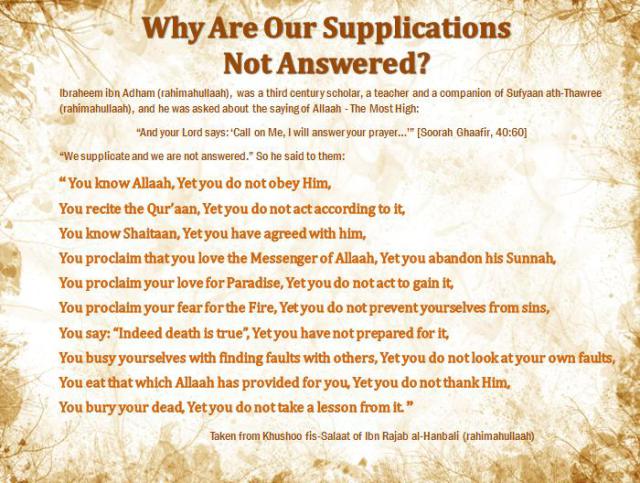
Why Are Our Supplicatiosn Not Answered? – Imam Ibn Rajab

Ibrahim ibn Adham – may Allah have mercy on him – a third century scholar, a teacher and a companion of Sufyan ath-Thawri, was asked about the saying of Allah – the Most High:

and your Lord says: “Call on me I will answer your prayer…” [40:60]

“We supplicate and we are not answered.”

So he said to them:

You know Allah, Yet you do not obey Him,

You recite the Qur’an, Yet do not act according to it,

You know Shaitan, Yet you have agreed with him,

You proclaim that you love Muhammad (Sallallaahu ‘alayhi  wa sallam) Yet you abandon his Sunnah,

You proclaim your love for Paradise, Yet you do not act to gain it,

You proclaim your fear the Fire, Yet you do not prevent yourselves from sins,

You say “Indeed death is true”, Yet you have not prepared for it,

You point out the faults with others, Yet you do not look at your faults,

You eat of that which Allah has provided for you, Yet you do not thank Him,

You bury your dead, Yet you do not take a lesson from it.”

by  Ibn Rajab al Hanbali from Khushu’ fis-salah 

 Why our Du'as are not answered