Our Salaf and The First 10 Days of Dhul-Hijjah – by Shaykh Fuad al-Amri [Audio|Ar-En]

Our Salaf and The First 10 Days of Dhul-Hijjah by Shaykh Fuad al-Amri

Shaykh Fu’ad ibn Sa’ud al-‘Amri (hafidhahullaah) is from the mashiykh of Jeddah and a member of The Saudi Commission for Enjoing Good & Forbidding Vice.

Listen / Download Mp3 Here (Time 50:23)

Many texts from the Qur’aan and the Sunnah indicate that these first ten days of the month of Dhul-Hijjah are better than all the other days of the year, including the last ten days of Ramadhaan. Our Salaf us Saalih(righteous predecessors), at the head of them, the Prophet (sallAllaahu ‘alayhi wa salaam) mentioned many of the virtues of these first ten days.

Ibn ‘Abbaas (may Allaah be pleased with him and his father) reported that the Prophet (sallAllaahu ‘alayhi wa sallam) said:

“There are no days in which righteous deeds are more beloved to Allaah than these ten days.” The people asked, “Not even jihaad for the sake of Allaah?” He said, “Not even jihaad for the sake of Allaah, except in the case of a man who went out to fight giving himself and his wealth up for the cause, and came back with nothing.” [Reported by Bukhaari, 2/457]

Ibn ‘Abbaas (may Allaah be pleased with him and his father) also reported that the Prophet (sallAllaahu ‘alayhi wa sallam) said: “There is no deed more precious in the sight of Allaah, nor greater in reward, than a good deed done during the ten days of Sacrifice.” He was asked, “Not even jihaad for the sake of Allaah?” He said, “Not even jihaad for the sake of Allaah, except in the case of a man who went out to fight giving himself and his wealth up for the cause, and came back with nothing.” [Reported by al-Daarimi, 1/357; its isnaad is hasan as stated in al-Irwaa’, 3/398]

These are just two of the many evidences mentioned by our Shaykh Fu’ad al-‘Amri (hafidhahullaah) in this highly beneficial reminder

Posted from: http://www.mpubs.org

Islaam Condemns Every Facet of Terrorism – by Shaykh AbdulLateef al-Kurdi [Audio|Ar-En]

Islaam Condemns Every Facet of Terrorism by Shaykh AbdulLateef al-Kurdi

Muwahhideen Publications is very pleased to announce a LIVE Tele-lecture on Friday 19th April 2013 with theNoble Shaykh Abu ‘Abdul Haqq ‘Abdul Lateef al-Kurdi (May Allah Preserve him) who is from the mashaayikh of Iraq. He is highly recommended by Shaykh Rabee’ al-Madkhalee as well as Shaykh ‘Ubayd al-Jaabiree(May Allah Preserve them).

Listen / Download Mp3 Here (Time 01:13:50)

Allah, the Most High said,

“And do not kill those souls whom Allah has prohibited except with a due right.”

And those souls that Allah has prohibited, it is referring to the life of a Muslim. And it is referring to everyone who has an agreement with the Muslims, and likewise those non-Muslims who have been given the right of safety by the Muslims.

The Messenger (sallAllahu ‘alayhi wa sallam) said in an authentic hadeeth reported by Imaam al-Bukhaari,

“Whoever kills a non-Muslim who has an agreement with the Muslims then he will not smell the fragrance of Paradise.”

The Esteemed Scholar Shaykh ‘Abdul Lateef al-Kurdi (hafidhahullah) will clarify this crucial issue for us such that there will remain no doubt regarding the Islaamic stance on these abominable acts.

We ask AllahAl-Haqq to show us the Truth and make it easy for us to follow it and make clear to us falsehood so we may stay away from it.

Posted from: http://www.mpubs.org

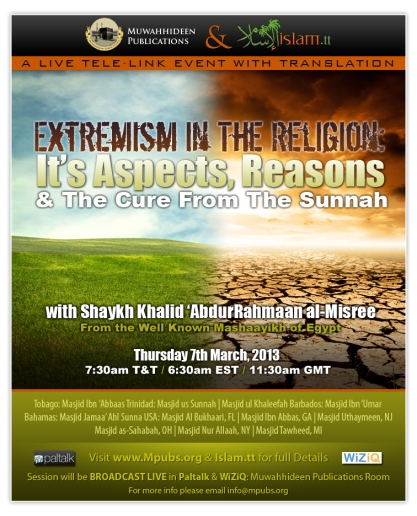
Extremism In The Religion: Its Aspects, Reasons and The Cure From The Sunnah – by Shaykh Khalid ibn AbdurRahmaan al-Misree[Audio|Ar-En]

Extremism In The Religion - Its Aspects, Reasons and The Cure From The Sunnah by Shaykh Khalid ibn 'AbdurRahmaan al-Misree

Listen / Download Mp3 Here (Time 01:08:51)

Allaah (Ta ‘alaa) says in the Qur’aan,

“O People of the Scripture, do not go to extremes in your religion and do not speak except the truth.” [Soorah an-Nisaa: 171]

“Say: O People of the Scripture, do not go to extremes in your religion beyond the truth and do not follow the inclinations of a people who had gone astray before – they misled many and themselves strayed from the correctness of the way.” [Soorah al-Maa’idah:77]

“In both of these verses there is a forbiddance for the “people of the scripture” – the jews and christians – from going to extremes in religion. And every statement in the noble Qur’aan directed towards the people of the scripture also includes this nation (the Muslims) because it is this nation that is the primary recipient and addressee of this book. So when Allaah forbids them from going to extremes, we are even more so forbidden to go to extremes.”

Additionally, it was narrated by ‘Abdullaah Ibn ‘Abbaas (radhiyAllaahu ‘anhu) that the Prophet (sallAllaahu ‘alayhi wa sallam) said,

“Beware of extremism in religion because the only thing that destroyed those before you was extremism in religion.” [An-Nasaa’ee and Ibn Maajah]

Moreover, ‘Abdullaah Ibn Masood ( radhiyAllaahu ‘anhu ) said: Allaah’s Messenger (sallAllaahu ‘alayhi wa sallam) repeated three times:

“The Mutanatti’oon are destroyed.” [Muslim]

An-Nawawee (rahimahullaah) explains, “The Mutanatti’oon are the overly-strict people; those who go too deep (into religious matters), the extremists, those who go beyond the permissible limits in their statements and actions.” [“The Forbiddance and Danger of Extremism” by Shaykh ‘Ali Ibn Yahya al-Haddaadi from AbdurRahman. org]

The Noble Shaykh Khalid ‘Abdur Rahmaan al-Misree (hafidhahullaah) will admonish us regarding this grave matter of extremism in the religion and expound on its aspects, reasons and the cure for this disease from the pure Sunnah of our beloved Prophet Muhammad (sallAllaahu ‘alayhi wa sallam).

We ask Allaah to make us from those who are balanced; those who neither fall into negligence nor exceed the limits.

Posted from: http://store.mpubs.org

The Favours of Allaah – Abu Muhammad al Maghribee [Audio|En]

Listen / Download Mp3 Here (Time 53:17)

Posted from: http://followthesalaf.com

Allaahumma a-innee alaa Dhikrika wa shukrika wa husni ibaadatika
O Allah! Help me to remember you, to thank you, and to worship you in the best of manners [Reference: Abu Dawud 2/86, An-Nasa’i 3/53. See also Al-Albani Sahih Abu Dawud 1 /284]

Killing Time ! – Shaykh Abdur-Razzaaq al-Badr

Some of the people squander time and waste their time with actions even in that which is impermissible. For this reason you find some of those people who are heedless, they make the expression using the words ‘killing time’ as if (time) is an enemy!! The time is a type of wealth and what goes away from it does not return. The one who has intellect, he is the one who values his time and he is cautious from killing and squandering it.

قتل الوقت
قتل « يتضايق بعض الناس من الوقت ويعمل على تضييعه حتى في الحرام ، ولهذا تجد عند بعض الغافلين التعبير بكلمة
كأنه عدو!!، والوقت غنيمة وما ذهب منه لا يعود، والعاقل هو من يغتنم أوقاته ويحاذر من قتلها وتضييعها » الوقت .

Translator: Abu Anas Atif Hasan
http://al-badr.net/muqolat/2670

Posted from: Al-Binaa Publishing | Durham NC

Ibn Abbas narrated that Prophet Mohammad (Sallalaahu Alaihi wa Sallam) said:

“There are two blessings which many people lose: (They are) health and free time for doing good.” (Bukhari 8/421)


The Honourable Status of The Scholars in Islaam – by Ash-Shaykh ‘AbdurRahmaan al-‘Adani [Audio|Ar-En]

The Honourable Status of The Scholars in Islaam by Ash-Shaykh 'AbdurRahmaan al-'Adani

The Shaykh is from the senior scholars of our time, from the students of Ash-Shaykh Muqbil ibn Hadi’ al-Wad’ee (rahimahullaah)and is in charge of Dar-ul-Hadeeth, Baalfeewush, in ‘Aden, YemenShaykh ‘AbdurRahmaan is highly praised as an ‘Alim of Ahl Sunnah by Shaykh Rabee’ al-MadkhaleeShaykh ‘Ubayd al-JaabireeShaykh Muhammad ibn Hadi al-MadkhaleeShaykh Muhammad ibn ‘Abdul Wahhaab al-Wasaabee (May Allaah preserve them all) and many others.

Listen / Download Mp3 Here (Time 01:15:41)

Allaah says in His Book,

“Say: Are they equal, those who have knowledge and those who do not? But only the men of understanding will take admonition.” [Soorah Zumar 39:9]

Allaah will raise up in degrees those of you who believe and those who have been granted knowledge.”
[Soorah al-Mujaadalah 58:11].

“It is only those who possess knowledge amongst His slaves that fear Allaah
[Soorah Faatir 35:28].

The Prophet (sallAllaahu ‘alayhi wa sallam) asserted,

“The superiority of the scholar over the worshiper is like that of the moon over the rest of the stars.”
[Abu Dawood and Tirmidhee]

Thus, those who have also been described as the ‘inheritors of the prophets’ by our Noble Messenger(sallAllaahu ‘alayhi wa sallam) hold an honourable and lofty station in the deen of Islaam. They are those who clarify the affairs of the religion to us and teach us that which will aid us in this life and the next. Therefore, it is incumbent upon us to recognize this high rank of theirs and give them their due right and not fall short in this matter.

Imaam Ahmad (rahimahullaah) beautifully described the reality of the scholars in the following,

“All Praise is for Allaah Who, in every age and interval between the Prophets, raises up a group from the People of Knowledge who call the misguided to guidance and patiently bear ill-treatment and harm. With the Book of Allaah they give life to the dead, and by Allaah’s light they give sight to the blind. How many a person killed by iblees have they revived. How many people astray and wandering have they guided. How beautiful their effect has been upon the people, and how vile people have been towards them. They repel from the Book of Allaah the alterations of those going beyond bounds, the false claims of the liars and the false interpretations of the ignorant ones-those who uphold the banner of innovation and let loose the trials and discords.” [Ar-Radd ‘alal-Jahmiyyah waz-Zanaadiqah of Imaam Ahmad ibn Hanbal]

Our Shaykh ‘Abdur Rahmaan al-Adani (hafidhahullaah) will admonish us regarding this affair and by the Permission of Allaah cause us to truly understand and respect the honourable status of our scholars.

We ask Allaah to grant us beneficial knowledge and to place in our hearts sincere love for the ‘ulamaa` ofAhlus-Sunnah.

http://store.mpubs.org/

From the barriers of seeking knowledge : Taking knowledge from the Asaaghir (young) – By Shaykh Abdus Salaam bin Burgess

Certainly there has appeared between the students of knowledge during this time, the taking of knowledge from those young in age. This phenomenon in reality is a cancerous disease and a chronic illness and it hinders the student of knowledge from his intent and turns him away the sound path that will connect him to knowledge.

That is because taking knowledge from those who are young in age; those who did not firmly establish their feet in knowledge, their beards did not become grey within it (they did not spend a long time with seeking knowledge) along with the presence of those older than them in age, whose feet are grounded, because of this the foundation of the beginner is weak. He is prevented from the benefit of the experience of the major scholars and attainment of their manners which is established by knowledge and time.

And from the evidences that give reason to this is the athar of Ibn Mas’ud (may Allaah be pleased with him) when he said:

“The people will not cease to be upon good as long as they take knowledge from their elders, their trusted and their scholars. If they (begin) taking knowledge from their sighaar and evil ones, then they are destroyed”

There is the affirmed Hadeeth on the authority of Abi Umayyah al Jamhee, that the Messenger of Allaah ملس و هيلع الله ىلص said:

“From the signs of the hour is when knowledge sought from al-asaagheer”

The people have differed in relation to the explanation of the word: “as-sighaar”.

There is some speech which Ibn Abdul Barr (may Allaah have Mercy on him) mentioned in al-Jaami’ and ash-shatibi (may Allaah have Mercy on him) mentioned in al-i’tisaam.

Ibn Qutaybah (may Allaah have mercy on him) took the view that as-sighaar are those who are young in age. And he said regarding the athar of Ibn Mas’ud:

“He intended that the people will not cease to be upon good as long as their scholars are mashaayakh (old) and that their scholars are not young (in age), because the shaykh (elderly) has left the pleasure of youth, his temper, his hastiness, his foolishness and he prefers practice and experience and nothing doubtful enters into his knowledge, his desires do not overcome him and he is not tempted by lust or greed. Shaytan does not cause him to fall (but) causes the young to. The one with age has dignity, honor and prestige.”

The young maybe will enter into some of these affairs that the elderly is safe from. If these affairs enter into him and he makes a ruling (then) he is destroyed and destroys others.

Ibn abdul Barr reported that Umar Ibn al-Khattaab (may Allaah be pleased with him) said:

“I knew when the uprightness of the people (was present) and when they became corrupted. When (an issue) of fiqh came from the young (in age) the elderly turned away from following them. And when (an issue) of fiqh came from the elderly; the young followed them and they were both guided.”

Ibn Abdul Barr also reported on the authority of Aboo Ahwas from Abdullah who said:

“Certainly you will always remain upon good as long as knowledge is found in your elderly and when knowledge is found in your young, the young will make the elderly appear foolish.”

In these two Athars are proofs for not taking knowledge from the young. Another besides which Ibn Qutaybah mentioned and it was fear of accepting knowledge if it came from the youth. At any rate, if its wording; as-sagheer is general (then) it is used in a way perceived and meaning (young in age).

This ruling is not without exception regarding the young in age, since a group from amongst the companions and taabi’een used to give fataawa and teach during their youth in the presence of those old in age. Certainly it is rare to find the likes of these individual so what about anyone after them. If they (the young) were present and their uprightness was known and their knowledge was examined and its firmness was apparent and no one from amongst the elders were found, then whatever knowledge they (the young) had with them was taken and safe from fitnah.

Hajjaaj bin Ar-Taah said:

“The people use to dislike that a man speak until grey was seen in his beard.”

The intent is not that knowledge of the young should be abandoned in the presence of the old; no! The intent is only to put people in their proper places. So the right of the intelligent young student is that he is benefited from in research, giving reminders and studies. As for putting him forward for giving rulings and questions being put forward to him the no! Certainly no! Because this will kill him and this is a fitna and deception.

Fudayl ibn Iyaad said:

“If you see a man gathering the people around him, then I say this (person) is crazy. What person gathers the people around him and does not like that they make good his speech”

He also said:

“It has reached me that the scholars of the past when they learned they acted, and when they acted they became busy,When they became busy they became lost (missing) and when they became lost they were sought (after) and when they were sought they fled “

So O seeker of knowledge if you desire knowledge from its source (fountain) then, here are the major scholars, those whose beards have become grey and bodies have become frail and strength have become weak (being exhausted) in knowledge and learning. Their commitments are before their lost and they bring out their treasures before they pass away (along) with them. (As) in the darkness of the night the Badr (moon) passes away.

A point of attention:

During these times the standards have been greatly blemished by the common people regarding properly estimating the scholars. So every individual who can give an eloquent speech, or a meaningful lecture, or a Friday sermon haphazardly becomes a scholar. He then becomes someone returned to for rulings and knowledge is taken from him. This is a painful and apparent affliction which its evil is airborne and it harms is circulated. When the connection of knowledge is (connected) to other than its people and when the affair (are in the hands) of other than its people, then look for the hour (Day of Judgment)

So the student must be warned of taking knowledge from these (types). Except if they are known to be from people who possess knowledge. Not everyone who has good expression is a scholar and not everyone who turns the people’s faces towards him with issues regarding the leaders of the Muslims or the mentioning of the death rate of aids and whatever is similarly to that is a scholar.

(Also) the meaning is not what has proceeded – as some understand it- ex. Not listening to them (the young in age) or not benefitting from their talks, No! The intent is only taking legislative knowledge from them and not raising them to the levels of the scholars and Allaah is the One Who gives success.

Translated by Abu Anas Atif Hasan
May Allaah make this a benefit for myself and the reader
burjes.com/burjes_article012.php

Posted from: Al-Binaa Publishing

The Importance of Returning To The Scholars in Times of Fitnah – Shaykh Muhammad Ramzaan al-Haajiree [Audio|Ar-En]

The Importance of Returning To The Scholars in Times of Fitnah by Shaykh Muhammad Ramzaan al-Haajiree

Listen / Download Mp3 Here (Time 19:31)

From the very nature of fitnah (trial and discord) is that matters become confused, mistakes increase, and minds and intellects begin to swerve. Protection and safety from this, in such times lies in the Jamaa’ah; at the head of which are the scholars. So it is obligatory upon the people – those leading and those being led – to take hold of the sayings of the Scholars and to act upon them. Since the general masses are pre-occupied with issues of fitnah, wherein they begin to express their own opinions, only leads to an increase in the fitnah and further splits the Ummah. So the umoorul-‘aammah (affairs pertaining to public benefit and welfare) – from the matters related to peace, security and fear – should be referred back to those who possess sound knowledge and understanding, as Allah, The Most High  has said,

“When there comes to them some matter related to public welfare of security or fear, they make it known amongst the people. If they had referred it back to the Messenger (sallAllahu ‘alayhi wa sallam), or to those in authority amongst them, then the proper people would have investigated and evaluated the matter from them. Were it not for the Grace and Mercy of Allah upon you, you would have indeed followed Shaytaan – except for a few of you.” [Soorah an-Nisaa: 83]

Imaam as-Sa’dee (d.1376H) – rahimahullah –said,

“This is the disciplinary admonition from Allah to His Servants with regards to their unbefitting action. And it is a must for them, that when there comes to them some news concerning important issues such as issues connected to public welfare and safety of the Believers, or those that are related to breach of security, or fear of a calamity befalling them, that they should first verify such news and not be hasty in spreading it. Rather, they should refer such issues back to the Messenger (sallAllahu ‘alayhi wa sallam) and to the people in authority; those who possess knowledge, understanding, sound advice, intellect, maturity and composure; those who understand the affairs and have knowledge of the associated benefits and harms. If they see that in broadcasting it there is a benefit and a cause of happiness for the Believers, and a means of protection from their enemies, then they should do so. This is why Allah said: “Then the proper people would have investigated and evaluated the matter from them.” Meaning: they would evaluate it with their sound understanding and their firm and correct knowledge. So in this is an evidence for an important principle, which is, if there arises a need to investigate a particular issue, then it is obligatory that it be left to those who are qualified for it, and no one should precede them in this – and this is close to what is correct, and safer from error. And in this is also a prohibition of being hasty and impatient in spreading the news as soon as they hear it. Likewise there is a command to reflect and consider before speaking, so he looks into it to see if there is a benefit in doing so, if so he embarks upon it, and if not, he abstains from it.”

[Tayseerul-Kareemur-Rahmaan (2/54-55). Refer also to Qawaa’id fee Ta’aamul ma’il-‘Ulemaa (p.121)]

Thus, we understand that it is absolutely imperative for us to take recourse in the Book of Allah and theSunnah of His Messenger (sallAllahu ‘alayhi wa sallam) in these times of great fitnah. Our Shaykh Muhammad Ramzaan (hafidhahullah) will offer a timely admonition concerning the grand importance we must place on returning to the Scholars, who are the Inheritors of the Prophets, in these times of innumerable trials and tribulations.

We ask Allah to keep our feet firm upon the Straight Path and we seek refuge in Him from ever deviating from it.

Posted from: http://store.mpubs.org

Characteristics of The Saved Sect – by Shaikh ‘Abdullaah Al-Bukhaaree (hafidhahullaah)

Bismillaah Al-Hamdulillaah wa salatu wa salaamu ‘ala rasulullaah
Amma-ba’d

[The following is a summary of an extremely beneficial portion of a highly beneficial advice the shaikh gave a few years ago]

Shaykh ‘Abdullaah al-Bukhaaree said:

This Saved Sect, who are also this Aided and Victorious Group, those who are upon this blessed da’wah, they are known through different characteristics and signs. We will mention the most important of them, as a summary.

In summary, the people of The Saved Sect are upon the manhaj of the Prophet (salallaahu ‘alayhi wa sallam) and his companions (radiallaahu ‘anhum) after him. They are not upon anything else. This is a summary, the answer in brief.

In detail [the shaikh mentioned nine points:]

1- From the main characteristics of what distinguish The Saved Sect and those who adhere to it is that they are those who establish servitude to Allaah alone. And they [establish] the Deen sincerely for Allaah Subhanahu wa Ta’aala. They worship Allaah alone, not associating anyone or anything with Allaah in worship.

2- They single out the Prophet (salallaahu ‘alayhi wa sallam) in ittiba’ (following). They follow the Messenger of Allaah (salallaahu ‘alayhi wa sallam).

3- They adhere to the understanding of the Salaf-us-Saleh (radiallaahu ‘anhum), the righteous predecessors. And we have [already] brought to you the adila (the proofs) from the legislation, wherein we are commanded to adhere to the way of the Salaf-us-Saleh, and we have been prohibited from going against that which they were upon.

4- To beware of and warn against bid’ah and Innovators, and sin and sinners.

5- Al-Waasatiyah (adhering to the middle course in this religion) between the two extremes – al-ghuloo (going beyond the boundaries) and jafaa` (negligence).

6- They are firm upon the haqq (truth) and adhere to it.

7- They are so eager and diligent and concerned to be united in the most harmonious way upon the truth – upon the Book and the Sunnah. And you find them against division and differing. They call the people to be united and kind and gentle with one another and to have harmony, and likewise they call against division and differing. And they do all this upon the truth, while using the truth itself. So they call to the true unity upon the truth, using the truth itself to call to it. Not any [kind of] unity [such as the people of bid’ah – such as Ikhwanul Muslimeen – who call to uniting upon falsehood]. And they warn against division and differing, in truth – using the truth itself.

8- They constantly busy themselves with seeking knowledge, the beneficial knowledge. They learn beneficial knowledge of this Deen, and they disseminate it amongst the people and call to it, (and) while doing all this – learning, disseminating and calling – they are patient upon the harms they may encounter and face.

9- Acting upon the knowledge, not just having knowledge.

And there are so many proofs from the revelations [Qur`an and Sunnah] and the Seerah of the Prophet (salallaahu ‘alayhi wa sallam) and his companions, and the Imams of this religion. They’re all proof to what we mentioned. From all these proofs, I will choose only one, a great hadeeth that comprehensively comprises all that we have mentioned – the hadeeth of Al-‘Irbaad ibnu Saariyah (radiallaahu ‘anhu), which we mentioned earlier. However, in sha` Allaah, there will be a benefit in repeating this matter.

Al ‘Irbaad bin Saariyah (radiallaahu ‘anhu) said:

“The Messenger of Allaah (sallallaahu ‘alayhi wasallam) admonished us one day after the early morning prayer. The admonition was heartfelt and eloquent and caused the eyes to shed tears and the hearts to tremble. A man from amongst us said, ‘Certainly, it is as if this is a farewell admonition, so with what do you advise us, O Messenger of Allaah (sallallaahu ‘alayhi wasallam)? He replied:

“I advise you to fear Allaah, and to listen and obey those in authority over you even if it were a slave. Indeed, whoever from amongst you lives long will witness much differing. So incumbent upon you is my sunnah and the sunnah of the rightly-guided khulafaa (Caliphs) after me. Bite onto it with your molar teeth. And beware of newly invented matters (in the religion), for verily every newly invented matter (in the religion) is a bid’ah, and every bid’ah is a misguidance.”

Contemplate carefully upon this great hadeeth that comprises all these characteristics of this noble methodology that distinguish The Saved Sect.

1- It includes the Prophet (sallallaahu ‘alayhi wasallam) advising us with Taqwa, and by achieving Taqwa you will achieve the ‘Uboodiyah (the worship of Allaah alone).

2- And it includes the Prophet (sallallaahu ‘alayhi wasallam) commanding us with his Sunnah, this means that you single out the Prophet in following, and he is to be followed in this Deen.

3- And it includes the Prophet (sallallaahu ‘alayhi wasallam) advising us with following the Sunnah of the rightly-guided Khulafa (Caliphs), and in it is a command to follow their understanding, the understanding of the Salaf-us-Saleh, as has already preceded.

4- And it includes the Prophet (sallallaahu ‘alayhi wasallam) warning against bid’ah. We take from that to beware and warn against bid’ah and its people.

5- That you understand the Sunnah [the whole Deen] with the understanding of the Salaf-us-Saleh; this is how you will be from those people who always stay on the middle course, not to fall into one extreme or the other. Likewise, it is taken from the statement of the Prophet (sallallaahu ‘alayhi wasallam): Whoever from amongst you lives long will witness much differing. —> This difference is due to either one extreme or the other – Ghuloo and Jafaa`.

6- Warning against division, that division and separation that is blameworthy. This is taken from the Prophet’s statement: Whoever from amongst you lives long will witness much differing… So therefore, the one who holds firmly onto the Sunnah of the Messenger of Allaah (sallallaahu ‘alayhi wasallam), he is saved from differing and division. And from that also is the command to be united upon the truth – also taken from the Prophet’s statement: So incumbent upon you is my sunnah and the sunnah of the rightly-guided khulafaa (Caliphs) after me. Bite onto it with your molar teeth.

It is well known, my dear brothers, that these characteristics and these beautiful distinguishing points of The Saved Sect, it is impossible to put them into application without beneficial knowledge. Ibnu Taymeeyah (rahimahullaah Ta’aala) said: All good and rectification and perfection is limited to beneficial knowledge and righteous actions.

So if someone wants good and rectification and reform that is correct, it is limited and restricted to beneficial knowledge and acting upon it with righteous actions…

Earlier, Shaykh ‘Abdullaah al-Bukhaaree had said: The Saved Sect are pleased with Allaah as a Lord, Islaam as a religion, and Muhammad (salallaahu ‘alayhi wa sallam) as a Prophet and Messenger.

Post Courtesy: Maher ibn Ahmad 

The Saved Sect and its Pillars – by Shaikh Muhammad Ibn ‘Umar Bazmool (hafidhahullaah)

Bismillaah Al-Hamdulillaah wa salatu wa salaamu ‘ala rasulullaah
Amma-ba’d

[The following are notes – not verbatim – from a telelink a few years ago]

After khutbat al-Hajjah, Shaikh Muhammad Bazmool meticulously laid out his talk with the following index:

1- Ta`ifatul Mansoora (Aided Sect)
2- Firaaq (the division)
3- Meaning of Firaaq (sects)
4- Meaning of the Messenger’s (salallaahu ‘alayhi wa sallam) statement “All in the fire except one”
5- Arkan, Usool (Pillars, Foundations) of The Saved Sect

Then the shaikh gave a brief beneficial explanation [the following are notes – not verbatim]:

1- The Saved Sect is a name from the names of Ahlus-Sunnah, such as Ahlul-Hadeeth. They are those who hold on to the Sunnah. They will be victorious over the others, sometimes via the sword and sometimes via evidences and proofs. The Messenger (salallaahu ‘alayhi wa sallam) said (what means): There will never cease to be a group from my Ummah upon the truth, uppermost. They will not be harmed by those who desert them or those who oppose them, until the affair of Allaah – the Blessed and Exalted – arrives, and they are in this state. Even during the time of ‘Eesa (Jesus, ‘alayhi salaam)…

2- The name Najia (saved) gives proof to the fact that there will groups which are not saved. The Messenger of Allaah (salallaahu ‘alaihi wa sallam) said (what means): This Ummah will divide into 73 sects, all of them in the hellfire except one. He was asked, “Which one is that, o Messenger of Allaah?” He (salallaahu ‘alaihi wa sallam) said: That which I and my companions are upon. [Abu Dawud, Ibn Maajah, Ahmad, Ad-Daaramee]

3- Firqa (sect) is those who follow a man or book or principle – other than the Messenger (salallaahu ‘alaihi wa sallam) and what he came with – and call to it, and love and hate for its sake. This is a firqa, such as Ikhwanul Muslimeen, Firqat at-Tableegh, Hizb-ut-Tahreer, Surooris, (and Raafidah, Soofiyah, Qadriyah, Ash’ariyah, Mu’tazila, Jahmeeyah, Murji’a).

So the Ikhwanul Muslimeen call to what ——> (founder) Hassan Banna said, and love and hate for his sake.

Likewise, the Tableeghis [call to what ——-> (founder) Muhammad Ilyas said, and love and hate for his sake]

[Hizb-ut-]Tahreeris [call to what ——-> (founder) Taqiuddeen an-Nabahani said, and love and hate for his sake]

Surooris [call to what ——-> (founder) Muhammad Suroor said, and love and hate for his sake]

The only group that is saved are those who make the Messenger (salallaahu ‘alaihi wa sallam) and what he came with the origin, and love and hate according to it. The other sects love and hate according to what Banna said or [Muhammad Ilyas said, or what Taqiudeen An-Nabahani , or what Muhammad Suroor said.]

4- The Messenger (salallaahu ‘alaihi wa sallam) issued a ruling with his statement “All in the fire except one.” The scholars mentioned this text is from the texts of threat. If Allaah wills, He will punish them, and if He wills, He will forgive them, as long as they do not die upon Shirk or nullify their Islaam.

Allaah (what means) said: Verily, Allaah forgives not that partners should be set up with him in worship, but He forgives except that (anything else) to whom He pleases, and whoever sets up partners with Allaah in worship, he has indeed invented a tremendous sin. (An-Nisa, ayah 48)

All these groups – other than The Saved Sect – subject themselves to the threat of the fire. These deviant Sects are two:

  1. a- Sects that oppose the Messenger, and exit Islaam
  2. b- Sects that oppose the Messenger, and do not exit Islaam

5- The Arkan, Usool (Pillars, Foundations) of The Saved Sect are four:

Firstly, al-Ikhlaas (sincerity).

The people of The Saved Sect know that Allaah is Ar-Raqeeb (All-Watcher) and do actions only for Allaah.

Allaah said (what means): And they were not commanded except that they should worship Allaah, purely and sincerely, singling Him out in worship (abstaining from ascribing partners to Him), and to establish the Salaat and give Zakat: and that is the upright religion. (Al-Baiyinah, ayah 5)

The Prophet (salallaahu ‘alaihi wa sallam) said (what means): I have been commanded to fight the polytheists until they testify ‘there is none worthy of worship except Allaah, and Muhammad is His slave and Messenger.’

Secondly, following the Sunnah.

The Saved Sect are eager to follow the Sunnah.

Allaah said (what means): And whoever contradicts and opposes the Messenger (Muhammad, (salallaahu ‘alayhi wa sallam)) after the right path has been shown clearly to him – and follows other than the believers’ (companions’) way – We shall keep him in the path he has chosen, and burn him in Hell. What an evil destination. (An-Nisa, ayah 115)

Allaah said (what means): And let those who oppose the Messenger’s (Muhammad) commandment (i.e. his Sunnah legal ways, orders, acts of worship, statements, etc.) (among the sects) beware, lest some Fitnah (disbelief, trials, afflictions, earthquakes, killing, overpowered by a tyrant, etc.) befall them or a painful torment be inflicted on them. (An-Nur, ayah 63)

Allaah said (what means): It is not for a believer, man or woman, when Allaah and His Messenger have decreed a matter that they should have any option in their decision. And whoever disobeys Allaah and His Messenger, he has indeed strayed in a plain error. (Al-Ahzab, ayah 36)

Allaah said (what means): But no, by your Lord, they can have no Faith, until they make you (O Muhammad) judge in all disputes between them, and find in themselves no resistance against your decisions, and accept (them) with full submission. (An-Nisa`, ayah 65)

The Prophet (salallaahu ‘alaihi wa sallam) said (what means): Whoever introduces or invents something into this affair (Deen) of ours, it will be rejected.

The Prophet (salallaahu ‘alaihi wa sallam) said (what means): Whoever does an action that is not in accordance with this affair (Deen) of ours, it will be rejected.

Imam Ahmad (rahimahullaah) said: Do not speak about a matter except if you have an Imam preceding you [in that statement].

And these first two foundations stem from the shahadatain. The Saved Sect know the only way to be saved from the fire is by following the Messenger (salallaahu ‘alaihi wa sallam). The Prophet (salallaahu ‘alaihi wa sallam) said (what means): I am leaving you two things, and you will never go astray as long as you cling to them – they are the Book of Allaah and my Sunnah.

Thirdly, warning against bid’ah and its people.

The Messenger (salallaahu ‘alaihi wa sallam) warned of this in every khutbah, with his statement: Beware of the newly invented matters, for every bid’ah is misguidance… The Messenger (salallaahu ‘alaihi wa sallam) taught the companions this. And bid’ah is to worship (or believe) other than the way the Messenger (salallaahu ‘alaihi wa sallam) taught. This is one of the points that distinguish The Saved Sect; they warn against bid’ah and its people, and do not accept hizbiyyah nor cooperate with them.

Allaah said (what means): And whoever contradicts and opposes the Messenger (Muhammad, (salallaahu ‘alayhi wa sallam)) after the right path has been shown clearly to him – and follows other than the believers’ (companions’) way – We shall keep him in the path he has chosen, and burn him in Hell. What an evil destination. (An-Nisa, ayah 115)

‘Abdullaah ibn Mas’ood (radiallaahu ‘anhu) said: Follow and do not innovate, for you have been sufficed. The Salaf (radiallaahu ‘anhum) used to warn against bid’ah, and wrote many books regarding this, such as I’teesam, Ash-Shatabee…

Fourthly, sticking to the Jama’ah and not dividing.

And his (sallallaahu ‘alayhi wa sallam) statement in the hadeeth of Al ‘Irbaad bin Saariyah (radiallaahu ‘anhu), who said: “The Messenger of Allaah (sallallaahu ‘alayhi wasallam) admonished us one day after the early morning prayer. The admonition was heartfelt and eloquent and caused the eyes to shed tears and the hearts to tremble. A man from amongst us said, ‘Certainly, it is as if this is a farewell admonition, so with what do you advise us, O Messenger of Allaah (sallallaahu ‘alayhi wasallam)? He replied: I advise you to fear Allaah and to listen and obey those in authority over you even if it were an Abyssinian slave. Indeed, whoever from amongst you lives long will witness much differeing. So incumbent upon you is my sunnah and the sunnah of the rightly-guided khulafaa (Caliphs) after me. Bite (hold) onto it with your molar teeth. And beware of newly invented matters (in the religion), for verily every newly invented matter (in the religion) is a bid’ah, and every bid’ah is a misguidance.”

All four foundations of Salaffiyah are in this above hadeeth:

Ikhlaas is in the Messenger’s statement, “Fear Allaah.”

Following the Sunnah is in the Messenger’s statement, “Upon you is my Sunnah.”

Warning against bid’ah and its people is in the Messenger’s statement, “And beware of newly invented matters.”

Sticking to the Jama’ah and not dividing is in the Messenger’s statement, “Listen and obey those in authority over you, even if it were an Abyssinian slave.”

So hold on to the jama’ah; as for people who want to cause chaos, they accuse the rulers, they rally people against the rulers. The People of The Saved Sect advise people to obey the ruler.

In the hadeeth of Hudhaifah bin al-Yamaan (radiallaahu ‘anhu), he said: “People used to ask the Messenger of Allaah (salallaahu ‘alayhi wa sallam) about the good times, but I used to ask him about bad times lest they overtake me.

I said: O Messenger of Allaah, we were in the midst of ignorance and evil, and then Allaah brought us this good (time through Islam). Is there any bad time after this good one?

He said: Yes.

I asked: Will there be a good time again after that bad time?

He said: Yes, but therein will be a hidden evil.

I asked: What will be the evil hidden therein?

He said: (That time will witness the rise of) the people who will adopt ways other than mine and seek guidance other than mine. You will know (their) good points as well as (their) bad points.

I asked: Will there be a bad time after this good one?

He said: Yes. (A time will come) when there will be people standing and inviting at the gates of Hell. Whosoever responds to their call they will throw them into the fire.

I said: O Messenger of Allaah, describe them for us.

He said: All right. They will be a people having the same complexion as ours and speaking our language.

I said: O Messenger of Allaah, what do you suggest if I happen to live in that time?

He said: You should stick to the main body of the Muslims and their leader.

I said: If they have no (such thing as the) main body and have no leader?

He said: Separate yourself from all these factions, though you may have to eat the roots of trees (in a jungle) until death comes to you and you are in this state.” (Collected by Bukhari and Muslim. The wording of the above is that of Imaam Muslim)

—-

In Shaikh Muhammad Bazmool’s Book “The Salafi Methodology“, he explained these foundations in detail, in addition to the legislated means of adherence to The Saved Sect and safety from bid’ah and hizbiyyah, and the legislated means to individual and communal rectification, in addition to many other benefits.

Here is an excerpt of this highly recommended book. On page 47 of the translated version, the shaikh wrote:

“There are distinct characteristics and qualities that the true Salafi is known by as opposed to those who falsely claim to adhere to the Salafi methodology. From these characteristics are the following:

  1. The first characteristic: Their allegiance and disassociation (al-walaa wal-baraa) revolves around following the way of the Messenger (salallaahu ‘alayhi wa sallam).
  2. The second characteristic: Their hallmark is that they follow [the Sunnah].
  3. The third characteristic: They are upon moderation in all their affairs.
  4. The fourth characteristic: They are a people who are united and in agreement, and they are firm and resolute upon the truth.
  5. The fifith characteristic: They work towards the establishment of the Religion through the seeking of correct Islaamic knowledge and its application.

Here is a detailed explanation of these characteristics: …” [The explanation of these characteristics begins on page 48 and continues through page 100, before the beginning of the ensuing chapter. It is a highly recommended book, especially in these times when people wear the clothes of Salafiyyah in order to fight it! Allaahul Musta’aan!]

Post Courtesy: Maher ibn Ahmad

Do you know why their speech was so sweet? – Al-Fudayl b. ‘Ayyâd (rahimahullaah)

The Sweetest Words [Ikhlas]

It is reported that the son of Al-Fudayl b. ‘Ayyâd – Allâh have mercy on him – said to his father:

“Father! How sweet (beautiful) the speech of the Companions is!”

[Al-Fudayl] said, “Son, do you know why it was so sweet?”

He replied, “No father, I do not.”

He said, “Because they sought Allâh the Exalted when they spoke.”

Al-Bayhaqî, Shu’ab Al-îmân 2:299

Source: http://www.sayingsofthesalaf.net/topic/ikhlas/#ixzz2dbzdBT9t

[Inspirational] At the Doorstep of Knowledge – Hadith

بسم الله الرحمن الرحيم

At the Doorstep of Knowledge

 It is reported from ‘Abdullâh b. ‘Abbâs – Allâh be pleased with them – that he said:

After Allâh’s Messenger – Allâh’s peace and blessings be upon him – passed away, I said to a man from the Ansâr, “Come, let us ask [and learn from] the Prophet’s Companions, Allâh’s peace and blessings be upon him, for they are many in number today.” He replied, “I am surprised at you Ibn ‘Abbâs – do you really think people need you when there are so many Companions of the Prophet – Allâh’s peace and blessings be upon him?” So he did not involve himself in this endeavor, but I busied myself asking [the Companions about issues]. If I heard of a hadîth being reported by a man, I would come to him and if he was taking his midday nap I would lay down my garment and lie outside waiting for him, with  the wind blowing dust in my face. The man would come out [for Dhuhr] and see me in that state, and he would exclaim, “O nephew of Allâh’s Messenger! What has brought you here? You should have sent for me and I would have come to you!” I would say, “Rather I should come to you [to seek knowledge].” I would then ask him about the hadîth I heard. The man [who I originally invited to seek knowledge with me] remained as he was, and when he saw how people would gather around me [to seek knowledge] he said, “For sure, this young man was more intelligent than me.” [Al-Dârimî, Al-Sunan Vol. 2 p129.]

Source: http://www.sayingsofthesalaf.net

Did the Sahaba Differ in ‘Aqīdah? | Al-‘Allâmah Sâlih al-Luhaydān [Video|Ar-En Subtitles]

Video Courtesy: DawahSalafiyaah

Questioner:

“There are those who come forth and claim that the Sahaabah differed in matters of ‘Aqeedah. What is the ruling on this? Please give us a fatwa, may you be rewarded.”

Al-‘Allâmah Sâlih al-Luhaydan:

“Astaghfirullaah! No one says this, except a misguided innovator. He says that the Sahaabah differed whilst the Sahaabah were people of ‘aqeedah. If there was any disagreement between them, then it was merely in some of the affairs of ijtihaad related to deeds.

As for the affairs of ‘aqeedah, that Allah is One and that He is All-Hearing and All-Seeing, and that He does what He wills, that He is the Supreme Creator, and that He is the Creator of everything and that He is aware of everything.

No! They did not differ (in Aqeedah). And no one brings up this affair, except a caller to fitnah. Except that he disguises himself — with his claim — that he is from the people of goodness. He may have known some good and started to speak with the good he knows, to mislead the people and drag them into the falsehood that he is inclined to and is eager in spreading.

If he is from those who are deceived, let him seek Allah’s forgiveness and repent to Him and let him return to the people of knowledge and ask them. And if he is from those who like to conceal their agendas and cover their true objectives let him be exposed so the people can be protected from his evil.”

Related Links:

Why do deviants say that the Sahaaba differ in ‘aqeedah? So they can justify their hizbiyyah and their differing. They work night and day to try to find differing of the sahaaba, so they can justify their opposition to the Sunnah – i.e. sahaabah differed so we can differ.

If I Supplicated to Allaah with the name Ali – By: Shaykh Saalih al-Fawzan

Question:

May Allaah treat you well. The questioner asks; If I supplicated to Allaah with the name ” O Ali” (without the adding the AL in front of it) intending the name of Allaah; al-Ali العلي (the Most High) is this imitating the actions of the Raafidah (Shia) those who seek aid from other than Allaah?

Answer:

(Do not say) Ali only (say) علي عظيم (the Most High, the All Mighty) as Allaah says; “He is al-Ali al-Atheem” (2:225)

Why don’t you say ع لي عظ يم Ali Atheem (as mentioned in the ayah) (so) that you will be safe from what you have said; fearing that you maybe supplicating to Ali Ibn Abee Taalib. So if you would have said; O Ali O Atheem (together) as mentioned in the ayah, you would be protected from this accusation.

Translated by: Abu Anas Atif Hasan
http://alfawzan.af.org.sa/node/14826

Posted with Permission from : Al-Binaa Publishing | Durham NC

Related Links:

With what do you direct the student and the beginning seeker of knowledge with? – Shaykh Saalih al-Fawzan

Question:

We Hope to open this meeting O virtuous Shaykh with a question from one of the brothers who says: “Shaykh Sālih with what do you direct the students of knowledge or similarly the beginning students of knowledge and those who have begun and what are the books you advise they begin with, in their quest for knowledge and what is the reward for acquiring Islāmic knowledge?”

Answer:

With the Name of Allāh, Ar-Rahmān Ar-Rahīm, and all praises are for Allāh the Lord of everything that exist may the salāt and salām be upon our Prophet Muhammad صلى الله عليه وسلم, his family and all of his Companions.

This an important question and it is how one should seek knowledge and how the student of knowledge should begin and who knowledge should be sought from and what are the books one should begin with and what is the important type of knowledge from all the (different) studies of knowledge.

So I say, and with Allāh is the success, without doubt seeking knowledge is an important affair. Allāh جل وعلا says: “Know! That none has the right to be worshipped except Allāh, and ask for forgiveness of your sins and for the male and female believers” (47:19)

Imām al-Bukhārī (May Allāh have mercy on him) said in his chapter “Knowledge proceeds speech and action”  then he mentioned this verse.

This is because if actions are not based upon knowledge, founded upon knowledge, then it is misguidance and tiring without benefit.Because the affair is like this it’s an obligation upon the Muslim to seek knowledge.

And this (knowledge) is categorized into two categories.

This first category ofKnowledge:

That which the Muslims religion will not be established except by way of it and this is an individual obligation upon every Muslim, male and female.That he learns that which his religion will be established by it. His Belief, his Prayer, his Zakāt, his Fasting, his Hajj, the five pillars of Islām. It is a must that he learns them, how he performs them. What are the requirements of every action, what are the conditions for them to be accepted by Allāh سبحانه و تعالى (as the Prophet صلى الله عليه وسلم said):

“Actions are only by the intentions” Having sincere intentions “And every person will have that which he intends”

This is what is obligatory upon every Muslim, an individual obligation upon (every) male and female and everyone who has reached the age of puberty, it is obligatory upon him that he begins with this.

Particularly with the affair of Creed, because it the foundation in which his actions are built upon. Action without knowledge is not accepted and actions (not built upon a sound) Creed are false actions and it will not benefit its doer, so if he begins with anything he begins with the Creed

(Allāh says) : “Know! That none has the right to be worshipped except Allāh” (47:19). This is Creed (mentioned in this verse) so he starts with knowledge of Creed.

Then after this he learns the rulings of the prayer which are compulsory upon him day and night, five times (a day) he knows its conditions, its pillars and its obligations and how he performs it, until (it is performed) in its legislative manner, so that Allāh will accept it from him (along) with him having a sincere intention.

Then he learns how to perform (pay) the Zakāt what are its conditions and what type of wealth which are obligatory (to be paid) regarding it and what is the amount obligatory (to be paid) on it, who are the one who it should be distributed to until it is performed in the manner demanded, because it coupled (paired together) with the Prayer.

Then he learns how he should fast during the month of Ramadhān and what the conditions of fasting are, what nullifies it and what makes it defective.

Then he learns how to make Hajj to the house al-Atīq and how he performs Hajj and Umrah.

So it is a must that he learns these affairs with details even if (he learns them) small portions (at a time) because all forms of worship has its small portions (in learning them). An individual beginning in his (studies) learns (these issues) with what is easy (while) returning to the people of knowledge.

This Second category of Knowledge:

Then he learns (that) which will aid him, he learns the rulings of transactions and this is from the second category of knowledge. This is what is obligatory upon some (but not every individual).

So whoever has the ability to learn it then he does so to benefit himself and the Muslims. Also this is what relates to the study of transactions, judgments and inheritance, wills and endowments, the book of marriage and divorce, the book of crimes and punishments, the book of qadā (etc.) All these are collective obligations, where one establishes it in what suffices himself and the Muslims, then this remains a right for the Muslims (in general) a recommended act (of seeking this knowledge) an affirmed recommended act.

So it is a must seek knowledge upon its known way, with the people of knowledge which Allāh has designed and His Messenger صلى الله عليه وسلم. So one does not seek knowledge except from its people, those known for it, he does not take knowledge from someone who claims [ المتعاال ] it or ignorant person الجاهال or the people of misguidance and deviation اهال الضالال و اننحافا but rather he takes knowledge from the people of knowledge who remain upright upon obedience (to Allāh) and worship and like this one take knowledge.

Either in schools with a system of study, or centers or colleges, or at the hands of the scholars in the Masājid. These are the places for seeking knowledge.

Also he learns that which will aid him in fiqh and the remaining sciences (of knowledge) as what is called knowledge of علاء such as Arabic grammar, Arabic language, or balāgha and this is something necessary for a person to learn that which is from the sciences of Arabic language. That from grammar and the Arabic language, that which the Qur’ān al-Karīm was revealed in and this regulates his recitation of Qur’ān and he doesn’t make mistakes in (its recitation) and this is not possible except by learning (Arabic) grammar.

Also he learns knowledge of measuring that which is distributed from inheritance, (knowledge) of how categorize in issues and how to give everyone who has a right, his rights as Allāh legislated and this is what is called knowledge of hisāb (measuring). So he gains understanding in transactions and other than that.

And this without doubt requires from the individual two affairs:

First affair: Patience upon the length (of time) in learning and patience upon the difficulties in learning.

Second affair: to act by what Allāh has taught him (what He has caused him to learn). There is a must that he works by what Allāh has taught him.

And a third affair: that he teaches the people (as Allāh says): “To obtain understanding in the religion and warn their people when they return to them that they might be cautious” (9:122)  So he learns and then he teaches.

As for the misguided group, who says we are not in need of learning knowledge as it hinders you from actions, and what is intended is actions and they strive hard in worship and they leave knowledge which is its guide and guidance. These people are misguided people and their actions are misguided. And this is mentioned in surah al-Fātihah which we read in every raka’ah “Guide us to the straight path – the path of those upon whom You have bestowed Your Favour, not of those who have evoked [Your] Anger or of those who went astray.” (1:6-7) Those who (Allāh’s) favour has been placed upon them are those who combine between beneficial knowledge and righteous actions. They don’t just take knowledge only without action and they don’t take action without knowledge. And those who have earned (Allāh’s) anger are those who took knowledge and abandoned action as the Jews. And those who are astray are those who took action and they abandoned knowledge. Those who are acquainted with this are the Christians, those who worship Allāh upon ignorance and misguidance. In every unit of prayer you read this great ayah. “Guide us to the straight path – the path of those upon whom You have bestowed Your Favour, not of those who have evoked [Your] Anger or of those who went astray.” (1:6-7)

So contemplate it and work by it! And do not pay attention to those who abstain from seeking knowledge and are firm upon that.Do not pay attention to those who meet knowledge with ignorance without knowing its guidelines and regulations and causes people to go astray.

These affairs are from principles in seeking knowledge and it is a must that the Muslim knows them.

And that which is the foundation is the intention, you seek knowledge with a good intention (i.e. for Allāh only) because seeking knowledge is worship and it is a must that the worship have an intention as the prophet صلى الله عليه وسلم said, “Actions are only by the intentions and every individual will have that which he intends”

Translated by: Abu Anas Atif Hasan
Taken from: فتاوى على الهواء 1

Posted  from : Al-Binaa Publishing | Durham NC

Ebook – Jealousy and Envy (Hasad) – Shaykh Saalihal-Fawzaan

Posted with Permission from : Al-Binaa Publishing | Durham NC

[Download PDF Ebook Here]

Shaykh Salih Fawzaan (hafidhahullaah):

“The meaning of jealously is the hoping in the removal of the blessing from the one who is envied. When he sees his brother blessed with what Allaah has given him, then he hopes that this blessing disappears from him for no other reason except because of his hatred and when he hated him (he therefore) envied him. Jealousy is an ancient disease, and the first to envy was Satan, (May Allaah’s curse be upon him) when he envied our father Adam for the virtues that Allah gave him. He created Adam by His hands, taught him the names of everything, made the Angels prostrate to him and let him live in His Paradise”

Advice During The Time In Which Trials Have Increased, People Of Innovation Have Spread And The Scholars Are Passing Away – By: Shaykh Saalih ibn Fawzaan al-Fawzaan

Question:

O Virtuous Shaykh, with what do you advise us during this time (in) which trials (fitan) have increased and the people of innovation have become widespread and the death of the scholars? (are increasing)

Answer:

I advise you with the first thing (which is) to have taqwa of Allaah and increase in your supplication to Allaah that He keeps us and you firm upon the religion and that He protects us and you from the evils of trials (fitan).

Then I advise you with seeking knowledge from the people of knowledge and the diligence in seeking knowledge, because one will not fall into trial (fitna) with Allaah’s permission (only) if he has the correct knowledge. But if you don’t have the correct knowledge, maybe you will fall into trial (fitna) while you are not aware (of it) and (while) you don’t know it is trial (fitna). It is upon you to seek knowledge from the people of knowledge and do not become lazy upon seeking knowledge whatever is possible for you.

Translated by Abu Anas Atif Hasan

Supplication of Shaykh Muqbil’s Mother

In her biographical account of her father, Umm ‘Abdillaah Al-Waadi’iyyah said:

“His father died while he was young and he didn’t know him. So he grew up as an orphan and under the care of his mother for a period of time. She would ask him to work to make money and order him to look at the state of his community so that he could be like them. But he would turn away from this and say: ‘I will go out to study.’ So she would say: ‘May Allaah guide you.’ (hadaakAllaah). She would supplicate for him to be guided, as several women who were around at that time informed me. Perhaps her supplication coincided with the time when supplications are accepted since he became one of the guided, guiding others.” [Nubdhah Mukhtasarah: pg. 18]

Source :  Autobiography of Shaikh Muqbil bin Haadee Al-Waadi’ee (rahimahullaah) – Al-Ibaanah.com Must Read

Do not pray against your children:

The Prophet (sal Allahu alaihi wa sallam) forbade praying against one’s children, one’s wealth and one’s own self, lest that be at a time when the du’aa is answered. He (sal Allahu alaihi wa sallam) said:

“Do not pray against yourselves, do not pray against your children, do not pray against your wealth, lest that coincides with a time when Allah is asked and He gives, so He answers your prayer.”

[Sahih Muslim]

@AbdurRahmanOrg

Shaykh ‘Abdul-Muhsin Al Abbaad on Protests and Demonstrations [Video|Ar-En Subtitles]

Video Courtesy: DawahSalafiyaah

Shaykh Abdul Mohsin Al Abaad clearly states the impermissibility of attending protests and demonstrations and that it has no Islamic basis. translated by http://blog.athaar.org/?p=305

Examples of Shaykh Abdul Muhsin al-Abbaad’s Piety

Examples of Shaykh Abdul Muhsin al-Abbaad‘s Piety:

When the Shaikh served as president of the Islamic University of Madeenah, he didn’t abuse his position and take it as an opportunity to oppress the workers and employees. Shaikh Hammaad Al-Ansaaree relates: “I went to the University at the time of ‘Asr when Shaikh ‘Abdul-Muhsin served as its president. And there would be no one in the University except for him and me. So I said to him: ‘Why don’t you bring someone who will open the University for you before you come?’ He replied: ‘I will not make anybody work at this time because it is a time of rest.’ This was at the time of ‘Asr.”

One graduate from the University related that when the Shaikh was president there he would not like to stop the university car on the road to buy things for the house. Meaning: Since the car was just to take him to and from work, he would not like to abuse this by using it for personal reasons.

On another occasion, when his term of presidency ended, his driver saw him standing on the street waiting, so he passed by him as usual and offered to take him home, but he replied: “I wouldn’t think of it. My term as president has ended and I called my son to come and get me.”

Source: Biography of Shaykh Abdul Muhsin al-Abbaad (hafidhahullah) – Al-Ibaanah.com

@AbdurRahmanOrg