Alleviating Grievances in Describing the Condition of the Strangers – Ibn Rajab

AUTHOR: Al-Haafidh Ibn Rajab Al-Hanbalee
TRANSLATED: Al-Ibaanah Book Publishing
PRODUCED BY: Al-Ibaanah.com

About the Book:

This book is a translation of a short treatise entitled “Kashf-ul-Kurbah fee wasfi Haali Ahlil-Ghurbah[Alleviating Grievances in Describing the Condition of the Strangers] written by the great Imaam, Al-Haafidh Zayn-ud-Deen Ibn Rajab Al-Hanbalee, may Allaah have mercy on him.

In this treatise, Ibn Rajab discusses the topic of the “Strangers”, listing the many ahaadeeth of the Prophet reported about them. They are given this name because they will be strange during the Last Days, due to their adherence to the Sunnah and to the Way of the first Muslims, the Salaf As-Saalih. So just as those who first accepted Islaam at the hands of Muhammad were considered strangers to their families and close ones, then indeed, those who adhere to the Sunnah in the last Days, when innovations and misguidance are rampant and widespread, will also be considered strangers to their families and close ones, not to mention the disbelievers.

It must be noted that Ibn Rajab uses several weak ahaadeeth in this treatise, which have been pointed out. Also, towards the end of his treatise, he begins to divert from the topic by going deep into the issue of inner strangeness, sometimes focusing on aspects that have no basis in Islaam, such as talk about wajdkhulwah and so on. These were Sufi concepts that were prevalent during his time. Consequently, the last pages of the treatise, which included several quotes and lines of poetry, were left out from this translation. However, the omission of this last part of the book does not detract from the overall meaning and intended theme of the treatise, and Allaah knows best. For the most part, the treatise is of great importance and is often referenced by the scholars, and that is what we hope to convey to the readers. All footnotes were added by the translator based on research and the use of several sources. We ask Allaah to accept this work as a sincere act and that He place it in our scale of good deeds on the Day of Judgement. And we ask that He benefit all the Muslims generally with it

Quotes from the Book:
“So when the Prophet was sent forth and began calling to Islaam, his call was not answered at first instance except by a few from each tribe. And those that did accept his call feared from their tribes and families lest they should be subjected to extreme punishment. And they would suffer while being patient with that for the sake of Allaah. Due to their weakness, the (first) Muslims would be frightened by every opposing force and they would flee for the sake of their Religion to far-off lands as was shown when they migrated twice to the land of Abysinnia, and then when they migrated to Madeenah. And there was from among them, he who was tortured for the sake of Allaah and he who was killed. So those who entered into the fold of Islaam, back in those days – they were the strangers. Then Islaam spread after the Hijrah to Madeenah and its followers became victorious over every group. After that, the people entered into the Religion of Allaah in multitudes. And Allaah perfected the Religion for them and completed His favor upon them. Then the Messenger of Allaah died, and the Muslims were upon the utmost level due to their firm adherence to their Religion. They were powerful and dominant, and they continued to be upon this condition during the times (i.e. khilaafah) of Abu Bakr and ‘Umar. Then the Devil unleashed his evil plot upon the Muslims and discord fell between them. And the trials of Doubts (Shubuhaat) and Desires(Shahawaat) became widespread. These two evils did not stop increasing at all until the plan of the Devil was established and the majority of the creation obeyed him.”

“Concerning the statement of the Prophet: ‘Islaam began as something strange and will return to being strange, as it began’, Imaam Al-Awzaa’ee (rahimahullaah) said: ‘As for this, then it does not mean that Islaam will go away, rather it means that Ahlus-Sunnah will go away, up to the point that there will not remain any from them in a land except one person.’”

“Based on this understanding, there can be found much praise in the statements of the Salaf for the Sunnah and their describing it as being strange, and describing its adherents and followers as being few. Al-Hasan Al-Basree (rahimahullaah) used to say to his companions: ‘Oh Ahlus-Sunnah! Be gentle with one another, and may Allaah have mercy on you, for indeed, you are from amongst the fewest of people.’ Yoonus bin ‘Ubayd (rahimahullaah) said: ‘There is not a thing more strange than the Sunnah. But what is stranger than it, is the one who knows it.’ Sufyaan Ath-Thawree (rahimahullaah) said: ‘Treat Ahlus-Sunnah kindly, for verily, they are strangers.’”

“And from the words of Ahmad bin ‘Aasim Al-Andaakee, who was one of the biggest scholars at the time of Sulaymaan Ad-Daaraanee, was: ‘Indeed, I have reached from all the times, a time when Islaam has returned to being strange as it began. In it, the description of truth has returned to being strange as it began. If you were to turn to the scholar, you would find him being tested with the love of this worldly life and the love for honor and authority. And if you were to turn to the worshipper, you would find him ignorant in his worship, deceived and fallen victim to his enemy Iblees (i.e. the Devil). He has mounted to the highest levels of worship while being ignorant of how to perform them so how can he be at that level? And the rest of the people are from among the ignorant followers, simple-minded and quick to follow a way, as if he were a wolf looking to steal a sheep, or a hungry lion, or a fox on the prowl. This is the description of the people of your time from the carriers of knowledge and the Qur’aan and the callers of wisdom.’ This was the description of the people of his time. So how much has the situation increased and the crisis become greater after it. Indeed, it has reached a point that would have never been thought of nor imagined!”

[Download the Complete eBook Here]

Following articles were extracted from this book:

The Signs of Beneficial and Non-Beneficial Knowledge – Ibn Rajab

AUTHOR: Al-Haafidh Ibn Rajab Al-Hanbalee
SOURCE: Fadlu ‘Ilm-is-Salaf ‘alaa ‘Ilm-il-Khalaf (pg. 39-43, Dar-ul-Imam Ahmad Ed.)
PRODUCED BY: Al-Ibaanah.com

The Signs of Non-Beneficial Knowledge:

An indicative sign of this non-beneficial knowledge is that it breeds haughtiness, pride and arrogance in the one who possesses it. And it causes him to seek after grandeur and elevation in the worldly life and to compete for that. It also leads one to pursue competing with the scholars, arguing with the foolish and turning the people’s attention his way. And it has been reported that the Prophet (sallAllaahu ‘alayhi wa sallam) said that whoever seeks knowledge for these reasons, then “the Fire, the Fire.” [1]

It could be that some of the people who possess these types of knowledge claim to know Allaah, seek after Him and abstain from everything apart from that, however, their goal behind that is for nothing else but to gain a high place in certain people’s hearts, such as that of the rulers and their likes. Perhaps their goal is to have these people think good thoughts about them or to gain large gatherings of followers or to have them venerate them because of that.

Another sign of this is when one openly claims to have a close relationship with Allaah, i.e. claims to be a walee, as the People of the Scripture would do, and as the Qaraamitah,[2] Baatiniyyah[3] and their likes would assert for themselves.

This is contrary to what the Salaf were upon for they would constantly belittle and scorn themselves, in hidden and in open. ‘Umar said: “Whoever says he is knowledgeable is really ignorant. And whoever says he is a believer is really a disbeliever. And whoever says he is in Paradise is in the Hellfire.”

Also from its signs is that one fails to accept and submit to the truth, and that he acts arrogantly towards those who speak the truth, especially if that person is considered below them in the eyes of the people. Also from its signs is that one persists upon falsehood out of fear that the people’s hearts will turn away from him if he openly shows his going back to the truth.

Perhaps these individuals may even openly condemn and belittle themselves with their tongues in front of large gatherings so that people will believe that they are truly humble, thus drawing (their) praises for that. And this is from the most intricate and subtle forms of showing off (riyaa), as indicated by the Taabi’een and the scholars that came after them. Furthermore, their blatant acceptance and receipt of such praise is to such an extent that it negates any honesty or sincerity on their part. This is since a truly honest person fears hypocrisy for himself and dreads the thought of having a bad end, whereas these individuals busy themselves with accepting and consenting to praises.

So based on this, one of the signs that people have beneficial knowledge is that they don’t see themselves as having any special position or status, and that they hate with their hearts any commendation or praise and that they do not exalt themselves arrogantly over anyone.

Al-Hasan said: “The Faqeeh (one with understanding of the Religion) is only he who abstains from the worldly life, longs for the next life, has deep insight into his Religion and is persistent in worshipping his Lord.” [4]

In another narration, he said: “He is one who does not envy those above him, nor does he belittle those below him, nor does he charge any fee for the knowledge that Allaah has given him.”

A statement with a similar meaning to this last one was reported on Ibn ‘Umar as a saying of his.[5] So every time the people who have beneficial knowledge increase in this type of knowledge, they increase in humbleness, fear, lowliness and submission to Allaah.

One of the Salaf said: “A person with knowledge should place dirt upon his head out of humbleness to his Lord.” [6]

For indeed every time he increases in knowledge and awareness of his Lord, He increases in fear and love for Him as well as submission and debasement towards Him.

The Signs of Beneficial Knowledge:
From the signs that one has beneficial knowledge is that it leads him to flee from the worldly life and its splendors, as well as from leadership, fame and praise. Keeping far away from these things and exerting one’s efforts in avoiding them are indications that one has beneficial knowledge. And if he were to fall into committing any of these things unintentionally and unwillingly, he would be in immense fear of being punished for that since he would fear that such (praise or leadership or fame) is perhaps a plot or gradual delusion (before inevitable punishment from Allaah). Such was the case with Imaam Ahmad, for he would fear for himself when his name became famous and his reputation spread.

Also from the signs of beneficial knowledge is that one does not claim to have knowledge nor does he use it to act arrogantly towards anyone, nor does he describe anyone as being ignorant – except for those who oppose the Sunnah and its followers, for in this case, he may speak about them out of anger for the sake of Allaah and not his own sake nor intending to elevate himself over anyone.

As for the one who does not have beneficial knowledge, his only concern is to use his knowledge to arrogantly elevate himself over people and to manifest the virtue of his knowledge to them while at the same time ascribing them to ignorance. His only concern is to belittle them so that he may exalt himself over them by doing that. This is one of the vilest and most despicable of actions. Perhaps he may even describe those scholars that came before him as being ignorant, negligent and forgetful. So his love for himself and his love for exposing himself leads him to think highly of himself while thinking poorly of those who preceded him!

Those who possess beneficial knowledge are upon the opposite of this, for they think poorly of themselves while thinking highly of those scholars that came before them. And they affirm with their hearts and souls the virtue and superiority that their predecessors have over them and their own inability to reach and attain the levels that they were at, let alone get near to them.

How beautiful was the response of Imaam Abu Haneefah[7] when he was asked about ‘Alqamah[8] and Aswad[9] as to which of them was better. He replied saying: “By Allaah, we are not qualified to even mention their names, so how can we choose between them?”

When the etiquettes of those who preceded would be mentioned, Ibn Al-Mubaarak would recite the following verses of poetry:

“Do not present our mention along with their mention,
The healthy one who walks is not like the crippled.”

So if this individual with non-beneficial knowledge feels that he is superior to those who came before him in terms of producing elaborate speech and statements, he will then assume that he is also superior to them in knowledge and rank before Allaah, due to his having a special virtue over those who preceded him. This will then lead him to scorn those who came before him (i.e. the Salaf) and audaciously accuse them of having little knowledge. However, this ignoramus doesn’t realize that the reason why the Salaf made such few statements was only because of their piety and fear of Allaah. Had they wanted to speak profusely and elaborate themselves through many statements, they would not have been unable to do it.

Footnotes:

[1] Saheeh: Reported by Ibn Maajah (254) from the narration of Jaabir bin ‘Abdillaah and authenticated by Al-Albaanee in Saheeh-ul-Jaami’ (7370).

[2] Al-Qaraamitah: They are one of the deviant factions that emerged from the Raafidah whose adherents follow Abu Sa’eed Bahraam Al-Hanaabee who was the founder of the Qaraamitee belief. They believed that ‘Abdullaah bin Al-Haarith Al-Kandee was a prophet and so would worship him. And they have other corrupt beliefs apart from that.

[3] Al-Baatiniyyah: This is a name given to a group that splintered from the Isma’eeli Shiites. They believe that the entire Book of Allaah is open to reinterpretation and claim that it cannot be understood in its apparent (literal) form and so as a result they went astray. Their beliefs have influenced the Sufi movement, which claims that all of the Qur’aan has an apparent as well as a hidden meaning.

[4] Reported by Ahmad in az-Zuhd (pg. 267), Ad-Daarimee (1/89), Al-Aajurree in Akhlaaq-ul-‘Ulamaa (pg. 74), and Abu Nu’aim in Hilyat-ul-Awliyaa (2/147) and its chain of narration is sound (hasan). [A]

[5] Reported by Ad-Daarimee (1/88) as a statement of Ibn ‘Umar. [A]

[6] Reported by Al-Aajurree in Akhlaaq-ul-‘Ulamaa (pg. 71 and Al-Khateeb in al-Faqeeh wal-Mutafaqqih (2/113) as a statement of Ayoob, and its chain of narration is authentic (saheeh). [A]

[7] He was the great Imaam, Abu Haneefah An-Nu’maan bin Thaabit, the Jurist from Iraq. He saw Anas bin Maalik on more than one occasion. He was pious, knowledgeable and diligent in performing deeds. Ash-Shaafi’ee said about him: “With regards to Fiqh, the people are dependent upon Abu Haneefah.” He died in 150H.

[8] He was ‘Alqamah bin Qais bin ‘Abdillaah bin Maalik bin ‘Alqamah An-Nakha’ee from Koofah, Iraq. He was born during the lifetime of Allaah’s Messenger but never met him. He was from the major Taabi’een, being the main Jurist and Muhaddith of the people of Iraq. He studied very closely under Ibn Mas’ood and spread his knowledge after him, passing rulings and verdicts. He died in 72H and some say in 73H.

[9] He was Al-Aswad bin Yazeed bin Qais An-Nakha’ee from the companions of Ibn Mas’oodt. His kunyah was Abu ‘Amr, but he was also called Abu ‘Abdir-Rahmaan. He was from the major Taabi’een, reliable and knowledgeable, and he narrated many hadeeth. He passed away in either 74H or 75H.

Published on: March 19, 2007

Prophet King or Slave Messenger : Imam Ibn Rajab

By al-Haafidh Ibn Rajab al-Hanbalee
Excerpt from the last chapter of Ibn Rajab’s famous book: al-Khushoo’ fis-Salaat

Al-Ibaanah Issue No.3

Bismillaahir-Rahmaanir-Raheem

The Prophet (sallallaahu ’alayhi wa sallam) chose the station of al-’uboodiyyah (slavery and servitude) over and above the station of kingship. Once – on the day of the conquest of Makkah – a man stood-up (out of reverence) for the Prophet (sallallaahu ’alayhi wa sallam), who, being shocked, said to him, “Do not trouble yourself! Indeed, I am not a king. Rather, I am merely the son of a Qurayshee woman who eats dry meat.” [2]

It has also been authentically reported from the Prophet (sallallaahu ’alayhi wa sallam) that he said, “Do not over praise me as the Christians over-praised ’Eesaa, son of Maryam. Indeed, I am only a slave. So call me the Slave of Allaah and His Messenger.” [3]

Imaam Ahmad (d.241H) – rahimahullaahu ta’aalaa – reports from Muhammad Ibn Fudayl, from ’Ammaarah, from Aboo Zur’ah who said: I do not know this except from Aboo Hurayrah – radiyallaahu ’anhu – who said: Jibreel was sitting with the Prophet (sallallaahu ’alayhi wa sallam) looking towards the sky, when he saw an angel. So Jibreel – ’alayhis-salaam – said to him: Indeed, this angel has never descended before today. So when the angel had descended, he said: O Muhammad! I have been sent by your Lord (to inquire) whether He should make you a Prophet-King or a Slave-Messenger. [4]

And in a mursal narration from Yahyaa Ibn Katheer – rahimahullaah that the Prophet (sallallaahu ’alayhi wa sallam) said, “I eat as a slave eats, and I sit as a slave sits. Since indeed I am a slave.” [5] This has been related by Ibn Sa’d in at-Tabaqaat.

There is also a narration related by Aboo Ma’dhr from al-Maqburee from ’Aa‘ishah – radiyallaahu ’anhaa – that the Prophet (sallallaahu ’alayhi wa sallam) said, “An angel came to me and said: Allaah sends blessings upon you and says: If you wish you may be a Prophet-King or a Slave-Messenger. So Jibeel – ’alayhis-salaam – indicated to me that I should humble myself: So I said: A Prophet-Slave.” So ’Aa‘ishah said: So after that day, the Prophet (sallallaahu ’alayhi wa sallam) never ate whilst reclining, saying, “I eat like a slave eats and I sit like a slave sits.” [6]

And from the mursal narrations of az-Zuhree – rahimahullaahu ta’aalaa – who said: we were informed that an angel came to the Prophet (sallallaahu ’alayhi wa sallam), who had never come to him before. Accompanying him was Jibreel – ’alayhis-salaam. So the angel spoke, and Jibreel – ’alayhis-salaam – remained silent, so he said: Your Lord inquires whether you wish to be a king or a Prophet-Slave. So the Prophet (sallallaahu ’alayhi wa sallam) looked towards Jibreel – ’alayhis-salaam – as if he was seeking his advice. So Jibreel indicated that he should be humble. So Allaah’s Messenger (sallallaahu ’alayhi wa sallam) said, “A Prophet-Slave.” Az-Zuhree said: So it is said that from that day onwards, the Prophet (sallallaahu ’alayhi wa sallam) never ate whilst reclining, until he departed from this world. [7]

And it is related in the Musnad, or in the Sunan of at-Tirmidhee, from Aboo Hurayrah radiyallaahu ’anhu), from the Prophet (sallallaahu ’alayhi wa sallam) who said, “My Lord – the Mighty and Majestic – gave me the choice that the valley of Makkah be filled with gold, but I said: No! O Lord. However, grant food to me one day, and hunger the day after. So when I am hungry I humble myself before You and remember You, and when I am full, I am grateful to You.” [8]

Some of the knowledgeable people have said: Whoever claims al-’uboodiyyah (slavery and servitude to Allaah), but desires still remain with him, then he is lying in his claim. Indeed, al-’uboodiyyah will only be true for the one who annihilates his desires and establishes the will of his Master, where his name is what He called him (i.e. ’ibaadur-Rahmaan: the Slaves of the Most Merciful).

Al-Haafidh Aboo Nu’aym – rahimahullaahu ta’aalaa – relates in the book: Asmaa‘us-Sabaabah, by way of Shaykh Aboo Sulaymaan ad-Daraanee (d.215H) – rahimahullaahu ta’aalaa – who related from ’Alqamah Ibnul-Haarith al-Azdee, from his father, from his grandfather who mentioned the saying of Luqmaan the wise when he said to his son, “I have gathered my wisdom for you in six sentences: Work for this world in proportion to how long you shall remain in it, and work for the Hereafter in proportion to how long you shall remain in it. Commit acts of sin in proportion to how much you can endure it. Act for Allaah in accordance to how much you are in need of Him. Commit acts of disobedience in accordance to how much you can endure the punishment. Do not ask except from the One who is in need of no one. And when you intend to commit a sin against Allaah, then do it in a place where He cannot see you.”

Ibraaheem al-Khawwaas – rahimahullaahu ta’aalaa – said, “The cure for the hearts is in five things: reciting the Qur‘aan with reflection and contemplation; emptying the stomach (i.e. frequent fasting); praying at night; humbling oneself in the early hours of the morning; and being in the company of the saaliheen (righteous).”

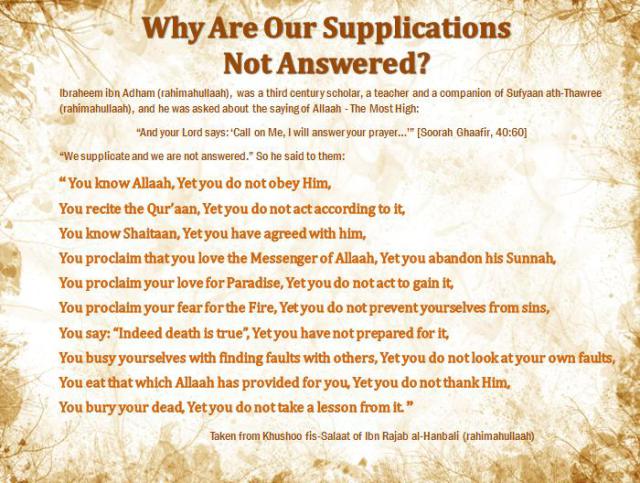
Ibraaheem Ibn Adham (d.160H) – rahimahullaahu ta’aalaa – said in an admonition, when he was asked (by some people) about the saying of Allaah – the Most High -:

“Call upon Me and I will respond to you.” [Soorah Ghaafir 40:60]

(They said): We call upon Him, but He does not respond to us. So he said to them, “You know Allaah, yet you do not obey Him. You recite the Qur‘aan, but you do not act according to it. You know Shaytaan, but still agree with him. You claim to love Allaah’s Messenger (sallallaahu ’alayhi wa sallam), yet you abandon his Sunnah. You claim to love Paradise, yet you do not work for it. You claim to fear the Fire, yet you do not stop sinning. You say: Indeed death is true, yet you have not prepared for it. You busy yourselves with the faults of others, but you do not look at your own faults. You eat the sustenance that Allaah provides for you, yet you are not grateful to Him. You bury your dead, but you have not heeded its lesson.”

We ask Allaah to grant us the ability to please Him and to bestow upon us His mercy.

Footnotes:

[1] He is the Imaam, the haafidh, the zaahid (abstainer from this world), the admonisher Abul-Faraj ’Abdur-Rahmaan Ibn Ahmad Rajab as-Salamee better known as Ibn Rajab al-Hanbalee. Ibn Fahd said about him, “The Imaam, the haafidh, the hujjah (proof), the knowledgeable Scholar, the dependable one. He was one of the Scholars who shunned the world, and one of the Imaams and worshippers. He was an instructive Scholar from the Scholars of Hadeeth – and an admonisher of the Muslims.” Ibn Fahd also said, “He – rahimahullaahu ta’aalaa – was a pious Imaam who shunned the world. Hearts inclined towards him with love, and the different sects accepted him. His sittings for advising the general people were of great benefit and used to open up the hearts.” As-Suyootee said about him, “The Imaam, the haafidh, the Scholar of Hadeeth, the admonisher ’Abdur-Rahmaan…” He learnt from some of the major Scholars of his time, such as Ibnul-Qayyim al-Jawziyyah, al-Haafidh al-’Iraaqee, Ibnun-Naqeeb and others. He authored many books in the field of tafseer, hadeeth, biography and history, raqaa‘iq (heart-affecting matters) and also in fiqh. He is enumerated as one of the great scholars of Fiqh of the Hanbalee madbhab – as is proven by his excellent book: al-Qawaa’idul-Kubraa fil-Furoo’ – about which Ibn Muflih said, “It is a proof about his complete knowledge of the madhhab.” And al-Haafidh Ibn Hajar also spoke with similar praises about the book. He – rahimahullaah – died in the year 795H.

For a complete biography, refer to: Inbaa‘ul-Ghamr bi Anbaa‘il-’Umar (3/175-176) and ad-Durarul-Kaaminah (2/321-322) of Ibn Hajr, Dhayl Tabaqaatul-Huffaadh (p.532) of as-Suyootee and Luhdhul-Labaadh (p.180-182) of Ibn Fahd al-Makkee. This article has been taken from the last chapter of his book: al-Khushoo’ fis-Salaah (p. 57-62).

[2] Saheeh: Related by Ibn Sa’d in at-Tabaqaat (1/23) in mursal form. However, it has been related in connected form by Ibn Maajah (no. 3312) and al-Haakim (3/47) from Aboo Mas’ood radiyallaahu ’anhu. Shaykh al-Albaanee authenticated it in as-Saheehah (no. 1876).

[3] Related by al-Bukhaaree (6/345), ad-Daarimee (2/320) and others, from ’Umar Ibnul-Khattaab radiyallaahu ’anhu.

[4] Related by Ahmad (2/321), al-Bazzaar (no. 4262) and al-Haythamee in al-Majma’ (9/18-19) where he said, “It has been narrated by Ahmad, al-Bazzaar and Abu Ya’laa, and its initial narrators are all the narrators of as-Saheeh.”

[5] Saheeh: Related by Ibn Sa’d in at-Tabaqaat (1/371) and Shaykh al-Albaanee authenticated it in Saheehul-Jaami’ (no. 8). Refer also to Takhreejul-Ihyaa‘ (2/4) of al-Haafidh al-’Iraaqee.

[6] Hasan: Related by al-Baghawee in Sharhus-Sunnah (no. 4683) and Abush-Shaykh in Akhlaaqun-Nabee (no. 213), and al-Haythamee authenticated it in al-Majma’ (9/19).

[7] Although this is a mursal narration, it does however, have support from those narrations that have already preceded, and it has a further witness from the narration of Ibn ’Abbaas – which is related by al-Baghawee (no. 3684) and Abush-Shaykh (no. 213-214).

[8] Da’eef Jiddan: Related by Ahmad (5/254) and at-Tirmidhee (no. 2348), from Aboo Umaamah radiyallaahu ’anhu. It was declared weak by Shaykh al-Albaanee in Da’eeful-Jaami’ (no. 3704).


Craving For Wealth And Status : Imam Ibn Rajab al-Hanbali

The first type of craving for wealth is that a person has extreme love for wealth and also relentlessly exerts efforts to attain it – via means which are lawful – being excessive in that, striving hard and making painstaking efforts and toiling in order to attain it.

It has been reported that this hadeeth was in response to the appearance of some elements of th is, as at-Tabaraanee reports from `Aasim ibn `Adiyy, radiyallaahu `anhu, who said, `I bought a hundred shares from the shares of Khaybar and that reached the Prophet sallallahu `alayhi wa sallam so he said, “Two ravenous wolves remaining amongst sheep whose owner has lost them will not be more harmful than a Muslim`s seeking after wealth and status is to his Deen.” [It is quoted by al-Haithumee in Majma` uz-Zawaa`id (10/250) and he attributed it to at-Tabaraanee in al-Awsat and said, “Its isnaad is hasan (good).”]

There is nothing more to chasing after wealth than the wastage of a person’s noble life for that which has no value. Instead he could have earned a high rank (in Paradise) and everlasting bliss, but he lost this due to his craving after provision – which had already been assured to him and allotted to him, and it was not possible for anything to come to him except what was decreed for him – then on top of this he does not benefit from that, but rather abandons it and leaves it for someone else.

He departs from that and leaves it behind so that he will be the one held accountable for it, yet someone else benefits from it. So in reality he is only gathering it for someone who will not praise him for that, whilst he himself goes on to One who will not excuse him for that – this itself would indeed be enough to show the blameworthiness of this craving.

The person who has this craving wastes his valuable time and engages himself in that which is of no benefit to himself – in journeying and exposing himself to dangers in order to amass that which will only benefit someone else, so it is as is said:

“So one who spends his days in gathering wealth
Out of fear of poverty – then he has achieved only poverty.”

It was said to a wise man, “So and so has amassed wealth,” so he said, “Then has he amassed days in which to spend it?” It was said, “No.” So he said, “Then he has amassed nothing!”

It was also said in some narrations from the People of the Book, “Provision has already been allotted and the one greedy for wealth is deprived. Son of Aadam! If you spend your life in seeking after this world then when will you seek after the Hereafter?” “If you are unable to do good deeds in this world, then what will you do on the Day of Resurrection?”

Ibn Mas`ood, radiyallaahu `anhumaa, said, “Certain faith (yaqeen) is that you do not make the people happy by angering Allaah, and that you do not envy anyone for that which Allaah has provided, and that you do not blame anyone for something which Allaah has not given you – since provision will not be brought on by a person’s craving after it, nor will it be repelled by a person’s disliking it. Indeed Allaah through His Justice has made joy and happiness dependant upon having certain faith and contentment, and He has made worries and sorrow spring from doubt and displeasure.”

One of the Salaf (predecessors) said: “Since predecree (qadr) is a reality then craving is futile. Since treachery exists in people’s characters then trusting everybody is to expose oneself to humiliation. Since death awaits everybody, then being satisfied with this world is foolishness.”

`Abdul-Waahid ibn Zayd (from the successors of the Taabi`een of Basrah, died after 150H) used to swear by Allaah that a person’s craving after this world was more fearful to him than his worst enemy. He also used to say, “O my brothers! Do not grow up craving after his riches and increase in earnings or wealth, rather look upon him with the eye of one who detests that he is preoccupying himself with that which will cause his ruin tomorrow in the Place of Return – and is proud with that.” He also used to say, “Craving is of two types: Craving which is an affliction and craving which is beneficial. As for the craving which is beneficial, then it is one’s desire for that which is obedience to Allaah, and as for the craving which is an affliction then it is a person’s craving after this world.”

Craving after this world torments a person, he is preoccupied and does not attain joy or pleasure whilst amassing – since he is preoccupied. He does not find time – due to his love of this world – for the Hereafter, and is preoccupied with that which will perish and forgets that which will abide and remain.

In this regard a person said,

“Do not envy a brother who craves after riches –
rather look upon him with aversion.
Indeed the one who craves is preoccupied with his
wealth from having any happiness due to his belongings.”

Someone else said in this regard:

“O gatherer and miserly one being watched closely by time
which is wondering which of its doors it should close.
You have gathered wealth, but think have you gathered for it –
O gatherer of wealth – days in which you can spend it.
Wealth is hoarded away with you for those who will inherit it –
The wealth is not yours except on the day when you spend it.
Satisfaction is for the one who settles in its neighbourhood
And in its shade he finds no worries to disturb him.”

A wise person wrote to a brother of his who desired this world: “To proceed, you have become one who craves after this world. It will serve you whilst taking you away from it with accidents, illnesses, calamities and infirmity. It is as if you have not seen one who craves prevented from what he desires, nor one who shuns this world granted provision, nor one who died despite having great wealth, nor one who is fully satisfied in this world with a small amount.”

A desert Arab rebuked a brother of his for covetousness, saying, “O my brother you are a seeker and one sought. You are being sought by One whom you cannot escape, and you are seeking that for which you have been sufficed. O brother, it is as if you have not seen one who craves being prevented, nor one who shuns the world being granted provision.”

A wise man said, “The people who have the greatest degree of restlessness are the envious, those who have the greatest degree of happiness are the contented. Those who persevere most through suffering are those who are covetous. Those who have the simplest and most pleasant life are those who most strongly refuse this world. The one who will suffer the greatest regret is the scholar whose actions contradict his knowledge.”

The second type of craving after wealth is that in addition to what has been mentioned in the first type, he also seeks wealth through unlawful means and withholds people’s rights – then this is definitely blameworthy greed and covetousness. Allaah, the Most High, says:

“And whoever is saved from his covetousness, such are those who are successful.” [Soorah al-Hashr (59):9]

It is reported in Sunan Abee Daawood from `Abdullaah ibn `Amr, radiyallaahu ‘anhu, from the Prophet sallallahu `alayhi wa sallam that he said, “Beware of greed (avarice) for indeed greed (avarice) destroyed those who came before you. It ordered them to cut off ties of relationship so they cut off ties of relationship, and it ordered them to be miserly so they were miserly, and it ordered them to commit sins so they committed sins.” [Reported by Aboo Daawood (transl. vol.2, p.445, no.1694), and al-Haakim (1/415) who declared it saheeh and adh-Dhahabee agreed, and Ahmad reports it (2/159, 195) with similar wording. I (Badr `Abdullah al-Badr) say: Its isnaad is saheeh.]

It is reported in Saheeh Muslim from Jaabir, radiyallaahu ‘anhu, that the Prophet sallallahu `alayhi wa sallam said, “Beware of greed (avarice), since greed (avarice) destroyed those who came before you. It led them to shed their blood and make lawful what was forbidden for them.” [Reported by Muslim (transl. vol.4, p.1366, no. 6248) and others, an-Nawawee said in explanation of the hadeeth, “al-Qaadee `Iyaad said: It is possible that this destruction was the destruction of those whose blood was spilled who were mentioned here, and it is possible that it is destruction in the Hereafter – and this is more apparent, and it is possible that it means destruction in both this world and the Hereafter. A number of people have said that avarice/greed (shuhh) is more severe than miserliness (bukhl) and causes the person to withhold to a greater degree. Some say that it is miserliness combined with covetousness. Some say that miserliness is with reference to specific actions whereas avarice/greed is general. Some say that miserliness is in particular actions and avarice/greed is with reference to wealth and good actions. Others say that avarice/greed is desiring that which one does not possess and being miserly about what one does possess.”]

Some of the scholars say, “Avarice is eager craving which causes a person to take things which are not lawful for him, and to withhold the rights of others. Its reality is that a person craves that which Allaah has forbidden and prohibited him from, and that one is not contented with the wealth and womenfolk and whatever else Allaah has made lawful for him. So Allaah, the Most High, has made lawful for us that which is good from foods, drinks, clothing and women and has forbidden us to acquire these things except by lawful means and He made lawful for us the blood and wealth of the Unbelievers and those fighting against us. He also forbade us from everything impure from foods, drinks, clothing and women, and He forbade us from seizing people’s wealth and spilling their blood unjustly. So he who limits himself to that which is permitted for him is a Believer, and one who goes beyond that into what he has been forbidden – then this is blameworthy avarice which is inconsistent with Eemaan (true faith in belief, word and action).

Therefore the Prophet sallallahu `alayhi wa sallam informed that avarice causes a person to cut off relations, commit sins and to be miserly – and miserliness is a person’s clinging on greedily to what he has in his hand. Whereas avarice is seeking to obtain that which does not belong to him unjustly and wrongfully – whether it is wealth or something else. It is even said that it is the head of all sins – this was how Ibn Mas`ood, radiyallaahu `anhu, and others from the Salaf explained avarice and greed.

So from this the meaning of the hadeeth of Aboo Hurairah, radiyallaahu ‘anhu, will be understood. He reports that the Prophet sallallahu `alayhi wa sallam said, “Avarice (shuhh) and Eemaan will not combine in the heart of a Believer.” [This is part of a hadeeth whose wording is, “Dust in the way of Allaah and the smoke of Hell-Fire will never combine in the belly of a servant, nor will avarice and Eemaan ever combine in the heart of a servant.” It is reported by Ibn Abee Shaibah (5/344), Ahmad, an-Nasaa’ee (6/13,14)… and its chain of narration is hasan lighairihi (good due to supports).] Also in another hadeeth from the Prophet sallallahu `alayhi wa sallam he said “The best of Eemaan is self-restraint (sabr) and compliance/liberality (musaamahah).” [This hadeeth has been reported from four Companions: (i) `Umayr ibn Qataadah al-Laythee, by al-Bukhaaree in at-Taareekhul-Kabeer (3/2/530) and al-Haakim (3/ 626), (ii) Jaabir ibn `Abdillaah – by Ibn Abee Shaibah in al-Eemaan (no.43) and Ibn Hibbaan in al-Majrooheen (3/136), (iii) `Amr ibn `Abasah – by Ahmad (4/375) and (iv) `Ubaadah ibn as-Saamit – by Ahmad (5/319), and the hadeeth is saheeh due to these chains – and Allaah knows best.] Sabr here has been explained to be withholding oneself from forbidden things, and musaamahah as the carrying out of the obligatory actions.

Also the word shuhh (avarice) may sometimes be used to mean bukhl (miserliness) and vice-versa, however in origin they are different in meaning, as we have mentioned.

If the person’s craving after wealth reaches this level then the deficiency it causes in a person’s Religion is clear – since failing to fulfill what is obligatory and falling into what is forbidden reduce one’s Religion and Eemaan without a doubt to the point that nothing but a little remains of it.

Excerpts from the Book – al-Hidaayah Publishing

Gratitude: One of the Greatest Blessings : Ibn Rajab Al-Hanbali

Transcribed from: The Journey to Allah | Ibn Rajab Al-Hanbali

As regards one whose deeds are great and many, he must busy himself with showing gratitude for them, for the accord to show gratitude is one of the greatest blessings Allah bestows upon His servant. It is obligatory upon him to meet these deeds with gratitude and realize his deficiency in displaying due gratitude.

Wahd ibn al-Ward, when asked about the reward of a particular deed said, “Ask not about its reward, but ask about the gratitude due upon one who was guided to it.”1

Abu Sulayman would say, “How can an intelligent person be amazed with his deeds? Deeds are one of Allah’s blessings, as such it is upon him to show gratitude and to show humility. It is only the Qadariyyah who are amazed at their deeds!”2  ie. those who do not believe that the actions of the servant are created by Allah, Mighty and Magnificent.

How excellent is the saying of Abu Bakr al-Nahshali on the day that Dawud al-Ta’I died. After his burial, ibn al-Sammak3 stood and praised him for his good deeds and wept causing all present to weep as well and testify to the truth of what he said … Abu Bakr al-Nahshali stood and said, “O Allah, forgive him and show mercy to him and leave him not to his deeds!”4

Abu Dawud records on the authority of Zayd ibn Thabit (radiAllaahu ‘anhu) that the Messenger of Allah (salAllaahu alayhi wa sallam) said, “Were Allah to punish the inhabitants of the heavens and the inhabitants of the earth, He could do so without having oppressed them in any way. Were He to show them mercy, His mercy would be better for them than their deeds.” 5

Footnotes:

1 – Abu Nu’aym, vol. 8, p. 155

2 – Ibid, vol. 9, p. 276 #13896

3 – Ibid, vol. 8, p. 223 #11949, records that he used to say, “Astounding it is that the eye can take delight in sleep when the Angel of Death is standing by one’s pillow!”

4 – Ibid, vol. 7, p. 396 #10977

5 – Abu Dawud #4699 and ibn Majah #77. It was declared sahih by ibn Hibban [#727] and Albani, Sahih al-Jami’ #5244

Allah, Exalted is He, says: “If Allah took mankind to task by that which they deserve, He would not leave a living creature on the surface of the earth; but He grants them reprieve unto an appointed term, and when their term comes  – then verily Allah is Ever All-Seer of His slaves.” [Fatir (35):45]

Ibn Hibban #659 records on the authority of Abu Hurayrah that the Messenger of Allah (salAllaahu alayhi wa sallam) said, “Were Allah to take me and Isa to account for our sins, he could punish us without wronging us in the least!”

It was declared sahih by ibn Hibban and Albani, Sahih al-Taghrib #2475

Fifteen Examples of Supplications Immediately Answered by Allaah – Ibn Rajab

The Messenger of Allah related that Allah Said:

“…if he calls upon Me, I answer him, and if he asks of Me, I will give him…”

Ibn Rajab commented:

“…This means that this person who is beloved and close to Allah has a special status with Allah such that if he asks Allah for something, He gives it to him, and if he seeks refuge with Allah from anything, He protects him from that thing, and if he calls upon Him, He answers him. So, he ends up becoming from those whose supplications are answered due to his honor with Allah.

And many from the righteous early generations were known to have their supplications answered.

It is related in the ‘Sahih’ that ar-Rubay’ bint an-Nadr broke a tooth of a slave. So, they offered compensation, and they refused. They asked for pardon, and they refused. The Messenger of Allah was then going to implement the rule of retaliation between them. Anas bin an-Nadr said: “The tooth of ar-Rubay’ will be broken? By the One who has sent you with the truth, her tooth will not be broken.” So, the people were pleased and took the compensation. The Messenger of Allah then said: “Indeed, from the slaves of Allah are those who, if they make an oath upon Allah, He fulfills it.”

…And Ibn Abi ad-Dunya reported with his chain that an-Nu’man bin Qawfal said on the day of Uhud: “O Allah, I swear that I will be killed and enter Paradise.” So, he was killed, and the Prophet said: “Indeed, Nu’man made an oath upon Allah, and He fulfilled that oath.”

And Abu Nu’aym reported with his chain from Sa’d that ‘Abdullah bin Jahsh said on the day of Uhud: “O Lord, if I meet the enemy tomorrow, give me an adversary who is strong and harsh for me to fight for Your Sake and for him to fight me. Then, let him cut off my nose and ear so that when I meet You the next day, You Say: ‘O ‘Abdullah! Why were your nose and ear cut off?’ I will say: ‘For You and Your Messenger.’ And You will Say: ‘You have spoken the truth.’

Sa’d said: “I saw him at the end of the day with his nose and ear hanging from a thread.”

And Sa’d bin Abi Waqqas would have his supplications answered. A man lied upon him, and he said: “O Allah, if he is lying, take away his eyesight, elongate his life, and expose him to trials and tribulations.” So, the man was stricken with all of this, as he used to walk through the streets and come into contact with the slave girls, saying: “I am an old man who is experiencing fitnah. I have been stricken with the supplication of Sa’d!”

And he supplicated against a man he heard insulting ‘Ali, and immediately, a camel came and trampled him to death.

And a woman disputed with Sa’id bin Zayd over some land he owned, claiming that he had taken from her land. So, he said: “O Allah, if she is lying, take away her eyesight and kill her in her own land.” So, she became blind, and one night when she was walking in her land, she fell into a well and died.

And al-’Ala’ bin al-Hadrami was on an expedition, and those with him became very thirsty. So, he prayed and supplicated: “O Knower, O Bestower, O Most High, O Mighty! We are Your slaves, and we are fighting Your enemy for Your Sake. Give us water to drink and make ablution from, and do not allow anyone else to benefit from this water!” They walked for a bit to find a river of water flowing from the sky. They drank from it and filled their vessels. Later, some of his companions returned to where the river was to find that there was nothing there, as if there had never been any water there.

And someone complained to Anas bin Malik of a drought in a part of al-Basrah. So, he performed ablution and went out to the patch of land, prayed two units, and it then began raining on the patch of land, and the rain did not fall anywhere beyond that patch of land.

…And Abu Muslim al-Khawlani was known for having his supplications answered. Once, a gazelle passed by him, and the young boys in the area said: “Ask Allah to allow us to capture this gazelle!” So, he supplicated, and he captured it and held it until they were able to take it from his hands.

And he once supplicated against a woman who had ruined his relationship with his wife that her eyesight be taken away. She immediately went blind, and she came to him begging. So, he had pity for her and asked Allah to return her eyesight to her, and his wife returned to her normal state with him.

And a man lied upon Mutarraf bin ‘Abdullah, and Mutarraf said: “If you are lying, I ask Allah to hasten your departure,” and the man died on the spot.

And a Kharijite used to pass by the classes of al-Hasan al-Basri and annoy those present. When it became unbearable, al-Hasan said: “O Allah, You Know how he has harmed us. So, suffice us against him with what You Will,” and the man immediately collapsed and was carried dead to his family.

And Silah bin Ashim was on an expedition, and his camel wandered off with all of his belongings, and there was nobody else around. So, he stood and prayed, saying: “O Allah, I swear that you will return my camel and belongings,” and it walked back until it stood right in front of him.

…And Habib al-’Ajami Abu Muhammad was known for having his supplications answered. He once supplicated for a young boy who was bald, and would weep and wipe his tears over the boy’s head. The boy’s hair began growing black all over his head, and it looked better than it had before.

…And Sa’id bin Jubayr was patient upon the harm inflicted upon him by al-Hajjaj until he killed him, and he was from those whose supplication was answered. He used to have a rooster whose crowing would wake him up to pray at night. One night, it didn’t wake him up on time, and he became very distressed, saying: “What is wrong with it? May Allah cut off its voice!” It never crowed again, and his mother said: “My son, do not supplicate against anything ever again.”

See ‘Jami’ al-’Ulum wal-Hikam’ (2/348-354) for more.

.. But their Tongues rip apart the honor of both the dead and the living – Imaam Ibnul-Qayyim

Imaam Ibnul-Qayyim, rahimahullaah, said:

It is quite amazing how it can be easy upon a person to be cautious and wary with regards to [different impermissible acts such as]: eating from unlawful means, oppression, adultery and fornication, stealing, drinking intoxicants, looking at prohibited things and the likes, and yet quite difficult for him to be careful about the movement of his tongue. So bad that you find a person towards whom the people point to concerning his practice of the Religion, his asceticism, and worship, and despite this he says statements that anger Allaah greatly and he shows no concern about this, yet this statement will take him [to a Fire] that is farther than distance between east and west. (1)

How many people do you see from amongst those who have enough piety to abstain from lewd, indecent acts, oppression and wrong doing, but their tongues rip apart the honor of both the dead and the living and they show not a care in the least.

Footnotes:

(1) Just as al-Bukhaaree (no. 6477) and Muslim (no. 2988) have collected on the authority of Aboo Hurayrah.

Source: “al-Jawaabul-Kaafee/adDaa wad-Dawaa”.

Transcribed from: The Appendix of “An Explanation of the Hadeeth: “Say, ‘I believe in Allah’, and then be upright and steadfast.” | Ibn Rajab
[you can the buy the book @ http://www.authenticstatements.com/sku16368/]


Why Are Our Supplicatiosn Not Answered? – Imam Ibn Rajab

Ibrahim ibn Adham – may Allah have mercy on him – a third century scholar, a teacher and a companion of Sufyan ath-Thawri, was asked about the saying of Allah – the Most High:

and your Lord says: “Call on me I will answer your prayer…” [40:60]

“We supplicate and we are not answered.”

So he said to them:

You know Allah, Yet you do not obey Him,

You recite the Qur’an, Yet do not act according to it,

You know Shaitan, Yet you have agreed with him,

You proclaim that you love Muhammad (Sallallaahu ‘alayhi  wa sallam) Yet you abandon his Sunnah,

You proclaim your love for Paradise, Yet you do not act to gain it,

You proclaim your fear the Fire, Yet you do not prevent yourselves from sins,

You say “Indeed death is true”, Yet you have not prepared for it,

You point out the faults with others, Yet you do not look at your faults,

You eat of that which Allah has provided for you, Yet you do not thank Him,

You bury your dead, Yet you do not take a lesson from it.”

by  Ibn Rajab al Hanbali from Khushu’ fis-salah 

 Why our Du'as are not answered

Hope is the Guide & Fear is the Driver – The Journey to Allaah

The Journey to Allaah[The Journey to Allaah : -Ibn Rajab al Hanbali ; pg 62 ]

And worship your Lord till the certainty comes to you . [al Hijr :99]

al Hasan said,

“Persistence, persistence! Surely Allaah  has appointed the time of cessation of deeds to be just before death,”

and the he recited the above verse. He also said,

“Your souls are your mounts ,so tend to your mounts, in this way they will convey you to your Lord, Mighty & Magnificent.”

The meaning of tending to one’s mounts is to be easy on them, to keep them fit & healthy, & not  to overburden them.

Therefore if one feels his soul is coming to a halt in its travel, he tends to it by inculcating in its the desire to finish the journey,as the situation may demand .

One of the salaf said,

” Hope is the guide & fear is the driver & the soul will stop & it will then need gentle treatment & song to provoke it to into recommencing its journey”.

In this respect the camel leader, who drives on his herd by singing,said,
“its guide gave it glad tidings saying: Tomorrow shall you see bananas & mountains.”

Fear is like a whip & when a person is excessively whips the animal, it could die.As such one must also strike it with  “songs” of hope that would encourage it to eagerly revitalize its efforts until it arrives at the destination .

Abu Yazeed said,

” I have persistently guided my soul to Allaah without letting up, it weeping all the way, then i urged it to on until it laughed”

it is said,

“When it complained of the burdens of the journey,
he promised  it Of the relief of arrival so it revitalized of its efforts.”

You fast and pray more than the Companions of Muhammad (sal’Allahu ‘alayhi wa sallam) but they were better than you.’ – Ibn Rajab

Ibn Mas’ud said to his companions, ‘You fast and pray more than the Companions of Muhammad (sal’Allahu ‘alayhi wa sallam) but they were better than you.’ They asked, ‘How so?’ He replied, ‘They were more abstinent of this world and desirous of the Hereafter.’ Hence he indicated that the superiority of the Companions lay in the attachment of their hearts to the Hereafter, their desire for it, their turning away from this world, and their thinking little of it even if it be readily available to them. Their hearts were empty of the world and filled with the Hereafter. This is what they inherited from their Prophet (sal’Allahu ‘alayhi wa sallam). He (sal’Allahu ‘alayhi wa sallam) was one whose heart was most devoid of the world and most attached to Allah and the Abode of the Hereafter, this despite his outwardly interacting with the creation, fulfilling the duties of Prophethood, and implementing the politics of religion and world.

This was the state of the Khulafa who came after him and those who followed them in goodness such as al-Hasan and ‘Umar ibn ‘Abdul-‘Aziz. There were, in their times, those who fasted more than them and prayed more than them, but their hearts had not attained the levels of theirs in terms of leaving the world and turning to the Hereafter, and settling there.

Posted from the Book “The Journey to Allah” Ibn Rajab Al-Hanbali
Dar us Sunnah Publishers

No human ever filled a vessel worse than the stomach – Imam Ibn Rajab

Explanation Of The Hadeeth: “No human ever filled a vessel worse than the stomach…”
Author: Al-Haafidh Ibn Rajab al-Hanbalee
Source: Jaami’ Al-‘Uloom wal-Hikam, hadeeth no. 47

Excerpts from the Book

On the authority of Al-Miqdaam ibn Maadiy-Karib who said: I heard the Messenger of Allaah saying:

“No human ever filled a vessel worse than the stomach. Sufficient for any son of Aadam are some morsels to keep his back straight. But if it must be, then one third for his food, one third for his drink and one third for his breath.” [Ahmad, At-Tirmidhee, An-Nasaa’ee, Ibn Maajah – hadeeth saheeh.]

1. Ibn Masaweh, a Muslim doctor, said after reading this hadeeth:

“If the people only used these words, they would avoid all diseases and maladies and the clinics and pharmacies would be idle.”

2. Another doctor, Al-Harith ibn Kalada said:

“That which has killed mankind is the introduction of food on top of food before it has been digested.”

3. As for spiritual benefits: humbleness of heart, strength of understanding, lessening of lower desires, lessening of personal opinions and anger, while overeating induces the opposites of all of those. Al-Hasan Al-Basree said:

“O, son of Adam, eat with one third of your stomach and drink with one third and leave one third of your stomach to breathe so that you may think.”

4. Ibn Umar: A man said to Ibn Umar:

“Shouldn’t I bring you some jawarish?” Ibn Umar said: “What is that?” He said: “Something which aids in digesting your food after you eat.” Ibn Umar said: “I have not eaten to being full for four months. That is not because I am not able to do so, but I was with a group of people who were hungry more than they were full.”

5. Not reaching your goals: Muhammad ibn Wasi said:

“Whoever eats little will understand and make others understand and will be clear and humble. Overeating weighs a person down and keeps him from much of what he wants [to accomplish].”

6. Al-Hasan Al-Basree:

“The test of Aadam, alayhis-salaam, was food and it is your test until Qiyama.”

And, it used to be said:

“Whoever takes control of his stomach gets control of all good deeds.”

And:

“Wisdom does not reside in a full stomach.”

One day, Al-Hasan offered some food to his companion who said: “I have eaten until I am no longer able to eat.” To which Al-Hasan said:

“SubhaanAllaah! Does a Muslim eat until he is no longer able to eat?”

7. Allaah grants this world to those whom He loves and those He does not love but only grants hunger to those whom he loves.

8. Ash-Shaafi’ee said:

“I have not filled myself in sixteen years because filling oneself makes the body heavy, removes clear understanding, induces sleep and makes one weak for worship.”

9. In Bukhaaree and Muslim:

“The believer eats with one stomach while the kafir eats with seven stomachs.”

Meaning: The believer eats with the manners of Islam and in moderation, while the kafir eats based on desires and gluttony and so he eats with seven stomachs.

10. Also:

“Food for one is enough for two and food for two is enough for three and food for three is enough for four.”

11. Also: From Aa’ishah:

“The family of Muhammad (sal-Allaahu ‘alayhe wa sallam) never filled themselves with wheat bread three days in a row from the time he came to Madeenah until he passed away.”

12. A Muslim should not merely follow his appetites. Allaah said:

“Then, they were followed by generations who neglected the prayer and followed their appetites. They will encounter a pit of fire except for those who repent…” [Maryam 59-60]

13. The best generations did not:

“The best generation is my generation, followed by the one after them then the one after them. Then will come a people who bear witness but are not asked to bear witness, who swear oaths but do not fulfill them and fatness will appear among them.” [Bukhaaree and Muslim]

14. From Abee Barza that the Prophet (sal-Allaahu ‘alayhe wa sallam) said:

“My greatest fear for you is the appetites of transgression with regard to your stomachs and your privates and the inclinations which lead astray.” [Ahmad and others and its narrators are people of saheeh]

Read the PDF of full Chapter by clicking the below Link

No human ever filled a vessel worse than the stomach – Al-Haafidh Ibn Rajab [PDF]