Refuting those who say that the Shia are our brothers || Sheikh Salih al-Fawzaan
الرد على مقولة الشيعة إخواننا || الشيخ صالح الفوزان
Uploaded by daarulhaq
Islamic Knowledge – Islam, Sunnah, Salafiyyah

Refuting those who say that the Shia are our brothers || Sheikh Salih al-Fawzaan
الرد على مقولة الشيعة إخواننا || الشيخ صالح الفوزان
Uploaded by daarulhaq
Bismillaah wa -Alhamdulillaah wa Salaatu wa Salaam ‘alaa Rasulillaah ‘amma ba’d
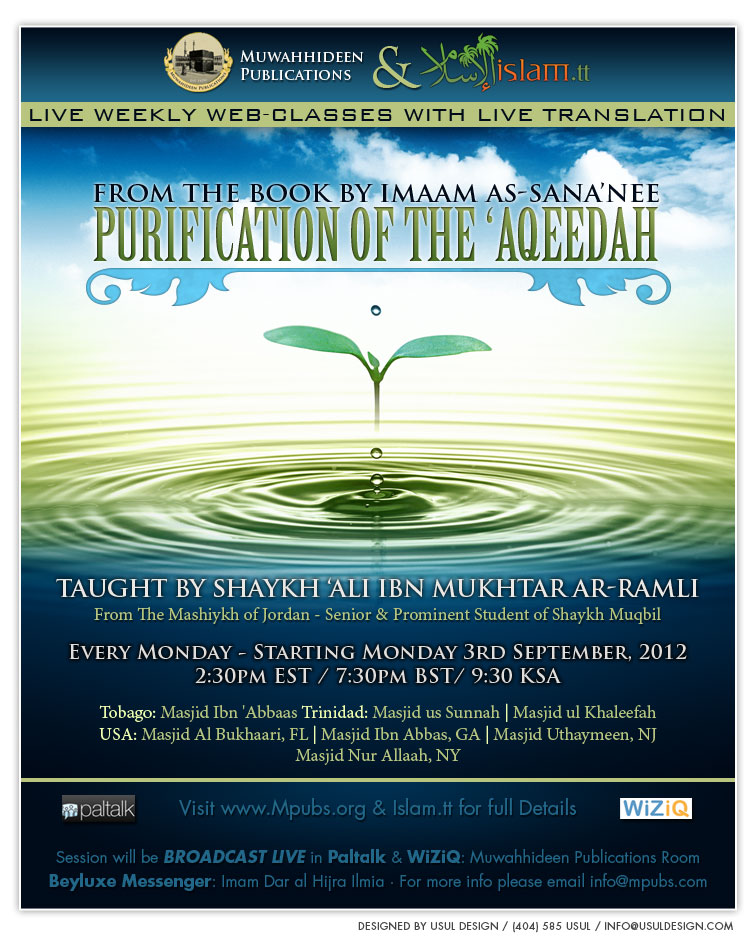
The Noble Shaykh, Aba al-Hassan ‘Ali ibn Mukhtar ar-Ramly (May Allaah Preserve Him) from amongst the scholars of Jordan, and a very strong student of Shaykh Muqbil ibn Hadi al-Wad’ee (rahimahullaah) started a weekly web class with Muwahhideen Publications on the explanation of the book “The Purification of The Aqeedah” by Imaam Muhammad ibn Ismaeel al-Sana’nee (rahimahullaah)
—
Class # 01 – 03.09.2012 70:09 mins. (Arabic & English)
Part 01: Listen /Download Mp3 Here (Time 70:09)
Commencing the class, Shaykh ‘Ali ar-Ramli (hafidhahullaah) spoke about the reason for Allaah sending us Prophets and Messengers and touched on the origin of shirk amongst mankind.
He then went on to give a brief biography of Imaam As-Sana’anee (rahimahullaah) and the reason why the author took it upon himself to write this book and clarify the misguidance of the people in his time.
Other points of benefit included mention of the condition of the disbelievers of Quraysh, an explanation of the title of the book, some discussion about the state of the people in the time of Imaam as-Sana’anee and much more benefit concerning the correct belief of the muslim.
The Shaykh completed the introduction of the book in this first sitting and all are encouraged to attend these vital lessons that are packed with immense benefit about the most important matter in the life of a Muslim: the establishment of Tawheed and safeguarding oneself from shirk.
—
Class # 02 – 03.09.2012 61:56 mins. (Arabic & English)
Part 02: Listen /Download Mp3 Here (Time 61:56)
Continuing with our study of the book ‘The Purification of the ‘Aqeedah’, Shaykh ar-Ramli (hafidhahullaah)explained in great detail three of the five fundamentals as articulated by the author.
Imaam as-Sana’anee (rahimahullaah) laid down five fundamentals which he then broke down into chapters.
The three fundamentals discussed are as follows:
Firstly: It has been known from the necessity of belief in the religion of Allaah that all of the Quraan is truth and not falsehood, all of it is guidance and not misguidance and all of it is certainty that has no doubt whatsoever. This is a foundation that the belief of anyone cannot be perfected and affirmed without.
Secondly: All of the prophets and messengers of Allaah from the first to the last of them were sent to call all of the creation to worship Allaah alone without associating any partners with Him.
Thirdly:Tawheed is divided into two categories. The first, Tawheed ar-Ruboobiyyah (Tawheed al-Asmaa was-Sifaat included in this category) and the second, Tawheed al-Uloohiyyaah.
—
Class # 03 – 17.09.2012 62:59 mins. (Arabic & English)
Part 03: Listen /Download Mp3 Here (Time 62:59)
In the third class, our Shaykh ‘Ali ar-Ramli (hafidhahullaah) began by doing a recap of the principles we studied thus far. Then, he went on to explain the remaining two principles of the five.
These include:
The Fourth Principle: All of the polytheists affirm and confirm that Allaah is the Lord (The Creator, The Sustainer and the Disposer of all Affairs) soAllaah sent the Messengers and Prophets to call the people to the Monotheism of Worship (Tawheed al-‘Uloohiyyah).
The Fifth Principle: ‘Ibaadah (worship) is the utmost of humiliation and humbling oneself to Allaah and worship is not meant but to humiliate oneself to Allaah. And this humiliation is only for Him and can never be for other than Him.
The Shaykh explained both principles in great detail, quoting the many evidences concerning both matters. He then went on to enlighten us with some benefits regarding the statement of Tawheed:‘Laa ilaaha il Allaah’.
This concluded the five principles as mentioned by the author (Imaam as-Sana’anee) and is the foundation upon which the rest of the book is built upon.
—
Class # 04 – 08.10.2012 89:17 mins. (Arabic & English)
Part 04: Listen /Download Mp3 Here (Time 89:17)
In this session, Shaykh ‘Ali ar-Ramli (hafidhahullaah) went in to great detail concerning the Monotheism of Worship (Tawheed al-‘Ibaadah) and what it necessitates.
He explained that it is the belief of Ahlus Sunnah that kufr (disbelief) is divided into different categories which he mentioned and gave examples, as opposed to the deviant sect, the Murji’ah who say kufr is only of one kind.
Shaykh Ramli went on to discuss and explain the speech of the author concerning the reality that even if a person affirms the Ruboobiyyah(Lordship) of Allaah and worships Him but does not single Him out in this worship then this is of no benefit to him and he is a mushrik (polytheist),kaafir (disbeliever).
A noteworthy point, as mentioned by the Shaykh, is that it is from the condition of sidq (truthfulness) in eemaan that an individual does not depend on other than Allaah and it is a must that we single Him out alone in our dependence just as we single Him out in other acts of ‘ibaadah. Allaahcommanded His slaves to say ‘You alone we worship’ so no one truthfully believes in this statement until he singles out Allaah in all acts of worship, otherwise he is a liar and is forbidden from saying this statement because it means to specify all acts of worship for Allaah alone.
This class was extremely beneficial in highlighting the crucial matter of actualizing Tawheed al-‘Ibaadah with the Shaykh bringing forth the necessary evidences from the Qur’aan and Sunnah with much clarity.
—
Class # 05 – 15.10.2012 52:54 mins. (Arabic & English)
Part 05: Listen /Download Mp3 Here (Time 52:54)
In this sitting, the Shaykh (hafidhahullaah) started a new chapter in which a number of matters were discussed. From them are:
—
Class # 06 – 22.10.2012 57:01 mins. (Arabic & English)
Part 06: Listen /Download Mp3 Here (Time 57:01)
Continuing with our study of the book ‘The Purification of the ‘Aqeedah’ by Imaam as-Sana’anee (rahimahullaah), Shaykh ‘Ali ar-Ramli (hafiidhahullaah) went on to explain some matters concerning the grave worshippers and that which constitutes shirk.
From the points discussed:
—
Source: Posted from http://www.mpubs.org with permission
Scholar: Imâm Muhammad bin Sâlih bin ´Uthaymîn
Source: Liqâ’ al-Bâb al-Maftûh (212 B)
Date: 1420-03-24/1999-07-07
Reference: Darulhadith.com
Translation & video: aFatwa.com (site is down)
Question:
What is the ruling on Jihâd today? Is it obligatory for some Muslims or for all? When is it obligatory for the entire Ummah if it only is obligatory for some Muslims?
Shaykh Ibn ‘Uthaymîn:
Firstly, you have to know that Jihâd is not obligatory for all Muslims. This is impossible. Allâh (ta’âlâ) said:
“And it is not for the believers to go forth [to battle] all at once. For there should separate from every division of them a group [remaining] to obtain understanding in the religion and warn their people when they return to them that they might be cautious.” (9:122)
If all were to have gone out in Jihâd, the rest of the prescriptions and rituals would have ended. However, it can become Fardh ‘Ayn (obligatory for all Muslims) in the following cases:
1 – On the frontline. If one comes here, one should accomplish the war.
Allâh (ta’âlâ) said:
“O you who have believed, when you meet those who disbelieve advancing [for battle], do not turn to them your backs [in flight]. And whoever turns his back to them on such a day, unless swerving [as a strategy] for war or joining [another] company, has certainly returned with anger [upon him] from Allah , and his refuge is Hell – and wretched is the destination.” (8:15-16)
2 – When the enemy attacks one’s country. Here it becomes obligatory to fight to defend oneself and one’s Islamic country.
3 – When the LEADER orders him to go out in Jihâd. Write the word “LEADER” with capital letters. It means that one has to have a leader who leads the Islamic army. When the LEADER orders him to go out in Jihâd, he has to go out. When he orders a country’s population to go out in Jihâd, they have to do it. For it is forbidden to be disobedient towards the rulers. When they are told to do it, they become obliged to fulfill it.
4 – When there is a need of the person. An example of that is that a person is a loner in knowing how a specific weapon is to be managed. In this case, it becomes obligatory for him to fight.
As for what is beyond these four situations, it is not obligatory for all Muslims to fight. Thereto, JIHÂD MUST BE UNDER THE LEAD OF A LEADER. OTHERWISE, A GUERRILLA WAR WOULD HAPPEN. THERE HAS TO BE A LEADER WHO IS LEADING THE ISLAMIC UMMAH. YOU THEREFORE SEE THAT IT DOES NOT GO WELL FOR THOSE WHO GO OUT IN JIHÂD WITHOUT THE LEADERSHIP OF A LEADER. There is a risk that they even attack each other. If they were to triumph, they begin to fight each other.
I ask Allâh that He helps us strive against ourselves. We have to strive against ourselves at the moment. Hearts are sick. The limbs are deficient. Hearts fight against each other. It is firstly this that is in need of Jihâd.

Bismillaah wa -Alhamdulillaah wa Salaatu wa Salaam ‘alaa Rasulillaah ‘amma ba’d
The Noble Shaykh ‘AbdulQaadir Ibn Muhammad al-Junaid (May Allaah Preserve Him), from the scholars of Ad-Dammam, K.S.A., delivered a LIVE tele-lecture with Muwahhideen Publications on Thursday 21stFebruary 2013. The Shaykh is recognized and recommended by the major scholars of our time, the likes of Shaykh ‘Ubayd al-Jaabiree, Shaykh Muhammad Ibn Haadee al-Madkhalee, and many others (May Allaah preserve them)
Listen / Download Mp3 Here (Time 93:33)
Shaykh ‘Abdul Qaadir al-Junaid (hafidhahullaah) commenced this comprehensively beneficial lecture by asking Allaah to benefit us with this sitting and to make us from those who love the truth, follow what Allaahand His Messenger says and that He makes us from those who put His Speech and that of His Messenger(sallAllaahu ‘alayhi wa sallam) before everything else.
Our Shaykh affirmed the fact that many Muslims are engaged in protests and demonstrations throughout the world and some of them desire by this the dunya while some seek to topple the ruler due to injustice that he might have committed, and will not stop until he is removed. However, this does not change their situation and ends up resulting in millions of deaths, loss of wealth and property. This might last for years if the ruler is not removed and as a result, the ruler may execute an armed counter-reaction, which would lead to even more deaths and losses.
The Shaykh then proceeded to say that if we use our intellects, we would see that this blessed Sharee’ahexplained even the intricate matters of using the toilet. So would it make sense that a great affair such as governance, which affects all Muslims, that Allaah would leave us without guidance, leaving each man to himself to act as he sees fit or to follow his desires?
He then said that if we were to return to the books of the Sunnah we would see that this matter of governorship and how the Muslim should deal with the rulers has been thoroughly addressed. He further mentioned that this issue has also been explained in the books of ‘Aqeedah. However, the fault lies with us, as many do not inquire about what is requested of them in light of the Sharee’ah before engaging in such matters and secondly, they do not study the ahkaam related to these affairs.
Our Shaykh then went on to extract some benefits and rulings regarding the manhaj in dealing with the rulers from three ahadeeth of the Prophet (sallAllaahu ‘alayhi wa sallam) where he advised us on what to do if we were to encounter unjust rulers. The remedies include having patience with them until we meet him(sallAllaahu ‘alayhi wa sallam) at the hawdh, carrying out their rights while seeking our rights from Allaah and listening and obeying even if they were to beat our backs and take our wealth.
Next, Shaykh al-Junaid (hafidhahullaah) commented on some reasons why protests are prohibited in Islaam. From them are:
This sitting was indeed filled with immense benefit and serves as a beautiful clarification concerning this pertinent and crucial issue as our Shaykh ‘Abdul Qaadir clearly explains each point bringing the necessary evidences from the Book and the Sunnah. A must listen for the one seeking clarity!
We ask Allaah to guide us to the truth and make it easy for us to follow and that He saves us all from falling into sin and transgression.
Wa Billaahi Tawfeeq
Wa SallAllaahu wa Sallaama wa Barak ‘alaa Nabiyanna Muhammad wa ‘alaa ‘Alyhi wa Sahbyhi wa Sallam
Posted with Permission from : http://www.mpubs.org
[youtube http://www.youtube.com/watch?v=9YtnE4-0MRg&rel=0]
بسم الله والصلاة والسلام على رسول الله
(In the name of Allaah, peace and salutations be upon His Prophet.)
The Messenger of Allaah (peace be upon him) said:
‘None of you truly believes until I am more beloved to him than his child, his father and all the people.” (Muslim: 44).
Allaamah Shaykh Dr. Saalih ibn Abd-Allaah ibn Fawzaan al-Fawzaan (may Allaah preserve him) highlights the significance, importance and correct way of loving the final messenger of Allaah, Muhammad, may Allaah send salutations and peace upon him.
IMPORTANT POINTS:
“Say: Are those who know equal to those who know not?” It is only men of understanding who will remember.” [39:9]
Imaam Ahmad ibn Muhammad ibn Hanbal (died 241h.) may Allaah be pleased with him said;
“The graves of sinners from People of Sunnah is a garden, while the graves of the pious ascetics from the People of Innovation is a barren pit. The pious among Ahlus Sunnah are the Friends of Allah, while the sinners among Ahlul-Bidah are the Enemies of Allah.” [Tabaqaat al-Hanaabilah, 1/184]
Imam Abu Dawood (died 275h.), may Allaah be pleased with him, the compiler of Sunan Abee Dawood, said;
“The lectures of Ahmad were sittings of the Hereafter. He would not mention in them anything of the worldly affairs; and I never saw him mention this world.”
_______________________________
A few facts about Shaykh Saalih as-Suhaymee:
Saalih bin Sa’d as-Suhaymee was born in the year 1366 H. in the city of Madeenah. He has a doctorate in fiqh. He works as an Associate Professor in the University of Madeenah, School of Da’wah and Usool-ud-Deen, in the Aqeedah Division.
He also holds duroos in the Mosque of the Prophet (salla Allaahu ‘alayhi wa sallam) in Madeenah.
May Allaah grant him a long, healthy and blessed life… ameen!
ash-Sheikh al-Faadhil Abdullah bin ‘Abdir-Raheem al-Bukhaari (hafidhahullah) briefly explains how to attain a strong memory to help memorise the Islamic Texts, an advice that will be of great use to those who wish to traverse the noble path of knowledge.
“and say: ‘My Lord! Increase me in knowledge”
[al-Qur’aan, 20:114]
Sheikh al-‘Allaamah Saalih bin ‘Abdullah bin Fawzan al-Fawzaan (may Allaah preserve him) narrates the story of the Mujaddid, the ‘Allaamah, Shaykh-ul-Islam Muhammad bin Abdul-Wahhab (may Allaah have mercy on him) and clarifies some of the false misconceptions and doubts spread about him by his opponents.
Abu Hurairah narrated that the Messenger of Allaah (peace be upon him) said;
“Allah shall raise for this Ummah at the head of every century a man who shall revive for it its religion.”
Sunan Abu Dawood
Video Uploaded by DawahSalafiyaah . Uploaded with Permission
Advice by Shaykh Ahmad as Subayee
(Arabic-English)
Shaykh Ahmad as Subayee’s TeleLink as part of Dawrah Ilmiyyah organized by brothers of Markaz Uthman ibn Affan, Mumbai, India in Nov12
Listen / Download Mp3 Here (Time 53:02)
English Translation Starts @ 21 min
Videos Uploaded by DawahSalafiyaah
The messenger of Allah, sallallahu alayhi wa sallam, said: “Whoever cheats is not from us.” And in another Hadeeth, he, sallallahu alahi wa sallam, mentioned: “Muslims follow the conditions they agree to (in their agreements, contracts, treaties, etc.)” There are numerous verses of the Quran and Ahadeeth which establish the sanctity of the property of others.
Uploaded by DawahSalafiyaah
An emotional introduction by Shaykh Saalih al-Fawzaan; highlighting the importance of returning back to the scholars and to fear Allah as much as one is able to! The audio is then followed by the speech of the Imaam of Yemen, the Allaamah ash-Shaykh al-Muhaddith Muqbil ibn Hadee al-Wadi’ee, rahimahullah; highlighting the importance of returning to the scholars of the Sunnah.
Uploaded by DawahSalafiyaah
Shaykh Muhammad ibn Abdul-Wahab al-Wasaabee explaining the Hadith of Abu Hurayrah, may Allaah be pleased with him:
إِنَّ اللَّهَ لَا يَنْظُرُ إِلَى صُوَرِكُمْ وَأَمْوَالِكُمْ وَلَكِنْ يَنْظُرُ إِلَى قُلُوبِكُمْ وَأَعْمَالِكُمْ
“Verily, Allah does not look at your appearance or wealth, but rather He looks at your hearts and actions.”
The 2 conditions are:
1) al-Ikhlaas
2) al-Mutabaa’a
If one of the two, or even both are missing the action of the servant of Allaah becomes corrupt. May Allaah make our actions sincere for Allaah alone in accordance with the Sunnah of our beloved messenger Muhammad, sallAllaahu alahyi wa sallam.
Scholar: Imâm Muhammad bin Sâlih bin ´Uthaymîn
Source: islamcast.wordpress.com/2009/03/29
Reference: Darulhadith.com
Translation & video: aFatwa.com
Shaykh Ibn ‘Uthaymîn:
I warn my Muslim brothers against what some stupid people do when they narrate april jokes. This lie have they taken from the jews, the christians, fire-worshipers (Majûs) and other disbelievers.
Not only is this act a lie, which is in itself forbidden according to the Sharî’ah, it also involves imitating the disbelievers, which is forbidden. The prophet (sallâ Allâhu ‘alayhi wa sallam) said:
“Whoever imitates a people belongs to them.”
Shaykh-ul-Islâm Ibn Taymiyyah (rahimahullâh) said:
“Its chain of narration is good.”
The least one could say is that it is forbidden, even if it seemingly entails disbelief.
Together with these two sins, the Muslim becomes humiliated before his enemy. It is generally known that the one who is imitated boasts before the imitator and sees himself as being in front of him. The imitator thus becomes weak so that he imitates him. The believer thusly becomes degraded since he subjugates himself and follows the disbelievers.
The fourth sin is that this filthy lie is often about taking someone else’s money unjustly and scaring the Muslims. They maybe lie and tell the family that they will be having guests. As a result thereof they prepare a great meal and meat and the like. They might also lie and tell them horrifying news of a relative being run over by a car or the like. This is not allowed.
Uploaded by DawahSalafiyaah
Shaykh Muhammad Saeed bin Raslaan on the great pakistani Alim and Mujadid Allamah Ihsaan Ilaahi Dhaheer. Born and raised in Pakistan and after having graduated from the Islamic University of Madeenah he went back to his country to spread ad-Dawatus-Salafiyaah, telling the people to worship the one true God and abandoning grave-worship and refuting the people of innovation such as the Barelwiyyah and Deobandiyyah, Rafidaah and Qadiyaniyyah. He was killed in 1987 and it was said that Shaykh Bin Baaz broke out in tears and led his funeral prayer in Riyaad which millions of people attended. He, rahimahullahu ta’ala, was then carried to the graveyard of Baqee. May Allah have mercy upon him and may Allah give the Rafidaah what they deserve for they have been slaughtering Ahlus-Sunnah to this very day. We advise you with the advice of Shaykh Raslaan: Return to the books of Allamah Ihsaan Ilaahi Dhaheer!
For more info on the History and Doctrines of the Rafidah, please visit www.shia.bs
Video Uploaded by DawahSalafiyaah
Uploaded by LearnToReadTheKuran
Prophet Muhummed (sallallaahu `alayhi wa sallaam) said: “If a housefly falls in the drink of anyone of you, he should dip it (in the drink), for one of its wings has a disease and the other has the cure for the disease.” (Al-Bukhari)
Also, Ibn Maj’ah narrated that the Messenger of Allah (sallallaahu `alayhi wa sallaam) said: “One of the fly’s wings carries poison while the other carries antidote. When it falls in the food, dip it, for the sake of Allah, for verily He (Allah) makes the poison (take effect) first and He makes the cure come last.”
This Hadith contains two areas of interest, Fiqh (Islamic Jurisprudence) and medicinal. As for the Fiqh part, the Hadith states that when a fly falls in water or fluids, it does not make it impure, according to the majority of the scholars. None among the early generations contradicted this ruling.
The Prophet (sallallaahu `alayhi wa sallaam) ordered the fly that falls on the food be dipped in it, thus killing the fly, especially if the food is hot. If the fly’s death inside the food would make the food impure, the Prophet (sallallaahu `alayhi wa sallaam) would have ordered us to discard the food. On the contrary, the Prophet sought to salvage the food.
As for the medicinal value contained in the Hadith, Abu ‘Ubaidah (may Allah be pleased with him) said that the purpose behind dipping the fly (in the drink) is to extract the antidote from (its other wing) just as the poison was extracted from (the wing that fell on the food).
Houseflies carry poisonous materials as evidenced by the effect of their bite, such as rash and infection, and this poison is the fly’s weapon of defense. When the fly falls into what harms it, it tries to defend itself with the available weapons.
The Prophet (sallallaahu `alayhi wa sallaam) ordered that we neutralize the poisonous substances produced by the fly with the antidote that Allah has kept on its other wing. The fly should then be submerged in the water or the food so that the antidote could neutralize the effect of the poison. This is a remedy that the best medical minds would never be able to discover on their own, because it is coming from Prophetic knowledge.
The doctors who have good knowledge and comprehension submit to this Prophetic remedy and admit that he who was sent with it, is indeed the perfect human being who is supported by divine revelation that is beyond human power.
[From: The Medicine of the Prophet| By: Ibn Qayyim is an 8th century (Hijri) Islamic scholar whose writings are popular in the Islamic world even today]
Further Study :
Guidelines on Children’s Clothes with Pictures and on Dolls
Sheikh Muhammad Naasir-ud-Deen Al-Albaanee (may Allah have mercy on him)
Question:
Here, one of the sisters asks: What is the ruling on clothing children with clothes which contains pictures of things which have souls if it is not possible to erase these pictures from them, because by erasing them (the pictures), the garment is spoiled?
So, the Sheikh replied:
Answer:
Without doubt, it has to be said, that for the likes of this question, the purchasing of the garment which is illustrated with pictures, has to have definitely already occurred by mistake or negligence from the father or mother who bought (it), because the fundamental principle is that it is not appropriate for the Muslims that they purchase clothes which have pictures on them. However, a person may be unaware, and he may be negligent, and they may forget…and he may forget and he may purchase a garment, (and) after he returns with it to his house it becomes clear to him that there is a full prohibited picture on it. So, in this situation also, this question (above) is not to be found. It is imperative that another introduction precede it (this question), and it is…the changing of the garment for another garment from the place where it was purchased from, (whereby this new garment) does not have on it a prohibited picture. So if… so if it was not possible for the father or the mother to change it (for another garment), then here in the third stage (of this situation) this question comes about.
So, I remind about these two introductions (which should be placed before the question) because the majority of the people are heedless when they proceed to the markets. They buy everyday necessities (which are made) from different materials, from them which are the likes of those things which are spread out (carpets, rugs, mats etc.) and blankets or what resembles that, those (things) which are predominantly illustrated with pictures and decorated. And they do not pay any attention to them at all (these materials which have pictures) and they buy them with the excuse that these materials are not respected (because they are sat on, slept on etc.) and are not hung up. So, we say: It is imperative upon the Muslims that they be those who are awake (and) not those who are asleep, and that they pay attention to the plot of the disbelievers, those who are invading them in the midst of their own house with diverse ways – and that which is from them (these ways) are these clothes which are illustrated with pictures.And it (this matter) is mentioned bit by bit, specifically if the people are in need of it. And in a manner more specific when they are made heedless through some of the erroneous guidelines, through some of the fataawa (religious edicts) which are not based upon authentic proof, like (the fataawa for) these dolls and children’s toys which cram up the markets and the mothers go and buy for the boys and girls many a thing from these amusements in the name of them (being) toys for children or toys for girls.
So, it is imperative that we remember something here, and it is that the toys (i.e. dolls) which are allowed to be used for the small children… rather I say for girls only and not for the males from the children, that there is not out there any proof for the permissibility (of these toys/dolls) except the hadeeth of ‘Aaishah (may Allah be pleased with her) which says that she used to send for the daughters from the daughters of her neighbours to come to her and she would play with them with girls’ toys and the Messenger (sallallahu ‘alaihi wa ‘ala aalihi wa sallam) would help her in that and consent to her (doing that) and he would not rebuke her. Rather, indeed he (sallallahu ‘alaihi wa ‘ala aalihi wa sallam) [entered upon her] one time and saw amongst her toys a horse with two wings. So he (‘alaihi salaam) said to ‘Aaishah, playing about with her: ‘A horse which has two wings?!’ She said: ‘O’ Messenger of Allah, have you not heard’ or ‘has it not reached you that the horse of Sulaymaan (‘alaihi salaam) had wings?’ and he (‘alaihi salaatu wa salaam) laughed and he affirmed her in that. This hadeeth is the proof which makes it possible for us to rely upon it in allowing girl’s toys (i.e. dolls) with images and sculptured forms.
However, there is a principle of fiqh (jurisprudence) out there that every text which comes and carries within its folds a ruling which is an exception from the general proofs, then this ruling is halted at and it is not increased upon because it is against the fundamental principle. And that which was like that, i.e. that which was against the fundamental principle, then an analogy (qiyaas) is not made from that which was irregular to the fundamental principle, (and) because that which was against (an) analogy (being made with it), cannot (then) be used to make (a further) analogy based upon it, and indeed it is but connected (back) to the general principle.
If this meaning is clear to all, inshaa’Allah, then at this time we say: The toys which Sayyidah ‘Aaishah (may Allah be pleased with her) [had], they were from that type which some of the other women engaged in, in diverting the attention of their children away from requesting food and drink in the state of them fasting. And indeed they (the women) used to take for them images from coloured wool, from cotton and give them to those who were fasting from the youngsters, diverting their attention away from requesting food and drink. This type from the images, this type from the toys of the children, it was a local (type of image and toy) and it was a domestic [i.e. in the house] (type of image and toy), and it was not imported from outside the Islamic households, let alone being imported from the lands of disbelief and misguidance which manufacture toys and figures which are in accordance with their tastes, with their habits and their customs, and which do not agree in any way whatsoever with the habits of the Muslims and their customs and the rulings of their share ‘ah. And from that which shows you this, is what you see in these (imported) images, from the (imported) figures (which) sometimes are small (in size) and sometimes are big (in size), until (even) a young girl (who) can just about hold the doll and (yet) it is the same length as her and the same width as her and it has blond hair and clipped (in its hair) from the sides like the male children. And it (the imported doll) has a garment which are shorts i.e. the garment which has no legs to it, and it has the short garment which reveals the thighs (of the dolls). These sculptured forms contain the customs of those disbelievers and their habits and their mannerisms.
So, if we entered these sculptured forms into our houses, then first that (shows) that we are pleased with what they contain (i.e. from the customs, habits and mannerisms of those who made them)…firstly…, and secondly, that we are teaching our children (those) mannerisms and that we are bringing them up since their tender age upon finding pleasant these objects which are mutually contradictory to the Islamic clothing, and in particular that which is related to the men. And due to this, it is imperative upon us to beware of these imported clothes from the lands of disbelief with their [different] types and their (different) forms and their (different) purposes, and from that are the clothes of young children.
So we, with great sorrow, every time we enter a house we find the children of our brothers, those who adhere – according to our claim – to the Book of our Lord and the Sunnah of our Prophet, despite all of that, we find that the children have been dressed in clothes which have pictures on them and lewd pictures. Then, this calamity has spread until we have begun to clothe our youths who have passed the age of responsibility with shirts which have pictures on the back and on the front. And (when) sometimes we pray the Friday prayer, there comes to the Friday prayer, as you know, the one who does not pray except on the day of Friday, and most of his life he spends in play and amusement and despite that he (stills) attends the Friday prayer. So, we see him praying and behind him i.e. on the back of his shirt, there is a picture of a woman with her hair flowing and visible from her is her arm and her neck and the likes of that, and we face this picture (whilst praying).
These strange acts of heedlessness from the Muslims, I think that that which helps in spreading these shameful things and these Islamic violations is the saying that the prohibited images are indeed only but firstly, the three- dimensional images which have a shadow. As for that which is not three- dimensional, then these they claim are permissible and allowed and especially if they were not formed by the hand but were rather but formed with a photo camera or a printer. So, these are from the whisperings of shaytaan which he has thrown amongst humanity in this time and beautified for them (the fact) that there is nothing wrong with them.
So, it is upon the Muslims therefore, to stay away from buying any type from the types of clothes which have these pictures on them due to what we have mentioned earlier.
And in conclusion I say in response to that question (asked above): If the affair revolves around scraping off (the picture from) the garment and wasting the benefit from it and around seeking pleasure from it (the garment) despite its obvious and hidden shortcomings…I say if…., then seeking benefit (from it) is permissible. However, I believe that the believing woman and the one who with her capability is truly the mistress of the house, (should) erase the traces of that picture by scraping (it) off and with embroidery whereby the head is wiped out because the affair is as he (‘alaihi as salaam) said:
‘Indeed, the picture is but the head’.
So, if the head is wiped out, the picture is wiped out, even if some of its traces remain. And with this has the answer been completed inshaa’Allah.
Taken from the cassette entitled: Tawjeehaat Lil-Mar’atil- Muslimah (guidelines for the Muslim woman) of Sheikh Muhammad Naasir-ud-Deen Al-Albaanee (may Allah have mercy on him).
Translated by: Abu Yusuf, Sagheer Ibn ‘Abdir-Rasheed Al-Kashmeeree


 AbdurRahman.Org
You must be logged in to post a comment.