Consensus of the scholars in boycotting the innovators – Abu Muhammad al Maghribee [Audio|En]

Listen / Download Mp3 Here (Time 57:05)
[audio https://salafiaudio.files.wordpress.com/2014/09/consensus-of-the-scholars-in-boycotting-the-innovators-abu-muhammad-al-maghribi.mp3]

The Salaf And Their Position Towards The People of Innovation And Desires – Imaam al-Laalikaa’ee

The Salaf And Their Position Towards The People of Innovation And Desires – Imaam al-Laalikaa’ee (d.418 H)
Source: Sharh Usool ul-I’tiqaad (Eng. Trans. by Dawud Burbank)

Click the below link to read or download PDF

The Salaf And Their Position Towards The People of Innovation And Desires – Imaam al-Laalikaaaa – Dawud Burbank [PDF]

Rulings Related to Death and Funerals (Janaza) in Islam – Dr Saleh as Saleh [Audio|En]

Rulings Related To Funerals – 01- Preparedness of Deceased

Rulings Related To Funerals – 02- Visiting the Sick

Rulings Related To Funerals – 03- Seeking Cures

Rulings Related To Funerals – 04- Dying Person – part 1

Rulings Related To Funerals – 05- Dying Person – part 2

Rulings Related To Funerals – 06- Executing the Will

Rulings Related To Funerals – 07- Washing

Rulings Related To Funerals – 08- Shrouding

Rulings Related To Funerals – 09- Position of Body for Janazah

Creeds of the People of the Scriptures (Jews & Christians) – Dr. Saleh as Saleh [Audio|En]

Bismillaah

Listen / Download Mp3 Here (Time 1:01:54)

Bid’ah – Innovation in the Deen – Dr Saleh as Saleh [Audio|En]

01- Innovation in the Deen – Bid’ah –  23:53
[audio https://salafiaudio.files.wordpress.com/2014/09/innovation-in-the-deen-01-bidah-saleh-as-saleh.mp3]

02- Innovation in the Deen – follow-up discussion  – 12:50
[audio https://salafiaudio.files.wordpress.com/2014/09/innovation-in-the-deen-02-follow-up-discussion-saleh-as-saleh.mp3]

03- Innovations in the Muslim World  – 15:37
[audio https://salafiaudio.files.wordpress.com/2014/09/innovations-in-the-muslim-world-saleh-as-saleh.mp3]

The Reality of Sufism – Dr Saleh as Saleh [Audio|En]

01- Realities of Sufism – part 1 –  46:43
[audio https://salafiaudio.files.wordpress.com/2014/09/realities-of-sufism-part-1-saleh-as-saleh.mp3]

02- Realities of Sufism – part 2 –  46:40
[audio https://salafiaudio.files.wordpress.com/2014/09/realities-of-sufism-part-2-saleh-as-saleh.mp3]

03- Realities of Sufism – part 3 –  16:47
[audio https://salafiaudio.files.wordpress.com/2014/09/realities-of-sufism-part-3-saleh-as-saleh.mp3]

Sikhism – Dr Saleh as Saleh [Audio|En]

Sikhism – part 1 – Saleh As-Saleh – 6:01
[audio https://salafiaudio.files.wordpress.com/2014/09/sikhism-part-1-saleh-as-saleh.mp3]

Sikhism – part 2 – Saleh As-Saleh – 27:13
[audio https://salafiaudio.files.wordpress.com/2014/09/sikhism-part-2-saleh-as-saleh.mp3]

The Dispraise of Al-Hawaa (Lowly Desire) – Imaam Ibn al Qayyim / Dr Saleh as Saleh

Read the Book

The Dispraise of Al-Hawaa (Lowly Desire) – Imaam Ibn al Qayyim [PDF]

Listen to the Audio

01- The Dispraise of Al-Hawaa – Lowly Desires – part 1 – 48:35

02- The Dispraise of Al-Hawaa – Lowly Desires – part 2 – 37:10

03- The Dispraise of Al-Hawaa – Lowly Desires – part 3 – 39:28

The below articles were extracted from the Book :


The Rejectionist Shi’a – Dr Saleh as Saleh [Audio Series|En]

All the audio below are in mp3 format.
Click on a link to Listen/Download MP3

Related Link:
https://abdurrahman.org/innovated-groups-sects/shia-raafidah/

Questions That Led Shi’a Youth to the Truth – Dr Saleh as Saleh [Audio|En]

01- Questions That Led Shia to the Truth – Ali Married his Daughter to Umar – 7:35

02- Questions That Led Shia to the Truth – Ali Respected Abu Bakr- Umar- Uthman – 14:33

03- Questions That Led Shia to the Truth – Bellief Imaam Knows When He Will Die – 4:32

04- Questions That Led Shia to the Truth – Hypothetical Mus’haf of Fatimah – 4:20

05- Questions That Led Shia to the Truth – 1- Wailing -2- Ali – 3- Ahlul Bayt – 12:29

Hajj – Points of Benefit and Rulings – Dr Saleh as Saleh [Audio|En]

00- Hajj and Tawheed 1:45:20

00- How to Perform ‘Umrah 20:33

00- Merits of the 10 Days of Dhul Hijjah 52:43

01- Hajj – Points of Benefits – Rulings 8:32

02- Hajj – Points of Benefits – Rulings – Conditions – Obligations of Hajj 18:35

03- Hajj – Points of Benefits – Rulings – Ability – Mahram for Women 31:18

04- Hajj – Points of Benefits – Rulings – Delegating in Hajj 25:56

05- Hajj – Points of Benefits – Rulings – Hajj Mabroor 19:07

06- Hajj – Points of Benefits – Rulings – Hajj of the Child and the Insane 16:42

07- Hajj – Points of Benefits – Rulings – Mawaaqeet of Hajj 27:53

08- Hajj – Points of Benefits – Rulings – Ihraam 28:31

09- Hajj – Points of Benefits – Rulings – Types of Hajj – part 1 12:51

10- Hajj – Points of Benefits – Rulings – Types of Hajj – part 2 8:40

11- Hajj – Points of Benefits – Rulings – Conditions of Hadee – Sacrificial Animal 7:54

12- Hajj – Points of Benefits – Rulings – Menses in Umrah or Hajj 14:57

13- Hajj – Points of Benefits – Rulings – Talbiyah 37:18

14- Hajj – Points of Benefits – Rulings – Prohibited Things During Ihraam – part 1 31:04

15- Hajj – Points of Benefits – Rulings – Prohibited Things During Ihraam – part 2 11:39

16- Hajj – Points of Benefits – Rulings – Prohibited Things During Ihraam – part 3 6:28

17- Hajj – Points of Benefits – Rulings – Prohibited Things During Ihraam – part 4 5:30

18- Hajj – Points of Benefits – Rulings – Expiations for Violations in Ihram 19:45

19- Hajj – Points of Benefits – Rulings – Forbidden Things in the Haram 22:20

20- Hajj – Points of Benefits – Rulings – Entering Makkah & Tawaaf – part 1 37:05

21- Hajj – Points of Benefits – Rulings – Conditions of Tawaaf – part 2 22:56

22- Hajj – Points of Benefits – Rulings – Conditions of Tawaaf – part 3 15:17

23- Hajj – Points of Benefits – Rulings – Sa’ee & Hair Shaving or Shortnening 27:11

24- Hajj – Points of Benefits – Rulings – Staying in Muzdalifah 15:16

25- Hajj – Points of Benefits – Rulings – Leaving to Mina 25:36

26- Hajj – Points of Benefits – Rulings – Casting the Pebbles 32:45

27- Hajj – Points of Benefits – Rulings – Rituals – 10th to the 13th – part 1 23:01

28- Hajj – Points of Benefits – Rulings – Rituals – 10th to the 13th – part 2 13:06

29- Hajj – Points of Benefits – Rulings – Fawaat & Ihsaar 21:26

30- Hajj – Points of Benefits – Rulings – Pillars & Obligations of Hajj & Umrah 14:35

31- Hajj – Points of Benefits – Rulings – Hadee and Udhiyah-1 19:59

32- Hajj – Points of Benefits – Rulings – Hadee and Udhiyah-2 – Eligible Animal 26:14

33- Hajj – Points of Benefits – Rulings – Hadee and Udhiyah-3 – Non-Fit Animal 20:25

34- Hajj – Points of Benefits – Rulings – Hadee and Udhiyah-4 – Slaughtering – Food Ahlul Kitaab 26:36

35- Hajj – Points of Benefits – Rulings – Hadee and Udhiyah-5 – Offering the Sacrifice 32:34

36- Hajj – The Sacrificial Animal – Merits and Rulings 58:10

37- Hajj – Day of Arafah Falling on a Friday 26-12-1427 – 20:07

38- The Eid – Rulings and Sunan 68:59

Q&A Concerning Hajj

001- Meaning of Hajj Mabroor 10:59

002- Trade in Hajj 9:11

003- Making Hajj for the Sahabah or for the Prophet 10:54

004- Stop Stations in Hajj 1:55

005- Number of ‘Umrah Performed by the Prophet 3:51

006- Differences Between Kinds of Tawaaf 2:40

Quran – Points of Benefit – Dr Saleh as Saleh [Audio|En]

01 Al Baqarah 001 to 029 Review of Benefits

02 Al Baqarah 030 to 040 Review of Benefits

03 Allaah is the Nur Light of the Heavens and the Earth

04 The 15 Aayaat of Prostration In the Quraan

05 Clarification Concerning Letters Beginning Certain Surahs

Fitan and Deviations :Contemporary Issues – Dr Saleh as Saleh [Audio|En]

Clearing Misconceptions on a Variety of Issues

01- Contemporary Issues – The Fitnah of Takfeer 27:43

02- Contemporary Issues – Al-Bay’aa – Hizbiyyah – Pledges of Allegiance – Parties – 25:02

03- Contemporary Issues – Demonstrations and Other Corrupts Practices 23:41

04- The Contemporary Fitan 39:45

05- The Inverted Priorities 13:07

06- Testing – Afflictions – Calamities 46:50

07- Contemporary Issues – General Kufr and its Applications 7:54

08- The Pillars of Kufr (Disbelief) – Imam Ibn al Qayyim | Dr Saleh as Saleh [Short Audio|En]

09- Kufr and Hypocrisy — A Concise Introduction 26:11

10- Blame on Us or Blame on Rulers — Imaam Ibnul Qayyim 10:06

11- Illness of the Ummah and the Cure 29:33

12- Lessons from Earthquakes – Floods – Hunger – Calamities 65:47

13- Testing of the Believers 15:12

14- Anwers to Questions on Unity and on Jihad 20:20

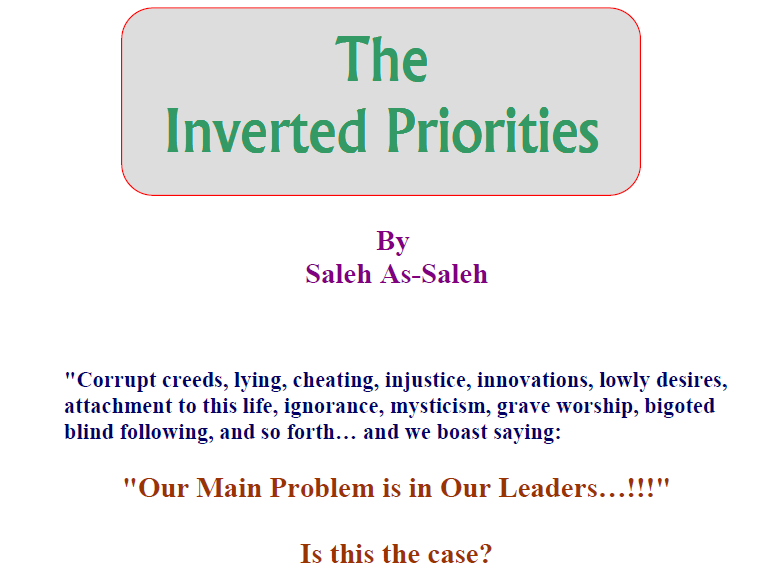
Inverted Priorities – “Our Main Problem is in Our Leaders…!!!” Is this the case? – Dr Saleh as Saleh

Inverted Priorities - Prepared by Saleh As-Saleh

In the Name of Allaah, the Most Beneficent the Most Merciful

Allaah, the Most High says:

“Verily! Allaah will not change the good (or bad condition) of a people as long as they don’t change their state of goodness (or sins and wrong doings etc) themselves.” [13:11].

Imaam Ibnul Qayyim, rahimahullahs, said:

“Ponder upon the Hikmah (Wisdom) of Allaah, the most High, where He has made people’s kings, leaders, and those of authority over them, of the same kind as their own deeds. It is as if the people’s deeds appeared in the forms of their kings and leaders.

If the people are upright, then their kings and rulers will be upright, and if they turn away (from uprightness), then their leaders will turn against them. And if they oppress and tyrannize, then their kings and rulers will tyrannize and oppress. And if deception and treachery becomes manifest amongst them, then the same will appear in their rulers.

If the people refrain from fulfilling the rights of Allaah upon them and become niggardly (regarding their execution), then their kings and rulers will refuse to give them their rights and will become niggardly (withhold their rights from them). And if they take away from those whom they oppress that which they deserve not to take, then the kings will take away from the people that which they deserve not to take and will levy taxes and impose tasks upon them. And whatever the people unjustly take from the oppressed, their kings take the same by force from them.

So those in charge of the people appear in the forms of their (the ruled) deeds. And it befits not the Divine Wisdom that the evil and wicked be ruled except by those of the same kind.

And since the early [Muslims] were the best and most righteous of generations, their rulers were of the same standing. But when the people turned weak, their rulers turned to be of their own rank.

So it befits not the Hikmah (Wisdom) of Allaah in these times (Ibnul Qayyim times [1] ) that rulers the like of Mu’aawiyah and ‘Umar bin ‘Addil ‘Azeez, be in charge over us, and even less the like of Abee Bakr and ‘Umar. Rather, our rulers are in accordance with our own rank and standing, and the ones who ruled those before us were (also) in accordance with these people own rank and standing. And both matters (the status of the former rulers and those of this time) are as necessitated and entailed by [Allaah’s] Hikmah.” [2]

It is very evident that from the legal perspective and by the consensus of the early Muslims, as well as by way of intellect and experience, that the true change of the status of the Ummah occurs when it turns to Allaah and follows the ways that made the early generations successful. Imaam Maalik, rahimahullah, summed it in words few in number, profound in meaning:

“Nothing will benefit the Ummah to come except that which benefited the early Ummah.”

Those who adopt the path of confrontation with the rulers, thinking that the change comes through this way, are trailing the path of misguidance and a path whose consequences proved it wrong by all perspectives. This is the same path taken by the early dissidents (khawaarij) who followed the mutashaabih (not entirely clear) texts instead of following the muhkam (clear) texts and referring whatever may be not entirely clear to that which is mukham. The following of the mutashaabih is a path of fitan (afflictions) that led to the rebellion against the leaders of the sahaabah, and in our times has caused bloodshed and suffering and retardation of da’wah. Allaahul Must’aan.

This matter is a matter of Deen and not a matter of emotions. And since the textual proofs are replete commanding the believers that they must obey those in authority, even if they oppress and take ones wealth, etc As long as they do not command the believer to do sin, then we have no choice but to comply and obey. Otherwise, we will be inventing a new Deen. Allaah, the One Free of all imperfection, the most High says:

“Let those beware who withstand the Rasool’s (صلى الله عليه و سلم) orders, unless some fitnah befalls them or a grievous penalty be inflicted on them” [24:63]

“Whatever was not Deen at the time of the Prophet (صلى الله عليه و سلم) cannot be considered to be a part of the Deen today.” [Imaam Maalik].

So if the person choses to contend the way of the Messenger (صلى الله عليه و سلم), then let him remember the following aayah:

If anyone contends with and opposes the Messenger (صلى الله عليه و سلم) after the right path has been shown clearly to him, and follows other than the believers way, We shall keep him in the path he has chosen, and burn him in Hell- what an evil destination! [4:115]

May Allaah, the most Merciful, guide us all to the truth and make us hold to it and may He, the most High and Majestic, save us all from fitan and guide us (ruled and rulers) to His Path. Aameen.

Saleh As-Saleh
22/7/1426
27/8/2005.

[1] Ibnul Qayyim was born in 691 AH/1292 CE, and died in 751 AH/ 1350 CE. May Allaah’s Mercy be upon him
[2] In Muftaah Daarus-Sa’aadah, vol. 1, pp. 177-178. Published by Daar Ibn ‘Affan (1416/1996, Al-Khubar, KSA).

[Download PDF]

Posted from : “The Inverted Priorities” – http://understand-islam.net/site/index.php?option=com_wrapper&view=wrapper&Itemid=102

Listen / Download Mp3 Here (Time 13:04)

General Kufr and Its Applications – Dr Saleh as Saleh

Listen / Download Mp3 Here (Time 7:51)

All Praise is due to Allaah, and may the salaah and salaam be on Prophet Muhammad, his household, and the noble companions and those who follow them until the Day of Resurrection.

Question:

If someone makes a statement of kufr or opposition to the Sunnah and he is a practicing Muslim, can we say he is a kafir?

Answer:

If a person commits an action of kufr or says a statement of kufr, then this person in particular can only be called a kafir only after certain criteria are met. These criteria include:

1. The conditions must be fulfilled that the action and/or statement is kufr and entails kufr.

2. It is necessary to check if there exist certain impediments that prevent the imputing of kufr on this particular person.

Actions and/or statements of kufr can be declared in general as such, however making them applicable on a specific person requires fulfilling the conditions and removing the impediments pertaining to takfeer. This is such because there may be causes which would prevent from imputing kufr on a particular person.

Moreover, it is not left for anyone to indulge in takfeer as this is the right of Allaah, (subhannahu wa ta’ala), and is a very grave matter to the extent that if you impute kufr on a person incorrectly, then the kufr may return on you; this applies to imputing kufr on the common Muslim as well as the rulers. The Prophet (sallallaahu ‘alayhi wa sallam) commanded the Muslim in the authentic hadith: “Say that which is good or stay silent.”

If this is for general matters, then what about takfeer? Then, by all means, it is necessary to refrain from indulging in this matter and leave it to the grand and reliable scholars of Islaam. They are the ones who can deduce the correct rulings vis-à-vis the kufr of a specific person. Similarly, this is not a matter for even the senior students of knowledge to take part in openly.

It seems nowadays that most people have nothing else to do but speak about the hukaam (the leaders) [1] and takfeer, day and night, in dreams and in awakness. If we claim to be on the path of the salaf (the righteous predecessors), then Muslims should not engage themselves in this matter. Regrettably, most common Muslims make analysis of the whole world political affairs and make judgments with ease and little fear of Allaah (subhannahu wa ta’ala). However, none of this is the business of the common Muslim. Their involvement in these matters can only aggravate situations and cause disunity. Some argue that, “Politics is from Islaam; Islaam and politics are the same.” They come through these doors. When you ask them about politics, you will find they read twelve newspapers, watch all the satellite news channels, and sit in countless circles, day and night, analyzing politics and so-called current affairs. This is what they consider as “politics”! At the very least, this is counterproductive and not beneficial for the person who will be responsible for every minute of his life, which he is required to fill with what is good and beneficial. The legislative policies in Islaam are the true “politics.” And this is not for the common Muslims to deal with, not to mention the “media” politics, filled with lies, counter-lies, endless analysis, deceptive statements, emotional speeches, etc. I ask Allaah (subhannahu wa ta’ala) to teach us all that which is beneficial and to save us from all that is evil. Aameen.

All Praise is due to Allaah, and may Allaah’s salaah and salaam be on Prophet Muhammad, his household, and the noble companions and those who follow them until the Day of Resurrection.

Saleh As-Saleh
Original material transcribed from understand-Islaam.net
By Br. Abu Abdullah Al-Amreeki.
10-5-1427 AH
June 7, 2006

[1] Please listen to the “The Inverted Priorities” talk on understand-islam.net

[Download the PDF]

Corrupt Modern Practices : Demonstrations, Sit-ins, Strikes – Dr Saleh as Saleh

Click the below link to read or download PDF

Corrupt Modern Practices – Demonstrations – Sit-ins – Strike – Dr Saleh as Saleh [PDF]

Listen / Download Mp3 (Time 23:39)
[audio https://salafiaudio.files.wordpress.com/2014/09/contemporary-issues-demonstrations-and-other-corrupts-practices-saleh-as-saleh.mp3]

All Praise is due to Allah, and may the salaah and salaam be on Prophet Muhammad, his household, and the noble companions and those who follow them until the Day of Resurrection.

Previously, we discussed the legal and illegal pledges, known as al-bay’ah, as well as partisanship (hizbiyyah). In continuity with that, it is appropriate to discuss certain practices that are taking place in the Muslim world in the form of so-called protests, namely demonstrations, sitins, and strikes. In our time, some people embrace everything that comes to us from the east or west. These practices are not an exception. This has reached the extent that some consider these practices as a means for da’wah (calling others to Allah). Given this, it is appropriate to determine whether this is the reality.

Types of Protests and Their Intentions

There are three specific types of protests that are used. They are demonstrations, sit-ins, and strikes.

A demonstration is when a group of people will meet along a street or a main road carrying banners, shouting, yelling, and demanding certain things be done or to show strength. This is known in Arabic as mudhaharah.

A sit-in is known as ‘itisam in Arabic. In our times, it involves sitting in one place (e.g., headquarters of a party, parliament, a factory, a campus, etc.) for a certain time, without leaving, in objection to some grievance, demanding that grievance be addressed.

The third type of protest is a strike. This is known as idrabat, with the origin of this word meaning refraining. As such, you refuse or hold back from doing a certain practice in order to request something. Examples of this include workers in a factory refusing to go to work, demanding higher wages or students not going to school, protesting a certain matter.

Given the definition of the different matters, the question arises how these things crept into the Islamic society. Mostly, they came from the West where they appeared originally; it was transferred to the Muslim world by primarily political and secular parties. These practices were later embraced by some Islamic groups who imitated such a methodology while trying to find some evidence in shariah to support these practices.

Evidences Cited to Justify Protests

It is important to note that those who cite evidences justifying these practices are not scholars. They are primarily thinkers and writers.

First, they cite the narration that when Umar ibn al-Khattab (radi Allahu ‘anhu) accepted Islam, the Prophet (sallallaahu ‘alayhi wa sallam) came out resting on the shoulders of two companions, namely Umar and Hamza. This was done to show the strength of the Muslims to the pagan Arabs of Quraysh. This hadith was reported by Abu Nu’aim in his book, al-Hillayyah. al-Haafidh ibn Hajar also reported it in his book al-Issaba relating it to Muhammad ibn Uthman’s book of history and as well as in al-Fath where he related it to al-Bazaar. The narrations of this incident revolve around a person named Ishaaq ibn ‘Abdullah ibn Abi Farwa. However, his hadith is rejected. Therefore, this incident can not be cited as a proof.

Second, these thinkers also take as proof the gathering of the Muslims on ‘Eid and Fridays. They twist the nature of these events to make them evidence for the permissibility of demonstrating, sit-ins, and showing strength. In response, it is necessary to note that there is no evidence in this. The gatherings on ‘Eid and Fridays are acts of worship and can not be linked to these protests. These gatherings are to make manifest the symbols of Allah in worship, in accordance with the way Allah chose and commanded. We can not stretch these acts of worship the way we want as this would entail abuse.

Therefore, there is no legally justifiable stance for these protests.

Effects of Protests

The effects of these protests, demonstrations and strikes are numerous and very serious.

Firstly, they bring forth chaotic behavior to the streets due to crowding and the like, negatively influencing the affairs of people. They can easily endanger the lives of many, while also providing an environment for theft and robbery. Many businesses could also be affected; for example, if a business does not close on the day of a demonstration, the protesters may vandalize or damage the building or even label the owners as traitors. And all of this occurred in many Islamic and Non-Islamic Capitals in the World.

Secondly, even when people try to go along with these protests to protect their benefits, they are forced to close their shops, negatively impacting their affairs as well as the economy in general. If they do not close their shops they are called “traitors”, “un-patriotic,” and so forth.

Thirdly, these protests provide a golden opportunity for those with hidden agendas or the people of fitnah to infiltrate the ranks of these demonstrations, to the degree where some of them may use firearms to create a fitnah or escalate the confrontation between the demonstrators and the security forces. This will lead the security forces to return fire on the crowd, potentially wounding many people.

Fourthly, these acts instigate animosity and hatred between the members of society, specifically the citizens and the security forces. Since the security forces usually try to prevent these demonstrations, there will be bloodshed and injury, which may lead to revenge attacks.

Fifthly, these practices lead to the halting of economic production in many sectors of the economy, especially during strikes. Most of the time when these groups intend to demonstrate, they ask the factory workers to join them, causing work to cease at times when the country is in dear need of collaboration between its ranks.

Sixthly, these protests disturb the overall security in the land due to the confrontations associated with them.

Seventhly, those who took these practices as a means of worship are worshiping Allah through a methodology that is not legislated and baseless. Therefore, they end up worshipping Allah through a way that is not acceptable to Him (: subhannahu wa ta’ala). For any act to be accepted, it must be done with the correct intentions and condoned by shariah. The actions of these people remind us of the statement of ibn Masoud (radi Allahu ‘anhu) when he said, “Many are those who intended good but could not achieve it.”

In order to attain the good, you must work according to the sunnah and the legal methods.

Eightly, these demonstrations hasten confrontations between the groups that utilize them and the government, since these practices appear as threats to the survival and security of the government itself. Therefore, the plotting begins against these groups, often resulting in unpleasant consequences and continuous animosity and mistrust.

The claim that these protests are permissible has led to their acceptance by the rejectionist Shia’ (Raafidah), who made such demonstrations against what they classified as imperialism during Hajj. Many innocent people were killed because of this, as is well known.

Misconceptions

There are numerous misconceptions regarding the value and permissibility of these practices. For example, some note that other countries regulate demonstrations and permit them according to their laws. As such, they fail to recognize the harm in doing the same. The response to this is that even if the government was to allow such practices, then we should not resort to them because there is no legal evidence justifying them, and we have to follow shariah above all other matters. We do not follow the general motto that says, “Objectives justify the means.” In Islam, the objectives must be legal, and the means that attain these objectives must be legal.

Similarly, others engage in these practices saying, “So-and-so considered these practices to be permissible.” However, it is necessary to note that these acts were not practised by the salaf, and had these demonstrations been something beneficial, they would have resorted to it, and we have no reports to indicate such. Moreover, when someone gives a fatwa, what really matters is the daleel (evidences) as any opinion without a proof can not be considered, even if it is made by the most knowledgeable of people as we are obligated to follow the Prophet (sallallaahu ‘alayhi wa sallam) and his companions who informed us all that is good.

If someone asserts that these practices had some benefits during certain times or in some countries, bringing useful results, then the response is that such results is not a proof for their permissibility since the criteria is the affirmation of the daleel and the acting of the salaf. Furthermore, we assert that if these demonstrations were successful during certain times, then most often, they failed and only lead to casualties, hastening confrontations with these groups, leading to their disintegration.

Conclusion

These are some points concerning these contemporary matters, which are counter productive and have depleted the energy of Muslim groups and youths in many parts of the Muslim world. We ask Allah to save us and to save our societies from all forms of corrupt and deviant practices, and to show us the truth and make us follow it while showing us the falsehood and safeguarding us from that.

All Praise is due to Allah, and may the salaah and salaam be on Prophet Muhammad, his household, and the noble companions and those who follow them until the Day of Resurrection.

Saleh As-Saleh
19-5-1427
June 15, 2006

Acknowledgment: This work originally appeared on understand-islam.net in audio form. It was based upon an article by Shaykh Muhammad alKhamees, may Allaah preserve him. It was transcribed and organized by br. Abu Abdullaah al-Amreeki, then text was reviewed by sis Umm Ahmad Al-Kanadiyyah, Jazaahmu Allaahu Khairan.

The Validity of Existence Of Various Muslim States in the Absence of Khaleefah (Greater Imam)

Refuting the Misconception that Obedience is Valid Only to the Greater Imaam.

In the Name of Allaah, the Beneficent, the Most Merciful, I begin (to write): The following Question was received from a brother in USA:

Assalaamu ‘alaykum wa rahmatullaah

As you know, there are a number of ahaadeeth concerning how Muslims are to deal with the Muslim rulers, including the sinful and oppressive rulers. How would you respond to the one who claims that these ahaadeeth are concerning the khaleefah of the Muslims, not the various leaders, kings, or prime ministers of today?

Baarakallaahu-feek.

The Answer:

Wa’alaykum as-Salaam wa Rahmatullaahi wa Barakaatuh

This Shubuha (misconception) that the Ahaadeeth of obedience to the Rulers are restricted to the general Khaleefah (greater Imaam) is, al-hamdulillah, already answered by the scholars of Islaam. Here are some of their statements:

1- Sh. Al-Islam Ibn Taymeyah (rahimahullaah) said:

“The sunnah is that the Muslims have one Imaam and the rest are his deputies. Suppose, however, the Ummah abandoned this due to a sin from some part of it and incapacity from the rest or for a reason other than that and which led to having number of Imaams, then it is binding upon each Imaam to establish the Hudood (prescribed punishments) and fulfill the rights (of people).” [Majmoo’ al- Fataawaa, 35/175-176].

2- Imaam Ash-Shawkaani (rahimahullaah) said:

“In Principle, all Muslims should have one Imaam. However, after the spread of Islam and the expansion of its territories and their remoteness, it is known that in each region there became a ruler or Imaam and so with the rest of the regions, none of them having authority to command and forbid in the other regions… So the presence of various (multiple) Imaams and Rulers is of no harm, and it is binding to obey each one of them after giving him the bay’ah (pledge of allegiance) in the region in which his commands and prohibitions are executed therein. And similarly in the case of the one in charge of another region. And it is not obligatory upon the people of the other regions to obey him, nor to be under his governorship due to the remoteness of the regions…”

Then he said: “You should know this, since it is fitting to the Sharee’ah Foundations, and in full agreement to what is indicated by the evidences. And turn down what is being said in opposition to this, since the difference between the condition of the early Islamic wilaayah (administrative governship) and its state nowadays is clearer than the sun during the day.” [Imaam Ash-Shawkaani in As- Sayelul Jarraar, 4/512].

3- Sh. Imaam Muhammad bin ‘Abdil Wahaab (rahimahullaah) said:

“The Imaams from each Madh-hab are unanimous that whoever overtakes a country or countries (seizes power) is entitled to assume the same rulership as the Imaam in ALL affairs. Were it not so, the affairs of this worldly life would not be upright. And for a long time, since before the time of Imaam Ahmad (rahimahullaah) and until our time, people were not in agreement upon one Imaam, and they have no account of a scholar stating that the validity of (the applicability) of any of the rulings (of sharee’ah) is conditional upon the presence of the Greater Imaam.” [In Ad-Durar As-Saniyyah, 7/239].

4- Al-‘Allaamah (esteemed scholar) As-San’aani (rahimahullaah) said in his explanation of the hadeeth of Abu Hurairah (radiya Allaahu ‘anhu), raised to the Prophet ( salllaallaahu ‘aleihi was-sallam):

“One who defected from obedience (to the Amir) and separated from the main body of the Muslims – if he died in that state – would die the death of one belonging to the days of Jahiliyya (i. e. would not die as a Muslim). [Saheeh Muslim, Book 20, # 4555, English Translation]

that the “obedience” is the obedience to the Khaleefah upon whom there is agreement, and it seems that what is intended is the khaleefah on any region from the regions, since people were not on agreement on a single khaleefah over the entire Islamic lands since the Abbasid Rule. Rather each region became independent under a ruler running its affairs. And if we carry the hadeeth to apply only to one khaleefah upon whom the Muslims are unanimous then its (the hadeeth) benefit would be diminished.

And that the saying (in the hadeeth) “and separated from the main body of the Muslims,” means: separated from the Jamaa’ah who agreed upon an Imaam under whom their body and affairs are organized, their world is united, and their protection from their enemy is achieved.”

So, it becomes clear that negating the validity of governership on separate Muslim states leads to evil in the sense that its sets the stage for rebellion against the rulers, and this is forbidden in Islaam even if the ruler is an oppressor as this constitutes the creed of ahl-us-Sunnah.

And Allaah Knows Best.

May Allaah, the Most High, guide me, you, and all Muslims to abide by the way of the Salaf and make us from those who relate the unclear matters to the clear so that they reach that which is clear and pleasing to Allaah.

Was-Salaam
Saleh As-Saleh
17th Rajab 1427 AH
10th August 2006

Posted from PDF from Dr Saleh as Saleh (rahimahullaah)’s website : http://understand-islam.net/site/index.php?option=com_wrapper&view=wrapper&Itemid=101

[Download Original PDF]

Meaning of Izhaar al-Din (Openly Practicing the Religion) in the lands of Disbelief – Shaykh Muhammad Bazmul [Video|Ar-En Subtitles]

What the Term Iẓhār al-Dīn (Openly Practicing the Religion) Entails – Shaykh Muḥammad Bāzmūl حفظه الله
Translated by Mikail Ibn Mahboob Ariff حفظه الله
Video Courtesy: Bilal Nahim

Advice Regarding Migration from the Lands of Disbelief – Shaykh Ali al-Ḥaddadi [Video|Ar-En Subtitles]

Advice Regarding Migration from the Lands of Disbelief to the Lands of Islām – Shaykh ʿAlī al-Ḥaddādī حفظه الله
Translated by Mikail ibn Mahboob Ariff حفظه الله
Video Courtesy: Bilal Nahim

Shubuha (Doubt) : Isbaal is permitted as long as it is not done out of conceit

[Isbaal is to wear garments that extend below the ankles]

First Shubuha (Doubt): Isbaal is permitted as long as it is not done out of Makheelah. Some refer to the following hadeeth as an evidence:

[Abdullah bin Umar رضي الله عنهم ا reported that: “I came to visit the Messenger of Allaah صلى الله عليه و سلم and I was wearing an Izaar Yataqa’qa’ (clanking because of its trailing below the ankles) . He صلى الله عليه و سلم said: “Who is this?” I said: “Abdullah bin Umar”. He said: “If you are an Abd (i.e. a true slave) of Allaah, then pull up your Izaar”. I did. He then said: “more!”. (Ibn Umar) said: “I pulled it up until it reached the middle of shank; this was the (length) of his Izaar until he (صلى الله عليه و سلم) died”. He then looked towards Abee Bakr and said: “If anyone trails his garment arrogantly, Allaah will not look at him on the Day of Judgment”. Then Abu Bakr said: “My Izaar sometimes hangs low (in another narration he said: “one of the sides of my lower garment hangs low if I do not take care of it”)[99]. The Prophet صلى الله عليه و سلمsaid: “But you are not one of them (in another narration he said: You are not one of those who do so conceitedly)[100].] [101]

Discussion: The hadeeth supports the Tahreem of Isbaal rather than the opinion which permits the Isbaal as long as it is not done out of conceit. In fact the hadeeth clearly makes it obligatory on the Muslim not to let his Izaar hang lower than his ankles, and that he must tuck it up even though his intention was like that of Abu Bakr in the hadeeth i.e. not done out of conceit. In fact Abu Bakr said: “One side of my Izaar hangs low if I do not take care of it”. In our times, however, people let their Izaars hang low, unlike Abu Bakr, and then they claim: “Well we do not do it out of arrogance!”. Don’t they realize the commands of Allaah’s Messenger to tuck up the Izaar and that his Izaar was extending to the middle of his shanks? Don’t they know that He صلى الله عليه و سلم never thinks about Makheelah? Isn’t he our example?

It is also clear that Abu Bakr did not say that: “I made my Izaar trailing”. In fact he said in one narration: “Sometimes my Izaar hangs low”. So, its his Izaar that goes down when as he said: “I do not take care of it”. Its clear that when he takes care of it it stays above his ankles, but when it gets loose it hangs low. Al-Hafidh Ibn Hajer reported that Ibn Sa’dd reported a narration from the way of Talha bin Abdullaah bin Abdur-Rahmaan bin Abee Bakr, that ‘Aaaishah رضي الله عنها وعنهم said: “Abu Bakr was Ahnaa (had an inclination in his back), his Izaar could not hold on him, it used to get loose around his loins”. Al-Hafidh also reported a narration from the way of Qayess Ibn Abee Haazim who said: “I visited Abee Bakr and he was a thin person.” [102]

Those who design garments, pants, etc. whose lower ends abide by the Sunnah, but when they wear them they get loose and sometimes trail below the ankles, resemble the case of Abu Bakr.

The Prophet صلى الله عليه و سلم considered that Abu Bakr was not “one of those who hang their garments out of conceit”, because Abu Bakr did not intend to lower his Izaar below the ankles, and it only trailed when he did not take care of it. Those who intend to trail out of conceit are threatened with a grave punishment:

The Prophet صلى الله عليه و سلم said:

Allaah will not look (on the Day of Resurrection)[103] at person who drags his Izaar (behind him) out of conceit.” [104]

In another narration the Prophet صلى الله عليه و سلم said:

Allaah will not look at a person , on the Day of Judgemt, who drags his Izaar out of pride and arrogance.” [105]

In addition, on the Day of Judgment, Allaah will not talk to or sanctify the Musbil. This is confirmed in the authentic hadeeth in which Abu Dharr reported the Prophet صلى الله عليه و سلم as saying:

“There are three (kinds) of persons to whom Allaah will neither speak on the Day of Judgment, nor will He look at them nor purify them, and they will have a painful Punishment. He (Abu Darr) said: “Allaah’s Messenger repeated it three times. Abu Dharr remarked: “They failed and they lost; who are these persons, O Messenger of Allaah? He صلى الله عليه و سلم replied: “The one who wears a trailing robe (the Musbil), the one who takes account of what he gives, and the seller of goods by false oaths.” [106]

Certainly Abu Bakr received a testimony from the Prophet صلى الله عليه و سلم that he did not lower his Izaar out of arrogance. Those who intentionally make Isbaal, when did they receive a purifying testimony?

In another incident, Abdullah Ibn Umar passed by the Prophet صلى الله عليه و سلم and his Izaar was hanging low. He said describing this incident:

“I happened to pass before Allaah’s Messenger صلى الله عليه و سلم with my garment hanging low. He said: Abdullah, tug up your lower garment. I tugged it up, and he again said: “Tug it still further”. I tugged it still further and I went on tugging it afterward, whereupon some of the people said: “To what extent?” Thereupon he said: “To the middle of the shanks.” [107]

The Prophet صلى الله عليه و سلم did not keep silent when he saw Abdullah bin Umar hanging low his Izaar. This shows that the prophibition of Isbaal for men is not restricted only to the case if it is done out of Makheelah. Abdullah bin Umar is one of the great Sahabah. Imagine what would the position of the Prophet صلى الله عليه و سلم be if he sees the clothes on many Du’aat (those who invite others to this Deen), or even “scholars” each trailing his Jubbah,[108] garment, or pants? We know that Ibn Umar hastened to comply with the Prophet’s command. Now it takes hours, talks, lectures to convey the Prophet’s command and still you find people arguing that: “Well! As long as Isbaal is not done out of conceit then its OK!” Indeed it makes the clement person preplexed! To Allaah alone, is the complaint!

References:

[99] From Saheeh Al-Bukhaaree, V. 7, hadeeth # 675.

[100] Ibid. Also reported by Abee Dawood.

[101]The hadeeth was reported by Imaam Ahmad, Abdul Razzaaq, At-Tabaraanee and others. Al-Albaanee said: The hadeeth’s Isnaad is according to the conditions laid down by Ash-Shayekhan (i.e. the two Shayeks: Al- Bukhaaree and Muslim), As-Silsilah As-Saheehah, V. 4, P. 95. The part of the hadeeth starting with the saying of the Prophet صلى الله عليه و سلم: If anyone trails his Izaar” and ending with “you are not of those who do so conceitedly” is reported by Al-Bukhaaree, Saheeh Al-Bukhaaree V. 7, hadeeth # 675.

[102] Fathul Baaree V. 10, P. 255.

[103] See Appendix.

[104] Al-Bukhaaree, Muslim, and Ahmad. See Saheeh Al-Bukhaaree, V. 7, hadeeth # 675., and Saheeh Muslim, V. 3, Ahadeeth # 5191-5195.

[105] Saheeh Al-Bukhaaree, V. 7, hadeeth # 679 and Saheeh Muslim, hadeeth # 5201.

[106] Collected by Muslim (Saheeh Muslim, V.1, hadeeth # 192 and 193), Saheeh Abee Daawood, hadeeth # 3444, Saheeh At-Tirmithee # 967, Saheeh Ibn Majah, # 2208, An-Nassaa’ee, Book of Zakat, V.5, P. 81, Imaam Ahmad in his Musnad, V. 5, P. 148 and P. 162, and others. Al-Albaanee also reported it in Saheeh Al-Jaami’, V.3, hadeeth # 3062.

[107] Reported by Muslim, Saheeh Muslim V. 3, hadeeth # 5200.

[108] Jubbah, a cloak.

Author: Sheikh (Dr) Muhamad Bin Ahmad Bin Ismaa’eel
Translated by Dr. Saleh As-Saleh (rahimahullaah)
Daar Al-Bukhari Publishing & Distribution

The Three Letters – The Beard, Isbaal , Smoking – Dr Saleh as Saleh [PDF]
Source: Understand-islam.net