Share this, Baarakallaah Feekum: [“One who guides to something good has a reward similar to that of its doer” - Saheeh Muslim vol.3, no.4665] [This website protects the copyrights of the authors/publishers. The Content is posted on this website with implicit/explicit permission from content owners]
Share this, Baarakallaah Feekum: [“One who guides to something good has a reward similar to that of its doer” - Saheeh Muslim vol.3, no.4665] [This website protects the copyrights of the authors/publishers. The Content is posted on this website with implicit/explicit permission from content owners]
Listen / Download Mp3 Here (Time 01:31:21) (Arabic-English) Currently this audio is being edited by mpubs.org for better clarity – Audio link will be posted soon !! ,inshaa’ Allaah.
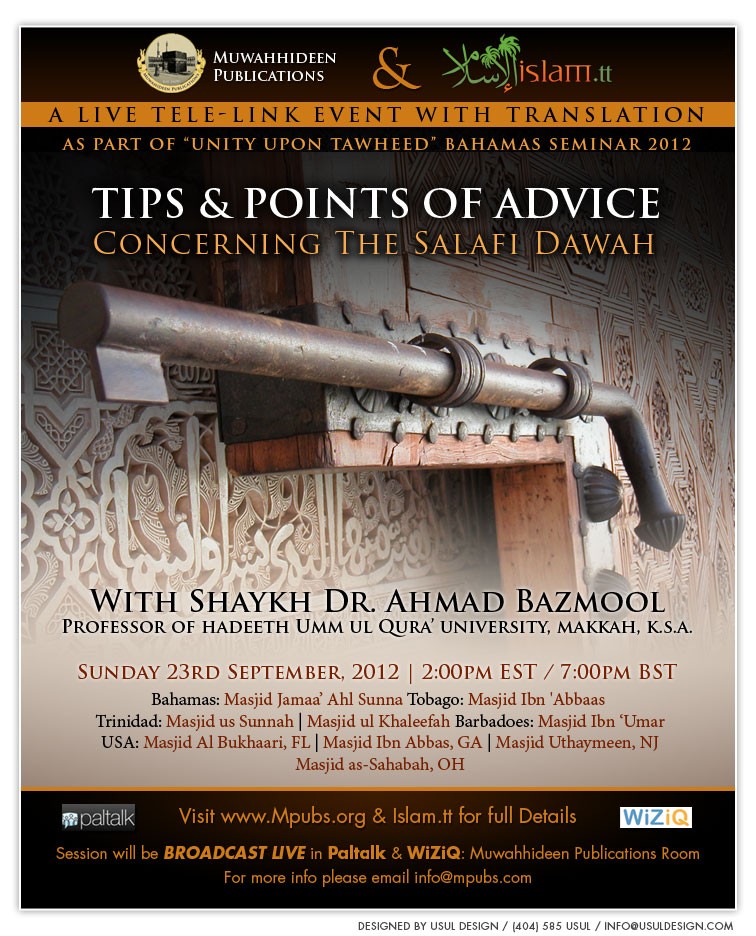
ShaykhDoctorAhmadBazmool(hafidhahullaah) is from amongst the well known scholars of Makkah, SaudiArabia. He teaches the Science of Hadeeth at Ummul-Qura University and has studied under some of the great scholars of our time, including Ash-Shaykh, the ‘Allaamah, Doctor Rabee’ Ibn Hadi al-Madhkhalee, and his own brother Ash-Shaykh Muhammad bin ‘Umar Baazmool. He has gotten ijazaahs from many scholars throughout the Islaamic World including Ash-Shaykh Muhammad Abdullaah as-Soomalee, Ash-Shaykh Ahmad bin Yahya an-Najmee, Ash-Shaykh Abdullaah Ada ash-Shanqeetee , Ash-Shaykh Rabee’ bin Haadee Al-Madkhalee , Ash-Shaykh Muhammad bin Abdullaah as-Sabeel, Ash-Shaykh Yahyaa bin Uthmaan al-Mudarris, and Ash-Shaykh Abdullaah bin Abdul Azeez al-Aqeel. The Shaykh has also been highly praised and recommend by al-Kibaar ul-‘Ulamah for his beneficial works.
As an admonition to Ahlus Sunnah in The Bahamas (a small island southeast of the United States and has a population of less than 400,000 people of which less than 300 are Muslim), and the wider nation of Muslims as well, our Shaykh will enlighten us with some much needed points of advice and wise admonition concerning this blessed da’wah. It is of paramount importance that we truly understand and are upon yaqeen concerning our call which must be done with knowledge. Even more so in these lands of kufr where the vast majority of people are upon shirk, kufr and other grave sins.
We ask Allaah to grant us beneficial knowledge, guide us to implement that which we have learnt, call the people to The Truth and have patience upon this.
Share this, Baarakallaah Feekum: [“One who guides to something good has a reward similar to that of its doer” - Saheeh Muslim vol.3, no.4665] [This website protects the copyrights of the authors/publishers. The Content is posted on this website with implicit/explicit permission from content owners]
The Noble Shaykh Mis’ad al-Hussayni (May Allaah Preserve Him), Professor of Tafseer (Quranic Exegesis) and Quranic Sciences in The Islaamic University of Madinah, K.S.A., delivered a LIVE tele-link lecture concerning the important affair of remaining steadfast in the non-muslim lands
The Shaykh, elaborated on several points which the muslim can hold to in the west to protect his eemaan and fortify himself against the many evils that are present in the non-muslim countries.
[Tele-link conducted with Shaykh Mis’ad al-Hussayni (hafidhahullaah) and the brothers at Mpubs, Tobago on April 14th 2012]
Share this, Baarakallaah Feekum: [“One who guides to something good has a reward similar to that of its doer” - Saheeh Muslim vol.3, no.4665] [This website protects the copyrights of the authors/publishers. The Content is posted on this website with implicit/explicit permission from content owners]
On the authority of ‘Abdullaah Ibn ‘Amr al-‘Aas, The Messenger of Allaah(sallAllaahu ‘alayhi wa sallam) said,
“Indeed Eemaan is worn out inside one of you just like a thawb (garment) is worn out, so ask Allaah to revive Eemaan in your hearts.”
The lofty rank and high station eemaan possesses is not something obscure, as it is unquestionably the most important duty as well as being the most imperative of all obligations. It is also the greatest and most glorious of them. All the good in the world and the Hereafter is dependent upon the presence of eemaan and on its soundness and integrity.
Eemaan holds such a multitude of benefits, ripe fruits, delicious produce, constant food and continual goodness.
It is within this context that those certain folk embarked upon and competed with each other in directing their attention to trying to actualize and fulfill eemaan. For the Muslim who is granted the tawfeeq, his concern for his eemaan is greater than any other concern he may have – and this must be so. When this became evident to the Salaf of this Ummah, the first and best of this Ummah, their concern for their eemaan was very eminent and the attention they gave to it was enormous.
They, may Allaah be pleased and have mercy upon them, used to tend to their eemaan, inspect their actions, and give each other advice. Reports of this nature from the Salaf are numerous. Some of their statements include:
‘Umar Ibn al-Khattaab (radhiyAllaahu ‘anhu) used to say to his companions: “Come on, so that we may increase our eemaan”.
Aboo Dardaa’(radhiyAllaahu ‘anhu) used to say: “It is from the intelligence of the servant to know whether he is increasing or decreasing, and indeed, it is from the intelligence of the servant to know how, where and when the whispers of shaytaan appear to him.”
‘Abdur-Rahmaan Ibn ‘Amr al-Awzaa’ee (rahimahullaah) was asked about eemaan: “Does it increase?” He replied, “Yes, until it becomes like mountains. He was then asked, “Does it decrease?” He answered, “Yes, up until there is nothing left of it.” [Causes Behind the Increase and Decrease of Eemaan by Shaykh ‘Abdur-Razzaak al-‘Abbaad from AbdurRahman. org]
Thus, it can be seen that the matter of eemaan is a tremendous affair, which each one of us must pay close attention to.
Our Shaykh Khalid ‘Uthmaan (hafidhahullaah) will admonish us concerning this crucial topic and explain to us the ways in which we can increase our eemaan and by the Permission of Allaah we will all act upon the advices offered and thus have our eemaan renewed and increased.
We ask Allaah to grant us all lasting eemaan, true certainty and beneficial knowledge.
Share this, Baarakallaah Feekum: [“One who guides to something good has a reward similar to that of its doer” - Saheeh Muslim vol.3, no.4665] [This website protects the copyrights of the authors/publishers. The Content is posted on this website with implicit/explicit permission from content owners]
Share this, Baarakallaah Feekum: [“One who guides to something good has a reward similar to that of its doer” - Saheeh Muslim vol.3, no.4665] [This website protects the copyrights of the authors/publishers. The Content is posted on this website with implicit/explicit permission from content owners]
This is the weekly Saturday morning class given at Masjid at-Tawheed in Stone Mountain, GA.
From the book Al-Mulakhas fee Sharh Kitaabit-Tawheed by Sheikh Saaleh al-Fawzaan.
What Has Been Said About Fortune-tellers and Their Like
Muslim has narrated, on the authority of one of the wives of the Prophet (Hafsah – may Allah be pleased with her), that Allah’s Prophet said:
“Whoever went to a fortune-teller and asked him about some matter (i.e. of the unseen) and believed him, will have his prayer rejected for forty days.”
Share this, Baarakallaah Feekum: [“One who guides to something good has a reward similar to that of its doer” - Saheeh Muslim vol.3, no.4665] [This website protects the copyrights of the authors/publishers. The Content is posted on this website with implicit/explicit permission from content owners]
Audio : Abu Muhammad al-Maghribee (hafidhahullaah)
Explanation of Selected Ahaadeeth from Riyaadus-Saaliheen by Sheikh Muhammad ibn al-Uthaymeen.(rahimahullaah)
In this class we read the explanation of the last hadith in the chapter of at-Taqwaa which is the sermon of the Messenger sallallahu alaihi wa sallam in the Farewell Pilgrimage.
Wednesday’s classes on the Explanation of Riyaadus-Saaliheen are held particularly for women after salatul-asr at Masjid Tawheed in Stone Mountain, GA. However, this is a book for us all to learn and benefit from, and we encourage everyone to join us.
73. Abu Umamah (May Allah be pleased with him) said: I heard Messenger of Allah (sallallaahu ’alayhi wa sallam) during the sermon of the Farewell Pilgrimage saying, “Be mindful of your duty to Allah; perform your five daily Salat, observe Saum during the month (of Ramadan) , pay the Zakat on your properties and obey your leaders; (if you do so) you will enter the Jannah of your Rubb”.
[At-Tirmidhi].
Commentary: The word Wada`, means to say farewell. The Farewell Pilgrimage was the last pilgrimage, the Prophet (sallallaahu ’alayhi wa sallam) performed, and on this occasion he bade farewell to the people and for this reason it came to be known as Hajjat-ul-Wada`. Obedience of the rulers is stressed but it is conditional, that is to say, they are to be obeyed only if their orders are not against the injunctions of Allah. Similarly, their obedience is obligatory till such time that they do not do anything which amounts to open disbelief. If any of these two things occurs, then no obedience would be due to them.
Source: Riyaadus-Saaliheen
Share this, Baarakallaah Feekum: [“One who guides to something good has a reward similar to that of its doer” - Saheeh Muslim vol.3, no.4665] [This website protects the copyrights of the authors/publishers. The Content is posted on this website with implicit/explicit permission from content owners]
This Friday Khutbah was given at Masjid At-Tawheed in Stone Mountain, GA.
This was taken from one of the khutab of our noble sheikh Abdur-Razzaq ibn Abdil-Muhsin Al-Badr. You can find the original audio and transcription here:صيانة الإسلام للمرأة
These are beautiful guidelines that every Muslim woman should adhere to. They do not oppress her nor do they take her freedom, as some foolish people claim. Rather they are legislated by Allahu subhaanahu wa ta’aala to preserve and protect the precious and priceless gem that is the Muslim woman.
Share this, Baarakallaah Feekum: [“One who guides to something good has a reward similar to that of its doer” - Saheeh Muslim vol.3, no.4665] [This website protects the copyrights of the authors/publishers. The Content is posted on this website with implicit/explicit permission from content owners]
From the book Al-Mulakhas al-Fiqhi “A Summary of Islamic Jurisprudence” by Sheikh Saaleh al-Fawzaan.In this class we continue in the chapter on as-salat (prayer) in the section of the prayer of the traveler.
Share this, Baarakallaah Feekum: [“One who guides to something good has a reward similar to that of its doer” - Saheeh Muslim vol.3, no.4665] [This website protects the copyrights of the authors/publishers. The Content is posted on this website with implicit/explicit permission from content owners]
O mankind! We have created you from a male and a female, and made you into nations and tribes, that you may know one another. Verily, the most honourable of you with Allâh is that (believer) who has At-Taqwa [i.e. he is one of the Muttaqûn (pious – see V.2:2). Verily, Allâh is All-Knowing, All-Aware.( Noble Qur’an 49:13)
Narrated by Abu huraira, The prophet peace be upon him said: “Truly, Allah does not look at your outward forms and wealth, but rather at your hearts and your works”(Sahih Muslim, 4.1389: hadith 2564)
In his final sermon the Prophet Muhammad, Allah’s Blessings and Peace be upon him, said:
“There is no superiority for an Arab over a non-Arab, nor for a non-Arab over an Arab. Neither is the white superior over the black, nor is the black superior over the white except by piety.”
Share this, Baarakallaah Feekum: [“One who guides to something good has a reward similar to that of its doer” - Saheeh Muslim vol.3, no.4665] [This website protects the copyrights of the authors/publishers. The Content is posted on this website with implicit/explicit permission from content owners]
Shaykh Muhammad Nasir ud-Deen al-Albaanee clarifies the deviation of Hizb ut-Tahrir and the other sects who deviate away from the Methodology of the Salaf us-Saalih i.e. Salafiyyah (Qur’aan and Sunnah upon the understanding of the righteous predecessors). The Shaykh explains many sects/groups claim to follow the Qur’aan and Sunnah, however the only sect i.e. the saved sect are the ones who follow the salaf us-saalih in their understanding of the Qur’aan and Sunnah
Share this, Baarakallaah Feekum: [“One who guides to something good has a reward similar to that of its doer” - Saheeh Muslim vol.3, no.4665] [This website protects the copyrights of the authors/publishers. The Content is posted on this website with implicit/explicit permission from content owners]
Share this, Baarakallaah Feekum: [“One who guides to something good has a reward similar to that of its doer” - Saheeh Muslim vol.3, no.4665] [This website protects the copyrights of the authors/publishers. The Content is posted on this website with implicit/explicit permission from content owners]
The Shaykh (May Allaah preserve him) is well known to the major scholars and studied with several of them, including Shaykh Rabee’ ibn Hadi al-Madkhalee and Shaykh ‘Ubayd al-Jaabiree (May Allaah preserve them). He is highly recommended, specifically, by Shaykh Rabee’ al-Madkhalee (May Allaah preserve him). TheShaykh delivered an extremely beautiful lecture full of athaar (narrations from the salaf). He expounded on many of the signs and characteristics of the people of innovation.
Throughout history, the ways of the people of innovation has been apparent to the scholars of Ahl Sunnah wal Jama’ah; however, in our time, the ability to distinguish haqq (truth) from baatil (falsehood) has become unclear to most muslims, especially since many of the innovators and deviant groups use clever ways to penetrate the hearts and minds of the people of the Sunnah, like labeling themselves with praiseworthy descriptions such as salafi, athari and ahl-hadeeth etc., when they are the furthest from the methodology of the salaf-us-saalih (righteous predecessors). Alhamdulillah we have the people of knowledge, who have not been deceived by these tactics but have the insight into the tell tale signs of the people of innovation. With the aid of our scholars, who equip us with the necessary tools to recognize these people, we can steer clear of their misguidance and be on guard against their infiltration amongst our ranks. The noble Shaykh Khalid ibn Dhawi adh-Dhufayree (May Allaah preserve him) elaborated on several of their characteristics and exposed some of their deceptive ways. The Shaykh detailed some of the major signs of the people of innovation, as their signs are plenty, with a focus on the more apparent groups and personalities from amongst the people of innovation, like the khawarij and their spokesmen in our recent times ‘Abdullaah Azaam and Sayid Qutb. MayAllaah, Al-Haqq show us the truth and make it easy for us to follow it and show us the falsehood and make it easy for us to distance ourselves from it.
Wa Billaahi Tawfeeq
Wa SallAllaahu wa Sallaama wa Barak ‘alaa Nabiyanna Muhammad wa ‘alaa ‘Alyhi wa Sahbyhi wa Sallam
Share this, Baarakallaah Feekum: [“One who guides to something good has a reward similar to that of its doer” - Saheeh Muslim vol.3, no.4665] [This website protects the copyrights of the authors/publishers. The Content is posted on this website with implicit/explicit permission from content owners]
Share this, Baarakallaah Feekum: [“One who guides to something good has a reward similar to that of its doer” - Saheeh Muslim vol.3, no.4665] [This website protects the copyrights of the authors/publishers. The Content is posted on this website with implicit/explicit permission from content owners]
This lecture was given on Saturday, December 1, 2012 in Masjid at-Tawheed in Stone Mountain, GA.
With this lecture, we will begin our weekly talk related to the Family in Islaam and related issues (selecting a spouse, raising children, the rights of the parents/child/husband/wife, status of the mother, and much more….).
This class was given on Saturday, December 8, 2012 in Masjid at-Tawheed, Stone Mountain, GA. This was taken from a Friday Khutbah by our sheikh Saaleh al-Fawzaan, hafidhahullah.
This class was given on Saturday, December 15, 2012 in Masjid at-Tawheed, Stone Mountain, GA.This was taken from a Friday Khutbah by our sheikh Saaleh al-Fawzaan, hafidhahullah.
Share this, Baarakallaah Feekum: [“One who guides to something good has a reward similar to that of its doer” - Saheeh Muslim vol.3, no.4665] [This website protects the copyrights of the authors/publishers. The Content is posted on this website with implicit/explicit permission from content owners]
Bismillaah wa -Alhamdulillaah wa Salaatu wa Salaam ‘alaa Rasulillaah ‘amma ba’d
The Noble Shaykh ‘Abdullah Ibn Naajee al-Hadaad (May Allah Preserve Him) from the mashaayikh of Dhimaar, Yemen delivered a LIVE tele-lecture with Muwahhideen Publications on Wednesday 6th March 2013 on the topic of reliance on Allah. Shaykh ‘Abdullaah al-Hadaad is a student of Ash-Shaykh Al-Allaamah Al-Muhaddith, the Imaam of Yemen, Shaykh Abu ‘Abdur Rahmaan Muqbil Ibn Hadee al-Waadi’ee (rahimahullah) and is currently the Imaam of Masjid Siddeeq in Dhimaar, Yemen.
The Noble Shaykh ‘Abdullah Ibn Naajee al-Hadaad (hafidhahullaah) introduced the lecture by supplicating to Allaah for His aid and assistance and subsequently sending prayers upon our Prophet (sallAllaahu ‘alayhi wa sallam). He then began by explaining the linguistic definition of tawakkul which is to show that one is unable to handle a certain affair and that one is relying upon other than himself to take care of that affair. He stated that there are two types of agents (helpers) that a person can rely upon:
Those agents who can be relied upon only in certain matters and are imperfect
Those agents who can be relied upon in every single affair and this can only be Allah
The Shaykh proceeded to the meaning of tawakkul in the sharee’ah, and it is true reliance of the heart upon Allah. So the person who relies upon Allaah is one who knows that Allah will provide for him and handle all of his affairs, may it be from his desires or his fears in this world or the aakhirah. It is noteworthy that tawakkul is one of the means by which a servant accomplishes what he desires. So a person should not lie around and not accomplish anything because doing so has no relation to relying upon Allah. Rather, this is a fake form of tawakkul called ittikaal that is indeed laziness and may lead to one not being keen upon performing his due deeds and not improving his situation at his own hands from where he is capable.
Shaykh Hadaad (hafidhahullah) then mentioned the difference between relying upon Allah(tawakkul) and leaving one’s affair to Allah(tafweedh). Although these two are related, tafweedh is more general than tawakkul since tafweedh is akin to submitting to Allah. Having tafweedh indicates that a person has freed himself from claiming he has any power or ability of his own without Allah. So one has to submit himself to Allah and leave his affair in His Hands before he obtains tawakkul, which is more specific as previously mentioned.
The lecture continued on an advantageous path, as the Shaykh differentiated the meaning of tawakkul and having trust in Allah. The essence of tawakkul is trusting in Allah just as the black of one’s eye is the most beautiful and most elegant part of it. He also spoke about the places where tawakkul is to be performed and surely, it is advised to have tawakkul in all the affairs of one’s life; however, the Prophet (sallAllaahu ‘alayhi wa sallam) and his Companions were instructed by Allah to have tawakkul in the following specific affairs:
·When seeking the aid of Allah for victory
·When turning away from your enemy
·If mankind turns away from you
·When the Qur’aan is being recited
·If you are trying to mend an affair of enmity between two people
·When the decree of Allah descends
·If your enemy places down their traps/schemes
·When you realize that all affairs return to Allah and that Allah is the One who decrees all affairs
·When you realize that Allah is truly One God
·If Allah guides you (you should receive the guidance with gratitude to Allah)
·If you fear the harms of the enemies of Allah and the shaytaan
·If you want Allah to be your agent in all of your affairs
·If you wish for the highest level of Paradise
·If you wish for Allah to love you (then rely on Him)
·If you want to completely submit to Allah
Our Shaykh (hafidhahullaah) then recited many ayaat from the Qur’aan where Allah mentioned the importance of tawakkul as well as many authentic ahadeeth from the Prophet (sallAllaahu ‘alayhi wa sallam). He concluded by sending prayers upon the Prophet(sallAllaahu ‘alayhi wa sallam), his family and his companions.
Indeed, there was a great benefit in this gathering as Shaykh ‘Abdullah al-Hadaad clearly defined each aspect of tawakkul, bringing forth the necessary evidences from the Qur’aan and authentic Sunnah.
Wa Billaahi Tawfeeq
Wa SallAllaahu wa Sallaama wa Barak ‘alaa Nabiyanna Muhammad wa ‘alaa ‘Alyhi wa Sahbyhi wa Sallam
Share this, Baarakallaah Feekum: [“One who guides to something good has a reward similar to that of its doer” - Saheeh Muslim vol.3, no.4665] [This website protects the copyrights of the authors/publishers. The Content is posted on this website with implicit/explicit permission from content owners]
Refuting those who say that the Shia are our brothers || Sheikh Salih al-Fawzaan
الرد على مقولة الشيعة إخواننا || الشيخ صالح الفوزان
Uploaded by daarulhaq
Share this, Baarakallaah Feekum: [“One who guides to something good has a reward similar to that of its doer” - Saheeh Muslim vol.3, no.4665] [This website protects the copyrights of the authors/publishers. The Content is posted on this website with implicit/explicit permission from content owners]
Bismillaah wa -Alhamdulillaah wa Salaatu wa Salaam ‘alaa Rasulillaah ‘amma ba’d
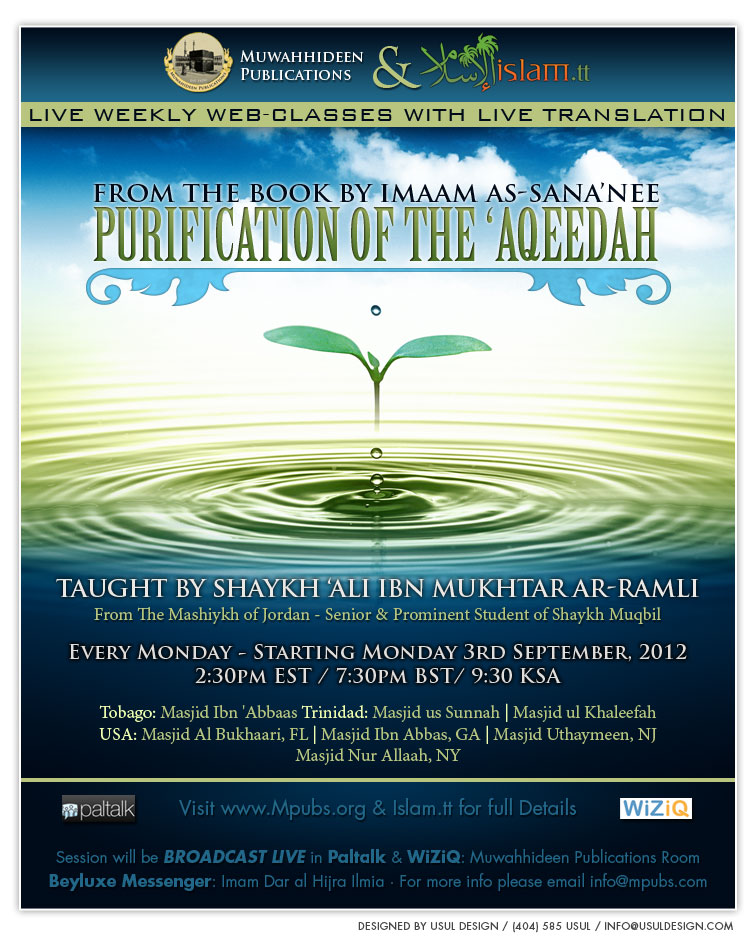
The Noble Shaykh, Aba al-Hassan ‘Ali ibn Mukhtar ar-Ramly (May Allaah Preserve Him) from amongst the scholars of Jordan, and a very strong student of Shaykh Muqbil ibn Hadi al-Wad’ee (rahimahullaah) started a weekly web class with Muwahhideen Publications on the explanation of the book “The Purification of The Aqeedah” by Imaam Muhammad ibn Ismaeel al-Sana’nee (rahimahullaah)
—
Class # 01 – 03.09.201270:09 mins. (Arabic & English)
Commencing the class, Shaykh ‘Ali ar-Ramli (hafidhahullaah) spoke about the reason for Allaah sending us Prophets and Messengers and touched on the origin of shirk amongst mankind.
He then went on to give a brief biography of Imaam As-Sana’anee (rahimahullaah) and the reason why the author took it upon himself to write this book and clarify the misguidance of the people in his time.
Other points of benefit included mention of the condition of the disbelievers of Quraysh, an explanation of the title of the book, some discussion about the state of the people in the time of Imaam as-Sana’anee and much more benefit concerning the correct belief of the muslim.
The Shaykh completed the introduction of the book in this first sitting and all are encouraged to attend these vital lessons that are packed with immense benefit about the most important matter in the life of a Muslim: the establishment of Tawheed and safeguarding oneself from shirk.
—
Class # 02 – 03.09.201261:56 mins. (Arabic & English)
Continuing with our study of the book ‘The Purification of the ‘Aqeedah’, Shaykh ar-Ramli (hafidhahullaah)explained in great detail three of the five fundamentals as articulated by the author.
Imaam as-Sana’anee (rahimahullaah) laid down five fundamentals which he then broke down into chapters.
The three fundamentals discussed are as follows:
Firstly: It has been known from the necessity of belief in the religion of Allaah that all of the Quraan is truth and not falsehood, all of it is guidance and not misguidance and all of it is certainty that has no doubt whatsoever. This is a foundation that the belief of anyone cannot be perfected and affirmed without.
Secondly: All of the prophets and messengers of Allaah from the first to the last of them were sent to call all of the creation to worship Allaah alone without associating any partners with Him.
Thirdly:Tawheed is divided into two categories. The first, Tawheed ar-Ruboobiyyah (Tawheed al-Asmaa was-Sifaat included in this category) and the second, Tawheed al-Uloohiyyaah.
—
Class # 03 – 17.09.201262:59 mins. (Arabic & English)
In the third class, our Shaykh ‘Ali ar-Ramli (hafidhahullaah) began by doing a recap of the principles we studied thus far. Then, he went on to explain the remaining two principles of the five.
These include:
The Fourth Principle: All of the polytheists affirm and confirm that Allaah is the Lord (The Creator, The Sustainer and the Disposer of all Affairs) soAllaah sent the Messengers and Prophets to call the people to the Monotheism of Worship (Tawheed al-‘Uloohiyyah).
The Fifth Principle:‘Ibaadah (worship) is the utmost of humiliation and humbling oneself to Allaah and worship is not meant but to humiliate oneself to Allaah. And this humiliation is only for Him and can never be for other than Him.
The Shaykh explained both principles in great detail, quoting the many evidences concerning both matters. He then went on to enlighten us with some benefits regarding the statement of Tawheed:‘Laa ilaaha il Allaah’.
This concluded the five principles as mentioned by the author (Imaam as-Sana’anee) and is the foundation upon which the rest of the book is built upon.
—
Class # 04 – 08.10.201289:17 mins. (Arabic & English)
In this session, Shaykh ‘Ali ar-Ramli (hafidhahullaah) went in to great detail concerning the Monotheism of Worship (Tawheed al-‘Ibaadah) and what it necessitates.
He explained that it is the belief of Ahlus Sunnah that kufr (disbelief) is divided into different categories which he mentioned and gave examples, as opposed to the deviant sect, the Murji’ah who say kufr is only of one kind.
Shaykh Ramli went on to discuss and explain the speech of the author concerning the reality that even if a person affirms the Ruboobiyyah(Lordship) of Allaah and worships Him but does not single Him out in this worship then this is of no benefit to him and he is a mushrik (polytheist),kaafir (disbeliever).
A noteworthy point, as mentioned by the Shaykh, is that it is from the condition of sidq (truthfulness) in eemaan that an individual does not depend on other than Allaah and it is a must that we single Him out alone in our dependence just as we single Him out in other acts of ‘ibaadah. Allaahcommanded His slaves to say ‘You alone we worship’ so no one truthfully believes in this statement until he singles out Allaah in all acts of worship, otherwise he is a liar and is forbidden from saying this statement because it means to specify all acts of worship for Allaah alone.
This class was extremely beneficial in highlighting the crucial matter of actualizing Tawheed al-‘Ibaadah with the Shaykh bringing forth the necessary evidences from the Qur’aan and Sunnah with much clarity.
—
Class # 05 – 15.10.201252:54 mins. (Arabic & English)
In this sitting, the Shaykh (hafidhahullaah) started a new chapter in which a number of matters were discussed. From them are:
The affirmation of the polytheists with regard to Tawheed ar-Ruboobiyyah is of no benefit to them due to them associating partners with Allaah in worship. Their actions negate their belief in His Lordship and they are counted from the mushrikoon.
It is only logical that the one who admits to the oneness of Allaah’s Lordship also dedicate all acts of worship to Him alone because what is the purpose of worshipping other than Allaah if everything is under His control and command (He is the Sole Creator, Sustainer etc). The one who does not dedicate all acts of worship to Allaah alone does not truly believe in His Lordship although he would attest to this.
Riyaa (showing off) is not only referred to as an act of shirk but it is also deemed worship since this refers to the slave doing an action seeking status/position in the hearts of the people while simultaneously seeking Allaah in that act of worship.
Whoever believes that a created being can benefit or harm, bring one closer to Allaah, intercede with Allaah on his behalf or fulfill his needs does not uphold Tawheed ar-Ruboobiyyah because he has ascribed attributes that belong to Allaah alone to other than Him.
The matter of an-nadr (vowing) which is to dedicate something to the object of worship seeking reward and fulfillment of a need as a result of this dedication. And this is only to be performed for Allaah alone as an-nadr is an act of ‘ibaadah so to perform it for other than Him constitutes shirkin worship.
This is still present today with the qubooriyoon (grave-worshippers) who use different names for their actions. Regardless of the names, the meaning is the same.
—
Class # 06 – 22.10.201257:01 mins. (Arabic & English)
Continuing with our study of the book ‘The Purification of the ‘Aqeedah’ by Imaam as-Sana’anee (rahimahullaah), Shaykh ‘Ali ar-Ramli (hafiidhahullaah) went on to explain some matters concerning the grave worshippers and that which constitutes shirk.
From the points discussed:
Whoever believes that a rock, tree, grave, the living or dead can bring about harm or benefit or grant that which is only in the Hands of Allaah or can bring you closer to Allaah has committed shirk.
Those who worship the graves treat the graves of those they claim to be awliyaa the same way the mushrikeen (idol worshippers) treated their idols. They call upon them as the Muslimeen call upon Allaah.
By worshipping the graves and calling upon the deceased they have gone back to the exact same concept that was found in the worship of Wad, Suwa, Yaguth, Ya’uq and Nasr by the people of Nuh.
Some have the belief that men from amongst the living who are fussaaq (apparent, public sinners) have powers and can be called upon while these men are themselves immersed and completely drowning in sin, transgression, lusts and every kind of despicable thing Allaah has made haraam (forbidden).
Along with all of this, this person will be found to make a claim of ‘ilm ul ghayb (knowledge of the unseen)nand this is in direct contradiction to theQur’aan thus rendering him a kaafir (disbeliever). However Iblees will bring to him people who will believe in his lies, accompany him and glorify and magnify him until they raise him to the level of Rabb-ul-‘Aalameen (The Lord of all creation).
Those who believe in the “awliyaa” and the open sinners have become mushrikeen (polytheists), just as the idol worshippers. There is similarity in their description and actions. According to the author, the ruling regarding them (the grave worshippers and idol worshippers) is exactly the same because they have directed worship which should be to Allaah alone to other than Him.
Share this, Baarakallaah Feekum: [“One who guides to something good has a reward similar to that of its doer” - Saheeh Muslim vol.3, no.4665] [This website protects the copyrights of the authors/publishers. The Content is posted on this website with implicit/explicit permission from content owners]
The Islaamic Position Regarding Protests and Demonstrations by Shaykh ‘AbdulQaadir al-Junaid
Bismillaah wa -Alhamdulillaah wa Salaatu wa Salaam ‘alaa Rasulillaah ‘amma ba’d
The Noble Shaykh ‘AbdulQaadir Ibn Muhammad al-Junaid (May Allaah Preserve Him), from the scholars of Ad-Dammam, K.S.A., delivered a LIVE tele-lecture with Muwahhideen Publications on Thursday 21stFebruary 2013. The Shaykh is recognized and recommended by the major scholars of our time, the likes of Shaykh ‘Ubayd al-Jaabiree, Shaykh Muhammad Ibn Haadee al-Madkhalee, and many others (May Allaah preserve them)
Shaykh ‘Abdul Qaadir al-Junaid (hafidhahullaah) commenced this comprehensively beneficial lecture by asking Allaah to benefit us with this sitting and to make us from those who love the truth, follow what Allaahand His Messenger says and that He makes us from those who put His Speech and that of His Messenger(sallAllaahu ‘alayhi wa sallam) before everything else.
Our Shaykh affirmed the fact that many Muslims are engaged in protests and demonstrations throughout the world and some of them desire by this the dunya while some seek to topple the ruler due to injustice that he might have committed, and will not stop until he is removed. However, this does not change their situation and ends up resulting in millions of deaths, loss of wealth and property. This might last for years if the ruler is not removed and as a result, the ruler may execute an armed counter-reaction, which would lead to even more deaths and losses.
The Shaykh then proceeded to say that if we use our intellects, we would see that this blessed Sharee’ahexplained even the intricate matters of using the toilet. So would it make sense that a great affair such as governance, which affects all Muslims, that Allaah would leave us without guidance, leaving each man to himself to act as he sees fit or to follow his desires?
He then said that if we were to return to the books of the Sunnah we would see that this matter of governorship and how the Muslim should deal with the rulers has been thoroughly addressed. He further mentioned that this issue has also been explained in the books of ‘Aqeedah. However, the fault lies with us, as many do not inquire about what is requested of them in light of the Sharee’ah before engaging in such matters and secondly, they do not study the ahkaam related to these affairs.
Our Shaykh then went on to extract some benefits and rulings regarding the manhaj in dealing with the rulers from three ahadeeth of the Prophet (sallAllaahu ‘alayhi wa sallam) where he advised us on what to do if we were to encounter unjust rulers. The remedies include having patience with them until we meet him(sallAllaahu ‘alayhi wa sallam) at the hawdh, carrying out their rights while seeking our rights from Allaah and listening and obeying even if they were to beat our backs and take our wealth.
Next, Shaykh al-Junaid (hafidhahullaah) commented on some reasons why protests are prohibited in Islaam. From them are:
1. They contradict the Sharee’ah
2. They resemble the way of the kuffaar
3. They encourage injustice and sin
This sitting was indeed filled with immense benefit and serves as a beautiful clarification concerning this pertinent and crucial issue as our Shaykh ‘Abdul Qaadir clearly explains each point bringing the necessary evidences from the Book and the Sunnah. A must listen for the one seeking clarity!
We ask Allaah to guide us to the truth and make it easy for us to follow and that He saves us all from falling into sin and transgression.
Wa Billaahi Tawfeeq
Wa SallAllaahu wa Sallaama wa Barak ‘alaa Nabiyanna Muhammad wa ‘alaa ‘Alyhi wa Sahbyhi wa Sallam
Share this, Baarakallaah Feekum: [“One who guides to something good has a reward similar to that of its doer” - Saheeh Muslim vol.3, no.4665] [This website protects the copyrights of the authors/publishers. The Content is posted on this website with implicit/explicit permission from content owners]






 AbdurRahman.Org
You must be logged in to post a comment.