Zamzam Water and the Answered Supplication – Shaykh al-Albaani

source: silsilat ul-hudaa wa nnoor – the series of guidance and light – tape no. 814

~

Question #13: “The du’aa (supplication) is answered when drinking zamzamwater, so is this particularly in Makkah or in any place?”

Shaykh al-Albaani (rahimahullaah) answers:

“The first one (i.e., particularly in Makkah) is that which I consider to be correct.”

~

asaheeha translations

Some Ahadeeth regarding Hajj and Umrah – Shaykh al-Albanee

Taken from Silsilah Ahadeeth As-Saheehah  of Shaykh Al-Albaani
Translated by Abbas Abu Yahya

Part A

1- 1527 – On the authority of Zaid bin Khalid al-Juhanee, on the authority of the Messenger of Allaah -sallAllaahu alayhi wa sallam – who said:

‘Jibraeel came to me and said: O Muhammad! Order your Companions to raise their voices with the Talbeeyah (proclamation for Hajj or Umrah), since it is from the signs of Hajj.’

No. 830

2- 1528- On the authority of Ibn Abbas in a narration ascribed to the Prophet: sallAllaahu alayhi wa sallam:

‘Be regular with (in another narration: follow up) the Hajj and the Umrah since they wipe out poverty and sins, just as the furnace separates the slag from the iron.’

No. 1185 & 1200

3- 1531 – On the authority of Ibn Abbas who said that the Messenger of Allaah – sallAllaahu alayhi wa sallam said:

‘If you stone the Jamaar (pillars) it will be like light for you on the Day of Judgement.’

No. 2515

4- 1533 – On the authority of ‘Aeysha in a narration ascribed to the Prophet: sallAllaahu alayhi wa sallam:

‘When you have completed your Hajj then you should hasten your journey to your family, since it is greater in its reward.’

No. 1379

5- 1536 – On the authority of Ibn Abbas: that the Quraish said: Indeed Muhammad and his Companions had been weakened by the fever of Yathrib (Madina).  So when the Messenger of Allaah – sallAllaahu alayhi wa sallam came in the year that he performed Umrah he said to his Companions: ‘walk briskly around the House (Ka’ba) so theMushrikeen can see your strength.’

So when they walked briskly, the Quraish said: They have not weakened.’

No. 2573

6- 1537 – The Messenger – sallAllaahu alayhi wa sallam said:

‘Stone the Jamarah with pebbles like the size of chick peas.’

No. 1437

7- 1538 – On the authority of Ibn Umar in a narration ascribed to the Prophet: sallAllaahu alayhi wa sallam:

‘Appreciate this House (Ka’ba) since it has been destroyed twice and the third time it will be raised up.’

No. 1451

Part B

8- 1539 – The Messenger – sallAllaahu alayhi wa sallam said:

‘O Allaah this Hajj has no ostentation in it nor any hypocrisy.’

No. 2617

9- 1544 – On the authority of Jaabir in a narration ascribed to the Prophet: sallAllaahu alayhi wa sallam:

‘The goodness of Hajj is feeding people and good speech.’

No. 1264

10- 1541 – The Messenger – sallAllaahu alayhi wa sallam said:

‘Indeed Allaah says: Indeed I have made a slave’s body healthy and given him adequate livelihood and five years have passed and he has not come and redeemed himself to Me, as a pilgrim.’

No. 1662

11- 1547 – On the authority of Abu Bakr as-Siddeeq who said that the Messenger of Allaah – sallAllaahu alayhi wa sallam- was asked:

‘What is the best Hajj?’

He answered

‘The one where you raise your voice reciting theTalbeeyah and you slaughter an animal.’

No. 1500

12- 1548 – On the authority of Jaabir who said: the Messenger of Allaah – sallAllaahu alayhi wa sallam said:

‘Pilgrims for Hajj and Umrah are the delegates of Allaah. He called them and they responded, they asked of Him and He gave them.’

No. 1820

13- 1554 – On the authority of Fadl bin Abbas who said

the Messenger of Allaah – sallAllaahu alayhi wa sallam said to the people when they left on the evening of ‘Arafat and Muzdalifah: ‘You should be tranquil.’ He said this while he was preventing his female camel from speeding.  Until he entered Mina and he descended in a place between Mina and Muzdalifah, then he said: ‘You should take pebbles the size of chick peas, with which you can stone theJamarah.’

No. 2144

14- 1560 – On the authority of ‘Aeysha that she would carry Zam-Zam water, and she would say that

The Messenger of Allaah – sallAllaahu alayhi wa sallam used to carry Zam-Zam water in leather water sacks and jugs, and he used to pour it on the sick and give it to them to drink.’

No. 883

Part C

15- 1561 – On the authority of ‘Uthmaan bin ‘Affan :

the Messenger– sallAllaahu alayhi wa sallam used to cover his face while he was a Muhrim (in a state of Ihram).’

No. 2899

16- 1562 – On the authority of Ibn Abbas:

the Messenger – sallAllaahu alayhi wa sallam used to visit the House (Ka’ba) every night from the nights of Mina.’

No. 804

17- 1563 – On the authority of Abdullaah bin ‘Amr who said

the Messenger – sallAllaahu alayhi wa sallam used to place his chest, face, forearms and hands between the Black Stone and the door of the Ka’ba,’ in hisTawwaf.’

No. 2138

18- 1566 – On the authority of Jaabir who said:

we used to preserve the slaughtered meat and take it to Madina during the time of the Messenger of Allaah – sallAllaahu alayhi wa sallam.’

No. 805

19 – 1569 – On the authority of Abu Huraira in a narration ascribed to the Prophet: sallAllaahu alayhi wa sallam:

‘A person does not ever makeTalbeeyah except he is given glad tidings, nor does a person ever sayTakbeer except he is given glad tidings.’

It was asked: ‘With Paradise?’

He answered: ‘Yes.’

No. 1621

20 – 1570 – On the authority of ‘Aeysha that the Messenger of Allaah -sallAllaahu alayhi wa sallam- said:

‘There is no other day in which Allaah frees more slaves from the fire than the Day of ‘Arafah. Indeed, He comes close to them then boasts about them to the Angels and then He says: ‘What do these people want?’

No. 2551

21- 1571- On the authority of ‘Uqbah bin ‘Aamr al-Juhanee who said: ‘My sister vowed that she would walk to the Ka’ba barefoot and unveiled.  So the Messenger of Allaah -sallAllaahu alayhi wa sallam- came to her and said: ‘What is wrong with this woman?’

They said: She vowed to walk to the Ka’ba barefoot and unveiled!

So he said: ‘Order her to take a ride, cover herself, perform the Hajj and slaughter an animal.’

No. 2930

22- 1573 – On the authority of Abdullaah bin Umar who said I heard the Messenger of Allaah -sallAllaahu alayhi wa sallam- saying:

‘Whoever makes seven circuits of Tawwaf around the House (Ka’ba) and prays two Rakats,  it is the same as freeing a slave.’

No. 2725

Kissing the Black Stone and Touching the Yemeni Corner – Shaykh AbdurRazzaq al-Badr

Lessons of Creed Acquired From the Hajj
By ‘AbdurRazzaq bin ‘Abdul-Muhsin al-Badr
Translated by Abbas Abu Yahya

Chapter Seven

Kissing the Black Stone and Touching theYemeni Corner [1]

What preceded was a discussion of the excellence of Tawaaf of the House of Allaah al-Haraam, the great act of worship and important act of obedience which is a pillar from the pillars of Hajj and Umrah and that it is prescribed for this one place only, as AllaahTa’ala said:

وَلۡيَطَّوَّفُواْ بِٱلۡبَيۡتِ ٱلۡعَتِيقِ

<< and circumambulate the Ancient House (the Ka’ba at Makkah). >>

[Hajj: 29]

So it is not permissible to make Tawaaf of domes, graves, tombs or other things; since these matters clash with the principles of the Sharia’ and they oppose the reality ofTawheed, because it involves associating and equating the created with The Creator -Subhanahu.

The discussion of a part of this issue, with a brief explanation, has already preceded.  As for what we will discuss here, by Allaah’s permission, regarding another lesson and benefit for the Muslim is what happens when he reaches the House of Allaah al-Haraamto perform Tawaaf of it.  It is legislated at this place to kiss the black stone and touch the Yemeni corner in obedience to Allaah and in imitation of the Messenger of Allaah sallAllaahu alayhi wa sallam. There are very many proofs which explain the legality of it and show that the Prophet sallAllaahu alayhi wa sallam did this when he came to the House of Allaah al-Haraam.

It has been narrated by Bukhari and Muslim on the authority of Abdullaah bin Umar bin al-Khattab –RadhiAllaahu anhu- who said : ‘I saw the Messenger of Allaah sallAllaahu alayhi wa sallam when he came to Makkah.  He touched the black corner (the black stone) at the beginning of his Tawaaf and he would jog the first three of the seven circuits.[2]

It is narrated by Muslim in the hadeeth of Jaabir bin AbdAllaah, who said that: ‘When the Prophet sallAllaahu alayhi wa sallam came to Makkah he entered the Masjid and touched the stone, he then began from the right hand side.  He jogged for three circuits and walked for four………..’[3]

Hence, the Muslims also kiss the stone imitating the Messenger of Allaah sallAllaahu alayhi wa sallam, following his guidance and adhering to his Sunnah; rejecting any belief that the Black Stone could bring benefit or harm or give or withhold.  This is why the Ameer ul-Mumineen, Umar bin al-Khattaab -RadiAllaahu anhu- said, as he kissed the Black stone:

‘Indeed I  know that you are a stone and you cannot cause benefit or harm.  If it were not that I saw the Messenger of Allaah sallAllaahu alayhi wa sallamkiss you, I would not have kissed you.’

Narrated by Bukhari and  Muslim.

Ibn Jareer at-Tabaree -Rahimullaah- said:

‘Verily, Umar said this because the people had newly entered Islaam after having left the worship of idols.  So Umar feared that some of the ignorant people would take the act of touching of the stone to signify glorification of stones or rocks as had been the practice of previous Arabs in times of ignorance.  Umar intended to teach the people that he only touched this stone imitating the action of the Messenger of Allaah, not because the stone itself caused harm or benefit, which they had previously believed about their idols.’[4]

As for what has been narrated in the hadeeth of Abu Saeed that Alee, when Umar said this, responded by saying. ‘Indeed it does harm and benefit’ and went on to mention how Allaah took covenants from the sons of Aadam and they were written upon parchement which were devoured by the stone.  He continued, ‘I heard the Messenger of Allaah sallAllaahu alayhi wa sallam say:

‘The black Stone will be brought on the Day of Judgment, it will have a tongue and it will testify for those upon Tawheed who touched it.’

Then, this narration is not established from the Ameer ul-Mumineen, Alee bin Abu Taalib.  Hafidh Ibn Hajr said in Fath ul-Bari: ‘In its chain is Abu Haroon al-Abdee and he is very weak.’[5]

Abu Haroon, the narrator of this narration is Matrook Hadeeth (his narrations are not accepted) according to the people of knowledge, some even call him a liar! an-Nisaee mentions that he is ‘Matrook al-Hadeeth’.  Hamaad Ibn Zayd said ‘Abu Haroon al-Abdee is a liar, in the morning he says one thing and  in the evening another!’

Al Jawzajani said of him ‘a slandering liar’ and Ibn Hibban said of him ‘I used to narrate from Abu Saeed that which was not narrated by him. It is not permissible to write his hadeeth except from the standpoint of amazement!!’[6]

So how can anyone support this narration if this, according to the people of knowledge, is the state of the narrator.

Thus what is prescribed is kissing of the Black stone only and if you cannot do so then touching it.  If it is not possible to kiss or touch it then pointing to it is sufficient.

It is also legislated to touch the Yemeni corner, as found in the two authentic books.  On the authority of Abdullaah bin Umar bin al-Khattaab –RadiAllaahu anhu-  ‘I did not see the Messenger of Allaah sallAllaahu alayhi wa sallam touch any part of the House except the two Yemeni corners.’[7]

This clarifies that it is not legislated to touch any part of the House other than the twoYemeni corners, namely the Black stone and the Yemeni corner.

Shaykh ul-Islaam Ibn Taymeeyah said: ‘No corners other than the two Yemeni corners are to be touched and not the Shami corners.  The Prophet – sallAllaahu alayhi wa sallam – specifically touched them because they are from the foundations laid by Ibraheem whilst the other corners are from inside the House.  Thus the Black stone is touched and kissed and the Yemeni corner is touched but not kissed.  The remaining two corners are not touched or kissed. Al-Istislaam is to touch with the hand.

Concerning the remaining parts of the House and the Station of Ibraheem, the entiremasjid and its walls, graves of Prophets and righteous people, such as the house of our Prophet – sallAllaahu alayhi wa sallam, the cave of Ibraheem, the place in which our Prophet used to pray in and other places such as the graves of the Prophets and the righteous people and the stone in Bait al-Maqdis, then none of these are to be touched or kissed and the Imaams are all in agreement on this.’[8]

There are great lessons and benefits which the Muslim derives from the fact that touching and kissing is only legislated at the above-mentioned specific place.  The evidence does not allow these acts to be performed at other than these two places.  Thus the Muslim does this in obedience to Allaah and imitating His Messenger – sallAllaahu alayhi wa sallam.  The Muslim does not believe that in doing this (i.e. touching/kissing) he will receive any benefit or ward off any harm, as in the preceding explanation of the Ameer ul-Mumineen, Umar bin Khattab, where he kissed the Black stone and said as much in front of the people in order to teach and guide them.

As previous texts have illustrated, touching or kissing the walls of the Ka’ba at other than the Yemeni corners or the Black stone is not from the Sunnah.  The texts show that touching or kissing the station of Ibraheem is, likewise, not from the Sunnah as nothing regarding this has been narrated from the Messenger of Allaah sallAllaahu alayhi wa sallam.

If it (i.e. touching/kissing) is not permissible with the Ka’bah itself -whose sacredness over all other Masajid and places is well-known- then it is not permissible at the Station of Ibraeem, about which Allaah says:

وَٱتَّخِذُواْ مِن مَّقَامِ إِبۡرَٰهِ‍ۧمَ مُصَلّٗىۖ

<< And take the Maqaam (place) of Ibraheem [or the stone on which Ibraheem stood while he was building the Ka’bah] as a place of prayer>>

[al-Baqarah : 125]

Even though it is known that there is the Station of Ibraheem in Shaam, and other places, along with the other places of the Prophets lesser than this one, Allaah has only ordered us to take this particular, one station as a place of prayer.  Yet even so, we are not allowed to touch it or kiss it, as there is no evidence to sanction such an action.

So Know! That the rest of places cannot be made places of prayer nor can you touch or kiss any of them.  In fact there is no one thing on the face of this earth other than the Black stone that it has been made allowed to kiss.[9]

As for those ignorant people -who encourage one another to gather around shrines and tombs etc- they kiss, rub and touch them.  They seek blessings from them and request their help and aid.  All of this has nothing at all to do with the Deen.  On the contrary, it is clear misguidance and a great lie.

Shaykh ul Islaam Ibn Taymeeyah said: ‘As for touching/rubbing a grave, regardless of whose it is, kissing it or placing one’s cheek upon it then this is prohibited by the consensus of the Muslims, even if they were the graves of the Prophets.  Neither anyone from the Salaf of this Ummah nor from the Imaams did it, rather this is fromShirk.’[10]


[1] This Highly beneficial booklet was compiled from a series of lectures that the Shaykh delivered in Masjid Quba for the visiting pilgrims.  It was translated by Allaah’s blessings in 1423 A.H. in the Prophetic City of al-Madina.


[2] Saheeh al-Bukharee  and Saheeh Muslim

[3] Saheeh Muslim

[4] Fath al-Bari

[5] Fath al-Bari

[6] Tahdheeb al-Kamal by al-Mizzi

[7] Saheeh al-Bukharee  and Saheeh Muslim

[8] Al-Fatawa

[9] Al-Fatawa by Ibn Taymeeyah

[10] Al-Fatawa

Tawwaf of the House of Allaah al-Haraam – Shaykh ‘AbdurRazzaq al-Badr

Lessons of Creed Acquired From the Hajj
By ‘AbdurRazzaq bin ‘Abdul-Muhsin al-Badr
Translated by Abbas Abu Yahya 

Chapter Six

Tawwaf of the House of Allaah al-Haraam

Indeed from the great lessons that benefits the pilgrim is when he reaches the Ancient House and carries out that great act of worship which is: Tawwaf of the House of Allaahal-Haraam.  He sees all those pilgrims performing Tawwaf in obedience to Allaah and fulfilling His command.

What benefits him in this situation is that which is well-known; the important state and noble value of this worship and the great intensity with which it enters the hearts of the believers.  This is especially so when the large masses of believers are all dressed in one type of clothing and are of uniform appearance, circling the House of Allaah, saying: ‘SubhanAllaah, La illaah ill Allaah and Allaahu Akbar’ (Far is Allaah from imperfection, There is none worthy of worship in truth except Allaah and Allaah is the Greatest), supplicating to their Noble Lord, beseeching Him for success, asking of Him and turning to Him in prayer.

Every single one of them is making a Tawwaf of seven circuits, all of them beginning at the black stone and ending at it and this is what the Tawwaf is: going around the Ka’baseven times with the intention of Tawwaf, in worship of Allaah, starting with the black stone and ending at it, with the Ka’ba on their left hand side.  The Muslims do this in obedience to Allaah and in imitation of the Messenger of Allaah – sallAllaahu alayhi wa sallam, and, for each person, the level of perfection for this act of worship is the equivalent to how much he followed the Noble Messenger– sallAllaahu alayhi wa sallam.

Tawwaf is the first action a Muslim does when he reaches Makkah.  It is narrated by Bukhari and Muslim on the authority of ‘Ayesha -radiAllaah anha – who said:

‘Indeed the first action the Prophet sallAllaahu alayhi wa sallam performed when he reached Makkah was that he made Wudhoo, then he made the Tawwaf.’[2]

It has been narrated by Muslim in his authentic book on the authority of Jaabir ibn Abdullaah – radiAllaah anhu – who described the Hajj of the Prophet sallAllaahu alayhi wa sallam saying:

‘…until we came to the House with the Prophet, where he touched the corner (black stone), then briskly walked the first three circuits and calmly walked four circuits.’[3]

It has also been narrated by Bukhari and Muslim from the Hadeeth of Ibn Umar – radiAllaah anhu- ‘that the Messenger of Allaah sallAllaahu alayhi wa sallam if he madeTawwaf in the Hajj or Umrah, the first thing he would begin with was walking briskly for three circuits and walking the remaining four normally.  Then, he prostrated twice (i.e. he prayed two rakahs) and, next, walked between as-Safa and al-Marwah.’[4]

The evidences in the Book and the Sunnah showing the legislation of Tawwaf of the House of Allaah al-Haraam are numerous and there are multiple narrations from the Messenger of Allaah sallAllaahu alayhi wa sallam.  This is proof that this action brings one closer to Allaah and it is obedience from Allaah’s slaves that He loves.  He has legislated it for them and commanded them with it, urged them to carry it out and made it a rite from the rites whereby His House al-Haraam is intended as He said :

وَأَذِّن فِي ٱلنَّاسِ بِٱلۡحَجِّ يَأۡتُوكَ رِجَالٗا وَعَلَىٰ كُلِّ ضَامِرٖ يَأۡتِينَ مِن كُلِّ فَجٍّ عَمِيقٖ ٢٧ لِّيَشۡهَدُواْ
مَنَٰفِعَ لَهُمۡ وَيَذۡكُرُواْ ٱسۡمَ ٱللَّهِ فِيٓ أَيَّامٖ مَّعۡلُومَٰتٍ عَلَىٰ مَا رَزَقَهُم مِّنۢ بَهِيمَةِ ٱلۡأَنۡعَٰمِۖ فَكُلُواْ مِنۡهَا
وَأَطۡعِمُواْ ٱلۡبَآئِسَ ٱلۡفَقِيرَ ٢٨ ثُمَّ لۡيَقۡضُواْ تَفَثَهُمۡ وَلۡيُوفُواْ نُذُورَهُمۡ وَلۡيَطَّوَّفُواْ بِٱلۡبَيۡتِ ٱلۡعَتِيقِ

<<And proclaim to mankind the Hajj.  They will come to you on foot and on every lean camel, they will come from every deep and distant mountain highway (to performHajj).  That they may witness things that are of benefit to them and mention the Name of Allaah on the appointed days, over the livestock animals that He has provided for them.  Then eat thereof and feed therewith the poor having a hard time.  Then let them complete their prescribed duties and perform their vows, and circumambulate the Ancient House.>>

[al-Hajj: 27-29]

Indeed Allaah appointed His Prophet and friend, Ibraheem, along with his son Ismaeel, the Prophet of Allaah –alayhis Sallat wa Sallam, to sanctify the House, build its foundations and prepare it for those who would perform Tawwaf, stand up for prayer, make Rukoo and make Sujood, Allaah says :

وَعَهِدۡنَآ إِلَىٰٓ إِبۡرَٰهِ‍ۧمَ وَإِسۡمَٰعِيلَ أَن طَهِّرَا بَيۡتِيَ لِلطَّآئِفِينَ وَٱلۡعَٰكِفِينَ وَٱلرُّكَّعِ ٱلسُّجُودِ

<<and We commanded Ibraheem and Isma’eel that they should purify My House (the Ka’bahat Makkah) for those who are circumbulating it, staying (in it i.e. in I’tikâf), bowing or prostrating themselves (there, in prayer) >> [al-Baqarah : 125]

In addition, He says:

وَإِذۡ بَوَّأۡنَا لِإِبۡرَٰهِيمَ مَكَانَ ٱلۡبَيۡتِ أَن لَّا تُشۡرِكۡ بِي شَيۡ‍ٔٗا وَطَهِّرۡ بَيۡتِيَ لِلطَّآئِفِينَ وَٱلۡقَآئِمِينَ وَٱلرُّكَّعِ ٱلسُّجُودِ

<<And (remember) when We showed Ibraheem the site of the (Sacred) House (the Ka’bah at Makkah) (saying): “Associate not anything (in worship) with Me, and sanctify My House for those who circumambulate it, those who stand up for prayer, and those who bow and prostrate (in prayer)”>>[Hajj: 26]

It becomes clear from what has preceded that Tawwaf of the Ancient House is a noble act of worship and great act of obedience that Allaah loves from His slaves.  He has legislated it and ordained it for them.  He has prepared a great reward and many gains for those performing the TawwafTawwaf of the House is a pillar from the pillars ofHajj, just as it is also a pillar from the pillars of Umrah.  This shows the great importance and high status of the Tawwaf with Allaah; since neither the Hajj nor theUmrah can be complete without it.

Indeed, in this great act, the Muslim learns great lessons and attains significant benefits, which is that this significant act of worship – by which I mean the Tawwaf – was legislated for this place alone, around the House of Allaah al-Haraam, as preceding texts from the Book and Sunnah have shown and there are many other texts as well.

Due to this, the Muslim comes to know that making Tawwaf in any place of the world other than this place is not legislated and there is nothing that proves its legislation.  Rather it is misguidance and false to make the houses of the creation equal with the House of the Creator; that place that He -Subhanahu- commanded to be established for His remembrance, obedience and to be faced in His -Subhanahu- worship.  There is no difference amongst the people of knowledge regarding the futility of making Tawwafin any area or location other than the House of Allaah al-Haraam.

So it  is not permissible to make Tawwaf around domed shrines or graves, nor around tombs, trees, stones or anything else, and there are many, many narrations from the people of knowledge regarding this.  Perhaps, if time allows, I will mention some of their statements.

Imaam an-Nawawee -Rahimullaah- said in his book ‘al-Majmoo Sharh al-Muhadhib’: ‘and it is not permissible to make Tawwaaf of his grave sallAllaahu alayhi wa sallam.’

He continues after mentioning some points: ‘A person should not be deceived by many of the common people performing this Tawwaf because following the Sunnah and performing an action is only done by following the Ahaadeeth and the sayings of the scholars; no attention is paid to the innovations and ignorance of the common people or other then them.  It is affirmed in the two authentic books on the authority of ‘Ayesha -RadiAllaah anha: that the Messenger of Allaah –sallAllaahu alayhi wa sallam-said:

‘Whoever innovates in this matter of ours that which is not from it then it is rejected.’[5]

Also in the narration of Muslim :

‘Whoever does an action that we have not commanded then it will be rejected.’[6]

And on the authority of Abu Huraira – radiAllaah anhu – who said that the Messenger of Allaah sallAllaahu alayhi wa sallam said :

‘Do not frequent my grave, and send prayers upon me, as your prayers reach me from wherever you are.’

Narrated by Aboo Dawood with an authentic chain,[7]

Fudayl bin ‘Ayaad -Rahimullaah-  said the meaning of which is : ‘Follow the paths of guidance and you will not be harmed due to being a small number of followers.  Beware of the paths of misguidance and do not be deceived by the large number of ruined ones.’

Whosoever thinks that wiping his hands on graves and shrines, and other things similar to this, is more effective for receipt of blessings then this is from his ignorance and negligence; because receiving blessings can only be by way of that which is in accordance with the Sharia’, and how can good be achieved by opposing that which is correct.’[8]

Shaykh ul-Islaam Ibn Taymeeyah -Rahimullaah- said :  ‘And Indeed the Muslims are agreed that it is not legislated to make the Tawaaf except of Bait-ul-Mamoor.  It is not allowed to make Tawaaf of the rock of Bait ul-Maqdis, nor of the Prophet’s house sallAllaahu alayhi wa sallam, nor of the dome which is in the mountain of ‘Arafat, nor in any other place.’[9]

He also said : ‘There is no place on earth like the Ka’ba where you can make Tawaaf.  Whoever believes that making Tawaaf of other than the Ka’ba is legislated, then that is a worse evil than the one who believes that it is permissible to pray facing other than the Ka’ba.

This is because the Prophet sallAllaahu alayhi wa sallam and the Muslims prayed facing Bait ul- Maqdis for eighteen months when he first migrated from Makkah to Madina.  That was the Qiblah of the Muslims for that period, then Allaah changed theQiblah to the Ka’ba and revealed this in the Qur’aan as is mentioned in Sooratul Baqaraah.  The Prophet sallAllaahu alayhi wa sallam and the Muslims prayed towards the Ka’ba and so it became a Qiblah.  It is the Qiblah of Ibraheem and other than him, from the Prophets.

So whoever today takes the rock as a Qiblah and prays facing it then he is a disbeliever, an apostate and he is made to repent- so he either repents or he is killed.  This is even though it used to be a Qiblah but has since been abrogated.  So what is the condition of one who takes it as a place for Tawaaf, just as one would make Tawaafof the Ka’ba?  Making Tawaaf of other than the Ka’ba has not been legislated by Allaah in any way whatsoever……….’[10]

Therefore, with this research mentioned by Imaam an-Nawawee, Shaykh-ul- Islaam Ibn Taymeeyah and other then them from amongst the people of knowledge, the severe evil and danger of making Tawaaf of any place other than the House of Allaahal-Haraam– which Allaah gave permission to make Tawaaf around- becomes clear.

As far as what some of the ignorant people do where they make Tawaaf around graves, domes, shrines or anything else like this, then none of this is from the Deen of Allaah; rather it is from the whisperings of the Shaytaan and the legislation of Iblees; if it is not, then where is it to be found in the Book and the Sunnah: ‘make Tawaaf of the grave of so-and-so’ or of the tomb of so-and-so’, or things of this nature?  Allaah is The Most High above what they describe and He is far from the imperfection of what they associate with Him.


[1] This Highly beneficial booklet was compiled from a series of lectures that the Shaykh delivered in Masjid Quba for the visiting pilgrims.  It was translated by Allaah’s blessings in 1423 A.H. in the Prophetic City of al-Madina.

[2] Saheeh al-Bukharee  and Saheeh Muslim

[3] Saheeh Muslim

[4] Saheeh al-Bukharee  and Saheeh Muslim

[5] Saheeh al-Bukharee  and Saheeh Muslim

[6] Saheeh Muslim

[7] Sunan Abee Dawood

[8] Al-Majmoo’Sharh al-Muhadhab

[9] Al-Fatawa

[10] Al-Fatawa

An Explanation of Number of Benefits Gained From The Talbiyaah – Shaykh AbdurRazzaq al-Badr

Lessons of Creed Acquired From the Hajj
By ‘AbdurRazzaq bin ‘Abdul-Muhsin al-Badr

Translated by Abbas Abu Yahya

Chapter Five

An Explanation of a Number of Benefits Gained From The Talbiyaah[1]

Indeed the words in the proclamation relate to a very important matter and have a profound explanation.  We previously discussed the proof for the words of theTalbiyaah containing the implementation of Tawheed and the rejection of Shirk.  There is no doubt that these are great words which comprise important meanings with distinguished aims and many benefits.  The people of knowledge have pointed out the great significance of these words and the magnitude of what they comprise, of benefits and gains.  The Imaam and great scholar Ibn al-Qayyim mentioned a complete section, giving an extended explanation and discussion of this, in his book ‘Tahdeeb as-Sunnan’.[2]

He said: ‘And indeed the words in the Talbiyaah consist of great principles and magnificent benefits…’  and he mentioned twenty one benefits.  Here I will summarise a number of these magnificent benefits extracted from the Talbiyaah and from what Ibn al-Qayyim mentioned:

So from these benefits is:

  • Your saying: ‘Labbayk’ (here I am).  This includes the response to your supplication by The One supplicated to and the response to your call by The One called upon.  It is not correct linguistically or intellectually that you call someone who does not speak or that you supplicate to someone who cannot answer you, so in this is the affirmation of the attribute of Allaah’s Speech.
  • That the Talbiyaah includes love.  ‘Labbayk’ (here I am) is not said except to The One who is loved and glorified.  This is why it is said of its meaning: ‘I am directing myself towards You with what You love’, and it is said: a woman is beloved. i.e. beloved to her son.
  • That the Talbiyaah comprises an adherence to a continuous (al-Uboodiyah) worship, so this is why it is said: the Talbiyaah is taken from the word al-Iqamah (establishment), i.e.: I am established on Your obedience.
  • It includes humility and submissiveness, i.e. humility and more humility, in what they say: I am responding here in front of You, i.e. with humbleness and submissiveness.
  • It comprises al-Ikhlaas (sincerity), that is, it is said: the Talbiyaah is taken from the word al-Lubb (the core) and it is something pure.

From the benefits of the Talbiyaah are that:

  • It comprises an affirmation that Allaah, The Lord, hears; since it is impossible that a man will say ‘Labbayk’ (here I am) to someone who will not hear his supplication.
  • It includes coming closer to Allaah, since it is said: that the Talbiyaah is taken from the word al-ilbaab (establishing) and that is seeking nearness.
  • The Talbiyaah is used as a distinction between moving from one state to another and from one rite to another in Ihraam, just as the Takbeer (sayingAllaahu Akbar) in the prayer is a cause for moving from one pillar of the prayer to another.  This is why it is the Sunnah to say the Talbiyaah up until the start of the Tawaaf at which point you break off from the Talbiyaah.  Then (after that), the pilgrim again begins to say the Talbiyaah until he stands at ‘Arafat, then he breaks off the Talbiyaah.  The pilgrim then resumes the Talbiyaah until he stands at Muzdalifah then he breaks off from it.  Then he makes theTalbiyaah until he stones the Jamaraatul-‘Aqabah (the Large Pillar) then he stops making Talbiyaah.  Therefore, the Talbiyaah is a sign of Hajj and a (sign of) change in the actions of its rites.  So, when the pilgrim moves from one action to another action he says: ‘Labbayk Allaahumma Labbayk’, just as the one praying says ‘Allaahu Akbar’ when he moves from one act to another.  So, when he completes his rites, he breaks off from the Talbiyaah, just as the one praying says the Tasleem (saying salaams at the end of the prayer) which cuts him off from his Takbeer.
  • The Talbiyaah is a sign of Tawheed and the creed of Ibraheem – alayhis Sallat wa Sallam, which is the spirit of Hajj and its purpose.  On the contrary, it is the spirit of all acts of worship and its purpose.  This is why the Talbiyaah is the key to this act of worship, wherewith a person enters into the Hajj.

From its benefits is that it contains the key to Paradise and the door of Islaam whereby Paradise and Islaam are entered. It is also the statement of al-Ikhlaas and the testification for Allaah that He has no partners.

From the benefits of the Talbiyaah is that it includes the fact that all praise (al-Hamd) is for Allaah, which is the most beloved thing whereby a slave comes closer to Allaah.  It is the first thing that the people of Paradise will call with and ‘al-Hamd’ is the opening and completion of the prayer.

From its benefits is that it comprises the acknowledgement that all blessings belong to Allaah and this is why the word an-Ni’ma (الـنعـم) (the blessing) is in the definite form, meaning that it includes everything i.e. that all blessings are for You [O Allaah ] and You are The Lord of blessings and the One who gives blessings.

From its (benefits); the Talbiyaah includes the acknowledgement that all the dominion belongs to Allaah Alone, thus there is, in actuality, no dominion for anyone other than Him.

Also from its benefits: The Talbiyaah includes a notification of the combination of al-Mulk (the dominion), an-Ni’mah (the blessings) and al-Hamd (the praise) and that all of these are for Allaah Azza wa Jal.  This is another type of praise for Allaah which is different to the praise which results from (only) one of any of these three, High attributes.  So combining the dominion, which constitutes capability, with the blessing- which constitutes the height of benefiting, doing good and mercy-, and the praise – which constitutes a general sublimity and honour which leads to loving Allaah- then this is a different type of praise and in it is a greatness and perfection and a glory which is better suited to Allaah and befitting for Him –Subhanahu.  So, when a slave  remembers Him and knows about his Lord then his heart is attracted to Allaah and turns towards Him, facing Him, professing all love for Him with that which is the reason for al-Uboodiyaah (worship) and its core.

From its benefits: the Prophet said, ‘The best thing which I and the Prophets before me have said is:

لَا إِلَهَ إِلَّا اللَّهُ وَحْدَهُ لَا شَرِيكَ لَه،ُ لَهُ الْمُلْكُ وَلَهُ الْحَمْد،ُ وَهُوَ عَلَى كُلِّ شَيْءٍ قَدِيرٌ

‘La ilaha ‘illa Allaahu wahdahu la shareeka lahu, lahul mulku wa lahul hamdu wa huwa ala kulli shayin qadeer’

(There is none worthy of worship except Allaah Alone, He has no partner, He has the Dominion and for Him is the praise and He has the capability over everything.)’

And the Talbiyaah consists of these words exactly and they include the same meaning.

Also from the benefits: That the words in the Talbiyaah contain a refutation of everyone who negates Allaah’s Attributes and His Tawheed.  So the Talbiyaah nullifies the statements of the Mushrikeen however diverse their sects and statements. TheTalbiyaah nullifies the statements of the philosophers and whoever is affected by them, from amongst those who nullify Allaah’s Attributes connected to al-Hamd (all praise).  The Talbiyaah ends the sayings of the Qadireeyah,  who are called the Majoos (fire-worshippers) of this Ummah, those who separate the actions of His slaves- from amongst the Angels, Jinn and mankind- from the dominion of The Lord and His capability.  They do not affirm that Allaah has power over them, nor do they make Him the Creator of this power over them.

So, whoever comes to know the meaning of  the Talbiyaah, testifies to them and truly believes in them, then he will be unlike all the sects of the Muattilah (those who nullify the attributes of Allaah.)

Also, from the benefits of the Talbiyaah is that repetition of the testification (Shahaada) in Allaah, ‘that He has no partner’, has a benefit which is that Allaah has informed him of the fact that He has no partner after the response to: ‘labbayk’ (Here I am), then he repeats it again after saying: ‘innal hamda wan-ni’mata laka wal mulka-la shareeka lak’ (Verily all praise is for You, and every bounty is from You, and all dominion is Yours – You have no partner.)

This section of the Talbiyaah consists of the fact that Allaah has no partner in praise, blessing or dominion whereas the first part consists of the fact that Allaah has no partner in His response to this call (i.e. the Talbiyaah).

This is similar to the saying of Allaah Ta’ala:

شَهِدَ ٱللَّهُ أَنَّهُۥ لَآ إِلَٰهَ إِلَّا هُوَ وَٱلۡمَلَٰٓئِكَةُ وَأُوْلُواْ ٱلۡعِلۡمِ قَآئِمَۢا بِٱلۡقِسۡطِۚ لَآ إِلَٰهَ إِلَّا هُوَ ٱلۡعَزِيزُ ٱلۡحَكِيمُ

<< Allah bears witness that Lâ ilâha illa Huwa (none has the right to be worshipped but He), and the Angels, and those having knowledge (also give this witness); (He is always) maintaining His creation in Justice. Lâ ilâh illa Huwa (none has the right to be worshipped but He), the All-Mighty, the All-Wise. >> [al-Imraan: 18]

At the beginning of this Ayaah Allaah tells us that there is none worthy of worship in truth except Him, which is incorporated into His testimony (la ilaha ill Allaah) along with the testimony of the Angels and the people of knowledge, this is what has been attested to.

Then Allaah informs us that He maintains with justice and that He is just, then repeats the testification that there is none worthy of worship in truth except Him along with His maintainingeverything with justice.

These are just a number of great benefits and the precious harvest acquired from this distinguished statement, the Talbiyaah.

These benefits, without doubt, indicate the importance of concern for understanding the meaning of this statement and that if the slave of Allaah has correct concern for it then this will help him to perform this worship in the best and most correct way.


[1] This Highly beneficial booklet was compiled from a series of lectures that the Shaykh delivered in Masjid Quba for the visiting pilgrims.  It was translated by Allaah’s blessings in 1423 A.H. in the Prophetic City of al-Madina.

[2] ‘Tahdeeb as-Sunnan’ (2/337-340)

Talbiyah in Hajj : The Proclamation of Tawheed is an Evidence of ‘Aqeedah – Shaykh ‘AbdurRazzaq bin ‘Abdul-Muhsin al-Badr

Lessons of Creed Acquired From the Hajj
By ‘AbdurRazzaq bin ‘Abdul-Muhsin al-Badr
Translated by Abbas Abu Yahya

Chapter 3

The Proclamation of Tawheed is an Evidence of ‘Aqeedah[1]

Indeed the most significant of the great lessons which benefits the Muslim in his Hajj to the House of Allaah the al-Haram is the obligation to have sincerity in all worship for Allaah Alone Who has no partners. So when the Muslim begins his Hajj, the first thing that he begins with is the proclamation of Tawheed and rejection of Shirk (associating partners with Allaah), when he says:

لَبَّيْكَ اللَّهُمَّ لَبَّيْكَ , لَبَّيْكَ لا شَرِيكَ لَكَ لَبَّيْكَ , إنَّ الْحَمْدَ وَالنِّعْمَةَ لَكَ وَالْمُلْكَ ، لا شَرِيكَ لَكَ

labbaykallaahumma labbaika, labbaika laa shareeka laka labbaika-innal hamda wan ni’mata laka wal mulka-la shareeka lak

(Here I am O Allaah, here I am, You have no partner, here I am, Verily all praise is for You, and every bounty is from You, and all dominion is Yours – You have no partner.)

He repeats it and raises his voice with it whilst, at the same time, he is conscious of and feels what this proclamation indicates: the obligation to single out Allaah Alone with worship and keeping far away from Shirk.

Since Allaah is Alone in His favours and His giving, having no partners, then likewise He is Alone in His Tawheed not having any equal.

No one is supplicated to except Allaah, none is relied upon except Allaah, none is sought for aid except Allaah nor is any type of the different aspects of worship directed to anyone except Allaah. Just as the slave is required to make his intention for the Hajjcompletely for Allaah Alone, then in the same way he is required to make his intention in all the worship he performs and in all the acts of obedience by which he becomes closer to Allaah, for Allaah Alone.

Whosoever directs anything from worship to other than Allaah then he has committedShirk with Allaah, The Great, and he has suffered a clear loss, nullified his actions and Allaah will not accept his actions from him, neither his optional actions nor his obligatory actions.

Indeed Islaam came with this great proclamation, the proclamation of the Tawheed of Allaah, making the Deen sincerely for Allaah and distancing oneself from all types ofShirk large or small, minor or major.  Whereas the Mushrikoon (polytheists), the worshippers of idols and statues, used to make the declaration to enter into theirIhraam for Hajj with Shirk and abuse, they would say in their Talbeeyaah(proclamation):

‘Here I am O Allaah, here I am, You have no partner except for the partner who is Yours, whom you possess and what he possesses.’

So, in the proclamation, they included their false gods along with Allaah and they place – what they claim for their false gods – in the Hands of Allaah and this is the meaning of the saying of Allaah about them in the Qur’aan:

وَمَا يُؤۡمِنُ أَكۡثَرُهُم بِٱللَّهِ إِلَّا وَهُم مُّشۡرِكُونَ

<< And most of them believe not in Allaah except that they attribute partners unto Him>> [Yusuf: 106]

Meaning: that most of them do not believe in Allaah, that He is The Creator, The Provider and The Disposer except that they associate partners with Him in worship – with idols who do not possess anything and statues that do not benefit or bring harm, nor do they give anything or prevent harm, rather they do not possess anything at all for themselves, let alone possess anything for anyone else.

It is narrated by Ibn Jareer at-Tabaree on the authority of Ibn ‘Abbas -RadiAllaah anhu   – who said:

‘It is from their Eemaan, that if it is said to them: ‘Who created the sky?’ ‘Who created the earth?’ and ‘Who created the mountains?’ They would say ‘Allaah’ yet they are stillMushrikoon.’

On the authority of Ikrimaa that he said:

‘Ask them who created the heavens and the earth, they will say: Allaah. That is theirEemaan in Allaah and yet they worship other than Him.’

Also, on the authority of Mujaahid who said:

‘Their Eemaan is their saying: Allaah is our Creator, He gives us provision and He takes our lives. So this is Eemaan, along with Shirk in their worship of other than Him.’

On the authority of Ibn Zayd who said: ‘There is no-one that worships someone along with Allaah except that he believes in Allaah, knows that Allaah is His lord and that Allaah is his Creator and his Provider, but along with this he commits Shirk with Him. Do you not see how Ibraheem said:

قَالَ أَفَرَءَيۡتُم مَّا كُنتُمۡ تَعۡبُدُونَ ٧٥ أَنتُمۡ وَءَابَآؤُكُمُ ٱلۡأَقۡدَمُونَ ٧٦ فَإِنَّهُمۡ عَدُوّٞ لِّيٓ إِلَّا رَبَّ ٱلۡعَٰلَمِينَ ٧٧

<< He said: ‘Do you observe that which you have been worshipping – you and your ancient fathers? Verily they are enemies to me, except the Lord of the worlds. >> [ash-Shoora:75-77]

Ibraheem – alayhi as-Sallam – knew that they worshipped the Lord of the worlds along with those whom they used to worship.’ Then he said: there is none that commits Shirkexcept that he believes in Allaah, do you not see how the Arabs used to proclaim and say: ‘Here I am O Allaah, here I am, You have no partner except for the partner who is Yours, whom you possess and what he possesses.’

This is what the Mushrikoon used to say.’[2]

Indeed the Mushrikoon at the time of the Prophet – sallAllaahu alayhi wa sallam – used to affirm that their Creator, Provider and The Disposer of their affairs was Allaah, but even with this affirmation they did not make the Deen sincerely for Allaah. Rather, they worshipped others along with Him in their worshipping of trees, stones and idols, besides other things. Allaah made this matter clear and explained it in many places in the Noble Qur’aan, such as His -Subhanahu- saying:

وَلَئِن سَأَلۡتَهُم مَّنۡ خَلَقَ ٱلسَّمَٰوَٰتِ وَٱلۡأَرۡضَ وَسَخَّرَ ٱلشَّمۡسَ وَٱلۡقَمَرَ لَيَقُولُنَّ ٱللَّهُۖ فَأَنَّىٰ يُؤۡفَكُونَ ٦١

<<And if you were to ask them: ‘Who has created the heavens and the earth and subjected the sun and the moon?’ They will surely reply ‘Allaah’. How then are they deviating (as disbelievers)? >>

[Ankabut: 61]

The Aayaat with this meaning are many.

Al-Hafidh Ibn Katheer -Rahimullaah- said in his book of Tafseer: ‘Allaah Ta’ala speaks, affirming that there is none worthy of worship in truth except Him- because theMushrikeen who worship Him, worship others along with Him- they acknowledge that He is Independent in His creation of the heavens and the earth, the sun and the moon and the change of the night and day and that He is The Creator and The Provider for His slaves, The One Who determines their different times of death, their different types of provision and the contrast between them.

Therefore, from amongst them, are the rich and the poor and He knows best that which is befitting for everyone amongst them, he who deserves to be rich and he who deserves to be poor. It is mentioned that He is Independent in creating things and He is Alone in organising the creation.  So, if this is the case, then why is someone other than Him relied upon? Since He is Alone in possessing everything then He should be the only One worshipped. Many times Allaah Ta’ala establishes His status as being worthy of being worshipped due to the recognition of the Tawheed of His Lordship. TheMushrikoon used to acknowledge this as they used to say in their proclamation:

‘Here I am O Allaah, here I am, You have no partner, except for the partner who is Yours, whom You possess and what he possesses.’

So why is someone else relied upon?[3]

There are many places in the noble Qur’aan which mention this meaning of establishing proof against the Kuffar of their obligation to have Tawheed of Him in His worship and making the Deen sincerely for Him due to their acknowledgement of the Lordship of Allaah –Jala wa Oola. Due to this, Allaah addresses them regarding the Tawheed of His Lordship with a rhetorical question. So, if they affirm His Lordship, He uses this as an evidence against them, that He is The One Who deserves to be worshipped Alone and He rebukes them, rejecting their association of others with Him, even though they acknowledge that He Alone is The Lord; because whoever acknowledges that He Alone is The Lord then it necessitates that all worship is performed sincerely for Him.

With this, it becomes clear that acknowledging that Allaah is The Creator, The Provider, The Benefactor, The One who controls and The Disposer of the affairs of the creation, (then this) is not sufficient for the (establishment of the) Tawheed of Allaah and it does not save anyone from the punishment of Allaah on the Day of Judgement, unless all worship is sincerely for Allaah Alone.

Allaah does not accept the Tawheed of Lordship from His slaves unless they single Him out Alone in the Tawheed of Ibaadah (worship), such that they do not take an equal with Him, nor do they supplicate to anyone along with Him, nor do they rely upon anyone except Him, nor do they direct any form of worship to other than Him -Subhanahu, so just as He -Subhanahu- is The Only One to create then He is worshipped Alone with all types of worship.

This is why Allaah Ta’ala said to those who turned their worship to other than Him, even though they knew that He is their Creator and Provider:

فَلَا تَجۡعَلُواْ لِلَّهِ أَندَادٗا وَأَنتُمۡ تَعۡلَمُونَ ٢٢

<< Then do not set up rivals unto Allaah (in worship) while you know (that He Alone has the right to be worshipped)>>

[al-Baqarah: 22]

Ibn ‘Abbas – RadiAllaah anhu – said: ‘i.e. Do not associate others with Allaah assigning equals to Him, who do not bring any benefit, nor do they harm while you know that you have no Lord who provides for you other than Him. Indeed you have come to know that what the Messenger of Allaah sallAllaahu alayhi wa sallamcalled you to, of Allaah’s Tawheed, then that is the truth wherein there is no doubt.’[4]

Qatadah said: ‘You know that Allaah created you and He created the Heavens and the earth, then you ascribe equals unto Him.’[5]

Indeed the blessing upon the Ummah of Islaam is great; their being guided to theTawheed of Allaah in His Lordship, worship and His Names and Attributes. The blessing of Allaah upon the Muslims is great in their being capable of proclaiming Allaah’sTawheed, since others besides them proclaim Shirk and set up equals with Him.  So, for Allaah belongs the praise, -Subhanahu- for giving the ability, His blessings and guidance and to Him belong many good and blessed praises, such as our Noble Lord loves and is pleased with.


[1] This Highly beneficial booklet was compiled from a series of lectures that the Shaykh delivered in Masjid Quba for the visiting pilgrims.  It was translated by Allaah’s blessings in 1423 A.H. in the Prophetic City of al-Madina.

[2]           Jamia’ al-Bayan 98/77-78.

[3]           Tafseer Ibn Katheer (6/301)

[4]           Narrated by Ibn Jareer in his Tafseer (1/164).

[5]           Narrated by Ibn Jareer in his Tafseer (1/164).

An Explanation of a Number of Benefits of Hajj – Shaykh ‘AbdurRazzaq bin ‘Abdul-Muhsin al-Badr

Translated by Abbas Abu Yahya

Chapter 2

An Explanation of  a Number of Benefits of Hajj

As was mentioned in the previous discussion of the excellence of Hajj and its high stature, Hajj is from amongst the most distinguished acts of worship and the greatest means of seeking closeness to Allaah.  It is a pillar from the great pillars of Islaam and it is a principle from the strong foundations upon which Islaam stands and is built as was indicated previously when we mentioned the worldly and religious virtues and benefits of the Hajj, which a person can neither enumerate, nor limit nor is a person able to count them, and in this regard Allaah Ta’ala says in the Noble Qur’aan:

وَأَذِّن فِي ٱلنَّاسِ بِٱلۡحَجِّ يَأۡتُوكَ رِجَالٗا وَعَلَىٰ كُلِّ ضَامِرٖ يَأۡتِينَ مِن كُلِّ فَجٍّ عَمِيقٖ ٢٧ لِّيَشۡهَدُواْ
مَنَٰفِعَ لَهُمۡ وَيَذۡكُرُواْ ٱسۡمَ ٱللَّهِ فِيٓ أَيَّامٖ مَّعۡلُومَٰتٍ عَلَىٰ مَا رَزَقَهُم مِّنۢ بَهِيمَةِ ٱلۡأَنۡعَٰمِۖ فَكُلُواْ مِنۡهَا
وَأَطۡعِمُواْ ٱلۡبَآئِسَ ٱلۡفَقِيرَ ٢٨ ثُمَّ لۡيَقۡضُواْ تَفَثَهُمۡ وَلۡيُوفُواْ نُذُورَهُمۡ وَلۡيَطَّوَّفُواْ بِٱلۡبَيۡتِ ٱلۡعَتِيقِ

<<And proclaim to mankind the Hajj.  They will come to you on foot and on every lean camel, they will come from every deep and distant mountain highway (to performHajj).  That they may witness things that are of benefit to them and mention the Name of Allaah on the appointed days, over the livestock animals that He has provided for them.  Then eat thereof and feed therewith the poor having a hard time.  Then let them complete their prescribed duties and perform their vows, and circumambulate the Ancient House.>>

[al-Hajj: 27-29]

Therefore the Hajj is full of religious and worldly benefits, and the arabic letter Laam [ل ] in the saying of Allaah: <<…may witness things that are of benefit to them……>> is the arabic letter Laam which is used for purpose and reason which, here, is connected to the saying of Allaah: <<And proclaim to mankind the Hajj.  They will come to you on foot and on every lean camel………>>, which means; if the Hajj is proclaimed they will come to you walking and riding so that they can witness benefits; i.e. they can be present for their benefits, and the meaning of ‘be present’ is that they can achieve these benefits.

His saying << منافع – benefits>> is the plural of <<منفعة – benefit >>, because Allaah intended benefits from this specific act of worship, religious and worldly benefits, which are not found in any other act of worship which is done together, communally.

Ibn Abee Haatim narrated in his Tafseer on the authority of Ibn Abbas –RadhiAllaahu anhumma- who said regarding the saying of Allaah Ta’ala:

<< may witness things that are of benefit to them>>

‘Benefits in the world and benefits in the Hereafter.  As for benefits of the Hereafter then it is the pleasure of Allaah- Azza wa Jal- and as for benefits of the world then it is what they acquire of the meat of the goat and the slaughtered animals and business.’[2]

AbdurRazzaq narrated on the authority of Mujahid –Rahimullaah- regarding the statement of Allaah <<…may witness things that are of benefit to them>> he said: ‘Business and that which is pleasing to Allaah from the matters of the world and the Hereafter.’[3]

Ibn Jareer at-Tabari narrated in his Tafseer on the authority of Mujahid –Rahimullaah- <<…may witness things that are of benefit to them.>>  He said: ‘The reward in the Hereafter and business in the worldly life.’[4]

So the benefits which the pilgrims achieve and encounter in their Hajj to the House of Allaah the al-Haram, are many and varied:

–       Religious benefits of distinguished acts of worship and momentous acts of obedience which cannot take place except in the Hajj.

–       Worldly benefits of profits and achieving worldly gains, as Allaah mentions in the context of the Ayaat of Hajj in Soorah al-Baqarah :

لَيۡسَ عَلَيۡكُمۡ جُنَاحٌ أَن تَبۡتَغُواْ فَضۡلٗا مِّن رَّبِّكُمۡۚ

 <<There is no sin on you if you seek the bounty of your Lord >>[al-Baqarah : 198]

It is narrated by Abu Daawood and others on the authority of Ibn ‘Abbas – RadhiAllaah anhu  – who said:

‘They used to be frightened to buy and sell and to conduct business during the prohibited season and during the Hajj because they would say ‘These are the days ofDhikr (remembrance).’ Then Allaah revealed :

لَيۡسَ عَلَيۡكُمۡ جُنَاحٌ أَن تَبۡتَغُواْ فَضۡلٗا مِّن رَّبِّكُمۡۚ

 <<There is no sin on you if you seek the bounty of your Lord >>[al-Baqarah : 198]

It is narrated on the authority of Ibn ‘Abbas -RadiAllaah anhu- that he said, regarding the meaning of this Ayaah:

‘There is no harm in you buying and selling before the Ihraam or after it.’[5]

Shaykh Muhammad al-Ameen ash-Shanqitee -Rahimullaahi- said : ‘And the scholars ofTafseer are agreed on the meaning of the statement of Allaah : <<There is no sin on you if you seek the bounty of your Lord >> that there is no sin upon the person performing Hajj nor is there any harm if he desires to profit from business during the days of Hajj if this does not busy  him from performing the rituals of Hajj.’[6]

Also from the worldly benefits for the people doing Hajj are what they gain from the sacrificial and slaughtered animals, as Allaah Ta’ala mentions :

<< In them (cattle offered for sacrifice) are benefits for you for an appointed term and afterwards they are brought for sacrifice unto the Ancient House >>

Further to that is what the pilgrim gains of religious benefits, which cannot be compared to the worldly benefits since, in the Hajj, there are great rewards and plentiful expiations, forgiveness of sins, cancellation of bad deeds and many other great religious benefits which cannot be counted- all of which the pilgrim attains if he has Taqwa of Allaah during his Hajj by fulfilling His commands and keeping away from His prohibitions.

What greater good can there be?  What can be more profitable than that the pilgrim departs from his Hajj and he is as he was on the day his mother gave birth to him, with no sin or mistake, as Allaah mentions :

فَمَن تَعَجَّلَ فِي يَوۡمَيۡنِ فَلَآ إِثۡمَ عَلَيۡهِ وَمَن تَأَخَّرَ فَلَآ إِثۡمَ عَلَيۡهِۖ لِمَنِ ٱتَّقَىٰۗ

<< But whosoever hastens to leave in two days, there is no sin on him and whosoever stays on, there is no sin on him, if his aim is to do good>>

[al-Baqarah :203]

Ibn Jareer chose in his Tafseer of this Ayaah, after mentioning the sayings of the people of knowledge, the saying, that its meaning is:

‘So whosoever hastens the two days from the three days of Mina and he leaves on the second day, then there is no sin upon him since Allaah has purged him of his sins, if he had feared Allaah during his Hajj, avoided that which Allaah had ordered him to avoid, and done what Allaah had commanded him to do and had been obedient in performing the Hajj according to what Allaah had required from him, from His laws. Whosoever delays the Hajj until the third day ……..then there is no sin upon him, since Allaah has covered up what has preceded from his sins and crimes if he had Taqwa of Allaah whilst carrying out the Hajj within its limits.’[7]

Then Ibn Jareer mentions some clear narrations from the Messenger of Allaah – sallAllaahu alayhi wa sallam – with this meaning, and from them is his – sallAllaahu alayhi wa sallam saying: ‘He who performs Hajj and does not commit intercourse nor is disobedient to Allaah then he returns cleansed from his sins just as the day his mother gave birth to him.’[8]

The  Messenger -sallAllaahu alayhi wa sallam- said :

‘The reward of a complete Hajj is nothing but Paradise.’[9]

The  Messenger – sallAllaahu alayhi wa sallam – said :

‘Perform the Hajj and the ‘Umrah regularly since they do indeed negate poverty and sins just as the bellows get rid of the filth from iron.’[10]

So these texts show that if the pilgrim performs Hajj within its limits according to what Allaah commanded then he has become free from all his sins, as Allaah –Jala wa ‘Ala – says :

فَلَآ إِثۡمَ عَلَيۡهِۖ لِمَنِ ٱتَّقَىٰۗ

<<there is no sin on him, if his aim is to do good >>

[al-Baqarah :203]

Meaning; for the one who fears Allaah in his Hajj by carrying out the commands and keeping away from the prohibitions.

There is no doubt that this is a great virtue and an amazing benefit which the believing hearts hasten to receive and the truthful souls desire to achieve.  By Allaah how great are His virtues and how great are the benefits.  When the pilgrim returns to his country after having carried out his Hajj and having his sins forgiven, he is left pure and clean from his sins and bad deeds, just as the day his mother gave birth to him, with no sin upon him nor any mistakes if he had Taqwaa of his Lord in his Hajj.

In fact, from the great favours of the Lord – far is He from imperfection – and from His beautiful kindness to His pilgrim slaves, is that He boasts to His Angels about the pilgrims to His House al-Haram when they stand altogether on the plain of ‘Arafat and says: ‘Look at My slaves coming to Me from every deep valley with dishevelled hair, covered in dust and sacrificing , I take you as witnesses that I have indeed forgiven them.’[11]

By this, it becomes clear that the pilgrim returns from his Hajj with the greatest of profits and the biggest of gains and it is none other than forgiveness from his Lord for his sins.

So, after his Hajj he begins a new, righteous life full of Eemaan and Taqwaa, filled with goodness, being upright and persistent in obedience, but achieving this reward is conditional on performing the Hajj correctly with sincerity and truthfulness and sincere repentance, coupled with avoiding anything of committing intercourse or disobedience to Allaah that cancels out the Hajj, as was mentioned earlier.  If he performs his Hajjlike this, then it wipes out what was before it and the pilgrim departs from his Hajj in a wonderful state, like the day his mother gave birth to him without any sin or mistakes.


[1] This Highly beneficial booklet was compiled from a series of lectures that the Shaykh delivered in Masjid Quba for the visiting pilgrims.  It was translated by Allaah’s blessings in 1423 A.H. in the Prophetic City of al-Madina.

[2] Mentioned as-Suyuti in ad-Durur al-Manthoor (6/37)

[3] Tafseer ‘AbdurRazzaq (2/36)

[4] Jama’ al-Bayaan (10/ 147)

[5] Narrated by Ibn Jareer (2/282)

[6] Adwaa al-Bayaan (5/ 489)

[7] Jama’ Al-Bayaan (2/309)

[8] Saheeh al-Bukharee and Muslim

[9] Muslim

[10] Narrated by Nisae, and at-Tabaranee in al-kabeer, and al-Albaanee authenticated it in as-Saheehah (1200)

[11] Narrated by Ibn Khuzaimah in his authentic book and shaykh al-Albaanee said it was weak in ‘Silsilah Daeefah’.  The first sentence, i.e. up to the word [ dusty ], has a supporting witness from the hadeeth of ‘Abdullaah bin ‘Amr bin al-‘Aas which is mentioned by Ahmad, from the hadeeth of Abu Hurairah which is mentioned by Ahmad, and Ibn Khuzaimah, al-Hakim in ‘al-Mustadrak’ and other than them.

An Explanation Concerning the Hajj being a Great Centre of Learning – Shaykh ‘AbdurRazzaq bin ‘Abdul-Muhsin al-Badr

Lessons of Creed Acquired From the Hajj – ‘AbdurRazzaq bin ‘Abdul-Muhsin al-Badr
Translated by Abbas Abu Yahya 

Chapter 1

An Explanation Concerning the Hajj being a Great Centre of Learning

There is no doubt that the Hajj is from the best acts of obedience and from the most magnificent ways by which the Muslim seeks closeness to his Lord. Rather, it is an act from the acts of worship, which Allaah has made obligatory and has made one of the five pillars upon which the upright religion of Islaam rests.

The Messenger of Allaah – sallAllaahu alayhi wa sallam – explained this with his saying in the authentic hadeeth:

‘Islaam is built upon five: The testification that there is none worthy of worship except Allaah and that Muhammad is His Messenger, establishing the prayer, payment of theZakaat, the fasting of Ramadan and Hajj of the House.’[2]

The obligation of Hajj is established from him – sallAllaahu alayhi wa sallam – in many ahaadeeth encouraging his Ummah to perform the Hajj and urging them to fulfil this great act of obedience. He explained the great rewards, the abundance of recompense and the forgiveness of sins they would profit from in the Hajj.

Muslim narrated in his authentic collection that the Prophet – sallAllaahu alayhi wa sallam– said to ‘Amr bin al-Aaas –RadhiAllaahu anhu- when he became a Muslim:

‘Did you not know that accepting Islaam wipes out what was before it, migration (Hijra) wipes out that what was before it, and that the Hajj wipes out what was before it.’[3]

It has been narrated by Bukhari and Muslim from the hadeeth of Abu Hurairah –RadhiAllaahu anhu- who said: the Messenger of Allaah – sallAllaahu alayhi wa sallam –said:

‘He who performs Hajj and neither commits intercourse nor is disobedient to Allaah then he returns free from his sins just as the day his mother gave birth to him.’[4]

It is narrated by Muslim from the hadeeth of Abu Hurairah –RadhiAllaahu anhu- thatthe Messenger of Allaah said:

‘The performance of ‘Umrah is an expiation for the sins committed between it and the previous one and the reward of a complete Hajj is nothing but Paradise.’[5]

The Messenger performed Hajj with the people in the tenth year of his prophetic Hijra(migration) where he practically demonstrated for his Ummah how to perform this great obligation and urged them to learn everything that came from him – sallAllaahu alayhi wa sallam – of actions and sayings. He said:

‘Take your Hajj rituals from me, perhaps I will not meet up with you after this year.’[6]

This was called the Hajjatul Widdah (the farewell Hajj) and during it the following statement of Allaah Ta’ala was revealed to the Messenger of Allaah– sallAllaahu alayhi wa sallam:

ٱلۡيَوۡمَ أَكۡمَلۡتُ لَكُمۡ دِينَكُمۡ وَأَتۡمَمۡتُ عَلَيۡكُمۡ نِعۡمَتِي وَرَضِيتُ لَكُمُ ٱلۡإِسۡلَٰمَ دِينٗاۚ

<<Today I have perfected your religion for you, completed my favour upon you and have chosen for you Islaam as your religion >>

 [Soorah al-Ma’idah: 3]

Indeed it is obligatory upon every Muslim who comes to perform this great act of obedience, to exert himself and endeavour completely to learn about the Prophet’s – sallAllaahu alayhi wa sallam – guidance regarding the Hajj and how to perform its rituals, thereby following the Prophet’s methodology.

It is also obligatory to tread along his path and imitate his way so that he can learn the rites from the Prophet and, therefore, accomplish the Hajj completely and with perfection since there is no way to perfect this act of obedience, nor any other act of obedience, except by following the traditions of the noble Messenger– sallAllaahu alayhi wa sallam – and by proceeding according to his methodology.

There is no doubt that every single Muslim on the face of the earth has his soul awakened in these blessed days where he desires to carry out this great act of worship, craving to fulfil this momentous ritual and loving to see the ancient House of Allaah, because indeed all the Muslims have a pledge to go to the House of Allaah, the Haram, and this began when the Muslim ascribed himself to the Deen of Islaam. So, this pledge remains as long as his soul is in his body.

For the child who is born into Islaam, one of the first things that is brought to his attention, from the obligations of Islaam, is that one of the five pillars is performingHajj to the House of Allaah, the Haram.

As for the disbeliever then, when he accepts Islaam and testifies that there is none worthy of worship except Allaah and that Muhammad is His slave and Messenger, then one of the first obligations of Islaam that faces him, after the two testifications, are the rest of the remaining pillars of Islaam, and they are: establishing the prayer, the giving of the Zakaat, the fasting of Ramadan and Hajj to the House of Allaah the Haram.

The first pillar after the two testifications is establishing the five prayers. Allaah has obligated this upon His slaves in every day and night and has made facing the House of Allaah, the Haram, a condition for the correctness of the prayer.

Allaah says :

قَدۡ نَرَىٰ تَقَلُّبَ وَجۡهِكَ فِي ٱلسَّمَآءِۖ فَلَنُوَلِّيَنَّكَ قِبۡلَةٗ تَرۡضَىٰهَاۚ فَوَلِّ وَجۡهَكَ شَطۡرَ ٱلۡمَسۡجِدِ
ٱلۡحَرَامِۚ وَحَيۡثُ مَا كُنتُمۡ فَوَلُّواْ وُجُوهَكُمۡ شَطۡرَهُۥۗ

<<Verily We have seen the turning of your face towards the heaven. Surely, We shall turn you to a Qiblah that shall please you, so turn in the direction of Masjid al-Haram;, and wherever you people are, turn your faces in prayer in that direction>> [Soorah al-Baqarah: 144]

So the Muslim’s connection to the House of Allaah, the Haram, remains continuous in every day and night; he faces it, if he has the capability, in every prayer that he performs whether it is an obligatory or optional prayer and he also faces it to supplicate.[7]

Therefore, this fortified link, which is acquired by this connection between the heart of the Muslim and the House of His Lord, and this continuous persistence inevitably drive the Muslim to a pressing desire to direct oneself towards the Ancient House, to gratify the eyes by gazing at it and to perform the Hajj that Allaah has made binding upon the Muslim if he has the means to perform it. So, when the Muslim has the means to perform the Hajj, he hastens to it in order to carry out this obligation with a desire to behold the House which he faces in all his prayers.

٩٦ فِيهِ ءَايَٰتُۢ بَيِّنَٰتٞ مَّقَامُ إِبۡرَٰهِيمَۖ

<< In it are manifest signs (for example), the place of Ibraheem>>

[Soorah al-Imraan: 97]

So due to this, it is an obligation upon you my brother pilgrim that you increase in your praise of Allaah for His great blessing upon you of giving you the capability to perform this act of obedience, of your arrival to accomplish this worship and of being honoured to be permitted to see the Ancient House of Allaah which is the Qiblah of the Muslims from the east to the west of the earth.

You should exert yourself in completing the actions of the Hajj in the best way, with all its conditions, without any transgression or shortcoming, without any negligence or excessiveness, but rather, it should be upon guidance, upright, on a straight path following your noble Messenger – sallAllaahu alayhi wa sallam.

You should be seeking, by this action of yours, the pleasure of your Lord, seeking to earn reward from Him, forgiveness for sins and then returning to your country after this blessed journey with your sins forgiven and having had your sacrifices accepted. Also, returning having had your good actions accepted and blessed and returning with a new, good life full of Eemaan and Taqwa, full of goodness and steadfastness and beautified with eagerness and exerting oneself in obedience to Allaah.

Indeed the Hajj is a great opportunity to increase the provisions for the Hereafter with repentance to Allaah, turning repentantly to Him, drawing closer to Him in obedience and seeking His pleasure during the Hajj by carrying out its rituals.

The pilgrim has many opportunities to receive beneficial lessons, moving admonitions, important benefits and precious, ripe fruits in ‘Aqeedah, worship and manners beginning with the very first action of Hajj which the worshippers carry out at the meeqaat and ending with the last rite of Hajj, which is the Tawaaf of seven circuits, where the pilgrim bids farewell to the House of Allaah,the Haram. Truly, it is a great school of education and Eemaan from which the God-fearing believers graduate. So, they witness great benefits in their Hajj, various lessons and touching sermons by which the hearts are given life and Eemaan is strengthened.

Allaah Ta’ala says:

وَأَذِّن فِي ٱلنَّاسِ بِٱلۡحَجِّ يَأۡتُوكَ رِجَالٗا وَعَلَىٰ كُلِّ ضَامِرٖ يَأۡتِينَ مِن كُلِّ فَجٍّ عَمِيقٖ ٢٧ لِّيَشۡهَدُواْ مَنَٰفِعَ لَهُمۡ

<< And proclaim to mankind the Hajj. They will come to you on foot and on every lean camel, they will come from every deep and distant mountain highway (to perform Hajj). That they may witness things that are of benefit>>

[Soorah Al-Hajj: 27 – 28]

The benefits of Hajj cannot be counted, its virtues cannot be thoroughly investigated, nor can its beneficial events and lessons be completely defined. We will stop regularly during this booklet to examine a good number of valuable lessons and tremendous benefits of performing Hajj to the House of Allaah al-Haram and all capability lies with Allaah Alone.


[1] This Highly beneficial booklet was compiled from a series of lectures that the Shaykh delivered in Masjid Quba for the visiting pilgrims.  It was translated by Allaah’s blessings in 1423 A.H. in the Prophetic City of al-Madina.

[2] Saheeh al-Bukhari and Muslim

[3] Saheeh Muslim

[4] Saheeh al-Bukhari and Muslim

[5] Saheeh Muslim

[6] Saheeh Muslim

[7] Refer to the book: ‘al-Hajj its Excellence & Benefits’- by my noble father Shaykh AbdulMuhsin al-Badr –Hafidhullaah- from the collection ‘Qabs min Hadi al-Islaam’p.128-133.

Ahadith regarding the benefits and blessings of Hajj – Shaykh Al Albaani

Taken from ‘Saheeh al-Targheeb wa Tarheeb’
By the Shaykh, ‘Allaama, the Muhadith Muhammad Nasr ud-Deen al-Albaani

Translated by Abbas Abu Yahya 

It is narrated on the authority of Ibn Umar – radiAllaahu anhuma – who said:  I was sitting with the Prophet – sallAllaahu alayhi wa sallam – in the masjidin Mina when a man from the Ansaar came and a man from the Thaqeef, they gave Salaam and said, “O Messenger of Allaah, we came to ask you questions.”

So the Messenger said:  “If you want I can inform you why you came and what you want to ask, and I will do so, and if you want I will hold back and you can ask me and I will answer you.”

They said:  “Tell us O Messenger of Allaah!”

The man from Thaqeef said to the Ansaari:  “Ask.”  So the Ansaari man said:  “Inform me O Messenger of Allaah!”

The Messenger of Allaah said:  “You came to me, to ask about leaving your house and aiming for the Bait-ul-Haraam and the reward for it; about praying two Rakah after Tawaaf and the reward for it; going between as-Safa and Marwa and the reward for it; your staying the evening in Mina, and the reward for it; stoning the Jamarah and the reward for it; slaughtering an animal and the reward for it; and the Tawaaf of al-Ifaadh.”

The man said:  “I swear by the One who sent you with the truth! This is what I came to ask you about.”

The Prophet said:

“As for you leaving your homes aiming for the Bait-ul-Haraam:  then your she-camel does not place its foot nor does it raise it except that Allaah writes for you a reward due to it, and wipes off one of your sins.

As for the two Rakah after the Tawaaf, then it is equivalent to freeing a slave from the Children of Ismaeel.

As for your circuiting of as-Safa and al-Marwa, then it is the same as freeing 70 slaves.

As for you staying till the evening in Arafah, then Allaah descends to the sky of the Duniya and He boasts about you to the Angels, and says:  ‘My slaves have come to Me, looking rough, from every deep valley hoping for My mercy, so if your sins were equivalent to the amount of sand or the drops of rain or like the foam on the sea I will forgive them.  So go forth My slaves!  Having forgiveness and for what or who you have interceded for.’

As for stoning the Jamaar (the pillars), then for every stone that you throw, it removes a big sin from the deadly sins.

As for your slaughtering, then it is saved for you with your Lord.

As for shaving your head, then there is a reward for every strand of hair that you shaved, and a sin is wiped off by it.

As for you performing Tawaaf of the House after all this, then by this time your are performing Tawaaf with no sin upon you and an Angel comes and places his hand between your shoulders saying: “Perform good deeds in what you face of the future for verily your past sins have been forgiven.”

Reported by at-Tabarani in his book “al-Kabeer” and by al-Bazaar. Shaykh Al-Albani graded it  Hassan.  Taken from ‘Saheeh al-Targheeb wa Tarheeb’.  Volume 2, Page 9-10, hadeeth no. 1112

All Praise belongs to Allaah, may His peace and blessings be upon our final Prophet Muhammad, his family, his companions and all those who follow his guidance.

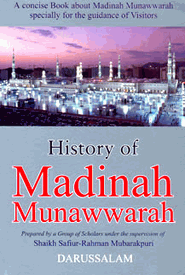
History of Madinah Munawwarah – Shaikh Safiur-Rahman Mubarakpuri

history-of-madina-mubarakpuri

History of Madinah Munawwarah (Shaikh Safiur-Rahman Mubarakpuri)

Publisher: Darussalam Publishers and Distributors (2002)
Pages: 152 Binding: Paperback

You can buy Here or read most of the book @ Google Books Here

Description from the publisher:

In this book, mention has been made about the different aspects of Al-Madinah, and the most important historical events are recorded that have direct effect on the establishment and sacredness of Al-Madinah as well as its religious weight.

This book has highlighted the sites that are highly important whenever Al-Madinah is mentioned like the Prophet’s Mosque, Quba Mosque and others. A great part of the book is designated to speak about the Prophet’s Mosque updating the expansions and the improvements that has taken place from the time of Muhammad (Sallallaahu alaihi wa sallam) till the Saudi era. It contains more than fifty, pictures taken from original documented resources. The pictures vary from old to new dealing with many aspects. The book is a genuine addition to the Islamic library in, its subject both for the researcher and the regular reader. This book sought scientific trustworthiness, by presenting only the correct Ahadith and authentic reports.

Hajj and Tawheed – Dr. Saleh as-Saleh [Audio Book|En]

Hajj is an act of worship that must be devoted only to Allaah. It is a declaration and a manifestation of the belief in the Oneness (tawheed) of Allaah. It is a time to call upon Allaah to purify the self from any worship to other than Him.

The Muslim who declares the talbiyah: (Labbaika allaahumma labbaik. labbaika laa shareeka laka labbaik; innal-hamda wan-ni’mata laka wal mulk, laa shareeka lak) understands that it is a du’aa that means: “Here I am O Allaah, here I am. Here I am, You have no partner, here I am. Surely all praise is due to You, and every bounty is from You, and all dominion is Yours, and You have no partner.”

The Muslim, therefore, should submit himself completely (mentally, spiritually, and physically) to Allaah Alone. No worship should be devoted to statues, tombs, religious leaders, righteous men (dead or alive) or any part of the creation!

The tawheed of Allaah requires the Muslim to follow the perfect way of worship. This is the way (sunnah) of Muhammad sallallaahu alaihi wa sallam as understood by the sahaabah (the companions of the Prophet sallallaahu alaihi wa sallam), who were the best of mankind.

Listen / Download Mp3 Here (Time 01:45:19)

[Read or Download the Book– PDF]

Courtesy: UnderStand-Islam.net

Making Hajj for the Sahabah or for the Prophet – Saleh-As-Saleh [Audio|En]

Listen / Download Mp3 Here (Time 10:52)

Audio Courtesy : Understand-Islam.net

The Obligation of Hajj (Pilgrimage) and its Excellence

Imam Al-Nawawi’s Riyad-us-Saliheen
Chapter 233
The Obligation of Hajj (Pilgrimage) and its Excellence

Allah, the Exalted, says:

“And Hajj (pilgrimage to Makkah) to the House (Ka`bah) is a duty that mankind owes to Allah, those who can afford the expenses (for one’s conveyance, provision and residence); and whoever disbelieves [i.e., denies Hajj (pilgrimage to Makkah), then he is a disbeliever of Allah], then Allah stands not in need of any of the `Alamin (mankind, jinn and all that exists).” (3:97)

1271. Ibn `Umar (May Allah be pleased with them) reported: The Messenger of Allah (sallallaahu ’alayhi wa sallam) said, “(The superstructure of) Islam is based on five (pillars), testifying the fact that La ilaha illallah wa anna Muhammad-ar-Rasul-ullah [there is no true god except Allah, and Muhammad ((sallallaahu ’alayhi wa sallam)) is the Messenger of Allah], establishing As-Salat (the prayers), paying Zakat (poor due), the pilgrimage to the House [of Allah (Ka`bah)], and the Saum (fasting) during the month of Ramadan.”
[Al-Bukhari and Muslim].

1272. Abu Hurairah (May Allah be pleased with him) reported: The Messenger of Allah (sallallaahu ’alayhi wa sallam) delivered a Khutbah and said, “O people! Hajj (pilgrimage to the House of Allah) has been made incumbent upon you, so perform Hajj.” A man inquired: “O Messenger of Allah, is it prescribed every year?” He (sallallaahu ’alayhi wa sallam) remained silent till the man repeated it thrice. Then he (sallallaahu ’alayhi wa sallam) said, “Had I replied in the affirmative, it would have surely become obligatory, and you would not have been able to fulfill it.” Afterwards he said, “Do not ask me so long as I do not impose anything upon you, because those who were before you were destroyed on account of their frequent questioning and their disagreement with their Prophets. So when I order you to do something, do it as far as you can; and when I forbid you from doing anything, eschew it.”
[Muslim].

1273. Abu Hurairah (May Allah be pleased with him) reported: The Prophet (sallallaahu ’alayhi wa sallam) was asked: “Which deed is the best?” He (sallallaahu ’alayhi wa sallam) replied, “Faith in Allah and His Messenger.” Then he was asked: “What is next?” He replied, “Jihad (holy fighting) in the Cause of Allah.” Then he was asked, “What is after that?” He (sallallaahu ’alayhi wa sallam) replied, “Hajj Mabrur (an accepted pilgrimage).”
[Al-Bukhari and Muslim].

1274. Abu Hurairah (May Allah be pleased with him) reported: The Messenger of Allah (sallallaahu ’alayhi wa sallam) said, “Whoever performs Hajj (pilgrimage) and does not have sexual relations (with his wife), nor commits sin, nor disputes unjustly (during Hajj), then he returns from Hajj as pure and free from sins as on the day on which his mother gave birth to him.”
[Al-Bukhari and Muslim].

1275. Abu Hurairah (May Allah be pleased with him) reported: The Messenger of Allah (sallallaahu ’alayhi wa sallam) said, “(The performance of) `Umrah is an expiation for the sins committed between it and the previous `Umrah; and the reward of Hajj Mabrur (i.e., one accepted) is nothing but Jannah.”
[Al-Bukhari and Muslim].

1276. `Aishah (May Allah be pleased with her) reported: I said: “O Messenger of Allah! We consider Jihad as the best deed, should we not then go for Jihad?” The Messenger of Allah (sallallaahu ’alayhi wa sallam) said, “The best Jihad for you women is Hajj Mabrur (i.e., one accepted by Allah).”
[Al-Bukhari].

1277. `Aishah (May Allah be pleased with her) reported: The Messenger of Allah (sallallaahu ’alayhi wa sallam) said, “There is no day on which Allah sets free more slaves from Hell than He does on the Day of `Arafah.”
[Muslim].

1278. Ibn `Abbas (May Allah be pleased with them) reported: The Prophet (sallallaahu ’alayhi wa sallam) said, “(The performance of) `Umrah during Ramadan is equal to Hajj (pilgrimage).” Or said, “Equal to the performance of Hajj with me.”
[Al-Bukhari and Muslim].

1279. Ibn `Abbas (May Allah be pleased with them) reported: A woman came to the Messenger of Allah (sallallaahu ’alayhi wa sallam) and said, “Allah’s obligation upon His slaves has become obligatory on my father in his old age. My father is very old and incapable of riding. May I perform Hajj on his behalf?” He (sallallaahu ’alayhi wa sallam) said, “Yes.”
[Al-Bukhari and Muslim].

1280. Laqit bin `Amir (May Allah be pleased with him) reported: I came to the Prophet (sallallaahu ’alayhi wa sallam) and said: “My father is a very old man and does not have strength to perform Hajj (pilgrimage) or `Umrah or to undertake the journey.” The Prophet (sallallaahu ’alayhi wa sallam) said, “Perform Hajj and `Umrah on behalf of your father.”
[Abu Dawud and At-Tirmidhi].

1281.  As-Sai’b bin Yazid (May Allah be pleased with him) reported: I was seven years old when I was taken to perform Hajj (pilgrimage). This was during the time the Messenger of Allah (sallallaahu ’alayhi wa sallam) performed the Hajjat-ul-Wada` (Farewell Pilgrimage).

[Al-Bukhari].

1282. Ibn `Abbas (May Allah be pleased with them) reported: The Prophet (sallallaahu ’alayhi wa sallam) came across a caravan at Ar-Rauha’ and asked who the people in the caravan were. They replied that they were Muslims. They asked: “Who are you?” He (sallallaahu ’alayhi wa sallam) said, “I am the Messenger of Allah.” Then a woman lifted up a boy to him and asked: “Would this child be credited with having performed the Hajj (pilgrimage)?” Whereupon he (sallallaahu ’alayhi wa sallam) said, “Yes, and you will have a reward.”
[Muslim].

1283. Anas (May Allah be pleased with him) reported: The Messenger of Allah (sallallaahu ’alayhi wa sallam) performed the pilgrimage on an unsaddled camel which also carried his provisions (i.e., his Zamilah).
[Al-Bukhari].

1284. Ibn `Abbas (May Allah be pleased with them) reported: Ukaz, Mijannah and Dhul-Majaz were markets during the pre-Islamic period. The Companions disliked trading there till the following Ayat of the Noble Qur’an were revealed: “There is no sin on you if you seek the Bounty of your Rubb (during pilgrimage by trading)…” (2:198)
[Al-Bukhari].

Sahih Muslim : Book 07: The Book of Pilgrimage (Kitab Al-Hajj)

Translation of Sahih Muslim, Book 7:

The Book of Pilgrimage (Kitab Al-Hajj)

INTRODUCTION

The word Hajj means, literally, repairing to a place for the sake of visit (al-qasd li-ziyarah), and in the terminology of the Islamic Shari’ah, it implies the repairing to Bait-Allah (the house of Allah) to observe the necessary devotion (iqamat-an-li-nusuk) Bait-Allah is one of the names by which the Ka’ba is called.

Hajj is not a new institution which Islam has introduced in its Shari’ah. This institution is as old as the Ka’ba itself which is called in the Holy Qur’an to be” the first House of Divine Worship appointed for men” (iii. 95). This verse of the Holy Qur’an corroborates the hadith which tells us that the Ka’ba was first built by Adam, the first man upon the earth. It was later on rebuilt by Hadrat Ibrahim and his illustrious son Hadrat Isma’il (peace be upon both of them). And when Ibrahim and Isma’al raised the foundations of the house, they said:” Our Lord! accept from us” (ii. 127). An earlier revelation makes it clear that the Ka’ba was already there when Hadrat Ibrahim left Hadrat Isma’il in the wilderness of Arabia:” Our Lord! I have settled a part of my offspring in a valley unproductive of fruit near Thy sacred House” (xiv. 37).

The whole ceremony of Hajj is commemorative of Hadrat Ibrahim and his family’s acts of devotion to God Almighty. This shows that the Holy Prophet (may peace be upon him) did not innovate this institution but purged it of all evil practices and made it an obligatory act of piety by which one can develop God-consciousness.

It is rightly said that it is the perfection of faith since it combines in itself all the distinctive qualities of other obligatory acts. It represents the quality of salat since a pilgrim offers prayers in the Ka’ba, the House of the Lord. It encourages the spending of material wealth for the sake of the Lord, the chief characteristic of Zakat. When a pilgrim sets out for Hajj, he dissociates himself from his hearth and home, from his dear and near ones to please the Lord. He suffers privation and undertakes the hardship of journey-the lessons we learn from fasting and i’tikaf. In Hajj one is trained to be completely forgetful of the material comforts and show of worldly thing. One has to sleep on stony ground, circumambulate the Ka’ba, run between Safa and Marwa and spend his night and day wearing, only two pieces of unsewn cloth. He is required to avoid the use of oil or scent or any other perfume. He is not even allowed to get his hair cut or trim his beard. In short, he is commanded to abandon everything for the sake of Allah and submit himself before his Lord, the ultimate aim of the life of a Muslim. In fact, physical pilgrimage is a prelude to spiritual pilgrimage to God, when man would bid goodbye to everything of the world and present himself before Him as His humble servant saying:” Here I am before Thee, my Lord, as a slave of Thine.”

“Down through the ages.” says Professor Hitti, “this institution has continued to serve as the major unifying influence in Islam and the most effective common bond among the diverse believers. It rendered almost every capable Moslem perforce a traveller for once in his lifetime. The socializing influence of such a gathering of the brotherhood of believers from the far quarters of the earth is hard to overestimate. It afforded opportunity for negroes, Berbers, Chinese, Persians, Syrians, Turks-rich and poor, high and low-to fraternize and meet together on the common ground of faith” (History of the Arabs, p. 136).

Chapter 1: WHAT IS PERMITTED FOR THE MUHRIM (WEARER OF IHRAM) IN HAJJ AND UMRA, WHAT IS NOT PERMISSIBLE AND FORBIDDANCE OF THE USE OF PERFUME


Book 007, Number 2647:

Ibn ‘Umar (Allah be pleased with them) reported that a person asked the Messenger of Allah (may peace be upon him) what a Muhrim should put on as dress. Thereupon the Messenger of Allah (may peace be upon him) said: Do not put on a shirt or a turban, or trousers or a cap, or leather stockings except one who does not find shoes; he may put on stockings but he should trim them below the ankles. And do not wear clothes to which saffron or wars is applied.


Book 007, Number 2648:

Salim reported on the authority of his father (‘Abdullah b. ‘Umar) that the Apostle of Allah (may peace be upon him) was asked what a Muhrim should wear, whereupon he said: A Muhrim should not wear a shirt, or a turban, or a cap, or trousers, or a cloth touched with wars or with saffron, nor (should he wear) stock- ings, but in case he does not find shoes, but (before wearing stockings) be should trim them (in such a way) that these should become lower than the ankles.


Book 007, Number 2649:

Ibn ‘Umar reported that the Messenger of Allah (may peace be upon him) forbade the Muhrim to put on a cloth dyed in saffron or wars and he further said: One who does not find shoes (to wear) he way wear stockings, but (only) after trimming them below the ankles.


Book 007, Number 2650:

Ibn ‘Abbas (Allah be pleased with both of them) reported: I heard Allah’s Messenger (may peace be upon him) say as he was delivering an address: So far as the trousers are concerned, one who does not find lower garment, he may wear them; as also socks, he may wear them who does not find shoes. It concerns the Muhrim.


Book 007, Number 2651:

‘Amr b. Dinar narrated with the same chain of transmitters that he heard the Messenger of Allah (may peace be upon him) delivering sermon at ‘Arafat, and he made a mention of this hadith (as quoted above).


Book 007, Number 2652:

This hadith has been narrated on the authority of ‘Amr b. Dinar with the same chain of transmitters, but none of them (the narrators) made a mention that he (the Holy Prophet) was delivering address at ‘Arafia except Sbu’ba.


Book 007, Number 2653:

Jabir (Allah be pleased with him) reported Allah’s Messenger (may peace be upon him) as saying: He who does not find shoes to wear may wear socks, and he who does not find lower garment to wear may put on trousers.


Book 007, Number 2654:

Ya’la b. Umayya reported on the authority of his father (Allah be pleased with them) that a person came to the Apostle of Allah (may peace be upon him) as he was at Ji’rana and he (the person) had been putting on a cloak which was perfumed, or he (the narrator) said: There was a trace of yellowness on it. He said (to the Holy Prophet): What do you command me to do during my Umra? (It was at this juncture) that the revelation came to the Apostle of Allah (way peace be upon him) and he was covered with a cloth, and Ya’la said: Would that I see revelation coming to the Apostle of Allah (may peace be upon him). He (Hadrat ‘Umar) said: Would it please you to see the Apostle of Allah (may peace be upon him) receiving the revelations ‘Umar lifted a corner of the cloth and I looked at him and he was emitting a sound of snorting. He (the narrator) said: I thought it was the sound of a camel. When he was relieved of this he said: Where is he who asked about Umra? When the person came, the Holy Prophet (may peace be upon him) said: Wash out the trace of yellowness, or he said: the trace of perfume and put off the cloak and do in your ‘Umra what you do in your Hajj.


Book 007, Number 2655:

Safwan b. Ya’la reported on the authority of his father (who said): A person came to the Apostle of Allah (may peace be upon him) as he was staying at Ji’rana and I (the narrator’s father) was at that time in the apostle’s (may peace be upon him) company and (the person) was donning a cloak having the marks of perfume on it, and he said: I am in a state of Ihram for the sake of Umra, and it (this cloak) is upon me and I am perfumed. The Apostle of Allah (may peace be upon him) said to him: What would you do in your Hajj? He said: I would take off the clothes and would wash from me this perfume. Thereupon the Apostle of Allah (may peace be upon him) said: What you do in your Hajj do it in your Umra.


Book 007, Number 2656:

Safwan b. Ya’la b. Umayya reported that Ya’la used to say to ‘Umar b. Khattab (Allah be pleased with him): Would that I see revelation descending upon the Apostle of Allah (may peace be upon him). (Once) when the Apostle of Allah (may peace be upon him) was in Ji’rana and there was a cloth which provided shade over him, and there were his Companions with him. ‘Umar being one of them, there came a person with a cloak of wool on him daubed with perfume and he said: Messenger of Allah, what about the person who, entered upon the state of Ihram with a cloak after daub- ing it with perfume? The Apostle of Allah (may peace be upon him) looked at him for a short while, and then became quiet, and revelation began descending upon him, and ‘Umar gestured (with his hand) to Ya’la b Umayya to come. Ya’la came and he enter- ed his head (beneath the cloth and saw) the Apostle of Allah (may peace be upon him) with his face red, and breathing with a snore. Then he felt relieved (of that burden) and he said: Where is the man who was just asking me about Umra? The man was searched for and he was brought, and the Apostle of Allah (may peace be upon him) said: So far as the perfume is concerned, wash it three times, and remove the cloak too (as it was sewn) and do in ‘Umra as you do in Hajj.


Book 007, Number 2657:

Ya’la b. Umayya (Allah be pleased with him) reported that a person came to the Apostle of Allah (may peace be upon him) as he was staying at Ji’rana and he had put on Ihram for ‘Umra and he had dyed his beard and his head with yellow colour and there was a cloak on him. He said: I put on Ihram for ‘Umra and I am in this state as you see (with dyed beard and head and a cloak over me). He (the Holy Prophet) said: Take off the cloak and wash the yellowness and do in your ‘Umra what you do in Hajj.


Book 007, Number 2658:

Ya’la reported: We were with the Messenger of Allah (may peace be upon him) that a person came to him with a cloak on him having the traces of scent. He said, Messenger of Allah, I put on Ihram for ‘Umra: what should I do? He (the Holy Prophet) kept quiet and did not make him any reply. And ‘Umar screened him and it was (usual) with ‘Umar that when the revelation descended upon him, he provided him shade (with the help of a piece of cloth). I (the person who came to the Holy Prophet) said: I said to ‘Umar I wish to project my head into the cloth (to see how the Holy Prophet receives revelation). So when the revelation began to descend upon him ‘Umar wrapped him (the Holy Prophet) with cloth I came to him and projected my head with him into the cloth, and saw him (the Holy Prophet) (receiving the revelation). When he (the Holy Prophet) was relieved (of its burden), he said: Where is the inquirer who was just inquiring about ‘Umra? That man came to him. Thereupon he (the Apostle of Allah) said: Take off the cloak from (your body) and wash the traces of perfume which were upon you, and do in ‘Umra what you did in Hajj.

Chapter 2: THE PLACE WHERE THE PILGRIMS ENTER UPON THE STATE OF IHRAM


Book 007, Number 2659:

Ibn ‘Abbas (Allah be pleased with them) reported that the Messenger of Allah (may peace be upon him) specified Dhu’l-Hulaifa, for the people of Medina; Juhfa for the people of Syria; Qarn al-Manazil, for the people of Najd; Yalamlam for the people of Yemen (the Mawaqit) and those (Mawaqit) are also meant for those who live at these (places) and for those too who come from without towards them for the sake of Hajj or ‘Umra. And those who live within them (within the bounds of these places) or in the suburbs of Mecca or within Mecca, they should enter upon the state of Ihram at these very places.


Book 007, Number 2660:

Ibn ‘Abbas (Allah be pleased with them) reported that the Messenger of Allah (may peace be upon him) specified Dhu’l-Hulaifa for the people of Medina; Juhfa for the people of Syria, Qarn al-Manazil for the people of Najd, Yalamlam for the people of Yemen (as their respective Mawaqit), and he also said: These are (Mawaqit) of them too (who live there) and everyone who comes from outside (through) their (directions) for the sake of Hajj and ‘Umra and for those who live within (those bounds their Miqat is that) from which they commenced (their journey), and for the people of Mecca, Mecca itself is (the Miqat).


Book 007, Number 2661:

Ibn ‘Umar (Allah be pleased with them) reported that the Messenger of Allah (may peace be upon him) said: The people of Medina should enter upon the state of Ihram at Dhu’l-Hulaifa, and people of Syria at Juhfa, and people of Najd at Qarn (al-Manazil), and ‘Abdullah (further) said: It has reached me that the Messenger of Allah (may peace be upon him) also caid: The people of Yemen should enter upon the state of Ihram at Yalamlam.


Book 007, Number 2662:

Salim reported on the authority of his father (‘Abdullah b. ‘Umar) that the Messenger of Allah (may peace be upon him) said: The people of Medina should enter upon the state of Ihram at Dhu’l-Hulaifa; the people of Syria at Juhfa, the people of Najd at Qarn (al-Manazil). Ibn ‘Umar (Allah be pleased with them) said: It was mentioned to me but I did not myself bear it (directly) from the Messenger of Allah (may peace be upon him) having said this: The people of Yemen should enter upon the state of Ihram at Yalamlam.


Book 007, Number 2663:

Salim b. ‘Abdullah b. ‘Umar b. al-Khattab (Allah be pleased with them) reported his father as saying: I heard the Messenger of Allah (may peace be upon him) as saying that the people of Medina should enter upon the state of Ihram at Dhu’l- Hulaifa, the people of Syria at Mahya’a and that is Juhfa, and the people of Najd at Qarn (al-Manazil). ‘Abdullah b. ‘Umar (Allah be pleased with them) said: (I did not hear it myself from him) but heard from them saying that the Messenger of Allah (may peace be upon him) had (also) said: The people of Yemen should enter upon the state of Ihram at Yalamlam.


Book 007, Number 2664:

Ibn ‘Umar (Allah be pleased with them) reported that the Messenger of Allah (may peace be upon him) had commanded the people of Medina to enter upon the state of Ihram at Dhu’l-Hulaifa; the people of Syria at Juhfa; the people of Najd at Qarn (al-Manazil). ‘Abdullah b. ‘Umar (Allah be pleased with them) said: I was informed that he said that the people of Yemen should enter upon the state of Ihram at Yalamlam.


Book 007, Number 2665:

Abu Zubair reported that he heard Jabir b. ‘Abdullah (Allah be pleased with them) saying that as he was asked about (the places for entering upon the) state of ihram, he said: I heard (and he then carried the narration directly, I think to) the Apostle of Allah (may peace be upon him).


Book 007, Number 2666:

Abu Zubair heard Jabir b. ‘Abdullah (Allah be pleased with them) as saying as he was asked about (the place for entering upon the) state of Ihram: I heard (and I think he carried it directly to the Apostle of Allah) him saying: For the people of Medina Dhu’l-Hulaifa is the place for entering upon the state of Ihram, and for (the people coming through the other way, i. e. Syria) it is Juhfa; for the people of Iraq it is Dbat al-‘Irq; for the people uf Najd it is Qarn (al-Manazil) and for the people of Yemen it is Yalamlam.

Chapter 3: TALBIYA, ITS CHARATERISTICS AND ITS TIME


Book 007, Number 2667:

‘Abdullah b. ‘Umar (Allah be pleased with them) reported that the Talbiya of the Messenger of Allah (may peace be upon him) was this: Here I am at Thy service. O Allah, here I am at Thy service, here I am at Thy service. There is no associate with Thee; here I am at Thy service. Verily all praise and grace is due to Thee, and the sovereignty (too). There is no associate with Thee. He (the narrator) further said that ‘Abdullah b. ‘Umar (Allah be pleased with them) made this addition to it: Here I am at Thy service; here I am at Thy service; ready to obey Thee, and good is in Thy Hand; here 1 am at Thy service; unto Thee is the petition, and deed (is also for Thee).


Book 007, Number 2668:

‘Abdullah b. ‘Umar (Allah be pleased with them) reported that the Mes- senger of Allah (may peace be upon him) entered upon the state of Ihram near the mosque at Dhu’l-Hulaifa as his camel stood by it and he said: Here I am at Thy service, O Lord; here I am at Thy service: here I am at Thy service. There is no associate with Thee. Here I am at Thy service. All praise and grace is due to Thee and the sovereignty (too). There is no associate with Thee. They (the people) said that ‘Abdullah b. ‘Umar said that that was the Talbiya of the Messenger of Allah (may peace be upon him). Nafi’ said: ‘Abdullah (Allah be pleased with him) made this addition to it: Here I am at Thy service; here I am at Thy service; ready to obey Thee. The Good is in Thy Hand. Here I am at Thy service. Unto Thee is the petition and deed (is also for Thee).


Book 007, Number 2669:

Ibn ‘Umar (Allah be pleased with him) reported: I immediately learnt Talbiya from the Messenger of Allah (may peace be upon him), and he then narrated the hadith.


Book 007, Number 2670:

‘Abdullah b. ‘Umar (Allah be pleased with them) reported: I heard the Messenger of Allah (may peace be upon him) pronouncing Talbiya with compacted hair: Here I am at Thy service. O Allah: here I am at Thy service; here I am at Thy service. There is no associate with Thee; here I am at Thy service. Verily all praise and grace is due to Thee and the Sovereignty (too). There is no associate with Thee; and he did not make any addition to these words. ‘Abdullah b. ‘Umar (Allah be pleased with them) (further) said: The Messenger of Allah (may peace be upon him) used to offer two rak’ahs of prayer at Dhu’l-Hulaifa and then when his camel stood up with him on its back near the mosque at Dhu’l-Hulaifa, he pronounced these words (of Talbiya). And ‘Abdullah b. ‘Umar (Allah be pleased’with them) said that ‘Umar b. Khattab (Allah be pleased with him) pronounced, the Talbiya of the Messenger of Allah (may peace be upon him) in these words of his (Prophet’s words) and said: Here I am at Thy service, O Lord; here I am at Thy service, ready to obey Thee, and good is in Thy Hand, Here I am at Thy service. Unto Thee is the petition and deed (is also for Thee).


Book 007, Number 2671:

Ibn ‘Abbas (Allah be pleased with them) reported that the polytheists also pronounced (Talbiya) as: Here I am at Thy service, there is no associate with Thee. The Messenger of Allah (may peace be upon him) said: Woe be upon them, as they also said: But one associate with Thee, you possess mastery over him, but he does not possess mastery (over you). They used to say this and circumambulate the Ka’ba.

Chapter 4: THF PEOPLE OF MEDINA ARE COMMANDED TO ENTER UPON THE STATE OF IHRAM AT A MOSQUE IN DHU’L-HULAIFA


Book 007, Number 2672:

Salim b. ‘Abdullah (Allah be pleased with them) reported that he heard his father saying: This place Baida’ is for you that about which you attribute lie to the Messenger of Allah (may peace be upon him). And the Messenger of Allah (may peace be upon him) did not enter upon the state of Ihram but near the mosque at Dhu’l- Hulaifa.


Book 007, Number 2673:

Salim reported that when it was said to Ibn ‘Umar (Allah be pleased with them) that the state of Ihram (commences from) al-Baida’ he said: Al-Baida’, you attribute lie about it to the Messenger of Allah (may peace be upon him). And the Messenger of Allah (mav peace be upon him) did not enter upon the state of Ihram but near the-tree when his camel stood up with him.

Chapter 5: ENTERING UPON THE STATE OF IHRAM AS THE RIDE PROCEEDS TOWARDS (MECCA)


Book 007, Number 2674:

‘Ubaid b. Juraij said to ‘Ahdullah b. ‘Umar (Allah be pleased with them): ‘Abd al-Rahman, I find you doing four things which I do not see anyone among your companions doing. He said: Son of Juraij, what are these? Thereupon he said: You (while circumambulating the Ka’ba) do not touch but the two pillars situated on the side of yaman (south), and I find you wearing the sandals of tanned leather, and I find you with dyed beard and head, and I also found that, when you were at Mecca, the people pronounced Talbiya as they saw the new moon (Dhu’l-Hijja), but you did not do it till the 8th of Dhu’l-Hijja. Upon this ‘Abdullab b. ‘Umar said: (So far as the touching of) the pillars is concerned, I did not see the Messenger of Allah (may peace be upon him) touching them but only those situated on the side of yaman. (So far asthe wearing of) the shoes of tanned leather is concerned, I saw the Messenger of Allah (may peace be upon him) wearing shoes without hair on them, and he (wore them with wet feet) after performing ablution, and I like to wear them. So far as the yellowness is concerned, I saw the Messenger of Allah (may peace be upon him) dyeing (head, beard and cloth) with this colour and I love to dye (my head, beard or cloth) with this colour. And so far as the pronouncing of Talbiya is concerned, I did not see the Messenger of Allah (may peace be upon him) pronouncing it until his camel proceeded on (to Dhu’l-Hulaifa).


Book 007, Number 2675:

‘Ubaid b. Juraij reported: I remained in the company of ‘Abdullah b. ‘Umar b. al-Khattab (Allah be pleased with them) its twelve Hajjs and ‘Umras and I said to him: I saw four characteristics (peculiar in you), and the rest of the hadith is the same except the case of Talbiya. There he offered the narration given by al-Maqburi and he stated the facts excepting the one given above.


Book 007, Number 2676:

Ibn ‘Umar (Allah be pleased with them) reported that the Messenger of Allah (may peace be upon him) pronounced Talbiya in Dhu’l-Hulaifa as he put his feet in the stirrup and his camel stood up and proceeded.


Book 007, Number 2677:

Ibn ‘Umar (Allah be pleased with them) reported that the Apostle of Allah (may peace be upon him) pronounced Talbiya as his camel stood up.


Book 007, Number 2678:

‘Abdullah b. ‘Umar reported: I saw the Messenger of Allah (may peace be upon him) riding on his camel at Dhu’l-Hulaifa and pronouncing Talbiya as it stood up with him.


Book 007, Number 2679:

‘Abdullah b. ‘Umar (Allah be pleased with them) reported that the Mes- senger of Allah (may peace be upon him) spent the night at Dhu’l-Hulaifa while com- mencing (the rites of) Pilgrimage and he observed prayer in the mosque.

Chapter 6: APPLYING OF PERFUME TO THE BODY BEFORE ENTERING UPON THE STATE OF IHRAM


Book 007, Number 2680:

‘A’isha (Allah be pleased with her) reported: I applied perfume to the Messenger of Allah (may peace be upon him) before he entered upon the state of lhram and (concluding) before circumambulating the (sacred) House.


Book 007, Number 2681:

‘A’isha (Allah be pleased with her), the wife of the Apostle of Allah (may peace be upon him), reported: I applied perfume to the Messenger of Allah (may peace be upon him) with my own hand before he entered upon the state of Ihram, and as he concluded it before-circumambulating the House (for Tawaf-i-lfada).


Book 007, Number 2682:

‘A’isha (Allah be pleased with her) reported: I used to apply perfume to the Messenger of Allah (may peace be upon him) before his entering upon the state of Ihram and at the conclusion of it, before circumambulating the House (for Tawf-i- Ifada).


Book 007, Number 2683:

‘A’isha (Allah be pleased with her) said: I applied perfume to the Messenger of Allah (may peace be upon him) as he became free from Ihram and as he entered upon it.


Book 007, Number 2684:

‘A’isha (Allah be pleased with her) said: I applied perfume of Dharira to the Messenger of Allah (may peace be upon him) with my hand (on the occasion of) the Farewell Pilgrimage on freeing from the state of Ihram and entering upon it.


Book 007, Number 2685:

‘Uthman b. ‘Urwa reported on the authority of his father that he said: I asked ‘A’isha with what thing she perfumed the Messenger of Allah (may peace be upon him) at the time of entering upon the state of Ihram. She said: With the best of perfume.


Book 007, Number 2686:

‘A’isha (Allah be pleased with her) reported: I applied the best perfume, which I could get, to the Messenger of Allah (may peace be upon him) before entering upon the state of Ihram (and after this) he put on the Ihram.


Book 007, Number 2687:

‘A’isha (Allah be pleased with her) reported: I applied the best available perfume I could find to the Messenger of Allah (may peace be upon him) before he entered upon the state of Ihram and after he was free from it.


Book 007, Number 2688:

‘A’isha (Allah be pleased with her) reported: I still seem to see the glisten- ing of the perfume where the hair parted on Allah’s Messenger’s (may peace be upon him) head as he was in the state of Ihram, and Khalaf (one of the narrators) did not say: As he was in the state of Ihram, but said: That was the perfume of Ihram.


Book 007, Number 2689:

‘A’isha (Allah be pleased with her) reported: I still seem to see the glisten- ing of the perfume where the hair parted on Allah’s Messenger’s (may peace be upon him) head and he was free from Ihram.


Book 007, Number 2690:

‘A’isha (Allah be pleased with her) reported: I still seem to see the glisten- ing of the perfume where the hair parted on Allah’s Messenger’s (may peace be upon him) head, while he was pronouncing Talbiya.


Book 007, Number 2691:

‘A’isha (Allah be pleased with her) reported: I still seem to see; the rest of the hadith is the same.


Book 007, Number 2692:

‘A’isha (Allah be pleased with her) said: I still seem to see the glistening of the perfume where the hair was parted on Allah’s Messeinger’s (may peace be upon him) head while he was in the state of Ihram.


Book 007, Number 2693:

‘A’isha (Allah be pleased with her) reported: I still seem to perceive the glistening of perfume where the hair was parted on Allah’s Messenger’s (may peace be upon him) head as he was in the state of Ihram.


Book 007, Number 2694:

‘A’isha (Allah be pleased with her) reported that when the Messenger of Allah (may peace be upon him) intended to enter upon the state of Ihram he perfumed himself with the best of perfumes which he could find and after that I saw the glisten- ing of oil on his head and beard.


Book 007, Number 2695:

‘A’isha (Allah be pleased with her) reported: I still seem to see the glisten- ing of musk (in the parting of the head) of the Messenger of Allah (may peace be upon him) while he was in the state of Ihram.


Book 007, Number 2696:

This hadith has been narrated by ‘Ubaidullah with the same chain of trans- mitters.


Book 007, Number 2697:

‘A’isha (Allah be pleased with her) reported: I used to perfume the Apostle of Allah (may peace be upon him) with a perfume containing musk before entering upon the state of Ihram and on the day of sacrifice (10th of Dhu’l-Hijja) and (at the conclusion of Ihram) before circumambulating the House (for Tawaf-i-Ifada).


Book 007, Number 2698:

Muhammad b. al-Muntashir reported on the authority of his father: I asked ‘Abdullah b. ‘Umar (Allah be pleased with them) about a person who applied perfume and then (on the following) morning entered upon the state of lhram. There- upon he said: I do not like to enter upon the state of Ihram shaking off the perfume. Rubbing of tar (upon my body) is dearer to me than doing this (i. e. the applying of perfume), I went to ‘A’isha (Allah be pleased with her) and told her that Ibn ‘Umar stated:” I do not like to enter upon the state of Ihram shaking off the perfume. Rubbing of tar (upon my body) is dearer to me than doing it (the applying of perfume).” Thereupon ‘A’isha said: I applied perfume to the Messenger of Allah (may peace be upon him) at the time of his entering upon the state of Ihram. He then went round his wives and then put on Ihram in the morning.


Book 007, Number 2699:

‘A’isha (Allah be pleased with her) reported: I used to apply perfume to the Messenger of Allah (may peace be upon him). He then went round his wives, and entered upon the state of Ihram in the morning and the perfume was shaken off.


Book 007, Number 2700:

Muhammad b. al-Muntashir reported on the authority of his father: I heard from Ibn ‘mar having said this:” It is dearer to me to rub tar (on my body) than to enter upon the state of Ihram (in a state) of shaking off the perfume.” He (the narrator) said: I went to ‘A’isha and told her about this statement of his (of Ibn ‘Umar). Thereupon she said: I applied perfume to the Messenger of Allah (may peace be upon him) and he then went round his wives and then entered upon the state of Ihram in the morning.

Chapter 7: HUNTING IS FORBIDDEN FOR ONE WHO IS IN THE STATE OF IHRAM


Book 007, Number 2701:

Al-Sa’b b. Jaththama al-Laithi reported that he presented a wild ass to Allah’s Messenger (may peace be upon him) when he was at al-Abwa’, or Waddan, and he refused to accept it. He (the narrator) said: When the Messenger of Allah (may peace be upon him) looked into my face (which had the mark of dejection as my present had been rejected by him) he (in order to console me) said: We have refused it only because we are in a state of Ihram.


Book 007, Number 2702:

A hadith (pertaining to this topic), has been narrated on the authority of Zuhri (and the words are):” I presented to him (the Holy Prophet) a wild ass.”


Book 007, Number 2703:

It is narrated on the authority of Zuhri with the same chain of transmitters (the narrator having) said this:” I presented to him the flesh of a wild ass.”


Book 007, Number 2704:

Ibn ‘Abbas (Allah be pleased with them) reported that al-Sa’b b. Jaththama presented to the Apostle of Allah (may peace be upon him) a wild ass as he was in a state of Ihram, and he returned it to him saying: If we were not in a state of Ihram, we would have accepted it from you.


Book 007, Number 2705:

The narration transmitted by Hakam (the words are): Al-Sa’b b. Jaththama presented to the Apostle of Allah (may peace be upon him) the leg of a wild ass. And in the narration transmitted by Shu’ba (the words are): (He presented to him) the rump of a wild ass as the blood was trickling from it. In the narration transmitted by Shu’ba on the authority of Habib (the words are): A part of a wild ass was presented to the Apostle (may peace he upon him) and he returned it to him (who presented it).


Book 007, Number 2706:

Tawus reported on the authority of Ibn ‘Abbas (Allah be pleased with them) that one Zaid b. Arqamwent to him (Ibn ‘Abbas) and said: Narrate how you informed me about the meat of the game presented to the Messenger of Allah (may peace be upon him) as he was in the state of Ihram. Thereupon he said: He was pre- sented with a slice of the meat of game, but he returned it to him (who presented it) saying: We are not going to eat it, as we are in the state of Ihram.


Book 007, Number 2707:

Abu Qatada reported: We went with the Messenger of Allah (may peace be upon him) till we reached al-Qaha (a place three stages away from Medina). Some of us were in the state of Ihram and some of us were not. I saw my companions looking towards something, and as I saw I found It to be a wild ass. I saddled my horse and took up my spear and then mounted upon (the horse) and my whip, fell down. I said to my companions as they were in the state of Ihram to pick up the whip for me but they said: By Allah, we cannot help you in any (such) thing (i. e. hunting). So i dis- mounted (the horse) and picked it (whip) up and mounted again and caught the wild ass after chasing it. It was behind a hillock and I attacked it with my spear and killed it. Then I brought it to my companions. Some of them said: Eat it, while others said: Do not eat it. The Apostle of Allah (may peace be upon him) was in front of us. I moved my horse and came to him (and asked him), whereupon he said: It is permis- sible, so eat it.


Book 007, Number 2708:

Abu Qatada (Allah be pleased with him) reported that while he was with the Messenger of Allah (may peace be upon him) on one of the highways of Mecca, he lagged behind him (the Holy Prophet) along with companions who were in the state of Ihram, whereas he was himself not Muhrim. He saw a wild ass. As he was mounting his horse he asked his companions to pick up for him his whip (which had dropped) but they refused to do so. He asked them to hand him over the spear, but they refused. He then himself took hold of it and chased the wild ass and killed it. Some of the Companions of the Apostle of Allah (way peace be upon him) ate (its meat), but some of them refused to do so. They overtook the Messenger of Allah (may peace be upon him) and asked him about it, and he said: It is a food which Allah provided you (so eat it).


Book 007, Number 2709:

This hadith pertaining to the wild ass is reported on the authority of Abu Qatada. The rest of the hadith is the same but with this (variation of words) that the Messenger of Allah (may peace be upon him) said:” Is there with you some of its flesh?”


Book 007, Number 2710:

‘Abdullah b. Abu Qatada reported: My father went with the Messenger of Allah (may peace be upon him) in the year of Hudaibiya. His Companions entered upon the state of Ihram whereas he did not, for it was conveyed to the Messenger of Allah (may peace be upon him) that the enemy (was hiding at) Ghaiqa. The Messenger of Allah (may peace be upon him) went forward. He (Abu Qatada) said: Meanwhile I was along with his Companions, some of them smiled (to one another) As I cast a glance I saw a wild ass. I attacked It with a spear and held it, and begged for their (i. e. of his companions) assistance, but they refused to help me and we ate its meat. But we were afraid lest we should be separated (from the Messenger of Allah). So I proceeded on (with a view to) seeking the Messenger of Allah (may peace be upon him). Some- times I’dashed my horse and sometimes I made it run at a leisurely pace (keeping pace with others). (In the meanwhile) I met a person from Banfu Ghifar in the middle of the night. I said to him: Where did you meet the messenger of Allah (may peace be upon him)? He said: I left him at Ta’bin and he intended to halt at Suqya to spend the afternoon. I met him and said: Messenger of Allah. your Companions convey salutations and benedictions of Allah to you and they fear that they may not be separated from you (and the enemy may do harm to you), so wait for them, and he (the Holy Prophet) waited for them. I said: Messenger of Allah, I killed a game and there is left with me (some of the meat). The Apostle of Allah (may peace be upon him) said to his people: Eat it. And they were in the state of Ihram.


Book 007, Number 2711:

‘Abdullah b. Abo. Qatada reported on the ant ‘hority of his father (Allah be pleased with him): The Messenger of Allah (may peace be upon him) set out for Pil- grimage and we also set out along with him. He (Abu Qatada) said: There proceeded on some of his Companions and Abu Qatada was (one of them). He, (the Holy Prophet) said: You proceed along the coastline till you meet me. He (Abfl Qatida) said: So they proceeded ahead of the Prophet of God (may peace be upon him), all of them had entered upon the state of Ihram, except Abu Qatada; he had not put on ]hram. As they went on they saw a wild ass, and Abu Qatada attacked it and cut off its hind legs. They got down and ate its meat. They said: We ate meat In the state of Ihram. They carried the meat that was left of it. As they came to the Messenger of Allah (way peace be upon him) they said: Messenger of Allah, we were in the state of Ibrim where as Abu Qatada was not. We saw a wild ass and Abu Qatada attacked it and cut off its hind legs. We got down and ate its meat and we thus ate the meat of a game while we were In the state of Ihram. We have (carried to you) what was left out of its meat. There upon he (the holy Prophet) said: Did anyone among you command him (to hunt) or point to him with anythiny (to do so)? They said: No. There upon he said: Then eat what is left out of its meat.


Book 007, Number 2712:

This hadith is narrated’on the authority of ‘Uthman b. ‘Abdullah b. Mauhab with the same chain of transmitters. And in the narration transmitted on the authority of Shaiban (the words are):” The Messenoer of Allah (may peace be upon him) said: Did any one of you command him to attack it or point towards it?” And in the narration transmitted by Shu’ba (the words are):” Did you point out or did you help or did you hunt?” Shu’ba said: I do not know whether he said:” Did you help or did you hunt?”


Book 007, Number 2713:

Abdullah b. Abu Qatada narrated on the authority of his father (Allah be pleased with him) that they went with the Messenger of Allah (may peace be upon him) on an expedition to Hudaibiya. He (further) said: They had entered upon the state of Ihram except I for ‘Umra. He (again) said: I (Abu Qatada) hunted a wild ass and fed my companions In the state of their being Muhrim. 1 then came to the Messenger of Allah (may peace be upon him) and informed him that we had with us the meat that was left out of it Thereupon he said: Eat It, while they were in the state of Ibrim.


Book 007, Number 2714:

‘Abdullah b. Abu Qatada reported on the authority of his father (Allah be pleased with him) that they went out with the Messenger of Allah (may peace be upon him) and they were Muhrim except Abu Qatada. The rest of the hadith Is the same (but with the exception of these words):” He (the Holy Prophet) said: 15 there any- thing out of it? They said: We have its leg with us. The Messenger of Allah (may peace be upon him) took it and ate it.”


Book 007, Number 2715:

Abdullah b. Abi Qatada reported that Abu Qatada was among the party of those who had entered upon the state of Ihram whereas he was not. The rest of the hadith is the same (and herein it is also narrated):” He (the Holy Prophet) said: Did any person among you point to him (to hunt) or command him (in any form)? They said: Messenger of Allah, not at all. Thereupon he said: Then eat it.”


Book 007, Number 2716:

Abd al-Rahman b. ‘Uthman Taimi reported on the authority of his father; While we were with Talha b. Ubaidullah and were in the state of Ihram we were pre- sented a (cooked) bird. Talha was sleeping. Some of us ate it and some of us refrained from (eating) it. When Talba awoke he agreed, with him who ate it, and said: We ate it along with the Messenger of Allah (may peace be upon him).

Chapter 8: WHICH ANIMAL THE MUHRIM AND THE NON-MUHRIM ARE PERMITTED TO KILL IN THE STATE OF IRRAM AND AT THE CONCLUSION OF IT (WITHIN THE PRECINCTS OF THE KA’BA)


Book 007, Number 2717:

A’isha, the wife of the Apostle of Allah (may peace be upon him). said: I heard Allah’s Messenger (may peace be upon him) as saying: Four are the vicious (birds, beasts and reptiles) which should be killed in the state of Ihram or otherwise: kite (and vulture), crow, rat, and the voracious dog I (one of the narrators, ‘Ubaid- ullah b. Miqsam) said to Qasim (the other narrator who beard it from ‘A’isha): What about the snake? lie said: Let it be killed with disgrace.


Book 007, Number 2718:

A’isha (Allah be pleased with her) reported Allah’* Apostle (may peace be upon him) as saying: Five are the harmful things which should be killed in the state of Ihram or otherwise: snake, speckled crow. rat. voracious dog, and kite.


Book 007, Number 2719:

A’isha (Allah be pleased with her) reported Allah’s Messenger (may peace be upon him) as saying: Five are the vicious beasts which should be killed even in the state of Ihram: scorpion, rat, kite, crow and voracious dog.


Book 007, Number 2720:

This hadith has been narrated on the authority of Hisham with the same chain of transmitters.


Book 007, Number 2721:

A’isha reported Allah’s Mdssenger (may peace be upon him) having said this: Five are the vicious and harmful things which should be killed even within the precincts of Haram: rat, scorpion, crow. kite and voracious dog.


Book 007, Number 2722:

This hadith has been narrated on the authority Zuhri with the same chain of transmitters that she (A’isha) reported: The Messenger of Allah (may peace be upon him) commanded to kill five harmful things in the state of lhram or other- wise. The rest of the badith is the same.


Book 007, Number 2723:

IA’isha (Allah be pleased with her) reported Allah’s Messenger (may peace be upon him) as saying: Five are the beasts 1618 harmful and vicious and these must be killed even within the precincts of the Ka’ba: crow, kite, voracio@s dog, kcorpion and rat.


Book 007, Number 2724:

Salim reported on the authority of his father (Allah be pleased with them) that the Apostle of Allah (may peace be upon him) said: Five are the (beasts) which if one kills them in the precincts of the Ka’ba or in the state of lhram entail no sin: rat, scorpion, crow, kite and voracious dog. In another version the words are:” as a Muhrim and in the state of lhram”.


Book 007, Number 2725:

Hafsa, the wife of Allah’s Apostle (may peace be upon him), reported Allah’s Messenger (may peace be upon him) having said this: There are five beasts, all of them are vicious and harmful and there is no tin for one who kills them (and these are): scorpion, crow. kite, rat and voracious dog.


Book 007, Number 2726:

Zaid b. Jubair reported: A person asked Ibn Umar which beast a Muhrim could kill. Thereupon he said: One of the wives of Allah’s Apostle (may peace be upon him) told me: He (the Holy Prophet) commanded to kill rat, scorpion, kite, voracious dog and crow.


Book 007, Number 2727:

Zaid b. Jubair reported: A person asked Ibn ‘Umar which beast a Mubrim could kill, whereupon he said: One of the wives of Allab’s Apostle (may peace be upon him) told me: He (the Holy Prophet) commanded to kill voracious dcg, rat, scorpion, kite, crow, and snake (and this is allowed) likewise in prayer.


Book 007, Number 2728:

Ibn ‘Umar (Allah be pleased with them) reported Allah’s Messenger (may peace be upon him) as saying: Five are the beasts for killing which there is no sin for the Muhrim: crow, kite, scorpiou, rat and voracious dog.


Book 007, Number 2729:

Ibn Juraij reported: I said to Nafi: What is that which you heard Ibn, Umar declaring permissible for a Mubrim to kill some of the beasts? Nafi, said to me that ‘Abdullah had reported: I heard Allah’s Messenger (may peace be upon him) as saying: Five are the beasts in killing which or their being killed, there is no sin: crow, kite, scorpion, rat and voracious dog.


Book 007, Number 2730:

This hadith has been narrated on the authority of Ibn ‘Umar through be upon him) as saying: Five (are the beasts) in killing which or their being killed in the precinct of the Ka’ba there is no sin.” The rest of the hadith is the same.


Book 007, Number 2731:

‘Abdullah b. Umar (Allah be pleased with them) reported Allah’s Messen- ger (may peace be upon him) as saying: Five (are the animals) which, it one kills them In the state of Ihram, entail no sin for one (who does it): scorpion, rat, voracious dog, crow and kite.

Chapter 9: IT IS PERMISSIBLE TO SHAVE THE HEAD IN THE STATE OF IHRAM IF THERE IS A TROUBLE, AND EXPIATION BECOMES OBLIGATORY FOR SHAVING


Book 007, Number 2732:

Ka’b b. ‘Ujra (Allah be pleased with him) reported: The Messenger of Allah (may peace be upon him) came to me on the occasion of Hudaibiya and I was kindling fire under my cooking pot and lice were creeping on my face. Thereupon he (the Holy Prophet) said: Do the vermins harm your head? I said: Yes. He said: Get your head shaved and (in lieu of it) observe fasts for three days or feed six needy persons, or offer sacrifice (of an animal). Ayyub said: I do not know with what (type of expiation) did he commence (the statement).


Book 007, Number 2733:

This hadith is narrated on the authority of Ayyub.


Book 007, Number 2734:

Kalb b. Ujra (Allah be pleased with him) reported: It was I for whom this verse was revealed (to the Holy Prophet):” Whoever among you is sick or has an ail- ment of the head, he (may effect) a compensation by lasting or alms or a sacrifice” He said: I came to him (the Holy Prophet) and he said: Come Dear. So Iwent near. He (again) said: Come near. So I went near. Thereupon the Messenger of Allah (may peace be upon him) said: Do the vermins trouble you? Ibn Aun (one of the narrators) said: I think he (Ka’b b. Ujra) replied in the affirmative. He (the Holy Prophet) then commanded to do compensation by fasting or by giving @adaqa (feed- ing six needy persons) or by sacrifice (of a animal) that is available.


Book 007, Number 2735:

Ka’b b. ‘Ujra (Allah be pleased with him) reported that the Messenger of Allah (may peace be, upon him) stood near him and lice were falling from his head. Thereupon he (the Holy Prophet) said: Do these vermins trouble you? I said: Yes. Thereupon he said: Then shave your head; and it was in connection with me that this verse was revealed:” Whoever among you is sick or has an ailment of the head, he (may effect) a compensation by fasting or alms or a sacrifice”. He (the Holy Prophet, therefore) said to me: Observe fast for three days or give a quantity of alms enough to feed six needy persons or offer sacrifice (of an animal) that is available.


Book 007, Number 2736:

Ka’b b. ‘Ujra (Allah be pleased with him) reported that the Apostle of Allah (may peace be upon him) happened to pass by him at Hudaibiya before entering Mecca in a state of Ibrim and he (Ka’b) was kindling fire under the cooking pot and virmins were creeping on his (Kalb’s) face. Thereupon (the Holy Prophet) said: Dothese vermins trouble you? He (Ka’b) said: Yes. The Messenger of Allah (way peace be upon him) said: Shave your head and give some quantity of food enough to feed six needy persons (faraq is equal to three sa’s), or observe fast for three days or offer sacri- fice of a sacrificial animal. Ibn Najih (one of the narrators) said:” Or sacrifice a goat.”


Book 007, Number 2737:

Ka’b b. Ujra (Allah be pleased with him) reported that the Messenger of Allah (may peace be upon him) happened to pass by him during the period of Hudaibiya. Thereupon he (the Holy Prophet) said to him (Ka’b b. Ujra): Do these vermins trouble your head? He said: Yes. Thereupon he (the Holy Prophet) said: Shave your head. Then sacrifice a goat or observe fasts for three days or give three sits of dates to feed six needy persons.


Book 007, Number 2738:

Abdullah b. Ma’qil said: I sat with Ka’b (Allah be pleased with him) and he was in the mosque. I asked him about this verse:” Compensation in (the form of) fasting, or Sadaqa or sacrifice.” Ka’b (Allah be pleased with him) said: It was reveal- ed In my case. There was some trouble in my head. I was taken to the Messenger of Allah (may peace be upon him) and lice were creeping upon my face. Thereupon he said: I did not think that your trouble had become so unbearable as I see. Would you be able to afford (the sacrificing) of a goat? I (Ka’b) said: Then this verse was revealed:” Com- pensation (in the form of) fasting or alms or a sacrifice.” He (the Holy Prophet) said: (It Implies) fasting for three days, or feeding six needy perscins, half sa’ of food for every needy person. This verse was revealed particularly for me and (now) Its applica- tion is general for all of you.


Book 007, Number 2739:

Ka’b b. Ujra (Allah be pleased with him) reported that he went out with the Apostle of Allah (may peace be upon him) in the state of Ihram, and his (Ka’b’s) head and beard were infested with lice. This was conveyed to the Apostle of Allah (may peace be upon him). He sent for him (Ka’b) and called a barber (who) shaved his head. He (the Holy Prophet) said. Is there any sacrificial animal with you? He (Kalb) said: I cannot afford it. He then commanded him to observe fasts for three days or feed six needy persons, one sa’ for every two needy persons. And Allah the Exalted and Majestic revealed this (verse) particular with regard to him:” So whosoever among you is sick and has an ailment of the head..” ; then (its application) became general for the Muslims.

Chapter 10: PERMISSIBILITY OF CUPPING FOR A MUHRIM


Book 007, Number 2740:

Ibn ‘Abbas (Allah be pleased with them) reported that the Apostle of Allah (may peace be upon him) got himself cupped in the state of lhrim.


Book 007, Number 2741:

Ibn Buhaina reported that the Apostle of Allah (may peace be upon him) got himself cupped in the middle of his head on his way to Mecca.

Chapter 11: THE MUHRIM IS PERMITTED TO GET THE TRREATMENT FOR HIS EYES


Book 007, Number 2742:

Nubaih b. Wabb reported: We went with Aban b. Uthman (in a state of lhram). When we were at Malal the eyes of Umar b. Ubaidullah became sore and, when we reached Rauba’ the pain grew intense. He (Nubaib b. Wahb) sent (one) to Aban b. Uthman to ask him (what to do). He sent him (the message) to apply aloes to them, for ‘Uthman (Allah be pleased with him) reported that the Messenger of Allah (may peace be upon him) applied aloes to the person whose eyes were sore and he was in the state of Ihram.


Book 007, Number 2743:

Nubaih b Wahb reported that the eyes of Umar b. Ubaidnllah b. Ma’mar were swollen, and he decided to use antimony. Aban b. ‘Uthman forbade him to do so and commanded him to apply aloes on them, and reported on the authority of ‘Uthman b. Affan that the Apostle of Allah (may peace be upon him) had done that.

Chapter 12: PERMISSIBILITY OF WASHING THE BODY AND HEAD OF A MUHRIM


Book 007, Number 2744:

Ibrahim b. ‘Abdullah narrated on the authorrity of his father that there cropped up a difference of opinion between Abdullah b. ‘Abbas and al-Miswar b. Makhrama at a place (called) Abwa’. Abdullah b. ‘Abbas contended that a Muhrim (is permitted) to wash his head, whereas Miswar contended that a Muhrim is not (permit- fed) to wash his head. So Ibn Abbas sent me (the father of Ibrabim) to Abu Ayyub al- Ansirl to ask him about it. (So I went to him) and found him taking bath behind two poles covered by a cloth. I gave him salutation, whereupon be asked: Who is this? I said: I am ‘Abdullah b. Hunain. ‘Abdullah b. ‘Abbas has sent me to you to find out how the Messenger of Allah (may peace be upon him) washed his head in the state of Ihram. Abu Ayyub (Allah be pleased with him) placed his hand on the cloth and lowered it (a little) till his head became visible to me; and he said to the man who was pouring water upon him to pour water. He poured water on his head. He then moved his head with the help of his hands and moved them (the hands) forward and backward and then said: This is how I saw him (the Messenger of Allah) doing.


Book 007, Number 2745:

This hadith has been narrated on the authority of Zaid b. Aslam with the same chain of transmitters that Abu Ayyub rubbed his whole head with his hands and then moved them forward and backward. Miswar said to Ibn ‘Abbas: I would never dispute with you (in future).

Chapter 13: WHAT MUST BE DONE TO A MUHRIM IN CASE OF HIS DEATH


Book 007, Number 2746:

Ibn Abbas (Allah be pleased with them) reported that a person fell down from his camel (in a state of Ihram) and his neck was broken and he died. Thereupon Allah’s Apostle. (may peace be upon him) said: Bathe him with water mixed with the leaves of the lote tree and shroud him in his two (pieces of) cloth (Ihbram), and do not cover his head for Allah will raise him on the Day of Resurrection Pronouncing Talbiya.


Book 007, Number 2747:

Ibn Abbas (Allah be pleased with them) reported: While a person was standing in ‘Arafat with the Messenger of Allah (may peace be upon him) he fell down from his camel and broke his neck. This was mentioned to the Apostle of Allah (may peace be upon him), whereupon he said: Bathe him with water mixed with the leaves of the lote tree and shroud him in two (pieces of) cloth and neither perfume him nor cover his head; (Ayyub said) for Allah would raise him on the Day of Resurrection in the state of pronouncing Talbiya. (‘Amr. however, said): Verily Allah would raise him on the Day of Resurrection pronouncing Talbiya. Sa’id b. Jubair narrated this hadith on the authority of Ibn ‘Abbas (Allah be pleased with them) that a person was standing with the Apostle of Allah (may peace be upon him) as he was in the state of Ihram. The rest of the hadith is the same.


Book 007, Number 2748:

Ibn Abbas (Allah be pleased with them) reported that a person proceeded along with the Apostle of Allah (may peace he upon him) in the state of Ihram and fell down from his camel and his neck was broken, and he died. The Messenger of Allah (may peace be upon him) said: Bathe him with water mixed with lote (leaves) and shroud him in two (pieces of) cloth and do’not cover his head for he would come on the Day of Resurrection pronouncing Talbiya.


Book 007, Number 2749:

Sa’id b. Jubair reported on the authority of Ibn Abbas (Allah be pleased with him) that a person proceeded with the Messenger of Allah (may peace be upon him) in the state of Ihram. The rest of the hadith th is the same except that he (the Holy Prophet) (is reported to have) said: He would be raised on the Day of Resurrection pronouncing Talbiya. Sa’id b. Jubair did not name the place where he fell down.


Book 007, Number 2750:

Ibn Abbas (Allah be pleased with them) reported that there was a person in the state of Ihram whose camel broke his neck and he died. Thereupon the Mes- senger of Allah (may peace be upon him) said: Bathe him with water mixed (with the leaves of) lote tree and shroud him In his two (pieces of) cloth and cover neither his head nor his face, for he would be raised on the Day of Resurrection pronouncing Talbiya.


Book 007, Number 2751:

Ibn ‘Abbas (Allah be pleased with them) reported that when a person who was in the state of Ihram was in the company of the Messenger of Allah (may peace be upon him), his camel broke his neckand he died. Upon this the Messenger of Allah (may peace be upon him) said: Bathe him with water (mixed with the leaves) of the lute tree and shroud him in his two (pieces of) cloth and, neither perfume him nor cover his head, for he would be raised on the Day of Resurrection pronouncing Talbiya.


Book 007, Number 2752:

Sa’id b. Jubair reported on the authority of Ibn ‘Abbas (Allah be pleased with them) that a camel broke the neck of its owner while he was in the state of lhram and he was at that time in the company of the Messenger of Allah (may peace be upon him). Allah’s Messenger (may peace be upon him) commanded that he should be bathed with water mixed with (leaves of the) lote (tree) and no perfume should be applied to him and his head should not be covered, for he would be raised on the Day of Resurrection pronouncing Talblya.


Book 007, Number 2753:

Sa’id b. Jubair heard Ibn ‘Abbas (Allah be pleased with them) as saying: A person came to Allah’s Apostle (may peace be upon him) while he was in the state of lhram. He fell down from his camel and broke his neck. Thereupon Allah’s Apostle (may peace be upon him) commanded to bathe him with water (mixed with the leaves of) the lote (tree), and shroud him in two (pieces of) cloth and not to apply perfume (to him), keeping his head out (of the shroud). Shu’ba said: He then narrated to me after this (the words)” keeping his head out,” his face out, for he would be raised on the Day of Resurrection pronouncing Talbiya.


Book 007, Number 2754:

Sa’id b. Jubair reported on the authority of Ibn ‘Abbas (Allah be pleased with them) that the camel of a person broke his neck as he was in the company of Allah’s Messenger (may peace be upon him). The Messenger of Allah, (way peace be upon him) commanded them (Companions) to wash him with water mixed (with the leaves of) the lote (tree) and to keep his face exposed; (he, the narrator) said: And his head (too), for he would be raised on the Day of Resurrection pronouncing Talbiya.


Book 007, Number 2755:

Ibn ‘Abbas (Allah be pleased with him) reported that there was a person in the company of Allah’s Messenger (may peace’ be upon him) whose camel broke his neck and he died. thereupon Allah’s Apostle (may peace be upon him) said: Wash him, but do not apply perfume and do not cover his face, for he would be raised (on the Day of Resurrection) pronouncing Talbiya.

Chapter 14: PERMISSIBILITY OF ENTERING INTO THE STATE OF IHRAM PROVISIONALLY BECAUSE OF ILLNESS


Book 007, Number 2756:

A’isha (Allah be pleased with her) reported that Allah’s Messenger (may peace be upon him) went (into the house of) Duba’a bint Zubair and said to her: Did you intend to perform Hajj? She said: By Allah, (I intend to do so) but I often remain ill, whereupon he (the Holy Prophet) said to her: Perform Hajj but with con- dition, and say: O Allah, I shall be free from Ihram where you detain me. And she (Duba’a) was the wife of Miqdad.


Book 007, Number 2757:

A’isha (Allah be pleased with her) reported that Allah’s Apostle (may peace be upon him) went (to the house of) Duba’a bint al-Zubair b. Abd al-Muttalib. She said: Messenger of Allah, I intend to perform Hajj, but I am ill. Thereupon Allah’s Apostle (may peace be upon him) said: Enter Into the state of Ihram on condition that you would abandon it when Allah would detain you.


Book 007, Number 2758:

This hadith has been reported on the authority of A’isha through another chain of transmitters.


Book 007, Number 2759:

Ibn Abbas reported that Duba’a bint al-Zubair b. ‘Abd al-Muttalib (Allah be pleased with her) came to Allah’s Messenger (may peace be upon him) and said: I am an ailing woman but I intend to perform Hajj; what you command me (to do)? He (the Holy Prophet) said: Enter into the state of Ihram (uttering these words) of condition: I would be free from it when Thou wouldst detain me. ‘He (the narrator) said: But she was able to complete (the Hajj without breaking down).


Book 007, Number 2760:

Ibn Abbas (Allah be pleased with him) reported that Duba’a intended to perform Hajj. and the Apostle of Allah (may peace be upon him) commanded her (to enter into the state of Ihram) with condition. She did it in compliance with the com- mand of Allah’s Apostle (may peace be upon him).


Book 007, Number 2761:

This hadith has been narrated on the authority of Ibn ‘Abbas with a slight variation of words.

Chapter 15: DONNING OF IHRAM FOR WOMEN WHO ARE IN THE STATE OF MENSES AND PARTURITION AND EXCELLENCE OF BATH WHILE ENTERING INTO THE STATE OF IHRAM


Book 007, Number 2762:

A’isha (Allah be pleased with her) reported that Asma’ hint ‘Umais gave birth to Muhammad b Abu Bakr near Dhu’I-Hulaifa. The Messenger of Allah (may peace be upon him) commanded Abu Bakr to convey to her that she should take a bath and then enter into the state of Ihram.


Book 007, Number 2763:

Jabir b. Abdullah (Allah be pleased with them) reported that when Asma’ hint Umais gave birth (to a child) in Dhu’I-Hulaifa. Allah’s Messenger (may peace be upon him) commanded Abyl Bakr (to convey to her) that she should take a bath and enter Into the state of Ihram.

Chapter 16: TYPES OF IHRAM-IT IS PERMISSIBLE TO ENTER INTO THE STATE’OF IHRAM SINGULARLY FOR THE SAKE OF HAJJ, OR FOR TAMATTU’BI’L-UMRA ILA’L-HAJJ OR FOR BOTH HAJJ AND’UMRA TOGETHER


Book 007, Number 2764:

‘A’isha (Allah be pleased with her) said: We went with the Messenger of Allah (may peace be upon him) during the year of the Farewell Pilgrimage. We entered into the state of Ibrim for Umra. Then the Messenger of Allah (may peace be upon him) said: Who has the sacrificial animal with him, he should put on Ihram for Hajj along with Umra. and should not put it off till he has completed them (both Hajj and Umra). She said: When I came to Mecca. I was having menses, I neither circumambulated the House, nor ran between as-safa’ and al-Marwa. I complained about it to the Messenger of Allah (may peace be upon him) and he said: Undo your hair, comb it, and pronounce Talbiya for Hajj, and give up Umra (for the time being), which I did. When we had performed the Hajj, the Messenger of Allah (way peace he upon him) sent me with Abd al-Rabman b. Abu Bakr to Tan’im saying: This is the place for your Umra. Those who had put on Ibrim for Umra circumambulated the House, and ran between al-safa’ and al-Marwa. They then put off Ihram and then made the last circuit after they had returned from Mina after performing their Hajj, but those who had combined the Hajj and the Umra made only one circuit (as they had combined Hajj and ‘Umra).


Book 007, Number 2765:

‘A’isha, the wife of the Apostle of Allah (may peace be upon him), said: We went out with the Messenger of Allah (may peace be upon him) during the year of the Farewell Pilgrimage. There were some amongst us who had put on IHram for Umra and there were some who had put on Ihram for Hajj. (We proceeded on till) we came to Mecca. The Messenger of Allah (may peace be upon him) said: He who put on Ihram for ‘Umra but did not bring the sacrificial animal with him should put it off. and he who put on Ihram for Umra and he who had brought the sacrificial animal with him should not put it off until he had slaughtered the animal; and he who put on lhram for Hajj should complete it. A’isha (Allah be pleased with her) said: I was in the monthlyperiod, and I remained In this state till the day of ‘Arafa, and I had entered into the state of Ihram for ‘Umra. The Messenger of Allah (may peace be upon him) thus commanded me to undo my hair and comb them (again) and enter into the state of Ihram for Hajj, and abandon (the rites of ‘Umra). She (‘A’isha) said: I did so, and when I had completed my Pilgrimage, the Messenger of Allah (may peace be upon him) sent with me ‘Abd al-Rabman b. Abu Bakr and commanded me to (resume the rites of) ‘Umra at Tan’im. the place where (I abandoned) ‘Umra and put on Ihram for Hajj (before completing Umra).


Book 007, Number 2766:

A’isha (Allah be pleased with her) reported: We went with the Messenger of Allah (may peace be upon him) during the year of the Farewell Pilgrimage. I put on Ihram for Umra and did not bring the sacrificial animal. The Apostle of Allah (may peace be upon him) said: He who has the sacrihcial animal with him should enter into the state of Ibrim for Hajj along with ‘Umra, and. he should not put the Ibrim off till he has completed both of them. She (Hadrat A’isha) said: The monthly period began. When it was the nigt of Arafa, I said to the Messenger of Allah (may peace be upon him): I entered into the state of Ihram for ‘Umra. but now how should I perform the Hajj? Thereupon he said: Undo your hair and comb them, and desist from performing Umra, and put on Ihram for Hajj She (A’isha, said: When I had completed my Hajj he commanded ‘Abd al-Rahman b. Abu Bakr to carry me behind him (on boneback) in order to enable me to resume the rituals of Umra from Tan’im, the place where I abandoned its rituals.


Book 007, Number 2767:

‘A’isha (Allah be pleased with her) reported: ‘We went with the Messenger of Allah (may peace be upon him) (to Mecca). He said: He who intended among you to put on Ihram for Hajj and Umra should do so. And he who intended to put on Ihram for Hajj may do so. and he who intended to put on Ihram for ‘Umra only may do so. A’isha (Allah be pleased with her) said: The Messenger of Allah (way peace be upon him) put on Ihram for Hajj and some people did that along with him. And some people put on Ihram for Umra and Hajj (both). and some persons put on Ihram for Umra only, and I was among those who put on Ihram for Umra (only).


Book 007, Number 2768:

A’isha (Allah be pleased with her) reported: We went with the Messenger of Allah (may peace be upon him? (in his) Farewell Pilgrimage near the time of the appearance of the new moon of Dhu’I-Hijja. The Messenger of Allah (may peace be upon him) said: He who amongst you intends to put on Ihram for Umra may do so; bad I not brought sacrificial animal along with me, I would have put on Ihram for Umra. She (further said). There were some persons who put on Ihram for Umrs, and some persons who put on Ibrim for gajj, and 1 was one of those who put on Ihram for Umra. We went on till we reached Mecca, and on the day of ‘Arafa I found myself In a state of menses, but I did not put off the Ihram for Umra. I told about (this state of mine) to the Apostle of Allah (may peace be upon him). whereupon he said: Abandon your ‘Umra, and undo the hair of your head and comb (them), and put on Ihram for Hajj ‘she (‘A’isha) said: I did accordingly. When it was the night at Hasba and Allah enabled us to complete our Hajj, he (the Holy Prophet) sent with me Abd al-Rahman b. Abu Bakr, and he mounted me behind him on his camel and took me to Tan’im and I put on Ihram for ‘Umra, and thus Allah enabled us to complete our Hajj and Umra and (we wore required to observe) neither sacrifice nor alms nor fasting.


Book 007, Number 2769:

‘A’isha (Allah be pleased with her) said: We set out with the Messenger of Allah (may peace be upon him) just at the appearance of the new moon of Dhu’l- Hijja. We had no other intention but that of performing the Hajj, whereupon the Messenger of Allah (may peace be upon him) said: He who among you intends to put on Ihram for ‘Umra should do so for ‘Umra. The rest of the badith is the same.


Book 007, Number 2770:

A’isha (Allah be pleased with her) reported: We went with the Messenger of Allah (may peace be upon him) at the appearance of the new moon of Dhu’I-Hijja. There were amongst us those who had put on Ihram for Umra, and those also who had put on Ihram both for Hajj and Umra, and still those who had put on Ihram for Hajj (alone). I was one of those who had put on Ihram for. Umra (only). ‘Urwa (one of the narrators) said: Allah enabled her (Hdrat A’isha) to complete both Hajj and Umra (according to the way as mentioned above). Hisham (one of the narrators) said: She had neither the sacrificial animal nor (was she required to) fast, nor (was she obliged to give) alms.


Book 007, Number 2771:

A’isha (Allah be pleased with her) said: We proceeded with the Messenger of Allah (may peace be upon him) during the year of the Farewell Pilgrimage. There were those amongst us who had put on Ihram for Umra, and those who had put on Ibrim both for Hajj and” Umra, and those amongst us who had put on Ihram for Hajj (only), while the Messenger of Allah (may peace be upon him) had put on Ihram for Hajj (only). He who put on Ihrim for Umra put it off (after performing Umra), and he who had put on Ihram for Hajj or for both Hajj and ‘Umra did not put it off before the day of sacrifice (10th of Dhu’I-Hijja).


Book 007, Number 2772:

A’isba (Allah be pleased with her) said: We proceeded with the Apostle of Allah (may peace be upon him) with no other Intention but that of performing the Hajj. As I was at Sarif or near it, 1 entered in the state of menses. The Apostle of Allah (may peace be upon him) came to me and I was weeping, whereupon he said: Are you in a state of menses? I said. Yes. whereupon he said: This is what Allah has ordained for all the daughters, of Adam. Do whatever the pilgrim does. except that you should not circumambulate the House till you have washed yourself (at the end of the menses period). And the Messenger of Allah (may peace be upon him) offered sacrifice of a cow on behalf of his wives.


Book 007, Number 2773:

A’isha (Allah be pleased with her) reported: We went with the Messenger of Allah (may peace be upon him) with no other aim but that of Hajj till we came (to the place known as) Sarif; and there I entered in the state of menses. The Messenger of Allah (may peace be upon him) came to me while I was weeping. He said: What makes you weep? I said: Would that I had not come (for Pilgrimage) this year. He (the Holy Prophet) said: What has happened to you? You have perhaps entered the period of menses. I said: Yes. He said: This is what has been ordained for the daughters of Adam. Do what a pilgrim does except that you should not circumambu- late the House, till you are purified (of the menses). She (‘A’isha) said: When I came to Mecca, the Messenger of Allah (may peace be upon him) said to his companions: Make this (Ihram) the Ihram for ‘Umra. So the people put off Ihbaim except those who had sacrificial animals with them. She (‘A’isha) said: The Apostle of Allah (may peace be upon him) had the sacrificial animal with him, and so had Abd Bakr, ‘Umar and other persons of means. They (those who had put off lhram again) put on Ihram (for Hajj) when they marched (towards Mina), and it was the 8th of Dhu’I-Hijja. She (‘A’isha) said: When it was the day of sacrifice (10th of Dhu’I-Hijia), I was purified, and the Messenger of Allah (may peace be upon him) commanded me and I did the circumambulation of Ifada. She said that the flesh of cow was sent to us. I said: What is It? They said: The Messenger of Allah (may peace be upon him) has offered cow as sacrifice on behalf of his wives. When it was the might at Hasba, I said: Messenger of Allah, people are coming back from Hajj and Umra, where as I am coming back from Hajj (alone). She (IA’isha) reported: He (the Holy Prophet) commanded” Abd al- Rahman b. Abu Bakr to mount me upon his camel behind him. She (‘A’isha) said: I was very young and I well remember that I dozed oil and my face touched the bind part of the haudaj (camel litter) till we came to Tan’im, and entered into the state of Ihram in lieu of Umra (which I for the time being abandoned) and which the people had performed.


Book 007, Number 2774:

A’isha (Allah be pleased with her) reported: We entered into the state of. Ihram for Hajj till we were at Sarif and I was in menses. The Messenger of Allah (may peace be upon him) came to me and I was weeping. The rest of the hadith is the same but (with this portion) that there were sacrificial animals with Allah’s Apostle (may peace be upon him) and with Abu Bakr, Umar and with rich persons. And they pro- nounced Talbiya as they proceeded on. And there is no mention of this (too):” I was a girl of tender age and I dozed off and my face touched the bind part of the Haudaj.”


Book 007, Number 2775:

‘A’Isha reported that the Messenger of Allah (may peace be upon him) entered into the state of Ihram for Hajj Ifrid.


Book 007, Number 2776:

‘A’isha (Allah be pleased with her) reported: We proceeded with the Mes- senger of Allah (may peace be upon him) putting on the Ihram for Hajj during the months of Hajj and the night of Hajj till we encamped at Sarlf. He (the Holy Prophet) went to his Companiens and said: He who has no sacrificial animal with him, in his case I wish that he should perform Umra (with this Ihram), and he who has the sacrificial animal with him should not do it. So some of thtm performed Hajj whereas others who had no sacrificial animals with them did not do (Hajj, but per- formed only ‘Umra). The Messenger of Allah (may peace be upon him) had the sacrificial animal with him and those too who could afford it (performed) Hajj). The Messenger of Allah (may peace be upon him) came to me (i. e. A’isha) while I was weeping, and he said: What makes thee weep? I said: I heard your talk with Companions about Umra. He said: What has happened to you? I said: I do not observe prayer (due to the monthly period), whereupon besaid: It would not harm you; you should perform (during this time) the rituals of Hajj (which you can do outside the House). Maybe Allah will compensate you for this. You are one among the daughters of Adam and Allah has ordained for you as He has ordained for them. So I proceeded on (with the rituals of Hajj) till we came to Mina. I washed myself and then circumambuleted the House, and the Messenger of Allah (may peace be upon him) encamped at Muhassab and called, Abd al-Rahman b. Abua Bakr. and said: Take out your sister from the precincts of the Ka’ba in order to put on Ihram for Umra and circumambulate the House. and I shall wait for you here. She said: So I went out and put on Ihram and then circu- mambulated the House. and (ran) between al-Safa and al-Marwa, and then we came to the Messenger of Allah (may peace be upon him) and he was in his bouse in the middle of the night. He said: Have you completed your (rituals)? I said: Yes. He then announced to his Companions to march on. He came out, and went to the House and circumambulated it before the dawn prayer and then proceeded to Medina.


Book 007, Number 2777:

A’isha (Allah be pleased with her) said: Some among us put on Ihram for Hajj alone (Hajj Mufrad) ; some of us for Hajj and Umra together (Qiran), and some of us for Tamattal (first for Umra and after completing it for Haii).


Book 007, Number 2778:

AI-Qasim b. Muhammad reported that A’isha had come for Hajj.


Book 007, Number 2779:

‘Umra reported: I heard A’isha (Allah be pleased with her) as saying: We went out with the Messenger of Allah (may peace be upon him) five days before the end of Dhi Qa’dah, and we did see but that he intended to perform Hajj (only), but as we came near Mecca the Messenger of Allah (may peace be upon him) commanded that he who did not have the sacrificial animal with him should put off Ibrim after circumambulating the House and running between al-Safa and aI-Marwa (and thus convert his Ihram from that of Hajj to ‘Umra). ‘A’isha (Allah be pleased with her) said: The flesh of cow was sent to us on the Day of Sacrifice (10th of Dhu’I-Hijja). I said. What is this? It was said: The Messenger of Allah (may peace be upon him) sacrificed (the cow) on behalf of his wives. Yabyi said: I made a mention of this hadith (what has been stated by Umra) to Qisim b. Muhammad, whereupon be said: By Allah, she has rightly narrated it to you.


Book 007, Number 2780:

This hadlth has been narrated by Yahyi through the same chain of transmitters.


Book 007, Number 2781:

AI-Qasim narrated from the Mother of the Believers (Hadrat ‘A’isha) that she said: Messenger of Allah. the people return (from Mecca) having ione two worships (both Hajj and Umra), but I am coming back with one (only). whereupon he said: You should wait and when the period of menses is over, you should go to Tan’im and put on lhram and then meet us at such and such time (and I think he said tomorrow) ; and (the reward of this Umra) is for you equal to your hardship or your spending.


Book 007, Number 2782:

Ibn al-Muththanna reported on the authority of Ibn Abu’Adi who transmit- ted on the authority of Ibn’Aun who narrated from al-Qasim and Ibrahim having said: I cannot differentiate the badith of one from the other (Q[Lsim and Ibribim) that the Mother of the Believers (Allah be pleased with her) said this: Messenger of Allah, people have come back with two acts of worship. The rest of the hadith is the same.


Book 007, Number 2783:

A’isha (Allah be pleased with her) reported: We went with the Messenger of Allah (may peace be upon him) and we did not see but that he (intended to perform) Rajj (only), but when we reached Mecca we circmambulated the House; and the Messenger of Allah (may peace be upon him) commanded that he who did not have with him a sacrificial animal should put off Ihram. She (A’isha) said: (And consequent- ly) those who did not bring the sacrificial anima) s with them put off Ihram; and among his wives (too) who had not brought the sacrificial animals with them put off Ihram. A’isha said: I entered in the monthly period and could not (therefore) circumambulate the House. When it was the night of Hasba she said: Messenger of Allah, people are coming. back (after having performed @oth) Hajj and’Umra, whereas I am coming back only with Hajj, whereupon he said: Did you not eircumambulate (the Ka’ba) that very night we intered Mecca? She (A’isha) said: No, whereupon he said: Go along with your brother to Tan’im and put on the Ihram for Umra, and it is at such and such a place that you can meet (us). (In the meanwhile) Safiyya (the wife of the Holy Prophet) said: I think, I will detain you (since I have entered in the monthly) period and you shall have to wait for me for the farewell circuit). Thereupon he (the Holy Prophet) said: May you be wounded and your head shorn did you not circumambulate on the Day of Sacrifice (10th of Dhu’I-Hijja)? She said: Yes. The Holy Prophet (way peace be upon him) said: There is no harm. You should go forward. ‘A’isha said: The Messenger of Allah (may peace be upon him) was going upwards to the side of Mecca, whereas I was coming down from it, or I was going upward, whereas he was coming down. Isbiq said: She was clim bing down, and he was climbing down.


Book 007, Number 2784:

‘A’isha (Allah be pleased, with her) reported: We went out with the Mes. senger of Allah (may peace be upon him) pronouncing Talbiya having no explicit inten- tion of Pilgrimage or ‘Umra. The rest of the hadith is the same.


Book 007, Number 2785:

‘A’isha (Allah be pleased with her) reported that the Messenger of Allah (may peace be upon him) came out on the 4th or 5th of Dhul’I-Hijja (for Pilgrimage to Mecca) and came to me, and he was very angry. I said: Messenger of Allah, who has annoyed you? May Allah cast him in fire I He said: Don’t you know that I commanded the people to do an act, but they are hesitant. (Hakam said: I think that he said: They seem to be hesitant.) And if I were to know my affair before what I had to do subsequently, I would not have brought with me the sacrificial animals, and would have bought them (at Mecca) and would have put off lhram as others have done.


Book 007, Number 2786:

A’isha (Allah be pleased with her) reported that the Apostle of Allah (may peace be upon him) came out (for Pilgrimage) on The 4th or 5th of Dbu’l Hjjja. The rest of the hadith is the same, but he (the narrator) made no mention of the doubt of Hakam about his (the Prophet’s) words:” They were reluctant.”


Book 007, Number 2787:

A’isha (Allah be pleased with her) reported that she put on Ihram for, Umra and arrived ‘at Mecca) but did not circumambulate the House as she had entered in the period of menses, and then put on Ihram for Hajj and performed all the rituals concerning it (except circumambulating the House). The Apostle of Allah (may peace be upon him) said to her on the day of march (when pilgrims come to Mina): Your circumambulation would suffice both Hajj and Umra. She, however, felt reluc- tant. Thereupon the Holy Prophet (may peace be upon him) sent her with ‘Abd al- Rahman to Tan’im and she performed Umra (with separate rituals) after Hajj.


Book 007, Number 2788:

‘A’isha (Allah be pleased with her) reported that she entered in the monthly period at Sarif, and took bath at ‘Arafa (after the period was over). The messenger of Allah (may peace be upon him) said to her: Your circumambulation between al Safa and al-Marwa is enough for your Hajj and ‘Umra.


Book 007, Number 2789:

Safiyya hint Shaiba reported that ‘A’isha (Allah be pleased with her) said: Messenger of Allah, lo! the people are returning with two rewards whereas I am return- ing with one reward. Thereupon he commanded ‘Abd al-Rahman b. Abu Bakr to take her to al-Tan’im. She (‘A’isha) said: He seated me behind him on his camel. She (further) stated: I lifted my head covering and took it off from my neck. He struck my foot as if he was striking the camel. I said to him: Do you find anyone bere? She (further) said: I entered into the state of Ihram fond. ‘Umra till we reached the Messen- ger of Allah (may peace be upon him) and he was at Hasba.


Book 007, Number 2790:

Abd al-Rahman b. Abu Bakr reported that the Apostle of Allah (may peace be upon him) ordered him to mount A’isha behind him and enable her to (enter into the state of Ibrim for ‘Umra) at Tan’im.


Book 007, Number 2791:

Jabir (Allah be pleased with him) said: We, in the state of lhram, came with the Messenger of Allah (may peace be upon him) for Hajj Mufrad (with the aim of Hajj only), and ‘A’isha set out for Umra, and when we reached Sarif, she (Hadrat A’isha) entered in the state of monthly period; we proceeded on till we reached (Mecca) and circumambulated the Ka’ba and ran between (al-Safa) and al-Marwa; and the Messenger of Allah (may peace be upon him) commanded that one who amongst us had no sacrificial animal with him should put off Ihram. We said: What does this” Putting off” imply? He said: Getting out completely from the state of lhram, (so we put off Ihram), and we turned to our wives and applied perfume and put on our clothes. and we were at a four night’s distance from ‘Arafa. And we again put on Ihram on the day of Tarwiya (8th of Dhu’l-Hijja). The Messenger of Allah (may peace be upon him) came to ‘A’isha (Allah be pleased with her) and found her weeping, and said: What is the matter with you? She said: The matter is that I have entered in the monthly period, and the people had put off lhram, but I did not and I did not circumambulate the House, and the people are going for Hajj now (but I can’t go), whereupon he said: It is the matter which Allah has ordaiucd for the daughters of Adam, so now take a bath and put on Ihram for Hajj. She (‘A’isha) did accordingly, and stayed at the places of staying till the monthly period was over. She then circu- mambulated the House, and (ran between) al-Safa and al-Marwa. He (the Holy Prophet) then said: Now both your Hajj and ‘Umra are complete, whereupon she said: I feel in my mind that I did not circumambulate the House till I performed Hajj (I missed the circumambulation of ‘Umra). Thereupon he (Allah’s Apostle) said: ‘Abd al- Rahman, take her to Tan’im (so as to enable her) to perform Umra (separately), and it was the night at Hasba.


Book 007, Number 2792:

Jabir b. Abdullah is reported to have said that the Apostle of Allah (may peace be upon him) came to ‘A’isha (Allah be pleased with her) and she was weeping. The rest of the hadith is the same.


Book 007, Number 2793:

Jabir b. ‘Abdullah reported that A’isha (Allah be pleased with her) enter- ed into the state of Ihram (separately) for ‘Umra while the Prophet (may peace be upon him) was performing Hajj. The rest of the hadith is the same, but with this addi- tion: The Messenger of Allah (may peace be upon him) was a person of gentle disposi- tion, so when she (A’Isha) wished for a thing, he accepted it (provided it did not contravene the teachings of Islam). So he (in pursuance of her desire for a separate lhram for Umra) sent her with ‘Abd al-Rahman b. Abu Bakr and she put on Ihram for ‘Umra at al-Tan’im. Matar and Abu Zubair (the two narrators amongst the chain of transmitters) said: Whenever ‘A’isha performed Hajj she did as she bad done along with Allah’s Apostle (may peace be upon him).


Book 007, Number 2794:

Jabir (Allah be pleased with him) said.: We went with Allah’s Messenger (may peace be upon him) in ‘a state of Ihram for the Hajj. There were women and children with us. When we reached Mecca we circumambulated the House and (ran) between al-Safa and al-Marwa. The Messenger of Allah (may peace be upon him) said: He who has no sacrificial animal with him should put off lhram. We said: What kind of putting off? He said: Getting out of lhram completely. So we came to our wives, and put on our clothes and applied perfume. When it was the day of Tarwiya, we put on Ihram for Hajj. and the first circumambulation and (running) between al-Safa and al-Marwa sufficed us.. Allah’s Messenger (may peace be upon him) commanded us to become seven partners (in the sacrifice) of a camel and a cow.


Book 007, Number 2795:

Jabir b. Abdullah reported that the Apostle of Allah (may peace be upon him) ordered us to put on Ihram (again) as we proceeded towards Mina after we had put it off (i. e. ‘on the 8th of Dhu’l-Hijja). So we pronounced Talbiya at al-Abtah.


Book 007, Number 2796:

Jabir b. Abdullah is reported to have said: Neither Allah’s Apostle (may peace be upon him) nor his Companions (circumambulated the Ka’ba and) ran between al-Safa and al-Marwa but once (sufficing both for Hajj and ‘Umra). But in the hadith transmitted by Muhammad b. Bakr there is an addition:” That is first circumambu- lation.”


Book 007, Number 2797:

‘Ata’reported: I, along with some people, heard Jabir b. ‘Abdullah saying: We the Companions of Muhammad (may peace be upon him) put on Ihram for Hajj only. Ata’ further said that Jabir stated: Allah’s Apostle (may peace be upon him) came on the 4th of Dhu’l-Hijja and he commanded us to put off Ihram. ‘Ata’said that he (Allah’s Apostle) commanded them to put off Ihram and to go to their wives (for inter- course). ‘Ata’ said: It was not obligatory for them, but (intercourse) with them had become permissible. We said: When only five days had been left to reach ‘Arafa, he (the Holy Prophet) commanded us to have intercourse with our wives. And we reached ‘Arafa in a state as if we had just intercoursed (with tbem). He (‘Ata’) said: Jabir pointed with his hand and I (perceive) as if I am seeing his hand as it moved. In the (meantime) the Apostle of Allah (may peace be upon him) stood amongst us and said: You are well aware that I am the most God-fearing, most truthful and most pious amongst you. And if there were not sacrificial animals with me, I would also have put off Ihram as you have put off. And if I were to know this matter of mine what I have come to know later on. I would not have brought sacrificial animals with me. SO they (the Companions) put. olf Ihrim and we also put off and listened to (the Holy Prophet) and obeyed (his command). Jabir said: ‘All came with the revenue of the taxes (from Yemen). He (the Holy Prophet) said: For what (purpose) have you entered into the state of Ihram (whether you entered into the state purely for Hajj and, Umra jointly or Hajj and Umra separately)? He said: For the purpose for which the Apostle of Allah (may peace be upon him) had entered. (The Holy Prophet had entered as a Qiran, i. e. Ihram covering both Umra and Hajj simultaneously.) Thereupon Allah’s Messenger (may peace be upon him) said: Offer a sacrifice of animal, and retain Ihram. And ‘All brought a sacrificial animal for him (for the Holy Prophet). Suraqa b. Malik b. Ju’shum said: Messenger of Allah, is it (this concession putting off Ihram of Hajj or Umra) meant for this year or is it for ever?. He said: It is for ever.


Book 007, Number 2798:

Jabir b. ‘Abdullah (Allah be pleased with them) reported: We entered with the Messenger of Allah (may peace be upon him) in the state of Ihram for Hajj. When we came to Mecca he commanded us to put off Ihrim and make it for ‘Umra. We felt It (the command) hard for us, and our hearts were anguished on account of this and it (this reaction of the people) reached the Apostle of Allah (may peace be upon him). We do not know whether he received (this news) from the Heaven (through revelation) or from the people. (Whatever the case might be) he said; O people, put off Ihram. If there were not the sacrificial animals with me, I would have done as you do. So we put off the Ihram (after performing Umra), and we bad intercourse with our wives and did everything which a non-Muhrim does (applying perfume, putting on clothes, etc.), and when It was the day of Tarwiya (8th of Dhu’l-Hijja) we turned our back to Mecca (in order to go to Mini, ‘Arafat) and we put on lhram for Hajj.


Book 007, Number 2799:

Musa b. Nafi reported: I came to Mecca as a Mutamattil for Umra (per- forming Umra first and then putting off lhram and again entering into the state of Ihram for Hajj) four days before the day of Tarwiya (i. e. on tee 4th of Dhu’l-Hijja). Thereupon the people said: Now yours is the Hajj of the Meccans. I went to ‘Ata’ b. Abi Rabah and asked his religious verdict. Ata’ said: Jabir b. ‘Abdullah al’Ans-ari (Allah be pleased wa’th them) narrated to me that he peirforfned Hajj with the Messenger of Allah (may peace be upon him) in the year when he took sacrificial animals with him (i. e. during the 10th year of Hijra known as the Farewell Pilgrimage) and they had put on Ihram for Hajj only (as Mufrid). The Messenger of Allah (may peace be upon him) said: Put off Ihram and circumambulate the House, and (run) between al-Safa and al-Marwa. and get your hair cut and stay as non-Muhrims. When it was the day of Tarwiya, then put on Ihram for Hajj and make lhram for Mut’a (you had put on Ihram i f or Hajj, but take it off af ter perf orming Umra and then again put on Ihram for Hajj). They said: How should we make it Mut’a although we entered upon lhram in the name of Hajj? He said: Do whatever I command you to do. Had I not brought sacrificial animals with me, I would have done as I have commanded you to do. But it is not permissible for me to put off Ihram till tLe sacrifice is offered. Then they also did accordingly.


Book 007, Number 2800:

Jabir b. ‘Abdullah (Allah be pleased with them) reported: We set out with Allah’s Messenger (may peace be upon him) as Muhrim for Hajj. The Messenger of Allah (may peace be upon him) commanded us to make this Ihram for Umra, and some put it off (af ter performing ‘Umra), but the Prophet (may peace be upon him) had sacrificial animals with him, so he could not make it (this Ihram) as that of Umra.

Chapter 17: PERFORMING HAJJ AND UMRA SEPARATELY


Book 007, Number 2801:

Abu Nadra reported: Ibn’Abbas commanded the performance of Mut’a putting lhram for ‘Umra during the months of Dhu’I-Hijja and after completing it. then putting on Ibrim for Hajj), but Ibn Zubair forbade to do it. I made a mention of it to Jabir b. Abdullih and he said: It is through me that this hadith has been circulated. We entered into the state of Ihram as Tamattu’ with the Messenger of Allah (may peace be upon him). When ‘Umar was Installed as Caliph, he said: Verily Allah made permissible for His Messenger (may peace be upon him) whatever He liked and as Re liked. And (every command) of the Holy Qur’an has been revealed for every occasion. So accomplish Hajj and Umra for Allah as Allah has commanded you; and confirm by (proper conditions) the marriage of those women (with whom you have performed Mut’a). And any person would come to me with a marriage of appointed duration (Mut’a), I would stone him (to death). Qatada narrated this hadith with the same chain of transmitters saying: (That ‘Umar also said): Separate your Hajj from ‘Umra, for that is the most complete Hajj, and complete your Umra.


Book 007, Number 2802:

Jabir b. ‘Abdullah (Allah be pleased with them) reported: We came with the Messenger of Allah (May peace be upon him) pronouncing Talbiya for Hajj, and the Messenger of Allah (May peace be upon him) commanded us to make (our Ihram) into that of Umra.

FAREWELL PILGRIMAGE OF THE APOSTLE OF ALLAH (MAY PEACE BE UPON HIM)

Just as the first revelation in the cave of Hira’ marks the advent of the apostolic mission of Muhammad (May peace be upon him), similarly his Farewell Pilgrimage marks its crowning glory. Opinions differ as to when Hajj became obligatory but the commonly accepted opinion is that it was in the eighth year of Hijra that Allah declared it as one of the five fundamentals of Islam. In the ninth year of Hijra the Holy Prophet (may peace be upon him) sent Abu Bakr as the leader of the Hajj delegation but he himself did not go. Hadrat Abu Bakr was later on joined by Hadrat Ali in order to make a sure declaration on behalf of the Holy Prophet (may peace be upon him) which concerned the freedom from obligation in regard to those idolatrous tribes who had shown no respect for the treaties which they had entered into with the Holy Prophet (May peace be upon him). This declaration is contains in the opening verses of Sura Tauba.

The Holy Prophet (May peace be upon him) spent this year in making preparations for the Hajj in the tenth year of Hijra which coincided with the sixty-third year (the last year) of his life. Every attempt was, therefore, made to take full advantage of this great assembly. Messengers were sent to all parts of Arabia inviting people to join him in this great Pilgrimage. It was necessary for them since they should learn by first-hand knowledge the several injunctions and practices of the Pilgrimage-free from all taints of ignorance-an ideal pattern which was to be kept intact in its pristine glory for all times to come. Not only the rites and rituals of the Pilgrimage were to be finally explained by the Holy Prophet (May peace be upon him) but all those things which had any concern with Islam had been finalized.

The Holy Prophet (May peace be upon him) delivered a khutba on the 24th of Dhi-Qa’da on the occasion of the Friday prayer and gave the Muslims necessary instructions relating to Hajj. Next day, I. e. on the 25th of Dhi-Qa’da, he set out after Zuhr prayer on a journey for Hajj along with thousands of his devoted Companions. The ‘Asr prayer was offered at Dhu’l-Hulaifa. The caravan spent the night there and it was there after the Zuhr prayer that the Holy Prophet (May peace be upon him) and his Companions put on Ihram and proceeded towards Mecca. They reached their destination on the 4th of Dhu’l-Hijja pronouncing Talbiya (Labbaik, Labbaik, Allahumma Labbaik).

As the caravan moved on the number of participants swelled till, according to some of the narrators, it reached more than one lakh and thirty thousands. The Farewell Pilgrimage is one of the most important occasions in the sacred life of Muhammad (May peace be upon him). Apart from the rites and rituals, the addresses and speeches of the Holy Prophet (May peace be upon him) succinctly sum up the teachings of Islam.


Book 007, Number 2803:

Ja’far b Muhammad reported on the authority of his father: We went to Jabir b. Abdullah and he began inquiring about the people (who had gone to see him) till it was my turn. I said: I am Muhammad b. ‘Ali b. Husain. He placed his hand upon my head and opened my upper button and then the lower one and then placed his palm on my chest (in order to bless me), and I was, during those days, a young boy, and he said: You are welcome, my nephew. Ask whatever you want to ask. And I asked him but as he was blind (he could not respond to me immediately), and the time for prayer came. He stood up covering himself in his mantle. And whenever he placed its ends upon his shoulders they slipped down on account of being short (in size). Another mantle was, however, lying on the clothes rack near by. And he led us in the prayer. I said to him: Tell me about the Hajj of Allah’s Messenger (May peace be upon him). And he pointed with his hand nine, and then stated: The Messenger of Allah (may peace be upon him) stayed in (Medina) for nine years but did not perform Hajj, then he made a public announcement in the tenth year to the effect that Allah’s Messenger (may peace be upon him) was about to perform the Hajj. A large number of persons came to Medina and all of them were anxious to follow the Messenger of Allah (May peace be upon him) and do according to his doing. We set out with him till we reached Dhu’l-Hulaifa. Asma’ daughter of Umais gave birth to Muhammad b. Abu Bakr. She sent message to the Messenger of Allah (May peace be upon him) asking him: What should 1 do? He (the Holy Prophet) said: Take a bath, bandage your private parts and put on Ihram. The Messenger of Allah (May peace be upon him) then prayed in the mosque and then mounted al-Qaswa (his she-camel) and it stood erect with him on its back at al-Baida’. And I saw as far as I could see in front of me but riders and pedestrians, and also on my right and on my left and behind me like this. And the Messenger of Allah (may peace be upon him) was prominent among us and the (revelation) of the Holy Qur’an was descending upon him. And it is he who knows (its true) significance. And whatever he did, we also did that. He pronounced the Oneness of Allah (saying):” Labbaik,0 Allah, Labbaik, Labbaik. Thou hast no partner, praise and grace is Thine and the Sovereignty too; Thou hast no partner.”

And the people also pronounced this Talbiya which they pronounce (today). The Messenger of Allah (May peace be upon him) did not reject anything out of it. But the Messenger of Allah (May peace. be upon him) adhered to his own Talbiya. Jabir (Allah be pleased with him) said: We did not have any other intention but that of Hajj only, being unaware of the Umra (at that season), but when we came with him to the House, he touched the pillar and (made seven circuits) running three of them and walking four. And then going to the Station of Ibrahim, he recited:” And adopt the Station of Ibrahim as a place of prayer.” And this Station was between him and the House. My father said (and I do not know whether he had made a mention of it but that was from Allah’s Apostle [May peace be upon him] that he recited in two rak’ahs:” say: He is Allah One,” and say:” Say: 0 unbelievers.” He then returned to the pillar (Hajar Aswad) and kissed it. He then went out of the gate to al-Safa’ and as he reached near it he recited:” Al-Safa’ and al-Marwa are among the signs appointed by Allah,” (adding: ) I begin with what Allah (has commanded me) to begin. He first mounted al-Safa’ till he saw the House, and facing Qibla he declared the Oneness of Allah and glorified Him, and said:” There is no god but Allah, One, there is no partner with Him. His is the Sovereignty. to Him praise is due. and He is Powerful over everything. There is no god but Allah alone, Who fulfilled His promise, helped His servant and routed the confederates alone.” He then made supplication in the course of that saying such words three times. He then descended and walked towards al-Marwa, and when his feet came down in the bottom of the valley, he ran, and when he began to ascend he walked till he reached al-Marwa. There he did as he had done at al-Safa’. And when it was his last running at al-Marwa he said: If I had known beforehand what I have come to know afterwards, I would not have brought sacrificial animals and would have performed an ‘Umra. So, he who among you has not the sacrificial animals with him should put off Ihram and treat it as an Umra. Suraqa b. Malik b. Ju’sham got up and said: Messenger of Allah, does it apply to the present year, or does it apply forever? Thereupon the Messenger of Allah (May peace be upon him) intertwined the fingers (of one hand) into another and said twice: The ‘Umra has become incorporated in the Hajj (adding):” No, but for ever and ever.” ‘All came from the Yemen with the sacrificial animals for the Prophet (May peace be upon him) and found Fatimah (Allah be pleased with her) to be one among those who had put off Ihram and had put on dyed clothes and had applied antimony. He (Hadrat’Ali) showed disapproval to it, whereupon she said: My father has commanded me to do this. He (the narrator) said that ‘Ali used to say in Iraq: I went to the Messenger of Allah (may peace be upon him) showing annoyance at Fatimah for what she had done, and asked the (verdict) of Allah’s Messenger (may peace be upon him) regarding what she had narrated from him, and told him that I was angry with her, whereupon he said: She has told the truth, she has told the truth. (The Holy Prophet then asked ‘Ali): What did you say when you undertook to go for Hajj? I (‘Ali) said: 0 Allah, I am putting on Ihram for the same purpose as Thy Messenger has put it on.

He said: I have with me sacrificial animals, so do not put off the Ihram. He (Jabir) said: The total number of those sacrificial animals brought by ‘Ali from the Yemen and of those brought by the Apostle (may peace be upon him) was one hundred. Then all the people except the Apostle (may peace be upon him) and those who had with them sacrificial animals, put off Ihram, and got their hair clipped; when it was the day of Tarwiya (8th of Dhu’l-Hijja) they went to Mina and put on the Ihram for Hajj and the Messenger of Ailah (may peace be upon him) rode and led the noon, afternoon, sunset ‘Isha’ and dawn prayers. He then waited a little till the sun rose, and commanded that a tent of hair should be pitched at Namira. The Messenger of Allah (may peace be upon him) then set out and the Quraish did not doubt that he would halt at al-Mash’ar al-Haram (the sacred site) as the Quraish used to do in the pre-Islamic period. The Messenger of Allah (may peace be upon him), however, passed on till he came to ‘Arafa and he found that the tent had been pitched for him at Namira. There he got down till the sun had passed the meridian; he commanded that al-Qaswa should be brought and saddled for him. Then he came to the bottom of the valley, and addressed the people saying: Verily your blood, your property are as sacred and inviolable as the sacredness of this day of yours, in this month of yours, in this town of yours. Behold! Everything pertaining to the Days of Ignorance is under my feet completely abolished. Abolished are also the blood-revenges of the Days of Ignorance.

The first claim of ours on blood-revenge which I abolish is that of the son of Rabi’a b. al-Harith, who was nursed among the tribe of Sa’d and killed by Hudhail. And the usury of she pre-Islamic period is abolished, and the first of our usury I abolish is that of ‘Abbas b. ‘Abd al-Muttalib, for it is all abolished. Fear Allah concerning women! Verily you have taken them on the security of Allah, and intercourse with them has been made lawful unto you by words of Allah. You too have right over them, and that they should not allow anyone to sit on your bed whom you do not like. But if they do that, you can chastise them but not severely. Their rights upon you are that you should provide them with food and clothing in a fitting manner. I have left among you the Book of Allah, and if you hold fast to it, you would never go astray. And you would be asked about me (on the Day of Resurrection), (now tell me) what would you say? They (the audience) said: We will bear witness that you have conveyed (the message), discharged (the ministry of Prophethood) and given wise (sincere) counsel. He (the narrator) said: He (the Holy Prophet) then raised his forefinger towards the sky and pointing it at the people (said):” O Allah, be witness. 0 Allah, be witness,” saying it thrice. (Bilal then) pronounced Adhan and later on Iqama and he (the Holy Prophet) led the noon prayer. He (Bilal) then uttered Iqama and he (the Holy Prophet) led the afternoon prayer and he observed no other prayer in between the two.

The Messenger of Allah (may peace be upon him) then mounted his camel and came to the place of stay, making his she-camel al-Qaswa, turn towards the side where there we are rocks, having the path taken by those who went on foot in front of him, and faced the Qibla. He kept standing there till the sun set, and the yellow light had somewhat gone, and the disc of the sun had disappeared. He made Usama sit behind him, and he pulled the nosestring of Qaswa so forcefully that its head touched the saddle (in order to keep her under perfect control), and he pointed out to the people with his right hand to be moderate (in speed), and whenever he happened to pass over an elevated tract of sand, he slightly loosened it (the nose-string of his camel) till she climbed up and this is how he reached al-Muzdalifa. There he led the evening and ‘Isha prayers with one Adhan and two Iqamas and did not glorify (Allah) in between them (i. e. he did not observe supererogatory rak’ahs between Maghrib and ‘Isha’ prayers). The Messenger of Allah (may peace be upon him) then lay down till dawn and offered the dawn prayer with an Adhan and Iqama when the morning light was clear. He again mounted al-Qaswa, and when he came to al-Mash’ar al-Haram, he faced towards Qibla, supplicated Him, Glorified Him, and pronounced His Uniqueness (La ilaha illa Allah) and Oneness, and kept standing till the daylight was very clear.

He then went quickly before the sun rose, and seated behind him was al-Fadl b. ‘Abbas and he was a man having beautiful hair and fair complexion and handsome face. As the Messenger of Allah (May peace be upon him) was moving on, there was also going a group of women (side by side with them). Al-Fadl began to look at them. The Messenger of Allah (may peace be upon him) placed his hand on the face of Fadl who then turned his face to the other side, and began to see, and the Messenger of Allah (may peace be upon him) turned his hand to the other side and placed it on the face of al-Fadl. He again turned his face to the other side till he came to the bottom of Muhassir. 1680 He urged her (al-Qaswa) a little, and, following the middle road, which comes out at the greatest jamra, he came to the jamra which is near the tree. At this be threw seven small pebbles, saying Allah-o-Akbar while throwing every one of them in a manner in which the small pebbles are thrown (with the help of fingers) and this he did in the bottom of the valley. He then went to the place of sacrifice, and sacrificed sixty-three (camels) with his own hand. Then he gave the remaining number to ‘All who sacrificed them, and he shared him in his sacrifice. He then commanded that a piece of flesh from each animal sacrificed should be put in a pot, and when it was cooked, both of them (the Holy Prophet and Hadrat ‘All) took some meat out of it and drank its soup. The Messenger of Allah (May peace be upon him) again rode and came to the House, and offered the Zuhr prayer at Mecca. He came to the tribe of Abd al-Muttalib, who were supplying water at Zamzam, and said: Draw water. O Bani ‘Abd al-Muttalib; were it not that people would usurp this right of supplying water from you, I would have drawn it along with you. So they handed him a basket and he drank from it.


Book 007, Number 2804:

Ja’far b. Muhammad narrated on the authority of his father thus: I came to Jabir b. Abdullah and asked him about the (Farewell) Pilgrimage of Allah’s Messenger (may peace be upon him). The rest of the hadith is the same, but with the addition of this:” There was one Abu Sayyara among the Arabs, (of pre-Islamic period) who carried (people from Muzdalifa to Mini). As the Messenger of Allah (May peace be upon him) set out from Muzdalifa to al-Mash’ar al-Haram, the Quraish were certain that he would halt there and that would be his station. But he passed on (without staying) there. and paid no heed to it till he came to ‘Arafat and there he stayed.”


Book 007, Number 2805:

Jabir reported Allah’s Messenger (May peace be upon him) as saying: I have sacrificed (the animals) here, and the whole of Mini is a place for sacrifice; so sacrifice your animals at your places. 1 have stayed here (near these rocks), and the whole of Arafat is a place for stay. And I have stayed here (at Muzdalifa near Mash’ar al-Haram and the whole of Muzdalifa) is a place for stay (i. e. one is permitted to spend night in any part of it, as one likes).


Book 007, Number 2806:

Jabir b. Abdullah (Allah be pleased with them) reported that when Allah’s Messenger (may peace be upon him) proceeded to Mecca, he came to it (the Black Stone). he kissed it. and moved to his right. and moved quickly in three circuits, and walked in four circuits.

Chapter 18: STAYING AND THE SIGNIFICANCE OF THE VERSE:, THEN HASTEN ON FROM WHERE THE PEOPLE HASTEN ON (ii. 199)


Book 007, Number 2807:

‘A’isha (Allah be pleased with her) reported that the Quraish (of the pre-Islamic days) and those who followed their religions practices stayed at Muzdalifa, and they named themselves as Hums, whereas all other Arabs stayed at ‘Arafa. With the advent of Islam, Allah, the Exalted and Glorious, commanded His Apostle (may peace be upon him) to come to ‘Arafat and stay there, and then hurry from there, and this is the significance of the words of Allah:” Then hasten on from where the people hasten on.”


Book 007, Number 2808:

Hisham narrated on the authority of his father that the Arabs with the exception of Hums who were Quraish, and their descendants, circumambulated the House naked. They kept circumambulating In this state of nudity unless the Hums supplied to them the clothes. The male provided (clothes) to the male and the female provided clothes to the female. And the Hums did not get out of Muzdalifa, whereas the people (other than the Quraish) went t o ‘Arafat. Hisham said on the authority of his father who related from ‘A’isha (Allah be pleased with her) who said: Hums are those about whom Allah, the Exalted and Glorious, revealed this verse:” Then hasten to where the people hasten.” She (further) said: The people hastened on from ‘Arafat, whereas Hums hastened from Muzdalifa, and said: We’do not hasten but from Haram. But when this (verse) was revealed:” Hasten on from that (place) where the people hasten on,” they (the Quraish) then went to ‘Arafat.


Book 007, Number 2809:

Jubair. b. Mut’im reported: I lost my camel and went in search of it on the day of ‘Arafa, and I saw the Messenger of Allah (may peace be upon him) staying along with people in ‘Ara’fit. Thereupon I said: By Allah, he is among the Hums (Quraish) ; what has happened to him that he has come to this (place)? The Quraish were counted among Hums.

Chapter 19: PERMISSIBILITY OF SAYING ONE HAS ENTERED INTO IHRAM LIKE THE IHRAM OF THE OTHER ONE OR ABROGATION OF PUTTING OFF IHRAM AND COMPLETING (HAJJ AND UMRA)


Book 007, Number 2810:

Abu Musa (Allah be pleased with him) said: I came to the Messenger of Allah (may peace be upon him) as he was encamping at Batha. He said to me: Did you intend to perform Hajj? I said: Yes. He again said: With what intention have you entered into the state of Ihram (for Ifrad, Qiran or Tamattu’). I said: I pronounced Talbiya (I have entered into the state of Ihram ) with that very aim with which the Apostle of Allah (may peace be upon him) is pronouncing Talbiya. He (the Holy Prophet) said; You have done well. Then circumambulate the House and run between al-Safa’ and al-Marwa’ and put off Ihram (as you have not brought the sacrificial animals along with you). So I circumambulated the House, and ran between al-Safa’ and al-Marwa’ and then came to a woman of the tribe of Qais and she rid my head of the lice. I again put on Ihram for Hajj. and continued giving religious verdict (according to this practice) till during the Caliphate of Umar (Allah be pleased with him) when a person said to him: Abu Musa, or Abdullah b. Qais, exercise restraint in delivering some religious verdict of yours, for you do not know what has been introduced after you by the Commander of the Believers in the rites (of Hajj). Thereupon he said: 0 people, whom we gave the religious verdict (concerning putting off Ihram ) they should wait, for the Commander of the Believers is about to come to you, and you should follow him. Umar (Allah be pleased with him) then came and I made a mention of it to him. whereupon he said: If we abide by the Book of Allah (we find) the Book of Allah has commanded us to complete the (. Hajj and ‘Umra), and if we abide by the Sunnah of Allah’s Messenger (may peace be upon him), we find that Allah’s Messenger (may peace be upon him) did not put off Ihram till the sacrificial animal was brought to its end (till it was sacrificed).


Book 007, Number 2811:

This hadith has been narrated by Shu’ba with the same chain of transmitters.


Book 007, Number 2812:

Abu Musa (Allah be pleased with him) reported: I came to the Messenger of Allah (may peace be upon him) and he was encamping at Batha. He (the Holy Prophet) said: With what purpose have you entered into the state of Ihram? I said: I have entered into the state of Ihram in accordance with the Ihram of Allah’s Apostle (may peace be upon him). He said: Have you brought sacrificial animals along with you? I said: No. whereupon he said: Then circumambulate the House and run between al-Safa’ and al-Marwa and put off Ihram. So I circumambulated the House, ran between al-Safa’ and al-Marwa, and then came to a woman of my tribe. She combed and washed my head. I used to give religious verdict (according to the above mentioned command of the Holy Prophet) during the Caliphate of Abu Bakr and also during that of ‘Umar. And it was during the Hajj season that a person came to me and said: You (perhaps) do not know what the Commander of the Believers has introduced in the rites (of Hajj). I said: 0 people, those whom we have given religious verdict about a certain thing should wait, for the Commander of the Believers is about to arrive among you, so follow him. When the Commander of the Believers arrived, I said: What is this that you have introduced in the rites (of Hajj)? -where upon he said: If we abide by the Book of Allah (we find) that there Allah, Exalted and Majestic, has said: Complete Hajj and ‘Umra for Allah.” And if we abide by the Sunnah of our Apostle (may peace be upon him) (we find) that the Apostle of Allah (May peace be upon him) did not put off Ihram till he had sacrificed the animals.


Book 007, Number 2813:

Abu Musa (Allah be pleased with him) reported: The Messenger of Allah (May peace be upon im) had sent me to Yemen and I came back In the year in which he (the Holy Prophet) performed the (Farewell) Pilgrimage. Allah’s Messenger (may peace be upon, him) said to me: Abu Musa, what did you ‘ say when you entered into the state of Ihram? I said: At thy beck and call; my (Ihram) is that of the Ihram of Allah’s Apostle (May peace be upon him). He said: Have you brought the sacrificial animals? I said: No. Thereupon he said: Go and circumambulate the House, and (run) between al-Safa’ and al-Marwa and then put off Ihram. The rest of the hadith is the same.


Book 007, Number 2814:

Abu Musa, (Allah be pleased with him) reported that he used to deliver religious verdict in favor of Hajj Tamattu’. A person said to him: Exercise restraint in delivering some of your religious verdicts, for you do not know what the Commander of Believers has introduced in the rites (of Hajj) after you (when you were away in Yemen). He (Abu Musa, ) met him (Hadrat Umar) subsequently and asked him (about it), whereupon ‘Umar said: I know that Allah’s Apostle (May peace be upon him) and also his Companions did that (observed Tamattu’), but I do not approve that the married persons should have intercourse with their wives under the shade of the trees, and then set out for Hajj with water trickling down from their beads.

Chapter 20: PERMISSIBILITY OF THE TAMATTU, (FORM OF PILGRIMAGE)


Book 007, Number 2815:

‘Abdullah b. Shaqiq reported that ‘Uthman (Allah be pleased with him) used to forbid Tamattu’, whereas ‘Ali (Allah be pleased with him) ordered to do it. ‘Uthman said a word to ‘Ali, but ‘Ali said: You know that we used to perform Tamattu’ with the Messenger of Allah (may peace be upon him), whereupon he said: It is right, but we entertained fear. This hadith has been narrated by Shu’ba with the same chain of transmitters.


Book 007, Number 2816:

Sa’id b. al-Musayyab reported that ‘Ali and ‘Uthman (Allah be pleased with them) met at ‘Usfan; and Uthman used to forbid (people) from performing Tamattu’ and ‘Umra (during the period of Hajj), whereupon ‘Ali said: What is your opinion about a matter which the Messenger of Allah (may peace be upon him) did but you forbid it? Thereupon Uthman said: You leave us alone, whereupon he (‘Ali) said: I cannot leave you alone. When ‘Ali saw this, he put on Ihram for both of them together (both for Hajj and ‘Umra).


Book 007, Number 2817:

Abu Dharr (Allah be pleased with him) said that Tamattu’ in Ha was a special (concession) 1694 for the Companions of Muhammad (may peace be upon him).


Book 007, Number 2818:

Abu Dharr (Allah be pleased with him) reported: Tamattu’ in Hajj was a special concession for us.


Book 007, Number 2819:

Abu Dharr (Allah be pleased with him) said: Two are the Mut’as which were not permissible but only for us, i. e. temporary marriage with women and Tamattu’ in Hajj.


Book 007, Number 2820:

‘Abd al-Rahman b. Abi al-Sha’tha’ reported: I came to Ibrahim al-Nakha’I and Ibrahim Taimi and said: I intend to combine ‘Umra and Hajj this year, whereupon Ibrahim al-Nakha’i said: But your father did not make such intention. Ibrahim narrated on the authority of, his father that he passed by Abu Dharr (Allah be pleased with him) at Rabdha, and made a mention of that, whereupon he said: It was a special concession for us and not for you.


Book 007, Number 2821:

Ghunaim b. Qais said: I asked Sa’d b. Abu Waqqas (Allah be pleased with him) about Mut’a, whereupon he said: We did that, and it was the day when he was an unbeliever living in (one of the) houses of Mecca.


Book 007, Number 2822:

This hadith has been narrated on the authority of Sulaiman Taimi with the same chain of transmitters and in his narration (he) refers to Mu’awiya.


Book 007, Number 2823:

This hadith has been transmitted on the authority of Sulaiman (but with a slight modification of words).


Book 007, Number 2824:

Mutarrif reported: ‘Imran b. Husain said to me: Should I not narrate to you a hadith today by which Allah will benefit you subsequently-and bear in mind that Allah’s Messenger (may peace be upon him) made some members of his family perform ‘Umra within ten days of Dhu’l-Hijja. No verse was revealed to abrogate that, and he (the Holy Prophet) did not refrain from doing it till he died. So after him everyone said as he liked, (but it would be his. personal opinion and not the verdict of the Shari’ah).


Book 007, Number 2825:

This hadith been narrated on the authority of Jurairi with the same chain of transmitters, and Ibn Hatim said in his narration:” A person said according to his personal opinion, and it was Umar.”


Book 007, Number 2826:

Imran b. Husain reported: I am narrating to you a hadith by which Allah will benefit you (and the hadith is) that Allah’s Messenger (may peace be upon him) combined Hajj and ‘Umra, and he did not forbid (this combination) till he died. (Moreover) nothing was revealed in the Holy Qur’an which forbade it. And I was always blessed till I was branded and then it (blessing) was abandoned. I then abandoned branding and it (the blessing was restored).


Book 007, Number 2827:

This hadith has been narrated on the authority of Mutarrif with the same chain of transmitters.


Book 007, Number 2828:

Mutarrif reported: ‘Imran b. Husain sent for me during his illness of which he died, and said: I am narrating to you some ahadith which may benefit you after me. If I live you conceal (the fact that these have been transmitted by me), and if I die, then you narrate them if you like (and these are): I am blessed, and bear in mind that the Messenger of Allah (may peace be upon him) combined Hajj and Umra. Then no verse was revealed in regard to it in the Book of Allah (which abrogated it) and the Apostle of Allah (may peace be upon him) did not forbid (from doing it). And whatever a person (, Umar) said was out of his personal opinion.


Book 007, Number 2829:

‘Imran b. al-Husain (Allah be pleased with him) said: Know well that Allah’s Messenger (may peace be upon him) combined ‘Hajj and ‘Umra, and nothing was revealed in the Book (to abrogate it), and the Messenger of Allah (may peace be upon him) too did not forbid us from (combining) them. And whatever a person said was out of his personal opinion.


Book 007, Number 2830:

‘Imran b. Husain (Allah be pleased with him) reported: We performed Tamattu’ (Hajj and ‘Umra combining together) in the company of Allah’s Messenger (may peace be upon him), and nothing was revealed in the Qur’an (concerning the abrogation of this practice), and whatever a person (Hadhrat ‘Umar) said was his personal opinion. ‘Imran b. Husain narrated this hadith (in these words also):” Allah’s Apostle (may peace be upon him) performed Hajj Tamattu’ and we also performed it along with him.”


Book 007, Number 2831:

‘Imran b. Husain said: There was revealed the verse of Tamattu’ in Hajj in the Book of Allah and the Messenger of Allah (may peace be upon him) commanded us to perform it. and then no verse was revealed abrogating the Tamattu’ (form of Hajj), and the Messenger of Allah (may peace be upon him) did not forbid to do it till he died. So whatever a person said was his personal opinion. A hadith like this is transmitted on the authority of Imran b. Husain, but with this variation that he (‘Imran) said: We did that (Tamattu’) in the company of Allah’s Messenger (may peace be upon him) and he did not say anything but he (the Holy Prophet) commanded us to do it.

Chapter 21: SACRIFICING OF ANIMAL IS OBLIGATORY FOR TAMATTU., BUT HE WHO DOES NOT DO IT IS REQUIRED TO OBSERVE FAST FOR THREE DAYS DURING THE HAJJ AND FOR SEVEN DAYS WHEN HE RETURNS TO THE FAMILY


Book 007, Number 2832:

Abdullah b. ‘Umar (Allah be pleased with them) reported: Allah’s Messenger (may peace be upon him) observed Tamattu’ in Hajjat-ul-Wada’. He first put on Ihram for ‘Umra and then for Hajj. and then offered animal sacrifice. So he drove the sacrificial animals with him from Dhu’l-Hulaifa. Allah’s Messenger (may peace be upon him) commenced Ihram of Umra and thus pronounced Talbiya for ‘Umra. and then (put on Ihram for Hajj) and pronounced Talbiya for Hajj. And the people performed Tamattu’ in the company of Allah’s Messenger (may peace be upon him). They put on Ihram for Umra (first) and then for Hajj. Some of them had sacrificial animals which they had brought with them, whereas some of them had none to sacrifice. So when Allah’s Messenger (may peace be upon him) came to Mecca, he said to the people: He who amongst you has brought sacrificial animals along with him must not treat as lawful anything which has become unlawful for him till he has completed the Hajj; and he, who amongst you has not brought the sacrificial animals should circumambulate the House, and run between al-Safa’ and al-Marwa and clip (his hair) and put off the Ihram, and then again put on the Ihram for Hajj and offer sacrifice of animals. But he who does not find the sacrificial animal, he should observe fast for three days during the Hajj and for seven days when he returns to his family. Allah’s Messenger (may peace be upon him) circumambulated (the House) when he came to Mecca: he first kissed the corner (of the Ka’ba containing the Black Stone), then ran in three circuits out of seven and walked in four circuits. And then when he had finished the circumambulation of the House he observed two rak’ahs of prayer at the Station (of Ibrahim), and then pronounced Salaam (for concluding the rak’ahs), and departed and came to al-Safa’ and ran seven times between al-Safa’ and al-Marwa. After that he did not treat anything as lawful which had become unlawful till he had completed his Hajj and sacrificed his animal on the day of sacrifice (10th of Dhu’l-Hijja). and then went back quickly (to Mecca) and performed circumambulation of the House (known as tawaf ifada) after which all that was unlawful for him became lawful; and those who had brought the sacrificial animals along with them did as Allah’s Messenger (may peace be upon him) had done. This hadith has been narrated on the authority of ‘A’isha. The wife of Allah’s Messenger (may peace be upon him), concerning his Tamattu’ of Hajj and ‘Umra and performing of Tamattu’ by people in his company.

Chapter 22: THE QARIN SHOULD NOT PUT OFF THE IHRAM BUT AT THE TIME WHEN A MUFRID PILGRIM TAKES IT OFF


Book 007, Number 2833:

Hafsa (Allah be pleased with her), the wife of Allah’s Apostle (may peace be upon him), said: Messenger of Allah. what about people who have put off Ihram whereas you have not put it off after your ‘Umra? He said: I have stuck my hair and have driven my sacrificial animal, and would not, therefore, put off Ihram until I have sacrificed the animal.


Book 007, Number 2834:

Hafsa (Allah be pleased with her) reported: I said: Messenger of Allah what is the matter with you that you have not put off Ihram? The rest of the hadith is the same.


Book 007, Number 2835:

Hafsa (Allah be pleased with her) reported: I said to Allah’s Messenger (may peace be upon him): What is the matter with people that they have put off Ihram, whereas you have not put it off after your Umra’? He said: I have driven my sacrificial animal and stuck my hair, and it is not permissible for me to put off Ihram unless I have completed the Hajj.


Book 007, Number 2836:

Hafsa (Allah be pleased with her) said: Messenger of Allah; the rest of the hadith is the same and (the concluding words of the Holy Prophet):” I won’t put off Ihram until I have sacrificed the animal.”


Book 007, Number 2837:

Hafsa (Allah be pleased with her) said that Allah’s Apostle (may peace be upon him) commanded his wives that they should put off Ihram during the year of Hajj (at-ul-Wada’). whereupon she (Hafsa) said: What hinders you that you have not put off Ihram? Thereupon he said: I have stuck my hair and driven my sacrificial animal along with men and it is not permissible to put off Ihram (under this condition until I have sacrificed the animal.

Chapter 23: PERMISSIBILITY OF PUTTING OFF IHRAM (IN THE MIDST OF HAJJ CEREMONIES) IN CASE OF OBSTRUCTION AND PERMISSIBILITY OF QIRAN


Book 007, Number 2838:

Nafi’ reported that ‘Abdullah b. Umar (Allah be pleased with them) set out for Umra during the turmoil, and he said: If I am detained (from going to) the House, we would do the same as we did with Allah’s Messenger (may peace be upon him). So he went out and put on Ihram for ‘Umra and moved on until he reached al-Baida’. He turned towards his Companions and said: There is one command for both of them. and 1 call you as my witness (and say) that verify I have- made Hajj with ‘Umra compulsory for me. He proceeded until, when he came to the House, he circumambulated it seven times and ran between al-Safa’ and al-Marwa seven times, and made no addition to it and thought it to be sufficient for him and offered sacrifice.


Book 007, Number 2839:

Nafi’ reported that ‘Abdullah b. ‘Abdullah and Salim b. Abdullah said to ‘Abdullah (b. ‘Umar) at the time when Hajjaj came to fight against Ibn Zubair: There would be no harm if you do not (proceed) for Hajj this year, for we fear that there would be fight among people which would cause obstruction between you and the House, whereupon he said: If there would be obstruction between me and that (Ka’ba), I would do as Allah’s Messenger (may peace be upon him) did. I was with him (the Holy Prophet) when the infidels of Quraish caused obstructions between him (the Holy Prophet) and the House. I call you as my witness (to the fact) that I have made ‘Umra essential for me. He proceeded until he came to Dhu’l-Hulaifa and pronounced Talbiya for Umra, and said: If the way Is clear forme, I would then complete my ‘Umra but If there is some obstruction between me and that (the Ka’ba). I would then do what Allah’s Messenger (may peace be upon him) had done (at the occasion of Hudaibiya), and I was with him (the Holy Prophet). and then recited:” Verily in the Messenger of Allah, there is a model pattern for you” (xxxiii. 21). He then moved on until he came to the rear side of al-Baida’ and said: There is one command for both of them automatically) (Hajj and Umra). If I am detained (in the performance) of ‘Umra, I am ( automatically detained (in the performance) of Hajj (too). I call you as witness that Hajj along with ‘Umra I had made essential for me. (I am performing Hajj and ‘Umra as Qiran.) He then bought sacrificial animals at Qudaid and then circumambulated the House and ran between al-Safa’ and al-Marwa once (covering both Hajj and Umra), and did not put off Ihram until on the Day of Sacrifice in the month of Dhu’l-Hijja.


Book 007, Number 2840:

Nafi’ reported that Ibn Umar intended to go to Hajj (during the year) when Hajjaj attacked Ibn Zubair, and he narrated the account as (narrated above), and he used to say at the end of the hadith: He who combines Hajj with Umra, for him one single circumambulation is sufficient, and he did not put off Ihram until he had completed both of them.


Book 007, Number 2841:

Nafi’ reported that Ibn Umar intended to go for Hajj during the year when Hajjaj attacked Ibn Zubair. It was said to him: There is a state of war between people and we fear that they would detain you, whereupon he (‘Abdullah b. Umar) said:” Verily in the Messenger of Allah there is a model pattern for you.” I would do as Allah’s Messenger (may peace be upon him) did. I call you as witness that I have undertaken to perform ‘Umra. He then set out until, when he reached the rear side of al-Baida’, he said: There is one command both for Hajj and Umra. so bear witness. Ibn Rumh said: I call you as witness that I have undertaken to perform my Hajjalong with my Umra (i. e. I am performing both of them as Qiran), and he offered the sacrifice of animals which he had bought at Qudaid. He then proceeded pronouncing Talbiya for both of them together until he reached Mecca, He circumambulated the House. and (ran) between al-Safa’ and al-Marwa and made no addition to it. He neither sacrificed the animal, nor got his head shaved, nor got his hair clipped, nor did he make anything lawful which was unlawful (due to Ihram) until it was the Day of Sacrifice (10th of Dhu’l-Hijja). He then offered sacrifice, and got his hair cut, and saw that circumambulation of Hajj and ‘Umra was complete with the first circumambulation. Ibn ‘Umar said: This is how Allah’s Messenger (may peace be upon him) had done.


Book 007, Number 2842:

This hadith has been narrated from Ibn Umar through another chain of transmitters except with (this variation) that Allah’s Apostle (may peace be upon him) was mentioned in the first part of the hadith,. i. e. when it was said to him: They would bar you (from going) to the House. He said: In that, case I would do what Allah’s Messenger (may peace be upon him) had done. He did not mention at the end of this hadith (i. e. these words):” This is how the Messenger of Allah (may peace be upon him) had done,” as it Is narrated by al-Laith.

Chapter 24: IFRAD AND QIRAN (COMBINING HAJJ AND ‘UMRA UNDER ONE IHRAM) DURING THE PERFORMANCE OF PILGRIMAGE


Book 007, Number 2843:

Nafi’ thus reported on the authority of Ibn Umar: We entered into the state of Ihram with Allah’s Messenger (may peace be upon him) for Hajj Mufrad and in the narration of Ibn ‘Aun (the words are):” Allah’s Messenger (may peace be upon him) entered into the state of Ihram (with the intention) of Hajj Mufrad.”


Book 007, Number 2844:

Anas (Allah be pleased with him) said: I heard Allah’s Apostle (way peace be upon him) pronouncing Talbiya for both Hajj and Umra. Bakr (one of the narrators) said: I narrated it to Ibn ‘Umar, whereupon he said: He (the Holy Prophet) pronounced the Talbiya for Hajj alone. I met Anas and narrated to him the words of Ibn ‘Umar, whereupon he said: You treat us not but only as children. I heard Allah’s Messenger (may peace be upon him) pronouncing Talbiya both for ‘Umra and Hajj.


Book 007, Number 2845:

Bakr b. ‘Abdullah reported: Anas (Allah be pleased with him) had narrated to us that he saw Allah’s Apostle (may peace be upon him) combining Hajj and ‘Umra. He (Bakr) said: I asked (about it) from Ibn ‘Umar, whereupon he said: We entered into the state of Ihram for Hajj (only). I came to Anas and told him what Ibn Umar had said, whereupon he remarked: (You are treating us) as if we were children.

Chapter 25: WHAT IS ESSENTIAL FOR HIM WHO ENTERS INTO THE STATE OF IHRAM FOR HAJJ AND THEN COMES TO MECCA FOR CIRCUMAMBULATION AND RUNNING


Book 007, Number 2846:

Wabara reported: While I was sitting in the company of Ibn ‘Umar, a person came to him and said: Is it right for me to circumambulate the House before I come to stay (at ‘Arafat)? Ibn ‘Umar said: Yes. whereupon he said: Ibn Abbas, however, says: Do not circumambulate the House until you come to stay at ‘Arafat. Thereupon Ibn ‘Umar said: Allah’s Messenger (may peace be upon him) Performed the Hajj and circumambulated the House before coming to stay (at ‘Arafat). If you say the Truth, is it more rightful to follow the saying of the Prophet (may peace be upon him) or the words of Ibn Abbas?


Book 007, Number 2847:

Wabara reported: A person asked Ibn Umar (Allah be pleased with him): May I circumambulate the House, whereas I have entered-into the state of Ihram for Hajj? Thereupon he said: What prevents you from doing it? He said: I saw the son of so and so showing disapproval of it, and you are dearer to us as compared with him. And we see that he is allured by the world, whereupon he said: Who amongst you and us is not allured by the world? And said (further) ‘: ‘We saw that Allah’s Messenger (may peace be upon him) put on Ihram for Hajj and circumambulated the House and run between al Safa’ and al-Marwa. And the way prescribed by Allah and that prescribed by His Apostle (may peace be upon him) deserve more to be followed than the way shown by so and so, if you speak the truth.


Book 007, Number 2848:

Amr b. Dinar said: We asked Ibn Umar about a person who came for Umra and circumambulated the House, but he did not run between al-Safa’ and al-Marwa, whether he is allowed to (put off Ihram) and have intercourse with his wife. He replied: Allah’s Messenger (may peace be upon him) circumambulated the House seven times and offered two rak’ahs of prayer after staying (at ‘Arafat), and ran between al-Safa and al-Marwa seven times.” Verily there is in Allah’s Messenger a model pattern for you” (xxxill. 21).


Book 007, Number 2849:

This hadith is narrated by another chain of transmitters.

Chapter 26: ONE WHO UNDERTAKES TO PERFORM ‘UMRA IS NOT ALLOWED TO PUT OFF IHRAM BEFORF, SA’I AND THE PILGRIM AND THE (QIRAN) IS NOT ALLOWED TO PUT OFF IHRAM AT TAWAF QUDUM CIRCUMAMBULATION OF ARRIVAL)


Book 007, Number 2850:

Muhammad b. ‘Abd al-Rahman reported: A person from Iraq said to him to inquire from ‘Urwa b. Zubair for him whether a person who puts on Ihram for Hajj is allowed to put it off or not as he circumambulates the House. And if he says:” No, it can’t be put off,” then tell him that there is a person who makes such an assertion. He (Muhammad b. ‘Abd al-Rahman) then said: I asked him ( Urwa b. Zubair), where- upon he said: The person who has entered into the state of Ihram for Hajj cannot get out of it unless he has, completed the Hajj I (further) said (to him): (What) if a person makes that assertion? Thereupon he said: It is indeed unfortunate that he makes such an assertion. That person (‘Iraqi) then met me and he asked me and I narrated to him (the reply of ‘Urwa), whereupon he (the Iraqi) said: Tell him (‘Urwa) that a person had informed him that Allah’s Messenger (may peace be upon him) had done that; and why is it that Asma’ and Zubair have done like this? He (Muhammad b. ‘Abd al-Rahman) said: I went to him and made a mention of that to him, whereupon he (‘Urwa) said: Who is he (the ‘Iraqi)? I said: I do not know, whereupon he said: What is the matter that he does not come to me himself and ask me? I suppose he is an ‘Iraqi. I said: I do not know, whereupon he said: He has told a lie. Allah’s Messenger (may peace be upon him) performed Hajj, and ‘A’isha (Allah be pleased with her) has told me that the first thing with which he commenced (the rituals) when he arrived at Mecca was that he performed ablution and then circumambulated the Ka’ba. Then Abu Bakr performed Hajj and the first thing with which he commenced (the Hajj) as the circumambulation of the Ka’ba and nothing besides it. So did ‘Umar. Then ‘Uthman performed Hajj and I saw that the first thing with which he commenced the Hajj was the circumambulation of the Ka’ba and nothing besides it. Then Mu’awiya and Abdullah b. ‘Umar did that. Then I performed Hajj with my father Zubair b. al-‘Awwam, and the first thing with which he commenced (Hajj) was the circumambulation of the House. He then did nothing besides it. I then saw the emigrants (Muhajirin) and the helpers (Ansar) doing like this and nothing besides it. And the last one whom I saw doing like this was Ibn ‘Umar. And he did not break it (the Hajj) after performing ‘Umra. And Ibn ‘Umar is with them. Why don’t they ask him (to testify it)? And none amongst those who had passed away commenced (the rituals of Hajj) but by circumambulating the Ka’ba on their (first arrival) and they did not put off Ihram (without completing the Hajj), and I saw my mother and my aunt commencing (their Hajj) with the circumambulation of the House, and they did not put off Ihram. My mother informed me that she came and her sister, and Zubair and so and so for ‘Umra, and when they had kissed the corner (the Black Stone, after Sa’i and circumambulation), they put off Ihram. And he (the ‘Iraqi) has told a lie in this matter.


Book 007, Number 2851:

Asma bint Abu Bakr (Allah be pleased with both of them) reported: We set out (to Mecca) in a state of Ihram. Allah’s Messenger (may peace be upon him) said: He who has the sacrificial animal with him should remain in the state of Ihram, but he who has not the sacrificial animal with him should put off Ihram. As I had not the sacrificial animal with me, I put off Ihram. And since Zubair (her husband) – had the sacrificial animal with him, he did not put off Ihram. She (Asma) said: I put on my clothes and then went out and sat by Zabair, whereupon he said: Go away from me, whereupon I said: Do you fear that I would jump upon you?


Book 007, Number 2852:

Asma bint Abu Bakr (Allah be pleased with th (m) said: We came for Hajj in the state of Ihram with Allah’s Messenger (may peace be upon him). The rest of the hadith is the same except (for the words) that he (Zubair) said: Keep away from me, keep away from me, whereupon I said: Do you fear that I will jump upon you?


Book 007, Number 2853:

Abdullah, the freed slave of Asma’ bint Abu Bakr (Allah be pleased with them), narrated that he used to hear Asma, ‘ whenever she passed by Hajun, saying (these words):” May there be peace and blessing of Allah upon His Messenger.” We used to stay here along with him with light burdens. Few were our rides, and small were our provisions. I performed ‘Umra and so did my sister ‘A’isha, and Zubair and so and so. And as we touched the House (performed circumambulation and Sa’i) we put off Ihram, and then again put on Ihram in the afternoon for Hajj. Harun (one of the narrators) in one of the narrations said: The freed slave of Asma’ and he did not mention ‘Abdullah.

Chapter 27: CONCERNING TAMATTU’ IN HAJJ


Book 007, Number 2854:

Muslim al-Qurri reported: I asked Ibn Abbas (Allah be pleased with them) about Tamattu’ in Hajj and he permitted it, whereas Ibn Zubair had forbidden it. He (Ibn ‘Abbas) said: This is the mother of Ibn Zubair who states that Allah’s Messenger (may peace be upon him) had permitted it, so you better go to her and ask her about it. He (Muslim al-Qurri said): So we went to her and she was a bulky blind lady and she said: Verily Allah’s Messenger (may peace be upon him) permitted it.


Book 007, Number 2855:

This hadith has been narrated on the authority of Shu’ba with the same chain of transmitters, but with a slight variation of words.


Book 007, Number 2856:

Muslim al-Qurri heardlbn ‘Abbas (Allah be pleased with them) saying that Allah’s Apostle (may peace be upon him) entered into the state of Ihram for Umra and his Companions for Hajj. Neither Allah’s Apostle (may peace be upon him) nor those among his Companions who had brought sacrificial animals with them put off Ihram, whereas the rest (of the pilgrims) did so. Talha b. Ubaidullah was one of those who had brought the sacrificial animals along with them so he did not put off Ihram.


Book 007, Number 2857:

This hadith has been narrated on the authority of Shu’ba with the same chain of transmitters but with this variation (of words):” Talha and another person also were among those who had not brought the sacrificial animals with them and so they put off Ihram.”

Chapter 28: PERMISSIBILITY OF ‘UMRA DURING THE MONTHS OF HAJJ


Book 007, Number 2858:

Ibn Abbas (Allah be pleased with them) reported that they (the Arabs of pre-Islamic days) looked upon Umra during the months of Hajj as the greatest of sins on the earth. So they intercalated the month of Muharram for Safar and said: When the backs of their camels would become all right and traces (if the pilgrims) would be effaced (from the paths) and the month of Safar would be over, then Umra would be permissible for one who wants to perform it. When Allah’s Apostle (may peace be upon him) and his Companions came in the state of Ihram for performing Hajj on the fourth (of Dhu’l-Hijja) he (Allah’s Apostle) commanded them to change their state of Ihram (from Hajj) to that of ‘Umra. It was something inconceivable for them. So they said: Messenger of Allah, is it a complete freedom (of the obligation) of Ihram? Thereupon he said: It is a complete freedom (from Ihram).


Book 007, Number 2859:

Ibn ‘Abbas (Allah be pleased with them) ‘is reported to have said: The Messenger of Allah (may peace be upon him) put on Ihigm for Hajj. When four days of Dhu’l-Hijja were over, he led the dawn prayer, and when the prayer was complete, he said: He who wants to change it to Umra may do so.


Book 007, Number 2860:

Rauh and Yahya b. Kathir narrated as Nasr reported that the Messenger of Allah (may peace be upon him) entered into the state of Ihram for Hajj. And in the narration of Abu Shihab (the words are): We went out with the Messenger of Allah (may peace be upon him) pronouncing Talbiya for Hajj, And in an the ahadith (narrated in this connection the words are): He led the morning prayer at al-Batha’, except al- jahdami who did not make mention of it.


Book 007, Number 2861:

Ibn ‘Abbas (Allah be pleased with them) reported: Allah’s Messenger (may peace be upon him) came along with his Companions when four days had passed out of ten days (of Dhu’l-Hijja) and they were pronouncing Talbiya for Hajj, and he (the Holy Prophet) commanded them to change (this Ihram) into that of ‘Umra.


Book 007, Number 2862:

Ibn Abbas (Allah be pleased with them) reported that Allah’s Messenger (may peace be upon him) observed the morning prayer at Dhu Tawa (a valley near Mecca) and arrived (in Mecca) when four days of Dhul-Hijja had passed and he commanded his Companions that they should change their Ihram (of Hajj) to that of Umra, except those who had brought sacrificial animals with them.


Book 007, Number 2863:

Ibn ‘Abbas (Allah be pleased with them) reported Allah’s Messenger (may peace be upon him) as saying: This is the ‘Umra of which we have taken advantage. So he who has not the sacrificial animal with him should get out of the state of Ihram completely, for ‘Umra has been incorporated in Hajj until the Day of Resurrection,


Book 007, Number 2864:

Abu Jam at al-Dubu’i reported: I performed Tamattu’ but the people dis- couraged me to do so. I came to Ibn ‘Abbas and asked him about it. He ordered me to do so. I came to the House (Ka’ba) and slept. I saw a visitant in the dream who said: ‘Umra is acceptable and so is the Hajj performed for God’s sake. I came to Ibn Abbas and informed him about that Which I saw in the dream whereupon he said: Allah is the Greatest, Allah is the Greatest This is the Sunnah of Abu’l-Qasim (the Holy Pro- phet) (may peace be upon him).

Chapter 29: GARLANDING THE SACRIFICIAL ANIMALS, AND MARKING THEM


Book 007, Number 2865:

Ibn ‘Abbas (Allah be pleased with them) reported that Allah’s Messenger (may peace be upon him) observed the Zuhr prayer at Dhu’l-Hulaifa; then called for his she-camel and marked it on the right side of its bump, removed the blood from it, and tied two sandals round its neck. He then mounted his camel, and when it brought him up to al-Baida’, he pronounced Talbiya for the Pilgrimage.


Book 007, Number 2866:

This hadith has been narrated on the authority of Qatada with the same chain of transmitters but with this variation (of words):” When Allah’s Apostle (may peace be upon him) came to Dhu’l-Hulaifa” and he made no mention (of the fact) that he led the Zuhr prayer.

Chapter 30: SAYING OF PEOPLE TO IBN ‘ABBAS: WHAT IS THIS RELIGIOUS VERDICT OF YOURS THAT HAS ENGAGED THE ATTENTION OF THE PEOPLE?


Book 007, Number 2867:

Abu Hassan al-A’raj reported that a person from Bani Hujaim said to Ibn ‘Abbas (Allah be pleased with them): What is this religious verdict of yours which has engaged the attention of the people or which has become a matter of dispute among them that he who circumambulated the House can be free from Ihram? Thereupon he said: That is the Sunnah of your Apostle (may peace be upon him), even though you may not approve of it.


Book 007, Number 2868:

Abu Hassan reported: It was said to Ibn ‘Abbas (Allah be pleased with them) that this affair had engaged the attention of the people that he who circumambu- lates the House was permitted to circumambulate for Umra (even though he was in a state of Ihram for Hajj), whereupon he said: That is the Sunnah of your Apostle (may peace be upon him), even though you may not approve of it.


Book 007, Number 2869:

Ata’ said: Ibn ‘Abbas (Allah be pleased with them) used to say that a pilgrim or non-pilgrim (one performing ‘Umar) who circumambulates the House is free from the responsibility of Ihram. I (Ibn Juraij, one of the narrators) said to ‘Ata’: On what authority does he (Ibn Abbas) say this? He said: On the authority uf Allah’s words:” Then their place of sacrifice is the Ancient House” (al-Qur’an, xxii. 33). I said: It concerns the time after staying at ‘Arafat, whereupon he said: Ibn ‘Abbas (Allah be pleased with them) had stated (that the place of sacrifice is the Ancient House) ; it way be after staying at ‘Arafat or before (staying there). And he (Ibn Abbas) made this deduction I from the command of Allah’s Apostle (may peace be upon him) when he had ordered to put off Ihram on the occasion of the Farewell Pilgrimage.

Chapter 31: CLIPPING OF HAIR IN ‘UMRA


Book 007, Number 2870:

Ibn Abbas reported that Mu’awiya had said to them: Do you know that I clipped some hair from the head of Allah’s Messenger (may peace be upon him) at al- Marwa with the help of a clipper? I said: I do not know it except as it verdict against you.


Book 007, Number 2871:

Ibn Abbis (Allah be pleased with him) reported that Mu’awiya b. Abu Safyin had told him: I clipped the hair (from the head of) Allah’s Messenger (may peace he upon him) with a clipper while he was at al-Marwa, or I saw him getting his hair clipped with a clipper as he was at al-Marwa. 1722

Chapter 32: TALBIYA OF THE APOSTLE, (MAY PEACE BE UPON HIM) AND HIS SACRIFICE


Book 007, Number 2872:

Abu Sa’id (Allah be pleased with him) reported: We went out with Allah’s messenger (may peace be upon him) pronouncing loudly the Talbiya for Hajj When we came to Mecca, he commanded us that we should change this (Ibrim for Hajj) to that of Umra except one who had brought the sacrificial animal with him. When it was the day of Tarwiya (8th of Dhu’l-Hijja) and we went to Mini, we (again) pronounced Talbiya for Hajj.


Book 007, Number 2873:

jibir and Abil Salld al-Khudri (Allah be pleased with them) reported: We went with Allah’s Apostle (may peace be upon him) and we were pronouncing Talbiya for Hajj loudly.


Book 007, Number 2874:

Abd Nadra reported: While I was in the company of Jibir, a person came and said: There is difference of opinion amomg Ibn Abbas and Ibn Zubair about two Mut’as (benefits, Tamattul in Hajj and temporary marriage with women), whereupon jibir said: We have been doing this during the lifetime of Allah’s Messenger (way peace be upon him), and then ‘Umar forbade us to do so, and we never resorted to them.


Book 007, Number 2875:

Anas (Allah be pleased with him) reported that ‘All (Allah be pleased with him) came from the Yemen, and the Apostle (may peace be upon him) said: With (what intention) have you put on Ihram? He said: I have put on Ibram in accordance with the intention with which Allah’s Apostle (may peace be upon him) has put on Ibram, whereupon he (the Holy Prophet) said: Had there not been the sacrificial animals with me, I would have put off Ibram (after performing ‘Umra). This hadith is narrated by Salim b. Hayyin with the same chain of transmitters, but with a slight variation of words.


Book 007, Number 2876:

Anas (Allah be pleased with him) reported: I heard Allah’s Messenger (may peace be upon him) pronouncing Talbiya for both simultaneously, Talbiya for ‘Umra and Hajj. Talbiya for Uwra and Hajj (he performed both Hajj and Umra as a Qarin). In another version words are: I heard Allah’s Messenger (may peace be upon him) pronouncing Talbiya for Umra and Hajj (simultaneously).”


Book 007, Number 2877:

Hanzala al-Aslami reported: I heard Abu Huraira (Allah be pleased with him) as narrating from Allah’s Apostle (may peace be upon him) who said: By Him in Whose Hand is my life. Ibn Maryam (Jesus Christ) would certainly pronounce Talbiya for Hajj or for Umra or for both (simultaneously as a Qiran) In the valley of Rauha


Book 007, Number 2878:

Hanzala b. ‘Ali al-Aslaml reported that he had heard Abu Huraira (Allah be pleased with him) as saying that Allah’s Messenger (may peace be upon him) bed said: By Him In Whose Hand is my life; the rest of the hadith is the same.

Chapter 33: CONCERNING THE UMRAS PERFORMED BY ALLAH’S APOSTLE (MAY PEACE BE UPON HIM) AND THEIR RESPECTIVE TIMES


Book 007, Number 2879:

Qatida saia. that Anas (Allah be pleased with him) had informed him that Allah’s Messenger (may peace be upon him) performed four ‘Umras, all during the month of Dhu’l-Qa’da except the one he performed along with Hajj (and these are) the Umra that he performed from al-Hudaibiya or during the time of (the truce of) Hudaibiya in the month of Dhu’l-Qa’da then the Umra of the next year in the month of Dhu’l-Qa’da, then the Umra for which b’e had started from ji’rana, the place where he distributed the spoils of (the battle of) Hunain in the month of Dhu’l-Qa’da, and then the ‘Umra that he performed along with his Hajj (on the occasion of the Farewell Pilgrimage).


Book 007, Number 2880:

Qatida said: I asked Anas (Allah be pleased with him) as to bow many Pilgrimages had been performed by Allah’s Messenger (may peace be upon him), and he replied: One Hajj and four ‘Umras were performed by him. The rest of the badith is the same.


Book 007, Number 2881:

Abu lshaq said: I asked Zaid b. Arqam: In how many military expeditions have you participated with Allah’s Messenger (may peace be upon him)? He said: In seventeen (expeditions). He (Abu Ishaq) said: Zaid b. Arqam reported to me that Allah’s Messenger (may peace be upon him) had led nineteen expeditions. And he performed Hajj only once after Migration, and that was the Farewell Pilgrimage. Abu Ishaq also said: The second (Hajj) he performed at Mecca (before his Migration to Medina)


Book 007, Number 2882:

‘Ataa reported that ‘Urwa b. Zubair (Allah be pleased with him) had informed him (this): I and Ibn ‘Umar were reclining against the (wall) of the apartment of A’isha and we were listening to the sound produced by the brushing of her teeth. I said Abu Abd al-Rahman (the kunya of ‘Abdullah b. Umar), did Allah’s Apostle (may peace be upon him) perform ‘Umra in the month of Rijab? He said: Yes. I said to ‘A’isha: Mother, are you listening to what Abu Abd al-Rabman is saying? She said: What is he Saying? I said: He is saying that Allah’s Apostle (may peace be upon him) performed ‘Umra during the month of Rajab, whereupon she said: May Allah grant pardon to Abu Abd al-Rahman I By my life he (the Holy Prophet) did not perform ‘Umra during the month of Rajab. And never was there an Umra performed by him (the Holy Prophet) in which he (‘Abdullah b. ‘Umar) did not join him. Ibn ‘Umar heard this and said nothing to affirm It or to deny it, but kept quiet.


Book 007, Number 2883:

Mujihid reported: I and ‘Urwa h Zubair entered the mosque and there found ‘Abdullah b. ‘Umar sitting near the apartment of IA’isha and the people were observing the forenood” prayer (when the sun bad sufficiently risen). We asked him about their prayer, and he said: It is bid’a (innovation), Urwa said to him: Abd al-Rahman, how many, ‘Umras had Allah’s Messenger (may peace be upon him) performed? He said: Four Umras, one he performed during the month of Rajab. We were reluctant either to belie him or reject him. We heard the noise of brushing of her teeth by ‘A’isha in her apartment. ‘Urwa said: Mother of the Faithful, are you not hearing what Abfi ‘Abd al-Rahman is saying? She said: What is he saying? Thereupon he (‘Urwa) said: He (Ibn ‘Umar) states that Allah’s Apostle (may peace be upon him) performed four Umras and one of them during the month of Rajab. Thereupon she remarked: May Allah have merely upon Abu ‘Abd al-Rahman. Never did Allah’s Messenger (may peace be upon him) perform ‘Umra in which he did not accompany him, and he (Allah’s Apostle) never performed ‘Umra during the month of Rajab.

Chapter 34: EXCELLENCE OF PERFORMING ‘UMRA IN THE MONTH OF RAMADAN


Book 007, Number 2884:

Ataa reported: I heard Ibn Abbas (Allah be pleased with him) narrating to us that Allah’s Messenger (may peace be upon him) said to a woman of the Ansar (Ibn Abbas had mentioned her name but I have forgotten it): ‘What has prevented you that you do not perform Hajj along with us? She said: We have only two camels for carrying water. One of the camels has been taken by my husband and my son for performing Hajj and one has been left for us for carrying water, whereupon he (the Holy Prophet) said: So when the month of Ramadan come, perform Umra, for’Umra in this (month) is equal to Hajj (in reward).


Book 007, Number 2885:

Ibn Abbis reported that Allah’s Apostle (may peace be upon him) said to a woman of the Ansar who was called Umm Sinan: What has prevented you that you did not perform Hajj with us? She said: The father of so and so (i. e. her husband) had only two camels. One of them had been taken away by him (my busbard) and his son for Hajj, whereas the other one is used by our boy to carry water. Upon this he (the Holy Prophet) said: Umra during the month of Rawadin would suffice for Hajj or Hajj along with me.

Chapter 35: EXCELLENCE OF ENTRY INTO MECCA FROM THE UPPER SIDE AND EXIT FROM IT FROM THE LOWER SIDE, AND EN FERING THE TOWN FROM THE SIDE OTHER THAN THAT FROM WHICH. ONE GETS OUT


Book 007, Number 2886:

Ibn ‘Umar reported that Allah’s Messenger (may peace be upon him) used to come out (of Medina) by way of al-Shajarah and entered it by the way of al-Mu’arras and whenever he entered Mecca, he entered it from the upper side and went out of it from the lower side. This hadith has been narrated on the authority of ‘Ubaidullah with the same chain of transmitters and in the narration transmitted by Zubair (it is mentioned) that the upper side is that’which is at al-Batha


Book 007, Number 2887:

‘A’isha (Allah be pleased with her) reported that when Allah’s Messenger may peace be upon him) came to Mecca he entered from its upper side and came out from its lower side.


Book 007, Number 2888:

A’isha (Allah be pleased with her) reported that Allah’s Messenger (may peace be upon him) entered Mecca during the year of Victory from Kada I. e. from the upper side. Hisham said.. My father entered It from both the Fides, but generally he entered from Kada.

Chapter 36: EXCELLENCE OF SPENDING THE NIGHT AT DHI TUWA FOR ENTERING MECCA (FOR H. Ajj) AND GETTING l@TO IT AFTER A BATH AND ENTERING DURING THE DAY


Book 007, Number 2889:

Ibn Umar (Allah be pleased with him) reported that Allah’s Messenger may peace be upon him) spent the night at Dhi Tuwa till it was dawn and then entered Mecca. ‘Abdullah (b. ‘Umar) himself did like it. And in the narration transmitted by Ibn Sa’ld (the words are): Until he obrerved the dawn prayer. Yahya (another narrator) said: Until it was dawn.


Book 007, Number 2890:

Nafi’ reported that Ibn Umar (Allah be pleased with them) did not enter Mecca without spending the night at Dhi Tawu until it was dawn, when he took a bath, and then entered Mecca in the morning, and made a mention that Allah’s Apostle (may peace be upon him) did that.


Book 007, Number 2891:

Abdullah (b. ‘Umar) reported that whenever Allah’s Messenger (may peace be upon him) entered Mecca, he got down at Dhi Tuwa and spend the night there until he observed the dawn prayer. And Allah’s Messenger (may peace be upon him) observed this prayer on a rough hillock, and not in the mosque which had been then built there, but to the lower side of it (the mosque) on a hillock.


Book 007, Number 2892:

Nafi’ reported that Abdullah (b. ‘Umar) informed him that Allah’s Messenger (may peace be upon him) turned his face to the two hillocks which intervened between him and the long mountain by the side of the Ka’ba, and the mosque which had been built there was thus on the left of the hillock. Allah’s Messenger’s (may peace be upon him) place of prayer was lower than the black hillock, at a distance of ten cubits or near it. He (may peace be upon him) would then observe prayer facing these two hillocks of the long mountain that is intervening between you and the Ka’ba.

Chapter 37: EXCELLENCE OF WALKING AT A QUICK PACE IN TAWAF IN ‘UMRA AND ON THE OCCASION OF FIRST TAWAF IN HAJJ


Book 007, Number 2893:

Nafi’ reported on the authority of Ibn Umar (Allah be pleased with them) that when Allah’s Messenger (may peace be upon him) circumambulated the House, while observing the first circumambulation, he walked swiftly in three (circuits), and walked in four circuits, and ran in the bottom of the valley as he moved between al-Safa and al-Marwa. Ibn ‘Umar (Allah be pleased with them) also used to do like this.


Book 007, Number 2894:

Ibn’Umar (Allah be pleased with them) reported that when Allah’s messenger (may peace be upon him) circumambulated in Hajj and Umra he walked swiftly in the first three circuit about the House, and then walked in four circuits, and then observed two rak’ahs of prayer, and then ran between al-Safa and al-Marwa.


Book 007, Number 2895:

Abdullah b. ‘Umar (Allah be pleased with them) reported: I saw that when Allah’s Messenger (may peace be upon him) came to Mecca and kissed the Black Stone, (in the first circumambulation) he moved quickly in three circuits out of seven circuits.


Book 007, Number 2896:

Nafi’ reported on the authority of Ibn Umar (Allah be pleased with them) that Allaws Messenger (may peace be upon him) walked swiftly from stone to stone in three circuits and walked (normally) in four.


Book 007, Number 2897:

Nafi’ reported that Ibn Umar (Allah he pleased with them) walked swiftly from stone to stone, and stated that Allah’s Messenger (may peace be upon him) did like this.


Book 007, Number 2898:

jabir b. Abdullah (Allah be pleased with them) reported: I saw Allah’s Messenger (may peace be upon him) walking swiftly from the Black Stone till he completed three circuits up to it.


Book 007, Number 2899:

Jabir b.” Abdullah (Allah be pleased with them) reported that Allah’s Messenger (may peace be upon him) walked swiftly in three circuitsfrom stone to stone.


Book 007, Number 2900:

Abu Tufail reported: I said to Ibn Abbas (Allah be pleased with them): Do you think that walking swiftly round the House in three circuits, and just walking in four circuits is the Sunnah (of the Holy Prophet), for your people say that it is Sunnah? Thereupon he (Ibn ‘Abbas) said: They have told the truth and the lie (too). I said: What do your words” They have told the truth and the lie (too)” imply? Thereupon he said: Allah’s Messenger (may peace be upon him) came to Mecca and the polytheists said that Mubammad and his Companions had emaciated and would, therefore, be unable to circumambulate the House; and they felt jealous of him (the Holy Prophet). (It was due to this) that Allah’s Messenger (may peace be upon him) commanded them to walk swiftly in three (circuits) and walk (normally) in four. I said to him: Inform me if it is Sunnah to observe Tawaf between al-Safa and al-Marwa while riding, for your people look upon it as Sunnah. He (Ibn Abbas) said: They have told the truth and the lie too. I said: What do your words” They have told the truth and the lie tool, iMply? He said: as Allah’s Messenger (may peace be upon him) had come to Mecca, there was such a large gathering of people around him that even the virgins had come out of their houses (to catch a glimpse of his face). and they were saying: He is Muhammad; He is Muhammad. Allah’s Messenger (may peace be upon him) (was so gentle and kind) that the people were not beaten back (to make way) in front of him. When there was a; throng (of people) around him, he rode (the she-camel) but walking and trotting is, however, better.


Book 007, Number 2901:

This hadith has been narrated on the authority of jurairi with the same chain of transmitters but with a slight variation of words (and this is) that he (the narrator) did not say:” They felt jealous of him. but said: The people of Mecca, were jealous people.”


Book 007, Number 2902:

Abu Tufail reported: I said to Ibn ‘Abbas (Allah be pleased with them): People are of the view that Allah’s Messenger (may peace be upon him) moved quickly round the House and between al-Safa and al-Marwa, and (thus) it is Sunnah. He said: They told the truth and they told the lie.


Book 007, Number 2903:

Abu Tufail reported; I. said to Ibn ‘Abbas (Allah be pleased with them): I think that I saw Allah’s Messenger (may peace be upon him). He (Ibn ‘Abbis) said’ Give a description of him to me. I said: I saw him near al-Marwa on the back of a she- camel, and people had thronged around him. Thereupon Ibn’Abbis said: It was Allah’s Messenger (may peace be upon him) for they (the Compainions of the Holy Prophet) were neither pushed aside from him, nor were they turned away.


Book 007, Number 2904:

Ibn ‘Abbas (At lab be pleased with them) reported: Allah’s Messenger (may peace be upon him) and his Companions came to Mecca and the fever in Medina had weakened them. Thereupon the polytheists (of Mecca) said: There would come to you a people whom the fever has made weak and they have suffered severely from it. They sat in Hatim. Thereupon Allah’s Apostle (may peace be upon him) commanded them to walk quickly ift three circuits and walk (in four) between the two corners. so that the polytheists should. see their endurance. The polytheists then said (to one anothery You were under the impression that fever had emaciated them. whereas they are stronger than so and so. Ibn Abbas said: He (the Holy Prophet) did not command them (the Muslims) to walk quickly in all the circuits out of kindness to them.


Book 007, Number 2905:

Ibn Abbas (Allah be pleased with them) reported: Allah. ‘s Messenger (peace be upon him) observed Sa’i and walked quickly round the House with a view to showing his strength to the polytheists.

Chapter 38: EXCELLENCE OF TOUCHING THE TWO CORNERS (RUKNAIN AL-YAMANITYAIN) IN ‘FAWAF


Book 007, Number 2906:

Ahdullah b. Umar (reported) that he had not seen Allah’s Messenger (way peace he upon him) touching anything in the House, except the two Yamani corners.


Book 007, Number 2907:

Salim reported on the authority of his father (Allah he pleased with him) that Allah’& Messenger (tinny peace be upon him) did not touch any of the corners of the House. except that of Black Corner (in which the Black Stone is embedded and that (portion) near it, towards the houses of the tribe of jumuhi.


Book 007, Number 2908:

Nafi’ reported on the authority of ‘Abdullah (Allah be pleased with him) that Allah’s Messenger (way peace be upon him) did not touch but the Stone and the Yamani corner.


Book 007, Number 2909:

Ibn ‘Umar (Allah be pleased with them) reported: I have not abandoned touching of Yamani corners (and kissing of) the Stone since I saw Allah’s messneger (may peace be upon him) touching them both In hardship and ease.


Book 007, Number 2910:

NAfi’ (Allah be pleased with him) reported: I saw’lbn ‘Umar (Allah be pleased with them) touching the Stone with his hand and then kissing his hand. and he said: I have never abandoned it since I saw Allah’s Messenger (way peace be upon him) doing It.


Book 007, Number 2911:

Ibn ‘Abbas (Allah be pleased with them) is reported to have said that he did not see Allah’s Messenger (may peace be upon him) touching other than the Yamani corners.

Chapter 39: EXCEI, LENCE OF KISSING THE BLACK STONE WHILE CIRCUMAMBULATING


Book 007, Number 2912:

Salim narrated on the authority of his father (Allah be pleased with him) that ‘Umar b. al-Khattib (Allah be pleased with him) kissed (the Black Stone) and then said: By Allah, I know that you are a stone and if I were not to see Allah’s Messenger (may peace be upon him) kissing you, I would not have kissed you. Harun said in his narration: A hadith like this has been transmitted to me by Zaid b. Aslam on the authority of his father Aslam.


Book 007, Number 2913:

Ibn ‘Umar (Allah be pleased with them) reported that Umar (Allah be pleased with him) kissed the Stone and said: I am kissing you, whereas I know that you are a stone, but I saw Allah’s Messenger (may peace be upon him) kissing you (that Is why I kiss you).


Book 007, Number 2914:

Abdullah b. Sarjis reported: I saw the bald one, i. e. ‘Umar b. Khattib (Allah be pleased with him). kissing the Stone and saying: By Allah. I am kissing with full consciousness of the fact that you are a stone and that you can neither do any harm nor good; and if I had not seen Allah’s Messenger (may peace be upon him) kissing you. I would not have kissed you. The rest of the hadith is the same.


Book 007, Number 2915:

Abis b. Rabi’a reported: I saw ‘Umar (Allah’be pleased with him) kissing the Stone and saying: I am kissing you and I know that you are a stone. And if I had not seen Allah’s Messenger (may peace be upon him) kissing you, I would not have kissed you.


Book 007, Number 2916:

Suwaid b. Ghafala reported: I saw Umar (Allah be pleased with him) kissing the Stone and clinging to it and saying: 1 saw Allah’s Messenger (may peace be upon him) having great love for you. This hadith has been narrated on the authority of Sufyin with the same chain of transmitters (and the words are):” That he (‘Umar) said: But I saw Abu’l-Qasim (way peace be upon him) having great love for you.” And he did not’mention about clinging to it.

Chapter 40: IT IS PERMISSIBLE TO OBSERVE TAWAF ON THE BACK OF A CAMEL OR ANY OTHER RIDING BEAST, AND TO TOUCH THE BLACK STONE WITH A STICK


Book 007, Number 2917:

Ibn ‘Abbas (Allah be pleased with him) reported that Allah’s Messenger (may peace be upon him) circumambulated the House on the occasion of the Farewell Pilgrimage on the back of his camel and touched the Corner (of Black Stone) with a stick.


Book 007, Number 2918:

Jabir (Allah be pleased with him) reported that Allah’s Messenger (may peace be upon him) circumambulated the House on the back of his riding camel on the occasion of the Farewell Pilgrimage and touched the Stone with his stick so that the people should see him, and he should be conspicuous, and they should be able to ask him (questions pertaining to religion) as the people had crowded round him.


Book 007, Number 2919:

jabir b. ‘Abdullah (Allah be pleased with them) reported that Allah’s Apostle (may peace be upon him) circumambulated the House (and ran) between al-Safa and al-Marwa on the back of his she-camel, at the occasion of the Farewell Pilgrimage. so that the people should see him and he should be conspicuous, and they should be able to ask him (questions pertaining to religion), and the people had crowded round him. In the hadith transmitted on the authority of Ibn Khashram no mention Is made of:” So that they should ask him.”


Book 007, Number 2920:

‘A’isha (Allah be pleased with her) reported that Allah’s Apostle (may peace be upon him) circumambulated the Ka’ba on the back of his camel on the occasion of the Farewell Pilgrimage and touched the corner and he did not like that the people should be pushed away from him.


Book 007, Number 2921:

Abu Tufail reported: I saw Allah’s Messenger (may peace be upon him) circumambulating the House. and touching the corner with a stick that he had with him, and then kissing the stick.


Book 007, Number 2922:

Umm Salama reported: I made a complaint to Allah’s Messenger (may peace be upon him) of my ailment, whereupon be said: Circumambulate behind the people while riding. She said: So I circumambulated and Allah’s Messenger (may peace be upon him) was at that time praying towards the side of the House and he was reciting al-Tur and a Book Inscribed (i. e. Sura Iii. of the Qur’un).

Chapter 41: SA’I BETWEEN AL-SAFA’ AND AL-MARWA IS AN ESSENTIAL RITE OF HAJJ AND HAJJ IS NOT COMPLETE WITHOUT IT


Book 007, Number 2923:

Hisham b. ‘Urwa reported on the authority of his father who narrated from ‘A’isha. He said to ‘A’isha: I think if a person does not run between al- Safa’ and al-Marwa, It does not do any harm to him (so far as Hajj is concerned). She said: Why (do you think so)? I said: For Allah says:” Verily al-Safa’ and al-Marwa are among the Signs of Allah” (ii. 158) (to the end of the verse), whereupon she said: Allah does not complete the Hajj of a person or his Umra if he does not observe Sa’i between al-Safa’ and al-marwa; and if it were so as you state, then (the wording would have been (fala janah an la yatufu biha) [” There is no harm for him if he does not circumambulate between them’]. Do you know in what context (this verse was revealed)? (It was revealed in this context) that the Ansar in the Days of Ignorance pronounced the Talbiya for two idols. (fixedl on the bank of the river which were called Isaf and Na’ila. The people went there, and then circumambulated between al-Safa’ and al-Marwa and then got their heads shaved. With the advent of Islam they (the Muslims) did not like to circumambulate between them as they used to do during the Days of Ignorance. It was on account of this that Allah. the Exalted and Majestic, revealed:” Verily al-Safe and al-Marwa are among the Signs of Allah” to the end of the verse. She said: Then people began to observe Sa’i.


Book 007, Number 2924:

Hisham b. ‘Urwa narrated on the authority of his father who reported: I said to ‘A’isha: I do not see any harm to me if I do not circumambulate betweez al-Safa’ and al-Marwa. She said: On what ground do you say so? (I said: ) Since Allah, the Exalted and Majestic, says:” Verily al-Safa’ and al-Marwa are among the Signs of Allah.” It (your assertion) were (correct), it would have been said like this:” There is no harm for him, that he should not circumambulate between them.” It (this verse) has been revealed about the people of Ansar. Whenever they pronounced the Talbiya, they pronounced it in the name of al-Manat during the Days of Ignorance; so they (thought) that it was not permissible for them (for the Muslims) to circumambulate between and al-Marwa. When they (the Muslims) came with Allah’s Apostle (may peace he upon him) for Hajj, they mentioned it to him. So Allah, the Exalted and Majestic, revealed this verse. By my life, Allah will not complete the Hajj of one who has not circumambulated between al-Safa and al-Marwa.


Book 007, Number 2925:

‘Urwa b. Zabair reported: I said to ‘A’isha, the wife of Allah’s Apostle (may peace be upon him): I do not see any (fault) in one who does not circumambl” te between al-Safa’ and al-Marwa, and I do not mind if I do not circumambulate between them, whereupon she said: O, the son of my sister, what you say is wrong. Allah’s Messenger (may peace be upon him) observed Sa’i and so did the Muslims. So it is a Sunnah (of the Prophet). And it was a common practice (with the pagan Arabs) that those who pronounced Talbiya for the wretched al-Manat, situated at Mushalla, did not observe Sa’i between al-Safa’ and al-Marwa. With the advent of Islam, we asked Allah’s Apostle (may peace be upon him) about this practice, and (it was on this occasion) that Allah, the Exalted and Majestic, revealed this verse:” Verily al-Safa’ and al-Marwa are among the Signs of Allah” ; so he who performed Hajj or ‘Umra it is no sin on him if he circumambulates them. And if it were as you state, (then the wording would have been):” There is no harm for him, that he should not circumambulate round them.” Zuhri said: I made a mention of that to Abu Bakr b. ‘Abd al- Rahman b. al-Harith b. Hisham; he was impressed by that and said: This is what is called knowledge. And I have heard many a scholar saying: Many of the Arabs who did not circumambulate between al-Safa’ and al-Marwa caid: Our circumambulation between these two hills is an act of ignorance; whereas others among the Ansar said: We have been commanded to circumambulate the House, and not Commanded to run between al-Safa’ and al-Marwa. So Allah, the Exalted and Majestic, revealed thia verse:” Verily al-Safa’ and al-Marwa are among the Signs of Allah.” Abu Bakr b. ‘Abd al-Rahman said: I think that this (verse) has been revealed for such and such (persons).


Book 007, Number 2926:

‘Urwa b. Zubair reported: I asked ‘A’isha (Allah be pleased with her) ; the rest of the hadith is the same. And in this hadith (these words are also found):” When they (the Companions of the Holy Prophet) asked Allah’s Messenger (may peace be upon him) about this, they said: Messenger of Allah, we felt reluctant to circumambulate between al-Safa’ and al-Marwa. Then Allah, the Exalted and Majestic, revealed this verse:” Verily al-Safa’ and al-Marwa are among the Signs of. Allah so he who perform Hajj or Umra it is no sin on him if he should circumambulate between them. ‘A’isha (Allah be pleased with her) said: Allah’s Messenger (may peace be upon him) laid down this Sa’i between them as Sunnah (of the Holy Prophet). So it is not advisable for anyone to abandon this Sa’i between them.


Book 007, Number 2927:

‘Urwa b. Zabair narrated on the authority of ‘A’isha (Allah be pleased with her) who informed him that the Ansar and the people of the tribe of Ghassan before embracing Islam pronounced Talbiya for Manat, and so they avoided circumambulating between al-Safa’ and al-Marwa, and it was a common practice with their forefather, that he who put on Ihram for Manat did not circumambulate between al-Safa’ and al-Marwa. And when they embraced Islam, they asked Allah’s Messenger (may peace be upon him) about it, and then Allah, the Exalted and Majestic, revealed this verse:” Verily al-Safa’ and al-Marwa are among the Signs of Allah” ; so he who performs Hajj or Umra, for him there is no harm if he should circumambulate between them, and he who does good spontaneously-surely Allah is Bountiful in rewarding and Knowing.


Book 007, Number 2928:

Anas (Allah be pleased with him) reported that the Ansar felt reluctant that they should circumambulate between al-Safa’ and al-Marwa until it was revealed:” Verily al-Safa’ and al-Marwa are among the Signs of Allah” ; so whoever performs Hajj or ‘Umra, for him there is no harm that he should circumambulate between them.

Chapter 42: SA’I SHOULD NOT BE REPEATED


Book 007, Number 2929:

Jabir b. ‘Abdullah reported that Allah’s Apostle (may peace be upon him) and his Companions did not observe Sa’i between al-Safa’ and al-Marwa but only one Sa’i.


Book 007, Number 2930:

Ibn Juraij reported on the same authority a hadith like that, and said: But one Tawaf and that was the first Tawaf.

Chapter 43: THE PILGRIM SHOULD CONTINUE TO PRONOUNCE TALBIYA UNTIL THE STONING OF JAMRAT AL-‘AQABA ON THE DAY OF SACRIFICE (10TH OF DHU’L-HIJJA)


Book 007, Number 2931:

Usama b. Zaid (Allah be pleased with him) reported: I was sitting behind Allah’s Messenger (may peace be upon him) on the riding animal from ‘Arafat. As Allah’s Messenger (may peace be upon him) reached the left side of the mountain which was situated near Muzdalifa, he made the camel kneel down and made water and then came back. I poured water and he, performed light ablution. I then said: Messenger of Allah, it is time for prayer. Thereupon Allah’s Messenger (may peace be upon him) said: The prayer awaits you (at the next station, Muzdalifa). Allah’s Messenger (may peaced be upon him) rode on until he came to Muzdalifa and observed prayer. Then al-Fadl (Allah be pleased with him) sat behind Allah’s Messenger (may peace be upon him) and reached (Muzdalifa) in the morning. Kuraib said: ‘Abdullah b. ‘Abbas (Allah be pleased with them) narrated from al-Fadl (Allah be pleased with him) that Allah’s Messenger (may peace be upon him) continued pronouncing Talbiya until he reached al-Jamara (al-‘Aqaba).


Book 007, Number 2932:

Ibn Abbas (Allah be pleased with them) reported that Allah’s Apostle (may peace be upon him) made al-Fadl sit behind him (on the camel back) from the place (where the two prayers) are combined (Muzdalifa). Ibn Abbas (Allah be pleased with them) also informed that Allah’s Apostle (may peace be upon him) did not stop pronouncing Talbiya till he threw pebbles at Jamrat al-‘Aqaba.


Book 007, Number 2933:

Ibn ‘Abbas narrated from al-Fadl b. Abbas (Allah be pleased with them) who sat behind Allah’s Messenger (may peace be upon him) that he (the Holy Prophet) said to the people on the evening of ‘Arafa and on the morning to the gathering of people (at Muzdalifa) as they were pushing on to proceed slowly. And he himself drove his she-camel with restraint until he entered Muhassir (it is a place in Mina), and further told them to take up pebbles which were to be thrown at Jamra. And Allah’s Messenger (may peace be upon him) continued pronouncing Talbiya till he stoned the Jamra. This hadith has been narrated on the authority of Abd Zubair with the same chain of transmitters but with this variation that in the hadith no mention is made of (this) that Allah’s Messenger (may peace be upon him) continued pronouncing Talbiya till he stoned the Jamra, and he made this addition in his hadith:” The Apostle (may peace be upon him) pointed with his hand how a person should catch hold of pebbles (in order to throw them).”


Book 007, Number 2934:

‘Abdullah narrated to us as we had gathered (at Muzdalifa): I have heard from one upon whom Surah al-Baqara was revealed (the Holy Prophet) pronouncing Talbiya at this place.


Book 007, Number 2935:

‘Abd al-Rahman b. Yazid reported that ‘Abdullah (b. Mas’ud) pronounced Talbiya as he returned from the gathering of the people (at Muzdalifa). It was said: He might be a Bedouin (not knowing correctly the rituals of Hajj and, therefore, pronouncing Talbia at this stage), whereupon Abdullah said: Hive the people forgotten (this Sunnah of the Holy Prophet) or have they gone astray? I heard him, upon whom Sibrah al-Baqara was revealed, pronouncing Talbiya at the very place.


Book 007, Number 2936:

‘Abd al-Rahman b. Yazid and al-Aswad b. Yazid reported: We heard ‘Abdullah b. Mas’ud saying to the gathering of people (at Muzdalifa) that he had heard Talbiya from him, upon whom Surah al-Baqara was revealed, at this very place. And so he (‘Abdullah b. Mas’ud) pronounced Talbiya and we also pronounced it with him.

Chapter 44: PRONOUNCING OF TALBIYA AND TAKBIR WHILE GOING FROM MINA TO’ARAFAT ON THE DAY OF ‘ARAFA


Book 007, Number 2937:

‘Abdullah b. ‘Umar reported on the authority of his father (Allah be pleased with them). He said: As we proceeded in the morning along with AUbs Messenger (may peace be upon him) from Mina to ‘Arafat, some of us prounced Talbiya, and some pronounced Takbir (Allah-o-Akbar).


Book 007, Number 2938:

Abdullah b. ‘Umar reported on the authority of his father (Allah be pleased with them): We were along with Allah’s Messenger (way peace he upon him) in the morning of ‘Arafa (9th of Dhu’l-Hijja). Some of us pronounced Takbir and some of us Tahlil La ilaha ill-Allah). And to those of us who pronounced Takbir, I said: By Allah, how strange it is that you did not care to ask him: What did you see Allah’s Messenger (may peace be upon him) doing (on this occasion)?


Book 007, Number 2939:

Muhammad b. Abu Bakr al-Thaqafi asked Anas b. Malik (Allah be pleased with him), while on their way from Mina to ‘Arafa in the morning: What did you do on this day in the company of Allah’s Messenger (may peace be upon him)? Thereupon he said: One of us pronounced Tahlil, and he met with no disapproval, and one of us pronounced Takbir, and he also met with no disapproval.


Book 007, Number 2940:

Muhammad b. Abu Bakr reported: I said to Anas b. Malik in the morning of ‘Arafa: What do you say as to pronouncing Talbiya on this day? He said: I travelled with Allah’s Apostle (may peace he upon him) and his Companions in this journey. Some of us pronounced Takbir and some of us pronounced Tahlil, and none of us found fault with his companion.

Chapter 45: RETURNING FROM ‘ARAFAT TO MUZDALIFA AND EXCELLENCE OF OBSERVING SUNSET AND ‘ISHA’ PRAYERS TOGETHER AT MUZDALIFA


Book 007, Number 2941:

Kuraib, the freed slave of Ibn Abbas, narrated from Usama b. Zaid (Allah be pleased with him) that he had heard him saying: Allah’s Messenger (may peace be upon him) proceeded from ‘Arafa, and as he approached the creek of a hill, he got down (from his camel) and urinated, and then performed a light ablution. I said to him: Prayer, whereupon he said: The prayer awaits you (at Muzdalifa). So he rode again, and as he came to Muzdalifa, he got down and performed ablution well. Then Iqima was pronounced for prayer, and he ‘observed the sunset prayer. Then every person made his camel kneel down there, and then Iqama was pronounced for ‘Isha’ prayer and he observed it, and he (the Holy Prophet) did not observe any prayer (either Sunan or Nawifil) in between them (He observed the Fard of sunset and ‘Isha’ prayers successively.)


Book 007, Number 2942:

Usama b. Zaid (Allah be pleased with him) reported: Allah’s Messenger (may peace be upon him) on his way back from ‘Arafat got down in one of these creeks (to answer the call of nature), and after he had done that I poured water (over his hands) and said: Are you going to pray? Thereupon he said: The place of prayer is ahead of you.


Book 007, Number 2943:

Usama b. Zaid (Allah be pleased with him) narrated: AHah’s Messenger (may peace be upon him) was on his way back from ‘Arafat and as he reached the creek (of a hillock) he got down and urinated (Usama did not say that he poured water), but said: He (the Holy Prophet) called for water and performed ablution, but it was not a thorough one. I said: Messenger of Allah, the prayer! Thereupon he said: Prayer awaits you ahead (at Muzdalifa). He then proceeded, until he reached Muzdalifa and observed sunset and ‘Isha’ prayers (together) there.


Book 007, Number 2944:

Kuraib reported that he asked Usama b. Zaid (Allah be pleased with him) What did you do in the evening of ‘Arafa as you rode behind Allah’s Messenger (may peace be upon him)? He said: We came to a valley where people generally halted their (camels) for the sunset prayer. Allah’s Messenger (may peace be upon him) halted his camel and urinated (and he did not say that he had poured water). He then called for water and performed light ablution. I said: Messenger of Allah, the prayer! Thereupon he said: Prayer awaits you (at Muzdalifa). and he rode on until we came to Muzdalifa. Then he offered the sunset prayer. and the people halted their camels at their places, and did not untie them until Iqama was pronounced for the ‘Isha’ prayer and he observed the prayer, and then they untied (their camels). I said: What did you do in the morning? He said: Al-Fadl b. Abbas (Allah be pleased with them) sat behind him (the Holy Prophet) in the morning, whereas I proceeded on foot with the Quraish who had gone ahead.


Book 007, Number 2945:

Usama b. Zaid (Allah be pleased with him) reported that when Allah’s Messenger (may peace jbe upod him) came to the valley where the rich (people of Mecca) used to get down. he got down. and urinated (and he did not mention about pouring water) ; he then called for water and performed a light ablution. I said: Messenger of Allah, the prayer I Thereupon he said: Prayer awaits you ahead.


Book 007, Number 2946:

Usama b. Zaid (Allah be pleased with him) reported that he sat behind Allah’s Messenger (may peace be upon him) on his ride as he came back from ‘Arafa. And as he came to the valley, he halted his camel, and then went to the wilderness (to urinate). And when he came back, I poured water on him from the jug and he performed ablution, and then rode on until he came to Muzdalifa and there he combined the sunset and ‘Isha’ prayers.


Book 007, Number 2947:

Ibn Abbas (Allah be pleased with him) reported that Allah’s Messenger (may peace be upon, him) came back from ‘Arafa and Usama (Allah be pleased with him) was seated behind him. Usama said that he (the Holy Prophet) continued the journey in this very state until he came to Muzdalifa.


Book 007, Number 2948:

Hisham (Allah be pleased with him) reported from his father: Usama (Allah be pleased with him) was asked in my presence or I asked Usama b. Zaid andhe rode behind Allah’s Messenger (may peace be upon him) as he came back from ‘Arafat. I said (to him): How did Allah’s Messenger (may peace be upon him) journey as he came back from ‘Arafat? Thereupon he said: He made it (his riding camel) walk at a slow speed, and when he found an open space, he made it walk briskly.


Book 007, Number 2949:

This hadith has been narrated on the authority of ‘Urwa with the same chain of transmitters. and in the hadith narrated by Humaid there is an addition (of these words):” Hisham said: Al-nass (speed of camel) is faster than al-‘anaq.”


Book 007, Number 2950:

Abdullah b. Yazid al-Khatmi reported on the authority of Abu Ayyub (Allah be pleased with him) that he prayed the sunset and ‘Isha’ prayers (together) at Muzdalifa in the company of Allah’s Messenger (may peace be upon him) on the occasion of the Farewell Pilgrimage.


Book 007, Number 2951:

Ibn Umar (Allah be pleased with them) reported that Allah’s Messenger (may peace be upon him) observed the sunset and ‘Isha’ prayers together at Muzdalifa.


Book 007, Number 2952:

Ubaidullah b. ‘Abdullah b. ‘Umar reported on the authority of his father (Allah be pleased with them) that Allah’s Messenger (may peace be upon him) combined the sunset and ‘Isha’, prayers at Muzdalifa and there was no prostration (i. e. any rak’ahs of Sunan or Nawafil prayers) in between them. He observed three rak’ahs of the sunset prayer and two rak’ahs of the ‘Isha’ prayer, and ‘Abdullah (b. ‘Umar) observed the prayers in this very manner (at Muzdalifa) until he met his Lord.


Book 007, Number 2953:

Sa’id b. Jubair reported that he observed the sunset and ‘Isha’ prayers at Muzdalifa with (one) iqama. He narrated on the authority of Ibn ‘Umar (Allah be pleased with them) that he observed prayers like this. and Ibn ‘Umar (Allah be pleased with them) narrated that Allah’s Apostle (may peace be upon him) did like this. Shu’ba reported this hadith with the same chain of transmitters and said: He (the Holy Prophet) observed the two prayers (together) with one iqama.


Book 007, Number 2954:

Ibn ‘Umar rep rte that Allah’s Messenger (may peace be upon him) combined the sunset and ‘Isha ‘ prayers at Muzdalifa. He observed three rak’ahs of the sunset prayer and two rak’ahs of the ‘Isha’ prayer with one Iqama.


Book 007, Number 2955:

Sa’id b. Jubair reported: We came back along with Ibn ‘Umar till we reached Muzdalifa. There he led us in the sunset and ‘Isha’ prayers with one iqama and we then proceeded and he said: This is how Allah’s Messenger (may peace be upon him) led us in prayer at this place.

Chapter 46: EXCELLENCE OF OBSERVING THE DAWN PRAYER AT THE EARLIEST PART OF THE DAWN ON THE 10TH OF DHU’L-HIJJA AT MUZDALIFA


Book 007, Number 2956:

A’bdullah (b. ‘Umar) reported: I have never seen Allah’s Messenger, (may peace be upon him) but observing the prayers at their appointed times except two players, sunset and ‘Isha, ‘ at Muzdalifa (where he deferred the sunset prayer to combine it with ‘Isha’ and he observed the dawn prayer before its stipulated time on that day (10th of Dhu’l-Hijja).


Book 007, Number 2957:

This badith has been transmitted by A’mash with a slight variation of words, i. e. he said before its time when it was still dark.

Chapter 47: IT IS EXCELLENT THAT THE AGED AND THE WEAK, ESPECIALLY AMONG THE WOMEN, SHOULD HASTEN FROM MUZDALIFA TO MINA AT THE LATTER PART OF THE NIGHT BEFORE THE PEOPLE MOVE IN MULTITUDE, AND EXCELLENCE OF STAYING THERE FOR OTHERS UNTIL THEY OBSERVE THE DAWN PRAYER AT MUZDALIFA


Book 007, Number 2958:

‘A’isha (Allah be pleased with her) reported: Sauda (the wife of the Holy Prophet) who was bulky sought the permission of Allah’s Messenger (may peace be upon him) on the night of Muzdalifa to move from (that place) ahead of him and before the multitude (set forth). He (Allah’s Apostle) gave her the permission. So she set forth before his (Holy Prophet’s) departure. But we stayed there until it was dawn and we moved on, when he departed. And if I were to seek the permission of Allah’s Messenger. (may peace be upon him) as Sauda had sought permission, I could have also gone with his permission and it would have been better for me than that for which I was happy.


Book 007, Number 2959:

A’isha (Allah be pleased with her) reported that (hadrat) Sauda was a bulky lady, so she sought permission from Allah’s Messenger (may peace be upon him) to proceed from Muzdalifa (to Mina) in the (latter part of the) night. He granted her permission. ‘A’isha said: I wish I had also sought permission from Allah’s Messenger (may peace be upon him) as Sauda had. sought permission from him. ‘A’isha did not proceed but with the Imam.


Book 007, Number 2960:

‘A’isha said: I wish I had sought permission from Allah’s Messenger (may peace be upon him) as Sauda had sought, and observed the dawn prayer at Mina and stoned at al-Jamra before the people had come there. It was said to ‘A’isha (Allah be pleased with her): Did Sauda seek permission from him (the Holy Prophet)? She said: Yes. She was a bulky lady and so she sought permission from Allah’s Messenger (may peace be upon him) (to proceed to mina from Muzdalifa ahead of him), and he granted her permission.


Book 007, Number 2961:

A hadith like this has been narrated by ‘Abd al-Rahman b. al-Qasim with the same chain of transmitters.


Book 007, Number 2962:

Abdullah, the freed slave of (Hadrat) Asma’, reported: Asma’ (Allah be pleased with her), as she was in the house at Muzdalifa, asked me whether the moon had set. I said: No. She prayed for some time, and again said: My son has the moon set? I said: Yes. And she said: Set forth along with me, and so we set forth until (we reached Mini) and the stoned at al-Jamra. She then prayed in her place. I said to her: Respected lady, we set forth (in the very early part of dawn) when it was dark, whereupon she said: My son, there is no harm in it; Allah’s Apostle (may peace be upon him) had granted permission to women. This hadith has been narrated by Ibn Juraij with the same chain of transmitters, and In his narration (the words are):” She (Asma’) said: My son, Allah’s Apostle (may peace be upon him) granted permission to women.”


Book 007, Number 2963:

Ibn Shawwal (the freed slave of Umm Habiba) reported that he went to Umm Habiba (the wife of Allah’s Apostle) who informed him that Allah’s Apostle (may peace be upon him) sent her from Muzdalifa during the night.


Book 007, Number 2964:

It is narrated from Umm Habiba: We used to set forth from Muzdalifa to Mina, (very early in the dawn) when it was dark. And in the narration of Naqid (the words are):” We set from Muzdalifa in the darkness (of the dawn).”


Book 007, Number 2965:

Ibn ‘Abbas reported: Allah’s Messenger (may peace be upon him) sent me from Muzdalifa ahead (of the caravan) along with the luggage or with the weak ones during (the latter part of the) night.


Book 007, Number 2966:

Ibn ‘Abbas (Allah be pleased with them) reported: I was among those (i. e. women and children) whom Allah’s Messenger (may peace be upon him) sent forth with the weak members of his family.


Book 007, Number 2967:

This hadith has been transmitted by Ibn ‘Abbas (Allah be pleased with them) with a slight variation of words.


Book 007, Number 2968:

‘Ata’ reported from Ibn Abbas (Allah be pleased with them): Allah’s Messenger (may peace be upon him) sent me from Muzdalifa along with his luggage (in the very early part of @he dawn). I (Ibn Juraij, one of the narrators) said (to ‘Ati’): Has this (news) reached you that Ibn ‘Abbas (Allah be pleased with them) had said:” He (Allah’s Messenger) had sent me in the latter part of the night”? Thereupon he said: No, it was the dawn. I (again) said to him: (Did you hear) Ibn ‘Abbas (Allah be pleased with them) having said this (too):” We stoned al-Jamra before the dawn prayer”? So where did he observe the dawn prayer? He said: No. But he said only so much (as described above).


Book 007, Number 2969:

Salim b. ‘Abdullah reported that ‘Abdullah b. ‘Umar (Allah be pleased with them) used to send ahead of him the weak members of his household to stay during the night at Mash’ar al-Haram at Muzdalifa. They remembered Allah so long as they could afford, and then they proceeded before the stay of the Imam, and before his return. So some of them reached Mina for the dawn prayer and some of them reached there after that; and as they reached there, they stoned al-Jamra; and Ibn ‘Umar (Allah be pleased with them) used to say: Allah’s Messenger (may peace be upon him) has granted this concession to them.

Chapter 48: STONING AT JAMRAT AL-‘AQABA FROM THE HEART OF THE VALLEY IN THE STATE THAT MECCA IS ON THE LEFT SIDE AND PRONOUNCING OF TAKBIR WHILE THROWING EVERY PEBBLE


Book 007, Number 2970:

‘Abd al-Rahman b. Yazid reported that ‘Abdullah b. Mas’ud (Allah be pleased with them) threw seven pebbles at Jamrat al-‘Aqaba from the heart of the valley. He pronounced Takbir with every pebble. It was said to him that people fling stones from the upper side (of the valley), whereupon ‘Abdullah b. Mas’ud (Allah he pleased with them) said: By him, besides Whom there is no other god, that is the place (of flinging stones) of one upon whom Surah al-Baqara was revealed (the Holy Prophet).


Book 007, Number 2971:

A’mash reported: I heard Hajjaj b. Yusuf saying as he was delivering sermon on the pulpit: Observe the order of the (Holy) Qur’an which has been observed by Gabriel. (Thus state the surahs in this manner)” one in which mention has been made of al-Baqara,”” one in which mention has been made of women (Surah al-Nisa’)” and then the surah in which mention has been made of the Family of ‘Imrin. He (the (narrator) said: I met Ibrahim and informed him about these words of his (the statement of Hajjaj b. Yusuf). He cursed him and said: Abd al-Rahman b. Yazid has narrated to me that when he was in the company of ‘Abdullah b. Mas’udd (Allah be pleased with them) he came to Jamrat al-‘Aqaba and then entered the heart of the valley and faced towards it (the Jamra) and then flung seven pebbles at it from the heart of the valley pronouncing Takbir with every pebble. I said: Abu ‘Abd al-Rahman, people fling pebbles at it (Jamra) from the upper side, whereupon he said: By Him besides Whom there is no god, that is the place (of flinging pebbles of one) upon whom Surah al-Baqara was revealed;


Book 007, Number 2972:

A’mash reported: I heard Hajjaj saying I Do not say Surah al-Baqara. The rest of the hadith is the same.


Book 007, Number 2973:

Abd al-Rahman b. Yazid reported that he performed Hajj along with ‘Abdullah (Allah be pleased with him) and he flung seven pebbles at al-Jamra (from a position) that the House was on his left and Mina was on his right and said: That is the place (of flinging pebbles of one) upon whom Surah al-Baqara was revealed.


Book 007, Number 2974:

This hadith nas been narrated on the authority of Shu’ba with the same chain of transmitters except with this variation of (words): As he came to Jamrat al-‘Aqaba.”


Book 007, Number 2975:

Abd al-Rahman b. Yazid reported: It was said to ‘Abdullah (Allah be pleased with bird) that people threw pebbles at the Jamra from the upper side of ‘Aqaba, whereas he threw stones at it from the heart of the valley, whereupon he said: By Him besides Whom there is no god, it is at this very place that one upon whom was revealed Surah al-Baqara threw stones at it.

Chapter 49: EXCELLENCE OF FLINGING PEBBLES AT JAMRAT AL-‘AQABA ON THE DAY OF SACRIFICE (IOTH OF DHU’L-HIJJA) WHILE RIDING


Book 007, Number 2976:

Jabir (Allah be pleased with him) reported: I saw Allah’s Apostle (may peace be upon him) flinging pebbles while riding his camel on the Day of Nahr, and he was saying: Learn your rituals (by seeing me performing them), for I do not know whether I would be performing Hajj after this Hajj of mine.


Book 007, Number 2977:

Umm al-Husain (Allah be pleased with her) reported: I performed Hajj along with Allah’s Messenger (may peace be upon him) on the occasion of the Farewell Pilgrimage and saw him when he flung pebbles at Jamrat al-‘Aqaba and returned while he was riding the camel, and Bilal and Usama were with him. One of them was leading his camel, while the other was raising his cloth over the head of Allah’s Messenger (may peace be upon him) to protect him from the sun. She (further) said: Allah’s Messenger (may peace be upon him) said so many things, and I heard him saying: If a slave having some limb of his missing and having dark complexion is appointed to govern you according to the Book of Allah the Exalted. listen to him and obey him.


Book 007, Number 2978:

Umm al-Husain (Allah be pleased with her) reported: I performed Hajj along with Allah’s Messenger (may peace be upon him) on the occasion of the Farewell Pilgrimage and saw Usama and Bilal (too), one of whom had caught hold of the lose string of the she-camel of Allah’s Apostle (may peace be upon him) while the other one was raising his cloth (over his head) protecting him from the heat, till he flung pebbles at Jamrat al-‘Aqaba.

Chapter 50: THE PEBBLES TO BE USED FOR THROWING SHOULD BE SMALL


Book 007, Number 2979:

Jabir b. ‘Abdullah reported: I saw Allah’s Apostle (may peace be upon him) throwing stones (at Jamrat al ‘Aqaba) like pelting of small pebbles.

Chapter 51: WHAT IS THE EXCELLENT TIME FOR THROWING PEBBLES (AT THE JAMRAS)


Book 007, Number 2980:

Jabir (Allah be pleased with him) reported that Allah’s Messenger (may peace be upon him) flung pebbles at jamra on the Day of Nahr after sunrise, and after that (i. e. on the 11th, 12th and 13th of Dhu’l-Hijja when the sun had declined.


Book 007, Number 2981:

Jabir b. Abdullah reported a hadith like this from Allah’s Apostle (may peace be upon him).

Chapter 52: WHAT SHOULD BE THE NUMBER OF THE PEBBLES


Book 007, Number 2982:

Jabir (b. Abdullab) (Allah be pleased with him) reported Allah’s Messenger (may peace be upon him) as saying: Odd number of stones are to be used for cleaning (the private parts after answering the call of nature), and casting of pebbles at the Jamras is to be done by odd numbers (seven), and (the number) of circuits between al-Safa’ and al-Marwa is also odd (seven), and the number of circuits (around the Ka’ba) is also odd (seven). Whenever any one of you is required to use stones (for cleaning the private parts) he should use odd number of stones (three, five or seven).

Chapter 53: IT IS PREFERABLE TO GET ONE’S HAIR CUT (AS A RITUAL OF PILGRIMAGE) BUT CLIPPING IS ALSO PERMISSIBLE


Book 007, Number 2983:

‘Abdullah reported that Allah’s Messenger (may peace be upon him) got his head shaved (after slaughtering the sacrificial animal on the 10th of Dhu’l-Hijja), and so did a group of Companions, while some of them got their hair clipped. Abdullah said: Allah’s Messenger (may peace’be upon him) observed once or twice:” May Allah have mercy upon those who get their heads shaved.” And he also said:” Upon those too who got their hair clipped.”


Book 007, Number 2984:

Abdullah b. Umar (Allah be pleased with him) reported Allah’s Messenger (may peace be upon him) as having observed: O Allah, have mercy upon those who get their heads shaved. They (the Companions) said: Messenger of Allah, (what about those) who have got their hair clipped? He said: O Allah, have mercy upon those who have got their heads shaved. They (again) said: Allah’s Messenger, (what about those) who have got their hair clipped? Thereupon he said: (O Allah, have mercy upon those) who have got their hair clipped.


Book 007, Number 2985:

Ibn ‘Umar reported that Allah’s Messenger (may peace be upon him) said: May Allah have mercy upon those who have got their heads shaved. They said: Messenger of Allah, (what about) those who got their hair clipped? He said: May Allah have mercy upon those who have got their heads shaved. They said: Messenger of Allah, (what about those who have got their hair clipped)? He said: May Allah have mercy upon those who got their hair shaved. They said: Messenger of Allah, (what about) those who got their hair clipped? He said: (O Allah, have mercy upon) those who got their hair clipped.


Book 007, Number 2986:

Ubaidullah reported this hadith with the same chain of transmitters and (it is said) that it was on the fourth turn that he (the Holy Prophet) said: (May Allah have mercy upon) those who got their hair clipped.”


Book 007, Number 2987:

Abu Huraira reported Allah’s Messenger (may peace be upon him) as having said: O Allah, grant pardon to those who got their heads shaved They (Companions of the Holy Prophet) said: Messenger of Allah, (what about those) who get their hair cut? He said: O Allah, grant pardon to those who get their heads shaved. They said: Messenger of Allah, (what about those) who got their hair clipped? He said: O Allah, grant pardon to those who get their heads shaved. They said: Messenger of Allah, (what about those) who get their hair clipped? He said: O Allah, grant pardon to those who get their heads shaved. They said: (What about those) who get their hair clipped? He said: (O Allah, grant pardon to) those who get their hair clipped.


Book 007, Number 2988:

A hadith like this is narrated on the authority of Abu Huraira.


Book 007, Number 2989:

Yahya b. al-Husain reported on the authority of his grandfather that Allah’s Apostle (may peace be upon him) invoked blessing on the occasion of the Farewell Pilgrimage three times for those who got their heads shaved and once for those who got their hair clipped. In the narration transmitted by Waki’ there is no mention of the Farewell Pilgrimage.


Book 007, Number 2990:

Ibn Umar reported that Allah’s Messenger (may peace be upon him) got his head shaved on the occasion of the Farewell Pilgrimage.

Chapter 54: IT IS A SUNNAH THAT ON THE DAY OF NAHR ONE SHOULD THROW PEBBLES, THEN SLAUGHTER ANIMAL THEN GET ONE’S HEAD SHAVED, AND ONE SHOULD START SHAVING ONE’S HEAD FROM THE RIGHT SIDE


Book 007, Number 2991:

Anas b. Malik (Allah be pleased wish him) reported that Allah’s Messenger (may peace be upon him) came to Mina; he went to the Jamra and threw pebbles at it, after which he went to his lodging in Mina, and sacrificed the animal. He then called for a barber and, turning his right side to him, let him shave him; after which he tiimed his left side. He then gave (these hair) to the people.


Book 007, Number 2992:

Abu Bakr reported: (He called for) the barber and, pointing towards the right side of his head, said: (Start from) here, and then distributed his hair among those who were near him. He then pointed to the barber (to shave) the left side and he shaved it, and he gave (these hair) to Umm Sulaim (Allah be pleased with her). And in the narration of Abu Kuraib (the words are):” He started from the right half (of his head), and he distributed a hair or two among the people. and then (asked the barber) to shave the left side and he did similarly, and he (the Holy Prophet) said: Here is Abu Talha and he gave these (hair) to Abu Talha.”


Book 007, Number 2993:

Anas b. Malik (Allah be pleased with him) reported that Allah’s Messenger (may peace be upon him) threw stones at Jamrat al-‘Aqaba. He then want to his sacrificial animal and sacrificed it, and there was sitting the barber, and he pointed with his hand towards his head, and he shaved the right half of it, and he (the Holy Prophet) distributed them (the hair) among those who were near him. And he again said: Shave the other half, and said: Where is Abu Talha and gave it (the hair) to him.


Book 007, Number 2994:

Anas b. Malik (Allah be pleased with him) reported: When Allah’s Messenger (may peace be upon him) had thrown pebbles at the Jamra and had sacrificed the animal, he turned (the right side) of his head towards the barber, and i. e shaved it. He then called Abu Talha al-Ansari and gave it to him. He then turned his left side and asked him (the barber) to shave. And he (the barber) shaved. and gave it to Abu Talha and told him to distribute it amongst the people.

Chapter 55: REGARDING ONE WHO SHAVES BEFORE OFFERING TLIE SACRIFICE OR OFFERS SACRIFICE BEFORE THROWING (TIIE STONES AT JAMRA)


Book 007, Number 2995:

Abdullah b. ‘Amr b. al-‘As said that Allah’s Messenger (may peace be upon him) stopped during the Farewell Pilgrimage at Mina for people who had something to ask. A man came and said: Messenger of Allah, being ignorant. I shaved before sacrificing, whereupon he (the Holy Prophet) said: Now sacrifice (the animal) and there is no harm (for you). Then another man came and he said: Messenger of Allah, being ignorant, I sacrificed before throwing the pebbles, whereupon he (the Holy Prophet) said: (Now) throw the pebbles, and there is no harm (for you). Allah’s Messenger (may peace be upon him) was not asked about anything which had been done before or after (its proper time) but he said: Do it, and no harm is there (for you).


Book 007, Number 2996:

‘Abdullah b. ‘Amr b. al-‘As (Allah be pleased with them) reported: Allah’s Messenger (may peace be upon him) stopped while riding his camel and the people began to ask him. One of the inquirers said: Messenger of Allah, I did not know that pebbles should be thrown before sacrificing the animal, and by mistake I sacrificed the animal before throwing pebbles, whereupon Allah’s Messenger (may peace be upon him) said: (Now) throw pebbles and there is no harm in it. Then another (person) came saying: I did not know that the animal was to be sacrificed before shaving, but I got myself shaved before sacrificing the animal, whereupon he (the Holy Prophet) said: Sacrifice the animal (now) and there is no harm in it. He (the narrator) said: I did not hear that anything was asked on that day (shout a matter) which a person forgot and could not observe the sequence or anything like it either due to forgetfulness or ignorance, but Allah’s Messenger (may peace be upon him) said (about that): Do it; there is no harm in it.


Book 007, Number 2997:

This hadith has been narrated on the authority of Zuhri.


Book 007, Number 2998:

Abdullah b. Amr b. al-‘As (Allah be pleased with them) reported: As Allah’s Apostle. (may peace be upon him) was delivering sermon on the Day of Nahr, a man stood up before him and said: Messenger of Allah, I did not know that such and such (rite was to be performed) before such and such (rite). Then another man came and said: Messenger of Allah, I thought that such and such (rite) should precede such and such (rite), and then another man came and said: Messenger of Allah, I had thought that such and such was before such and such, and such and such (is the sequence) of the three (rites, viz. throwing of pebbles, sacrificing of animal and shaving of one’s head). He said to all these three: Do now (if you have not observed the cequence) ; there is no harm in it.


Book 007, Number 2999:

This hadith has been narrated on the authority of Ibn Juraij with the same chain of transmitters. And the narration of Ibn Bakr is like one transmitted by ‘Isa but with this (variation):” There are not these words in it: To all these three rites (throwing of pebbles sacrificing of animal and shaving of one’s head).” And so far as the narration of Yahya al-Umawi (the words are): I got (my head) shaved before I sacrificed the animal, and I sacrified the animal before throwing pebbles, and like that.


Book 007, Number 3000:

Adullah b. ‘Amr (b. al-‘As) (Allah be pleased with him) reported that a person came to Allah’s Apostle (may peace be upon him) and said: I got (my head) shaved before sacrificing the, animal, whereupon be (the Holy Prophet) said: Sacrifice the animal (now) ; there is no harm in it. He (the person said): I sacripced the animal before throwingpebbles. whereupon he said: Throw pebbles (now) ; there is no harm in it.


Book 007, Number 3001:

This hadith has been narrated on the authority of Zuhri with the same chain of transmitters (and the words are): I saw Allah’s Messenger (may peace be upon him) on the back of the camel at Mina, and a person came to him,” and the rest of the hadith Is like that transmitted by Ibn ‘Uyaina.


Book 007, Number 3002:

‘Abdullah b. ‘Amr b. al-As (Allah be pleased with them) said: As Allah’s Messenger (may peace be’upon him) was standing near the jamra, a person came to him on the Day of Nahr and said: Messenger of Allah, I got (my head shaved) before throwing pebbles, whereupon he (the Holy Prophet) said: Throw pebbles (now) ; there is no harm in it. Another man (then) came and said: I have sacrificed before throwing the stones. He said: Throw stones (now) and there is no harm. Another came to him and said: I have observed the circumambulation of Ifada of the House before throwing pebbles. He said: Throw pebbles (now) ; there is no harm in it, He (the narrator) said: I did not see that he (the Holy Prophet) was asked about anything on that day, but he said: Do, and there is no harm in it.


Book 007, Number 3003:

Ibn Abbas (Allah be pleased with them) reported that it was said to Allah’s Apostle (may peace be upon him) about sacrificing of animals, shaving of one’s head, throwing of pebbles, and (the order of) precedence and succession, and he said: There is no harm in it.

Chapter 56: EXCELLENCE OF OBSERVING CIRCUMAMBULATION OF IFADA ON THE DAY OF NAHR


Book 007, Number 3004:

Ibn Umar reported that Allah’s Messenger (may peace be upon him) observed the circumambulation of Ifada on the Day of Nabr (10th of Dhu’l-Hijja), and then came back and observed the noon prayer at Mina. Nafi’ (one of the narrators) said that Ibn Umar used to observe the circumambulation of Ifada on the Day of Nahr, and then return and observe the noon prayer at Mina, and mentioned that Allah’s Apostle (may peace be upon him) did that.

Chapter 57: EXCELLENCE OF MAKING A HALT AT AL-MUHASSAB, ON THE DAY OF NAHR, AND OBSERVING PRAYER THERE


Book 007, Number 3005:

Abd al-‘Aziz b. Rufai’ (Allah be pleased with him) said: I asked Anas b. Malik to tell me about something he knew about Allah’s Messenger (may peace be upon him), viz. where he observed the noon prayer on Yaum al-Tarwiya. He said: At Mina. I said: Where did he observe the afternoon prayer on the Yaum an-Nafr? and he said: It was at al-Abtah. He then said: Do as your rulers do.


Book 007, Number 3006:

Ibn ‘Umar (Allah be pleased with him) reported that Allah’s Messenger (may peace be upon him) and Abu Bakr and ‘Umar observed halt at al-Abtah.


Book 007, Number 3007:

Nafi’ reported that Ibn ‘Umar regarded halt at Muhassab as Sunnah (of the Holy Prophet) and observed the noon prayer on Yaum al-Nafr at that place. Nafi’ said: Allah’s Messenger (may peace be upon him) halted at Muhassab and the Caliphs did the same after him.


Book 007, Number 3008:

‘A’isha (Allah be pleased with her) reported.: Halt at al-Abtah is not the Sunnah. Allah’s Messenger (may peace be upon him) halted there simply because it was easier for him to depart from there, when he left.


Book 007, Number 3009:

This hadith is narrated on the authority of Hisham with the same chain of transmitters.


Book 007, Number 3010:

Salim reported that Abu Bakr, ‘Umar and Ibn Umar used to halt at Abtah. ‘Urwa narrated from ‘A’isha (Allah be pleased with her) that he did not observe this practice and said: Allah’s Messenger (may peace be upon him) halted there, for it is a place from where it was easy to depart.


Book 007, Number 3011:

Ibn ‘Abbas (Allah be pleased with them) reported: Halt at Muhassab is not something (significant from the point of view of the Shari’ah). It is a place of halt where Allah’s Messenger (way peace be upon him) halted.


Book 007, Number 3012:

Abu Rafi’ reported: Allah’s Messenger (may peace be upon him) did not command me to observe halt at al-Abtah when be departed from Mina, but I came and set up his (the Holy Prcphet’s) tent (of my own accord) ; and he (Allah’s Apostle) came and observed halt. This hadith is narrated through another chain of transmitters from Abu Rafi’ who was (in charge) of the luggage of Allah’s Apostle (may peace be upon him).


Book 007, Number 3013:

Abu Huraira (Allah be pleated with him) reported that Allah’s Messenger (may peace be upon him) said: God willing, we will get down tomorrow, at Khaif of Banu Kinanah, the place where they had taken an oath on unbelief.


Book 007, Number 3014:

Abu Huraira (Allah be pleased with him) reported: Allah’s Messenger (may peace be upon him) said to us as we were at Mina: We would observe halt tomorrow at-Khaif of Banu Kinanah, where (the polytheists) had taken an oath on unbelief, and that was that the Quraish and Banu Kinanah had, pledged against Banu Hashim and Banu Muttalib that they would neither marry nor do any transaction with them unless they deliver Allah’s Messenger (way peace be upon him) to them. And (this pledge was) taken at this (place) Muhassab.


Book 007, Number 3015:

Abu Huraira (Allah be pleased with him) reported Allah’s Apostle (may peace be upon him) as saying: God willing, when Allah has granted us victory, our halt tomorrow will be at Khaif, where they (the unbelievers of Mecca) had taken an oath on unbelief.

Chapter 58: IT IS ESSENTIAL TO STAY (FOR TWO OR THREE NIGHTS) AT MINA DURING THE DAYS OF TASHRIQ (11th, 12th AND 13th) AND EXEMPTION FROM THIS COMMAND FOR THE SUPPLIERS OF WATER


Book 007, Number 3016:

Ibn Umar (Allah be pleased with them) reported that al-‘A’bbas b. Abd al-Muttalib (Allah be pleased with him) sought permission from Allah’s Messenger (may peace be upon him) to spend in Mecca the nights (which be was required to spend) at Mina on account of his office of supplier of water, and he (the Holy Prophet) granted him permission.


Book 007, Number 3017:

A hadith like this has been narrated by ‘Ubaidullah b. Umar with the the same chain of transmitters.


Book 007, Number 3018:

Bakr b. ‘Abdullah al-Muzani said: While I was sitting along with Ibn ‘Abbas (Allah be pleased with him) near the Ka’ba, there came a bedouin to him and said: What is the matter that I see that the progeny of your uncle supply honey and milk (as drink to the travellers), whereas you supply al-nabidh (water sweetened with dates)? Is it due to your poverty or due to your close-fistedness? Thereupon Ibn ‘Abbas said: Allah be praised, it is neither due to poverty nor due to close-fistedness (but due to the fact) that Allah’s Apostle (may peace be upon him) came here riding his she-came, and there was sitting behind him Usama. He asked for water, and we gave him a cup full of nabidh and he drank it, and gave the remaining (part) to Usama; and he (the Holy Prophet) said: You have done Food, You have done well. So continue doing like it So we do not like to change what Allah’s Messenger (may peace be upon him) had commanded us to do.

Chapter 59: ONE SHOULD OFFER AS SADAQA THE MEAT AND HIDE OF THE SACRIFICIAL ANIMAL


Book 007, Number 3019:

‘All (Allah be pleased with him) reperted: Allah’s Messenger (may peace be upon him) put me in charge of his sacrificial animals, that I should give their flesh. skins and saddle cloths as sadaqa, but not to give anything to the butcher, saying: We would pay him ourselves.


Book 007, Number 3020:

This hadith has been narrated on the authority of Abd al-Karim al-Jazari with the same chain of transmitters.


Book 007, Number 3021:

This hadith has been narrated on the authority of ‘Ali (Allah be pleased with him) with another chain of transmitters, but there is no mention of the wages of the butcher in it.


Book 007, Number 3022:

Ali b. Abi Talib (Allah be pleased with him) reported: Allah’s Apostle (may peace be upon him) put him in charge of his sacrificial animals, and commanded him to distribute the whole of their meat, hides, and saddle cloths to the poor, and not to give to the butcher anything out of them.


Book 007, Number 3023:

A hadith like this has been narrated on the authority of Hadrat ‘Ali (Allah be pleased with him).

Chapter 60: IT IS PERMISSIBLE TO JOIN SEVEN PERSONS IN A COW OR A CAMEL


Book 007, Number 3024:

Jabir b. ‘Abdullah (Allah be pleased with him) reported: In the year of Hudaibiya (6 H ), we, along with Allah’s Messenger (way peace be upon him), sacrificed a camel for seven persons and a cow for seven persons.


Book 007, Number 3025:

Jabir (Allah be pleased with him) reported: We set out in the state of Ihram for Hajj along, with Allah’s Messenger (may peace be upon him). He commanded us that seven perons should join in a camel and a cow for offering sacrifice.


Book 007, Number 3026:

Jabir b. ‘Abdullah (Allah be pleased with him) reported: We performed Hajj along with Allah’s Messenger (may peace be upon him), and we sacrificed a camel on behalf of seven persons, and a cow on behalf of seven persons.


Book 007, Number 3027:

Jabir b. ‘Abdullah (Allah be pleased with them) reported: We joined Allah’s Apostle (may pea, @. e be upon him) in Hajj and Umra and seven persons shared in the sacrifice of an animal. A person said to Jabir (Allah be pleased with him): Can seven persons share in the sacrifice of al-Badnah (a camel) as he shares in al- Jazur (a cow)? He, (Jabir) said: It (al-Jazur) is nothing but one among the budun. Jabir was present at Hudaibiya and he said: We sacrificed on that day seventy camel, and seven men shared in each sacrifice (of camel).


Book 007, Number 3028:

Jabir b. ‘Abdullah (Allah be pleased with them), describing the Hajj of Allah’s Apostle (may peace be upon him) said: He (the Holy Prophet) commanded us as we had entered into the state of Ihram to sacrifice the animals (as a rite of Hajj) and a group (of person; amongst us, i. e. seven) shared in the sacrifice of one (camel or cow), and it happened at that time when he commanded them to put off Ihram for Hajj (after performing ‘Umra).


Book 007, Number 3029:

Jaibir b. ‘Abdullah (Allah be pleased with them) reported: We performed Hajj Tamattu’ along with Allah’s Messenger (may peace be upon him) and we slaughtered a cow on behalf of seven persons sharing in it.


Book 007, Number 3030:

Jabir reported that Allah’s Messenger (may peace be upon him) sacrificed a cow on behalf of ‘A’isha on the Day of Nahr (10th of Dhu’l-Hijja).


Book 007, Number 3031:

Jabir b. ‘Abdullah (Allah be pleased with them) reported that Allah’s Messenger (may peace be upon him) sacrificed (animals) on behalf of his wives, and in the hadith transmitted by Ibn Abu Bakr (the words are):” A cow on behalf of ‘A’isha on the occasion of the Hajj.”

Chapter 61: THE CAMEL IS TO BE SACRIFICED IN A STANDING POSTURE AND FETTERED


Book 007, Number 3032:

Ziyad b. Jubair reported that Ibn ‘Umar came upon a person who was slaughtering (sacrificing) his camel and had made him kneel down. So he told him to make it stand up festered (and then sacrifice it) according to the Sunnah of the Holy Prophet (may peace be upon him).

Chapter 62: IT IS MERITORIOUS FOR ONE WHO DOES IN FEND TO GO HIMSELF TO SEND THE SACRIFICIAL ANIMAL TO AL-HARAM


Book 007, Number 3033:

‘A’isha (Allah be pleased with her) reported that Allah’s Messenger (may peace be upon him) sent the sacrificial animals from Medina. I wove garlands for his sacrificial animals (and then he hung them round their necks), and he would not avoid doing anything which the Muhrim avoids A hadith like this has been transmitted on the authority of Ibn Shihab.


Book 007, Number 3034:

‘A’isha narrated (in another badith narrated through another chain of transmitters) these words:” As if I am seeing myself weaving the garlands for the sacrificial animals of Allah’s Messenger (may peace be upon him).”


Book 007, Number 3035:

Abd al-Rahman b. al-Qasim reported on the authority of his father that he heard ‘A’isha (Allah be pleased with her) saying: I used to weave garlands for the sacrificial animals of Allah’s Messenger (may peace be upon him) with these hands of mine, but he (Allah’s Apostle) neither avoided anything nor gave up anything (which a Muhrim should avoid or give up).


Book 007, Number 3036:

‘A’isha reported: I wove the garlands for the sacrificial animals of Allah’s Messenger (may peace be upon him) with my own bands, and then he (the Holy Prophet) marked them, and garlanded them, and then sent them to the House, and stayed at Medina and nothing was forbidden to him which was lawful for him (before).


Book 007, Number 3037:

‘A’isha (Allah be pleased with her) reported: Allah’s Messenger (may peace be upon him) sent the sacrificial animals and I wove garlands for them with my own ‘hands, and he did not refrain from doing anything which he did not avoid in the state of non-Muhrim.


Book 007, Number 3038:

Al-Qasim reported the Mother of the Faithful (Hadrat ‘A’isha Siddiqa) (Allah be pleased with her) as saying: I used to weave these garlands from the multicoloured wool which was with us. The Messenger of Allah (may peace be upon him) was in the state of non Muhrim among us, and he would do all that was lawful for a lion-Muhrim with his wife.


Book 007, Number 3039:

‘A’isha (Allah be pleased with her) reported: I recall how I wove garlands for the sacrificial animals (the goats) of Allah’s Messenger (may peace be upon him). He sent them and then stayed with us as a non-Muhrim.


Book 007, Number 3040:

‘A’isha (Allah, be pleased, with her) reported: I often wove garlands for the sacrificial animals of Allah’s Messenger (may peace be upon him), and he garlanded his sacrificial animals, and then he sent them and stayed in the ouse) avoiding nothing which a Muhrim avoids.


Book 007, Number 3041:

‘A’isha (Allah be pleased with her) reported: Allah’s Messenger (may peace be upon, him) sent some goats as sacrificial animals to the House and He garlanded them.


Book 007, Number 3042:

‘A’isha (Allah be pleased with her) reported: We used to garland the goats and send them (to Mecca), and Allah’s Messenger (may peace be upon him) stayed back in Medina as a non-Muhrim ard nothing was forbidden for him (which is forbidden for a Muhrim).


Book 007, Number 3043:

‘Amra daughter of Abd al-Rahman reported that Ibn Ziyad had written to ‘A’isha (Allah be pleased with him) that ‘Abdullah b. Abbas (Allah be pleased with them) bad said that he who sent a sacrificial animal (to Mecca) for him was forbidden what is forbidden for a pilgrim (in the state of Ihram) until the animal is sacrificed I have myself sent my sacrificial animal (to Mecca), so write to me your opinion. Amra reported ‘A’isha (Allah be pleased with her) as saying: It is not as Ibn ‘Abbas (Allah be pleased with them) had asserted, for I wove the garlands for the sacrificial animals of Allah’s Messenger (may peace be upon him) with my own hands. Allah’s Messenger (may peace be upon him) then garlanded them with his own hands, and then sent them with my father, and nothing was forbidden for Allah’s Messenger (may peace be upon him) which had been made lawful for him by Allah until the animals were sacrificed.


Book 007, Number 3044:

Masruq reported: I heard ‘A’isha (Allah be pleased with her) clapping her hands behind the curtain and saying: I used to weave garlands for the sacrificial animals of Allah’s Messenger (may peace be upon him) with my own hands, and then he (the Holy Prophet) sent them (to Mecca), and he did not avoid doing anything which a Muhritn avoids until his animal was sacrificed.


Book 007, Number 3045:

A hadith like this has been narrated on the authority of ‘A’isha (Allah be pleased with her) through another chain of transmitters.

Chapter 63: IT IS PERMISSIBLE TO RIDE THE SACRIFICIAL ANIMAL (CAMEL) FOR ONE WHO IS IN NEED OF IT


Book 007, Number 3046:

Abu Huraira (Allah be pleased with him) rerorted that Allah’s Messenger (may peace be upon him) saw a person who was driving a sacrificial camel (and told him to ride on it. Thereupon he said: Messenger of Allah, it is a sacrificial camel. He told him again to ride on it; (when he received the same reply) he said: Woe to you, (he uttered these words on the second or the third reply).


Book 007, Number 3047:

This hadith has been narrated by A’raj with the same chain of transmitters (and the words are):” Whereas the person was driving a sacrificial camel which was garlanded.”


Book 007, Number 3048:

Hammam b. Munabbih reported: It is one out of these (narrations) that Abu Huraira (Allah be pleased with him) narrated to us from Muhammad the Messenger of Allah (may peace be upon him), and he narrated to us traditions out of which is that he said: When there was a person who was driving a garlanded sacrificial camel, Allah’s Messenger (may peace be upon him) said to him: Woe to you; ride on it. He said: Messenger of Allah, it is a sacrificial animal, whereupon Allah’s Messenger (may peace be upon him) said: Woe to you, ride on it; woe to you, ride on it.


Book 007, Number 3049:

Anas reported that Allah’s Messenger (may peace be upon him) happened to pass by a person who was driving a sacrificial camel, whereupon he (the Holy Prophet) said: Ride on It. He said: It is a sacrificial camel. Thereupon he (the Holy Prophet) said twice or thrice: Ride on it.


Book 007, Number 3050:

Anas reported: Someone happened to pass by Allah’s Apostle (may peace be upon him) with a sacrificial camel, or a sacrificial animal, whereupon he said: Ride on it. He said: It is a sacrificial camel, or animal, whereupon he said: (Ride) even if (it is a sacrificial camel).


Book 007, Number 3051:

Anas (Allah be pleased with him) reported: There happened to pass (a person) with a sacrificial camel by Allah’s Apostle (may peace be upon him) and the rest of the hadith is the same.


Book 007, Number 3052:

Jabir b. ‘Abdullah (Allah be pleased with them) reported that he was asked about riding on a sacrificial animal, and he said: I heard Allah’s Messenger (may peace be upon him) as saying: Ride on it gently, when you have need for it, until you find (another) mount.


Book 007, Number 3053:

Abu Zubair reported: I asked Jabir (Allah be pleased with him) about riding on the sacrificial animal, to which he replied: I heard Allah’s Apostle (may peace be upon him) as saying: Ride on them gently until you find another mount.

Chapter 64: WHAT SHOULD BE DONE WITH THE SACRIFICIAL ANIMAL, WHEN IT IS COMPLETELY EXHAUSTED AND BECOMES POWERLESS TO MOVE


Book 007, Number 3054:

Musa b. Salama al-Hudhali reported: I and Sinan b. Salama proceeded (to Mecca to perform Umra. Sinan had a sacrificial camel with him which he was driving. The camel stopped in the way being completely exhausted and this state of it made him (Sinan) helpless. (He thought) if it stops proceeding further how he would be able to take it, along with him and said: I would definitely find out (the religious verdict) about it. I moved on in the morning and as we encamped at al-Batha’, (Sinan) said: Come (along with me) to Ibn ‘Abbis (Allah be pleased with them) so that we should narrate to him (this incident), and he (Sinan) reported to him the incident of the sacrificial camel. He (Ibn Abbas) said: You have referred (the matter) to the well informed person. (Now listen) Allah’s Messenger (may peace be upon him) sent sixteen sacrificial camels with a man whom he put in change of them. He set out and came back and said: Messenger of Allah, what should I do with those who are completely exhausted and become powerless to move on, whereupon he said: Slaughter them, and dye their hoofs in their blood, and put them on the sides of their humps, but neither you nor anyone among those who are with you must eat any part of them.


Book 007, Number 3055:

Ibn Abbas (Allah be pleased with them) reported that Allah’s Messenger (may peace be upon him) sent eighteen sacrificial camels with a person. The rest of the hadith is the same, and the first part (of the above-mentioned hadith) is not mentioned.


Book 007, Number 3056:

Ibn Abbas (Allah be pleased with them) reported that Dhuwaib, father of Qabisa (Allah be pleased with him) narrated to him that Allah’s Messenger (may peace be upon him) sent under his charge the sacrificial camels, and said: If any of these is completely exhausted and you apprehend its death, then slaughter it, then dip its hoofs in its blood and imprint it on its hump; but neither you nor any one of your comrades should eat it.

Chapter 65: IT IS OBLIGATORY TO PERFORM FAREWELL CIRCUMAMBULATION, WHILE A MENSTRUATING WOMAN IS EXEMPTED FROM IT


Book 007, Number 3057:

Ibn ‘Abbas (Allah be pleased with them) reported that the people used to return through every path, whereupon Allah’s Messenger (way peace be upon him) said: None amongst you should depart until he performs the last circumambulation round the House. Zuhair said (the words are): [ARABIC: YANSWARIFUWN KULLA WAJH] and the word [arabic: FIY] was not mentioned.


Book 007, Number 3058:

Ibn Abbas reported: The people were commanded (by the Holy Prophet) to perform the last circumambulation round the House, but menstruating women were exempted.


Book 007, Number 3059:

Tawus reported: I was in the company of Ibn Abbas (Allah be pleased with them) when Zaid b. Thabit said: Do you give religious verdict that the woman who is in menses is allowed to go without performing the last circumambulation of the House? Ibn ‘Abbas (Allah be pleased with them) said to him: Ask such and such woman of the Ansar, if you do not (believe my religious verdict) whether Allah’s Messenger (may peace be upon him) had coimmanded her this. Zaid b Thabit (went to that lady and after getting this verdict attested by her) came back to Ibn Abbas (Allah be pleased with them) smilingly and said: I did not find you but telling the truth.


Book 007, Number 3060:

‘A’isha (Allah be pleased with her) reported: Safiyyah bint Huyayy entered the period of menses after performing Tawaf Ifada. I made a mention of her menses to Allah’s Messenger (may peace be upon him), whereupon Allah’s. Messenger (may peace be upon him) remarked: Well, then she will detain us. I said: Messenger of Allah. she has performed Tawif Ifada and circumambulated the House, and it was after this that she entered the period of menses. Thereupon Allah’s Messenger (may peace be upon him) said: (If it is so), then proceed forth.


Book 007, Number 3061:

This hadith is narrated (from ‘A’isha) on the authority of Ibn Shihab with the same chain of transmitters (and the words are): Safiyyah bint Huyayy, the wife of Allah’s Apostle (may peace be upon him), entered the period of menses at the occasion of the Farewell Pilgrimage after she had performed Tawaf Ifada in the state of cleanliness; the rest of the hadith is the same.


Book 007, Number 3062:

Abd al-Rahman b. al Qasim narrated on the authority of ‘A’isha (Allah be pleased with her) that she made a mention to Allah’s Messenger (may peace be upon him) that Safiyyah had entered the period of menses. The rest of the hadith is the same.


Book 007, Number 3063:

‘A’isha (Allah be pleased with her) reported: We feared that Safiyyah might have entered the period of menses before performing Tawaf Ifada. Allah’s Messenger (may peace be upon him) came to us and said: Is Safiyyah going to detain us? Thereupon we said: She has performed Tawaf Ifada. He (the Holy Prophet) said: Then there is no detention (for us) now.


Book 007, Number 3064:

‘A’isha (Allah be pleased with her) said to the Messenger of Allah (may peace be upon him): Messenger of Allah, Safiyyah bint Huyayy has entered the state of menses, whereupon Allah’s Messenger (may peace be upon him) said: Perhaps she is going to detain us. Has she not clicumambulated the House along with you (i. e. whether she has not performed Tawaf Ifada)? They said: Yes. He said: Then they should set out.


Book 007, Number 3065:

‘A’isha (Allah be pleased with her) reported that Allah’s Messenger (may peace be upon him) inclined to do with Safiyyah what a man feels inclined to do with his wife. They said: Messenger of Allah, she has entered the state of menses, whereupon he said: (Well) she is going to detain us. They (his wives) said: Messenger of Allah, she performed Tawaf Ziyara (Tawaf Ifada) on the Day of Nahr. Thereupon he said: Then she should proceed along with you


Book 007, Number 3066:

‘A’isha (Allah be pleased with her) reported: When Allah’s Apostle (may peace be upon him) decided to march (for return journey), he found Safiyyah at the door of her tent, sad and downcast. He remarked. Barren, shaven-head, you are going to detain us, and then said: Did you perform Tawaf Ifada on the Day of Nahr? She replied in the affirmative, whereupon he said: Then march on.


Book 007, Number 3067:

This hadith is narrated by ‘A’isha (Allah be pleased with her) through another chain of transmitters, but no mention is made of” sad and downcast”.

Chapter 66: THE MERIT OF ENTERING THE KA’BA FOR A PILGRIM AND OBSERVING OF PRAYER IN IT


Book 007, Number 3068:

Ibn Umar (Allah be pleased with them) reported that Allah’s Messenger (may peace, be upon him) entered the Ka’ba. Usama, Bilal and ‘Uthman b. Talha, the keeper (of the Ka’ba), were along with him. He closed the door and stayed in it for some time. Ibn ‘Umar (Allah be pleased with them) said: I asked Bilal as he came out what Allah’s Messenger (may peace be upon him) had done there. He said: He prayed there in (such a position) that two pillars were on his left side, one pillar on his right, and three pillars were behind him, and the House at that time was resting on six pillars.


Book 007, Number 3069:

Ibn Umar (Allah be pleased with them) reported: Allah’s Messenger (may peace be upon him) came on the Day of Victory, and got down in the courtyard of the Ka’ba and he sent (a message) for ‘Uthman b. Talha (Allah be pleased with them). He came with the key and opened the door. Allah’s Apostle (may peace be upon him) then entered therein and Bilal, Usama b. Zaid, and ‘Uthman b. Talha (along with him), and then commanded the door to be closed. They stayed there for a considerable time, and then the door was opened, and Abdullah said: I was the first to meet Allah’s Messenger. (may peace be upon him). outside (the Ka’ba), and Bilal was close behind him. I said to Bilal: Did Allah’s Messenger (may peace be upon him) observe prayer therein? He said: Yes. I said: Where? He said: Between the two pillars in front of his face. He said: I forgot to ask him as to the number of rakahs he prayed.


Book 007, Number 3070:

lbn Umar (Allah be pleased with them) reported: Allah’s Messenger (may peace be upon him) came daring the year of Victory on the she-camel of Usama b. Zaid until he made her kneel down in the courtyard of the Ka’ba (and got down). He then sent for ‘Uthman b. Talha and said: Bring me the key. He went to his mother and she refused to give that to him. He said: By Allah, give that to him or this sword would be thrust into my side. So she gave that to him, and he came with that to Allah’s Apostle (may peace be upon him) and gave that to him, and he opened the door. The rest of the hadith is the same as the above one.


Book 007, Number 3071:

Ibn ‘Umar (Allah be pleased with them) reported: Allah’s Messenger, (may peace be upon him) entered the House, and Usama, Bilal and Uthman b. Talha were with him, and they kept the door closed for a considerable time. Then it was opened and I was the first to enter the House and meet Bilal, and I said: Where did Allah’s Messenger (may peace be upon him) observe prayer? He said: Between these two front pillars. I, however, forgot to ask him the number of rak’ahs that he observed.


Book 007, Number 3072:

Abdullah b. Umar reported that he reached the Ka’ba and Allah’s Apostle (may peace be upon him) had entered therein, and Bilal and Usama too. ‘Uthman b. Talha closed the door to them, and they stayed there for a considerable time, and then the door was opend and Allah’s Apostle (may peace be upon him) came out, and I went upstairs and entered the House and said: Where did Allah’s Apostle (may peace be upon him) observe prayer? They said: At this very place. I, however, forgot to ask them about the (number of) rak’ahs that he observed.


Book 007, Number 3073:

Salim narrated on the authority of his father (Allah be pleased with him) that Allah’s Messenger (may peace be upon him) entered the House along with Usama b. Zaid, Bilal and Uthman b. Talha. They closed the door from within, and, as they opened it, I was the first to get into it and meet Bilal, and I asked him: Did Allah’s Messenger (may peace be upon him) observe prayer in it? He said: Yes, he observed prayer between these two Yemenite pillars (pillars situated towards the side of Yemen).


Book 007, Number 3074:

Salim b. Abdullah reported his father (Allah be pleased with him) saying: I saw Allah’s Messenger (may peace be upon him) entering the Ka’ba, and Usama b. Zaid, Bilal and ‘Uthman b. Talha were along with him, but none (else) entered therein along with them. Then the door was closed for them from within. ‘Abdullah b. Umar (Allah be pleased with them) said: Bilal and Uthman b. Talha informed me that Allah’s Messenger (may peace be upon him) observed prayer in the interior of the Ka’ba between the two Yemenite pillars.


Book 007, Number 3075:

Ibn Juraij reported: I said to ‘Ata’: Have you heard Ibn ‘Abbas saying: You have been commanded to observe circumambulation, and not commanded to enter it (the Ka’ba)? He (‘Ata’) said: He (Ibn Abbas) (at the same time) did not forbid entrance into it. I, however, heard him saying: Usama b. Zaid informed me that when Allah’s Apostle (may peace be upon him) entered the House, he supplicated in all sides of it; and he did not observe prayer therein till he came out, and as he came out he observed two rak’ahs in front of the House, and said: This is your Qibla. I said to him: What is meant by its sides? Does that mean its corners? He said: (In all sides and nooks of the House) there is Qibla.


Book 007, Number 3076:

Ibn Abbas (Allah be pleased with them) reported that Allah’s Apostle (may peace be upon him) entered the Ka’ba, and in it there were six pillars, and he stood near a pillar and made supplication, bnt did not observe the prayer.


Book 007, Number 3077:

Isma’il b. Abu Khalid reported: I asked Abdullah b. Abu Aufa (Allah be pleased with him), a Companion of Allah’s Messenger (may peace be upon him), whether Allah’s Apostle (may peace be upon him) had entered the House, while performing ‘Umra, He said: NO.

Chapter 67: THE DEMOLISHING OF THE KA’BA AND ITS RECONSTRUCTION


Book 007, Number 3078:

‘A’isha (Allah be pleased with her) reported: Allah’s Messenger may peace be upon him) said to me: Had your people not been unbelievers in the recent past (had they not quite recently accepted Islam), I would have demolished the Ka’ba and would have rebuilt it on the foundation (laid) by Ibrahim; for when the Quraish had built the Ka’ba, they reduced its (area), and I would also have built (a door) in the rear.


Book 007, Number 3079:

This hadith has been narrated on the authority of Hisham with the same chain of transmitters.


Book 007, Number 3080:

‘A’isha, the wife of Allah’s Apostle (may peace be upon him), reported Allah’s Messenger (may peace be upon him) as having said this: Didn’t you see that when your people built the Ka’ba, they reduced (its area with the result that it no longer remains) on the foundations (laid) by Ibrahim. I said: Messenger of Allah, why don’t you rebuild it on the foundations (laid by) Ibrahim? Thereupon Allah’s Messenger (may peace be upon him) said: Had your people not been new converts to Islam, I would have done that. ‘Abdullah b. ‘Umar (Allah be pleased with them) said: If ‘A’isha (Allah be pleased with her) had heard it from Allah’s Messenger (may peace be up (vn him), I would not have seen Allah’s Messenger (may peace be upon him) abandoning the touching of the two corners situated near al-Hijr, but (for the fact) that it was not completed on the foundations (laid) by Ibrihim.


Book 007, Number 3081:

‘A’isha (Allah be pleased with her), wife of Allah’s Apostle (may peace be upon him), heard Allah’s Messenger (may peace be upon him) as saying: If your people, had not been recent converts to Islam, I would have spent the treasure of the Ka’ba in the way of Allah and would have constructed its door just on the level of the ground and would have encompassed in it the space of Hijr.


Book 007, Number 3082:

‘Abdullah b. Zubair (Allah be pleased with him) reported on the authority of his mother’s sister (‘A’isha) saying that Allah’s Messenger (may peace be upon him) said: ‘A’isha, if your people had not been recently polytheists (and new converts to Islam), I would have demolished the Ka’ba, and would have brought it to the level of the ground and would have constructed two doors, one facing the east and the other one to the west, and would have added to it six cubits of area from Hijr, for the Quraish had reduced it when they rebuilt it.


Book 007, Number 3083:

‘Ata’ reported: The House was burnt during the time of Yazid b. Muawiya when the people of Syria had fought (in Mecca). And it happened with it (the Ka’ba) what was (in store for it). Ibn Zubair (Allah be pleased with him) felt it (in the same state) until the people came in the season (of Hajj). (The idea behind was) that he wanted to exhort them or incite them (to war) against the people of Syria. When the people had arrived he said to them: O people, advise me about the Ka’ba. Should I demolish it and then build it from its very foundation, or should I repair whatever has been damaged of it? Ibn ‘Abbas said: An idea has occurred to me according to which I think that you should only repair (the portion which has been) damaged, and leave the House (in that very state in which) people embraced Islam (and leave those very stones in the same state) when people embraced Islam, and over which Allah’s Apostle (may peace be upon him) had raised it. Thereupon Ibn Zubair said: It the house of any one of you is burnt, he would not be contented until he had reconstructed it, then what about the House of your Lord (which is far more Important than your house)? I would seek good advice from my Lord thrice and then I would make up (my mind) about this affair. After seeking good advice thrice, he made up his mind to demolish it. The people apprehended that calamity might fall from heaven on those persons who would be first to climb (over the building for the purpose of demolishing it), till one (took up courage, and ascended the roof), and threw down one of its stones. When the people saw no calamity befalling him, they followed him, demolished it until it was razed to the ground. Then Ibn Zubair erected pillars and hung cartains on them (in order to provide facilities to the people for observing the time of its construction). And the walls were raised; and Ibn Zubair said: I heard ‘A’isha (Allah be pleased with her) say that Allah’s Apostle (may peace be upon him) had observed: If the people had Rot recently (abandoned) unbelief, find I had means enough to reconstruct it, which I had not, I would have definitely excompassed in it five cubits of area from Hijr. And I would also have constructed a door for the people to enter, and a door for their exit. I today have (the means to spend) and I entertain no fearfrom the side of people (that they would protest against this change). So he added five cubits of area from the side of Hatim to it that there appeared (the old) foundation (upon which Hadrat Ibrahim had built the Ka’ba). and the people saw that and it was upon this foundation that the wall was raised. The length of the Ka’ba was eighteen cubits. when addition was made to it (which was in its breadth), then naturally the length appears to be) small (as compared with its breadth). Then addition of ten cubits (of area) was made in its length (also). Two doors were also constructed, one of which (was meant) for entrance and the other one for exit. When Ibn Zubair (Allah be pleased with him) was killed, Hajjaj wrote to ‘Abd al-Malik (b. Marwan) informing him about it, and telling him that Ibn Zubair (Allah be pleased with him) had built (the Ka’ba) on those very foundations (which were laid by Ibrahim) and which reliable persons among the Meccans had seen. ‘Abd al-Malik wrote to him: We are not concerned with the censuring of Ibn Zubair in anything. Keep intact the addition made by him in the side of length, and whatever he has added frem the side of Hijr revert to (its previous) foundation, and wall up the door which he had opened. Thus Hajjaj at the command of Abd al-Malik) demolished it (that portion) and rebuilt it on (its previous) foundations.


Book 007, Number 3084:

Abdullah b. ‘Ubaid reported that Harith b. ‘Abdullah led a deputation to ‘Abd al-Malik b. Marwan during his caliphate. ‘Abd al-Malik said: I do riot think that Abu Khubaib (i. e. Ibn Zabair) had heard from ‘A’isha (Allah be pleased with her) (about the intended wish of the Holy Prophet [may peace be upon him) In regard to the alteration of the Ka’ba). Harith said: Yes, I myself did hear from her. He (‘Abd al-Malik) said: Well, tell me what you heard from her. He stated that she (Hadrat ‘A’isha) had said that Allah’s Messenger (may peace be upon him) remarked: Verily your people have reduced (the area) of the House from its (original foundations, and if they had not recently abandoned polytheism (and embraced Islam) I would have reversed it to (those foundations) which they had left out of it. nd if your people would take initiative after me in rebuilding it, then come along with me so that I should show you what they have left out of it. He showed her about fifteen cubits of area from the side of Hatim (that they had separated). This is the narration transmitted by ‘Abdullah b. Ubaid. Walid b. ‘Ata’ has, however, made this addition to it:” Allah’s Apostle (may peace be upon him) said: I would have made two doors on the level of the ground (facing) the east and the west. Do you know why your people raised the level of its door (i. e. the door of the Ka’ba)? She said: No. He said: (They did it) out of vanity so that (they might be in a position) to grant admittance to him only whom they wished. When a person intended to get into it, they let him climb (the stairs), and as he was about to enter, they pushed him and he fell down.” ‘Abd al-Malik said to Harith; Did you yourself hear her saying this? He said: Yes. He (Harith) said that he (‘Abd al-Malik) scratched the ground with his staff for some time and then said: I wish I had left his (Ibn Zubair’s) work there.


Book 007, Number 3085:

This hadith has been narrated on the authority of Juraij with the same chain of transmitters.


Book 007, Number 3086:

Abu Qaza’ah reported that while Abd al-Malik b. Marwan was circumambulating the Ka’ba he said: May Allah ruin Ibn Zubair that he lies in attributing to the Mother of the Faithful, as he says: I heard her stating that Allah’s Messenger (may’peace be upon him) had said: ‘A’isha, if your people had not been new converts to Islam, I would have demolished the House and would have added (in it area) from the Hijr for your people have reduced the area from its foundations. Harith b. ‘Abdullah b. Abu Rabi’a (Allah be pleased with him) said: Commander of the Faithful, don’t say that, for I heard the Mother of the Faithful saying this, whereupon he said: If I had heard this before demolishing it, I would have left it in the state in which Ibn Zabair had built it.

Chapter 68: THE WALL OF THE KA’BA AND ITS DOOR


Book 007, Number 3087:

‘A’isha (Allah be pleased with her) reported: I asked Allah’s Messenger (may peace be upon him) about the wall, circumpassing the House (i. e. whether the wall on the side of Hijr was included in the Ka’ba). He said, Yes. I said: Then why did they not include it in the House? He said: ‘Your people ran short of the means (to do so). I said: Why is it that the level of its door is raised high? He said: Your people did it so that they should admit one whom they liked, and forbid him whom they disliked, and if your people were not new converts to faith, and I did not apprehend that their hearts would feel agitated at this. I would have definitely included (the area of) this wall-in the House and would have brought the door to the level of the ground.


Book 007, Number 3088:

‘A’isha reported: I asked Allah’s Messenger (may peace be upon him) about Hijr, and the rest of the hadith is the same. I also said: Why is it that the door has been made on a higher level, and one cannot (get into it) but with the help of a ladder? The rest of the hadith is the same as reported above and the concluding words are: (I do not change it) out of the apprehension that their hearts may disapprove of it.”

Chapter 69: ONE MAY PERFORM HAJJ ON BEHALF OF THE MAIMED THE OLD AND THE DECEASED


Book 007, Number 3089:

‘Abdullah b. ‘Abbas reported that while al-Fadl b. Abbas had been riding behind Allah’s Messenger (may peace be upon him) a women of the tribe of Khath’am came to him (to the Holy Proppet) asking for a religious verdict. Fadl looked at her and she looked at him. Allah’s Messenger (may peace be upon him) turned the face of al-Fadl to the other side. She said: Messenger of Allah, there is an obligation from Allah upon His servants in regard to Hajj. (But) my father is an aged man; he is incapable of riding safely. May I perform Hajj on his behalf? He said: Yes. It was during the Farewell Pilgrimage.


Book 007, Number 3090:

Fadl reported that a woman of Banu Khath’am said: Messenger of Allah, my father is very old. There is an old obligation of Hajj upon him from Allah, but he is not capable of sitting on the back of the camel. Thereupon Allah’s Apostle (may peace be upon him) said: Perform Hajj on his behalf.

Chapter 70: THE VALIDITY OF THE HAJJ PERFORMED BY A BOY AND REWARD FOR ONE WHO ENABLES HIM TO PERFORM IT (BY ACCOMPANYING HIM AND BEARING EXPENSES FOR HIM)


Book 007, Number 3091:

Ibn Abbas reported that Allah’s Apostle (may peace be upon him) met some riders at al-Rauha and asked who they were. They replied that they were Muslims. They said: Who art thou? He said: (I am) Messengef of Allah. A woman (then) lifted up a boy to him and said: Would this child be credited with having performed the Hajj? Thereupon he said: Yes, and you will have a reward.


Book 007, Number 3092:

Ibn Abbas (Allah be pleased with them) reported: A woman lifted up her child and said: Messenger of Allah, would the child be credited with having performed the Hajj? Thereupon he said: Yes, and there would be a reward for you.


Book 007, Number 3093:

Karaib reported: A woman lifted a child and said: Messenger of Allah, would he be credited with Hajj? He said: Yes. and for you there would be a reward.


Book 007, Number 3094:

A hadith like this has been narrated on the authority of Ibn ‘Abbas through another chain of transmitters.

Chapter 71: PERFORMANCE OF HAJJ IS OBLIGATORY ONLY ONCE IN LIFE


Book 007, Number 3095:

Abu Huraira (Allah be pleased with him) reported: Allah’s Messenger (may peace be upon him) addressed us and said: O people, Allah has made Hajj obligatory for you; so perform Hajj. Thereupon a person said: Messenger of Allah, (is it to be performed) every year? He (the Holy Prophet) kept quiet, and he repeated (these words) thrice, whereupon Allah’s Messenger (may peace be upon him) said: If I were to say” Yes,” it would become obligatory (for you to perform it every year) and you would not be able to do it. Then he said: Leave me with what I have left to you, for those who were before you were desroyed because of excessive questioning, and their opposition to their apostles. So when I command you to do anything, do it as much as it lies in your power and when I forbid you to do anything, then abandon it.

Chapter 72: TRAVELLING OF A WOMAN WITH HER MAHRAM FOR HAJJ, ETC.


Book 007, Number 3096:

Ibn Umar (Allah be pleased with them) reported Allah’s Messenger (may peace be upon him) as saying: A woman should not set out on three (days’ journey) except when she has a Mahram with her.


Book 007, Number 3097:

This hadith has been narrated on the same authority by Ubaidullah. And in the narration of Abu Bakr (the words are):” More than three (days).” Ibn Numair narrated on the authority of his father, (and the words are):” Three (days) except (when) she has a Mahram with her.”


Book 007, Number 3098:

‘Abdullah b. Umar (Allah -be pleased with them) reported Allah’s Apostle (may peace be upon him) as saying: It is not lawful for a woman who believes in Allah and the Hereafter to travel for more than three nights journey except when there is a Mahram with her.


Book 007, Number 3099:

Qaza’ah reported: I heard a hadith from Abu Sa’id (Allah be pleased with him) and it impressed me (very much), so I said to him: Did you hear it (yourself) from Allah’s Messenger (may peace be upon him)? Thereupon he said: (Can) I speak of anything about Allah’s Messenger (may peace be upon him) which I did not bear? He said: I heard Allah’s Messenger (may peace be upon him) saying: Do not set out on a journey (for religious devotion) but for the three mosques-for this mosque of mine (at Medina) the Sacred Mosque (at Mecca), and the Mosque al-Aqsa (Bait al-Maqdis), and I heard him saying also: A woman should not travel for two days duration, but only when there is a Mahram with her or her husband.


Book 007, Number 3100:

Qaza’ah reported: I heard Abu Sa’id al-Khudri (Allah be pleased with him) saying: I heard four things from Allah’s Messenger (may peace be upon him) which impressed me and captivated me (and one out of these is this), that he forbade a woman to undertake journey extending over two days but with her husband, or with a Mahram; and he then narrated the rest of the hadith.


Book 007, Number 3101:

Abu Sa’id (Allah be pleased with him) reported Allah’s Messenger (may peace be upon him) as saying: A woman should not set out on three (days’) journey, but in the company of a Mahram.


Book 007, Number 3102:

Abu Sa’id Khudri (Allah be pleased with him) reported Allah’s Apostle (may peace be upon him) as saying: A woman should not set out on a journey extending beyond three nights but with a Mahram.


Book 007, Number 3103:

This hadith has been narrated on the authority of Qatada with the same chain of transmitters and he said:” More than three (days) except in the company of a Mahram.”


Book 007, Number 3104:

Abu Huraira (Allah be pleased with him) reported Allah’s Messenger (may peace be upon him) as saying: It is not lawful for a Muslim woman to travel a night’s journey except when there is a Mahram with her.


Book 007, Number 3105:

Abu Huraira (Allah be pleased with him) reported Allah’s Apostle (may peace be upon him) as saying: It is not lawful for a woman who believes in Allah and the Hereafter to undertake a day’s journey except in the company of a Mahram.


Book 007, Number 3106:

Abu Huraira (Allah be pleased with him) reported Allah’s Messenger (may peace be upon him) as saying: It is not lawful for a woman believing in Allah and the Hereafter to undertake journey extending over a day and a night except when there is a Mahram with her.


Book 007, Number 3107:

Abu Huraira (Allah be pleased with him) reported Allah’s Messenger (may peace be upon him) as saying: It is not lawful for a woman to undertake three (days, ) journey except when there is a Mahram with her.


Book 007, Number 3108:

Abu Sa’id al-Khudri (Allah be pleased with him) reported Allah’s Messenger (may peace be upon him) as saying: It is not lawful for a woman believing in Allah and the Hereafter to undertake journey extending over three days or more, except when she is in the company of her father, or her son, or her husband, or her brother, or any other Mahram.


Book 007, Number 3109:

A hadith like this has been narrated by A’mash with the same chain of transmitters.


Book 007, Number 3110:

Ibn ‘Abbas (Allah be pleased with them) reported: I heard Allah’s Messenger (may peace be upon him) delivering a sermon and making this observation:” No person should be alone with a woman except when there is a Mahram with her, and the woman should not undertake journey except with a Mahram.” A person stood up and said: Allah’s Messenger, my wife has set out for pilgrimage, whereas I am enlisted to fight in such and such battle, whereupon he said:” You go and perform Hajj with your wife.”


Book 007, Number 3111:

A hadith like this has been narrated by ‘Amr on the authority of the same chain of transmitters.


Book 007, Number 3112:

Ibn Juraij narrated this hadith with the same chain of transmitters, but he made no mention of it:” No person should be alone with a woman except when there is a Mahram with her.”

Chapter 73: WHAT IS TO BE UTTERED WHEN ONE SETS OUT FOR HAJJ OR ANY OTHER JOURNEY


Book 007, Number 3113:

Ibn Umar (Allah be pleased with them) reported that whenever Allah’s Messenger (may peace be upon him) mounted his camel while setting out on a journey, he glorified Allah (uttered Allah-o-Akbar) thrice, and then said: Hallowed is He Who subdued for us this (ride) and we were not ourselves powerful enough to use It as a ride, and we are going to return to our Lord. O Allah, we seek virtue and piety from Thee in this journey of ours and the act which pleaseth Thee. O Allah, lighten this journey of ours, and make its distance easy for us. O Allah, Thou art (our) companion during the journey, and guardian of (our) family. O Allah, I seek refuge with Thee from hardships of the journey, gloominess of the sights, and finding of evil changes in property and family on return. And he (the Holy Prophet) uttered (these words), and made this addition to them: We are returning, repentant, worshipping our Lord. and praising Him.


Book 007, Number 3114:

Abdullah b. Sarjis (Allah be pleased with him) reported that when Allah’s Messenger (may peace be upon him) set forth on a journey, he sought refuge (with Allah) from the hardships of the travelling, and finding of evil changes on return, and disgrace after honour, and the curse of the oppressed and a gloomy sad scene in family and property.


Book 007, Number 3115:

A hadlth like this has been narrated on the authority of Asim With the same chain of transmitters except (this difference) that the hadith transmitted by ‘Abd al-Wahid (one of the narrators) the (word)” property” precedes the family, and in the hadith transmitted by Mahammad b. Khazim (the word)” family” precedes (theword” Property” ), on returning home, in the narrations of both the narrators (these words are found):” O Allah I seek refuge with Thee from the hardships of the journey.”

Chapter 74: WHAT IS TO BE RECITED ON RETURN FROM THE JOURNEY OF HAJJ OR ANY OTHER JOURNEY


Book 007, Number 3116:

Abdullah b. ‘Umar reported that whenever Allah’s Messenger (may peace be upon him) came back from the battle or from expeditions or from Hajj or Umra and as he reached the top of the hillock or upon the elevated hard ground, he uttered Allah-o- Akbar thrice, and then said: There is no god but Allah. He is One, there is no partner with Him, His is the sovereignty and His is the praise and He is Potent over everything. (We are) returning, repenting, worshipping, prostrating before our Lord, and we praise Him Allah fulfilled His promise and helped His servant, and routed the confederates alone.


Book 007, Number 3117:

This hadith has been narrated on the authority of Ibn Umar through another chain of transmitters (but with one alteration) that here Allah-o-Akbar is mentioned twice.


Book 007, Number 3118:

Anas b. Malik (Allah be pleased with him) reported: I and Abu Talha (both) came back along with Allah’s Apostle (may peace be upon him). Safiyyah (the wife of the Holy Prophet) rode behind him on his camel and as we came to the out- skirts of Medina he said: (We are those) who return, who repent, who worship our Lord, who praise (Him), and he went on uttering this until we entered Medina.


Book 007, Number 3119:

A hadith like this has been narrated by Anas b. Malik (Allah be pleased with him) through another chain of transmitters.

Chapter 75: STAYING AT DHU’L-HULAIFA AND OBSERVING OF PRAYER THERE, WHILE RETURNING FROM HAJJ OR ‘UMRA


Book 007, Number 3120:

Abdullah b. ‘Umar (Allah be pleased with them) reported that Allah’s Messenger (may peace be upon him) made (his camel) kneel down (i, e. halt at the stony ground of Dhu’l-Hulaifa) and prayed there, and so did Abdullah b. Umar (Allah be pleased with them).


Book 007, Number 3121:

Nafi’ reported that ‘Abdullah b. Umar (Allah be pleased with them) used to halt his camel in the stony ground at Dhu’l-Hulaifa, where Allah’s Messenger (may peace be upon him) used to make a halt (and pray).


Book 007, Number 3122:

Nafi’ reported that when ‘Abdullah b. ‘Umar returned from Hajj or ‘Umra he made his camel kneel down (i. e. halted) in the stony ground of Dhu’l-Hulaifa where Allah’s Messenger (may peace be upon him) had made his camel halt.


Book 007, Number 3123:

Salim (b. Abdullah b. ‘Umar) reported on the authority of his father (Allah be pleased with them) that Allah’s Apostle (may peace be upon him) was visited by (someone, i. e. an angel) during the fag end of the night at Dhu’l-Hulaifa, and it was said to him: Verily it is a blessed stony-ground.


Book 007, Number 3124:

Salim b. Abdullah b. Umar reported on the authority of his father (Allah be pleased with them) that Allah’s Apostle (may peace be upon him) came to Dhu’l- Hulaifa in the heart of the valley at the fag end of the night, and it was said to him: It is a blessed stony ground. Musa (one of the narrators) said: Salim made his came) halt at the mosque where ‘Abdullah made his camel halt as seeking the place of stay of Allah’s Messenger (may peace be upon him). It is, in fact, situated at a lower plain than the mosque, which stands in the heart of the valley, and it is between it (the mosque) (and Qibla) that that place (where Allah’s Apostle used to get down for rest and prayer) is situated.

Chapter 76: NO POLYTHEIST IS AUTHORISED TO PERFORM PILGRIMAGE OF THE KA’BA AND CIRCUMAMBULATE THE HOUSE NAKED AND THE DESCRIPTION OF THE GREAT HAJJ


Book 007, Number 3125:

Abu Huraira (Allah be pleased with him) reported: Abu Bakr Siddiq (Allah be pleased with him) sent me during Hajj before the Farewell Pilgrimage for which Allah’s Messenger (may peace be upon him) had appointed him an Amir, among a group of people whom he had ordered to make announcement to the people on the Day of Nahr:” After this year no polytheist may perform the Pilgrimage and no naked person may circumambulate the House.” Ibn Shihab stated that Humaid b. Abd al-Rahman said that according to this narration of Abu Huraira (Allah be pleased with him) the day of Hajj al-Akbar (Great Hajj) is this Day of Nahr (10th of Dhu’l-Hijja).

Chapter 77: THE MERIT OF HAJJ AND UMRA AND THE DAY OF ‘ARAFA (THE 9TH OF DHU’L-HIJJA)


Book 007, Number 3126:

‘A’isha (Allah be pleased with her) reported Allah’s Messenger (may peace be upon him) as saying: There is no day when God sets free more servants from Hell than the Day of ‘Arafa. He draws near, then praises them to the angels, saying: What do these want?


Book 007, Number 3127:

Abu Huraira (Allah be pleased with him) reported Allah’s Messenger (may peace be upon him) as saying: An Umra is an expiation for the sins committed between it and the next, and Hajj which is accepted will receive no other reward than Paradise.


Book 007, Number 3128:

This hadith has been narrated on the authority of Abu Huraira (Allah be pleased with him) through another chain of transmitters.


Book 007, Number 3129:

Abu Huraira (Allah be pleased with him) reported Allah’s Messenger (may peace be upon him) as saying. He who came to this House (Ka’ba) (with the intention of performing Pilgrimage), and neither spoke indecently nor did he act wickedly. would return (free from sin) as on the (very first day) his mother bore him.


Book 007, Number 3130:

This hadith has been narrated on the authority of Mainsur with the same chain of transmitters (and the words are):” He who performed Pilgrimage but neither spoke indecently nor acted wickedly.”


Book 007, Number 3131:

A hadith like this has been narrated on the authority of Abu Huraira (Allah be pleased with him).

Chapter 78: ENCAMPING OF PILGRIMS IN MECCA AND INHERITING OF (THE PROPERTY OF THEIR ANCESTORS)


Book 007, Number 3132:

Usama b. Zaid b. Haritha (Allah be pleased with him) said to Alla’s Messenger (may peace be upon him): Will you stay in your house at Mecca (which you abandoned at the time of migration)? Thereupon he said: Has ‘Aqil left for as any land or house? And ‘Aqil and Talib became the Inheritors of Abu Talib’s (property), and neither Ja’far nor ‘Ali inherited anything from him, for both (Ja’far and ‘Ali) were Muslims whereas ‘Aqil and Talib were non-Muslims.


Book 007, Number 3133:

Usama b. Zaid (Allah be pleased with him) said: Allah’s Messenger, God willing, where will you stay tomorrow? And it was at the time of the Conquest (of Mecca). Thereupon he (the Holy Prophet) said: Has ‘Aqil left any accommodation for us?

Chapter 79: THE MUHAJIR IS PERMITTED TO STAY FOR THREE DAYS IN MECCA AFTER HAJJ AND UMRA AND NOT MORE THAN THIS


Book 007, Number 3134:

Al-‘Ali’ b. al-Hadrami reported Allah’s Messenger (may peace he upon as saying: For a Mahijir, it is only three (days’) stay at Mecca, after completing (the Hajj or ‘Umra) that is allowed, and it seemed as if he was saying that he should not (stay) beyond this (period).


Book 007, Number 3135:

Al-‘Ali, ‘ b. al-Hadrami reported Allah’s Messenger (may peace be upon him) as saying: The Muhijir should stay at Mecca after performing the rituals (of Hajj) but for three (days) only.


Book 007, Number 3136:

Al-‘Ala’ b. al-Hadrami reported Allah’s Messenger (may peace be upon him) as saying: It is only for three nights that a Muhajir should stay at Mecca after the completion of the rituals of Hajj.


Book 007, Number 3137:

Al-” Ala’ b. al-Hadrami reported Allah’s Messenger (may peace be upon him) as saying: The stay at Mecca after the completion of his rituals (of Hajj) is only for three days.


Book 007, Number 3138:

Ibn Juraij narrated this hadith with the same chain of transmitters.

Chapter 80: THE SACRED TERRITORY OF MECCA AND ITS INVIOLABILITY AND THE PROHIBITION TO DO HUNTING IN IT AND ITS SUBURBS, AND FELLING DOWN OF ITS TREES AND CUTTING ITS GRASS


Book 007, Number 3139:

Ibn ‘Abbas (Allah be pleased with him) reported Allah’s Messenger (may peace be upon him) as saying on the Day of Victory over Mecca: There is no Hijra (emigration) but only Jihad and good intention; and when you are called to battle, then go forth. He also said on the Day of Victory over Mecca: Allah made this town sacred on the day He created the earth and the heavens; so it is -sacred by the sacred- ness conferred on it by Allah until the Day of Resurrection and fighting in it was not lawful to anyone before me, and it was made lawful for me only during an hour on one day, for it is sacred by the sacredness conferred on it by Allah until the Day of Resurrection. Its thorns are not to be cut, its game is not to be molested, and the things dropped are to be picked up only by one who makes a public announcement of it, and its fresh herbage is not to be cut. Abbas (Allah be pleased with him) said: Messenger of Allah, exception may be made in case of rush, for it is useful for their blacksmiths and for their houses. He (the Holy Prophet) conceding the suggestion of ‘Abbas) said: Except rush.


Book 007, Number 3140:

A hadith like this has been narrated on the authority of Mansur, but he did not mention:” On that very day He created the heavens and the earth,” and he (the narrator) substituted the word” fighting” (qital) for” killing” (qatl), and further said:” No one is to pick up the dropped thing except one who makes a public announcement of it.”


Book 007, Number 3141:

Abu Shuraih al-‘Adawi reported that he said to Amr b. Sa’id when he was sending troops to Mecca: Let me tell you something. O Commander, which Allah’s Messenger (may peace be upon him) said on the day following, the Conquest which my ears heard and my heart has retained, and my eyes saw as he spoke it. He praised Allah and extolled Him and then said: Allah, not men, has made Mecca sacred; so it is not permissible for any person believing in Allah and the Last Day to shed blood in it, or lop a tree in it. If anyone seeks a concession on the basis of fighting of Allah’s Messenger (may peace be upon him), tell him that Allah permitted His Messenger, but not you, and He gave him permission only for an hour on one day, and its sacredness was restored on the very day like that of yesterday. Let him who is present convey the information to him who is absent. It was said to Abu Shuraih: What did Amr say to you? He said: I am better informed of that than you, Abu Shuraih, but the sacred territory does not grant protection to one who is disobedient, or one who runs away after shedding blood, or one who runs away after committing


Book 007, Number 3142:

Abu Huraira, (Allah be pleased with him) reported. When Allah, the Exalted and Majestic, granted Allah’s Messenger (may peace be upon him) victory over Mecca, he stood before people and praised and extolled Allah and then said: Verily Allah held back the elephants from Mecca and gave the domination of it to His Messenger and believers, and it (this territory) was not violable to anyone before me and it was made violable to me for an hour of a day, and it shall not be violable to anyone after me. So neither molest the game, nor weed out thorns from it. And it is not lawful for anyone to pick up a thing dropped but one who makes public announcement of it. And it a relative of anyone is killed he is entitled to opt for one of two things. Either he should be paid blood-money or he can take life as (a just retribution). ‘Abbas (Allah be pleased with him) said: Allah’s Messenger, but Idhkhir (a kind of herbage), for we use it for our graves and for our houses, whereupon Allah’s Messenger (may peace be upon him) said: With the exception of Idhkhir. A person known as Abu Shah, one of the people of Yemen, stood up and said: Messenger of Allah, (kindly) write it for me. Thereupon Allah’s Messenger (may peace be upon him) said I Write it for Abu Shah. Walid said: I asked al-Auzai’: What did his saying mean:” Write it for me, Messenger of Allah”? He said: This very address that he had heard from Allah’s Messenger (may peace be upon him).


Book 007, Number 3143:

Abu Huraira (Allah be pleased with him) reported: The people of the Khuza’ah tribe killed a man of the tribe of Laith in the Year of Victory as a retaliation for one whom they had killed (whom the people of the tribe of Laith had killed). It was reported to Allah’s Messenger (may peace be upon him). He mounted his camel and delivered this address: Verily Allah, the Exalted and Majestic, held back the Ele- phants from Mecca, and gave its domination to His Messenger and believers. Behold, it was not violable for anyone before me and it will not be violable for anyone after me. Behold, it was made violable for me for an hour of a day; and at this very hour it has again been made inviolable (for me as well as for others). So its thorns are not to be cut, its trees are not to be lopped, and (no one is allowed to) pick up a thing dropped, but the one who makes an announcement of it. And one whose fellow is killed is allowed to opt between two alternatives: either he should receive blood-money or get the life of the (murderer) in return. He (the narrator said): A person from the Yemen, who was called Abu Shah, came to him and said: Messenger of Allah, write it down for me, whereupon he (Allah’s Messenger) said: Write it down for Abu Shah. One of the persons from among the Quraish also said: Except Idhkhir, for we use it in our houses ant our graves. Thereupon Allah’s Messenger (may peace be upon him) said: Except Idhkhir.


Book 007, Number 3144:

Jabir (Allah be pleased with him) reported: I heard Allah’s Apostle (may peace be upon him) say: It is not permissible for any one of you to carry weapons in Mecca.

Chapter 81: IT IS PERMISSIBLE TO ENTER MECCA WITHOUT IHRAM


Book 007, Number 3145:

Anas b. Malik (Allah be pleased with them) reported that Allah’s Apostle (may peace be upon him) entered Mecca in the Year of Victory with a helmet on his head; and when he took it off, a man came to him and said: Ibn Khatal is hanging on to the curtains of the Ka’ba, whereupon he said: Kill him. Malik (one of the narrators) attested this statement having been made.


Book 007, Number 3146:

Jabir b. ‘Abdullah al-Ansari (Allah be pleased with them) reported that Allah’s Messenger (may peace be upon him) entered Mecca and Qutaiba (another narrator) stated that he entered Mecca in the Year of Victory, wearing a black turban, but not wearing the Ihram.


Book 007, Number 3147:

Jabir b. Abdullah reported that Allah’s Apostle (may peace be upon him) entered on the day of Victory of Mecca wearing a black turban on his head. and she said: In case Allah cures me I will certainly go and observe prayer in Bait al-Maqdis. She recovered and so she made preparations to go out (to that place). She came to Maimuna. the wife of Allah’s Apostle (may peace be upon him). and after greeting her she informed her about it, whereupon she said: Stay here. and eat the provision (which you had made) and observe prayer In the mosque of the Messenger (may peace be upon him). for I heard Allah’s Messenger (may peace be upon him) say: Prayer in it is better than a thousand prayers observed in other mosques except the mosque of the Ka’ba.


Book 007, Number 3148:

Amr b. Huraith reported on the authority of his father that Allah’s Messenger (may peace be upon him) addressed the people (on the day of the Victory of Mecca) with a black turban on his head.


Book 007, Number 3149:

Ja’far b. ‘Amr b. Huraith reported his father as saying: As if I am seeing Allah’s Messenger (may peace be upon him) on the pulpit with a black turban on his head, and its two ends hanging between his shoulders. Abu Bakr (another narrator) did not make mention of:” Upon the pulpit”.

Chapter 82: EMINENCE OF MEDINA. ALLAH’S APOSTLE (MAY PEACE BE UPON HIM) SHOWERED BLESSINGS UPON IT, ITS SACREDNESS, AND UNLAWFULNESS OF HUNTING AND LOPPING OF TREES AND DEMARCATION ITS PRECINCTS


Book 007, Number 3150:

‘Abdullah b. Zaid b. ‘Asim (Allah be pleased with him) reported Allah’s Messenger (may peace be upon him) as saying: Verily Ibrahim declared Mecca sacred and supplicated (for blessings to be showered) upon its inhabitants, and I declare Medina to be sacred as lbrahim had declared Mecca to be sacred. I have supplicated (Allah for His blessings to be showered) in its sa’ and its mudd (two standards of weight and measurement) twice as did Ibrahim for the inhabitants of Mecca. This hadith has been narrated through another chain of transmitters with a slight varia- tion of words.


Book 007, Number 3151:

Rafi’ b. Khadij reported Allah’s Messenger (may peace be upon him) as saying: Ibrahim declared Mecca as sacred and I declare sacred the area between its two stony grounds (lava lands by which he meant Medina).


Book 007, Number 3152:

Nafi’ b. Jubair reported that Marwan b. al-Hakam (Allah be pleased with him) addressed people and made mention of Mecca and its inhabitants and its sacredness, but he made no mention of Medina, its inhabitants and its sacredness. Rafi’ b. Khadij called to him and said: What is this that I hear you making mention of Mecca and its inhabitants and its sacredness, but you did not make mention of Medina and its inhabitants and its sacredness, while the Apostle of Allah (may peace be upon him) has also declared sacred (the area) between its two lava lands (Medina)? And (we have record of this) with us written on Khaulani parchment. If you like, I can read it out to you. Thereupon Marwan became silent, and then Said: I too have heard some part of it.


Book 007, Number 3153:

Jabir (Allah be pleased with him) reported Allah’s Apostle (may peace be upon him) as saying: Ibrahim declared Mecca as sacred; I declare Medina, that between the two mountains, as inviolable. No tree should be lopped and no game is to be molested.


Book 007, Number 3154:

Amir b. Sa’d reported on the authority of his father (Allah be pleased with him) that Allah’s Messenger (may peace be upon him) said: I have declared sacred the territory between the two lava plains of Medina, so its trees should not be cut down, or its game killed; and he also said: Medina is best for them if they knew. No one leaves it through dislike of it without Allah putting in it someone better than he in place of him; and no one will stay there in spite of its hardships and distress without my being an intercessor or witness on behalf of him on the Day of Resurrection.


Book 007, Number 3155:

‘Amir b. Sa’d b. Abu Waqqas reported on the authority of his father (Allah be pleased with him) that Allah’s Messenger (may peace be upon him) said, and then the (above-mentioned) hadith was narrated with this addition:” None should nurse ill-will towards the people of Medina, or Allah will melt him in fire like the melting of lead or the dissolution of salt in water.


Book 007, Number 3156:

‘Amir b. Sa’d reported that Sa’d rode to his castle in al-‘Aqiq and found a slave cutting down the trees, or beating off their leaves, so he stripped him off his belongings. When Sa’d returned, there came to him the masters of the slave and negotiated with him asking him to return to their slave or to them what he had taken from their slave, whereupon he said: God forbid that I should return anything which Allah’s Messenger (may peace be upon him) has given me as spoil, and refused to return anything to them.


Book 007, Number 3157:

Anas b. Malik (Allah be pleased with him) reported that Allah’s Messenger (may peace be upon him) said to Abu Talha (Allah be pleased with him): Find for me a servant from amongst your boys to serve me. Abu Talha went out along with me and made me sit behind him. And I used to serve Allah’s Messenger (may peace be upon him) whenever he got down from the camel. And in one hadith he said: He proceeded and when (the mountain of) Uhud was within sight, he said: This is the mountain which loves us and we love it. And as he came close to Medina he said: O Allah, I declare (the area) between the two mountains of it (Medina) sacred just as Ibrahim declared Mecca as sacred. O Allah, bless them (the people of Medina) in their mudd and sa’.


Book 007, Number 3158:

Anas b. Malik reported a hadith like this from Allah’s Apostle (may peace be upon him) except with this variation that he said:” I declare sacred the area between its two lava mountains.”


Book 007, Number 3159:

‘Asim reported: I asked Anas b. Malik whether Allah’s Messenger (may peace be upon him) had declared Medina as sacred. He said: Yes. (the area) between so and so. He who made any innovation in it, and further said to me: It is something serious to make any innovation in it (and he who does it) there is upon him the curse of Allah, and that of the angels and of all the people, Allah will not accept from him on the Day of Resurrection either obligatory acts or the surpererogatory acts. Ibn Anas said: Or he accommodates an innovator.


Book 007, Number 3160:

‘Asim reported: I asked Anas (Allah be pleased with him) whether Allah’s Messenger (may peace be upon him) had declared Medina as sacred. He said: Yes, it is sacred, so its tree is not to be cut; and he who did that let the curse of Allah and that of the angels and of all people be upon him.


Book 007, Number 3161:

Anas b. Malik (Allah be pleased with him) reported that Allah’s Messenger (may peace be upon him) said: Allah bless them in their measurements, bless them in their sa’s and bless them in their mudd.


Book 007, Number 3162:

Anas b. Malik (Allah he pleased with him) reported that Allah’s Messenger (may peace be upon him) said: O Allah, increase in Medina twice the blessings (Thou showered) on Mecca.


Book 007, Number 3163:

Ibrahim al-Taimi reported on the authority of his father: ‘Ali b. Abi Talib (Allah be pleased with him) addressed us and said: He who thought that we have besides the Holy Qur’an anything else that we recite, he told a lie. And this document which is hanging by the sheath of the sword contains but the ages of the camels, and the nature of the wounds. He (Hadrat ‘Ali) reported Allah’s Apostle (may peace be upon him) as saying: Medina is sacred from ‘Air to Thaur; So if anyone makes an innovation or accommodates an innovator, the curse of Allah, the angels, and all persons will fall upon him, and Allah will not accept any obligatory or supererogatory act as recompense from them. And the protection granted by the Muslims is one and must be respected by the humblest of them. If anyone makes a false claim to paternity, or being a client of other than his own masters, there is upon him the curse of Allah, the angels, and all the people. Allah will not accept from him any recompense in the form of obligatory acts or supererogatory acts. The hadith transmitted on the authority of Abu Bakr and Zabair ends with (these words): The humblest among them should respect it; and what follows after it is not mentioned there, and in the hadith transmitted by them (these words are) not found: (The document was hanging) on the sheath of his sword.


Book 007, Number 3164:

A hadith like this has been narrated on the authority of A’mash with the same chain of transmitters (but at the end) these words are added:” He who violated the covenant with a Muslim, there is upon him the curse of Allah, of angels and of all people. Neither an obligatory act nor a supererogatory act would be accepted from him as recompense on the Day of Resurrection; and in the hadith transmitted by two other narrators these words are not found:” He who claimed false paternity.” And in the hadith transmitted by Waki’ there is no mention of the Day of Resurrection.


Book 007, Number 3165:

A hadith like this has been narrated with the same chain of transmitters by A’mash with a slight variation of words.


Book 007, Number 3166:

Abu Huraira (Allah be pleased with him) reported Allah’s Apostle (may peace be upon him) as saying: Medina is a sacred territory, so he who made any innovation in it. or gave protection to an innovator, there is upon him the curse of Allah, that of the angels and that of all the people. There would not be accepted on the Day of Resurrection either obligatory acts or supererogatory acts from him.


Book 007, Number 3167:

A hadith like this has been narrated on the authority of A’mash with the same chain of transmitters, but no mention has been made of the Day of Resurrection. But this addition is made:” The protection granted by Muslims is one and must be respected by the humblest of them. And he who broke the covenant made by a Muslim, there is a curse of Allah, of his angels, and of the whole people upon him, and neither an obligatory act nor a supererogatory act would be accepted from him as recompense on the Day of Resurrection.”


Book 007, Number 3168:

Abu Huraira (Allah be pleased with him) reported: If I were to see deer grazing in Medina, I would have never molested them, for Allah’s Messenger (may peace be upon him) has stated: There is between the two lava mountains a sacred territory.


Book 007, Number 3169:

Abu Huraira (Allah be pleased with him) reported that Allah’s Messenger (may peace be upon him) declared sacred the territory between two lava mountains of Medina. Abu Huraira said: If I were to find deer in the territory between the two mountains, I would not molest them, and he (the Holy Prophet) declared twelve miles of suburb around Medina as a prohibited pasture.


Book 007, Number 3170:

Abu Huraira (Allah be pleased with him) reported that when the people saw the first fruit (of the season or of plantation) they brought it to Allah’s Apostle (may peace be upon him). When he received it he said: O Allah, bless us in our fruits; and bless us in our city; and bless us in our sa’s and bless us in our mudd. O Allah, Ibrahim was Thy servant, Thy friend, and Thy apostle; and I am Thy servant and Thy apostle. He (Ibrahim) made supplication to Thee for (the showering of blessings upon) Mecca, and I am making supplication to Thee for Medina just as he made supplication to Thee for Mecca, and the like of it in addition. He would then call to him the youngest child and give him these fruits.


Book 007, Number 3171:

Abu Huraira (Allah be pleased with him) reported that Allah’s Messenger (may peace be upon him) was given the first fruit and he said: O Allah, shower blessings upon us in our city, and in our fruits, in our mudd and in our sa’s, blessings upon blessings, and he would then give that to the youngest of the children present there.


Book 007, Number 3172:

Abu Sa’id Maula al-Mahri reported that they were hard pressed by the distress and hardship of Medina, and he come to AbU Sa’Id al-Khudri and said to him: I have a large family (to support) and we are enduring hardships; I have, therefore, made up my mind to take my family to some fertile land. Thereupon Abu Sa’id said: Don’t do that, stick to Medina, for we have come out with Allah’s Apostle (may peace be upon him), and (I think that he also said) until we reached ‘Usfan, and he (the Holy Prophet along with his Companions) stayed there for some nights. There the people said: By Allah, we are lying here idle, whereas our children are unprotected behind us, and we do not feel secure about them. This (apprehension of theirs) reached Allah’s Apostle (may peace be upon him), whereupon he said: What is this matter concerning you that has reached me? (I do not retain how he said it, whether he said like this: ) By Him (in the name of Whom) I take oath, (or he said like this: ) By Him in Whose Hand is my life, I made up my mind or if you like (I do not retain what word did he actually say), I should command my camel to proceed and not to let it halt until it comes to Medina and then said: Ibrahim declared Mecca as the sacred territory and it became sacred, and I declare Medina as the sacred territory-the area between the two mountains (‘Air and Uhud). Thus no blood is to be shed within its (bounds) and no weapon is to be carried for fighting, and the leaves of the trees there should not be beaten off except for fodder. O Allah, bless us in our city; O Allab, bless us in our sil; O Allah, bless us in our mudd; O Allah, bless us in our sa; O Allah, bless us in our mudd. O Allah, bless us in our city. O Allah, bless with this blessing two more blessings. By Him in Whose Hand is my life, there is no ravine or mountain path of Medina which is not protected by two angels until you reach there. (He then said to the people: ) Proceed, and we, therefore, proceeded and we came to Medina By Him (in Whose name) we take oath and (in Whose name) oath is taken (Hammad is in doubt about it), we had hardly put down our camel saddles on arriving at Medina that we were attacked by the people of the tribe of ‘Abdullah b. Ghatafan but none dared to do it before.


Book 007, Number 3173:

Abu Sa’id al-Kbudri (Allah be pleased with him) reported that Allah’s Messenger (may peace be upon him) said: O Allah, bless us in our sa’ and mud and shower with its blessings two other blessings (multiply blessings showerted upon it).


Book 007, Number 3174:

A hadith like this has been narrated by Yabya b. Abu Kathir with the same chain of transmitters.


Book 007, Number 3175:

Abu Sa’id Maula al-Mahri reported that he came to Abu Sa’id al-Khudri during the nights (of the turmoil) of al-Barrah, and sought his advice about leaving Medina, and complained of the high prices prevailing therein and his large family, and informed him that he could not stand the hardships of Medina and its rugged surrounding. He said to him: Woe to you; I will not advise you to do it, for I heard Allah’s Messenger (may peace be upon him) as saying: No one will endure hardships of Medina without my being an intercessor or a witness on his behalf on the Day of Resurrectiar), if he is a Muslim.


Book 007, Number 3176:

Abd al-Rahman reported on the authority of his father Abu Sa’id (Allah be pleased with him) that he heard Allah’s Messenger (may peace be upon him) as saying: I have declared sacred what is between the two lava grounds of Medina just as Ibrahim (peace be upon him) declared Mecca as sacred. He (the narrator) then said: Abu Sa’id caught hold of (Abu Bakr, another narrator, used the word” found” ) a bird in his hand and then released it from his hand and set it free.


Book 007, Number 3177:

Sahl b. Hunif reported that Allah’s Messenger (may peace be upon him) pointed with his hands towards Medina and said: That is a sacred territory and a place of safety.


Book 007, Number 3178:

‘A’isha (Allah be pleased with her) reported: When we came to Medina, and it was an unhealthy, uncogenial place, Abu Bakr fell sick and Bilal also fell sick; and when Allah’s Messenger (may peace be upon him) saw the illness of his Companions he said: O Allah, make Medina as congenial to us as you made Mecca congenial or more than that; make it conducive to health, and bleesus in its sa’ and in its mudd, and transfer its fever to al-juhfa.


Book 007, Number 3179:

This hadith has been narrated by Hisham b. ‘Urwa with the same chain of transmitters.


Book 007, Number 3180:

Ibn ‘Umar (Allah be pleased with them) reported Allah’s Messenger (may peace be upon him) as saying: He who patiently endures the hardships of it (of this city of Medina), I would be an intercessor or a withness on his behalf on the Day of Resurrection.


Book 007, Number 3181:

Yuhannis, the freed slave of Zubair, narrated that when he was sitting with Abdullah b. ‘Umar (Allah be pleased with him) during the days of turmoil, his freed slave-girl came to him. After saluting him she said: Abu Abd al-Rahmin, I have decided to leave (Medina) for the time is hard for us, whereupon Abdullah said to her: Stay here, foolish lady, for I have heard Allah’s Messenger (may peace be upon him) as saying: For one who shows endurance on the hardships and rigour of it (of Medina) I would be an intercessor or a witness on his behalf on the Day of Resurrection.


Book 007, Number 3182:

Abdullah b. ‘Umar (Allah be pleased with them) said: I heard Allah’s Messenger (may peace be upon him) as saying: He who patiently endured the hardships and rigours of (this city, i. e. Medina), I would be his witness and intercessor on the Day of Resurrection.


Book 007, Number 3183:

Abu Huraira (Allah be pleased with him) reported the Apostle of Allah (may peace be upon him) as saying: For one among my Ummah who shows endurance against the hardships and rigours of Medina, I would be an intercessor or a witness on his behalf on the Day of Resurrection.


Book 007, Number 3184:

A hadith like this has been narrated on the authority of Abu Huraira (Allah be pleased with him) through another chain of transmitters.


Book 007, Number 3185:

Abu Huraira (Allah be pleased with him) reported Allah’s Messenger (may peace be upon him) as saying: None who shows endurance on the hardships of Medina,… (the rest of the hadith is the same).

Chapter 83: THE SECURITY OF MEDINA AGAINST PLAGUE AND DAJJAL


Book 007, Number 3186:

Abu Huraira (Allah be pleased with him) reported Allah’s Messenger (may peace be upon him) as saying: There are at the approaches of Medina angels so that plague and the Dajjal shall not penetrate into it.


Book 007, Number 3187:

Abu Huraira (Allah be pleased with him) reported Allah’s Messenger (may peace be upon him) as saying: Dajjal will come from the eastern side with the intention of attacking Medina until he will get down behind Uhud. Then the angels will turn his face towards Syria and there he will perish.

Chapter 84: MEDINA WIPES OUT EVIL FROM IT AND ITS OTHER NAMES ARE TABBA AND TAIBA


Book 007, Number 3188:

Abu Huraira (Allah be pleased with him) reported Allah’s Messenger (may peace be upon him) as saying: A time will come for the people (of Medina) when a man will invite his cousin and any other near relation: Come (and settle) at (a place) where living is cheap, come to where there is plenty, but Medina will be better for them; would they know it! By Him in Whose Hand is my life, none amongst them would go out (of the city) with a dislike for it, but Allah would make his successor in it someone better than be. Behold. Medina is like furnace which eliminates from it the impurities. And the Last Hour will not come until Medina banishes its evils just as a furnace eliminates the impurities of iron.


Book 007, Number 3189:

Abu Huraira (Allah be pleased with him) reported Allah’s Messenger (way peace be upon him) as saying: I have been commanded (to migrate) to a town (Medina) which would overpower other towns. They (the people) call it Yathrib; its correct name is (in fact) Medina. It eliminates (bad) people just as a furnace removes the alloy of iron.


Book 007, Number 3190:

This hadith has been narrated by Yabya b. Sa’id with the same chain of transmitters (and the words are):” Just as a furance removes impurity,” but no mention is made of iron.


Book 007, Number 3191:

Jabir b. Abdullah (Allah be pleased with them) reported that a desert Arab swore allegiance to Allah’s Messenger (may peace be upon him). He suffered frozn a severe fever in Medina (and) so he came to Allah’s Messenger (may peace be upon him) saying: Mubammad. cancel my oath of allegiance, but Allah’s Messenger (may peace be upon him) refused it. He again came and caid: Cancel my oath of allegiance. but he (the Holy Prophet) refused it. He again came to him and said: Cancel my oath of allegiance, but he refused. The desert Arab, however, went away (cancelling the allegiance himself) ; thereupon Allah’s Messenger (may peace be upon him) said: Medina is like a furnace which drives away its impurity and purifies what is good.


Book 007, Number 3192:

Zaid b. Thabit reported Allah’s Apostle (may peace be upon him) as saying: It is Taiba, thereby meaning Medina. It drives away impurity just as fire removes the impurity of silver.


Book 007, Number 3193:

Jabir b. Samura (Allah be pleased with him) reported that he heard Allah’s Messenger (may peace be upon him) say: Allah named Medina as Tabba.

Chapter 85: ALLAH WILL PUNISH THOSE WHO INTEND TO DO ANY HARM TO THE CITIZENS OF MEDINA


Book 007, Number 3194:

Abu Huraira (Allah be pleased with him) reported that Abu’I-Qasim (Mubammad, may peace be upon him) said: He who intends to do harm to the people of this city (that is, Medina). Allah would efface him as salt is dissolved in water.


Book 007, Number 3195:

Abu Huraira reported Allah’s Messenger (may peace be upon him) as saying: He who intends to do harm to its people (he meant Medina), Allah would efface him as salt is dissolved in water. Ibn Hatim (one of the narrators) substituted the word” harm” for” mischief”.


Book 007, Number 3196:

This hadith is narrated on the authority of Abu Huraira by another chain of transmitters.


Book 007, Number 3197:

Sa’d b. Abu Waqqas reported Allah’s Messenger (may peace be upon him) as saying: He who intends to do harm to the people of Medina, Allah would efface him just as water dissolves salt.


Book 007, Number 3198:

Sa’d b. Malik heard Allah’s Messenger (may peace be upon him) saying like this except (this variation) that he said:” Sudden attack or harm.”


Book 007, Number 3199:

Abu Huraira and Sa’d reported Allah’s Messenger (way peace be upon him) as saying: O Allah, bless the people of Medina in their mudd, the rest of the hadith being the same, and in It (this is also mentioned):” He wo intends to do harm to its people, Allah would efface him just as salt it dissolved in water.”

Chapter 86: EXHORTATION TO STAY IN MEDINA WHEN THE TOWNS WILL BE CONQUERED


Book 007, Number 3200:

Sufyan b. Abd Zuhair reported Allah’s Messenger (may peace be upon him) as saying: Syria will be conquered and some people will go out of Medina along with their families driving their camels. and Medina is better for them if they were to know it. Then Yemen will be conquered and some people will go out of Medina along with their families driving their camels, and Medina is better for them if they were to know it. Then Iraq will be conquered and some people will go out of it along with their families driving their camels, and Medina is better for them if they were to know it.


Book 007, Number 3201:

Sufyan b. Abu Zuhair heard Allah’s Messenger (may peace be upon him) say: Yemen will be conquered and some people will go away (to that country) driving their camels and carrying their families on them and those who are under their authority, while Medina is better for them if they were to know it. Then Syria will be conquered and some people will go away driving their camels along with them and carrying their families with them and those who are under their authority, while Medina is better for theni if they were to know it. Thtn lraq will be conquered and some people will go away (to that country) driving their camels and carrying their families with them and those who are under their authority. while Medina is better for them if they were to know it.

Chapter 87: WHEN PEOPLE WILL ABANDON MEDINA


Book 007, Number 3202:

Salid b. Musayyib heard Abu Huraira (Allah be pleased with him) say that ‘Allah’s Messenger (may peace be upon him) said about Medina: Its inhabitants will abandon it, whereas it is good for them and it will become the haunt of beasts and birds. (Imam Muslim said that Abu Safwan, one of the narrators whose name was ‘Abdullah b. ‘Abd al-Malik, was an orphan and I bn juraij took him under his care for ten years.)


Book 007, Number 3203:

Abu Huraira (Allah be pleased with him) heard Allah’s Messenger (may peace be upon him) say: They (the residents of) Medina will abandon Medina whereas it is good for them and it will be haunted by beasts and birds, and two shepherds will come out from Muzainah intending (to go) towards Medina and tending their herd, and will find nothing but wilderness there until when they will reach the mountain path of Wada, they will fall down on their faces.

Chapter 88: BETWEEN THE GRAVE (OF THE HOLY PROPHET) AND THE PULPIT THERE IS A GARDEN FROM THE GARDENS OF PARADISE


Book 007, Number 3204:

AbduUah b. Zaid al-Mazini (Allah be pleased with him) reported Allah’s Messenger (may peace be upon him) as saying: That which is between my house” and my pulpit is a garden from the gardens of Paradise.


Book 007, Number 3205:

Abdullah b. Zaid al-Ansari heard Allah’s Messenger (may peace be upon him) as saying: That which exists between my pulpit and my house is a garden from the gardens of Paradise.


Book 007, Number 3206:

Abu Huraira (Allah be pleased with him) reported Allah’s Messenger (may peace be upon him) as saying: That which exists between my house and my pulpit is a garden from the gardens of Paradise, and my pulpit is upon my cistern.

Chapter 89: UHUD IS A MOUNTAIN: IT LOVES US AND WE LOVE IT


Book 007, Number 3207:

Abu Humaid (Allah be pleased with him) reported: We went out along with Allah’s Messenger (may peace be upon him) in the expedition of Tabuk, and Humaid further related: We proceeded until we reached the valley of Qura; and Allah’s Messenger (may peace be upon him) said: I am going forth, so he who among you wants to move fast with me may do so; and he who likes to go slowly may do so. We proceeded until Medina wag within our sight. and he said: This is Tibba (another name of Medina) ; this is Ubud, the mountain which loves us and we love it.


Book 007, Number 3208:

Anas b. Malik (Allah be pleased with him) reported Allah’s Messenger (way peace be upon him) as saying: Ohud is a mountain which loves us and which we love. This hadith is narrated by Anas b. Malik (Allah be pleased with him) with another chain of transmitters (and the words are):” AIlah’s Messenger (may peace be upon him) cast a glance at Ubud and said: Ubud is a mountain which loves us and we love it.”

Chapter 90: THE MERIT OF PRAYING IN THE TWO MOSQUES, AT MECCA AND MEDINA


Book 007, Number 3209:

Abu Huraira (Allah be pleased with him) narrated It directly from Allah’s Apostle’ (may peace be upon him) having said this: A prayer in my mosque is a thousand times more excellent than a prayer in any other mosque, except Masjid al-Haram (Mosque of the Ka’ba).


Book 007, Number 3210:

Abu Huraira (Allah be pleased with him) reported Allah’s Messenger (may peace be upon him) as saying: Prayer in my mosque is more excellent than a thousand prayers observed in other mosques except the Masjid al- Haram.


Book 007, Number 3211:

Abu Huraira (Allah be pleased with him) reported: Prayer in the mosque of Allah’s Messenger (may peace be upon him) is more excellent than a thousand prayers in other mosques except the Masjid al-Haram, for Allah’s Messenger (may peace be upon him) is the last of the Apostles, and his mosque is the last of the mosques. Abu Salama and Abu Abdullah (two of the narrators in this chain of narrations said: We had no doubt that what Abu Haraira (Allah be pleased with him) had said was from Allah’s Messenger (may peace be upon him), and so we did not like to get an attestation from Abu Huraira about this hadith until Abu Huraira (Allah be pleased with him) died. We discussed it (the issue of getting attestation from Abu Huraira) amongst ourselves and blamed one another as to why we did not talk about it to Abu Huraira regarding it so that he could attribute its transmission to Allah’s Messenger (may peace be upon him) in case he had heard It from him. While we were discussing it as we sat with ‘Abdullah b. Ibrahlm b. Qariz; we made a mention of this hadith, and our omission (in getting its attestation) about its direct transmission by Abu Huraira from him (the Holy Proohet) ; thereupon Abdullah b. Ibrahim said to us: I bear witness to the fact that I heard Abu Huraira (Allah be pleased with him) say that Allah’s Messenger (may peace be upon him) said: I am the last of the Apostles and my mosque is the last of the mosques.


Book 007, Number 3212:

Yahya b. Sa’id (Allah be pleased with him) reported: I said to Abu Salih: Did you hear Abu Huraira (Allah be pleased with him) making a mention of the excellence of prayer in the mosque of Allah’s Messenger (may peace be upon him)? He said: No (I did not hear directly from Abu Huraira), but I heard Abdullah b. Ibrahlm b. Qariz; say that’ he had heard from Abu Huraira (Allah be pleased with him) that Allah’s Messenger (may peace be upon him) had said: Prayer in this mosque of mine is better than a thousand prayers. or. is like one thousand prayers observed in other mosques besides It, except that it be in al-Masjid al-Haram. This hadith has been narrated by Yabya b. Sa’id with the same chain of transmitters.


Book 007, Number 3213:

Ibn ‘Umar (Allah be pleased with them) reported Allah’s Apostle (may peace be upon him) as saying: Prayer in this mosque of mine is better than a thousand prayers (observed in other mosque.) besides it, except that of Masjid al-Haram.


Book 007, Number 3214:

A hadith like this has been narrated on the authority of Ubaidullah with the same chain of transmitters.


Book 007, Number 3215:

Ibn ‘Umar reported: I heard Allah’s Messenger (may peace be upon him) saying like this.


Book 007, Number 3216:

Ibn Umar narrated from Allah’s Apostle (may peace be upon him) a hadlth like this.


Book 007, Number 3217:

Ibn Abbas (Allah be pleased with them) reported that a woman fell ill and she said: In case Allah cures me I will certainly go and observe prayer in Bait al-Maqdis. She recovered and so she made preparations to go out (to that place). She came to Maimuna. the wife of Allah’s Apostle (may peace be upon him). and after greeting her she informed her about it, whereupon she said: Stay here. and eat the provision (which you had made) and observe prayer In the mosque of the Messenger (may peace be upon him). for I heard Allah’s Messenger (may peace be upon him) say: Prayer In it is better than a thousand prayers observed in other mosques except the mosque of the Ka’ba.

Chapter 91: DO NOT UNDERTAKE JOURNEY (PURELY FOR VISIT TO THE SACRED PLACES) BUT TO THREE MOSQUES


Book 007, Number 3218:

Abu Huraira (Allah be pleased with him) reported it directly from Allah’s Apostle (may peace be upon him) that he said: Do not undertake journey but to three mosques: this mosque of mine, the Mosque of al-Haram and the Mosque of Aqsa (Bait al-Maqdis).


Book 007, Number 3219:

This hadith has been narrated on the authority of Zuhri (but with this change of words) that he (Allah’s Apostle) said:” Undertake journey to three mosques.”


Book 007, Number 3220:

Abu Haraira (Allah be pleased with him) reported Allah’s Messenger (way peace be upon him) as saying: One should undertake journey to three mosques: the mosque of the Ka’ba, my mosque, and the mosque of Elia (Bait al-Maqdis).

Chapter 92: THE MOSQUE FOUNDED ON PIETY IS THE MOSQUE OF THE APOSTLE (MAY PEACE BE UPON HIM) AT MEDINA


Book 007, Number 3221:

Abu Salama b. Abd al-Rabman reported: ‘Abd al-Rabman b. Abu Sa’id al-Khudri (Allah be pleased with him) happened to pass by me and I said to him. How did you hear your father making mention of the mosque founded on Piety? He said: My father said: I went to Allah’s Messenger (may peace be upon him) as he was in the house of one of his wives, and said: Messenger of Allah, which of the two mosques is founded on piety? Thereupon he took a handful of pebbles and threw them on the ground and then said: This is the very mosque of yours (mosque at Medina). He (the narrator) said: I bear witness that I heard your father making mention of it.


Book 007, Number 3222:

Abu Sa’id reported from Allah’s Apostle (may peace be upon him) a hadlth like this, but in the chain of transmitters no mention was made of Abd al- Rahman b. Abu Sa’id.

Chapter 93: EMINENCE OF THE MOSQUE OF QUBA’AND EXCELLENCE OF PRAYER IN IT


Book 007, Number 3223:

Ibn Umar reported that Allah’s Messenger (may peace be upon him) visited (the mosque) at Quba’ riding and on foot.


Book 007, Number 3224:

Ibn Umar (Allah be pleased with them) reported that Allah’s Messenger (may peace be upon him) came to the mosque at Quba’ riding and on foot, and he observed two rak’ahs of (Nafl prayer) in it.


Book 007, Number 3225:

Ibn ‘Umar reported that Allah’s Messenger (may peace be upon him) came to Quba’ riding as well as on foot.


Book 007, Number 3226:

This hadith has been reported on the authority of Ibn Umar (Allah be pleased with them) with another chain of transmitters.


Book 007, Number 3227:

Abdullah b. Umar (Allah be pleased with them) reported that Allah’s Messenger (may peace be upon him) used to come to Quba’ riding and on foot


Book 007, Number 3228:

Ibn ‘Umar had narrated this hadith through another chain of transmitters.


Book 007, Number 3229:

Ibn Umar used to come to Quba’ on every Saturday and he said: I saw Allah’s Apostle (may peace be upon him) coming (to this place) on every Saturday.


Book 007, Number 3230:

‘Abdullah b. ‘Umar reported that Allah’s Messenger (may peace be upon him) used to come to Quba’, i. e. (he came) on every Saturday, and he used to come riding or on foot. Ibn Dinar (another narrator) said that Ibn Umar used to do like this. This hadlth has been narrated on the authority of Ibn Dinar, but he made no mention of:” Every Saturday.”


Sahih Bukhari : Book 68: Al-Adha Festival Sacrifice (Adaahi)

Translation of Sahih Bukhari, Book 68:

Al-Adha Festival Sacrifice (Adaahi)

Volume 7, Book 68, Number 453:

Narrated Al-Bara:

The Prophet said (on the day of Idal-Adha), “The first thing we will do on this day of ours, is to offer the (‘Id) prayer and then return to slaughter the sacrifice. Whoever does so, he acted according to our Sunna (tradition), and whoever slaughtered (the sacrifice) before the prayer, what he offered was just meat he presented to his family, and that will not be considered as Nusak (sacrifice).” (On hearing that) Abu Burda bin Niyar got up, for he had slaughtered the sacrifice before the prayer, and said, “I have got a six month old ram.” The Prophet said, ‘Slaughter it (as a sacrifice) but it will not be sufficient for any-one else (as a sacrifice after you). Al-Bara’ added: The Prophet said, “Whoever slaughtered (the sacrifice) after the prayer, he slaughtered it at the right time and followed the tradition of the Muslims.”


Volume 7, Book 68, Number 454:

Narrated Anas bin Malik:

The Prophet said, “Whoever slaughtered the sacrifice before the prayer, he just slaughtered it for himself, and whoever slaughtered it after the prayer, he slaughtered it at the right time and followed the tradition of the Muslims.”


Volume 7, Book 68, Number 455:

Narrated ‘Uqba bin ‘Amir Al-Juhani:

that the Prophet distributed among his companions some animals for sacrifice (to be slaughtered on ‘Id-al-Adha). ‘Uqba’s share was a Jadha’a (a six month old goat). ‘Uqba said, “O Allah’s Apostle! I get in my share of Jadha’a (a six month old ram).” The Prophet said, “Slaughter it as a sacrifice.”


Volume 7, Book 68, Number 456:

Narrated ‘Aisha:

that the Prophet entered upon her when she had her menses at Sarif before entering Mecca, and she was weeping (because she was afraid that she would not be able to perform the Hajj). The Prophet said, “What is wrong with you? Have you got your period?” She said, “Yes.” He said, “This is a matter Allah has decreed for all the daughters of Adam, so perform all the ceremonies of Hajj like the others, but do not perform the Tawaf around the Ka’ba.” ‘Aisha added: When we were at Mina, beef was brought to me and I asked, “What is this?” They (the people) said, “Allah’s Apostle has slaughtered some cows as sacrifices on behalf of his wives.”


Volume 7, Book 68, Number 457:

Narrated Anas bin Malik:

The Prophet said on the day of Nahr, “Whoever has slaughtered his sacrifice before the prayer, should repeat it (slaughter another sacrifice).” A man got up and said, “O Allah’s Apostle! This is a day on which meat is desired.” He then mentioned his neighbors saying, “I have a six month old ram which is to me better than the meat of two sheep.” The Prophet allowed him to slaughter it as a sacrifice, but I do not know whether this permission was valid for other than that man or not. The Prophet then went towards two rams and slaughtered them, and then the people went towards some sheep and distributed them among themselves.


Volume 7, Book 68, Number 458:

Narrated Abu Bakra:

The Prophet said, “Time has come back to its original state which it had on the day Allah created the Heavens and the Earth. The year is twelve months, four of which are sacred, three of them are in succession, namely Dhul-Qa’da, Dhul Hijja and Muharram, (the fourth being) Rajab Mudar which is between Juma’da (ath-thamj and Sha’ban. The Prophet then asked, “Which month is this?” We said, “Allah and his Apostle know better.” He kept silent so long that we thought that he would call it by a name other than its real name. He said, “Isn’t it the month of Dhul-Hijja?” We said, “Yes.” He said, “Which town is this?” We said, “Allah and His Apostle know better.” He kept silent so long that we thought that he would call it t,y a name other than its real name. He said, “isn’t it the town (of Mecca)?” We replied, “Yes.” He said, “What day is today?” We replied, “Allah and His Apostle know better.” He kept silent so long that we thought that he would call it by a name other than its real name. He said, “Isn’t it the day of Nahr?” We replied, “Yes.” He then said, “Your blood, properties and honor are as sacred to one another as this day of yours in this town of yours in this month of yours. You will meet your Lord, and He will ask you about your deeds. Beware! Do not go astray after me by cutting the necks of each other. It is incumbent upon those who are present to convey this message to those who are absent, for some of those to whom it is conveyed may comprehend it better than some of those who have heard it directly.” (Muhammad, the sub-narrator, on mentioning this used to say: The Prophet then said, “No doubt! Haven’t I delivered (Allah’s) Message (to you)? Haven’t I delivered Allah’s message (to you)?”


Volume 7, Book 68, Number 459:

Narrated Nafi’:

‘Abdullah (bin ‘Umar) used to slaughter his sacrifice at the slaughtering place (i.e the slaughtering place of the Prophet ) . Ibn ‘Umar said, “Allah’s Apostle used to slaughter (camels and sheep, etc.,) as sacrifices at the Musalla.”


Volume 7, Book 68, Number 460:

Narrated Anas bin Malik:

The Prophet used to offer two rams as sacrifices, and I also used to offer two rams.


Volume 7, Book 68, Number 461:

Narrated Anas:

Allah’s Apostle came towards two horned rams having black and white colors and slaughtered them with his own hands.


Volume 7, Book 68, Number 462:

Narrated ‘Uqba bin ‘Amir:

that the Prophet gave him some sheep to distribute among his companions to slaughter as sacrifices (‘Id–al–Adha). A kid was left and he told the Prophet of that whereupon he said to him, “Slaughter it as a sacrifice (on your behalf).”


Volume 7, Book 68, Number 463:

Narrated Al-Bara’ bin ‘Azib:

An uncle of mine called Abu Burda, slaughtered his sacrifice before the ‘Id prayer. So Allah’s Apostle said to him, “Your (slaughtered) sheep was just mutton (not a sacrifice).” Abu Burda said, “O Allah’s Apostle! I have got a domestic kid.” The Prophet said, “Slaughter it (as a sacrifice) but it will not be permissible for anybody other than you” The Prophet added, “Whoever slaughtered his sacrifice before the (‘Id) prayer, he only slaughtered for himself, and whoever slaughtered it after the prayer, he offered his sacrifice properly and followed the tradition of the Muslims.”


Volume 7, Book 68, Number 464:

Narrated Al-Bara’:

Abu Burda slaughtered (the sacrifice) before the (‘Id) prayer whereupon the Prophet said to him, “Slaughter another sacrifice instead of that.” Abu Burda said, “I have nothing except a Jadha’a.” (Shu’ba said: Perhaps Abu Burda also said that Jadha’a was better than an old sheep in his opinion.) The Prophet said, “(Never mind), slaughter it to make up for the other one, but it will not be sufficient for anyone else after you.”


Volume 7, Book 68, Number 465:

Narrated Anas:

The Prophet slaughtered two rams, black and white in color (as sacrifices), and I saw him putting his foot on their sides and mentioning Allah’s Name and Takbir (Allahu Akbar). Then he slaughtered them with his own hands.


Volume 7, Book 68, Number 466:

Narrated ‘Aisha:

Allah’s Apostle entered upon me at Sarif while I was weeping (because I was afraid that I would not be able to perform the ,Hajj). He said, “What is wrong with you? Have you got your period?” I replied, “Yes.” He said, “This is a matter Allah has decreed for all the daughters of Adam, so perform the ceremonies of the Hajj as the pilgrims do, but do not perform the Tawaf around the Ka’ba.” Allah’s Apostle slaughtered some cows as sacrifices on behalf of his wives.


Volume 7, Book 68, Number 467:

Narrated Al-Bara’:

I heard the Prophet delivering a sermon, and he said (on the Day of ‘Id-Allah. a), “The first thing we will do on this day of ours is that we will offer the ‘Id prayer, then we will return and slaughter our sacrifices; and whoever does so, then indeed he has followed our tradition, and whoever slaughtered his sacrifice (before the prayer), what he offered was just meat that he presented to his family, and that was not a sacrifice.” Abu Burda got up and said, “O Allah’s Apostle! I slaughtered the sacrifice before the prayer and I have got a Jadha’a which is better than an old sheep.” The Prophet said, “Slaughter it to make up for that, but it will not be sufficient for anybody else after you.”


Volume 7, Book 68, Number 468:

Narrated Anas:

The Prophet said, “Whoever slaughtered the sacrifice before the ‘Id prayer, should repeat it (slaughter another one).” A man said “This is the day on which meat is desired.” Then he mentioned the need of his neighbors (for meat) and the Prophet seemed to accept his excuse. The man said, “I have a Jadha’a which is to me better than two sheep.” The Prophet allowed him (to slaughter it as a sacrifice). But I do not know whether this permission was general for all Muslims or not. The Prophet then went towards two rams and slaughtered them, and the people went towards their sheep and slaughtered them.


Volume 7, Book 68, Number 469:

Narrated Jundab bin Sufyan Al-Bajali:

I witnessed the Prophet on the Day of Nahr. He said, “Whoever slaughtered the sacrifice before offering the ‘Id prayer, should slaughter another sacrifice in its place; and whoever has not slaughtered their sacrifice yet, should slaughter now.”


Volume 7, Book 68, Number 470:

Narrated Al-Bara’:

One day Allah’s Apostle offered the ‘Id prayer and said, “Whoever offers our prayer and faces our Qibla should not slaughter the sacrifice till he finishes the ‘Id prayer.” Abu Burda bin Niyar got up and said, “O Allah’s Apostle! I have already done it. The Prophet said, “That is something you have done before its due time.” Abu Burda said, “I have a Jadha’a which is better than two old sheep; shall I slaughter it?” The Prophet said, “Yes, but it will not be sufficient for anyone after you.”


Volume 7, Book 68, Number 471:

Narrated Anas:

The Prophet used to offer as sacrifices, two horned rams, black and white in color, and used to put his foot on their sides and slaughter them with his own hands.


Volume 7, Book 68, Number 472:

Narrated Anas:

The Prophet offered as sacrifices, two horned rams, black and white in color. He slaughtered them with his own hands and mentioned Allah’s Name over them and said Takbir and put his foot on their sides.


Volume 7, Book 68, Number 473:

Narrated Masruq:

that he came to ‘Aisha and said to her, “O Mother of the Believers! There is a man who sends a Hadi to Ka’ba and stays in his city and requests that his Hadi camel be garlanded while he remains in a state of Ihram from that day till the people finish their Ihram (after completing all the ceremonies of Hajj)” (What do you say about it?) Masruq added, I heard the clapping of her hands behind the curtain. She said, “I used to twist the garlands for the Hadi of Allah’s Apostle and he used to send his Hadi to Ka’ba but he never used to regard as unlawful what was lawful for men to do with their wives till the people returned (from the Hajj).”


Volume 7, Book 68, Number 474:

Narrated Jabir bin ‘Abdullah:

During the lifetime of the Prophet we used to take with us the meat of the sacrifices (of Id al Adha) to Medina. (The narrator often said. The meat of the Hadi).


Volume 7, Book 68, Number 475:

Narrated Abu Sa’id Al-Khudri:

that once he was not present (at the time of ‘Id-al-Adha) and when he came. some meat was presented to him. and the people said (to him), ‘This is the meat of our sacrifices” He said. ‘Take it away; I shall not taste it. (In his narration) Abu Sa’id added: I got up and went to my brother, Abu Qatada (who was his maternal brother and was one of the warriors of the battle of Badr) and mentioned that to him He Sad. ‘A new verdict was given in your absence (i.e., meat of sacrifices was allowed to be stored and eaten later on).”


Volume 7, Book 68, Number 476:

Narrated Salama bin Al-Aqua’:

The Prophet said, “Whoever has slaughtered a sacrifice should not keep anything of Its meat after three days.” When it was the next year the people said, “O Allah’s Apostle! Shall we do as we did last year?” He said, ‘ Eat of it and feed of it to others and store of it for in that year the people were having a hard time and I wanted you to help (the needy).”


Volume 7, Book 68, Number 477:

Narrated ‘Aisha:

We used to salt some of the meat of sacrifice and present it to the Prophet at Medina. Once he said, “Do not eat (of that meat) for more than three days.” That was not a final order, but (that year) he wanted us to feed of it to others, Allah knows better.


Volume 7, Book 68, Number 478:

Narrated Abu ‘Ubaid:

the freed slave of Ibn Azhar that he witnessed the Day of ‘Id-al-Adha with ‘Umar bin Al-Khattab. ‘Umar offered the ‘Id prayer before the sermon and then delivered the sermon before the people, saying, “O people! Allah’s Apostle has forbidden you to fast (on the first day of) each of these two ‘Ida, for one of them is the Day of breaking your fast, and the other is the one, on which you eat the meat of your sacrifices.”


Volume 7, Book 68, Number 479:

Narrated Abu ‘Ubaid:

(in continuation of 478). Then I witnessed the ‘Id with ‘Uthman bin ‘Affan, and that was on a Friday. He offered the prayer before the sermon, saying, “O people! Today you have two ‘Its (festivals) together, so whoever of those who live at Al-‘Awali (suburbs) would like to wait for the Jumua prayer, he may wait, and whoever would like to return (home) Is granted my permission to do so.” Then I witnessed (the ‘Its) with ‘Ali bin Abi Talib, and he too offered the ‘Id prayer before the sermon and then delivered the sermon before the people and said, “Allah’s Apostle has forbidden you to eat the meat of your sacrifices for more than three days.”


Volume 7, Book 68, Number 480:

Narrated Salim:

‘Abdullah bin ‘Umar said, “Allah’s Apostle said, “Eat of the meat of sacrifices (of ‘Id al Adha) for three days.” When ‘Abdullah departed from Mina, he used to eat (bread with) oil, lest he should eat of the meat of Hadi (which is regarded as unlawful after the three days of the ‘Id).


Sahih Bukhari : Book 29: Penalty of Hunting while on Pilgrimmage

Translation of Sahih Bukhari, Book 29:

Penalty of Hunting while on Pilgrimage

Volume 3, Book 29, Number 47:

Narrated ‘Abdullah bin Abu Qatada:

My father set out (for Mecca) in the year of Al-Hudaibiya, and his companions assumed Ihram, but he did not. At that time the Prophet was informed that an enemy wanted to attack him, so the Prophet proceeded onwards. While my father was among his companions, some of them laughed among themselves. (My father said), “I looked up and saw an onager. I attacked, stabbed and caught it. I then sought my companions’ help but they refused to help me. (Later) we all ate its meat. We were afraid that we might be left behind (separated) from the Prophet so I went in search of the Prophet and made my horse to run at a galloping speed at times and let it go slow at an ordinary speed at other times till I met a man from the tribe of Bani Ghifar at midnight. I asked him, “Where did you leave the Prophet ?” He replied, “I left him at Ta’hun and he had the intention of having the midday rest at As-Suqya. I followed the trace and joined the Prophet and said, ‘O Allah’s Apostle! Your people (companions) send you their compliments, and (ask for) Allah’s Blessings upon you. They are afraid lest they may be left behind; so please wait for them.’ I added, ‘O Allah’s Apostle! I hunted an onager and some of its meat is with me. The Prophet told the people to eat it though all of them were in the state of Ihram.”


Volume 3, Book 29, Number 48:

Narrated ‘Abdullah bin Abu Qatada:

That his father said “We proceeded with the Prophet in the year of Al-Hudaibiya and his companions assumed Ihram but I did not. We were informed that some enemies were at Ghaiqa and so we went on towards them. My companions saw an onager and some of them started laughing among themselves. I looked and saw it. I chased it with my horse and stabbed and caught it. I wanted some help from my companions but they refused. (I slaughtered it all alone). We all ate from it (i.e. its meat). Then I followed Allah’s Apostle lest we should be left behind. At times I urged my horse to run at a galloping speed and at other times at an ordinary slow speed. On the way I met a man from the tribe of Bani Ghifar at midnight. I asked him where he had left Allah’s Apostle . The man replied that he had left the Prophet at a place called Ta’hun and he had the intention of having the midday rest at As-Suqya. So, I followed Allah’s Apostle till I reached him and said, “O Allah’s Apostle! I have been sent by my companions who send you their greetings and compliments and ask for Allah’s Mercy and Blessings upon you. They were afraid lest the enemy might intervene between you and them; so please wait for them.” So he did. Then I said, “O Allah’s Apostle! We have hunted an onager and have some of it (i.e. its meat) left over.” Allah’s Apostle told his companions to eat the meat although all of them were in a state of Ihram.”


Volume 3, Book 29, Number 49:

Narrated Abu Qatada:

We were in the company of the Prophet at a place called Al-Qaha (which is at a distance of three stages of journey from Medina). Abu Qatada narrated through another group of narrators: We were in the company of the Prophet at a place called Al-Qaha and some of us had assumed Ihram while the others had not. I noticed that some of my companions were watching something, so I looked up and saw an onager. (I rode my horse and took the spear and whip) but my whip fell down (and I asked them to pick it up for me) but they said, “We will not help you by any means as we are in a state of Ihram.” So, I picked up the whip myself and attacked the onager from behind a hillock and slaughtered it and brought it to my companions. Some of them said, “Eat it.” While some others said, “Do not eat it.” So, I went to the Prophet who was ahead of us and asked him about it, He replied, “Eat it as it is Halal (i.e. it is legal to eat it).”


Volume 3, Book 29, Number 50:

Narrated ‘Abdullah bin Abu Qatada:

That his father had told him that Allah’s Apostle set out for Hajj and so did his companions. He sent a batch of his companions by another route and Abu Qatada was one of them. The Prophet said to them, “Proceed along the sea-shore till we meet all together.” So, they took the route of the sea-shore, and when they started all of them assumed Ihram except Abu Qatada. While they were proceeding on, his companions saw a group of onagers. Abu Qatada chased the onagers and attacked and wounded a she-onager. They got down and ate some of its meat and said to each other: “How do we eat the meat of the game while we are in a state of Ihram?” So, we (they) carried the rest of the she-onager’s meat, and when they met Allah’s Apostle they asked, saying, “O Allah’s Apostle! We assumed Ihram with the exception of Abu Qatada and we saw (a group) of onagers. Abu Qatada attacked them and wounded a she-onager from them. Then we got down and ate from its meat. Later, we said, (to each other), ‘How do we eat the meat of the game and we are in a state of Ihram?’ So, we carried the rest of its meat. The Prophet asked, “Did anyone of you order Abu Qatada to attack it or point at it?” They replied in the negative. He said, “Then eat what is left of its meat.”


Volume 3, Book 29, Number 51:

Narrated ‘Abdullah bin ‘Abbas:

From As-Sa’b bin Jath-thama Al-Laithi that the latter presented an onager to Allah’s Apostle while he was at Al-Abwa’ or at Waddan, and he refused it. On noticing the signs of some unpleasant feeling of disappointment on his (As-Sab’s) face, the Prophet said to him, “I have only returned it because I am Muhrim.”


Volume 3, Book 29, Number 52:

Narrated ‘Abdullah bin ‘Umar:

Allah’s Apostle said, “It is not sinful of a Muhrim to kill five kinds of animals.”


Volume 3, Book 29, Number 53:

One of the wives of the Prophet narrated:

The Prophet said, “A Muhrim can kill (five kinds of animals.)”


Volume 3, Book 29, Number 54:

Narrated Hafsa:

Allah’s Apostle said, “It is not sinful (of a Muhrim) to kill five kinds of animals, namely: the crow, the kite, the mouse, the scorpion and the rabid dog.”


Volume 3, Book 29, Number 55:

Narrated Aisha:

Allah’s Apostle said, “Five kinds of animals are harmful and could be killed in the Haram (Sanctuary). These are: the crow, the kite, the scorpion, the mouse and the rabid dog.”


Volume 3, Book 29, Number 56:

Narrated ‘Abdullah:

While we were in the company of the Prophet in a cave at Mina, when Surat-wal-Mursalat were revealed and he recited it and I heard it (directly) from his mouth as soon as he recited its revelation. Suddenly a snake sprang at us and the Prophet said (ordered us): “Kill it.” We ran to kill it but it escaped quickly. The Prophet said, “It has escaped your evil and you too have escaped its evil.”


Volume 3, Book 29, Number 57:

Narrated ‘Aisha the wife of the Prophet:

Allah’s Apostle called the salamander a bad animal, but I did not hear him ordering it to be killed.”


Volume 3, Book 29, Number 58:

Narrated Said bin Abu Said Al-Maqburi:

Abu Shuraih, Al-‘Adawi said that he had said to ‘Amr bin Sa’id when he was sending the troops to Mecca (to fight ‘Abdullah bin Az-Zubair), “O Chief! Allow me to tell you what Allah’s Apostle said on the day following the Conquest of Mecca. My ears heard that and my heart understood it thoroughly and I saw with my own eyes the Prophet when he, after Glorifying and Praising Allah, started saying, ‘Allah, not the people, made Mecca a sanctuary, so anybody who has belief in Allah and the Last Day should neither shed blood in it, nor should he cut down its trees. If anybody tells (argues) that fighting in it is permissible on the basis that Allah’s Apostle did fight in Mecca, say to him, ‘Allah allowed His Apostle and did not allow you.’ “Allah allowed me only for a few hours on that day (of the conquest) and today its sanctity is valid as it was before. So, those who are present should inform those who are absent (concerning this fact.” Abu Shuraih was asked, “What did ‘Amr reply?” He said, (‘Amr said) ‘O Abu Shuraih! I know better than you in this respect Mecca does not give protection to a sinner, a murderer or a thief.”


Volume 3, Book 29, Number 59:

Narrated Ibn ‘Abbas:

“The Prophet said, ‘Allah has made Mecca, a sanctuary, so it was a sanctuary before me and will continue to be a sanctuary after me. It was made legal for me (i.e. I was allowed to fight in it) for a few hours of a day. It is not allowed to uproot its shrubs or to cut its trees, or to chase (or disturb) its game, or to pick up its luqata (fallen things) except by a person who would announce that (what he has found) publicly.’ Al-‘Abbas said, ‘O Allah’s Apostle! Except Al-ldhkhir (a kind of grass) (for it is used) by our goldsmiths and for our graves.’ The Prophet then said, ‘Except Al-idhkhir.’ ” ‘Ikrima said, ‘Do you know what “chasing or disturbing” the game means? It means driving it out of the shade to occupy its place.”


Volume 3, Book 29, Number 60:

Narrated Ibn ‘Abbas:

their blacksmiths and for their domestic purposes).” So, the Prophet s


Volume 3, Book 29, Number 61:

Narrated Ibn Abbas:

Allah’s Apostle was cupped while he was in a state of Ihram.


Volume 3, Book 29, Number 62:

Narrated Ibn Buhaina: The Prophet, while in the state of Ihram, was cupped at the middle of his head at Liha-Jamal.


Volume 3, Book 29, Number 63:

Narrated Ibn ‘Abbas:

The Prophet married Maimuna while he was in the state of Ihram, (only the ceremonies of marriage were held).


Volume 3, Book 29, Number 64:

Narrated ‘Abdullah bin Umar:

A person stood up and asked, “O Allah’s: Apostle! What clothes may be worn in the state of Ihram?” The Prophet replied, “Do not wear a shirt or trousers, or any headgear (e.g. a turban), or a hooded cloak; but if somebody has no shoes he can wear leather stockings provided they are cut short off the ankles, and also, do not wear anything perfumed with Wars or saffron, and the Muhrima (a woman in the state of Ihram) should not cover her face, or wear gloves.”


Volume 3, Book 29, Number 65:

Narrated Ibn ‘Abbas:

A man was crushed to death by his she-camel and was brought to Allah’s Apostle who said, “Give him a bath and shroud him, but do not cover his head, and do not bring any perfume near to him, as he will be resurrected reciting Talbiya.”


Volume 3, Book 29, Number 66:

Narrated ‘Abdullah bin Hunain:

Abdullah bin Al-Abbas and Al-Miswar bin Makhrama differed at Al-Abwa’; Ibn ‘Abbas said that a Muhrim could wash his head; while Al-Miswar maintained that he should not do so. ‘Abdullah bin ‘Abbas sent me to Abu Aiyub Al-Ansari and I found him bathing between the two wooden posts (of the well) and was screened with a sheet of cloth. I greeted him and he asked who I was. I replied, “I am ‘Abdullah bin Hunain and I have been sent to you by Ibn ‘Abbas to ask you how Allah’s Apostle used to wash his head while in the state of lhram.” Abu Aiyub Al-Ansarl caught hold of the sheet of cloth and lowered it till his head appeared before me, and then told somebody to pour water on his head. He poured water on his head, and he (Abu Aiyub) rubbed his head with his hands by bringing them from back to front and from front to back and said, “I saw the Prophet doing like this.”


Volume 3, Book 29, Number 67:

Narrated Ibn ‘Abbas:

I heard the Prophet delivering a sermon at ‘Arafat saying, “If a Muhrim does not find slippers, he could wear Khuffs (but he has to cut short the Khuffs below the ankles), and if he does not find an Izar (a waist sheet for wrapping the lower half of the body) he could wear trousers.”


Volume 3, Book 29, Number 68:

Narrated Abdullah:

Allah’s Apostle was asked what sort of clothes a Muhrim should wear. He replied, “He should not wear a shirt, turbans, trousers, a hooded cloak, or a dress perfumed with saffron or Wars; and if slippers are not available he can wear Khuffs but he should cut them so that they reach below the ankles.


Volume 3, Book 29, Number 69:

Narrated Ibn Abbas:

The Prophet delivered a sermon at ‘Arafat and said, “Whoever does not get an Izar can wear trousers, and whoever cannot get a pair of shoes can wear Khuffs.”


Volume 3, Book 29, Number 70:

Narrated Al-Bara:

The Prophet assumed Ihram for Umra in the month of Dhul-Qa’da but the (pagan) people of Mecca refused to admit him into Mecca till he agreed on the condition that he would not bring into Mecca any arms but sheathed.


Volume 3, Book 29, Number 71:

Narrated Ibn ‘Abbas:

The Prophet fixed Dhul-Hulaifa as the Miqat (the place for assuming Ihram) for the people of Medina, and Qaran-al-Manazil for the people of Najd, and Yalamlam for the people of Yemen. These Mawaqit are for those people and also for those who come through these Mawaqit (from places other than the above-mentioned) with the intention of (performing) Hajj and Umra. And those living inside these Mawaqit can assume Ihram from the place where they start; even the people of Mecca can assume Ihram from Mecca.


Volume 3, Book 29, Number 72:

Narrated Anas bin Malik:

Allah’s Apostle entered Mecca in the year of its Conquest wearing an Arabian helmet on his head and when the Prophet took it off, a person came and said, “Ibn Khatal is holding the covering of the Ka’ba (taking refuge in the Ka’ba).” The Prophet said, “Kill him.”


Volume 3, Book 29, Number 73:

Narrated Ya’li:

ame as you do in your Hajj.” A man bit the hand of another man but in


Volume 3, Book 29, Number 74:

Narrated Ibn ‘Abbas:


Volume 3, Book 29, Number 75:

Narrated Ibn ‘Abbas:

While a man was standing with the Prophet at ‘Arafat, he fell from his Mount and his neck was crushed by it. The Prophet said, “Wash the deceased with water and Sidr and shroud him in two pieces of cloth, and neither perfume him nor cover his head, for Allah will resurrect him on the Day of Resurrection and he will be reciting Talbiya.”


Volume 3, Book 29, Number 76:

Narrated Ibn ‘Abbas:

A man was in the company of the Prophet and his she-camel crushed his neck while he was in a state of Ihram and he died Allah’s Apostle said, “Wash him with water and Sidr and shroud him in his two garments; neither perfume him nor cover his head, for he will be resurrected on the Day of Resurrection, reciting Talbiya.”


Volume 3, Book 29, Number 77:

Narrated Ibn ‘Abbas:

A woman from the tribe of Juhaina came to the Prophet and said, “My mother had vowed to perform Hajj but she died before performing it. May I perform Hajj on my mother’s behalf?” The Prophet replied, “Perform Hajj on her behalf. Had there been a debt on your mother, would you have paid it or not? So, pay Allah’s debt as He has more right to be paid.”


Volume 3, Book 29, Number 78:

Narrated Ibn ‘Abbas:

A woman from the tribe of Khath’am came in the year (of ,Hajjat-ul-wada’ of the Prophet ) and said, “O Allah’s Apostle! My father has come under Allah’s obligation of performing Hajj but he is a very old man and cannot sit properly on his Mount. Will the obligation be fulfilled if I perform Hajj on his behalf?” The Prophet replied in the affirmative.


Volume 3, Book 29, Number 79:

Narrated ‘Abdullah bin ‘Abbas:

Al-Fadl was riding behind the Prophet and a woman from the tribe of Khath’am came up. Al-Fadl started looking at her and she looked at him. The Prophet turned Al-Fadl’s face to the other side. She said, “My father has come under Allah’s obligation of performing Hajj but he is a very old man and cannot sit properly on his Mount. Shall I perform Hajj on his behalf? The Prophet replied in the affirmative. That happened during Hajjat-ul-wada’ of the Prophet .


Volume 3, Book 29, Number 80:

Narrated Ibn ‘Abbas:

The Prophet sent me (to Mina) with the luggage from Jam'(i.e. Al-Muzdalifa) at night.


Volume 3, Book 29, Number 81:

Narrated ‘Abdullah bin ‘Abbas:

I came riding on my she-ass and had (just) then attained the age of puberty. Allah’s Apostle was praying at Mina. I passed in front of a part of the first row and then dismounted from it, and the animal started grazing. I aligned with the people behind Allah’s Apostle (The sub-narrator added that happened in Mina during the Prophet’s Hajjat-ul-wada.)


Volume 3, Book 29, Number 82:

Narrated As-Sa’ib bin Yazid:

(While in the company of my parents) I was made to perform Hajj with Allah’s Apostle and I was a seven-year-old boy then. (Fatch-Al-Bari, p.443, Vol.4)


Volume 3, Book 29, Number 83:

Narrated Al-Ju’aid bin ‘AbdurRahman:

I heard ‘Umar bin ‘Abdul Azlz telling about As-Sa’ib bin Yazid that he had performed Hajj (while carried) with the belongings of the Prophet


Volume 3, Book 29, Number 84:

Narrated Aisha (mother of the faithful believers):

I said, “O Allah’s Apostle! Shouldn’t we participate in Holy battles and Jihad along with you?” He replied, “The best and the most superior Jihad (for women) is Hajj which is accepted by Allah.” ‘Aisha added: Ever since I heard that from Allah’s Apostle I have determined not to miss Hajj.


Volume 3, Book 29, Number 85:

Narrated Ibn ‘Abbas:

The Prophet said, “A woman should not travel except with a Dhu-Mahram (her husband or a man with whom that woman cannot marry at all according to the Islamic Jurisprudence), and no man may visit her except in the presence of a Dhu-Mahram.” A man got up and said, “O Allah’s Apostle! I intend to go to such and such an army and my wife wants to perform Hajj.” The Prophet said (to him), “Go along with her (to Hajj).”


Volume 3, Book 29, Number 86:

Narrated Ibn ‘Abbas:

When the Prophet returned after performing his Hajj, he asked Um Sinan Al-Ansari, “What did forbid you to perform Hajj?” She replied, “Father of so-and-so (i.e. her husband) had two camels and he performed Hajj on one of them, and the second is used for the irrigation of our land.” The Prophet said (to her), “Perform ‘Umra in the month of Ramadan, (as it is equivalent to Hajj or Hajj with me (in reward).”


Volume 3, Book 29, Number 87:

Narrated Qaza’a, the slave of Ziyad: Abu Said who participated in twelve Ghazawat with the Prophet said, “I heard four things from Allah’s Apostle (or I narrate them from the Prophet ) which won my admiration and appreciation. They are:

1. “No lady should travel without her husband or without a Dhu-Mahram for a two-days’ journey.

2. No fasting is permissible on two days of ‘Id-al-Fitr, and ‘Id-al-Adha.

3. No prayer (may be offered) after two prayers: after the ‘Asr prayer till the sun set and after the morning prayer till the sun rises.

4. Not to travel (for visiting) except for three mosques: Masjid-al-Haram (in Mecca), my Mosque (in Medina), and Masjid-al-Aqsa (in Jerusalem).”


Volume 3, Book 29, Number 88:

Narrated Anas:

The Prophet saw an old man walking, supported by his two sons, and asked about him. The people informed him that he had vowed to go on foot (to the Ka’ba). He said, “Allah is not in need of this old man’s torturing himself,” and ordered him to ride.


Volume 3, Book 29, Number 89:

Narrated ‘Uqba bin ‘Amir:

My sister vowed to go on foot to the Ka’ba, and she asked me to take the verdict of the Prophet about it. So, I did and the Prophet said, “She should walk and also should ride.”


Volume 3, Book 29, Number 90:

Narrated Abu-l-Khair from ‘Uqba as above.


Sahih Bukhari : Book 26: Pilgrimage (Hajj)

Translation of Sahih Bukhari, Book 26:

Pilgrimage (Hajj)

Volume 2, Book 26, Number 589:

Narrated ‘Abdullah bin Abbas :

Al-Fadl (his brother) was riding behind Allah’s Apostle and a woman from the tribe of Khath’am came and Al-Fadl started looking at her and she started looking at him. The Prophet turned Al-Fadl’s face to the other side. The woman said, “O Allah’s Apostle! The obligation of Hajj enjoined by Allah on His devotees has become due on my father and he is old and weak, and he cannot sit firm on the Mount; may I perform Hajj on his behalf?” The Prophet replied, “Yes, you may.” That happened during the Hajj-al-Wida (of the Prophet ).


Volume 2, Book 26, Number 590:

Narrated Ibn ‘Umar:

I saw that Allah’s Apostle used to ride on his Mount at Dhul Hulaifa and used to start saying, “Labbaik” when the Mount stood upright.


Volume 2, Book 26, Number 591:

Narrated Jabir bin ‘Abdullah :

that Allah’s Apostle started saying, “Labbaik” from Dhul-Hulaifa when his Mount stood upright carrying him .


Volume 2, Book 26, Number 592:

Narrated Thumama bin ‘Abdullah bin Anas:

Anas performed the Hajj on a pack-saddle and he was not a miser. Anas said, “Allah’s Apostle

performed Hajj on a pack-saddle and the same Mount was carrying his baggage too.”


Volume 2, Book 26, Number 593:

Narrated Al-Qasim bin Muhammad:

‘Aisha said, “O Allah’s Apostle! You performed ‘Umra but I did not.” He said, “O ‘Abdur-Rahman! Go along with your sister and let her perform ‘Umra from Tan’im.” ‘Abdur-Rahman made her ride over the pack-saddle of a she-camel and she performed ‘Umra.


Volume 2, Book 26, Number 594:

Narrated Abu Huraira:

The Prophet was asked, “Which is the best deed?” He said, “To believe in Allah and His Apostle.” He was then asked, “Which is the next (in goodness)?” He said, “To participate in Jihad in Allah’s Cause.” He was then asked, “Which is the next?” He said, “To perform Hajj-Mabrur. “


Volume 2, Book 26, Number 595:

Narrated ‘Aisha:

(the mother of the faithful believers) I said, “O Allah’s Apostle! We consider Jihad as the best deed.” The Prophet said, “The best Jihad (for women) is Hajj Mabrur. “


Volume 2, Book 26, Number 596:

Narrated Abu Huraira:

The Prophet (p.b.u.h) said, “Whoever performs Hajj for Allah’s pleasure and does not have sexual relations with his wife, and does not do evil or sins then he will return (after Hajj free from all sins) as if he were born anew.”


Volume 2, Book 26, Number 597:

Narrated Zaid bin Jubair:

I went to visit ‘Abdullah bin ‘Umar at his house which contained many tents made of cotton cloth and these were encircled with Suradik (part of the tent). I asked him from where, should one assume Ihram for Umra. He said, “Allah’s Apostle had fixed as Miqat (singular of Mawaqit) Qarn for the people of Najd, Dhul-Hulaifa for the people of Medina, and Al-Juhfa for the people of Sham.”


Volume 2, Book 26, Number 598:

Narrated Ibn Abbas:

The people of Yemen used to come for Hajj and used not to bring enough provisions with them and used to say that they depend on Allah. On their arrival in Medina they used to beg the people, and so Allah revealed, “And take a provision (with you) for the journey, but the best provision is the fear of Allah.” (2.197).


Volume 2, Book 26, Number 599:

Narrated Ibn Abbas:

Allah’s Apostle (p.b.u.h) made Dhul-Huiaifa as the Miqat for the people of Medina; Al-Juhfa for the people of Sham; Qarn-al-Manazil for the people of Najd; and Yalamlam for the people of Yemen; and these Mawaqit are for the people at those very places, and besides them for those who come thorough those places with the intention of performing Hajj and ‘Umra; and whoever is living within these boundaries can assume lhram from the place he starts, and the people of Mecca can assume Ihram from Mecca.


Volume 2, Book 26, Number 600:

Narrated Nafi’:

‘Abdullah bin ‘Umar said, “Allah’s Apostle said, ‘The people of Medina should assume lhram from Dhul-Hulaifa; the people of Sham from Al-Juhfa; and the people of Najd from Qarn.” And ‘Abdullah added, “I was informed that Allah’s Apostle had said, ‘The people of Yemen should assume Ihram from Yalamlam.’ “


Volume 2, Book 26, Number 601:

Narrated Ibn Abbas :

Allah’s Apostle had fixed Dhul Hulaifa as the Mlqat for the people of Medina; Al-Juhfa for the people of Sham; and Qarn Ul-Manazil for the people of Najd; and Yalamlam for the people of Yemen. So, these (above mentioned) are the Mawaqit for all those living at those places, and besides them for those who come through those places with the intention of performing Hajj and ‘Umra and whoever lives within these places should assume Ihram from his dwelling place, and similarly the people of Mecca can assume lhram from Mecca.


Volume 2, Book 26, Number 602:

Narrated Salim from his father who said,:

“The Prophet had fixed the Mawaqit as follows: (No. 603)


Volume 2, Book 26, Number 603:

Narrated Salim bin ‘Abdullah from his father:

I heard Allah’s Apostle saying, “The Miqat for the people of Medina is Dhul-Hulaifa; for the people of Sham is Mahita; (i.e. Al-Juhfa); and for the people of Najd is Qarn. And said Ibn ‘Umar, “They claim, but I did not hear personally, that the Prophet said, “The Miqat for the people of Yemen is Yalamlam.”


Volume 2, Book 26, Number 604:

Narrated Ibn Abbas:

The Prophet fixed Dhul-Hulaifa as the Miqat for the people of Medina, Al-Juhfa, for the people of Sham, Yalamlam for the people of Yemen, and Qarn for the people of Najd. And these Mawaqlt are for those living at those very places, and besides them for those who come through those places with the intention of performing Hajj and Umra; and whoever is living inside these places can assume lhram from his own dwelling place, and the people of Mecca can assume lhram from Mecca.


Volume 2, Book 26, Number 605:

Narrated Ibn Abbas:

The Prophet (p.b.u.h) fixed Dhul-Hulaifa as the Miqat for the people of Medina, Al-Juhfa for the people of Sham, Qarn-ul-Manazil for the people of Najd, and Yalamlam for the people of Yemen; and these Mawaqit are for those living at those very places, and besides them for those whom come through them with the intention of performing Hajj and Umra; and whoever is living within these Mawaqit should assume lhram from where he starts, and the people of Mecca can assume Ihram from Mecca.


Volume 2, Book 26, Number 606:

Narrated Ibn Umar:

When these two towns (Basra and Kufa) were captured, the people went to ‘Umar and said, “O the Chief of the faithful believers! The Prophet fixed Qarn as the Miqat for the people of Najd, it is beyond our way and it is difficult for us to pass through it.” He said, “Take as your Miqat a place situated opposite to Qarn on your usual way. So, he fixed Dhatu-Irq (as their Miqat).”


Volume 2, Book 26, Number 607:

Narrated Nafi :

‘Abdullah bin ‘Umar’ said, “Allah’s Apostle made his camel sit (i.e. he dismounted) at Al-Batha’ in Dhul-Hulaifa and offered the prayer.” ‘Abdullah bin ‘Umar used to do the same.


Volume 2, Book 26, Number 608:

Narrated Ibn ‘Umar :

Allah’s Apostle used to go (for Hajj) via Ash-Shajara way and return via Muarras way; and no doubt, whenever Allah’s Apostle went to Mecca, he used to offer the prayer in the Mosque of Ash-Shajara; and on his return, he used to offer the prayer at Dhul-Hulaifa in the middle of the valley, and pass the night there till morning.


Volume 2, Book 26, Number 609:

Narrated ‘Umar:

In the valley of Al-‘Aqiq I heard Allah’s Apostle saying, “To night a messenger came to me from my Lord and asked me to pray in this blessed valley and to assume Ihram for Hajj and ‘Umra together. “


Volume 2, Book 26, Number 610:

Narrated Musa bin ‘Uqba:

Salim bin ‘Abdullah’s father said, “The Prophet said that while resting in the bottom of the valley at Mu’arras in Dhul-Hulaifa, he had been addressed in a dream: ‘You are verily in a blessed valley.’ ” Salim made us to dismount from our camels at the place where ‘Abdullah used to dismount, aiming at the place where Allah’s Apostle had rested and it was below the Mosque situated in the middle of the valley in between them (the residence) and the road.


Volume 2, Book 26, Number 611:

Narrated Said bin Jubair:

Ibn ‘Umar used to oil his hair. I told that to Ibrahim who said, “What do you think about this statement: Narrated Aswad from ‘Aisha: As if I were now observing the glitter of the scent in the parting of the hair of the Prophet while he was Muhrim?”


Volume 2, Book 26, Number 612:

Narrated ‘Aisha:

(the wife of the Prophet (p.b.u.h) I used to scent Allah’s Apostle when he wanted to assume Ihram and also on finishing Ihram before the Tawaf round the Ka’ba (Tawaf-al-ifada).


Volume 2, Book 26, Number 613:

Narrated Salim from his father:

I heard that Allah’s Apostle assumed Ihram with his hair matted together.


Volume 2, Book 26, Number 614:

Narrated Salim bin ‘Abdullah :

I heard my father saying, “Never did Allah’s Apostle assume Ihram except at the Mosque, that is, at the Mosque of Dhul-Hulaifa.


Volume 2, Book 26, Number 615:

Narrated ‘Abdullah bin ‘Umar:

A man asked, “O Allah’s Apostle! What kind of clothes should a Muhrim wear?” Allah’s Apostle replied, “He should not wear a shirt, a turban, trousers, a headcloak or leather socks except if he can find no slippers, he then may wear leather socks after cutting off what might cover the ankles. And he should not wear clothes which are scented with saffron or Wars (kinds of Perfumes) . “


Volume 2, Book 26, Number 616:

Narrated ‘Ubaidullah bin ‘Abdullah:

Ibn Abbas’ said, “Usama rode behind Allah’s Apostle from ‘Arafat to Al-Muzdalifa; and then Al-Fadl rode behind Allah’s Apostle from Al-Muzdalifa to Mina.” Ibn Abbas added, “Both of them said, ‘The Prophet kept on reciting Talbiya till he did the Rami of Jamrat-al-‘Aqaba.’ “


Volume 2, Book 26, Number 617:

Narrated ‘Abdullah bin Abbas:

The Prophet with his companions started from Medina after combing and oiling his hair and putting on two sheets of lhram (upper body cover and waist cover). He did not forbid anyone to wear any kind of sheets except the ones colored with saffron because they may leave the scent on the skin. And so in the early morning, the Prophet mounted his Mount while in Dhul-Hulaifa and set out till they reached Baida’, where he and his companions recited Talbiya, and then they did the ceremony of Taqlid (which means to put the colored garlands around the necks of the Budn (camels for sacrifice). And all that happened on the 25th of Dhul-Qa’da. And when he reached Mecca on the 4th of Dhul-Hijja he performed the Tawaf round the Ka’ba and performed the Tawaf between Safa and Marwa. And as he had a Badana and had garlanded it, he did not finish his Ihram. He proceeded towards the highest places of Mecca near Al-Hujun and he was assuming the Ihram for Hajj and did not go near the Ka’ba after he performed Tawaf (round it) till he returned from ‘Arafat. Then he ordered his companions to perform the Tawaf round the Ka’ba and then the Tawaf of Safa and Marwa, and to cut short the hair of their heads and to finish their Ihram. And that was only for those people who had not garlanded Budn. Those who had their wives with them were permitted to contact them (have sexual intercourse), and similarly perfume and (ordinary) clothes were permissible for them.


Volume 2, Book 26, Number 618:

Narrated Anas bin Malik:

The Prophet offered four Rakat in Medina and then two Rakat at DhulI lulaifa and then passed the night at Dhul-Hulaifa till it was morning and when he mounted his Mount and it stood up, he started to recite Talbiya.


Volume 2, Book 26, Number 619:

Narrated Abu Qilaba:

Anas bin Malik said, “The Prophet offered four Rakat of the Zuhr prayer in Medina and two Rakat of ‘Asr prayer at Dhul-Hulaifa.” I think that the Prophet passed the night there till morning.


Volume 2, Book 26, Number 620:

Narrated Anas:

The Prophet offered four Rakat of the Zuhr prayer in Medina and two Rakat of the ‘Asr prayer in Dhul-Hulaifa and I heard them (the companions of the Prophet) reciting Talbiya together loudly to the extent of shouting.


Volume 2, Book 26, Number 621:

Narrated ‘Abdullah bin ‘Umar :

The Talbiya of Allah’s Apostle was : ‘Labbaika Allahumma labbaik, Labbaika la sharika Laka labbaik, Inna-l-hamda wan-ni’mata Laka walmu Lk, La sharika Laka’ (I respond to Your call O Allah, I respond to Your call, and I am obedient to Your orders, You have no partner, I respond to Your call All the praises and blessings are for You, All the sovereignty is for You, And You have no partners with you.


Volume 2, Book 26, Number 622:

Narrated ‘Aisha:

I know how the Prophet used to say (Talbiya) and it was: ‘Labbaika Allahumma Labbaik, Labbaika la sharika Laka labbaik, Inna-l-hamda wan-ni’mata Laka walmu Lk, La sharika Laka’.


Volume 2, Book 26, Number 623:

Narrated Anas bin Malik:

Allah’s Apostle offered four Rakat of Zuhr prayer at Medina and we were in his company, and two Rakat of the Asr prayer at Dhul-Hulaifa and then passed the night there till it was dawn; then he rode, and when he reached Al-Baida’, he praised and glorified Allah and said Takbir (i.e. Alhamdu-lillah and Subhanallah(1) and Allahu-Akbar). Then he and the people along with him recited Talbiya with the intention of performing Hajj and Umra. When we reached (Mecca) he ordered us to finish the lhram (after performing the Umra) (only those who had no Hadi (animal for sacrifice) with them were asked to do so) till the day of Tarwiya that is 8th Dhul-Hijja when they assumed Ihram for Hajj. The Prophet sacrificed many camels (slaughtering them) with his own hands while standing. While Allah’s Apostle was in Medina he sacrificed two horned rams black and white in color in the Name of Allah.”


Volume 2, Book 26, Number 624:

Narrated Ibn Umar:

The Prophet (p.b.u.h) recited Talbiya when he had mounted his Mount and was ready to set out.


Volume 2, Book 26, Number 625:

Narrated Nafi’:

Whenever Ibn ‘Umar intended to go to Mecca he used to oil himself with a sort of oil that had no pleasant smell, then he would go to the Mosque of Al-Hulaita and offer the prayer, and then ride. When he mounted well on his Mount and the Mount stood up straight, he would proclaim the intention of assuming Ihram, and he used to say that he had seen the Prophet doing the same.


Volume 2, Book 26, Number 626:

Narrated Mujahid:

I was in the company of Ibn Abbas and the people talked about Ad-Dajjal and said, “Ad-Dajjal will come with the word Kafir (non-believer) written in between his eyes.” On that Ibn Abbas said, “I have not heard this from the Prophet but I heard him saying, ‘As if I saw Moses just now entering the valley reciting Talbyia. ‘ “


Volume 2, Book 26, Number 627:

Narrated Aisha:

(the wife of the Prophet (p.b.u.h) We set out with the Prophet in his last Hajj and we assumed Ihram for Umra. The Prophet then said, “Whoever has the Hadi with him should assume Ihram for Hajj along with ‘Umra and should not finish the Ihram till he finishes both.” I was menstruating when I reached Mecca, and so I neither did Tawaf round the Ka’ba nor Tawaf between Safa and Marwa. I complained about that to the Prophet on which he replied, “Undo and comb your head hair, and assume Ihram for Hajj (only) and leave the Umra.” So, I did so. When we had performed the Hajj, the Prophet sent me with my brother ‘Abdur-Rahman bin Abu Bakr to Tan’im. So I performed the ‘Umra. The Prophet said to me, “This ‘Umra is instead of your missed one.” Those who had assumed Ihram for ‘Umra (Hajj-atTamattu) performed Tawaf round the Ka’ba and between Safa and Marwa and then finished their Ihram. After returning from Mina, they performed another Tawaf (between Safa and Marwa). Those who had assumed Ihram for Hajj and ‘Umra together (Hajj-al-Qiran) performed only one Tawaf (between Safa and Marwa).


Volume 2, Book 26, Number 628:

Narrated Ata:

Jabir said, “The Prophet ordered Ali to keep on assuming his Ihram.” The narrator then informed about the narration of Suraqa.


Volume 2, Book 26, Number 629:

Narrated Anas bin Malik:

Ali came to the Prophet (p.b.u.h) from Yemen (to Mecca). The Prophet asked Ali, “With what intention have you assumed Ihram?” Ali replied, “I have assumed Ihram with the same intention as that of the Prophet.” The Prophet said, “If I had not the Hadi with me I would have finished the Ihram.” Muhammad bin Bakr narrated extra from Ibn Juraij, “The Prophet said to Ali, “With what intention have you assumed the Ihram, O Ali?” He replied, “With the same (intention) as that of the Prophet.” The Prophet said, “Have a Hadi and keep your Ihram as it is.”


Volume 2, Book 26, Number 630:

Narrated Abu Musa:

The Prophet sent me to some people in Yemen and when I returned, I found him at Al-Batha. He asked me, “With what intention have you assumed Ihram (i.e. for Hajj or for Umra or for both?”) I replied, “I have assumed Ihram with an intention like that of the Prophet.” He asked, “Have you a Hadi with you?” I replied in the negative. He ordered me to perform Tawaf round the Ka’ba and between Safa and Marwa and then to finish my Ihram. I did so and went to a woman from my tribe who combed my hair or washed my head. Then, when Umar came (i.e. became Caliph) he said, “If we follow Allah’s Book, it orders us to complete Hajj and Umra; as Allah says: “Perform the Hajj and Umra for Allah.” (2.196). And if we follow the tradition of the Prophet who did not finish his Ihram till he sacrificed his Hadi.”


Volume 2, Book 26, Number 631:

Narrated Al-Qasim bin Muhammad:

‘ Aisha said, “We set out with Allah’s Apostles in the months of Hajj, and (in) the nights of Hajj, and at the time and places of Hajj and in a state of Hajj. We dismounted at Sarif (a village six miles from Mecca). The Prophet then addressed his companions and said, “Anyone who has not got the Hadi and likes to do Umra instead of Hajj may do so (i.e. Hajj-al-Tamattu) and anyone who has got the Hadi should not finish the Ihram after performing ‘ Umra). (i.e. Hajj-al-Qiran). Aisha added, “The companions of the Prophet obeyed the above (order) and some of them (i.e. who did not have Hadi) finished their Ihram after Umra.” Allah’s Apostle and some of his companions were resourceful and had the Hadi with them, they could not perform Umra (alone) (but had to perform both Hajj and Umra with one Ihram). Aisha added, “Allah’s Apostle came to me and saw me weeping and said, “What makes you weep, O Hantah?” I replied, “I have heard your conversation with your companions and I cannot perform the Umra.” He asked, “What is wrong with you?’ I replied, ‘ I do not offer the prayers (i.e. I have my menses).’ He said, ‘ It will not harm you for you are one of the daughters of Adam, and Allah has written for you (this state) as He has written it for them. Keep on with your intentions for Hajj and Allah may reward you that.” Aisha further added, “Then we proceeded for Hajj till we reached Mina and I became clean from my menses. Then I went out from Mina and performed Tawaf round the Ka’ba.” Aisha added, “I went along with the Prophet in his final departure (from Hajj) till he dismounted at Al-Muhassab (a valley outside Mecca), and we too, dismounted with him.” He called ‘ Abdur-Rahman bin Abu Bakr and said to him, ‘ Take your sister outside the sanctuary of Mecca and let her assume Ihram for ‘ Umra, and when you had finished ‘ Umra, return to this place and I will wait for you both till you both return to me.’ ” ‘ Aisha added, ‘ ‘ So we went out of the sanctuary of Mecca and after finishing from the ‘ Umra and the Tawaf we returned to the Prophet at dawn. He said, ‘Have you performed the ‘ Umra?’ We replied in the affirmative. So he announced the departure amongst his companions and the people set out for the journey, and the Prophet: too left for Medina.”


Volume 2, Book 26, Number 632:

Narrated Al-Aswad:

‘ Aisha said, We went out with the Prophet (from Medina) with the intention of performing Hajj only and when we reached Mecca we performed Tawaf round the Kaba and then the Prophet ordered those who had not driven the Hadi along with them to finish their Ihram. So the people who had not driven the Hadi along with them finished their Ihram. The Prophet’s wives, too, had not driven the Hadi with them, so they too, finished their Ihram.” ‘Aisha added, “I got my menses and could not perform Tawaf round the Ka’ba.” So when it was the night of Hasba (i.e. when we stopped at Al-Muhassab), I said, ‘O Allah’s Apostle! Everyone is returning after performing Hajj and ‘Umra but I am returning after performing Hajj only.’ He said, ‘Didn’t you perform Tawaf round the Ka’ba the night we reached Mecca?’ I replied in the negative. He said, ‘Go with your brother to Tan’im and assume the Ihram for’Umra, (and after performing it) come back to such and such a place.’ On that Safiya said, ‘I feel that I will detain you all.’ The Prophet said, ‘O ‘Aqra Halqa! Didn’t you perform Tawaf of the Ka’ba on the day of sacrifice? (i.e. Tawaf-al-ifada) Safiya replied in the affirmative. He said, (to Safiya). ‘There is no harm for you to proceed on with us.’ ” ‘Aisha added, “(after returning from ‘Umra), the Prophet met me while he was ascending (from Mecca) and I was descending to it, or I was ascending and he was descending.”


Volume 2, Book 26, Number 633:

Narrated ‘Aisha:

We set out with Allah’s Apostles (to Mecca) in the year of the Prophet’s Last Hajj. Some of us had assumed Ihram for ‘Umra only, some for both Hajj and ‘Umra, and others for Hajj only. Allah’s Apostle assumed Ihram for Hajj. So whoever had assumed Ihram for Hajj or for both Hajj and ‘Umra did not finish the Ihram till the day of sacrifice. (See Hadith No. 631, 636, and 639).


Volume 2, Book 26, Number 634:

Narrated Marwan bin Al-Hakam:

I saw ‘Uthman and ‘Ali. ‘Uthman used to forbid people to perform Hajj-at-Tamattu’ and Hajj-al-Qiran (Hajj and ‘Umra together), and when ‘Ali saw (this act of ‘Uthman), he assumed Ihram for Hajj and ‘Umra together saying, “Lubbaik for ‘Umra and Hajj,” and said, “I will not leave the tradition of the Prophet on the saying of somebody.”


Volume 2, Book 26, Number 635:

Narrated Ibn Abbas:

The people (of the Pre-lslamic Period) used to think that to perform ‘Umra during the months of Hajj was one of the major sins on earth. And also used to consider the month of Safar as a forbidden (i.e. sacred) month and they used to say, “When the wounds of the camel’s back heal up (after they return from Hajj) and the signs of those wounds vanish and the month of Safar passes away then (at that time) ‘Umra is permissible for the one who wishes to perform it.” In the morning of the 4th of Dhul-Hijja, the Prophet and his companions reached Mecca, assuming Ihram for Hajj and he ordered his companions to make their intentions of the Ihram for’Umra only (instead of Hajj) so they considered his order as something great and were puzzled, and said, “O Allah’s Apostle! What kind (of finishing) of Ihram is allowed?” The Prophet replied, “Finish the Ihram completely like a non-Muhrim (you are allowed everything).”


Volume 2, Book 26, Number 636:

Narrated Abu Musa:

came to the Prophet (from Yemen and was assuming Ihram for Hajj) and he ordered me to finish the Ihram (after performing the ‘Umra).


Volume 2, Book 26, Number 637:

Narrated Ibn ‘Umar:

Hafsa the wife of the Prophet said, “O Allah’s Apostle! Why have the people finished their Ihram after performing ‘Umra but you have not finished your Ihram after performing ‘Umra?” He replied, “I have matted my hair and garlanded my Hadi. So I will not finish my Ihram till I have slaughtered (my Hadi). “


Volume 2, Book 26, Number 638:

Narrated Shu’ba:

Abu Jamra Nasr bin ‘Imran Ad-Duba’i said, “I intended to perform Hajj-at-Tamattu’ and the people advised me not to do so. I asked Ibn Abbas regarding it and he ordered me to perform Hajj-at-Tammatu’. Later I saw in a dream someone saying to me, ‘Hajj-Mabrur (Hajj performed in accordance with the Prophet’s tradition without committing sins and accepted by Allah) and an accepted ‘Umra.’ So I told that dream to Ibn Abbas. He said, ‘This is the tradition of Abu-l-Qasim.’ Then he said to me, ‘Stay with me and I shall give you a portion of my property.’ ” I (Shu’ba) asked, “Why (did he invite you)?” He (Abu Jamra) said, “Because of the dream which I had seen.”


Volume 2, Book 26, Number 639:

Narrated Abu Shihab:

I left for Mecca for Hajj-at-Tamattu’ assuming Ihram for ‘Umra. I reached Mecca three days before the day of Tarwiya (8th Dhul-Hijja). Some people of Mecca said to me, “Your Hajj will be like the Hajj performed by the people of Mecca (i.e. you will lose the superiority of assuming Ihram from the Miqat). So I went to ‘Ata’ asking him his view about it. He said, “Jabir bin ‘Abdullah narrated to me, ‘I performed Hajj with Allah’s Apostle on the day when he drove camels with him. The people had assumed Ihram for Hajj-al-Ifrad. The Prophet ordered them to finish their Ihram after Tawaf round the Ka’ba, and between Safa and Marwa and to cut short their hair and then to stay there (in Mecca) as non-Muhrims till the day of Tarwiya (i.e. 8th of Dhul-Hijja) when they would assume Ihram for Hajj and they were ordered to make the Ihram with which they had come as for ‘Umra only. They asked, ‘How can we make it ‘Umra (Tamattu’) as we have intended to perform Hajj?’ The Prophet said, ‘Do what I have ordered you. Had I not brought the Hadi with me, I would have done the same, but I cannot finish my Ihram till the Hadi reaches its destination (i.e. is slaughtered).’ So, they did (what he ordered them to do).”


Volume 2, Book 26, Number 640:

Narrated Said bin Al-Musaiyab:

‘Ali and ‘Uthman differed regarding Hajj-at-Tamattu’ while they were at ‘Usfan (a familiar place near Mecca). ‘Ali said, “I see you want to forbid people to do a thing that the Prophet did?” When ‘Ali saw that, he assumed Ihram for both Hajj and ‘Umra.


Volume 2, Book 26, Number 641:

Narrated Jabir bin ‘Abdullah :

We came with Allah’s Apostle (to Mecca) and we were saying: ‘Labbaika Allahumma Labbaik’ for Hajj. Allah’s Apostle ordered us to perform ‘Umra with that Ihram (instead of Hajj).


Volume 2, Book 26, Number 642:

Narrated ‘Imran:

We performed Hajj-at-Tamattu’ in the lifetime of Allah’s Apostle and then the Quran was revealed (regarding Hajj-at-Tamattu’) and somebody said what he wished (regarding Hajj-at-Tamattu’) according his own opinion.


Volume 2, Book 26, Number 643:

Narrated Nafi:

On reaching the sanctuary of Mecca, Ibn ‘Umar used to stop, reciting Talbiya and then he would pass the night at Dhi-Tuwa and then offer the Fajr prayer and take a bath. He used to say that the Prophet used to do the same.


Volume 2, Book 26, Number 644:

Narrated Nafi:

‘ Ibn ‘Umar said, “The Prophet passed the night at Dhi-Tuwa till it was dawn and then he entered Mecca.” Ibn ‘Umar used to do the same.


Volume 2, Book 26, Number 645:

Narrated Ibn ‘Umar:

Allah’s Apostle used to enter Mecca from the high Thaniya and used to leave Mecca from the low Thaniya.


Volume 2, Book 26, Number 646:

Narrated Ibn ‘Umar:

Allah’s Apostle entered Mecca from Kada’ from the highest Thaniya which is at Al-Batha’ and used to leave Mecca from the low Thaniya.


Volume 2, Book 26, Number 647:

Narrated ‘Aisha:

When the Prophet came to Mecca he entered from its higher side and left from its lower side.


Volume 2, Book 26, Number 648:

Narrated ‘Aisha’:

In the year of the conquest of Mecca, the Prophet entered Mecca from Kada’ and left Mecca from Kuda, from the higher part of Mecca.


Volume 2, Book 26, Number 649:

Narrated ‘Aisha:

In the year of the conquest of Mecca, the Prophet entered Mecca from Kada’ at the higher place of Mecca. (Hisham, a sub-narrator said, ” ‘Urwa used to enter (Mecca) from both Kada’ and Kuda and he often entered through Kada’ which was nearer to his dwelling place.)”


Volume 2, Book 26, Number 650:

Narrated Hisham:

‘Urwa said, “The Prophet entered Mecca in the year of the conquest of Mecca from the side of Kada’ which is at the higher part of Mecca.” ‘Urwa often entered from Kada’ which was nearer of the two to his dwelling place.


Volume 2, Book 26, Number 651:

Narrated Hisham from his father :

In the year of the conquest of Mecca, the Prophet entered Mecca from the side of Kada. Urwa used to enter through both places and he often entered through Kada’ which was nearer of the two to his dwelling place.


Volume 2, Book 26, Number 652:

Narrated Jabir bin ‘Abdullah:

When the Ka’ba was built, the Prophet and Abbas went to bring stones (for its construction). Al Abbas said to the Prophet, “Take off your waist sheet and put it on your neck.” (When the Prophet took it off) he fell on the ground with his eyes open towards the sky and said, “Give me my waist sheet.” And he covered himself with it.


Volume 2, Book 26, Number 653:

Narrated ‘Aisha:

(the wife of the Prophet) that Allah’s Apostle said to her, “Do you know that when your people (Quraish) rebuilt the Ka’ba, they decreased it from its original foundation laid by Abraham?” I said, “O Allah’s Apostle! Why don’t you rebuild it on its original foundation laid by Abraham?” He replied, “Were it not for the fact that your people are close to the pre-lslamic Period of ignorance (i.e. they have recently become Muslims) I would have done so.” The sub-narrator, ‘Abdullah (bin ‘Umar ) stated: ‘Aisha ‘must have heard this from Allah’s Apostle for in my opinion Allah’s Apostle had not placed his hand over the two corners of the Ka’ba opposite Al-Hijr only because the Ka’ba was not rebuilt on its original foundations laid by Abraham.


Volume 2, Book 26, Number 654:

Narrated ‘Aisha:

I asked the Prophet whether the round wall (near Ka’ba) was part of the Ka’ba. The Prophet replied in the affirmative. I further said, “What is wrong with them, why have they not included it in the building of the Ka’ba?” He said, “Don’t you see that your people (Quraish) ran short of money (so they could not include it inside the building of Ka’ba)?” I asked, “What about its gate? Why is it so high?” He replied, “Your people did this so as to admit into it whomever they liked and prevent whomever they liked. Were your people not close to the Pre-lslamic Period of ignorance (i.e. they have recently embraced Islam) and were I not afraid that they would dislike it, surely I would have included the (area of the) wall inside the building of the Ka’ba and I would have lowered its gate to the level of the ground.”


Volume 2, Book 26, Number 655:

Narrated ‘Aisha:

Allah’s Apostle said to me, “Were your people not close to the Pre-lslamic period of ignorance, I would have demolished the Ka’ba and would have rebuilt it on its original foundations laid by Abraham (for Quraish had curtailed its building), and I would have built a back door (too).”


Volume 2, Book 26, Number 656:

Narrated Yazid bin Ruman from ‘Urwa:

‘Aisha said that the Prophet said to her, “O Aisha! Were your nation not close to the Pre-lslamic Period of Ignorance, I would have had the Ka’ba demolished and would have included in it the portion which had been left, and would have made it at a level with the ground and would have made two doors for it, one towards the east and the other towards the west, and then by doing this it would have been built on the foundations laid by Abraham.” That was what urged Ibn-Az-Zubair to demolish the Ka’ba. Jazz said, “I saw Ibn-Az-Zubair when he demolished and rebuilt the Ka’ba and included in it a portion of Al-Hijr (the unroofed portion of Ka’ba which is at present in the form of a compound towards the north-west of the Ka’ba). I saw the original foundations of Abraham which were of stones resembling the humps of camels.” So Jarir asked Yazid, “Where was the place of those stones?” Jazz said, “I will just now show it to you.” So Jarir accompanied Yazid and entered Al-Hijr, and Jazz pointed to a place and said, “Here it is.” Jarir said, “It appeared to me about six cubits from Al-Hijr or so.”


Volume 2, Book 26, Number 657:

Narrated Ibn Abbas:

On the Day of the Conquest of Mecca, Allah’s Apostle said, “Allah has made this town a sanctuary. Its thorny bushes should not be cut, its game should not be chased, and its fallen things should not be picked up except by one who would announce it publicly.”


Volume 2, Book 26, Number 658:

Narrated ‘Usama bin Zaid:

I asked, “O Allah’s Apostle! Where will you stay in Mecca? Will you stay in your house in Mecca?” He replied, “Has ‘Aqil left any property or house?” Aqil along with Talib had inherited the property of Abu Talib. Jafar and Ali did not inherit anything as they were Muslims and the other two were non-believers. ‘Umar bin Al-Khattab used to say, “A believer cannot inherit (anything from an) infidel.” Ibn Shihab, (a sub-narrator) said, “They (Umar and others) derived the above verdict from Allah’s Statement: “Verily! those who believed and Emigrated and strove with their life And property in Allah’s Cause, And those who helped (the emigrants) And gave them their places to live in, These are (all) allies to one another.” (8.72)


Volume 2, Book 26, Number 659:

Narrated Abu Huraira:

When Allah’s Apostle intended to enter Mecca he said, “Our destination tomorrow, if Allah wished, will be Khaif Bani Kinana where (the pagans) had taken the oath of Kufr.” (Against the Prophet i.e. to be loyal to heathenism by boycotting Bani Ha shim, the Prophets folk) (See Hadith No. 221 Vol. 5)


Volume 2, Book 26, Number 660:

Narrated Abu Huraira:

On the Day of Nahr at Mina, the Prophet said, “Tomorrow we shall stay at Khaif Bani Kinana where the pagans had taken the oath of Kufr (heathenism).” He meant (by that place) Al-Muhassab where the Quraish tribe and Bani Kinana concluded a contract against Bani Hashim and Bani ‘Abdul-Muttalib or Bani Al-Muttalib that they would not intermarry with them or deal with them in business until they handed over the Prophet to them.


Volume 2, Book 26, Number 661:

Narrated Abu Huraira:

The Prophet;; said, “Dhus-Suwaiqa-tain (literally: One with two lean legs) from Ethiopia will demolish the Ka’ba.”


Volume 2, Book 26, Number 662:

Narrated ‘Aisha:

The people used to fast on ‘Ashura (the tenth day of the month of Muharram) before the fasting of Ramadan was made obligatory. And on that day the Ka’ba used to be covered with a cover. When Allah made the fasting of the month of Ramadan compulsory, Allah’s Apostle said, “Whoever wishes to fast (on the day of ‘Ashura’) may do so; and whoever wishes to leave it can do so.”


Volume 2, Book 26, Number 663:

Narrated Abu Said Al-Khudri:

The Prophet said “The people will continue performing the Hajj and ‘Umra to the Ka’ba even after the appearance of Gog and Magog.”

Narrated Shu’ba extra:

The Hour (Day of Judgment) will not be established till the Hajj (to the Ka’ba) is abandoned.


Volume 2, Book 26, Number 664:

Narrated Abu Wail:

(One day) I sat along with Shaiba on the chair inside the Ka’ba. He (Shaiba) said, “No doubt, Umar sat at this place and said, ‘I intended not to leave any yellow (i.e. gold) or white (i.e. silver) (inside the Ka’ba) undistributed.’ I said (to ‘Umar), ‘But your two companions (i.e. The Prophet and Abu Bakr) did not do so.’ ‘Umar said, They are the two persons whom I always follow.’ “


Volume 2, Book 26, Number 665:

Narrated Ibn Abbas:

The Prophet said, “As if I were looking at him, a black person with thin legs plucking the stones of the Ka’ba one after another. “


Volume 2, Book 26, Number 666:

Narrated Abu Huraira:

Allah’s Apostle said, “DhusSuwaiqatain (the thin legged man) from Ethiopia will demolish the Ka’ba.”


Volume 2, Book 26, Number 667:

Narrated ‘Abis bin Rabia:

‘Umar came near the Black Stone and kissed it and said “No doubt, I know that you are a stone and can neither benefit anyone nor harm anyone. Had I not seen Allah’s Apostle kissing you I would not have kissed you.”


Volume 2, Book 26, Number 668:

Narrated Salim that his father said,

“Allah’s Apostle, Usama bin Zaid, Bilal, and ‘Uthman bin abu Talha entered the Ka’ba and then closed its door. When they opened the door I was the first person to enter (the Ka’ba). I met Bilal and asked him, “Did Allah’s Apostle offer a prayer inside (the Ka’ba)?” Bilal replied in the affirmative and said, “(The Prophet offered the prayer) in between the two right pillars.”


Volume 2, Book 26, Number 669:

Narrated Nafi’:

Whenever Ibn ‘Umar entered the Ka’ba he used to walk straight keeping the door at his back on entering, and used to proceed on till about three cubits from the wall in front of him, and then he would offer the prayer there aiming at the place where Allah’s Apostle prayed, as Bilal had told him. There is no harm for any person to offer the prayer at any place inside the Ka’ba.


Volume 2, Book 26, Number 670:

Narrated Isma’li bin Abu Khalid:

‘Abdullah bin Abu Aufa said, “Allah’s Apostle performed the ‘Umra. He performed Tawaf of the Ka’ba and offered two Rakat behind the Maqam (Abraham’s place) and was accompanied by those who were screening him from the people.” Somebody asked ‘Abdullah, “Did Allah’s Apostle enter the Ka’ba?” ‘Abdullah replied in the negative.


Volume 2, Book 26, Number 671:

Narrated Ibn Abbas:

When Allah’s Apostle came to Mecca, he refused to enter the Ka’ba with idols in it. He ordered (idols to be taken out). So they were taken out. The people took out the pictures of Abraham and Ishmael holding Azlams in their hands. Allah’s Apostle said, “May Allah curse these people. By Allah, both Abraham and Ishmael never did the game of chance with Azlams.” Then he entered the Ka’ba and said Takbir at its corners but did not offer the prayer in it.


Volume 2, Book 26, Number 672:

Narrated Ibn Abbas:

When Allah’s Apostle and his companions came to Mecca, the pagans circulated the news that a group of people were coming to them and they had been weakened by the Fever of Yathrib (Medina). So the Prophet ordered his companions to do Ramal in the first three rounds of Tawaf of the Ka’ba and to walk between the two corners (The Black Stone and Yemenite corner). The Prophet did not order them to do Ramal in all the rounds of Tawaf out of pity for them.


Volume 2, Book 26, Number 673:

Narrated Salim that his father said:

I saw Allah’s Apostle arriving at Mecca; he kissed the Black Stone Corner first while doing Tawaf and did ramal in the first three rounds of the seven rounds (of Tawaf).


Volume 2, Book 26, Number 674:

Narrated Abdullah bin Umar :

The Prophet did Ramal in (first) three rounds (of Tawaf), and walked in the remaining four, in Hajj and Umra.


Volume 2, Book 26, Number 675:

Narrated Zaid bin Aslam from his father who said:

“Umar bin Al-Khattab addressed the Corner (Black Stone) saying, ‘By Allah! I know that you are a stone and can neither benefit nor harm. Had I not seen the Prophet touching (and kissing) you, I would never have touched (and kissed) you.’ Then he kissed it and said, ‘There is no reason for us to do Ramal (in Tawaf) except that we wanted to show off before the pagans, and now Allah has destroyed them.’ ‘Umar added, ‘(Nevertheless), the Prophet did that and we do not want to leave it (i.e. Ramal).’


Volume 2, Book 26, Number 676:

Narrated Nafi’:

Ibn ‘Umar. said, “I have never missed the touching of these two stones of Ka’ba (the Black Stone and the Yemenite Corner) both in the presence and the absence of crowds, since I saw the Prophet touching them.” I asked Nafi’: “Did Ibn ‘Umar use to walk between the two Corners?” Nafi’ replied, “He used to walk in order that it might be easy for him to touch it (the Corner Stone).”


Volume 2, Book 26, Number 677:

Narrated Ibn Abbas.:

In his Last Hajj the Prophet performed Tawaf of the Ka’ba riding a camel and pointed a bent-headed stick towards the Corner (Black Stone).


Volume 2, Book 26, Number 678:

Narrated Salim bin ‘Abdullah that his father said:

“I have not seen the Prophet touching except the two Yemenite Corners (i.e. the ones facing Yemen).”


Volume 2, Book 26, Number 679:

Narrated Zaid bin Aslam that his father said:

“I saw ‘Umar bin Al-Khattab kissing the Black Stone and he then said, (to it) ‘Had I not seen Allah’s Apostle kissing you, (stone) I would not have kissed you.’ “


Volume 2, Book 26, Number 680:

Narrated Az-Zubair bin ‘Arabi:

A man asked Ibn ‘Umar about the touching of the Black Stone. Ibn ‘Umar said, “I saw Allah’s Apostle touching and kissing it.” The questioner said, “But if there were a throng (much rush) round the Ka’ba and the people overpowered me, (what would I do?)” He replied angrily, “Stay in Yemen (as that man was from Yemen). I saw Allah’s Apostle touching and kissing it.”


Volume 2, Book 26, Number 681:

Narrated Ibn Abbas:

The Prophet performed Tawaf of the Ka’ba while riding a camel, and whenever he came in front of the Corner, he pointed towards it (with something).


Volume 2, Book 26, Number 682:

Narrated Ibn Abbas

The Prophet performed Tawaf of the Ka’ba riding a camel, and every time he came in front of the Corner (having the Black Stone), he pointed towards it with something he had with him and said Takbir.


Volume 2, Book 26, Number 683:

Narrated ‘Urwa:

‘Aisha said, “The first thing the Prophet did on reaching Mecca, was the ablution and then he performed Tawaf of the Ka’ba and that was not ‘Umra (alone), (but Hajj-al-Qiran). ‘Urwa added: Later Abu Bakr and ‘Umar did the same in their Hajj.” And I performed the Hajj with my father Az-Zubair, and the first thing he did was Tawaf of the Ka’ba. Later I saw the Muhajirin (Emigrants) and the Ansar doing the same. My mother (Asma’) told me that she, her sister (‘Aisha), Az-Zubair and such and such persons assumed Ihram for ‘Umra, and after they passed their hands over the Black Stone Corner (of the Ka’ba) they finished the Ihram. (i.e. After doing Tawaf of the Ka’ba and Sa’i between Safa-Marwa.


Volume 2, Book 26, Number 684:

Narrated ‘Abdullah bin ‘Umar :

When Allah’s Apostle performed Tawaf of the Ka’ba for Hajj or ‘Umra, he used to do Ramal during the first three rounds, and in the last four rounds he used to walk; then after the Tawaf he used to offer two Rakat and then performed Tawaf between Safa and Marwa.


Volume 2, Book 26, Number 685:

Narrated Ibn ‘Umar:

When the Prophet performed the Tawaf of the Ka’ba, he did Ramal during the first three rounds and in the last four rounds he used to walk and while doing Tawaf between Safa and Marwa, he used to run in the midst of the rain water passage.


Volume 2, Book 26, Number 686:

Narrated Um Salama:

(the wife of the Prophet) I informed Allah’s Apostle that I was ill. So he said, “Perform the Tawaf while riding behind the people.” I did so, and at that time the Prophet was praying beside the Ka’ba and reciting Surat-at-Tur.


Volume 2, Book 26, Number 687:

Narrated Ibn Abbas:

While the Prophet was performing Tawaf of the Kaba, he passed by a person who had tied his hands to another person with a rope or string or something like that. The Prophet cut it with his own hands and said, “Lead him by the hand.”


Volume 2, Book 26, Number 688:

Narrated Ibn Abbas:

The Prophet saw a man performing Tawaf of the Kaba tied with a string or something else. So the Prophet cut that string.


Volume 2, Book 26, Number 689:

Narrated Abu Huraira:

In the year prior to the last Hajj of the Prophet when Allahs Apostle made Abu Bakr the leader of the pilgrims, the latter (Abu Bakr) sent me in the company of a group of people to make a public announcement: ‘No pagan is allowed to perform Hajj after this year, and no naked person is allowed to perform Tawaf of the Kaba.’ (See Hadith No. 365 Vol. 1)


Volume 2, Book 26, Number 690:

Narrated Amr:

We asked Ibn Umar: “May a man have sexual relations with his wife during the Umra before performing Tawaf between Safa and Marwa?” He said, “Allah’s Apostle arrived (in Mecca) and circumambulated the Kaba seven times, then offered two Rakat behind Maqam Ibrahim (the station of Abraham), then performed Tawaf between Safa and Marwa.” Ibn Umar added, “Verily! In Allah’s Apostle you have a good example.” And I asked Jabir bin Abdullah (the same question), and he replied, “You should not go near your wives (have sexual relations) till you have finished Tawaf between Safa and Marwa. “


Volume 2, Book 26, Number 691:

Narrated Ibn Abbas:

The Prophet arrived at Mecca and performed Tawaf of the Kaba and Sa’i between Safa and Marwa, but he did not go near the Kaba after his Tawaf till he returned from Arafat.


Volume 2, Book 26, Number 692:

Narrated Um Salama:

(the wife of the Prophet) I informed Allah’s Apostle (about my illness). (Through other sub-narrators, Um Salama narrated that when Allah’s Apostle was at Mecca and had just decided to leave (Mecca) while she had not yet done Tawaf of the Kaba (and after listening to her). The Prophet said, “When the morning prayer is established, perform the Tawaf on your camel while the people are in prayer.” So she did the same and did not offer the two Rakat of Tawaf until she came out of the Mosque.


Volume 2, Book 26, Number 693:

Narrated Ibn Umar:

The Prophet reached Mecca, circumambulated the Kaba seven times and then offered a two Rakat prayer behind Maqam ibrahim. Then he went towards the Safa. Allah has said, “Verily, in Allah’s Apostle you have a good example.”


Volume 2, Book 26, Number 694:

Narrated Urwa from Aisha:

Some people performed Tawaf (of the Kaba) after the morning prayer and then sat to listen to a preacher till sunrise, and then they stood up for the prayer. Then Aisha commented, “Those people kept on sitting till it was the time in which the prayer is disliked and after that they stood up for the prayer.”


Volume 2, Book 26, Number 695:

Narrated Abdullah:

heard the Prophet forbidding the offering of prayers at the time of sunrise and sunset.


Volume 2, Book 26, Number 696:

Narrated Abida bin Humaid:

Abdul, Aziz bin Rufai Said, “I saw Abdullah bin Az-Zubair performing Tawaf of the Kaba after the morning prayer then offering the two Rakat prayer.” Abdul Aziz added, “I saw Abdullah bin Az-Zubair offering a two Rakat prayer after the Asr prayer.” He informed me that Aisha told him that the Prophet used to offer those two Rakat whenever he entered her house.”


Volume 2, Book 26, Number 697:

Narrated Ibn Abbas:

Allah’s Apostle performed Tawaf (of the Kaba) ending a camel (at that time the Prophet had foot injury). Whenever he came to the Corner (having the Black Stone) he would point out towards it with a thing in his hand and say, “Allahu-Akbar.”


Volume 2, Book 26, Number 698:

Narrated Um Salama:

I informed Allah’s Apostle that I was sick. He said, “Perform Tawaf (of the Kaba) while riding behind the people.” So, I performed the Tawaf while Allah’s Apostle was offering the prayer beside the Kaba and was reciting Surat-at-Tur.


Volume 2, Book 26, Number 699:

Narrated Ibn Umar:

Al Abbas bin Abdul-Muttalib asked the permission of Allahs Apostle to let him stay in Mecca during the nights of Mina in order to provide the pilgrims with water to drink, so the Prophet permitted him.


Volume 2, Book 26, Number 700:

Narrated Ibn Abbas:

Allah’s Apostle came to the drinking place and asked for water. Al-Abbas said, “O Fadl! Go to your mother and bring water from her for Allah’s Apostle .” Allah’s Apostle said, “Give me water to drink.” Al-Abbas said, “O Allahs Apostle! The people put their hands in it.” Allah’s Apostle again said, ‘Give me water to drink. So, he drank from that water and then went to the Zam-zam (well) and there the people were offering water to the others and working at it (drawing water from the well). The Prophet then said to them, “Carry on! You are doing a good deed.” Then he said, “Were I not afraid that other people would compete with you (in drawing water from Zam-zam), I would certainly take the rope and put it over this (i.e. his shoulder) (to draw water).” On saying that the Prophet pointed to his shoulder.


Volume 2, Book 26, Number 701:

Narrated Ibn Abbas:

I gave Zam-zam water to Allah’s Apostle and he drank it while standing. ‘Asia (a sub-narrator) said that ‘Ikrima took the oath that on that day the Prophet had not been standing but riding a camel.


Volume 2, Book 26, Number 702:

Narrated ‘Aisha:

We set out with Allah’s Apostle in the year of his Last Hajj and we mended (the Ihram) for ‘Umra. Then the Prophet said, “Whoever has a Hadi with him should assume Ihram for both Hajj and ‘Umra, and should not finish it till he performs both of the them (Hajj and ‘Umra).” When we reached Mecca, I had my menses. When we had performed our Hajj, the Prophet sent me with ‘Abdur-Rahman to Tan’im and I performed the ‘Umra. The Prophet said, “This is in lieu of your missed ‘Umra.” Those who had assumed Ihram for ‘Umra performed Tawaf (between Safa and Marwa) and then finished their Ihram. And then they performed another Tawaf (between Safa and Marwa) after returning from Mina. And those who had assumed lhram for Hajj and ‘Umra to get her ( Hajj-Qiran ) performed only one Tawaf (between Safa and Marwa).


Volume 2, Book 26, Number 703:

Narrated Nafi’:

‘Abdullah bin ‘Abdullah bin ‘Umar and his riding animal entered the house of Ibn ‘Umar. He (the son of Ibn ‘Umar) said, “I fear that this year a battle might take place between the people and you might be prevented from going to the Ka’ba. I suggest that you should stay here.” Ibn Umar said, “Once Allah’s Apostle set out for the pilgrimage, and the pagans of Quraish intervened between him and the Ka’ba. So, if the people intervened between me and the Ka’ba, I would do the same as Allah’s Apostle had done . . . “Verily, in Allah’s Apostle you have a good example.” Then he added, “I make you a witness that I have intended to perform Hajj along with ‘Umra.” After arriving at Mecca, Ibn ‘Umar performed one Tawaf only (between Safa and Marwa).


Volume 2, Book 26, Number 704:

Narrated Nafi’:

Ibn ‘Umar intended to perform Hajj in the year when Al-Hajjaj attacked Ibn Az-Zubair. Somebody said to Ibn ‘Umar, “There is a danger of an impending war between them.” Ibn ‘Umar said, “Verily, in Allah’s Apostle you have a good example. (And if it happened as you say) then I would do the same as Allah’s Apostle had done. I make you witness that I have decided to perform ‘Umra.” Then he set out and when he reached Al-Baida’, he said, “The ceremonies of both Hajj and ‘Umra are similar. I make you witness that I have made Hajj compulsory for me along with ‘Umra.” He drove (to Mecca) a Hadi which he had bought from (a place called) Qudaid and did not do more than that. He did not slaughter the Hadi or finish his Ihram, or shave or cut short his hair till the day of slaughtering the sacrifices (10th Dhul-Hijja). Then he slaughtered his Hadi and shaved his head and considered the first Tawaf (of Safa and Marwa) as sufficient for Hajj and ‘Umra. Ibn ‘Umar said, “Allah’s Apostle did the same.”


Volume 2, Book 26, Number 705:

Narrated Muhammad bin ‘AbdurRahman bin Nawfal Al-Qurashi:

I asked ‘Urwa bin Az-Zubair (regarding the Hajj of the Prophet ). ‘Urwa replied, “Aisha narrated, ‘When the Prophet reached Mecca, the first thing he started with was the ablution, then he performed Tawaf of the Ka’ba and his intention was not ‘Umra alone (but Hajj and ‘Umra together).’ ” Later Abu Bakr I performed the Hajj and the first thing he started with was Tawaf of the Ka’ba and it was not ‘Umra alone (but Hajj and ‘Umra together). And then ‘Umar did the same. Then ‘Uthman performed the Hajj and the first thing he started with was Tawaf of the Ka’ba and it was not ‘Umra alone. And then Muawiya and ‘Abdullah bin ‘Umar did the same. I performed Hajj with Ibn Az-Zubair and the first thing he started with was Tawaf of the Ka’ba and it was not ‘Umra alone, (but Hajj and ‘Umra together). Then I saw the Muhajirin (Emigrants) and Ansar doing the same and it was not ‘Umra alone. And the last person I saw doing the same was Ibn ‘Umar, and he did not do another ‘Umra after finishing the first. Now here is Ibn ‘Umar present amongst the people! They neither ask him nor anyone of the previous ones. And all these people, on entering Mecca, would not start with anything unless they had performed Tawaf of the Ka’ba, and would not finish their Ihram. And no doubt, I saw my mother and my aunt, on entering Mecca doing nothing before performing Tawaf of the Ka’ba, and they would not finish their lhram. And my mother informed me that she, her sister, Az-Zubair and such and such persons had assumed lhram for ‘Umra and after passing their hands over the Corner (the Black Stone) (i.e. finishing their Umra) they finished their Ihram.”


Volume 2, Book 26, Number 706:

Narrated ‘Urwa:

I asked ‘Aisha : “How do you interpret the statement of Allah,. : Verily! (the mountains) As-Safa and Al-Marwa are among the symbols of Allah, and whoever performs the Hajj to the Ka’ba or performs ‘Umra, it is not harmful for him to perform Tawaf between them (Safa and Marwa.) (2.158). By Allah! (it is evident from this revelation) there is no harm if one does not perform Tawaf between Safa and Marwa.” ‘Aisha said, “O, my nephew! Your interpretation is not true. Had this interpretation of yours been correct, the statement of Allah should have been, ‘It is not harmful for him if he does not perform Tawaf between them.’ But in fact, this divine inspiration was revealed concerning the Ansar who used to assume lhram for worship ping an idol called “Manat” which they used to worship at a place called Al-Mushallal before they embraced Islam, and whoever assumed Ihram (for the idol), would consider it not right to perform Tawaf between Safa and Marwa.

When they embraced Islam, they asked Allah’s Apostle (p.b.u.h) regarding it, saying, “O Allah’s Apostle! We used to refrain from Tawaf between Safa and Marwa.” So Allah revealed: ‘Verily; (the mountains) As-Safa and Al-Marwa are among the symbols of Allah.’ ” Aisha added, “Surely, Allah’s Apostle set the tradition of Tawaf between Safa and Marwa, so nobody is allowed to omit the Tawaf between them.” Later on I (‘Urwa) told Abu Bakr bin ‘Abdur-Rahman (of ‘Aisha’s narration) and he said, ‘i have not heard of such information, but I heard learned men saying that all the people, except those whom ‘Aisha mentioned and who used to assume lhram for the sake of Manat, used to perform Tawaf between Safa and Marwa.

When Allah referred to the Tawaf of the Ka’ba and did not mention Safa and Marwa in the Quran, the people asked, ‘O Allah’s Apostle! We used to perform Tawaf between Safa and Marwa and Allah has revealed (the verses concerning) Tawaf of the Ka’ba and has not mentioned Safa and Marwa. Is there any harm if we perform Tawaf between Safa and Marwa?’ So Allah revealed: “Verily As-Safa and Al-Marwa are among the symbols of Allah.” Abu Bakr said, “It seems that this verse was revealed concerning the two groups, those who used to refrain from Tawaf between Safa and Marwa in the Pre-lslamic Period of ignorance and those who used to perform the Tawaf then, and after embracing Islam they refrained from the Tawaf between them as Allah had enjoined Tawaf of the Ka’ba and did not mention Tawaf (of Safa and Marwa) till later after mentioning the Tawaf of the Ka’ba.’


Volume 2, Book 26, Number 707:

Narrated Nafi’:

Ibn ‘Umar said, “When Allah’s Apostle performed the first Tawaf he did Ramal in the first three rounds and then walked in the remaining four rounds (of Tawaf of the Ka’ba), where as in performing Tawaf between Safa and Marwa he used to run in the midst of the rain-water passage,” I asked Nafi’, “Did ‘Abdullah (bin ‘Umar) use to walk steadily on reaching the Yemenite Corner?” He replied, “No, unless people were crowded at the Corner; otherwise he would not leave it without touching it.”


Volume 2, Book 26, Number 708:

Narrated ‘Amr bin Dinar:

We asked Ibn ‘Umar whether a man who, while performing ‘Umra, had performed Tawaf of the Ka’ba; and had not yet performed Tawaf between Safa and Marwa, could have sexual relation with his wife, Ibn ‘Umar replied “The Prophet (p.b.u.h) reached Mecca and performed the seven rounds (of Tawaf) of the Ka’ba and then offered a two-Rakat prayer behind Maqam ibrahim and then performed the seven rounds (of Tawaf) between Safa and Marwa.” He added, “Verily! In Allah’s Apostle (p.b.u.h) you have a good example.” We asked Jabir bin ‘Abdullah (the same question) and he said, “He (that man) should not come near (his wife) till he has completed Tawaf between Safa and Marwa.”


Volume 2, Book 26, Number 709:

Narrated ‘Amr bin Dinar:

I heard Ibn ‘Umar saying, “The Prophet arrived at Mecca and performed Tawaf of the Ka’ba and then offered a two-Rakat prayer and then performed Tawaf between Safa and Marwa.” Ibn ‘Umar then recited (the verse): “Verily! In Allah’s Apostle (p.b.u.h) you have a good example. “


Volume 2, Book 26, Number 710:

Narrated ‘Asim:

I asked Anas bin Malik: “Did you use to dislike to perform Tawaf between Safa and Marwa?” He said, “Yes, as it was of the ceremonies of the days of the Pre-lslamic period of ignorance, till Allah revealed: ‘Verily! (The two mountains) As-Safa and Al-Marwa are among the symbols of Allah. It is therefore no sin for him who performs the pilgrimage to the Ka’ba, or performs ‘Umra, to perform Tawaf between them.’ ” (2.158)


Volume 2, Book 26, Number 711:

Narrated Ibn Abbas:

Allah’s Apostle performed Tawaf of the Ka’ba and the Sa’i of Safa and Marwa so as to show his strength to the pagans.


Volume 2, Book 26, Number 712:

Narrated ‘Aisha:

I was menstruating when I reached Mecca. So, I neither performed Tawaf of the Ka’ba, nor the Tawaf between Safa and Marwa. Then I informed Allah’s Apostle about it. He replied, “Perform all the ceremonies of Hajj like the other pilgrims, but do not perform Tawaf of the Ka’ba till you get clean (from your menses).”


Volume 2, Book 26, Number 713:

Narrated Jabir bin ‘Abdullah:

The Prophet and his companions assumed Ihram for Hajj and none except the Prophet (p.b.u.h) and Talha had the Hadi (sacrifice) with them. ‘Ali arrived from Yemen and had a Hadi with him. ‘Ali said, “I have assumed Ihram for what the Prophet has done.” The Prophet ordered his companions to perform the ‘Umra with the lhram which they had assumed, and after finishing Tawaf (of Ka’ba, Safa and Marwa) to cut short their hair, and to finish their lhram except those who had Hadi with them. They (the people) said, “How can we proceed to Mina (for Hajj) after having sexual relations with our wives?” When that news reached the Prophet he said, “If I had formerly known what I came to know lately, I would not have brought the Hadi with me. Had there been no Hadi with me, I would have finished the state of lhram.” ‘Aisha got her menses, so she performed all the ceremonies of Hajj except Tawaf of the Ka’ba, and when she got clean (from her menses), she performed Tawaf of the Ka’ba. She said, “O Allah’s Apostle! (All of you) are returning with the Hajj and ‘Umra, but I am returning after performing Hajj only.” So the Prophet ordered ‘Abdur-Rahman bin Abu Bakr to accompany her to Tan’im and thus she performed the ‘Umra after the Hajj.


Volume 2, Book 26, Number 714:

Narrated Hafsa:

(On ‘Id) We used to forbid our virgins to go out (for ‘Id prayer). A lady came and stayed at the Palace of Bani Khalaf. She mentioned that her sister was married to one of the companions of Allah’s Apostle who participated in twelve Ghazawats along with Allah’s Apostle and her sister was with him in six of them. She said, “We used to dress the wounded and look after the patients.” She (her sister) asked Allah’s Apostle , “Is there any harm for a woman to stay at home if she doesn’t have a veil?” He said, “She should cover herself with the veil of her companion and she should take part in the good deeds and in the religious gatherings of the believers.” When Um ‘Atiyya came, I asked her. “Did you hear anything about that?” Um ‘Atiyya said, “Bi Abi” and she never mentioned the name of Allah’s Apostle without saying “Bi Abi” (i.e. ‘Let my father be sacrificed for you’). We asked her, “Have you heard Allah’s Apostle saying so and so (about women)?” She replied in the affirmative and said, “Let my father be sacrificed for him. He told us that unmarried mature virgins who stay often screened or unmarried young virgins and mature girls who stay often screened should come out and take part in the good deeds and in the religious gatherings of the believers. But the menstruating women should keep away from the Musalla (praying place).” I asked her, “The menstruating women?” She replied, “Don’t they present themselves at ‘Arafat and at such and such places?”


Volume 2, Book 26, Number 715:

Narrated ‘Abdul ‘Aziz bin Rufai:

I asked Anas bin Malik, “Tell me what you remember from Allah’s Apostle (regarding these questions): Where did he offer the Zuhr and ‘Asr prayers on the day of Tarwiya (8th day of Dhul-Hajja)?” He relied, “(He offered these prayers) at Mina.” I asked, “Where did he offer the ‘Asr prayer on the day of Nafr (i.e. departure from Mina on the 12th or 13th of Dhul-Hijja)?” He replied, “At Al-Abtah,” and then added, “You should do as your chiefs do.”


Volume 2, Book 26, Number 716:

Narrated ‘Abdul ‘Aziz:

I went out to Mina on the day of Tarwiya and met Anas going on a donkey. I asked him, “Where did the Prophet offer the Zuhr prayer on this day?” Anas replied, “See where your chiefs pray and pray similarly.”


Volume 2, Book 26, Number 717:

Narrated ‘Abdullah bin ‘Umar :

Allah’s Apostle offered a two-Rakat prayer at Mina. Abu Bakr, ‘Umar and ‘Uthman, (during the early years of his caliphate) followed the same practice.


Volume 2, Book 26, Number 718:

Narrated Haritha bin Wahab Al-Khuza’i:

The Prophet led us in a two-Rakat prayer at Mina although our number was more than ever and we were in better security than ever.


Volume 2, Book 26, Number 719:

Narrated ‘Abdullah bin Masud:

I offered (only a) two Rakat prayer with the Prophet (at Mina), and similarly with Abu Bakr and with ‘Umar, and then you d offered in opinions. Wish that I would be lucky enough to have two of the four Rakat accepted (by Allah).


Volume 2, Book 26, Number 720:

Narrated Um Al-Fadl:

The people doubted whether the Prophet was observing the fast on the Day of ‘Arafat, so I sent something for him to drink and he drank it.


Volume 2, Book 26, Number 721:

Narrated Muhammad bin Abu Bakr Al-Thaqafi:

I asked Anas bin Malik while we were proceeding from Mina to ‘Arafat, “What do you use to do on this day when you were with Allah’s Apostle ?” Anas said, “Some of us used to recite Talbiya and nobody objected to that, and others used to recite Takbir and nobody objected to that.”


Volume 2, Book 26, Number 722:

Narrated Salim:

‘Abdul Malik wrote to Al-Hajjaj that he should not differ from Ibn ‘Umar during Hajj. On the Day of ‘Arafat, when the sun declined at midday, Ibn ‘Umar came along with me and shouted near Al-Hajjaj’s cotton (cloth) tent. Al-Hajjaj came Out, wrapping himself with a waist-sheet dyed with safflower, and said, “O Abu Abdur-Rahman! What is the matter?” He said, If you want to follow the Sunna (the tradition of the Prophet (p.b.u.h) ) then proceed (to ‘Arafat).” Al-Hajjaj asked, “At this very hour?” Ibn ‘Umar said, “Yes.” He replied, “Please wait for me till I pour some water over my head (i.e. take a bath) and come out.” Then Ibn ‘Umar dismounted and waited till Al-Hajjaj came out. So, he (Al-Hajjaj) walked in between me and my father (Ibn ‘Umar). I said to him, “If you want to follow the Sunna then deliver a brief sermon and hurry up for the stay at ‘Arafat.” He started looking at ‘Abdullah (Ibn ‘Umar) (inquiringly), and when ‘Abdullah noticed that, he said that he had told the truth.


Volume 2, Book 26, Number 723:

Narrated Um Al-Fadl bint Al Harith:

On the day of ‘Arafat, some people who were with me, differed about the fasting of the Prophet (p.b.u.h) some said that he was fasting while others said that he was not fasting. So I sent a bowl full of milk to him while he was riding his camel, and he drank that milk.


Volume 2, Book 26, Number 724:

Narrated Salim bin ‘Abdullah bin ‘Umar:

‘Abdul-Malik bin Marwan wrote to Al-Hajjaj that he should follow ‘Abdullah bin ‘Umar in all the ceremonies of Hajj. So when it was the Day of ‘Arafat (9th of Dhul-Hajja), and after the sun has deviated or has declined from the middle of the sky, I and Ibn ‘Umar came and he shouted near the cotton (cloth) tent of Al-Hajjaj, “Where is he?” Al-Hajjaj came out. Ibn ‘Umar said, “Let us proceed (to ‘Arafat).” Al-Hajjaj asked, “Just now?” Ibn ‘Umar replied, “Yes.” Al-Hajjaj said, “Wait for me till I pour water on me (i.e. take a bath).” So, Ibn ‘Umar dismounted (and waited) till Al-Hajjaj came out. He was walking between me and my father. I informed Al-Hajjaj, “If you want to follow the Sunna today, then you should shorten the sermon and then hurry up for the stay (at ‘Arafat).” Ibn ‘Umar said, “He (Salim) has spoken the truth.”


Volume 2, Book 26, Number 725:

Narrated Muhammad bin Jubair bin Mut’im:

My father said, “(Before Islam) I was looking for my camel ..” The same narration is told by a different sub-narrator. Jubair bin Mut’im said, “My camel was lost and I went out in search of it on the day of ‘Arafat, and I saw the Prophet standing in ‘Arafat. I said to myself: By Allah he is from the Hums (literally: strictly religious, Quraish were called so, as they used to say, ‘We are the people of Allah we shall not go out of the sanctuary). What has brought him here?”


Volume 2, Book 26, Number 726:

Narrated ‘Urwa:

During the pre-lslamic period of Ignorance, the people used to perform Tawaf of the Ka’ba naked except the Hums; and the Hums were Quraish and their offspring. The Hums used to give clothes to the men who would perform the Tawaf wearing them; and women (of the Hums) used to give clothes to the women who would perform the Tawaf wearing them. Those to whom the Hums did not give clothes would perform Tawaf round the Ka’ba naked. Most of the people used to go away (disperse) directly from ‘Arafat but they (Hums) used to depart after staying at Al-Muzdalifa. ‘Urwa added, “My father narrated that ‘Aisha had said, ‘The following verses were revealed about the Hums: Then depart from the place whence all the people depart–(2.199) ‘Urwa added, “They (the Hums) used to stay at Al-Muzdalifa and used to depart from there (to Mina) and so they were sent to ‘Arafat (by Allah’s order).”


Volume 2, Book 26, Number 727:

Narrated ‘Urwa:

Usama was asked in my presence, “How was the speed of (the camel of) Allah’s Apostle while departing from ‘Arafat during the Hajjatul Wada?” Usama replied, “The Prophet proceeded on with a modest pace, and when there was enough space he would (make his camel) go very fast.”


Volume 2, Book 26, Number 728:

Narrated Usama bin Zaid:

As soon as the Prophet departed from ‘Arafat, he went towards the mountain pass, and there he answered the call of) the prayer is ahead of you (i.e. at asked, “O Allah’s Apostle! Will you offer the prayer here?” He replied, “(The place of) the prayer is ahead of you (i.e. at Al-Muzdalifa).”


Volume 2, Book 26, Number 729:

Narrated Nafi’:

‘Abdullah bin ‘Umar used to offer the Maghrib and ‘Isha’ prayers together at Jam’ (Al-Muzdalifa). But he used to pass by that mountain pass where Allah’s Apostle went, and he would enter it and answer the call of nature and perform ablution, and would not offer any prayer till he had prayed at Jam.’


Volume 2, Book 26, Number 730:

Narrated Usama bin Zaid

rode behind Allah’s Apostle from ‘Arafat and when Allah’s Apostle reached the mountain pass on the left side which is before Al-Muzdalifa he made his camel kneel and then urinated, and then I poured water for his ablution. He performed light ablution and then I said to him: (Is it the time for) the prayer, O Allah’s Apostle!” He replied, “The (place of) prayer is ahead of you (i.e. at Al-Muzdalifa).” So Allah’s Apostle rode till he reached Al-Muzdalifa and then he offered the prayer (there) . Then in the morning (10th Dhul-Hijja) Al-Faql (bin Abbas) rode behind Allah’s Apostle. Kuraib, (a sub-narrator) said that ‘Abdullah bin Abbas narrated from Al-Fadl, “Allah’s Apostle (p.b.u.h) kept on reciting Talbiya (during the journey) till he reached the Jamra.” (Jamrat-al-Aqaba)


Volume 2, Book 26, Number 731:

Narrated Ibn Abbas. :

I proceeded along with the Prophet on the day of ‘Arafat (9th Dhul-Hijja). The Prophet heard a great hue and cry and the beating of camels behind him. So he beckoned to the people with his lash, “O people! Be quiet. Hastening is not a sign of righteousness.”


Volume 2, Book 26, Number 732:

Narrated Usama bin Zaid:

Allah’s Apostle proceeded from ‘Arafat and dismounted at the mountainous pass and then urinated and performed a light ablution. I said to him, “(Shall we offer) the prayer?” He replied, “The prayer is ahead of you (i.e. at Al-Muzdalifa).” When he came to Al-Muzdalifa, he performed a perfect ablution. Then Iqama for the prayer was pronounced and he offended the Maghrib prayer and then every person made his camel kneel at his place; and then Iqama for the prayer was pronounced and he offered the (‘Isha’) prayer and he did not offer any prayer in between them (i.e. Maghrib and ‘Isha’ prayers).


Volume 2, Book 26, Number 733:

Narrated Ibn ‘Umar:

The Prophet offered the Maghrib and ‘Isha’ prayers together at Jam’ (i.e. Al-Muzdalifa) with a separate Iqama for each of them and did not offer any optional prayer in between them or after each of them.


Volume 2, Book 26, Number 734:

Narrated Abu Aiyub Al-Ansari :

Allah’s Apostle coffered the Maghrib and ‘Isha’ prayers together at Al-Muzdalifa.


Volume 2, Book 26, Number 735:

Narrated ‘Abdur-Rahman bin Yazid:

‘Abdullah;- performed the Hajj and we reached Al-Muzdalifa at or about the time of the ‘Isha’ prayer. He ordered a man to pronounce the Adhan and Iqama and then he offered the Maghrib prayer and offered two Rakat after it. Then he asked for his supper and took it, and then, I think, he ordered a man to pronounce the Adhan and Iqama (for the ‘isha’ prayer). (‘Amr, a sub-narrator said: The intervening statement ‘I think’, was said by the sub-narrator Zuhair) (i.e. not by ‘Abdu-Rahman). Then ‘Abdullah offered two Rakat of ‘Isha’ prayer. When the day dawned, ‘Abdullah said, “The Prophet never offered any prayer at this hour except this prayer at this time and at this place and on this day.” ‘Abdullah added, “These two prayers are shifted from their actual times — the Maghrib prayer (is offered) when the people reached Al-Muzdalifa and the Fajr (morning) prayer at the early dawn.” ‘Abdullah added, “I saw the Prophet doing that.”


Volume 2, Book 26, Number 736:

Narrated Salim:

‘Abdullah bin ‘Umar used to send the weak among his family early to Mina. So they used to depart from Al-Mash’ar Al-Haram (that is Al-Muzdalifa) at night (when the moon had set) and invoke Allah as much as they could, and then they would return (to Mina) before the Imam had started from Al-Muzdalifa to Mina. So some of them would reach Mina at the time of the Fajr prayer and some of them would come later. When they reached Mina they would throw pebbles on the Jamra (Jamrat-al-Aqaba) Ibn ‘Umar used to say, “Allah’s Apostle gave the permission to them (weak people) to do so.”


Volume 2, Book 26, Number 737:

Narrated Ibn Abbas :

Allah’s Apostle had sent me from Jam’ (i.e. Al-Muzdalifa) at night.


Volume 2, Book 26, Number 738:

Narrated Ibn Abbas:

I as among those whom the Prophet sent on the night of Al-Muzdalifa early being among the weak members of his family.


Volume 2, Book 26, Number 739:

Narrated ‘Abdullah:

(the slave of Asma’) During the night of Jam’, Asma’ got down at Al-Muzdalifa and stood up for (offering) the prayer and offered the prayer for some time and then asked, “O my son! Has the moon set?” I replied in the negative and she again prayed for another period and then asked, “Has the moon set?” I replied, “Yes.” So she said that we should set out (for Mina), and we departed and went on till she threw pebbles at the Jamra (Jamrat-al-Aqaba) and then she returned to her dwelling place and offered the morning prayer. I asked her, “O you! I think we have come (to Mina) early in the night.” She replied, “O my son! Allah’s Apostle gave permission to the women to do so.”


Volume 2, Book 26, Number 740:

Narrated ‘Aisha :

Sauda asked the permission of the Prophet to leave earlier at the night of Jam’, and she was a fat and very slow woman. The Prophet gave her permission.


Volume 2, Book 26, Number 741:

Narrated ‘Aisha:

We got down at Al-Muzdalifa and Sauda asked the permission of the Prophet to leave (early) before the rush of the people. She was a slow woman and he gave her permission, so she departed (from Al-Muzdalifa) before the rush of the people. We kept on staying at Al-Muzdalifa till dawn, and set out with the Prophet but (I suffered so much that) I wished I had taken the permission of Allah’s Apostle as Sauda had done, and that would have been dearer to me than any other happiness.


Volume 2, Book 26, Number 742:

Narrated Abdullah:

I never saw the Prophet offering any prayer not at its stated time except two; he prayed the Maghrib and the ‘Isha’ together and he offered the morning prayer before its usual time.


Volume 2, Book 26, Number 743:

Narrated ‘Abdur-Rahman bin Yazid

I went out with ‘Abdullah , to Mecca and when we proceeded to am’ he offered the two prayers (the Maghrib and the ‘Isha’) together, making the Adhan and Iqama separately for each prayer. He took his supper in between the two prayers. He offered the Fajr prayer as soon as the day dawned. Some people said, “The day had dawned (at the time of the prayer),” and others said, “The day had not dawned.” ‘Abdullah then said, “Allah’s Apostle said, ‘These two prayers have been shifted from their stated times at this place only (at Al-Muzdalifa); first: The Maghrib and the ‘Isha’. So the people should not arrive at Al-Muzdalifa till the time of the ‘Isha’ prayer has become due. The second prayer is the morning prayer which is offered at this hour.’ ” Then ‘Abdullah stayed there till it became a bit brighter. He then said, “If the chief of the believers hastened onwards to Mina just now, then he had indeed followed the Sunna.” I do not know which proceeded the other, his (‘Abdullah’s) statement or the departure of ‘Uthman . Abdullah was reciting Talbiya till he threw pebbles at the Jamrat-al-‘Aqaba on the Day of Nahr (slaughtering) (that is the 10th of Dhul-Hijja).


Volume 2, Book 26, Number 744:

Narrated ‘Amr bin Maimun:

I saw ‘Umar, offering the Fajr (morning) prayer at Jam’; then he got up and said, “The pagans did not use to depart (from Jam’) till the sun had risen, and they used to say, ‘Let the sun shine on Thabir (a mountain).’ But the Prophet contradicted them and departed from Jam’ before sunrise.”


Volume 2, Book 26, Number 745:

Narrated Ibn Abbas:

The Prophet made Al-Faql ride behind him, and Al-Fadl informed that he (the Prophet ) kept on reciting Talbiya till he did the Rami of the Jamra. (Jamrat-al-Aqaba.)


Volume 2, Book 26, Number 746:

Narrated ‘Ubaidullah bin ‘Abdullah:

Ibn Abbas said, “Usama bin Zaid rode behind the Prophet from ‘Arafat to Al-Muzdalifa; and then from Al-Muzdalifa to Mina, Al-Fadl rode behind him.” He added, “Both of them (Usama and Al-Fadl) said, ‘The Prophet was constantly reciting Talbiya till he did Rami of the Jamarat-al-‘Aqaba.”


Volume 2, Book 26, Number 747:

Narrated Abu Jamra:

I asked Ibn Abbas about Hajj-at-Tamattu’. He ordered me to perform it. I asked him about the Hadi (sacrifice). He said, “You have to slaughter a camel, a cow or a sheep, or you may share the Hadi with the others.” It seemed that some people disliked it (Hajj-at-Tamattu). I slept and dreamt as if a person was announcing: “Hajj Mabrur and accepted Mut’ah (Hajj-At-Tamattu’)” I went to Ibn Abbas and narrated it to him. He said, “Allah is Greater. (That was) the tradition of Abu Al-Qasim (i.e. Prophet). Narrated Shu’ba that the call in the dream was. “An accepted ‘Umra and Hajj-Mabrur. “


Volume 2, Book 26, Number 748:

Narrated Abu Huraira’ :

Allah’s Apostle (p.b.u.h) saw a man driving his Badana (sacrificial camel). He said, “Ride on it.” The man said, “It is a Badana.” The Prophet said, “Ride on it.” He (the man) said, “It is a Badana.” The Prophet said, “Ride on it.” And on the second or the third time he (the Prophet ) added, “Woe to you.”


Volume 2, Book 26, Number 749:

Narrated Anas:

The Prophet saw a man driving a Badana. He said, “Ride on it.” The man replied, “It is a Badana.” The Prophet said (again), “Ride on it.” He (the man) said, “It is a Badana.” The Prophet said thrice, “Ride on it.”


Volume 2, Book 26, Number 750:

Narrated Ibn ‘Umar:

During the last Hajj (Hajj-al-Wada’) of Allah’s Apostle he performed ‘Umra and Hajj. He drove a Hadi along with him from Dhul-Hulaifa. Allah’s Apostle started by assuming Ihram for’Umra and Hajj. And the people, too, performed the ‘Umra and Hajj along with the Prophet. Some of them brought the Hadi and drove it along with them, while the others did not. So, when the Prophet arrived at Mecca. he said to the people, “Whoever among you has driven the Hadi, should not finish his Ihram till he completes his Hajj. And whoever among you has not (driven) the Hadi with him, should perform Tawaf of the Ka’ba and the Tawaf between Safa and Marwa, then cut short his hair and finish his Ihram, and should later assume Ihram for Hajj; but he must offer a Hadi (sacrifice); and if anyone cannot afford a Hadi, he should fast for three days during the Hajj and seven days when he returns home. The Prophet performed Tawaf of the Ka’ba on his arrival (at Mecca); he touched the (Black Stone) corner first of all and then did Ramal (fast walking with moving of the shoulders) during the first three rounds round the Ka’ba, and during the last four rounds he walked. After finishing Tawaf of the Ka’ba, he offered a two Rakat prayer at Maqam Ibrahim, and after finishing the prayer he went to Safa and Marwa and performed seven rounds of Tawaf between them and did not do any deed forbidden because of Ihram, till he finished all the ceremonies of his Hajj and sacrificed his Hadi on the day of Nahr (10th day of Dhul-Hijja). He then hastened onwards (to Mecca) and performed Tawaf of the Ka’ba and then everything that was forbidden because of Ihram became permissible. Those who took and drove the Hadi with them did the same as Allah’s Apostle did.


Volume 2, Book 26, Number 751:

Narrated Nafi’:

‘Abdullah (bin ‘Abdullah) bin ‘Umar said to his father, “Stay here, for I am afraid that it (affliction between Ibn Zubair and Al-Hajjaj) might prevent you from reaching the Ka’ba.” Ibn ‘Umar said, “(In this case) I would do the same as Allah’s Apostle did, and Allah has said, ‘Verily, in Allah’s Apostle, you have a good example (to follow).’ So, I make you, people, witness that I have made ‘Umra compulsory for me.” So he assumed lhram for’Umra. Then he went out and when he reached Al-Baida’, he assumed Ihram for Hajj and ‘Umra (together) and said, “The conditions (requisites) of Hajj and ‘Umra are the same.” He, then brought a Hadi from Qudaid. Then he arrived (at Mecca) and performed Tawaf (between Safa and Marwa) once for both Hajj and ‘Umra and did not finish the lhram till he had finished both Hajj and ‘Umra.


Volume 2, Book 26, Number 752:

Narrated Al-Miswar bin Makhrama and Marwan:

The Prophet set out from Medina with over one thousand of his companions (at the time of the Treaty of Hudaibiya) and when they reached Dhul-Hulaifa, the Prophet garlanded his Hadi and marked it and assumed Ihram for’Umra.


Volume 2, Book 26, Number 753:

Narrated ‘Aisha:

I twisted with my own hands the garlands for the Budn of the Prophet who garlanded and marked them, and then made them proceed to Mecca; Yet no permissible thing was regarded as illegal for him then.


Volume 2, Book 26, Number 754:

Narrated Hafsa:

I said, “O Allah’s Apostle! What is wrong with the people, they have finished their Ihram but you have not?” He said, “I matted my hair and I have garlanded my Hadi, so I will not finish my Ihram till I finished my Hajj .”


Volume 2, Book 26, Number 755:

Narrated ‘Aisha:

Allah’s Apostle used to send the Hadi from Medina and I used to twist the garlands for his Hadi and he did not keep away from any of these things which a Muhrim keeps away from.


Volume 2, Book 26, Number 756:

Narrated ‘Aisha:

I twisted the garlands for the Hadis of the Prophet and then he marked and garlanded them (or I garlanded them) and then made them proceed to the Ka’ba but he remained in Medina and no permissible thing was regarded as illegal for him then .


Volume 2, Book 26, Number 757:

Narrated ‘Abdullah bin Abu Bakr bin ‘Amr bin Hazm

that ‘Amra bint ‘Abdur-Rahman had told him, “Zaid bin Abu Sufyan wrote to ‘Aisha that ‘Abdullah bin Abbas had stated, ‘Whoever sends his Hadi (to the Ka’ba), all the things which are illegal for a (pilgrim) become illegal for that person till he slaughters it (i.e. till the 10th of Dhul-Hijja).’ ” ‘Amra added, ‘Aisha said, ‘It is not like what Ibn Abbas had said: I twisted the garlands of the Hadis of Allah’s Apostle with my own hands. Then Allah’s Apostle put them round their necks with his own hands, sending them with my father; Yet nothing permitted by Allah was considered illegal for Allah’s Apostle till he slaughtered the Hadis.’ “


Volume 2, Book 26, Number 758:

Narrated ‘Aisha:

Once the Prophet sent sheep as Hadi.


Volume 2, Book 26, Number 759:

Narrated ‘Aisha:

I used to make the garlands for (the Hadis of) the Prophet and he would garland the sheep (with them) and would stay with his family as a non-Muhrim.


Volume 2, Book 26, Number 760:

Narrated Aisha:

I used to twist the garlands for the sheep of the Prophet and he would send them (to the Ka’ba), and stay as a non-Muhrim.


Volume 2, Book 26, Number 761:

Narrated ‘Aisha:

I twisted (the garlands) for the Hadis of the Prophet before he assumed Ihram.


Volume 2, Book 26, Number 762:

Narrated ‘Aisha:

I twisted the garlands of the Hadis from the wool which was with me.


Volume 2, Book 26, Number 763:

Narrated ‘Ikrima:

Abu Huraira said, “The Prophet saw a man driving a Badana (sacrificial camel). The Prophet (p.b.u.h) said (to him), ‘Ride on it.’ He replied, ‘It is a Badana.’ The Prophet again said, ‘Ride on it!’ Abu Huraira added, ‘Then I saw that man riding it, showing obedience to the Prophet (p.b.u.h), and a shoe was (hanging) from its neck.’ “


Volume 2, Book 26, Number 764:

Narrated Abu Huraira:

From the Prophet: (as above).


Volume 2, Book 26, Number 765:

Narrated ‘Ali:

Allah’s Apostle ordered me to give in charity the skin and the coverings of the Budn which I had slaughtered.


Volume 2, Book 26, Number 766:

Narrated Nafi’:

Ibn ‘Umar intended to perform Hajj in the year of the Hajj of Al-Harawriya during the rule of Ibn Az-Zubair. Some people said to him, “It is very likely that there will be a fight among the people, and we are afraid that they might prevent you (from performing Hajj).” He replied, “Verily, in Allah’s Apostle there is a good example for you (to follow). In this case I would do the same as he had done. I make you witness that I have intended to perform ‘Umra.” When he reached Al-Baida’, he said, “The conditions for both Hajj and ‘Umra are the same. I make you witness that I have intended to perform Hajj along with ‘Umra.” After that he took a garlanded Hadi (to Mecca) which he bought (on the way). When he reached (Mecca), he performed Tawaf of the Ka’ba and of Safa (and Marwa) and did not do more than that. He did not make legal for himself the things which were illegal for a Muhrim till it was the Day of Nahr (sacrifice), when he had his head shaved and slaughtered (the sacrifice) and considered sufficient his first Tawaf (between Safa and Marwa), as a (Sa’i) for his Hajj and ‘Umra both. He then said, “The Prophet used to do like that.”


Volume 2, Book 26, Number 767:

Narrated ‘Amra bint ‘AbdurRahman:

I heard ‘Aisha saying, “Five days before the end of Dhul-Qa’ada we set out from Medina in the company of Allah’s Apostle with the intention of performing Hajj only. When we approached Mecca, Allah’s Apostle ordered those who had no Hadi with them to finish their lhram after performing Tawaf of the Ka’ba and (Sa’i) and between Safa and Marwa.” ‘Aisha added, “On the day of Nahr (slaughtering of sacrifice) beef was brought to us. I asked, ‘What is this?’ The reply was, ‘Allah’s Apostle (p.b.u.h) has slaughtered (sacrifices) on behalf of his wives.’ “


Volume 2, Book 26, Number 768:

Narrated Nafi’:

‘Abdullah (bin ‘Umar), used to slaughter (his sacrifice) at the Manhar. (‘Ubaidullah, a sub-narrator said, “The Manhar of Allah’s Apostle.”)


Volume 2, Book 26, Number 769:

Narrated Nafi’:

Ibn ‘Umar used to send his Hadi from Jam’ (to Mina) in the last third of the night with the pilgrims amongst whom there were free men and slaves, till it was taken into the Manhar (slaughtering place) of the Prophet .


Volume 2, Book 26, Number 770:

Narrated Sahl bin Bakkar:

The narration of Anas abridged, saying, “The Prophet slaughtered seven Budn (camels) while standing, with his own hands. On the day of ‘Id-ul-Adha he slaughtered (sacrificed) two horned rams, black and white in color.


Volume 2, Book 26, Number 771:

Narrated Zaid bin Jubair:

I saw Ibn ‘Umar passing by a man who had made his Badana sit to slaughter it. Ibn ‘Umar said, “Slaughter it while it is standing with one leg tied up as is the tradition of Muhammad.”


Volume 2, Book 26, Number 772:

Narrated Anas :

The Prophet offered four Rakat of Zuhr prayer at Medina; and two Rakat of ‘Asr prayer at Dhul-hulaifa and spent the night there and when (the day) dawned, he mounted his Mount and started saying, “None has the right to be worshipped but Allah, and Glorified be Allah.” When he reached Al-Baida’ he recited Talbiya for both Hajj and ‘Umra. And when he arrived at Mecca, he ordered them (his companions) to finish their Ihram. The Prophet slaughtered seven Budn (camel) with his own hands while the camels were standing He also sacrificed two horned rams (black and white in color) at Medina.


Volume 2, Book 26, Number 773:

Narrated Anas bin Malik:

The Prophet (p.b.u.h) offered four Rakat of Zuhr prayer at Medina and two Rakat of ‘Asr prayer at Dhul-Hulaifa. Narrated Aiyub: “A man said: Anas said, “Then he (the Prophet passed the night there till dawn and then he offered the morning (Fajr) prayer, and mounted his Mount and when it arrived at Al-Baida’ he assumed Ihram for both ‘Umra and Hajj.”


Volume 2, Book 26, Number 774:

Narrated ‘Ali:

The Prophet sent me to supervise the (slaughtering of) Budn (Hadi camels) and ordered me to distribute their meat, and then he ordered me to distribute their covering sheets and skins. ‘All added, “The Prophet ordered me to supervise the slaughtering (of the Budn) and not to give anything (of their bodies) to the butcher as wages for slaughtering.”


Volume 2, Book 26, Number 775:

Narrated ‘Ali:

The Prophet ordered me to supervise the (slaughtering) of Budn (Hadi camel) and to distribute their meat, skins and covering sheets in charity and not to give anything (of their bodies) to the butcher as wages for slaughtering.


Volume 2, Book 26, Number 776:

Narrated ‘Ali:

The Prophet offered one hundred Budn as Hadi and ordered me to distribute their meat (in charity) and I did so. Then he ordered me to distribute their covering sheets in charity and I did so. Then he ordered me to distribute their skins in charity and I did so.


Volume 2, Book 26, Number 777:

Narrated Ibn Juraij:

‘Ata’ said, “I heard Jabir bin ‘Abdullah saying, ‘We never ate the meat of the Budn for more than three days of Mina. Later, the Prophet gave us permission by saying: ‘Eat and take (meat) with you. So we ate (some) and took (some) with us.’ ” I asked ‘Ata’, “Did Jabir say (that they went on eating the meat) till they reached Medina?” ‘Ata’ replied, “No.”


Volume 2, Book 26, Number 778:

Narrated ‘Amra:

I heard ‘Aisha saying, “We set out (from Medina) along with Allah’s Apostle five days before the end of Dhul-Qa’da with the intention of performing Hajj only. When we approached Mecca, Allah’s Apostle ordered those who had no Hadi along with them to finish the lhram after performing Tawaf of the Ka’ba, (Safa and Marwa). ‘Aisha added, “Beef was brought to us on the Day of Nahr and I said, ‘What is this?’ Somebody said, ‘The Prophet has slaughtered (cows) on behalf of his wives.’ “


Volume 2, Book 26, Number 779:

Narrated Ibn Abbas:

The Prophet was asked about a person who had his head shaved before slaughtering (his Hadi) (or other similar ceremonies of Hajj). He replied, “There is no harm, there is no harm.”


Volume 2, Book 26, Number 780:

Narrated Ibn Abbas:

A man said to the Prophet “I performed the Tawaf-al-Ifada before the Rami (throwing pebbles at the Jamra).” The Prophet replied, “There is no harm.” The man said, “I had my head shaved before slaughtering.” The Prophet replied, “There is no harm.” He said, “I have slaughtered the Hadi before the Rami.” The Prophet replied, “There is no harm.”


Volume 2, Book 26, Number 781:

Narrated Ibn Abbas:

The Prophet was asked by a man who said, “I have done the Rami in the evening.” The Prophet replied, “There is no harm in it.” Another man asked, “I had my head shaved before the slaughtering.” The Prophet replied, “There is no harm in it.”


Volume 2, Book 26, Number 782:

Narrated Abu Musa:

came upon Allah’s Apostle when he was at Al-Bat-ha. He asked me, “Have you intended to perform the Hajj?” I replied in the affirmative. He asked, “For what have you assumed lhram?” I replied,” I have assumed Ihram with the same intention as that of the Prophet .” The Prophet said, “You have done well! Go and perform Tawaf round the Ka’ba and between Safa and Marwa.” Then I went to one of the women of Bani Qais and she took out lice from my head. Later, I assumed the Ihram for Hajj. So, I used to give this verdict to the people till the caliphate of ‘Umar. When I told him about it, he said, “If we take (follow) the Holy Book, then it orders us to complete Hajj and ‘Umra (Hajj-at-Tamattu’) and if we follow the tradition of Allah’s Apostle then Allah’s Apostle did not finish his lhram till the Hadi had reached its destination (had been slaughtered). (i.e. Hajj-al-Qiran). (See Hadith No. 630)


Volume 2, Book 26, Number 783:

Narrated Ibn ‘Umar:

Hafsa said, “O Allah’s Apostle! What is wrong with the people; they finished their Ihram after performing ‘Umra, but you have not finished it after your ‘Umra?” He replied, “I matted my hair and have garlanded my Hadi. So, I cannot finish my Ihram till I slaughter (my Hadi). “


Volume 2, Book 26, Number 784:

Narrated Ibn ‘Umar:

Allah’s Apostle (p.b.u.h) (got) his head shaved after performing his Hajj.


Volume 2, Book 26, Number 785:

Narrated Abdullah bin Umar:

Allah’s Apostle said, “O Allah! Be merciful to those who have their head shaved.” The people said, “O Allah’s Apostle! And (invoke Allah for) those who get their hair cut short.” The Prophet said, “O Allah! Be merciful to those who have their head shaved.” The people said, “O Allah’s Apostle! And those who get their hair cut short.” The Prophet said (the third time), “And to those who get their hair cut short.” Nafi’ said that the Prophet had said once or twice, “O Allah! Be merciful to those who get their head shaved,” and on the fourth time he added, “And to those who have their hair cut short.”


Volume 2, Book 26, Number 786:

Narrated Abu Huraira:

Allah’s Apostle said, “O Allah! Forgive those who get their heads shaved.” The people asked. “Also those who get their hair cut short?” The Prophet said, “O Allah! Forgive those who have their heads shaved.” The people said, “Also those who get their hair cut short?” The Prophet (invoke Allah for those who have their heads shaved and) at the third time said, “also (forgive) those who get their hair cut short.”


Volume 2, Book 26, Number 787:

Narrated ‘Abdullah:

The Prophet and some of his companions got their heads shaved and some others got their hair cut short. Narrated Muawiya: I cut short the hair of Allah’s Apostle with a long blade.


Volume 2, Book 26, Number 788:

Narrated Ibn Abbas:

When the Prophet came to Mecca, he ordered his Companions to perform Tawaf round the Ka’ba and between Safa and Marwa, to finish their Ihram and get their hair shaved off or cut short.


Volume 2, Book 26, Number 789:

Narrated ‘Aisha:

We performed Hajj with the Prophet and performed Tawaf-al-ifada on the Day of Nahr (slaughtering). Safiya got her menses and the Prophets desired from her what a husband desires from his wife. I said to him, “O Allah’s Apostle! She is having her menses.” He said, “Is she going to detain us?” We informed him that she had performed Tawaf-al-Ifada on the Day of Nahr. He said, “(Then you can) depart.”


Volume 2, Book 26, Number 790:

Narrated Ibn Abbas:

The Prophet was asked about the slaughtering, shaving (of the head), and the doing of Rami before or after the due times. He said, “There is no harm in that.”


Volume 2, Book 26, Number 791:

Narrated Ibn Abbas:

The Prophet was asked (as regards the ceremonies of Hajj) at Mina on the Day of Nahr and he replied that there was no harm. Then a man said to him, “I got my head shaved before slaughtering.” He replied, “Slaughter (now) and there is no harm in it.” (Another) man said, “I did the Rami (of the Jimar) after midday.” The Prophet replied, “There was no harm in it.”


Volume 2, Book 26, Number 792:

Narrated ‘Abdullah bin ‘Amr :

Allah’s Apostle stopped (for a while near the Jimar at Mina) during his last Hajj and the people started asking him questions. A man said, “Ignorantly I got my head shaved before slaughtering.” The Prophet replied, “Slaughter (now) and there is no harm in it.” Another man said, “Unknowingly I slaughtered the Hadi before doing the Rami.” The Prophet said, “Do Rami now and there is no harm in it.” So, on that day, when the Prophet was asked about anything (about the ceremonies of Hajj) done before or after (its stated time) his reply was, “Do it (now) and there is no harm.”


Volume 2, Book 26, Number 793:

Narrated ‘Abdullah bin ‘Amr bin Al-‘As:

I witnessed the Prophet when he was delivering the sermon on the Day of Nahr. A man stood up and said, “I thought that such and such was to be done before such and such. I got my hair shaved before slaughtering.” (Another said), “I slaughtered the Hadi before doing the Rami.” So, the people asked about many similar things. The Prophet said, “Do it (now) and there is no harm in all these cases.” Whenever the Prophet was asked about anything on that day, he replied, “Do it (now) and there is no harm in it.”


Volume 2, Book 26, Number 794:

Narrated ‘Abdullah bin ‘Amr bin Al-‘As:

Allah’s Apostle stopped while on his she-camel (the subnarrator then narrated the Hadith as above, i.e. 793).


Volume 2, Book 26, Number 795:

Narrated ‘Ikrima:

Ibn Abbas said: “Allah’s Apostle delivered a sermon on the Day of Nahr, and said, ‘O people! (Tell me) what is the day today?’ The people replied, ‘It is the forbidden (sacred) day.’ He asked again, ‘What town is this?’ They replied, ‘It is the forbidden (Sacred) town.’ He asked, ‘Which month is this?’ They replied, ‘It is the forbidden (Sacred) month.’ He said, ‘No doubt! Your blood, your properties, and your honor are sacred to one another like the sanctity of this day of yours, in this (sacred) town (Mecca) of yours, in this month of yours.’ The Prophet repeated his statement again and again. After that he raised his head and said, ‘O Allah! Haven’t conveyed (Your Message) to them’. Haven’t I conveyed Your Message to them?’ ” Ibn Abbas added, “By Him in Whose Hand my soul is, the following was his will (Prophet’s will) to his followers:–It is incumbent upon those who are present to convey this information to those who are absent Beware don’t renegade (as) disbelievers (turn into infidels) after me, Striking the necks (cutting the throats) of one another.’ “


Volume 2, Book 26, Number 796:

Narrated Ibn Abbas:

I heard the Prophet delivering a sermon at ‘Arafat.


Volume 2, Book 26, Number 797:

Narrated Abu Bakra:

The Prophet delivered to us a sermon on the Day of Nahr. He said, “Do you know what is the day today?” We said, “Allah and His Apostle know better.” He remained silent till we thought that he might give that day another name. He said, “Isn’t it the Day of Nahr?” We said, “It is.” He further asked, “Which month is this?” We said, “Allah and His Apostle know better.” He remained silent till we thought that he might give it another name. He then said, “Isn’t it the month of Dhul-Hijja?” We replied: “Yes! It is.” He further asked, “What town is this?” We replied, “Allah and His Apostle know it better.” He remained silent till we thought that he might give it another name. He then said, “Isn’t it the forbidden (Sacred) town (of Mecca)?” We said, “Yes. It is.” He said, “No doubt, your blood and your properties are sacred to one another like the sanctity of this day of yours, in this month of yours, in this town of yours, till the day you meet your Lord. No doubt! Haven’t I conveyed Allah’s message to you? They said, “Yes.” He said, “O Allah! Be witness. So it is incumbent upon those who are present to convey it (this information) to those who are absent because the informed one might comprehend it (what I have said) better than the present audience, who will convey it to him. Beware! Do not renegade (as) disbelievers after me by striking the necks (cutting the throats) of one another.”


Volume 2, Book 26, Number 798:

Narrated Ibn ‘Umar:

At Mina, the Prophet (p.b.u.h) said, “Do you know what is the day today?” The people replied, “Allah and His Apostle know it better.” He said, “It is the forbidden (sacred) day. And do you know what town is this?” They replied, “Allah and His Apostle know it better.” He said, “This is the forbidden (Sacred) town (Mecca). And do you know which month is this?” The people replied, “Allah and His Apostle know it better.” He said, “This is the forbidden (sacred) month.” The Prophet added, “No doubt, Allah made your blood, your properties, and your honor sacred to one another like the sanctity of this day of yours in this month of yours in this town of yours.” Narrated Ibn ‘Umar: On the Day of Nahr (10th of Dhul-Hijja), the Prophet stood in between the Jamrat during his Hajj which he performed (as in the previous Hadith) and said, “This is the greatest Day (i.e. 10th of Dhul-Hijjah).” The Prophet started saying repeatedly, “O Allah! Be Witness (I have conveyed Your Message).” He then bade the people farewell. The people said, “This is Hajjat-al-Wada).”


Volume 2, Book 26, Number 799:

Narrated Ibn ‘Umar:

The Prophet permitted (them).


Volume 2, Book 26, Number 800:

Narrated Ibn ‘Umar

That the Prophet allowed (as above).


Volume 2, Book 26, Number 801:

Narrated Ibn ‘Umar:

Al-Abbas asked the permission from the Prophet to stay at Mecca during the nights of Mina in order to provide water to the people, so the Prophet allowed him.


Volume 2, Book 26, Number 802:

Narrated Wabra:

I asked Ibn ‘Umar, “When should I do the Rami of the Jimar?” He replied, “When your leader does that.” I asked him again the same question. He replied, “We used to wait till the sun declined and then we would do the Rami (i.e. on the 11th and 12th of Dhul-Hijja).”


Volume 2, Book 26, Number 803:

Narrated ‘Abdur-Rahman bin Yazid:

‘Abdullah, did the Rami from the middle of the valley. So, I said, “O, Abu ‘Abdur-Rahman! Some people do the Rami (of the Jamra) from above it (i.e. from the top of the valley).” He said, “By Him except whom none has the right to be worshipped, this is the place from where the one on whom Surat-al-Baqara was revealed (i.e. Allah’s Apostle) did the Rami.”


Volume 2, Book 26, Number 804:

Narrated ‘Abdur-Rahman bin Yazid:

When ‘Abdullah, reached the big Jamra (i.e. Jamrat-ul-Aqaba) he kept the Ka’ba on the left side and Mina on his right side and threw seven pebbles (at the Jamra) and said, “The one on whom Surat-al-Baqara was revealed (i.e. the Prophet) had done the Rami similarly.”


Volume 2, Book 26, Number 805:

Narrated ‘Abdur-Rahman bin Yazid:

I performed Hajj with Ibn Masud , and saw him doing Rami of the big Jamra (Jamrat-ul-Aqaba) with seven small pebbles, keeping the Ka’ba on his left side and Mina on his right. He then said, “This is the place where the one on whom Surat-al-Baqara was revealed (i.e. Allah’s Apostle ) stood.”


Volume 2, Book 26, Number 806:

Narrated Al-Amash:

I heard Al-Hajjaj saying on the pulpit, “The Sura in which Al-Baqara (the cow) is mentioned and the Sura in which the family of ‘Imran is mentioned and the Sura in which the women (An-Nisa) is mentioned.” I mentioned this to Ibrahim, and he said, ‘Abdur-Rahman bin Yazid told me, ‘I was with Ibn Masud, when he did the Rami of the Jamrat-ul-Aqaba. He went down the middle of the valley, and when he came near the tree (which was near the Jamra) he stood opposite to it and threw seven small pebbles and said: ‘Allahu-Akbar’ on throwing every pebble.’ Then he said, ‘By Him, except Whom none has the right to be worshipped, here (at this place) stood the one on whom Surat-al-Baqra was revealed (i.e. Allah’s Apostle).’ “


Volume 2, Book 26, Number 807:

Narrated Salim:

Ibn ‘Umar used to do Rami of the Jamrat-ud-Dunya (the Jamra near to the Khaif mosque) with seven small stones and used to recite Takbir on throwing every pebble. He then would go ahead till he reached the level ground where he would stand facing the Qibla for a long time to invoke (Allah) while raising his hands (while invoking). Then he would do Rami of the Jamrat-ul-Wusta (middle Jamra) and then he would go to the left towards the middle ground, where he would stand facing the Qibla. He would remain standing there for a long period to invoke (Allah) while raising his hands, and would stand there for a long period. Then he would do Rami of the Jamrat-ul-Aqaba from the middle of the valley, but he would not stay by it, and then he would leave and say, “I saw the Prophet doing like this.”


Volume 2, Book 26, Number 808:

Narrated Salim bin Abdullah:

‘Abdullah bin ‘Umar used to do Rami of the Jamrat-ud-Dunya with seven small pebbles and used to recite Takbir on throwing each stone. He, then, would proceed further till he reached the level ground, where he would stay for a long time, facing the Qibla to invoke (Allah) while raising his hands. Then he would do Rami of the Jamrat-ul-Wusta similarly and would go to the left towards the level ground, where he would stand for a long time facing the Qibla to invoke (Allah) while raising his hands. Then he would do Rami of the Jamrat-ul-‘Aqaba from the middle of the valley, but he would not stay by it. Ibn ‘Umar used to say, “I saw Allah’s Apostle doing like that.”


Volume 2, Book 26, Number 809:

Narrated ‘Abdur-Rahman bin Al-Qasim:

I heard my father who was the best man of his age, saying, “I heard ‘Aisha saying, ‘I perfumed Allah’s Apostle with my own hands before finishing his Ihram while yet he has not performed Tawaf-al-Ifada.’ She spread her hands (while saying so.)”


Volume 2, Book 26, Number 810:

Narrated Ibn Abbas:

The people were ordered to perform the Tawaf of the Ka’ba (Tawaf-al-Wada’) as the lastly thing, before leaving (Mecca), except the menstruating women who were excused.


Volume 2, Book 26, Number 811:

Narrated Anas bin Malik:

The Prophet offered the Zuhr, ‘Asr, Maghrib and the ‘Isha’ prayers and slept for a while at a place called Al-Mahassab and then rode to the Ka’ba and performed Tawaf round it .


Volume 2, Book 26, Number 812:

Narrated ‘Aisha:

Safiya bint Huyay, the wife of the Prophet got her menses, and Allah’s Apostle was informed of that. He said, “Would she delay us?” The people said, “She has already performed Tawaf-al-Ifada.” He said, “Therefore she will not (delay us).”


Volume 2, Book 26, Number 813:

Narrated ‘Ikrima:

The people of Medina asked Ibn Abbas about a woman who got her menses after performing Tawaf-al-Ifada. He said, “She could depart (from Mecca).” They said, “We will not act on your verdict and ignore the verdict of Zaid.” Ibn Abbas said, “When you reach Medina, inquire about it.” So, when they reached Medina they asked (about that). One of those whom they asked was Um Sulaim. She told them the narration of Safiya (812).


Volume 2, Book 26, Number 814:

Narrated Ibn Abbas:

A menstruating woman was allowed to leave Mecca if she had done Tawaf-al-Ifada. Tawus (a sub-narrator) said from his father, “I heard Ibn ‘Umar saying that she would not depart. Then later I heard him saying that the Prophet had allowed them (menstruating women) to depart.”


Volume 2, Book 26, Number 815:

Narrated ‘Aisha:

We set out with the Prophet with the intention of performing Hajj only. The Prophet reached Mecca and performed Tawaf of the Ka’ba and between Safa and Marwa and did not finish the Ihram, because he had the Hadi with him. His companions and his wives performed Tawaf (of the Ka’ba and between Safa and Marwa), and those who had no Hadi with them finished their Ihram. I got the menses and performed all the ceremonies of Hajj. So, when the Night of Hasba (night of departure) came, I said, “O Allah’s Apostle! All your companions are returning with Hajj and ‘Umra except me.” He asked me, “Didn’t you perform Tawaf of the Ka’ba (Umra) when you reached Mecca?” I said, “No.” He said, “Go to Tan’im with your brother ‘Abdur-Rahman, and assume Ihram for ‘Umra and I will wait for you at such and such a place.” So I went with ‘Abdur-Rahman to Tan’im and assumed Ihram for ‘Umra. Then Safiya bint Huyay got menses. The Prophet said, ” ‘Aqra Halqa! You will detain us! Didn’t you perform Tawaf-al-Ifada on the Day of Nahr (slaughtering)?” She said, “Yes, I did.” He said, “Then there is no harm, depart.” So I met the Prophet when he was ascending the heights towards Mecca and I was descending, or vice-versa.


Volume 2, Book 26, Number 816:

Narrated ‘Abdul-Aziz bin Rufai:

I asked Anas bin Malik, “Tell me something you have observed about the Prophet concerning where he offered the Zuhr prayer on the Day of Tarwiya (8th Dhul-Hijja).” Anas replied, “He offered it at Mina.” I said, “Where did he offer the Asr prayer on the Day of Nafr (day of departure from Mina)?” He replied, “At Al-Abtah,” and added, “You should do as your leaders do.”


Volume 2, Book 26, Number 817:

Narrated Anas bin Malik:

The Prophet offered the Zuhr, ‘Asr, Maghrib and ‘Isha’ prayers and slept for a while at a place called Al-Mahassab and then he rode towards the Ka’ba and performed Tawaf (al-Wada’).


Volume 2, Book 26, Number 818:

Narrated ‘Aisha:

It (i.e. Al-Abtah) was a place where the Prophet used to camp so that it might be easier for him to depart.


Volume 2, Book 26, Number 819:

Narrated Ibn Abbas:

Staying at Al-Mahassab is not one of the ceremonies (of Hajj), but Al-Mahassab is a place where Allah’s Apostle camped (during his Hajjat-ul-wida).


Volume 2, Book 26, Number 820:

Narrated Nafi:

Ibn ‘Umar used to spend the night at Dhi-Tuwa in between the two Thaniyas and then he would enter Mecca through the Thaniya which is at the higher region of Mecca, and whenever he came to Mecca for Hajj or ‘Umra, he never made his she camel kneel down except near the gate of the Masjid (Sacred Mosque) and then he would enter (it) and go to the Black (stone) Corner and start from there circumambulating the Ka’ba seven times: hastening in the first three rounds (Ramal) and walking in the last four. On finishing, he would offer two Rakat prayer and set out to perform Tawaf between Safa and Marwa before returning to his dwelling place. On returning (to Medina) from Hajj or ‘Umra, he used to make his camel kneel down at Al-Batha which is at Dhu-l-Hulaifa, the place where the Prophet used to make his camel kneel down.


Volume 2, Book 26, Number 821:

Narrated Khalid bin Al-Harith:

‘Ubaidullah was asked about Al Mahassab. ‘Ubaidullah narrated: Nafi’ said, ‘Allah’s Apostles, ‘Umar and Ibn ‘Umar camped there.” Nafi’ added, “Ibn ‘Umar used to offer the Zuhr and ‘Asr prayers at it (i.e. Al-Mahassab).” I think he mentioned the Maghrib prayer also. I said, “I don’t doubt about ‘Isha’ (i.e. he used to offer it there also), and he used to sleep there for a while. He used to say, ‘The Prophet used to do the same.’ “


Volume 2, Book 26, Number 822:

Narrated Ibn ‘ Abbas :

Dhul-Majaz and ‘Ukaz were the markets of the people during the pre-lslamic period of ignorance. When the people embraced Islam, they disliked to do bargaining there till the following Holy Verses were revealed:– There is no harm for you If you seek of the bounty Of your Lord (during Hajj by trading, etc.) (2.198)


Volume 2, Book 26, Number 823:

Narrated ‘ Aisha:

Safiya got her menses on the night of Nafr (departure from Hajj), and she said, “I see that I will detain you.” The Prophet said, “Aqra Halqa! Did she perform the Tawaf on the Day of Nahr (slaughtering)?” Somebody replied in the affirmative. He said, “Then depart.” (Different narrators mentioned that) ‘Aisha said, “We set out with Allah’s Apostle (from Medina) with the intention of performing Hajj only. When we reached Mecca, he ordered us to finish the Ihram. When it was the night of Nafr (departure), Safiya bint Huyay got her menses. The Prophet said, “Halqa Aqra! I think that she will detain you,” and added, “Did you perform the Tawaf (Al-Ifada) on the Day of Nahr (slaughtering)?” She replied, “Yes.” He said, “Then depart.” I said, “O Allah’s Apostle! I have not (done the Umra).” He replied, “Perform ‘Umra from Tan’im.” My brother went with me and we came across the Prophet in the last part of the night. He said, “Wait at such and such a place.”


Sahih Bukhari : Book 28: Pilgrims Prevented from Completing the Pilgrimage

Translation of Sahih Bukhari, Book 28:

Pilgrims Prevented from Completing thePilgrimage

Volume 3, Book 28, Number 33:

Narrated Nafi:

When Abdullah bin Umar set out for Mecca intending to perform Umra, at the time of afflictions, he said, “If I should be prevented from reaching the Kaba, then I would do the same as Allah’s Apostle did, so I assume the lhram for Umra as Allah’s Apostle assumed the Ihram for Umra in the year of Hudaibiya.”


Volume 3, Book 28, Number 34:

Narrated Nafi:

That Ubaidullah bin ‘Abdullah and Salim bin ‘Abdullah informed him that they told Ibn ‘Umar when Ibn Az-Zubair was attacked by the army, saying “There is no harm for you if you did not perform Hajj this year. We are afraid that you may be prevented from reaching the Kaba.” Ibn ‘Umar said “We set out with Allah’s Apostle and the non-believers of Quraish prevented us from reaching the Ka’ba, and so the Prophet slaughtered his Hadi and got his head shaved.” Ibn ‘Umar added, “I make you witnesses that I have made ‘Umra obligatory for me. And, Allah willing, I will go and then if the way to Ka’ba is clear, I will perform the Tawaf, but if I am prevented from going to the Ka’ba then I will do the same as the Prophet did while I was in his company.” Ibn ‘Umar then assumed Ihram for Umra from Dhul-Hulaifa and proceeded for a while and said, “The conditions of ‘Umra and Hajj are similar and I make you witnesses that I have made ‘Umra and Hajj obligatory for myself.” So, he did not finish the Ihram till the day of Nahr (slaughtering) came, and he slaughtered his Hadi. He used to say, “I will not finish the Ihram till I perform the Tawaf, one Tawaf on the day of entering Mecca (i.e. of Safa and Marwa for both ‘Umra and Hajj).”


Volume 3, Book 28, Number 35:

Narrated Nafi: Some of the sons of ‘Abdullah told him (i.e. ‘Abdullah) if he had sta


Volume 3, Book 28, Number 36:

Narrated Ibn ‘Abbas:

Allah’s Apostle was prevented from performing (‘Umra) Therefore, he shaved his head and had sexual relations with his wives and slaughtered his Hadi and performed Umra in the following year.


Volume 3, Book 28, Number 37:

Narrated Salim:

(Abdullah) bin ‘Umar used to say, “Is not (the following of) the tradition of Allah’s Apostle sufficient for you? If anyone of you is prevented from performing Hajj, he should perform the Tawaf of the Ka’ba and between As-Safa and Al-Marwa and then finish the Ihram and everything will become legal for him which was illegal for him (during the state of Ihram) and he can perform Hajj in a following year and he should slaughter a Hadi or fast in case he cannot afford the Hadi.”


Volume 3, Book 28, Number 38:

Narrated Al-Miswar:

Allah’s Apostle slaughtered (the Hadi) before he had his head shaved and then he ordered his Companions to do the same.


Volume 3, Book 28, Number 39:

Narrated Nafi:

That Abdullah and Salim said to ‘Abdullah bin ‘Umar, “(You should not go for Hajj this year).” ‘Abdullah bin ‘Umar replied, “We set out with the Prophet (to Mecca for performing ‘Umra) and e infidels of Quraish prevented us from reaching the Ka’ba. Allah’s Apostle slaughtered his Budn (camels for sacrifice) and got his head shaved.”


Volume 3, Book 28, Number 40:

Narrated Nafi:

When Abdullah bin ‘Umar set out for Mecca with the intentions performing ‘Umra in the period of afflictions, he said, “If I should be prevented from reaching the Ka’ba, then I would do the same as we did while in the company of Allah’s Apostle .” So, he assumed the Ihram for ‘Umra since the Prophet had assumed the Ihram for ‘Umra in the year of Al-Hudaibiya. Then ‘Abdullah bin ‘Umar thought about it and said, “The conditions for both Hajj and ‘Umra are similar.” He then turned towards his companions and said, “The conditions of both Hajj and ‘Umra are similar and I make you witnesses that I have made the performance of Hajj obligatory for myself along with ‘Umra.” He then performed one Tawaf (between As-Safa and Al-Marwa) for both of them (i.e. Hajj and (‘Umra) and considered that to be sufficient for him and offered a Hadi.


Volume 3, Book 28, Number 41:

Narrated ‘Abdur-Rahman bin Abu Layla:

Ka’b bin ‘Ujra said that Allah’s Apostle said to him (Ka’b), “Perhaps your lice have troubled you?” Ka’b replied, “Yes! O Allah’s Apostle.” Allah’s Apostle said, “Have your head shaved and then either fast three days or feed six poor persons or slaughter one sheep as a sacrifice.”


Volume 3, Book 28, Number 42:

Narrated Ka’b bin ‘Umra:

Allah’s Apostle stood beside me at Al-Hudaibiya and the lice were falling from my head in great number. He asked me, “Have your lice troubled you?” I replied in the affirmative. He ordered me to get my head shaved. Ka’b added, “This Holy Verse:–‘And if any of you is ill, or has ailment in his scalp (2.196), etc. was revealed regarding me. “The Prophet then ordered me either to fast three days, or to feed six poor persons with one Faraq (three Sas) (of dates), or to slaughter a sheep, etc (sacrifice) whatever was available.


Volume 3, Book 28, Number 43:

Narrated ‘Abdullah bin Ma’qal:

I sat with Ka’b bin ‘Ujra and asked him about the Fidya. He replied, “This revelation was revealed concerning my case especially, but it is also for you in general. I was carried to Allah’s Apostle and the lice were falling in great number on my face. The Prophet said, “I have never thought that your ailment (or struggle) has reached to such an extent as I see. Can you afford a sheep?” I replied in the negative. He then said, “Fast for three days, or feed six poor persons each with half a Sa of food.” (1 Sa = 3 Kilograms approx.)


Volume 3, Book 28, Number 44:

Narrated Abdur-Rahman bin Abu Layla:

(Reporting the speech of Ka’b bin Umra) Allah’s Apostle saw him (i.e. Ka’b) while the lice were falling on his face. He asked (him), “Have your lice troubled you?” He replied in the affirmative. So, he ordered him to get his head shaved while he was at Al-Hudaibiya. At that time they were not permitted to finish their Ihram, and were still hoping to enter Mecca. So, Allah revealed the verses of Al-Fidya. Allah’s Apostle ordered him to feed six poor persons with one Faraq of food or to slaughter one sheep (as a sacrifice) or to fast for three days.


Volume 3, Book 28, Number 45:

Narrated Abu Huraira:

Allah’s Apostle said, “Whoever performs Hajj to this House (Ka’ba) and does not approach his wife for sexual relations nor commits sins (while performing Hajj), he will come out as sinless as a newly-born child. (Just delivered by his mother).”


Volume 3, Book 28, Number 46:

Narrated Abu Huraira:

The Prophet said, “Whoever performs Hajj to this Ka’ba and does not approach his wife for sexual relations nor commit sins (while performing Hajj), he will come out as sinless as a new-born child, (just delivered by his mother).”


[ Index Page]

Rites of Hajj and Umrah : Shaykh Al-Albaani

Rites of Hajj and Umrah Manaasik-ul-Hajj wal ‘Umrah
from the Book and Sunnah and Narrations from the Pious Predecessors fil Kitaab wa Sunnah wa Athar as-Salaf
Shaikh Muhammad Naasir-ud-Deen Al-Albaani

Table of Contents

  • Advice for those about to do Hajj
  • Assuming Ihram
  • The Meeqaats
  • The Prophets order to perform Hajj ut-tamattu
  • Prayer in Wadee ul-Aqeeq
  • Talbeeyah and raising the voice
  • Ghusl for entring Makka
  • Tawwaf of Qudoom (arrival)
  • Iltizaam between the corner and the door
  • Sa’ee between Safa and Marwa
  • Ihlaal (calling aloudd with talbeeyah) for Hajj on yaum ut tarwiiyyah
  • Proceeding to Arafah
  • Fajr prayer in Muzdalifah
  • The Stoning
  • The Sacrifice
  • Staying overnight in Mina
  • The farewell Tawaaf (tawaaf alwadaa’)
  • Footnotes

Shaikh Muhammad Naasir-ud-Deen Al-Albaani was born in the Ashkodera, capital of Albania in 1914 C.E. While he was young his parents migrated with him to Damascus, Syria. From an early age he became fascinated by the sciences of Hadith and thereafter spent his time devoted to seeking the knowledge. In later life he was given professorship of Hadith at the Islamic University of Madinah. He is well known to students and scholars for his knowledge and writings. He has many well-known students and has visited places throughout the MiddleeEast and Europe. He was forced to migrate to Syria to Jordan, then to Syria, then to Lebanon, then to the Emirates, then finally back to Jordan. He has been of enormous service to the Prophetic Hadith, taking great pains to check and sort out the authentic from the weak and fabricated narrations. He has produced many pamphlets and books, some of them running into many volumes – on topics of great importance to Muslims – and has fully checked many of the famous books of Hadith – the Sunan of Tirmidhee, Aboo Daawood, An-Nasaa’ee and Ibn Maajah, along with Suyootis huge ‘Jaami su-Sugheer’ and Mishkat ul-Masaabeeh’. He is the foremost scholar of Hadith and related science of this age.

Text of Translation

Verily all praise is for Allaah, we praise Him and seek His aid, and we ask for His forgiveness, and we seek refuge in Allaah from the evils of our own selves and from our evil deeds. Whomsoever Allaah has guided, none can misguide him, and whomsoever Allaah has mis- guided, none can guide him, and I testify that none has the right to be worshipped except Allaah, without any partner, and I testify that Muhammad is His servant and Messenger.

To proceed,

Verily the desire to make Knowledge easily accessible to the public has called me to explain the rites of Hajj and to do that by extracting these from my original book: “the Hajj of the Prophet as narrated by Jaabir radhi Allaahu anhu “ – in the same way that I produced an abridgement of my book on the Prophet’s manner of Prayer – except that I have here in included many important additions not found in the original – and I have been careful to record their source and authenticity – along with other additions with I have added in accordance with the method used in my other books as regards quoting the standard Hadith along with its source – in abridged form – while usually referring the reader to my other books – some of which have been published and some of which have not. As for what is to be found in my original book on Hajj, then I have not quoted the sources in full herein – regarding it as sufficient that reader should refer back to the original as it is widely available to the honorable readers – so anyone who wishes to check on such a point will find it easy to refer back to and I will refer to it as ‘The Original’. And to add to the usefulness of the book I have ended it with a brief mention of the innovations connected with Hajj and visiting Madinah.

And I have called it “The Rites of Hajj and ‘Umrah” from the Book and the Sunnah and Narrations from the Pious Predecessors.

I ask Allaah the Blessed and Most High to make all my work good and sincerely for His Face and that should be no sharer in that with Him.

Muhammad Naasir-ud-Deen Al-Albaani

Damascus, 21st Sha’baan 1395


Advice for those about to perform Hajj

These are some pieces of advice and useful points which I offer to our brothers about to make Hajj.

Firstly. The pilgrim must fear his lord by obedience to Him, and must be very careful not to fall into that which Allaah has forbidden as Allaah ta’la says:

<<For Hajj are the months well-known. If anyone undertaken that duty therein, let there be no obscenity nor wrangling in the Hajj.>>

[Surat-al-Baqarah ayah 197]

And the prophet said:

He who performs Hajj and does not speak obscenely or commit evil then he returns from his sins just as the day his mother gave birth to him“,

and if he did so then his Hajj would be accepted and Rasoolullaah said:

The accepted Hajj – there is no less a reward for it than Paradise” (1)

So he must be aware of what many are affected by because of their ignorance or misguidance:

(A) Directing any form of worship to other than Allaah (shirk). And we have seen many of the people falling into shirk – like praying fro the removal of distress or aid from the Prophets and the pious instead of from Allaah alone, and their taking oath by them in veneration of them – so by their actions they completely nullify their Hajj. As Allaah ta’ala says:(Soorat-ul-Zumar ayah 65)

<<If you were to join gods with Allaah, truly fruitless will be you work (in life).>>

(B) Some men shaving off their beards – as it is a sinful deed – and doing it involves four separate sins – as I have explained in ‘The Original’.

(C) The wearing of gold rings by men – and this is Haraam – even more so those which are known as wedding-rings as that includes the further sin of imitating the Christians.

Secondly. Everyone who intends to make Hajj and has not brought the sacrificial animal (Hadee) with him (2) then he should intend to perform Hajj of Tamattu’ [see the Glossary] – as the Prophet ordered his companions to do in the end, and as he became angry when some did not immediately carry out this order to change the intention from Hajj to an ‘Umrah and he صلى الله عليه و آله وسلم said: “I have entered the `Umarah into the Hajj until the Day of Resurrection”, and when some of the Companions asked whether he had done that only for that year or forever, the Prophet joined his fingers together and said: “I have entered the ‘Umrah into the Hajj until the Day of Resurrection, not just for a time, rather forever.(3) And because of this he ordered Fatimah and also all his wives – may Allah be pleased with them all – to leave the state of iHraam after finishing the ‘Umrah, and therefore Ibn ‘Abaas رضي الله عنه used to say: Whomsoever makes tawaaf of the House – then he has left iHraam – the Sunnah of your Prophet – even if you are averse to it.(4) So everyone who has not brought the sacrificial animal with him, should call out that he is going to make ‘Umrah – in the three months of Hajj, and he who has declared his intention to do Hajj Mufrad (Hajj on its own) or Hajj Qaarin then hears of the Prophet to change it ‘Umrah – then he should quickly obey even after reaching Makkah and Sa’ee between Safaa and Marwah – then he should leave the state of iHraam – then declare the intention for Hajj on the Day of Tarwiyyah – the 8th of Dhul Hijjah.

<<O you who believe! Give you response to Allaah and His Messenger, when He calls you to that which will give you life…>>[Soorat-ul-Anfal ayah 24].

Thirdly. You must not leave off staying the night at Mina on the night before ‘Arafah as it is obligatory (waajib) – the Prophet did it and ordered it with his saying:

Take from me your rites of pilgrimage.”

And you must also stay the night at Muzdalifah until you pray Fajr prayer, and if you miss this staying then you must at least pray Fajr there – as that is even more obligatory – rather it is one of the rukn (pillar) of Hajj according to the most correct saying according to the scholars – except upon the woman and the weak – for it has been allowed for them to leave after half of the night has passed.

Fourthly. And be very careful not to walk directly in front of anyone praying in the Haraam mosque, not to speak of other mosques and prying places as the Prophet said:

“If the one walking between the hands of one praying knew what were upon him then it would be better for him to stand still for forty (…) than that he should walk between his hands.

[Maalik, al-Bukhaaree, Muslim, the 4 Sunan of Abu Juhaim].

And this is a general text covering everyone walking in front, and everyone praying – and there is no authentic Hadith to make any exception for the one doing so in the Haraam Masjid – and you should pray therein like any other place towards a sutrah – according to the general nature of the Hadith regarding that – and there are also some narrations from the Companions particularly about the Masjid-ul-Haraam – which I have mentioned in ‘The Original’.

Fifthly. The people of knowledge should teach the pilgrims the rites of Hajj and its commands according to the Book and the Sunnah whenever meeting with them, and that should not stop them from calling to Tawheed which is the essence of Islaam and was the reason for sending of the Prophets, and the sending down of revealed books, as most of the people whom we have met – even some of those who are supposed to be seeking knowledge – we have found to be in complete ignorance of the real meaning of oblivious to the necessity of the return of the Muslims – upon their differing madhabs (schools of thoughts) and various parties – to unification and joining ranks upon the basis of the Book and the Sunnah, – in belief (Aqeedah) and Regulations (Ahkaam) and transactions, and behaviour, and politics and economic affairs and all other aspects of life. And they must remember that any voice raised or any movement made to reform which is based upon any foundation other than this firm splitting and weakening of the Muslims – and will increase their shamefulness and humiliation – and the present state of affairs is the greatest proof of that – and Allaah is the One Whose help is sought.

And there is nothing wrong with debating in the best way – when required, as the kind of argumentation that is forbidden in Hajj is useless argument which is also forbidden outside Hajj, just like the eveil-doing that is forbidden in Hajj – for that is not the debating which is commanded in Allaah ta’ala’s saying [Soorat-un-Nahi aya 125].

<<Invite (all) to the way of your Lord with wisdom and beautiful preaching, and argue with them in ways that are best and most gracious...>>

However, it should be noticed that if it appears that there is no benefit in the discussion because of the other persons blindly sticking to his madhab or own opinion – and if he were to continue then there is fear of going into that which is not permissible – then it is better to leave that argument with him as the Prophet said:

“I am a claimant for a house in the outskirts of Paradise for one who leaves off arguing even if he is in the right…” (6)

No Difficulty

And the one who is inviting to the truth should always make things easy for the people in general and the pilgrims in particular as this making things easy is one of the principles of the kind of Sharee’ah – as is known – as long as there is no text against the point, for when there is a specific text then it is not permissible to make things easy by opinion. And this is the just and middle way which it is binding for every caller to the truth to adopt. And there is no need to take any notice to the people’s objecting after that and saying: He is too strict, he is too lenient.

And there are various actions which are permissible for the pilgrims which they have become used to avoiding due to some people’s fatawa going against the aforementioned principle. So I decided to make note of those:

1. Bathing, without need to because of (e.g.) wet dreams (iHtilaam), even if it involves rubbing the head – as it is authentically reported from the Prophet in Bukhaaree and Muslim and others from the narration of Aboo Ayyoob rahimahullaah (7)

2. Scratching the head, even if some hair falls out as shown by the preceding hadith of Aboo Ayyoob – and it is the saying of Shaikhul-Islaam Taimiyya (rahimahullaah ).

3. Cupping/Blood-letting (iHtijaam) even if some of the hair is shaved off in the place required, as the Prophet had it done on the center of his head while in iHraam – and that is not possible without shaving some of the hair. And this is also the saying of Ibn Taymiyyah – and the Hanbali scholars also – however, they say that he must make a sacrifice to make up for it, and they have no proof of this. Rather that is rejected by the Prophet’s cupping – and had he made a sacrifice because of having done that then the narrator would have reported that – and his not having done so shows that it did not happen – so the correct position is the saying of Ibn Taymiyyah (rahimahullaah ).

4. Smelling sweet smelling plants and pulling off broken nails – and there is narrations about that mentioned in ‘The Original’.

5. Taking the shade of a tent, or upheld garment – as this is proven from the Prophet, and in the same way using the camel-litter in the old days or an umbrella or car – even sitting inside – these days. And making it obligatory to make up for that with a sacrifice is a harshness for which there is no proof, rather there is no difference between seeking the shade of a tent which is proven from the Sunnah and seeking shade from the camel-litter – and its like, and this is a narration from Imaam AHmad as occurs in ‘Manaar us-Sabeel’ (1/2460). And what some people do regarding removing the roofs of their cars is entering into religion something that the Lord of the worlds has not allowed.

6. Wearing a belt around the izaar and tying it when necessary, and wearing rings – as occurs in some narrations. And like it is wearing a watch or spectacles and money-pouch around the neck.

All of those things fall under the aforementioned principle – furthermore some of them also being supported by hadith from the Prophet, or by narrations from the Companions – and Allaah ta’ala says: [Soorat-ul-Baqarah ayah 185].

<<He (Allah) intends every facility for you, He does not want to put you into difficulties.>>

And all praise is for Allaah Lord of the worlds.


Assuming Iharaam (Ihraam is the state entered into at the Meeqat in which certain acts and types of clothing are forbidden).

1. It is mustaHabb for anyone going for Hajj or ‘Umrah to take a ghusl (bath) for iHraam – even if a woman is in her period or in after-birth confinement.

2. Then the men may wear whatever clothes he wishes that are not made in the shape of the body – and these clothes are called by the fuqahaa (religious scholars) “ghair al mukheet (unstitched)“. So he wears a ridaa (upper garment) and izaar (lower garment) or whatever, and sandals or any footwear that does not cover the ankle-bone.

3. He does not wear a hat or an ‘imaamah (turban) or anything like that which fits onto and covers the head – this referring only to men. As for the women – she does not remove anything of the clothes that are prescribed for her in the Shari’ah, except that she should not tie on the niqaab (8) (face-veil) or the burqa’ or the lithaam (lower face cover, up to the eyes) or handkerchief and she should not wear gloves (9). And the Prophet (صلى الله عليه و آله وسلم) said :

“The muHrim should not wear the shirt, or the ‘imaamah, or the hooded cloak, or trousers, or garment touched by wars (dyes with saffron) or saffron; or leather socks – unless he cannot find sandals) then in that case he may wear leather socks),(10)”

and the Prophet said:

“The woman muHrim should not affix a face veil and should not wear gloves(11).

And it is permissible to for the women to cover her face – even if it touches her face according to the correct opinion – however, she should not tie it on, as Ibn Taymiyyah says.

4. He may put on the clothing of iHraam before the meeqat even in his own house as the Prophet and his Companions did. And this makes it easier for those making Hajj by aeroplane for whom it is not possible to put on iHramm at the meeqat – so it is permissible for them to embark on the plane in iHraam, but they do not make the intention of iHramm until very shortly before the meeqat – in order that they do not go past the meeqat without iHraam.

5. He may use body oil and perfume himself with any perfume he please which was has odor but not color, however, women use that which has color not but no odor – and all this to be before he makes intention of iHraam at the meeqat – after that is Haraam.

Ihraam and Niyya (intention)

6. So when he comes t the meeqat it becomes waajib (obligatory) for him to assume iHraam – and the mere wish and intention to perform Hajj is not sufficient as that has been with him since leaving his own land – rather he must perform by word and action what will cause him to be muhrim. So when he recites `talbiyyah’ intending to enter into iHraam then his iHraam is concluded – as agreed upon by the scholars.

7. And he does not say anything more than the talbiyyah such as their saying: “O Allah, I intend to make Hajj or `Umrah so make it easy for me and accept it from me…” as none of this is reported from the Prophet – just like speaking with the intention for wudoo and salaat and Fasting – all of this being from the newly invented matters and is well-known the Prophet said: “…for every newly invented matter is an innovation, and every innovation is a going astray and every going astray is in HellFire.” [Tirmidhee – saHeeh]


The Meeqaats

8. The meeqaats (places for assuming iHraam) are five: Dhul Hulaifah, Al-Juhfah, Qarn-ul manaazil, Yalamlam and Dhaatu `Irq. They are for those who live there and those who pass by them intending Hajj or ‘Umrah. And he whose house is nearer than them to Makkah then he makes iHraam from his house, the people of Makkah making iHraam from Makkah.

DHUL HULAIFAH is the place for the people of Madinah and is a village six or seven miles away – and it is the furthest meeqaat from Makkah – being ten riding stations away – or less depending on the route, there being many routes from there to Makkah as Ibn Taimiyyah points out. And it is called ((waadi ul `Aqeeq,)) and its masjid is called ((Masjid-ush-shajarah)) (mosque of the Tree), and there is spring there called `the spring of `Ali‘ by the ignorant masses – believing that `Ali : killed a jinn there – and that is a lie.

And AL-JUHFAH is a village between Madinah and Makkah – about three travel stages away. It is the meeqat for the people of Madinah if they come by this route. Ibn Taimiyyah said: “It is the meeqaat for those who make Hajj from the direction of the west, like the people of Shaam (Greater Syria) and Egypt and the rest of the West. And it is today ruined and deserted, therefore the people now go into iHraam before it in the place called “Raabigh“.

And Qarn UL MANAAZIL – which is also called “Qarn-uth-Tha’aalib” is near Makkah – being a day and night’s journey away – and is the meeqaat for the people of Najd.

And YALAMLAM is a place two nights distant from Makkah, thirty miles away and is the meeqaat for the people of Yemen.

And DHAATU TRQ is a place out in the desert, marking the border between Najd and Tihaamah, being forty-two miles from Makkah. It is the meeqaat for the people of Iraq.


The Prophet’s order to perform Hajj UT-TAMATTU

9. So when he wishes to make iHraam and is making Hajj-ul-Qirran, having brought the sacrificial animal with him, he should say: labbaikallaahumma bi-hajjah wa umrah

(Here I am O Allah making Hajj and `Umraah). So if he hasn’t brought the sacrificial animal – and that is better – then he says talbiyyah for `Umrah only and that he must do, saying labbaikallaahumma bi-`umrah.

So if he has already made talbiyyah for Hajj only, he cancels that and makes it into an `Umrah – as the Prophet ordered that and also said: “I have entered the Hajj until the Day of Judgment” and he joined his fingers together (as in the Hadith that has preceded).

He also said: “O family of Muhammad – whoever from you makes Hajj, then let him say talbiyyah of an ‘Umrah in Hajj(12)” and this is At-Tamattu’ of `Umrah with Hajj.

Making condition

10. And if he wishes when making talbiyyah he may state a condition to Allah fearing that which may prevent him (from completion of the Hajj) whether illness or fear – saying as the Prophet taught: allaahumma mahillee haithu habastanee

(O Allah my place is wherever you prevent me).(13) So if he does that and is then prevented or becomes ill – then he may leave iHraam of the Hajj or `Umrah – and there is no recompensatory sacrifice due upon him and he does not have to do the Hajj again, except and unless it was his first Hajj – then he has to repeat it.

11. There is no special prayer for iHraam, however if it is time for prayer before iHraam, then he should pray and then put on iHraam following the example of the Rasoolullah who put on iHraam after prying zuhr.


Prayer in waadee ul’aqeeq

12. However he whose meeqaat is Dhul Hulaifah – then it is mustahabb for him to pray there, not for iHraam, but because of the place and its being blessed. As al-Bukhaari has narrated from Umar – may Allah be pleased with him – who said : “I heard the Rasoolullah say in waadi ul ‘Aqeeq:” “Someone came to me this night from my Lord and said: Pray in this blessed valley, and say `Umrah with Hajj(14)” And Ibn ‘Umar narrates from the Prophet: “…that he saw, when alighting for sleep at the end of the night in Dhul Hulaifah in the center of the valley, one saying to him: you are in the blessed stony ground.”(15)


Talbiyyah and raising the voice

13. then he said he should stand(16) facing the Qiblah, and say talbiyyah for `Umrah or Hajj as has preceded, and say:

allaahumma haadhihi hajjah, laariyaa’a feehaa wa laa sum’ah

(O Allah this is a Hajj, there being no ostentation in it or hypocrisy).(17)

14. And he should say the talbiyyah of the Prophet:

(i) labbaikallaahumma labbaika labbaika laa shareeka laka labbaika-innal hamda wan na’mata laka wal mulka-la shareeka laka

(Here I am O Allah, here I am, there is no partner for You, here I am, Verily all praise for You, and every bounty is from You, and all dominion is Yours – You have no partner.)

(ii) And he also said: labbaika ilaahal haqq

(Here I am O God of Truth.)

15. And it is better to stick to the talbiyyah of the Prophet, even though it is permissible to increase upon it – as the Prophet approved of those who did so, saying:

“labbaika dhal ma’aarij, labbaika dhal fawaadil”.
(of the Ways of Ascent, Here I am Owner of Excellence.)

And Ibn `Umar used to also say:

“labbaika wa sa’daika wal khairu biyadaika war-raghabaa’u ilaika wal `amalu”
(Here I am and blessed by You, and all good is in Your Hands, and desire and action are directed towards You.)(18)

16. And the one saying the talbiyyah is ORDERED to raise his voice with it, as the Prophet said:

“Jibreel came to me and ordered me to ordered my companions and those with me to raise their voices with talbiyyah.”(19)

and he said:

“the best Hajj is shouting out and spilling blood” (20)

Therefore the companions of the Prophet when they entered into iHraam, by the time they reached `arRauhaa’ their voices had tired out.(21)

And the Prophet said:

“It is as if I am looking at Musa, upon whom be peace, descending from the mountain pass raising his voice with talbiyyah…”(22)

17. And women, as regards the talbiyyah, are like men – as the two preceding hadith are general – so they should raise their voices as long as their is no fear of fitnah. And `Aa’ishah used to raise her voice until the men could hear her.

Abu `Atiyyah said:

“I heard `Aa’ishah saying: Verily I know how was the talbiyyah of Rasoolullah, then I heard her after that saying: Labbaikallaahumma labbaika…”(23)

And Qaasim ibn Muhammad said: Mu’aawiyyah went out at night and heard the voice of someone making talbiyyah, so he said: `Who is that?” It was said: “`Aa’ishah, Mother of the Believers, making `Umrah from at-Tan’eem.” So that was mentioned to `Aa’ishah so she said: “If he had asked me I would have told him.”(24)

18. And he continually repeats the talbiyyah as it is “from the signs of Hajj”(25) and because of the Prophet’s saying:

“There is no one who makes talbiyyah except that whatever is on his right and left – trees and stones also make talbiyyah until the earth resounds from here and here – meaning – on his right and left.”(26)

Especially whenever he ascends a high place or descends a valley – according to the hadith which has preceded: “It is as if I am looking at Musa – upon whom be peace – coming down from the mountain pass….loudly reciting talbiyyah” and in the other hadith: “It is if I am looking towards him when he descends in the valley reciting talbiyyah”.(27)

19. And he may also recite along with it “La ilaaha illallaah” and talbiyyah according to the saying of Ibn Mas’ood may Allaah be pleased with him – “I went out Rasoolullah and he did not leave off the talbiyyah until he stoned Jamrat-ul’ Aqabah – except when he mixed it with reciting talbiyyah or “La ilaaha illallaah”.(28)

20. So when he reaches the haram of Makkah and sees the houses of Makkah he leaves off the talbiyyah to concentrate on the following actions:(29)


Taking Ghusl for entring Makkah

21. And whoever can talk a ghusl (bath) before entering Makkah then he should do so. And he should enter Makkah in the day following the example of Rasoolullah.(30)

22. And he should enter from the upper part of Makkah which today has Bab ul Mi’laah as the Prophet entered from the upper pass (Kadaa’)(31) above the graveyard, and he entered the masjid from Bab Bani Shaibah as that was the nearest way to the Black Stone (Al-Hajrul-Aswad).

23. And he is allowed to enter by any path as the Prophet said: All of the mountain passes of Makkah are a pathway and place for slaughter and in another hadith, All of Makkah is a pathway. He enters from here and leaves from here.(32)

24. So if you enter the masjid do not forget to enter by the right foot,(33) and say:(34)

allallhumma salli `alaa muhammadin wa sallim – allaahumma aftah lee abwaaba rahmatika or a’oodhu billaahil `azeemi wa biwajhihil kareem wa sultaanihil qadeemi minash shaitaanir rajeem.

25. And when he sees the Ka’bah he raises his hands if he wants to – as it is established from Ibn `Abbaas.(935))

26. And there is no du’aa established from the Prophet at this point. So he may make du’aa with Whatever he can if he wishes with the du’aa which is established from `Umar:(36)

allaahumma anta salaamu wa minkas salaamu fahayyinaa rabbanaa bissalaam


Tawaaf of Quadoom (arrival)

27. Then he should go straight to the Black Stone and facing it make takbeer. And he may say `Bismillah’ before it – as it is authentically reported from Ibn `Umar, although not from the Prophet.

28. Then he touches the Black Stone with his hand and kisses it also, and makes sajda upon it also – as Rasoolullah did that, and `Umar, and Ibn `Abbaas.(37)

29. If he is not able to kiss it then he touches it with his hand then kisses his hand.

30. Then if he cannot touch it he should make a sign towards it with his hand.

31. And he does that in every circuit.

32. And he should not push and crowd to get to it according to the Prophet’s saying:

O`Umar, you are a strong man, so do not harm the weak, and when you wish to touch it, then when it become free then touch it, and if not then face it and say takbeer.(38)

33. And there is in touching the Black Stone a great excellence as the Prophet said:

“Allaah will raise up the Stone on the Day of Judgement, and will have two eyes with which it will see, and a tongue which it talks with, and it will give witness in favor of everyone who touched it in truth.”(39)

And he said:

“Touching the Black Stone and the Yemeni corner removes sins.”(40)

“The Black Stone is from Paradise, and it used to be whiter that snow, but the sins of the idolaters turned it black.”(41)

34. Then he should begin making tawaaf around the Ka’bah – it being to his left – and he goes around past the Stone seven times – from the Stone to the Stone being one, wearing the iHraam under his right armpit and over the left (called al-idtibaa’)(42) throughout the tawaaf. And walking quickly and with boldness (ramal – a strong walk in which the shoulders are thrust forwards) in the first three, from the Stone to the Stone – then he walks normally in the rest.

35. And he touches the Yemeni corner with his hand each time he passes and does not kiss it, and if he is not able to touch it then he should not make any sign towards it with his hand at all.

36. And he should say between the two corners:

“O Allaah gives us good in this life, and good in the Hereafter and save us from the Punishment of the Fire.”(43)

Rabbanaa aatinaa fid-dunyaa hasanatan wa feel aakhirati hasanatan wa qinaa ‘adhaaban naar
[Soorat-ul-Baqarah ayah 201]

(Our Lord! Give us good in this world and good in the Hereafter, and defend us from the torment of the Fire.)

37. And he does not touch the two shaami corners at all following the sunnah of the Prophet.(44)


Iltizaam Between The Corner And The Door

38. And he may cling to the place between the corner and the Door – placing his chest and face and forearms upon this place.(45)

39. And there is no particular dhikr for tawaaf – so he may read Qur’an or say any dhikr he pleases, according to the Prophet’s saying :

Tawaaf around the House is prayer, except that Allah has allowed speech in it, so he who speaks then let him not say except, good things and in a narration : so let him limit his talk in it.”(46)

40. And it is forbidden for a naked person or a mentruating woman to make tawaaf of the House, as he said :

A naked person may not make tawaaf of the House.”(47)

And his saying to ‘Aa’ishah when she came to make ‘Umrah in the final Hajj :

Do as anyone making Hajj does, except do not make tawaaf of the House (and do not pray) until you become clean.(48)

41. So when he finished the seventh round he covers his right shoulder and moves to the Place of Ibrahim and recites:

Wattakhidhoo min-maqaami ibraaheema musalla [Soorat-ul-Baqarah ayah 125]
(And take you the Station of Abraham as a place of prayer.)

42. And he places the Maqaami Ibraheem (Place of Abraham) between himself and the Ka’bah and then prays two rak’ahs.

43. And he recites therein Surat-ul-Kaafiroon and Surat-Qul Huwallaahu Ahad.

44. And he should not walk between the hands of any praying person there, nor allow anyone to walk in front of him while he is praying – as the ahadith forbidding that are general – and there is no established exception for the Haram Masjid, let alone the rest of Mukkah.(49)

45. Then after praying he goes to Zamzam and drinks thereof,and pours some of the water onto his head, as he said :

“Zamzam water is for what it drunk for”(50)

and he said

“It is blessed and it is a food and a cure for illness”(51)

and he said :

The best water upon the face of the earth is Zamzam water, in it is nourishment and a cure from illness.(52)

46. Then he returned to the Black Stone, says takbeer and touches it – as before.


Sa’ee Between Safaa And Marwah

47. The he goes off for sa’ee between Safaa and Marwah (two small hills). And when he reaches the foot of Safaa he reads Allaah ta’ala’s saying:

Innas-safaa wal marwata min sha’aa’irillaahi faman hajjal baita ‘awi`tamara falaa janaaha ‘alaihi an yattawwafa bihimaa wa man tatawwa’a khiran fa’innallaaha shaakirun ‘aleemun [Soorat-ul-Baqarah ayah 158]

(Behold! Safa and Marwa are among the Symbols of Allah. So if those who visit the House in the Season or at other times should compass them round, it is no sin in them, and if any one obeys his own impulse to good, be sure that Allaah is He Who recognizes and knows.)

and says:

Nabda’u bimaa bada’allaahu bihi
(We begin with what Allaah began with.)

48. Then he begins with as-Safaa – climbing upon it until he can see the Ka’bah.(53)

49. Then he faces the Ka’bah – and makes tauheed of Allaah and takbeer, saying :(54)

Allaahu akbar allaahu akbar allaahu akbar – laa illaaha illallahu wahdau laa shareekalahu – lahul mul ku wa lahul hamdu – yuheeu wa yumeetu wa huwa ‘alaa kulli shai’in qadeer – laa ilaaha illallahu wahdahu laa shareekalahu – anjaza wa’dahu wa nasara ‘ abdahu wa hazamal ahzaaba wahdahu

Saying that three times and making du’aa after each time.(55)

50. Then he descends for sa’ee between Safaa and Marwah, as Rasoolullah said : Make sa’ee as Allah has prescribed sa’ee for you.(56)

51. So he walks till he reaches the green sign-post – on the right and left – then runs quickly till he reaches the next sign-post. And this place was in the time of the Prophet a dried river bed covered with small stones, and the Prophet said:(57)

(The river bed is not crossed except with vigour.)

Then he walks up to Marwah and ascends it and does upon it as he did upon as-Safaa – facing the Qiblah, saying takbeer and tahleel and making du’aa(58) and that forms one complete circuit.

52. Then he returns till he ascends as-Safaa – walking in the place for walking, and running in the place for running – and that is a second circuit.

53. Then he returns to Marwah – and so on till he completes seven circuits finishing upon Marwah.

54. And it is permissible for him to go between Safaa and Marwah While riding. However the Prophet preferred to walk.(59)

55. And if he makes du’aa in sa’ee, saying :

Rabbighfir warham innaka antal a’azzul akram
(O lord forgive and have mercy,verily You are the Most Mighty, Most Noble)

then there is no harm as it is authentically reported from a group of the Salaf.(60)

56. Then when he finishes from the seventh circuit upon al-Marwah he shortens the hair of his head(61) thus ending the ‘Umrah – and everything that became forbidden to him upon entering iHraam now becomes permissible again – and he remains in the state of hill (being out of iHraam) until Yaum ut-Tarwiyyah (8th Dhul-Hijjah).

57. And he who made iHraam not intending to make ‘Umrah before the Hajj – and not having brought the hadi (sacrificial animal) from outside sacred precincts then should also leave the state of iHraam in obedience to the Prophet’s order and in avoidance of his anger. Those, however, who have bought the sacrificial animal with them remain in iHraam and do not leave that state until after the stoning on the Day of Sacrifice (Yaum-un-Nahr) (10th Dhul-Hijjah).


Ihlaal (Calling Aloud With Tal-Biyyah) For Hajj On Yaum Ut-Tarwiyyah

58. So when it is Yaum ut-Tarwiyyah and that is the 8th of Dhul Hijjah – he puts on iHraam and calls out with the talbiyyah of Hajj, and does as he did when assuming iHraam for ‘Umrah which he did from the meeqaat – as regards bathing and putting on perfume, and wearing the ridaa and izaar (upper and lower garments) and reciting talbiyyah – which he does not cease to do until he has stoned Jamrat ul-Aqaha (on 10th Dhul-Hijjah).

59. And he assumes iHraam form the place he is resident in – the people resident in Makkah doing so from Makkah.

60. Then he goes off to Minaa and prays there the Zuhr prayer and remains there, spending the night there and praying the rest of the five daily prayers – shortening them (to two ra’kahs) but without combining them.


Proceeding To ‘Arafah

61. So after the sun rises on the Day of ‘Arafah (10th Dhul-Hijjah) – he moves off towards ‘Arafah (a large plain to the south-east of Makkah), while reciting talbiyyah of takbeer – as both of these were practised by the Companions of the Prophet while making Hajj with him – and he did not critize either (those reciting tal-biyyah of those reciting takbeer.) (62)

62. Then he stops at Namirah (63) – and it is a place near to ‘Arafah but not forming part of it – and he remains there until noon.

63. So When the sun passes its zenith he moves to ‘Uranah and settles there,(64) and it is next to ‘Arafah – and here the Imaam should give an appropriate Khutbah to the people.

64. Then he prays with the people Zuhr and ‘Asr shortening and combining them in the time of the Zuhr prayer.

65. And one adhaan is given and two iqaamahs.

66. And he does not pray anything between the two prayers.(65)

67. And he who is not able to pray along with the Imaam – then he prays them in the same way on his own – or with those in similar situation around him.(66)

Standing In ‘Arafah

68. Then he goes off to ‘Arafah and if able stands upon the rocks beneath the Mount of Mercy (Jabal ur-Rahmah) and if not then all of ‘Arafah is place of standing.

69. And he stands facing the Qiblah, raising his hands making du’aa and reciting talbiyyah.

70. And he recites much ‘La ilaha illallaah’ as it is the best du’aa on the Day of ‘Arafah as the Prophet said:

The best thing that I and the Prophets have said on the evening of ‘Arafah is :
Laa ilaha illallaahu wahdahu laa shareeka lahu lahul mulk wa lahul hamdu wa huwa ‘alaa kulli shay’in qadeer.(67)

71. And if he adds in the talbiyyah occasionally (all good is the good of the Hereafter) then that is permissible.(68)

Innamaal Khairu Khairul Aakhirati

72. And it is sunnah for the one standing in ‘Arafah not to fast that day.

73. And he remains in that state, remembering Allaah reciting talbiyyah, making du’aa as he wishes – hoping from Allaah that He will make him one of those whom He boasts of (those whom He frees from Fire) to the Angels as occurs in the hadith :

“There is no day on which Allaah frees more of His slaves from Fire than the Day of ‘Arafah, and He verily draws near then boasts of them before the angles, saying :’What do they seek?’ “(69)

and in another hadith :

“Verily Allaah boasts of the people of ‘Arafah before the people of heaven (the angels), saying : ‘Look to my servants who have come to Me dishevelled and dusty.'”(70)

and he remains in that state until the sun sets.

Leaving ‘Arafah

74. So when the sun has set he leaves ‘Arafah for Muzdalifah – going with calmness and tranquility, not jostling or pushing the people with himself or his riding beast or his vehicle, rather whenever he finds room then he goes faster.

75. And when reaching Muzdalifah he gives adhaan and iqaamah then prays the three ra’kahs of Maghrib, then gives iqaamah and prays ‘Ishaa – shortening it – and joining the two prayers.

76. And if he separates the two prayers for some necessity then there is no harm in that.(71)

77. And he does not pray anything between them or after ‘Ishaa.(72)

78. Then he sleeps until Fajr.

79. Then when the dawn first appears he prays Fajr in the first part of its time with adhaan and iqaamah.


Fajr Prayer In Muzdalifah

80. And all of the pilgrims pray Fajr prayer in Muzdalifah (a place between ‘Arafah and Minaa) except the weak and the women – it being permissible for them to leave after half of the night has passed for fear of the crush of people.

81. Then he comes to the Mash’ar al-Haraam (a small mountain in Muzdalifah) and climbs upon it and faces the Qiblah – then recites tahweed,takbeer, tahleel – and declares Allaah’s Unity and makes du’aa until the sky becomes very bright.

82. And all Muzdalifah is a place of standing – so wherever he stands then it is permissible.

83. Then he leaves for Minaa before the sun rises, calmly while reciting talbiyyah.

84. So when he comes to the river valley of Mu-Hassir he hurries if possible – and it is a part of Minaa.

85. Then he takes the middle road which takes him to the Jamrat ul Aqabah.


The Stoning (Ar-Ramee)

86. And he picks up in Minaa stones with which he intends to do the stoning of Jamrat-ul-‘Aqabah – and it is the last of the Jamraat and the nearest one to Makkah.

87. And he faces the Pillar (Jamrah), having Makkah to his left and Minaa to his right.

88. Then he stones it with seven small stones, like the Stones of Khadhf – which are slightly longer than the chick-pea.

89. And he recites takbeer while throwing each stone.(73)

90. And he ceases reciting talbiyyah when throwing the last stone.(74)

91. And he he does not perform this stoning until after sunrise, even the women or weak who were allowed to leave Muzdalifah after half the night, as this is one thing and the stoning is something else.(75)

92. And he may perform this stoning after noon even up to the night if he finds difficulty in performing this stoning before noon as is established in the hadith.

93. So when he has stoned the Jamrah everything becomes lawful for him again except women, even if he has not sacrificed or shaved his head – so he may wear his clothes and use perfume.

94. However he should perform Tawaaf-ul-Ifaada on the same day (before Maghrib) if he wishes to continue in his state of having left iHraam – otherwise, if he has not made Tawaaf before the evening (before Maghrib) then he returns to the state of iHraam as he was before the stoning – so he should remove his clothes and put on iHraam according to the Prophet’s saying:

“Verily on this day has been allowed for you, when you have stoned the Jamrah, that was prohibited for you except women (sexual intercourse). Verily on this day everything that you were prohibited from (by iHraam) has been allowed for you, when you have stoned the Jamrah, except the women (sexual intercourse) – so if evening comes upon you before you have made Tawaaf of this House then you revert to the state of iHraam as you were before stoning the Jamrah – until you make the Tawaaf. (76)


The Sacrifice

95. Then he comes to the place of sacrifice in Minaa and sacrifices his animal – and that is the Sunnah.

96. However, it is permissible for him to slaughter in any other part of Minaa or Makkah as the Prophet said:

I have slaughtered here and all of Minaa is a place for slaughtering, and all of the mountain pass approaches, so slaughter on your place of stopping.(77)

97. And the Sunnah is to do the dhabh (slaughter by a horizontal cut through the throat) or Nahr (slaughter by a vertical movement of the spear to the lower part of the throat) with own hand if possible, and if not, then to depute someone else to do it.

98. And he should make the animal face the Qiblah when slaughtering(78), making it lie down on its left side and putting his right foot upon its right side.(79)

99. As for the camel then he should slaughter it by means of Nahr..while it is standing having its left leg tied, standing on its others(80) with its face towards the Qiblah.(81)

100. And he says when slaughtering:

Bismillaahi Wallaahu Akbar Al-Laahumma Inna Hadha Minka Wa Laka(82) Al Lahumma Taqabbal Minnee(83)
(In the name of Allah and Allah is greater. O Allah this is from You and for You. O Allah accept it from me.)

101. And the time for slaughter is the four days of ‘Eid – Yaum-un-Nahr, and that is called ‘Yaum ul-Jajj-ul-Akbar’ (Day of the greatest Hajj)(84) and the three days of Tashreeq, as the Prophet said:

“Allthe days of Tashreeq are for sacrifice.” (85)

102. And he may eat from the meat of his sacrificial animal and take some back with him to his land as the Prophet did.

103. And he should give some it to feed the poor and the needy as Allah ta’ala says:(86)

(The sacrificial camels We have made for you as among the Symbols from Allah: in them is (much) good for you: then pronounce the name of Allah over them as they line up (for sacrifice): when they are down on their side (after slaughter), eat ye thereof, and feed such as (beg not you) live in contentment and such as beg with due humility.)[Soorat-ul-Hajj ayah 36]

104. And seven people may share in one camel or cow.

105. And he who cannot afford a sacrificial animal should fast three days in Hajj and seven when he returns to his family.

106. And he may fast the three days of Tashreeq according to the hadith of ‘Aa’ishah and Ibn ‘Umar – may Allah be pleased with them – who said:

“No permission was given for us to fast the days of Tashreeq except for those who could not afford a sacrificial animal.(87)

107. Then he shaves all of his hair off or shortens it. – and the first is better as the Prophet said:

“O Allah have mercy on those who save their heads. They (the people) said ‘And those who shorten their O Rasoolullah.’ He said: O Allah have mercy on those who save their heads. They said: ‘And those who shorten their hair O Rasoolullah’ He added on the fourth time: And those who shorten their hair”(88)

108. And the Sunnah is for the barber to begin with the right side of the head as occurs in the hadith of Anas.(89)

109. And shaving the hair is just the for men and not for the women – they have to shorten only as the Prophet said:

“There is no shaving of the hair for women, verily upon women is shortening of the hair.”(90)

So she should together her hair and shorten it by the length of a finger-joint.(91)

110. And it is Sunnah for the Imaam to give a khutbah on the Day of Sacrifice in Minaa(92) between the Jamaraat(93) in the forenoon(94) to teach the people to rites of Hajj.(95)

Tawaaf ul Ifaadah

111. The he goes off that day to the House and makes Tawaaf – seven times around – as has preceeded in the Tawaaf of arrival – except that he does not wear iHraam under his right shoulder – nor does he perform raml in this Tawaaf.

112. And it is from the Sunnah to pray two ra’kahs behind the Station of Ibrahim – as Az-Zuhree(96) said, and Ibn ‘Umar did so(97), and said:

“For every seven times around there are two ra’kahs.”(98)

113. Then he walks and runs between Safaa and Marwah as before – except for one doing Hajj of Qiraan or Ifraad – the first sa’ee being enough for them.

114. And after this tawaaf everything again becomes lawful for him that became unlawful due to iHraam – even the woman (sexual intercourse).

115. And he prays Zuhr at Makkah, and Ibn ‘Umar says: At Minaa.(99)

116. And he comes to Zamzam and drinks from it.


Staying Overnight At Minaa

117. Then he returns to Minaa and remians there for the days of Tashreeq and their nights.

118. And he stones the three Jamaraat with seven small stones in each of those days, after noon, as has preceeded concerning the stoning on the Day of Sacrifice.

119. He begins with the first Jamrah, which is the nearest to Masjid – al-Khaif, and after stoning it he moves onward and stands facing the Qiblah for a long while making du’aa while raising his hands.(100)

120. Then he comes to the second Jamarah and stones it in the same way, then he moves to the left and stands for a long while facing the Qiblah making du’aa while raising his hands.(101)

121. The he comes to the third Jamarah and it is Jamrat al-Aqabah – and he stones it in the same way – standing so that Ka’bah is to his left and Minaa to his right and does not stand there (making du’aa) afterwards.(102)

122. Then on the second day he repeats this stoning and on the third day.

123. An if he leaves after stoning on the second day not remaining for the third day’s stoning, then that is permissible as Allaah ta’ala says:

(Celebrate the praises of Allah during the Appointed Days, but if anyone hastens to leave in two days, there is no blame on him, and if anyone stays on, these is no blame on him if his aim is to do right,)

However remaining for the third day’s stoning is better as it is the Sunnah.(103)

124. And the Sunnah is to do the previous actions of Hajj in order: the stoning, then slaughter, then shaving the head, then Tawaaf of Ifaadah, the Sa’ee for the one doing Hajj at-Tamattu’; however if he brings something forward in the order or delays something in the order (doing things out of order) then that is permissible as the Prophet said: “There is no harm, there is no harm.”

125. And regarding stoning, the following is allowed to those who have a valid excuse:

(a) The permission not to have to spend the night in Minaa according to the hadith of Ibn ‘Umar: “Al ‘Abbaas sought permission of Rasoolullah to spend the night of Minaa in Makkah as he was responsible for supplying Zamzam water there, so he gave him the permission.”(104)

(b) To combine two days’ stoning in one day, according to the hadith of ‘Aasim ibn ‘Adiyy who said: “Rasoolullah made concession for the camel drivers in Bairootah that they could stone on the Day of Sacrifice, the combine two days’ stoning after that – performing it in one of the two days.”(105)

(c) To perform the stoning at night as the Prophet said: The shephered may stone at night, then look after his flock in the daytime.(106)

126. And it is lawful for him to visit the Ka’bah and make Tawaaf during each of the nights of Minaa as the Prophet did so.(107)

127. And the pilgrim during the Days of Minaa must take care to pray the five daily prayers with the congregation – and it is best to pray the Masjid of Khaif if he is able to, as the Prophet said:

Seventy Prophets have prayed in the Masjid of Khaif.(108)

128. So after completing the stoning on the second day or third day of the days of Tashreeq – then he has completed the rites of Hajj and therefore returns to Makkah – and remains there for as long as Allaah has written for him to remain – and he should take care to perform the prayer with the congregation – especially in the Masjid-ul-Haraam, and a single prayer in the Masjid-ul-Haraam is better than a hundred thousand prayers in other mosques.(109)

129. And he should perform much of prayer and Tawaaf at any time he pleases of the day or night as the Prophet said about the two corners – the Black Stone and Yemeni corner:

“Touching them takes away sins, and he who performs Tawaaf does not raise or lower his foot (while walking) except that Allaah writes it for him as a good deed, and wipes off bad deed for him, and writes for him an extra rank and whoever does it even times round [check Sharh of at-Tirmidhee] it is as if he had freed a slave.”(110)

And the Prophet said:

“”O tribe of ‘Abd Manaaf! Do not prevent anyone from making Tawaaf of this house or from prayer at any hour of the day or night he pleases.””(111)


The Farewell Tawaaf (Tawaaf ul Wadaa)

130. So when he has finished all that he has to do and has decided to travel then he has to make a farewell Tawaaf of the house, as Ibn ‘Abbas narrated: ‘The people used to head off in every direction so the Prophet said:

“None of you should depart until he makes as his last act Tawaaf of the House.”(112)

131. And the menstruating woman was at first ordered to wait until she became clean of it in order to make Tawaaf ul Wadaa'(113) then it was permitted for her to leave without waiting according to the hadith of Ibn ‘Abbas:

“That the Prophet gave concession for the menstruating women that she should depart before (Farewell) Tawaaf as long as she had made Tawaaf of Ifaadah.” (114)

132. And he may carry away with him whatever he can of Zamzam water because of the blessing therein, as:

“Rasoolullah used to carry it with him in water skins and containers – and he used to pour (it) upon the sick and give it to them to drink.”(115)

Further:

“Before Makkah was conquered he used to send the message to Suhail ibn ‘Amr: that he should bring Zamzam water for us and not leave it – so he would send to him two large bag fulls.”(116)

133. So when he finishes the Tawaaf he leaves the mosque like the rest of the people – not walking backwards – and he leaves putting out his left foot first(117), saying:

Allaahuma salli ‘alla muhammadin wa sallim – allaahumma innee ‘as’aluka min fadhlika
(O Allaah send blessings and peace upon Muhammad. O Allaah I ask You for Your bounty.)

Related Audio Lecture:

A Guide To Hajj, Umrah And Visiting The Prophet’s Masjid: Imam Ibn Baaz

A Guide To Hajj, Umrah And Visiting The Prophet's Masjid -  Imam Ibn Baaz

This book is published by Cooperative Office for Call & Guidance, Saudi Arabia
[Download the PDF eBook] – Which includes arabic text of Du’aas as well

1. Preface.
2. Important Advice.
3. Violations of Islam.
4. How to perform Hajj and ‘Umrah and visit the Prophet’s Mosque.
5. The Performance of ‘Umrah.
6. The Performance of Hajj.
7. Obligations During Ihram.
8. Visitation of the Prophet’s Mosque.
9. Errors Often Committed by Pilgrims.
10. What Is Required of the Pilgrim.
11. Some Supplications Which May Be Recited at ‘Arafat, at the Sacred sites and at other Places of Supplication.

PREFACE

Dear pilgrim brothers and sisters,

Assalamu alaikumwa rahmatullahi wa barakatuhu. Congratulations and welcome on your arrival at these sacred precincts, on this blessed journey as guests of Allah, the Most Merciful.

This brief but comprehensive Guide is presented to you to outline the obligatory rites of Hajj and ‘umrah with which you ought to be familiar. It begins with some important advice. This advice is, first of all, for ourselves, and then it is offered to you in accordance with what Allah, the Most High, says concerning those of His servants who receive salvation and success in this world and the Hereafter: “They counsel each other of the truth and counsel each other of patience.” It is further to put into practice His saying: “Cooperate with each other in goodness and fear of Allah, and do not cooperate in sin and transgression.”

We ask you to read this booklet before you begin the rites of Hajj in order that you may acquaint yourself with what is to be done. You will f Ind in It answers to many of your questions. We hope that you will keep this booklet with you as a reference for this year, and possibly for later years as well if It Is Allah’s will that you return again for Hajj.

We ask you to share this booklet with other Muslims in order that they may also benefit from reading its contents. We ask Allah to accept from all of us our Hajj, our striving, and our good deeds.

Wassalamu ‘alaikum wa rahmatullahi wa barakatuhu.

‘Abdul-‘Aziz bin ‘Abdullah bin Baz
President of Islamic Research,
IFTA and Propagation
RIYADH, KINGDOM OF SAUDI ARABIA

IMPORTANT ADVICE

Dear pilgrims, we praise Allah for having guided you to the hajj of His House and to the visit of the Sacred Precincts. May He accept from all of us our good deeds and increase His reward for us and for you.

The following advice is being offered to you in the hope that Allah will accept from all of us our hajj and our striving.

1. Remember that you are on a blessed journey. This journey, which is a migration toward Allah, is based on belief in His Unity (tawheed), on sincerity toward Him, on responding to His call, and on obedience to His commands. There is no greater reward than that of a hajj which is acceptable to Allah Ta’alah-the reward of the Garden of Paradise.

2. Be on your guard against the mischief of Satan, who intends to cause dissension among you. Love each other as brothers and avoid disputes and disobedience to Allah. Know that the Messenger of Allah (may peace and blessings of Allah be on him) said, “None of you has truly believed unless he likes for his brother what the likes for himself.”

3. Whenever you have a question concerning religious matters or concerning the hajj, ask knowledgeable Muslims until you receive a satisfactory answer. This is in accordance with what Allah has said: ” If you realize this not, ask of those who possess The Message.” it is also in accordance with what the Prophet (peace be on him) has said. “When Allah intends good for someone, He gives him understanding of the religion.”

4. Know that Allah has made certain acts fard (obligatory) and other acts sunnah (according to the practice of the Prophet, peace be on him). Allah does not accept a sunnah which violates some fard.

Some pilgrims ignore this fact when they harm believing men and women in their zeal to kiss the Black Stone, to hasten in their circuits around the K’abah, to make salah behind the Station of lbraheem, to drink from Zamzam,.and similar practices. These practices are sunnah.

To harm any believer in doing them is haram (prohibited). How is it possible to carry out a sunnah observance while doing a haram deed? Therefore, avoid hurting each other, and Allah will grant you His mercy and will increase your reward.

We would also like to emphasize the following:

(a) It is not fitting that a Muslim man performs his Salat next to, or behind a woman in the holy Mosque or at any other place if it is at all possible to avoid doing so. Women should pray behind men.

(b) The doors and entrances to the holy Mosque are for traffic and should not be blocked by people praying there, even though if it is to join the congregational prayer that may be in progress.

(c) It is not permissible to block the free flow of people around the K’abah by sitting near the K’abah, by praying near it, or by standing near the Black Stone, or al-Hijr or at the Station of lbraheem, especially when the place is crowded, as this is a source of harm to other people.

(d) While safeguarding the dignity of Muslims is a fard, kissing the Black Stone is a sunnah. A fard cannot be sacrificed for a sunnah. When the area is crowded, it is sufficient to point to the Black Stone, saying “Allahu akbar.” and to continue to move with the flow of people without causing a break in the lines. indeed, keeping an easy flow during circuits is the most commendable thing.

(e) It is not a sunnah to kiss the Yamani corner, but to touch it with the right hand, if it is not overcrowded, and say: “Bismillahi wal-lahu akbar. ” But if it is difficult to touch it, then move on, do not point to it with your hand, or say takbir. For it is not reported of the Prophet. It is mustahabb (good) to recite the following supplication in between the Yamani corner and the Black Stone:

رَبَّنَا آتِنَا فِي الدُّنْيَا حَسَنَةً وَفِي الآخِرَةِ حَسَنَةً وَقِنَا عَذَابَ النَّارِ

“Rabbana atina fid-donya hasanatan wa fil- akhirati hasanatan wa qina adhaban-nar”.

Finally, the best advice we can give you is that you follow the Book of Allah and the sunnah of His Messenger (peace be on him) in all what you do.

“Obey Allah and the Messenger in order that you may receive mercy.”

VIOLATIONS OF ISLAM

Brother and sister Muslim, you must be aware that there are matters which nullify your Islam. We will mention here the ten most common violations. Please be mindful of them.

The First

Associating partners with Allah (shirk). Allah, the Most High, says,

Truly, if anyone associates partners with Allah, Allah will forbid him the garden and his abode will be the Fire; the wrongdoers will have no helpers.”

Calling upon the dead, asking their help, or offering them gifts or sacrifices are all forms of shirk.

The Second

Setting up intermediaries between oneself and Allah, making supplication to them, asking their intercession with Allah, and placing one’s trust in them is unbelief (kufr).

The Third

Anyone who does not consider polytheists (mushrikeen) to be unbelievers, or who has doubts concerning their unbelief, or considers their way to be correct, is himself an unbeliever (kafir).

The Fourth

Anyone who believes any guidance other than the Prophet’s guidance to be more perfect, or a decision other than the Prophet’s decision to be better, is an unbeliever. This applies to those who prefer the rule of Evil (Taghout) to the Prophet’s rule. Some examples of this are:

(a) To believe that systems and laws made by human beings are better than the Shari’ah of Islam; for example,

that the Islamic system is not suitable for the twentieth century.

that Islam is the cause of the backwardness of Muslims.

Or that Islam is a relationship between Allah and the Muslim. It should not interfere in other aspects of life.

(b) To say that enforcing the punishments prescribed by Allah, such as cutting off the hand of a thief or stoning an adulterer, is not suitable in this day and age.

(c) To believe that it is permissible to give a rule from that which Allah did not reveal in Islamic transactions or matters of law, punishments or other affairs. Although one may not believe such rulings to be superior to the Shari’ah he in effect affirms such a stand by declaring a thing which Allah has totally prohibited, such as adultery, drinking alcohol or usury, to be permissible. According to the consensus of Muslims, one who declares such things to be permissible is an unbeliever (kafir).

The Fifth

Anyone who hates any part of what the Messenger of Allah (may peace and blessings of Allah be on him) has declared to be lawful has nullified his lslam, even though he may act in accordance with it. Allah the Most High, says: “Because they disliked what Allah has revealed. their deeds are brought to nothing.”

The Sixth

Anyone who ridicules any aspect of the religion of the Messenger of Allah (peace be on him), or any of its rewards or punishments, becomes an unbeliever. Allah. the Most High, says: “Say: Do you ridicule Allah, His revelations and His Messenger? Make no excuse; you have disbelieved after your (profession of) faith”

The Seventh

The practice of magic included in this is causing a rift between a husband and wife by turning his love for her into hatred, or tempting a person to do things he dislikes by using black arts. One who engages in such a thing or is pleased with it is outside the pale of Islam. Allah the Most High, says, “The two (angels, Harut and Marut) did not teach anyone (magic) without warning them, ‘Indeed. we are a trial; then do not disbelieve.“‘

The Eighth

Supporting and aiding polytheists against the Muslims. Allah the Most High, says: “The one from among you who supports them belongs to them. Truly. Allah does not guide the people who do wrong.”

The Ninth

Anyone who believes that some people are permitted to deviate from the Shari’ah of Muhammad (peace be on him) is an unbeliever by the word of Allah, the Most High: “If anyone seeks a religion other than al-Islam it will not be accepted from him, and in the Hereafter he will by among the losers”

The Tenth

To turn completely away from the religion of Allah, neither learning its precepts nor acting upon it. Allah the Most High, says: “Who does greater wrong than the one who is reminded of the revelations of his Lord and turns away from them. Truly, We shall recompense the guilty,” and He also says: “But those who disbelieve turn away from that about which they are warned.”

It makes no difference whether such violations are committed as a joke, in seriousness or out of fear, except when they are done under compulsion.

We seek refuge in Allah from such deeds as entail His wrath and severe punishment. 

How to perform HaJJ and ‘Umrah, and to visit the Prophet’s Mosque

Brother and sister Muslims:

There are three ways of performing the hajj:

Hajj al-tamatt’u (interrupted)
Haii al-qiran (combined)
Haii al- ifrad (single)

Hajj al-Tamatt’u

This means entering into ihram for the ‘umrah during the months of Haji, i.e., the months of Shawwal, Dhul-Q’idah and the first ten days of Dhul-Hijjah; to take off ihram after performing the ‘umrah; and then to take ihram again for the hajj from Makkah on the 8th day of Dhul-Hijjah during the same year in which the ‘umrah was performed.

Hajj al-Qiran

This denotes entering into ihram for both the ‘umrah and the hajj at the same time, not taking off the ihram until the Day of Sacrifice (the 10th of Dhul-Hijjah). Alternatively, one may first enter into ihram for the ‘umrah, and before beginning one’s tawaf may make the intention of ihram for the hajj as well.

Hajj al-lfrad

This signifies donning ihram for the hajj either from the prescribed Station of lhram (al-miqat), from Makka if one resides there, or from a place in between al-migat and Makkah in the event that one has brought a sacrificial animal with him, and to remain in ihram until the Day of Sacrifice. If one has not brought an animal for sacrifice, he is required to come out of ihram after performing ‘umrah; that is, he makes the (Sa’ye)”around the K’abah (tawaf), performs the (Sa’ye) the running between Safa and Marwah. cuts some of his hair and then comes out of ihram, resuming his usual clothing and state. This is what the, Prophet (peace be on him) prescribed for those people who had entered into ihram for the hajj without bringing a sacrificial animal; they then re-entered into ihram on the 8th of Dhul-Hijjah. The same applies to a person who is performing hajj al-qiran in the event that he has not brought with him an animal to sacrifice; it is required that he comes out of ihram after the ‘umrah, as described above. 

THE PERFORMANCE OF ‘UMRAH

1. When you reach the prescribed Station (al-miqat), make ghusl (a shower or full washing of the whole body), use perfume if available, and then put on the two-piece garment of ihram ( izar and rida ), which preferably should be of white cloth. This applies to men only. A woman also makes ghusl but she does not use make up, and she may wear any clothes she has available as long as they do not display her adornments; she should be completely covered except for her face and hands. Then make your intention to perform ‘Umrah by saying; Labbayka ‘Umrah, or: Labbayk Allahumma Umrah, as follows:

Labbayk, Allahumma. Labbayk Here I am at Your service. O Lord, here I am.
Labbayk. La shareeka laka. Labbayk. Here I am. No partner do You have. Here I am,
lnnal-hamda wan-n ‘imata laka wal- mulk. Truly, the praise and the favor is Yours, and the dominion.
La shareeka lak’ No partner do You have

Men should utter this aloud while women should say it silently. Repeat this talbiyyah frequently, and engage in the praise of Allah, in supplications for forgiveness, and in the enjoining of what is good and forbidding of what is evil.

2. When you reach Makkah, make seven circuits (Tawaf) around the K’abah, beginning at the Black Stone with takbir (utterances of Allahu akbar’) and ending each at the same place. While making your (Tawaf) you may praise Allah and make supplications to Him in any words you please. it is preferable to end each with the words.

“Rabbana, atina fid-dunya hasanatan wa fil-akhirati hasanstan wa qina adhaban-nar.”
(Our Lord, give us good in this world and good in the Hereafter. and save us from the punishment of the Fire.)

After completing the seventh cirucit, pray two rak’ats behind the Station of Ibraheem (Maqam lbraheem) if It is possible, even though you may be a little far from it. Otherwise at any other place within the Sacred Mosque.

3. You then go to as-safa and climb on it. Facing the K’abah, praise Allah, raising your hands, say takbir (”Allahu akbar”) three times. Then make supplication to Allah, repeating your supplication three times as this is the sunnah. Then say

“La ilaha illal- Lah, wahdahu La sharika La. ”
Lahul-mulk wa Iahul-hamd, wa huwa ‘ala kulli Shayin qadeer”.
“La illahe illal-lah, wahdahu. Anjaza wadahu Wanasara abdahu wa hazama alahzab wahdahu. “

(There is no deity except Allah, the One without a partner.
His is the dominion and His is the praise. and He is powerful over everything.
There is no deity except Allah, completed His promise, supported His Slave and defeated the parties Alone.)

It is preferable to utter this supplication three times but there is no harm in saying it less than three times.

You then descend from as-Safa and do the sa’ye of the umrah seven times. Increase your pace between the green posts, but walk at a normal pace before and after them. When you climb on the Marwah, praise Allah and do as you did at as-Safa, repeating your supplications, if you can conveniently do so, three times.

There are no required formulas or supplications for tawaf and sa’ye. It is up to the worshipper to praise Allah or supplicate Him in his own words, or he may recite portions of the Our’an, with due regard to the supplications which the Prophet (peace be on him) recited during the performance of these rites.

4. After sa’ye end your ‘umrah by shaving or shortening your hair. After this, the prohibitions pertaining to the state of ihram are lifted and you may now resume your normal life.

If you are doing hajj al-tamatt’u the sacrifice of a sheep or the seventh part of a camel or a cow becomes obligatory for you on the Day of Sacrifice (the 10th of Dhul-Hijjah) .If you cannot afford this sacrifice, it is obligatory for you to fast ten days, three of them during the hajj and seven after returning home.

If you are performing hajj al-tamatt’u or hajj al-qiran, it is preferable to fast these three days before the Day of ‘Arafat (the 9th of Dhul-Hijjah). 

THE PERFORMANCE OF HAJJ

1. If you are performing hajj al-ifrad or hajj al-qiran (i.e., hajj combined with ‘umrah), you enter into ihram at the ‘station of ihram (al-miqat) through which you pass on your way to Makkah.

If you do not pass through any Station of ihram on your way to Makkah, you enter into ihram from your residence.

If you are performing hajj al-tamatt’u (the interrupted haii), you enter into ihram for hajj from your residence in Makkah on the 8th of Dhul-Hijjah. Perform ghusl (shower or washing of the entire body), perfume yourself if possible, and put on the two garments of ihram. This applies to men. Women likewise perform ghusl but are not to use perfume. They may wear any suitable clothes they have as long as they do not show their adornments and cover every part of their bodies excepting the hands and face. For woman, if she is in the presence of other men who are not her immediate relatives like her husband, father, brother or son then she should cover her face. After putting on ihram make your niyyah (intention) by Saying: Labbayk Hajjan then recite talbiyyah

“Labbayk, Allahumma. Labbayk.
Labbayk. La shareeka laka. Labbayk.
lnnal-hamda wan-n’imata laka wal-mulk. La shareeka lak’.”

(Here I am at Your service, O Lord, here I am. No partner do You have. Here Iam. Truly, the praise and the favor is Yours, and the dominion. No partner do You have.)

2. You then go to Mina, where you pray the Dhuhr, ‘Asr, Maghrib, ‘Isha and Fajr prayers at their proper times, shortening prayers of four rak’as to two rak’as. Do not combine these prayers.

3. When the sun has risen on the 9th of Dhul-Hijjah, proceed toward ‘Arafat in a dignified manner and without harming your fellow pilgrims. At’Arafat, pray the Dhuhr and ‘Asr prayers, shortened and combined during the time of Dhuhr with one adhan and two iqamahs

Make sure that you are within the boundaries of ‘Arafat. Stay within the boundaries of ‘Arafat, except the valley of Oranah, reciting the praise of Allah the Most High, and offering supplications facing qiblah with upraised hands, as was the practice of Prophet Muhammad (may peace and blessings of Allah be on him). Remain at ‘Arafat until after sunset.

4. When the sun has set, proceed toward Muzdalifah in a peaceful and dignified manner, reciting talbiyyah. Do not harm or cause any discomfort to your fellow Muslims. When you arrive at Muzdalifah, pray the Maghrib and ‘lsha prayers combined, shortening ‘Isha to two rak’ats. Stay at Muzdalifah until you have prayed the Fair prayer. Then wait until the brightness of the morning is wide spread, supplicate facing qiblah with upraised hands, following the practice of the Prophet (peace be on him).

For women or weak individuals, it is permissible to proceed to Mina at any time after midnight.

In Muzdalifah, pick up only seven pebbles to throw at the Stone Pillar of ‘Aqabah. Other pebbles can be picked up at Mina. There is no harm even if the seven pebbles to be thrown at the Stone Pillar of ‘Aqabah are also picked up at Mina.

6. When you arrive at Mina, do the following:

(a) At the Stone Pillar of ‘Aqabah (this is the pillar nearest to Makkah) throw the seven pebbles one after the other, saying “Allahu akbar” at each throw.

(b) If you are required to sacrifice, slaughter your sacrificial animal. You are to eat some of its meat and distribute the major part of it to the needy.

(c) Shave your head or cut some hair from it. Shaving is preferable for men, while for women the length of hair to be cut is that of a fingertip.

The above-mentioned order of doing things is preferred, however, if they are done in some other order, there is no harm in it.

After you have thrown the pebbles and shaved or cut some of your hair, the prohibitions of ihram are lifted, excepting the prohibition of sexual intercourse with your spouse. This is the first tahallul, i.e., returning to one’s normal state. You are now to wear your usual clothes.

7. Then you go to Makkah and perform the tawaf al-ifadah (the tawaf which is an essential part of the Hajj). If you are doing hajj al-tamatt’u, you also perform sa’ye. If you are performing hajj al- ifrad or hajj al-qiran and you did not perform sa’ye with tawaf al- qudum (the Tawaf of Arrival), you must do sa’ye now. After this, the prohibition of marital relations is also lifted and you return to a completely normal life.

It is permissible to delay the tawaf al-ifadah until the days spent at Mina are over, going to Makkah for this tawaf after all three Pillars have been stoned.

8. After performing your tawaf al-ifadah on the Day of Sacrifice, return to Mina and spend there the nights preceding the 11th, 12th and 13th days of Dhul-Hijjah (the three days following the Day of Sacrifice which are known as ayyamu-tashreeq. It is however, permissible to spend only two nights in Mina instead of three.

9. At any time in the afternoon of each of the two or three days of your stay in Mina, stone each of the three Pillars, starting with the first Pillar( i.e., the one which is farthest from Makkah), followed by the middle Pillar and lastly the Pillar of ‘Aqabah. Throw seven pebbles, one by one, at each of these Pillars, saying “Allahu akbar” at each throw.

If you stay in Mina for only two days, you must leave Mina before the sun sets on the second day. if the sun should set before you are able to depart, remain in Mina for the third night and throw pebbles again the next day. In any case, it is preferable to remain in Mina for three nights.

It is permissible for the sick and the weak to appoint a proxy to throw their pebbles. The proxy first throws his own pebbles, followed by the pebbles of the person he represents while at the same pillar.

10. If you decide to return to your Country after completing the rites of hajj, you perform the Farewell Tawaf (tawaf al-wida ‘ ) before leaving Makkah. No one is excused from this except women who are menstruating or in the period of discharge following childbirth.

OBLIGATIONS DURING IHRAM

During the state of ihram for hajj or ‘Umrah, the following are obligatory;

1. To faithfully observe all that Allah has made obligatory, such as the daily prayers at their proper times.

2. To avoid what Allah has prohibited, such as wrongdoing, quarreling and committing sins.

3. To guard against injuring the Muslims by deed or by word.

4. To abstain from what is prohibited during ihram, namely:

(a) Do not cut your nails or pull out hair. There is no blame on you if these break or come off by themselves without your intending it.

(b) Do not use scent, whether on the clothes or on the body, or in food or drink. There is no harm if the effect of scent applied before putting on ihram remains.

(c) Do not kill, frighten or assist in hunting any land game as long as you are in ihram.

(d) Within the precincts of al-Haram no one, in the state of ihram or not, is allowed to cut trees, pluck vegetables or collect a lost property except for the sake of identifying it for its owner. For the Messenger of Allah (peace be upon him) said so.

(e) Do not propose to a woman or contract marriage either for yourself or on behalf of others. Sexual intercourse is prohibited too, so is touching the apposite sex with desire. All these actions are-prohibited during the period of ihram.

All these prohibitions apply equally to men and women alike.

In particular

A man may not put any covering on his head. However, the shade of an umbrella or the roof of a car is permissible. There is no harm in carrying something on the head.

A man may not wear a shirt or anything else which is sewn, such as a burnoose, turban, trousers, khuff (short, thin boot), on the whole or a part of his body. However, if an izar (one of the two garments of ihram, worn on the lower part of the body) is not available, trousers may be worn, and if sandals are not available khuff may be worn.

It is forbidden for a woman to wear gloves on her hands or to cover her face with a face-veil (niqab) or burqa (drape) during the state of ihram. However, if male strangers are around her, she should conceal her face with her head-covering or something similar. These rules apply until she comes out of ihram..

If a person wears a sewn garment or covers his head (for men), uses perfume, pulls out some hairs, or cuts his nails through forgetfulness or due to ignorance, there is no fidyah (expiation) for him. He should stop doing such things as soon as he remembers or is reminded of then.

It is permissible to wear sandals, a ring, a pair of glasses, a hearing aid, a wrist watch, and a belt or a girdle which protects one’s money or documents.

It is permissible to change one’s clothes and to wash them, as well as to wash one’s hair and body, and it does not matter if some hair inadvertently falls out during washing. 

VISITATION OF THE PROPHET’S MOSQUE

1. Going to Madinah at any time with the intention of visiting the Prophet’s Mosque is a sunnah, as is performing salah in it, According to a hadith of the Prophet (may peace and blessing of Allah be on him). A salah performed in the Prophet’s Mosque is better than a thousand salats in any other place excepting the Sacred Mosque (Masjid al-Haram) in Makkah.

2. There is no ihram nor talbiyah for the visit to the Prophet’s Mosque, and it should be emphasized that there is no connection whatsoever between this visit and the hajj.

3. When you enter the Prophet’s Mosque, enter with your right foot first, saying the name of Allah the Most High, and invoking blessings on His Prophet (may His peace and blessings be on him), and ask Allah to open the gates of His mercy for you. The recommended words for entering any mosque, including the Prophet’s Mosque, are:

“A’udhu billahil-adheem wa wajhi hil-kareem wa sultanihil- qadeem mina – shaytani-rajeem. Allahhumma, iftah li abwaba rahmattk.

(I seek refuge in Allah the Al-mighty, and in His noble countenance and in His eternal power, from Satan the Rejected. 0 Allah, open to me the doors of Your mercy.)

4. Perform two rak’ats of tahiyyat al-masjid (the salat of “greeting of the mosque”) after entering the Mosque, preferably in the Rawdah or otherwise anywhere else in the Mosque.

5. Then go to the grave of the Prophet (may the peace and blessing of Allah be on him), and standing in front of it and facing it, say in a respectful and hushed voice:

“Assalamu ‘alaika, ayyuhan-nabiyya wa rahmat al lahi wa barakatuhu. ”
(Peace be on you, O Prophet, and the mercy and blessings of Allah),

and call for the blessings of Allah on him. There is no harm if you add:

“Allahumma, atihil-waseelata wal-fadeelata wab-‘athul-maqamal-mahmoudal-ladhee wa-adtahu. Allahumma, ajzih ‘an ummatihi afdalal- jaza’.”

(O Lord, give him the right (of intercession) and the favor, and raise him to the praiseworthy station which you promised to him.O Allah, reward him on behalf of his ummah (people) with the best of rewards.)

Then move a little to the right to stand before the grave of Abu Bakr (may Allah be pleased with him). Greet him and supplicate Allah to bestow His mercy and forgiveness on him.

Again move a little to the right to stand before the grave of ‘Umar (may Allah be pleased with him), and greet him and make supplication for him.

6. It is sunnah to have (Taharah), and visit the Mosque of Quba and offer salat in it, as the Prophet (peace be on him) prayed there and encouraged others to do the same.

7. It is sunnah to visit the graves of al-Baqe’e cemetery, and the grave of Uthman (May Allah be pleased with him) and the martyrs of ‘Uhud, and the grave of Hamzah (May Allah be pleased with them.); to greet them and to pray for the mercy of Allah upon them. The Prophet (peace be upon him) used to visit all these graves and pray for the souls of those who were buried there. He taught his companions when visiting graves to say:

“Assalamu ‘alaikum, ahlal-diyar minal-mu’mineen wal-muslimeen,
wa inna insha-Allah bikum lahiqoon.
Nasalal-laha lans wa lakumul-‘afiyah.

(Peace be on you, O dwellers of this place from among the Believers and the Muslims,
and we will insha-‘Allah join you.
We ask Allah for security (from the Fire of Hell) for ourselves and for you.)

(Reported by Muslim)

According to the Shari’ah besides the mosques and other places mentioned above, there are no other mosques or places in Madinah which are to be visited. Therefore, do not burden yourself by visiting places for which there is no reward or for which, in fact, there might be some blame for doing so. And Allah is the source of guidance. 

ERRORS OFTEN COMMITTED BY PILGRIMS

First: Errors Related to lhram

Some pilgrims bypass the designated Station of lhram on their route without either being in ihram or entering into ihram there, proceeding until they reach Jeddah or some other place within the precincts of the Stations, at which they enter into ihram. This is against the command of Allah’s Messenger (peace be on him), which stipulates that every pilgrim should enter into ihram at the Station of ihram which lies on his route.

If this happens to someone, he must either go back to the Station of ihram lying on his route and there enter into ihram, or he must make expiation by sacrificing a sheep in Makkah and feeding all its meat to the poor.

This applies to all pilgrims regardless of whether one passes the Station of ihram by air, by sea or by land.

If one did not pass through one of the five designated Stations of lhram, he should enter into ihram at a point which is nearest to the Station of ihram on his route.

Second: Errors Related to Tawaf

1. Starting the tawaf at some point other than the site of the Black Stone, while it is obligatory to begin tawaf from the Black Stone

2. Doing one’s tawaf inside the Hijr of lsma’il, which means going around a portion of the K’abah rather than the whole of it since the Hijr of Isma’il is a part of the K’abah which would then be left out of tawaf. Such a tawaf is invalid.

3. Doing ramal (i.e., taking quick short steps) during alI seven circuits while ramal is to be done only during the first three of the Tawaf of Arrival (tawaf al-qudum).

4. Struggling vehemently to kiss the Black Stone in this process and hitting or pushing people. Such acts, which are injurious to Muslims, are not permissible.

It should be noted that the tawaf remains perfectly valid without kissing the Black Stone. If one does not or cannot kiss the Black Stone. it is sufficient simply to point to it, saying “Allahu akbar” when one comes parallel to it, although one may be at a distance from it.

5. Wiping one’s hand over the Black Stone, seeking “blessings” (barakah) thereby is an innovation (bid’a) with no basis in the Shari’ah of Islam. The sunnah is to touch it or kiss it only when it can be done easily.

6. Touching the four corners of K’abah or its walls, and wiping one’s hands against them. The Prophet (peace be on him) did not touch any part of K’abah except the Black Stone and the Yemeni Corner.

7. Saying specific formulas of supplications reserved for each circuit. The Prophet (peace be on him) did not specify any supplications except to say “Allahu akbar” when when he reached the Black Stone and, at the end of each circuit between the Yamani Corner and the Black Stone, he said:

“Rabbana, atina’ fid-dunya hasanatan wa fil-akhirati hasana wa qina adhaban-nar. ”
(Our Lord, give us good in this world and good in the Hereafter and save us from the punishment of the Fire.)

8. Raising one’s voice above the voices of others; whether in following or leading the tawaf as it causes confusion among the worshippers.

9. Struggling to pray at the Station of lbraheem. This is contrary to the sunnah, besides being injurious to other worshippers. it is sufficient to pray the two rak’ats of tawaf after completing one’s tawaf anywhere within the Sacred Mosque.

Third: Errors Related to Sa’ye

1. When climbing upon Safa and Marwah, some pilgrims face the K’abah and gesticulate toward it with their hand while saying “Allahu akbar” as if they were saying takbir for salat salat. This gesticulating is an error because the Prophet (peace be on him) raised his palms only for supplication. Here you may glorify and magnify Allah the Most High, supplicating Him in any words you wish while facing the direction of the K’abah. It is preferable to recite the dhikr which the Prophet (peace be on him) recited at Safa and Marwah.

2. Accelerating one’s pace throughout the entire distance between the two hills. The sunnah is to accelerate one’s pace only between the two green posts, while walking at normal pace the remainder of the way.

Fourth: Errors Related to ‘Arafat

1. Some pilgrims camp outside the boundaries of ‘Arafat and remain there until the sun has set; then they depart for Muzdalifah without standing at ‘Arafat properly. This is a serious error which invalidates their hajj since standing in Arafat is the essence of haji, and it is obligatory to be within its boundaries and not outside them, if it is not easy to do that, they may enter before sunset and remain there until sunset. It is quite acceptable to stand in Arafat during the night of sacrifice in particular.

2. Departing from ‘Arafat before the sun has set is not permissible, because the messenger of Allah (peace be on him) stayed at ‘Arafat until the sun had set completely.

3. Struggling through crowds in order to climb Mount ‘Arafat is not permissible, because it causes much harm and injury to others. The entire Plain of ‘Arafat is a place of standing, and neither climbing Mount ‘Arafat nor making salah there has been recommended.

4. Making supplications facing Mount ‘Arafat is incorrect because the sunnah is to face qiblah while making supplication.

5. Making heaps of earth or pebbles: during the day of ‘Arafat, at particular places, by some people, has no bases in the Shariah of Allah.

Fifth: Errors Related to Muzdalifah

Some pilgrims start collecting pebbles to throw at the Stone Pillars in Mina as soon as they arrive in Muzdalifah prior to praying the Maghrib and ‘lsha prayers. This is not correct. Nor is the practice that ail the pebbles must be collected at Muzdalifah.

The correct position is that the pebbles can be collected anywhere within the boundaries of al-Haram (the territory or precincts of Makkah ). It is known that the Prophet (peace be on him) did not ask that the pebbles for Jamratul Aqabah be picked up for him from Muzdalifa. They were picked up for him, in the Morning, after leaving Muzdalifa and on entering Mina. The rest of the pebbles were picked up for him, from Mina too. Some pilgrims wash the pebbles, but this is not recommended.

Error Related to Throwing the Pebbles

1. Some pilgrims are under the impression that when they are throwing pebbles at the Stone Pillars, they are actually throwing them at shayateen (devils): hence they hurl them with rage and force. However, the throwing of the pebbles has been merely prescribed as a means of remembering Allah the Most High.

2. Some people throw big stones, shoes or pieces of wood. This is an excess in matters of religion which the Prophet (peace be upon him) prohibited, what is allowed is to throw pebbles the size of good beans.

3. Crowding and fighting with others at the Pillars while throwing the pebbles is not permissible. What is prescribed is to be gentle and to throw the pebbles without hurting anyone as much as possible.

4. Throwing all the pebbles at one time is an error. Scholars have said that this would be counted as only one throw. The Shari’ah prescribes throwing the pebbles one by one, saying “Allahu akbar” at each separate throw.

5. Appointing a proxy to throw the pebbles, simply due to fear of the crowds or of hardship, while one is capable of doing it himself. Only sick or weak individuals are permitted to have a proxy for this act.

Seventh: Errors Related to the Farewell Tawaf (Tawaf -al- Wida)

1. On the day of their departure, some pilgrims go.to Makkah to perform their Farewell Tawaf before throwing the pebbles at the Pillars. Then they return to Mina to throw the pebbles, and depart from Mina for their respective countries. Thus their final rite becomes that of throwing the pebbles at the Pillars and not of the tawaf of K’abah. This is an error as the Prophet (peace be on him) said, No one should depart without his last visit being to the House (K’abah) ”

Accordingly, the Farewell Tawaf must take place after one has completed all the rites of hajj (and before starling his journey for home). After this tawaf one should not stay in Makkah except during the time it takes to prepare to depart.

2. After finishing the Farewell Tawaf, some people walk backwards, facing the K’abah, as they exit from the Sacred Mosque, under the impression that this is a veneration of the K’abah. This act is an innovation (bid’a) in the religion and is without any basis.

3. After finishing the Farewell Tawaf, some pilgrims halt at the door of the Sacred Mosque to make supplications. This is also an innovation with no basis in the Shari’ah of Islam.

Eighth: Errors Related to the visit of the Prophet’s Mosque

1. Touching and wiping one’s hands on the walls and iron grilles, tying threads to the gratings, and other acts of this sort while visiting the grave of the Prophet (may peace and blessings of Allah be on him) in order to receive blessings (barakah) are an innovation (bid’a). Blessings come from following what Allah and His Messenger (peace be on him) have prescribed, and not from following innovations.

2. Going to the caves of Mount Uhud or to the caves of Hira or Thaur near Makkah and hanging pieces of cloth or making supplications there have not been prescribed by Allah. All these are unnecessary hardships, innovations in the religion, and are without any basis in the Shari’ah.

3. Likewise, visiting certain sites under the impression that these constitute “relics” of the Prophet (peace be on him), as for example the place where his camel sat, the Well of ‘Uthman or the Well of the Ring, and gathering soil from these places to obtain “blessings”, are all innovations.

4. Calling upon the dead while visiting the graves at the Baqi’ Cemetery or the graves of the martyrs of Uhud, and throwing coins in order to seek the blessings of the place or of the people buried there, is a grievous error indeed. it is shirk (ascribing partners to Allah the Most High), as has been pointed out by scholars. It is clear from the Book of Allah and the sunnah of His Messenger (peace be on him) that all forms of worship are for Allah alone. It is not permissible to call upon, or to offer sacrifice, give vow or any other form of ibadah (worship) except for Allah alone. Allah the Most High, says:

“and they were commanded nothing except to worship Allah (only), purifying the religion for Him alone,”

and He also says,

Verily, the places of worship are for Allah (alone), so do not call on anyone else apart from Allah.”

We ask Allah, the Most High, to improve the condition of the Muslims and to give them understanding of the religion. and to turn all of us away from errors and deviations Indeed, He is the Hearing, the Responding. 

WHAT IS REQUIRED OF THE PILGRIMS

1. To repent sincerely of all sins, and to spend on the hajj or ‘umrah out of his lawful earnings.

2. To guard one’s tongue from lying, backbiting and slandering.

3, To purify the intention to perform hajj or ‘umrah solely to seek the pleasure of Allah the Most High.

4. To learn what actions are prescribed’by the Shari’ah or hajj and ‘umrah, and in the event of any difficulty or problem to ask those who know.

5. When the pilgrim arrives at al-miqat (station of ihram) he is free to choose one of the three types of hajj (ifrad, tamatt’u or qiran). Tamatt’u is preferable for a person who has not brought his sacrificial animal with him, while qiran is preferable for one who has his animal with him.

6. If the person entering ihram is afraid he may not be able to complete all the rites because of sickness or fear, he should make the condition: “I will return to the normal state in case I am obliged to.”

7. The hajj of children is valid, but it does not fulfill their lslamic obligation of hajj.

8. During the state of ihram, one may take bath or wash his head or scratch it if need be.

9. A woman may veil her face with her headcovering if she fears that men are looking at her.

10. Many women wear a headband under the veil to keep it away from the face. This action has no basis.

11. It is permissible to wash the ihram garments and to wear them again, or to change into other ihram garments.

12. If, during the state of ihram, one should wear a sewn garment, cover his head, or use scent due to forgetfulness or ignorance, no expiation (penalty or redemptive offering) is required of him.

13. If one is performing hajj al-tamatt’u or ‘umrah, he should stop reciting talbiyyah upon arriving at the K’abah before beginning his tawaf.

14. Walking with quick, short steps and baring the right shoulder is not permissible during tawaf except during the first three circuits of the Tawaf of Arrival (tawaf al-qudum). This applies to men only.

15. If the pilgrim forgets how many circuits he has performed, i.e., whether three or four, he should count them as three (that is, the lesser of the two numbers). The same procedure is to be followed for sa’ye.

16. In case of large crowds, there is no harm in performing the circuits beyond the Station of lbraheem or even further beyond, as the whole of the Sacred Mosque is a place of tawaf.

17. It is prohibited for a woman to make tawaf showing her adornments, using perfume, or not covering properly what the Shari’ah requires her to be covered.

18. If a woman’s menses begins or she gives birth after entering into ihram, it is not permissible for her to make tawaf until the flow of blood ceases and she is cleansed.

19. A woman may wear any dress for ihram as long as it does not resemble men’s clothing, show her adornments, or cause temptation to men.

20. To verbalize the intentions for acts of worship other than the hajj or ‘umrah is an innovation (bid’a), and to say it aloud is even more incorrect.

21. If a Muslim has the intention of making hajj or umrah, it is forbidden for him to pass by the appointed Station of lhrem (al- miqat) without entering into ihram.

22. If the pilgrim for hajj or umrah is arriving by air, he enters into ihram on the plane when he passes parallel to the Station of ihram on his route. He is to prepare himself, for entering into ihram during the flight before boarding the plane.

23. If one resides in Makkah, or between Makkah and the Stations of Ihram he need not go anywhere to take ihram. In this case, he is to take his ihram for either hajj or ‘umrah at his place of residence.

24. In order to increase the number of their ‘umrahs, some people go to al-Tan’im or al-J’iranah after the hajj and subsequently return for ‘umrah. No support for this practice exists in the Shari’ah.

.25. The pilgrim who is performing hajj al-tamatt’u re-enters ihram on the 8th of Dhul-Hijjah at the place in which he is staying in Makkah. It is not necessary for him to take ihram from any specified place within Makkah (such as al-Mizab), as many people do, nor is there any Farewell Tawaf for going out of Makkah at this time.

26. It is preferable to go to ‘Arafat from Mina on the 9th of Dhul- Hijjah after the sun has risen.

27. It is not permissible to depart from ‘Arafat on the 9th of Dhul- Hijjah before the sun has set. When the pilgrim departs after sunset, he should do so with ease and dignity.

28, The Maghrib and ‘Isha prayers are to be performed after arriving at Muzdalifah, whether at the time of Maghrib or during the period of ‘lsha.

29. It is permissible to gather the pebbles for stoning the Pillars from any place within the boundaries of Makkah (al-Haram), not necessarily from Muzdalifah.

30. It is not recommended to wash the pebbles. No report exists to the effect that the Prophet (peace be on him) or his Companions ever did this. Nor are the used pebbles to be used again.

31. It is permissible for women, children and weak individuals to proceed to Mina at the end of the night.

32, When the pilgrim arrives in Mina on the Day of ‘Eid (the 10th of Dhul-Hijjah), he should stop reciting talbiyyah. The pebbles are to be thrown successively, one by one, at the Stone Pillar of ‘Aqabah.

33. It is not required that the pebbles remain where they are thrown; it is only necessary that they be thrown at the Pillar.

34. According to the opinion of scholars, the period of sacrifice extends to the sunset of the third day.

35. Tawaf al-ifadah or al-ziyarah on the day of ‘Eid (the 10th of Dhul-Hijjah) is an essential part of the hajj and hajj is not complete without it. However, it is permissible to delay it until the end of the stay in Mina.

36. The person making qiran between hajj and ‘umrah offers one Sa,ye only. The same is true in the case of ifrad, if the person keeps his ihram until the day of an-Nahr.

37. On the Day of Sacrifice, it is preferable that the pilgrims do things in the following order: begins by throwing pebbles at the Pillar of ‘Aqabah; then Offers his sacrifice; then shaves or clips his hair, he then makes tawaf of the K’abah followed by sa’ye Changing this order is, however, permissible.

38. Returning to full normal state is attained after one has done the following: (a) thrown the pebbles at the Pillar of ‘Aqabah; (b) shaved his head or clipped some of his hair; (c) done tawaf al-ifada with sa’ye.

39. If the pilgrim decides to shorten his stay in Mina, it is necessary that he departs from Mina before the sunset.

40. For a child who cannot do the throwing of pebbles, his guardian throws on his behalf after throwing his own pebbles.

41. A person who is not capable of going to the throwing due to old age, illness or pregnancy it is permitted to appoint someone else (his proxy) to do the throwing on his or her behalf.

42. The proxy first throws his own pebbles and thereafter, without leaving the place, throws the pebbles on behalf of the person whom he represents at each of the three Pillars.

43. Except for the residents of the Sacred Mosque, it is obligatory on anyone who is doing hajj a l-tamatt’u or hajj al-qiran to sacrifice a sheep or to share in the seventh part of a camel or a cow.

44. If the pilgrim is unable to make this sacrifice, he must fast three days during the hajj and seven days after returning home.

45. It is preferable that these three days of fasting be completed before the Day of ‘Arafat so that he is not fasting on that day, or otherwise that he fast on the 11 th, 12th and 13th of Dhul-Hijjah.

46. It is permissible to fast these three days either consecutively or separately, and the same applies to the seven days of fasting at home.

47. The Farewell Tawaf (tawaf al-wida’) is obligatory for every pilgrim excepting menstruating or post-partum women.

48. To visit the Prophet’s Mosque in Madinah is a sunnah, whether it is done before the haii or after it.

49. When you enter the Prophet’s Mosque, it is sunnah to pray two rak’ats of tahiyyat al-masjid (the (the salah of greeting the mosque). Although you can perform this salah anywhere in the Mosque, it is preferable to perform it in the Rawdah.

50. Visiting the graves of the Prophet (peace be on him) and others is allowed for Males only, and not for females, so that they would not have to travel for such a visit.

51. Rubbing and wiping one’s hands against the walls of the chamber containing the Prophet’s tomb, kissing it, or doing circuits around it are all innovations which are prohibited. Such things were not done by our upright ancestors. in particular, making tawaf around the chamber is shirk (ascribing partners to Allah).

52. it is also shirk to call upon the Prophet (peace be upon him) for the fulfilment of a need or to remove a grief.

53. The Prophet’s life in his grave is in the state at barzakh (the state of existence between death and resurrection on the Day of Judgement) and is in no way similar to his life on earth before his death. The nature and reality of the life of barzakh is known only to Allah the Most High.

54. People who stand in front of the Prophet’s grave, raising their hands and making supplications, are doing something alien to Islam. This is an innovation in the religion.

55. Visiting the grave of the Prophet (peace be on him) is neither obligatory nor a condition for the completion of the hajj, as some people believe.

56. The hadiths cited by some people prescribing visitation of the Prophet’s grave either have weak authority or are fabricated.

Some Supplications Which May Be Recited At ‘Arafat, at The Sacred Sites, and at Other Places Of Supplication

O Allah! I ask of You integrity and soundness in my religion, my life, my family, and my possessions.

O Allah! Cover my shame, pacify my fears, guard me from what is in front of me and behind me, from what is on my right and on my left, over my head and under my feet.

O Allah! Grant health to my body.O Allah grant health to my hearing.O Allah! Grant health to my sight. There is no deity except You.

O Allah! I seek refuge in You from unbelief and poverty, and from the punishment of the grave. There is no deity except You.

O Allah! You are my Lord. There Is no deity except You. You are my Creator and I am your creature. I try to keep my covenant with You and to live in the hope of Your promise as well as I can. I seek refuge in You from my own evil deeds. I acknowledge Your favors to me; and I acknowledge my sins. Forgive me my sins, for there is no one who can forgive sins except You.

O Allah! I seek refuge in You from worry and sorrow. I seek refuge in You from impotence and sloth, from stinginess and cowardice, and I seek refuge in You from the burden of debt and from being humbled by men.

O Allah! make the beginning of this day good, the middle prosperous, and the end successful. I ask You to grant me the good of this world and of the Hereafter, O Most Merciful of all Who show us mercy!

O Allah! I ask of You to make me pleased with what You decreed for me return to good life after death, and I earnestly seek the pleasure of looking at Your Glorious Countenance and the craving to meet you, without distress or affiction or misguiding trial. I seek refuge in You from oppressing others or being oppressed, from doing wrong or suffering wrong. and from committing an error or a sin which You will not forgive.

O Allah! I seek refuge in You from the feebleness of old age.

O Allah! Guide me to the best of deeds and the best of morals, as none can guide to the best except You, and save me from bad deeds, as none can save me from what is bad except You.

O Allah! Strengthen my faith, expand my living space, and bless me in my livelihood.

O Allah! I seek refuge in You from negligence, degradation and destitution; I seek refuge in You from unbelief, wickedness, vanity and show; and I seek refuge in You from blindness, deafness and leprosy and bad diseases.

O Allah! Give my soul piety and my conscience purity. You are the Master of my soul and the Guardian of my conscience.

O Allah! I seek refuge in You from a knowledge which does not benefit, from a heart which does not tremble, from an ego which is not sated, and from a supplication which is not accepted.

O Allah! I seek refuge in You from the evil of what I did and from the evil of what I did not do; from the evil of what I know and from the evil of what I did not know.

O Allah! I seek refuge in You from a decline in Your favor, from a change in Your protection, from Your sudden punishment and all Your displeasure.

O Allah! I seek refuge in You from ruin and falling,from drowning and burning, and from senility: I seek refuge in You from Satan’s beguiling me at my death; and I seek refuge in You from being bitten by venomous creatures. I seek refuge in You from greed, bad manners, bad actions, bad desires and bad diseases. I seek refuge in You from the burden of debt, from being humbled by people, and from the ridicule of enemies.

O Allah! Strengthen my religion which is my fortress, make this world a better place of sojourn for me, and grant me a good life in the Hereafter which will be my abode. Make my life increase in all goodness and my death a rest from all evil.

O Allah! Support me and help me, and do not let others overpower me; guide me and make the following of Your Commands easy for me.

O Allah! make me grateful to You, mindful of You, full of fear toward You, devoted to obedience of You, humble before You, earnest in supplication, and penitent. My Lord, accept my repentance, wash away my sins, answer my supplication, establish my veracity, guide my heart, make my tongue truthful, and remove all ill-feeling from my heart.

O Allah! I ask You for a resolute mind and firmness in following the guidance. I ask You to make me thankful for Your favor, to be of good service to You, and to grant me a sound heart and a truthful tongue. I ask You to grant me what You know to be good and to give me refuge from what is evil, and to forgive me – and You are the Knower of the Unseen.

O Allah! Inspire me with good conduct and save me from the evil of my selfishness.O Allah! I ask You to guide me to the doing of good deeds and abstaining from bad deeds and love those who are humble, and to forgive me and show mercy to me. And if You wish a trial for Your servants, take me to You before falling into it.

O Allahl I ask You for Your love and the love of those who love You, and for the love of every action which will bring me closer to Your love.

O Allah! I ask You the best of the request for the best in my supplication, for the best success and the best reward. Strengthen me, make heavier my balance of good, confirm my faith, elevate my rank, accept my worship, and forgive my mistakes, and I ask of You the highest ranks in the Garden of Paradise. I ask You for good beginnings, good endings, the totality of goodness, from the first to the last, from within and from without, and I ask of You the highest ranks in the Garden.

O Allah! I ask You to exalt my fame, lighten my burden, purify my heart, keep me chaste, forgive me my sins, and I ask of You a high rank in the Garden.

O Allah! Bless me in my sight, in my hearing, in my soul, In my body, In my conduct; bless me in my life, in my family, in my work; accept my good deeds, and I ask of You a high rank in the Garden.

O Allah! I seek refuge In You against difficulties, calamities, troubles, oppression and the ridicule of enemies.

O Allah! O Controller of the Hearts!; Keep my heart firm in Your religion; keep it contented with Your worship.

O Allah! Grant us increase and not decrease, honor and not dishonor; give us Your favors and do not deprive us; prefer us, let not others be preferred to us.

O Allah! Grant us the best of outcomes in all our affairs, and save us from disgrace in this world and from punishment in the Hereafter.

O Allah! Grant us such fear of Your as will come between us and acts of disobedience to You; such obedience to You as will bring us to Your Garden; and such certainty that the calamities of this world will be made easy for us by You. Let us enjoy our hearing, our sight and our faculties as long as You grant us life, and let it be, the last to be taken away from us. Avenge us from those who have wronged us and help us against our enemies. Let no calamity be fall our religion; let not worldly affairs be our greatest care or all about which we know; and Let not those who have no fear of You and who do not show mercy toward us rule over us.

O Allah! I ask You to bestow Your mercy on me, to forgive me, to protect me from every sin, to give me a share of every good, and to grant me the attainment of the Garden and salvation from the Fire.

O Allah! Leave not for us a sin which You have not forgiven, nor a shortcoming which You have not concealed, nor a wary which You have not removed, nor a debt which You have not paid, nor a need from among the needs of this world or the Hereafter, the fulfillment of which is beneficial for us and pleasing to You, which You have not fulfilled, O Most Merciful of all show us mercy!

O Allah! I ask for a mercy from You by which You will guide my heart, settle my affairs, remove my worries, protect me from what is unseen to me, make my face radiant, purify my deeds, inspire me with wisdom, avert calamities from me, and protect me from every evil,

O Allah! I ask You for success on the day of judgment, and a life of happiness, and the rank of the martyrs, the companionship of the prophets, and victory over the enemies.O Allah! I ask You for correctness of belief: for a faith which leads to good conduct, for a success which results in eternal felicity: for mercy, health and forgiveness from You, and for Your pleasure.

O Allah! I ask You for health, for integrity, for good character, and that I may be pleased with my portion.

O Allah! I seek refuge in You from the evil of my self, and from the evil of every creature which You are grasping by its forelock. O my Lord, keep me on the straight path.

O Allah! You hear my words, You behold my situation, You know what is open and what is hidden within me; nothing is hidden from You. It is me alone who is in need, a humble seeker of Your forgiveness. I beseech You with humility in my heart, with trembling and fear, in prostration and utter helplessness. O Allah! Grant me soundness of belief, goodness of character, forgiveness of my sins, and Your eternal pleasure in the Hereafter.

May Allah’s blessings be upon Muhammad and his family and Companions.