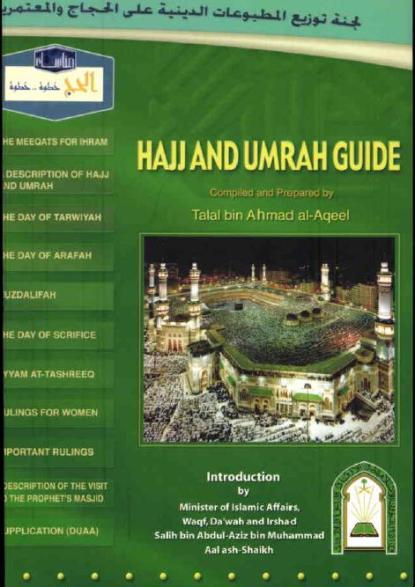
Hajj And Umrah Guide – Compiled by Talal Ahmad al-Aqeel

Hajj And Umrah Guide -  Compiled by Talal Ahmad al-Aqeel Introduction by Sheikh Salih Ibn Abdul Aziz Ali Sheikh

Click the Link below to read or download PDF

Hajj And Umrah Guide – Compiled by Talal Ahmad al-Aqeel [PDF] [81 Pages]

Introduction by Sheikh Salih Ibn Abdul Aziz Ali Sheikh

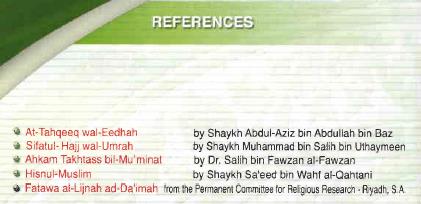
Hajj And Umrah Guide -  Compiled by Talal Ahmad al-Aqeel - References

This book has illustrative pictures related to the Rites of Hajj and Umrah  for easy comprehending of the things

Shaving the Head : Permissible and Impermissible Types – Shaykh AbdurRazzaq al-Badr

Chapter 11: Shaving the Head
Lessons of Creed Acquired From The Hajj
By  Shaykh AbdurRazzaq bin ‘Abdul-Muhsin
Translated by Abbas Abu Yahya

The actions of the day of an-Nahr, the tenth day of the month of Dhul-Hijjah, are indeed four well-known actions which are the stoning, the slaughter, shaving the head and then the Tawaaf. The discussion here will be about shaving the head or shortening the hair as worship for Allaah in obedience to Him and seeking closeness to Him on this great day.

Shaving is completely removing the hair of the head while shortening is lessening the hair of the head all over. Shaving or shortening the hair is one of the obligations of Hajj and Umrah, it is not permissible to leave it, and the evidence is the saying of Allaah Ta’ala:

<< Certainly, you shall enter masjid al-Haram; if Allaah wills, secure, (some) having your heads shaved, and (some) having your head hair cut short, having no fear>> [Fath : 27]

Ibn Qadaamah –Rahimullaah- said:

‘If it was not from the rites of Hajj, Allaah would not have described them this way.’ [1]

It is narrated by Bukhari and Muslim from the hadeeth of Ibn Abbas –RadhiAllaahu anhu- who said:

‘When the Prophet -sallAllaahu alayhi wa sallam- came to Makkah he ordered his Companions to make Tawaaf of the House and of Safa and Marwa, then to come out of Ihraam and shave or shorten their hair.’ [2]

Hence, it is one of the obligations of Hajj and Umrah. So whoever does not shave or shorten their hair, then it is necessary to atone for this by slaughtering a sacrificial animal. It (i.e. shaving/shortening) is a sign that the time period for Ihraam has ended and it imitates the actions of the Messenger – alayhi as-sallat wa sallam- where he shaved his head and ordered his Companions to shave their heads, casting aside their impurities and removing dishevelled hair. Shaving the head is the act of humbly placing the forehead in front of its Lord, due to His greatness, and in submission due to His Honour and it is from the most intense forms of Uboodiyah (worship) for Allaah Azza Wa Jal.

So when the Muslims performs this great act of obedience and important worship in reverence of Allaah and in imitation of the Messenger of Allaah – sallAllaahu alayhi wa sallam- it is obligatory upon him to know that shaving the head or shortening the hair is done to worship and seek closeness to Allaah and that it is not permissible to perform it for anyone other than Allaah –subhanahu wa Ta’ala.

The great Imaam, Shaykh-ul-Islaam ibn Taymeeyah -Rahimullaah– was asked about a people who shave their heads at the command of their shaykhs at such graves as they glorify while regarding it as a means seeking closeness to Allaah and worship: is all of this a Sunnah or a Bida? Is shaving the head, generally, a Sunnah or Bida?

He –Rahimullaah- replied: ‘Shaving the head is of four types:

One of them is shaving the head in Hajj and Umrah and this is from what Allaah and His Messenger -sallAllaahu alayhi wa sallam- have ordered. It is legislated and ordered in the Book, the Sunnah and the consensus of the Ummah.

Allaah Ta’ala said:

<< Certainly, you shall enter masjid al-Haram; if Allaah wills, secure, (some) having your heads shaved, and (some) having your head hair cut short, having no fear>> [Fath : 27]

There are multiple narrations on the authority of the Prophet -sallAllaahu alayhi wa sallamthat he shaved his head in his Hajj and Umrah as did his Companions. From them were those who shaved their heads and some who shortened their hair. Shaving is better than shortening because the Prophet said: ‘O Allaah forgive those who shave their heads.’ The people said, ‘O Messenger of Allaah -sallAllaahu alayhi wa sallam- and those who shorten their hair?’ He said ‘O Allaah forgive those who shave their heads.’ The people said, ‘O Messenger of Allaah -sallAllaahu alayhi wa sallam- and those who shorten their hair?’ He said ‘O Allaah forgive those who shave their heads.’ The people said, ‘O Messenger of Allaah -sallAllaahu alayhi wa sallam- and those who shorten their hair?’ He said: ‘And those who shorten their hair.’ [3]

In the farewell Hajj he -sallAllaahu alayhi wa sallam- commanded the Companions who had brought a sacrificial animal with them to shorten their hair if they had performed Tawaaf of the House and had walked between Safa and Marwa for Umrah and then to shave their heads once they had completed the Hajj. So (in this way) he combined for them, firstly, shortening their hair and, secondly, shaving their heads.

The second type of shaving the head is for a need, such as shaving the head for treatment. This is also permissible according to the Book, the Sunnah and the consensus of the scholars. Indeed Allaah has permitted the Muhrim (pilgrim), for whom it is not usually allowed to have his head shaved until completion of the Hajj rites, to shave his head if he is suffering as Allaah Ta’ala mentions:

<<and do not shave your heads until the Hady (sacrificial animal) reaches the place of sacrifice. And whosoever of you is ill or has an ailment in his scalp (necessitating shaving), he must pay a Fidyah (ransom) of either observing Saum (fasts) (three days) or giving Sadaqah (charity – feeding six poor persons) or offering sacrifice (one sheep) >> [Baqarah :196]

What has been established by agreement of the Muslims is the hadeeth of Ka’b bin Ujraah that when the Prophet -sallAllaahu alayhi wa sallam- passed by him in the Umrah of Al-Hudaybiyah lice were falling from his head, so the Prophet said to him: ‘Are your lice harming you?’ K’ab replied: ‘Yes.’ So the Prophet said: ‘Shave your head and sacrifice a sheep, or fast three days or feed a group of six needy people.’[4]

The authenticity of this Hadeeth is agreed upon and has been received with acceptance by all the Muslims.

The third type of shaving the head is that which is done for worship, religion and Zuhd (abstention from loving worldly things) in other than Hajj or Umrah.

For example, some of the people command the one who repents, once he has repented to shave his head. Similar is the one who shaves the head as a sign of being from the people of rituals and religion or as a sign of the perfection of Zuhd and worship or as a sign that the one who shaves is better, more religious or has more Zuhd than the one who does not.

Then there are those who adhere to certain shaykhs such that if they repent, they shave their heads or they cut some of his hair. So the shaykh specifies who should have the scissors and prayer rug so he can pray on that rug (and not with the Muslims). His cutting hair from the heads of the people is from the complete authority befitting him and someone who is imitated in order to make the people repent.

So all of this is Bida’ which has neither been commanded by Allaah, nor by His Messenger -sallAllaahu alayhi wa sallam. It is not obligatory nor has it been recommended by any one scholar of the Deen. Not one of the Companions did this, nor did any of those who followed the companions in goodness, neither the scholars of the Muslims who were well known for Zuhd and worship nor the Companions, the successors or those who came after them.

There were those who accepted Islam at the time of the Prophet -sallAllaahu alayhi wa sallam- but he never used to order them to shave their heads if they entered Islaam nor did he cut anyone’s hair. He didn’t pray on a rug but, rather, he used to pray as an Imaam with all the Muslims. He used to pray on what they used to pray, sit where they used to sit and he never used to make himself distinct from them by sitting on something special, whether a prayer rug or anything else.

Whoever takes this Bida’ -which is not obligatory or even recommended- as a means of seeking closeness and obedience or as a path to Allaah making it a completion of the Deen or orders the repentant to do it, both the Zahid (the one who abstains from loving worldly things) and the worshipper, then he is a misguided person outside the path of ar-Rahmaan (Allaah the Most Merciful), following the footsteps of the Shayateen.’

Then Shaykh ul-Islaam –Rahimullaah- mentioned the fourth type of shaving the head which is shaving the head as other than a ritual or for other than a need, neither seeking closeness to Allaah nor seeking to be religious. He mentions that the people of knowledge have two opinions regarding this, which are two narrations attributed to Imaam Ahmad.

The first is that it is disliked and this is the Madhab of Maalik and others. The second is that it is permissible and this is well known amongst the companions of Abu Haneefa and ash-Shafi’ee.

Then Imaam Ahmad mentions the evidence that the scholars use for each of these sayings. [5]

Imaam Ibn al-Qayyim mentions a similar division to what has preceded in his book ‘Zaad al-Ma’ad’. He mentions that from the different types of shaving the head there is one that is Shirk and one that is Bida’. Shirk being the one shaving his head for other than Allaah –Subhaanhu- such as those who follow shaykhs and who shave their heads for their shaykhs.

One of them will say:

‘I have shaved my head for so-and-so and you have shaved your head for soand-so.’ This is the same as saying: ‘I have done Sadjah (prostration) for so- and-so,’ because shaving the head is done with humility, in worship and with submissiveness and it is done for the completion of Hajj.

Then he mentions that the misguided shaykhs deceive their followers by causing them to shave their heads for them, just as they mislead them into prostrating to them. [6]

All of this is clear Shirk and a great lie, we ask Allaah for security.

Footnotes:

[1] Al-Mughni (5/305)
[2] Saheeh al-Bukharee
[3] Saheeh al-Bukharee & Saheeh Muslim
[4] Saheeh al-Bukharee & Saheeh Muslim
[5] Majmoo’al-Fatwa (21/116-119)
[6] Za’d al-Ma’ad (4/159-160)

Meaning of Hajj Mabroor (The Accepted Hajj) – Dr. Saleh as Saleh [Audio|En]

It was narrated that Abu Hurayrah (may Allah be pleased with him) said: I heard the Prophet (blessings and peace of Allah be upon him) say:

“Whoever performs Hajj for the sake of Allah and does not utter any obscene speech or do any evil deed, will go back (free of sin) as his mother bore him.” 

Narrated by al-Bukhaari, 1449; Muslim, 1350.

Listen / Download Mp3 Here (Time 10:59)
[audio https://salafiaudio.files.wordpress.com/2014/09/qa-concerning-hajj-001-meaning-of-hajj-mabroor-saleh-as-saleh.mp3]

Posted from : https://abdurrahman.org/2015/02/24/hajj-points-of-benefit-and-rulings-dr-saleh-as-saleh/

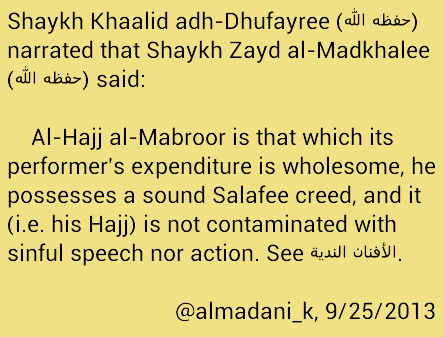
The Definition of al-Hajj al-MabroorTranslation & Photo Source:
Abu Adam Jameel Finch hafidhahullaah
http://t.co/bzHORRy4VJ

Hajj – Al-Mulakhas al-Fiqhi – Shaykh Saalih al-Fawzaan | Abu Muhammad al-Maghribee [Audio|En]

These are the lectures based on the book Al-Mulakhas al-Fiqhi (A Summary of Islamic Jurisprudence) by Shaykh Salih al-Fawzan.

You may download a copy of the original Arabic text here: الملخص الفقهي

As with all of our classes at Masjid Tawheed in Stone Mountain, GA, we encourage you to join us.  If you are not able to attend in person, please feel free to listen in via our Spreaker channel or our telelink line at 712-432-2856.

The following are the chapters covered from the Book

  • Chapter 01 The Obligation off Hajj (Pilgrimage)
  • Chapter 02 Women’s Hajj & Performing it on someones’s behalf
  • Chapter 03 Virtues off Hajj and It’s preparations
  • Chapter 04 Miqats of Hajj
  • Chapter 05 How to Assume Ihraam
  • Chapter 06 Acts Prohibited during Ihraam
  • Chapter 07 Rites of Tarwiyah and ‘Arafah Days
  • Chapter 08 Acts on Muzdalifah and Mina
  • Chapter 09 Days of Tashreeq and Farewell Tawaaf
  • Chapter 10 Sacrificial Animals (Hady and Udhiyah)

Audio Files

Regarding the Haj
Al-Mulakhas al-Fiqhi – Hajj – Part 01 – 20140804
Al-Mulakhas al-Fiqhi – Hajj – Part 02 – 20140818
Al-Mulakhas al-Fiqhi – Hajj – Part 03 – 20140825
Al-Mulakhas al-Fiqhi – Hajj – Part 04 – 20140901

Regarding the ihraam for Hajj
Al-Mulakhas al-Fiqhi – Hajj – Part 05 – 20140908
Al-Mulakhas al-Fiqhi – Hajj – Part 06 – 20140915

The Things the Muhrim Should Not Do
Al-Mulakhas al-Fiqhi – Hajj – Part 07 – 20140922

Yawn al-Arafah
Al-Mulakhas al-Fiqhi – Hajj – Part 08 – 20141006

From the 10th day of Dhul-Hijjah
Al-Mulakhas al-Fiqhi – Hajj – Part 09 – 20141110

Days of Tashriq and Farewell Tawaf
Al-Mulakhas al-Fiqhi – Hajj – Part 10 – 20141117
Al-Mulakhas al-Fiqhi – Hajj – Part 11 – 20141124

Sacrificial Animals
Al-Mulakhas al-Fiqhi – Hajj – Part 12 – 20141201

Posted fromhttp://followthesalaf.com/?tag=Al-Mulakhas+Al-Fiqhi

The following short benefits were extracted from these Hajj Series

Related Books & Lectures on the Rites of Hajj

Hajj index Page

Book on Hajj (Tabseer an-Naasik fi Ahkaam al-Manaasik) – Shaykh Abdul-Muhsin al-Abbaad – Abu Muhammad al Maghribee [Audio|En]

The following lessons are on the book on Hajj, Tabseer an-Naasik fi Ahkaam al-Manaasik by our noble Shaykh Abdul-Muhsin al-Abbaad al-Badr, hafidhahullah.

You may download a copy of the Arabic text here: تبصير الناسك بأحكام الناسك.

Does ‘Umrah in Ramadan compensate for Hajj? – Shaykh Ibn Baaz

Source: http://www.binbaz.org.sa/node/19904
Translated by Abu Afnaan Muhammad Abdullah hafidhahullaah
Video Courtesy: Bilal Nahim

Question:

Does ‘Umrah in the month of Ramadan satisfy for the obligation of Hajj due to the Messenger’s (صلى الله عليه وسلم) statement, “Whoever performs ‘Umrah in Ramadan is like the one who makes Hajj with me.”

Shaykh Abdul- Azeez Bin Baaz:

Umrah in Ramadan does not compensate for Hajj. However, it has the merit/virtue of Hajj due to his (صلى الله عليه وسلم) statement, ‘Umrah in Ramadan equals a Hajj’ or he said ‘a Hajj with me‘.

This means in regards to merit and reward and it does not mean it is equivalent to it and replaces it such that he does not have to perform Hajj. No, rather he still must perform the Hajj, the Hajj of Islam (the obligatory Hajj) even if he makes ‘Umrah in Ramadan according to all of the scholars. Thus, with ‘Umrah in Ramadan, the merit of Hajj is attained from the aspect of reward and excellence, but it does not compensate for the Hajj of Islam.

Related Links:

Global Sighting vs. Local Sighting of the Moon – Shaykh Uthaymeen – Abu Muhammad al Maghribee [Audio|En]

Today we talk about global sighting vs. local sighting of the moon and two other opinions.

Part 03 : Listen / Download Mp3 Here (Time 01:02:32)

Posted from: Book Of Fasting – Sharh al-Mumti alaa Zaad al-Mustaqni – Shaykh Uthaymeen – Abu Muhammad al Maghribee [Audio|En]

Sourcehttp://followthesalaf.com

My Umrah Selfie – Dr Murtaza bin Baksh [ Video|Urdu- English Subtitles]

Translated and transcribed by: Aboo Bilal Nahim ibn Abd al Majid حفظه الله
Video Courtesy: Brother Bilal Nahim
Audio Sourcehttp://urdu-islamic-audio.com/2015/05/28/my-umrah-selfie/

Below is the Transcription of the above Video

The question of the brother is that in these days a new Fitnah (trial) has begun.

 THE TAKING OF SELFIE PHOTOSAllah’s aid is sought.

The strange thing is that you see this in the Haram, people standing in front of the Ka’bah taking selfies, behind them is the Ka’bah and they are taking photographs.  My brother, taking photographs is Haraam (forbidden).

This Haraam (forbidden act), outside of this House (of Allah) is also Haraam.

Its prohibition inside (of this Masjid) is increased even more!

In front of the House of Allah its prohibition is increased even more! 

For what reason have these people come here? To show the world that I have come here to perform Umrah and here is my evidence for it! Then were has their intention gone!

If you came for the pleasure of Allah, then why is there a need to announce to the world where you are?  Then they post it upon Facebook:

“Look, I also went to Makkah.  Here is the proof, look the Ka’bah is behind me.”

إنا لله وإنا إليه راجعون

To Allah we belong and to Him we shall return.

So fear Allah and save yourself from this Fitnah… and a mobile phone is a mobile phone.  Some people have turned it in to, I don’t know what.

For some people within it, they have songs, music, movies a camera.

HARAAM UPON HARAAM!

How many Muharamaat (forbidden things) are you carrying in your pocket!!

 So, FEAR ALLAH!!

Keep it within the limits of being a mobile phone.  Use it in a good manner for good (permissible) things.  But, since when has that taking of photographs been regard as making good use of it?

Using it for something that is Haraam!

Allah has given you the ability, by Allah millions wish for the opportunity to visit the House of Allah.  In the world, millions of individuals, I swear by Allah. But, do they have the ability?  No they don’t have the ability. They don’t get the opportunity to come to the House of Allah.

They die with this desire!

And you come here having the pleasure of performing Umrah and you are taking SELFIES!!

Behind you walk’s a sister or someone’s mother and they too become a part of this selfie.  Do you have no shame!

Nor do you have any shame with regards to the House of Allah and no shame with regards to the sister or daughter and neither any shame of yourself.  So for this reason this is a fitnah and it is not permissible, may Allah reward you with barakah!

(Dr Murtaza (حفظه الله تعالى) then explains the prohibition to our Moroccan brother (حفظه الله تعالى) who was present (in the Urdu lecture) to take opportunity to sit in a gathering where the remembrance of Allah was taking place).

Translated and transcribed by: Aboo Bilal Nahim ibn Abd al Majid
Date:  The day of Jumu’ah. 11th Shab’aan 1436 corresponding with 29th May 2015

The Goal of the Udhiyyah (Sacrifice) according to Allah is the Sincerity and Taqwa of His Servant

(37. It is neither their meat nor their blood that reaches Allah, but it is Taqwa from you that reaches Him. Thus have We made them subject to you that you may proclaim Allah’s greatness for His guidance to you. And give glad tidings to the doers of good.) – Suratul Baqarah

Allah says: this sacrifice is prescribed for you so that you will remember Him at the time of slaughter, for He is the Creator and Provider. Nothing of its flesh or blood reaches Him, for He has no need of anything other than Himself. During the time of Jahiliyyah, when they offered sacrifices to their gods, they would put some of the meat of their sacrifices on their idols, and sprinkle the blood over them. But Allah says:

(It is neither their meat nor their blood that reaches Allah,) Ibn Abi Hatim recorded that Ibn Jurayj said, “The people of the Jahiliyyah used to put the meat of their sacrifices and sprinkle the blood on the House, and the Companions of the Messenger of Allah said, “We have more right to do that.” Then Allah revealed the words:

(It is neither their meat nor their blood that reaches Allah, but it is Taqwa from you that reaches Him.) That is what He will accept and reward for, as mentioned in the Sahih,

(Allah does not look to your appearance or your colors, but He looks to your hearts and deeds.) And in the Hadith; (Indeed charity falls in the Hand of Ar-Rahman before it falls in the hand of the one asking.)

(Thus have We made them subject to you) meaning, `for this purpose We have subjugated the Budn for you,’

(that you may proclaim Allah’s greatness for His guidance to you.) means, that you may glorify Him for guiding you to His religion and His way which He loves and is pleased with, and has forbidden you to do all that He hates and rejects.

(And give glad tidings to the doers of good.) means, `give good news, O Muhammad, to those who do good,’ i.e., whose deeds are good and who remain within the limits prescribed by Allah, who follow that which has been prescribed for them, who believe in the Messenger and follow that which he has conveyed from his Lord.

(Note) The Udhiyyah is Sunnah Mustahabbah One animal is sufficient on behalf of all the members of one household. Ibn `Umar said, “The Messenger of Allah continued to offer sacrifice for ten years.” This was recorded by At-Tirmidhi. Abu Ayyub said: “At the time of the Messenger of Allah , a man would sacrifice a sheep on behalf of himself and all the members of his household, and they would eat from it and feed others, until the people started boasting ﴿by sacrificing more than one﴾ and things reached the stage that you see now.” This was recorded by At-Tirmidhi, who graded it Sahih, and by Ibn Majah. `Abdullah bin Hisham used to sacrifice one sheep on behalf of his entire family; this was recorded by Al-Bukhari. Concerning how old the sacrificial animal should be, Muslim recorded from Jabir that the Messenger of Allah said:

(Do not sacrifice any but mature animals, and if that is not possible, then sacrifice a young sheep.)

Source: Tafseer Ibn Kathir, Dar-us-Salam publications

Learning Aqeedah from Hajj – Shaykh Muhammad Al Aqeel [Audio|Ar-En]

Title: Learning Aqeedah from Hajj – Lesson 1, 2 & 3 (3 Mp3 Lectures)
By: Shaykh Muhammad Al Aqeel
Translated by: Abbas Abu Yahya
Copyright: miraath.net

Visit the below link to Listen or Download Mp3 Lectures

http://www.miraathpublications.net/learning-aqeedah-from-hajj/

How To Perform The Rituals Of Hajj And Umrah – Shaykh Ibn Uthaymeen

Published by Dawah Center Jeddah (1992)

Click the below link to read or download PDF
How To Perform The Rituals Of Hajj & Umrah – Shaykh Ibnul-Uthaymeen [PDF]
How To Perform The Rituals Of Hajj And Umrah – Shaykh Ibn Uthaymeen

In The Name of Allaah, Most Gracious, Most Merciful

Preface

Praise be to Allaah, Lord of the Universe. May peace and blessings be upon Muhammad, the last of the prophets and messengers, and upon his family and esteemed companions.

Hajj is one of the best forms of worship and is one of the most sublime deeds because it is one of the pillars of Islam that Allaah sent Muhammad (may the peace and blessings of Allaah be upon him) with. A servant’s religion is incomplete without it.

A form of worship is only acceptable when the following is true.

1. One devotes it to Allaah alone, with a desire for the Hereafter. It cannot be done with the intention of being seen among men or for worldly gain.

2. One follows the Prophet’s example, in words deeds. This cannot accomplished except knowledge of the Sunnah.

Forms of Pilgrimage

There are three forms of Hajj:

Tamattu’-Ifraad-Qiran

Tamattu‘: A pilgrim wears Ihram for Umrah only during the months of Hajj, which means when he reaches Makkah, he makes Tawaf and Sa’yi for Umrah. He then shaves or clips his hair. On the day of Tarwiya, which is the eighth of Dhul-Hijja, he puts on his Ihram for Hajj only and carries out all of its requirements.

Ifraad: A pilgrim wears Ihram for Hajj only. When he reaches Makkah, he performs Tawaf for his arrival and Sa’yi for Hajj. He doesn’t shave or clip his hair as he doesn’t disengage from Ihram. Instead, he remains in Ihram till after he stones Jamrah Al-Aqaba on the Eid day. It is permissible for him to postpone his Sa’yi for Hajj until after his Tawaf for Hajj.

Qiran: A pilgrim wears Ihram for both Umrah and Hajj or he wears Ihram first for Umrah, then makes intentions for Hajj before his Tawaf for Hajj. The obligations on one performing Ifraad are the same as those on one performing Qiran, except that the latter must slaughter whereas the former is not obligated to do so.

The best of the three forms is Tamattu’. It is the form that the prophet (may the peace and blessings of Allaah be upon him) encouraged his followers to perform. Even if a pilgrim makes intentions to perform Qiran or Ifraad he is allowed to change his intentions to Tamattu’; he can do this even after he has performed Tawaf and Sa’yi.

When the Prophet (may the peace and blessings of Allaah be upon him) performed Tawaf and Sa’yi during the year of the Farewell Hajj with his companions, he ordered all those who hadn’t brought sacrificial animals to change their intentions for Hajj to intentions for Umrah. cut their hair, and disengage from Ihram till Hajj. He said, ” If I hadn’t brought the sacrificial animal, I’d have done what I’ve ordered you to do.”

The Umrah

If a pilgrim wishes to be ritually pure for Umrah, he should shed his clothing and bathe as he would after sexual defilement, if convenient. He should perfume his head and beard with the best oil he can find. There is no harm in what remains of it after Ihram.

Bathing for Ihram is Sunnah for both men and women, including menstruating women and those experiencing postnatal bleeding. After bathing and preparing himself, a. pilgrim, other than those menstruating or experiencing postnatal bleeding, prays the obligatory prayer, if it is time. Otherwise, he makes his intention by praying the two Sunnah Rakaas which are made each time Wudhu is performed.

When he finishes his prayer he should say:

“Here I am for Umrah, here I am, Oh Allaah, here I am. Here I am. You have no partner. Here I am. Surely all praise, grace and dominion is yours, and you have no partner.” [Talbeeyah].

A man raises his voice when saying this and a woman says it so that only one beside her may hear her.

One in Ihram should say the Talbeeyah as often as possible, especially when times and places change. For example: when descending or ascending during travel or when day or night approach. He should also ask Allaah for His pleasure, for Heaven and seek refuge in Allaah’s mercy from Hellfire.

One should say the Talbeeyah during Umrah, starting from the time he puts on his Ihram till he starts Tawaf. During Hajj he should say it starting from the time he puts on his Ihram till he starts to stone Jamrah Al-Aqaba on the Eid day.

When a pilgrim enters the Holy Mosque he puts forth his right foot first and says:

“In the name of Allaah, may peace and blessings be upon the Messenger of Allaah. Oh Allaah, forgive me my sins and open to me the doors of Your mercy. I seek refuge in Allaah the Almighty and in His Eminent Face and in His Eternal Dominion from the accursed Satan.”

He approaches the Black Stone, touches it with his right hand and kisses it. If this isn’t possible, he should face the Black Stone and point to it.

It is best not to push and shove, causing harm and being harmed by other people.

When touching the Stone, a pilgrim should say the following:

“In the name of Allaah, Allaah is the greatest. Oh, Allaah, with faith in you, belief in Your book, loyalty to you, compliance to the way of your Prophet Muhammad (may the peace and blessings of Allaah be upon him).”

A pilgrim must walk, keeping the Ka’bah on his left. When he reaches the Rukn Al Yamani he should touch, but not kiss it, and say:

” Our Lord, grant us good in this life and good in the hereafter and save us from the punishment of the Hell fire. Oh Allaah, I beg of You for forgiveness and health in this life and in the Hereafter.”

Each time he passes the Black Stone he should say: “Allaah is the Greatest.”

During the remainder of his Tawaf he may say what he pleases of supplications, mentioning Allaah, and recitation of Quran. This is because Tawaf, Sa’yi, and Stoning the Jamrah have been devised for the purpose of mentioning Allaah.

During this Tawaf it is necessary for a man to do two things:

1. Al-ldhtebaa’ from the beginning of Tawaf until the end. Al-ldhtebaa’ means placing the middle of one’s Reda’ under his right arm and the ends of it over his left shoulder.

When he is finished performing Tawaf, he may return his Reda’ to its original state because the time for Idhtebaa’ is only during Tawaf.

2. Al-Raml during the first three circuits. Al-Raml means speeding up one’s pace with small steps. A pilgrim should walk at a normal pace during his last four circuits.

When he completes seven circuits of Tawaf, he approaches Maqam Ibrahim and recites:

“And take ye the station of Abraham as a place of Prayer” Chapter 2, Verse 125 [2:125].

He prays two short Rakaas, as close as conveniently possible, behind Maqam Ibrahim. During the first Rakaa he recites Surah Al-Kafirun [Chapter 109] and during the second one Surah Al-lkhlas [Chapter 112].

When he completes the two Rakaas he should return to the Black Stone and touch it, if convenient. He goes out to the Mesa’a and when he nears As-Safaa he recites:

“Verily As-Safaa and Al-Marwah are among the shrines of Allaah ” [2:158].

He ascends As-Safaa until he is able to see the Ka’bah. Facing the Ka’bah and raising his hands, he praises Allaah and makes any supplications he chooses. The Prophet (may the peace and blessings of Allaah be upon him) prayed thus: “There is no Deity but Allaah alone,” three times, supplicating in between.

He descends As-Safaa and heads for Al-Marwah at a normal pace until he reaches the green marker. He should then run fast until the next green marker. He continues toward Al-Marwah at a normal pace. When he reaches it, he ascends it, faces the Qibla, raises his hands and repeats what he said on As-Safaa. He descends Al-Marwah heading towards As-Safaa, taking care to walk where walking is designated, and run where running is designated.

He continues this procedure until he completes seven laps. Going from As-Safaa to Al-Marwah is a lap and returning is another lap.

During his Sa’yi he may recite what he wills of supplications, recitation of Qur’an, and mentioning Allaah.

In completion of Sa’yi he shaves his head. A woman clips her hair the length of a finger tip.

Shaving is preferable, except when Hajj is near and there isn’t sufficient time for hair to grow back. In this case it’s best to clip so that hair will remain for shaving during Hajj.

With that, Umrah is completed. and a pilgrim is free to dress in other clothing, wear perfume and engage in marital relations, etc.

The Hajj

In the forenoon of the eighth day of Dhul-Hijja, a pilgrim purifies himself once again by bathing as he did before Umrah in the place in which he is staying, if convenient. He puts on his Ihram and says:

” Here I am for Hajj. Here I am, oh Allaah, here I am. Here I am. You have no partner. Here I am. Surely all praise, grace and dominion is yours, and you have no partners.”

If he fears that something will prevent him from completing his Hajj he should make a condition when he makes his intentions, saying:

“If I am prevented by any obstacle my place is wherever I am held up.”

If he has no such fear, he doesn’t make this condition.

A pilgrim goes to Mina and there prays Dhuhr, Asr, Magrib, Isha and Fajr, shortening his four unit prayers so as to make them two units each, without combining them.

When the sun rises, he goes to Arafah and there prays Dhuhr and Asr combined at the time of Dhuhr, making each one two units. He remains in Namira Mosque until sunset if possible. He remembers Allaah and makes as many supplications as possible while facing the Qibla.

The Prophet (may the peace and blessing of Allaah be upon him) prayed thus:

“There is no Deity but Allaah alone. He has no partner. All dominion and praise are His and He is powerful over all things.

If he grows weary it is permissible for him to engage in beneficial conversation with his companions or reading what he can find of beneficial books, especially those concerning Allaah’s grace and abundant gifts. This will strengthen his hope in Allaah.

He should then return to his supplications and be sure to spend the end of the day deep in supplication because the best of supplication is the supplication of the day of Arafah.

At sunset he goes from Arafah to Muzdalifah and there prays Magrib, Isha, and Fajr. If he is tired or has little water, it is permissible for him to combine Magrib and Isha. If he fears that he will not reach Muzdalifah until after midnight, he should pray before he reaches it for it is not permissible to delay prayer until after midnight. He remains there, in Muzdalifah, making supplications and remembering Allaah till just before sunrise.

If he is weak and cannot handle the crowd during Ar-Ramy, it is permissible for him to go to Mina at the end of the night to stone the Jamrah before the arrival of the crowd.

Near sunrise, a pilgrim goes from Muzdalifah to Mina. Upon reaching it he does the following:

  • a) He throws seven consecutive pebbles at Jamrah Al-Aqaba which is the closest monument to Makkah, saying “Allaah is the Greatest,” as he  throws each pebble.
  • b) He slaughters the sacrificial animal, eats some of it, and gives some to the poor. Slaughter is obligatory on the Mutamati and Qiran.
  • c) He shaves or clips his hair; shaving is preferable. A woman clips her hair the length of a finger tip.

These three should be done in the above order if convenient, but there is no restriction if one precedes another.

With that, one is allowed to come out of Ihram. He can wear other clothing and do everything that was lawful before Ihram except engaging in marital relations.

He goes to Makkah to perform Tawaf Al-lfadha and Sa’yi, also for Hajj. It is Sunnah to put perfume on before going to Makkah.

With the completion of this Tawaf and Sa’yi, a pilgrim is allowed to do everything that was lawful before Ihram, including engaging in marital relations.

After performing Tawaf and Sa’yi, he returns to Mina to spend the nights of the eleventh and twelfth days there.

He stones the three Jamrah in the afternoon of both the eleventh and twelfth days. He starts with the first Jamrah, which is furthest from Makkah, then the middle one, and lastly Jamrah Al-Aqaba. Each one should be stoned with seven consecutive pebbles accompanied by Takbeer. He stops after the first and middle Jamrah to make supplications facing the Qibla. It is not permissible to stone before noon on these two days. It is best to walk to the Jamrah, but riding is permissible.

If he is in a hurry after stoning on the twelfth day, he leaves Mina before sunset. But if he wishes to prolong his stay, which is best, he spends the night of the thirteenth in Mina and stones that afternoon in the same manner as on the twelfth day.

When he is ready to return to his country, he makes Tawaf Al-Wadaa, which is seven circuits around the Ka’bah. Menstruating women and women experiencing postnatal discharge are not obligated to perform Tawaf Al-Wadaa.

Visiting The Prophet’s Mosque

1. A pilgrim goes to Madina before or after Hajj with the intention of visiting the Prophet’s mosque and praying in it. Prayer there is better than a thousand prayers elsewhere except in the Holy Mosque in Makkah.

2. Upon reaching the mosque he prays two Rakaas of salutation or performs any obligatory prayer that is due.

3. He goes to the grave of the Prophet (may the peace and blessings of Allaah be upon him) and he stands before it. He greets him saying the ” May the peace, mercy, and blessings of Allaah be upon you, oh Prophet. May Allaah grant you a good reward on behalf of your people. “

He takes a step or two to his right to position himself before Abu-Bakr and greets him saying : “May the peace, mercy, and blessing of Allaah be upon you. oh Abu-Bakr, Caliph of the Messenger of Allaah. May Allaah be pleased with you and grant you a good reward on behalf of Muhammad’s people.”

Then he takes a step or two to his right to position himself before Umar and greets him saying: ” May the peace, mercy and blessings of Allaah be upon you, oh Umar, Prince of the believers. May Allaah be pleased with you and grant you a good reward on behalf of Muhammad’s people.”

4. In a state of purity, he goes to pray in Qubaa Mosque.

5. He goes to Al-Baqee to visit Uthman’s grave (may Allaah be pleased with him). He stands before it and greets him saying:

“May the peace, mercy and blessing of Allaah be upon you, oh Uthman Prince of the believers. May Allaah be pleased with you and grant you a good reward on behalf of Muhammad’s people.”

He greets any other Muslims in Al-Baqee.

6. He goes to Uhud and visits the grave of Hamza (may Allaah be pleased with him) and the other martyrs there with him. He greets them and preys to Allaah to grant them forgiveness, mercy, and pleasure.

Notification

The following is incumbent upon the Muhrim for Hajj or Umrah:

1. That he be committed to Allaah’s religious obligations upon him such as prayer in its time (in congregation for men).

2. That he avoids what Allaah has prohibited such as obscenity, inequity, and disobedience. if anyone undertakes Hajj therein. Let there be no obscenity, nor wickedness, nor wrangling during Hajj ~ [2:197].

3. That he avoids harming the Muslims with words or actions within the Masha’ir or elsewhere.

4. That he avoids all of the restrictions of Ihram:

a. He shouldn’t cause the loss of any of his hair or nails. A prick by a thorn and the like is unobjectionable, even if there is bleeding.

b. He shouldn’t perfume himself, his clothing, his food or his drink after entering Ihram. He should also abstain from cleansing himself with scented soap. There is no harm in what remains of the effect of perfume used prior to Ihram.

c. He shouldn’t touch, kiss, etc. his spouse out of passion and, even worse, shouldn’t have sexual intercourse.

e. He shouldn’t be wed or propose to a woman for himself or others.  He shouldn’t wear gloves, although there is no harm in wrapping the hands in cloth. This ruling goes for both men and women.

The following pertains specifically to men:

a) He cannot cover his head with something that touches it, although there is no harm in the use of an umbrella, the roof of a car or tent for shade. There is also no harm in carrying his baggage atop his head.

b) He cannot wear a shirt, turban, hooded cloak trousers, or shoes. Only if he is unable to obtain an Ezar or sandals can he wear trousers or shoes.

c) He cannot wear anything with the same qualities of the above mentioned such as an Abea’, Qubaa, hat, undershirt, etc.

It is permissible for him to wear sandals, rings, glasses, a hearing aid. a watch, worn on his wrist or hung from his neck, or a speech aid.

It is permissible for him to cleanse himself with unscented cleansers and to wash and scratch his head and body, even if some of his hair falls unintentionally. In such a case there is no obligation on him because of it.

A woman cannot wear a Niqab or Burqa’. The Sunnah is for her to uncover her face except if men not related to her might see her, in which case it is obligatory for her to cover her face during Ihram and otherwise.

Allaah is the giver of success. May His blessings be upon our Prophet Muhammad and all of his family and companions.

By the needy before Allaah, Muhammad As-Salih Al-Uthaimeen


Glossary

Abaya’: cloak like, woolen wrap.
Abu Bakr: first Muslim Caliph.
Al-Baqee’: a place in Madina.
Al-ldhtebaa:placing the middle of the Reda’ under the right arm and the ends of it over the left shoulder during Tawaf.
Al-lkhlas: Chapter 112 (Purity of Faith).
Al-Kafirun: Chapter 109 of the Qur’an ( Those who reject Faith).
AlMarwah: name of the hillock where a Muslim begins Sa’yi.
Al-Raml: walking quickly but with small steps during the first three circuits of Tawaf.
Arafah: the most important stop during Hajj, located beyond Muzdalifah.
Ar-Ramy– The Stoning.
As-Safaa: name of the hillock where a Muslim ends his last lap of Sa’yi.
Asr: the afternoon prayer.
Burqa’: a face veil like a Niqab.
Dhul-Hijja: the twelfth month of the Islamic calendar.
Dhuhr: the noon prayer.
Eid: celebration for Muslims.
Ezaar: lower cloth of Ihram.
Fajr: dawn prayer.
Hajj: official Muslim pilgrimage to Makkah.
Hamza: one of the Prophet’s uncles and a martyr during the battle of Uhud.
Ifraad: isolated form of Hajj.
Ihram: the ceremonial state of making Hajj or the Hajj garments themselves. Isha night prayer.
Jamrah: Monument in Mina.
Jamrah Al-Aqaba: the monument closest to Makkah.
Ka’bah: the house of Allaah in the Holy Mosque in Makkah.
Magrib: dusk prayer.
Maqam Ibrahim: the stepping stone of the prophet Abraham.
Mes’aa: the stretch between As-Safaa and Al-Marwah.
Masha’ir: ceremonial shrines.
Mina: one of the ceremonial shrines, a valley near Makkah.
Muhammad– the last of the prophets, the prophet of Islam.
Muhrim: a person in Ihram.
Mutamati: a pilgrim performing Hajj Tamattu’.
Muzdalifah: one of the ceremonial shrines of Hajj, between Mina and Arafah.
Namira: mosque in Mina.
Niqab: a face veil revealing the eyes through slashes
Qiran: a pilgrim performing Hajj Qiran.
Qibla: the direction Muslims face to pray.
Qiraan: Accompanied form of Hajj.
Quba: a mosque in Madina, used to be on the outskirts.
Qur’an: the Book of Allaah.
Rakaa: a unit of prayer.
Reda’: the upper cloth of Ihram.
Rukn Al-Yamani: the corner of the Ka’bah which faces Yemen.
Sa’yi: the walk made between As-Safaa and Al-Marwah.
Sunnah: way of the Prophet.
Surah: a chapter of the Qur’an.
Takbeer: saying “Allaahu Akbar (“Allaah is Greatest”)
Talbeeya: the supplication a Muslim recites once he is in Ihram and has made his intention.
Tamattu’: enjoyable form of Hajj.
Tarwiyya: the eighth of Dhul-Hijja.
Tawaf: circumambulation of the Ka’bah
Tawaf Al-lfadha: tawaf for Hajj.
Tawaf Al-Wadaa: farewell Tawaf.
Uhud: the name of a mountain in Medina and the site of the battle by this name.
Umar: the second Muslim Caliph and first Prince of the believers.
Umrah-minor Hajj: the combination of Tawaf and Sa’yi.
Uthman: the third Muslim Caliph and second Prince of the believers.
Wudhu: ablution.

Related Beneficial Audio:

Important Fatwas regarding the rites of Hajj and Umrah – Shayk Ibn Baaz

Important Fatwas regarding the rites of Hajj and Umrah
Dictated By His Eminence Shaikh Abdul Aziz Bin Abdullha Bin Baz
Published by the Islamic Ministry (Riyadh)

Click the below link to read or download PDF

Important Fatwas regarding the rites of Hajj and Umrah – Shayk Ibn Baaz [PDF]

45 Important Questions answered by Imam Ibn Baz rahimahullaah

The Fiqh of Hajj – Shaykh al Albanee

Taken from Silsilah Ahadeeth As-Saheehah & Silsilah Ahadeeth Ad-Daeefah of The Muhaddith, Shaykh, Allamaah Muhammad Nasiruddeen al-Albaani Rahimahullaahu Ta’ala

Translated byAbbas Abu Yahya

The Excellence of Hajj

No. 1185 & 1200 – On the authority of Ibn Abbas in a narration ascribed to the Prophet: – sallAllaahu alayhi wa sallam:

‘Be regular with (in another narration: follow up) the Hajj and the Umrah since they wipe out poverty and sins, just as the furnace separates the slag from the iron.’

Not Leaving Off Hajj for More than Five Years

No. 1662 – The Messenger – sallAllaahu alayhi wa sallam said:

‘Indeed Allaah says: Verily I have made a slave’s body healthy and given him adequate livelihood yet five years have passed and he has not come to Me and redeemed himself, as a pilgrim.’

Silsilah-Saheehah

Shaykh Albaani said:

Benefit: al-Mundhiri said in ‘al-Targheeb’ (2/134): Narrated by Ibn Hibban in his ‘Saheeh’ and by al-Bayhaqi who said: ‘Alee bin al-Mundhir said: Some of our companions narrated to me saying:

Hasan bin Hayyin used to be amazed by this hadeeth and used to implement it. He would love a healthy, prosperous person not to leave off Hajj for five years.’

No. 1264 – On the authority of Jaabir in a narration ascribed to the Prophet: -sallAllaahu alayhi wa sallam:

‘The goodness of Hajj is feeding people and good speech.’

No. 1820 – On the authority of Jaabir who said: the Messenger of Allaah – sallAllaahu alayhi wa sallam said:

‘Pilgrims for Hajj and Umrah are the delegates of Allaah. He called them and they responded, they asked of Him and He gave them.’

Ihram

What is Avoided in Hajj is that which is Avoided in Umrah

No.2765 – On the authority of Safwaan bin Umayyah who said: A man came to the Messenger of Allaah -sallAllaahu alayhi wa sallam: wearing a lot of coloured perfume on his clothing, he was wearing different pieces of clothing and he had already assumed Ihraam for Umrah. He said: ‘What do you order me to do, O Messenger of Allaah, in my Umrah?’ Then Allaah -Azza wa Jal- revealed: <<Complete the Hajj and Umrah for Allaah >> So the Messenger of Allaah -sallAllaahu alayhi wa sallam- said: ‘Where is the person who asked the question about Umrah?’ The man said: ‘Here I am.’ So the Messenger said: ‘Remove your clothing and take a bath, clean off the perfume as much as you can and whatever you used to do for your Hajj, then do that in your Umrah.’

Saheeh
Silsilah-Saheehah

Shaykh Albaani said:

Benefit: Ibn Hajr said in ‘al-Fath’ (3/394): Ibn al-Muneer said in ‘al-Hashiyah’: ‘What the Messenger -sallAllaahu alayhi wa sallam- said was: “Wassna’,” (i.e. the Arabic word for ‘do, make’) which means: ‘To leave something,’ because the clarification meant what a Muhrim keeps away from. So, the benefit taken from this explanation is that ‘leaving something is an action in itself.’

The Prohibition of the Woman in Ihram Covering her Face with a Scarf

No. 2930 – On the authority of ‘Uqbah bin ‘Aamr al-Juhanee who said: ‘My sister vowed that she would walk to the Ka’bah barefoot and unveiled. So the Messenger of Allaah -sallAllaahu alayhi wa sallam- came to her and said: ‘What is wrong with this woman?’ They said: She vowed to walk to the Ka’bah barefoot and unveiled! So he said:

‘Order her to take a ride, cover herself, perform the Hajj and slaughter an animal.’

Saheeh
Silsilah-Saheehah

Shaykh Albaani said:

‘In this hadeeth there are some important benefits, from them:

That the Ihram of the woman is for her face, so it is not permissible for her to cover her face with her Khimaar (scarf), rather she covers her head and chest. This is like the hadeeth:

‘A woman in Ihram does not wear a Niqaab (face veil), nor does she wear gloves.’

[Narrated by Bukhari and Muslim.]

[Important note: Shaykh al-Albaani said in his book: ‘The Rites of Hajj and Umrah’ (p.12)

‘It is permissible for the woman to cover her face with something like a Khimaar or Jilbaab, which she throws over her head and it sits on her face. What is correct is that it can touch her face, but she cannot tie it to her face.

This is similar to what Ibn Taymeeyah -Rahimahullaah said.]’

No. 2617 -The Messenger – sallAllaahu alayhi wa sallam said:

‘O Allaah this Hajj has no ostentation in it nor any hypocrisy.’

The Permissibility of the Person in Ihram Covering his Face if Needed.

No. 2899 – On the authority of Uthmaan bin ‘Affan –RadiAllaahu anhu- that

‘The Prophet – sallAllaahu alayhi wa sallam- would cover his face while he was in a state of Ihram.’

Saheeh
Silsilah-Saheeha

On the authority of Abdullaah bin ‘Aamir bin Rabeeh that

he saw ‘Uthmaan bin ‘Affan in a village near Madina with his face covered by a deep red coloured, velvet cloth on a summer’s day while he was a Muhrim (in the state of Ihram).

Its chain is authentic.

Shaykh Albaani said: ‘So if you know that the chain of narration is authentic, then there is no contradiction between this hadeeth and the report which is Mawqoof (the Isnad only goes back to the Companion) at ‘Uthmaan, as is apparent. This is because there is nothing that conflicts with the acceptability of ‘Uthmaan doing that which it is possible the Messenger -sallAllaahu alayhi wa sallam- did.

This is better (that the hadeeth and the Athar correspond) rather than attributing a mistake to one of the trustworthy narrators simply because ‘Uthmaan did an action that he narrated from the Prophet -sallAllaahu alayhi wa sallam. Do you not also see that there is no difference between what ad-Daraqutni -Rahimullaah- noted, saying that the Mawqoof (the Isnad only goes back to the Companion) precedes the Marfoo’ (a narration ascribed to the Prophet), and those who invert the issue saying that the Marfoo’ precedes the Mawqoof.

The truth is that both of them are authentic, so neither of them opposes the other. Indeed there are many Aathaar narrated by the Companions, the Tabieen and the diligent Imaams which permit the person in a state of Ihram to cover his face if need be. Ibn Hazm uses these Aathaar as evidence in his book ‘al-Muhalla’ (7/91-93) so as to support the original stance. Al-Bayhaqi also narrated some of these Aathaar (5/54)

This hadeeth does not oppose the saying of the Messenger -sallAllaahu alayhi wa sallamregarding the person who dies while in a state of Ihram:

‘Wash him with water mixed with Acacia leaves, shroud him in his clothing and do not cover his face or head.’

Narrated by Muslim and other than him and it is narrated in the book ‘al-Irwaa’ (4/198-199).

This verdict is specific to the one who dies in a state of Ihram but the hadeeth under discussion is regarding the living, so it (i.e. the ruling) is different.’

What Animals are Permissible for the Muhrim to Kill

No. 193 -‘Five types of animals which, if a Muhrim kills, there is no blame upon him: a crow, a predatory bird, a rat, scorpion and a voracious dog.’

Saheeh

Narrated by Bukhari and Muslim on the authority of Ibn Umar in a narration ascribed to the Prophet: -sallAllaahu alayhi wa sallam.

Shaykh Albaani said:

‘From what is clear in this hadeeth is the absence of blame, which shows the permissibility of killing them. It is not to be understood from this that it is recommended or obligatory to kill them or that it is better leave off killing them.’

Talbeeyah

No. 830 – On the authority of Zaid bin Khalid al-Juhanee, on the authority of the Messenger of Allaah -sallAllaahu alayhi wa sallam – who said:

‘Jibraeel came to me and said: O Muhammad! Order your Companions to raise their voices with the Talbeeyah (proclamation for Hajj or Umrah), since it is from the signs of Hajj.’

No. 1500 – On the authority of Abu Bakr as-Siddeeq who said that

the Messenger of Allaah – sallAllaahu alayhi wa sallam- was asked: ‘What is the best Hajj?’

He answered ‘The one where you raise your voice reciting the Talbeeyah and you slaughter an animal.’

No. 1621 – On the authority of Abu Huraira in a narration ascribed to the Prophet: -sallAllaahu alayhi wa sallam:

‘A person does not ever make Talbeeyah except that he is given glad tidings, nor does a person ever say Takbeer except that he is given glad tidings.’

It was asked: ‘With Paradise?’

He answered: ‘Yes.’

Mina

No. 804 – On the authority of Ibn Abbas: the Messenger – sallAllaahu alayhi wa sallam used to visit the House (Ka’bah) every night from the nights of Mina.’

Tawwaaf

No. 2725 – On the authority of Abdullaah bin Umar who said I heard the Messenger of Allaah – sallAllaahu alayhi wa sallam- saying:

‘Whoever makes seven circuits of Tawwaaf around the House (Ka’bah) and prays two Rakats, it is the same as freeing a slave.’

Salutation of the House – for the person not in Ihram- is Two Rakah

The Hadeeth has no chain – La Asl laha
No.1012 ‘Salutation of the House is done with Tawwaaf.’
The Hadeeth has no chain – La Asl laha

Silsilah-Daeefah

Shaykh Albaani said:

‘I say: I do not know, neither from the sayings or actions of the Sunnah, that which attests the meaning of this hadeeth other than the general evidences which mention praying before sitting in the Masjid which then include the Masjid al-Haraam.

The assertion that salutation of the Masjid al-Haraam is the Tawwaaf opposes the general evidence previously mentioned. So, this salutation cannot be accepted until it can be affirmed and how inconceivable is that? Especially as – due to experience – it is not possible for the person entering the Masjid al-Haraam during the days of the sacred seasons to perform the Tawwaaf every time he enters it, so praise be to Allaah Who has made the matter easy.

<<And He has not placed any burden upon you in your religion>>

Indeed what must be brought to attention here regarding this verdict is that it is for the person who is not a Muhrim. As for the person who is in Ihram then the rightful Sunnah is that he begins with the Tawwaaf and then the two Rakah after it.’

The Hajj Pilgrimage is Only Made to the House of Allaah

Da’eefah No. 265 Mawdoo- Fabricated

‘O Abu Huraira! Teach the people the Quran and learn it, because if you died upon that, the Angels would visit your grave just as they visit the Ancient House (Ka’bah). Teach the people my Sunnah, even if they dislike it. If you would like not to stop on the bridge on the Day of Judgement, even for the blink of an eye until you enter Paradise, then do not innovate with your opinion.’

Mawdoo- Fabricated
Silsilah-Daeefah

Shaykh Albaani said:

‘Ibn al-Jawzi mentions this narration in his book ‘al-Mawdoo’aat’ (The Fabricated Ahadeeth) (1/264) and he said: ‘Not authentic and Abu Hammam (one of the narrators) is Muhammad bin Mujeeb.

Yahya said: ‘He is a liar.’

Abu Haatim said: ‘He is lost in hadeeth (i.e. rejected).’

As-Sooyuti brings a similar narration but mentions the wording: ‘If death comes to you and you are in this state then the Angels perform Hajj (pilgrimage) to your grave just as the believers perform Hajj to the House of Allaah, the Haraam.’

As-Sooyuti remained silent about this; but I have a more severe hatred for this wording than the first – due to what it mentions about performing Hajj to a grave – as it is an innovated statement which has no origin in the Sharia’. Also, performing Hajj to a visited thing other than the House of Allaah, the Haraam, is not mentioned in the Sharia’.

As for performing Hajj (Pilgrimage) to graves, then that is done by Ahl-ul-Bida’ (the people of Bida’) who aggrandize graves to extreme by journeying to them, spending nights there, performing Tawwaaf around them, making Dua’, begging and imploring of the graves and other similar things which are all symbols of the Hajj. Some of them even authored a book entitled ‘The Rites of Making Hajj to Shrines and Graves’ as a refutation of what Shaykhul-Islaam Ibn Taymeeyah mentioned in his books!!

This is major misguidance and no Muslim who has smelt the fragrance of pure Tawheed will doubt that this is the thing most disliked by the Messenger -sallAllaahu alayhi wa sallam-. So how can it be conceived possible that the Messenger -sallAllaahu alayhi wa sallam- made this statement: ‘the Angels would visit your grave just as they visit the Ancient House (Ka’bah).’ O Allaah! Indeed the heart testifies that the Prophet -sallAllaahu alayhi wa sallam- never said even one of the letters from this statement. May Allaah disfigure the one who fabricated this.’

Raml

The Sharia’ Reasoning for the Brisk Walk During Tawwaaf

No. 2573 – On the authority of Ibn Abbas –RadiAllaahu anhu- ‘The Quraish said: ‘Indeed Muhammad and his Companions have been weakened by the fever of Yathrib.’ So in the year the Messenger of Allaah – sallAllaahu alayhi wa sallam – performed Umrah he said to his Companions: ‘Walk briskly around the Ka’bah so the Mushrikeen can see your strength.’ So when they walked briskly the Quraish said: ‘It has not weakened them.’

Saheeh
Silsilah-Saheehah

Shaykh Albaani said:

‘This chain is Saheeh according to the conditions of Imam Muslim. Bukhari narrates it without a complete chain in his ‘Saheeh’ (5/86) on the authority of Hamad bin Salamah in a narration similar to this, as does Hamad bin Zayd in a narration on the authority of Ayoob whose wording is as follows:

‘The Prophet -sallAllaahu alayhi wa sallam- commanded them to walk briskly for three circuits and walk calmly between the two corners so the Mushrikeen could see their strength and patience.’

So the Mushrikeen said: ‘These are those whom you claimed had been weakened by the fever. They are stronger and more patient than such and such!’

In ‘al-Musnad’ (1/305) via another chain which is narrated on the authority of Abu Tufail from Ibn ‘Abbas that when the Messenger of Allaah -sallAllaahu alayhi wa sallam- stopped at a place not far from Makkah called ‘Marra az-Zahran’ on his way to Umrah, it reached the Companions of the Messenger of Allaah -sallAllaahu alayhi wa sallam- that the Quraish were saying: What has caused them to come here feeble and thin?

So his Companions said: ‘If we slaughter our camels, eat from their meat and make a broth from its soup, then we will be relaxed when we enter upon the people tomorrow.’

The Messenger said: ‘Do not do that, but gather your provisions and bring them to me.’ So they gathered them for the Messenger -sallAllaahu alayhi wa sallam- and spread out a tablecloth made from leather. They ate, and had eaten satisfactorily, then left and every one of them took some in their sacks. Then the Messenger of Allaah -sallAllaahu alayhi wa sallam- turned and went ahead until he entered the Masjid – and the Quraish were sitting near the black stone. The Messenger -sallAllaahu alayhi wa sallam- uncovered one of his shoulders through his top garment then said: ‘Do not let the people see you as deficient/weak.’

He touched the corner and entered Tawwaaf, passing by the Yemeni corner and walking to the Black Stone.

The Quraish said: ‘Just walking in the Tawwaaf does not please them, but they leap and jump like gazelles.’

The Messenger -sallAllaahu alayhi wa sallam- did that for three circuits and so it became the Sunnah.

Abu Tufail said: ‘Ibn ‘Abbas informed me that the Prophet -sallAllaahu alayhi wa sallam- did this in his farewell Hajj.’

Its chain is also authentic according to the conditions of Imam Muslim.

It was also narrated by al-Bayhaqi in his book ‘Dala’il an-Naboowa’ (3/3/1) through two routes. Muslim narrated it (4/64) by way of al-Jareeri on the authority of Abu Tufail with a similar narration and it has been researched in ‘al-Irwaa’ (4/315).

It was also narrated via ‘Atta on the authority of Ibn Abbas who said: ‘Indeed the Messenger of Allaah -sallAllaahu alayhi wa sallam- walked, and he walked briskly, around the House (Ka’bah) to show the Mushrikeen his strength.’

Benefit: Perhaps someone might say: ‘If the Sharia’ reason for the brisk walk during the Tawwaaf was to show the Mushrikeen the strength of the Muslims, then can it not be said that as the reason for doing the action has ceased, then the legislation of the brisk walk should cease
too?’

The answer: No, because the Prophet – sallAllaahu alayhi wa sallam – walked briskly in his Tawwaaf after that first Umrah, in his farewell Hajj, as is mentioned in the long hadeeth of Jabir and by other than him, such as this hadeeth of Ibn Abbas with the previous narration of Abu Tufail. This is why Ibn Hibban said in his book ‘Saheeh’ (6/47 al-Ihsaan): ‘So this objection has been cleared up and the brisk walk during Tawwaaf remains prescribed upon the Ummah of al- Mustafa – sallAllaahu alayhi wa sallam – until the Day of Judgement.’

Iltizaam

No.2138- On the authority of Abdullaah bin ‘Amr who said

the Messenger – sallAllaahu alayhi wa sallam used to place his chest, face, forearms and hands between the Black Stone and the door of the Ka’bah in his Tawwaaf.’

Arafat

No. 2551 – On the authority of ‘Aeysha that the Messenger of Allaah -sallAllaahu alayhi wa sallam- said: ‘

There is no other day in which Allaah frees more slaves from the fire than the Day of ‘Arafah. Indeed, He comes close to them then boasts about them to the Angels and then He says: ‘What do these people want?’

Jamaraat

No. 2515 – On the authority of Ibn Abbas who said that the Messenger of Allaah – sallAllaahu alayhi wa sallam said:

‘If you stone the Jamaar (pillars) it will be as light for you on the Day of Judgement.’

No. 1437 – The Messenger – sallAllaahu alayhi wa sallam said: ‘Stone the Jamarah with pebbles the size of chick peas.’

Gathering the Pebbles for Stoning the Jamaraat from Mina and not from Muzdalifah

No. 2144 – On the authority of al-Fadl bin Abbas who said

the Messenger of Allaah – sallAllaahu alayhi wa sallam said to the people when they left on the evening of ‘Arafat and Muzdalifah: ‘You should be tranquil.’ He said this while he was preventing his female camel from speeding until he entered Mina and descended in a place between Mina and Muzdalifah. Then he said: ‘You should take pebbles the size of chick peas, with which you can stone the Jamarah.’

Then al-Fadl said: ‘and the Prophet -sallAllaahu alayhi wa sallam- was demonstrating with his hand just as when a person throws.’

Saheeh
Silsilah-Saheehah

Shaykh Albaani said:

‘Benefit: Nisa’ee wrote a chapter heading for this hadeeth saying: ‘From where does one collect the pebbles?’ indicating by this that collecting pebbles takes place in Mina and the hadeeth regarding this is clear. This is because the Prophet -sallAllaahu alayhi wa sallam- ordered them to do this when he stopped at a place called ‘Muhassir’, while he was in Mina, as is mentioned in the narration of Muslim and al-Bayhaqi.

What also indicates this is the apparent hadeeth of Ibn ‘Abbas who said: The Messenger of Allaah -sallAllaahu alayhi wa sallam- said to me on the morning of ‘Aqabah while he was on his she-camel: ‘Collect small stones for me.’

So I collected small pebbles for him which were like chickpeas and when I placed them in his palm, he said:

‘The likes of these (type and size stones), O you people. Beware of exaggerating in the Deen, as indeed what destroyed those before you was exaggeration in the Deen.’

Narrated by Nisa’ee, al-Bayhaqi and Ahmad (1/215,247) with an authentic chain.

Indeed the evidence here is his saying: ‘early at ‘Aqabah’ by which he means the early morning in which you stone the large Jamarat al-‘Aqabah, and from what is apparent from the hadeeth is that the act of collecting the pebbles took place in Mina, near the Jamarah. As for what people do today, collecting pebbles in Muzdalifah, we do not know an origin for it in the Sunnah, rather it opposes these two ahadeeth and it contains burden and inconvenience with no benefit.’

Does the Person Performing Hajj Walk to the Jamarah to Stone it?

No. 2072 – On the authority of Ibn Umar –RadiAllaahu anhu- that

‘The Prophet -sallAllaahu alayhi wa sallam- would walk to the Jamarah if he wanted to stone it; he would walk to it and walk back from it.’

Saheeh
Silsilah-Saheehah

Shaykh Albaani said:

‘Benefit: Tirmidhi said at the end of this hadeeth: ‘Most of the people of knowledge implement this hadeeth while some of them say: He would ride on the day of an-Nahr (slaughtering) and would walk for the days other than the day of an-
Nahr.’

Tirmidhi continues: ‘It is as if the person who said this statement intended to follow the Prophet – sallAllaahu alayhi wa sallam- in his action, because indeed what is narrated of the Prophet – sallAllaahu alayhi wa sallam- is that he rode on the day of an-Nahr to go to stone the Jamarah and only Jamarat ul-‘Aqabah is stoned on the day of an-Nahr.’

I say (Albaani): As for the Prophet -sallAllaahu alayhi wa sallam- stoning the Jamarat ul- ‘Aqabah while he was riding, then this is mentioned in the long hadeeth of Jaabir cited in the book ‘The Hajj of the Prophet -sallAllaahu alayhi wa sallam’ from the narration of Muslim and others. This is why the hadeeth of Ibn Umar (above) that when the Prophet intended ‘to stone the Jamarat, he would walk to it and walk back from it’ is explained to mean other than the stoning of the day of an-Nahr, thereby reconciling this hadeeth of Ibn Umar with the hadeeth of Jaabir, and Allaah knows best.

Then I came across that which supports this opinion, from the narration of Abdullaah bin Umar on the authority of Nafi’ with the wording: ‘On the authority of Ibn Umar: that he used to come to the Jamaar during the three days after the day of an-Nahr, going back and forth walking and he mentioned that the Prophet -sallAllaahu alayhi wa sallam- used to do that.’

Narrated by Abu Dawood(1969) and Ahmad 92/156)

In another narration by Ahmad (2/114,138):

Ibn Umar used to stone the Jamarat ul-‘Aqabah while riding on his animal on the day of an- Nahr and he never used to go to the other Jamaarat after that except that he would go back and forth walking. He asserted that the Prophet -sallAllaahu alayhi wa sallam- never used to go back and forth to the Jamaarat, except on foot.’

Everything is Permissible After Stoning the Jamaarat al-‘Aqabah Except Women

No. 239 – On the authority of Ibn Abbas –RadiAllaahu anhu- who said that: The Messenger of Allaah -sallAllaahu alayhi wa sallam- said:

‘When you stone the Jamarah, then everything except women becomes permissible.’

Saheeh
Silsilah-Saheehah

Shaykh Albaani said:

‘Benefit: In this hadeeth is a clear proof that when the person on Hajj has stoned the Jamaarat al- ‘Aqabah then all the prohibitions of Ihraam are lifted except for the prohibition of intercourse with women; this is not permissible for him as has been unanimously agreed.’

Slaughter

No. 805- On the authority of Jaabir who said: we used to preserve the slaughtered meat and take it to Madina during the time of the Messenger of Allaah – sallAllaahu alayhi wa sallam.’

After the Completion of Hajj

No.1379 – On the authority of ‘Aeysha in a narration ascribed to the Prophet: -sallAllaahu alayhi wa sallam:

‘When you have completed your Hajj then you should hasten your journey to your family, since it is greater in its reward.’

No. 1451- On the authority of Ibn Umar in a narration ascribed to the Prophet: -sallAllaahu alayhi wa sallam:

‘Appreciate this House (Ka’bah) since it has been destroyed twice and the third time it will be raised up.’

No. 883- On the authority of ‘Aeysha that she would carry Zam-Zam water, and she would say that

the Messenger of Allaah – sallAllaahu alayhi wa sallam used to carry Zam-Zam water in leather water sacks and jugs, and he used to pour it on the sick and give it to them to drink.’

The Permissibility of Visiting the Prophet’s -sallAllaahu alayhi wa sallam- Grave

No. 2497 – On the authority of ‘Aasim bin Humaid as-Sakooni –RadiAllaahu anhu- that when the Prophet -sallAllaahu alayhi wa sallam- sent Mu’adh to Yemen, he came out with him to advise him. Mu’adh was riding and the Messenger -sallAllaahu alayhi wa sallam- was walking next to his riding animal. When the Prophet -sallAllaahu alayhi wa sallam – had advised him he said: O Mu’adh! Indeed you might not meet me after this year and perhaps you will pass by my Masjid and my grave.’

Saheeh
Silsilah-Saheehah

Shaykh Albaani said:

‘Benefit: ‘Dr. al-Booti uses this hadeeth in the last part of his book ‘Fiqh as-Seerah’ as evidence for the permissibility of visiting the Prophet’s -sallAllaahu alayhi wa sallam- grave – claiming that Ibn Taymeeyah rejects this visiting!

Even though we do not oppose his use of this proof, as it is indeed clear, we notify the readers that this is a false claim and a lie against Ibn Taymeeyah -Rahimullaah. Indeed his books make clear and abundant mention of its legality and he even expounded on how to visit the grave.

What Ibn Taymeeyah rejected was intending a journey to visit the grave as is the meaning of the hadeeth: ‘Do not undertake a journey except to three Masajid…’ which I have explained in detail with the sayings of Ibn Taymeeyah himself in my refutation of al-Booti entitled: ‘In defense of the Prophetic hadeeth.’ So what does the doctor intend by persisting with this slander which is even in the latest print of his book? Intelligent readers know the answer.’

No. 45 – ‘Whoever performs the Hajj of the House (Ka’bah) and does not visit me has indeed treated me badly.’

Fabricated- Mawdoo
Silsilah-Daeefah

Shaykh Albaani said:

‘Benefit: From what indicates its being fabricated is that ill-treatment of the Prophet – sallAllaahu alayhi wa sallam- is from the major sins, if not disbelief. So if the one who does not visit the Prophet -sallAllaahu alayhi wa sallam- has committed a great sin, then this necessitates that this visit is obligatory, like Hajj, which no Muslim would say. This is because even though visiting the Prophet -sallAllaahu alayhi wa sallam- is from the actions that bring one closer to Allaah, it does not exceed the status of being only recommended by the scholars. So how can it be that the one who leaves off visiting it is harsh to the Prophet -sallAllaahu alayhi wa sallamand is one who turns away from him!?’

All Praise belongs to Allaah, may His peace and blessings be upon our final Prophet Muhammad, His family, his companions and all those who follow his guidance.

Unity of Muslims as one of the goals of Hajj – Shaik Ibn Baz

Click the below link to read or download PDF Document

Unity of Muslims as one of the goals of Hajj – Shaykh Ibn Baaz [PDF]

Virtues of Madina : Sahih Bukhari

Taken from Virtues of Madinah of Sahih Bukhari

  • Medina is a sanctuary from that place to that.
  • Its trees should not be cut.
  • No heresy should be innovated nor any sin should be committed in it.
  • Whoever innovates in it an heresy or commits a sin, or gives shelter to such an innovator in it will incur the curse of Allah,the angels, and all the people, none of his compulsory or optional good deeds of worship will be accepted.
  • The Prophet peace be upon him said, “I have made Medina a sanctuary between its two (Harrat) mountains.”
  • Allah’s Apostle , peace be upon him, “Verily, Belief returns and goes back to Medina as a snake returns and goes back to its hole (when in danger).”
  • “None plots against the people of Medina but that he will be dissolved (destroyed) like the salt is dissolved in water.”
  • “The terror caused by Al-Masih Ad-Dajjal will not enter Medina and at that time Medina will have seven gates and there will be two angels at each gate guarding them.”
  • “There are angels guarding the entrances (or roads) of Medina, neither plague nor Ad-Dajjal will be able to enter it.”
  • “There will be no town which Ad-Dajjal will not enter except Mecca and Medina, and there will be no entrance (road) (of both Mecca and Medina) but the angels will be standing in rows guarding it against him, and then Medina will shake with its inhabitants thrice (i.e. three earth-quakes will take place) and Allah will expel all the nonbelievers and the hypocrites from it.”
  • “Medina is like a furnace, it expels out the impurities (bad persons) and selects the good ones and makes them perfect.”
  • “Medina expels the bad persons from it, as fire expels the impurities of iron.”
  • The Prophet , peace be upon him, said, “O Allah! Bestow on Medina twice the blessings You bestowed on Mecca.”
  • The Prophet , peace be upon him, said, “There is a garden from the gardens of Paradise between my house and my pulpit, and my pulpit is on my Lake Fount (Al-Kauthar).”
  • Umar ,radhi Allaahu anhu,said, “O Allah! Grant me martyrdom in Your cause, and let my death be in the city of Your Apostle.”

Refuting Misconceptions about Kabah and Black Stone – by Dr. Saleh as-Saleh [Audio|En]

Listen / Download Mp3 Here (Time 56:37)

The Sacred Mosque in Makkah – by Dr. Saleh as-Saleh [Audio|En]

Listen / Download Mp3 Here (Time 21:30)
[audio https://salafiaudio.files.wordpress.com/2014/09/faq-clarifications-points-of-benefit-the-sacred-mosque-in-makkah-saleh-as-saleh.mp3]

The Black Stone does not Harm and does not Benefit – Shaykh Ahmed al-Wasaabee

Narrated ‘Umar ibnul-Khattaab (radiyAllaahu ‘anhu), that he came to the Black Stone and kissed it and said:

((Verily, I know that you are a stone, and that you do not harm and do not benefit, and if I did not see the Messenger of Allaah (صلّى الله عليه وسلّم ) kiss you, then I would not kiss you)).

Narrated by al-Bukhaaree, no. 1520, 1528, 1532 and Muslim, no. 1270.

Click the below link to read or download PDF

The Black Stone does not Harm and does not Benefit [PDF]

Source: ‘al-Qawl-ul- Mufeed Fee Adillatit-Tawhid’ [Beneficial Speech in Establishing the Evidences of Tawhid] – Shaykh Muhammad al-Wasabi

Hajj – Points of Benefit and Rulings – Dr Saleh as Saleh [Audio|En]

00- Hajj and Tawheed 1:45:20

00- How to Perform ‘Umrah 20:33

00- Merits of the 10 Days of Dhul Hijjah 52:43

01- Hajj – Points of Benefits – Rulings 8:32

02- Hajj – Points of Benefits – Rulings – Conditions – Obligations of Hajj 18:35

03- Hajj – Points of Benefits – Rulings – Ability – Mahram for Women 31:18

04- Hajj – Points of Benefits – Rulings – Delegating in Hajj 25:56

05- Hajj – Points of Benefits – Rulings – Hajj Mabroor 19:07

06- Hajj – Points of Benefits – Rulings – Hajj of the Child and the Insane 16:42

07- Hajj – Points of Benefits – Rulings – Mawaaqeet of Hajj 27:53

08- Hajj – Points of Benefits – Rulings – Ihraam 28:31

09- Hajj – Points of Benefits – Rulings – Types of Hajj – part 1 12:51

10- Hajj – Points of Benefits – Rulings – Types of Hajj – part 2 8:40

11- Hajj – Points of Benefits – Rulings – Conditions of Hadee – Sacrificial Animal 7:54

12- Hajj – Points of Benefits – Rulings – Menses in Umrah or Hajj 14:57

13- Hajj – Points of Benefits – Rulings – Talbiyah 37:18

14- Hajj – Points of Benefits – Rulings – Prohibited Things During Ihraam – part 1 31:04

15- Hajj – Points of Benefits – Rulings – Prohibited Things During Ihraam – part 2 11:39

16- Hajj – Points of Benefits – Rulings – Prohibited Things During Ihraam – part 3 6:28

17- Hajj – Points of Benefits – Rulings – Prohibited Things During Ihraam – part 4 5:30

18- Hajj – Points of Benefits – Rulings – Expiations for Violations in Ihram 19:45

19- Hajj – Points of Benefits – Rulings – Forbidden Things in the Haram 22:20

20- Hajj – Points of Benefits – Rulings – Entering Makkah & Tawaaf – part 1 37:05

21- Hajj – Points of Benefits – Rulings – Conditions of Tawaaf – part 2 22:56

22- Hajj – Points of Benefits – Rulings – Conditions of Tawaaf – part 3 15:17

23- Hajj – Points of Benefits – Rulings – Sa’ee & Hair Shaving or Shortnening 27:11

24- Hajj – Points of Benefits – Rulings – Staying in Muzdalifah 15:16

25- Hajj – Points of Benefits – Rulings – Leaving to Mina 25:36

26- Hajj – Points of Benefits – Rulings – Casting the Pebbles 32:45

27- Hajj – Points of Benefits – Rulings – Rituals – 10th to the 13th – part 1 23:01

28- Hajj – Points of Benefits – Rulings – Rituals – 10th to the 13th – part 2 13:06

29- Hajj – Points of Benefits – Rulings – Fawaat & Ihsaar 21:26

30- Hajj – Points of Benefits – Rulings – Pillars & Obligations of Hajj & Umrah 14:35

31- Hajj – Points of Benefits – Rulings – Hadee and Udhiyah-1 19:59

32- Hajj – Points of Benefits – Rulings – Hadee and Udhiyah-2 – Eligible Animal 26:14

33- Hajj – Points of Benefits – Rulings – Hadee and Udhiyah-3 – Non-Fit Animal 20:25

34- Hajj – Points of Benefits – Rulings – Hadee and Udhiyah-4 – Slaughtering – Food Ahlul Kitaab 26:36

35- Hajj – Points of Benefits – Rulings – Hadee and Udhiyah-5 – Offering the Sacrifice 32:34

36- Hajj – The Sacrificial Animal – Merits and Rulings 58:10

37- Hajj – Day of Arafah Falling on a Friday 26-12-1427 – 20:07

38- The Eid – Rulings and Sunan 68:59

Q&A Concerning Hajj

001- Meaning of Hajj Mabroor 10:59

002- Trade in Hajj 9:11

003- Making Hajj for the Sahabah or for the Prophet 10:54

004- Stop Stations in Hajj 1:55

005- Number of ‘Umrah Performed by the Prophet 3:51

006- Differences Between Kinds of Tawaaf 2:40

Obligation of Adhering to the Sunnah and to Take from the Guidance of the Messenger of Allaah – Shaykh

Source: Lessons of Creed Acquired From The Hajj – By ‘AbdurRazzaq bin ‘Abdul-Muhsin al-Badr, Translated By Abbas Abu Yahya

Chapter 8 : An Explanation of the Obligation to Adhere to the Sunnah and to Take from the Guidance of the Messenger of Allaah

Indeed from the greatest benefits and lessons from Hajj for the pilgrims to the House of Allaah is knowing the importance of the Sunnah and limiting oneself to it in all actions of the Hajj. The importance of knowing the Sunnah becomes apparent from the state of many pilgrims who you see gathering together in circles of knowledge and remembrance. They ask the scholars many questions regarding the description of Hajj: how to perform it, its pillars and obligatory duties and those acts that negate it. These questions are asked with precision and enthusiasm, especially by those who, in their Hajj, are conscious of the saying of the Messenger of Allaah -sallAllaahu alayhi wa sallam-: ‘Take your Hajj rites from me’ [1]

Therefore Hajj will not be accepted by Allaah unless the Muslim does it in the manner of the Messenger of Allaah, adhering to his guidance in the Hajj and following his Sunnah – without excess or negligence, without going to extremes or being without purpose and without adding to or taking away from it. So if a Muslim adheres to the Sunnah of the Prophet -sallAllaahu alayhi wa sallam- in his Hajj and limits himself to his guidance, he benefits from the knowledge that adhering to the Sunnah and following his -sall’Allaahu alayhi wasallam- guidance is obligatory in all acts of obedience.

Just as it is necessary to take the rites of Hajj from the Messenger, it is also necessary for all Muslims to take the guidance of the Messenger in every act of obedience.

This is why the Messenger of Allaah -sallAllaahu alayhi wa sallam- said with regards to prayer: ‘pray as you have seen me praying.’ [2]

He also said in all matters of general obedience: ‘Whoever does an action which we have not commanded then it is rejected.’[3]

In another narration: ‘Whoever innovates in this matter of ours, that which is not from it, it will be rejected.’[4]

Thus all actions which are not done in accordance to the guidance of the Messenger of Allaah -sallAllaahu alayhi wa sallam- will not be accepted by Allaah, as is shown by his explicit statement -sallAllaahu alayhi wa sallam: ‘Whoever does an action which we have not commanded then it is rejected.’

Indeed this proves that every innovation (Bida’) introduced into the religion has no foundation in the Book or Sunnah, regardless of whether it is from knowledge-based verbal innovations or practical, worship-based innovations. So whoever informs of other than that which Allaah and His Messenger -sallAllaahu alayhi wa sallam- have informed or worships in a way that Allaah and His Messenger have not permitted then this will be returned to the one who did it and it will not be accepted.

This hadeeth also implies the meaning that anyone who does an action in accordance to what Allaah and His Messenger have commanded i.e. is worshipping Allaah with correct creed and righteous actions from what is obligatory and recommended, then his action will be accepted.

It is narrated by Abu Daawood, Tirmidhi, Ibn Majah and others on the authority of al-Irbaad bin Sariyyah –RadhiAllaahu anhu- who said that the Messenger of Allaah -sallAllaahu alayhi wa sallam- led us in prayer that day, then turned and faced us and gave us an admonition which caused hearts to tremble and eyes to shed tears.

So we said: ‘It is as if this is a farewell speech, so advise us O Messenger of Allaah!’

He said: ‘I advise you to hear and obey, even if a slave rules over you. Indeed whosoever from you lives will see many differences, so hold on to my Sunnah and the Sunnah of the Rightly Guided Khulafaah after me, bite on to it with your molar teeth. Beware of newly invented matters, since every Bida’ is misguidance.’[5]

As for the Messenger of Allaah -sallAllaahu alayhi wa sallam- saying in the hadeeth ‘All Bida’ is misguidance’ then this is from his comprehensive, eloquent speech. This statement is a great principle from the principles of the Deen and it resembles the saying of the Messenger of Allaah -sallAllaahu alayhi wa sallam: ‘Whoever innovates anything in this matter of ours that which is not from it, will be rejected.’

Thus anyone who innovates and ascribes something to the Deen which has no foundation to which it can be referred, then it is misguidance which the Deen is free from, the one who innovates has the innovation rejected and it is not accepted from him.

The Deen of Allaah is built upon two great, strong principles and foundations. Firstly; That we do not worship except Allaah Alone who has no partner. Secondly; That we do not worship Him except with what He legislated on the tongue of His Messenger -sallAllaahu alayhi wa sallam-. We do not worship Allaah according to our desires or Bida’.

And Allaah Ta’ala said :

<< Then We have put you on a plain way of (Our) commandment. So follow that and do not follow the desires of those who do not know. Verily, they can avail you nothing against Allaah >> [Al-Jathiyah : 18-19]

And Allaah Ta’ala said :

<< Or do they have partners with Allaah (false gods), who have instituted for them a religion which Allaah has not allowed. >> [Shura: 21]

It is not allowed for anyone to worship Allaah except with what His Messenger -sallAllaahu alayhi wa sallam- legislated from obligatory and recommended actions. We do not worship Him with newly invented matters which have no foundation in the Deen nor any basis for them in the Sharia’. It is not allowed for anyone to worship anything except Allaah Alone, so no-one is allowed to pray except to Allaah, nor fast except for Allaah, nor perform the Hajj except to His house, nor rely upon anyone except Him, nor can anyone direct any aspect of worship to anyone except Him.[6]

Allaah combined these two great principles in His –
Subhanhu- statement :

<< So whoever hopes for the Meeting with his Lord, let him work righteousness and associate none as a partner in the worship of his Lord.>>[Kahf :110]

A good action is that which is in agreement with the pure Sharia’ and is sincere i.e. that which is not done, except for Allaah’s Face. These are the two pillars for acceptance of actions. So if an action is done sincerely but is not correct then it will not be accepted and if the action is correct but is not done sincerely for Allaah, then it will not be accepted unless the action is sincere and correctwhere sincere means that it is done purely for Allaah and being correct means that it is done according to the Sunnah.

What is obligatory on every Muslim who hopes for success and happiness for himself in this world and the hereafter is that he attaches himself to the guidance of the Messenger -sallAllaahu alayhi wa sallam-, that his action conforms to his – sallAllaahu alayhi wa sallam- Sunnah and that he is wary of deviating from his guidance, opposing his Sunnah or following other than his path; since he -sallAllaahu alayhi wa sallam- is a guide and example for his nation, as Allaah Ta’ala said regarding him :

<< Indeed in the Messenger of Allaah you have a good example to follow for he who hopes in (the Meeting with) Allaah and the Last Day and remembers Allaah much. >> [Ahzab:21]

And He said :

<<The Prophet is closer to the believers than their ownselves >> [Ahzab: 6]

Which means : ‘He has more right over them in all aspects of the Deen and worldly affairs and he is of greater importance to them than their ownselves or anyone else. It is obligatory upon them to give what he determines from their wealth even if they are in need of it. It is obligatory upon them to have more love for him than for their ownselves, and it is obligatory upon them to put his rulings first, before their own rulings for their ownselves. In brief, if the Prophet -sallAllaahu alayhi wa sallam- calls them to something and they themselves call to something else then it is obligatory for them to give precedence to what he calls them to and to defer what they themselves call to. It is obligatory upon them to have obedience to him which supersedes obedience to their ownselves and that they prefer obedience to him before that which their ownselves incline to and their inner selves desire.’ [7]

There is no doubt that this necessitates that the Muslim strives to know the Sunnah and sacrifices time in the path to knowing the guidance of the Messenger -sallAllaahu alayhi wa sallam- – which is done by questioning the people of knowledge, sitting in the circles of remembrance where the rules of Halaal and Haraam are explained and also by reading beneficial books and useful works which collect these issues. So after that a Muslim can establish a path whereby he can worship correctly on a sound methodology, in agreement with the guidance of the noble Messenger -sallAllaahu alayhi wa sallam.

[1] Saheeh Muslim
[2] Saheeh al-Bukharee
[3] Saheeh Muslim
[4] Saheeh al-Bukharee and Saheeh Muslim
[5] Sunan Abee Dawood, Sunan at-Tirmidhee & Sunan Ibn majah
[6] Majmoo’Al-Fatawa by Ibn Taymeeyah
[7] Fath al-Qadeer

Posted from the below PDF:
Lessons Of Creed Acquired From The Hajj – Chapter 08 – Abbas Abu Yahya