Share this, Baarakallaah Feekum: [“One who guides to something good has a reward similar to that of its doer” - Saheeh Muslim vol.3, no.4665] [This website protects the copyrights of the authors/publishers. The Content is posted on this website with implicit/explicit permission from content owners]
Share this, Baarakallaah Feekum: [“One who guides to something good has a reward similar to that of its doer” - Saheeh Muslim vol.3, no.4665] [This website protects the copyrights of the authors/publishers. The Content is posted on this website with implicit/explicit permission from content owners]
Share this, Baarakallaah Feekum: [“One who guides to something good has a reward similar to that of its doer” - Saheeh Muslim vol.3, no.4665] [This website protects the copyrights of the authors/publishers. The Content is posted on this website with implicit/explicit permission from content owners]
Listen / Download Mp3 Here (Time 55:41)[audio https://salafiaudio.files.wordpress.com/2014/09/know-leavings-the-correct-path-occurs-in-two-ways-abu-muhammad-al-maghribi.mp3]
Leaving the correct path occurs in one of two ways:
The first is one who leaves the correct path but only intends good
He did not seek knowledge from the correct place and is heading for destruction
Following him in his error knowingly is a path leading to destruction
He should be advised privately (if he is not calling to his error)
The second one leaves the correct path deliberately, obstinately and knowing the Truth
He wishes to mislead the people and he is a devil
The devil misleads people from the Straight Path (aayah and hadeeth mentioned as proof)
It is obligatory to warn against this person otherwise he will fool the people
This is the role of the knowledge-based refutations, rudood
Clarifying the Truth is a trust and responsibility Allaah placed upon the scholars
Remaining silent about those who mislead the people is hiding the Truth
Share this, Baarakallaah Feekum: [“One who guides to something good has a reward similar to that of its doer” - Saheeh Muslim vol.3, no.4665] [This website protects the copyrights of the authors/publishers. The Content is posted on this website with implicit/explicit permission from content owners]
The Creed Of Al Imaam Al Barbaharee – Explanation of Sh Ahmed Al-Najmee
Listen / Download Mp3 Here (Time 1:01:22)
[audio https://salafiaudio.files.wordpress.com/2014/09/beware-of-small-innovations-abu-muhammad-al-maghribi.mp3]
Share this, Baarakallaah Feekum: [“One who guides to something good has a reward similar to that of its doer” - Saheeh Muslim vol.3, no.4665] [This website protects the copyrights of the authors/publishers. The Content is posted on this website with implicit/explicit permission from content owners]
Share this, Baarakallaah Feekum: [“One who guides to something good has a reward similar to that of its doer” - Saheeh Muslim vol.3, no.4665] [This website protects the copyrights of the authors/publishers. The Content is posted on this website with implicit/explicit permission from content owners]
Listen / Download Mp3 Here (Time 57:05)
[audio https://salafiaudio.files.wordpress.com/2014/09/consensus-of-the-scholars-in-boycotting-the-innovators-abu-muhammad-al-maghribi.mp3]
Share this, Baarakallaah Feekum: [“One who guides to something good has a reward similar to that of its doer” - Saheeh Muslim vol.3, no.4665] [This website protects the copyrights of the authors/publishers. The Content is posted on this website with implicit/explicit permission from content owners]
The Salaf And Their Position Towards The People of Innovation And Desires – Imaam al-Laalikaa’ee (d.418 H)
Source: Sharh Usool ul-I’tiqaad (Eng. Trans. by Dawud Burbank)
Share this, Baarakallaah Feekum: [“One who guides to something good has a reward similar to that of its doer” - Saheeh Muslim vol.3, no.4665] [This website protects the copyrights of the authors/publishers. The Content is posted on this website with implicit/explicit permission from content owners]
Share this, Baarakallaah Feekum: [“One who guides to something good has a reward similar to that of its doer” - Saheeh Muslim vol.3, no.4665] [This website protects the copyrights of the authors/publishers. The Content is posted on this website with implicit/explicit permission from content owners]
Share this, Baarakallaah Feekum: [“One who guides to something good has a reward similar to that of its doer” - Saheeh Muslim vol.3, no.4665] [This website protects the copyrights of the authors/publishers. The Content is posted on this website with implicit/explicit permission from content owners]
03- Innovations in the Muslim World – 15:37
[audio https://salafiaudio.files.wordpress.com/2014/09/innovations-in-the-muslim-world-saleh-as-saleh.mp3]
Share this, Baarakallaah Feekum: [“One who guides to something good has a reward similar to that of its doer” - Saheeh Muslim vol.3, no.4665] [This website protects the copyrights of the authors/publishers. The Content is posted on this website with implicit/explicit permission from content owners]
01- Realities of Sufism – part 1 – 46:43
[audio https://salafiaudio.files.wordpress.com/2014/09/realities-of-sufism-part-1-saleh-as-saleh.mp3]
02- Realities of Sufism – part 2 – 46:40
[audio https://salafiaudio.files.wordpress.com/2014/09/realities-of-sufism-part-2-saleh-as-saleh.mp3]
03- Realities of Sufism – part 3 – 16:47
[audio https://salafiaudio.files.wordpress.com/2014/09/realities-of-sufism-part-3-saleh-as-saleh.mp3]
Share this, Baarakallaah Feekum: [“One who guides to something good has a reward similar to that of its doer” - Saheeh Muslim vol.3, no.4665] [This website protects the copyrights of the authors/publishers. The Content is posted on this website with implicit/explicit permission from content owners]
Share this, Baarakallaah Feekum: [“One who guides to something good has a reward similar to that of its doer” - Saheeh Muslim vol.3, no.4665] [This website protects the copyrights of the authors/publishers. The Content is posted on this website with implicit/explicit permission from content owners]
Share this, Baarakallaah Feekum: [“One who guides to something good has a reward similar to that of its doer” - Saheeh Muslim vol.3, no.4665] [This website protects the copyrights of the authors/publishers. The Content is posted on this website with implicit/explicit permission from content owners]
Share this, Baarakallaah Feekum: [“One who guides to something good has a reward similar to that of its doer” - Saheeh Muslim vol.3, no.4665] [This website protects the copyrights of the authors/publishers. The Content is posted on this website with implicit/explicit permission from content owners]
Share this, Baarakallaah Feekum: [“One who guides to something good has a reward similar to that of its doer” - Saheeh Muslim vol.3, no.4665] [This website protects the copyrights of the authors/publishers. The Content is posted on this website with implicit/explicit permission from content owners]
Share this, Baarakallaah Feekum: [“One who guides to something good has a reward similar to that of its doer” - Saheeh Muslim vol.3, no.4665] [This website protects the copyrights of the authors/publishers. The Content is posted on this website with implicit/explicit permission from content owners]
Share this, Baarakallaah Feekum: [“One who guides to something good has a reward similar to that of its doer” - Saheeh Muslim vol.3, no.4665] [This website protects the copyrights of the authors/publishers. The Content is posted on this website with implicit/explicit permission from content owners]
Share this, Baarakallaah Feekum: [“One who guides to something good has a reward similar to that of its doer” - Saheeh Muslim vol.3, no.4665] [This website protects the copyrights of the authors/publishers. The Content is posted on this website with implicit/explicit permission from content owners]
In the Name of Allaah, the Most Beneficent the Most Merciful
Allaah, the Most High says:
“Verily! Allaah will not change the good (or bad condition) of a people as long as they don’t change their state of goodness (or sins and wrong doings etc) themselves.” [13:11].
Imaam Ibnul Qayyim, rahimahullahs, said:
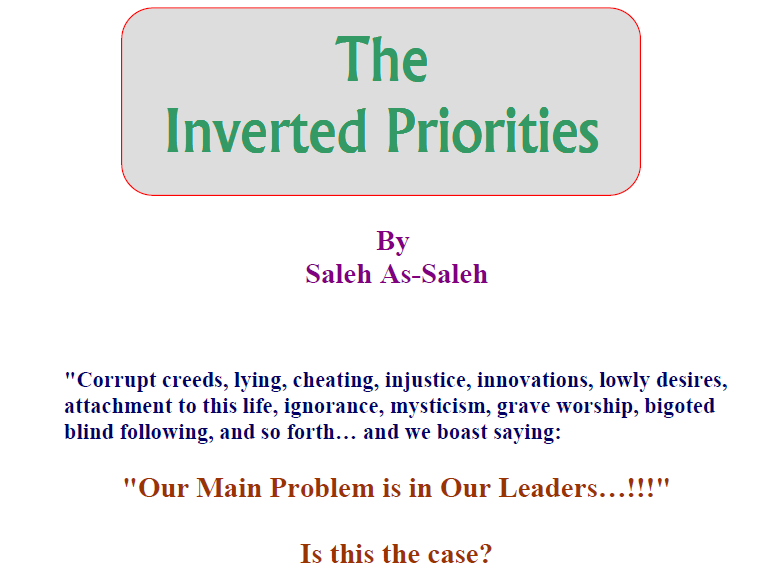
“Ponder upon the Hikmah (Wisdom) of Allaah, the most High, where He has made people’s kings, leaders, and those of authority over them, of the same kind as their own deeds. It is as if the people’s deeds appeared in the forms of their kings and leaders.
If the people are upright, then their kings and rulers will be upright, and if they turn away (from uprightness), then their leaders will turn against them. And if they oppress and tyrannize, then their kings and rulers will tyrannize and oppress. And if deception and treachery becomes manifest amongst them, then the same will appear in their rulers.
If the people refrain from fulfilling the rights of Allaah upon them and become niggardly (regarding their execution), then their kings and rulers will refuse to give them their rights and will become niggardly (withhold their rights from them). And if they take away from those whom they oppress that which they deserve not to take, then the kings will take away from the people that which they deserve not to take and will levy taxes and impose tasks upon them. And whatever the people unjustly take from the oppressed, their kings take the same by force from them.
So those in charge of the people appear in the forms of their (the ruled) deeds. And it befits not the Divine Wisdom that the evil and wicked be ruled except by those of the same kind.
And since the early [Muslims] were the best and most righteous of generations, their rulers were of the same standing. But when the people turned weak, their rulers turned to be of their own rank.
So it befits not the Hikmah (Wisdom) of Allaah in these times (Ibnul Qayyim times [1] ) that rulers the like of Mu’aawiyah and ‘Umar bin ‘Addil ‘Azeez, be in charge over us, and even less the like of Abee Bakr and ‘Umar. Rather, our rulers are in accordance with our own rank and standing, and the ones who ruled those before us were (also) in accordance with these people own rank and standing. And both matters (the status of the former rulers and those of this time) are as necessitated and entailed by [Allaah’s] Hikmah.” [2]
It is very evident that from the legal perspective and by the consensus of the early Muslims, as well as by way of intellect and experience, that the true change of the status of the Ummah occurs when it turns to Allaah and follows the ways that made the early generations successful. Imaam Maalik, rahimahullah, summed it in words few in number, profound in meaning:
“Nothing will benefit the Ummah to come except that which benefited the early Ummah.”
Those who adopt the path of confrontation with the rulers, thinking that the change comes through this way, are trailing the path of misguidance and a path whose consequences proved it wrong by all perspectives. This is the same path taken by the early dissidents (khawaarij) who followed the mutashaabih (not entirely clear) texts instead of following the muhkam (clear) texts and referring whatever may be not entirely clear to that which is mukham. The following of the mutashaabih is a path of fitan (afflictions) that led to the rebellion against the leaders of the sahaabah, and in our times has caused bloodshed and suffering and retardation of da’wah. Allaahul Must’aan.
This matter is a matter of Deen and not a matter of emotions. And since the textual proofs are replete commanding the believers that they must obey those in authority, even if they oppress and take ones wealth, etc As long as they do not command the believer to do sin, then we have no choice but to comply and obey. Otherwise, we will be inventing a new Deen. Allaah, the One Free of all imperfection, the most High says:
“Let those beware who withstand the Rasool’s (صلى الله عليه و سلم) orders, unless some fitnah befalls them or a grievous penalty be inflicted on them” [24:63]
“Whatever was not Deen at the time of the Prophet (صلى الله عليه و سلم) cannot be considered to be a part of the Deen today.”[Imaam Maalik].
So if the person choses to contend the way of the Messenger (صلى الله عليه و سلم), then let him remember the following aayah:
If anyone contends with and opposes the Messenger (صلى الله عليه و سلم) after the right path has been shown clearly to him, and follows other than the believers way, We shall keep him in the path he has chosen, and burn him in Hell- what an evil destination! [4:115]
May Allaah, the most Merciful, guide us all to the truth and make us hold to it and may He, the most High and Majestic, save us all from fitan and guide us (ruled and rulers) to His Path. Aameen.
Saleh As-Saleh
22/7/1426
27/8/2005.
[1] Ibnul Qayyim was born in 691 AH/1292 CE, and died in 751 AH/ 1350 CE. May Allaah’s Mercy be upon him
[2] In Muftaah Daarus-Sa’aadah, vol. 1, pp. 177-178. Published by Daar Ibn ‘Affan (1416/1996, Al-Khubar, KSA).
Share this, Baarakallaah Feekum: [“One who guides to something good has a reward similar to that of its doer” - Saheeh Muslim vol.3, no.4665] [This website protects the copyrights of the authors/publishers. The Content is posted on this website with implicit/explicit permission from content owners]



 AbdurRahman.Org
You must be logged in to post a comment.