How to wear the upper garment known as Rida’ for Ihram : Ibn Baz

Fatwa by Shaykh Ibn Baz Fatawa Islamiyah , Darussalam, Vol 4, Page 127

Q. Is it better for the Muhrim to cover the two shoulders or to uncover one of them during the Ihram?

A. The sunnah for the Muhrim is that he places the Rida’ (upper garment) over both of his shoulders and put its ends on his chest. This is the Sunnah and it is what the Prophet (Sallalahu Alahi wa Sallam) did.

So, if the person wants to perform the Tawaf of Arrival (Tawaful-Qudum) , he does Al-Idhtiba’. This is by him placing the center of his Rida’ under his right armpit and its edges over his left shoulder. Thus he uncovers his right shoulder. This is specifically for the Tawaf of Arrival, meaning when the person first arrives in Makkah for Hajj or ‘Umrah.

Then when he completes the Tawaf, he adjusts the Rida’ and places it over both of his shoulders, and he prays two Rak’ahs of Tawaf.

The person who always keeps one shoulder uncovered, this is opposed to the Sunnah, and so is uncovering both of the shoulders. The Sunnah is only to cover both of them with the Rida’ while the person is in Ihram. If the person takes off the Rida’ and does not cover his shoulders while he is sitting or eating or talking with his brothers, there is no harm in that.

However, the Sunnah is that when the person wears the Rida’, it should be over his two shoulders and its ends should be on his chest.

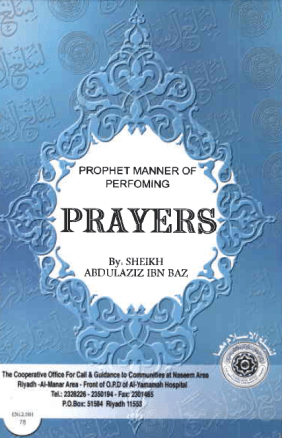
Prophet Muhammad’s (Sallalaahu Alaihi Wasallam) Manner Of Performing Prayers : Imam Ibn Baaz

Printed & Published by
Presidency Of Islamic Researches Ifta And Propagation
Printing And Translation Agency Riyadh,

Prophet Muhammad's Manner Of Performing Prayers - Ibn Baaz

All praise be to Allah alone, and may His peace and blessings be upon His messenger and bondsman our Prophet Mohammed, his family and his companions.

The objective of this concise pamphlet is to explain how prophet Mohammed (Peace and blessings of Allah be upon him) used to perform his prayers. I would like to present this explanation to every male and female Muslim so that they may strive to take up the Prophet’s manner in performing their prayers as a model for them.

It was narrated by Al Bukhari that Prophet Mohammed (Peace and blessings of Allah be on him) had said: “Perform your prayers in the same manner you had seen me doing.”

Therefore, here is the explanation for the Prophet’s manner of prayer:

(1) To perform completely the ablution, adopting the method commanded by Allah in the Quran: “O ye who believe, when ye prepare for prayer, wash your faces and your hands (and arms) to the elbows, rub your heads(with water) and (wash) your feet to the ankles.”(5:6)

The Prophet (peace and blessings of Allah be on him) said: “Prayer without ablution is invalid.”

(2) To turn one’s face and whole body towards the Ka’aba, The Holy House at Makkah, intending by heart to perform the prayer which he wants to fulfill, whether it is an obligatory prayer or a supererogatory prayer, the worshipper in all cases, should not pronounce his intention openly, because neither the Prophet nor his companions used to utter the intention for prayer. Thus, pronouncing the intention for prayer in audible voice is a heresy and an illicit action. Whether the individual be an Imam or performs his prayer individually, he should make (A Sutra) i.e. a curtain for his prayer. Directing the face towards the Qibla (The Ka’aba at Makkah) is an imperative condition for every prayer. However, there are few exceptions for this rule explained in authoritative books for whom who wish to refer.

(3) To pronounce “Takbirat Al Ihram” that is to say “Allahu Akbar” celebrating by that the greatness of Allah and looking meanwhile, downwards to the place where he will prostrate.

(4) To raise one’s hands up to the level of the shoulders or near to the lobes of his ears, while pronouncing “Takbirat Al‑ Ihram”.

(5) To put one’s right hand over his left hand and left wrist, and put them both over his chest, as the Prophet (peace and blessings of Allah be upon him) used to do.

(6) It is advisable that the worshipper recite this opening supplication saying: “Allahumma bald bayni wa bayena khatayaya kama boadta bayena al‑mashriki wal maghribi, Allahumma naqqiniy min khatayaya kama yonaqa al thawbo alabyndo min aldans… Allahumma igysilniy min khatayaya bilmai wathalgi walbarad.”

This supplication means: “O Allah, separate me from my sins as You have separated the east and west. O Allah, cleanse me of my sins as the white rope is cleansed from dirt. O Allah, wash off my sins with water, snow and hail.”

Or, may say instead:

“Sobhanaka Allahumma wa bihamdika wa~abaraka Ismoka wata’la jaddoka wala ilaha ghayroka”

“Praise and glory be to Allah. Blessed be Your Name, exalted be Your Majesty and Glory. There is no god but You.”

Or he may say any other supplications which the Prophet, (peace and blessings of Allah be on him) used to say in his prayers. It is better to recite these supplications alternately, the first one in the morning prayer “Fajr”, the second in the noon prayer “Zuhr”, each one by turn, in conformity with what the Prophet used to do.

After reciting the opening supplication, the worshipper says:

“Aouzo billahi min al‑shaytani‑r‑ragim”

Which means:

“I seek protection of Allah against the accursed Satan.”

Then says:

“Bism illahi‑Rahmani Raheem”

Which means:

“In the name of Allah, the All Merciful, the All Compassionate.”

and recites the Fatiha (The opening Sura of the glorious Quran).

Prophet Mohammed, may peace and blessings be upon him, said: “Prayer without reciting the Fatiha is invalid”.

The worshipper should say “A’meen” after reciting the Fatiha loudly if the prayer is said loudly, and whisper it in inaudible prayers. To be in conformity with the traditions of the Prophet, the worshipper‑is advised to recite verses from medium size Suras of the Quran in the Zuhr (noon), Asr (late afternoon), and Isha (night) prayers. As for the Fajr (morning) prayer, the worshipper is advised to recite a passage from the long Suras of the Quran. He has the choice in Maghrib prayer (Evening prayer) either to recite passages from the long Suras or from the short Suras 6 of the Quran.

(7) Then, the worshipper bows in “Ruku” raising his hands up to the level of his shoulders or ears while saying “Allahu Akbar” “Allah is Great” then bends down, making his head and back on one level and putting his hands with the fingers spread on his knees.

The worshipper should feel serenity and tranquillity while bowing, he should say thrice at least:

“Subhana Rabbiayl A’zim”

Which means:

“Glory be to my Lord, the Almighty.”

It is advisable to say while bowing in addition to that:

“Subhanak‑Allahumma Rabbana wa bi hamdika, Allahumma Ighfir liy”

Which means:

“Glory be to Thee, O Allah, and I praise Thee, forgive me my sins.”

(8) To raise one’s head up from bowing, raising one’s hands to the level of his shoulders or ears, saying, in case of being Imam or praying alone:

“Sami’a Allahu liman hamidah”

Which means:

“Allah listens to him who praises Him”

While resuming the standing position, he should say:

“Rabbana wa laka al hamdu hamdan katheera’n tayyiban mobarakan feehiy mil’a ssamawati wa mila alardhi wa mil’a ma baynahoma wa mil’a ma Shita min shiyin ba’ad”

This supplication means:

“Our Lord, praise be fore Thee only, praises plentiful and blessed as to fill the heavens, the earth, what in between, and fill that which will please Thee besides them.”

But if the worshipper is a follower, and led in his prayer by the Imam he should say when rising up “Rabbana wa lake alhamd…” etc.

It is advisable for the Imam, the follower, or who prays alone to add also:

“You Allah who deserve all praises and all glory, your praising is the best and most true of whatever Your servant can say, we all are Your servants, Our Lord, no one can ever deprive aught of what You have bestowed and no one can ever give aught of what You have deprived.”

The worshipper is advised to put his hands on his chest, as he had done before he bowed. Both Wa’il Ibn Haggar and Sahl Ibn Sai’yd reported that this was the manner of the Prophet when he used to raise his head up after bowing.

(9) To prostrate saying “Allahu Akbar” “Allah is Great”. He should touch the ground with his knees before touching it with his hands, if that is possible to him. If not, he is permitted to touch the ground by his hand before his knees. His fingers and toes should be directed towards the Qibla Makkah, and his hands should be stretched, and the fingers close together and not separated. In prostration, the worshipper should use these seven organs: The forehead, the nose, both hands, both knees and the internal parts of the toes.

These seven organs should touch the ground. Then the worshipper should say thrice or more:

“Subhana Rabbiyal A’ala”

Which means:

“Glorified is my Lord, the Exalted.”

It is advisable to say:

“Subhanaka Allahuma Rabbana wa bi hamdika, Allahuma Ighfir‑ liy.”

This means:

“Glory be to Thee, Our Lord, and I praise Thee. Our Lord, forgive me my sins.”

It is recommendable for the worshipper to exceed more and more in supplications and ask for more from his Lord, because the Prophet, may peace and blessings of Allah be on him, said (which means):

“As for bowing “Ruku” you should glorify your Lord during performing it, as for prostration, you should do your best to supplicate and ask for more from Him, because your supplications during prostration are more worthy to be accepted.”

The worshipper should ask his Lord for prosperity both in this worldly life and in the Hereafter. Whether it is an obligatory prayer or an optional prayer, the worshipper, while prostrating, should neither bring his hands close to his sides, nor stick his abdomen to his thighs, or his thighs to his legs. The worshipper’s arms should be raised up from the ground because the Prophet, may peace and blessings of Allah be on him, prohibited putting the arms and stretching them on the ground, ordering that “adjust your prostration, keep straight in it, and stretch not your hands on the ground as dogs do.”

(10) He should raise his head from prostration saying: “Allahu Akbar” and lays his left foot flat on the ground and sits upon it, keeping his right foot erected, his hands on his thighs and knees, and says:

“O my Lord, forgive me, have mercy on me, guide me, provide me with your blessings and console me.”

The worshipper should feel tranquillity during this pause.

(11) To prostrate again saying “Allahu Akbar” and repeating during his prostration what he did and said in the first prostration.

(12) Then the worshipper raises his head saying “Allahu Akbar” taking a pause similar to the pause between the two prostration; this is called “the pause for rest.” It is recommended for the worshipper to do such a pause, but there is no sin if he desists from it. Then the worshipper rises up and stands supporting on his knees, or on the ground if he cannot support himself on the knees, reads the Fatihah (The opening Sura of the glorious Quran) and some other verses of the Quran and do as just as he did in the first Rakaah (unit of prayer). Those who pray behind the Imam should not compete with him in the prayer actions as the Prophet (peace and blessings of Allah be upon him) said (which means):

The Imam is to be followed, if he says: “Allahu Akbar” which means “Allah is Great” then say the same after him. If he bows in “Ruku” bow after him. If he says “Samia‑l‑lahu liman hamidah” which means “Allah hears him who praises Him”, then say: “Rabbana wa laka‑l‑hamd” which means “Our Lord! All praises are for Thee”; and if he prostrates, then prostrate after him”. (Bukhari V:1 P.37)

(13) If the prayer consists of two Rakaat (two units of prayer) as the morning prayer “Fajr”, Feast prayer “Eid”, or the Friday prayer “Jumu’a”, the worshipper sits after the second prostration, with his right foot erect, sitting on his left foot laid down, putting his right hand on his right thigh, all his fingers close‑fisted save the index finger which he uses to point out as a sign for his monotheistic belief, and his left hand is put on his left thigh. There is nothing in the way, if the worshipper keeps both the little and ring fingers closed, while rounding his thumb and middle finger in a ring‑shape, and uses his index finger to point out as a sign for his monotheistic belief. It has been related that the Prophet, may peace and blessings of Allah be on him, had practiced both of these ways, thus, it is advisable for the worshipper to perform the first way once and the other on the second time.

The worshipper reads the Tashahud while sitting and says:

“Al‑tahiyatu lilahi wasalawatu watayibatu Assalamu alayha ayuha‑n‑nabiyu wa rahmat‑u‑llahi wa barakatuhu. Assalamu alayina wa ala ibadi‑l‑lahi‑s‑salalihiyn. Ashadu ala ilaha ila lahu wa ashadu anna Muhammadan abdoho wa raswuloh. Allahuma salliy ala Muhammad wa ala aali Muhamad, kama salayata ala Ibrahima wa aali Ibrahim. Inaka Hamidon Majid. Wa barik ala Mohammad wa ala aali Muhammad kama barkta ala Ibrahima wa aali Ibrahima. Inaka Hamidon Majid.”

This means:

“Greetings, prayers and the good things of life belong to Allah. Peace, mercy and blessing of Allah be on you, O Prophet. May peace be upon us and on the devout slaves of Allah. I testify that there is no god but Allah and I testify that Mohammed is His slave and messenger. O Allah, bless Mohammed and his family as You blessed Ibrahim and his family. You are the Most‑ Praised, The Most‑glorious. O Allah, bestow Your grace on Mohammed and his family as You bestwoed it on lbrahim and his family. You are the Most‑Praised, The Most‑glorious.”

After reciting the Tashahud, the worshipper asks Allah’s protection from four evils, he should say:

“My Lord, I ask your protection from torment of the Hell, torment of the grave the trials in life‑time and after death, and from the impostor Antichrist.” The worshipper may ask Allah for prosperity in this worldly life and in the Hereafter, supplicate Allah to bestow His favors on his parents and other Muslims. He could do this in both obligatory and optional prayers. It has been reported by Ibn Massoud that the Prophet, peace and blessings of Allah be on him, taught him how to recite the Tashahud and told him that the worshipper should invoke Allah and ask Him for the more beloved wishes which he likes, or, as it has been related in other wordings, the worshipper should ask Allah for whatever he wishes. In this manner, the servant can ask Allah for all the prosperity of this worldly life and the life to come.

The worshipper terminates his prayer by turning his face to the right saying: “As‑salamu alai kum wa rahmatu Allah” and to the left saying this salutation which means “Peace and mercy of Allah be on you.”

(14) In case of a three Rakaat prayer (prayer consisting of three units) as that of Maghrib prayer, (evening prayer), or a four Rakaat prayer like that of noon prayer (Zuhr), Asr prayer (late afternoon prayer) or, Isha prayer (night prayer), the worshipper stands up after reciting the Tashahud according to the manner stated before, and raises his hands up to the level of his shoulders saying (Allahu Akbar). The worshipper puts his hands over his chest as it had been explained before, and recites only the Fatiha. There is no objection if he adds to the Fatiha some other verses of the Quran while performing the third or fourth Rakaat (units of prayer) of noon prayer (Zuhr), because this was stated to be one of the manners adopted by the Prophet, may peace and blessings of Allah be on him, according to the tradition reported by Abi Saied.

After the third Rakaah of Maghrib prayer (evening prayer), and the fourth Rakaah of Zuhr (noon), Asr (afternoon) and Isha (night) prayers, the worshipper recites the Tashahud and terminates his prayers by saying: “Assalamu‑alaikum wa rahmatu Allah” while turning first to the right, and second to the left as it has been explained before.

It is not an obligatory duty, but it is a recommendable prophetic tradition to invoke Allah after terminating the prayer by asking Him forgiveness thrice and saying before turning one’s face towards his followers if he is the Imam: “O Allah, Thou art peace and from Thee is peace, Thou art blessed, O possessor of Glory and Honour.”

It is advisable for the worshipper to say:

“There is no god but Allah. He is the One. He has no partner. His is the dominion and to Him alone is the praise. He has power over all things. O Lord, none may withhold what You have given and none may give what You have withheld and the riches cannot avail a wealthy person with Thee. There is no might or power except by the support of Allah, There is no god but Allah and we do not worship but Him alone. To Him alone belong all bounties, to Him alone belong all grace, and to Him worthy praise is accorded. There is no god but Allah, to Whom we are sincere in devotion, even though the unbelievers may detest it.”

It is also advisable to the worshipper to extol Allah 33 times by saying (Subhana Allah). Praise Him by saying (Al Hamdu El‑Allah) 33 times also by saying “Allahu Akbar” and the worshipper completes his supplications to be one hundred by saying once: “There is no god but Allah. He is the One. He has no partner. His is the dominion and to Him alone is the praise. He has power over all things.”

The worshipper adds to that the recitation of the verse of the Throne “Ayat Al‑ Kursiy”, Surat Al‑Ikhlas, Surat El‑Falaq, and Surat Al‑Nas. It is recommendable to recite these Suras thrice after the Fajr prayer (Morning prayer), and the Maghrib prayer (evening prayer) because this was reported to be one of the traditions of the Prophet, peace and blessings of Allah be on him. As it had been stated before, all these after‑prayer supplications are optional and not obligatory.

Every Muslim, whether be male or female, is recommended to pray 12 Rakaat of supererogatory prayers every day: four of these Rakaat (units of prayers) are before noon prayer, two after it, two after Maghrib prayer, two after Isha (night) prayer and two before the morning prayer ‑ These supererogatory prayers are called (Rawatib) which means: “Certain supererogatory exercises of optional prayers.” The Prophet peace and blessings of Allah be on him, preserved the performance of these optional prayers wherever he settled. During his travels, he used to practice the two optional Rakaat before the morning prayer and also the Witr prayer (after the Isha prayer).

There is no objection to perform these optional prayers in the mosque, but it is better to perform it at home, because the Prophet, peace and blessings of Allah be on him, said “The best of the prayers are those which are furfilled at one’s own home, with exception to obligatory prayers which should be performed in congregation at the mosque.”

Observance of fulfilling these optional prayers is a means for gaining admission to paradise. The Prophet, may peace and blessings of Allah be on him, said (which means): “Whoever prays optionally twelve Rakoat every one day and night, Allah will reward him by an established dwelling in the paradise. “

It is also advisable to the Muslim to pray four optional Rakaat before Asr prayer (afternoon prayer), two before Maghrib prayer (evening prayer), and two before Isha prayer (night prayer), because this manner was reported to be one of the traditions of the Prophet. Allah, the Almighty says: “Ye have indeed in the Messenger of Allah an excellent exemplar” (33:21).

And the Prophet (May the peace and blessings of Allah be upon him) said (which means): “Perform your prayer in the same manner as you had seen me doing.”

Allah is He Who is Able to render us success and prosperity, and may Allah give His blessings and peace to our Prophet Mohammed son of Abdullah, his family, his companions and whoever follows his way till doomsday.

President of Supreme Head Office for Religious Researches, Ifta, Call and Guidance Departments.
(Shiekh Abdul Aziz Abdullah Bin Baz)

Click the Below Link to read or Download the scanned PDF

Prophet Mohammad’s Manner Of Performing Prayers – Ibn Baaz [PDF]


The Beautiful Names and Lofty Attributes : Shaykh Ibn Baaz

Source: Al-Ibaanah Magazine – Issue No.2 – Rabî’ul-Awwal 1416H / August 1995

The Shaykh – hafidhahullâh – said: [1]

From îmân (faith) in Allâh is to have îmân in those of His Asmâul-Husnâ (beautiful Names) and Sifâtul-’Ulyâ (lofty Attributes) that occur in His Great Book and that have been affirmed by His trustworthy Messenger sallallâhu ’alayhi wa sallam – without tahrîf (distorting the wording or the meaning), ta’tîl (divesting or denying the Attributes), takyîf (asking how) or tamthîl (resembling Allâh to any of His creation). Rather, it is obligatory to leave them as they came, without takyîf. Along with this, it is also obligatory to have îmân in the meaning that Allâh – the Mighty and Majestic – has been described with, in a way which befits Him; without resembling Him to His creation in any of His Attributes. Allâh – the Most High – says:

“There is nothing like unto Him, and He is the All-Hearing, the All-Seeing.” [2]

Allâh – the Mighty and Majestic – also says:

“And do not put forward any similitude for Allâh. Indeed, Allâh knows and you do not know.” [3]

So this is the ’aqîdah (belief) of Ahlus-Sunnah wal-Jamâ’ah from the Companions of the Messenger of Allâh sallallâhu ’alayhi wa sallam and those that followed them in goodness. This is what has been recorded also by Imâm Abûl-Hasan al-Ash’arî (d.324H) – rahimahullâh – in his book: “Al-Maqâlât ‘an Asbâbul-Hadîth wa Ahlus-Sunnah.” This has also been stated by many others from the people of knowledge and îmân.

Imâm al-Awzâ’î [4] – rahimahullâh – said:
“I asked az-Zuhrî and Makhûl about the âyât pertaining to the Sifât (Attributes of Allâh), so they said: Leave them as they are.” [5]

Al-Walîd ibn Muslim – rahimahullâh – said:
“I asked Mâlik, al-Awzâ’î, Layth ibn Sa’d and Sufyân ath-Thawrî – rahimahumullâh – about the reports related about the Attributes, so they all said: Leave them as they are, without asking how.” [6]

Al-Awzâ’î – rahimahullâh – said:
“We – whilst the Tâbi’ûn were many – would say: Indeed Allâh – the Most Perfect – is above His Throne, and we have îmân in what is related in the Sunnah about the Attributes.” [7]

Rabî’ah ibn Abî ’Abdur-Rahmân [8] – rahimahumullâh – said:
Al-Istiwâ (Allâh ascending) is not unknown, and how is not comprehendible, and from Allâh is the Message, upon the Messenger is to clearly convey it, and upon us is to affirm it.” [9]

Imâm Mâlik [10] – rahimahullâh – said:
Al-Istiwâ is known, and how is unknown, to have îmân in it is obligatory and to question it is an innovation.” Then he said to the questioner: “I do not think, except that you are an evil man.” So he ordered him to be expelled. [11]

This has also been related about Ummul-Mu‘minîn Umm Salamah radiallâhu ’anhâ. [12]

’Abdullâh ibn al-Mubârak [13] – rahimahullâh – said:
“We know that our Lord – the Most Perfect – is above the heavens, above His ’Arsh (Throne), separate from His creation.” [14]

The words of the Scholars about this matter are very numerous indeed, and it is not possible to relate them all in such a short space. However, whosoever further desires to be acquainted with this topic, then let him turn to the books by the Scholars of Sunnah about this subject, such as the book:- Kitâbus-Sunnah by ’Abdullâh the son of Imâm Ahmad (d.290H), Kitâbut-Tawhîd by the great Imâm, Muhammad ibn Khuzaymah (d.311H), Kitâbus-Sunnah by Abûl-Qâsim al-Lâlikâ‘î at-Tabarî (d.418H), and Kitâbus-Sunnah by Abû Bakr Ibn Abî ’Âsim (d.287H).

Refer also to the reply given by Shaykhul-Islâm Ibn Taymiyyah (d.728H) to the people of Hamah (entitled al-’Aqîdatul-Hamawiyyah), as it is a great reply, full of benefit. In it he –rahimahullâh – has made clear the ’aqîdah of Ahlus-Sunnah, and has recorded many of the sayings of the Scholars; as well as giving proofs from both the Sharî’ah and sound reasoning about the correctness of what Ahlus-Sunnah say, showing also the futility of those who oppose them.

Likewise, his book entitled al-’Aqîdatut-Tadmuriyyah in which he established and explained the ’aqîdah of Ahlus-Sunnah with both textual proofs and proofs from sound reasoning. In this treatise he has – for all those of understanding, intending righteousness and desiring to realise the truth – thoroughly refuted all opposition, by clarifying the truth and refuting the falsehood.

All those who oppose Ahlus-Sunnah in their ’aqîdah concerning Allâh’s Names and Attributes, have indeed fallen into opposing the textual evidences and sound reasoning along with clearly contradicting all that Allâh has affirmed or negated for Himself.

So Ahlus-Sunnah wal-Jamâ’ah affirm for Allâh – the Most Perfect – what He has affirmed for Himself in His Noble Book, or what has been affirmed for Him by His Messenger Muhammad sallallâhu ’alayhi wa sallam in the authentic Sunnah. Affirming without tamthîl (resemblance) and freeing Allâh – the Most Perfect – from any resemblance to His creation, whilst also rejecting and being free from ta’tîl. So whosoever holds fast to the truth which Allâh sent, humbling and accepting it, whilst being sincere to Allâh in the quest for it, then it is the way of Allâh – the Most Perfect – that He will grant such a person harmony with the truth and show them His clear evidences, as Allâh – the Most High – mentions:

“Nay! We hurl truth against falsehood, so it destroys it; and behold, falsehood is vanquished.” [15]

And Allâh – the Most High – said:

“And no example or similitude do they bring, except We reveal to you the truth and the best explanation thereof.” [16]

Al-Hâfidh Ibn Kathîr (d.774H) rahimahullâh explained in his famous tafsîr – whilst commenting upon the saying of Allâh – the Mighty and Majestic:

“Indeed your Lord is He who created the heavens and the earth in six days, then He ascended (istiwâ) over the Throne.” [17]

He explained this issue in a most beautiful manner, which I have quoted here in its entirety, due to its great benefit.

Ibn Kathîr – rahimahullâh – said:
“The sayings of the people in this issue are very many. However, this is not the place to enter into a detailed discussion about it. Indeed, the path we traverse in this issue is to follow the way of the Salafus-Sâlih (Pious Predecessors) such as: Mâlik, al-Awzâ’î, ath-Thawrî, Layth ibn Sa’d, ash-Shâfi’î, Ahmad, Ishâq ibn Bâhâwaih, and other from the Scholars of the Muslims – both past and present. And their way is: to recite them as they are, without takyîf, tashbîh, nor ta’tîl. Indeed, Allâh does not resemble anything of His creation in any way:

“There is nothing like Him, He is the all-Hearing, all-Seeing.” [18]

Rather, the matter is as the Scholars – such as Nu’aym ibn Hammâd al-Khuzâ’î (d.228H), the Shaykh of al-Bukhârî – said: “Whosoever makes tashbîh (resemblance) of Allâh to His creation, has committed kufr (disbelief), and whosoever denies what Allâh has described Himself with, has also committed kufr … Indeed, all that Allâh has described Himself with, or what His Messenger has described Him with, then there is no tashbîh in it at all.” [19] So whosoever affirms for Allâh – the Most High – what is related in the clear Âyât and the authentic narrations – in a way which befits Allâh’s Greatness and Majesty – whilst also denying and negating from Allâh – the Most High – any defects and imperfection, then such a person has truly traversed the path of Guidance.” [20]

The Shaykh (bin Bâz) – hafidhahullâh – also said: [21]
Tahrîf (distortion) means: changing the wordings of the Names and Attributes, or changing their meanings. Like the saying of the Jahmiyyah that istiwâ (ascending above) is istawlâ (conquering and having dominion over); and like the saying of some of the Innovators that al-Ghadab (Anger) when referring to Allâh means ‘intending to punish’ and that ar-Rahmah (Mercy) means ‘intending to send blessings.’ And all of this is tahrîf: And their saying about istawâ that it is istawlâ is tahrîf of the wording, and their saying that ar-Rahmah is intending to send blessings and al-Ghadab is intending to punish is tahrîf of the meaning. The true saying, however, is that istawâ means ascending and being above – as is clear in the ’Arabic language. And the Qur‘ân came to show that its meaning is ascending and being above the ’Arsh (Throne) in a manner which befits Allâh’s Majesty and Greatness. Likewise, al-Ghadab and ar-Rahmah are two real Attributes befitting Allâh’s Majesty and Greatness – just as is the case with the rest of the Attributes reported in the Book and the Sunnah.

Ta’tîl (divesting) means: removal of the Attributes and to deny them for Allâh the Most High. It is taken from their saying: ‘A graceful neck without adornment (mu’attal).’ So the Jahmiyyah and their like divest Allâh of His Attributes and are thus called the Mu’atillah. And this saying of theirs is totally futile, since it is not possible for there to be anything in existence without attributes – and the Qur‘ân and the Sunnah repeatedly affirm Attributes (for Allâh) in a manner befitting Allâh’s Majesty and Greatness.

Takyîf means: Explaining how the Attributes are. So it is not said: ‘How did He ascend?’ And ‘How is His Hand?’ And ‘How is His Face?’ Since, speaking about the Attributes of Allâh follows the same principle, and is treated the same, as speaking about the Dhât (Essence/Self) of Allâh. So just as He has a Dhât – and we do not know how it is, then likewise, He has Sifât (Attributes) – and we do not know how they are either, no one knows that except Him. But we believe in the reality of their meaning.

As regards to tamthîl, then it means: tashbîh (making resemblance). So it is not said: Allâh has a Dhât (Essence) like ours, or resembling ours, etc. Thus, it is not said about the Attributes of Allâh that they are like – or resembling – our attributes. Rather, the Believer must stick to His – the Most High’s – saying: “There is nothing like Him.” And the meaning is that there is none who resembles Him.”

Note: Shaykhul-Islâm Ibn Taymiyyah (d.728H) mentioned: If it is said to you: We interpret the meaning of Anger to be ‘desiring to punish’ and Mercy to be ‘desiring to send blessings’ then say: Does this desiring resemble that of the creation, or is it a desiring befitting His Majesty and Greatness? So if he says the first – then he has done tashbîh! And if he says the second, then say: Then why do you not say, ‘Mercy and Anger befitting His Majesty and Greatness?’ And this will put an end to his argument.


References

1. Al-’Aqîdatus-Sahîhah wa Ma Yudâdahâ (pp.9-13).
2. Sûrah ash-Shûrâ 42:11
3. Sûrah an-Nahl 16:74
4. He is Abdur-Rahmân ibn ’Amr al-Awzâ’î – the Scholar, worshipper and mujâhid. Al-Hâkim said: “Al-Awzâ’î was the Imâm of the people of his time in general, and he was the Imâm of the people of Shâm in particular.” He died in Bayrût, in the year 157H. Refer to at-Tadhbirab (l/178) and al-Hilyah (6/135) for his biography.
5. Related by al-Harawî in Dhammul-Kalâm (p.18).
6. Related by al-Âjurrî in ash-Sharî’ah (p.314), al-Bayhaqî in al-Asmâ was-Sifât (p.453), al-l’tiqâd (p.118) and the isnâd is Hasan.
7. Related by al-Bayhaqî in al-Asmâ was-Sifât (p.408). The isnâd is jayyid, as al-Hâfidh Ibn Hajar said in Fathul-Bârî (13/406).
8. He is Rabî’ah ibn Abî ’Abdur-Rahmân – better known as Rabî’atur-Râ’î – one of the Tâbi’ûn of al-Madînah. Al-Khatîb said: “He was a Faqîh, a Scholar and a Hâfidh in Fiqh and Hadîth.” He died in the year 136H. Refer to Târîkh Baghdâd (8/420) and Hilyatul-Awliyâ (3/259) for his biography. Related by al-Bayhaqî in al-Asmâ was-Sifât (no.516) and al-Lâlikâ‘î in Sharh Usûl I’tiqâd Ahlus-Sunnah wal-Jamâ’ah (no.665). Ibn Taymiyyah said in Majmû’al-Fatâwâ (5/365): “It is established from Rabî’ah.” He also said in al-Hamawiyyah (p.80): “Al-Khallâl narrated it with an isnâd all of whom are thiqât (precise and reliable).”
10. He is Abû ’Abdullâh Mâlik ibn Anas – the Imâm from the Atbâ’ut-Tâbi’ûn of al-Madînah and one of the Scholars of Ahlus-Sunnah. Imâm ash-Shâfi’î said: “When the Scholars are mentioned, then Mâlik is a dazzling star.” He died in 179H. Refer to Siyâr A’lâmun-Nubalâ (7/366) of adh-Dhahabî for a complete biography.
11. Related by al-Bayhaqî in al-Asmâ was-Sifât (p.516) with the wording: “Al-Istiwâ is not unknown and how is unknown, to have îmân in it is obligatory and to question it is an innovation.” Al-Bayhaqî also relates (p.516), as does ad-Dârimî in ar-Radd ’alal-Jahmiyyah (p.55) – with a jayyid isnâd, as Ibn Hajr says in Fatbul-Bârî (13/406) – that Imâm Mâhk said: “The Most Merciful ascended as He Himself described, and it is not to be asked: How? Since how is unknown.”
12. Related by al-Lâlakâ‘î in Sharh Usûl I’tiqâd (no.663). Ibn Taymiyyah said in al-Fatâwâ (5/365): “Its isnâd cannot be relied upon.” Adh-Dhahabî said in al-’Uluww (p.82): “This saying has been preserved from a group, such as Rabi’atur-Ra‘î, Mâlik and Abû Ja’far at-Tirmidhî. However, the narration from Umm Salamah is not authenhic – since Abû Kinânah is not reliable and Abû ’Amîr is not known.” So the Shaykh was indeed correct in not definitely ascribing this saying to the Mother of the Believers, Umm Salamah – and all praise is for Allâh.
13. He is Abû ’Abdur-Rahmân ’Abdullâh ibn al-Mubârak al-Marwazî. The Imâm from the Atbâ’ut-Tâbi’ûn, the Hâfidh, the Shaykh of Islâm, example for the people of zuhd and a leader of the mujâhidîn. He died in the year 181H. Refer to Târîkh Baghdâd (l/152) and at-Tadhkirah (l/274) for his biography.
14. Related by ad-Dârimî in ar-Radd ’alal-Jahmiyyah (no.23), ’Abdullâh ibn Ahmad in as-Sunnah (no.22) and al-Bukhârî in Khalq Af’âlul-’Ibâd (no.8). It was declared Sahîh by Ibn Taymiyyah in al-Hamawiyyah (no.41).
15. Sûrah al-Anbiyâ 21:18
16. Sûrah al-Furqân 25:33
17. Sûrah al-A’râf 7:54
18. Sûrah ash-Shûrâ 42:11
19. Related by Imâm adh-Dhahabî with his isnâd in al-’Uluww (no.217), and the isnâd is Sahîh and the narrators are all well-known – as al-Albânî said in Mukhtasar al-’Uluww (p.184).
20. Tafsîr Qur‘ânul-Adhîm (2/230) of Ibn Kathîr.
21. Added from the footnotes to at-Tanbîbâtul-Intîfab ’alâ mabtawat ’alayhil-’Aqîdatil-Wâsitiyyah (pp.15-16).


The Testimony of Imâm at-Tirmidhî

Speaking about those ahâdîth which mention the Attributes of Allâh, Imâm at-Tirmidhî (d.279H)- rahimahullâh – said in his Sunan (l/128-129): “It has been said by more than one person from the People of Knowledge – about such ahâdîth – that there in no tashbîh (resemblence) to the Attributes of Allâh. And the Lord – the Blessed, the Most High – descends to the lowest heaven every night. So they say: Affirm these narrations, have îmân in them and do not deny them, and do not ask how. The likes of this has been related from Mâlik ibn Anas, Sufyân ath-Thawrî, Ibn ’Uyaynah and ’Abdullâh ibn al-Mubârak, who all said about these ahâdîth: “Leave them as they are, without asking how.” Such is the saying of the People of Knowledge from Ahlus-Sunnah wal-Jamâ’ah. However, the Jahmiyyah oppose these narrations and say: This is tashbîh!!

However, Allâh – the Most High – has mentioned in various places in His Book the Attribute of Hand, Hearing and Seeing. So the Jahmiyyah make ta’tîl (false interpolation) of these Âyât and explain it in a way other than that explained by the People of Knowledge. They say: Indeed, Allâh did not create Âdam with His own Hand. And they also say that the meaning of Hand is Power.

Ishâq ibn Ibrâhîm ar-Râhawaiah said:
Tashbîh is if it is said: Hand like my hand, or similar to my hand. Or Hearing like my hearing, or similar to my hearing. So when it is said: Hearing like my hearing, or similar to my hearing, then this is tashbîh. But if what is being said is what Allâh has said: Hand, Hearing, Seeing; and it is not asked how, nor is it said: like my hearing, or similar to my hearing – then this is not tashbîh. Allâh – the Most Blessed, Most High – said in His Book: “There is none like unto Him, and He is the all-Hearing, the all-Seeing.” [Sûrah ash-Shûrâ 42:11]”

Description of the Funeral Prayer : Shaykh ibn Baaz

[In both The Sacred Mosque in Mecca and the Prophet’s Mosque in Medina, janazah prayer is conducted after almost every congregational prayer. Learn this prayer before you leave for The Holy Land so that there will be greater depth to your participation in this prayer]

Q: What is the manner of performing Funeral Prayer?

A: The manner of performing Funeral Prayer is that the Imam (the one who leads congregational Prayer) begins by pronouncing Takbirat-ul-Ihram (saying: “Allahu Akbar [Allah is the Greatest]”) and seeking refuge with Allah from the accursed Satan.

He then recites the Basmalah (saying, “Bismillah Al-Rahman, Al-Rahim [In the Name of Allah, the Most Gracious, the Most Merciful]”) and Al-Fatihah (the opening chapter of the Glorious Qur’an, Surah number I). It is desirable that he recites a short Surah after Al-Fatihah, such as Al-Ikhlas or Al-`Asr, or some Ayahs (Qur’anic verses). It was authentically related from the Prophet (peace be upon him) in the Hadith of Ibn `Abbas (may Allah be pleased with him and his father) which indicates this.

Then, the Imam should pronounce the second Takbir (saying: “Allahu Akbar [Allah is the Greatest]”) and invoke Allah’s peace upon the Prophet(peace be upon him) in the same manner a person invokes Allah’s peace upon him in the final Tashahhud (a recitation in the sitting position in the second/ last unit of Prayer).

The Imam pronounces the third Takbir and supplicates to Allah for the deceased with the well-known supplications (of the Prophet), being attentive to mentioning the correct gender and plural pronouns for multiple funerals.

Finally, the Imam pronounces the fourth Takbir followed by a moment of silence and then recites Taslim (salutation of peace ending the Prayer) once to his right only.

As for the opening invocation, there is no harm in either saying it or not. Yet it is better to omit it in accordance with the statement of the Prophet (peace be upon him): Hasten the funeral proceedings…

Q: Would you please explain to us how should the Funeral Prayer be performed as reported from the Prophet (peace be upon him), because many people do not know how it should be performed?

A: The manner of performing Funeral Prayer was demonstrated by the Prophet (peace be upon him) and his Companions (may Allah be pleased with them) as follows: It begins with pronouncing Takbirat-ul-Ihram and seeking refuge with Allah from the accursed Satan. Then, the Imam recites the Basmalah and Al-Fatihah followed by a short Surah or some Ayahs. Then, he pronounces Takbir and invokes Allah’s peace upon the Prophet (peace be upon him) as one does at the end of the Prayer. Then, he pronounces a third Takbir and supplicates to Allah for the deceased.

The best is to say:

 O Allah, forgive our living and our dead, those who are present among us and those who are absent, our young and our old, our males and our females. O Allah, whoever You decree to live, let him live in Islam and whoever You cause to die, cause him to die withIman (Faith).

O Allah, forgive him and have mercy on him, keep him safe and sound and forgive him, honor the place where he settles and make his entrance wide; wash him with water, snow and hail, and cleanse him of sins as a white garment is cleansed of dirt.

O Allah, give him a house better than his house and a family better than his family. O Allah, admit him to Paradise and protect him from the torment of the grave and the torment of Hell-fire; make his grave spacious and fill it with light.

O Allah, do not deprive us of the reward and do not cause us to go astray after this.

All of this was recorded from the Prophet (peace be upon him). If you supplicate to Allah using other words, this is fine. For example, one may say,

“O Allah, if he was a doer of good, then increase his good deeds; and if he was a wrongdoer, then forgive his bad deeds. O Allah, forgive him and give him the strength to say the right thing.”

Then, after a fourth Takbir there is a short pause ending with one Taslim to the right. This was narrated from the Prophet (peace be upon him).

It is an act of Sunnah (action following the teachings of the Prophet) that the Imam stands at the head of the body if the deceased is a male and by its middle if it is the body of a female as authentically reported from the Prophet (peace be upon him) in the Hadith of Anas and Samurah ibn Jundub (may Allah be pleased with them both). As for the opinion held by some scholars that it is prescribed in the Sunnah that the Imam stands at the chest of the body if the deceased is a male, this is a weak opinion that has no basis as far as we know. When performing Funeral Prayer, the dead body should be positioned facing the direction of the Qiblah (Ka`bah-direction faced in Prayer), because the Prophet (peace be upon him) said: It is the Qiblah (Ka`bah-direction faced in Prayer) of Muslims while living i.e. during Prayer and after death [in the grave]. May Allah grant us success.

Posted from: http://www.alifta.net/fatawa/fatawaDetails.aspx?languagename=en&View=Page&PageID=2291&PageNo=1&BookID=14

Learn the dua’s ( taken from Hisn al Muslim, Darussalam Publishers)

For the deceased in the funeral prayer:

[Note: The following  are for funeral of a male Muslim, change it accordingly for female Muslimah]

اللهُمِّ اغْفِرْ لِحَيِّنا وَمَيِّتِنا وَشاهِدِنا ، وَغائِبِنا ، وَصَغيرِنا وَكَبيرِنا ، وَذَكَرِنا وَأُنْثانا. اللهُمِّ مَنْ أَحْيَيْتَهُ مِنّا فَأَحْيِهِ عَلى الإِسْلام ،وَمَنْ تَوَفَّيْتَهُ مِنّا فَتَوَفَّهُ عَلى الإِيمان ، اللهُمِّ لا تَحْرِمْنا أَجْرَه ، وَلا تُضِلَّنا بَعْدَه

Allaahum-maghfir lihayyinaa, wa mayyitinaa, wa shaahidinaa, wa ghaa’ibinaa, wa sagheerinaa wa kabeerinaa, wa thakarinaa wa ‘unthaanaa. Allaahumma man ‘ahyaytahu minnaa fa’ahyihi ‘alal-‘Islaami, wa man tawaffaytahu minnaa fatawaffahu ‘alal-‘eemaani, Allaahumma laa tahrimnaa ‘ajrahu wa laa tudhillanaa ba’dahu.

O Allah, forgive our living and our dead, those who are with us and those who are absent, our young and our old, our menfolk and our womenfolk. O Allah, whomever you give life from among us give him life in Islam, and whomever you take way from us take him away in Faith. O Allah, do not forbid us their reward and do not send us astray after them.

Ibn Majah 1/480, Ahmad 2/368. See also Al-Albani, Sahih Ibn Majah 1/251.

اللهُمِّ اغْفِرْ لَهُ وَارْحَمْه ، وَعافِهِ وَاعْفُ عَنْه ، وَأَكْرِمْ نُزُلَه ، وَوَسِّعْ مُدْخَلَه ، وَاغْسِلْهُ بِالْماءِ وَالثَّلْجِ وَالْبَرَدْ ، وَنَقِّهِ مِنَ الْخطايا كَما نَقّيْتَ الثَّوْبُ الأَبْيَضُ مِنَ الدَّنَسْ ، وَأَبْدِلْهُ داراً خَيْراً مِنْ دارِه ، وَأَهْلاً خَيْراً مِنْ أَهْلِه ، وَزَوْجَاً خَيْراً مِنْ زَوْجِه ، وَأَدْخِلْهُ الْجَنَّة ، وَأَعِذْهُ مِنْ عَذابِ القَبْر وَعَذابِ النّار

Allaahum-maghfir lahu warhamhu, wa ‘aafihi, wa’fu ‘anhu, wa ‘akrim nuzulahu, wa wassi’ mudkhalahu, waghsilhu bilmaa’i waththalji walbaradi, wa naqqihi minal-khataayaa kamaa naqqaytath-thawbal-‘abyadha minad-danasi, wa ‘abdilhu daaran khayran min daarihi, wa ‘ahlan khayran min ‘ahlihi, wa zawjan khayran min zawjihi, wa ‘adkhilhul-jannata, wa. ‘a’ithhu min ‘athaabil-qabri[wa ‘athaabin-naar].

O Allah, forgive him and have mercy on him and give him strength and pardon him. Be generous to him and cause his entrance to be wide and wash him with water and snow and hail. Cleanse him of his transgressions as white cloth is cleansed of stains. Give him an abode better than his home, and a family better than his family and a wife better than his wife. Take him into Paradise and protect him from the punishment of the grave [and from the punishment of Hell-fire].

Sheeh Muslim 2/663.

The funeral prayer for deceased child:

اللهُمَّ أَعِذْهُ مِن عَذَابِ القَبْرِ
اللهُـمِّ اجْعَلْـهُ فَرَطـاً وَذُخْـراً لِوالِـدَيهِ، وَشَفـيعاً مُجَـاباً، اللهُـمِّ ثَـقِّلْ بِهِ مَوازيـنَهُما، وَأَعْـظِمْ بِهِ أُجُـورَهُـما، وَأَلْـحِقْـهُ بِصَالِـحِ الـمؤْمِنـين، وَاجْعَلْـهُ في كَِفـَالَةِ إِبْـراهـيم، وَقِهِ بِرَحْمَـتِكَ عَذابَ الْجَـحِيمِ, وَأَبْـدِلْهُ داراً خَـيْراً مِنْ دارِه ، وَأَهْلاً خَـيْراً مِنْ أَهْلِـه, اللَّهُمَّ اغْفِرْ لإِسْلافِنَا, وَأَفْراطِنَا, وَمَنْ سَبَقَنَاَ بِالإِيمَان

Allaahumma ‘a’ith-hu min ‘athaabil-qabri. Allaahum-maj’alhufaratan wa thukhran liwaalidayhi, wa shafee’an mujaaban. Allaahumma thaqqil bihi mawaazeenahumaa wa ‘a’dhim bihi ‘ujoorahumaa, wa ‘alhiqhu bisaalihil-mu’mineena, waj’alhu fee kafaalati ‘Ibraaheema, wa qihi birahmatika ‘athaabal-jaheemi, wa ‘abdilhu daaran khayran min daarihi, wa ‘ahlan khayran min ‘ahlihi, Allaahum-maghfir li’aslaafinaa, wa ‘afraatinaa wa man sabaqanaa bil’eemaan.

O Allah, protect him from the torment of the grave. O Allah, make him a precursor, a forerunner and a treasure for his parents and an answered intercessor. O Allah, make him weigh heavily in their scales (of good) and magnify their reward. Make him join the righteous of the believers. Place him in the care of Ibrahim. Save him by Your mercy from the torment of Hell. Give him a home better than his home and a family better than his family. O Allah, forgive those who have gone (i.e. passed away) before us, our children lost (by death), and those who have preceded us in Faith.

Ibn Qudamah, Al-Mughni 3/416 and Ad-Duroosul-Muhimmah li-Aammatil-‘Ummah, pg. 15, by Shaikh ‘Abdul-‘Aziz bin Baz.

Clarity – Defending the Religion & Uniting the Ranks upon the Truth

Istiqaamah Magazine , Issue No.2 ,1996

DEFENDING THE RELIGION

Imaam Ahmad bin Hanbal (d.241H)- rahimahullaah – said:

“All praise is for Allaah who, in every age and intervals between the Prophets, raises up a group from the People of Knowledge, who call the misguided to guidance, patiently bearing ill treatment and harm. With the Book of Allaah they give life to the dead, and by Allaah’s Light they give sight to the blind. How many a person killed by Iblees (the Devil) have they revived. How many people astray and wandering have they guided. How beautiful their effect has been upon the people, and how vile people have been towards them. They expel from the Book of Allaah the alterations of those going beyond bounds, the false claims of the liars and the false interpretations of the ignorant ones – those who uphold die banner of innovation and let loose the trials and discords; who differ about the Book, oppose the Book, and agree upon opposing the Book. They speak about Allaah and His Book without knowledge, argue about what is ambiguous in the Book, and deceive the ignorant masses with such ambiguities. We seek refuge in Allaah from the trials of the misguided ones.” 1

Shaykhul-Islaam Ibn Taymiyyah (d.728H) – rahimahullaah – said:

“When some people asked Imaam Ahmad bin Hanbal that they felt uneasy about criticizing people, he replied: “If I were to remain silent, how would the ignorant masses know the truth from falsehood?” Those who introduce heretical writings which oppose the Qur’aan and the Sunnah and those who innovate in matters of worship, then it is obligatory that they be exposed and that the Muslims be warned against them – by unanimous agreement of the Muslims Scholars. In fact, when Imaam Ahmad bin Hanbal was asked about a person who fasted, preyed and secluded himself in the mosque for worship; if he was dearer to him than a person who spoke out against ahlul-bid’ah (the innovators), he replied: “When he fasts and prays and secludes himself, then he does so for the benefit of his own self. However, when he speaks out against the innovators, he does so for the benefit of the Muslims in general, and this is more virtuous.”

So it is clear that openly opposing the innovators is of general benefit to the Muslims and is considered one of the types of jihaad in the path of Allaah. Since purifying the religion of Allaah and defending it from their attacks is a collective obligation – as is agreed upon by the Scholars. For Allaah did not raise up some people to oppose the innovators, then the religion would suffer harm, corruption and deviation. Indeed, this type of corruption is even greater then the corruption resulting from the disbelievers conquering the Muslims. Since when the disbelievers conquer the Muslims, they do not corrupt their hearts, nor their religion, except after some time. Whereas the innovators corrupt the hearts from the very beginning.” [2]

UNITING THE RANKS UPON THE TRUTH

Shaykh ‘Abdul-‘Azeez bin Baaz – hafidhahullaah – said:

“There is no doubt that it is obligatory upon the Muslims to unify their ranks and to unite their word upon the truth and to co-operate in goodness and piety against the enemies of Islaam – as Allaah, the Most Perfect, ordered them with in His saying: “And hold fast altogether to the rope of Allaah and do not become divided.” [Soorah Aal-‘lmraan 3:102]. And likewise, Allaah has warned the Muslims against splitting up, as occurs in His – the Most Perfect’s – saying: “And do not be like those who differed and split-up after the clear evidences came to them.” [Soorah Aal-‘lmraan 3:105]. However, the order to unify the Muslims and unite their word upon the truth and to hold fast to the rope of Allaah, does not necessitate that they should not censure wrong beliefs and practices – whether from the Soofees or other than them. Rather, what the order to hold fast to the rope of Allaah necessitates is: to order the good, forbid the evil and also to clarify the truth – with the clear Sharee’ah proofs – to whomsoever is misguided or has a mistaken opinion, until they unite upon the truth and turn away from that which opposes it. All of this is included in His – the Most Perfect’s – saying: “And help you one another in righteousness and piety, and do not help one another in sin and transgression.” [Sooratul-Maa’idah 5:2]. And His – the Most Perfect’s – saying: “Let there arise from amongst you a group of people calling to all that is good, enjoining the good and forbidding the evil, they are the ones who shall be successful.” [Soorah Aal’-lmraan 3:110]. And when the people of truth withhold from clarifying the mistakes of those who have erred or are mistaken, then they will not have achieved that which Allaah ordered them with, as regards calling to goodness, ordering the good and forbidding the evil. So the person in error will remain upon his error, and the one acting in opposition to the truth will remain upon his opposition. And this is contrary to what Allaah – the Most Perfect – prescribed, with regards sincere advice, co-operation upon goodness, ordering the good and forbidding the evil – and Allaah alone is the One who grants success.

Shaykh ‘Abdul-‘Azeez bin Baaz was asked about the correctness of the saying: “We should unite upon that which we agree, and excuse each other in that which we disagree.” The Shaykh commented:

“Yes! It is obligatory to co-operate in that which we agree, by aiding the truth, calling to it and warning against that which Allaah and His Messenger sallallaahu ‘alayhi wa sallam have prohibited. Its for excusing each other for that in which we differ – then this is not to be taken in an absolute sense, but rather in a general one. Thus, if the difference involves a particular issue of ijtihaad wherein the proofs are deep and detailed – then it is obligatory not to reproach or censure one another. However, if it opposes a clear text of the Book and the Sunnah, then it is obligatory to correct the one who has opposed the clear texts, but with wisdom, beautiful admonition and debating in the best possible manner, acting upon Allaah -the Most High’s – saying: “And help you one another in righteousness and piety, but do not help one another in sin and transgression.” [Soorah al-Maa’idah 5:2] And His – the Most Perfect’s – saying: “The Believers – man and woman – are protectors to each other, they order the good and forbid the evil … “ [Soorah at-Towbah 9:71]. And His – the Mighty and Majestic’s – saying: “Invite to the way of your Lord with wisdom and beautiful admonition, and argue with them in ways that are better.” [Soorah an-Nahl 16:125]. And he sallallaahu ‘alayhi wa sallam said: “Whosoever sees an evil, then let him change it with his hand. If he is unable to do this, then with his tongue, and if he is unable to do this, then with his heart. And that is the weakest of eemaan (faith).” And he sallallaahu ‘alayhi wa sallam said: “Whosoever directs a person to do good, will have a reward similar to the one who does that good.” 5 And the aayaat (verses) and ahaadeeth with this meaning are plenty.” 6


1. Ar-Radd ‘alal-Jahmiyyah waz-Zanaadiqah (p.2) of Imaam Ahmad ibn Hanbal.
2. Majmoo’ul-Fataawaa (28/231-232).
3. Tanbeehaat fir-Radd ‘alaa man Ta’awwalis-Sifaat (pp.31-32).
4. Related by Muslim (2/21), from Abu Sa’eed al-Khudree radiallaahu ‘anhu.
5. Related by Muslim (13/38), from Abu Mas’ood al-Ansaaree radiallaahu ‘anhu.
6. Tanbeehaat fir-Radd ‘alaa man Ta’awwalis-Sifaat (pp.14-15)

The Remedy for Whispering (of Shaytan) : Shaikh Ibn Baz

From Fatawah Islamiyyah Vol. 1 and 2
Published by Darussalaam

The Remedy for Whispering (of Shaytan) in the Prayer

When I begin to pray, I am afflicted by a kind of whispering and thoughts, and sometimes I do not know what I have recited, not how many Raka’ahs I have prayed. Please advice me.

It is prescribed for the worshiper, man or woman, to approach the prayer with humility towards Allah and to call to mind that he stands before his Lord, so that Shaytan will stay away from him and the whispering will be reduced, in implementation of Allah’s Words: “Successful indeed are the believers. Those who offers their prayers with all solemnity and full submission.” [Soorah Muminoon (23): 1-2]

If the whispering become frequent, it is prescribed to seek refuge with Allah, from Shaytan, as the Prophet (sallallahu alaihi wa-sallam) ordered Uthman Ibn Abi al-As when he informed him (sallallahu alaihi wa-sallam) that Shaytan had confused his prayers. And when the worshiper becomes confused as to the number of Raka’ahs he has prayed, he should assume the minimum, base his estimation upon what he is sure of, and then complete his prayer. Afterwards, he performs two prostration of forgetfulness before making the Tasleem, based upon the narration of Abu Said (radhi allahu anhu) from the Prophet (sallallahu alaihi wa-sallam) in which he said: “If any of you is in doubt regarding his prayer, and he does not know how much he has prayed, three or four (Raka’ahs) then let him cast aside doubt and base his estimation upon what he is sure of. Then prostrate twice before making the Tasleem; if he has prayed five, his prayer will be an intercessor for him, and if he has completed the prayer correctly, it will be a humiliation for Shaytan.” [Saheeh Muslim (571)], And Allah is the Grantor of success.

Shaikh Ibn Baz (rahimahullah)

Legitimate and Illegitimate Amulets – Shaykh Abdul-Azeez Bin Baz

Question:

Abdullah bin Mas’ud, may Allaah be pleased with him, said: I heard the Messenger of Allaah (sallallaahu alaihi wa sallam) say: Verily, incantations, amulets and Tiwalah are Shirk. [1] Jabir, may Allaah be pleased with him, said:I had an uncle who used to treat people with incantations for the scorpion’s sting. When the Prophet (sallallaahu alaihi wa sallam) forbade incantations, he came to him and asked him: O Messenger of Allaah, You have forbidden incantations, and I treat those who are stung by scorpions with incantations. He (sallallaahu alaihi wa sallam) said: He who can help his brother, let him do so. [2] How do we compromise between the Hadith which forbids, and that which permits? And what is the ruling on wearing an amulet containing Qur’anic words on the chest of the affected person?

Answer:

The forbidden formulas for incantations are those containing Shirk, beseeching other than Allaah, or meaningless words. But incantations that are free from such things, are legitimate, and are among the great means of healing.

The Prophet (sallallaahu alaihi wa sallam) said: There is no harm in incantations as long as they do not include Shirk. [3]

And he (sallallaahu alaihi wa sallam) said: He who can help his brother, let him do so.[4]

He also said: No incantation for other than the envious eye or venomous sting. [5]

This means the most affective and beneficial incantation is that which is used in these two cases. The Prophet (sallallaahu alaihi wa sallam) was himself treated with incantation, and he treated others with it.

As for wearing amulets by children and patients, it is not permissible. Such are called trinkets. But the most valid opinion is that they are a form of Shirk, and unlawful, because the Prophet (sallallaahu alaihi wa sallam) said: He who wears an amulet; may Allaah not help him, and he who wears a shell; may Allaah not protect him. [6] He who wears an amulet commits Shirk.[7] And he (sallallaahu alaihi wa sallam) said: Verily, incantations, amulets and Tiwalah are Shirk. [8]

The scholars are at variance regarding the legality of wearing amulets containing Qur’anic Verses. The correct verdict is that they are unlawful, for two reasons:

  • The general prohibition of wearing any kind of amulets according to the Prophetic traditions whether they contain Qur’anic Verses or not.
  • Leaving no room for formulas of Shirk, for if the amulets containing Qur’anic verses were allowed then they may be confused with the other amulets, and that will keep the door open to Shirk, and all kinds of amulets would be worn on that ground. It is known that closing the door to things that lead to Shirk and evil deeds is one of the greatest judicial objectives. It is Allaah who grants success.

[1] Abu Dawud no. 3883, Ahmad 1:381 and Al-Hakim 4:418 [2] Muslim no. 2199 [3]Muslim no. 2200 [4] Muslim no. 2199 [5] Al-Bukhari no. 5705 and Muslim no. 220 [6] Ahmad 4:154 and Abu Yaýla no. 1759. See Majmaýuz-Zawaýid 5:103 [7] Ahmad 4:156 and Al-Hakim 4:417. See Majmaýuz-Zawaýid 5:103 [8] Abu Dawud no. 3883, Ahmad 1:381 and Al-Hakim 4:418

Shaykh `Abdul-`Azeez Bin Baz
Fatawa Islamiyah Vol. 1 Page 40, Dar-us-salam publications

Danger of women joining men in their workplace – Shaykh Ibn Baaz (rahimahullaah)

All praise be to Allah Alone, and peace and blessings be upon the Honest Messenger, his family and Companions.

All the implicit and explicit calls to women’s engagement in men’s work, which leads to free intermixing of men and women under the pretext that it is urgently needed and represents a civilized aspect, is a grave matter that results in fatal consequences. It goes against the texts of Shari`ah (Islamic law) which order women to stay at their houses and carry out their domestic duties.

Whoever wants to know the innumerable evil consequences of free intermixing can unbiasedly and impartially observe the societies inflicted with this grave affliction. It is easy to find people expressing their disapproval and grief at women leaving home and subsequent family breakup. This is apparent in writings and in the media, as this is the reason behind the destruction of societies.

There are many reliable proofs that prohibit being alone with and looking at an Ajnabiyyah (a woman other than a wife or unmarriageable female relatives) and the prohibition of the means that lead to committing what Allah has prohibited. All these indications prove the prohibition of mixing between the two sexes as this leads to evil consequences.

Letting a woman leave her house; her kingdom and proper place, is against her Fitrah (natural disposition) and the nature created in her by Allah.

Calling women to engage in men’s work has dangerous effects on the Islamic society. Among these dangerous effects is the free intermixing of men and women, which is considered one of the greatest means to adultery that destroys the morals and values of society.

Allah (Exalted be He) created women with a physique completely different from men, so that women will be able to carry out domestic affairs as well as other feminine duties.

When a woman engages in men’s work, this is considered against her physique and nature. It is a grave crime against women, for it destroys her character. The effect continues to her children, as they lose love and compassion. This is because no one can perform the role of a mother who, when she dismisses herself from her kingdom, she cannot find rest, stability, or tranquility elsewhere. The reality of these societies is the best example.

Islam entrusted the two spouses with different duties and each has to undertake their responsibilities to help build up their community both inside and outside home.

A man’s role is to earn livelihood and support his family financially while a woman’s role is to raise and love children and show compassion toward them. This is in addition to nursing, breastfeeding, teaching children, administrating female schools, treating women medically, as well as other duties proper for women. Abandoning the domestic duties destroys the whole family and, eventually, the society becomes an empty entity, a form without reality or substance.

Allah (Glorified and Exalted be He) says:

Men are the protectors and maintainers of women, because Allâh has made one of them to excel the other, and because they spend (to support them) from their means.(Surah an-Nisa 4:34).

It is Allah’s Law upon His creation that guardianship is the duty of man who supports the woman financially as mentioned in the previous Ayah. Allah has ordered women to stay in their houses and forbidden them from free intermixing with Ajanib (men other than a husband or permanently unmarriageable male relatives) in the same place, such as in work, markets, trips, and traveling. Women’s engagement in men’s work will lead to committing what Allah has prohibited and disobeying Allah’s Orders and neglecting the legal duties a Muslim woman has to perform.

Free intermixing of men and women and the means leading to it are prohibited by the Qur’an and the Sunnah. Allah (Glorified and Exalted be He) says:

“And stay in your houses, and do not display yourselves like that of the times of ignorance, and perform As-Salât (Iqamât-as-Salât), and give Zakât and obey Allâh and His Messenger. Allâh wishes only to remove Ar-Rijs (evil deeds and sins) from you, O members of the family (of the Prophet صلى الله عليه وسلم), and to purify you with a thorough purification. And remember (O you the members of the Prophet’s family, the Graces of your Lord), that which is recited in your houses of the Verses of Allâh and Al-Hikmah (i.e. Prophet’s Sunnah – legal ways, so give your thanks to Allâh and glorify His Praises for this Qur’ân and the Sunnah ). Verily, Allâh is Ever Most Courteous, Well-Acquainted with all things.” (Surah Al-Ahzaab 33:33-34)

Allah has ordered the Mothers of the Believers (the Prophet’s wives, may Allah be pleased with them) and all the Muslim believing women to stay in their houses to protect and keep them away from the means of evil. When a woman leaves her house without necessity, this may lead to Tabarruj (woman’s public display of her adornment or charms) in addition to other evils. Allah has ordered women to perform good deeds that protect them, such as Salah (Prayer), Zakah (obligatory charity), and obeying Allah and His Messenger, which protect them from wrongdoing. Then He (Exalted be He) directed them to what benefits them in this worldly life and in the Hereafter, such as reciting the Qur’an and studying the Hadith frequently, as they both purify the hearts and guide them to the Truth.

Allah (Exalted be He) says:

O Prophet! Tell your wives and your daughters and the women of the believers to draw their cloaks (veils) all over their bodies (i.e. screen themselves completely except the eyes or one eye to see the way). That will be better, that they should be known (as free respectable women) so as not to be annoyed. And Allâh is Ever Oft-Forgiving, Most Merciful. (Surah Al-Ahzaab 33:59)

Allah has ordered His Prophet (peace be upon him) to inform his wives, daughters, and the believing womento cover their bodies completely when they leave their houses when necessary to escape the harm of people with weak faith. How about working in the same places, free intermixing, expressing her demands to them, relinquishing her femininity and losing her shyness so that harmony is achieved between the two sexes who are different in form and content.

Allah (Glorified and Exalted be He) says:

Tell the believing men to lower their gaze (from looking at forbidden things), and protect their private parts (from illegal sexual acts). That is purer for them. Verily, Allâh is All-Aware of what they do. And tell the believing women to lower their gaze (from looking at forbidden things), and protect their private parts (from illegal sexual acts) and not to show off their adornment except only that which is apparent (like both eyes for necessity to see the way, or outer palms of hands or one eye or dress like veil, gloves, head-cover, apron, etc.), and to draw their veils all over Juyûbihinna (i.e. their bodies, faces, necks and bosoms) (Surah Al-Noor 24:30-31)

Allah orders His Prophet (peace be upon him) to inform the believing men and women to lower their gaze and abstain from committing illicit sexual acts. Allah (Glorified be He) emphasizes the merit of this value. It is known that guarding one’s private parts can be realized through avoiding the means that lead to committing adultery. Undoubtedly, gazing and free intermixing of men and women in workplaces are dangerous means that lead to committing adultery. A believer cannot fulfill those two requirements while working with an Ajnabiyyah in the same place. It is impossible for the two sexes to lower their gaze, guard their private parts, and purify their soul while working in the same place.

Allah commands the believing women to lower their gaze, guard their private parts, and not show their beauty and adornments. He also orders them to wear Khimar (veil covering to the waist) to cover their heads and faces. How can they lower their gaze, guard their private parts, and not show their beauty and adornments when women work and intermix freely with men at the workplace? Free intermixing of men and women could certainly lead to committing these forbidden acts. How can a Muslim woman lower her gaze while walking with an Ajnaby (a man other than a husband or unmarriageable male relatives) side by side on the plea of being a workmate or that she is equal to him?

Islam has prohibited all the means that lead to committing prohibited acts. It also prohibited for women to soften their speech while talking to men as this might stir the desires of men with weak faith. Allah (Glorified and Exalted be He) says: O wives of the Prophet! You are not like any other women. If you keep your duty (to Allâh), then be not soft in speech, lest he in whose heart is a disease (of hypocrisy, or evil desire for adultery) should be moved with desire. (Surah al-Ahzaab 33:32)How can this be prevented in an atmosphere where men and women freely intermix?

Undoubtedly, if a woman works with men in the same place, they will exchange talks and soften their speech. Satan will beautify their deeds and invite them to commit adultery. Allah, All-Wise and All-Knowing, orders women to wear Hijab (veil), for people vary; some are good and some are bad, some are virtuous and some are indecent. By Allah’s will, Hijab prevents Fitnah (temptation), blocks its means, keeps men and women’s hearts pure, and shuns suspicions. Allah (Glorified and Exalted be He) says: And when you ask (his wives) for anything you want, ask them from behind a screen: that is purer for your hearts and for their hearts. (Surah al-Ahzaab 33:53)

The best Hijab for women after covering her face is to stay in her house. Islam forbids a woman to intermix freely with Ajnaby men so that she may not be exposed to Fitnah in a direct or an indirect way. It orders her to stay in her house and not leave it without necessity. If a woman leaves her house, she should adhere to the etiquettes of Shari`ah. Allah even called this act of staying in the house as ‘Qarar‘, i.e. settlement, stay, and composure, to convey the meaning of stability and heart-rest. This is a refined meaning as when a woman stays in her house, her soul becomes stable, feels peace at heart, and has self-assurance. On the contrary, when she goes out of her house, she feels uneasy, irritated, and tense and she may be exposed to evil consequences. Islam forbids Khulwah (being alone with a member of the opposite sex) with an Ajnabiyyah woman without a Mahram (spouse or permanently unmarriageable relative). She should not travel without a Mahram. This is to block the means to corruption, cut off the means that lead to evil, and protect the two sexes from the intrigues of Satan. It was authentically reported that the Messenger of Allah (peace be upon him) said: I am not leaving behind me any trial more harmful to men than women. And: So beware of (getting infatuated by) this world and women. The first trial of the Children of Israel was due to women.

Some advocates of free intermixing of men and women take the superficial meanings of some legal texts to support their claims. However, these legal proofs may only be explored and understood by those whom Allah granted deep understanding of religion. Those who can collect the relevant texts to each other and deal with them all together. For example, they may argue that some women used to go out with the Messenger of Allah (peace be upon him) in some battles. In reply, these women accompanied their Mahrams. They went out for many interests, which will not lead to corruption for their faith and Taqwa (fear/wariness of offending Allah), and their Mahrams used to look after them. They were also wearing Hijab unlike women of the present time. It is evident that the case of women going out to work is completely different from the case of the female Sahabah (Companions of the Prophet). It is not appropriate to make an analogy between the two cases as it is not completely corresponding. What is the meaning derived by the Salaf (righteous predecessors) who were the most knowledgeable people in the meanings of the legal texts and their application? What are the statements traced to them in this regard? Did they call for working in the fields that are for men? Did they call for free intermixing of men and women? On the contrary, they understood that those were only special cases.

Examining the Islamic conquests and the battles unveils that this phenomenon was not there throughout history. As for those who call for women to join the armed forces and fight in battles like men, this is just a call to corrupt the morals of the soldiers in the name of entertainment. Its man’s nature to incline, feel at ease with, and like to talk with women when being in Khulwah. It is better to block the means that lead to Fitnah than regretting it in the future.

Islam is keen to bring the benefits and ward off and block the means to corruption. Free intermixing of men and women in the workplace plays a major role in the deterioration and the corruption of nations. It is known that among the reasons behind the fall of the Roman and the Greek civilizations was women’s engagement in the fields of men that led to men’s corruption and abandoning the acts that should lead to the prosperity of their nations. Women’s work will lead to the unemployment of men, deterioration of the nation, family disorders, and decline of morals. It also contradicts what Allah has mentioned with regard to men’s domestic authority over women. Islam is keen to protect women from all that is against her nature. Islam has prohibited her to rule a country or hold the position of a judge. The Prophet (peace be upon him) said: Never will succeed such a people who place a woman in charge of their affairs. (Related by Al-Bukhari in his Sahih) Allowing women to work in the fields of men is against her happiness and stability. Islam forbids women to work in fields that do not befit her. It is proven, especially in societies where the two sexes intermix freely, that men and women are not naturally equivalent. It is clear in the Qur’an and the Sunnah that both sexes are different in nature and duties. Those who call for equality between the two sexes; the females who are brought up in adornments and inclined to peaceful life, and males, are ignorant or intentionally ignore the basic differences between them.

We have mentioned many Shari`ah texts that prove the prohibition of free intermixing of men and women and women’s engagement in jobs that do not befit her. Howe

ver, some people might benefit from statements by Eastern and Western intellectuals more than the Qur’an, the sayings of the Messenger (peace be upon him), and Muslim scholars. Therefore, it is more useful to cite the confessions of the intellectuals in the East and the West concerning the negative effects of free intermixing, so the opponents may be convinced and learn that the teachings of Islam are for the protection of women.

English writer Lady Cook said that men like and prefer a mixed environment. And thus women are lured to something that conflicts with their human nature. The greater the co-ed. Environment (between male and female), the more illegitimate children the society will have. This is the greatest disaster, she said, urging people to learn women that men are luring.

The philosopher Schopenhauer said, “Hence, with that absurd arrangement which allows them to share the rank and title of their husbands, they are a constant stimulus to his ignoble ambitions. And, furthermore, it is just because they are Philistines that modern society, where they take the lead and set the tone, is in such a bad way.”

Lord Byron said, “Thought of the state of women under the ancient Greeks – convenient enough. Present state, a remnant of the barbarism of the chivalric and the feudal ages – artificial and unnatural. They ought to mind home – and be well fed and clothed but not mixed in society.”

The British writer Samuel Smiles said, “The system that has required women to work in factories and industrial areas, regardless of the national wealth it brings, has destroyed the family life. It has attacked, in fact, the basic structure and foundations of the home and destroyed the essential pillars of the family. It has cut and destroyed social ties as well.Stripping the wife from her husband, and depriving children of their rights of proper, tender and maternal care, has resulted in lower moral values for the women. The real job and profession of a woman is to raise a good, sound and moral family. She is mainly required to take care of household responsibilities, home economics and other domestic needs. Work in factories has stripped the woman, as we pointed earlier, of all these responsibilities which changed the looks and the realities of the inner home. Children, as well, were often neglected and raised with no sound standards. The love and affection between a husband and wife were somewhat extinguished. The woman was no longer the sought after, wanted, admired and loved by man, after he got used to seeing her in the factory next to him doing the same thing he does. Women came under many influences and pressures that changed her mentality and thinking pattern on which moral values and virtues were established.”

An American professor called Adeline said that the reason for family crises in the United States and the increase in the crime rate is because a woman has abandoned her house in order to double the family’s income. The income increased but the morals declined. She added that woman’s return to her house is the only way to save the new generations from deterioration.

A Congressman said a woman can truly serve her country if she stays at her house which is the essence of a family.

Another Congressman said when Allah granted women the ability to produce children, He made it her duty to stay in her house to take care of children and not leave them to work outside her house.

German philosopher Schopenhauer also said, “Grant woman total and absolute freedom for one year only, and check with me after that to see the results of such freedom. Do not forget that you (all), along with me, will feel sad at the loss of virtue, chastity and good morals. If I die (before then) you are free to say either: “He was wrong!” or “He hit the heart of the truth!” These quotations were mentioned by Dr. Mustafa Husny Al-Siba`y (may Allah be merciful to him) in his book ‘Al-Mar’ah bayn Al-Fiqh wa Al-Qanun.’

Following and gathering the numerous sayings of the unbiased Western writers on the disadvantages of free intermixing of men and women that followed after women’s participation with men at work may form volumes. However, the above quotations are enough.

In conclusion, it is better for a woman to stay in her house and carry out her domestic duties after performing her religious obligations as it is suitable for her natural dispositions. It is for the sake of her welfare as well as that of society and the youth. She may spend her spare time in fields that are for women, such as teaching, curing, and nursing women. Thus, they cooperate with men in developing society but each in one’s field. We are not to forget the role of the Mothers of the Believers and those who followed in their footsteps in teaching, directing, guiding the nation, and conveying the Message of Allah (Glorified be He) from His Messenger (peace be upon him). May Allah reward them the best! There are many Muslim women who are following in their footsteps while wearing Hijab and staying away from free intermixing with men in their workplaces.

May Allah help us carry out our duties in the best manner that pleases Him and protect us all from the means to Fitnah and Satanic tricks. He is the Most Generous. May the peace and blessings of Allah be upon His servant and Messenger, our Prophet Muhammad, his family, and his Companions.

Posted from: http://www.alifta.net

Saying ‘Good morning/evening’ – Shaykh Bin Bâz

Scholar: Imâm ´Abdul-´Azîz bin ´Abdillâh bin Bâz
Source: binbaz.org.sa/mat/17636
aFatwa.com (site no more exists)

Question:

Some brothers limit their speech by; ‘good morning…good evening’ instead of ‘assalâmu alaykum wa rahmatu Allâh wa barakâtuh’ ie the greeting of Islâm. So is there any advice concerning this?

Shaykh Ibn Bâz:

Yes, that is not permitted. What is obligatory is to start with the ‘Salâm’. ‘Assalâmu alaykum. You do not say ‘good morning’ and ‘good evening’ but rather say: ‘Assalâmu alaykum. And if he said; ‘wa rahmatu Allâh wa barakatuh’ is better and perfect/complete.

Thereafter (after starting with the Salaam) he may says; ‘Good morning’, ‘may Allâh give you a good morning’, ‘may Allâh give you a good evening’, ‘how are you’, ‘how are your children’, ‘how is your family’, (this is) a good added greeting. However he starts by saying; ‘Assalâmu alaykum and that is the minimum. And if he added ‘wa rahmatu Allâh wa barakâtuh’ then that is better.

And this is how the Prophet (peace & blessings of Allâh be upon him) was with his companions. One time a man came in (joined them) and said: “Assalâmu ‘alaykum (peace be upon you).” The Prophet said, “[He will have] ten hasanât (rewards).” Another man passed by and said “Assalâmu ‘alaykum wa rahmatu Allâh.” The Prophet, “[He will have] twenty hasanât.” Another man passed by and said “Assalâmu ‘alaykum wa rahmatu Allâhi wa barakâtuh.” The Prophet, “[He will have] thirty hasanât.” [Bukhâri]

And this is the virtue of that point of view.

The Easiest way to memorize the Noble Quran – Sound advice from Shaykh bin Baaz [Video|Ar-En Subtitles]

The Easiest Way to Memorize The Noble Quraan – Shaykh bin Baaz رحمه الله
Translated by Abu Afnaan Muhammad ‘Abdullah حفظه الله
Source: http://www.binbaz.org.sa/node/17085

Video Courtesy: Brother Bilal Nahim

Shaykh Ibn Baaz and the Hungry Students [Video|Ar-En Subtitles]

Video Courtesy: DawahSalafiyaah

May Allah the Most High have mercy upon this great scholar. Look at our ‘Ulamah and their soft-hearted mind in terms of sharing and caring. The question that you should ask yourself is: Would you do the same?

Taken from: Mawaaqif Mudhee.ah fee Hayaat al-Imaam ‘Abdul-‘Azeez Ibn Baaz – Page 37.

The Reality of Tawheed and Shirk – Ibn Baaz – Abu Muhammad al-Maghribee [Audio|En]

This lecture was given in Orlando, FL on Friday, December 21, 2012 as part of their 3 day seminar.

This was originally taken from a work of the noble sheikh, al-allaama Abdul-Aziz ibnu Baaz, rahimahullah, regarding the Reality of Tawheed and Shirk.

Listen / Download Mp3 Here  (Time 1:02:11) [Audio|English]

http://followthesalaf.com

Read – Essence of Tawhid and Shirk – Ibn Baz

Ruling On Taswir (Idols,Painting, Drawing,Sculpture,Photography) Of Any Being With A Soul – Shaikh Ibn Baaz (rahimahullaah)

Ruling On Taswir (Painting, Drawing, Sculpture, Photography) Of Any Being With A Soul
Fatwas of Shaikh Ibn Baaz (rahimahullaah)

Question:

What is the ruling on Taswir (painting, drawing, sculpture, and photography), that is widely common among people? Would you please give us a comprehensive answer about lawful and unlawful Taswir? May Allah reward you!

Answer:

Praise is due to Allah alone. Peace be upon the Last Prophet!

There are many Hadith reported from the Prophet (peace be upon him) in Sahih (authentic) books of Hadith, Musnad (Hadith compilation), and Sunan (Hadith compilations classified by jurisprudential themes) indicating the prohibition of Taswir of any being with a soul, whether human or not. These texts urge defacing pictures and curse Musawwirs (those who make pictures and statues, or photographs of living beings), indicating that they will receive the severest punishment on the Day of Resurrection.

Following are some of the Sahih Hadith that were reported in this regard. We will cite the scholars’ comments on them and explain the correct opinion concerning this matter In sha’a-Allah (if Allah wills).

It is related in the Two Sahih (authentic) Books of Hadith (i.e. Al-Bukhary and Muslim) on the authority of Abu Hurayrah (may Allah be pleased with him) that the Messenger of Allah (peace be upon him) informed us that Allah (Exalted be He) stated: Who can be more unjust than one who tries to create a creation like Mine. Let them create an atom, a grain of wheat, or a grain of barley. This wording reported by Muslim.

In the Two Sahih, it is related on the authority of Ibn Mas`ud (may Allah be pleased with him) that the Messenger of Allah (peace be upon him) stated: The people who will receive the severest punishment on the Day of Resurrection will be the Musawwirs.

It is also related in the same books of Hadith on the authority of Ibn `Umar (may Allah be pleased with both of them) that the Messenger of Allah (peace be upon him) stated: Those whomake siwar (pictures, images, statues) will be punished on the Day of Resurrection and it will be said to them: Breathe soul into what you have created. This wording is reported by Al-Bukhari.

Also, Al-Bukhari related in the Sahih on the authority of Abu Juhayfah (may Allah be pleased with him): The Prophet (peace be upon him) forbade taking payment for blood, a dog, and the earnings of a prostitute. He cursed those who accept or pay Riba (usury/interest), a woman who tattoos others or gets herself tattooed, and the Musawwir.

On the authority of Ibn `Abbas (may Allah be pleased with both of them) that he heard the Messenger of Allah (peace be upon him) saying: Whoever makes a sura (picture, icon, idol, etc.) in the world will be asked to breathe soul into it (on the Day of Resurrection), but they will not be able to breathe soul (into it). (Agreed upon by Al-Bukhary and Muslim).

It is related by Muslim that Sa`id ibn Abu Al-Hasan said:

A man came to Ibn `Abbas and said: I make suras, so tell me about (the ruling on) this. Ibn `Abbas said: Come closer to me. The man did. Ibn `Abbas asked him to come closer again and the man did and he put his hand on the man’s head and said: I will tell you what I heard the Messenger of Allah (peace be upon him) saying. I heard him saying: Every Musawwir will enter the Fire and a soul will be given to every sura they made so that it would torment them in the Fire. He added: If you have to do this (go on in this profession), then make suras of trees and everything that does not have a soul.

The statement “If you have to do this…” was related by Al-Bukhari in the aforementioned Hadith related by Muslim.

Furthermore, it was related by Al-Tirmidhy in his Jami` Book of Hadith on the authority of Abu Al-Zubayr from Jabir (may Allah be pleased with him): The Messenger of Allah (peace be upon him) forbade having suras in the home and forbade the making of them. He commented that it was a Hadith Hasan Sahih (a valid and authentic Hadith).

On the authority of `Aishah (may Allah be pleased with her) who narrated: The Messenger of Allah (peace be upon him) came to me, and I had screened my alcove with a curtain on which there were suras. When he saw it, he tore it up and the color of his face changed [due to anger] and he said, “O `Aishah! The people who will receive the severest punishment on the Day of Resurrection will be those who imitate Allah’s Creation.” `Aishah added: So we tore it up and we stuffed a cushion or two with it. (Related by Muslim).

On the authority of `Aishah (may Allah be pleased with her) who narrated: Allah’s Messenger (peace be upon him) returned from a journey and I had covered my alcove with a curtain on which there were suras. No sooner did he see it than he tore it up and said: Those who will receive the severest punishment on the Day of Resurrection will be those who imitate Allah’s Creation. She said: Thus, we turned it (i.e. The curtain) into one or two cushions. (Related by Al-Bukhari and Muslim). Muslim added, “his face changed” after “he tore it up”)

She also narrated: The Prophet (peace be upon him) returned from a journey and I had hung a thick curtain having suras. He ordered me to remove it and I did. (Related by Al-Bukhari). Imam Muslim also related it with the following wording: I had screened my door with a thick curtain having suras of winged horses. He ordered me to remove it and I did.

On the authority of Al-Qasim ibn Muhammad from `Aishah who narrated: I bought a cushion with suras on it. When Allah’s Messenger (peace be upon him) saw it, he kept standing at the door and did not enter the house. I noticed the sign of disgust on his face, so I said, “O Allah’s Messenger! I repent to Allah and to His Messenger. (Please let me know) what sin I have done.” He (peace be upon him) said, “What about this cushion?” I replied, “I bought it for you to sit and recline on.” Allah’s Messenger (peace be upon him) said, “The makers of these suras will be punished on the Day of Resurrection. It will be said to them, ‘Breathe life into what you have created.'” He (peace be upon him) added, “Angels do not enter a house where there are suras.” (Related by Al-Bukhari and Muslim). Muslim added from Ibn Al-Majishun that `Aishah said: “I took it and turned it into two pillows on which he used to recline at home.”)

It is reported from Ibn `Abbas (may Allah be pleased with both of them) that the Messenger of Allah (peace be upon him) said: Angels do not enter a house in which there is a dog or a sura. (Agreed upon by Al-Bukhary and Muslim). This wording is reported by Muslim).

It is related by Muslim on the authority of Zayd ibn Khalid from Abu Talhah that the Prophet (peace be upon him) said: Angels do not enter a house in which there is a dog or a statue.

[It is also reported] in Sahih Al-Bukhari from Ibn `Umar (may Allah be pleased with them) that the Prophet (peace be upon him) said, “Jibril said: We do not enter a house in which there is a dog or a sura.” The same Hadith was related by Muslim on the authority of `Aishah and Maymunah.

Also, Muslim related on the authority of Abu Al-Hayyaj Al-Asady who said: `Aly (may Allah be pleased with him) said to me: Shall I not order you of the same thing which the Messenger of Allah (peace be upon him) ordered me; leave no sura unspoiled and leave no outstanding grave unleveled. It is related by Abu Dawud with a good Sanad (chain of narration) on the authority of Jabir (may Allah be pleased with him) that the Prophet (peace be upon him) ordered `Umar ibn Al-Khattab during the time of the Conquest of Makkah while he was in Al-Bat-ha’ to go to the Ka`bah and efface every sura in it. The Prophet (peace be upon him) only entered it when all suras were effaced.

Moreover, Abu Dawud Al-Tayalisy related in his Musnad on the authority of Usamah who said: I went to the Messenger of Allah (peace be upon him) in the Ka`bah and he saw suras. He, thus, ordered to bring him a bucket of water and when I did, he began erasing them, saying: May Allah fight those who make Taswir of what they are not able to create. Al-Hafizh said: Its Sanad (chain of narrators) is good.

He said: `Umar ibn Shabbah related from `Abdul-Rahman ibn Mahran from `Umayr, the freed slave of Ibn `Abbas, from Usamah that: The Prophet (peace be upon him) entered the Ka`bah and ordered me to bring him some water in a bucket. He wet his garment and beat the suras with it, saying: May Allah fight those who make Taswir of what they are not able to create.

Also, Al-Bukhari related in his Sahih on the authority of `Aishah that she narrated: The Prophet (peace be upon him) never left in his house anything bearing crosses on it without obliterating it. The same Hadith was narrated by Al-Kushmihany using the term “Tasawir (i.e. Pictures) instead of crosses. Imam Al-Bukhari (may Allah be merciful to him) entitled a chapter in his collection of Hadith: “Obliterating Suras” where he related this Hadith.

In the Two Sahih Books of Hadith, it is related on the authority of Busr ibn Sa`id from Zayd ibn Khalid from Abu Talhah that the Prophet (peace be upon him) stated: Angels do not enter a house in which there is a sura. Busr said, “Zayd then fell ill and we went to visit him but there was a curtain with a sura hanging at his door. I said to `Ubaydullah Al-Khawlany: the stepson of Maymunah – the wife of the Prophet (peace be upon him): Did not Zayd tell us about (the ruling on) suras the day before? `Ubaydullah said: Did you not hear when he said: Except a design in a cloth.” In the Two Sahih, it is related on the authority of `Amr ibn Al-Harith from Bukayr Al-Ashaj from Busr that he said, “I said to `UbaydullahAl-Khawlani: Did he not tell us about (the ruling on) suras? He said: He said, “Except a design in a cloth. Did you not hear him?” I said: No and he said: He said, “He indeed did say that.”

It is related in the Musnad and Sunan Al-Nasa’y on the authority of `Ubaydullah ibn `Abdullah who narrated that he went to Abu Talhah Al-Ansary to visit him during his illness and found Sahl ibn Hunayf with him. Abu Talhah asked someone to remove a rug on the floor. Sahl asked: Why do you (want to) remove it? He replied: Because it includes suras and I know what the Messenger of Allah (peace be upon him) said about them (suras – i.e. the ruling on them). He said: Did he not say: “Except a design in a cloth”. He said, “Yes, but this is more comfortable for me.” The Sanad of this Hadith is valid. Al-Tirmidhy related it in the same wording and commented, ‘It is a Sahih Hasan Hadith.’

Abu Dawud, Al-Tirmidhy, and Al-Nasa’y related with a good Sanad on the authority of Abu Hurayrah that the Messenger of Allah (peace be upon him) said: Jibril came to me and said: ‘I came to you yesterday and nothing prevented me from entering except that there were statues by your door, there was a curtain in your house with suras on it, and there was a dog in the house. Tell someone to cut off the head of the statue by your door, so it will look like a tree; tell someone to tear up the curtain and make it into floor-cushions that will be stepped on; and tell someone to put the dog outside.’ The Messenger of Allah (peace be upon him) did that. The dog belonged to Al-Hasan or Al-Husayn and was under their couch. The Prophet (peace be upon him) ordered that it would be taken outside the house. This is the wording of Abu Dawud and a similar wording was reported by Al-Tirmidhy. The following is the wording of Al-Nasa’y: Jibril asked the Prophet’s permission to enter his house whereupon the Prophet said, “Get in,” but Jibril replied, “How could I enter your house and there is a curtain on which there are suras? Either you cut off their heads or make it (the curtain) into a cushion spread out so that the people may tread on. We, angels, do not enter a house in which there are suras.”

There are many other Hadith conveying the same meaning.

These Hadith and those which are similar in meaning evidently indicate that Taswir of any being with a soul is prohibited and is one of the major sins entailing the threat of punishment in the Fire.

This prohibition is applicable to all forms of Taswir, whether the sura has a shadow or not, and whether it is on a wall, a curtain, a garment, a mirror, a paper, etc. This is because the Prophet (peace be upon him) did not differentiate between that which has a shadow and that which has no shadow or between what is drawn on a curtain or not. In fact, he cursed Musawwirs, saying that they will receive the severest punishment on the Day of Resurrection and that all of them will enter the Fire, without making any exceptions.

The fact that this prohibition is general is supported by the evidence that when the Prophet (peace be upon him) saw suras on the curtain in the house of `Aishah, he tore it up and the color of his face changed and he said: The people who will receive the severest punishment on the Day of Resurrection will be those who imitate Allah’s Creation. In another narration, he said when he saw the curtain: The makers of these suras will be punished on the Day of Resurrection and it will be said to them: ‘Breathe life into what you have created.’ This narration and similar ones clearly indicate that Musawwirs are included in the general admonishment, whether they make suras on curtains or the like.

As for his statement “except a design in a cloth” in the Hadith narrated by Abu Talhah and Sahl ibn Hunayf, this is an exception to suras which prevent the entry of angels but not an exception far Taswir as understood by the context of the Hadith. This means that Taswir is only permissible if the design in a cloth or the like is made to be used in a disrespectful fashion, such as the cushion that was made to be sat on as stated in the aforementioned Hadith narrated by `Aishah, in which she tore up the curtain and made it into one or two cushions, and the Hadith narrated by Abu Hurayrah in which Jibril said to the Prophet (peace be upon him), “Tell someone to cut off the head of the statue by your door, so it will look like a tree; tell someone to tear up the curtain and make it into floor-cushions that will be stepped on…” The Prophet (peace be upon him) did that. It is not permissible to apply this exception to suras in a cloth that is to be hung on a door or a wall or the like because the texts of Hadith narrated by `Aishah in this regard clearly indicate that such curtains is forbidden, and must be removed and torn up as already stated.

This Hadith as narrated by Abu Hurayrah unmistakably means that such curtains prevent the entry of angels unless it is made into something to be treaded on or the head of the statue is cut off so that it takes the shape of a tree. The statements of Prophet (peace be upon him) do not conflict with each other; they confirm the validity of each other.Whenever it is possible to reconcile between various Hadith in a proper manner without any prejudice, it becomes obligatory to do so and to give this precedence over adopting the approach of Tarjih (comparing an opinion with another to choose the most appropriate one) and Naskh (abrogation) as stated in the sciences of Usul-ul-Hadith (principles of Hadith) and Mustalah Al-Hadith (Hadith terminology). Here, it was possible to reconcile between the quoted texts. All praise is due to Allah for this.

In Al-Fath, Al-Hafizh gave precedence to reconciliation between Hadith in the manner that I have already mentioned. He said, “Al-Khattaby said: The suras which forbid angels from entering a house are those whose possession is prohibited e.g. The suras of beings with souls whose heads are not cut off or are not treated in a disrespectful manner.”

Also, Al-Khattaby (may Allah be merciful to him) said, “In fact, the punishment of a Musawwir is made severe because suras were worshipped besides Allah. Furthermore, looking at them may become a sort of Fitnah (temptation) and some souls might be attached to them.”

Al-Nawawy (may Allah be merciful to him) stated the following in Sharh Muslim, “Chapter: The prohibition of Taswir of animate beings and the prohibition of possessing that which has a sura un-trodden in a carpet or the like. In fact, the angels do not enter a house in which there is a sura or a dog”

“Our companions and other scholars commented: Taswir of animate beings is extremely prohibited and is a major sin, because severe warnings are made against the Musawwir in the Hadith; whether they make suras to be used in a disrespectful fashion or for other purposes, this profession is prohibited in all cases, because it implies that one is trying to match the Creation of Allah (Exalted be He). There is no difference whether the sura is in a cloth, carpet, coin, vessel, wall or whatever. With regard to making Taswir of trees and camel saddlebags and other inanimate beings, this is not prohibited.

“This is the ruling on Taswir. As for making Taswir of animate beings, this is prohibited if the suras are to be hung on a wall or worn as clothing or a turban or what is similar to that of things that are not considered to be in a state of degradation or disrespect. On the other hand, if suras are made on carpets, cushions, or similar articles to be used in a disrespectful fashion, it is not prohibited to possess them. There is no difference (in the prohibition) between that which has a shadow and that which has no shadow.

“This is our own opinion on this issue and the opinion of Jumhur (dominant majority of scholars) from among the Sahabah (Companions of the Prophet), the Tabi`un (Followers, the generation after the Companions of the Prophet), and those who came after them. It is also the opinion of Al-Thawry, Malik, Abu Hanifah, and others.

“Some of the Salaf (righteous predecessors) believed that suras which are prohibited are only those which cast a shadow and that there is no harm in the suras which do not cast a shadow. However, this is an invalid opinion because the curtain that the Prophet (peace be upon him) disapproved was undoubtedly disrespected and the sura did not cast a shadow. This is in addition to the general and inclusive Hadith [forbidding] all kinds of Taswir.”

After summarizing the opinion of Al-Nawawy, Al-Hafizh said:

“The opinion that the prohibition of Taswir is general, including that which casts a shadow and that which has no shadow, is supported by the Hadith related by Ahmad on the authority of `Aly (may Allah be pleased with him) who narrated that the Prophet (peace be upon him) stated: Anyone of you who goes to Al-Madinah must not leave there any idol without breaking it up nor any sura without obliterating it. In another narration, the Prophet (peace be upon him) stated: Whoever returns to make these things (suras) has disbelieved in what was revealed to Muhammad (peace be upon him).

Whoever looks closely at the previously quoted Hadith will notice that they denote that the prohibition of Taswir is general and inclusive of that which has a shadow and that which has no shadow – as already explained.

It may be claimed that the Hadith narrated by Zayd ibn Khalid from Abu Talhah that Busr ibn Sa`id, the narrator from Zayd, said: “Zayd then fell ill and we went to visit him but there was a curtain with a sura hanging at his door” apparently denotes that Zayd believed in the permissibility of hanging curtains including suras.

The answer to this claim is that the aforementioned Hadith narrated by `Aishah and other Hadith conveying the same meaning all serve as evidence on the prohibition of hanging curtains that include suras, the obligation of tearing them up, and the fact that they prohibit the entry of angels. If the Hadith reported from the Messenger of Allah (peace be upon him) are Sahih (authentic), it is not permissible to contradict them because of a saying or action of any person, whoever they may be. Likewise, believers are obligated to follow these Hadith, hold fast to that which they indicate, and reject whatever contradicts them. Allah (Exalted be He) states: And whatsoever the Messenger (Muhammad صلى الله عليه وسلم) gives you, take it; and whatsoever he forbids you, abstain (from it). Allah (Exalted be He) also says: Say: “Obey Allâh and obey the Messenger, but if you turn away, he (Messenger Muhammad صلى الله عليه وسلم) is only responsible for the duty placed on him (i.e. to convey Allâh’s Message) and you for that placed on you. If you obey him, you shall be on the right guidance. The Messenger’s duty is only to convey (the message) in a clear way (i.e. to preach in a plain way).” Allah (Glorified be He) has, thus, guaranteed the guidance of those who obey the Messenger (peace be upon him). Allah (Exalted be He) states: And let those who oppose the Messenger’s (Muhammad صلى الله عليه وسلم) commandment (i.e. his Sunnah – legal ways, orders, acts of worship, statements) (among the sects) beware, lest some Fitnah (disbelief, trials, afflictions, earthquakes, killing, overpowered by a tyrant) should befall them or a painful torment be inflicted on them.

Perhaps Zayd (may Allah be pleased with him) was not aware of the sura which was on the curtain or did not hear about the Hadith on the prohibition of hanging curtains including suras and, thus, his action followed the apparent meaning of the statement of the Prophet “except a design in a cloth”. Therefore, he would be free from blame for not having knowledge of the Hadith.

As for those who know the Sahih Hadith indicating the prohibition of hanging curtains including suras, there is no excuse for them. Whoever contradicts Sahih Hadith in order to follow their whims or to blindly follow others will necessarily deserve the Anger of their Lord and may be tried with deviation and Fitnah of the heart. Allah (Glorified be He) states: And let those who oppose the Messenger’s (Muhammad صلى الله عليه وسلم) commandment (i.e. his Sunnah – legal ways, orders, acts of worship, statements) (among the sects) beware, lest some Fitnah (disbelief, trials, afflictions, earthquakes, killing, overpowered by a tyrant) should befall them

Allah (Exalted be He) says: So when they turned away (from the Path of Allâh), Allâh turned their hearts away (from the Right Path). Allah (Exalted be He) also says: So He punished them by putting hypocrisy into their hearts

The aforementioned Hadith narrated by Abu Hurayrah indicates that it is permissible to keep a sura in a house if its head is cut off, because it would then be in the shape of a tree. This proves that it is permissible to make Taswir of trees and any beings which have no souls. This was already mentioned clearly in the narration of the two Sheikhs (Al-Bukhary and Muslim) on the authority of Ibn `Abbas.

The quoted Hadith is also a proof that cutting off anything other than the head of the sura such as cutting off the lower half or the like, is not enough to render it permissible to keep or to allow the entry of angels. This is because the Prophet (peace be upon him) ordered it to be torn up and efface the suras, saying that they prevent the entry of angels, with the exception of suras that are to be treated in a disrespectful manner or whose heads have been cut off. Thus, whoever has any claim justifying the permissibility of keeping suras at home other than for these two stated reasons must bring evidence supporting their claim from the Qur’an or the Sunnah (whatever is reported from the Prophet).

The Prophet (peace be upon him) informed us that if the head of the sura is cut off, the remainder of it will be like the shape of a tree, this proves that the factor which permits its possession is its being transformed from the shape of beings with souls to a form similar to inanimate beings. If the lower part of the sura is cut off and the head remains, it will not take the shape of a tree because the face still remains. Furthermore, the face has a beauty and uniqueness of creation that is not found in the rest of the body. Hence, it is not permissible for a person who understands the intended meanings of the quoted Nas (Islamic text from the Qur’an or the Sunnah) to make Qiyas (analogy) between cutting off any other part of the body and cutting off the head.

Thus, it is clear that making Taswir of the head and other parts of the body of animate beings is prohibited because the ruling stated by the aforementioned Sahih Hadith is generally applied and no one is allowed to make exceptions to this general ruling beyond those stated by the Law-Giver.

There is no difference in this ruling between corporeal suras and others inscribed on curtains, papers, etc. As there is no difference between suras of humans and other beings with souls and the suras of kings, scholars, etc. In fact, the degree of prohibition regarding the suras of kings, scholars, and other influential people is severer, because the Fitnah that might be caused by them is greater. Also, hanging their suras in sitting areas and elsewhere and revering them are of the most dangerous means leading to Shirk (associating others with Allah in His Divinity or worship) and to the worship of such persons along with Allah as happened to the people of Nuh. Al-Khattaby pointed to this in his statements.

During Jahiliyyah (pre-Islamic time of ignorance), there were many suras that people used to revere and worship other than Allah until Allah sent his Prophet Muhammad (peace be upon him) who destroyed the idols, obliterated the suras, and removed Shirk and its means. Therefore, anyone who makes Taswir or hangs suras and reveres them has imitated the Kafirs (disbelievers) in their actions and opened the door to Shirk and its means for the people. Likewise, any person who orders the making of Taswir and is pleased with it will have the same ruling of a Musawwir in terms of having done something prohibited and being entitled to the threat. This is because the Qur’an, the Sunnah, and the scholars’ opinions have all decreed that it is prohibited to order something entailing disobedience and to be pleased with acts of disobedience just as it is prohibited to commit such acts. Allah (Exalted be He) states: And when you (Muhammad صلى الله عليه وسلم) see those who engage in a false conversation about Our Verses (of the Qur’ân) by mocking at them, stay away from them till they turn to another topic. And if Shaitân (Satan) causes you to forget, then after the remembrance sit not you in the company of those people who are the Zâlimûn (polytheists and wrong-doers). Allah (Exalted be He) also says: And it has already been revealed to you in the Book (this Qur’ân) that when you hear the Verses of Allâh being denied and mocked at, then sit not with them, until they engage in a talk other than that; (but if you stayed with them) certainly in that case you would be like them. The Ayah (Qur’anic verse) indicates that whoever is present while Munkar (that which is unacceptable or disapproved of by Islamic law and Muslims of sound intellect) is being committed and does not turn away from it is like those who are doing it.

If the one who remains silent about Munkar, although they are able to reject it or to leave the place where Munkar is committed, is like the doer of Munkar but the one who enjoin the Munkar or is pleased with it will be more sinful than the one who remains silent about it and will be more deserving to be like those who actually commit it. There are several evidences conveying the same meaning and can be easily found by whomever seeks them.

In the light of the Hadith and the scholars’ opinion mentioned above, it is clear that making Taswir of beings with souls that are widely spread in books, magazines, newspapers, and letters, is a plain mistake and an act of disobedience. People must beware of it and warn each other against it; and must make sincere Tawbah (repentance) for what they have done.

Also, the aforementioned evidence indicates that it is not permissible to keep such suras without cutting off their heads or effacing them unless they are on a carpetor something similar which is treated in a disrespectful manner. In this case only, is it permissible to possess them as already supported by the Hadith narrated by `Aishah and Abu Hurayrah As for toys in the form of beings with souls, scholars have differed about the permissibility of their possession by little girls.

It was authentically reported in the Two Sahih Books of Hadith: On the authority of `Aishah who narrated: I used to play with dolls in the presence of the Prophet (peace be upon him) and I had female friends who used to play along with me. They would hide from the Messenger of Allah (peace be upon him) whenever he entered, but he would call them to join and play with me.

Al-Hafizh said in Al-Fath, “This Hadith has been used as a proof for the permissibility of possessing suras of dolls and toys so that young girls may play with them. This has been an exception to the general prohibition of possessing suras. `Iyad confirmed this opinion and reported that it was the same opinion of the Jumhur who permitted the selling of toys for little girls to train them from childhood for household responsibilities and childrearing. He added that some scholars believed that this permissibility was Mansukh (abrogated). Ibn Battal inclined to this opinion. It is reported from Ibn Abu Zayd from Malik that he disliked that a man buys dolls for his daughter. Accordingly, Al-Dawudy was in favor of the opinion that the permissibility was Mansukh.

“However, Ibn Hibban entitled a chapter: Permissibility for young women to play with dolls. Al-Nasa’y also entitled a chapter: Man’s permitting his wife to play with dolls. He did not restrict this to childhood, but this opinion is debatable.

“After mentioning the Takhrij (referencing) of Hadith, Al-Bayhaqy said, “The prohibition of possessing suras has been confirmed.” Thus, the permission given to `Aishah in this matter was perhaps before rendering it as prohibited. The same opinion was held by Ibn Al-Jawzy.” He went on to say, “Abu Dawud, and Al-Nasa’y related another narration on the authority of `Aishah who said: The Messenger of Allah (peace be upon him) returned from the Battle of Tabuk or Khaybar… And he mentioned the Hadith of tearing up the curtain which `Aishah had hung at her door. She said, “The side of the curtain which was over dolls of `Aishah was uncovered. He (peace be upon him) asked: What is this, O `Aishah? She answered: My dolls. She, then, said: He saw amongst them a two-winged horse tied up. He asked about it and she replied: A horse having two wings. Did not youhear that Sulayman had horses with wings? Upon this, he laughed.” He continued to say, “Al-Khattaby said: This Hadith indicates that playing with dolls is not like having amusement with other suras regarding which warnings have been issued. In fact, `Aishah was given the permission to play with dolls, because she had not reached the age of puberty at that time.”

“I believe that it is questionable to confirm that she had not reached the age of puberty at that time, though it might possibly be so. This is because `Aishah at the time of the Battle of Khaybar was fourteen years old; she was either past the age of fourteen or was approaching it. In the Battle of Tabuk, on the other hand, she definitely had reached the age of puberty. Thus, the strongest opinion is that of those who said it was in the Battle of Khaybar. Reconciliation is to be made with what Al-Khattaby stated because this is better than assuming that the reports are in conflict.” This is the end of Al-Hafizh’s quote.

If you have understood what Al-Hafizh (may Allah be merciful to him) mentioned, then it is safer to avoid possession of toys. This is because their lawfulness is doubtful due to the possibility that the Prophet (peace be upon him) might have approved of `Aishah’s possession of dolls before the order to efface suras was revealed. In such a case, the permission would be considered Mansukh by the Hadith including the order to efface suras except those whose heads are cut off or those which are degraded, as stated by Al-Bayhaqy, Ibn Al-Jawzy, and Ibn Battal. Another possibility is that this permission could be a special exception to the general prohibition, as the Jumhur (dominant majority of scholars) have stated, for the sake of training girls to be mothers and because playing with dolls entails a kind of disrespect. As this possibilities loom and the doubt is there, it is safer to avoid the possession of toys and dolls. In fact, it is better to train girls using non-corporeal toys in order to be safe from the questionable matter regarding the possession of corporeal dolls. In this way, you will be acting according to the following Hadith in which the Prophet (peace be upon him) stated: Leave what causes you doubt and turn to what does not cause you doubt. Also, it is narrated on the authority of Al-Nu`man ibn Bashir – as related in the Two Sahih Books of Hadith: What is lawful is evident and what is unlawful is evident, and in between them are doubtful matters which many people do not know. Thus, whoever guards against doubtful matters keeps their religion and honor blameless, and whoever indulges in doubtful matters, indulges, in fact, in unlawful matters, just as a shepherd who pastures their animals round a preserve will soon pasture them in it. And Allah knows best!

Peace be upon our Prophet Muhammad and his family

http://www.alifta.net/Fatawa/fatawaDetails.aspx?View=Page&PageID=328&PageNo=1&BookID=14

Ruling On Mixed Universities – Imam Ibn Baz [Video|Ar-En Subtitles]

Video Courtesy: LearnToReadTheKuran

Reasons for the Hardness of the Heart – Sheikh Ibn Baz [Video|Ar-En]

نسأل الله للجميع التوفيق والهداية

Uploaded on youtube by daarulhaq

Hadiths with regard to singling out the Day of ‘Ashura’ for wearing Kuhl, bathing, dying with Henna and so on are all Fabricated

 117- Hadith: Anyone who bathes on the Day of ‘Ashura’ will not be sick during that whole year

All the Hadiths mentioned in respect of bathing on the Day of ‘Ashura’ (10th of Muharram), wearing Kuhl (antimony powder eyeliner), dying (with Henna), in addition to other acts observed by Ahl-ul-Sunnah (those adhering to the Sunnah) in opposition to the Shiites are Mawdu‘ (fabricated Hadith) except for those mentioned about Sawm (Fast).

Shaykh Al-Islam Ibn Taymiyyah (may Allah be merciful to him) mentioned in “Al-Fatawa” volume (4) page (513) what reads:

(Some people among those who claim themselves as followers of the Sunnah narrated many Hadith Mawdu‘ on which they based what they made as a slogan for them on that day – meaning the day of ‘Ashura’ – with which they also contradicted with those people – meaning Al-Rafidah (a Shiitic group). Therefore, they confronted a void act with another void act, and refuted a Bid‘ah (innovation in religion) by introducing another.

Nevertheless, there was one which was indeed more grievous and supportive of the atheists than the other – he meant the Bid‘ah of Al-Rafidah – such as the long Hadith that reads: Anyone who bathes on the Day of ‘Ashura’, will not be sick that year, and anyone who wears Kuhl on the Day of ‘Ashura’, their eyes will not become sore that year. This is in addition to other similar acts on that day such as dying with Henna, shaking hands, and so on. This Hadith and other similar ones are all considered fabricated lies by consensus of those who have knowledge of Hadith Science. Yet, it was mentioned by some Hadith scholars that it is Sahih (authentic). They claim that its Isnad (chain of narration) meets the condition of Sahih. However, this is undoubtedly wrong as clarified in other positions. Furthermore, none of the Muslim Imams (initiator of a School of Jurisprudence) stated it to be Mustahab (desirable) to wash up, wear Kuhl, dye with Henna and suchlike on the Day of ‘Ashura’. It was also not mentioned by any of the reliable Muslim scholars to whom people resort to know Allah’s Commands and Prohibitions. This was neither observed by the Messenger of Allah (peace be upon him) nor by Abu Bakr, `Umar, `Uthman or `Aly, (may Allah be pleased with them). Moreover, there was no mention of these Hadith in any of the Books or Musnads (Hadith compilations) composed by Hadith Scholars such as Musnad Ahmad, Is-haq, Ahmad ibn Mani‘ Al-Hamidy, Al-Dalany, Abu Ya`la Al-Mawsily and others. They were not stated in any of the subject-categorized Hadith books such as the Sihah (pl. of Sahih: Authentic Hadith Book), Sunan (Hadith compilations classified by jurisprudential themes), or those which comprise the Musnads and Athar (narrations from the Companions) such as Muwatta’ Malik, Waki‘, `Abdul-Razzaq, Sa‘id ibn Mansur, Ibn Abu Shaybah and other like them).

End quote.

It was also mentioned by Al-Hafizh ibn Rajab (may Allah be merciful to him) in his book (Lata’if Al-Ma‘arif) in regard to observing Sawm on the Day of ‘Ashura’ what reads:

All that which was reported about the merit of wearing Kuhl, dying with Henna, and bathing on the Day of ‘Ashura’ is Mawdu‘ and wrong. Concerning Sadaqah (voluntary charity), it was narrated on the authority of `Abdullah ibn `Amr ibn Al-`As that he said: Anyone who fasts on the Day of ‘Ashura’ it is as if they fasted the entire year. And, anyone who gives Sadaqah on this day it is as if they have given it during the whole year. (Related by Abu Mussa Al-Madiny)

As regards spending generously on one’s children on this day, Harb said: I asked Ahmad about the Hadith: Anyone who is openhanded with his family on the Day of ‘Ashura’… he stated that it does not count as a Hadith. Ibn Mansur added: I asked Ahmad: Did you hear anything about the Hadith: Anyone who gives generously to his family on the Day of ‘Ashura’, Allah will give him generously the rest of the year. He answered in the affirmative. It was also related on the authority of Sufyan ibn Huyaynah from Ja‘far Al-Ahmar from Ibrahim ibn Muhammad ibn Al-Muntashir, who was one of the best Hadith narrators at his time, that he was informed that: Anyone who gives generously to his family on the Day of ‘Ashura’, Allah will give him generously the rest of the year. Ibn ‘Uyaynah mentioned that he acted upon this Hadith for fifty or sixty years and the result was all good. As for the statement of Harb that Ahmad did not count it as a Hadith; he meant the Hadith that is narrated as Marfu‘ (a Hadith narrated from the Prophet with a connected or disconnected chain of narration)as its Isnad is unauthentic.

Even though it was related from several ways of transmission, they are all unauthentic. An example of this is the one related by Muhammad ibn ‘Abdullah ibn ‘Abdul-Hakam. Furthermore, Al-‘Uqayly stated that it was not authentically transmitted (i.e., among scholars). It was also related on the authority of `Umar according to his saying. However, its Isnad includes an anonymous narrator in its chain.

On the other hand, the acts of mourning that some people like Al-Rafidah offer on this day because of the murder of Al-Husayn (may Allah be pleased with him) are characteristic of those who missed the right path in this life while they think that they are acquiring good by their deeds. This is because neither Allah (Exalted be He) nor His Messenger (peace be upon him) ordained to mourn the death of the prophets or the calamities that befell them, so, in what manner could this be applied in respect of people who are below them in rank?

End quote.

Based on the cited statement of Ibn Taymiyyah and Al-Hafizh ibn Rajab (may Allah be merciful to them), it is known that the Hadiths mentioned with regard to singling out the Day of ‘Ashura’ for wearing Kuhl, bathing, dying with Henna and so on are all Mawdu‘. Similarly, all the Hadiths mentioned on the merit of openhanded giving to one’s children are also unauthentic. Concerning what was reported by Ibrahim ibn Muhammad Al-Muntashir – a junior Tabi‘y (one of the follower, the generation after the Companions of the Prophet) – who transmitted it from another person without naming him, and similarly did Sufyan ibn ‘Uyaynah, the renowned Imam; it is not permissible to cite that as an evidence on the validity of openhanded giving (on this day). This is because the proof is to be derived from the Qur’an or the Sunnah (whatever is reported from the Prophet), not the acts of the Tabi‘un or those who succeeded them. Accordingly, the command to do that on the Day of ‘Ashura’ is considered an impermissible act of Bid‘ah (innovation in religion).

The Prophet (peace be upon him) said: Anyone who does any action that is not in accordance with this matter of ours (Islam) will have it rejected. (Related by Muslim in his Sahih and Al-Bukhari as a Hadith Mu‘allaq [a Hadith missing link in the chain of narration, reported directly from the Prophet] but he affirmed its authenticity) The Prophet (peace be upon him) also said: Anyone who introduces anything into this matter of ours (Islam) that is not part of it will have it rejected. (Agreed upon by Al-Bukhari and Muslim from the Hadith of `Aishah)

In reference to giving Sadaqah (voluntary charity) on that day, there is the Hadith of `Abdullah ibn `Amr that was previously mentioned in the statements of Al-Hafizh ibn Rajab and it is Mawquf (words or deeds narrated from a Companion of the Prophet that are not attributed to the Prophet). It was reported from him by Abu Musa Al-Madiny; however, Al-Hafizh ibn Rajab (may Allah be merciful to him) did not mention anything about its Isnad. But, most of the narrators from whom Abu Musa Al-Madiny transmitted were ranked as weak and unauthentic narrators. Therefore, it is not permissible to act upon such a Hadith unless it is proven to be authentically reported from `Abdullah ibn `Amr ibn Al-`As (may Allah be pleased with them both). In case this is proven, it is to be considered Marfu‘ since such a statement cannot be issued as a personal opinion. Again, mourning on the Day of ‘Ashura’ is one of the condemned Bid‘ahs introduced by Al-Rafidah, with which they contradicted Ahl-ul-Sunnah wal-Jama‘ah (those adhering to the Sunnah and the Muslim main body), and the path of the Sahabah (Companions of the Prophet). Consequently, it is not permissible to imitate them in this matter. Allah is the One sought for Help!

Source: Fatwas of Ibn Baz
http://alifta.net/Fatawa/FatawaChapters.aspx?View=Page&PageID=154&PageNo=1&BookID=10

“The Virtues Of The Month Of Ramadhaan – Ibn Baaz” – Abu Uwais Abdullah Ali [Mp3|En]

Masjid ar-Rahmah Presents: “The Virtues & Benefits Of The Month Of Ramadhaan” Lecture October 2004.  It was at this lecture that “We Need A Ramadhaan” by Abu Uwais was born may Allah reward him well for that talk. But…..here’s my favorite.  As you will hear he was sick.  This was his last lecture series he gave on Ramadhaan as Allah, The Tremendous, The Compassionate took his life the following month, raheemahullaah.

Listen / Download Mp3 Here  (Time 50:51) [Mp3|English]

Sunnah Prayers Explained – Shaykh Bin Baz (rahimahullaah) – [Must Read]

Question:

What are the Rawatib (Sunnah Prayers associated with Obligatory Prayers) which can be made up if the person misses them?

Shaykh Bin Baz:

The Rawatib which the Prophet, peace be upon him, used to preserve are twelve Rakats, these are the Rawatib; for the resident not the traveler. Twelve Rakats; four before Thur prayer with two tasleems, and two after Thur prayer; this is six. Two after Magrib prayer and two after Isha prayer; this is ten. And two before the morning (Fajr) prayer; this is twelve. The Prophet, peace be upon him, used to practice these consistently while present at his residence. And he, peace be upon him, said:

Whoever preserves four Rakats before Thur and four after it, Allah will make him forbidden for the Fire.”

If the person prays four after Thur, thus adding two Rakat then this is better, but it is not Rawatib. The Rawatib is two Rakats. If he prays four after Thur prayer then this has in it virtue and a tremendous amount of good.

In a similar fashion before Asr prayer it is recommended for the person to pray four Rakats, but these are not Rawatib, rather they are recommended. This is based upon the statement of the Messenger of Allah, peace be upon him:

“May Allah have mercy upon the person who prays four Rakats before Asr prayer”.

Likewise if he prays two Rakats before Magrib prayer and two Rakats before Isha prayer, between the Athan and the Iqamah, this is recommended; but these are not Rawatib. Rather it is recommended after the Athan to pray two Rakats, after the Athan for Maghrib and after the Athan for Isha the person prays two Rakats; two Rakats which are different than the two Rakats to greet the Masjid.

As for greeting the Masjid, if the person enters the Masjid even before the Athan then he greets the Masjid with two Rakats of prayer. And if he enters after the Athan, the Athan of Maghrib or after the Athan of Isha, then he greets the Masjid with two Rakats of prayer and this will suffice him from the two Rakats between the Athan and the Iqamah.

As for travel – then it is only prescribed to pray the Sunnah prayers of Fajr and the Witr prayer. During travel the person only prays the Witr and Tahajjud prayers during the night, and he prays the Sunnah prayers of Fajr. As for the Sunnah prayers of Thur, Maghrib, and Isha, then it is better to leave them during travel. But as it relates to the Sunnah prayers of Fajr, then the Prophet, peace be upon him, used to preserve then during travel and while he was a resident.

And if the person misses the Sunnah prayer for Fajr he prays them after the Fajr prayer or after the sun has risen. As for the other Rawatib, for Thur, Maghrib, and Isha, then they are not made up after the time has passed; if the time passed they are not made up. Therefore one would not make up the Sunnah prayers for Thur after Asr, nor the Sunnah prayers for Maghrib after Isha, nor the Sunnah prayers for Isha after Fajr. These prayers are not made up. As for the Sunnah prayer for Fajr then it is made up. If he prays it after the Fajr prayer then there is no problem with this. And if he prays it after the sun has risen and reached its height then this is better.

As for the Sunnah prayer of Duha and Tahajjud prayers at night then they are prescribed for the travel and the resident. Likewise is the Sunnah prayer after completing Wudu; after the person completes Wudu it is recommended (for him to pray) whether he is on a journey or a resident.

Likewise if a person enters a Masjid while upon a journey he also prays two Rakats of prayer, even if he is travelling. May Allah reward you with good.

Therefore we will summarize the answer once again, if you will allow me; the Sunnah prayers which are recommended to make up.

First the summary of the answer: The twelve Rawatib which are specific to the resident are: Four Rakats before Thur with two tasleems, two Rakats after Thur with one tasleem; two Rakats after Maghrib with one tasleem; two Rakats after Isha with one tasleem, and two Rakats before the morning prayer after the rising of the Fajr. These are the Rawatib that the Prophet, peace be upon him, used to preserve.

As for those that are made up then it is only the Sunnah prayer for Fajr, if it is missed then it is made up after Fajr or after the rising of the sun. Likewise the Sunnah prayers that come before Thur can be made up after Thur. If the four Sunnah prayer that come before Thur are missed they are prayed after Thur, then he prays the two Rakats after Thur; thus praying six Rakats. The four that come before Thur, and the two Rawatib that come after Thur. May Allah reward you with good.

Translated by Rasheed ibn Estes Barbee
http://mtws.posthaven.com/sunnah-prayers-explained-by-shaykh-bin-baz

Related Links:

  1. Great Reward – Preserve These Eight Rak’ah and Stay Out Of Hell – By the Will of Allaah!
  2. Great Reward – The superiority of the voluntary prayer in the house
  3. Great Reward – Excellence of the Twelve Units of Voluntary Prayers

Ruling on Celebrating the Mid-Sha’ban Night – Detailed fatwa from Sheikh Ibn Baz

Ruling on Celebrating the Mid-Sha’ban Night
Fatwas of Ibn Baz, Volume 1, Warning against Bid’ahs,
Third Treatise: Ruling on celebrating the night before the fifteenth of Sha’ban,
Page No. 186 – 192, alifta.net

Praise be to Allah Who has perfected the religion for us and has completed the favor upon us! Peace and blessings of Allah be upon His Prophet and Messenger Muhammad, the Prophet of repentance and mercy!

To proceed: Allah (Exalted be He) says:

This day, I have perfected your religion for you, completed My Favour upon you, and have chosen for you Islam as your religion [al-Maa’idah 5:3]

He (Exalted be He) also says:

Or have they partners (with Allah — false gods) who have instituted for them a religion which Allah has not ordained? [al-Shooraa 42:21]

Moreover, it is reported in the two the Sahih (authentic) Books of Hadith (i.e. Al-Bukhari and Muslim) from ‘Aishah (may Allah be pleased with her) from the Prophet (peace and blessings of Allah be upon him) that he said:

“Anyone who introduces anything into this matter of ours (Islam) that is not part of it will have it rejected”.

Furthermore, it is reported in the Sahih of Muslim from Jabir (may Allah be pleased with him) that the Prophet (peace be upon him) used to address people in the Friday Sermon by saying:

To proceed, the best of speech is the Book of Allah, the best of guidance is the guidance of Muhammad (peace and blessings of Allah be upon him), the most evil of matters are those which are newly-introduced in religion, and every Bid’ah (innovation in religion) is Dalalah (a deviation from what is right).”

There are many other Qur’anic verses and Hadiths to the same effect.

All these verses and Hadiths clearly indicate that Allah (Glorified and Exalted be He) has perfected for this Ummah (nation based on one creed) its religion and has completed upon it His Favor and did not cause His Prophet (peace be upon him) to die until he had conveyed the clear message, explained to the Ummah all what Allah has legislated for it of sayings and actions and he (peace be upon him) had pointed out that all what the people innovate after him and relate to the religion of Islam of sayings and actions are Bid’ah (innovation in religion) rejected to those who innovate it, even if done with good intention. The Companions of the Messenger of Allah (peace be upon him) and the scholars of Islam after them had realized this matter, and thus, they denied such innovations in religion and warned against them as mentioned by all the scholars who wrote about the great status of the Sunnah (supererogatory act of worship following the example of the Prophet) and the denial of Bid’ah, such as Ibn Waddah, At-Tartushy, Abu Shamah and others.

From the Bid’ah which have been introduced into the religion by people is the Bid’ah of celebrating the Mid-Sha’ban night and fasting on its day, and there is no reliable evidence for such actions. There are weak Hadiths reported with regard to the virtue of the Mid-Sha’ban night, but it is not allowed to rely on them as evidence. As for what is reported regarding the virtue of praying during the Mid-Sha’ban night, they are all fabricated Hadiths as confirmed by many Muslim scholars, and we will, Insha’a-Allah (if Allah wills), mention some of their comments on that.

Besides, there are some other narrations regarding the virtue of this night reported from the righteous predecessors of the people of Al-Sham (the Levant) and others. What the majority of Muslim scholars agreed upon is that the celebration of this Mid-Sha’ban night is Bid’ah and that the Hadiths reported regarding the virtue of this night are all weak Hadiths and some of them are fabricated Hadiths. From those who drew the attention to the weakness and fabrication of these Hadiths is Al-Hafiz ibn Rajab in his book entitled: (Lata’if Al-Ma’arif) and people other than him. It is to be noted that the weak Hadiths can be applied only in the types of worship, the origin of which have been established by sound and authentic evidence. As for celebrating the Mid-Sha’ban night, there is no sound and authentic evidence supporting it to justify reliance on the weak Hadiths in this regard.

This great rule has been mentioned by Imam: Abul-’Abbas Shaykhul-Islam Ibn Taymiyyah (may Allah have mercy upon him). Dear reader, I will convey for you some of what the people of knowledge say about this issue in order to be on clear evidence regarding it. Moreover, the majority of Muslim scholars (may Allah have mercy upon all of them) said that it is an obligation to refer the issues what the people differ over to the Book of Allah (Exalted be He) and to the Sunnah of the Messenger of Allah (peace be upon him), and thus, what both these sources or either of them approve, then it is the legislation which should be followed and what contradicts them should be set aside and what is not mentioned in these two sources of worships, then it is Bid’ah which is not allowed to be practiced, let alone inviting people to it and encouraging it.

Allah (Glorified and Exalted be He) says:

O you who believe! Obey Allah and obey the Messenger (Muhammad صلى الله عليه وسلم), and those of you (Muslims) who are in authority. (And) if you differ in anything amongst yourselves, refer it to Allah and His Messenger (صلى الله عليه وسلم), if you believe in Allah and in the Last Day. That is better and more suitable for final determination. [al-Nisaa’ 4:59]

He (Glorified be He) also says:

And in whatsoever you differ, the decision thereof is with Allah (He is the ruling Judge).” [al-Shooraa 42:10]

Moreover, Allah (Exalted be He) also says:

Say (O Muhammad صلى الله عليه وسلم to mankind): “If you (really) love Allah then follow me (i.e. accept Islamic Monotheism, follow the Qur’an and the Sunnah), Allah will love you and forgive you your sins.” [Aal ‘Imraan 3:31]

He (Glorified and Exalted be He) also says:

But no, by your Lord, they can have no Faith, until they make you (O Muhammad صلى الله عليه وسلم) judge in all disputes between them, and find in themselves no resistance against your decisions, and accept (them) with full submission. [al-Nisaa’ 4:65]

In addition to that, there are many verses supporting this principle and they are clear evidence of the obligation to refer the debatable issues to the Book of Allah and to the Sunnah of His Messenger (peace be upon him) and the obligation to be pleased and satisfied with their rulings, and to know that this is the natural outcome of faith, the best for the slaves during this lifetime and in the Hereafter and the best in result: namely, the end result.

Al-Hafiz ibn Rajab (may Allah have mercy upon him) in his book entitled: “Lata’if Al-Ma’arif” with regard to this issue – after previous similar talk – said in wording:

“Regarding the Mid-Sha’ban night, the followers from the people of Al-Sham; such as Khalid ibn Ma’dan, Makhul, Luqman ibn ‘Amir and others used to exalt it and exert their efforts therein to perform more worships and people followed them with regard to its virtue and exaltation. It is said that some Israelite narrations and traditions have reached them regarding the virtue of this night, and when this became widespread in countries, people differed regarding it, and therefore, some of them accepted it and agreed with them with regard to the magnification of this night such as a group from the worshippers of the people of Basra and others. On the other hand, this act was denied by the majority of Muslim scholars of Al-Hijaz such as: ‘Ata and Ibn Abu Mulaikah, and it was transmitted by ‘Abdul-Rahman ibn Zayd ibn Aslam from the jurists of the people of Madinah, and it is the opinion of the disciples of Imam Malik and others. They said that all these acts are mere Bid’ah. However, the scholars of the people of Al-Sham differed regarding the way of celebrating it into two opinions:

First: It is recommended to celebrate it collectively in the Masajid (Mosques). It is reported that Khalid ibn Ma’dan and Luqman ibn ‘Amir and others used to put on their best clothes, apply incense and kohl (antimony powder eyeliner) and spend the entire night in the Masjid. Their act was approved by Ishaq ibn Rahawyah who said about celebrating it in congregation in the Masjid, that it is not Bid’ah. This is reported by Harb Al-Kirmany in his book titled: “Al-Masa’il” (Religious Issues).

Second: It is reprehensible to gather during that night in the Masjid for prayer, narrating stories and supplication, but is not reprehensible for one to pray individually during that night for himself. This is the opinion of Al-Awza’iy, who was the Imam of the people of Al-Sham, their jurist and their scholar, and this, Insha’a-Allah (if Allah wills), is the closest opinion to the truth, until he said: It is not known if Imam Ahmad said something about the Mid-Sha’ban night. There are two narrations reported from Al-Awza’iy regarding the recommendation to stay up late for prayer during the Mid-Sha’ban night relying on the two narrations reported from Imam Ahmad regarding staying up late for Prayer during the two nights of ‘Eid. In one narration, he did not recommend staying up late in congregational prayer during the two nights of ‘Eid because it was not reported from the Prophet (peace be upon him) or from his Companions that they did that. In another narration he recommended staying up late for Prayer during those nights following the act of ‘Abdul-Rahman ibn Yazid ibn Al-Aswad who was one of the Tabi’un (Followers, the generation after the Companions of the Prophet), in that. By the same token, there is no sound and authentic narration reported from the Prophet (peace be upon him) nor from his Companions regarding staying up late for Prayer during the Mid-Sha’ban night. However, it is reported from a group of the Followers from among the noble jurists of the people of Al-Sham”

This is the end of the statement of Al-Hafiz ibn Rajab (may Allah have mercy upon him), which clearly states that no sound and authentic narration was reported from the Prophet (peace be upon him) nor from his Companions (may Allah be pleased with all of them) regarding the Mid-Sha’ban night.

As for the opinion chosen by Al-Awza’iy (may Allah have mercy upon him) regarding the recommendation of staying up late individually for Prayer during the Mid-Sha’ban night and Al-Hafiz ibn Rajab’s preference of this opinion, it is strange and weak, because if something has not been established by the legal evidence that it is legislation, then it is not allowed for a Muslim to introduce it into the religion of Allah, whether one does it individually or in congregation, and whether one practices it secretly or openly, due to the comprehensiveness of the Prophet’s (peace and blessings of Allah be upon him) saying: Anyone who does an action which is not in accordance with this matter of ours (Islam) will have it rejected. and other evidence indicating the rejection of innovations in religion and warning against them.

It is also reported from Imam Abu Bakr Al-Tartushy (may Allah have mercy upon him) in his book entitled: (Al-Hawadith Wal-Bida’) that he said in wording:

“It is reported by Ibn Waddah from Zayd ibn Aslam that he said: ‘We have not found anyone from our Shaykhs or our jurists paying attention to the Mid-Sha’ban night. Moreover, they did not pay attention to that Hadith reported by Mak-hul and they did not consider any special virtue for this night to the exclusion of other nights.’ Moreover, it was said to Ibn Abi Mulaikah : Indeed, Ziyad An-Numairiy says: ‘Verily, the reward of the Mid-Sha’ban night is like the reward of Laylat-ul-Qadr (the Night of Decree)’, then he said: ‘If I hear him saying that and I have a staff in my hand, I will hit him’. It is noteworthy that Ziyad was a narrator of stories.” End of the statement of Abu Bakr Al-Tartushy.

Furthermore, the erudite scholar: Al-Shawkany (may Allah bestow His mercy upon him), in his book entitled: (Al-Fawa’id Al-Majmu’ah), said in wording:

“The Hadith: O ‘Ali, whoever prays a hundred Rak’ah (a unit of the prayer) during the Mid-Sha’ban night and reads in every Rak’ah (unit of Prayer) Al-Fatihah (the Opening Chapter of the Book) and Surah Ikhlas ten times, Allah will fulfil all their needs etc., is a fabricated Hadith, and within the words of the Hadith talking about the great reward for the one who performs this Prayer there is something which does not leave any doubt for a sound-minded person to know that it is a fabricated Hadith. Moreover, its narrators are unknown and it has been reported through a second and third narrations, all of which are inserted fabrications and their narrators are unknown. It is also said in “Al-Mukhtasar” (The Concise Book of Hadith) that the Hadith of performing Prayer during the Mid-Sha’ban night is null. and what is reported by Ibn Hibban from the Hadith of ‘Ali : When the Middle Night of Sha’ban comes, observe night vigil prayer during it and fast the following day is a weak Hadith. It is said in (Al-La’ali’, “Perals”) that Praying one hundred Rak’ahs with sincerity during the Mid-Sha’ban night ten times. along with the rest of the details about its virtue, which is reported by Ad-Daylamiy and others, and this is a false Hadith, and all its narrators in the three different narrations are unknown and thier narrators are weak. He said that the Hadith: And twelve Rak’ahs in which Surah Al-Ikhlas is recited thirty times. is a fabricated Hadith, and the Hadith: and fourteen Rak’as. is also a false Hadith.

It is noted that a group of jurists had been deceived by this Hadith, such as the author of the book entitled: (Al-’Ihya’) and others, as well as some Exegetes of the Qur’an. Performing prayer on this night – namely, the Mid-Sha’ban night- has been reported in different ways, all of which are null and fabricated narrations. This does not contradict the narration reported by Al-Tirmidhiy from the Hadith of ‘Aishah regarding his (peace be upon him) going to Al-Baqi’ and the descending of the Lord to the nearest sky during the Mid-Sha’ban night and that He forgives for more than the number of the hairs of the sheep of Banu Kalb, since we are talking about this prayer which has been falsely established in that night. Moreover, the Hadith reported by ‘Aishah has weakness and its chain of transmission is interrupted and the Hadith reported by ‘Ali which has been previously mentioned with regard to staying up late during that night for Prayer does not contradict the ruling that a special Prayer during that night is falsely established, in addition to the weakness in that Hadith according to the what we have mentioned.” End of Al-Shawkany’s comment.

It is reported from Al-Hafiz Al-’Iraqy that he said:

“The Hadith of performing prayer during the Mid-Sha’ban night is falsely related to the Messenger of Allah (peace be upon him) and is lying about him. Moreover, it is reported by Al-Imam Al-Nawawy that he said in the book entitled: (Al-Majmu’): ‘The Prayer known as Salat-ul-Ragha’ib (Prayer for great bounties or wishes), which is twelve Rak’ahs performed between the Maghrib (Sunset) Prayer and ‘Isha’ (Night) Prayer during the night of the first Friday of the Month of Rajab and the Prayer during the Mid-Sha’ban night, which is a hundred Rak’ahs, are two evil Bid’ahs (innovations in religion) and no one should be deceived by their mentioning in the book entitled: (Qout A-Qulub), the book entitled: (Ihya’ ‘Ulum Ad-Din) nor by the Hadith reported regarding these two nights, since all this is void and no one should be deceived by some of the Imams who got confused about their ruling and wrote some papers regarding the recommended practices during these two nights, because they made a mistake in that”.

On the other hand, Shaykh Imam Abu Muhammad ‘Abdul-Rahman ibn Isma’il Al-Maqdisy wrote a very valuable book regarding the falsification of the special virtues of these two nights and he did a good job in this book. Moreover, people of knowledge talked very much about this issue, and if we trace all what has been said regarding this subject and try to convey it, then we will have a very long explanation, but we hope that what we have mentioned regarding this issue will be sufficient and convincing for the seeker of truth.

From what has been previously mentioned of verses, Hadith and the opinions of Muslim scholars, it becomes clear to the seeker of the truth that celebrating the Mid-Sha’ban night through performing Prayer and other activities and singling out the following day with Fast is an evil Bid’ah according to the opinion of the majority of Muslim scholars. It has no foundation in the purified Islamic Shar’ (law), but it has been newly introduced into Islam after the epoch of the Companions (may Allah be pleased with all of them). It is sufficient for the seeker of truth, about this subject and other subjects, to read Allah’s (may He be Exalted and Sublime) Saying: “This day, I have perfected your religion for you” and to read other Qur’anic verses confirming this meaning, as well as the Prophet’s (peace be upon him) saying: “Anyone who introduces anything into this matter of ours (Islam) that is not part of it will have it rejected”, in addition to what has been reported of the Hadiths confirming this meaning.

Moreover, it is reported in the Sahih of Muslim from Abu Hurayrah (may Allah be pleased with him) who said that the Messenger of Allah (peace be upon him) said:

Do not single out the night (preceding) Friday among the nights for prayer and do not single out Friday among days for fasting but only when anyone among you is accustomed to fast (on dates) which coincide with this day (Friday).

If it is allowed to single out a certain night with a special worship, then the night of Friday will be more deserving of this special worship, because its day is the best day on which the sun rises according to the sound and authentic Hadith reported from the Messenger of Allah (peace and blessings of Allah be upon him). Since the Prophet (peace and blessings of Allah be upon him) warned against singling out this night with special Prayer to the exclusion of other nights, then it is evidence that other nights should not be singled out with a certain type of worship unless there is a sound and authentic evidence indicating such specification.

Since it is ordained to stay up late for Prayer during Laylat-ul-Qadr (the Night of Decree) and during other nights of Ramadan, the Prophet (peace and blessings of Allah be upon him) drew the attention to that, encouraged the Ummah to do that and did it himself as reported in the two Two Sahih (authentic) Books of Hadith (i.e. Al-Bukhari and Muslim) from the Prophet (peace and blessings of Allah be upon him) that he said:

Whoever observes Optional Night Prayer during the month of Ramadan out of sincere Faith and hoping for a reward from Allah, then all his past sins will be forgiven, and whoever stands for prayers in the night of Qadr out of sincere Faith and hoping for a reward from Allah, then all his previous sins will be forgiven.”

Thus, if the Mid-Sha’ban night, the night of the first Friday of Rajab or the night of Isra’ (Night Journey) and Mi’raj (Ascension to Heaven) were singled out with a certain type of worship, then the Prophet (peace and blessings of Allah be upon him) would guide the Ummah to it or would do it himself and if something like this had happened, the Companions (may Allah be pleased with all of them) would have transmitted it to the Ummah and would not conceal it from the following generations since they were the best people and the best in giving advice after the Prophet (peace and blessings of Allah be upon all of them) and may Allah be pleased with the Companions of the Messenger of Allah (peace and blessings of Allah be upon him) and may they be pleased by Allah. You have already known from the opinions of Muslim scholars that nothing has been established from the Messenger of Allah (peace and blessings of Allah be upon him) nor from his Companions (may Allah be pleased with all of them) regarding the virtue of the night of the first Friday of Rajab or of the Mid-Sha’ban night, and therefore, it becomes clear that celebrating both of them is a Bid’ah, newly introduced in the religion. By the same token, singling them out with a special worship is an evil Bid’ah. The same ruling applies to the twenty-seventh night of Rajab, which some people believe is the night of Al-Isra’ and Mi’raj, that it should not be singled out with a certain worship and it is not allowed to celebrate it due to the above-mentioned evidence. This is the ruling if we know when Al-Isra’ and Mi’raj happened, how will it be if this night is unknown, according to the true view of Muslim scholars, and the saying of those who claim that it is the twenty-seventh night of Rajab is a false opinion having no basis within the sound and authentic Hadith. Indeed, he is good in speech the one who says:

The best affairs are those previously established on true guidance
and the worst of them are the newly introduced innovations in religion

He is Allah Whom we ask to guide us and all Muslims to abide by the Sunnah, to be steadfast on it and to be cautious of what contradicts it. Indeed, He is Bounteous and Generous! May Allah send His Peace and Prayers upon His Servant and Messenger, our Prophet Muhammad, his family and all his Companions!

Fatwas of Ibn Baz, Volume 1, Warning against Bid’ahs,
Third Treatise: Ruling on celebrating the night before the fifteenth of Sha’ban, Page No. 186 – 192

Taken from :http://www.alifta.net/Fatawa/FatawaChapters.aspx?View=Page&PageID=39&PageNo=1&BookID=14