A condition (sharat) is something that is required before the commencement of prayer in order for it to be valid.
The pillars (arkaan) are that which if one fails to perform any of them out of forgetfulness or intentionally, his prayer is rendered invalid because of his abandoning it. Sujood as Sahuw will not make up for someone neglecting one of these pillars – even out of forgetfulness. If, for example, someone realizes during the third rak’ah of the ‘Isha prayer that he left out a rukun (pillar) during each of the first two rak’ah, then he must make up those first two rak’ah. Additionally, before taslim, he should make Sujood as Sahuw. But if he were to say, “I’ll just make Sujood as Sahuw at the end” and not make up those first two rak’ah in which he left off a rukun, then his prayer would be null and void.
The requirements (waajibaat) are that which if one fails to perform any of them intentionally, his prayer is rendered invalid due to his abandoning it, but if he leaves any of them due to forgetfulness, he is obligated to perform the (extra) prostrations for forgetfulness. The Wajibaat (obligatory) matters are similar to the Arkaan (pillars) in that they cannot be left off on purpose. However, the wajibaat are different in that if left off unintentionally (out of forgetfulness), Sujood as Sahuw at the end make up for it; whereas the neglected arkaan (pillars) must be repeated even if unintentionally left off.
All these conditions and pillars are for the one who is saleem (able, normal). It is upon him to do what he is able to do. For example, if a person is not able to stand or is handicapped and cannot sit, then,
“Allaah does not place a burden on a soul more than it can bear.” (Al-Baqarah 2:286)
However, if he is able to stand and do rukoo’, but not sit or make sujood, then he is obligated to stand and do rukoo’, as these are pillars and he has the ability to do these. So whatever he is able to do, then these conditions, pillars (and obligations) are applicable to him.
| The Nine Conditions of the Prayer |
The Fourteen Pillars of the Prayer |
The Eight Requirements of the Prayer |
| 1) One must be Muslim2) He must be sane and conscious3) He must be of the age of maturity4) He must have wudoo (ablution) and have taken ghusl if necessary
5) There must be no impurities on his body, clothes or place of prayer
6) He must cover his ‘awrah.
7) It must be the right time for the prayer he is performing
8) His entire body must be facing the Qiblah.
9) He must have the intention for the prayer in his heart |
1) Standing, if one has the ability to do so2) The opening Takbeer3) Reciting Surah Al-Faatihah in every rak’ah4) Bowing
5) Rising from Bowing
6) Prostrating on all seven limbs
7) Erecting oneself from it
8) Sitting between the two prostrations
9) Remaining tranquil (i.e. not rushing) during all of these pillars)
10) Maintaining the same Sequence
11) The final Tashahhud
12) Sitting during the Tashahhud
13) Sending Salaat on the Prophet
14) The (final) two Tasleems |
1) All the takbeers except the opening one2) Saying «Subhaana Rabby al-‘Adheem» when bowing3) Saying «Sami’a Allaahu Liman Hamidahu» – This applies to the one leading the prayer and the one praying alone
4) Saying «Rabbanaa wa Lakal-Hamd» – this applies to everyone praying
5) Saying «Subhaana Rabby al-A’alaa» when prostrating
6) Saying «Rabb Ighfir Lee» while in between the two prostrations
7) The first Tashahhud
8) Sitting during the first Tashahhud. |
Book: The Conditions, Pillars and Requirements of the Prayer – Shuroot as-Salaat wa Arkaanuhaa wa Waajibaatuhaa
Author: Imaam Muhammad bin ‘Abdil-Wahhaab
Source: His treatise “Shuroot as-Salaat wa Arkaanuhaa wa Waajibaatuhaa”
Published by: Al-Ibaanah Book Publishing, USA
Translated by: Abu Maryam Isma’eel Alarcon
Share this, Baarakallaah Feekum: [“One who guides to something good has a reward similar to that of its doer” - Saheeh Muslim vol.3, no.4665] [This website protects the copyrights of the authors/publishers. The Content is posted on this website with implicit/explicit permission from content owners]


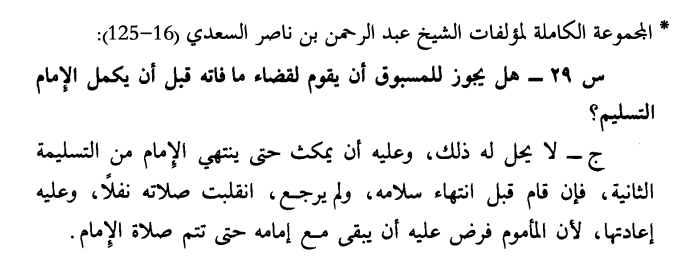 * Shaikh `Abdur-Rahmaan ibn Naasir as-Sa`dee –rahimahullaah -was asked:

 AbdurRahman.Org
You must be logged in to post a comment.