The Blessing of Allaah Between Thankfulness and Ungratefulness – Shaykh Khalid ‘Uthmaan al-Misree [Audio|Ar-En]

The Blessing of Allaah Between Thankfulness and Ungratefulness by Shaykh Khalid 'Uthmaan al-Misree

Bismillaah wa -Alhamdulillaah wa Salaatu wa Salaam ‘alaa Rasulillaah ‘amma ba’d

Muwahhideen Publications organized a LIVE tele-lecture on Sunday 6th January, 2013 with the Noble Shaykh, Abu ‘Abdul’Alaa Khalid ‘Uthmaan al-Misree (May Allaah Preserve Him) from the well-known mashaayikh of Egypt. The Shaykh addressed us with some beautiful admonition regarding the necessity of being grateful to Allaah (Subhaanahu wa Ta’aala).

This session was translated LIVE into English.

Listen / Download Mp3 Here  (Time 57:34)

Commencing the lecture, Shaykh Khalid ‘Uthmaan al-Misree (hafidhahullaah) first established two important principles related to the blessings of Allaah upon His servants:

  1. It is necessary for every Muslim to believe without any doubt that every blessing whether in one’s deen or dunyaa is from Allaah.
  2. Regardless of how much strength or knowledge the slave is given, he would never be able to enumerate the blessings of Allaah

Upon understanding these two issues, we will realise that showing gratitude to Allaah is from the most tremendous of the acts of worship.

Our Shaykh then went on to define the meaning of gratitude as stated by some of the scholars of the past and further delved into variations of the word in the Arabic language and the meaning that they carry.

He proceeded to explain, as stated by Ibn al-Qayyim (rahimahullaah), that gratitude is an act of worship that is only fulfilled when three components are present:

  1. Recognizing the blessings of Allaah in the heart and loving Allaah for His bestowments
  2. Praising and exalting Allaah with the tongue
  3. Seeking the aid of using these blessings in order to perform that which Allaah is pleased with and to refrain from the things that would earn His displeasure

Shaykh Khalid further explained that from the greatest of things that bring a slave closer to his Lord and is from the most certain of reasons for a blessing to be preserved and increased, is the application of the aforementioned components of gratitude. Moreover, since Allaah is Ash-Shakoor (the One Who is Most Grateful), the most beloved of His slaves to Him are those who embody this noble characteristic. Conversely, those who are most abhorred by Him are those who manifest ingratitude.

Next, he delivered some benefits regarding the Name of AllaahAsh-Shakoor, discussed what it means as well as provided us with some examples of the Gratitude of Allaah.

Our Shaykh Abu ‘Abdul ‘Alaa (hafidhahullaah) presented an abundance of proof from the Book of Allaah in explaining the topic at hand as well as provided the statements of our scholars particularly quoting from the works of Imaam Ibn al-Qayyim (rahimahullaah) for this much needed reminder.

We implore our brothers and sisters to listen to this lecture in its entirely in order to seek admonition from the tremendous benefits contained therein.

Wa Billaahi Tawfeeq

Wa SallAllaahu wa Sallaama wa Barak ‘alaa Nabiyanna Muhammad wa ‘alaa ‘Alyhi wa Sahbyhi wa Sallam

Posted from mpubs.org

A Glimpse Into The Creed of The Twelver Shi’a – Shaykh Muhammad ibn Rabee’ al-Madkhalee [Audio|Ar-En]

A Glimpse Into The Creed of The Twelver Shi' a

Bismillaah wa -Alhamdulillaah wa Salaatu wa Salaam ‘alaa Rasulillaah ‘amma ba’d

Muwahhideen Publications organized a LIVE Tele-Lecture with the Noble Shaykh Muhammad ibn Rabee’ ibn Hadi’ al-Madkhalee (May Allaah Preserve Him), son of Ash-Shaykh al-Allaamah Rabee’ ibn Hadi al-Madkhalee (May Allaah Preserve Him) and a professor of ‘Aqeedah in TheIslaamic University of Madeenah.

This session was translated LIVE into English.

Part 01 : Listen / Download Mp3 Here (Time 1:11:11)

Part 02 : Listen / Download Mp3 Here (Time 1:28:15)

Our Noble Shaykh Muhammad Ibn Rabee’ (hafidhahullaah) began by saying that truly the shi’a have been a tribulation and test from Allaah upon the Ummah; it has been a calamity that befell this Ummah and surely this is the way of Allaah, that He tests His slaves. For  this dunya is a life of fitan, assessing the mettle of the servants of Allaah; it is an abode where good and evil mingle, contrary to the aakhirah which is the life of exclusive truth where evil does not mix with the good.

Shaykh Muhammad then went on to describe the history of this deviant group and how they came about. He explained the atmosphere after the murder of ‘Uthmaan (radhiyAllaahu ‘anhu) and the two positions held by the Sahabah concerning how the issue should be dealt with. He explained the role of the hypocrites in this fitnah and then went on to shed some light on the character of ‘Abdullaah Ibn Saba’ and the falsehood and shirkhe injected into the pure Islaamic Creed from within.  From them is his belief that ‘Ali (radhiyAllaahu ‘anhu)  had more right to the khilaafah thanAbu Bakr‘Umar and ‘Uthmaan (radiyAllaahu ‘anhum). He then went a step further and declared ‘Ali (radhiyAllaahu ‘anhu) to be the embodiment of Allaah and exalted be Allaah above the falsehood that he claime d.

Our Shaykh proceeded to explain that there is a group of shi’a who believed that ‘Ali (radhiyAllaahu ‘anhu) was the best of the companions. However, they did not see the first three khulafaa as evil men but believed in their virtue, loved them for the sake of Allaah and even prayed for them. This group is the smallest and for the most part no longer existent.

Now, the matter has changed and they base allegiance and enmity on a person’s stance on Abu Bakr‘Umar and ‘Uthmaan (radhiyAlllahu ‘anhum); they make it obligatory to hate them and render them enemies of Allaah and if one refuses to do such they claim that this individual is misguided or might even make takfir on him.

The Shaykh then went on to say that the shi’a fall into two groups – the twelvers and the zaydiyyah and between these two are vast differences in understanding and creed. The twelvers epitomize misguidance of the greatest magnitude; their beliefs are deeply rooted in shirk and even the affair of racism has entered upon them as they believe in the virtue of the Persian lineage.

Shaykh Muhammad (hafidhahullaah) continued by enlightening us about the linguistic meanings for the terms ‘shi’a’ and ‘raafidhah’ and explained the story behind them being referred to as the raafidhah.

He then proceeded to touch on their beliefs regarding the twelve Imaams whom they deify and deem to be infallible. Here the Shaykh listed the twelve Imaams and then explained that as for the twelfth Imaam, whom they claim has been alive for over 1200 years has never existed historically as his father, Hasan, never bore any children!

Our Shaykh further delved into some of their atrocious beliefs such as the deifying of Ahlul Bayt and their calling upon them in times of ease and hardship as well as their disgusting notion that the Qur’aan has been tampered with, is missing two thirds and the complete Qur’aan which they refer to as the version of Faatimah will only come in the time of the Mahdi. The consensus of the people of Islaam is that this is clear kufr.

Shaykh Muhammad (hafidhahullaah) concluded this sitting by saying that the danger and enmity of the shi’a is more severe than that of the jews and christians as acquisition of our wealth and land will please them (the jews and christians) but these shi’a have great resolve to spread their creed and would settle for nothing less than to drink our blood and ensure that no one from Ahlus Sunnah remains on the face of the earth. They sleep and awake upon their devilish schemes and plots.

This lecture is a must listen for the seeker of truth who wishes to acquaint himself/herself with the falsehood of the shi’a so that he/she may be wary of them as they seek to spread their repugnant beliefs.

Wa Billaahi Tawfeeq

Wa SallAllaahu wa Sallaama wa Barak ‘alaa Nabiyanna Muhammad wa ‘alaa ‘Alyhi wa Sahbyhi wa Sallam

Source : Posted from mpubs.org with permission

Who is The True Muslim? – Khutbah – Shaykh Usaamah al-Utaybee [Audio|Ar-En]

Who is The True Muslim ?
Khutub (Friday Sermon) – 21/09/2012
Shaykh Usaamah al-Utaybee (hafidhahullaah)
[Audio|Arabic-English]

Listen / Download Mp3 Here (Time 31:29)

Source:Posted from http://www.mpubs.org with permission.
Visit Unity Upon Tawheed Bahamas Seminar 2012 with Shaykh Abu ‘Umar Usamah al-’Utaybi

The Truth is Not Known by Way of Men, Men are Known by Way of The Truth – Shaykh Haamid Khamees al-Junaybi [Audio|Ar-En]

The Truth is Not Known by Way of Men, Men are Known by Way of The Truth by Shaykh Haamid Khamees al-Junaybi

Bismillaah wa -Alhamdulillaah wa Salaatu wa Salaam ‘alaa Rasulillaah ‘amma ba’d

Muwahhideen Publications organized a LIVE tele-lecture on Saturday 16th June, 2012 with Shaykh Haamid ibn Khamees al-Junaybi (May Allaah Preserve Him), one of the mashayikh from Abu Dhaby, U.A.E. The Shaykhstudied with Shaykhanna al-Walid ‘Ubaydullaah al-Jaabiree (May Allaah preserve him). He also studied with many of the prominent scholars of our time, like Shaykh Zayd al-Madkhalee, Shaykh Saalih as-Suhaymee andShaykh Muhammad al-Aqeel, whom he has written tazkiyyah from. The tele-lecture is entitled “The Truth is Not Known by Way of Men but Men are Known by Way of The Truth”. The Shaykh had a follow up to the first part on Sunday 24th June, 2012.

Part 01: Listen / Download Mp3  Here (Time 1:19:20)

Part 02: Listen / Download Mp3  Here (Time 2:03:12 )

The Shaykh started off by saying that the shayateen from mankind and jinn have misguided many of the slaves of Allaah by three mighty deviations that are nothing but lies upon Allaah.

  1. Taking people away from the texts i.e The Book of Allaah and the Sunnah of Muhammad (sallallaahu ‘alayhi wa sallam) to the opinions, desires and allegiances.
  2. Glorifying ignorance amongst the people so much so that it became an objective that the majority of the people be upon that mannerism of ignorance.
  3. Glorifying or thinking of some scholars as being holy and infallible.

As a result, it is necessary to clarify the straight path of Allaah and thus the Shaykh outlined some principles needed by the student of knowledge that he/she can use as a light on the path towards his/her Lord.

These principles include:-

  1. Allaah has clarified to the people the path of truth and the way to know the truth.
  2. It is a must to bring the Book of Allaah and Sunnah of Muhammad (sallallaahu ‘alayhi wa sallam) above and beyond the intellect and analogy of the people.
  3. It a must to understand the book and the Sunnah upon the understanding of the salaf-us-saalih.
  4. It is a must to know that the truth is being upon the understanding of the salaf-us-saalih or anybody upon that understanding i.e the scholars of this deen that have followed the first generations in ihsaan(perfection).
  5. We must believe that the truth is always present in every time and every generation and it is not possible that you would have a time, generation or century in which there is no person guiding the people to the truth.
  6. It is a must to know that even though the scholars are those who are guiding the people to the truth, it doesn’t mean that they are infallible and cannot or may not go against the truth even in one single matter.
  7. Whoever tries to seek the proof from the book and the Sunnah, he should never ever leave it for the statement of anybody else regardless of who that person may be but rather he must follow the book of Allaah and the Sunnah of Muhammad (sallallaahu ‘alayhi wa sallam).
  8. The truth is independent of any man but the truth cannot be known except through the men who transmit it.
  9. If the proof contradicts the statements of men, it is waajib upon us to bring forward the proof ahead of the statements of men.
  10. Whoever is ignorant of the proofs of the Quraan and Sunnah and understanding of the salaf-us-saalihmust go back to the rulings of the scholars.
  11. Nobody after the Messenger of Allaah (sallallaahu ‘alayhi wa sallam) can be obeyed in everything he commands and forbids.
  12. It is not permissible to say that every mujtahid (one who has the tools and strives to derive rulings from the Quraan and Sunnah) is correct. The truth is only one and cannot be more than one.
  13. The people of the Sunnah will suspect/accuse the opinions of people but will never accuse/suspect the religion of Allaah.
  14. It is not permissible for anybody to delve into ijtihaad during times of calamity except if he is well qualified and has the capacity to be upon ijtihaad.
  15. It is not correct to use as a proof against those who are calling to the Book and the Sunnah with the understanding of the salaf-us-saalih that the four imaams of the four madhahib have more precedence to be followed than the pious predecessors of this Ummah.
  16. The people of the Sunnah will refute and correct whoever goes against the proofs of the Book and theSunnah even if the one who went against the proofs is a Shaykh of the Sunnah.
  17. IMPORTANT PRINCIPLE: It is a must to warn against the people of innovation and desires, to warn against their statements, and this is the way of the companions of Muhammad (sallallaahu ‘alayhi wa sallam) and those who followed them from the Taabi’oon and those who follow them in ihsaan till the Day of Judgment.

The Shaykh brought an abundance of proofs from the Quraan and Sunnah as well as the statements of our pious predecessors in explaining the aforementioned points.

A must listen for those who wish to acquaint themselves with the truth!

We ask Allaah to make us align ourselves to the truth and the people of truth and rid us of the sickness of blind following anyone, and to make us avid followers of Muhammad (sallAllaahu ‘alayhi wa sallam).

Wa Billaahi Tawfeeq

Wa SallAllaahu wa Sallaama wa Barak ‘alaa Nabiyanna Muhammad wa ‘alaa ‘Alyhi wa Sahbyhi wa Sallam

Source : Posted from mpubs.org with permission

The Story of the Sincerity and Tawbah of Ka’b ibn Maalik – Shaykh Usaamah al-Utaybee [Audio|Ar-En]

The Sincerity and Tawbah of Ka’b ibn Maalik (radhi Allaahu Anhu)
Shaykh Usaamah al-Utaybee (hafidhahullaah)
[Audio|Arabic-English]

Explanation of Hadeeth : Riyaadh us Saaliheen of Imaam an-Nawawi
Read the Story Here : The Story of Ka’b Ibn Maalik (rahimahullaah)

Listen / Download Mp3 Here (Time 93:10)

Source:Posted from http://www.mpubs.org with permission.
Visit Unity Upon Tawheed Bahamas Seminar 2012 with Shaykh Abu ‘Umar Usamah al-’Utaybi

The Three Men in The Cave – Shaykh Usaamah al-Utaybee [Audio|Ar-En]

Ikhlaas (Sincerity) & Tawassul with Righteous Deeds
Shaykh Usaamah al-Utaybee (hafidhahullaah)
[Audio|Arabic-English]

Explanation of Hadeeth : Riyaadh us Saaliheen of Imaam an-Nawawi

Listen / Download Mp3 Here (Time 39:00)

Source:Posted from http://www.mpubs.org with permission.


Look to Whom You Befriend – Shaykh Muhammad ibn Abdullaah Baamusa [Audio|Ar-En]

Look to Whom You Befriend
Shaykh Muhammad ibn ‘Abdullaah Baamusa (hafidhahullaah)
[Audio|Arabic-English]

Look to Whom You Befriend by Shaykh Muhammad ibn 'Abdullaah Baamusa

Bismillaah wa -Alhamdulillaah wa Salaatu wa Salaam ‘alaa Rasulillaah ‘amma ba’d

Muwahhideen Publications facilitated a LIVE tele-lecture with Shaykh Muhammad Ibn ‘Abdullaah al-Baamusa(hafidhahullaah). The Shaykh is a prominent student of Shaykh Muqbil Ibn Hadee al-Waadi’ee (rahimahullaah) and runs Markaz Dar-ul-Hadeeth in HobaishYemen.

This session was translated LIVE into English.

Listen / Download Mp3 Here (Time 33:50)

This monumental admonition by Shaykh Muhammad Ibn ‘Abdullaah al-Baamusa (hafidhahullaah) was replete with abundant narrations of the Salaf regarding the issue of companionship and the effects of keeping the company of the pious as well as the harms of sitting with the transgressors.

The Noble Shaykh initiated this highly beneficial and heartfelt advice by saying that befriending the pious is from the signs of piety and is part of the religion of Islaam. It is also necessitated by the covenant that Allaah has taken upon the believers to be allies to one another; based on this we say that before it is an issue of methodology or behaviour and mannerisms, this topic is one that is related to ‘Aqeedah because it is related to al-Walaa’ wal-Baraa’ – where your allegiance lies and whom it is you take as an enemy.

The Shaykh then proceeded to mention the various ayaat and ahadeeth related to the issue of companionship.

He continued by stating, And remember my brother as you search for companions that Allaah (Jalla wa ‘Ala)has mentioned the conditions that must be found and met by those whom you take as companions in (the following ayah from) Soorah Al-Kahf.

“And keep yourself (O Muhammad sallAllaahu ‘alayhi wa sallam) patiently with those who call on their Lord (i.e. your companions who remember their Lord with glorification, praising in prayers, etc., and other righteous deeds, etc.) morning and afternoon, seeking His Face, and let not your eyes overlook them, desiring the pomp and glitter of the life of the world; and obey not him whose heart We have made heedless of Our Remembrance, one who follows his own lusts and whose affair (deeds) has been lost.” [Soorah Al-Kahf :28]

The conditions are:

  1.  At-Tawheed
  2. He is seen worshipping Allaah in all different times of the day; always hastening to accumulate good deeds
  3. Sincerity
  4. He is not seeking the dunya; the dunya is not his biggest concern.
  5. He should not be from the negligent – those who neglect abundantly remembering their Lord.
  6. He should not be from those who follow their desires.
  7. He should not be from those who have difficulty handling and controlling their affairs.

From the matters one must look into when choosing a companion:

  1. How does he behave when his desires are before him?
  2. How is he at the time of anger when something incenses him?
  3. How is he at the time when the thing he lusts for is in front of him?

The issue of choosing companionship can be of three types:

  1. The one who keeps the company of the transgressors.
  2. The who keeps the company of the pious as well as the transgressors.
  3. The one who keeps the company of the believers and the pious exclusively; and this is the one who will be saved by the permission of Allaah.

The harms of keeping the company of other than the pious:

  1. You may be affected with doubts regarding your sound creed.
  2. They will call and entice you to fall into the same types of sins and transgressions that they fall into.
  3. They will link you by common acquaintances to other people of evil.

In a time where finding pious companions is rare, everyone who seeks good companionship should listen to and adhere to the advice of Shaykh Muhammad (hafidhahullaah) as he beautifully explains exactly what we should look for in a companion and what we must steer clear of in order to avoid the transgressors.

We ask Allaah to grant us good campanions that encourage us upon goodness and prevent us from evil.

Wa Billaahi Tawfeeq

Wa SallAllaahu wa Sallaama wa Barak ‘alaa Nabiyanna Muhammad wa ‘alaa ‘Alyhi wa Sahbyhi wa Sallam

Posted with Permission from : http://www.mpubs.org

Points of Contemplation from The Book of Allaah – Shaykh ‘Ali at-Tuwayjari [Audio|Ar-En]

Points of Contemplation from The Book of Allaah - Shaykh 'Ali at-Tuwayjari

Bismillaah wa -Alhamdulillaah wa Salaatu wa Salaam ‘alaa Rasulillaah ‘amma ba’d

On Sunday 10th June, 2012, The Noble Shaykh Dr. ‘Ali at-Tuwayjari (May Allaah Preserve Him), professor of tafseer at the university of Madinah, K.S.A., and from the well known scholars of Saudi Arabia delivered a LIVE Tele-Lecture with Muwahhideen Publications highlighting some points to reflect upon in the noble book of Allaah.

This lecture event was translated LIVE into English.

Listen / Download Mp3 Here (Time 44:18)

The Shaykh organized this beautiful reminder according to 3 noble merits of the Qur’aan:

  • The virtue of its recitation. Here, he appealed to the Muslimoon to sectionize the Qur’aan into portions and allot a fraction of each day to the recitation of these portions, bit by bit, so much so, as taught in the hadeeth of ‘Abdullah ibn ‘Amr, that one should not allow 40 days to pass without reciting and reflecting on the entire book.
  • The virtue of it as a cure. Here, the Shaykh discussed the healing benefits of the Qur’aan for those experiencing illness, pain, fear and even whisperings of the shaytaan. He emphasized the blessings of Suraat-ul-Baqarah and enlisted 3 ways from the Sunnah, whereby one can perform this ruqayyah.
  • The Virtue of Teaching it. Here, the Shaykh encouraged the muslimoon to learn the Qur’aan and to teach it, showing the loftiness of such an act.

This is merely a summary of the points of contemplation mentioned by our Shaykh Dr. ‘Ali ibn Razi at-Tuwayjari (hafidhahullaah) in this highly beneficial reminder.

Wa Billaahi Tawfeeq

Wa SallAllaahu wa Sallaama wa Barak ‘alaa Nabiyanna Muhammad wa ‘alaa ‘Alyhi wa Sahbyhi wa Sallam

Source : Posted from http://www.mpubs.org with permission

The Rights of Allaah and The Ayah of The 10 Rights – Shaykh Usaamah al-Utaybee [Audio|Ar-En]

The Rights of Allaah & The Ayah of The 10 Rights
Shaykh Usaamah al-Utaybee (hafidhahullaah)
[Audio|Arabic-English]

Kitaab at-Tawheed of Imaam Muhammad ibn ‘AbdulWahhab

Listen / Download Mp3 Here (Time 1:34:48 mins)

Source:Posted from http://www.mpubs.org with permission.
Visit Unity Upon Tawheed Bahamas Seminar 2012 with Shaykh Abu ‘Umar Usamah al-’Utaybi

The 70,000 That Will Enter Jannah Without Reckoning – Shaykh Usamah al-Utaybi [Audio|Ar-En]

Kitaab at-Tawheed of Imaam Muhammad ibn ‘AbdulWahhab

Listen / Download Mp3 Here (Time 1:17:40)

Narrated Ibn ‘Abbas:

Allah’s Apostle said, ‘Nations were displayed before me; one or two prophets would pass by along with a few followers. A prophet would pass by accompanied by nobody. Then a big crowd of people passed in front of me and I asked, Who are they Are they my followers?” It was said, ‘No. It is Moses and his followers It was said to me, ‘Look at the horizon.” Behold! There was a multitude of people filling the horizon. Then it was said to me, ‘Look there and there about the stretching sky! Behold! There was a multitude filling the horizon,’ It was said to me, ‘This is your nation out of whom seventy thousand shall enter Paradise without reckoning.’ “Then the Prophet entered his house without telling his companions who they (the 70,000) were. So the people started talking about the issue and said, “It is we who have believed in Allah and followed His Apostle; therefore those people are either ourselves or our children who are born m the Islamic era, for we were born in the Pre-lslamic Period of Ignorance.” When the Prophet heard of that, he came out and said.

“Those people are those who do not treat themselves with Ruqya, nor do they believe in bad or good omen (from birds etc.) nor do they get themselves branded (Cauterized). but they put their trust (only) in their Lord “

On that ‘Ukasha bin Muhsin said. “Am I one of them, O Allah’s Apostle?’ The Prophet said, “Yes.” Then another person got up and said, “Am I one of them?” The Prophet said, ‘Ukasha has anticipated you.”

[Sahih bukhari Volume 7, Book 71, Number 606]

Source:Posted from http://www.mpubs.org with permission. Visit Unity Upon Tawheed Bahamas Seminar 2012 with Shaykh Abu ‘Umar Usamah al-‘Utaybi

Let Us Sit Down and Believe for A While – Shaykh Muhammad ibn Rabee’ al-Madkhalee [Audio|Ar-En]

Let Us Sit Down and Believe for A While by Shaykh Muhammad ibn Rabee' al-Madkhalee

Bismillaah wa -Alhamdulillaah wa Salaatu wa Salaam ‘alaa Rasulillaah ‘amma ba’d

Muwahhideen Publications organized a LIVE Tele-Lecture with the Noble Shaykh Muhammad ibn Rabee’ ibn Hadi’ al-Madkhalee (May Allaah Preserve Him), son of Ash-Shaykh al-Allaamah Rabee’ ibn Hadi al-Madkhalee (May Allaah Preserve Him) and a professor of Aqeedah in TheIslaamic University of Madeenah.

The Shaykh delivered a heart felt reminder of some very important issues of eeman.

This lecture event was translated LIVE by our brother Abu Suhailah Umar Quinn.

Listen / Download Mp3 Here (Time 1:18:52 )

Our noble Shaykh Muhammad Ibn Rabee’ (hafidhahullaah) commenced this beautiful heart felt admonition by stating, “How great is the need of the heart that we nurture it and provide it with the nutrition that it needs to supply its eemaan. Just as vegetation needs water, the heart needs that which will give it life; so we are in dire need of the likes of this subject matter.”

He continued his introduction by saying that we live in an era that is worlds apart from the peaceful time of the Messenger (sallAllaahu ‘alayhi wa sallam) and these times are very difficult upon the hearts of the people. Over the course of the last century the situation of mankind have become quite complicated and this over complication has led to the death of the hearts of the people so we need to do what it takes in order to resuscitate their hearts. He proceeded to say that the hearts of the Muslims need to be reminded of Allaah and we must reflect over the creation of Allaah, reflect on the miracles He sent His Messengers with and we need to deeply contemplate and imagine as though we were present when these miracles occurred. We need to imagine what it would have been like to witness these miracles and how it would have affected our eemaan had we been there.

Our Shaykh then went on to mention the stories of different Prophets and implored us to reflect upon them and imagine ourselves as being present with the Prophets of Allaah and the believers in those times. He continued by stating that many have abandoned the Qur’aan and when we do read the Qur’aan, it is without contemplation. Some read the Qur’aan only in Ramadhaan solely to finish it, again with no contemplation.  We have neglected reflecting over the Qur’aan which is the greatest of miracles and will remain as such until the Day of Judgement.

Shaykh Muhammad highlighted specific stories from the Book of Allaah, urging us to reflect upon them and imagine ourselves with the Prophets Nuh,IbraheemMusaa and Muhammad (alayhum as-salaam); the effect it would have on our eemaan and certainty in Allaah and how we would increase in our understanding that Allaah has the power to do everything, is in charge of everything and there is no limit to His power and Knowledge.

Another benefit as mentioned by the Shaykh after referring to Soorah At-Takaathur is the three types of yaqeen mentioned in the Qur’aan. They are:

  1. ‘ilmul-yaqeen which is certainty that comes with having knowledge of something,
  2. ‘aynul-yaqeen that comes on account of witnessing something and
  3. haqqul-yaqeen which is when someone experiences something and knows it is a reality without doubt.

In closing the Shaykh explained that eemaan is of different levels so there is room to increase it; we are in need of increasing our eemaan andyaqeen. He then went on to say that in Saudi Arabia they have been continuously making du’a and performing Salaatul Istisqaa beseeching Allaahfor rain but the rain has not come. He said nothing is impossible for Allaah to do but due to the weakness of the people’s eemaan and them engaging in deception, trickery, lying and all sorts of disobedience in addition to consuming unlawful wealth and food, our du’a is not being answered.

Our beloved Shaykh Muhammad Ibn Rabee’ ended this truly inspiring admonition by making du’a to Allaah, asking Him to strengthen our eemaan, make us from those who contemplate on the Qur’aan and benefit from it; that He strengthens the Muslims, give them victory and return them back to their religion and that He destroys and humiliates the enemies of the religion from the kuffaarmunaafiqoon, the raafidhah and the like; and thatAllaah restores honour to Islaam and the Muslims.

We encourage our brothers and sisters to listen to and benefit from this tremendous reminder

Wa Billaahi Tawfeeq

Wa SallAllaahu wa Sallaama wa Barak ‘alaa Nabiyanna Muhammad wa ‘alaa ‘Alyhi wa Sahbyhi wa Sallam

Posted with Permission from mpubs.org

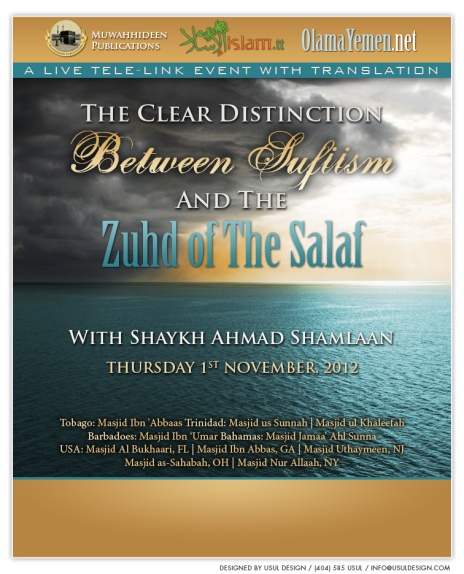
The Clear Distinction Between Sufism and The Zuhd of The Salaf – Shaykh Ahmad ibn Ahmad Shamlaan [Audio|Ar-En]

The Clear Distinction Between Sufism and The Zuhd of The Salaf
Shaykh Ahmad ibn Ahmad Shamlaan (hafidhahullaah)
[Audio|Arabic-English]

The Clear Distinction Between Sufism and The Zuhd of The Salaf by Shaykh Ahmad ibn Ahmad Shamlaan

Bismillaah wa -Alhamdulillaah wa Salaatu wa Salaam ‘alaa Rasulillaah ‘amma ba’d

Muwahhideen Publications facilitated a LIVE telelink lecture with Shaykh Ahmad ibn Ahmad Shamlaan (hafidhahullaah), from the mashaayikh and head of Dar ul Hadeeth, Radaa’, Yemen.

A superb refutation of the falsehood of the sufis!

Listen / Download Mp3 Here (Time 1:23:17)

The noble Shaykh Ahmad ibn Ahmad Shamlaan (hafidhahullaah) explained that Zuhud is to renounce worldly pleasures in order to gain nearness to Allaah. It is to leave off what Allaah has made haram and to do that which Allaah has made obligatory. This concept is of tremendous importance in Islaam and the Shaykhpresented this in the form of a comparison between the proper and upright Zuhud of the Salaf to the extreme and deviant practices of the sufis. The Salaf best understood and practiced this noble principle. They had reached the pinnacle of sincerity and devotion to Allaah and strict adherence to the sunnah of the Messenger (sallAllaahu ‘alayhi wa sallam), performing all acts of worship in precise accordance to the legislated texts. The Shaykh showed the clear distinction of this to the absurd innovations of the sufis who went to such extremes in their ‘ibaadah, out of their acclaimed piety, that many of their beliefs and practices fell into kufr.

Our Shaykh Ahmad Shamlaan (hafidhahullaah) continues in this lecture making distinct the falsehood of thesufis and the proper practice of our salaf us saalih in their implementation of zuhud.

Wa Billaahi Tawfeeq

Wa SallAllaahu wa Sallaama wa Barak ‘alaa Nabiyanna Muhammad wa ‘alaa ‘Alyhi wa Sahbyhi wa Sallam

Source : Taken from http://www.mpubs.org with permission

Reasons for the Hardness of the Heart – Sheikh Ibn Baz [Video|Ar-En]

نسأل الله للجميع التوفيق والهداية

Uploaded on youtube by daarulhaq

Tafseer of Surat al-‘Asr – Sheikh Salih al-Fawzaan [Video|Ar-En Subtitles]

وفق الله للجميع ما يحب ويرضى

Uploaded by daarulhaq

~ Happy New Year ?! – Shaykh Fawzaan [Video|Ar-En]

Uploaded by abdalla508 on Youtube

Related Links:

A Muslim is prohibited to congratulate the disbelievers, Christians, Jews or whomever, on their distinctive occasions

Fatwa no. 21079

Q: On 12/8/1420 A.H. notices were placed on the roads of Riyadh conveying congratulations from the Banque Saudi Fransi on the New Year.

Employees of the Banque Saudi Fransi wish the Saudi people a merry year. Respected shaykh, it undoubtedly hurts every Muslim to find things like this common in the land of Tawhid (belief in the Oneness of Allah/monotheism) and Al-Haramayn Al-Sharifayn (the Two Sacred Mosques, the Sacred Mosque in Makkah and the Prophet’s Mosque in Madinah).

I hope that Your Honor will clarify the ruling of Islam on this matter.

A:

A Muslim is prohibited to congratulate the disbelievers, Christians, Jews or whomever, on their distinctive occasions. This involves a sort of agreeing with them on their falsehood and being loyal to them.

Similarly, a Muslim is prohibited to congratulate his Muslim brother on the feasts and celebrations of the disbelievers. By doing so, a Muslim imitates them.

Muslims must resent disbelievers, dissociate themselves from them and hate their disbelief and disobedience to Allah, as Allah (Exalted be He) states,

 It was authentically reported that the Prophet (peace be upon him) stated,

 Anyone who imitates a people becomes one of them.

the Shaykh of Islam Ibn Taymiyyah commented on this Hadith saying,

This Hadith at least implies that it is prohibited for a Muslim to imitate the disbelievers though it apparently signifies the disbelief of the imitator.

Allah (Exalted be He) states,

…and if any amongst you takes them as Auliyâ’, then surely he is one of them.

You (O Muhammad صلى الله عليه وسلم) will not find any people who believe in Allâh and the Last Day, making friendship with those who oppose Allâh and His Messenger (Muhammad صلى الله عليه وسلم)

He (Glorified be He) states,

 O you who believe! Take not the Jews and the Christians as Auliyâ’ (friends, protectors, helpers), they are but Auliyâ’ of each other. And if any amongst you takes them as Auliyâ’, then surely he is one of them. Verily, Allâh guides not those people who are the Zâlimûn (polytheists and wrong-doers and unjust).

Thus, Muslims are not permitted to express joy or congratulate disbelievers on their festive occasions, whether by word of mouth, posters, newspapers, magazines, cards or the like. The legal authorities must remove these notices.

May Allah grant us success . May peace and blessings be upon our Prophet Muhammad, his family and Companions!

The Permanent Committee for Scholarly Research and Ifta’

Member Member Member Chairman
Bakr Abu Zayd Salih Al-Fawzan `Abdullah ibn Ghudayyan `Abdul-`Aziz ibn `Abdullah Al Al-Shaykh

Fatwas of the Permanent Committee>Group 2>Volume 1: `Aqidah>Acts commensurate with Kufr>Congratulating Kafirs in their feasts

Types of Ibadah – Khawf, Rajaa and Tawakkul – Abu Muhammad al Maghribee [Audio|En]

Types of Ibadah Khawf (Reverential Fear), Rajaa (Hope/Longing) & Tawakkul (Trust/Reliance)
Abu Muhammad al Maghribee

Audio Courtesy: http://followthesalaf.com
[Audio|English]

Class of Tuesday, February 14, 2012

Sharh Thalathat al-Usool (Explanation of the Three Fundamental Principles)- by Sheikh Muhammad ibn al-Uthaymeen

On the Types of Ebaadah. In this class we covered khawf (reverential fear), the blameworthy and praiseworthy and its types, rajaa’ (hope/longing), the praiseworthy and blameworthy and tawakkul (putting one’s trust/reliance in Allah) and its 4 types.

Listen / Download Mp3 Here  (Time 56:19)

Benefits from Manners and Character of Shaykh Hasan ibn Abdul Wahhab Marzooq al-Banna and the Scholars in General – Abu Muhammad al-Maghribee [Audio|En]

One Week with Shaykh Hasan ibn Abdul Wahhab Marzooq al-Banna
Abu Muhammad al-Maghribee
[Audio|English]

Topic: Benefits from Manners and Character of Shaykh Hasan ibn Abdul Wahhab Marzooq al-Banna and the Scholars  in General

Listen / Download Mp3 Here  (Time 46:56)

(Inspirational) Oh Sisters Be Not Soft in Speech, Stay in Your Houses, Do Not Display Yourselves – By Shaykh Hasan al-Banna – Abu Muhammad al-Maghribee [Audio|En]

Translation of Shaykh Hasan ibn Abdul Wahhab Marzooq al-Banna
Abu Muhammad al-Maghribee
[Audio|English]

Inspirational Lecture !! Don’t Miss to Listen to it 

O wives of the Prophet! You are not like any other women. If you keep your duty (to Allâh), then be not soft in speech, lest he in whose heart is a disease (of hypocrisy, or evil desire for adultery, etc.) should be moved with desire, but speak in an honourable manner.

And stay in your houses, and do not display yourselves like that of the times of ignorance, and perform As-Salât (Iqamât­as­Salât), and give Zakât and obey Allâh and His Messenger. Allâh wishes only to remove Ar­Rijs (evil deeds and sins, etc.) from you, O members of the family (of the Prophet Peace be upon him), and to purify you with a thorough purification.

And remember (O you the members of the Prophet’s family, the Graces of your Lord), that which is recited in your houses of the Verses of Allâh and Al­Hikmah (i.e. Prophet’s Sunnah legal ways, etc. so give your thanks to Allâh and glorify His Praises for this Qur’an and the Sunnah). Verily, Allâh is Ever Most Courteous, Well­Acquainted with all things. (Al-Ahzab 33:32-34)

Verily, the Muslims (those who submit to Allâh in Islâm) men and women, the believers men and women (who believe in Islâmic Monotheism), the men and the women who are obedient (to Allâh), the men and women who are truthful (in their speech and deeds), the men and the women who are patient (in performing all the duties which Allâh has ordered and in abstaining from all that Allâh has forbidden), the men and the women who are humble (before their Lord Allâh), the men and the women who give Sadaqât (i.e. Zakât, and alms, etc.), the men and the women who observe Saum (fast) (the obligatory fasting during the month of Ramadân, and the optional Nawâfil fasting), the men and the women who guard their chastity (from illegal sexual acts) and the men and the women who remember Allâh much with their hearts and tongues (while sitting, standing, lying, etc. for more than 300 times extra over the remembrance of Allâh during the five compulsory congregational prayers) or praying extra additional Nawâfil prayers of night in the last part of night, etc.) Allâh has prepared for them forgiveness and a great reward (i.e. Paradise). (Al-Ahzab 33:35)

Listen / Download Mp3 Here  (Time 1:28:40)

Advice to the Parents on Raising Children – Sheikh Mis’ad al-Husaynee [Audio|Ar-En]

Telelink – Sheikh Mis’ad al-Husaynee – Advice to the Parents on Raising Children

This telelink lecture was givenon Saturday, April 7, 2012 by our Noble Sheikh Mis’ad al-Husaynee, Professor of Tafseer (Quranic Exegesis) and Quranic Sciences in The Islaamic University of Madinah, K.S.A

Translated into English By Abu Muhammad al-Maghribee
Audio Courtesy: http://followthesalaf.com

At what age do we begin teaching our children?

How do we give them the proper Islamic education?

Here is a brief summary of 5 important points the sheikh also brought.

1. Give priority their Islamic education, in accordance with what the Messenger, sallallahu alaihi wasallam, taught.

2. Set the right example in statements & action.

3. Keep them away from that which will have an evil affect on them. Know that TV & media are more dangerous than a person in destroying the uprightness of our children!

4. Strive to find good substitutions for that which we prevent them (from harmful things). Keep them busy with good, or they may keep busy with falsehood!

5. Make sure the manhaj of Ahlus-Sunnah is made clear to them and warn them from deviant methodologies and leave no room for confusion.

Listen to find out more!

Listen / Download Mp3 Here (Time 58:41)