Affluent Have Made Off With Rewards – Great Rewards of Dhikr – Shaykh Ibn Al-Uthaymeen |Dr Saleh as Saleh [Audio|En]

Bismillaah

The explanation is based upon that of Shaykh Ibn Al-‘Uthaymeen rahimahullaah

An-Nawawi 40 Hadith – 25 – Affluent Have Made Off With Rewards

عَنْ أَبِي ذَرٍّ رَضِيَ اللهُ عَنْهُ أَيْضًا، “أَنَّ نَاسًا مِنْ أَصْحَابِ رَسُولِ اللَّهِ صلى الله عليه و سلم قَالُوا لِلنَّبِيِّ صلى الله عليه و سلم يَا رَسُولَ اللَّهِ ذَهَبَ أَهْلُ الدُّثُورِ بِالْأُجُورِ؛ يُصَلُّونَ كَمَا نُصَلِّي، وَيَصُومُونَ كَمَا نَصُومُ، وَيَتَصَدَّقُونَ بِفُضُولِ أَمْوَالِهِمْ. قَالَ: أَوَلَيْسَ قَدْ جَعَلَ اللَّهُ لَكُمْ مَا تَصَّدَّقُونَ؟ إنَّ بِكُلِّ تَسْبِيحَةٍ صَدَقَةً، وَكُلِّ تَكْبِيرَةٍ صَدَقَةً، وَكُلِّ تَحْمِيدَةٍ صَدَقَةً، وَكُلِّ تَهْلِيلَةٍ صَدَقَةً، وَأَمْرٌ بِمَعْرُوفٍ صَدَقَةٌ، وَنَهْيٌ عَنْ مُنْكَرٍ صَدَقَةٌ، وَفِي بُضْعِ أَحَدِكُمْ صَدَقَةٌ. قَالُوا: يَا رَسُولَ اللَّهِ أَيَأْتِي أَحَدُنَا شَهْوَتَهُ وَيَكُونُ لَهُ فِيهَا أَجْرٌ؟ قَالَ: أَرَأَيْتُمْ لَوْ وَضَعَهَا فِي حَرَامٍ أَكَانَ عَلَيْهِ وِزْرٌ؟ فَكَذَلِكَ إذَا وَضَعَهَا فِي الْحَلَالِ، كَانَ لَهُ أَجْرٌ”. 
[رَوَاهُ مُسْلِمٌ]

Also on the authority of Abu Dharr (radi Allaahu anhu):

Some people from amongst the Companions of the Messenger of Allah ﷺ said to the Prophet ﷺ, “O Messenger of Allah, the affluent have made off with the rewards; they pray as we pray, they fast as we fast, and they give [much] in charity by virtue of their wealth.”

He ﷺ said, “Has not Allah made things for you to give in charity? Truly every tasbeehah [saying: ‘subhan-Allah’] is a charity, and every takbeerah [saying: ‘Allahu akbar’] is a charity, and every tahmeedah [saying: ‘al-hamdu lillah‘] is a charity, and every tahleelah [saying: ‘laa ilaha illAllah‘] is a charity. And commanding the good is a charity, and forbidding an evil is a charity, and in the bud`i [sexual act] of each one of you there is a charity.”

They said, “O Messenger of Allah, when one of us fulfills his carnal desire will he have some reward for that?” He ﷺ said, “Do you not see that if he were to act upon it [his desire] in an unlawful manner then he would be deserving of punishment? Likewise, if he were to act upon it in a lawful manner then he will be deserving of a reward.”

[Muslim]

Posted from:
Hadeeth – An Nawawi 40 Hadeeth – Dr. Saleh as-Saleh [Audio Series|En]

Remembering Allaah Morning and Evening – Shaykh al-Albaani

Source: silsilat ul-hudaa wa nnoor – the series of guidance and light – tape no. 192

~

Question #6: “When is the time for the adhkaar[1] of the morning and evening?”

Shaykh al-Albaani (rahimahullaah) answers:

“The adhkaar of the evening are (made) after ‘asr, and the adhkaar of themorning are (made) after fajr.”

[1] words of remembrance of Allaah

~

asaheeha translations

The Ruling of making Dhikr collectively in Unison

The Ruling of making Dhikr collectively in Unison according to the Imams of the Salaf
Researched by Ahmad bin Muhammad an-Najjar
Translated by Abbas Abu Yahya

[The scenario]

This is collectively coming together to make Dhikr (remembrance of Allaah) in unison (one voice) whether that Dhikr is reciting the Qur’aan, or making Dua’ or makingTasbeeh (saying: SubhanAllaah) etc. doing this without the aim of educating or learning.

[Its ruling According to the Imams of the Salaf ]

Indeed the Imams of the Salaf from the (Sahabah) Companions and those that followed them in goodness are all agreed upon the rejection of every innovation in theDeen, and rejecting every worship or form of worship which the Prophet -sallAllaahu alayhi wa sallam- did not do, nor what his noble Companions did not practice.  There are narrations from a group of the Companions and those who followed their way, concerning this form of making Dhikr, and here are their statements:

[Umar bin al-Khattab Radi Allaahu anhu]

From Abu Uthmaan an-Nahdi who said: ‘A worker for Umar bin al-Khattab wrote to Umar saying that there are a group of people who gather together to make Dua’ for the Muslims and the leader.’

So Umar Radi Allaahu anhu wrote to him: ‘Bring them to me with yourself.’

The man came and Umar said to the doorman, prepare the whip. When they entered upon Umar Radi Allaahu anhu he descended upon their leader by hitting him with the whip.’[1]

The rightly guided Khalifah Umar bin al-Khattab Radi Allaahu anhu rejected that a group gathered to make Dhikr in a form that the Prophet -sallAllaahu alayhi wa sallam-did not do, nor did the best of his Companions. To the extent Umar Radi Allaahu anhudid not suffice by rejecting what they did by just speaking about it, rather he beat their leader with a whip, and this shows the great concern the Companions had in rejecting innovated Bida’ in the Deen.


[Abdullaah ibn Mas’ood]

From ‘Amr bin Salamah:  We were sitting by the door of Abdullaah ibn Mas’ood before lunch, so that if he came out, we could walk with him to the Masjid.

Abu Moosaa al-Ash’aree came and said: Has Abu Abdur-Rahmaan come out yet?

We said: No.

So, he sat down with us, waiting for him to come out, and when he came out, we all gathered towards him, and Abu Moosaa said:

‘O Abu Abdur-Rahmaan! Previously I saw something in the Masjid, which I disliked. But, Alhamdulillaah, what I saw, was nothing but good.’

He said: What was it?

Abu Moosaa said, ‘If you live, you will see it.’

Then Abu Moosaa said, ‘I saw a group of people, sitting in circles waiting for the prayer.  In every circle there was a man and in their hands were small stones and he would say: ‘Say Allaahu Akbar 100 times’ and they would say ‘Allaahu Akbar’ 100 times.  Then, he would say, ‘Say laa ilaha ilAllaah 100 times’ and they would say ‘laa ilaha ilAllaah’ 100 times and he would say, ‘Say SubhaanAllaah’ 100 times and they would say ‘SubhaanAllaah’ 100 times.’

Abdullaah ibn Mas’ood said, ‘So what did you say to them?’

He said: ‘I did not say anything to them, rather I waited for your opinion [or ‘I waited for your command’].’

He said: ‘Why did you not command them to count their bad deeds [i.e. seek forgiveness from your deeds] and guarantee them that their good deeds would not be lost?!’

Then he walked and we walked with him until he reached one of those circles and he stood there and said, ‘What is this that I see you doing?’

They said: ‘O Abu Abdur-Rahmaan! These are nothing but small stones with which we are counting, saying ‘Allaahu Akbar, laa ilaaha illAllaah and SubhaanAllaah.’

He said, ‘Count your sins; I guarantee that you will not lose anything of your good deeds!  Beware, O Ummah of Muhammad!  How quick you are to your destruction!

Here we are, the Companions of your Prophet – abundant, everywhere and here is his clothing which has not been [wasted away] and his utensils have not been broken. I swear by Him in Whose Hand is my soul, either you are an Ummah more rightly-guided than the Ummah of Muhammad or you are opening the door of misguidance.’

They said; ‘We swear by Allaah, O Abu Abdur-Rahmaan, we did not intend anything but good.’

He said: ‘How many people intend good but never achieve it.  Verily the Messenger of Allaah – narrated to us, ‘Indeed there will be a people who read the Qur’aan but it does not pass beyond their throats.’  I swear by Allaah, I do not know. Perhaps most of them are from amongst you.’

Then he went away.

‘Amr bin Salamah said, ‘We saw some of those sitting in those circles fighting on the Day of Nahrawaan, along with the Khawaarij.’[2]

Indeed Ibn Mas’ood Radi Allaahu anhu reprimanded a group who were gathered together in the form of circles, remembering Allaah, and Ibn Mas’ood used as an evidence against their misguidance in that they opposed that what the Companions of the Messenger of Allaah -sallAllaahu alayhi wa sallam- were upon, those who had witnessed the Messenger -sallAllaahu alayhi wa sallam, and they knew his statements, his actions, and his situations, which the Companions used to use to show their guidance.

[Abu Hanifah an-Nu’man]

Imam Abu Hanifah -Rahimullaah- said:

‘That raising the voice in making Takbeer (saying Allaahu Akbar) is principally a Bida’, because it is Dhikr, and the Sunnah regarding Dhikr is with lowering the voice.’[3]

[Malik bin Anas]

From Ibn Wahab who said:

‘I said to Malik -Rahimullaah-: ‘What would you say if you saw a group of people gathering together and all of them together reading one Soorah till the end of theSoorah?

Imam Malik rejected that and found fault with that and said:

‘This is not how the people used to do this, rather one man used to recite to another person for learning purposes.’[4]

Ibn Wahab also said in ‘Taj wal-Ikleel li Mukhtasir Khaleel’:

‘Malik disliked that recitors gather together reciting one Soorah, and he said: ‘this was not from the practice of the people,’ and he regarded it as a Bida’.[5]

[Yahya bin Ma’een & Ahmad bin Hanbal]

al-Fadl bin Mihraan said: ‘I asked Yahya bin Ma’een and Ahmad bin Hanbal: ‘Indeed we have a group of people who get together and make Dua’, recite Qur’aan (collectively) and remember Allaah Ta’ala together, how do you view these people?’

As for Yahya bin Ma’een he said: ‘They should read from the Mus’haf (Qur’aan), and make Dua’ after the prayer and remember Allaah individually to themselves.’

al-Fadl bin Muhammad said: ‘I said: ‘I have a brother who takes part with them.’

Yahya said: ‘Forbid him from that.’

I said: ‘He does not accept.’

Yahya said: ‘Admonish him.’

I said: ‘He does not accept. Should I boycott him?’

He said: ‘Yes.’

Then I came to Ahmad and told him similar to what I had said to Yahya and Ahmad also said to me:

‘They should read from the Mus’haf, and remember Allaah Ta’ala individually and seek the hadeeth of the Messenger of Allaah sallAllaahu alayhi wa sallam.’

I said: ‘Should I forbid my brother?’

Ahmad said: ‘Yes.’

I said: ‘And if he does not accept.’

Ahmad said: ‘Of course he will InshAllaah, since indeed this is an innovation, this type of gathering which you describe.’

I said: ‘and if he does not accept should I boycott him?’

Ahmad smiled and remained silent.’[6]

If an opponent contests what has preceded and says, there are Sharia’ texts which indicate to the excellence of gathering for Dhikr, and this is what is established in Saheeh Muslim from Abu Hurairah Radi Allaahu anhu from the Prophet -sallAllaahu alayhi wa sallam- who said: ‘Indeed Allaah –Tabaraka wa Ta’ala – has  noble Angels who travel around, they search for gatherings of Dhikr, and if they find gatherings where there is Dhikr they sit with those people and they encompass each other with their wings, until they fill that which is between them and the heavens of the Dunyaa, then when they leave they ascend and climb to the heavens.

Then Allaah – Azza wa Jal- asks them – while He knows more about them than they do -: ‘From where did you come?’

They will reply:

‘We came from worshippers of Yours on the earth, and they were saying:SubhaanAllaah (Far is Allaah from imperfection), Allaahu Akbar (Allaah is the Greatest), laa ilaaha illAllaah (there is none worthy of worship in truth except Allaah) and Alhamdulillaah (Praise be to Allaah) and they were asking of You. . . .’[7]

And there are other similar evidences.

The reply to this objection is from different points:

1- The wording ‘Dhikr’ and ‘Tasbeeh’ is mentioned in the texts (Book & Sunnah) unrestrictedly. For an unrestricted wording in the Sharia’ it is not allowed to limit it to a particular number or amount, or to a particular form, except if there is a text from theSharia’ present regarding it.

As for Dhikr in a collective form with voices in unison, then this has not been mentioned in the Book of Allaah nor in the Sunnah of His Messenger -sallAllaahu alayhi wa sallam.

Therefore, what is mentioned in the texts, with the encouragement to perform Dhikr in a plural form does not indicate in itself to making Dhikr collectively, because it is an unrestricted wording, and an unrestricted wording cannot be limited except with aSharia’ evidence, and there is no proof to restrict making Dhikr in unison in this issue.

2- That the Companions did not understand this form of Dhikr from these texts of theSharia’, rather they rejected this form, and they dispraised the one who did this form of Dhikr.  They regarded this from the innovated matters in the Deen, as has preceded in the story of Umar and Ibn Mas’ood, and the understanding of the Companions of the texts of the two revealed sources (the Book & the Sunnah) precedes the understanding of other than them.  Rather it is an obligation to follow their understanding, and it is not allowed to abstain from it.

3- That the Imams also rejected what the Companions rejected as has been mentioned from Abu Hanifah, Malik, Ahmad bin Hanbal and others.

This indicates that they are united upon rejecting and criticizing this form of Dhikr, and along with that I will add two more statements of two Imams from the Maliki Madhab, and they are Qurtubi and Tartooshi.

Abul-Abbas Ahmad al-Qurtubi said:

‘As for the saying of the Messenger -sallAllaahu alayhi wa sallam:

‘No people gather together in one of the houses of Allah, reciting the Book of Allah and studying it among themselves, without tranquility descending upon them, mercy enveloping them, the angels surrounding them, and Allah making mention of them amongst those who are with Him.’[8]

The houses of Allaah are the Masajid, as Allaah Ta’ala said:

<< In houses (Masajid), which Allah has ordered to be raised, in them His Name is glorified in the mornings and in the afternoons or the evenings>>[9]

Those who hold it permissible to read the Qur’aan in congregation in unison (one voice) adhere to this hadeeth, as is done here in Morocco.  Some of our scholars have disliked that, and held the opinion that it is a Bida’, since it was not the way of the Salaf in reciting like this.  But rather the hadeeth is understood to be that every individual studies the Book of Allaah by them self, or with someone who will correct them.’[10]

Tartooshi said:

‘These Aathaar (narrations) necessitate the permissibility of congregating to recite the noble Qur’aan with the intent of studying it, learning it, and revising it. That takes place by a student reading it to a teacher, or a teacher reading it to a student. And if two people have an equal level of knowledge then one of them reads to the other for revision and studying purposes, this is how teaching and learning occur, without having to recite in congregation.’[11]

Concluding, I bring attention to an issue: which is that being continuous upon gathering for the Dhikr of Allaah – even if it does not include doing so in unison – has not been legislated, because there is no text from the Qur’aan nor from the Sunnah being continuous in gathering in this way. Likewise, being continuous upon this type of congregation resembles the congregations which are permissible, like the five daily prayers, the Juma’ prayer, the two Eid, and the Hajj.

Therefore, there is a distinction between what is taken as Sunnah and custom, and these gatherings, which resemble legislated ones, and between that which is done sometimes, since this is permitted, and this is the guidance of the Companions of the Prophet -sallAllaahu alayhi wa sallam, as they would sometimes gather together.

al-Imam Ibn Taymeeyah said:

‘Gathering for optional prayers, or to listen to Qur’aan, or for the Dhikr of Allaah, etc. if that is done sometimes then it is better since it has been authentically reported from the Prophet -sallAllaahu alayhi wa sallam- that he prayed an optional prayer in congregation sometimes. Likewise, he went out to his Companions and there would be amongst them one who would recite and the others would listen, and the Prophet -sallAllaahu alayhi wa sallam- would sit with them to listen. And the Companions of the Messenger of Allaah sallAllaahu alayhi wa sallam would, if they gathered order one of them to recite while they would listen. . . . .

As for taking gatherings successively repeating them, repeatedly and regularly over weeks, months and years, other than gatherings which have been legislated. Then these type gatherings which resemble gatherings for the five daily prayers, the Juma’prayer, the two Eid, and the Hajj, that is because those other gatherings are innovated and newly invented. Therefore, there is a difference between what is taken as a Sunnah and what is taken as a habit and that which resembles what is legislated, and this difference has been mentioned by Imam Ahmad and others from the Imams.

Abu Bakr al-Khalaal narrated in ‘the book of manners’ from Ishaq bin Mansoor al-Kosaj that he said to Abu Abdullaah:

‘It is disliked that a people gather to make Dua’ to Allaah and to raise their hands to Allaah.

Imam Ahmad said: ‘I do not reject for brothers, if they should unintentionally gather except that they should not do it a lot.’

Ishaq bin Rahawayeeyah said the same as what Imam Ahmad said.

As for the wording: ‘not do it a lot’ means not to take it as a habit so much that it is done a lot, and this is the speech of Ishaaq.’[12]

Ibn Taymeeyah also said:

‘Gathering upon reading, Dhikr and Dua’ is good and recommended as long as it is not taken as a regular habit – just like those gatherings which are legislated – and that there is no evil Bida’ connected to it.’[13]

Shaatabi al-Maliki said:

‘Constantly making Dua’ in a form of a congregation was not from the actions of the Messenger of Allaah sallAllaahu alayhi wa sallam, as it was not from the statements of the Messenger, nor was it from that which he allowed.’[14]

Footnotes

[1] Collected by Ibn Abi Shaybah (8/558) from Muwayeeyah bin Hisham who said Sufyaan narrated to us from Sa’eed al-Jareeree from Abi Uthmaan, & its chain is Hasan.

[2] Narrated by ad-Darmi in his Musnad. The chapter about the dislike of taking opinions (1/286-287) by ‘Amr bin Yahya bin ‘Amr bin Salmah from his father, from his grandfather.

[3] Badai’ as-Sanai’ by al-Kasani al-Hanafi (2/99)

[4] al-Madkhal by Ibn al-Hajj (1/91)

[5] (2/85) & al-Khaleel said: in his ‘Mukhtasir’ (p.38), and this is the main issue in theMadhab of Malik amongst the later comers: ‘This dislike of doing Sujood of gratefulness in unison, & reciting Soorah Zilzal together by raising voices in the Masjid and reciting Qur’aan and Dhikr in a musical way.’

The Malikeeyah clearly disliked this.

And in ‘at-Taj wal-Ikleel li Mukhtasir Khaleel’ (2/85): ‘Muhiddeen an-Nawawi commented regarding the saying of the Prophet -sallAllaahu alayhi wa sallam-: ‘No group of people gather together to recite the Book of Allaah except….’

This hadeeth shows the permissibility of reciting the Qur’aan in unison, this is ourMadhab, and the Madhab of the majority, however Malik rejected it and some of our companions interpolated it.

Ibn Rushd said: ‘Indeed Malik disliked this because it is a matter which is innovated, and because these people desired to recite it in a musical tone, in the same way singers do, so the reason for it being disliked is clear.’

[6] ‘al-Adab ash-Shareeya’ by Ibn Muflih (2/75)

[7] Collected by Muslim in the Book of Dhikr & Dua’, Chapter The Excellence of gatherings of Dhikr.

[8] Collected by Muslim in the Book of Dhikr & Dua’, Chapter The Excellence of gatherings of reading Qur’aan & upon Dhikr.

[9] [Noor: 36]

[10] ‘al-Mufhim ‘ala Saheeh Muslim’ (9/424)

[11] Kitab al-Hawadith wal-Bida’ p.166

[12] Iqtida Siraat-ul-Mustaqeem (1/305)

[13] Majmoo’ al-Fatawa (22/523)

[14] al-‘Itissam (1/248)

The Excellence of the Four Statements (Subhana Allaah, wal hamdu lillaah, wa la illaah ila Allaah, wa Allaahu akbar) – Shaykh AbdurRazaaq al-Badr

Bismillaah

The Excellence of the Four Statements

سُبْحَانَ اللَّهِ ، وَالْحَمْدُ لِلَّهِ ، وَلَا إِلَهَ إِلَّا اللَّهُ ، وَاللَّهُ أَكْبَرُ

‘Far is Allaah from imperfection, and all praise be to Allaah, and there is none worthy of worship in truth except Allaah, and Allaah is the Greatest,’

By AbdurRazaaq bin AbdulMuhsin al-Badr
Translated by Abbas Abu Yahya


Part 01

AbdurRazaaq bin AbdulMuhsin al-Badr said:

Indeed the best speech and the most excellent remembrance after the Noble Qur’aan is four statements. They have an exceptional value, they consist of a great matter and have a high status in the Deen of Allaah, and they are:

‘Far is Allaah from imperfection, and all praise be to Allaah, and there is none worthy of worship in truth except Allaah, and Allaah is the Greatest,’ (Subhana Allaahi, wal hamdu lillaahi, wa la illaah ila Allaah, wa Allaahu akbar).

There are many texts, which show the excellence of these four statements that emphasize this great matter, and the value of these statements and the resulting great reward when establishing them and their noble excellence and their continuous benefits in the Dunyaa and the Hereafter. We will attempt to present some of the excellence of these statements from some of the texts, which mention these benefits.


1- So from the excellence of these words is that they are the most beloved speech to Allaah.

Imam Muslim collected in his book from the hadeeth of Sumrah bin Jundab Radi Allaahu anhu who said that the Messenger of Allaah sallAllaahu alayhi wa sallam said:

‘The most beloved speech to Allaah consists of four, there is no harm with which one you begin, Subhana Allaahi, wal hamdu lillaahi, wa la illaah ila Allaah, wa Allaahu akbar.’[1]

And collected by Tayyalisi in his ‘Musnad’ with the wording:

There are four statements that are the most beloved speech to Allaah, and they are in the Qur’aan, there is no harm which one you begin with: Subhana Allaahi, wal hamdu lillaahi, wa la illaah ila Allaah, wa Allaahu Akbar.’[2]


2- From their excellence is that the Prophet sallAllaahu alayhi wa sallam informed us that they are more beloved to him than what the sun rose upon (i.e. from the Dunyaa and what is in it,)

Muslim collected in his book ‘Saheeh’ from the hadeeth of Abu Hurairah who said: the Messenger of Allaah sallAllaahu alayhi wa sallam said:

‘Indeed that I say: ‘Far is Allaah from imperfection, and all praise be to Allaah, and there is none worthy of worship in truth except Allaah, and Allaah is the Greatest,’ (Subhana Allaahi, wal hamdu lillaahi, wa la illaah ila Allaah, wa Allaahu akbar) is more beloved to me than what the sun rose upon.’ [3]


3 – From their excellence is, what is mentioned in ‘Musnad’ of Imam Ahmad and ‘Shu’ab al-Eeman’ by Bayhaqi with a good Isnaad from Assim bin Bahdalah from Abu Salih from Umm Hani bint Abu Talib who said:

‘The Messenger of Allaah walked past me so I said: ‘Indeed I have become old and weak – or something similar to this – then he ordered me with an action which I should do while I am sitting.

He sallAllaahu alayhi wa sallam said:

‘Say Subhana Allaah one hundred times, indeed it is equivalent to freeing one hundred slaves from the offspring of Isma’eel. And

Say Alhamdulillaah one hundred times, it is the equivalent to one hundred horses saddled with reins ready to carry a person in the path of Allaah. And

Say Allaahu akbar one hundred times, since it is the equivalent to one hundred camels slaughtered for the sake of Allaah. And

Say La illaah ila Allaah one hundred times, Ibn Khalf (the narrator from Aasim) said: I think he said: it fills what is between the heavens and the earth and on that day no one will have an action raised except the one who came with the like of it.’ [4]

Al-Mundhari said: Ahmad collected it with a Hasan Isnad [5] and the ‘allaama al-Albaani declared its Isnad Hasan.[6]

Reflect upon this great reward, which is a result of these words. So whoever says Subhana Allaah hundred times then it is the equivalent to freeing a hundred slaves from the sons of Isma’eel, the offspring of Isma’eel was mentioned specifically because they are the noblest of the Arabs in lineage.  Whoever says Alhamdulillaah a hundred times then he will have the reward as the one who gave charity of one hundred horses saddled and reined ready to carry the Mujahideen in the path of Allaah. Whoever says Allaahu Akbar a hundred times then he will have the reward as the one who spends camels slaughtered for the sake of Allaah. Whoever said laa illaah ila Allaah a hundred times then it fills what is between the heavens and the earth and no one’s action is raised except if one comes with what was mentioned.


4- From the excellence of the status of these words, is that they are an expiation for sins. It is mentioned in ‘al-Musnad’, ‘Sunnan Tirmidhi’ and ‘Mustadrak al-Hakim’ from the hadeeth of Abdullaah bin ‘Amr bin al-‘Aaas Radi Allaahu anhuwho said the Messenger of Allaah sallAllaahu alayhi wa sallam said:

‘There is no person on earth who says: ‘laa illaah ila Allaah, wa Allaahu akbar, wa Subhana Allaahi, wal hamdu lillaahi, La hawla wa la quwwata illa billaa, (There is no capability nor is there any power except with Allaah) except that his sins are expiated even if they were more than the foam on the sea.’

Tirmidhi declared it to be Hasan, and al-Hakim authenticated it and Dhahabi agreed with him and al-Albaani declared it to be Hasan.[7]

As for the meaning ‘expiation of sins’ here it means minor sins, as is mentioned in Saheeh Muslim from Abu Hurairah Radi Allaahu anhuthat the Messenger of Allaah sallAllaahu alayhi wa sallam used to say:

‘The five daily prayers, from one Juma’ till the next Juma’, from one Ramadhan till the next Ramadhan is an expiation for what takes place between them as long as the major sins are kept away from.’ [8]

Therefore expiation of sins has been limited to keeping away from the major sins; because a major sin can only be expiated by repentance.

Also there is a hadeeth that has been collected with the same meaning by Tirmidhi and other than him from Anas bin Malik Radi Allaahu anhu that the Messenger of Allaah sallAllaahu alayhi wa sallam walked passed a tree which had dry leaves and he hit that tree with his stick and the leaves began to fall, the Messenger of Allaah sallAllaahu alayhi wa sallam said:

‘Indeed al-Hamdu lillaahi, wa Subhana Allaahi, wa la illaah ila Allaah, wa Allaahu akbar, cause the sins of a slave of Allaah to fall just like the leaves of this tree are falling.’

Declared Hasan by al-Albaani.[9]


5- From the excellence of these words is that they are plants of Paradise, Tirmidhi collected from Abdullaah bin Mas’ood, from the Prophet sallAllaahu alayhi wa sallamthat he said:

‘I met the Prophet Ibrahim on the night when I was taken on the night journey, and Ibrahim said:

O Muhammad convey my Salam to your Ummah, and inform them that Paradise has very fine soil, sweet water. That it has lowland and its plants are: 

Subhana Allaahi, wal hamdu lillaahi, wa la illaah ila Allaah, wa Allaahu akbar

(Far is Allaah from imperfection, and all praise be to Allaah, and there is none worthy of worship in truth except Allaah, and Allaah is the Greatest)’ [10]

In the Isnaad of this hadeeth is AbdurRahman bin Ishaaq, however the hadeeth has two supporting narrations which strengthen this narration from the hadeeth of Abu ‘Ayyoub al-Ansari and from the hadeeth of Abdullaah bin Umar.

The meaning is that plants in Paradise grow quickly due to these statements, just like the plants that are planted on lowland and the growth of its plants is fast.


6 – From its excellence is that there is none better according to Allaah than a believer who lives his life in Islaam and says ‘Allaahu akbar, Subhana Allaahi, la illaah ila Allaah, and al-Hamdu lillaahi,’ a lot.

What is collected by Imam Ahmad and by Nisa’ee in ‘Amal al-Yawm wa Laylah’ with a Hasan Isnaad from Abdullaah bin Shaddad: is that a group of three people from the tribe of Udhraah came to the Prophet sallAllaahu alayhi wa sallam and accepted Islaam and Abdullaah said that the Prophet sallAllaahu alayhi wa sallam said: ‘Who will look after them?’

Talha said: ‘I will.’

Abdullaah said: ‘They stayed with Talha and the Prophet sallAllaahu alayhi wa sallamsent out a delegation and one of them went in it and was martyred.  Abdullaah said: then the Prophet sallAllaahu alayhi wa sallam sent another a delegation and another person went with them and was martyred.

Abdullaah continued: then the third person died on his bed.

Talha said: ‘I saw these three people who stayed with me [in a dream] they were in Paradise, and I saw the one who died on his bed in front of them, and I saw the one who was martyred last after him and I saw the one who was martyred last behind them.  Talha said: I came to the Prophet sallAllaahu alayhi wa sallam and I mentioned this to him, and the Messenger of Allaah sallAllaahu alayhi wa sallam said:

‘Why did you not stop them from going with the delegation, there is none better according to Allaah from a believer who lives his life in Islaam and says ‘Allaahu akbar, Subhana Allaahi, la illaah ila Allaah, and al-Hamdu lillaahi,’ a lot.’[11]

This great hadeeth shows the great excellence of the one who has a long life and his actions are good, and his tongue continues to be moist with the Dhikr of Allaah – Azza wa Jal, and success is from Allaah Alone.

[Taken from ‘Fiqh al-Adeeyah wal Adhkaar’ by Abdur-Razzaq al-Badr p.156-160]


[1] Saheeh Muslim

[2] Musnad at-Tayyalisi

[3] Saheeh Muslim

[4] Al-Musnad & Shu’ab al-Eemaan

[5] Targheeb wa Tarheeb (2/409)

[6] Silsilah Saheehah (3/303)

[7] Al-Musnad , Sunnan Tirmidhi, Mustadrak al-Hakim & Saheeh al-Jamia’ no. 5636

[8] Saheeh Muslim

[9] Sunnan Tirmidhi & Saheeh al-Jamia’ no. 1601

[10] Sunnan Tirmidhi & Albaani declared it Hasan in Saheehah no. 105

[11] Al-Musnad, Sunnan al-Kubra by Nisa’ee Book of Actions of the Day & the Night, Albaani declared it Hasan in Saheehah No. 654


Part 02

Shaykh AbdurRazaaq bin AbdulMuhsin al-Badr said:

‘Previously, we covered a number of virtues of these four statements: they are the best speech after the Qur’aan, they are ‘Far is Allaah from imperfection, and all praise be to Allaah, and there is none worthy of worship in truth except Allaah, and Allaah is the Greatest,’ (Subhana Allaahi, wal hamdu lillaahi, wa la illaah ila Allaah, wa Allaahu Akbar).

Here we will continue with another number of benefits from these statements from the Ahadeeth of the Messenger of Allaah sallAllaahu alayhi wa sallam which mention these statements:


7- From their excellence is that Allaah chose these statements and chose them for His slave, and Allaah has set aside for the one who remembers Allaah saying them, with great and abundant reward.

In the ‘Musnad’ of Imam Ahmad and ‘Mustadrak’ of al-Hakim with an authentic Isnaad from the hadeeth of Abu Huraira and Abu Sa’eed Radi Allaahu anhumma: that the Messenger of Allaah sallAllaahu alayhi wa sallam said:

‘Indeed Allaah chose four statements: ‘Far is Allaah from imperfection, and all praise be to Allaah, and there is none worthy of worship in truth except Allaah, and Allaah is the Greatest,’ (Subhana Allaahi, wal hamdu lillaahi, wa la illaah ila Allaah, wa Allaahu Akbar). So whoever says ‘Subhana Allaah,’ twenty good deeds are written for him, and twenty bad deeds are taken away.  Whoever says ‘Allaahu akbar’ then he gets likewise. Whoever says ‘La illaah ila Allaah,’ then he gets likewise.  Whoever says ‘Alhamdulillaahi Rabbil Al-Ameen’ from his own self then thirty good deeds are written for him and thirty sins are cancelled from him.’ [1]

The reward for the slave of Allaah saying al-Hamd (Praise) is increased more than the other four, when he says it from his own self; this is because al-Hamd does not generally occur except after a reason for saying it, like eating or drinking, or the occurrence of a blessing, so it is as if the al-Hamd occurs due to something in return, for that which has been rendered to the slave of Allaah at the time of saying al-Hamd, so if the slave of Allaah mentions al-Hamd from his own self without any pushing factor to do so, nor for a new blessing (which Allaah has given him) then his reward is increased.


8- From their virtues is: that they are a protection from the Hell-Fire for the one who says them and they will come as a savior on the Day of Judgement for the one who says them and they will precede him.

Al-Hakim collected in ‘al-Mustadrak’ and Nisa’ee in ‘Amal al-Yawm wa Layla’ and others from Abu Hurairah Radi Allaahu anhu who said that Messenger of Allaah sallAllaahu alayhi wa sallam said:

‘Take your protection.’

We said: ‘O Messenger of Allaah against an enemy that has arrived?’

He said:

‘No, but your protection from the Hell-Fire, say:

‘Far is Allaah from imperfection, and all praise be to Allaah, and there is none worthy of worship in truth except Allaah, and Allaah is the Greatest,’ (Subhana Allaahi, wal hamdu lillaahi, wa la illaah ila Allaah, wa Allaahu Akbar) since indeed they will come on the Day of Judgement as saviours and preceding good actions and they are the lasting good deeds of the righteous.’

Al-Hakim said: ‘This hadeeth is Saheeh upon conditions of Muslim and they did not collect it. Dhahabi agreed with al-Hakim. And it was authenticated by the ‘allaama al-Albaani -Rahimullaah.’[2]

This hadeeth includes an addition to the Ahadeeth which have preceded which is describing these statements that they are the lasting good deeds.

Allaah Ta’ala said:

وَالْبَاقِيَاتُ الصَّالِحَاتُ خَيْرٌ عِندَ رَبِّكَ ثَوَابًا وَخَيْرٌ أَمَلًا

<< But the enduring good deeds are better to your Lord for reward and better for [one’s] hope. >> [18:46]

The lasting good deeds are those deeds due to which their reward remains, and is continuous, and this is the best at what a slave of Allaah can expect and hope for and expect the best reward.


9 – And from its benefits is: that they make a curve around the ‘Arsh of ar-Rahman and they have a buzzing sound like the buzzing of the bee, by which they mention /remember the one who said them.

In the ‘Musnad’ of Imam Ahmad and Sunnan Ibn Majah and ‘al-Mustadrak’ by al-Hakim from Nu’man bin Basheer Radi Allaahu anhu who said: the Messenger of Allaah sallAllaahu alayhi wa sallam said:

‘Indeed what you remember/mention from the magnificence of Allaah is saying Subhana Allaah, Allaahu Akbar, la illaah ila Allaah and Alhamdulillaah, it curves around the ‘Arsh, they have a buzzing sound like the buzz of the bee, which (mention/remember) its (companion/the one) who says it. Does not one of you want that, or wish that someone still remembers you by it.’

Al-Busseeri said in: ‘Zawaid Sunnan Ibn Majah: ‘Its Isnaad is Saheeh, its narrators of trustworthy, and it was authenticated by al-Hakim.[3]

Therefore, the benefit of this hadeeth is this great virtue, which is that these four statements curve around the  ‘Arsh, i.e. that they go around it, they have a buzzing sound like the buzz of the bee, i.e. a sound which is similar to the sound of the bee and in doing so it remembers the person who said them, and those words are the greatest encouragement for Dhikr with these statements, this is why the Messenger sallAllaahu alayhi wa sallam said in this hadeeth: ‘Does not one of you want that, or wish that someone still remembers you by it.’


10 – From their excellence: that the Prophet sallAllaahu alayhi wa sallam mentioned that they are heavy on the scales.

Nisa’ee narrated in ‘Amal al-Yawm wa Layla’ and Ibn Hibban in his book called ‘Saheeh’ and al-Haakim and other than them from Abu Salma Radi Allaahu anhu who said: I heard the Messenger of Allaah sallAllaahu alayhi wa sallam saying:

Bakhin Bakhin – and pointed with his five fingers – how heavy they are on the scale: ‘Far is Allaah from imperfection, and all praise be to Allaah, and there is none worthy of worship in truth except Allaah, and Allaah is the Greatest,’ (Subhana Allaahi, wal hamdu lillaahi, wa la illaah ila Allaah, wa Allaahu Akbar) and a righteous son that dies and his father is a Muslim and he benefits by him.’

Al-Haakim authenticated it and Dhahabi agreed[4] and the hadeeth has a support from the hadeeth of Thawbaan Radi Allaahu anhu, and al-Bazzar collected it in his ‘Musnad’ and said its Isnaad was Hasan. [5]

And his saying in the hadeeth: ‘Bakhin Bakhin’ this is a word, which is said when, being amazed by something and explaining its excellence.


11- From the excellence of these words is that for the slave of Allaah they are Sadaqah (giving charity) when he says each one of them.

It is collected by Muslim in his ‘Saheeh’ from Abu Dharr Radi Allaahu anhu: Some of the companions of the Messenger of Allaah sallAllaahu alayhi wa sallam said:

‘O Messenger of Allaah, the affluent have made off with the rewards, they pray as we pray they fast as we fast, and they give away in charity the extra of their wealth.’

He sallAllaahu alayhi wa sallam said:

‘Has not Allah made things for you to give away in charity?

Every Tasbihah (saying: Subhana Allaah) is a charity, every Takbirah (saying: Allaahu Akbar) is a charity, every Tahmidah (saying: al-Hamdu lillaah) is a charity, and every Tahlilah (saying: la illaah ila Allaah) is a charity, to enjoin a good action is a charity, to forbid an evil action is a charity, and in having relations with your wife is a charity.’

They said: ‘O Messenger of Allah, when one of us fulfils his desire (with his wife) will he have some reward for that?’

He sallAllaahu alayhi wa sallam said:

‘Do you not think that if he were to act upon it unlawfully he would be sinning? Likewise, if he has acted upon it lawfully he will have a reward.’[6]

The poor people thought that there was no Sadaqah except by giving money, and they were incapable of doing that, so the Prophet sallAllaahu alayhi wa sallam informed them that all types of good actions and being good is Sadaqah, and the Prophet sallAllaahu alayhi wa sallam mentioned that at the head of good actions are these four statements ‘Far is Allaah from imperfection, and all praise be to Allaah, and there is none worthy of worship in truth except Allaah, and Allaah is the Greatest,’ (Subhana Allaahi, wal hamdu lillaahi, wa la illaah ila Allaah, wa Allaahu Akbar).


12 – From the excellence of these statements is that the Prophet sallAllaahu alayhi wa sallam made these statements in place of the Noble Qur’aan for the one who truly cannot read it.

It is narrated by Abu Dawood, Nisa’aee, Daraqutni and other than them from Ibn Abee Awfa Radi Allaahu anhu who said: ‘A man came to the Prophet sallAllaahu alayhi wa sallam and said: ‘O Messenger of Allaah indeed I cannot learn the Qur’aan, so teach me something that will give me a reward.’ He sallAllaahu alayhi wa sallam said:

‘Say: ‘Far is Allaah from imperfection, and all praise be to Allaah, and there is none worthy of worship in truth except Allaah, and Allaah is the Greatest, There is no capability nor is there any power except with Allaah.’ (Subhana Allaahi, wal hamdu lillaahi, wa la illaah ila Allaah, wa Allaahu Akbar wa La hawla wa la quwwata illa billaa.)

Then the Bedouin said: ‘like this – and he closed his hand – and said: This is for Allaah, what is for me?’

The Prophet sallAllaahu alayhi wa sallam said:

اللهم اغفر لي وارحمني وعافني وارزقني واهدني

‘Say: O Allaah forgive me, and have mercy on me, and pardon me, and provide for me, and guide me.’

Then the Bedouin took them [this supplication] and closed the palm of his hand. The Prophet sallAllaahu alayhi wa sallam said:

‘As for this person then he has filled his two hands with goodness.’[7]

The Muhaddith Abu Tayyib al-Atheem ‘Abbadi said in his comments on Sunnan Daraqutni its Isnad is Saheeh and Albaani -Rahimullaah- said its Sanad is Hasan.[8]

These are some of the virtues mentioned in the Prophetic Sunnah regarding these four statements.  There are specific virtues for every one of these statements. Whoever reflects upon these preceding virtues finds that they are very great, and show the great status of these statements and their lofty status and their many benefits and their advantages upon the believer, the slave of Allaah.

Perhaps the secret to this great excellence – and Allaah knows best – is what has been mentioned by some of the people of knowledge, which is that the Names of Allaah –Tabaraka wa Ta’ala – are all incorporated in these four statements.

As for what is embodied in ‘Subhana Allaah’ is the Name of Allaah which show purity like al-Qudoos (The Holy) and as-Salaam (The Source of Peace).

As for ‘Alhamdulillaah’ then it is comprises and affirms the different types of perfection for Allaah –Tabaraka – in His Names and His Attributes.

As for ‘Allaahu Akbar’ then it contains the Magnificence of Allaah and regarding Him as Great, and that none can enumerate praise upon Him, so whoever this possesses, then, He is the One Who is worthy of worship, which means that there is none worthy of worship except Him.

I swear by Allaah, look how great these statements are, and how magnificent their matter is, and how great is the result of the good for them.

We ask Allaah that He gives us the capability to observe these statements and to be continuous upon them, and makes us from its people, those whose tongues are moist with remembering them, indeed Allaah is The Protector of that and He is The Capable One.

[Taken from ‘Fiqh al-Adeeyah wal Adhkaar’ by Abdur-Razzaq al-Badr  p.161-166]


[1] Al-Musnad, al-Mustadrak and ‘Allaama Albaani said in Saheeh al-Jamia’ No.1718 it is Saheeh.

[2] Al-Mustadrak, Sunnan al-Kubra & Saheeh al-Jamia’ No. 3214

[3] Al-Musnad, Sunnan Ibn Majah & al-Mustadrak

[4] Sunnan al-Kubra, Saheeh Ibn Hibban & Al-Mustadrak

[5] Kashf al-Astaar ‘an Zawaid al-Bazzar

[6] Saheeh Muslim

[7] Sunnan Abu Dawood, Sunnan Nisa’ee & Sunnan Daraqutni

[8] Saheeh Abu Dawood

Related Link:

https://abdurrahman.org/dhikr/

A Scholarly Research by Shaykh Albaani That Prayer Beads are a Bida’

Taken from ‘Silsilah Ahadeeth ad-Daeefah’ 1/83
A summary of the research by the Muhaddith, Shaykh, Allamaa’ Muhammad Nasiruddeen al-Albaani
Translated by Abbas Abu Yahya

Shaykh al-Albaani said in ‘Silsilah ad-Da’eefah’:

83 – ‘What a blessed reminder are prayer beads and indeed the best place to prostrate on is the earth and on that which the earth produces.’

Mawdoo (Fabricated)

Narrated by ad-Daylamee in ‘Musnad al-Firdaws’ (4/98); he said that Abdoos bin Abdullaah informed us that Abu Abdullaah al-Hussain bin Funjoowayah a-Thaqafi informed us that ‘Ali bin Muhammad bin Nassrooweeyah narrated to us that Muhammad bin Haroon bin Isa bin Mansoor al-Hashami narrated to us that Muhammad bin ‘Ali bin Hamzah al-‘Alawee narrated to me that Abdul Samad bin Musa narrated to me that Zainab bint Sulayman bin ‘Ali narrated to me that Umm al-Hasan bint Jafar bin al-Hasan on the authority of her father on the authority of her grandfather on the authority of ‘Ali marfoo’ (ascribed to the Messenger of Allaah –sallAllaahu alayhi wa sallam).

[Research of the Isnad][1]

Suyooti mentioned it in his book ‘al-Manha fee as-Subha’ (2/141) and Shawkani conveyed it from him in ‘Nail-Awtaar’ (2/166-167) and they remained quiet about this narration!

I say (Albaani): This chain has darkness upon darkness; the majority of the narrators are Majhool (unknown) and some of them have been blamed:

I did not find anyone who wrote a biography for Umm al-Hasan bint Jafar bin al-Hasan.

Al-Khateeb wrote a biography for Zainab bint Sulayman bin ‘Ali in his ‘Tareekh’ (14/334) and he said: ‘She was of the best of women.’

Al-Khateeb wrote a biography for Abdul Samad bin Musa, he is al-Hashmi, (14/41) but he did not mention anything about him eitherpraising or criticizing him. However, Dhahabi conveyed in ‘al-Meezan’ on the authority of al-Khateeb that he said regarding him: ‘Indeed they regarded him as weak (Da’eef).’

Perhaps that was in some of al-Khateeb’s other books, then I corrected that and said: Rather that is in another hadeeth which will be mentioned with no. 2898.

Then Dhahabi said: ‘He narrates rejected narrations on the authority of his grandfather Muhammad bin Ibraheem al-Imaam’

I say (Albaani): Perhaps he is the point of objection in this hadeeth.

As for Muhammad bin ‘Ali bin Hamza al-‘Alawee then al-Khateeb also wrote a biography for him (3/63) and said: ‘Ibn Abee Haatim said: I heard from him and he is Sadooq (truthful) who died in the year 286.’

Muhammad bin Haroon, he is Muhammad bin Haroon bin al-Abbas bin Abee Jafar al-Mansoor, and al-Khateeb also mentioned him (3/356) saying: ‘He was from the people who had intelligence, had excellence and was a lecturer. He held the post of an Imaam of the masjid al-Madina in Baghdad for 50 years and he died in the year 308.’

As for Abdullaah bin al-Hussain bin Funjoowayah at-Thaqafi then he is Thiqaah (trustworthy), his biography is in ‘Siyaar alaam an-Nubala’ (17/383) and ‘Shadhrat ad-Dhaab’ (3/200).

Likewise with Abdoos bin Abdullaah, his biography is in ‘Siyaar alaam an-Nubala’ (19/98) and in ‘Lisaan al-Meezan’ (4/95).

[The Explanation]

From what has preceded it becomes clear to you that the Isnaad(chain) is Da’eef (weak), so it cannot be used as evidence.

Now, in my opinion, this hadeeth is Baatil (false) due to its meaning for the following reasons:

Firstly: that prayer beads are a Bida’ which were not present at the time of the Prophet –sallAllaahu alayhi wa sallam- and were innovated after the Messenger –sallAllaahu alayhi wa sallam-[2], so how could it make sensethat the Messenger – alayhi asallam- would encourage his Companions ina matter they did not know?!

The evidence for this is what Ibn Waddah al-Qurtubi mentioned in ‘al-Bida’ wal-Nahee anhaa’ (p.12) on the authority of Saltt bin Bahraam who said: ‘Ibn Mas’ood passed by a woman who had aTasbeeh (prayer beads) and would count upon them, so he broke it and threw it away. Then he passed by a man who was counting upon pebbles, so he kicked him with his leg. Then he said: You have preceded the Prophet! You have carried out an oppressive Bida’! You have preceded the Companions of Muhammad –sallAllaahu alayhi wa sallam- in knowledge!’

The chain up to Saltt is Saheeh, he is Thiqaah (trustworthy) from theAtbaa’ at-Tabi’een (followers of the successors of the Companions), so its chain is broken.

Then it was narrated on the authority of Abaan bin Abee ‘Ayaash who said: I asked al-Hasan about a Nathaam (a thread with pearls etc. arranged upon it) made from pearls and date stones etc, isTasbeeh counted upon it?

So he said: None of the women of the Prophet –sallAllaahu alayhi wa sallam-or the female emigrants did this.

However, its chain is very weak.

Secondly: that prayer beads oppose the guidance of the Messenger –sallAllaahu alayhi wa sallam: Abdullaah bin ‘Amr said: ‘I saw the Messenger of Allaah –sallAllaahu alayhi wa sallam- counting the Tasbeeh with his right hand.’

Narrated by Abu Dawood (1/235), Tirmidhi (4/255) who graded it hasan, Ibn Hibban (2334), Hakim (1/547), Bayhaqi (2/253) and its chain is Saheeh just as Dhahabi said. I researched it in ‘Saheeh Abu Dawood’ (1346).

[The Command of the Messenger]

Then prayer beads oppose the command of the Messenger –sallAllaahu alayhi wa sallam-, when he said to some women:

‘You should make Tasbeeh[3], Tahleel[4], Taqdees[5] and do not be negligent and forget Tawheed (and in a narration: mercy), and count them on your fingertips since they will be questioned and will respond.’

This hadeeth is Hasan, narrated by Abu Dawood and other than him, Hakim and Dhahabi authenticated it and an-Nawawi and al-Asqalani graded it as Hasan as is mentioned in ‘Amali al-Adhkaar’ (1/84) and it has supporting evidence on the authority of ‘Aeysha which is Mawqoof (the Isnad only goes back to the Companion), see ‘Saheeh Abu Dawood’ (1345).

This is why a group of scholars have made the hadeeth ‘What a blessed reminder are prayer beads…..’ Da’eef; as is mentioned by Shaykh Muhammad Khaleel al-Qawooqjee in ‘Shawaariq al-Anwaar al-Jaleela’ (1/113).

[Here the Shaykh mentions technical information related to the Isnadof the hadeeth]

[He continues:]

It may be said: Some of the Ahadeeth mention performing Tasbeehwith pebbles and the Messenger –sallAllaahu alayhi wa sallam- approved of it, therefore there is no difference between this and Tasbeeh using prayer beads, as Shawkani said.

I say (Albaani): Perhaps this would be acceptable if the Ahadeeth regarding this were authentic, however this is not the case. Most of what is narrated regarding this are two Ahadeeth which Suyooti brings in his booklet as we indicated, so it is necessary to mention them and explain their mistakes:

Firstly on the authority of Sa’ad bin Abi Waqqas that he and the Messenger of Allaah –sallAllaahu alayhi wa sallam- entered upon a woman while she was counting Tasbeeh on date stones or pebbles in front of her and the Messenger –sallAllaahu alayhi wa sallam- said: ‘Shall I inform youof that which is easier upon you than this or better?’

He said: ‘SubhanAllaah equivalent to the number of what Allaah created in the heavens….’ the hadeeth.

Narrated by Abu Dawood (1/235), Tirmidhi (4/277-278), Ibn Hibban 92330 – in his book ‘Zawaid’, Doorqi in ‘Musnad Sa’ad’ (130/1), Mukhalas in ‘al-Fawaid’ (9/17/2), and Hakim (1/547-548)[6] by way of ‘Amroo bin al-Harith that Sa’eed bin Abi Halaal narrated to him on the authority of Khuzaimah on the authority of ‘Aeysha bint Sa’ad bin Abi Waqqas on the authority of her father.

Tirmidhi said: ‘Hadeeth Hasan.’

Hakim said: ‘Saheeh al-Isnad.’

Dhahabi agreed with him, however he was mistaken because this Khuzaimah is Majhool (unknown) even Dhahabi himself said in ‘al-Meezan’: ‘Khuzaimah is unknown and so is Sa’eed bin Abi Halaal.’

Hafidh said likewise in ‘Taqreeb’: ‘Indeed he is unknown.’

Even with Sa’eed bin Abi Halaal being Thiqaah, as-Saajee mentioned on the authority of Ahmad that he became confused and Yahya also described him as confused as in ‘al-Fasal’ by Ibn Hazm (2/95).Perhaps what supports this argument is his narrating this hadeeth, because some of the trustworthy narrators who narrated from Sa’eed do not mention Khuzaimah in their chain, so the chain becomesbroken. This is why Hafidh al-Mizee did not mention ‘Aeysha bint Sa’ad amongst the shuyookh (those who were narrated from) of Ibn Abi Halaal, so this Isnad is not without the defects of Jahaala (a narrator being unknown) or Inqitaa’ (a break in the chain), so how can this hadeeth be Saheeh or Hasan?!

Some of those who authored works claiming Prayer Beads are from the Sunnah were ignorant of this information or they pretended to be ignorant of it such as those of the present day who follow their desires and blindly follow their Shaykh Abdullaah al-Ghamaari who likewise pretended to be ignorant of this truth. He mentioned this hadeeth in his ‘Kanz’ (103) so that he could make the Prayer Beads permissible for his Mureeds (loyal followers) consequently making it permissible for them to wear them around their necks just as some of the Mushayikh (shaykhs) of the Soofi orders wear them.

See the refutation against him in the introduction to volume three of this ‘Silsilah’ (p.37) and you will see the strangest of the strange.

The second hadeeth is on the authority of Safeeyah who said:

‘The Messenger of Allaah –sallAllaahu alayhi wa sallam- entered upon me while I had 4,000 date stones in front of me and I would countTasbeeh upon them.

He said: ‘O daughter of Huyaiya what is this?!’

She answered: ‘I am counting Tasbeeh upon them.’

He said: ‘I have said more Tasbeeh than this while I have been standing here near you.’

She requested: ‘Teach me O Messenger of Allaah!’

He said: ‘Say SubhanAllaah equivalent to the number of what Allaah created of things….’

Narrated by Tirmidhi (4/274), Abu Bakr ash-Shafi’ee in ‘al-Fawaaid’ (73/255/1), Haakim (1/547) by way of Hashim bin Sa’eed on the authority of Kanana Maula (the freed slave of) Safeeyah, from her.

Tirmidhi regarded it as weak by saying: ‘This hadeeth is Ghareeb(strange), we do not know it except from this route of the hadeeth of Hashim bin Sa’eed al-Koofee and his Isnaad is not well-known.Also, there is a hadeeth on this issue on the authority of Ibn ‘Abbas.’

As for Hakim then he said: ‘Saheeh al-Isnaad’ and Dhahabi[7] agreed with him and this is strange coming from him, since he mentioned this Hashim bin Sa’eed in ‘al-Meezan’ and said: ‘Ibn Ma’een said: He is nothing. Ibn ‘Adee said: Whatever he narrated cannot have supporting narrations.’

This is why Hafidh said in ‘Taqreeb’: ‘He is weak’.

This Kanana’s condition is unknown; no-one other than Ibn Hibban regarded him as trustworthy.

Then I amended this and said: However a group of narrators have narrated from Kanana and from them were Zuhayr and Hudayj, the two sons of Muwayyeeyah, Mohammad bin Talha bin Musrif and Sa’adaan bin Basheer al-Juhani; all these four are trustworthy and also included along with them is Yazeed bin Mughliss al-Bahilly, whom a group regarded as trustworthy while others regarded him as weak. So the one from whom the likes of these narrate is included in the group of those who are regarded as ‘Sadooq’; just as I recently researched in a uniquely detailed piece of study ‘Tamaam al-Mina’ (p.204-206), so do not be deceived by some of the ignorant ones, like Saqqaf and other than him; therefore the defect in this hadeeth is only Hishaam.

What indicates that these two hadeeth are weak is that this story is mentioned on the authority of Ibn Abbas without mentioning pebbles and its wording is as follows:

Ibn Abbas said: On the authority of Juwayreeyah that the Prophet –sallAllaahu alayhi wa sallam- left her early when he went to pray the morning prayer, while she was in her place of prayer, then he returned after he had prayed Duha prayer and she was still sitting.

So he said to her: Are you still in the same state that I left you in?

She answered: Yes.

The Prophet –sallAllaahu alayhi wa sallam- said:

‘I have already said four statements after you, three times, and if they were weighed against what you have said today then they would outweigh what you have said. They are: SubhanAllaahi wa bihamdihee, ‘adad Khalqihi, wa ridha nafsihi, wazeenat ‘arshihee, wa Midaad kalimaatihi.

(Allaah is free from imperfection and praise is for him; to the amount of his creation, the pleasure of His own Self, the beautification of His ‘Arsh and the extent of His words.)

Narrated by Muslim (8/83-84) and Tirmidhi (4/274) and he authenticated it. Also narrated by Nisa’ee in ‘Amal al-Yawm wa Layla’ (161-165), Ibn Majah (91/23), Ahmad (6/325 & 429-430).

So this authentic hadeeth indicates two matters:

The first is that the person in the story is Juwayreeyah and not Safeeyah as was mentioned previously in the second hadeeth!

The second matter is that the mention of pebbles in the story is rejected. What supports this is that Abdullaah ibn Mas’ood –RadhiAllaahu anhu- rebuked those whom he saw counting Tasbeeh upon pebbles.

This has been mentioned on the authority of Ibn Mas’ood via many chains, one of which has already preceded. If the use of pebbles forcounting Tasbeeh was that which the Messenger –sallAllaahu alayhi wa sallam-had relayed then it would not have been hidden from Ibn Mas’ood,inshAllaah.

Indeed this rebuke was adopted by some of those who graduated from the school of Ibn Mas’ood, including none other than Ibraheem bin Yazeed Nakhai, the scholar from Koofa, who used to prohibit his daughter from helping women braid thread together for prayer beads which they would use for Tasbeeh[8]!

Narrated by Ibn Abi Shaybah in ‘al-Musannaf’ (2/89/2) with a good chain.

[The Amount of Dhikr]

If the Dhikr were a lot, a person might perhaps say: It is not possible to enumerate exactly the amount counted upon fingers as is the waymentioned in the Sunnah.

The reply is: indeed this matter of contempt came from anotherBida’, which is the act of performing the Dhikr (remembrance) of Allaah much more than the limited amount – which Allaah the Most-Wise did not legislate. So this Bida’ necessitated another Bida’which is the prayer beads since, as far as I know, the most that has been mentioned in the authentic Sunnah is indeed one hundred andit is possible for the one used to doing so to count this easily on one’s fingers.

As for the hadeeth:

‘Whoever says one hundred times a day: ‘Laa ilaaha illAllaahwahdahu la shareeka lahu…..’ the hadeeth.

So the intent is: one hundred in the morning and one hundred in the evening; as is clearly mentioned in some of the authentic narrations and they have been explained in ‘Saheehah’ (2762).

As for what Ibn Abi Shaybah (2/391) narrated on the authority of Weeqa on the authority of Sa’eed bin Jubayr who said: Umar bin al-Khattab saw a man counting Tasbeeh with prayer beads he had, Umar said: What would be better than this would be for him to say: ‘SubhanAllaah …..’

This is rejected due to the following reasons: the disconnection between him and Sa’eed as well as Weeqa being weak and he is Ibn Eyaas who is layin in hadeeth (he is not discarded, he is upright in himself but his hadeeth are not precise).

If there was only one resultant evil from the prayer beads which is that they have, or have nearly, annihilated the Sunnah of counting on fingers – which they agree is better – then this would have been sufficient evil since it is indeed rare that I see an old person count the Tasbeeh on his fingertips!

Indeed the people have also diversified innovating with this Bida’, so you see some of those who ascribe themselves to one of the Soofiorders wearing prayer beads around their necks![9]

Some of the people use prayer beads while they are talking to you or while they are listening to you talk! The last thing my eyes fell upon a few days ago was a man going along some streets, busy with people, on an ordinary bicycle and in one of his hands were prayer beads!!

They make a pretence to the people of not neglecting the remembrance of Allaah, even for the blink of an eye! Many of theseBida’ become the cause of the loss of an obligation. It has happened to me – and to others – many a time that I have given my Salaams to one of them and they have replied with just a signal, without saying as-Salaam! The evils of these Bida’ are innumerable. How excellent was the saying of the poet:

Every good is in the following of the Salaf * and every evil is in the innovations of the Khalaf[10]

A Summary of what the Shaykh mentioned:

A- that prayer beads are a Bida’ which were not present at the time of the Prophet –sallAllaahu alayhi wa sallam- and were innovated after the Messenger –sallAllaahu alayhi wa sallam-[11], so how could it make sensethat the Messenger – alayhi asallam- would encourage his Companionsin a matter they did not know?!

B- That prayer beads oppose the guidance of the Messenger –sallAllaahu alayhi wa sallam: Abdullaah bin ‘Amr said: ‘I saw the Messenger of Allaah –sallAllaahu alayhi wa sallam- counting the Tasbeeh with his right hand.’

C- Then prayer beads oppose the command of the Messenger –sallAllaahu alayhi wa sallam-, when he said to some women: ‘You should makeTasbeeh, Tahleel, Taqdees and do not be negligent and forget Tawheed (and in a narration: mercy), and count them on your fingertips since they will be questioned and will respond.’

D- Ibraheem bin Yazeed Nakhai, the scholar from Koofa, used to prohibit his daughter from helping women braid thread together for prayer beads which they would use for Tasbeeh!

E- As far as I know, the most that has been mentioned in the authentic Sunnah is indeed one hundred and it is possible for the one used to doing so to count this easily on one’s fingers.

F- If there was only one resultant evil from the prayer beads which is that they have, or have nearly, annihilated the Sunnah of counting on fingers – which they agree is better – then this would have been sufficient evil since it is indeed rare that I see an old person count theTasbeeh on his fingertips!

G- How excellent was the saying of the poet: Every good is in the following of the Salaf * and every evil is in the innovations of the Khalaf[12]

All Praise belongs to Allaah, may His peace and blessings be upon our final Prophet Muhammad, his family, his companions and all those who follow his guidance.

Footnotes

[1] Headings were added for clarity (T.N.)

[2] What supports that is the statement of the scholars of language: ‘Indeed the words:

‘as-Subha’ (Prayer beads) is a newly created word, it was unknown to the Arabs.’

[3] To say ‘SubhanAllaah’ (T.N.)

[4] To say ‘La illaha ill Allaah’ (T.N.)

[5] ‘To say ‘SubhanAllaah al-Malikul Quddoos; or Subooh Quddoos Rabb al-malaikatu war-Ruhu; and it is possible that Taqdees means to say Allaahu Akbar’. (Mishkat al-Masabih (2/9) –Checked by shaykh Albani) (T.N.)

[6] Suyooti attributed it in ‘al-Manha’ to Nisa’ee and Ibn Majah and Shawkani followed him in that, however there is some speculation about this due to two points:

a- That Ibn Majah did not relate this narration at all.

b- That Nisa’ee narrated it in ‘al-Yawm wa Layla’ as is mentioned in ‘at-Thufah’ (3/325), so it was necessary to qualify it and I did not see this in the printed version.

[7] Suyooti followed him in this in ‘al-Manha’ & Shawkani was deceived by it.

[8] In this and what has preceded is a clear refutation of Shaykh al-Habashee in his claim that no-one has preceded me in rejecting prayer beads.

[9] Shaykh Abdullaah al-Ghamari, the shaykh of the Darqaweeyah order and other orders, encourage them saying: ‘There is nothing wrong with wearing prayer beads around the neck as it is the same as a writer placing his pen on his ear!’ How amazing it is when a Faqih makes a good analogy because this is the most baseless analogy on the face of this earth as it is built upon fabricated ahadeeth.

[10] The transliteration of which is: ‘Kullu khairin fee ittiba’ man Salaf * wa Kullu Sharrin fee Ibtida’ man Khallaf’(T.N.)

[11] What supports that is the statement of the scholars of language: ‘Indeed the words:

‘as-Subha’ (Prayer beads) is a newly created word, it was unknown to the Arabs.’

[12] The transliteration of which is: ‘Kullu khairin fee ittiba’ man Salaf * wa Kullu Sharrin fee Ibtida’ man Khallaf’(T.N.)

Gaining Rewards for easy actions : Saheeh al-Kalima at-Tayyib

BismillaahThe Hadeeth of the Prophet which were chosen For their great rewards for easy actions

Hadeeth taken from ‘Saheeh al-Kalima at-Tayyib’

By Shaykhul Islaam Ibn Taymeeyah
And Checked by Shaykh Muhammad Nasir-rudeen al-Albani

Compiled by Hajaj bin Abdullaah al-Areeni
Translated by Abbas Abu Yahya


Introduction

All praise belongs to Allaah, Lord of all the worlds. May peace and blessings be upon our Prophet Muhammad, upon his family, his Companions and all those who follow his guidance until the Day of Judgment.

Then to proceed, indeed Allaah Ta’ala sent Muhammad sallAllaahu alayhi wa sallam with the most eloquent of speech, Allaah Ta’ala says:

<<And he does not speak from his own desire, indeed it is revelation sent down to him>>

And He said:

<<Whatever the Messenger gave you then take it, and whatever he prohibits you from then keep away from it>>

And He said :

<<Whoever obeys the Messenger then he has obeyed Allaah>>

Allaah has blessed this Ummah with the guidance of the Messenger of Allaah sallAllaahu alayhi wa sallam and from the greatest of these blessings of guidance, is the ease of worship, coupled with the great reward for fulfilling that worship.

The Messenger of Allaah sallAllaahu alayhi wa sallam mentioned, in many hadith, actions and sayings, which, if performed grant us great and well-known results. This is to encourage good actions and sayings.

This collection of hadeeth, contain some of the valuable pearls of sayings, from the Messenger of Allaah sallAllaahu alayhi wa sallam. They yield immense rewards, in return of easy & effortless actions, for those whom Allaah has made them easy.

I have chosen these hadeeth from the book Saheeh al-kalima at-Tayyib by the Shaykh Muhammad Nasir-rudeen al-Albaani -Rahimullaah. This book consists of authentic hadeeth from the book of Shaykh ul-Islaam Ibn Taymeeyah -Rahimullaah- called al-kalima at-Tayib. All of the hadeeth mentioned in this pamphlet have been graded authentic from the research of Shaykh al-Albaani -Rahimullaah.

This pamphlet has only been only limited to the texts of the hadeeth, since not more than the text is required. I have named this collection Hawiz ala jawaiz (Gaining Rewards). Because these chosen hadeeth, which yield great rewards or great known results which the Prophet sallAllaahu alayhi wa sallam informed us of.

It would be of great benefit, if someone by Allaah’s permission could carry out research similar to this. Delving into the books of hadeeth to bring forth knowledge guidance & good works to the people.


The Hadeeth

1- The Messenger of Allaah sallAllaahu alayhi wa sallam said :

Whoever says: –

لَا إِلَهَ إِلَّا اللَّهُ وَحْدَهُ لَا شَرِيكَ لَه،ُ لَهُ الْمُلْكُ وَلَهُ الْحَمْد،ُ وَهُوَ عَلَى كُلِّ شَيْءٍ قَدِيرٌ

‘There is none worthy of worship in truth except Allaah Alone, He has no partners, to Him belongs the Dominion and for Him is all praise, and He is capable of all things.’ –

La ilaha ‘illa Allaahu wahdahu la shareeka lahu, lahul mulku wa lahul hamdu wa huwa ala kulli shayin qadeer

One hundred times in one day, then it is equivalent to him freeing ten slaves, a hundred good deeds are written for him, a hundred bad deeds are erased, it is a protection for him against shaytaan during that day until the evening, and no one comes with a better deed than him except for the man who does more actions than him.


2 – The Messenger of Allaah sallAllaahu alayhi wa sallam said:

Whoever says: –

سُبْحَانَ اللَّهِ وَبِحَمْدِهِ

‘Far is Allaah from imperfection and all praise is for Him’

Subhana allaahi wa bihamdihi

One hundred times in one day, then his mistakes / sins are cancelled out, even if they are like the foam on the ocean.


3 – The Messenger of Allaah sallAllaahu alayhi wa sallam said:

There are two words which are gentle on the tongue, heavy on the scales, and beloved to ar-Rahmaan: –

سُبْحَانَ اللَّهِ وَبِحَمْدِهِ ، سُبْحَانَ اللَّهِ الْعَظِيمِ

‘Far is Allaah from imperfection and praise is for Him, Far is Allaah The Sublime from imperfection

Subhana allaahi wa bihamdihi, Subhana allaahil atheem


4 – The Messenger of Allaah sallAllaahu alayhi wa sallam said:

Indeed that I say:

سُبْحَانَ اللَّهِ ، وَالْحَمْدُ لِلَّهِ ، وَلَا إِلَهَ إِلَّا اللَّهُ ، وَاللَّهُ أَكْبَرُ

‘Far is Allaah from imperfection, and all praise be to Allaah, and there is none worthy of worship in truth except Allaah, and Allaah is the Greatest,’

Subhana allaahi, wal hamdu lillaahi, wa la illaah ila Allaah, wa Allaahu akbar

– is more beloved to me than what the sun rose upon.


5 – The Messenger of Allaah sallAllaahu alayhi wa sallam said:

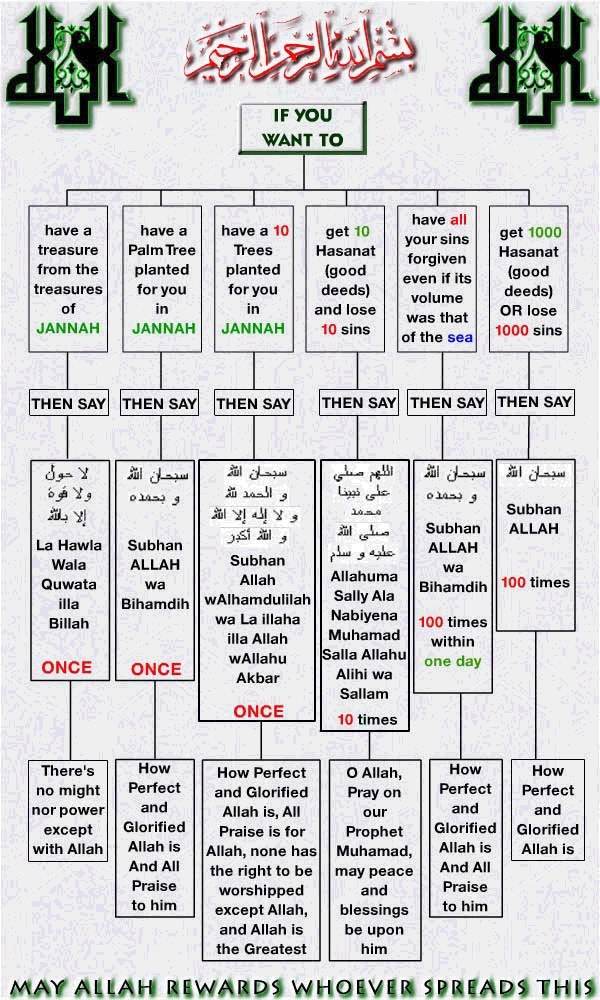
Is one of you so weak that he cannot acquire a thousand good deeds everyday? So a questioner from amongst those sitting there asked him: How can anyone of us gain a thousand rewards?

He said: say:

سُبْحَانَ اللَّهِ

– Far is Allaah from imperfection –

Subhana allaahi

A hundred times, so a thousand good deeds are written for him or a thousand sins are cancelled for him.


6 – The Messenger of Allaah sallAllaahu alayhi wa sallam said :

Shall I not inform you of a statement, which is a treasure from the treasures of Paradise? I said: Yes O Messenger of Allaah, may my father and mother be sacrificed for you! He said: say:

لَا حَوْلَ وَلَا قُوَّةَ إِلَّا بِاللَّهِ

There is no capability nor is there any power except with Allaah.

La hawla wa la quwwata illa billaa


7 – The Messenger of Allaah sallAllaahu alayhi wa sallam said:

Whoso ever, reaches the morning & reaches the evening and he says:

سُبْحَانَ اللَّهِ وَبِحَمْدِهِ

-‘Allaah is far from imperfection and all praise is for Him’ –

Subhana allaahi wa bihamdihi

One hundred times, then no one brings anything better than him on the day of judgment, than what he has brought. Except the one who says what he has said, or has said more than him.


8 – On the authority of Mua’ad bin Abdillaah ibn Khubayb on the authority of his father who said we went out on a very dark and rainy night searching for the Messenger of Allaah so that he could pray for us, then I found him and he sallAllaahu alayhi wa sallam said : Recite. So I did not say anything, then he said: Recite. So I did not say anything, and he said: Recite, so I said: what should I recite? He said: recite:

“قُلْ هُوَ اللَّهُ أَحَدٌ”

‘Say that Allaah is the One.’

And the last two Soorahs (al-muawaathatayan) in the evening and the morning, three times for it will suffice you for everything.


9 – The Messenger of Allaah sallAllaahu alayhi wa sallam said :

Indeed the major supplication for forgiveness is to say

اللَّهُمَّ أَنْتَ رَبِّي لَا إِلَهَ إِلَّا أَنْتَ خَلَقْتَنِي وَأَنَا عَبْدُكَ وَأَنَا عَلَى عَهْدِكَ وَوَعْدِكَ مَا اسْتَطَعْتُ أَعُوذُ بِكَ مِنْ شَرِّ مَا صَنَعْتُ أَبُوءُ لَكَ بِذَنْبِي وَأَبُوءُ لَكَ بِنِعْمَتِكَ عَلَيَّ فَاغْفِرْ لِي فَإِنَّهُ لَا يَغْفِرُ الذُّنُوبَ إِلَّا أَنْتَ

O Allaah You are my Lord, there is none worthy of worship in truth except You, You created me and I am Your slave and I abide to Your covenant and promise as best as I can, I seek refuge in You from the evil that I have committed, I profess to you my sins and I acknowledge Your favour upon me, so forgive me verily no one forgives sins except you.

Allaahumma anta rabbee, la ilaha illa anta, Khalaqtanee, wa ana abduka, wa ana ala ahdika wa wa’dika mastata’tu, a’outhu bika min sharri ma sanatu, aboo’u laka bini’matika alayya, wa aboo’u bee thambee, faghfirlee fa’innahu la yaghfiru ath-thunooba ‘illa ‘anta

So if the worshipper says this when the morning arrives, truly believing in it and he dies, enters Paradise, and if he says this when the evening arrives truly believing in it enters Paradise.


10 – The Messenger of Allaah sallAllaahu alayhi wa sallam said:

There is not one from amongst the worshippers, that if he says, in the morning of everyday and the evening of every night:

بِسْمِ اللَّهِ الَّذِي لَا يَضُرُّ مَعَ اسْمِهِ شَيْءٌ فِي الْأَرْضِ وَلَا فِي السَّمَاءِ وَهُوَ السَّمِيعُ الْعَلِيمُ

In the name of Allaah with whose name nothing is harmed what so ever, on this earth nor in the heavens whatsoever, and He is the All Hearing and All Knowing

Bismil-lahil-lathee la yadhurru ma’a ‘issmihi shay’un fil ‘ardhi wa la fissama’i wa huwa ‘as-samee’ul –‘aleem

Three times nothing harms him what so ever.


11 – On the authority of Abu Huraira –RadhiAllaahu anhu-, the Prophet sallAllaahu alayhi wa sallam had placed Abu Huraira to look after the charity, some one came to him to take from the charity – and this person came night after night, so on the third night Abu Huraira said to him: I will take you to the Messenger of Allaah. So he said Why don’t you leave me and I will teach you some words that Allaah will benefit you by – and Abu Huraira was of those who were very attentive regarding good deeds – so the person said to him: When you go to bed, read Ayaat ul-Kursi:

(الله لا إلهَ إلا هُوَ الحيُ القَيُومَ )

<<Allaah, none has the right to be worshipped except Him The Ever living, The One Who sustains and protects all that exists>>

[verse 255 from Soorah Baqarah]

Until the end of the Ayaah, then this will continue to be a protection for you from Allaah, and Shaytan will not be able to come near you until the morning arrives. The Messenger of Allaah sallAllaahu alayhi wa sallam said: He spoke the truth even though he is a liar, [that was Shaytan].


12 – The Messenger of Allaah sallAllaahu alayhi wa sallam said:

Who ever recites the last two Ayaat from Soorah al-Baqarah at night, then those two verses will be sufficient for him.


13 – The Messenger of Allaah sallAllaahu alayhi wa sallam said:

Shall I not show you what will be better for you than a servant? When you lie down on your bed, say SubhanAllaah 33 times, say al-hamdulillaah 33 times and say Allaahu akbar 34 times.


14 – The Messenger of Allaah sallAllaahu alayhi wa sallam said:

Who ever wakes up at night, and says: –

لَا إِلَهَ إِلَّا اللَّهُ وَحْدَهُ لَا شَرِيكَ لَه،ُ لَهُ الْمُلْكُ وَلَهُ الْحَمْد،ُ وَهُوَ عَلَى كُلِّ شَيْءٍ قَدِيرٌ،الْحَمْدُ لِلَّهِ ،وَ سُبْحَانَ اللَّهِ ، وَلَا إِلَهَ إِلَّا اللَّهُ ، وَاللَّهُ أَكْبَرُ ،وَ لَا حَوْلَ وَلَا قُوَّةَ إِلَّا بِاللَّهِ العليِ الْعَظِيمِ.

‘There is none worthy of worship in truth except Allaah Alone, He has no partners, He has the Dominion and for Him is all praise, and He is capable of all things, praise is for Him, and Far is Allaah from imperfection, and There is none worthy of worship in truth except Allaah, and Allaah is the Greatest, there is no capability nor is there any power except with Allaah the Most High the ‘Atheem.’ (Supreme)

La ilaha ‘illa Allaahu wahdahu la shareeka lahu, lahul mulku wa lahul hamdu wa huwa ala kulli shayin qadeer Subhana allaahi, wal hamdu lillaahi, wa la illaah ila Allaah, wa Allaahu akbar

La hawla wa la quwwata illa billaa

Then he says : اللهمَ اغْفِرْلي O Allaah forgive me (Allaahumma aghfirlee), or he supplicates and his supplication is answered, and if he makes Wudu and prays then his prayer is accepted.


15- The Messenger of Allaah sallAllaahu alayhi wa sallam said:

Who ever goes to bed with purification….there is not an hour of the night that he asks Allaah for something of good from this world and the hereafter, except that Allaah grants him that which he asked for.


16 – Abu Salma said that he heard Abu Qatada say that he heard the Messenger of Allaah sallAllaahu alayhi wa sallam say:

A good dream is from Allaah –Tabaraka wa Ta’ala– and a bad dream is from Shaytaan, so if anyone sees something in his dream which he dislikes, then he should spit on his left side 3 times when he awakens, and he should seek refuge with Allaah from its evil, then it will not harm him if Allaah so wills.


17 – The Messenger of Allaah sallAllaahu alayhi wa sallam said:

A good dream is from Allaah, so if any one of you sees something in his dream that he likes, then he should not relate it to anyone except the one whom he loves, and if he sees that which he dislikes, then he should not relate it to anyone, rather he should spit on his left side 3 times, and he should seek refuge with Allaah from the evil of the accursed shaytaan, and the evil of what he saw, then it will not harm him.


18- The Messenger of Allaah sallAllaahu alayhi wa sallam said:

Our Lord –Tabarak wa Ta’ala- descends every night to the lowest heavens, when there remains the last third part of the night, and He says who is there that supplicates to me so that I may answer his supplication, who is there that asks of me so that I may grant him what he asks for, who is there that seeks my forgiveness so that I may forgive him.


19 – The Messenger of Allaah sallAllaahu alayhi wa sallam said:

Indeed, there is an hour from the night, which if a Muslim asks Allaah in that time from the good of the affairs of this world and the hereafter, then Allaah gives him of it, and that is in every night.


20 – On the authority of Abu Huraira that the Messenger of Allaah sallAllaahu alayhi wa sallam said:

Whoever says, as he leaves from his house:

بِسْمِ اللَّهِ ، تَوَكَّلْتُ عَلَى اللَّهِ ،ولَا حَوْلَ وَلَا قُوَّةَ إِلَّا بِاللَّهِ تعالى

In the name of Allaah, I have placed my trust in Allaah, and there is no capability nor is there any power except with Allaah Ta’ala

Bismillaahi tawwakaltu alalaahi wa la hawla wa la quwwata illa billahi taa’la

then it is said to him: indeed you have been saved, and you have been protected, and you have been guided, and shaytaan has been kept away from him, so another shaytaan says: how can you affect a man who has indeed been guided and saved and been protected.


21 – The Messenger of Allaah sallAllaahu alayhi wa sallam said:

If a man enters his home, and he remembers Allaah when he enters and when he eats his food, the shaytaan says: there is no place for you to spend the night nor is there any dinner. And if he does not remember Allaah when he enters his house then the shaytaan says: you have found a place to spend the night and if he does not remember Allaah while he is eating his food then he says you have found food to eat.


22 – The Messenger of Allaah sallAllaahu alayhi wa sallam said:

O my son if you enter your home then say Salaam it will be a blessing for you and your family.


23 – When the Messenger of Allaah sallAllaahu alayhi wa sallam would enter the Masjid he would say:

أَعُوذُ بِاللَّهِ الْعَظِيمِ وَبِوَجْهِهِ الْكَرِيمِ وَسُلْطَانِهِ الْقَدِيمِ مِنَ الشَّيْطَانِ الرَّجِيمِ

– I seek refuge with Allaah The Supreme and with His Noble Face, and His eternal authority from the accursed shaytaan –

A’outhu bil-lahil ‘atheem, wa bi-wajhihil-kareem, wa bi-sultanihil-qadeem min ‘ash-shayanir-rajeemi

Then he said: if he says this supplication then the shaytaan says: this person has been protected from me for the rest of the day.


24 – The Messenger of Allaah sallAllaahu alayhi wa sallam said:

If the people knew what was there (in benefit for them) in the call to prayer and praying in the front row, and they could not get to it except by drawing lots, then they would draw lots.


25- The Messenger of Allaah sallAllaahu alayhi wa sallam said:

There is none from the Jinn, mankind and anything else that hears the reach of the Muaddthin’s (the caller to prayer) voice except that they will testify for him on the day of Resurrection.


26 – The Messenger of Allaah sallAllaahu alayhi wa sallam said:

If you hear the Muaddthin, then repeat what he says, then send prayers upon me, since indeed the one who sends prayers upon me once, Allaah sends ten prayers upon him. Then ask Allaah for me to be an intercessor since it is a high station in Paradise, which is not befitting except for a servant from the servants of Allaah and I hope that I am the one, so whoever asks intercession for me then intercession will take place for him.


27 -The Messenger of Allaah sallAllaahu alayhi wa sallam said:

Who ever says, when he hears the call to prayer:

اللَّهُمَّ رَبَّ هَذِهِ الدَّعْوَةِ التَّامَّةِ وَالصَّلَاةِ الْقَائِمَةِ آتِ مُحَمَّدًا الْوَسِيلَةَ وَالْفَضِيلَةَ وَابْعَثْهُ مَقَامًا مَحْمُودًا الَّذِي وَعَدْتَهُ

– O Allaah Lord of this perfect call to prayer and Owner of this prayer to be performed, bestow upon Muhammad a station in Paradise and a rank above the rest of creation and give him the honorable station which you have promised him –

Allaahumma rabba hathihi ‘addawatittamati, was-salatil qa’imati, ‘ati Muhammadan ál-waseelata wal faaheelata, wab’ath-hu maqqaman mahmoodan ‘allathee wa’adtahu

then my intercession occurs for him on the day of Judgment.


28- A man said O Messenger of Allaah indeed the callers to the prayer are more favored than we are. So the Messenger of Allaah sallAllaahu alayhi wa sallam said: repeat what they say, and when you finish ask, and you will be given.


29 – The Messenger of Allaah sallAllaahu alayhi wa sallam said:

A supplication that is made between the Adhaan and the Iqama is not rejected.


31 – The Messenger of Allaah sallAllaahu alayhi wa sallam said:

Two things which are not rejected, or rarely rejected: A supplication made at the time of the call to prayer, and at the time when the battle becomes severe.


31 -The Prophet sallAllaahu alayhi wa sallam said:

Shall I not teach you something, which the people who proceeded you attained, and those who come after you will proceed you with, and there will be no-one better than you except the one who does what you do? They said of course O Messenger of Allaah sallAllaahu alayhi wa sallam. So he said: say: – far is Allaah from imperfection, Allaah is the Greatest and Praise is to Allaah – SubanAllaah and Allaahu akbar and Alhamdulillaah at the end of every prayer 33 times each.


32 -The Messenger of Allaah sallAllaahu alayhi wa sallam said:

Whoever says SubhanAllaah at the end of every prayer 33 times, says al-hamdulillaah 33 times, and says Allaahu akbar 33 times, then this adds up to 99, and if he says –

ِ لَا إِلَهَ إِلَّا اللَّهُ وَحْدَهُ لَا شَرِيكَ لَهُ ، لَهُ الْمُلْكُ وَلَهُ الْحَمْدُ وَهُوَ عَلَى كُلِّ شَيْءٍ قَدِيرٌ

‘There is none worthy of worship in truth except Allaah Alone, He has no partners, He has the Dominion and for Him is all praise, and He is capable of all things’

La ilaha ‘illa Allaahu wahdahu la shareeka lahu, lahul mulku wa lahul hamdu wa huwa ala kulli shayin qadeer

To complete a hundred, then his mistakes/sins are forgiven even if they were equivalent to the foam on the sea.


34 – The Messenger of Allaah sallAllaahu alayhi wa sallam said:

There are two characteristics or two qualities that if a Muslim slave of Allaah is continuous upon, will enter Paradise, they are simple but those who do them are few. To say SubhanAllaah at the end of every prayer ten times, says alhamdulillah ten times and says Allaahu akbar ten times, which is equivalent to 150 times on the tongue and 1500 on the scales. And he says Allaahu Akbar 34 times when he goes to bed and he says alhamdulillah 33 times and says SubhanAllaah 33 times, and that is equivalent to 100 on the tongue and 1000 on the scales.


34 – The Messenger of Allaah sallAllaahu alayhi wa sallam used to teach us al-Istikharah (a prayer said for aid in making a decision) for all matters, just like he used to teach us a chapter from the Qur’aan, he would say: If any of you intends to undertake a matter then he should pray two Rakah other than an obligatory prayer then he should say

اللَّهُمَّ إِنِّي أَسْتَخِيرُكَ بِعِلْمِكَ وَأَسْتَقْدِرُكَ بِقُدْرَتِكَ وَأَسْأَلُكَ مِنْ فَضْلِكَ الْعَظِيمِ ، فَإِنَّكَ تَقْدِرُ وَلَا أَقْدِرُ ، وَتَعْلَمُ وَلَا أَعْلَمُ وَأَنْتَ عَلَّامُ الْغُيُوبِ ، اللَّهُمَّ إِنْ كُنْتَ تَعْلَمُ أَنَّ هَذَا الْأَمْرَ خَيْرٌ لِي فِي دِينِي وَمَعَاشِي وَعَاقِبَةِ أَمْرِي أَوْ قَالَ عَاجِلِ أَمْرِي وَآجِلِهِ فَاقْدُرْهُ لِي وَيَسِّرْهُ لِي ثُمَّ بَارِكْ لِي فِيهِ وَإِنْ كُنْتَ تَعْلَمُ أَنَّ هَذَا الْأَمْرَ شَرٌّ لِي فِي دِينِي وَمَعَاشِي وَعَاقِبَةِ أَمْرِي أَوْ قَالَ فِي عَاجِلِ أَمْرِي وَآجِلِهِ فَاصْرِفْهُ عَنِّي وَاصْرِفْنِي عَنْهُ وَاقْدُرْ لِيَ الْخَيْرَ حَيْثُ كَانَ ثُمَّ أَرْضِنِي بِهِ

O Allaah I request of You with Your knowledge, and by Your Power I seek capability, and I ask of you of your great favour, since indeed You are the One who is able while I am not, and You know and I do not, and You are the One who knows the unseen. O Allaah if You know that this matter – here he mentions his need – is good for me in this world and for my living and for the matters of my hereafter – or he said, for my affairs now and the future – then decree it for me and make it easy for me and bless it for me. And if You know that this matter is evil for me in this world and for my life and for the matters of my hereafter – or he said, for my affairs now and the affairs of my future – then turn it away from me and turn me away from it, and decree goodness for me where ever it may be and make me pleased with it.


35 – The Messenger of Allaah sallAllaahu alayhi wa sallam said:

The supplication of Yunas, when he supplicated while he was in the belly of the whale:

لَا إِلَهَ إِلَّا أَنْتَ سُبْحَانَكَ إِنِّي كُنْتُ مِنَ الظَّالِمِينَ

– There is none worthy of worship in truth except You, far are You from imperfection, indeed I am from amongst the Thalimoon(oppressors) –

La ilaha ‘illa ‘anta, subhanaka ‘innee kuntu minath-thalimeena

No Muslim ever supplicates with this for anything except that Allaah responds to him.


36 – The Messenger of Allaah sallAllaahu alayhi wa sallam said:

Allaah does not afflict a slave with grief nor sadness, except that if the slave says: –

اللَّهُمَّ إِنِّي عَبْدُكَ وَابْنُ عَبْدِكَ وَابْنُ أَمَتِكَ نَاصِيَتِي بِيَدِكَ مَاضٍ فِيَّ حُكْمُكَ ، عَدْلٌ فِيَّ قَضَاؤُكَ ، أَسْأَلُكَ بِكُلِّ اسْمٍ هُوَ لَكَ سَمَّيْتَ بِهِ نَفْسَكَ أَوْ عَلَّمْتَهُ أَحَدًا مِنْ خَلْقِكَ أَوْ أَنْزَلْتَهُ فِي كِتَابِكَ أَوِ اسْتَأْثَرْتَ بِهِ فِي عِلْمِ الْغَيْبِ عِنْدَكَ أَنْ تَجْعَلَ الْقُرْآنَ رَبِيعَ قَلْبِي وَنُورَ صَدْرِي وَجِلَاءَ حُزْنِي وَذَهَابَ هَمِّي

O Allaah indeed I am Your slave, and the son of Your slave, and the son of Your female slave, my forelock is in Your Hand, Your command over me is forever executed and Your decree over me is just. I ask of You with all Your names, which belong to You, which You have named Yourself with, or which You have taught someone from Your creation or revealed it in Your Book or that which You have taken unto Your self with the knowledge of the unseen with You, that You make the Qur’aan the life of my heart and light of my breast and keep away from me my sadness, and that my grief goes away –

Allaahumma ‘innee ‘abduka, wabnu ‘abdika, wabnu amatika, nasiyatee biyadika, madhin fiyya hukmuka, adlun fiyya qadha’uka, asaluka bikulli ismin huwa laka, sammayta bihi nafsaka, aw anzaltahu fee kitabika, ‘aw allamthu ahadan min khaliqika, aw ista’tharta bihi fee ilmil ghaybi ‘indaka, án taj’alal-qurana rabee’a qalbee, wa noora sadree, wa jala’a huznee, wa thahaba hammee

Then Allaah takes away his grief and sadness and replaces it with happiness.


37 – Uthman ibn al-Aas came to the Messenger of Allaah sallAllaahu alayhi wa sallam and said: O Messenger of Allaah indeed the shaytaan comes between me and my prayer, and my recitation becomes confusing? The Messenger of Allaah sallAllaahu alayhi wa sallam said: This is a shaytaan called khunsabun, so if you sense his presence then seek refuge in Allaah from him and spit on your left hand side three times. Uthman said: I did that and Allaah kept him away from me.


39 – The Messenger of Allaah sallAllaahu alayhi wa sallam said:

There is no one from among Allaah’s servants, who is afflicted with an affliction except that he says: –

 إِنَّا لِلَّهِ وَإِنَّا إِلَيْهِ رَاجِعُونَ  اللَّهُمَّ أْجُرْنِي فِي مُصِيبَتِي وَأَخْلِفْ لِي خَيْرًا مِنْهَا

Indeed, we belong to Allaah and indeed to Him is our return – O Allaah recompense me for my affliction and replace it with something better than that

Inna lil-lahi wa inna ‘ilayhi raji’oona, ‘allahumma’jurnee fee museebatee, wa ákhliflee khayran minha

Except that Allaah compensates him in what he has been afflicted with, and gives him that which is better than the previous thing.


40 – ‘Alee –RadhiAllaahu anhu:

Shall I not teach you words that the Messenger of Allaah sallAllaahu alayhi wa sallam taught me that even if you have an equivalent of a mountain of debt upon you that Allaah will pay it off on you behalf? Say: –

َ اللَّهُمَّ اكْفِنِي بِحَلَالِكَ عَنْ حَرَامِكَ وَأَغْنِنِي بِفَضْلِكَ عَمَّنْ سِوَاكَ

O Allaah make what You have made lawful sufficient for me, as opposed to what You have made unlawful, and spare me by Your grace, from the need of others.

Allahumma ikfeenee bihalalieeka ‘an harameeka wa ‘aghninee bifadhlieeka ‘amman siwaka


41 – Uthmaan bin Abee al-Aaas complained to the Messenger of Allaah sallAllaahu alayhi wa sallam about a pain he had in his body since he had become Muslim, so the Messenger of Allaah sallAllaahu alayhi wa sallamsaid to him: place your hand on the part of your body that pains you and then say: –

بِاسْمِ اللَّهِ

In the name of Allaah, – three times,

and say seven times : –

أَعُوذُ بِاللَّهِ وَقُدْرَتِهِ مِنْ شَرِّ مَا أَجِدُ وَأُحَاذِرُ

I seek refuge with Allaah and with His Capability from the evil that I feel and wary of

‘Aouthu bi’izzatil-lahi waqudratihi min sharri ma ‘ajidu wa’uhathiru


42 -The Messenger of Allaah sallAllaahu alayhi wa sallam said:

Who ever visits a sick person who has not reached his appointed time, then says for him seven times: –

أَسْأَلُ اللَّهَ الْعَظِيمَ رَبَّ الْعَرْشِ الْعَظِيمِ أَنْ يَشْفِيَكَ

I ask Allaah The ‘Atheem (The Supreme), Lord of the magnificent ‘Arsh to cure you –

Except that Allaah cures him.

As’alul-laha ‘al-atheema, rabbal ‘arshil átheemi an yashfika


43 – The Messenger of Allaah sallAllaahu alayhi wa sallam said:

Who ever stops at a place on his journey and then says: –

أَعُوذُ بِكَلِمَاتِ اللَّهِ التَّامَّاتِ مِنْ شَرِّ مَا خَلَقَ

I seek refuge in the perfect words of Allaah from the evil of what He has created –

A’outhu bikalimatil-lahi ‘at-tammati min sharri ma khalaqa

nothing will harm him until he leaves from that place.


44 – The Messenger of Allaah sallAllaahu alayhi wa sallam said:

Whoever eats some food and then says: –

الْحَمْدُ لِلَّهِ الَّذِي أَطْعَمَنِي هَذَا وَرَزَقَنِيهِ مِنْ غَيْرِ حَوْلٍ مِنِّي وَلَا قُوَّةٍ

All praise be to Allaah Who fed me this food and provided it for me without any ability from my self nor any strength from my self –

Al-hamdu lil-lahi ‘al-lathee at-‘amanee hatha, wa razaqaneehi min ghayri hawlin minnee wa la quwwatin

except that his previous sins are forgiven.

46 – The Messenger of Allaah sallAllaahu alayhi wa sallam said:

You will not enter Paradise until you believe, and you will not believe until you love one another, shall I not show you something that by doing it, will cause you to love one another, spread salaams between yourselves.

47 – Imran bin Hussain said: that a man came to the Messenger of Allaah sallAllaahu alayhi wa sallam and said: Peace be to you.

The Messenger of Allaah said: ten.

Then another man came and said: Peace be to you and the mercy of Allaah, the Messenger of Allaah said: twenty.

Then another man came and said : Peace be to you and the mercy of Allaah and His blessings, the Messenger of Allaah sallAllaahu alayhi wa sallamsaid: thirty.


47 – The Messenger of Allaah sallAllaahu alayhi wa sallam said:

If one of you wants to have relations with his wife and says: –

بِاسْمِ اللَّهِ اللَّهُمَّ جَنِّبْنَا الشَّيْطَانَ وَجَنِّبِ الشَّيْطَانَ مَا رَزَقْتَنَا

In the name of Allaah, O Allaah keep shaytaan away from us and keep shaytaan away from that which You provide for us –

Bismillahi allaahumma jannibna ash-shaytana, wajannib ásh-shaytana ma razaqtana

so if a child is born from them then shaytaan will never be able to harm him.


48 – The Messenger of Allaah sallAllaahu alayhi wa sallam said:

Whoever sits in a gathering and speaks a lot, then he says before he gets up from his sitting place –

سُبْحَانَكَ اللَّهُمَّ وَبِحَمْدِكَ أَشْهَدُ أَنْ لَا إِلَهَ إِلَّا أَنْتَ أَسْتَغْفِرُكَ وَأَتُوبُ إِلَيْكَ

You are far from imperfection O Allaah, and praise is to You, I testify that there is none worthy of worship in truth except You, I seek Your forgiveness, and I repent to You –

Subhanaka allahumma wa bihamdika, ash-hadu alla ilaha illa anta, astaghfiruka wa atoobu ilayka

except that Allaah covers up for him what he said in that gathering.


49 – Sulaymaan bin Suradin said : I was sitting with the Prophet sallAllaahu alayhi wa sallam and two men were cursing, and one of them his face became red, and he became furious, the Messenger of Allaah sallAllaahu alayhi wa sallam said: indeed I know a statement if he says it then his anger will go away, if he says: –

أَعُوذُ بِاللَّهِ مِنَ الشَّيْطَانِ الرَّجِيمِ

I seek refuge in Allaah from the accursed shaytaan –

then his anger will go away.


50 – The Messenger of Allaah sallAllaahu alayhi wa sallam said:

Whoever sees some one who has been tried and then says: –

الْحَمْدُ لِلَّهِ الَّذِي عَافَانِي مِمَّا ابْتَلَاكَ بِهِ وَفَضَّلَنِي عَلَى كَثِيرٍ مِمَّنْ خَلَقَ تَفْضِيلًا

Praise be to Allaah Who has saved me from what He has trialed you with and chosen me above much of the creation –

Alhamdu lil-lahi allathee afanee mimma ibtalaka bihi, wa fadh-dhalanee ala katheerin mimman khalaqa tafdheelan

then that trial will not afflict him.


51 – The Messenger of Allaah sallAllaahu alayhi wa sallam said:

Whoever enters the market place and says –

لَا إِلَهَ إِلَّا اللَّهُ وَحْدَهُ لَا شَرِيكَ لَهُ ، لَهُ الْمُلْكُ وَلَهُ الْحَمْدُ يُحْيِي وَيُمِيتُ وَهُوَ حَيٌّ لَا يَمُوتُ بِيَدِهِ الْخَيْرُ وَهُوَ عَلَى كُلِّ شَيْءٍ قَدِيرٌ

‘There is none worthy of worship in truth except Allaah Alone, He has no partners, He has the Dominion and for Him is all praise, He gives life and He takes life and He is the Ever living and does not die, in His Hand is goodness and He is capable of all things.’ –

La ilaha ‘illa Allaahu wahdahu la shareeka lahu, lahul mulku wa lahul hamdu yuhyee wa youmeet wa huwa hayun la yamoot biyadihi alkhair wa huwa ala kulli shayin qadeer

then Allaah writes a thousand thousand good deeds for him, and erases a thousand thousand bad deeds for him, and He raises him up a thousand thousand grades.


All Praise belongs to Allaah, may His peace and blessings be upon our final Prophet Muhammad, his family, his companions and all those who follow his guidance.

Remembrance of Allah in the Morning and in the Evening

Imam Al-Nawawi’s Riyad-us-Saliheen
Chapter 248
Remembrance of Allah in the Morning and in the Evening

Allah, the Exalted, says:

وَاذْكُر رَّبَّكَ فِي نَفْسِكَ تَضَرُّعًا وَخِيفَةً وَدُونَ الْجَهْرِ مِنَ الْقَوْلِ بِالْغُدُوِّ وَالْآصَالِ وَلَا تَكُن مِّنَ الْغَافِلِينَ

And remember your Rubb by your tongue and within yourself, humbly and with fear and without loudness in words in the mornings, and in the afternoons and be not of those who are neglectful. (7:205)

وَسَبِّحْ بِحَمْدِ رَبِّكَ قَبْلَ طُلُوعِ الشَّمْسِ وَقَبْلَ غُرُوبِهَا

And declare the perfectness of your Rubb before the rising of the sun, and before its setting.” (20:130)

وَسَبِّحْ بِحَمْدِ رَبِّكَ بِالْعَشِيِّ وَالْإِبْكَارِ

And declare the perfectness of your Rubb and praise Him in the `Ashi (i.e., the time period after the midnoon till sunset) and in the Ibkar(i.e., the time period from early morning or sunrise till before midnoon).” (40:55)

فِي بُيُوتٍ أَذِنَ اللَّهُ أَن تُرْفَعَ وَيُذْكَرَ فِيهَا اسْمُهُ يُسَبِّحُ لَهُ فِيهَا بِالْغُدُوِّ وَالْآصَالِ رِجَالٌ لَّا تُلْهِيهِمْ تِجَارَةٌ وَلَا بَيْعٌ عَن ذِكْرِ اللَّهِ وَإِقَامِ الصَّلَاةِ وَإِيتَاءِ الزَّكَاةِ ۙ يَخَافُونَ يَوْمًا تَتَقَلَّبُ فِيهِ الْقُلُوبُ وَالْأَبْصَارُ

In houses (mosques) which Allah has ordered to be raised (to be cleaned, and to be honoured), in them His Name is mentioned in the mornings and in the afternoons or the evenings. Men whom neither trade nor sale diverts from the remembrance of Allah (with heart and tongue). (24:36,37)

إِنَّا سَخَّرْنَا الْجِبَالَ مَعَهُ يُسَبِّحْنَ بِالْعَشِيِّ وَالْإِشْرَاقِ

Verily, We made the mountains to declare the Perfectness of Allah with him [Dawud (David)] in the `Ashi (i.e., after the midday till sunset) and Ishraq (i.e., after the sunrise till midday). (38:18)

1451. Abu Hurairah (May Allah be pleased with him) reported: The Messenger of Allah (sallallaahu alayhi wa sallam) said,

He who recites in the morning and in the evening the statement: `Subhan-Allahi wa bihamdihi (Allah is free from imperfection and I begin with praising Him)’ one hundred times, will not be surpassed on the Day of Resurrection by anyone with better deeds than one who utters the same words or utters more of these words.”

[Muslim].

1452. Abu Hurairah (May Allah be pleased with him) reported: A man came to the Prophet (sallallaahu alayhi wa sallam) and said, “What a trouble I suffered from a scorpion which stung me last night!” He (sallallaahu alayhi wa sallam) said,

Had you said in the evening: `A`udhu bikalimatillahit-tammati min sharri ma khalaqa (I seek the protection of Allah’s Perfect Words from the evil of whatever He has created),’ it would not have harmed you.”

[Muslim].

1453. Abu Hurairah (May Allah be pleased with him) reported: The Prophet (sallallaahu alayhi wa sallam) used to say in the morning:

Allahumma bika asbahna, wa bika amsaina, wa bika nahya, wa bika namutu, wa ilaikan-nushur

(O Allah! With Your Power we have come to the morning, with Your Power we come to the evening, with Your Power we live, and we die, and to You will we return).”

In the evening he would say:

Allahumma bika amsaina, wa bika nahya, wa bika namutu, wa ilaikan-nushur

(O Allah! With Your Power, we have come to the evening, by You do we live, by You do we die, and to You is the return).”

[At-Tirmidhi and Abu Dawud].

1454. Abu Hurairah (May Allah be pleased with him) reported: Abu Bakr asked, “O Messenger of Allah! Teach me some words so that I may recite them in the morning and in the evening.” The Messenger of Allah (sallallaahu alayhi wa sallam) said,

Recite these words: `Allahumma fatiras-samawati wal-ardi, `alimal-ghaibi wash-shahadati, Rabba kulli shai’in wa malikahu. Ash-hadu an la ilaha illa Anta, a`udhu bika min sharri nafsi, wa sharrish-Shaitani wa shirkihi

(O Allah! Creator of the heavens and the earth! Knower of the hidden and the exposed! Rubb of everything and every one. I bear witness that none has the right to be worshipped but You. I seek Your Protection from the evil of my own self from the evil of Satan and from the evil of Shirk to which he calls).”’

The Messenger of Allah (sallallaahu alayhi wa sallam) added: “Recite these words in the morning and the evening and when you go to bed.”

[Abu Dawud and At-Tirmidhi].

1455. `Abdullah bin Mas`ud (May Allah be pleased with him) reported: When it was evening, the Prophet (sallallaahu alayhi wa sallam) used to supplicate:

Amsaina wa amsal-mulku lillah, wal-hamdu lillah. La `ilaha illallahu wahdahu la sharika lahu

(We have entered upon evening and the whole kingdom of Allah, too, has entered upon evening. Praise is due to Allah. There is none who has the right to be worshiped but Allah, the One who has no partner with Him).”

He (the narrator) said: I think that he (sallallaahu alayhi wa sallam) used to follow the recitation with these words:

Lahul-mulku, wa lahul-hamdu, wa Huwa `ala kulli shi’in Qadir. Rabbi as’aluka khaira ma fi hadhihil-lailati, wa khaira ma ba`daha; wa a`udhu bika min sharri ma fi hadhihil-lailati, wa sharri ma ba`daha; Rabbi a`udhu bika minal-kasali, wa suil-kibari; Rabbi a`udhu bika min `adhabin fin-nari, wa `adhabin fil-qabri

(His is the sovereignty and to Him is all praise due, and He is Omnipotent. My Rubb, I beg of you good that lies in this night and good that follows it, and I seek refuge in You from the evil that lies in this night and from the evil of that which follows it. My Rubb! I seek refuge in You from lethargy and the misery of old age. O Allah! I seek Your Protection from the torment of Hell-fire and the punishment of the grave).”

When it was morning, he (sallallaahu alayhi wa sallam) would recite the same, replacing the words:

We have entered upon evening and the whole kingdom of Allah, too, has entered upon evening” with “We have entered upon morning and the whole kingdom of Allah entered upon morning.”

(Replace the words “Amsaina, amsa, hadhihil-lailati, ma ba`daha with Asbahna, asbaha, hadhal-yaumi, ma ba`dahu, respectively.)

[Muslim].

1456. `Abdullah bin Khubaib (May Allah be pleased with him) reported: The Messenger of Allah (sallallaahu alayhi wa sallam) said to me, “Recite Surat Al-Ikhlas and Al-Mu`awwidhatain (Surat Al-Falaq and Surat An-Nas) three times at dawn and dusk. It will suffice you in all respects.”
[Abu Dawud and At-Tirmidhi].

1457. `Uthman bin `Affan (May Allah be pleased with him) reported: The Messenger of Allah (sallallaahu alayhi wa sallam) said, “He who recites three times every morning and evening:

بِسْمِ اللهِ الَّذِي لَا يَضُرُّ مَعَ اسْمِهِ شَيْءٌ فِي الأَرْضِ وَلَا فِي السَّمَاءِ وَهُوَ السَّمِيعُ الْعَلِيمُ

Bismillahil-ladhi la yadurru ma`as-mihi shai’un fil-ardi wa la fis-sama’i, wa Huwas-Sami`ul-`Alim (In the Name of Allah with Whose Name there is protection against every kind of harm in the earth or in the heaven, and He is the All-Hearing and All-Knowing),’

nothing will harm him.” [Abu Dawud and At-Tirmidhi].

Source: Dar-us-salam English Publication of Riyad-us-Saliheen

Related Links:

The Excellence of Gathering in which Allah is Remembered

Imam Al-Nawawi’s Riyad-us-Saliheen
Chapter 247
The Excellence of Gathering in which Allah is Remembered

Allah, the Exalted, says:

And keep yourself (O Muhammad (sallallaahu ’alayhi wa sallam)) patiently with those who call on their Rubb (i.e., your companions who remember their Rubb with glorification, praising in prayers, and other righteous deeds) morning and afternoon, seeking His Face; and let not your eyes overlook them.” (18:28)

1447. Abu Hurairah (May Allah be pleased with him) reported: The Messenger of Allah (sallallaahu ’alayhi wa sallam) said, “Allah, the Exalted, has teams of angels who go about on the roads seeking those who remember Allah. When they find some people remembering Allah they call to one another and say, `Come to what you are looking for;’ and they surround them with their wings till the space between them and the lowest sky is fully covered. Allah, the Exalted and Glorious, asks them (although He is best informed about every thing): `What are my slave saying?’ They say: `They are glorifying Your Tasbih, Tahmid, Takbir, Tamjid, (i.e., they were declaring Your Perfectness, praising, remembering the Greatness and Majesty of Allah).’ He asks: `Have they seen Me?’ They reply, `No, indeed, they have not seen You.’ He asks: `How would they act if they were to see Me?’ Thereupon they reply: `If they were to see You, they would engage more earnestly in worshipping and glorifying You and would extol You more.’ He would say: `What do they beg of Me?’ They say, `They beg You for Your Jannah.’ Allah says, `Have they seen My Jannah?’ They say, `No, our Rubb.’ He says: `How would they act if they were to see My Jannah?’ They reply, `Were they to see it, they would more intensely eager for it.’ They (the angels) say, `They seek Your Protection.’ He asks, `Against what do they seek My Protection?’ They (the angels) say, `Our Rubb, from the fire of Hell.’ (He, the Rubb) says, `Have they seen the fire of Hell?’ They say, `No. By Your Honour, they have not seen it.’ He says: `How would they act if they were to see My Fire?’ They say: `If they were to see it, they would more earnest in being away from it and fearing it. They beg of Your forgiveness.’ He says: `I call you to witness that I hereby grant pardon to them and confer upon them what they ask for; and grant them protection against what they seek protection from.’ One of the angels says: `Our Rubb, there is amongst them such and such slave who does not belong to the assembly of those who are participating in Your remembrance. He passed by them and sat down with them.’ He says: `I also grant him pardon because they are the people by virtue of whom their associates will not be unfortunate‘.”
[Al-Bukhari and Muslim].

(The narration in Muslim is also the same with minor changes in wordings).

1448. Abu Hurairah and Abu Sa`id Al-Khudri (May Allah be pleased with them) reported: The Messenger of Allah (sallallaahu ’alayhi wa sallam) said, “When a group of people assemble for the remembrance of Allah, the angels surround them (with their wings), (Allah’s) mercy envelops them, Sakinah, or tranquillity descends upon them and Allah makes a mention of them before those who are near Him.”
[Muslim].

1449. Abu Waqid Al-Harith bin `Auf (May Allah be pleased with him) reported: The Messenger of Allah (sallallaahu ’alayhi wa sallam) was sitting in the mosque with his Companions when three people came to him. Two of them stepped forward to the Messenger of Allah (sallallaahu ’alayhi wa sallam) and the third went away. Those two men stood by the side of Messenger of Allah (sallallaahu ’alayhi wa sallam). One of them found a space in the circle and he filled it, while the other one sat behind him. When the Messenger of Allah (sallallaahu ’alayhi wa sallam) finished, he said, “Shall I not inform you about these three people? One of them sought refuge with Allah and Allah gave him refuge; the second one felt shy and Allah showed kindness to his shyness (and so he was accommodated in that meeting), and the last one averted, and so Allah turned away His Attention from him.”
[Al-Bukhari and Muslim].

1450. Abu Sa`id Al-Khudri (May Allah be pleased with him) reported: Mu`awiyah (May Allah be pleased with him) came to an assembly in the mosque and asked them: “What has made you sit together?” They replied, “We are sitting here to remember Allah.” He said, “I adjure you by Allah to tell me whether nothing else has made you to sit together.” They replied: “By Allah! We are sitting only to remember Allah.” Then he said, “I did not adjure you because I suspected you. No one of my rank in the eyes of the Messenger of Allah (sallallaahu ’alayhi wa sallam) is the narrator of so few traditions as I am. The fact is that the Messenger of Allah (sallallaahu ’alayhi wa sallam) went out to a circle of his Companions and said, `What has made you sit there?‘ When they replied that they are sitting together to remember Allah and to praise Him for guiding them to Islam and bestowing favours on them, he (sallallaahu ’alayhi wa sallam) said, `I adjure you by Allah to tell me that nothing else has made you sit together.’ On their reply that there was certainly no other purpose, he (sallallaahu ’alayhi wa sallam) said, `I did not adjure you because I suspected you, but Jibril (Gabriel) came to me and told me that Allah was talking proudly of you to the angels.”’

[Muslim].

The Excellence of the Remembrance of Allah

Imam Al-Nawawi’s Riyad-us-Saliheen
Chapter 244
The Excellence of the Remembrance of Allah

Allah, the Exalted, says:

And the remembering (praising) of (you by) Allah (in front of the angels) is greater indeed [than your remembering (praising) of Allah in prayers]” (29:45)

Therefore remember Me (by praying, glorifying). I will remember you.” (2:152)

And remember your Rubb by your tongue and within yourself, humbly and with fear and without loudness in words, in the mornings and in the afternoons, and be not of those who are neglectful.” (7:205)

And remember Allah much, that you may be successful.” (62:10)

Verily, the Muslims (those who submit to Allah in Islam) men and women… (up to)… And the men and the women who remember Allah much with their hearts and tongues. Allah has prepared for them forgiveness and a great reward (i.e., Jannah).” (33:35)

O you who believe! Remember Allah with much remembrance. And glorify His Praises morning and afternoon [the early morning (Fajr) and `Asr prayers].” (33:41,42)

1408. Abu Hurairah (May Allah be pleased with him) reported: The Messenger of Allah (sallallaahu ’alayhi wa sallam) said, “There are two statements that are light for the tongue to remember, heavy in the Scales and are dear to the Merciful: `Subhan-Allahi wa bihamdihi, Subhan-Allahil-Azim [Glory be to Allah and His is the praise, (and) Allah, the Greatest is free from imperfection)‘.”
[Al-Bukhari and Muslim].

1409. Abu Hurairah (May Allah be pleased with him) reported: The Messenger of Allah (sallallaahu ’alayhi wa sallam) said, “The uttering of the words: “Subhan-Allah (Allah is free from imperfection), Al-hamdu lillah (all praise is due to Allah), La ilaha illallah (there is no true god except Allah) and Allahu Akbar (Allah is the Greatest)’ is dearer to me than anything over which the sun rises.”
[Muslim].

1410. Abu Hurairah (May Allah be pleased with him) reported: The Messenger of Allah (sallallaahu ’alayhi wa sallam) said, “He who utters a hundred times in a day these words: `La ilaha illallahu, wahdahu la sharika lahu, lahul-mulku wa lahul-hamdu, wa Huwa `ala kulli sha’in Qadir (there is no true god except Allah. He is One and He has no partner with Him; His is the sovereignty and His is the praise, and He is Omnipotent),’ he will have a reward equivalent to that for emancipating ten slaves, a hundred good deeds will be recorded to his credit, hundred of his sins will be blotted out from his scroll, and he will be safeguarded against the devil on that day till the evening; and no one will exceed him in doing more excellent good deeds except someone who has recited these words more often than him. And he who utters: `Subhan-Allahi wa bihamdihi (Allah is free from imperfection and His is the praise)’ one hundred times a day, his sins will be obliterated even if they are equal to the extent of the foam of the ocean.”
[Al-Bukhari and Muslim].

1411. Abu Ayyub Al-Ansari (May Allah be pleased with him) reported: The Prophet (sallallaahu ’alayhi wa sallam) said: “He who utters ten times: `La ilaha illallahu, wahdahu la sharika lahu, lahulmulku wa lahulhamdu, wa Huwa `ala kulli sha’in Qadir (there is no true god except Allah. He is One and He has no partner with Him. His is the sovereignty and His is the praise, and He is Omnipotent),’ he will have a reward equal to that for freeing four slaves from the progeny of Prophet Isma`il.”
[Al-Bukhari and Muslim].

1412. Abu Dharr (May Allah be pleased with him) reported: The Messenger of Allah (sallallaahu ’alayhi wa sallam) said to me, “Shall I tell you the expression that is most loved by Allah?” It is `Subhan-Allahi wa bihamdihi’ (Allah is free from imperfection and His is the praise)’.
[Muslim].

1413. Abu Malik Al-Ash`ari (May Allah be pleased with him) reported: The Messenger of Allah (sallallaahu ’alayhi wa sallam) said, “Wudu’ is half of Salat, and the expression: `Subhan-Allah (Allah is free from imperfection)’ fills the Balance, and the expression: `Al-hamdu lillah (praise be to Allah)’ fills the space between the heavens and the earth.”
[Muslim].

1414. Sa`d bin Abu Waqqas (May Allah be pleased with him) reported: A bedouin came to the Messenger of Allah (sallallaahu ’alayhi wa sallam) and said to him, “Teach me a few words to recite frequently.” He (sallallaahu ’alayhi wa sallam) said, “Say: “La ilaha illallahu wahdahu la sharika lahu; Allahu Akbar kabiran, wal-hamdu lillahi kathiran, wa subhan-Allahi Rabbil-`alamin; wa la hawla wa la quwwata illa billahil-`Azizil-Hakim (there is no true god except Allah the One and He has no partner with Him; Allah is the Greatest and greatness is for Him. All praise is due to Him. Allah, the Rubb of the worlds is free from imperfection; there is no might and power but that of Allah, the All-Powerful and the All-Wise.)”’ The bedouin said: “All of these for my Rubb. But what is for me?” Thereupon he (Messenger of Allah (sallallaahu ’alayhi wa sallam)) said, “You should say: `Allahummaghfir li, warhamni, wahdini, warzuqni (O Allah! Grant me pardon, have mercy upon me, direct me to righteousness and provide me subsistence)‘.”
[Muslim].

1415. Thauban (May Allah be pleased with him) reported: Whenever the Messenger of Allah (sallallaahu ’alayhi wa sallam) concluded his prayer, he would beg forgiveness from Allah thrice and then would recite: “Allahumma Antas-Salamu, wa minkas-salamu, tabarakta ya Dhal-Jalali wal-Ikram (O Allah, You are the Grantor of security, and security comes from You. You are Blessing, O You Who have majesty and nobility)!” (Imam) Al-Awza`i, one of the narrators of this Hadith, was asked: “How forgiveness is to be sought?” He answered: “The Messenger of Allah (sallallaahu ’alayhi wa sallam) used to say: `Astaghfirullah! Astaghfirullah! (I beseech Allah for forgiveness, I beseech Allah for forgiveness)’.”
[Muslim].

1416. Al-Mughirah bin Shu`bah (May Allah be pleased with him) reported: Messenger of Allah (sallallaahu ’alayhi wa sallam) used to say at the conclusion of prayer: “La ilaha illallahu wahdahu la sharika lahu, lahul-mulku, wa lahul-hamdu, wa Huwa `ala kulli shai’in Qadir. Allahumma la mani`a lima a’tayta, wa la mu`tiya lima mana`ta, wa la yanfa`u dhal-jaddi, minkal-jaddu (there is no true god except Allah. He is One and He has no partner with Him, His is the sovereignty and His is the praise, and He is Omnipotent. O Allah! None can deny that which You bestow and none can bestow that which You hold back; and the greatness of the great will be of no avail to them against You).”
[Al-Bukhari and Muslim].

1417. It has been reported that `Abdullah bin Zubair (May Allah be pleased with them) used to recite after Taslim at the conclusion of every Salat (prayer): “La ilaha illallahu wahdahu la sharika lahu, lahul-mulku, wa lahul-hamdu, wa Huwa `ala kulli shai’in Qadir. La hawla wa la quwwata illa billah. La ilaha illallahu, wa la na`budu illa iyyahu, Lahun-ni`matu, wa lahul-fadlu, wa lahuth-thana’ul-hasan. La ilaha ilallahu, mukhlisina, lahud-dina, wa lau karihal-kafirun (there is no true god except Allah; He is One. To Him belongs the dominion and to Him is all praise, and He is Powerful over all things. There is no power and might except with (the help of) Allah. There is no God but Allah and we worship none except Him, to Him belongs the bounty and to Him belongs the grace, and to Him belongs all excellent praise; there is no deity but Allah. We reserve our devotion exclusively for Him though the disbelievers may detest it).” Ibn Az-Zubair said: The Messenger of Allah (sallallaahu ’alayhi wa sallam) used to celebrate Allah’s Greatness in those terms after every Salat (prayer).
[Muslim].

1418. Abu Hurairah (May Allah be pleased with him) reported: The poor Emigrants came to the Messenger of Allah (sallallaahu ’alayhi wa sallam) and said: “The wealthy have gone with the highest ranks and lasting bliss.” He asked: “How is that?” They replied: “They offer Salat (prayer) as we offer it; they observe fast as we do; (and as they are wealthy) they perform Hajj and `Umrah, and go for Jihad, and they spend in charity but we cannot, and they free the slaves but we are unable to do so.” The Messenger of Allah (sallallaahu ’alayhi wa sallam) said, “Shall I not teach you something with which you may overtake those who surpassed you and with which you will surpass those who will come after you? None will excel you unless he who does which you do.” They said: “Yes, please do, O Messenger of Allah” He (sallallaahu ’alayhi wa sallam) said, “You should recite: Tasbih (Allah is free from imperfection), Takbir (Allah is Greatest), Tahmid (Praise be to Allah) thirty-three times after each Salat.”
[Al-Bukhari and Muslim].

Abu Salih, the subnarrator of the Hadith said, when Abu Hurairah (May Allah be pleased with him) was asked about the manner of reciting Tasbih, Tahmid and Takbir, he said, “Recite: “Subhan-Allah, wal-hamdulillah, wallahu Akbar’, till all are recited thirty-three times.

1419. Abu Hurairah (May Allah be pleased with him) reported: The Messenger of Allah (sallallaahu ’alayhi wa sallam) said, “He who recites after every prayer: Subhan-Allah (Allah is free from imperfection) thirty-three times; Al-hamdu lillah (praise be to Allah) thirty-three times; Allahu Akbar (Allah is Greatest) thirty-three times; and completes the hundred with: La ilaha illallahu, wahdahu la sharika lahu, lahul-mulku wa lahul-hamdu, wa Huwa `ala kulli shai’in Qadir (there is no true god except Allah. He is One and He has no partner with Him. His is the sovereignty and His is the praise, and He is Omnipotent), will have all his sins pardoned even if they may be as large as the foam on the surface of the sea.
[Muslim].

1420. Ka`b bin `Ujrah (May Allah be pleased with him) reported: The Messenger of Allah (sallallaahu ’alayhi wa sallam) said, “There are some words, the reciters of which will never be disappointed. These are: Tasbih [saying `Subhan-Allah’ (Allah is free from imperfection)], thirty-three times, Tahmid [saying `Al-hamdu lillah’ (praise be to Allah)] thirty-three times and Takbir [saying `Allahu Akbar’ (Allah is Greatest)] thirty-four times; and these should be recited after the conclusion of every prescribed prayer.”
[Muslim]

1421. Sa`d bin Abu Waqqas (May Allah be pleased with him) reported: The Messenger of Allah (sallallaahu ’alayhi wa sallam) used to seek (Allah’s) protection after prayers in these words: “Alla-humma inni a`udhu bika minal-jubni wal-bukhl, wa a`udhu bika min an uradda ila ardhalil-`umur, wa a`udhu bika min fitnatid-dunya, wa a`udhu bika min fitnatil-qabr (O Allah, I seek refuge with You from cowardice, miserliness and from being sent back to a feeble age; and, seek refuge with You from the trials of this life and those of the grave).”
[Al-Bukhari].

1422. Mu`adh (May Allah be pleased with him) reported: The Messenger of Allah (sallallaahu ’alayhi wa sallam) took hold of my hand and said, “O Mu`adh! By Allah I love you, so I advise you to never forget to recite after every prayer: “Allahumma a`inni ala dhikrika, wa shukrika, wa husni `ibadatika (O Allah, help me remember You, to be grateful to You, and to worship You in an excellent manner).
[Abu Dawud].

1423. Abu Hurairah (May Allah be pleased with him) reported: The Messenger of Allah (sallallaahu ’alayhi wa sallam) said, “When anyone of you has done his Tashahhud during Salat (prayer), he should seek refuge in Allah against four things and say: “Allahumma inni a`udhu bika min `adhabi jahannam, wa min `adhabil-qabr, wa min fitnatil-mahya wal-mamat, wa min sharri fitnatil-masihid-dajjal (O Allah! I seek refuge in You from the torment of Hell, from the torment of the grave, from the trials of life and death, and from the mischief of Al-Masih Ad-Dajjal (Antichrist).”
[Muslim].

1424. `Ali (May Allah be pleased with him) reported: When the Messenger of Allah (sallallaahu ’alayhi wa sallam) was in Salat (prayer), he used to supplicate towards the end of prayer after Tashahhud and before the concluding salutations: “Allahum-maghfir li ma qaddamtu wa ma akh-khartu, wa ma asrartu, wa ma a`lantu, wa ma asraftu, wa ma Anta a`lamu bihi minni. Antal-Muqqadimu, wa Antal-Mu’akh-khiru. La ilaha illa Anta (O Allah! Forgive my former and latter sins, which I have done secretly and those which I have done openly, and that I have wronged others, and those defaults of mine about which You have better knowledge than I have. You Alone can send whomever You will to Jannah, and You Alone can send whomever You will to Hell-fire. None has the right to be worshipped but You.”
[Muslim].

1425. `Aishah (May Allah be pleased with her) reported: The Prophet (sallallaahu ’alayhi wa sallam) used to recite frequently in his bowing and prostration: “Subhanak-Allahumma, Rabbana wa bihamdika. Allahum-maghfir li (O Allah! You are free from imperfection and I begin with praising You. Forgive my sins).”
[Al-Bukhari and Muslim].

1426. `Aishah (May Allah be pleased with her) reported: The Messenger of Allah (sallallaahu ’alayhi wa sallam) used to recite in his bowing and prostration: “Subbuhun Quddusun, Rabbul-mala’ikati war-ruh [You are the Most Glorious. The Most Holy. You the Rubb of the angels and of Jibril
[Muslim].

1427. Ibn `Abbas (May Allah be pleased with them) reported: The Messenger of Allah (sallallaahu ’alayhi wa sallam) said: “Glorify your Lord in Ruku` (bowing posture) and exert yourself in supplication in prostration. Thus your supplications are liable to be accepted.”
[Muslim].

1428. Abu Hurairah (May Allah be pleased with him) reported: The Messenger of Allah (sallallaahu ’alayhi wa sallam) said, “A slave becomes nearest to his Rubb when he is in prostration. So increase supplications while prostrating.”
[Muslim].

1429. Abu Hurairah (May Allah be pleased with him) reported: The Messenger of Allah (sallallaahu ’alayhi wa sallam) used to say in his prostration: Allahum-maghfir li dhanbi kullahu: diqqahu wa jillahu, wa `awwalahu wa akhirahu, wa alaniyatahu wa sirrahu (O Allah! Forgive all my sins, the small and the great, first and the last, the open and the secret).”
[Muslim].

1430. `Aishah (May Allah be pleased with her) reported: One night I missed the Messenger of Allah (sallallaahu ’alayhi wa sallam) from his bed. I searched for him. When I found him he was in bowing or prostrating posture and was reciting: Subhanaka wa bi hamdika. La ilaha illa Anta (You are free from imperfection and I begin praising You. There is no true god except You).

Another narration is: My hand fell over his feet while he was in prostration with his feet erect. He was supplicating: “Allahumma inni a`udhu biridaka min sakhatika, wa bi-mu`afatika min `uqubatika, wa a`udhu bika minka, la uhsi thana’an `alaika, Anta kama athnaita `ala Nafsika (O Allah! I seek protection against Your Wrath in Your Pleasure. I seek protection in Your Pardon against Your chastisement, I am not capable of enumerating praise of You. You are as You have lauded Yourself).”

1431. Sa`d bin Abu Waqqas (May Allah be pleased with him) reported: We were with the Messenger of Allah (sallallaahu ’alayhi wa sallam) when he asked, “Is anyone of you unable to earn a thousand good deeds?” One of those present asked: “How can one earn thousand good deeds in a day?” He (sallallaahu ’alayhi wa sallam) replied, “By saying: Subhan Allah a  hundred times, then one thousand good deeds will be recorded for him or one thousand sins will be blotted out from his record.”
[Muslim].

1432. Abu Dharr (May Allah be pleased with him) reported: The Messenger of Allah (sallallaahu ’alayhi wa sallam) said, “Every morning charity is due from every joint bone of the body of every one of you. Every utterance of Allah’s Glorification (i.e., Subhan-Allah) is an act of charity, and every utterance of praise of Him (i.e., Al-hamdu lillah) is an act of charity, and every utterance of profession of Faith (i.e., La ilaha illallah) is an act of charity, and every utterance of His Greatness (i.e., Allahu Akbar) is an act of charity; and enjoining good is an act of charity and forbidding what is disreputable is an act of charity; and two Rak`ah prayer which one offers in the forenoon (Ad-Duha) will suffice for all this.”
[Muslim].

1433. Juwairiyah bint Al-Harith (May Allah be pleased with her) reported, the Mother of the Believers: The Prophet (sallallaahu ’alayhi wa sallam) came out from my apartment in the morning as I was busy in performing the dawn prayer. He came back in the forenoon and found me sitting there. The Prophet (sallallaahu ’alayhi wa sallam) said, “Are you still in the same position as I left you.” I replied in the affirmative. Thereupon the Prophet  said, “I recited four words three times after I had left you. If these are to be weighed against all you have recited since morning, these will be heavier. These are: Subhan-Allahi wa bihamdihi, `adada khalqihi, wa rida nafsihi, wa zinatah `arshihi, wa midada kalimatihi [Allah is free from imperfection and I begin with His praise, as many times as the number of His creatures, in accordance with His Good Pleasure, equal to the weight of His Throne and equal to the ink that may be used in recording the words (for His Praise)].”
[Muslim].

1434. Abu Musa Al-Ash`ari (May Allah be pleased with him) reported: The Prophet (sallallaahu ’alayhi wa sallam) said, “The similitude of one who remembers his Rubb and one who does not remember Him, is like that of the living and the dead.”
[Al-Bukhari and Muslim].

1435. Abu Hurairah (May Allah be pleased with him) reported: The Messenger of Allah (sallallaahu ’alayhi wa sallam) said, “Allah the Exalted says: `I am as my slave expects me to be, and I am with him when he remembers Me. If he remembers Me inwardly, I will remember him inwardly, and if he remembers Me in an assembly, I will remember him in a better assembly (i.e., in the assembly of angels).”
[Al-Bukhari and Muslim].

1436. Abu Hurairah (May Allah be pleased with him) reported: The Messenger of Allah (sallallaahu ’alayhi wa sallam) said, “The Mufarridun have gone ahead.” He was asked, “Who are the Mufarridun?” He (sallallaahu ’alayhi wa sallam) replied, “Those men and women who frequently celebrate the remembrance of Allah.”
[Muslim].

1437. Jabir (May Allah be pleased with him) reported: I heard the Messenger of Allah (sallallaahu ’alayhi wa sallam) saying, “The best way to celebrate the remembrance of Allah is to say: La ilaha illallah (there is no true god except Allah).”
[At-Tirmidhi].

1438. `Abdullah bin Busr (May Allah be pleased with him) reported: One of the Companions said, “O Messenger of Allah. There are many injunctions of Islam for me. So tell me something to which I may hold fast.” He said, “Keep your tongue wet with the remembrance of Allah.”
[At-Tirmidhi].

1439. Jabir (May Allah be pleased with him) reported: The Prophet (sallallaahu ’alayhi wa sallam) said, “For him who says: `Subhan-Allahi wa bi hamdihi (Allah is free from imperfection, and I begin with praising Him, and to Him),’ a palm-tree will be planted in Jannah.”
[At-Tirmidhi].

1440. Ibn Mas`ud (May Allah be pleased with him) reported: Messenger of Allah (sallallaahu ’alayhi wa sallam) said, “I met Ibrahim (sallallaahu ’alayhi wa sallam) on the Night of Ascension (Al-Asra), and he said to me: `O Muhammad, convey my greetings to your Ummah, and tell them that Jannah has a vast plain of pure soil and sweet water. It is a plain levelled land. The plants grow there by uttering: Subhan-Allah, Al-hamdu lillah, La ilaha illallah and Allahu Akbar (Allah is free from imperfection; praise be to Allah; there is no true god except Allah; and Allah is Greatest).”
[At-Tirmidhi].

1441. Abud-Darda (May Allah be pleased with him) reported: The Messenger of Allah (sallallaahu ’alayhi wa sallam) said, “Shall I not inform you of the best of your actions which are the purest to your Rubb, which exalt you to the high ranks, which are more efficacious than spending gold and silver (in charity), and better for you than you should encounter your enemies whom you will smite their necks and they will smite your necks?” They said, “Certainly.” He (sallallaahu ’alayhi wa sallam) said, “Remembrance of Allah the Exalted.
[At-Tirmidhi].

1442. Sa`d bin Abu Waqqas (May Allah be pleased with him) reported: The Messenger of Allah (sallallaahu ’alayhi wa sallam) and I went to see a woman. She had date-stones or pebbles in front of her, and she was counting and reciting Tasbih. [`Subhan-Allah’ (Allah is free from imperfection)]. He said, “Shall I not inform you of what is easier or better than this for you?” You should say: `Subhan-Allahi `adada ma khalaqa fis-sama’, wa subhan-Allahi `adada ma khalaqa fil-ardi, wa subhan-Allahi `adada ma baina dhalika, wa subhan-Allahi `adada ma Huwa Khaliqun, wallahu Akbaru mithla dhalika, wal-hamdu lillahi mithla dhalika, wa la ilaha illallahu mithla dhalika, wa la hawla wa la quwwata illa billahi mithla dhalika (Subhan-Allah, equal to the number of what He created in the heaven; and Subhan-Allah, equal to the number of His creatures in the earth; and Subhan-Allah, equal to the number in between them; and Subhan-Allah equal to the number of those He will create).’ Then say: `Allahu Akbar’ (Allah is Greatest) in the same way. Then say: `Al-hamdu lillah’ (praise be to Allah) in the same way. Then say: `La ilaha illallah’ (there is no true god except Allah) in the same way. Then say: `La hawla wa la quwwata illa billah’ (there is no change of a condition nor power except by Allah) in the same manner.”
[At-Tirmidhi].

1443. Abu Musa (May Allah be pleased with him) reported: The Messenger of Allah (sallallaahu ’alayhi wa sallam) said to me, “Shall I not guide you to a treasure from the treasures of Jannah?” I said: “Yes, O Messenger of Allah!” Thereupon he (sallallaahu ’alayhi wa sallam) said, “(Recite) `La hawla wa la quwwata illa billah’ (There is no change of a condition nor power except by Allah).
[Al-Bukhari and Muslim].

Remembrance of Allah in all Conditions

Imam Al-Nawawi’s Riyad-us-Saliheen
Chapter 245
Remembrance of Allah in all Conditions

Allah, the Exalted, says:

Verily! In the creation of the heavens and the earth, and in the alternation of night and day, there are indeed signs for men of understanding. Those who remember Allah (always, and in prayers) standing, sitting, and lying down on their sides..” (3:190,191)

1444. `Aishah (May Allah be pleased with her) reported: The Messenger of Allah (sallallaahu ’alayhi wa sallam) used to remember Allah at all times.
[Muslim].

1445. Ibn `Abbas (May Allah be pleased with them) reported: The Prophet (sallallaahu ’alayhi wa sallam) said, “If anyone intends to have (sexual intercourse) with his wife, he should say: “Bismillah! Allahumma janibnash-Shaitana, wa jannibish-Shaitana ma razaqtana (In the Name of Allah, O Allah! Keep us away from Satan and keep Satan away from what You have bestowed upon us);’ and if Allah has ordained a child for them, Satan will never harm him.
[Al-Bukhari and Muslim].

Saying ‘Al-Hamdulillah’ on Sneezing, its reply and Manners relating toSneezing and Yawning

Imam Al-Nawawi’s Riyad-us-Saliheen
Chapter 142
Saying ‘Al-Hamdulillah’ on Sneezing, its reply and Manners relating to Sneezing
and Yawning

878. Abu Hurairah (May Allah be pleased with him) reported: The Prophet (sallallaahu ’alayhi wa sallam) said, “Allah likes sneezing and dislikes yawning. When any one of you sneezes and says `Al-hamdu lillah (praise be to Allah)’, it becomes obligatory upon every Muslim who hears him to respond with `Yarhamuk-Allah (may Allah have mercy on you)’. Yawning is from the devil. When one of you feels like yawning, he should restrain it as much as possible, for the devil laughs when one of you yawns.”
[Al-Bukhari].

879. Abu Hurairah (May Allah be pleased with him) reported: The Prophet (sallallaahu ’alayhi wa sallam) said, “When one of you sneezes he should say: `Al-hamdu lillah (praise be to Allah),’ and his brother or his companion should say to him: `Yarhamuk-Allah (may Allah have mercy on you).’ When he says this he should reply: `Yahdikum-ullah wa yuslihu balakum (may Allah guide you and render sound your state of affairs).”’
[Al-Bukhari].

880. Abu Musa (May Allah be pleased with him) reported: The Messenger of Allah (sallallaahu ’alayhi wa sallam) said, “When one of you sneezes and praises Allah (i.e., says Al-hamdu lillah), you should invoke Allah’s Mercy upon him (i.e., say Yarhamuk-Allah); but if he does not praise Allah, you should not make a response.” [Muslim].

881. Anas (May Allah be pleased with him) reported: When two men sneezed in the presence of the Prophet (sallallaahu ’alayhi wa sallam), he responded to one with “Yarhamuk-Allah (may Allah have mercy on you)” and did not respond to the other. The latter said to him: “You invoked a blessing on this man but did not do so in my case.” The Prophet (sallallaahu ’alayhi wa sallam) replied, “He praised Allah (i.e., he said `Al-hamdu lillah’) but you did not.”
[Al-Bukhari and Muslim].

882. Abu Hurairah (May Allah be pleased with him) reported: Whenever the Messenger of Allah (sallallaahu ’alayhi wa sallam) sneezed, he would cover his mouth with his hand or a piece of cloth, suppressing the sound this way.
[Abu Dawud and At-Tirmidhi].

883. Abu Musa (May Allah be pleased with him) reported: The Jews used to intentionally sneeze in the presence of the Messenger of Allah (sallallaahu ’alayhi wa sallam) hoping that he would say to them: `Yarhamukum-ullah (may Allah have mercy on you),’ but he would respond with: “Yahdikum-ullahu wa yuslihu balakum (may Allah guide you and render sound your state of affairs).”
[Abu Dawud and At-Tirmidhi].

884. Abu Sa`id Al-Khudri (May Allah be pleased with him) reported: The Messenger of Allah (sallallaahu ’alayhi wa sallam) said, “When one yawns, he should put his hand over his mouth, otherwise the devil will enter.”
[Muslim].

Sahih Muslim : Book 35: The Book Pertaining to the Remembrance of Allah, Supplication, Repentance and Seeking Forgiveness (Kitab Al-Dhikr)

Translation of Sahih Muslim, Book 35:

The Book Pertaining to the Remembrance of Allah, Supplication, Repentance and Seeking Forgiveness (Kitab Al-Dhikr)


INTRODUCTION

Supplication is in fact not only the spontaneous outpourings of man’s heart before his Lord, but it is an expression of his sense of nearness to Him, of His Might and Power, of his confidence in His mercy, grace and blessings. If one were to know how much a man supplicates, and what he supplicates about, and how he supplicates, one would be able to see how much spirituality is there in his soul. When a man without any witness speaks with Allah, the soul stands unveiled before its Creator. The higher the note he strikes in his outpouring, the higher is the quality of the faith that is imprinted upon his soul, and serves as a background to all his thought and activity. Thus to understand the spirit of any religion and appraise its value to life and society, supplications serve as the key. The Prophet (may peace be upon him) was a great believer in supplication and prayer. He made supplications to his Lord with zeal and fervour, rarely to be found in the religious literature of the world. One who cares to read them cannot but be overwhelmed with the depth of feelings with which the Holy Prophet (may peace be upon him) approaches his Lord, his intense love for the Great Master, his deep faith in His unbounded Favours, his unshakeable confidence in His Divine Mercy and unflinching faith in His Might and Power, and his sense of deep humility before Him. These are in fact the multi-coloured threads with which is woven the delicate pattern of the Prophet’s (may peace be upon him) supplications. In Islam the supplication which a Muslim has been instructed to make whether singly or in congregation, whether at the appointed hour of ritual prayer or at any sudden call or urge to His Lord, reflects the one single attitude of submission, humility and closeness to God. Whatever is the state of spiritual elevation of the supplication he is made to keep this fact constantly in his mind that he is a humble servant of the Lord. That is the reason why most of the supplications in Islam open with an invocation of the Divine Being; either the personal name of God, i. e. Allah, is used or the descriptive title of His Attributes are called out in order to make the worshipper conscious of his own weak and dependent self before his Master. In Islam man seeks to move God to help and grant him what he desires, and at the same time he seeks unconsciously to work upon himself through the realisation of what God means to him, to strengthen, to renew and to refresh his own inner life.

While the expression of dependence and trust is in reality a prerequisite of supplication in Islam, it covers the whole range of human life with all its needs, longings and problems. Supplication finds expression in a deep and urgent longing for self preservation and deliverance from the oppressive situation, forgiveness of sins, elevation of the soul, goodness of the worldly life and that of the Hereafter. This consciousness of one’s absolute dependence upon Him, which pervades the entire stock of the Prophet’s (may peace be upon him) supplications, shows man’s attitude of perfect resignation before the Mighty Will of the Master, but this resignation has nothing of the spirit of despondence and despair in it; it rather illuminates hope out of conviction that the Being Who is the Lord of man’s fate can also help him and save him even in the most trying circumstances.

The supplications of Muhammad (may peace be upon him) eminently combine in themselves the mystical and the religious traits. While the Muslim supplicates, he, like a mystic, beholds undisturbed with concentrated gaze one Supreme Spiritual Reality Who is the Embodiment and Repository of all values. But, unlike mystics, he, in the hour of contemplation in supplication, does not lose himself but realises himself to be a humble servant of God and therein lies his spiritual strength and unwavering confidence in God.

The one more distinguishing feature of the supplications taught by Muhammad (may peace be upon him) is that these are all permeated with the spirit of social fellowship. They do not urge man to stand face to face with God in absolute loneliness, isolated from all other human beings. Herein the suppliant begs his Lord with the full consciousness of human brotherhood and with a feeling that the distress which vexes him is not his only, it is that of his brethren. The graces of God and the salvation for which he longs are also the longings of all believers, nay, of the entire humanity. There is no doubt a deep touch of intimate personal and individual contact with God in these supplications, but this contact is not of the nature of a non-Muslim mystic in which the soul is supposed to be unified with God losing all its individual identity. Here the soul has a communion with Allah with full consciousness of man’s own self, his social surroundings and responsibilities. That is why most of the supplications have been expressed in the form” We” and Us”.


Chapter 1: EXHORTATION FOR THE REMEMBRANCE OF ALLAH, THE EXALTED


Book 035, Number 6471:

Abu Huraira reported Allah’s Messenger (may peace be upon him) as saying that Allah, the Exalted and Glorious, thus stated: I am near to the thought of My servant as he thinks about Me, and I am with him as he remembers Me. And if he remembers Me in his heart, I also remember him in My Heart, and if he remembers Me in assembly I remember him in assembly, better than his (remembrance), and if he draws near Me by the span of a palm, I draw near him by the cubit, and if he draws near Me by the cubit I draw near him by the space (covered by) two hands. And if he walks towards Me, I rush towards him.


Book 035, Number 6472:

This hadith has been narrated on the authority of A’mash with the same chain of transmitters, but there is no mention of these words:” He draws near Me by the space of a hand, I draw near him by the space (covered) by two hands.”


Book 035, Number 6473:

Hammam b. Munabbih reported so many ahadith from Abu Huraira and one out of them is this that Allah’s Messenger (may peace be upon him) said that Allah thus stated: When My servant draws close to me by the span of a palm, I draw close to him by the space of a cubit, and when he draws close to Me by the space of a cubit, I draw close to him by the space (covered) by two hands, and when he draws close to Me by the space (covered by) two hands, I go in hurry towards him.


Book 035, Number 6474:

Abu Huraira reported that Allah’s Messenger (may peace be upon him) was travelling along the path leading to Mecca that he happened to pass by a mountain called Jumdan. He said: Proceed on, it is Jumdan, Mufarradun have gone ahead. They (the Companions of the Holy Prophet) said: Allah’s Messenger, who are Mufarradun? He said: They are those males and females who remember Allah much.


Chapter 2: THE NAMES OF ALLAH, THE EXALTED, AND THE MERIT OF ONE WHO ENUMERATES THEM


Book 035, Number 6475:

Abu Huraira reported Allah’s Messenger (may peace be upon him) as saying: There are ninety-nine names of Allah; he who commits them to memory would get into Paradise. Verily, Allah is Odd (He is one, and it is an odd number) and He loves odd number. And in the narration of Ibn ‘Umar (the words are):” He who enumerated them.”


Book 035, Number 6476:

Abu Huraira reported Allah’s Apostle (may peace be upon him) as saying: Verily, there are ninety-nine names for Allah, i. e. hundred excepting one. He who enumerates them would get into Paradise. And Hammam has made this addition on the authority of Abu Huraira who reported it from Allah’s Apostle (may peace be upon him) that he said:” He is Odd (one) and loves odd number.”


Chapter 3: SUPPLICATION SHOULD BE MADE WITH CONVICTION AND WILL


Book 035, Number 6477:

Anas reported Allah’s Messenger (may peace be upon him) as saying: When one of you makes supplication, he should supplicate with a will and should not say: O Allah, confer upon me if Thou likest, for there is none to coerce Allah.


Book 035, Number 6478:

Abu Huraira reported Allah’s Messenger (may peace be upon him) as saying: When one of you makes a supplication (to his Lord) one should not say: O Allah, grant me pardon, if Thou so likest, but one should beg one’s (Lord) with a will and full devotion, for there is nothing so great in the eye of Allah which He cannot grant.


Book 035, Number 6479:

Abu Huraira reported Allah’s Messenger (may peace be upon him) as saying: None of you should say to Allah (like this): O Allah, grant me mercy, if thou so likest. The supplication (of his) should (be permeated with) conviction (that it would be accepted by the Lord), for Allah is the Doer of (everything) He likes to do, and there is none to force Him (to do or not to do this or that).


Chapter 4: IT IS NOT SOMETHING APPRECIABLE TO MAKE REQUEST FOR DEATH FROM THE LORD WHEN ONE IS IN TROUBLE


Book 035, Number 6480:

Anas (b. Malik) reported Allah’s Messenger (may peace be upon him) as saying. None of you should make a request for death because of the trouble in which he is involved, but if there is no other help to it, then say: O Allah, keep me alive as long as there is goodness in life for me and bring death to me when there is goodness in death for me.


Book 035, Number 6481:

This hadith has been narrated on the authority of Anas through another chain of transmitters, but with a small variation of wording.


Book 035, Number 6482:

Nadr b. Anas reported, as when Anas was alive, that he said: Had Allah’s Messenger (may peace be upon him) not stated this..” None should make a request for death,” I would have definitely done that.


Book 035, Number 6483:

Abu Hazim reported: I visited Khabbab who bad seven cauteries on his stomach and he s aid: Had Allah’s Messenger (may peace be upon him) not forbidden us to call for death, I would have done so.


Book 035, Number 6484:

This hadith has been transmitted on the authority of Isma’il through other chains of narrators.


Book 035, Number 6485:

Hammam b. Munabbih said: Abu Huraira narrated to us ahadith from Allah’s Messenger (may peace be upon him) and out of these one is that Allah’s Messenger (may peace be upon him) said: None amongst you should make a request for death, and do not call for it before it comes, for when any one of you dies, he ceases (to do good) deeds and the life of a believer is not prolonged but for goodness.


Chapter 5: HE WHO LOVES TO MEET ALLAH, ALLAH ALSO LOVES TO MEET HIM, AND HE WHO DISLIKES TO MEET ALLAH, ALLAH ALSO ABHORS TO MEET HIM


Book 035, Number 6486:

Ubida b. Samit reported Allah’s Messenger (may peace be upon him) as saying: He who loves to meet Allah, Allah also loves to meet him, and he who dislikes to meet Allah, Allah also abhors to meet him.


Book 035, Number 6487:

This hadith has been narrated on the authority of ‘Ubada b. Samit through another chain of transmitters.


Book 035, Number 6488:

A’isha reported that Allah’s Messenger (may peace be upon him) said: He who loves to meet Allah, Allah loves to meet him, and he who dislikes to meet Allah, Allah abhors to meet him. I (‘A’isha) said: Allah’s Apostle, so far as the feeling of aversion against death is concerned, we all have this feeling. Thereupon he (the Holy Prophet) said: It is not that (which you construe), but (this) that when a believer (at the time of death) is given the glad tidings of the mercy of Allah, His Pleasure, and of Paradise, he loves to meet Allah, and Allah also loves to meet him, and when an unbeliever is given the news of the torment at the Hand of Allah, and Hardship to be imposed by Him, he dislikes to meet Allah and Allah also abhors to meet him.


Book 035, Number 6489:

This hadith has been reported on the authority of Qatida with the same chain of transmitters.


Book 035, Number 6490:

‘A’isha reported Allah’s Messenger (may peace be upon him) as saying: He who loves to meet Allah, Allah also loves to meet him, and who dislikes to meet Allah, Allah abhors to meet him. There is death before (one is able to) meet Allah.


Book 035, Number 6491:

A hadith like this has been narrated on the authority of A’isha through another chain of transmitters.


Book 035, Number 6492:

Abu Huraira reported Allah’s Messenger (may peace be upon him) as saying: He who loves meeting Allah, Allah loves to meet him, and he who dislikes to meet Allah, Allah abhors to meet him. I (Shuraih b. Hani, one of the narrators) came to A’isha and said to her: Mother of the faithful, I heard Abu Huraira narrate from Allah’s Messenger (may peace be upon him) which, if it is actually so, is a destruction to us. Thereupon she said: Those are in fact ruined who are ruined at the words of Allah’s Messenger (may peace be upon him). What are (the words which in your opinion would cause your destruction)? He said that Allah’s Messenger (may peace be upon him) had stated: He who loves to meet Allah, Allah too loves to meet him, and he who dislikes to meet Allah, Allah too abhors to meet him, and there is none amongst us who dons not hate death. Thereupon she said: Allah’s Messenger (may peace be upon him) has in fact stated this, but it does not mean what you construe, but it implies (the time) when one loses the lustre of the eye, and there is rattling in the throat, shudder in the body and convulsion in fingers (at the time of death). (It is about this time) that it has been said: He who loves to meet Allah, Allah would love to meet him, and he who dislikes to meet Allah, Allah would abhor to meet him


Book 035, Number 6493:

This hadith has been reported on the authority of Mutarrif with the same chain of transmitters.


Book 035, Number 6494:

Abu Musa reported Allah’s Apostle (may peace be upon him) as saying: He who loves to meet Allah, Allah too loves to meet him, and he who dislikes to meet Allah, Allah abhors to meet him.


Chapter 6: MERIT OF REMEMBRANCE OF ALLAH AND CALLING HIM, AND NEARNESS TO ALLAH, THE EXALTED


Book 035, Number 6495:

Abu Huraira reported Allah’s Messenger (may peace be upon him as saying that Allah thus stated: I live in the thought of My servant as he thinks of Me and with him as he calls Me.


Book 035, Number 6496:

Abu Huraira reported Allah’s Apostle (may peace be upon him) as saying that Allah, the Exalted and Glorious, said: When My servant draws close to Me by the span of a palm, I draw close to him by the cubit and when he draws close to Me by the cubit, I draw close to him by the space (covered) by two hands, and when he draws close to Me by the space (covered) by two hands, I go in hurry towards him.


Book 035, Number 6497:

This hadith has been narrated on the authority of Mu’tamar from his father with the same chain of transmitters, with a slight variation of wording.


Book 035, Number 6498:

Abu Huraira reported Allah’s Messenger (may peace be upon him) as saying that Allah, the Exalted and Glorious, thus stated: I live in the thought of My servant as he thinks about Me, and I am with him, as he remembers Me And if he remembers Me in his heart, I also remember him in My Heart, and if he remembers Me in assembly I remember him in the assembly, better than he (does that), and if he draws near Me by the span of a palm I draw near him by the cubit, and if he draws near Me by the cubit I draw near him by the space (covered by) two hands. And it he walks towards Me, I rush towards him.


Book 035, Number 6499:

Abu Dharr reported Allah’s Messenger (may peace be upon him) as saying that Allah, the Exalted and Glorious, stated:” He who comes with goodness, there are in store for him ten like those and even more than those: ‘And he who comes with vice, ‘ it is only for that that he is called to account. I even forgive him (as I like) and he who draws close to Me by the span of a palm I draw close to him by the cubit, and he who draws close to Me by the cubit I draw close to him by the space (covered) by two hands, and he who walks towards Me I rush towards him, and he who meets Me in the state that his sins fill the earth, but not associating anything with Me, I would meet Him with the same (vastness) of pardon (on My behalf).” This hadith has been transmitted on the authority of Waki’.


Book 035, Number 6500:

A hadith like this has been transmitted on the authority of A’mash with the same chain of transmitters and he (further) said: There is for him ten like that (the good he performed) or more than that.


Chapter 7: THE DISAPPROVAL OF SUPPLICATION IN WHICH A REQUEST IS MADE TO ALLAH FOR PUNISHMENT OF ONE’S (MISDEEDS) IN THE WORLD


Book 035, Number 6501:

Anas reported that Allah’s Messenger (may peace be upon him) visited a person from amongst the Muslims in order to inquire (about his health) who had grown feeble like the chicken. Allah’s Messenger (may peace be upon him) said: Did you supplicate for anything or beg of Him about that? He said: Yes. I used to utter (these words): Impose punishment upon me earlier in this world, what Thou art going to impose upon me in the Hereafter. Thereupon Allah’s Messenger (may peace be upon him) said: Hallowed be Allah, you have neither the power nor forbearance to take upon yourself (the burden of His Punishment). Why did you not say this: O Allah, grant us good in the world and good in the Hereafter, and save us from the torment of Fire. He (the Holy Prophet) made this supplication (for him) and he was all right.


Book 035, Number 6502:

This hadith has been narrated on the authority of Humaid with the same chain of transmitters, but with a slight variation of wording.


Book 035, Number 6503:

Anas reported that Allah’s Messenger (may peace be upon him) visited a person from amongst his Companions who had grown as feeble as the chicken. The rest of the hadith is the same, but with this variation that he (the Holy Prophet) said: You have not power enough to undergo the torment imposed by Allah. And there is no mention of: He supplicated Allah for him and He cured him.


Book 035, Number 6504:

This hadith had been transmitted on the authority of Anas through another chain of narrators.


Chapter 8: MERITS OF THE ASSEMBLIES IN WHICH ALLAH IS REMEMBERED


Book 035, Number 6505:

Abu Huraira reported Allah’s Apostle (may peace be upon him) as saying Allah has mobile (squads) of angels, who have no other work (to attend to but) to follow the assemblies of Dhikr and when they find such assemblies in which there is Dhikr (of Allah) they sit in them and some of them surround the others with their wings till the space between them and the sky of the world is fully covered, and when they disperse (after the assembly of Dhikr is adjourned) they go upward to the heaven and Allah, the Exalted and Glorious, asks them although He is best informed about them: Where have you come from? They say: We come from Thine servants upon the earth who had been glorifying Thee (reciting Subhan Allah), uttering Thine Greatness (saying Allah o-Akbar) and uttering Thine Oneness (La ilaha ill Allah) and praising Thee (uttering al-Hamdu Lillah) and begging of Thee. Be would say: What do they beg of Me? They would say: They beg of Thee the Paradise of Thine. He (God) would say: Have they seen My Paradise? They said: No, our Lord. He would say: (What it would be then) if they were to see Mine Paradise? They (the angels) said: They seek Thine protection. He (the Lord) would say: Against what do they seek protection of Mine? They (the angels) would say: Our Lord, from the Hell-Fire. He (the Lord) would say: Have they seen My Fire? They would say: No. He (the Lord) would say: What it would be if they were to see My Fire? They would say: They beg of Thee forgiveness. He would say: I grant pardon to them, and confer upon them what they ask for and grant them protection against which they seek protection. They (the angels) would again say: Our Lord, there is one amongst them such and such simple servant who happened to pass by (that assembly) and sat there along with them (who had been participating in that assembly). He (the Lord) would say: I also grant him pardon, for they are a people the seat-fellows of whom are in no way unfortunate.


Chapter 9: THE MERIT OF THIS (SUPPLICATION):” O ALLAH, GRANT US THE GOOD IN THE WORLD AND GOOD IN THE HEREAFTER AND SAVE US FROM THE TORMENT OF HELL”


Book 035, Number 6506:

Qatada asked Anas which Supplication Allah’s Apostle (may peace be upon him) frequently made. He said: The supplication that he (the Holy Prophet made very frequently is this:” O Allah, grant us the good in this world and the good in the Hereafter and save us from the torment of Hell-Fire.” He (Qatada) said that whenever Anas had to supplicate he made this very supplication, and whenever he (intended) to make another supplication he (inserted) this very supplication in that.


Book 035, Number 6507:

Anas reported that Allah’s Messenger (may peace be upon him) used to supplicate (in these words):” Our Lord, grant us the good in this world and the good in the Hereafter and save us from the torment of Hell Fire.”


Chapter 10: THE MERIT OF PRONOUNCING TAHLIL, TASBIH AND SUPPLICATION


Book 035, Number 6508:

Abu Huraira reported Allah’s Messenger (may peace be upon him) as saying: He who uttered these words:” There is no god but Allah, the One, having no partner with Him. Sovereignty belongs to Him and all the praise is due to Him, and He is Potent over everything” one hundred times every day there is a reward of emancipating ten slaves for him, and there are recorded hundred virtues to his credit, and hundred vices are blotted out from his scroll, and that is a safeguard for him against the Satan on that day till evening and no one brings anything more excellent than this, except one who has done more than this (who utters these words more than one hundred times and does more good acts) and he who utters:” Hallowed be Allah, and all praise is due to Him,” one hundred times a day, his sins are obliterated even if they are equal to the extent of the foam of the ocean.


Book 035, Number 6509:

Abu Huraira reported Allah’s Messenger (may peace be upon him) as saying: He who recites in the morning and in the evening (these words):” Hallowed be Allah and all praise is due to Him” one hundred times, he would not bring on the Day of Resurrection anything excellent than this except one who utters these words or utters more than these words.


Book 035, Number 6510:

‘Amr b. Maimun reported: He who uttered:” There is no god but Allah, the One, having no partner with Him, His is the Sovereignty and all praise is due to Him and He is Potent over everything” ten times, he is like one who emancipated four slaves from the progeny of Isma’il. Rabi’ b. Khuthaim narrated a hadith like this. Sha’bi reported: I said to Rabi’: From whom did you hear it? He said: From ‘Amr b. Maimun. I came to ‘Amr b. Maimun and said to him: From whom did you hear this hadith? He said: from Ibn Abi Laila. I came to Ibn Abi Laila and said to him: From whom did you hear this hadith? He said: From Abu Ayyub Ansari, who narrated from Allah’s Messenger (may peace be upon him).


Book 035, Number 6511:

Abu Huraira reported Allah’s Messenger (may peace be upon him) as saying: Two are the expressions which are light on the tongue, but heavy in scale, dear to the Compassionate One:” Hallowed be Allah and praise is due to Him” ;” Hallowed be Allah, the Great.”


Book 035, Number 6512:

Abu Huraira reported Allah’s Messenger (may peace be upon him) as saying: The uttering of (these words):” Hallowed be Allah; all praise is due to Allah, there is no god but Allah and Allah is the Greatest,” is dearer to me than anything over which the sun rises.


Book 035, Number 6513:

Mu’sab b. Sa’d reported on the authority of his father that a desert Arab came to Allah’s Messenger (may peace be upon him) and said to him: Teach me the words which I should (often) utter. He said: Utter,” There is no god but Allah, the One, having no partner with Him. Allah is the Greatest of the great and all praise is due to Him. Hallowed be Allah, the Lord of the worlds, there is no Might and Power but that of Allah, the All-Powerful and the Wise.” He (that desert Arab) said: These all (glorify) my Lord. But what about me? Thereupon he (the Holy Prophet) said: You should say:” O Allah, grant me pardon, have mercy upon me, direct me to righteousness and provide me sustenance.” Musa (one of the narrators) said: I think he also said:” Grant me safety.” But I cannot say for certain whether he said this or not. Ibn Abi Shaiba has not made a mention of the words of Musa in his narration.


Book 035, Number 6514:

Abu Malik Ashaja’i reported on the authority of his father that whenever a person embraced Islam, Allah’s Messenger (may peace be upon him) instructed him to recilte:” O Allah, grant me pardon, have mercy upon me, direct me to the path of righteousness and provide me sustenance.”


Book 035, Number 6515:

Abu Malik reported on the authority of his father that when a person embraced Islam, Allah’s Messenger (may peace be upon him) used to teach him how to observe prayer and then commanded him to supplicate in these words:” O Allah, grant me pardon, have mercy upon me, direct me to the path of righteousness, grant me protection and provide me sustenance.”


Book 035, Number 6516:

Abu Malik reported on the authority Of his father that he heard Allah’s Messenger (may peace be upon him) as saying to the person who bad come to him and asked him as to how he should beg his Lord, that he should utter these words:” O Allah, grant me pardon, have mercy upon me, protect me, provide me sustenance,” and he collected his fingers together except his thumb and said: It is in these words (that there is supplication) which sums up for you (the good) of this world and that of the Hereafter.


Book 035, Number 6517:

Mus’ab b. Sa’d reported that his father told him that he had been in the company of Allah’s Messenger (may peace be upon him) that he said: Is one amongst you powerless to get one thousand virtues every day. Amongst those who had been sitting there, one asked: How one amongst us can get one thousand virtues every day? He said: Recite:” Hallowed be Allah” one hundred times for (by reciting them) one thousand virtues are recorded (to your credit) and one tbousand vices are blotted out.


Chapter 11: THE MERIT OF AN ASSEMBLY FOR THE RECITATION OF THE QUR’AN OR FOR TIIE DHIKR (REMEMBRANCE OF ALLAH)


Book 035, Number 6518:

Abu Huraira reported Allah’s Messenger (may peace be upon him) as saying: He who alleviates the suffering of a brother out of the sufferings of the world, Allah would alleviate his suffering from the sufferings of the Day of Resurrection, and he who finds relief for one who is hard pressed, Allah would make things easy for him in the Hereafter, and he who conceals (the faults) of a Muslim, Allah would conceal his faults in the world and in the Hereafter. Allah is at the back of a servant so long as the servant is at the back of his brother, and he who treads the path in search of know- ledge, Allah would make that path easy, leading to Paradise for him and those persons who assemble in the house among the houses of Allah (mosques) and recite the Book of Allah and they learn and teach the Qur’an (among themselves) there would descend upon them the tranquillity and mercy would cover them and the angels would surround them and Allah makes a mention of them in the presence of those near Him, and he who is slow-paced in doing good deeds, his (high) descent does not make him go ahead.


Book 035, Number 6519:

This hadith has been narrated on the authority of Abu Huraira through another chain of transmitters but with a slight variation of wording.


Book 035, Number 6520:

Agharr Abi Muslim reported: I bear witness to the fact that both Abu Huraira and Abu Sa’id Khudri were present when Allah’s Messenger may peace be upon him) said: The people do not sit but they are surrounded by angels and covered by Mercy, and there descends upon them tranquillity as they remember Allah, and Allah makes a mention of them to those who are near Him. This hadith has been narrated on the authority of Shu’ba with the same chain of transmitters.


Book 035, Number 6521:

Abu Sa’id Khudri reported that Mu’awiya went to a circle in the mosque and said: What makes you sit here? They said: We are sitting here in order to re- member Allah. He said: I adjure you by Allah (to tell me whether you are sitting here for this very purpose)? They said: By Allah, we are sitting here for this very purpose. Thereupon, he said: I have not demanded you to take an oath, because of any allegation against you and none of my rank in the eye of Allah’s Messenger (may peace be upon him) is the narrator of so few ahadith as I am. The fact is that Allah’s Messenger (may peace be upon him) went out to the circle of his Companions and said: What makes you sit? They said: We are sitting here in order to remember Allah and to praise Him for He guided us to the path of Islam and He conferred favours upgn us. Thereupon he adjured by Allah and asked if that only was the purpose of their sitting there. They said: By Allah, we are not sitting here but for this very purpose, whereupon he (the Messenger) said: I am not asking you to take an oath because of any allegation against you but for the fact that Gabriel came to me and he informed me that Allah, the Exalted and Glorious, was talking to the angels about your magnificence.


Chapter 12: EXCELLENCE OF SEEKING FORGIVENESS FROM ALLAH AND SEEKING THAT VERY MUCH


Book 035, Number 6522:

Al-Agharr al-Muzani, who was one amongst the Companions (of the Holy Prophet) reported that Allah’s Messenger (may peace be upon him) said: There is (at times) some sort of shade upon my heart, and I seek forgiveness from Allah a hundred times a day.


Book 035, Number 6523:

Al-Agharr al-Muzani who was from amongst the Companions of Allah’s Apostle (may peace be upon him) reported that Ibn ‘Umar stated to him that Allah’s Messenger (may peace ‘be upon him) said: O people, seek repentance from Allah. Verily, I seek repentance from Him a hundred times a day.


Book 035, Number 6524:

This hadith has been narrated on the authority of Shu’ba with the same chain of transmitters.


Book 035, Number 6525:

Abu Huraira reported Allah’s Messenger (may peace be upon him) as say- ing: He who seeks repentance (from the Lord) before the rising of the sun from the west (before the Day of Resurrection), Allah turns to him with Mercy.


Chapter 13: EXCELLENCE OF REMEMBERING ALLAH IN A LOW VOICE


Book 035, Number 6526:

Abu Musa reported: We were along with Allah’s Apostle (may peace be upon him) on a journey when the people began to pronounce Allah-o-Akbar in a loud voice. Thereupon Allah’s Messenger (may peace be upon him) said: O people, sh mercy to yourselves for you are not calling One Who is deaf or absent. Verily, you are calling One Who is All-Hearing (and) Near to you and is with you. Abu Musa told that he had been behind him (the Holy Prophet) and reciting:” There is neither might nor power but that of Allah.” He (the Holy Prophet), while addressing ‘Abdullah b. Qais, said: Should I not direct you to a treasure from amongst the treasurers of Para- dise? I (‘Abdullah b. Qais) said: Allah’s Messenger, do it, of course. Thereupon he (the Holy Prophet) said: Then recite:” There is no might and no power but that of Allah.”


Book 035, Number 6527:

This hadith has been narrated on the authority of ‘Asim with the same chain of transmitters.


Book 035, Number 6528:

Abu Musa reported that he (and his other companions) were climbing upon the hillock along with Allah’s Messenger (may peace be upon him) and when any person climbed up, he pronounced (loudly):” There is no god but Allah, Allah is the Greatest.” Thereupon Allah’s Apostle (may peace be upon him) said: Verily, you are not supplicating One Who is deaf or absent. He said: Abu Musa or Abdullah b Qais, should I not direct you to the words (which form) the treasure of Paradise? I said: Allah’s Messenger, what are these? He said:” There is no might and no power but that of Allah.”


Book 035, Number 6529:

This hadith has been transmitted on the authority of Abu Musa with a slight variation of wording.


Book 035, Number 6530:

Abu Musa reported: We were along with Allah’s Apostle (may peace be upon him) on a journey; the rest of the hadith is the same as transmitted by A’sim.


Book 035, Number 6531:

Abu Musa, reported. We were along with Allah’s Messenger (may peace be upon him) in an expedition. The rest of the hadith is the same (and there is an addi- tion of these words in that):” He (the Holy Prophet) said: He Whom you are sup- plicating is nearer to every one of you than the neck of his camel.” And there is no mention of these words:” There is no might and no power but that of Allah.”


Book 035, Number 6532:

Abu Musa Ash’ari reported that Allah’s Messenger (may peace be upon him) said to him: Should I not direct you to the words from the treasures of Paradise, or he said: Like a treasure from the treasures of Paradise? I said: Of course, do that. Thereupon he said:” There is no might and no power but that of Allah.”


Book 035, Number 6533:

Abu Bakr reported that he said to Allah’s Messenger (may peace be upon him): Teach me a supplication which I should recite in my prayer. Thereupon he (the Holy Prophet) said: Recite:” O Allah, I have done great wrong to myself.” According to Qutaiba (the words were: ) much (wrong) -there is none to forgive the sins but Thou only, say:” Grant me pardon from Thyself, have mercy upon me for Thou art much Forgiving and Compassionate.” This hadith has been transmitted on the authority of ‘Amr b. al-‘As that Abu Bakr Siddiq said to Allah’s Messenger (may peace be upon him): Allah’s Messenger. teach me a supplication which I should make in my prayer and in my house. The rest of the hadith is the same except with this variation that he said: Much wrong (Zulman Kathira).


Chapter 14: SUPPLICATION FOR THE SAFEGUARD OF ONE’S SELF AGAINST THE EVIL OF THE TURMOIL


Book 035, Number 6534:

‘A’isha reported that Allah’s Messenger (may peace be upon him) used to make these supplications:” O Allah, I seek refuge in Thee from the trial of Hell-Fire; and from the torment of Hell-Fire; and from the trial of the grave and torment of the grave; and from the evil of the trial of the affluence and from the evil of the trial of poverty and I seek refuge in Thee from the evil of the turmoil of the Dajjal. O Allah, wash away my sins with snow and hail water, purify my heart from the sins as is purified the white garment from the dirt, and keep away at a distance the sins from me as yawns the distance between the East and the West; O Allah, I seek refuge in Thee from sloth, from senility, from sin, and from debt.”


Book 035, Number 6535:

This hadith has been narrated on the authority of Hisham with the same chain of transmitters.


Book 035, Number 6536:

Anas b. Malik reported that Allah’s Messenger (may peace be upon him) used to say:” O Allah, I seek refuge in Thee from incapacity, from indolence, from cowardice, from senility, from miserliness, and I seek refuge in Thee from the torment of the grave and from trial of the life and death.”


Book 035, Number 6537:

Anas reported from Allah’s Messenger (may peace be upon him) (this suppli- cation) but with this variation that these words are not found in that supplication:” From the trial of life and death.”


Book 035, Number 6538:

Anas b. Malik reported that Allah’s Apostle (may peace be upon him) used to seek refuge in Allah from such things as mentioned in the above-mentioned hadith and from ‘miserliness” too.


Book 035, Number 6539:

Anas reported that Allah’s Messenger (may peace he upon him) wed to make this supplication:” O Allah, I seek refuge in Thee from miserliness, from sloth and from decrepitude.”


Chapter 15: SEEKING OF REFUGE IN ALLAH FROM THE EVIL OF DESTINY AND FROM THE SEVERITY OF CALAMITY


Book 035, Number 6540:

Abu Huraira reported that Allah’s Apostle (may peace be upon him) used to seek refuge (in Allah) from the evil of destiny and from falling into the hand of calamity and from the mockery of (triumphant) enemies and from the hardship of misery. Abu Sufyan reported: I am in doubt that I have made an addition of one word in this supplication.


Book 035, Number 6541:

Khaula bint Hakim Sulamiyya reported: I heard Allah’s Messenger (may peace be upon him) as saying: When anyone lands at a place, and then says:” I seek refuge in the Perfect Word of Allah from the evil of what He has created,” nothing would harm him until he marches from that stopping place.


Book 035, Number 6542:

Khaula bint Hakim Sulamiyya reported: I heard Allah’s Messenger (may peace be upon him) as saying: When any one of you stays at a place, he should say:” I seek refuge in the Perfect Word of Allah from the evil of that He created.” Nothing would then do him any harm until he moves from that place. Abu Huraira reported that a person came to Allah’s Messenger (may peace be upon him) and said:” Allah’s Messenger, I was stung by a scorpion during the night. Thereupon he said: Had you recited these words in the evening:” I seek refuge in the Perfect Word of Allah from the evil of what He created,” it would not have done any harm to you.


Book 035, Number 6543:

This hadith has been transmitted on the authority of Abu Huraira with a slight variation of wording.


Chapter 16: SUPPLICATION AT THE TIME OF SLEEPING AND GOING TO BED


Book 035, Number 6544:

Al-Bara’ b. ‘Azib reported that Allah’s, Messenger (may peace be upon said: When you go to bed, perform ablution as is done for prayer; then lie down pn the right side and recite:” O Allah, I turn my face towards Thee and entrust my affair to Thee. I retreat unto Thee for protection with hope in Thee and fear of Thee. There is no resort and no deliverer (from hardship) but Thou only. I affirm my faith in Thine books which Thou revealed and in Thine Apostles whom Thou sent.” Make this as the last word of yours (when you go to sleep) and in case you die during that night, you would die upon Fitra (upon Islam). And as I repeated these words in order to commit them to memory, I said:” I affirm my faith in Thy Messenger (Rasul) whom Thou sent.” He said: Say:” I affirm my faith in the Apostle (Nabi) whom Thou sent.”


Book 035, Number 6545:

This hadith has been transmitted on the authority of al-Bara’ b. ‘Azib with a slight variation of wording and there is this addition in the hadith transmitted on the authority of Husain:” In case you get up in the morning, you will get up with bliss.”


Book 035, Number 6546:

Al-Bara’ b. ‘Azib reported that Allah’s Messenger (in may peace be upon him) commanded a person (in these words): When you go to bed during night, you should say:” O Allah, I surrender myself to Thee and entrust my affair to Thee, with hope in Thee and fear of Thee. There is no resort and no deliverer (from hardship but Thou). I affirm my faith in the Book which Thou revealed and in the Messengers whom Thou sent.” If you die in this state you would die on Fitra, and Ibn Bashshdr did not make a mention of” night” in this hadith.


Book 035, Number 6547:

This hadith has been transmitted on the authority of al-Bara’ b. ‘Azib that Allah’s Messenger (may peace be upon him) said to a person: O, so and so, as you go to your bed; the rest of the hadith is the same but with this variation of wording that he said:” Thine Apostle whom Thou sent.” If you die that night you would die on Fitra and if you get up in the morning you would get up with a bliss.


Book 035, Number 6548:

This hadith has been transmitted on the authority of al-Bara’ b. ‘Azib that Allah’s Messenger (may peace be upon him) commanded a person (in these words) and there is no mention of this:” if you get up in the morning you would get up with a bliss.”


Book 035, Number 6549:

Al-Bara’ reported that whenever Allah’s Messenger (may peace be upon him) went to bed, he said:” O Allah, it is with Thine Name that I live and it is with Thine Name that I die.” And when he got up he used to say:” Praise is due to Allah, Who gave us life after our death (sleep) and unto Thee is resurrection.”


Book 035, Number 6550:

Abdullah b. ‘Umar commanded a person that as he went to bed, he should say:” O Allah, Thou created my being and it is for Thee to take it to its ultimate goal. And its death and life is due to Thee, and if Thou givest it life, safeguard it; and if Thou bringst death, grant it pardon. O Allah, I beg of Thee safety.” A person said to him: Did you hear it from Umar? Thereupon he said: (I have heard from one) who is better than Umar, viz. from Allah’s Messenger (may peace be upon him). Ibn Nafi, reported this on the authority of Abdullah b. Harith but he did not make mention of this” that he heard it himself”.


Book 035, Number 6551:

Suhail reported that Abu Salih used to command us (in these words): When any one of you intends to go to sleep, he should lie on the bed on his right side and then say:” O Allah. the Lord of the Heavens and the Lord of the Earth and Lord of the Magnificent Throne, our Lord, and the Lord of evervthina, the Splitter of the grain of corn and the datestone (or fruit kernal), the Revealer of Torah and Injil (Bible) and Criterion (the Holy Qur’an), I seek refuge in Thee from the evil of every- thing Thou art to sieze by the forelock (Thou hast perfect control over it). O Allah, Thou art the First, there is naught before Thee, and Thou art the Last and there is naught after Thee, and Thou art Evident and there is nothing above Thee, and Thou art Innermost and there is nothing beyond Thee. Remove the burden of debt from us and relieve us from want.” Abu Salih used to narrate it from Abu Huraira who narrated it from Allah’s Apostle (may peace be upon him).


Book 035, Number 6552:

Abu Huraira reported that Allah’s Messenger (may peace be upon him) used to command us that as we go to our bedo, we should utter the words (as mention- ed above) and he also said (these words):” From the evil of every animal, Thou hast hold upon its forelock (Thou bast full control over it).”


Book 035, Number 6553:

Abu Huraira reported that Fatima (the daughter of the Holy Prophet) came to Allah’s Apostle (may peace be upon him) and asked for a servant. He said to her: Say:” O Allah, the Lord of the seven heavens” ; the rest of the hadith is the same.


Book 035, Number 6554:

Abu Huraira reported Allah’s Messenger (may peace be upon him) as say- ing: When any one of you goes to bed, he should take hold of the hem of his lower garment and then should clean (his bed) with the help of that and then should recite the name of Allah for he himself does tiot know what he left behind him on his bed, and when he intends to lie on bed, he should lie on his right side and utter these words:” Hallowed be Allah, my Lord. It is with Thine (grace) that I place my side (upon the bed) and it is with Thee that I take it up (after sleep), and in case Thou withholdst my being (if thou causest me to die), then grant pardon to my being, and if Thou keepst (this process of breathing on), then protect it with that with which Thou protected Thine pious servants.”


Book 035, Number 6555:

This hadith has been narrated on the authority of Ubaidullah b. Umar with the same chain of transmitters and he said: Then utter:” My Lord. with Thine name I place my side and if Thou keepest me alive have mercy upon myself”


Book 035, Number 6556:

Anas reported Allah’s Messenger (may peace be upon him) as saying: When you go to bed, say:” Praise is due to Allab Who fed us, provided us drink, sufficed us and provided us with shelter, for many a people there is none to suffice and none to provide shelter.”


Chapter 17: REFUGE FROM THE EVIL OF WHAT ONE HAS DONE AND WHAT ONE HAS NOT DONE


Book 035, Number 6557:

Farwa’ b. Naufal Ashja’i reported: I asked: ‘A’isha, in what words did Allah’s Messenger (may peace be upon him) supplicate Allah? She said that he used to utter:” I seek refuge in Thee from the evil of what I did and from the evil of what I did not.”


Book 035, Number 6558:

Farwa’ b. Naufal reported: I asked ‘A’isha about the supplication that Allah’s Messenger (may peace be upon him) made. She said that he used to say:” O Allah, I seek refuge in Thee from the evil of what I have done and from the evil of what I have not done.”


Book 035, Number 6559:

This hadith has been narrated on the authority of Muhammad b. ja’far through another chain of transmitters.


Book 035, Number 6560:

Farwa’ b. Naufal reported on the authority of ‘A’isha that Allah’s Mes- senger (may peace be upon him) used to supplicate (in these words):” O Allah, I seek refuge in Thee from the evil of what I did and from the evil of what I did not.”


Book 035, Number 6561:

Ibn ‘Abbas reported that Allah’s Messenger (may peace be upon him) used to say:” O Allah, it is unto Thee that I surrender myself. I affirm my faith in Thee and repose my trust in Thee and turn to Thee in repentance and with Thy help fought my adversaries. O Allah, I seek refuge in Thee with Thine Power; there is no god but Thou, lest Thou leadest me astray. Thou art ever-living that dieth not, while the Jinn and mankind die.”


Book 035, Number 6562:

Abu Huraira reported that when Allah’s Messenger (may peace be upon him) set out on a journey in the morning, he used to say:” A listener listened to our praising Allah (for) His goodly trial of us. Our Lord! acompany us, guard us and bestow upon us Thy grace. I am seeker of refuge in Allah from the Fire.”


Book 035, Number 6563:

Abu Musa Ash’ari reported on the authority of his father that Allahs Apostle (may peace be upon him) used to supplicate in these words:” O Allah, forgive me my faults, my ignorance, my immoderation in my concerns. And Thou art better aware (of my affairs) than myself. O Allah, grant me forgiveness (of the faults which I committed) seriously or otherwise (and which I committed inadvertently and de- liberately. All these (failings) are in me. O Allah, grant me forgiveness from the fault which I did in haste or deferred, which I committed in privacy or in public and Thou art better aware of (them) than myself. Thou art the First and the Last and over all things Thou art Omnipotent.”


Book 035, Number 6564:

This hadith has been narrated on the authority of Shu’ba with the same chain of transmitters.


Book 035, Number 6565:

Abu Huraira reported that Allah’s Messenger (may peace be upon him) used to supplicate (in these words):” O Allah, set right for me my religion which is the safeguard of my affairs. And set right for me the affairs of my world wherein is my living. And set right for me my Hereafter on which depends my after-life. And make the life for me (a source) of abundance for every good and make my death a source of comfort for me protecting me against every evil.”


Book 035, Number 6566:

Abdullah reported that Allah’s Messenger (may peace be upon him) used to supplicate (in these words):” O Allah. I beg of Thee the right guidance, safeguard against evils, chastity and freedom from want.”


Book 035, Number 6567:

This hadith has been narrated on the authority of Abu Ishaq with the same chain of transmitters but with a slight variation of wording.


Book 035, Number 6568:

Zaid b. Alqam reported: I am not going to say anything but only that which Allah’s Messenger (may peace be upgn him) used to say. He used to supplicate:” O Allah, I seek refuge in Thee from incapacity, from sloth, from cowardice, from miserliness, decrepitude and from torment of the grave. O Allah, grant to my soul the sense of righteousness and purify it, for Thou art the Best Purifier thereof. Thou art the Protecting Friend thereof, and Guardian thereof. O Allah, I seek refuge in Thee from the knowledge which does not benefit, from the heart that does not entertain the fear (of Allah), from the soul that does not feel contented and the supplication that is not responded.”


Book 035, Number 6569:

Abdullah b. Mas’ud reported that when it was evening Allah’s Messenger (may peace be upon him) used to supplicate:” We entered upon evening and the whole Kingdom of Allah also entered upon evening and praise is due to Allah. There is no god but Allah, the One Who has no partner with Him.” Hasan said that Zubaid reported to him that he memorised it from Ibrahim in these very words.” His is the Sovereignty and Praise is due to Him, and He is Potent over everything. O Allah, I beg of Thee the good of this night and I seek refuge in Thee from the evil of this night and the evil which follows it. O Allah, I seek refuge in Thee from sloth, from the evil of vanity. O Allah, I seek refuge in Thee from torment in the Hell-Fire and from torment in the grave.”


Book 035, Number 6570:

Abdullah reported that when it was evening Allah’s Messenger (may peace be upon him) used to supplicate:” We have entered upon evening and so, too, the whole Kingdom of Allah has entered upon evening. Praise is due to Allah. There is no god but Allah, the One having no partner with Him.” He (the narrator) said: I think that he also uttered (in this supplication these words):” His is tne Sovercignty and to Him is praise due and He is Potent over everything. My Lord, I beg of Thee good that lies in this night and good that follows it and I seek refuge in Thee from the evil that lies in this night and from the evil of that which follows it. My Lord, I seek refuge in Thee from sloth, from the evil of vanity. My Lord, I seek refuge in Thee from torment of the Hell-Fire and from torment of the grave.” And when it was morning he said like this:” We entered upon morning and the whole Kingdom of Allah enter ed upon morning.”


Book 035, Number 6571:

Abdullah reported that when it was evening Allah’s Messenger (may peace be upon him) used to supplicate:” We have entered upon evening and so has the Kingdom of Allah entere d upon evening; praise is due to Allah, there is no god but Allah the One, and there is no partner with Him. O Allah, I beg of Thee the blessing of this night and the blessing of that which lies in it. I seek refuge in Thee from the evil of it and what lies in it. O Allah, I seek refuge in Thee from sloth, from decrepitude, from the evil of vanity, from trial of the world, and from torment of the grave.” Zubaid, through another chain of transmitters, has narrated on the authority of Abdullah directly this addition:” There is no god but Allah, the One, there is no partner with Him, His is the Sovereignty and to Him is praise due and He is Potent over everything.”


Book 035, Number 6572:

This hadith has been transmitted on the authority of Abu Huraira that Allah’s Messenge; (may peace be upon him) used to supplicate thus:” There is no god but Allah, the One Who conferred upon His armies the honour of victory and helped His servant rout the clans; there is nothing after that.”


Book 035, Number 6573:

‘Ali reported that Allah’s Messenger (may peace be upon him) said to him: Say,” O Allah, direct me to the right path and make me adhere to the straight path,” and when you make a mention of right guidance, keep in mind the right path and when you consider of the straight (path), keep in mind the straightness of the arrow.


Book 035, Number 6574:

This hadith has been narrated on the authority of ‘Asim b. Kulaib with the same chain of transmitters that Allah’s Messenger (may peace be upon him) said to me: Say:” O Allah, I beg of Thee righteousness and adhering to the straight path.”


Chapter 18: THE RECITING OF SUBHAN ALLAH IN THE MORNING AND AT THE TIME OF SLEEPING


Book 035, Number 6575:

Juwairiya reported that Allah’s Messenger (may peace be upon him) came out from (her apartment) in the morning as she was busy in observing her dawn prayer in her place of worship. He came back in the forenoon and she was still sitting there. He (the Holy Prophet) said to her: You have been in the same seat since I left you. She said: Yes. Thereupon Allah’s Apostle (may peace be upon him) said: I recited four words three times after I left you and if these are to be weighed against what you have recited since morning these would outweigh them and (these words) are:” Hallowed be Allah and praise is due to Him according to the number of His creation and according to the pleasure of His Self and according to the weight of His Throne and according to the ink (used in recording) words (for His Praise).”


Book 035, Number 6576:

Juwairiya reported that Allah’s Messenger (may peace be upon him) happened to pass by her as she was observing her dawn prayer; or after she had observed her dawn prayer. The rest of the hadith is the same but with this variation that he said:” Hallowed be Allah according to the number of His creation, hallowed be Allah according to the pleasure of His Self, hallowed be Allah according to the weight of His Throne, hallowed be Allah according to the ink used in recording His words.”


Book 035, Number 6577:

It is reported on the authority of Ali that Fatima had corns in her hand because of working at the hand-mill. There had fallen to the lot of Allah’s Apostle (may peace be upon him) some prisoners of war. She (Fatima) came to the Holy Prophet (may peace be upon him) but she did not find him (in the house). She met A’isha and informed her (about her hardship). When Allah’s Apostle (may peace be upon him) came, she ( A’isha) informed him about the visit of Fatima. ABah’s Messenger (may peace be upon him) came to them (Fitima and her family). They had gone to their beds. ‘Ali further (reported): We tried to stand up (as a mark of respect) but Allah’s Messenger (may peace be upon him) said: Keep to your beds, and he sat amongst us and I felt coldness of his feet upon my chest. He then said: May I not direct you to something better than what you have asked for? When you go to your bed, you should recite Takbir (Allah-o-Akbar) thirty-four times and Tasbih (Subhdn Allah) thirty-three times and Tahmid (al-Hamdu li-Allah) thirty-three times, and that is better than the servant for you.


Book 035, Number 6578:

This hadith has been narrated on the authority of Shu’ba with the same chain of transmitters but. with a slight variation of wording.


Book 035, Number 6579:

This hadith has been transmitted on the authority of Ibn Abi Laili but with this addition:” Ali said: Ever since I heard this (supplication) from Allah’s Apostle (may peace be upon him), I never abandoned it. It was said to him, Not even in the night of Siffin (battle of Siffin)? He sad: Yes, not even in the night of Siffin,”


Book 035, Number 6580:

Abu Huraira reported that Fatima came to Allah’s Apostle (may peace be upon him) and asked for a servant and told him of the hardship of household work. He said: You would not be able to get a servant from us. May I not direct you to what is better than the servant for you? Recite Subhaana Allah thirty-three times, al- Hamdu li-Allah thirty-three times and Allah-o-Akbar thirty-four times as you go to bed. This hadith has been narrated on the authority of Suhail with the same chain of transmitters.


Chapter 19: THE EXCELLENCE OF SUPPLICATING AT THE TIME OF THE CROWING OF THE COCK IN THE MORNING


Book 035, Number 6581:

Abu Huraira reported Allah’s Messenger (may peace be upon him) as say- ing. When you listen to the crowing of the cock, ask Allah for His favour as it sees Angels and when you listen to the braying of the donkey, seek refuge in Allah from the Satan for it sees Satan.


Chapter 20: SUPPLICATION DURING THE TIME OF TROUBLE


Book 035, Number 6582:

Ibn ‘Abbas reported that Allah’s Apostle (may peace be upon him) used to supplicate during the time of trouble (in these words):” There is no god but Allah, the Great, the Tolerant, there is no god but Allah, the Lord of the Magnificent Throne There is no god but Allah, the Lord of the Heaven and the earth, the Lord of the Edifying Throne.”


Book 035, Number 6583:

This hadith has been narrated on the authority of Hisham with the same chain of transmitters.


Book 035, Number 6584:

Ibn Abbas reported that Allah’s Messenger (may peace be upon him) used to supplicate (with these words) and he (uttered these words) at the time of trouble; the rest of the hadith is the same except with this difference that insted of saying:” The Lord of heaven and the earth,” he said:” The Lord of the heaven and that of the earth.”


Book 035, Number 6585:

Ibn ‘Abbas reported this hadith through another chain of transmitters with a sliglit variation of wording.


Chapter 21: THE MERIT OF SUBHAN ALLAH WA BI HAMDIHI


Book 035, Number 6586:

Abu Dharr reported that Allah’s Messenger (may peace be upon him) was asked as to which words were the best. He said: Those for which Allah made a choice for His Angels and His servants (and the words are):” Hallowed be Allah and praise is due to Him.”


Book 035, Number 6587:

Abu Dharr reported that Allah’s Messenger (may peace be upon him) said: Should I not inform you about the words liked most by Allah? I said: Allah’s Mes- senger, do inform me about the words liked most by Allah. He said: Verily, the words liked most by Allah are:” hallowed be Allah and praise is due to Him.”


Chapter 22: EXCELLENCE OF SUPPLICATING FOR THE MUSLIMS BEHIND THEIR BACK (IN THEIR ABSENCE)


Book 035, Number 6588:

Abu Dharr reported that Allah’s Messenger (may peace be upon him) said: There is no believing servant who supplicates for his brother behind his back (in his absence) that the Angels do not say: The same be for you too.


Book 035, Number 6589:

Umm Darda’ reported: My husband reported that he heard Allah’s Mes- senger (may peace be upon him) as saying: He who supplicates for his brother behind his back (in his absence), the Angel commissioned (for carrying supplication to his Lord) says: Amen, and it is for you also.


Book 035, Number 6590:

Safwan (and he was Ibn ‘Abdullah b. Safwan, and he had been married to Umm Darda’) reported: I visited Abu Darda’s house in Syria. I did not find him there but Umm Darda’ (was present at the house). She said: Do you intend to perform Hajj during this year? I said: Yes. She said: Do supplicate Allah for blessings upon us, for Allah’s Apostle (may peace be upon hiin) used to say: The supplication of a Muslim for his brother at his back (in his absence) is responded so long as he makes a supplica- tion for blessings for his brother and the commissioned Angel says: Amen, and says: May it be for you too I I went to the bazar and met Abfi Dardi’ and he narrated like this from Allah’s Messenger (may peace be upon him).


Book 035, Number 6591:

This hadith has been narrated on the authority of Safwan b. ‘Abdullah b. Safwan with the same chain of transmitters.


Chapter 23: EXCELLENCE OF RECITING AL-HAMDU LI-ALLAH AFTER EATING AND DRINKING


Book 035, Number 6592:

Anas b. Malik reported that Allah’s Messenger (may peace be upon him) said: Allah is pleased with His servant who says: Al-Hamdu lillah While taking a morsel of food tnd while drinking.


Chapter 24: SUPPLICATION IS GRANTED IF THE SUPPLICANT DOES NOT SHOW IMPATIENCE


Book 035, Number 6593:

Abu Huraira reported that Allah’s Messenger (may peace be upon him) said: The supplication of every one of you is granted if he does not grow impatient and says: I supplicated but it was not granted.


Book 035, Number 6594:

Abu Huraira reported Allah’s Messenger (may peace be upon him) as saying: The supplication of one of you is granted if he does not grow impatient and say- I supplicated my Lord but it was not granted.


Book 035, Number 6595:

Abu Huraira reported Allah’s Messenger (may peace be upon him) as saying: The supplication of the servant is granted in case he does not supplicate for sin or for severing the ties of blood, or he does not become impatient. It was said: Allah’s Messenger, what does:” If he does not grow impatient” imply? He said: That he should say like this: I supplicated and I supplicated but I did not find it being responded. and theu he becomes frustrated and abandons supplication.


[ Index Page ]

Remembrance of Allah In The Blessed Month of Ramadhaan – Abu Muhammad Al-Maghribee [Audio|En]

This talk was given at Masjid Tawheed in Stone Mountain, GA.

Listen / Download Mp3 Here (Time 53:39)[audio https://salafiaudio.files.wordpress.com/2014/06/rememberance-of-allah-in-the-blessed-month-of-ramadhaan-abu-muhammad-al-maghribee.mp3]

Posted from: http://followthesalaf.com

Miracle of the Crying of the Tree Trunk

[Below is a portion from the book “Miracles of the Messenger (Sallalahu Alaihi wa Sallam)” regarding the remembrance of Allah. This miracle occurred when Rasulallah moved from the tree trunk to the newly made pulpit to give the Khutbah. Rasulallah used to lean against the tree trunk but when he left for the pulpit it cried out loud like a child for it would no longer be in the company of the Prophet and hear the remembrance of Allah (azzawajal). You can read the detailed story and hadith in chapter 6 page 105 in the book “Miracles of the Messenger (Sallalahu Alaihi wa Sallam)”]

There was also another reason for the weeping of the tree trunk and this was made clear by the Prophet when he said to his Companions: “It wept because of the remembrance of Allah (Dhikr) which it used to hear.”

So, the tree trunk also used to hear remembrance of Allah from the mouth of the Messenger of Allah (Sallalahu Alaihi wa Sallam) and Allah, the Most Blessed, the Most High says regarding remembrance of Him: “Those who believed (in the Oneness of Allah Islamic Monotheism), and whose hearts find rest in the remembrance of Allah verily, in the remembrance of Allah do hearts find rest. “

Therefore, it is not surprising that the tree trunk cried for that which brought tranquility to it. Haply, we may learn from this lifeless thing to love the remembrance of Allah and to accustom ourselves to it.

The word Dhikr means to remember something through constant verbal repetition of it.

So if a person were to constantly repeat the Names of Allah for example he would be remembering Allah; and due to the great need of man for remembrance of Allah, He has encouraged us to do it, in His Words: “He said: ‘O my Lord! Make a sign for me.’ (Allah) said: ‘Your sign is that you shall not speak to mankind for three days except with signals. And remember your Lord much (by praising Him again and again), and glorify (Him) in the afternoon and in the morning.”

And He says: “O you who believe! Remember Allah with much remembrance.” In remembrance of Allah there is great virtue, including:

Reminding Others to Remember Allah:

Allah, the Most Glorified, the Most High says: “Therefore remember Me (by praying, glorifying). I will remember you, and be grateful to Me (for My countless Favors on you) and never be ungrateful to Me. “

And He inspired the Prophet (Sallalahu Alaihi wa Sallam) to say: “Shall I not inform you about the best of your deeds with Allah and the purest of them with your King and the highest of them in status for you, which are better for you than spending gold and silver in charity and better than meeting your enemy and cutting off their heads, while they also cut off yours?” They said “Certainly, oh, Messenger of Allah!” He said: “It is remembrance of Allah, the All-Mighty, the All Powerful.”

And the Prophet (Sallalahu Alaihi wa Sallam) also said: “The likeness of one who remembers Allah and one who does not remember Allah is as the likeness of the living and the dead.”

It repels Satan and pleases the Most Gracious, according to the Words of the Prophet (Sallalahu Alaihi wa Sallam): “Whenever a people sit in a meeting-place and remember Allah, they are surrounded by angels and enveloped in mercy, and tranquility descends upon them as they remember Allah; and Allah makes mention of them to those with Him.”

It removes Anxiety and Sadness and enlightens the Heart and brings Peace and Tranquility to it, according to the Words of Allah, the Most High: “Those who believed (in the Oneness of Allah Islamic Monotheism), and whose hearts find rest in the remembrance of Allah verily, in the remembrance of Allah do hearts find rest.”

It strengthens the Heart and the Body, according to the Words of the Prophet (Sallalahu Alaihi wa Sallam) to His Daughter, Fatimah and ‘Ali (R). He told them to glorify Allah (i.e., say Subhan Allah) thirty-three times, to praise and thank Allah (i.e., to say Al-Hamdu Lilldh) thirty-three times and to extol Allah (i.e., to say Allahu Akbar) thirty-four times. This was when she (i.e., Fatimah ) asked him for a servant which would help her in her work.

Remembrance of Allah also attracts Sustenance, according to the Words of Allah, the Most High: “Ask forgiveness from your Lord, verily, He is Oft Forgiving; He will send rain to you in abundance, and give you increase in wealth and children, and bestow on you gardens and bestow on you rivers. “

Through remembrance of Allah, the hearts live, according to the Saying of Ibn Taimiyyah: Remembrance of Allah for the heart is like water to the fish; and what would the situation of the fish be if it left the water?

Remembrance of Allah causes the One Who remembers Him to be with Him, according to the Hadith Qudsi: “I am with My slave whenever he remembers me and moves his lips to pronounce My Names.”

And he spoke the truth who said: “The heart becomes diseased due to two things: negligence and sin; and it becomes clear due to two things: seeking forgiveness from Allah and remembrance of Allah.”

By Remembrance of Allah, the Slave earns Allah’s Love, according to the Words of Ibn ‘Abbas (R): “When Moses t went to Mount Sinai, he said: ‘Oh, my Lord! Which of Your slaves is most beloved to You?’ He said: “The one who remembers me and does not forget me.”

Remembrance of Allah also opens up the door to knowledge for the slave and protects the tongue from backbiting and tale-bearing.

It has also been said that it causes the slave to be conscious of Allah’s Observation of him, which admits him to the door of Ihsan, so that he worships Allah as if he could see Him. It also gives rise to Inabah, which is to return to Allah, the All-Mighty, the All-Powerful. So when a person returns frequently to Allah by remembrance of Him, it will cause him to return to Allah in all circumstances.

Remembrance of Allah is the Easiest Act of Worship: It is easy for a person in every place, in every situation and at all times to remember Allah and in spite of this, it is one of the best acts of worship for the movement of the tongue is lighter and easier than the movement of any other part of the body. Therefore, it is incumbent upon the Muslim to take care to accustom his tongue to remembrance of Allah and keep it moist thereby and he should do so in all circumstances, according to the Hadith of ‘Aishah : “The Messenger of Allah (Sallalahu Alaihi wa Sallam), used to remember Allah, the Most High in all circumstances.”

So, we must observe his Sunnah, for there is a supplication and a remembrance of Allah (Dhikr) legislated for every time and every action.

In the Shade of this Miracle

It might appear that the weeping of an inanimate object is something strange, but it was a subjugation from Allah in order that the tree trunk should deliver a Message not only for the Companions (R) rather, it was for all mankind, in every time and place.

It was a message delivered by the tree trunk through Allah’s Ability to do all things and it announced it in a resounding manner, which echoed: “La ilaha illallah (none is worthy of worship except Allah).”

The tree trunk addressed mankind, with a message of complete faith, in that language which purifies the hearts and washes the senses and when humanity understands it, its soul which is wandering in the wilderness will return to it.

Its message will remain to soften hard hearts, to remind forgetful hearts and to awaken sleeping feelings and to give life to sensations which have died and it will remain to shout out to mankind: The dry, lifeless object cried out for the intimacy and delight which it lost, when the Prophet (Sallalahu Alaihi wa Sallam) passed by it in favor of the new pulpit.

The dry, lifeless object was distressed at being far from the Prophet (Sallalahu Alaihi wa Sallam) and alarmed at being parted from him and wished that it should continue. It was as if this dry, lifeless object was declaring to us that we should seek that delight which comes from following the guidance of Al-Mustafa e; and adhering to his Sunnah. And (that it was declaring also) that we should feel distress at being far from it, that we beware of transgress in it, that we should hold fast to it and cling to it by our molar teeth, in order that we might attain closeness to the Prophet and companionship with him, and that the Miracle should remove from us all traces of doubt which might remain present in the hearts of some, regarding the Messenger (Sallalahu Alaihi wa Sallam)

The Meaning of “Al Hamdulillah” (All Praise and Thanks be to Allah) : Tafseer Ibn Katheer Surah Fatiha

Al Hamdulillah
(All Praise and Thanks be to Allah)

The Meaning of Al-Hamd

Abu Ja`far bin Jarir said,

The meaning of (Al-Hamdu Lillah) (all praise and thanks be to Allah) is: all thanks are due purely to Allah, alone, not any of the objects that are being worshipped instead of Him, nor any of His creation. These thanks are due to Allah’s innumerable favors and bounties, that only He knows the amount of.

Allah’s bounties include creating the tools that help the creation worship Him, the physical bodies with which they are able to implement His commands, the sustenance that He provides them in this life, and the comfortable life He has granted them, without anything or anyone compelling Him to do so. Allah also warned His creation and alerted them about the means and methods with which they can earn eternal dwelling in the residence of everlasting happiness. All thanks and praise are due to Allah for these favors from beginning to end.”

Further, Ibn Jarir commented on the Ayah,

(Al-Hamdu Lillah), that it means, “A praise that Allah praised Himself with, indicating to His servants that they too should praise Him, as if Allah had said, `Say: All thanks and praise is due to Allah.’

It was said that the statement, (All praise and thanks be to Allah), entails praising Allah by mentioning His most beautiful Names and most honorable Attributes. When one proclaims, `All thanks are due to Allah,’ he will be thanking Him for His favors and bounties.”

The Difference between Praise and Thanks

Hamd is more general, in that it is a statement of praise for one’s characteristics, or for what he has done. Thanks are given for what was done, not merely for characteristics.

The Statements of the Salaf about Al-Hamd

Hafs mentioned that `Umar said to `Ali, “We know La ilaha illallah, Subhan Allah and Allahu Akbar. What about Al-Hamdu Lillah” `Ali said, “A statement that Allah liked for Himself, was pleased with for Himself and He likes that it be repeated.”

Also, Ibn `Abbas said, “Al-Hamdu Lillah is the statement of appreciation. When the servant says Al-Hamdu Lillah, Allah says, `My servant has praised Me.” Ibn Abi Hatim recorded this Hadith.

The Virtues of Al-Hamd

Imam Ahmad bin Hanbal recorded that Al-Aswad bin Sari` said,

“I said, `O Messenger of Allah! Should I recite to you words of praise for My Lord, the Exalted, that I have collected’ He said,

(Verily, your Lord likes Al-Hamd.)

An-Nasa’i also recorded this Hadith.

Furthermore, Abu `Isa At-Tirmidhi, An-Nasa’i and Ibn Majah recorded that Musa bin Ibrahim bin Kathir related that Talhah bin Khirash said that Jabir bin `Abdullah said that the Messenger of Allah said,

(The best Dhikr (remembering Allah) is La ilaha illallah and the best supplication is Al-Hamdu Lillah.)

At-Tirmidhi said that this Hadith is Hasan Gharib.

Also, Ibn Majah recorded that Anas bin Malik said that the Messenger of Allah said,

(No servant is blessed by Allah and says,`Al-Hamdu Lillah’, except that what he was given is better than that which he has himself acquired.)

Further, in his Sunan, Ibn Majah recorded that Ibn `Umar said that the Messenger of Allah said,

(A servant of Allah once said, `O Allah! Yours is the Hamd that is suitable for the grace of Your Face and the greatness of Your Supreme Authority.’ The two angels were confused as to how to write these words. They ascended to Allah and said, `O our Lord! A servant has just uttered a statement and we are unsure how to record it for him.’ Allah said while having more knowledge in what His servant has said, ‘What did My servant say’ They said, `He said, `O Allah! Yours is the Hamd that is suitable for the grace of Your Face and the greatness of Your Supreme Authority.’ Allah said to them, `Write it as My servant has said it, until he meets Me and then I shall reward him for it.)

Al before Hamd encompasses all Types of Thanks and Appreciation for Allah

The letters Alif and Lam before the word Hamd serve to encompass all types of thanks and appreciation for Allah, the Exalted.

A Hadith stated,

(O Allah! All of Al-Hamd is due to You, You own all the ownership, all types of good are in Your Hand and all affairs belong to You.)

Source: Tafseer Ibn Katheer – Surah Fatiha, Darusslam English Publication

Polishing the Hearts : Imaam ibn al-Qayyim al-Jawziyyah

Imaam ibn al-Qayyim al-Jawziyyah (d.751 H), rahimahullaah 1
From al-Istiqaamah magazine Shawwal 1418H/ February 1998

Allaah – the Most High – said:

“O you who believe! Remember Allaah and remember Him a lot.” [Soorah al-Ahzaab 33:4I].

“Those men and women who remember Allaah a lot.” [Soorah al-Ahzaab 33:35].

“So when you have finished the rights of your Pilgrimage, then remember Allaah as you remember your fore-father, or with more intense remembrance.” [Soorah al-Baqarah 2:200].

These verses contain a command to remember Allaah intensely and abundantly, since the worshipper is in dire need of [remembering Allaah] and cannot do without it even for a twinkling of an eye. This is because every moment that a person does not spend in the dhikr (remembrance) of Allaah will not be of any benefit to him. Rather, the harm entailed in being neglectful of the dhikr of Allaah is far greater than any benefits that can be gained. One of the ‘aarifeen (those who are knowledgeable about Allaah) said:”If a person were to spend such and such number of years engaged [in the dhikr of Allaah], then he turns away from it for just a moment, what he will lose is far greater than whatever he has already gained.”

Al-Bayhaqee relates from ‘Aaishah radiallaahu ‘anhaa that the Prophet sallallaahu ‘alayhi wa sallam said: “There is no time in which the son of Aadam does not remember AIIaah in it, except that it will be a source of regret for him on the Day of Judgement” 2

Mu’aadh ibn jabal radiallaahu ‘anhu relates that the Prophet sallallaahu ‘alayhi wa sallam said: “The people of Paradise will not have any regrets except for those moments in which they were not engaged in the dhikr (remembrance) of Allaah.” 3

Mu’aadh ibn Jabal also relates that Allaah’s Messenger sallallaahu ‘alayhi wa sallam was asked: What action is the most beloved to Allaah? So he replied: “That you continue to keep your tongue moist with the dhikr of Allaah, until you die.” 4

POLISHING THE HEART

Abu Dardaa radiallaahu ‘anhu said:”For everything there is a polish and the polish for the heart is the dhikr of Allaah”.

Al-Bayhaqee relates from Ibn ‘Umar radiallaahu ‘anhu that AlIaah’s Messenger sallallaahu ‘alayhi wa sallam said: “For everything there is a polish, and the polish for the hearts is the dhikr (remembrance) of Allaah. There is nothing more potent in saving a person from the punishment of Allaah than the dhikr of Allaah.” It was said: Not even Jihaad in the path of Allaah. So he replied: “Not even if you were to continue striking with your sword until it breaks.”5

There is no doubt that hearts becomes rusty just as copper and silver coins become rusty. The polish for [this rust] is the dhikr of AIlaah. This is because [dhikr] is like a polish [which polishes the heart] like a shiny mirror. When dhikr is left, the rust returns. But when dhikr resumes, then the heart is [again] polished. And hearts become rusty due to two things:-

(i) neglecting remembering Allaah, and

(ii) committing sins.

The polish for these two things is:-

(i) seeking Allaah’s forgiveness and

(ii) dhikr.

CONFUSING TRUTH WITH FALSEHOOD

Whoever neglects [remembering Allaah] most of the time, then his heart will become rusty in accordance with how neglectful the person is. And when this [filthy] rust accumulates on the heart, then it no longer recognises things as they really are. Thus, it views falsehood as if it is the truth, and truth as if it is falsehood. This is because this rust darkens and confuses the heart’s perception, and so it is unable to truly recognise things for what they really are. So as the rust accumulates, the heart gets blackened, and as this happens the heart becomes stained with this filthy rust, and when this occurs it corrupts the heart’s perception and recognition of things. The heart [then] does not accept the truth nor does it reject falsehood, and this is the greatest calamity that can strike the heart. Being neglectful [of dhikr] and following of whims and desires is a direct consequence of such a heart, which [further] extinguish the heart’s light and blinds its vision. Allaah – the Most High – said:
“And do not obey him whose heart We have made to be neglectful of Our remembrance, one who follows his own whims and desires and whose affairs are furat [have gone beyond bounds and whose deeds have been lost].” [Soorah al-Kahf 18:28].

QUALITIES OF A GUIDE

So when a worshipper desires to follow another person, then let him see: Is this person from the people of dhikr, or from the people who are negligent [about remembering Allaah]? Does this person judge in accordance with his whims and desires, or by the Revelation? So, if he judges by whims and desires then he is actually from those people who are negligent; those whose affairs have gone beyond bounds and whose deeds are lost.

The term furat [which occurs in the above verse] has been explained in many ways. It has been explained to mean:- (i) losing the rewards of that type of action which is essential to do, and in which lies success and happiness; (ii) exceeding the limits of something; (iii) being destroyed; and (iv) opposing the truth. Each of these sayings are very close in meaning to each other.

The point is that Allaah – the One free from all imperfections, the Most High – has prohibited following all those who possess such attributes. So it is absolutely essential that a person considers whether such attributes are found in his shaykh, or the person who’s example he follows, or the person that he obeys. If they are, then he should distance himself from such a person. However, if it is found that the person is, in most cases, pre-occupied with the dhikr of Allaah and with following the Sunnah, and his affairs do not exceed the limits, but rather he is judicious and resolute in his affairs, then he should cling to him very firmly.

Indeed, there is no difference between the living and the dead, except with the dhikr of Allaah; since [the Prophet sallallaahu ‘alayhi wa sallam] said: “The example of one who remembers Allaah and someone who does not, is like the example between the living and the dead.”6


FOOTNOTES

1. AI-Waabilus-Sayyib min Kalimit-Tayyib (pp.78-82).

2. Hasan: Related by Abu Nu’aym in al-Hiliyatul-Awliyaa (51361-362). It was authenticated by Shaykh al-Albaanee in Saheehul-Jaami’ (no.5720).

3. Saheeh: Related by lbnus-Sunnee in ‘Aml al-Yawma wal-Laylah (no.3). Refer to Saheehul-Jaami’ (no.5446).

4. Hasan: Related by lbn Hibbaan (no.2318). It was authenticated by Shaykh Saleem al-Hilaalee in Saheeh al-Waabilus-Sayyib (p.80).

5. Saheeh: Related by Ahmad (4/352), from Mu’aadh ibn Jabal radiallaahu ‘anhu. It was authenticated by al-Albaanee in Saheehul-Jaami’ (no.5644).

6. Related by al-Bukhaaree (11/208) and Muslim (1/539).

From al-Istiqaamah magazine Shawwal 1418H/ February 1998

If You Want To..

if you want to

Rust on the Heart – Two Causes it & Two Removes it : Imam Ibn al Qayyim – Dr. Saleh as-Saleh [Audio|En]

Listen / Download Mp3 Here (Time 6:32)

Repeating dhikr when he gets up and again goes to sleep – Dr. Saleh as-Saleh (rahimahullaah)

Listen / Download Mp3 Here (Time 7:38)

Isti’adhah : Seeking Refuge with Allah : Tafsir Ibn Kathir

Tafseer Ibn Kathir – Surah Fatihah

[1] Why the Devil is called Shaytan ?

In the Arabic language, Shaytan is derived from Shatana, which means the far thing. Hence, the Shaytan has a different nature than mankind, and his sinful ways are far away from every type of righteousness. It was also said that Shaytan is derived from Shata, (literally `burned’), because it was created from fire. Some scholars said that both meanings are correct, although they state that the first meaning is more plausible. Further, Siybawayh (the renowned Arab linguistic) said, “The Arabs say, `So-and-so has Tashaytan,’ when he commits the act of the devils. If Shaytan was derived from Shata, they would have said, Tashayyata (rather than Tashaytan).” Hence, Shaytan is derived from the word that means, far away. This is why they call those who are rebellious (or mischievous) from among the Jinns and mankind a `Shaytan’. Allah said,

(And so We have appointed for every Prophet enemies ـ Shayatin (devils) among mankind and Jinn, inspiring one another with adorned speech as a delusion (or by way of deception)) (6:112).

In addition, the Musnad by Imam Ahmad records that Abu Dharr said that the Messenger of Allah said,

(O Abu Dharr! Seek refuge with Allah from the devils of mankind and the Jinns.) Abu Dharr said, “I asked him , `Are there human devils’ He said, (Yes.)” Furthermore, it is recorded in Sahih Muslim that Abu Dharr said that the Messenger of Allah said,

(The woman, the donkey and the black dog interrupt the prayer (if they pass in front of those who do not pray behind a Sutrah, i.e. a barrier).) Abu Dharr said, “I said, `What is the difference between the black dog and the red or yellow dog’ He said,

(The black dog is a devil.).”

Also, Ibn Jarir At-Tabari recorded that `Umar bin Al-Khattab once rode a Berthawn (huge camel) which started to proceed arrogantly. `Umar kept striking the animal, but the animal kept walking in an arrogant manner. `Umar dismounted the animal and said, “By Allah! You have carried me on a Shaytan. I did not come down from it until after I had felt something strange in my heart.” This Hadith has an authentic chain of narrators.

[2] What does Isti`adhah mean

Isti`adhah means, “I seek refuge with Allah from the cursed Satan so that he is prevented from affecting my religious or worldly affairs, or hindering me from adhering to what I was commanded, or luring me into what I was prohibited from.” Indeed, only Allah is able to prevent the evil of Satan from touching the son of Adam. This is why Allah allowed us to be lenient and kind with the human devil, so that his soft nature might cause him to refrain from the evil he is indulging in. However, Allah required us to seek refuge with Him from the evil of Satan, because he neither accepts bribes nor does kindness affect him, for he is pure evil. Thus, only He Who created Satan is able to stop his evil. This meaning is reiterated in only three Ayat in the Qur’an. Allah said in Surat Al-A`raf,

(Show forgiveness, enjoin what is good, and turn away from the foolish (i.e. don’t punish them).) (7:199)

This is about dealing with human beings. He then said in the same Surah,

(And if an evil whisper comes to you from Shaytan, then seek refuge with Allah. Verily, He is Hearing, Knowing (7: 200).)

Allah also said in Surat Al-Mu’minun,

(Repel evil with that which is better. We are Best-Acquainted with the things they utter. And say: “My Lord! I seek refuge with You from the whisperings (suggestions) of the Shayatin (devils). And I seek refuge with You, My Lord! lest they should come near me.” (23:96-98).)

Further, Allah said in Surat As-Sajdah,

(The good deed and the evil deed cannot be equal. Repel (the evil) with one which is better, then verily he, between whom and you there was enmity, (will become) as though he was a close friend. But none is granted it (the above quality) except those who are patient ـ and none is granted it except the owner of the great portion (of happiness in the Hereafter, i.e. Paradise and of a high moral character) in this world. And if an evil whisper from Shaytan tries to turn you away (from doing good), then seek refuge in Allah. Verily, He is the Hearing, the Knowing) (41:34-36).

[3] The Tafsir of Isti`adhah (seeking Refuge)

Allah said,

(Show forgiveness, enjoin what is good, and stay away from the foolish (i.e. don’t punish them). And if an evil whisper comes to you from Shaytan (Satan), then seek refuge with Allah. Verily, He is Hearing, Knowing) (7:199-200),

(Repel evil with that which is better. We are Best-Acquainted with things they utter. And say: “My Lord! I seek refuge with You from the whisperings (suggestions) of the Shayatin (devils). And I seek refuge with You, My Lord! lest they should come near me.”) (23:96-98) and,

(Repel (an evil) with one which is better, then verily he with whom there was enmity between you, (will become) as though he was a close friend. But none is granted it except those who are patient ـ and none is granted it except the owner of the great portion (of happiness in the Hereafter, i.e. Paradise and of a high moral character) in this world. And if an evil whisper from Shaytan tries to turn you away (O Muhammad ) (from doing good), then seek refuge in Allah. Verily, He is the Hearing, the Knowing.) (41:34-36) These are the only three Ayat that carry this meaning. Allah commanded that we be lenient human enemy, so that his soft nature might make him an ally and a supporter. He also commanded that we seek refuge from the satanic enemy, because the devil does not relent in his enmity if we treat him with kindness and leniency. The devil only seeks the destruction of the Son of Adam due to the vicious enmity and hatred he has always had towards man’s father, Adam. Allah said,

(O Children of Adam! Let not Shaytan deceive you, as he got your parents ﴿Adam and Hawwa’ (Eve)﴾ out of Paradise) (7:27),

(Surely, Shaytan is an enemy to you, so take (treat) him as an enemy. He only invites his Hizb (followers) that they may become the dwellers of the blazing Fire) (35:6) and,

(Will you then take him (Iblis) and his offspring as protectors and helpers rather than Me while they are enemies to you What an evil is the exchange for the Zalimun (polytheists, and wrongdoers, etc)) (18:50).

The devil assured Adam that he wanted to advise him, but he was lying. Hence, how would he treat us after he had vowed,

(“By Your might, then I will surely, mislead them all. Except Your chosen servants among them (i.e. faithful, obedient, true believers of Islamic Monotheism).”) (38:82-83)

Also, Allah said,

(So when you ﴿want to﴾ recite the Qur’an, seek refuge with Allah from Shaytan, the outcast (the cursed one). Verily, he has no power over those who believe and put their trust only in their Lord (Allah). His power is only over those who obey and follow him (Satan), and those who join partners with Him.) (16:98-100).

[4] The Meaning of Ar-Rajim

Ar-Rajim means, being expelled from all types of righteousness. Allah said,

(And indeed We have adorned the nearest heaven with lamps, and We have made such lamps Rujuman (as missiles) to drive away the Shayatin (devils)) (67:5).

Allah also said,

(Verily, We have adorned the near heaven with the stars (for beauty). And to guard against every rebellious devil. They cannot listen to the higher group (angels) for they are pelted from every side. Outcast, and theirs is a constant (or painful) torment. Except such as snatch away something by stealing, and they are pursued by a flaming fire of piercing brightness) (37:6-10).

Further, Allah said,

(And indeed, We have put the big stars in the heaven and We beautified it for the beholders. And We have guarded it (near heaven) from every Shaytan Rajim (outcast Shaytan). Except him (devil) who steals the hearing then he is pursued by a clear flaming fire.) (15:16-18).

There are several similar Ayat. It was also said that Rajim means, the person who throws or bombards things, because the devil throws doubts and evil thoughts in people’s hearts. The first meaning is more popular and accurate.

[5] Virtues of the Isti`adhah

The Isti`adhah cleanses the mouth from the foul speech that it has indulged in. It also purifies the mouth and prepares it to recite the speech of Allah. Further, the Isti`adhah entails seeking Allah’s help and acknowledging His ability to do everything. The Isti`adhah also affirms the servant’s meekness, weakness and inability to face the enemy of his inner evil, whom Allah alone, Who created this enemy, is able to repel and defeat. This enemy does not accept kindness, unlike the human enemy. There are three Ayat in the Qur’an that affirm this fact. Also, Allah said,

(Verily, My servants (i.e. the true believers of Islamic Monotheism) ـ you have no authority over them. And sufficient is your Lord as a Guardian.) (17:65).

We should state here that the believers, whom the human enemies kill, become martyrs, while those who fall victim to the inner enemy – Satan – become bandits. Further, the believers who are defeated by the apparent enemy – disbelievers – gain a reward, while those defeated by the inner enemy earn a sin and become misguided. Since Satan sees man where man cannot see him, it is befitting that the believers seek refuge from Satan with Whom Satan cannot see. The Isti`adhah is a form of drawing closer to Allah and seeking refuge with Him from the evil of every evil creature.

[6] Is the Isti`adhah (seeking Refuge) required

The majority of the scholars state that reciting the Isti`adhah (in the prayer and when reciting the Qur’an) is recommended and not required, and therefore, not reciting it does not constitute a sin. However, Ar-Razi recorded that `Ata’ bin Abi Rabah said that the Isti`adhah is required in the prayer and when one reads the Qur’an. In support of `Ata’s statement, Ar-Razi relied upon the apparent meaning of the Ayah,

(Then seek refuge.) He said that the Ayah contains a command that requires implementation. Also, the Prophet always said the Isti`adhah. In addition, the Isti`adhah wards off the evil of Satan, which is neccessary, the rule is that the means needed to implement a requirement of the religion is itself also required. And when one says, “I seek refuge with Allah from the cursed devil.” Then this will suffice.

[7] Seeking Refuge before reciting the Qur’an

Allah said,

(So when you ﴿want to﴾ recite the Qur’an, seek refuge with Allah from Shaytan, the outcast (the cursed one).) meaning, before you recite the Qur’an. Similarly, Allah said,

(When you intend to offer As-Salah (the prayer), wash your faces and your hands (forearms)) (5:6) meaning, before you stand in prayer, as evident by the Hadiths that we mentioned. Imam Ahmad recorded that Abu Sa`id Al-Khudri said, “When the Messenger of Allah would stand up in prayer at night, he would start his prayer with the Takbir (saying “Allahu Akbar”; Allah is Greater) and would then supplicate,

(All praise is due to You, O Allah, and also the thanks. Blessed be Your Name, Exalted be Your sovereignty, and there is no deity worthy of worship except You.)

He would then say thrice,

(There is no deity worthy of worship except Allah,).

He would then say,

(I seek refuge with Allah, the Hearing, the Knowing, from the cursed Satan, from his coercion, lures to arrogance and poems.).”

The four collectors of the Sunan recorded this Hadith, which At-Tirmidhi considered the most famous Hadith on this subject.

Abu Dawud and Ibn Majah recorded that Jubayr bin Mut`im said that his father said, “When the Messenger of Allah started the prayer, he said,

(Allah is the Greater, truly the Greatest (thrice); all praise is due to Allah always (thrice); and all praise is due to Allah day and night (thrice). O Allah! I seek refuge with You from the cursed Satan, from his Hamz, Nafkh and Nafth.).” `Amr said, “The Hamz means asphyxiation, the Nafkh means arrogance, and the Nafth means poetry.” Also, Ibn Majah recorded that `Ali bin Al-Mundhir said that Ibn Fudayl narrated that `Ata’ bin As-Sa’ib said that Abu `Abdur-Rahman As-Sulami said that Ibn Mas`ud said that the Prophet said,

(O Allah! I seek refuge with You from the cursed devil, from his Hamz, Nafkh and Nafth.)

He said, “The Hamz means death, the Nafkh means arrogance, and the Nafth means poetry.”

[8] Seeking Refuge with Allah when One is Angry

In his Musnad, Al-Hafiz Abu Ya`la Ahmad bin `Ali bin Al-Muthanna Al-Mawsili reported that Ubayy bin Ka`b said, “Two men disputed with each other in the presence of the Messenger of Allah and the nose of one of them became swollen because of extreme anger. The Messenger of Allah said,

(I know of some words that if he said them, what he feels will go away, ‘I seek refuge with Allah from the cursed Satan.’)”

An-Nasa’i also recorded this Hadith in his book, Al-Yawm wal-Laylah.

Al-Bukhari recorded that Sulayman bin Surad said, “Two men disputed in the presence of the Prophet while we were sitting with him. One of them was cursing the other fellow and his face turned red due to anger. The Prophet said,

(I know of a statement which if he said it, will make what he feels disappear, `I seek refuge with Allah from the cursed Satan.’) They said to the man, `Do you not hear what the Messenger of Allah is saying’ He said, `I am not insane.”’ Also, Muslim, Abu Dawud and An-Nasa’i recorded this Hadith.

There are many other Hadiths about seeking refuge with Allah. One can find this subject in the books on supplication and the virtues of righteous, good deeds.