Table of Contents
- Innovations of Hajj, Umrah and visiting Medina
- Innovations before Ihraam
- Innovations of Ihraam and Talbiyyah, etc.
- Innovations of Tawaaf
- Innovations of Sa`ee
- Innovations of Arafah
- Innovations of Muzdalifah
- Innovations of Stoning
- Innovations of sacrifice and shaving the head
- Various Innovations
- Innovations of Visiting Madinat-ul-munawwarah
- Innovations of Visiting Bait-ul-Maqadis
- Footnotes
Innovations of Hajj, Umrah and visiting Medina
And I decided to add an appendix, setting forth the innovations regarding Hajj and visiting Madinat-ul-Munawwara, and Bait-ul-Maqdis (Jerusalem) (118) as many people do not know these things and so fall into them – so I wished to advise them by explaining and warning them against these things – as Allaah the Blessed and Exalted does not accept any action unless it fulfils two conditions:
Firstly: That it done sincerely for the Face of Allaah, the Honored, the Exalted.
Secondly: That it is correct – and it is not correct until it is in accordance with the Sunnah, not at variance with it – and as the people of knowledge have agreed – everything claimed by the people to be part of worship which Rasoolullah did not prescribe by his saying, nor drew nearer to Allaah by performing it – then that is at variance with his Sunnah as his Sunnah is of two kinds:
(a) Sunnah of action (Sunnah Fi’liyyah – actions which he did) and
(b) Sunnah of neglect (Sunnah Tarkiyyah) – acts which he did not do)
As for those things pertain to worship, the Prophet did not do – then it is from the Sunnah to leave them – for example: calling Adhaan for the ‘Eid prayers and for burying the dead, even though it is a means of making mentioning of Allaah and glorifying Him, it is not permissible do it as a means of drawing nearer to Allah, the Exalted, the Glorious – and that is only because it is something which Rasoolullah refrained from doing – and this point was understood by his companions – so they often warred against innovation in general – as is mentioned in its proper place – and Hudhaufah ibn al Yamaan (ra) said: “Every worship that has not been done by the companions of Rasoolullah, then do not do it.” And Ibn Mas’ood (ra)said: “Follow (the Sunnah) and do not innovate, and that is enough for you – stick to the old way.”
So how fortunate is the one to whom Allaah gives the good fortune of making his worship sincerely for Him and following of the Sunnah of His Prophet (sas) in it – not mixing it with innovation – for such a one then let him have good tidings of Allaah’s acceptance of his obedience – and his admission to His Paradise. May Allah make us those who bear the word and follow the best of it.
And you should know that these innovations are traceable to the following factors:
(i) Weak (da’eef) Ahaadith – which are not permitted to be used as evidence, nor is it, according to your saying, permissible to act on them – as I have explained in the introduction of ‘Sifat-Salaat un-Nabee’ (The Prophet’s Manner of Prayer) – and this is the position of a group of the people of knowledge – from them Ibn Taimiyya.
(ii) Fabricated (maudoo’) Ahaadith – or narrations which have no basis – some scholars remaining unaware of their true nature – and therefore basing religious verdicts upon them – their being the core of innovation and novelties!
(iii) The decisions of some scholars or their regarding certain things to be commendable – especially the later scholars – not basing these on any proofs (from the Qur’an of Sunnah), rather treating them as indisputable matters – until they become Sunnahs adhered to and followed. And it will not remain hidden from one who has insight into his religion – that it is not correct to follow such things -as nothing is part of the Sharee’ah except what Allaah has prescribed – and it is enough for the one who makes something desirable – if he is mujtahid – that it is permissible for him to act according to what he sees as desirable – and that Allaah will not punish him for that – But as for other people taking that as something prescribed and as Sunnah – then not definitely not! And how can that be when some of these things conflict with the Sunnah – as will be noted later of Allaah wills?
(iv) Customs and superstitions which have no evidence from the Sharee’ah, and are not even supported by the intellect – even if some ignorant people act upon them and take them to be part of the sharee’ah – sometimes finding support from others – sometimes from some people claiming to be from the people of knowledge – and actually having their appearance.
Then you should know that the danger of these innovations is not of one level – rather they are of different degrees. Some of them being clear shirk and kufr – as you will see, and some of them are less than that – however, you must be aware that the slightest innovation that someone brings into the religion is haraam (forbidden) after it is exposed as an innovation – as there is no innovation that is only makrooh (disapproved), as some people think – and how can that be when Rasoolullah (sas) said: “Every innovation is a going astray. And every going astray is in the Fire”. That is the one who does it.
And Imaam ash-Shaatibee has fully explained this point in his important book ‘Al I’tisaam’ – and because of this the innovation is something very dangerous – and most people remain heedless of this, except for a small group of the people of knowledge and enough as a proof of the seriousness of innovation is the saying of the Prophet : “Verily Allah has refused to admit the repentance of anyone committing an innovation, until he gives up the innovation”. Narrated by Tabraanee and ad-Diyaa-ul-Maqdisee in ‘al Ahaadith ul-Mukhtaarah’ and others – with saheeh isnaad – and was declared by al-Mundharee to be hasan. (119)
And I complete this with word of advice which I convey to the readers from a great Imaam from the first scholars of the Muslims – Shaikh Hasan ibn ‘Ali al Barbahaaree – one of the companions of Imaam Ahmad – and died in the year 329 H, he – may Allaah be please with him – said: “And beware of the smallest of the newly-invented matters, as the small innovations due to repetition become large innovations, and in that way every innovation introduced in this Ummah began as a small innovation – resembling something correct and thus is the one who falls into it enticed – then he is not able to leave it – some of it grows and becomes part of the religion, practiced as such. So examine – may Allaah have mercy upon you – everything that people of your time say and do not made haste (in accepting it) until you ask and find out: Did any of the companions of the Prophet or any of the people of knowledge speak about it? So if you find a narration from the, then accept it and do not leave it for anything – and do not prefer anything- and do not prefer anything over it and thus fall into the Fire. And you should know – may Allaah have mercy upon you – that a worshipper’s Islaam is not complete until he is follower (of proof), consenting and submitting (to the Truth). So whoever claims that anything remains of Islaam which the companions of Rasoolullah did not fully explain to us – then he has invented a lie against them, and that is enough for him that he has reviled them – so he is an innovator, misguided and misguiding, introducing into Islaam what does not belong to it.”
I (Al-Albaani) say : And may Allah have mercy upon Imaam Maalik who said : “The last part of this Ummah will not be corrected except by that which corrected its beginning, so that which was not part of the religion then – is not part of the religion today.”
And may Allah send blessing upon our Prophet (sas) who said : “I have not left any thing that will draw you nearer to Allah – except that I have enjoined it upon you. And I have not left anything that will take you away from Allah and draw you to the Fire except that I have forbidden it for you.”
And all praise is for Allaah by Whose blessing Good actions are completed.
Innovations Before Ihraam
1. Abstaining from travel in the month of Safar, and abstaining from beginning any action such as marriage or building in it.
2. Abstaining from travel in the second half of the month or because the moon is positioned in the constellation of the Scorpion.
3. Abstaining from cleaning the house and sweeping it because a traveller is about to leave.
4. Praying two ra’kahs when leaving for Hajj – reciting in the first Surat-ul-Kaafiroon and in the second Surat-ul-Ikhlaas, then after finishing saying : “O Allaah I have gone out for You and am heading towards You…” then reciting Ayat-ul-Kursi and Surat-ul-Ikhlaas, and the Last two surahs – and other things which occur in certain fiqh books.
5. Praying four ra’kahs before leaving.
6. Reciting by the one intending Hajj of the end of Surah Al Imraan, Ayat ul Kursi, Surat uz-Zilzall a and Surat ul-Faatihah -when leaving the house – claiming that thus will all his problems of this world and the next solved.
7. Making Dhikr and Takbeer loudly upon the leaving or arrival of the pilgrims.
8. Giving adhaan upon departure of the pilgrims.
9. Conveying the covering for the Ka’bah and celebration upon clothing the Ka’bah. (120)
10. Some nations seeing off the pilgrims accompanied by music!
11. Traveling alone ‘taking only Allaah as companion’ as some of the Sufis claim!
12. Traveling without provisions claiming that is tawakkul (depending upon Allaah)!
13. Traveling in order to visit the graves of the Prophets and pious people.
14. A man making agreement with a married woman who is about to make Hajj and has no mahram, that he will be for her as a mahram. (121)
15. A woman taking a non-related man as her brother so that he can be a mahram for her – and then treating him as a mahram.
16. A woman traveling together with a group of trustworthy women – as they claim – without a mahram – and similarly traveling along with a man who is a mahram for one them – claming that he is mahram for all of them!
17. Taking a tax from the pilgrims intending to perform the obligatory duty of Hajj.
18. The traveler’s praying two ra’kahs every time he makes a halt and saying “O Allaah make my stop a blessed stop and You are the best of hosts.”
19. The traveler’s reciting every time he makes a stop Surat ul-Ikhlaas ten times, and Ayat ul-Kursi and the Ayah “WA MAA QADAROOLLAAHA HAQQA QADRIHI” once.
20. Eating onions from every land which he enters.
21. Going to a particular place intending good thereby and while not being recommended by the Sharee’ah, such as those places about which it is said: “In it is remnant of the Prophet”, as is said about the Dome of the Rock, and Mosque of the Footprint towards Damascus, and the tombs of the Prophets and pious. (123)
22. Unsheathing of weapons upon reaching Taabook.
Innovations of Ihraam and Talbiyyah, etc.
23. Taking a particular sort of shoe with certain conditions well-known in certain books.
24. Entering the state of iHraam (not merely putting on the clothing) before the meeqat.
25. Wearing the iHraam under the right armpit and over the left upon assuming iHraam.
26. Making intention by words.
27. Performing Hajj silently, not speaking.
28. Making Talbiyyah in a group in one voice.
29. Saying takbeer and ‘tahleel’ in place of the talbiyyah (when assuming iHraam).
30. Saying after talbiyyah “O Allaah I intend to make Hajj so make it easy for me and help me to perform its obligation and accept it from me. O Allaah I have intended to perform what You have make obligatory in Hajj so make me of those who have responded to You…” (Allaahumma innee ureedul Hajj fa yassirhu lee… )
31. Going to the mosques in and around Makkah apart from Masjid al-Haraam – like the mosque beneath Safaa, and that is the foot of the mountains of Abu Qubais, and the Mosque of the Birthplace, and the other mosques built upon vestiges of the Prophet.
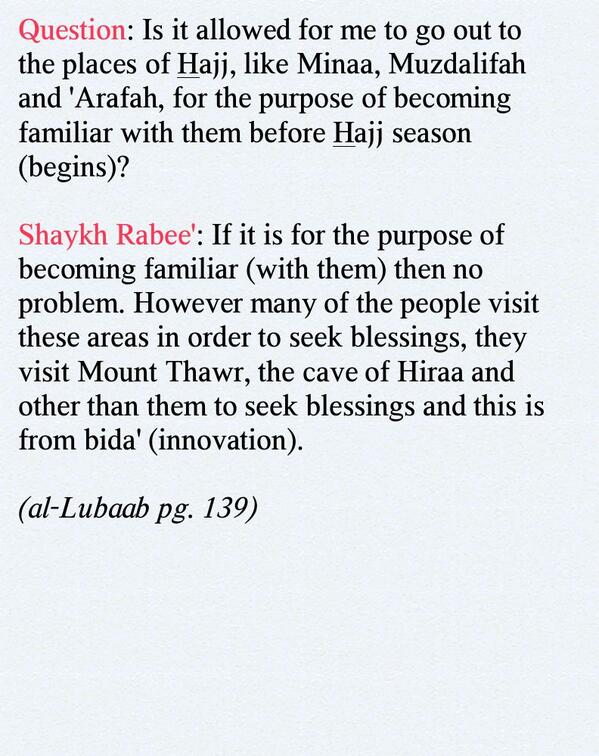
32. Going to the hills and places around Makkah, like the Mountain of Hiraa, and the Mountain at Minaa – which is said to have contained the sacrifice, etc.
33. Going to perform prayer in the Mosque of ‘Aa’ishah at Tan’eem.
34. Making the sign of the cross in front of the House. (124)
Innovations Of Tawaaf
35. Bathing for Tawaaf.
36. Wearing socks or similar footwear in order not to step upon bird excrement and covering his hands so as not to touch a woman.
37. The pilgrims praying Tahiyyat-ul-Masjid when he enters Masjid ul-Haraam. (125)
38. His saying: “I intend by my tawaaf these seven times such and such..”
39. Raising up the hands when touching the Black Stone as they are raised at the beginning of prayer.
40. To call out with kissing of the Black Stone.
41. Crowding in order to kiss the Black Stone, and preceding the imams’ saying salaam in order to do so.
42. Holding up the lower end of his garment when touching the Black Stone of Yemeni corner.
43. Saying when touching the Black Stone: (O Allaah out of belief in You and attesting to Your Book.)
44. Saying when touching the Black Stone: (O Allaah I seek Your refuge from pride and poverty and grade of disgrace in his world and the Hereafter.)
45. Placing the right hand upon the left while making tawaaf.
46. Saying in front of the door of the Ka’bah: (O Allah the House is Your House and the Sacred Area is Your Sacred Area, and the Safety is Your Safety) Then pointing towards the Station of Ibrahim – peace be upon him – saying: (And this is the place of the one who seeks Your refuge from the Fire.)
47. Making du’aa at the ‘Iraaqi corner saying: (O Allaah I seek Your refuge from doubt and shirk, and from hostility and hypocrisy, and had manners, and loss in money and family and children.)
48. Making du’aa beneath the water-spout saying: (O Allaah shade me under Your shade on the Day that there is no shade except Your shade.)
49. Making du’aa while doing raml, saying: (O Allaah make it an accepted Hajj, and forgiven sin, and a praiseworthy sa’ee, and a work that does not lead to nothing, O Mighty One, O Forgiving One.)
50. Saying on the last four rounds of Tawaaf: (O Allaah forgive and have mercy and forgive what You know, verily You are the Most Mighty, The Most Generous.)
51. Kissing the Yemeni corner.
52. Kissing the two shaami corners and touching them.
53. Wiping the walls of the Ka’bah and the Station Wiping the walls of the Ka’bah and the Station of Ibrahim – peace be upon him.
54. Seeking blessing from what they call ‘Al’Urwat al Wuthqaa’ and it is a high place Jutting out from the wall of the Ka’bah opposite to the Door, the common people claiming that one who touches it with his hand has clung on to ‘the most Trustworthy Hand-Hold.’
55. A peg at the center of the House, which they call ‘the Navel of the world’ -uncovering their navels and placing it upon that spot – so that he is putting his navel upon ‘the Navel of the world’.
56. Seeking to perform Tawaaf because it is raining claiming that one who does that has all of his previous sins forgiven.
57. Seeking blessing from the rainwater which descends from the Water-spout of Mercy on the Ka’bah.
58. Desisting from Tawaaf in a Garment that is not clean.
59. The pilgrims tipping what remains of the drink of Zamzam into the Well and saying. (O Allah I ask You for a plenteous provision, and beneficial knowledge, and a cure from every disease…)
60. Bathing in Zamzam.
61. Being careful to drench their bears in Zamzam, and also their money and clothes in order to bless them.
62. What is mentioned in some books of Fiqh regarding drinking Zamzam in many gulps, each time looking up at the Ka’bah.
Innovations of Sa’ee Between Safaa and Marwah
63. Making wudoo in order to walk between Safaa and Marwah with claim that he who does so has 70,000 ranks written for him for every step he takes.
64. Climbing right up Safaa until reaching the wall.
65. Making du’aa when descending from Safaa, saying: (O Allaah make me act according to the Sunnah of Your Prophet, and cause me to die upon his religion, and protect me from the misleading trials, by Your Mercy, O Most Merciful One.)
66. Saying while making Sa’ee: (O Allah forgive and have mercy and pass over what You Know…etc) (126)
67. Making fourteen circuits and thus finishing upon Safaa.
68. Doing Sa’ee repetitively in Hajj or `Umrah.
69. Praying two rak’ahs after completing Sa’ee.
70. Continuing to perform the Sa’ee between Safaa and Marwah after the Iqaamah has been given for prayer – so that they miss prayer in congregation.
71. Saying a particular du’aa upon reachin Minaa, like that which occurs in “Ihyaa `Uloom ud Deen”: (O Allah this is Minaa…) And when he leaves saying: (O Allah make the best early morning ever this early morning…)
Innovations of `Arafah
72. Standing upon the Mount of `Arafah on the Eight Day for a time in case the moon was wrongly sighted.
73. The lighting of many candles on the night of `Arafah at Minaa.
74. Making du’aa on the night of `Arafah with ten phrases – saying them a thousand times: (Glory be to Him Whose Throne is above the sky…)
75. Their going direct from Makkah to `Arafah on the eight day.
76. Tarvelling to `Arafah from Minaa at night.
77. Lighting fires and candles upon the Mount of `Arafah on the night of `Arafah.
78. Bathing for the day of `Arafah.
79. Saying when nearing `Arafah and upon seeing the Mount of Mercy (Jabal ur-Rahmah): subHaanallaah walhamdulillaah wa…
80. Seeking to go off to the Plain of `Arafah before the time for standing which is after half the day.
81. Saying Tahleel 100 times upon `Arafah, then reading Surat ul-Ikhlaas, then upon the Prophet 100 times at the end upon us.
82. Remaining silent upon `Arafah and leaving du’aa.
83. Climbing upon the Mount of Mercy (Jabal ur-Rahmah).
84. Entering the Dome upon the Mount of Mercy which they call “The Dome of Adam” and praying in it, and making Tawaaf of it.
85. Believing that Allah ta’ala descends in the night of `Arafah upon the Dark Green Mountain and shakes hands with the riders and embraces those who are walking.
86. The imams giving two Khutbahs in `Arafah divinding them by sitting like that of Jumu’ah.
87. Praying Zuhr and `Asr before the Khutbah.
88. Giving adhaan for Zuhr and `Asr in `Arafah before the finish of the Khutbah.
89. The imams saying to the people of Makkah after finishing the prayer in `Arafah: “Complete your prayers for we are travellers.”
90. Praying nafl prayers between Zuhr and `Asr in `Arafah.
91. Particularizing a certain du’aaa or dhikr for `Arafah, like the du’aa of al-Khidr – peace be upon him – which is mentioned in “Ihyaa `Uloom ud-Deen” and begins “O Him Who is not preoccupied with…” and other du’aas – some of them reaching five written pages.
92. Leaving `Arafah before sunset as some do.
93. What has become commmon upon the tongues of the people that the satanding in `Arafah on Yawm ul Jumu’ah is equivalent to 72 pilgrimages.
94. What some people do as regards gathering together on the evening of `Arafah in congregational mosques or in a foreign place – them making du’aa and dhikr raising their voices very much, reciting sermons and poetry, in imitating the people in `Arafah.
Innovations of Muzdalifah
95. Moving hurriedly at the time of leaving `Arafah for Muzdalifah.
96. Bathing to spend the night at Muzdalifah.
97. Regarding it to be desirable for one riding to get down and enter Muzdalifah on foot out of respect for the Sacred Area (Haram).
98. To repeat du’aa upon reaching Muzdalifah saying: (O Allah this is Muzdalifah, many languages have come together here…)
99. Leaving off praying Maghrib prayer as soon as Muzdalifah is reached and instead looking for small stones.
100. Praying the sunnahs of Maghrib between the two prayers – or combining them with the sunnahs of Ishaa and Witr after the two Fard Prayers – as al-Ghazzali says.
101. Increasing the amount of firewood on the night of Sacrifice and in the Mash’ar ul-Haram.
102. Staying awake at night.
103. Stopping at Muzdalifah without spending the night there.
104. Saying upon reaching the Mash’ar ul-Haram: (O Allah I ask You by the night of…) (127)
105. Al-Bazjooris saying: “And it is sunnah to take seven stones for stoning on the Day of Sacrifice from Muzdalifah – and to take all other stones from the river-bed of Muhassir.”
Innovations of Stoning
106. Bathing in order to perforn the stoning.
107. Washing the stones before the stoning.
108. Saying “subhaanallah” or any other dhikr in place of takbeer.
109. Saying anything in addition to takbeer – such as:
110. The saying of some of the later people: “And it is sunnah to say when throwing each stone…”
111. Adhering to a particular way of throwing the stones: like the saying of some: He should put the end of his right thumb upon the center of his forefinger and he should place the stone upon the back of his thumb as if he was making the number 70 with his fingers – then he should throw it. And others say: He should make a circle with his forefinger upon the joint of his thumb as if he were making the number 10.
112. Fixing a certain place for the one stoning to stand – that there should be between him and the ppillar five arm-lengths.
113. Stoning with shoes, etc.
Innovations of Sacrifice and Shaving the Head
114. Giving charity to the value of sacrifice instead of making the obligatory sacrifice of an animal, declaring that most of the sacrificial meat goes to waste – only a few people benefitting from it. (128)
115. Some people’s sacrificing the obligatory sacrifice in Makkah before the Day of Sacrifice.
116. The barbers starting with the left side of the head when shaving.
117. Only shaving a quarter of the head.
118. Al-Ghazzalis saying in “Ihyaa `Uloom ud-Deen”: “And the Sunnah is to face the Qiblah during shaving.”
119. Making du’aa while the head is shaved, saying: alhamdu lillaahi `alaa maa hadaana
120. Making tawaaf of the mosques near the Pillars.
121. Holding it recommendable to pray `Eid Prayer in Minaa.
122. The mutamatti’s leaving out sa’ee after Tawaaf Ifaadah.
Various Innovations
123. Celebrating the covering of the Ka’bah.
124. Covering the Station of Ibrahim.
125. Tying scraps of paper ti the Station of Ibrahim and the minbar in order for needs to be fulfilled.
126. The pilgrims writing their names upon the pillars and walls of the Ka’bah – and some of them advising that.
127. Declaring it to be lawful to walk in front of one praying in the Haraam Mosque and opposing those who try to stop them from doing so.
128. Calling one who has performed Hajj “al-Haajj”.
129. Leaving Makkah to perform an extra `Umrah.
130. Leaving the Haraam Mosque after the Farewell Tawaaf walking backwards.
131. Painting the Pilgrims’ whouse white, painting pictures upon it and writing his name and the date thereon.
Innovations of Visiting Madinat-ul-Munawwarah
This is included as undertaking journey to the Prophet’s mosque and Masjid ul-Aqsaa – may Allah return it to the Muslims soon – is from the Sunnah and because of the benefits and rewards for this, and people usually visit them before or after making Hajj – and many of them fall into numerous innovations well-known to the scholars, while doing that – so I saw it beneficial to include what I have across from these as a notification and warning and they are:
132. Journeying to visit the Prophet’s grave. (129)
133. Sending requests with the pilgrims and those visiting the Prophet and asking them to convey their salaams to him.
134. Bathing in order to enter Madinat-ul-Munawwarah.
135. Saying upon seeing the walls of Madinah: (O Allah this is the Sacred Area of Your Messenger, so make it a protection against the Fire for me and a protection from punishment and any misfortunate accounting.)
136. Saying upon entering Madinah: (In the name of Allah and upon the the religion of…)
137. The retention of the Prophet’s grave within his mosque.
138. Visiting the grave of the Prophet before praying in his mosque.
139. Some peoples facing the grave whith total humility placing his right hand upon the left as if in prayer near the grave or far from it – when entering or leaving the mosque.
140. Making du’aa facing the grave.
141. Going to the grave to make du’aa towards hoping for an answer.
142. Seeking nearness to Allah (tawassul) by means of the Prophet.
143. Seeking for intercession etc. from the Prophet.
144. Ibn al-Hajj’s saying in “al-Madkhal” (1/259) that: “One should not mention with his tongues his needs or need forgiveness of sins when visiting the grave of the Prophet” because he knows his needs already and what is of benefit to him!!
145. His saying also (1/364): “There is no difference between his death and life – as regards his watching over his Ummah and their affairs and intentions, and their regrets and their thoughts”!!
146. Their placing their hands upon the grills around the room containing the Prophet’s grave to seek blessings. And some of them taking oath upon that.
147. Kissing the tomb or touching it or what surrounds it – pillars and so on. (130)
148. Adopting a particular way for visiting the Prophet and his two companions – and a particular way of giving salaam and making du’aa, like the saying of Al-Ghazzali: “He should stand next to the face of the Prophet with his back to the Qiblah, and face the wall of the tomb … and say.. “mentioning a long salaam then a long salaat and du’aa reaching about three pages. (131)
149. Seeking to pray facing the tomb.
150. Sitting near the grave in order to recite and make dhikr.
151. Going to the Prophet’s grave after every prayer. (132)
152. Visiting the Prophet’s grave by the people of Madinah every time they enter or leave the mosque.
153. Raising the voice after prayer saying: “Peace be upon you, O Messenger of Allah.”
154. Seeking blessings from rainwater which falls down from the Green Dome above the Prophet’s tomb!
155. Seeking nearness to Allah by eating dates of Saihaan in the ‘Rawdah’ which is between the pulpit and the grave.
156. Cutting off bits of their hair and throwing them into the large chandelier near to the Prophet’s tomb.
157. Wiping the two brass palm trees that were placed in the mosque to the west of the pulpit (133).
158. Making a point of praying in the original part of the mosque and avoiding praying in the front rows which are in the extension made by `Umar and others.
159. Making a point by visitors to Madinah to stay for a whole week in order to pray forty prayers in the Prophet’s Mosque – so as to have written for them a security from hypocrisy and from the Fire. (134)
160. Seeking reward by going to any of the mosques or places in and around Madinah except for thw Prophet’s Mosque and Qubaa Mosque.
161. Guides instructing groups of pilgrims and leading them in certain du’aas near the Prophet’s room or far from it with raised voices – and the people’s repeating even louder voices.
162. Visiting the graveyard of Baqee’ everyday and prayer in the Mosque of Fatimah – may Allah be pleased with her.
163. Particularizing Yaum ul-Khamees (known to the Christians as Thursday) for visiting the martyrs of Uhud.
164. Affixing pieces of paper to the iron railings on the ground of the martyrs.
165. Seeking blessings by bathing in the pool that used to be by the side of the graves.
166. Walking backwards out of the Prophet’s Mosque when leaving for the last time.
Innovations of Bait ul-Maqdis
167. Visiting Bait ul-Maqdis along with Hajj and their saying: May Allah make your Hajj holy.
168. Making Tawaaf of the Dome of the Rock like Tawaaf of the Ka’bah.
169. Venerating the Rock with any form of veneration – like touching it or kissing it, or leading sheep to it to slaughter them there – and visiting it on the night of `Arafah, and building upon it, etc.
170. Their claim that there is in the rock the Prophet’s fooprint, and the trace of his `imaamah (turban) and some of them think that it is the footprint of the Lord.
171. Visiting the place which they claim is the cradle of Isa – peace be upon him.
172. They claim that the Siraat (Bridge) and the Scales (meezan) are there, and that the wall that will be placed between the people of Pradise and the people of the Fire is the wall built to the east of the mosque.
173. Venerating the rock where al-Buraaq is alleged to have been tethered or its place.
174. Praying by the grave of Ibrahim – peace be upon him.
175. Gathering in Masjid ul Aqsa at the time of Hajj to sing and play the ‘Daff’ (an instrument made of a small circle of wood with a skin stretched over one side).
and this is all that I have been able to gather from innovations of Hajj and visiting. I ask Allaah the Blessed and Most High to make it an aid to the Muslims in giving preference to and following the example of the best of the Messengers and accepting his guidance.
Foot Notes / References :
1. Reported by Bukharee, AHmad, An-nasaaiee & Ibn Maajah from Abu Hurairah – may Allah be pleased with him. See ‘Silsilat-ul-Ahadeeth-us-Saheehah’ (no. 1200) and ‘Al-Irwaa’ (no. 769).
2. As is the case with most pilgrims these days – and it is very rare for one of them to bring the sacrificial animal along with him as the Prophet did. So he who does so, then there is no blame upon him – however one who does not bring it with him and still does Hajj Qaarin or Faarid – then he has gone against the Prophet’s action and his command – even though the people may be averse to this point. As Ibn Abbas said- reported by Muslim(4/58) and AHmad(1/278,342).
3. See ‘Sahheh Abi Dawud'(nos.1568 and 1571).
4. And his basis for saying that is the saying of the Prophet: Verily Allaah has entered the ‘Umrah into this Hajj of yours, so when you come – then he who has made tawaaf of the House and between Safaa and Marwah – then he has become Halaal(left iHraam) except he who had the sacrificial animal with him.(Sahih A.D., nos.1573,1580).
5. And that does not negate what is narrated from ‘Umar and others that Hajj Muffrad is better because of what I have stated in the Original. And I have found also that Ibn Taimiyyah explains that to mean singling out ‘Umrah in his journey and Hajj in his journey. See Majmood al-Fataawaa, Vol.26 as it is important.
6. Hasan hadith. See ‘Saheeh ul-Jaami us-Sagheer’ (no.1477).
7. And it exists in the Original in its complete form (pg. 28) and is reported in [[Irwaa al Ghaleel]] #1019 and Saheeh Abi Dawood #1613.
8. It is the face-cover worn upon the tip of the nose. And it is of different types. If she pulls it up to her eyes then it is called ‘Al-Waswasah’ or ‘Al-Burqa’. If she pulls it down to below the eye socket then it is ‘Al-Niqaab’, and if it is upon the end of her nose it is ‘Al-Lukfaam’. It is called the woman’s niqaab because it hides her colour of the niqaab (Lisaan ul ‘Arab 2/265-266).
9. Shaikh-ul-Islaam Ibn Taimiyyah says in his ‘Mansik'(p.365): “And the gloves(Quffaazaat) are a covering made for the hand- like falconers wear….”
10. Shaikh-ul-Islaam Ibn Taimiyyah says in his ‘Mansik’: “And he should not cut them down to below the ankle, as the Prophet ordered with this to begin with, then made allowance for not doing do in ‘Arafaat, when allowed one not finding an izaar to wear trousers, and allowing one who does not find sandals to wear leather socks(khuff). This is the most authentic saying of the scholars”.
11. Bukharee and Muslim, Sahih Abi Dawud(no.1600).
12. Al-Ahadeeth-us-Saheehah.(no.24569).
13. Bukharee and Muslim, SaHeeH Abi Dawud no. 155.
14. Bukharee and others
15. Sahih Abi Dawud,(no.1579), Mukhtasar Sahih ul Bukharee,(no. 761-762). Ibn Hajar says in ‘Fath-ul-Baree'(3/311) – “This shows that the excellence of al-Aqeeq valley is like the excellence of Madinah are like prayer therein….”
16. Bukharee with mu’allaq isnaad.
17. Narrated by Ad-Diyaa with saheeh isnaad.
18. Bukharee and Muslim. Saheeh Abi Dawud,(no.1590).
19. Abu Dawud, Tirmidhee. An-Nasaa’ee, Ibn Maajah. See Saheeh Abi Dawud,(no.1592).
20. Hadith Hasan. (Saheeh ul-Jaami’, no.112)
21. Narrated by Sa’eed ibn Mansoor ( See ‘al-Mahallaa'(7/94)) with good isnaad. And Ibn Abi Shaibah with saheeh isnaad from al-Muttalib ibn ‘Abdullah (Fath-ul Baree:3/324) and is mursal.
22. Muslim, see as-Saheehah, (no.2023).
23. Bukharee (no.769 in the mukhtasar). At-Tayaalisee (no.1513), AHmad(6/32,…)
24. Ibn Abi Shaibah – see ‘al-Muhallaa (7/94-95) and its isnaad is saheeh.
25. Part of a saheeh hadith – ‘as-Saheehah’ (no.828) with the words: “Jibreel ordered me to raise the voice with ihlaal (talbiyyah) as it is one of the signs of Hajj.”
26. Ibn Khuzaimah and Baihaq’ with saheeh isnaad.
27. Bukharee. And Ibn Hajr says: “And in the hadith is that the talbiyyah in valleys is from the sunnah of the Prophets, and that it is more stressed in descending and ascending.”
28. AHmad (1/417) with good isnaad, and Al-Haakim and adh-Dhahabee authenticate it.
29. Bukharee and al-Baihaqi.
30. Bukharee, Saheeh Abi Dawud,(no.1630).
31. Bukharee, Saheeh Abi Dawud,(no.1929).
32. Al-Fakihee with hasan isnaad.
33. Hadith Hasan: “As-Saheehah, (no.2478)”.
34. Saheeh ul Kalim ut-Tayyibah.
35. Ibn Abi Shaibah with saheeh isnaad up to Ibn ‘Abbaas. Marfoo’an it is da’eef.
36. Baihaqi (5/72) with hasan isnaad….
37. See ‘Al-Irwaa’, (no.1112).
38. Ash-Shafi’ee, AHmad and others – and it is a strong hadith as I have explained in ‘al-Hajj-ul-Kabeer’.
39. Authenticated by at-Tirmidhee, Ibn Khuzaimah, Ibn Hibbaan, al-Haakim and Adh-Dhahabee. See ‘al-Hajj-ul-Kabeer’.
40. Made Hasan by at-Tirmidhee. Made Saheeh by Ibn Hibbaan and Adh-Dhahabee.
41. Made Saheeh by at-Tirmidhee and Ibn Khuzaimah.
42. Al-Idtibaa’ is bid’ah before this tawaaf, and after it.
43. Abu Dawud and others. Authenticated by many scholars. See Saheeh Abi Dawud,(no.1653).
44. Shaikh ul Islaam ibn Taimiyyah says: “As for the other parts of the House, and the Place of Ibraheem, and whatever is in the rest of the world mosques and their walls, and the graves of the prophets and good people – like the room of our Prophet, and cave of Ibraheem, and the place where our Prophet used to pray – and all other such places, and the rock at Jerusalem, then none of these are to be touched at all or kissed – by total agreement of the scholars. And as for tawaaf of these things – then it is one of the greatest and most forbidden bid’ahs – and he who takes that as part of his religion should be asked to repent – and if he refuses he killed”.
And ‘Abdur Razzaaq (no.8945) and AHmad and al-Baihaqi port from Ya’laa ibn Umayyah who said: “I made tawaaf with Umar ibn ul-Khattaab ( and in a narration: with ‘Uthuzza) – may Allaah be pleased with him – so when I came to the corner of the Door I started to touch it so he said ‘Have you not made tawaaf with Rasoolullaah?’ I said: Yes. He said: ‘Then did you see him touch it?’ I said: No. He said: ‘Then do likewise for there is for you in Rasoolullah a good example'”.
45. This is narrated by two isnaads from the Prophet by which the hadith reaches the level of hasan – and is increased in strength by the fact that a group of the Sahaabah acted on it – from them Ibn ‘Abbaas – may Allaah be pleased with him – who said: “This is the Multazam between the Corner and the Door. And it is authentically narrated from ‘Urwah ibn az-Zubair also – see ‘As-Sahaabah, no.2138. And Ibn Taimiyyah said in his ‘Mansak’ (p.387): “And if he wishes to come to the Multazam – and that is what is between the Black stone and the Door – and he places upon it his chest and face and forearms and hands – and makes du’aa – and he asks Allaah for whatever he needs – then he may do so. And he may do so before the Farewell Tawaaf there being no difference in this being at that time or any other – and the Sahaabah used to do so when they entered Makkah – and if he stands near the Door making du’aa without iltizaam of the House then that is also good, and when he leaves he does not stand or turn or walk backwards.”
46. At-Tirmidhee and others, and the other narration is Tabraanis. And it is Saheeh: See also ‘Al-Irwaa’ (no.21). Shaikh-ul-Islaam Ibn Taimiyyah said: “And there is no particular dhikr narrated from the Prophet, not by his order, or his saying, or by his teaching, rather he should make du’aa with any authentic du’aas – and the particular du’aas which many people mention like that for below the water-spout, etc. – there is no basis for them.
47. Bukharee and Muslim from Abu Hurairah, and Tirmidhee from ‘Alee and Ibn ‘Abbaas – see ‘Al-Irwaa'(no.1102)
48. Bukharee and Muslim from ‘Aa’ishah, and Bukharee from Jaabir – and the addition is his. See ‘Al-Irwaa'(no.191).
49. See the Introduction and the Original Book, (pp.21,23 and 135).
50. Saheeh hadith – as a number of scholars have said. see ‘Al-Irwaa’ (no.1123) and ‘as-Saheehah’ (no.883).
51. Saheeh hadith narrated by at-Tayaalisee and others. See ‘as-Saheehah’ (no.1056).
52. Narrated by ‘ad-Diyaa’ in ‘Al-Mukhtaarah’ and others. See ‘as-Saheehah’ (no.1056)
53. It is not easy these days to see the Ka’bah except from certain points on as-Safa; it can be seen from the pillar which supports the second storey of the mosque, so he who is able to do so has attained the Sunnah, and if not then let him try his best and there is no harm.
54. (An-Nawawi) adds in ‘Al-Adhkaar’: Laa ilaaha illallaahu walaa na’budu illaa iyyaahu, and I do not find this addition in any narration of the hadith- either Muslim or anyone else who records the hadith…
55. That is after the tahleels – making du’aa for whatever he wishes from the good of this world and the Hereafter – and the best thing is that it should be something reported from the Prophet or the pious predecessors (ssalaf ul-Saalih).
56. And contrary to what some mistakenly say it is a sahih hadith. See ‘Al-Irwaa'(no.1072).
57. Reported by an-Nasaa’ee and others – see ‘Al-Hajj ul-Kabeer. Note:The following text appears in ‘al-Mughnee’of Ibn Qudaamah al-Maqdisee (3/394): “And all the woman’s tawaaf and sa’ee is done walking, Ibn al-Mundhir says: Scholars are agreed that there is no reaml(walking quickly) upon the women around the Ka’bah or between Safaa and Marwah – nor uncovering the right shoulder (idtibaa’). And that is because the principle of it is uncovering the skin – and that is not desired from women – what is required from them is to cover – and in walking quickly (raml) and idtibaa’ uncovering occurs.” And in ‘Al-Majmoo’ of an-Nawawee(8/75) there appears what shows that there is difference of opinion in the matter between the Shafi’i scholars, he says:” There are two sayings in that. Firstly, and this is correct upon which the Jumhoor (majority) of scholars agree: That she should not run at all – but walk whether in the night or day. Secondly, that it is mutahabb for her to run at night when there is no one around (to see her) in the place of running – just as for men.” I (Al-Albanee) say: “And perhaps that is more cprrect – as the origin of sa’ee (running) is the sa’ee of Haajar mother of Imaa’eel – seeking water for her thirsty son as occurs in the hadith of Ibn ‘Abbaas: “And she found as-Safaa to be the nearest hill to her so she stood upon it, then turned towards the river-bed to see if she could see anyone – so she went down from as-Safaa till she reached the river-bed, raising up the border of her dress – and running fast till she crossed the river-bed then she came to Marwah and stood upon it to see if she could see anyone, and she could not see anyone – and she did that seven times. Ibn ‘Abbaas said: The Prophet said:’And that is the sa’ee of the people between these two'”. (Narrated by Bukharee in the Book of the Prophets)
58. As for seeing the Ka’bah – it is not possible now because of the building between it and the Ka’bah – so should try his best to face the Ka’bah and not do as the confused people do, who raise up their eyes and hands to the sky!
59. Narrated by Abu Nu’aim in his ‘Mustakhraj of Sahih Muslim’.
60. Narrated by Ibn Abi Shaibah(4/68.69) from Ibn Mas’ood and Ibn ‘Umar – May Allah be pleased with them – with two sahih isnaads. And from Al-Musayyib ibn Raafi’ al-Kaahilee and ‘Urwah ibn az-Zubair. And at-Tabraani narrates it from the Prophet but its isnaad is da’eef (weak) – ‘Al-Mujmi'(3/248).
61. Or shaves it if there is sufficient time between his ‘Umrah and Hajj for his hair to grow enough (see Fath ul Baari,3/444).
62. Narrated by Bukharee and Muslim
63. 64. 63,64. This stopping and that after it may be difficult to perform these days due to the crowd of people, so if he goes past it to ‘Arafah then it is alright insh’allah. Shaikh ul Islaam Ibn Taimiyyah says in ‘al-Fataawaa’ (26:128): As for that which is from the sunnah of Rasoolullah – staying in Minaa on Yaum -ut-Tarwiyyah and for that night, then stopping at ‘Urahah’, which is between the Mash’ar ul Haraam and going from there to ‘Arafah, and the giving of Khutbah and the two prayers on the way in the middle of ‘Uranah’- then this is as agreed upon by scholars – whereas many writers do not bring it to notice – and most people do not know due to the prevalence of invented practices.”
65. I say: “And also it is not reported that the Prophet prayed anything before Zuhr or after ‘Asr in this place – or in any of his journeys – and it is not established that he prayed any supplementary prayers in any of his journeys except the two sunnahs of Fajr and the Witr.
66. Bukharee narrates it from Ibn ‘Umar with mu’allaq isnaad. See ‘Mukhtasar-al-Bukhari'(3/89/25).
67. Hasan or Sahih hadith. With more than one isnaad – refer to ‘As-Saheehah,(no.1503)’.
68. As that is established from the Prophet – as is explained in the Original.
69. Narrated by Muslim and others. See ‘At-Targheeb'(2/129).
70. Narrated by AHmad and others – and authenticated by a number of scholars – as I have explained in ‘Takhreej ut-Targheeb’.
71. This was said ny Shaikh-ul-Islaam Ibn Taimiyyah, its being established from the Prophet and his companions, in al-Bukhari (25/94/801) (Mukhtasar al-Bukhari).
72. Ibn Taimiyyah says: “And when he reaches Muzdalifah he prays Maghrib before making the camels kneel down if possible, then after making them kneel they pray ‘Ishaa – and if they delay the ‘Ishaa somewhat then there is no harm.”
73. As for the addition “Allahummaj’alhu Hajjan mabrooran….” which some writers mention – it is not established from the Prophet as I have explained in ‘Ad-Daee’fah’ (no.1107).
74. Narrated in Ibn Khuzaimah’s ‘Saheeh’ – where he says: Hadith saheeh, and explaining with this narration what is unclear in others and that what is intended by ‘until he stoned Jamrat ul ‘Aqabah’ is ‘finished stoning it’ (Fath ul Baaree, no.1426).
75. And this point has been fully explained in the Original – so refer to that if you wish to receive the proof of the matter (p.30).
76. And this hadith is sahih and has been authenticated by a number of scholars, from among them Ibn ul Qayyim, as I have explained in ‘Sahih Abi Dawud’ (no.1745). And when some of the distinguished scholars came upon this hadith before the spread of this treatise- they regarded it as something strange – some of them quickly declaring it to be weak – as I myself did in some of my earlier works – based upon Abu Dawud’s isnaad – eventhough Ibn ul Qayyim strengthened it in his ‘Tahdheeb’ of Abi Dawud, and as did Al-Haafiz (Ibn Hajr) in ‘At-Talkhees’ – by keeping silent about it. And I have found other chains of narration for it which will convince anyone looking into the matter of its being raised from the level of da’eef to level of its being saheeh. However due to there being in a reference work not in common use by the large majority – and that is Imaam at-Tahaawis ‘Sharh Ma’aanee ul ‘Athaar’- these people quickly declared its something strange or being da’eef and they were encouraged in this by the fact that they found that some of the earlier scholars had said: ‘And I do not know any scholar who has ruled according to that.’ And that is a negation of something – it is not a piece of definite known amongst the scholars that lack of knowledge of something does not mean absence of knowledge of it. So when a hadith is established to have come from Rasoolullah and is a relevant proof – as this is – then it is obligatory to act upon it straight away, not waiting to see if the scholars know of it or not, just as Imaam ash-Shaafi’ee said “A narration is to be accepted as soon as it is confirmed even if none of the scholars are acting upon it like the narrations which they accept – for the hadith of Rasoolullah is confirmed on its own not by anyone’s acting on it afterwards.” I say: So the hadith of Rasoolullah is above needing to be attested to by the actions of scholars according to it, as it is a source (of knowledge) by itself, judging not being judged. And along with that, indeed, some of the scholars have acted upon this particular hadith – from them ‘Urwah ibn az-Zubair – the greatest Taabi’ee – so can there remain any excuse for anyone to leave action according to this hadith: So verily therein is a warning for any who have a perceptive heart or listens attentively. And this is more fully explained in the Original. And you should be aware that the stoning of the Jamrah is for the pilgrims as the ‘Eid prayer for the rest of the people, therefore, Imaam AHmad liked that the time for the ‘Eid prayer in different parts should be that of the time of sacrifice in Minaa, And the Prophet gave Khutbah on the Day of Sacrifice after the stoning just as he used to give the Khutbah in Madinah after ‘Eid prayer – so some people holding it as being desirable to offer ‘Eid prayer in Minaa, taking as their evidence the word of general profs or analogy – is a mistake and neglect of the Sunnah – As neither the Prophet nor the khulafaa after him ever prayed the ‘Eid prayer at Minaa. See ‘Fatawaa Ibn Taimiyyah'(26:180).
77. I say: And there is in this hadith two great allowancesfor the pilgrims – and a solution for most of the problems of the piling up of slaughtered animals in the slaughter- house – which has led to those in control there to have to bury some in the earth – and he who wishes to see the matter more fully laid out should return to the Original (pp.82-988).
78. And there is a hadith from the Prophet narrated by Jaabir – reported by Abu Dawud and others – see ‘AL-Irwaa'(no.1138) and another by Baihaqee (9/289). And it is narrated from Ibn ‘Umar that he liked the animal to be made to face the Qiblah when slaughtered. And Abdur-Razzaaq(no.8585) narrates with sahih isnaad from ibn ‘Umar, that he disliked to eat from an animal slaughtered facing other than the Qiblah.
79. Al-Haafiz (Ibn Hajr) says (10/16): “That it will be easier for the one slaughtering to take the knife in his right hand, and to hold its head with his left.” I say: And causing it to die down and placing the foot on its side is what is narrated by Bukharee and Muslim.
80. Sahih Abi Dawud (no.1550). And there is after it a supporting hadith from Ibn’Umar like it – narrated by Bukharee and Muslim.
81. Narrated by Maalik with sahih isnaad reaching Ibn ‘Umar and Bukharee brings it in a chapter heading while signifying its authenticity Mukhtasar of Bukharee no.330).
82. Reported by Abu Dawud and others narrated by Jaabir – and it has support from the hadith of Abu Sa’eed al Khudnee reported by Abu Ya’laa – as occurs in ‘al-Majma’ (4/22) – see “Al-Irwaa’ (no.1118).
83. Reported by Muslim and others from ‘Aa’ishah – see ‘AL-Irwaa’ – and Ibn Taimiyyah in his book ‘Al-Mansik’ added: “……..(As You accepted from Ibrahim whom You took as a chosen friend)”, and I cannot find it in any of the books of Sunnah which are with me.
84. Reported by Bukharee with mu’allaq isnaad (see Glossary). Its isnaad is joined by Abu Dawud and others. See Sahih Abi Dawud (nos.1700,1701).
85. Reported by AHmad, authenticated by Ibn Hibbaan, and I hold it to be authentic due to its multiple lines of transmission. See ‘As-Saheehah'(no.2476).
86. Al Qaani’ is the one who asks. And Al Mu’tarr is the one who begs by displaying the weakness of his body.
87. Narrated by Bukharee and others. See ‘Irwa ul Ghaleel’ (no.964). As for Ibn Taimiyyah’s saying (p.388) “And the Mutamatti’ must fast part of the three days before putting of the iHraam for Hajj on the Day of Tarwiyya” – I do not know any proof for it. Rather it seems to go against the clear meaning of the ayah and hadith, and Allah knows best.
88. Reported by Bukharee and Muslim and others from the hadith of Ibn ‘Umar and others – see ‘Al-Irwaa’ (no.1084).
89. Reported by Muslim and others, see ‘Al-Irwaa’ (no.1089), and Sahih Abi Dawud (no.1730). And this is one of those matters in which Ibn al Hammaam the Hanaafi scholar agrees that the Hanaafi scholars have gone against the Sunnah. So what have the blind followers to say of that?
90. Sahih hadith – ‘Al Ahaadith us-Saheehah’ (no.605), Sahih Abi Dawud (no.1732).
91. Ibn Taimiyyah says: “And if he shortens it he draws it together and shortens it up to the length of a finger joint or less – or more, and the woman does not shorten in excess of that – as for the man he may shorten it as much as he pleases.”
92. Report by Bukharee and Abu Dawud from a number of the companions – see Sahih Abi Dawud (nos.1705,1707,1709,1710) and ‘Mukhtasar ul-Bukharee’ (no.847).
93. Narrated by Bukharee with mu’allaq isnaad – connected by Abu Dawud. See Sahih Abi Dawud (no.1700) and ‘Irwaa ul Ghaleel’ (no.1064).
94. 95. 94,95. Narrated by Abu Dawud and others. See Sahih Abi Dawud (no.1710)
96. Narrated by Bukharee with mu’allaq isnaad. Connected by Ibn Abi Shaibah and others. See ‘Mukhtasar al Bukharee’ (no.319,1/p.386).
97. Narrated by Bukharee with mu’allaq isnaad. Connected by Abdur-Razzaaq. See ‘Mukhtasar al Bukharee'(no.318).
98. Narrated by ‘Abd ur-Razzaaq (no.9012) with sahih isnaad from Ibn ‘Umar.
99. I say: And Allaah knows better which of them Rasoolullah did – and it may be that he prayed twice with them – the first being Fard and the second nafl as he did in some of his battles.
100. 101. 102. 100,101,102. All of this is established in the hadith of Ibn Mas’ood reported by Bukharee and Muslim and others – and as for what occurs in some Hajj books that he should face the Qiblah upon stoning Jamrat-ul-Aqabah, then that contradicts this authentic hadith – and whatever contradicts it is shaadh (Glossary), or rather munkar (Glossary) as I have explained in ‘Ad-Da’eefah'(no.4864).
103. Shaikh-ul-Islaam Ibn Taimiyyah says: “So if the sun sets and he is still in Minaa – then he must remain for the stoning on the third day”. I say: And the great majority of scholars agree on that – contrary to what Ibn Hazm says in ‘Al-Muhallaa’ (7.185). And An-Nawaawi drives proof for them(the majority) from what is understood from Allaah ta’alas saying: faman ta’ajjala fee yaumaini falaa ithma ‘alaihi (8:283): “And the day (al-Yaum) is a name for the daytime not including the night”. And using what is confirmed from ‘Umar and his son ‘Abdullah who both said : “Whoever is at Minaa on the second day and the evening comes upon him – then let him stay until the next day and leave together with the people.” And the wording of ‘Al-Muwatta’ from Ibn ‘Umar is: “Then let him not leave until he has stoned the Jamaraat on the next day.” And Imaam Muhamad in his Muwatta (p.233) narrates it from Imaam Maalik and says: “And that is what we accept, and it is the saying of Abu Hanifah and people in general.”
104. Reported by Bukharee and Muslim and others – see ‘Al-Irwaa’ (no.1097). And I have pointed out there that my narrating it as being from the hadith of Ibn ‘Abbaas in the Original is a mistake.
105. Reported by Abu Dawud, At-Tirmidhi, An-Nasaa’ee and Ibn Maajah – and authenticated by a group of the scholars. See ‘Al-Irwaa'(no.1080).
106. Hadith hasan reported by Al-Bazzaar and Al-Baihaqi and others from Ibn ‘Abbaas – Ibn Hajr declaring its isnaad to be hasan, and it has supporting narrations which I have quoted in ‘As-Saheehah’ (No.2477).
107. Reported with Mu’allaq isnaad by Bukharee (Mukhtasar al Bukharee, no.287) joined by a number of scolars whom I have named in ‘As-Saheehah’ (no.803).
108. Reported by Tabraani and Diyaa-al-Maqdisee in ‘Al-Mukhtara’ and ‘Al-Mundhari’ declares its isnaad to be hasan. And it is as he said as it has another chain of transmission as I have shown in ‘Tahdheer us-Saajid…’ (pp.106-107 2nd edition).
109. Reported by AHmad and others from the hadith of Jaabir from the Prophet with saheeh isnaad – and authenticated by a number of scholars whom I have mentioned in ‘Al-Irwaa’ (no.1129).
110. Reported by Tirmidhee and others – authenticated by Ibn Khuzaimah and Ibn Hibbaan and al-Haakim and others – see ‘Al-Mishkaat’ (no.258) and ‘at-Targheeb’ (no.2/120,122).
111. Reported by Abu Dawud, Tirmidhee, an-Nasaaiee Ibn Maaja and others – authenticated by Tirmidhee and al-Haakim and adh-Dhahbee – see ‘Al-Irwaa’ (no.481).
112. Reported by Muslim and others – and a similar hadith by Bukharee. see ‘Al-Irwaa'(no.1086) and ‘Saheeh Abi Dawud’ (no.1747).
113. Established in the hadith of al-Haarith Ibn ‘Abdullah Ibn Aus, reported by AHmad and others. See Sahih Abi Dawud (no.1749)
114. Reported by AHmad with a sahih isnaad to the standard of Bukharee and Muslim – who also both narrate a similar hadith – see ‘Al-Irwaa’ (no.1086). And they also narrate a witness to it from the hadith of ‘Aa’ishah – see Sahih Abi Dawud (no.1748).
115. Reported by Bukharee in his ‘Taareeq and Tirmidhee who declared it to be hasan – from the hadith of ‘Aa’isha – may Allaah be pleased with her – see ‘Al-Ahaadeeth-as-Saheehah’ (no.883).
116. Reported by Baihaqi with a good sahih isnaad from Jaabir – may Allaah be pleased with him. And it has an authentic mursal narration as a witness to it reported by ‘Abd-ur-Razzaaq in his ‘Musannaf'(no.9127). And Ibn Taimiyyah narrates that the salaf used to transport it.
117. See note 24.
118. May Allaah return it and the rest of the Muslim land to them, and may Allah inspire them to work with the rulings of the religion.
119. See ‘Silsilat-ul-Ahaadeeth as-Saheehah’ (no.1620)
120. And this innovation was stopped many years ago-al-hamdulillah-however the one after it remains in its place and in Al-Baajoorees explanation of Ibn ul-Qaasim (1/41) there occurs: “And it is forbidden to go for a pleasure trip to see the carrying of the Ka’bahs covering and the coverings of the Station of Ibrahim,etc.
121. And this and the one after it are some of the most wicked innovations because of what they contain regarding use of tricks to get around the shaaree’ah and the risk of falling into shameful actions as is obvious.
122. see 121.
123. And it is authentically reported from ‘Umar – may Allaah be pleased with him – that he saw some people while on the way to Hajj going to a certain place, so he said: What is this? So it was said: A place where Rasoolullah prayed. So he said: In this way where the People of the Book destroyed. They took the places connected with there Prophets as a place of prayer. Whomsoever of you reaches such a place at the time of prayer then let him pray, otherwise he should not do so.
124. This appears to refer to wiping the face and chest with the two hands resembling a cross.
125. For the greeting for the Haraam Mosque is tawaaf, then the praying behind the Station of Ibrahim and has preceded from the Prophet, from his action. And see ‘Al-Qawaa’id an-Nooraneeyah’ of Ibn Taimiyyah (pg.101)
126. What has been authentically reported as a practice of Ibn Mas’ood and Ibn ‘Umar is the same that has preceded (see point no.55).
127. This du’aa besides being a novelty also contains that which contradicts the sunnah and that is using as a means of approach to Allaah the ‘right of the Mush’ar-ul-Haraam and the ka’bah …’but rather than one should use Allaahs names and attributes as a means of approach (wasilah) to Him. And the Hanafi scholars have declared that is hated to say: “Allaah I ask You by the right of the Mash’aral Haraam…etc” As occurs in ‘Haashiyat Ibn ‘Aa-bideen’ and other books. see ‘at-Tawassul’ Anwa’uhu wa ah-kaamuhu’
128. And this is one of the worst innovations because of what it involves regarding twisting the shari’ah which is clearly shown in the Book and Sunnah merely on account of opinion. And the chief responsibility for the lack of total use of the meat lies upon the pilgrims themselves, because they do not when sacrificing take account of the directions of the Wise Legislator – as is shown in the Original (pg.87-88)
129. And the Sunnah is to go to visit the mosqe as the Prophet said: do not journey accept to three mosques…so when he reaches it and prays upon entering then he may go to the grave. And it should be known that traveling to visit his grave – peace and blessings be upon him – and other graves is one thing, and visiting without traveling is something else – contrary to what has become widespread amongst the later people – among them holders of doctorates who have confused the two – and have further declared that Ibn Taimiyyah in particular and the salafis in general deny the authenticity of visiting the Prophets graves – and this is a clear untruth. See the matter fully explained in our refutation of Doctor Bootee who produced a succession of such sayings in the magazine ‘Islamic civilization’. Then I produced a particular treatise called ‘in defense of the Prophetic hadith….
130. And al-Ghazali-may Allaah have mercy upon him-did well in speaking against this kissing (1/244) and said: “it is a habit of Christians and Jews” So is there anyone to take heed?
131. And what is correct is to say: “assalaamu’alaika yaa rasoolullaahi wa rahmatullaahi wa barakaatuhu – assalaamu ‘alaika yaa abaa bakr – assalaamu ‘alaika ya ‘umar” as Ibn ‘Umar used to. And if he adds something slight as he feels at the time – not always doing it – then it is alright insha’Allah.
132. And this is in addition to its being an innovation and exaggeration in religion, and in contradiction to the Prophet’s saying: Do not take my grave as a festival, and send blessings upon me and it is a reason for many Sunnahs being lost and many benefits – and that it is the dhikr after the prayer recited after giving salaam – for they leave all of these and hurry to this innovation So may Allaah have mercy upon the one who said: “No innovation is brought to life except that a Sunnah is killed off “.
133. And there is absolutely no benefit in these two as they were only put there for decoration and to charm the people – and they have lately been removed – alhamdulillaah.
134. And the hadith about that id da’eef – and cannot be an evidence for it is as I have explained in ‘Ad-Ad-Da’eefah’ (no.364). So it is not permissible to act on it as it is Sharee’ah – especially as it may cause trouble to some pilgrims as I myself once found – thinking that the hadith about it was authentic – and he might miss some prayers and thus be a hardship – which Allaah has delivered him from. And one honorable person holds this hadith to be strong – based upon the attestation of Ibn Hibbaan in favour of one of its unknown narrators – and the scholars of Hadith criticism do not accept this type of attestation. Among them the aforementioned honorable person as he himself has stated in his refutation of Shaikh al-Ghumaaree in the ‘Journal of the Salafi University’ which comes from India. See the Book of Shaikh ‘Abd-ul-Rabee’aan in reply to him, as he has written well and is of benefit and explains the mistakes regarding supporting this hadith and the contradictions involved.
Share this, Baarakallaah Feekum: [“One who guides to something good has a reward similar to that of its doer” - Saheeh Muslim vol.3, no.4665] [This website protects the copyrights of the authors/publishers. The Content is posted on this website with implicit/explicit permission from content owners]


 There are also other Hadiths narrated in this regard. If a Muslim performs `Umrah before Hajj during the months of Hajj and performs Hajj in the same year, then he has performed Tamattu` Hajj (combining Hajj and `Umrah with a break in between) which is better than the Ifrad Hajj (performing Hajj only) and Qiran Hajj (combining Hajj and `Umrah simultaneously) for the one who has not brought a hadiy with him. It is reported that the Prophet (peace be upon him) told the Sahabah (Companions of the Prophet) who did not bring sacrificial animals:






 AbdurRahman.Org
You must be logged in to post a comment.