Video Source: http://www.westlondondawah.net/the-ru…
Islamic Knowledge – Islam, Sunnah, Salafiyyah

Video Source: http://www.westlondondawah.net/the-ru…
AsSalam Alaikum,
Alhamdulillaah, Here is very important resource for searching for a word in Hans-Wehr Dictionary (4th Edition) & Lane’s Lexicon online.
It is a HTML/JavaScript app for both desktop and mobile use that allows looking up Arabic roots in Hans Wehr, Lane’s Lexicon and other books simultaneously. Additionally, you may download the entire website to your hard disk or smart phone’s sd card, for fast offline usage. Read below for more information on downloading and installing it.
You can search in both “Arabic” and “English” words. And it is customized to serach on mobile /smartphone as well.
For Searching: http://ejtaal.net/m/aa/#HW=489,LL=4_283,LS=2,HA=380
You can now download the entire website and install it for instance on your phone’s SD card or your desktop PC for super fast access. Download link:
Main download site @ archive.org: Mawrid_Reader_v1.0.zip
The size is about 2.9 GB. The zip file contains two folders, one named “aa” and one “mr” which you should place somewhere on your PC’s drive or on your phone’s SD card. For desktops you should then be able to do “File->Open” and select the index.html file within the “aa” or “mr” folder for root based or alphabetical dictionaries respectively. On smart phones & tablets there are 2 ways you could try to get it installed: 1) Install the free Opera browser (the full one, not the Mini) to go the following url: file://localhost/sdcard, then locate the “aa” or “mr” folder and click on index.html or 2) Install the free Astro file manager and navigate to the aa or mr folder that you’ve extracted from the zip file onto the sdcard. Tap the index.html file and it will either open in your default browser or you can choose any of the installed browser to open the file. Once in your browser you can bookmark it for quick access. I’ve found the Dolpin browser to have the best performance, but the Chrome or Firefox browsers should work as well.
Visit for More Information : http://ejtaal.net/aa/readme.html#download-for-offline-use
Points discussed by Shaykh Saalih al-Fowzaan and Shaykh Saalih as-Suhaymee hafizahumAllaah in this excerpt include:
Leaving the correct path occurs in one of two ways:
[Click Here to Read or Download PDF] – 8 Pages
Translated By Abu Talha Dawood Burbank (rahimahullaah)
Scholar: Imâm Muhammad bin Sâlih bin ´Uthaymîn
Source: Liqâ’ al-Bâb al-Maftûh (51 B)
Reference: Darulhadith.com
Scholar: Imâm Muhammad bin Sâlih bin ´Uthaymîn
Source: Liqâ’ al-Bâb al-Maftûh (78 B) 1415-06-14/1994-11-17
Sound-file: http://www.ibnbaz.se/713-6474481
Reference: Darulhadith.com, Sweden
Audio and Translation courtesy of aFatwa.com
Question: Regarding peace with the disbelievers, some say that it is unrestricted disbelief. Others say that it isn’t…
Hadeeth no. 270: From Abud-Dardaa· –radiyallaahu `anhu-: from the Prophet tha the said:
” There is nothing that will be heavier upon the balance than good character”
[Shaikh al-Albaanee said: “ Hasan: ‘as-Saheehah‘ (no.876)”]
Hadeeth no. 272 : From `Abdullaah ibn `Amr –radiyallaahu `anhumaa-: that he heard the Prophet say: “Shall I inform you of the most beloved of you to me, and those who will be seated closest to me on the Day of Resurrection? “ So the people remained silent, so he repeated it two or three times. The people said: ‘Yes, O Messenger of Allaah!’ He said: “Those who are best in character”
[Shaikh al-Albaanee said: “ Saheeh: ‘as-Saheehah‘ (no.792)”]
Hadeeth no. 277: From Anas –radiyallaahu `anhu– who said: ” I served the Prophet for ten years, and he never said ‘Uff‘ to me, and he never said to me about anything which I had not done: ‘Why didn’t you do it?!’ Nor about anything which I had done: ‘Why did you do it?!’.”
[Saheeh: Reported by al-Bukhaaree in his ‘Saheeh‘(no.6038) and by Muslim (no.2309).]
Hadeeth no. 323: From Asmaa· bint Yazeed –radiyallaahu `anhaa– that she said ‘The Prophet said: “Shall I not inform you of the best ones from amongst you? “ They said: ‘Yes, indeed.’ He said: “Those who when they are seen, then Allaah is remembered. Shall I not inform you of the worst ones from amongst you? “ They said: ‘Yes, indeed.’ He said: “Those who go about carrying tales to cause mischief between friends, those who seek harm and corruption for the innocent “.’
[Shaikh al-Albaanee said: ‘Hasan‘.]
Click here to Read or Download the Explanation of these Hadeeth – PDF
Compiled and translated by Abu Talhah Dawud Burbank (rahimahullaah)
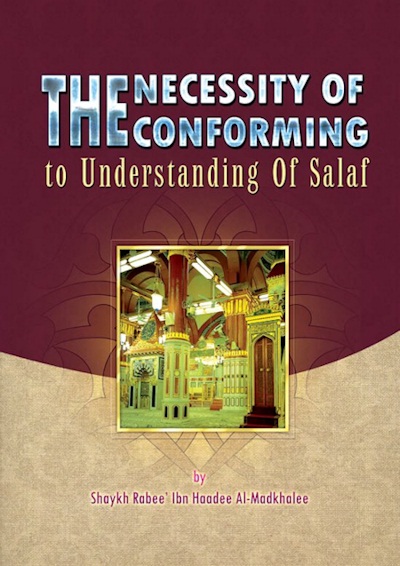
In these times of great division and media saturation, this treatise is an essential read to help mankind in general, and Muslims specifically, discern between what is correct and authentic knowledge, from what is misleading.
In this publication, the Shaykh begins by explaining to the readers the reasons why Knowledge of the Qur’aan and the Sunnah is a necessity in our lives.
He further elaborates on the fundamental importance of evidence and proof in the study of Islam and the responsibility we have in staying away from blind following.
Furthermore, in seeking the correct understanding of Islam, he makes clear the status of the Companions when he says, ‘No matter how much an individual excels in intelligence, aptitude and cleverness, he cannot do without the understanding of the Salaf.
Even great Scholars like Shaafi’ee, Malik, Ahmed, Abu Haneefa and others were in great need of referring back to the illustrious companions (may Allah be pleased with them). Ash- Shaafi’ee said: ‘The companions are superior to us in all aspects of knowledge, intelligence and understanding.’’
– See more at: http://www.miraathpublications.net/the-necessity-of-conforming
Author: Shaikh Rabee ibn Haadee al Madkhalee
Paperback: 93 Pages
Published: 2012
Benefits From Shaykh Muhammad Ramzan – Kitab at-Tawheed
Click the below link to read or download PDF
The Guidelines For Takfeer – Shaykh Muhammad Baazmool [PDF]
Notes Taken from Sheikh Abdul Qadir al Junaid’s explanationof Ibaana as Sughra from ibn Battah. Translated by: Abu Afnaan Muhammad
Click the below link
Put Tawheed First!!!
Shaykh Taamir Fatooh (may Allah preserve him upon good) said, from the tricks of shaytawn is to make the people belittle the studying of Tawheed and Aqeedatul-Islaamiyyah. From the deceptions of shaytawn is to beatify and rises the other sciences in the eyes and hearts of the people, before understanding Tawheed soundly and correct ones Aqeedah. No doubt all of the sciences of Islaam are important and they have their time and place, but Tawheed and correct Aqeedah must come first and foremost. It is from the tricks of shaytawn to mislead the Muslims from the correct path. It is from the tricks of shaytawn to belittle understanding Tawheed and correcting ones Aqeedah.
Aboo Abdir-Rahmaan Abdur-Raqeeb
insightaudio.com
The Noble Shaykh Taamir Fatooh (May Allah Preserve Him) is from the mashaayikh of Egypt and is a student of Shaykh Hasan Ibn ‘AbdulWahhaab Marzuq al-Banna and is highly recommended by Shaykh Hasan and Shaykh Adil as-Sayyid (May Allah Preserve Them).
Also from the etiquettes related to books is that one should make an effort to care for and reinforce their outer and inner parts as well as to keep them clean so that the books can be in a presentable condition that is befitting for others besides you.
This is since when a student of knowledge buys a book, he must have or should we say it’s preferred for him to have two types of intentions. The first is that he should intend to benefit from it in order to free himself from ignorance. And secondly, he should intend that others benefit from the book as well – such as either his wife or his children. Afterward, the books can either remain with that person (in his family) or they can be donated after him. Or perhaps one can give them away to someone as a gift or sell them, and so on and so forth.
So every time someone takes care of his books – whether by binding them or preserving them so that they can last longer in the future – the result of this is that his reward and recompense will be greater for doing that.
From the amazing stories about negligence shown towards books is what was reported by Al-Qiftee, author of the book Inbaa’-ur-Ruwaat, concerning the story about him and the book al-Ansaab of As-Sam’aanee. Perhaps I mentioned it to you before. Al-Qiftee was very enthusiastic for books so much so that he had gathered a collection of books that was from the best of what could be compiled.
He said: “The book al-Ansaab of As-San’aanee in the author’s own handwriting was presented to me, and it consisted of the second, third and fourth volumes, however, the first volume in the author’s handwriting was missing.” Even though there was a span of close to 250 years between the time of Al-Qiftee and that of As-Sam’aanee, he nevertheless purchased the three volumes and said: “So I bought them.”
Then some time had passed during which he would continuously ask people about this book trying to find the first volume. He kept asking about it and getting nothing in reply to the point that he thought the book was missing and that that was the end of it. Perhaps the book written in the author’s handwriting had been borrowed by someone and then went missing or it had gotten lost, and so on.
He went on to say: “Then one day, my servant brought me a parcel of legumes – i.e. a kind of vegetable – wrapped up in pieces of paper that appeared to be originally from a book. So I grabbed the paper before the legumes” – since they had no value to him compared to these pieces of paper – “and when I looked at it, behold it was the handwriting of As-Sam’aanee, which I recognized! I then took it to my copy of the book al-Ansaab and discovered that this page was from the first volume that was missing! So I rushed in haste to the one who was selling the legumes and found that only a few pages from it were still left. So I asked him: ‘Where are the rest of these papers?’ He replied: ‘We wrapped legumes with it and they are dispersed throughout the people’s homes.'” So he said: “Verily, to Allaah we belong and to Him we will return!”
Someone’s loss is another person’s gain! This one is sad because of his loss, while the other is happy because he found these pieces of paper which contain the handwriting of Al-Haafidh As-Sam’aanee that have no value to him and which he instead used to wrap legumes in and give out to people.
So it is said that he, i.e. Al-Qiftee, then spent a month mourning over knowledge and its people and for the book al-Ansaab of As-Sam’aanee.
We wanted to say by relaying this story that one must take special care of his books – whether by way of reinforcing them or by way of preserving them. If one has the pages of a book all over the place then it is easy that the pages will get lost. But if they are preserved and attached to each other, this is the best way to guarantee that they will continue to exist in your library.
The issues related to this subject are many. Perhaps what we mentioned here will serve as a reminder for some of the things that are required with regard to books. I ask Allaah to grant myself and you success, correctness, uprightness and guidance, and may the peace, praises and blessings of Allaah be on our prophet, Muhammad.
[End of the Lecture]
Taken from : The Student of Knowledge and Books : Shaikh Saalih bin ‘Abdil-’Azeez Aali Shaikh
Also from the etiquettes related to caring for books, even though this topic is vast and covers many aspects, is that a student of knowledge should review and examine his books from time to time. This means that he should not amass books without reviewing what he has. So, for example, he goes out and gets this book and that book, puts them in his library and only refers to a small portion from them. One should continuously inspect all of his books.
You should go and examine what books you have so that you remember the subjects they cover. This is since some people buy the same book twice or three times or maybe even four times due to the fact that they have forgotten that they already have the book! And this is because of the few times that they inspect and review their collection.
But if one were to have a constant connection to his books – especially in countries such as ours where the libraries of some of the students of knowledge are big – if he does not review his books, perhaps he will ask to borrow the book from someone when he already has it himself! Or perhaps he may forget what is in the book or need to research a topic but because he doesn’t review his collection, he makes no reference to that book.
Another etiquette regarding books is one’s concern for donated books. Donated books refer to any book that has an imprint or seal on it that states that it is a donation (i.e. waqf). You may only keep these books in your library so long as you meet the donor’s conditions. When a person donates books he is (firstly) making them available for the students of knowledge. If you are not using the book and someone else needs it, then giving the book to someone else that needs it is better. Yes, you may have a valid need for the book, even if it is one time in the year that you refer to it. There is nothing wrong with this since this book was given as a donation for the students of knowledge.
However, if you do not refer to the book and two years or four to five years have passed by without you looking into it and you acknowledge that you have no interest in referencing this book or these books in general or perhaps you won’t need the book in the future, then in this case your keeping it contradicts its purpose.
Some scholars say that it is not permissible to keep these books (in this situation) and that they should be given to those who deserve them. They should be passed on to those who will use them and benefit from them. This is since the donor has intended them as donations for only those who will use them. If you are not using them then it is more fitting that it should go to someone who will.
There are some students of knowledge that feel that they are above keeping donated books if they have a lot of money and are able to obtain the book by buying it. This is since perhaps one may store away the book and not use it. So if the book is a charitable copy then it may be that he is sinning for withholding this book from someone who can use it. This is perhaps more noticeable in countries in which books are more scarce.
Taken from : The Student of Knowledge and Books : Shaikh Saalih bin ‘Abdil-’Azeez Aali Shaikh
A student should arrange his books in such a way that it is easy for him to refer to them if there is an issue that requires him to research some of his books. This means that he should maintain his books in a certain order. The way the books are to be organized depends on the preference of this student. So if he requires that all of his books on Tafseer be arranged together and all of his books on Hadeeth be arranged together, and he further divides the Tafseer section into its various sciences and the Hadeeth section into its various sciences, and the Fiqh books into their respective madh-hab’s and so on and so forth, then there is no harm in this. And if he decides to arrange his books in some other order that he feels is more beneficial, then there is also no problem with this. The objective is for the book to be in a place where if he looks for it, he will find it.
Books are divided into two types: Large books and small treatises. As for the large books, then these are the ones that we see in a library. This is since they are big – 10 volumes, 15 volumes, 13 volumes, 14 volumes, etc. This is clear. Rather, what deserves special attention are the small treatises, which are also important. It is possible that these smaller books may contain knowledge that cannot be found in the bigger books.
When he needs to refer to one of these small treatises, he looks for it but can’t find it. Why? It is because he has not put it in its proper place. One should take special care of these small treatises by putting them in a separate area. This means that they should not be put amidst the works of research and the larger books. So for example, a person may put a large book on his shelf and then next to it place a small book, in terms of its pages, and then next to that a small 40-50 page treatises and so on! The scholars have devoted some of their attention to this aspect, such that they have put forth what they call “compilations” consisting of a volume or more in which there can be found 10 or 12 treatises or more.
So if it’s possible, a student of knowledge should compile these small treatises into a collection, placing booklets of a similar subject into one volume. This means that he should put all the small treatises that deal with the manners of seeking knowledge in one specific volume, for example, or the small treatises that deal with the subject of Hadeeth terminology in a separate volume or the essays on the sciences of Tafseer and the sciences of Qur’aan in one specific collection and so on and so forth.
Likewise, he should place his Fiqh-related books and treatises separately. It is also appropriate to divide the Fiqh-related books and treatises into different sections, within themselves, according to what topics of Fiqh (jurisprudence) they fall under. So for example, one should place a treatise on crimes in its proper place amongst the chapters of Fiqh, thus organizing his books in this manner. He should begin with the treatises that deal with purification, followed by the treatises that deal with prayer.
Even those treatises on prayer should be subdivided into those that deal with the conditions of prayer first followed by the rulings on prayer which include the prostration of forgetfulness, for example. Each book should be put in its proper place. They should not be placed in the section of Zakaat, say, which comes after the prayer. The same should then be done with similar treatises, i.e. these small booklets that are hard to locate if one needs to refer to them. They should be organized according to their subjects of jurisprudence.
The same goes for the rest of the Islamic sciences whether they deal with history, Creed or their likes. One should put the books that cover Creed in general amongst the general books or treatises on Creed. Or he should place those subjects on Creed that he is researching into different sections on Creed so that it is easy for him to refer back to them.
So the first etiquette with regard to books is that one must organize his books in a good manner. Maintaining one’s library in order is an indication of a student of knowledge’s regard for his books.
However, if you visit and are granted access to a person’s library and find that his books are scattered around, in disorder and so on, this is due to ether one of two possibilities. The books are this way either because (1) the person researches his books a lot and needs to refer to them, thus causing his books to be scattered about – and even though this is something praiseworthy he should still put them back in their proper places afterward – or (2) he does not organize his books at all to begin with.
In his book on the judges of Egypt, which is called Raf’u-il-Isr ‘an Qudaat Misr, Al- Haafidh Ibn Hajr records a biography of one of the judges in Egypt and mentioned that when he was granted his judicial position, he would sit in a place where his books were on display. His books would be arranged in a nice and neat order. A student of knowledge entered his office once and saw his books and said: “What excellent order these books are in!” He was insinuating that the neat order and arrangement that his books were in indicated his lack of referencing them and using them. The judge understood this and kept it a secret to himself.
Later on, this man that had criticized the judge for having his books neatly arranged was put in charge of recording people’s marriages, i.e. the marriage contracts – something like an official that is licensed to wed couples. So the judge discovered that he had made an error in one of his marriage certificates and then rebuked him harshly. This shows that he had preserved that statement he made (a long time ago) in his memory.
The point is that this student used the fact that the judge’s books were neatly arranged as proof that he didn’t read or use them. But this is not always the case. If a student of knowledge wants to work on a subject or research an issue and he takes a number of books out, putting them in front of him and looking into this one and looking into that one, when he finishes, he should return them back to their proper place so that it will be easy for him to refer back to them at a later time.
Taken from : The Student of Knowledge and Books : Shaikh Saalih bin ‘Abdil-’Azeez Aali Shaikh
From the manners of dealing with books is that a student of knowledge focuses his attention on the revised and accurate editions of books only. In the old days, books used to be bought from a manuscript transcriber known as a warraaq. A person was called a warraaq if he had a place where he would manually transcribe a copy of a book and sell it to buyers or sell it to someone who intended to sell his manuscripts (i.e. dealers). These people were known as warraaqoon – those who devoted their time to transcribing books by hand or to just selling books. Amongst these transcribers were those who were vary careful in their work and others who weren’t.
The closest things in resemblance to them in our time are the publishing houses and print shops that exist today. They have inherited the work of the warraaqoon throughout the passage of time. This is why we say that the occupation of the copyists was taken over in detail as time passed on by the scholars. A student of knowledge should strive to buy a verified and edited book or to transcribe one by hand whilst comparing what he has copied to the original manuscript. Or he should buy a book and compare it with a reliable source copy that is studied in the presence of scholars and so on and so forth.
What this means is that a student of knowledge should focus on acquiring the authentic and verified editions of book whether in manuscript or published form. In this day and age, most of the students of knowledge devote their attention and concern to only the published books. This is why we see that the books in print today are many.
The publication of books in the Arabic Language began a little more than five centuries ago, i.e. printing books in Arabic started more than 500 years ago, which was around 1400-1500 AD, since that is the time they were dated. However, the majority of the books that were printed in the Arabic Language in the Arab and Muslim lands only occurred in the last two-hundred years. Whatever was printed before that was published in the western countries due to their high regard for publishing books.
The point of all this is to show that the publication of books is something old and well established. Today one can find displayed in the marketplaces and stores a variety of different publishing companies, books, and names of verifiers and editors, etc. This is why many times that a phrase or a sentence is quoted from a recently published book, which is not necessarily revised accurately or precisely, the result is that discrepancies and mix-ups occur.
This happened to me several times while teaching in the mosque’s study area. I confirm the reading of a passage (from a book being studied), for example, based on an accurate edition of the book, then one of the students of knowledge comes and presents a recent edition of the same book in which the passage in there is inaccurate. The reason for this is because the contemporary publishing companies are not all precise and meticulous with the books they print. This also can apply to the older publishing companies. So regardless if the book was published a long time ago or recently, you should strive to find which edition of the book is the most accurate.
If you are interested in purchasing a book or acquiring knowledge on some subject, you must seek to attain the most accurate edition of the book that has been published with precision. So you should ask the people of knowledge or those who have expertise on this subject, saying for example: “What is the most reliable edition of such and such book?” “What is the most accurate edition of Tafseer Al-Qurtubee?” “What is the most accurate edition of Tafseer At- Tabaree?” “What is the most accurate edition of Saheeh Al-Bukhaaree?” – which if you acquire, you will keep in your library and have no need for another edition of the book to go along with it.
What we have observed today from many publications is that you find the publishing companies only print books for commercial purposes and so they come out unreliable. This is why you should ask about which edition you should acquire or which edition you want to purchase. So you should not just buy any book that is thrown at you. Rather, you should ask about it and become aware of the publishing company that has produced it.
If a certain individual has verified and reviewed the publication of the book, you should ask about whether or not this individual is accurate or inaccurate in his verification. Is he a businessman or not? And so on and so forth. To reiterate, a student of knowledge should focus on acquiring only the most accurate edition of a particular book.
He should only buy a book after enquiring about it. For example, you should ask: “Which is the most accurate edition of Tafseer Al-Qurtubee?” So if you receive an answer to this question, you should then go and strive to acquire this edition of the book regardless of whether it is printed or photocopied or published in modern times via computer formatting. You should strive to acquire only the correct and accurate editions of books.
What I have noticed according to my opinion is that most of the books that the brothers have in their hands are editions that are not accurate and precise. They may have a valid copy of the book however it is not completely accurate.
Some individual has taken charge of the overview of its publication but what he has done can hardly be called “taking charge.” Or it is said that the edition was amended by the publishing house and so on and so forth, however, it contains mistakes and errors the likes of which make the edition defective and not fit for a student of knowledge to acquire and reference and use for researching information.
Therefore, the second etiquette is that a student of knowledge should strive to acquire the accurate and precise editions regardless of whether they are printed in older form or they are recent publications. What is important is that the edition is accurate. So one should get to know and become acquainted with which publishing companies are meticulous and precise and which publishing companies are not. This is so that he will be able to know and distinguish which editors are just interested in business from which ones show great concern and care for their verifications. By doing this, he will also be able to tell the advantages that certain editions have over others, as well as how many times one book has been published.
We will diverge from the topic a little here and say that a student of knowledge should also be careful when looking into verifications and what people do nowadays such as placing footnotes and comments in their books. He should be aware of the different editions that exist for a book because it may be for example that an editor makes a reference to a volume and page number of a particular book and the reader believes that the book was only printed once. So when he goes to reference the volume and page number of the edition that he has, he cannot find it and says: “This person has erred or made a mistake.” It is possible that this same book was published over a hundred times or twenty times of thirty times or five times or four times and so on and so forth. So if a student of knowledge is aware of the different editions of the book and the number of times it was printed and the advantages and merits that some editions have over others, this is from the supplementary forms of knowledge that is from the general etiquettes that a student of knowledge should abide by.
Taken from : The Student of Knowledge and Books : Shaikh Saalih bin ‘Abdil-’Azeez Aali Shaikh
The third etiquette with regard to books is that one must strive to keep his books clean and preserved. This means that his books should be clean and have no dust attached to them. They should not be dirty nor should they have any bad markings on them. They should also not be put in an improper place, meaning the book should be put in an appropriate place that is befitting for it.
From that which is not befitting for books – especially the books of the people of knowledge in which can be found a clarification of the meanings of the Qur’aan and the Sunnah – is that they have dirt, dust and filth on them. Keeping books clean is a sign of one’s respect for what is contained in them and a proof that one magnifies the symbols of Allaah. Allaah says:
ِبﻮُﻠُﻘْﻟا ىَﻮْﻘَﺗ ﻦِﻣ ﺎَﻬﱠﻧِﺈَﻓ ِﻪﱠﻠﻟا َﺮِﺋﺎَﻌَﺷ ْﻢﱢﻈَﻌُﻳ ﻦَﻣَو
“And whoever magnifies the symbols of Allaah, then that is truly from the piety of the hearts.” [Surah Al-Hajj: 32]
So if the book is on Tafseer or on the Sunnah or on Fiqh – the lawful and unlawful – or on Creed, then a person should strive to preserve them. Maintaining books clean falls under honoring Allaah and honoring the religious knowledge that is taken from the Qur’aan and the Sunnah.
When dealing with books, from the perspective of preserving and safeguarding them, a student of knowledge should also be careful of not turning his book into a parcel for his documents, special essays or receipts, i.e. such as the sales receipts for the books he bought and so on. If you were to pick up one of his books and look at it you would find that there is a receipt and a treatise inside it or that there is a pen and an eraser inside it and so on an so forth. Some of the scholars have said: “Do not turn your book into a bouquet or a parcel.”
This is one of the important etiquettes with regard to books – that you not turn them into storage bins such as by placing pens inside them or treating them like repositories for money and currency. So if you were to open up a book you would find all of these things inside them and notice that the book’s binding has become worn and that the book has changed and so on due to the book not being preserved properly.
A book should also not be turned into a bouquet, i.e. it should not be folded in an inappropriate manner, since a book contains the words of Allaah and the words of the Messenger of Allaah (Peace be upon him). So it is not proper to treat a book in this manner.
It is also not proper to put a glass of water or a cup of tea or their likes on top of books. The books of the people of knowledge, which contain texts from the Qur’aan and the Sunnah should be put in the highest places and not in the lowest places with pieces of paper and such on top of them. Abiding by this etiquette instills respect in the heart for the words of Allaah and the words of the Messenger of Allaah, not to mention the knowledge that is derived from these two sources.
What is also related to preserving books is when a student of knowledge is careful in the manner that he records text from books. Sometimes, we see books with written comments in them that are annotated in such a way that their benefit is squandered. In what has preceded, we have seen that the scholars forbade from writing small letters in books, such as when you write notes using tiny lettering or when you make notes on points of benefit found in your book using such small letters that if a student of knowledge wanted to, he would not be able to benefit from them. In what has been reported, Imaam Ahmad one time regretted having recorded ahaadeeth with small handwriting. This is since when he needed to refer to them in his old age, he was not able to extract these points of benefit because they were written in very tiny letters and the ink from the letters were so close to each other that it was hard to read and thus the benefit was lost.
Some scholars or students of knowledge may not have good handwriting. This is not a flaw. However, one should arrange his letters in such a way that they are written clearly. This is since some of the scholars who didn’t possess good handwriting would not be able to read even their own handwriting, as was the case with Shaikh-ul-Islaam Ibn Taimiyyah whose writings would have to be extracted by one of his students. This is mentioned in the books on Biographies.
Al-Haafidh Ibn Katheer indicated this in the 14th volume of his collection al- Bidaayah wan-Nihaayah while discussing the year in which this student of Ibn Taimiyyah passed away. He said: “And he was the one who would be able to extract the second sermon of Ibn Taimiyyah. And whenever Ibn Taimiyyah would want to take a portion (from his writings), no one would be able to extract it except for him since Shaikh-ul-Islaam (Ibn Taimiyyah) would write in a hurry and his writings would be unclear, so at times it would appear obscure to him.”
This was due to the letters being written very small. This could work, however it is not possible all the time, which is why a student of knowledge needs to know how to write in his books.
The scholars of Hadeeth have advised in their etiquettes on writing that when a student of knowledge wants to write, he should start from the line that he is in or in which can be found the note, then continue by going up towards the top and not the bottom. This means that when you study a book with a teacher or you make notes in a book and you come upon an area where you begin writing (a comment), you should transfer from that line to a line above it. The reason for this is because you may encounter a point of benefit in the line that follows that one, which requires you to write a note for it, and so then you will be confused on how to write it. Start ascending to the line above it. If you write from the bottom to the top, this will ensure that your writing will be clear.
You should also try to make your lines straight but designed in a sloping manner such that if you want to correct anything later, you can insert that correction in the empty spaces that are between the slants. Perhaps some of you have seen some of the old books with notes in them and noticed that these (notes) were written in blocks of text that appear to be in the shape of triangles. This was not done in vain and without purpose. Rather, these books were written this way – in the manner of the ancestors – because they needed to be verified afterward. The corrections would be placed in the empty spaces (on the sides of the triangle) or the book would be compared to another manuscript and notes from that manuscript would be annotated in these empty spaces.
So therefore, you must give great importance to having handwriting that is clear and organized in terms of knowing the place where the writing starts. So if I were to look at what you wrote and the notes you made, I would know where the note you made for this sentence begins and in which direction it will go.
Also, if you reference the books on terminology, their authors have explained how to write and make notes in books using guidelines and details that they have established on either preserving the text, explaining a word, making a correction, writing a footnote, clarifying which manuscript it is or how to write valid phrases and so on. So we should refer to these books on terminology because their authors wrote about this and talked about it in detail.
Taken from : The Student of Knowledge and Books : Shaikh Saalih bin ‘Abdil-’Azeez Aali Shaikh


 AbdurRahman.Org
You must be logged in to post a comment.