Brief Biography : Yahya bin Ma’een (rahimahullaah) d. 233 A.H

Yahya bin Ma’een -Rahimullaah Abu Zakariya, Yahya bin Ma’een bin ‘Awn al-Ghatfaanee.

It is said that Yahya’s father left Yahya a million dirham in inhaeritance, and Yahya spent all of it in the field of Hadeeth until he did not have shoes to wear.

He was the elder of his peers, from the likes of ‘Alee bin Madeenee, Ahmad bin Hanbal, Ishaaq bin Rah’wayaa & Abu Bakr bin Abee Shayba -Rahimhumullaah.

A man came to Imaam Ahmad & said : O Aba Abdillaah, look at these ahaadeeth indeed there is a mistake in them. So Imaam Ahmad said: Go to Abu Zakariya , for indeed he knows the mistake.

Imaam Ahmad said about Yahya bin Ma’een: Here is a man that Allaah created for this matter, he exposes the lies of the liars. He died in the year 233 A.H.

Source: Brief Biographies of some of the People of Knowledge – Taken from Siyaar ‘Alaam an-Nubalaa & Thahdheeb at Thahdheeb And other works – Compiled & Translated By Abbas Abu Yahya

Loving Allaah & Loving and Hating for the Sake of Allaah (Al-Walaa wal-Baraa) – Shaykh Fawzan | Dawud Burbank [Audio|En]

Aqeedah Tahaawiyyah: Lesson 42  : Point [164]
Dawud Burbank [Audio|English]

164. And we love the people of justice and trustworthiness, and
we have hatred for the people of injustice and treachery.

[Souncloud Audio Link]

At-Ta`leeqaat Al-Mukhtasarah `alaa Matn Al-`Aqeedah AtTahaawiyyah. By Shaykh Saalih ibn Fawzaan al-Fawzaan hafizahullaah. Translated by Aboo Talhah Daawood Burbank, rahimahullaah, in 1426AH

Posted with kind permission from Dawud Burbank rahimahullaah

Listen to the Full Audio Series of Aqeedah Tahaawiyyah:
Explanation of Aqeedah at-Tahaawiyyah – Dawud Burbank [Audio|En]

Book Study Resource : Aqeedah at-Tahaawiyyah – Imam at-Tahaawi

Wiping Over the Leather Socks (al-Mash ‘alal-khuffayn) – Abdul-Azeem ibn Badawee al-Khalafee | Dawood Burbank

WIPING OVER THE LEATHER SOCKS (al-Mash `alal-khuffayn):

Imaam an-Nawawee -rahimahullaah- said in his explanation of Muslim (3/164):

‘Those whose sayings are counted in consensus have agreed that it is permissible to wipe over the leather socks, when on a journey and when in residence, whether it is done for a need or otherwise, to the extent that it is permissible for the woman who stays within her house, and at times when the person is not walking about. It is only criticised by the Shee`ah and the Khawaarij, and their disagreement is not counted.

al-Hasan al-Basree -rahimahullaah- said:

Seventy of the Companions of Allaah’s Messenger (صلّى الله عليه وسلّم ) narrated to me that Allaah’s Messenger (صلّى الله عليه وسلّم ) used to wipe upon the leather socks.’

And the best thing that is used as evidence for the permissibility of wiping is that which Muslim reported from al-A`mash: from Ibraaheem from Hammaam, who said: Jareer urinated, and then he performed wudoo·, and he wiped over his leather socks. So it was said: “You do this.” He said, “Yes, I saw Allaah’s Messenger (صلّى الله عليه وسلّم ) urinate, and then he performed the wudoo·, and then he wiped over his leather socks.”

al-A`mash said: Ibraaheem said: “This hadeeth used to please them, because the Islaam of Jareer happened after Sooratul-Maa·idah came down’’. [1]

an-Nawawee said [2] : ‘Meaning that Allaah- the Most High- said:

“Then wash your faces and your arms up to and including the elbows, and wipe your heads, and wash your feet up to and including the ankle bones.” [Sooratul Maa·idah (5):6]

He said: “So if the Islaam of Jareer had come before the descent of al-Maa·idah it would have been possible that his hadeeth about wiping over the leather socks was abrogated by the Aayah of al-Maa.idah, but since his Islaam came later on, then we know for certain that his hadeeth is to be acted upon; and it clarifies that the one who is meant by the Aayah is the person who is not wearing leather socks. So therefore the Sunnah particularises the Aayah, and Allaah knows best.’’

Its Conditions:

It is a condition for the permissibility of wiping that he should wear the leather socks upon the state of having made wudoo·.

From al-Mugheerah ibn Shu`bah -radiyallaahu `anhu- who said: I was with the Prophet (صلّى الله عليه وسلّم ) one night on a journey. So I poured water out for him from the pot, and he washed his face and his two forearms, and he wiped his head. Then I reached down to remove his leather socks, so he said: “Leave them because I entered them both in a state of purification.” And he wiped over them. [3]

The time period for wiping:

From `Alee ibn Abee Taalib -radiyallaahu `anhu- who said Allaah’s Messenger (صلّى الله عليه وسلّم ) laid down three days and their nights for the traveller,and one day and night for the resident. [4]

The place of wiping and its description:

The place which it is legislated to wipe is the upper surface of the leather sock, because of the saying of `Alee ibn Abee Taalib -radiyallaahu `anhu- : “If the Religion were in accordance with opinion, then underneath of the leather sock would have more right to be wiped then its top part, but I saw Allaah’s Messenger (صلّى الله عليه وسلّم ) wiping over the upper surface of his leather socks.” [5]

And what is obligatory in wiping is whatever the term ‘wiping’ is applied to.

Wiping over socks and sandals:

And just as it is permissible to wipe upon leather socks then it is permissible to wipe upon normal socks and upon sandals, because of the hadeeth of al-Mugheerah ibn Shu`bah that the Prophet (صلّى الله عليه وسلّم ) performed the wudoo·, and he wiped over the socks and the sandals. [6]

And from `Ubayd ibn Juraij who said: “ It was said to Ibn `Umar: We have seen you doing something which we did not see anyone else besides you doing.’ He said: ‘And what is it?’ They said: ‘We have seen you wearing these animal- hair sandals.’ He said: ‘I saw Allaah’s Messenger (صلّى الله عليه وسلّم ) wearing them and performing wudoo· in them, and he wiped over them.’ [7]

That which nullifies the wiping:

The wiping is annulled by one of these three:

1) Completion of the time period, because wiping has a time limit, as you have known. So it is not permissible to increase upon the time period which has been established.

2) Janaabah: Because of the hadeeth of Safwaan: “Allaah’s Messenger (صلّى الله عليه وسلّم ) used to command us when we were upon a journey that we should not remove our leather socks for three days along with their nights except from janaabah, but rather from passing excrement, and urine and sleep.” [8]

3) Removing that which has been wiped upon from the feet, because if he removes them, and then wears them again, then he will not have entered his two feet in a state of purification.

A point of benefit:

The completion of the time period, and removing that which he has wiped upon nullify the wiping alone. So it is not permissible to wipe until he has performed the wudoo·, and washed his feet, and then worn it. However if he was still in a state of wudoo· when he took off the thing that he wiped over, or when the time period finished, then he remains upon his state of wudoo·. He can pray with it as he wishes until he breaks his wudoo·.

A point of benefit:

Whoever wears two pairs of socks upon a state of purification, and then wipes over them, and then he removes the top one -after having wiped over it, then it is permissible for him to complete the time period by wiping over the underneath one, because it is correct that he entered his two feet into them in a state of being pure. But if he wore a sock, and wiped over it, and then he wore another one on top of it, then he may not wipe over that. This is because it will not be correct that he has entered the two of them when they were pure. [9]

Footnotes:

[1] Saheeh: [Mukhtasar Muslim (136), Muslim (1/227/272), at-Tirmidhee (1/63/93).
[2] Sharh Muslim (3/164)
[3] Agreed upon: Muslim (1/230-79-274), al-Bukhaaree (1/309/206)-in abridged form, Aboo Daawood (1/256/151)
[4] Saheeh:[ Mukhtasar Muslim (139), Muslim (1/232/276), an-Nasaa·ee (1/84).
[5] Saheeh: [Irwaa.ul-Ghaleel 103], Aboo Daawood (1/278/162).
[6] Saheeh: [Irwaa·ul-Ghaleel 101], Aboo Daawood (1/269/159), at-Tirmidhee (1/67/99), Ibn Maajah (1/185/559).
[7] Ibn Khuzaymah (1/p.100 hadeeth 199), al-Bayhaqee (1/ p.287 )
[8] Hasan: [Irwaa·ul-Ghaleel 104], at-Tirmidhee (1/65/96), an-Nasaa·ee (1/84)
[9] This is what Shaikh al-Albaanee mentioned to me.

Source : Al-Wajeez, The Book Of Purification  –  Abdul-`Azeem ibn Badawee al-Khalafee, Translated by Abu Talhah Dawood Burbank . An excellent book on the rules and regulations of various acts of worship, with evidences from the Book and Sunnah. This chapter deals with water and aspects of purification, wudhoo, ghusl, the toilet etc

Related Linkhttps://abdurrahman.org/tahara-purification/

Scholars Biographies: Shaykh Hamad al-Ansaari

A Brief Biography  of  Shaykh, ‘Allaama, al-Muhaddith  Hamad al-Ansaari[1]  -Rahimullaah-
Translated & Compiled  By  Abbas Abu Yahya
Followingthesunnah.wordpress.com

Contents:

  • His Name & Lineage:
  • The Hijra From Mali to Saudi Arabia
  • Nigeria
  • Sudan
  • Makkah
  • Riyadh
  • Madina Nabaweeyah
  • Establishing the Islaamic University
  • The Term ‘al-Munawarah’
  • Manuscripts
  • Shaykh Muhammad Nasir-uddeen al-Albaani
  • Meeting Shaykh Albaani & Muhammad al-Banna
  • He Used to Love the Sunnah
  • From His Students
  • Shaykh’s Death
  • From the Okaz Newspaper

His Name & Lineage:

AbdulAwal bin Hamad al-Ansaari said:

‘Shaykh Hamad bin Muhammad al-Ansaari al-Khazraji as-Sa’adi – in lineage to Sa’ad bin ‘Ubadah al-Ansaari, the noble Companion -Radi Allaahu anhu.

The Shaykh left Africa, – the country of Mali- due to the humiliating colonisation over Africa at that time.  This was the French colonialism which was filthy, unrelenting, and terribly violent. It had eaten up everything whether it was green and alive, or dry and dead. It prevented people from becoming religious and seeking knowledge, it demolished the rights of the people of Islaam, in addition to many other problems, difficulties and types of corruption.’[2]

‘The Shaykh was born in 1344 A.H. in a town called ‘Tadd Makkah’ in West Africa in the country of Mali.’[3]

‘The Shaykh said: I was born in 1344 A.H. and that was the year King AbdulAziz took over al-Madina an-Nabaweeyah.  I came to know this while preparing for Hijra, I asked my mother when was I born? She replied: ‘In the year Ahl-ul-Najd[4] took over al-Madinah.’[5]

‘The Shaykh’s father passed away when he was eight years old, so he was orphaned and lived in the shelter of his uncle, his mother’s brothers and his mother. Also those around him from amongst his relatives both on his father’s side and his mother’s side were students of knowledge, scholars, Muftis and judges.

So he grew up in a purely knowledge based environment, in an environment where there were nothing of the modern day conveniences whatsoever, such as electricity, cars and planes.

He lived in the most beautiful of surroundings, of greenery, forests, pure fresh water, beautiful breezes and clean air.  I heard him say more than once: ‘Indeed no one would wish to leave it due to all the goodness that was there, which was unlimited supplies of food, drink, in addition to recreation and other things.’[6]

‘The people at the time of the Shaykh would memorise the Qur’aan using slates and boards.  The Shaykh of the scribes would write one or four Ayaat and the students would go away and memorise them, and then recite them to the teacher, then the teacher would wipe it clean and write other Ayaat for the students, and this is how they would memorise the whole Qur’aan.’[7]

‘We in my country would share one book between a hundred men, and that was due to the absence of books.  We would divide up one book into sections of papers each person would take a section read it and memorize it.’[8]

The Hijra From Mali to Saudi Arabia

‘The Shaykh used to tell us that he had a book of poetry that he had to leave behind in Africa, he did not bring it with him when he migrated to this blessed land (Kingdom of Saudi Arabia). This was because he left Africa escaping with only a Mus’haf (Qur’aan) fearing the colonialism of the French and the British.  The colonists would not allow anyone from the people of Africa to leave to go to the Haramain (the two major Masajid).  The Shaykh would tell us, that when he prepared to leave with two of his relatives, they had to leave in the night riding an animal, each one of them had a camel and they left, they spent two years on their journey until they reached the port of Jeddah.’[9]

‘I heard my father saying: ‘My journey from my country until I reached the Haramain (Makkah & Madina) was an adventure.’[10]

I heard my father say: ‘When I exited from Mali, there were only two people with me on the journey, Shaykh ‘Amaar and Shaykh Uheed.  We left from the country in the year 1365 A.H. we would walk during the night and sleep during the day – it took us a complete year for the journey.’[11]

Nigeria

‘They passed by many countries like: ‘Niger’, ‘Nigeria’ ‘Sudan’ and others.

My father -Rahimullaah- met with some of the people knowledge in Nigeria, he met the Shaykh, the reviver, the scholar, as-Salafi, Abdullaah bin al-Mahmood ash-Shareef al-Hussni al-Madani, who spread the Dawat-us-Salafeeyah in the deserts of Mali.  Allaah guided nations of people on his hands away from the misguidance of grave worship, Tawwasul[12] with the righteous people, superstitions and Bida’ which had become widespread at their time in some of the African deserts.

Shaykh Abdullaah whom my father -Rahimullaah- met in Nigeria had come over from this blessed country (Kingdom of Saudi Arabia – may Allaah Ta’ala protect it & honour it). Shaykh Abdullaah had from a young age spent this life in al-Madina an-Nabaweeyah, and he was the Imam of the Masjid an-Nabaweeyah ash-Shareef, and he was also a teacher there.’[13]

‘When my father met Shaykh Abdullaah al-Mahmood in Nigeria, he took many benefits and advice from him, the most important being when Shaykh Abdullaah said:

‘O my son, when you reach the land of the Haramain, then adhere to the books of Shaykh ul-Islaam Ibn Taymeeyah and Ibn Qayyim.  And it is upon you to disseminate the ‘Aqeedah of the Salaf and spread their books. It is upon you to teach the people ‘Aqeedah and knowledge.’

AbdulAwal bin Hamad al-Ansaari continues:

‘I heard my father say: ‘I was greatly affected by his advice, and I took that advice and it held a great status in my heart, and I decided to act upon that advice.’

Shaykh Hamad al-Ansaari said:

‘Indeed Shaykh Abdullaah bin al-Mahmood al-Madani took permission from king AbdulAziz -Rahimullaah- to travel to Africa for Dawa’, and he gave him permission. When the Shaykh arrived in Africa he opened a school for learning Qur’aan, and Tawheed as-Salafi, we the younger ones benefitted from it, but the elders did not benefit from it.’

‘The Shaykh gave Dawa’ there for thirty years and he died in 1373 A.H.’

Then my father said:

‘The reason why Shaykh Abdullaah al-Madani left Madina, was because the people of Madina [at that time].  When the Shaykh would go out to lead the prayer [in the Prophet’s Masjid] he would not allow the shops to be left open, he would not lead the people in the Masjid an-Nabawee until they closed their shops. So the people complained to King AbdulAziz about him, when the complaint reached him, the King AbdulAziz -Rahimullaah- wrote to the Shaykh and said: ‘I am certain that the people of Madina are not truthful, however to prevent chaos I hope that you will resign.’ So the Shaykh resigned and wrote to him and after that he went to Mali.’[14]

Sudan

‘My father also met Shaykh Tahir as-Sowakinee in the country of Sudan, and took from him the knowledge of hadeeth and on his hands he became familiar with the books of hadeeth.  Shaykh Tahir was a scholar from the scholars of Sudan in hadeeth and other sciences; he had a great concern for the knowledge of hadeeth. Indeed I heard my father saying:

‘Indeed I was affected by Shaykh Tahir as-Sowakinee in the knowledge of hadeeth, he advised me to learn it, and to acquire its books and to follow the Manhaj of its people.’[15]

Makkah

‘My father met with Shaykh Hamid Faqeeh in Makkah, and was greatly affected by him in more than just his knowledge or spreading the ‘Aqeedah of the Salaf, and his love for the books of Shaykh ul-Islaam Ibn Taymeeyah and his student Ibn Qayyim. Also the books of the Imams of Dawa’ beginning from its Imam Muhammad bin AbdulWahab at-Tameemi -Rahimullaah.’

Shaykh Hamad al-Ansaari said:

‘I entered Makkah and I saw the gathering of Hamid Faqeeh.  I saw that he was strong in Salafi Tawheed, so I sat there until the Adhan of Isha.  Then when I was alone with him I asked him: ‘O Shaykh how did you learn Tawheed?’

He said: your question is excellent.’

Then he narrated the famous story to me.’[16]

The Shaykh also said:

‘I met with Shaykh Hamid Faqeeh once and I said to him: Salafiyoon are a rarity in Egypt, and you are a Salafi, so how did Salafeeyah come to you?’

He said: ‘I had graduated from the university of Cairo or Azhar, and while I was travelling back to my village carrying my university certificate I passed by a farm and I saw an old Shaykh sitting there and I gave him Salam, so he said to me what is that in your hands?’

I said: ‘A graduation certificate.’

Next to the Shaykh was the book ‘Kitab al-Tawheed’ with its explanation of ‘Fath al-Majeed’ the Shaykh stood up and walked off to take care of something and he was away for sometime. I picked up the book to read, then later on the Shaykh returned, I asked him about this book, and I told him that I was amazed by it.  He began explaining the ‘Aqeedah of the Salaf to me.  He said: ‘O my son it is upon you to spread Tawheed and the ‘Aqeedah of the Salaf, because indeed you did not learn that in the university from where you graduated.’

So from then on I began calling to the ‘Aqeedah of the Salaf, and this Shaykh was a farmer in that farm.’[17]

‘He also met Shaykh Yahya al-Muallami, the brilliant scholar of hadeeth the scholar of his time in the knowledge of hadeeth, he adhered to him and took from him love for the knowledge of hadeeth and learning it.’

Hamad al-Ansaari said:

‘My Shaykh AbdurRahman al-Mu’alami -Rahimullaah- would research a very great deal.  He would research into more than one book at one time.  I would sit with him in the library of the Haramain, and he would give me books and say ‘look for such and such thing.’ But I could not find it, when I would give them back he would say to me: ‘Here it is, where are you?’  This was in the year 1367 A.H. at that time I was not paying attention and being hasty.’[18]

‘He also adhered to Shaykh Taqi uddeen al-Hilali, sticking to him for a long time and benefitting from him in more than one science from the sciences of knowledge.’[19]

Riyadh

‘My father travelled to Riyadh in 1373 A.H. and met Shaykh Muhammad bin Ibraheem ‘Ala-Shaykh -Rahimullaah- the general Mufti of this blessed land.  Shaykh Muhammad bin Ibraheem encouraged him to teach in the Jamia Masjid of Riyadh, my father would teach the books of ‘Aqeedah, and hadeeth to the youngsters, as the Shaykh had ordered him to, due to what he saw from my father of knowledge, understanding, cleverness, intelligent and concern for the ‘Aqeedah Salafeeyah.’[20]

Shaykh Hamad said:

‘I came from Riyadh in the year 1385 A.H. and Shaykh at-Tayyib ibn Is’haq had died in 1365 A.H.’

AbdulAwal bin Hamad al-Ansaari said:

‘at-Tayyib bin Is’haq al-Ansaari was one of the senior scholars of the Salafeeyeen in al-Madina an-Nabaweeyah, of those who made Hijra a long time ago from Mali.’[21]

Madina Nabaweeyah

‘Also when my father was in Madina before he went to Riyadh he met Shaykh Ibn Turki – and he was from the scholars of Madina at that time – and my father read ‘Saheeh al-Bukhari’ to him and the ‘Aqeedah of the Salaf and was affected by him.  Shaykh Ibn Turki was very strict, and this was clear and apparent to everyone.  He was a scholar, a Zahid[22], there were very few like him in his Zuhd in Madina Nabaweeyah at that time.’[23]

‘He studied under a number of scholars of al-Madina an-Nabaweeyah in Dar al-Uloom ash-Sharia’, from them were Shaykh al-Khaleel -Rahimullaah- and Shaykh Abu Bakr Shareef al-Timbaktooee – who was a teacher in the Masjid Nabawee Shareef near the Rawdah.’[24]

‘My father taught ‘Sunnan Tirmidhi’ in the Masjid Nabawee until he finished it completely, likewise he taught Arabic grammar, the study of the forms of words, and some sciences and hadeeth.’[25]

‘The reader should know that my father utilized himself from the time he came to this blessed land, in giving service to the knowledge of hadeeth and the ‘Aqeedah Salafeeyah. He was a teacher in the Islamic University, in its institutes, faculties and in higher studies.

He would encourage students of knowledge to spread the ‘Aqeedah Salafeeyah, to learn it, and teach it and he would clarify the ‘Aqeedah Salafeeyah for them with an excellent explanation.’[26]

Establishing the Islaamic University

AbdulAwal bin Hamad al-Ansaari said:

‘I heard him say: ‘When the order came to launch an Islaamic University, there was a difference of opinion of where it should be.  So I suggested to Shaykh Muhammad bin Ibraheem ‘Ala-Shaykh -Rahimullaah: ‘It would be good if you established it in al-Madina since previously there was an Islaamic University in Madina which was none other than Abu Bakr -Radi Allaahu anhu- who represented the Arabs, and Bilal who represented al-Habasha etc.’[27]

The Term ‘al-Munawarah’

Hamad al-Ansaari said:

‘I searched for the origin of what people say these days of al-Madina ‘al-Munawarah’ and I found that the first people to label it ‘al-Munawarah’ were the ‘Uthmaanyoon’.  As for the Companions and the Successors and those after them, then for many centuries they called it al-Madina an-Nabaweeyah.’

AbdulAwal bin Hamad al-Ansaari commented:

‘I noticed from my father -Rahimullaah- that if he saw a person write ‘al-Munawarah’, he would say to him to wipe out the word ‘al-Munawarah’ and write ‘an-Nabaweeyah.’[28]

‘Indeed the people of knowledge apply the term ‘an-Nabaweeya’ to al-Madina.’[29]

The Shaykh also said:

‘Applying the word ‘al-Munawarah’ after the word al-Madina was introduced by the non-Arabs.  What was well known by the Companions and the Successors was the addition ‘an-Nabaweeyah’. Likewise, adding the term ‘al-Mukkarama’ to Makkah is not known.’[30]

Rain in Madina

Hamad al-Ansaari said:

‘Indeed rain is good for the health, now when we have became deprived of it we have become sick.’

Then he said:

‘There used to be a lot of water springs in al-Madina an-Nabaweeyah, and there used to be a spring of water right next to the Masjid Nabawee.  It had fish in it due to the large quantity of water and its great amount, and that was in the year 1369 A.H.

When I came to Madina again in 1385 A.H. I asked about it and it was said to me the water springs had lost their pressure and dried up and were taken away by people digging artesian wells.’[31]

Hamad al-Ansaari said:

‘At our time in al-Madina Nabaweeyah there used to be a well in every house, for those who used to live in houses.’[32]

Manuscripts

Shaykh Hamad al-Ansaari said:

‘During my travels I brought five thousand manuscripts for the Islamic University on their account. Most of my travels which were for acquiring manuscripts and copying them were during the administration of Shaykh AbdulMuhsin al-Abbad of the university.’[33]

Shaykh Muhammad Nasir-uddeen al-Albaani

Shaykh Hamad al-Ansaari said:

‘Indeed Shaykh al-Albaani made ‘al-Musnad’ easy for us, he made it really easy in an excellent manner by which he compiled lists for the Companions mentioned in ‘al-Musnad’ and before this we would have great difficulty in finding the hadeeth.’[34]

The Shaykh also said:

‘Indeed Shaykh al-Albaani studied knowledge abundantly and sufficiently, and he took the trade of mending watches for livelihood just as the Imams in the beginning used to do so. Indeed each one of them used to have a skill for his livelihood, for example Abu Hanifa was a cloth merchant.’[35]

The Shaykh also said:

‘When I was in Damascus I used to visit al-Albaani in his house in ‘Safha, Mount Qassiyoon’.  I would stay awake the night with him after Isha until the end of the night, and that was so I could look into his books and his library was a good size.  Indeed Shaam[36] has been deprived of the Shaykh Nasir al-Albaani, there is none present like him in Shaam, especially in his field of expertise.’[37]

Shaykh Hamad al-Ansaari said:

‘Likewise I also used to phone Shaykh AbdulAziz bin Baz, there is no Muhaddith who exists like him, even though he has many duties which have come between him and being free to specialise in the knowledge of hadeeth.

In addition to this, indeed I would refer to Shaykh Albaani regarding some matters, because he posses vast research in to the knowledge of hadeeth.’

Meeting Shaykh Albaani & Muhammad al-Banna

Shaykh Hamad said:

‘We met two noble generous brothers in Casablanca (Dar al-Bayda), Shaykh Nasir-uddeen Albaani and brother Muhammad al-Banna on their way to London, dispatched to teach in London.  We really enjoyed their company on Wednesday night, the following morning we were to leave the lands of Morocco.  That night was sociable, pleasant, relaxed, filled with the Prophetic Ahadeeth, and splendid guidance.

We also attended, on that Wednesday evening an excellent lecture entitled: ‘Straightening the rows in the prayer is from establishing the prayer’ which was delivered by Shaykh Nasir-Uddeen Al-Albaani in the Masjid al-Muhammadi in Casablanca.’[38]

Muhammad Nasir- Deen Al-Albaani (d.1420A.H) -Rahimullaah- said about him:

‘This is along with my awareness and appreciation of his knowledge, his excellence, and his benefitting the students especially in the Islamic University, may Allaah reward him with goodness.’[39]

He Used to Love the Sunnah

Dr. Waleed al-Firyaanee said:

‘Shaykh Hamad al-Ansaari’s life was not one of play and uselessness or a life of being meek and lethargic, rather it was a living example for a biography of a serious scholar who turned down the enjoyments of this life and its pleasures. He sacrificed his time and effort for knowledge and teaching.  He -Rahimullaah- would exemplify the guidance of the Salaf as-Salih in his look, in his appearance, his character, his manners, his good behaviour, his humility, and him turning away from everything, which may violate and dishonour knowledge and the prestige of the scholars. He had Islaamic awareness, he was a Zahid. He possessed honesty in his tongue, and purity in the heart, and contentment. May Allaah have vast mercy upon the deceased.’[40]

From His Students

Shaykh Hamad al-Ansaari was asked:

‘Is Shaykh Rabee al-Madkhali from your students?’

The Shaykh replied: ‘Yes, he is from my students.’[41]

Shaykh Hamad al-Ansaari said:

‘Indeed Muqbil al-Wada’iee was my student; I was the one who chose the topic [for his Master’s Degree].[42] He would read to me in my house, the days I used to live in Sharqeeyah district.  I used to advise him and say to him O Muqbil, you came from your country to seek knowledge so do not mix with those people[43], leave them and mixing with them, and turn towards that for which you travelled for.  However he was trialled and tested and he fell into that which I warned him against – I used to say to him: ‘I hope that you will be for Yemen in our time as Shawkaani was in his time.

Muqbil was a student the like of whom I have never seen in energy and seeking knowledge.’

AbdulAwal bin Hamad added: ‘When my father said: ‘those people’ he meant those who have something against the Saudi Salafi state.’[44]

AbdulAwal bin Hamad al-Ansaari said:

‘Shaykh AbdurRahman Muhiddeen narrated to me that he was the last person to gain an Ijazah from my father.’

AbdulAwal adds: ‘Ijazah for what my father had of narrations in Hadeeth and other works.’[45]

‘And indeed Shaykh Ali Faqihi is my student, he would adhere to me strongly.  He would come to visit me in Makkah to take from me, and due to his great concern for knowledge, he would sleep in the library next to the books.’[46]

‘Indeed Hafidh Hakami is my student’ – my father means the author of many works and poetry who died along time ago.’[47]

Shaykh’s Death[48]

‘The reader should know that my father -Rahimullaah- sacrificed his wealth, time, his life from a tender age to meet Allaah Ta’ala after suffering from a medical error which led him to fall into a coma that lasted nine months, then he died [1418A.H] and was buried near the graves of the Prophet’s -sallAllaahu alayhi wa sallam- daughters and his wives, near the entrance of Baqia’ al-Gharqad on the left of the entrance.’

‘Also from those who are buried there near that place in that spacious graveyard is the Shaykh, the scholar Umar bin Muhammad al-Falata who used to love and revere my father, and he knew his worth, rank, his knowledge and his extensive research and his love for spreading the ‘Aqeedah of the Salaf and the knowledge of hadeeth.’[49]

‘He was prayed upon in the Masjid Nabawee on Wednesday 21st of Jumada al-Aakhir 1418 A.H. – corresponding to 22nd October 1997.’[50]

From the Okaz Newspaper

‘During these past two weeks al-Madina al-Munnawara has lost two scholars from its senior scholars. Those who were known for research and deriving verdicts, high aspirations in the field of Dawa’ and a large number of the senior scholars of the Kingdom had graduated at their hands. They, who have travelled from our world are the noble Shaykh, Scholar, Muhaddith Hamad bin Muhammad al-Ansaari after suffering from an illness, and likewise the noble Shaykh, the judge, AbdulAziz bin Muhammad ash-Shibal who departed and met his Lord facing Him while he was in Sajda’ in the ‘Rawda ash-Shareef’ in the Masjid an-Nabawee ash-Shareef.

Beginning with the scholar, Muhaddith, Shaykh Hamad al-Ansaari, since indeed a number of the senior scholars of the Kingdom have spoken about him, whereby the noble Shaykh Abdullaah al-Bassam, who is a member of the committee for the Senior Scholars, said about Shaykh Hamad:

‘I have known Shaykh Hamad due to his strength of his knowledge regarding the knowledge of hadeeth whereby he was strong and sturdy in it, and a reference point for every question.  I have known him to be Salafi in ‘Aqeedah upon the Manhaj of the Salaf.  He made great efforts in education and teaching and researching books.  I ask Allaah to forgive him and compensate the students of knowledge with other than him.’[51]

All Praise belongs to Allaah, may His peace  and blessings be upon our final  Prophet Muhammad, his  family, his companions  and all those who  follow his  guidance.

Footnotes:

[1] This Biography is taken from a collection, which was compiled by the Shaykh’s son AbdulAwal bin Hamad al-Ansaari who is a teacher in the faculty of Hadeeth in the prestigious Islaamic University of Madina. The Collection is called: ‘al-Majmoo’ Fee Tarjama al-Allama al-Muhaddith ash-Shaykh Hamad bin Muhammad al-Ansaari -Rahimullaah- wa Seeratahi wa Aqwaalihi wa Rihlatihi’. It is a large two-volume collection of the sayings, wisdom and various biographies of the Shaykh. The statements in this translation are all from his son AbdulAwal unless stated otherwise.
[2] [vol. 1 p. 7]
[3] [vol. 1 p. 30]
[4] Najd is the central eastern region of the Kingdom of Saudi Arabia, like Riyadh & the surrounding areas.
[5] [vol. 1 p. 410]
[6] [vol. 1 p. 8]
[7] [Vol. 1 p. 8]
[8] [Vol.1 p. 445 No. 393]
[9] [Vol. 1 p. 9]
[10] [Vol.1 p. 434  No. 321]
[11] [Vol.1 p. 435  No. 329]
[12] Seeking closeness to Allaah.
[13] [vol. 1 p. 9-10]
[14] [Vol.2 p. 637 No. 250]
[15] [vol. 1 p. 10]
[16] [Vol.2 p. 539  No. 12]
[17] [Vol.2 p.618 No. 157]
[18] [Vol.2 p. 592 No. 8]
[19] [Vol. 1 p. 11]
[20] [vol. 1 p. 12]
[21] [vol. 1 p.420 No.225]
[22]  (One who abstains from the luxuries of the Dunyaa)
[23] [Vol. 1 p. 12-13]
[24] [Vol. 1 p.13]
[25] [vol. 1 p. 14]
[26] [Vol. 1 p. 16]
[27] [Vol.1 p. 428 No. 290]
[28] [Vol.2 p.547-8 No. 434]
[29] [Vol. 2 p.549 No. 443]
[30] [Vol.2 p.552 No.473]
[31] [Vol.2 p.701 No. 130]
[32] [Vol.2 p. 701 No. 131]
[33] [Vol.2 p.775 No.22]
[34] [Vol.2 p. 617 No.151]
[35] [vol.2 p.623 No. 179]
[36] The lands of Syria, Palestine, Jordan were called Shaam.
[37] [Vol. 2 p. 625 No. 190]
[38] [vol. 1 p.346]
[39] [Silsilah Ahadeeth ad-Da’eefah 3/319]
[40] [Vol. 1 p.72, by Dr. al-Waleed bin AbdurRahmaan al-Firyaanee – A member of the committee for teaching in the Faculty of Sharia’ in Riyadh]
[41] [Vol. 2/p.679 No.29]
[42] See: http://followingthesalaf.blogspot.com/2012/03/part-1-ruling-of-dome-built-upon-grave.html
[43] Shaykh Muqbil had left those people after their deviancy became apparent.
[44] [Vol.2 p. 606 No. 95]
[45] [Vol. 2 p.675 No. 1]
[46] [Vol. 2 p.675 No. 3]
[47] [Vol. 2 p. 677 No. 11]
[48] [Footnote: The translator says: ‘The day we received the news of his death early in the morning, there was a great cloud of sadness that hung over everyone in the faculty of Hadeeth in the Islaamic University due to the loss of a scholar of the hadeeth & Sunnah.’]
[49] [vol. 1 p. 18]
[50] [vol. 1 p. 27]
[51] [vol. 1 p. 49]

Biography of Ibn Hajar al-Asqalani – Dr. Saleh as-Saleh [Audio|En]

Listen / Download Mp3 Here (Time 28:19) – Dr Saleh as Saleh

Ibn Hajr al-Asqaalanee -Rahimullaah He is Shihaab ud-Deen, Abu Fadl, Ahmad bin ‘Alee al-Asqaalanee, he died in 852 A.H. He was a great scholar of Hadeeth, he was given the title of Ameer ul-Mumineen of Hadeeth in his time. Ibn Fahad said: ‘Eyes have not seen one like him and he hasn’t seen anyone like himself.’

He used to follow and stick to the Sunnah very firmly in all his affairs. He used to call to the Sunnah with his speech and his writings; he used to warn against opposing it and was severe in his disapproval of Bida’.

He wrote a very famous explanation of the Saheeh of al-Bukharee, called Fath-ul-Bari.

Source for above : Brief Biographies of some of the People of Knowledge Taken from Siyaar ‘Alaam an-Nubalaa & Thahdheeb at Thahdheeb And other works – Compiled & Translated By Abbas Abu Yahya

We follow the Sunnah and the Jamaa’ah & we avoid separation, disputation and splitting – Dawud Burbank [Audio|En]

Aqeedah Tahaawiyyah: Lesson 41  : Point [163]
Dawud Burbank [Audio|English]

163. And we follow the Sunnah and the Jamaa’ah(the united body upon the truth), and we avoid separation, disputation and splitting.

[Souncloud Audio Link]

At-Ta`leeqaat Al-Mukhtasarah `alaa Matn Al-`Aqeedah AtTahaawiyyah. By Shaykh Saalih ibn Fawzaan al-Fawzaan hafizahullaah. Translated by Aboo Talhah Daawood Burbank, rahimahullaah, in 1426AH

Posted with kind permission from Dawud Burbank rahimahullaah

Listen to the Full Audio Series of Aqeedah Tahaawiyyah:
Explanation of Aqeedah at-Tahaawiyyah – Dawud Burbank [Audio|En]

Book Study Resource : Aqeedah at-Tahaawiyyah – Imam at-Tahaawi

Scholars Biographies: Shaikh Safiur-Rahman Al-Mubarakpuri

Author of Ar-Raheeq Al-Makhtum: The Sealed Nectar, When the Moon Split, History of Islam, and History of Makkah / Madinah.

Autobiography

All praise is due to Allah, the Rabb of all mankind, Jinn and all that exists. May the peace and blessings of Allah be upon our Prophet, the Seal of all Messengers, Muhammad, his family, Companions and all those who follow him until the Day of Judgement (Aameen).

[The following is an updated outline on the life of Shaykh Safiur-Rahman Mubarakpuri, may Allah have mercy upon him, based on the brief biography detailing his life and professional career presented to the Muslim World League while compiling this book (The Sealed Nectar) for publication.]

Name and Lineage

Name: Safiur-Rahman
Kunyah: Abu Hisham

Lineage: Safiur-Rahman bin Abdullah bin Muhammad Akbar bin Muhammad Ali bin AbdulMumin bin Faqirullah Mubarakpuri, Azami. Date and Place of Birth

I was born in the year 1942 C.E., in Husainabad, a village at a distance of one mile from the north side of Mubarakpur (Azamgarh District), a town famous for cottage industry in the northern province of India.

Educational Background

I started my studies at home reading the Qur’an from my grandfather and uncle. Then I was admitted to Madrasah Arabia Darut-Taleem, in Mubarakpur, and began my basic Islamic education in Arabic and Persian languages.

In Shawwal 1337 A.H. (June 1954 C.E.), I received admission to the Madrasah Ehyaul-Uloom, in Mubarakpur, for further education in Islamic studies and Arabic literature. Two years later, in Shawwal 1375 A.H. (May 1956 C.E.), I joined the Madrasah Faid Aam, Maunath Bhanjan, Azamgarh District for higher studies.

Upon completion of seven years of study in Islamic courses, I received a Master Degree from the same Institute in Sha’ban 1380 A. H. I also received the Certificates of Maulvi in 1959 C.E. and Alim in 1960 C.E. from the Government Education Board on passing their examinations with high grade. After changes in the system of the Arabic schools, I participated in the Fadil Degree examination under the Government Education Board, successfully passed double Fadil examinations in 1976 and 1978 C.E. with high honors.

Professional Life

After completing my studies at the Madrasah Faid Aam in 1961 C.E., I began teaching, preaching, lecturing and delivering sermons. However, unfavorable circumstances did not permit me to stay in one place for long. In March 1963 C.E., I joined the Madrasah Faid Aam in Maunath Bhanjan as a Teacher. Then I was transferred to the Madrasah Darul-Hadeeth in the same city in February 1966 C.E.

In January 1969 C.E., I was appointed as the Principal at the Madrasah Faidul-Uloom at Seoni (M.P.), India. After four years, in 1972 C.E., I was requested to serve in my native Institute Madrasah Arabia Darut-Taleem as Principal. After spending two years, I was invited by Jamiah Salafiyah Banaras to join as a Professor (Ustadh). I was appointed in Shawwal 1394 A.H. (October 1974 C.E.) working in various academic departments till Dhul-Hijjah 1408 A.H. (July 1988 C.E.).

A research institute was established in 1408 Hijrah at the Islamic University of Al-Madinah AlMunawwarah known as “The Center for the Services of the Prophet’s Biography.’’ I was selected to work there and was entrusted the duty of preparing an encyclopedia on the subject of the life history of the Noble Prophet (May the peace and blessings of Allah be upon him), as a research scholar.

Books and Compilations

It is the mercy of Allah Who favored me and provided me the ability of writing from the very beginning of my career. During my teaching period, I wrote and compiled about seventeen books in the Urdu and Arabic languages. When the monthly Urdu magazine Muhaddith of Jamiah Salafiyah was published in 1980 C.E., I was appointed as Chief Editor of the magazine section up to September 1988 C.E., until I joined the Islamic University at Al-Madinah AlMunawwarah. During that period, I wrote a number of articles on social, historical, political and religious topics which were well received by many people. Al-Hamdu lillah!

“O our Rabb , accept from us with goodly acceptance and seek it grow in a good manner.’’

Safiur-Rahman
Al-Mubarakpuri

[Source : From the English Book “The Sealed Nectar”  published by dar-us-salam publications]

PS: Shaykh Safiur-Rahmaan Mubarakpuri (rahimahullaah) passed away 1st Dec 2006 C.E., in Mubarakpur, India, after Salaatul-Jumu’ah

Mubarakpuri wrote and compiled seventeen books in Urdu and Arabic. Several books were translated into English, including:

  • Ar-Raheeq Al-Makhtum (English: The Sealed Nectar)
  • When the Moon Split
  • History of Makkah Al-Mukaramah
  • History of Madinah Al-Munawarah
  • Abridged Tafsir Ibn Kathir

At-Tayammum (Purification with Earth) – Abdul-Azeem ibn Badawee al-Khalafee | Dawood Burbank

PURIFICATION WITH EARTH (AT-TAYAMMUM):

Its Legislation:

He- the Most High- says:

“And if you are ill or upon a journey, or one of you comes from going to the toilet, or if you have had sexual intercourse with women and you do not find water, then perform tayammum with clean earth: and wipe your faces and your hands.” [Sooratul-Maa.idah (5):6]

And Allaah’s Messenger (صلّى الله عليه وسلّم ) said:

“Clean earth is a purification for the Muslim even if he does not find water for ten years.” [1]

The causes which render it permissible:

It is permissible to perform tayammum when one is unable to use water, if he can not find it, or if he fears harm from using- it because of illness in the body or severe cold. From `Imraan ibn Husayn -radiyallaahu `anhu- who said: “We were along with Allaah’s Messenger (صلّى الله عليه وسلّم ) on a journey. So he led the people in the Prayer and then he saw a man who was keeping himself away. So he said:

“What prevented you from praying?” He said: “I was struck by janaabah and there was no water.” So he (صلّى الله عليه وسلّم ) said: “Use the earth, for it will suffice you.” [2]

And from Jaabir -radiyallaahu `anhu- who said: “We went out on a journey, so a man from us was struck by a rock and it caused him a head injury. Then he had a wet dream, so he asked his companions: ‘Do you find any concession for me to perform tayammum?’ So they said: “We do not find any concession for you and you, and you are able to use water.” So he took a bath and he died. So when we came to Allaah’s Messenger (صلّى الله عليه وسلّم ) he was informed of that. So he said:

“They killed him, may Allaah kill them. Why didn’t they ask when they did not know? Indeed the cure for ignorance is to ask. It would have sufficed him to perform tayammum.” [3]

And from `Amr ibn al-`Aas -radiyallaahu `anhu- that when he was sent on the military expedition of Dhaatas-Salaasil he said: “I had a wet dream on a night which was severely cold, so I feared that if I took a bath I would die. So I performed tayammum, and then I led my companions in the Dawn Prayer. Then when we came to Allaah’s Messenger (صلّى الله عليه وسلّم ) they mentioned that to him. So he said:

“O `Amr did you lead your companions in Prayer when you were junub?” So I said: “I remembered the Saying of Allaah- the Most High:

“And do not kill yourselves indeed Allaah is ever Merciful to you.” [Sooratun-Nisaa· (4): 29]

So therefore I performed tayammum and then I prayed.” So Allaah’s Messenger (صلّى الله عليه وسلّم ) laughed, and he did not say anything.” [4]

What is ‘earth’ (as-Sa’eed)?

He said in ‘Lisaanul `Arab’ [5] : “The Sa`eed is the earth; it is said: pure earth, and it is said: it is every pure soil; and there occurs in the Revelation sent down:

“So perform tayammum with pure earth” [Sooratul Maa·idah (5): 6]

Aboo Ishaaq said: ‘as-Sa`eed is the face of the earth, and it is upon the person that he should strike his two hands upon the face of the earth, and not care whether the place has soil upon it or not. Because as-Sa`eed is not soil rather it is the face of the earth, whether that be soil or something else. He said: and if there is a land which is all rock, with no soil upon it, and the person performing tayammum strikes his hand upon that rock, then that would be purification if he wipes his face with it.’

The description of the tayammum:

From `Ammaar ibn Yaasir -radiyallaahu `anhu(maa)- who said: ‘I became junub and I did not find any water. Therefore I rolled around in the dust and I prayed. So I mentioned that to the Prophet (صلّى الله عليه وسلّم ) and he said: “It would have sufficed you to do like this”, and the Prophet (صلّى الله عليه وسلّم ) struck the ground with his two palms, and blew upon them. Then he wiped his face with them and his two hands.’ [6]

A point of benefit:

The principal with regard to tayammum is that it takes the place of the wudoo· So whatever is permissible to do in a state of wudoo·, then is permissible to do it with it (i.e. tayammum). And it is permissible to perform it before the time, just as that is permissible with the wudoo·; and the person can prayer whatever he wishes with it, just as he prays in a state of wudoo.

The things which break tayammum:

Tayammum is broken by that which breaks the wudoo·. It is also broken by the presence of water -for the person who couldn’t find it, and the ability to use it- for the one who was unable to use it; and whatever came before from his Prayer is correct, it is not necessary for him to repeat it.

From Aboo Sa`eed al-Khudree -radiyallaahu `anhu- who said: “Two men went out on a journey and it became time for the Prayer and they did not have any water with them. So both of them performed tayammum with pure earth and they prayed. Then they found water within the time. So one of them repeated the wudoo· and the Prayer, and the other one did not repeat. Then they came to Allaah’s Messenger (صلّى الله عليه وسلّم ) and they mentioned that to him. So he said to the one who had not repeated: “You attained the Sunnah, and your Prayer suffices you.” And he said to the one who performed wudoo· and repeated: “You have the reward twice over.”’’ [7]

A point of benefit:

Whoever has a wound upon which he has wrapped a bandage, or a fracture which he has set, then having to wash that place falls away from him, and he does not have to wipe over it, nor perform tayammum for it.

The proof for that is the Saying of Allaah- the Most High:

“Allaah does not place a duty on any soul except that which it can carry out.” [Sooratul-Baqarah (2): 286]

And the saying of the Messenger (صلّى الله عليه وسلّم ) “When I command you with a matter, then do what you are able to do from it.” [8]

So everything which the person is unable to do falls away, by the text of the Qur’aan and the Sunnah, and to declare something else to be a replacement for it is legislation, and legislation is not binding except by a text of the Qur’aan or Sunnah; and there is nothing in the Qur’aan or the Sunnah to show that wiping upon a splint or upon ointment is a replacement for washing that which the person is not able to wash. So that saying falls away. [9]

The permissibility of performing tayammum with a wall: [10]

From Ibn `Abbaas-radiyallaahu `anhu(maa)-who said: “ I came along with `Abdullaah ibn Yasaar- the slave belonging to Maymoonah the wife of the Prophet (صلّى الله عليه وسلّم ) until we entered upon Aboo Juhaym ibn al-Haarith ibn as-Simmah al-Ansaaree.

So Abul- Juhaym said: The Prophet (صلّى الله عليه وسلّم ) came from the direction of the well of Jamal [11], so he was met by a man who greeted him with Salaam, but the Prophet (صلّى الله عليه وسلّم ) did not respond to him until he went to the wall, and wiped his face and two hands. Then he responded to his greeting of Salaam.” [12]

Footnotes:

[1] Saheeh: [Saheeh Sunan Abee Daawood (322); at-Tirmidhee (1/81/124), Aboo Daawood ( 1/528/329), anNasaa·ee (1/171)-with wordings which are close.
[2]Agreed upon: al-Bukhaaree (1/477/344), Muslim (1/474/682), an-Nasaa·ee (1/171).
[3] Hasan: [Saheeh Sunan Abee Daawood (326)]; Aboo Daawood (1/532/332), and it contains an addition which is munkar, and that is “…and wipe or tie a piece of cloth upon his wound and then wipe over it. And wash the rest of his body.’’ Shamsul-Haqq said in ‘ `Awnul-Ma`bood’ (1/535): ‘The narration about combining tayammum and washing is not reported by anyone other than Zubayr ibn Khurayq, and he- along with the fact that he is not strong in hadeeth – has also contradicted the rest of those who report it from `Ataa· ibn Abee Rabaah. So the narration of the combination between tayammum and taking a bath is a narration which is weak, rulings cannot be established through it.’ And take note of the point of benefit which follows after one page.
[4] Saheeh: [Saheeh Sunan Abee Daawood (323), Aboo Daawood (1/530/330), Ahmad (2/191/16),al-Haakim (1/177).
[5] (3/254)
[6] Agreed upon: al-Bukhaaree (1/455/347), Muslim (1/280/368), Aboo Daawood (1/514/317), an-Nasaa·ee (1/166).
[7] Saheeh:[Saheeh Sunan Abee Daawood (327), Aboo Daawood (1/536/334), an- Nasaa·ee (1/213).
[8] Saheeh: [Mukhtasar Muslim (639), Muslim (2/975/1337), an-Nasaa·ee (5/110).
[9] al-Muhallaa of Ibn Hazm (2/74).
[10] Whether it is made of clay or made of rock; whether it is painted or not painted .This verdict was given to me by our Shaikh al-Albaanee –rahimahullaah, and he said: “And your Lord is never forgetful” [Soorah Maryam (19): 64]
[11] A place close to al-Madeenah.
[12] Agreed upon: al-Bukhaaree (1/441/337), Muslim (1/281/369) -in disconnected form, Aboo Daawood (1/521/325), an-Nasaa·ee (1/165).

Source : Al-Wajeez, The Book Of Purification  –  Abdul-`Azeem ibn Badawee al-Khalafee, Translated by Abu Talhah Dawood Burbank . An excellent book on the rules and regulations of various acts of worship, with evidences from the Book and Sunnah. This chapter deals with water and aspects of purification, wudhoo, ghusl, the toilet etc

Related Linkhttps://abdurrahman.org/tahara-purification/

Scholars Biographies: Shaikh Ahmad bin Yahyaa An-Najmee

1346H-1429H: Shaikh Ahmad bin Yahyaa An-Najmee

Author: Shaikh Muhammad bin Haadee Al-Madkhalee
Source: His introduction to the Shaikh’s book “Al-Mawrid-ul-‘Adhb az-Zilaal”.  Published by : al-ibaanah. com

His Name and Lineage: 

He is our noble Shaikh, the ‘Allaamah, the Muhaddith, the Faqeeh, the present Muftee of the district of Jaazaan and carrier of the Banner of the Sunnah and Hadeeth in it – Shaikh Ahmad bin Yahyaa bin Muhammad bin Shabeer An-Najmee Aali Shabeer from Banee Hummad, one of the well known tribes of the district of Jaazaan.

His Birth: 

The Shaikh, may Allaah preserve him, was born in the village of Najaamiyyah on the 22nd of Shawaal of 1346H, and was raised in the house of his two righteous parents – which have no equal in comparison.

Because of this, both his parents made a pledge to Allaah on him that they would not burden him with any type of worldly jobs, and Allaah made what they wished come true.

They would both constantly keep guard of their son to the point that they would not even let him play amongst the children. When he reached the age of puberty, they entered him into the schools of the town, where he learned to read and write. He learned to recite the Qur’aan in the national school before the arrival of Shaikh ‘Abdullaah Al-Qar’aawee, rahimahullaah, three times to that area, the last of which occurred in 1358H when he remained there.

He first read the Qur’aan to Shaikh ‘Abdu Ibn Muhammad ‘Aqeel An-Najmee in 1355H. Then he read it to Shaikh Yahyaa Faqeeh ‘Abasee, who was from Yemen and who had come to Najaamiyyah and stayed there. Our Shaikh studied under him in the year 1358H. But when Shaikh ‘Abdullaah Al-Qar’aawee arrived at Najaamiyyah, there occurred a debate between him and this teacher concerning the issue of Allaah’s Rising – for he was an ‘asharee. So Shaikh Al-Qar’aawee defeated him and he fled from the town after that. “And so the roots of the people who did wrong were cut off – all praise be to Allaah, Lord of the Worlds.” [Surah Al-An’aam: 45]

His Educational Upbringing: 

After their ‘asharee teacher left, the Shaikh, along with his two paternal uncles, Hasan bin Muhammad An-Najmee and Husayn bin Muhammad An-Najmee, began to frequently attend Shaikh Al-Qar’aawee’s classes for some days in the city of Saamitah, but this did not last. This was in the year 1359H. In 1360, in the month of Safar to be exact, our Shaikh joined the Madrasah Salafiyyah (Salafee School) and recited the Qur’aan, this time under the order of Shaikh ‘Abdullaah Al-Qar’aawee (rahimahullaah) to Shaikh ‘Uthmaan bin ‘Uthmaan Hamlee (rahimahullaah). This was such that he recited the entire Qur’aan to him with tajweed and memorized the books “Tuhfat-ul-Atfaal“, “Hidaayat-ul-Mustafeed“, “Thalaathat-ul-Usool“, “Al-‘Arba’een An-Nawawiyyah” and “Al-Hisaab.” And he perfected the discipline of handwriting.

He would sit in the study circle, which Shaikh Al-Qar’aawee had set up there, until the time when the younger students departed after the Dhuhr Prayer. Then he would attend the circle for the elder students, which Shaikh ‘Abdullaah Al-Qar’aawee was in charge of personally teaching. So he would sit in this class from after the Dhuhr Prayer till the time of the ‘Ishaa Prayer. Then after praying (‘Ishaa), he would return to his town of Najaamiyyah with his two uncles (Hasan and Husayn).

After four months, Shaikh ‘Abdullaah Al-Qar’aawee granted him permission to be part of his study circle for elder students, which he taught himself. So he read to the Shaikh the following books: “Ar-Raheebah” concerning Laws of Inheritance, “Al-Aajroomiyyah” concerning Arabic Grammar, “Kitaab At-Tawheed”, “Buloogh Al-Maraam”, “Al-Bayqooniyyah”, “Nukhbat-ul-Fikr” with its explanation “Nuzhat-un-Nadhr”, “Mukhtasaraat fee Seerah”, “Tasreef Al-Ghazee”, “Al-‘Awaamil fee An-Nahw”, “Al-Waraqaat” concerning the Principles of Fiqh, and “Al-‘Aqeedat-ut-Tahaawiyyah” with its explanation from Shaikh ‘Abdullaah Al-Qar’aawee – this was before they had seen its explanation from Ibn Abeel-‘Izz. He also studied parts of the book “Al-Alfiyyah” of Ibn Maalik and “Ad-Durar Al-Bahiyyah” with its explanation “Ad-Daraaree Al-Madiyyah” concerning Fiqh – both of which were written by Ash-Shawkaanee (rahimahullaah). This goes as well for other books – those they were assigned to study, like the books mentioned above, those concise treatises and small pamphlets they studied for cultural education, or those books they would reference when researching such as Nayl-ul-Awtaar, Zaad Al-Ma’aad, Noor-ul-Yaqeen, Al-Muwatta and Al-Ummahaat.

In 1362H, Shaikh ‘Abdullaah (rahimahullaah) distributed portions of the Umahaat (Hadeeth Books) he had present in his library to his students, which consisted of Saheeh Al-Bukhaaree, Sunan Abee Dawood, Sunan An-Nasaa’ee, and the Muwatta of Imaam Maalik. So they (his elder students) began to read these books to him, but they weren’t able to complete them since they had to depart due to a drought.

In 1364H, they returned and read them to him. This is when Shaikh ‘Abdullaah gave him the ijaazah (religious authorization) to report from Al-Umahaat as-Sittah.

In 1369H, he studied two books under Shaikh Ibraaheem bin Muhammad Al-‘Amoodee, (rahimahullaah), the Judge of Saamitah at that time, which were: (1) “Islaah-ul-Mujtami’” and (2) the book of Shaikh ‘Abdur-Rahmaan bin Sa’adee (rahimahullaah) on Fiqh, which is organized in the form of questions and answers, entitled: “Al-Irshaad ilaa Ma’rifat-il-Ahkaam.”

Also, at the order of Shaikh ‘Abdullaah Al-Qar’aawee, he studied Grammar under Shaikh ‘Alee Ibn-ush-Shaikh Ziyaad As-Sumaalee, going over the book “Al-‘Awaamil fin-Nahwi Mi’ah“, as well as other books on Grammar and Morphology.

In 1384H, he attended the study circles of the (former) Muftee of the Saudi Lands, Shaikh Muhammad bin Ibraaheem Aali Shaikh (rahimahullaah) for the length of close to two months. In these circles, Imaam Aali Shaikh would teach Tafseer Ibn Jareer At-Tabaree with the recitation of ‘Abdul-‘Azeez Ash-Shalhoob. In the same year, he also attended the gatherings of our teacher, the Imaam, Shaikh ‘Abdul-‘Azeez Ibn Baaz (rahimahullaah), for the length of close to a month and a half. This class was on Saheeh Al-Bukhaaree and occurred between the Maghrib and ‘Ishaa prayers.

His Teachers: 

From what you have read above, it is clear that his teachers, in order, include:

1. Shaikh Ibraaheem bin Muhammad Al-‘Amoodee – the judge of Saamitah in his time.
2. Shaikh Haafidh bin Ahmad Al-Hakamee, may Allaah have mercy on him.
3. The Caller and Reformer (mujaddid) of the southern regions of the Kingdom of Saudi Arabia, Shaikh ‘Abdullaah Al-Qar’aawee, may Allaah have mercy on him.
4. Shaikh ‘Abdu bin Muhammad ‘Aqeel An-Najmee.
5. Shaikh ‘Uthmaan bin ‘Uthmaan Al-Hamlee.
6. Shaikh ‘Alee Ibn Ash-Shaikh ‘Uthmaan Ziyaad As-Sumaalee.
7. The Imaam and former Muftee of the lands of Saudi Arabia, Shaikh Muhammad bin Ibraaheem Aali Shaikh, may Allaah have mercy on him.
8. Shaikh Yahyaa Faqeeh ‘Abasee Al-Yemenee

His Students: 

Our Shaikh, may Allaah preserve him, has many, many students. For someone who has spent the amount of time he spent teaching, which is almost half a century, you can just imagine how many students he will have. If we were to list their number, that would require a large book in itself. So I will only mention a short example of them, by which one can go by in determining his other students. So from among his students are:

1. Our Shaikh, the ‘Allaamah, the Muhaddith, the Defender of the Sunnah, Rabee’ bin Haadee Al-Madkhalee
2. Our Shaikh, the ‘Allaamah, the Faqeeh, Zayd bin Muhammad Haadee Al-Madkhalee
3. Our Shaikh, the Noble Scholar, ‘Alee bin Naasir Al-Faqeehee

It is sufficient to just mention these three names here. And this is due to the widespread fame they have in the circles and gatherings of knowledge, so no one can blame us for doing so.

His Aptitude and Intelligence: 

The Shaikh possesses a very high level of intelligence. The following is a story that indicates the intelligence and good memory he had since childhood:

The uncle, Shaikh ‘Umar bin Ahmad Jardee Al-Madkhalee said:

“When Shaikh Ahmad would attend classes at the Salafee School in Saamitah, along with his two uncles, Hasan An-Najmee and Husayn An-Najmee, during 1359H when he was 13, he would listen to the classes that Shaikh ‘Abdullaah Al-Qar’aawee gave to his elder students and would memorize them.”

`I say: This is what caused Shaikh ‘Abdullaah Al-Qar’aawee to let Shaikh Ahmad join his classes for adults, which he was in charge of teaching himself. This was because of what the Shaikh (Al-Qar’aawee) saw of his superiority, quickness in memorizing and intelligence.

His Works: 

Our Shaikh, may Allaah preserve him, worked as a volunteer teacher in the schools of his Shaikh ‘Abdullaah Al-Qar’aawee. When the salary positions began, he was assigned the duty of a teacher in his town of Najaamiyyah. This was in 1367H. Then in 1372H, he transferred to being Imaam and teacher in the town (masjid) of Abu Subaila in Baalhurrath.

In 1/1/1374H, when the educational institute (ma’ahad) of Saamitah opened, he was assigned the position of a teacher in it, where he served until the year 1384H.[1] Then he resigned from this post with the hopes of getting the opportunity to teach in the Islamic University of Madeenah, so he traveled there. [2] However, certain circumstances took place that didn’t allow that to occur, so he returned back to his district and Allaah decreed for him to be appointed the position of religious admonisher and guide for the Ministry of Justice of the District of Jaazaan. So he took the role of admonishing and advising in the best of manners.

On 1/7/1387H, he returned to being a teacher at the educational institute in the city of Jaazaan at his request. Then at the beginning of the school year of 1389H, he returned to teaching at the institute of Saamitah. He remained there as a teacher until he retired in 1/7/1410H.

Since that time up until the time that I am writing these lines, he has kept himself busy teaching in his home, in his local masjid and in other masaajid of the district, holding weekly classes as well as taking on the role of providing fataawaa (for questions).

In doing all of this, he has acted in accordance with the final advice of his teacher, which was to remain constant in teaching and in taking care of the students, especially the foreign ones among them who left their families (to study). He had remarkable patience in accomplishing this, so we ask Allaah that He reward him on our behalf.

He also abided by his teacher, Shaikh Al-Qar’aawee’s final advice by continuing in his studies and researching and learning from others. This is especially with regard to the sciences and principles of Hadeeth and Fiqh, for it was such that he surpassed his colleagues and had a powerful command in that matter. May Allaah bless his life and knowledge and benefit us with his efforts.

His Books of Knowledge: 

Our Shaikh, may Allaah preserve him, has written many books, some of which have been printed and some which have not. We ask Allaah to facilitate the publishing of those books so that benefit can be attained from them. Some of his books include:

1. Awdah-ul-Ishaarah fee Ar-Radd ‘alaa man abaaha Al-Mamnoo’ min-az-Ziyaarah.
2. Ta’sees-ul-Ahkaam Sharh ‘Umdat-ul-Ahkaam – only a very, very small portion of it was printed.
3. Tanzeeh-ush-Sharee’ah ‘an Ibaahat-il-Aghaanee al-Khalee’ah.
4. Risaalat-ul-Irshaad ilaa Bayaan-il-Haqq fee Hukm-il-Jihaad (A book explaining the ruling on Jihaad)
5. Risaalatun fee Hukm-il-Jahr bil-Basmalah (The Ruling on pronouncing Bismillaah out loud in prayer)
6. Fat’h-ur-Rabb-ul-Wadood fil-Fataawaa war-Rudood (A collection of verdicts)
7. Al-Mawrid-ul-Adh’b az-Zilaal feemaa intaqada ‘alaa ba’ad-il-manaahij ad-da’wiyyah min Al-‘Aqaa’id wal-‘A’amaal. (A book refuting two modern-day deviant sects: the Tablighi Jama’at and the Ikhwaan-ul-Muslimoon).

He also has other beneficial books that he has put forth for the Muslims, may Allaah reward him with the best of rewards and benefit Islaam and the Muslims with him. And may the peace and blessings of Allaah be on our prophet, Muhammad, his family and Companions, Ameen.

Written by his student
Muhammad bin Haadee bin ‘Alee Al-Madkhalee
A Lecturer in the Faculty of Hadeeth
of the Islaamic University of Madeenah


Footnotes:

[1] Translator’s Note: He taught at this school alongside Shaikh Haafidh Al-Hakamee and Shaikh Naasir Khaloofah

[2] Translator’s Note: The Shaikh says about this in his book al-Fataawaa al-Jaliyyah (pg. 7): “I strongly desired to join the Islamic University as a teacher, especially since at that time, Shaikh Muhammad Naasir-ud-Deen Al-Albaanee, the well known Muhaddith, and Shaikh ‘Abdul-‘Azeez bin Baaz, who was the Assistant Principal of the school, were both there. I wanted to be close to the two of them and take knowledge from them. I strongly desired this, but Allaah did not will it for me. So after that, I tried to enroll in the University (of Madeenah) but Allaah did not decree that for me either.”

Five False principles of the Mu’tazilah, the deviant group – Shaykh Fawzan | Dawud Burbank [Audio|En]

Five principles of the Mu’tazilah, the deviant group.

1) Tawheed (literally Divine Unity)

They say that this means: denying the Attributes of Allaah. And the Mu’tazilah hold that the person who affirms the Attributes of Allaah is a person of shirk. They believe that affirming many Attributes for Allaah would necessitate affirming many different gods.

2) Adl (literally ‘justice’)

They misinterpret this to mean: denying Qadr (the Pre-decree).

They say that affirming the Pre-decree – that Allaah has knowledge of and has already written down everything which is to happen – is tyranny and oppression upon His Servants and it is obligatory upon Allaah to be just.

3) Enjoining the good and forbidding the evil

What these misguided people intend by this is: rebelling against the Muslim rulers who have fallen into sins less than shirk. And this idea of rebellion is evil itself, and is not from good whatsoever.

4) The status in this world of the person who commits a major sin

The fourth principle is that of: al manzil baynal manzilatayn – the station between the two stations. This refers to their mistaken judgement upon the major sinner that he/she has justify Islaam, but whilst still in this life, the person has not actually entered kufr (disbelief). So the person is on a station between the two stations of kufr and eemaan.

In comparison, the Khawaarij pass the judgement of kufr upon such a person in this life.

5) The fate in the hereafter of the major sinner

The fifth principle is: infaadh ul wa’eed (enforcing the textual threats). This refers to their belief that whoever dies upon a major sin less than shirk will remain in the Hellfire forever. And in this aspect of ‘aqeedah, they are in agreement with the Khawaarij who also say that the major sinner will be in the Hellfire forever in the Hereafter.

And these are the five fundamental principles of the Mu’tazilah.

Source for aboveQuestions on Al-‘Aqeedah At-Tahaawiyyah
Using the explanation by Shaykh Saalih Al-Fawzaan This Q & A is  checked by Abu Talhah (rahimahullaah). 159 Pages PDF Document

[Souncloud Audio Link]

The above short clip has been extracted from the below lecture: 
We do not hold rebelling against our rulers and those in authority over our affairs – Aqeedah Tahawiyyah – Dawud Burbank [Audio|En]

Scholars Biographies : Shaikh Muhammad Khaleel Harraas

1335H-1395H: Shaikh Muhammad Khaleel Harraas

Produced By:Al-Ibaanah.com

His Name and Birth:

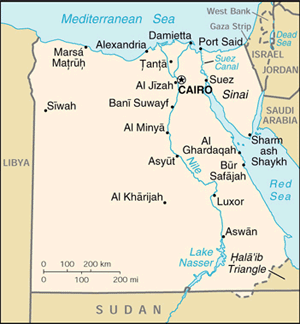
Muhammad bin Khaleel Hasan Harraas was born in Egypt in 1335H (1915) in a small town known as Sheen which was part of the city, Kafr El-Sheikh. At that time Kafr El-Sheikh was the capital city of the Gharbia governorate. Today, Kafr El-Sheikh is a governorate in its own right while Tanta has now become the capital of the Gharbia governorate.

His Upbringing and Early Studies:

The Shaikh was raised in a religious environment as he received his primary formal education in the Azhari school system in 1926. After successfully completing these primary studies, he enrolled in the College of Usool-ud-Deen of Al-Azhar University where he studied until he graduated in 1940 receiving the highest honors.

Afterward, he enrolled in the advanced studies program and in 1945 he obtained his doctorate’s degree basing his dissertation on the subject: “Ibn Taimyyah and his Critique of the Methods employed by the Theorists.”

This shows that he had embraced the methodology of the Salaf at a very early stage in his life, i.e. before completing his academic studies.

His Duties and Positions:

After graduating from Al-Azhar’s collegiate program, Shaikh Muhammad Khaleel Harraas began teaching in the Educational Institute at Zakazik.

Then when he obtained his doctorate’s degree, he was hired as a professor in the College of Usool-ud-Deen in Al-Azhar University, teaching the subject of Islamic Creed.

He also served as head of the Ansaar-us-Sunnah al-Muhammadiyyah Organization in Zakazik, until he was later put in charge of the organization’s branch in Tanta after he helped establish it.

He was then selected to serve as deputy to the main head of the Ansaar-us-Sunnah al-Muhammadiyyah Organization of Egypt at that time, Shaikh ‘Abdur-Rahmaan Al-Wakeel. This nomination took place in a general assembly meeting held on the 15th of Muharram, 1385H (7/9/1960).

Afterward, he was selected to teach in the College of Sharee’ah of the Umm-ul-Qurraa University in Makkah where he spent seven years. While there, he established a branch for the subject of Creed in the Advanced Studies department and served as head of this branch up until he passed away.

Al-Azhar University showed great opposition to his transfer to the Kingdom of Saudi Arabia to the point that King Faisal, may Allaah have mercy on him, had to insist upon his request for him. In the end, lieutenant general, ‘Abdur-Rahmaan Ameen, intervened and the government of Egypt finally agreed to his transfer. Al-Azhar opposed his transfer because they knew Shaikh Harraas would bear the banner of the methodology of the Salaf in full force and fight against the tactics of the theorists and misguided sects.

He also served as the head of the Islamic Da’wah Organization in the Gharbia governorate after founding it with Dr. ‘Abdul-Fattaah Ibraaheem Salaamah in 1393H.

His Scholarly Status:

Shaikh Muhammad Khaleel Harraas held a distinguished scholarly position for he was known throughout the circles of knowledge for his deep and intricate understanding of the issues of Creed, the proponents of rhetoric, and the philosophical ideologies of the east and west. He was systematic in his research, precise in his comprehension, organized in his presentation, and completely well-versed in the subject he intended to clarify. And he was unique in his ability to solve problems and clarify ambiguities with regard to scholastic issues.

He was unrelenting when it came to clarifying the truth, presenting evidences, broadening understandings, and silencing opponents. This could be seen from him in his lectures ‘ which would last hours ‘ as well his writings and performance in the classroom while teaching.

One particular lecture he delivered in Al-Azhar that was comprehensive and later published by Al-Azhar amongst their collections of lectures, courtesy of Muhammad Al-Bahee, may Allaah have mercy on him, was the lecture: ‘The Divine Attributes according to Ibn Taimiyyah.’

In his introduction to the Shaikh’s explanation of al-‘Aqeedat-ul-Waasitiyyah, Shaikh ‘Abdur-Razzaaq ‘Afeefee said: ‘The book of Shaikh Muhammad Khaleel Harraas is one of the most valuable, clear, and concise explanations (of al-‘Aqeedat-ul-Waasitiyyah).’

Shaikh Abul-Fidaa, Sayyid ‘Abdul-Maqsood bin ‘Abdir-Raheem Al-Atharee said in his introduction to the Shaikh’s book Fasl-ul-Maqaal fee Nuzool ‘Eesaa: ‘The author has done an excellent job in refuting those who hold this belief, i.e. those who reject what is authentically attributed on the Prophet (sallAllaahu ‘alayhi wa sallam) with regard to that. In spite of this treatise being small in size, it comprises the evidences and refutes the opponents. So may Allaah have mercy on the author and reward him greatly on behalf of Islaam.’

The publisher of one of the Shaikh’s books, Da’wat-ut-Tawheed, ‘Abdul-Fattaah Az-Zainee said: ‘It is only proper that Dr. Muhammad Khaleel Harraas, head of the Creed and Philosophy department in Al-Azhar University and one of the callers of Ansaar-us-Sunnah in Egypt, author a book such as this, for how many lectures of his did I hear from him personally and benefited from immensely in which he would explain the Tawheed that the messengers called to. And I saw him in the last part of his life, may Allaah have mercy on him, defending the Sunnah and refuting those who reject ahaadeeth found in Al-Bukhaaree and Muslim based on their intellects. So may Allaah have mercy on him and all of the Muslim scholars.’

In his biographical account of the Shaikh, ‘Alawee bin ‘Abdil-Qaadir As-Saqaaf said: ‘He, may Allaah have mercy on him, was Salafee in his Creed, strict with regard to the truth, and strong in his ability to establish proof and clarify matters. He spent his entire life teaching and writing. And he spread the Sunnah and the Creed of Ahlus-Sunnah wal-Jamaa’ah.’

Amongst the scholars of his time that he had met and kept a good relation with and who would praise him and advise people to read his books were: Shaikh ‘Abdur-Razzaaq ‘Afeefee, Shaikh ‘Abdul-‘Azeez bin Baaz, Shaikh Haamid Al-Fiqqee, Shaikh ‘Abdur-Rahmaan Al-Wakeel and Shaikh Muhammad Amaan Al-Jaamee.

His Efforts in Spreading the Creed of the Salaf:

Dr. Muhammad Khaleel Harraas lived a life full of sacrifice and struggle all in the name of trying to establish the balanced and true methodology and to reinforce the Call to the Way of the Salaf.

He worked hard to fight against polytheism, innovation, misguided groups, destructive beliefs, and deviant ideologies. He would employ all avenues and use any opportunity presented to him in order to achieve this, such as within the classes he gave at the institutes and universities, his general lectures, his articles for the al-Hadee-un-Nabawee magazine, his publication of books and treatises, and so on and so forth.

After the death of Dr. Harraas, Muhammad ‘Abdul-Hameed Ash-Shaafi’ee, former head of the Ansaar-us-Sunnah al-Muhammadiyyah of Egypt, said about him: ‘And so Khaleel has passed on like this and therefore a noble Salafee scholar has died. For how long did he carry the weight of calling to Allaah and struggling in His path on his shoulders! He would wage war against idolatry with every ounce of strength in him. And he would concentrate all his energy and time in teaching the Sunnah and warning against innovation. He would face such hardships from oppressors, endure such plots from innovators and experience such atheism from heretics the likes of which no one would be able to tolerate except for the patient and forbearing.

He was in truth a sincere caller ‘ neither lethargic nor lazy. Rather, he was always moving, active and untiring wherever he was, whether in the village, the city or other places he traveled to.

Dr. Muhammad Khaleel Harraas’s connection with the Ansaar-us-Sunnah al-Muhammadiyyah Organization began around 1360H during the time of its founder, Shaikh Muhammad Haamid Al-Fiqqee. This was while Shaikh Harraas was still a teacher at the Religious Institute in Zakazik, the place where he first began spreading the call to Tawheed. During this point in his life, he was also busy preparing his doctorate’s dissertation on the subject of Ibn Taimiyyah, may Allaah have mercy on him.

Afterward in 1945, while in the College of Usool-ud-Deen at Al-Azhar University, Shaikh Muhammad Khaleel Harraas obtained his doctorate’s degree and was subsequently appointed as a professor in the same college (of Usool-ud-Deen) within the University (Al-Azhar). He would toil tirelessly to spread the Creed of the Salaf throughout the classrooms of Al-Azhar and launched a full-scale offensive against the beliefs of the people of rhetoric, clarifying how they deviated away from the beliefs of Ahlus-Sunnah wal-Jamaa’ah. Most of his material would be extracted from the works of Shaikh-ul-Islaam Ibn Taimiyyah and his student Ibn Qayyim Al-Jawziyyah.

He would also deliver exhaustive scholarly lectures filled with narrative and intellectual evidences. This includes the lecture he delivered in Al-Azhar which was published amongst Al-Azhar’s lectures under the supervision of Dr. Muhammad Al-Bahee with the title: ‘As-Sifaat-ul-Ilaahiyyah ‘inda Ibn Taimiyyah‘ [The Divine Attributes according to Ibn Taimiyyah].

Dr. Harraas was diligent and eager to produce a generation of students that would understand the Creed of the Salaf to the point that it flowed from them like blood from their veins. This was so that they could in turn carry its banner after learning from him and proclaim it to their people, family and communities. So he would not deliver lectures to just give pure information, rather he would add a spiritual and doctrinal aspect to it.

Amongst his efforts in manifesting the way of the Salaf while at the University of Al-Azhar and demonstrating his firmness upon it was the fact that he based his research paper for obtaining his professor’s degree on the subject: ‘Ibn Taimiyyah, the Salafee.’

The Shaikh encountered great opposition and harm due to this enthusiasm and zeal of his for following the way of the Salaf. He endured many problems and obstacles from both the University of Al-Azhar’s administration and some of his teachers and colleagues. An example of this is the one mentioned previously when Al-Azhar at first refused to transfer him to Saudi Arabia.

However, no matter who you ask, Dr. Harraas played a prominent role and exerted tremendous effort in spreading the Creed of the Salaf in Al-Azhar.

His Articles in the Al-Hadee-un-Nabawee Magazine:

Dr. Muhammad Khaleel Harraas also worked at spreading the methodology of the Salaf by way of contributing serialized articles that he would write regularly for the Ansaar-us-Sunnah Organization’s magazine at that time ‘al-Hadee-un-Nabawee.’ This magazine served as the voice of the organization during that era and it would traverse the farthest regions of the Muslim world, spreading the call to the Way of the Salaf, bearing the banner of Tawheed, and raising high the slogan of the Sunnah.

The Shaikh would write articles for three ongoing segments in the magazine where he would clarify the Creed and refute those affected by the ideologies of intellectualism and innovation who would reject ahaadeeth. The titles of these segments were:

1. The Creed of the Qur’aan and Sunnah: Under this segment, the Shaikh set out to clarify the correct creed derived from the two pure sources of the Book of Allaah and the Sunnah of His Messenger (sallAllaahu ‘alayhi wa sallam).

Amongst the subjects he presented in this series was: Allaah’s Existence in two parts and Allaah’s Oneness in more than forty parts. In these articles, he discussed issues related to Allaah’s Lordship, Allaah’s Oneness in worship, certain acts of worship such as supplication and seeking assistance from Allaah, Allaah’s Oneness in His Names and Attributes and so on.

2. Allaah rises over His Throne even though the Deniers may Hate it: This consists of a refutation of an article written in the al-‘Itisaam magazine. In these series of articles, the Shaikh clarifiedsthe creed of Ahlus-Sunnah wal-Jamaa’ah with regard to Allaah rising over His Throne, while refuting the people of rhetoric and philosophy.

3. The Pillar of the Sunnah

His Religious Verdicts in the Al-Hadee-un-Nabawee Magazine:

Shaikh Muhammad Khaleel Harraas was put in charge of answering readers questions sent in the al-Hadee-un-Nabaweemagazine after the death of Professor Abul-Wafaa Muhammad Darweesh, may Allaah have mercy on him. Questions would be sent in from all parts of the Muslim world the magazine would reach and they would cover a wide range of topics and sciences.

There is no doubt that taking charge of such a duty requires a great deal of researching and examining of the books of the scholars in order to prepare answers for these numerous questions on distinct subjects. A portion of these questions would also be on issues pertaining to Creed, Tawheed and the Sunnah. Dr. Harraas continued to fulfill this most important duty up until the time that the magazine seized publication, which was in 1387H.

His Lectures in the Organization’s Center as well as in the Cities, Villages and Colleges:

From the methods and ways employed by the Ansaar-us-Sunnah Organization to spread the call to Tawheed and the Prophetic Sunnah were the weekly lectures and programs they would hold in their main center on Sundays and Wednesdays.

Dr. Muhammad Khaleel Harraas had an active role in organizing these lectures. He would deliver talks that would focus on clarifying the Creed of the Salaf, backing that up with proofs from the Qur’aan and Sunnah and statements of the Companions, Taabi’een and Muslim Imaams. His lectures would be widely circulated.

With regard to the cities and villages, the center would organize outings in which they would go visit the various branches of the organization throughout the cities and villages of Egypt to give academic lectures and lessons, to attend general assembly meetings to select administrative boards for those branches, or to participate in specific events such as opening a masjid or announcing a new branch.

Shaikh Harraas played a big part in this area as he would participate in these da’wah, administrative and inspectional trips.

He would also deliver academic lectures in universities, taking advantage of those opportunities to present the Call to the Way of the Salaf to the audience members, which would consist of teachers, students and faculty members.

At times, he would also give valuable points of advice to the youth of Al-Azhar close to the end of the school year so that they could go back to their towns and families properly equipped with the creed of the Qur’aan and Sunnah.

His Formation of the Ansaar-us-Sunnah al-Muhamadiyyah Organization in Tanta:

After Shaikh Muhammad Khaleel Harraas embraced the methodology of the Salaf, he began to proclaim the Call to Allaah in the institutes, universities, cities and villages. Amongst these cities was his town of Tanta. However, when he realized that the call of individuals dies with the death of those individuals, he worked to form a branch for the Ansaar-us-Sunnah al-Muhammadiyyah Organization in Tanta. After forming this branch, he assumed its leadership and as a result was able to spread Tawheed, revive the Sunnah, demolish polytheism, and exterminate innovation.

Shaikh Fat’hee Ameen ‘Uthmaan said: ‘When Shaikh Harraas formed the Ansaar-us-Sunnah al-Muhammadiyyah Organization in Tanta, he would give lectures there in which he would fight against innovation and call to the Sunnah in a good manner while using proofs from the Qur’aan and Sunnah. This had a great effect in bringing many people back to the truth.

Another of its effects was that the wrath of the enemies of the truth surpassed its limits and so they began to complain about him to the authorities by distorting his methodology. They based their argument on the precipice that he hated the awliyaa (close friends of Allaah). However, the matter fell into the hands of a smart man who quickly saw the truth and realized the objective behind their complaints. So he advised them to refrain from this because the Shaikh was only calling to the truth.

Shaikh Harraas would deliver sermons to the people in the masjid on Fridays and lectures in the evenings for the organization as well as during any other occasion in which he would get the opportunity. And his call found general acceptance amongst the people. From among his biggest aides and supporters was Dr. ‘Abdul-Fattaah Salaamah.

His Authoring of Books and Support of the Methodology of the Salaf:

Shaikh Muhammad Khaleel Harraas is considered one of the most prolific writers amongst the scholars of Ansaar-us-Sunnah on the subject of the Creed of the Salaf. This was since he began writing about it ever since he began acquiring knowledge. This is seen clearly in the fact that his doctorate’s dissertation was titled: ‘Ibn Taimiyyah and his Critique of the Methods employed by the Theorists.’ He also based the thesis for achieving his professor’s certificate on the subject: ‘Ibn Taimiyyah, the Salafee.’

From amongst Dr. Muhammad Khaleel Harraas’ biggest efforts in spreading the call to the way of the Salaf was his explanation of the book ‘al-‘Aqeedat-ul-Waasitiyyah‘ of Shaikh-ul-Islaam Ibn Taimiyyah, which is distinguished by its clarity, conciseness, referencing of the Qur’aan and Sunnah and statements of the Salaf, past and present, in numerous places, and mention of the opinions of the various sects along with a response to their false ideologies.

In his introduction to this book, Shaikh ‘Abdur-Razzaaq ‘Afeefee said: ‘The book of Shaikh Muhammad Khaleel Harraas is one of the most valuable, clear and concise explanations (of al-‘Aqeedat-ul-Waasitiyyah).’

This explanation continues to be used in the curriculum of some schools and institutes today.

After this, comes his book ‘Da’wat-ut-Tawheed‘ [The Call to Monotheism] which is distinguished by its simplicity and ease. This book discusses some of the most important issues of Creed such as the definition of Tawheed, its categories and effects, an explanation of Allaah’s Attributes, and the call of the prophets from the time of Nooh to the time of Muhammad. It also talks about the appearance of the following sects: the Qadariyyah, the Murji’ah, the Jahmiyyah, the Mu’atazilah and so on. The book also discusses the Sufis and their dangers and refutes them. It is from the most widespread books of the Shaikh in which he exerted a great deal of effort in clarifying the call to Tawheed.

Then there is his book ‘Sharh al-Qaseedat-un-Nooniyyah‘ [An Explanation of the Nooniyyah Poem] of Ibn Al-Qayyim. The explanation of this book is considered a form of spreading the beliefs of the Salaf since it consists of a clarification of the creed of Ahlus-Sunnah wal-Jamaa’ah on various issues and mentions the opinions of the sects, while refuting them in a smooth and firm poetic manner. The explanation along with the original text was published in two volumes.

Among his significant works was his book “Fasl-ul-Maqaal fee Raf’ ‘Eesaa Hayyan wa Nuzoolihi Li-Qatl-il-Maseeh-id-Dajjaal” [The Final Word on Jesus Ascending Alive and Descending to Kill the Antichrist]. This book consists of a refutation against those who follow the intellectual school of thought as well as those who tread their path and were influenced by them, particularly in that which is related to rejecting the descending of Prophet Jesus. No doubt this is considered one of his efforts in stopping that violent wave that opens the floor for those with evil intentions and desires to play around with the issues of Creed.

In his introduction to this book, Shaikh Muhammad Khaleel Harraas said (pg. 5): ‘To proceed: Since the beginning of this century or a little before it, there appeared a group that called to free thinking, leading a religious reformation movement and working to revive the correct understanding of the Religion in the souls of the Muslims. However, in their efforts to achieve this, they began rejecting many aspects of the Unseen that have been mentioned in the clear and well-known texts of the Qur’aan and Sunnah, which only further confirms their authenticity and establishment. And they have no support for this rejection of theirs except for the defiance and self-delusion of their intellects”

There is also the book “Al-Harakat-ul-Wahhaabiyyah” [The Wahhabi Movement] in which he refutes an article from Dr. Muhammad Al-Bahee. This book is one of the significant efforts made in order to expel the biased misconceptions and claims concerning the call of Shaikh Muhammad bin ‘Abdil-Wahhaab, which is considered one of the Islamic reformation movements that spread the spirit of the methodology of the Salaf throughout the Muslim ummah.

In this book, Dr. Harraas said (pg. 32): ‘The movement only calls to returning back to the way of the Salaf with regard to beliefs, which represent the fundamentals, since the Salaf were united upon it in one single view against the people of desires, such as the Khawaarij, the Shee’ah, the Qadariyyah, the Murji’ah, the Jahmiyyah, and their likes.’

Verifications and Explanations:

Dr. Muhammad Khaleel Harraas took on the task of verifying and explaining some of the books of the Salaf on various subjects, such as Creed, Hadeeth, Prophetic Biography, Jurisprudence, and so on.

Verifying and distributing the books of Creed is considered one of the efforts in serving the methodology of the Salaf since the material found in these books is confined to explaining the correct creed and pure monotheistic beliefs that the pious predecessors (Salaf-us-Saalih) were upon.

As for the work and effort he did in books on other subjects, Dr. Harraas’ explanations and comments to these texts would still focus primarily on clarifying the Creed of the Salaf and calling others to adhere to it.

List of his Written Works and Verifications:

His written works include:

1. Da’wat-ut-Tawheed [The Call to Monotheism]
2. Sharh al-‘Aqeedat-ul-Waasitiyyah [An Explanation of the Waasitee Creed of Ibn Taimiyyah]
3. Ibn Taimiyyah wa Naqduhu li-Masaalik al-Mutakallimeen fee Masaa’il-il-Ilaahiyaat [Ibn Taimyyah and his Critique of the Methods employed by the Theorists on Theological Issues]
4. Ibn Taimiyyah As-Salafee: This is the thesis he wrote for obtaining his Professor’s certificate from Al-Azhar University.
5. Sharh al-Qaseedat-in-Nooniyyah [An Explanation of the Nooniyyah Poem of Ibn Al-Qayyim]: This is considered one of his greatest works. It was published several times in two volumes. It also goes by the name ath-Thimaar-ush-Shahiyyah fee Sharh-in-Nooniyyah [The Tantalizing Fruits: An Explanation of an-Nooniyyah]
6. Fasl-ul-Maqaal fee Raf’ ‘Eesaa Hayyan wa Nuzoolihi Li-Qatl-il-Maseeh-id-Dajjaal [The Final Word on Jesus Ascending Alive and Descending to kill the Antichrist].
7. Sharh at-Targheeb wat-Tarheeb [An Explanation of at-Targheeb wat-Tarheeb of At-Tabreezee]
8. Sharh as-Seerat-un-Nabawiyyah Libn-Hishaam [An Explanation of the Prophet’s Biography of Ibn Hishaam]
9. Al-Harakat-ul-Wahaabiyyah [The Wahhabi Movement]
10. As-Sifaat-ul-Ilaahiyyah ‘inda Ibn Taimiyyah [The Divine Attributes according to Ibn Taimiyyah]: This was a lecture he delivered in Al-Azhar University, which was published amongst a collection of Al-Azhar’s lectures courtesy of Muhammad Al-Bahee.

Amongst the classical books that he verified were:

1. Al-Khasaa’is-ul-Kubraa also known as Kifaayat-ut-Taalib-il-Labeeb fee Khasaa’is-il-Habeeb of As-Suyootee
2. Al-Amwaal of Abu ‘Ubaid Al-Qaasim bin Salaam
3. At-Tawheed of Ibn Khuzaimah
4. Al-Mughnee of Ibn Qudaamah
5. Subul-us-Salaam of As-San’aanee

His Students:

Due to the Shaikh’s active role in teaching and especially due to his position in Umm-Qurraa in Makkah, many students were produced under his supervision, particularly those with professional and specialized degrees. From amongst those who learned at his hands were:

1. Dr. Mahmood Muhammad Mazroo’ah: Professor of Creed at the Umm-ul-Qurraa University of Makkah.
2. Dr. Ahmad ‘Atiyyah Az-Zahraanee: Former head of the Creed department at the Umm-ul-Qurraa University of Makkah.
3. Dr. Ahmad ‘Atiyyah Al-Ghaamidee: Professor of Creed at the Islamic University of Madeenah.
4. Dr. ‘Alee Naasir Al-Faqeehee: Former professor of Creed at the Islamic University of Madeenah; now retired from teaching.
5. Dr. Muhammad Amaan Al-Jaamee [D. 1416H]: Former head of the Creed department at the Islamic University of Madeenah.
6. ‘Abdul-Fattaah Salaamah: Head of the Tafseer Department in the Advanced Studies section of the Islamic University of Madeenah.

His Death:

The Shaikh was particularly very active in the last year of his life as he delivered many lectures that year in Tanta, Mahalla and the Ansaar-us-Sunnah’s main center. Shaikh Muhammad Khaleel Harraas passed away in 1395H (Sept. 1975) when he was close to sixty after having lived a life full of calling to Allaah, teaching and writing. May Allaah have mercy on him and grant him a lofty abode in Paradise.

Recently, a student named Moosaa bin Waasil As-Sulamee based his thesis for obtaining his master’s degree from the College of Da’wah and Usool-ud-Deen at the Umm-ul-Qurraa University in Makkah on the subject: ‘Shaikh Khaleel Harraas and his Efforts in Establishing the Creed of the Salaf.’

The researcher chose Shaikh Harraas as the subject for his thesis, in his own words: ‘Due to the fact that the writings of the Shaikh are characterized with profuse knowledge, a clear technique, and a deep understanding of the beliefs of those who oppose the Creed of the Salaf, which makes the attempt to divulge on these efforts of his a source of great benefit and good.’

In summary, the study shows that Shaikh Muhammad Khaleel Harraas:

1. Was distinguished by his strong ability to use texts from the Qur’aan and Sunnah as evidence for his points, which indicate his firm and well-grounded knowledge.
2. Adhered strictly to the Qur’aan and Sunnah and would refer to them and judge by them in all affairs.
3. Showed great concern for the principles upon which the theorists and philosophers based their beliefs on with regard to matters of Creed.

Sources used for his Biography:

The sources used for this particular biography were the biographical accounts of the Shaikh found in the Dar-ul-Minhaaj 2003 edition of Sharh al-Qaseedat-un-Nooniyyah, the Dar-ul-Imaam Ahmad 2008 edition of the same book and ‘Abdul-Fattaah Salamaah’s biography of him found in the Dar-ush-Sharee’ah 2004 edition of Fasl-ul-Maqaal.

Published on: November 3, 2007

We do not make Supplication against Muslim Rulers – Aqeedah Tahawiyyah

Aqeedah Tahaawiyyah: Lesson 40  : Point [159]
Dawud Burbank [Audio|English]

[159] And we do not make supplication against them (Muslim Rulers).

[Souncloud Audio Link]

At-Ta`leeqaat Al-Mukhtasarah `alaa Matn Al-`Aqeedah AtTahaawiyyah. By Shaykh Saalih ibn Fawzaan al-Fawzaan hafizahullaah. Translated by Aboo Talhah Daawood Burbank, rahimahullaah, in 1426AH

Posted with kind permission from Dawud Burbank rahimahullaah

Listen to the Full Audio Series of Aqeedah Tahaawiyyah:
Explanation of Aqeedah at-Tahaawiyyah – Dawud Burbank [Audio|En]

Book Study Resource : Aqeedah at-Tahaawiyyah – Imam at-Tahaawi

Related Link : Muslim Rulers  abdurrahman.org/rulers

We do not hold rebelling against our rulers and those in authority over our affairs – Aqeedah Tahawiyyah

Aqeedah Tahaawiyyah: Lesson 39  : Points [157-158]
Dawud Burbank [Audio|English]
Explanation Based on Shaykh Fawzan & Shaykh Albani’s explanations

[157.] And we do not hold rebelling against our rulers and those in authority over our affairs. [158.] Even if they oppress.

[Souncloud Audio Link]

At-Ta`leeqaat Al-Mukhtasarah `alaa Matn Al-`Aqeedah AtTahaawiyyah. By Shaykh Saalih ibn Fawzaan al-Fawzaan hafizahullaah. Translated by Aboo Talhah Daawood Burbank, rahimahullaah, in 1426AH

Posted with kind permission from Dawud Burbank rahimahullaah

Listen to the Full Audio Series of Aqeedah Tahaawiyyah:
Explanation of Aqeedah at-Tahaawiyyah – Dawud Burbank [Audio|En]

Book Study Resource : Aqeedah at-Tahaawiyyah – Imam at-Tahaawi

Related Link : Muslim Rulers  abdurrahman.org/rulers

Siwaak – It’s recommendation is emphasized in five Situations – Abdul-Azeem ibn Badawee al-Khalafee | Dawud Burbank

The siwaak (tooth-stick) :

The siwaak is recommended in all conditions, and its recommendation is emphasized:

1- Along with the wudoo·:

From Aboo Hurayrah -radiyallaahu `anhu- who said: Allaah’s Messenger (صلّى الله عليه وسلّم ) said:

<<If it were not that I would make a difficulty upon my nation I would have commanded them to use the siwaak with every wudoo·.>>” [1]

2- At every Prayer:

From Aboo Hurayrah -radiyallaahu `anhu- from the Prophet ( صلّى الله عليه وسلّم ) who said:

<<If it were not that I would make a difficulty for my nation I would have commanded them to use the siwaak at every Prayer.>> [2]

3- When reciting the Qur·aan:

From `Alee -radiyallaahu `anhu- who said: “He commanded us to use the siwaak, and he said:

<<When the servant stands in Prayer an Angel comes to him and stands behind him, listening to the Qur.aan and drawing closer. So he continues listening and drawing closer until he places his mouth upon his mouth. So he does not recite any Aayah except that it enters within the Angel>> [3]

4- When entering the house:

From al-Miqdaam ibn Shurayh: from his father, who said: I asked `Aa·ishah, saying: “What had the Prophet ( صلّى الله عليه وسلّم ) used to begin with when he entered his house?” she said: “With the siwaak.” [4]

5- When getting up (to pray) during the night:

From Hudhayfah –radiyallaahu `anhu- who said: “When Allaah’s Messenger ( صلّى الله عليه وسلّم ) got up to pray the tahajjud Prayer at night, he used to rub his mouth with the siwaak.” [5]

Footnotes:

[1] Saheeh: Saheehul-Jaami` (5317); Ahmad (1/294/171).
[2] Agreed upon Muslim (1/220/252), al-Bukhaaree (2/374/887), at-Tirmidhee (1/18/22), an-Nasaa·ee (1/12); except that the wording of al-Bukhaaree is: “with every Prayer.”
[3] Saheeh Lighairihi: as-Saheehah (1213); al-Bayhaqee (1/38).
[4] Saheeh Ibn Maajah (235); Muslim (1/220/253) Aboo Daawood (1/86/58), Ibn Maajah (1/106/290), an-Nasaa·ee (1/13).
[5] Agreed upon: Muslim (1/220/255), and this wording is his; al-Bukhaaree (1/356/245), Aboo Daawood (1/83/54), an-Nasaa·ee (1/8); and the wording of the three is: “When he got up (to pray) during the night.”

Source : Al-Wajeez, The Book Of Purification  –  Abdul-`Azeem ibn Badawee al-Khalafee, Translated by Abu Talhah Dawood Burbank .

Related Linkhttps://abdurrahman.org/tahara-purification/

We do not hold using the sword against anyone from the Ummah of Muhammad except upon those whom it becomes obligatory to use it upon – Aqeedah Tahawiyyah

Aqeedah Tahaawiyyah: Lesson 38  : Point [156]
Dawud Burbank [Audio|English]

156. And we do not hold using the sword against anyone from the Ummah of Muhammad  (صلّى الله عليه وسلّم ) except upon those whom it becomes obligatory to use it upon.

[Souncloud Audio Link]

Narrated Ibn `Umar: The Prophet (ﷺ) said at Mina, “Do you know what day is today?” They (the people) replied, “Allah and His Apostle know better,” He said “Today is 10th of Dhul-Hijja, the sacred (forbidden) day. Do you know what town is this town?” They (the people) replied, “Allah and His Apostle know better.” He said, “This is the (forbidden) Sacred town (Mecca a sanctuary).” And do you know which month is this month?” They (the People) replied, “Allah and His Apostle know better.” He said, ”This is the Sacred (forbidden) month .” He added, “Allah has made your blood, your properties and your honor Sacred to one another (i.e. Muslims) like the sanctity of this day of yours in this month of yours, in this town of yours.” (See Hadith No. 797, Vol. 2.)

[Sahih al-Bukhari 6043 (Book 78, Hadith 73). Translated by Dr. Muhamamd Muhsin Khan]

At-Ta`leeqaat Al-Mukhtasarah `alaa Matn Al-`Aqeedah AtTahaawiyyah. By Shaykh Saalih ibn Fawzaan al-Fawzaan hafizahullaah. Translated by Aboo Talhah Daawood Burbank, rahimahullaah, in 1426AH

Posted with kind permission from Dawud Burbank rahimahullaah

Listen to the Full Audio Series of Aqeedah Tahaawiyyah:
Explanation of Aqeedah at-Tahaawiyyah – Dawud Burbank [Audio|En]

Book Study Resource : Aqeedah at-Tahaawiyyah – Imam at-Tahaawi

Toilet Manners (Aadaabul-Khalaa) : Abdul-Azeem ibn Badawee al-Khalafee

1 – It is recommended for the person who wants to enter the toilet to say:

بِسْمِ الله ) اللَّهُمَّ إِنِّي أَعُوْذُ بِكَ مِنَ الْخُبُثِ وَالْخَبَائِثِ)

(Bismillaah),
(Allaahummaa innee a`oodhu bika minal-khubuthi wal-khabaa·ith)

(With the name of Allaah),
(O Allaah! I seek Your refuge from male and female devils).

This is because of the hadeeth of `Alee -radiyallaahu `anhu- that the Prophet (صلّى الله عليه وسلّم ) said:

<<The screen between the jinn and the private-parts of the descendants of Aadam, when one of you enters the toilet, is that he says:‘Bismillaah’ (with the name of Allaah).>> [1.1]

And because of the hadeeth of Anas -radiyallaahu `anhu- who said: “When Allaah’s Messenger (صلّى الله عليه وسلّم ) went to the toilet he used to say:

اللَّهُمَّ إِنِّي أَعُوْذُ بِكَ مِنَ الْخُبُثِ وَالْخَبَائِثِ

‘Allaahummaa innee a`oodhu bika minal-khubuthi wal-khabaa·ith’ (O Allaah! I seek Your refuge from male and female devils).”  [1.2]

2 – And it is recommended that when he departs he says:: (Ghufraanaka): (I seek Your forgiveness), because of the hadeeth of Aa·ishah -radiyallaahu `anhaa- who said: “When the Prophet (صلّى الله عليه وسلّم ) came away from the toilet he would say: << Ghufraanaka>> (I seek Your forgiveness).” 1.3

3 – And it is recommended that he should enter with his left-foot first, and depart with the right-foot first.

This is because the right-side is used for noble actions, and the left-side for actions which are not noble actions; and there are reports which indicate this generally. [1.4]

4 – And if he is in an open place, then it is recommended for him to move far enough away so that he is not seen:

From Jaabir -radiyallaahu `anhu- who said: “We went out along with Allaah’s Messenger (صلّى الله عليه وسلّم ) on a journey, and Allaah’s Messenger (صلّى الله عليه وسلّم ) would not go to the toilet until he had gone far enough so that he would not be seen.” [1.5]

5 – And it is recommended that he does not raise his garment until he is close to the ground:

From Ibn `Umar -radiyallaahu `anhumaa- : “That when the Prophet (صلّى الله عليه وسلّم ) wanted to relieve himself he would not raise his garment until he was close to the ground.” [2.1]

6 – And it is not permissible to face or to have ones back towards the qiblah, whether in the open desert or within a building:

From Aboo Ayyoob al-Ansaaree -radiyallaahu `anhu- from the Prophet (صلّى الله عليه وسلّم ) who said:

When you go to the toilet, then do not face the qiblah and do not have your back towards it, but rather turn to the east or to the west.” [2.2]

Aboo Ayyoob said: “So we came to Shaam, and we found toilets which had been built facing towards the Ka`bah. So we would turn aside from it, and we would ask for the forgiveness of Allaah -the Most High.” [2.3]

7 – And it is forbidden to go to the toilet upon the path-way of the people, and in the places where they take shade:

From Aboo Hurayrah that the Prophet (صلّى الله عليه وسلّم ) said:

<<Beware of the two things which bring about curses.>> They said: “And what are the two things which bring about curses, O Messenger of Allaah?” He said: <<The person who goes to the toilet upon the path-way of the people, or where they take shade.>>2.4

8 – And it is disliked to urinate in the place where he takes a bath: From Humayd al-Himyaree who said: I met a man who had accompanied the Prophet (صلّى الله عليه وسلّم ) just as Aboo Hurayrah accompanied him, [2.5] who said: “Allaah’s Messenger (صلّى الله عليه وسلّم ) forbade that one of us should comb his hair every day, and that he should urinate in the place where he takes a bath.”  [2.6]

9 – And it is forbidden to urinate in standing water:

From Jaabir: from the Prophet (صلّى الله عليه وسلّم ) that he forbade urinating in standing water. [3.1]

10 – And it is permissible to urinate standing, but sitting is better:

From Hudhayfah -radiyallaahu `anhu-: that the Prophet (صلّى الله عليه وسلّم ) came to the rubbish dump of a people, and he urinated whilst standing. So I moved away, so he said: <<Draw near.>> So I drew close to him, until I stood at his heels. So he performed wudoo·, and wiped over his leather socks. [3.2]

And we said that sitting is better because that was his usual practice, to such an extent that `Aa·ishah -radiyallaahu `anhaa- said: “Whoever narrates to you that Allaah’s Messenger (صلّى الله عليه وسلّم ) urinated whilst standing then do not believe him. He had not used to urinate except whilst sitting.” [3.3]

And this saying of hers does not negate what occurs from Hudhayfah, since she informed about what she had seen, and Hudhayfah informed about what he had seen; and, as is known, the one who affirms is given precedence over the one who negates, since he has additional knowledge with him.

11 – And it is obligatory to keep oneself clean of urine:

So from Ibn `Abbaas -radiyallaahu `anhumaa- : that the Prophet (صلّى الله عليه وسلّم ) passed by two graves, and said:

<<They are being punished, and they are not being punished for something serious. As for one of them, then he had not used to keep himself clean of his urine; and as for the other, then he used to go between the people with reports to cause trouble (nameemah).” [3.4]

12-And he should not hold his penis with his right hand whilst he is urinating, nor clean himself with it:

From Qataadah -radiyallaahu `anhu- who said: Allaah’s Messenger (صلّى الله عليه وسلّم ) said:

When one of you urinates, let him not hold his penis with his right hand; and let him not clean himself with his right hand.” [4.1]

13 – And it is permissible to clean oneself with water, or with stones-or with whatever is like them, and water is better:

From Anas -radiyallaahu `anhu- who said: “Allaah’s Messenger (صلّى الله عليه وسلّم ) used to enter the toilet, and I and a boy of similar age to me used to carry a pot of water and a spear. So he would clean himself with the water.” [4.2]

And from `Aa·ishah -radiyallaahu `anhaa- that Allaah’s Messenger (صلّى الله عليه وسلّم ) said: <<When one of you goes to the toilet then let him take three stones along with him, and let him clean himself with them, since they will suffice him.>>  [4.3]

14 – And it is not permissible to suffice with less than three stones:

From Salmaan al-Faarisee -radiyallaahu `anhu- that it was said to him: ‘Your Prophet (صلّى الله عليه وسلّم ) has taught you everything, even how to use the toilet!’ So he said: “Yes indeed! He forbade us from facing the qiblah with excrement or urine; and that we should clean ourselves with the right hand, and that we should clean ourselves with less than three stones; and that we should clean ourselves with a piece of animal dung or with a bone.” [4.4]

15 – And it is not permissible to clean oneself with a bone, or with a piece of dung: From Jaabir -radiyallaahu `anhu- who said: “The Prophet (صلّى الله عليه وسلّم ) forbade that a person should wipe himself clean with a bone or a piece of animal dung.” [4.5]

Footnotes :

[1.1] Saheeh: Saheehul-Jaami` (3611); at-Tirmidhee (2/59/606)-and this is his wording; Ibn Maajah (1/109/297)…

[1.2] Agreed upon: al-Bukhaaree (1/242/142), Muslim (1/283/375), Aboo Daawood (1/21/4), Ibn Maajah (1/109/298), at-Tirmidhee (1/76), an-Nasaa·ee (1/20)

[1.3] Saheeh: Saheehul-Jaami` (4714); Aboo Daawood (1/52/30), at-Tirmidhee (1/7/7), Ibn Maajah (1/110/300).

[1.4] ‘as-Saylul-Jarraar’ (1/64). Shaikh al-Albaanee said in his notes upon ‘Ta·seesul-Ahkaam’ (1/34), concerning entering the toilet with the justify-foot: “I do not know anything from that in the Sunnah” (transl.).

[1.5] Saheeh: Saheeh Ibn Maajah (268); Ibn Maajah (1/121/335), Aboo Daawood (1/19/2) -with its like.

[2.1] Saheeh: Saheehul-Jaami` (4652); Aboo Daawood (1/31/14), at-Tirmidhee (1/11/14) as a hadeeth of Anas.

[2.2] Saheeh: Mukhtasar Muslim (109), [Muslim (no.264)], Saheeh Abee Daawood (7).

[2.3] Agreed upon: al-Bukhaaree (1/498/394), Muslim (1/224/264), at-Tirmidhee (1/8/8).

[2.4] Saheeh: Saheehul-Jaami` (110); Aboo Daawood (1/47/25), Muslim (1/226/269)…

[2.5] The narration of an-Nasaa·ee contains the additional wording “for four years.” (transl.).

[2.6] Saheeh: Saheehun-Nasaa·ee (232); an-Nasaa·ee (1/130), Aboo Daawood (1/50/28).

[3.1] Saheeh: Saheehul-Jaami` (6814); Muslim (1/235/281), an-Nasaa·ee (1/34).

[3.2] Muslim (1/228/273), at-Tirmidhee (1/11/13), al-Bukhaaree (1/329/225), an-Nasaa·ee (1/19), Aboo Daawood (1/44/23), Ibn Maajah (1/111/305).

[3.3] Saheeh: Saheehun-Nasaa·ee (29), an-Nasaa.ee (1/26), at-Tirmidhee (1/10/12)….

[3.4] Agreed upon: al-Bukhaaree (1/317/216), Muslim (1/240/292), at-Tirmidhee (1/47/70), Aboo Daawood (1/40/20), an-Nasaa·ee (1/28).

[4.1] Saheeh: Saheeh Ibn Maajah (250); Ibn Maajah (1/113/310) -this is his wording; and it was reported by: al-Bukhaaree (1/254/154), Muslim (1/225/267), Aboo Daawood (1/53/31), at-Tirmidhee (1/12/15), an-Nasaa·ee (1/25) -in longer form, and in abridged form.

[4.2] Agreed upon: al-Bukhaaree (1/252/152), Muslim (1/227/271), an-Nasaa·ee (1/42)- and he does not have a mention of the spear. An-Nawawee said: “The Prophet (صلّى الله عليه وسلّم ) used to take it (i.e. the spear) along with him, because when he had performed wudoo· he would pray. So he needed to erect it in front of him, so that it would be a barrier which he could pray towards.” (transl.)

[4.3] Saheeh:Saheehun-Nasaa·ee; an-Nasaa·ee (1/42), Aboo Daawood (1/61/40)

[4.4] Saheeh: Saheeh Ibn Maajah (255); Muslim (1/223/262), at-Tirmidhee (1/13/16), Aboo Daawood (1/24/7), Ibn Maajah (1/115/316), an-Nasaa·ee (1/38)

[4.5] Saheeh: Saheehul-Jaami` (6827); Muslim (1/224/263), Aboo Daawood (1/60/38)

Source : Al-Wajeez, The Book Of Purification  –  Abdul-`Azeem ibn Badawee al-Khalafee, Translated by Abu Talhah Dawood Burbank . An excellent book on the rules and regulations of various acts of worship, with evidences from the Book and Sunnah. This chapter deals with water and aspects of purification, wudhoo, ghusl, the toilet etc

Related Linkhttps://abdurrahman.org/tahara-purification/

Praise of the ‘Ulema for Shaykh Abu AbdurRahmaan Muqbil bin Haadee al-Waadi’ee

Compiled & Translated by Abbas Abu Yahya hafidhahullaah

1- The ‘Allamaa The Muhadith Muhammad Nasr ud-Deen al-Albaani

Shaykh al-Albaani says;

‘….As for the people who know about this science then they do not have any doubt in the weakness of this type of hadeeth.  Here we have Shaykh Muqbil bin Haadee al-Yemani who mentions in his checking of ‘Ibn Katheer’ (v1 p.513) after briefly speaking about the narrators of the isnaad one by one;’ the hadeeth is weak due to a break in the isnaad and because of the weakness of UbaydAllaah bin Waleed ar-Rasaafee’

Taken from ‘Silsilah ad-Da’eefah  V5 p.95’

Shaykh al-Albaani was asked about Muqbil bin Haadee al-Waadi’ee and Rabee bin Haadee al-Madkhalee he answered with;

‘We, by no doubt praise Allaah Azza wa Jal that He has subjected/provided for this righteous Dawa’, which stands upon the Book, the Sunnah and the methodology of the Salaf as-Saalih, many callers to Islaam in the different Islaamic countries who establish the duty which is established by very few of the people in the Islaamic world today.

Therefore these two shaykhs are a blessing, the two callers to the Book, the Sunnah and what the Salaf as-Salih were upon, who battle against those who oppose this correct Manhaj.  As everyone knows (regarding those who oppose these two shaykhs) – that this certainlyemanates from two types of people; ‘either from an ignorant person or a person who follows his desires’.  As for the ignorant person then it is easy to guide him, since he thinks that he has some knowledge-so when correct knowledge is explained to him he is guided.

This is why I have said on many occasions that many of the organisations which are prevalent today, even though they have deviated away from our Dawa’, we find amongst them those who have sincerity – which is more beloved to me than some of those in our Dawa’.  Although it becomes clear that they are not with us in the sincerity which is a condition for the acceptance of all good actions.

As for the one who follows his desires, then we have no other way for him except that Allaah Tabaraka wa Ta’ala guides him.  So those who criticise the two Shaykhs, are as we mentioned either ignorant, so they are educated, or he who follows his desires, then Allaah’s refuge is sought from this person’s evil, and we request from Allaah that He either guides him or He breaks his back.

As for Shaykh Muqbil, I have not read much of his works, unlike the case of our brother Rabee.  What seems apparent is that Rabee is more active in writing than Shaykh Muqbil and vice versa in Dawa’, (Shaykh Muqbil is more involved in) mixing with the people and inviting them to the Book and the Sunnah, admonishing them and directing them more so than Shaykh doctor Rabee.

As for Shaykh Muqbil then the people of Makkah know their pastures better – the news that reaches us from you is the best testimony that Allaah has blessed him with ability which is probably unparalleled when compared to some of the other callers to Islaam on the face of the earth today. So we ask Allaah Azza wa Jal that He grants the Muslims the capability to acknowledge firstly their (i.e. the two shaykhs’) religion and that they are far from following their desires.’

Taken from ‘Silsilah hudaa wa Noor No. 851   Date 1416/7/9’

2) The Allaama The Faqeeh Ash-Shaykh AbdulAzeez bin Baz

A questioner from Yemen asked the Shaykh where he should go to study knowledge.

The Shaykh answered: ‘Go to Shaykh Muqbil.’

When Shakyh Bin Baz spoke about the history of the Dawa’ in Yemen he mentioned: ‘this is the result of the fruits of honesty and sincerity.’

Shaykh Bin Baz would accept references -from Shaykh  Muqbil.

Shaykh Muqbil mentioned: At that time a person escaped to Riyadh and he said to Shaykh Bin Baz: O Shaykh I’m from Ahlus-Sunnah but I don’t have any documents.

Shaykh Bin Baz said to him: ‘Prove to me that you’re from Ahl-us-Sunnah.’

The man took out a piece of paper with a reference from me, upon that the Shaykh wrote a letter for him with which he could travel to wherever he wanted.’

Taken from ‘Rathaa shaykhina libin Baz p. 16’

3) Shaykh the Faqeeh Uthaymeen.

Shaykh Uthaymeen said:

‘Tell him that I regard him as a reviver of Islaam.’

Taken from ‘Nubtha Mukhtasira’ (p.9) by Umm Abdullaah the daughter of Shaykh Muqbil

4) Shaykh Muhaddith Rabee bin Haadee al-Madkhalee

Shaykh Rabee also said:

‘He is a reviver of Islaam in the country of Yemen. There has not been, since the time of AbdurRazaq as-Sanaani until our time, anyone who has established the Dawa’ and revived it like al-Waadi’ee.’

Taken from ‘Nubtha Mukhtasira’ (p.9) by Umm Abdullaah the daughter of Shaykh Muqbil

He also said in his advice to the Salafis of Yemen and in poetry he recited when mourning for the Shaykh:

‘This is what we express as condolence about the flag bearer of the Sunnah and Tawheed, that caller to Allaah, the reviver in truth in the land of Yemen. The effects of his Dawa’ reached to many regions of the earth.

I say to you what I believe, that your country, after the best generations, came to know the Sunnah and the Manhaj of the Salaf as-Saalih.  The Sunnah appeared at different periods of time with strength, yet still I do not know of any period like this, with which Allaah has blessed you and the people of Yemen at the hands of this righteous man, theMuhadith, the Zahid, the Wara’ who stamped the world and its adornment under his feet.’   Dated: 1422/5/1

Taken from ‘al-Abhaaj bitarjamat al-Allama al-Muhadith Abee Abu AbdurRahmaan Muqbil bin Hadi al-Waadi’ee wa Dar al-hadeeth bi-Damaj’ p.163

Shaykh Rabee also said: On the death of our Shaykh the Imam Muqbil bin Haadee al-Waadi’ee may Allaah have mercy on him:

‘May Allaah make your reward great and give good condolences, may He forgive your dead.  Allaah gives and takes what is His and everything has an appointed time.  This is the Sunnah of AllaahTabaraka wa Ta’ala and all praise belongs to Allaah.

I ask Allaah that He covers this man with His mercy and is pleased with him. This man Zahid, the pious, whom I regard InshAllaah as a reviver in our time from the revivers of Islaam.  May Allaah have mercy on him.  He was burdened with carrying the Dawa’ and he handled its responsibility, its difficulties and toiling with patience,Zuhud and piety.  All these means helped in spreading his Dawa’ and raising his status InshAllaah with his Lord and with the Muslims.

It is obligatory on his students that they continue on the path of the noble Messenger -alayhi as-sallat wa sallam – in the light of the Book and the Sunnah and upon the Manhaj of the Salaf as-Salih – upon the actions of the Manhaj of this man who you saw with your eyes, witnessed with your sight and came to know.

I hope that his example was a living example for you to follow in theDeen and to hold onto in piety and Zuhud and with patience at theharm faced in making the word of Allaah Tabaraka wa Ta’ala high and spreading the Deen of Allaah Azza wa Jal.

Taken from ‘al-Abhaaj bitarjamat al-Allama al-Muhadith Abee Abu AbdurRahmaan Muqbil bin Hadi al-Waadi’ee wa Dar al-hadeeth bi-Damaj’ p.164

5) Shaykh Ahmad bin Yahya an-Najmee

The Mufti of the south said when he came to visit Dar al-hadeeth in Dammaj after the shaykh passed away. His visit was on 3rd Jumad al-Akhir 1422 A.H.:

‘Praise belongs to Allaah on His Qada and His Qadr.  It is necessary to have patience since all people will die.  However whoever leaves behind the likes of this then he is not regarded as one who has died, since he has established something, he has reformed, he has invited and he has exerted himself.

We love that he is regarded (as being) of the virtuous people and of the pious from the highest of the Awliyah.  This is how we regard him and Allaah will take all of us to account.

However we see all this, we see it with our own eyes, and feel it with our senses.

And we know – alhamdulillah – that he did a lot of good, very few people can reach what he did.

All these centres of learning which emanated from Yemen are goodness from his good deeds, rather from some of his good deeds. Every person who is in charge of a centre is from his students and all of them are examples to be followed.

There is no doubt that anyone who establishes good or does a good action and whoever follows that good action, then the person who initiated that good deed will have a reward as well as the reward of the one who acts upon that deed.

Like the Prophet – sallAllaahu alayhi wa sallam – said, “whoever calls to goodness then he will be rewarded and he will have the reward of the one who acts upon what he calls to from goodness.  Whoever originates misguidance or calls to it then upon him is the sin and the sin of the one who acts upon that evil.”

We ask Allaah for forgiveness and goodness. This gathering, which we see, is nothing except from the good deeds of this great Shaykh who called to Allaah and was patient and steadfast.  He sacrificed all that was dear and every precious thing in gathering these faces, encouraging them to study knowledge and placing them on the correct path-the path that Allaah Subhanahu Ta’ala ordered to follow since He says:

((And verily, this is My Straight Path, so follow it, and follow not (other) paths,

for they will separate you away from His Path. This He has ordained for you that you may become Al-Muttaqoon (God fearing)))

The last of our call is that we ask Allaah Azza wa  Jal that He forgives our dead and our afflicted Ummah altogether. That Allaah forgives him and pardon his mistakes.

We ask Allaah Azza wa Jal to forgive him his mistakes.  We are completely convinced InshAllaah that the like of these deeds are a reason for Allaah forgiving His slave.

We ask Allaah that He forgives Shaykh Muqbil and that He gives usthe ability to take him as an example in these good deeds and that we follow the path he followed in giving the correct Dawa’ to the Book of Allaah, to the Sunnah of the Messenger of Allaah -sallAllaahu alayhi wa sallam – and to the actions of the Salaf as-Salih.  We ask for the ability to follow this Salafi Manhaj, which is the methodology of theSalaf -may Allaah be pleased with them.  May Allaah send prayers upon our Prophet Muhammad and his Family and his Companions.’

Taken from ‘al-Abhaaj bitarjamat al-Allama al-Muhadith Abee Abu AbdurRahmaan Muqbil bin Hadi al-Waadi’ee wa Dar al-hadeeth bi-Damaj’ p.164-166

6) Shaykh Salih ibn Fawzan al-Fawzan

He was asked about the Aqeedah of Shaykh Muqbil, and he replied with:

‘Yes, Shaykh Muqbil – may Allaah have mercy on him- studied here in this country, in the Islamic University.  He learnt Tawheed and went to Yemen.  He called to Allaah and to Tawheed.  His Dawa’ is good, as far as I have heard and as far as the fruits from that Dawa’go.  Allaah caused him to benefit.  May Allaah have mercy on him.’

Taken from ‘dahar.net/vb/archive/index.php?t-15041.html’ audio link

Scholars Biographies: Shaikh Muqbil bin Haadee Al-Waadi’ee

Died 1422H: Imaam Muqbil bin Haadee Al-Waadi’ee

AUTHOR: Shaikh Muqbil bin Haadee Al-Waadi’ee (Autobiography)
SOURCE: Tarjamah Abee ‘Abdir-Rahmaan (pg. 16-29, with minor abridgement) [2nd Edition; 1999] PRODUCED BY: Al-Ibaanah.com

I come from Waadi’ah, which is a place to the east of the city of Sa’adah from the valley of Dammaaj. My name is Muqbil bin Haadee bin Muqbil bin Qaa’idah al-Hamdaanee al-Waadi’ee al-Khallaalee, from the tribe of Aali Raashid. [1] 

All praise due to Allaah, most of the people of Waadi’ah, who neighbor Sa’adah defend me and the Da’wah. Some of them wish to defend the Religion while others defend their tribal devotion. If it were not for Allaah first, then them, the enemies of the (Salafi) Da’wah, particularly the Shee’ah of Sa’adah, would not have left behind any signs or traces of us.

I will mention some examples of them for which I ask Allaah to reward them, one of which was when I faced severe opposition in the Haadee Mosque because I turned people away from the (Shiite) Da’wah there. So some men from Waadi’ah and others stood by me to the point that Allaah saved me through their hands. The Shiites desired to rule against me. This was at the time of Ibraaheem Al-Hamdee. And evil people amongst the Communists and Shiites raised their heads and imprisoned me for a period of eleven days during Ramadaan. About fifty of the youth from Waad’iah would come to visit me in prison during some of the nights, while another hundred and fifty of their men would also go to the prison caretakers during these nights, so much so that the caretakers got fed up and released me from jail, all praise be to Allaah.

Another example is that the enemies of the Da’wah would sometimes come to Dammaaj with their weapons, so the people of Dammaaj would drive them away and they would be forced to leave in humiliation.

Another example is during our journeys. When I would say: “We wish to travel”, they would compete with one other, may Allaah preserve them, to see who would accompany and guard me. So sometimes we would go out on some of our travels in about 15 cars!

During these days, the Da’wah was progressing in a superb manner because, all praise be to Allaah, I had grown older. Perhaps at this point I have reached about 62 years of age. So it was the calamities and the advice from those who love the Da’wah that drove me to have kindness and to not keep up with the enemies, who don’t have anything but insults and abuses.

Also, due to my teaching, writing and giving Da’wah, I was not able to find time to keep up with those enemies. So let them say what they want for my sins are many, and perhaps because of their slander, my sins will be lightened for me and instead fall upon their shoulders.

My Studies and Teachers:

I studied at school until I completed the school’s curriculum. Then a long time passed without me seeking knowledge since there was no one who would encourage me or assist me in seeking knowledge. And I used to love seeking knowledge. So I sought knowledge from the Al-Haadee Mosque but I was not assisted in that.

After some time, I left my homeland (of Yemen) and went to the sacred lands (Makkah/Madeenah) and Najd. I would listen to the speakers and be fascinated by their sermons. So I sought the advice of some of the speakers on what beneficial books I should buy? They advised me to get Saheeh Al-Bukhaaree, Buloogh al-Maraam, Riyaadh as-Saaliheen, and Fath-ul-Majeed, the explanation of Kitaab at-Tawheed. And they gave me copies of the textbooks from the Tawheed courses.

At that time, I used to work as a security guard in a building in Makkah, and so I would cling tightly to those books, and the material would stick to my head because what the people in our country did was the opposite of what was in these books, especially Fath-ul-Majeed. After some time had passed, I returned to my country and began to rebuke everything I saw that contradicted what was in those books, such as offering sacrifices to other than Allaah, building shrines over the graves, and calling unto the deceased. So news of this reached the Shiites and they began to censure what I was upon. One of them would say (the hadeeth): “Whoever changes his religion, then kill him.” Another one sent a letter to my relatives saying: “If you don’t prevent him, we will imprison him!” But after that, they agreed to let me enter the Haadee Mosque in order to study with them, so that they may (perhaps) remove the misconceptions that had clung to my heart.

So after that, I was admitted to study with them in the Haadee Mosque. The head of education there was the Judge Mutahhir Hanash. I studied the book Al-‘Aqd-uth-Thameen and ath-Thalaatheen Mas’alah, along with its explanation by Haabis. From the teachers that taught me there was Muhammad bin Hasan al-Mutamayyiz. One time we were discussing the subject of seeing Allaah in the Hereafter, so he began to mock and ridicule Ibn Khuzaimah and other Imaams of Ahlus-Sunnah, but I used to conceal my creed. Despite that, I was too weak to put my right hand over my left hand during prayer, and I would pray with my hands by my side. We studied the text of al-Azhaar up to the section on Marriage.

I also studied an explanation of the Laws of Inheritance from a large book that was above the standard level, but I did not benefit from it. So I saw that the assigned books were not beneficial, except for Grammar, since I studied the books al-Aajroomiyyah and Qatar an-Nadaa with them. Then I asked the Judge, Qaasim bin Yahyaa ash-Shuwayl, to teach me Buloogh al-Maraam. So we started it, but then we were disapproved of, so we left it.

So when I saw that the assigned study books were of a Shiite and Mu’tazlite nature, I agreed to only take from the books of Grammar. So I studied Qatar an-Nadaa several times under Isma’eel al-Hatbah, may Allaah have mercy on him, in the masjid that I would live in and he would pray in. And he would give us a lot of time and attention. One time, Muhammad bin Hooriyyah came to the masjid and I advised him to abandon astrology (tanjeem). So he advised the people there to kick me out of the study program, but they interceded on my behalf and he kept quiet.

Some of the Shiites would pass by me while I was studying Qatar an-Nadaa and say something with the meaning that education would not have any effect on me. But I would just remain silent and benefit from the books on Grammar. I did this until the revolution started in Yemen, when we left our country and settled in Najraan. There I studied with Abul-Husayn Majd-ud-Deen al-Mu’eed and benefited from him particularly in the Arabic Language. I stayed in Najraan for the length of two years. Then when I became sure that the war between the Republic party and the King’s party (in Yemen) was all for the sake of worldly reasons, I resolved to travel to the sacred lands (Makkah/Madeenah) and to Najd. I lived in Najd for one and a half months in a school for Qur’aanic memorization, which was run by Shaikh Muhammad bin Sinaan Al-Hadaa’ee. He was very hospitable to me because he saw that I benefited from the knowledge. And he advised me to stay for a while until he could send me to the Islamic University (of Madeenah). But the environment in Riyaadh changed for me and I decided to travel to Makkah.

I used to work whenever I found work, and I would seek knowledge at night, attending the lessons of Shaikh Yahyaa bin ‘Uthmaan al-Paakistaanee on Tafseer Ibn Katheer, Saheeh Al-Bukhaaree and Saheeh Muslim.

I would go over several books and there I met two noble Shaikhs from the scholars of Yemen:

First: The Judge, Yahyaa al-Ashwal. I would study Subul-us-Salaam of as-San’aanee with him and he would teach me any subject that I asked him about.

Second: Shaikh ‘Abdur-Razzaaq ash-Shaahidhee al-Muhwaytee. He would also teach me whatever I asked him about.

Then the educational institute in Makkah opened and I took the entrance exam with a group of students, and I passed, all praise be to Allaah.

The most distinguished of our teachers there was Shaikh ‘Abdul-‘Azeez as-Subayyal. I, along with a group of students from the institute, would also study with Shaikh ‘Abdullaah bin Muhammad bin Humayd, may Allaah have mercy on him, the book at-Tuhfah as-Saniyyah after ‘Ishaa at the Haram. He, may Allaah have mercy on him, would bring many points of benefit from Ibn ‘Aqeel and other scholars’ explanation. The lessons were above the level of my colleagues, so they began to slip away until he eventually stopped the class.

I also studied along with a group of students with Shaikh Muhammad as-Subayyal, may Allaah preserve him, the subject of the Laws of Inheritance.

After staying in the institute for some time, I left to go to my family in Najraan. Then I brought them to live with me in Makkah. We resided there together for the length of my studies in the institute and the Haram itself, which lasted six years.

The blessing of studying in the masaajid is well known. Do not ask about the friendly environment and relaxation we felt while in the masaajid. The Prophet (sallAllaahu ‘alayhi wa sallam) indeed spoke the truth when he said: “A group of people do not gather together in one of the Houses of Allaah, reciting the Book of Allaah and studying it amongst themselves, except that tranquility descends upon them, angels surround them, mercy engulfs them, and Allaah mentions them to those by Him.” 

So I would spend the day studying in the institute, and all of the lessons would assist my Creed and Religion. Then from after ‘Asr till after the ‘Ishaa prayer, I would go to the Haram and drink from the Zamzam water, about which the Prophet (sallAllaahu ‘alayhi wa sallam) said: “Verily, it is a drink that satiates and a cure for diseases.”

And we would listen to the speakers that came to Makkah from different lands to perform Hajj or ‘Umrah.

From the teachers that we learned from at the Haram between Maghrib and ‘Ishaa was Shaikh ‘Abdul-‘Azeez bin Raashid an-Najdee, author of the book “Tayseer-ul-Wahyain fil-Iqtisaar ‘alal-Qur’aani was-Saheehain”, in which he has errors that we don’t agree with him on. He, may Allaah have mercy on him, used to say: “The authentic ahaadeeth that are not found in the two Saheeh Collections can be counted on one’s fingers.” This statement of his stuck to my mind since I had objections to it. This was all the way until I decided to write “As-Saheeh-ul-Musnad mimmaa laysa fis-Saheehain” after which I became more certain about the falsehood of his statement, Allaah have mercy on him.

However, he was a man of Tawheed, who had strong knowledge of the Science of Hadeeth and was able to distinguish the authentic from the weak and the defective from the pure with regard to hadeeth. What amazed me about him was that he would call people away from taqleed (blind-following), to the point that he wrote a treatise called “At-Tawaagheet-ul-Muqanna’” [Masked Deities of Falsehood]. So the government, and likewise some of the senior scholars, thought that he intended them by it. So the committee of senior scholars gathered together to debate with him. They said: “Did you intend us and the government with this book?” So he replied: “If you feel that you possess the characteristics that I mentioned in the book, then it includes you. And if you feel that you do not possess those characteristics that I mentioned in the book, then it doesn’t include you.” Thereafter, the book was banned from entering into the Kingdom. I was informed about this.

One night, he was asked to give a class, but it was as if to only test him. So he began his class with Allaah’s statement: “Follow that which has been revealed to you from your Lord and do not follow false gods besides Him. Little do you remember.” [Surah Al-A’raaf: 3] He followed that with numerous ayaat that prove the prohibition of taqleed (blind-following). After this, he was restricted from teaching at the Haram, and we ask Allaah’s aid.

And from my teachers at the Grand Mosque (Haram) of Makkah who I benefited from was Shaikh Muhammad bin ‘Abdillaah as-Sumaalee, for I attended his lessons for about seven or more months. And he was an ayah (manifest sign) in terms of knowledge of the narrators used by the two Shaikhs (Al-Bukhaaree and Muslim). I benefited immensely from him in the Science of Hadeeth. All praise to my Lord, since I started seeking knowledge, I didn’t love anything except knowledge of the Book and the Sunnah.

After I completed the intermediate and secondary levels of the educational institute in Makkah, and after completing all of my religious lessons, I moved to Madeenah to go to the Islamic University there. Most of us transferred to the Faculty of Da’wah and Usool-ud-Deen. The most distinguished of those who taught us there were: Shaikh as-Sayyid Muhammad al-Hakeem and Shaikh Mahmood ‘Abdul-Wahhaab Faa’id, both from Egypt. When vacation time came, I feared that time would go by wasted so I joined the Faculty of Sharee’ah, due to two reasons, the first of which was to acquire knowledge:

This was since some of the classes there were successive while others were combined. So it was a like a repetition of what we had studied in the Faculty of Da’wah. I completed both Faculty courses, all praise be to Allaah, and I was given two degrees. However, all praise be to Allaah, I give no regard to certificates; what merits recognition in my opinion is knowledge.

In the same year that I finished the two College courses, an advanced studies program opened in the Islamic University, which they called the Masters program. So I went for the interview exam and passed, all praise be to Allaah. The advanced studies course was on the Science of Hadeeth. All praise be to Allaah, I studied the subject that I loved the most. The most prominent of those who taught us there was Shaikh Muhammad al-Ameen al-Misree, may Allaah have mercy on him, Shaikh As-Sayyid Muhammad al-Hakeem al-Misree, and during the last part of my studies, Shaikh Hammaad bin Muhammad al-Ansaaree. On some nights, I would attend the classes of Shaikh ‘Abdul-‘Azeez bin Baaz in the Prophet’s Mosque (in Madeenah) on the subject of Saheeh Muslim. I would also attend the gatherings of Shaikh Al-Albaanee, which were specified to only the students of knowledge, in order to learn from him.

While I was in Makkah, I would teach some of the students of knowledge from the books Qatar-un-Nadaaand at-Tuhfah as-Saniyyah. And while I was in Madeenah, I would teach some of my brothers the book at-Tuhfah as-Saniyyah in the Prophet’s Mosque. Then I promised my Muslim brothers that I would hold classes on the Jaami’ (Sunan) of at-Tirmidhee, Qatar-un-Nadaa and Al-Baa’ith-ul-Hatheeth for them in my house after ‘Asr.

So a great wave of Da’wah spread from Madeenah, which filled the world in the time-span of six years. It was some righteous people who were ones who took on the task of financing it, while Muqbil bin Haadee and his Muslim brothers were the ones who took on the task of teaching their fellow brothers. As for traveling for the purpose of Calling to Allaah throughout all regions of the Kingdom, then this was shared between all of the brothers – the student of knowledge so that he can acquire knowledge and benefit others, and the common person so that he could learn. This was such that many of the common folk benefited and grew to love the (Salafi) Da’wah.

One of our Muslim brothers from amongst the students of knowledge was an Imam of a masjid in Riyadh. One time some people of knowledge rebuked him for using a sutrah. So he said: “We are unable to in front of you, but by Allaah, no one but a common person will get up to teach you the ahaadeeth of the Sutrah.” So he called a brother from the general folk who loved the Da’wah and had memorized the ahaadeeth of the Sutrah from “Al-Lu’lu wal-Marjaan feemataffaqa ‘alayhi ash-Shaikhaan.” So he got up and narrated these ahaadeeth, after which the opposers felt ashamed and stayed quiet.

After this, the blind followers and the scholars of evil began to set in motion, and the reason for this stirring of the blind-followers, who were considered scholars in the eyes of the people, was because whenever they would find a young student of knowledge amongst our students and they would use a hadeeth as proof, the student would say to them: “Who reported the hadeeth?” And this was something they were not accustomed to. Then he would say to them: “What is the status (i.e. grading) of the hadeeth?” This was something that they also weren’t accustomed to. So they would embarrass them in front of the people. And sometimes the student would say to them: “This is a weak hadeeth. There is so and so in its chain of narration and so and so declared him weak.” So upon hearing this, it is as if the earth would become constricted beneath these blind-followers. And they would then go about spreading lies that these students were Khawaarij, when in fact the brothers were not from the Khawaarij who make it lawful to shed a Muslim’s blood and who deem a Muslim a disbeliever on the count of sins.

However, there would occur some errors on the part of some of the new brothers, and this was because the beginner is almost always overwhelmed with excessive zeal. At that time, I was preparing my Master’s dissertation, when all of a sudden one night, before I knew what was happening, they arrested me and arrested almost one hundred and fifty others. Some people were able to escape, but the earth trembled between those who opposed and those who agreed with out arrest. We remained in prison for a month or a month and a half. After that we were set free, all praise be to Allaah.

Shortly after this, the treatises from Juhaymaan were released and a group of us were again arrested. [2] During the interrogation, they asked me: “Where you the one who wrote this?” What, Juhaymaan can’t write? So I denied this, and Allaah knows that I didn’t write it nor did I assist in any part of it. But after staying in jail for three months, an order was made for foreigners to be deported.

When I arrived at Yemen, I went back to my village and stayed there for a while teaching the children Qur’aan. Before I knew it, it seemed like the whole world was in an all-out battle against me. It was as if I had come out to destroy the country, the Religion and the rulership. At that time, I didn’t know any leader or tribal chief. So I would say: “Allaah is sufficient for me and the best of Guardians.” When things would get tight, I would go to San’aa or to Haashid or to Dhimmaar, and also to Ta’iz, Ibb and Hudaydah to give Da’wah and to visit the Muslims brothers.

After some days, some good-doers sent me my library from Madeenah. They sent the books to Sa’adah where the head of shipments there was malicious of the Sunnah. Some of our companions went to request the books from him, so he said: “Come back after Dhuhr, Allaah willing.” But he didn’t return after Dhuhr. Instead, some Shiites mobilized and requested the caretakers to confiscate the books because they were Wahaabbi books!

Do not ask about the monetary fees, hardships and injustice that occurred to me as a result of trying to get my books! Many of the brothers from the inhabitants of my country made great efforts to follow that up, including Shaikh ‘Abdullaah bin Husayn al-Ahmar, Shaikh Hazaa’ Dab’aan, the caretakers of the Guidance and Counseling Center, such as the Judge Yahyaa al-Fasayyal, may Allaah have mercy on him, and brother ‘Aa’id bin ‘Alee Mismaar. After a long difficulty, the people of Sa’adah sent a telegraph to the President ‘Alee bin ‘Abdillaah bin Saalih, so he assigned the case to the judge, ‘Alee as-Samaan. The judge sent me a letter and promised that he would turn over the library to me. And he said: “The people of Sa’adah are very strict. They call the scholars of San’aa disbelievers.” So I went to San’aa to get my books. Allaah decreed that my books arrive there while the judge ‘Alee Samaan was out of the country on a mission. So when some of the brothers went to ask for it, the head of the Ministry of Endowments told them: “These books need to be inspected.” So some of our Muslim brothers at the Center for Guidance and Counseling mobilized and went to request the books. So they said: “These books are under our jurisdiction. We must examine them, so whatever is upright, we will hand over to al-Waadi’ee and whatever violates the Religion, we will keep it with us.” So by doing this, they discovered that the books were in fact purely religious and turned the them over to me without inspecting them, so may Allaah reward them.

I brought the books into my country, all praise be to Allaah. And my close ones, may Allaah reward them, built a small library and a small masjid. And they said: “We will pray Jumu’ah here to avoid hardships and problems. Sometimes we would pray there with only six people present.

One time the governor Haadee al-Hasheeshi asked for me, so I went to Shaikh Qaa’id Majlee, may Allaah have mercy on him, who then called him and said: “What do you want from al-Waadi’ee?” He said: “Nothing, except to get to know him.” So he said: “We will look for him in his institute.”

In another instance, some other leader asked for me and so Husayn bin Qaa’id Majlee went with me to see him. He (Majlee) began to talk against the Shee’ah and explain to him that we call to the Qur’aan and the Sunnah and that the Shee’ah hate us because of that because they fear that the truth will come out about them, so this leader said: “Indeed, the Shiites have tainted the history of Yemen, so as long as your Da’wah (call) is as you say it is, then call to it and we are with you.”

After this I spent some time with my library. Only a few days had passed when some Egyptian brothers came and we started classes on some of the books of Hadeeth and the Arabic Language. After this, students continued to come from Egypt, Kuwait, the Sacred Lands (Makkah and Madeenah), Najd, ‘Aden, Hadramaut, Algeria, Libya, Somalia, Belgium, and other Muslim and non-Muslim countries.

The number of students has now reached between six to seven hundred students, amongst which are a hundred and seventy families.[3] And Allaah is the One who provides them with sustenance. And all of this is not because of our might or power, nor due to the amount of knowledge we have or because of our courage or eloquence in speech. Rather, this is something that Allaah willed to be. So He was the One, all praise to Allaah, that granted us this blessing.

[End of Translation of Shaikh Muqbil’s Autobiography]

His Death:

Shaikh Muqbil bin Haadee Al-Waadi’ee passed away on the 2nd of Jumaadal-Oolaa, 1422H (7/21/2001) due to a liver disease that he was suffering from for a long time, and due to which he traveled to America, Germany and Saudi Arabia during the last part of his life to seek treatment for. He was around seventy years of age when he died in Jeddah. His funeral prayer was held in Makkah and he was buried in the Al-‘Adl Cemetery near the graves of Shaikhs Ibn Baaz and Ibn Al-‘Uthaimeen, may Allaah have mercy on all of them.

The Scholars’ Praise for him:

Shaikh Muhammad bin Saalih Al-‘Uthaimeen said:

“Tell him that I consider him to be a mujaddid.”

Shaikh Al-Albaanee said:

“So degrading and belittling these two Shaikhs (Rabee’ and Muqbil), who call to the Qur’aan and the Sunnah and what the Salaf As-Saalih were upon and who wage war against those who oppose this correct methodology. As is quite clear to everyone, it either comes from one of two types of people. Either it comes from someone who is ignorant or someone who follows his desires… If he is ignorant, then he can be taught. But if he is one who follows his desires, then we seek Allaah’s refuge from the evil of this person. And we ask Allaah, Mighty and Sublime, to either guide him or break his back.” [The Audio series Silsilah al-Hudaa wan-Noor: 1/851]

 Shaikh Rabee’ Al-Madkhalee said about him:

“He is the mujaddid in the lands of Yemen” and that he said: “there can’t be found from the time of ‘Abdur-Razaaq as-San’aanee to this present day someone who established the Da’wah and revived it as the likes of Al-Waadi’ee.” [4]

Footnotes:

[1] Translator’s Note: In her biographical account of her father, Umm ‘Abdillaah Al-Waadi’iyyah said:

“His father died while he was young and he didn’t know him. So he grew up as an orphan and under the care of his mother for a period of time. She would ask him to work to make money and order him to look at the state of his community so that he could be like them. But he would turn away from this and say: ‘I will go out to study.’ So she would say: ‘May Allaah guide you.’ She would supplicate for him to be guided, as several women who were around at that time informed me. Perhaps her supplication coincided with the time when supplications are accepted since he became one of the guided, guiding others.” [Nubdhah Mukhtasarah: pg. 18]

[2] Translator’s Note: This refers to Juhaymaan bin Muhammad al-‘Utaybee, a deviant from Saudi Arabia who took over the Grand Mosque of Makkah with hundreds of followers in 1979, and held it for several days, after which the senior scholars allowed force to be used in the sacred site of the Ka’bah in order to regain it. The Saudi National Guard subdued them about two weeks later after much blood was shed and casualties were lost on the part of the rebels and the Saudi army. The remaining dissidents that were captured were later beheaded. Shaikh Al-Albaanee (rahimahullaah) mentioned this Juhaymaan in his book as-Saheehah (5/872), saying: “…And like the followers of the Saudi Juhaymaan, who caused the fitnah in the Grand Mosque in Makkah at the beginning of the 1400’s (Hijree). He claimed that the awaited Mahdee was with him and sought from those present in the Mosque to give him bay’ah (allegiance). Some of the simple-minded, heedless and evil people followed him. Then Allaah put an end to their fitnah after they had shed much of the Muslims’ blood.”

[3] Translator’s Note: It must be re-emphasized here that this statement comes from the second edition of his autobiography, which was printed in 1999.

[4] Translator’s Note: These quotes are from the book Nubdhah Mukhtasarah of Shaikh Muqbil’s daughter Umm ‘Abdillaah (pg. 46}

Note :  Some of the Translator’s comments removed.

We do not accuse Muslims of Kufr , Shirk or Nifaaq as long as nothing from that appears from them – Aqeedah Tahawiyyah

Aqeedah Tahaawiyyah: Lesson 38  : Point [154]
Dawud Burbank [Audio|English]

154. Nor do we accuse them of Kufr (Unbelief), Shirk or Nifaaq (Hypocrisy) as long as nothing from that appears from them.

155. And we leave their hidden secrets to Allaah – the Most High

[Souncloud Audio Link]

At-Ta`leeqaat Al-Mukhtasarah `alaa Matn Al-`Aqeedah AtTahaawiyyah. By Shaykh Saalih ibn Fawzaan al-Fawzaan hafizahullaah. Translated by Aboo Talhah Daawood Burbank, rahimahullaah, in 1426AH

Posted with kind permission from Dawud Burbank rahimahullaah

Title of the Post is taken from the Shaykh Fawzan’s explanation of the Point.

Listen to the Full Audio Series of Aqeedah Tahaawiyyah:
Explanation of Aqeedah at-Tahaawiyyah – Dawud Burbank [Audio|En]

Book Study Resource : Aqeedah at-Tahaawiyyah – Imam at-Tahaawi

Related Link:  abdurrahman.org/category/islam/takfeer

Biography of Dr. Muhammad Muhsin Khan

Dr. Muhammad Muhsin Khan was born in the year 1345 Al-Hijri, in Qasur, a city of the Punjab Province, in Pakistan.

His grandfathers emigrated from Afghanistan escaping from the wars and ribal strifes. Dr. Muhammad Muhsin belongs to the famous Afghanese tribe AlKhoashki Al-Jamandi. The residence place of his tribe was the valley of Afghastan south east of the city of Kandhar (Afghanistan).

He had most of his education in that city, then he continued his education till he gained Degree in Medicine and Surgery from the University of Punjab, Lahore. Then he worked in the University Hospital in Lahore, after that he traveled to England and stayed there for about four years, where he got the Diploma of Chest Diseases from the University of Wales. Then he worked in the Ministry of Health, in the Kingdom of Saudi Arabia. He came during the period of late King Abdul Aziz A’l-i-Saud. He stayed in the Ministry of Health for about 15 years, most of that period was in At-Ta’if, where he worked as the Director of El-Sadad Hospital for the Chest Diseases, then he moved to AlMadinah, where he worked as a Chief of the Department of Chest Diseases in the King’s Hospital. Then lastly, he worked as the Director of the Islamic University Clinic, Al-Madinah.

Allah (glory is to Him) helped him to share with Dr. M. Taqi-ud-Din Al-Hilali in the translation of the meanings of the Ahadith of the Book Sahih Al-Bukhari and the Book Al-Lulu wal Marjan and the meanings of the interpretation of the Qur’an into the English.

Source: The Interpretation of The Noble Qur’an,  Dar-us-Salaam English publication