[Download PDF]
The Message of the Messengers – Dr Saleh As-Saleh
The Messengers and Their Tasks – Dr. Saleh as Saleh (Rahimahullah)

Islamic Knowledge – Islam, Sunnah, Salafiyyah
[Download PDF]
The Message of the Messengers – Dr Saleh As-Saleh
Allaah Makes All That Known By His Words
A call to Ponder & Contemplate
Prepared by Dr. Saleh As-Saleh
Visit the Website of Dr. Saleh as Saleh Rahimahullaah : http://understand-islam.net
The Shahaadah – Testimony of Faith- by Dr. Saleh As-Saleh (rahimahullah)
Click the Below Link to Read or Download the Document
[The Shahaadah – Testimony of Faith – by Saleh As-Saleh]
Visit the Website of Dr. Saleh as Saleh Rahimahullaah : http://understand-islam.net

Compiled by Dr. Saleh As-Saleh (rahimahullah)
http://understand-islam.net/salat/04.html
1-Meaning of Salah (Prayers)
As-Salah:In the Arabic language it means du’aa’ (Invocation).
As-Salah:Islamically it means to worship Allaah through certain known and prescribed sayings and actions starting with Takbeer (saying Allaahu Akbar Allaah is the Greater), and ending with Tasleem (saying: as-salaamu ‘alaykum wa Rahmatul-lahi wabarakaatuh may Allaah’s Peace, Mercy, and Blessings be upon you).
2-The Merits of As-Salah
1-Prevents from Al-Fahshaa’ (great sins of every kind, unlawful sexual intercourse, etc.) and Al-Munkar (disbelief, polytheism, and every kind of evil wicked deed, etc.). [see Q:29/45].
2-The best of deeds after the Testimony of Faith (laa ilaaha illal-laah, Muhammad rasoulul-laah). [hadeeth ‘Abdullaah ibn Mas’oud (radiyallaahu ‘anhu) in Bukhari (v.9; 625) & Muslim].
3-Washes out sins. [hadeeth of Jaabir (radiyallaahu ‘anhu) in Muslim (v1;1410)].
4-Expiates sins. [hadeeth of Abu Hurairah (radiyallaahu ‘anhu) in Muslim (v1;450)].
5-A light for its adherent in this Life and in the Hereafter. [hadeeth of Ibn ‘Umar (radiyallaahu ‘anhuma) in Musnad Ahmad (v2;169) with good chain of narration].
6-Raises in rank and removes sins. [hadeeth of Thawbaan (radiyallaahu ‘anhu) in Muslim (v.1; 989)].
7-One of the greatest causes to enter Paradise with the company of the Prophet (sallallaahu ‘alayhi wa sallam). [hadeeth of Rabee’ah al-Aslami (radiyallaahu ‘anhu) in Muslim (v1; 990)].
8-Between each performance of salaat and the next performance, sins are pardoned [hadeeth ‘Uthmaan (radiyallaahu ‘anhu) in Muslim (v1;438)].
9-The angels will ask Allaah for Blessings and Forgiveness upon the adherent in his place of prayers. [hadeeth Abu Hurairah (radiyallaahu ‘anhu) in Bukhari (v.3; 330) and in Muslim].
10-Waiting for the next prayer after observing a prayer is Ribaat (keeping oneself adhering and firm on acts of obedience).[hadeeth Abu Hurairah (radiyallaahu ‘anhu) in Muslim (251)].
11-The one who goes to the Mosque to perform the prayer is in prayer until he returns. [hadeeth Abu Hurairah radiyallaahu ‘anhu) in “saheeh” ibn Khuzaimah; authenticated by Al-Albani].
Allah, the Most High, Says:

“Verily, Salah (Prayers) is enjoined on the believers- to be performed-at fixed times.” [Qur’an 4:103].
|
Prayer
|
Time
|
Reg* or Opt** (before the Obligatory) Units
|
Obligatory Units
|
Reg* or Opt** (following the Obligatory) Units
|
|
Fajr (early morning); 2 Obligatory units
|
dawn – sunrise
|
2*
|
2
|
–
|
|
Thuhr (noonday); 4 obligatory units.
|
zawaal (sun passing its zenith) – time of next prayer (‘Asr)
|
2* & 2*
|
4
|
2 (2**)
|
|
‘Asr (late afternoon), 4 obligatory units.
|
time when shadow of a vertical stick equals its length – sunset
|
4**
|
4
|
–
|
|
Maghrib (sunset); 3 obligatory units.
|
sunset – disappearance of red twilight (glow) in the sky.
|
2**
|
3
|
2*
|
|
Ishaa’ (night); 4 obligatory units
|
disappearance of the red glow – midnight
|
2*
|
4
|
2*, 2*, 1*
|
One Unit of Prayer (Rak’ah) constitutes certain actions: standing, bowing, prostrating, sitting, and prostrating.
If one misses an obligatory prayer due to sleep or forgetfulness, then the person must perform it a s soon as he/she wakes up or when he/she remembers it.
General Guidelines:
1-Intention (it is a determination in the heart that you are performing a particular Salah; not to be uttered).


[Subhanaka Allaahumma wa bihamdika tabaarakas muka wa ta’aalaa jadduka wa laa ilaaha ghairuk.]
O Allaah! I declare You far removed from above all imperfection, and that You deserve all Praise. Blessed is Your Name. Your Majesty (Glory and Might) is Exalted., and there is no true God Worthy of Worship Except You.
5-Recitation of Soorat Al-Faatiha (Opening Chapter of the Qur’an): Must be recited in every unit of prayer (Rak’ah). Begin by utter the following with a low voice:
Then you Must recite the Faatiha in every Rak’ah, pausing after each verse (aayah):
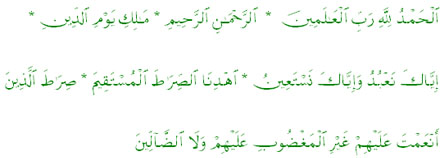
– All the praises and thanks be to Allaah, the Lord of the ‘Alamîn (mankind, jinns and all that exists).
– The Most Beneficent, the Most Merciful.
– The Only Owner (and the Only Ruling Judge) of the Day of Recompense (i.e. the Day of Resurrection)
– You (Alone) we worship, and You (Alone) we ask for help (for each and everything).
– Guide us to the Straight Way
– The Way of those on whom You have bestowed Your Grace, not (the way) of those who earned Your Anger (such as the Jews), nor of those who went astray (such as the Christians).
At the end, you must say Aameen .
Those who cannot recite the Faatiha may say instead (Subhanah Allah, Al-Hamdulillah, and la Illaah Illallaah, Allaahu Akbar, and laa Hawlah wa Laa Quwata Illaa bil-laah) which means: I declare Allaah far removed from all imperfection, and deserving all the Praise, and that there is no true God other than Allaah).

Far removed from every imperfection is my Rabb (Lord), the Great. [3 times].
7-Standing Erect (Qiyaam) after Rukoo’:
(i) Rise from bowing, raising you hands to the levels of the shoulders, or earlobes, saying:
ii) Stand upright until one’s very parts take their positions and say:

(iii) Then you raise your head while saying: ALLAAHU AKBAR (sometimes raising one’s hands), sit on your left leg while keeping your right foot upright with its fingers to the Qiblah. Put your hands on your knees [see below], and supplicate saying:

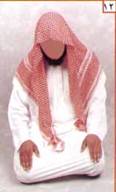
(iv) Following the sitting position, you come up with a second prostration as you did before. Once done you have completed one full unit (Rak’ah). Say Allaahu Akbar and stand up for the second Rak’ah. Do it in the same manner as you did the first one, but without reciting the opening supplication.
9-Sitting for Tashahhud (Testification of Faith):
First Tashahhud
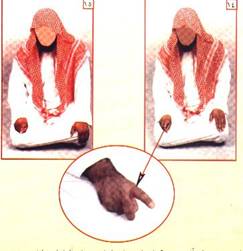
(i) Once you finish the second Rak’ah, follow the same way of sitting as above. Hold your right hand closed with its thumb and middle finger touching each other like in a circle while pointing the index finger straight in the direction of the Qiblah and moving it through the recitation of the Tashahhud:
]التَّحِيَّاتُ لِلَّهِ وَالصَّلَوَاتُ وَالطَّيِّبَاتُ السَّلَامُ عَلَى النَّبِيُّ وَرَحْمَةُ اللَّهِ وَبَرَكَاتُهُ السَّلَامُ عَلَيْنَا وَعَلَى عِبَادِ اللَّهِ الصَّالِحِين. أَشْهَدُ أَنْ لا إِلَهَ إِلَّا اللَّهُ وَأَشْهَدُ أَنَّ مُحَمَّدًا عَبْدُهُ وَرَسُولُهُ. [
Allaahumma salli ‘ala Muhammad wa ‘ala aali Muhammad kama sallaita ‘ala Ibraaheem wa ‘ala aali Ibraaheem innaka Hameedun Majeed, wabaarik ‘ala Muhammad wa ‘ala aali Muhamaad kama baarakta ‘ala Ibraaheem wa ‘ala aali Ibraaheem innaka Hameedun Majeed.
O Allaah! Praise Muhammad, and on the family of Muhammad, as You Praised Ibraaheem, and the family of Ibraaheem; You are indeed Worthy of Praise, Full of Glory. And send blessings on Muhammad, and on the family of Muhammad, as you sent blessings on Ibraaheem, and the family of Ibraaheem; You are indeed Worthy of Praise, Full of Glory.
What to do when going for the final Rak’ah in Salah?
In the prayers of the three or four Rak’ah type, after finishing the second Rak’ah and the first Tashahhud, stand up raising your hands (as described earlier) and say: ALLAAHU AKBAR. When you reach the straight standing position, recite the Faatiha and go for the prostrations as done earlier. If you are praying the three Rak’ah prayer of Maghrib sit with your body resting on your left thigh, your left leg under your right, while keeping your right foot upright. This position is called Tawarruk:

For the four Rak’ah prayers, stand up at the end of the third Rak’ah and bring fourth the fourth and final Rak’ah. Recite full Tashahhud in the Tawarruk position
After recitation of the Tashahhud, you can supplicate Allaah with the following invocation (du’aa):
Allaahumma Inni a’oodthu bika min adthabil qabr, wa a’oodthu bika min fitnatil-Maseeh ad-Dajjal, wa a’oodthu bika min fitnatil mahya wal mamat. Allaahumma inni a’oodthu bika minal-ma’tham walmaghram.
O Allaah! I seek refuge with You from the Punishment of the grave and from the Fitnah (trail or affliction) of Ad-Dajjaal [pseudo Messiah], and from the Fitnah of life and Fitnah of death. O Allaah! I seek refuge with You from the sins and from being in debt.
You may also ask Allaah to bestow upon you from the good things for this life and for the hereafter.
10-Concluding Salah by Tasleem:
After you recite the Tashahhud and make the supplications, turn your head to the right and say:
References and Acknowledgment:
1-Sumaries of Prayers (Arabic) by the three great Imaams of our time: Sh. Bin Baaz, Sh. Al-Albani, and Sh. Bin ‘Uthaimeen, may Allah’s Mercy be upon them all.
2-The Prophet’s Prayer described (English) by Sh. Al-Albani. (1413/1993 ed.)
4-Illustration adapted from islam.groub.com/modules/w-s-groub/ [Prayers described].
5-Sister Umm Ahmad al-Kanadiyyah for her encouragement and support to produce reliable information for new Muslims trying to learn Salah.
by Imam Ibn ul Qayyim Jawziyyah,
[Madarij as-Saalikeen 1/100-101, 105], Slightly adapted by Dr Saleh as-Saleh
From a footnote in “The Dispraise of Al-Hawaa (Desire) by Ibnul Qayyim Al-Jawziyyah” © 1998 Dar al-Bukhaari
`Uboodiyyah is a comprehensive term that asserts the meaning of the Verse (Aayah).
“You Alone do we worship and You Alone do we seek for Help.” (Qur’an 1:5)
It comprises the slavery of the heart, tongue and limbs to Allaah ta`aala.
The slavery of the heart includes both the Qawl (saying of the heart) and `Amaal (actions of the heart).
The Qawl of the heart is the belief (I`tiqaad) in what Allaah has informed about His Self, His Names and Attributes, His Action, His Angels, and that which He revealed in His Book and sent upon the tongue of His Messenger Muhammad sallallahu `alayhi wa sallam.
The `Amaal of the heart include love for Allaah, reliance upon Him, turning to Him in repentance, fearing Him, having hope in Him, devoting the Deen sincerely to Him, having patience in what He orders and forbids, having patience with His decrees and being pleased with them, having allegiance for His pleasure, having humility for Him and humbling oneself in front of Him, and becoming tranquil with Him.
The Qawl (saying) of the tongue is to convey what Allah has revealed (in the Qur’an and authentic Sunnah) regarding Himself, His Names and Attributes, His Actions, His Commands, His Prohibitions, and all that is related to this Deen), to call to it, defend it, to expose the false innovations which oppose it, and to establish its remembrance and to convey what it orders.
The `Amaal (actions) of the limbs include the Salaat (prayers), Jihaad, attending the Jumu`ah prayers and the rest of the Jamaa`aat (congregational prayers), assisting those who are unable, and acting with goodness and kindness to creation, and other such acts.
This comprehensive meaning of the `Uboodiyyah pertains to its specific type. The people who fall under this type of `Uboodiyyah are the believers who obey, love, and sincerely follow the Deen of Allaah ta`aala.
The second type of `Uboodiyyah is the general one in which all creatures in the heavens and in the earth are subdued to Allaah’s sovereign Authority and Power; everything is subservient to His Will, and Authority; nothing occurs or ceases to occur except by His leave; His is the Kingdom and He disposes the affairs as He pleases. This type of `Uboodiyyah is known as the `Uboodiyyah of Qahr (Subduing) and Mulk (Sovereignty, Kingship, Possession, Mastership, etc.).
So, the part of the Aayah signifying “You do we worship” asserts the adherence to the four principles of `Uboodiyyah:
The other part, “You Alone do we seek for Help,” stresses the fact that the believer must ask Allaah alone to help him establish the `Uboodiyyah and succeed in executing all what it requires.
From a footnote in “The Dispraise of Al-Hawaa (Desire) by Ibnul Qayyim Al-Jawziyyah” 1998 Dar al-Bukhaari
Source : Compiled by: Dr. Saleh As-Saleh (Rahimahullah)
Visit the Website of Dr. Saleh as Saleh Rahimahullaah : http://understand-islam.net
Abd : A male slave, a slave of Allah.
Adhaan : The call to Salah (Prayer) pronounced loudly
Ayah (pl. Ayaat): A sign of Allah; a verse of the Qur’aan.
Aboo (Abee, Abaa): Father of; used as a means of identification
‘Alayhi salaam: “May Allah protect and preserve him” It is said after the name of the Prophet of Allah or after the name of an angel.
Alim : A knowledgeable person or a religious scholar in islaam.
Allahul Musta’an: Allah’s help is sought
Allahu Akbar: Allah is the Greatest
Ahaadeeth: See Hadeeth
‘An’anah: a narrator’s reporting by saying ‘from so and so’ not describing exactly in what form it was transmitted to him. This will only affect the authenticity of the narration if the one doing it is a mudallis.
Ansaar: “Helpers”; the Muslims of Madeenah who supported the Muslims who migrated from Makkah.
Aameen: O Allah ! accept our invocation.
Bid’ah: Innovation; anything introduced into the Religion, in order to seek Allaah’s pleasure, not having a specific proof or basis in the Religion.
Companions (Arabic – Sahaabah): the Muslims who saw the Prophet (may Allah protect and preserve him) and died upon Islaam.
Da’eef: weak; unauthentic (narration)
Da’wah: Literally call. This refers to the concept and practical implementation of inviting and calling a person or persons to abide by and accept Islaam in its pure and unadulterated form.
Deen: way of life prescribed by Allah i.e. Islaam
Duha : Forenoon
Eemaan: faith; to affirm all that was revealed to the Messenger (may Allah protect and preserve him), affirming with the heart, testifying with the tongue and acting with the limbs. The actions of the limbs are from the completeness of Eemaan. Faith increases with obedience to Allah and decreases with disobedience.
Fataawa: see Fatwa.
Fatwa (pl. Fataawa): religious verdict.
Fiqh: the understanding and application of the Sharee’ah from its sources.
Firdaus : The middle and the highest part of the Jannah.
Fitnah: (pl. fitan): This linguistically refers to calamities, trials, tribulations and mischief.
Ghusl : A ceremonial bath. This is necessary for one who is Junub, and also on other occassions.
Hadeeth (pl. Ahaadeeth): narration concerning the utterances of the Prophet (may Allah protect and preserve him), his action or an attribute of his.
Hajj: Pilgrimage to Makkah
Halaal: permitted under the Sharee’ah
Haneef : Pure Islamic Monotheism
Haram : The Sanctuaries of Makkah and Al-Madeenah
Haraam: prohibited under the Sharee’ah
Hasan: fine; term used for an authentic hadeeth, which does not reach the higher category
Haya: Modesty – Bashfulness
Hijaab : A long dress prescribed from muslim women to cover their whole body from head to feet
Hijrah : Migration
Ibn: son of; used as a means of identification.
Iftaar : Breaking the fast
Imaam: leader; leader in Salaah, knowledge or fiqh; leader of a state.
Isnaad: the chain of narrators linking the collector of the saying to the person quoted.
Jinn: A creation of Allah created by smokeless fire.
Kaafir: A disbeliever.
Khaleefah (pl. Khulafaa’): the head of the Islamic government (the khilaafah) to whom the oath of allegaince is given.
Khulafaa’: see khaleefah.
Kufr: Disbelief.
Kuffaar: Disbelievers.
La Ilaha Illa Allah: There is none worthy of worship except Allah
Mudallis: most commonly a narrator who reports things from his Shaikh which he did not directly hear from him but from an intermidediate whom he does not name but instead says ‘from the Shaikh’. This intermediate may be weak. The scholars of hadeeth will only accept the narrations of a mudallis when he clearly states that he heard them from the Shaikh, i.e. ‘The Shaikh narrated to us…’ e.t.c.
Muhaajir: One who migrates from the lands of the disbelievers to the land of the Muslims for the sake of Allaah.
Munqati’: (lit. disjoined) An isnaad in which two continuous links are missing in one or more than one place or an unknown narrator is found to join the links.
Mursal: loose; a narration in which a Successor narrated firectly from the Prophet sallalahu ‘alayhe wasallam, i.e. omitting the Companion from who he heard it.
Mushaf : The Qur’aan between two covers.
Matrook: (lit. discarded) Where narrators are accused of falsehood in matters other than the narration of the tradition.
Radiyallaahu ‘anhu/’anhaa/’anhum/’anhumaa: may Allaah be pleased with him/her/them/both of them.
Rahimahullaah/Rahimahumullaah: may Allaah bestow His mercy upon him/them.
Saheeh: correct; an authentic narration.
Salaf: predecessors; the early Muslims; the Muslimsof the first three generations: The Companions, the Successors and their successors.
Salafus-Saaliheen: pious predecessors; the Muslims of the first three generations: the Companions, the Successors and their successors.
Shaikh: scholar
Shaitaan: Satan
Sharee’ah: the Divine code of Law.
Shirk: Associating partners with Allaah.
Sunnah: in its broadest sense, the entire Deen which the Prophet sallalahu ‘alayhe wasallam came with and taught, i.e. all matters of belief, rulings, manners and actions whjich were conveyed by the Companions. It also includes those matters which the Prophet sallalahu ‘alayhe wasallam established by his sayings, actions and tacit approval – as opposed to bid’ah (innovation).
sunnah: an action of the Prophet sallalahu ‘alayhe wasallam.
SubhanAllah: Glory be to Allah; How perfect is Allah of Saheeh.
Soorah: a chapter of the Qur’aan.
Taabi’ee (pl. Taabi’een): a Muslim (other than another Companion) who met a Companion.
Taqwa: “taqwa is acting in obedience to Allaah, hoping for His mercy upon light from Him and Taqwa is leaving acts of disobedience, out of fear of Him, upon light from Him.”
Tawheed: Literally Oneness – The belief and realization of singling Allaah out alone in His Lordship, the Worship that is performed for Him and His names and Attributes, apart from all other false deities. This entails the belief that Allaah is the only true Creator, Sustainer, and Administrator of the Universe. It entails that one is mandated to perform and sincerely direct all of his worship to Allaah alone and no one else. And lastly, it entails believing in all of Allaah’s perfect Names and Attributes, and that they apply to Him alone and no one else.
‘Ulamaa: Scholars of the Deen of Islaam.
Umm: Mother of. Ex: Umm ‘Abdillah – Mother of ‘Abdillah
Zaahid: One who practices zuhd.
Zuhd: Abstaining from the world and its luxuries.
Sources Used:
“The Evil of Craving For Wealth and Status” by Ibn Rajab al-Hanbalee. Pgs. 56-58
“Beneficial Answers to Questions on Innovated Methodologies” by Shaykh Saleh al-Fawzaan
“Explanation of the Creed” by Imaam al-Barbahaaree
From the appendix of “Translation of the meanings of The Nobl Qur’an , in the English Language” – By Dr. Muhammad Taqiuddeen al-Hilaalee, Ph.D. and Dr. Muhammad Muhsin Khan [ Arabic/English]
Q: A family is composed of a father, a mother, four sons, and four daughters. They were all Christians. Three sons and one daughter converted to Islam. Their father died and left them a huge fortune which is around 18,000,000 Saudi Riyals. do the children who embraced Islam have the right to inherit from their non-Muslim father?
A: If the matter is as mentioned, the Muslim children whose father died as non-Muslim will not inherit. The origin of this ruling is what is related by Al-Bukhari and Muslim on the authority of Usamah ibn Zayd (may Allah be pleased with him) that the Messenger of Allah (peace be upon him) said: Neither a Muslim inherits from a disbeliever, nor does a disbeliever inherit from a Muslim.
May Allah grant us success! May peace and blessings be upon our Prophet Muhammad, his family and Companions!
Permanent Committee for Scholarly Research and Ifta’
Member Member Deputy Chairman
`Abdullah ibn Qa`ud `Abdullah ibn Ghudayyan `Abdul-Razzaq `Afify
Source: alifta.com
~~~~~~
Q 1: This letter is sent by some Dutch women who have embraced Islam, praise be to Allah, and who have many inquiries concerning the issue of inheritance, as our parents are non-Muslims, and a Muslim must not inherit a Kafir (disbeliever). Our parents asked us to tell them how to share their property after their death, which falls into many categories: First, a house, as the money will only be available when the house is sold after their parents’ death;we cannot take part of this money during their lifetime. Is it permissible for the parents to make a grant contract with their children during their lifetime, by paying an annual sum of money that can only be reclaimed after they die and the children sell the house? Is it permissible for the parents to make a grant contract with their children, so that the latter are the real owners of the house during the lifetime of the parents, and after their death each one takes their right? If a Kafir mother has two daughters, one of whom is a Muslim and the other is a Kafir, is it permissible for the mother to make a will for her Kafir daughter to grant half of her inheritance to her Muslim sister? It is said that no bequest must be made to an heir. If we are not entitled to inherit, is it permissible to make a will for us with one third of the money? Second, jewels and valuable objects. Is it permissible for the Kafir parents to distribute such items among their children during their lifetime as a grant, provided that the children use them during their fathers’ lifetime, and after their death these things are returned to the children as agreed upon in the grant? Third, trivial objects and things of low value, such as clothes, mugs and furniture. Is it permissible for us to take them and use them after their death? Is it permissible for us to give them to some Muslims or Kafirs, or simply get rid of them? If the mother dies, and the father is still alive, is it permissible for their daughter to accept her father’s offer and take her mother’s things such as clothes?
A: A Muslim does not inherit a Kafir, neither does a Kafir inherit a Muslim, according to the saying of the Prophet (peace be upon him), Neither a Muslim inherits a Kafir, nor does a Kafir inherit a Muslim. Agreed upon by Al-Bukhari and Muslim in the Hadith reported from Usamah (may Allah be pleased with him). However, it is permissible for the Muslim children to accept the grants, gifts and wills from their Kafir parents. They can also make contracts with them according to the Shar`y (Islamically lawful) regulations. However, it is impermissible for them to inherit their parents. If the Kafir parents deprive their Muslim children from their inheritance and dedicate all of it to their Kafir children, the Muslim children have no right to claim any of their parents’ property, as this claim only takes the form of inheritance, which is a compulsory right. It is known that a Muslim does not inherit a Kafir. May Allah grant us success! May peace and blessings be upon our Prophet Muhammad, his family and Companions!
Permanent Committee for Scholarly Research and Ifta’
Member Member Member Member Chairman
Bakr Abu Zayd `Abdul-`Aziz Al Al-Shaykh Salih Al-Fawzan `Abdullah ibn Ghudayyan `Abdul-`Aziz ibn `Abdullah ibn Baz
Source: alifta.net
~~~~
Q: A man converted to Islam at the age of forty. Should he make up for the missed Salah (prayer)?
A: A person who converts to Islam does not have to make up for Salah and Sawm (fasting) which they did not perform during the days of their Kufr (disbelief), as Allah stated, Say to those who have disbelieved, if they cease (from disbelief), their past will be forgiven. (Surah Al-Anfal, 8: 38). The Prophet (peace be upon him) also stated, Islam wipes out all that has gone before it (previous misdeeds). The Prophet (peace be upon him) did not order those who embraced Islam to make up for any missed rites of Islam. The scholars also unanimously agreed upon this.
May Allah grant us success! May peace and blessings be upon our Prophet Muhammad, his family, and Companions!
Permanent Committee for Scholarly Research and Ifta’
Member Member Deputy Chairman Chairman
`Abdullah ibn Qa`ud `Abdullah ibn Ghudayyan `Abdul-Razzaq `Afify `Abdul-`Aziz ibn `Abdullah ibn Baz
Source: alifta.com
Q: The submitter says he has recently converted to Islam. He had bought a house before he converted to Islam through a transaction widely prevailing in the West. To clarify, he paid a certain amount of the price in advance and borrowed the remainder on credit. Knowing that a Muslim may not pay or receive interest, he inquires about the ruling on interest that he has to pay for that loan.
A: If the reality is as you have mentioned, the person in question should submit his new status to the authority from which he took the loan asking it to take back only the capital, i.e. without interest, as interest is prohibited according to Islam. Doing so is more precautionary and frees him from accountability for paying the usurious interest. If the borrowing authority approves of it, it will be alright, praise be to Allah. Otherwise, he will have to pay the interest stipulated in the contract he had signed before converting to Islam.
May Allah grant us success! May peace and blessings be upon our Prophet Muhammad, his family, and Companions!
Permanent Committee for Scholarly Research and Ifta’
Member Member Deputy Chairman Chairman
`Abdullah ibn Qa`ud `Abdullah ibn Ghudayyan `Abdul-Razzaq `Afify `Abdul-`Aziz ibn `Abdullah ibn Baz
Source : alifta.com
Q3: If there is a woman who wants to embrace Islam, is it permissible for a man to dictate the Shahadah (Testimony of Faith) to her or should it be a woman who does so?
A: There is no problem with dictating Shahadah to a woman who wants to become a Muslim if this is performed by a man or a woman. Yet it is preferable if it is a woman who does so, so that the new Muslim woman can learn all that she needs to know about Islam with complete ease.
May Allah grant us success. May peace and blessings be upon our Prophet Muhammad, his family, and Companions
Permanent Committee for Scholarly Research and Ifta’
Member Member Member Chairman
Bakr Abu Zayd Salih Al-Fawzan `Abdullah ibn Ghudayyan `Abdul-`Aziz ibn `Abdullah Al Al-Shaykh
Source: alifta.com
Repenting from all sins but keeping the ill-gotten money
Q 6: A person used to abandon Salah (prayer), drink alcohol and commit vile deeds. He has a lot of ill-gotten money. He then turned to Allah with sincere repentance with regard to all the sins mentioned above except the ill-gotten money. Should he get rid of such ill-gotten money? Or will he be treated like a new Muslim who is not asked about the source of his wealth?
A: on turning to Allah with sincere repentance with regards to the ill-gotten money, it is obligatory for one to get rid of such evil money. In case he is not able to define the ill-gotten money, he can give out what he thinks to clear himself from such guilt. This is to be followed if his sins have not caused him to leave Islam.
On committing sins that make a person leave Islam such as the abandonment of Salah, according to the most preponderant opinion of scholars, even if such a person does not deny its obligation, repentance can be realized by performing Salah and embracing Islam again. This is because Islam wipes out all that has gone before it. Also, one is not obliged to get rid of the money he got before adopting Islam. This is because Allay (Exalted be He) says about the disbelievers, Say to those who have disbelieved, if they cease (from disbelief), their past will be forgiven. As mentioned in the Sahih (Authentic Book of Hadith), the Prophet (peace be upon him) said, Islam wipes out all that has gone before it (previous misdeeds). And penitence also wipes out all that has gone before it.
May Allah grant us success! May peace and blessings be upon our Prophet Muhammad, his family and Companions!
Permanent Committee for Scholarly Research and Ifta’
Member Member Deputy Chairman Chairman
Bakr Abu Zayd Salih Al-Fawzan `Abdul-`Aziz Al Al-Shaykh `Abdul-`Aziz ibn `Abdullah ibn Baz
Source : alifta.com
Q 4: Has the gradual communication of the Islamic legislation ended by the completion of delivering the Message? Is it permissible for a Da`y (caller to Islam) to tell a new Muslim about the commands and the prohibitions of Islam gradually, so that they are not shocked?
A: It is permissible to convey the Message of Islam to others gradually, acting upon the Hadith of Mu`adh when he was sent by the Prophet (peace be upon him) to Yemen. The Six Hadith Compilers (Al-Bukhari, Muslim, Abu Dawud, Al-Tirmidhy, Al-Nasa’y, and Ibn Majah) reported from Ibn `Abbas (may Allah be pleased with them both) that the Messenger of Allah (peace be upon him) told Mu`adh ibn Jabal when he sent him to Yemen: You are going to people of a (Divine) Book. So when you come to them call them to testify that there is no god but Allah and that Muhammad is the Messenger of Allah. If they obey you in that, inform them that Allah has enjoined on them five Salahs (to be offered) in every day and night. If they obey you in that, inform them that Allah has enjoined on them Sadaqah (obligatory charity) to be taken from the rich among them and given to the poor among them. If they obey you in that, beware (not to take as obligatory charity) their precious property! And fear the supplication of a wronged person, for there is no barrier between them and Allah.
As for Islamic legislation, it has come to an end by the death of the Prophet (peace be upon him), as Allah (Exalted be He) says: This day, I have perfected your religion for you, completed My Favour upon you, and have chosen for you Islâm as your religion.
Permanent Committee for Scholarly Research and Ifta’
Deputy Chairman Chairman
`Abdul-Razzaq `Afify `Abdul-`Aziz ibn `Abdullah ibn Baz
Source: alifta.com
Q: Some people hasten to explain some matters to new Muslims, some of these matters may be minor details, for example, wearing the complete Hijab (veil) for women and growing a beard for men and circumcision and other such matters. Can you comment on this subject?
A: These are minor details, if they are clarified at the beginning, there is nothing wrong with that, and if they are delayed to a later time, there is also nothing wrong with that. The most important thing is to explain the basics of the religion so that the person can enter Islam. As for subsidiary matters like shaving the beard or shortening it, or wearing Hijab, or circumcision and the like, these should better be delayed to a later time so that the person is not repelled or discouraged and just to teach them the foundations of Islam first and its great pillars. After they embrace Islam, they can be encouraged to perform the rest of the practices of Islam.
Source : Fatwas of Nur `Ala Al-Darb
Do not recite Surah Al-Fatihah during Ruku` or Sujud instead of Tasbih!
Q4: Is it permissible for a new Muslim to recite Surah Al-Fatihah and some Ayahs (Qur’anic verses) instead of the obligatory Tasbihs (glorifications of Allah) and Du`a’ (supplications) that are obligatory in Salah (Prayer) or is there anything else that can be said instead, because this is difficult at the beginning?
A: A new Muslim should recite the Qur’an and Dhikr (Remembrance of Allah) in the correct places during Salah as soon as they can, as Allah says: Allâh burdens not a person beyond his scope. However, they should not recite Surah Al-Fatihah while in Ruku` (bowing) or Sujud (prostration) instead of Tasbih.
May Allah grant us success! May peace and blessings be upon our Prophet Muhammad, his family, and Companions!
Permanent Committee for Scholarly Research and Ifta’
Member Deputy Chairman Chairman
`Abdullah ibn Ghudayyan `Abdul-Razzaq `Afify `Abdul-`Aziz ibn `Abdullah ibn Baz
Source : http://alifta.com
Q: On our visit to Uganda, we noticed that some Christians bring their children to embrace Islam in an orphanage for newly converted Muslims. When the parents were asked why they themselves do not embrace Islam, their answer was that they fear being circumcised. What is the opinion of Your Eminence concerning this?
A:
It is not necessary to demand that they be circumcised, if they fear that, for this is Sunnah (action following the teachings of the Prophet) and not an obligatory action, according to the majority of scholars. Those who maintain that circumcision is obligatory restrict it to situations where there are no fears for the circumcised person’s safety.
If this fear of circumcision prevents those Christians from embracing Islam, they should not be asked to do it at the time of embracing Islam. When Islam becomes firm in their hearts, this matter can be reconsidered.
May Allah grant us success. May peace and blessings be upon our Prophet Muhammad, his family, and his Companions.
Permanent Committee for Scholarly Research and Ifta’
Member Member Member Member Deputy Chairman Chairman
Bakr Abu Zayd `Abdul-`Aziz Al Al-Shaykh Salih Al-Fawzan `Abdullah ibn Ghudayyan `Abdul-Razzaq `Afify `Abdul-`Aziz ibn `Abdullah ibn Baz
Source : alifta.com
Question: An Indonesian Christian woman who had come to Berlin, in West Germany, for a special task she is entrusted with by the government of Indonesia, converted to Islam. The woman belongs to an influential family which has good connections with President Suharto. Moreover, her husband is an official in the Indonesian Ministry of Defense and Security. In Sha’a Allah (If Allah wills), through her conversion to Islam, being an intellectual and influential woman, she will prove to be useful to Islam and Muslims. However, the dilemma is that her husband is a Christian bigot and thus she cannot declare her conversion to Islam. Until now, no one knows about her conversion except us (7 people only). Nevertheless, she intends to tell her husband and children about her conversion to Islam in her own way so that she can call them to Islam. Your Eminence Shaykh, I do not know what to do in this regard knowing that Allah prohibited that a Muslim woman be married to a non-Muslim man and that such a woman has to leave her husband immediately after her conversion to Islam. On account of her being a new convert to Islam, I do not think she can enforce such an Islamic ruling and I fear that she may go back to disbelief. Furthermore, she does not belong to an ordinary family. Had she belonged to an ordinary family, leaving the husband would have been easy. Therefore, I ask you about the issue and want, if possible, a fatwa from Shaykh Ibn Baz. May I postpone ordering her to leave her non-Muslim husband until her belief gets stronger? Or, what should I tell her?
Answer:
She has to tell her husband about her conversion to Islam and that she is now prohibited to be his wife until he embraces Islam.
If he embraces Islam while she is in her `Iddah (waiting period), she will remain his wife without the need to contract marriage anew.
However, if he converts to Islam after the `Iddah is over, he may marry her anew through a new marriage contract provided that she shows her consent and all Shar`y (Islamic legal) conditions are met.
May Allah grant us success! May peace and blessings be upon our Prophet Muhammad, his family and Companions!
Permanent Committee for Scholarly Research and Ifta’
Member Member Deputy Chairman Chairman
`Abdullah ibn Qa`ud `Abdullah ibn Ghudayyan `Abdul-Razzaq `Afify `Abdul-`Aziz ibn `Abdullah ibn Baz
Source : alifta.com
Q: One of my Non-Muslim workers has converted to Islam. A few hours later, he asked for a Mus-haf and a translation to read. After a few days, he asked to go and perform `Umrah (lesser pilgrimage). My question is: Should I let him touch the Mus-haf and travel to Allah’s Sacred Land, or wait a year or more until he becomes a true Muslim, and I am sure that has sincerely embraced Islam?
A: If you are sure concerning his Islam, it is permissible for you to give him a Mus-haf to read and accompany him to perform Hajj or `Umrah. You will be rewarded for this Insha’a Allah, for the Prophet (peace be upon him) stated: “Whoever calls others to follow guidance, their reward will be equivalent to those who shall follow them (in righteousness)” And Allah helps His servant as long as the servant helps their fellow brothers .
May Allah grant us success! May peace and blessings be upon our Prophet Muhammad, his family, and Companions!
Permanent Committee for Scholarly Research and Ifta’
Member Member Member Deputy Chairman Chairman
Bakr Abu Zayd Salih Al-Fawzan `Abdullah ibn Ghudayyan `Abdul-`Aziz Al Al-Shaykh `Abdul-`Aziz ibn `Abdullah ibn Baz
Source: alifta.com
Q: Thanks to Allah, some Japanese women accepted Islam. They began to struggle with the atheist Japanese society that prefers disbelief and distorted Christianity to Islam. Indeed, there are no obligations in the distorted Christianity, so a person may drink Khamr (intoxicant), eat pork, have girl friends, and at the same time be a Christian who believes in the Father, the Son, and the Holy Spirit. On the other hanzd, a new Muslim has to stand out and become different from non-Muslims and keeps away from their society and gatherings when it comes to `Aqidah (creed); so they become subject to be ostracized and regarded as insane.Non-Muslims may even isolate new Muslim converts and deny them work. They cannot accept them as fellow Japanese while seeing them do what they deem as awful offense i.e. becoming Muslims, abandoning non-Muslim parties, Khamr, pork, and praying to Allah, the God that such non-Muslim people deny as the true Lord?
The problems the girls face are even worse, as they are weaker and usually depend on work to support themselves or on their non-Muslim families to support them.
Among the various problems the Muslim women face is the observation of the religious obligations e.g. wearing the Hijab (veil). Many times, a woman is prevented from wearing Hijab and offering Salah (Prayer) at her workplace. as she cannot pray on time, she makes up for the missed prayers together lest she should be fired from work; her only source to earn her living, as she lives apart from her non-Muslim family.
Another problem a Muslim young woman may face is her inability to fast Ramadan when she hides her Islam from her family, especially her strict Christian mother. This mother prefers that her daughter becomes a disbeliever to becoming a Muslim. This girl studies at the university and her family supports her.She lives, eats, and drinks with them in the same house. This might lead her to committing many prohibitions. She cannot fast Ramadan, as this will be strange to her family. If they know of her conversion, they might harm and prevent her from continuing her education which will be her only way to earn her living in the future. A third problem a new Japanese Muslim may face is when his wife and children remain non-Muslims and he does not know what to do about them.
We would like to ask your Eminence the following questions:
1. What should a Muslim woman do in such circumstances in Japan?
2. What should this Muslim man do with his non-Muslim wife and children? Is his disbelieving wife still lawful to him?
3. Is Salah (Prayer) offered by a woman outside her house and in public places while sitting behind a screen to cover her `Awrah (private parts of the body that must be covered in public) valid? May Allah reward you with the best!
A: Firstly, anyone who reverts to Islam and conceals it lest they should be harmed need to indirectly show the merits of Islam to people they fear from without makingtheir reversion known. They should invoke Allah (Exalted be He) to guide them, perhaps Allah will guide them to accept Islam. This would ward off their evil. If they are not guided and are expected to harm the person, or the country does not allow the practicing of the Islamic rites, then this person should migrate to muslim lands, if possible. Allah (Exalted be He) says, He who emigrates (from his home) in the Cause of Allâh, will find on earth many dwelling places and plenty to live by. i.e. they should find another place away from the place they detest, a way out from deviation to guidance, from distress to relief, and from poverty to welfare.
A weak person who can not migrate is excused as they are prevented from immigration or due to being a woman. Allah (Exalted be He) says, Verily! As for those whom the angels take (in death) while they are wronging themselves (as they stayed among the disbelievers even though emigration was obligatory for them), they (angels) say (to them): “In what (condition) were you?” They reply: “We were weak and oppressed on the earth.” They (angels) say: “Was not the earth of Allâh spacious enough for you to emigrate therein?” Such men will find their abode in Hell – What an evil destination! Except the weak ones among men, women and children who cannot devise a plan, nor are they able to direct their way. These are they whom Allâh is likely to forgive them, and Allâh is Ever Oft-Pardoning, Oft-Forgiving. These Ayahs (Qur’anic verses) mean that the weak people are not able to develop plans, spend, and direct their way if they migrate.
Secondly, a weak woman should be in contact with the Islamic centers in her country, as they might help her. Otherwise, she should be patient and wait for a way out. She should invoke Him (Exalted be He) to facilitate her affairs. She will be rewarded In sha’a-Allah (if Allah wills). She should abide by the teachings, rulings, and obligatory acts of Islam as much as she can for Allah (Glorified be He) says, So keep your duty to Allâh and fear Him as much as you can The Prophet (peace be upon him) said, If I order you to do something, do as much of it as you can. (Al-Bukhari and Muslim agreed upon its authenticity.)
Thirdly, when a man converts to Islam but his wife remains in disbelief, it is permissible for him to keep her, if she is from the People of the Book (a Christian or a Jew),since the basic ruling is that it is permissible for a Muslim to marry chaste women of the People of the Book. Allah (Exalted be He) says, Made lawful to you this day are At-Tayyibât [all kinds of Halâl (lawful) foods, which Allâh has made lawful (meat of slaughtered eatable animals, milk products, fats, vegetables and fruits)]. The food (slaughtered cattle, eatable animals) of the people of the Scripture (Jews and Christians) is lawful to you and yours is lawful to them. (Lawful to you in marriage) are chaste women from the believers and chaste women from those who were given the Scripture (Jews and Christians) before your time
However, it is not permissible for him to stay with her if she is not from the people of the Book. Allah says, Likewise hold not the disbelieving women as wives.
On the other hand, if a woman converts to Islam while her husband remains a disbeliever, she becomes unlawful to him for Allah says, O you who believe! When believing women come to you as emigrants, examine them; Allâh knows best as to their Faith, then if you ascertain that they are true believers send them not back to the disbelievers. They are not lawful (wives) for the disbelievers nor are the disbelievers lawful (husbands) for them.
If she is forced to stay with him, she should be patientuntil she finds a way out and there is no harm on her as the early Muslim women did. Zaynab (may Allah be pleased with her) the daughter of the Messenger of Allah (peace be upon him) stayed with her husband Abu Al-`As ibn Al-Rabi`, after she converted to Islam, before he converted to Islam. The Prophet (peace be upon him) did not separate them. When she followed the Prophet (peace be upon him) to Madinah, their marriage was annulled. However, the Prophet (peace be upon him) gave her back to him after he became a Muslim.
Fourthly, as for the children, they should follow the best religion of their parents. If one of the parents embraces Islam, all the minor children will be Muslims, as children follow the best religion of their parents.
Fifthly, a woman should cover before any Ajnaby (man lawful for the woman to marry). She should stay away from anything that shows her adornment, stay at her house, and she should not leave it except out of necessity and in such a case she should dress modestly. If the time of Salah is due while she is out of her house, she has to offer it in a place away from men. The excuse mentioned in the question does not exempt her from standing while offering Salah, because standing is a pillar of Salah for anyone who is able to.
May Allah grant us success! May peace and blessings be upon our Prophet Muhammad, his family and Companions!
Permanent Committee for Scholarly Research and Ifta’
Member Member Member Member Chairman
Bakr Abu Zayd `Abdul-`Aziz Al Al-Shaykh Salih Al-Fawzan `Abdullah ibn Ghudayyan `Abdul-`Aziz ibn `Abdullah ibn Baz
Source: alifta.com
Q: People who embrace Islam in Europe are given written certificates by the Islamic institutions to prove that they are Muslims. Such certificates had never been given to Muslims throughout the history of Islam. Is not the witnessing of two just Muslims and the testimony of the new Muslim himself sufficient? Is not this written certificate a Bid’ah (rejected innovation in religion)?
A: A Muslim does not need such a certificate to prove his faith before Allah; however, it may be required by people to settle some matters. Thus, a person is required to state their religion on their identity card, passport, family records, and birth certificate. They sometimes might not be able to prove that they are Muslims, as when one travels to a country where he knows no one, or if a person dies abroad. In this case, a person is identified by their passport, identity card, or these other certificates, as it is usually too difficult to prove [that a person is a Muslim] in such cases.
Thus, there is no harm in this certificate. Although it is an innovation, it is not a Bid’ah related to religion; the prohibited Bid’ah is only that related to religion, as the Prophet (peace be upon him) stated, Whoever introduces a practice into this affair of ours that is not of it, it is to be rejected. He thus clarified that the rejected Bida’s are those innovated in matters of religion.
May Allah grant us success! May peace and blessings be upon our Prophet Muhammad, his family, and Companions!
Permanent Committee for Scholarly Research and Ifta’
Member Member Deputy Chairman Chairman
`Abdullah ibn Qa`ud `Abdullah ibn Ghudayyan `Abdul-Razzaq `Afify `Abdul-`Aziz ibn `Abdullah ibn Baz
Source : alifta.com
Q3: Does a new Muslim have to perform the obligations that are prescribed for Muslims in the period between being convinced about Islam and officially declaring it?
A: When someone accepts Islam, they are obligated to gradually learn what is legislated for them, according to their ability, and to act upon this from the time they are convinced about Islam.
Permanent Committee for Scholarly Research and Ifta’
Member Deputy Chairman Chairman
`Abdullah ibn Ghudayyan `Abdul-Razzaq `Afify `Abdul-`Aziz ibn `Abdullah ibn Baz
Source : alifta.com


 AbdurRahman.Org
You must be logged in to post a comment.