Scholars Biographies : Shaikh Muhammad Amaan bin ‘Alee Al-Jaamee

1349H-1416H: Shaikh Muhammad Amaan bin ‘Alee Al-Jaamee

Source:  Excerpted from Al-Ibaanah.com with slight updates

His Name and Birth:

His name was Muhammad Amaan bin Alee Jaamee Alee; and he went by the nickname Abu Ahmad. He was born and raised in Ethiopia in the district of Harer, town of Taga Tab. According to his official documents, he was born in 1349H.

His Early Studies: 

The Shaikh grew up in the town of Taga Tab (Ethiopia) where he learned the Noble Qur’aan. After completing the Qur’aan, he began studying the books of Fiqh according to the madh-hab of Imaam Ash-Shaafi’ee, may Allaah have mercy on him. He also studied Arabic in his hometown with Shaikh Muhammad Ameen Al-Hareree.

He then justify his hometown as was the custom of the inhabitants of that area, and moved to another town where he met with a man who would become his colleague in seeking knowledge and migrating to Saudi Arabia, Shaikh Abdul-Kareem. So the ties of Islamic brotherhood were formed between the two of them. After meeting, they would go together to study under a teacher called Shaikh Moosaa under whom they studied Nadham-uz-Zubd of Ibn Raslaan. They then studied the text of al-Minhaaj under Shaikh Abaadir. While in this town, they learned several disciplines of Islamic knowledge.
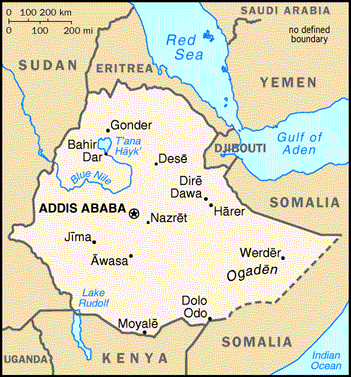
ethiopia.gif

The pair then had a desire to travel to the holy land of Makkah to seek knowledge and fulfill the obligation of Hajj. So they justify from Ethiopia and headed for Somalia where they boarded a ship and headed for Aden (Yemen). There they experienced many hardships and perils on both land and sea but they continued on to Hudaidah by foot and fasted the month of Ramadaan there.

They then departed for Saudi Arabia and passed through Saamitah and Abi ‘Areesh until they got permission to enter Makkah, which they walked to on foot. While in Yemen, some teachers warned them against the Salafi Dawah, which they called Wahhaabee.

His Studies while in Saudi Arabia: 

After the Shaikh performed Hajj in 1369H, he began to seek knowledge in the study circles held in the precincts of Al-Masjid-ul-Haraam. There, he learned from Shaikh Abdur-Razzaaq Hamzah, may Allaah have mercy on him, Shaikh Abdul-Haqq Al-Haashimee, may Allaah have mercy on him, Shaikh Muhammad bin Abdillaah As-Sumaalee and others.

While in Makkah, he came to know Shaikh Abdul-Azeez bin Baaz and accompanied him in his journey to Riyadh when the Educational Institute was opened. This was in the early seventies (i.e. 1370H).

Some of the colleagues he studied with while undergoing secondary studies at the Educational Institute was Shaikh Abdul-Muhsin bin Hamad Al-Abbaad and Shaikh Alee bin Mahnaa, former judge in the Central Courthouse of Madeenah. At the same time, he would attend the many circles of knowledge in Riyadh.

He also benefited and was influenced by the (former) Muftee, the great scholar of Jurisprudence and Principles, Shaikh Muhammad bin Ibraaheem Aali Shaikh, may Allaah have mercy on him.

He would stick closely to Shaikh Abdur-Rahmaan Al-Afreeqee, may Allaah have mercy on him, as well as Shaikh Abdul-Azeez bin Baaz, may Allaah have mercy on him, whose vast knowledge and noble manners he was able to absorb.

In Riyadh, he studied under Shaikh Muhammad Al-Ameen Ash-Shanqeetee, may Allaah have mercy on him, and the Muhaddith, Shaikh Hammaad Al-Ansaaree, may Allaah have mercy on him.

He was also greatly influenced by Shaikh Abdur-Razzaaq Al-Afeefee, even in his manner of teaching. Likewise, he benefited from and was influenced by Shaikh Abdur-Rahmaan bin Naasir As-Saadee, may Allaah have mercy on him, since they would write letters to each other. However, it should be known that he did not study under Shaikh As-Saadee. He also learned under Shaikh Muhammad Khaleel Harraas, may Allaah have mercy on him, whom he was greatly influenced by, and Shaikh Abdullaah Al-Qaraawee, may Allaah have mercy on him.

His Scholastic Accreditation: 

He completed his secondary studies at the Educational Institute in Riyadh, then joined the College of Shareeah and obtained his diploma in 1380H. He then received the equivalent of a Masters Degree in Shareeah from the University of Punjab (Pakistan) in 1974 and thereafter a Doctorates Degree from Daar-ul-Uloom in Cairo.

His Scholarly Status and the Scholars Praise for him: 

The Shaikh held a high status amongst the people of knowledge and virtue as they would mention good things about him and rely on him. In fact, reliance upon his knowledge and Creed reached the point that when he was a student in Riyadh, and his teacher Shaikh Abdul-Azeez bin Baaz, saw his superiority and enthusiasm for knowledge, he referred him to Shaikh Muhammad bin Ibraaheem, may Allaah have mercy on him, which resulted in him being appointed a teacher at the Educational Institute in Saamitah in the district of Jaazaan.

What also proves the trustworthiness of his knowledge and Creed and his high regard amongst the scholars was the fact that when the Islamic University in Madeenah was opened, he was appointed to teach in it after being selected by Shaikh Abdul-Azeez bin Baaz, may Allaah have mercy on him.

It is well known that the Islamic University of Madeenah was founded in order to disperse the Creed of the Pious Predecessors. And this same University entrusted him to teach this Creed, first in the secondary institute and then in the College of Shareeah, due to their trust in his Creed, knowledge and methodology and so that he could participate in achieving the Universitys goals.

Below are some of the statements of the trustworthy scholars that they wrote about Shaikh Muhammad Amaan Al-Jaamee, may Allaah have mercy on him:

In a letter written (no. 64) by the former Muftee of the Kingdom of Saudi Arabia, Shaikh Abdul-Azeez bin Baaz, may Allaah have mercy on him, on 1/9/1418H, he said about Shaikh Muhammad Amaan: “He is known to me for possessing knowledge, virtue, a good Creed, and activeness in Calling to Allaah and warning against innovations and misconceptions. May Allaah forgive him, grant him an abode in Paradise and keep his progeny upright. And may He gather us, you and him in the abode of His honor. Verily, He is All-Hearing and All-Near.”

In a letter dated 3/3/1418H, Shaikh Saalih bin Fawzaan Al-Fawzaan said:

“Shaikh Muhammad Amaan as I knew him: Indeed, the students and those who hold various type of higher degrees are many, but there are only a few from whose knowledge and personality you could truly benefit from. Shaikh Muhammad Amaan was one of these few rare scholars who employed their knowledge and efforts in order to benefit Muslims and guide them by calling them to Allaah upon knowledge. This was via the classes he would give while at the Islamic University and the Prophets Masjid as well as during the excursions he would undertake inside and outside of the Kingdom in order to give lessons and lectures on various topics. He would call to Tawheed and propagate the correct Creed, and he would direct the Muslim youth towards the methodology of the pious Predecessors (Salaf as-Saalih) while warning them about destructive principles and deviant calls.

Whoever did not know him personally should get to know him by way of his beneficial books and numerous tapes, which consist of a deluge of the great amount of knowledge and immense benefit he possessed.

Shaikh Abdul-Muhsin bin Hamad Al-Abbaad, a teacher at the Prophets Masjid, may Allaah preserve him, said: “I came to know Shaikh Muhammad Amaan bin Alee Al-Jaamee when he was a student in the Educational Institute of Riyadh and then when he was a teacher in the Islamic University of Madeenah in the secondary level and then in the university level. I knew him to have a good Creed and following a safe course. He dedicated himself to clarifying the Creed upon the beliefs of the Predecessors and to warning against innovations by way of his classes, lectures and writings. May Allaah forgive him, have mercy on him and grant him an immense reward.”

The Director of the Islamic University of Madeenah, Dr. Saalih bin Abdillaah Al-Abood, said in a letter written on 4/15/1417H: The brother, Shaikh Mustafaa bin Abdil-Qaadir, asked me to write something about Shaikh Muhammad Amaan Al-Jaamee, may Allaah have mercy on him, that I know personally about him and his good qualities. So I complied with his request by writing these brief words even though I was not one of his students or close companions throughout the times I met him and mixed with him. However, there were some meetings that took place between him and I, may Allaah have mercy on him, from which I benefited and which resulted in us getting to know each other better and love for the sake of Allaah to develop between us, not to mention a firm conformance with the methodology of the Salaf-us-Saalih in matters of Creed and refuting opposition.

Muhammad bin Alee bin Muhammad Thaanee, a former teacher in the Prophets Masjid, may Allaah have mercy on him, said in a letter dated 1/4/1417H: He was a Salafee scholar of first class rate in sacrificing himself for the Islamic Call. He was also very active in giving lectures in mosques and educational seminars both in and out of the country (of Saudi Arabia). He authored many books on Creed and other subjects. May Allaah reward him on behalf of Islaam and the Muslims with the best of rewards.

Muhammad bin Abdil-Wahhaab Marzooq Al-Bannaa, may Allaah preserve him, said about him: He, may Allaah have mercy on him, was upon good, which we love, such as good manners, sound Creed and pleasant companionship. I ask Allaah to shower him with His Mercy, grant him an abode in Paradise, and gather us together there as brothers upon thrones facing one another.

Shaikh Umar bin Muhammad Fulaata, a teacher in the Prophets Masjid and Director of the Daar-ul-Hadeeth branch, may Allaah have mercy on him, said in a letter dated 2/8/1417H: In general, he, may Allaah have mercy on him, was honest in speech, immense in his ascription to the beliefs of Ahlus-Sunnah, and strong in his desire to call to Allaah through speech and action. He was reserved in speech, strong in clarifying, and quick to get angry when Allaahs laws were violated. The gatherings he would hold in the Prophets Masjid, the books he would distribute, and the travels he would undergo speak on his behalf.

I accompanied him one time on a journey and what a great friend he was! He himself accompanied the great scholar Muhammad Al-Ameen Ash-Shanqeetee, may Allaah have mercy on him, author of Adwaa-ul-Bayaan and other books, on a journey and also served as a good companion for him. A journey is that in which the true nature of a man becomes revealed. He would not flatter others, nor would he be hypocritical. He would not argue or dispute with others. If the proof was with him, he would openly proclaim it. And if the opposite of what he adhered to became apparent to him, he would take on that view and recant from his prior position. This is the common practice of the believers as Allaah says: The only saying of the faithful believers when they are called to Allaah and His Messenger to judge between them is that they say: We hear and we obey! Such are the successful. [Surah An-Noor: 51]

I call upon Allaah as a witness to the fact that he, may Allaah have mercy on him, fulfilled many times over his duty of serving the Religion and spreading the Sunnah of the chief of messengers (i.e. Prophet Muhammad). As a result he encountered much harm and was subjected to plots and conspiracies, but he did not give in nor was he dissuaded from his goal until he met Allaah. The last words he uttered were the testimonies of Laa Ilaaha illaaAllaah and Muhammadur-Rasoolullaah.

Shaikh Umar Fulaata, may Allaah have mercy on him, also said: I came to know Shaikh Muhammad Amaan bin Alee Al-Jaamee, may Allaah have mercy on him, since a long time ago, after he came to this country (of Saudi Arabia) seeking knowledge, searching for good, and looking to learn the Creed of Ahlus-Sunnah wal-Jamaaah.

I met him in 1372H in the home of our teacher, example, and fatherly figure, Shaikh Abdur-Rahmaan bin Yoosuf Al-Afreeqee, may Allaah have mercy on him and us, in Riyadh, since he would spend a lot of time with him and benefit from him. When I asked about him, I was informed that he had come from Saamitah where he would teach and participate in examinations in the educational institute and faculties under the Aali Shaikh family.

What caused me to notice him at that time was his vigor, zeal, superiority and great concern for speaking the pure Arabic language as well as his ability to explain clearly some of the problematic Fiqh issues, which showed that he was a well-versed student of knowledge.

Not much time passed since then until it was conveyed to me that our teacher, Shaikh Abdur-Rahmaan Al-Afreeqee, presented him with the opportunity of becoming part of his family by way of him marrying his wifes sister. So based on this, the ties between them became strengthened and the connection and love between them increased.

The professor, Dr. Muhammad Hamood Al-Waailee, teacher in the Prophets Masjid and Islamic University of Madeenah as well as its headmaster for Advanced Studies and Educational Research, said in a letter dated 5/29/1417H: I began my acquaintance of the Shaikh in 1381H when this noble country of Saudi Arabia first opened the Islamic University in Madeenah. He was one of the first to teach there and I was one of his students. He was from a number of teachers that would give their students special attention, which was not restricted to just that of a student-teacher relationship in class.

He would devote a great amount of attention in most of his classes to the Creed of the Pious Predecessors, may Allaah be pleased with them, and would not let any opportunity pass in which he would not explain its status and high position. This was the same whether his lessons were on Creed or on other subjects.

When he would discuss the Creed of the pious Predecessors and attempt to implant it into the souls of his students a majority of who came from all places abroad he would speak with profound experience and knowledge of this Creed, as he had tasted its sweetness and treaded its path, to the point that those listening and watching him would feel as though their hearts would become soft with love and affection for it.

He would undergo journeys in order to spread the Call and teach outside of the Kingdom of Saudi Arabia. He would not let any occasion or opportunity pass without clearly explaining the loftiness, purity and nobility of this Creed. Anyone who reads the books and treatises that he wrote will come to realize the truth of his Call.

I attended the deliberation of his doctorates dissertation in Dar-ul-Uloom, which falls under the University of Cairo in Egypt. In most of his research, he strove to clarify the purity of the Creed and the soundness of the methodology of the pious Predecessors. His academic persona became apparent throughout the discourse in his ability to expose the falseness of every methodology that deviated from the methodology of the pious Predecessors

In summary, he may Allaah have mercy on him, had great love for the Creed of the pious Predecessors and he was sincere in calling to it and dedicated to defending it. Nothing prevented him from speaking the truth about it not even people turning away from him and boycotting him. May Allaah have mercy on him and forgive him.

Dr. Muhammad bin Abdir-Rahmaan Al-Khumayyis, teacher at the Imaam Muhammad bin Suood Islamic University in Riyadh wrote: The noble Shaikh, Muhammad Amaan bin Alee Al-Jaamee, may Allaah have mercy on him, from what I knew about him, was from the strongest at defending and calling to the Creed of the pious Predecessors. He would defend it in books, lectures and seminars. And he was strict in refuting those who opposed the Creed of the pious Predecessors.

It is as if he sacrificed his entire life for this Creed in terms of learning it, teaching it, instructing it and calling to it. He realized the importance that this Creed has on the life and uprightness of a human being. And he acknowledged the danger that innovations which opposed this Creed have on the livelihood of society and individuals. So may Allaah have mercy on him and forgive him and all of the Muslims.

The afore-mentioned statements of people of knowledge and virtue about Shaikh Muhammad Amaan Al-Jaamee show his academic status and his efforts and struggle in calling to Allaah for close to his last forty years. His strong love and interest for clarifying and teaching the Creed of the Salaf brought him to high levels of distinction to the point that he became known amongst the scholars for his devotion to it. But apart from Creed, he was also very well-versed in the subjects of Tafseer, Jurisprudence, and the Arabic language.

His Books and Writings: 

The Shaikh authored several books and delivered many lectures and classes, which were transcribed before and after his death and published. Below is a list of some of his most famous and highly regarded works:

1. As-Sifaat-ul-Ilaahiyyah fil-Kitaab was-Sunnah an-Nabawiyyah fee Daw-il-Ithbaat wat-Tanzeeh [The Divine Attributes in the Quraan and Prophetic Sunnah in light of Affirming and Absolving] This is one of the larger books of the Shaikh, which is highly beneficial in its subject.

2. Adwaa alaa Tareeq ad-Dawah ilaal-Islaam [Illuminations upon the Path of Calling to Islaam] This book consists of a number of lectures he gave, which affirm the Creed of the Salaf, present the status of the Call to Islaam in Africa, discuss the problems faced by the Call and the Callers in current times and their solutions, and provide a refutation of the Sufees.

3. Al-Muhaadarah ad-Difaaiyyah an-is-Sunnah al-Muhammadiyyah [A Lecture in Defense of the Sunnah of Muhammad] The source of this book was a lecture he delivered in 1383H in Sudan in which he refutes the atheist Mahmood TaHa.

4. Haqeeqat-ud-Dimuqratiyyah wa annahaa laisat minal-Islaam [The Reality of Democracy and a Clarification that it is not from Islaam] The source of this treatise was a lecture he gave in 1412H.

5. Haqeeqat-ush-Shooraa fil-Islaam [The Reality of Shooraa in Islaam] This is a small treatise.

6. Al-Aqeedat-ul-Islaamiyyah wa Taareekhuhaa [The Islamic Creed and its History] An excellent treatise on the progression and evolution of the recording of Creed and the formation of deviant groups throughout the history of Islaam.

7. Nidhaam-ul-Usrah fil-Islaam [The Structure of the Muslim Family] A short treatise which was originally a lecture he gave in Africa. The book was translated and published in English.

Many of the lessons and classes the Shaikh would give explaining classical works on Creed and Jurisprudence were also transcribed and published on the Internet and in book format. Amongst these works are his explanations of:

1. Tajreed-ut-Tawheed of Al-Maqreezee
2. Thalaathat-ul-Usool of Muhammad bin Abdil-Wahhaab
3. Shuroot-us-Salaat of Muhammad bin Abdil-Wahhaab
4. Al-Usool-us-Sittah of Muhammad bin Abdil-Wahhaab
5. Al-Aqeedat-ut-Tadmuriyyah of Ibn Taimiyyah
6. Al-Qawaaid-ul-Muthlaa of Ibn Al-Uthaimeen and more.

His Students: 

It is hard to imagine that a man of such a high regard amongst the scholars and who expended such great efforts in his call to Allaah and his love for the Creed of the Salaf would be void of any students. Many students studied under him to the point that it is difficult to confine their amount due to their large number. However, from the most outstanding of them are:

1. Dr. Rabee bin Haadee Al-Madkhalee;
2. Shaikh Zayd bin Haadee Al-Madkhalee;
3. Dr. Alee bin Naasir Al-Faqeehee, teacher in the Prophets Masjid;
4. Dr. Muhammad Hamood Al-Waailee, teacher in the Prophets Masjid and headmaster of the Islamic Universitys Advanced Studies department;
5. The Muhaddith, Shaikh Abdul-Qaadir bin Habeebillaah As-Sindee, may Allaah have mercy on him;
6. Dr. Saalih bin Saad As-Suhaymee, teacher in the Prophets Masjid and Islamic University;
7. Dr. Ibraaheem bin Aamir Ar-Ruhaylee, teacher in the Islamic University;
8. Dr. Bakr bin Abdillaah Abu Zaid, member of the Committee of Senior Scholars;
9. Dr. Falaah Ismaeel, teacher in the University of Kuwait.

Some of his Noble Characteristics: 

1. His Sincerity: He, may Allaah have mercy on him, was sincere to Allaah, His Book, His Messenger, the Muslim Imaams and their common-folk. This becomes apparent with just the slightest bit of reflection, since if one looks at his life, he will see that the Shaikh sacrificed his entire life in affirming what our Lord is deserving of in terms of His Lordship, Worship, and Names and Attributes according to the understanding of the pious Predecessors. This can be seen in his lessons, writings, lectures, and refutations against those who opposed the Quraan and Sunnah. Furthermore, he was just and balanced when refuting his opponents steering clear from partisanship and vain desires.

2. His Mixing Little with People: He, may Allaah have mercy on him, was known to mix little with people unless it was for good. So as a result most of his time and his days would be reserved. His manner of doing this was well known since he would go out from his home to work in the Islamic University, then return home, then go to the Prophets Masjid to give classes there after Asr, after Maghrib, after Ishaa and after Fajr. He would continue to follow this schedule up until he was bedridden when his illness worsened.

3. His Reserved Tongue: He, may Allaah have mercy on him, was also reserved in speech, He would not speak ill, throw blame or backbite others. In fact, he would not allow anyone to backbite others while in his presence nor would he permit anyone to convey gossip and people’s defects to him.

If any students of knowledge fell into error, he would request the tape or the book (containing the error) and would listen or read it. If it became apparent to him that it was in fact an error, he would fulfill his requirement of advising that person.

4. His Forgiving Nature and Forbearance: He would react to those who treated him badly by displaying forbearance and forgivingness.

Many times people would come up to him on the street or while in the Prophets Masjid and ask his forgiveness for speaking bad about him and attacking his honor, and he would say to them: I hope Allaah will not cause anyone to enter the Hellfire because of me.

He would also pardon those who sought to destroy his reputation, saying: There is no need for anyone to come to me to seek my pardon, for I have already pardoned everyone. And he would request those in his gatherings to convey this from him.

5. His Concern and Care for His Students: He, may Allaah have mercy on him, was from those who gave special to his students, which would not stop with the end of his classes. He would attend their special functions, ask about their situations, take care of some of their needs, and help them out with some of their family problems or some of the hardships of life that they encountered. In general, he would make use of his money, reputation, and time in order to assist those students of his that were needy.

These actions of his justify a profound effect on his students and as a result, he would earn true love from them. His students felt the great gap in this aspect after he died. The truth is that the Shaikh, may Allaah have mercy on him, possessed many good characteristics, all of which cannot be mentioned here.

Some of his Wise Sayings: 

The Shaikh said: It is upon our youth to take advantage of their free time by spending it on studying books that cure the diseases of the heart. This will cause a person to try to adhere to the ways and practices of the pious Predecessors in being steadfast and upright, and not just practicing it outwardly. Practicing Islaam on the outside is of no use by itself. Wearing a short garment (thawb) and growing a long beard are two things that Allaah has prescribed and encouraged. However, if there cannot be found any Islamic concept and understanding behind that, these outward features are of no use or benefit. [The tape: Sharh Asbaab Inshiraah-us-Sadr]

His Salafee Creed: 

What proves that the Shaikh was upon a sound Salafee Creed was that fact that he would teach from the classical books of Creed from the pious Predecessors, such as: al-Waasitiyyah, al-Fataawaa al-Hamawiyyah al-Kubraa, at-Tadmuriyyah, Sharh al-Aqeedatut-Tahaawiyyah of Ibn Abil-Izz, al-Eemaan, Thalaathat-ul-Usool, Fath-ul-Majeed, Qurratu Uyoon-ul-Muwahhideen, al-Usool-us-Sittah, al-Waajibaat-ul-Mutahattimaat, al-Qawaaid-ul-Muthlaa and Tajreed-ut-Tawheed of Al-Maqreezee. These lessons were recorded and are widely available in cassette form. He would explain some books several times such as Thalaathat-ul-Usool.

He would also refute the people of innovation, such as the Sufees, the Sheeah, and the Rawaafid as can be witnessed in his books, the articles he would write for scholastic magazines, and the lectures and classes he would give. As an example, refer to his book: Adwaa alaa Tareeq ad-Dawah ilaal-Islaam [Illuminations upon the Path of Calling to Islaam].

His Sickness and Death: 

During the last part of his life, he was stricken with a terminal illness to the point that he was bedridden for almost a year. But he endured it with patience and forbearance.

Shaikh Umar Fulaata, may Allaah have mercy on him, said: In the last part of his life, he was stricken with chronic illnesses, but endured them. One of his children related to me that before he died, he gathered his family together, advised them and emphasized in counseling them to be conscious and fearful of Allaah (Taqwaa), to maintain family ties, and to strive upon the Salafee Creed up until the time that they meet Allaah. The last thing he said before he died was the testimony that: There is no deity that is worshipped in truth except Allaah and Muhammad is the Messenger of Allaah.

On a Wednesday morning, on the 26th of Shabaan 1416H, his soul returned back to its Creator. His funeral prayer was held on that day after Dhuhr and he was then buried in the Baqee-ul-Gharqad Cemetery in Madeenah. A large group of people were present at his funeral including amongst them many scholars, judges, and students of knowledge. His death put the ummah at a loss, since they were now lacking a great and hard-working scholar, may Allaah grant him a spacious abode in Paradise.

Sources for his Biography: 

Refer to the biographical account of the Shaikh written by his student, Mustafaa bin Abdil-Qaadir Al-Fulaanee in 3/5/1419H as found in the book: The Islamic Creed and its History (pg. 5-22) with alterations and additions.

Published on: August 31, 2007

Related Links: abdurrahman.org/tag/shaykh-muhammad-amaan-al-jaamee

We do not bear witness for any one from the muslims that he will be in paradise or hellfire – Aqeedah Tahawiyyah

Aqeedah Tahaawiyyah: Lesson 38  : Point [153]
Dawud Burbank [Audio|English]

153. And we do not declare about anyone from them (the people of the Qiblah) that he is going to be in the Paradise or that he is going to be in the Fire. 

[Souncloud Audio Link]

At-Ta`leeqaat Al-Mukhtasarah `alaa Matn Al-`Aqeedah AtTahaawiyyah. By Shaykh Saalih ibn Fawzaan al-Fawzaan hafizahullaah. Translated by Aboo Talhah Daawood Burbank, rahimahullaah, in 1426AH

Posted with kind permission from Dawud Burbank rahimahullaah

Title of the Post is taken from the Shaykh Fawzan’s explanation of the Point.

Listen to the Full Audio Series of Aqeedah Tahaawiyyah:
Explanation of Aqeedah at-Tahaawiyyah – Dawud Burbank [Audio|En]

Book Study Resource : Aqeedah at-Tahaawiyyah – Imam at-Tahaawi


Are there any exceptions to Residing in the Lands of Disbelief? – By Shaykh ‘Abdur Rahmaan al-‘Adanee

Question 6: Are there any exceptions to residing in the lands of disbelief?

“After we have come to know the ruling of hijrah, and the rule defining the land from which hijrah is made, are there any circumstances considered exceptions to this, and if so, what is the condition on this resident?”

The Answer:

Allaah (Ta’ala) says in His Noble Book:

إِنَّ الَّذِينَ تَوَفَّاهُمُ الْمَلَائِكَةُ ظَالِمِي أَنفُسِهِمْ قَالُوا فِيمَ كُنتُمْ ۖ قَالُوا كُنَّا مُسْتَضْعَفِينَ فِي الْأَرْضِ ۚ قَالُوا أَلَمْ تَكُنْ أَرْضُ اللَّهِ وَاسِعَةً فَتُهَاجِرُوا فِيهَا ۚ فَأُولَٰئِكَ مَأْوَاهُمْ جَهَنَّمُ ۖ وَسَاءَتْ مَصِيرًا – 4:97

إِلَّا الْمُسْتَضْعَفِينَ مِنَ الرِّجَالِ وَالنِّسَاءِ وَالْوِلْدَانِ لَا يَسْتَطِيعُونَ حِيلَةً وَلَا يَهْتَدُونَ سَبِيلًا – 4:98

فَأُولَٰئِكَ عَسَى اللَّهُ أَن يَعْفُوَ عَنْهُمْ ۚ وَكَانَ اللَّهُ عَفُوًّا غَفُورًا – 4:99

“Verily! As for those whom the angels take (in death) while they are wronging themselves (as they stayed among the disbelievers even though emigration was obligatory for them), they (angels) say (to them): ‘In what (condition) were you?’ They reply: ‘We were weak and oppressed on earth.’ They (angels) say: ‘Was not the earth of Allaah spacious enough for you to emigrate therein?’ Such men will find their abode in Hell – What an evil destination! Except the weak ones among men, women and children who cannot devise a plan, nor are they able to direct their way. For these there is hope that Allaah will forgive them, and Allaah is Ever Oft Pardoning, Oft-Forgiving.” – An-Nisaa (4):97-99

So those who are excused for not making hijrah when it is obligatory upon them, they are these people, the people who have excuses, those who are in no way able to make hijrah. So these people, they are the ones in which an exception is made, and this incapability is under certain circumstances:

1. It could be because of an illness. Either because he is sick with an illness that forces him to stay in bed, and with this illness he is not able to mount any means of transportation required to leave the land he is in, this person is then excused, or likewise if he has an illness that he can’t find treatment to stay alive except in the land of disbelief which he is in, this person is also excused.

2. Or this incapability could be because of compulsion, like a prisoner for example, or likewise some countries prevent its citizens from leaving to go somewhere else except under extremely difficult measures as we saw and witnessed in the south of Yemen in the days of Communism.

3. Or it could be because of weakness as is the case of the women and children who are unable to travel from one land to another because of their weakness and lack of experience. So these also are from those for whom an exception is made.

However, if there exists from the women one who is rational, and resolute, and possesses insight and comprehension, and is able to travel and leave the land of disbelief to go to the land of Islaam, and she feels safe for herself from fitnah (tribulation), then this woman, it is obligatory upon her to leave and make hijrah when she is in the circumstance where it is obligatory upon her, and it is not a condition that she have a mahram (a guardian who, because of ties, she is never able to marry) because of the statement of Allaah (Ta’ala):

“O you who believe! When believing women come to you as emigrants, examine them” – Al-Mumtahanah (60):10

For verily Umm Kulthoom Bint ‘Uqbah Ibn Abee Mu’ait justify, and also Zainab the daughter of the Messenger of Allaah (Sallallaahu ‘Alayhi Wa Sallam) justify, they both justify without a mahram, and likewise many women justify from Makkah to Madeenah without mahaarim, so the ahadeeth which mention the condition of having a mahram for a woman to travel don’t apply in the particular case of hijrah.

4. Or this incapability could be because of the obstacles which have been put in place today, from the visas and things similar to that, thus if he is not able to enter the lands of Islaam because of the likes of these obstacles, and this is rare that all of the Islaamic lands shut their doors on he who comes from Europe, and America, and other lands of disbelief, however, whatever the case may be, if something like that were to happen to a Muslim, then it would be an excuse for him.

5. Also, there are some extremely rare cases where the person has fled from an oppressive Muslim ruler who wants to kill him, or he wants to do something to him that he can’t handle, and he could not find a land where he is safe from the evil of this oppressor other than a land of disbelief. This is a rare case, otherwise, the Islaamic countries are many, however, sadly you find many of these people who flee from their oppressive rulers choose the countries of disbelief over the Muslim countries without necessity. They only desire easy living and luxury, and Allaah is the one whose help is sought.

Whatever the case may be, it is upon these people who are excused to avoid falsehood and the people of falsehood, and stay far away from the tribulations as much as they are able to do so, and it is upon them to hold firm to the truth and the Sunnah in those lands which they were forced to stay in. And we ask Allaah (‘Azza Wa Jall) for grace.

Also, it is upon the Muslims to help their brothers who are not able to make hijrah, while they are in the circumstance where it is obligatory, with everything they can, so they can rescue them from the situation they are in. Allaah (Subhaanahu Wa Ta’ala) says in His Noble Book:

“Help you one another in righteousness and piety; but do not help one another in sin and transgression.” – Al-Maaidah (5):2

Also, the Prophet (Sallallaahu ‘Alayhi Wa Sallam) is the one who said, “One of you doesn’t believe until he loves for his brother what he loves for himself.” (This hadeeth is) agreed upon (by al-Bukhaaree and Muslim) from the hadeeth of Anas.

Likewise, in Muslim from the hadeeth of Abu Hurairah on the Prophet (Sallallaahu ‘Alayhi Wa Sallam) that he said,

“Whoever relieves a believer of an anxiety from the anxieties of this life, Allaah will relieve him of an anxiety from the anxieties of the day of resurrection, and whoever makes things easy for the mu’sir (the one who is in financial straights and is not able to repay his debt), Allaah will make things easy for him in this life and the next, and Allaah supports the slave when the slave supports his brother.”

As for the condition on the one residing in those lands, it is that he have the ability to openly perform his deen, and perform the rituals of his deen, and openly profess it without hindrance. The second condition is that he feels safe for his deen, whereas he has enough knowledge and insight and strength of faith and contentment and conviction and firmness and composure that will help him to stand firm on his deen.

With regards to the first condition, it is the one the Muslims focus on in order to justify them residing in the lands of disbelief, and most of their questions are about that while they are negligent when it comes to fulfilling the second condition, and at the same time the first condition, which is to be able to openly perform the deen in a manner which frees you from guilt, most of the people residing over there, this condition is not possible for them. For example, the Adhaan, to call it publicly out loud is prohibited over there as is well known, and it is from the important rituals of our deen. The Permanent Committee of Scholars (in Saudi Arabia) gave a legal verdict that: “Whoever is not able to call the Adhaan out loud then he has failed to openly perform the rituals of the deen, and it is upon him to make hijrah.”

Likewise, the second condition, which is that, the resident feels safe for his deen, do we truly believe that there is anyone over there who is able to feel safe for his deen, and stand firm upon it with all those tremendous causes of corruption that exist over there.

In brief, in residing in the lands of disbelief there is tremendous danger for the belief of the Muslim and for his deen and for his character. Over there the causes of disbelief and sin are strong and many and of various kinds, and add to that the weakness the Muslims over there have in adhering to their deen. Look how he and his family are brought up amongst the disbelievers and how they then acquire their despicable character and their evil habits. Rather, at times they get affected by them in beliefs and types of worship. So he who lives in those corruptive, bestial societies, he does not take interest in his deen, nor does he take it into account, nor does he pay attention to its commands and its good manners. How sad it is!

How can his soul feel at ease about residing in the land of disbelief in which the rituals of disbelief are publicized, and the unlawful things and despicable things are considered lawful, and in which every wicked person is deemed good, and in which every forbidden act is performed, and in which every secret thing is brought out into the open, and over there every evil and abomination is at hands reach. How can the soul of the Muslim feel at ease about being in a land in which the rule is for other than Allaah and His Messenger (Sallallaahu ‘Alayhi Wa ‘Alaa Aalihi Wa Sallam). He hears that, and witnesses it, and touches it, and then he persists to remain there with his children.

It is upon the Muslims to beware of the plots, and conspiracies, and plans, and schemes of the enemies of Islaam which aim to turn the Muslims away from their deen and weaken their adherence to it. We must be alert, and we must also ask ourselves: Why did the enemies of Islaam open their lands to the Muslims? So they can reside there, and work there, and study there, and amuse themselves and stroll about there? Did they do that because of their love for the Muslims? Did they do that out of desire for their wealth or for their need for laborers?

The answer: No! By Allaah! They didn’t do that because of their love for the Muslims, for verily they harbor in their hearts hatred and enmity. Also, they opened up their lands to the poor Muslims and the weak Muslims, so this shows us they are not ambitious for their wealth. Also, it is well known that they have unemployment, so they are not in need of laborers. Rather, the goal from that is to attempt to turn the Muslims away from their deen, and to corrupt the Muslims, and wipe out the Muslims’ identity over there.

By Allaah, O my brothers in Allaah’s deen, they envy us because of this deen, and because of this good that we live in, and they are extremely eager for us to become like them in disbelief and misguidance and decadence.

Allaah (‘Azza Wa Jall) says in His Noble Book:

“They wish that you disbelieve, as they have disbelieved, so you all become equal.” – An-Nisaa (4):89

And He (Subhaanahu) is the one who said:

“The Jews and the Christians will not be pleased with you until you follow their religion.” – Al-Baqarah (2):120

And He (Subhaanahu) said:

“… and they will not cease fighting you until they turn you back from your religion if they can.” – Al-Baqarah (2):217

So they are bent on making evil and discomfort reach the Muslims. They are saddened by the good that reaches the Muslims, and they rejoice at the calamity that befalls them. Allaah (Subhaanahu Wa Ta’ala) has exposed them in His Book, and He has disclosed that which they conceal in their hearts. He (‘Azza Wa Jall) said:

“O you who believe, take not as your advisors those outside your religion since they will not fail to do their best to corrupt you. They desire to harm you severely. Hatred has already appeared from their mouths, but what their breasts conceal is far worse. Indeed, We have made plain to you the proofs if you understand.” – Aal Imraan (3):118

And Allaah (‘Azza Wa Jall) says in His Noble Book:

“Should they gain the upper hand over you, they would behave to you as enemies, and stretch forth their hands and their tongues against you with evil, and they desire that you disbelieve.” – Al-Mumtahanah (60):2

So they, O my brothers in Allaah’s deen, they have not justify the Muslims alone in their (the Muslims’) own lands and inside their own houses, so how much more with someone who lives amongst them, and with someone who goes to them? No doubt, they will not leave off any means or path that leads to diverting him from his deen except that they will implement that. They have plots for that, and tricks, and secret means, and apparent means. There is a war against Islaam and the Muslims, and there are plots, day and night. So because of that they aspire to carry out these schemes on the Muslims with all the might they have and they spend large amounts of money and take great efforts to achieve that.

Also, they have plans to convert people to Christianity in their lands and in the Muslim lands. They have revealed those plans in many Muslim lands like Indonesia, and the Philippines, and Sudan, and Bangladesh, and Uganda, and other Islaamic lands.

They use as a means to do that giving charity to the weak Muslims by building schools and hospitals, and also by forming what are called organizations for humanity, and there goal is not to benefit the Muslims, nor develop the Muslim societies, there goal in that is only to destroy the Muslims’ character and destroy the Muslims’ intellect and break the relationship the Muslims have with their Lord, Allaah (Subhaanahu Wa Ta’ala) and give free rein to their desires. So we must beware of these plans.

In brief, residing in the land of disbelief has evil consequences, and it has bad effects on the Muslim’s deen, and this deen is the capital wealth of the righteous slave in this life. So I ask you by Allaah, is there anyone residing in the lands of disbelief who has realized At-Taqwaa (piety and fear of Allaah), and has become from the Muttaqeen (the devout ones who fear Allaah), and thus has performed the commands, and has stayed away from the prohibitions in his eating, and drinking, and in his clothing, and in his house, and in his street, and in his market, and in his school, and in his job.

It is rare that you find someone who has realized At-Taqwaa and has truly become from the Muttaqeen, those who hasten to carry out the commands and stay away from the prohibitions. Rather, how many are the sins which the Muslims over there live in, and infatuation and love of the dunyaa (worldly pleasures), and being attached to it, and putting it before obedience to Allaah and His Messenger, for the disbelievers, as is well known, the splendor of this life has been granted to them, however, it is a small pleasure, and a short lived pleasure designed for tribulation, and test, and trial. Allaah (Subhaanahu Wa Ta’ala) says:

“Let not the free disposal (and affluence) of the disbelievers throughout the land deceive you. A brief enjoyment; then, there ultimate abode is hell, and worst indeed is that place for rest.” – Aal Imraan (3):196-197

And He (Subhaanahu) says:

“Do they think that We enlarge them in wealth and children. We hasten unto them with good things (in this life so that they will have no share of good things in the Hereafter). Nay, but they perceive not.” – Al-Mu’minoon (23):55-56

And He (Ta’ala) says:

“We shall gradually seize them with punishment in ways they perceive not. And I respite them; certainly My plan is strong.” – Al-A’raaf (7):182-183 and Al-Qalam (68):44-45

The Muslim over there gets amazed and dazzled by the civilization of the disbelievers and by the material goods of the disbelievers which leads to glorifying them.

Also, (there is) the temptation of the women. It is well known the nudity, and the decadence, and the lack of morals, and the lack of values in those bestial societies. They have no deen, no shame, no morals, no obstacles, nothing preventing them from the forbidden things, and the Prophet (Sallallaahu ‘Alayhi Wa Sallam), he is the one who said as has been transmitted in the two Saheehs from the hadeeth of ‘Usaamah, “I have not justify a fitnah (trial) more harmful on the men than the women.

And the hadeeth of Abu Sa’eed on the Prophet (Sallallaahu ‘Alayhi Wa Sallam) which has been transmitted by Imaam Muslim,

“Verily, the dunyaa (this life) is sweet and succulent, and indeed Allaah has made you successors to one another in it, so beware of the dunyaa, and beware of the women, for verily the first fitnah (trial/temptation) for the children of Israa’eel was in the women.”

And his (Sallallaahu ‘Alayhi Wa Sallam) statement,

“I have not seen from the females who are deficient in their intellect and deen she who has more power to take away the heart of the prudent man than one of you.”

The highlight is that the Muslim over there is in serious danger, he, and his family, and his children. It has to amaze you how can the Muslim feel safe for his children, boys and girls, in those societies, in the schools, and in the streets, and in the different sections of town, and in the roads, everywhere! These little ones who are like moths, they don’t distinguish between that which is beneficial and that which is harmful, nor between guidance and misguidance, nor between what is permissible and what is forbidden. Rather, whoever directs them to the path of good, they follow it by the success granted by Allaah, and likewise, whoever directs them to the path of evil, they, in most cases, rush to it, except for he who Allaah protects.

So the infant over there from his infancy is being led to that which has evil in it, and that which has corruption in it, and to decadence, and to being detached from the deen, and from morals, and from modesty. From kindergarten to the highest grades; while it is incumbent upon those in charge of their affairs to fear Allaah (Subhaanahu Wa Ta’ala) in dealing with these offspring and these families, and they must take care of the responsibility facing their children and their families, and they must show them the path to paradise and help them follow that path, and it is also upon them to warn them from the path to the fire, and warn them from these paths, and help them to leave alone these paths, and help them to stay far away from them.

It is also upon them to raise their children a righteous upbringing, and bring them up in a good way, and order them to observe the Islaamic rituals and codes of behavior, and it is also upon them to forbid them from despicable forms of behavior and the forbidden things and all means which lead to that, and that is not possible except by keeping them far away from evil companions, and far away from criminal groups and places of corruption. It is also upon them to implant in them outstanding character. All of that must be done in compliance with the statement of Allaah (‘Azza Wa Jall):

“O you who believe! Ward off from yourselves and your families a Fire (Hell) whose fuel is men and stones.” – AtTahreem (66):6

Likewise, the Prophet (Sallallaahu ‘Alayhi Wa Sallam), he is the one who said, “Each one of you is a herdsman, and each one of you is responsible for his flock.”

So I ask you, by Allaah, is the one who resides over there able to do that with his family and his children, or is it the reality that the Muslim over there is subject to the systems of the disbelievers and to the laws of the disbelievers?

Over there he does not have true authority over them (his family). Rather, how often are the incidents of rebellion, and dispute, and quarrel between the man and his family, for verily if he does not respond to their demands, the disbelieving police force is the judge, and because of that you notice that he sees the abomination and the indecency in his family, and he is not able to do anything about it. O how distressing it is! O how sad it is!

Also, from the dangers is the existence of complete social intercourse with the disbelievers which causes him and them to come closer together, and brings about love through the perception that he is a fellow citizen, and this is a dangerous matter because it is incumbent upon the Muslim to hate the disbelievers because they are the enemies of Allaah, and the enemies of His Messenger, and the enemies of Islaam and the Muslims. Allaah has ordered that, and He has warned against loving them and befriending them. He (‘Azza Wa Jall) said:

“You (O Muhammad) will not find any people who believe in Allaah and the Last Day, making friendship with those who oppose Allaah and His Messenger (Muhammad), even though they were their fathers, or their sons, or their brothers, or their kindred (people). For such He has written Faith in their hearts, and strengthened them with Rooh (proofs, light and true guidance) from Himself.” – AlMujaadilah (58):22

And He (‘Azza Wa Jall) said:

“Let not the believers take the disbelievers as Auliyaa (supporters, helpers, etc.) instead of the believers, and whoever does that will never be helped by Allaah in any way, except if you indeed fear a danger from them. And Allaah warns you against Himself (His Punishment), and to Allaah is the final return.” – Aal Imraan (3):28

And Allaah (‘Azza Wa Jall) says:

“O you who believe! Take not as (your) Bitaanah (advisors, consultants, protectors, helpers, friends, etc.) those outside your religion (pagans, Jews, Christians, and hypocrites) since they will not fail to do their best to corrupt you. They desire to harm you severely.” – Aal Imraan (3):118

And He (Subhaanahu) says:

“O you who believe! Take not the Jews and the Christians as Auliyaa (friends, protectors, helpers, etc.), they are but Auliyaa to one another. And if any amongst you takes them as Auliyaa, then surely he is one of them. Verily, Allaah guides not those people who are the wrong-doers.” – AlMaa’idah (5):51

And our Lord (Subhaanahu) says:

“You see many of them taking the disbelievers as their Auliyaa (protectors and helpers). Evil indeed is that which their ownselves have sent forward before them, for that (reason) Allaah’s Wrath fell upon them and in torment they will abide.” – Al-Maa’idah (5):80

And our Lord (Subhaanahu) says:

“Indeed there has been an excellent example for you in Ibraaheem (Abraham) and those with him, when they said to their people: ‘Verily, we are free from you and whatever you worship besides Allaah, we have rejected you, and there has started between us and you, hostility and hatred for ever, until you believe in Allaah Alone.’” – Al-Mumtahanah (60):4

So when he (the Muslim) loves them, then, no doubt, he will agree with them, and follow in their footsteps, and blindly follow them and imitate them, while the Prophet (Sallallaahu ‘Alayhi Wa Sallam), he is the one who said, “Whoever imitates a people then he is from them.”

Also, from the evils of residing in the lands of the disbelievers is, in doing so, their masses are increased, and their societies are stimulated, and it also strengthens their economy, while we are ordered to irritate them, and show enmity to them.

In brief, it is almost impossible for the Muslim to feel safe for his deen in most lands of disbelief. Add to that, the enemies of Islaam over there who are eager to make the Muslim doubt about his deen, and his creed, and his faith in his Lord and His Messenger. And it is known that faith does not accept doubt, rather, it is the certain belief. So if the Muslim becomes doubtful, and uncertain, and irresolute about that which it is incumbent upon him to be firmly convinced about, then he, and Allaah’s refuge is sought, becomes a disbeliever.

They spread their specious arguments, and their falsehood, and their ways of skepticism everywhere, and with every means, and because of that, it is from the conditions of the one residing in those lands that he feel safe for his deen, and this does not happen except if he learns his deen with its proofs, and evidences and arguments, so he will be able to defend it, and so he can refute the specious arguments of the disbelievers which they have spread everywhere. Yes, it is upon him to have knowledge of the legislation and know that which will enable him to distinguish between truth and falsehood, so he won’t be deceived by the falsehood and the people of falsehood, and so the truth won’t be made obscure to him.

So it is a must that the Muslim have knowledge to protect himself from the specious arguments, and so he can use it to protect himself from disbelief and disobedience. It is well known that the hearts are weak, and the specious arguments are strong and grabbing, and when it was the case that most of the people going and residing over there were not strong in deen, and were lacking in knowledge and insight, many of them returned to us with something different from what he went with. He would return deviant in his deen, and in his manners and behavior. He would return as a sinful person, far astray, rather, some of them would return, and Allaah’s refuge is sought, as an apostate disbelieving in his deen, the deen of Islaam.

Rather, he would also disbelieve in the rest of the religions whereas he would be upon total disbelief, and he would mock the people of Islaam. He would return imitating the destructive ideology of the disbelievers, and he would follow their way in lifestyle, and in clothing, and in appearance, and in all of their affairs, and they would become spokesmen for the enemies of Islaam in the lands of the Muslims. So it is upon every Muslim to strive to reside in the lands of Islaam in which the abominations are few in comparison to the lands of disbelief. Indeed, in that is good for him, and security and protection for his deen.

Nevertheless, we would like to point out, it is possible that there exists remote lands of disbelief in which the Muslim is able to openly perform his deen, and openly perform the rituals while feeling safe for himself from tribulations, so if there are lands of disbelief out there upon this description, then Al-Hijrah from it is mustahab (highly recommended) for the Muslim, and residing there is makrooh (disliked). However, as is well known, most of the lands of disbelief in the east and the west are not like that.

SourceQuestions and answers concerning al-Hijrah – By Shaykh ‘Abdur Rahmaan al-‘Adanee

Related Link: Hijrah (Migration to Muslim Lands) – abdurrahman.org/hijrah

Praying behind every righteous or sinful person / Ruler from the people of the Qiblah, and upon whoever dies from them

Aqeedah Tahaawiyyah: Lesson 38  : Point [152]
Dawud Burbank [Audio|English]

152. And we hold praying the Prayer behind every righteous or sinful person from the people of the Qiblah, and upon whoever dies from them

[Souncloud Audio Link]

At-Ta`leeqaat Al-Mukhtasarah `alaa Matn Al-`Aqeedah AtTahaawiyyah. By Shaykh Saalih ibn Fawzaan al-Fawzaan hafizahullaah. Translated by Aboo Talhah Daawood Burbank, rahimahullaah, in 1426AH

Posted with kind permission from Dawud Burbank rahimahullaah

Listen to the Full Audio Series of Aqeedah Tahaawiyyah:
Explanation of Aqeedah at-Tahaawiyyah – Dawud Burbank [Audio|En]

Book Study Resource : Aqeedah at-Tahaawiyyah – Imam at-Tahaawi

PS: The title of the post is from AbdurRahman.Org

Related Link : Rulers & Kings – https://abdurrahman.org/rulers/

“Allaah! O Guardian of Islaam and its people! Make us firm upon Islaam until we meet You with it” – Aqeedah Tahawiyyah

Aqeedah Tahaawiyyah: Lesson 37  : Point [151]

151. Allaah! O Guardian of Islaam and its people! Make us firm upon Islaam until we meet You with it.

[Souncloud Audio Link]

At-Ta`leeqaat Al-Mukhtasarah `alaa Matn Al-`Aqeedah AtTahaawiyyah. By Shaykh Saalih ibn Fawzaan al-Fawzaan hafizahullaah. Translated by Aboo Talhah Daawood Burbank, rahimahullaah, in 1426AH

Posted with kind permission from Dawud Burbank rahimahullaah

Listen to the Full Audio Series of Aqeedah Tahaawiyyah:
Explanation of Aqeedah at-Tahaawiyyah – Dawud Burbank [Audio|En]

Book Study Resource : Aqeedah at-Tahaawiyyah – Imam at-Tahaawi

Related Links: Steadfastness (Istiqaamah)

Moving from one land of disbelief to another land of disbelief where there is less tribulation – – By Shaykh ‘Abdur Rahmaan al-‘Adanee

Question 17: Moving from one land of disbelief to another land of disbelief where there is less tribulation

“Some of the Salafees travel from one land of disbelief to another land of disbelief with the argument that the Salafee da’wah there is stronger, like those who go from France to Britian, and they don’t make hijrah to an Islaamic land. So is this practice permissible according to the legislation, and what is your advice to these people?”

The Answer (by Shaykh ‘Abdur Rahmaan al-‘Adanee) :

If these people who do that are able to make hijrah to the land of Islaam then this act of theirs does them no benefit and this doesn’t remove them from the disobedient act and the sin. As for, if they are not able to make hijrah to the land of Islaam and they are from the people who have excuses, those who were previously mentioned in the answer to the sixth question, then this act is alright and it is a good thing, and it has a basis in the Sunnah as some of the Muslims made hijrah from Makkah by the order of the Prophet (Sallallaahu ‘Alayhi Wa Sallam) to the lands of Al-Habasha. So in this act of theirs, moving from a land of shirk to a land of shirk that has less evil and less danger on the Muslim, it is said: “With evil there is a choice”

(and as the poet said):
Have mercy, for some evil is lesser than others

This is if in reality the land of Britian has less evil and less danger on the Muslim than France, otherwise, this act of theirs is just a burden on one’s self by crossing long distances and the burden of moving, and Allaah is the one whose help is sought. This, as you have heard, is if they are not able to make hijrah to the lands of Islaam.

SourceQuestions and answers concerning al-Hijrah – By Shaykh ‘Abdur Rahmaan al-‘Adanee

Related Link: Hijrah (Migration to Muslim Lands) – abdurrahman.org/hijrah

We do not differentiate between any of His Messengers, & we believe all of them regarding what they came with – Dawud Burbank [Audio|En]

Aqeedah Tahaawiyyah: Lesson 36  : Point [145]

145. We do not differentiate between any of His Messengers, and we believe all of them regarding what they came with.

[Souncloud Audio Link]

“Verily, those who disbelieve in Allah and His Messengers and wish to make distinction between Allah and His Messengers (by believing in Allah and disbelieving in His Messengers) saying, “We believe in some but reject others,” and wish to adopt a way in between.They are in truth disbelievers. And We have prepared for the disbelievers a humiliating torment.And those who believe in Allah and His Messengers and make no distinction between any of them (Messengers), We shall give them their rewards, and Allah is Ever Oft-Forgiving, Most Merciful.” [Qur’an 4:150-152, Muhsin Khan Translation]

At-Ta`leeqaat Al-Mukhtasarah `alaa Matn Al-`Aqeedah AtTahaawiyyah. By Shaykh Saalih ibn Fawzaan al-Fawzaan hafizahullaah. Translated by Aboo Talhah Daawood Burbank, rahimahullaah, in 1426AH

Posted with kind permission from Dawud Burbank rahimahullaah

Listen to the Full Audio Series of Aqeedah Tahaawiyyah:
Explanation of Aqeedah at-Tahaawiyyah – Dawud Burbank [Audio|En]

Book Study Resource : Aqeedah at-Tahaawiyyah – Imam at-Tahaawi

Related Link: Eeman & Its Pillars – https://abdurrahman.org/belief/imaan-faith-pillars/

All of the Believers are “Awliyaa” of (Servants loved by) the Most Merciful – Dawud Burbank [Audio|En]

Aqeedah Tahaawiyyah: Lesson 35  : Point [142]

142. And all of the Believers are ‘Awliyaa’ of (Servants loved by) the Most Merciful; and those having the most honour with Allaah are the ones who are the most obedient, and those who most closely follow the Qur’aan.

[Souncloud Audio Link]

“No doubt! Verily, the Auliya’ of Allah [i.e. those who believe in the Oneness of Allah and fear Allah much (abstain from all kinds of sins and evil deeds which he has forbidden), and love Allah much (perform all kinds of good deeds which He has ordained)], no fear shall come upon them nor shall they grieve, Those who believed (in the Oneness of Allah – Islamic Monotheism), and used to fear Allah much (by abstaining from evil deeds and sins and by doing righteous deeds).” [Qur’an 10:62-63, Muhsin Khan Translation]

At-Ta`leeqaat Al-Mukhtasarah `alaa Matn Al-`Aqeedah AtTahaawiyyah. By Shaykh Saalih ibn Fawzaan al-Fawzaan hafizahullaah. Translated by Aboo Talhah Daawood Burbank, rahimahullaah, in 1426AH

Posted with kind permission from Dawud Burbank rahimahullaah

Listen to the Full Audio Series of Aqeedah Tahaawiyyah:
Explanation of Aqeedah at-Tahaawiyyah – Dawud Burbank [Audio|En]

Book Study Resource : Aqeedah at-Tahaawiyyah – Imam at-Tahaawi

Related Link: Awliya – https://abdurrahman.org/category/islam/awliya/

Eemaan is NOT one entity, and its people regarding it are NOT the same – Dawud Burbank [Audio|En]

Aqeedah Tahaawiyyah: Lesson 35  : Point [140-141]

140.Eemaan is one entity, and its people regarding it are the same. **
141.And variation in excellence between them is by fear and dutifulness, and by opposing desires, and by adhering to what has most right.

Quote from Shaykh Fawzan:

“This is a mistake. Because eeman is not one entity and its people are not all the same. Rather eeman varies in levels of excellence and it increases and it decreases, except in the view of the murji’ah”

[Souncloud Audio Link]

At-Ta`leeqaat Al-Mukhtasarah `alaa Matn Al-`Aqeedah AtTahaawiyyah. By Shaykh Saalih ibn Fawzaan al-Fawzaan hafizahullaah. Translated by Aboo Talhah Daawood Burbank, rahimahullaah, in 1426AH

Posted with kind permission from Dawud Burbank rahimahullaah

Commentary from Imam Ibn Baz (Source : alifta.net)

His statement, “Faith is the same for the faithful in terms of its basis” is disputable, even Batil (null and void), for the faithful are not the same in terms of faith. Rather, they vary considerably in faith. The faith of the messengers is not like that of others. Similarly, the faith of the Rightly-Guided Caliphs and the rest of the Sahabah (Companions of the Prophet), may Allah be pleased with them, is like not that of others. Likewise, the faith of Mu’mins (believers) is not like that of Fasiqs (people flagrantly violating Islamic law). Faith varies according to the awareness of Allah, His names, attributes, and Shari`ah (Islamic law), according to Ahl-ul-Sunnah wal-Jama`ah (adherents to the Sunnah and the Muslim mainstream), unlike Al-Murji’ah (a deviant Islamic sect claiming that Faith is restricted to belief, not deeds) and those who follow them. Allah is the One sought for help.

Listen to the Full Audio Series of Aqeedah Tahaawiyyah:
Explanation of Aqeedah at-Tahaawiyyah – Dawud Burbank [Audio|En]

Book Study Resource : Aqeedah at-Tahaawiyyah – Imam at-Tahaawi

Related Link: Eeman – https://abdurrahman.org/belief/imaan-faith-pillars/

The rule defining the land in which it is obligatory to make hijrah (migration) from – Shaykh ‘Abdur Rahmaan al-‘Adanee

Question 5:

The rule defining which land it is obligatory to make hijrah from

“What is the rule defining the land in which it is obligatory to make hijrah from?”

The Answer:

It has already preceded that hijrah is made from the land of disbelief to the land of Islaam, so if what is meant by this question, is an explanation and clarification of the rule defining the land of shirk or disbelief then the Scholars have many interpretations defining that rule.

The most famous rule amongst the Scholars defining the land of shirk and the land of disbelief is: ‘The land in which shirk or disbelief is in the open and predominant,’ as has been mentioned in ‘Sharh Al-Iqnaa’ by al-Buhootee, and in the fataawa (legal verdicts) of Ash-Shaykh Muhammad Ibn Ibraaheem, and in the fataawa of Ash-Shaykh Ibn Baaz, may Allaah have mercy upon all of them.

Imaam ash-Shawkaanee (Rahimahullaahu Ta’ala) has also mentioned in his book ‘AsSail Al-Jarraar’ a rule defining the land of disbelief, and the land of shirk, and also the land of Islaam. He (Rahimahullaahu Ta’ala) said,

“What is considered is, who’s word is predominant. If the commands and prohibitions in the land belong to the people of Islaam, then it is a land of Islaam, and that ruling is not impaired by the appearance of certain traits of disbelief because they didn’t appear by means of the might and force of the disbelievers as is witnessed in Ahl Adh-Dhimmah (those disbelievers who pay a tax to live in the Muslim lands) from the Jews and Christians, and in the Muaahadoon (those who have a pact with the Muslims) who reside in the Islaamic cities, and if the situation is opposite to that, the land takes the opposite ruling.”

Also, there is a nice discussion by Ash-Shaykh Ibn ‘Uthaymeen (Rahimahullaahu Ta’ala) in his explanation to ‘Al-Usool AthThalaathah’. He (Rahimahullaah) said,

“And the land of shirk is the one in which the rituals of disbelief are performed and the rituals of Islaam, such as the Adhaan (call to prayer), and the Salaah (prayer) in congregation, and the ‘Eed prayers, and Jumu’ah (Friday prayers) are not performed in a general universal manner.”

He said,

“We only said: ‘in a general universal manner’ in order to exclude those places in which these rituals are performed in a limited way like the lands of the disbelievers that have Muslim minorities, for verily they don’t become the lands of Islaam by the Islamic rituals that the Muslim minorities perform therein. As for the lands of Islaam, they are the lands in which these rituals are performed in a general universal manner.”

This statement of Ibn ‘Uthaymeen (Rahimahullaahu Ta’ala), could be used to refute that which al-Maawardee mentioned. He is a Shaafi’ee Scholar who said, “If he is able to openly perform the deen in a land from the lands of disbelief, then that land has become a land of Islaam, and therefore, residing in it is better than leaving it because of the hope that others will enter Islaam.” Ibn Hajar (Rahimahullaah) reported that on him. So the statement of Ibn ‘Uthaymeen (Rahimahullaah) could be used as a refutation against what al-Maawardee (Rahimahullaahu Ta’ala) mentioned.

So this is the rule defining the land of shirk and the land of disbelief from which hijrah is obligatory upon whoever is not able to openly perform his deen, nor perform the rituals therein.

Source : Transcribed by AbdurRahman.Org from the PDF –  Questions and answers concerning al-Hijrah – By Shaykh ‘Abdur Rahmaan al-‘Adanee

Related Link: Hijrah (Migration to Muslim Lands) – abdurrahman.org/hijrah

Everything which is authentic (whether Mutawatir or Ahad) from the Messenger صَلَّى اللّٰهُ عَلَيْهِ وَسَلَّم from the Legislation and the clear explanation is all true

Aqeedah Tahaawiyyah: Lesson 35  : Point [139]

Dawud Burbank [Audio|En]

139.Everything which is authentic from the Messenger صَلَّى اللّٰهُ عَلَيْهِ وَسَلَّم from the Legislation and the clear explanation is all true.

[Souncloud Audio Link]

At-Ta`leeqaat Al-Mukhtasarah `alaa Matn Al-`Aqeedah AtTahaawiyyah. By Shaykh Saalih ibn Fawzaan al-Fawzaan hafizahullaah. Translated by Aboo Talhah Daawood Burbank, rahimahullaah, in 1426AH

Posted with kind permission from Dawud Burbank rahimahullaah

Listen to the Full Audio Series of Aqeedah Tahaawiyyah:
Explanation of Aqeedah at-Tahaawiyyah – Dawud Burbank [Audio|En]

Book Study Resource : Aqeedah at-Tahaawiyyah – Imam at-Tahaawi

Please Read:  The Virtue of Abu Ubayda and using Khabar al-Ahad as a proof – Shaykh al-Alabanee – Translated by Abbas Abu Yahya

Related Link: Sunnah – https://abdurrahman.org/sunnah/

Voluntary Sawm (Fasting) on Saturdays – Imam Ibn Baz

[A question asked by a fellow Muslim, and His Eminence replied on 9/2/1415 A.H., no. Sh/1179]

To His Eminence, Shaykh `Abdul-`Aziz ibn `Abdullah ibn Baz, the Grand Mufty (Islamic scholar qualified to issue legal opinions) of Saudi Arabia, may Allah protect him.

As-salamu `alaykum warahmatullah wabarakatuh (May Allah’s Peace, Mercy, and Blessings be upon you).

As you know, this year the 9th of Muharram was on Saturday, and the 10th was on Sunday, according to the Makkan calendar. Acting upon the Hadith that states: If I live until next year, I will perform Sawm (Fasting) on the 9th and 10th (of Muharram) [1] I performed Sawm on Saturday and Sunday. However, one of my Muslim brothers objected to my Sawm on Saturday, and told me that it is forbidden to perform a voluntary Sawm on Saturdays, based on a Hadith, which he said its meaning and not its text. Due to my desire for clarifying this matter, and acting upon the Words of Allah (Exalted be He): So ask the people of the Scripture, if you do not know. [2] I would like Your Eminence to clarify this ambiguity, mentioning the Hadith and the degree of its authenticity, and advise me on this matter. May Allah protect you. [3]

A: Wa `alaykum as-salam warahmatullah wabarakatuh (May Allah’s Peace, Mercy, and Blessings be upon you too).

The Hadith he mentioned is well-known and included in: “Bulugh Al-Maram”, in the Chapter on Sawm. However, it is a Hadith Da`if (a Hadith that fails to reach the status of Hasan, due to a weakness in the chain of narration or one of the narrators) and Shadh (a Hadith narrated by a trustworthy narrator, not in line with the narration of other trustworthy narrators in terms of wording, chain of narrators, or both), and contradicts the Hadith Sahih (Hadith that have been transmitted by people known for their uprightness and exactitude; free from eccentricity and blemish) such as the next one in which the Prophet (peace be upon him) said: Do not perform Sawm on Fridays, unless you perform Sawm on the day before it or the day after it. [4] It is known that the day that follows Friday is Saturday. Also, the Hadith, which is mentioned in the Two Sahih Books of Hadith (i.e. Al-Bukhari and Muslim): The Prophet (peace be upon him) used to perform Sawm on Saturdays and Sundays, saying: “They are feast days for the Mushriks (those who associate others with Allah in His Divinity or worship), and I like to do the opposite of them. [5]

There are many Hadiths that carry the same meaning, and they all show the permissibility of voluntary Sawm on Saturday.

May Allah grant us success. As-salamu `alaykum warahmatullah wabarakatuh.

The Grand Mufty of the Kingdom of Saudi Arabia
and Chairman of the Council of Senior Scholars
and the Departments of Scholarly Research and Ifta’

Footnotes:

[1] Narrated by Muslim, Book on fasting, Chapter on which day the fast is observed in Muharram, no. 1134

[2] Surah Al-Nahl, 16: 43

[3] A question asked by a fellow Muslim, and His Eminence replied on 9/2/1415 A.H., no. Sh/1179.

[4] Al-Bukhari, Sahih, Book on fasting, no. 1985; Al-Tirmidhy, Sunan, Book on fasting, no. 743; Abu Dawud, Sunan, Book on fasting, no. 2420; and Ibn Majah, Sunan, Book on fasting, no. 1723

[5] Ahmad ibn Hanbal, Musnad, vol. 6, p. 324

http://www.alifta.net/fatawa/fatawaDetails.aspx?languagename=en&BookID=14&View=Page&PageNo=1&PageID=2995

Eemaan (true faith) is the Belief of the Heart, Speech of the Tongue and Actions of the Limbs – Aqeedah Tahawiyyah | Dawud Burbank

Aqeedah Tahaawiyyah: Lesson 34  : Point [138]

138.And Eemaan (true Faith) is to affirm with the tongue,and to believe with the heart. **

[Souncloud Audio Link]

At-Ta`leeqaat Al-Mukhtasarah `alaa Matn Al-`Aqeedah AtTahaawiyyah. By Shaykh Saalih ibn Fawzaan al-Fawzaan hafizahullaah. Translated by Aboo Talhah Daawood Burbank, rahimahullaah, in 1426AH

Posted with kind permission from Dawud Burbank rahimahullaah

Listen to the Full Audio Series of Aqeedah Tahaawiyyah:
Explanation of Aqeedah at-Tahaawiyyah – Dawud Burbank [Audio|En]

Book Study Resource : Aqeedah at-Tahaawiyyah – Imam at-Tahaawi

Related Link: Iman – abdurrahman.org/belief/imaan-faith-pillars/

They accompany the world with their bodies while their souls are drawn towards the great abode – Imam Ibn Rajab

CHARACTERISTICS OF THE PEOPLE OF KNOWLEDGE

The Commander of the Believers (radhi Allaahu anhu) has described this category from the carriers of knowledge with certain attributes:

Among them is that: “Through them, the knowledge is fortified upon the reality of evidences.”

The meaning of this is that the knowledge directs them to the highest of goals and this is the awareness of Allaah. Thus they fear Him and love Him to the point that everything that is difficult upon others becomes easy for them.

So they do not look for a way towards that which others seek a way towards, from those who stop with this worldly life, its attractions and its pleasures. And from those who have pride in that and do not spread the knowledge, exaltation and honoring of Allaah in their hearts. Rather, they are the ones who turn towards that which the self-sufficient ones have abandoned.

Verily, the self-sufficient one, who has fallen and given into the desires of the world and its pleasures, finds difficulty in abandoning its desires and pleasures. This is because there is no substitute that could replace his desire for this world if he were to abandon it. So he does not have the patience to abandon it.

In the hearts of this type of people, for what they seek a way towards, is the biggest substitute over the desire to acquire the knowledge of Allaah and the love and honor for Him. This is as Al-Hasan (rahimahullaah) used to say:

“Verily, the ones who love Allaah are only those who inherit the good life and taste its pleasures due to what they seek a way towards, such as the private attachment to their Beloved (Allaah), and due to what they find from the sweetness of their love for Him in their hearts.”

These individuals only befriend that which the ignorant feel repelled by because those who are ignorant about Allaah are opposed to abandoning the worldly life and its pleasures. And this is because they don’t know anything that can compare to it (i.e. the worldly life) and thus it is that which they love and befriend. On the other hand, these individuals feel repelled by that and instead find love in Allaah, His remembrance, awareness of Him, love for Him, and the recitation of His Book. Meanwhile, those who are ignorant about Allaah feel repelled by these things and do not find any love or enjoyment in them.

Another of their attributes, which the Commander of the Believers described them with, was that:

They accompany the world with their bodies while their souls are drawn towards the great abode.”

This indicates that they do not take this world as their home nor are they content with it as a place of residence or a place of rest. Indeed, they only see it as a transition and they do not take it as a final abode. All of the messengers and revealed Books advised towards this aspect. Allaah informed us in His Book of the believing man from the house of Pharaoh who said to his people while he was lecturing them:

“O my people! Truly, the life of this world is nothing but a (quick passing) transition, and verily, the Hereafter that is the home that will remain forever.” [Surah Ghaafir: 39]

The Prophet (صلّى الله عليه وسلّم) said to Ibn ‘Umar:

“Be in this world as if you were a stranger or a passer-by.” [34]

So it is to be in this world as if you did not exist and in the next life as if you did not cease to exist.

And in another report it is stated:

“Count yourself amongst the inhabitants of the graveyards.” [35]

From the advice that the Maseeh ‘Eesaa gave, was his words to his companions: “Pass through it and do not become an inhabitant of it.”

And he also said: “Who is the one who will build a home upon the waves of the ocean? This is the worldly life, so do not take it as a home that will last forever.”

Thus, the believer, in this world is like the stranger crossing through a land other than his own, longing for his homeland and the day when he will return to it. He makes provision of what is necessary for his path back homeward. He does not compete for status with the people of the land he is passing through. Nor does he grieve over the degradation he experiences while amongst them.

Al-Fudayl bin ‘Iyaad (rahimahullaah) said:

“The believer in this world is worried and distressed. His main concern is to repair his equipment (as one who is stranded fixes his vehicle).”

Al-Hasan (rahimahullaah) said:

“The believer in this world is like a stranger. He does not become upset when it (the world) degrades him, nor does he compete with others with regard to what it gives of honor. For him is a condition and for the people is a condition.”

In reality, the believer is a stranger in this world because his forefather (Aadam) used to originally reside in the eternal abode and was then cast out from it. So he is constantly longing to return to his first place of residence. And he is always concerned with returning to the home from which he was cast out of.

This is as is said: “Love of one’s homeland is part of Faith.” [36]

And as it is said:

“How many homes in the world does the young man take charge of. Yet his longing will forever be for his first home.”

Some of our scholars [37] have said:

“So rush to the Gardens of Eden for indeed
It is your original home, and in it is a place of rest.
However, we are in the captivity of the enemy, so don’t you see?
Shall we return to our homes and find peace?
And it has been determined that when the stranger is far away
and his home has disappeared, then he is lost.
So what type of strangeness is greater than our strangeness
which the enemies amongst us have manifested?”

Footnotes:

[34] Saheeh Al-Bukhaaree (Eng.): vol. 8, no. 425

[35] Sunan Ibn Maajah (no. 4114). This addition was graded weak in Da’eef Sunan Ibn Maajah (no. 895)

[36] This statement is based on a fabricated hadeeth: “Love of ones homeland is part of Eemaan (Faith).” Imaam Al-Albaanee declared it mawdoo’ (fabricated) and he listed several scholars from the past that held the same opinion. It is perhaps for this reason, that the author (Ibn Rajab) has not attributed it to the Prophet, but merely claimed it as a saying. However, the meaning of the statement itself seems to be incorrect. The scholars have discussed various meanings for it. What is the most correct is that if it is used as a saying, then it is correct in the context that the author (Ibn Rajab) has put it in here, in the sense that the homeland refers to the original abode of Paradise. Therefore, the love for this original abode is from the aspects of Faith. The saying taken in any other sense would breed love for nationalism and party spirit and these two are abhorred and detested in the Religion. Refer to Imaam Al-Albaanee’s long discussion of this statement in his al-Ahaadeeth ad-Da’eefah (vol. 1, no.36).

[37] He is referring here to his teacher Ibn Al-Qayyim. See his book Haadee Al-Arwaah (pg. 7).

SourceAlleviating Grievances in Describing the Condition of the Strangers – Al-Haafidh Ibn Rajab Al-Hanbalee, al-Ibaanah eBook

Related Link:
Dunya, Death & Hereafter – abdurrahman.org/finaljourney

The Believer exiting from Eemaan – Aqeedah Tahawiyyah | Dawud Burbank [Audio|En]

Aqeedah Tahaawiyyah: Lesson 34  : Point [137]

137.And the servant does not exit from Eemaan except by denying that which entered him into it.

[Souncloud Audio Link]

At-Ta`leeqaat Al-Mukhtasarah `alaa Matn Al-`Aqeedah AtTahaawiyyah. By Shaykh Saalih ibn Fawzaan al-Fawzaan hafizahullaah. Translated by Aboo Talhah Daawood Burbank, rahimahullaah, in 1426AH

Posted with kind permission from Dawud Burbank rahimahullaah

Commentary from Shaykh Ibn Baz : ( from alifta.net)

This restriction should be considered. A disbeliever embraces Islam on the pronunciation of the Two Shahadahs (Testimonies of Faith) if he has not already pronounced them. If he has already pronounced them, he re-embraces Islam by Tawbah (repentance to Allah) for the cause for his disbelief. He may get out of the fold of Islam for many reasons other than ingratitude, as indicated by scholars in the Chapter on the Ruling on the Murtad (Apostate). Such causes include blasphemy against Islam or the Prophet, peace be upon him, or making a mockery of Allah, His Messenger, Book, or anything of His Shar` (Law) for Allah, Exalted be He, says: “Say, ‘Is it Allah and His verses and His Messenger that you were mocking?’ Make no excuse; you have disbelieved after you had believed.

One of the causes for disbelief is idolatry, supplicating to the dead, making Istighathah (beseeching for help) to them and the like, for this contradicts the testimony of “There is none worthy of Worship except Allah,” which indicates that worship is an exclusive right of Allah Alone.

Other causes for disbelief are making Du`a’ (supplication), Istighathah, Ruku` (bowing), Sujud (Prostration), slaughtering, making a vow, and the like to something other than Allah. He who does any of these things to something other than Allah, including idols, angels, Jinn (creatures created from fire), the dead, and other creatures, commits Shirk (associating others with Allah in His Divinity or worship) and does not act upon the testimony of “There is none worthy of Worship except Allah”.

All such acts bring one out of the fold of Islam, according to the Ijma` (consensus of scholars) of the scholars. These are not merely acts of ingratitude. The evidence for this is derived from the Book of Allah and the Sunnah of the Prophet. There are many other acts that cause a Muslim to be declared a disbeliever and they are not then merely acts of ingratitude. Such acts are cited by the scholars in the Chapter on the Ruling on the Murtad. So you can refer to them. May Allah grant us success.

Listen to the Full Audio Series of Aqeedah Tahaawiyyah:
Explanation of Aqeedah at-Tahaawiyyah – Dawud Burbank [Audio|En]

Book Study Resource : Aqeedah at-Tahaawiyyah – Imam at-Tahaawi

Feeling totally secure and totally despairing – both of these take a person outside the Religion of Islaam – Aqeedah Tahawiyyah

Aqeedah Tahaawiyyah: Lesson 33B  : Point [135]
Dawud Burbank – Audio|English

135. And feeling totally secure and totally despairing-both of these take a person outside the Religion of Islaam

[Souncloud Audio Link]

At-Ta`leeqaat Al-Mukhtasarah `alaa Matn Al-`Aqeedah AtTahaawiyyah. By Shaykh Saalih ibn Fawzaan al-Fawzaan hafizahullaah. Translated by Aboo Talhah Daawood Burbank, rahimahullaah, in 1426AH

Posted with kind permission from Dawud Burbank rahimahullaah

Listen to the Full Audio Series of Aqeedah Tahaawiyyah:
Explanation of Aqeedah at-Tahaawiyyah – Dawud Burbank [Audio|En]

Book Study Resource Aqeedah at-Tahaawiyyah – Imam at-Tahaawi

Love, Hope and Fear abdurrahman.org/category/islam/hope-fear/


Imaamah, Khilaafah & al-Haakimiyyah – Refutation of Maududi – by Shaykh Rabee

The following is excerpted from Appendix I of  the book : “The Methodology of the Prophets in Calling to Allaah – that is the way of wisdom and intelligence” – by Shaykh Rabee hafidhahullaah, translated by Dawud Burbank rahimahullah

Appendix I [1]

All praise is for Allaah alone, and may He send praises and blessings of peace upon the Messenger of Allaah, and upon his family and true followers, and his Companions and those who follow his way.

To proceed, I praise Allaah, with abundant, pure and blessed praise for every blessing which He has bestowed on me, and I give thanks to Him, the Most High, and praise and extol Him, and I cannot praise and extol Him as truly befits Him, and no-one can do so.

Then from the blessings which Allaah has bestowed on me is that He has enabled me, despite my weakness, to speak the truth openly according to my capability, whether in writing or face to face encounters, so I thank Him and praise Him with praise such as would fill the heavens and the earth and whatever is between them. I also ask that He grants me firmness upon that until I meet Him and that He is pleased with me. I further ask that He grants me increase in guidance to what is correct, and protection, and I do not forget, and all praise is for Allaah, that when my book, ‘The Methodology of the Prophets in Calling to Allaah – That is the Way of Wisdom and Intellect,’ was published it was accepted by the true Muslim youth in every place with joy and was greatly welcomed. This was because it made the call of the Prophets clear to them, until it became as clear as the sun in the middle of the day, and it removed confusion, distortions and the deception of some writers whose hearts were like those of devils in the form of humans those whose only concern is to gather the people around them and around their fraudulent slogans. It does not worry such people that this gathering of people should include the Raafidees (extreme Shee’ah), the hypocrites, the heretical Khawaarij,[2] the extreme Sufis who are guilty of apostasy, the ignorant and their like from the worshippers of the graves, or whichever of the wretched and unfortunate groups.

It does not worry them that this type of people rally together with them and rally to their slogans, despite the evil consequences of this in this world and the Hereafter. This is because they are as they were described by Allaah’s Messenger (صلّى الله عليه وسلّم )  , “Callers to the gates of Hell, whoever answers their call will be thrown into it,” and because they are as the sincere, truthful and trustworthy Messenger (صلّى الله عليه وسلّم )   described them, “Devils in the bodies of humans.” If this is not the case then what is it that causes them, and those who follow their lead, to flee from and separate themselves from the clear and radiant way and methodology of the Prophets, which is made clear by the Qur’aan and shown to be their way and their methodology?

Tawheed of Allaah with regard to this His names and attributes, tawheed of Allaah in His lordship, and tawheed of Allaah in His worship, and to disbelieve and reject everything that is worshipped besides Him – that is the pure religion. Allaah the Most High, says:

“We sent a Messenger to every nation, ordering them that they should worship Allaah alone, obey Him and make their worship purely for Him, and that they should avoid everything worshipped besides Allaah.”[3]

He said:

“We did not send any Messenger before you, O Muhammad (صلّى الله عليه وسلّم )  , except that We revealed to Him that none has the right to be worshipped except Allaah – so make all of your worship purely for Allaah.”[4]

Study any of the other da’wahs of the sects and parties – other than the Salafee[5] da’wah – do you see this methodology or any trace of it in their schooling, their persons, or their jamaa’aat? Then show it to me if you are truthful. As for myself I do not find in these sects and parties except that they wage a fierce war against this methodology and its people. I do not see except belittlement and mockery of this methodology and its people. I do not see except hatred and enmity for this methodology and its people, and I do not see except warm greetings and respect from them for the deviant and misguided calls and their people. Indeed you will frequently see and hear the last of these from those who disguise themselves as Salafees but are in reality closer in relation to their enemies, and there are ties and relationships between them which are such as they are known only to Allaah.

Then there are some who are passionately in love with the state of superstitions, innovations and misguidance who think- and evil are their thoughts, and evil is the lie which they invent- that Imake a separation between the religion and the State, and that I dispute about the importance of the subject of authority of sovereignty.

“What a serious word it is that comes out of their mouths! What they say is nothing but a lie”[6]

So this book displeased them and it made clear the falsity of their calls and their misrepresentation and distortion of Islaam and of the text concerning tawheed – particularly with regard to the da’wah of the Messengers, may Allaah’s praise and blessings of peace be upon them. The book did not join them in welcoming the state of the Raafidee Shee’ahs. Nor did it support them in seeking establishment of statelets founded upon the building of the tombs and upon the belief that the pious who have died know the Hidden and Unseen and have some control over the creation. Nor did it support them in seeking establishment of statelets based upon any such things as have preceded, nor in accepting the misguidance and shirk of secularism which seeks to disguise itself in the guise of Islaam.

Rather the book, and all praise is for Allaah, made clear that the true and trustworthy da’wah is that which follows the methodology of the Prophets in calling to Allaah, and the state which is established upon this correct methodology – that is the Islamic state. Then despite the fact that the book was dealing with a particular topic – which was to explain the methodology of the Prophets in calling to Allaah – it still gave attention to mentioning the Islamic state which it mentioned repeatedly and emphasised a number of times. It even had a chapter headed: “The view of the scholars of Islaam concerning leadership (al-Imaamah) and their proofs of its obligation”. Then the scholars sayings about that were quoted and their proofs mentioned. However what angered the people of innovations and desires, and the callers to falsehood, is that I placed leadership and the state in the place given to them by Allaah and which was accepted by the scholars of Islaam. I did not support the people of innovation and desires in their abandonment of the methodology of the Prophets in calling to tawheed, and fighting shirk, innovations and the rest of the types of misguidance and deviation, and fighting idolatry and grave-worship.

Nor did I support them in making leadership (al-Imaamah) the most important matter, and the most fundamental principle – which is something which has led people to rejection of the methodology of the Prophets and has lead them to fight against it. It has also led them to fling themselves into the arms of the Raafidee Shee’ah, and to having affection for them, and to allying themselves with them, defending them and to falsley adorning their ideology which is at war with Islaam, in opposition to the Book and the Sunnah and waging war against the Companions of Allaah’s Messenger (صلّى الله عليه وسلّم )   and his pure wives and the rest of the Muslims and their scholars. Indeed it goes beyond that to the point that they declare these great people to be disbelievers and make the foulest attacks against them.

I did not support them in this misguidance and this loathsome excess, so they disliked the book and thought evil about its author. So they said the falsehood which they said in order to turn the youth who thirst for the truth away from the irrefutable and clear truth in this book. This book which openly spoke the truth and placed both correct creed and belief (‘aqeedah) and the state in the place given to them by Allaah – without going beyond the bounds or falling short, and without distorting and deception. Then it is essential that I explain to the youth the distinction between the state (ad-Dawlah) and the dominion and sovereignty of Allaah (al-Haakimiyyah). As for the state, then it is a gathering of people who may be disbelievers, may be misguided deviants, or may be Believers. Then the people may be gathered under a rightly- guided khilaafah, or restricted kingships- which has been the case with the Islamic states after the rightly -guided khilaafah. So these individuals who form the Believing state are no more than the means to implement the Sharee’ah of Allaah- the establishment of jihaad, the ordering of good and forbidding of evil, establishment of the Prescribed Punishments and retribution, and the protection of the ummah from the plots and aggression of the enemies against the lands of the Muslims and against their souls, their wealth and their honour. So the Muslims must establish a state to accomplish these great obligations – either : by giving the pledge of allegiance to a khaleefah whom all of the Muslims are united upon; or by the fact that an individual from the ummah gains ascendancy and has power, an army and authority – which means that the benefit of the ummah lies in accepting him as long as he proclaims Islaam, establishes the laws and the creed (‘aqeedah) and protects the ummah from its enemies and does whatever is required, the details of which are known and mentioned in the source works of Islaam; or by the fact that some individuals gain ascendancy over some areas as happened in the lands of Islaam after the weakening of the khilaafah, so overall benefit necessitated submitting to this situation.

As for dominion and sovereignty then these are attributes of Allaah and qualities particular to Him alone, as He, the Most High, says:

“Judgement and command is for Allaah alone, He ordered that you should worship none but Him. That is the true and straight religion.”[7]

So this authority and sovereignty is not denied except by one who is a disbeliever in Allaah and is severe in his enmity to Allaah, His Messenger and His Books. Indeed one who even denies Allaah’s authority in the slightest matter, not to mention with regard to fundamental matters, then he is a disbeliever in Allaah, outside the fold of Islaam if he knowingly denies that. As for the ignorant person, then he has excuse until the proof is established against him.

What I have said applies to the rulers, the ruled and to indivduals and groups (Jamaa’aat). This has been affirmed by the trustworthy scholars of Islaam, and from them Shaykhul-Islaam Ibn Taymiyyah, rahimahullaah,[8] and his student Ibnul-Qayyim.[9] So whoever accepts and abides by this rule and authority in the fundamentals of the religion and its details, and in matters of creed and belief, and matters of worship, and dealings and political affairs, and economic affairs, and manners, and social affairs – then he is a Believer. But he who does not abide by it all or some of these then he is a disbeliever, whether he is an individual or a group, a ruler or one ruled, a caller or one called. Indeed I fear, by Allaah, for many of the sects, parties and individuals that they may fall into disbelief due to their not abiding by the rule and authority of Allaah with regard to the fundamentals of the religion, indeed with regard also to its details. I fear for many of them, against whom the proof has been established and to whom the truth has been made clear, yet still they persist in opposing the call to tawheed and oppose waging war against shirk and innovation, aswell as opposing its people and to cutting from them. Instead these people incite others against and warn against those who call with the call of the Prophets, and those who seek truly and sincerely to amend the affairs. After establishment of the proof against such a person he would fall into the abyss of disbelief.

Then I call all of the ummah – its rulers and its ruled, its indivduals, sects, and parties, to all have true belief in the all-encompassing authority and sovereignty of Allaah which covers the fundamental matters of the religion and its details, and that they should fully abide by it with regard to the fundamental matters of the religion and its details. I also call the heads of the states, from those who abide generally by the rule and authority of Allaah, and yet are negligent in some areas of practice, I call them to abide by it totally and unrestrictedly in every field, in the matter of ‘aqeedah, and worship, and dealings, and economics, and politics, and with regard to ordering good and forbidding evil, and that they should strive to fight against shirk and innovations, and against sins and against evil – particularly usury and the rest of the major sins which harm the ummah and its manners. Indeed Allaah prevents by means of the rulers those who are not prevented by the Qur’aan. They should be fully aware that Allaah will question them about every small and large matter which they are responsible for. “Each of you is a guardian and is responsible for thoses whom he is in charge of.” I also remind them of the saying of the Prophet, “There is no ruler having authority over Muslim subjects who dies while he is decieving them except that Allaah has forbidden Paradise for him.”[10] and his saying, “There is no servant whom Allaah places in authority over some people, and he does not deal with them sincerely and honestly, except that he will not find the fragrance of Paradise.”[11]

From sincerity to the ummah is that you encourage them to abide by the ruler of Allaah and His Sharee’ah, by teaching them, directing them, encouraging and warning them, and by ordering the good and forbidding the evil, and by establishing prescribed punishment and using every means which will cause them to respect the Sharee’ah of Allaah in ‘aqeedah, worship, political affairs and manners.

I also call the heads of state in Islamic lands who do not abide by the Sharee’ah of Allaah that they should turn back to Allaah and respect His religion which is found in the Book and the Sunnah, and that they should cling to the creed and beliefs of this religion and its rulings, and to be proud of that – since therein lies honour and nobility. However total disgrace and humiliation comes from submission to laws laid down by the most despicable humans, the enemies of this ummah whether they are Jews, Christians, Magians or atheists. So I call such leaders to respect the feelings of the ummah of Islaam which has striven and fought and sacrificed millions of its sons for the achievement of a noble and lofty goal – which is that it should be ruled by Islaam, and Islaam alone is the religion of Allaah, the Creator of this creation, the Creator of mankind and jinn so that they should worship Him alone and submit to His revealed laws alone. They should abide by the Sharee’ah of Allaah and impose it upon the ummah in creed and beliefs, in manners, in teaching and in Islamic curriculae which education and training are to be based upon.

I also enjoin the scholars of the ummah, and its callers, and parties and groups that they should sincerely advise all of the ummah, its elders and its youth, its males and its females, and unite them upon the Book of Allaah, the Sunnah of his Messenger, and upon the methodology and understanding of the Salalafu-Saalih (the Pious Predecessors), the Companions, the Taabieen and those who followed them upon good, the imaams of guidance, the scholars of fiqh, the scholars of hadeeth and of tafseer, in creed and beliefs, in worship, in manners, in dealings, in economic affairs, and all the other affairs of Islaam and eemaan. Then they should fully comprehend the Sayings of Allaah, the Most High,

“And whoever does not judge by what Allaah has revealed then they are the ones guilty of unbelief.”[12]

“And whoever does not judge by what Allaah has revealed then they are the transgressors.”[13]

“And whoever does not judge by what Allaah has revealed then they are the disobedient.”[14]

They should understand that these Sayings of Allaah apply to all individuals, groups, rulers and subjects. So to restrict it to refer it to the rulers alone and not to the people of deviant sects and misguidance, those who do not judge by the Sharee’ah of Allaah in their creed and beliefs, nor in their worship and their behaviour, then this is from ignorance, misguidance and foolishness, since Allaah sent these Aayaat down concerning the Jews at a time when they had not had any state or authority for centuries. He sent these Aayaat down concerning them at a time when He had imposed humiliation and lowliness upon them. I have explained the authority and sovereignty of Allaah in this broad and all-embracing sense in the book itself.

I should also not fail to draw attention to an error made by the author of ‘Meezaanul-I’tidaal litaqyeem Kitaabil-Mawridiz-Zallaal fir-Tanbeeh ‘alaa Akhtaa’iz Zilaal,’ who is ’Isaam ibn Muhammad ibn Taahir al-Barqaawee, who attributed to me something which my tongue has never uttered and which I never believed, nor have I ever written such a thing. Furthermore I seek Allaah’s refuge from what he said, and I declare myself free before Allaah from it, and I ask Allaah to save me and all the Muslims from it.

Al-Barqaawee said in a footnote (p.15) to his aforementioned book: “This also reminds me of what Shaykh Rabee’ ibn Haadee al-Madkhalee, hafizahullaahu ta’aalaa, did in his book, ‘Manhajul-Anbiyaa fid-Da’wah illallaah…’ when he criticised the view of al-Maududi, rahimahullaah ta’aalaa, about the importance of leadership (imaamah), khilaafah, and judging by that which Allaah sent down, since he also sought to use as evidence the saying of Shaykhul-Islaam Ibn Taymiyyah about the position of the imaamah with the Raafidee (Shee’ahs). So he took up six pages in quoting the discussion of Shaykhul-Islaam with those Raafidee (Shee’ahs). However the numerous and great differences between the beliefs of the Raafidees concerning the imaamah and the infallibility of the Imaams, and the twelve imaams and so on, and between what al-Maududi and others call to, i.e. the necessity and importance of striving to return to judging by the Sharee’ah, through the khilaafah, and to establish a single ruler for the people of Islaam; the differences between these two are well known. Even if the words of Shaykhul-Islaam Ibn Taymiyyah contain something which is fitting in this regard, yet most of it, if a just person were to examine it, is not fitting to this discussion, rather it applies to the matter of imaamah with the Raafidee (Shee’ah) with its well known details… so he should not have quoted it all… for fear of deception.”

Al-Barqaawee’s scales are unbalanced and he has not judged between myself and al-Maududi with justice, and perhaps he has forgotten the saying of Allaah:

“And weigh justly with the true balance.”[15]

And His saying,

“Woe to those who give short measure to others. Those who demand full measure from others, but when they give them in measure or weight then they give them less than their due. Do these people not think that they will be ressurected for reckoning on a formidable Day. The Day when all mankind will stand before the Lord of the Worlds.”[16]

O brother al-Barqaawee, I was debating the view of al-Maududi about the importance of the matter of leadership (imaamah), the khilaafah and judging by that which Allaah has sent down!

As regards the fact of their importance, then no Believer having a trace of eemaan would dispute that. But O brother you have failed to note the point of disagreement between myself and al-Maududi. I debated with the view of al-Maududi with regard to his going beyond the due limits about leadership to such an extent that no Muslim who has respect for Islaam could remain silent about this excess, and it was of such a level that even the misguided would not accept it, not to mention the people of hadeeth and the Salafees. Indeed very many scholars from his own land, from the Salafees and others have replied to him. Then this excess of his has travelled and has reached many Arab and Islamic lands, and it has fooled an overwhelming majority of authors and youth, which has led to great neglect of the ‘aqeedah of tawheed, and even comtempt of it and of its people. It has also led people to treat shirk and innovation lightly and has caused al-Maududi and his like to ally themsleves with and to befriend the devotees of the graves and even the Raafidees (Shee’ah), and to gather these people under their banner, to treat them as brothers, to love and defend them and their beliefs and creed, and this is something which is a reality and is clear to everyone possessing intellect and religion. So since the matter has reached this frightful state, I replied to al-Maududi with regard to some of his excess in order to make the people in general aware, and also the people of the Arabian Peninsula, to which the followers of al-Maududi and their helpers direct their attention. So they seek to wipe away the ’aqeedah of tawheed, and the ’aqeedah of true and correct alliance and enmity (al-Walaa wal-Baraa). Do you think that my reply to al-Maududi was so unreasonable that you seek to defend his view with falsehood, and by forgetting to judge justly, to the point that you take my words to mean something which I did not say, and which they did not mean?! Listen to what al-Maududi says:

“The question of leadership is the most important matter in human life and its most fundamental principle.” Then try to defend this saying with clear and unequivocal texts from the Book of Allaah and the Sunnah of His Messenger, and the words of the Companions and the scholars of Islaam. If you have not seen this, then you must adjust your scales in order to establish justice, equity and fairness, and to abandon the excess which has led al-Maududi and his followers to scorn the call of the Prophets and the goal of their da’wah, and to turn the affairs upside down. Listen to his saying: “The true goal of the religion is to establish the system of the rightly guided and righteous leadership (imaamah).” So to him this is the true goal of the religion. So tawheed, and the Prayer, and Zakaat, and jihaad and other matters from the religion become only means to reach this goal in the view of al-Maududi. So produce the clear proofs from the Book of Allaah and the Sunnah of His Messenger (صلّى الله عليه وسلّم )  , in place of al-Maududi, to support this and if you are unable then do not be too embarrassed to say, ‘This poor weak servant, Rabee’ ibn Haadee, has spoken the truth and has been sincere towards Islaam and the Muslims, and has put matters in their due place.’ Then listen to the saying of al-Maududi: “This is the purpose for which the Prayer, Fasting, the Zakaat and the Hajj have been made obligatory in Islaam. Then the fact that they are called acts of worship does not mean that they are themselves worship, rather its meaning is that they prepare mankind for the true and fundamental worship, and these are a training course which are essential for that.’ He also says, ‘You think that standing facing the Qiblah, placing the right hand upon the justify, and rukoo’ with your hands upon your knees, and prostration upon the ground, and reciting particular words, and these actions and movements are themselves worship; and you think that fasting from the start of Ramadaan until the start of Shawwaal, and going hungry and thirsty from morning until evening, you think that this is worship; and you think that reciting a number of Aayaat from the Qur’aan is worship; and you think that performing Tawaaf around the Ka’bah is worship. In summary you have called the manifestation of certain actions worship, and when a person performs these actions with their form and manners you think that he has worshipped Allaah… but the truth is that the worship which Allaah created you for, and which he ordered you to perform is something else.”[17]

Are you pleased by this derisive manner about speaking about the great pillars of Islaam and those who worship in this way? These are not, in the view of al-Maududi, forms of worship for which man was created, rather the worship for which man was created and which they were ordered to fulfil is something else. O Barqaawee, do you take this as your religion before Allaah? That the forms of worship are only a training course which if applied will… etc. Is this something stated textually in the Qur’aan and the Sunnah, and which the Prophets came with and which was accepted by the best of the people of this ummah? If you agree with al-Maududi then bring the proofs to support his saying. Otherwise bite upon your knuckles in regret and grief for having deserted the truth and offended its people and helped falsehood. This, O my brother, was the subject of my debate with al-Maududi, and about which I quoted the words of Shaykhul-Islaam concerning the exceeding of the bounds by the Raafidees about leadership (imaamate). What I quoted from him was all relevant, not just a part of it as al-Barqaawee claimed. Then if you were correct, O Barqaawee, then why did you not explain what was relevant from the words of Shaykhul-Islaam and what was not? As for the claim of ‘infallibility’ for the ‘twelve imaams,’ then I did not attribute it to al-Maududi, nor did I debate about it with him, nor did I quote Shaykhul-Islaam’s words about it. So your words are totaly opposed to justice! As for your equity and justice which you set up for yourself in judging between Sayyid Qutb and ad-Duwaysh, then I do not know what you have done. Indeed you have totally failed to be just between myself and al-Maududi, and how would it have harmed you to speak the truth? Then as for the khilaafah, I do not know if you read what I wrote and quoted from the scholars of Islaam, or if you merely took the subject with the tips of your fingers with your eyes closed, thinking that justice and equity would be achieved that easily. So read this and that anew and speak the truth, supporting it with proof, not alarmism and agitation!

As for judging by that which Allaah sent down, then how can you imagine that I would dispute about it with al-Maududi or anyone else, when it is something known necessarily in the religion, and not even the deviant and deviated sects dispute about it?! So I seek Allaah’s refuge from what the author of ‘al-Meezaan,’ attributed to me. Rather read again what I wrote concerning the authority and sovereignty of Allaah, and that it comprehends every part of the religion, and you will see the extent of the mistake of al-Barqaawee, may Allah guide him. Then finally the points of criticism of al-Maududi and his like are so many that this introduction is not the place for them. But in summary, he is one of those furthest from abiding by the authority and sovereignty of Allaah with regard to his ’aqeedah and his Fiqh, and with regard to his stance on the Sunnah of Allaah’s Messenger (صلّى الله عليه وسلّم )  , and his stance with regard to the Companions of Allaah’s Messenger (صلّى الله عليه وسلّم )  , and with regard to their enemies the Raafidee Shee’ah. Indeed he and his followers have alliance and friendship with those Raafidees, they support them and they praise their Taaghoot, al-Khomeini and his students, the Aayatur-Raafidiyyah. So noble reader be aware of this, and judge the people according to the truth, and do not judge the truth according to its people, and beware of falling into the abyss of over-exaggerated respect for personalities so that it leads you to reject the truth, and to argue against its people.

May Allaah guide and grant the ummah to loving the truth and its people. Indeed my Lord hears and responds to supplications.

Written by:
Rabee’ ibn Haadee al-Madkhalee,
13/6/1413H.

Footnotes

[1] In the orignal Arabic print this was the “Introduction to the Second Edition.”

[2] For more details on the Shee’ah and the Khawaarij refer to the Book “The Devils Deception”

[3] Soorah an-Nahl (16):36.

[4] Soorah al-Ambiyaa (21):25.

[5] Publisher’s note: One who attributes himself to the salaf. The salaf being primarily the Companions of the Prophet (صلّى الله عليه وسلّم ), and the two generations that came after them (taabi’een and the atbaa at-taabi’een). Therefore a Salafee will always refer to the Qur’aan and Sunnah, relying on the explanation of the salaf.

[6] Soorah al-Kahf (18):5.

[7] Soorah Yoosuf (12):40.

[8] Minhaajus-Sunnah an- Nabawiyyah (3/32) where he clearly explains that one not accepting the rule and authority of Allaah is a disbeliever, and he explains how that applies in matters of knowledge and action.

[9] Madaarijus- Saalikeen (91/336).

[10] Reported by al- Bukhaaree (Eng. trans. 9/197/no.265).

[11] Al-Bukhaaree (Eng. trans. 9/197/264).

[12] Soorah al-Maa’idah (5):44.

[13] Soorah al-Maa’idah (5):45.

[14] Soorah al-Maa’idah (5):47.

[15] Soorah al-Israa (17):35.

[16] Soorah al-Mutaffifeen (83):1-6.

[17] Quoted from the book, “The book of al-Maududi, what is for it and what is against it,” of Muhammad Zakariyyaa al-Kandahlaawee (pp.45-46), 2nd Edn.

[Excerpted from the book : “The Methodology of the Prophets in Calling to Allaah – that is the way of wisdom and intelligence” – by Shaykh Rabee hafidhahullaah, translated by Dawud Burbank rahimahullah]

Download the full PDF Book:
https://abdurrahman.org/dawah/methodology-of-the-prophets-in-calling-to-allaah/

Al-Fitrah (Natural Disposition) : Riyaad-us-Saaliheen – Dawood Burbank [Audio|En]

Listen to the four part audio Series from Dawud Burbank (rahimahullaah), may Allaah grant him Jannatul Firdous, ameen

Ahadeeth Covered in these Lessons:

Abu Hurairah (May Allah be pleased with him) reported: The Prophet (sallallaahu alayhi wa sallam) said, “There are five acts which conform to the pure nature: Circumcision, removing of the pubic hair, clipping the nails, plucking the underarm hair and trimming the moustache.” [Al-Bukhari and Muslim].

Aishah (May Allah be pleased with her) reported: The Messenger of Allah (sallallaahu alayhi wa sallam) said, “There are ten demands of pure nature: trimming the moustache, letting the beard grow, using Miswak (tooth-stick), snuffing up water into the nose (in ablution), paring the nails, washing the bases of the finger joints; plucking the underarm hair, removing of the pubic hair and removing impurities with water from the affected part after a call of nature.”

The subnarrator said: I forgot the tenth but it might possibly be the rinsing of the mouth (in ablution). [Muslim].

Ibn `Umar (May Allah be pleased with them) reported: The Prophet (sallallaahu alayhi wa sallam) said, “Trim the moustaches and let the beard grow.” [Al-Bukhari and Muslim].

Above ahadeeth are taken from Riyaad-us-Saliheen english edition of Dar-us-salam Publication

Posted with kind permission from Dawud Burbank rahimahullaah

Related Link:

Tahara (Purification) : https://abdurrahman.org/tahara-purification/

The Excellence of using Siwak(Miswak) – Riyad-us-Saliheen – Dawud Burbank [Audio|En]

Read the ahadeeth from Riyadus-saliheen at the below Link:
https://abdurrahman.org/2014/09/04/riyad-us-saliheen-imaam-nawawi-chapter-215/

Listen the Three Part Audio Series  from Dawud Burbank, may Allaah grant him Jannatul Firdous, ameen

Tahhara & Purification : https://abdurrahman.org/tahara-purification/

Declaring the People of Qiblah to be Unbelievers because of a Sin – Aqeedah Tahawiyyah | Dawud Burbank

Aqeedah Tahaawiyyah: Lesson 33B  : Point [131] 

131. And we do not declare anyone from the people of the Qiblah to be Unbelievers because of a sin – as long as the person does not consider the sin to be lawful.

[Souncloud Audio Link]

At-Ta`leeqaat Al-Mukhtasarah `alaa Matn Al-`Aqeedah AtTahaawiyyah. By Shaykh Saalih ibn Fawzaan al-Fawzaan hafizahullaah. Translated by Aboo Talhah Daawood Burbank, rahimahullaah, in 1426AH

Posted with kind permission from Dawud Burbank rahimahullaah

Listen to the Full Audio Series of Aqeedah Tahaawiyyah:
Explanation of Aqeedah at-Tahaawiyyah – Dawud Burbank [Audio|En]

Book Study Resource : Aqeedah at-Tahaawiyyah – Imam at-Tahaawi

Takfeer  & People of Takfeer – abdurrahman.org/category/islam/takfeer/