Fear of Shirk – Aboo Sufyaan Uthmaan Beecher [Audio|En]

Listen / Download Mp3 Here (Time 23:57)
[audio http://salafiaudio.files.wordpress.com/2013/07/khutbah-fear-of-shirk-aboo-sufyaan-uthmaan-beecher.mp3]

Posted from: http://soundcloud.com/noor-al-furqaan/khutbah-fear-of-shirk-camp

We should (truly) be afraid of the reality of shirk since Ibraaheem (`alayhis-salaam) was the Imaam of the monotheists, and he demolished the idols with his hands, yet still feared falling into shirk. If the Imaam of the monotheists, Ibraheem (`alayhis-salaam), feared shirk for his own being, should we not, as average every-day monotheists, be moreso afraid for ours?

»وَاجْنُبْنِي وَبَنِيَّ أَن نَّعْبُدَ الْأَصْنَامَ«
«Keep me and my sons away from worshiping idols.»
[Soorah Ibraaheem (4):35]


Ibn Taymiyyah (rahimahullaahu ta`aala) commented: WHO can be safe from trials after that? [Collected by Ibn Abee Haatim in his Tafseer]

Related Links: (Must Read)

An-Nushrah during Jahiliyyah (Counteracting Magic with its Like) – Sharh Kitaabit-Tawheed by Sheikh Saaleh al-Fawzaan – Abu Muhammad al-Maghribee [Audio|Eng]

An-Nushrah (Counteracting Magic with its Like)
Abu Muhammad al-Maghribee
[Audio|Eng]

This is the weekly Saturday morning class given at Masjid at-Tawheed in Stone Mountain, GA.
From the book Al-Mulakhas fee Sharh Kitaabit-Tawheed by Sheikh Saaleh al-Fawzaan.

You may download the original text in Arabic here: الملخص في شرح كتاب التوحيد

Listen / Download Mp3 Here (Time 42:18)
[audio http://salafiaudio.files.wordpress.com/2013/07/an-nushrah-counteracting-magic-with-its-like-sharh-kitaabit-tawheed-by-sheikh-saaleh-al-fawzaan-abu-muhammad-al-maghribee.mp3]

What has Been Said About An-Nushrah 

It is reported on the authority of Jabir (Radhi Allaahu Anhu) that Allah’s Messenger was asked about an-nushrah and he said:

“It is one of the works of Satan.” (Narrated by Ahmad with a good Sanadand by Abu Dawood

Who said: “Ahmad was asked about these matters and he answered that Ibn Mas’ood detested all such things.”)

Because an-nushrah was one of the actions of the Jahiliyyah, and the Companions had no desire or liking for the Jahiliyyah or its deeds, they asked the Prophet about an-nushrah. He replied that it is one of the works of Satan, and it is well-known that Satan orders not except that which is corrupt and detestable to the Believer. As for that which is permissible and not from the works of Satan, there is ar-ruqyah, seeking refuge (with Allah swt ) and the use of all permissible medicines (i.e. those which do not contain forbidden substances such as alcohol, pig fat etc.) and the Hadith is not a forbiddance of these things.

Posted from: http://followthesalaf.com/blog/2013/5/18/explanation-of-kitaab-at-tawheed

“Ibn Al-Qayyim said: “An-Nushrah is counteracting the effects of magic and it consists of two kinds:

1. Counteracting magic with its like and this is the work of the devil.

2. An-Nushrah by means of ar-ruqyah, seeking refuge with Allah , permissible medicines and making supplications to Allah – these are all permitted forms of an-nushrah.

The Virtue and Excellence of The Last Ten Nights of Ramadhaan – Shaykh Muhammad ibn Rabee’ al-Madkhalee [eBook] [Audio|Ar-En]

The Virtue and Excellence of The Last Ten Nights of Ramadhaan by Shaykh Muhammad ibn Rabee' al-Madkhalee

Bismillaah wa -Alhamdulillaah wa Salaatu wa Salaam ‘alaa Rasulillaah ‘amma ba’d

Muwahhideen Publications organized a LIVE Tele-Lecture with the Noble Shaykh Muhammad ibn Rabee’ ibn Hadi’ al-Madkhalee (May Allaah Preserve Him), son of Ash-Shaykh al-Allaamah Rabee’ ibn Hadi al-Madkhalee (May Allaah Preserve Him) and a professor of Aqeedah in The Islaamic University of Madeenah. The Shaykh has written many books, more famous of which is the refutation of the sufis, which is available in English. The Shaykh will elaborate on the virtue and excellence of the last ten nights of Ramadhaan.

Listen / Download Mp3 Here (Time 30:21)

Read e-Book :

The following Ebook was transcribed from a tele-lecture by ash-Shaykh Muhammad ibn Rabee’ al-Madkhalee (حفظه اللهhosted by Muwahhideen Publications on 9th August 2012 entitled, “The Virtue and Excellence of the Last Ten Nights of Ramadhaan.”

Herein, the Shaykh discusses pertinent matters related to Taraweeh, Laylatul Qadr, the last ten night of Ramadhaan in general and other salient points of benefit.

~ An excerpt taken from the Ebook ~

“Dear brothers, this is going to be the last part of this phone lecture and we really need more action than statements. From the wisdom of Allah سبحانه وتعالى, is that He has hidden the Night of Decree from us and we do not know exactly when it is going to be in the last ten in the month of Ramadhaan. And He سبحانه وتعالى told His Prophet صلّى اللَّهُ عليه وسلّم exactly when it would be and when the Prophet صلّى اللَّهُ عليه وسلّم went out to his Companions to tell them exactly when the Night of Decree will be, he found two of the Muslims arguing with one another, asking him to judge between them so he became busy with their affair and was made to forget exactly which night is the Night of Decree in the last ten of Ramadhaan. This in itself indicates and shows us how bad it is to disagree with one another and how bad it is to fight amongst the Muslims, so much so that Allahسبحانه وتعالىtook away the knowledge of the exact day of Laylatul Qadr in the last ten. That is one way of looking at it.”

Download PDF: The Virtue and Excellence of the Last Ten Nights of Ramadhaan by Shaykh Muhammad ibn Rabee’ al-Madkhalee

Courtesy from : http://store.mpubs.org

The Keys of Good – Shaykh ‘Abdur-Razzaaq ibn ‘Abdul-Muhsin Al-Badr

Bismillaah Al-Hamdulillaah wa salatu wa salaamu ‘ala rasulullaah
Amma ba’d

The Keys of Good, by Shaikh ‘Abdur-Razzaq al-‘Abbad, ibn Shaikh ‘Abdul-Muhsin al-‘Abbad al-Badr (hafidhahumullaah)

From amongst people are those who are keys to good and closers of evil. There are also those who are – we seek refuge in Allaah – keys to evil and closers of good. This is according to their condition of good or evil. Every vessel will dispense what is present within it.

It is recorded in Ibnu Majah as well as Ibn Abee ‘Asim in as-Sunnah, and other than them, on the authority of Anas ibnu Malik that the Messenger of Allaah (salallaahu ‘alaihi wa sallam) said:

Indeed from the people are people who are keys to open the good for the people, and to lock away the evil. And indeed from the people are people who are keys to lock away and block the good, and they open up the evil for the people. So Tooba (glad tidings; scholars have also defined this word Tooba to be a tree in Paradise) is for the one whom Allaah subhanahu wa ta’aala places the keys of good at his hands. And woe be to the one whom Allaah has placed the keys of evil at his disposal. – {Hasan hadeeth, Ibn Majah: 237; as-Sunnah by Ibn Abee ‘asim: 297}

The Imaams of guidance, the callers to the Sunnah, the supports of the religion, and the carriers of knowledge – those who call the people to guidance and are patient upon harm, those who bring life to the dead by means of the Book of Allaah and bring sight to the blind by the light of Allaah – they are the keys to good.*

Imam As-Sa’dee (rahimahullaah), describing The Keys to Good, said:

From the most important factors is learning beneficial knowledge and spreading it. Verily, this is the key to all good. From this is enjoining the good and forbidding the evil with gentleness, kindness and wisdom. An example of this is a servant performing a good practice and starting a beneficial task in order that the people follow him in doing so. …

[From Abee Hurayrah (radiyAllaahu ‘anhu) that the Messenger of Allaah (salallaahu ‘alaihi wa sallam) said, “Whoever calls to guidance has a reward like the example of the reward of those who follow him, not decreasing their reward in any way. And whoever calls to misguidance has upon him the sin like the example of the sin of those who follow him, not decreasing their sin in anyway.” Narrated by Muslim, no. 2674.]

Another example is giving valuable advice and sincerity in the religion, or in wordly affairs. Verily, those who advise are keys to good and blockers of evil.

Imam As-Sa’dee also mentioned those who are keys to good take advantage of the opportunity of gatherings by busying them with good – and away from evil.

So when the desire for good becomes the focal point of the individual, and his intention is determined on accomplishing his goal according to his ability, he seeks assistance from Allaah in fulfilling his goals, he approaches affairs in the correct manner and fashion and, as a result, he will continue to gain good and reap reward.

And the opposite of this is lack of desire for good; much good escapes this person. If lack of sincerity and advice for others is coupled with this, and he doesn’t intend to benefit others in any fashion – in fact, he may actually desire to harm and deceive them to accomplish personal goals or corrupt beliefs – at that time, he has indeed come with the greatest means of [harm] and elimination of good. He has become one who deserves to be called ‘a key to evil’ and a blocker of good. We seek refuge in Allaah from the evil of ourselves and of our actions. –

 Riyad u Nadirah: 1/512-513

* The author (Shaikh ‘Abdur-Razzaq al-‘Abbad) commented in a footnote:

The opening of good is done by clarifying the good to mankind and calling them to it, encouraging them regarding it, causing a desire for it, and similar to this. As for opening of good, which is expanding one’s chest for good and success and accepting it, then this affair is solely for Allaah.

Subsequently, the opening is of two types:

  • 1- That which is done by way of the creation, and this is accomplished through propagation, guidance and clarification.
  • 2- The second is by Allaah only, and this is accomplished through guidance, inspiration, and allowing to succeed.

Source: The book The Keys of Good, by Shaikh ‘Abdur-Razzaq al-‘Abbad, son of Shaikh ‘Abdul-Muhsin al-‘Abbad al-Badr (hafidhahumullaah)

Three Levels of Fasting – Imam Ibn Qudamaah Al-Maqdisee

There are three levels of fasting, the general fast, the specific fast and the more specific fast.

As for the general fast, then it is the refraining of ones stomach and their private parts from fulfilling their desires.

The specific fast is the refraining of ones gaze, tongue, hands, feet, hearing and eyes, as well as the rest of his body parts from committing sinful acts.

As for the more specific fast, then it is the heart’s abstention from its yearning after the worldly affairs and the thoughts which distance one away from Allaah, as well as its (the heart’s) abstention.

From all the things that Allaah has placed on the same level. [5]

From the characteristics of the specific fast is that one lowers his gaze and safeguards his tongue from the repulsive speech that is forbidden, disliked, or which has no benefit, as well as controlling the rest of his body parts. . In a hadeeth by al-Bukhaaree:

‘‘Whosoever does not abandon false speech and the acting upon it, Allaah is not in need off his food and drink.’’ [6]

Another characteristic of the specific fast is that one does not overfill himself with food during the night. Instead, he eats in due measure, for indeed, the son of Aadam does not fill a vessel more evil than his stomach. If he were to eat his fill during the first part of the night, he would not make good use of himself for the remainder of the night. In the same way, if he eats to his fill for suhoor, he does make good use of himself until the afternoon. This is because excessive eating breads laziness and lethargy therefore, the objective of fasting disappears due to one’s excessiveness in eating, for what is indeed intended by the fast, is that one savours the taste of hunger and becomes an abandoner of desires.

References:

[5] (Editors note: Additional comment is required here, The levels mentioned are levels of abstinence.

The first of these three levels entails the abstinence which is fulfilled, the fast is considered complete in view of the one having met the legislated requirements [i.e. It does not have to be repeated or made up, the servant has indeed fasted.]

The remaining levels deal with the value of the Fast. If the second is level is not met, the fast will be of less value to the servant, than if it were met and likewise for the third.

Thus it is said that intentional eating and intercourse render the fast null and void, whereas committing other unlawful acts such, likes speaking falsely, placing the unlawful look to the opposite sex and so on will constitute a sin of one degree or another, but not nullify the fast.

[6] Related by al-Bukhaaree (4/99)

Posted from : The Inner Secrets of Fasting
Imam Muwaffaq-ud-Deen Ibn Qudamaah Al-Maqdisee
Translated by Isma’eel Ibn al-Arkaan

They talk much about the scholars yet they do little themselves – Shaykh Saalih al-Fawzaan [Video|Ar-En Subtitles]

Scholar: ´Allâmah Sâlih bin Fawzân al-Fawzân
Source: Cassette tape ”Aqwâl-ul-´Ulamâ’ fîl-Jihâd”
Reference: Darulhadith, Sweden
Translation and Video by aFatwa.com (site is down)

Question: After the reckless attacks, the scholars that follow the methodology of the Salaf have been slandered a lot. They are accused of coaxing the disbelievers and of being to their satisfaction. How do you advise these people who say this?

Shaykh al-Fawzân: What has this person, who slanders the scholars and accuses them of this and that, done himself? What has he done himself? What has he himself done? What has he done against the disbelievers? Or is he only talking without doing anything?

Secondly, he is asked the question: Do you know what is means to coax? Do you know what it means to be to someone’s satisfaction? There is a difference between coaxing and pleasing someone. Does he know the difference? Or is he talking without knowledge?

Thirdly, one should during these circumstances keep one’s mouth closed. One should keep the mouth closed in order not to fall into gossiping, backbiting, and splitting the Muslims. The human is obliged to keep the mouth closed. These issues have their men who take care of them; the scholars and the rulers. They are the ones who treat these issues. It is namely not these people’s concern. There are correct people who take care of them. Allâh says:

“When there comes to them some matter touching (public) safety or fear, they make it known (among the people), if only they had referred it to the Messenger or to those charged with authority among them, the proper investigators would have understood it from them (directly).” (The Qur’ân 4:83, interpretation of the meanings)

Not everyone is able to delve into these matters. These matters are for those charged with authority and they are the scholars and the rulers. This is their responsibility and we are obliged to advise them and pray for them that they get success in what they are doing and that they firmly remain established upon the truth. We have nevertheless no right to sit in our meetings and backbite this one, slander that one and insult the third. This is pure evil. There is no good in it. It is pure evil. All it leads to is the splitting of the Muslims and that one gets evil thoughts about the scholars and the rulers. And in the end, there’s just more tribulations.

It is obligatory to understand these matters. These issues are not a big mess. Religious issues have rules and principles. They have their sources. If you have some knowledge or something to clarify, then you should go to those responsible or write them a letter. However, that you should speak in sittings, this is considered to be disallowed. It leads to tribulations and evilness. You are talking with ignorant people who do not understand anything. You thereafter incite them against their brothers and rulers. Where is the benefit in this? If you have some knowledge or something to say, then you should go to the rulers. The prophet (sallâ Allâhu ‘alayhi wa sallam) said:

“The religion is an advice.” They (the companions) said: “To whom, O messenger of Allâh?” He said: “To Allâh, His book, His messenger, the leaders and laymen of the Muslims.”

A Nasîhah means that you advise, not that you disparage people and accuse them of coaxing and that they are to other’s satisfaction. It is worse than what you are afraid of.

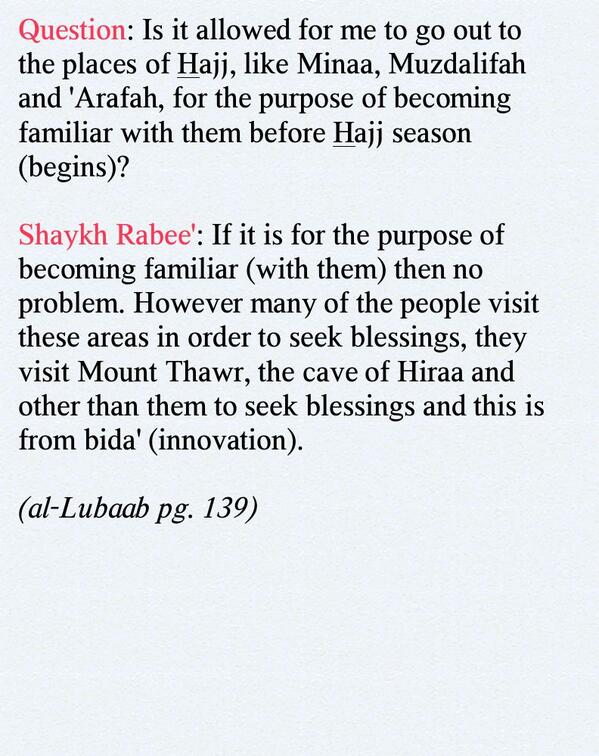
Visiting the places of Hajj outside of it’s time – Shaykh Rabee’ al-Madkhalee

Bismillaah Al-Hamdulillah wa salatu wa salaamu ‘ala rasulullaah
Amma-ba’d

Visiting the places of Hajj outside of it's time - Shaykh Rabee' al-Madkhalee

Related Links:

Whats Wrong With Our Salafiyyah ? – (Good Character and Manners) – Abu Uwais Abdullaah Ali [Audio|En]

Listen / Download Mp3 Here (Time 01:05:49)

Related Links:

Did the Sahaba differ in ‘Aqeedah? – Shaikh Ubaid al-Jabiree [Video|Ar-En Subtitles]

Source: http://ar.miraath.net/fatwah/3881
هل اختلف الصحابة -رضي الله عنهم- في العقيدة؟

Video Courtesy: DawahSalafiyaah

Why do deviants say that the Sahaaba differ in ‘aqeedah? So they can justify their hizbiyyah and their differing. They work night and day to try to find differing of the sahaaba, so they can justify their opposition to the Sunnah – i.e. sahaabah differed so we can differ

Highly Beneficial Link:

Golden Advices from Shaikh Ahmad as-Subay’ee and others

In the name of Allāh, the Most Merciful, the Bestower of Mercy.

As-salāmu ‘alaikum wa rahmatullāhi wa barakātuh.

Student Abu Remlah Adam Amreeki (hafidhahullaah) relayed the following scholarly advices:
Shaikh Abu Muhammad Ahmad As-Subay’ee (hafidhahullaah) said:

“Only strive in clinging to the Sunnah; even if all of mankind praised you, it would not increase you in anything with Allaah”

“There is nothing equivalent to being guided to the Sunnah; it is the most tremendous blessing after Tawheed.”

“Only strive in clinging to the Sunnah; even if all of mankind praised you, it would not increase you in anything with Allaah.”

“From the evil effects of sins is that they weaken one’s ability to distinguish Truth from falsehood.”

“If someone only speaks against those people whom have spoken against him first, then he’s not a sincere advisor.”

“There’s NEVER been a single day that Jameeah IhyaaTuraath had ever been upon the Sunnah; it was founded upon other than Sunnah.”

“Search for the Truth (الحق), like the searching of a frantic mother who lost her child (as Allaah said what means:) and those who strive for Our sake, we will surely guide them to Our paths. (Al-Ankabut, ayah 69)

“The most tremendous way to purify the hearts: Cling to the Sunnah TRUTHFULLY, and recite the Qur`an with contemplation.”

Shaikh Rabee’ Bin Haadee al-Madkhalee (hafidhahullaah) said:

“That some of Ahl-Sunnah go easy on those who fall into tribulations (فتن) and falsehood in the name of “keeping them close,” or because they are considered to be “from Ahl-Sunnah,” then this does NOT benefit Islaam in anything.”

“The most dangerous of the arrows and spears are the arrows of the Hadaadees; they and the enemies of Islaam are together in the same trench.”

From the great wisdom in Shaikh Rabee’s advice about Al-Hajoori:

“Take MANLY stances with him.” [Don’t fear standing up to who opposes the Sunnah!]

Shaikh Abu ‘Uthmaan Muhammad Al-Anjaaree (hafidhahullaah) said:
“Having knowledge of the Correct Path and how to succeed in this life & hereafter isn’t enough; a Sunni must have DETERMINATION (عزيمة)!”       

Shaikh Muhammad Ibn Salih al-‘Uthaymeen (rahimahullaah):

“There’s NOTHING in the Book nor Sunnah which allows the innovated Islamic political groups & parties.” (جماعات و أحزاب)

Shaikh ‘Ubaid ibn ‘Abdullaah al-Jaabiree (hafidhahullaah) said:

 “The khawaarij are dogs of the hellfire…they lie against Allaah, His Prophet (salallaahu ‘alayhi wa sallam), and His Religion; they are (those) who spoil the image of Islaam!”

Post Courtesy: Maher ibn Ahmad 

The Two Resurrections After Death – Shaykh Ubayd al-Jaabiree [Audio|Ar-En]

Listen / Download Mp3 Here (Time 46:18)

The minor resurrection which is the stupor of death and that it came with the truth which is meeting with Allah, the Exalted and the soul will be brought to judgment and will have its reward or punishment which will be advanced to it before the major Day of Resurrection. Then He mentioned the major Resurrection as He, the Almighty says, وَنُفِخَ فِي الصُّورِ ۚ ذَٰلِكَ يَوْمُ الْوَعِيدِ which means, “And the Trumpet will be blown, that will be the Day whereof warning (had been given) (i.e. the Day of Resurrection).” [ القرآن الكريم The Noble Qur’aan, سورة ق  Soorah Qaaf 050, Verse 020]

From: AL-FAWA’ ID – A Collection Of Wise Sayings by Imam Ibn Al-Qayyim [ رحمه الله , rahimahullaah, may Allaah have mercy on him, died 751AH]

Not taking Islam Seriously – Shaykh Ubayd al-Jaabiree

Not taking Islam Seriously
Shaykh Ubayd al-Jaabiree (hafithahuAllah)

Translated by Miraath Publications
http://www.miraath.net/publications

Video Courtesy: Eesa Ibn Roy

Rizq? – Don’t Worry It’s Coming Anyway! – Abu Dihyah Dawud Adeeb [Audio-En]

Don’t Worry It’s Coming Anyway!
Abu Dihyah Dawud Adeeb (hafidhahullaah)
[Audio-English]

Listen / Download Mp3 Here (Time 28:37)

Reality of Taqwa – Shaykh Abdullaah al-Bukhaaree [Audio|Ar-En]

Reality of Taqwa
Shaykh Abdullaah al-Bukhaaree
[Audio|Arabic-English]

Listen / Download Mp3 Here (Time 01:17:49)

Allaah reveals of His wisdom what He wishes so believers may increase in Eeman, witholds what He wishes so believers may increase submission to Him

Bismillaah Al-Hamdulillaah wa salatu wa salaamu ‘ala rasulullaah
Amma ba’d

Question: What is the wisdom behind facing the Ka`bah in Salah (Prayer)?

Permanent Committee for Scholarly Research and Ifta’ answered:

It is known that the duty of a Muslim is to carry out Allaah’s commands as much as possible and refrain from committing what He has prohibited.

Whether one grasps its wisdom or not, one must believe that Allaah commands only that which is of benefit, and prohibits that which is harmful. All of His legislations contain wisdom which He knows; He reveals of this wisdom what He wishes so that believers may increase their Eeman, (Faith), and witholds what He wishes so that believers may increase their submission to Him.

The Muslims have taken the Ka`bah as a Qiblah (direction faced for Prayer) in obedience to Allaah’s order in His statement: Verily! We have seen the turning of your (Muhammad’s, salallaahu ‘alaihi wa sallam) face towards the heaven. Surely, We shall turn you to a Qiblah (prayer direction) that shall please you, so turn your face in the direction of Al-Masjid-al-Haraam (at Makkah). And wheresoever you people are, turn your faces (in prayer) in that direction. (Surah Al-Baqarah, ayah 144)

The wisdom behind this is perhaps that it is the Qiblah of our father Ibrahim (‘alaihi salaam), as mentioned regarding the event when the Ayah was revealed. The Prophet (peace be upon him) had hoped to be ordered to face the Ka`bah during Salah instead of Jerusalem. Thus, Allah granted his wish. It might also be a refutation of the claim made by the Jews that we share their Qiblah. It may be for another reason and only Allah knows.

May Allah grant us success! May peace and blessings be upon our Prophet Muhammad, his family, and Companions!

Permanent Committee for Scholarly Research and Ifta’ (Chairman ‘Abdul-‘Aziz ibn ‘Abdullah ibn Baz)

Source: AlIfta.Com

Delving into the Sciences of the World to prove Islaam – Shaikh ‘Ubaid al-Jabiree

Video Courtesy: LearnToReadTheKuran

Bismillaah Al-Hamdulillaah wa salatu wa salaamu ‘ala rasulullaah
Amma ba’d

Delving into the Sciences of the World to prove Islaam 

Excerpts from Shaikh ‘Ubaid al-Jabiree (hafidhahullaah):

This was not known at the times of the Salaf, nor was it known by the Companions of the Prophet Muhammad sallallahu ‘alayhi wa sallam, or the imams of the Tabi’een (the Successors) or those who followed after them. This idea of researching the sciences behind the creation didn’t appear until about thirty years or so ago…

This idea of proving Islam through the Sciences is a bid’ah (an innovation). This type of study keeps us away from learning the true religion. My sincere advice to you my sister in Egypt, and other sisters of the Sunnah in Egypt, is that you shouldn’t listen to this and must not busy yourselves with this knowledge but rather you should focus on the knowledge of the Sharee’ah which is the knowledge of the Qur`aan and the Sunnah upon the understanding of the Salaf.

The Sunnah is a way of happiness and tranquillity in this life because the Prophet sallallahu ‘alayhi wa sallam said: Whoever Allaah wants good for, He gives him understanding of the religion. So from this, we understand that whoever Allaah does not want good for, He does not give him understanding of the religion.

Preparing For A Noble Guest… Ramadhaan – Abu Muhammad al-Maghribee [Audio|En]

This talk was given on Friday, May 17, 2013.

This noble guest is the month of Ramadhaan.  The salaf used to begin preparing for Ramadhaan six months before.  So how do we prepare for this beautiful and blessed month?  Listen to find out.

Listen/ Download Mp3 (Time 50:57)

Posted fromhttp://followthesalaf.com

‘Ashru Qawaa’id fil-Istiqaamah (10 Principles of Steadfastness) – Shaykh Abdur-Razzaaq Al-Badr – Abu Muhammad al-Maghribi [Audio|En]

‘Ashru Qawaa’id fil-Istiqaamah (10 Principles of Steadfastness)
by Shaykh Abdur-Razzaaq Al-Badr 

Abu Muhammad a-Maghribi (hafidhahullaah)

 al-Istiqaamah (Steadfastness) Seminar that took place in Detroit, MI this past April 2013.

[Part01] Listen /Download Mp3 (Time 59:13)

[Part02] Listen /Download Mp3 (Time 01:05:08)

[Part02b] Listen /Download Mp3 (Time 24:43)

[Part03] Listen /Download Mp3 (Time 54:45)

[Part04] Listen /Download Mp3 (Time 01:06:02)

[Part04b] Listen /Download Mp3 (Time 46:14)

Audio Courtesyhttp://www.masjidtawheed.org/wordpress/?p=296

(Must Listen) A Talk to the Youth – Abu Muhammad al-Maghribee [Audio|En]

A Talk to the Youth
(Al-Istiqaamah seminar, Masjid at-Tawheed, Detroit)
Abu Muhammad al-Maghribee (hafidhahullaah)

Listen / Download Mp3 (Time 01:06:40)

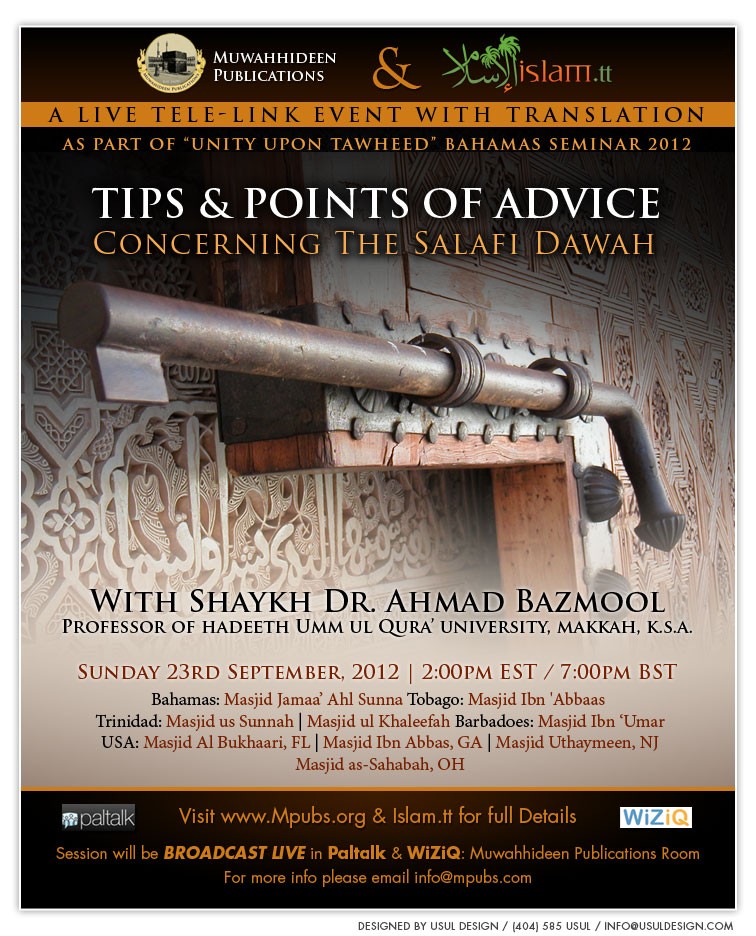
Tips and Points of Advice Concerning The Salafi Dawah – Shaykh Ahmad Bazmool [Audio|Ar-En]

Tips and Points of Advice Concerning The Salafi Dawah - Shaykh Ahmad Bazmool

Listen / Download Mp3 Here (Time 01:31:21) (Arabic-English)
Currently this audio is being edited by mpubs.org for better clarity – Audio link will be posted soon !! ,inshaa’ Allaah.

ShaykhDoctor Ahmad Bazmool (hafidhahullaah) is from amongst the well known scholars of MakkahSaudiArabia. He teaches the Science of Hadeeth at Umm ul-Qura University and has studied under some of the great scholars of our time, including Ash-Shaykh, the ‘Allaamah, Doctor Rabee’ Ibn Hadi al-Madhkhalee, and his own brother Ash-Shaykh Muhammad bin ‘Umar Baazmool. He has gotten ijazaahs from many scholars throughout the Islaamic World including Ash-Shaykh Muhammad Abdullaah as-SoomaleeAsh-Shaykh Ahmad bin Yahya an-NajmeeAsh-Shaykh Abdullaah Ada ash-Shanqeetee , Ash-Shaykh Rabee’ bin Haadee Al-Madkhalee , Ash-Shaykh Muhammad bin Abdullaah as-Sabeel, Ash-Shaykh Yahyaa bin Uthmaan al-Mudarris, and Ash-Shaykh Abdullaah bin Abdul Azeez al-Aqeel. The Shaykh has also been highly praised and recommend by al-Kibaar ul-‘Ulamah for his beneficial works.

As an admonition to Ahlus Sunnah in The Bahamas (a small island southeast of the United States and has a population of less than 400,000 people of which less than 300 are Muslim), and the wider nation of Muslims as well, our Shaykh will enlighten us with some much needed points of advice and wise admonition concerning this blessed da’wah. It is of paramount importance that we truly understand and are upon yaqeen concerning our call which must be done with knowledge. Even more so in these lands of kufr where the vast majority of people are upon shirkkufr and other grave sins.

We ask Allaah to grant us beneficial knowledge, guide us to implement that which we have learnt, call the people to The Truth and have patience upon this.

Posted fromhttp://store.mpubs.org