This lecture was given on Saturday, December 1, 2012 in Masjid at-Tawheed in Stone Mountain, GA.
With this lecture, we will begin our weekly talk related to the Family in Islaam and related issues (selecting a spouse, raising children, the rights of the parents/child/husband/wife, status of the mother, and much more….).
This class was given on Saturday, December 8, 2012 in Masjid at-Tawheed, Stone Mountain, GA. This was taken from a Friday Khutbah by our sheikh Saaleh al-Fawzaan, hafidhahullah.
This class was given on Saturday, December 15, 2012 in Masjid at-Tawheed, Stone Mountain, GA.This was taken from a Friday Khutbah by our sheikh Saaleh al-Fawzaan, hafidhahullah.
Share this, Baarakallaah Feekum: [“One who guides to something good has a reward similar to that of its doer” - Saheeh Muslim vol.3, no.4665] [This website protects the copyrights of the authors/publishers. The Content is posted on this website with implicit/explicit permission from content owners]
Bismillaah wa -Alhamdulillaah wa Salaatu wa Salaam ‘alaa Rasulillaah ‘amma ba’d
The Noble Shaykh ‘Abdullah Ibn Naajee al-Hadaad (May Allah Preserve Him) from the mashaayikh of Dhimaar, Yemen delivered a LIVE tele-lecture with Muwahhideen Publications on Wednesday 6th March 2013 on the topic of reliance on Allah. Shaykh ‘Abdullaah al-Hadaad is a student of Ash-Shaykh Al-Allaamah Al-Muhaddith, the Imaam of Yemen, Shaykh Abu ‘Abdur Rahmaan Muqbil Ibn Hadee al-Waadi’ee (rahimahullah) and is currently the Imaam of Masjid Siddeeq in Dhimaar, Yemen.
The Noble Shaykh ‘Abdullah Ibn Naajee al-Hadaad (hafidhahullaah) introduced the lecture by supplicating to Allaah for His aid and assistance and subsequently sending prayers upon our Prophet (sallAllaahu ‘alayhi wa sallam). He then began by explaining the linguistic definition of tawakkul which is to show that one is unable to handle a certain affair and that one is relying upon other than himself to take care of that affair. He stated that there are two types of agents (helpers) that a person can rely upon:
Those agents who can be relied upon only in certain matters and are imperfect
Those agents who can be relied upon in every single affair and this can only be Allah
The Shaykh proceeded to the meaning of tawakkul in the sharee’ah, and it is true reliance of the heart upon Allah. So the person who relies upon Allaah is one who knows that Allah will provide for him and handle all of his affairs, may it be from his desires or his fears in this world or the aakhirah. It is noteworthy that tawakkul is one of the means by which a servant accomplishes what he desires. So a person should not lie around and not accomplish anything because doing so has no relation to relying upon Allah. Rather, this is a fake form of tawakkul called ittikaal that is indeed laziness and may lead to one not being keen upon performing his due deeds and not improving his situation at his own hands from where he is capable.
Shaykh Hadaad (hafidhahullah) then mentioned the difference between relying upon Allah(tawakkul) and leaving one’s affair to Allah(tafweedh). Although these two are related, tafweedh is more general than tawakkul since tafweedh is akin to submitting to Allah. Having tafweedh indicates that a person has freed himself from claiming he has any power or ability of his own without Allah. So one has to submit himself to Allah and leave his affair in His Hands before he obtains tawakkul, which is more specific as previously mentioned.
The lecture continued on an advantageous path, as the Shaykh differentiated the meaning of tawakkul and having trust in Allah. The essence of tawakkul is trusting in Allah just as the black of one’s eye is the most beautiful and most elegant part of it. He also spoke about the places where tawakkul is to be performed and surely, it is advised to have tawakkul in all the affairs of one’s life; however, the Prophet (sallAllaahu ‘alayhi wa sallam) and his Companions were instructed by Allah to have tawakkul in the following specific affairs:
·When seeking the aid of Allah for victory
·When turning away from your enemy
·If mankind turns away from you
·When the Qur’aan is being recited
·If you are trying to mend an affair of enmity between two people
·When the decree of Allah descends
·If your enemy places down their traps/schemes
·When you realize that all affairs return to Allah and that Allah is the One who decrees all affairs
·When you realize that Allah is truly One God
·If Allah guides you (you should receive the guidance with gratitude to Allah)
·If you fear the harms of the enemies of Allah and the shaytaan
·If you want Allah to be your agent in all of your affairs
·If you wish for the highest level of Paradise
·If you wish for Allah to love you (then rely on Him)
·If you want to completely submit to Allah
Our Shaykh (hafidhahullaah) then recited many ayaat from the Qur’aan where Allah mentioned the importance of tawakkul as well as many authentic ahadeeth from the Prophet (sallAllaahu ‘alayhi wa sallam). He concluded by sending prayers upon the Prophet(sallAllaahu ‘alayhi wa sallam), his family and his companions.
Indeed, there was a great benefit in this gathering as Shaykh ‘Abdullah al-Hadaad clearly defined each aspect of tawakkul, bringing forth the necessary evidences from the Qur’aan and authentic Sunnah.
Wa Billaahi Tawfeeq
Wa SallAllaahu wa Sallaama wa Barak ‘alaa Nabiyanna Muhammad wa ‘alaa ‘Alyhi wa Sahbyhi wa Sallam
Share this, Baarakallaah Feekum: [“One who guides to something good has a reward similar to that of its doer” - Saheeh Muslim vol.3, no.4665] [This website protects the copyrights of the authors/publishers. The Content is posted on this website with implicit/explicit permission from content owners]
The Easiest Way to Memorize The Noble Quraan – Shaykh bin Baaz رحمه الله
Translated by Abu Afnaan Muhammad ‘Abdullah حفظه الله
Source: http://www.binbaz.org.sa/node/17085
Video Courtesy: Brother Bilal Nahim
Share this, Baarakallaah Feekum: [“One who guides to something good has a reward similar to that of its doer” - Saheeh Muslim vol.3, no.4665] [This website protects the copyrights of the authors/publishers. The Content is posted on this website with implicit/explicit permission from content owners]
This is a very important Q&A concerning Hijrah to the west due to some kind of persecution.
Answered by Shaykh Rabee’ Al-Madkhalee (hafithahuAllah)
We can see from his answer to the questioned put to our Shaykh Rabee (hafithahuAllah), that the Ulamaa have serious insight of what the west are up to regarding us.
Many Muslims make excuses for there brothers and sisters for being here in the west, Insha’allaah it’s time for us to advised our friends and families and our self’s to leave this place.
May Allaah give us the strength and the ability to leave the west, from all it’s dangers.
Share this, Baarakallaah Feekum: [“One who guides to something good has a reward similar to that of its doer” - Saheeh Muslim vol.3, no.4665] [This website protects the copyrights of the authors/publishers. The Content is posted on this website with implicit/explicit permission from content owners]
Bismillaah Al-Hamdulillaah wa salatu wa salaamu ‘ala rasulullaah
Amma-ba’d
Allaah’s Messenger (salallaahu ‘alayhi wa sallam) said: “There are three people that Allaah will not speak to on the Day of Judgement, will not look at them, will not purify them; and for them is a painful punishment: one who lets his garment hang below his ankles, the Mannan, and the Munaffiq who does his business with false oaths.” (Muslim no. 106)
Allaah’s Messenger (salallaahu ‘alayhi wa sallam) said: “Whoever drags his garment out of arrogance, Allaah will not look at him on the Day of Judgement.” (Al-Bukhaaree no. 5784 and Muslim no. 2085)
Allaah’s Messenger (salallaahu ‘alayhi wa sallam) also said: “Whatever is below the ankles is in the fire.”(Al-Bukhaaree no. 5787)[1]
Allaah’s Messenger (salallaahu ‘alayhi wa sallam) also said: “The Izar of the believer is at the middle of his shin, and there is no harm – or he said – no sin upon someone if it is anywhere between that and the ankles. What is lower than that is in the Fire. And whoever drags his Izar arrogantly, Allaah will not look at him on the Day of Judgement.”[2] (Abu Dawud no. 4093, Ibn Majah no. 3573, An-Nasa’i 5/490, no 9716 and Al-Mawatta’ 2/914, 915)
Refutation of Doubt “We are like Abu Bakr; we’re not doing it out of Pride”
During the course of his series of classes of Readings from – Complete Characteristics of Muhammad (sallalallaahu ‘alayhi wa sallam), student Abul-Hasan Maalik (hafidhahullaah) relayed the proofs from the pure Sunnah concerning the Isbal as relates to the Izaar, Thobe, Kamees (shirt), and even the ‘Imaamah (turban).
Concerning those who violate these boundaries with the excuse “We are like Abu Bakr; we’re not doing it out of Pride,” Abul-Hasan relayed the following from the scholars:
“The scholars have mentioned a few different reasons why it is not correct for you to try to compare yourself with Abu Bakr As-Sideeq (radiallaahu ‘anhu).
– Firstly, we don’t have a testimony as Abu Bakr did from the Prophet (salallaahu ‘alayhi wa sallam) that he wasn’t doing it out of pride. The Prophet (salallaahu ‘alayhi wa sallam) said: You are not one doing it out of Pride. None of you have a testimony from the Messenger of Allaah (salallaahu ‘alayhi wa sallam) (saying) you’re not doing it out of pride. (That’s) number one.
– Number two, the ‘ulemma mention that it happened to Abu Bakr because of his thinness, he was a thin man. Very small (waist), and it was hard for him to keep his izaar up, and it used to fall.
– The third issue the ‘ulemma mention is that he was striving to keep it up! He wasn’t just letting it all hang out and down like this. He was striving to keep it up.
– [Fourthly,] they (the scholars) also mention another narration that the Prophet mentioned that isbal itself is nakhyila – isbal itself is arrogance. The ‘ulemma mentioned that at the very least it leads to arrogance…”
Abul-Hasan relayed other benefits and explanations and rulings from ‘ulemma such as Shaikh-ul-Islaam Ibn Taymeeyah, Imam Ibnul-Qayyim, and Imam An-Nawaawee (rahimahumullaah) concerning matters such as isbal for the sleeves of the kamees (they can’t be too long or wide)[3] and the isbal for the ‘Imaamah (the tail of the turban cannot be very long). And this is not a minor issue, rather it concerns the major matter of obeying Allaah and His Messenger, the matter of following the Sunnah[4] of the Messenger (salallaahu ‘alayhi wa sallam), whom Allaah Ta’aala commanded us to follow and take as an example. The Prophet (salallaahu ‘alayhi wa sallam) is the best example to follow.[5]
Notes:
[1] Shaikh Muhammad Ibn Saalih al-‘Uthaimeen (rahimahullaah) said: “The Prophet (salallaahu ‘alayhi wa sallam) did not confine this to arrogance, and it is not correct to do so based on the Hadeeth before it, because Abu Sa’eed Al-Khudri (radiallaahu ‘anhu) said that the Messenger of Allaah (salallaahu ‘alayhi wa sallam) said: ‘The Izar of the believer is at the middle of his shin, and there is no harm – or he said – no sin upon someone if it is anywhere between that and the ankles. What is lower than that is in the Fire. And whoever drags his Izar arrogantly, Allaah will not look at him on the Day of Judgement.’
Because the two actions are different, the punishment for each is different. Whenever the ruling and the reason for that differ, it is not possible to restrict a general ruling. This is because that would lead to a contradiction.”
[2] The hadeeth is authenticated by Imam Al-Albaanee (rahimahullaah).
[3] Imam Ibn Baaz (rahimahullaah) said: “As for the sleeves, the Sunnah is that they should not extend beyond the wrist, and with Allaah is the facilitation to do what is right.”
[4] The word Sunnah refers to the Prophet’s statements, actions, and his tacit approvals – some of which are obligatory (such as Ash-Shahadatayn, having the correct ‘aqeedah, the 5 obligatory prayers, Zakat, Hajj, fasting Ramadan, obedience to parents, growing the beard, returning the salaam, keeping your thobe or izaar above the ankles) and some of which are recommended (such as the optional prayers, optional fasting, using the miswak, beginning the salaam). The word Sunnah has also been used to refer to the ‘aqeedah and manhaj, and the word Sunnah has also been used to refer to the entire Religion.
[5] Among the many ayat Allaah revealed in this regard are the statements of Allaah, Ta’aala:
Indeed in the Messenger of Allaah (Muhammad), you have a good example to follow for him who hopes in (the Meeting with) Allaah and the Last Day and remembers Allaah much. (Al-Ahzab, ayah 21)
Say (Oh Muhammad to mankind): “If you (really) love Allaah then follow me (i.e. accept Tawheed, follow the Qur`an and the Sunnah), Allaah will love you and forgive you of your sins. And Allaah is Oft-Forgiving, Most Merciful.” (Aali ‘Imran, ayah 31)
Say (Oh Muhammad): “Obey Allaah and the Messenger (Muhammad).” But if they turn away, then Allaah does not like the disbelievers. (Aali ‘Imran, ayah 32)
Cuffing the Pants in Prayer, by Shaykh Zaid al-Madkhalee (hafidhahullaah)
Bismillaah Al-Hamdulillaah wa salatu wa salaamu ‘ala rasulullaah
Amma-ba’d
Cuffing the pants in prayer by Shaykh Zaid
Here is an excerpt:
Question: What is the ruling on rising or cuffing the pants in prayer if they are beneath the ankles?
“Obligatory. If the pants or the garment, or the trousers, or the izar, hangs beneath the ankles, the man falls into a sin from the major sins and this is not specific to the prayer, rather it is general for all times. As it appears in the hadith: Allaah will not look at the one (man) who drags his garment out of arrogance.[Muslim (2085)]
If a person comes with an attempt to remain neutral, saying ‘I don’t drag my garment due to arrogance; rather it is normal or routine.’ Then bring him the proof with another narration, the statement of the Messenger of Allaah (salallaahu ‘alayhi wa sallam): Whatever is beneath the ankles is in the fire. [Musnadof Imam Ahmad (9064)]
So he (salallaahu ‘alayhi wa sallam) did not say, ‘due to arrogance,’ nor did he restrict this to a condition or a description. Therefore there are two punishments for the one who drags his garment, one of them being more severe than the other – and they are both severe…”
Post Courtesy : Maher ibn Ahmad
Share this, Baarakallaah Feekum: [“One who guides to something good has a reward similar to that of its doer” - Saheeh Muslim vol.3, no.4665] [This website protects the copyrights of the authors/publishers. The Content is posted on this website with implicit/explicit permission from content owners]
May Allah the Most High have mercy upon this great scholar. Look at our ‘Ulamah and their soft-hearted mind in terms of sharing and caring. The question that you should ask yourself is: Would you do the same?
Taken from: Mawaaqif Mudhee.ah fee Hayaat al-Imaam ‘Abdul-‘Azeez Ibn Baaz – Page 37.
Share this, Baarakallaah Feekum: [“One who guides to something good has a reward similar to that of its doer” - Saheeh Muslim vol.3, no.4665] [This website protects the copyrights of the authors/publishers. The Content is posted on this website with implicit/explicit permission from content owners]
Shaikh Ubayd al-Jabiree giving an important advice to those Salafiyun who are deficient in their dealings with others.
Share this, Baarakallaah Feekum: [“One who guides to something good has a reward similar to that of its doer” - Saheeh Muslim vol.3, no.4665] [This website protects the copyrights of the authors/publishers. The Content is posted on this website with implicit/explicit permission from content owners]
Refuting those who say that the Shia are our brothers || Sheikh Salih al-Fawzaan
الرد على مقولة الشيعة إخواننا || الشيخ صالح الفوزان
Uploaded by daarulhaq
Share this, Baarakallaah Feekum: [“One who guides to something good has a reward similar to that of its doer” - Saheeh Muslim vol.3, no.4665] [This website protects the copyrights of the authors/publishers. The Content is posted on this website with implicit/explicit permission from content owners]
Bismillaah wa -Alhamdulillaah wa Salaatu wa Salaam ‘alaa Rasulillaah ‘amma ba’d
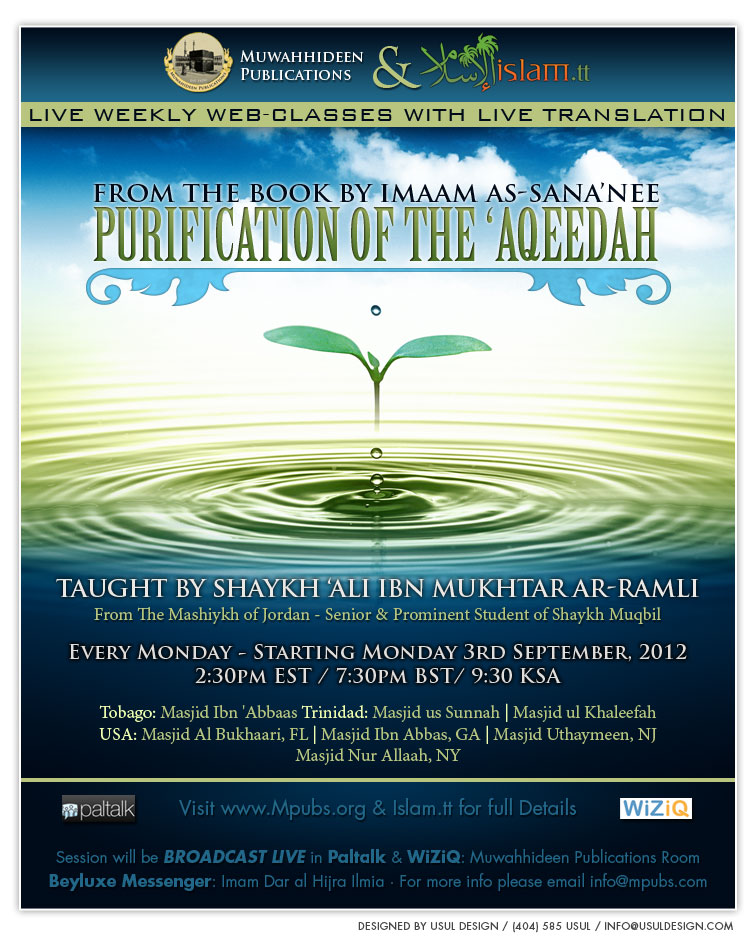
The Noble Shaykh, Aba al-Hassan ‘Ali ibn Mukhtar ar-Ramly (May Allaah Preserve Him) from amongst the scholars of Jordan, and a very strong student of Shaykh Muqbil ibn Hadi al-Wad’ee (rahimahullaah) started a weekly web class with Muwahhideen Publications on the explanation of the book “The Purification of The Aqeedah” by Imaam Muhammad ibn Ismaeel al-Sana’nee (rahimahullaah)
—
Class # 01 – 03.09.201270:09 mins. (Arabic & English)
Commencing the class, Shaykh ‘Ali ar-Ramli (hafidhahullaah) spoke about the reason for Allaah sending us Prophets and Messengers and touched on the origin of shirk amongst mankind.
He then went on to give a brief biography of Imaam As-Sana’anee (rahimahullaah) and the reason why the author took it upon himself to write this book and clarify the misguidance of the people in his time.
Other points of benefit included mention of the condition of the disbelievers of Quraysh, an explanation of the title of the book, some discussion about the state of the people in the time of Imaam as-Sana’anee and much more benefit concerning the correct belief of the muslim.
The Shaykh completed the introduction of the book in this first sitting and all are encouraged to attend these vital lessons that are packed with immense benefit about the most important matter in the life of a Muslim: the establishment of Tawheed and safeguarding oneself from shirk.
—
Class # 02 – 03.09.201261:56 mins. (Arabic & English)
Continuing with our study of the book ‘The Purification of the ‘Aqeedah’, Shaykh ar-Ramli (hafidhahullaah)explained in great detail three of the five fundamentals as articulated by the author.
Imaam as-Sana’anee (rahimahullaah) laid down five fundamentals which he then broke down into chapters.
The three fundamentals discussed are as follows:
Firstly: It has been known from the necessity of belief in the religion of Allaah that all of the Quraan is truth and not falsehood, all of it is guidance and not misguidance and all of it is certainty that has no doubt whatsoever. This is a foundation that the belief of anyone cannot be perfected and affirmed without.
Secondly: All of the prophets and messengers of Allaah from the first to the last of them were sent to call all of the creation to worship Allaah alone without associating any partners with Him.
Thirdly:Tawheed is divided into two categories. The first, Tawheed ar-Ruboobiyyah (Tawheed al-Asmaa was-Sifaat included in this category) and the second, Tawheed al-Uloohiyyaah.
—
Class # 03 – 17.09.201262:59 mins. (Arabic & English)
In the third class, our Shaykh ‘Ali ar-Ramli (hafidhahullaah) began by doing a recap of the principles we studied thus far. Then, he went on to explain the remaining two principles of the five.
These include:
The Fourth Principle: All of the polytheists affirm and confirm that Allaah is the Lord (The Creator, The Sustainer and the Disposer of all Affairs) soAllaah sent the Messengers and Prophets to call the people to the Monotheism of Worship (Tawheed al-‘Uloohiyyah).
The Fifth Principle:‘Ibaadah (worship) is the utmost of humiliation and humbling oneself to Allaah and worship is not meant but to humiliate oneself to Allaah. And this humiliation is only for Him and can never be for other than Him.
The Shaykh explained both principles in great detail, quoting the many evidences concerning both matters. He then went on to enlighten us with some benefits regarding the statement of Tawheed:‘Laa ilaaha il Allaah’.
This concluded the five principles as mentioned by the author (Imaam as-Sana’anee) and is the foundation upon which the rest of the book is built upon.
—
Class # 04 – 08.10.201289:17 mins. (Arabic & English)
In this session, Shaykh ‘Ali ar-Ramli (hafidhahullaah) went in to great detail concerning the Monotheism of Worship (Tawheed al-‘Ibaadah) and what it necessitates.
He explained that it is the belief of Ahlus Sunnah that kufr (disbelief) is divided into different categories which he mentioned and gave examples, as opposed to the deviant sect, the Murji’ah who say kufr is only of one kind.
Shaykh Ramli went on to discuss and explain the speech of the author concerning the reality that even if a person affirms the Ruboobiyyah(Lordship) of Allaah and worships Him but does not single Him out in this worship then this is of no benefit to him and he is a mushrik (polytheist),kaafir (disbeliever).
A noteworthy point, as mentioned by the Shaykh, is that it is from the condition of sidq (truthfulness) in eemaan that an individual does not depend on other than Allaah and it is a must that we single Him out alone in our dependence just as we single Him out in other acts of ‘ibaadah. Allaahcommanded His slaves to say ‘You alone we worship’ so no one truthfully believes in this statement until he singles out Allaah in all acts of worship, otherwise he is a liar and is forbidden from saying this statement because it means to specify all acts of worship for Allaah alone.
This class was extremely beneficial in highlighting the crucial matter of actualizing Tawheed al-‘Ibaadah with the Shaykh bringing forth the necessary evidences from the Qur’aan and Sunnah with much clarity.
—
Class # 05 – 15.10.201252:54 mins. (Arabic & English)
In this sitting, the Shaykh (hafidhahullaah) started a new chapter in which a number of matters were discussed. From them are:
The affirmation of the polytheists with regard to Tawheed ar-Ruboobiyyah is of no benefit to them due to them associating partners with Allaah in worship. Their actions negate their belief in His Lordship and they are counted from the mushrikoon.
It is only logical that the one who admits to the oneness of Allaah’s Lordship also dedicate all acts of worship to Him alone because what is the purpose of worshipping other than Allaah if everything is under His control and command (He is the Sole Creator, Sustainer etc). The one who does not dedicate all acts of worship to Allaah alone does not truly believe in His Lordship although he would attest to this.
Riyaa (showing off) is not only referred to as an act of shirk but it is also deemed worship since this refers to the slave doing an action seeking status/position in the hearts of the people while simultaneously seeking Allaah in that act of worship.
Whoever believes that a created being can benefit or harm, bring one closer to Allaah, intercede with Allaah on his behalf or fulfill his needs does not uphold Tawheed ar-Ruboobiyyah because he has ascribed attributes that belong to Allaah alone to other than Him.
The matter of an-nadr (vowing) which is to dedicate something to the object of worship seeking reward and fulfillment of a need as a result of this dedication. And this is only to be performed for Allaah alone as an-nadr is an act of ‘ibaadah so to perform it for other than Him constitutes shirkin worship.
This is still present today with the qubooriyoon (grave-worshippers) who use different names for their actions. Regardless of the names, the meaning is the same.
—
Class # 06 – 22.10.201257:01 mins. (Arabic & English)
Continuing with our study of the book ‘The Purification of the ‘Aqeedah’ by Imaam as-Sana’anee (rahimahullaah), Shaykh ‘Ali ar-Ramli (hafiidhahullaah) went on to explain some matters concerning the grave worshippers and that which constitutes shirk.
From the points discussed:
Whoever believes that a rock, tree, grave, the living or dead can bring about harm or benefit or grant that which is only in the Hands of Allaah or can bring you closer to Allaah has committed shirk.
Those who worship the graves treat the graves of those they claim to be awliyaa the same way the mushrikeen (idol worshippers) treated their idols. They call upon them as the Muslimeen call upon Allaah.
By worshipping the graves and calling upon the deceased they have gone back to the exact same concept that was found in the worship of Wad, Suwa, Yaguth, Ya’uq and Nasr by the people of Nuh.
Some have the belief that men from amongst the living who are fussaaq (apparent, public sinners) have powers and can be called upon while these men are themselves immersed and completely drowning in sin, transgression, lusts and every kind of despicable thing Allaah has made haraam (forbidden).
Along with all of this, this person will be found to make a claim of ‘ilm ul ghayb (knowledge of the unseen)nand this is in direct contradiction to theQur’aan thus rendering him a kaafir (disbeliever). However Iblees will bring to him people who will believe in his lies, accompany him and glorify and magnify him until they raise him to the level of Rabb-ul-‘Aalameen (The Lord of all creation).
Those who believe in the “awliyaa” and the open sinners have become mushrikeen (polytheists), just as the idol worshippers. There is similarity in their description and actions. According to the author, the ruling regarding them (the grave worshippers and idol worshippers) is exactly the same because they have directed worship which should be to Allaah alone to other than Him.
Share this, Baarakallaah Feekum: [“One who guides to something good has a reward similar to that of its doer” - Saheeh Muslim vol.3, no.4665] [This website protects the copyrights of the authors/publishers. The Content is posted on this website with implicit/explicit permission from content owners]
Scholar: Imâm Muhammad bin Sâlih bin ´Uthaymîn Source: Liqâ’ al-Bâb al-Maftûh (212 B) Date: 1420-03-24/1999-07-07 Reference: Darulhadith.com Translation & video: aFatwa.com (site is down)
Question:
What is the ruling on Jihâd today? Is it obligatory for some Muslims or for all? When is it obligatory for the entire Ummah if it only is obligatory for some Muslims?
Shaykh Ibn ‘Uthaymîn:
Firstly, you have to know that Jihâd is not obligatory for all Muslims. This is impossible. Allâh (ta’âlâ) said:
“And it is not for the believers to go forth [to battle] all at once. For there should separate from every division of them a group [remaining] to obtain understanding in the religion and warn their people when they return to them that they might be cautious.” (9:122)
If all were to have gone out in Jihâd, the rest of the prescriptions and rituals would have ended. However, it can become Fardh ‘Ayn (obligatory for all Muslims) in the following cases:
1 – On the frontline. If one comes here, one should accomplish the war.
Allâh (ta’âlâ) said:
“O you who have believed, when you meet those who disbelieve advancing [for battle], do not turn to them your backs [in flight]. And whoever turns his back to them on such a day, unless swerving [as a strategy] for war or joining [another] company, has certainly returned with anger [upon him] from Allah , and his refuge is Hell – and wretched is the destination.” (8:15-16)
2 – When the enemy attacks one’s country. Here it becomes obligatory to fight to defend oneself and one’s Islamic country.
3 – When the LEADER orders him to go out in Jihâd. Write the word “LEADER” with capital letters. It means that one has to have a leader who leads the Islamic army. When the LEADER orders him to go out in Jihâd, he has to go out. When he orders a country’s population to go out in Jihâd, they have to do it. For it is forbidden to be disobedient towards the rulers. When they are told to do it, they become obliged to fulfill it.
4 – When there is a need of the person. An example of that is that a person is a loner in knowing how a specific weapon is to be managed. In this case, it becomes obligatory for him to fight.
As for what is beyond these four situations, it is not obligatory for all Muslims to fight. Thereto, JIHÂD MUST BE UNDER THE LEAD OF A LEADER. OTHERWISE, A GUERRILLA WAR WOULD HAPPEN. THERE HAS TO BE A LEADER WHO IS LEADING THE ISLAMIC UMMAH. YOU THEREFORE SEE THAT IT DOES NOT GO WELL FOR THOSE WHO GO OUT IN JIHÂD WITHOUT THE LEADERSHIP OF A LEADER. There is a risk that they even attack each other. If they were to triumph, they begin to fight each other.
I ask Allâh that He helps us strive against ourselves. We have to strive against ourselves at the moment. Hearts are sick. The limbs are deficient. Hearts fight against each other. It is firstly this that is in need of Jihâd.
Share this, Baarakallaah Feekum: [“One who guides to something good has a reward similar to that of its doer” - Saheeh Muslim vol.3, no.4665] [This website protects the copyrights of the authors/publishers. The Content is posted on this website with implicit/explicit permission from content owners]
The Islaamic Position Regarding Protests and Demonstrations by Shaykh ‘AbdulQaadir al-Junaid
Bismillaah wa -Alhamdulillaah wa Salaatu wa Salaam ‘alaa Rasulillaah ‘amma ba’d
The Noble Shaykh ‘AbdulQaadir Ibn Muhammad al-Junaid (May Allaah Preserve Him), from the scholars of Ad-Dammam, K.S.A., delivered a LIVE tele-lecture with Muwahhideen Publications on Thursday 21stFebruary 2013. The Shaykh is recognized and recommended by the major scholars of our time, the likes of Shaykh ‘Ubayd al-Jaabiree, Shaykh Muhammad Ibn Haadee al-Madkhalee, and many others (May Allaah preserve them)
Shaykh ‘Abdul Qaadir al-Junaid (hafidhahullaah) commenced this comprehensively beneficial lecture by asking Allaah to benefit us with this sitting and to make us from those who love the truth, follow what Allaahand His Messenger says and that He makes us from those who put His Speech and that of His Messenger(sallAllaahu ‘alayhi wa sallam) before everything else.
Our Shaykh affirmed the fact that many Muslims are engaged in protests and demonstrations throughout the world and some of them desire by this the dunya while some seek to topple the ruler due to injustice that he might have committed, and will not stop until he is removed. However, this does not change their situation and ends up resulting in millions of deaths, loss of wealth and property. This might last for years if the ruler is not removed and as a result, the ruler may execute an armed counter-reaction, which would lead to even more deaths and losses.
The Shaykh then proceeded to say that if we use our intellects, we would see that this blessed Sharee’ahexplained even the intricate matters of using the toilet. So would it make sense that a great affair such as governance, which affects all Muslims, that Allaah would leave us without guidance, leaving each man to himself to act as he sees fit or to follow his desires?
He then said that if we were to return to the books of the Sunnah we would see that this matter of governorship and how the Muslim should deal with the rulers has been thoroughly addressed. He further mentioned that this issue has also been explained in the books of ‘Aqeedah. However, the fault lies with us, as many do not inquire about what is requested of them in light of the Sharee’ah before engaging in such matters and secondly, they do not study the ahkaam related to these affairs.
Our Shaykh then went on to extract some benefits and rulings regarding the manhaj in dealing with the rulers from three ahadeeth of the Prophet (sallAllaahu ‘alayhi wa sallam) where he advised us on what to do if we were to encounter unjust rulers. The remedies include having patience with them until we meet him(sallAllaahu ‘alayhi wa sallam) at the hawdh, carrying out their rights while seeking our rights from Allaah and listening and obeying even if they were to beat our backs and take our wealth.
Next, Shaykh al-Junaid (hafidhahullaah) commented on some reasons why protests are prohibited in Islaam. From them are:
1. They contradict the Sharee’ah
2. They resemble the way of the kuffaar
3. They encourage injustice and sin
This sitting was indeed filled with immense benefit and serves as a beautiful clarification concerning this pertinent and crucial issue as our Shaykh ‘Abdul Qaadir clearly explains each point bringing the necessary evidences from the Book and the Sunnah. A must listen for the one seeking clarity!
We ask Allaah to guide us to the truth and make it easy for us to follow and that He saves us all from falling into sin and transgression.
Wa Billaahi Tawfeeq
Wa SallAllaahu wa Sallaama wa Barak ‘alaa Nabiyanna Muhammad wa ‘alaa ‘Alyhi wa Sahbyhi wa Sallam
Share this, Baarakallaah Feekum: [“One who guides to something good has a reward similar to that of its doer” - Saheeh Muslim vol.3, no.4665] [This website protects the copyrights of the authors/publishers. The Content is posted on this website with implicit/explicit permission from content owners]
Share this, Baarakallaah Feekum: [“One who guides to something good has a reward similar to that of its doer” - Saheeh Muslim vol.3, no.4665] [This website protects the copyrights of the authors/publishers. The Content is posted on this website with implicit/explicit permission from content owners]
“Say: Are those who know equal to those who know not?” It is only men of understanding who will remember.”[39:9]
Imaam Ahmad ibn Muhammad ibn Hanbal (died 241h.) may Allaah be pleased with him said;
“The graves of sinners from People of Sunnah is a garden, while the graves of the pious ascetics from the People of Innovation is a barren pit. The pious among Ahlus Sunnah are the Friends of Allah, while the sinners among Ahlul-Bidah are the Enemies of Allah.” [Tabaqaat al-Hanaabilah, 1/184]
Imam Abu Dawood (died 275h.), may Allaah be pleased with him, the compiler of Sunan Abee Dawood, said;
“The lectures of Ahmad were sittings of the Hereafter. He would not mention in them anything of the worldly affairs; and I never saw him mention this world.”
_______________________________
A few facts about Shaykh Saalih as-Suhaymee:
Saalih bin Sa’d as-Suhaymee was born in the year 1366 H. in the city of Madeenah. He has a doctorate in fiqh. He works as an Associate Professor in the University of Madeenah, School of Da’wah and Usool-ud-Deen, in the Aqeedah Division.
He also holds duroos in the Mosque of the Prophet (salla Allaahu ‘alayhi wa sallam) in Madeenah.
May Allaah grant him a long, healthy and blessed life… ameen!
Share this, Baarakallaah Feekum: [“One who guides to something good has a reward similar to that of its doer” - Saheeh Muslim vol.3, no.4665] [This website protects the copyrights of the authors/publishers. The Content is posted on this website with implicit/explicit permission from content owners]
Video Uploaded by DawahSalafiyaah . Uploaded with Permission
Share this, Baarakallaah Feekum: [“One who guides to something good has a reward similar to that of its doer” - Saheeh Muslim vol.3, no.4665] [This website protects the copyrights of the authors/publishers. The Content is posted on this website with implicit/explicit permission from content owners]
Share this, Baarakallaah Feekum: [“One who guides to something good has a reward similar to that of its doer” - Saheeh Muslim vol.3, no.4665] [This website protects the copyrights of the authors/publishers. The Content is posted on this website with implicit/explicit permission from content owners]
An emotional introduction by Shaykh Saalih al-Fawzaan; highlighting the importance of returning back to the scholars and to fear Allah as much as one is able to! The audio is then followed by the speech of the Imaam of Yemen, the Allaamah ash-Shaykh al-Muhaddith Muqbil ibn Hadee al-Wadi’ee, rahimahullah; highlighting the importance of returning to the scholars of the Sunnah.
Share this, Baarakallaah Feekum: [“One who guides to something good has a reward similar to that of its doer” - Saheeh Muslim vol.3, no.4665] [This website protects the copyrights of the authors/publishers. The Content is posted on this website with implicit/explicit permission from content owners]
Shaykh Muhammad ibn Abdul-Wahab al-Wasaabee explaining the Hadith of Abu Hurayrah, may Allaah be pleased with him:
إِنَّ اللَّهَ لَا يَنْظُرُ إِلَى صُوَرِكُمْ وَأَمْوَالِكُمْ وَلَكِنْ يَنْظُرُ إِلَى قُلُوبِكُمْ وَأَعْمَالِكُمْ
“Verily, Allah does not look at your appearance or wealth, but rather He looks at your hearts and actions.”
The 2 conditions are: 1) al-Ikhlaas 2) al-Mutabaa’a
If one of the two, or even both are missing the action of the servant of Allaah becomes corrupt. May Allaah make our actions sincere for Allaah alone in accordance with the Sunnah of our beloved messenger Muhammad, sallAllaahu alahyi wa sallam.
Share this, Baarakallaah Feekum: [“One who guides to something good has a reward similar to that of its doer” - Saheeh Muslim vol.3, no.4665] [This website protects the copyrights of the authors/publishers. The Content is posted on this website with implicit/explicit permission from content owners]
Scholar: Imâm Muhammad bin Sâlih bin ´Uthaymîn Source: islamcast.wordpress.com/2009/03/29 Reference: Darulhadith.com Translation & video: aFatwa.com
Shaykh Ibn ‘Uthaymîn:
I warn my Muslim brothers against what some stupid people do when they narrate april jokes. This lie have they taken from the jews, the christians, fire-worshipers (Majûs) and other disbelievers.
Not only is this act a lie, which is in itself forbidden according to the Sharî’ah, it also involves imitating the disbelievers, which is forbidden. The prophet (sallâ Allâhu ‘alayhi wa sallam) said:
“Whoever imitates a people belongs to them.”
Shaykh-ul-Islâm Ibn Taymiyyah (rahimahullâh) said:
“Its chain of narration is good.”
The least one could say is that it is forbidden, even if it seemingly entails disbelief.
Together with these two sins, the Muslim becomes humiliated before his enemy. It is generally known that the one who is imitated boasts before the imitator and sees himself as being in front of him. The imitator thus becomes weak so that he imitates him. The believer thusly becomes degraded since he subjugates himself and follows the disbelievers.
The fourth sin is that this filthy lie is often about taking someone else’s money unjustly and scaring the Muslims. They maybe lie and tell the family that they will be having guests. As a result thereof they prepare a great meal and meat and the like. They might also lie and tell them horrifying news of a relative being run over by a car or the like. This is not allowed.
Share this, Baarakallaah Feekum: [“One who guides to something good has a reward similar to that of its doer” - Saheeh Muslim vol.3, no.4665] [This website protects the copyrights of the authors/publishers. The Content is posted on this website with implicit/explicit permission from content owners]
Shaykh Muhammad Saeed bin Raslaan on the great pakistani Alim and Mujadid Allamah Ihsaan Ilaahi Dhaheer. Born and raised in Pakistan and after having graduated from the Islamic University of Madeenah he went back to his country to spread ad-Dawatus-Salafiyaah, telling the people to worship the one true God and abandoning grave-worship and refuting the people of innovation such as the Barelwiyyah and Deobandiyyah, Rafidaah and Qadiyaniyyah. He was killed in 1987 and it was said that Shaykh Bin Baaz broke out in tears and led his funeral prayer in Riyaad which millions of people attended. He, rahimahullahu ta’ala, was then carried to the graveyard of Baqee. May Allah have mercy upon him and may Allah give the Rafidaah what they deserve for they have been slaughtering Ahlus-Sunnah to this very day. We advise you with the advice of Shaykh Raslaan: Return to the books of Allamah Ihsaan Ilaahi Dhaheer!
For more info on the History and Doctrines of the Rafidah, please visit www.shia.bs
Share this, Baarakallaah Feekum: [“One who guides to something good has a reward similar to that of its doer” - Saheeh Muslim vol.3, no.4665] [This website protects the copyrights of the authors/publishers. The Content is posted on this website with implicit/explicit permission from content owners]
Share this, Baarakallaah Feekum: [“One who guides to something good has a reward similar to that of its doer” - Saheeh Muslim vol.3, no.4665] [This website protects the copyrights of the authors/publishers. The Content is posted on this website with implicit/explicit permission from content owners]




 AbdurRahman.Org
You must be logged in to post a comment.