Ibn Taymiyyah’s Letter To The Christian King of Cyprus – Dr. Saleh As Saleh [Audio|En]

Imam Ibn Taymiyyah rahimahullaah wrote a letter to the then Christian King of Cyprus inviting him to Islam and exposing the lies and corruption being committed by the priests and monks whilst they knew fully well that they were upon falsehood. After mentioning the devoutness of the King, his love for knowledge and good conduct towards the people, Ibn Taymiyyah then invited him to embrace Islam and adopt the correct belief. He did this in a gentle and exemplary manner addressing his intellect, and entrusted him to behave benevolently towards the Muslims in Cyprus, not to strive to change the religion of a single one of them.

cyprus


[Alternative Download Link]

Posted from : http://understand-islam.net/site/index.php?option=com_content&view=article&id=126&Itemid=76

Remembrance of Allaah – 20 Points of Benefit – Imam Ibn al Qayyim – Dr. Saleh As Saleh [Audio|En]

The following is based from the book Al-Wabil al-Sayyib by Ibn Qayyim al-Jawziyya


[Download Part 01Part 02]

Posted from: http://understand-islam.net/site/index.php?option=com_content&view=article&id=126&Itemid=76

Al-Istiqaamah (Steadfastness) of the Deen – A Door from the Doors of Sustenance – Shaykh Muhammad Ibn ‘Abdul-Wahhaab al-Wassaabee

After the Khutbatul Haajah the Sheikh mentions our subject tonight deals with: The means of getting sustenance and the doors towards sustenance. This subject in which everyone likes it, however many of them went wrong in the way of going about it. So, the Muslim knows the legislated means and doors towards attaining sustenance of which Allaah has mentioned in the Qura’an and of the Messenger صلى الله عليه وسلم has mentioned and carried those legislated means out he would have gained what has been promised to him. And sometimes these means are called ‘Abwaabur Rizq’ or ‘Abwaabul Furaj’ i.e doors towards relaxation and relief or if you wish to say ‘Abwaabul Rizq’ – doors towards obtaining sustenance or if you wish then say ‘Asbaabur Rizq’ i.e the means of sustenance. So the first means insha-Allaah (the students of knowledge should write these down in the notebooks with the proofs which we will mention from the Qura’an and the Sunnah). The Sheikh continues with the first door of means is :

1. Al-Istiaqaamah (Steadfastness on the Deen of Allaah) : Al-Istiqaamah of the Deen is a door from the doors of relief from difficulty and a door from the doors of sustenance and a means from the means of sustenance. Allaah (subhana wa ta’ala) says,

‘and if only they had believed in Allaah and had Istiqaamah on the right way, We would surely have bestowed upon them water (rain) in abundance.’

So Istiqaamah on the Book and the Sunnah and holding onto them wholeheartedly without increasing in them or taking away from them, this is a door from the doors of relief from discomfort, and a door from the doors of sustenance and a means from its means. On the contrary it is from the greatest means of Rizq in the Dunya and the Aakhirah. And if you knew the following means you would have known how much the people had gone away from them these days except whom Allaah has had mercy on. They want Rizq but they went wrong in the ways of attaining it and the doors towards it and its means except who Allaah has had mercy on them and they are very few. Even to the point where it might come to the thought of a person that if he wants rizq all he has to do is engross himself in pursuing the dunya and leave off the ‘Asbaab-al-Shar’eeah’ – (that is the means designated by the Shariah). So he doesn’t find except adverse hardship and you ofcourse know what rain has of benefits for the Ummah. The Sheikh mentions the ayah in Surahtul Anbiah :

‘We made all things living from water.’

When rain comes, i.e the rain that has the mercy of Allaah with it, all of the good in turn comes – the earth vegetates fruits and various herbs and waters in rivers become plentiful and the cattle and the riding beasts benefit and the good of humans and animals become abundant and agriculture becomes successful and ghee and honey becomes abundant, and sheep, cattle becomes abundant and the market prices become lower. And even the heat it gets lowered a great deal from the people. The Sheikh mentions the ayah again :

‘and if only they had Istiqaamah on the right path, We would have given them water (rain) from the sky in abundance.’

And Istiqaamah as you know as Allaah (subhana wa ta’ala) says :

‘That is verily those who say, “Our Lord is Allaah, then they have Istiqaamah, the angels descend upon them saying, ‘have no fear and do not be sad and have good tidings of Jannah (Paradise) that you have been promised. We are your protecting friends in the Dunya and in the Aakhirah. ‘

And whomsoever has Allaah as his wali or his protecting friend and has the angels as his awliyaah, his protecting friends, will Allaah leave that person to be by himself without any protection? Whoever thinks that Allaah will let go to waste his awliyaah, the ones that are close to Him, that hold firm to the Book and the Sunnah – then he has thought negatively about Allaah. So, the first door from the doors of rizq is Istiqaamah upon the Deen. And visualize the time that the people were Mustaqeemeen – when they had Istiqaamah upon the Book and the Sunnah.

Ibn al Qayyim (rahimahullah) he mentioned in his book ‘Zaad al-Maad’ that he found a grain of wheat the size of a date stone. The Sheikh reiterates : a grain of wheat the size of a date stone. And a cucumber the length of it being such and such … This is barakah from Allaah. So then Istiqaamah would probably lead to having a tomato that would need two people to hold it, a water melon which needs 5 or 6 people to hold it – i.e if there is present holding to the Book of Allaah and the Sunnah, no bid’ah, no khurafaath (superstitions & folklore), no sheer foolishness, no magic, no taking of intoxicants, no ribaa and no zinaa, no ‘liwaath’ — no sodomy and no lying and no fujoor – witness evil doing and no ‘shahaadatuz zoor’ — bearing witness to falsehood, and no wicked oath and not putting off of the prayers.

With Istiqaamah there will be present an abundance of good by the permission of Allaah. Our forefathers mentioned to us (May Allaah forgive us and them and all the Muslims) that they used to sell a young sheep for a Riyal. So, they eat its meat and sell its skin for a Riyal. So he slaughters it, he eats it with his family, his neighbours and whoever comes and at the end of it he sells the skin for a Riyal. He didn’t lose anything. So Isthiqaamah its affair is great in this Dunya and Aakhirah, in your Deen and dunya and in your Barzaakh, in your Aakhirah if you held on to the Kitaab and the Sunnah.

From : Means of Sustenance: Shaykh Muhammad Ibn ‘Abdul-Wahhaab al-Wassaabee. May Allaah reward the sister who Transcribed from the Audio 

Istiqaamah – Articles & Audio:
https://abdurrahman.org/category/islam/steadfastness-istiqaamah/

Fasalli li Rabbika wanhar (Therefore turn in Prayer to your Lord and Sacrifice) – Dr. Saleh As Saleh [Clip]

fasalli-lirabbika-wanhar


Clip Extracted from the Tafseer of Surah Al-Kawthar

Tafseer – Explanation Surah 78-114 – Tafseer Juz Amma

The following is posted from Tafseer Ibn Kathir , Darussalam:

Allah says,

﴿فَصَلِّ لِرَبِّكَ وَانْحَرْ ﴾

(Therefore turn in prayer to your Lord and sacrifice.) meaning, `just as We have given you the abundant goodness in this life and the Hereafter — and from that is the river that has been described previously — then make your obligatory and optional prayer, and your sacrifice (of animals) solely and sincerely for your Lord. Woship Him alone and do not associate any partner with him. And sacrifice pronouncing His Name alone, without ascribing any partner to Him.’ This is as Allah says,

﴿قُلْ إِنَّ صَلاَتِى وَنُسُكِى وَمَحْيَاىَ وَمَمَاتِى للَّهِ رَبِّ الْعَـلَمِينَ – لاَ شَرِيكَ لَهُ وَبِذَلِكَ أُمِرْتُ وَأَنَاْ أَوَّلُ الْمُسْلِمِينَ ﴾

(Say: “Verily, my Salah, my sacrifice, my living, and my dying are for Allah, the Lord of all that exists. He has no partner. And of this I have been commanded, and I am the first of the Muslims.”) (6:162-163)

Ibn `Abbas, `Ata,’ Mujahid, `Ikrimah and Al-Hasan all said, “This means with this the Budn should be sacrificed.” Qatadah, Muhammad bin Ka`b Al-Qurazi, Ad-Dahhak, Ar-Rabi`, `Ata’ Al-Khurasani, Al-Hakam, Isma`il bin Abi Khalid and others from the Salaf have all said the same. This is the opposite of the way of the idolators, prostrating to other than Allah and sacrificing in other than His Name. Allah says,

﴿وَلاَ تَأْكُلُواْ مِمَّا لَمْ يُذْكَرِ اسْمُ اللَّهِ عَلَيْهِ وَإِنَّهُ لَفِسْقٌ﴾

(And do not eat from what Allah’s Name has not been pronounced over, indeed that is Fisq.) (6:121)

Shaykh Ibn Al-‘Uthaymeen – His Humbleness – Dr. Saleh As Saleh [Short Clip] – Must Listen !

You can Listen to the Speech of the Shaykh Uthaymeen rahimahullaah

[Alternative Download Link]

Source: http://understand-islam.net/site/index.php?option=com_content&view=article&id=126&Itemid=76

The Creed of the Rāziyayn – Translated by Dawud Burbank [eBook]

The Foundation Of The Sunnah And The Creed Of The Religion
( Aslus-Sunnah Wa`tiqaadud-Deen )
Aboo Haatim ar-Raazee (d.277 H) & Aboo Zur`ah ar-Raazee (d.264 H) (rahimahumallaah)

Notes by Saalih ibn `Uthmaan ibn` Abdil-Hameed al-Lahhaam
Translated by Aboo Talhah Daawood ibn Ronald Burbank

In the name of Allaah, the Extremely Merciful, the Bestower of Mercy

To proceed,

Then this is the Creed of outstanding Imaams from the imaams of the Muslims. I present it to the Muslims so that they should be aware of their creed, and the creed of their predecessors; and recognise its easiness, and how the Predecessors (as-Salaf) adhered to it and defended it: so that they should also be like them in defending it, and in adhering to it.

I present it in this form [1] so that it can be kept close to you, so that it can be read repeatedly and referred to, and so memorised, and so that understanding of it and application of it settles in the heart, with Aid from Allaah alone.

The book has previously been printed in the Journal of al-Jaami`atus-Salafiyyah, in the year 1413 H; and it was likewise printed within the book “Sharh Usool I`tiqaad Ahlis-Sunnah” of al-Laalikaa·ee.

There are two photocopies of it in the library of the Islamic University of al-Madeenatun-Nabawiyyah, which are copies of two manuscripts found in the Zaahiriyyah Library -may Allaah protect it.

I have not mentioned the variations between the manuscripts, since there is no need for that, and I have sufficed with adding brief notes. I hope that Allaah causes them to be upon correctness, and that He grants me acceptance in a fine manner, and likewise my parents, my family, my wife, and my son `Ukkaashah – Aameen.

Written by Aboo `Ukkaashah in `Ammaan, in the forenoon of Sunday the 19th of Jumaadal-Aakhirah in the year 1413 H.

The Foundation Of The Sunnah And The Creed Of The Religion

In the name of Allaah, the Extremely Merciful, the Bestower of Mercy

He (i.e. `Abdur-Rahmaan ibn Abee Haatim)[2] said:

I asked my father and Aboo Zur`ah -radiyallaahu `anhumaa- about the positions of the Ahlus-Sunnah (the People of the Sunnah) regarding the fundamentals of the Religion, and what they found the scholars upon in all of the cities, and what they held as their creed in that regard, so they both said:

We found the scholars in all of the cities: in the Hijaaz, in `Iraaq, in Egypt, in Shaam, in Yemen, so it was from their position that [3]:

Eemaan (true Faith) is speech and action, it increases and decreases [4];

And the Qur’aan is the Speech of Allaah, it is not created, in all its aspects [5];

And Predecree, its good and its bad, is from Allaah (the Mighty and Majestic) [6];

And the best one of this nation, after its Prophet -`alaihis-Salaam- is Aboo Bakr as-Siddeeq, then `Umar ibn al-Khattaab, then `Uthmaan ibn `Affaan, then `Alee ibn Abee Taalib -radiyallaahu `anhum [7]; and they are the rightly-guided, orthodox Caliphs [8];

And that the ten whom Allaah”s Messenger صلى الله عليه وسلم mentioned by name, and for whom he bore witness that they will be in Paradise, are just as Allaah”s Messenger صلى الله عليه وسلم bore witness to, and his saying is the truth [9];

And to supplicate for mercy upon all of the companions of Muhammad صلى الله عليه وسلم , and upon his true followers, and to withhold from whatever occurred between them [10];

And that Allaah is (upon His Throne),[11] separate from His creation, just as He described Himself in His Book and upon the tongue of His Messenger, without describing how. He encompassed everything with Knowledge:

لَيْسَ كَمِثْلِهِ شَيْءٌ ۖ وَهُوَ السَّمِيعُ الْبَصِيرُ   [12

[[ Meaning: There is nothing like Him, and He is the All-Hearing, the All-Seeing.]] [13]

And Allaah -the Exalted and Most High- will be seen in the Hereafter; (and) the inhabitants of Paradise will see Him with their eyes, and they will hear His Speech, however He wishes, and just as He wishes [14];

And Paradise is true, and the Fire is true, and they are both already created: they will never come to an end. So Paradise is a reward for His beloved and obedient servants; and the Fire is a punishment for those who are disobedient to Him, except for those whom Allaah -the Mighty and Majestic- has mercy upon [15];

And the Siraat is true [16];

And the Balance (al-Meezaan) -which has two balance-plates, upon which the deeds of the servants will be weighed: the good and the bad- is true [17];

And the Vast Reservoir (al-Hawd) which our Prophet صلى الله عليه وسلم has been honoured with is true;

And the Intercession (ash-Shafaa`ah) is true [18];

And that some people, from the people of Tawheed, will come out from the Fire through intercession, is true;

And the punishment of the grave (`Adhaabul-Qabr) is true; and Munkar and Nakeer are true; and the noble Angels who write down deeds (al-Kiraamul-Kaatiboon) are true [19];

And the Resurrection (al-Ba`th) after death is true;

And those guilty of major sins (Ahlul-Kabaa’ir) are under the Will of Allaah -the Mighty and Majestic; and we do not declare the people of the Qiblah to be Disbelievers on account of their sins, and we entrust their secrets to Allaah -the Mighty and Majestic [20];

And we establish the obligation of the Jihaad and the Hajj along with the rulers of the Muslims in every age and time; and we do not hold rebelling against the rulers (nor fighting in time of discord)[21]; and we hear and obey whomever Allaah -the Mighty and Majestic- places in charge of our affair, and we do not remove our hand from obedience; and we follow the Sunnah and the Jamaa`ah, and we avoid isolation, differing, and splitting;

And that Jihaad continues, from the time when Allaah -the Mighty and Majestic- sent His Prophet صلى الله عليه وسلم until the establishment of the Hour, along with those in authority over affairs from the rulers of the Muslims, nothing abolishes it [22];

And the same is the case with the Hajj; and the charity due upon cattle is to be handed over to those in authority from the rulers of the Muslims ;

And the people are treated as Believers with regard to their rulings and their inheritance, but it is not known what their actual condition with Allaah -the Mighty and Majestic- is [23];

So whoever says that he is a true Believer, then he is an innovator;

And whoever says that he is a Believer according to Allaah, then he is one of the liars;

And whoever says: I am indeed a Believer in Allaah, then he is correct;

And the Murji·ah are innovators, astray [24];

And the Qadariyyah are innovators, astray; so whoever from them denies that Allaah -the Mighty and Majestic- knows whatever will occur, before it exists, then he is a Disbeliever [25];

And the Jahmiyyah are Disbelievers [26];

And the Raafidah have rejected Islaam [27];

And the Khawaarij are renegades [28];

And whoever claims that the Qur’aan is a created thing, then he is a Disbeliever in Allaah -the Tremendous, guilty of Disbelief which takes him out of the Religion; and whoever doubts about his being a Disbeliever, from those who have understanding, then he is a Disbeliever [29];

And whoever doubts regarding the Speech of Allaah -the Mighty and Majestic, and so withholds concerning it, doubting, and saying: ” I do not know whether it is created or not created”, then he is a Jahmee [30];

And whoever withholds regarding the Qur’aan out of ignorance, then he is to be taught, and he is declared to be guilty of innovation, but he is not declared to be a Disbeliever;

And whoever says: “My recital of the Qur’aan is created”, then he is a Jahmee; or: “The Qur’aan with my recitation is created”, then he is a Jahmee;

Aboo Muhammad said: And I heard my father say:

And the sign of the People of Innovations (Ahlul-Bida` ) is that they speak ill of the People of the Narrations (Ahlul-Athar)[31];

And the sign of the outright heretics (az-Zanaadiqah) is that they call the People of the Narrations (the Sunnah): “Rabble who fill their works with worthless speech” (hashawiyyah) : desiring by that to abolish the narrations [32];

And the sign of the Jahmiyyah is that they call the People of the Sunnah: “Anthropomorphists” (mushabbihah), (and “New shoots that have recently arisen”);

And the sign of the Qadariyyah is that they call the People of the Narrations: “Deniers of Free-Will” (“mujbirah”);

And the sign of the Murji’ah is that they call the People of the Sunnah: “Opposers” and “Reductionists”;

And the sign of the Raafidah is that they call the People of the Sunnah: “Naasibah” [33];

And all [34] of this is [said] (on account of their being fanatical groups)[35], but no name can apply to the People of the Sunnah except for a single name, and it is impossible for all of these names to unite upon them.

Aboo Muhammad narrated to us, saying: And I heard my father and Aboo Zur`ah both commanding boycotting of the people of deviation and innovations [36]; and they were both extremely stern (in what they held)[37] regarding that;

And they both criticized the writing of books of opinions, without narrations;

And they both forbade sitting with the people of theological rhetoric (Ahlul-Kalaam), and looking into the books of the people of theological rhetoric; and they both used to say: a person of theological rhetoric will never prosper.

Aboo Muhammad said: And it is the saying that I hold;

And Aboo `Alee ibn Habash al-Muqri· said: And it is the saying that I hold;

Our Shaikh Ibn al-Muzaffar said: And it is the saying that I hold;

And our Shaikh -meaning the author (i.e. al-Laalikaa·ee) said: And it is the saying that I hold;

And our Shaikh as-Silafee said: And it is the saying that I hold.[38]

[The end of the Creed of the Religion]

Footnotes:

[1] The Arabic version was printed as a small, pocket sized booklet (transl.)

[2] He is Aboo Muhammad `Abdur-Rahmaan ibn Abee Haatim ar-Raazee (d.327 H) -rahimahullaah. (transl.)

[3] This shows that the issues which follow are the `Aqeedah (Creed and Belief) of the Ahlus-Sunnah wal-Jamaa`ah, and that whoever opposes anything from them has deviated away from the Ahlus-Sunnah -in accordance with the extent of his opposition.

[4] Eemaan (true Faith) is affirmation and compliance; and it is affirmation of the heart, and speech of the tongue, and action of the heart and the tongue and the limbs -in compliance with the regulations of Islaam; and Eemaan can increase; and everything which is open to increase is even more open to decrease.

[5] Meaning that which is found in the written copy of the Qur·aan (mus-haf), and that which the reciters recite; that which Jibreel brought down, having heard it from the Speech of the Lord -the Majestic and Most High.

[6] And this does not contradict having correct manners with respect to Allaah when calamities occur, as was practised by Ibraaheem -`alaihis-Salaam- with our Lord:

وَإِذَا مَرِضْتُ فَهُوَ يَشْفِينِ
[Sooratush-Shu`araa· (26):80] [[ Meaning: And when I become ill He cures me.]]

[7] So we love and ally ourselves to those who love and ally themselves to them, and we free and disassociate ourselves from those who disassociate themselves from them.

[8] And joined with them is al-Hasan ibn `Alee ibn Abee Taalib; and this was the saying of Ibn Jareer [at-Tabaree].

[9] And the same is the case with all of the Companions, and with all of those for whom Allaah‟s Messenger صلى الله عليه وسلم bore witness that they will be in Paradise.

[10] And to seek forgiveness for them and for the Believers:

 رَبَّنَا اغْفِرْ لَنَا وَلِإِخْوَانِنَا الَّذِينَ سَبَقُونَا بِالْإِيمَانِ

[Sooratul-Hashr (59):10] [[ Meaning: O our Lord! Forgive us, and forgive our brothers who preceded us upon Eemaan]] . And disassociating oneself from them is a denial of the witness given by the Prophet صلى الله عليه وسلم that they will be in Paradise; and Aboo Zur`ah said: “If you see a man speaking ill of the Companions of Allaah‟s Messenger صلى الله عليه وسلم then know that he is an outright heretic (zindeeq). That is because the Messenger is, with us, true; and the Qur·aan is true; and this Qur·aan and these sunnahs were only conveyed to us by the Companions of Allaah‟s Messenger صلى الله عليه وسلم ; so all that those people intend is to destroy the credibility of our witnesses, so that they can abolish the Book and the Sunnah; whereas destruction of credibility is more appropriate for them, and they are outright heretics.”

[11] An addition from the text in „Sharh Usool I`tiqaad Ahlis-Sunnah‟ (1/177) of al-Laalikaa·ee.

[12] Sooratush-Shooraa (42):11.

[13] Apart, separate from His creation. So He -the Perfect- is not in every place, and the Salaf affirmed the word „baa·in‟ (separate).

[14] So whoever denies it in this world will be deprived of it in the Hereafter.

[15] Meaning these two are already created now; and it contains an affirmation that one guilty of major sins does not become a Disbeliever.

[16] i.e. the Bridge [finer than a hair, and sharper than a sword, passing over the Hell-Fire].

[17] Refer to „Sharhut-Tahaawiyyah‟ (1/417).

[18] It is of different types, and the most important of them is the intercession for those guilty of major sins (Ahlul-Kabaa·ir), since this is the main point of disagreement with the Mu`tazilah.

[19] Punishment of the grave is mutawaatir [something reported by such a large number of narrators at every level of its transmission that it is impossible for them to have made it up] with regard to its meaning; and concerning Munkar and Nakeer, he صلى الله عليه وسلم said: << When one of you -or (he said): a person- is placed in his grave, two black, blue Angels come to him. One is called al-Munkar, and the other is called an-Nakeer.>> Reported by at-Tirmidhee [„Hasan‟: at-Tirmidhee, no.1071]

[20] And this matter is connected to the Intercession, since denial of the Intercession is based upon declaring one who is guilty of major sin, and who does not repent, to be aDisbeliever.

[21] An addition occurring in „Sharh Usoolil-I`tiqaad’ (1/177) of al-Laalikaa·ee , and in the manuscript (transl.).

[22] The scholars have continued giving verdicts that Jihaad is to be performed along with those in authority from the Muslims.

[23] This is the principle of Islaam. So having suspicion regarding ones own self is more likely to incite it to perform deeds; but having suspicion about the rest of the people is to hold a saying without knowledge, and it does not produce any fruit, nor does it result in good deeds, and the rest of the people are then looked down upon by him.

[24] The Murji·ah are those who say that Eemaan is just speech and belief, and that action does not enter into it.

[25] And this is the argument that is to be used against them, and that Allaah is the Creator of the good and the evil.

[26] And they and the Mu`tazilah are equal, because of their saying that the Qur·aan is a created thing, and other innovations.

[27] They are the ones who are now known as the „Shee`ah‟, and they are Baatiniyyah [those who claim that Islaam has an apparent aspect, which is for the common folk, and a hidden reality known only to the chosen elite: (transl.)]: their intent is to undermine and demolish Islaam from within.

[28] And they are upon performing more worship, and establishment of the duties of the Religion, however this is founded upon ignorance and hastiness; and upon on only giving importance to their own opinions, and looking down upon others.

[29] That is because it is the Speech of Allaah, and His Speech -He the Most High- is from His Knowledge; and His Speech and His Knowledge are not created things; and it consists of Letters (Harf), and a Voice (Sawt) that is heard, which He speaks with, in accordance with the Will of Allaah alone.

[30] The saying of those who doubt (ash-Shaakkah), and those who withhold (al-Waaqifah), and those who declare that what they recite is created (al-Lafziyyah), is a pathway leading to the saying that it is created; and means to an end have the same ruling as the end results.

[31] Just as Satan now incites the Muslims to speak ill of the People of the Sunnah, in order to distance the people from them; such as their reviling the honour of the Imaams of Hadeeth, and its eminent persons of the present times, and of past times.

[32] Refer to “Fadl `Ilmis-Salaf”(“The Excellence of the Knowledge of the Salaf” [: by al-Haafiz Ibn Rajab]) (pp.43,67), and reflect upon the underlying reason why they speak ill of the People of the Sunnah.

[33] Those who have enmity towards `Alee -radiyallaahu `anhu, and the family of the Prophet صلى الله عليه وسلم (transl.).

[34] This is what occurs the manuscript, and see “`Aqeedatus-Salaf As-haabil-Hadeeth” (p.119) of Imaam Aboo `Uthmaan as-Saaboonee (transl.).

[35] An addition from the manuscript (transl.).

[36] And this is a crucial fundamental principle, … .

[37] An addition from the manuscript (transl.).

[38] And it is the saying that I hold. [And it is the saying that I hold (:transl.).]

[Download the Original PDF]

Posted fromhttps://alitisaambissunnah.wordpress.com

Short & Beneficial Biography of Yasir Qadhi, the Deviant – Abbas Abu Yahya [Audio|En]


“And By the Ten Nights” – Compiled by Dawud Burbank

بسم الله الرحمن الرحيم

وَلَيَالٍ عَشْرٍ

AND BY THE TEN NIGHTS
[[Meaning: And by the ten nights.]] Sooratul-Fajr (89):2

AS-SA’DEE:

“He swore an oath after it by the ten nights; and they are, upon the correct saying, the [last] ten nights of Ramadaan, or the [first] ten of Dhul-Hijjah, since they are nights which comprise virtuous days; and such acts of worship and devotion occur in them as do not occur in other than them.

So in the [last] ten nights of Ramadaan Laylatul-Qadr (the Night of Decree) occurs, which is better than a thousand months; and in their days the fasting at the end of Ramadaan occurs, which is one of the pillars of Islam. And in the [first] ten days of Dhul-Hijjah there occurs the standing in ‘Arafah, wherein Allah forgives His servants with forgiveness that causes Satan to grieve.

So Satan is never seen to be more humiliated and rejected then he is on the day ‘Arafah, because of what he sees from the descending of the Angels and mercy from Allah upon His servants; and many of the actions of the Hajj, and the ‘Umrah occur in them, and these are matters greatly honoured, and are deserving that Allah should swear an oath by them.”

*

AT-TABAREE:

“The people of explanation disagree about which ten nights these are. So some of them said: They are the ten nights of Dhul-Hijjah:

… Ibn ‘Abbas said: “The ten nights which Allah swore an oath by are the first ten nights of Dhul-Hijjah.”

… ‘Ikrimah said: “The ten of Dhul-Hijjah.”

… Mujaahid said regarding the saying of Allah-the Mighty and Majestic: وَلَيَالٍ عَشْرٍ : “The ten of Dhul-Hijjah.”

… Qataadah said: “It used to be narrated to us that they are the ten of al-Adhaa.”

… Ibn Zayd said: “The first ones of Dhul-Hijjah.”

Whereas others said: They are the ten (nights) at the beginning of Ramadaan. However what is the correct saying in that regard in our view is that they are the ten of al-Adhaa, because of the consensus of the evidence from the people of explanation upon it…”

*

‘ABDUR-RAZZAAQ said in his ‘Tafseer’: “From Ma’mar: from Qataadah, regarding His Saying: وَلَيَالٍ عَشْرٍ : “The first ten of Dhul-Hijjah: (Allah made them the completion for Moosaa)’”

… Masrooq said: “They are the best of the days of the year.”

*

IBN KATHEER: “What is meant by the ten nights is the ten of Dhul-Hijjah, as was said by Ibn ‘Abbaas, Ibn az-Zubayr, Mujaahid, and a number of the Salaf and the later people; and it is established in the ‘Saheeh’ of al-Bukharee [no.969] traced back to the Prophet صلى الله عليه و سلم: <<There are no days wherein righteous action is more beloved to Allaah than these days>> – meaning the ten of Dhul-Hijjah. They said: “Not even Jihaad in Allah’s cause?” He said: <<Not even Jihaad in Allah’s cause, except for a man who goes out with his person and his wealth, and then he did not return with anything from that.>> And it is said: what is meant by that is the first ten of Muharram. Aboo Ja’far ibn Jareer quoted it, but he did not ascribe it to anyone.

And Aboo Kudaymah narrated from Qaaboos ibn Abee Zabyaan: from his father: from Ibn ‘Abbaas that he said concerning وَلَيَالٍ عَشْرٍ : It is the first ten of Ramadaan”, but what is correct is the first saying…”

*

ASH-SHAWKAANEE:

“They are the ten of Dhul-Hijjah upon the saying of the majority of the people of Tafseer…”

*

Shaikh Muhammad ibn Saalih al-‘Uthaymeen said in his ‘Tafseer Juz· ‘Amma’:

“It is said that what is meant by وَلَيَالٍ عَشْرٍ is the ten of Dhul-Hijjah; and the days are referred to as ‘nights’ since the Arabic language is vast. So ‘nights’ may be mentioned when what is actually meant is the days; and ‘days’ can mean ‘nights’.

It is otherwise said that وَلَيَالٍ عَشْرٍ means the last ten nights of Ramadaan.

As for upon the first (saying): those who say that what is meant by the ten nights is the ten of Dhul-Hijjah, then this is because the ten days of Dhul-Hijjah are virtuous days concerning which the Prophet صلى الله عليه و سلم said: <<There are no days wherein righteous action is more beloved to Allah than these ten days>> They said: “Not even Jihaad in Allah’s cause?” He said: <<Not even Jihaad in Allah’s cause, except for a man who went out with his person and his wealth, and then he did not return from that with anything.>> [Reported by al-Bukhaaree (no.969).]

As for those who said that what is meant by the ten nights is the last ten nights of Ramadaan, then they said: the basic principle regarding ‘layaalee’ (nights) is that it refers to nights, and not to days; and they said: the last ten nights of Ramadaan contain the Night of Decree (Laylatul-Qadr), concerning which Allaah said :

 خَيْرٌ مِّنْ أَلْفِ شَهْرٍ
[Sooratul-Qadr (97):3]

[[Meaning: It is better than a thousand months]]; and He said:

إِنَّا أَنزَلْنَاهُ فِي لَيْلَةٍ مُّبَارَكَةٍ ۚ إِنَّا كُنَّا مُنذِرِينَ
فِيهَا يُفْرَقُ كُلُّ أَمْرٍ حَكِيمٍ

[Sooratud-Dukhaan (44): 3-4]
[[Meaning: Indeed We sent the Qur·aan down on a blessed night. Indeed We are warning Our creation. Within it every ordained affair is decreed]];

and this saying is stronger than the first saying, even though the first saying is the saying of the majority.

So the wording does not support the saying of the majority; rather it strengthens the second saying, that it is the last ten nights of Ramadaan; and Allah swore an oath by them because of their eminence, and because they contain the Night of Decree; and because with them the Muslims conclude the month of Ramadaan, which is the time of one of the obligatory duties of Islaam, and one of the pillars of Islaam. So therefore Allah swore an oath by these nights.>>

[Compiled and translated by Aboo Talhah Daawood ibn Ronald Burbank – rahimahullaah]

[Download Original PDF]

www.alitisaambissunnah.wordpress.com

Ud-hiyah (Sacrificial Animal offered by Non-Pilgrims) on behalf of the Dead – Permanent Committee

The second question of Fatwa no. 1474

Q2: Is it permissible for a person to offer an Ud-hiyah (sacrificial animal offered by non-pilgrims) on behalf of a dead person?

A: All Muslims have agreed upon its permissibility. So, it is permissible to offer Ud-hiyah on behalf of a dead person because of the generality of the saying of the Prophet (peace be upon him):

When a man dies, his acts come to an end, but three, recurring charity, or knowledge (by which people) benefit, or a pious son, who prays for him (for the deceased).[1]

(Narrated by Muslim, Abu Dawud, Al-Tirmidhy, Al-Nasa’y and Al-Bukhari in his book Al-Adab Al-Mufrad on the authority of Abu Hurayrah)

Offering Ud-hiyah on behalf of the dead is also considered a Sadaqah Jariyah (ongoing charity) because it benefits the person offering it, the dead person and other people.

May Allah grant us success. May peace and blessings be upon our Prophet Muhammad, his family, and Companions.

[1] Related by Ahmad, vol. 2, p. 372; Muslim, vol. 3, p. 1255, no. 1631, Book on wills, Chapter on what reward a person gets after his death; Al-Bukhari, Al-Adab Al-Mufrad, vol. 1, p. 113, no. 38, Chapter on dutifulness to parents; Abu Dawud, vol. 3, p. 117, no. 2880, Book on Wills, Chapter on giving Sadaqah on behalf of the dead; Al-Tirmidhy, vol. 3, p. 660, no. 1376, Book on judgments, Chapter on endowments; Al-Nasa’y, vol. 6, p. 251, Book on Wills, Chapter on the merit of giving Sadaqah on behalf of the dead; Al-Baghawy, vol. 1, p. 230, no. 139; Ibn Hibban, vol. 7, p. 286, no. 3016; and Al-Bayhaqy, vol. 6, p. 278.

The Permanent Committee for Scholarly Research and Ifta’
Member Deputy Chairman Chairman
`Abdullah ibn Ghudayyan `Abdul-Razzaq `Afify `Abdul-`Aziz ibn `Abdullah ibn Baz

Posted from: http://alifta.net/Fatawa/FatawaChapters.aspx?languagename=en&View=Page&PageID=4201&PageNo=1&BookID=7

Ruling On Al-Udhiyyah (Animal Sacrifice) On Behalf Of The Living And The Dead – Dr. Saleh As Saleh [Audio Clip]

Audio Clip extracted from: 

Al-Udhiyyah (Animal Sacrifice) is Meritorious and Better than Charity of it’s Value – Dr. Saleh As Saleh [Audio Clip]

Audio Clip extracted from: 

Al-Udhiyyah (Sacrificial Animal) : Merits and Rulings – Dr. Saleh-As-Saleh [Audio|En]

[Alternative Download Link]

Audio Source: Understand-Islam.net

The Virtues of the Ten Days of Dhul-Hijjah – Shaykh Uthaymeen [Video|Ar-En Subtitles]


The Virtues of the Ten Days of Dhul-Hijjah – Shaykh Muhammad bin Saalih Al-‘Uthaymeen رحمه الله. Translated by Abu ‘Abdullah Naasir Hussain حفظه الله.

Transcription of the Video:

Shaykh Muhammad bin Saalih Al-‘Uthaymeen:

All praises, abundant and blessed, are for Allah. I testify that none deserves to be worshipped except Allah alone, who has no partners a testimony which saves the one who says it from the punishment of Allah, and I testify that indeed Muhammad is His true worshipper and messenger. May the praise of Allah and peace be upon him, his family, his companions and everyone who follows them correctly until the Day of Judgment. As for what proceeds, O worshippers of Allah:

You are indeed coming upon the ten blessed days, which Allah swore by in His statement:

وَالْفَجْرِ وَلَيَالٍ عَشْرٍ

“By the dawn. By the ten nights.” [Soorah AI-Fajr: 1-2]

What is intended by the ten nights, as is held by many of the commentators, is that they are the ten days of Dhul-Hijjah. And the Prophet, may the praise of Allah and peace be upon him and his family, said about them:

There are no days in which the righteous actions are more beloved to Allah than these ten days.” They (the companions) said: “O Messenger of Allah, not even Jihad in the path of Allah?” He replied: “Not even Jihad in the path of Allah, except the one who goes out with his self and his wealth and returns with none of them.”

Meaning that he went out and was martyred and didn’t return with anything. So, increase in these ten days, O brothers, increase in actions of righteousness: prayer and recitation of the Qur’aan, remembrance of Allah, the Mighty and Majestic, giving charity, fasting… Indeed the Prophet, may the praise of Allah and peace be upon him, did not make this statement except as an encouragement to hasten towards righteous actions. Audibly, and in abundance, say the takbeer (Allah is the Greatest). Abundantly utter the statement:

Allaahu akbar, Allaahu akbar, laa ilaaha ill-Allaah, Allaahu akbar, Allaahu akbar, wa Lillaahi’l-hamd 

(Allah is the Greatest, Allah is the Greatest, None deserves to be worshipped except Allah, Allah is the Greatest, Allah is the Greatest, and to Allah belongs all praise).

So that you can ‘join’ the pilgrims, who have filled the horizons with the raising of their voices with the talbiya. So, fill the horizons, by raising your voices with the glorification and praise of Allah, the Mighty and Majestic.

Indeed Allah is the Most Wise, the Most Merciful. When he legislated for the pilgrims to say the talbiya and to raise their voices with it and He legislated for them the sacrifice of an animal, He legislated for the people in their countries, to raise their voices with the takbeer (Allahu Akbar), the tahleel (Laa ilaaha ilIa-Allah) and tahmeed (Alhamdulillah).

Also, that they should offer a sacrificial animal because it is one of the nusuk (rites of Hajj) by which one seeks a means of nearness to Allah, the Mighty and Majestic. So, sacrifice for yourself and for your families.

One sacrificial animal suffices a man and his family and there is no need for every individual (in a family) to offer a sacrifice even if they have the financial means. This is because, even though the Prophet, may the praise of Allah and peace be upon him, was the most generous of creation, he didn’t sacrifice for himself and his family except one sacrificial animal. Even though his family comprised nine women, he only sacrificed one sacrificial animal, may the praise of Allah and peace be upon him. As for the second sacrificial animal that he offered, it was for his nation – may Allah reward him for that with the best of rewards.

As for the one who intends to offer a sacrifice and the ten days have commenced, he should not remove any of his hair, his nails or any of his skin because the Prophet, may the praise of Allah and peace be upon him, prohibited this. For this reason, anybody who wants to act upon the Sunnah by trimming his moustache, plucking his armpits, clipping his nails, or shaving his private parts should do so before the commencement of these ten days because when the ten days begin, he should not remove anything from these things due to the prohibition of the Prophet, may the praise of Allah and peace be upon him and his family.

Some say that fasting in the first ten days of Dhul-Hijjah is Bid’ah (innovation in religion)? – Fatwas of Ibn Baz

Q: What is the opinion of your Eminence regarding the opinion of the one who says that Sawm in the first ten days of Dhul-Hijjah is Bid`ah (innovation in religion)?

A: This is an ignorant person who should be taught.

The Messenger (peace be upon him)ordered that good deed should be done in them and fasting is one of the good deeds.

The Prophet (peace be upon him) said: “There are no days during which the righteous action is so pleasing to Allah than these ten days (i.e. The first ten days of Dhul-Hijjah).” They asked him: “O Messenger of Allah, not even Jihad in the Cause of Allah?” He (peace be upon him) replied: “Not even Jihad in the Cause of Allah, except in case one goes forth with his life and his property and does not return with either of it.” Narrated by Al-Bukhari in his Sahih Book of Hadith. [1]

Though it is not certain whether the Prophet (peace be upon him) fasted them or not, yet it should be relied on what the Prophet said because saying is much more significant than practice. When saying is accompanied by practice, this will affirm the Sunnah. The Sunnah of the Prophet are divided into saying, practice, and approving. Though each of them forms the Sunnah, the saying is the most significant and strong of them. Then, the practice comes next and then approval follows.

The Prophet (peace be upon him) said: “There are no days during which the righteous action is so pleasing to Allah than these days.” [2] By these days the Prophet means the first ten days of Dhul-Hijjah. Thus, if one fasts or gives to charity during them, one will be doing a great good.

It is ordained during these days also to recite Takbir (saying: “Allahu Akbar [Allah is the Greatest]”), Tahmid (saying: “Al-hamdu lillah [All praise is due to Allah]”), and Tahlil (saying: “La ilaha illa Allah [There is no god except Allah]”) because he (peace be upon him) said:

“There are no days that are greater before Allah or in which good deeds are more beloved to Him than these ten days, so recite a great deal of Tahlil, Takbir, and Tahmid during them.”[3]

May Allah grant us all success!

Footnotes:

[1] Narrated by Al-Bukhari, Book on Friday, Chapter on the excellence of right action during the days of Tashriq, no. 969; and Al-Tirmidhy, Book on fasting, Chapter on the narrations concerning the right deeds in the first ten days of Dhul Hijjah, no. 757, and the wording is his.’

[2] Al-Bukhari, Sahih, Book on Friday, no. 969; Al-Tirmidhy, Sunan, Book on fasting, no. 757; Abu Dawud, Sunan, Book on fasting, no. 2438; Ibn Majah, Sunan, Book on fasting, no. 1727; Ahmad ibn Hanbal, Musnad, vol. 1, p. 224; and Al-Darimy, Sunan, Book on fasting, no. 1773.’

[3] Ahmad ibn Hanbal, Musnad, vol. 2, p. 75.

Fatwas of Ibn Baz:
Browse by subject > Acts of worship > Hajj > Virtue of the First Ten Days of Dhul-Hijjah and Mustahab acts to be done during them >

Posted from: alifta.net

The Use of Nail Polish and Artificial Nails in relation to the Purification – Dr. Saleh As Saleh [Audio Clip]


This Short Clip was extracted from this Mp3

Audio Sourcehttp://understand-islam.net/site/index.php?option=com_content&view=article&id=75&Itemid=58#Travel

Some of the Innovations (Bidah) in the Muslim World – Dr. Saleh As Saleh [Audio|En]

[Alternative Download Link]

Posted fromBidah-Innovation in the Deen

Oaths (Qasam) in the Qur’an – Shaykh Uthaymeen |Dr. Saleh As Saleh [Audio|En]


[Alternative Download Link]

Principles of Tafseer – Shaykh Ibn Uthaymeen – Dr Saleh as Saleh [Audio|En]

Audio Sourcehttp://understand-islam.net/site/index.php?option=com_content&view=article&id=113&Itemid=59

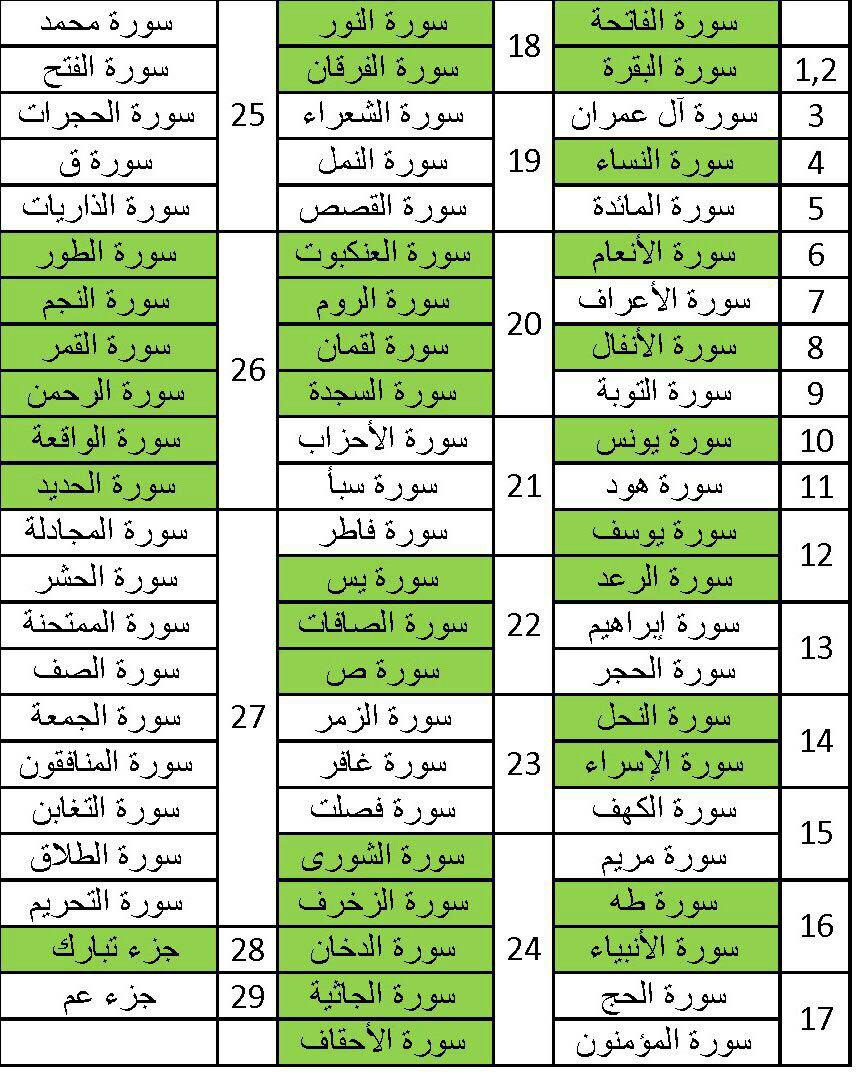
Ibn Taimiyyah: A Better Way to Divide Recitation of the Qur’ān over a Month

Ibn Taimiyyah, may Allāh have mercy on him, described a 29 day schedule for completing recitation of the Qur’ān closer to the way the Companions did that.

He said: “…Division by complete surahs takes precedence over division by parts [based on letter count].” (412)

And from the great advantages of division by complete surahs, he mentioned (414):

· Reciting speech whose parts are connected, one part with another;
· Beginning [one’s daily recitation] with that which Allāh began a surah with;
· Finishing with that which He finished with;
· Completing what was intended [to be completed] from every surah.

The chart in Arabic below [checked but not produced by me], shows Ibn Taimiyyah’s recommended schedule for a 29 day completion.

A Better Way to Divide Recitation of the Quran over Thirty Days

Summary of key points by Mikail ibn Mahboob Ariff

Source: Majmū‘ al-Fatāwá, vol. 13, pp. 405-416

Also see:
منتديات الإمام الآجري
http://www.ajurry.com/vb/showthread.php?t=14898

Etiquette with Dying Person and After Death – Dr. Saleh As-Saleh [Audio|En]

Part 01: [Alternative Download Link]

Part 02: [Alternative Download Link]

Posted from: Rulings Related to Death and Funerals (Janaza)

Three types of Hair – Dr. Saleh As Saleh [Short Clip]

Is it Permissible for the Person to take off the hair on one’s shin or one’s arm?

Dr Saleh As Saleh explains that the hair falls into three categories:

(1) that which is forbidden to remove
(2) that which is commanded to remove
(3) that which there is no mention of prohibition/commandment, i.e no mention of it.


Posted fromhttp://understand-islam.net/site/index.php?option=com_content&view=article&id=134&Itemid=52