Ahl Al-Sunnah Must Aid Dammaj – Shaykh Muhammad bin Hadi Al-Madkhali [Video|Ar-En Subtitles]

Update: The statement of Shaykh Muhammad below is from Dhul-Hijjah 1432H (and not recent). Some of the Hajaawirah have taken opportunity to use what was a genuine error to make an issue. In any case, the advice is as relevant than as it is now.

Video Courtesy: DawahSalafiyaah

Shaykh Muhammad bin Hādī:

“It is upon our brothers from Ahl al-Sunnah to aid them in Dammaaj, and we say this as a religious conviction, even if we refute Yahya al-Hajuri, or we refute so and so. For refutation and clarification of the truth is one field and aiding the Sunnah and its people is an other field. It is obligatory upon those near to Dammaaj, those closest, then those closest to aid their brothers. And that that they should stand with them in a single rank, that they aid them against those wrongdoing transgressors, and that they wage war against them alongside them. It is obligatory for them to make jihad alongside them in facing them (Hoothees), the closest (in proximity), then the closest (in proximity). So let no person think that if we refute Yahya al-Hajuri in Dammaaj that we shall be sacrificing the Sunnah (as a result) – refuge is from Allaah – Ahl al-Sunnah are our brothers and they are our flesh, in every place and in every time, we become angry for them and we rejoice when they rejoice and we are harmed due to the harms (brought upon them). So it is obligatory upon Ahl al-Sunnah in general to aid them, and to stand alongside them in the face of those Hoothees who transgressed and who thought that they will swallow up Ahl al-Sunnah. Hence, it is upon our brothers, Ahl al-Sunnah in Yemen generally, that they aid their brothers in Dammaj. And if they have the ability they should take those Raafidah from behind, forming an encirclement around them, if they are holding Dammaaj in siege, so they should (in turn) surround them and cut off supplies to them. This is what we advise our brothers, Ahl al-Sunnah in Yemen to aid their brothers in Dammaaj with everything they are capable of, and Allaah knows best.”

Source: http://www.alhajuri.com/articles/dnnb…

The Prohibition of Swearing by Other Than Allaah – Shaykh Ahmed Wasabi

Shaykh Ahmed Wasabi then read to us from the book of Shaykh Muhammad ibn Saalih al-‘Uthaymeen, al- Qawl ul-Mufeed Sharh Kitaab ut-Tawheed, Beneficial Speech in Explaining the Book of Tawheed, which is an explanation of Kitaab ut-Tawheed of Shaykhul-Islaam Muhammad ibn ‘Abdul Wahhaab an- Najdee (rahimahullaah). He read to us from the chapter ‘Swearing by Allaah (subhaana wa ta’aalaa)’:

“The meaning of this is the glorification of the one that is being sweared by. And the reason of doing this action of swearing is to certify an issue by the remembrance of the one that is glorified. And it has specific terminology that is used in the Arabic language, certain words and phrases that are used to swear by, and they are known as Huroof al-Qasam, which consists of the harf baa, waav, and taa (billaahi, wallaahi, and tallaahi).

And a person who numerously swears by Allaah (subhaana wa ta’aalaa), and is consistently and in all times found swearing by Allaah (subhaana wa ta’aalaa), then this is a proof that his glorification of Allaah is weak.

And the reason for mentioning these chapters in Kitaab ut-Tawheed is that from the perfection and completion of Tawheed is that a person glorifies Allaah (subhaana wa ta’aalaa). And the fact that a person swears by Allaah numerously, without taking heed of what he is swearing about, then this is a proof that shows the weakness in his glorification of Allaah (subhaana wa ta’aalaa).”

From ‘Abdullaah ibn ‘Umar ibnul-Khattaab (radiyAllaahu ‘anhumaa) that the Messenger of Allaah (peace be upon him) met ‘Umar ibnul-Khattaab (radiyAllaahu ‘anhu) while the latter was going with a group of camel-riders, and he was swearing by his father. So Allaah’s Messenger ( Peace be upon him) said, ((Behold! Allaah (‘azza wa jall) forbids you to swear by your fathers, so whoever has to take an oath, he should swear by Allaah or keep quiet)). Reported by al- Bukhaaree, no. 6270 and Muslim, no. 1646. Also from him [‘Abdullaah ibn ‘Umar] (radiyAllaahu ‘anhumaa), who said, Allaah’s Messenger (peace be upon him) said, ((Whosoever wishes to take an oath then he should not take an oath except by Allaah)).

  • In this hadeeth is the proof that it is not allowable to swear by other than Allaah, and that it is forbidden to swear by the created things.
  • And the thing that is sweared by, this is in actuality glorification of that which is sweared by, so the one who swears by the creation is glorifying it, and Allaah (subhaana wa ta’aalaa) is greater than everything and He deserves glorification more than anything else that is in existence. 
  • And the one who swears by other than Allaah (subhaana wa ta’aalaa) has committed an act of shirk (association).

From Abee Hurayrah (radiyAllaahu ‘anhu) who said, Allaah’s Messenger ( peace be upon him) said, ((Whoever amongst you swears, (saying by error) in his oath “By al-Laat and al-‘Uzzaa,” then he should say, “Laa Ilaaha illaAllaah (None has the right to be worshipped but Allaah).” And whoever says to his companions, “Come let me gamble with you,” then he must give something in charity (as an expiation for such a sin).)) Reported by al-Bukhaaree, no. 4579 and Muslim, no. 1647.

  • The one who swears by other than Allaah without intentionally intending this, and the ones who become accustomed to this due to the fact that they have been brought up in Jaahiliyyah, then the Prophet (peace be upon him) has made clear to them the atonement of doing this act (i.e. swearing by other than Allaah in error), and it is by saying the statement of Laa Ilaaha illaAllaah.
  • The atonement for the one who swears by other than Allaah (i.e. in error) by saying the statement of Laa Ilaaha illaAllaah is the affirmation of worship to Allaah (subhaana wa ta’aalaa) and its negation to other than Allaah (subhaana wa ta’aalaa).

From Buraydah (radiyAllaahu ‘anhu) who said that the Messenger of Allaah ( peace be upon him) said, ((Whoever takes an oath by al-Amaanah (the trust), then he is not from us)). Reported by Aboo Daawud, no. 3253 with an authentic chain, authenticated by ash-Shaykh al-Albaanee in as-Saheehah, no. 94, and also authenticated by ash-Shaykh Muqbil in al-Jaami’ as-Saheeh 1/291.

Read Here for more details

From Qutaylah, the woman from Juhaynah, (radiyAllaahu ‘anhaa) that a Jew came to the Prophet (peace be upon him) and said: “Verily you make equal and verily you associate, you say: ‘What Allaah Wills and what you will,’ and you swear: ‘By al-Ka’bah.’ So the Prophet () ordered them: (If they want to swear, they should say: ‘By the Lord of al-Ka’bah,’ and they should say: ‘What Allaah Wills then what you will.’).” Narrated by an-Nisaa’ee 7/6, and authenticated by ash-Shaykh al-Albaanee in as-Saheehah: 1166, and also by ash-Shaykh Muqbil in the book as-Saheeh al-Musnad Mimmaa Laysa Fee as-Saheehayn 2/515.

  • It is allowable to swear by the attributes of Allaah (subhaana wa ta’aalaa).
  • Therefore, it is allowable for someone to swear by the Qur’aan, the Qur’aan being the speech of Allaah (jalla wa ‘alaa), and speech is an attribute of Allaah (subhaana wa ta’aalaa).
  • As for al- Ka’bah, then it is not from the attributes of Allaah (subhaana wa ta’aalaa), and therefore it is not allowable for a person to swear by al-Ka’bah. So it is upon us to say as the Prophet (peace be upon him) said, ‘By the Lord of al-Ka’bah.’

From ‘Umar ibnul-Khattaab (radiyAllaahu ‘anhu) who said, “The Messenger of Allaah (peace be upon him) said to me: ((Verily, Allaah (‘azza wa jall) prohibits you to swear by your fathers)).” Reported by al-Bukhaaree, no. 6271 and Muslim, no. 1646.

From Thaabit ibn ad-Dahhaak (radiyAllaahu ‘anhu) who said that the Messenger of Allaah (peace be upon him) said: ((Whosoever swears to be on a religion other than the religion of al- Islaam, then he is as he says)). Reported by al-Bukhaaree, no. 1297 and Muslim, no. 110.

From Buraydah (radiyAllaahu ‘anhu) who said that the Messenger of Allaah ( peace be upon him) said: ((Whosoever swears and says: “Verily, I am free from al-Islaam,” and if he was a liar, then he is as he says, and if he was truthful, then he will not return back to al-Islaam in a perfect manner)). Narrated by Aboo Daawud, no. 3258 and Ahmed, no. 5/355 and an-Nisaa’ee 7/6 and ibn Maajah, no. 2100, and authenticated by ash-Shaykh al-Albaanee in al-‘Irwaa’, no. 2576, and also by ash-Shaykh Muqbil in al-Jaami’ as-Saheeh 1/290.

From ‘Abdur Rahmaan ibn Samurah (radiyAllaahu ‘anhu) who said that the Messenger of Allaah ( peace be upon him) said: ((Do not swear by idols and by your fathers)). Narrated by Muslim, no. 1648.

From Abee Hurayrah (radiyAllaahu ‘anhu) who said that the Messenger of Allaah (peace be upon him) said: ((Do not swear by your fathers, or by your mothers, or by idols, and do not swear except by Allaah, and do not swear except that you are truthful)). An authentic hadeeth, narrated by Aboo Daawud, no. 3248 and an-Nisaa’ee, no. 3769 and ibn Hibbaan, mo. 4357 and al-Bayhaqee 10/29, and authenticated by ash-Shaykh al-Albaanee (rahimahullaah) in Saheeh al-Jaami’, no. 7249, and also by ash-Shaykh Muqbil in as-Saheeh al-Musnad 2/341.

From ‘Abdullaah ibn ‘Umar (radiyAllaahu ‘anhumaa) who said that the Messenger of Allaah (peace be upon him) said: ((Whosoever swears by other than Allaah, then he has committed (an action of) disbelief or association)). Narrated by Aboo Daawud, no. 3251 and at-Tirmidhee, no. 1535 and al-Haakim 1/18 and 4/297; and authenticated by adh-Dhahabee, and also by al-Albaanee in al-‘Irwaa’, no. 2561, and al-Bayhaqee 10/29, and at-Tayaalisee, no. 1896, and Ahmed 2/34 and 69 and 86 and 125, and ibn Hibbaan 10/199-200, and see al-Jaami’ as-Saheeh 1/279 and 6/321 of ash-Shaykh Muqbil ibn Haadee (rahimahullaahu ta’aalaa).

From ‘Umar ibnul-Khattaab (radiyAllaahu ‘anhu) that he said: “No, by my father,” so the Messenger of Allaah ( peace be upon him) said: ((What is this? Verily, whosoever swears by something other than Allaah has associated)). Narrated by Ahmed 1/413-414 with an authentic chain.

This Post Extracted from:
Lessons on Tawhid – Approximately 50 Classes – from Dar-ul-Hadith, Dammaj, Yemen
Class 31 : January – 21 – 06 – The Prohibition of Swearing by Other Than Allaah

You have been Guided to the Sunnah! – Shaykh Ahmad as-Subay’ee [Video|Ar-En Subtitles]

Video Courtesy: DawahSalafiyaah @WegderSalaf

Shaykh Ahmad as-Subay’ee حفظه الله said in a Friday sermon delivered at the Salafi Masjid in Birmingham:

“[…] O companion of the Sunnah! Remember the statement of Allah جلا وعلا: “And strain not your eyes in longing for the things We have given for enjoyment to various groups of them, the splendour of the life of this world that We may test them thereby. But the provision (good reward in the Hereafter) of your Lord is better and more lasting. [Ta-Ha 20:131]

You have been guided to the Sunnah! Do you know what the Sunnah is?! You have been guided to the Sunnah in this time where those who apparently ascribe themselves to the Sunnah many betray it! Allah جلا وعلا has guided you to knowing the truthful scholars that have been praised (given tazkiyah) by the Imams such as Shaykh Rabee’! The one who was praised by al-Albaanee and Ibn Baz and Ibn Uthaymeen! Bring me an ‘Alim where there has been agreement on his tazkiyah other than this man (Shaykh Rabee’) !!

So you have been guided to the correct path! You have been guided to the Sunnah! You have been guided to this great good! […]”

Forbidden Places of Slaughtering – Dr. Saleh as Saleh [Audio|En]

It is forbidden to carry out an act of obedience to Allah and His Prophet (صلى الله عليه و سلم) in a place used to carry out acts of disobedience to Allah and His Messenger (صلى الله عليه و سلم), and that includes slaughtering animals in a place where animals are slaughtered for others besides Allah.

That it proves the prohibition of all things which might lead in the end to Shirk.

It is reported on the authority of Thabit Ibn Adh-Dhahhak (صلى الله عليه و سلم) that he said: “A man vowed to sacrifice a camel at a place called Buwanah, and he asked the Prophet (صلى الله عليه و سلم) about it.

He (صلى الله عليه و سلم) said to him: “Does the place contain any of the idols from the time of the Jahiliyyah?” They said: “No.”

He (صلى الله عليه و سلم) then asked: “Did the disbelievers hold any of their (religious) festivals there?” They replied: “No.” So the Messenger of Allah (صلى الله عليه و سلم) said:

“Then fulfill your vow, for verily, vows, which entail disobedience to Allah or that which is beyond the capacity of the son of Adam should not be fulfilled.” (Narrated by Abu Dawood, with a Sanad that meets the conditions of acceptance laid down by Bukhari and Muslim).

Thabit Ibn Adh-Dhahak (Radhi Allaahu Anhu) informs us that a man made a vow to slaughter a female camel in a place called Buwanah, and so the Prophet (صلى الله عليه و سلم) enquired as to whether it had been used as a place of worship for the idols of the Jahiliyyah or whether any of their pagan festivals had been celebrated there. When it was made clear to him that this was not the case, he ordered the man to fulfill his vow. In addition to this, he then gave a general ruling binding upon his Ummah until the Day of Ressurrection, prohibiting the fulfillment of vows made in disobedience to Allah or which require of man what is beyond his capacity.

Part 01 : Listen / Download Mp3 Here (Time 44:42)

Benefits Derived From the ayah and Hadith:

Part 02 : Listen / Download Mp3 Here (Time 50:28)

Posted from:  Beneficial Sayings from Kitaab ut-Tawheed – Book by Shaykh Muhammaad at-Tamimi rahimahullaah – Explanation is based upon that of Shaykh Ibn Al-‘Uthaymeen rahimahullaah

The Kind of Khawf (Fear) that is Shirk – By Shaykh Ahmed al-Wasaabee

The Second: Shirk (Shirk of Fear)

It is that the slave fears someone other than Allaah, such as the Jinn, a dead person or other than that, as he fears Allaah or greater.

Allaah (ta’laa) says:

Have you not seen those who were told to hold back their hands (from fighting) and perform As-Salât (Iqâmat­as­Salât), and give Zakât, but when the fighting was ordained for them, behold! a section of them fear men as they fear Allâh or even more. (An-Nisa 4:77)

It is only Shaitân (Satan) that suggests to you the fear of his Auliyâ’ [supporters and friends (polytheists, disbelievers in the Oneness of Allâh and in His Messenger, Muhammad SAW)], so fear them not, but fear Me, if you are (true) believers. (Aali Imran 3:175)

And our Lord (subhaana wa ta’laa) says:

 Therefore fear not men but fear Me . (Al-Ma’idah 5:44)

Explanation Of The Text By Shaykh Al-Wasaabee:

Explaining the verse in Sooratun-Nisaa’ (4:77), the shaykh mentioned that this verse was revealed concerning a group of Companions, who while they were in Makkah, were weak and oppressed in the land, and were not able to defend themselves and to fight in the path of Allaah (subhaana wa ta’laa). And then the Prophet (peace be upon him ) and His Companions were ordered to make Hijrah to Madeenah. And after they had made Hijrah, Allaah (subhaana wa ta’laa) ordered them to fight the kuffaar. And when this order came to them from Allaah (subhaana wa ta’laa), a group of them fell into association with Allaah (subhaana wa ta’laa) by fearing the people like they fear Allaah, or greater than they fear Allaah.

So it is not befitting for the creation of Allaah (subhaana wa ta’laa) to fear those who are like them, those who are also created. Those who are created from dust and clay, and those who are going to return to being clay.

And Ibn Rajb (rahimahullaah) said that this is not permissible, and that it is not befitting for the people to fear the creation as they fear Allaah (subhaana wa ta’laa). How can they fear the creation when they have been created from clay, and from dust, and verily they are to return back to it. And they are only to fear Allaah (subhaana wa ta’laa), who is the King and Owner of everything.

Explaining the verse in Soorah Aali Imraan (3:175), the shaykh highlighted the context in which this verse was revealed by mentioning the two verses that precede this verse.

Allaah (subhaana wa ta’laa) says:

Those (i.e. believers) unto whom the people (hypocrites) said, “Verily, the people (pagans) have gathered against you (a great army), therefore, fear them.” But it (only) increased them in Faith, and they said: “Allâh (Alone) is Sufficient for us, and He is the Best Disposer of affairs (for us).” (Aali Imran 3:173)

So they returned with Grace and Bounty from Allâh. No harm touched them; and they followed the good Pleasure of Allâh. And Allâh is the Owner of Great Bounty. (Aali Imran 3:174)

It is only Shaitân (Satan) that suggests to you the fear of his Auliyâ’ [supporters and friends (polytheists, disbelievers in the Oneness of Allâh and in His Messenger, Muhammad (Peace be upon him)], so fear them not, but fear Me, if you are (true) believers. (Aali Imran 3:175)

So this verse informs us that the shaytaan tries to push the people to fear his allies. And Shaykh Ahmed mentioned that Allaah (subhaana wa ta’laa) is more entitled to be feared of, as He is the One who has created us, and has brought us from nothing in existence.

Explaining the verse is Sooratul-Maa’idah (5:44), the shaykh mentioned again that it is not befitting for someone to fear the people as one fears Allaah (subhaana wa ta’laa).

Posted from: Class 25 of ‘al-Qawl-ul- Mufeed Fee Adillatit-Tawhid’ [Beneficial Speech in Establishing the Evidences of Tawhid] – Shaykh Muhammad al-Wasabi

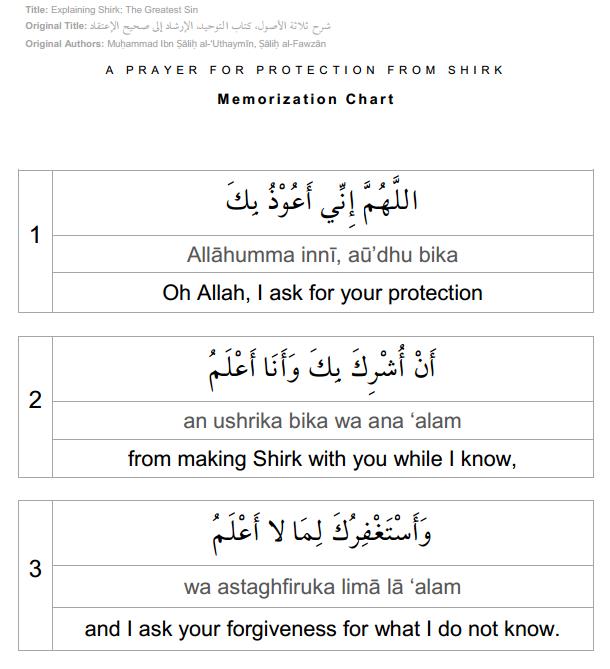
A Prayer for the Protection From Shirk – Memorization Chart

A Prayer for the Protection From Shirk - Memorization Chart

Reference: Ahmad 4/403. See also Al-Albani, Sahihul-Jami’ As-Saghir 3/233 and Sahihut-Targhib wat- Tarhib 1/19.

Posted from: Explaining Shirk: The Greatest Sin – Muhammad Ibn Sālih al-’Uthaymīn, Sālih al-Fawzān

Read for the Source and Explanation of the above du’a @ Du’aa for Fear of Shirk

Performing Ruku‘ (bowing) to one’s parents? – The Permanent Committee

Q 7: Is it permissible to perform Ruku‘ (bowing) to one’s parents?

This is impermissible and is tantamount to Shirk (associating others with Allah in His Divinity or worship).

Ruku‘ is a form of worship, just like Sujud (prostration); therefore, it is impermissible to bow or prostrate before anyone other than Allah the Exalted.

May Allah grant us success. May peace and blessings be upon our Prophet Muhammad, his family, and Companions.

The Permanent Committee for Scholarly Research and Ifta’
Browse by Volume Number > Group 1 > Volume 1: `Aqidah (1) > Creeds > Prostration before anyone other than Allah > Bowing to parents

Prostrating before other than Allaah and slaughtering animals for them

Q 4: Is it true that a person who testifies that Allah is the Creator and Provider,and that Muhammad (peace be upon him) is Allah’s Messenger, and performs Salah (Prayer) is a Muslim even if they make Sujud (Prostration) to their shaykh and offer sacrifices for people other than Allah?

A:

Making Sujud and sacrificing for anyone other than Allah is Shirk (associating others with Allah in His Divinity or worship). People who indulge in any of these practices after being aware of the ruling of doing so, are Mushriks (people who associate others with Allah in worship) and Kafirs (disbelievers). Allah will not accept any of their deeds even if they offer Sawm (Fast) and Salah. Deeds of Mushriks are rejected. Moreover, if they die in this case, Allah will not forgive them.

Allah (Exalted be He) says:

Verily, Allâh forgives not that partners should be set up with Him (in worship), but He forgives except that (anything else) to whom He wills.

Allah also says,

Verily, whosoever sets up partners (in worship) with Allâh, then Allâh has forbidden Paradise to him, and the Fire will be his abode. And for the Zâlimûn (polytheists and wrong-doers) there are no helpers.

Also Allah (Exalted be He) says:

But if they had joined in worship others with Allâh, all that they used to do would have been of no benefit to them. But if they return to Allah in sincere Tawbah (repentance to Allah) before death, Allah will forgive them,

as Allah (Exalted be He) says:

Say: “O ‘Ibâdî (My slaves) who have transgressed against themselves (by committing evil deeds and sins)! Despair not of the Mercy of Allâh: verily, Allâh forgives all sins.

Muslim scholars unanimously agree that this Ayah (Qur’anic verse) speaks about repentant people.

As for the Ayah of Surah Al-Nissa’:

Verily, Allâh forgives not that partners should be set up with Him (in worship), but He forgives except that (anything else) to whom He wills ,

it speaks about the unrepentant people, namely, those who died in Kufr (disbelief) and sin. May Allah protect us from that.

May Allah grant us success. May peace and blessings be upon our Prophet Muhammad, his family, and Companions.

The Permanent Committee for Scholarly Research and Ifta’
Posted from: http://alifta.com

Understanding Shirk in Tawheed of Lordship (Ruboobiyyah) with examples – Shaykh Uthaymīn, Shaykh Sālih al-Fawzān

Shirk in Tawḥīd of Lordship is to believe that others besides Allah create or share control over his creation. This belief means that someone other than Allah can make good things happen or keep bad things from happening.

One example of this type of Shirk is to believe something brings good luck. People often have “good luck” rings or similar items they believe will help good things happen to them. Others tie special strings around them or their children, believing that if they recite the Quran over the strings, they will protect from bad things happening. However, only Allah can protect us from bad things and we should only seek his protection in ways he mentions in the Quran or the prophet ( صلّى الله عليه وسلّم ) taught us in the ḥadīth

Another common example of Shirk in Tawḥīd of Lordship today is when people believe others like themselves who are created and have no control in Allah’s universe can control what happens. Such people even wait until the ones they believe in are dead before worshipping them by praying to them. The act of praying to dead people is Shirk in Tawḥīd of Worship (which we will cover shortly), but the belief itself is also Shirk in Tawḥīd of Lordship because when people pray to dead people, they believe the souls of humans can control things in this life even after their death. This is completely wrong because the prophet ( صلّى الله عليه وسلّم ) told us:

إِذَا مَاتَ الإِنْاَانُ انْقَطَعَ عَنْهُ عَمَلُهُ إِلاَّ مِنْ ثَلاثَ ة إِلاَّ مِنْ صَدَقَ ة جَارِيَ ة أَوْ عِلْمٍ «
». يُنْتَفَعُ بِهِ أَوْ وَلَ د صَالِحٍ يَدْعُو لَهُ

When a person dies, his actions come to an end except for (receiving rewards for) three things: continuous charity, beneficial knowledge, or a righteous child who prays for him.
[Recorded by Muslim]

While a person may still receive rewards from Allah for things he left behind after he died, the prophet ( صلّى الله عليه وسلّم ) clearly told us that after death, a human being’s actions stop. So how can dead people control whether good and bad things happen in life when they are not even in life anymore? Still, some people continue to pray to the dead, asking for their help in changing events in this life although only Allah can do this.

Even if a dead person was a righteous worshipper of Allah, believing that dead people or anyone else controls things in this life is Shirk in Tawḥīd of Lordship.

Review

  1. What is Shirk in Tawḥīd of Lordship? 
  2. Give an example of Shirk in Tawḥīd of Lordship

Posted from: Explaining Shirk: The Greatest Sin – Muhammad Ibn Sālih al-‘Uthaymīn, Sālih al-Fawzān, Translated by  Abu az-Zubayr Harrison

Tawheed is not fulfilled unless it contains both negation and affirmation – Shaykh ibn Uthaymeen

The noble Shaykh, Muhammad ibn Saalih Ibn al-‘Uthaymeen – may Allaah raise his status among the guided ones, was asked about the meaning of Tawheed and its categories. He answered, saying:

Linguistically, Tawheed is the noun derived from the Arabic root verb: wahhada / yuwahhidu which means to make something one.

This is not accomplished except by a negation and affirmation, both together – negating this characteristic from anything other than the thing which is being singled out, and affirming it to that thing.

For example, we say that mankind will not fulfill the concept of Tawheed unless and until they testify that nothing deserves any form of worship except Allaah. By this, we negate any right of worship to anyone or anything other than Allaah (subhanahu wa ta’aala), and we affirm it to Allaah alone.

This is because negation alone equates to an absolute and complete negation, just as affirmation alone does not restrict others from sharing in the characteristic.

So if you were to say, “So and so is standing,” then you have affirmed that he is indeed standing but you have not singled him out alone, restricting this action only to him because it is possible, based on this saying alone, that someone else could also be standing with him. Similarly, if you were to say, “No one is standing,” then you have absolutely and completely negated the action of standing for anyone. However, if you said, “No one is standing except Zayd,” then you have singled out Zayd alone with the action of standing, negating it from anyone other than him. This is the true actualization of Tawheed in reality – meaning that Tawheed is not fulfilled unless it contains both negation and affirmation. 

Posted fromTawheed: Its Meaning and Categories – Shaykh Muhammad Ibn Sālih al-‘Uthaymīn [PDF] – Translated by Abu az-Zubayr Harrison @ authentic-translations.com

The Story of Hajj – by Shaykh Hasan ibn AbdulWahhab al-Banna [Audio|Ar-En]

The Story of Hajj by Shaykh Hasan ibn 'AbdulWahhab al-Banna

Listen / Download Mp3 Here (Time 01:34:52)

Allah commanded our father Ibraaheem saying,

“And proclaim to mankind the Hajj (pilgrimage). They will come to you on foot and on every lean camel, they will come from every deep and distant (wide) mountain highway (to perform Hajj). [Soorah al-Hajj :27]

“And proclaim to mankind the Hajj” meaning, announce the pilgrimage to mankind and call them to perform pilgrimage to this House which We have commanded you to build. It was said that Ibraaheem said: “O Lord, how can I convey this to people when my voice will not reach them” It was said: “Call them and We will convey it.” So Ibraaheem stood up and said, “O mankind! Your Lord has established a House so come on pilgrimage to it.”

It is said that the mountains lowered themselves so that his voice would reach all the regions of the earth, and those who were still in their mothers’ wombs and their fathers’ loins would hear the call. The response came from everyone in the cities, deserts and countryside, and those whom Allah has decreed will make the pilgrimage, until the Day of Resurrection: “At Your service, O Allah, at Your service.” This is a summary of the narrations from Ibn ‘AbbaasMujaahid`IkrimahSa’id bin Jubayr and others among the Salaf. And Allah knows best. This was recorded by Ibn Jarir and by Ibn Abi Hatim at length. [Tafseer Ibn Kathir]

With the time of Hajj upon us, our Shaykh Hasan al-Banna (hafidhahullah) will enlighten us with respect to the story of Hajj according to the Book, the Sunnah and the narrations of our Salaf-us-Saalih.

We ask Allah to accept the Hajj of all our brothers and sisters and that He Al-GhafoorAr-Raheem forgives us our sins and shortcomings.

Posted from: http://store.mpubs.org

The Superiority of Abu Bakr As-Siddiq and Umar Ibn Al-Khattab – By Dawud Adib [Audio|En]

Listen / Download Mp3 Here (Time 01:03:21)

Lecture hosted by Sisters United Upon Knowledge, online study group

Related Links:

[eBook] The Response of the Muslim Against the Plots of the Kuffaar – Shaykh Salih al-Fawzaan

Since the time of Prophet Muhammad those who disbelieved in his message have always diligently tried to put out the light of Allaah and to this day they have not ceased in trying to destroy Islam with every means, whether it be through the media, through war, occupation of Muslim countries and much more. We also witness how many Muslims fall subject to the traps of the disbelievers even at the hands of the Muslims themselves. One of the most prominent scholars of our time by the name of Shaykh Saalih bin Fawzan addresses these issues in a Friday sermon entitled; “The Response of the Muslims during trials”.

He addresses how the Muslims should counter the plots and objectives of the disbelievers during these times. Recently the kuffaar have produced movies, illustrations and evil ideas about Prophet Muhammad and the religion of Islaam. They have plotted cleverly against the Muslims in ways that are not apparent to many. Along with this they continue to spread western ideologies amongst the Muslims which shaykh Fawzan may Allaah preserve him has shed light on.

[Download PDF]

Posted with Permission from: http://al-binaapublishing.posthaven.com

Brief illustration of Hajj and Umrah [Fiqh al-Ebaadaat by Sh. Uthaymeen] – Abu Muhammad al-Maghribee [Audio|En]

This is a brief illustration of Hajj and Umrah taken from the book Fiqh al-Ebaadaat by our noble sheikh Muhammad bin Saaleh al-Uthaymeen, rahimahullah.

Listen / Download Mp3 Here (Time 47:31)

Posted from: http://followthesalaf.com

Time is Running Out – Abu Muhammad al-Maghribee [Audio|En]

Listen / Download Mp3 Here (Time 30:07)

Our Salaf and The First 10 Days of Dhul-Hijjah – by Shaykh Fuad al-Amri [Audio|Ar-En]

Our Salaf and The First 10 Days of Dhul-Hijjah by Shaykh Fuad al-Amri

Shaykh Fu’ad ibn Sa’ud al-‘Amri (hafidhahullaah) is from the mashiykh of Jeddah and a member of The Saudi Commission for Enjoing Good & Forbidding Vice.

Listen / Download Mp3 Here (Time 50:23)

Many texts from the Qur’aan and the Sunnah indicate that these first ten days of the month of Dhul-Hijjah are better than all the other days of the year, including the last ten days of Ramadhaan. Our Salaf us Saalih(righteous predecessors), at the head of them, the Prophet (sallAllaahu ‘alayhi wa salaam) mentioned many of the virtues of these first ten days.

Ibn ‘Abbaas (may Allaah be pleased with him and his father) reported that the Prophet (sallAllaahu ‘alayhi wa sallam) said:

“There are no days in which righteous deeds are more beloved to Allaah than these ten days.” The people asked, “Not even jihaad for the sake of Allaah?” He said, “Not even jihaad for the sake of Allaah, except in the case of a man who went out to fight giving himself and his wealth up for the cause, and came back with nothing.” [Reported by Bukhaari, 2/457]

Ibn ‘Abbaas (may Allaah be pleased with him and his father) also reported that the Prophet (sallAllaahu ‘alayhi wa sallam) said: “There is no deed more precious in the sight of Allaah, nor greater in reward, than a good deed done during the ten days of Sacrifice.” He was asked, “Not even jihaad for the sake of Allaah?” He said, “Not even jihaad for the sake of Allaah, except in the case of a man who went out to fight giving himself and his wealth up for the cause, and came back with nothing.” [Reported by al-Daarimi, 1/357; its isnaad is hasan as stated in al-Irwaa’, 3/398]

These are just two of the many evidences mentioned by our Shaykh Fu’ad al-‘Amri (hafidhahullaah) in this highly beneficial reminder

Posted from: http://www.mpubs.org

Islaam Condemns Every Facet of Terrorism – by Shaykh AbdulLateef al-Kurdi [Audio|Ar-En]

Islaam Condemns Every Facet of Terrorism by Shaykh AbdulLateef al-Kurdi

Muwahhideen Publications is very pleased to announce a LIVE Tele-lecture on Friday 19th April 2013 with theNoble Shaykh Abu ‘Abdul Haqq ‘Abdul Lateef al-Kurdi (May Allah Preserve him) who is from the mashaayikh of Iraq. He is highly recommended by Shaykh Rabee’ al-Madkhalee as well as Shaykh ‘Ubayd al-Jaabiree(May Allah Preserve them).

Listen / Download Mp3 Here (Time 01:13:50)

Allah, the Most High said,

“And do not kill those souls whom Allah has prohibited except with a due right.”

And those souls that Allah has prohibited, it is referring to the life of a Muslim. And it is referring to everyone who has an agreement with the Muslims, and likewise those non-Muslims who have been given the right of safety by the Muslims.

The Messenger (sallAllahu ‘alayhi wa sallam) said in an authentic hadeeth reported by Imaam al-Bukhaari,

“Whoever kills a non-Muslim who has an agreement with the Muslims then he will not smell the fragrance of Paradise.”

The Esteemed Scholar Shaykh ‘Abdul Lateef al-Kurdi (hafidhahullah) will clarify this crucial issue for us such that there will remain no doubt regarding the Islaamic stance on these abominable acts.

We ask AllahAl-Haqq to show us the Truth and make it easy for us to follow it and make clear to us falsehood so we may stay away from it.

Posted from: http://www.mpubs.org

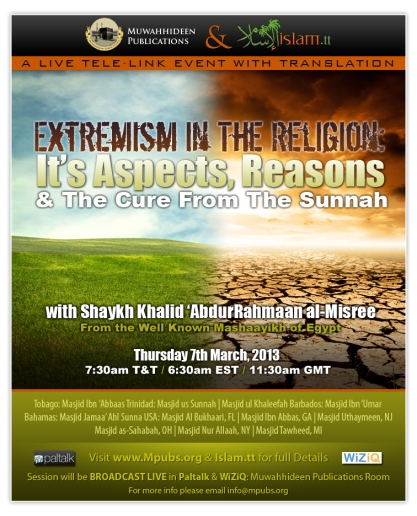
Extremism In The Religion: Its Aspects, Reasons and The Cure From The Sunnah – by Shaykh Khalid ibn AbdurRahmaan al-Misree[Audio|Ar-En]

Extremism In The Religion - Its Aspects, Reasons and The Cure From The Sunnah by Shaykh Khalid ibn 'AbdurRahmaan al-Misree

Listen / Download Mp3 Here (Time 01:08:51)

Allaah (Ta ‘alaa) says in the Qur’aan,

“O People of the Scripture, do not go to extremes in your religion and do not speak except the truth.” [Soorah an-Nisaa: 171]

“Say: O People of the Scripture, do not go to extremes in your religion beyond the truth and do not follow the inclinations of a people who had gone astray before – they misled many and themselves strayed from the correctness of the way.” [Soorah al-Maa’idah:77]

“In both of these verses there is a forbiddance for the “people of the scripture” – the jews and christians – from going to extremes in religion. And every statement in the noble Qur’aan directed towards the people of the scripture also includes this nation (the Muslims) because it is this nation that is the primary recipient and addressee of this book. So when Allaah forbids them from going to extremes, we are even more so forbidden to go to extremes.”

Additionally, it was narrated by ‘Abdullaah Ibn ‘Abbaas (radhiyAllaahu ‘anhu) that the Prophet (sallAllaahu ‘alayhi wa sallam) said,

“Beware of extremism in religion because the only thing that destroyed those before you was extremism in religion.” [An-Nasaa’ee and Ibn Maajah]

Moreover, ‘Abdullaah Ibn Masood ( radhiyAllaahu ‘anhu ) said: Allaah’s Messenger (sallAllaahu ‘alayhi wa sallam) repeated three times:

“The Mutanatti’oon are destroyed.” [Muslim]

An-Nawawee (rahimahullaah) explains, “The Mutanatti’oon are the overly-strict people; those who go too deep (into religious matters), the extremists, those who go beyond the permissible limits in their statements and actions.” [“The Forbiddance and Danger of Extremism” by Shaykh ‘Ali Ibn Yahya al-Haddaadi from AbdurRahman. org]

The Noble Shaykh Khalid ‘Abdur Rahmaan al-Misree (hafidhahullaah) will admonish us regarding this grave matter of extremism in the religion and expound on its aspects, reasons and the cure for this disease from the pure Sunnah of our beloved Prophet Muhammad (sallAllaahu ‘alayhi wa sallam).

We ask Allaah to make us from those who are balanced; those who neither fall into negligence nor exceed the limits.

Posted from: http://store.mpubs.org

The Favours of Allaah – Abu Muhammad al Maghribee [Audio|En]

Listen / Download Mp3 Here (Time 53:17)

Posted from: http://followthesalaf.com

Allaahumma a-innee alaa Dhikrika wa shukrika wa husni ibaadatika
O Allah! Help me to remember you, to thank you, and to worship you in the best of manners [Reference: Abu Dawud 2/86, An-Nasa’i 3/53. See also Al-Albani Sahih Abu Dawud 1 /284]

Killing Time ! – Shaykh Abdur-Razzaaq al-Badr

Some of the people squander time and waste their time with actions even in that which is impermissible. For this reason you find some of those people who are heedless, they make the expression using the words ‘killing time’ as if (time) is an enemy!! The time is a type of wealth and what goes away from it does not return. The one who has intellect, he is the one who values his time and he is cautious from killing and squandering it.

قتل الوقت
قتل « يتضايق بعض الناس من الوقت ويعمل على تضييعه حتى في الحرام ، ولهذا تجد عند بعض الغافلين التعبير بكلمة
كأنه عدو!!، والوقت غنيمة وما ذهب منه لا يعود، والعاقل هو من يغتنم أوقاته ويحاذر من قتلها وتضييعها » الوقت .

Translator: Abu Anas Atif Hasan
http://al-badr.net/muqolat/2670

Posted from: Al-Binaa Publishing | Durham NC

Ibn Abbas narrated that Prophet Mohammad (Sallalaahu Alaihi wa Sallam) said:

“There are two blessings which many people lose: (They are) health and free time for doing good.” (Bukhari 8/421)