Listen / Download Mp3 Here (Time 6:53)
Usool Sitta (The Six Principles) – Arabic Audio Text

Islamic Knowledge – Islam, Sunnah, Salafiyyah
Listen / Download Mp3 Here (Time 6:53)
Al-Qawa’aid al-Arba’ah The Four Principles – Full Arabic Text [MS Word]
Listen / Download Mp3 Here (Time 7:05)
Related Links:
Audio of Arabic Text : Listen / Download Mp3 Here (Time 3:30)
[1] [النساء: 48]
[2] [المائدة: 72]
[3] [التوبة: 65، 66]
[4] [البقرة: 102]
[5] [المائدة: 51]
[6] [السجدة:22]
[Download Matn PDF] [Download Matn MS Word Doc]
Courtesy of : http://www.ajurry.com/vb/showthread.php?t=24793
(Translated by al-ibaanah publihers)
THE FIRST NULLIFIER
Know that the Nullifiers of Islaam are ten.
First: Shirk (associating partners) in the worship of Allaah. Allaah says:
“Verily, Allaah does not forgive that partners be associated with Him in worship (i.e. Shirk), but He forgives what is less than that to whom He wills.” [Surah An-Nisaa: 116]
And He says: “Verily, the one who mixes partners in worship with Allaah (Shirk), then Paradise has been made forbidden for him and his final abode will be the Hellfire. And the wrongdoers will not have any helpers (in Hell).” [Surah Al-Maa’idah: 72]
What falls into this is performing sacrifices to someone other than Allaah, such as the person who offers a sacrifice to the Jinn or to a grave.
THE SECOND NULLIFIER
Second: Whoever places intermediaries between himself and Allaah, calling unto them and asking intercession from them, and seeking reliance in them, has committed disbelief according to the unanimous agreement (Ijmaa’).
THE THIRD NULLIFIER
Third: Whoever does not hold the polytheists to be disbelievers, or has doubts about their disbelief or considers their ways and beliefs to be correct, has committed disbelief.
THE FOURTH NULLIFIER
Fourth: Whoever believes that some guidance other than that of the Prophet’s (sallAllaahu ‘alayhi wa sallam) is more complete than his guidance and that someone else’s judgement is better than his judgement, such as the one who prefers the judgement of the Tawaagheet (pl. of Taaghoot; false deities/religions) over his judgement, then he is a disbeliever.
THE FIFTH NULLIFIER
Fifth: Whoever hates something that the Messenger came with, even though he may act on it, has disbelieved.
THE SIXTH NULLIFIER
Sixth: Whoever mocks or ridicules any part of the Messenger’s Religion or its rewards or punishments has committed an act of disbelief. The proof for this is Allaah’s statement:
“Say: ‘Was it Allaah and His verses and His Messenger that you were mocking? Make no excuses, you have disbelieved after having had faith.” [Surah At-Tawbah: 65-66]
THE SEVENTH NULLIFIER
Seventh: Sorcery, which includes magic spells that cause a person to hate something he seeks after (sarf) or love something he doesn’t seek after (‘atf). So whoever performs it or is pleased with it being done, has committed disbelief. The proof for this is Allaah’s statement:
“And neither of these two (angels) would teach anyone until they had first said to them: ‘We are only a trial (for the people), so do not commit disbelief.’” [Surah AlBaqarah: 102]
THE EIGHTH NULLIFIER
Eighth: Supporting and assisting the polytheists against the Muslims. The proof for this is Allaah’s statement:
“And whoever amongst you takes them (i.e. the disbelievers) as allies and protectors then he is indeed from among them. Verily, Allaah does not guide a wrong-doing people.” [Surah Al-Maa’idah: 51]
THE NINTH NULLIFIER
Ninth: Whoever believes that it is permitted for some people to be free of (implementing) the Sharee’ah (revealed laws) of Muhammad (i.e. Islaam), just as it was permitted for Al-Khidr to be free from the Sharee’ah of Moosaa, then he is a disbeliever.
THE TENTH NULLIFIER
Tenth: Turning away from Allaah’s Religion, not learning it or implementing it (is an act of disbelief). The proof for this is Allaah’s saying:
“And who does more wrong than he who is reminded of the ayaat (signs/verses) of his Lord, then turns away from them. Verily, We shall extract retribution from the criminals.” [Surah As-Sajdah: 22]
There is no difference, with regard to (committing any of) these nullifiers, between the one who jokes, the one who is serious or the one who does so out of fear. However, the one who commits them due to being coerced (is excused). All of these (ten) matters are from the gravest in danger and from those that most often occur. So the Muslim must beware of them and fear from these acts befalling him. We seek refuge in Allaah from those things that bring about His Anger and painful Punishment. May the peace and blessing be on the best of His creatures, Muhammad (sallAllaahu ‘alayhi wa sallam).
Listen / Download Mp3 Here (Time 54:29)
Listen / Download Mp3 Here (Time 22:16)
[Read or Download Arabic Matn (Text) Here] [PDF] [27 Pages]
Book Study Resources:
https://abdurrahman.org/islamic-book-study/thalaathat-ul-usool-the-three-fundamental-principles/
Arabic text: lumatul itiqad [PDF]
Listen / Download Mp3 Here (Time 37:34)
Video with text and audio (Audio and written text in Arabic):
1.http://www.youtube.com/watch?v=fCPAepMWdZY&rel=0
2.http://www.youtube.com/watch?v=aZG_Cqn6kZY&rel=0
3.http://www.youtube.com/watch?v=vhED9ex2egA&rel=0
Lum’at-ul-I’tiqaad – by Imaam Ibn Qudaamah al-Maqdisee rahimahullaah
Explanation by Shaykh Fawzaan hafizahullaah
Translated by Abu Talhah Dawud Burbank rahimahullaah
Read : Biography of Imaam Muwaffaqud-Deen `Abdullaah ibn Ahmad ibn Qudaamah – Compiled & Translated by Dawud Burbank
66 Audio Lessons ( Complete Series)
[01] [02] [03] [04] [05] [06] [07] [08] [09] [10]
[11] [12] [13] [14] [15] [16] [17] [18] [19] [20]
[21] [22] [23] [24] [25] [26] [27] [28] [29] [30]
[31] [32] [33] [34] [35] [36] [37] [38] [39] [40]
[41] [42] [43] [44] [45] [46] [47] [48] [49] [50]
[51] [52] [53] [54] [55] [56] [57] [58] [59] [60]
[61] [62] [63] [64] [65] [66]
Introduction by Shaykh Saalih al-Fawzaan
The Defenders of the Creed and Belief
All praise is for Allaah, the Lord of the whole of creation. May Allaah extol and grant peace and security to our Prophet Muhammad (sallallaahu `alayhi wa sallam), the Seal and final one of the Prophets, and upon his true followers, and his companions and the tabi`een upon good until the Day of Recompensing. To proceed:
Allaah, the One Free of all imperfections, has established for the creed and belief of the Muslims, trustworthy guardians from the scholars who are firmly founded in knowledge. So, when the enemies made attacks trying to corrupt the creed and belief of the Muslims, bringing misgivings and raising doubts from the disbelievers, the atheists, the hypocrites, and the companions of the deviant sects, those who deviated away from the methodology of the pious predecessors with regard to the Jahmiyyah, the Mu`tazilah, the Shee`ah, the Baatiniyyah and others; the Baatiniyyah, the Qadariyyah, the Khawaarij, the Murji`ah, the Soofiyyah, and the grave worshippers. Those scholars who are firmly founded in knowledge, who educate and train the people, stood to clarify the correct `aqeedah which is founded upon the Book and the Sunnah and that is what the salaf-us-saalih (pious predecessors) were upon from these affairs.
They stood to repel the doubts and deviations which those contentious enemies put forth. So through them, Allaah threw back their plots into their necks, and their arrows rebounded into their own chests and the correct `aqeedah remained fully protected and clear in its signposts by means of what those imaams have written from books and treatises, some of them abridged and some large in size, which the Muslims studied generation after generation. From those Imaams who were rabbaniyyoon (scholars upon wisdom and taught their students in a wise manner) was Shaykhul-Islaam Muwaffaqud-Deen Aboo Muhammad, `Abdullaah ibn Qudaamah al-Hanbalee, with what he wrote in his book: Lum`atul-I`tiqaad al-Haadee ilaa Sabeel ar-Rashaad.
I taught this book and those lessons were recorded on cassette tapes. One of the brothers, may Allaah bless him, transcribed those tapes and arranged them, then he showed the result to me, so I amended and corrected that and refined it. [So] from that came this book which I put forward for their reader despite its deficiency. However, it is a small effort, just as it has been said: “Giving something extra to your requirements is not generosity until you give generously when you only possess a small amount.”
I ask Allaah to cause it (with what it contains) to be a benefit and that He forgives me wherever I have fallen short or made a mistake.
May Allaah extol and send peace and security upon our Prophet Muhammad, his true followers and companions.
Written by:
Shaykh Saalih al-Fawzaan bin `Abdillaah al-Fawzaan 6/9/1424H
Posted with kind permission from Dawud Burbank rahimahullaah
Audio Courtesy: ittibaa.com
Book by Shaykh Muhammaad bin AbdulWahhaab at-Tamimi rahimahullaah
Explanation is based upon that of Shaykh Ibn Al-‘Uthaymeen rahimahullaah
01- Meaning of Tawheed
02- Purpose of our Existence
03- Ch 02 – Excellence of Tawheed – It Expiates Sins
04- Right of Allaah – Right of the Slave
05- Hadeeth of Mu’adh Ibn Jabal – part 2
06- Hadeeth of ‘Ubadah Ibn As Saamit – part 1
07- Jesus – Spirit FROM Allaah – hadeeth part 2
08- Hadeeth of ‘itban bin Malik
09- Ch 03 – Purifying Tawheed From Shirk
10- Hadeeth of Husayn Ibn Abdur Rahmaan
11- Hadeeth of Ibn Abbas
12- Ch 04 – Fear of Shirk
13- Hadeeth of Ibn Mas’ud
14- Hadeeth of Jaabir
15- Ch 05 – The Call To Tawheed
16- Hadeeth of Sa’ad Ibn Sahl
17- Ch 06 – Explanation of Tawheed and the Testimony
18- Tawheed Requires Negation and Affirmation
19- Hadeeth Whoever Says laa ilaaha illallaah
20- Ch 07 – Wearing Rings For Protection Is Shirk
21- Ch 07 – Hadeeth – ‘Uqbah Ibn Amir – Abu Hatim
22- Ch 08 – Incantations – Talisman – 1
23- Ch 08 – Incantations – Talisman – 2
24- Ch 09 – Seeking Blessings From Tree or Stone – 1
25- Ch 09 – Seeking Blessings From Tree or Stone – 2
26- Ch 10 – Slaughtering For Other Than Allaah – 1
27- Ch 10 – Slaughtering For Other Than Allaah – 2
28- Ch 11 – Forbidden Places of Slaughtering – 1
29- Ch 11 – Forbidden Places of Slaughtering – 2
30- Ch 12 – Making Vow to Other Than Allaah is Shirk
31- Ch 13 – Seeking Refuge in Other than Allaah is Shirk
32- Ch 14 – Seeking Help From Other Than Allaah is Shirk -1
33- Ch 14 – Seeking Help From Other Than Allaah is Shirk -2
34- Ch 15 – Incapacity of Partners Man Gives to Allaah – 1
35- Ch 15 – Incapacity of Partners Man Gives to Allaah – 2
36- Ch 16 – No One Deserves to Be Partner With Allaah – 1
37- Ch 16 – No One Deserves to Be Partner With Allaah – 2
38- Ch 17 – Allaah Has No Need of an Intercessor – 1
39- Ch 17 – Allaah Has No Need for an Intercessor – 2
40- Ch 18 – Guidance of Direction – Guidance of Success
41- Ch 19 – Excessive Praise of the Righteous – 1
42- Ch 19 – Excessive Praise of the Righteous – 2
43- Ch 19 – Excessive Praise of the Righteous – 3
44- Ch 20 – Acts of Worship at a Grave – 1
45- Ch 20 – Acts of Worship at a Grave – 2
46- Ch 21 – Excess in Raising up Graves of Righteous -1
47- Ch 21 – Excess in Raising up Graves of Righteous – 2
48- Ch 22 – The Prophet Protected Tawheed and Blocked Shirk
49- Ch 23 – Those of This Ummah Who Worship idols – 1
50- Ch 23 – Those of This Ummah Who Worship Idols – 2
51- Ch 23 – Those of This Ummah Who Worship Idols – 3
52- Ch 23 – Those of This Ummah Who Worship Idols – 4
53- Ch 24 – What Is Mentioned Concerning Magic – 1
54- Ch 24 – What Is Mentioned Concerning Magic – 2
55- Ch 25 – Types of Magic – 1
56- Ch 25 – Types of Magic – 2
57- Ch 26 – Concerning Fortune Tellers and the Like – 1
58- Ch 26 – Concerning Fortune Tellers and the Like – 2
59- Ch 27 – Counteracting Magic with Magic
Click the below link to read the document
Foundation of Sunnah – Imam Ahmad [PDF]

Based Upon Shaykh Muhammad At-Tameemi’s (rahimahullaah) Classification.
Prepared By Dr. Saleh As-Saleh
[Download PDF] [Listen/ Download Mp3]
Read the Article:
Know, may Allaah’s Mercy be upon you, that Allaah (subhanahu wa ta’ala: Far is He removed from every imperfection, the Most High) made it very clear that mankind must follow Islaam, hold to it and dissociate from whatever contradicts it. The declaration that Laa Ilaaha Illallaah “There is none worthy of worship except Allaah” not only negates all false deities and confirms worship only to Allaah, it also requires the complete dissociation from any form of worship to any false deity;
Allaah (subhanahu wa ta’ala) says:
“There is no compulsion in religion. Verily, the right path has become distinct from the wrong path. Whoever disbelieves in Taaghut (false deities) and believes in Allaah, then he has grasped the most trustworthy handhold that will never break.”(Qur’an 2: 256)
Furthermore, to declare that Muhammad (sallallaahu ‘alayhe wa sallam: may Allaah Exalt his mention and safeguard him and his message) is the Messenger and slave of Allaah requires the belief that Muhammad (sallallaahu ‘alayhe wa sallam) is trusted by Allaah (subhanahu wa ta’ala) to deliver the Message of Islaam, and that Muhammad (sallallaahu ‘alayhe wa sallam) is to be followed and obeyed because Allaah (subhanahu wa ta’ala) decreed in the Qur’an:
“And whatsoever the Messenger gives you, take it. And whatsoever he forbids you, abstain (from it) and fear Allaah. Verily, Allaah is severe in punishment.” (Qur’an 59: 7)
All the ways and methods that are needed by the Muslim to fulfill this declaration of Tawheed [2] are explained in the Qur’an and by the Prophet Muhammad (sallallaahu ‘alayhe wa sallam).
Allaah (subhanahu wa ta’ala) and His Messenger (sallallaahu ‘alayhe wa sallam) warned that there are ways that lead to Shirk,[3] Kufr [4] and rejection of Faith. The Muslim must be very knowledgeable about Tawheed so that he does not indulge in practices and concepts that contradict the essence of Islaam. The most dangerous and widely existing ways that breach Tawheed are:
ONE: Shirk in the worship of Allah: to associate something and/or anyone in the worship of Allaah:
“Verily Allaah forgives not setting up rivals in worship with Him, but He forgives whom He pleases other sins than that.” (Qur’an 4: 116)
“Verily, whosoever sets up rivals in worship with Allaah, then Allaah has forbidden Al-Jannah for him, and the Fire will be his abode.” (Qur’an 5: 72)
TWO: Setting up intermediaries between a person and Allaah is Kufr (disbelief): calling upon them and seeking their intercession and depending upon them. Those who do this are taking “associates” with Allaah and this is Shirk.
Allaah (subhanahu wa ta’ala) says (what means):
“Then set not up rivals unto Allaah (in worship) while you know (that He Alone has the right to be worshiped). (Qur’an 2: 22)
The Prophet (sallallaahu ‘alayhe wa sallam) was asked: ‘Which sin is the Gravest? He said: “That you set up rivals unto Allaah (despite the fact) that He has created you.”[5]
Allaah (subhanahu wa ta’ala) says (what means):
“And call not on other than Allaah, any that will neither profit you, nor hurt you but if (in case) you did so, you shall certainly be one of Ath-thalimeen (who commit Shirk)”. (Qur’an 10:106)
THREE: Believing that the Mushrikeen (those who commit Shirk) are not Kufar or doubting their Kufr or defending and correcting the beliefs of the Kufar, is Kufr.
Allaah (subhanahu wa ta’ala) says (what means):
“And if any amongst you who take them (wholeheartedly) as friends, then surely he is one of them.”(Qur’an 5: 51)
This is one of the greatest contradictions to Tawheed. Here it is important to caution that many Muslims are reluctant (and feel ashamed) to say the word “Kufr” to describe a disbeliever or to point out their acts of Shirk. Some even look at the Kufar with great deal of admiration, fear and obedience. Those have an inferiority complex that leads them to become blind followers and defenders of the Kufar and their ways. They are at grave danger since this may “melt” their identity.
The Muslim’s position about these matters must be dissociation from Kufr and Shirk, but Love for Allaah (subhanahu wa ta’ala), His Prophet (sallallaahu ‘alayhe wa sallam) and the believers:
“Let not the believers take the disbelievers as Awliyaa’ (supporters, helpers, etc.) instead of believers, and whoever does that will never be helped by Allaah in any way, except if you indeed fear a danger from them. And Allaah warns you against Himself (His punishment), and to Allaah is the final return.” (Qur’an 3: 28)
FOUR: The belief that guidance by someone other than the Prophet Muhammad (sallallaahu ‘alayhe wa sallam) is better or that ruling by other than the rule of Muhammad (sallallaahu ‘alayhe wa sallam) is better, then this is Kufr. The rule of Muhammad (sallallaahu ‘alayhe wa sallam) is the rule of Allaah:
“But no, by your Lord, they can have no true Faith (al-waajib: which is dutiful upon them), until they make you judge in all disputes between them, and find in their souls no resistance against your decisions, but accept (them) fully with submission.”(Qur’an 4: 65)
Some examples of this are:
(a) The belief that systems and laws made by human beings are better than, or equal to the Sharee’ah of Islaam; or that Islamic system is not suitable for the contemporary times, and that Islaam is the cause of backwardness of the Muslims.
(b) The belief that enforcing the punishments prescribed by Allaah (subhanahu wa ta’ala), such as cutting of the hand of the thief or the stoning of an adulterer, is not suitable for this day and age.
FIVE: Hating any command or anything of the Prophet’s (sallallaahu ‘alayhe wa sallam) Message despite practicing it is Kufr.
Allaah (subhanahu wa ta’ala) says (what means):
“That is because they hate that which Allaah has sent down, so He has made their deeds fruitless.” (Qur’an 47: 9)
SIX: Mocking any part of Islaam or any of Allaah’s Names and Attributes is Kufr. Allaah, the Most High, says (what means):
“Was it at Allaah, and His signs, and His Messenger that you were mocking? Make no excuse, you have disbelieved (became Kufar) after you had believed.”(Qur’an 9: 65-66)
SEVEN: Involvement in Magic: considering it permissible to practice and spread ways that may (i) sway man from the good things he likes (e.g., using magic to sow discord between a man and his wife) or (ii) reduce man to do what he dislikes or is bad for him. These ways of magic are Satanic.
Allaah (subhanahu wa ta’ala) says (what means):
“Solomon did not disbelieve but the devils disbelieved, teaching men magic and such things that came down at Babylon to the two angels (put coma after the word angels) Harut and Marut, but neither of these two (angels) taught anyone (such things) till they had said: We are only for trial, so disbelieve not (by learning the magic from us).”(Qur’an 2: 102)
Today, we see many people seek help from the so called fortunetellers. They believe that these tellers know what will happen. This is Kufr. The Prophet (sallallaahu ‘alayhe wa sallam) warned that:
“Whoever goes to a priest (soothsayer or a fortuneteller), and believes him in what he says has committed Kufr and denied what was revealed to Muhammad (sallallaahu ‘alayhe wa sallam)”
EIGHT: Standing by the Mushrikeen, supporting them and helping them against the Muslims (so that mushrikeen will be the prevalent ones) is Kufr.
Allaah (subhanahu wa ta’ala) says (what means):
“And he amongst you who take them as friends (WHOLEHEARTEDLY), then surely he is one of them.” (Qur’an 5: 51)
NINE: Believing that some “special” people don’t have to follow the Prophet (sallallaahu ‘alayhe wa sallam) is Kufr because this negates the second part of the declaration of Tawheed ‘Muhammad is the slave and Messenger of Allaah,” since this constitutes desiring a “religion” other than Islaam. Allaah (subhanahu wa ta’ala) says (what means):
“And whoever desires a religion other than Islaam, it will never be accepted from him, and in the Hereafter he will be one of the losers.” (Qur’an 3: 85)
TEN: Completely turning away from the religion of Allaah, not learning it and practicing it, is Kufr.
“And who does wrong than the one to whom are recited the Aayat (proofs, evidences, verses, revelations, etc.) of his Lord, then he turns aside therefrom? Verily, We shall exact retribution from the Mujrimin (criminals, disbelievers, polytheists, sinners etc.)” (Qur’an 32: 22)
and He, the Most High, also says (what means):
“But those who disbelieve turn away from that about which they are warned.” (Qur’an 46:3).
An authentic hadeeth reported in Saheeh Al-Jaami’ (a collection of authentic narrations verified by the Scholar of hadeeth Sheikh Muhammad Nassir Ad-Deen al-Albaani) V.2 # 5939. Believing in sorcery and horoscopy is as setting up rivals with Allaah. This is Shirk.
Finally, it must be pointed out that there is no difference (in accountability) between the one who seriously commits any of the above acts or the one who claims to be just “joking”, “playing” or “mocking”! The only exception is when someone commits any of these acts under compulsion; even then his heart must be filled with faith and Tawheed of Allaah.
Another serious matter is that the issue of declaring someone Kufr (rulers or ruled). This is not left for the unlearned of the common Muslims or heads of hizbee-groups or the like. It is to be left to the reliable scholars who follow the Qur’an, authentic Sunnah in the context of the Salaf’s way of understanding the Deen, not to innovators and the politically and emotionally driven ones. We must fear Allah in this matter which had caused and is still causing deviation in the Ummah at large.
We seek refuge in Allaah from such deeds and we ask Him to make the truth clear to us all.
Taaghut: Derived from Tughyaan, exceeding the limits. So:
1. Whatever is worshipped instead of or to the exclusion of Allaah is a Taaghut. So, any human being who is pleased to be set as an object of worship is a Taaghut.
2. The one who exceeds the limits concerning following and obedience to other than Allaah, and sets others as rivals with Allaah, then himself is a Taaghut.
3- Those who make Istihlaal, making the unlawful lawful or vice versa, and are obeyed for that are Taaghut, because they are being set as Lords besides Allah. Here it must be known that obeying them on their Istihlaal is divided into three categories:
(i) The person obeys them while pleased and content by their saying, giving precedence to their judgments, and discontent with Allaah’s ruling, then he is a Kufr.
(ii) The person obeys them while accepting Allaah’s ruling and knowing that it is the best and the most fitting to man, but due to lowly desire in himself he chooses otherwise. For example, he may be seeking a job, and so forth. In this case it is not Kufr, rather he is a Faasiq (rebellion, disobedient).
(iii) The person obeys them due to ignorance, thinking that their rulings are those of Allaah’s. This is subdivided into two cases:
(a) The person is able to know the truth by himself, but he is negligent. In this case he is sinful, because Allaah ordered to ask the people of knowledge when matters are not known.
(b) The person is not knowledgeable and unable to learn but he follows them by way of blind following believing that it is the truth. In this case there is nothing upon him, i.e not held blameworthy. [See Al-Qawlul Muffed ‘Alaa Kitaab at-Tawheed, by our Shayekh Muhammad bin Salih Al-‘Uthaimeen, v.2, pp. 157-158, with slight adaptation].
4. It covers also all that which opposes Allaah’s Judgment. And this is of different levels and ranks. Some may lead to exiting the fold of Islam, while others don’t.
Some examples on Taaghut:
Those followed, like soothsayers, magicians, and evil “scholars,” are Taaghut. Those pleased for being worshipped besides Allaah, as well as idols, are Taaghut
(i) General Statements of Imputation of Kufr.
This is known as Itlaaq-ut-Takfeer: stating in the general sense, such as to say, “whoever does or says such and such,”from what is known to be Kufr then he is a Kafir.
(ii) Applicability on a particular person:
This is known at Takfeer-ul-Mu’ayyan It is to impute what is generally stated to be Kufr on a particular person. This can be established only after conditions of Takfeer (imputing Kufr) are met as well as all impediments which may hinder the imputing of Kufr are removed.
(iii) Who Are the Ones who advise on these Enormous Matters?
The Imputation of Kufr is very serious and it is not left for common Muslims or the student of knowledge to decide. Surely the reliable scholars following the path of the salaf are the ones who can advise concerning these immense issues. So people should refrain and hold themselves so as not to hasten to impute Kufr on a particular person before the evidences are established and impediments are removed.
And Allaah, the Most High, Knows best.
[1] Taaghut: It may be Satan and/or anyone who is worshipped other than Allah and is pleased and/or calls for it. [See Appendix]. Here I relate a very important benefit explaining the issue of Taaghut which is often misunderstood by enthusiastic young Muslims and it is by Shayekh Sulaimaan Ibn Samhaan (rahimahullaah: may Allaah’s Mercy be upon him). He said: “It should be known that the one who seeks judgments from the Taaghut, or rules by other than Allaah’s rule while believing that (these) judgments are more perfect and better than the Judgment of Allaah and His Messenger, then this is disbelief (Kufr ‘aqadi: pertaining to creed) that takes the person out of the fold of Islam-as it is mentioned in the ten nullifiers of Islam. However, as to the one who does not believe as such but resorted to the Taaghut judgment while believing that it to be false, then this is of the practical type of disbelief (Kufr’amali: lesser type that does not take the person from Islam). [See Irshaadut-Taalib Ilaa Ahamadil-Mataalib, p. 19.] In addition, anyone (ruler or ruled) who equates the judgment of Allaah and His Messengers to that of man, or believes that the rules of man are more fitting to our times than the Islamic laws, commits Kufr [See Shayekh bin Baaz’s (rahimahullaah) details on this matter in Qadiyyatu-t-Takfeer bayna ahlis-sunnah wa ffiraqu-d-Dalaal, by Shayekh Sa’eed Ibn Wahf Al-Qahtaani, pp. 72-73.]
It is, therefore, concluded that the term Taaghut in itself does not necessarily translate into major disbelief and apostasy, since every Kufr is Taaghut, but not every Taaghut is Kufr. Imaam Ibnul Qayyim (rahimahullaah) considered that figurative interpretations of Allaah’s Names and Attributes through scholastic ways, and giving precedence to the intellect over the legal texts as Taaghuts (in as-Sawaa’iq alMursalah, v.2, 632-633). Certainly, none considers every level of these distortions as a major Kufr!!
[2] Tawheed: Belief in Oneness and Uniqueness of Allah. Allah is One in His Lordship, One in His God-ship, and One in His Actions, Names and Attributes.
[3] Shirk: Associating anyone/anything in the worship of Allaah (subhana wa ta’ala) or setting up rivals with Allaah (subhana wa ta’ala).
[4] Kufr: Disbelieving in Allah (subhana wa ta’ala) and His Messengers whether by denial, doubts, suspicion, aversion, jealousy, arrogance or following some whims which deters one from adhering to the Message.
[5] Collected by Al-Bukahari and Muslim.
Visit the Website of Dr. Saleh as Saleh Rahimahullaah : http://understand-islam.net
An Explanation of Shaykhul-Islaam Muhammad Ibn ‘Abdul-Wahhaab’s Four Principles of Shirk
Title: Explanation of “The Four Rules Regarding Shirk”
Author: Dr. Muhammad Bin ‘Abdir-Rahmaan Al-Khumayyis
Translated: Al-Ibaanah Book Publishing
Produced By: Al-Ibaanah.Com
Click the Below link to read the PDF Book
Explanation of the Four Rules regarding shirk- Al-Ibaanah.com (PDF)
About the Book:
Before you is a complete translation of a treatise written by Imaam Muhammad bin ‘Abdil-Wahhaab, “Al-Qawaa’id-ul-Arba’ah”, with an explanation by Dr. Muhammad bin ‘Abdir-Rahmaan Al-Khumayyis. The treatise, along with its explanation, was printed in a larger book: “Jam’-ul-Funoon fee Sharh Jumlati Mutoon Li’’Aqaa’id Ahlis-Sunnah ‘alal-Madhaahib-il-Arba’ah” [A Compilation of Explanations of Treatises on the Creed of Ahlus-Sunnah according to the Four Madh-habs] by Daar Ilaaf Publishers. The treatise was then printed as a separate booklet in order to spread the benefit and facilitate the knowledge for readers.
The treatise “Al-Qawaa’id-ul-‘Arba’ah” [The Four Rules regarding Shirk] is well known throughout the Muslim world and needs no introduction. It is a basic discussion that provides fundamental principles regarding Shirk. Although short in size, it is an extremely valuable source of knowledge and a must–read for all students desiring to further their understanding of Islaam.
The commentator, Muhammad bin ‘Abdir-Rahmaan Al-Khumayyis, has added summaries and several test questions at the end of each section, in order to facilitate the study of the material for the readers and students.
The Following articles are extracted from this e-Book:
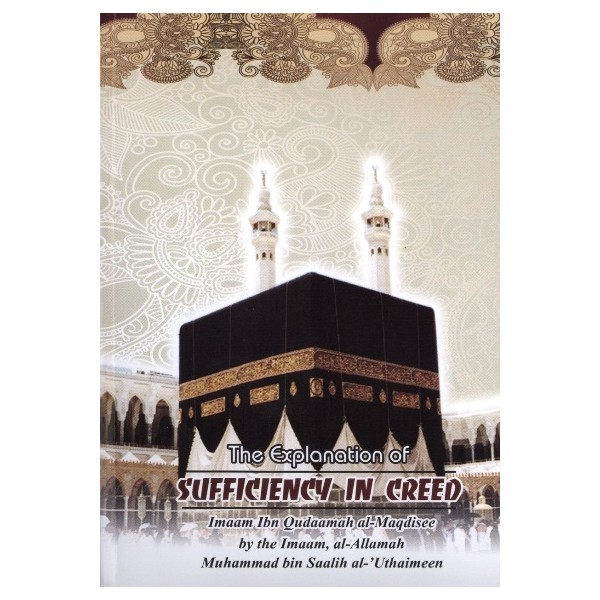
In this book, we present the classical treatise on Creed of Imaam Ibn Qudaamah Al-Maqdisee, rahimahullaah, known as Lum’at-ul-‘Itiqaad, which is studied all over the Muslim world. Imaam Muhammad bin Saalih Al-‘Uthaimeen, rahimahullaah, has provided an in depth explanation for the points touched on by the author in a clear and simple manner. Furthermore, the narrations mentioned in the book have been verified and lengthy and extensive footnotes have been provided to make this book a valuable source of reference.
Shaikh Muhammad bin Saalih Al-‘Uthaimeen said in his introduction to this book: ‘This is a brief commentary of the book ‘Lum’at-ul-‘Itiqaad”, written by Abu Muhammad ‘Abdullaah bin Ahmad Ibn Qudaamah Al-Maqdisee (rahimahullaah), who was born in Sha’baan in 541H in a village from the districts of Nablis (present-day Palestine) and who died on the day of ‘Eed-ul-Fitr in 620H.
In this book, the author (rahimahullaah) gathered together the main points of the Islaamic Creed (‘Aqeedah). For this reason, the Board of the Educational Institutes assigned this book to be studied and taught during the second semester of the first year of study, so that it may serve as a pillar upon which one can establish his Creed at this stage.
Because I saw the importance of this book in terms of the topics it touches upon, its methodology and the lack of there being any explanation for it, I became determined, while seeking assistance from Allaah and hoping that He grant me correctness in intention and action, to put forth some words on it, in the attempt to clarify its ambiguous parts, explain its meanings and bring to light its main points.’
No doubt this book is of great importance for the Muslim with regard to establishing the correct Creed. This book is deserving of being taught and studied so that it may serve as a foundation for both the students of knowledge and the common Muslims. The topics touched upon by the author relate to the authentic Creed and Methodology, which all Muslims are obligated to have knowledge of. Consequently, we encourage everyone to purchase a copy of this magnificent book.
View the Table of Contents and Introduction @ http://www.dar-us-salam.com/inside/RA20-SufficiencyinCreed.pdf
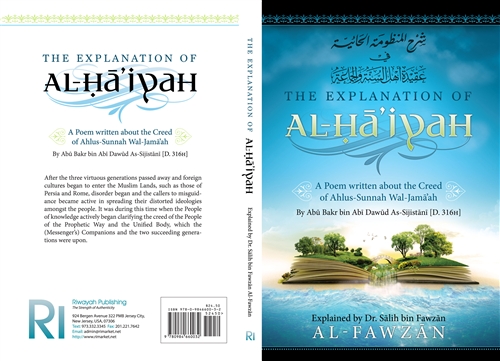
This is the highly beneficial English translation of Dr. Salih Al-Fawzan’s Explanation of Al-Haaiyah, a classical poem written by Abu Bakr bin Abi Dawud As-Sijistani about the Creed of Ahl As-Sunnah.
Specifications:
246 Pages
Printed on Beautiful Natural Paper
Dimensions: 6X9
Buy @ http://www.rimarket.net/product-p/eng0007s.htm
From the book Al-Mulakhas al-Fiqhi (A Summary of Islamic Jurisprudence) by Sheikh Saaleh al-Fawzaan. You may download a copy of the original arabic text here: الملخص الفقهي
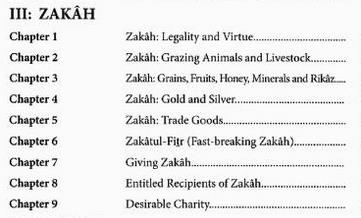
Part III: Zakah of Volume 1. Here are all the lessons covering Chapters 1 through 9
In this class we begin reading from the chapter of Zakaat (obligatory charity)
Part 01: Download Mp3 Here (Time 01:00:02) (Feb 3rd 2014) (Ch 1)
In this class we continue reading from the chapter of Zakaat (obligatory charity)
Part 02: Download Mp3 Here (Time 48:02) (Feb 10th 2014) (Ch 2)
Today we will continue with the section regarding the zakaat due on grazing livestock
Part 03: Download Mp3 Here (Time 48:30) (Feb 24th 2014) (Ch 2)
Today we will continue with the section regarding the zakaat due on grains, fruits, honey, etc…
Part 04: Download Mp3 Here (Time 46:48) (March 3, 2014) (Ch 3)
Part 05: Download Mp3 Here (Time 32:44) (2014-03-10) (Ch 3)
Part 06: Download Mp3 Here (Time 44:04) (2014-03-17) (Ch 4)
Part 07: Download Mp3 Here (Time 48:38) (2014-03-24) (Ch 4)
Part 08: Download Mp3 Here (Time 42:52) (2014-03-31) (Ch 5)
Part 09: Download Mp3 Here (Time 43:29) (2014-04-07) (Ch 5)
Part 10: Download Mp3 Here (Time 53:53) (2014-04-14) (Ch 6)
Part 11: Download Mp3 Here (Time 37:52) (2014-04-21) (Ch 7)
Part 12: Download Mp3 Here (Time 54:02) (2014-04-28) (Ch 8)
Part 13: Download Mp3 Here (Time 44:38) (2014-05-05) (Ch 8)
Part 14: Download Mp3 Here (Time 56:36) (2014-05-12) (Ch8 and Ch9)
Posted with Permission from: http://followthesalaf.com/
From the book Al-Mulakhas al-Fiqhi by Sheikh Saaleh al-Fawzaan
Part 01: In this class we begin the chapter on the Salatul-Janaazah (Funeral Prayer)
Listen /Download Mp3 Here (Time 55:41)
[audio http://salafiaudio.files.wordpress.com/2014/06/rulings-janazah-01-al-mulakhas-al-fiqhi-abu-muhammad-al-maghribee.mp3]
Part 02: In this class we continue with the rulings of the janaaiz (funerals). In this section the sheikh explains the etiquette of visiting the sick; how to encourage them, how to bring them joy. The sheikh, hafidhahullah, also explains the forbiddance of seeking medicine and cures in impermissible things (such as alcohol) and through matters that go against our creed (such as magic and soothsayers). He also discusses the ruling of reciting Surat Yaaseen upon the dying person.
Listen /Download Mp3 Here (Time 59:47)
[audio http://salafiaudio.files.wordpress.com/2014/06/rulings-janazah-02-al-mulakhas-al-fiqhi-abu-muhammad-al-maghribee.mp3]
Part 03: In this class we continue with the rulings of the janaaiz (funerals). In this class we read about the proper etiquette and rulings of attending the funerals.
Listen /Download Mp3 Here (Time 57:05)
[audio http://salafiaudio.files.wordpress.com/2014/06/rulings-janazah-03-al-mulakhas-al-fiqhi-abu-muhammad-al-maghribee.mp3]
Part 04: In this class we continue with the rulings of the janaaiz (funerals). In this class we read about the washing of the deceased (body). Do you know who has most right to wash the body? Listen to find out…
Listen /Download Mp3 Here (Time 52:50)
[audio http://salafiaudio.files.wordpress.com/2014/06/rulings-janazah-04-al-mulakhas-al-fiqhi-abu-muhammad-al-maghribee.mp3]
Part 05: In this class we continue with the rulings of the janaaiz (funerals). In this class we continue reading about the washing and shrouding of the deceased (body). Do you know who has most right to wash the body? Listen to find out…
Listen /Download Mp3 Here (Time 57:13)
[audio http://salafiaudio.files.wordpress.com/2014/06/rulings-janazah-05-al-mulakhas-al-fiqhi-abu-muhammad-al-maghribee.mp3]
—
Concise Rulings Related to Funerals – Al-Mulakhas al-Fiqhi – Abu Muhammad al-Maghribee
Part 01 : Listen / Download Mp3 Here (Time 47:28)
[audio https://salafiaudio.files.wordpress.com/2014/06/concise-rulings-related-to-funerals-01-al-mulakhas-al-fiqhi-abu-muhammad-al-maghribee.mp3]
Part 02 : Listen / Download Mp3 Here (Time 1:02:32)
[audio http://salafiaudio.files.wordpress.com/2014/06/concise-rulings-related-to-funerals-02-al-mulakhas-al-fiqhi-abu-muhammad-al-maghribee.mp3]
Posted with Permission from http://followthesalaf.com
From the summarized explanation of our Sheikh Abdur-Razzaq ibn Abdil-Muhsin al-Badr, hafidhahumallah. Shaykh taught at the Masjid, University of Madina.
Part 01: Listen / Download Mp3 Here (Time 01:01:45)[audio http://salafiaudio.files.wordpress.com/2014/06/al-haaiyyah-01-abu-muhammad-al-maghribee.mp3]
Part 02: Listen / Download Mp3 Here (Time 39:31)[audio http://salafiaudio.files.wordpress.com/2014/06/al-haaiyyah-02-abu-muhammad-al-maghribee.mp3]
Posted with Permission from http://followthesalaf.com
 The Explanation of the Creed of the Salaf, by Imaam Abee Uthmaan Ismaa’eel bin Abdir-Rahmaan As-Saaboonee,rahimahullaah, as explained by our noble sheikh al-Allaamah Rabee’ bin Haadee Al-Madkhalee, hafidhahullaah.
You may download the original text of As-Saaboonee’s work here: عقيدة السلف أصحاب الحديث (PDF)
Listen or Download Below
Part01 : Listen /Download Mp3 Here (Time 1:00:49)
—
Part02 : Listen /Download Mp3 Here (Time 54:34)
—
Part03 : Listen /Download Mp3 Here (Time 57:15)
—
Part04 : Listen /Download Mp3 Here (Time 58:15)
—
Part05 : Listen /Download Mp3 Here (Time 01:00:33)
—
Part06 : Listen /Download Mp3 Here (Time 01:01:45)
—
Part07 : Listen /Download Mp3 Here (Time 51:56)
—
Part08 : Listen /Download Mp3 Here (Time 01:01:20)
—
Part09 : Listen /Download Mp3 Here (Time 01:07:29)
—
Part10 : Listen /Download Mp3 Here (Time 54:51)
—
Part11 : Listen /Download Mp3 Here (Time 54:39)
—
Part12 : Listen /Download Mp3 Here (Time 53:13)
—
Part13 : Listen /Download Mp3 Here (Time 52:04)
—
Part14 : Listen /Download Mp3 Here (Time 47:45)
—
Part15 : Listen /Download Mp3 Here (Time 41:54)
—
Part16 : Listen /Download Mp3 Here (Time 52:16)
—
Part17 : Listen /Download Mp3 Here (Time 59:43)
—
Part18 : Listen /Download Mp3 Here (Time 54:26)
—
Part19 : Listen /Download Mp3 Here (Time 57:53)
—
Part20 : Listen /Download Mp3 Here (Time 58:43)
—
Part21 : Listen /Download Mp3 Here (Time 55:48)
—
Part22 : Listen /Download Mp3 Here (Time 01:03:55)
—
Part23 : Listen /Download Mp3 Here (Time 01:05:55)
—
Part24 : Listen /Download Mp3 Here (Time 58:20)
—
Part25 : Listen /Download Mp3 Here (Time 59:40)
—
Part26 : Listen /Download Mp3 Here (Time 58:47)
—
Part 27 | 28 | 29 | 30 | 31 | 32 | 33 | 34 | 35 | 36 | 37 | 38 | 39 | 40 | 41 | 42 | 43 | 44 | 45 | 46 | 47 | 48 | 49 | 50 | 51 | 52 | 53 | 54 | 55 | 56 | 57 | 58 | 59 | 60 | 61 | 62 | 63 | 64 | 65 | 66 | 67 | 68 | 69 |
—
These are ongoing classes.other parts will be uploaded as they are made available by http://followthesalaf.com
Shaikh Muhammad ibn Abdul-Wahhab al-Wasabi
Source: Lessons on Tawhid – Approximately 50 Classes – from Dar-ul-Hadith, Dammaj, Yemen
These were lessons conducted on the book ‘al-Qawl-ul- Mufeed Fee Adillatit-Tawhid’ [Beneficial Speech in Establishing the Evidences of Tawhid] written by one of the major scholars of the Sunnah in Yemen, Shaikh Muhammad ibn Abdul-Wahhab al-Wasabi (may Allah preserve him).
They were explained live via a telephone conference calling system by the Imam of the Masjid in Dar-ul-Hadith, Dammaj (Yemen), who is one of the senior scholars of the center of learning in Dammaj, Shaikh Ahmad al-Wasabi (may Allah preserve him). These lessons were conducted every Saturday from the period of April 2005 to June 2006. The .pdf files also contain questions which were asked in relation to the topic of the lesson in question.
The Three Fundamental Principles
Of the Imaam and Mujaddid Muhammad bin ‘Abdil-Wahhaab [Died 1206H]
– may Allaah have mercy on him –
Translated by Abu Maryam Isma’eel AlArcon,
al-Ibaanah e-books
[Read or Download Arabic Matn (Text) Here] [PDF] [27 Pages]
About the Book:
Before you is a complete translation of the great classical treatise “Thalaathat-ul-Usool” [The Three Fundamental Principles] of Imaam Muhammad bin ‘Abdil-Wahhaab. The source used for this translation was a booklet with the title “The Creed of the Saved Sect” printed by Maktab-ul-Islamee in 1993 [5th Edition] with checking by Zuhair Shawaish. This book is not to be confused with “al-Usool-uthThalaatha” which is another work written by Imaam Ibn ‘Abdul-Wahhaab.
This treatise needs no introduction, as it is one of the Islamic works that is most studied and taught throughout the world. In fact, many of the scholars recommend the students of knowledge to begin their path of learning by studying and mastering this booklet. The reason for this is because it was written by the author in a simple manner and comprising of the basic fundamentals of this Religion in brief. The material contained in the treatise was designed to be easily memorized and understood.
It is our intent, by producing this treatise, to provide the English audience with the source of this tremendous work so that they may study it in gatherings and use it as a reference. There are several explanations available for “The Three Fundamental Principles” that were written in recent times, such as that of Imaam Muhammad bin Saalih Al-‘Uthaimeen, Shaikh Zayd Al-Madkhalee and Shaikh Saalih Aali Shaikh.
Read the Text Below :
The Three Fundamental Principles
In the Name of Allaah, the Most Merciful, the Bestower of Mercy.
The proof for this is Allaah’s saying:
“In the Name of Allaah, the Most Merciful, the Bestower of Mercy. By the time! Verily mankind is at loss – except for those who believe and perform righteous deeds, and advise one another towards the truth and advise one another towards patience.” [Surah Al-‘Asr]
Ash-Shaafi’ee, may Allaah have mercy on him, said: “Had Allaah not sent down a proof to His creation other than this surah (chapter), it would have been sufficient for them.”
Al-Bukhaaree, may Allaah have mercy on him, said: “Chapter: Knowledge comes before speech and action.”
The proof for this is Allaah’s saying:
“So know that there is no deity worthy of worship except Allaah, and seek forgiveness for your sins.” [Surah Muhammad: 19]
So He began by mentioning knowledge before speech and action.
First: That Allaah created us, provided sustenance for us, and did not leave us neglected. Rather, He sent a Messenger to us. So whoever obeys him will enter Paradise, whereas whoever disobeys him will enter the Hellfire.
The proof for this is Allaah’s statement:
“Verily, We sent to you a Messenger, to be a witness over you, just as we sent a Messenger to Pharaoh. But Pharaoh disobeyed the Messenger (i.e. Moosaa) so We seized him with a severe punishment” [Surah Al-Muzzammil: 15-16]
Second: Allaah is not pleased with anyone being mixed into worship with Him – neither an angel brought close nor a prophet that was sent.
The proof for this is:
“And verily the masaajid belong to Allaah, so do not call unto anyone along with Allaah.” [Surah Al-Jinn: 18]
Third: Whoever obeys the Messenger (i.e. Muhammad) and singles Allaah out (in worship), it is not permissible for him to take as allies those who oppose Allaah and His Messenger, not even if they are close relatives.
The proof for this is Allaah’s saying:
“You will not find any people who believe in Allaah and the Last Day making friendship with those who oppose Allaah and His Messenger, even if they are their fathers or their sons or their brothers or there kindred. For such He has written Faith in their hearts, and strengthened them with Rooh (light and guidance) from Himself. And He will admit them into Gardens under which rivers flow to dwell therein forever. Allaah is pleased with them and they with Him. They are the party of Allaah. Verily it is the party of Allaah that will be the successful.” [Surah Al-Mujaadilah: 22]
Know, may Allaah grant you the ability to obey Him, that Al-Haneefiyyah, the Religion of Ibraaheem, is that you worship Allaah alone, making the religion sincerely (i.e. solely) for Him. This is what Allaah ordered all of mankind to do, and this is the purpose for which He created them, as Allaah says:
“And I did not create the Jinn and mankind except to worship Me.” [Surah AdhDhaariyaat: 56]
The meaning of “to worship Me” is “to single Me out (in worship).”
The greatest thing that Allaah commanded is Tawheed, which means: Singling Allaah out in worship. And the greatest thing that Allaah warned against is Shirk, which is: Supplicating to others along with Him.
The proof for this is Allaah’s statement:
“And worship Allaah (alone) and do not mix anything (in worship) with Him.” [Surah An-Nisaa: 36]
So if it said to you: What are the three fundamental principles that mankind is obligated to know?
Then say: That the servant knows his Lord, his Religion and his Prophet Muhammad, may the peace and blessings of Allaah be on him.
So if it is said: Who is your Lord?
Then say: My Lord is Allaah, the One who nurtured me and nurtured all of creation through His favors. And He is the One whom I worship, there being to me no (false) deity worshipped that is equal to Him.
The proof for this is Allaah’s statement:
“All praise be to Allaah, Lord of the ‘Alameen (i.e. all of creation).” [Surah AlFaatihah: 1]
The word ‘Aalam refers to everything apart from Allaah, and I am part of that creation. So if it is said to you: How did you come to know of your Lord?
Then say: By way of His signs and His creations. And among His signs are the night and the day, and the sun and the moon. And among His creations are the seven (levels of) heaven and the seven (levels of) earth, as well as whoever [and whatever] lies in them and between them. The proof for this is Allaah’s statement:
“And from among His signs are the night and the day, and the sun and the moon. Do not prostrate yourselves to the sun or to the moon, but rather prostrate yourselves to Allaah who created them, if it is He whom you truly worship.” [Surah Fussilat: 37]
And His statement:
“Verily, your Lord is Allaah, who created the heavens and the earth in six days, and then rose over the Throne. He brings the night as a cover over the day, which it follows rapidly. And He made the sun, the moon and the stars subjected to His Command. Surely, to Him belongs the Creation and the Command. Blessed is Allaah, Lord of the Worlds.” [Surah Al-A’raaf: 54]
The word Rabb (Lord) means One who is worshipped. The proof for this is Allaah’s saying:
“O mankind! Worship your Lord who created you and those before you, so that you may be dutiful to Him. He is the One who made the earth a resting place for you, and the sky as a canopy, and sent down water from the sky and brought forth therewith fruits as a provision for you. So do no set up rivals with Allaah in worship knowingly.” [Surah Al-Baqarah: 21-22]
Ibn Katheer, may Allaah have mercy on him, said: “The creator of these things is the One who truly deserves to be worshipped.”
The types of worship that Allaah commanded, such as Islaam, Eemaan and Ihsaan, which includes: Supplication (Du’aa), Fear (Khawf), Hope (Rajaa), Reliance (Tawakkul), Longing (Raghbah) and Dreading (Rahbah), Submissiveness (Khushoo’), Awe (Khashyah), Repentance (Inaabah), Seeking Assistance (Isti’aanah), Seeking Refuge (Isti’aadhah), Asking for Help (Istighaathah), Offering Sacrifices (Dhabah), Making Oaths (Nadhar) and all of the other types of worship that Allaah commanded – all of these belong to Allaah, alone. The proof for this is Allaah’s saying:
“And the masaajid belong to Allaah, so do not call unto anyone along with Allaah.” [Surah Al-Jinn: 18]
So whoever directs any part of these (acts of worship) to other than Allaah, then he is a polytheist, disbeliever. The proof for this is Allaah’s saying:
“And whoever calls unto another god besides Allaah, of which he has no proof for, his reckoning is only with his Lord. Surely, the disbelievers will not be successful.” [Surah Al-Mu’minoon: 117]
It is stated in a hadeeth: “The supplication is the core of worship.” [1]
The proof for this (i.e. supplication) is Allaah’s saying:
“And your Lord says: ‘Supplicate to Me, I will respond to you. Verily those who are to proud to worship Me will enter the Hellfire in disgrace.’” [Surah Ghaafir: 60]
The proof for Fear (khawf) is Allaah’s saying:
“So do not fear them, but fear Me if you are true believers.” [Surah Aali ‘Imraan:175]
The proof for Hope (Rajaa) is Allaah’s saying:
“So whoever hopes to meet his Lord, then let him perform righteous deeds, and not mix anyone into the worship of his Lord.” [Surah Al-Kahf: 110]
The proof for Reliance (Tawakkul) is Allaah’s saying:
“And upon Allaah (alone) put your reliance if you are truly believers.” [Surah AlMaa’idah: 23]
And His saying:
“And whoever relies upon Allaah, then He is sufficient for Him.” [Surah At-Talaaq:3]
The proof for Longing (Raghbah) and Dreading (Rahbah) and Submissiveness (Khusoo’) is Allaah’s saying:
“Verily, they used to rush to do good deeds, and they would call on Us, longing (His reward) and dreading (His punishment), and they used to humble themselves submissively before Us.” [Surah Al-Anbiyaa: 90]
The proof for Awe (Khashyah) is Allaah’s saying:
“So do not be in awe of them, but have awe of Me.” [Surah Al-Baqarah: 150]
The proof for Repentance (Inaabah) is Allaah’s saying:
“And turn to your Lord in repentance and submit to Him (as Muslims).” [Surah Az-Zumar: 54]
The proof for Seeking Assistance (Isti’aanah) is Allaah’s saying:
“You alone do we worship and in You alone do we seek assistance.” [Surah AlFaatihah: 4]
And in the hadeeth: “When you ask for assistance then seek assistance in Allaah.” [02]
The proof for Seeking Refuge (Isti’aadhah) is Allaah’s saying:
“Say: I seek refuge in the Lord of the Daybreak.” [Surah Al-Falaq: 1] And:
“Say: I seek refuge in the Lord of Mankind.” [Surah An-Naas: 1]
The proof for Asking for Help (Istighaathah) is Allaah’s saying:
“And remember when you sought help from your Lord and He responded to you…” [Surah Al-Anfaal: 9]
The proof for offering sacrifices (Dhabah) is Allaah’s saying:
“Say: Verily my prayer, my sacrificial offerings, my living and my dying are for Allaah, Lord of the Worlds. He has no partner. And of this I have been commanded, and I am the first of the Muslims.” [Surah Al-An’aam: 162-163]
And from the Sunnah is: “May Allaah curse the one who offers a sacrifice to other than Allaah.” [03]
The proof for Making Oaths (Nadhar) is Allaah’s saying:
“They are those who fulfill their vows and fear a Day whose evil will be widespread.” [Surah Al-Insaan: 7]
Knowing the Religion of Islaam, based on evidences. This (i.e. Islaam) means submitting to Allaah by way of Tawheed, surrendering one’s (full) obedience to Him, and absolving oneself from Shirk and its people. This can be divided into three levels:
1. Islaam
2. Eemaan, and
3. Ihsaan
Each one of these levels has its own pillars.
The pillars of Islaam are five:
The proof for the testimony of Faith is Allaah’s saying:
“Allaah bears witness that there is no deity that has the right to be worshipped except Him, and so do the angels and those who possess knowledge. He is always maintaining His creation with justice. None has the right to be worshipped but Him – the All-Mighty, the All-Wise.” [Surah Aali ‘Imraan: 18]
The meaning of it (i.e. the testimony of Faith) is: There is no one that has the right to be worshipped except Allaah, alone. Laa Ilaaha negates everything that is worshipped besides Allaah, while IllaaAllaah affirms the worship of only Allaah, free from any partner being mixed in with His worship, just as there is no partner mixed in with His Dominion.
An explanation of this, which will clarify it further, is found in Allaah’s saying:
“And remember when Ibraaheem said to his father and to his people: ‘Verily, I am free from all that you worship – except for He who created Me, and verily He will guide me.’ And He made it a statement that will endure among his offspring that they may turn back to.” [Surah Az-Zukhruf: 26-28]
And Allaah’s saying:
“Say: ‘O People of the Scripture (i.e. Jews and Christians)! Come to a word that is just between us and you – that we worship none but Allaah alone and that we associate no partners with Him; and that none of us shall take others as lords besides Allaah.’ Then if they turn away, say: ‘Bear witness that we are Muslims.’” [Surah Aali ‘Imraan: 64]
The proof for testifying that Muhammad is the Messenger of Allaah is His saying:
“Verily there has come to you a Messenger from amongst yourselves. It grieves him that you should receive any injury or difficulty. He is anxious over you (to be guided) and he is full of kindness and mercy towards the believers.” [Surah AtTawbah: 128]
The meaning of testifying that Muhammad is the Messenger of Allaah is: Obeying him in what he has commanded, believing him in what he has informed us of, avoiding what he forbade and warned against, and not worshipping Allaah except by what he (صَلَّى اللّٰهُ عَلَيْهِ وَسَلَّم) prescribed.
The proof for Prayer and Zakaat and the explanation of Tawheed is found in Allaah’s saying:
“And they were not commanded except that they should worship Allaah, making the religion (i.e. worship) solely for Him alone, and that they should perform the prayer and give the Zakaat. And that is the right Religion.” [Surah Al-Bayyinah: 5]
The proof for Fasting is Allaah’s saying:
“O you who believe! Fasting is prescribed for you just as it was prescribed for those before you, in order that you may acquire Taqwaa (dutifulness to Allaah).” [Surah Al-Baqarah: 183]
The proof for Hajj is Allaah’s saying:
“And the Hajj (pilgrimage) to the House (Ka’bah) is a duty that mankind owes to Allaah for those who are able to do it. And whoever disbelieves (by denying Hajj), then indeed Allaah is not in need of any of His creation.” [Surah Aali ‘Imraan: 97]
Eemaan consists of more than seventy branches. The highest of them is saying Laa Ilaaha IllaaAllaah and the lowest of them is moving a harmful object from the road. And Hayaa (modesty) is a branch from Eemaan. [04]
Its pillars are six:
The proof for these six pillars is Allaah’s statement:
“Righteousness (birr) is not that you turn your faces towards the east and the west (in prayer), but rather righteousness (birr) is (for) the one who believes in Allaah, the Last Day, the Angels, the Books and the Prophets.” [Surah AlBaqarah: 177]
And the proof for Al-Qadar (Pre-Decree) is Allaah’s saying:
“Verily, We have created all things with Qadar (divine pre-decree ordained for it).” [Surah Al-Qamar: 49]
Ihsaan is one pillar, which means: To worship Allaah as if you see Him, but even if you don’t see Him, He indeed sees you. [05]
The proof for this is Allaah’s saying:
“Verily, Allaah is with those who have Taqwaa (dutifulness to Allaah) and those who have Ihsaan.” [Surah An-Nahl: 128]
And His saying:
“And put your trust in the All-Mighty, the Most Merciful, who sees you when you stand up (for prayer at night), and (who sees) your movements among those who prostrate themselves (to Him). Verily, He is the All-Hearer, the All-Knower.” [Surah Ash-Shu’araa: 217-220]
And His saying:
“There is no deed that you (O Muhammad) do, nor any portion of the Qur’aan that you recite, nor any deed that you (humans) do, except that We are witnesses to it, whilst you are doing it.” [Surah Yoonus: 61]
The proof from the Sunnah is the famous hadeeth of Jibreel, which is reported from ‘Umar bin Al-Khattaab (رضي الله عنه) who said: “One day we were sitting with the Prophet (صَلَّى اللّٰهُ عَلَيْهِ وَسَلَّم) when there appeared to us a man with extremely white garments and extremely black hair. No trace of journeying could be seen on him nor did any amongst us recognize him. Then he sat in front of the Prophet, lining up his knees with his (صَلَّى اللّٰهُ عَلَيْهِ وَسَلَّم) knees and placing his palms upon his (صَلَّى اللّٰهُ عَلَيْهِ وَسَلَّم) thighs, and said: ‘O Muhammad, inform me about Islaam.’ So he (صَلَّى اللّٰهُ عَلَيْهِ وَسَلَّم) said: ‘It is that you testify that there is no deity that has the right to be worshipped except Allaah and that Muhammad is the Messenger of Allaah. And that you establish the prayer, give the Zakaat, fast during Ramadaan and perform the Hajj (pilgrimage) to (Allaah’s) House, if you are able to do it.’ He said: ‘You have spoken truthfully.’ So we were amazed that he had asked him and then told him that he was truthful.
Then he said: ‘Now inform me about Eemaan.’ So he (صَلَّى اللّٰهُ عَلَيْهِ وَسَلَّم) said: ‘It is that you believe in Allaah, His angels, His (revealed) books, His messengers, the Last Day, and that you believe in Al-Qadar, the good of it and the bad of it.’ He said: ‘You have spoken truthfully. Now inform me about Ihsaan.
He (صَلَّى اللّٰهُ عَلَيْهِ وَسَلَّم) said: ‘It is that you worship Allaah as if you see Him, but even though you don’t see Him, He indeed sees you.’
He then said: ‘Now inform me about the (Final) Hour.’ He (صَلَّى اللّٰهُ عَلَيْهِ وَسَلَّم) said: ‘The one who is being asked does not have any more knowledge of it than the one who is asking.’ He said: ‘So then inform me about its signs.’ He (صَلَّى اللّٰهُ عَلَيْهِ وَسَلَّم) said: ‘It will be when the mother gives birth to her (female) master, when the barefooted, barren and lowly shepherds will compete with one another in constructing tall buildings.’
Then he left and we remained (seated) there for a while. Then he (صَلَّى اللّٰهُ عَلَيْهِ وَسَلَّم) said: ‘O ‘Umar, do you know who the questioner was?’ I said: ‘Allaah and His Messenger know best.’ He (صَلَّى اللّٰهُ عَلَيْهِ وَسَلَّم) said: ‘That was Jibreel who came to you to teach you your Religion.’”
Knowledge of your Prophet, Muhammad: He is Muhammad, the son of ‘Abdullaah, the son of ‘Abdul-Mutallib bin Haashim. Haashim was from the (the tribe of) Quraysh and Quraysh was from the Arabs. And the Arabs are from the offspring of (Prophet) Isma’eel, son of (Prophet) Ibraaheem. May Allaah send the best of His peace and blessings on him and on our Prophet (Muhammad) (صَلَّى اللّٰهُ عَلَيْهِ وَسَلَّم).
He lived for sixty-three years, forty of which was prior to his prophethood and twentythree of which he spent as a prophet, messenger. He became a prophet due to (Allaah’s saying): ْ“ اقْرَأ Read” [Surah ‘Alaq: 1] and a messenger due to: ُيَا أَيُّهَا الْمُدَّثِّر “O you wrapped in garments.” [Surah Al-Muddathir: 1]
His homeland was Makkah, and he (later) migrated to Madeenah. Allaah sent him to warn against Shirk (polytheism) and to call to Tawheed (pure monotheism). The proof for this is Allaah’s saying:
“O you wrapped in garments. Rise and warn! And magnify your Lord (Allaah). And purify your garments. And abandon ar-rujz (idols). And do not give away something in order to have more. And be patient for the sake of your Lord.” [Surah Al-Muddathir: 1-7]
The meaning of: “Rise and warn” is warn against Shirk and call to Tawheed. “And magnify your Lord” means glorify Him by way of Tawheed. “And purify your garments” means cleanse your actions from Shirk. “And abandon ar-rujz.” “Rujz” means statues, and “Abandon” means leave them and free yourself from them and those who worship them. He remained doing this for ten years, calling the people to Tawheed. And after ten years, he was ascended up to the heaven, where the five daily prayers were made obligatory on him. So he prayed in Makkah for three years and thereafter, he was ordered to make the Hijrah (migration) to Madeenah.
Hijrah means Moving from a land of Shirk to a land of Islaam. It is obligatory upon this ummah to migrate from a land of Shirk to a land of Islaam, and this is everlasting until the (Final) Hour is established. The proof for this is Allaah’s saying:
“Verily, as for those whom the angels take (in death) while they are wronging themselves (by not performing Hijrah), they (angels) will say (to them): ‘In what (condition) were you?’ They will reply: ‘We were weak and oppressed in the earth.’ They (angels) will say: ‘Was not the earth of Allaah spacious enough for you to migrate therein?’ Such men will find their abode in Hell – what an evil destination! Except the weak ones among men, and women and children – who cannot devise a plan, nor are they able to direct their way. These are the ones whom Allaah is (most) likely to forgive, and Allaah is Ever Oft-Pardoning, Most Forgiving.” [Surah An-Nisaa: 97-99]
And Allaah’s saying:
“O My servants who believe (in Me)! Verily, My earth is spacious so to Me alone, perform your worship.” [Surah Al-‘Ankaboot: 56]
Al-Baghawee, may Allaah have mercy on him, said: “The reason for the revelation of this ayah was due to some Muslims who had resided in Makkah and did not migrate (to Madeenah). Allaah called out to them using the title of Eemaan (for them).”
The proof for Hijrah from the Sunnah is his (صَلَّى اللّٰهُ عَلَيْهِ وَسَلَّم) saying: “Hijrah will not cease until repentance ceases. And repentance will not cease (to be accepted) until the sun rises from where it sets (i.e. the west).” [07]
So when he settled in Madeenah, he (صَلَّى اللّٰهُ عَلَيْهِ وَسَلَّم) commanded all of the remaining Laws of Islaam, such as Zakaat, Fasting, Hajj, Adhaan, Jihaad, commanding good and forbidding evil, as well as the other laws of Islaam. He remained doing this for ten years, and then passed away, peace and blessings of Allaah be on him, while his Religion remained.
This was his Religion – there was no good except that he directed his ummah towards it, and there was no evil except that he warned them against it. The good that he directed his ummah to was: Tawheed and everything that Allaah loves and is pleased with. The evil that he warned his ummah about was: Shirk and everything that Allaah hates and rejects.
Allaah sent him to all of mankind, and He made it an obligation upon everyone from the two species of Jinn and mankind to obey him. The proof for this is Allaah’s saying:
“Say: ‘O people! Verily, I am the Messenger of Allaah sent to all of you.’” [Surah Al-A’raaf: 158]
Allaah perfected and completed his Religion through him (صَلَّى اللّٰهُ عَلَيْهِ وَسَلَّم). The proof for this is Allaah’s saying:
“This day [08] I have completed your Religion for you, and perfected my Favor upon you. And I am pleased with Islaam as a Religion for you.” [Surah Al-Maa’idah: 3]
The proof that he (صَلَّى اللّٰهُ عَلَيْهِ وَسَلَّم) died is Allaah’s saying:
“You will surely die and they too will surely die. Then on the Day of Recompense, you will be disputing before your Lord.” [Surah Az-Zumar: 30-31]
When people die they will be resurrected. The proof for this is Allaah’s saying:
“From it (the earth) We created you, and to it We shall return you, and from it We shall bring you out once again.” [Surah TaHa: 55]
And Allaah’s saying:
“Allaah has brought you forth from the earth. Afterwards, He will return you into it and (then) bring you forth (once again, i.e. resurrection).” [Surah Nooh: 17-18]
After being resurrected, they will be judged and recompensed for their actions. The proof for this is Allaah’s saying:
“And to Allaah belongs all that is in the heavens and all that is in the earth, that He may recompense those who do evil with that which they have done (i.e. Hellfire), and reward those who do good with what is best (i.e. Paradise).” [Surah An-Najm: 31]
Whoever rejects the resurrection, disbelieves. The proof for this is Allaah’s saying:
“The disbelievers claim they will never be resurrected. Say (O Muhammad): ‘Yes, by my Lord! You will certainly be resurrected then you will be informed of what deeds you did.’ And that is easy for Allaah.” [Surah At-Taghaabun: 7]
Allaah sent all of the messengers, giving good tidings and warning. The proof for this is Allaah’s saying:
“Messengers bearing good news and warning – in order that mankind could have no plea against Allaah after (the coming of) the Messengers.” [Surah AnNisaa: 165]
The first of them was Nooh and the last of them was Muhammad, who was the Seal of
the Prophets.
The proof that Nooh was the first of them is Allaah’s saying:
“Verily, We sent the revelation to you (O Muhammad), just as We sent the revelation to Nooh and the prophets after him.” [Surah An-Nisaa: 163]
Every nation that Allaah sent a messenger to, from Nooh up to Muhammad, he (i.e. the messenger) would command them to worship Allaah alone and forbid them from worshipping the Taaghoot. The proof for this is Allaah’s saying:
“And We have indeed sent a messenger to every nation (saying): ‘Worship Allaah (alone) and avoid the false deities (Taaghoot).” [Surah An-Nahl: 36]
Allaah obligated all of His servants to disbelieve in the Taaghoot and believe in Allaah. Ibn Al-Qayyim, may Allaah have mercy on him, said: “The meaning of Taaghoot is someone or thing for whose sake a worshipper transgresses limits, such as those who are worshipped, followed or obeyed.”
The Tawaagheet (pl. of Taaghoot) are many, but their heads are five:
(1) Iblees (the Devil), may Allaah curse him;
(2) whoever is worshipped while being pleased with that;
(3) whoever calls the people to worship himself;
(4) whoever claims to have knowledge of the Unseen, and
(5) whoever rules by other than what Allaah has revealed.
The proof for this is Allaah’s saying:
“There is no compulsion in the Religion. Verily, the right path has become distinct from the wrong path. So whoever disbelieves in the Taaghoot and believes in Allaah, then he has taken hold of the firmest handhold that will never break. And Allaah is the All-Hearer, the All-Knower.” [Surah Al-Baqarah: 256]
This is what is meant by the statement Laa Ilaaha IllaaAllaah.
And in the hadeeth: “The head of the matter is Islaam and its main pillar is the Prayer. And its highest part is Jihaad in the Cause of Allaah.” [09]
And Allaah knows best. May Allaah send His peace and blessings on Muhammad, his family and his Companions.
[End of the Treatise]
Footnotes:
[01]Reported by At-Tirmidhee with a weak chain of narration. However it is authentically reported from An-Nu’maan bin Basheer with the wording: “The supplication is worship.” This was reported by Ahmad (18351), At-Tirmidhee and others with an authentic chain of narration. Refer to Saheeh alJaami’-us-Sagheer (3407) as well as Da’eef al-Jaami’-us-Sagheer (3003), both from Imaam AlAlbaanee, rahimahullaah.
[02] An authentic hadeeth based on its several paths of narration, reported by Ahmad and At-Tirmidhee.
The first part of it is: “O young lad. I will teach you some words: Safeguard Allaah and you will find Him before you; If you ask (for something), then ask (it from) Allaah; and when you ask for assistance, then seek assistance in Allaah.”
The remainder of the hadeeth as occurs in al-Mishkaat (5302) is: “And know that if the ummah were to gather together to benefit you with something, they would not be able to benefit you except with something that Allaah has already written for you. And if they were to gather together to harm you with something, they would not be able to harm you except with something that Allaah has already written against you. The pens have been lifted and the pages have dried.” Refer to Saheeh al-Jaami’-us-Sagheer (7957) and Saheeh Sunan AtTirmidhee (2043) of Imaam Al-Albaanee, rahimahullaah.
[03] This is a portion of a hadeeth found in Saheeh Muslim on the authority of ‘Alee (رضي الله عنه). The complete hadeeth reads: “May Allaah curse the one who curses his father. And may Allaah curse the one who offers a sacrifice to other than Allaah. And may Allaah curse the one who accommodates an innovator.” This hadeeth is found in the Musnad of Imaam Ahmad (no. 953 and 1305). Also refer to Saheeh Sunan An-Nasaa’ee (4119)
[04] This is based on an agreed upon hadeeth; i.e. reported by Al-Bukhaaree and Muslim.
[05] Part of a hadeeth reported by Muslim on the authority of ‘Umar (رضي الله عنه) and by Al-Bukhaaree from Abu Hurairah (رضي الله عنه).
[06] An authentic hadeeth reported by Al-Bukhaaree and Muslim
[07]Reported by Ahmad (16882) and Abu Dawood (See Saheeh Sunan Abee Dawood: 2166). The second part of it is found in Saheeh Muslim from the narration of Abu Hurairah (رضي الله عنه).
[08]Translator’s Note: What is meant by “This Day” is the day of Jumu’ah (Friday), which occurred on the Day of ‘Arafah after ‘Asr during the Prophet’s farewell pilgrimage. This is what has been related in the Saheeh of Imaam Al-Bukhaaree from ‘Umar bin Al-Khattaab (رضي الله عنه).
[09] Reported by At-Tabaraanee from Mu’aadh with the wording: “The head of this matter is Islaam. And whoever submits to Islaam is saved. Its main pillar is the Prayer. And its highest part is Jihaad. No one will attain it except for the best amongst them.” This is a weak hadeeth. Refer to Da’eef al-Jaami’-us-Sagheer (3077).
Related Link:
Book Study Resources for “Three Fundamental Principles”
https://abdurrahman.org/islamic-book-study/thalaathat-ul-usool-the-three-fundamental-principles/
A Lengthy Explanation of the first three points from “Foundations of the Sunnah ”
Imaam Ahmad Ibn Hanbal (d.241H)
Source: Al-Ibaanah Magazine, Issue No.1 – Dhul-Qa’dah 1415H / April 1995
Bismillaahir-Rahmaanir-Raheem
Shaykh Aboo ’Abdullaah Yahyaa Ibn Abil-Hasan Ibnul-Bannaa narrated to us saying: My father Aboo ’Alee al-Hasan Ibn ’Umar Ibnul-Bannaa related to us saying: Abul-Husayn ’Alee Ibn Muhammad Ibn ’Abdullaah Ibn Bushraan al-Mu’addil related to us, saying: ’Uthmaan Ibn Ahmad Ibn as-Sammaak reported to us, saying: Aboo Muhammad al-Hasan Ibn ’Abdul-Wahhaab, Abun-Nabr narrated to us, reading it to him from his handwritten copy in the month of Rabee’ul-Awwal, in the year two-hundred and ninety three (293H) who said: Aboo Ja’far Muhammad Ibn Sulaymaan al-Munqaree, in Basrah related to us, saying: ’Abdoos Ibn Maalik al-’Attaar narrated to me, saying: [1] I heard Aboo ’Abdullaah Ahmad Ibn Hanbal [2] – rahimahullaah – say:
“The Fundamental Principles of the Sunnah [3] with us [4] are:
Clinging to that which the Companions [5] of the Messenger of Allaah (sallallaahu ’alayhi wa sallam) were upon, taking them as our example to be followed, [6] avoiding innovation; [7] and every innovation is misguidance.” [8]
[1]: This is the isnaad (chain of narration connected to the text) which – just as in the case of the hadeeth of the Prophet (sallallaahu ’alayhi wa sallam) – helps ascertain whether or not the statement and the ascription is authentically related back to the one it is being reported from. As regards the importance of the isnaad, then a few narrations from the Scholars of the early generations will be mentioned.
Sufyaan ath-Thawree (d.161H) – rahimahullaah – said:
“The isnaad is the weapon of the Believer. So if he has no weapon, with what will he fight?”[1]
Ibnul-Mubaarak (d.181H) – rahimahullaah – said:
“The isnaad with me is from the Religion. If there were no isnaad, then whosoever wanted would relate whatever they wanted. However, when it is said to him: Who narrated to you? He remains silent.” [2]
As regards the ascription to Imaam Ahmad, then a number of Scholars have agreed to its ascription from ’Abdoos Ibn Maalik al-’Attaar – one of the close students of the Imaam – and from these verifying Scholars are: Ibn Abee Ya’laa in Tabaqaatul-Hanaabilah (1/241-246), al-Laalikaa‘ee in Sharh Usoolul-I’tiqaad Ahlus-Sunnah wal-Jamaa’ah (1/158-164) and also Ibnul-Jawzee in Manaaqib Ahmad (p. 222-228).
The text of this brief ’aqeedah was first printed by Daarul-Manaar in al-Mujaahid magazine (no. 28-29, Sha’baan – Ramadaan 1411H); and the original is a manuscript copy, transcribed by the Shaykh and muhaddith, Muhammad Naasirud-Deen al-Albaanee, rahimahullaah, in the month of Sha’baan 1374H, from the manuscript copy (no. 68, Q. 10-15) which is housed at the Dhaahiriyyah library in Damascus, Syria. We ask Allaah – the Most High – to grant us the ability to serialize the introduction of this valuable and concise tract, adding to it – for the benefit of the honourable readers – a brief commentary and explanation.
[2]: He is Aboo ’Abdullaah Ahmad Ibn Muhammad Ibn Hanbal ash-Shaybaanee – the Imaam of Ahlus-Sunnah wal-Jamaa’ah in his time. Born in Baghdaad in Rabee’ul-Awwal, 164H, he attended the circles of al-Qaadee Aboo Yoosuf (the student of Abee Haneefah) – rahimahullaah – where he studied fiqh. He left this in favour of hadeeth, which he began to study at the age of thirteen – having already memorized the Qur‘aan at a young age. He traveled extensively acquiring and learning ahaadeeth from over two-hundred and eighty teachers. From them are: Wakee’ Ibnul-Jarraah, Yahyaa Ibn Sa’eed al-Qattaan, ’Abdur-Rahmaan Ibn Mahdee, Sufyaan Ibn ’Uyaynah, ash-Shaafi’ee, Yazeed Ibn Haaroon and others – rahimahullaah. He underwent severe torture and trial due to defending the correct ’aqeedah – the ’aqeedah of Ahlus-Sunnah wal-Jamaa’ah (the Prophet (sallallaahu ’alayhi wa sallam), his Companions and those who followed them in ’aqeedah and manhaj) – being from those who were foremost in clinging to their way, whilst shunning the innovations.
Aboo ’Umayr said: “May Allaah have mercy upon him. There was no one having more patience regarding this world than him, nor anyone more closely resembling those who cam before him, nor anyone more rightfully amongst the righteous. This world was presented to him, but he rejected it, and he expelled innovations.” In his time, he was the Imaam of the people of Hadeeth specifically, and the Muslims in general.” [3]
Imaam ash-Shaafi’ee (d.204H) – rahimahullaah – said:
“I left Baghdaad, and I did not leave behind me a man better, having more knowledge, or greater Fiqh (understanding), nor having greater taqwaa (piety) than Ahmad Ibn Hanbal.”
Ishaaq Ibn Raahawayh (d.238H) said:
“I used to sit with Ahmad and Ibn Ma’een revising ahaadeeth; and I would say: What is the Fiqh (understanding) of it? What is its explanation? So they would remain silent, except for Ahmad.”
Aboo Daawood (d.275H) said:
“The lectures of Ahmad were sittings for the Hereafter. He would not mention in them any worldly affairs; and I never saw him mention this world.”
’Alee Ibnul-Madeenee (d.324H) – rahimahullaah – said:
“Indeed Allaah aided this Religion through Aboo Bakr as-Siddeeq on the day of apostasy, and through Ahmad Ibn Hanbal on the day of the trial.” [4]
Due to these qualities, he became a sign for Ahlus-Sunnah – as Qutaybah Ibn Sa’eed (d.240H) said, “If you see a man loving Ahmad, then know that he is a person of the Sunnah.”
And Abul-Hasan al-Ash’aree (d.324H) – rahimahullaah – said:
“Our statement which we hold and take as our Religion is: Clinging to the Book of Allaah, our Lord the Mighty and Majestic, and to the Sunnah of our Prophet, Muhammad (sallallaahu ’alayhi wa sallam), and what is narrated from the Companions, the Taabi’een and the Imaams of Hadeeth. This is what we cling to, and also that to which Aboo ’Abdullaah Ahmad Ibn Muhammad Ibn Hanbal – may Allaah enlighten his face, rais up his rank and grant him a magnificent reward – used to say, distancing ourselves from those who oppose his statement. Since he was the noble and complete Imaam, by whom Allaah made the truth clear, and removed the misguidance, and made the minhaaj (methodology) clear, and though whom Allaah annihilated the innovation of the innovators, the deviation of the deviant and the doubts of the doubters. So may Allaah have mercy upon him, the foremost Imaam.” [5]
Taajud-Deen as-Subkee (d.770H) – rahimahullaah – said, “Abul-Hasan al-Ash’aree is the foremost of Ahlus-Sunnah and Ahmad Ibn Hanbal…” [6]
Ibraaheem al-Harbee (d.285H) – rahimahullaah – said, “I saw Aboo ’Abdullaah, and it was as if Allaah had gathered for him the knowledge of the earlier people and the later people.”
Imaam Ahmad Ibn Hanbal died in the year 241H.
[3]: The term ‘Sunnah’ here, refers to the principles and foundations of the correct Islaamic ’aqeedah (belief) and manhaj (methodology), since the Salafus-Saalih (pious predecessors) would apply this term to matters of ’aqeedah and manhaj – as can be seen from their books and writings – for example: [i] Kitaabus-Sunnah of Imaam Ahmad Ibn Hanbal (d.241H); [ii] as-Sunnah of al-Athram (d.273H); [iii] Kitaabus-Sunnah of Aboo Daawood (d.275H) – being part of his Sunan. [iv] Kitaabus-Sunnah of Ibn Abee ’Aasim (d.287H); [v] Kitaabus-Sunnah of ’Abdullaah (d.290H), the son of Ahmad Ibn Hanbal; [vi] as-Sunnah of al-Marwazee (d.292H); [vii] Sareehus-Sunnah of Ibn Jareer at-Tabaree (d.310H); [viii] as-Sunnah of al-Khallaal (d.311H); [ix] Sharhus-Sunnah of al-Barbahaaree (d.329H); [x] as-Sunnah of al-’Asaal (d.349H) and [xi] as-Sunnah of at-Tabaraanee (d.360H).
The term ‘Sunnah’ was employed in this context to differentiate those matters of ’aqeedah and manhaj of the Salafus-Saalih were upon, from that which was innovated by the deviant and misguided sects.
[4]: Meaning, with the Scholars of Ahlus-Sunnah wal-Jamaa’ah and at the head of them in his time was Imaam Ahmad Ibn Hanbal. And in this regard, the way of the Salafus-Saalih was to point out to the people, the true followers and adherents to the Sunnah so that their ’aqeedah and manhaj (methodology) could be learnt and adhered to, as Imaam Ayyoob as-Sakhtiyaanee (d.131H) – rahimahullaah – said, “From the success of a youth, or a non-Arab is that Allaah guides him to a Scholar of the Sunnah.” [7]
And ’Amr Ibn Qays al-Mulaa‘ee (d.143H) said,
“If you see a youth when he begins to sprout, keeping company with Ahlus-Sunnah wal-Jamaa’ah then have hope for him. If you see him keeping company with the people of Innovation, then fear for him, because the youth is according to his initial upbringing.” [8]
[5]: Companions: Arabic: Sahaabah, or Ashaab; singular: Sahaabee. As regards the Sharee’ah definition of ‘Sahaabee’ or ‘Companion,’ then:
al-Haafidh Ibn Hajar (d.825H) – rahimahullaah – said,
“The most correct of what I have come across is that a Sahaabee (Companion) is one who met the Prophet (sallallaahu ’alayhi wa sallam) whilst believing in him, and died as a Muslim. So that includes one who lived with him for a long or short time, and those who narrated from him and those who did not, and those who saw him but did not sit with him and those who could not see him due to blindness.” [9]
Imaam an-Nawawee (d.676H) – rahimahullaah – said,
“The correct position is that whosoever accompanied the Prophet (sallallaahu ’alayhi wa sallam), even for an hour, then that person is from his Sahaabah.” [10]
Imaam Ahmad (d.241H) – rahimahullaah – said,
“Every person who accompanied the Prophet (sallallaahu ’alayhi wa sallam), whether for a year, month, a day, or even for an hour, or even just saw him is from his Companions.”[11]
Imaam al-Bukhaaree (d.256H) – rahimahullaah – said,
“H who accompanied the Prophet (sallallaahu ’alayhi wa sallam) or saw him – from the Muslims – then he is from his Companions.” [12]
al-Haafidh Ibn Hajar said in Fathul-Baaree (7/1),
“That which al-Bukhaaree states is the saying of Ahmad and the great majority of the Scholars of Hadeeth.” Some of the proofs that the Scholars have used for this are: The saying of the Prophet (sallallaahu ’alayhi wa sallam), “There will come upon the people a time when a group from amongst the people will go off to fight and it will be said to them: Is there any amongst you who has seen the Messenger of Allaah (sallallaahu ’alayhi wa sallam)? So they will say: Yes. So victory will be granted to them. So a group will go off to fight and it will be said to them: Is there any amongst you who were the Companions of the Messenger of Allaah (sallallaahu ’alayhi wa sallam)? So they will say: Yes. So victory will be granted to them. Then a group will go off to fight and it will be said to them: Is there any amongst you who have seen the companions of the Companions of the Messenger of Allaah (sallallaahu ’alayhi wa sallam)? So they will say: Yes. So victory will be granted to them.” [13]
The Prophet (sallallaahu ’alayhi wa sallam) also said,
“You will not cease to be upon good as long as there amongst you those who accompanied me. By Allaah! You will not cease to be upon good as long as there are amongst you those who accompanied those who accompanied and saw me.” [14]
So these narrations contain a clear proof that a Muslim seeing the Prophet (sallallaahu ’alayhi wa sallam) is granted virtue and excellence and is established as being from amongst the Companions.
Ibn Katheer (d.774H) – rahimahullaah – said,
“The fact that just seeing him (the Prophet) is enough for one to be called a Companion is clearly stated by al-Bukhaaree, Aboo Zur’ah and others who have written books regarding the names of the Companions – such as Ibn ’Abdul-Barr, Ibn Mandah, Aboo Moosaa al-Madanee, Ibnul-Atheer…” [15]
As regards the statement attributed to the taabi’ee and Imaam Sa’eed Ibnul-Musayyib – rahimahullaah – concerning the definition of a Companion, then this cannot be used as a proof at all. This is because al-Haafidh al-’Iraaqee – rahimahullaah – says, “The third saying is what is related from Sa’eed Ibnul-Musayyib, that he had not used to count someone as being a Companion, except one who accompanied the Prophet (sallallaahu ’alayhi wa sallam) for a year or two and fought along with him in one or two battles. Ibnus-Salaah said, “What is meant by this if it is authentic from him – refers back to what the Scholars of Usool say (i.e. what is meant be companionship language wise). However, this definition contains restrictions, which will mean that we do not count as Companions those such as Jareer Ibn ’Abdullaah al-Bajalee – who obviously does not fulfill these conditions that are made – but such are people about whom we know of no difference of opinion with regards to them being Companions.” I say, this is not authentic from Ibnul-Musayyib, since the isnaad (chain of narration) from him contains Muhammad Ibn ’Umar al-Waaqidee – who is da’eef (weak) in hadeeth.” [16]
[6]: Here the Imaam – rahimahullaah – explains and lays down the signposts for the correct manhaj followed by Ahlus-Sunnah wal-Jamaa’ah, and that is the methodology of the best and most excellent of mankind, the Companions, then those who followed them (the taabi’een), then those who followed them (the atbaa’ut-taabi’een).
So Ahlus-Sunnah wal-Jamaa’ah cling to what the first three generations of Muslims were upon – the Salafus-Saalih – whose excellence has been testified to by the Messenger of Allaah (sallallaahu ’alayhi wa sallam) in his statement, “The most excellent of mankind is my generation, then those who follow them, then those who follow them.” [17] And he (sallallaahu ’alayhi wa sallam) said, “The most excellent Ummah is the generation which I have been sent in, then those who followed them, then those who followed them.” [18]
As regards to the following generations, then they have not been praised with any specific excellence. Rather, they have, in general, been spoken ill of by the Prophet (sallallaahu ’alayhi wa sallam). Indeed, in some authentic narrations, after mentioning the excellence of the first three generations, the Prophet (sallallaahu ’alayhi wa sallam) said, “…then there will come a people amongst whom fatness will appear and who will testify without having been asked to do so.” [19] And in another narration, “…then there will come a people in whom you will not find any good.” [20] Also, there occurs in another authentic narration, the wording, “…then there will come a people who will testify without being asked to do so, who make promises but do not keep them, who are treacherous and not trustworthy and fatness will appear amongst them.” [21]
So it is the first three generations – the Salafus-Saalih – whose era has been praised with an excellence, whose path is to be followed and whose understanding of the Religion is to be accepted and affirmed. ’Aa‘ishah – radiyallaahu ’anhaa – said: A man came to the Prophet (sallallaahu ’alayhi wa sallam) and said, ‘Who is the most excellent of mankind?’ So the Prophet (sallallaahu ’alayhi wa sallam) said, “The generation which I am in, then the second, then the third.” [22]
And it is the first of these generations – the Companions – radiyallaahu ’anhum – who were the foremost in excellence from mankind; since they were: [i] those who learnt the Religion directly from the Prophet (sallallaahu ’alayhi wa sallam) and, “Being informed is not like seeing.” [23] [ii] those who knew best and understood the Religion – and this is the root of their excellence – as the Prophet (sallallaahu ’alayhi wa sallam) said, “Whosoever Allaah intends to show excellence to, He gives him the understanding of the Religion.” [24] [iii] They were those who followed it the best, and [iv] They were the ones who were furthest away from and remained free from innovations. About the excellence of the Salafus-Saalih, and the excellence of those who follow them, and the obligation to follow their path, Allaah – the Mighty and Majestic says,
“Those foremost of those who first migrated and those that helped them and those who follow them in goodness, Allaah is well-pleased with them and they are well-pleased with Him. He has prepared for them gardens underneath which rivers flow, to dwell therein forever. That is the supreme success.” [Sooratut-Tawbah 9:100]
And Allaah – the Most Perfect – says,
“Whosoever contends with the Messenger, even after guidance has been clearly conveyed to him, and follows a path other than that of the Believers; We shall leave him in the Path he has chosen and land him in Hell, what an evil destination.” [Sooratun-Nisaa‘ 4:115]
Indeed, “This is a clear definition and a decisive proof upon the worshipper, in making following the path of the Believers obligatory. And who were the Believers at the time this aayah was revealed, except the Companions (radiyallaahu ’anhum). Thus, Allaah has threatened those who leave their way and traverse other than their path, with lowliness and humiliation in this world; and a severe punishment in the Hereafter.” [25]
What further adds to the above decisive proofs, and is considered to be the correct explanation of those aayaat, are the ahaadeeth of the Propht (sallallaahu ’alayhi wa sallam), “Indeed my Ummah will split up into seventy-three. All of them are in the Fire except one.” It was said, ‘What is the one?’ He said, “The Jamaa’ah.” And in another narration, he said, “That which I and my Companions are upon.” [26]
He – sallallaahu ’alayhi wa sallam – also said,
“Those of you who survive after me shall see many differences of opinion. So hold fast to my Sunnah and to the Sunnah of the rightly-guided Caliphs after me. Cling to it tightly and beware of newly-invented matters, for every newly-invented matter is an innovation and every innovation is a going astray.” [27]
And the Prophet (sallallaahu ’alayhi wa sallam) said,
“The stars are the custodians of the sky, when the stars pass away, that which has been decreed for the sky will come upon it. I am the custodian for my Companions, so when I pass away there will come upon my Companions that which is decreed for them. And my Companions are the custodians for my Ummah, so when my Companions pass away, that which has been decreed upon my Ummah will come upon it.” [28] Below is a summary of the aforementioned proofs:
[i] That the iftiraaq (splitting-up) of the Ummah into various sects – on the basis of differences in ’aqeedah and manhaj – has been foretold.
[ii] All of the various firaq (sects) have been threatened with Hellfire, except those who adhere to the ’aqeedah and the manhaj of the Prophet (sallallaahu ’alayhi wa sallam) and his Companions, and that is al-Firqatun-Naajiyah (the Saved-Sect) and the Jamaa’ah.
[iii] That the authentic hadeeth about iftiraaq (splitting-up) is an explanation of, and in full agreement with the aayah from Sooratun-Nisaa‘ [4:115] in that all those who, “follow a path other than that of the Believers (the Companions),” have been threatened with Hellfire.
[iv] The obligation to follow the Prophet (sallallaahu ’alayhi wa sallam) and his Companions, and that is the way of Ahlus-Sunnah wal-Jamaa’ah, cannot be fulfilled, except by avoiding and shunning innovation and its people.
[v] When differences and innovations arise, it is obligatory to cling to the Sunnah, and also that which the Jamaa’ah have ijmaa’ (consensus and agreement) upon.
[vi] That the Companions were made examples to be followed and were for this Ummah, after the Prophet (sallallaahu ’alayhi wa sallam), the custodians of the correct knowledge, manhaj and ’aqeedah.
[vii] The root of the Companions excellence is in their understanding of and clinging onto the correct ’aqeedah and manhaj and also in their defending it, preserving it, and in their conveying it.
[viii] This is also the root cause for the excellence of those who followed the Companions in the next two generations. So it is binding upon the Muslims to follow the path taken by the Salafus-Saalih, those Muslims who – living in the first three generations – adhered to the ’aqeedah and manhaj, and have been praised with an excellence over and above the rest of mankind.
[ix] Opposing the way of the Salafus-Saalih is considered iftiraaq (splitting-up) and opposing them in matters related to Islaamic manhaj is also considered iftiraaq. So whoever chooses to oppose their knowledge and understanding of the Revelation, has split from them; and has therefore split from the way of Ahlus-Sunnah wal-Jamaa’ah, and has taken one of the forbidden and innovated paths.
Indeed, Ibn Mas’ood (radiyallaahu ’anhu) said,
“Indeed, Allaah looked into the hearts of the servants and found the heart of Muhammad (sallallaahu ’alayhi wa sallam) to be the best of the hearts of the servants. So He chose him for Himself and sent him as a Messenger. Then He looked into the hearts of the servants after Muhammad (sallallaahu ’alayhi wa sallam) and found the hearts of the Companions to be the best of the hearts of the servants. So He made them ministers of His Messenger, fighting for His Religion. So whatever the Muslims (i.e. the Companions) hold to be good, then it is good with Allaah, and whatever the Muslims hold to be evil, then it is evil with Allaah.” [29]
Imaam al-Barabahaaree (d.329H) – rahimahullaah – said,
“The foundations upon which the Jamaa’ah is made clear is the Companions of Muhammad (sallallaahu ’alayhi wa sallam). They are Ahlus-Sunnah wal-Jamaa’ah, so whoever does not take from them has gone astray and innovated; and every innovation is misguidance and misguidance and its people are in the Fire.” [30]
Indeed, “The truth is that which comes from Allaah the Mighty and Majestic. Th Sunnah is that which the Messenger of Allaah (sallallaahu ’alayhi wa sallam) laid down, and the Jamaa’ah is that which the Companions of the Messenger of Allaah (sallallaahu ’alayhi wa sallam) united upon, in the Caliphate of Aboo Bakr, ’Umar and ’Uthmaan. So he who limits himself to the Sunnah of the Messenger of Allaah (sallallaahu ’alayhi wa sallam) and that which the Companions were upon, is successful and triumphs over all the people of innovation, is saved and his Religion is preserved – if Allaah wills. Since the Messenger of Allaah (sallallaahu ’alayhi wa sallam) said, “My Ummah will split up into seventy-three sects,” and he told us that which would be the saved sect, saying, “That which I and my Companions are upon.” So this is the cure, the explanation, the dear affair and the straight and distinct road.” [31]
Ibn Mas’ood (radiyallaahu ’anhu) said,
“The Prophet (sallallaahu ’alayhi wa sallam) drew a line for us and said, “This is the Straight Path of Allaah.” Then he drew lines to its right and its left and said, “These are other paths; upon every one of them is a devil calling towards it.” Then he recited,
“Indeed, this is My Straight Path, so follow it. And do not follow other paths, they will separate you from His Path.” [32]
About the statement of Allaah, “And do not follow other paths,” ad-Daarimee relates in his Sunan (1/68) and al-Bayhaqee relates in al-Madkhal ilas-Sunan (no. 200) that Mujaahid (d.204H) said explaining this aayah, “Innovations and doubts.”
Abul-’Aaliyah (d.90H) – rahimahullaah – said,
“Learn Islaam. Then when you have learnt Islaam, do not turn away from it to the right, nor the left. Rather, be upon the Straight Path and be upon the Sunnah of your Prophet and that which his Companions were upon…And beware of these innovations because they cause enmity and hatred amongst you. Rather, stick to the original state of affairs which was there before they divided.” [33]
[7]: Arabic: Bida’ (singular: Bid’ah). Linguistically, bid’ah means: a newly invented matter. The Sharee’ah definition of bid’ah is: “A newly invented way (beliefs or actions) in the Religion, in imitation to the Sharee’ah (prescribed Law), by which nearness of Allaah is sought, not being supported by an authentic proof; neither in its foundations, nor the manner in which it is performed.” [34]
Imaam ash-Shaatibee (d.777H) – rahimahullaah – said,
“Everyone who follows the mutashaabihaat (those aayaat without a clear meaning), or twists the underlying meanings or gives a meaning to the aayaat not given to it by the Salafus-Saalih, or clings on to the very weak and unauthentic ahaadeeth, or takes that which is apparent as a proof – for every action, statement or belief in agreement with his objetives and intentions, not finding a fundamental proof for understanding it in that manner – then this is the method of deduction and derivation which gives rise to innovations and those who innovate.” [35]
Ibn ’Abdul-Haadee (d.745H) – rahimahullaah – said,
“It is not permissible to invent an interpretation about an aayah or a Sunnah which was not there in the time of the Salaf, nor did they have any knowledge of it, nor explain it to the Ummah. Since this would mean that the Salaf were ignorant of the truth in this matter and failed to reach it, whereas the late-coming opponent is somehow guided to the truth!” [36]
Imaam Ibnul-Qayyim (d.756H) – rahimahullaah – said,
“Inventing an explanation with regards to the Book of Allaah – to which the Salaf and the Scholars ar in opposition – necessitates one of two things; [i] either the explanation in itself a mistake, or [ii] that the sayings of the Salaf which run contrary to it are in error! And no one with an ounce of intellect would doubt that the one whose saying is in opposition to that of the Salaf is the one who is mistaken and in error.” [37]
And avoiding bida’ (innovations) is one of the great usool (foundations) of Ahlus-Sunnah wal-Jamaa’ah, and it involves: [i] keeping away from them; [ii] having hatred for them; [iii] warning the people about them; [iv] clarifying them to the people so that they do not fall into them; [v] refuting the innovators.
Imaam as-Saaboonee (d.449H) said about Ahlus-Sunnah,
“They follow the Salafus-Saalih – the Imaams and Scholars of the Muslims – and they cling to the firm Religion that they clung to and the firm truth. And they hate Ahlul-Bid’ah (people of innovation) who innovate into the Religion that which is not from it. They do not love them and they do not keep company with them. They do not listen to their sayings, nor sit with them, nor argue with them about the Religion, nor debate with them. Rather, they protect their ears from their futility – things which if they pass through the ears and settle in the hearts – will cause harm and will cause doubts and wicked ideas to appear. And concerning this, Allaah the Mighty and Majestic sent down:
“And when you see people engaged in vain discourse, then turn away from them unless they turn to different theme.” [Sooratul-An’aam 6:68].” [38]
Imaam ash-Shawakaanee (d.1255H) said,
“And this aayah contains a severe reprimand for those who allow people to sit with the innovators, those who twist the Words of Allaah, play around with His Book, and the Sunnah of His Messenger (sallallaahu ’alayhi wa sallam). And refer them back to their own misleading desires and wicked innovations. Since, if he is unable to reprimand them and change them from what they are upon, then at the very least, he should avoid sitting with them – and that is easy for him, not difficult. And the innovators may make use of his presence with them – even though he may be free from their mistakes – through a doubt by which they will beguile the common people, in which case his presence will cause an extra evil, in addition to just listening to their evil.” [39]
The Prophet (sallallaahu ’alayhi wa sallam) said, “Indeed, Allaah does not accept the repentance of an innovator, until he ceases from the innovation.” [40] And he (sallallaahu ’alayhi wa sallam) said, “Every innovation is misguidance and going astray.” [41] And he also said, “Whosoever innovates, or accommodates an innovator, then upon him is the curse of Allaah, the Angels and the whole of mankind.” [42]
Sufyaan ath-Thawree – rahimahullaah – said,
“Innovations are more beloved to Iblees than sin. Since a sin may be repented from, but innovation is not repented from.” [43] The following narrations will highlight – if Allaah wills – the manhaj (methodology) adopted by our Salafus-Saalih with regards to the mubtadi’een (innovators). A man said to ’Abdullaah Ibn ’Umar, ‘Najdah (a man from the Khawaarij) says such and such.’ So Ibn ’Umar prevented himself from listening for fear of that some of it should enter into his heart. [44]
Imaam al-Hasan al-Basree (d.110H) – rahimahullaah – said,
“Do not sit with the people of innovations and desires, nor argue with them, nor listen to them.” [45]
Asmaa‘ Bint ’Ubayd said: Two of the people of vain desires and innovations entered upon Ibn Seereen (d.110H), and said, “O Abaa Bakr, may we speak with you?” So he said, “No!” They said, “May we recite an aayah?” He from the Book of Allaah said, “No, indeed either you must get up and leave me, or I will get up and leave.” So said, “O Abaa Bakr, what harm would they left, so some of the people it have done to you, for them to recite an aayah from the Book of Allaah?” He said, “I feared that they would read an aayah to me and distort it, and that would remain in my heart.” [46]
An innovator asked Ayyoob as-Sakhtiyaanee (d.131H), “O Abaa Bakr, may I ask you about a word?’ He turned away and indicated with his hand, “No, not even half of a word.” [47]
Ibraaheem Ibn Maysirah (d.132H) – rahimahullaah – said,
“He who honours an innovator has assisted him in the demolition of Islaam.” [48]
Aboo Qilaabah (d.140H) – rahimahullaah – said,
“Do not sit with the people of innovation, because I do not feel secure that they will not drown you in their misguidance and make part of what you used to know unclear to you.”[49]
Ibn ’Awn (d.150H) – rahimahullaah – said:
“Whosoever sits with an innovator is worse than him.” [50]
It was said to Imaam al-Awzaa’ee (d.157H) – rahimahullaah, ‘A person says, ‘I sit with Ahlus-Sunnah and I sit with the innovators.’ So al-Awzaa’ee said, ‘This person desires to fluctuate between the truth and falsehood.” [51] Commenting upon this statement, Ibn Battah said, “Indeed, al-Awzaa’ee has spoken the truth. And I say, indeed this person does not know the truth from falsehood, nor faith from disbelief.” [51]
Sufyaan ath-Thawree (d.164H) – rahimahullaah – said, “Whosoever listens to an innovator has left the protection of Allaah and is entrusted to the innovation.” [52]
And al-Fudayl Ibn ’Iyaad (d.187H) – rahimahullaah – said, “Do not sit with an innovator, for I fear that curses will descend upon you.” [53]
Imaam Maalik (d.197H) – rahimahullaah – said,
“How evil are the people of innovation, we do not give them salaam.” [54]
Imaam ash-Shaafi’ee (d.197H) – rahimahullaah – said, “That a person meets Allaah with every sin except Shirk is better than meeting Him upon any one of the innovated beliefs.”[55]
Aboo Daawood as-Sijjistaanee (d.275H) – rahimahullaah – said,
I said to Aboo ’Abdullaah Ahmad Ibn Hanbal, “If I see a man from the people of the Sunnah sitting with a man from the people of innovation, should I speak with him?” He said, “No, you should first inform him that the one whom you saw him with is a person of innovation. Either he will cease speaking to the innovator, so continue speaking with him, or if not, then consider him to be like him. Ibn Mas’ood said that a person is like his friend.” [56]
Indeed, the people of knowledge throughout the ages continued warning the masses against the innovators and considered this matter important enough to dedicate chapters in their various books about this. For example:
Aboo Daawood placed a chapter in his Sunan (4/197), called: “Chapter: Turning away from the innovators and having hatred for them.”
Al-Haafidh al-Mundhiree (d.656H) – rahimahullaah – placed a chapter in at-Targheeb wat-Tarheeb (3/14) called: “Deterrent against loving the people of innovation, since a person will be with those whom he loves.”
Imaam an-Nawawee (d.676H) – rahimahullaah – says in al-Adhkaar (p.323), “Chapter: Disassociating from the people of innovation and sin.”
Imaam al-Bayhaqee (d.458H) – rahimahullaah – said in al-I’tiqaad (p.236), “Chapter: The prohibition from sitting with the people of innovation.”
Imaam al-Laalikaa‘ee (d.418H) said in Sharh Usoolul-I’tiqaad Ahlus-Sunnah wal-Jamaa’ah (1/128), “What is related from the Prophet (sallallaahu ’alayhi wa sallam) with respect to the forbiddance of debating with the innovators.”
Imaam al-Baghawee (d.516H) – rahimahullaah – said:
‘‘Indeed the Prophet (sallallaahu ’alayhi wa sallam) informed about the division in this Ummah, and the manifestation of desires and innovations in it. And he designated salvation for those who follow his Sunnah and the Sunnah of his Companions, may Allaah be pleased with them. So it is upon the Muslim, that if he sees a man having something from innovations and desires in belief, or something neglected from the Sunnah, that he makes Hijrah (migration) from him, and he frees himself from him, and abandons him in life and death. So he must not greet him if he meets him, and he must not answer him if he (i.e. the innovator) begins the greeting, until he abandons his innovation and returns to the truth…So verily the hijrah from the people of desires and innovation continues until they repent.’’ [57]
Qaadee Aboo Ya’laa (d.333H) – rahimahullaah – said in Hajarul-Mubtadi’ (p. 32), “There is ijmaa’ (consensus) from the Companions and the taabi’een as regards disassociating and cutting-off from the innovators.”
It is also necessary to mention here, the distinction that the Scholars make between a newly-invented matter being bid’ah (innovation) and passing a judgement upon the one who is involved in it that he is a mubtadi’ (innovator).
[8]: Just as the Messenger of Allaah (sallallaahu ’alayhi wa sallam) said in his sermons, “…and every innovation is misguidance and all that misguides, misguides to the Fire.” [59]
And ’Abdullaah Ibn ’Umar (radiyallaahu ’anhu) said,
“Every innovation is misguidance, even if the people think it is good.” [60]
Imaam al-Barbahaaree (d.329H) – rahimahullaah – said,
“Beware of small innovations, because they will grow until they become large. This was the case with every innovation introduced into this Ummah. It began as something small, bearing resemblance to the truth, which is why those who entered into it were misled and then were unable to leave it. So it grew and became the religion that they followed, and thus deviated from the Straight Path and left Islaam. And may Allaah have mercy upon you! Examine carefully the speech of everyone you hear from in your time particularly. So do not act in haste, and do not enter into anything from it until you ask and see: Did any of the Companions of the Prophet (sallallaahu ’alayhi wa sallam) speak about it, or any of the Scholars? So if you find a narration from them about it, cling to it, do not go beyond it for anything and do not give precedence to anything over it and thus fall into the Fire.”[61]
Imaam al-Hasan al-Basree said,
“The Sunnah is – by Him besides whom none has the right to be worshipped – between those who exceed the limits and those who fall short. So be patient upon it, may Allaah have mercy upon you. For indeed, Ahlus-Sunnah were a minority from those who preceded and shall be a minority from those to come. They did not accompany the people of excessiveness when they exceeded, nor the people of innovation when they innovated. Rather, they persevered upon the Sunnah, until they met their Lord.” [62]
In summary, two major principles of manhaj – with regards to the ’aqeedah of Ahlus-Sunnah wal-Jamaa’ah – have been covered in the first part of this serialization: Firstly, “The source for the ’aqeedah is: the Book of Allaah, the Sunnah of the Messenger of Allaah (sallallaahu ’alayhi wa sallam) and the ijmaa’ (consensus) of the Salafus-Saalih.” Secondly, “Every newly invented matter in the Religion is an innovation, and every innovation is misguidance, and every misguidance is in the Fire.” [63]
[1] Related by Ibn Hibbaan in al-Majrooheen (1/27)
[2] Related by at-Tirmidhee in al-’Ilal (4/388), Ibn Hibbaan in al-Majrooheen (1/18) an al-Khateeb in al-Kifaayah (no. 393).
[3] For a comprehensive biography of the imaam, refer to Manaaqib Ahmad of Ibnul-Jawzee; and also Siyar A’laamun-Nubalaa‘ (11/177-358) of adh-Dhahabee – from which the above biography and most of the following narrations have been taken.
[4] Tadhkiratul-Huffaadh (2/432) of adh-Dhahabee. The trial mentioned here is the trial of torture and persecution that Imaam Ahmad, whilst refuting the kufr (disbelief) of those who declared that the Qur‘aan was created, and standing firm upon the correct belief that the Qur‘aan is the Word of Allaah, uncreated. An explanation of this matter will come in its appropriate place, if Allaah wills.
[5] al-Ibaanah ’an Usoolid-Diyaanah (no. 24) of Abul-Hasan al-Ash’aree.
[6] Tabaqaatush-Shaafi’iyyatul-Kubraa (2/250)
[7] Related by al-Laalikaa‘ee in Sharh Usoolul-I’tiqaad Ahlis-Sunnah wal-Jamaa’ah (no. 30)
[8] Related by Ibn Battah in al-Ibaanah (p. 133)
[9] al-Isaabah (1/4-5) of al-Haafidh Ibn Hajar
[10] Sharh Saheeh Muslim (16/85) of an-Nawawee
[11] al-Kifaayah fee ’Ilmir-Riwaayah (p. 99) of al-Khateeb al-Baghdaadee
[12] Saheehul-Bukhaaree (7/1 – with Fath) of Imaam al-Bukhaaree
[13] Related by al-Bukhaaree (no. 3649) and Muslim (no. 3456) from Aboo Sa’eed al-Khudree (radiyallaahu ’anhu)
[14] Related by Ibn Abee Shaybah in al-Musannaf (no. 3242) from Waathilah (radiyallaahu ’anhu). It was authenticated by Ibn Hajar in Fathul-Baaree (7/7) saying, “It’s isnaad is hasan.”
[15] Mukhtasar ’Uloomul-Hadeeth (p. 174) of Ibn Katheer
[16] Fathul-Mugheeth (p. 346) of al-Haafidh al-’Iraaqee
[17] Related by al-Bukharee (no. 2652) and Muslim (no. 2533) from ’Abdullaah Ibn Mas’ood (radiyallaahu ’anhu)
[18] Related by Muslim (no. 2534) from Aboo Hurayrah (radiyallaahu ’anhu)
[19] Saheeh: Related by at-Tirmidhee (no. 2334), Ibn Hibbaan (no. 2285) and others, from ’Imraan Ibn Husayn (radiyallaahu ’anhu). It was authenticated by Shaykh al-Albaanee Silsilatul-Ahaadeethus-Saheehah (no. 699)
[20] Hasan: Related by at-Tabaraanee from Ibn Mas’ood (radiyallaahu ’anhu). It was authenticated by Shaykh al-Albaanee in Saheehul-Jaami’ (no. 3293)
[21] Related by Muslim (7/186) and Aboo Daawood (no. 4657) from ’Imraan Ibn Husayn.
[22] Related by Muslim (no. 2536)
[23] Saheeh: Related by Ahmad (1/215) from ’Abdullaah Ibn ’Abbaas (radiyallaahu ’anhumaa)
[24] Related by al-Bukhaaree (1/25) and at-Tahaawee in Mushkilul-Aathaar (2/278), from Mu’aawiyah (radiyallaahu ’anhu).
[25] as-Sabeel ilaa Manhaj Ahlus-Sunnah wal-Jamaa’ah (p. 16)
[26] The first hadeeth is mentioned by Aboo Daawood (no. 4598) and ad-Daarimee (2/249) and is Saheeh, and the second is related by at-Tirmidhee (no. 2792) and al-Haakim (1/128-129) and it is hasan. Shaykh al-Albaanee has authenticated them both in Silsilatul-Ahaadeethus-Saheehah (no. 204-205).
[27] Saheeh: Related by Ahmad (4/126), Aboo Daawood (no. 4607) and Ibn Maajah (no. 43), from ’Irbaad Ibn Saariyah (radiyallaahu ’anhu). It was authenticated by al-Haafidh Ibn Hajar in Takhreej Ahaadeeth Mukhtasar Ibnul-Haajib (1/137).
[28] Related by Muslim (16/82) and Ahmad (4/398), from Aboo Moosaa al-Ash’aree (radiyallaahu ’anhu)
[29] Related by Ahmad (no. 3600) and at-Tiyaalisee (no. 23). It was authenticated by al-Haafidh Ibn Hajar in ad-Diraayah (2/187), as did as-Sakhaawee in al-Maqaasidul-Hasanah (no. 959)
[30] Kitaab Sharhus-Sunnah (no. 2) of Imaam al-Barbahaaree
[31] Kitaab Sharhus-Sunnah (no. 82)
[32] Saheeh: Related by Ahmad (1/435), an-Nisaa‘ee (7/49) and ad-Daarimee (1/67-68). It was authenticated by Shaykh al-Albaanee in his checking to Kitaabus-Sunnah (no. 16-17) of Ibn Abee ’Aasim.
[33] Related by Ibn Battah in al-Ibaanah (no. 136) and Aboo Nu’aym in Hilyatul-Awliyaa‘ (2/218)
[34] al-I’tisaam (1/37) of the Imaam, the Scholar of usool, ash-Shaatibee
[35] al-I’tisaam (1/321) of ash-Shaatibee
[36] as-Saarimul-Munkee (p. 427) of Ibn ’Abdul-Haadee
[37] Mukhtasar Sawaa’iqul-Mursalah (2/128) of Ibnul-Qayyim
[38] Risalah fee I’tiqaad Ahlus-Sunnah Ashaabul-Hadeeth (p. 100) of Imaam as-Saaboonee
[39] Fathul-Qadeer (2/218) of ash-Shawkaanee
[40] Saheeh: Related by at-Tabaraanee in al-Awsat (no. 4360) and others. It was authenticated by Shaykh al-Albaanee in Silsilatul-Ahaadeethus-Saheehah (no. 1620)
[41] Saheeh: Related by Aboo Daawood (no. 4607), at-Tirmidhee (no. 2676) and others, and al-Haafidh Ibn Hajar authenticated it in Takhreejul-Ahaadeeth Ibnul-Haajib (1/137).
[42] Related by al-Bukhaaree (12/41), Muslim (9/140) and the hadeeth is general, as has been duly explained by al-Haafidh Ibn Hajar in Fathul-Baaree (13/281).
[43] Related by al-Laalikaa‘ee (no. 238)
[44] Related by al-Laalikaa‘ee (no. 199)
[45] Related by ad-Daarimee in his Sunan (1/121) and Ibn Battah in al-Ibaanatul-Kubraa (2/444)
[46] Related by ad-Daarimee in his Sunan (1/109)
[47] Fathul-Qadeer (2/128) of ash-Shawkaanee
[48] Related by al-Laalikaa‘ee (1/139)
[49] Related by al-Bayhaqee in al-I’tiqaad (p. 118) and ’Abdullaah Ibn Imaam Ahmad in as-Sunnah (p. 18).
[50] Related by Ibn Battah in al-Ibaanatul-Kubraa (no. 446)
[51] Related by Ibn Battah (1/456)
[52] Related by Aboo Nu’aym in al-Hilyah (7/26) and Ibn Battah (no. 444)
[53] Related by al-Laalikaa‘ee (no. 262) and Ibn Battah (no. 441)
[54] Related by al-Baghawee in Sharhus-Sunnah (1/234)
[55] Related by al-Bayhaqee in al-I’tiqaad (p. 158)
[56] Related by Ibn Abee Ya’laa in Tabaqaatul-Hanaabilah (1/60) and Ibn Muflih in Aadaabish-Shar’iyyah (1/263)
[57] Related by al-Baghawee in Sharhus-Sunnah (1/224)
[59] Saheeh: Related by an-Nisaa‘ee (1/224), from Jaabir (radiyallaahu ’anhu), and declared authentic by Shaykhul-Islaam Ibn Taymiyyah in Majmoo’ul-Fataawaa (3/58).
[60] Related by al-Laalikaa‘ee (no. 126), Ibn Battah (no. 205), al-Bayhaqee in al-Madkhal ilas-Sunan (no. 191) and Ibn Nasr in as-Sunnah (no. 70). This narration refutes the concept of bid’ah hasanah (good innovation) with regards to beliefs and worship, and a more detailed explanation of this will come in a later issue – if Allaah wills.
[61] Kitaab Sharhus-Sunnah (no. 7-8) of al-Barbahaaree
[62] Related by ad-Daarimee in his Sunan (1/71-72)
[63] Mujmal Usool Ahlus-Sunnah wal-Jamaa’ah fil-’Aqeedah (p. 7-9) of Dr. Naasir al-’Aql


 AbdurRahman.Org
You must be logged in to post a comment.