Supplication for the Sick

Imam Al-Nawawi’s Riyad-us-Saliheen
Chapter 145
Supplication for the Sick

901. `Aishah (May Allah be pleased with him) reported: When a person complained to the Prophet (sallallaahu ’alayhi wa sallam) about an ailment or suffered from a sore or a wound, the Prophet (sallallaahu ’alayhi wa sallam) would touch the ground with his forefinger and then raise it (Sufyan bin `Uyainah, the narrator, demonstrated this with his forefinger) and would recite: `Bismil-lahi, turbatu ardina, biriqati ba`dina, yushfa bihi saqimuni, bi ‘idhni Rabbina’ (With the Name of Allah, the dust of our ground mixed with the saliva of some of us would cure our patient with the permission of our Rubb.”
[Al-Bukhari and Muslim].

902. `Aishah (May Allah be pleased with her) reported: When the Prophet (sallallaahu ’alayhi wa sallam) visited any ailing member of his family, he would touch the sick person with his right hand and would supplicate: “Allahumma Rabban-nasi, adhhibil-ba’sa, washfi, Antash-Shafi, la shifa’a illa shifa’uka, shifaan la yughadiru saqaman [O Allah! the Rubb of mankind! Remove this disease and cure (him or her)! You are the Great Curer. There is no cure but through You, which leaves behind no disease].”
[Al-Bukhari and Muslim].

903. Anas (May Allah be pleased with him) reported: I said to Thabit (May Allah had Mercy upon him) Should I not perform Ruqyah (i.e., recite supplication or Quranic Ayat and blow) over you, such supplication as was practised by the Messenger of Allah (sallallaahu ’alayhi wa sallam)?” He said: “Please do so.” Anas (May Allah be pleased with him) supplicated: “Allahumma Rabban-nasi, mudh-hibal-ba’si, ishfi Antash-Shafi, la shafiya illa Anta, shifa’an la yughadiru saqaman [O Allah! the Rubb of mankind! Take away this disease and cure (him or her). You are the Curer. There is no cure except through You. Cure (him or her), a cure that leaves no disease].”
[Al-Bukhari].

904. Sa`d bin Abu Waqqas (May Allah be pleased with him) reported: The Messenger of Allah (sallallaahu ’alayhi wa sallam) visited me during my illness and supplicated, “O Allah! Cure Sa`d. O Allah! Cure Sa`d. O’ Allah! Cure Sa`d.”
[Muslim].

905. Abu `Abdullah bin Abul-`as (May Allah be pleased with him) reported: I complained to the Messenger of Allah (sallallaahu ’alayhi wa sallam) about a pain I had in my body. The Messenger of Allah (sallallaahu ’alayhi wa sallam) said, “Place your hand where you feel pain and say: `Bismillah (With the Name of Allah)’ three times; and then repeat seven times: `A`udhu bi`izzatillahi wa qudratihi min sharri ma ajidu wa `uhadhiru (I seek refuge with Allah and with His Power from the evil that afflicts me and that which I apprehend).”’
[
Muslim].

906. Ibn `Abbas (May Allah be pleased with them) reported: The Prophet (sallallaahu ’alayhi wa sallam) said, “He who visits a sick person who is not on the point of death and supplicates seven times: As’alullahal-`Azima Rabbal-`Arshil-`Azimi, an yashfiyaka (I beseech Allah the Great, the Rubb of the Great Throne, to heal you), Allah will certainly heal him from that sickness.”
[Abu Dawud and At-Tirmidhi].

907. Ibn `Abbas (May Allah be pleased with them) reported: The Prophet (sallallaahu ’alayhi wa sallam) visited a bedouin who was sick. Whenever he visited an ailing person, he would say, “La ba’sa, tahurun in sha’ Allah [No harm, (it will be a) purification (from sins), if Allah wills].”
[Al-Bukhari].

908. Abu Sa`id Al-Khudri (May Allah be pleased with him) reported: Jibril (Gabriel) came to the Prophet (sallallaahu ’alayhi wa sallam) and said: “O Muhammad (sallallaahu ’alayhi wa sallam)! Do you feel sick?” He (sallallaahu ’alayhi wa sallam) said, “Yes.” Jibril supplicated thus (i.e., he performed Ruqyah): “Bismillahi arqika, min kulli shay’in yu’dhika, min sharri kulli nafsin aw `ayni hasidi, Allahu yashfika, bismillahi arqika. [With the Name of Allah. I recite over you (to cleanse you) from all that troubles you, and from every harmful mischief and from the evil of the eyes of an envier. Allah will cure you; and with the Name of Allah, I recite over you].”
[Muslim].

909. Abu Sa`id Al-Khudri and Abu Hurairah (May Allah be pleased with them) reported: The Messenger of Allah (sallallaahu ’alayhi wa sallam) said, “If a person says: `La ilaha illallahu wallahu Akbar (There is no true god except Allah and Allah is Greatest)’, his Rubb responds to him and affirms: `(Yes!) There is no true god except I, and I am the Greatest.’ When he says: `La ilaha illallahu Wahdahu la sharika Lahu (There is no true god except Allah, the One, He has no partner).’ Allah (SWT) affirms: `(Yes!) There is no true god except I. I have no partner.’ When he says: `La ilaha illallahu Lahul mulku wa Lahul-hamdu (the sovereignty belongs to Him and all the praise is due to Him).’ He (SWT) affirms: `(Yes!) There is no true god except I, Mine is the praise and to Me belongs the sovereignty.’ When he says: `La ilaha illallahu wa la hawla wa la quwwata illa Billah (There is no true god except Allah, and there is no might and power but with Allah).’ He (SWT) affirms: `(Yes!) There is no true god except I, and there is no might and power but with Me.”’ The Messenger of Allah (sallallaahu ’alayhi wa sallam) added, “He who recites this during his illness and dies, will not be touched by the Fire (Hell).”
[At-Tirmidhu].

Supplication to be made soon after a Person’s Death

Imam Al-Nawawi’s Riyad-us-Saliheen
Chapter 151
Supplication to be made soon after a Person’s Death

919. Umm Salamah (May Allah be pleased with her) reported: The Messenger of Allah (sallallaahu ’alayhi wa sallam) visited Abu Salamah (May Allah be pleased with him) when his eyes were open soon after he died. He closed them (the eyes) for him and said, “When the soul is taken away, the sight follows it.” Some members of his family began to weep. He (sallallaahu ’alayhi wa sallam) said: “Do not supplicate for yourselves anything but good, for the angels say `amin’ to what you say.” Then he ü said, “O Allah! Forgive Abu Salamah, raise his rank among those who are rightly-guided and grant him a successor from his descendants who remain behind. Grant him pardon and us, too. O Rubb of the worlds. Make his grave spacious for him and give him light in it.”
[Muslim].


Supplication at the time of wearing new Dress or Shoes

Imam Al-Nawawi’s Riyad-us-Saliheen
Chapter 125
Supplication at the time of wearing new Dress or Shoes

813.  Abu Sa`id Al-Khudri (May Allah be pleased with him) reported: When Messenger of Allah (sallallaahu ’alayhi wa sallam) wore a new garment, he would name it. For instance, a turban or shirt or cloak and would supplicate: “Allahumma lakal-hamdu, Anta kasautanihi, as`aluka khairahu wa khaira ma suni`a lahu, wa a`udhu bika min sharrihi wa sharri ma suni`a lahu (O Allah, all the praise is for You that You have given it to me to put on. I ask You its goodness and the goodness of the purpose for which it was made, and I seek Your Protection from its evil and the evil of the purpose for which it was made).”
[Abu Dawud and At-Tirmidhi].

What is to be said at the time of Sleeping

Imam Al-Nawawi’s Riyad-us-Saliheen
Chapter 127
What is to be said at the time of Sleeping

814. Al-Bara’ bin `Azib (May Allah be pleased with them) reported: Whenever Messenger of Allah (sallallaahu ’alayhi wa sallam) went to bed, he would lie down on his right side and recite: “Allahumma aslamtu nafsi ilaika, wa wajjahtu wajhi ilaika, wa fawwadtu amri ilaika, wa ‘alja’tu zahri ilaika, raghbatan wa rahbatan ilaika, la malja’a wa la manja illa ilaika. Amantu bikitabikal-ladhi anzalta, wa nabiyyikal-ladhi arsalta [O Allah! I have submitted myself to You, I have turned my face to You, committed my affairs to You, and depend on You for protection out of desire for You and out of fear of You (expecting Your reward and fearing Your punishment). There is no refuge and no place of safety from You but with You. I believed in the Book You have revealed, and in the Prophet You have sent (i.e., Muhammad (sallallaahu ’alayhi wa sallam)).]”
[Al-Bukhari].

815. Al-Bara’ bin `Azib (May Allah be pleased with them) reported: Messenger of Allah (sallallaahu ’alayhi wa sallam) directed me thus: “Whenever you go to bed, perform Wudu’ as you do for Salat then (before sleeping) recite: `O Allah! I have submitted myself to You, I have turned myself to You, committed my affairs to You and sought Your refuge for protection out of desire for You and fear of You (expecting Your reward and fearing Your punishment). There is no refuge and no place of safety from You but with You. I believe in the Book You have revealed and in the Prophet (sallallaahu ’alayhi wa sallam) You have sent.”’ Messenger of Allah (sallallaahu ’alayhi wa sallam) added: “If anyone recites these words and dies during the night, he will die on the true Deen, and if he remains alive till the morning, he will obtain good. And make this supplication your last words (before sleeping).”
[Al-Bukhari and Muslim].

816. `Aishah (May Allah be pleased with her) reported: The Prophet (sallallaahu ’alayhi wa sallam) used to offer eleven Rak`ah of optional Salat (prayers) in the latter part of night. When it was about dawn, he would offer two short Rak`ah and then would lie down on his right side till the Mu’adhdhin (one who calls for prayer) would come to inform him that the congregation had gathered (for prayer).
[Al-Bukhari and Muslim].

817. Hudhaifah (May Allah be pleased with him) reported: Whenever the Prophet (sallallaahu ’alayhi wa sallam) lay down for sleep at night, he would place his (right) hand under his (right) cheek and supplicate: “Bismika Allahumma amutu wa ahya [O Allah, with Your Name will I die and live (wake up)].” And when he woke up, he would supplicate: “Al-hamdu lillahil-ladhi ahyana ba`da ma amatana, wa ilaihin-nushur (All praise is due to Allah, Who has brought us back to life after He has caused us to die, and to Him is the return).”
[Al-Bukhari].

818. Ya`ish bin Tikhfah Al-Ghifari (May Allah be pleased with him) reported: My father said: I was lying down on my belly in the mosque when someone shook me with his foot and said, “Lying down this way is disapproved by Allah.” I looked up and saw that it was Messenger of Allah (sallallaahu ’alayhi wa sallam).
[Abu Dawud].

819. Abu Hurairah (May Allah be pleased with him) reported: Messenger of Allah (sallallaahu ’alayhi wa sallam) said, “Whoever sits in a place where he does not remember Allah (SWT), he will suffer loss and incur displeasure of Allah; and whoever lies down (to sleep) in a place where he does not remember Allah, he will suffer sorrow and incur displeasure of Allah.”
[Abu Dawud].

Istikhara (Seeking Guidance from Allah), and Consultation

Imam Al-Nawawi’s Riyad-us-Saliheen
Chapter 97
Istikhara (Seeking Guidance from Allah), and Consultation

Allah, the Exalted, says:

“And consult them in the affairs.” (3:159)

“And who (conduct) their affairs by mutual consultation.” (42:38)

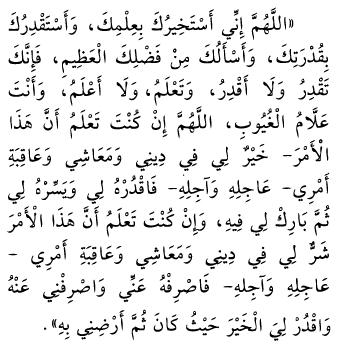
718. Jabir (May Allah be pleased with him) reported: Messenger of Allah (sallallaahu ’alayhi wa sallam) used to teach us the Istikharah (seeking guidance from Allah) in all matters as he would teach us a Surah of the Qur’an. He used to say: “When one of you contemplates entering upon an enterprise, let him perform two Rak`ah of optional prayer other than Fard prayers and then supplicate: “Allahumma inni astakhiruka bi `ilmika, wa astaqdiruka bi qudratika, wa as-‘aluka min fadlikal-`azim. Fainnaka taqdiru wa la aqdiru, wa ta`lamu wa la a`lamu, wa Anta `allamul-ghuyub. Allahumma in kunta ta`lamu anna hadhal-`amra (and name what you want to do) khairun li fi dini wa ma`ashi wa `aqibati amri, (or he said) `ajili amri ajilihi, faqdurhu li wa yassirhu li, thumma barik li fihi. Wa in kunta ta`lamu anna hadhal `amra (and name what you want to do) sharrun li fi dini wa ma`ashi wa `aqibati amri, (or he said) wa `ajili amri wa ajilihi, fasrifhu `anni, wasrifni `anhu, waqdur liyal-khaira haithu kana, thumma ardini bihi.” (O Allah, I consult You through Your Knowledge, and I seek strength through Your Power, and ask of Your Great Bounty; for You are Capable whereas I am not and, You know and I do not, and You are the Knower of hidden things. O Allah, if You know that this matter (and name it) is good for me in respect of my Deen, my livelihood and the consequences of my affairs, (or he said), the sooner or the later of my affairs then ordain it for me, make it easy for me, and bless it for me. But if You know this matter (and name it) to be bad for my Deen, my livelihood or the consequences of my affairs, (or he said) the sooner or the later of my affairs then turn it away from me, and turn me away from it, and grant me power to do good whatever it may be, and cause me to be contented with it). And let the supplicant specify the object.”
[Al-Bukhari and Muslim]

Sahih Muslim : Book 35: The Book Pertaining to the Remembrance of Allah, Supplication, Repentance and Seeking Forgiveness (Kitab Al-Dhikr)

Translation of Sahih Muslim, Book 35:

The Book Pertaining to the Remembrance of Allah, Supplication, Repentance and Seeking Forgiveness (Kitab Al-Dhikr)


INTRODUCTION

Supplication is in fact not only the spontaneous outpourings of man’s heart before his Lord, but it is an expression of his sense of nearness to Him, of His Might and Power, of his confidence in His mercy, grace and blessings. If one were to know how much a man supplicates, and what he supplicates about, and how he supplicates, one would be able to see how much spirituality is there in his soul. When a man without any witness speaks with Allah, the soul stands unveiled before its Creator. The higher the note he strikes in his outpouring, the higher is the quality of the faith that is imprinted upon his soul, and serves as a background to all his thought and activity. Thus to understand the spirit of any religion and appraise its value to life and society, supplications serve as the key. The Prophet (may peace be upon him) was a great believer in supplication and prayer. He made supplications to his Lord with zeal and fervour, rarely to be found in the religious literature of the world. One who cares to read them cannot but be overwhelmed with the depth of feelings with which the Holy Prophet (may peace be upon him) approaches his Lord, his intense love for the Great Master, his deep faith in His unbounded Favours, his unshakeable confidence in His Divine Mercy and unflinching faith in His Might and Power, and his sense of deep humility before Him. These are in fact the multi-coloured threads with which is woven the delicate pattern of the Prophet’s (may peace be upon him) supplications. In Islam the supplication which a Muslim has been instructed to make whether singly or in congregation, whether at the appointed hour of ritual prayer or at any sudden call or urge to His Lord, reflects the one single attitude of submission, humility and closeness to God. Whatever is the state of spiritual elevation of the supplication he is made to keep this fact constantly in his mind that he is a humble servant of the Lord. That is the reason why most of the supplications in Islam open with an invocation of the Divine Being; either the personal name of God, i. e. Allah, is used or the descriptive title of His Attributes are called out in order to make the worshipper conscious of his own weak and dependent self before his Master. In Islam man seeks to move God to help and grant him what he desires, and at the same time he seeks unconsciously to work upon himself through the realisation of what God means to him, to strengthen, to renew and to refresh his own inner life.

While the expression of dependence and trust is in reality a prerequisite of supplication in Islam, it covers the whole range of human life with all its needs, longings and problems. Supplication finds expression in a deep and urgent longing for self preservation and deliverance from the oppressive situation, forgiveness of sins, elevation of the soul, goodness of the worldly life and that of the Hereafter. This consciousness of one’s absolute dependence upon Him, which pervades the entire stock of the Prophet’s (may peace be upon him) supplications, shows man’s attitude of perfect resignation before the Mighty Will of the Master, but this resignation has nothing of the spirit of despondence and despair in it; it rather illuminates hope out of conviction that the Being Who is the Lord of man’s fate can also help him and save him even in the most trying circumstances.

The supplications of Muhammad (may peace be upon him) eminently combine in themselves the mystical and the religious traits. While the Muslim supplicates, he, like a mystic, beholds undisturbed with concentrated gaze one Supreme Spiritual Reality Who is the Embodiment and Repository of all values. But, unlike mystics, he, in the hour of contemplation in supplication, does not lose himself but realises himself to be a humble servant of God and therein lies his spiritual strength and unwavering confidence in God.

The one more distinguishing feature of the supplications taught by Muhammad (may peace be upon him) is that these are all permeated with the spirit of social fellowship. They do not urge man to stand face to face with God in absolute loneliness, isolated from all other human beings. Herein the suppliant begs his Lord with the full consciousness of human brotherhood and with a feeling that the distress which vexes him is not his only, it is that of his brethren. The graces of God and the salvation for which he longs are also the longings of all believers, nay, of the entire humanity. There is no doubt a deep touch of intimate personal and individual contact with God in these supplications, but this contact is not of the nature of a non-Muslim mystic in which the soul is supposed to be unified with God losing all its individual identity. Here the soul has a communion with Allah with full consciousness of man’s own self, his social surroundings and responsibilities. That is why most of the supplications have been expressed in the form” We” and Us”.


Chapter 1: EXHORTATION FOR THE REMEMBRANCE OF ALLAH, THE EXALTED


Book 035, Number 6471:

Abu Huraira reported Allah’s Messenger (may peace be upon him) as saying that Allah, the Exalted and Glorious, thus stated: I am near to the thought of My servant as he thinks about Me, and I am with him as he remembers Me. And if he remembers Me in his heart, I also remember him in My Heart, and if he remembers Me in assembly I remember him in assembly, better than his (remembrance), and if he draws near Me by the span of a palm, I draw near him by the cubit, and if he draws near Me by the cubit I draw near him by the space (covered by) two hands. And if he walks towards Me, I rush towards him.


Book 035, Number 6472:

This hadith has been narrated on the authority of A’mash with the same chain of transmitters, but there is no mention of these words:” He draws near Me by the space of a hand, I draw near him by the space (covered) by two hands.”


Book 035, Number 6473:

Hammam b. Munabbih reported so many ahadith from Abu Huraira and one out of them is this that Allah’s Messenger (may peace be upon him) said that Allah thus stated: When My servant draws close to me by the span of a palm, I draw close to him by the space of a cubit, and when he draws close to Me by the space of a cubit, I draw close to him by the space (covered) by two hands, and when he draws close to Me by the space (covered by) two hands, I go in hurry towards him.


Book 035, Number 6474:

Abu Huraira reported that Allah’s Messenger (may peace be upon him) was travelling along the path leading to Mecca that he happened to pass by a mountain called Jumdan. He said: Proceed on, it is Jumdan, Mufarradun have gone ahead. They (the Companions of the Holy Prophet) said: Allah’s Messenger, who are Mufarradun? He said: They are those males and females who remember Allah much.


Chapter 2: THE NAMES OF ALLAH, THE EXALTED, AND THE MERIT OF ONE WHO ENUMERATES THEM


Book 035, Number 6475:

Abu Huraira reported Allah’s Messenger (may peace be upon him) as saying: There are ninety-nine names of Allah; he who commits them to memory would get into Paradise. Verily, Allah is Odd (He is one, and it is an odd number) and He loves odd number. And in the narration of Ibn ‘Umar (the words are):” He who enumerated them.”


Book 035, Number 6476:

Abu Huraira reported Allah’s Apostle (may peace be upon him) as saying: Verily, there are ninety-nine names for Allah, i. e. hundred excepting one. He who enumerates them would get into Paradise. And Hammam has made this addition on the authority of Abu Huraira who reported it from Allah’s Apostle (may peace be upon him) that he said:” He is Odd (one) and loves odd number.”


Chapter 3: SUPPLICATION SHOULD BE MADE WITH CONVICTION AND WILL


Book 035, Number 6477:

Anas reported Allah’s Messenger (may peace be upon him) as saying: When one of you makes supplication, he should supplicate with a will and should not say: O Allah, confer upon me if Thou likest, for there is none to coerce Allah.


Book 035, Number 6478:

Abu Huraira reported Allah’s Messenger (may peace be upon him) as saying: When one of you makes a supplication (to his Lord) one should not say: O Allah, grant me pardon, if Thou so likest, but one should beg one’s (Lord) with a will and full devotion, for there is nothing so great in the eye of Allah which He cannot grant.


Book 035, Number 6479:

Abu Huraira reported Allah’s Messenger (may peace be upon him) as saying: None of you should say to Allah (like this): O Allah, grant me mercy, if thou so likest. The supplication (of his) should (be permeated with) conviction (that it would be accepted by the Lord), for Allah is the Doer of (everything) He likes to do, and there is none to force Him (to do or not to do this or that).


Chapter 4: IT IS NOT SOMETHING APPRECIABLE TO MAKE REQUEST FOR DEATH FROM THE LORD WHEN ONE IS IN TROUBLE


Book 035, Number 6480:

Anas (b. Malik) reported Allah’s Messenger (may peace be upon him) as saying. None of you should make a request for death because of the trouble in which he is involved, but if there is no other help to it, then say: O Allah, keep me alive as long as there is goodness in life for me and bring death to me when there is goodness in death for me.


Book 035, Number 6481:

This hadith has been narrated on the authority of Anas through another chain of transmitters, but with a small variation of wording.


Book 035, Number 6482:

Nadr b. Anas reported, as when Anas was alive, that he said: Had Allah’s Messenger (may peace be upon him) not stated this..” None should make a request for death,” I would have definitely done that.


Book 035, Number 6483:

Abu Hazim reported: I visited Khabbab who bad seven cauteries on his stomach and he s aid: Had Allah’s Messenger (may peace be upon him) not forbidden us to call for death, I would have done so.


Book 035, Number 6484:

This hadith has been transmitted on the authority of Isma’il through other chains of narrators.


Book 035, Number 6485:

Hammam b. Munabbih said: Abu Huraira narrated to us ahadith from Allah’s Messenger (may peace be upon him) and out of these one is that Allah’s Messenger (may peace be upon him) said: None amongst you should make a request for death, and do not call for it before it comes, for when any one of you dies, he ceases (to do good) deeds and the life of a believer is not prolonged but for goodness.


Chapter 5: HE WHO LOVES TO MEET ALLAH, ALLAH ALSO LOVES TO MEET HIM, AND HE WHO DISLIKES TO MEET ALLAH, ALLAH ALSO ABHORS TO MEET HIM


Book 035, Number 6486:

Ubida b. Samit reported Allah’s Messenger (may peace be upon him) as saying: He who loves to meet Allah, Allah also loves to meet him, and he who dislikes to meet Allah, Allah also abhors to meet him.


Book 035, Number 6487:

This hadith has been narrated on the authority of ‘Ubada b. Samit through another chain of transmitters.


Book 035, Number 6488:

A’isha reported that Allah’s Messenger (may peace be upon him) said: He who loves to meet Allah, Allah loves to meet him, and he who dislikes to meet Allah, Allah abhors to meet him. I (‘A’isha) said: Allah’s Apostle, so far as the feeling of aversion against death is concerned, we all have this feeling. Thereupon he (the Holy Prophet) said: It is not that (which you construe), but (this) that when a believer (at the time of death) is given the glad tidings of the mercy of Allah, His Pleasure, and of Paradise, he loves to meet Allah, and Allah also loves to meet him, and when an unbeliever is given the news of the torment at the Hand of Allah, and Hardship to be imposed by Him, he dislikes to meet Allah and Allah also abhors to meet him.


Book 035, Number 6489:

This hadith has been reported on the authority of Qatida with the same chain of transmitters.


Book 035, Number 6490:

‘A’isha reported Allah’s Messenger (may peace be upon him) as saying: He who loves to meet Allah, Allah also loves to meet him, and who dislikes to meet Allah, Allah abhors to meet him. There is death before (one is able to) meet Allah.


Book 035, Number 6491:

A hadith like this has been narrated on the authority of A’isha through another chain of transmitters.


Book 035, Number 6492:

Abu Huraira reported Allah’s Messenger (may peace be upon him) as saying: He who loves meeting Allah, Allah loves to meet him, and he who dislikes to meet Allah, Allah abhors to meet him. I (Shuraih b. Hani, one of the narrators) came to A’isha and said to her: Mother of the faithful, I heard Abu Huraira narrate from Allah’s Messenger (may peace be upon him) which, if it is actually so, is a destruction to us. Thereupon she said: Those are in fact ruined who are ruined at the words of Allah’s Messenger (may peace be upon him). What are (the words which in your opinion would cause your destruction)? He said that Allah’s Messenger (may peace be upon him) had stated: He who loves to meet Allah, Allah too loves to meet him, and he who dislikes to meet Allah, Allah too abhors to meet him, and there is none amongst us who dons not hate death. Thereupon she said: Allah’s Messenger (may peace be upon him) has in fact stated this, but it does not mean what you construe, but it implies (the time) when one loses the lustre of the eye, and there is rattling in the throat, shudder in the body and convulsion in fingers (at the time of death). (It is about this time) that it has been said: He who loves to meet Allah, Allah would love to meet him, and he who dislikes to meet Allah, Allah would abhor to meet him


Book 035, Number 6493:

This hadith has been reported on the authority of Mutarrif with the same chain of transmitters.


Book 035, Number 6494:

Abu Musa reported Allah’s Apostle (may peace be upon him) as saying: He who loves to meet Allah, Allah too loves to meet him, and he who dislikes to meet Allah, Allah abhors to meet him.


Chapter 6: MERIT OF REMEMBRANCE OF ALLAH AND CALLING HIM, AND NEARNESS TO ALLAH, THE EXALTED


Book 035, Number 6495:

Abu Huraira reported Allah’s Messenger (may peace be upon him as saying that Allah thus stated: I live in the thought of My servant as he thinks of Me and with him as he calls Me.


Book 035, Number 6496:

Abu Huraira reported Allah’s Apostle (may peace be upon him) as saying that Allah, the Exalted and Glorious, said: When My servant draws close to Me by the span of a palm, I draw close to him by the cubit and when he draws close to Me by the cubit, I draw close to him by the space (covered) by two hands, and when he draws close to Me by the space (covered) by two hands, I go in hurry towards him.


Book 035, Number 6497:

This hadith has been narrated on the authority of Mu’tamar from his father with the same chain of transmitters, with a slight variation of wording.


Book 035, Number 6498:

Abu Huraira reported Allah’s Messenger (may peace be upon him) as saying that Allah, the Exalted and Glorious, thus stated: I live in the thought of My servant as he thinks about Me, and I am with him, as he remembers Me And if he remembers Me in his heart, I also remember him in My Heart, and if he remembers Me in assembly I remember him in the assembly, better than he (does that), and if he draws near Me by the span of a palm I draw near him by the cubit, and if he draws near Me by the cubit I draw near him by the space (covered by) two hands. And it he walks towards Me, I rush towards him.


Book 035, Number 6499:

Abu Dharr reported Allah’s Messenger (may peace be upon him) as saying that Allah, the Exalted and Glorious, stated:” He who comes with goodness, there are in store for him ten like those and even more than those: ‘And he who comes with vice, ‘ it is only for that that he is called to account. I even forgive him (as I like) and he who draws close to Me by the span of a palm I draw close to him by the cubit, and he who draws close to Me by the cubit I draw close to him by the space (covered) by two hands, and he who walks towards Me I rush towards him, and he who meets Me in the state that his sins fill the earth, but not associating anything with Me, I would meet Him with the same (vastness) of pardon (on My behalf).” This hadith has been transmitted on the authority of Waki’.


Book 035, Number 6500:

A hadith like this has been transmitted on the authority of A’mash with the same chain of transmitters and he (further) said: There is for him ten like that (the good he performed) or more than that.


Chapter 7: THE DISAPPROVAL OF SUPPLICATION IN WHICH A REQUEST IS MADE TO ALLAH FOR PUNISHMENT OF ONE’S (MISDEEDS) IN THE WORLD


Book 035, Number 6501:

Anas reported that Allah’s Messenger (may peace be upon him) visited a person from amongst the Muslims in order to inquire (about his health) who had grown feeble like the chicken. Allah’s Messenger (may peace be upon him) said: Did you supplicate for anything or beg of Him about that? He said: Yes. I used to utter (these words): Impose punishment upon me earlier in this world, what Thou art going to impose upon me in the Hereafter. Thereupon Allah’s Messenger (may peace be upon him) said: Hallowed be Allah, you have neither the power nor forbearance to take upon yourself (the burden of His Punishment). Why did you not say this: O Allah, grant us good in the world and good in the Hereafter, and save us from the torment of Fire. He (the Holy Prophet) made this supplication (for him) and he was all right.


Book 035, Number 6502:

This hadith has been narrated on the authority of Humaid with the same chain of transmitters, but with a slight variation of wording.


Book 035, Number 6503:

Anas reported that Allah’s Messenger (may peace be upon him) visited a person from amongst his Companions who had grown as feeble as the chicken. The rest of the hadith is the same, but with this variation that he (the Holy Prophet) said: You have not power enough to undergo the torment imposed by Allah. And there is no mention of: He supplicated Allah for him and He cured him.


Book 035, Number 6504:

This hadith had been transmitted on the authority of Anas through another chain of narrators.


Chapter 8: MERITS OF THE ASSEMBLIES IN WHICH ALLAH IS REMEMBERED


Book 035, Number 6505:

Abu Huraira reported Allah’s Apostle (may peace be upon him) as saying Allah has mobile (squads) of angels, who have no other work (to attend to but) to follow the assemblies of Dhikr and when they find such assemblies in which there is Dhikr (of Allah) they sit in them and some of them surround the others with their wings till the space between them and the sky of the world is fully covered, and when they disperse (after the assembly of Dhikr is adjourned) they go upward to the heaven and Allah, the Exalted and Glorious, asks them although He is best informed about them: Where have you come from? They say: We come from Thine servants upon the earth who had been glorifying Thee (reciting Subhan Allah), uttering Thine Greatness (saying Allah o-Akbar) and uttering Thine Oneness (La ilaha ill Allah) and praising Thee (uttering al-Hamdu Lillah) and begging of Thee. Be would say: What do they beg of Me? They would say: They beg of Thee the Paradise of Thine. He (God) would say: Have they seen My Paradise? They said: No, our Lord. He would say: (What it would be then) if they were to see Mine Paradise? They (the angels) said: They seek Thine protection. He (the Lord) would say: Against what do they seek protection of Mine? They (the angels) would say: Our Lord, from the Hell-Fire. He (the Lord) would say: Have they seen My Fire? They would say: No. He (the Lord) would say: What it would be if they were to see My Fire? They would say: They beg of Thee forgiveness. He would say: I grant pardon to them, and confer upon them what they ask for and grant them protection against which they seek protection. They (the angels) would again say: Our Lord, there is one amongst them such and such simple servant who happened to pass by (that assembly) and sat there along with them (who had been participating in that assembly). He (the Lord) would say: I also grant him pardon, for they are a people the seat-fellows of whom are in no way unfortunate.


Chapter 9: THE MERIT OF THIS (SUPPLICATION):” O ALLAH, GRANT US THE GOOD IN THE WORLD AND GOOD IN THE HEREAFTER AND SAVE US FROM THE TORMENT OF HELL”


Book 035, Number 6506:

Qatada asked Anas which Supplication Allah’s Apostle (may peace be upon him) frequently made. He said: The supplication that he (the Holy Prophet made very frequently is this:” O Allah, grant us the good in this world and the good in the Hereafter and save us from the torment of Hell-Fire.” He (Qatada) said that whenever Anas had to supplicate he made this very supplication, and whenever he (intended) to make another supplication he (inserted) this very supplication in that.


Book 035, Number 6507:

Anas reported that Allah’s Messenger (may peace be upon him) used to supplicate (in these words):” Our Lord, grant us the good in this world and the good in the Hereafter and save us from the torment of Hell Fire.”


Chapter 10: THE MERIT OF PRONOUNCING TAHLIL, TASBIH AND SUPPLICATION


Book 035, Number 6508:

Abu Huraira reported Allah’s Messenger (may peace be upon him) as saying: He who uttered these words:” There is no god but Allah, the One, having no partner with Him. Sovereignty belongs to Him and all the praise is due to Him, and He is Potent over everything” one hundred times every day there is a reward of emancipating ten slaves for him, and there are recorded hundred virtues to his credit, and hundred vices are blotted out from his scroll, and that is a safeguard for him against the Satan on that day till evening and no one brings anything more excellent than this, except one who has done more than this (who utters these words more than one hundred times and does more good acts) and he who utters:” Hallowed be Allah, and all praise is due to Him,” one hundred times a day, his sins are obliterated even if they are equal to the extent of the foam of the ocean.


Book 035, Number 6509:

Abu Huraira reported Allah’s Messenger (may peace be upon him) as saying: He who recites in the morning and in the evening (these words):” Hallowed be Allah and all praise is due to Him” one hundred times, he would not bring on the Day of Resurrection anything excellent than this except one who utters these words or utters more than these words.


Book 035, Number 6510:

‘Amr b. Maimun reported: He who uttered:” There is no god but Allah, the One, having no partner with Him, His is the Sovereignty and all praise is due to Him and He is Potent over everything” ten times, he is like one who emancipated four slaves from the progeny of Isma’il. Rabi’ b. Khuthaim narrated a hadith like this. Sha’bi reported: I said to Rabi’: From whom did you hear it? He said: From ‘Amr b. Maimun. I came to ‘Amr b. Maimun and said to him: From whom did you hear this hadith? He said: from Ibn Abi Laila. I came to Ibn Abi Laila and said to him: From whom did you hear this hadith? He said: From Abu Ayyub Ansari, who narrated from Allah’s Messenger (may peace be upon him).


Book 035, Number 6511:

Abu Huraira reported Allah’s Messenger (may peace be upon him) as saying: Two are the expressions which are light on the tongue, but heavy in scale, dear to the Compassionate One:” Hallowed be Allah and praise is due to Him” ;” Hallowed be Allah, the Great.”


Book 035, Number 6512:

Abu Huraira reported Allah’s Messenger (may peace be upon him) as saying: The uttering of (these words):” Hallowed be Allah; all praise is due to Allah, there is no god but Allah and Allah is the Greatest,” is dearer to me than anything over which the sun rises.


Book 035, Number 6513:

Mu’sab b. Sa’d reported on the authority of his father that a desert Arab came to Allah’s Messenger (may peace be upon him) and said to him: Teach me the words which I should (often) utter. He said: Utter,” There is no god but Allah, the One, having no partner with Him. Allah is the Greatest of the great and all praise is due to Him. Hallowed be Allah, the Lord of the worlds, there is no Might and Power but that of Allah, the All-Powerful and the Wise.” He (that desert Arab) said: These all (glorify) my Lord. But what about me? Thereupon he (the Holy Prophet) said: You should say:” O Allah, grant me pardon, have mercy upon me, direct me to righteousness and provide me sustenance.” Musa (one of the narrators) said: I think he also said:” Grant me safety.” But I cannot say for certain whether he said this or not. Ibn Abi Shaiba has not made a mention of the words of Musa in his narration.


Book 035, Number 6514:

Abu Malik Ashaja’i reported on the authority of his father that whenever a person embraced Islam, Allah’s Messenger (may peace be upon him) instructed him to recilte:” O Allah, grant me pardon, have mercy upon me, direct me to the path of righteousness and provide me sustenance.”


Book 035, Number 6515:

Abu Malik reported on the authority of his father that when a person embraced Islam, Allah’s Messenger (may peace be upon him) used to teach him how to observe prayer and then commanded him to supplicate in these words:” O Allah, grant me pardon, have mercy upon me, direct me to the path of righteousness, grant me protection and provide me sustenance.”


Book 035, Number 6516:

Abu Malik reported on the authority Of his father that he heard Allah’s Messenger (may peace be upon him) as saying to the person who bad come to him and asked him as to how he should beg his Lord, that he should utter these words:” O Allah, grant me pardon, have mercy upon me, protect me, provide me sustenance,” and he collected his fingers together except his thumb and said: It is in these words (that there is supplication) which sums up for you (the good) of this world and that of the Hereafter.


Book 035, Number 6517:

Mus’ab b. Sa’d reported that his father told him that he had been in the company of Allah’s Messenger (may peace be upon him) that he said: Is one amongst you powerless to get one thousand virtues every day. Amongst those who had been sitting there, one asked: How one amongst us can get one thousand virtues every day? He said: Recite:” Hallowed be Allah” one hundred times for (by reciting them) one thousand virtues are recorded (to your credit) and one tbousand vices are blotted out.


Chapter 11: THE MERIT OF AN ASSEMBLY FOR THE RECITATION OF THE QUR’AN OR FOR TIIE DHIKR (REMEMBRANCE OF ALLAH)


Book 035, Number 6518:

Abu Huraira reported Allah’s Messenger (may peace be upon him) as saying: He who alleviates the suffering of a brother out of the sufferings of the world, Allah would alleviate his suffering from the sufferings of the Day of Resurrection, and he who finds relief for one who is hard pressed, Allah would make things easy for him in the Hereafter, and he who conceals (the faults) of a Muslim, Allah would conceal his faults in the world and in the Hereafter. Allah is at the back of a servant so long as the servant is at the back of his brother, and he who treads the path in search of know- ledge, Allah would make that path easy, leading to Paradise for him and those persons who assemble in the house among the houses of Allah (mosques) and recite the Book of Allah and they learn and teach the Qur’an (among themselves) there would descend upon them the tranquillity and mercy would cover them and the angels would surround them and Allah makes a mention of them in the presence of those near Him, and he who is slow-paced in doing good deeds, his (high) descent does not make him go ahead.


Book 035, Number 6519:

This hadith has been narrated on the authority of Abu Huraira through another chain of transmitters but with a slight variation of wording.


Book 035, Number 6520:

Agharr Abi Muslim reported: I bear witness to the fact that both Abu Huraira and Abu Sa’id Khudri were present when Allah’s Messenger may peace be upon him) said: The people do not sit but they are surrounded by angels and covered by Mercy, and there descends upon them tranquillity as they remember Allah, and Allah makes a mention of them to those who are near Him. This hadith has been narrated on the authority of Shu’ba with the same chain of transmitters.


Book 035, Number 6521:

Abu Sa’id Khudri reported that Mu’awiya went to a circle in the mosque and said: What makes you sit here? They said: We are sitting here in order to re- member Allah. He said: I adjure you by Allah (to tell me whether you are sitting here for this very purpose)? They said: By Allah, we are sitting here for this very purpose. Thereupon, he said: I have not demanded you to take an oath, because of any allegation against you and none of my rank in the eye of Allah’s Messenger (may peace be upon him) is the narrator of so few ahadith as I am. The fact is that Allah’s Messenger (may peace be upon him) went out to the circle of his Companions and said: What makes you sit? They said: We are sitting here in order to remember Allah and to praise Him for He guided us to the path of Islam and He conferred favours upgn us. Thereupon he adjured by Allah and asked if that only was the purpose of their sitting there. They said: By Allah, we are not sitting here but for this very purpose, whereupon he (the Messenger) said: I am not asking you to take an oath because of any allegation against you but for the fact that Gabriel came to me and he informed me that Allah, the Exalted and Glorious, was talking to the angels about your magnificence.


Chapter 12: EXCELLENCE OF SEEKING FORGIVENESS FROM ALLAH AND SEEKING THAT VERY MUCH


Book 035, Number 6522:

Al-Agharr al-Muzani, who was one amongst the Companions (of the Holy Prophet) reported that Allah’s Messenger (may peace be upon him) said: There is (at times) some sort of shade upon my heart, and I seek forgiveness from Allah a hundred times a day.


Book 035, Number 6523:

Al-Agharr al-Muzani who was from amongst the Companions of Allah’s Apostle (may peace be upon him) reported that Ibn ‘Umar stated to him that Allah’s Messenger (may peace ‘be upon him) said: O people, seek repentance from Allah. Verily, I seek repentance from Him a hundred times a day.


Book 035, Number 6524:

This hadith has been narrated on the authority of Shu’ba with the same chain of transmitters.


Book 035, Number 6525:

Abu Huraira reported Allah’s Messenger (may peace be upon him) as say- ing: He who seeks repentance (from the Lord) before the rising of the sun from the west (before the Day of Resurrection), Allah turns to him with Mercy.


Chapter 13: EXCELLENCE OF REMEMBERING ALLAH IN A LOW VOICE


Book 035, Number 6526:

Abu Musa reported: We were along with Allah’s Apostle (may peace be upon him) on a journey when the people began to pronounce Allah-o-Akbar in a loud voice. Thereupon Allah’s Messenger (may peace be upon him) said: O people, sh mercy to yourselves for you are not calling One Who is deaf or absent. Verily, you are calling One Who is All-Hearing (and) Near to you and is with you. Abu Musa told that he had been behind him (the Holy Prophet) and reciting:” There is neither might nor power but that of Allah.” He (the Holy Prophet), while addressing ‘Abdullah b. Qais, said: Should I not direct you to a treasure from amongst the treasurers of Para- dise? I (‘Abdullah b. Qais) said: Allah’s Messenger, do it, of course. Thereupon he (the Holy Prophet) said: Then recite:” There is no might and no power but that of Allah.”


Book 035, Number 6527:

This hadith has been narrated on the authority of ‘Asim with the same chain of transmitters.


Book 035, Number 6528:

Abu Musa reported that he (and his other companions) were climbing upon the hillock along with Allah’s Messenger (may peace be upon him) and when any person climbed up, he pronounced (loudly):” There is no god but Allah, Allah is the Greatest.” Thereupon Allah’s Apostle (may peace be upon him) said: Verily, you are not supplicating One Who is deaf or absent. He said: Abu Musa or Abdullah b Qais, should I not direct you to the words (which form) the treasure of Paradise? I said: Allah’s Messenger, what are these? He said:” There is no might and no power but that of Allah.”


Book 035, Number 6529:

This hadith has been transmitted on the authority of Abu Musa with a slight variation of wording.


Book 035, Number 6530:

Abu Musa reported: We were along with Allah’s Apostle (may peace be upon him) on a journey; the rest of the hadith is the same as transmitted by A’sim.


Book 035, Number 6531:

Abu Musa, reported. We were along with Allah’s Messenger (may peace be upon him) in an expedition. The rest of the hadith is the same (and there is an addi- tion of these words in that):” He (the Holy Prophet) said: He Whom you are sup- plicating is nearer to every one of you than the neck of his camel.” And there is no mention of these words:” There is no might and no power but that of Allah.”


Book 035, Number 6532:

Abu Musa Ash’ari reported that Allah’s Messenger (may peace be upon him) said to him: Should I not direct you to the words from the treasures of Paradise, or he said: Like a treasure from the treasures of Paradise? I said: Of course, do that. Thereupon he said:” There is no might and no power but that of Allah.”


Book 035, Number 6533:

Abu Bakr reported that he said to Allah’s Messenger (may peace be upon him): Teach me a supplication which I should recite in my prayer. Thereupon he (the Holy Prophet) said: Recite:” O Allah, I have done great wrong to myself.” According to Qutaiba (the words were: ) much (wrong) -there is none to forgive the sins but Thou only, say:” Grant me pardon from Thyself, have mercy upon me for Thou art much Forgiving and Compassionate.” This hadith has been transmitted on the authority of ‘Amr b. al-‘As that Abu Bakr Siddiq said to Allah’s Messenger (may peace be upon him): Allah’s Messenger. teach me a supplication which I should make in my prayer and in my house. The rest of the hadith is the same except with this variation that he said: Much wrong (Zulman Kathira).


Chapter 14: SUPPLICATION FOR THE SAFEGUARD OF ONE’S SELF AGAINST THE EVIL OF THE TURMOIL


Book 035, Number 6534:

‘A’isha reported that Allah’s Messenger (may peace be upon him) used to make these supplications:” O Allah, I seek refuge in Thee from the trial of Hell-Fire; and from the torment of Hell-Fire; and from the trial of the grave and torment of the grave; and from the evil of the trial of the affluence and from the evil of the trial of poverty and I seek refuge in Thee from the evil of the turmoil of the Dajjal. O Allah, wash away my sins with snow and hail water, purify my heart from the sins as is purified the white garment from the dirt, and keep away at a distance the sins from me as yawns the distance between the East and the West; O Allah, I seek refuge in Thee from sloth, from senility, from sin, and from debt.”


Book 035, Number 6535:

This hadith has been narrated on the authority of Hisham with the same chain of transmitters.


Book 035, Number 6536:

Anas b. Malik reported that Allah’s Messenger (may peace be upon him) used to say:” O Allah, I seek refuge in Thee from incapacity, from indolence, from cowardice, from senility, from miserliness, and I seek refuge in Thee from the torment of the grave and from trial of the life and death.”


Book 035, Number 6537:

Anas reported from Allah’s Messenger (may peace be upon him) (this suppli- cation) but with this variation that these words are not found in that supplication:” From the trial of life and death.”


Book 035, Number 6538:

Anas b. Malik reported that Allah’s Apostle (may peace be upon him) used to seek refuge in Allah from such things as mentioned in the above-mentioned hadith and from ‘miserliness” too.


Book 035, Number 6539:

Anas reported that Allah’s Messenger (may peace he upon him) wed to make this supplication:” O Allah, I seek refuge in Thee from miserliness, from sloth and from decrepitude.”


Chapter 15: SEEKING OF REFUGE IN ALLAH FROM THE EVIL OF DESTINY AND FROM THE SEVERITY OF CALAMITY


Book 035, Number 6540:

Abu Huraira reported that Allah’s Apostle (may peace be upon him) used to seek refuge (in Allah) from the evil of destiny and from falling into the hand of calamity and from the mockery of (triumphant) enemies and from the hardship of misery. Abu Sufyan reported: I am in doubt that I have made an addition of one word in this supplication.


Book 035, Number 6541:

Khaula bint Hakim Sulamiyya reported: I heard Allah’s Messenger (may peace be upon him) as saying: When anyone lands at a place, and then says:” I seek refuge in the Perfect Word of Allah from the evil of what He has created,” nothing would harm him until he marches from that stopping place.


Book 035, Number 6542:

Khaula bint Hakim Sulamiyya reported: I heard Allah’s Messenger (may peace be upon him) as saying: When any one of you stays at a place, he should say:” I seek refuge in the Perfect Word of Allah from the evil of that He created.” Nothing would then do him any harm until he moves from that place. Abu Huraira reported that a person came to Allah’s Messenger (may peace be upon him) and said:” Allah’s Messenger, I was stung by a scorpion during the night. Thereupon he said: Had you recited these words in the evening:” I seek refuge in the Perfect Word of Allah from the evil of what He created,” it would not have done any harm to you.


Book 035, Number 6543:

This hadith has been transmitted on the authority of Abu Huraira with a slight variation of wording.


Chapter 16: SUPPLICATION AT THE TIME OF SLEEPING AND GOING TO BED


Book 035, Number 6544:

Al-Bara’ b. ‘Azib reported that Allah’s, Messenger (may peace be upon said: When you go to bed, perform ablution as is done for prayer; then lie down pn the right side and recite:” O Allah, I turn my face towards Thee and entrust my affair to Thee. I retreat unto Thee for protection with hope in Thee and fear of Thee. There is no resort and no deliverer (from hardship) but Thou only. I affirm my faith in Thine books which Thou revealed and in Thine Apostles whom Thou sent.” Make this as the last word of yours (when you go to sleep) and in case you die during that night, you would die upon Fitra (upon Islam). And as I repeated these words in order to commit them to memory, I said:” I affirm my faith in Thy Messenger (Rasul) whom Thou sent.” He said: Say:” I affirm my faith in the Apostle (Nabi) whom Thou sent.”


Book 035, Number 6545:

This hadith has been transmitted on the authority of al-Bara’ b. ‘Azib with a slight variation of wording and there is this addition in the hadith transmitted on the authority of Husain:” In case you get up in the morning, you will get up with bliss.”


Book 035, Number 6546:

Al-Bara’ b. ‘Azib reported that Allah’s Messenger (in may peace be upon him) commanded a person (in these words): When you go to bed during night, you should say:” O Allah, I surrender myself to Thee and entrust my affair to Thee, with hope in Thee and fear of Thee. There is no resort and no deliverer (from hardship but Thou). I affirm my faith in the Book which Thou revealed and in the Messengers whom Thou sent.” If you die in this state you would die on Fitra, and Ibn Bashshdr did not make a mention of” night” in this hadith.


Book 035, Number 6547:

This hadith has been transmitted on the authority of al-Bara’ b. ‘Azib that Allah’s Messenger (may peace be upon him) said to a person: O, so and so, as you go to your bed; the rest of the hadith is the same but with this variation of wording that he said:” Thine Apostle whom Thou sent.” If you die that night you would die on Fitra and if you get up in the morning you would get up with a bliss.


Book 035, Number 6548:

This hadith has been transmitted on the authority of al-Bara’ b. ‘Azib that Allah’s Messenger (may peace be upon him) commanded a person (in these words) and there is no mention of this:” if you get up in the morning you would get up with a bliss.”


Book 035, Number 6549:

Al-Bara’ reported that whenever Allah’s Messenger (may peace be upon him) went to bed, he said:” O Allah, it is with Thine Name that I live and it is with Thine Name that I die.” And when he got up he used to say:” Praise is due to Allah, Who gave us life after our death (sleep) and unto Thee is resurrection.”


Book 035, Number 6550:

Abdullah b. ‘Umar commanded a person that as he went to bed, he should say:” O Allah, Thou created my being and it is for Thee to take it to its ultimate goal. And its death and life is due to Thee, and if Thou givest it life, safeguard it; and if Thou bringst death, grant it pardon. O Allah, I beg of Thee safety.” A person said to him: Did you hear it from Umar? Thereupon he said: (I have heard from one) who is better than Umar, viz. from Allah’s Messenger (may peace be upon him). Ibn Nafi, reported this on the authority of Abdullah b. Harith but he did not make mention of this” that he heard it himself”.


Book 035, Number 6551:

Suhail reported that Abu Salih used to command us (in these words): When any one of you intends to go to sleep, he should lie on the bed on his right side and then say:” O Allah. the Lord of the Heavens and the Lord of the Earth and Lord of the Magnificent Throne, our Lord, and the Lord of evervthina, the Splitter of the grain of corn and the datestone (or fruit kernal), the Revealer of Torah and Injil (Bible) and Criterion (the Holy Qur’an), I seek refuge in Thee from the evil of every- thing Thou art to sieze by the forelock (Thou hast perfect control over it). O Allah, Thou art the First, there is naught before Thee, and Thou art the Last and there is naught after Thee, and Thou art Evident and there is nothing above Thee, and Thou art Innermost and there is nothing beyond Thee. Remove the burden of debt from us and relieve us from want.” Abu Salih used to narrate it from Abu Huraira who narrated it from Allah’s Apostle (may peace be upon him).


Book 035, Number 6552:

Abu Huraira reported that Allah’s Messenger (may peace be upon him) used to command us that as we go to our bedo, we should utter the words (as mention- ed above) and he also said (these words):” From the evil of every animal, Thou hast hold upon its forelock (Thou bast full control over it).”


Book 035, Number 6553:

Abu Huraira reported that Fatima (the daughter of the Holy Prophet) came to Allah’s Apostle (may peace be upon him) and asked for a servant. He said to her: Say:” O Allah, the Lord of the seven heavens” ; the rest of the hadith is the same.


Book 035, Number 6554:

Abu Huraira reported Allah’s Messenger (may peace be upon him) as say- ing: When any one of you goes to bed, he should take hold of the hem of his lower garment and then should clean (his bed) with the help of that and then should recite the name of Allah for he himself does tiot know what he left behind him on his bed, and when he intends to lie on bed, he should lie on his right side and utter these words:” Hallowed be Allah, my Lord. It is with Thine (grace) that I place my side (upon the bed) and it is with Thee that I take it up (after sleep), and in case Thou withholdst my being (if thou causest me to die), then grant pardon to my being, and if Thou keepst (this process of breathing on), then protect it with that with which Thou protected Thine pious servants.”


Book 035, Number 6555:

This hadith has been narrated on the authority of Ubaidullah b. Umar with the same chain of transmitters and he said: Then utter:” My Lord. with Thine name I place my side and if Thou keepest me alive have mercy upon myself”


Book 035, Number 6556:

Anas reported Allah’s Messenger (may peace be upon him) as saying: When you go to bed, say:” Praise is due to Allab Who fed us, provided us drink, sufficed us and provided us with shelter, for many a people there is none to suffice and none to provide shelter.”


Chapter 17: REFUGE FROM THE EVIL OF WHAT ONE HAS DONE AND WHAT ONE HAS NOT DONE


Book 035, Number 6557:

Farwa’ b. Naufal Ashja’i reported: I asked: ‘A’isha, in what words did Allah’s Messenger (may peace be upon him) supplicate Allah? She said that he used to utter:” I seek refuge in Thee from the evil of what I did and from the evil of what I did not.”


Book 035, Number 6558:

Farwa’ b. Naufal reported: I asked ‘A’isha about the supplication that Allah’s Messenger (may peace be upon him) made. She said that he used to say:” O Allah, I seek refuge in Thee from the evil of what I have done and from the evil of what I have not done.”


Book 035, Number 6559:

This hadith has been narrated on the authority of Muhammad b. ja’far through another chain of transmitters.


Book 035, Number 6560:

Farwa’ b. Naufal reported on the authority of ‘A’isha that Allah’s Mes- senger (may peace be upon him) used to supplicate (in these words):” O Allah, I seek refuge in Thee from the evil of what I did and from the evil of what I did not.”


Book 035, Number 6561:

Ibn ‘Abbas reported that Allah’s Messenger (may peace be upon him) used to say:” O Allah, it is unto Thee that I surrender myself. I affirm my faith in Thee and repose my trust in Thee and turn to Thee in repentance and with Thy help fought my adversaries. O Allah, I seek refuge in Thee with Thine Power; there is no god but Thou, lest Thou leadest me astray. Thou art ever-living that dieth not, while the Jinn and mankind die.”


Book 035, Number 6562:

Abu Huraira reported that when Allah’s Messenger (may peace be upon him) set out on a journey in the morning, he used to say:” A listener listened to our praising Allah (for) His goodly trial of us. Our Lord! acompany us, guard us and bestow upon us Thy grace. I am seeker of refuge in Allah from the Fire.”


Book 035, Number 6563:

Abu Musa Ash’ari reported on the authority of his father that Allahs Apostle (may peace be upon him) used to supplicate in these words:” O Allah, forgive me my faults, my ignorance, my immoderation in my concerns. And Thou art better aware (of my affairs) than myself. O Allah, grant me forgiveness (of the faults which I committed) seriously or otherwise (and which I committed inadvertently and de- liberately. All these (failings) are in me. O Allah, grant me forgiveness from the fault which I did in haste or deferred, which I committed in privacy or in public and Thou art better aware of (them) than myself. Thou art the First and the Last and over all things Thou art Omnipotent.”


Book 035, Number 6564:

This hadith has been narrated on the authority of Shu’ba with the same chain of transmitters.


Book 035, Number 6565:

Abu Huraira reported that Allah’s Messenger (may peace be upon him) used to supplicate (in these words):” O Allah, set right for me my religion which is the safeguard of my affairs. And set right for me the affairs of my world wherein is my living. And set right for me my Hereafter on which depends my after-life. And make the life for me (a source) of abundance for every good and make my death a source of comfort for me protecting me against every evil.”


Book 035, Number 6566:

Abdullah reported that Allah’s Messenger (may peace be upon him) used to supplicate (in these words):” O Allah. I beg of Thee the right guidance, safeguard against evils, chastity and freedom from want.”


Book 035, Number 6567:

This hadith has been narrated on the authority of Abu Ishaq with the same chain of transmitters but with a slight variation of wording.


Book 035, Number 6568:

Zaid b. Alqam reported: I am not going to say anything but only that which Allah’s Messenger (may peace be upgn him) used to say. He used to supplicate:” O Allah, I seek refuge in Thee from incapacity, from sloth, from cowardice, from miserliness, decrepitude and from torment of the grave. O Allah, grant to my soul the sense of righteousness and purify it, for Thou art the Best Purifier thereof. Thou art the Protecting Friend thereof, and Guardian thereof. O Allah, I seek refuge in Thee from the knowledge which does not benefit, from the heart that does not entertain the fear (of Allah), from the soul that does not feel contented and the supplication that is not responded.”


Book 035, Number 6569:

Abdullah b. Mas’ud reported that when it was evening Allah’s Messenger (may peace be upon him) used to supplicate:” We entered upon evening and the whole Kingdom of Allah also entered upon evening and praise is due to Allah. There is no god but Allah, the One Who has no partner with Him.” Hasan said that Zubaid reported to him that he memorised it from Ibrahim in these very words.” His is the Sovereignty and Praise is due to Him, and He is Potent over everything. O Allah, I beg of Thee the good of this night and I seek refuge in Thee from the evil of this night and the evil which follows it. O Allah, I seek refuge in Thee from sloth, from the evil of vanity. O Allah, I seek refuge in Thee from torment in the Hell-Fire and from torment in the grave.”


Book 035, Number 6570:

Abdullah reported that when it was evening Allah’s Messenger (may peace be upon him) used to supplicate:” We have entered upon evening and so, too, the whole Kingdom of Allah has entered upon evening. Praise is due to Allah. There is no god but Allah, the One having no partner with Him.” He (the narrator) said: I think that he also uttered (in this supplication these words):” His is tne Sovercignty and to Him is praise due and He is Potent over everything. My Lord, I beg of Thee good that lies in this night and good that follows it and I seek refuge in Thee from the evil that lies in this night and from the evil of that which follows it. My Lord, I seek refuge in Thee from sloth, from the evil of vanity. My Lord, I seek refuge in Thee from torment of the Hell-Fire and from torment of the grave.” And when it was morning he said like this:” We entered upon morning and the whole Kingdom of Allah enter ed upon morning.”


Book 035, Number 6571:

Abdullah reported that when it was evening Allah’s Messenger (may peace be upon him) used to supplicate:” We have entered upon evening and so has the Kingdom of Allah entere d upon evening; praise is due to Allah, there is no god but Allah the One, and there is no partner with Him. O Allah, I beg of Thee the blessing of this night and the blessing of that which lies in it. I seek refuge in Thee from the evil of it and what lies in it. O Allah, I seek refuge in Thee from sloth, from decrepitude, from the evil of vanity, from trial of the world, and from torment of the grave.” Zubaid, through another chain of transmitters, has narrated on the authority of Abdullah directly this addition:” There is no god but Allah, the One, there is no partner with Him, His is the Sovereignty and to Him is praise due and He is Potent over everything.”


Book 035, Number 6572:

This hadith has been transmitted on the authority of Abu Huraira that Allah’s Messenge; (may peace be upon him) used to supplicate thus:” There is no god but Allah, the One Who conferred upon His armies the honour of victory and helped His servant rout the clans; there is nothing after that.”


Book 035, Number 6573:

‘Ali reported that Allah’s Messenger (may peace be upon him) said to him: Say,” O Allah, direct me to the right path and make me adhere to the straight path,” and when you make a mention of right guidance, keep in mind the right path and when you consider of the straight (path), keep in mind the straightness of the arrow.


Book 035, Number 6574:

This hadith has been narrated on the authority of ‘Asim b. Kulaib with the same chain of transmitters that Allah’s Messenger (may peace be upon him) said to me: Say:” O Allah, I beg of Thee righteousness and adhering to the straight path.”


Chapter 18: THE RECITING OF SUBHAN ALLAH IN THE MORNING AND AT THE TIME OF SLEEPING


Book 035, Number 6575:

Juwairiya reported that Allah’s Messenger (may peace be upon him) came out from (her apartment) in the morning as she was busy in observing her dawn prayer in her place of worship. He came back in the forenoon and she was still sitting there. He (the Holy Prophet) said to her: You have been in the same seat since I left you. She said: Yes. Thereupon Allah’s Apostle (may peace be upon him) said: I recited four words three times after I left you and if these are to be weighed against what you have recited since morning these would outweigh them and (these words) are:” Hallowed be Allah and praise is due to Him according to the number of His creation and according to the pleasure of His Self and according to the weight of His Throne and according to the ink (used in recording) words (for His Praise).”


Book 035, Number 6576:

Juwairiya reported that Allah’s Messenger (may peace be upon him) happened to pass by her as she was observing her dawn prayer; or after she had observed her dawn prayer. The rest of the hadith is the same but with this variation that he said:” Hallowed be Allah according to the number of His creation, hallowed be Allah according to the pleasure of His Self, hallowed be Allah according to the weight of His Throne, hallowed be Allah according to the ink used in recording His words.”


Book 035, Number 6577:

It is reported on the authority of Ali that Fatima had corns in her hand because of working at the hand-mill. There had fallen to the lot of Allah’s Apostle (may peace be upon him) some prisoners of war. She (Fatima) came to the Holy Prophet (may peace be upon him) but she did not find him (in the house). She met A’isha and informed her (about her hardship). When Allah’s Apostle (may peace be upon him) came, she ( A’isha) informed him about the visit of Fatima. ABah’s Messenger (may peace be upon him) came to them (Fitima and her family). They had gone to their beds. ‘Ali further (reported): We tried to stand up (as a mark of respect) but Allah’s Messenger (may peace be upon him) said: Keep to your beds, and he sat amongst us and I felt coldness of his feet upon my chest. He then said: May I not direct you to something better than what you have asked for? When you go to your bed, you should recite Takbir (Allah-o-Akbar) thirty-four times and Tasbih (Subhdn Allah) thirty-three times and Tahmid (al-Hamdu li-Allah) thirty-three times, and that is better than the servant for you.


Book 035, Number 6578:

This hadith has been narrated on the authority of Shu’ba with the same chain of transmitters but. with a slight variation of wording.


Book 035, Number 6579:

This hadith has been transmitted on the authority of Ibn Abi Laili but with this addition:” Ali said: Ever since I heard this (supplication) from Allah’s Apostle (may peace be upon him), I never abandoned it. It was said to him, Not even in the night of Siffin (battle of Siffin)? He sad: Yes, not even in the night of Siffin,”


Book 035, Number 6580:

Abu Huraira reported that Fatima came to Allah’s Apostle (may peace be upon him) and asked for a servant and told him of the hardship of household work. He said: You would not be able to get a servant from us. May I not direct you to what is better than the servant for you? Recite Subhaana Allah thirty-three times, al- Hamdu li-Allah thirty-three times and Allah-o-Akbar thirty-four times as you go to bed. This hadith has been narrated on the authority of Suhail with the same chain of transmitters.


Chapter 19: THE EXCELLENCE OF SUPPLICATING AT THE TIME OF THE CROWING OF THE COCK IN THE MORNING


Book 035, Number 6581:

Abu Huraira reported Allah’s Messenger (may peace be upon him) as say- ing. When you listen to the crowing of the cock, ask Allah for His favour as it sees Angels and when you listen to the braying of the donkey, seek refuge in Allah from the Satan for it sees Satan.


Chapter 20: SUPPLICATION DURING THE TIME OF TROUBLE


Book 035, Number 6582:

Ibn ‘Abbas reported that Allah’s Apostle (may peace be upon him) used to supplicate during the time of trouble (in these words):” There is no god but Allah, the Great, the Tolerant, there is no god but Allah, the Lord of the Magnificent Throne There is no god but Allah, the Lord of the Heaven and the earth, the Lord of the Edifying Throne.”


Book 035, Number 6583:

This hadith has been narrated on the authority of Hisham with the same chain of transmitters.


Book 035, Number 6584:

Ibn Abbas reported that Allah’s Messenger (may peace be upon him) used to supplicate (with these words) and he (uttered these words) at the time of trouble; the rest of the hadith is the same except with this difference that insted of saying:” The Lord of heaven and the earth,” he said:” The Lord of the heaven and that of the earth.”


Book 035, Number 6585:

Ibn ‘Abbas reported this hadith through another chain of transmitters with a sliglit variation of wording.


Chapter 21: THE MERIT OF SUBHAN ALLAH WA BI HAMDIHI


Book 035, Number 6586:

Abu Dharr reported that Allah’s Messenger (may peace be upon him) was asked as to which words were the best. He said: Those for which Allah made a choice for His Angels and His servants (and the words are):” Hallowed be Allah and praise is due to Him.”


Book 035, Number 6587:

Abu Dharr reported that Allah’s Messenger (may peace be upon him) said: Should I not inform you about the words liked most by Allah? I said: Allah’s Mes- senger, do inform me about the words liked most by Allah. He said: Verily, the words liked most by Allah are:” hallowed be Allah and praise is due to Him.”


Chapter 22: EXCELLENCE OF SUPPLICATING FOR THE MUSLIMS BEHIND THEIR BACK (IN THEIR ABSENCE)


Book 035, Number 6588:

Abu Dharr reported that Allah’s Messenger (may peace be upon him) said: There is no believing servant who supplicates for his brother behind his back (in his absence) that the Angels do not say: The same be for you too.


Book 035, Number 6589:

Umm Darda’ reported: My husband reported that he heard Allah’s Mes- senger (may peace be upon him) as saying: He who supplicates for his brother behind his back (in his absence), the Angel commissioned (for carrying supplication to his Lord) says: Amen, and it is for you also.


Book 035, Number 6590:

Safwan (and he was Ibn ‘Abdullah b. Safwan, and he had been married to Umm Darda’) reported: I visited Abu Darda’s house in Syria. I did not find him there but Umm Darda’ (was present at the house). She said: Do you intend to perform Hajj during this year? I said: Yes. She said: Do supplicate Allah for blessings upon us, for Allah’s Apostle (may peace be upon hiin) used to say: The supplication of a Muslim for his brother at his back (in his absence) is responded so long as he makes a supplica- tion for blessings for his brother and the commissioned Angel says: Amen, and says: May it be for you too I I went to the bazar and met Abfi Dardi’ and he narrated like this from Allah’s Messenger (may peace be upon him).


Book 035, Number 6591:

This hadith has been narrated on the authority of Safwan b. ‘Abdullah b. Safwan with the same chain of transmitters.


Chapter 23: EXCELLENCE OF RECITING AL-HAMDU LI-ALLAH AFTER EATING AND DRINKING


Book 035, Number 6592:

Anas b. Malik reported that Allah’s Messenger (may peace be upon him) said: Allah is pleased with His servant who says: Al-Hamdu lillah While taking a morsel of food tnd while drinking.


Chapter 24: SUPPLICATION IS GRANTED IF THE SUPPLICANT DOES NOT SHOW IMPATIENCE


Book 035, Number 6593:

Abu Huraira reported that Allah’s Messenger (may peace be upon him) said: The supplication of every one of you is granted if he does not grow impatient and says: I supplicated but it was not granted.


Book 035, Number 6594:

Abu Huraira reported Allah’s Messenger (may peace be upon him) as saying: The supplication of one of you is granted if he does not grow impatient and say- I supplicated my Lord but it was not granted.


Book 035, Number 6595:

Abu Huraira reported Allah’s Messenger (may peace be upon him) as saying: The supplication of the servant is granted in case he does not supplicate for sin or for severing the ties of blood, or he does not become impatient. It was said: Allah’s Messenger, what does:” If he does not grow impatient” imply? He said: That he should say like this: I supplicated and I supplicated but I did not find it being responded. and theu he becomes frustrated and abandons supplication.


[ Index Page ]

Sahih Bukhari : Book 75: Invocations

Translation of Sahih Bukhari, Book 75:

Invocations

Volume 8, Book 75, Number 317e:

Narrated Abu Huraira:

Allah’s Apostle said, “For every prophet there is one (special invocation (that will not be rejected) with which he appeals (to Allah), and I want to keep such an invocation for interceding for my followers in the Hereafter.”


Volume 8, Book 75, Number 317o:

Narrated Anas:

that the Prophet said, “For every prophet there is an invocation that surely will be responded by Allah,” (or said), “For every prophet there was an invocation with which he appealed to Allah, and his invocation was accepted (in his lifetime), but I kept my (this special) invocation to intercede for my followers on the Day of Resurrection.”


Volume 8, Book 75, Number 318:

Narrated Shaddad bin Aus:

The Prophet said “The most superior way of asking for forgiveness from Allah is: ‘Allahumma anta Rabbi la ilaha illa anta, Anta Khalaqtani wa ana abduka, wa ana ‘ala ahdika wa wa’dika mastata’tu, A’udhu bika min Sharri ma sana’tu, abu’u Laka bini’matika ‘alaiya, wa Abu Laka bidhanbi faghfirli innahu la yaghfiru adhdhunuba illa anta.” The Prophet added. “If somebody recites it during the day with firm faith in it, and dies on the same day before the evening, he will be from the people of Paradise; and if somebody recites it at night with firm faith in it, and dies before the morning, he will be from the people of Paradise.”


Volume 8, Book 75, Number 319:

Narrated Abu Huraira:

I heard Allah’s Apostle saying.” By Allah! I ask for forgiveness from Allah and turn to Him in repentance more than seventy times a day.”


Volume 8, Book 75, Number 320:

Narrated Al-Harith bin Suwaid:

‘Abdullah bin Mas’ud related to us two narrations: One from the Prophet and the other from himself, saying: A believer sees his sins as if he were sitting under a mountain which, he is afraid, may fall on him; whereas the wicked person considers his sins as flies passing over his nose and he just drives them away like this.” Abu Shihab (the sub-narrator) moved his hand over his nose in illustration. (Ibn Mas’ud added): Allah’s Apostle said, “Allah is more pleased with the repentance of His slave than a man who encamps at a place where his life is jeopardized, but he has his riding beast carrying his food and water. He then rests his head and sleeps for a short while and wakes to find his riding beast gone. (He starts looking for it) and suffers from severe heat and thirst or what Allah wished (him to suffer from). He then says, ‘I will go back to my place.’ He returns and sleeps again, and then (getting up), he raises his head to find his riding beast standing beside him.”


Volume 8, Book 75, Number 321:

Narrated Anas bin Malik:

Allah’s Apostle said, “Allah is more pleased with the repentance of His slave than anyone of you is pleased with finding his camel which he had lost in the desert. ”


Volume 8, Book 75, Number 322:

Narrated Aisha:

The Prophet used to pray eleven Rakat in the late part of the night, and when dawn appeared, he would offer two Rakat and then lie on his right side till the Muadhdhin came to inform him (that the morning prayer was due).


Volume 8, Book 75, Number 323:

Narrated Al-Bara bin ‘Azib:

Allah’s Apostle said to me, “When you want to go to bed, perform ablution as you do for prayer, then lie down on your right side and say: ‘Allahumma aslamtu wajhi ilaika, wa fauwadtu Amri ilaika wa aljatu zahri ilaika, raghbatan wa rahbatan ilaika, lamalja’a wa la manja mink a ill a ilaika. Amantu bikitabi kalladhi anzalta wa bi nabiyyikal-ladhi arsalta’. If you should die then (after reciting this) you will die on the religion of Islam (i.e., as a Muslim); so let these words be the last you say (before going to bed)” While I was memorizing it, I said, “Wa birasiulikal-ladhi arsalta (in Your Apostle whom You have sent).’ The Prophet said, “No, but say: Wa binabiyyi-kalladhi arsalta (in Your Prophet whom You have sent).”


Volume 8, Book 75, Number 324:

Narrated Hudhaifa:

When the Prophet went to bed, he would say: “Bismika amutu wa ahya.” and when he got up he would say:” Al-hamdu lillahil-ladhi ahyana ba’da ma amatana wa ilaihin-nushur.”


Volume 8, Book 75, Number 325:

Narrated Al-Bara bin ‘Azib:

e then (after reciting this before going to bed) you will die on the r


Volume 8, Book 75, Number 326:

Narrated Hudhaifa:

When the Prophet went to bed at night, he would put his hand under his cheek and then say, “Allahumma bismika amutu wa ahya,” and when he got up, he would say, “Al-Hamdu lil-lahi al-ladhi ahyana ba’da ma amatana, wa ilaihi an-nushur.”


Volume 8, Book 75, Number 327:

Narrated Al-Bara’ bin ‘Azib:

When Allah’s Apostle went to bed, he used to sleep on his right side and then say, “All-ahumma aslamtu nafsi ilaika, wa wajjahtu wajhi ilaika, wa fauwadtu Amri ilaika, wa alja’tu zahri ilaika, raghbatan wa rahbatan ilaika. La Malja’a wa la manja minka illa ilaika. Amantu bikitabika al-ladhi anzalta wa nabiyyika al-ladhi arsalta! Allah’s Apostle said, “Whoever recites these words (before going to bed) and dies the same night, he will die on the Islamic religion (as a Muslim).”


Volume 8, Book 75, Number 328:

Narrated Ibn ‘Abbas:

One night I slept at the house of Maimuna. The Prophet woke up, answered the call of nature, washed his face and hands, and then slept. He got up (late at night), went to a water skin, opened the mouth thereof and performed ablution not using much water, yet he washed all the parts properly and then offered the prayer. I got up and straightened my back in order that the Prophet might not feel that I was watching him, and then I performed the ablution, and when he got up to offer the prayer, stood on his left. He caught hold of my ear and brought me over to his right side. He offered thirteen Rak’at in all and then lay down and slept till he started blowing out his breath as he used to do when he slept. In the meantime Bilal informed the Prophet of the approaching time for the (Fajr) prayer, and the Prophet offered the Fajr (Morning) prayer without performing new ablution. He used to say in his invocation, Allaihumma ij’al fi qalbi nuran wa fi basari nuran, wa fi sam’i nuran, wa’an yamini nuran, wa’an yasari nuran, wa fawqi nuran, wa tahti nuran, wa amami nuran, wa khalfi nuran, waj’al li nuran.” Kuraib (a sub narrator) said, “I have forgotten seven other words, (which the Prophet mentioned in this invocation). I met a man from the offspring of Al-‘Abbas and he narrated those seven things to me, mentioning, ‘(Let there be light in) my nerves, my flesh, my blood, my hair and my body,’ and he also mentioned two other things.”


Volume 8, Book 75, Number 329:

Narrated Ibn ‘Abbas:

When the Prophet got up at night to offer the night prayer, he used to say: “Allahumma laka-l-hamdu; Anta nuras-samawati wal ardi wa man fihinna. Wa laka-l-hamdu; Anta qaiyim as-samawati wal ardi wa man fihinna. Wa laka-l-hamdu; Anta-l-,haqqun, wa wa’daka haqqun, wa qauluka haqqun, wa liqauka haqqun, wal-jannatu haqqun, wannaru haqqun, was-sa atu haqqun, wan-nabiyyuna huqqun, Mahammadun haqqun, Allahumma laka aslamtu, wa Alaika tawakkaltu, wa bika amantu, wa ilaika anabtu, wa bika Khasamtu, wa ilaika hakamtu, faghfirli ma qaddamtu wa ma akh-khartu, wa ma asrartu, wa ma a’lantu. Anta al-muqaddimu, wa anta al-mu-‘akhkhiru. La ilaha il-la anta (or La ilaha ghairuka)”


Volume 8, Book 75, Number 330:

Narrated ‘Ali:

Fatima complained about the blisters on her hand because of using a mill-stone. She went to ask the Prophet for servant, but she did not find him (at home) and had to inform ‘Aisha of her need. When he came, ‘Aisha informed him about it. Ali added: The Prophet came to us when we had gone to our beds. When I was going to get up, he said, “‘Stay in your places,” and sat between us, till I felt the coolness of the feet on my chest. The Prophet then said, “Shall I not tell you of a thing which is better for you than a servant? When you (both) go to your beds, say ‘Allahu Akbar’ thirty-four times, and ‘Subhan Allah’ thirty-three times, ‘Alhamdu ‘illah’ thirty-three times, for that is better for you than a servant.” Ibn Sirin said, “Subhan Allah’ (is to be said for) thirty-four times.”


Volume 8, Book 75, Number 331:

Narrated ‘Aisha:

Whenever Allah’s Apostle went to bed, he used to blow on his hands while reciting the Mu’auwidhat ( i.e. Suratal-Falaq and Surat-an-Nas, 113 and 114) and then pass his hands over his body,


Volume 8, Book 75, Number 332:

Narrated Abu Huraira:

The Prophet said, “When anyone of you go to bed, he should shake out his bed with the inside of his waist sheet, for he does not know what has come on to it after him, and then he should say: ‘Bismika Rabbi wada’tu Janbi wa bika arfa’uhu, In amsakta nafsi farhamha wa in arsaltaha fahfazha bima tahfazu bihi ibadakas-salihin.”


Volume 8, Book 75, Number 333:

Narrated Abu Huraira:

Allah’s Apostle said, “When it is the last third of the night, our Lord, the Blessed, the Superior, descends every night to the heaven of the world and says, ‘Is there anyone who invokes Me (demand anything from Me), that I may respond to his invocation; Is there anyone who asks Me for something that I may give (it to) him; Is there anyone who asks My forgiveness that I may forgive him?’ ”


Volume 8, Book 75, Number 334:

Narrated Anas bin Malik:

Whenever the Prophet went to the lavatory, he used to say: “Allahumma Inni a’udhu bika mina-lkhubthi Wal khaba’ith.”


Volume 8, Book 75, Number 335:

Narrated Shaddad bin ‘Aus:

The Prophet said, “The most superior way of asking for forgiveness from Allah is: ‘Allahumma anta Rabbi la ilaha illa anta. Khalaqtani wa ana ‘abduka, wa ana ‘ala ‘ahdika wa Wa’dika mastata’tu abu’u Laka bi ni ‘matika wa abu’u Laka bidhanbi; faghfirli fa’innahu la yaghfiru-dh-dhunuba ill a ant a. A’uidhu bika min sharri ma sana’tu.’ If somebody recites this invocation during the night, and if he should die then, he will go to Paradise (or he will be from the people of Paradise). And if he recites it in the morning, and if he should die on the same day, he will have the same fate.”


Volume 8, Book 75, Number 336:

Narrated Hudhaifa:

Whenever the Prophet intended to go to bed, he would recite: “Bismika Allahumma amutu wa ahya (With Your name, O Allah, I die and I live).” And when he woke up from his sleep, he would say: “Al-hamdu lil-lahil-ladhi ahyana ba’da ma amatana; wa ilaihi an-nushur (All the Praises are for Allah Who has made us alive after He made us die (sleep) and unto Him is the Resurrection). ”


Volume 8, Book 75, Number 337:

Narrated Abu Dhar:

Whenever the Prophet lay on his bed, he used to say: “Allahumma bismika amutu wa ahya,” and when he woke up he would say: “Al-hamdu lil-lahilladhi ahyana ba’da ma an atana, wa ilaihi an-nushur.”


Volume 8, Book 75, Number 338:

Narrated ‘Abdullah bin ‘Amr:

Abu Bakr As-Siddiq said to the Prophet, “Teach me an invocation with which I may invoke (Allah) in my prayer.” The Prophet said, “Say: Allahumma inni zalamtu nafsi zulman kathiran wala yaghfirudh-dhunuba illa anta, Faghfirli maghfiratan min indika war-hamni, innaka antalGhafur-Rahim.”


Volume 8, Book 75, Number 339:

Narrated ‘Aisha:

The Verse: ‘Neither say your prayer aloud, nor say it in a low tone.’ (17.110) was revealed as regards invocation.


Volume 8, Book 75, Number 340:

Narrated ‘Abdullah:

We used to say in the prayer: ‘AsSalam be on Allah, As-Salam be on so-and so.’ So one day the Prophet said to us, “Allah Himself is As-Salam; when anyone of you sits during his prayer, he should say: ‘At-tah, iyyatu-lillahi,’ up to ‘As-Salihin,’ (All the compliments are for Allah …righteous people) for when he recites this, then he says his Salam to all the righteous people present in the heavens and on the earth. Then he should say, ‘I testify that none has the right to be worshipped except Allah, and that Muhammad is His slave and His Apostle,’ and then he can select whatever he likes to celebrate (Allah’s) Praises.”


Volume 8, Book 75, Number 341:

Narrated Abu Huraira:

The people said, “O Allah’s Apostle! The rich people have got the highest degrees of prestige and the permanent pleasures (in this life and the life to come in the Hereafter).” He said, “How is that?” They said, “The rich pray as we pray, and strive in Allah’s Cause as we do, and spend from their surplus wealth in charity, while we have no wealth (to spend likewise).” He said, “Shall I not tell you a thing, by doing which, you will catch up with those who are ahead of you and supersede those who will come after you; and nobody will be able to do such a good deed as you do except the one who does the same (deed as you do). That deed is to recite ‘Subhan Allah ten times, and ‘Al-Hamdulillah ten times, and ‘AllahuAkbar’ ten times after every prayer.”


Volume 8, Book 75, Number 342:

Narrated Warrad:

(the freed slave of Al-Mughira bin Shu’ba) Al-Mughira wrote to Muawiya bin Abu Sufyan that Allah’s Apostle used to say at the end of every prayer after the Taslim, “La ilaha illa-l-lahu wahdahu la sharika lahu; lahu-l-mulk wa lahu-l-hamd, wahuwa ‘ala kulli shai’n qadir. Allahumma la mani’a Lima a taita, wa la mu’ta Lima mana’ta, wa la yanfa’u dhal-jaddu minkal-jadd.


Volume 8, Book 75, Number 343:

Narrated Salama bin Al-Akwa’:

We went out with the Prophet to Khaibar. A man among the people said, “O ‘Amir! Will you please recite to us some of your poetic verses?” So ‘Amir got down and started chanting among them, saying, “By Allah! Had it not been for Allah, we would not have been guided.” ‘Amir also said other poetic verses which I do not remember. Allah’s Apostle said, “Who is this (camel) driver?” The people said, “He is ‘Amir bin Al-Akwa’,” He said, “May Allah bestow His Mercy on him.” A man from the People said, “O Allah’s Apostle! Would that you let us enjoy his company longer.” When the people (Muslims) lined up, the battle started, and ‘Amir was struck with his own sword (by chance) by himself and died. In the evening, the people made a large number of fires (for cooking meals). Allah’s Apostle said, “What is this fire? What are you making the fire for?” They said, “For cooking the meat of donkeys.” He said, “Throw away what is in the pots and break the pots!” A man said, “O Allah’s Prophet! May we throw away what is in them and wash them?” He said, “Never mind, you may do so.” (See Hadith No. 509, Vol. 5).


Volume 8, Book 75, Number 344:

Narrated Ibn Abi Aufa:

Whenever a man brought his alms to the Prophet, the Prophet would say, “O Allah! Bestow Your Blessing upon the family of so-and-so.” When my father came to him (with his alms), he said, “O Allah! Bestow Your Blessings upon the family of Abi Aufa.”


Volume 8, Book 75, Number 345:

Narrated Jarir:

Allah’s Apostle said to me. “Will you relieve me from Dhi-al-Khalasa? ” Dhi-al-Khalasa was an idol which the people used to worship and it was called Al-Ka’ba al Yamaniyya. I said, “O Allah’s Apostle I am a man who can’t sit firm on horses.” So he stroked my chest (with his hand) and said, “O Allah! Make him firm and make him a guiding and well-guided man.” So I went out with fifty (men) from my tribe of Ahrnas. (The sub-narrator, Sufyan, quoting Jarir, perhaps said, “I went out with a group of men from my nation.”) and came to Dhi-al-Khalasa and burnt it, and then came to the Prophet and said, “O Allah’s Apostle! I have not come to you till I left it like a camel with a skin disease.” The Prophet then invoked good upon Ahmas and their cavalry (fighters).


Volume 8, Book 75, Number 346:

Narrated Anas:

Um Sulaim said to the Prophet “Anas is your servant.” The Prophet said, “O Allah! increase his wealth and offspring, and bless (for him) what ever you give him.”


Volume 8, Book 75, Number 347:

Narrated ‘Aisha:

The Prophet heard a man reciting (the Qur’an) in the mosque. He said,” May Allah bestow His Mercy on him, as he made me remember such and-such Verse which I had missed in such-and-such Sura.”


Volume 8, Book 75, Number 348:

Narrated ‘Abdullah:

The Prophet divided something (among the Muslims) and distributed the shares (of the booty). A man said, “This division has not been made to please Allah.” When I informed the Prophet about it, he became so furious that I noticed the signs of anger on his face and he then said, “May Allah bestow His Mercy on Moses, for he was hurt with more than this, yet he remained patient.”


Volume 8, Book 75, Number 349:

Narrated ‘Ikrima:

Ibn ‘Abbas said, “Preach to the people once a week, and if you won’t, then preach them twice, but if you want to preach more, then let it be three times (a week only), and do not make the people fed-up with this Qur’an. If you come to some people who are engaged in a talk, don’t start interrupting their talk by preaching, lest you should cause them to be bored. You should rather keep quiet, and if they ask you, then preach to them at the time when they are eager to hear what you say. And avoid the use of rhymed prose in invocation for I noticed that Allah’s Apostle and his companions always avoided it.”


Volume 8, Book 75, Number 350:

Narrated Anas:

Allah’s Apostle said, “When anyone of you appeal to Allah for something, he should ask with determination and should not say, ‘O Allah, if You wish, give me.’, for nobody can force Allah to do something against His Will.


Volume 8, Book 75, Number 351:

Narrated Abu Huraira:

Allah’s Apostle said, “None of you should say: ‘O Allah, forgive me if You wish; O Allah, be merciful to me if You wish,’ but he should always appeal to Allah with determination, for nobody can force Allah to do something against His Will.”


Volume 8, Book 75, Number 352:

Narrated Abu Huraira:

Allah’s Apostle said, “The invocation of anyone of you is granted (by Allah) if he does not show impatience (by saying, “I invoked Allah but my request has not been granted.”)


Volume 8, Book 75, Number 353:

Narrated Anas:

While the Prophet was delivering a sermon on a Friday, a man stood up and said, “O Allah’s Apostle! Invoke Allah to bless us with rain.” (The Prophet invoked Allah for rain.) So, the sky became overcast and it started raining till one could hardly reach one’s home. It kept on raining till the next Friday when the same man or another man got up and said (to the Prophet), “Invoke Allah to withhold the rain from us, for we have been drowned (with heavy rain ).” The Prophet said, “O Allah! Let it rain around us and not on us.” Then the clouds started dispersing around Medina and rain ceased to fall on the people of Medina.


Volume 8, Book 75, Number 354:

Narrated ‘Abdullah bin Zaid:

Allah’s Apostle went out to this Musalla (praying place) to offer the prayer of Istisqa.’ He invoked Allah for rain and then faced the Qibla and turned his Rida’ (upper garment) inside out.


Volume 8, Book 75, Number 355:

Narrated Anas:

My mother said, “O Allah’s Apostle! Please invoke Allah on behalf of your servant.” He said, “O Allah! Increase his wealth and children, and bestow Your Blessing on whatever You give him.” a time of distress.


Volume 8, Book 75, Number 356:

Narrated Ibn Abbas:

The Prophet used to invoke Allah at the time of distress, saying, “La ilaha illal-lahu al-‘Azim, al-Halim, La ilaha illal-lahu Rabbu-s-samawati wal-ard wa Rabbu-l-arsh il-azim,”


Volume 8, Book 75, Number 357:

Narrated Ibn ‘Abbas:

Allah’s Apostle used to say at a time of distress, “La ilaha illal-lahu Rabbul-l-‘arsh il-‘azim, La ilaha illallahu Rabbu-s-samawati wa Rabbu-l-ard, Rabbu-l-‘arsh-il-Karim.”


Volume 8, Book 75, Number 358:

Narrated Abu Huraira:

Allah’s Apostle used to seek refuge with Allah from the difficult moment of a calamity and from being overtaken by destruction and from being destined to an evil end, and from the malicious joy of enemies. Sufyan said, “This narration contained three items only, but I added one. I do not know which one that was.”


Volume 8, Book 75, Number 359:

Narrated ‘Aisha:

When Allah’s Apostle was healthy, he used to say, “No prophet dies till he is shown his place in Paradise, and then he is given the option (to live or die).” So when death approached him(during his illness), and while his head was on my thigh, he became unconscious for a while, and when he recovered, he fixed his eyes on the ceiling and said, “O Allah! (Let me join) the Highest Companions (see Qur’an 4:69),” I said, “So, he does not choose us.” Then I realized that it was the application of the statement he used to relate to us when he was healthy. So that was his last utterance (before he died), i.e. “O Allah! (Let me join) the Highest Companions.”


Volume 8, Book 75, Number 360:

Narrated Qais:

I came to Khabbab who had been branded with seven brands(1) and he said, “Had Allah’s Apostle not forbidden us to invoke (Allah) for death, I would have invoked (Allah) for it.”


Volume 8, Book 75, Number 361:

Narrated Qais:

I came to Khabbab who had been branded with seven brands over his abdomen, and I heard him saying, “If the Prophet: had not forbidden us to invoke (Allah) for death, I would have invoked Allah for it.”


Volume 8, Book 75, Number 362:

Narrated Anas:

Allah’s Apostle said,” None of you should long for death because of a calamity that had befallen him, and if he cannot, but long for death, then he should say, ‘O Allah! Let me live as long as life is better for me, and take my life if death is better for me.’ ”


Volume 8, Book 75, Number 363:

Narrated As-Sa’ib bin Yazid:

My aunt took me to Allah’s Apostle and said, “O Allah’s Apostle! My sister’s son is sick.” So he passed his hand over my head and invoked for Allah’s blessing upon me and then performed the ablution. I drank from the water of his ablution and I stood behind him and looked at his Khatam (the seal of Prophethood) between his shoulders (and its size was) like the button of a tent.


Volume 8, Book 75, Number 364:

Narrated Abu ‘Aqil:

that his grandfather. ‘Abdullah bin Hisham used to take him from the market or to the market (the narrator is in doubt) and used to buy grain and when Ibn Az-Zubair and Ibn ‘Umar met him, they would say to him, “Let us be your partners (in trading) as the Prophet invoked for Allah’s blessing upon you.” He would then take them as partners and he would Sometimes gain a whole load carried by an animal which he would send home.


Volume 8, Book 75, Number 365:

Narrated Mahmud bin Ar-Rabi:

On whose face Allah’s Apostle had thrown water from his mouth, the water having been taken from their well while he was still a young boy (who has not yet attained the age of puberty).


Volume 8, Book 75, Number 366:

Narrated ‘Aisha:

The boys used to be brought to the Prophet and he used to invoke for Allah’s blessing upon them. Once an infant was brought to him and it urinated on his clothes. He asked for water and poured it over the place of the urine and did not wash his clothes.


Volume 8, Book 75, Number 367:

Narrated ‘Abdullah bin Tha’laba bin Su’air:

whose eye Allah’s Apostle had touched, that he had seen Sa’d bin Abi Waqqas offering one Rak’a only for the Witr prayer.


Volume 8, Book 75, Number 368:

Narrated ‘Abdur-Rahman bin Abi Laila:

Ka’b bin ‘Ujra met me and said, “Shall I give you a present? Once the Prophet came to us and we said, ‘O Allah’s Apostle ! We know how to greet you; but how to send ‘Salat’ upon you? He said, ‘Say: Allahumma Salli ala Muhammadin wa ‘ala Ali Muhammadin, kama sal-laita ‘ala all Ibrahima innaka Hamidun Majid. Allahumma barik ‘ala Muhammadin wa ‘ala all Muhammadin, kama barakta ‘ala all Ibrahima, innaka Hamidun Majid.”


Volume 8, Book 75, Number 369:

Narrated Abu Sa’id Al-Khudri:

We said, “O Allah’s Apostle This is (i.e. we know) the greeting to you; will you tell us how to send Salat on you?” He said, “Say: ‘Allahumma Salli ‘ala Muhammadin ‘abdika wa rasulika kama sal-laita ‘ala Ibrahima wa barik ‘ala Muhammadin wa all Muhammadin kama barakta ‘ala Ibrahima wa Ali Ibrahim.”


Volume 8, Book 75, Number 370:

Narrated Ibn Abi Aufa:

Whenever somebody brought alms to the Prophet the used to say, “Allahumma Salli ‘Alaihi (O Allah! Send Your Salat (Grace and Honor) on him).” Once when my father brought his alms to him, he said, “O Allah! Send Your Salat (Grace and Honor) on the family of Abi Aufa.”


Volume 8, Book 75, Number 371:

Narrated Abu Humaid As-Saidi:

The people said, “O Allah’s Apostle ! How may we send Salat on you?” He said, “Say: Allahumma Salli ‘ala- Muhammadin wa azwajihi wa dhurriyyatihi kama sal-laita ‘ala ali Ibrahim; wa barik ‘ala Muhammadin wa azwajihi wa dhurriyyatihi kamabarakta ‘ala ali Ibrahim innaka hamidun majid.”


Volume 8, Book 75, Number 372:

Narrated Abu Huraira:

that he heard the Prophet saying, “O Allah! If I should ever abuse a believer, please let that be a means of bringing him near to You on the Day of Resurrection.”


Volume 8, Book 75, Number 373:

Narrated Anas:

Once the people started asking Allah’s Apostle questions, and they asked so many questions that he became angry and ascended the pulpit and said, “I will answer whatever questions you may ask me today.” I looked right and left and saw everyone covering his face with his garment and weeping. Behold ! There was a man who, on quarreling with the people, used to be called as a son of a person other than his father. He said, “O Allah’s Apostle! Who is my father?” The Prophet replied, “Your father is Hudhaifa.” And then ‘Umar got up and said, “We accept Allah as our Lord, and Islam as (our) religion, and Muhammad as (our) Apostle; and we seek refuge with Allah from the afflictions.” Allah’s Apostle said, ” I have never seen a day like today in its good and its evil for Paradise and the Hell Fire were displayed in front of me, till I saw them just beyond this wall.” Qatada, when relating this Hadith, used to mention the following Verse:–

‘O you who believe! Ask not questions about things which, If made plain to you, May cause you trouble. (5.101)


Volume 8, Book 75, Number 374:

Narrated Anas bin Malik:

The Prophet said to Abu Talha, “Choose one of your boys to serve me.” So Abu Talha took me (to serve the Prophet ) by giving me a ride behind him (on his camel). So I used to serve Allah’s Apostle whenever he stayed somewhere. I used to hear him saying, “O Allah! I seek refuge with you (Allah) from (worries) care and grief, from incapacity and laziness, from miserliness and cowardice, from being heavily in debt and from being overpowered by other men.” I kept on serving him till he returned from (the battle of) Khaibar. He then brought Safiya, the daughter of Huyay whom he had got (from the booty). I saw him making a kind of cushion with a cloak or a garment for her. He then let her ride behind him. When we reached a place called As-Sahba’, he prepared (a special meal called) Hais, and asked me to invite the men who (came and) ate, and that was the marriage banquet given on the consummation of his marriage to her. Then he proceeded till the mountain of Uhud appeared, whereupon he said, “This mountain loves us and we love it.” When he approached Medina, he said, “O Allah! I make the land between its (i.e., Medina’s) two mountains a sanctuary, as the prophet Abraham made Mecca a sanctuary. O Allah! Bless them (the people of Medina) in their Mudd and the Sa’ (units of measuring).”


Volume 8, Book 75, Number 375:

Narrated Um Khalid bint Khalid:

I heard the Prophet seeking refuge with Allah from the punishment of the grave.


Volume 8, Book 75, Number 376:

Narrated Mus’ab:

Sa’d used to recommend five (statements) and mentioned that the Prophet I used to recommend it. (It was) “O Allah! I seek refuge with You from miserliness; and seek refuge with You from cowardice; and seek refuge with You from being sent back to geriatric old age; and I seek refuge with You from the affliction of this world (i.e., the affliction of Ad-Dajjal etc.); and seek refuge with You from the punishment of the grave.”


Volume 8, Book 75, Number 377:

Narrated ‘Aisha:

Two old ladies from among the Jewish ladies entered upon me and said’ “The dead are punished in their graves,” but I thought they were telling a lie and did not believe them in the beginning. When they went away and the Prophet entered upon me, I said, “O Allah’s Apostle! Two old ladies..” and told him the whole story. He said, “They told the truth; the dead are really punished, to the extent that all the animals hear (the sound resulting from) their punishment.” Since then I always saw him seeking refuge with Allah from the punishment of the grave in his prayers.


Volume 8, Book 75, Number 378:

Narrated Anas bin Malik:

Allah’s Prophet used to say, “O Allah! I seek refuge with You from incapacity and laziness, from cowardice and geriatric old age, and seek refuge with You from the punishment of the grave, and I seek refuge with You from the afflictions of life and death.”


Volume 8, Book 75, Number 379:

Narrated ‘Aisha:

The Prophet used to say, “O Allah! I seek refuge with You from laziness and geriatric old age, from all kinds of sins and from being in debt; from the affliction of the Fire and from the punishment of the Fire and from the evil of the affliction of wealth; and I seek refuge with You from the affliction of poverty, and I seek refuge with You from the affliction of Al-Mesiah Ad-Dajjal. O Allah! Wash away my sins with the water of snow and hail, and cleanse my heart from all the sins as a white garment is cleansed from the filth, and let there be a long distance between me and my sins, as You made East and West far from each other.”


Volume 8, Book 75, Number 380:

Narrated Anas bin Malik:

The Prophet used to say, “O Allah! I seek refuge with You from worry and grief, from incapacity and laziness, from cowardice and miserliness, from being heavily in debt and from being overpowered by (other) men.” (See Hadith No. 374)


Volume 8, Book 75, Number 381:

Narrated Mus’ab bin Sa’d:

Sa’d bin Abi Waqqas used to recommend these five (statements) and say that the Prophet said so (and they are): “O Allah! I seek refuge with You from miserliness, and seek refuge with You from cowardice, and seek refuge with You from being brought back to geriatric old age, and seek refuge with You from the afflictions of the world, and seek refuge with You from the punishment of the grave.”


Volume 8, Book 75, Number 382:

Narrated Anas bin Malik:

Allah’s Apostle used to seek refuge with Allah saying, “O Allah! I seek refuge with You from laziness, and seek refuge with You from cowardice, and seek refuge with You from geriatric old age, and seek refuge with You from miserliness.”


Volume 8, Book 75, Number 383:

Narrated ‘Aisha:

The Prophet said, “O Allah! Make us love Medina as You made us love Mecca, or more, and transfer the fever that is in it, to Al-Juhfa. O Allah! Bless our Mudd and our Sam’ (kinds of measures).”


Volume 8, Book 75, Number 384:

Narrated ‘Amir bin Sa’d:

that his father said, “In the year of Hajjatal-Wada’, the Prophet paid me a visit while I was suffering from an ailment that had brought me to the verge of death. I said, ‘O Allah’s Apostle! My sickness has reduced me to the (bad) state as you see, and I am a rich man, but have no heirs except one daughter. Shall I give 2/3 of my property in charity?’ He said, ‘No.’ I said, ‘Then 1/2 of it?’ He said, ‘Even 1/3 is too much, for, to leave your inheritors wealthy is better than to leave them in poverty, begging from people. And (know that) whatever you spend in Allah’s Cause, you will get reward for it, even for the morsel of food which you put in your wife’s mouth.’ I said, ‘O Allah’s Apostle! Will I be left behind my companions (in Mecca)?’ He said, ‘If you remain behind, whatever good deed you will do for Allah’s Sake, will raise and upgrade you to a higher position (in Allah’s Sight). May be you will live longer so that some people may benefit by you, and some e others (pagans) may get harmed by you. O Allah! Complete the migration of my companions and do not turn them on their heels; But (we pity) the poor Sa’d bin Khaula (not the above mentioned Sa’d) (died in Mecca)” Allah’s Apostle lamented (or pitied) for him as he died in Mecca. (See Hadith No. 693, Vol. 5)


Volume 8, Book 75, Number 385:

Narrated Sa’d:

Seek refuge with Allah by saying the words which the Prophet used to say while seeking refuge with Allah, “0 Allah! I seek refuge with You from cowardice, and seek refuge with You from miserliness, and seek refuge with You from reaching a degraded geriatric old age, and seek refuge with You from the afflictions of the world and from the punishment in the grave.”


Volume 8, Book 75, Number 386:

Narrated ‘Aisha:

The Prophet used to say, “O Allah! I seek refuge with You from laziness from geriatric old age, from being in debt, and from committing sins. O Allah! I seek refuge with You from the punishment of the Fire, the afflictions of the grave, the punishment in the grave, and the evil of the affliction of poverty and from the evil of the affliction caused by Al-Masih Ad-Dajjal. O Allah! Wash away my sins with the water of snow and hail, and cleanse my heart from the sins as a white garment is cleansed of filth, and let there be a far away distance between me and my sins as You have set far away the East and the West from each other.”


Volume 8, Book 75, Number 387:

Narrated ‘Aisha:

The Prophet used to seek refuge with Allah (by saying), “O Allah! I seek refuge with You from the affliction of the Fire and from the punishment in the Fire, and seek refuge with You from the affliction of the grave, and I seek refuge with You from the affliction of wealth, and I seek refuge with You from the affliction of poverty, and seek refuge with You from the affliction of Al-Masih Ad-Dajjal.”


Volume 8, Book 75, Number 388:

Narrated ‘Aisha:

The Prophet used to say, ‘O Allah! I seek refuge with You from the affliction of the Fire, the punishment of the Fire, the affliction of the grave, the punishment of the grave, and the evil of the affliction of poverty. O Allah! I seek refuge with You from the evil of the affliction of Al-Masih Ad-Dajjal, O Allah! Cleanse my heart with the water of snow and hail, and cleanse my heart from all sins as a white garment is cleansed from filth, and let there be a far away distance between me and my sins as You made the East and West far away from each other. O Allah! I seek refuge with You from laziness, sins, and from being in debt.”


Volume 8, Book 75, Number 389:

Narrated Um Sulaim:

that she said, “O Allah’s Apostle! Anas is your servant, so please invoke for Allah’s blessing for him.” The Prophet said, “O Allah! Increase his wealth and offspring and bless (for him) whatever You give him.”


Volume 8, Book 75, Number 390:

Narrated Anas:

Um Sulaim said (to the Prophet), “Anas is your servant; so please invoke for Allah’s blessings for him.” He said “O Allah! Increase his wealth and offspring, and Bless (for him) whatever You give him.”


Volume 8, Book 75, Number 391:

Narrated Jabir:

The Prophet used to teach us the Istikhara for each and every matter as he used to teach us the Suras from the Holy Qur’an. (He used to say), “If anyone of you intends to do something, he should offer a two-Rak’at prayer other than the obligatory prayer, and then say: ‘Allahumma inni astakhiruka bi’ilmika, wa astaqdiruka biqudratika, wa as’aluka min fadlika-l-‘azim, fa innaka taqdiru wala aqdiru, wa ta’lamu wala a’lamu, wa anta’allamu-l-ghuyub. Allahumma in kunta ta’lamu anna hadha-lamra khairun li fi dini wa ma’ashi wa ‘aqibati amri (or said, fi ‘ajili amri wa ajilihi) fa-qdurhu li, Wa in junta ta’lamu anna ha-dha-l-amra sharrun li fi dini wa ma’ashi wa ‘aqibati amri (or said, fi ajili amri wa ajilihi) fasrifhu ‘anni was-rifni ‘anhu wa aqdur li alkhaira haithu kana, thumma Raddani bihi,” Then he should mention his matter (need).


Volume 8, Book 75, Number 392:

Narrated Abu Musa:

The Prophet asked for some water and performed the ablution, and then raised his hands (towards the sky) and said, “O Allah! Forgive ‘Ubaid Abi ‘Amir.” I saw the whiteness of his armpits (while he was raising his hands) and he added, “O Allah! Upgrade him over many of Your human creatures on the Day of Resurrection ”


Volume 8, Book 75, Number 393:

Narrated Abu Musa:

We were in the company of the Prophet on a journey, and whenever we ascended a high place, we used to say Takbir (in a loud voice). The Prophet said, “O people! Be kind to yourselves, for you are not calling upon a deaf or an absent one, but You are calling an All-Hearer, and an All-Seer.” Then he came to me as I was reciting silently, “La haul a wala quwwata illa bil-lah.” He said, “O ‘Abdullah bin Qais! Say: La haul a walaquwata illa bil-lah, for it is one of the treasures of Paradise.” Or he said, “Shall I tell you a word which is one of the treasures of Paradise? It is: La haul a wala quwwata illa bil-lah.”


Volume 8, Book 75, Number 394:

Narrated Ibn Umar:

Whenever Allah’s Apostle returned from a Ghazwa or Hajj or ‘Umra, he used to say, “Allahu Akbar,” three times; whenever he went up a high place, he used to say, “La ilaha illal-lahu wahdahu la sharika lahu, lahu-l-mulk wa lahu-l-hamd, wa huwa’ala kulli Shai ‘in qadir. Ayibuna ta’ibuna ‘abiduna lirabbina hamidun. Sadaqa-l-lahu wa’dahu, wa nasara’abdahu wa hazama-l-ahzaba wahdahu.”


Volume 8, Book 75, Number 395:

Narrated Anas:

The Prophet seeing a yellow mark (of perfume) on the clothes of ‘Abdur-Rahman bin ‘Auf, said, “What about you?” ‘Abdur-Rahman replied, “I have married a woman with a Mahr of gold equal to a date-stone.” The Prophet said, “May Allah bestow His Blessing on you (in your marriage). Give a wedding banquet, (Walima) even with one sheep.”


Volume 8, Book 75, Number 396:

Narrated Jabir:

My father died and left behind seven or nine daughters, and I married a woman. The Prophet said, “Did you get married, O Jabir?” I replied, “Yes.” He asked, “Is she a virgin or a matron?” I replied, “She is a matron.” He said, “Why didn’t you marry a virgin girl so that you might play with her and she with you (or, you might make her laugh and she make you laugh)?” I said, “My father died, leaving seven or nine girls (orphans) and I did not like to bring a young girl like them, so I married a woman who can look after them.” He said, “May Allah bestow His Blessing on you.”


Volume 8, Book 75, Number 397:

Narrated Ibn ‘Abbas:

The Prophet said, “If anyone of you, when intending to have a sexual intercourse with his wife, says: ‘Bismillah, Allahumma jannibna-sh-shaitan, wa jannibi-sh-shaitan ma razaqtana,’ and if the couple are destined to have a child (out of that very sexual relation), then Satan will never be able to harm that child.”


Volume 8, Book 75, Number 398:

Narrated Anas:

The most frequent invocation of The Prophet was: “O Allah! Give to us in the world that which is good and in the Hereafter that which is good, and save us from the torment of the Fire.” (2.201)


Volume 8, Book 75, Number 399:

Narrated Sa’d bin Abi Waqqas:

The Prophet used to teach us these words as he used to teach us the Book (Qur’an): “O Allah! seek refuge with You from miserliness, and seek refuge with You from cowardice, and seek refuge with You from being brought back to (senile) geriatric old age, and seek refuge with You from the affliction of the world and from the punishment in the Hereafter.”


Volume 8, Book 75, Number 400:

Narrated ‘Aisha:

that Allah’s Apostle was affected by magic, so much that he used to think that he had done something which in fact, he did not do, and he invoked his Lord (for a remedy). Then (one day) he said, “O ‘Aisha!) Do you know that Allah has advised me as to the problem I consulted Him about?” ‘Aisha said, “O Allah’s Apostle! What’s that?” He said, “Two men came to me and one of them sat at my head and the other at my feet, and one of them asked his companion, ‘What is wrong with this man?’ The latter replied, ‘He is under the effect of magic.’ The former asked, ‘Who has worked magic on him?’ The latter replied, ‘Labid bin Al-A’sam.’ The former asked, ‘With what did he work the magic?’ The latter replied, ‘With a comb and the hair, which are stuck to the comb, and the skin of pollen of a date-palm tree.’ The former asked, ‘Where is that?’ The latter replied, ‘It is in Dharwan.’ Dharwan was a well in the dwelling place of the (tribe of) Bani Zuraiq. Allah’s Apostle went to that well and returned to ‘Aisha, saying, ‘By Allah, the water (of the well) was as red as the infusion of Hinna, (1) and the date-palm trees look like the heads of devils.’ ‘Aisha added, Allah’s Apostle came to me and informed me about the well. I asked the Prophet, ‘O Allah’s Apostle, why didn’t you take out the skin of pollen?’ He said, ‘As for me, Allah has cured me and I hated to draw the attention of the people to such evil (which they might learn and harm others with).’ ”

Narrated Hisham’s father: ‘Aisha said, “Allah’s Apostle was bewitched, so he invoked Allah repeatedly requesting Him to cure him from that magic).” Hisham then narrated the above narration. (See Hadith No. 658, Vol. 7)


Volume 8, Book 75, Number 401:

Narrated Ibn Abi Aufa:

Allah’s Apostle asked for Allah’s wrath upon the Ahzab (confederates), saying, “O Allah, the Revealer of the Holy Book, and the One swift at reckoning! Defeat the confederates; Defeat them and shake them.”


Volume 8, Book 75, Number 402:

Narrated Abu Huraira:

When the Prophet said, “Sami’ al-lahu Liman hamidah (Allah heard him who sent his praises to Him)” in the last Rak’a of the ‘Isha’ prayer, he used to invoke Allah, saying, “O Allah! Save ‘Aiyash bin Abi Rabi’a; O Allah! Save Al-Walid bin Al-Walid; O Allah! Save the weak people among the believers; O Allah! Be hard on the Tribe of Mudar; O Allah! Inflict years of drought upon them like the years (of drought) of the Prophet Joseph.”


Volume 8, Book 75, Number 403:

Narrated Anas:

The Prophet sent a Sariya (an army detachment) consisting of men called Al-Qurra’, and all of them were martyred. I had never seen the Prophet so sad over anything as he was over them. So he said Qunut (invocation in the prayer) for one month in the Fajr prayer, invoking for Allah’s wrath upon the tribe of ‘Usaiya, and he used to say, “The people of ‘Usaiya have disobeyed Allah and His Apostle.”


Volume 8, Book 75, Number 404:

Narrated ‘Aisha:

The Jews used to greet the Prophet by saying, “As-Samu ‘Alaika (i.e., death be upon you), so I understood what they said, and I said to them, “As-Samu ‘alaikum wal-la’na (i.e. Death and Allah’s Curse be upon you).” The Prophet said, “Be gentle and calm, O ‘Aisha, as Allah likes gentleness in all affairs.” I said, “O Allah’s Prophet! Didn’t you hear what they said?” He said, “Didn’t you hear me answering them back by saying, ‘Alaikum (i.e., the same be upon you)?”


Volume 8, Book 75, Number 405:

Narrated ‘Ali bin Abi Talib:

We were in the company of the Prophet on the day (of the battle) of Al-Khandaq (the Trench). The Prophet said, “May Allah fill their (the infidels’) graves and houses with fire, as they have kept us so busy that we could not offer the middle prayer till the sun had set; and that prayer was the ‘Asr prayer.”


Volume 8, Book 75, Number 406:

Narrated Abu Huraira:

At-Tufail bin ‘Amr came to Allah’s Apostle and said, “O Allah’s Apostle! The tribe of Daus has disobeyed (Allah and His Apostle) and refused (to embrace Islam), therefore, invoke Allah’s wrath for them.” The people thought that the Prophet would invoke Allah’s wrath for them, but he said, “O Allah! Guide the tribe Of Daus and let them come to us,”


Volume 8, Book 75, Number 407:

Narrated Abu Musa:

The Prophet used to invoke Allah with the following invocation: ‘Rabbi-ghfir-li Khati ‘ati wa jahli wa israfi fi amri kullihi, wa ma anta a’lamu bihi minni. Allahumma ighfirli khatayaya wa ‘amdi, wa jahli wa jiddi, wa kullu dhalika’indi. Allahumma ighrifli ma qaddamtu wa ma akhartu wa ma asrartu wa ma a’lantu. Anta-l-muqaddimu wa anta-l-mu’akh-khiru, wa anta ‘ala kulli shai’in qadir.’


Volume 8, Book 75, Number 408:

Narrated Abu Musa Al-Ash’ari:

The Prophet used to invoke Allah, saying, “Allahumma ighfirli khati’ati wa jahli wa israfi fi amri, wa ma anta a-‘lamu bihi minni. Allahumma ighfirli hazali wa jiddi wa khata’i wa amdi, wa kullu dhalika ‘indi”


Volume 8, Book 75, Number 409:

Narrated Abu Huraira:

Abu-l-Qasim (the Prophet) said, “On Friday there is a particular time. If a Muslim happens to be praying and invoking Allah for something good during that time, Allah will surely fulfill his request.” The Prophet pointed out with his hand. We thought that he wanted to illustrate how short that time was.


Volume 8, Book 75, Number 410:

Narrated Ibn Abi Mulaika:

‘Aisha said, “The Jews came to the Prophet and said to him, “As-Samu ‘Alaika (i.e., Death be upon you).” He replied, ‘The same on you.’ ” ‘Aisha said to them, “Death be upon you, and may Allah curse you and shower His wrath upon you!” Allah’s Apostle I said, “Be gentle and calm, O ‘Aisha! Be gentle and beware of being harsh and of saying evil things.” She said, “Didn’t you hear what they said?” He said, “Didn’t you hear what I replied (to them)? have returned their statement to them, and my invocation against them will be accepted but theirs against me will not be accepted.”


Volume 8, Book 75, Number 411:

Narrated Abu Huraira:

The Prophet said, “When the Imam says ‘Amin’, then you should all say ‘Amin’, for the angels say ‘Amin’ at that time, and he whose ‘Amin’ coincides with the ‘Amin’ of the angels, all his past sins will be forgiven.”


Volume 8, Book 75, Number 412:

Narrated Abu Huraira:

Allah’s Apostle said,” Whoever says: “La ilaha illal-lah wahdahu la sharika lahu, lahu-l-mulk wa lahu-l-hamd wa huwa ‘ala kulli shai’in qadir,” one hundred times will get the same reward as given for manumitting ten slaves; and one hundred good deeds will be written in his accounts, and one hundred sins will be deducted from his accounts, and it (his saying) will be a shield for him from Satan on that day till night, and nobody will be able to do a better deed except the one who does more than he.”


Volume 8, Book 75, Number 413:

Narrated ‘Amr bin Maimun:

Whoever recites it (i.e., the invocation in the above Hadith (412) ten times will be as if he manumitted one of Ishmael’s descendants. Abu Aiyub narrated the same Hadith from the Prophet saying, “(Whoever recites it ten times) will be as if he had manumitted one of Ishmael’s descendants.”


Volume 8, Book 75, Number 414:

Narrated Abu Huraira:

Allah’s Apostle said, “Whoever says, ‘Subhan Allah wa bihamdihi,’ one hundred times a day, will be forgiven all his sins even if they were as much as the foam of the sea.


Volume 8, Book 75, Number 415:

Narrated Abu Huraira:

The Prophet said, “There are two expressions which are very easy for the tongue to say, but they are very heavy in the balance and are very dear to The Beneficent (Allah), and they are, ‘Subhan Allah Al-‘Azim and ‘Subhan Allah wa bihamdihi.'”


Volume 8, Book 75, Number 416:

Narrated Abu Musa: The Prophet said, “The example of the one who celebrates the Praises of his Lord (Allah) in comparison to the one who does not celebrate the Praises of his Lord, is that of a living creature compared to a dead one.”


Volume 8, Book 75, Number 417:

Narrated Abu Huraira:

Allah ‘s Apostle said, “Allah has some angels who look for those who celebrate the Praises of Allah on the roads and paths. And when they find some people celebrating the Praises of Allah, they call each other, saying, “Come to the object of your pursuit.’ ” He added, “Then the angels encircle them with their wings up to the sky of the world.” He added. “(after those people celebrated the Praises of Allah, and the angels go back), their Lord, asks them (those angels)—-though He knows better than them—-‘What do My slaves say?’ The angels reply, ‘They say: Subhan Allah, Allahu Akbar, and Alham-du-lillah, Allah then says ‘Did they see Me?’ The angels reply, ‘No! By Allah, they didn’t see You.’

Allah says, How it would have been if they saw Me?’ The angels reply, ‘If they saw You, they would worship You more devoutly and celebrate Your Glory more deeply, and declare Your freedom from any resemblance to anything more often.’ Allah says (to the angels), ‘What do they ask Me for?’ The angels reply, ‘They ask You for Paradise.’ Allah says (to the angels), ‘Did they see it?’ The angels say, ‘No! By Allah, O Lord! They did not see it.’ Allah says, How it would have been if they saw it?’ The angels say, ‘If they saw it, they would have greater covetousness for it and would seek It with greater zeal and would have greater desire for it.’ Allah says, ‘From what do they seek refuge?’ The angels reply, ‘They seek refuge from the (Hell) Fire.’ Allah says, ‘Did they see it?’ The angels say, ‘No By Allah, O Lord! They did not see it.’ Allah says, How it would have been if they saw it?’ The angels say, ‘If they saw it they would flee from it with the extreme fleeing and would have extreme fear from it.’ Then Allah says, ‘I make you witnesses that I have forgiven them.”‘ Allah’s Apostle added, “One of the angels would say, ‘There was so-and-so amongst them, and he was not one of them, but he had just come for some need.’ Allah would say, ‘These are those people whose companions will not be reduced to misery.’ ”


Volume 8, Book 75, Number 418:

Narrated Abu Musa Al-Ash’ari:

The Prophet started ascending a high place or hill. A man (amongst his companions) ascended it and shouted in a loud voice, “La ilaha illal-lahu wallahu Akbar.” (At that time) Allah’s Apostle was riding his mule. Allah’s Apostle said, “You are not calling upon a deaf or an absent one.” and added, “O Abu Musa (or, O ‘Abdullah)! Shall I tell you a sentence from the treasure of Paradise?” I said, “Yes.” He said, “La haul a wala quwwata illa billah,”


Volume 8, Book 75, Number 419:

Narrated Abu Huraira:

Allah has ninety-nine Names, i.e., one hundred minus one, and whoever believes in their meanings and acts accordingly, will enter Paradise; and Allah is Witr (one) and loves ‘the Witr’ (i.e., odd numbers).


Volume 8, Book 75, Number 420:

Narrated Shaqiq:

While we were waiting for ‘Abdullah (bin Mas’ud). Yazid bin Muawiya came. I said (to him), “Will you sit down?” He said, “No, but I will go into the house (of Ibn Mas’ud) and let your companion (Ibn Mas’ud) come out to you; and if he should not (come out), I will come out and sit (with you).” Then ‘Abdullah came out, holding the hand of Yazid, addressed us, saying, “I know that you are assembled here, but the reason that prevents me from coming out to you, is that Allah’s Apostle used to preach to us at intervals during the days, lest we should become bored.”


* Sahih Bukhari : Book 17: Invoking Allah for Rain (Istisqaa)

Translation of Sahih Bukhari, Book 17:

Invoking Allah for Rain (Istisqaa)

Volume 2, Book 17, Number 119:

Narrated ‘Abbas bin Tamim’s uncle:

The Prophet (p.b.u.h) went out to offer the Istisqa’ prayer and turned (and put on) his cloak inside out.


Volume 2, Book 17, Number 120:

Narrated Abu Huraira;

Whenever the Prophet (p.b.u.h) lifted his head from the bowing in the last Raka he used to say: “O Allah! Save ‘Aiyash bin Abi Rabi’a. O Allah! Save Salama bin Hisham. O Allah! Save Walid bin Walid. O Allah! Save the weak faithful believers. O Allah! Be hard on the tribes of Mudar and send (famine) years on them like the famine years of (Prophet) Joseph .” The Prophet further said, “Allah forgive the tribes of Ghifar and save the tribes of Aslam.” Abu Az-Zinad (a sub-narrator) said, “The Qunut used to be recited by the Prophet in the Fajr prayer.”


Volume 2, Book 17, Number 121:

Narrated Masruq:

We were with ‘Abdullah and he said, “When the Prophet saw the refusal of the people to accept Islam he said, “O Allah! Send (famine) years on them for (seven years) like the seven years (of famine during the time) of (Prophet) Joseph.” So famine overtook them for one year and destroyed every kind of life to such an extent that the people started eating hides, carcasses and rotten dead animals. Whenever one of them looked towards the sky, he would (imagine himself to) see smoke because of hunger. So Abu Sufyan went to the Prophet and said, “O Muhammad! You order people to obey Allah and to keep good relations with kith and kin. No doubt the people of your tribe are dying, so please pray to Allah for them.” So Allah revealed: “Then watch you For the day that The sky will bring forth a kind Of smoke Plainly visible … Verily! You will return (to disbelief) On the day when We shall seize You with a mighty grasp. (44.10-16) Ibn Masud added, “Al-Batsha (i.e. grasp) happened in the battle of Badr and no doubt smoke, Al-Batsha, Al-Lizam, and the verse of Surat Ar-Rum have all passed .


Volume 2, Book 17, Number 122:

Narrated ‘Abdullah bin Dinar:

My father said, “I heard Ibn ‘Umar reciting the poetic verses of Abu Talib: And a white (person) (i.e. the Prophet) who is requested to pray for rain and who takes care of the orphans and is the guardian of widows.” Salim’s father (Ibn ‘Umar) said, “The following poetic verse occurred to my mind while I was looking at the face of the Prophet (p.b.u.h) while he was praying for rain. He did not get down till the rain water flowed profusely from every roof-g utter: And a white (person) who is requested to pray for rain and who takes care of the orphans and is the guardian of widows . . . And these were the words of Abu Talib.”


Volume 2, Book 17, Number 123:

Narrated Anas:

Whenever drought threatened them, ‘Umar bin Al-Khattab, used to ask Al-Abbas bin ‘Abdul Muttalib to invoke Allah for rain. He used to say, “O Allah! We used to ask our Prophet to invoke You for rain, and You would bless us with rain, and now we ask his uncle to invoke You for rain. O Allah ! Bless us with rain.”(1) And so it would rain.


Volume 2, Book 17, Number 124:

Narrated ‘Abdullah bin Zaid:

The Prophet turned his cloak inside out on Istisqa.


Volume 2, Book 17, Number 125:

Narrated ‘Abdullah bin Zaid

The Prophet went towards the Musalla and invoked Allah for rain. He faced the Qibla and wore his cloak inside out, and offered two Rakat.


Volume 2, Book 17, Number 126:

Narrated Sharik bin ‘Abdullah bin Abi Namir:

I heard Anas bin Malik saying, “On a Friday a person entered the main Mosque through the gate facing the pulpit while Allah’s Apostle was delivering the Khutba. The man stood in front of Allah’s Apostle and said, ‘O Allah’s Apostle! The livestock are dying and the roads are cut off; so please pray to Allah for rain.’ ” Anas added, “Allah’s Apostle (p.b.u.h) raised both his hands and said, ‘O Allah! Bless us with rain! O Allah! Bless us with rain! O Allah! Bless us with rain!’ ” Anas added, “By Allah, we could not see any trace of cloud in the sky and there was no building or a house between us and (the mountains of) Sila.” Anas added, “A heavy cloud like a shield appeared from behind it (i.e. Sila’ Mountain). When it came in the middle of the sky, it spread and then rained.” Anas further said, “By Allah! We could not see the sun for a week. Next Friday a person entered through the same gate and at that time Allah’s Apostle was delivering the Friday’s Khutba. The man stood in front of him and said, ‘O Allah’s Apostle! The livestock are dying and the roads are cut off, please pray to Allah to with-hold rain.’ ” Anas added, “Allah’s Apostle I raised both his hands and said, ‘O Allah! Round about us and not on us. O Allah! On the plateaus, on the mountains, on the hills, in the valleys and on the places where trees grow.’ So the rain stopped and we came out walking in the sun.” Sharik asked Anas whether it was the same person who had asked for the rain (the last Friday). Anas replied that he did not know.


Volume 2, Book 17, Number 127:

Narrated Sharik:

Anas bin Malik said, “A person entered the Mosque on a Friday through the gate facing the Daril-Qada’ and Allah’s Apostle was standing delivering the Khutba (sermon). The man stood in front of Allah’s Apostle and said, ‘O Allah’s Apostle, livestock are dying and the roads are cut off; please pray to Allah for rain.’ So Allah’s Apostle (p.b.u.h) raised both his hands and said, ‘O Allah! Bless us with rain. O Allah! Bless us with rain. O Allah! Bless us with rain!” Anas added, “By Allah, there were no clouds in the sky and there was no house or building between us and the mountain of Silas’. Then a big cloud like a shield appeared from behind it (i.e. Silas Mountain) and when it came in the middle of the sky, it spread and then rained. By Allah! We could not see the sun for a week. The next Friday, a person entered through the same gate and Allah’s Apostle was delivering the Friday Khutba and the man stood in front of him and said, ‘O Allah’s Apostle! The livestock are dying and the roads are cut off; Please pray to Allah to withhold rain.’ ” Anas added, “Allah’s Apostle raised both his hands and said, ‘O Allah! Round about us and not on us. O Allah!’ On the plateaus, on the mountains, on the hills, in the valleys and on the places where trees grow.’ ” Anas added, “The rain stopped and we came out, walking in the sun.” Sharik asked Anas whether it was the same person who had asked for rain the previous Friday. Anas replied that he did not know.


Volume 2, Book 17, Number 128:

Narrated Qatada:

Anas I said, “While Allah’s Apostle (p.b.u.h) was delivering the Friday Khutba (sermon) a man came and said, ‘O Allah’s Apostle! Rain is scarce; please ask Allah to bless us with rain.’ So he invoked Allah for it, and it rained so much that we could hardly reach our homes and it continued raining till the next Friday.” Anas further said, “Then the same or some other person stood up and said, ‘O Allah’s Apostle! Invoke Allah to withhold the rain.’ On that, Allah’s Apostle I said, ‘O Allah! Round about us and not on us.’ ” Anas added, “I saw the clouds dispersing right and left and it continued to rain but not over Medina.”


Volume 2, Book 17, Number 129:

Narrated Anas:

A man came to the Prophet (p.b.u.h) and said, “Livestock are destroyed and the roads are cut off.” So Allah’s Apostle invoked Allah for rain and it rained from that Friday till the next Friday. The same person came again and said, “Houses have collapsed, roads are cut off, and the livestock are destroyed. Please pray to Allah to withhold the rain.” Allah’s Apostle (stood up and) said, “O Allah! (Let it rain) on the plateaus, on the hills, in the valleys and over the places where trees grow.” So the clouds cleared away from Medina as clothes are taken off .


Volume 2, Book 17, Number 130:

Narrated Anas bin Malik:

A man came to Allah’s Apostle and said, “O Allah’s Apostle! Livestock are destroyed and the roads are cut off. So please invoke Allah.” So Allah’s Apostle prayed and it rained from that Friday to the next Friday. Then he came to Allah’s Apostle I and said, “O Allah’s Apostle! Houses have collapsed, roads are cut off and the livestock are destroyed.” So Allah’s Apostle (p.b.u.h) prayed, “O Allah! (Let it rain) on the tops of mountains, on the plateaus, in the valleys and over the places where trees grow.” So the clouds cleared away from Medina as clothes are taken off.


Volume 2, Book 17, Number 131:

Narrated Anas bin Malik

I p man complained to the Prophet about the destruction of livestock and property and the hunger of the offspring. So he invoked (Allah for rain. The narrator (Anas) did not mention that the Prophet had worn his cloak inside out or faced the Qibla.


Volume 2, Book 17, Number 132:

Narrated Anas bin Malik

A man came to Allah’s Apostle and said, “O Allah’s Apostle! Livestock are destroyed and the roads are cut off; so please invoke Allah.” So Allah’s Apostle prayed for rain and it rained from that Friday till the next Friday. Then a man came to the Prophet (p.b.u.h) and said, “O Allah’s Apostle! The houses have collapsed, roads are cut off and the livestock are destroyed.” So Allah’s Apostle said, “O Allah ! (Let it rain) on the tops of the mountains, on the plateaus, in the valleys and over the places where trees grow.” So the clouds cleared away from Medina as clothes are taken off.


Volume 2, Book 17, Number 133:

Narrated Masruq:

One day I went to Ibn Masud who said, “When Quraish delayed in embracing Islam, the Prophet I invoked Allah to curse them, so they were afflicted with a (famine) year because of which many of them died and they ate the carcasses and Abu Sufyan came to the Prophet and said, ‘O Muhammad! You came to order people to keep good relation with kith and kin and your nation is being destroyed, so invoke Allah I ? So the Prophet I recited the Holy verses of Sirat-Ad-Dukhan: ‘Then watch you For the day that The sky will Bring forth a kind Of smoke Plainly visible.’ (44.10) When the famine was taken off, the people renegade once again as nonbelievers. The statement of Allah, (in Sura “Ad-Dukhan”-44) refers to that: ‘On the day when We shall seize You with a mighty grasp.’ (44.16) And that was what happened on the day of the battle of Badr.” Asbath added on the authority of Mansur, “Allah’s Apostle prayed for them and it rained heavily for seven days. So the people complained of the excessive rain. The Prophet said, ‘O Allah! (Let it rain) around us and not on us.’ So the clouds dispersed over his head and it rained over the surroundings.”


Volume 2, Book 17, Number 134:

Narrated Anas:

Allah’s Apostle I was delivering the Khutba (sermon) on a Friday when the people stood up, shouted and said, “O Allah’s Apostle! There is no rain (drought), the trees have dried and the livestock are destroyed; Please pray to Allah for rain.” So Allah’s Apostle said twice, “O Allah! Bless us with rain.” By Allah, there was no trace of cloud in the sky and suddenly the sky became overcast with clouds and it started raining. The Prophet came down the pulpit and offered the prayer. When he came back from the prayer (to his house) it was raining and it rained continuously till the next Friday. When the Prophet started delivering the Friday Khutba (sermon), the people started shouting and said to him, “The houses have collapsed and the roads are cut off; so please pray to Allah to withhold the rain.” So the Prophet smiled and said, “O Allah! Round about us and not on us.” So the sky became clear over Medina but it kept on raining over the outskirts (of Medina) and not a single drop of rain fell over Median. I looked towards the sky which was as bright and clear as a crown.


Volume 2, Book 17, Number 135:

Narrated Abbas bin Tamim

that his uncle (who was one of the companions of the Prophet) had told him, “The Prophet went out with the people to invoke Allah for rain for them. He stood up and invoked Allah for rain, then faced the Qibla and turned his cloak (inside out) and it rained.”


Volume 2, Book 17, Number 136:

Narrated Abbas bin Tamim

from his uncle who said, “The Prophet went out to invoke Allah for rain. He faced the Qibla invoking Allah. He turned over his cloak (inside out) and then offered two Rakat and recited the Quran aloud in them.”


Volume 2, Book 17, Number 137:

Narrated Abbas bin Tamim from his uncle,

“I saw the Prophet on the day when he went out to offer the Istisqa’ prayer. He turned his back towards the people and faced the Qibla and asked Allah for rain. Then he turned his cloak inside out and led us in a two Rakat prayer and recited the Qur’an aloud in them.”


Volume 2, Book 17, Number 138:

Narrated Abbas bin Tamlm from his uncle who said,

“The Prophet invoked Allah for rain and offered a two Rakat prayer and he put his cloak inside out.”


Volume 2, Book 17, Number 139:

Narrated Abbas bin Tamim from his uncle who said,

“The Prophet went out to the Musalla to offer the Istisqa’ prayer, faced the Qibla and offered a two-Rakat prayer and turned his cloak inside out.” Narrated Abu Bakr, “The Prophet put the right side of his cloak on his left side.”


Volume 2, Book 17, Number 140:

Narrated ‘Abdullah bin Zaid Al-Ansari:

The Prophet went out towards the Musalla in order to offer the Istisqa’ prayer and when he intended to invoke (Allah) or started invoking, he faced the Qibla and turned his cloak inside out.


Volume 2, Book 17, Number 141:

Narrated Anas bin Malik

The Prophet never raised his hands for any invocation except for that of Istisqa’ and he used to raise them so much that the whiteness of his armpits became visible. (Note: It may be that Anas did not see the Prophet raising his hands, but it is narrated that the Prophet used to raise his hands for invocations other than Istisqa. See Hadith No. 807 & 808 and also see Hadith No. 612, Vol. 5).


Volume 2, Book 17, Number 142:

Narrated Aisha:

Whenever Allah’s Apostle saw the rain, he used to say, “O Allah! Let it be a strong fruitful rain.”


Volume 2, Book 17, Number 143:

Narrated Anas bin Malik:

In the life-time of Allah’s Apostle (p.b.u.h) the people were afflicted with a (famine) year. While the Prophet was delivering the Khutba (sermon) on the pulpit on a Friday, a Bedouin stood up and said, “O Allah’s Apostle! The livestock are dying and the families (offspring) are hungry: please pray to Allah to bless us with rain.” Allah’s Apostle raised both his hands towards the sky and at that time there was not a trace of cloud in they sky. Then the clouds started gathering like mountains. Before he got down from the pulpit I saw rain-water trickling down his beard. It rained that day, the next day, the third day, the fourth day and till the next Friday, when the same Bedouin or some other person stood up (during the Friday Khutba) and said, “O Allah’s Apostle! The houses have collapsed and the livestock are drowned. Please invoke Allah for us.” So Allah’s Apostle raised both his hands and said, “O Allah! Around us and not on us.” Whichever side the Prophet directed his hand, the clouds dispersed from there till a hole (in the clouds) was formed over Medina. The valley of Qanat remained flowing (with water) for one month and none, came from outside who didn’t talk about the abundant rain.


Volume 2, Book 17, Number 144:

Narrated Anas:

Whenever a strong wind blew, anxiety appeared on the face of the Prophet (fearing that wind might be a sign of Allah’s wrath).


Volume 2, Book 17, Number 145:

Narrated Ibn Abbas:

The Prophet said, “I was granted victory with As-Saba and the nation of ‘Ad was destroyed by Ad-Dabur (westerly wind) .


Volume 2, Book 17, Number 146:

Narrated Abu Huraira:

The Prophet said, “The Hour (Last Day) will not be established until (religious) knowledge will be taken away (by the death of religious learned men), earthquakes will be very frequent, time will pass quickly, afflictions will appear, murders will increase and money will overflow amongst you.” (See Hadith No. 85 Vol 1).


Volume 2, Book 17, Number 147:

Narrated Ibn ‘Umar:

(The Prophet) said, “O Allah! Bless our Sham and our Yemen.” People said, “Our Najd as well.” The Prophet again said, “O Allah! Bless our Sham and Yemen.” They said again, “Our Najd as well.” On that the Prophet said, “There will appear earthquakes and afflictions, and from there will come out the side of the head of Satan.”


Volume 2, Book 17, Number 148:

Narrated Zaid bin Khalid Al-Juhani:

Allah’s Apostle led the morning prayer in Al-Hudaibiya and it had rained the previous night. When the Prophet (p.b.u.h) had finished the prayer he faced the people and said, “Do you know what your Lord has said?” They replied, “Allah and His Apostle know better.” (The Prophet said), “Allah says, ‘In this morning some of My worshipers remained as true believers and some became non-believers; he who said that it had rained with the blessing and mercy of Allah is the one who believes in Me and does not believe in star, but he who said it had rained because of such and such (star) is a disbeliever in Me and is a believer in star.’ ”


Volume 2, Book 17, Number 149:

Narrated Ibn ‘Umar:

Allah’s Apostle (p.b.u.h) said, “Keys of the unseen knowledge are five which nobody knows but Allah . . . nobody knows what will happen tomorrow; nobody knows what is in the womb; nobody knows what he will gain tomorrow; nobody knows at what place he will die; and nobody knows when it will rain.”


[ Index Page]

Ruling on adding ‘Sayyidinaa’ to the tashahhud – Shaykh Muhammad Amaan al Jaami (rahimahullaah)

The Thirteenth and Fourteenth Pillar:

“Allaahumma Salli ‘alaa Muhammadin wa ‘alaa Muhammadin kamaa Salayta ‘alaa ibraaheema wa ‘alaa Aali ibraaheema Innaka Hameedun Majeed” [O Allaah, send your praises upon Muhammad and the family of Muhammad as you sent praises upon Ibraaheem and the family of Ibraaheem. Verily, You are Most-Praiseworthy, Most Glorified]

This version of the tashahhud is well known. There are other forms of it as well.You may memorize whichever wording of the tashahhud that you like. However, choose one that is agreed upon. And if you hear someone using a tashahhud that varies from this one, do not condemn him.Tha same could be said about sending Salaat on the Prophet (Sallallaahu alaihi wa Sallam) if you have memorized the version mentioned here by the author. There are other ways of saying it as well. And we have stated many times that there exists many ways of doing it. Perhaps all of these ways (of sending salaat on the Prophet) have been gathered together by the great Scholar Ibn Al-Qavvim in his book which is unique in its subject: Jalaa-ul-Afhaam fis-Salaati ‘alaa Khair-il-Anaam.”

The Salaat mentioned here (i.e. above) is known as the Abrahamic Salaat. The most comprehensive form of it is the one that has been agreed upon, which is:

“Allaahumma Salli ‘alaa Muhammadin wa ‘alaa Aali Muhammad kamaa salaita ‘alaa Ibraaheema wa ‘alaa Aali Ibraaheem. Innaka Hameedun Majeed. Wa Baarik Muhammadin wa ‘alaa Aali Muhammad kamaa baarakta ‘alaa Ibraaheema wa ‘alaa Aali Ibraaheem. Innaka Hameedun Majeed.”

This manner of saying it is agreed upon. And there are many other ways. However you should take note that none of the versions of the Abrahamic Salaat that have been recorded by Ibn Al-Qayyim in his afore-mentioned book contain an mention of the word “Sayyidinaa” our master) such as: “Allaahumma Salli ‘alaa Sayyidinaa Muhammad.”

Many of our sensitive Muslim brothers, if you don’t say “Sayyidinaa” when sending Salaat and just say “Allaahumma Salli ‘alaa Muhammad” , will perhaps think bad thoughts about you and say: “This person doesn’t have any respect for Allaah’s Messenger!”

In fact, this very thing actually did happen, for one time a Moroccan man on Hajj told me: “0 Shaikh! I have attended your lessons from the first class till now while traveling. But I notice about you that when you send Salaat on the Prophet (Sallallaahu alaihi wa Sallam), you say ‘ Allaahumma Salli ‘alaa Muhammad’ and I never heard you once say: ‘ Allaahumma Salli ‘alaa Sayyidinaa Muhammad.’ Why is this O Shaikh?”

He asked a good question and I clarified the matter to him, thus reducing the irritation found in him since he would become very annoyed whenever he would hear someone send Salaat on the Prophet and not say: “Allaahumma Salli Sayyidinaa Muhammad.”

The Muslim common-folk do not make any distinction in matters. Perhaps they think that someone who leaves out the word “Sayyidinaa” does not respect the Prophet and does not love him in the manner that he deserves.

The reply: This is ignorance. It may even be called compound ignorance. Compound ignorance is when someone is ignorant and he doesn’t know that he is ignorant. If you don’t know that you don’t know something then this is ignorance on top of ignorance. So what is it that someone with ignorance attached to him knows? Nothing!

The point is that Muhammad, the Messenger of Allaah (Sallallaahu alaihi wa Sallam) is our leader (Sayyid). He is the leader of all of mankind – all of the descendants of Aadam. This is what I worship Allaah with. We must believe this, in accordance with what he has informed us: “I am the Sayyid (leader) of mankind on the Day of Judgement. I am the Sayyid (leader) of the children of Aadam, and I do not say this to boast” We are obligated to believe that he is the Sayyid (leader) of all of mankind.

But in spite of this, when he (Sallallaahu alaihi wa Sallam) taught the Companions how to send Salaat on him and when he dictated the Abrahamic Salaat to them during the revelation of the ayah:

“Verily Allaah and His Angels send Salaat (praises) on the Prophet. O you who believe, send your praises (Salaat) and greetings (Salaam) on him” [Surah Al-Ahzaab: 56]

When this ayah was revealed, the Companions asked: “0 Messenger of Allaah(Sallallaahu alaihi wa Sallam), you have already taught us how to send greetings (of Salaam) upon you, but we have been ordered to (also) send praises (Salaat) upon you, so how do we send Salaat on you?”

It is possible that this sort of questioning occurred in several different gatherings based on the fact that there are numerous manners of sending Salaat on the Prophet (Sallallaahu alaihi wa Sallam). The Prophet (Sallallaahu alaihi wa Sallam) taught his Companions to say it like this: “Allaahumma Salli ‘alaa Muhammad.” This does not mean that he (Sallallaahu alaihi wa Sallam) revoked his status of leadership and that he was no longer a Sayyid.

You have noted that at times the Prophet (Sallallaahu alaihi wa Sallam) would condemn people in certain circumstances who would make statements that were understood to contain exaggeration and extremism with regard to himself. He (Sallallaahu alaihi wa Sallam) would condemn the one who said: “You are our Sayyid (leader), son of our Sayyid. And you are the best among us, son of the best among us” even though he really is the Sayyid (leader) of mankind.

However, he did this because he feared that this man was being afflicted with extremism. Going to extremes with regard to the righteous people is one of the main causes of others being worshipped besides Allaah. So in order to protect the sanctuary of Tawheed, he told him no. He forbade him from (saying) that, saying: “I am only a slave, so say: ‘The slave and messenger of Alhall.'” This was even in spite of his prior statement in which he announced that he was the Sayyid (leader) of the children of Aadam. However, there is no contradiction between this statement and that statement since each situation warrants its own statement depending on its circumstances.

The situation in which the Prophet condemned the man was a situation that warranted such a condemnation and warning, whereas the situation in which he (Sallallaahu alaihi wa Sallam) announced he was the Sayyid (of mankind) was due to the fact that he was talking about his (Sallallaahu alaihi wa Sallam) intercession. So he was clarifying its reality the reality that he is the Sayyid (leader) of all of mankind.

The point we are trying to make here is: Sending Salaat on the Prophet should be done by using one of the versions that have been reported in the texts. You should not add the phrase Sayyidina (our leader) to it even though the Prophet is our Sayyid. I hope that this point is understood. Furthermore, after making this point clear, I would like to reiterate that we must believe and affirm, in accordance with his report, that the Prophet (Sallallaahu alaihi wa Sallam) is our Sayyid (leader). However, when sending Salaat upon him, we should not say: “Allaahumma Salli ‘alaa Sayyidinaa.” Rather we should just say: “Allaahumma Salli ‘alaa Muhammad” since this would be following his example, implementing his teachings, and carrying out his instructions.

This statement stuns some people, which is why I must say again that the scholars have unanimously agreed that it is not permissible for a Muslim who wants to worship Allaah through words of supplication that have been reported in the texts to add, subtract, change or replace any of those words.

The scholars of Hadeeth, with their intricate memory and understanding of the texts, use as evidence one single report, which others perhaps are not aware of the basis of proof found in it. This report is about the time when the Prophet taught one of his Companions the supplication one should make when going to bed. The supplication contains the following words:

“Aamantu bi-Kitaabik aladhee anzalta wa Nabee’ik aladhee arsalta.”
I believe in Your Book that You revealed and in Your Prophet that You sent.

This Companion began to repeat this supplication in order to memorize it, but then on one occasion, said: “…wa Rasoolik aladhee arsalta” , i.e. “…in Your Messenger that You sent.”

What did he do? He replaced the word “Nabee” (Prophet) with the word “Rasool” (Messenger). This Companion then narrated that: “The Prophet (Sallallaahu alaihi wa Sallam), tapped my chest and said: “No, say: Wa Nabee’ik aladhee arsalta.”

This is clear proof that it is not proper for a person who wishes to follow Allaah’s Messenger (Sallallaahu alaihi wa Sallam) and abide by his teachings to add, subtract, change or replace (these supplications) based on his own accord. The “Messenger” and “Prophet” are two valid titles for Prophet Muhammad. However, we cannot change the supplication from the manner in which it was reported since that is the way the Prophet (Sallallaahu alaihi wa Sallam) stated it.

The Prophet (Sallallaahu alaihi wa Sallam) does not speak from his own desire. So these were revealed to the Prophet (Sallallaahu alaihi wa Sallam) through revelation from Allaah. Meaning: The legislation of these words of remembrance that are to be said at the time of sleeping came down from the heavrns. So if something was revealed to the Prophet(Sallallaahu alaihi wa Sallam) and he conveyed it to his, Companions in the same manner in which it was sent down, it would not be proper for the Companions to change that. And we should follow their example, and Allaah knows best.

Taken from the Book “An Explanation of ‘The Conditions, Pillars and Requirements of Prayer” Published by al-ibaanah – Explained by Shaykh Muhammad Amaan al Jaami (rahimahullaah) . You are encouraged to buy this Beautiful Book.

Beautiful Explanation of the Opening Supplication in Salah (Prayer) – Shaykh Muhammad Amaan al Jaami (rahimahullaah)

After this, there occurs the opening supplication, which is optional, and states: “Subhaanak Allaahumma wa bi Hamdika. Wa Tabaarakasmuka wa Ta’aala Jadduka. Wa Laa ilaaha Ghayruka.” [Free from imperfections are You, O Allaah, and all praise is Yours. Blessed is Your Name, Glorified be Your Greatness, and there is no deity worthy of worship besides You]

The meaning of “Subhaanak Allaahumma” is: I absolve You from all imperfections in a manner that befits Your majesty. “Wa bi-Hamdika” i.e. while praising You. “Wa Tabaarakasmuka” i.e. blessing can be attained by mentioning You. “Wa Ta’aala Jadduka” i.e. Glorified be Your Greatness. “Wa Laa ilaaha Ghayruka” i.e. There is nothing that has the right to be worshipped on earth or in heaven except You, O Allaah.

~ the explanation ~

The author, may Allaah have mercy on him, states here that the opening supplication is a recommended act. It is neither a pillar nor a requirement nor a condition. Rather it is supererogatory. He then went on to choose one version of the opening supplication, which is the shortest, amplest, and most comprehensive of these supplications from the perspective of praise, veneration and glorification of Allaah. And it is: “Subhaanak Allaahumma wa hi Hamdika. Wa Tabaarakasmuka wa Ta’aala Jadduka. Wa Laa Ilaaha Ghayruka.”

The great scholar Ibn Al-Qayyim listed a number of opening supplications in his book Zaad al-Ma’aad. But he preferred this supplication over the numerous other ones of this nature, some of which are longer. This is due to the fact that this concise supplication contains such praise, veneration and glorification for Allaah the likes of which cannot be found in other supplications. Other supplications consist more of requests and invocations whereas this one consists of (purely) glorification, honoring and exaltation (of Allaah).

The author then takes it upon himself to explain this supplication as well as what comes after it. The meaning of: “Subhaanak Allaahumma” is: “I absolve You, O Lord, in a manner that befits You, from all imperfections.”  This is an absolving that befits His majesty, and it is derived from the Qur’aan and the Sunnah.

The people are divided in their definitions of absolving Allaah from imperfections. Some people have defined it as negating Allaah’s Attributes, which is why the Jahmiyyah and Mu’tazilah have negated all of Allaah’s Attributes, claiming that they are removing imperfections from Allaah. The reason for this (according to them) is because if one affirms Attributes for Allaah, this leads to likening Allaah to His creation. So, according to them, freeing Allaah from imperfections can only be achieved by negating His Attributes.

The Ashaa’irah and the Matooridiyyah did the same with respect to the textual Attributes. The textual Attributes are those attributes for which the intellect plays no part in affirming. They are only affirmed by way of narrations and textual proofs. According to the understanding of the Ashaa’irah, affirming these attributes literally goes against removing imperfections from Allaah. So as a result they resorted to taweel (misinterpretation). They did not negate the Attributes as others did. Rather, they claimed that what was literally stated in these texts was not what Allaah intended. So therefore, interpreting them them with other than their literal meanings is binding based on the claim of removing imperfections from Allah.

You will notice that everyone who negates or distorts the meaning of Allaah’s Attributes claims to be removing imperfections from Allaah by what they do. When the first group negated Allaah’s Attributes, they did not intend disrespect for Allaah. Rather, according to their claim, they only intended to remove imperfections from Him. But where is this removal of imperfections? They went astray in this regard. Why did they go astray? Because they looked for guidance in other than Allaah’s Book. Whoever searches for guidance in other than the Book of Allaah and in other than what the Messenger brought, will no doubt go astray. This is a principle. Whoever looks for guidance and truth in other than what the Messenger of Allaah came with will be misguided as recompense for turning away (from the Qur’aan and the Sunnah). This is since guidance, correctness and truth is restricted to only that which the Messenger of Allaah (peace be upon him) brought.

If we want to know the true manner of removing Allaah, from imperfections in a manner that befits His majesty, we should read Allaah’s statement: “There is nothing like Him (in comparison), and He is the All Hearer, the All-Seer.” [Surah Ash-Shooraa: 11]

Is there a greater example of removing imperfections from Allaah than this? Allaah affirms Attributes for Himself but negates any comparisons in those Attributes that He has affirmed. This is what is meant by tanzeeh (removing imperfections from Allaah). It is that you affirm for Him what He has affirmed for Himself from complete Attributes, perfect Names and flawless Actions.

Affirm for Him what He has affirmed for Himself. Then negate any comparisons to what He has affirmed (for Himself) since no one can describe Allaah who is more knowledgeable than Him. Also affirm for what His trusted Messenger has described Him with and negate my comparisons to what he (peace be upon him) has affirmed, since no one can describe Allaah from His creation who is more knowledgeable than Allaah’s Messenger (peace be upon him).

This is how Allaah has guided the people of truth and the callers to truth. So they know how to remove imperfections from Allaah without negating His Attributes, distorting their meaning, making comparisons to them or likening them to His creation. This is the point the author is trying to make when he says: “I absolve You from all imperfections, my Lord, in a manner that befits You.” This is the type of removing of imperfections from Allaah that befits His majesty, which has been derived from the Qur’an and the Sunnah.

“Wa bi-Hamdika” means: “while praising You.” So this consists of removing imperfections from Allaah while at the same time praising Him. But on the other hand, if you have negated Allaah’s Perfect Attributes, how can you then praise Him?! If you have negated the Attribute of Mercy from Allaah, how can you praise Him? You say that it is impossible for Allaah to have Mercy and that Love is something impossible for Allaah. He is neither loved nor does He love. How then can you praise him when you negate Mercy from Him?

You heard previously the qudsee hadeeth about Al-Faatihah in which it is stated: “And when the servant says: Ar-Rahmaan-ir-Raheem‘, Allaah says: ‘My servant has extolled Me.” As for the one who negates the Attribute of Mercy from Allaah, it is not possible for Him to praise Allaah, since praising Allaah can only be achieved through His exemplary Names, Attributes, and Actions.

“Wa Tabaarakusmuka” means: Blessing is achieved by mentioning You. Your Name is removed from any imperfections and blessing is achieved through mention of Your Name. This is how the author (Muhammad bin Abdil-Wahhaab) has explained it.

“Wa Ta’aala jadduka” means: Glorified be Your greatness grandness. The word “jadd” here takes on the meaning of grandness and self sufficiency. So it means: “Glorified be Your Grandness and self-sufficiency.”

This means that: “No one on earth or in heaven is worshipped with due right except for You, O Allaah.” The phrase “with due right” must be mentioned when explaining the meaning of “Laa Ilaaha illaaAllaah”. You must include “due right” or “rightfully” or else the meaning will be wrong. If you were to say: “There is no one worshipped in the heavens or on the earth except for You” we would be contradicting reality since those who are worshipped are many. But the one who is worshipped after all others have been negated is the One who is worshipped in truth or with “due right.”

There is no one worshipped on earth or in heaven with due right except for You. As for those who are worshipped in the heavens and the earth, the worship of them is futile and invalid. The sun and the moon are worshipped but worshiping them is invalid. Trees are worshipped. Many of the large trees with many branches (known as dawhaat) are still worshipped today. This goes also for stones, tombs and shrines. The worship of these things is futile.

This also applies to the worship of Jinn and the worship of graves. Every time something is worshipped, it becomes known as a “god” according to the language. It is not called Allaah, but rather a “false” god. The term “god” is general and encompasses the One who is worshipped with due right as well as those that are worshipped wrongfully. The word “Allaah” is specifically reserved for the One who is worshipped with due right – the Creator of the heavens and the earth. There is no one worshipped in the heavens or the earth (with due right) except for you, O Allaah.

Taken from the Book “An Explanation of ‘The Conditions, Pillars and Requirements of Prayer” Published by al-ibaanah – Explained by Shaykh Muhammad Amaan al Jaami (rahimahullaah) . You are encouraged to buy this Beautiful Book.

Being Pleased With Allaah, His Messenger & His Deen : Shaykhul Islaam Ibn Qayyim al-Jawziyyah

By Shaykhul –Islaam Ibn Qayyim al-Jawziyyah as-Salafi -Rahimullaah-
Translated & Compiled  by Abbas Abu Yahya

Ibn Qayyim aj-Jawzeeyah (d.751 A.H.) -Rahimullaah- said:

‘The Prophet – sallAllaahu alayhi wasallam –said:

ذَاقَ طَعْمَ الإيمانِ : مَنْ رَضِيَ بالله ربًّا، وبالإسلام دينًا، وبمحمَّدٍ رَسُولاً

‘The sweetness of Eemaan has been tasted by he, whomever is pleased with Allaah as a Lord, Islaam as a religion and Muhammad as a Messenger.’

[Collected by Muslim]

The Prophet – sallAllaahu alayhi wa sallam –said:

مَنْ قَالَ حِيْنَ يَسْمَعُ النِّدَاءَ رَضِيتُ بِاللَّهِ رَبًّا، وَبِمُحَمَّدٍ رَسُولاً، وَبِالإِسْلاَمِ دِينًا. غُفِرَ لَهُ ذَنْبُهُ

‘Whoever says, when he hears the call to prayer, I am pleased with Allaah as a Lord, Muhammad as a Messenger and Islaam as a religion, then his sin will be forgiven.’

[Collected by Muslim]

The levels of the religion revolve around these two Ahadeeth and they end with these.

Indeed these two Ahadeeth include being pleased with the Ruboobeeyah (Lordship) of Allaah Subhanahu, and His Ulooheeyah (worshipping Him), being pleased with His Messenger and having obedience to him, and being pleased with Allaah’s religion and having submission to it.

Whoever has these four aspects combined, then he truly is a Siddeeq (truthful) person. It is an easy claim and statement to say, but it is from the most difficult matters in reality and in being tested, especially if what occurs opposes the desires of the soul and the intent of that becomes clear that being pleased was stated with just the tongue, so it was upon the tongue and not with ones actions.

Therefore, being pleased with Allaah’s Ieelaheeya (meaning the One who is worshipped):

includes being pleased with loving Him alone, being fearful of Him, having hope in Him, and turning repentantly to Him, and having devotion for Him,  andstrength of intention and having all love for Him,  the person being pleased does everything to please his beloved, and this includes His worship and having sincerity for Allaah.

Being pleased with His Ruboobeeyah (Lordship):

This includes being pleased with what Allaah has planned and disposed for His slave. Being pleased with Allaah’s Ruboobeeyah also includes singling Allaah out alone for having trust and reliance upon Him, and seeking assistance with Him, trusting Him, having reliance upon Him, and that a person is pleased with everything that Allaah does to him.

The first: includes being pleased with what He commands.

The second: includes being pleased with what He destined for him.

There are many people who are pleased with Allaah as a Lord and they do not desire any other Lord except Him, however, they are not pleased with Him with being the only Wali (Guardian) and being the only Helper. But they have loyalty to Awaliyah other than Allaah, thinking that they are bringing you closer to Allaah, and that being loyal to them is like being loyal to those who are close to the king, and this is specific Shirk.

Indeed Tawheed is that a person does not take any one other than Allaah as an Awaliyah, and the Qur’aan is full of the description of the Mushrikeen that they took Awaliyah other than Allaah.

This is not the loyalty that one has for Allaah’s Prophets, His Messengers and His believing slaves, since this is from the completion of Eemaan to have loyalty to His Prophets, and this is in fact complete loyalty for Allaah.

Therefore, having loyalty for His Awaliyah is one colour and taking a Wali other than Allaah is a different colour. Whoever has not understood the distinction and criterion between them, then he must study Tawheed from its foundation, since this issue is a foundation of Tawheed and its base principle.

There are many people who desire to take someone other than Allaah as a judge to whom they can take their judgements to.

With whom they could debate, and be pleased with his judgement.

These three levels are the pillars of Tawheed; that none other than Allah is taken as a Lord, or as a deity and none other than Him has a command.

Being pleased with His Prophet:

As for being pleased with His Prophet as a Messenger: then this includes having prefect obedience to him, and complete submission to him, whereby the Prophet –sallAllaahu alayhi wa sallam– is foremost to a person than his own self.  So he does not take guidance except from the places of the Messenger’s speech,  he does not turn for a judgement except to him, and no one gives a judgement above his,  and he totally is not pleased with someone else’s judgement, not in anything from the Asmaa (Names) of Allaah and His characteristics and His actions, nor in anything from the perception and sense of the reality of al Eemaan and its different  levels,  nor in anything from the Ahkam (rulings) apparent and hidden, and a person is not pleased with a ruling regarding these things from someone other than the Messenger, and he is not pleased except with his ruling.

If however a person is incapable of following the Messenger’s judgement, then him having someone else’s judgement then this is from the view of forceful nourishment for a person who cannot find that which would sustain himself with except from dead flesh and blood.  The best that can be said about this situation is that it is like using dust, which is used for Tayummum (dry ablution) when a person is incapable of using water for purification.

Being pleased with His Deen (Religion):

As for being pleased with the Deen, so if the Deen says something or gives a ruling or commands or prohibits then a person should be completely pleased with it. There does not remain any opposition and resistance in his heart from its ruling, and he submits to it with total submission.  Even if it opposes what his own self intends, or his desires, or the statement of the one whom he blindly follows, or his Shaykh or his sect, this is where all the people desert you except the Ghuraba (those who adhere to the Sunnah) in this world.

Beware of feeling distressed and lonely of being isolated and alone [i.e. Since the people abandon you for holding on to the Sunnah, being from the Ghuraba.]  since indeed it is -and I swear by Allaah- the distinction of honour and companionship with Allaah and His Messenger and it is the soul of being close to Allaah.  And being pleased with Allaah as a Lord, Muhammad as a Messenger and Islaam as a religion.

[From: ‘Madarij as-Salikeen’ 2/170-172]

The Different Wordings of the Hadeeth

1 – From Abu Sa’eed al-Khudri saying that the Messenger of Allaah – sallAllaahualayhiwasallam– said:

(مَنْ قَالَ: رَضِيتُ بِاللَّهِ رَبًّا وَبِالْإِسْلَامِ دِينًا وَبِمُحَمَّدٍ صَلَّى اللَّهُ عَلَيْهِ وَسَلَّمَ نَبِيًّا وَجَبَتْ لَهُ الْجَنَّةُ)

‘Whoever says: ‘I am pleased with Allaah as the Lord, Islaam as the Religion and with Muhammad as the Prophet, then Paradise becomes obligatory for him.’

[Collected in SilsilahSaheehah 334 &Saheeh Abu Dawood 1368]

2 – From Aamir bin Sa’ad bin Abee Waqas from his father from the Messenger of Allaah – sallAllaahualayhiwasallam –that he said:

(مَنْ قَالَ حِينَ يَسْمَعُ الْمُؤَذِّنَ: وَأَنَا أَشْهَدُ أَنْ لَا إِلَهَ إِلَّا اللَّهُ وَحْدَهُ لَا شَرِيكَ لَهُ وَأَشْهَدُ أَنَّ مُحَمَّدًا عَبْدُهُ وَرَسُولُهُ رَضِيتُ بِاللَّهِ رَبًّا وَبِالْإِسْلَامِ دِينًا وَبِمُحَمَّدٍ صَلَّى اللَّهُ عَلَيْهِ وَسَلَّمَ رَسُولًا غُفِرَ لَهُ مَا تَقَدَّمَ مِنْ ذَنْبِهِ)

‘Whoever says when he hears the Mu’adhin (the caller to the prayer): Wa Ana Ashhaduanala  ilaha ‘illa Allaah wahdahu la shareekalahu wa Ashhaduanna Muhammadan Abduhu wa Rasooluhu Radeetu Billaahi Rabban wa BilIslaami Deenan wa Bi Muhammad sallAllaahu alayhi wa sallam Rasoolan.’

(I testify that there is none worthy of worship in truth except Allaah Alone and He has no partners and that Muhammad is His slave and Messenger, I am pleased with Allaah as the Lord, with Islaam as the Religion and with Muhammad as the Messenger’) Then his previous sins are forgiven.’

[Collected in Saheeh Abu Dawood 537]

3 – From al-Munaydhir a Companion of the Messenger of Allaah – sallAllaahu alayhi wa sallam- and he used to be in Africa who said: I heard the Messenger of Allaah – sallAllaahu alayhi wa sallam – say:

من قال إذا أصبح :” رضيت بالله ربا و بالإسلام دينا و بمحمد نبيا “،فأناالزعيم لآخذن بيده حتى أدخله الجنة

‘Whoever says in the morning: ‘I am pleased with Allaah as the Lord, Islaam as the Religion and with Muhammad as the Prophet,’ then I am a guarantor that I will indeed definitely take him by his hand until I can enter him in to Paradise.’

[Collected in At-Targheeb by al-Mundhari, Tabarani & Albaani in Silsilah Saheehah 2686 and he said the Hadeeth is Thaabit (Established)]

Al-Ayni said in his explanation of Abu Dawood:

Regarding the Messenger’s saying: ‘I am pleased with Allaah as the Lord’ means: I am convinced by Him, He is sufficient for me, and I do not require anyone along with Him.

Regarding the Messenger’s saying:  ‘and with Muhammad as the Prophet,’ means: that I am content with Muhammad as a Messenger to me and to all the other Muslims.

Regarding the Messenger’s saying:  ‘Islaam as the Religion’ means: I am content with Islaam as a religion, meaning I do not desire another way other than Islaam, and I do not follow except that which is in agreement with the Sharia’ of Muhammad – alayhi as-Salaam- or that I do not desire other than Islaam as a Deen.’

[SharhAbeeDawood by al-Ayani 2/484]

Al-Ayni continues in his explanation:

If it is said what is the intent of the saying: ‘as a Deen’, I say: the meaning of Deen here is Tawheed; … . . as in the saying of Allaah Ta’ala:

ومَنيَبتَغ غَيرَ الإِسلاَم دينا

<< And whoever seeks a religion other than Islaam>>[Ala-Imran: 85]

Means: Tawheed.

As for the authentic hadeeth from Umar who said: ‘While we were with the Messenger of Allaah that day, all of a sudden a man came to visit whose clothing was exceedingly white…..’ to the end of the hadeeth. So here the Messenger of Allaah generalized the ‘Deen’ upon ‘Islaam, Eemaan (faith) and Ihsaan (perfection of worship)’  due to his saying: Indeed that was Jibraeel who came to you to teach you your Deen.’ He taught them these three things.

Therefore, sometimes the Deen is stated for the three things which Jibraeel – Alayhi as-Salaam – inquired about, and sometimes it is stated for Islaam as is in the saying of Allaah Tala’a:

اليَومَ أكمَلتُ لَكُم دينَكُم وَأتمَمتُ عَلَيكم نعمَتيوَرَضيتُ لَكُمُ الإسلاَمَ دينا

<< This day, I have perfected your religion for you, completed My Favour upon you, and have chosen for you Islaam as your religion.>>[al-Maidah: 3]

[From: ‘SharhAbeeDawood’ by al-Ayani 2/486-7]

Saying it three times is not Authentic

Da’eefFrom Abee Salaam the servant of the Prophet – sallAllaahu alayhi wa sallam- from the Prophet – sallAllaahu alayhi wa sallam- that he said:

‘There is no Muslim or human or slave who says when the morning comes and when the evening approaches, three times: ‘I am pleased with Allaah as the Lord, Islaam as the Religion and with Muhammad as the Prophet, except that it is a right upon Allaah that he will please him on the Day of Judgement.’

[Collected by Ibn Abee Shaybah in ‘al-Musannaf’ and in ‘al-Musnad’ & Albaani declared it Da’eef in Silsilah Ahadeeth ad-Da’eefah no. 5020]

And in another wording:

Da’eef‘who says when the morning comes and when the evening approaches, three times: ‘I am pleased with Allaah as the Lord, Islaam as the Religion and with Muhammad as the Prophet.’ except that it is a right upon Allaah that he will please him.’

[Albaani declared it Da’eef in ‘Da’eef al-Jamia’ as-Sagheer’ No. 5734]

All Praise belongs to Allaah, may His peace and blessings be upon our final Prophet Muhammad, his family, his companions and all those who follow his guidance

Du’aa Al-Istikhaarah – Read, Listen and Learn

AbdurRahman.org's avatarAuthentic Dua & Dhikr

Supplication for seeking guidance in forming a decision or choosing the proper course (Al-Istikhaarah)

Al-IstikhaarahJabir bin Abdullaah –RadhiAllaahu anhu- said the Messenger of Allaah -sallAllaahu alayhi wa sallam- used to teach us al-Istikharah (a prayer said for seeking blessings in carrying out a decision) for all matters, just like he used to teach us a chapter from the Qur’aan, he would say: If any of you intends to undertake a matter then he should pray two Rakah other than an obligatory prayer then he should say :

Al-IstikhaarahAllaahumma ‘innee ‘astakheeruka bi ‘ilmika, wa ‘astaqdiruka bi qudratika, wa as’aluka min fadhlikal-‘Adheemi, fa ‘innaka taqdiru wa laa ‘aqdiru, wa ta’lamu, wa laa ‘a’lamu, wa ‘Anta ‘Allaamul Ghuyoobi, Allaahumma in kunta ta’lamu ‘anna haadhal-amra – [then mention the thing to be decided] khayrun lee fee deenee wa ma’aashee wa ‘aaqibati ‘amree – [or say] ‘Aajilihi wa ‘aajilihi –  Faqdurhu…

View original post 315 more words

Receive a good deed for every believing man and woman : Shaykh Abdur Razzaq Al Badr

Translated by Rasheed ibn Estes Barbee
Read the article : http://mtws.posthaven.com/receive-a-good-deed..
Video Courtesy: Bilal Nahim

The Master of Supplications and Spreading Mischief Through the Art of Lying

Al-Istiqaamah Issue No.2 – Safar 1417H / July 1996

THE MASTER OF SUPPLICATIONS

The Prophet sallallaahu ‘alayhi wa sallam said:

“The master of supplications for seeking Allaah’s forgiveness is when a servant says: O Allaah! You are my Lord and none has the right to be worshipped except You. Indeed You created me and I am Your slave. I abide by my promise and covenant to You as best as I can. I seek refuge in You from the evils that I have done. I acknowledge Your favours upon me and I acknowledge my sin. So forgive me. Indeed none can forgive sin except You. [Allaahumma anta Rabbee, laa ilaaha illaa anta, khalaqtanee, wa anaa ‘abduka, wa anaa ‘alaa abdika wa wa’dika mastata’tu, a’oodhu bika min sharri maa sana’tu, aboo’u laka bi ni’matika ‘alayaa, wa aboo’u bi dhanbee, faghfirlee, fa innahu laa yaghfirudh-dhanooba illaa anta] Whosoever enters upon the evening saying this, then dies that night, would enter Paradise. And whosoever enters upon the morning saying this, then dies that day, will enter Paradise.” [Related by al-Bukhaaree (11/97-98) and Ahmad (5/356), from the narration of Shaddaad ibn Aws and Buraydah ibn al-Haseeb radiallaahu ‘anhumaa.]

A POINT OF BENEFIT

Ibn al-Qayyim (d.751H) – rahimahullaah – said in al-Waabilus-Sayyib (pp.16-17):
“Shaykhul-Islaam Ibn Taymiyyah (d.728H) said: “Knowing the path to Allaah lies in recognising Allaah’s favours and considering the sins and shortcomings of one’s self.” This is the meaning of the Prophet sallallaahu ‘alayhi wa sallam’s saying – as occurs in the authentic narration from Shaddaad and Buraydah radiallaahu ‘anhumaa – that he said: “The master of supplications in seeking the forgiveness of Allaah is when a savant says: O Allaah! You are my Lord… “ So recognition of Allaah’s favours and consideration of one’s own sins and shortcomings have both been collectively mentioned in the (above) supplication, since he sallallaahu ‘alayhi wa sallam said: “I acknowledge Your favours upon me and I acknowledge my sins.” So recognition of Allaah’s Favours necessitates praising and thanking Him for His favours and bounties, which in turn necessitates love for Him. Whilst consideration of one’s own sins and shortcomings necessitates humility to Allaah and a feeling of lowliness and humbleness to Him. This in turn necessitates repenting to Allaah continuously, and that one considers himself as being poor and in need of Allaah.”

Spreading Mischief Through THE ART OF LYING

Allaah’s Messenger sallallaahu ‘alayhi wa sallam said:

“Indeed truthfulness leads to piety and obedience and piety and obedience lead to Paradise. And a person continues to be truthful until he is recorded with Allaah as a truthful person. And indeed lying leads to wickedness and wickedness lead to the Fire. And a person continues to lie until he is recorded with Allaah as a liar.” [Related by al-Bukhaaree (3/30) and Muslim (no.2607), from Ibn Mas’ood radiallaabu ‘anhu.]

DESTROYING COMPREHENSIVE BROTHERHOOD

Shaykh al-Albaanee – hafidhahullaah – said in Fiqhul-Waaqi’ (pp.13-14), whilst speaking about certain trials that have afflicted the Muslims, destroying their unity, weakening their resolve and splitting their ranks: “Part of this trial has struck at the root of the hearts of a great number of daa’ees (callers to Islaam) and students of knowledge, so that they have – regretfully – become divided between themselves. Some of them speaking ill of others, and the others criticising the remainder and refuting them. These rebuttals on their own, or these criticisms alone will neither harm the one refuting, nor the one refuted, since – with the people of justice – the truth is recognised by its light and its proofs, which is not the case with the people of blind-sectarianism and deviation. However, what will harm them is speech without knowledge, talking without restraint and speaking falsely about the servants of Allaah!


Why is My Supplication Not Answered? Shaykh Ibn Uthaymeen

By the Noble Scholar, Shaykh Muhammad Ibn Saalih al-’Uthaymeen [1]
Majmoo’ul-Fataawaa war-Rasaa‘il (no. 155)
Al-Istiqaamah Magazine, Issue No.3 – Rabî’ul-Awwal 1417H / August 1996.

[Q]: ‘Allaah says: ‘‘And your Lord says: Call upon Me and I will, respond to your supplication.’’ [Soorah Ghaafir 40:60] So why is it that a person’s du’aa (supplication) is sometimes unanswered?’

[A]: ‘‘All praise is due to Allaah, Lord of the worlds. May the Prayers and Peace be upon our Prophet Muhammad, and upon his Family and his Companions.  I ask Allaah for the ability to be correct in belief, speech and actions, for myself and for my brothers.

Allaah says:

‘‘And your Lord says: Call upon Me and I will respond to your supplication. Verily those who are too arrogant to worship Me will, enter Hell in humiliation.’’ [Soorah Ghaafir 40:60]

The questioner stated that he did indeed make du’aa (supplication) to Allaah – the Mighty and Majestic – but it was not answered by Allaah. So he is in doubt with respect to this noble aayah (verse), in which Allaah promises to answer the one who supplicates to Him, and indeed Allaah – the Most Perfect – never breaks His promise.

So the clarification of this is that there are certain conditions that need to be fulfilled in order for a supplication to be answered.  These conditions are:

Firstly: Sincerity to Allaah – the Mighty and Majestic. That is to say, one must be sincere in his du’aa (supplication), so he turns to Allaah – the One free from all imperfections with an attentive heart, being truthful in his turning to Him, knowing that Allaah – the Most Perfect, the Most High – is capable of answering his du’aa (supplication) and hoping that the du’aa will be answered.

Secondly: During du’aa, the caller should feel that he is in need of Allaah – the Most Perfect, the Most High – in fact in dire need; and that only Allaah alone answers the supplication of the one in distress and the One who removes evil.

Thirdly: That the one making du’aa should refrain from haraam (unlawful) matters, as this acts as a barrier between the person and his du’aa (supplication) being answered – as has been established in the authentic hadeeth, from the Prophet (sallallaahu ’alayhi wa sallam) who said: ‘‘Indeed Allaah – the Most High -is good and accepts only that which is good. Allaah has ordered the Believers to do that which He commanded the Messengers. Allaah – the Most High -has said:

‘‘O you Messengers! Eat of the good things and do righteous actions.’’ [Sooratul-Mu‘minoon 3:51 ]

And Allaah – the Most High – says:

‘‘O you who Believe! Eat of the good things wherewith We have provided you. ’’ [Sooratul-Baqarah 2:172]

Then he mentioned (the case of) a man who, having journeyed far is dishevelled and dusty and who spreads out his bands to the sky (saying): ‘O Lord! O Lord,’ whilst his food is unlawful, his drink unlawful and he is nourished unlawfully. So how can he be answered!’ [2] So the Prophet (sallallaahu ’alayhi wa sallam) explained the un-likelihood that this person’s du’aa would be answered, even after fulfilling the apparent factors which aid the du’aa being answered. The apparent factors being:

[i]: Raising ones’ hands towards the sky, meaning towards Allaah – the Mighty and Majestic – since Allaah is above the heavens, above His ’Arsh (Throne). Extending the hands out towards Allaah -the Mighty and Majestic – is amongst the causes of du’aa being responded to, as is shown in the narration from the Prophet (sallallaahu ’alayhi wa sallam) that he said: ‘‘Indeed your Lord is Alive, Most generous. He feels shy that when his servant raises his bands towards Him, calling upon Him, that He should return him empty, having nothing.’’[3]

[ii]: This man called upon Allaah – the Most High – using the name Rabb (Lord).  Seeking tawassul (the means of nearness to Allaah) with this name is also regarded as one of the causes for du’aa to be responded to, since the Rabb is the Creator, the Owner, the Governor of all affairs – and the reigns of the Heavens and the earth are in His Hands.  Due to this, you will find that most of the supplications made in the Noble Qur‘aan are by this name:

‘‘Our Lord! We have heard the call of one calling us to faith: ‘Believe you in the Lord,’ and we have believed. Our Lord! Forgive us our sins, and remit from us our evil deeds, and take to Yourself our souls in the company of the righteous. Our Lord! Grant us what You did promise unto us through Your Messengers, and do not disgrace us on the Day of judgement, for You never break Your promise. And their Lord has accepted of them, and answered them: Never will I suffer to be lost the work of any of you, whether male or female.’’ [Soorah Aal-‘lmraan 3:193-195]

So tawassul (seeking the means of nearness to Allaah) by this name is one of the causes for the du’aa to be responded to.

[iii]: This man was a traveller, and journeying is often a cause for du’aa to be responded to, because a person feels more in need of Allaah – the Mighty and Majestic – when travelling, than when a person is resident with his family. He was dusty and dishevelled, seeming very insignificant in himself, as if the most important thing to him was to implore Allaah and to call upon Him – in any condition he may be – whether dusty and dishevelled, or in ease and oppulance. Being dusty and dishevelled is also instrumental, like in the hadeeth attributed to the Prophet (sallallaahu ’alayhi wa sallam) in which he said: Indeed Allaah boasts to the people of the Heaven about the people standing at ’Arafah, saying: ‘‘Look at My servants who have come to Me dusty and dishevelled.’’ [4] However, these factors did not bring about anything, because his food, his nourishment and his clothing were all haraam (unlawful). So the Prophet (sallallaahu ’alayhi wa sallam) remarked: ‘‘So how can he be answered!’’

Therefore, if these conditions are not satisfied, then the question concerning the du’aa (supplication) being answered will seem distant. However, if the conditions are satisfied and the one supplicating is still not answered, then this is due to a wisdom which Allaah – the Mighty and Majestic – knows, and the one supplicating does not know what this wisdom is; and maybe that you like a thing and it is bad for you.

So when these conditions are fulfilled and the one supplicating is not answered, then either he has been protected from an evil which is greater than what he has asked for, or Allaah stores it for him until the Day of Resurrection, and he then gets a greater reward. This is so, because the one who makes du’aa – calling upon Allaah alone, fulfilling the conditions and not being answered, but rather being saved from a greater evil – is in the position of having carried out the causes yet has been prevented from being answered, and therefore has a two-fold reward. One reward for making du’aa (supplication), and another reward for bearing the trial of not being answered. So that which is greater and more complete is stored for him with Allaah – the Mighty and Majestic.

Also of importance is that the one supplicating should not express dissatisfaction if his du’aa is apparently not being answered, for this action in itself is a reason for the du’aa not being answered – as the Prophet (sallallaahu ’alayhi wa sallam) said: ‘‘A servants du’aa continues to be answered as long as be does not ask for anything sinful or breaking the ties of relations, and as long as be does not become impatient.’’ It was said: How does one become impatient O Messenger of Allaah? He said: ‘‘He says: I have supplicated, I have supplicated, yet it has not been answered.’’ [5] He therefore becomes dispondant and abandons supplicating. So it is not befitting that the one supplicating should become impatient about being answered, then become disappointed and dispondant, and thereby abandon making du’aa. Rather, one should call upon Allaah, since every du’aa you make to Allaah is an act of worship, which brings you closer to Him and increases your reward.

So my brother, you should take to making du’aa (supplication) in all affairs, be it general or specific, in difficulty or in ease. And if it was that supplication was only a means of worshipping Allaah – the One free from all imperfections, the Most High – then that would be sufficient. So it is more befitting that a person strives in this – and with Allaah lies the success and the ability.’’

Footnotes:

[1] Majmoo’ul-Fataawaa war-Rasaa‘il (no. 155)
[2] Related by Muslim (no. 1015) from Aboo Hurayrah (radiyallaahu ’anhu)
[3] Saheeh: Related by Ahmad (5/438) and Aboo Daawood (no. 1488). It was authenticated by al-Haafidh Ibn Hajar in Fathul-Baaree (11/143).
[4] Saheeh: Related by Ibn Hibbaan (no. 1006), from ’Abdullaah Ibn ’Amr (radiyallaahu ’anhu). It was authenticated by Shaykh al-Albaanee in Saheehul-Jaami’ (no. 1868).
[5] Related by al-Bukhaaree (11/140) and Muslim (no. 2735), from Aboo Hurayrah (radiyallaahu ’anhu)


The Dua of Light : Sahih Muslim

[ This hadith was transmitted by Sahih Muslim]

Ibn ‘Abbâs reports that he once stayed the night as a guest of Maymûna, who was his aunt, and the Prophet, may Allâh bless him and grant him peace. They slept on their blanket lengthways, and he slept at the end, crossways. After they had all slept for a while, the Prophet rose in the middle of the night to pray the tahajjud prayer, and Ibn ‘Abbas joined him.

They both did wudû’, and he prayed eleven rak’ats with the Prophet. Then they both went back to sleep again until dawn. Bilâl called the adhân and the Prophet did another two short rak’ats, before going into the mosque to lead the Dawn Prayer.

Ibn ‘Abbâs said that one of the du’âs that the Prophet made during this night was:

“O Allâh, place light in my heart, light in my tongue, light in my hearing, light in my sight, light behind me, light in front of me, light on my right, light on my left, light above me and light below me; place light in my sinew, in my flesh, in my blood, in my hair and in my skin; place light in my soul and make light abundant for me; make me light and grant me light.”

( وَعَنْ ابْنِ عَبَّاسٍ { أَنَّ النَّبِيَّ صلى الله عليه وسلم صَلَّى فَجَعَلَ يَقُولُ فِي صَلَاتِهِ أَوْ فِي سُجُودِهِ :

اللَّهُمَّ اجْعَلْ فِي قَلْبِي نُورًا , وَفِي سَمْعِي نُورًا , وَفِي بَصَرِي نُورًا , وَعَنْ يَمِينِي نُورًا , وَعَنْ شِمَالِي نُورًا , وَأَمَامِي نُورًا , وَخَلْفِي نُورًا , وَفَوْقِي نُورًا , وَتَحْتِي نُورًا , وَاجْعَلْ لِي نُورًا أَوْ قَالَ : وَاجْعَلْنِي نُورًا } . مُخْتَصَرٌ مِنْ مُسْلِمٍ )

This hadith was transmitted by Muslim and others.

The Supplication and Al-Qadar : Imaam Ibn Qayyim Al-Jawziyyah

Imaam Ibn Qayyim Al-Jawziyyah
Source:His monumental book Ad-Daa wad-Dawaa [The Sickness and the Cure] (pg.22 -23)

al-ibaanah Publications

Here there occurs a very popular question and it is:

If the thing that is being supplicated for is already decreed for the servant, then there is no doubt that it is going to come to pass for him, regardless of whether he supplicates for it or not. And if it has not been decreed for him, then it will not come to pass, regardless of whether he asks Allaah for it or not.

There is one group that perceives this question to be valid and so they have abandoned the supplication and are of the view that there is no benefit in doing it. These people, along with their excessive ignorance and misguidance are in clear contradiction, for if we were to follow their opinion, it would require us to reject all the different means for attaining something (desired).

So it can be said to one of them:

If satisfying your appetite and quenching your thirst were already decreed for you, then there is no doubt that they are going to come to pass, whether you eat and drink or you don’t. And if they were not decreed for you, they will not come to pass, whether you eat and drink or you don’t.

And likewise, if a child were decreed for you, then you will definitely receive it, whether you have sexual intercourse with your wife or you don’t. And if that was not decreed for you, then it will not come to pass. Thus there is no need for marrying, having sexual relations and so on and so forth.

Who says such a statement? Is it one possessing common sense or a beast? Rather, even the animal has a natural inclination (fitrah) towards seeking the means of attaining something (desired), which (for example) will give it sustenance and livelihood. So the animals have more common sense and possess more understanding than these types of people who are like cattle – nay, far worse!

Some of them try to be clever and say:

Preoccupying oneself with supplication falls into the realm of worship solely – Allaah will reward the one supplicating, without that having an effect on what he is asking for in any way. According to this type of person, there is no difference between supplicating and refraining from supplicating by heart and tongue, with regard to that having an effect on attaining what is being asked for. And according to them, the relation of the supplication to it (what is being asked for) is like its relation with silence. There is no difference between them.

Another group, more slick than this one says:

Rather, the supplication is a sign, which Allaah displays as a symbol that a matter has been carried out. So when Allaah grants his servant the ability to supplicate, it is a sign and a symbol that the matter he was requesting has been carried out. This is just as if one were to see a frigid black cloud during the winter season. It is a sign and an implication that it will rain.

They say: Similarly is enacting good deeds with respect to reward, and committing disbelief and sins with respect to punishment – they are pure signs for the occurrence of (either) reward or punishment – not means (by which the result will be attained).

Likewise, according to them, with the matters of breaking, kindling and destroying – none of these things serves as a means for the occurrence (result) of a wreck, fire and death, respectively. Nor is there any connection between those things and what results from them, other than the fact that they are normally paired together – not that one is caused due to the means of the other!

They have contradicted perceptual observation and common sense with this opinion, as well as revelation and fitrah (natural inclination), not to mention all of the other intellectual groups. Rather, those with intellects laugh at them!

The correct view:

There is a third category, apart from those mentioned by the questioner. And it is that the decreed result is preordained along with its proper means, which lead to its occurrence. One of these means is the supplication. It is not preordained just like that, without any means (leading to its occurrence), rather it is preordained along with its proper means (which will ensure its occurrence). So when a person comes across the means, the decreed matter will come to pass. And if he does not come across those means, the decreed matter is denied.

So satisfying one’s appetite and quenching one’s thirst are preordained with (the means of) eating and drinking. Children are preordained with (the means of) sexual intercourse. Harvesting crops is preordained with (the means of) planting and, the withdrawal of the soul from an animal is decreed with slaughter. Likewise, entrance into Paradise is preordained with (good) deeds, while entrance into the Hellfire is preordained with (bad) deeds.

This category is the true one. And it is the one that the questioner has been deprived of and not granted.

Tags: dua can change destiny hadith, dua can change taqdeer hadith, can dua change destiny of marriage, nothing can change the divine decree except dua, can dua change qadr islamqa, nothing can change qadr except dua


The Supplication of a Menstruating Woman : Ibn Baaz

By Imaam ’Abdullaah Ibn ’Abdul ’Azeez Ibn Baaz

Question:

Is it permissible for a menstruating woman to recite the du’aa’s of the Day of ‘Arafaah despite the fact that they include aayaat from the Qur’aan?

Answer:

There is nothing wrong with the woman who is menstruating or bleeding after childbirth reciting du’aa’s that are prescribed for the rituals of Hajj. Also, according to the correct opinion, there is nothing wrong with them reading Qur’aan as well, because there is no clear saheeh report that states that the woman who is menstruating or bleeding after childbirth should not read Qur’aan. It was reported that the man who is junub (in a state of impurity following sexual activity), in particular, should not read Qur’aan whilst he is junub, because of the hadeeth of ‘Ali (may Allaah be pleased with him). With regard to the woman who is menstruating or bleeding after childbirth there is the hadeeth of Ibn ‘Umar: “The menstruating woman and the man who is junub should not read Qur’aan” – but it is da’eef (weak), because the hadeeth was reported by Ismaa’eel ibn ‘Ayyaash from the Hijaaziyeen, and he is da’eef in his reports from them. But she should read without touching the Mus-haf (copy of the Qur’aan in Arabic), from memory. In the case of the man who is junub, he should not recite Qur’an at all, either from memory or from the Mus-haf, until he has done ghusl. The difference between them is that the timespan for the one who is junub is very short, he can do ghusl straightaway, as soon as he finished having intercourse with his wife. He is not junub for long, and it is up to him when he wants to do ghusl; if he cannot find water, he can do tayammum (“dry ablution” using dust etc.) and pray and read Qur’aan. But the woman who is menstruating or bleeding after childbirth has no control over her situation – it rests with Allaah, may He be glorified. The period lasts for a number of days and nifaas (post-natal bleeding) is the same. So it is permissible for them to recite Qur’aan so that they do not forget it and so that they do not miss out on the blessings of reciting Qur’aan and learning the rules of sharee’ah from the Book of Allaah. If that is the case, then it should certainly be permissible for them to read books containing du’aas that are a mixture of aayaat and ahaadeeth, etc… this is the more correct of the two opinions of the scholars, may Allaah have mercy on them. [1]

Question:

I read some Tafseers (Qur’anic commentaries) when I am not taahir (ritually pure), such as during my monthly period. Is there any sin on me for doing that? Will I be committing a sin if I do that?

Answer:

There is no sin on the woman who is menstruating or bleeding after childbirth if she reads books of Tafseer or even if she reads Qur’aan without touching the Mus-haf, according to the more correct of the two scholarly opinions. As for the man who is junub, he should not read Qur’aan at all until he has done ghusl, but he can read books of Tafseer and hadeeth etc., without reading whatever they contain of aayaat, because of the report that nothing would stop the Prophet (peace and blessings of Allaah be upon him) from reading Qur’aan except janaabah (being junub). According to a hadeeth narrated by Imaam Ahmad with a jayyid isnaad, he said: “As for the man who is junub, he should not read even one aayah.” [2]

Footnotes:

[1] Fataawaa Islaamiyyah (1/239)
[2] Fataawaa Islaamiyyah (1/239).

Excellence of Supplications at Al-Multazim

Iltizaam Between The Corner And The Door ( from Rites of Hajj and Umrah – by Shaik Nasiruddin Albanee )

38. And he may cling to the place between the corner and the Door – placing his chest and face and forearms upon this place.(45)

This is narrated by two isnaads from the Prophet by which the hadith reaches the level of hasan – and is increased in strength by the fact that a group of the Sahaabah acted on it – from them Ibn ‘Abbaas – may Allaah be pleased with him – who said: “This is the Multazam between the Corner and the Door. And it is authentically narrated from ‘Urwah ibn az-Zubair also – see ‘As-Sahaabah, no.2138.

And Ibn Taimiyyah said in his ‘Mansak’ (p.387): “And if he wishes to come to the Multazam – and that is what is between the Black stone and the Door – and he places upon it his chest and face and forearms and hands – and makes du’aa – and he asks Allaah for whatever he needs – then he may do so. And he may do so before the Farewell Tawaaf there being no difference in this being at that time or any other – and the Sahaabah used to do so when they entered Makkah – and if he stands near the Door making du’aa without iltizaam of the House then that is also good, and when he leaves he does not stand or turn or walk backwards.”

Shaykh Ibn ‘Uthaymeen (may Allaah have mercy on him) said:

This is a matter concerning which the scholars differed, although it was not narrated from the Prophet (peace and blessings of Allaah be upon him) (i.e. that was not narrated in a saheeh hadeeth, as the ahaadeeth that were narrated concerning this were deemed to be da’eef or weak). Rather it was narrated from some of the Sahaabah (may Allaah be pleased with them). So is iltizaam (clinging) Sunnah? When should it be done – upon arrival or when about to leave, or at any time?

The reason for this difference of opinion among the scholars is that it is not narrated in the Sunnah of the Prophet (peace and blessings of Allaah be upon him), rather the Sahaabah (may Allaah be pleased with them) used to do that when they arrived in Makkah.

The fuqaha’ said: He (the pilgrim) should do that when about to leave, and should cling to the multazam, which is the area between the corner where the Black Stone is located and the door…

Based on this, there is nothing wrong with iltizaam (clinging to the Ka’bah in this area) so long as that does not involve annoying others.

Al-Sharh al-Mumti’, 7/402, 403.

Reflections – Al-Istiqaamah Magazine

Al-Istiqaamah Magazine , Issue No.6 – Dhul-Qa’dah 1417H / March 1997

THE BEST OF BOTH WORLDS

‘Abdullaah ibn Mas’ood radiallaahu ‘anhu relates that the Prophet sallallaahu ‘alayhi wa sallam would supplicate: “O Allaah! I ask You for guidance, piety, safety and well-being, and contentment and sufficiency.” [Allaahumma innee as’alukal-hudaa wat-tuqaa wal-‘afaafa wal-ghinaa].1

Imaam as-Sa’dee (d.1376H) – rahimahullaah – said:

This du’aa (supplication) is from the most comprehensive and beneficial du’aas (supplications), since it includes asking Allaah for well-being with regards to both the Religion and the world. Thus, al-hudaa (the guidance) is beneficial knowledge, and at-tuqaa (i.e. taqwaa or piety) is righteous actions and leaving-off what Allaah and His Messenger have forbidden; and this is (asking) for correctness and well-being of a person’s Religion. For indeed, the Religion comprises of beneficial knowledge and recognising the truth – which is guidance – and standing firm upon obedience to Allaah and His Messenger sallallaahu ‘alayhi wa sallam – and this is piety.

And al-‘afaafa (well-being and safety) and al-ghinaa (contentment and sufficiency) comprises of being safe from (the harms of) the creation and that the heart is not attached to them. And it also comprises of being contented with Allaah and what He provides, and seeking whatever will cause the heart to be satisfied with Him. So with this, happiness in this worldly life is completed, and the heart tastes true sweetness and delight – and this is a goodly life. So whosoever is granted the provisions of guidance, Piety. well-being and contentment has indeed achieved true happiness, and has acquired all that could be possibly sought after, as well as being saved from all that is dreadful and frightening.”2

KNOWLEDGE AND HUMILITY

Imaam adh-Dhahabee (d.748H) – rahimahullaah – said:

“Whosoever seeks knowledge for actions, then his knowledge makes him humble and fearful, and causes him to weep at (the deficiencies in) himself. But whosoever seeks knowledge for the sake of merely teaching, giving verdicts, in order to brag, or to show-off; becomes foolish, arrogant and looks down in contempt at the people, and is destroyed by pride, and the people hate him. “Truly he succeeds who purifies his soul, and he fails who corrupts it.” [Soorah ash-Shams 99:4-5]. Meaning that it is corrupted with sin and disobedience.”3

REMEMBERING THE GUIDANCE

Al-Qaadee ‘Iyaadh (d.591H) – rahimahullaah – relates: “Mu’sab ibn ‘Abdullaah said:

When Imaam Maalik (d.179H) would mention the Prophet sallallaahu ‘alayhi wa sallam, his colour would change and he would have to lean down, and those in his gathering would feel disturbed. So one day, on being asked about this, he said: If you had seen what I have seen, you would not have rejected what you had seen. I have seen Muhammad ibn al-Munkadir (d.130H) – and he was the leader of the Reciters – that he would never be asked about a hadeeth (Prophetic narration), except that he would weep, until we had mercy upon him. And I have seen Ja’far ibn Muhammad (d.148H) who used to smile alot. Yet whenever the Prophet sallallaahu ‘alayhi wa sallam was mentioned to him, he would turn pale. I have never seen him narrating the hadeeth of the Allaah’s Messenger sallallaahu ‘alayhi wa sallam, except in a state of purification. And when times deteriorated, I never saw him except in one of three conditions: Either Praying, observing silence, or reciting the Qur’aan. He never uttered a word having no significance, and he was one of the Scholars and worshippers who had great fear of Allaah. Whenever ‘Abdur-Rahmaan ibn al-Qaasim (d.126H) mentioned the Prophet sallallaahu ‘alayhi wa sallam, he turned pale, as if the blood had been drained from his face, and his tongue dried-up due to reverence for Allaah’s Messenger sallallaahu ‘alayhi wa sallam. I went to ‘Aamir ibn ‘Abdullaah ibn az-Zubayr (d.123H), and whenever the Prophet sallallaahu ‘alayhi wa sallam was mentioned to him, he would weep so much, until he was unable to weep any longer. I saw az-Zuhree (d.124H) – and he was from the kindest of people, and closest to them – that when the Prophet sallallaahu ‘alayhi wa sallam was mentioned to him, he would not be able to recognise you, nor would you be able to recognise him. I came to Safwaan ibn Sulaym (d.132H) – and he was one of the mujtahid Scholars and worshippers – that whenever he mentioned the Prophet sallallaahu ‘alayhi wa sallam he would weep, and he would not stop weeping, to the extent that the people would have to get up and leave him.”4

And it is from the likes of such weeping souls that we have inherited the knowledge of our Religion!


1. Related by Muslim (no.2721).
2. Bahjatul-Quloobul-Abraar (p.198).
3. Siyar A’laamun-Nubulaa (18/192).
4. Related by Ibn Taymiyyah in Kitaabul-Waseelah (p.92)