Does touching a woman with sexual desire breaks wudhu?

Source: from the book “An Explanation of the conditions,pillars and requirements of Prayer” al-ibaanah publishing

Touching a Woman with Sexual Desire:

The issue of touching a woman is another point the scholars have differed on The scholars have differed on this issue into three opinions:

The First Opinion: Touching a woman nullifies one’s ablution under all circumstances, even if it is not done with sexual desire. So it includes all types of touching. This is the view held by Imaam Ash-Shaafi’ee.

The Second Opinion: Is the one stated by the author, which is that it nullifies the ablution if done with sexual desire.

The Third Opinion: Touching a woman does not nullify one’s ablution in any circumstance. Rather, the only thing that nullifies one ablution is actual sexual intercourse. This is what cancels out ablution and makes ghusl mandatory. This is the opinion of Ibn ‘Abbaas When people would disagree with him on this matter, he would put his fingers in his ears and say: “It only means sexual intercourse.”

Allaah says:

“Or you have been in contact with women.” [Surah Al-Maa’idah verse 6]

Regardless if you read the ayah as “Iaamastum” or “lamastum”, the Interpreter of the Qur’aan, ‘Abdullaah bin ‘Abbaas has interpreted the meaning of “contact” here as sexual intercourse. As for all other types of contact besides sexual intercourse, they do not nullify one’s ablution. This is the third opinion, which is the view of the scholars of Hadeeth and the one that we incline towards, if Allaah wills, and Allaah knows best.

A Word Of Advice For Those Memorizing The Book Of Allah – Shaykh Rabee bin Haadee

All praise is due to Allah, and peace and blessings be upon Allah’s Messenger, his household, his companions, and whoever followed his guidance.

To proceed, we do advise those concerned and occupied with memorizing the Qur’an to fear Allah (subhana wa ta’ala) and to be dutiful to Him, for He it is Who has guided them towards that goodly and blessed direction, namely memorizing the Book of Allah. This is a tremendous affair as it is the religion of Allah which He sent down as guidance to people. So memorize the Qur’an so proficiently that it is not forgotten, for this requires patience and perseverance.

It takes some people only two or three readings of a Qur’anic text to memorize it, yet this is not sufficient to firmly commit the Qur’an to one’s memory. As a matter of fact, it demands great deal of repetition and long practice and perseverance, for the Qur’an is more liable to escape (from one’s memory) than a camel from its tying rope.[1a] If a person does not strongly and meticulously commit it to his memory and on top of that neglects to study it and to read it regularly, it will certainly escape from his memory faster than a camel escapes from its tying rope. So long as Allah has guided you to study and memorize the Qur’an, it behooves you to perfect that memorization.

Having done with its memorization, you should then embark on learning the Sunnah of Allah’s Messenger (peace be upon him) . Memorize as much as you can from it, such as ‘Umdatul- Ahkam and Bulugh Al-Maram. Memorize Imam Muhammad Ibn Adbulwahhab’s Book of Tawhid, whose subject matter is the tawhid of worship; and Imam Ibn Taymia’s “Al- Aqidatul-Wasitiyah”, on the topic of tawhid pertaining to the Names and Attributes and on the topic of ‘aqidah and manhaj. These are the foundations of Islam. If you learn them strongly and accurately, all of your ‘aqidah and manhaj related matters will be rectified.

Likewise, I advise you to be sincere towards Allah, the Lord of the Universe, for all these matters that I have mentioned to you, i.e. memorizing the Qur’an and memorizing these texts and books, are amongst the greatest acts of worship whereby we seek nearness to Allah. We are in need of sincerity towards Allah (subhana wa ta’ala) with regards to these acts. So cultivate yourselves upon sincerity towards Allah, the Lord of the Universe, and study the texts that encourage towards sincerity from Riyadus-Salihin and from other than it, from the Qur’an itself.

Allah, the Exalted, says: And they were commanded not, but that they should worship Allah, and worship none but Him Alone (abstaining from ascribing partners to Him).(Qur’an, 98:5)

Say (O Muhammad): “Verily, I am commanded to worship Allah (Alone) by obeying Him and doing religious deeds sincerely for Allah’s sake only and not to show off, and not to set up rivals with Him in worship. (Qur’an, 39:11)

Allah commands the Messenger (peace be upon him) to single Him out for worship and orders him to be sincere. Similarly, He commands the Ummah and those who follow him to be sincere. No act of worship is accepted unless it is carried out with sincerity, for sincerity is a great condition from the conditions for accepting acts of worship. Any act of worship that is performed seeking nearness to Allah (subhana wa ta’ala) must fulfill two conditions: sincerity towards Allah and following the Messenger (peace be upon him) ; that is to say, your deed should emanate from the Book and the Sunnah and be established upon them.

So whoever hopes for the Meeting with his Lord, let him work righteousness, i.e. by following the Messenger (peace be upon him) , and associate none as a partner in the worship of his Lord.(Qur’an, 18:110)

That is to say, neither type of shirk should enter into this worship, be it major or minor shirk such as showing off.

Therefore, sincerity is an affair that is of considerable importance, and without it acts of worship are null and void, and are of no benefit in this life as well as in the hereafter. Worse still, they should bring destruction upon the one who performs them. For the one who shows off, Allah shall make a display of him; and the one who seeks to be heard, Allah shall expose him and disgrace him on the Day of Resurrection before those who will be witnessing. So do not recite the Qur’an in order to be said about you that so-and-so is a reciter. Indeed, one of the first three people upon whom hellfire will be enflamed is such a reciter. As the noble Messenger (peace be upon him) said:

Indeed the first people who will be judged on the Day of Resurrection are: a man who died as a martyr. He will be brought forth, and He (Allah) will make His favors known to him and he will acknowledge them. Allah will say: What did you do with them? He will say: I fought in Your cause until I died as a martyr. Allah will say: You have lied. Rather, you fought in order to be said that you are brave, and that was said. Then a command will be passed regarding him and he will be dragged along on his face until he is cast into Hellfire.

And a man who acquired knowledge and taught it (to others), and learned the Qur’an and taught it (to others). He will be brought forth, and He (Allah) will make His favors known to him and he will acknowledge them. Allah will say: What did you do with them? He will say: I obtained knowledge and taught it and recited the Qur’an for Your sake. Allah will say: you have lied. Rather, you acquired knowledge so as to be said that you are a knowledgeable man and recited the Qur’an so as to be said that you are a reciter, and that was said. Then a command will be passed regarding him and he will be dragged along on his face until he is cast into Hellfire.

And a man whom Allah increased his provision and granted every type of wealth. He will be brought forth, and He (Allah) will make His favors known to him and he will acknowledge them. Allah will say: What did you do with them? He will say: I left no way in which You like money to be spent without spending in it for Your sake. Allah will say: you have lied. Rather, you did that in order to be said that you are a generous man, and that was said. Then a command will be passed regarding him and he will be dragged along on his face until he is cast into Hellfire.[Reported by Muslim (1905) from the narration of Abu Hurairah radhi Allaahu anhu]

This hadith causes fear in every Muslim and makes him think seriously about every action he performs, every word he utters, and every movement he makes. It makes him observe Allah in everything he does. It behooves every believer to try to be from the people of uprightness and people of sincerity and to achieve the level of Ihsan in his worship, and that is to worship Allah as if you see Him, and since you do not see Him then He sees you. Therefore, it is binding upon man to cultivate himself upon these affairs, not to be cultivated upon the love of showing off and fame or any insignificant worldly pursuits and interests that do not weigh with Allah the wing of a mosquito. So you recite the Qur’an and memorize it so as to act upon it. Hence, the Prophet (peace be upon him) and the senior companions used to read ten verses to the other companions in order to memorize them and never moved on to other verses until they had memorized them and acted upon them, so they used to acquire knowledge and action simultaneously. This is a great manner of cultivation that Muslims have become totally oblivious to.

As for the Messenger (peace be upon him) , then Allah revealed the Qur’an to him gradually in sequential parts in proportion to the events and occasions over a period of twenty-three years. All this was done in order to raise the Ummah upon understanding this Qur’an, acting upon it, and implementing it.

The Messenger (peace be upon him) used to teach them the Qur’an part by part, ten verses in each, and explain to them its meaning so that they would learn it and implement it. They would not proceed to the next text until they have grasped its meaning and put it into action. If it were a text pertaining to ‘aqidah, they would hold as a belief what is contained therein; if it were an exhortation to fight in the cause of Allah, they would hope in fighting in the cause of Allah or would actually set off for the battleground; and if it were an exhortation to charity and a righteous act or a promise of reward or a warning, they would never surpass it until they have fully comprehended all its content.

This is a great cultivation indeed, yet people now are not capable of it. O young people! Bear this in your minds, for the Ummah is in need of sincere scholars who are free from whims and desires and purely devoted to Allah.

O brothers, nowadays desires are blowing the youth of the Ummah away (from the right salafi path) — desires pertaining to partisanship and other than it. A student of knowledge would devote himself sincerely to teaching the Qur’an, yet would be umbilically attached to parties that do not act upon that Qur’an but rather follow their own desires. So beware of this type of people, and upon you is sincerity towards Allah (subhana wa ta’ala), seeking knowledge and acting upon the Book of Allah and the Sunnah of Allah’s Messenger. And I hope that you continue to pursue that 10 A WORD OF ADVICE FOR THOSE MEMORIZING THE BOOK OF ALLAH blessed course which started with memorizing the Qur’an until you become from the firmly established scholars whom Allah has praised and in whose favor He has said:

It is only those who have knowledge among His slaves that fear Allah.[Qur’an, 35:28]

So much so, that some people of knowledge have stated that knowledge is fear of Allah, and this is not attainable except for scholars, scholars who have true knowledge of Allah, uphold His Names and Attributes and worship Allah therewith, and believe in Paradise as if they see it with their very eyes and believe in Hell as if they see it with their very eyes. In line with this, Handhalah ? said:

Abu Bakr met me and said: How are you, Handhalah? I replied: Handhalah has become a munafiq (i.e. hypocrite).

He said: Glorified is Allah! What are you saying? I said: When we are in the company of Allah’s Messenger (peace be upon him)  and he reminds us of Hell and Paradise, it is as if we can see them with our very eyes. But when we leave the company of Allah’s Messenger (peace be upon him) , we turn to our wives, children and properties, and so we tend to forget much (of what we heard from him).

That is to say, they become busy with farming and attending to their wives, etc. which he deemed to be hypocrisy. When he is in the company of Allah’s Messenger (peace be upon him), he is in a different state from that when he is away from his company.

Abu Bakr said: By Allah! I do experience the same. So I and Abu Bakr went to Allah’s Messenger (peace be upon him) and entered upon him. I said: Handhalah has become a munafiq (i.e. hypocrite), O Allah’s Messenger. So Allah’s Messenger (peace be upon him) said: And what’s that? I replied: When we are in your company and you remind us of Hell and Paradise, it is as if we can see them with our very eyes. But when we leave your company, we turn to our wives, children and properties, and so we tend to forget much (of what we hear from you). Thereupon, Allah’s Messenger (peace be upon him) said: By Him in Whose Hand my soul is, if you persist upon that state which you achieve in my company and upon remembering (Allah), the Angels will shake hands with you in your beds and in your pathways; however, O Handhalah, there is time for this and time for that. He said this three times.[Reported by Muslim (2750)]

Yet who amongst us now reaches that level?

Allah has commanded that this Qur’an be contemplated: That they may ponder over its Verses, and that men of understanding may remember [Qur’an, 38:29]

By Allah, the souls cannot rise to that high levels or come up to the same standing as that of the companions. Yet the Qur’an is the means of elevation. By Allah, souls shall never rise to high levels except through this Qur’an and this Sunnah. Through genuine commitment, sincere belief and open sensibility, souls and minds get uplifted to superior status such that this world becomes of little worth to them and their lives become just as insignificant. Hence when the companions of Allah’s Messenger (peace be upon him) used to sit with him, it was as if they saw Paradise with their own eyes. Due to the strength of their belief, they presented their hearts and souls as a sacrifice in the cause of Allah for they deemed them to be of no value.

Now you see many Muslims thoroughly preoccupied with this worldly life, such that al-wahan has crept up on us, and that is the love for this worldly life and hatred of death. Thus with this kind of life and with the deviant cultivation they acquire at misguided schools, Muslims have become scum, as the scum on a stream of water. By Allah, were they to understand this Qur’an, to be raised upon it in the correct manner, and to found their ‘aqidah and manhaj upon it, this condition of theirs would alter completely. Allah’s Messenger (peace be upon him) said:

When you conduct ‘inah [1] transaction, and you follow the tails of cows, and you are content with farming, and you abandon jihad, Allah shall inflict disgrace upon you which He will not withdraw until you return to your religion.[2]

That is to say, to that Qur’an and to the Sunnah by way of understanding it, implementing it, believing in it, and recognizing its lofty status with Allah (subhana wa ta’ala), and with His Messenger and with the believers. If they return (to their religion) with this kind of spirit, Allah will reestablish their position and status in this life. But if they did not acknowledge the status of this Qur’an and went about taking their aqidah from here and there and importing their manhaj from here and there, they would be moving from one pitfall to another until they recover their awareness.

The youth need to learn the Qur’an and to get the proper cultivation (based upon it) and to recognize its lofty status. They should also display the banner of the Qur’an and the Sunnah to the Ummah by spreading and disseminating the essence of the Qur’an which will raise them to the high standing that the companion achieved, in order that the Ummah return to its genuine religion — the Book of Allah and the Sunnah of the Messenger (peace be upon him) , not this party, nor that group, nor that school of thought, nor that other sect.

Implementing the Book of Allah and the Sunnah of the Messenger (peace be upon him) is the one and the only way out. There is no other remedy for the Ummah except that. All these distorted visions and empty slogans destroy the Ummah worse and worse. They are of no avail or use to the Ummah in any way.

If memorizing and learning the Qur’an and the Sunnah is done with the purpose of ensuring victory and support for one’s party, then this is not the correct way. Today we find those who study to obtain degrees in order to promote their own parties, such that they distort and twist the religion of Allah and the speech of the scholars, all this in favor of their own parties. Some read the Qur’an as a means to promote their own party, some read the Qur’an as a means to promote their own sect, while others read the Qur’an as a means to promote their own ‘aqidah and manhaj. No! This is not the correct way. The correct way is to submit to the Qur’an and the Sunnah, not to direct them (i.e. the course of their interpretation) according to your frame of mind and desire.

We want memorizers of the Qur’an who understand it and comprehend it in accordance with the understanding of the righteous salaf, not the understanding of the people of innovations and misguidance or the understanding of the deviant parties. No matter what, do not put your trust in these parties, and do not lean towards them in matters of your religion. Rather, turn to the books of the salaf, the books of ‘aqidah, the books of hadith, the likes of the two Sahihs, the four books of Sunan [3], Ahmad’s Musnad, and other Masanid [4] and Ma’ajim [5]. We advise you to turn to these books, not to nashids and movies and other nonsense that has compromised and softened the youth of this Ummah.

These people have no knowledge. Therefore, it is obligatory that the youth be warned against their nonsense and their tricks and deception. They raise the youth upon fun and amusement and upon love for that. This was not the case with the companions, the followers, nor with the Imams up to this time of ours. Now amusement has become the primary occupation and interest before anything else. While the neglectful person intends to occupy himself with seeking knowledge, these people divert him towards these means of entertainment, namely nashids, movies, music, and so on and so forth. Indeed they have caused this Ummah more calamities on top of the ones it is already suffering. They claimed to save the Ummah from the state of loss it has come to, yet they only added to its trials and tribulations.

What is important though is that the sole remedy lies in the Book of Allah and the Sunnah of the Messenger and the way of the salaf. That is to say, how they used to cultivate themselves, how their relationship with the Qur’an was, what their occupation was and how they spent their time. To the salaf, time was more precious than gold, yet now countless hours are wasted in amusement and absolute nonsense. Therefore, be cautious, O brothers, and commit yourselves to memorizing the Book of Allah and invest your time in memorizing it and memorizing the Sunnah, then memorizing some portion of the mutun (texts) that I mentioned to you above, and then acquire knowledge from scholars and traverse this path upon that clear and noble methodology. After that you will become the men of this Ummah, and by the Will of Allah you shall direct it towards goodness by means of knowledge, proof, and evidence and the correct cultivation.

We ask Allah to save the Ummah by virtue of sincere men, and sincere men do not materialize except through the way part of which I elucidated above that is attained through correct cultivation upon the Qur’an and the Sunnah and holding in high esteem the manhaj of the salaf and keeping steadfast upon it and leading the Ummah to that good and to that path of guidance. We ask our Lord to accomplish that, for verily our Lord is indeed All-Hearer of invocation. And peace and blessings be upon Allah’s Messenger, his household, and his companions.

Footnotes:

[1a] Reported by Al-Bukhari (5033) and Muslim (791) from the narration of Abu Musa (radhi Allaahu anhu).

1 [TRANS] This is when one sells merchandise with a deferred payment agreement yet buys it back at a lesser amount of money than its original price before the whole sum of money is paid back by the first buyer. See ‘Awn Al-Ma’bud Sharh Sunan Abi Dawud, vol.9, p:242

2 Reported by Abu Dawud (3462) from the narration of Ibn ‘Umar (radhi Allaahu anhu) and authenticated by Al-Albany in As-Sahih Al-Jami’ (423)?

3 [TRANS] Compilations of hadiths arranged according to a fiqh-based sequence. The most famous books of As-Sunan are Sunan of Abu Dawud, Sunan of Tirmithi, Sunan of Nasa’i, and Sunan of Ibn Majah.

4 [TRANS] Collections of hadiths arranged according to the names of narrators from the companions.

5 [TRANS] Books of hadith in which the compiler collects narrations from the basic collections of hadith such as Al-Bukhari’s Sahih and Muslim’s Sahih, etc. and arranges them according to a specific thematic organisation, e.g. fiqh-based sequence.

Publisher: Al-Binaa Publishing 

Read or Download the Original PDF

** Why is it Important to Have Knowledge of The Names and Attributes of Allaah? – Shaikh ‘Abdur-Razzaaq bin ‘Abdil-Muhsin Al-’Abbaad

Shaikh ‘Abdur-Razzaaq bin ‘Abdil-Muhsin Al-’Abbaad (hafidhahullaah) mentions the most important reasons behind knowing and understanding and applying the Names and Attributes of Allaah The Most High. Along with the benefits and rewards that come as a result of that in this life as well as in the Hereafter. The Shaikh lists these reasons as follows:

Read the full article Here (wrightstreetmosque.com)

Making the palms of the hands and the fingers face the direction of the ears when raising the hands in prayer contradicts the sunnah

Imam Ibn Qayyim al Jawziyah-May Allah have mercy upon him-stated in his book ‘Raising the hands in prayer’, pg 281:

‘What is recommended is that his palms face towards the direction of the Qiblah and that he does not make them face towards his ears. Our scholars (the Hanbalis) and the Shafi’is have cleary mentioned this and from those who mentioned this is the author of ‘al Tatimma’.

However, regarding what many of the common people do from making their palms and fingers face their ears, it opposes the sunnah.

Selected by Sheikh Abdul Qadir al Junayd

Translated by: Abu Afnaan Muhammad

Is The Smile On The Face Of A Dead Person an Indication Of Good Ending ? – Shaykh Muhammad Al-Wassabi

Question:

Is The Smile On The Face Of A Dead Person An Indication Of Husn Al Khātimah (I.E. Good Ending Of One’s Worldly Life)?

Shaykh Muhammad Al-Wassãbi :

Husn al-khātimah has been mentioned in various hadīths. So we should rely solely on what was reported from the Messenger (peace be upon him) regarding it and should not add to it based on opinion. From the opinion-based signs of husn al-khātimah is the dead person being light. Some people consider this to be from husn al-khātimah— that his body was extremely swift and easy (when carried) over people’s shoulders. This is not a proof. It might be because his body is lean, yet knowing whether or not a person’s actions are righteous is something else.

Ok then what if his body were fat? Would it be said that this is from sū’ al-khātimah (i.e. evil ending)?

Pay no attention to this. Husn al-Khātimah is when (a Muslim) dies while fasting, performing haj, praying, doing jihaad, when he dies upon a good ending, upon a righteous deed. In this case, you say: Maashaallaah! Wishing him good but not affirming Paradise for him. Conversely, sū’ al-khātimah is when one dies while not praying (i.e. abandoning prayer), (visiting) a sorcerer, while drunk, or committing robbery or any forbidden act. However, affirm for him neither Paradise nor Hell.

Source: ajurry.com/vb/attachment.php?attachmentid=30411&d=13750230

Translated Into English By Abu Ilyas Abdulali Jourari Al – M Aghrebi

Al Binaa Publishing | Durham NC

Wrong understandings Regarding some of the Rulings of Wudu – Translated by Abbas Abu Yahya

Translated by Abbas Abu Yahya

1 – Some people presume that it is not allowed to perform Wudu whilst being uncovered!

The noble scholar AbdulAziz Ibn Baz said:

‘Covering ones private parts is not a condition in the correctness of Wudu [1].’

[Fatawa Ibn Baz 10/101]

2  – Some people presume that if one precedes washing a limb from the left hand side before one from the right hand side then their Wudu is not correct.

Imam Nawawi said:

‘The scholars are in consensus that preceding the right over that of the left from washing the hands and feet in Wudu is a Sunnah, if it is opposed in washing [left before the right] then a virtue is missed out on but the Wudu is correct.’

[Sharh Saheeh Muslim 3/160]

3 – Many people raise their finger whilst reciting the testification of Islaam after Wudu.

‘Allaama Ibn Uthaymeen said:

‘I do not know of a foundation for this action.’

[Fatawa noor ala Darb 8/117]

4 – Some people think that if you touched some impurity that you have to repeat your Wudu from the beginning!

‘Allaama Ibn Uthaymeen said:

‘Stepping upon impurities while it is moist does not invalidate the Wudu, however, it is upon the person to purify that which it is obligatory to purify; meaning you only have to purify the place that was affected by the impurity.’

[Fatawa Ibn Uthaymeen 52/119]

6 – Many people find it difficult in themselves to wipe over socks which have be holes in them.

‘Allaama Ibn Uthaymeen said:

‘It is permissible to wipe over socks which have holes in them and it is permissible to wipe over thin Khuff (leather socks), because many of the Companions were poor, and generally the poor have Khuff which have holes in them.

[Fatawa Ibn Uthaymeen 11/116]

7 – Some people wipe over socks which have pictures on them of those things which posses a soul.

‘Allaama Ibn Uthaymeen said:

 ‘It is not permissible to wipe over a sock which had a picture of an animal on it because wiping over the Khuff is an allowance and it is not allowed with sinning.’

[Fatawa Ibn Uthaymeen 11/116]

All Praise belongs to Allaah, may His peace and blessings be upon our final Prophet Muhammad, his family, his  companions and all those who follow his

[1] T.N. e.g. making Wudu while having a shower.

Related Links:

Hold Firm To The Sunnah And Do Not Innovate In Rajab – Abu Muhammad al Maghribee [Audio|En]

Listen / Download Mp3 Here (Time 32:45)

This khutbah was given on Friday, May 24, 2013 at Masjid Tawheed in Stone Mountain, GA.

Audio Posted from: http://followthesalaf.com

Innovations Practiced In the Sacred month of Rajab – Abu Muhammad al Maghribee [Audio|En]

Listen / Download Mp3 Here (Time 44:14)

This talk was given on Thursday, May 16, 2013.
From one of the works of our noble sheikh al-Allaama Dr Saaleh al-Fawzaan,hafidhahullaahu ta’ala.

Audio Posted from: http://followthesalaf.com

The various innovations which are common in this sacred month of Rajab :

  1. Celebrating Prophet’s Night Journey (Isra’ and Mi’raaj)
  2. Kunday (Preparing & Distributing kheer puri)
  3. Performing Salaat al-Raghaaib
  4. Observing Voluntary Fast
  5. Visiting Graves
  6. Frequently Performing Umrah

Book Study: Aqeedatus-Salaf of as-Saaboonee – Expl. of Shaykh Rabee – Abu Muhammad al Maghribee [Audio|En]

Aqeedatus-Salaf of as-Saaboonee – Expl. of Shaykh Rabee The Explanation of the Creed of the Salaf,  by Imaam Abee Uthmaan Ismaa’eel bin Abdir-Rahmaan As-Saaboonee,rahimahullaah, as explained by our noble sheikh al-Allaamah Rabee’ bin Haadee Al-Madkhalee, hafidhahullaah.

You may download the original text of As-Saaboonee’s work here: عقيدة السلف أصحاب الحديث (PDF)

Listen or Download Below

Part01 : Listen /Download Mp3 Here (Time 1:00:49)

Part02 : Listen /Download Mp3 Here (Time 54:34)

Part03 : Listen /Download Mp3 Here (Time 57:15)

Part04 : Listen /Download Mp3 Here (Time 58:15)

Part05 : Listen /Download Mp3 Here (Time 01:00:33)

Part06 : Listen /Download Mp3 Here (Time 01:01:45)

Part07 : Listen /Download Mp3 Here (Time 51:56)

Part08 : Listen /Download Mp3 Here (Time 01:01:20)

Part09 : Listen /Download Mp3 Here (Time 01:07:29)

Part10 : Listen /Download Mp3 Here (Time 54:51)

Part11 : Listen /Download Mp3 Here (Time 54:39)

Part12 : Listen /Download Mp3 Here (Time 53:13)

Part13 : Listen /Download Mp3 Here (Time 52:04)

Part14 : Listen /Download Mp3 Here (Time 47:45)

Part15 : Listen /Download Mp3 Here (Time 41:54)

Part16 : Listen /Download Mp3 Here (Time 52:16)

Part17 : Listen /Download Mp3 Here (Time 59:43)

Part18 : Listen /Download Mp3 Here (Time 54:26)

Part19 : Listen /Download Mp3 Here (Time 57:53)

Part20 : Listen /Download Mp3 Here (Time 58:43)

Part21 : Listen /Download Mp3 Here (Time 55:48)

Part22 : Listen /Download Mp3 Here (Time 01:03:55)

Part23 : Listen /Download Mp3 Here (Time 01:05:55)

Part24 : Listen /Download Mp3 Here (Time 58:20)

Part25 : Listen /Download Mp3 Here (Time 59:40)

Part26 : Listen /Download Mp3 Here (Time 58:47)

Part 27 | 28 | 29 | 30 | 31 | 32 | 33 | 34 | 35 | 36 | 37 | 38 | 39 | 40 | 41 | 42 | 43 | 44 | 45 | 46 | 47 | 48 | 49 | 50 | 51 | 52 | 53 | 54 | 55 | 56 | 57 | 58 | 59 | 60 | 61 | 62 | 63 | 64 | 65 | 66 | 67 | 68 | 69 |

These are ongoing classes.other parts will be uploaded as they are made available by http://followthesalaf.com

Being Pleased With Allaah, His Messenger & His Deen : Shaykhul Islaam Ibn Qayyim al-Jawziyyah

By Shaykhul –Islaam Ibn Qayyim al-Jawziyyah as-Salafi -Rahimullaah-
Translated & Compiled  by Abbas Abu Yahya

Ibn Qayyim aj-Jawzeeyah (d.751 A.H.) -Rahimullaah- said:

‘The Prophet – sallAllaahu alayhi wasallam –said:

ذَاقَ طَعْمَ الإيمانِ : مَنْ رَضِيَ بالله ربًّا، وبالإسلام دينًا، وبمحمَّدٍ رَسُولاً

‘The sweetness of Eemaan has been tasted by he, whomever is pleased with Allaah as a Lord, Islaam as a religion and Muhammad as a Messenger.’

[Collected by Muslim]

The Prophet – sallAllaahu alayhi wa sallam –said:

مَنْ قَالَ حِيْنَ يَسْمَعُ النِّدَاءَ رَضِيتُ بِاللَّهِ رَبًّا، وَبِمُحَمَّدٍ رَسُولاً، وَبِالإِسْلاَمِ دِينًا. غُفِرَ لَهُ ذَنْبُهُ

‘Whoever says, when he hears the call to prayer, I am pleased with Allaah as a Lord, Muhammad as a Messenger and Islaam as a religion, then his sin will be forgiven.’

[Collected by Muslim]

The levels of the religion revolve around these two Ahadeeth and they end with these.

Indeed these two Ahadeeth include being pleased with the Ruboobeeyah (Lordship) of Allaah Subhanahu, and His Ulooheeyah (worshipping Him), being pleased with His Messenger and having obedience to him, and being pleased with Allaah’s religion and having submission to it.

Whoever has these four aspects combined, then he truly is a Siddeeq (truthful) person. It is an easy claim and statement to say, but it is from the most difficult matters in reality and in being tested, especially if what occurs opposes the desires of the soul and the intent of that becomes clear that being pleased was stated with just the tongue, so it was upon the tongue and not with ones actions.

Therefore, being pleased with Allaah’s Ieelaheeya (meaning the One who is worshipped):

includes being pleased with loving Him alone, being fearful of Him, having hope in Him, and turning repentantly to Him, and having devotion for Him,  andstrength of intention and having all love for Him,  the person being pleased does everything to please his beloved, and this includes His worship and having sincerity for Allaah.

Being pleased with His Ruboobeeyah (Lordship):

This includes being pleased with what Allaah has planned and disposed for His slave. Being pleased with Allaah’s Ruboobeeyah also includes singling Allaah out alone for having trust and reliance upon Him, and seeking assistance with Him, trusting Him, having reliance upon Him, and that a person is pleased with everything that Allaah does to him.

The first: includes being pleased with what He commands.

The second: includes being pleased with what He destined for him.

There are many people who are pleased with Allaah as a Lord and they do not desire any other Lord except Him, however, they are not pleased with Him with being the only Wali (Guardian) and being the only Helper. But they have loyalty to Awaliyah other than Allaah, thinking that they are bringing you closer to Allaah, and that being loyal to them is like being loyal to those who are close to the king, and this is specific Shirk.

Indeed Tawheed is that a person does not take any one other than Allaah as an Awaliyah, and the Qur’aan is full of the description of the Mushrikeen that they took Awaliyah other than Allaah.

This is not the loyalty that one has for Allaah’s Prophets, His Messengers and His believing slaves, since this is from the completion of Eemaan to have loyalty to His Prophets, and this is in fact complete loyalty for Allaah.

Therefore, having loyalty for His Awaliyah is one colour and taking a Wali other than Allaah is a different colour. Whoever has not understood the distinction and criterion between them, then he must study Tawheed from its foundation, since this issue is a foundation of Tawheed and its base principle.

There are many people who desire to take someone other than Allaah as a judge to whom they can take their judgements to.

With whom they could debate, and be pleased with his judgement.

These three levels are the pillars of Tawheed; that none other than Allah is taken as a Lord, or as a deity and none other than Him has a command.

Being pleased with His Prophet:

As for being pleased with His Prophet as a Messenger: then this includes having prefect obedience to him, and complete submission to him, whereby the Prophet –sallAllaahu alayhi wa sallam– is foremost to a person than his own self.  So he does not take guidance except from the places of the Messenger’s speech,  he does not turn for a judgement except to him, and no one gives a judgement above his,  and he totally is not pleased with someone else’s judgement, not in anything from the Asmaa (Names) of Allaah and His characteristics and His actions, nor in anything from the perception and sense of the reality of al Eemaan and its different  levels,  nor in anything from the Ahkam (rulings) apparent and hidden, and a person is not pleased with a ruling regarding these things from someone other than the Messenger, and he is not pleased except with his ruling.

If however a person is incapable of following the Messenger’s judgement, then him having someone else’s judgement then this is from the view of forceful nourishment for a person who cannot find that which would sustain himself with except from dead flesh and blood.  The best that can be said about this situation is that it is like using dust, which is used for Tayummum (dry ablution) when a person is incapable of using water for purification.

Being pleased with His Deen (Religion):

As for being pleased with the Deen, so if the Deen says something or gives a ruling or commands or prohibits then a person should be completely pleased with it. There does not remain any opposition and resistance in his heart from its ruling, and he submits to it with total submission.  Even if it opposes what his own self intends, or his desires, or the statement of the one whom he blindly follows, or his Shaykh or his sect, this is where all the people desert you except the Ghuraba (those who adhere to the Sunnah) in this world.

Beware of feeling distressed and lonely of being isolated and alone [i.e. Since the people abandon you for holding on to the Sunnah, being from the Ghuraba.]  since indeed it is -and I swear by Allaah- the distinction of honour and companionship with Allaah and His Messenger and it is the soul of being close to Allaah.  And being pleased with Allaah as a Lord, Muhammad as a Messenger and Islaam as a religion.

[From: ‘Madarij as-Salikeen’ 2/170-172]

The Different Wordings of the Hadeeth

1 – From Abu Sa’eed al-Khudri saying that the Messenger of Allaah – sallAllaahualayhiwasallam– said:

(مَنْ قَالَ: رَضِيتُ بِاللَّهِ رَبًّا وَبِالْإِسْلَامِ دِينًا وَبِمُحَمَّدٍ صَلَّى اللَّهُ عَلَيْهِ وَسَلَّمَ نَبِيًّا وَجَبَتْ لَهُ الْجَنَّةُ)

‘Whoever says: ‘I am pleased with Allaah as the Lord, Islaam as the Religion and with Muhammad as the Prophet, then Paradise becomes obligatory for him.’

[Collected in SilsilahSaheehah 334 &Saheeh Abu Dawood 1368]

2 – From Aamir bin Sa’ad bin Abee Waqas from his father from the Messenger of Allaah – sallAllaahualayhiwasallam –that he said:

(مَنْ قَالَ حِينَ يَسْمَعُ الْمُؤَذِّنَ: وَأَنَا أَشْهَدُ أَنْ لَا إِلَهَ إِلَّا اللَّهُ وَحْدَهُ لَا شَرِيكَ لَهُ وَأَشْهَدُ أَنَّ مُحَمَّدًا عَبْدُهُ وَرَسُولُهُ رَضِيتُ بِاللَّهِ رَبًّا وَبِالْإِسْلَامِ دِينًا وَبِمُحَمَّدٍ صَلَّى اللَّهُ عَلَيْهِ وَسَلَّمَ رَسُولًا غُفِرَ لَهُ مَا تَقَدَّمَ مِنْ ذَنْبِهِ)

‘Whoever says when he hears the Mu’adhin (the caller to the prayer): Wa Ana Ashhaduanala  ilaha ‘illa Allaah wahdahu la shareekalahu wa Ashhaduanna Muhammadan Abduhu wa Rasooluhu Radeetu Billaahi Rabban wa BilIslaami Deenan wa Bi Muhammad sallAllaahu alayhi wa sallam Rasoolan.’

(I testify that there is none worthy of worship in truth except Allaah Alone and He has no partners and that Muhammad is His slave and Messenger, I am pleased with Allaah as the Lord, with Islaam as the Religion and with Muhammad as the Messenger’) Then his previous sins are forgiven.’

[Collected in Saheeh Abu Dawood 537]

3 – From al-Munaydhir a Companion of the Messenger of Allaah – sallAllaahu alayhi wa sallam- and he used to be in Africa who said: I heard the Messenger of Allaah – sallAllaahu alayhi wa sallam – say:

من قال إذا أصبح :” رضيت بالله ربا و بالإسلام دينا و بمحمد نبيا “،فأناالزعيم لآخذن بيده حتى أدخله الجنة

‘Whoever says in the morning: ‘I am pleased with Allaah as the Lord, Islaam as the Religion and with Muhammad as the Prophet,’ then I am a guarantor that I will indeed definitely take him by his hand until I can enter him in to Paradise.’

[Collected in At-Targheeb by al-Mundhari, Tabarani & Albaani in Silsilah Saheehah 2686 and he said the Hadeeth is Thaabit (Established)]

Al-Ayni said in his explanation of Abu Dawood:

Regarding the Messenger’s saying: ‘I am pleased with Allaah as the Lord’ means: I am convinced by Him, He is sufficient for me, and I do not require anyone along with Him.

Regarding the Messenger’s saying:  ‘and with Muhammad as the Prophet,’ means: that I am content with Muhammad as a Messenger to me and to all the other Muslims.

Regarding the Messenger’s saying:  ‘Islaam as the Religion’ means: I am content with Islaam as a religion, meaning I do not desire another way other than Islaam, and I do not follow except that which is in agreement with the Sharia’ of Muhammad – alayhi as-Salaam- or that I do not desire other than Islaam as a Deen.’

[SharhAbeeDawood by al-Ayani 2/484]

Al-Ayni continues in his explanation:

If it is said what is the intent of the saying: ‘as a Deen’, I say: the meaning of Deen here is Tawheed; … . . as in the saying of Allaah Ta’ala:

ومَنيَبتَغ غَيرَ الإِسلاَم دينا

<< And whoever seeks a religion other than Islaam>>[Ala-Imran: 85]

Means: Tawheed.

As for the authentic hadeeth from Umar who said: ‘While we were with the Messenger of Allaah that day, all of a sudden a man came to visit whose clothing was exceedingly white…..’ to the end of the hadeeth. So here the Messenger of Allaah generalized the ‘Deen’ upon ‘Islaam, Eemaan (faith) and Ihsaan (perfection of worship)’  due to his saying: Indeed that was Jibraeel who came to you to teach you your Deen.’ He taught them these three things.

Therefore, sometimes the Deen is stated for the three things which Jibraeel – Alayhi as-Salaam – inquired about, and sometimes it is stated for Islaam as is in the saying of Allaah Tala’a:

اليَومَ أكمَلتُ لَكُم دينَكُم وَأتمَمتُ عَلَيكم نعمَتيوَرَضيتُ لَكُمُ الإسلاَمَ دينا

<< This day, I have perfected your religion for you, completed My Favour upon you, and have chosen for you Islaam as your religion.>>[al-Maidah: 3]

[From: ‘SharhAbeeDawood’ by al-Ayani 2/486-7]

Saying it three times is not Authentic

Da’eefFrom Abee Salaam the servant of the Prophet – sallAllaahu alayhi wa sallam- from the Prophet – sallAllaahu alayhi wa sallam- that he said:

‘There is no Muslim or human or slave who says when the morning comes and when the evening approaches, three times: ‘I am pleased with Allaah as the Lord, Islaam as the Religion and with Muhammad as the Prophet, except that it is a right upon Allaah that he will please him on the Day of Judgement.’

[Collected by Ibn Abee Shaybah in ‘al-Musannaf’ and in ‘al-Musnad’ & Albaani declared it Da’eef in Silsilah Ahadeeth ad-Da’eefah no. 5020]

And in another wording:

Da’eef‘who says when the morning comes and when the evening approaches, three times: ‘I am pleased with Allaah as the Lord, Islaam as the Religion and with Muhammad as the Prophet.’ except that it is a right upon Allaah that he will please him.’

[Albaani declared it Da’eef in ‘Da’eef al-Jamia’ as-Sagheer’ No. 5734]

All Praise belongs to Allaah, may His peace and blessings be upon our final Prophet Muhammad, his family, his companions and all those who follow his guidance

The Correct Understanding of Splitting & Differing in the Ummah – Shaykh Muhammad al-Anjaree [Audio|Ar-En]

Listen / Download Mp3 Here (Time 55:29)

Audio Courtesy: Uthman bin Affan LK – 2005-May Sri Lanka Conference

Having Good Thoughts About Allah : by Shaykh ‘Abdur Razzaaq Ibn ‘Abdul Muhsin

Compilation of Tweets from the lecture, “Having Good Thoughts About Allah” by Dawud Adib (hafidhahullah) 

Having good thoughts of Allah is an enormous act of worship and has a lofty position for those seeking to get close to Allah. It is one of the obligations of Tawheed; in fact, the Tawheed of the slave will not be correct except by having good assumptions of Allah

Having good assumptions of Allah brings about praiseworthy effects and beneficial fruits in this life and the next

Jaabir (radhiyAllahu ‘anhu) said, “Three days before the Messenger (sallAllahu ‘alayhi wa sallam) died he said, ‘Do not allow anyone of you to die except that he is perfecting his assumptions about Allah.’”

Side Benefit: The ‘Ulamaa` pay close attention to those statements and actions of the Prophet (sallAllahu ‘alayhi wa sallam) that happen close to his death by days, weeks or months because the revelation is about to cease

Having good thoughts about Allah will produce good actions; and this comes from having knowledge of Allah – one is the result of the other.

Hasan al-Basree (rahimahullah) said, “Verily, when the believer perfects his thoughts about his Rabb, he would have perfected his actions and the faajir is the one who has corrupted his thoughts of his Lord, so his actions will also be corrupted.”

Deeply reflect upon this consistent, strong connection between having good thoughts of Allah and good actions. It is based upon having good knowledge of Allah, specifically about his Lofty Names and Perfect Attributes.

If you know the Name of Allah, Al-Ghaffaar, then you have to perfect your thoughts about Him when you make istighfaar.

If you deeply ponder upon His Beautiful Name, At-Tawwaab and that Allah will accept the repentance of His servants and pardon them for their offences, then it is upon you to perfect your assumptions of Him, that He will accept your repentance regardless of what your offense is

If some of the calamities of this world or pain afflicts you, even some of those diseases that are called incurable or fatal, it is upon you to perfect your assumptions about Allah, that He is Ash-Shaafee and there is no remedy or healing except His healing.

“Who has created me, and it is He Who guides me; And it is He Who feeds me and gives me to drink. And when I am ill, it is He who cures me; And Who will cause me to die, and then will bring me to life (again)” [Soorah ash-Shu’araa` :78-81]

These aayaat indicate that Ibraaheem (‘alayhis salaam) had good thoughts about Allah. He did not attribute becoming sick to Allah as he attributed creation, guidance and sustenance to Him. He did not say “when Allah makes me ill” – he attributed this to himself

In your du’aa to Allah for the good things of this dunyaa and aakhirah, you must perfect your thoughts about Allah that He will answer you

“And your Lord said: ‘Invoke Me, I will respond to your (invocation). Verily! Those who scorn My worship will surely enter Hell in humiliation!” [Soorah Ghaafir: 60]

“And when My slaves ask you (O Muhammad) concerning Me, then (answer them), I am indeed near (to them by My Knowledge) I respond to the invocations of the supplicant when he calls on Me.” [Soorah al-Baqarah: 186]

Having good thoughts about Allah is from the most tremendous blessings and greatest bounties that Allah gives to whomever He wishes

Ibn Abi Dunyaa (rahimahullah) said in “Having Good Thoughts AboutAllah”: ‘Abdullah Ibn Mas’ood (radhiyAllahu ‘anhu) said, “I swear by The One Who there is none worthy of worship but Him. A believing slave has not been given anything better than having good assumptions about Allah.”

Then he (Ibn Mas’ood) said, “And I swear by the One Who there is nothing worthy of worship but Him, that there is no slave who perfects his assumption of Allah except that Allah will give him what he assumed and all of that good is in the Hand of Allah.”

It is said that whoever is more knowledgeable of Allah will be the most fearing of Him and whoever is most fearing of Him will be foremost in acts of worship and will be furthest from acts of disobedience

As Allah says, “It is only those who have knowledge among His slaves that fear Allah.” [Soorah Faatir :28]

Indeed, having good thoughts is constructed upon perfecting your knowledge and understanding of Allah. This produces good actions and obedience, and will be your share and portion of the People of Eemaan; this is a description of the People of Eemaan

The munaafiqoon and mushrikoon have no share regarding having good thoughts of Allah. In fact, they have bad thoughts of Allah

It is a sign of nifaaq and kufr to have bad thoughts of Allah because those who have bad thoughts of Him are those who do not believe in Him

“And that He may punish the Munaafiqoon, men and women, and also the Mushrikoon men and women, who think evil thoughts about Allah for them is a disgraceful torment, and the Anger of Allah is upon them, and He has cursed them and prepared Hell for them and worst indeed is that destination.” [Soorah al-Fath :6]

Thus, the scholars have said that there is no punishment mentioned in the Qur’aan more severe than that for having bad thoughts about Allah

They have bad thoughts of Allah due to their disbelief in Allah, their corrupted ‘Aqeedah and the deviation in their hearts

These tremendous benefits were taken from the lecture, “Having Good Thoughts of Allah” by Shaykh ‘Abdur Razzaaq Ibn ‘Abdul Muhsin al-‘Abbaad(hafidhahumullah)

Posted from : mpubs.org/forum

An Open Enemy – Dawud Adeeb [Audio|En]

Listen / Download Mp3 Here (Time 35:19)

Audio Download Courtesy : dawatulmuminaat

Khutbah by our elder brother Dawud Adib hafidhahullaah

Du’aa Al-Istikhaarah – Read, Listen and Learn

AbdurRahman.org's avatarAuthentic Dua & Dhikr

Supplication for seeking guidance in forming a decision or choosing the proper course (Al-Istikhaarah)

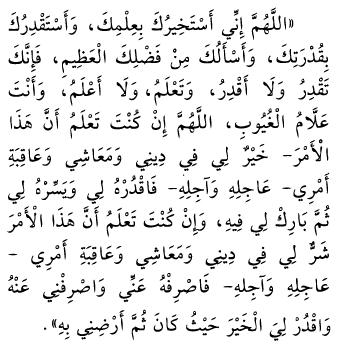
Al-IstikhaarahJabir bin Abdullaah –RadhiAllaahu anhu- said the Messenger of Allaah -sallAllaahu alayhi wa sallam- used to teach us al-Istikharah (a prayer said for seeking blessings in carrying out a decision) for all matters, just like he used to teach us a chapter from the Qur’aan, he would say: If any of you intends to undertake a matter then he should pray two Rakah other than an obligatory prayer then he should say :

Al-IstikhaarahAllaahumma ‘innee ‘astakheeruka bi ‘ilmika, wa ‘astaqdiruka bi qudratika, wa as’aluka min fadhlikal-‘Adheemi, fa ‘innaka taqdiru wa laa ‘aqdiru, wa ta’lamu, wa laa ‘a’lamu, wa ‘Anta ‘Allaamul Ghuyoobi, Allaahumma in kunta ta’lamu ‘anna haadhal-amra – [then mention the thing to be decided] khayrun lee fee deenee wa ma’aashee wa ‘aaqibati ‘amree – [or say] ‘Aajilihi wa ‘aajilihi –  Faqdurhu…

View original post 315 more words

What Shaykh Hamad al-Ansaari said about The Soofeeyah

What Shaykh Hamad al-Ansaari [1] said About The Soofeeyah
Compiled & translated By Abbas Abu Yahya

1 – Seeking Blessings

Shaykh Hamad al-Ansaari said:

‘I saw a person who came for Hajj and there were people gathered around him, and they took his turban, it was white, they tore it up, and some of them began eating it.

So I said to one of them: ‘Why do you eat from his turban?’

A person said: ‘This person is a Haji and we are seeking blessings from his turban.’

I wanted to make him understand [that this is wrong] but he refused to accept and also those along with him.’[2]

2 – Superstitions

‘Indeed all types of superstitions are in the Turq (different paths of the Soofeeyah).’[3]

3 – Play

‘The worship of the Soofeeyah is playing.’[4]

4 -Naqshbandeeyah [5]

‘No one authors, distributes and prints books against the Dawa’ as-Salafeeyah[6] in the world like that what the Turks do and the government of the Rawafidah (Shia) in Iran.  Because the increase of ‘Aqeedah Salafeeyah was not lessened until the Turks began ruling. They are the Naqshbandeeyah, and the Naqshbandeeyah are the enemies of the ‘Aqeedah Salafeeyah.’[7]

5 – Relieved from Worship

‘I saw a man in Africa who was a big Soofi, and people would come to him and kiss his head, his hand, his belly, and his feet and there was a large majority of people around him.

When the prayer time came he did not pray, so I asked about this, and his companions said to me: ‘He does not pray because he is relieved of Islaamic duties. I had read about these types of people in books, and now I have seen them.’[8]

6 – The Soofeeyah are Made Up Of

‘The Soofeeyah are made up of Judaism, fire-worshippers, polytheism, and a basic foundation of Islaam, but Islaam only by name, and they are the brothers of the colonialists.’

AbdulAwal bin Hamad al-Ansaari adds: ‘He means the extreme Soofeeyah.’[9]

7 – Dangers of the Soofis

‘Indeed the Soofi deviants are more dangerous to Islaam than the disbelief of the Russians and Americans.  Because they are negligent with the truth.’[10]

References :

[1] The statements here were taken from the biography of the Shaykh, which was compiled by the Shaykh’s son AbdulAwal bin Hamad al-Ansaari who is a teacher in the faculty of Hadeeth in the prestigious Islaamic University of Madina. The Collection is called:‘al-Majmoo’ Fee Tarjama al-Allama al-Muhaddith ash-Shaykh Hamad bin Muhammad al-Ansaari -Rahimullaah- wa Seeratahi wa Aqwaalihi wa Rihlatihi’. It is a large two-volume collection of the sayings, wisdom and various biographies of the Shaykh. The statements in this translation are all from his son AbdulAwal unless stated otherwise.

[2] [vol. 1 p.390 No.15]

[3] [Vol.2 p. 487 No. 83]

[4] [Vol.2 p. 490  No. 105]

[5] http://followingthesunnah.wordpress.com/2012/05/16/ascription-to-the-salafi-manhaj/

[6] http://followingthesunnah.wordpress.com/2013/01/03/what-shaykh-hamad-al-ansaari-said-about-salafeeyah/

[7] [Vol.2 p. 691 No.64]

[8] [vol.1 p. 397 No. 71]

[9] [Vol.2 p. 488 No. 94]

[10] [Vol.2 p.537  No.366]

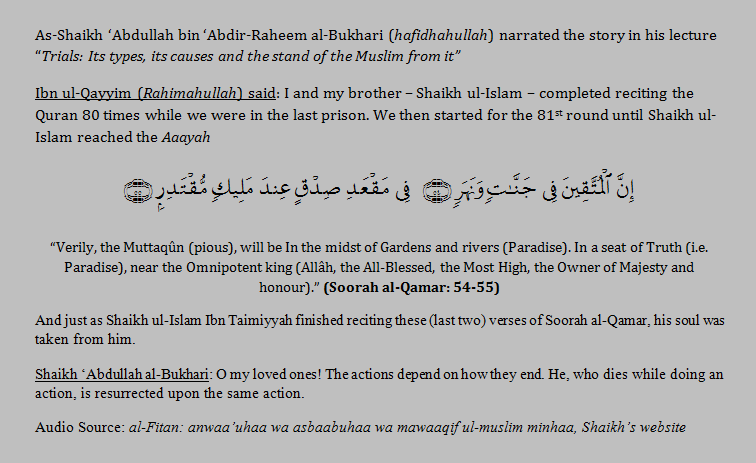
Actions are how they get sealed. The last Action of Ibn Taymiyyah!

Actions are how they get sealed. The last Action of Ibn Taymiyyah!

Benefit Shared by أبوحفص عديّ بن محمّد via Twitter
http://elbukhari.com/download/esound/muhadarat/al_fitan.mp3 …

Receive a good deed for every believing man and woman : Shaykh Abdur Razzaq Al Badr

Translated by Rasheed ibn Estes Barbee
Read the article : http://mtws.posthaven.com/receive-a-good-deed..
Video Courtesy: Bilal Nahim

Repaying a debt in the same currency no matter whether its value increases or decreases – alifta

Browse by Volume Number > Group 1 > Volume 13: Transactions 1 > Buyu` > Payment of the price > Repaying a debt in the same currency no matter whether its value increases or decrease

Question:

I borrowed 20,000 Pakistani Rupees, which were worth 7,000 Saudi Riyals at that time, from my brother. I now want to settle my debt, but the debt of 20,000 Pakistani Rupees is now worth 2,000 Saudi Riyals. Is it permissible for me to repay him with 2,000 Riyals or do I have to give him 7,000 Riyals according to the value when I borrowed it, or is it obligatory on me to give it to him in Pakistani Rupees, the same currency that I borrowed from him?

Answer:

It is obligatory on you to return the money that you borrowed from your brother in the same currency you took it from him, regardless of whether its value has risen or fallen against other currencies.

You therefore have to give him 20,000 Pakistani Rupees, no more or less, for the 20,000 Pakistani Rupees you borrowed. You have to give him what equals its value at the time of the repayment in another currency, such as in Saudi Riyals or another currency, on the condition that it is done in one session. This is based on the answer which the Prophet (peace be upon him) gave to the inquirer who asked him whether it was permissible to sell Dirhams (a dirham of silver equals 2.975 grams of silver) for Dinars (old Arab coin that equals 2.975 grams of gold) or Dinars for Dirhams. He (peace be upon him) said, “There is nothing wrong with taking them at the current rate so long as you do not separate leaving something to be settled.”

May Allah grant us success. May peace and blessings be upon our Prophet Muhammad, his family, and Companions. The Permanent Committee for Scholarly Research and Ifta’

Permanent Committe . Source: http://alifta.net

Taking the means to wake up for the Fajr prayer – Shaykh Sulaymaan ar-Ruhaylee [Video|Ar-En Subtitles]

Video Courtesy : Brother Bilal @ Manhaj ul-Haqq

The Sunnah for the Fajr Prayer – Compiled and Translated By Abbas Abu Yahya

The Sunnah for the Fajr Prayer
Compiled[1] and Translated By Abbas Abu Yahya

Contents:

1 – Giving Attention to the Two Rakat Sunnah for the Fajr Prayer
2 – Shortening the Sunnah of the Fajr Prayer
3 – What the Messenger -sallAllaahu alayhi wa sallam- would Recite in the Two Rakah for the Sunnah of the Fajr Prayer
4 – Recommendation to Pray the Two Rakah at Home
5 – Lying down on the Right Hand side after the Two Rakah Sunnah of the Fajr
The Messenger -sallAllaahu alayhi wa sallam- used to talk after the two Rakah Sunnah for Fajr
6 – The Dislike of Praying the Optional Prayer once Fajr Time has come in, other than the Two Rakah Sunnah for the Fajr Prayer
7 – The Dislike for the Worshipper to begin Praying Two Rakah Sunnah for the Fajr After the Muadhin began the Iqama for the prayer.
8 – Praying two Rakah Sunnah for the Fajr Prayer after the Obligatory Prayer if You Cannot Pray Before it

1 – Giving Attention to the Two Rakat Sunnah for the Fajr Prayer[2]

a) From Ayesha Radi Allaahu anha who said:

‘The Prophet -sallAllaahu alayhi wa sallam- was not more concerned and did not pay attention to any of the optional prayers like he did for the two Rakat of Sunnah for the Fajr prayer.’[3]

b) From Ayesha from the Prophet -sallAllaahu alayhi wa sallam- who said:

‘Two Rakat for Sunnah of Fajr prayer are better than the Dunyaa and everything that is in it.’[4]

c) From Ayesha Radi Allaahu anha who said from the Prophet -sallAllaahu alayhi wa sallam- that he said about the two Rakat when the Fajr prayer time comes in:

‘They are more beloved to me than the Dunyaa and everything that is in it.’[5]

2 – Shortening the Sunnah of the Fajr Prayer

a) From Ayesha Radi Allaahu anha who said that the Messenger of Allaah -sallAllaahu alayhi wa sallam- used to pray thirteen Rakah during the night, then he would pray two short Rakah once he had heard the call for the morning prayer.’[6]

And in the narration of Abu Dawood:

‘The Messenger -sallAllaahu alayhi wa sallam- would pray two Rakah between the Adhan of Fajr and the Iqamah.’

b) From Ayesha who said:

The Messenger of Allaah -sallAllaahu alayhi wa sallam- used to pray two shortened Rakah which were before the morning (Fajr) prayer, he would shorten them so much that I would say: Did he recite Soorah Fatiha?’[7]

Abu Tayeeb Atheema-a-Baadi said:

‘It is established from these Ahadeeth that the Prophet -sallAllaahu alayhi wa sallam- used to pray them when the Mu’adhin had become silent after the Adhan, and when the time of Fajr had come in and Fajr had lit up.  He -sallAllaahu alayhi wa sallam- used to pray them lightly. As for the wisdom of them being a light prayer, then al-Qurtubi said in al-Mufhim: ‘so that the Messenger -sallAllaahu alayhi wa sallam- could go to the morning prayer early at its beginning time.’

Some of the scholars said: ‘So that the Messenger -sallAllaahu alayhi wa sallam- could begin the prayer for the day with two light prayers, just as he would do for the night prayer.’ Therefore, praying them lightly is the Sunnah, and that is the clear truth.’

‘Shawkaani said in ‘Nail Awtaar’:

‘The Hadeeth indicates to the legislation of praying it lightly (i.e. not lengthening it).  This was the opinion of the majority of the scholars, the Hanafeeyah opposed them and said that it is recommended to lengthen the recitation.  This opposes the clear evidence.’

3 – What the Messenger -sallAllaahu alayhi wa sallam- would Recite in the Two Rakah for the Sunnah of the Fajr Prayer

a) From Ibn Umar that the Prophet -sallAllaahu alayhi wa sallam- used to recite in the two Rakat for Fajr, and two Rakat after Maghrib prayer: <<Say to these O Al-Kafiroon >>[8]  & <<Say: He is Allaah, (the) One.>>[9]

b) From Ayesha who said: ‘the Messenger of Allaah -sallAllaahu alayhi wa sallam- used to pray four Rakat before Dhuhr, and two Rakat before Fajr and would not leave them, and she said: and he would say:

‘Two blessed Soorahs which are read in the two Rakat before Fajr: << Say to these O Al-Kafiroon >>[10]  & <<Say: He is Allaah, (the) One.>>’[11]

c) From Ibn Umar – Radi Allaahu anhu – that the Messenger of Allaah -sallAllaahu alayhi wa sallam- said:

 ‘<<Say: He is Allaah, (the) One.>> is equivalent to a third of the Qur’aan, and <<Say to these O Al-Kafiroon >> is equivalent to a fourth of the Qur’aan, and he would read both of them in the two Rakat of Fajr . . .’[12]

d) From the Hadeeth of Abu Hurairah – Radi Allaahu anhu – that the Messenger of Allaah -sallAllaahu alayhi wa sallam- read:

<< Say to these O Al-Kafiroon >>[13]  & <<Say: He is Allaah, (the) One.>>[14]

in the two Rakah of the Fajr prayer.’ (i.e. the Sunnah of Fajr).[15]

e) From Abul-Gayth from Abu Hurairah that he heard the Prophet -sallAllaahu alayhi wa sallam- recite in the two Rakah of Fajr:

<<Say: We believe in Allaah and in what has been sent down to us, >> [3:84] in the first Rakah, and in the other Rakah with this Ayaah:

<<Our Lord! We believe in what You have sent down, and we follow the Messenger [‘Iesa (Jesus)]; so write us down among those who bear witness (to the truth i.e. La ilaha ill-Allaah – none has the right to be worshipped but Allaah). >> [3:53]

or:

<<Verily, We have sent you with the truth (Islaam), a bringer of glad tidings (for those who believe in what you brought, that they will enter Paradise) and a warner (for those who disbelieve in what you brought, they will enter the Hell-fire). And you will not be asked about the dwellers of the blazing Fire.>> [2: 119][16]

Atheem-a-Baadi said:

‘What is established from these Ahadeeth is that the Prophet -sallAllaahu alayhi wa sallam- sometimes would recite << Say to these O Al-Kafiroon >> in the first Rakah, and <<Say: He is Allaah, (the) One.>> in the second Rakah.

And sometimes he would read in the first of the two Rakah:

<< Say: We believe in Allaah and that which has been sent down to us and that which has been sent down to Ibraheem, Isma’eel, Ishaaq, Ya’qoob, and to Al-Asbaat [the twelve sons of Ya’qoob], and that which has been given to Moosa and ‘Iesa, and that which has been given to the Prophets from their Lord. We make no distinction between any of them, and to Him we have submitted (in Islaam). >> [2:136]

and in the second of the two Rakah:

<< Then when ‘Iesa came to know of their disbelief, he said: ‘Who will be my helpers in Allaah’s Cause?’ Al-Hawarioon (the disciples) said: ‘We are the helpers of Allaah; we believe in Allaah, and bear witness that we are Muslims (i.e. we submit to Allaah).’

Our Lord! We believe in what You have sent down, and we follow the Messenger [‘Iesa (Jesus)]; so write us down among those who bear witness (to the truth i.e. Lâ ilâha ill-Allâh – none has the right to be worshipped but Allâh). >> [3:52-53].

And sometimes recite in the first of the two Rakah:

<<Say: We believe in Allaah and in what has been sent down to us, >> [2:136]

and in the second of the two Rakah:

<< Say: ‘O people of the Scripture (Jews and Christians): Come to a word that is just between us and you, that we worship none but Allaah, and that we associate no partners with Him, and that none of us shall take others as lords besides Allaah. Then, if they turn away, say: ‘Bear witness that we are Muslims.’>> [3:64].

And sometimes he would recite in the first of the two Rakah:

<<Say: ‘We believe in Allaah and in what has been sent down to us, and what was sent down to Ibraheem, Isma’eel, Ishaaq, Ya’qoob and Al-Asbaat [the twelve sons of Ya’qoob] and what was given to Moosa, ‘Iesa and the Prophets from their Lord. We make no distinction between one another among them and to Him (Allaah) we have submitted (in Islaam).’>> [3:83]

and in the second Rakah:

<<Our Lord! We believe in what You have sent down, and we follow the Messenger [‘Iesa (Jesus)]; so write us down among those who bear witness (to the truth i.e. La ilaha ill-Allaah – none has the right to be worshipped but Allaah). >> [3:53]

or with this Ayaah:

<<Verily, We have sent you with the truth (Islaam), a bringer of glad tidings (for those who believe in what you brought, that they will enter Paradise) and a warner (for those who disbelieve in what you brought, they will enter the Hell-fire). And you will not be asked about the dwellers of the blazing Fire.>> [2:119].’

4 – Recommendation to Pray the Two Rakah at Home

Abu Tayeeb al-Atheem-a-Baadi said:

‘It is better to pray the two Rakah at home, because the optional pray at home is of a more complete status and has more reward than praying it in the Masjid.  This is affirmed from the Prophet -sallAllaahu alayhi wa sallam- from his actions and his statements.

As for his actions, is that the Prophet -sallAllaahu alayhi wa sallam- used to pray them a lot of the time in his home, as has been mentioned in narrations from Ibn Umar, Ibn Abbas, Ayesha and others from the Companions. Actually it has not been affirmed that he performed them in the Masjid.

As for his saying in the Hadeeth of Ibn Umar, as collected by Bukhari, Muslim, Abu Dawood, Tirmidhi, Nisa’ee and Ibn Majah that the Prophet-sallAllaahu alayhi wa sallam- said:

‘Perform some of your prayer in your homes, and do not take them as graves.’

The Hadeeth of Jabir collected by Muslim, and Muhammad bin Nasr from Jabir Radi Allaahu anhu that he said, the Messenger of Allaah -sallAllaahu alayhi wa sallam- said:

‘If one of you has completed the prayer in his Masjid, then he should make a portion of his prayer for the house, since indeed Allaah will place goodness in his home from his prayer.’

Imam Nawawi said in the explanation of Muslim:

‘Indeed one is encouraged to pray optional prayer in the home due to it being more hidden away, further away from showing off, more protective from being cancelled out and that the home can get blessings, and that mercy can descend in the home, and the Angels, and that the Shaytaan runs away.’

5 – Lying down on the Right Hand side after the Two Rakah Sunnah of the Fajr

Abu Tayeeb al-Atheem-a-Baadi said:

‘It is the Sunnah to lie down on the right side after the Sunnah of the Fajr prayer, whether he performed Tahhajjud (the night prayer) or not, and this is the truth, and this has been narrated from the hadeeth of four people from the Companions of the Prophet -sallAllaahu alayhi wa sallam, Ayesha, Abu Hurairah, Ibn Abbas and Abdullaah bin ‘Amr.

The Hadeeth of Ayesha, collected by Bukhari that she said:

‘The Prophet -sallAllaahu alayhi wa sallam- used to lie down on his right side after praying two Rakats [Sunnah] of Fajr.’

Also, in Muslim from Ayesha the wife of the Prophet -sallAllaahu alayhi wa sallam- who said:

‘The Messenger of Allaah -sallAllaahu alayhi wa sallam- used to pray after finishing the Isha prayer, which the people call ‘al-‘Uttmah’ he would pray eleven Rakah till the Fajr prayer, he would give the Salaam between every two Rakah, and pray one Rakah Witr. And when the Muhaddin would finish from the call to the Fajr prayer, and it would be clear to the Messenger -sallAllaahu alayhi wa sallam-that it is Fajr time and the Muhaddin would come to the Messenger -sallAllaahu alayhi wa sallam, then he would pray a light two Rakah, then lie down on his right side, until the Muadhin would come to him -sallAllaahu alayhi wa sallam- to make the call that prayer is established.’[17]

  • Laying down after the Sunnah prayer for Fajr is not done in the masjid

Shaykh Albaani commented on the Hadeeth of Aeysha Radi Allaahu anha:

‘…then lie down on his right side, until the Muadhin would come to him -sallAllaahu alayhi wa sallam.’

Shaykh Albaani said:

‘This is a clear proof of the permissibility of laying down between the Sunnah of the Fajr prayer and the obligatory prayer, however, it is not known that anyone from the Companions did so in the Masjid, but rather some of them disliked and criticised this.  Therefore, it should be limited to what the Prophet did in his house as is his – sallAllaahu alayhi wa sallam –Sunnah.’[18]

  • The Messenger -sallAllaahu alayhi wa sallam- used to say or talk after the two Rakah Sunnah for Fajr

It has been collected by Bukhari, Muslim and Abu Dawood from Ayesha who said:

‘The Prophet -sallAllaahu alayhi wa sallam- used to, once he had prayed the two Rakah of the Sunnah for the Fajr, he would talk to me if I were awake, otherwise he would lie down.’

Nawawi said in ‘al-Minhaaj Sharh Muslim bin al-Hajjaaj’:

‘In this narration is the proof that it is permissible to talk after the Sunnah of the Fajr prayer.  This is our Madhab, and the Madhab of Malik and the majority of the scholars.’

Al-Qadi said:

‘The Koofeeyoon disliked it, and it is narrated from Ibn Mas’ood and some of the Salaf that this time between two Rakah of the Sunnah for the Fajr and the Fajr prayer is for seeking forgiveness. However, what is correct is that it is permissible due to the action of the Prophet -sallAllaahu alayhi wa sallam. As for it being regarded as the recommended time for seeking forgiveness then that does not prevent the allowance to speak.’

Al-Qastallani said in ‘Irshaad as-Saari’:

‘In this Hadeeth, is that there is no problem with permissible speech after the two Rakah Sunnah for the Fajr.  Ibn al-Arabi said: ‘There is no mention or narration of an excellence of remaining silent at the time, rather that is after the obligatory Morning Prayer until sunrise.’


6 – The Dislike of Praying the Optional Prayer once Fajr Time has come in, other than the Two Rakah Sunnah for the Fajr Prayer

Abu Taeeb al-Atheem-a-Baadi said:

‘It is disliked to pray the optional prayer after Fajr time has come in, because the Prophet -sallAllaahu alayhi wa sallam- did not pray more than the two Rakah of the Sunnah even though he had great concern over the prayer.  Yet there is a prohibition from the Prophet -sallAllaahu alayhi wa sallam- against this.

Muslim and Nisa’ee narrated from Hafsah who said:

‘If the Fajr time came in, the Messenger of Allaah -sallAllaahu alayhi wa sallam- would not pray except for two light Rakahs.’

7 – The Dislike for the Worshipper to begin Praying Two Rakah Sunnah for the Fajr After the Muadhin began the Iqama for the prayer.

Abu Taeeb al-Atheem-a-Baadi said:

 ‘Know that it is disliked to perform the two Rakah of Sunnah for the Fajr after the Muadhin has begun the Iqama for the prayer, this is whther the worshipper is amongst the rows, or not in the row, whether he knows that he will catch the Rakah with the Imam or not.  This is what has been narrated from the Hadeeth of Abu Hurairah, Abdullaah bin Malik bin Buhaynah, Abdullaah bin Surjiss, Ibn Umar, Jabir, Ibn Abbas, Anas bin Muhammad, Zayed bin Thabit, Abu Musa and ‘Aeysha Radi Allaahu anhum.

a) As for the Hadeeth of Abu Hurairah, collected by Muslim that the Prophet -sallAllaahu alayhi wa sallam- said:

‘If the prayer is established then there is no prayer except for the obligatory one.’

b) Bukhari collected from Abdullaah bin Malik bin Buhaynah who said: The Prophet -sallAllaahu alayhi wa sallam- passed by a man, and the prayer had just been established [the Iqama was called] while that man was praying two Rakah, after the Messenger of Allaah -sallAllaahu alayhi wa sallam- finished, the people gathered around him, so the Messenger of Allaah -sallAllaahu alayhi wa sallam- said:

‘Is the morning prayer four Rakahs? Is the morning prayer four Rakahs?’

Abu Taeeb al-Atheem-a-Baadi discusses the general times that prayer is prohibited: ‘Five types, the prohibition to pray after Fajr and Asr, at the time of sunrise, at sunset, and when the sun has reached its highest point, and every one of these types has exceptions. So we say: from the specific times out of the general times is the Hadeeth of Abu Hurairah which was collected by Bukhari in the ‘Chapter: Whoever catches one Rakah from the Asr prayer before sunset.

Bukhari narrates from Yahya from Salmah from Abu Hurairah who said: The Messenger of Allaah -sallAllaahu alayhi wa sallam- said:

‘If one of you catches a Sajdah from the Asr prayer before the sunsets, then he should complete his prayer.  If one of you catches a Sajdah from the morning prayer before the sunrises then he should complete his prayer.’

An-Nawawi said:

‘This is a clear evidence that whoever caught and prayed a Rakah of the morning or Asr prayer, and then the prayer time finished before he gave Salam then his prayer is not null and void, rather he should complete it, and his prayer is correct.  There is a consensus about this point regarding the Asr prayer, as for the morning prayer, then Malik, Shaafi’ee, Ahmad and all the scholars accept it except Abu Hanifah -Rahimullaah, since he says that the morning prayer is void due to sunrise, because the time where Salat is prohibited has entered, and this is in contrast to sunset, but the Hadeeth is an evidence against him.’

Abu Taeeb al-Atheem-a-Baadi also mentions:

‘From those specific matters for the general prohibition is the Ahadeeth of Anas, Abu Hurairah and Abu Qatadah. As for the Hadeeth of Anas, then that has been collected by the six Imams [Bukhari, Muslim, Abu Dawood, Tirmidhi, Nisa’ee and Ibn Majah] and Darmi from Anas from the Prophet -sallAllaahu alayhi wa sallam- who said:

‘Whoever forgets a prayer then he should pray it when he remembers, there is no expiation for the missed prayer except to pray it. << and perform the Salat for My remembrance>> [Taha: 14]’

8 – Praying two Rakah Sunnah for the Fajr Prayer after the Obligatory Prayer if You Cannot Pray Before it

Shaykh Muhammad Bazmool said:

Whoever misses the two Rakah [Sunnah] of the Fajr prayer

It is legislated for the person who misses the two Rakah of Fajr, that he can then pray them directly after the obligatory prayer or after the sun has risen, and what is better is to pray them after the sun has risen.

From Abu Hurairah –Radi Allaahu anhu who said the Messenger of Allaah said:

‘Whoever did not pray the two Rakah [Sunnah] of Fajr; then he should pray them after the sun has risen.’[19]

I [Bazmool] say: ‘The apparent meaning of the Hadeeth indicates that the Sunnah of Salat al-Fajr is obligatory to be prayed after the sun has risen if you had missed this Sunnah prayer, however, this verdict is shifted to a recommended act due to the proof from the following Hadeeth:

From Qays bin Qahd Radi Allaahu anhu that he prayed the Morning Prayer along with the Messenger of Allaah -sallAllaahu alayhi wa sallam, but he had not prayed the two Rakah for the Sunnah of the Fajr prayer.  So when the Messenger of Allaah -sallAllaahu alayhi wa sallam- gave the Salam from the prayer, Qays gave the Salam with him and then after that he stood and prayed two Rakah of the Sunnah for the Fajr, while the Messenger of Allaah -sallAllaahu alayhi wa sallam- was watching him, and he -sallAllaahu alayhi wa sallam-did not criticize him for it.’ [20]

The Hadeeth shows the permissibility of making up the Sunnah prayer of al-Fajr after the obligatory prayer for the person who had not prayed it before the obligatory prayer.’[21]

All Praise belongs to Allaah, may His peace and blessings be upon our final Prophet Muhammad, his family, his companions and all those who follow his guidance.


[1] The majority of this article has been compiled from the book: ‘A’laam Ahl-ul-‘Asr BiHaakaam Rakatay al-Fajr’ by Abu Tayyib Muhammad Shams al-Haqq al-Atheem-a-Baadi

[2] The Importance of the Sunnah of Fajr Prayer

Siddiq Hasan Khan said:

‘Some of the Mushayikh said: ‘The Sunnah of Fajr is starting of actions, and the Witr is ending of actions, this shows the certainty of having concern for these two prayers. This is the reason why it has been legislated to read Soorah Ikhlaas, and Soorah Kafiroon, due to them comprising of Tawheed al-Ilm (knowledge) and al-Amaal (action), and Tawheed al-Ma’rifah (acquainting) and al-Irada (want), and Tawheed al-Itiqaad (belief) and al-Qasd (Intent).’

[Taleeqat ar-Raddeeyah ‘ala Rowddat an-Nadeeya by Siddiq Hasan Khan 1/p.316]

[3] [Bukhari & Abu Dawood]

[4] [Muslim, Tirmidhi & Nisa’ee]

[5] [Muslim]

[6] [Bukhari, Malik in al-Muwatta & Abu Dawood]

[7]  [Bukhari, Muslim, Malik, Abu Dawood & Nisa’ee]

[8] Soorah Kafiroon

[9] Collected by Tabarani in ‘al-Mu’jam al-Kabeer’ from Ibn Umar & Albaani declared it to be Saheeh, in Silsilah Saheeehah No.3328

[10] Soorah Kafiroon

[11] Collected by Ibn Khuzaimah from Ayesha & Albaani declared its Isnad to be Jayyid in Silsilah Saheeehah No.636

[12] Collected by Abu Ya’ala with a Hasan Isnaad, Tabaraani in ‘al-Kabeer’  & Albaani declared it to be Saheeh Lighayrihi in ‘Saheeh Targheeb wa Tarheeb’ no.583 by Albaani

[13] Soorah Kafiroon

[14] Soorah Ikhlaas

[15] [Collected by Muslim, Abu Dawood, Nisa’ee and Ibn Majah]

[16] [Collected by Abu Dawood & Albaani regarded it as Hasan no.1260]

[17] [Muslim, Ahmad & Bayhaqi]

[18] From: ‘Salat ul Taraweeh’ p.90 by Muhammad Nasir ud-Deen al-Albaani]

[19] ‘Hadeeth Saheeh, collected by Tirmidhi in ‘Kitab as-Salah’, Chapter: what is mentioned regarding praying them after sunrise, and authenticated by al-Haakim, Ibn Khuzaimah, Ibn Hibban in ‘al-Ihsaan’ and it is authenticated by the researcher of that book, and al-Albaani authenticated it in ‘Saheeh Sunnan at-Tirmidhi’, and also in Silsilah Saheeehah No.2361

[20] Hadeeth Hasan Li Ghayri hi, collected by Tirmidhi in ‘Kitab as-Salah’, Chapter: what is mentioned about he person who misses the two Rakah before Fajr then he should pray them after the obligatory Fajr prayer.

Also collected by Abu Dawood in ‘Kitab as-Salah’ Chapter: whoever misses the prayer so that he has to make it up. Authenticated by al-Haakim, Ibn Khuzaimah and Ibn Hibban.  It was authenticated by al-Allamma Ahmad Shakir in his checking of ‘Sunnan Tirmidhi’ and al-Albaani in ‘Saheeh Sunnan Tirmidhi’.

A benefit: the Hadeeth shows the permissibility of praying the missed prayers at the time when prayer is prohibited.’

[21] [Taken from: ‘Bugheeyah al-Muttatowa’ fee Salat al-Muttatowa’ by Muhammad Bazmool p. 28-29]