Beneficial points conveyed by brother Nabil Chogle (hafidhahullaah)

بِسْمِ اللَّهِ الرَّحَْٰمنِ الرَّحِيمِ
الحمد لله والصلاة والسلام على رسول الله وعلى آله وصحبه ومن ولاه، وبعد،

Beneficial points conveyed by brother Nabil Chogle [student of knowledge – recommended by Shaykh al-‘Anjaree (hafidhahullah)].

Some of the Kuwaiti Mashaykh the brother , Nabil Chogle, studied under are Shaykh al-‘Anjaree, Shaykh Tariq as-Suba’ee and Shaykh Ahmad as-Suba’ee (hafidhahumullah). Both Shaykh ‘Anjaree and Shaykh Ahmad as-Suba’ee have a recommendation from Shaykh Rabe’e and Shaykh ‘Ubayd al-Jabiree (hafidhahumullah). Shaykh ‘Anjaree (hafidhahullah) said Shaykh Rabe’e (hafidhahullah) praised Shaykh Taariq as-Suba’ee (hafidhahullah) saying he is “Hakeem Hakeem” (Wise Wise – Twice) i.e. he is really good.

Below are some of the brief points that the brother had conveyed:

1. Shaykh al-‘Anjaree (hafidhahullah) constantly advised to be on the Furqaan (That which distinguishes truth from falsehood).

2. The Shaykh also warned about the dangers of falling into Bid’ah (Innovation in the religion).

3. While teaching one of the books, Shaykh Ahmad as-Suba’ee (hafidhahullah) said that the correct explanation of the statement of prophet Muhammad (sallallahu ‘alayhi wa sallam) about Khutbat al-Haaja (The Sermon for Necessities) [1]

مِنْ شُرُورِ أمنْفُسِنما مومِنْ م سيِّئماتِ أمعْ م مالِنما
Min Shuroori an-Fusina wa-Min Sayeaati A’amaalinaa
[“We seek refuge in Allah] from the evils of ourselves and from the evils of our actions” ]

is that we don’t just seek refuge from the evils which our hands have brought forth rather we also seek refuge for the sins into which we fell and which were then followed by others. In Islaam you are rewarded for the good deeds you do and also for those people who follow you in good. Similarly you are punished for the sins that you do and for the misguidance of others who follow you in such sins.

4. The evils of some innovations can be seen hundreds of years later. One of them is the counting of the beads which was not legislated during the time of the Prophet (sallallahu ‘alayhi wasalam). Another example is the seeking of refuge in Allah while yawning (Uttering “aa’odhu billahi min ash-shaytaanir-rajeem” while yawning). One more such innovation is the mentioning of “sadaqallahul adheem” after reciting the Quraan. All these are innovated affairs. The people who initiated these acts would have never thought how widespread these could get.

5. Based on the above it’s extremely important to know if a particular thing that you do is from Sunnah or not. You don’t know who is following you!

6. One should constantly sit with ‘Ulemaa (scholars) and be in touch with them. Shaykh Taariq (hafidhahullah) said he finished Buloogh al-Maraam three times from cover to cover with Shaykh ‘Abdul ‘Azeez ibn Baaz (rahimahullah). Shaykh Tariq (hafidhahullah) also said that in one single sitting with Shaykh ‘Abdul ‘Azeez ibn Baaz (rahimahullah) they used to study five different books.

7. Shaykh Rabe’e advised to submit to the text (Quraan and the Sunnah). First of the ones to make Qiyaas (applying one’s own intelligence) was Iblees. His argument of him being made by fire made him think he was superior. This is one of the reasons of going astray.

8. Warning of staying away from affairs of fighting and spilling blood. The rebels say loosing 20,000 lives or so is a small price for the oppression suffered. Verily for a Salafi every life is expensive. The whole affair of making Khurooj is not meant for the general public.

9. Make a lot of supplications. Verily one of the reasons of winning the war in Jihad is the supplication of those who didn’t join.

10. When Salman al-‘Awdah planned a visit to Kuwait, Shaykh al-‘Anjaree wrote a front page article in the newspaper clearing the affairs of Salman al-‘Awdah. The Kuwaiti government al-Hamdullilah went ahead and cancelled his visit. Some 50 odd scholars then thanked the government for its intervention.

11. The Shaykh also paid for a half page advert in one of the leading daily newspaper writing about “Guidance to Muslims upon Walee al-Amr”

12. It is from Salafiyah to be from those who do charity discreetly. Also it’s better to go and help out the needy directly than to buy charity coupons. One should feel the charity. Seeing first hand the sufferings of the people increases one in Eemaan. He also mentioned names of Mashaykh from Kuwait regularly visiting refugee camps in Syria and Turkey to help our brothers who are being tested by Allah. May Allah ease their affairs. Verily He has power over all things.

13. Also he mentioned a Hadeeth about charity.

Narrated Abu Hurayrah (radhiallahu ‘anhu): The Prophet (sallallahu ‘alayhi wa sallam) commanded to give Sadaqah (charity). A man said, “Apostle of Allah, I have a Dinaar (currency of gold)”. He (sallallahu ‘alayhi wa sallam) said, “Spend it on yourself”. He (the man) again said, “I have another”. He (sallallahu ‘alayhi wa sallam) said, “Spend it on your children”. He (the man) again said, “I have another”. He (sallallahu ‘alayhi wa sallam) said, “Spend it on your wife”. He (the man) again said, “I have another”. He (sallallahu ‘alayhi wa sallam) said, “Spend it on your servant”. He (the man) finally said, “I have another”. He (sallallahu ‘alayhi wa sallam) replied, “You know best (what to do with it)”. [Sunan Abee Dawud, Book of Charity] [2]

14. One valuable advice which he mentioned from Shaykh al-’Anjaree (hafidhahullah) was the only way to succeed is to be a hard worker. Just because you are smart does not mean that you will succeed. Indeed success is from Allah.

15. Manage time efficiently. If a task can be completed in 4 hours do not spend 13 days on it.

16. Verily there is Barakah (blessing) in the mornings so do not spend it sleeping at home. (referring to the time post Salaat al-Fajr).

17. Keep a balance between Deen (religion) and Dunyah (worldly life) and let one of them strengthen the other.

18. It’s not from the Salaf to just work 8 hours a day or 6 days a week. In fact they used to work all week around. The evidence is that the Khutbat al-Jumu’ah (Friday sermon) used to be short so that people could get back to their affairs at the earliest.

19. Strive as much as you can. Do not wait. Aid the Dawah as much as you can and in any manner. Those capable of financial aid should help with money, those capable of printing flyers should do so, and those who can translate should do so.
20. Be in constant touch of the Mashaykh and those whom they refer.

وصلى الله على نبينا محمد وعلى آله وصحبه وسلم

For References [1] and [2] please check the last page of the PDF: Beneficial points conveyed by brother Nabil Chogle (hafidhahullaah)[PDF]

Follow the brother Nabil Chogle on Twitter for beneficial tweets @ http://twitter.com/nchogle

Post Courtesy: Abu AbdirRahman Rajeef @ islaam.ae / Acef Iqbal

Discouraging from concentrating on satisfying the stomach, and having vast amount of food and drink being greedy and wanton

Discouraging from concentrating on satisfying the stomach, and having vast amount of food and drink being greedy and wanton

Translated By Abbas Abu Yahya

1 – (2134) From Abu Hurairah – Radi Allaahu anhu– who said the Messenger of Allaah -sallAllaahu alayhi wa sallam- said:

المسلم يأكل في معى واحد والكافر في سبعة أمعاء

‘A Muslim eats for one stomach, and a non-Muslim eats for seven stomachs.’

[Collected by Malik, Bukhari, Muslim, Ibn Majah and others. Albaani declared it Saheeh No.2134]

And in the narration of Bukhari:

‘There used to be a man who would eat a lot, then he accepted Islaam, and he would only eat a small amount, so this was mentioned to the Messenger of Allaah -sallAllaahu alayhi wa sallam-, so he said:

إن المؤمن يأكل في معى واحد وإن الكافر يأكل في سبعة أمعاء

‘Indeed the believer eats for one stomach, and indeed the non-Muslim eats for seven stomachs.’

And in the narration of Muslim he said:

‘That the Messenger of Allaah -sallAllaahu alayhi wa sallam- hosted a non Muslim guest, so the Messenger of Allaah -sallAllaahu alayhi wa sallam- ordered for a goat to be milked and the guest drank its milk, then another one was milked and he drank its milk, then another one was milked and he drank its milk, until he had drunk the milk of seven goats!  Then in the morning he had accepted Islaam. The Messenger of Allaah -sallAllaahu alayhi wa sallam- ordered for a goat and the man drank its milk, then another but he could not finish it, so the Messenger of Allaah -sallAllaahu alayhi wa sallam- said:

إن المؤمن ليشرب في معى واحد والكافر يشرب في سبعة أمعاء

‘A believer drinks for one stomach, and the kaffir drinks for seven stomachs.’

[It was also collected by Malik and Tirmidhi, with similar wording]


2 –  (2135) From Al-Miqdad bin Ma’d Yakrib Radhi Allaahu anhu who said:

‘I heard the Messenger of Allaah -sallAllaahu alayhi wa sallam- saying:

ما ملأ آدمي وعاء شرا من بطن بحسب ابن آدم أكيلات يقمن صلبه فإن كان

 لا محالة فثلث لطعامه وثلث لشرابه وثلث لنفسه

‘A human does not fill a more evil container than a stomach.  It is sufficient for the son of Adam to eat small portions by which his back can remain straight.  If it is not possible, then he should reserve his stomach, a third for his food, third for his drink and a third for his breathing.’

[Collected by Tirmidhi and he declared it to be Hasan,  and by Ibn Majah and Ibn Hibban & Albaani declared it to be Saheeh. No.  2135]

3 – (2136)  From Abu Juhayfah Radhi Allaahu anhu who said:

‘I had eaten a broth made of bread and meat, then I came to the Prophet -sallAllaahu alayhi wa sallam- and I began burping.  The Prophet -sallAllaahu alayhi wa sallam- said:

يا هذا كف عنا من جشائك فإن أكثر الناس شبعا في الدنيا أكثرهم جوعا يوم القيامة

‘O person!  Stop your burping, indeed majority of those people who are satiated and full from food in the Dunyaa, will be the hungry on the Day of Judgement.’

[Collected by al-Hakim and he said: Saheeh al Isnad & Albaani declared it to be Saheeh. No. 3136]

[Taken from: ‘Saheeh Targheeb wa Tarheeb’ by Shaykh Albaani – Vol.2 p.501- 502]

4  – From al-Miqdaam bin Ma’ad Yakrib al-Kindee who said: I heard the Messenger of Allaah -sallAllaahu alayhi wa sallam- say:

ما ملأ آدمي وعاء شرا من بطن بحسب ابن آدم أكلات يقمن صلبه فإن كان

 لا محالة فثلث لطعامه وثلث لشرابه وثلث لنفسه

‘A human does not fill a vessel more evil than his stomach. It is sufficient for the son of Adam to eat food that would keep his back straight. If it is inevitable (that he eats a full meal) then a third is for his food, a third for his drink and a third for air.’

[Taken from: ‘Silsilah Ahadeeth Saheehah’ No. 2265]

The Encouragement to Fast Ramadan Seeking a Reward – Compiled and translated By Abbas Abu Yahya

The Encouragement to Fast Ramadan Seeking a Reward
Compiled & translated By Abbas Abu Yahya

Published by Miraath Publications

Audio Excerpt: Miraath Publications – BiteSize Ramadhaan 1434 Articles – Day 05

1 – (992) – From Abu Hurairah -Radhi Allaahu anhu- from the Prophet -sallAllaahu alayhi wa sallam- who said:
من قام ليلة القدر إيمانا واحتسابا غفر له ما تقدم من ذنبه ومن صام رمضان إيمانا واحتسابا غفر له ما تقدم من ذنبه

‘Whoever prayed during the night of Laylatul – Qadr due to Eemaan and seeking a reward, then he is forgiven his previous sins. Whoever Fasts Ramadan due to Eemaan and seeking a reward, then he is forgiven his previous sins.’

[Collected by Bukhari, Muslim, Abu Dawood, Nisa’ee, Ibn Majah & Albaani declared it to be Saheeh]

Al-Khattabi said: ‘The meaning of the Prophet’s saying: ‘due to Eemaan and seeking a reward’ means having the intention and a strong resolve, which is to fast Ramadan with certainty and desiring a reward for it. Wanting to make oneself better due to Ramadan, without disliking it, nor with feeling it burdensome due to fasting it, nor due to its long drawn out days, but rather taking opportunity of the many days of Ramadan for its great reward.’

Baghawi said: ‘The saying of the Prophet: ‘seeking a reward’ means seeking Allaah’s Face and His reward.’

2- (993) – Abu Hurairah -Radhi Allaahu anhu- said:
كان رسول الله صلى الله عليه وسلم يرغب في قيام رمضان من غير أن يأمرهم بعزيمة ثم يقول
من قام رمضان إيمانا واحتسابا غفر له ما تقدم من ذنبه
The Messenger of Allaah -sallAllaahu alayhi wa sallam- used to encourage praying in the night during Ramadan, without ordering them to do so as an obligation, then he would say:

‘Whoever prayed during the night in Ramadan due to Eemaan and seeking a reward, then he is forgiven his previous sins.’

[Collected by Muslim, Abu Dawood, Tirmidhi, Nisa’ee & Albaani declared it to be Saheeh.]

Shaykh Albaani mentioned in the footnote:

‘This encouragement of having sins forgiven and those similar to it, are a clarification of the excellence of this type of worship, which is that if a person had sins then they are forgiven for him due to this type of worship. It is known that the means which lead to general forgiveness are many, so when these means are gathered/ combined, what can remain from those sins so that he needs to be forgiven?

So the purpose is a clarification of the excellence of this worship, that Allaah gives this worship this amount of excellence. If there was no sin upon a person, then this excellence is expressed in raising the rank of a person, the like of that which is rightful for the Prophets, who are infallible from committing sin. And Allaah knows best.’

3 – (994) – Abu Hurairah -Radhi Allaahu anhu- from the Messenger of Allaah -sallAllaahu alayhi wa sallam- who said:
الصلوات الخمس والجمعة إلى الجمعة ورمضان إلى رمضان مكفرات ما بينهن إذا اجتنبت الكبائر

‘The five daily prayers, from one Juma till the next Juma, from Ramadan to the next Ramadan, are an expiation for what takes place between them, as long as the major sins are kept away from.’

[Collected by Muslim]

4 – (998) – Abu Hurairah -Radhi Allaahu anhu- from the Messenger of Allaah -sallAllaahu alayhi wa sallam- who said:
إذا جاء رمضان فتحت أبواب الجنة وغلقت أبواب النار وصفدت الشياطين

‘When Ramadan comes in, the doors of Paradise are opened, the doors of Hell-Fire are closed and the Devils are locked up.’

[Collected by Bukhari & Muslim]

In the narration of Muslim:
فتحت أبواب الرحمة وغلقت أبواب جهنم وسلسلت الشياطين

‘The doors of mercy are opened, the doors of Hell are closed, and the Devils are chained up.’

In the wording from Tirmidhi and Ibn Majah:
إذا كان أول ليلة من شهر رمضان صفدت الشياطين ومردة الجن وغلقت أبواب النار فلم يفتح منها باب وفتحت أبواب الجنة فلم يغلق منها باب وينادي مناد يا باغي الخير أقبل ويا باغي الشر أقصر ولله عتقاء من النار وذلك كل ليلة

‘When it is the first night of the month of Ramadan, the Devils are locked up and the evil Jinn, the doors of Hell-Fire are closed, so that no door from it is open. The doors of Paradise are opened, so no door from it is closed. A caller will call out: O seeker of good come forward, and O seeker of evil keep away from sin, and Allaah has slaves freed from the fire, and that is every night of Ramadan.’

[Albaani declared it Hasan]

5 – (1002) – It is narrated from Abu Saeed al-Khudri -Radhi Allaahu anhu- who said: The Messenger of Allaah -sallAllaahu alayhi wa sallam- said:
إن لله تبارك وتعالى عتقاء في كل يوم وليلة – يعني في رمضان – وإن لكل مسلم في كل يوم وليلة دعوة مستجابة

‘Indeed Allaah -Tabaraka wa Ta’ala- has freed slaves every day and night -meaning in Ramadan- and indeed every Muslim has every day and night a supplication that is answered.’

[Collected by al- Bazzar & Albaani declared it to be Saheeh lighayrihi.]

6 – 1003 – From Amr bin Murra al-Juhani -Radhi Allaahu anhu- who said: ‘A man came to the Prophet -sallAllaahu alayhi wa sallam- and asked: ‘O Messenger of Allaah! Do you see that if I testify that there is none worthy of worship except Allaah, and that you are the Messenger of Allaah, and I pray the five prayers, and I gave the Zakat, and Fast Ramadan, and prayed during its nights, so who will I be from?’

He -sallAllaahu alayhi wa sallam- said:
من الصديقين والشهداء
‘From the righteous and the martyrs.’

[Collected by al-Bazzar, Ibn Khuzaimah, Ibn Hibban & Albaani declared it Saheeh.]

[Taken from: ‘Saheeh Targheeb wa Tarheeb’ by Shaykh Albaani – Vol.1 p.582]

– See more at: http://www.miraathpublications.net/day-05/#sthash.FpXpEmHr.UuJNhLvt.dpuf

Posted fromhttp://www.miraathpublications.net/day-05/

Make Du’aa right before Maghrib on Fridays and when Fasting

Bismillaah Al-Hamdulillaah wa salatu wa salaamu ‘ala rasulullaah
Amma-ba’d

Implementing the Sunnah of the Prophet (salallaahu ‘alayhin wa sallam) in your Du’aa to Allaah!

Student Salah al-‘Iraanee (hafidhahullaah) said: “The Du’aa made before Maghrib on Fridays is answered, and the Du’a when fasting is also answered! Both are just before Maghrib!”

Then he brought the hadeeth: “…Supplications will be answered on Friday after ‘Asr prayer until the sun goes down.” [Saheeh al-Targheeb wa’l-Tarheeb, no. 700]

Hadeeth: “There are two which will not be rejected: du’aa at the time of the adhaan and when it is raining.” [Saheeh al-Jaami’ 3078].

Hadeeth: “A du’aa made between the adhaan and iqamah is not rejected.” [Saheeh al-Jaami’, 2408]

Hadeeth: “Oh Messenger of Allaah, which du’aa is heard?” He (salallaahu ‘alayhin wa sallam) said: “In the last third of the night.” [al-Albaani in Saheeh al-Tirmidhi 3499]

The following are Etiquettes, Manners, Guidelines of Making Du’aa from the Sunnah and Min Akhbar as-Salaf (From the Narrations of the Salaf)

Fadalah bin ‘Ubayd (radiallaahu ‘anhu) said: “The Messenger of Allaah (salallaahu ‘alaihi wa sallam) heard a man making supplication in his prayer when he had not praised Allaah or said Salah upon the Prophet. The Messenger of Allaah (salallaahu ‘alaihi wa sallam) said: This man is rushing.

Then he (salallaahu ‘alaihi wa sallam) called him over and said to him or to someone else:

When any one of you supplicates, let him start by praising and glorifying Allaah, The Exalted, then let him send Salah upon the Prophet, and after that let him make supplication as he wishes.

Imam Ahmad, Abu Dawud and At-Tirmidhi reported the above hadeeth and graded it Sahih; An-Nasa`i, Ibn Khuzaymah and Ibn Hibban recorded in their Sahihs.

‘Abdullaah ibn Masood (radiallaahu ‘anhu) said:

When one of you wishes to ask (Allaah), then he should begin with praising and thanking Allaah with that which He deserves. Then he should ask Allaah to send His peace and blessings upon the Prophet (salallaahu ‘alaihi wa sallam) then he should ask (for his need). For verily, that (the above method) is more likely to result in success.

(as-Saheehah no. 3204)

The following is a summary of guidelines for making Du’aa – a summary (and fiqh) from Min Akhbar as-Salaf (From the Narrations of the Salaf):

  • 1- one should be sincere in Du’aa
  • 2- one’s heart should be present in the Du’aa
  • 3- while fearing Allaah
  • 4- one’s food should be halal
  • 5- one should make Du’aa with truthfulness
  • 6- the Du’aa should be made repeatedly, persistently
  • 7- humble yourself to Allaah
  • 8- be consistent in Du’aa
  • 9- increase in Du’aa during times of fear
  • 10- Don’t leave off making Du’aa (even if you commit sins), for Allaah answered the du’aa of shaytan – worst of all creation – “grant me respite until the Day of Judgment.” Allaah said (what means): You are of those allowed respite. (Al-A’raf, ayah 15)
  • 11- Keep in mind that Du’aa is ‘ibaadah (worship)
  • 12- one should be fearful of being prevented from making Du’aa
  • 13- Do not say “my Du’aa is not answered,” while you yourself close the door by sins

Post Courtesy: Maher ibn Ahmad

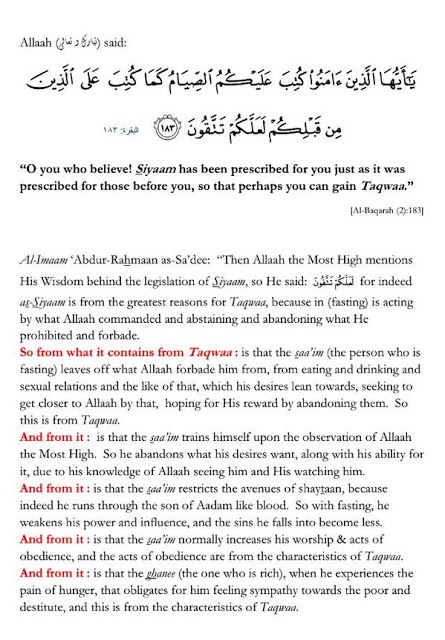
Imam as-Sa’dee’s Tafseer of Allaah’s Statement: "Oh you who believe! Siyaam has been prescribed for you…"

Bismillaah Al-Hamdulillaah wa salatu wa salaamu ‘ala rasulullaah
Amma-ba’d
Oh you who believe! Siyaam has been prescribed for you

Source: http://salafiyyah-kuwait.blogspot.com/

The Shayaateen are locked up, but not their soldeirs – Shaykh Saalih al-Fawzaan [Video|Ar-En Subtitles]

Shaykh Saalih al-Fawzaan (hafithahuAllah)
Source: alfawzan.af.org.sa/node/14849

Video Courtesy: Eesa ibn Roy

The State of the Salaf (Pious Predecessors) in Ramadan – Shaykh Rabia’ ibn Haadee al-Madkhalee

The State of the Salaf in Ramadan
by Shaykh Rabia’ ibn Haadee al-Madkhalee (hafidhahullaah)
Translated by Umm Yahya 

Question:

A questioner is asking about the state of the Salaf in Ramadan.

Answer:

In answering this question I say, that the state of the noble Messenger –alayhi as-Salat wa Salam- in Ramadan is well known and he used to prepare for this month by fasting more in Shabaan. As is narrated in the Hadeeth of Aeysha Radhi Allaahu anha-: ‘He –Alayhi as-Salat wa Salam- used to fast all of, or most of Shabaan.’

Then he –Alayhi as-Salat wa Salam- would fast in this noble month of Ramadan and exert himself even more so in the last ten nights of Ramadan.

When the last ten nights entered he would exert himself in worship and tighten his waist wrapper (meaning to exert him self in worship), he would perform Itikaaf and his wives would too and many of his –Alayhi as-Salat wa Salam- Companions would also make Itikaf.

He –Alayhi as-Salat wa Salam- would establish these great actions of fasting perfectly, performing good deeds and showing goodness and sacrifice.

The Messenger –Alayhi as-Salat wa Salam- was extremely generous, he was the most generous of people and when Ramadan came, he –Alayhi as-Salat wa Salam- was more generous than a wind that had been sent and more so if Jibraeel was sent as is narrated in the Hadeeth of Ibn Abbas Radhi Allaahu anhumaa.

The Messenger of Allaah would recite, or present the Qur’aan to Jibraeel once every Ramadan, and in the last year of his noble life he recited the Qur’aan to Jibraeel twice, as is narrated in the Hadeeth of Ayesha and Abu Hurairah Radhi Allaahu anhumaa. This was a sign of his –Alayhi as-Salat wa Salam- eminent passing away.

So the Salaf held a special concern for this great month of paying attention to reciting the Qur’aan, increasing in the remembrance of Allaah, abstaining from sins, as fasting necessitates all these things. Fasting is not merely abstaining from food and drink indeed it is a way of refraining from all that Allaah The Most High The Most Blessed hates in terms of sins etc.

Fasting is also turning in obedience to Allaah –Azza wa Jal- and to have Ikhlaas (sincerity) for Allaah in this action.

May Allaah be pleased with the Salaf. It is said of Malik that he would teach the people and when Ramadan approached he would free up his time for fasting and reciting Qur’aan.

Thus you should give importance to reciting the Qur’aan in this noble month, along with reflecting upon it and pondering about it, and to take heed of the admonition and take heed of that which is rebuked, and comprehend the Halal and Haram and the clear understanding of Allaah’s threats and promises and things of this nature from the noble Qur’aan, with this the soul is purified and hearts are illuminated.

This illustrates to us that the Qur’aan is life, light and a guidance for us as Allaah -Tabaraka wa Ta’ala- has described it as such.

وَكَذَٰلِكَ أَوۡحَيۡنَآ إِلَيۡكَ رُوحٗا مِّنۡ أَمۡرِنَاۚ مَا كُنتَ تَدۡرِي مَا ٱلۡكِتَٰبُ
وَلَا ٱلۡإِيمَٰنُ وَلَٰكِن جَعَلۡنَٰهُ نُورٗا نَّهۡدِي بِهِۦ مَن نَّشَآءُ مِنۡ عِبَادِنَاۚ
وَإِنَّكَ لَتَهۡدِيٓ إِلَىٰ صِرَٰطٖ مُّسۡتَقِيمٖ

<< And thus We have sent to you Ruhan (an Inspiration, and a Mercy) of Our Command. You knew not what is the Book, nor what is Faith? But We have made it (this Qur’aan) a light wherewith We guide whosoever of Our slaves We will. And verily, you are indeed guiding (mankind) to the Straight Path.>> [ash-Shura: 52]

Regarding the way of the Righteous Salaf, you should read about their striving, their patience and their sincerity for Allaah, how they exceeded in their efforts in this noble month and other months. That is to say that we do not only remind ourselves of performing these actions only in the month of Ramadan and then become heedless and forsake our obedience to Allaah in the remaining months, on the contrary we continue to stand in the night with prayer and continue to worship Allaah and turn to Allaah in addition to all the other acts of worship in order to gain closeness to Allaah in Ramadan, we should not be heedless.

Some people turn in obedience to Allaah in this month and once it has passed they fall short, become lazy and forget many acts of worship.

No, there is no doubt that we should have more concern in this month than in the other months, however, we must remember Allaah continuously throughout the year and throughout our lives.

يَٰٓأَيُّهَا ٱلَّذِينَ ءَامَنُواْ ٱذۡكُرُواْ ٱللَّهَ ذِكۡرٗا كَثِيرٗا 

وَسَبِّحُوهُ بُكۡرَةٗ وَأَصِيلًا 

<< O you who believe! Remember Allaah with much remembrance.

And glorify His Praises morning and afternoon [the early morning (Fajr) and ‘Asr prayers]. >> [Ahzab: 41-42]

Therefore, the believer remembers Allaah -Tabaraka wa Ta’ala- continuously, obeys Him, has Taqwa of Him, has Khushoo (humility) of Him and awareness of Him in every hour of his life.

I beseech Allaah to grant us and you the ability to perform the night prayer, fast and all that which is obligatory upon us in this noble month and grant us eagerness and zest regarding its virtues

I also beseech Allaah to grant us the ability to continuously uphold His obedience and turn to Him upon that which pleases Him. Verily our Lord hears the supplication.’

[Taken from: ‘Majmoo’ Kutub wa Rasail wa Fatawa Fadeelatu Shaykh alaama Rabia’ bin Hadi Umayr al-Madkhalee’ 15/337-339]

Courtesy: http://followingthesunnah.wordpress.com/

Hadith of Irbaadh Ibn Saariyah (radiyallaahu anhu) – “Stick to my Sunnah and the Sunnah of the Rightly-Guided Caliphs” – Abu Sufyaan Uthmaan Beecher [Audio|En]

Hadith of Irbaadh Ibn Saariyah (radiyallaahu anhu)
A short reminder of the obligation of holding on to the way of the Salaf (telelink with brothers in Singapore and Sri Lanka) – Aboo Sufyaan Uthmaan Beecher hafidhahullaah

Hadith of Irbaad ibn Saariyah, may Allaah the Most High be pleased with him, who said, “The Messenger of Allaah صلى الله عليه وسلم gave us a sermon which frightened the hearts and caused the eyes to shed tears. So we said, ‘O Messenger of Allaah! [it is as if it is a farewell sermon] so advise us.’ He said,

‘I advise you to fear Allaah and to hear and obey even if an Abyssinian slave were to rule over you. For surely, he who lives from amongst you will see much differing, so it is upon you to be upon my Sunnah and the Sunnah of the Rightly Guided Caliphs. Bite on to it with your back molar teeth and beware of newly invented matters, for verily, every newly invented matter is an innovation, and all innovation is misguidance.’” 

Related by Aboo Daawood (no. 4607) and by at-Tirmidthee (no. 2676). It was authenticated by Shaykh al-Albaanee in Irwaa’ul-Ghaleel (no. 2455).

Listen / Download Mp3 Here (Time 49:55)

Audio Posted from: http://soundcloud.com/noor-al-furqaan/a-reminder-regarding-holding

Soorah al-Kaafiroon is a Declaration of Freedom from Shirk – Aboo Sufyaan Uthmaan Beecher [Audio|En]

Khutbah: Soorah al-Kaafiroon
May 10, 2013 – Camp Buehring, Kuwait
Aboo Sufyaan Uthmaan Beecher
[Audio|English]

Listen /Download Mp3 Here (Time 29:04)
[audio http://salafiaudio.files.wordpress.com/2013/07/khutbah-soorah-al-kaafiroon-aboo-sufyaan-uthmaan-beecher.mp3]

Posted fromhttp://soundcloud.com/noor-al-furqaan/khutbah-soorah-al-kaafiroon

Aboo Sufyaan ‘Uthmaan Beecher – Noor al-Furqaan Publications
Fintas, Kuwait · Salafiyyah-Kuwait.blogspot.com

The Declaration of Innocence from Shirk 

This Surah is the Surah of disavowal from the deeds of the idolators. It commands a complete disavowal of that. Allah’s statement, (Say: “O disbelievers!”) includes every disbeliever on the face of the earth, however, this statement is particularly directed towards the disbelievers of the Quraysh. It has been said that in their ignorance they invited the Messenger of Allah to worship their idols for a year and they would (in turn) worship his God for a year. Therefore, Allah revealed this Surah.

Source : Tafsir Ibn Kathir

Reciting Sooratul-Kaafiroon When Going To Bed

Imaam Aboo Daawood -rahimahullaah- reported in his “Sunan‟[The Book of Manners: Chapter (107) What should be said at the time of sleep] (no. 5055):

“an-Nufaylee narrated to us: Zuhayr narrated to us: Aboo Ishaaq narrated to us: from Farwah ibn Nawfal: from his father: that the Prophet (peace be upon him) said << Read Soorah Kaafiroon then sleep upon its conclusion, because it is a declaration of freedom from shirk >>.”

– Declared “Saheeh” by Shaikh al-Albaanee.
– Also reported by Imaam at-Tirmidhee (no.3403).

[Translated by Aboo Talhah Daawood ibn Ronald Burbank]
www.alitisaambissunnah.wordpress.com

Golden Advice for Ramadhaan – ash-Shaykh al-Allaamah Saalih al Fawzaan [Video|Ar-En Subtitles]

Translated by Abu ‘Abdullah Naasir Hussain (Hafidhahullah)

Transcribed text from the Video:

The Noble Shaykh Saalih Al-Fawzaan حفظه الله

All praises and thanks be to Allah, the Lord of the Worlds.  May Allah send prayers and peace upon our Prophet Mohammad, and upon all his family and companions.

To proceed:

So, indeed we are…  and all praises are due to Allah…  in this month…  whomever Allah helps from amongst us, then we are upon great goodness.

For it is a noble month, which Allah, the Most High far from imperfections, made better than other months.  Allah, the one far from imperfections, said:

“The month of Ramadan in which was revealed the Quran, a guidance for mankind and clear proofs for the guidance and the criterion (between right and wrong). So whoever of you sights (the crescent on the first night of) the month (of Ramadan i.e. is present at his home), he must observe Saum (fasts) that month…”

[Soorah Al-Baqarah: 185]

Allah made the fasting in it obligatory and praying during its nights voluntary.

The fasting in it is the fourth pillar of Islam.  The standing at night in taraaweeh  and tahhajjud prayers is a Sunnah of the Messenger of Allah established by him, may Allah send prayers and peace upon him.

Fasting has important rulings because it is a striving of oneself – striving of oneself against its desires.  The person leaves that which he desires, what his self wants, he leaves it in obedience to Allah, the Most High far from imperfections, preferring the obedience of Allah over the obedience of his own self.  He leaves that which he desires seeking to draw close to Allah, the Mighty and Majestic.  This is a sign of faith… this is a sign of faith… the one who chooses the obedience of Allah over the obedience to his self; this is a sign of his faith.

As for the one who is the opposite – the one who chooses obedience of oneself over the obedience of Allah, then he is a hypocrite.

So, the believer during these days knows that Allah has commanded him to leave his food, drink and (relations with) his wife; leaving these for Allah, the Mighty and Majestic.  Then, from the Mercy of Allah, the One free from imperfections, is that He has provided for him a time in which he can enjoy these desired things which are permissible.  They are impermissible during the day because of fasting, but are allowed at night.

“It is made lawful for you to have sexual relations with your wives on the night of As-Saum (the fasts)…”

Until the saying of Allah, the Most High:

“…and eat and drink until the white thread (light) of dawn appears to you distinct from the black thread (darkness of night), then complete your Saum (fast) till the nightfall…”

[Soorah Al-Baqarah: 187]

So, He designated the fast to begin at Fajr time and end at sunset.  The night is the setting of the sun.

The believer obeys Allah, the Mighty and Majestic.  He breaks his fast at the time of breaking the fast.  It is obligatory upon him to break his fast at the time of breaking the fast, just as it is obligatory upon him to fast at the time of fasting, because he is a slave of Allah.  He obeys Allah, the Mighty and Majestic, in those things that he has ordered and abstains from those things that he has prohibited.

It is not allowed for a person to continuously fast during the day and night – this is not allowed.  He, may Allah send prayers and peace upon him, prohibited al-wisaal (fasting continuously without breaking the fast).  They said: ‘O messenger of Allah, you perform a continuous fast’.  He used to perform a continuous fast, but this is from the things that were specific to him, may Allah send prayers and peace upon him.  This is from the things that were specific to The Messenger.  As for us, then we break our fast at the time of breaking the fast and we fast at the time of fasting.

And if a person fasts, then this does not mean that he follows (the example only) in leaving food, drink and (relations with) his wife, rather he leaves all of that which Allah has prohibited for him outside of the time of fasting, because there are things that are always prohibited and there are those things that are allowed but they are prohibited at the time of fasting only:  eating, drinking and relations with the wife – these are allowed at other than the time of fasting.  So, they are allowed at a given time and prohibited at a given time.

As for those things which are not allowed, such as, back-biting, tale-spreading,  false speech, cursing, prohibited speech, looking at that which is prohibited and listening to that which is prohibited, these are prohibited forever and always.  So, if a person does these things during the fast, then this makes his fast deficient or could invalidate the reward of his fast, so no reward remains for him with Allah.  He justify his food and drink, which are allowed at other than the time of fasting, but he didn’t leave that which Allah prohibited for him at all times.  That which Allah prohibited at all times, he didn’t leave it – so this one, in reality didn’t fast!  He fasted from one perspective – fasted from that which Allah allowed, and he wasn’t fasting from those things that Allah prohibited!  So for this one, there is no reward!  His share from the fasting is just hunger and thirst, as the Messenger of Allah, may Allah send prayers and peace upon him, stated:

“It may be that a fasting person’s portion from his fast is merely hunger and thirst”.

And, it may be that the share of the one who stands in prayer is merely staying up late.  Why?  Because he didn’t purify his intention for Allah, the Mighty and Majestic, in his standing for prayer.  He stands in order to show-off and to be heard of.

“And when they stand up for As-Salat (the prayer), they stand with laziness and to be seen of men, and they do not remember Allah but little”.

[Soorah An-Nisaa: 142]

Things are based upon the sincerity to Allah, the Mighty and Majestic, and obedience to Allah, the Mighty and Majestic, as Allah ordered you to break your fast, you break it… he ordered you to fast – fast.  You are a slave to Allah, the Most High far from imperfections.

What is amazing is that many people especially in our times, they fast, they fast, they leave food, drink and those apparent things that break the fast – they leave them.  But, they don’t perform the prayers at their appointed times.  They sleep through them – they sleep throughout the whole day!  There is no Fajr prayer, no Thuhr prayer, no ‘Asr prayer!  They get up at the time of breaking the fast.  If the time for breaking the fast comes, they get up to eat and drink.  Their prayer has been lost.  These people have no fast with Allah, the Mighty and Majestic.  They have no fast with Allah, even though they fasted in the daytime.  They justify food and drink but, they have no fast with Allah!  Why?  Because the one who justify the prayer, then there is no fast for him.  The prayer is the second pillar of Islam and fasting is the fourth pillar.  So, the fast is not accepted from the one who has neglected the prayer.  These ones neglect the prayer and they fast?  This will not be of any use to them and it will not benefit them with Allah, the Most High far from imperfections, until they establish the prayer.  There is no religion for the one who doesn’t establish the prayer – he has no religion!  Because the prayer is a pillar of Islam.  It is the distinguishing factor between a Muslim and a disbeliever.  The one who doesn’t pray, is a disbeliever.  The one who totally abandons the prayer is a disbeliever, by the consensus of the scholars.  As for the one who didn’t leave the prayer, but doesn’t offer it at the times that Allah has legislated, this one didn’t pray – he neglected his prayer:

“Then, there has succeeded them a posterity who have given up As-Salat (the prayers) [i.e. made their Salat (prayers) to be lost, either by not offering them or by not offering them perfectly or by not offering them in their proper fixed times, etc.] and have followed lusts…”

[Soorah Maryam: 59]

“So woe unto those performers of Salat (prayers) (hypocrites), who delay their Salat (prayer) from their stated fixed times”.

[Soorah Al-Maa’oon: 4-5]

He named them as those who pray – they pray, but at a time which is other than the time which Allah ordered them.  So they have neglected it and its prescribed time.  Allah warned them with wayl and punishment – al-wayl is punishment and we seek refuge with Allah.  He is punished and he prays?  Yes, he is punished!  He is punished and he prays, because he didn’t pray as he was ordered to do so by Allah, rather he prays as his self tells him to.  This means that he is a slave to himself and his desires and not a slave to Allah, the Most High far from imperfections.

So the Muslim should be aware of these issues.  He should preserve his religion, his prayers, his Zakaah, his fasting, his Hajj, his ‘Umrah, his whole religion.  This is the one who is a Muslim.  As for the one who establishes a part of the religion, and leaves another part, this is like the one who lives in a ruined house – it doesn’t have doors or walls!  A dilapidated house!  It doesn’t protect him from the heat or the cold or prevent thieves.  Likewise in Islam, the one who doesn’t live upon that which Allah has ordered, then this will not benefit him, even if he is named as being upon Islam.  Islam is indeed as Allah has ordered – it is submission to Allah – submission to Allah by singling him out (in worship).  Subservience to him with obedience.  Distancing oneself from associating partners to Allah and from the polytheists – this is Islam.

I ask Allah that he helps us to righteous speech and action.  May Allah send prayers and peace upon our Prophet Mohammad, and upon all his family and companions.

Ramadhan Index Page:
https://abdurrahman.org/ramadhan/

Fear of Shirk – Aboo Sufyaan Uthmaan Beecher [Audio|En]

Listen / Download Mp3 Here (Time 23:57)
[audio http://salafiaudio.files.wordpress.com/2013/07/khutbah-fear-of-shirk-aboo-sufyaan-uthmaan-beecher.mp3]

Posted from: http://soundcloud.com/noor-al-furqaan/khutbah-fear-of-shirk-camp

We should (truly) be afraid of the reality of shirk since Ibraaheem (`alayhis-salaam) was the Imaam of the monotheists, and he demolished the idols with his hands, yet still feared falling into shirk. If the Imaam of the monotheists, Ibraheem (`alayhis-salaam), feared shirk for his own being, should we not, as average every-day monotheists, be moreso afraid for ours?

»وَاجْنُبْنِي وَبَنِيَّ أَن نَّعْبُدَ الْأَصْنَامَ«
«Keep me and my sons away from worshiping idols.»
[Soorah Ibraaheem (4):35]


Ibn Taymiyyah (rahimahullaahu ta`aala) commented: WHO can be safe from trials after that? [Collected by Ibn Abee Haatim in his Tafseer]

Related Links: (Must Read)

An-Nushrah during Jahiliyyah (Counteracting Magic with its Like) – Sharh Kitaabit-Tawheed by Sheikh Saaleh al-Fawzaan – Abu Muhammad al-Maghribee [Audio|Eng]

An-Nushrah (Counteracting Magic with its Like)
Abu Muhammad al-Maghribee
[Audio|Eng]

This is the weekly Saturday morning class given at Masjid at-Tawheed in Stone Mountain, GA.
From the book Al-Mulakhas fee Sharh Kitaabit-Tawheed by Sheikh Saaleh al-Fawzaan.

You may download the original text in Arabic here: الملخص في شرح كتاب التوحيد

Listen / Download Mp3 Here (Time 42:18)
[audio http://salafiaudio.files.wordpress.com/2013/07/an-nushrah-counteracting-magic-with-its-like-sharh-kitaabit-tawheed-by-sheikh-saaleh-al-fawzaan-abu-muhammad-al-maghribee.mp3]

What has Been Said About An-Nushrah 

It is reported on the authority of Jabir (Radhi Allaahu Anhu) that Allah’s Messenger was asked about an-nushrah and he said:

“It is one of the works of Satan.” (Narrated by Ahmad with a good Sanadand by Abu Dawood

Who said: “Ahmad was asked about these matters and he answered that Ibn Mas’ood detested all such things.”)

Because an-nushrah was one of the actions of the Jahiliyyah, and the Companions had no desire or liking for the Jahiliyyah or its deeds, they asked the Prophet about an-nushrah. He replied that it is one of the works of Satan, and it is well-known that Satan orders not except that which is corrupt and detestable to the Believer. As for that which is permissible and not from the works of Satan, there is ar-ruqyah, seeking refuge (with Allah swt ) and the use of all permissible medicines (i.e. those which do not contain forbidden substances such as alcohol, pig fat etc.) and the Hadith is not a forbiddance of these things.

Posted from: http://followthesalaf.com/blog/2013/5/18/explanation-of-kitaab-at-tawheed

“Ibn Al-Qayyim said: “An-Nushrah is counteracting the effects of magic and it consists of two kinds:

1. Counteracting magic with its like and this is the work of the devil.

2. An-Nushrah by means of ar-ruqyah, seeking refuge with Allah , permissible medicines and making supplications to Allah – these are all permitted forms of an-nushrah.

The Virtue and Excellence of The Last Ten Nights of Ramadhaan – Shaykh Muhammad ibn Rabee’ al-Madkhalee [eBook] [Audio|Ar-En]

The Virtue and Excellence of The Last Ten Nights of Ramadhaan by Shaykh Muhammad ibn Rabee' al-Madkhalee

Bismillaah wa -Alhamdulillaah wa Salaatu wa Salaam ‘alaa Rasulillaah ‘amma ba’d

Muwahhideen Publications organized a LIVE Tele-Lecture with the Noble Shaykh Muhammad ibn Rabee’ ibn Hadi’ al-Madkhalee (May Allaah Preserve Him), son of Ash-Shaykh al-Allaamah Rabee’ ibn Hadi al-Madkhalee (May Allaah Preserve Him) and a professor of Aqeedah in The Islaamic University of Madeenah. The Shaykh has written many books, more famous of which is the refutation of the sufis, which is available in English. The Shaykh will elaborate on the virtue and excellence of the last ten nights of Ramadhaan.

Listen / Download Mp3 Here (Time 30:21)

Read e-Book :

The following Ebook was transcribed from a tele-lecture by ash-Shaykh Muhammad ibn Rabee’ al-Madkhalee (حفظه اللهhosted by Muwahhideen Publications on 9th August 2012 entitled, “The Virtue and Excellence of the Last Ten Nights of Ramadhaan.”

Herein, the Shaykh discusses pertinent matters related to Taraweeh, Laylatul Qadr, the last ten night of Ramadhaan in general and other salient points of benefit.

~ An excerpt taken from the Ebook ~

“Dear brothers, this is going to be the last part of this phone lecture and we really need more action than statements. From the wisdom of Allah سبحانه وتعالى, is that He has hidden the Night of Decree from us and we do not know exactly when it is going to be in the last ten in the month of Ramadhaan. And He سبحانه وتعالى told His Prophet صلّى اللَّهُ عليه وسلّم exactly when it would be and when the Prophet صلّى اللَّهُ عليه وسلّم went out to his Companions to tell them exactly when the Night of Decree will be, he found two of the Muslims arguing with one another, asking him to judge between them so he became busy with their affair and was made to forget exactly which night is the Night of Decree in the last ten of Ramadhaan. This in itself indicates and shows us how bad it is to disagree with one another and how bad it is to fight amongst the Muslims, so much so that Allahسبحانه وتعالىtook away the knowledge of the exact day of Laylatul Qadr in the last ten. That is one way of looking at it.”

Download PDF: The Virtue and Excellence of the Last Ten Nights of Ramadhaan by Shaykh Muhammad ibn Rabee’ al-Madkhalee

Courtesy from : http://store.mpubs.org

The Keys of Good – Shaykh ‘Abdur-Razzaaq ibn ‘Abdul-Muhsin Al-Badr

Bismillaah Al-Hamdulillaah wa salatu wa salaamu ‘ala rasulullaah
Amma ba’d

The Keys of Good, by Shaikh ‘Abdur-Razzaq al-‘Abbad, ibn Shaikh ‘Abdul-Muhsin al-‘Abbad al-Badr (hafidhahumullaah)

From amongst people are those who are keys to good and closers of evil. There are also those who are – we seek refuge in Allaah – keys to evil and closers of good. This is according to their condition of good or evil. Every vessel will dispense what is present within it.

It is recorded in Ibnu Majah as well as Ibn Abee ‘Asim in as-Sunnah, and other than them, on the authority of Anas ibnu Malik that the Messenger of Allaah (salallaahu ‘alaihi wa sallam) said:

Indeed from the people are people who are keys to open the good for the people, and to lock away the evil. And indeed from the people are people who are keys to lock away and block the good, and they open up the evil for the people. So Tooba (glad tidings; scholars have also defined this word Tooba to be a tree in Paradise) is for the one whom Allaah subhanahu wa ta’aala places the keys of good at his hands. And woe be to the one whom Allaah has placed the keys of evil at his disposal. – {Hasan hadeeth, Ibn Majah: 237; as-Sunnah by Ibn Abee ‘asim: 297}

The Imaams of guidance, the callers to the Sunnah, the supports of the religion, and the carriers of knowledge – those who call the people to guidance and are patient upon harm, those who bring life to the dead by means of the Book of Allaah and bring sight to the blind by the light of Allaah – they are the keys to good.*

Imam As-Sa’dee (rahimahullaah), describing The Keys to Good, said:

From the most important factors is learning beneficial knowledge and spreading it. Verily, this is the key to all good. From this is enjoining the good and forbidding the evil with gentleness, kindness and wisdom. An example of this is a servant performing a good practice and starting a beneficial task in order that the people follow him in doing so. …

[From Abee Hurayrah (radiyAllaahu ‘anhu) that the Messenger of Allaah (salallaahu ‘alaihi wa sallam) said, “Whoever calls to guidance has a reward like the example of the reward of those who follow him, not decreasing their reward in any way. And whoever calls to misguidance has upon him the sin like the example of the sin of those who follow him, not decreasing their sin in anyway.” Narrated by Muslim, no. 2674.]

Another example is giving valuable advice and sincerity in the religion, or in wordly affairs. Verily, those who advise are keys to good and blockers of evil.

Imam As-Sa’dee also mentioned those who are keys to good take advantage of the opportunity of gatherings by busying them with good – and away from evil.

So when the desire for good becomes the focal point of the individual, and his intention is determined on accomplishing his goal according to his ability, he seeks assistance from Allaah in fulfilling his goals, he approaches affairs in the correct manner and fashion and, as a result, he will continue to gain good and reap reward.

And the opposite of this is lack of desire for good; much good escapes this person. If lack of sincerity and advice for others is coupled with this, and he doesn’t intend to benefit others in any fashion – in fact, he may actually desire to harm and deceive them to accomplish personal goals or corrupt beliefs – at that time, he has indeed come with the greatest means of [harm] and elimination of good. He has become one who deserves to be called ‘a key to evil’ and a blocker of good. We seek refuge in Allaah from the evil of ourselves and of our actions. –

 Riyad u Nadirah: 1/512-513

* The author (Shaikh ‘Abdur-Razzaq al-‘Abbad) commented in a footnote:

The opening of good is done by clarifying the good to mankind and calling them to it, encouraging them regarding it, causing a desire for it, and similar to this. As for opening of good, which is expanding one’s chest for good and success and accepting it, then this affair is solely for Allaah.

Subsequently, the opening is of two types:

  • 1- That which is done by way of the creation, and this is accomplished through propagation, guidance and clarification.
  • 2- The second is by Allaah only, and this is accomplished through guidance, inspiration, and allowing to succeed.

Source: The book The Keys of Good, by Shaikh ‘Abdur-Razzaq al-‘Abbad, son of Shaikh ‘Abdul-Muhsin al-‘Abbad al-Badr (hafidhahumullaah)

Three Levels of Fasting – Imam Ibn Qudamaah Al-Maqdisee

There are three levels of fasting, the general fast, the specific fast and the more specific fast.

As for the general fast, then it is the refraining of ones stomach and their private parts from fulfilling their desires.

The specific fast is the refraining of ones gaze, tongue, hands, feet, hearing and eyes, as well as the rest of his body parts from committing sinful acts.

As for the more specific fast, then it is the heart’s abstention from its yearning after the worldly affairs and the thoughts which distance one away from Allaah, as well as its (the heart’s) abstention.

From all the things that Allaah has placed on the same level. [5]

From the characteristics of the specific fast is that one lowers his gaze and safeguards his tongue from the repulsive speech that is forbidden, disliked, or which has no benefit, as well as controlling the rest of his body parts. . In a hadeeth by al-Bukhaaree:

‘‘Whosoever does not abandon false speech and the acting upon it, Allaah is not in need off his food and drink.’’ [6]

Another characteristic of the specific fast is that one does not overfill himself with food during the night. Instead, he eats in due measure, for indeed, the son of Aadam does not fill a vessel more evil than his stomach. If he were to eat his fill during the first part of the night, he would not make good use of himself for the remainder of the night. In the same way, if he eats to his fill for suhoor, he does make good use of himself until the afternoon. This is because excessive eating breads laziness and lethargy therefore, the objective of fasting disappears due to one’s excessiveness in eating, for what is indeed intended by the fast, is that one savours the taste of hunger and becomes an abandoner of desires.

References:

[5] (Editors note: Additional comment is required here, The levels mentioned are levels of abstinence.

The first of these three levels entails the abstinence which is fulfilled, the fast is considered complete in view of the one having met the legislated requirements [i.e. It does not have to be repeated or made up, the servant has indeed fasted.]

The remaining levels deal with the value of the Fast. If the second is level is not met, the fast will be of less value to the servant, than if it were met and likewise for the third.

Thus it is said that intentional eating and intercourse render the fast null and void, whereas committing other unlawful acts such, likes speaking falsely, placing the unlawful look to the opposite sex and so on will constitute a sin of one degree or another, but not nullify the fast.

[6] Related by al-Bukhaaree (4/99)

Posted from : The Inner Secrets of Fasting
Imam Muwaffaq-ud-Deen Ibn Qudamaah Al-Maqdisee
Translated by Isma’eel Ibn al-Arkaan

They talk much about the scholars yet they do little themselves – Shaykh Saalih al-Fawzaan [Video|Ar-En Subtitles]

Scholar: ´Allâmah Sâlih bin Fawzân al-Fawzân
Source: Cassette tape ”Aqwâl-ul-´Ulamâ’ fîl-Jihâd”
Reference: Darulhadith, Sweden
Translation and Video by aFatwa.com (site is down)

Question: After the reckless attacks, the scholars that follow the methodology of the Salaf have been slandered a lot. They are accused of coaxing the disbelievers and of being to their satisfaction. How do you advise these people who say this?

Shaykh al-Fawzân: What has this person, who slanders the scholars and accuses them of this and that, done himself? What has he done himself? What has he himself done? What has he done against the disbelievers? Or is he only talking without doing anything?

Secondly, he is asked the question: Do you know what is means to coax? Do you know what it means to be to someone’s satisfaction? There is a difference between coaxing and pleasing someone. Does he know the difference? Or is he talking without knowledge?

Thirdly, one should during these circumstances keep one’s mouth closed. One should keep the mouth closed in order not to fall into gossiping, backbiting, and splitting the Muslims. The human is obliged to keep the mouth closed. These issues have their men who take care of them; the scholars and the rulers. They are the ones who treat these issues. It is namely not these people’s concern. There are correct people who take care of them. Allâh says:

“When there comes to them some matter touching (public) safety or fear, they make it known (among the people), if only they had referred it to the Messenger or to those charged with authority among them, the proper investigators would have understood it from them (directly).” (The Qur’ân 4:83, interpretation of the meanings)

Not everyone is able to delve into these matters. These matters are for those charged with authority and they are the scholars and the rulers. This is their responsibility and we are obliged to advise them and pray for them that they get success in what they are doing and that they firmly remain established upon the truth. We have nevertheless no right to sit in our meetings and backbite this one, slander that one and insult the third. This is pure evil. There is no good in it. It is pure evil. All it leads to is the splitting of the Muslims and that one gets evil thoughts about the scholars and the rulers. And in the end, there’s just more tribulations.

It is obligatory to understand these matters. These issues are not a big mess. Religious issues have rules and principles. They have their sources. If you have some knowledge or something to clarify, then you should go to those responsible or write them a letter. However, that you should speak in sittings, this is considered to be disallowed. It leads to tribulations and evilness. You are talking with ignorant people who do not understand anything. You thereafter incite them against their brothers and rulers. Where is the benefit in this? If you have some knowledge or something to say, then you should go to the rulers. The prophet (sallâ Allâhu ‘alayhi wa sallam) said:

“The religion is an advice.” They (the companions) said: “To whom, O messenger of Allâh?” He said: “To Allâh, His book, His messenger, the leaders and laymen of the Muslims.”

A Nasîhah means that you advise, not that you disparage people and accuse them of coaxing and that they are to other’s satisfaction. It is worse than what you are afraid of.

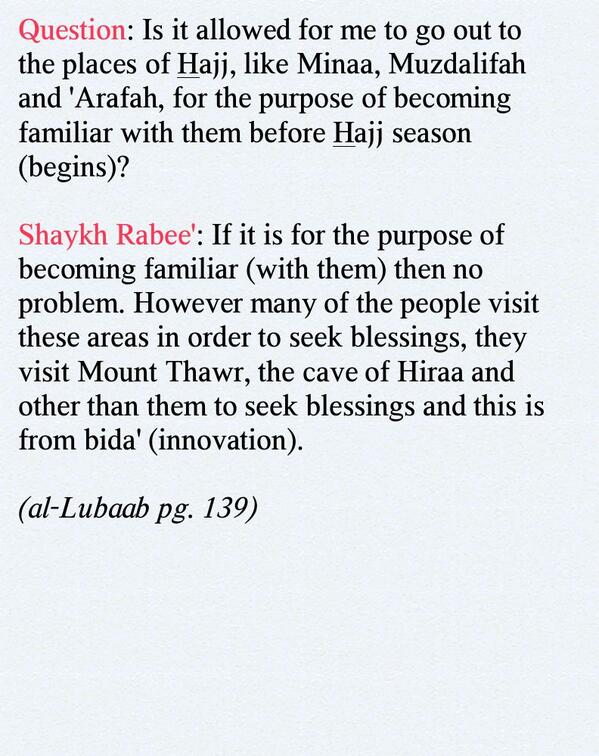
Visiting the places of Hajj outside of it’s time – Shaykh Rabee’ al-Madkhalee

Bismillaah Al-Hamdulillah wa salatu wa salaamu ‘ala rasulullaah
Amma-ba’d

Visiting the places of Hajj outside of it's time - Shaykh Rabee' al-Madkhalee

Related Links:

Whats Wrong With Our Salafiyyah ? – (Good Character and Manners) – Abu Uwais Abdullaah Ali [Audio|En]

Listen / Download Mp3 Here (Time 01:05:49)

Related Links:

Did the Sahaba differ in ‘Aqeedah? – Shaikh Ubaid al-Jabiree [Video|Ar-En Subtitles]

Source: http://ar.miraath.net/fatwah/3881
هل اختلف الصحابة -رضي الله عنهم- في العقيدة؟

Video Courtesy: DawahSalafiyaah

Why do deviants say that the Sahaaba differ in ‘aqeedah? So they can justify their hizbiyyah and their differing. They work night and day to try to find differing of the sahaaba, so they can justify their opposition to the Sunnah – i.e. sahaabah differed so we can differ

Highly Beneficial Link:

Golden Advices from Shaikh Ahmad as-Subay’ee and others

In the name of Allāh, the Most Merciful, the Bestower of Mercy.

As-salāmu ‘alaikum wa rahmatullāhi wa barakātuh.

Student Abu Remlah Adam Amreeki (hafidhahullaah) relayed the following scholarly advices:
Shaikh Abu Muhammad Ahmad As-Subay’ee (hafidhahullaah) said:

“Only strive in clinging to the Sunnah; even if all of mankind praised you, it would not increase you in anything with Allaah”

“There is nothing equivalent to being guided to the Sunnah; it is the most tremendous blessing after Tawheed.”

“Only strive in clinging to the Sunnah; even if all of mankind praised you, it would not increase you in anything with Allaah.”

“From the evil effects of sins is that they weaken one’s ability to distinguish Truth from falsehood.”

“If someone only speaks against those people whom have spoken against him first, then he’s not a sincere advisor.”

“There’s NEVER been a single day that Jameeah IhyaaTuraath had ever been upon the Sunnah; it was founded upon other than Sunnah.”

“Search for the Truth (الحق), like the searching of a frantic mother who lost her child (as Allaah said what means:) and those who strive for Our sake, we will surely guide them to Our paths. (Al-Ankabut, ayah 69)

“The most tremendous way to purify the hearts: Cling to the Sunnah TRUTHFULLY, and recite the Qur`an with contemplation.”

Shaikh Rabee’ Bin Haadee al-Madkhalee (hafidhahullaah) said:

“That some of Ahl-Sunnah go easy on those who fall into tribulations (فتن) and falsehood in the name of “keeping them close,” or because they are considered to be “from Ahl-Sunnah,” then this does NOT benefit Islaam in anything.”

“The most dangerous of the arrows and spears are the arrows of the Hadaadees; they and the enemies of Islaam are together in the same trench.”

From the great wisdom in Shaikh Rabee’s advice about Al-Hajoori:

“Take MANLY stances with him.” [Don’t fear standing up to who opposes the Sunnah!]

Shaikh Abu ‘Uthmaan Muhammad Al-Anjaaree (hafidhahullaah) said:
“Having knowledge of the Correct Path and how to succeed in this life & hereafter isn’t enough; a Sunni must have DETERMINATION (عزيمة)!”       

Shaikh Muhammad Ibn Salih al-‘Uthaymeen (rahimahullaah):

“There’s NOTHING in the Book nor Sunnah which allows the innovated Islamic political groups & parties.” (جماعات و أحزاب)

Shaikh ‘Ubaid ibn ‘Abdullaah al-Jaabiree (hafidhahullaah) said:

 “The khawaarij are dogs of the hellfire…they lie against Allaah, His Prophet (salallaahu ‘alayhi wa sallam), and His Religion; they are (those) who spoil the image of Islaam!”

Post Courtesy: Maher ibn Ahmad