Book Study: Aqeedatus-Salaf of as-Saaboonee – Expl. of Shaykh Rabee – Abu Muhammad al Maghribee [Audio|En]

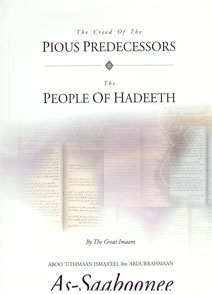
Aqeedatus-Salaf of as-Saaboonee – Expl. of Shaykh Rabee The Explanation of the Creed of the Salaf,  by Imaam Abee Uthmaan Ismaa’eel bin Abdir-Rahmaan As-Saaboonee,rahimahullaah, as explained by our noble sheikh al-Allaamah Rabee’ bin Haadee Al-Madkhalee, hafidhahullaah.

You may download the original text of As-Saaboonee’s work here: عقيدة السلف أصحاب الحديث (PDF)

Listen or Download Below

Part01 : Listen /Download Mp3 Here (Time 1:00:49)

Part02 : Listen /Download Mp3 Here (Time 54:34)

Part03 : Listen /Download Mp3 Here (Time 57:15)

Part04 : Listen /Download Mp3 Here (Time 58:15)

Part05 : Listen /Download Mp3 Here (Time 01:00:33)

Part06 : Listen /Download Mp3 Here (Time 01:01:45)

Part07 : Listen /Download Mp3 Here (Time 51:56)

Part08 : Listen /Download Mp3 Here (Time 01:01:20)

Part09 : Listen /Download Mp3 Here (Time 01:07:29)

Part10 : Listen /Download Mp3 Here (Time 54:51)

Part11 : Listen /Download Mp3 Here (Time 54:39)

Part12 : Listen /Download Mp3 Here (Time 53:13)

Part13 : Listen /Download Mp3 Here (Time 52:04)

Part14 : Listen /Download Mp3 Here (Time 47:45)

Part15 : Listen /Download Mp3 Here (Time 41:54)

Part16 : Listen /Download Mp3 Here (Time 52:16)

Part17 : Listen /Download Mp3 Here (Time 59:43)

Part18 : Listen /Download Mp3 Here (Time 54:26)

Part19 : Listen /Download Mp3 Here (Time 57:53)

Part20 : Listen /Download Mp3 Here (Time 58:43)

Part21 : Listen /Download Mp3 Here (Time 55:48)

Part22 : Listen /Download Mp3 Here (Time 01:03:55)

Part23 : Listen /Download Mp3 Here (Time 01:05:55)

Part24 : Listen /Download Mp3 Here (Time 58:20)

Part25 : Listen /Download Mp3 Here (Time 59:40)

Part26 : Listen /Download Mp3 Here (Time 58:47)

Part 27 | 28 | 29 | 30 | 31 | 32 | 33 | 34 | 35 | 36 | 37 | 38 | 39 | 40 | 41 | 42 | 43 | 44 | 45 | 46 | 47 | 48 | 49 | 50 | 51 | 52 | 53 | 54 | 55 | 56 | 57 | 58 | 59 | 60 | 61 | 62 | 63 | 64 | 65 | 66 | 67 | 68 | 69 |

These are ongoing classes.other parts will be uploaded as they are made available by http://followthesalaf.com

Being Pleased With Allaah, His Messenger & His Deen : Shaykhul Islaam Ibn Qayyim al-Jawziyyah

By Shaykhul –Islaam Ibn Qayyim al-Jawziyyah as-Salafi -Rahimullaah-
Translated & Compiled  by Abbas Abu Yahya

Ibn Qayyim aj-Jawzeeyah (d.751 A.H.) -Rahimullaah- said:

‘The Prophet – sallAllaahu alayhi wasallam –said:

ذَاقَ طَعْمَ الإيمانِ : مَنْ رَضِيَ بالله ربًّا، وبالإسلام دينًا، وبمحمَّدٍ رَسُولاً

‘The sweetness of Eemaan has been tasted by he, whomever is pleased with Allaah as a Lord, Islaam as a religion and Muhammad as a Messenger.’

[Collected by Muslim]

The Prophet – sallAllaahu alayhi wa sallam –said:

مَنْ قَالَ حِيْنَ يَسْمَعُ النِّدَاءَ رَضِيتُ بِاللَّهِ رَبًّا، وَبِمُحَمَّدٍ رَسُولاً، وَبِالإِسْلاَمِ دِينًا. غُفِرَ لَهُ ذَنْبُهُ

‘Whoever says, when he hears the call to prayer, I am pleased with Allaah as a Lord, Muhammad as a Messenger and Islaam as a religion, then his sin will be forgiven.’

[Collected by Muslim]

The levels of the religion revolve around these two Ahadeeth and they end with these.

Indeed these two Ahadeeth include being pleased with the Ruboobeeyah (Lordship) of Allaah Subhanahu, and His Ulooheeyah (worshipping Him), being pleased with His Messenger and having obedience to him, and being pleased with Allaah’s religion and having submission to it.

Whoever has these four aspects combined, then he truly is a Siddeeq (truthful) person. It is an easy claim and statement to say, but it is from the most difficult matters in reality and in being tested, especially if what occurs opposes the desires of the soul and the intent of that becomes clear that being pleased was stated with just the tongue, so it was upon the tongue and not with ones actions.

Therefore, being pleased with Allaah’s Ieelaheeya (meaning the One who is worshipped):

includes being pleased with loving Him alone, being fearful of Him, having hope in Him, and turning repentantly to Him, and having devotion for Him,  andstrength of intention and having all love for Him,  the person being pleased does everything to please his beloved, and this includes His worship and having sincerity for Allaah.

Being pleased with His Ruboobeeyah (Lordship):

This includes being pleased with what Allaah has planned and disposed for His slave. Being pleased with Allaah’s Ruboobeeyah also includes singling Allaah out alone for having trust and reliance upon Him, and seeking assistance with Him, trusting Him, having reliance upon Him, and that a person is pleased with everything that Allaah does to him.

The first: includes being pleased with what He commands.

The second: includes being pleased with what He destined for him.

There are many people who are pleased with Allaah as a Lord and they do not desire any other Lord except Him, however, they are not pleased with Him with being the only Wali (Guardian) and being the only Helper. But they have loyalty to Awaliyah other than Allaah, thinking that they are bringing you closer to Allaah, and that being loyal to them is like being loyal to those who are close to the king, and this is specific Shirk.

Indeed Tawheed is that a person does not take any one other than Allaah as an Awaliyah, and the Qur’aan is full of the description of the Mushrikeen that they took Awaliyah other than Allaah.

This is not the loyalty that one has for Allaah’s Prophets, His Messengers and His believing slaves, since this is from the completion of Eemaan to have loyalty to His Prophets, and this is in fact complete loyalty for Allaah.

Therefore, having loyalty for His Awaliyah is one colour and taking a Wali other than Allaah is a different colour. Whoever has not understood the distinction and criterion between them, then he must study Tawheed from its foundation, since this issue is a foundation of Tawheed and its base principle.

There are many people who desire to take someone other than Allaah as a judge to whom they can take their judgements to.

With whom they could debate, and be pleased with his judgement.

These three levels are the pillars of Tawheed; that none other than Allah is taken as a Lord, or as a deity and none other than Him has a command.

Being pleased with His Prophet:

As for being pleased with His Prophet as a Messenger: then this includes having prefect obedience to him, and complete submission to him, whereby the Prophet –sallAllaahu alayhi wa sallam– is foremost to a person than his own self.  So he does not take guidance except from the places of the Messenger’s speech,  he does not turn for a judgement except to him, and no one gives a judgement above his,  and he totally is not pleased with someone else’s judgement, not in anything from the Asmaa (Names) of Allaah and His characteristics and His actions, nor in anything from the perception and sense of the reality of al Eemaan and its different  levels,  nor in anything from the Ahkam (rulings) apparent and hidden, and a person is not pleased with a ruling regarding these things from someone other than the Messenger, and he is not pleased except with his ruling.

If however a person is incapable of following the Messenger’s judgement, then him having someone else’s judgement then this is from the view of forceful nourishment for a person who cannot find that which would sustain himself with except from dead flesh and blood.  The best that can be said about this situation is that it is like using dust, which is used for Tayummum (dry ablution) when a person is incapable of using water for purification.

Being pleased with His Deen (Religion):

As for being pleased with the Deen, so if the Deen says something or gives a ruling or commands or prohibits then a person should be completely pleased with it. There does not remain any opposition and resistance in his heart from its ruling, and he submits to it with total submission.  Even if it opposes what his own self intends, or his desires, or the statement of the one whom he blindly follows, or his Shaykh or his sect, this is where all the people desert you except the Ghuraba (those who adhere to the Sunnah) in this world.

Beware of feeling distressed and lonely of being isolated and alone [i.e. Since the people abandon you for holding on to the Sunnah, being from the Ghuraba.]  since indeed it is -and I swear by Allaah- the distinction of honour and companionship with Allaah and His Messenger and it is the soul of being close to Allaah.  And being pleased with Allaah as a Lord, Muhammad as a Messenger and Islaam as a religion.

[From: ‘Madarij as-Salikeen’ 2/170-172]

The Different Wordings of the Hadeeth

1 – From Abu Sa’eed al-Khudri saying that the Messenger of Allaah – sallAllaahualayhiwasallam– said:

(مَنْ قَالَ: رَضِيتُ بِاللَّهِ رَبًّا وَبِالْإِسْلَامِ دِينًا وَبِمُحَمَّدٍ صَلَّى اللَّهُ عَلَيْهِ وَسَلَّمَ نَبِيًّا وَجَبَتْ لَهُ الْجَنَّةُ)

‘Whoever says: ‘I am pleased with Allaah as the Lord, Islaam as the Religion and with Muhammad as the Prophet, then Paradise becomes obligatory for him.’

[Collected in SilsilahSaheehah 334 &Saheeh Abu Dawood 1368]

2 – From Aamir bin Sa’ad bin Abee Waqas from his father from the Messenger of Allaah – sallAllaahualayhiwasallam –that he said:

(مَنْ قَالَ حِينَ يَسْمَعُ الْمُؤَذِّنَ: وَأَنَا أَشْهَدُ أَنْ لَا إِلَهَ إِلَّا اللَّهُ وَحْدَهُ لَا شَرِيكَ لَهُ وَأَشْهَدُ أَنَّ مُحَمَّدًا عَبْدُهُ وَرَسُولُهُ رَضِيتُ بِاللَّهِ رَبًّا وَبِالْإِسْلَامِ دِينًا وَبِمُحَمَّدٍ صَلَّى اللَّهُ عَلَيْهِ وَسَلَّمَ رَسُولًا غُفِرَ لَهُ مَا تَقَدَّمَ مِنْ ذَنْبِهِ)

‘Whoever says when he hears the Mu’adhin (the caller to the prayer): Wa Ana Ashhaduanala  ilaha ‘illa Allaah wahdahu la shareekalahu wa Ashhaduanna Muhammadan Abduhu wa Rasooluhu Radeetu Billaahi Rabban wa BilIslaami Deenan wa Bi Muhammad sallAllaahu alayhi wa sallam Rasoolan.’

(I testify that there is none worthy of worship in truth except Allaah Alone and He has no partners and that Muhammad is His slave and Messenger, I am pleased with Allaah as the Lord, with Islaam as the Religion and with Muhammad as the Messenger’) Then his previous sins are forgiven.’

[Collected in Saheeh Abu Dawood 537]

3 – From al-Munaydhir a Companion of the Messenger of Allaah – sallAllaahu alayhi wa sallam- and he used to be in Africa who said: I heard the Messenger of Allaah – sallAllaahu alayhi wa sallam – say:

من قال إذا أصبح :” رضيت بالله ربا و بالإسلام دينا و بمحمد نبيا “،فأناالزعيم لآخذن بيده حتى أدخله الجنة

‘Whoever says in the morning: ‘I am pleased with Allaah as the Lord, Islaam as the Religion and with Muhammad as the Prophet,’ then I am a guarantor that I will indeed definitely take him by his hand until I can enter him in to Paradise.’

[Collected in At-Targheeb by al-Mundhari, Tabarani & Albaani in Silsilah Saheehah 2686 and he said the Hadeeth is Thaabit (Established)]

Al-Ayni said in his explanation of Abu Dawood:

Regarding the Messenger’s saying: ‘I am pleased with Allaah as the Lord’ means: I am convinced by Him, He is sufficient for me, and I do not require anyone along with Him.

Regarding the Messenger’s saying:  ‘and with Muhammad as the Prophet,’ means: that I am content with Muhammad as a Messenger to me and to all the other Muslims.

Regarding the Messenger’s saying:  ‘Islaam as the Religion’ means: I am content with Islaam as a religion, meaning I do not desire another way other than Islaam, and I do not follow except that which is in agreement with the Sharia’ of Muhammad – alayhi as-Salaam- or that I do not desire other than Islaam as a Deen.’

[SharhAbeeDawood by al-Ayani 2/484]

Al-Ayni continues in his explanation:

If it is said what is the intent of the saying: ‘as a Deen’, I say: the meaning of Deen here is Tawheed; … . . as in the saying of Allaah Ta’ala:

ومَنيَبتَغ غَيرَ الإِسلاَم دينا

<< And whoever seeks a religion other than Islaam>>[Ala-Imran: 85]

Means: Tawheed.

As for the authentic hadeeth from Umar who said: ‘While we were with the Messenger of Allaah that day, all of a sudden a man came to visit whose clothing was exceedingly white…..’ to the end of the hadeeth. So here the Messenger of Allaah generalized the ‘Deen’ upon ‘Islaam, Eemaan (faith) and Ihsaan (perfection of worship)’  due to his saying: Indeed that was Jibraeel who came to you to teach you your Deen.’ He taught them these three things.

Therefore, sometimes the Deen is stated for the three things which Jibraeel – Alayhi as-Salaam – inquired about, and sometimes it is stated for Islaam as is in the saying of Allaah Tala’a:

اليَومَ أكمَلتُ لَكُم دينَكُم وَأتمَمتُ عَلَيكم نعمَتيوَرَضيتُ لَكُمُ الإسلاَمَ دينا

<< This day, I have perfected your religion for you, completed My Favour upon you, and have chosen for you Islaam as your religion.>>[al-Maidah: 3]

[From: ‘SharhAbeeDawood’ by al-Ayani 2/486-7]

Saying it three times is not Authentic

Da’eefFrom Abee Salaam the servant of the Prophet – sallAllaahu alayhi wa sallam- from the Prophet – sallAllaahu alayhi wa sallam- that he said:

‘There is no Muslim or human or slave who says when the morning comes and when the evening approaches, three times: ‘I am pleased with Allaah as the Lord, Islaam as the Religion and with Muhammad as the Prophet, except that it is a right upon Allaah that he will please him on the Day of Judgement.’

[Collected by Ibn Abee Shaybah in ‘al-Musannaf’ and in ‘al-Musnad’ & Albaani declared it Da’eef in Silsilah Ahadeeth ad-Da’eefah no. 5020]

And in another wording:

Da’eef‘who says when the morning comes and when the evening approaches, three times: ‘I am pleased with Allaah as the Lord, Islaam as the Religion and with Muhammad as the Prophet.’ except that it is a right upon Allaah that he will please him.’

[Albaani declared it Da’eef in ‘Da’eef al-Jamia’ as-Sagheer’ No. 5734]

All Praise belongs to Allaah, may His peace and blessings be upon our final Prophet Muhammad, his family, his companions and all those who follow his guidance

The Correct Understanding of Splitting & Differing in the Ummah – Shaykh Muhammad al-Anjaree [Audio|Ar-En]

Listen / Download Mp3 Here (Time 55:29)

Audio Courtesy: Uthman bin Affan LK – 2005-May Sri Lanka Conference

Story of Imaam Ahmad (rahimahullaah) when death approached him – Dr. Saleh as-Saleh

Listen / Download Mp3 Here (Time 5:53)

[audio http://salafiaudio.files.wordpress.com/2014/04/story-of-imaam-ahmad-rahimahullaah-dr-saleh-assaleh.mp3]

May Allaah reward the sister who shared this audio clip.

If you also find some beneficial short audio clip, just inform us.

Abdullaah Ibn Ahmad Bin Hanbal said: when death approached my father     I came close to him and I set by his side and I had piece of cloth with me. I looked at him and I saw him becoming unconscious and I thought that he had passed away. Then he became conscious and he said:” La Ba’ad! La Ba’d! (Not yet! Not yet!) He did this once and twice and whilst he was doing in the third time I said to him, ‘Oh my father, what is this you are saying now? He Imaam Ahmad said to his son,” Ya Bunaiy, Oh my son, you don’t know? So I said no I don’t know.

So he said,

iblis the cursed one, he stood by my feet, and biting his fingers,

he kept saying: Ya Ahmad , Futanee,

Meaning: you are saved from me from my plots, why is he saying this to Imaam Ahmad at this time of death? He is saying to him that you are safe from me you were protected from me, why? In order to lead Imaam Ahmad , to feel pride of himself, and this is an affliction, he was trying to cause a fithna at the time of death, and this is why Imaam Ahmad kept saying La Ba’ad hata amut, not until I die this what he explained to his son. ‘’Until I die then I will be inshaa Allaah ,be saved from your plots but not yet’’.

These are the fruits of Imaan that Allaah will be the believers at the time of death steadfastness against the shaitan and plots of shaitan.

May   Allah make us be among the ones who are mentioned in this ayah. Ameen.

يُثَبِّتُ ٱللَّهُ ٱلَّذِينَ ءَامَنُواْ بِٱلۡقَوۡلِ ٱلثَّابِتِ فِى ٱلۡحَيَوٰةِ ٱلدُّنۡيَا وَفِى ٱلۡأَخِرَةِ‌ۖ

Having Good Thoughts About Allah : by Shaykh ‘Abdur Razzaaq Ibn ‘Abdul Muhsin

Compilation of Tweets from the lecture, “Having Good Thoughts About Allah” by Dawud Adib (hafidhahullah) 

Having good thoughts of Allah is an enormous act of worship and has a lofty position for those seeking to get close to Allah. It is one of the obligations of Tawheed; in fact, the Tawheed of the slave will not be correct except by having good assumptions of Allah

Having good assumptions of Allah brings about praiseworthy effects and beneficial fruits in this life and the next

Jaabir (radhiyAllahu ‘anhu) said, “Three days before the Messenger (sallAllahu ‘alayhi wa sallam) died he said, ‘Do not allow anyone of you to die except that he is perfecting his assumptions about Allah.’”

Side Benefit: The ‘Ulamaa` pay close attention to those statements and actions of the Prophet (sallAllahu ‘alayhi wa sallam) that happen close to his death by days, weeks or months because the revelation is about to cease

Having good thoughts about Allah will produce good actions; and this comes from having knowledge of Allah – one is the result of the other.

Hasan al-Basree (rahimahullah) said, “Verily, when the believer perfects his thoughts about his Rabb, he would have perfected his actions and the faajir is the one who has corrupted his thoughts of his Lord, so his actions will also be corrupted.”

Deeply reflect upon this consistent, strong connection between having good thoughts of Allah and good actions. It is based upon having good knowledge of Allah, specifically about his Lofty Names and Perfect Attributes.

If you know the Name of Allah, Al-Ghaffaar, then you have to perfect your thoughts about Him when you make istighfaar.

If you deeply ponder upon His Beautiful Name, At-Tawwaab and that Allah will accept the repentance of His servants and pardon them for their offences, then it is upon you to perfect your assumptions of Him, that He will accept your repentance regardless of what your offense is

If some of the calamities of this world or pain afflicts you, even some of those diseases that are called incurable or fatal, it is upon you to perfect your assumptions about Allah, that He is Ash-Shaafee and there is no remedy or healing except His healing.

“Who has created me, and it is He Who guides me; And it is He Who feeds me and gives me to drink. And when I am ill, it is He who cures me; And Who will cause me to die, and then will bring me to life (again)” [Soorah ash-Shu’araa` :78-81]

These aayaat indicate that Ibraaheem (‘alayhis salaam) had good thoughts about Allah. He did not attribute becoming sick to Allah as he attributed creation, guidance and sustenance to Him. He did not say “when Allah makes me ill” – he attributed this to himself

In your du’aa to Allah for the good things of this dunyaa and aakhirah, you must perfect your thoughts about Allah that He will answer you

“And your Lord said: ‘Invoke Me, I will respond to your (invocation). Verily! Those who scorn My worship will surely enter Hell in humiliation!” [Soorah Ghaafir: 60]

“And when My slaves ask you (O Muhammad) concerning Me, then (answer them), I am indeed near (to them by My Knowledge) I respond to the invocations of the supplicant when he calls on Me.” [Soorah al-Baqarah: 186]

Having good thoughts about Allah is from the most tremendous blessings and greatest bounties that Allah gives to whomever He wishes

Ibn Abi Dunyaa (rahimahullah) said in “Having Good Thoughts AboutAllah”: ‘Abdullah Ibn Mas’ood (radhiyAllahu ‘anhu) said, “I swear by The One Who there is none worthy of worship but Him. A believing slave has not been given anything better than having good assumptions about Allah.”

Then he (Ibn Mas’ood) said, “And I swear by the One Who there is nothing worthy of worship but Him, that there is no slave who perfects his assumption of Allah except that Allah will give him what he assumed and all of that good is in the Hand of Allah.”

It is said that whoever is more knowledgeable of Allah will be the most fearing of Him and whoever is most fearing of Him will be foremost in acts of worship and will be furthest from acts of disobedience

As Allah says, “It is only those who have knowledge among His slaves that fear Allah.” [Soorah Faatir :28]

Indeed, having good thoughts is constructed upon perfecting your knowledge and understanding of Allah. This produces good actions and obedience, and will be your share and portion of the People of Eemaan; this is a description of the People of Eemaan

The munaafiqoon and mushrikoon have no share regarding having good thoughts of Allah. In fact, they have bad thoughts of Allah

It is a sign of nifaaq and kufr to have bad thoughts of Allah because those who have bad thoughts of Him are those who do not believe in Him

“And that He may punish the Munaafiqoon, men and women, and also the Mushrikoon men and women, who think evil thoughts about Allah for them is a disgraceful torment, and the Anger of Allah is upon them, and He has cursed them and prepared Hell for them and worst indeed is that destination.” [Soorah al-Fath :6]

Thus, the scholars have said that there is no punishment mentioned in the Qur’aan more severe than that for having bad thoughts about Allah

They have bad thoughts of Allah due to their disbelief in Allah, their corrupted ‘Aqeedah and the deviation in their hearts

These tremendous benefits were taken from the lecture, “Having Good Thoughts of Allah” by Shaykh ‘Abdur Razzaaq Ibn ‘Abdul Muhsin al-‘Abbaad(hafidhahumullah)

Posted from : mpubs.org/forum

An Open Enemy – Dawud Adeeb [Audio|En]

Listen / Download Mp3 Here (Time 35:19)

Audio Download Courtesy : dawatulmuminaat

Khutbah by our elder brother Dawud Adib hafidhahullaah

Du’aa Al-Istikhaarah – Read, Listen and Learn

AbdurRahman.org's avatarAuthentic Dua & Dhikr

Supplication for seeking guidance in forming a decision or choosing the proper course (Al-Istikhaarah)

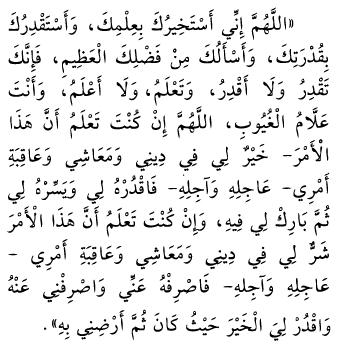
Al-IstikhaarahJabir bin Abdullaah –RadhiAllaahu anhu- said the Messenger of Allaah -sallAllaahu alayhi wa sallam- used to teach us al-Istikharah (a prayer said for seeking blessings in carrying out a decision) for all matters, just like he used to teach us a chapter from the Qur’aan, he would say: If any of you intends to undertake a matter then he should pray two Rakah other than an obligatory prayer then he should say :

Al-IstikhaarahAllaahumma ‘innee ‘astakheeruka bi ‘ilmika, wa ‘astaqdiruka bi qudratika, wa as’aluka min fadhlikal-‘Adheemi, fa ‘innaka taqdiru wa laa ‘aqdiru, wa ta’lamu, wa laa ‘a’lamu, wa ‘Anta ‘Allaamul Ghuyoobi, Allaahumma in kunta ta’lamu ‘anna haadhal-amra – [then mention the thing to be decided] khayrun lee fee deenee wa ma’aashee wa ‘aaqibati ‘amree – [or say] ‘Aajilihi wa ‘aajilihi –  Faqdurhu…

View original post 315 more words

What Shaykh Hamad al-Ansaari said about The Soofeeyah

What Shaykh Hamad al-Ansaari [1] said About The Soofeeyah
Compiled & translated By Abbas Abu Yahya

1 – Seeking Blessings

Shaykh Hamad al-Ansaari said:

‘I saw a person who came for Hajj and there were people gathered around him, and they took his turban, it was white, they tore it up, and some of them began eating it.

So I said to one of them: ‘Why do you eat from his turban?’

A person said: ‘This person is a Haji and we are seeking blessings from his turban.’

I wanted to make him understand [that this is wrong] but he refused to accept and also those along with him.’[2]

2 – Superstitions

‘Indeed all types of superstitions are in the Turq (different paths of the Soofeeyah).’[3]

3 – Play

‘The worship of the Soofeeyah is playing.’[4]

4 -Naqshbandeeyah [5]

‘No one authors, distributes and prints books against the Dawa’ as-Salafeeyah[6] in the world like that what the Turks do and the government of the Rawafidah (Shia) in Iran.  Because the increase of ‘Aqeedah Salafeeyah was not lessened until the Turks began ruling. They are the Naqshbandeeyah, and the Naqshbandeeyah are the enemies of the ‘Aqeedah Salafeeyah.’[7]

5 – Relieved from Worship

‘I saw a man in Africa who was a big Soofi, and people would come to him and kiss his head, his hand, his belly, and his feet and there was a large majority of people around him.

When the prayer time came he did not pray, so I asked about this, and his companions said to me: ‘He does not pray because he is relieved of Islaamic duties. I had read about these types of people in books, and now I have seen them.’[8]

6 – The Soofeeyah are Made Up Of

‘The Soofeeyah are made up of Judaism, fire-worshippers, polytheism, and a basic foundation of Islaam, but Islaam only by name, and they are the brothers of the colonialists.’

AbdulAwal bin Hamad al-Ansaari adds: ‘He means the extreme Soofeeyah.’[9]

7 – Dangers of the Soofis

‘Indeed the Soofi deviants are more dangerous to Islaam than the disbelief of the Russians and Americans.  Because they are negligent with the truth.’[10]

References :

[1] The statements here were taken from the biography of the Shaykh, which was compiled by the Shaykh’s son AbdulAwal bin Hamad al-Ansaari who is a teacher in the faculty of Hadeeth in the prestigious Islaamic University of Madina. The Collection is called:‘al-Majmoo’ Fee Tarjama al-Allama al-Muhaddith ash-Shaykh Hamad bin Muhammad al-Ansaari -Rahimullaah- wa Seeratahi wa Aqwaalihi wa Rihlatihi’. It is a large two-volume collection of the sayings, wisdom and various biographies of the Shaykh. The statements in this translation are all from his son AbdulAwal unless stated otherwise.

[2] [vol. 1 p.390 No.15]

[3] [Vol.2 p. 487 No. 83]

[4] [Vol.2 p. 490  No. 105]

[5] http://followingthesunnah.wordpress.com/2012/05/16/ascription-to-the-salafi-manhaj/

[6] http://followingthesunnah.wordpress.com/2013/01/03/what-shaykh-hamad-al-ansaari-said-about-salafeeyah/

[7] [Vol.2 p. 691 No.64]

[8] [vol.1 p. 397 No. 71]

[9] [Vol.2 p. 488 No. 94]

[10] [Vol.2 p.537  No.366]

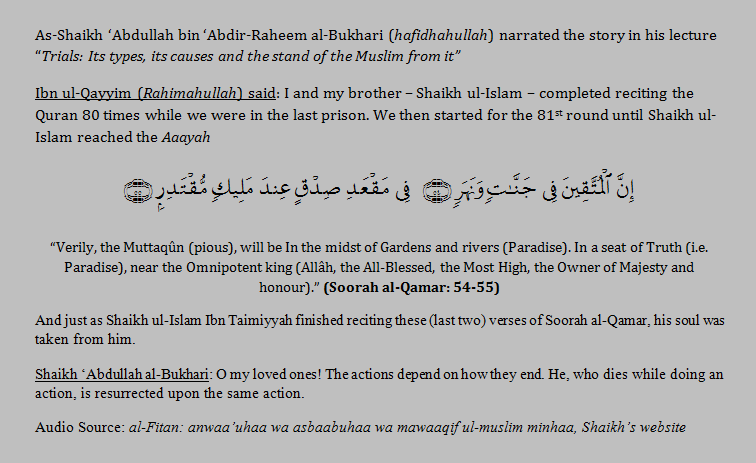
Actions are how they get sealed. The last Action of Ibn Taymiyyah!

Actions are how they get sealed. The last Action of Ibn Taymiyyah!

Benefit Shared by أبوحفص عديّ بن محمّد via Twitter
http://elbukhari.com/download/esound/muhadarat/al_fitan.mp3 …

Receive a good deed for every believing man and woman : Shaykh Abdur Razzaq Al Badr

Translated by Rasheed ibn Estes Barbee
Read the article : http://mtws.posthaven.com/receive-a-good-deed..
Video Courtesy: Bilal Nahim

Repaying a debt in the same currency no matter whether its value increases or decreases – alifta

Browse by Volume Number > Group 1 > Volume 13: Transactions 1 > Buyu` > Payment of the price > Repaying a debt in the same currency no matter whether its value increases or decrease

Question:

I borrowed 20,000 Pakistani Rupees, which were worth 7,000 Saudi Riyals at that time, from my brother. I now want to settle my debt, but the debt of 20,000 Pakistani Rupees is now worth 2,000 Saudi Riyals. Is it permissible for me to repay him with 2,000 Riyals or do I have to give him 7,000 Riyals according to the value when I borrowed it, or is it obligatory on me to give it to him in Pakistani Rupees, the same currency that I borrowed from him?

Answer:

It is obligatory on you to return the money that you borrowed from your brother in the same currency you took it from him, regardless of whether its value has risen or fallen against other currencies.

You therefore have to give him 20,000 Pakistani Rupees, no more or less, for the 20,000 Pakistani Rupees you borrowed. You have to give him what equals its value at the time of the repayment in another currency, such as in Saudi Riyals or another currency, on the condition that it is done in one session. This is based on the answer which the Prophet (peace be upon him) gave to the inquirer who asked him whether it was permissible to sell Dirhams (a dirham of silver equals 2.975 grams of silver) for Dinars (old Arab coin that equals 2.975 grams of gold) or Dinars for Dirhams. He (peace be upon him) said, “There is nothing wrong with taking them at the current rate so long as you do not separate leaving something to be settled.”

May Allah grant us success. May peace and blessings be upon our Prophet Muhammad, his family, and Companions. The Permanent Committee for Scholarly Research and Ifta’

Permanent Committe . Source: http://alifta.net

Taking the means to wake up for the Fajr prayer – Shaykh Sulaymaan ar-Ruhaylee [Video|Ar-En Subtitles]

Video Courtesy : Brother Bilal @ Manhaj ul-Haqq

The Sunnah for the Fajr Prayer – Compiled and Translated By Abbas Abu Yahya

The Sunnah for the Fajr Prayer
Compiled[1] and Translated By Abbas Abu Yahya

Contents:

1 – Giving Attention to the Two Rakat Sunnah for the Fajr Prayer
2 – Shortening the Sunnah of the Fajr Prayer
3 – What the Messenger -sallAllaahu alayhi wa sallam- would Recite in the Two Rakah for the Sunnah of the Fajr Prayer
4 – Recommendation to Pray the Two Rakah at Home
5 – Lying down on the Right Hand side after the Two Rakah Sunnah of the Fajr
The Messenger -sallAllaahu alayhi wa sallam- used to talk after the two Rakah Sunnah for Fajr
6 – The Dislike of Praying the Optional Prayer once Fajr Time has come in, other than the Two Rakah Sunnah for the Fajr Prayer
7 – The Dislike for the Worshipper to begin Praying Two Rakah Sunnah for the Fajr After the Muadhin began the Iqama for the prayer.
8 – Praying two Rakah Sunnah for the Fajr Prayer after the Obligatory Prayer if You Cannot Pray Before it

1 – Giving Attention to the Two Rakat Sunnah for the Fajr Prayer[2]

a) From Ayesha Radi Allaahu anha who said:

‘The Prophet -sallAllaahu alayhi wa sallam- was not more concerned and did not pay attention to any of the optional prayers like he did for the two Rakat of Sunnah for the Fajr prayer.’[3]

b) From Ayesha from the Prophet -sallAllaahu alayhi wa sallam- who said:

‘Two Rakat for Sunnah of Fajr prayer are better than the Dunyaa and everything that is in it.’[4]

c) From Ayesha Radi Allaahu anha who said from the Prophet -sallAllaahu alayhi wa sallam- that he said about the two Rakat when the Fajr prayer time comes in:

‘They are more beloved to me than the Dunyaa and everything that is in it.’[5]

2 – Shortening the Sunnah of the Fajr Prayer

a) From Ayesha Radi Allaahu anha who said that the Messenger of Allaah -sallAllaahu alayhi wa sallam- used to pray thirteen Rakah during the night, then he would pray two short Rakah once he had heard the call for the morning prayer.’[6]

And in the narration of Abu Dawood:

‘The Messenger -sallAllaahu alayhi wa sallam- would pray two Rakah between the Adhan of Fajr and the Iqamah.’

b) From Ayesha who said:

The Messenger of Allaah -sallAllaahu alayhi wa sallam- used to pray two shortened Rakah which were before the morning (Fajr) prayer, he would shorten them so much that I would say: Did he recite Soorah Fatiha?’[7]

Abu Tayeeb Atheema-a-Baadi said:

‘It is established from these Ahadeeth that the Prophet -sallAllaahu alayhi wa sallam- used to pray them when the Mu’adhin had become silent after the Adhan, and when the time of Fajr had come in and Fajr had lit up.  He -sallAllaahu alayhi wa sallam- used to pray them lightly. As for the wisdom of them being a light prayer, then al-Qurtubi said in al-Mufhim: ‘so that the Messenger -sallAllaahu alayhi wa sallam- could go to the morning prayer early at its beginning time.’

Some of the scholars said: ‘So that the Messenger -sallAllaahu alayhi wa sallam- could begin the prayer for the day with two light prayers, just as he would do for the night prayer.’ Therefore, praying them lightly is the Sunnah, and that is the clear truth.’

‘Shawkaani said in ‘Nail Awtaar’:

‘The Hadeeth indicates to the legislation of praying it lightly (i.e. not lengthening it).  This was the opinion of the majority of the scholars, the Hanafeeyah opposed them and said that it is recommended to lengthen the recitation.  This opposes the clear evidence.’

3 – What the Messenger -sallAllaahu alayhi wa sallam- would Recite in the Two Rakah for the Sunnah of the Fajr Prayer

a) From Ibn Umar that the Prophet -sallAllaahu alayhi wa sallam- used to recite in the two Rakat for Fajr, and two Rakat after Maghrib prayer: <<Say to these O Al-Kafiroon >>[8]  & <<Say: He is Allaah, (the) One.>>[9]

b) From Ayesha who said: ‘the Messenger of Allaah -sallAllaahu alayhi wa sallam- used to pray four Rakat before Dhuhr, and two Rakat before Fajr and would not leave them, and she said: and he would say:

‘Two blessed Soorahs which are read in the two Rakat before Fajr: << Say to these O Al-Kafiroon >>[10]  & <<Say: He is Allaah, (the) One.>>’[11]

c) From Ibn Umar – Radi Allaahu anhu – that the Messenger of Allaah -sallAllaahu alayhi wa sallam- said:

 ‘<<Say: He is Allaah, (the) One.>> is equivalent to a third of the Qur’aan, and <<Say to these O Al-Kafiroon >> is equivalent to a fourth of the Qur’aan, and he would read both of them in the two Rakat of Fajr . . .’[12]

d) From the Hadeeth of Abu Hurairah – Radi Allaahu anhu – that the Messenger of Allaah -sallAllaahu alayhi wa sallam- read:

<< Say to these O Al-Kafiroon >>[13]  & <<Say: He is Allaah, (the) One.>>[14]

in the two Rakah of the Fajr prayer.’ (i.e. the Sunnah of Fajr).[15]

e) From Abul-Gayth from Abu Hurairah that he heard the Prophet -sallAllaahu alayhi wa sallam- recite in the two Rakah of Fajr:

<<Say: We believe in Allaah and in what has been sent down to us, >> [3:84] in the first Rakah, and in the other Rakah with this Ayaah:

<<Our Lord! We believe in what You have sent down, and we follow the Messenger [‘Iesa (Jesus)]; so write us down among those who bear witness (to the truth i.e. La ilaha ill-Allaah – none has the right to be worshipped but Allaah). >> [3:53]

or:

<<Verily, We have sent you with the truth (Islaam), a bringer of glad tidings (for those who believe in what you brought, that they will enter Paradise) and a warner (for those who disbelieve in what you brought, they will enter the Hell-fire). And you will not be asked about the dwellers of the blazing Fire.>> [2: 119][16]

Atheem-a-Baadi said:

‘What is established from these Ahadeeth is that the Prophet -sallAllaahu alayhi wa sallam- sometimes would recite << Say to these O Al-Kafiroon >> in the first Rakah, and <<Say: He is Allaah, (the) One.>> in the second Rakah.

And sometimes he would read in the first of the two Rakah:

<< Say: We believe in Allaah and that which has been sent down to us and that which has been sent down to Ibraheem, Isma’eel, Ishaaq, Ya’qoob, and to Al-Asbaat [the twelve sons of Ya’qoob], and that which has been given to Moosa and ‘Iesa, and that which has been given to the Prophets from their Lord. We make no distinction between any of them, and to Him we have submitted (in Islaam). >> [2:136]

and in the second of the two Rakah:

<< Then when ‘Iesa came to know of their disbelief, he said: ‘Who will be my helpers in Allaah’s Cause?’ Al-Hawarioon (the disciples) said: ‘We are the helpers of Allaah; we believe in Allaah, and bear witness that we are Muslims (i.e. we submit to Allaah).’

Our Lord! We believe in what You have sent down, and we follow the Messenger [‘Iesa (Jesus)]; so write us down among those who bear witness (to the truth i.e. Lâ ilâha ill-Allâh – none has the right to be worshipped but Allâh). >> [3:52-53].

And sometimes recite in the first of the two Rakah:

<<Say: We believe in Allaah and in what has been sent down to us, >> [2:136]

and in the second of the two Rakah:

<< Say: ‘O people of the Scripture (Jews and Christians): Come to a word that is just between us and you, that we worship none but Allaah, and that we associate no partners with Him, and that none of us shall take others as lords besides Allaah. Then, if they turn away, say: ‘Bear witness that we are Muslims.’>> [3:64].

And sometimes he would recite in the first of the two Rakah:

<<Say: ‘We believe in Allaah and in what has been sent down to us, and what was sent down to Ibraheem, Isma’eel, Ishaaq, Ya’qoob and Al-Asbaat [the twelve sons of Ya’qoob] and what was given to Moosa, ‘Iesa and the Prophets from their Lord. We make no distinction between one another among them and to Him (Allaah) we have submitted (in Islaam).’>> [3:83]

and in the second Rakah:

<<Our Lord! We believe in what You have sent down, and we follow the Messenger [‘Iesa (Jesus)]; so write us down among those who bear witness (to the truth i.e. La ilaha ill-Allaah – none has the right to be worshipped but Allaah). >> [3:53]

or with this Ayaah:

<<Verily, We have sent you with the truth (Islaam), a bringer of glad tidings (for those who believe in what you brought, that they will enter Paradise) and a warner (for those who disbelieve in what you brought, they will enter the Hell-fire). And you will not be asked about the dwellers of the blazing Fire.>> [2:119].’

4 – Recommendation to Pray the Two Rakah at Home

Abu Tayeeb al-Atheem-a-Baadi said:

‘It is better to pray the two Rakah at home, because the optional pray at home is of a more complete status and has more reward than praying it in the Masjid.  This is affirmed from the Prophet -sallAllaahu alayhi wa sallam- from his actions and his statements.

As for his actions, is that the Prophet -sallAllaahu alayhi wa sallam- used to pray them a lot of the time in his home, as has been mentioned in narrations from Ibn Umar, Ibn Abbas, Ayesha and others from the Companions. Actually it has not been affirmed that he performed them in the Masjid.

As for his saying in the Hadeeth of Ibn Umar, as collected by Bukhari, Muslim, Abu Dawood, Tirmidhi, Nisa’ee and Ibn Majah that the Prophet-sallAllaahu alayhi wa sallam- said:

‘Perform some of your prayer in your homes, and do not take them as graves.’

The Hadeeth of Jabir collected by Muslim, and Muhammad bin Nasr from Jabir Radi Allaahu anhu that he said, the Messenger of Allaah -sallAllaahu alayhi wa sallam- said:

‘If one of you has completed the prayer in his Masjid, then he should make a portion of his prayer for the house, since indeed Allaah will place goodness in his home from his prayer.’

Imam Nawawi said in the explanation of Muslim:

‘Indeed one is encouraged to pray optional prayer in the home due to it being more hidden away, further away from showing off, more protective from being cancelled out and that the home can get blessings, and that mercy can descend in the home, and the Angels, and that the Shaytaan runs away.’

5 – Lying down on the Right Hand side after the Two Rakah Sunnah of the Fajr

Abu Tayeeb al-Atheem-a-Baadi said:

‘It is the Sunnah to lie down on the right side after the Sunnah of the Fajr prayer, whether he performed Tahhajjud (the night prayer) or not, and this is the truth, and this has been narrated from the hadeeth of four people from the Companions of the Prophet -sallAllaahu alayhi wa sallam, Ayesha, Abu Hurairah, Ibn Abbas and Abdullaah bin ‘Amr.

The Hadeeth of Ayesha, collected by Bukhari that she said:

‘The Prophet -sallAllaahu alayhi wa sallam- used to lie down on his right side after praying two Rakats [Sunnah] of Fajr.’

Also, in Muslim from Ayesha the wife of the Prophet -sallAllaahu alayhi wa sallam- who said:

‘The Messenger of Allaah -sallAllaahu alayhi wa sallam- used to pray after finishing the Isha prayer, which the people call ‘al-‘Uttmah’ he would pray eleven Rakah till the Fajr prayer, he would give the Salaam between every two Rakah, and pray one Rakah Witr. And when the Muhaddin would finish from the call to the Fajr prayer, and it would be clear to the Messenger -sallAllaahu alayhi wa sallam-that it is Fajr time and the Muhaddin would come to the Messenger -sallAllaahu alayhi wa sallam, then he would pray a light two Rakah, then lie down on his right side, until the Muadhin would come to him -sallAllaahu alayhi wa sallam- to make the call that prayer is established.’[17]

  • Laying down after the Sunnah prayer for Fajr is not done in the masjid

Shaykh Albaani commented on the Hadeeth of Aeysha Radi Allaahu anha:

‘…then lie down on his right side, until the Muadhin would come to him -sallAllaahu alayhi wa sallam.’

Shaykh Albaani said:

‘This is a clear proof of the permissibility of laying down between the Sunnah of the Fajr prayer and the obligatory prayer, however, it is not known that anyone from the Companions did so in the Masjid, but rather some of them disliked and criticised this.  Therefore, it should be limited to what the Prophet did in his house as is his – sallAllaahu alayhi wa sallam –Sunnah.’[18]

  • The Messenger -sallAllaahu alayhi wa sallam- used to say or talk after the two Rakah Sunnah for Fajr

It has been collected by Bukhari, Muslim and Abu Dawood from Ayesha who said:

‘The Prophet -sallAllaahu alayhi wa sallam- used to, once he had prayed the two Rakah of the Sunnah for the Fajr, he would talk to me if I were awake, otherwise he would lie down.’

Nawawi said in ‘al-Minhaaj Sharh Muslim bin al-Hajjaaj’:

‘In this narration is the proof that it is permissible to talk after the Sunnah of the Fajr prayer.  This is our Madhab, and the Madhab of Malik and the majority of the scholars.’

Al-Qadi said:

‘The Koofeeyoon disliked it, and it is narrated from Ibn Mas’ood and some of the Salaf that this time between two Rakah of the Sunnah for the Fajr and the Fajr prayer is for seeking forgiveness. However, what is correct is that it is permissible due to the action of the Prophet -sallAllaahu alayhi wa sallam. As for it being regarded as the recommended time for seeking forgiveness then that does not prevent the allowance to speak.’

Al-Qastallani said in ‘Irshaad as-Saari’:

‘In this Hadeeth, is that there is no problem with permissible speech after the two Rakah Sunnah for the Fajr.  Ibn al-Arabi said: ‘There is no mention or narration of an excellence of remaining silent at the time, rather that is after the obligatory Morning Prayer until sunrise.’


6 – The Dislike of Praying the Optional Prayer once Fajr Time has come in, other than the Two Rakah Sunnah for the Fajr Prayer

Abu Taeeb al-Atheem-a-Baadi said:

‘It is disliked to pray the optional prayer after Fajr time has come in, because the Prophet -sallAllaahu alayhi wa sallam- did not pray more than the two Rakah of the Sunnah even though he had great concern over the prayer.  Yet there is a prohibition from the Prophet -sallAllaahu alayhi wa sallam- against this.

Muslim and Nisa’ee narrated from Hafsah who said:

‘If the Fajr time came in, the Messenger of Allaah -sallAllaahu alayhi wa sallam- would not pray except for two light Rakahs.’

7 – The Dislike for the Worshipper to begin Praying Two Rakah Sunnah for the Fajr After the Muadhin began the Iqama for the prayer.

Abu Taeeb al-Atheem-a-Baadi said:

 ‘Know that it is disliked to perform the two Rakah of Sunnah for the Fajr after the Muadhin has begun the Iqama for the prayer, this is whther the worshipper is amongst the rows, or not in the row, whether he knows that he will catch the Rakah with the Imam or not.  This is what has been narrated from the Hadeeth of Abu Hurairah, Abdullaah bin Malik bin Buhaynah, Abdullaah bin Surjiss, Ibn Umar, Jabir, Ibn Abbas, Anas bin Muhammad, Zayed bin Thabit, Abu Musa and ‘Aeysha Radi Allaahu anhum.

a) As for the Hadeeth of Abu Hurairah, collected by Muslim that the Prophet -sallAllaahu alayhi wa sallam- said:

‘If the prayer is established then there is no prayer except for the obligatory one.’

b) Bukhari collected from Abdullaah bin Malik bin Buhaynah who said: The Prophet -sallAllaahu alayhi wa sallam- passed by a man, and the prayer had just been established [the Iqama was called] while that man was praying two Rakah, after the Messenger of Allaah -sallAllaahu alayhi wa sallam- finished, the people gathered around him, so the Messenger of Allaah -sallAllaahu alayhi wa sallam- said:

‘Is the morning prayer four Rakahs? Is the morning prayer four Rakahs?’

Abu Taeeb al-Atheem-a-Baadi discusses the general times that prayer is prohibited: ‘Five types, the prohibition to pray after Fajr and Asr, at the time of sunrise, at sunset, and when the sun has reached its highest point, and every one of these types has exceptions. So we say: from the specific times out of the general times is the Hadeeth of Abu Hurairah which was collected by Bukhari in the ‘Chapter: Whoever catches one Rakah from the Asr prayer before sunset.

Bukhari narrates from Yahya from Salmah from Abu Hurairah who said: The Messenger of Allaah -sallAllaahu alayhi wa sallam- said:

‘If one of you catches a Sajdah from the Asr prayer before the sunsets, then he should complete his prayer.  If one of you catches a Sajdah from the morning prayer before the sunrises then he should complete his prayer.’

An-Nawawi said:

‘This is a clear evidence that whoever caught and prayed a Rakah of the morning or Asr prayer, and then the prayer time finished before he gave Salam then his prayer is not null and void, rather he should complete it, and his prayer is correct.  There is a consensus about this point regarding the Asr prayer, as for the morning prayer, then Malik, Shaafi’ee, Ahmad and all the scholars accept it except Abu Hanifah -Rahimullaah, since he says that the morning prayer is void due to sunrise, because the time where Salat is prohibited has entered, and this is in contrast to sunset, but the Hadeeth is an evidence against him.’

Abu Taeeb al-Atheem-a-Baadi also mentions:

‘From those specific matters for the general prohibition is the Ahadeeth of Anas, Abu Hurairah and Abu Qatadah. As for the Hadeeth of Anas, then that has been collected by the six Imams [Bukhari, Muslim, Abu Dawood, Tirmidhi, Nisa’ee and Ibn Majah] and Darmi from Anas from the Prophet -sallAllaahu alayhi wa sallam- who said:

‘Whoever forgets a prayer then he should pray it when he remembers, there is no expiation for the missed prayer except to pray it. << and perform the Salat for My remembrance>> [Taha: 14]’

8 – Praying two Rakah Sunnah for the Fajr Prayer after the Obligatory Prayer if You Cannot Pray Before it

Shaykh Muhammad Bazmool said:

Whoever misses the two Rakah [Sunnah] of the Fajr prayer

It is legislated for the person who misses the two Rakah of Fajr, that he can then pray them directly after the obligatory prayer or after the sun has risen, and what is better is to pray them after the sun has risen.

From Abu Hurairah –Radi Allaahu anhu who said the Messenger of Allaah said:

‘Whoever did not pray the two Rakah [Sunnah] of Fajr; then he should pray them after the sun has risen.’[19]

I [Bazmool] say: ‘The apparent meaning of the Hadeeth indicates that the Sunnah of Salat al-Fajr is obligatory to be prayed after the sun has risen if you had missed this Sunnah prayer, however, this verdict is shifted to a recommended act due to the proof from the following Hadeeth:

From Qays bin Qahd Radi Allaahu anhu that he prayed the Morning Prayer along with the Messenger of Allaah -sallAllaahu alayhi wa sallam, but he had not prayed the two Rakah for the Sunnah of the Fajr prayer.  So when the Messenger of Allaah -sallAllaahu alayhi wa sallam- gave the Salam from the prayer, Qays gave the Salam with him and then after that he stood and prayed two Rakah of the Sunnah for the Fajr, while the Messenger of Allaah -sallAllaahu alayhi wa sallam- was watching him, and he -sallAllaahu alayhi wa sallam-did not criticize him for it.’ [20]

The Hadeeth shows the permissibility of making up the Sunnah prayer of al-Fajr after the obligatory prayer for the person who had not prayed it before the obligatory prayer.’[21]

All Praise belongs to Allaah, may His peace and blessings be upon our final Prophet Muhammad, his family, his companions and all those who follow his guidance.


[1] The majority of this article has been compiled from the book: ‘A’laam Ahl-ul-‘Asr BiHaakaam Rakatay al-Fajr’ by Abu Tayyib Muhammad Shams al-Haqq al-Atheem-a-Baadi

[2] The Importance of the Sunnah of Fajr Prayer

Siddiq Hasan Khan said:

‘Some of the Mushayikh said: ‘The Sunnah of Fajr is starting of actions, and the Witr is ending of actions, this shows the certainty of having concern for these two prayers. This is the reason why it has been legislated to read Soorah Ikhlaas, and Soorah Kafiroon, due to them comprising of Tawheed al-Ilm (knowledge) and al-Amaal (action), and Tawheed al-Ma’rifah (acquainting) and al-Irada (want), and Tawheed al-Itiqaad (belief) and al-Qasd (Intent).’

[Taleeqat ar-Raddeeyah ‘ala Rowddat an-Nadeeya by Siddiq Hasan Khan 1/p.316]

[3] [Bukhari & Abu Dawood]

[4] [Muslim, Tirmidhi & Nisa’ee]

[5] [Muslim]

[6] [Bukhari, Malik in al-Muwatta & Abu Dawood]

[7]  [Bukhari, Muslim, Malik, Abu Dawood & Nisa’ee]

[8] Soorah Kafiroon

[9] Collected by Tabarani in ‘al-Mu’jam al-Kabeer’ from Ibn Umar & Albaani declared it to be Saheeh, in Silsilah Saheeehah No.3328

[10] Soorah Kafiroon

[11] Collected by Ibn Khuzaimah from Ayesha & Albaani declared its Isnad to be Jayyid in Silsilah Saheeehah No.636

[12] Collected by Abu Ya’ala with a Hasan Isnaad, Tabaraani in ‘al-Kabeer’  & Albaani declared it to be Saheeh Lighayrihi in ‘Saheeh Targheeb wa Tarheeb’ no.583 by Albaani

[13] Soorah Kafiroon

[14] Soorah Ikhlaas

[15] [Collected by Muslim, Abu Dawood, Nisa’ee and Ibn Majah]

[16] [Collected by Abu Dawood & Albaani regarded it as Hasan no.1260]

[17] [Muslim, Ahmad & Bayhaqi]

[18] From: ‘Salat ul Taraweeh’ p.90 by Muhammad Nasir ud-Deen al-Albaani]

[19] ‘Hadeeth Saheeh, collected by Tirmidhi in ‘Kitab as-Salah’, Chapter: what is mentioned regarding praying them after sunrise, and authenticated by al-Haakim, Ibn Khuzaimah, Ibn Hibban in ‘al-Ihsaan’ and it is authenticated by the researcher of that book, and al-Albaani authenticated it in ‘Saheeh Sunnan at-Tirmidhi’, and also in Silsilah Saheeehah No.2361

[20] Hadeeth Hasan Li Ghayri hi, collected by Tirmidhi in ‘Kitab as-Salah’, Chapter: what is mentioned about he person who misses the two Rakah before Fajr then he should pray them after the obligatory Fajr prayer.

Also collected by Abu Dawood in ‘Kitab as-Salah’ Chapter: whoever misses the prayer so that he has to make it up. Authenticated by al-Haakim, Ibn Khuzaimah and Ibn Hibban.  It was authenticated by al-Allamma Ahmad Shakir in his checking of ‘Sunnan Tirmidhi’ and al-Albaani in ‘Saheeh Sunnan Tirmidhi’.

A benefit: the Hadeeth shows the permissibility of praying the missed prayers at the time when prayer is prohibited.’

[21] [Taken from: ‘Bugheeyah al-Muttatowa’ fee Salat al-Muttatowa’ by Muhammad Bazmool p. 28-29]

American Muslim Asks: Why does Islam Forbid Music? Shaykh Ibn ʿUthaymīn [Video|Ar-En Subtitles]

American Muslim Asks: Why does Islam Forbid Music? Shaykh Ibn ʿUthaymīn رحمه الله
http://owaisalhashimi.info/american-m…
Translated by Owais Al-Hashimi حفظه الله

Video Courtesy: Brother Bilal Nahim

Forwarding Falsehood through Text Messages – Shaykh Saalih as-Suhaymi [Video|Ar-En Subtitles]

Forwarding Falsehood through Text Messages – Shaykh Saalih as-Suhaymi حفظه الله
Translated by Abul Hasan Malik حفظه الله

http://ar.miraath.net/fatwah/5339
http://groups.google.com/forum/#!top…

Video Courtesy: Brother Bilal @ Manhaj ul-Haqq

Sisters Be Good And Do Not Harm Others – Abu Dihya Dawud Adib [Audio|Eng]

(From the Covered Gems Sister’s Cyber Seminar “Rectification of the Female Servants of Allah”)

Who has more right to be the imam for the prayer? Young Boy who memorized more Qur’an or the Adult? – Shaykh Saalih al-Fawzan

Question:

Who has more right to be the imam for the prayer? Is it the young boy who has not reached puberty but he has (memorized) half of the Quran or is it the adult who has (memorize) five juz (of Quran) but he also has (knowledge) from the sunnah just as Aqeedah (belief), hadeeth and fiqh? May Allaah keep you firm.

Answer:

The oldest is more preferable as long as he has from the Quran what suffices for the prayer. He is preferred over the young. Only if the young is the most proficient in Quran amongst the others present then he is put forth.

Al-Binaa Publishing | Durham NC
Translated: Abu Anas Atif Hasan
http://alfawzan.af.org.sa/node/14838

Brief Summary of Tele-link with Shaykh Rabee to Dawrah in Nadoor Morocco [Audio|En]

Brief summary by Abu Muhammad al-Maghribee

Listen / Download Mp3 Here (Time 12:57)


A Heartfelt Advice to the sons of the Ummah and the Carriers of Ad-Dawatu As-Salafiyyah : Shaykh Rabee’ ibn Haadee al-Madkhalee

All praises belong to Allaah, may prayers and salutations be upon the Messenger of Allaah, his family, companions and those who follow his guidance. As to what follows:

Certainly Allaah has distinguished the ummah of Islaam over the other nations, because we enjoin what is right and we forbid what is wrong. Allaah says: “You are the best nation brought out of the people (because) you enjoin what is right and you forbid what is wrong.” (3:110)

And the Prophet (may peace be upon him said): “Whoever of you sees an evil then let him change it with his hand, if he is not able then with his tongue, if he is not able then with his heart and that is the weakest of faith.”

Our Lord has imposed on us that we are from those people who establish justice. As Allaah says: “Oh you who believe, be from those who establish justice and be witnesses for Allaah even if it is against yourselves, parents or kinfolk.” (4:135)

Allaah also ordered us to cooperate upon righteousness and piety and not sin and transgression. As Allaah says: “And cooperate upon righteousness and piety and do not cooperate upon sin and transgression, and have taqwa of Allaah; certainly Allaah is strong in punishment.” (5:2)

Allaah ordered us with jihad, as a means for spreading the religion and defending it. We were ordered to make jihad with the sword and with the tongue. We were ordered with the jihad of clarifying, (establishing) evidences, and proofs. And this is the jihad of the prophets (may peace be upon them all).

Allaah ordered (us) with truthfulness and what comes along with it, and forbade us from lying and what comes along with it. The Prophet (may peace be upon him) said: “Upon you is to be truthful, for truthfulness guides to goodness and goodness guides to paradise. A man will continue to be truthful and he is lead to that, until it is written with Allaah that he is truthful. And beware of lying, for lying leads to wickedness and wickedness leads to the fire. A man will continue lying and he is lead to that until it is written with Allaah that he is a liar.”

The Prophet (may peace be upon him) warned us from false suspicion when he said: “Beware of suspicion, for suspicion is the worst of false tales.”

He ordered us with brotherhood and being diligent upon coming together as brothers. The Messenger (may peace be upon him) said: “The Muslim is a brother to another Muslim, he does not deceive him nor desert him. The Muslim’s honor, wealth and blood are sacred.” (Then he said) “Piety is here,” (pointing to his chest three times) and he said, “It is sufficient enough evil for a person to hold his Muslim brother in contempt.” (Narrated by at-Tirmidhi who said the hadeeth is hasan)

The Prophet (may peace be upon him) (also) said: “Do not envy one another, do not hate one another, do not turn away from one another, do not inflate prices on one another, but be, (oh) servants of Allaah, brothers (to one another).”

He ordered us with (giving) advice. He said: “The religion is advice.” So we said, “To whom, oh Messenger of Allaah?” He said: “To Allaah, to His Book, to His Messenger, to the leaders of the Muslims and to the common folk.”

He ordered us with helping the oppressed and the oppressor. He said: “Help your brother if he is an oppressor or oppressed.” A man then said: “Oh Messenger of Allaah, I (can see) helping him if he is being oppressed. But if I see that he is the oppressor how can I help him?!” He said: “Hold him and prevent him from oppression and this is (your) helping him.” (Narrated by al-Bukhaari)

Allaah informed us that oppression will be darkness on the Day of Judgment. Allaah says: “Indeed, Allaah does not do injustice, [even] as much as an atom’s weight; while if there is a good deed, He multiplies it and gives from Himself a great reward.” (4:4)

The Messenger (may peace be upon him) said (that Allaah says) in a Hadeeth al-Qudsi [1]: “Oh my servants, surely I have made oppression forbidden upon Myself and I have made it forbidden amongst you, therefore do not oppress (one another).”

Allaah has made excessiveness and extremism forbidden in the religion. Allaah says: “Oh People of the Scripture, do not commit excess in your religion or say about Allaah except the truth.”(4:171)

And the Prophet (may peace be upon him) said: “Beware of excessiveness, for certainly the people before you were destroyed because of their excessiveness in the religion.”

He also said: “Do not exaggerate with me as the Christians exaggerated with (Jesus) the son of Mary.”

He (Allaah) made forbidden partisanship and tribalism, as the Messenger of Allaah (may peace be upon him) said: “Whoever is killed under the banner of a people whose cause is not clear and calls to fanatical partisanship or tribalism or supports it and is killed, he dies in a state of jaahiliyyah [2].”

Shaykh al-Islaam ibn Taymiyyah said:

It is not correct for those who educate to make the people into parties or groups and to make enmity and hatred between them. Rather they should be as brothers, cooperating upon righteousness and piety.

As Allaah says: “And cooperate upon righteousness and piety and do not cooperate upon sin and transgression, and have taqwa of Allaah, certainly Allaah is strong in punishment.” (5:2)

It is not (correct) for anyone to take a vow to be in agreement with everything that someone wants, and to support those whom he supports and to become an enemy to those he is an enemy to. Rather whoever does this, he is from the likes of Genghis Khan [3] and those similar to him. They are the ones who make those in agreement with them their supporting friends and they make those who oppose them their hated enemies.

What is binding upon them and their followers is the covenant of Allaah and His Messenger (may peace be upon him). So they must obey Allaah and His Messenger and work by what Allaah and His Messenger ordered. They must make forbidden that which Allaah and His Messenger made forbidden. They must take care of the rights of those (scholars and students) who educate people as Allaah and His Messenger have ordered. So if a teacher (scholar or student) is the one being oppressed, then he aids him and if a teacher is the oppressor, then he does not aid him in his oppression, rather he prevents him from it. As what has been authentically reported is that the Prophet (may peace be upon him) said: “Help your brother if he is an oppressor or oppressed.” A man then said: “Oh Messenger of Allaah, I (can see) helping him if he is being oppressed. But if I see that he is the oppressor how can I help him?!” He said: “Hold him and prevent him from oppression and this is (your) helping him.”

(End of Ibn Taymiyyah’s quote)

It is obligatory for this ummah to establish these affairs of great benefits and upright principles. And (the ummah) must have a concern for this with a true care, whether it be an individual, group, tribe, or government, and specifically the scholars and the students of knowledge. This applies more specifically to those who ascribe themselves to the people of Sunnah and the Jamaa’ah.

So if there is (any) exceeding of the limits of these affairs or anything from them, great corruption will appear in the world and the religion, and this leads to the destruction of these great guideposts. In this is a dangerous evil and great corruption.

And from that of which there is no doubt for the one who has intellect, there has occurred great exceeding of the limits and harmful oppression for the one who speaks the truth. He is rebutted for what is with him of the truth, belittled and insulted, and this is something extremely bad. It coming from a disbeliever (is one thing) but how much more coming from a Muslim?

Therefore it is upon the Muslim ummah, specifically the youth who are its pillars, to honor and respect the truth and magnify it. It is upon them to despise falsehood and its people, whoever they may be. Allaah will honor them, give them might and elevate their affairs because of this. The opposite of this only brings misguidance, trials, and displeasure from Allaah. This will (lead) to punishments in the life of this world. From these punishments is that the enemies will have authority over them until they return to their true religion and adhere to it.

May Allaah give us all success in what pleases Him.

References:

1 Those hadeeth that were reported that Allaah said, but were conveyed by the Messenger of Allaah.
2 Pre-islamic ignorance
3 The founder of the Mongol Empire who came to power by uniting many of the nomadic tribes of northeast Asia.
http://www.britannica.com/EBchecked/topic/229093/Genghis-Khan

Translator: Abu Anas Atif Hasan
Publisher: Al-Binaa Publishing
For easy reading this ebook is copied from PDF and posted with color and text formatting . Original PDF can read or downloaded @ Download A_Heartfelt_Advice_to_the_sons_of_the_Islamic_Ummah.pdf

Means to Learning Arabic : Dawud Adib

Listen / Download Mp3 Here  (Time 22:13)

The following the Transcribed version of the Audio

As for the course that we need to take, the first thing that we need to know, and we need to deeply consider, is that you have to understand Arabic in Arabic. Translating is a downfall. Translating Arabic is a downfall, what we mean by translating, is looking at the Arabic and then going to look up the words in English. This is going to set you back, its going to keep you back, and your not going to be able to understand that language if you continue to do that. But rather, when your studying the Arabic language, for instance, when your utilizing the dictionary, the dictionary that you should be utilizing is an Arabic dictionary with no English. Now, that may seem like your going against what the goal is, but the goal is to learn Arabic not English. So if you really want to learn Arabic, you have to learn and understand Arabic in Arabic.

The second thing we need to know is that the traditional method of learning Arabic has already been tested and there is no need for new ways to learning the lugah (language). You can go on the Internet, and some people will say ‘ A New Method: sixty-nine dollars and ninety-five cents, PayPal, you can use your Bankcard, Mac card, or whatever. Buy it now a new method, 25 cd’s, 3 books, instructional guide, study guide, NEW ways to learn Arabic. ’ Once again, I began learning Arabic in 1976, I cant even tell you how many books have been put out in the United States on England combined, on trying to learn the Arabic language, and every single person, including the person who your listening to right now, is still learning Arabic, because they didn’t start out properly. Every single brother and sister I know, from 1976 and before I became a Muslim in the 60’s, they are still learning Arabic. Why? It is because they didn’t learn Arabic from the proper sources, and the methodology that the Salaf left for us, that is the Imaams of the Salaf. And they always try to use a new way. I remember in the 70s the book that was most popular, there were two books that were most popular for people to learn Arabic, one is what we call ‘Kapelewski.’ For those brothers who started learning Arabic around my time, my age, they remember it. There are four books, Kapelewski, they are still in my house. They were written by Jews and they are very good, and in the beginning of the first book, they tell you the reason why they teach Arabic at that Arabic institute there in Jerusalem, they said, ‘We have developed this program to tap the Arab press.’ So we find brothers starting with those books, or the big orange books (this is what we call them in America), from Michigan Press. The point is there is no new way to learn Arabic. The way to learn Arabic is already been tested and tried, you don’t have to worry about a new developed way. We already have the ways to learn Arabic.

Also, we need to know that there is not one book that is going to teach you every single thing you need to know. You won’t find one book brothers, forget it, it doesn’t exist.

The other thing that we need to know is that Arabic is difficult in the beginning. But as you go through your lessons, and apply yourself then Arabic becomes easy. Don’t let the Arabs deceive you when they tell you Arabic is difficult, it’s not difficult it’s very easy. And you can become a master in the Arabic language in America. You don’t have to leave. Its good to leave, its better to be in the land of the Arabs, but you can master Arabic, in America, in Philadelphia, without leaving the United States, it’s very possible. And there are many people, too many to count, who mastered the Arabic language, and understand it as well or better than the Arabs, who weren’t Arabs. Example, Imam al-Bukhaari, rahimuhullaah, was not an Arab. It’s debatable if Imam Muslim was an Arab. Abu Dawud, Imam at-Tirmidhi, we can go on and on. There is a big huge dictionary/lexicon, maybe 15, 20 volumes, called ‘Lisan al-Arab.’ It is one of the best dictionaries you can get on the Arabic language. It goes half way across this long table, or maybe a little bit less than half across this table in length. It was written by a non-Arab, it was compiled by an African, Ibn Manzur al-Afriki. And all of the Arabs, scholars and non-Scholars, they depend on Lisan al-Arab, and they quote Lisan al-Arab but it was written by someone who was not an Arab. You can go to Indonesia finding people mastering Arabic. Go to Nigeria, I don’t know how many people I have met, or Ghana, that has mastered the Arabic language and it’s not their language. So don’t be fooled into thinking that because you’re American, that you can’t learn the Arabic language.

Also you have to understand, that you have to take everything of those three sciences that we mentioned, an-Nahw, as-Sarf, and al-Balagha. As for the books that are recommended by the ‘Ulamaa, for this difficult in the beginning language to study and easy at the end, like Shaykh Uthaymeen rahimuhullah, he says ‘Studying the Arabic language is like a house, the door is made of iron, but the interior of the house is made of sugar cane.’ He says, its difficult to get into the house in the beginning but once you get into the house, the house is made of sugar cane, it becomes real easy. The scholars of al-Islaam, in our present day time, and the scholars who came before them, and the scholars who came before them, and the scholars who came before them, they say, almost in total agreement from what I’ve seen, that the book that is suggested to learn an-Nahw (Arabic grammar), is the book called al-Ajrumiyyah. This is the book they all recommend to start from, ‘Al Ajrumiyyah by ibn al-Ajurrum. And they say that the explanation of that book is called, at-Tuhfah as-Saniyyah, which is an explanation of al-Ajrumiyyah. It doesn’t mean that you can’t start with the Madinah books or the other books that are available, but the book that the scholars of Ahlus-Sunnah recommend is al-Ajrumiyyah. That’s the book that they suggest, and this is the book that I suggest. Because, we follow the way of the Ulemaa, not saying that you can’t start with the Madinah books, but the Madinah books are not enough. They are not enough. 

In addition to that, these are some guidelines that need to be followed or that should be followed. And you can put them in any order, because this is not in any special order inshaa’Allahu ta’aala. You should try to listen to the Qur’aan, and try to understand the Qur’aan when you listen to it; this is key in learning the Arabic language. Try to listen and understand what is being said when you listen to the Qur’aan. Because the Qur’aan is Arabic and it is the uncreated speech of Allaah. This will help tremendously. The Qur’aan is the number one source for the Arabic language for those who are trying to study it. And you will find that even people who have memorized the Qur’aan that don’t know an-Nahw, as-Sarf, or al-Balagha, when they begin studying those sciences they grasp it better and have a better understanding than the person who didn’t memorize the Qur’aan. Because, all those words and those phrases that they are now going to learn, they are going to be like, ‘Ohh yeah! Wow! Yeah that’s this verse! And that’s that.’ It starts to come easier than the one who didn’t memorize the Qur’aan. 

Also, as we mentioned we shouldn’t be like the people who try to translate everything into their own language. This is going to take a lot of time, and it’s better to understand the Arabic in Arabic. So, for instance, if you have an Arabic dictionary, make it Arabic-Arabic. Of course, your going to have to utilize, an English dictionary, and the preferred one, of course for us in America, is Hans Wehr. That’s the one that’s most popular, there are others, but that is the one most popular. The recommended (this is from me, not from the ‘Ulamaa this is from me) dictionary to use, I suggest from my hit and miss, study of Arabic, my trial and error study of Arabic, I would suggest, through the years I have been doing it, to get, to carry with you, to study is called, Raa’id at-Tulaab. There is a bigger version called Ar-Raa’id, by the same person. But the smaller version it’s about the size of this mushaf in height and it’s about this thick, or this size of this mushaf. And you can get it here in America; you can buy it here in America inshaa’Allaah. Don’t ask me where but I know its here, inshaa’Allaah we may be able to find it for those who want to study it. That book, Raa’id at-Tulaab, is one of the best dictionaries for a beginner. You’re going to have to in the beginning have Hans Wehr with it. Because the book is Arabic-Arabic. But you should not depend on the English dictionary in translating the definition, because the reason why we’re saying study Arabic using an Arabic-Arabic dictionary is because when you go to the Arabic-English dictionary it will just give you the definition. But it won’t give you the meaning. There is a difference between the definition of a word and the meaning of a word. The Arabic-Arabic dictionary will teach you the meaning of the word with the definition. The Arabic-English dictionary will only give you the definition. It will not give you the meaning. 

I will give you an example, that mat that you put on the floor that your about to eat your food with, the Arabs now call it ‘sufra.’ But the original word for that mat that you put on the floor, the American Muslims call it ‘ma’idah.’ We mispronounce it, but its called ‘maa’idah’ like soorah al-Maa’idah. That mat that you put on the floor is called ‘khiwaan’, or ‘khuwaan’, more properly ‘khuwaan’. That same khuwaan that you put on the floor and you put food on it, is now called maa’idah. If you take the food off, no food, it’s called khuwaan. That same mat. And this the way of the Arabic language. The subtlety of the language is like this. If you go to the dictionary that’s Arabic-English and you look up ‘khuwaan’ for instance it’s going to say tablecloth, or the mat that you put the food on. If you look up the word ‘maa’idah’ it may tell you the same thing. So you’ll think that those two words are synonyms, but they are not synonyms. They are not. Like the word ‘dalu’ is a bucket, but so is ‘dhanub.’ But how do you know the difference between ‘dhanub’ and ‘dalu’? If you go to the Arabic-English dictionary it won’t tell you, it will just say bucket, a container with water. But if you go to the Arabic-Arabic dictionary it’s going to be very definitive in the meaning. This why we say you have to study Arabic in Arabic. When you use a dictionary use it Arabic-Arabic using the Hans Wehr initially but you have to try to divorce yourself from the Arabic-English dictionary and depend only on the Arabic-Arabic dictionary.

In addition to this in studying Arabic, when you read a word, you should underline that word in the dictionary, and make a note of it so that you will be able to use it in the context that it was used in the example in the dictionary. Even if you have to use an index card or place card, write that word down, and try to utilize it as much as possible. Building vocabulary is essential in Arabic, but it’s not the end. Just knowing a whole lot of words won’t work, because words in Arabic change their meanings with regards to the context.

Another dictionary that could be used is called ‘Mu’jam al Waseet’.  A very good dictionary, but the problem with that dictionary is that it’s build, its bulky. So this is the one you’re going to leave at home, and Raa’id at-Tulaab is the one your going to carry with you, in your car, or in your bookcase. But Mu’jam al Waseet is a very good dictionary, Arabic-Arabic.

Also, you have to read as much as you can in Arabic. Read the Qur’aan, read the hadeeths, read children’s stories. Reading children’s stories, stories of the Prophets for instance, stories of the companions that are geared for children try to read them as much as possible. And any new word you come across (once again) you go back to the Arabic-Arabic dictionary, you underline it, highlight it, or circle it, to see the meaning. But you have to read as much as you can.

Also, you have to develop your ear. So listen, if you can, to Arabic stations, on the radio. If you have a short wave radio then listen to Arabic stations, especially the news. And try to be around the Arabs as much as possible; to listen to the language, even if it is the slang language, they will still be using many of the words that are going to be found in the Qur’aan, or found in the hadeeths of the Prophet, sallallahu ‘alayhi wa sallam, or general Arabic. Please forgive me if you are Moroccan, we are excluding the Moroccans, because with the Moroccan dialect there are a lot of things that are not Arabic. It is very difficult. So if you find a Moroccan brother who will speak Fus-hah with you this is better, walillahilhamd. Many of the people who have excelled in the Arabic language come from Morocco, but the dialect of the Moroccans is one you should try not to get involved in, as for the other Arabs, OK. But please forgive me Moroccan brothers, or sisters who are listening, please forgive me this is not to talk bad about you, your culture, or your language, but this is a fact, and I’m sure you’ll agree. In the Arabic of the Moroccans they have Burbur, they have French, they have all these different things inside of it.

We also should know that sticking with those people who are students of knowledge. Who understand the Arabic language, sticking with them and asking them, and trying to get them to assist you, is very important inshaa’allaah in studying the Arabic language.

Lastly, remember what we said firstly. That the goal is to understand the Book of Allaah. That is the goal. To undersand that which Allaah intended for us to understand in the Qur’aan. And to understand the Sunnah of the Messenger of Allaah, sallallahu ‘alayhi wa salaam, so that we can get closer to Allaah, subhaanahu wa ta’aala. And so that we can be those who worship Allaah in a state of taqwa, because having knowledge of the Arabic language is a vehicle that gets you to the goal which is to fear Allaah, subhaanahu wa ta’ala. This is what we wanted to present, inshaa’Allaah, this evening.

Haathaa wa sallallahu wa salaam wa baarik ‘ala nabiyyina Muhammad wa ‘ala alihee wa ashabihee wa salaam.

Transcribed by Sister Zaynab Abdul Hakeem , May Allaah reward the sister,ameen