Share this, Baarakallaah Feekum: [“One who guides to something good has a reward similar to that of its doer” - Saheeh Muslim vol.3, no.4665] [This website protects the copyrights of the authors/publishers. The Content is posted on this website with implicit/explicit permission from content owners]
Share this, Baarakallaah Feekum: [“One who guides to something good has a reward similar to that of its doer” - Saheeh Muslim vol.3, no.4665] [This website protects the copyrights of the authors/publishers. The Content is posted on this website with implicit/explicit permission from content owners]
Share this, Baarakallaah Feekum: [“One who guides to something good has a reward similar to that of its doer” - Saheeh Muslim vol.3, no.4665] [This website protects the copyrights of the authors/publishers. The Content is posted on this website with implicit/explicit permission from content owners]
Share this, Baarakallaah Feekum: [“One who guides to something good has a reward similar to that of its doer” - Saheeh Muslim vol.3, no.4665] [This website protects the copyrights of the authors/publishers. The Content is posted on this website with implicit/explicit permission from content owners]
Share this, Baarakallaah Feekum: [“One who guides to something good has a reward similar to that of its doer” - Saheeh Muslim vol.3, no.4665] [This website protects the copyrights of the authors/publishers. The Content is posted on this website with implicit/explicit permission from content owners]
Posted from: The Beneficial Saying on The Book of Tawheed Book by Shaykh Muhammaad bin AbdulWahhaab at-Tamimi rahimahullaah, Explanation is based upon that of Shaykh Ibn Al-‘Uthaymeen rahimahullaah
CHAPTER No: 25
بيان شيء من أنواع السحر
Clarification of types of Sorcery (As-Sihr)
Imam Ahmad (May Allah be pleased with him) reported: Muhammad bin Ja’far narrated from Auf, from Haiyan bin Al- `Ala’, from Qatan bin Qabisah, from his father that he heard the Prophet (صلّى الله عليه و سلّم) say:
إن العيافة والطرق والطيرة من الجبت
“Verily, Al-Iyafah (letting birds fly to foretell events) and At-Tarq (drawing lines on earth to predict events) and At-Tiyarah (taking sight on some object as a bad omen) are Al-Jibt (sorceries/magic).”
`Auf (رضي الله عنه) said,
العيافة: زجر الطير، والطرق: الخط يخط بالأرض والجبت
“Al-‘Iyafah is letting a bird’s flight foretell events while At-Tarq is drawing line on earth.”
Hasan Basri (May Allah be pleased with him) said,
والجبت رنة الشيطان
“Al- Jibt is the scream of Satan (devil).”
The above Hadith has been narrated through good chain of narrators and collected by Abu Dawud, An-Nasa’i and Ibn Hibban.
Abu Dawud reported in his book with Sahih lsnad that Ibn Abbas (رضي الله عنه) narrated that Allah’s Messenger (صلّى الله عليه و سلّم) said:
من اقتبس شعبة من النجوم، فقد اقتبس شعبة من السحر، زاد ما زاد
“Whoever learns a part of astrology (drawing knowledge from stars) has learned a part of sorcery (magic). Those who learn more are getting that much more (sin to their credit).”
In An-Nasa’i, Abu Hurairah (رضي الله عنه) is reported to have said:
من عقد عقدة ثم نفث فيها فقد سحر، ومن سحر فقد أشرك، ومن تعلق شيئاً وكل إليه
“Whoever tied a knot and blew on it, has committed sorcery and whoever committed sorcery has committed Shirk. Whoever wears an amulet or talisman will be subjected to its control.”
Ibn Mas’ud (رضي الله عنه) is reported to have heard Allah’s Messenger (صلّى الله عليه و سلّم) saying:
ألا هل أنبئكم ما الغضة؟ هي النميمة، القالة بين الناس
“Shall I not tell you what Al-‘Adh (literally: lying, sorcery etc.) is? It is conveying false rumors for the purpose of causing disputes between people.”(Muslim)
Both Sahih collectors reported from Ibn Umar (رضي الله عنه) that Allah’s Messenger (صلّى الله عليه و سلّم) said:
إن من البيان لسحراً
“Some eloquence can be (so beautiful that it constitutes) sorcery.”
Important issues of the Chapter
1) Al-‘Iyafah, At-Tarq, At-Tiyarah are three kinds of Al-Jibt (sorcery/magic). 2) Al-‘Iyafah, and At-Tarq are explained. 3) Astrology too is a kind of sorcery. 4) Tying knots and blowing over them is also sorcery. 5) An-Namimah (tale bearing, backbiting) is also a form of sorcery. 6) Talking sometimes superfluously and eloquently can too be sorcery.
Source of the above Text:Darussalam English publication of Kitab at-Tawheed
Share this, Baarakallaah Feekum: [“One who guides to something good has a reward similar to that of its doer” - Saheeh Muslim vol.3, no.4665] [This website protects the copyrights of the authors/publishers. The Content is posted on this website with implicit/explicit permission from content owners]
[Text from Imam Muhammad Ibn ‘Abdul-Wahhaab’s “Four Rules Regarding Shirk”]
The Second Rule: They (i.e. the disbelievers) said: “We did not invoke them nor turn towards them except to seek nearness (to Allah) and (their) intercession. The proof for their seeking nearness (to Allaah) is His saying:
“And those who take protectors besides Him (say): ‘We don’t worship them except to bring us closer to Allaah.’ Verily Allaah will judge between them concerning that which they differ in. Verily, Allaah does not guide he who is a liar, a disbeliever.” [Surah Az-Zumar: 3]
The proof for their seeking intercession is Allaah’s saying:
“And they worship besides Allaah things that harm them not nor benefit them. And they say: ‘These are our intercessors besides Allaah.’” [Surah Yoonus: 18]
Intercession is of two types: Intercession that is negated and Intercession that is affirmed.
The Negated Intercession is that which is sought from someone other than Allaah in matters that no one has the ability to carry out except Allaah. The proof for this is Allaah’s saying:
“O you who believe! Spend of that which We have provided for you, before a Day comes when there will be no bargaining nor friendship nor intercession. And it is the disbelievers who are the wrong-doers.” [Surah Al- Baqarah: 254]
The Affirmed Intercession is that which is sought from Allaah. The intercessor is one who is granted the honor of being able to intercede (by Allaah), while the one who is interceded for is the one whom Allaah is pleased with his statements and actions. (All of these occur) after Allaah’s permission is granted, as Allaah says:
Explanation from Dr. Muhammad Bin ‘Abdir-Rahmaan Al-Khumayyis’ explanation of Four Rules Regarding Shirk
Language:
Zulfaameans closeness; Shufa’aaunaa(our intercessors) is the plural of shaafi’ and shafee’, and he is the one that gets in between (two parties) in order to bring some benefit or to repel some harm; Khillah(friendship) mutual love.
Explanation:
These disbelievers used as an argument for their supplicating and worshipping of other gods besides Allaah, the claim that they did not call unto them nor turn to them except for two reasons.
First: So that these things (i.e. false gods) that they were worshipping could bring them nearer to Allaah. And Second: So that they may intercede for them before Allaah.
The proof for the first reason is Allaah’s saying:
“And those who take protectors besides Him (say): ‘We don’t worship them except to bring us closer to Allaah.’” [Surah Az-Zumar: 3]
Meaning: We only supplicated to them and worshipped them so that they may serve as a means to gain nearness to Allaah and attain a high position with Him.
The proof for the second reason is Allaah’s saying:
“And they worship besides Allaah things that harm them not nor benefit them. And they say: These are our intercessors besides Allaah.” [Surah Yoonus: 18]
Meaning: We only worshipped them so that they may intercede for us before Allaah in bringing about some good or repelling some harm.
Then the Shaikh explains that Intercession is of two types in the Book of Allaah. The first is an intercession that the Qur’aan has negated, rejected and restricted that it be achieved. And the second type is the Affirmed Intercession, which the Qur’aan has affirmed will occur on the Day of Judgement, based on the clear evidences.
As for the Intercession that Allaah has negated in His Book, when He said:
“O you who believe! Spend of that which We have provided for you, before a Day comes when there will be no bargaining nor friendship nor intercession” [Surah Al-Baqarah: 254]
then it is the Intercession that is sought from other than Allaah in matters that no one has control over except Allaah, such as a person who seeks entrance into Paradise from other than Allaah, for example, or to be saved from the Hellfire. What also falls into the Negated Intercession is the Intercession that is done for those whom Allaah did not permit that intercession be granted to, such as the disbelievers, or the Intercession from someone that Allaah did not allow to intercede. As for the Affirmed Intercession, then it is that which is sought from Allaah and which occurs with His permission. So the one who intercedes, Allaah has granted him the honor of interceding. As for the one who is interceded for, he is the one whom Allaah is pleased with his statements and actions, after He has given His permission for him to be interceded for.
“And they cannot intercede except for he whom Allaah is pleased with. And they stand in awe from fear of Allaah.” [Surah Al-Anbiyaa: 28]
So due to this, all of the Intercession occurs by Allaah’s Permission and it is all in His Hand and Command, as Allaah says:
قُل لِّلَّهِ الشَّفَاعَةُ جَمِيعًا
“Say: To Allaah belongs all of the intercession.” [Surah Az-Zumar: 44]
Summary:
1. The disbelievers worshipped false gods besides Allaah seeking nearness (to Allaah) and intercession (from them) before Allaah.
2. Having good intention is not sufficient in the absence of following of the Sunnah.
3. Intercession is of two types: Affirmed and Negated.
4. The Conditions for Intercession are: (a) permission must be granted to the intercessor and (b) Allaah must be pleased with the one being interceded for.
Examination:
1. What is it that caused the disbelievers to worship other than Allaah? Provide evidence for your answer.
2. What are the types of Intercession? Give one proof for each type.
3. What are the conditions for the Affirmed Intercession?
Excerpted from: An Explanation of Shaykhul-Islaam Muhammad Ibn ‘Abdul-Wahhaab’s Four Rules Regarding Shirk, Explained Shaykh Muhammad Al Khumayyis ,Al-Ibaanah book publishing [e-Book]
Share this, Baarakallaah Feekum: [“One who guides to something good has a reward similar to that of its doer” - Saheeh Muslim vol.3, no.4665] [This website protects the copyrights of the authors/publishers. The Content is posted on this website with implicit/explicit permission from content owners]
Share this, Baarakallaah Feekum: [“One who guides to something good has a reward similar to that of its doer” - Saheeh Muslim vol.3, no.4665] [This website protects the copyrights of the authors/publishers. The Content is posted on this website with implicit/explicit permission from content owners]
The following has been taken from Tafseer Ibn Kathir (Darussalam English Publication) :
Imam Ahmad recorded from Anas bin Malik that the Messenger of Allah said to Ubayy bin Ka`b,
(Verily, Allah has commanded me to recite to you (Those who disbelieve from among the People of the Scripture.)) Ubayy said, “He (Allah) mentioned me by name to you” The Prophet replied,
(Yes.) So he (Ubayy) cried. Al-Bukhari, Muslim, At-Tirmidhi and An-Nasa’i all recorded this Hadith from Shu`bah.
In the Name of Allah, the Most Gracious, the Most Merciful.
(1. Those who disbelieve from among the People of the Scripture and the idolators, were not going to leave until there came to them the Bayyinah.) (2. A Messenger from Allah reciting purified pages.) (3. Wherein are upright Books.) (4. And the People of the Scripture differed not until after there came to them the Bayyinah.) (5. And they were commanded not, but that they should worship Allah, making religion purely for Him alone, Hunafa’, and that they perform Salah and give Zakah, and that is the right religion.)
As for the People of the Scripture, they are the Jews and the Christians, and the idolators are the worshippers of idols and fire among the Arabs and the non-Arabs. Mujahid said, they are not going
(to leave) “Meaning, they will not be finished until the truth becomes clear to them.” Qatadah also said the same thing.
(until there came to them the Bayyinah.)meaning, this Qur’an. This is why Allah says,
(Those who disbelieve from among the People of the Scripture and idolators, were not going to leave until there came to them the Bayyinah.) Then He explains what the Bayyinah is by His saying,
(A Messenger from Allah, reciting purified pages.) meaning, Muhammad and the Magnificent Qur’an he recites, which is written down among the most high gathering in purified pages. This is similar to Allah’s statement,
(In Records held in honor. Exalted, purified, in the hands of scribes (angels). Honorable and obedient.) (80:13-16) Then Allah says,
(Wherein are upright Books.) Ibn Jarir said, “Meaning in the purified pages are Books from Allah that are upright, just and straight. They have no mistakes in them because they are from Allah, the Mighty and Majestic.”
Allah says,
(And the People of the Scripture differed not until after there came to them the Bayyinah.)This is similar to Allah’s statement,
(And be not as those who divided and differed among themselves after the Bayyinat came to them. It is they for whom there is an awful torment.) (3:105) This refers to the people of those divinely revealed Scriptures that were sent down to the nations that were before us. After Allah established the proofs and evidences against them, they divided and differed concerning that which Allah had intended in their Scriptures, and they had many differences. This is like what has been reported in a Hadith that has many routes of transmission,
(Verily, the Jews differed until they became seventy-one sects. And verily, the Christians differed until they became seventy-two sects. And this Ummah will divide into seventy-three sects, and all of them will be in the Fire except one.) They said, “Who are they, O Messenger of Allah” He replied,
((Those who are upon) what I and my Companions are upon.)
Allah says,
(And they were commanded not, but that they should worship Allah, making religion purely for Him alone,)This is similar to Allah’s statement,
(And We did not send any Messenger before you but We revealed to him: La ilaha illa Ana.) (21:25) Thus, Allah says,
(Hunafa’)meaning, avoiding Shirk and being truly devout to Tawhid. This is like Allah’s statement,
(And Verily, We have sent among every Ummah a Messenger (proclaiming): “Worship Allah, and avoid the Taghut (false deities).”) (16:36) A discussion of the word Hanif has already been mentioned previously and in Surat Al-An`am, so there is no need to repeat it here.
(and perform Salah)And this is the best of the physical forms of worship.
(and give Zakah,) This is doing good to the poor and the needy.
(and that is the right religion.) meaning, the upright and just religion, or the nation that is straight and balanced.
(6. Verily, those who disbelieve from among the People of the Scripture and idolators, will abide in the fire of Hell. They are the worst of creatures.) (7. Verily, those who believe and do righteous good deeds, they are the best of creatures.) (8. Their reward with their Lord is Eternal Gardens, underneath which rivers flow. They will abide therein forever, Allah will be pleased with them, and they well-pleased with Him. That is for him who fears his Lord.)
Allah informs of what will happen to the wicked disbelievers among the People of the Scripture and the idolators who oppose the Allah’s divinely revealed Books and the Prophets whom He sent. He says that they will be in the fire of Hell on the Day of Judgement and they will abide therein forever. This means that they will remain in it and they will have no way out of it and they will not cease being in it.
(They are the worst of creatures.) meaning, they are the worst creation that Allah has fashioned and created. Then Allah informs about the situation of the righteous people who believed in their hearts and performed righteous deeds with their bodies. He says that they are the best of creation. Abu Hurayrah and a group of the scholars have used this Ayah as a proof that the believers have a status among the creatures that is better than the angels. This is because Allah says,
(They are the best of creatures.)Then Allah says,
(Their reward with their Lord)meaning, on the Day of Judgement.
(is Eternal Gardens underneath which rivers flow. They will abide therein forever,)meaning, having no end, no break and no conclusion.
(Allah will be pleased with them, and they well-pleased with Him.) The condition of Him being pleased with them is more illustrious than all of the everlasting delights that they will be given.
(and they well-pleased with Him.) Due to the comprehensive favors He has given them. Then Allah says,
(That is for him who fears his Lord.) meaning, this is the reward that will be attained by those who revere Allah and fear Him as He deserves to be feared. This is the person who worships Allah as if he sees Him, and he knows that even though he does not see Him, indeed Allah sees him.
Imam Ahmad recorded from Abu Hurayrah that the Messenger of Allah said,
(Shall I not inform you of the best of creation) They said, “Of course, O Messenger of Allah!” He said,
(A man who takes the reins of his horse in the way of Allah, and whenever there is a fearful cry from the enemy, he climbs upon it. Shall I not inform you of the best of creation) They said, “Of course, O Messenger of Allah!” He said,
(A man who has a flock of sheep and he establishes the prayer and gives the obligatory charity. Shall I not inform you of the worst of creation) They said, “Of course.” He said,
(The person who is asked by Allah and he does not give by Him.)
This is the end of the Tafsir of Surat Lam Yakun (Al-Bayyinah), and all praise and thanks are due to Allah.
Share this, Baarakallaah Feekum: [“One who guides to something good has a reward similar to that of its doer” - Saheeh Muslim vol.3, no.4665] [This website protects the copyrights of the authors/publishers. The Content is posted on this website with implicit/explicit permission from content owners]
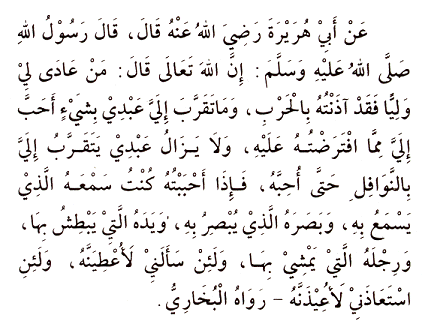
On the authority of Abu Hurayrah (radi Allaahu anhu) who said: The Messenger of Allah (صلّى الله عليه وسلّم) said, “Verily Allah ta’ala has said:
‘Whosoever shows enmity to a wali(friend) of Mine, then I have declared war against him. And My servant does not draw near to Me with anything more loved to Me than the religious duties I have obligated upon him. And My servant continues to draw near to me with nafil (supererogatory) deeds until I Love him. When I Love him, I am his hearing with which he hears, and his sight with which he sees, and his hand with which he strikes, and his foot with which he walks. Were he to ask [something] of Me, I would surely give it to him; and were he to seek refuge with Me, I would surely grant him refuge.’ ”
Share this, Baarakallaah Feekum: [“One who guides to something good has a reward similar to that of its doer” - Saheeh Muslim vol.3, no.4665] [This website protects the copyrights of the authors/publishers. The Content is posted on this website with implicit/explicit permission from content owners]
(With the name of Allaah),
(O Allaah! I seek Your refuge from male and female devils).
This is because of the hadeeth of `Alee -radiyallaahu `anhu- that the Prophet (صلّى الله عليه وسلّم ) said:
<<The screen between the jinn and the private-parts of the descendants of Aadam, when one of you enters the toilet, is that he says:‘Bismillaah’ (with the name of Allaah).>> [01]
And because of the hadeeth of Anas -radiyallaahu `anhu- who said: “When Allaah’s Messenger (صلّى الله عليه وسلّم ) went to the toilet he used to say:
Share this, Baarakallaah Feekum: [“One who guides to something good has a reward similar to that of its doer” - Saheeh Muslim vol.3, no.4665] [This website protects the copyrights of the authors/publishers. The Content is posted on this website with implicit/explicit permission from content owners]
‘The Prophet -sallAllaahu alayhi wa sallam- was not more concerned and did not pay attention to any of the optional prayers like he did for the two Rakat of Sunnah for the Fajr prayer.’ [Bukhari & Abu Dawood]
From Ayesha from the Prophet -sallAllaahu alayhi wa sallam- who said:
‘Two Rakat for Sunnah of Fajr prayer are better than the Dunyaa and everything that is in it.’ [Muslim, Tirmidhi & Nisa’ee]
From Ayesha –Radi Allaahu anha– who said from the Prophet -sallAllaahu alayhi wa sallam- that he said about the two Rakat when the Fajr prayer time comes in:
‘They are more beloved to me than the Dunyaa and everything that is in it.’ [Muslim]
Share this, Baarakallaah Feekum: [“One who guides to something good has a reward similar to that of its doer” - Saheeh Muslim vol.3, no.4665] [This website protects the copyrights of the authors/publishers. The Content is posted on this website with implicit/explicit permission from content owners]
Audio Courtesy: Masjid Uthmaan bin Affaan رضي الله عنه Sri Lanka. Delivered by Shaykh Adil Mansoor (hafidhahullaah), Live translated in to English by brother Abu Remlah Adam (hafidhahullaah). Sri Lankan Tour Jan 2018
You can buy the Book : “The Aqeedah of Imaam Al-Bukhari, His Life, his Creed, his Teachers, his Methodology” Here
Share this, Baarakallaah Feekum: [“One who guides to something good has a reward similar to that of its doer” - Saheeh Muslim vol.3, no.4665] [This website protects the copyrights of the authors/publishers. The Content is posted on this website with implicit/explicit permission from content owners]
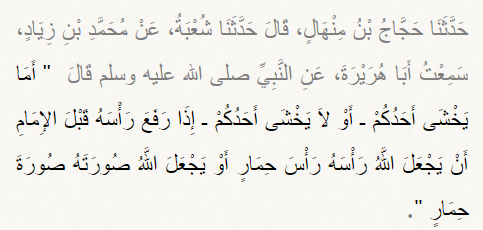
The Prophet (ﷺ) said, “Isn’t he who raises his head before the Imam afraid that Allah may transform his head into that of a donkey or his figure (face) into that of a donkey?”
Share this, Baarakallaah Feekum: [“One who guides to something good has a reward similar to that of its doer” - Saheeh Muslim vol.3, no.4665] [This website protects the copyrights of the authors/publishers. The Content is posted on this website with implicit/explicit permission from content owners]
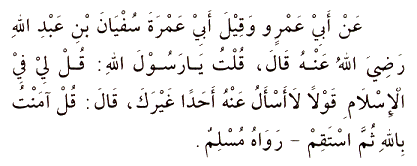
On the authority of Sufyan bin Abdullah (may Allah be pleased with him) who said:
“I said, ‘O Messenger of Allah, tell me something about Islam which I can ask of no one but you.’ He (peace be upon him) said, ‘Say “I believe in Allah” — and then be steadfast.'”
Share this, Baarakallaah Feekum: [“One who guides to something good has a reward similar to that of its doer” - Saheeh Muslim vol.3, no.4665] [This website protects the copyrights of the authors/publishers. The Content is posted on this website with implicit/explicit permission from content owners]
Share this, Baarakallaah Feekum: [“One who guides to something good has a reward similar to that of its doer” - Saheeh Muslim vol.3, no.4665] [This website protects the copyrights of the authors/publishers. The Content is posted on this website with implicit/explicit permission from content owners]
Abu Huraira reported Allah’s Messenger (ﷺ) as saying:
The most burdensome prayers for the hypocrites are the night prayer and the morning prayer. If they were to know the blessings they have in store, they would have come to them, even though crawling, and I thought that I should order the prayer to be commenced and command a person to lead people in prayer, and I should then go along with some persons having a fagot of fuel with them to the people who have not attended the prayer (in congregation) and would burn their houses with fire.
Share this, Baarakallaah Feekum: [“One who guides to something good has a reward similar to that of its doer” - Saheeh Muslim vol.3, no.4665] [This website protects the copyrights of the authors/publishers. The Content is posted on this website with implicit/explicit permission from content owners]
Umdatul Ahkaam – Book of Purification Hadith No. 24
Narrated `Abbad bin Tamim:
My uncle asked Allah’s Messenger (ﷺ) about a person who imagined to have passed wind during the prayer. Allah’ s Messenger (ﷺ) replied: “He should not leave his prayers unless he hears sound or smells something.”
Sahih al-Bukhari 137 (Book 4, Hadith 3)
Muhsin Khan Translation
Share this, Baarakallaah Feekum: [“One who guides to something good has a reward similar to that of its doer” - Saheeh Muslim vol.3, no.4665] [This website protects the copyrights of the authors/publishers. The Content is posted on this website with implicit/explicit permission from content owners]
.. After Ishmael’s mother had died, Abraham came after Ishmael’s marriage in order to see his family that he had left before, but he did not find Ishmael there. When he asked Ishmael’s wife about him, she replied, ‘He has gone in search of our livelihood.’ Then he asked her about their way of living and their condition, and she replied, ‘We are living in misery; we are living in hardship and destitution,’ complaining to him. He said, ‘When your husband returns, convey my salutation to him and tell him to change the threshold of the gate (of his house).’ When Ishmael came, he seemed to have felt something unusual, so he asked his wife, ‘Has anyone visited you?’ She replied, ‘Yes, an old man of so-and-so description came and asked me about you and I informed him, and he asked about our state of living, and I told him that we were living in a hardship and poverty.’ On that Ishmael said, ‘Did he advise you anything?’ She replied, ‘Yes, he told me to convey his salutation to you and to tell you to change the threshold of your gate.’ Ishmael said, ‘It was my father, and he has ordered me to divorce you. Go back to your family.’ So, Ishmael divorced her and married another woman from amongst them (i.e. Jurhum).
Then Abraham stayed away from them for a period as long as Allah wished and called on them again but did not find Ishmael. So he came to Ishmael’s wife and asked her about Ishmael. She said, ‘He has gone in search of our livelihood.’ Abraham asked her, ‘How are you getting on?’ asking her about their sustenance and living. She replied, ‘We are prosperous and well-off (i.e. we have everything in abundance).’ Then she thanked Allah’ Abraham said, ‘What kind of food do you eat?’ She said. ‘Meat.’ He said, ‘What do you drink?’ She said, ‘Water.” He said, “O Allah! Bless their meat and water.” The Prophet added, “At that time they did not have grain, and if they had grain, he would have also invoked Allah to bless it.” The Prophet added, “If somebody has only these two things as his sustenance, his health and disposition will be badly affected, unless he lives in Mecca.” The Prophet added,” Then Abraham said Ishmael’s wife, “When your husband comes, give my regards to him and tell him that he should keep firm the threshold of his gate.’ When Ishmael came back, he asked his wife, ‘Did anyone call on you?’ She replied, ‘Yes, a good-looking old man came to me,’ so she praised him and added. ‘He asked about you, and I informed him, and he asked about our livelihood and I told him that we were in a good condition.’ Ishmael asked her, ‘Did he give you any piece of advice?’ She said, ‘Yes, he told me to give his regards to you and ordered that you should keep firm the threshold of your gate.’ On that Ishmael said, ‘It was my father, and you are the threshold (of the gate). He has ordered me to keep you with me.’ [https://abdurrahman.org/2009/07/23/the-mother-of-ishmael/]
Share this, Baarakallaah Feekum: [“One who guides to something good has a reward similar to that of its doer” - Saheeh Muslim vol.3, no.4665] [This website protects the copyrights of the authors/publishers. The Content is posted on this website with implicit/explicit permission from content owners]
PS: For the authenticity of one of the dua’s mentioned by brother Ustadh Dawud Adib at the end of the audio, please read the below section
The Du’aa After the Wudoo
56. ‘Umar ibn al-Khattaab (radhiAllaahu ‘anhu) said: Rasoolullah (sallallaahu ‘alahi wa sallam)said None of you makes wudoo and completes the wudoo then says: Ashhadu anlaa ilaaha illallaahu wahdahu laa shareekalahu washhadu anna Muhammadan ‘abduhu wa rasooluhu (I bear witness that none has the right to be worshipped except Allaah, and that Muhammad is His slave andMessenger) except that all eight Gates of Paradise are opened for him – so that he enters by whichever he pleases.[Reported by Muslim (no.234), Abu Dawood (no 169), at-Tirmidhee (no.55), an-Nasaa’ee (no.148), Ibn Maajah (no.470)].
And at-Tirmidhee adds an authentic addition to it:
Allaahumma aj’alnee minat-tawwabeen waj’alnee minal mutatahhireen (O Allaah, make me one of those who constantly repents toYou and of those who purify themselves.) [Declared as Sahih by al-Albaanee].
[Prophets’s wudhoo – Fahd ibn ‘Abdir Rahman ash-Shuwaib | Dawud Burabanak]
Share this, Baarakallaah Feekum: [“One who guides to something good has a reward similar to that of its doer” - Saheeh Muslim vol.3, no.4665] [This website protects the copyrights of the authors/publishers. The Content is posted on this website with implicit/explicit permission from content owners]









 AbdurRahman.Org
You must be logged in to post a comment.