Sincerity and Significance of Intentions and all Actions, Apparent andHidden

Imam Al-Nawawi’s Riyad-us-Saliheen
Chapter 1
Sincerity and Significance of Intentions and all Actions, Apparent and Hidden

Allah, the Exalted, says:

And they were commanded not, but that they should worship Allah, and worship none but Him Alone (abstaining from ascribing partners to Him), and perform As-Salat (Iqamat-as-Salat) and give Zakat, and that is the right religion.” (98:5)

“It is neither their meat nor their blood that reaches Allah, but it is piety from you that reaches Him.” (22:37)

“Say (O Muhammad (sallallaahu ’alayhi wa sallam) ): Whether you hide what is in your breasts or reveal it, Allah knows it“. (3:29)

1. Narrated ‘Umar bin Al-Khattab (May Allah be pleased with him), reported: Messenger of Allah (sallallaahu ’alayhi wa sallam) said, “The deeds are considered by the intentions, and a person will get the reward according to his intention. So whoever emigrated for Allah and His Messenger, his emigration will be for Allah and His Messenger; and whoever emigrated for worldly benefits or for a woman to marry, his emigration would be for what he emigrated for.
[Al-Bukhari and Muslim].

2. Narrated ‘A`ishah (May Allah be pleased with her) reported: Messenger of Allah (sallallaahu ’alayhi wa sallam) said, “An army will raid the Ka`bah and when it reaches a desert land, all of them will be swallowed up by the earth.” She asked; “O Messenger of Allah! Why all of them?” He answered, “All of them will be swallowed by the earth but they will be raised for Judgement according to their intentions.”
[Al-Bukhari and Muslim].

3. A`ishah  (May Allah be pleased with her) narrated that the Prophet (sallallaahu ’alayhi wa sallam) said, “There is no emigration after the conquest (of Makkah) but only Jihad [(striving and fighting in the cause of Allah) will continue] and good intention.* So if you are summoned to fight, go forth.”
[Al-Bukhari and Muslim].

*. Intention according to An-Nawawi: It means that goodness which ceased to continue by the cessation of emigration can still be obtained by Jihad and by intending accomplishing good deeds.

4.  Jabir bin Abdullah Al-Ansari (May Allah be pleasedwith them) reported: We accompanied the Prophet (sallallaahu ’alayhi wa sallam) in an expedition when he said, “There are some men in Al-Madinah who are with you wherever you march and whichever valley you cross. They have not joined you in person because of their illness.” In another version he said: “They share the reward with you.”
[Muslim].

It is narrated by Bukhari from Anas bin Malik (May Allah be pleased with him): We were coming back from the battle of Tabuk with the Prophet (sallallaahu ’alayhi wa sallam) when he remarked, “There are people whom we left behind in Al-Madinah who accompanied us in spirit in every pass and valley we crossed. They remained behind for a valid excuse.”

5.  Ma`n bin Yazid bin Akhnas (May Allah be pleased with them) (he, his father and his grandfather, all were Companions) reported: My father set aside some dinars for charity and gave them to a man in the mosque. I went to that man and took back those dinars. He said: “I had not intended you to be given.” So we went to Messenger of Allah (sallallaahu ’alayhi wa sallam), and put forth the matter before him. He said to my father, “Yazid, you have been rewarded for what you intended.” And he said to me, “Ma`n, you are entitled to what you have taken.”
[Al-Bukhari].

6. Abu Ishaq Sa`d bin Abu Waqqas (May Allah be pleased with him) (one of the ten who had been given the glad tidings of entry into Jannah) narrated: Messenger of Allah (sallallaahu ’alayhi wa sallam) visited me in my illness which became severe in the year of Hajjat-ul-Wada` (Farewell Pilgrimage). I said, “O Messenger of Allah, you can see the pain which I am suffering and I am a man of means and there is none to inherit from me except one daughter. Should I give two-thirds of my property in charity?” He (sallallaahu ’alayhi wa sallam) said, “No”. I asked him, “Then half?” He said, “No”. Then I asked, “Can I give away one-third”. He said, “Give away one-third, and that is still too much. It is better to leave your heirs well-off than to leave them poor, begging people. You will not expend a thing in charity for the sake of Allah, but you will be rewarded for it; even the morsel of food which you feed your wife”. I said, “O Messenger of Allah, would I survive my companions?” He said, “If you survive others and accomplish a thing for the sake of Allah, you would gain higher ranking and standing. You will survive them … your survival will be beneficial to people (the Muslim) and harmful to others (the enemies of Islam). You will survive others till the people will derive benefit from you, and others would be harmed by you.” Messenger of Allah (sallallaahu ’alayhi wa sallam) further said, “O Allah, complete for my Companions their emigration and do not cause them to retract.” Sa`d bin Khaulah was unfortunate. Messenger of Allah (sallallaahu ’alayhi wa sallam) lamented his death as he died in Makkah.
[Al-Bukhari and Muslim].

7. Abu Hurairah (May Allah be pleased with him) narrated: Messenger of Allah (sallallaahu ’alayhi wa sallam) said, “Allah does not look at your figures, nor at your attire but He looks at your hearts and accomplishments”.
[Muslim].

8. Abu Musa Al-Ash`ari (May Allah be pleased with him) reported that Messenger of Allah  (sallallaahu ’alayhi wa sallam) was asked about who fights in the  battlefield out of valour, or out of  zeal, or out of  hypocrisy, which of this is considered as fighting in the cause of Allah? He said: “He who fights in order that the Word of Allah remains the supreme, is considered as fighting in the cause of Allah”.
[Al-Bukhari and Muslim].

9. Abu Bakrah Ath-Thaqafi (May Allah be pleased with him) reported: The Prophet (sallallaahu ’alayhi wa sallam) said: “When two Muslims are engaged in a combat against each other with their sword’s and one is killed, both are doomed to Hell”. I said, “O Messenger of Allah! As to the one who kills, it is understandable, but why the slain one?” He (sallallaahu ’alayhi wa sallam) replied: “He was eager to kill his opponent”.
[Al-Bukhari and Muslim].

10. Abu Hurairah (May Allah be pleased with him) reported that: The Messenger of Allah (sallallaahu ’alayhi wa sallam) said: “The reward for Salat performed by a person in congregation is more than 20 times greater than that of the Salat performed in one’s house or shop. When one performs Wudu’ perfectly and then proceeds to the mosque with the sole intention of performing Salat, then for every step he takes towards the mosque, he is upgraded one degree in reward and one of his sins is eliminated until he enters the mosque, and when he enters the mosque, he is considered as performing Salat as long as it is the Salat which prevents him (from leaving the mosque); and the angels keep on supplicating Allah for him as long as he remains in his place of prayer. They say: ‘O Allah! have mercy on him; O Allah! forgive his sins; O Allah! accept his repentance’. This will carry on as long as he does not pass wind“.
[Al-Bukhari and Muslim].

11. `Abdullah bin `Abbas (May Allah be pleased with them) reported:  Messenger of Allah (sallallaahu ’alayhi wa sallam) said that Allah, the Glorious, said: “Verily, Allah (SWT) has ordered that the good and the bad deeds be written down. Then He explained it clearly how (to write): He who intends to do a good deed but he does not do it, then Allah records it for him as a full good deed, but if  he carries out his intention, then Allah the Exalted, writes it down for him as from ten to seven hundred folds, and even more. But if he intends to do an evil act and has not done it, then Allah writes it down with Him as a full good deed, but if he intends it and has done it, Allah writes it down as one bad deed”.
[Al-Bukhari and Muslim].

12. `Abdullah bin `Umar bin Al-Khattab (May Allah be pleased with them) narrated that: He heard Messenger of Allah (sallallaahu ’alayhi wa sallam) as saying: “Three men, amongst those who came before you, set out until night came and they reached a cave, so they entered it. A rock fell down from the mountain and blocked the entrance of the cave. They said: `Nothing will save you from this unless you supplicate to Allah by virtue of a righteous deed you have done.’ Thereupon, one of them said: `O Allah! I had parents who were old, and I used to offer them milk before any of my children or slaves. One day, I went far away in search of grazing and could not come back until they had slept. When I milked as usual and brought the drink I found them both asleep. I hated to disturb them and also disliked to give milk to my children before them. My children were crying out of hunger at my feet but I awaited with the bowl in my hand for them to wake up. When they awoke at dawn, they drank milk. O Allah! If  I did so to seek Your Pleasure, then deliver us from the distress caused by the rock’. The rock moved slightly but they were unable to escape. The next said: `O Allah! I had a cousin whom I loved more than any one else (in another version he said: as a man can love a woman). I wanted to have sexual intercourse with her but she refused. Hard pressed in a year of famine, she approached me. I gave her one hundred and twenty dinars on condition that she would yield herself to me. She agreed and when we got together (for sexual intercourse), she said: Fear Allah and do not break the seal unlawfully. I moved away from her in spite of the fact that I loved her most passionately; and I let her keep the money I had given her. O Allah! If I did that to seek Your Pleasure, then, remove the distress in which we are.’ The rock moved aside a bit further but they were still unable to get out. The third one said: `O Allah! I hired some labourers and paid them their wages except one of them departed without taking his due. I invested his money in business and the business prospered greatly. After a long time, he came to me and said: O slave of Allah! Pay me my dues. I said: All that you see is yours – camels, cattle, goats and slaves. He said: O slave of Allah! Do not mock at me. I assured him that I was not joking. So he took all the things and went away. He spared nothing. O Allah! If  I did so seeking Your Pleasure, then relieve us of our distress.’ The rock slipped aside and they got out walking freely”.
[Al-Bukhari and Muslim].

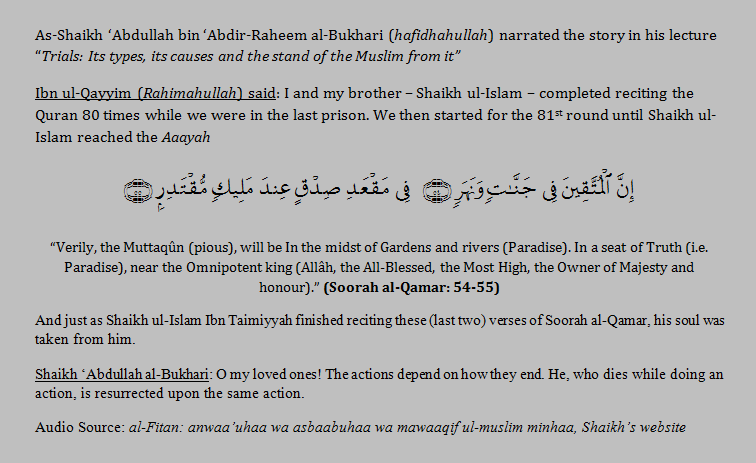
Actions are how they get sealed. The last Action of Ibn Taymiyyah!

Actions are how they get sealed. The last Action of Ibn Taymiyyah!

Benefit Shared by أبوحفص عديّ بن محمّد via Twitter
http://elbukhari.com/download/esound/muhadarat/al_fitan.mp3 …

Actions and People most beloved to Allaah

On the authority of Ibn Umar who said: ‘A man came to the Prophet sallAllaahu alayhi wa sallam- said: ‘

O Messenger of Allaah! Which of the people are the most beloved to Allaah and which of the actions are most beloved to Allaah?’

The Messenger of Allaah -sallAllaahu alayhi wa sallam- said:

‘The most beloved of the people to Allaah are the most beneficial for the people. The most beloved of actions to Allaah –Azza wa Jal- are to cause happiness to reach a Muslim, to relieve him from a hardship, to settle a debt for a Muslim or to repel hunger from him. For me to walk with a brother in order to assist him is more beloved to me than to make ‘Itikaf in this Masjid (Masjid al-Madeenah) for a month.

Whoever holds back his anger then Allaah hides his mistakes. Whoever suppresses his anger – even though he is not scared to show it, but withholds due to the truth – Allaah fills his heart with hope on the day of Judgement. Whoever walks with his brother to assist him with a need until he has helped him completely, then Allaah plants his feet firmly on the day people will not stand firmly. Indeed bad behaviour spoils good actions, just as vinegar spoils honey.’

Taken from Silsilah Ahadeeth As-Saheehah of Shaykh Al-Albaani. No. 906

Some Ahadeeth Pertaining to Behaviour and Seeking Permission
Taken from Silsilah Ahadeeth As-Saheehah of Shaykh Al-Albaani
Translated by Abbas Abu Yahya

The Righteous Action – Shaykh al-Albani

Shaykh Muhammad Nasirud-Din al-Albani – al-Hijra magazine (vol.4 no.2)
Al-Ibaanah Magazine Issue No.1 – Dhul-Qa’dah 1415H / April 1995

What Benefits the Dead

Abû Hurayrah narrated that the Prophet sallallâhu ’alayhi wa sallam said: “The likeness of wealth, family and the actions of the son of Âdam is of a man who has three companions. One of the man’s companions says: I am with you as long as you live; when you die, you have taken your share of yourself and you have taken your share of me – this is his wealth. The second companion says: I am with you until you reach that tree; you have had your share of yourself and your share of me – this is his family. The third companion says: I am with you in life and in death.” [2]

The above authentic hadîth is in fact like the following hadîth in meaning and in subject matter. Anas said that the Prophet sallallâhu ’alayhi wa sallam said: “The dead person is followed (to his grave) by three: His family, his wealth and his actions. Two of them return and only one remains. His family and wealth return, but his actions remain.” [3]

These two ahâdîth show that actions alone endure and enter the grave with their doers. Both these ahâdîth also affirm the fact that anything other than actions – such as wealth, servants or relatives – are of no benefit at all. Rather, they all return (to this world). His wealth becomes the property of his inheritor, whilst his relatives and family do not grant him anything from Allâh.

These ahâdîth intend to direct Muslims to be concerned with actions which will stay with them forever; and not to strive for wealth and position for the sake of relatives, family and servants. Apparently, the Prophet sallallâhu ’alayhi wa sallam wanted to show us the value of good actions when he related these ahâdîth to us, (which can be found) in the books of Zuhd (renouncement of the world). He pointed out to us that because actions will last rather than wealth, you have to make your actions righteous. Part of making ones actions righteous is through good wealth that is earned lawfully and spent in a good manner. Then one gains the rewards of ’amalus-sâlih (a righteous action).

The Acceptable Action

Therefore, in these ahâdîth, the Prophet sallallâhu ’alayhi wa sallam encouraged us to make our actions righteous, whether gaining wealth or other things. However, we must remember a certain fact about this action, a fact that many people neglect. The explanation of this fact should actually be a complete lesson in itself; and it is that only a righteous action is beneficial, not just any action.

So what are the conditions that a Muslim must fulfill in order for the action to be righteous? This is shown in the statement of Allâh – the Exalted and Sublime: “Say (O Muhammad): Verily I am only a man like yourselves, but revelation has been revealed to me that the One whom you should worship is only One Deity. And whoever hopes to meet his Lord, let him do righteous actions; and in the worship of your Lord, do not associate anyone along with Him.”

Two Important Conditions

The Scholars of Tafsîr have said that the end of this verse is an indication that there are two conditions for an action to be righteous and acceptable: [5]

Firstly: That the action must be in accordance with the Sunnah. Therefore, if the action is done as an act of worship, but is not in accordance with the Sunnah, it is not a righteous action. The reason is that compliance with the Sunnah is one of the conditions for the action’s righteousness. The proofs of this are many, but it is enough to state one: The hadîth of the Prophet sallallâhu ’alayhi wa sallam in which he said: “Whoever innovates in this matter of ours what is not upon it, it shall be rejected.” [6]

Therefore, any action that was not part of Islâm when Allâh revealed it upon the heart of the Prophet Muhammad sallallâhu ’alayhi wa sallam is not a righteous action. About this, Allâh – the Most High – says: “This day I have perfected your Dîn for you and completed My favour upon you and I have chosen Islâm as your Dîn.” [7] It must be remembered that Bid’ah (innovation) [8] is not divided into five categories, as some Scholars say. A proof for this is that the Prophet sallallâhu ’alayhi wa sallam said: “Every innovation is misguidance, and every misguidance is in the Hellfire.” [9]

Secondly: That after being in accordance with the Sunnah, the action has to be sincere, purely seeking the Face of Allâh – the Most High – because Allâh says at the end of the aforementioned verse: “And in the worship of your Lord, do not associate anyone along with Him.” This means that the person seeks, by his righteous action, only the Face of Allâh – the Exalted and Sublime. However, if he seeks other than Allâh, then he has setup partners with Allâh (made shirk with Allâh), therefore his action is rejected.

This is confirmed by Allâh in an authentic hadîth Qudsî: “I am so self-sufficient that I am in no need of having any partners. Thus, whosoever does an action for the sake of someone else as well as Me, will have that action rejected by Me, to him whom he associated with Me.” [10]

Consequently, if the action is righteous but not sincere for the sake of Allâh’s Face, it is rejected. Moreover, if the action is purely for the sake of Allâh’s Face, but not in accordance with the Sunnah, it is likewise not accepted.

The Worthless and Sinful Action

So these arc the two conditions for every action to be a righteous action. If one of these conditions is not present, the action does not become a righteous action, rather, it becomes an evil one. Had the person not done this action, it would have been better for him.

If a man prays two rak’ât of prayer at night, while others sleep, then even if he prays them according to the Sunnah – without addition or deletion – but he does this so that people may talk about him and say: “This Person is a righteous man. He prays at night when the people are asleep,” then his action becomes bâtil (null and void), since he did not sincerely seek the Face of Allâh alone, but rather he sought the praises of people, thus becoming sinful by associating partners with Allâh in his action.

However, if his action only became null and void, then the following hadîth would apply to him; and he would not be punished for this action: “How many fasting people obtain nothing from their fasting except hunger and thirst. And how many people who stay up at night (praying), obtain nothing from their being awake except sleeplessness and tiredness.” [11]

But this is not the case, for this person’s action has changed into a sin. The two rak’ât that this person performed without intending to seek only the Face of Allâh – the Exalted and Sublime – are the same as if he had disobeyed Him, that is to say: He will be punished for these two rak’ât because he associated others along with Allâh – the Exalted and Sublime – in his action.

If a man prays eleven rak’ât at night with the intention, in this worship, that his brothers would say about him: “This man is correctly following the Prophet; he does not add to the Sunnah,” his action becomes null and void; and his action changes to a sin against him. Rather, he must pray according to the Sunnah but sincerely seeking only the Face of Allâh – the Most High. He must be absolutely free of seeking the pleasure of others along with Him in this worship.

This has been but a summary about the action that does not leave the person but enters the grave with him – whether the action was good or bad – and that what is of benefit is the person’s righteous action. What is a righteous action and what are its conditions? The two conditions are:- Muwwâfaqah (compliance) with the Sunnah; and Ikhlâs (sincerity and purity of intention) to Allâh. Therefore, one must remember these two conditions and act upon them so that one may become righteous and pious.

Safeguarding against Insincerity

Many people unfortunately neglect the first condition (complying with the Sunnah) because they are astray and believe that bid’ah (innovation) is good in the religion.[12] But there are those upon whom Allâh has granted His favour, by guiding them to the Sunnah of the Prophet sallallâhu ’alayhi wa sallam. They are those who know the reality of this condition and adhere to it the best they can. Yet they must pay attention to the second condition, which either group may fail to fulfill, and that is riyâ’ (insincerity and showing-off). No one is exempt from riyâ’ and all people are susceptible to it in their actions.

This matter is a very serious one and must be stressed here, so that we may know that we are in need of making our actions correct and purely for the Face of Allâh – the Exalted and Sublime. Part of this is that we are tested even while making Da’wah to the Qur‘ân and the Sunnah, for trials are not only in evil matters, but also in the good matters: “And We test you with evil and good, by way of fitnah (trial).” [13]

This da’wah has been neglected by Muslims throughout the world so that the du’ât (the callers) have become strangers. Not only are they strangers in foreign countries, but they are strangers even in their own countries; amongst their relatives and brothers. This makes them praiseworthy, but they must not stand up to be praised for this da’wah. This is the reality, for the Prophet sallallâhu ’alayhi wa sallam said: “Verily Islâm started as something strange and it will return as something strange, so Tûbâ is for the Strangers.” [14]

Tûbâ and the Strangers

The meaning of Tûbâ in the Arabic language is: “Praise and thanks.” The meaning according to the Sharî’ah refers to a tree in Paradise, which would take a rider a hundred years to traverse its shade. [15] This hadîth gives glad tidings to the newcomers of Paradise in which there is: “What no eye has never seen, no ear has ever heard, and no heart has ever imagined.” [16] This tree is mentioned in the Qur’ân in the statement of Allâh: Tûbâ is for them, and the best abode.” [17] Therefore, Tûbâ is for the Ghurabâ (the Strangers), but who are they? The answer to this is in the reply of the Prophet: “Those who correct [themselves and others], when the people have become corrupt.” [18]

The Need for Care

These Strangers call the people to the revival of the Sunnah and eradication of all that differs from it. However, they must still pay attention to the second condition of the righteous action: To be sincere in their da’wah. They must neither seek fame, pride, nor arguments from their da’wah.

They must not seek anything that an-Nafs ul-Amârata bis-Sû’ (the soul that calls them to evil) orders them to do. Whatever they call to is as a result of Allâh – the Most High – having ordered them to make da’wah to the Qur’ân and the Sunnah and to make da’wah to what the Muslims have neglected. They must take care of this da’wah. However, they stand in danger. It can happen that one may say a word seeking only to have fingers of praise pointed at him, not sincerely advising the people and desiring to guide them. Rather, to do that for fame.

Here we mention a saying of some Sûfîs, who have some wise sayings that can not be denied: “The love of fame breaks backs.” Therefore, I insist, that we who make Da’wah to the Sunnah be sincere in our actions so that when our actions enter the grave with us, it will help us to answer correctly when we are asked: “Who is your Lord? Who is your Prophet? What is your religion?” If the deed is evil, when the person enters the grave, he will deny it. His deed will come to him in the worst of forms. He will ask it: “Who are you?” It will say: “I am your deed.”

Wealth – its Reality and Purpose

The next Hadîth is also authentic. Abû Hurayrah said that the Prophet sallallâhu ’alayhi wa sallam said: “The servant says: My wealth! My wealth! However, he gets from his wealth three things: What he eats and finishes. What he wears and makes shabby; and what he gives away and pleases others with. Whatever else is besides this, goes and is left for the people.” [19]

This Hadîth also emphasises the subject of the previous ahâdîth. It shows us the care taken by people in amassing wealth. Allâh pointed this out in the Qur‘ân by His statement: “And for the love of good he is strong.” [20]

The Prophet depicted the nature of mankind for us in his saying: “The servant says: My wealth! My wealth!” Nevertheless, what is the amount that remains left over for him from his wealth? Is all his wealth for him? No! He gains from his wealth only the examples that the Prophet sallallâhu ’alayhi wa sallam specified. The first is defined by the Prophet’s statement: “What he eats and finishes.” From his wealth is that which is necessary for him to survive and that which enables him to accomplish the rights of Allâh. These rights are the rights of His Tawhîd (singling out Allâh alone for worship), as Allâh said: “And I have not created the jinn and mankind except to worship Me.” [21]

The second is what a person wears until it becomes shabby. Add to this that which he volunteers and does good with, which is mentioned in the statement of the Prophet: “Or what he gives away and pleases others with.” He got rid of his wealth by giving it away to another in charity. Therefore, the wealth that is for the servant is the amount that he eats and the amount that he wears in order to survive. However this is not an end in itself. Rather, one exists solely to accomplish the obligation of worship, as we pointed out previously.

The third kind of wealth that returns with a benefit is not only the obligatory charity, but it also includes non-obligatory charities. Then the Prophet sallallâhu ’alayhi wa sallam explained what is left after these categories. He said: “And other than that is gone, and is left, for the people.”

The relation of this Hadîth with the previous one is: Why do people exhaust themselves in amassing wealth, when this is the reality of wealth? They do not benefit from there wealth except the amount that they eat, drink and with which they help other people. All else will be left and it will remain for the people who inherit it.

The following Hadîth is also Sahîh (authentic). Abdullâh ibn ash-Shikhkhîr said: I came to the Prophet whilst he was reciting: “Seeking increase diverted you.” The Prophet sallallâhu ’alayhi wa sallam said: “The son of Âdam say My wealth! My wealth! What do you obtain, O son of Âdam, from your wealth except that which you eat and consume, or wear until it becomes shabby, or what you give as charity and accomplish.”

This hadîth is also similar in meaning to the previous one, though some of its words are different; and was recorded by Muslim, at-Tirmidhî and an-Nasâ‘î. This hadîth is clear in its wording, however, the statement of the Prophet at the end of the hadîth: “or what you give as charity and accomplish.” may not be clear to some people.

Generosity and Miserliness

This statement aims at drawing one’s attention to the fact that what is intended for charity is that which he actually gives away. It is not sufficient that a person should just make out a will, that he should give such and such to the poor, or such and such for a specific masjid. However, the Prophet calls our attention to the fact that benefit is in that wealth which a person actually gave away during his lifetime, since he did not really know what would happen with his wealth after he died, if he had made a will.

with this word, the Prophet points to a hadîth in the Sahîh of al-Bukhârî – the meaning of which is that the miser is one who when death comes to him makes a will and says: “Give so and so such amount and for so and so such and such amount.” The Prophet said: “This was already for so and so and so and so.”

What the Prophet sallallâhu ’alayhi wa sallam meant was that the deceased did not own anything anymore. He had left this dunya (life of this world ) and had entered into the Âkhirah (the Hereafter) and his inheritance will remain for those people who are still alive. Then should not the person have made his will earlier? Should he not have given charity whilst he was strong, hoping to be rich and fearing poverty?

This is the nature of the people today, they say: “Hoard your white Dirham for your black day.” They hoard this money for themselves for when they become old. They are covetous of this wealth. The generous person is the one who gives away his own wealth when his own soul is attached to it.

As for the one who is on the brink of death and who says: “Give so and so such and such amount,” he is a miser and is not generous. Rather, a truly generous person is one who gives charity whilst he holds onto his life and also whilst he loves this wealth very much.

The Insignificance of this World

The next hadîth is narrated by Jâbir ibn ’Abdullâh: The Messenger of Allâh sallallâhu ’alayhi wa sallam passed by the market place coming from the direction of ‘Âliyah and people were around him. He passed by a dead kid goat (i.e. a baby goat) which had very short ears. He held it by its ears and said: “Who amongst you would like to have this for a dirham?” They (the Companions) said: We would not want it even for less than that! What can we do with it? He said: “Do you wish to have it (for any price)?” They said: By Allâh, even if it were alive it (we would not want it), as it has very short ears, let alone now when it is also dead! The Messenger of Allâh sallallâhu ’alayhi wa sallam said: “By Allâh, this world is more insignificant to Allâh than this (goat) is to you all.” [23]

Let us return to the hadîth. He passed by the market place “and the people were around him.” Here I would like to pause a little in order to remind people about some of the guidance of the Prophet sallallâhu ’alayhi wa sallam that most of the Shaykhs of today have neglected.

The Shaykhs of today walk with their students behind them. This was not the way of the Messenger of Allâh sallallâhu ’alayhi wa sallam. The ahâdîth describing this are many and the following is from them: “He used to walk side by side with Abû Bakr and side by side with Abû Hurayrah; and they all walked with each other.”

Moreover, it is authentically proven that the Messenger of Allâh sallallâhu ’alayhi wa sallam used to say to his Companions radiallâhu ’anhum, when he used to walk with them: “Walk in
front of me and leave my back for the angels.”
[24]

Here he highlights two matters from one saying. People do not see angels, they see only people. Therefore, if anyone saw the Messenger sallallâhu ’alayhi wa sallam walking, they would only see people walking in front of him. The Prophet sallallâhu ’alayhi wa sallam said in the authentic hadîth: “He who humbles himself for the sake of Allâh, Allâh will raise him.” [25] His humbleness raised him to a degree whereby the angels walked behind him. Therefore, is a noble person one behind whom people – good or bad – walk; or is he the one who is followed by those described by Allâh in the following verse: “They do not disobey what Allâh ordered them to do and do precisely what they are commanded.” The nobility of the Prophet manifested itself in a visible and an invisible side. The visible side is that the Companions used to walk in front of the Prophet and not behind him. The invisible side is that the angels walked behind him.

Of course, the first phenomenon is the one in which we are ordered not to act proudly with our companions and our brothers in faith, even those who may be less than us in knowledge, morals, worship and righteousness. This is enough for us, because Allâh says: “Do not sanctify yourself. He knows best the ones who are pious.” [26] It is sufficient for us at least, to walk with people side by side. Whosoever intentionally goes against this Sunnah, without doubt, does not truly love the Messenger of Allâh sallallâhu ’alayhi wa sallam. This is because one’s degree of love from him, is based upon following him. This is established in the Qur’ân by the statement of Allâh: “Say (O Muhammad): If you do love Allâh then follow me; Allâh will love you and forgive you your sins.” [27]

So, if this was the case with the Prophet who was infallible and protected from the whispering of the Shaytân and this was an indication of the level with his Companions, then what can we say about ourselves? We are not infallible and are not protected from the Shaytân. We must adhere to this Sunnah as if it were obligatory. It is better for us to walk with people around us than to walk looking with our eyes at the backs of their shoulders. The statement of the Prophet, at the end of the hadîth: “By Allâh, this world is more insignificant to Allâh than this (goat) is to you all,” is to be reflected upon by people of intellect!

The next authentic hadîth is similar to the previous hadîth. Ibn ’Abbâs said: The Prophet passed by a dead goat that had been thrown away by its owners. He said: “By the One in Whose Hand is my soul, this world is more insignificant to Allâh than this is to its owner.”

Sahl ibn Sa’d said that the Messenger of Allâh sallallâhu ’alayhi wa sallam said: “If this world was worth as much to Allâh as the wing of a mosquito, He would not have given a disbeliever even a sip of water.” [28]

Salmân said: Some people came to the Prophet sallallâhu ’alayhi wa sallam and he asked them: “Do you have food?” They said: Yes. He asked: “Do you have drink?” They said: Yes. He said: “Verily their outcome is like the outcome of this world, one of you stands behind his house holding his nose from their bad smell.” This is the similitude of this world. What is the eventual outcome of food and drink? They change to stool and urine. Therefore, a person hates the smell for himself. This is the similitude of the outcome of this World.

The following hadîth has the same meaning. Ubayy ibn Ka’b said that the Messenger of Allâh sallallâhu ’alayhi wa sallam said: “Indeed the food of the son of Âdam is like the example of the world. Even if he puts spices and season into it, see what becomes of it.” [29]

What is the eventual outcome of spices and seasoning in his food? Look at what it becomes! Likewise, this world becomes a similar thing except that which is for Allâh. The next hadîth explains this.

Abû Hurayrah narrated that the Prophet sallallâhu ’alayhi wa sallam said: “The world and all that it contains is cursed, except for the remembrance of Allâh and what supports it; or a Scholar and a student.” [30]

In Conclusion

This is the reality of this world in the Sharî’ah, it has no value. The similitude of this world is like good food and drink: its outcome is decay. The exceptions arc those things which are done for Allâh whether remembrance of Allâh, knowledge or even food because it helps to support the worship of Allâh. These things are among the deeds of man that endure in this fleeting life. The goal behind these ahâdîth is that a person should not be overly concerned about this world, except with which is sufficient to keep him alive and strong; and sufficient enough to be able to accomplish the worship of his Lord. For if his wealth is greater than this, it will only benefit him by the amount of good that he does by helping others; otherwise, he is going to leave this wealth behind and it will not benefit him at all. However, what will benefit him are the righteous actions that he has done.

We ask Allâh not to put love of this world in our hearts, but to guide us to earn in this life what helps us to worship and obey Him. And all praise is for Allâh, Lord of the Worlds.


References

1. Taken from al-Hijra magazine (vol.4 no.2) Shawwâl 1411/August 1990. Footnotes are from the Editors of al-Ibânah.
2. Sahîh: Related by al-Bazzâr and al-Albânî authenticated it.
3. Related by al-Bukhârî and Muslim.
4. Sûrah Kahf 18:110.
5. Ibn Kathîr says in Tafsîr Qur’ân ul-’Adhîm (3/114): “Thus, for an action to be acceptable it has to fulfill two conditions. Firstly: It must be sincere for Allâh alone. Second: It must be corrcct and in accordance with the sharî’ah. So if the action is sincere, but not correct, it will not be accepted.”
6. Related by al-Bukhârî (5/301) and Muslim (no.1718) – from
’Âishah radiallâhu ’anhu.
7. Sûratul-Mâ’idah 5:3. Imâm ash-Shâtibî relates in al-’ltisâm (l/49): “Imâm Mâlik – rahimahullâh – said: Whosoever introduces into Islâm an innovation has lied against the message of Muhammad sallallâhu ’alayhi wa sallam. Since Allâh has said: “This day have I completed your Dîn for you.” So whatever was not Dîn that day, cannot be considered as part of the Dîn today.”
8. Ash-Shâtibî says in al- ’ltisâm (1/37) about the Sharî’ah definition of Bid’ah: “A newly invented way in the Dîn, in imitation of, or corresponding to the sharî’ah, through which nearness to Allâh is sought. This action not being supported by any authentic proof – neither the action itself, nor the way in which it is performed.”
9. Sahîh: Related by Muslim (6/153) from Jâbir ibn ’Abdullâh. The additional wording “and all that misguides, misguides to the Fire.” is related by an Nasâ‘î (l/224) with a Sahîh isnâd – as Ibn Taymiyyah has mentioned in al-Fatâwâ (3/58).
10. Related by Muslim (no.2985) and Ibn Mâjah (no.4202) – from Abû Hurayrah radiallâhu ’anhu.
11. Sahîh: Related by Ibn Mâjah (1/539) and Ahmad (2/441) – from Ibn ‘Umar radiallâhu ’anhu.
12. The evidence to refute the notion of Bid’ah Hasanah (good innovation) are many. However, for the sake of brevity, only one will be mentioned:- The Sahabî ’Abdullâh ibn ’Umar radiallâhu ’anhu said – as is related by ad-Dârimî in al-Madhkal ilas-Sunan (no.191) with a Sahîh isnâd -: “Every innovation is misguidance, even if the people regard it as something good.”
13. Sûratul-Anbiyâ 21:35.
14. Related by Muslim (2/175-176) and Ibn Mâjah (2/320) – from
Abû Hurayah radiallâhu ’anhu.
15. Sahîh: Related by Ahmad (3/71) and authenticated by al-Albânî in as-Sahîhah (no.1241) that the Prophet was asked: What is Tûbâ? So he sallallâhu ’alayhi wa sallam said: “A tree in Paradise, which would take one hundred years to traverse. The clothes of the people of Paradise are taken from it.”
16. Part of a hadîth Qudsî – related by al-Bukhârî and Muslim from Abû Hurayah radiallâhu ’anhu – in which the Prophet said that Allâh said: “I have prepared for my righteous salves what no eye … ”
17. Sûrah Ra’d 13:29.
18. Sahîh: Related by ad-Âjurrî in al-Ghurabâ (pp.15-16) from Ibn Mas’ûd. The isnâd is Sahîh as al-Albânî states in as-Sahîhah (no.1273).
19. Related by Ahmad and Muslim – from Abû Hurayah radiallâhu ’anhu.
20. Sûratul-’Âdiyât 100:8.
21. Sûratudh-Dhâriyât 51:56.
22. Sûrat at-Takâthur 102:1
23. Related by Muslim and Ahmad
24. Sahîh: Related by Abû Nu’aym in Hilyatul-Awliyâ (7/117) from Jâbir radiallâhu ’anhu. It was authenticated in as-Sahîhah (no.1557).
25. Related by Muslim (16/141), ad-Dârimî (l/396) and others – from Abû Hurayrah radiallâhu ’anhu.
26. Sûratun-Najm 53:32.
27. Sûrah Âl-Imrân 3:31.
28. Sahîh: Related by at-Tirmidhî (no.2436) and al-‘Uqaylî in ad-Du’afâ (no.250) and it was authenticated in as-Sahîhah (no.943).
29. Hasan: Related by Ibn Hibbân in his Sahîh (no.2489) and at-Tabarânî in al-Kabîr (1/27/2) and authenticated in as-Sahîhah (no.382).
30. Hasan: Related by Ibn Mâjah (no.4112) and authenticated in Sahîhul-Jâmi’ (no.3414).

Repel evil with that which is better

From Al-Istiqaamah Magazine , Issue No.7 , Rabee’ ul-Awwal 1418H / July 1997

Allaah – the Most High – said:

“The good deed and the evil deed cannot be equal. Repel evil with that which is better; then indeed, he between whom and you there was enmity, will become as though he was a close friend.” [Soorah Fussilat 41:34].

Imaam as-Sa’dee (d. 1376H)- rahimahullaah – said:

“Not equal are acts of goodness and obedience, which are done to earn the pleasure of Allaah; and acts of evil and disobedience, that bring about the anger of Allaah, and not His good pleasure. Likewise. not equal are those acts of goodness and kindness that are done towards the creation, and those acts of evil done against them – neither in their nature, their characteristics, nor in their rewards: “Is not the reward for good acts, goodness.” Then, a particular, but important act of ihsaan (goodness and kindness) is commanded, which is: showing ihsaan towards the one who has ill-treated you; because Allaah commanded to repel evil with that which is better. This means that whenever you are ill-treated by anyone from amongst the creation – in particular those that have great rights over you; such as relatives, friends, and their like – then return their ill-treatment of you with acts of kindness and goodness towards them. Thus, if you have been cut-off from then seek to join the ties of relation; if you have been oppressed, then be forgiving; if you have been spoken ill of, either in your presence or behind your back, then do not retaliate, but rather be forgiving and speak to them with mild and soft words; if you have been boycotted and abandoned, then continue speaking to those who have done so, with good words, and continue giving them the greetings of salaam. So if you return acts of evil with acts of ihsaan (goodness and kindness), then you will indeed acquire a tremendous benefit.”1

Consider also, the following incident.

‘Aaishah radiallaahu’anhaa said:

I asked the Prophet sallallaahu ‘alayhi wa sallam: O Allaah’s Messenger, has there ever been a day more severe upon you than the day of Uhud? So he said: “Your tribe troubled me greatly, and the most troublesome thing which I experienced from them was on the day of ‘Aqabah when I presented myself to Ibn ‘Abd Yaaleel ibn ‘Abd Kulaal, and he did not respond to my Message as I had hoped. So I returned overwhelmed with grief and sorrow, and did not recover until I reached Qarnuth-Tha’aalib. I raised my head and saw a cloud shading me. Then I looked and saw (the Angel) Jibreel in it, and he called me saying. Allaah has heard what your people have said to you, and their reply. And Allaah has sent the Angel of the mountains to you to do whatever you wish. So the Angel of the mountains called me, greeted me with Salaam; and then said. O Muhammad. Allaah has heard what your people said to you, and I am the Angel of the mountains. My Lord has sent me to you, that you may order me as you wish. So what do you wish? If you should so wish, I will crush them beneath the two mountains.” So Allaah’s Messenger sallallaahu ‘alayhi wa sallam said: “No, rather hope that from their offspring will come who will worship Allaah alone, and not worship anything else along with Him.”2

Ibn Abee Haatim (d.328H) – rahimahullaah – said:

“I entered Damascus and came upon the students of hadeeth, and I passed by the circle of Qaasim al-Joo’ee (d.248H). I found a group sitting around him and he was speaking. Their appearance amazed me; and I heard him saying: “Seize the benefit of five things from the people of your time: when you are present, you are not known; when you are absent, you are not missed; when you are seen, your advice is not sought; when you say something, your saying is not accepted; and when you have some knowledge, you are not given anything for it. I also advise you with five matters: when you are treated unjustly, do not behave unjustly; when you are praised, do not become happy; when you are criticised, do not become upset; when you are not believed, do not become angry; and if people act deceitfully towards you, do not act deceitfully towards them.” Ibn Abee Haatim said: So I took that as my benefit from Damascus.”3


1. Tayseerul-Kareemur-Rahmaan (p.695).
2. Related by al-Bukhaaree (no.3231) and Muslim (no.1795).
3. Related by Ibn al-Jawzee in Sifatus-Safwaa (2/200)


Time is Running Out – Abu Muhammad al-Maghribee [Audio|En]

Listen / Download Mp3 Here (Time 30:07)

Preserving Good Deeds from Envy – Ibn Taymeeyah

Preserving Good Deeds from Envy
By Shaykh ul-Islaam Ibn Taymeeyah (d.728) -Rahimullaah-
Compiled & Translated By Abbas Abu Yahya

Published by Miraath Publications

Listen Audio Excerpt @ : Miraath Publications – BiteSize Ramadhaan 1434 Articles – Day 22

Shaykh ul-Islaam Ibn Taymeeyah -Rahimullaah- mentions in his explanation of the saying of Allaah Ta’ala:

ادعوا ربَّكم تضرُّعًا وخُفيةً إنه لايحبُّ المعتدين…

Invoke your Lord with humility and in secret. [al-Aaraaf: 55]

there are ten benefits of hiding your Dua’, and from amongst these benefits he said:

‘Indeed the greatest of blessings is turning to Allaah and worshipping Him. Every blessing has the equivalent of it being envied by an envious person, whether openly or secretly. There is no greater blessing than of turning to Allaah and worshipping Him [making Dua’], indeed the souls of the envious are attached to that blessing.

There is nothing more secure for the person who is envied than hiding his blessing from the envious person. Indeed Yaqoob said to Yusuf -alayhi as-Sallam:

قَالَ يَا بُنَيَّ لاَ تَقْصُصْ رُؤْيَاكَ عَلَى إِخْوَتِكَ فَيَكِيدُواْ لَكَ كَيْدًا

< < O my son! Relate not your vision to your brothers, lest they arrange a plot against you > >

till the end of the Ayaah.

How many of the people who have hearts, a connection and status with Allaah Ta’ala may perhaps have spoken about it, and informed people about it, and the envious one tried to plunder him over these blessings.

This is why the righteous and elderly are advised to keep their secrets with Allaah Ta’ala, and not to allow anyone to be acquainted with them.
This issue of hiding the blessing is of great benefit, its people know is benefits. Therefore, if it is commanded to do so in your Dua’/supplications, then this also includes the Dua’ for requesting this, and the Dua’ of praising Allaah.

Living and turning to Allaah Ta’ala is from the great treasures which has a right to be hidden from the eyes of the envious.’

[From: ‘Majmoo al-Fatawa’ 15/18-19]

Knowledge and Actions – By Shaykh Rabia’ ibn Haadee al-Madkhalee

Knowledge & Actions
By Shaykh Rabia’ ibn Haadee al-Madkhalee
Compiled & translated By Abbas Abu Yahya

Published by Miraath Publications

Listen Audio Excerpt: Miraath Publications – BiteSize Ramadhaan 1434 Articles – Day 14

1 – Shaykh Rabia’ said:

‘Learning knowledge should be for the sake of Allaah’s Face, and also for acting upon that knowledge, otherwise knowledge will have an evil consequence, so the person remains between two illnesses, either the illness of ignorance or the illness of knowledge which is not beneficial, but rather harmful.

The knowledge which Muhammad -sallAllaahu alayhi wa sallam- came with is in itself beneficial. However, if a person does not act upon it then it becomes an evil consequence for him, and harmful for him, and perhaps it could harm others.’

2 – Shaykh Rabia’ said:

‘What is required from learning knowledge, is acting upon it, and action cannot come except after knowledge. As Allaah Tabaraka wa Ta’ala said:

فَاعْلَمْ أَنَّهُ لَا إِلَٰهَ إِلَّا اللَّهُ وَاسْتَغْفِرْ لِذَنْبِكَ وَلِلْمُؤْمِنِينَ وَالْمُؤْمِنَاتِ

-So know that Lâ ilâha ill-Allaah (none has the right to be worshipped but Allaah), and ask forgiveness for your sin, and also for (the sin of) believing men and believing women.-  [Muhammad: 19]

Bukhari wrote a chapter heading ‘Chapter: Knowledge comes before Statements and Actions because it is obligatory upon us not to act except with knowledge, and not worship Allaah except with knowledge, so we do not worship Allaah Subhanahu – with ignorance or following desires.’

3 – Shaykh Rabia’ said:

‘The way of those misguided from the people of the Book who learnt knowledge but did not act upon it, is that their hearts became hard, and most of them became evil…. . .

If this hardness afflicts the heart then it destroys it. . . . .

So it does not accept the truth, and does not act with knowledge and refuge is sought with Allaah, and it leads to hiding knowledge and acting in opposition to knowledge. . .. .

It leads to following whims and rejection of the truth, which is clear like the sun. . . . . ’

[Taken from a writing of the Shaykh ‘Comments upon the words of Imam Ibn Qayyim in his book ‘al-Fawaid’, from Miraath.net]

– See more at: http://www.miraathpublications.net/day-14-knowledge-actions/#sthash.BPxZ1wQK.dpuf

The 2 Conditions of the Acceptance of Any Act of Worhsip – Shaykh al-Wasaabee [Video|Ar-En Subtitles]

Uploaded by DawahSalafiyaah

Shaykh Muhammad ibn Abdul-Wahab al-Wasaabee explaining the Hadith of Abu Hurayrah, may Allaah be pleased with him:

إِنَّ اللَّهَ لَا يَنْظُرُ إِلَى صُوَرِكُمْ وَأَمْوَالِكُمْ وَلَكِنْ يَنْظُرُ إِلَى قُلُوبِكُمْ وَأَعْمَالِكُمْ
“Verily, Allah does not look at your appearance or wealth, but rather He looks at your hearts and actions.”

The 2 conditions are:
1) al-Ikhlaas
2) al-Mutabaa’a

If one of the two, or even both are missing the action of the servant of Allaah becomes corrupt. May Allaah make our actions sincere for Allaah alone in accordance with the Sunnah of our beloved messenger Muhammad, sallAllaahu alahyi wa sallam.

The Good Deed and The Bad Deed – Shaykh Fawzan | Abu Muhammad al-Maghribee [Mp3|En]

Audio Courtesy: followthesalaf.com

Based on a lecture by our beloved Shaikh Saalih Al-FawzaanHafithahullah.

Listen /Download Mp3 Part01 Here  (Time 01:03:02)

Listen /Download Mp3 Part02 Here  (Time 01:01:57)

Allah, the Exalted, says:  “So hasten towards all that is good”. (2:148)

Abu Hurairah (May Allah be pleased with him) reported: Messenger of Allah (sallallaahu ’alayhi wa sallam) said,

“Be prompt in doing good deeds (before you are overtaken) by turbulence which would be like a part of the dark night. A man would be a believer in the morning and turn to disbelief in the evening, or he would be a believer in the evening and turn disbeliever in the morning, and would sell his Faith for worldly goods.”

[Muslim].

Abdullah Ibn ‘Abbas (May Allah be pleased with them) reported:Messenger of Allah (sallallahu alayhi wassallam) said that Allah, the Glorious, said:

“Verily, Allah (subhanahu wa ta’ala) has ordered that the good and the bad deeds be written down. Then He explained it clearly how (to write): He who intends to do a good deed but he does not do it, then Allah records it for him as a full good deed, but if he carries out his intention, then Allah the Exalted, writes it down for him as from ten to seven hundred folds, and even more. But if he intends to do an evil act and has not done it, then Allah writes it down with Him as a full good deed, but if he intends it and has done it, Allah writes it down as one bad deed”.

[Al-Bukhari and Muslim]

"Yaa akhi, by Allaah, my intention is good" – Shaikh al-Albaani (rahimahullaah)

The Meaning Of ‘Actions Are Only Judged By Intentions’
sources: silsilat ul-hudaa wa nnoor, 340/8 & nudhum al-fawaaid, 21
asaheeha translations

~ Explanation of the hadeeth: ‘Actions are only judged by intentions’ [Saheeh al-Bukhaari #1] ~

Shaikh al-Albaani (rahimahullaah):

“This hadeeth means that righteous actions are only (sound/accepted/rewarded) by sincere intentions, not that actions opposing the Legislation turn into righteous legislated actions due to coupling them with righteous intentions. No one will say that except someone ignorant or pursuing his own interests!

Many people know this hadeeth in wording but don’t understand its meaning. Why? Because oftentimes we turn (to some people) and say: ‘Yaa akhi, this action that you are doing, or this statement that you are uttering, is not a righteous action.’ What is the answer? ‘Yaa akhi, the Messenger (sallAllaahu ‘alayhi wa sallam) said: ‘Actions are only judged by intentions’ and my intention is good! My intention is righteous!’

So what is the meaning of the hadeeth? Does the hadeeth mean that evil actions are only (sound/accepted/rewarded) by righteous intentions? Or does it mean that righteous actions are only (sound/accepted/rewarded) by righteous intentions? This latter statement is the meaning. As for if one’s actions are not righteous but intention is righteous – this is not enough. Likewise it is also not enough if it is vice versa: i.e. if one’s actions are righteous but intention is not righteous. So the hadeeth gives us two opposites: just like it is a condition for righteous action that there be righteous intention, it is likewise a condition for righteous intention that there be righteous action. So either one is not enough without the other.

You hear many people nowadays swearing by their fathers for example, saying: ‘.’ Sometimes you may find a person coming to a grave and praying there – a grave of a prophet or righteous person or the like – then when they are prohibited from that, he tells you: ‘My intention is not to worship him, my intention is to seek nearness to Allaah (tawassul) through him.’ Ok, your coming to this grave – granted that the intention is righteous – is an action, so is this a righteous action? The answer is no, because the Messenger (‘alayhi ssalaam) used to say: ‘Don’t sit on the graves nor pray toward them.’ And du’aa is part of prayer, in fact du’aa is worship as he (‘alayhi ssalaam) said. Hence turning to the grave with du’aa is like turning to it with prayer: it is an action that is not righteous, and this unrighteous action is not justified by the intention being righteous, if we grant that the intention is righteous.

Thus, for our actions to be righteous, they must be in agreement with the Legislation. This is what our Lord (‘azza wa jal) pointed to with His Statement in the Noble Qur’aan: {whoever hopes for the meeting with his Lord, let him do righteous work and not associate any partner in the worship of his Lord}.”

Satan whispers : “You are doing that ostentatiously, to be seen of men and for a good reputation.”

Purity and Ostentation

Question: 

Many times a person thinks about doing a good deed and then Satan comes to him and whispers to him, saying, “You are doing that ostentatiously, to be seen of men and for a good reputation.” Therefore, he makes us go away from the good deed. How can one remain free of such occurrences?

Response: 

One can remain free of such occurrences by seeking refuge in Allah from the accursed Satan, as well as by continually performing good deeds. He should not pay attention to such whisperings that make him stop doing good deeds. If he turns away from such whisperings and seeks refuge in Allah from the accursed Satan, such whisperings will stop by the permission of Allah.

Shaikh Ibn Uthaimin
Source : Fatwas regarding Women – Muhammed al-Musnad , Darussalam Publications

Related Linkhttps://abdurrahman.org/jinn-shayateen-devils

The inheritance of Paradise – Shaykh al-Albaani (rahimahullaah)

source: alkhawf wa rrajaa – fear and hope (of Allaah) – tape no. 1

~

Abu Huraira (radi Allaahu ‘anhu) said that the Messenger of Allaah (sallAllaahu ‘alayhi wa sallam) said: “Whoever fears (Allaah) sets out at nightfall,[1] and whoever sets out at nightfall will reach the goal. Indeed, the goods of Allaah are expensive; indeed, the goods of Allaah is Paradise.”[2]

Shaykh al-Albaani (rahimahullaah) comments:

“The meaning of this is that there is a price for entering Paradise and that entering it does not happen by feeling safe (from the plan of Allaah) and at-tawaakul (not taking any means and saying ‘Allaah will provide for me’), but rather it happens by (doing) righteous deeds and at-tawakkul (taking the means and putting one’s trust) in Allaah, the Blessed and Most High; as Allaah, the Might and Majestic, said: ‘And say (O Muhammad (sallAllaahu ‘alayhi wa sallam)) ‘Do deeds! Allaah will see your deeds, and (so will) His Messenger [sallAllaahu ‘alayhi wa sallam].’’[3]

And in this hadeeth, there is an indication of the noble aayah that says: ‘This is the Paradise which you have been made to inherit because of your deeds which you used to do (in the life of the world),’[4] and in the other aayah: ‘Enter you Paradise because of that (the good) which you used to do (in the world).’[5] And here, it occurs to many students who have some participation in studying theSunnah, as they read or at least hear the statement of the Messenger (of Allaah) (‘alayhi ssalaat wa ssalaam) which is established in the saheehayn[6] that he [sallAllaahu ‘alayhi wa sallam] said:  “‘None of you will enter Paradise by his (good) deeds, but rather by the Favor of Allaah and His Mercy.’ They said, ‘Not even you O Messenger of Allaah?’ He [sallAllaahu ‘alayhi wa sallam] said, ‘Not even myself, unless Allaah encompasses me with His Favor and His Mercy.’”[7] So it seems that there is a contradiction between this hadeeth and the previousaayah along with our hadeeth in this book of ours where (the Prophet) (‘alayhi ssalaam) said: ‘Indeed, the goods of Allaah are expensive; indeed, the goods of Allaah is Paradise.’ Hence, there is a price (that one must pay) for Paradise and the two previous aayaat indicate that the price of Paradise is righteous deeds, and there is no doubt that good deeds do not benefit the one who does them at all except if he is truly a believer in Allaah and His Messenger [sallAllaahu ‘alayhi wa sallam]. So therefore, the price of Paradise is eemaan (faith) and righteous deeds. Then how does one reconcile between these three texts – this reality that we learned from our hadeeth tonight, ‘Indeed, the goods of Allaah are expensive’ and from the two previous aayaat – and between this hadeeth: ‘None of you will enter Paradise by his (good) deeds, but rather by the Favor of Allaah and His Mercy’?

The reconciliation between (these two) is that… that which is negated in the lasthadeeth ‘None of you will enter Paradise by his (good) deeds’ is one thing and that which is confirmed in the aayah ‘Enter you Paradise because of that (the good) which you used to do (in the world)’ is something else. That which is established in the aayah and the like is merely the entrance (into Paradise), i.e., the key to Paradise, as mentioned in some narrations from Wahb bin Munabbih in Saheeh al-Bukhaari: ‘…the key to Paradise is laa ilaaha illAllaah (none has the right to be worshiped but Allaah).’[8] So the key to Paradise is this eemaan (faith) and righteous deeds. But, if this Muslim enters Paradise and he enjoys in it, as mentioned in some authentic narrations, that which ‘no eye has seen, no ear has heard and (that which) has not come to the mind of a human being,’[9] then this type of enjoyment is not by means of a price that this enjoyer presented, but rather (it is) by the Favor of Allaah, the Mighty and Majestic, and His Mercy.

So the price of merely entering (into Paradise) is eemaan (faith) and righteous deeds. As for, part of the specific nature of enjoyment in Paradise which we pointed to previously – there is in it what ‘no eye has seen, no ear has heard and (what) has not come to the mind of a human being’ – then there is no price for this; it is impossible for a price to be determined for it. Why?

It has been mentioned in Saheeh Muslim from the hadeeth of ‘Abdullaah bin Mas’ood (radi Allaahu ‘anhu) that the Prophet (sallAllaahu ‘alayhi wa sallam) said:[10] ‘Indeed, I know the last man to come out from the Fire and the last man to enter Paradise. A man will come out of the Fire crawling.’ The meaning of this is that he comes out of the Fire being the most punished in it from the Muslims,and he comes out destroyed, exhausted (and) fatigued. Therefore, he is not able to walk straight as Allaah, the Mighty and Majestic, created him. But rather, he crawls until his life returns to him and his limbs are energetic and active. So he walks in this manner until Allaah, the Blessed and Most High, shows him a very great tree from far such that he is captivated by its beauty and splendor. And he wished for the Favor of Allaah, the Mighty and Majestic, and His Mercy after He saved him from the His severe punishment. Thus, he says: ‘O my Lord! Bring me to this tree so that I may be shaded by its shade, eat from its fruit[11] and drink from its water.’ Then Allaah, the Mighty and Majestic, says, while having more knowledge of His slave: ‘Would you ask me for other than it?’ (The man) says: ‘No O Lord, I will not ask you for other than it.’ So Allaah, the Blessed and Most High, brings him to that tree such that he is shaded by its shade, eats from its fruit and drinks from its water. Then, he continues on his way toward Paradise. Meanwhile, another tree appears to him which is more radiant, more beautiful and greater than the first one. So he hopes again and wishes more and more for the Favor of Allaah, so he asks Him and says: ‘O my Lord! Bring me to this tree’- and repeats the previous saying, then he is shaded by its shade and so on. Then Allaah, the Mighty and Majestic, says: ‘Would you ask me for other than it?’ (The man) says: ‘I will not ask you for other than it,’ while (Allaah) is more knowledgeable of him; our Lord knows that he will wish and wish until he enters Paradise. So He brings him to that tree such that he is shaded by its shade, eats from its fruit[12] and drinks from its water. Then, he continues on his way until he comes near the door of Paradise such that part of its refreshment, scent and joy come to him and he hears the voices of the people of Paradise. Thus, he says: ‘O my Lord! Let me enter Paradise,’ and maybe he says ‘Let me enter past the door of Paradise.’ So Allaah, the Blessed and Most High, says: ‘Enter Paradise, and there is for you the like of the world and ten times as much.’ So, the slave – almost not believing in the like of this divine favor when (Allaah) says to him ‘there is for you in Paradise the like of the world and ten times as much’ – says: ‘Are you mocking me while you are the Lord?’ And here, the narrator of the hadeeth laughed, who was ‘Abdullaah bin Mas’ood as we mentioned. So he was asked by the one to whom he was narrating this hadeeth: ‘Why did you laugh?’ He said: ‘Because when the Messenger (of Allaah) (‘alayhi ssalaam) narrated the statement of the slave to His Lord ‘Are you mocking me while you are the Lord,’ he (‘alayhi ssalaat was salaam) had also laughed.’ They had asked the Messenger (of Allaah) (‘alayhi ssalaam) himself (about his reason for laughing), so he [sallAllaahu ‘alayhi wa sallam] said: ‘Because Allaah, the Mighty and Majestic, laughed at His slave when he said ‘Are you mocking me while you are the Lord.’

What is clear from the hadeeth is that this person is the last to come out from the Fire and the last to enter Paradise, and he will have the like of the world and ten times as much. So does this destroyed person, who was the last to come out of the Fire, deserve this vast dominion in Paradise for his (good) deeds? No, this is by the Favor of Allaah, the Mighty and Majestic, and His Mercy…

Thus, if we regard this detailed explanation, the contradiction disappears between this hadeeth and the two aayaat. And this is one of the many examples in which some contradiction appears to some people, even the sincere ones amongst them, between some texts, whether from the Qur’aan and Sunnah or from each of them individually. So, the Muslim must not be hasty and he must reflect on both texts, and if the way for reconciling between the two is not possible for him, he (should) ask the one who is above him, as our Lord, the Blessed and Most High, said: ‘So ask the people of the Reminder if you do not know.’”[13]


[1] Shaykh al-Albaani explains: “i.e., he is headed for good and righteous deeds early, and he hastens to do them.”
[2] Saheeh at-Tirmidhee #2450
[3] Surat ut-Tawbah, 9:105
[4] Surat uz-Zukhruf, 43:72
[5] Surat un-Nahl, 16:32
[6] the two saheehs, i.e. Saheeh al-Bukhaari and Saheeh Muslim
[7] Saheeh al-Bukhaari #5673, Saheeh Muslim #2816
[8] Saheeh al-Bukhaari, Book 23, Chapter 1
[9] Saheeh al-Bukhaari #4779
[10] the following includes the narrations of Saheeh Muslim #186 and #187, in addition to the shaykh’s commentary
[11] the wording, “eats from its fruit,” is found in Saheeh aj-Jaami’ #1557 and attributed to the second tree
[12] the wording, “eats from its fruit,” is found in Saheeh aj-Jaami’ #1557
[13] Surat ul-Ambiyaa, 21:7

~

asaheeha translations

To Whom are the Deeds of a Child Written? – Shaykh Ibn Baaz

Question posed to Shaykh Ibn Baaz, rahimahullah:

Q. Are the deeds of a child who has not yet reached the age of puberty such as prayer, Hajj and the reading of the Qur’aan attributed to his parents or are they attributed to him?

A.  The good deeds of a child who has not yet reached the age of puberty and their rewards are for him and not for his parents or anyone else.  His parents are rewarded for having taught him to perform these deeds, for directing him to do good and for helping him in them.  This is indicated by the hadeeth in Saheeh Muslim, narrated by Ibn Abbaas, that a woman lifted a child to the Prophet, salallahu ‘alayhi wa salam, during his farewell Hajj and said:  “O Messenger of Allah, is there Hajj for him?”  He, salallahu ‘alayhi wa salam, replied:  “Yes, and there is reward for you.”The Prophet, salallahu ‘alayhi wa salam, informed us that the Hajj is for the child, and that his mother is rewarded for her Hajj with him.  Similarly, there is reward for others besides the child’s parents, for the good they do such as teaching orphans, relatives, servants and others, due to the Prophet’s, salallahu ‘alayhi wa salam, saying:  “For the one who guides to good, a reward similar to that of the one who performs it.”  Narrated in Saheeh Muslim.  This is because it is from the assisting one another in virtue and fearfulness of Allah and that He, Glory be to Him, rewards for this.

Shaykh Ibn Baaz, rahimahullah  [Fataawa Islaamiyyah: 4/526]
(Also in Islamic Fataawa Regarding the Muslim Child, page 15)

Allaah’s dealing with His servants – Shaykh al-Albaani (rahimahullaah)

Source: alkhawf wa rrajaa – fear and hope (of Allaah) – tape no. 1, asaheeha translations

shaykh al-albaani (rahimahullaah) begins with the khutbat ul-haajah maa shaa Allaah, and the first part of his talk revolves around the meaning of the hadeeth below:

Allaah’s Messenger sallallahu ‘alayhi wa sallam said:

“Allaah says [to the angels], ‘If My slave intends to do a bad deed then do not write it against him until he does it; if he does it, then write it as it is, but if he leaves it for My sake, then write it as a good deed for him. And if he intends to go a good deed, but does not do it, then write it as a good deed for him; and if he does it, then write it for him as ten good deeds up to seven-hundred times as much up to many more times” – [Saheeh al-Bukhaari]

The shaykh comments and speaks on the many favors of Allaah upon His believing slave:

“…First, if he does a good deed it [the count of the deeds] is multiplied – as for a bad deed, then it [the count of the deeds] is not multiplied.

Second, if he did not do a bad deed, and had intended to do it, nothing is written against him, as opposed to [gaining a] good deed: 

if he intended to do (a bad deed), then did not do it, a good deed is written for him. Why? – because he left it fearing Allaah ‘azza wa jal. And the [understanding of] this is that if he intends to do a bad deed, then leaves it and does not act upon it for some reason, and it is not (because of) his fear of Allaah, the Blessed and Most High, then nothing is written upon him, neither a bad deed nor a good deed.

As for if his motive for leaving this bad deed was his fear of Allaah ‘azza wa jal, then this bad deed, because of his leaving it, turns into a good deed. Hence, fearing Allaah ‘azza wa jal pushes its possessor (the possessor of the quality of fearing Allaah) to have many good deeds. Every time he intends to do a bad deed and he leaves it fearing Allaah, the bad intention turns into a good deed.”

Advice: How to Set Your State Aright – Imam Ibn al Qayyim

Let’s strive to be close to Allah.

Let’s long for the dwelling of peace wherein there is no toil, stress or weariness.

The easiest way is to consider the fact that you are passing a period that lies between two other periods, namely your current life, which is the present one and it is between your past and your future.

The past can be set aright through repentance, regret and asking the forgiveness of Allah, and this is a way, which affords you no toil, weariness or hard work, as it is concerned with the heart.

The future can be set aright by abstaining from misdeeds, and this is a means of comfort and relief for you, for it is not a difficult act, but it is an intention that relieves your body, heart, and your mind.

In brief, your past is set aright through repentance; your future is set aright through abstention, determination and intention, which have nothing to do with overburdening the body.

However, our concern here is with the present time as it stands between the two other periods. If you waste it, then you are wasting your happiness and salvation. On the contrary, if you maintain it through setting your past and present aright, indeed you will attain success, salvation, relief, and pleasure.

Improving your present state is much more difficult than setting your past and your future aright, because it means that you should abide by the most deserving and beneficial deeds to achieve happiness. There are great differences between people in this regard. This is your chance to take the provision for your Hereafter, either Paradise or Hellfire. So, if you take this path to your Lord, you will attain glorious happiness and great success during this short period of time which has no value compared with eternity. However, if you prefer vain desires, idleness, play and amusement, the period would pass quickly, followed by a permanent and great pain, the suffering of which is much more severe than the suffering of patience, the patience required to obey Allah.

Source: AL-FA WA’ID: A Collection of Wise Syaings – Imam Ibn al Qayyim
Al Bayaan Translation Services

Faith has both apparent and hidden aspects – Imam Ibn AI-Qayyim

Faith has both apparent and hidden aspects. Its apparent aspect is when it is related by the tongue and acted upon by the body. The hidden aspect is the acknowledgment of the heart, and its submission and love. Therefore, the apparent aspect of faith will be of no use for someone who does not have the hidden aspect, though his blood is spared and his wealth and children are preserved by it. And no hidden aspect will be of any use, unless there is no fear that it will be weakened, coerced or in fear of being ruined. Therefore, the failure of apparent deeds without the existence of any real prevention, means the corruption of the hidden aspect and lack of faith. Its deficiency refers to its deficiency of faith and intensity refers to its intensity of faith.

Therefore, faith is the heart and core of Islam, and certainty is the heart and core of faith. Any piece of knowledge or deed that does not make faith and certainty stronger is abnormal, and any faith that does not urge one to perform good deeds is abnormal.

Source: Al-Fawaaid – A COLLECTION OF WISE SAYINGS – Imam Ibn AI-Qayyim,
Rendered into English by: Bayan Translation Services

A Precious and Valuable Gem: The (Religious) Scholar Whose Deeds are Inconsistent with his Knowledge

The religious scholars who prefer and Love this worldly life shall surely speak other than the truth concerning their judgments and religious verdicts. Verily, the judgments of Allah usually contradict the desires of people especially the rulers and those who follow their whims, as their aims cannot be attained except by opposing the truth.

Accordingly, if the ruler and the religious scholar seek position and power and follow their desires, indeed they will not be able to fulfill their aims except by deviating from the truth, especially if there is a doubtful matter involved. The doubtful matter will agree with the desires of man, and vanity will prevail. As a result, righteousness will disappear, and truth will vanish.

However, there is no doubtful matter in the truth, so how can wrong doers dare to oppose it openly, assuming that they will be able to repent afterwards. Such behavior is mentioned in a Qur’anic verse in which Allah says, which means,

“Then, there has succeeded them a posterity who have given up As-Salat (the prayers) [i.e. made their Salat (prayers) to be lost, either by not offering them or by not offering them perfectly or by not offering them at their proper fixed times, etc.] and have followed lusts.” (Mariam, 19:59)

They were also mentioned in another verse, in which Allah says,which means,

“Then after them succeeded an (evil) generation, which inherited the Book, but they chose (for themselves) the goods of this low life (evil pleasures of this world) saying (as an excuse): “(Everything) will be forgiven to us. And if (again) the offer of the like (evil pleasures of this world) came their way, they would (again) seize them (would commit those sins). Was not the covenant of the Book taken from them that they would not say about Allah anything but the truth? And they have studied what is in it (the Book). And the home of the Hereafter is better for those who are AI-Muttaqun (the pious). Do not you then understand?’1 (Al-A’raf, 7:169)

Allah, the Exalted, informs us that those wrong doers have chosen the goods of this low life (the evil pleasures of this world) despite being aware of its unlawfulness. Moreover, they say, as an excuse, “(Everything) will be forgiven to us.And if (again) the offer of the like (evil pleasures of this world) came their way, they would (again) seize them (would commit those sins), so they are insistent upon that, and that is the reason why they dare to utter falsehood against Allah, assuming that the judgment and the religion of Allah are implied therein.Either they know the fact that the religion and the judgment of Allah contradict their claims, or they do not know. The result is that sometimes they utter falsehood against Allah, or else they say what is unlawful.On the other hand, the pious know quite well that the Hereafter is better than this worldly life, so loving leadership and following one’s desires would not be a temptation to them, so they would never prefer this worldly life to the Hereafter. They have only one path, which is abiding by the Glorious Qur’an and the Sunnah. Besides, they seek help in patience and prayer, think deeply about this worldly life, its transient nature and its inferiority, and they compare it with the Hereafter, its greatness and the fact that it is eternal.Following one’s desires can blind the heart in a way that makes it confused between the Sunnah and innovation in religion. Sometimes, one may be confused whether or not an action is based on the Sunnah or on an innovation in religion. In fact, when misunderstandings like this occur, it is the fault of religious scholars as they prefer this worldly life and follow the rulers, and their vain desires.They are mentioned in these verses in which Allah says,which means,

“And recite (O Muhammad Sallalaahu Alaihi wa Sallam)) to them the story of him to whom We gave Our Ayat (proofs, evidences, verses, lessons, signs, revelations, etc.), but he threw them away, so Shaitan (Satan) followed him up, and he became of those who went astray. And had We willed, We would surely have elevated him therewith but he clung to the earth and followed his own vain desire. So his description is the description of a dog: if you drive him away, he lolls his tongue out, or it you leave him alone, he (still) lolls his tongue out” (Al-A’raf, 7: 175¬176)

So, this is the likeness of the devious scholar of religion whose deeds contradict his knowledge.The previous verses dispraised this behavior as follows:

One: He has gone astray after having been knowledgeable, and he has knowingly chosen disbelief over faith.

Two: He abandoned faith entirely with no return, so, he threw away the Ayat (proofs, evidences, verses, lessons, signs, revelations, etc.), like the serpent which throws away its skin.So, if there was any remnant thereof, he could not throw it away.

Three: Satan controlled him and so he tempted and seduced him, and that is why Allah says, “Satan followed him up, and He did not say, pursue him”, because following up means reaching and attaining him, which is much more eloquent than saying, “pursue him,” as far as meaning and expression are concerned.

Four: He has erred after having been guided, which means that he has gone astray in knowledge and in intention, which is related to the corruption of his intention and deeds. Going astray is related to the corruption of knowledge and belief, and the corruption of one side entails the corruption of the other.

Five: If Allah, the Exalted, had so willed, He could have elevated him with knowledge, which would have prevented his destruction. In other words, if he was not knowledgeable, it would have been much better for him, and would have meant a lesser torment for him.

Six: Allah, the Exalted, informed us about his wicked intention, mentioning that he has preferred inferiority rather than the most honorable and the most righteous.

Seven: His inferior choice was not chosen because of an idea that crossed his mind, on the contrary, it was chosen due to his desire to cling  to the earth. Clinging means permanent adherence, as if it was said, “He is sticking to the earth.” The Qur’anic expression described his inclination to this worldly life by referring to his clinging to the earth, because the worldly life is the earth, and those who are living therein, and everything that can be extracted thereof, either for adornment or enjoyment.

Eight: He deviated from the right path following his vain desires, so his own desire resembles a leader who should be followed.

Nine: He, the Almighty compared him to a dog, which is the most low amongst creatures, because of its greed.

Ten: He compares his covetousness to this worldly life and his impatience thereto and his grief of being deprived thereof by the lolling out of the dog’s tongue, whether it is left alone or driven away. Accordingly, if that person is left alone, then he will be covetous of this worldly life, and if he is advised he will still be covetous. of this worldly life. He clings to covetousness like the dog with its tongue lolling out. Ibn Qutaibiyah said, “Surely everyone pants because they are exhausted or thirsty, except dogs, for it is their habit to pant while lolling their tongues out in all cases, whether they are exhausted or not, and whether they are thirsty or not, and that is why the Qur’anic expression compared it to the disbeliever, asserting that he has gone astray whether he is advised or left on his own. This is like the dog whether it is left alone or driven away.

Source: AI-Fawa’id, A COLLECTION OF WISE SAYINGS , Rendered into English by: Bayan Translation Services

The Religion of al-Islaam is Based on Two Mighty and Fundamental Principles – Shaykh Muhammad Al-Wassãbi

Shaikh Muhammad ibn Abdul-Wahhab al-Wasabi (may Allah preserve him).

That the religion of al-Islaam can be summarized into two basic important and mighty principles, and they are as follows:

The First (al-Awwal):

That we do not worship anyone except Allaah alone, having no partner in that
[An-laa Na’budu illa-Allaah Wahdahu laa Shareeka lah].

Allaah (ta’aalaa) said:
Say (O Muhammad (Sallalahi Alaihi wa Sallam): “O people of the Scripture (Jews and Christians): Come to a word that is just between us and you, that we worship none but Allaah, and that we associate no partners with Him, and that none of us shall take others as lords besides Allaah.” Then, if they turn away, say: “Bear witness that we are Muslims.” (Aali Imraan 3:64)

And He (ta’aalaa) said: And your Lord has decreed that you worship none but Him. (Al-Israa’ 17:23)
And this is the meaning of: (I bear witness that none has the right to be worshipped except Allaah) [Ash-hadu an-laa Ilaaha illa-Allaah].

And The Second (ath-Thaanee):

That we do not worship Him except by what He legislated in His Book or in the Sunnah of His Messenger Muhammad (Sallalahi Alaihi wa Sallam), without innovations and desires [An-laa Na’budahu illaa bimaa Shara’ fee Kitaabihi aw fee Sunnati Rasoolihi Muhammad (Sallalahi Alaihi wa Sallam) laa bil-Bida’i wal-Ahwaa’].

He (ta’aalaa) said:
[Say (O Muhammad (Sallalahi Alaihi wa Sallam) to these idolaters (pagan ‘Arabs) of your folk:] Follow what has been sent down unto you from your Lord (the Qur’aan and Prophet Muhammad’s Sunnah), and follow not any Awliyaa’ (protectors and helpers, etc. who order you to associate partners in worship with Allaah), besides Him (Allaah). Little do you remember! (Al-A’raaf 7:3)

And He (ta’aalaa) said:

And whatsoever the Messenger (Muhammad (Sallalahi Alaihi wa Sallam) gives you, take it, and whatsoever he forbids you, abstain (from it), and fear Allaah. Verily, Allaah is Severe in punishment. (Al-Hashr 59:7) And this is the meaning of: (I bear witness that Muhammad (Sallalahi Alaihi wa Sallam) is the Messenger of Allaah) [Ash-hadu anna Muhammadar-Rasool-ullaah].

Shaykhul-Islaam ibn Taymiyyah (rahimahullaah) said in his valuable book ((Iqtidaa’ as- Siraatul-Mustaqeem Mukhaalifat Ashaab al-Jaheem)) [The Requirements of the Straight Path in Opposing the Companions of the Fire] page 451:

( And these two fundamentals: are the essence of the religion (Jimaa’ ad-Deen): That we do not worship anyone except Allaah and that we do not worship Him except with what He has legislated, and we do not worship Him with innovations … and these two fundamentals, they are the realization and the perfection of the two testimonies (ash-Shahaadatayn), which are the head of al- Islaam … ). End of quote. And see at-Tahqeeq wal-‘Eedaah of ash-Shaykh Ibn Baaz (rahimahullaah) page: 63.

EXPLANATION OF THE TEXT BY SHAYKH AHMED AL-WASAABEE (HAFIDHAHULLAAH):

Regarding the first fundamental principle, which is the Tawheed of Allaah, the Shaykh mentioned that in the Kitaab of Allaah and the Sunnah of His Messenger we find many Aayaat and Ahaadeeth that point to this great fundamental principle. And it was for this cause that Allaah (subhaanahu wa ta’aalaa) sent His Messengers, and He ordered them to call the people first and foremost to this fundamental principle, which is the Tawheed of Allaah, and the oneness of Allaah in His worship (Tawheed al-Ulooheeyah), and the oneness of Allaah in His Names and Attributes (Tawheed al- Asmaa was-Sifaat), and the oneness of Allaah in His Lordship (Tawheed ar-Ruboobeeyah).

Allaah (subhaanahu wa ta’aalaa) said:
And verily, We have sent among every Ummah (community, nation) a Messenger (proclaiming): “Worship Allaah (Alone), and avoid (or keep away from) Taaghoot (all false deities, etc. i.e. do not worship Taaghoot besides Allaah).” (An-Nahl 16:36)

And He (ta’aalaa) said:
And We did not send any Messenger before you (O Muhammad (Sallalahi Alaihi wa Sallam)) but We inspired him (saying): Laa Ilaaha Illaa Ana [none has the right to be worshipped but I (Allaah)], so worship Me (Alone and none else).” (Al-Anbiyaa’ 21:25)

So if a person worships Allaah (subhaanahu wa ta’aalaa) and obeys these commands of Allaah, then this is the realization of Tawheed, and this is the first fundamental which this religion of al-Islaam is based upon.

Regarding the second fundamental principle, and it is that we do not worship Allaah except by what He has legislated in His Book or in the Sunnah of His Messenger Muhammad (Sallalahi Alaihi wa Sallam), and that we do not worship Him with innovations and desires. The Shaykh mentioned that those who beautify and make beautiful to themselves innovations and desires, and from the innovations is celebrating the Mawlid (birthday) of the Prophet (Sallalahi Alaihi wa Sallam), which is an innovation of the Soofiyyah, and the Shaykh mentioned that this is not allowable in our religion and it is not legislated, and the people who perform this, they are under a severe threat. Allaah (subhaanahu wa ta’aalaa) has issued a severe warning against those who oppose and go against the commandments of the Messenger:

And let those who oppose the Messenger’s (Muhammad (Sallalahi Alaihi wa Sallam)) commandment (i.e. his Sunnah legal ways, orders, acts of worship, statements, etc.) (among the sects) beware, lest some Fitnah (disbelief, trials, afflictions, earthquakes, killing, overpowered by a tyrant, etc.) befall them or a painful torment be inflicted on them. (An-Noor 24:63)

We have been ordered to be followers and we have been ordered to take firm hold of the Sunnah. So that which the Prophet (Sallalahi Alaihi wa Sallam) has given us, then it is upon to take it and firmly hold on to it, and that which he prohibited us from then it is upon us to prohibit ourselves from it. And the one who goes against the clear orders of the Messenger (Sallalahi Alaihi wa Sallam) is in opposition to the Messenger, and he is on a great level of jeopardy, and if Allaah (subhaanahu wa ta’aalaa) does not give him the Tawfeeq to repent, and he dies upon this, then he is in a dangerous state. And many of the people in this day and age have fallen into numerous types of innovations, such as the Soofiyyah and the Raafidhah, and other than them. And they have not prohibited themselves from that which the Prophet (Sallalahi Alaihi wa Sallam) has prohibited them from, and they have not enjoined upon themselves that which the Prophet (Sallalahi Alaihi wa Sallam) has enjoined upon them and ordered them with.

And in the valuable book of Shaykhul-Islaam Ibn Taymiyyah is the warning to the Believers of following the path of the people whose destination is the Fire, the people of the Book, the Jews and the Christians. And in this day and age we find many of the Muslims following the Kuffaar in all levels of life. And verily we have been ordered to oppose the Kuffaar in all actions and in all levels of life, such as our speech, and our character, and in our dress, and in our actions of worship, so much so that even in the prayer, as the Prophet (Sallalahi Alaihi wa Sallam) has said: ((Pray in your shoes, for verily the Jews do not pray in their shoes)). A Hadeeth.

And many of the Muslims have invented various holidays following in the footsteps of the Kuffaar, such as labor day, and workers holiday, and mothers day, and other holidays like this, all of which are alien to al-Islaam and all of which are innovations.

Source : Class 43 : May – 13 – 06 of Lessons on Tawhid – Approximately 50 Classes – from Dar-ul-Hadith, Dammaj, Yemen

Important principle of Permissibility & Prohibition

The Principle of Permissibility

Source : Islamic Principles #1: The Principle of Permissibility , Al-Istiqaamah Issue No.5 – Ramadân 1417H / January 1997

“The principle regarding acts of worship is one of prohibition, except if the Sharee’ah (Divinely Prescribed Law) relates a prescription for it. And the principle regarding customary behaviour is permissibility, except when the Sharee’ah relates a prohibition for it.” (Al-aslu fil-‘ibaadat al-hadhru illaa ma waradah ‘anish-shar’ee tashree’ahu. Wal-aslu fil-‘aadaat al-ibaahah illaa ma waradah ‘anish-shar’ee tahreemahu).1

The above principle is an important principle that Islaam teaches. Thus, with regards to matters of ‘aadaat (day-to-day actions), such as eating, drinking and wearing clothes, then everything is allowed in this regard, except if there is a clear and authentic evidence restricting or prohibiting its allowance. However, when it comes to ‘ibaadaat (acts of worship), then the opposite is the true. Here, nothing can be established as an act of worship, except if there is a clear and authentic text to allow it. So the basic principle for ‘aadaat is ibaahah (permissibility), whereas the basic principle for ‘ibaadaat is tahreem (prohibition).

Shaykhul-lslaam Ibn Taymiyyah (d.728H)- rahimahullaah – said:

“Peoples’ sayings and actions are of two kinds: ‘ibaadaat (acts of worship) by which their Religion is established, and ‘aadaat (customary practices) which are required for day-to-day living. From the principles of the Sharee’ah (Divinely Prescribed Islaamic Law) we know that acts of worship are those acts which have been prescribed by Allaah or approved by Him; nothing is to be affirmed here, except through the Sharee’ah. However, as far as worldly activities of people are concerned, they are necessary for everyday life. Here the principle is freedom of action; nothing may be restricted in this regard except what Allaah – the Mort Perfect – has restricted. This is the case because commanding and prohibiting are both in Allaah’s Hands. As far as worship is concerned, there has to be a command from Him concerning it. Thus, when it requires a command from Allaah to establish something, how can we say that something is restricted without His command? This is why Ahmad bin Hanbal (d.241H) and other jurists who base their judgements upon ahaadeeth (Prophetic narrations) say: In relation to acts of worship, then the principle is tawqeef (limitation); that is to lay, nothing can be legislated in this regard except what Allaah legislates. To do otherwise is to incur the risk of being included in the meaning of the Aayah (verse):

“Do they have partners with Allaah who prescribe for them in the Religion that for which Allaah has not given any permission.” [Soorah ash-Shooraa 42:21].

However, as far as living habits are concerned, the principle here is freedom, because nothing can be restricted in this regard except what Allaah has prohibited. To do otherwise is to be included in the meaning of His saying:

“Say: Do you see what Allaah has sent down to you for sustenance? Yet you have made some part of it halaal (lawful) and some part haraam (prohibited).” [Soorah Yoonus 10:59].

This is a great and beneficial principle, on the basis of which we can say that buying, selling, leasing, giving gifts, and other such matters are necessary activities for people, as are eating, drinking and the wearing of clothes. Thus, if the Sharee’ah (Divinely Prescribed Islaamic Law) says something about these day-to-day matters, it is in order to teach good behaviour. Accordingly, it has prohibited whatever leads to corruption, has made obligatory that which is essential, has disapproved of that which is superfluous, and has approved of that which is beneficial. All this has been done with due consideration of the magnitude and properties of the various types of activities involved. Since this is the position of the Sharee’ah, people are free to buy, sell and to lease just as they wish, just as they are free to eat and drink what they like – as long as it is not haraam (unlawful). Even though some of these things may be disapproved, they are still free in this regard, since the Sharee’ah does not go to the extent of prohibiting them – and thus the original principle (of permissibility) remains.”2

1. Minhaajul-Qaasideen Mukhtasar fee Usoolil-Fiqh (p.27) of Shaykh ‘Abdur-Rahmaan as-Sa’dee.
2. Al-Qawaa’idun-Nooraaniyyah al-Fiqhiyyah (p.112-113)

1. Minhaajul-Qaasideen Mukhtasar fee Usoolil-Fiqh (p.27) of Shaykh ‘Abdur-Rahmaan as-Sa’dee.
2. Al-Qawaa’idun-Nooraaniyyah al-Fiqhiyyah (p.112-113)