Listen / Downlod Mp3 Here (Time 7:41)
Transgressing in Du’aa – Dr. Saleh as-Saleh (rahimahullaah) [Audio|En]

Islamic Knowledge – Islam, Sunnah, Salafiyyah
Listen / Downlod Mp3 Here (Time 7:41)
Tafseer Ibn Kathir – Surah Fatihah
[1] Why the Devil is called Shaytan ?
In the Arabic language, Shaytan is derived from Shatana, which means the far thing. Hence, the Shaytan has a different nature than mankind, and his sinful ways are far away from every type of righteousness. It was also said that Shaytan is derived from Shata, (literally `burned’), because it was created from fire. Some scholars said that both meanings are correct, although they state that the first meaning is more plausible. Further, Siybawayh (the renowned Arab linguistic) said, “The Arabs say, `So-and-so has Tashaytan,’ when he commits the act of the devils. If Shaytan was derived from Shata, they would have said, Tashayyata (rather than Tashaytan).” Hence, Shaytan is derived from the word that means, far away. This is why they call those who are rebellious (or mischievous) from among the Jinns and mankind a `Shaytan’. Allah said,
(And so We have appointed for every Prophet enemies ـ Shayatin (devils) among mankind and Jinn, inspiring one another with adorned speech as a delusion (or by way of deception)) (6:112).
In addition, the Musnad by Imam Ahmad records that Abu Dharr said that the Messenger of Allah said,
(O Abu Dharr! Seek refuge with Allah from the devils of mankind and the Jinns.) Abu Dharr said, “I asked him , `Are there human devils’ He said, (Yes.)” Furthermore, it is recorded in Sahih Muslim that Abu Dharr said that the Messenger of Allah said,
(The woman, the donkey and the black dog interrupt the prayer (if they pass in front of those who do not pray behind a Sutrah, i.e. a barrier).) Abu Dharr said, “I said, `What is the difference between the black dog and the red or yellow dog’ He said,
(The black dog is a devil.).”
Also, Ibn Jarir At-Tabari recorded that `Umar bin Al-Khattab once rode a Berthawn (huge camel) which started to proceed arrogantly. `Umar kept striking the animal, but the animal kept walking in an arrogant manner. `Umar dismounted the animal and said, “By Allah! You have carried me on a Shaytan. I did not come down from it until after I had felt something strange in my heart.” This Hadith has an authentic chain of narrators.
[2] What does Isti`adhah mean
Isti`adhah means, “I seek refuge with Allah from the cursed Satan so that he is prevented from affecting my religious or worldly affairs, or hindering me from adhering to what I was commanded, or luring me into what I was prohibited from.” Indeed, only Allah is able to prevent the evil of Satan from touching the son of Adam. This is why Allah allowed us to be lenient and kind with the human devil, so that his soft nature might cause him to refrain from the evil he is indulging in. However, Allah required us to seek refuge with Him from the evil of Satan, because he neither accepts bribes nor does kindness affect him, for he is pure evil. Thus, only He Who created Satan is able to stop his evil. This meaning is reiterated in only three Ayat in the Qur’an. Allah said in Surat Al-A`raf,
(Show forgiveness, enjoin what is good, and turn away from the foolish (i.e. don’t punish them).) (7:199)
This is about dealing with human beings. He then said in the same Surah,
(And if an evil whisper comes to you from Shaytan, then seek refuge with Allah. Verily, He is Hearing, Knowing (7: 200).)
Allah also said in Surat Al-Mu’minun,
(Repel evil with that which is better. We are Best-Acquainted with the things they utter. And say: “My Lord! I seek refuge with You from the whisperings (suggestions) of the Shayatin (devils). And I seek refuge with You, My Lord! lest they should come near me.” (23:96-98).)
Further, Allah said in Surat As-Sajdah,
(The good deed and the evil deed cannot be equal. Repel (the evil) with one which is better, then verily he, between whom and you there was enmity, (will become) as though he was a close friend. But none is granted it (the above quality) except those who are patient ـ and none is granted it except the owner of the great portion (of happiness in the Hereafter, i.e. Paradise and of a high moral character) in this world. And if an evil whisper from Shaytan tries to turn you away (from doing good), then seek refuge in Allah. Verily, He is the Hearing, the Knowing) (41:34-36).
[3] The Tafsir of Isti`adhah (seeking Refuge)
Allah said,
(Show forgiveness, enjoin what is good, and stay away from the foolish (i.e. don’t punish them). And if an evil whisper comes to you from Shaytan (Satan), then seek refuge with Allah. Verily, He is Hearing, Knowing) (7:199-200),
(Repel evil with that which is better. We are Best-Acquainted with things they utter. And say: “My Lord! I seek refuge with You from the whisperings (suggestions) of the Shayatin (devils). And I seek refuge with You, My Lord! lest they should come near me.”) (23:96-98) and,
(Repel (an evil) with one which is better, then verily he with whom there was enmity between you, (will become) as though he was a close friend. But none is granted it except those who are patient ـ and none is granted it except the owner of the great portion (of happiness in the Hereafter, i.e. Paradise and of a high moral character) in this world. And if an evil whisper from Shaytan tries to turn you away (O Muhammad ) (from doing good), then seek refuge in Allah. Verily, He is the Hearing, the Knowing.) (41:34-36) These are the only three Ayat that carry this meaning. Allah commanded that we be lenient human enemy, so that his soft nature might make him an ally and a supporter. He also commanded that we seek refuge from the satanic enemy, because the devil does not relent in his enmity if we treat him with kindness and leniency. The devil only seeks the destruction of the Son of Adam due to the vicious enmity and hatred he has always had towards man’s father, Adam. Allah said,
(O Children of Adam! Let not Shaytan deceive you, as he got your parents ﴿Adam and Hawwa’ (Eve)﴾ out of Paradise) (7:27),
(Surely, Shaytan is an enemy to you, so take (treat) him as an enemy. He only invites his Hizb (followers) that they may become the dwellers of the blazing Fire) (35:6) and,
(Will you then take him (Iblis) and his offspring as protectors and helpers rather than Me while they are enemies to you What an evil is the exchange for the Zalimun (polytheists, and wrongdoers, etc)) (18:50).
The devil assured Adam that he wanted to advise him, but he was lying. Hence, how would he treat us after he had vowed,
(“By Your might, then I will surely, mislead them all. Except Your chosen servants among them (i.e. faithful, obedient, true believers of Islamic Monotheism).”) (38:82-83)
Also, Allah said,
(So when you ﴿want to﴾ recite the Qur’an, seek refuge with Allah from Shaytan, the outcast (the cursed one). Verily, he has no power over those who believe and put their trust only in their Lord (Allah). His power is only over those who obey and follow him (Satan), and those who join partners with Him.) (16:98-100).
[4] The Meaning of Ar-Rajim
Ar-Rajim means, being expelled from all types of righteousness. Allah said,
(And indeed We have adorned the nearest heaven with lamps, and We have made such lamps Rujuman (as missiles) to drive away the Shayatin (devils)) (67:5).
Allah also said,
(Verily, We have adorned the near heaven with the stars (for beauty). And to guard against every rebellious devil. They cannot listen to the higher group (angels) for they are pelted from every side. Outcast, and theirs is a constant (or painful) torment. Except such as snatch away something by stealing, and they are pursued by a flaming fire of piercing brightness) (37:6-10).
Further, Allah said,
(And indeed, We have put the big stars in the heaven and We beautified it for the beholders. And We have guarded it (near heaven) from every Shaytan Rajim (outcast Shaytan). Except him (devil) who steals the hearing then he is pursued by a clear flaming fire.) (15:16-18).
There are several similar Ayat. It was also said that Rajim means, the person who throws or bombards things, because the devil throws doubts and evil thoughts in people’s hearts. The first meaning is more popular and accurate.
[5] Virtues of the Isti`adhah
The Isti`adhah cleanses the mouth from the foul speech that it has indulged in. It also purifies the mouth and prepares it to recite the speech of Allah. Further, the Isti`adhah entails seeking Allah’s help and acknowledging His ability to do everything. The Isti`adhah also affirms the servant’s meekness, weakness and inability to face the enemy of his inner evil, whom Allah alone, Who created this enemy, is able to repel and defeat. This enemy does not accept kindness, unlike the human enemy. There are three Ayat in the Qur’an that affirm this fact. Also, Allah said,
(Verily, My servants (i.e. the true believers of Islamic Monotheism) ـ you have no authority over them. And sufficient is your Lord as a Guardian.) (17:65).
We should state here that the believers, whom the human enemies kill, become martyrs, while those who fall victim to the inner enemy – Satan – become bandits. Further, the believers who are defeated by the apparent enemy – disbelievers – gain a reward, while those defeated by the inner enemy earn a sin and become misguided. Since Satan sees man where man cannot see him, it is befitting that the believers seek refuge from Satan with Whom Satan cannot see. The Isti`adhah is a form of drawing closer to Allah and seeking refuge with Him from the evil of every evil creature.
[6] Is the Isti`adhah (seeking Refuge) required
The majority of the scholars state that reciting the Isti`adhah (in the prayer and when reciting the Qur’an) is recommended and not required, and therefore, not reciting it does not constitute a sin. However, Ar-Razi recorded that `Ata’ bin Abi Rabah said that the Isti`adhah is required in the prayer and when one reads the Qur’an. In support of `Ata’s statement, Ar-Razi relied upon the apparent meaning of the Ayah,
(Then seek refuge.) He said that the Ayah contains a command that requires implementation. Also, the Prophet always said the Isti`adhah. In addition, the Isti`adhah wards off the evil of Satan, which is neccessary, the rule is that the means needed to implement a requirement of the religion is itself also required. And when one says, “I seek refuge with Allah from the cursed devil.” Then this will suffice.
[7] Seeking Refuge before reciting the Qur’an
Allah said,
(So when you ﴿want to﴾ recite the Qur’an, seek refuge with Allah from Shaytan, the outcast (the cursed one).) meaning, before you recite the Qur’an. Similarly, Allah said,
(When you intend to offer As-Salah (the prayer), wash your faces and your hands (forearms)) (5:6) meaning, before you stand in prayer, as evident by the Hadiths that we mentioned. Imam Ahmad recorded that Abu Sa`id Al-Khudri said, “When the Messenger of Allah would stand up in prayer at night, he would start his prayer with the Takbir (saying “Allahu Akbar”; Allah is Greater) and would then supplicate,
(All praise is due to You, O Allah, and also the thanks. Blessed be Your Name, Exalted be Your sovereignty, and there is no deity worthy of worship except You.)
He would then say thrice,
(There is no deity worthy of worship except Allah,).
He would then say,
(I seek refuge with Allah, the Hearing, the Knowing, from the cursed Satan, from his coercion, lures to arrogance and poems.).”
The four collectors of the Sunan recorded this Hadith, which At-Tirmidhi considered the most famous Hadith on this subject.
Abu Dawud and Ibn Majah recorded that Jubayr bin Mut`im said that his father said, “When the Messenger of Allah started the prayer, he said,
(Allah is the Greater, truly the Greatest (thrice); all praise is due to Allah always (thrice); and all praise is due to Allah day and night (thrice). O Allah! I seek refuge with You from the cursed Satan, from his Hamz, Nafkh and Nafth.).” `Amr said, “The Hamz means asphyxiation, the Nafkh means arrogance, and the Nafth means poetry.” Also, Ibn Majah recorded that `Ali bin Al-Mundhir said that Ibn Fudayl narrated that `Ata’ bin As-Sa’ib said that Abu `Abdur-Rahman As-Sulami said that Ibn Mas`ud said that the Prophet said,
(O Allah! I seek refuge with You from the cursed devil, from his Hamz, Nafkh and Nafth.)
He said, “The Hamz means death, the Nafkh means arrogance, and the Nafth means poetry.”
[8] Seeking Refuge with Allah when One is Angry
In his Musnad, Al-Hafiz Abu Ya`la Ahmad bin `Ali bin Al-Muthanna Al-Mawsili reported that Ubayy bin Ka`b said, “Two men disputed with each other in the presence of the Messenger of Allah and the nose of one of them became swollen because of extreme anger. The Messenger of Allah said,
(I know of some words that if he said them, what he feels will go away, ‘I seek refuge with Allah from the cursed Satan.’)”
An-Nasa’i also recorded this Hadith in his book, Al-Yawm wal-Laylah.
Al-Bukhari recorded that Sulayman bin Surad said, “Two men disputed in the presence of the Prophet while we were sitting with him. One of them was cursing the other fellow and his face turned red due to anger. The Prophet said,
(I know of a statement which if he said it, will make what he feels disappear, `I seek refuge with Allah from the cursed Satan.’) They said to the man, `Do you not hear what the Messenger of Allah is saying’ He said, `I am not insane.”’ Also, Muslim, Abu Dawud and An-Nasa’i recorded this Hadith.
There are many other Hadiths about seeking refuge with Allah. One can find this subject in the books on supplication and the virtues of righteous, good deeds.
Fatwa from Permanent Commitee
source: alifta.net
Q 2: does Tawakkul (putting one’s trust in Allah) negate du`a’ (supplication)? That is to say, “Can a Muslim slave put his trust in Allah without performing Du`a’ citing this Hadith Qudsy (Revelation from Allah in the Prophet’s words) which says “Whoever is occupied with My Dhikr rather than seeking My Grace, I shall give him/her the best I give to the seekers.” What is meant by “My Dhikr”? Does it mean the Holy Qur’an? And what is meant by “seeking My Grace”? The Prophet (peace be upon him) said, Whoever does not ask Allah,surely Allah will be angry with him.
That is what is meant by this Hadith. My question is, “Can we combine Du`a’ with Tawakkul? Actually, I have been confused between the Hadith Qudsy and the Prophetic Hadith mentioned above. What is deemed preferable, asking Allah or being busy with Dhikr rather than asking Him?
A: First of all, This Hadith is related by Al-Tirmidhy in His Jami`, on the authority of Muhammad ibn Al-Hasan ibn Abu Yazid Al-Hamadany from `Amr ibn Qays from `Atiyyah from Abu Sa`id Al-Khudry who reported Allah’s Messenger (peace be upon him) as saying, Allah (Glory be to Him) says, “Whoever is occupied with the Qur’an rather than remembering Me and seeking My Grace, I shall give him/her the best I give to the seekers. Indeed, the superiority of Allah’s Word over that of man is to equal to His superiority over His creation. This Hadith is Da`if (a Hadith that fails to reach the status of Hasan, due to a weakness in the chain of narration or one of the narrators) as the chain of its narrators includes `Atiyyah Al-`Awfy and Muhammad ibn Al-Hasan ibn Abu Yazid, who are considered as weak narrators.
Imam Abu Hatim Al-Razy said, “This is a Hadith Munkar (rejected Hadith reported by a weak narrator whose narration conflicts with an authentic Hadith).” Al-Hafizh Al-Dhahaby said, “Al-Tirmidhy tried to raise it to the rank of Hasan, but it is not considered as Hadith Hasan.” The Hadith was also related by Al-Darimy in his Sunan and Al-Tabarany in his book “The Du`a’ (supplication)” and Al-Bayhaqy in Al-Asma’ wa Al-Sifat (Allah’s Names and Attributes). It was also mentioned by Ibn Al-Jawzy in “Al Mawdu`at” (fabricated Hadith); Allah knows best.
Secondly, Many texts in the Qur’an and Sunnah have recommended Du`a’ urging its performance to the extent of describing it as the core of worship. Allah (may He be Exalted) said, Surah Al-Baqarah, 2: 186 And when My slaves ask you (O Muhammad) concerning Me, then (answer them), I am indeed near (to them by My Knowledge). I respond to the invocations of the supplicant when he calls on Me (without any mediator or intercessor). So let them obey Me and believe in Me, so that they may be led aright. Allah (may He be Praised) also said,Surah Ghafir, 40: 60 And your Lord said: “Invoke Me, [i.e. believe in My Oneness (Islâmic Monotheism) and ask Me for anything] I will respond to your (invocation). Verily, those who scorn My worship [i.e. do not invoke Me, and do not believe in My Oneness, (Islâmic Monotheism)] they will surely enter Hell in humiliation!” In addition, there are many other relevant Qur’anic verses. The Prophet (peace be upon him) said, Du`a’ (Supplication) is itself the worship. Related by As-hab-ul-Sunan (authors of Hadith compilations classified by jurisprudential themes) through an authentic Sanad (chain of narration). Du`a’ is not in conflict with Tawakkul, as the former denotes application of the means. Whoever thinks that Tawakkul means deserting Du`a’ is fabricating lies against Shari`ah, the same as the one who thinks that Tawakkul can be a substitute for the application of the means, like selling, purchasing, cultivating in addition to other means. What is lawful for every Muslim is combining Tawwakul with pursuing the rightful and permissible means. In Allah Alone we seek help.
May Allah grant us success! May peace and blessings be upon our Prophet Muhammad, his family and Companions!
Permanent Committee for Scholarly Research and Ifta’
Seeking Blessings from Graves
Question:
Is it permissible to stand or sit by a grave for supplication in favour of the deceased?
Answer:
The purpose of the legitimate visitation to graves is to get a lesson, remember death and heed, not for seeking blessings from the buried.
When one enters a cemetery he should greet the dead saying: As-Salaamu Alaikum, O people of this place, believers and Muslims, and we will – if Allah wills – follow you. We ask Allah safety for ourselves and yourselves.[1]
One may also recite other supplication in favour of the dead that are recommended by the Prophet (sallallaahu alaihi wa sallam).
But he should not ask the dead people to fulfil his needs, seek relief or benefit from them. Supplication alone is an act of worship which must be dedicated to Allah alone.
There is not harm however, in standing or sitting by the grave while supplicating, but not for seeking blessings or taking rest. Graveyards are not resting places or residential area for people to sit in.
It is legitimate to stand by the grave areas right after burial to supplicate in favour of the buried asking Allah to confirm him and forgive him. It is authentically reported that whenever the Prophet (sallallaahu alaihi wa sallam) buried a dead, he would stand by his grave and say: Ask Allah’s forgiveness for your brother, and ask him to make him give firm answers, for right now he is being questioned.[2]
[1] Muslim no.975
[2] Abu Dawud no.3221, Al-Hakim 1:370 and Al-Bayhaqi 4:56
The Permanent Committee
Fatawa Islamiyah Vol. 1 Page 66, Dar-us-salam publications
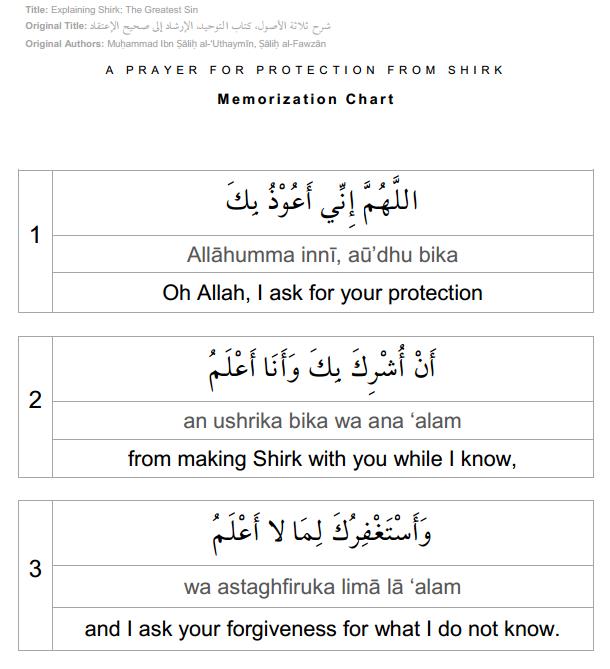
Reference: Ahmad 4/403. See also Al-Albani, Sahihul-Jami’ As-Saghir 3/233 and Sahihut-Targhib wat- Tarhib 1/19.
Posted from: Explaining Shirk: The Greatest Sin – Muhammad Ibn Sālih al-’Uthaymīn, Sālih al-Fawzān
Read for the Source and Explanation of the above du’a @ Du’aa for Fear of Shirk
In her biographical account of her father, Umm ‘Abdillaah Al-Waadi’iyyah said:
“His father died while he was young and he didn’t know him. So he grew up as an orphan and under the care of his mother for a period of time. She would ask him to work to make money and order him to look at the state of his community so that he could be like them. But he would turn away from this and say: ‘I will go out to study.’ So she would say: ‘May Allaah guide you.’ (hadaakAllaah). She would supplicate for him to be guided, as several women who were around at that time informed me. Perhaps her supplication coincided with the time when supplications are accepted since he became one of the guided, guiding others.” [Nubdhah Mukhtasarah: pg. 18]
Source : Autobiography of Shaikh Muqbil bin Haadee Al-Waadi’ee (rahimahullaah) – Al-Ibaanah.com Must Read
Do not pray against your children:
The Prophet (sal Allahu alaihi wa sallam) forbade praying against one’s children, one’s wealth and one’s own self, lest that be at a time when the du’aa is answered. He (sal Allahu alaihi wa sallam) said:
“Do not pray against yourselves, do not pray against your children, do not pray against your wealth, lest that coincides with a time when Allah is asked and He gives, so He answers your prayer.”
[Sahih Muslim]
@AbdurRahmanOrg
Dua ‘ for Increase in Knowledge
Compiled & translated By Abbas Abu Yahya
1 – Al-Hafidh Ibn Hajr al-Assqalani (d.852 A.H.) -Rahimullaah- said:
‘Regarding the statement: ‘The saying of Allaah Azza wa Jal:
وَقُل رَّبِّ زِدۡنِي عِلۡمٗا
‘Rabbi Zidni Ilma’
<<O my Lord increase me in knowledge>>
This is a clear proof of the Excellence of knowledge. This is because Allaah Ta’ala did not order the Messenger -sallAllaahu alayhi wa sallam- with request for increase in anything except for an increase in knowledge.’
[From: ‘Fath al-Bari’ 1/141]
2 – Umm Salma –Radhi Allaahu anha– said, the Messenger of Allaah -sallAllaahu alayhi wa sallam- used to say in the supplication in the morning prayer:
اللهم إني أسألك علماً نافعاً، ورزقاً طيباً، وعملاً متقبلاً
‘Allaahumma innee assaluka ilman nafia, wa rizzqan tayyeebun, wa amalan mutaqabilan,.’
‘O Allaah indeed I ask You for beneficial knowledge, and a good Halal provision, and actions which are accepted.’
[Collected by Tayalisee, Tabraani & regarded Hasan by Hafidh Ibn Hajr]
3 – From Anas bin Malik – Radi Allaahu anhu – that he heard the Messenger of Allaah -sallAllaahu alayhi wa sallam- supplicating:
اللهم انفعني بما علمتني وعلمني ما ينفعني وارزقني علما تنفعني به
Allahumman fa’nee bi-maa ‘allam-ta-nee wa ‘allim-nee maa yanfa’u-nee war zuq-nee ‘ilman yanfa’u-nee
‘O Allaah benefit me with what You have taught me, and teach me that which will benefit me, and grant me knowledge which will benefit me.’
[Collected by al-Hakim, Bayhaqi, Tabraani & authenticated by Albaani in Silsilah No. 3151]
4 – Allaah Ta’ala said:
رَبَّنَآ ءَاتِنَا فِي ٱلدُّنۡيَا حَسَنَةٗ وَفِي ٱلۡأٓخِرَةِ حَسَنَةٗ وَقِنَا عَذَابَ ٱلنَّارِ
<< O our Lord give us good in this Dunyaa, and good in the Hereafter and save us from the punishment of the fire >> [2:201]
Al-Hasan said: ‘al-Hasana (good) in the Dunyaa is knowledge and worship, and in the Hereafter it is Paradise.’
Sufyan said: ‘al-Hasana (good) in the Dunyaa is knowledge and good provision, and in the Hereafter Paradise.’
[From: ‘Lattaif al-Ma’arif p.302]
5 – Abu Bakr Muhammad bin Jafar said: ‘I heard Ibn Khuzaimah while he was asked: ‘Where did you get this knowledge from?’
He answered: ‘The Messenger of Allaah -sallAllaahu alayhi wa sallam- said:
ماء زمزم لما شرب له
‘Zam Zam water is what it is drank for.’
So, when I would drink Zam Zam water I would ask Allaah for beneficial knowledge.’
[From: ‘Tadhkiratul Huffadh’ 2/721]
Al-Hakim said: ‘I drank Zam Zam water and I asked Allaah that he grant me the ability to compile works of books in a good way.’
[From: ‘Tadhkiratul Huffadh’ 3/1044]
Al-Hafidh Ibn Hajr said: ‘Once I drank Zam Zam, and I supplicated to Allaah, at that time I was at the beginning of studying Hadeeth, I asked Allaah to grant me the status of Dhahabi in memorising Hadeeth. Twenty years later I went to perform Hajj, and I found in myself the ability to surpass that rank, so I asked Allaah for a higher rank than before, and I hope that Allaah grants me that rank.’
[From: ‘Juz hadeeth (Mau Zam Zam lema shuriba lahu)’ p.191 – 192]
6 – Shaykh ul-Islaam Ibn Taymeeyah (d.728 A.H.) -Rahimullaah- said:
‘The reality of the issue is that a slave of Allaah is in dire need of asking someone for knowledge and guidance, seeking and asking, then he remembers Allaah and of his dire need of Allaah, then Allaah guides and shows him. Just as Allaah said:
يا عبادي كلكم ضال إلا من هديته فاستهدوني أهدكم
‘O My worshippers! All of you are astray except the one whom I have guided, so seek guidance from Me and I will guide you.’
[Collected by Muslim]
And just as the Prophet -sallAllaahu alayhi wa sallam- used to say:
اللَّهُمَّ رَبَّ جَبْرَائِيلَ وَمِيكَائِيلَ وَإِسْرَافِيلَ. فَاطِرَ السَّمَاوَاتِ وَالأَرْضِ. عَالِمَ الْغَيْبِ وَالشَّهَادَةِ. أَنْتَ تَحْكُمُ بَيْنَ عِبَادِكَ فِيمَا كَانُوا فِيهِ يَخْتَلِفُونَ. اهْدِنِي لِمَا اخْتُلِفَ فِيهِ مِنَ الْحَقِّ بِإِذْنِكَ إِنَّكَ تَهْدِي مَنْ تَشَاءُ إِلَى صِرَاطٍ مُسْتَقِيمٍ
Allaahumma Rabba Jibreela wa Mikaa’eela wa Israafeel, faatir al-samawaati wa’l-ard, ‘aalim al-ghaybi wa’l-shahaadah, anta tahkumu bayna ‘ibaadika fima kaanu fihi yukhtalifoon, ihdini lima’khtulifa fihi min al-haqq bi idhnika, innaka tahdi man tasha’ ila siraatin mustaqeem
‘O Allaah, Lord of Jibraeel, Mikael and Israfeel, You are the Originator of the heavens and the earth, the One who has all knowledge of the unseen and what is visible. You judge between Your worshippers in what they differ, guide me to the truth by Your permission in what they differ, indeed You are the One who guides whom You want to the straight path.’ [Collected by Muslim]
[Majmoo’ Fatawa 4/39]
[Taken from: ‘an-Nubdha fee Adab Talab al-Ilm’ by Muhammad Uthman p.179-181]
Above Post slightly updated by AbdurRahman. Org – added transliteration of the dua’a
Types Of Knowledge & Various Dua’s Regarding Knowledge
Owais al-Hashimi (hafidhahullaah)
[Mp3|English]
Published on 12 Mar 2012 by Bilal Nahim
Listen / Download Mp3 Here (Time 5:23)
The Messenger of Allah related that Allah Said:
“…if he calls upon Me, I answer him, and if he asks of Me, I will give him…”
Ibn Rajab commented:
“…This means that this person who is beloved and close to Allah has a special status with Allah such that if he asks Allah for something, He gives it to him, and if he seeks refuge with Allah from anything, He protects him from that thing, and if he calls upon Him, He answers him. So, he ends up becoming from those whose supplications are answered due to his honor with Allah.
And many from the righteous early generations were known to have their supplications answered.
It is related in the ‘Sahih’ that ar-Rubay’ bint an-Nadr broke a tooth of a slave. So, they offered compensation, and they refused. They asked for pardon, and they refused. The Messenger of Allah was then going to implement the rule of retaliation between them. Anas bin an-Nadr said: “The tooth of ar-Rubay’ will be broken? By the One who has sent you with the truth, her tooth will not be broken.” So, the people were pleased and took the compensation. The Messenger of Allah then said: “Indeed, from the slaves of Allah are those who, if they make an oath upon Allah, He fulfills it.”
…And Ibn Abi ad-Dunya reported with his chain that an-Nu’man bin Qawfal said on the day of Uhud: “O Allah, I swear that I will be killed and enter Paradise.” So, he was killed, and the Prophet said: “Indeed, Nu’man made an oath upon Allah, and He fulfilled that oath.”
And Abu Nu’aym reported with his chain from Sa’d that ‘Abdullah bin Jahsh said on the day of Uhud: “O Lord, if I meet the enemy tomorrow, give me an adversary who is strong and harsh for me to fight for Your Sake and for him to fight me. Then, let him cut off my nose and ear so that when I meet You the next day, You Say: ‘O ‘Abdullah! Why were your nose and ear cut off?’ I will say: ‘For You and Your Messenger.’ And You will Say: ‘You have spoken the truth.’“
Sa’d said: “I saw him at the end of the day with his nose and ear hanging from a thread.”
And Sa’d bin Abi Waqqas would have his supplications answered. A man lied upon him, and he said: “O Allah, if he is lying, take away his eyesight, elongate his life, and expose him to trials and tribulations.” So, the man was stricken with all of this, as he used to walk through the streets and come into contact with the slave girls, saying: “I am an old man who is experiencing fitnah. I have been stricken with the supplication of Sa’d!”
And he supplicated against a man he heard insulting ‘Ali, and immediately, a camel came and trampled him to death.
And a woman disputed with Sa’id bin Zayd over some land he owned, claiming that he had taken from her land. So, he said: “O Allah, if she is lying, take away her eyesight and kill her in her own land.” So, she became blind, and one night when she was walking in her land, she fell into a well and died.
And al-’Ala’ bin al-Hadrami was on an expedition, and those with him became very thirsty. So, he prayed and supplicated: “O Knower, O Bestower, O Most High, O Mighty! We are Your slaves, and we are fighting Your enemy for Your Sake. Give us water to drink and make ablution from, and do not allow anyone else to benefit from this water!” They walked for a bit to find a river of water flowing from the sky. They drank from it and filled their vessels. Later, some of his companions returned to where the river was to find that there was nothing there, as if there had never been any water there.
And someone complained to Anas bin Malik of a drought in a part of al-Basrah. So, he performed ablution and went out to the patch of land, prayed two units, and it then began raining on the patch of land, and the rain did not fall anywhere beyond that patch of land.
…And Abu Muslim al-Khawlani was known for having his supplications answered. Once, a gazelle passed by him, and the young boys in the area said: “Ask Allah to allow us to capture this gazelle!” So, he supplicated, and he captured it and held it until they were able to take it from his hands.
And he once supplicated against a woman who had ruined his relationship with his wife that her eyesight be taken away. She immediately went blind, and she came to him begging. So, he had pity for her and asked Allah to return her eyesight to her, and his wife returned to her normal state with him.
And a man lied upon Mutarraf bin ‘Abdullah, and Mutarraf said: “If you are lying, I ask Allah to hasten your departure,” and the man died on the spot.
And a Kharijite used to pass by the classes of al-Hasan al-Basri and annoy those present. When it became unbearable, al-Hasan said: “O Allah, You Know how he has harmed us. So, suffice us against him with what You Will,” and the man immediately collapsed and was carried dead to his family.
And Silah bin Ashim was on an expedition, and his camel wandered off with all of his belongings, and there was nobody else around. So, he stood and prayed, saying: “O Allah, I swear that you will return my camel and belongings,” and it walked back until it stood right in front of him.
…And Habib al-’Ajami Abu Muhammad was known for having his supplications answered. He once supplicated for a young boy who was bald, and would weep and wipe his tears over the boy’s head. The boy’s hair began growing black all over his head, and it looked better than it had before.
…And Sa’id bin Jubayr was patient upon the harm inflicted upon him by al-Hajjaj until he killed him, and he was from those whose supplication was answered. He used to have a rooster whose crowing would wake him up to pray at night. One night, it didn’t wake him up on time, and he became very distressed, saying: “What is wrong with it? May Allah cut off its voice!” It never crowed again, and his mother said: “My son, do not supplicate against anything ever again.”
See ‘Jami’ al-’Ulum wal-Hikam’ (2/348-354) for more.
The differentiation between invoking the Attribute and invoking by the Attribute
Sheikh Abu `Abd-El-Mu`iz Muhammed `Ali Farkûs – May Allâh protect him
Source: from the Sheik’s website http://ferkous.com
The question:
His eminence sheikh Ibn Bâz Said: “Invoking the Attribute [of Allah] is unanimously not permissible for Ahl As-Sunna (people of the Sunna). How to reconcile between this saying and the hadith where the Messenger صلَّى الله عليه وسلَّم says: “O the Ever Living, the One Who sustains and protects all that exists, by Your mercy I ask Your help.”[1]
The answer:
All praise is due to Allah, the Lord of the Worlds. Peace and blessing be upon whom Allah sent as a mercy to the Worlds, upon his Family, his Companions and his Brothers till the Day of Resurrection.
In fact, there is a difference between invoking the Attribute of Allah and invoking Allah by the Attribute.
Invoking the Attribute of Allah means that the Attribute used for invocation implies something separated and independent from the divine being, which hears invocation and answers it such as saying, “O mercy of Allah, be merciful with me.” or “O strength of Allah, strengthen me.” or “O power of Allah, give me power.” or any other expressions which are not mentioned in the known invocations at all.
Therefore, whoever believes that the Attribute separated from the divine being forgives, has mercy, enriches or strengthens…would make the Attribute a worshiped divinity, which scholars consider unanimously disbelief, because the Attributes of Allah are inherent to Him and can never dissociate from him. In fact, Allah is One, with all His Attributes. His Names and Attributes are included in His Name “Allah”. So it is not permissible to call an Attribute a divinity, a creator, a sustainer…etc.
Ibn Taymiya – may Allah be merciful with him – reported the unanimity of the scholars as regards the invocation of the Attributes and the Words of Allah and said that it is disbelief. He said, “As for invoking His Attributes and Words, this is disbelief as agreed by all the Muslims. Would a Muslim say: O Word of Allah forgive me, be merciful with me, protect me or help me? Or would he say: O knowledge of Allah, O power of Allah, O strength of Allah or O greatness of Allah…etc.? Was it heard from a Muslim or even from a disbeliever invoking by such Attributes of Allah or the attributes of others, to ask the Attribute to bring him benefit or to push evil away from him, to ask for help, support or any other thing from it?”[2]
This is what Ibn Bâz – may Allah be merciful with him – meant by establishing the unanimity of the scholars as regards the interdiction of invoking the Attribute of Allah.
As for the invocation by the Attribute, or the fact of imploring Allah by His Names and Attributes, this is permissible. It is a sort of the permissible imploration. In fact, it is authentically stated in the known invocations what proves that it is permissible to implore Allah تعالى by the Attribute of mercy, as mentioned in the hadith above in the question, “…by Your mercy I ask Your help.”[3], which means, “I ask you, O Allah by Your mercy”. There is also the imploration by the Attribute such as in the hadith where the Messenger صلَّى الله عليه وسلَّم says, “I ask protection by the perfect Words of Allah from His evil creatures.”[4] Or the hadith where the Messenger صلَّى الله عليه وسلَّم says, “I ask protection by the strength of Allah and His power from the evil I am subject to and from what I apprehend.”[5] Or also the hadith where the Messenger صلَّى الله عليه وسلَّم says, “I ask protection by Your satisfaction from Your anger, by Your preservation from Your punishment and by You from You.”[6] Or offering the consultation prayer by the Attribute such as in the hadith where the Messenger صلَّى الله عليه وسلَّم says, “O my Lord, indeed I consult You by Your Knowledge and ask You by your strength to grant me strength.”[7]
Therefore, if the difference becomes clear between the two kinds of invocation, there will not be a contradiction between the two sayings, because each one will be understood according to its correct meaning.
The perfect knowledge belongs to Allah عزّ وجلّ. Our last prayer is all praise is due to Allah, the Lord of the Worlds. Peace and blessing be upon our Prophet, his Family, his Companions and Brothers till the Day of Resurrection.
Algiers, Shawwâl 20th, 1431H.
Corresponding to: September 29th, 2010
[1] Reported by At-Tirmidhi, chapter of “Invocations” (hadith 3524), on the authority of Anas رضي الله عنه. This hadith is judged authentic by Al-Albâni in As-Silsila As-Sahîha (1/449).
[2] See Talkhîs Al-Istighâtha [Ar-Rad `Ala Al-Bakri by Ibn Taymiya] of Ibn Kathîr (1/181).
[3] Previously reported, see footnote 1.
[4] Reported by Muslim, chapter of “Evocation and invocation” (2/1246) (hadith 2708), on the authority of Khawla Bint Hakîm رضي اله عنها (hadith 2709) on the authority of Abu Hurayra رضي الله عنه.
[5] Reported by Abu Dâwûd, chapter of “Medicine” (hadith 3891), concerning the way we make exorcisms, on the authority of `Uthmân Ibn Abi Al-`Âs رضي الله عنه. This hadith is judged authentic by Al-Albâni in As-Silsila As-Sahîha (3/404). It is also reported by Muslim (hadith 2202) as follows, “I ask protection by Allah and by power from the evil I am subject to and from what I apprehend.”
[6] Reported by Muslim, chapter of “Prayer” (1/223) (hadith 486), on the authority of `Â’isha رضي الله عنها.
[7] Reported by Al-Bukhâri, chapter of “The different sorts of supererogatory acts” (1/278), concerning what is reported about the supererogatory prayer by accomplishing it two Rak`as (two units of prayer) then two…etc. on the authority of Jâbir Ibn `Abd Allâh رضي الله عنهما.
This lecture was given on Saturday, May 5, 2012 at Masjid at-Tawheed in Stone Mountain, GA.
This talk is based on the book Fiqh al-Ad’iyyah wal-Adhkaar by our noble Sheikh Abdur-Razzaaq ibn Abdil-Muhsin al-Badr, and may Allah preserve them both. This book was actually a set of classes given by the Sheikh on a Quran Radio Station in Saudi Arabia. However, many of the students and scholars alike saw the tremendous benefit in these classes and requested him to compile them into a book. He did this and then sent it to the noble Sheikh ibn Baaz, rahimahullah, who read it and praised it.
You can also find this book as an ebook on the website of the Sheikh here :
http://www.al-badr.net/web/download/ebook/muallafat3.html
And perhaps this will be an incentive for some to study the arabic language, in shaa Allah.
From the highlights of the talk is the mention of ibn Abbaas,
The shaytaan is sitting on the heart of the Son of Adam in wait. Once that heart becomes heedless, he begins to whisper. And when the person begins to remember Allah, he flees and is humiliated.
—
Listen/Download Mp3 Here (Time 1:02:03)
by Rabee’ ibn Haadee al-Madkhalee
Translated by Abbas Abu Yahya
The Question:
A lot of what we see in certain Masajid is ‘Ya Allaah & Ya Muhammad’ (O Allaah & O Muhammad) written on the Mihrab, is it permissible to pray in the likes of these Masajid?
The answer:
This is clear from what we have seen in Pakistan and Afghanistan – with great regret – I swear by Allaah we saw this written in the cars of the Mujahideen; actually those who claim to be Mujahideen! And they would not accept any advice, they would continue upon these aspects of Shirk! You would see it written in their shops and their Masajid: ‘Ya Allaah, Ya Ali, Ya Ghawth, Ya Hussain, Ya AbdulQadir, Ya such and such!!’ as well as other aspects of Shirk!
Seeking aid from other than Allaah is Shirk; by saying ‘Ya Muhammad’, then this is committing Shirk with Allaah (associating partners to Allaah). Muhammad was the Messenger of Allaah, the slave of Allaah and His Messenger –alayhi as-Sallat wa Sallam. Therefore, if one says ‘Ya Allaah and Ya Muhammad’, then that person has made Muhammad as an equal to Allaah Tabaraka wa Ta’ala.
The Messenger –alayhi as-Sallat wa Sallam- did not come except to destroy this polytheism, and to rectify the deviated nation and at the head of what they had was committing Shirk (associating) with Allaah -Azza wa Jal. The Messenger came to purify the Dunyaa, the hearts, the minds and intellects from Shirk with Allaah –Azza wa Jal- and the filth connected with Shirk.
He –alayhi as-Sallat wa Sallam- taught us pure Tawheed with the texts of the Qur’aan, the texts of the Sunnah and practically implementing them. He –alayhi as-Sallat wa Sallam- ordered us to level the graves, and to destroy idols.
The Messenger –alayhi as-Sallat wa Sallam- said:
‘Do not undertake journeys except to three Masajid – only these, not to graves, nor any place [for worship] – the Masjid al-Haraam, and this masjid of mine, and Masjid al-Aqsa.’
This is because these Masajid were built by the Prophets for the Tawheed of Allaah having Ikhlaas (Sincerity) of the Deen for Allaah – Azza wa Jal.
This action of writing ‘Allaah & Muhammad’ began in al-Madinah – since we know these things we can evaluate it – we knew the plots of the Ahl-ul-Bida’.
There was a man named Siraaj Rahman a colleague of mine in the University and he was from the students of Abul-Hasan an-Nadawi – I don’t know whether – I saw this in Kenya or a story had been narrated to him that this had begun to spread in al-Madinah. Anyway, he mentioned that Abul-Hasan an-Nadawi said the statement: ‘Allaah & Muhammad’ and this is disbelief, what they mean by this is that Muhammad is a partner to Allaah –Azza wa Jal; Allaah & Muhammad are equal.
There is none worthy of worship in truth except Allaah, Muhammad is the Messenger of Allaah; I testify that there is none worthy of worship in truth except Allaah and I testify that Muhammad is the Messenger of Allaah, I testify that there is none worthy of worship in truth except Allaah and I testify that Muhammad is His slave and Messenger; this is the highest status for this Noble Prophet –alayhi as-Sallat wa Sallam.
The Messenger -sallAllaahu alayhi wa sallam- said:
‘Do not over praise me, like the Christians over praised the son of Maryam. Indeed I am a slave of Allaah and His Messenger.’
I have seen this clearly and I would have waged war against it, and if I saw it in a Masjid I would advise the Imam of the Masjid. Likewise in Masjid al-Qiblatayn – Masjid al-Amoodi -, I spoke to the Imam, but he did not do anything! So I spoke to al-Amoodi who was responsible for the Masjid, and he hastened – may Allaah reward him with goodness- and effaced these things.
And in the Masjid near my home in al-Madina they had written ‘Allaah & Muhammad’ so I advised the Imam and he said: ‘we will change it, we will change it.’ But he kept postponing it and did not change it! There was a good young man present who said: ‘I’ll sort it out.’ Then he went and covered it, and that was the end of that, and all praise be to Allaah.
One day I was coming from Batthan and entered Madinah and there was a pickup truck in front of me and it had ‘Ya Allaah Ya Muhammad’ written on it in red. So I followed him and he began speeding up, he noticed that I was following him, so he began to speed up even more, so I gave chase and pursued him until we reached Qurban, he stopped his car and got out and said to me: ‘Shall I wipe it off?’ and I hadn’t even spoken to him yet! He knew and felt this is what I was pursuing him about, so I told him ‘Yes, wipe it off.’
This confirms that there is a battle going on, the battle of these grave worshipping deviants in the land of Tawheed!
[Taken From: sahab.net/forums/index.php?showtopic=128851]
According to Shaykh Al-Islam Ibn Taymiyyah (May Allah have mercy upon him)
An exclusive translation for Sisters Upon Al-Istiqaamah
http://uponistiqaamah.blogspot.com/2011/03/best-way-for-sisters-to-say.html
Sallallaahu ‘alayhi wa Sallam – The salaah and salaam of Allaah be upon His Prophet Muhammad.
The salaah of Allaah upon Prophet Muhammad is His Praise of the Prophet before the angels who are close to (but below) Allaah, the Most High, who istawaa (ascended) upon His ‘Arsh (Throne), which is above the seven heavens, in a manner that suits His Majesty. The angels also praise the Prophet (Sallallaahu ‘alayhi wasallam).
The salaam is Allaah’s safeguarding of the Prophet (Sallallaahu ‘alayhi wasallam) from deficiencies and any kind of evil, and the protection of the Message with which he was entrusted.
When the Muslim says “sallallaahu ‘alayhi wasallam”, he invokes Allaah to grant His Praise and Security to Prophet Muhammad and the protection of the Message of Islam which was revealed to him (Sallallaahu ‘alayhi wasallam).
[See Ibnul Qayyim’s Jalaa’ul Afhaam fee Fadlis-Salaati-wa-Salaam ‘alaa Muhammadin Khairil Anaam, [Damascus, Syria: Daar Ibn Katheer, and Daar at-Turaath, Al-Madeenah, Saudi Arabia 1408/1988, p.128].
Visit the Website of Dr. Saleh as Saleh Rahimahullaah : http://understand-islam.net
The Above is Taken from :
Tafseer Ayatul-Kursi – By Shaykh Muhammad bin Saalih Al-’Uthaymeen
With Related Points of Benefit From the Shaykh’s Commentary on Imaam ibn Taymeeyah’s Sharhul ’Aqeedatil-Waasitiyyah, Prepared by Dr. Saleh As-Saleh (rahimahullah)
Related Links:
The Status of the Messenger & His Rights upon Us [PDFs] – Compiled by The Eminent Shaykh, the Muhaddith, Rabee’ ibn Haadee al-Madkhalee
145- Ruling on hanging supplications on the body
Q: Is it permissible to hang some of the Du`a’s (supplications) which are mentioned in the Qur’an and Sunnah (whatever is reported from the Prophet) on the chest of a man or woman as protection for them from the Jinn (creatures created from fire) and devils? [1]
A: This is not permissible whether it be from the Qur’an, Sunnah or anything else. This is called “Tama’im (amulets)”, “Jami`at” and “Hujub” and it is not permitted to wear or hang them.
The Prophet (peace be upon him) said about this matter: <<Anyone who ties an amulet, may Allah not fulfill his aim; and anyone who ties a seashell, may Allah not give him peace>> [2]
He (peace be upon him) also said: <<Ruqyahs (recitations for healing or protection), amulets and love-charms are Shirk (associating others with Allah in His Divinity or worship)>> [3]. Ruqyah here is referring to any words recited that are unknown or involve Shirk or Munkar (that which is unacceptable or disapproved of by Islamic law and Muslims of sound intellect), they are absolutely prohibited! All amulets are prohibited, that is, what is written on a paper or parchment and placed in a piece of cloth or a bag and tied to a child or a sick person, these are all forbidden.
This prohibition applies even if the amulets are made of Words of the Qur’an or lawful Du`a’s, they are still forbidden, because the correct scholarly opinion is that all amulets are absolutely prohibited. However, there is greater prohibition regarding the amulets which are not made using Words of the Qur’an. The prohibition of the amulets made using the Qur’an is to close any of the doors which may lead to sin or Shirk, as a Muslim is obliged to stay away from these acts, so that they do not fall into what Allah (Exalted be He) has made Haram (prohibited). Allah has made lawful for His Servants the things which lead to happiness, well-being and protection. He did not make lawful that which will harm them; rather, He made lawful that which will bring well-being and happiness in this life and the Hereafter. Humans are not permitted to introduce a Bid`ah (innovation in religion); hanging these things constitutes a Bid`ah, even if they contain Qur’an or Hadiths. The Prophet (peace be upon him) forbade the use of amulets and warned those who wear or hang them that Allah will not fulfill their aim; anyone who ties an amulet or a seashell, Allah will not fulfill their aim of wearing them. It is obligatory on every believing man and woman to protect themselves by reciting the Islamic supplications not by hanging them; supplications for recovery and well-being should be made for the sick and the children. Du`a’ for protection should also be made on their behalf before sleeping by saying: <<I seek refuge for you in the Perfect Words of Allah from the evil of what He has created>> [4]. This is following the example of the Prophet (peace be upon him) because it is reported that: <<The Prophet (peace be upon him) used to seek refuge with Allah for Al-Hasan and Al-Husayn, by saying, ‘I seek refuge for you both in the Perfect Words of Allah, from every devil and every poisonous vermin, and from every evil (envious) eye.’>> [5] Muslims must accustom themselves to reciting Adhkar (invocations and Remembrances said at certain times on a regular basis) and supplications for refuge and protection, and should seek refuge with Allah, as long as they are a sane adult, before sleeping, when entering and leaving their house etc.
The point is that there is no need to wear amulets. Some scholars have permitted wearing amulets which contain Qur’an or lawful invocations, and they said: It is a form of Ruqyah (recitation for healing or protection), and since Ruqyah is lawful if it is using the Qur’an and lawful supplications, an amulet made using the Qur’an and supplications is also lawful. The answer is that there is a difference between the two; we have evidence that the prophet (peace be upon him) performed Ruqyah and Ruqyah was performed for him. He (peace be upon him) said: <<There is nothing wrong with Ruqyah as long as it does not involve any Shirk (associating others with Allah in His Divinity or worship).>> [6] This is evidence of the exception of Islamically lawful Ruqyah (i.e., reciting Qur’an and saying supplications over the sick seeking healing), which is excluded from his saying: <<Ruqyahs (recitations for healing or protection), amulets and love-charms are Shirk.>>[7] This is based on the fact that the Prophet (peace be upon him) performed Ruqyah and Ruqyah was performed for him.
No exceptions were made for amulets and there is no evidence that the Prophet (peace be upon him) hung an amulet on anyone; therefore, it is not permissible to regard amulets the same as Ruqyahs; rather, all amulets are absolutely prohibited. Wearing amulets of the Qur’an and lawful supplications could lead to wearing all other amulets, while being unaware of which is right and which is wrong, and thus opens the door to Shirk and wearing charms. The Shari`ah (Islamic law) has closed all of the doors which may lead to Shirk, and the Hadiths stated regarding amulets are general and the prohibition applies to all. Closing the doors which may lead to Shirk is an obligation, consequently, this entails prohibiting all amulets, even if they contain Qur’an or lawful invocations. This is to block the means leading to Shirk and act upon the general meaning of the Hadiths, so that the believer grows accustomed to putting their trust in Allah, relying on Him, supplicating to Him, and asking Him to protect them from all evil and relieve them from any distress, and not to rely on an object which they wear around their neck or anywhere else.
The teachings of the Shari`ah sufficiently contain all goodness and well-being, for the young and old, sick and healthy. May Allah grant everyone success and guidance!
Footnotes:
[1] Question no. 10, tape no. 195.
[2] Related by Imam Ahmad, Musnad, Section on Levanters, Chapter on the Hadiths narrated by `Uqbah ibn `Amir Al-Juhany, no. 16969.
[3] Related by Imam Ahmad, Musnad, Section on the Companions who narrated a large number of Hadiths, Chapter on the hadiths narrated by `Abdullah ibn Mas`ud (may Allah be pleased with him), no. 3604.
[4] Muslim, Book on remembrance of Allah, supplication, repentance and seeking forgiveness, no. 2708; Al-Tirmidhy, Book on supplications, no. 3437; Ibn Majah, Book on medicine, no. 3547; Ahmad, vol. 6, p. 409; and Al-Darimy, Book on asking permission, no. 2680.’
[5] Related by Al-Bukhari, Book on prophets, Chapter on Allah’s Saying: “And Allah did take Ibrahim (Abraham) as a Khalil (beloved, close elect)”, no. 3371.’
[6]Related by Muslim, Book on salutations and greetings, Chapter on there is no harm in the incantation which does not smack of polytheism, no. 2200.’
[7] Related by Imam Ahmad, Musnad, Section on the Companions who narrated a large number of Hadiths, Chapter on the hadiths narrated by `Abdullah ibn Mas`ud (may Allah be pleased with him), no. 3604.’
Source : alifta.com
Fatwas of Nur `Ala Al-Darb>Volume 1>Chapter on `Aqidah>Chapter on Ruqyahs and amulets>Ruling on hanging supplications on the body

Allahumma faatiras-samaawaati wal-ardhi, ‘Aalimal-ghaybi wash-shahaadati, , Rabba kulli shay’in wa maleekahu, ‘ash-hadu ‘an laa ‘ilaaha ‘illaa Anta, ‘a’oothu bika min sharri nafsee, wa min sharrish-shaytaani wa shirkihi (*), wa ‘an ‘aqtarifa ‘alaa nafsee soo’an ‘aw ajurrahu ‘ilaa muslim.
“O Allaah, Creator of the heavens and the earth, Knower of the unseen and visible, the Lord of everything and it’s Possessor, I bear witness that nothing is worthy of worship but You. I seek refuge in You from the evil of my soul and from the evil of Shaytan and his shirk. (I seeek refuge in You) from bringing evil upon my soul and from harming any Muslim.” (**)
Related by Ahmad (#51, #63, #81, and #7961), al-Bukhaaree in (al-Adabul-Mufrad) (#1202, #1204), and in the narrative of Imaam Ahmad #7961 from him where he said in the last part of the narration: “…Say it when you have entered upon morning and when you have entered upon the evening, and when you take to your bed.” And it was authenticated by al-‘Alaamah Ibn Baaz-may Allah have mercy upon him-in Tuhfat-ul-Akhyaar.
Source : Supplication # 17 in “Precious Rememberance” – Written by ash-Shaykh Ibn ‘Uthaymeen
Also mentioned in Hisn al Muslim – Sahih At-Tirmidhi 3/142 and AbuDawood.
Also mentioned in Saheeh Al-Kalimaat At-Tayyib – Hadeeth No # 21
The following notes has been taken from “More than 1000 Sunan Every Day & Night” published by Dar-us-Salaam
(*) There are two opinions on how this should be pronounced:
(a) The first opinion is that the word should be pronounced as Shiraki, which means plots and plans. So, this part of the supplication would read, “I seek refuge in You from the evil of my soul and from the evil and plans of Shaytaan“.
(b) The second opinion, which seems to be the strongest, is that it should be pronounced as Shirki; this refers to whatever the Shaytaan is calling you towards, in terms of acts of worship, which result in associating partners with Allah. It doesn’t meant that Shirk is being commited by Shaytaan himself. On the contrary it is the person who commits the shirk in obedienec to Shaytaan.
For a more detailed explanation, refer to TuhfatAl-Ahwadee, Volume 9, Hadeeth 3452, by Shaykh Muhammad Al-Mubaarakpuri.
(**) Shaykh Al-Albanee mentioned that the last part,
..is from another narration is Sunan At-Tirmidhi, narrated by Abdullah bin Ammaar, and is not mentioned as part of this supplication, which is also from Sunan At-Tirmidhee, but narrated by Aboo Hurayrah.
Visit : https://abdurrahman.org/jinn-shayateen-devils/
Majmoo’ Fataawa wa Maqaalaat Mutanawwi’ah li Samaahat
al-Shaykh ‘Abd al- ‘Azeez ibn ‘Abd-Allaah ibn Baaz, Vol. 11, pp. 188-190 – alifta.net
From ‘Abdul ‘Aziz Bin ‘Abdullah Ibn Baz to those who receive this among Muslims. May Allah guide all Muslims and increase their knowledge and faith, amen!
As-salamu ‘alaykum warahmatullah wabarakatuh (May Allah’s Peace, Mercy, and Blessings be upon you!) It gives me pleasure to remind my Muslim brothers that –
It is of the Sunnah for a Muslim to say after each obligatory Salah, whether one is the Imam (the one who leads the congregational Salah), Ma’mum (a person being led by an Imam in Prayer) or Mufarid (a person who performs prayer alone) to say, three times
أَسْـتَغْفِرُ الله
“Astagfir Allah” [#1]
(I ask Allah forgiveness)
and then say,
اللّهُـمَّ أَنْـتَ السَّلامُ ، وَمِـنْكَ السَّلام ، تَبارَكْتَ يا ذا الجَـلالِ وَالإِكْـرام
“Allahumma Anta Al-Salam Wa Minka Al-Salam, Tabarakta Wa Ta’alayta Ya-dhal-Jalali Wal-Ikram” [#1]
(O Allah, You are Al-Salam [the One Who is free from all defects and deficiencies] and from You is all peace, blessed are You, Possessor of majesty and honor!)
If one is Imam, one should turn facing the people. The Imam, those praying behind him, or a person offering Salah individually should say,
لَا إِلهَ إِلَّا اللهُ وَحْدَهُ لَا شَرِيكَ لَهُ، لَهُ الْمُلْكُ وَلَهُ الْحَمْدُ وَهُوَ عَلَى كُلِّ شَيْءٍ قَدِيرٌ
لَا حَوْلَ وَلَا قُوَّةَ إِلَّا بِاللهِ، لَا إِلَهَ إِلَّا اللهُ، وَلَا نَعْبُدُ إِلَّا إِيَّاهُ، لَه النِّعْمَةُ وَلَهُ الْفَضْلُ وَلَهُ الثَّنَاءُ الْحَسَنُ، لَا إِلَهَ إِلَّا اللهُ مُخْلِصِينَ لَهُ الدِّينَ وَلَوْ كَرِهَ الْكَافِرُونَ
اللَّهُمَّ لَا مَانِعَ لِمَا أَعْطَيْتَ، وَلَا مُعْطِيَ لِمَا مَنَعْتَ، وَلَا يَنْفَعُ ذَا الْجَدِّ مِنْكَ الْجَدُّ
Laa ‘ilaaha ‘illallaahu wahdahu laa shareeka lahu, lahul-mulku, wa lahul-hamdu wa Huwa ‘alaa kulli shay ‘in Qadeer. Laa hawla wa laa quwwata ‘illaa billaahi, laa ‘ilaaha ‘illallaahu, wa laa na’budu ‘illaa ‘iyyaahu, lahun-ni’matu wa lahul-fadhlu wa lahuth-thanaa’ul-hasanu, laa ‘ilaaha ‘illallaahu mukhliseena lahud-deena wa law karihal-kaafiroon. Allaahumma laa mani’a limaa ‘a’tayta, wa laa mu’tiya limaa mana’ta, wa laa yanfa’u thal-jaddi minkal-jadd. [#2]
(None has the right to be worshipped except Allah, alone, without any partner. To Allah belong all sovereignty and praise. He is Omnipotent over all things. There is no might nor power except with Allah. None has the right to be worshipped except Him. We worship none but Him. To Allah all favor, grace, and praise are due. None has the right to be worshipped except Allah and we are sincere in faith and devotion to Him although disbelievers detest it. Oh Allah! Oh Allah! None can prevent what You willed to give and none can grant what You have willed to prevent, and no wealth or majesty can benefit anyone, as from You is all wealth and majesty).
After offering Maghrib (Sunset) Prayer and Fajr (Dawn) Prayer one should say along with what is mentioned previously,
After completing the prayer:
لَا إِلَهَ إِلَّا اللهُ وَحَدْهُ لَا شَرِيكَ لَهُ، لَهُ الْمُلْكُ وَلَهُ الْحَمْدُ يُحْيِي وَيُمِيتُ، وَهُوَ عَلَى كُلِّ شَيْءٍ قَدِيرٌ
Laa ‘ilaaha ‘illallaahu wahdahu laa shareeka lahu, lahul-mulku wa lahul-hamdu yuhyee wa yumeetu wa Huwa ‘alaa kulli shay’in Qadeer
[None has the right to be worshipped but Allah alone, Who has no partner. His is the dominion and His is the praise . He brings life and He causes death , and He is Able to do all things.]
After that, one is to say each of the following supplications thirty three times;
(a) “Subhana Allah” (Glory is to Allah),
(b) “Al-Hamdu Lillah” (praise is due to Allah) and
(c) “Allahu Akbar” (Allah is the Great),
and then complete the hundred by saying,
لَا إِلَهَ إِلَّا اللهُ وَحَدْهُ لَا شَرِيكَ لَهُ، لَهُ الْمُلْكُ وَلَهُ الْحَمْدُ يُحْيِي وَيُمِيتُ، وَهُوَ عَلَى كُلِّ شَيْءٍ قَدِيرٌ
Laa ‘ilaaha ‘illallaahu wahdahu laa shareeka lahu, lahul-mulku wa lahul-hamdu yuhyee wa yumeetu wa Huwa ‘alaa kulli shay’in Qadeer
It is recommended for the Imam, Ma’mum, and Munfarid to recite these supplications audibly after each obligatory Salah in a low voice without disturbing others.
It is authentically reported in the two Sahih on the authority of Ibn ‘Abbas (may Allah be pleased with them) that raising one’s voice in supplication after concluding the obligatory Salah was during the time of the Prophet (peace be upon him). Ibn ‘Abbas (may Allah be pleased with them) said, “I used to know when they finished the Salah by this (supplications as they were said aloud) if I heard them.”
[Al-Bukhari, Sahih, Book on Adhan, no. 841; Muslim, Sahih, Book on Masjids and places for Salah, no. 583; Al-Nasaa’y, Sunan, Book on Sujud-ul-Sahw, no. 1335; Abu Dawud, Sunan, Book on Salah, no. 1003; and Ahmad ibn Hanbal, Musnad, vol. 1, p. 367.’]
However, it is not permissible to say these supplications collectively. Each worshipper should recite them individually without observing the voice of others, because reciting supplications collectively is Bid’ah and has no basis in the divine Shari’ah (law) of Allah.
It is recommended for Imam, Ma’mum, and Munfarid to recite
Ayat-ul-Kursy (the Qur’anic Verse of Allah’s Foot stool, Surah Al-Baqarah, 2:255) [#3] inaudibly.
After that,
Surah-Al-Iklas (the Qur’an, Surah 112),
Surah-Al-Falaq (the Qur’an, Surah 113), and
Surah-Al-Nas (the Qur’an, Surah 114)
inaudibly after each obligatory Salah and repeat them three times after the Maghrib (Sunset) and Fajr (Dawn) Salahs. [#4]
This is preferable, for the authenticity of what we have mentioned above.
May Allah’s Peace and Blessings be upon our Prophet Muhammad, His companions, and those who follow him rightfully till the Day of Judgment.
The Grand Mufty of the Kingdom of Saudi Arabia
Chairman of the Departments of Scholarly Research, Ifta’, Da`wah, and Guidance
24/10/1414 A.H.
PS: [AbdurRahman.Org] Du’aa transliterations slightly corrected for the better pronunciation
Foot Notes : (added by AbdurRahman.Org)
[#1] Sahih Muslim 1/414
[#2] Sahih Muslim 1/415
[#3] An-Nasaai, ‘Amalul Yawm-Yawm wal-Layl (hadith No.100), also Ibn As-Sunni (n.121). See also Al-Albanee Sahihul-Jaami As-Sagheer 5/339 and Silsilatul-Ahadeeth As-Saheehah 2/697 (no.972)
[#4] Abu Dawood 2/86, An-Nasaai 3/68, see also Al-Albanee, Sahih At-Tirmidhi 2/8.
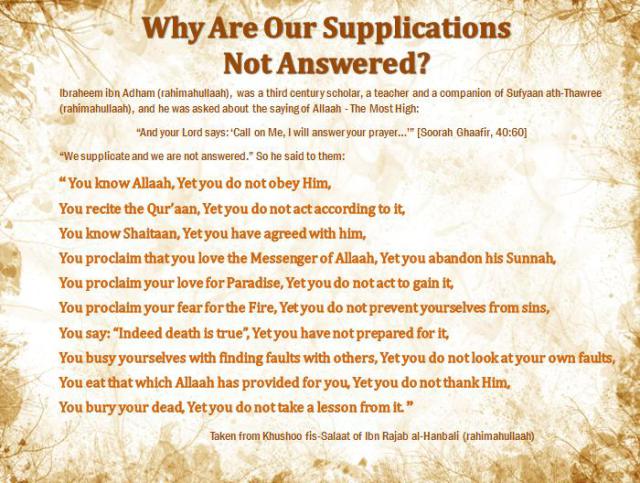
Ibrahim ibn Adham – may Allah have mercy on him – a third century scholar, a teacher and a companion of Sufyan ath-Thawri, was asked about the saying of Allah – the Most High:
“and your Lord says: “Call on me I will answer your prayer…” [40:60]
“We supplicate and we are not answered.”
So he said to them:
You know Allah, Yet you do not obey Him,
You recite the Qur’an, Yet do not act according to it,
You know Shaitan, Yet you have agreed with him,
You proclaim that you love Muhammad (Sallallaahu ‘alayhi wa sallam) Yet you abandon his Sunnah,
You proclaim your love for Paradise, Yet you do not act to gain it,
You proclaim your fear the Fire, Yet you do not prevent yourselves from sins,
You say “Indeed death is true”, Yet you have not prepared for it,
You point out the faults with others, Yet you do not look at your faults,
You eat of that which Allah has provided for you, Yet you do not thank Him,
You bury your dead, Yet you do not take a lesson from it.”
by Ibn Rajab al Hanbali from Khushu’ fis-salah
Many people say:
‘I say my morning and evening supplications regularly and we seek refuge in Allaah yet we still experience afflictions.’
So we say if you recite the morning and evening supplications then it is necessary to move the tongue while reciting them, there is no benefit if you pass your eyes along the lines of the page and to say that this is a silent reading. This is not considered reading or speech in the Arabic tongue. Reading in the Arabic language necessitates movement of the tongue, as is known from the hadeeth which is narrated from the Companions -may Allaah be pleased with them- that they knew when the Messenger -sallAllaahu alayhi wa sallam- was reciting silently due to the movement of his beard. This illustrates that the Messenger -sallAllaahu alayhi wa sallam- whilst reciting silently would move his lips and tongue.
This moving of the tongue is if the person has the capability to move his tongue and that there is nothing to hinder the movement of the tongue.’
The correct way to recite in your prayers (Salah) and in morning and evening supplications – By Muhammad bin Umar Bazmool, Translated & Foreword by Umm Yahya
[Taken from: ‘Sharh Sifat Sallat an-Nabi –sallAllaahu alayhi wa sallam-‘ by Muhammad Bazmool, p.221]
From Shaykh Ubayd aj-Jaabiree’s Explanation of the Three Fundamental Principles : page 113-114:
“It is allowable to make a supplication for a person that they be blessed.
The correct way to do this is to say: ‘Baaraka Allaahu laka‘ or ‘Baarka Allaahu ‘alayka‘ and ‘hadhal amr mubaarak‘.
The expression that is common upon the tongues of the general people is ‘Mabrook ‘ala fulaan‘ (may so and so be knelt upon); this is a blatant mistake and in opposition to the correct usage of the word in the Arabic language.
Mabrook comes from the verb Baraka and Mubaarak comes from the verb Baaraka, so don’t use the word Mabrook; alternatively, use Mubaarak because it comes from Baaraka as we stated. The common people don’t intend by their saying: ‘Mabrook alayhi’ to supplicate that this person be knelt upon, but this expression is incorrect, as they want to make a supplication for the person that they be blessed. So it is said ‘Baaraka Allaahu alayka’… and ‘Az-Zawaaj Mubaarak’ (Allaah willing, the marriage will be blessed).”


 AbdurRahman.Org
You must be logged in to post a comment.