Danger of women joining men in their workplace – Shaykh Ibn Baaz (rahimahullaah)

All praise be to Allah Alone, and peace and blessings be upon the Honest Messenger, his family and Companions.

All the implicit and explicit calls to women’s engagement in men’s work, which leads to free intermixing of men and women under the pretext that it is urgently needed and represents a civilized aspect, is a grave matter that results in fatal consequences. It goes against the texts of Shari`ah (Islamic law) which order women to stay at their houses and carry out their domestic duties.

Whoever wants to know the innumerable evil consequences of free intermixing can unbiasedly and impartially observe the societies inflicted with this grave affliction. It is easy to find people expressing their disapproval and grief at women leaving home and subsequent family breakup. This is apparent in writings and in the media, as this is the reason behind the destruction of societies.

There are many reliable proofs that prohibit being alone with and looking at an Ajnabiyyah (a woman other than a wife or unmarriageable female relatives) and the prohibition of the means that lead to committing what Allah has prohibited. All these indications prove the prohibition of mixing between the two sexes as this leads to evil consequences.

Letting a woman leave her house; her kingdom and proper place, is against her Fitrah (natural disposition) and the nature created in her by Allah.

Calling women to engage in men’s work has dangerous effects on the Islamic society. Among these dangerous effects is the free intermixing of men and women, which is considered one of the greatest means to adultery that destroys the morals and values of society.

Allah (Exalted be He) created women with a physique completely different from men, so that women will be able to carry out domestic affairs as well as other feminine duties.

When a woman engages in men’s work, this is considered against her physique and nature. It is a grave crime against women, for it destroys her character. The effect continues to her children, as they lose love and compassion. This is because no one can perform the role of a mother who, when she dismisses herself from her kingdom, she cannot find rest, stability, or tranquility elsewhere. The reality of these societies is the best example.

Islam entrusted the two spouses with different duties and each has to undertake their responsibilities to help build up their community both inside and outside home.

A man’s role is to earn livelihood and support his family financially while a woman’s role is to raise and love children and show compassion toward them. This is in addition to nursing, breastfeeding, teaching children, administrating female schools, treating women medically, as well as other duties proper for women. Abandoning the domestic duties destroys the whole family and, eventually, the society becomes an empty entity, a form without reality or substance.

Allah (Glorified and Exalted be He) says:

Men are the protectors and maintainers of women, because Allâh has made one of them to excel the other, and because they spend (to support them) from their means.(Surah an-Nisa 4:34).

It is Allah’s Law upon His creation that guardianship is the duty of man who supports the woman financially as mentioned in the previous Ayah. Allah has ordered women to stay in their houses and forbidden them from free intermixing with Ajanib (men other than a husband or permanently unmarriageable male relatives) in the same place, such as in work, markets, trips, and traveling. Women’s engagement in men’s work will lead to committing what Allah has prohibited and disobeying Allah’s Orders and neglecting the legal duties a Muslim woman has to perform.

Free intermixing of men and women and the means leading to it are prohibited by the Qur’an and the Sunnah. Allah (Glorified and Exalted be He) says:

“And stay in your houses, and do not display yourselves like that of the times of ignorance, and perform As-Salât (Iqamât-as-Salât), and give Zakât and obey Allâh and His Messenger. Allâh wishes only to remove Ar-Rijs (evil deeds and sins) from you, O members of the family (of the Prophet صلى الله عليه وسلم), and to purify you with a thorough purification. And remember (O you the members of the Prophet’s family, the Graces of your Lord), that which is recited in your houses of the Verses of Allâh and Al-Hikmah (i.e. Prophet’s Sunnah – legal ways, so give your thanks to Allâh and glorify His Praises for this Qur’ân and the Sunnah ). Verily, Allâh is Ever Most Courteous, Well-Acquainted with all things.” (Surah Al-Ahzaab 33:33-34)

Allah has ordered the Mothers of the Believers (the Prophet’s wives, may Allah be pleased with them) and all the Muslim believing women to stay in their houses to protect and keep them away from the means of evil. When a woman leaves her house without necessity, this may lead to Tabarruj (woman’s public display of her adornment or charms) in addition to other evils. Allah has ordered women to perform good deeds that protect them, such as Salah (Prayer), Zakah (obligatory charity), and obeying Allah and His Messenger, which protect them from wrongdoing. Then He (Exalted be He) directed them to what benefits them in this worldly life and in the Hereafter, such as reciting the Qur’an and studying the Hadith frequently, as they both purify the hearts and guide them to the Truth.

Allah (Exalted be He) says:

O Prophet! Tell your wives and your daughters and the women of the believers to draw their cloaks (veils) all over their bodies (i.e. screen themselves completely except the eyes or one eye to see the way). That will be better, that they should be known (as free respectable women) so as not to be annoyed. And Allâh is Ever Oft-Forgiving, Most Merciful. (Surah Al-Ahzaab 33:59)

Allah has ordered His Prophet (peace be upon him) to inform his wives, daughters, and the believing womento cover their bodies completely when they leave their houses when necessary to escape the harm of people with weak faith. How about working in the same places, free intermixing, expressing her demands to them, relinquishing her femininity and losing her shyness so that harmony is achieved between the two sexes who are different in form and content.

Allah (Glorified and Exalted be He) says:

Tell the believing men to lower their gaze (from looking at forbidden things), and protect their private parts (from illegal sexual acts). That is purer for them. Verily, Allâh is All-Aware of what they do. And tell the believing women to lower their gaze (from looking at forbidden things), and protect their private parts (from illegal sexual acts) and not to show off their adornment except only that which is apparent (like both eyes for necessity to see the way, or outer palms of hands or one eye or dress like veil, gloves, head-cover, apron, etc.), and to draw their veils all over Juyûbihinna (i.e. their bodies, faces, necks and bosoms) (Surah Al-Noor 24:30-31)

Allah orders His Prophet (peace be upon him) to inform the believing men and women to lower their gaze and abstain from committing illicit sexual acts. Allah (Glorified be He) emphasizes the merit of this value. It is known that guarding one’s private parts can be realized through avoiding the means that lead to committing adultery. Undoubtedly, gazing and free intermixing of men and women in workplaces are dangerous means that lead to committing adultery. A believer cannot fulfill those two requirements while working with an Ajnabiyyah in the same place. It is impossible for the two sexes to lower their gaze, guard their private parts, and purify their soul while working in the same place.

Allah commands the believing women to lower their gaze, guard their private parts, and not show their beauty and adornments. He also orders them to wear Khimar (veil covering to the waist) to cover their heads and faces. How can they lower their gaze, guard their private parts, and not show their beauty and adornments when women work and intermix freely with men at the workplace? Free intermixing of men and women could certainly lead to committing these forbidden acts. How can a Muslim woman lower her gaze while walking with an Ajnaby (a man other than a husband or unmarriageable male relatives) side by side on the plea of being a workmate or that she is equal to him?

Islam has prohibited all the means that lead to committing prohibited acts. It also prohibited for women to soften their speech while talking to men as this might stir the desires of men with weak faith. Allah (Glorified and Exalted be He) says: O wives of the Prophet! You are not like any other women. If you keep your duty (to Allâh), then be not soft in speech, lest he in whose heart is a disease (of hypocrisy, or evil desire for adultery) should be moved with desire. (Surah al-Ahzaab 33:32)How can this be prevented in an atmosphere where men and women freely intermix?

Undoubtedly, if a woman works with men in the same place, they will exchange talks and soften their speech. Satan will beautify their deeds and invite them to commit adultery. Allah, All-Wise and All-Knowing, orders women to wear Hijab (veil), for people vary; some are good and some are bad, some are virtuous and some are indecent. By Allah’s will, Hijab prevents Fitnah (temptation), blocks its means, keeps men and women’s hearts pure, and shuns suspicions. Allah (Glorified and Exalted be He) says: And when you ask (his wives) for anything you want, ask them from behind a screen: that is purer for your hearts and for their hearts. (Surah al-Ahzaab 33:53)

The best Hijab for women after covering her face is to stay in her house. Islam forbids a woman to intermix freely with Ajnaby men so that she may not be exposed to Fitnah in a direct or an indirect way. It orders her to stay in her house and not leave it without necessity. If a woman leaves her house, she should adhere to the etiquettes of Shari`ah. Allah even called this act of staying in the house as ‘Qarar‘, i.e. settlement, stay, and composure, to convey the meaning of stability and heart-rest. This is a refined meaning as when a woman stays in her house, her soul becomes stable, feels peace at heart, and has self-assurance. On the contrary, when she goes out of her house, she feels uneasy, irritated, and tense and she may be exposed to evil consequences. Islam forbids Khulwah (being alone with a member of the opposite sex) with an Ajnabiyyah woman without a Mahram (spouse or permanently unmarriageable relative). She should not travel without a Mahram. This is to block the means to corruption, cut off the means that lead to evil, and protect the two sexes from the intrigues of Satan. It was authentically reported that the Messenger of Allah (peace be upon him) said: I am not leaving behind me any trial more harmful to men than women. And: So beware of (getting infatuated by) this world and women. The first trial of the Children of Israel was due to women.

Some advocates of free intermixing of men and women take the superficial meanings of some legal texts to support their claims. However, these legal proofs may only be explored and understood by those whom Allah granted deep understanding of religion. Those who can collect the relevant texts to each other and deal with them all together. For example, they may argue that some women used to go out with the Messenger of Allah (peace be upon him) in some battles. In reply, these women accompanied their Mahrams. They went out for many interests, which will not lead to corruption for their faith and Taqwa (fear/wariness of offending Allah), and their Mahrams used to look after them. They were also wearing Hijab unlike women of the present time. It is evident that the case of women going out to work is completely different from the case of the female Sahabah (Companions of the Prophet). It is not appropriate to make an analogy between the two cases as it is not completely corresponding. What is the meaning derived by the Salaf (righteous predecessors) who were the most knowledgeable people in the meanings of the legal texts and their application? What are the statements traced to them in this regard? Did they call for working in the fields that are for men? Did they call for free intermixing of men and women? On the contrary, they understood that those were only special cases.

Examining the Islamic conquests and the battles unveils that this phenomenon was not there throughout history. As for those who call for women to join the armed forces and fight in battles like men, this is just a call to corrupt the morals of the soldiers in the name of entertainment. Its man’s nature to incline, feel at ease with, and like to talk with women when being in Khulwah. It is better to block the means that lead to Fitnah than regretting it in the future.

Islam is keen to bring the benefits and ward off and block the means to corruption. Free intermixing of men and women in the workplace plays a major role in the deterioration and the corruption of nations. It is known that among the reasons behind the fall of the Roman and the Greek civilizations was women’s engagement in the fields of men that led to men’s corruption and abandoning the acts that should lead to the prosperity of their nations. Women’s work will lead to the unemployment of men, deterioration of the nation, family disorders, and decline of morals. It also contradicts what Allah has mentioned with regard to men’s domestic authority over women. Islam is keen to protect women from all that is against her nature. Islam has prohibited her to rule a country or hold the position of a judge. The Prophet (peace be upon him) said: Never will succeed such a people who place a woman in charge of their affairs. (Related by Al-Bukhari in his Sahih) Allowing women to work in the fields of men is against her happiness and stability. Islam forbids women to work in fields that do not befit her. It is proven, especially in societies where the two sexes intermix freely, that men and women are not naturally equivalent. It is clear in the Qur’an and the Sunnah that both sexes are different in nature and duties. Those who call for equality between the two sexes; the females who are brought up in adornments and inclined to peaceful life, and males, are ignorant or intentionally ignore the basic differences between them.

We have mentioned many Shari`ah texts that prove the prohibition of free intermixing of men and women and women’s engagement in jobs that do not befit her. Howe

ver, some people might benefit from statements by Eastern and Western intellectuals more than the Qur’an, the sayings of the Messenger (peace be upon him), and Muslim scholars. Therefore, it is more useful to cite the confessions of the intellectuals in the East and the West concerning the negative effects of free intermixing, so the opponents may be convinced and learn that the teachings of Islam are for the protection of women.

English writer Lady Cook said that men like and prefer a mixed environment. And thus women are lured to something that conflicts with their human nature. The greater the co-ed. Environment (between male and female), the more illegitimate children the society will have. This is the greatest disaster, she said, urging people to learn women that men are luring.

The philosopher Schopenhauer said, “Hence, with that absurd arrangement which allows them to share the rank and title of their husbands, they are a constant stimulus to his ignoble ambitions. And, furthermore, it is just because they are Philistines that modern society, where they take the lead and set the tone, is in such a bad way.”

Lord Byron said, “Thought of the state of women under the ancient Greeks – convenient enough. Present state, a remnant of the barbarism of the chivalric and the feudal ages – artificial and unnatural. They ought to mind home – and be well fed and clothed but not mixed in society.”

The British writer Samuel Smiles said, “The system that has required women to work in factories and industrial areas, regardless of the national wealth it brings, has destroyed the family life. It has attacked, in fact, the basic structure and foundations of the home and destroyed the essential pillars of the family. It has cut and destroyed social ties as well.Stripping the wife from her husband, and depriving children of their rights of proper, tender and maternal care, has resulted in lower moral values for the women. The real job and profession of a woman is to raise a good, sound and moral family. She is mainly required to take care of household responsibilities, home economics and other domestic needs. Work in factories has stripped the woman, as we pointed earlier, of all these responsibilities which changed the looks and the realities of the inner home. Children, as well, were often neglected and raised with no sound standards. The love and affection between a husband and wife were somewhat extinguished. The woman was no longer the sought after, wanted, admired and loved by man, after he got used to seeing her in the factory next to him doing the same thing he does. Women came under many influences and pressures that changed her mentality and thinking pattern on which moral values and virtues were established.”

An American professor called Adeline said that the reason for family crises in the United States and the increase in the crime rate is because a woman has abandoned her house in order to double the family’s income. The income increased but the morals declined. She added that woman’s return to her house is the only way to save the new generations from deterioration.

A Congressman said a woman can truly serve her country if she stays at her house which is the essence of a family.

Another Congressman said when Allah granted women the ability to produce children, He made it her duty to stay in her house to take care of children and not leave them to work outside her house.

German philosopher Schopenhauer also said, “Grant woman total and absolute freedom for one year only, and check with me after that to see the results of such freedom. Do not forget that you (all), along with me, will feel sad at the loss of virtue, chastity and good morals. If I die (before then) you are free to say either: “He was wrong!” or “He hit the heart of the truth!” These quotations were mentioned by Dr. Mustafa Husny Al-Siba`y (may Allah be merciful to him) in his book ‘Al-Mar’ah bayn Al-Fiqh wa Al-Qanun.’

Following and gathering the numerous sayings of the unbiased Western writers on the disadvantages of free intermixing of men and women that followed after women’s participation with men at work may form volumes. However, the above quotations are enough.

In conclusion, it is better for a woman to stay in her house and carry out her domestic duties after performing her religious obligations as it is suitable for her natural dispositions. It is for the sake of her welfare as well as that of society and the youth. She may spend her spare time in fields that are for women, such as teaching, curing, and nursing women. Thus, they cooperate with men in developing society but each in one’s field. We are not to forget the role of the Mothers of the Believers and those who followed in their footsteps in teaching, directing, guiding the nation, and conveying the Message of Allah (Glorified be He) from His Messenger (peace be upon him). May Allah reward them the best! There are many Muslim women who are following in their footsteps while wearing Hijab and staying away from free intermixing with men in their workplaces.

May Allah help us carry out our duties in the best manner that pleases Him and protect us all from the means to Fitnah and Satanic tricks. He is the Most Generous. May the peace and blessings of Allah be upon His servant and Messenger, our Prophet Muhammad, his family, and his Companions.

Posted from: http://www.alifta.net

Mourning for Kings and Rulers entail imitation of the Enemies of Islam – Shaykh Ibn Baaz (rahimahullaah)

All praise be to Allah, and peace and blessings be upon the Messenger of Allah, his family, his Companions, and those who follow his guidance.

There is, in the present time, a tradition in many Islamic countries that when a king or a leader dies, people must mourn for three days or more or less. Flags are lowered at half-mast and the State departments stop working.

Undoubtedly, these acts go against Shari`ah (Islamic law) and entail imitation of the enemies of Islam.

Authentic Hadiths related from the Prophet (peace be upon him) prohibit and warn people, except a wife, against mourning. The maximum period of mourning for a woman is four months and ten days, if the deceased is her husband, and three days or less for relatives. The other practices done during mourning a deceased person, whether a king or a leader, are prohibited in Shari`ah.

During the lifetime of the Prophet (peace be upon him), his son Ibrahim, his three daughters and others died, but he (peace be upon him) did not mourn them.

The leaders who joined the Battle of Mu’tah, including Zayd ibn Harithah, Ja`far ibn Abu Talib and `Abdullah ibn Rawahah (may Allah be pleased with them) were killed during the Prophet’s era but he (peace be upon him) did not mourn them.

Furthermore, the Sahabah (Companions of the Prophet) did not mourn the death of the Prophet (peace be upon him), the best of creation and prophets, nor did they mourn Abu Bakr Al-Siddiq (may Allah be pleased with him), the best of Sahabah and creation after the prophets. When `Umar, `Uthman and `Aly (may Allah be pleased with them), the best creation after the prophets and Abu Bakr Al-Siddiq, were killed, no one mourned them. The same was true with all the Sahabah and the Imams of Islam and guidance of Tabi`un (Followers, the generation after the Companions of the Prophet) and the next generation including Sa`id ibn Al-Musayyib, `Aly ibn Al-Husayn Zayn Al-`Abidin, his son Muhammad ibn `Aly, `Umar ibn `Abdul-`Aziz,Al-Zuhry, Imam Abu Hanifah, his two companions, Imam Malik ibn Anas, Al-Awza`y, Al-Thawry, Imam Al-Shafi`y, Imam Ahmad ibn Hanbal, and Is-haq ibn Rahawayh and many others. No Muslim mourned those people.

If this (mourning) were good, the Salaf (righteous predecessors) would have done it. All goodness lies in following them and evil lies in opposing them. Therefore, the Sunnah (whatever is reported from the Prophet) affirmed that what the Salaf did concerning avoiding mourning any person except for a dead husband, is the right action.

The mourning practiced nowadays for the death of kings and leaders is unacceptable in Islam. These practices entail imitating the enemies of Islam and result in much harm, such as suspension of public services. Consequently, the Muslim authorities and rulers must abandon these acts of mourning and follow the conduct of the Salaf.

Furthermore, the people of knowledge have to warn and inform Muslims about the ruling on these acts as they are obliged to advise people and cooperate in righteousness and piety.

I, therefore, for the sake of Allah, the Prophet (peace be upon him) and all Muslims, Imams and ordinary people, find it necessary to write this brief statement. I ask Allah (Glorified and Exalted be He) to grant Muslim rulers and subjects success to do what pleases Him and to follow Shari`ah and warn against opposing it. May Allah purify our hearts and deeds for He is the All-Hearer of supplication, the Ever-Near. May Allah’s Peace and blessings be upon our Prophet Muhammad, his family and Companions.

Source: Fatwas of Ibn Baz (rahimahullaah) – http://www.alifta.net

Sahih Bukhari : “Book of Menses”: No. 311  – Narrated Um-‘Atiya:

We were forbidden to mourn for a dead person for more than three days except in the case of a husband for whom mourning was allowed for four months and ten days. (During that time) we were not allowed to put kohl (antimony eye powder) in our eyes or to use perfumes or to put on colored clothes except a dress made of ‘Asb (a kind of Yemen cloth, very coarse and rough). We were allowed very light perfumes at the time of taking a bath after menses and also we were forbidden to go with the funeral procession

Bowing as a Greeting Either in Karate or for Some Other Reason – Permanent Committee

Question:

We joined a karate club in America, and when our trainer told us that we had to bow to him after he bowed to us, we refused, explaining to him that we couldn’t because of our religion. He accepted our excuse but then he said that we had to bow our heads at least. He said that since he began the greeting by bowing, we had to respond. What is the ruling in this issue?

Answer:

To greet somebody by bowing is unlawful, regardless whether that person is a Muslim or a disbeliever, and regardless whether you bow with our entire upper body or with your head only. This is because bowing is a kind of worship, and worship is for Allaah Almighty alone.

May Allaah send peace and blessing upon Muhammad, his family, and his Companions.

Permanent Committee for Research and Verdicts
Fatawa Islamiyah Vol. 8 Page 219

"Whoever takes an oath by al-Amaanah (the trust), then he is not from us"

From Buraydah (radiyAllaahu ‘anhu) who said that the Messenger of Allaah ( peace be upon him) said,

((Whoever takes an oath by al-Amaanah (the trust), then he is not from us)).

Reported by Aboo Daawud, no. 3253 with an authentic chain, authenticated by ash-Shaykh al-Albaanee in as-Saheehah, no. 94, and also authenticated by ash-Shaykh Muqbil in al-Jaami’ as-Saheeh 1/291.

Regarding the third hadeeth of Buraydah, Shaykh Ahmed mentioned that this great test and tribulation has affected the general people in the lands of the Muslims, such that they have become accustomed to this (i.e. swearing by al-Amaanah), and it has become widespread on their tongues to swear by al-Amaanah. And the trust (al-Amaanah) is a great thing to them, and they use as a proof for their action of this the statement of Allaah (subhaana wa ta’aalaa):

Truly, We did offer AlAmaanah (the trust or moral responsibility or honesty and all the duties which Allaah has ordained) to the heavens and the earth, and the mountains, but they declined to bear it and were afraid of it (i.e. afraid of Allaah’s Torment). But man bore it. Verily, he was unjust (to himself) and ignorant (of itsresults). (Al-Ahzaab 33:72)

And Shaykh Ahmed mentioned that in this verse is the affirmation that al-Amaanah, the trust, isa great thing. A great thing which Allaah (subhaana wa ta’aalaa) has sent down upon the creation. A thing which mankind took and bore it. But if the person who swears by al-Amaanah is asked what is greater than al-Amaanah, he would say: ‘Allaah (subhaana wa ta’aalaa).’ So why not swear by Allaah (subhaana wa ta’aalaa), who is greater than all things, and he is the One who is entitled to glorification. And the promise of punishment that the Prophet ( peace be upon him) mentioned for the one who swears by al-Amaanah is that ‘he is not from us,’ which means that he is not from our path, our clear path and Manhaj (way /methodology).

And it is upon the person who due to accustom and habitual habits finds himself swearing by al-Amaanah, it is upon him to take note and to be careful of what comes out of his tongue, and that he must be truthful in his swearing, and that he must swear only by Allaah (subhaana wa ta’aalaa).

And in regards to being truthful when swearing, the shaykh mentioned the hadeeth of Ibn Mas’ood (radiyAllaahu ‘anhu): The Prophet ( peace be upon him ) said, “Whoever swears falsely in order to grab the property of a Muslim (or of his brother), Allaah will be angry with him when he meets Him.” Reported by al-Bukhaaree, no. 6238.

This Post Extracted from:
Lessons on Tawhid – Approximately 50 Classes – from Dar-ul-Hadith, Dammaj, Yemen
Class 31 : January – 21 – 06 – The Prohibition of Swearing by Other Than Allaah

The Dangers of Smart Phones and Social Networking – Shaykh Saalih al-Fawzaan

Translated by Abu ‘Abdullah Naasir Hussain حفظه الله

Video Courtesy: Bilal Nahim

أخطار الاجهزة الذكية وبرامج التواصل الاجتماعية – لفضيلة الشيخ العلامة صالح بن فوزان الفوزان – حفظه الله

The Dangers of Smart Phones and Social Networking

All praises are due to Allah for His favours and kindness and I thank him for his assistance and for his blessings.

I testify that none has the right to be worshipped except Allah alone, having no partners, and I testify that Muhammad is his slave and messenger – May Allah mention him, his family and his companions with praise and send an abundance of peace upon them.

To proceed:  O mankind… Know that from the greatest of hindrances preventing you from being upright are trials and tribulations that block you from the path of Allah and cause you to fall into misguidance.

How great in number they are in this time, and how numerous are the callers calling to them through their writings, through their tweets on Twitter and those things like it – through the various means of communication that are widespread amongst the people and have filled their homes.

How numerous are those that go astray because of these evil channels.

So be weary of them, O slaves of Allah.

Be cautious of them and don’t look into them.  Don’t bring them into your homes.  Don’t leave them with your children and your wives because they are what hinder from the religion and from the path of Allah, and divert them from being upright and cause them to fall into deviation and misguidance.

How numerous are the ones who were misguided and deviated. They deviated and their features changed. Their ways changed and this is evident through their conduct, their sayings and their actions.

They are stuck to these means day and night. Their eyes are fixed to these things in these wicked devices. What came?  What happened?

All the time… until they have become afflicted by using them all the time… they have become afflicted with addiction…

It is mentioned by the experts that those that have fallen into this, becoming afflicted with addiction, they cannot bear to be without it, and this is something apparent.

You see them staring at these devices all the time… in his pocket… in his car… all the time… to the extent that he doesn’t talk to the one next to him, or his family or to his children in his house.

He’s always with these sites.  Even to the extent that he doesn’t pray – he doesn’t get up to pray!  He’s afraid he’s going to miss something.

He doesn’t sleep because he’s afraid to miss something or to present something.

This is because he has been afflicted with addiction so he cannot bear to be without it.

If only he had avoided it from the beginning, he would have been safe from it.

So, have fear of Allah, O slaves of Allah. Protect your religion from these distractions, trials and evils.

Know that the best of speech is the book of Allah and the finest of guidance is the guidance of Muhammad (sallallaahu ‘alayhi wa sallam), and the worst of affairs are the newly invented ones and every innovation is misguidance.

Stay with the body of Muslims upon the truth because Allah’s hand is upon the Jamaa’ah, and whoever deviated then he deviated in the hellfire.

Translated by Abu `Abdullah Naasir Hussain حفظه الله

Watch Video @ http://wp.me/p2sNCV-3lZ

The Best way to Fast the Day of Aashoora (10th Muharram) – Explained by Shaykh Fawzan

Translated by Rasheed ibn Estes Barbee
http://mtws.posthaven.com/the-best-way-to-fast-the-day-of-aashoora-explained-by-shaykh-fawzan

Video Courtesy: Bilal Nahim

The Prohibition of Swearing by Other Than Allaah – Shaykh Ahmed Wasabi

Shaykh Ahmed Wasabi then read to us from the book of Shaykh Muhammad ibn Saalih al-‘Uthaymeen, al- Qawl ul-Mufeed Sharh Kitaab ut-Tawheed, Beneficial Speech in Explaining the Book of Tawheed, which is an explanation of Kitaab ut-Tawheed of Shaykhul-Islaam Muhammad ibn ‘Abdul Wahhaab an- Najdee (rahimahullaah). He read to us from the chapter ‘Swearing by Allaah (subhaana wa ta’aalaa)’:

“The meaning of this is the glorification of the one that is being sweared by. And the reason of doing this action of swearing is to certify an issue by the remembrance of the one that is glorified. And it has specific terminology that is used in the Arabic language, certain words and phrases that are used to swear by, and they are known as Huroof al-Qasam, which consists of the harf baa, waav, and taa (billaahi, wallaahi, and tallaahi).

And a person who numerously swears by Allaah (subhaana wa ta’aalaa), and is consistently and in all times found swearing by Allaah (subhaana wa ta’aalaa), then this is a proof that his glorification of Allaah is weak.

And the reason for mentioning these chapters in Kitaab ut-Tawheed is that from the perfection and completion of Tawheed is that a person glorifies Allaah (subhaana wa ta’aalaa). And the fact that a person swears by Allaah numerously, without taking heed of what he is swearing about, then this is a proof that shows the weakness in his glorification of Allaah (subhaana wa ta’aalaa).”

From ‘Abdullaah ibn ‘Umar ibnul-Khattaab (radiyAllaahu ‘anhumaa) that the Messenger of Allaah (peace be upon him) met ‘Umar ibnul-Khattaab (radiyAllaahu ‘anhu) while the latter was going with a group of camel-riders, and he was swearing by his father. So Allaah’s Messenger ( Peace be upon him) said, ((Behold! Allaah (‘azza wa jall) forbids you to swear by your fathers, so whoever has to take an oath, he should swear by Allaah or keep quiet)). Reported by al- Bukhaaree, no. 6270 and Muslim, no. 1646. Also from him [‘Abdullaah ibn ‘Umar] (radiyAllaahu ‘anhumaa), who said, Allaah’s Messenger (peace be upon him) said, ((Whosoever wishes to take an oath then he should not take an oath except by Allaah)).

  • In this hadeeth is the proof that it is not allowable to swear by other than Allaah, and that it is forbidden to swear by the created things.
  • And the thing that is sweared by, this is in actuality glorification of that which is sweared by, so the one who swears by the creation is glorifying it, and Allaah (subhaana wa ta’aalaa) is greater than everything and He deserves glorification more than anything else that is in existence. 
  • And the one who swears by other than Allaah (subhaana wa ta’aalaa) has committed an act of shirk (association).

From Abee Hurayrah (radiyAllaahu ‘anhu) who said, Allaah’s Messenger ( peace be upon him) said, ((Whoever amongst you swears, (saying by error) in his oath “By al-Laat and al-‘Uzzaa,” then he should say, “Laa Ilaaha illaAllaah (None has the right to be worshipped but Allaah).” And whoever says to his companions, “Come let me gamble with you,” then he must give something in charity (as an expiation for such a sin).)) Reported by al-Bukhaaree, no. 4579 and Muslim, no. 1647.

  • The one who swears by other than Allaah without intentionally intending this, and the ones who become accustomed to this due to the fact that they have been brought up in Jaahiliyyah, then the Prophet (peace be upon him) has made clear to them the atonement of doing this act (i.e. swearing by other than Allaah in error), and it is by saying the statement of Laa Ilaaha illaAllaah.
  • The atonement for the one who swears by other than Allaah (i.e. in error) by saying the statement of Laa Ilaaha illaAllaah is the affirmation of worship to Allaah (subhaana wa ta’aalaa) and its negation to other than Allaah (subhaana wa ta’aalaa).

From Buraydah (radiyAllaahu ‘anhu) who said that the Messenger of Allaah ( peace be upon him) said, ((Whoever takes an oath by al-Amaanah (the trust), then he is not from us)). Reported by Aboo Daawud, no. 3253 with an authentic chain, authenticated by ash-Shaykh al-Albaanee in as-Saheehah, no. 94, and also authenticated by ash-Shaykh Muqbil in al-Jaami’ as-Saheeh 1/291.

Read Here for more details

From Qutaylah, the woman from Juhaynah, (radiyAllaahu ‘anhaa) that a Jew came to the Prophet (peace be upon him) and said: “Verily you make equal and verily you associate, you say: ‘What Allaah Wills and what you will,’ and you swear: ‘By al-Ka’bah.’ So the Prophet () ordered them: (If they want to swear, they should say: ‘By the Lord of al-Ka’bah,’ and they should say: ‘What Allaah Wills then what you will.’).” Narrated by an-Nisaa’ee 7/6, and authenticated by ash-Shaykh al-Albaanee in as-Saheehah: 1166, and also by ash-Shaykh Muqbil in the book as-Saheeh al-Musnad Mimmaa Laysa Fee as-Saheehayn 2/515.

  • It is allowable to swear by the attributes of Allaah (subhaana wa ta’aalaa).
  • Therefore, it is allowable for someone to swear by the Qur’aan, the Qur’aan being the speech of Allaah (jalla wa ‘alaa), and speech is an attribute of Allaah (subhaana wa ta’aalaa).
  • As for al- Ka’bah, then it is not from the attributes of Allaah (subhaana wa ta’aalaa), and therefore it is not allowable for a person to swear by al-Ka’bah. So it is upon us to say as the Prophet (peace be upon him) said, ‘By the Lord of al-Ka’bah.’

From ‘Umar ibnul-Khattaab (radiyAllaahu ‘anhu) who said, “The Messenger of Allaah (peace be upon him) said to me: ((Verily, Allaah (‘azza wa jall) prohibits you to swear by your fathers)).” Reported by al-Bukhaaree, no. 6271 and Muslim, no. 1646.

From Thaabit ibn ad-Dahhaak (radiyAllaahu ‘anhu) who said that the Messenger of Allaah (peace be upon him) said: ((Whosoever swears to be on a religion other than the religion of al- Islaam, then he is as he says)). Reported by al-Bukhaaree, no. 1297 and Muslim, no. 110.

From Buraydah (radiyAllaahu ‘anhu) who said that the Messenger of Allaah ( peace be upon him) said: ((Whosoever swears and says: “Verily, I am free from al-Islaam,” and if he was a liar, then he is as he says, and if he was truthful, then he will not return back to al-Islaam in a perfect manner)). Narrated by Aboo Daawud, no. 3258 and Ahmed, no. 5/355 and an-Nisaa’ee 7/6 and ibn Maajah, no. 2100, and authenticated by ash-Shaykh al-Albaanee in al-‘Irwaa’, no. 2576, and also by ash-Shaykh Muqbil in al-Jaami’ as-Saheeh 1/290.

From ‘Abdur Rahmaan ibn Samurah (radiyAllaahu ‘anhu) who said that the Messenger of Allaah ( peace be upon him) said: ((Do not swear by idols and by your fathers)). Narrated by Muslim, no. 1648.

From Abee Hurayrah (radiyAllaahu ‘anhu) who said that the Messenger of Allaah (peace be upon him) said: ((Do not swear by your fathers, or by your mothers, or by idols, and do not swear except by Allaah, and do not swear except that you are truthful)). An authentic hadeeth, narrated by Aboo Daawud, no. 3248 and an-Nisaa’ee, no. 3769 and ibn Hibbaan, mo. 4357 and al-Bayhaqee 10/29, and authenticated by ash-Shaykh al-Albaanee (rahimahullaah) in Saheeh al-Jaami’, no. 7249, and also by ash-Shaykh Muqbil in as-Saheeh al-Musnad 2/341.

From ‘Abdullaah ibn ‘Umar (radiyAllaahu ‘anhumaa) who said that the Messenger of Allaah (peace be upon him) said: ((Whosoever swears by other than Allaah, then he has committed (an action of) disbelief or association)). Narrated by Aboo Daawud, no. 3251 and at-Tirmidhee, no. 1535 and al-Haakim 1/18 and 4/297; and authenticated by adh-Dhahabee, and also by al-Albaanee in al-‘Irwaa’, no. 2561, and al-Bayhaqee 10/29, and at-Tayaalisee, no. 1896, and Ahmed 2/34 and 69 and 86 and 125, and ibn Hibbaan 10/199-200, and see al-Jaami’ as-Saheeh 1/279 and 6/321 of ash-Shaykh Muqbil ibn Haadee (rahimahullaahu ta’aalaa).

From ‘Umar ibnul-Khattaab (radiyAllaahu ‘anhu) that he said: “No, by my father,” so the Messenger of Allaah ( peace be upon him) said: ((What is this? Verily, whosoever swears by something other than Allaah has associated)). Narrated by Ahmed 1/413-414 with an authentic chain.

This Post Extracted from:
Lessons on Tawhid – Approximately 50 Classes – from Dar-ul-Hadith, Dammaj, Yemen
Class 31 : January – 21 – 06 – The Prohibition of Swearing by Other Than Allaah

You have been Guided to the Sunnah! – Shaykh Ahmad as-Subay’ee [Video|Ar-En Subtitles]

Video Courtesy: DawahSalafiyaah @WegderSalaf

Shaykh Ahmad as-Subay’ee حفظه الله said in a Friday sermon delivered at the Salafi Masjid in Birmingham:

“[…] O companion of the Sunnah! Remember the statement of Allah جلا وعلا: “And strain not your eyes in longing for the things We have given for enjoyment to various groups of them, the splendour of the life of this world that We may test them thereby. But the provision (good reward in the Hereafter) of your Lord is better and more lasting. [Ta-Ha 20:131]

You have been guided to the Sunnah! Do you know what the Sunnah is?! You have been guided to the Sunnah in this time where those who apparently ascribe themselves to the Sunnah many betray it! Allah جلا وعلا has guided you to knowing the truthful scholars that have been praised (given tazkiyah) by the Imams such as Shaykh Rabee’! The one who was praised by al-Albaanee and Ibn Baz and Ibn Uthaymeen! Bring me an ‘Alim where there has been agreement on his tazkiyah other than this man (Shaykh Rabee’) !!

So you have been guided to the correct path! You have been guided to the Sunnah! You have been guided to this great good! […]”

Forbidden Places of Slaughtering – Dr. Saleh as Saleh [Audio|En]

It is forbidden to carry out an act of obedience to Allah and His Prophet (صلى الله عليه و سلم) in a place used to carry out acts of disobedience to Allah and His Messenger (صلى الله عليه و سلم), and that includes slaughtering animals in a place where animals are slaughtered for others besides Allah.

That it proves the prohibition of all things which might lead in the end to Shirk.

It is reported on the authority of Thabit Ibn Adh-Dhahhak (صلى الله عليه و سلم) that he said: “A man vowed to sacrifice a camel at a place called Buwanah, and he asked the Prophet (صلى الله عليه و سلم) about it.

He (صلى الله عليه و سلم) said to him: “Does the place contain any of the idols from the time of the Jahiliyyah?” They said: “No.”

He (صلى الله عليه و سلم) then asked: “Did the disbelievers hold any of their (religious) festivals there?” They replied: “No.” So the Messenger of Allah (صلى الله عليه و سلم) said:

“Then fulfill your vow, for verily, vows, which entail disobedience to Allah or that which is beyond the capacity of the son of Adam should not be fulfilled.” (Narrated by Abu Dawood, with a Sanad that meets the conditions of acceptance laid down by Bukhari and Muslim).

Thabit Ibn Adh-Dhahak (Radhi Allaahu Anhu) informs us that a man made a vow to slaughter a female camel in a place called Buwanah, and so the Prophet (صلى الله عليه و سلم) enquired as to whether it had been used as a place of worship for the idols of the Jahiliyyah or whether any of their pagan festivals had been celebrated there. When it was made clear to him that this was not the case, he ordered the man to fulfill his vow. In addition to this, he then gave a general ruling binding upon his Ummah until the Day of Ressurrection, prohibiting the fulfillment of vows made in disobedience to Allah or which require of man what is beyond his capacity.

Part 01 : Listen / Download Mp3 Here (Time 44:42)

Benefits Derived From the ayah and Hadith:

Part 02 : Listen / Download Mp3 Here (Time 50:28)

Posted from:  Beneficial Sayings from Kitaab ut-Tawheed – Book by Shaykh Muhammaad at-Tamimi rahimahullaah – Explanation is based upon that of Shaykh Ibn Al-‘Uthaymeen rahimahullaah

The Kind of Khawf (Fear) that is Shirk – By Shaykh Ahmed al-Wasaabee

The Second: Shirk (Shirk of Fear)

It is that the slave fears someone other than Allaah, such as the Jinn, a dead person or other than that, as he fears Allaah or greater.

Allaah (ta’laa) says:

Have you not seen those who were told to hold back their hands (from fighting) and perform As-Salât (Iqâmat­as­Salât), and give Zakât, but when the fighting was ordained for them, behold! a section of them fear men as they fear Allâh or even more. (An-Nisa 4:77)

It is only Shaitân (Satan) that suggests to you the fear of his Auliyâ’ [supporters and friends (polytheists, disbelievers in the Oneness of Allâh and in His Messenger, Muhammad SAW)], so fear them not, but fear Me, if you are (true) believers. (Aali Imran 3:175)

And our Lord (subhaana wa ta’laa) says:

 Therefore fear not men but fear Me . (Al-Ma’idah 5:44)

Explanation Of The Text By Shaykh Al-Wasaabee:

Explaining the verse in Sooratun-Nisaa’ (4:77), the shaykh mentioned that this verse was revealed concerning a group of Companions, who while they were in Makkah, were weak and oppressed in the land, and were not able to defend themselves and to fight in the path of Allaah (subhaana wa ta’laa). And then the Prophet (peace be upon him ) and His Companions were ordered to make Hijrah to Madeenah. And after they had made Hijrah, Allaah (subhaana wa ta’laa) ordered them to fight the kuffaar. And when this order came to them from Allaah (subhaana wa ta’laa), a group of them fell into association with Allaah (subhaana wa ta’laa) by fearing the people like they fear Allaah, or greater than they fear Allaah.

So it is not befitting for the creation of Allaah (subhaana wa ta’laa) to fear those who are like them, those who are also created. Those who are created from dust and clay, and those who are going to return to being clay.

And Ibn Rajb (rahimahullaah) said that this is not permissible, and that it is not befitting for the people to fear the creation as they fear Allaah (subhaana wa ta’laa). How can they fear the creation when they have been created from clay, and from dust, and verily they are to return back to it. And they are only to fear Allaah (subhaana wa ta’laa), who is the King and Owner of everything.

Explaining the verse in Soorah Aali Imraan (3:175), the shaykh highlighted the context in which this verse was revealed by mentioning the two verses that precede this verse.

Allaah (subhaana wa ta’laa) says:

Those (i.e. believers) unto whom the people (hypocrites) said, “Verily, the people (pagans) have gathered against you (a great army), therefore, fear them.” But it (only) increased them in Faith, and they said: “Allâh (Alone) is Sufficient for us, and He is the Best Disposer of affairs (for us).” (Aali Imran 3:173)

So they returned with Grace and Bounty from Allâh. No harm touched them; and they followed the good Pleasure of Allâh. And Allâh is the Owner of Great Bounty. (Aali Imran 3:174)

It is only Shaitân (Satan) that suggests to you the fear of his Auliyâ’ [supporters and friends (polytheists, disbelievers in the Oneness of Allâh and in His Messenger, Muhammad (Peace be upon him)], so fear them not, but fear Me, if you are (true) believers. (Aali Imran 3:175)

So this verse informs us that the shaytaan tries to push the people to fear his allies. And Shaykh Ahmed mentioned that Allaah (subhaana wa ta’laa) is more entitled to be feared of, as He is the One who has created us, and has brought us from nothing in existence.

Explaining the verse is Sooratul-Maa’idah (5:44), the shaykh mentioned again that it is not befitting for someone to fear the people as one fears Allaah (subhaana wa ta’laa).

Posted from: Class 25 of ‘al-Qawl-ul- Mufeed Fee Adillatit-Tawhid’ [Beneficial Speech in Establishing the Evidences of Tawhid] – Shaykh Muhammad al-Wasabi

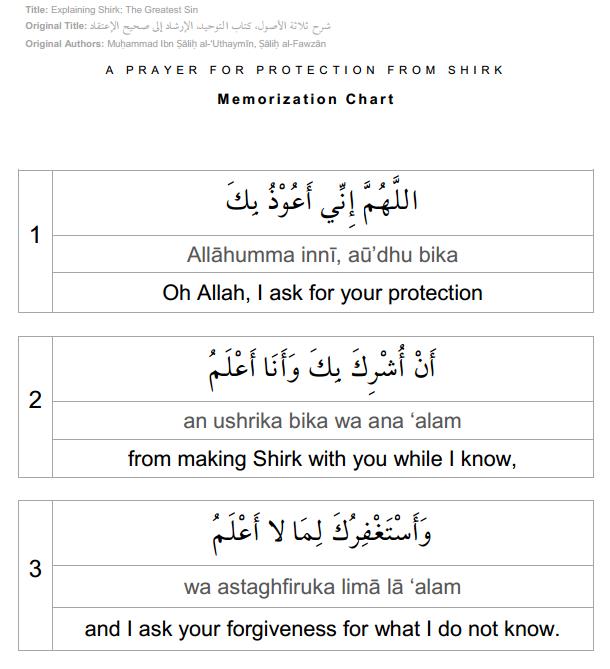
A Prayer for the Protection From Shirk – Memorization Chart

A Prayer for the Protection From Shirk - Memorization Chart

Reference: Ahmad 4/403. See also Al-Albani, Sahihul-Jami’ As-Saghir 3/233 and Sahihut-Targhib wat- Tarhib 1/19.

Posted from: Explaining Shirk: The Greatest Sin – Muhammad Ibn Sālih al-’Uthaymīn, Sālih al-Fawzān

Read for the Source and Explanation of the above du’a @ Du’aa for Fear of Shirk

Performing Ruku‘ (bowing) to one’s parents? – The Permanent Committee

Q 7: Is it permissible to perform Ruku‘ (bowing) to one’s parents?

This is impermissible and is tantamount to Shirk (associating others with Allah in His Divinity or worship).

Ruku‘ is a form of worship, just like Sujud (prostration); therefore, it is impermissible to bow or prostrate before anyone other than Allah the Exalted.

May Allah grant us success. May peace and blessings be upon our Prophet Muhammad, his family, and Companions.

The Permanent Committee for Scholarly Research and Ifta’
Browse by Volume Number > Group 1 > Volume 1: `Aqidah (1) > Creeds > Prostration before anyone other than Allah > Bowing to parents

Prostrating before other than Allaah and slaughtering animals for them

Q 4: Is it true that a person who testifies that Allah is the Creator and Provider,and that Muhammad (peace be upon him) is Allah’s Messenger, and performs Salah (Prayer) is a Muslim even if they make Sujud (Prostration) to their shaykh and offer sacrifices for people other than Allah?

A:

Making Sujud and sacrificing for anyone other than Allah is Shirk (associating others with Allah in His Divinity or worship). People who indulge in any of these practices after being aware of the ruling of doing so, are Mushriks (people who associate others with Allah in worship) and Kafirs (disbelievers). Allah will not accept any of their deeds even if they offer Sawm (Fast) and Salah. Deeds of Mushriks are rejected. Moreover, if they die in this case, Allah will not forgive them.

Allah (Exalted be He) says:

Verily, Allâh forgives not that partners should be set up with Him (in worship), but He forgives except that (anything else) to whom He wills.

Allah also says,

Verily, whosoever sets up partners (in worship) with Allâh, then Allâh has forbidden Paradise to him, and the Fire will be his abode. And for the Zâlimûn (polytheists and wrong-doers) there are no helpers.

Also Allah (Exalted be He) says:

But if they had joined in worship others with Allâh, all that they used to do would have been of no benefit to them. But if they return to Allah in sincere Tawbah (repentance to Allah) before death, Allah will forgive them,

as Allah (Exalted be He) says:

Say: “O ‘Ibâdî (My slaves) who have transgressed against themselves (by committing evil deeds and sins)! Despair not of the Mercy of Allâh: verily, Allâh forgives all sins.

Muslim scholars unanimously agree that this Ayah (Qur’anic verse) speaks about repentant people.

As for the Ayah of Surah Al-Nissa’:

Verily, Allâh forgives not that partners should be set up with Him (in worship), but He forgives except that (anything else) to whom He wills ,

it speaks about the unrepentant people, namely, those who died in Kufr (disbelief) and sin. May Allah protect us from that.

May Allah grant us success. May peace and blessings be upon our Prophet Muhammad, his family, and Companions.

The Permanent Committee for Scholarly Research and Ifta’
Posted from: http://alifta.com

Understanding Shirk in Tawheed of Lordship (Ruboobiyyah) with examples – Shaykh Uthaymīn, Shaykh Sālih al-Fawzān

Shirk in Tawḥīd of Lordship is to believe that others besides Allah create or share control over his creation. This belief means that someone other than Allah can make good things happen or keep bad things from happening.

One example of this type of Shirk is to believe something brings good luck. People often have “good luck” rings or similar items they believe will help good things happen to them. Others tie special strings around them or their children, believing that if they recite the Quran over the strings, they will protect from bad things happening. However, only Allah can protect us from bad things and we should only seek his protection in ways he mentions in the Quran or the prophet ( صلّى الله عليه وسلّم ) taught us in the ḥadīth

Another common example of Shirk in Tawḥīd of Lordship today is when people believe others like themselves who are created and have no control in Allah’s universe can control what happens. Such people even wait until the ones they believe in are dead before worshipping them by praying to them. The act of praying to dead people is Shirk in Tawḥīd of Worship (which we will cover shortly), but the belief itself is also Shirk in Tawḥīd of Lordship because when people pray to dead people, they believe the souls of humans can control things in this life even after their death. This is completely wrong because the prophet ( صلّى الله عليه وسلّم ) told us:

إِذَا مَاتَ الإِنْاَانُ انْقَطَعَ عَنْهُ عَمَلُهُ إِلاَّ مِنْ ثَلاثَ ة إِلاَّ مِنْ صَدَقَ ة جَارِيَ ة أَوْ عِلْمٍ «
». يُنْتَفَعُ بِهِ أَوْ وَلَ د صَالِحٍ يَدْعُو لَهُ

When a person dies, his actions come to an end except for (receiving rewards for) three things: continuous charity, beneficial knowledge, or a righteous child who prays for him.
[Recorded by Muslim]

While a person may still receive rewards from Allah for things he left behind after he died, the prophet ( صلّى الله عليه وسلّم ) clearly told us that after death, a human being’s actions stop. So how can dead people control whether good and bad things happen in life when they are not even in life anymore? Still, some people continue to pray to the dead, asking for their help in changing events in this life although only Allah can do this.

Even if a dead person was a righteous worshipper of Allah, believing that dead people or anyone else controls things in this life is Shirk in Tawḥīd of Lordship.

Review

  1. What is Shirk in Tawḥīd of Lordship? 
  2. Give an example of Shirk in Tawḥīd of Lordship

Posted from: Explaining Shirk: The Greatest Sin – Muhammad Ibn Sālih al-‘Uthaymīn, Sālih al-Fawzān, Translated by  Abu az-Zubayr Harrison

Tawheed is not fulfilled unless it contains both negation and affirmation – Shaykh ibn Uthaymeen

The noble Shaykh, Muhammad ibn Saalih Ibn al-‘Uthaymeen – may Allaah raise his status among the guided ones, was asked about the meaning of Tawheed and its categories. He answered, saying:

Linguistically, Tawheed is the noun derived from the Arabic root verb: wahhada / yuwahhidu which means to make something one.

This is not accomplished except by a negation and affirmation, both together – negating this characteristic from anything other than the thing which is being singled out, and affirming it to that thing.

For example, we say that mankind will not fulfill the concept of Tawheed unless and until they testify that nothing deserves any form of worship except Allaah. By this, we negate any right of worship to anyone or anything other than Allaah (subhanahu wa ta’aala), and we affirm it to Allaah alone.

This is because negation alone equates to an absolute and complete negation, just as affirmation alone does not restrict others from sharing in the characteristic.

So if you were to say, “So and so is standing,” then you have affirmed that he is indeed standing but you have not singled him out alone, restricting this action only to him because it is possible, based on this saying alone, that someone else could also be standing with him. Similarly, if you were to say, “No one is standing,” then you have absolutely and completely negated the action of standing for anyone. However, if you said, “No one is standing except Zayd,” then you have singled out Zayd alone with the action of standing, negating it from anyone other than him. This is the true actualization of Tawheed in reality – meaning that Tawheed is not fulfilled unless it contains both negation and affirmation. 

Posted fromTawheed: Its Meaning and Categories – Shaykh Muhammad Ibn Sālih al-‘Uthaymīn [PDF] – Translated by Abu az-Zubayr Harrison @ authentic-translations.com

The Story of Hajj – by Shaykh Hasan ibn AbdulWahhab al-Banna [Audio|Ar-En]

The Story of Hajj by Shaykh Hasan ibn 'AbdulWahhab al-Banna

Listen / Download Mp3 Here (Time 01:34:52)

Allah commanded our father Ibraaheem saying,

“And proclaim to mankind the Hajj (pilgrimage). They will come to you on foot and on every lean camel, they will come from every deep and distant (wide) mountain highway (to perform Hajj). [Soorah al-Hajj :27]

“And proclaim to mankind the Hajj” meaning, announce the pilgrimage to mankind and call them to perform pilgrimage to this House which We have commanded you to build. It was said that Ibraaheem said: “O Lord, how can I convey this to people when my voice will not reach them” It was said: “Call them and We will convey it.” So Ibraaheem stood up and said, “O mankind! Your Lord has established a House so come on pilgrimage to it.”

It is said that the mountains lowered themselves so that his voice would reach all the regions of the earth, and those who were still in their mothers’ wombs and their fathers’ loins would hear the call. The response came from everyone in the cities, deserts and countryside, and those whom Allah has decreed will make the pilgrimage, until the Day of Resurrection: “At Your service, O Allah, at Your service.” This is a summary of the narrations from Ibn ‘AbbaasMujaahid`IkrimahSa’id bin Jubayr and others among the Salaf. And Allah knows best. This was recorded by Ibn Jarir and by Ibn Abi Hatim at length. [Tafseer Ibn Kathir]

With the time of Hajj upon us, our Shaykh Hasan al-Banna (hafidhahullah) will enlighten us with respect to the story of Hajj according to the Book, the Sunnah and the narrations of our Salaf-us-Saalih.

We ask Allah to accept the Hajj of all our brothers and sisters and that He Al-GhafoorAr-Raheem forgives us our sins and shortcomings.

Posted from: http://store.mpubs.org

The Superiority of Abu Bakr As-Siddiq and Umar Ibn Al-Khattab – By Dawud Adib [Audio|En]

Listen / Download Mp3 Here (Time 01:03:21)

Lecture hosted by Sisters United Upon Knowledge, online study group

Related Links:

[eBook] The Response of the Muslim Against the Plots of the Kuffaar – Shaykh Salih al-Fawzaan

Since the time of Prophet Muhammad those who disbelieved in his message have always diligently tried to put out the light of Allaah and to this day they have not ceased in trying to destroy Islam with every means, whether it be through the media, through war, occupation of Muslim countries and much more. We also witness how many Muslims fall subject to the traps of the disbelievers even at the hands of the Muslims themselves. One of the most prominent scholars of our time by the name of Shaykh Saalih bin Fawzan addresses these issues in a Friday sermon entitled; “The Response of the Muslims during trials”.

He addresses how the Muslims should counter the plots and objectives of the disbelievers during these times. Recently the kuffaar have produced movies, illustrations and evil ideas about Prophet Muhammad and the religion of Islaam. They have plotted cleverly against the Muslims in ways that are not apparent to many. Along with this they continue to spread western ideologies amongst the Muslims which shaykh Fawzan may Allaah preserve him has shed light on.

[Download PDF]

Posted with Permission from: http://al-binaapublishing.posthaven.com

Brief illustration of Hajj and Umrah [Fiqh al-Ebaadaat by Sh. Uthaymeen] – Abu Muhammad al-Maghribee [Audio|En]

This is a brief illustration of Hajj and Umrah taken from the book Fiqh al-Ebaadaat by our noble sheikh Muhammad bin Saaleh al-Uthaymeen, rahimahullah.

Listen / Download Mp3 Here (Time 47:31)

Posted from: http://followthesalaf.com

Time is Running Out – Abu Muhammad al-Maghribee [Audio|En]

Listen / Download Mp3 Here (Time 30:07)