Most important books regarding the Stratagems of the Shaytaan and their cures – Permanent Committee

Q: What are the most important books that discuss the secrets of the souls and the treatment of wild whims, and who are the most important authors in this respect?

A: One of the best books in this respect is the one written by Ibn Al-Jawzy (may Allah be merciful to him). He was a preacher who thoroughly explored the souls. He wrote a book entitled “Talbis Iblis” (Entanglements of the Devil) in which he discussed the ways that the devil uses to entangle humans in whims and suspicions. Ibn Al-Jawzy (may Allah be merciful to him) really excelled in this book.

Moreover, there is a book entitled “Ighathat-ul-Lahfan min Maka’id Al-Shaytan (Relieving the Distressed from the Stratagems of the Devil) by Ibn Al-Qayyim (may Allah be merciful to him), which discusses a valuable subject. It is summarized by Shaykh `Abdullah ibn `Abdul-Rahman Ababtin in “Mukhtasar Al-Ighathah (The Summary of the Relief of the Distressed)” and many other books.

May Allah grant us success! May peace and blessings be upon our Prophet Muhammad, his family, and Companions!

Permanent Committee for Scholarly Research and Ifta’

Member     Deputy Chairman     Chairman
`Abdullah ibn Ghudayyan     `Abdul-Razzaq `Afify     `Abdul-`Aziz ibn `Abdullah ibn Baz

Browse by Volume Number > Group 2 > Volume 11: Jihad – Miscellaneous Fatwas > Knowledge > The books that discuss the secrets of the souls and the treatment of wild whims

When an evil thought comes to them from Shaytan .. – Tafseer Ibn Kathir

Allah says in Surah Al-A’raf,

(201. Verily, those who have Taqwa, when an evil thought comes to them from Shaytan, they remember (Allah), and (indeed) they then see (aright).)

(202. But (as for) their brothers (the devils’ brothers) they (the devils) plunge them deeper into error, and they never stop short.)

Allah mentions His servants who have Taqwa, obeying His orders, and avoid what He forbade:

(when comes to them) an evil thought, or anger, or the whispers of Shaytan cross their mind, or intend to err, or commit an error,

(they remember) Allah’s punishment, as well as, His tremendous reward. They remember Allah’s promises and threats, then repent, go back to Him, seek refuge with Him and ask for forgiveness before death,

(and (indeed) they then see (aright)) they become aright and aware of the error of their ways.

Allah said next,

(But (as for) their brothers they plunge them deeper) in reference to the devils’ brothers among mankind. Allah said in another Ayah, (Verily, the spendthrifts are brothers of the Shayatin) (17:27) for they are followers of the Shayatin, who listen to them and obey their orders.

(They plunge them deeper into error) the devils help them commit sins, making this path easy and appealing to them

(and they never stop short) for the devils never cease inciting mankind to commit errors.

`Ali bin Abi Talhah reported that Ibn `Abbas commented on Allah’s statement,

(But (as for) their brothers they plunge them deeper into error, and they never stop short.) “Neither mankind stop short of the evil that they are doing nor the devils stop short of luring them. ” Therefore,

(they never stop short) refers to the devils getting tired or stopping their whispering.

Allah said in another Ayah,

(See you not that We have sent Shayatin against the disbelievers to push them to do evil) (19:83) persistently luring the disbelievers to commit evil, according to Ibn `Abbas and others.

Source : Tafseer Ibn Kathir, Al-A’raf, verses 201 and 202, Dar-us-Salam English Publication

https://abdurrahman.org/jinn-shayateen-devils/

Turning one’s head during Salah to seek refuge (in Allah) from Shaytaan – Fatwas of Ibn Baz


Bismillaah

Question : A Muslim sister asks about the ruling on turning one’s head during Salah to seek refuge in Allah from the devil called Khanzab (a devil that distracts a servant at the time of prayer)?

A: There is no harm in turning the head during Salah seeking refuge in Allah from the accursed Satan when casting his insinuations. Rather, it is desirable when there is a dire need for it on condition that it is done by moving one’s head only, because the Prophet (peace be upon him) ordered ‘Uthman ibn Abul-‘As Ath-Thaqafi (may Allah be pleased with him) to do so when he complained to the Prophet about the insinuating thoughts that Satan casts during prayers, so he ordered him to spit (dryly) to his left side three times and seek refuge in Allah from Satan.[1] He did so and Allah granted him recovery.

As for turning one’s head during performing Salah without a due reason, this is undesirable. When the Prophet (peace be upon him) was asked about this, he said: It is a quick stealing by which Satan takes away (a portion) from the prayer of a person (By making him glance left and right). May Allah guide us all to what pleases Him! He is All-Hearing and Responsive.

Foot Notes:

[1] Related by Muslim, Book on greetings, Chapter on seeking refuge from the insinuating thoughts of Satan during Salah, no. 4083

General Chairman of the Departments of Scholarly Research, Ifta’, Da`wah, and Guidance

Fatwas of Ibn Baz

Browse by Volume Number > Volume 11 > The Book of Salah (Prayer): Section Two > Chapter: The description of Salat (Prayer) > Turning one’s head during Salah to seek refuge with Allah from Satan

Related Linkhttps://abdurrahman.org/jinn-shayateen-devils

The formulae of Allaah’s Remembrance prescribed after Salah – Imam Ibn Baz

Majmoo’ Fataawa wa Maqaalaat Mutanawwi’ah li Samaahat
al-Shaykh ‘Abd al- ‘Azeez ibn ‘Abd-Allaah ibn Baaz, Vol. 11, pp. 188-190 – alifta.net

From ‘Abdul ‘Aziz Bin ‘Abdullah Ibn Baz to those who receive this among Muslims. May Allah guide all Muslims and increase their knowledge and faith, amen!

As-salamu ‘alaykum warahmatullah wabarakatuh (May Allah’s Peace, Mercy, and Blessings be upon you!) It gives me pleasure to remind my Muslim brothers that –

It is of the Sunnah for a Muslim to say after each obligatory Salah, whether one is the Imam (the one who leads the congregational Salah), Ma’mum (a person being led by an Imam in Prayer) or Mufarid (a person who performs prayer alone) to say, three times

أَسْـتَغْفِرُ الله 
“Astagfir Allah”
[#1]
(I ask Allah forgiveness)

 and then say,

اللّهُـمَّ أَنْـتَ السَّلامُ ، وَمِـنْكَ السَّلام ، تَبارَكْتَ يا ذا الجَـلالِ وَالإِكْـرام

“Allahumma Anta Al-Salam Wa Minka Al-Salam, Tabarakta Wa Ta’alayta Ya-dhal-Jalali Wal-Ikram” [#1]

(O Allah, You are Al-Salam [the One Who is free from all defects and deficiencies] and from You is all peace, blessed are You, Possessor of majesty and honor!)

If one is Imam, one should turn facing the people. The Imam, those praying behind him, or a person offering Salah individually should say,

لَا إِلهَ إِلَّا اللهُ وَحْدَهُ لَا شَرِيكَ لَهُ، لَهُ الْمُلْكُ وَلَهُ الْحَمْدُ وَهُوَ عَلَى كُلِّ شَيْءٍ قَدِيرٌ

لَا حَوْلَ وَلَا قُوَّةَ إِلَّا بِاللهِ، لَا إِلَهَ إِلَّا اللهُ، وَلَا نَعْبُدُ إِلَّا إِيَّاهُ، لَه النِّعْمَةُ وَلَهُ الْفَضْلُ وَلَهُ الثَّنَاءُ الْحَسَنُ، لَا إِلَهَ إِلَّا اللهُ مُخْلِصِينَ لَهُ الدِّينَ وَلَوْ كَرِهَ الْكَافِرُونَ

 اللَّهُمَّ لَا مَانِعَ لِمَا أَعْطَيْتَ، وَلَا مُعْطِيَ لِمَا مَنَعْتَ، وَلَا يَنْفَعُ ذَا الْجَدِّ مِنْكَ الْجَدُّ

Laa ‘ilaaha ‘illallaahu wahdahu laa shareeka lahu, lahul-mulku, wa lahul-hamdu wa Huwa ‘alaa kulli shay ‘in Qadeer. Laa hawla wa laa quwwata ‘illaa billaahi, laa ‘ilaaha ‘illallaahu, wa laa na’budu ‘illaa ‘iyyaahu, lahun-ni’matu wa lahul-fadhlu wa lahuth-thanaa’ul-hasanu, laa ‘ilaaha ‘illallaahu mukhliseena lahud-deena wa law karihal-kaafiroon. Allaahumma laa mani’a limaa ‘a’tayta, wa laa mu’tiya limaa mana’ta, wa laa yanfa’u thal-jaddi minkal-jadd. [#2]

(None has the right to be worshipped except Allah, alone, without any partner. To Allah belong all sovereignty and praise. He is Omnipotent over all things. There is no might nor power except with Allah. None has the right to be worshipped except Him. We worship none but Him. To Allah all favor, grace, and praise are due. None has the right to be worshipped except Allah and we are sincere in faith and devotion to Him although disbelievers detest it. Oh Allah! Oh Allah! None can prevent what You willed to give and none can grant what You have willed to prevent, and no wealth or majesty can benefit anyone, as from You is all wealth and majesty).

After offering Maghrib (Sunset) Prayer and Fajr (Dawn) Prayer one should say along with what is mentioned previously,

After completing the prayer:

لَا إِلَهَ إِلَّا اللهُ وَحَدْهُ لَا شَرِيكَ لَهُ، لَهُ الْمُلْكُ وَلَهُ الْحَمْدُ يُحْيِي وَيُمِيتُ، وَهُوَ عَلَى كُلِّ شَيْءٍ قَدِيرٌ

Laa ‘ilaaha ‘illallaahu wahdahu laa shareeka lahu, lahul-mulku wa lahul-hamdu yuhyee wa yumeetu wa Huwa ‘alaa kulli shay’in Qadeer

[None has the right to be worshipped but Allah alone, Who has no partner. His is the dominion and His is the praise . He brings life and He causes death , and He is Able to do all things.]

After that, one is to say each of the following supplications thirty three times;

(a) “Subhana Allah” (Glory is to Allah),

(b) “Al-Hamdu Lillah” (praise is due to Allah) and

(c) “Allahu Akbar” (Allah is the Great),

and then complete the hundred by saying,

لَا إِلَهَ إِلَّا اللهُ وَحَدْهُ لَا شَرِيكَ لَهُ، لَهُ الْمُلْكُ وَلَهُ الْحَمْدُ يُحْيِي وَيُمِيتُ، وَهُوَ عَلَى كُلِّ شَيْءٍ قَدِيرٌ

Laa ‘ilaaha ‘illallaahu wahdahu laa shareeka lahu, lahul-mulku wa lahul-hamdu yuhyee wa yumeetu wa Huwa ‘alaa kulli shay’in Qadeer

It is recommended for the Imam, Ma’mum, and Munfarid to recite these supplications audibly after each obligatory Salah in a low voice without disturbing others.

It is authentically reported in the two Sahih on the authority of Ibn ‘Abbas (may Allah be pleased with them) that raising one’s voice in supplication after concluding the obligatory Salah was during the time of the Prophet (peace be upon him). Ibn ‘Abbas (may Allah be pleased with them) said, “I used to know when they finished the Salah by this (supplications as they were said aloud) if I heard them.” 

[Al-Bukhari, Sahih, Book on Adhan, no. 841; Muslim, Sahih, Book on Masjids and places for Salah, no. 583; Al-Nasaa’y, Sunan, Book on Sujud-ul-Sahw, no. 1335; Abu Dawud, Sunan, Book on Salah, no. 1003; and Ahmad ibn Hanbal, Musnad, vol. 1, p. 367.’]

However, it is not permissible to say these supplications collectively. Each worshipper should recite them individually without observing the voice of others, because reciting supplications collectively is Bid’ah and has no basis in the divine Shari’ah (law) of Allah.

It is recommended for Imam, Ma’mum, and Munfarid to recite

Ayat-ul-Kursy (the Qur’anic Verse of Allah’s Foot stool, Surah Al-Baqarah, 2:255[#3]  inaudibly.

After that,

Surah-Al-Iklas (the Qur’an, Surah 112),

Surah-Al-Falaq (the Qur’an, Surah 113), and

Surah-Al-Nas (the Qur’an, Surah 114)

inaudibly after each obligatory Salah and repeat them three times after the Maghrib (Sunset) and Fajr (Dawn) Salahs. [#4]

This is preferable, for the authenticity of what we have mentioned above.

May Allah’s Peace and Blessings be upon our Prophet Muhammad, His companions, and those who follow him rightfully till the Day of Judgment.

The Grand Mufty of the Kingdom of Saudi Arabia 
Chairman of the Departments of Scholarly Research, Ifta’, Da`wah, and Guidance
24/10/1414 A.H.

PS: [AbdurRahman.Org] Du’aa transliterations slightly corrected for the better pronunciation

Foot Notes : (added by AbdurRahman.Org)

[#1] Sahih  Muslim 1/414

[#2] Sahih  Muslim 1/415

[#3] An-Nasaai, ‘Amalul Yawm-Yawm wal-Layl (hadith No.100), also Ibn As-Sunni (n.121). See also Al-Albanee Sahihul-Jaami As-Sagheer 5/339 and Silsilatul-Ahadeeth As-Saheehah 2/697 (no.972)

[#4] Abu Dawood 2/86, An-Nasaai 3/68, see also Al-Albanee, Sahih At-Tirmidhi 2/8.

Iblees says : “You have done well” and embraces him – Saheeh Muslim

Iblis places his throne upon water

Jabir reported that Allah’s Messenger (ﷺ) said:

Iblis places his throne upon water; he then sends detachments (for creating dissension) ; the nearer to him in rank are those who are most notorious in creating dissension. One of them comes and says: I did so and so. And he says: You have done nothing. Then one amongst them comes and says: I did not spare so and so until I sowed the seed of discord between a husband and a wife. The Satan goes near him and says: ‘You have done well. A’mash said: He then embraces him.

Source : Sahih Muslim 2813 b  (Book 52, Hadith 60), Dar-us-salm English Translation

Sahih Muslim : Book 39: The Book Giving Description of the Day of Judgement, Paradise and Hell (Kitab Sifat Al-Qiyamah wa’l Janna wa’n-Nar)

Related Linkhttps://abdurrahman.org/jinn-shayateen-devils/

Bringing the Children Indoors and Closing Doors and Windows When Night Falls

حَدَّثَنَا إِسْحَاقُ، أَخْبَرَنَا رَوْحٌ، أَخْبَرَنَا ابْنُ جُرَيْجٍ، قَالَ أَخْبَرَنِي عَطَاءٌ، سَمِعَ جَابِرَ بْنَ عَبْدِ اللَّهِ ـ رضى الله عنهما ـ قَالَ رَسُولُ اللَّهِ صلى الله عليه وسلم:‏‏ إِذَا كَانَ جُنْحُ اللَّيْلِ ـ أَوْ أَمْسَيْتُمْ ـ فَكُفُّوا صِبْيَانَكُمْ، فَإِنَّ الشَّيَاطِينَ تَنْتَشِرُ حِينَئِذٍ، فَإِذَا ذَهَبَ سَاعَةٌ مِنَ اللَّيْلِ فَحُلُّوهُمْ، وَأَغْلِقُوا الأَبْوَابَ، وَاذْكُرُوا اسْمَ اللَّهِ، فَإِنَّ الشَّيْطَانَ لاَ يَفْتَحُ بَابًا مُغْلَقًا ‏”‏‏.‏ قَالَ وَأَخْبَرَنِي عَمْرُو بْنُ دِينَارٍ سَمِعَ جَابِرَ بْنَ عَبْدِ اللَّهِ نَحْوَ مَا أَخْبَرَنِي عَطَاءٌ وَلَمْ يَذْكُرْ ‏”‏ وَاذْكُرُوا اسْمَ اللَّهِ ‏”‏‏.‏”

Narrated Jabir bin `Abdullah: Allah’s Messenger (ﷺ) said,

“When night falls (or it is evening), keep your children close to you for the devils spread out at that time. But when an hour of the night elapses, you can let them free. Close the doors and mention the Name of Allah, for Satan does not open a closed door.”

Sahih al-Bukhari 3304 (Book 59, Hadith 112)

Translated by Dr. Muhammad Muhsin Khan

Related Linkhttps://abdurrahman.org/jinn-shayateen-devils


Meaning of the Ayah “…and follow not the footsteps of Shaitan” – Permanent Committee

The Ayah “…and follow not the footsteps of Shaitan”

The second question of Fatwa no. 20703

Q 2: Allah (Exalted be He) says: and follow not the footsteps of Shaitan (Satan). What are the footsteps of Satan? Is looking at non-Mahram women (not a spouse or unmarriageable relatives) in real life or on satellite channels or talking to them on the phone or in the markets or flirting with them considered as following the footsteps of Satan? Is reading romantic books and art and fashion magazines with pictures of actresses and beautiful and charming celebrities considered as following the footsteps of Satan? What is our duty towards a person who does so? May Allah benefit us and you!

A: Following the footsteps of Satan as Ibn Kathir mentioned in his book in which he explained the meanings of the Qur’an (Tafsir Ibn Kathir vol. 1, p. 204) that Qatadah and Al-Suddy said,

“All sins are footsteps of Satan.”

`Ikrimah said,

“They are the incitements of Satan.”

Mujahid said,

“Satan’s footsteps are his mistakes and sins.”

Abu Mijlaz said,

“Satan’s footsteps are vows involving sins.

Al-Qurtuby (in Tafsir Al-Qurtuby vol. 1, P. 308) said, “I said:

The correct view is that the utterance is general and covers all the sins and Bid`ahs (innovations in religion) but not the acts of Sunnah (commendable acts) nor the rulings of Shari`ah (Islamic law).”

Subsequently, it is clear that the footsteps of Satan apply to all the acts that involve disobedience to Allah (Exalted be He). So, whoever disobeys the orders of Allah (Exalted be He) and His Messenger (peace be upon him), violates the rulings of Shari`ah, and commits things which Allah (Exalted be He) has prohibited is disobeying Him.

All that is mentioned in the question is considered as footsteps and tricks of Satanabout which Allah (Exalted be He) says: He [Shaitân (Satan)] commands you only what is evil and Fahshâ (sinful), and that you should say against Allâh what you know not. Anyone who commits any such sins has to turn to Allah (Exalted be He) in sincere repentance and never do any such evil deeds again. Whoever knows any person who commits any such deeds has to advise them gently and leniently and explain the evil consequences of their bad deeds and encourage them to do good deeds and draw closer to Allah (Exalted be He) through supererogatory acts of worship and performance of Salah (Prayer) in congregation as Allah (Exalted be He) and His Messenger have ordered; because Salah prohibits immorality and wrongdoing.

May Allah grant us success! May peace and blessings be upon our Prophet Muhammad, his family, and Companions!

Permanent Committee for Scholarly Research and Ifta’

Member     Member     Member     Deputy Chairman     Chairman
Bakr Abu Zayd     Salih Al-Fawzan     `Abdullah ibn Ghudayyan     `Abdul-`Aziz Al Al-Shaykh     `Abdul-`Aziz ibn `Abdullah ibn Baz

Source : alifta.com

Is it permissible for the Muslim to curse Shaytaan ? – Permanent Committee

Fatwa no. 19753

Q: A man heard me cursing Satan one day and criticized me for that. He said it is prohibited to curse Satan, because cursing him makes him haughty. Is this correct? Please, advise. May Allah reward you!

A: When Satan incites a Muslim to sin or whispers (suggests) to him, it is permissible for him to seek refuge and protection in Allah Alone from Satan. Also, it is permissible for the Muslim who fears the harm of Satan’s plot, or that of his supporters, to seek the help of Allah to ward off Satan’s evil and harm. He should often recite Dhikr (Remembrance of Allah) so that Allah will rebuke him and thwart his plot in a disgraceful manner.

And Allah (Exalted be He) states: “And if an evil whisper comes to you from Shaitân (Satan), then seek refuge with Allâh. Verily, He is All-Hearer, All-Knower.” (Surah Al-A`raf, 7: 200)

He (Exalted be He) says: And say: “My Lord! I seek refuge with You from the whisperings (suggestions) of the Shayâtîn (devils).” (Surah Al-Mu’minun, 23: 97)

“And I seek refuge with You, My Lord! lest they should come near me.” (Surah Al-Mu’minun, 23: 98)

It was authentically reported from the Prophet (peace be upon him) that: “when getting up to pray, he (peace be upon him) used to say: I seek refuge in Allah the All-Hearing and All-Knowing from the accursed Satan , from his Hamz (evil whispers) and his Nafkh (arrogance) and his Nafth (spell and in that Hadith scholars interpreted Nafth as Poetry).” [1]

It was also compiled by Imam Ahmad in his Musnad (Hadith compilation) Vol. 5 p. 59 on the authority of Abu Tamimah Al-Hujaimy that a man who was riding behind the Prophet (peace be upon him) said:

“One day as I was riding behind the Prophet on a donkey, it stumbled and I shouted, “Let Satan perish!” The Prophet said, “Do not say ‘let Satan perish,’ for if you say so he will feel important and haughty and he will say, ‘I thwarted him with my power!’ Instead say, ‘In the name of Allah,’ so that he will (feel humiliated and) be smaller than a fly” [2]. A similar narration was related by Abu Dawud in his Sunan (Hadith compilations classified by jurisprudential themes).

It was mentioned in the book of Al-Samt wa Adab Al-Lisan (Silence and Etiquettes of the Tongue) written by Ibn Abu Al-Dunia p. 205 on the authority of Mujahid (may Allah be merciful with him) saying:

“Seldom do people mention Satan but he attends to them; when he hears someone invoking curses on him, he says, ‘Indeed, you invoke curses on a cursed being.’ There is nothing more breaking to Satan’s back than saying ‘there is no deity worthy of worship but Allah.'” This is the effective cure for fending off Satan’s harm from man, since the evil of the rebellious Jinn (creatures created from fire) cannot be removed except by that.

Allah cursed Satan in His Book repeatedly when he became arrogant and refused to carry out the order of Allah to prostrate before Adam in honor and respect. As a result, Allah described Satan as an accursed outcast. He has been expelled from the mercy and Paradise of Allah on the Day of Resurrection.

Allah (Exalted be He) states:

They (all those who worship others than Allâh) invoke nothing but female deities besides Him (Allâh), and they invoke nothing but Shaitân (Satan), a persistent rebel! Allâh cursed him. And he [Shaitân (Satan)] said: “I will take an appointed portion of your slaves. [Surah Al-Nisa’, 4: 117-118]

He may He be Exalted) stated: (Allâh) said: “Then, get out from here, for verily, you are Rajîm (an outcast or a cursed one).” [Tafsîr At-Tabarî] “And verily, the curse shall be upon you till the Day of Recompense (i.e. the Day of Resurrection).” [Surah Al-Hijr, 15: 34-35]

The Messenger (peace be upon him) cursed Satan in his Salah (prayer) when he (the Prophet) resisted him and wanted to harm and destroy him. It was related by Imam Muslim in his Sahih (authentic) Book of Hadith on the authority of Abu Al-Darda’ (may Allah be pleased with him) saying:

Allah’s Messenger (peace be upon him) stood up (to pray) and we heard him say:” I seek refuge in Allah from you.” Then said: “I curse you with Allah’s curse” three times, then he stretched out his hand as though he was taking hold of something. When he finished the prayer, we said: Messenger of Allah, we heard you say something during the prayer which we have not heard you say before, and we saw you stretch out your hand. He replied: Allah’s enemy Satan came with a flame of fire to put it in my face, so I said three times: “I seek refuge in Allah from you.” Then I said three times: “I curse you with Allah’s full curse.” But he did not retreat (on any one of these) three occasions. Thereafter, I meant to seize him. I swear by Allah that had it not been for the supplication of my brother Solomon he would have been bound, and made an object of sport for the children of Madinah. [3]

Therefore, it is permissible for the Muslim to curse Satan when he comes to harm him or tries to dissuade him from obedience to Allah. Nonetheless, he should not give up seeking refuge in Allah from Satan, always reciting Dhikr (Remembrance of Allah), Bismillah [In the Name of Allah] or other Adhkar (invocations), which are permissible under the Shari`ah (Islamic law). This guarantees protection of the Muslim against the evil of Satan.Based on the Ayah (Qur’anic verse) and Hadiths mentioned above, a Muslim should not take to cursing Satan needlessly as a form of following the Messenger of Allah (peace be upon him).

May Allah grant us success! May peace and blessings be upon our Prophet Muhammad, his family and Companions!

Permanent Committee for Scholarly Research and Ifta’

Member  –   Member  –   Member   –  Deputy Chairman  –   Chairman
Bakr Abu Zayd  –   Salih Al-Fawzan   –  `Abdullah ibn Ghudayyan   –  `Abdul-`Aziz Al Al-Shaykh   –  `Abdul-`Aziz ibn `Abdullah ibn Baz

Footnotes:

[1] Al-Tirmidhy, Sunan, Book on Salah, no. 242; Abu Dawud, Sunan, Book on Salah, no. 775; Ahmad ibn Hanbal, Musnad, vol. 3, p. 50; and Al-Darimy, Sunan, Book on Salah, no. 1239

[2] Ahmad, vol. 5, pp. 59, 71, and 365; Abu Dawud, vol. 5, p. 260, no. 4982; Al-Nasa*y, `Amal Al-Yawm Wa Al-Laylah, pp. 373-374, nos. 554-555, `Abdul Razzaq, vol. 11, p. 424, no. 20899; Al-Tahawy, Mushkal Al-Athar, vol. 1, p. 343, no. 368; Al-Tabarany, vol. 1, p. 194, no. 516; Al-Hakim, vol. 4, p. 292; Ibn Abu `Asim, Al-Ahad Wa Al-Mathany, vol. 2, p. 306, no. 1068; Ibn Al-Sunni, `Amal Al-Yawn Wa Al-Laylah, p. 240, no. 509; and Al-Baghawy, vol. 12, p. 354, no. 3384.’

[3] Muslim, vol. 1, p. 385, no. 542; Al-Nasa’y, vol. 3, p. 13, no. 1215; Ibn Hibban, vol. 5, pp. 316-317, no. 1979; Abu `Awanah, vol. 2, p. 144; Abu Nu`aym, vol. Dalail Al-Nubuwwah, vol. 2, p. 475, no. 266, verified by `bdul Barr `Abbas; and Al-Bayhaqy, vol. 2, p. 264.’

Fatwas of Permanent Committee

Browse by Volume Number > Group 1 > Volume 26: Miscellaneous 3 > Cursing > Cursing Satan

Visit: https://abdurrahman.org/jinn-shayateen-devils/

Charlatanry : The Awliya’ of Allah and the Awliya’ of Satan – Permanent Committee

(6) Conjuration

Q: Among us are some members of a dervish order; one of them is a relative of ours. He is an illiterate man, not gifted by any agility or wit, but he drank a sip of water from the hands of the head of this order to be able to perform charlatan tricks and sorcery before the people. He can strike his stomach with every cutting weapon such as daggers, swords, pieces of wood, bullets, etc. He is neither a practicing Muslim, nor does he perform the obligatory acts of worship enjoined by Allah such as Salah (Prayer), Sawm (Fasting) and others.

Please clarify the opinion of Islam regarding this matter. What is the secret of his ability to strike himself in this manner? Please reply in writing, as this phenomenon takes place in our country and in other Arab and Muslim countries as well.

A: Allah sent Muhammad (peace be upon him) as the Final Messenger, on the authority of Qur’anic texts and Ijma‘ (scholarly consensus), as Allah says (what means), Muhammad (صلى الله عليه وسلم) is not the father of any of your men, but he is the Messenger of Allâh and the last (end) of the Prophets. (Surah Al-Ahzab, 33: 40). Hadiths were reported from the Messenger of Allah (peace be upon him) by a significant number of trustworthy narrators to show that he is the Last of Prophets; and Muslims have unanimously agreed to this.

Awliya’ (supporters) are of two types: Awliya’ of Allah, and Awliya’ of Satan.

Allah (may He be praised and Exalted) has explained in His Book and the Sunnah of His Messenger (peace be upon him) that He has Awliya’ from among mankind, and that Satan also has his Awliya’.

Thus, Allah distinguishes between those who serve and support Him and those who serve and support Satan, saying (what means): No doubt! Verily, the Auliyâ’ of Allâh [i.e. those who believe in the Oneness of Allâh and fear Allâh much (abstain from all kinds of sins and evil deeds which he has forbidden), and love Allâh much (perform all kinds of good deeds which He has ordained)], no fear shall come upon them nor shall they grieve. Those who believed (in the Oneness of Allâh – Islâmic Monotheism), and used to fear Allâh much (by abstaining from evil deeds and sins and by doing righteous deeds). For them are glad tidings, in the life of the present world (i.e. through a righteous dream seen by the person himself or shown to others), and in the Hereafter. No change can there be in the Words of Allâh. This is indeed the supreme success. (Surah Yunus, 10: 62-64).

Allah also states, Allâh is the Walî (Protector or Guardian) of those who believe. He brings them out from darkness into light. But as for those who disbelieve, their Auliyâ (supporters and helpers) are Tâghût [false deities and false leaders], they bring them out from light into darkness. Those are the dwellers of the Fire, and they will abide therein forever. (See V.2:81,82) (Surah Al-Baqarah, 2: 257). It is mentioned in the Sahih (authentic) Hadith narrated by Al-Bukhari and others, from Abu Hurayrah (may Allah be pleased with him) from the Prophet (peace be upon him) that he stated, Allah says: “Whoever antagonizes a Waliy (sing. of Awliya’) of Mine has challenged Me to fight – or I have declared war against him.” The Prophet (peace be upon him) informed that if anyone declares hostility to the Awliya’ of Allah, he thus declares hostility and a fighting challenge against Allah.

Allah also mentions the Awliya’ of Satan when He states: So when you want to recite the Qur’ân, seek refuge with Allâh from Shaitân (Satan), the outcast (the cursed one). Verily! He has no power over those who believe and put their trust only in their Lord (Allâh). His power is only over those who obey and follow him (Satan), and those who join partners with Him (Allâh i.e. those who are Mushrikûn i.e. polytheists. See Verse 6:121). (Surah Al-Nahl, 16: 98-100). Allah also says: And whoever takes Shaitân (Satan) as a Walî (protector or helper) instead of Allâh, has surely suffered a manifest loss. (Surah Al-Nisa’, 4: 119).

Allah also says: Verily, We made the Shayâtin (devils) Auliyâ’ (protectors and helpers) for those who believe not. And when they commit a Fâhishah (evil deed, going round the Ka‘bah in naked state, and every kind of unlawful sexual intercourse), they say: “We found our fathers doing it” until Allah’s saying: surely they took the Shayâtîn (devils) as Auliyâ’ (protectors and helpers) instead of Allâh, and think that they are guided. (Surah Al-A‘raf, 7: 27-30). Allah also says: And certainly, the Shayâtîn (devils) do inspire their friends (from mankind) to dispute with you, and if you obey them [by making Al-Maitah (a dead animal) legal by eating it], then you would indeed be Mushrikûn (polytheists); [because they (devils and their friends) made lawful to you to eat that which Allâh has made unlawful to eat and you obeyed them by considering it lawful to eat, and by doing so you worshipped them; and to worship others besides Allâh is polytheism]. (Surah Al-An‘am, 6: 121). Allah relates the statement of the Prophet Ibrahim (Abraham, peace be upon him) who said: “O my father! Verily I fear lest a torment from the Most Gracious (Allâh) should overtake you, so that you become a companion of Shaitân (Satan) (in the Hell-fire).” [Tafsir Al-Qurtubî] (Surah Maryam, 19: 45). Allah also says: O you who believe! Take not My enemies and your enemies (i.e. disbelievers and polytheists) as friends, showing affection towards them until Allah’s saying: Verily, You, only You, are the All-Mighty, the All-Wise.” (Surah Al-Mumtahanah, 60: 1-5).

It is authentically reported in the Two Sahih (authentic) Books of Hadith (i.e. Al-Bukhari and Muslim) from ‘Amr Ibn Al-‘As (may Allah be pleased with him) that he heard the Messenger of Allah (peace be upon him) say publicly, not in secret: Behold! The family of so-and-so (referring to one group among his relatives) are not of my Awliya’ (supporters). Verily, my Wali (Protector, Supporter, and Helper) is Allah and the righteous believers.

Thus, the difference between the Awliya’ of the All-Merciful and the Awliya’ of Satan is:

The Awliya’ of the All-Merciful are the Allah-fearing, pious believers, as Allah states: No doubt! Verily, the Auliyâ’ of Allâh [i.e. those who believe in the Oneness of Allâh and fear Allâh much (abstain from all kinds of sins and evil deeds which he has forbidden), and love Allâh much (perform all kinds of good deeds which He has ordained)], no fear shall come upon them nor shall they grieve. Those who believed (in the Oneness of Allâh – Islâmic Monotheism), and used to fear Allâh much (by abstaining from evil deeds and sins and by doing righteous deeds). (Surah Yunus, 10: 62-63); whereas the latter are those who show hostility towards Allah and do not obey His Law.

Indeed, the best Awliya’ of Allah are His Messengers; Allah has manifested miracles and performed Karamahs (wonders) through His Messengers. Allah may also bring about Karamahs at the hands of His Awliya’; whereas the astounding feats performed by the Awliya’ of Satan are diabolical practices. The Shaykh of Islam Ibn Taymiyyah (may Allah have mercy on him) said, “Linguistically speaking a Mu‘jizah (miracle) refers to anything extraordinary, as defined by the precedent Imams like Imam Ahmad Ibn Hanbal and others who call it a sign, yet many of the latter Imams differentiate between them in terms of wording, attributing a Mu‘jizah (miracle) to a Prophet and a Karamah (wonder) to a Waliy. However, both of them signify something extraordinary.”

Given this, the person in question is of the Awliya’ of Satan, and his mentioned acts are satanic and deception wrought on people’s eyes. These acts are nothing real; they are illusions and deception wrought on people by the help of the devils.
May Allah grant us success! May peace and blessings be upon our Prophet Muhammad, his family and Companions!

Permanent Committee for Scholarly Research and Ifta’ – alifta.com

Member     Member     Deputy Chairman     Chairman
`Abdullah ibn Qa`ud     `Abdullah ibn Ghudayyan     `Abdul-Razzaq `Afify     `Abdul-`Aziz ibn `Abdullah ibn Baz

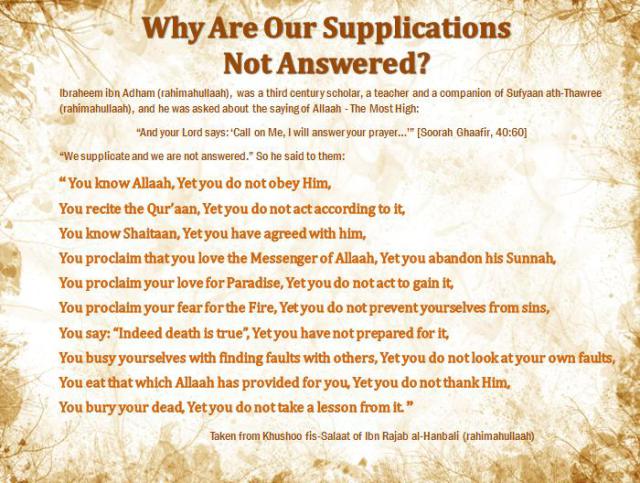
Why Are Our Supplicatiosn Not Answered? – Imam Ibn Rajab

Ibrahim ibn Adham – may Allah have mercy on him – a third century scholar, a teacher and a companion of Sufyan ath-Thawri, was asked about the saying of Allah – the Most High:

and your Lord says: “Call on me I will answer your prayer…” [40:60]

“We supplicate and we are not answered.”

So he said to them:

You know Allah, Yet you do not obey Him,

You recite the Qur’an, Yet do not act according to it,

You know Shaitan, Yet you have agreed with him,

You proclaim that you love Muhammad (Sallallaahu ‘alayhi  wa sallam) Yet you abandon his Sunnah,

You proclaim your love for Paradise, Yet you do not act to gain it,

You proclaim your fear the Fire, Yet you do not prevent yourselves from sins,

You say “Indeed death is true”, Yet you have not prepared for it,

You point out the faults with others, Yet you do not look at your faults,

You eat of that which Allah has provided for you, Yet you do not thank Him,

You bury your dead, Yet you do not take a lesson from it.”

by  Ibn Rajab al Hanbali from Khushu’ fis-salah 

 Why our Du'as are not answered

Qur’anic verses that repel witchcraft – Fatwas of Nur `Ala Al-Darb

What are the Qur’anic verses that repel witchcraft?

A: Some scholars mentioned that one of the ways of protection from what may touch a person of witchcraft and Jinn possession or what may turn him away from his wife is to read Ayat-ul-Kursy and blowing it into water, and Surahs (Qur’anic chapters) Al-Fatihah (Opening Chapter of the Qur’an), Al-Kafirun, Al-Ikhlas and Al-Mu`awwidhatayn.

If someone recites these Surahs and the noble verse of Ayat-ul-Kursy, and the verses relating to witchcraft in Surah Al-A`raf and the two Surahs of Yunus and Taha; this is one of the causes of recovery.

If a man drinks the water (over which these Surahs and verses are recited) and washes up with it, it will protect him witchcraft and free him from anything that makes him dislike and keep away from his wife.

The verses of Surah Al-A`raf (7: 117-119)  are:

And We revealed to Mûsâ (Moses) (saying): “Throw your stick,” and behold! It swallowed up straight away all the falsehoods which they showed. Thus truth was confirmed, and all that they did was made of no effect. So they were defeated there and returned disgraced.

These verses from Surah Al-A`raf are one ofthe causes of healing, by reciting them over water or blowing them into the sick person together with Surahs Al-Fatihah, Al-Kafirun, Al-Ikhlas, Mu`awwidhatayn as well as Ayat-ul-Kursy. One can either breath them over the patient or recite them over water and then have them drink it and wash up with the rest.

In Surah Yunus (verses 79-82), Allah (Glorified and Exalted be He) states:

And Fir‘aun (Pharaoh) said: “Bring me every well-versed sorcerer.” And when the sorcerers came, Mûsâ (Moses) said to them: “Cast down what you want to cast!” Then when they had cast down, Mûsâ (Moses) said: “What you have brought is sorcery; Allâh will surely make it of no effect. Verily, Allâh does not set right the work of Al-Mufsidûn (the evil-doers, corrupters). “And Allâh will establish and make apparent the truth by His Words, however much the Mujrimûn (criminals, disbelievers, polytheists, sinners) may hate it.”

This means that one may either recite them over patients or recite them over water and so on.

The verses of Surah Taha are verses 65-69:

They said: “O Mûsâ (Moses)! Either you throw first or we be the first to throw?” [Mûsâ (Moses)] said: “Nay, throw you (first)!” Then behold! their ropes and their sticks, by their magic, appeared to him as though they moved fast. So Mûsâ (Moses) conceived fear in himself. We (Allâh) said: “Fear not! Surely, you will have the upper hand. “And throw that which is in your right hand! It will swallow up that which they have made. That which they have made is only a magician’s trick, and the magician will never be successful, to whatever amount (of skill) he may attain.”

Source : alifta.com
Fatwas of Nur `Ala Al-Darb>Volume 3>A chapter on issues related to witchcraft>Legal Wirds and supplications for seeking refuge in Allah are causes of protection from witchcraft

Q: A questioner asks: Nowadays people talk a lot about witchcraft, may Allah protect you and us from it! What is the right protection of Qur’an and Sunnah (acts, sayings or approvals of the Prophet) from it? May Allah reward you with the best.

A: Witchcraft is practiced and it is well-known. There is no doubt that some people may bring it about. A witchcraft practitioner is a Mushrik (one who associates others with Allah in His Divinity or worship) that must be referred to authorities for possible capital punishment if he is found guilty. We ask Allah for protection and well-being.

`Umar (may Allah be pleased with him) ordered his governors to execute practitioners of witchcraft. The Prophet (peace be upon him) stated:

“The prescribed penalty for a witchcraft practitioner is to be struck with the sword.”

[Related by Al-Tirmidhy, Book on ordained punishments, Chapter on the ordained punishment for a magician, no. 1460]

This is because he is a disbeliever calling to Kufr.

As for protection, it is to “seek refuge in the perfect words of Allah from the evil of what He created” three times in the morning and three times in the evening, and saying: “In the name of Allah with whose Name nothing is harmful on Earth nor in the Heavens and He is the All-Hearing, the All-Knowing” three times in the morning and three times in the evening. These supplications are reported in Hadiths. Whoever does so will be protected by Allah from the evil of all things.

Reciting Surahs Al-Ikhlas and Al-Mu`awwidhatayn three times in the morning and three times in the evening are a cause of protection from witchcraft and any other harm.

Ayat-ul-Kursy can also be recited three times upon going to bed, and this is a cause of protection from witchcraft and Satan. It can also be recited following each Salah (Prayer). All these bring protection and safety. We ask Allah for protection and well-being.

Source Link : http://alifta.com/

Related Link: https://abdurrahman.org/jinn-shayateen-devils

Get close to Sutrah so that Shaytaan cannot break prayer – Shaykh Muhammad Naasiruddeen al-Albaanee

“He (sal-Allaahu ‘alayhe wa sallam) used to stand near to the sutrah, so that there was (a distance of) three cubits between him and the wall” [37] and “between the place of his prostration and the wall, (there was) enough space for a sheep to pass.” [38]

He used to say:

«Do not pray except towards a sutrah, and do not let anyone pass in front of you, but if someone continues (to try to pass) then fight him, for he has a companion (i.e. a shaytaan) with him.»[39]

He would also say:

«When one of you prays towards a sutrah, he should get close to it so that Shaytaan cannot break his prayer.»[40]

Sometimes “he would seek to pray at the pillar which was in his mosque.” [41]

When he prayed [in an open space where there was nothing to use as sutrah he would plant a spear in the ground in front of him and pray towards it with the people behind him” [42];

Sometimes “he would to set his mount sideways and pray towards it” [43] but this is not the same as prayer in the resting-place of camels [44], which “he forbade” [45], and sometimes “he would take his saddle; set it lengthways and pray towards its end.” [46]

He would say:

«When one of you places in front of him something such as the stick on the end of a saddle, he should pray and not mind anyone who passes beyond it.»[47]

Once “he prayed towards a tree” [48] and sometimes “he would pray towards the bed on which ‘Aa.ishah (radhi-yAllaahu ‘anhaa) was lying [under her sheet].” [49]

He (sal-Allaahu ‘alayhe wa sallam), would not let anything pass between him and his sutrah, hence once “he was praying, when a sheep came running in front of him, so he raced it until he pressed his belly against the wall [and it passed behind him].” [50]

Also, once “while praying an obligatory prayer, he clenched his fist (during it), so when he had finished, the people said: ‘O Messenger of Allaah, did something happen during the prayer?’ He said:

«No, except that the devil wanted to pass in front of me, so I strangled him until I could feel the coldness of his tongue on my hand By Allaah! Had my brother Sulaymaan not beaten me to it[51], I would have tied him (the devil) to one of the pillars of the mosque so that the children of Madeenah could walk round him. [So whoever can prevent something intervening between him and the qiblah, he must do so].»[52]

He also used to say:

«When one of you prays towards something which is a sutrah between him and the people and someone intends to cross in front of him, then he should push him in the throat [and repel, as much as he can], (in one narration: he should stop him, twice) but if he refuses (to not pass) then he should fight him, for verily he is a devil.»[53]

He also used to say:

«If the person who passed in front of someone praying knew (the sin) on him, it would be better for him to wait forty than to pass in front. (Abu an-Nadr said: “I do not remember exactly whether he said forty days, months or years.”).»[54]

What Breaks The Prayer

He used to say:

«A man’s prayer is cut off when there is nothing such as the end of a saddle in front of him, by: a [menstruating][55] woman, a donkey or a black dog.» Abu Dharr said: ‘I said: “O Messenger of Allaah, why the black dog rather than the red one?” He said:

«The black dog is a shaytaan.»[56]

Footnotes :

[36] lit., “screen, cover”; in the context of prayer, it refers to an object just beyond the place of prostration, within which nothing should pass, as is detailed in this section.

[37] al-Bukhaaree and Ahmad.

[38] al-Bukhaaree and Muslim.

[39] Ibn Khuzaymah in his Saheeh (1/93/1) with a sound isnaad.

[40] Abu Daawood, Bazzaar (p. 54 – az-Zawaa.id) and al-Haakim, who declared it saheeh and adh-Dhahabee and an-Nawawee agreed.

[41] al-Bukhaaree. The sutrah is a must for the Imaam or a person praying alone, even in a large mosque. Ibn Haanee said in his Masaa.il from Imaam Ahmad (1/66): “Abu `Abdullaah (i.e. Imaam Ahmad ibn Hanbal) saw me one day when I was praying without a sutrah in front of me, and I was in a (large) congregational mosque, so he said to me: `Take something as a sutrah’, so I took a man as a sutrah.” This contains an indication that Imaam Ahmad did not differentiate between big or small mosques in taking a sutrah – and that is surely correct, but this is something neglected by most people, including imaams of mosques, in every land that I have visited, including Arabia which I was able to tour in Rajab of this year (1410), so the `ulamaa should tell the people and advise them of this, explaining its ruling and that it is also required in the Two Sacred Mosques.

[42] al-Bukhaaree, Muslim and Ibn Maajah

[43] al-Bukhaaree and Ahmad.

[44] i.e., their kneeling place.

[45] al-Bukhaaree and Ahmad.

[46] Muslim, Ibn Khuzaymah (92/2) and Ahmad.

[47] Muslim and Abu Daawood.

[48] an-Nasaa.ee and Ahmad with a saheeh isnaad.

[49] al-Bukhaaree, Muslim and Abu Ya`laa (3/1107).

[50] Ibn Khuzaymah in his Saheeh (1/95/1), at-Tabaraanee (3/140/3) and al-Haakim who declared it saheeh and adh-Dhahabee agreed.

[51] Referring to the following prayer of the Prophet Sulaymaan (‘alayhis-salaam) which was answered by Allaah, as described in the Qur.aan:

{My Lord! Forgive me, and grant me sovereignty not allowed to anyone after me, for You are indeed the Granter of Bounties. So we subjected to his power: the Wind, gently flowing to his order, wherever he wished; and the devils, every kind of builder and diver, and also others bound together in fetters.} (Soorah as-Saad 38: 35-38)

[52] Ahmad, ad-Daaraqutnee and Tabaree with a saheeh isnaad, and similar in meaning to this hadeeth is found in al-Bukhaaree and Muslim and others on the authority of several Companions. It is one of the many ahaadeeth which the Qadiani group disbelieve, for they do not believe in the world of the jinn which is mentioned in the Qur.aan and the Sunnah. Their method of discarding the texts is well-known: if it is from the Qur.aan, they change its meaning e.g. the saying of the Exalted:

{Say, it has been revealed to me that a group of jinns listened} (72:1); they say “i.e. a group of humans”! making the word “jinn” synonymous with “human”! Hence they play with the language and the religion; if it is from the Sunnah, then if it is possible for them to change it with a false interpretation they do so, otherwise they find it easy to declare it to be false, even if all the Imaams of Hadeeth and the whole ummah behind them are agreed on its authenticity, nay its being mutawaatir. May Allaah guide them.

[53] al-Bukhaaree and Muslim, and the additional narration is from Ibn Khuzaymah (1/94/1).

[54] ibid.

[55] i.e. mature, and what is meant by `cut off’ is `rendered futile’. As regards the hadeeth: “Nothing cuts off the prayer”, then it is a weak hadeeth as I have shown in Tamaam al-Minnah (p. 306).

[56] Muslim, Abu Daawood and Ibn Khuzaymah (1/95/2).

Source:  Excerpted from the Book “The Prophet’s Prayer Described – from the beginning to the end as though you see it”, by Shaykh al-Albaanee

Moving the tongue while seeking refuge in Allaah and for other supplications – Shaykh Muhammad Bazmool

Many people say:

‘I say my morning and evening supplications regularly and we seek refuge in Allaah yet we still experience afflictions.’

So we say if you recite the morning and evening supplications then it is necessary to move the tongue while reciting them, there is no benefit if you pass your eyes along the lines of the page and to say that this is a silent reading. This is not considered reading or speech in the Arabic tongue. Reading in the Arabic language necessitates movement of the tongue, as is known from the hadeeth which is narrated from the Companions -may Allaah be pleased with them- that they knew when the Messenger -sallAllaahu alayhi wa sallam- was reciting silently due to the movement of his beard. This illustrates that the Messenger -sallAllaahu alayhi wa sallam- whilst reciting silently would move his lips and tongue.

This moving of the tongue is if the person has the capability to move his tongue and that there is nothing to hinder the movement of the tongue.’

The correct way to recite in your prayers (Salah) and in morning and evening supplications – By Muhammad bin Umar Bazmool, Translated & Foreword by Umm Yahya

[Taken from: ‘Sharh Sifat Sallat an-Nabi –sallAllaahu alayhi wa sallam-‘ by Muhammad Bazmool, p.221]

Know Your Enemy – Shaytaan Spends the Night in Your Nose – Hadith

34. Narrated Abu  Huraira (radhi Allaahu anhu) : Allah’s Messenger (Sallallaahu alaihi wa sallam) said,

“When one of you wakes up from his sleep, he must clean his nose (with water, by sniffling it in and then blowing it out) three times, for Satan spends the night inside one’s nostrils.” [1] [Agreed upon].

[1] Satan’s spending the night inside the nostrils of a man is plausible. However, its actual state is better known to Allah. It may be that this is a figurative expression, because bad excretions gather in the nose and cause laziness, indolence, slackness and negligence. And all these states are satanic dispositions. Blowing water out of the nose upon awakening from sleep might be performed as an individual act, or along with ablution. It is  considered obligatory by Ahmad, while the majority of scholars consider it Sunnah.

Bulugh al-Maram – Collection of hadith by al-Hafidh ibn Hajar al-Asqalani. With brief notes from the book Subul-us-Salam written by: Muhammad bin Ismail Al-Sanani. 

English Publication- Book 1, Hadith 34. Darus-salam Publishers.

An Amazing story from al-Hassan al-Basri (rahimahullah)

Shytan has power over the believers due to their sins

A hadith states, “Allah is with the judge as long as he does not commit any injustice. If he commits any injustice, Allah is free from him and keeps Shytan with him.” [1]

Abu al-Faraj ibn al-Jauzi [2] has related a unique story from al-Hassan al-Basri (rahimahullah). The story, depending on how authentic it is, shows the ability of a human in overpowering Shytan if he is sincere to Allah in his religion and it shows how Shytan can take advantage of the human when he strays.

Al-Hasan al-Basri narrated that there was a tree that was worshipped instead of Allah. One man decided to chop down that tree. He was going to chop down the tree out of anger for the sake of Allah. On the way to the tree he met Iblees who was in the form of a man. Iblees asked him, “What do you plan on doing?” The man answered, “I am going to chop down that tree that is worshipped instead of Allah.” Shytan said, “If you do not worship it, why should it harm you if others do so?” The man replied, “I will chop it down.” Shytan then told him, “Would you like something better than that” Do not cut it and you will get two dinars every morning under your pillow.” “From where will I get that?” the man asked. “I will give it to you,” said Iblees. The man returned and the next morning he found two dinars under his pillow. The following morning he again found two dinars under his pillow. On the following morning he did not find anything. He got upset and went to chop down the tree. Shytan again appeared to him in the shape of the same man. Shytan asked him, “What do you want to do?” The man answered, “I plan on cutting down that tree that is worshipped instead of Allah!” Iblees said, “You have lied. There is no way you will be able to do it,” The man left to chop it down. The earth swallowed him and him until it almost killed him. Iblees asked, “Do you know who I . I am Shytan. I met you for the first time when you were angry for the sake of Allah and I had no power over you. I deceived you by two dinars and you stopped what you had intended to do [for the sake of Allah]. Now you have come because you are angry about the two dinars, and I have gotten mastery over you.”

[1] This was recorded by al-Haakim and al-Baihaqi with a hasan chain. See al- Albanee Sahih al-Jaami, vol. 2, p.130

[2] Ibn al-Jawzi, Talbees Iblees, p. 43 [The author, al-Ashqar alluded to the fact that the authenticity of this story needs to be ascertained. Most likely, it is from the Israaeeliyaat or stories of the Jews and Christians.]

Source : The world of Jinn and Devils – Umar S. Ashqar

A Humiliation for the Shaytan – Sajda Sahu (Prostration of forgetfulness)

“If one of you doubts in his prayer and does not know how many he has prayed- whether it is three or four – then let him cast away the doubt and build upon what he is certain of. Then let him perform two prostrations before giving the salutation. So if he has prayed five, then they will make his prayer even for him, and if he has prayed the full four, then they will be a humiliation for Satan.”

Reported by Muslim (Eng. Trans. vol. 1, no. 1166)

SourceProstration of Forgetfulness in Prayer – by Shaykh Uthaymeen. Translated by Dawood  Burbank rahimahullaah

Shaytan sits in wait for the Son of Adam in all his paths – Tafseer Ibn Kathir

Noble Qur’aan 07.al-Araaf verses 16-17

16. (Iblis) said: “Because You have `Aghwaytni’, surely, I will sit in wait against them (human beings) on Your straight path.

17. “Then I will come to them from before them and behind them, from their right and from their left, and You will not find most of them to be thankful.”

Allah said that after He gave respite to Shaytan, (till the Day they are raised up (resurrected)) and Iblis was sure that he got what he wanted, he went on in defiance and rebellion.

He said, (“Because You have `Aghwaytani’, surely, I will sit in wait against them (human beings) on Your straight path.”) meaning, as You have sent me astray. Ibn `Abbas said that `Aghwaytani’ means, “Misguided me.” Others said, “As You caused my ruin, I will sit in wait for Your servants whom You will create from the offspring of the one you expelled me for.”

He went on, (Your straight path), the path of truth and the way of safety. I (Iblis) will misguide them from this path so that they do not worship You Alone, because You sent me astray. Mujahid said that the `straight path’, refers to the truth.

Imam Ahmad recorded that Saburah bin Abi Al-Fakih said that he heard the Messenger of Allah saying,

(Shaytan sat in wait for the Son of Adam in all his paths. He sat in the path of Islam, saying, `Would you embrace Islam and abandon your religion and the religion of your forefathers’ However, the Son of Adam disobeyed Shaytan and embraced Islam.

So Shaytan sat in the path of Hijrah (migration in the cause of Allah), saying, `Would you migrate and leave your land and sky’ But the parable of the Muhajir is that of a horse in his stamina So, he disobeyed Shaytan and migrated.

So Shaytan sat in the path of Jihad, against one’s self and with his wealth, saying, `If you fight, you will be killed, your wife will be married and your wealth divided.’ So he disobeyed him and performed Jihad.

Therefore, whoever among them (Children of Adam) does this and dies, it will be a promise from Allah that He admits him into Paradise. If he is killed, it will be a promise from Allah that He admits him into Paradise. If he drowns, it will be a promise from Allah that He admits him into Paradise. If the animal breaks his neck, it will be a promise from Allah that He admits him into Paradise.)

Ali bin Abi Talhah reported that Ibn `Abbas commented on:

(Then I will come to them from before them) Raising doubts in them concerning their Hereafter,

(and (from) behind them), making them more eager for this life,

(from their right), causing them confusion in the religion,

(and from their left) luring them to commit sins.”

This is meant to cover all paths of good and evil. Shaytan discourages the people from the path of good and lures them to the path of evil.

Al-Hakam bin Abban said that `Ikrimah narrated from Ibn `Abbas concerning the Ayah,

(Then I will come to them from before them and behind them, from their right and from their left,) “He did not say that he will come from above them, because the mercy descends from above.”

`Ali bin Abi Talhah reported that Ibn `Abbas said,

(and You will not find most of them to be thankful.) “means, those who single Him out in worship?.” When Shaytan said this, it was a guess and an assumption on his part. Yet, the truth turned out to be the same, for Allah said,

(And indeed Iblis (Shaytan) did prove true his thought about them, and they followed him, all except a group of true believers. And he had no authority over them, except that We might test him who believes in the Hereafter, from him who is in doubt about it. And your Lord is Watchful over everything.) (34:20-21).

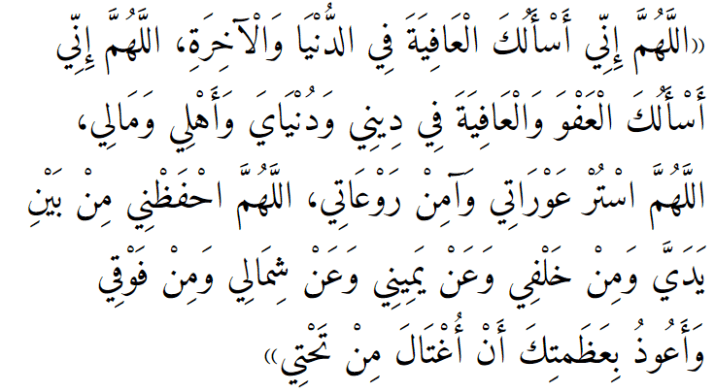
This is why there is a Hadith that encourages seeking refuge with Allah from the lures of Shaytan from all directions. Imam Ahmad narrated that `Abdullah bin `Umar said,

“The Messenger of Allah used to often recite this supplication in the morning and when the night falls,

«اللَّهُمَّ إِنِّي أَسْأَلُكَ الْعَافِيَةَ فِي الدُّنْيَا وَالْآخِرَةِ، اللَّهُمَّ إِنِّي أَسْأَلُكَ الْعَفْوَ وَالْعَافِيَةَ فِي دِينِي وَدُنْيَايَ وَأَهْلِي وَمَالِي، اللَّهُمَّ اسْتُرْ عَوْرَاتِي وَآمِنْ رَوْعَاتِي، اللَّهُمَّ احْفَظْنِي مِنْ بَيْنِ يَدَيَّ وَمِنْ خَلْفِي وَعَنْ يَمِينِي وَعَنْ شِمَالِي وَمِنْ فَوْقِي وَأَعُوذُ بِعَظَمتِكَ أَنْ أُغْتَالَ مِنْ تَحْتِي»

(O Allah! I ask You for well-being in this life and the Hereafter. O Allah! I ask You for pardon and well-being in my religion, life, family and wealth. O Allah! Cover my errors and reassure me in times of difficulty. O Allah! Protect me from before me, from behind me, from my right, from my left and from above me. I seek refuge with Your greatness from being killed from below me.)”

Waki` commented (about being killed from below), “This refers to earthquakes.” Abu Dawud, An-Nasa’i, Ibn Majah, Ibn Hibban and Al-Hakim collected this Hadith, and Al-Hakim said, “Its chain is Sahih. ”

Source : Tafseer Ibn Kathir 007:al-Araaf – Iblis was the First to use Qiyas (Analogical Comparison) – Dar-us-Salam English Publication


Dhikr and Sleep – Hadith

‘Abdullah b. Mas’ûd – Allâh be pleased with him – said:

Falling asleep when remembering Allâh is from Shaytân; if you want you can test this: when you lie down and want to fall asleep, try remembering Allâh ‘azza wa jall.

Al-Bukhârî, Al-Adab Al-Mufrad. Graded sahîh by Shaykh Al-Albânî in Sahîh Al-Adab Al-Mufrad Vol. 1 p490.

Source: https://www.sayingsofthesalaf.net/dhikr-and-sleep/

Ignorant Piety – Imâm Muhammad b. Sîrîn (rahimahullaah)

Bismillah Walhamdulillah Wassalatu Wassalamu ala Rasulillah,

Assalamu Alaikum Wa Rahmatullahi Wa Barakatu,

It is reported that Imâm Muhammad b. Sîrîn – Allâh have mercy on him – said:

There were people who abandoned knowledge and sitting with the scholars, and [instead] took to their chambers and prayed until their skin dried [from exertion in worship]. Thereafter they began to contradict the Sunnah and thus were destroyed. By Allâh, never does a person act without knowledge, except that he spoils and corrupts more than he fixes and rectifies.

Al-Asbahânî, Al-Targhîb wa Al-Tarhîb 3:98

Source: http://www.sayingsofthesalaf.net

Islam is not a religion of equality but of Justice – Shaykh Uthaymeen

There are some people who speak of equality instead of justice, and this is a mistake. We should not say equality, because equality implies no differentiation between the two. Because of this unjust call for equality, they ask, “What is the difference between male and female?” So they have made men similar to women. The communists said, “What difference is there between the ruler and the subject? No one has any authority over anyone else.” Not even the father over his son?! So they said the father has no authority over his son and so on.Instead, if we say justice, which means giving each one what he or she is entitled, this misunderstanding no longer applies, and the word used is correct. Allah does not say in the Qur’an that He enjoins equality. He said (interpretation of the meaning):

 “Verily, Allah enjoins Al‘Adl (i.e. justice)” (Qur’an, 16:90)

“And that when you judge between men, you judge with justice.” (Qur’an, 4:58)

 Those who say that Islam is the religion of equality are lying against Islam.Rather Islam is the religion of justice, which means treating equally those who are equal and differentiating between those who are different. No one who knows the religion of Islam would say that it is the religion of equality. Rather what shows you that this principle is false is the fact that most of what is mentioned in the Qur’an denies equality, as in the following verses: “Say: Are those who know equal to those who know not?” (Qur’an, 39:9)

 “Say: Is the blind equal to the one who sees? Or darkness equal to light?” (Qur’an, 13:16)

 “Not equal among you are those who spent and fought before the conquering (of Makkah, with those among you who did so later.” (Qur’an, 57:10)

“Not equal are those of the believers who sit (at home), except those who are disabled (by injury or are blind or lame), and those who strive hard and fight in the Cause of Allah with their wealth and their lives.” (Qur’an, 4:95)

Not one single letter in the Qur’an enjoins equality, rather it enjoins justice. You will also find that the word justice is acceptable to people, for I feel that if I am better than this man in terms of knowledge, or wealth, or piety, or in doing good, I would not like for him to be equal to me.Everyone knows that it is unacceptable if we say that the male is equal to the female.

Sheikh Ibn Uthaymeen,  Sharh Al-Aqeedah Al-Wasitah, 1/180-181