“The one who prayed badly” (radhi-Allaahu anhu) – Shaykh Al-Albanee

In Hadeeth and Fiqh literature, this term refers to the Companion mentioned in the following hadeeth of Saheeh al-Bukhaaree (Book of Prayer, English translation by Dr. Muhammad Muhsin Khan); many other narrations of this incident are found in the various collections of hadeeth, and provide an important source of instructions from the Prophet (sal-Allaahu ‘alayhe wa sallam) regarding the correct way to pray:

Narrated Abu Hurayrah (radhi-yAllaahu `anhu):

The Messenger of Allaah (sal-Allaahu ‘alayhe wa sallam) entered the mosque and a person followed him. The man prayed and then went to the Prophet (sal-Allaahu ‘alayhe wa sallam) and greeted him; he returned the greeting and said (to him):

«Go back and pray, for you have not prayed.» The man went back and prayed in the same way as before, and then returned and greeted the Prophet (sal-Allaahu ‘alayhe wa sallam), who said

«Go back and pray, for you have not prayed», three times. The man said: “By Him Who sent you with the Truth, I cannot do so any better than this, so please teach me.” He said:

«When you stand for the Prayer, say takbeer and then recite what is easy for you from the Qur.aan (from what you know by heart); then bow until you feel at ease in rukoo`; then raise your head and stand up straight, then prostrate until you feel at ease in sajdah; then sit with calmness until you feel at ease, and do likewise in all your prayers.»

[further narrations of this hadeeth found in the other works of Hadeeth such as Sunan Abee Daawood, etc. contain further details.]

Source:   From “The Prohet’s Prayer Described”  appendix 3 – by Shaykh Al-Albanee

Virtues of the Prayer : Imaam Muhammad Ibn Saalih Al-‘Uthaimeen

Bismillaah

Source: Sifat Salaat-in-Nabee, by Shaykh Uthaymeen
Translator: Isma’eel alarcon, Produced by: al-ibaanah

The Prayer: is the second pillar from the pillars of Islaam and the most important pillar of Islaam after the Shahaadah (testimony) of Faith.

The Prayer: is a link between the servant and his Lord. The Prophet (Sallallaahu ‘alaihi wa Sallam) said: “Indeed, when one of you prays, he speaks privately with his Lord.” [Reported by Al-Bukhaaree] And Allaah says in the qudsee hadeeth:

“I have divided the prayer between Myself and My servant into two parts, and My servant will have what he asks for.

So when the servant says: ‘Al-Hamdulillaahi Rabb-il-‘Alameen’, Allaah says: ‘My servant has praised Me.’And when he says: ‘Ar-Rahmaan-ir-Raheem’, Allaah says: ‘My servant has extolled Me.’ And when he says: ‘Maaliki-yawm-id-Deen’, Allaah says: ‘My servant has honored Me.’ And when he says: ‘Iyyaaka Na’bdu wa Iyyaaka Nasta’een’, Allaah says: ‘This is between Me and My servant and My servant will have what he asks for.’ And when he says: ‘Ihdinaas-Siraat-al-Mustaqeem. Siraat-aladheena an’amta ‘alaihim. Ghairil-Maghdoobi ‘alaihim wa lad-Daalleen’, Allaah says: ‘This is for My servant and for My servant will be what he asks for.’” [Reported by Muslim]

The Prayer: is a garden of ‘ibaadaat (acts of worship), in which every splendid type of worship is found. There is the takbeer, by which the prayer is initiated, the standing in which the person praying recites the words of Allaah, the bowing in which he extols his Lord, the rising from the bowing position, which is filled with the praising of Allaah, the prostration in which he glorifies Allaah by His highness and in which he implores him through supplication, the sitting in which there is the tashahhud and (more) supplication and the closing with tasleem.

The Prayer: is a means of support and assistance in times of distress and grief. And it prevents one from evil and shameful deeds. Allaah says: “Seek assistance in patience and prayer.” And He says: “Recite what has been revealed to you from the Book and establish the prayer. Verily, the prayer prevents one from evil and shameful deeds.

The Prayer: is the light of the believers in their hearts and in their place of gathering (on the Day of Judgement). The Prophet (Sallallaahu ‘alaihi wa Sallam) said: “The prayer is light.” And he (Sallallaahu ‘alaihi wa Sallam) said: “Whoever guards it (his prayers), it will be a light, a proof and a (means of) salvation for him on the Day of Judgement.” [Reported by Ahmad, Ibn Hibbaan and At-Tabaraanee]

The Prayer: is the joy and delight of the believers’ souls. The Prophet (Sallallaahu ‘alaihi wa Sallam) said: My delight was placed in the prayer.” [Reported by Ahmad and An-Nasaa’ee]

The Prayer: wipes away sins and expiates evil deeds.

The Prophet (Sallallaahu ‘alaihi wa Sallam) said: “Do you think that if there was a river by the door of one of you and he bathed in it five times a day that there would remain any dirt on him?” They (the Companions) answered: “There would not remain any dirt on him.” The Prophet (Sallallaahu ‘alaihi wa Sallam) said: “That is how it is with the five (daily) prayers, through them Allaah washes away the (minor) sins.” [Reported by Al-Bukhaaree and Muslim]

And the Prophet (Sallallaahu ‘alaihi wa Sallam) said: “The five (daily) prayers and Jumu’ah (prayer) to Jumu’ah (prayer) are an expiation for what (sins) occur between them so long as one is not guilty of major sins.” [Reported by Muslim]

The Prayer in Congregation:

Ibn ‘Umar (radiAllaahu anhu) reported that the Prophet (Sallallaahu ‘alaihi wa Sallam) said: “Prayer in congregation is better than praying alone by twenty-seven degrees.” [Reported by Al-Bukhaaree and Muslim]

Ibn Mas’ood (radiAllaahu anhu) said: “Whoever would be happy to meet Allaah tomorrow as a Muslim, then let him preserve (in establishing) these five prayers from the place where they are called from (i.e. masjids), for verily, Allaah has legislated for your Prophet the ways of guidance. And indeed these (five prayers in the masjid) are from the ways of guidance. And if you were to pray in your homes as this man who refrains (to pray in the masjid) prays in his home, then you would have abandoned the Sunnah of your Prophet. And if you were to abandon the Sunnah of your Prophet (Sallallaahu ‘alaihi wa Sallam) you would go astray. There is not a man that performs the ablution and does it well, then sets out to go to one of these masjids except that Allaah records a good deed for him for every step he takes and raises him up one level and erases one evil deed due to it. You have certainly seen us, and no one would refrain from the prayer (in the masjid) except the hypocrite whose hypocrisy was well known. And indeed a man would be brought supported by two men until he was made to stand in the row (for prayer).” [Reported by Muslim]

Al-Khushoo’ (Submissiveness) in the Prayer, which means that 1) the heart is present and attentive, and 2) preserving that condition – are both from the means of entering Paradise.

Allaah says: “Successful indeed are the believers. Those who in their prayers are submissive. And those who turn away from vain talk. And those who pay their Zakaat. And those who protect their private parts – Except in front of their spouses or those (women) whom their right hands possess, for indeed they are not held to blame (in that). So whoever seeks beyond that, then those are the transgressors. And those who keep their trusts and covenants. And those who preserve their prayers. They are the inheritors – the ones who will inherit Al-Firdaus (highest level in Paradise), in which they will abide forever.”

Being sincere to Allaah in the prayer and performing it according to the manner it is described in the Sunnah are the two fundamental conditions for its acceptance. The Prophet (Sallallaahu ‘alaihi wa Sallam) said: “Verily, actions are by intentions and every person will have what he intended.” [Reported by Al-Bukhaaree and Muslim] And he (Sallallaahu ‘alaihi wa Sallam) said: “Pray as you have seen me pray.” [Reported by Al-Bukhaaree]

Written by Muhammad Ibn Saalih Al-‘Uthaimeen
On 4-13/1406H

Related Linkhttps://abdurrahman.org/salah

Useful Table Chart for Sujuud as Sahw (Prostrations of Forgetfulness) : Dr. Saleh as Saleh

[Download the MS Word Document]

Based on Shaykh ibn Uthaymeen’s Book .

1. Additions Of the Same Kind As Found In Salaah

Causes of
Sujuud as Sahw
If One Remembers What To Do Do Sujuud
1. a- Additions in actionsexamples:
– extra rakaa
– extra sujuud
– during the addition – stop doing this addition
– continue and finish salaah
– must do sujuud as sahw
after tasleem
– soon after tasleem – must do sujuud as sahw after tasleem
– after long time
– example 30 minutes
– salaah is invalid .
another example
of addition in action:
– tasleem before end of salaah
– during the addition – stop doing this addition
– continue and finish salaah
– must do sujuud as sahw
after tasleem
– soon after this tasleem – go back to sitting position
– stand up to do missing rakaa
– do tashahhud and tasleem
– must do sujuud as sahw
after tasleem
– after long time
– example 30 minutes
– salaah is invalid .
1. b – additions in sayings 
example: “subhaana Rabbiyal ‘adheem” said in sujuud
– soon after tasleem – sunnah to do sujuud as sahw after tasleem
– after long time
– example 30 minutes
– nothing upon him .

2. Omissions in Salaah rukn {pillar} – wajib {obligation} – sunnah

3. Doubt – Ash Shakk :wavering between two matters such that none has distinction over the other

Causes of
Sujuud as Sahw
If One Remembers What To Do Do Sujuud
2. a – omissions of rukn – {pillar}some examples:
– omission of al Fatiha
– omission of rukuu
– omission of standing fully erect after doing rukuu
– before reaching the place of the missing rukn in the next rakat – return and do this missing rukn
– build on this to complete salaah
– must do sujuud as sahw
after tasleem
– after reaching the place of the missing rukn in the next rakat rakaa with missed rukn is cancelled and present rakaa replaces it
– build on this to complete salaah
– must do sujuud as sahw
after tasleem
– after tasleem
and omission is in last rakaa
– return and do this missing rukn
– complete the rakaa
– make tashahud and tasleem
– must do sujuud as sahw
after tasleem
– after tasleem
and omission is not in last rakaa
– do a complete rakaa and tasleem
– must do sujuud as sahw
after tasleem
– after a long time
– example 30 minutes
– salaah is invalid .
2. b – omissions of
wajib – {obligation}
example:
omitting the first tashahhud
– when having determination to move but did not move yet – return to do missing obligation
{in this example it is tashahhud}
– continue and finish salaah
no
– when starting to move but did not finish to stand fully yet – return to do missing obligation
{in this example it is tashahhud}
– continue and finish salaah
– do sujuud as sahw
after tasleem
– after finishing to stand up correctly – return is forbidden
– continue and finish salaah
– do sujuud as sahw
before tasleem
2. c- omissions in sunnah 
saying or action
– before the tasleem – recommended only if this omitted sunnah is a usual habit of this person before tasleem
.
rukn and wajib – pillar and obligation
Commonality -> deliberate omission of either one INVALIDATES salaahDifference -> omitted rukn MUST be made up — omitted wajib is compensated by sujuud as sahw
.
Causes of Sujuud as Sahw If One Remembers What To Do Do Sujuud
3. Doubt – ash shakk 
a – without preponderance

Example: he doubts if he is in 3rd or in 4th rakaa of a 4 rakaat salaah
– during salaah. build up on certainty, i.e. the least,
and in this example it is the 3rd rakaa
– do the 4th rakaa and do tashahud
– do sujuud as sahw
before tasleem
b – with preponderance – {Dhan}
Example: doubt if he is in 3rd or 4th rakaa or a 4 rakaat salaah
– during salaah and
– there is preponderation this is the 3rd rakaa
build up on the preponderation this is the 3rd rakaa
– do the 4th rakaa and do tashahud
– do sujuud as sahw
after tasleem
– during salaah and
– there is preponderation this is the 4th rakaa
build up on the preponderation this is the 4th rakaa
– finish salaah
– do sujuud as sahw
after tasleem
.
Doubt is not to be considered in three situations ->1. when the doubts are frequent and due to whispering {waswas}
2. when it is a thought that came on the mind, delusion {wahm}
3. when the doubt arises AFTER the execution of the worship, unless there is certainty {yaqeen}in principle the salah is complete because it was performed by a sane, fitting, legally responsible person and it is so unless the person is certain it was not complete and in this case he returns to what is certain

4. Different Situations

a. Droping of Sujuud As Sahw – b. Repetition of Forgetfulness
and other cases where there is no sujuud as sahw

Situations Cases What To Do Do Sujuud
a. Droping of sujuud as sahw 1. if he remembers long time after tasleem
– example: 30 minutes
. .
2. if he nullifies his wudhu after salaah . .
3. if he begins doing another salaah
– two situations depending on the length of time between the two salaat
time is long -> – obligation drops no
time is short ->
– he may return to the first salaah
– he does sujuud as sahw
– then he continues the 2nd salaah
– he does sujuud as sahw
either before or after tasleem in the 1st salaah
.
after tasleem in the 2nd salaah
4. if he leaves the mosque a – obligation drops no
b – obligation remains
– Imaam Ahmad (1)
– Shaykh Ibn Taymiyah (2)
see footnotes
b. repetition of forgetfulness in the same salaah – in the same salaah, there are many mistakes requiring sujuud as sahw – preponderating opinion ->
one instance of sujuud as sahw
either before or
after tasleem
– a mistake requiring sujuud as sahw before tasleem and
– also a mistake requiring sujuud as sahw after tasleem
– first opinion ->
one instance of sujuud as sahw
before tasleem (3)
– a strong opinion ->
two instances of sujuud as sahw
before and also
after tasleem
.
Sujuud as sahw is NOT applicable in the following situations -> 
– funeral prayer, janazah
– sujuud of thankfulness
– sujuud of recitation
– compensation for sujuud as sahw
.

5. Ma-muum {follower} – Masbuuq {one joining late} – Imaam

and other situations

Situations What To Do Do Sujuud
1. a – the ma-muum
he begins salaah with imaam
and imaam makes a mistake
– he follows the imaam follows imaam
1. b- the ma-muum
he begins salaah with imaam
and he makes a mistake
– imaam bears this for him
2. a- the masbuuq
he joins imaam late in salaah
and he makes a mistake
if his own mistake is AFTER he departed from imaam
– he completes his salaah
– he does sujuud as sahw
either after or before his own tasleem
2. b – the masbuuq he joins imaam late in salaah
and imaam does sujuud as sahw
before tasleem
– he follows imaam in sujuud as sahw
– then he completes his salaah
follows imaam
if he did not stand up fully before imaam makes sujuud as sahw
– he must return and do sujuud as sahw with the imaam
– them he completes his salaah
follows imaam
if he is standing up fully before imaam makes sujuud as sahw
– he completes his salaah and he does sujuud as sahw
after his own tasleem
2. c – the masbuuqhe joins imaam late in salaah
and imaam does sujuud as sahw
after tasleem
if he did NOT meet the imaam in his mistake
– he completes his salaah
if he MET the imaam in his mistake
– he completes his salaah and he does sujuud as sahw
after his own tasleem
if he does not know if he met or not the imaam in his mistake
– he completes his salaah
sujuud as sahw
is not binding
2. d – the masbuuq 
he joins imaam late in salaah
and imaam makes a mistake
example: imaam forgot a rakaa and he is alerted and returns
– he joins the imaam and prays with him
– he completes his own salaah after the imaam finishes his salaah
2. e – the masbuuqhe forgot he joined late and he makes tasleem with imaam if he remembers
– he completes his salaah and he does sujuud as sahw
after his own tasleem
he does not return to complete his salaah
– his salaah is invalid
.
3. a – the imaam
he makes a mistake in the sunnah of the salaah and he is alerted
example: imaam recite al Fatiha loud in a silent salaah
– sujuud as sahw is not obligation
– it is ok even if it is done before tasleem
after tasleem
is preferable
3. b – the imaam
he makes an extra rakaa and he is alerted
if he returns, his salaah is valid after tasleem
if he does not return
– his salaah is invalid
.
3. c – the imaamhe forgets the first tashahud
and is alerted when standing fully erect
it is forbidden for him to return
– he completes his salaah and he does sujuud as sahw
before tasleem
if he returns and he does not know it is forbidden
– he had now made an addition in standing
– he makes sujuud as sahw
after tasleem
if he returns after standing fully erect and he knows it is forbidden
– his salaah is invalid
.
4. a person enters witr with intention of doing 2 + 1 rakaat if he forgets to say tasleem after two rakaat
– witr can be prayed in three rakaat and there is nothing upon him
no
5. a person makes mistake in recitation – it does not change the format of salaah, there is nothing upon him no


1. one narration by Imaam Ahmad saying he does the sujuud as sahw whether the separation was long or short

2. one opinion by Shaykh Ibn Taymiyah saying the sujuud as sahw continues even after a long separation

3. The sujuud as sahw is preferably before tasleem because it is more part of salaah


Prophet Muhammad’s (Sallalaahu Alaihi Wasallam) Manner Of Performing Prayers : Imam Ibn Baaz

Printed & Published by
Presidency Of Islamic Researches Ifta And Propagation
Printing And Translation Agency Riyadh,
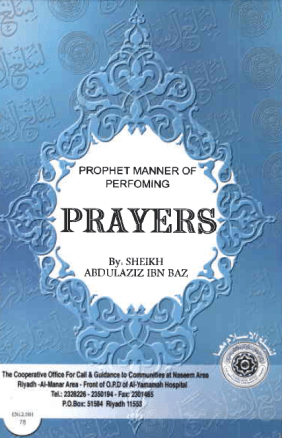
Prophet Muhammad's Manner Of Performing Prayers - Ibn Baaz

All praise be to Allah alone, and may His peace and blessings be upon His messenger and bondsman our Prophet Mohammed, his family and his companions.

The objective of this concise pamphlet is to explain how prophet Mohammed (Peace and blessings of Allah be upon him) used to perform his prayers. I would like to present this explanation to every male and female Muslim so that they may strive to take up the Prophet’s manner in performing their prayers as a model for them.

It was narrated by Al Bukhari that Prophet Mohammed (Peace and blessings of Allah be on him) had said: “Perform your prayers in the same manner you had seen me doing.”

Therefore, here is the explanation for the Prophet’s manner of prayer:

(1) To perform completely the ablution, adopting the method commanded by Allah in the Quran: “O ye who believe, when ye prepare for prayer, wash your faces and your hands (and arms) to the elbows, rub your heads(with water) and (wash) your feet to the ankles.”(5:6)

The Prophet (peace and blessings of Allah be on him) said: “Prayer without ablution is invalid.”

(2) To turn one’s face and whole body towards the Ka’aba, The Holy House at Makkah, intending by heart to perform the prayer which he wants to fulfill, whether it is an obligatory prayer or a supererogatory prayer, the worshipper in all cases, should not pronounce his intention openly, because neither the Prophet nor his companions used to utter the intention for prayer. Thus, pronouncing the intention for prayer in audible voice is a heresy and an illicit action. Whether the individual be an Imam or performs his prayer individually, he should make (A Sutra) i.e. a curtain for his prayer. Directing the face towards the Qibla (The Ka’aba at Makkah) is an imperative condition for every prayer. However, there are few exceptions for this rule explained in authoritative books for whom who wish to refer.

(3) To pronounce “Takbirat Al Ihram” that is to say “Allahu Akbar” celebrating by that the greatness of Allah and looking meanwhile, downwards to the place where he will prostrate.

(4) To raise one’s hands up to the level of the shoulders or near to the lobes of his ears, while pronouncing “Takbirat Al‑ Ihram”.

(5) To put one’s right hand over his left hand and left wrist, and put them both over his chest, as the Prophet (peace and blessings of Allah be upon him) used to do.

(6) It is advisable that the worshipper recite this opening supplication saying: “Allahumma bald bayni wa bayena khatayaya kama boadta bayena al‑mashriki wal maghribi, Allahumma naqqiniy min khatayaya kama yonaqa al thawbo alabyndo min aldans… Allahumma igysilniy min khatayaya bilmai wathalgi walbarad.”

This supplication means: “O Allah, separate me from my sins as You have separated the east and west. O Allah, cleanse me of my sins as the white rope is cleansed from dirt. O Allah, wash off my sins with water, snow and hail.”

Or, may say instead:

“Sobhanaka Allahumma wa bihamdika wa~abaraka Ismoka wata’la jaddoka wala ilaha ghayroka”

“Praise and glory be to Allah. Blessed be Your Name, exalted be Your Majesty and Glory. There is no god but You.”

Or he may say any other supplications which the Prophet, (peace and blessings of Allah be on him) used to say in his prayers. It is better to recite these supplications alternately, the first one in the morning prayer “Fajr”, the second in the noon prayer “Zuhr”, each one by turn, in conformity with what the Prophet used to do.

After reciting the opening supplication, the worshipper says:

“Aouzo billahi min al‑shaytani‑r‑ragim”

Which means:

“I seek protection of Allah against the accursed Satan.”

Then says:

“Bism illahi‑Rahmani Raheem”

Which means:

“In the name of Allah, the All Merciful, the All Compassionate.”

and recites the Fatiha (The opening Sura of the glorious Quran).

Prophet Mohammed, may peace and blessings be upon him, said: “Prayer without reciting the Fatiha is invalid”.

The worshipper should say “A’meen” after reciting the Fatiha loudly if the prayer is said loudly, and whisper it in inaudible prayers. To be in conformity with the traditions of the Prophet, the worshipper‑is advised to recite verses from medium size Suras of the Quran in the Zuhr (noon), Asr (late afternoon), and Isha (night) prayers. As for the Fajr (morning) prayer, the worshipper is advised to recite a passage from the long Suras of the Quran. He has the choice in Maghrib prayer (Evening prayer) either to recite passages from the long Suras or from the short Suras 6 of the Quran.

(7) Then, the worshipper bows in “Ruku” raising his hands up to the level of his shoulders or ears while saying “Allahu Akbar” “Allah is Great” then bends down, making his head and back on one level and putting his hands with the fingers spread on his knees.

The worshipper should feel serenity and tranquillity while bowing, he should say thrice at least:

“Subhana Rabbiayl A’zim”

Which means:

“Glory be to my Lord, the Almighty.”

It is advisable to say while bowing in addition to that:

“Subhanak‑Allahumma Rabbana wa bi hamdika, Allahumma Ighfir liy”

Which means:

“Glory be to Thee, O Allah, and I praise Thee, forgive me my sins.”

(8) To raise one’s head up from bowing, raising one’s hands to the level of his shoulders or ears, saying, in case of being Imam or praying alone:

“Sami’a Allahu liman hamidah”

Which means:

“Allah listens to him who praises Him”

While resuming the standing position, he should say:

“Rabbana wa laka al hamdu hamdan katheera’n tayyiban mobarakan feehiy mil’a ssamawati wa mila alardhi wa mil’a ma baynahoma wa mil’a ma Shita min shiyin ba’ad”

This supplication means:

“Our Lord, praise be fore Thee only, praises plentiful and blessed as to fill the heavens, the earth, what in between, and fill that which will please Thee besides them.”

But if the worshipper is a follower, and led in his prayer by the Imam he should say when rising up “Rabbana wa lake alhamd…” etc.

It is advisable for the Imam, the follower, or who prays alone to add also:

“You Allah who deserve all praises and all glory, your praising is the best and most true of whatever Your servant can say, we all are Your servants, Our Lord, no one can ever deprive aught of what You have bestowed and no one can ever give aught of what You have deprived.”

The worshipper is advised to put his hands on his chest, as he had done before he bowed. Both Wa’il Ibn Haggar and Sahl Ibn Sai’yd reported that this was the manner of the Prophet when he used to raise his head up after bowing.

(9) To prostrate saying “Allahu Akbar” “Allah is Great”. He should touch the ground with his knees before touching it with his hands, if that is possible to him. If not, he is permitted to touch the ground by his hand before his knees. His fingers and toes should be directed towards the Qibla Makkah, and his hands should be stretched, and the fingers close together and not separated. In prostration, the worshipper should use these seven organs: The forehead, the nose, both hands, both knees and the internal parts of the toes.

These seven organs should touch the ground. Then the worshipper should say thrice or more:

“Subhana Rabbiyal A’ala”

Which means:

“Glorified is my Lord, the Exalted.”

It is advisable to say:

“Subhanaka Allahuma Rabbana wa bi hamdika, Allahuma Ighfir‑ liy.”

This means:

“Glory be to Thee, Our Lord, and I praise Thee. Our Lord, forgive me my sins.”

It is recommendable for the worshipper to exceed more and more in supplications and ask for more from his Lord, because the Prophet, may peace and blessings of Allah be on him, said (which means):

“As for bowing “Ruku” you should glorify your Lord during performing it, as for prostration, you should do your best to supplicate and ask for more from Him, because your supplications during prostration are more worthy to be accepted.”

The worshipper should ask his Lord for prosperity both in this worldly life and in the Hereafter. Whether it is an obligatory prayer or an optional prayer, the worshipper, while prostrating, should neither bring his hands close to his sides, nor stick his abdomen to his thighs, or his thighs to his legs. The worshipper’s arms should be raised up from the ground because the Prophet, may peace and blessings of Allah be on him, prohibited putting the arms and stretching them on the ground, ordering that “adjust your prostration, keep straight in it, and stretch not your hands on the ground as dogs do.”

(10) He should raise his head from prostration saying: “Allahu Akbar” and lays his left foot flat on the ground and sits upon it, keeping his right foot erected, his hands on his thighs and knees, and says:

“O my Lord, forgive me, have mercy on me, guide me, provide me with your blessings and console me.”

The worshipper should feel tranquillity during this pause.

(11) To prostrate again saying “Allahu Akbar” and repeating during his prostration what he did and said in the first prostration.

(12) Then the worshipper raises his head saying “Allahu Akbar” taking a pause similar to the pause between the two prostration; this is called “the pause for rest.” It is recommended for the worshipper to do such a pause, but there is no sin if he desists from it. Then the worshipper rises up and stands supporting on his knees, or on the ground if he cannot support himself on the knees, reads the Fatihah (The opening Sura of the glorious Quran) and some other verses of the Quran and do as just as he did in the first Rakaah (unit of prayer). Those who pray behind the Imam should not compete with him in the prayer actions as the Prophet (peace and blessings of Allah be upon him) said (which means):

The Imam is to be followed, if he says: “Allahu Akbar” which means “Allah is Great” then say the same after him. If he bows in “Ruku” bow after him. If he says “Samia‑l‑lahu liman hamidah” which means “Allah hears him who praises Him”, then say: “Rabbana wa laka‑l‑hamd” which means “Our Lord! All praises are for Thee”; and if he prostrates, then prostrate after him”. (Bukhari V:1 P.37)

(13) If the prayer consists of two Rakaat (two units of prayer) as the morning prayer “Fajr”, Feast prayer “Eid”, or the Friday prayer “Jumu’a”, the worshipper sits after the second prostration, with his right foot erect, sitting on his left foot laid down, putting his right hand on his right thigh, all his fingers close‑fisted save the index finger which he uses to point out as a sign for his monotheistic belief, and his left hand is put on his left thigh. There is nothing in the way, if the worshipper keeps both the little and ring fingers closed, while rounding his thumb and middle finger in a ring‑shape, and uses his index finger to point out as a sign for his monotheistic belief. It has been related that the Prophet, may peace and blessings of Allah be on him, had practiced both of these ways, thus, it is advisable for the worshipper to perform the first way once and the other on the second time.

The worshipper reads the Tashahud while sitting and says:

“Al‑tahiyatu lilahi wasalawatu watayibatu Assalamu alayha ayuha‑n‑nabiyu wa rahmat‑u‑llahi wa barakatuhu. Assalamu alayina wa ala ibadi‑l‑lahi‑s‑salalihiyn. Ashadu ala ilaha ila lahu wa ashadu anna Muhammadan abdoho wa raswuloh. Allahuma salliy ala Muhammad wa ala aali Muhamad, kama salayata ala Ibrahima wa aali Ibrahim. Inaka Hamidon Majid. Wa barik ala Mohammad wa ala aali Muhammad kama barkta ala Ibrahima wa aali Ibrahima. Inaka Hamidon Majid.”

This means:

“Greetings, prayers and the good things of life belong to Allah. Peace, mercy and blessing of Allah be on you, O Prophet. May peace be upon us and on the devout slaves of Allah. I testify that there is no god but Allah and I testify that Mohammed is His slave and messenger. O Allah, bless Mohammed and his family as You blessed Ibrahim and his family. You are the Most‑ Praised, The Most‑glorious. O Allah, bestow Your grace on Mohammed and his family as You bestwoed it on lbrahim and his family. You are the Most‑Praised, The Most‑glorious.”

After reciting the Tashahud, the worshipper asks Allah’s protection from four evils, he should say:

“My Lord, I ask your protection from torment of the Hell, torment of the grave the trials in life‑time and after death, and from the impostor Antichrist.” The worshipper may ask Allah for prosperity in this worldly life and in the Hereafter, supplicate Allah to bestow His favors on his parents and other Muslims. He could do this in both obligatory and optional prayers. It has been reported by Ibn Massoud that the Prophet, peace and blessings of Allah be on him, taught him how to recite the Tashahud and told him that the worshipper should invoke Allah and ask Him for the more beloved wishes which he likes, or, as it has been related in other wordings, the worshipper should ask Allah for whatever he wishes. In this manner, the servant can ask Allah for all the prosperity of this worldly life and the life to come.

The worshipper terminates his prayer by turning his face to the right saying: “As‑salamu alai kum wa rahmatu Allah” and to the left saying this salutation which means “Peace and mercy of Allah be on you.”

(14) In case of a three Rakaat prayer (prayer consisting of three units) as that of Maghrib prayer, (evening prayer), or a four Rakaat prayer like that of noon prayer (Zuhr), Asr prayer (late afternoon prayer) or, Isha prayer (night prayer), the worshipper stands up after reciting the Tashahud according to the manner stated before, and raises his hands up to the level of his shoulders saying (Allahu Akbar). The worshipper puts his hands over his chest as it had been explained before, and recites only the Fatiha. There is no objection if he adds to the Fatiha some other verses of the Quran while performing the third or fourth Rakaat (units of prayer) of noon prayer (Zuhr), because this was stated to be one of the manners adopted by the Prophet, may peace and blessings of Allah be on him, according to the tradition reported by Abi Saied.

After the third Rakaah of Maghrib prayer (evening prayer), and the fourth Rakaah of Zuhr (noon), Asr (afternoon) and Isha (night) prayers, the worshipper recites the Tashahud and terminates his prayers by saying: “Assalamu‑alaikum wa rahmatu Allah” while turning first to the right, and second to the left as it has been explained before.

It is not an obligatory duty, but it is a recommendable prophetic tradition to invoke Allah after terminating the prayer by asking Him forgiveness thrice and saying before turning one’s face towards his followers if he is the Imam: “O Allah, Thou art peace and from Thee is peace, Thou art blessed, O possessor of Glory and Honour.”

It is advisable for the worshipper to say:

“There is no god but Allah. He is the One. He has no partner. His is the dominion and to Him alone is the praise. He has power over all things. O Lord, none may withhold what You have given and none may give what You have withheld and the riches cannot avail a wealthy person with Thee. There is no might or power except by the support of Allah, There is no god but Allah and we do not worship but Him alone. To Him alone belong all bounties, to Him alone belong all grace, and to Him worthy praise is accorded. There is no god but Allah, to Whom we are sincere in devotion, even though the unbelievers may detest it.”

It is also advisable to the worshipper to extol Allah 33 times by saying (Subhana Allah). Praise Him by saying (Al Hamdu El‑Allah) 33 times also by saying “Allahu Akbar” and the worshipper completes his supplications to be one hundred by saying once: “There is no god but Allah. He is the One. He has no partner. His is the dominion and to Him alone is the praise. He has power over all things.”

The worshipper adds to that the recitation of the verse of the Throne “Ayat Al‑ Kursiy”, Surat Al‑Ikhlas, Surat El‑Falaq, and Surat Al‑Nas. It is recommendable to recite these Suras thrice after the Fajr prayer (Morning prayer), and the Maghrib prayer (evening prayer) because this was reported to be one of the traditions of the Prophet, peace and blessings of Allah be on him. As it had been stated before, all these after‑prayer supplications are optional and not obligatory.

Every Muslim, whether be male or female, is recommended to pray 12 Rakaat of supererogatory prayers every day: four of these Rakaat (units of prayers) are before noon prayer, two after it, two after Maghrib prayer, two after Isha (night) prayer and two before the morning prayer ‑ These supererogatory prayers are called (Rawatib) which means: “Certain supererogatory exercises of optional prayers.” The Prophet peace and blessings of Allah be on him, preserved the performance of these optional prayers wherever he settled. During his travels, he used to practice the two optional Rakaat before the morning prayer and also the Witr prayer (after the Isha prayer).

There is no objection to perform these optional prayers in the mosque, but it is better to perform it at home, because the Prophet, peace and blessings of Allah be on him, said “The best of the prayers are those which are furfilled at one’s own home, with exception to obligatory prayers which should be performed in congregation at the mosque.”

Observance of fulfilling these optional prayers is a means for gaining admission to paradise. The Prophet, may peace and blessings of Allah be on him, said (which means): “Whoever prays optionally twelve Rakoat every one day and night, Allah will reward him by an established dwelling in the paradise. “

It is also advisable to the Muslim to pray four optional Rakaat before Asr prayer (afternoon prayer), two before Maghrib prayer (evening prayer), and two before Isha prayer (night prayer), because this manner was reported to be one of the traditions of the Prophet. Allah, the Almighty says: “Ye have indeed in the Messenger of Allah an excellent exemplar” (33:21).

And the Prophet (May the peace and blessings of Allah be upon him) said (which means): “Perform your prayer in the same manner as you had seen me doing.”

Allah is He Who is Able to render us success and prosperity, and may Allah give His blessings and peace to our Prophet Mohammed son of Abdullah, his family, his companions and whoever follows his way till doomsday.

President of Supreme Head Office for Religious Researches, Ifta, Call and Guidance Departments.
(Shiekh Abdul Aziz Abdullah Bin Baz)

Click the Below Link to read or Download the scanned PDF

Prophet Mohammad’s Manner Of Performing Prayers – Ibn Baaz [PDF]


Istikharah : Prayer For Seeking Guidance – Permanent Committee

When is the proper time for Du`a’ Al-Istikharah (supplication for guidance); before or after Taslim (salutation of peace ending the Prayer)?

A: Du`a’ Al-Istikharah should be said after Taslim.

May Allah grant us success! May peace and blessings be upon our Prophet Muhammad, his family and Companions!

Permanent Committee for Scholarly Research and Ifta’

http://alifta.net/Fatawa/FatawaChapters.aspx?View=Page&PageID=2603&PageNo=1&BookID=7

Q14: When performing Du`a’ Al-Istikharah (supplication for guidance) in regard to an action or a need, is it conditional to have memorized the Du`a reported from Prophet Muhammad (peace be upon him) or is it possible to read it from a book after finishing Salah (Prayer)? After performing the Du`a’, how can it be known or felt that Allah (may He be Praised and Exalted) is guiding the supplicant to do or to abandon something? Please, advise.

A: Whether you memorize the Du`a’ Al-Istikharah or read it from a book, it is accepted as the matter is flexible. What you should do is to strive to prepare your heart and attain Khushu` (the heart being attuned to the act of worship), and be sincere in the Du`a’. Afterwards, it is permissible to consult reliable and experienced people. When you feel that your heart feels at ease with one of the two possibilities, this is the sign that this is what Allah has chosen for you.

May Allah grant us success! May peace and blessings be upon our Prophet Muhammad, his family, and his Companions!

Permanent Committee for Scholarly Research and Ifta’

Q: Our Prophet (peace be upon him) taught us Salat-ul-Istikharah (Prayer for guidance); I hope that Your Eminence would point out to us the conditions concerning anyone who performs Istikharah in behalf of another person, if this is permissible.

A: It is prescribed for every person to perform Salat-ul-Istikharah for themselves, and it is not permissible on part of a certain person to perform it in behalf of another.

May Allah grant us success! May peace and blessings be upon our Prophet Muhammad, his family, and Companions!

Permanent Committee for Scholarly Research and Ifta’

http://alifta.net/Fatawa/FatawaChapters.aspx?View=Page&PageID=11384&PageNo=1&BookID=7

Q 1: If one performs Salat-ul-Istikharah (prayer for guidance) before proceeding with an important matter such as marriage, applying for a job, etc. then begins to comply with the direction of such Salah (Prayer), can one be afflicted by evil or any calamity after that? If so, what must be done in this case?

A: Performing Salat-ul-Istikharah is enjoined for matters wherein a person is unclear. The aim of Salat-ul-Istikharah is to leave one’s affairs to Allah (may He be Glorified and Exalted) and ask Him to choose what is best for one’s faith and worldly matters. However, if a person performs Salat-ul-Istikharah after which there is a negative result; it must be understood that this is for achieving a wisdom that Allah wills and that in the negative result there is real goodness.

May Allah grant us success! May peace and blessings be upon our Prophet Muhammad, his family, and Companions!

Permanent Committee for Scholarly Research and Ifta’

http://alifta.net/Fatawa/FatawaChapters.aspx?View=Page&PageID=11385&PageNo=1&BookID=7

Q: First, is it permissible to intend to pray Salat-ul-Istikharah (prayer for guidance) after starting to pray the Sunnah Ratibah (supererogatory Prayer performed on a regular basis) or Nafila (supererogatory) Salah such as Tahiyyat-ul-Masjid (two-unit-Prayer to greet the mosque)? Or Should my intention be specifically for offering Salat-ul-Istikharah only?

Second, is it permissible to raise the hands while performing Du`a’ (supplication)?

Third, is it permissible for me to offer Salat-ul-Istikharah for more than one matter?

Fourth, is it permissible for me to perform Du`a’-ul-Istikharah (supplication for guidance) regarding the time of offering `Umrah (lesser pilgrimage), such as saying: “O’ Allah, if You know that there is goodness in my going to perform `Umrah on that night, and then state a certain time”; or is Istikharah itself not related to acts of obedience and their time of performance?

Fifth, is it true concerning what people say that if a person offers Du`a’-ul-Istikharah, they will see in a dream or feel inner relief or abhorrence towards the matter for which they made Istikharah; then act according to what they feel assured about. What is the benefit in knowing that all goodness is in acting according to what results from Istikharah?

I ask Allah with His Most-High Names and Most Beautiful Attributes to bless you and admit you to Jannah (Paradise) with the Prophets, the Siddiqûn (followers of the Prophets who were first and foremost to believe in them, like Abu Bakr As-Siddîq may Allah be pleased with him), the martyrs, and the righteous. And how excellent these companions were!

A: First, Salat-ul-Istikharah (prayer for guidance) should be independent, as the Prophet (peace be upon him) said: If anyone of you intends to do something, they should offer a two-Rak‘ah prayer other than the compulsory prayers…

Second, It is permissible for you while offering Du`a’-ul-Istikharah to raise the hands, because the Prophet (peace be upon him) used to do so on passionately offering Du`a’ (supplication).

Third, It is permissible for one to offer a single Istikharah for more than one matter.

Fourth, As far as `Umrah is concerned, you should perform Istikharah concerning the time of performing it, not whether to perform it or not.

Fifth, There is no validity to what is said that Istikharah is related to having a particular vision; rather, one should act upon the matter which one’s heart is receptive to, and vice versa. This is the correct manner to either go ahead with a certain matter or not.

May Allah grant us success! May peace and blessings be upon our Prophet Muhammad, his family and Companions!

Permanent Committee for Scholarly Research and Ifta’

http://alifta.net/Fatawa/FatawaChapters.aspx?View=Page&PageID=11386&PageNo=1&BookID=7

Fatawa : Duha Prayer – Permanent Committee

Fatawa – Duha Prayer

Source : alifta.net Permanent Committee Fatwas

Ruling on Salat-ul-Duha and the number of its Rak`ahs

Q 9: Is it permissible to offer Salat-ul-Duha (supererogatory Prayer after sunrise) in four or six Rak`ahs (units of Prayer) with one Taslim (salutation of peace ending the Prayer)?

A: salat-ul-Duha is an act of Sunnah (reported from the Prophet) and its minimum is two Rak`ahs and it has no maximum limit. However, it is preferable not to exceed eight Rak`ahs and to say Taslim after each pair of Rak`ahs. Furthermore, they should not be combined with one Taslim at the end, for the Prophet (peace be upon him) said: The (optional) Salah (Prayer) by night and day should consist of pairs of Rak`ahs.

May Allah grant us success! May peace and blessings be upon our Prophet Muhammad, his family, and Companions!

Salah of Al-Awwabin

Q 2: is there a Salah (Prayer) called the Salah of the penitent, and when is it offered?

A: This was reported regarding Salat-ul-Duha (supererogatory Prayer after sunrise). Zayd ibn Arqam (may Allah be pleased with him) said that the Messenger of Allah (peace be upon him) stated, The Salah of those who are penitent is offered when your Fisal (weaned camels) feel the heat of the sun. Related by Muslim.

This means at the time when the young camels’ hoofs are burnt by the sun.

May Allah grant us success! May peace and blessings be upon our Prophet Muhammad, his family and Companions!

Waiting in the Masjid until the sun rises and then offering Salat-ul-Duha

Q2: A man sits in the mosque reading the Qur’an after praying Al-Fajr Salah (Dawn Prayer) until sunrise, then he prays two Rak`ahs. However, some people denied his deed and said: It is impermissible, because it is the tradition of the worshippers of the Sun. Please, advise! Mat Allah reward you!

Answer2: Whoever sits in the mosque reading the Qur’an and reciting the formulas of Adhkar (invocations and Remembrances said at certain times on a regular basis) after praying Al-Fajr Salah (Dawn Prayer) until sunrise is clear and the time when Salah is forbidden is over and prays two Rak`ahs or what he could, he indeed does a good and great deed. His act agrees with the Sunnah and is rewarded, God willing. In support of this, it is reported on the authority of Anas Ibn Malik: ()may Allah be pleased with him) that the Messenger of Allah said: ‘Whoever prays the morning prayer in congregation then sits remembering Allah until the sun rises, then prays two units of prayer has the reward like that of Hajj and `Umrah.'” rt No : 6,Page No:147)

The Messenger of Allah (May Allah’s Peace and Blessings be upon him) said: ‘Completely, completely, completely’ Recorded by Al-Tirmidhy who said: It is Hadith Hasan Gharib (a good Hadith that is strange to come from this chain of narration) from Sahl Ibn Mu`adh from his father (may Allah be pleased with him) that the Messenger of Allah (May Allah’s Peace and Blessings be upon him) said: “If anyone sits in his place of prayer when he finishes the dawn prayer till he prays the two Rak’ahs of the forenoon, saying nothing but what is good, his sins will be forgiven even if they are more than the foam of the sea”. Recorded by Al-Imam Ahmad and Abu Dawud. According to another narration: His would be Paradise The same narration is recorded by Al-Bayhaqy but he added in the end of the report: “Hellfire will never touch his skin.” The report has many supporting tarditions that back its authority and is also strengthened with the report of Jabir Ibn Samurah (may Allah be pleased with him) that The Prophet (peace be upon him) used to sit crossed legged after the Fajr (dawn) Prayer in the same place in which he had prayed till the sunrise is complete. Recorded by Imam Muslim in his Sahih (authentic) Collection of Hadith, Abu Dawud, Al-Tirmidhy, and Al-Nasa`y. The denial expressed by some people aginst his man is baseless denial and only ignorant people may deny this act.( Part No : 6,Page No:148)

May Allah grant us success! May peace and blessings be upon our Prophet Muhammad, his Family, and Companions!

The best time for offering Salat-ul-Duha

Q 1: It is narrated in a Hadith from the Prophet (peace be upon him) that he said: Whoever prays the congregational Salah ‘Prayer’ of Fajr ‘Dawn’, then sits ‘in the Masjid [mosque]’ doing Dhikr ‘Remembrance of Allah’ until sunrise, then prays two Rak`ahs ‘units of prayer’, receives a complete reward of Hajj and `Umrah ‘lesser pilgrimage’. My question here is whether these two Rak`ahs are considered a part of Salat-ul-Duha (supererogatory Prayer after sunrise) which is to be performed in eight Rak`ahs, or are they another independent Nafilah (supererogatory) Prayer?

A: The two Rak`ahs which are mentioned in this Hadith are considered a part of Salat-ul-Duha though they have special merit due to being linked to sitting in the Masjid until sunrise. on the other hand, the best time for offering Salat-ul-Duha is when it becomes very hot in the forenoon.

May Allah grant us success! May peace and blessings be upon our Prophet Muhammad, his family, and Companions!

Should someone who offers Salah then returns home and offers Salat-ul-Duha there take the reward of a person who sits in the Masjid?

Q: I usually offer Fajr (Dawn) Prayer in the Masjid (mosque) and after that I go ( Part No : 6,Page No:149)home and engage myself in reciting the Qur’an until the shade of sun is as the length of two spears. Then I perform ten Rak`ahs with the intention of Salat-ul-Duha (supererogatory Prayer after sunrise). This is my habit everyday, Praise be to Allah. But one of my colleagues, may Allah reward him, brought my attention to the following: The meaning of the Hadith which reads: He used to sit in his praying place until the sun had risen Therefore, I ask Your Eminence: Shall I have the reward in this condition or should I sit in the Masjid? Could you kindly advise? May Allah reward you! As-salamu `alaykum warahmatullah wabarakatuh (May Allah’s Peace, Mercy, and Blessings be upon you!)

A: Your recitation of the Qur’an and offering Salat-ul-Dhuha after the time of prohibition are good but what was reported from the Prophet (peace be upon him) is that he used to sit in the Masjid after Fajr (Dawn) Prayer. Imam Muslim related in his Sahih on the authority of Jabir ibn Hamzah (may Allah be pleased with him) that: Whenever the Prophet of Allah (peace be upon him) observed the Fajr (Dawn) Prayer, he used to set at the place of worship till the sun had risen enough. This action is considered as extension to Salah because of what was authentically reported on the authority of Abu Hurayrah (may Allah be pleased with him) that the Messenger (peace be upon him) said: The angels ask for blessings on each one of you as long as he is in the place where he has prayed and has not discharged anything. They say: O Allah, forgive him and have mercy on him. ( Part No : 6,Page No:150)

May Allah grant us success! May peace and blessings be upon our Prophet Muhammad, his family and Companions!

Whether someone who leaves the Masjid after the Fajr Prayer to perform Wudu’ again then returns to it should take the reward of a person sitting in the Masjid

Q 2: If a person stays in the Masjid (mosque) to remember Allah after performing Fajr (Dawn) Prayer, then enters the state of minor impurity and goes to perform ablution, does his leaving the Masjid deprive him of the reward of doing Hajj and `Umrah (lesser pilgrimage) if he returns to the Masjid then offers Salat-ul-Duha (supererogatory Prayer after sunrise) as mentioned in the Hadith?

A: If the person who sits in the Masjid after offering Fajr Prayer to make remembrance of Allah till sunrise enters the state of minor ritual impurity, then leaves the Masjid to perform ablution, returns soon to the Masjid without staying long outside the Masjid, then offers two Rak`ahs after sunrise, his leaving the Masjid does not deprive him of the great reward of offering this act of worship, that is, making perfect Hajj and `Umrah and entering Paradise, Allah Willing. The Hadith that indicates this is reported by Anas ibn Malik (may Allah be pleased with him) that Allah’s Messenger (peace be upon him) said: Whoever offers Fajr (Dawn) Prayer in congregation then sits for the remembrance of Allah till sunrise, then offers two Rak`ahs (units of Prayer), will have the reward of making perfect Hajj and `Umrah)

he added that Allah’s Messenger repeated the word ‘perfect’ thrice. Related by Al-Tirmidhy in (Al-Jame`) and he said, ‘This is a Hadith Hasan Gharib (a good Hadith that is strange to come from this chain of narration)’. Al-Tabarany related a similar narration with a good Isnad (chain of narrators)

May Allah grant us success! May peace and blessings be upon our Prophet Muhammad, his family, and Companions!

Salat-ul-Duha for the traveler

Q 2: Is it permissible for me to offer Salat-ul-Duha (supererogatory Prayer after sunrise) even if I traveled to one of the Arab countries and stayed there for a while?

A: It is Mustahab (desirable) to offer salat-ul-Duha, whether you are a traveler or not, at least two Rak`ahs. It is to be offered from after the sun rises, until it reaches the middle of the sky.

May Allah grant us success! May peace and blessings be upon our Prophet Muhammad, his family, and Companions!

Whether a traveler is obligated to offer Salat-ul-Duha

Q 4: is it permissible for a traveler not to perform Salat-ul-Duha (supererogatory Prayer after sunrise) like other Nawafil (supererogatory prayers), or should it be performed while on a journey? Should one recite the Qur’an in Salat-ul-Duha audibly or inaudibly? How many Rak`ahs should be offered, and what is the best time for performing it?

A: Salat-ul-Duha is a recommended not obligatory Salah, and it is not a Sunnah Ratibah (supererogatory Prayer performed on a regular basis). It is recommended in many authentic Hadiths reported from the Prophet( Part No : 6,Page No:152)

(peace be upon him), but it was not established that he (peace be upon him) offered it on a continuous basis. It was authentically reported that Allah’s Messenger (peace be upon him) offered four Rak`ahs in the Duha prayer and might add to them whatever Allah willed. Narrated by Muslim on the authority of `Aishah (may Allah be pleased with her). The word “offered” does not indicate that the Prophet continuously performed Salat-ul-Duha based on what she (may Allah be pleased with her) said when she was asked if the Prophet (peace be upon him) used to observe Duha (Salat-ul-Duha) prayer. She said, “No, only when he came back from travel. Related by Muslim. The linguistic meaning of the word “offered” does not indicate constancy. However, this does not contradict her (may Allah be pleased with her) saying: I have never seen the Messenger of Allah (peace be upon him) offering the supererogatory Duha prayer, but I offer it. Narrated by Al-Bukhari and Muslim. In fact, she (may Allah be pleased with her) negated seeing Allah’s Messenger offering Duha, and performed Duha on the basis of what she knew of the reward of Duha and the act of the Prophet (peace be upon him). As a result, the wordings narrated on her authority are consistent. As for the number of Rak`ahs of Duha Prayer, it is from two to eight Rak`ahs. Also, it is not preferable to recite the Qur’an audibly while offering Duha. Concerning the time for offering Duha, there is a Hadith narrated by Zayd ibn Arqam (may Allah be pleased with him) that ( Part No : 6,Page No:153)

Allah’s Messenger (peace be upon him) said: The Salah (prayer) of those who are penitent is offered when the weaned camels feel the heat of the sun. Related by Muslim. The Hadith means the time when the hoofs of young camels are harmed by the scorching heat caused by the intense rays of the sun on the sand. It is reported in the Two Sahihs (Al-Bukhari and Muslim’s Books of Authentic Hadith) that the Prophet (peace be upon him) recommended Abu Hurayrah (may Allah be pleased with him) to observe the two Rak`ahs of Duha. As for the virtue of Duha Prayer, it is narrated in Sahih Muslim that the Prophet (peace be upon him) advised Abu Ad-Darda’ (may Allah be pleased with him) to offer it, as well as Muslim’s narration on the authority of Abu Dharr (may Allah be pleased with him) that the Prophet (peace be upon him) said: Each morning, there is a charity due from every bone in the body of every one of you. Each utterance of Allah’s glorification (i.e. Subhana Allah) is an act of charity, every utterance of praise (i.e. Al-hamdu-lillah) is an act of charity, every utterance of affirmation of His Oneness (i.e. La Ilaha Illa Allah) is an act of charity, every utterance of affirmation of His Greatness (i.e. Allahu Akbar) is an act of charity, and enjoining right and forbidding evil is an act of charity. It suffices for all of this to offer two Rak`ahs of Duha.

May Allah grant us success! May peace and blessings be upon our Prophet Muhammad, his family and Companions!

Salah of Al-Awwabin

Q 5: Is there a two-Rak‘ahs Salah (two-unit-Prayer) called the Salah of Al-Awwabin (Prayer of the Oft-Repentant) that is performed after the supererogatory Salah for the Maghrib (Sunset) Prayer? Surahs Al-Fatihah and Al-Zalzalah are recited in each Rak‘ah (unit of Prayer) 15 times and those who perform it regularly are recorded among Al-Awwabin (the oft-repentant). May Allah grant you a long life!

A: salah of Al-Awwabin is Salat-ul-Duha (supererogatory Prayer after sunrise), which is performed (at the time of the day) when the sun’s heat becomes intense. It was authentically reported that the Prophet (peace be upon him) said, “The Salah of Al-Awwabin is when the feet of young camels are scalded (by the heat of sand).” It signifies the time when the sand heated by the sun becomes unbearably hot for the feet of young camels. As for offering Salah after the supererogatory Salah for the Maghrib Prayer in which Surahs Al-Fatihah and Al-Zalzalah are recited 15 times, we know of no basis for this.

May Allah grant us success! May peace and blessings be upon our Prophet Muhammad, and his family and Companions!

Salah of Al-Awwabin

Q: We heard that after the Maghrib (Sunset) Prayer, there is a two-Rak`ah (units of Prayer) Salah offered called “Salah of the penitent”. Is it a Sunnah (supererogatory act of worship following the example of the Prophet)? How is it offered?

A: the Sunnah Ratibah (supererogatory Prayer performed on a regular basis) offered after the Maghrib Prayer is two Rak`ahs, and then a person may offer any number of Rak`ahs they like. As for the two-Rak`ah Salah called “Salah of the penitent”, it is groundless.

it rather refers to Salat-ul-Duha (supererogatory Prayer after sunrise) which is offered when it becomes too hot, according to the saying of the Prophet (peace be upon him), The Salah of the penitent is offered when your Fisal (weaned camels) feel the heat of the sun. Related by Muslim in his Sahih (authentic) Book of Hadith.

May Allah grant us success! May peace and blessings be upon our Prophet Muhammad, his family and Companions!

Developing Humility in Prayer – Imaam Ahmad ibn Hanbal

You should know – may Allah have mercy upon you – that when the slave [of Allah] leaves his house to go to the mosque, that he is going to face Allah, the Irresistible, the One, the Omnipotent, the Exalted in Might, the Oft-forgiving, in the knowledge that nothing is hidden from Allah, wherever it might be, and that nothing is hidden from Allah and that even something as small as a mustard seed is not concealed from Him, nor even something smaller, nor larger – in the seven earths or the seven heavens, in the seven seas or the lofty mountains, fixed and firm. And  verily, the mosque to which he comes is one of the Houses of Allah. He desires only Allah and he sets out to one of Allah’s Houses, which:

In houses (mosques), which Allah has ordered to be raised (to be cleaned, and to be honored), in them His Name is glorified in the mornings and in the afternoons or the evenings, Men whom neither trade nor sale diverts them from the Remembrance of Allah (with heart and tongue), nor from performing As-Salat (Iqamat-as-Salat), nor from giving the Zakat. They fear a Day when hearts and eyes will be overturned (from the horror of the torment of the Day of Resurrection). [Qur’an 24:36-37, Muhsin Khan Translation]

So when anyone from amongst you sets out from his house (for the mosque) he should say quietly to himself words of remembrance [of Allah] – words unconnected with the affairs and business of this world. He should set out calmly, somberly, for this is what the Prophet, sallallahu `alaihi wa sallam, ordered us to do; he should set out with (his heart full of) longing and desire [for Allah’s pleasure] and fear and apprehension [of Allah’s anger] and with humility and meekness towards Allah. For the more humble, the more meek, the more submissive he is to Allah, the more virtuous and righteous does he become in Salah and the greater becomes his reward, and the more noble and nearer to Allah becomes the worshipper. But should he be filled with pride, Allah will destroy him and will reject his deeds, for the deeds of the proud are never accepted.

It has been narrated in a hadith concerning Prophet Ibrahim, `alaihis salam, Allah’s Khalil, that he spent the night in worship and remembrance of Allah, and in the morning, he was pleased with the night’s worship and he said: “How Good is the Rabb (Lord), and how good is the slave, Ibrahim (`alaihis salam).” On the following day, finding none to share his food with him – and he loved to share his food – he took his food outside to the road and sat, waiting for any passerby to eat with him. then two angels descended from the heavens and approached him.So he invited them to eat with him and they accepted. Then Ibrahim `alaihis salam suggested that they approach a nearby garden which contained a fresh water spring. They agreed to this and approached the garden, only to find that the spring had run underground, so there was no water. This was a severe blow to Ibrahim, `alaihis salam, and he was  embarrassed by what he had said (because there was no spring in evidence) and so the angels said to him: “Ask your Rabb to return the spring.” He did so, but the spring did not appear, and this was a great blow to him and so he said to the angels: “You ask Allah.” So one of them asked Him, and behold! The water returned, then the other supplicated Allah and the water flowed near to them. Then they informed him that his being impressed by his own standing in prayer the previous night had caused his supplication to be rejected.

So beware – may Allah have mercy on you – of pride, for no deed will be accepted if it is accompanied by pride. Be humble in your Salah. Should any of you stand in Salah before his Rabb, he should know Allah, in his heart by the great blessings which He bestows upon him and the abundant favour which He grants him, for Allah has honoured him with great goodness, but he has saddled himself with sins. Therefore it is incumbent upon him to be excessive in his humility and meekness towards Allah.

It is reported from Abu ad-Darda that he said, “That may face be covered in dust for my Rabb (is most loved by me), – for that is the best kind of worship for Allah.” So let none of you fear the dust, nor find it distasteful to make sujud in it, for there is no doubt that every one of you comes from it (i.e. mankind was created from dust). Nor should any of you fear an excess of it, for verily, it is by this means that one attempts to attain freedom from slavery and salvation from the Hellfire – a fire before which the fixed lofty mountains which were placed as pegs (holding the earth) could not stand, nor the seven strong heavens, built one above another, which are placed as a well graded canopy over us, nor the earth, which was placed as a dwelling for us, nor the seven seas, of which none knows their depths or their size except the One Who created them. Then what about us, with our feeble bodies, our delicate bones, our flimsy skin? We seek refuge with Allah from the Fire!

So should any of you stand in Salah – may Allah have mercy on you – then let him be as if he sees Allah before him, for though he may not see Allah, verily, Allah sees him. It is narrated in a hadith that Allah’s Messenger, sallallahu `alaihi wa sallam, advised a man, saying:

“Fear Allah as though you see Him, for verily, though you may not see Him, He sees you.” [Something similar to this wording is quoted in the hadith in which the Prophet, sallallahu `alaihi wa sallam spoke to Jibril, `alaihis salam, informing him about the meaning of ihsan, as reported by Bukhari and Muslim.]

This then, is the advice of the Prophet, sallallahu `alaihi wa sallam, to the slave in all his affairs, so what about when he performs Salah, when he stands before Allah, in a particular place, a sacred place, desiring Allah and turning his face towards Him? Does not his standing, his situation in Salah merit the same ihsan as all his affairs? It says in a hadith:

“Verily, the slave, when he starts his Salah, should turn his face to Allah, and he should not turn it away from Him until he leaves or turns to right and left.” [That is, when he makes taslim at the end of the prayer.] (Narrated by Ahmad, Abu Dawud and an-Nasa’i).

It is also narrated in a hadith:

Verily, the slave, as long as he is in Salah, possesses three qualities: Blessings are showered upon his head from the heavens above, the angels sit around him, from his feet to the heavens and a caller says: ‘If the slave knew the One Who hears his whispered utterances, he would never leave his Salah.'” [This narration was mentioned by Muhammad ibn Nasr al-Mirwazi in Kitab as-Salah from the hadith of Al-Hasan Al-Basri in a mursal form (an incomplete chain of narrations, in which no Companion is mentioned).

Allah showers His Mercy upon the worshipper who approaches prayer  in a state of humility and meekness towards Allah, in fear and supplicating Him with desire (for His Pleasure), and in hope (of His Mercy), making Salah to his Rabb, his most important consideration, dedicating his whispered utterances to Him and his standing erect in worship and his ruku` and his sujud, poring out his heart and his feelings and struggling to perfect his acts of worship, for he knows not whether he will perform another prayer after it, or whether he will be overtaken (by death) before he can perform Salah again. He stands before his Rabb, earnestly, with deep feelings, hoping for its acceptance and fearing its rejection, for verily, its acceptance is a cause for joy, while its rejection is a cause for misery and wretchedness. Nothing could be more important to you – O my brother – in this Salah, or indeed in any of your actions [i.e. that Allah should accept them]. What is more deserving of your distress and misery, your fear – indeed your terror – you know not whether your Salah will find favour with Allah at all, nor whether any of your good deeds will be accepted.

Do you know if your sins will be forgiven at all? After all this, you have no assurance that you will be spared from it (i.e. the punishment of the Hellfire). So who is more deserving of your tears and sadness [than Allah] – that He may accept from you (your deeds)? In addition to this, you know not whether or not you will awaken in the morning, nor if you will still be here in the evening – will you be given the good news of Paradise, or the bad news of the Hellfire? I only desire to warn you – O my brother – of this terrible danger. It is not fitting that you should be happy because of your family, your wealth or your children. It is a most amazing thing that you should continue to be unmindful, chasing after vain desires, wasting your time in disregard of this most important matter, for you are being driven at a fierce pace (towards death) day and night, hour by hour, like the blink of an eye. You should expect – O my brother – that your time may come at any moment and do not be unmindful of this great danger which may visit you. Most assuredly, you must (eventually) taste death.

Your time may come in the morning or in the evening. You will be separated from all that you possessed – either (to be rewarded with) Paradise or (to be punished in) the Hellfire. Descriptions and stories of them (have become) superfluous. Have you not heard – O my brother the words of the pious slave: “I am amazed concerning the Hellfire – how does the one who could flee from it sleep? And I am amazed concerning the Jannah – how does the one who desires it sleep? For by Allah! If you neither desire Paradise, nor fear the Hellfire, then you are destroyed and grievous will be your sorrow, interminable your sadness and without limit your tears; you will be amongst the wretched, the punished ones. So if you claim that you are amongst those who seek refuge from the Fire and desire Paradise, then strive for that which you seek and do not be misled by your worldly desires.”

Posted from the Book – Ahmad ibn Hanbal’s Treatise on Prayer (Salah)
Translated by Sameh Strauch

This treaties, by Imam Ahmad ibn Hanbal was written several hundred years ago to the inhabitants of a town where the Imam stayed for a period of time. It contains a full and clear description of the prayer and includes detailed observations of the mistakes, which Imam Ahmad observed during his time in that town. It was and remains an invaluable work for all Muslims, detailing as it does many common errors made during prayers, some of which are serious enough to invalidate the act of worship. The book includes several explanatory notes by the translator, Sameh Strauch.

Praying Alone in the Last Row of Prayer : Shaykh Al Albanee

Pulling someone back from the complete row to avoid praying alone

Question:

If you enter the masjid and the first row of prayer is complete, can you pull someone from it behind so that he can pray with you (in the second row) or should you just pray by yourself?

Answer:

If the hadeeth about pulling someone back from the first row so that one would not pray alone in the second row were authentic, it would be obligatory to base the opinion on it. However, its chain of narration is not authentic, as I have explained in Irwaa-ul-Ghaleel and As-Silsilah Ad- Da’eefah (second volume).

Therefore so long as this hadeeth is not authentic, then the person who enters the masjid and the row of prayer in front of him is complete, he must try to squeeze into the row that is before him. This is possible in most cases, during this era in which a majority of Muslims have abandoned the act of joining tightly (by squeezing together) in the lines of prayer, for many of them do not stand close together in the lines of prayer. So if he finds that the row is complete, he should try his best to find an empty space in it, even if he has to gesture to the one he wants to pray next to, to make some space for him to enter.

But if he is not able to do this, either because the people in the row are closely packed together or because some of the people praying do not make room for him, then he could stand in the second row by himself, and his prayer will be valid. This is because the Prophet’s saying, “There is no prayer for the one who prays in the row by himself” is only in reference to the extent of one’s ability and adequacy to perform all the rest of the acts of worship.

We know, for example, that standing for the obligatory prayer is a pillar (of the prayer). Therefore, if one prays sitting while he has the ability to stand, his prayer is not valid. However, if he is not able to stand, then he could pray sitting, as the Prophet, sallAllaahu ‘alayhi wa sallam, said: “Pray standing. But if you are not able to, then sitting. But if you are not able to, then on your bed.” This goes the same for the case of the individual who prays behind the row by himself, in that his condition is that he is not able to join into the row that is before him.

So the hadeeth, “There is no prayer for the one who prays alone behind the row“, is most likely applicable to the person that takes this issue lightly or to the one who turns away from this legal ruling. As has been done by many people, especially those mu’addhins who do not join into the rows, but rather pray by themselves in places near to the door (of the masjid). So these individuals are the ones whom the hadeeth is directed to.

As for the man who enters the masjid and tries to join into the row but is not able to, nor does anyone come that will join him (in the second row), then he can pray by himself. And Allaah does not burden a soul with a responsibility, except that He has given it the ability to fulfill the responsibility. And this is the view of Shaikh-ul-Islaam Ibn Taimiyyah.

[Al-Asaalah, Issue #10]

Fataawaa of Shaikh Al-Albaanee (rahimahullaah)
From Al-Asaalah Magazine Issues 1-21, Translated and Arranged by: Isma’eel Alarcon

Description of the Funeral Prayer : Shaykh ibn Baaz

[In both The Sacred Mosque in Mecca and the Prophet’s Mosque in Medina, janazah prayer is conducted after almost every congregational prayer. Learn this prayer before you leave for The Holy Land so that there will be greater depth to your participation in this prayer]

Q: What is the manner of performing Funeral Prayer?

A: The manner of performing Funeral Prayer is that the Imam (the one who leads congregational Prayer) begins by pronouncing Takbirat-ul-Ihram (saying: “Allahu Akbar [Allah is the Greatest]”) and seeking refuge with Allah from the accursed Satan.

He then recites the Basmalah (saying, “Bismillah Al-Rahman, Al-Rahim [In the Name of Allah, the Most Gracious, the Most Merciful]”) and Al-Fatihah (the opening chapter of the Glorious Qur’an, Surah number I). It is desirable that he recites a short Surah after Al-Fatihah, such as Al-Ikhlas or Al-`Asr, or some Ayahs (Qur’anic verses). It was authentically related from the Prophet (peace be upon him) in the Hadith of Ibn `Abbas (may Allah be pleased with him and his father) which indicates this.

Then, the Imam should pronounce the second Takbir (saying: “Allahu Akbar [Allah is the Greatest]”) and invoke Allah’s peace upon the Prophet(peace be upon him) in the same manner a person invokes Allah’s peace upon him in the final Tashahhud (a recitation in the sitting position in the second/ last unit of Prayer).

The Imam pronounces the third Takbir and supplicates to Allah for the deceased with the well-known supplications (of the Prophet), being attentive to mentioning the correct gender and plural pronouns for multiple funerals.

Finally, the Imam pronounces the fourth Takbir followed by a moment of silence and then recites Taslim (salutation of peace ending the Prayer) once to his right only.

As for the opening invocation, there is no harm in either saying it or not. Yet it is better to omit it in accordance with the statement of the Prophet (peace be upon him): Hasten the funeral proceedings…

Q: Would you please explain to us how should the Funeral Prayer be performed as reported from the Prophet (peace be upon him), because many people do not know how it should be performed?

A: The manner of performing Funeral Prayer was demonstrated by the Prophet (peace be upon him) and his Companions (may Allah be pleased with them) as follows: It begins with pronouncing Takbirat-ul-Ihram and seeking refuge with Allah from the accursed Satan. Then, the Imam recites the Basmalah and Al-Fatihah followed by a short Surah or some Ayahs. Then, he pronounces Takbir and invokes Allah’s peace upon the Prophet (peace be upon him) as one does at the end of the Prayer. Then, he pronounces a third Takbir and supplicates to Allah for the deceased.

The best is to say:

 O Allah, forgive our living and our dead, those who are present among us and those who are absent, our young and our old, our males and our females. O Allah, whoever You decree to live, let him live in Islam and whoever You cause to die, cause him to die withIman (Faith).

O Allah, forgive him and have mercy on him, keep him safe and sound and forgive him, honor the place where he settles and make his entrance wide; wash him with water, snow and hail, and cleanse him of sins as a white garment is cleansed of dirt.

O Allah, give him a house better than his house and a family better than his family. O Allah, admit him to Paradise and protect him from the torment of the grave and the torment of Hell-fire; make his grave spacious and fill it with light.

O Allah, do not deprive us of the reward and do not cause us to go astray after this.

All of this was recorded from the Prophet (peace be upon him). If you supplicate to Allah using other words, this is fine. For example, one may say,

“O Allah, if he was a doer of good, then increase his good deeds; and if he was a wrongdoer, then forgive his bad deeds. O Allah, forgive him and give him the strength to say the right thing.”

Then, after a fourth Takbir there is a short pause ending with one Taslim to the right. This was narrated from the Prophet (peace be upon him).

It is an act of Sunnah (action following the teachings of the Prophet) that the Imam stands at the head of the body if the deceased is a male and by its middle if it is the body of a female as authentically reported from the Prophet (peace be upon him) in the Hadith of Anas and Samurah ibn Jundub (may Allah be pleased with them both). As for the opinion held by some scholars that it is prescribed in the Sunnah that the Imam stands at the chest of the body if the deceased is a male, this is a weak opinion that has no basis as far as we know. When performing Funeral Prayer, the dead body should be positioned facing the direction of the Qiblah (Ka`bah-direction faced in Prayer), because the Prophet (peace be upon him) said: It is the Qiblah (Ka`bah-direction faced in Prayer) of Muslims while living i.e. during Prayer and after death [in the grave]. May Allah grant us success.

Posted from: http://www.alifta.net/fatawa/fatawaDetails.aspx?languagename=en&View=Page&PageID=2291&PageNo=1&BookID=14

Learn the dua’s ( taken from Hisn al Muslim, Darussalam Publishers)

For the deceased in the funeral prayer:

[Note: The following  are for funeral of a male Muslim, change it accordingly for female Muslimah]

اللهُمِّ اغْفِرْ لِحَيِّنا وَمَيِّتِنا وَشاهِدِنا ، وَغائِبِنا ، وَصَغيرِنا وَكَبيرِنا ، وَذَكَرِنا وَأُنْثانا. اللهُمِّ مَنْ أَحْيَيْتَهُ مِنّا فَأَحْيِهِ عَلى الإِسْلام ،وَمَنْ تَوَفَّيْتَهُ مِنّا فَتَوَفَّهُ عَلى الإِيمان ، اللهُمِّ لا تَحْرِمْنا أَجْرَه ، وَلا تُضِلَّنا بَعْدَه

Allaahum-maghfir lihayyinaa, wa mayyitinaa, wa shaahidinaa, wa ghaa’ibinaa, wa sagheerinaa wa kabeerinaa, wa thakarinaa wa ‘unthaanaa. Allaahumma man ‘ahyaytahu minnaa fa’ahyihi ‘alal-‘Islaami, wa man tawaffaytahu minnaa fatawaffahu ‘alal-‘eemaani, Allaahumma laa tahrimnaa ‘ajrahu wa laa tudhillanaa ba’dahu.

O Allah, forgive our living and our dead, those who are with us and those who are absent, our young and our old, our menfolk and our womenfolk. O Allah, whomever you give life from among us give him life in Islam, and whomever you take way from us take him away in Faith. O Allah, do not forbid us their reward and do not send us astray after them.

Ibn Majah 1/480, Ahmad 2/368. See also Al-Albani, Sahih Ibn Majah 1/251.

اللهُمِّ اغْفِرْ لَهُ وَارْحَمْه ، وَعافِهِ وَاعْفُ عَنْه ، وَأَكْرِمْ نُزُلَه ، وَوَسِّعْ مُدْخَلَه ، وَاغْسِلْهُ بِالْماءِ وَالثَّلْجِ وَالْبَرَدْ ، وَنَقِّهِ مِنَ الْخطايا كَما نَقّيْتَ الثَّوْبُ الأَبْيَضُ مِنَ الدَّنَسْ ، وَأَبْدِلْهُ داراً خَيْراً مِنْ دارِه ، وَأَهْلاً خَيْراً مِنْ أَهْلِه ، وَزَوْجَاً خَيْراً مِنْ زَوْجِه ، وَأَدْخِلْهُ الْجَنَّة ، وَأَعِذْهُ مِنْ عَذابِ القَبْر وَعَذابِ النّار

Allaahum-maghfir lahu warhamhu, wa ‘aafihi, wa’fu ‘anhu, wa ‘akrim nuzulahu, wa wassi’ mudkhalahu, waghsilhu bilmaa’i waththalji walbaradi, wa naqqihi minal-khataayaa kamaa naqqaytath-thawbal-‘abyadha minad-danasi, wa ‘abdilhu daaran khayran min daarihi, wa ‘ahlan khayran min ‘ahlihi, wa zawjan khayran min zawjihi, wa ‘adkhilhul-jannata, wa. ‘a’ithhu min ‘athaabil-qabri[wa ‘athaabin-naar].

O Allah, forgive him and have mercy on him and give him strength and pardon him. Be generous to him and cause his entrance to be wide and wash him with water and snow and hail. Cleanse him of his transgressions as white cloth is cleansed of stains. Give him an abode better than his home, and a family better than his family and a wife better than his wife. Take him into Paradise and protect him from the punishment of the grave [and from the punishment of Hell-fire].

Sheeh Muslim 2/663.

The funeral prayer for deceased child:

اللهُمَّ أَعِذْهُ مِن عَذَابِ القَبْرِ
اللهُـمِّ اجْعَلْـهُ فَرَطـاً وَذُخْـراً لِوالِـدَيهِ، وَشَفـيعاً مُجَـاباً، اللهُـمِّ ثَـقِّلْ بِهِ مَوازيـنَهُما، وَأَعْـظِمْ بِهِ أُجُـورَهُـما، وَأَلْـحِقْـهُ بِصَالِـحِ الـمؤْمِنـين، وَاجْعَلْـهُ في كَِفـَالَةِ إِبْـراهـيم، وَقِهِ بِرَحْمَـتِكَ عَذابَ الْجَـحِيمِ, وَأَبْـدِلْهُ داراً خَـيْراً مِنْ دارِه ، وَأَهْلاً خَـيْراً مِنْ أَهْلِـه, اللَّهُمَّ اغْفِرْ لإِسْلافِنَا, وَأَفْراطِنَا, وَمَنْ سَبَقَنَاَ بِالإِيمَان

Allaahumma ‘a’ith-hu min ‘athaabil-qabri. Allaahum-maj’alhufaratan wa thukhran liwaalidayhi, wa shafee’an mujaaban. Allaahumma thaqqil bihi mawaazeenahumaa wa ‘a’dhim bihi ‘ujoorahumaa, wa ‘alhiqhu bisaalihil-mu’mineena, waj’alhu fee kafaalati ‘Ibraaheema, wa qihi birahmatika ‘athaabal-jaheemi, wa ‘abdilhu daaran khayran min daarihi, wa ‘ahlan khayran min ‘ahlihi, Allaahum-maghfir li’aslaafinaa, wa ‘afraatinaa wa man sabaqanaa bil’eemaan.

O Allah, protect him from the torment of the grave. O Allah, make him a precursor, a forerunner and a treasure for his parents and an answered intercessor. O Allah, make him weigh heavily in their scales (of good) and magnify their reward. Make him join the righteous of the believers. Place him in the care of Ibrahim. Save him by Your mercy from the torment of Hell. Give him a home better than his home and a family better than his family. O Allah, forgive those who have gone (i.e. passed away) before us, our children lost (by death), and those who have preceded us in Faith.

Ibn Qudamah, Al-Mughni 3/416 and Ad-Duroosul-Muhimmah li-Aammatil-‘Ummah, pg. 15, by Shaikh ‘Abdul-‘Aziz bin Baz.

It is Sunnah to Delay Four Prayers – Dr. Saleh as-Saleh [Audio|En]

Listen / Download Mp3 Here (Time 2:43)

Source: Points of Benefit in Salah – Dr Saleh as Saleh [Audio|En]

Isti’adhah : Seeking Refuge with Allah : Tafsir Ibn Kathir

Tafseer Ibn Kathir – Surah Fatihah

[1] Why the Devil is called Shaytan ?

In the Arabic language, Shaytan is derived from Shatana, which means the far thing. Hence, the Shaytan has a different nature than mankind, and his sinful ways are far away from every type of righteousness. It was also said that Shaytan is derived from Shata, (literally `burned’), because it was created from fire. Some scholars said that both meanings are correct, although they state that the first meaning is more plausible. Further, Siybawayh (the renowned Arab linguistic) said, “The Arabs say, `So-and-so has Tashaytan,’ when he commits the act of the devils. If Shaytan was derived from Shata, they would have said, Tashayyata (rather than Tashaytan).” Hence, Shaytan is derived from the word that means, far away. This is why they call those who are rebellious (or mischievous) from among the Jinns and mankind a `Shaytan’. Allah said,

(And so We have appointed for every Prophet enemies ـ Shayatin (devils) among mankind and Jinn, inspiring one another with adorned speech as a delusion (or by way of deception)) (6:112).

In addition, the Musnad by Imam Ahmad records that Abu Dharr said that the Messenger of Allah said,

(O Abu Dharr! Seek refuge with Allah from the devils of mankind and the Jinns.) Abu Dharr said, “I asked him , `Are there human devils’ He said, (Yes.)” Furthermore, it is recorded in Sahih Muslim that Abu Dharr said that the Messenger of Allah said,

(The woman, the donkey and the black dog interrupt the prayer (if they pass in front of those who do not pray behind a Sutrah, i.e. a barrier).) Abu Dharr said, “I said, `What is the difference between the black dog and the red or yellow dog’ He said,

(The black dog is a devil.).”

Also, Ibn Jarir At-Tabari recorded that `Umar bin Al-Khattab once rode a Berthawn (huge camel) which started to proceed arrogantly. `Umar kept striking the animal, but the animal kept walking in an arrogant manner. `Umar dismounted the animal and said, “By Allah! You have carried me on a Shaytan. I did not come down from it until after I had felt something strange in my heart.” This Hadith has an authentic chain of narrators.

[2] What does Isti`adhah mean

Isti`adhah means, “I seek refuge with Allah from the cursed Satan so that he is prevented from affecting my religious or worldly affairs, or hindering me from adhering to what I was commanded, or luring me into what I was prohibited from.” Indeed, only Allah is able to prevent the evil of Satan from touching the son of Adam. This is why Allah allowed us to be lenient and kind with the human devil, so that his soft nature might cause him to refrain from the evil he is indulging in. However, Allah required us to seek refuge with Him from the evil of Satan, because he neither accepts bribes nor does kindness affect him, for he is pure evil. Thus, only He Who created Satan is able to stop his evil. This meaning is reiterated in only three Ayat in the Qur’an. Allah said in Surat Al-A`raf,

(Show forgiveness, enjoin what is good, and turn away from the foolish (i.e. don’t punish them).) (7:199)

This is about dealing with human beings. He then said in the same Surah,

(And if an evil whisper comes to you from Shaytan, then seek refuge with Allah. Verily, He is Hearing, Knowing (7: 200).)

Allah also said in Surat Al-Mu’minun,

(Repel evil with that which is better. We are Best-Acquainted with the things they utter. And say: “My Lord! I seek refuge with You from the whisperings (suggestions) of the Shayatin (devils). And I seek refuge with You, My Lord! lest they should come near me.” (23:96-98).)

Further, Allah said in Surat As-Sajdah,

(The good deed and the evil deed cannot be equal. Repel (the evil) with one which is better, then verily he, between whom and you there was enmity, (will become) as though he was a close friend. But none is granted it (the above quality) except those who are patient ـ and none is granted it except the owner of the great portion (of happiness in the Hereafter, i.e. Paradise and of a high moral character) in this world. And if an evil whisper from Shaytan tries to turn you away (from doing good), then seek refuge in Allah. Verily, He is the Hearing, the Knowing) (41:34-36).

[3] The Tafsir of Isti`adhah (seeking Refuge)

Allah said,

(Show forgiveness, enjoin what is good, and stay away from the foolish (i.e. don’t punish them). And if an evil whisper comes to you from Shaytan (Satan), then seek refuge with Allah. Verily, He is Hearing, Knowing) (7:199-200),

(Repel evil with that which is better. We are Best-Acquainted with things they utter. And say: “My Lord! I seek refuge with You from the whisperings (suggestions) of the Shayatin (devils). And I seek refuge with You, My Lord! lest they should come near me.”) (23:96-98) and,

(Repel (an evil) with one which is better, then verily he with whom there was enmity between you, (will become) as though he was a close friend. But none is granted it except those who are patient ـ and none is granted it except the owner of the great portion (of happiness in the Hereafter, i.e. Paradise and of a high moral character) in this world. And if an evil whisper from Shaytan tries to turn you away (O Muhammad ) (from doing good), then seek refuge in Allah. Verily, He is the Hearing, the Knowing.) (41:34-36) These are the only three Ayat that carry this meaning. Allah commanded that we be lenient human enemy, so that his soft nature might make him an ally and a supporter. He also commanded that we seek refuge from the satanic enemy, because the devil does not relent in his enmity if we treat him with kindness and leniency. The devil only seeks the destruction of the Son of Adam due to the vicious enmity and hatred he has always had towards man’s father, Adam. Allah said,

(O Children of Adam! Let not Shaytan deceive you, as he got your parents ﴿Adam and Hawwa’ (Eve)﴾ out of Paradise) (7:27),

(Surely, Shaytan is an enemy to you, so take (treat) him as an enemy. He only invites his Hizb (followers) that they may become the dwellers of the blazing Fire) (35:6) and,

(Will you then take him (Iblis) and his offspring as protectors and helpers rather than Me while they are enemies to you What an evil is the exchange for the Zalimun (polytheists, and wrongdoers, etc)) (18:50).

The devil assured Adam that he wanted to advise him, but he was lying. Hence, how would he treat us after he had vowed,

(“By Your might, then I will surely, mislead them all. Except Your chosen servants among them (i.e. faithful, obedient, true believers of Islamic Monotheism).”) (38:82-83)

Also, Allah said,

(So when you ﴿want to﴾ recite the Qur’an, seek refuge with Allah from Shaytan, the outcast (the cursed one). Verily, he has no power over those who believe and put their trust only in their Lord (Allah). His power is only over those who obey and follow him (Satan), and those who join partners with Him.) (16:98-100).

[4] The Meaning of Ar-Rajim

Ar-Rajim means, being expelled from all types of righteousness. Allah said,

(And indeed We have adorned the nearest heaven with lamps, and We have made such lamps Rujuman (as missiles) to drive away the Shayatin (devils)) (67:5).

Allah also said,

(Verily, We have adorned the near heaven with the stars (for beauty). And to guard against every rebellious devil. They cannot listen to the higher group (angels) for they are pelted from every side. Outcast, and theirs is a constant (or painful) torment. Except such as snatch away something by stealing, and they are pursued by a flaming fire of piercing brightness) (37:6-10).

Further, Allah said,

(And indeed, We have put the big stars in the heaven and We beautified it for the beholders. And We have guarded it (near heaven) from every Shaytan Rajim (outcast Shaytan). Except him (devil) who steals the hearing then he is pursued by a clear flaming fire.) (15:16-18).

There are several similar Ayat. It was also said that Rajim means, the person who throws or bombards things, because the devil throws doubts and evil thoughts in people’s hearts. The first meaning is more popular and accurate.

[5] Virtues of the Isti`adhah

The Isti`adhah cleanses the mouth from the foul speech that it has indulged in. It also purifies the mouth and prepares it to recite the speech of Allah. Further, the Isti`adhah entails seeking Allah’s help and acknowledging His ability to do everything. The Isti`adhah also affirms the servant’s meekness, weakness and inability to face the enemy of his inner evil, whom Allah alone, Who created this enemy, is able to repel and defeat. This enemy does not accept kindness, unlike the human enemy. There are three Ayat in the Qur’an that affirm this fact. Also, Allah said,

(Verily, My servants (i.e. the true believers of Islamic Monotheism) ـ you have no authority over them. And sufficient is your Lord as a Guardian.) (17:65).

We should state here that the believers, whom the human enemies kill, become martyrs, while those who fall victim to the inner enemy – Satan – become bandits. Further, the believers who are defeated by the apparent enemy – disbelievers – gain a reward, while those defeated by the inner enemy earn a sin and become misguided. Since Satan sees man where man cannot see him, it is befitting that the believers seek refuge from Satan with Whom Satan cannot see. The Isti`adhah is a form of drawing closer to Allah and seeking refuge with Him from the evil of every evil creature.

[6] Is the Isti`adhah (seeking Refuge) required

The majority of the scholars state that reciting the Isti`adhah (in the prayer and when reciting the Qur’an) is recommended and not required, and therefore, not reciting it does not constitute a sin. However, Ar-Razi recorded that `Ata’ bin Abi Rabah said that the Isti`adhah is required in the prayer and when one reads the Qur’an. In support of `Ata’s statement, Ar-Razi relied upon the apparent meaning of the Ayah,

(Then seek refuge.) He said that the Ayah contains a command that requires implementation. Also, the Prophet always said the Isti`adhah. In addition, the Isti`adhah wards off the evil of Satan, which is neccessary, the rule is that the means needed to implement a requirement of the religion is itself also required. And when one says, “I seek refuge with Allah from the cursed devil.” Then this will suffice.

[7] Seeking Refuge before reciting the Qur’an

Allah said,

(So when you ﴿want to﴾ recite the Qur’an, seek refuge with Allah from Shaytan, the outcast (the cursed one).) meaning, before you recite the Qur’an. Similarly, Allah said,

(When you intend to offer As-Salah (the prayer), wash your faces and your hands (forearms)) (5:6) meaning, before you stand in prayer, as evident by the Hadiths that we mentioned. Imam Ahmad recorded that Abu Sa`id Al-Khudri said, “When the Messenger of Allah would stand up in prayer at night, he would start his prayer with the Takbir (saying “Allahu Akbar”; Allah is Greater) and would then supplicate,

(All praise is due to You, O Allah, and also the thanks. Blessed be Your Name, Exalted be Your sovereignty, and there is no deity worthy of worship except You.)

He would then say thrice,

(There is no deity worthy of worship except Allah,).

He would then say,

(I seek refuge with Allah, the Hearing, the Knowing, from the cursed Satan, from his coercion, lures to arrogance and poems.).”

The four collectors of the Sunan recorded this Hadith, which At-Tirmidhi considered the most famous Hadith on this subject.

Abu Dawud and Ibn Majah recorded that Jubayr bin Mut`im said that his father said, “When the Messenger of Allah started the prayer, he said,

(Allah is the Greater, truly the Greatest (thrice); all praise is due to Allah always (thrice); and all praise is due to Allah day and night (thrice). O Allah! I seek refuge with You from the cursed Satan, from his Hamz, Nafkh and Nafth.).” `Amr said, “The Hamz means asphyxiation, the Nafkh means arrogance, and the Nafth means poetry.” Also, Ibn Majah recorded that `Ali bin Al-Mundhir said that Ibn Fudayl narrated that `Ata’ bin As-Sa’ib said that Abu `Abdur-Rahman As-Sulami said that Ibn Mas`ud said that the Prophet said,

(O Allah! I seek refuge with You from the cursed devil, from his Hamz, Nafkh and Nafth.)

He said, “The Hamz means death, the Nafkh means arrogance, and the Nafth means poetry.”

[8] Seeking Refuge with Allah when One is Angry

In his Musnad, Al-Hafiz Abu Ya`la Ahmad bin `Ali bin Al-Muthanna Al-Mawsili reported that Ubayy bin Ka`b said, “Two men disputed with each other in the presence of the Messenger of Allah and the nose of one of them became swollen because of extreme anger. The Messenger of Allah said,

(I know of some words that if he said them, what he feels will go away, ‘I seek refuge with Allah from the cursed Satan.’)”

An-Nasa’i also recorded this Hadith in his book, Al-Yawm wal-Laylah.

Al-Bukhari recorded that Sulayman bin Surad said, “Two men disputed in the presence of the Prophet while we were sitting with him. One of them was cursing the other fellow and his face turned red due to anger. The Prophet said,

(I know of a statement which if he said it, will make what he feels disappear, `I seek refuge with Allah from the cursed Satan.’) They said to the man, `Do you not hear what the Messenger of Allah is saying’ He said, `I am not insane.”’ Also, Muslim, Abu Dawud and An-Nasa’i recorded this Hadith.

There are many other Hadiths about seeking refuge with Allah. One can find this subject in the books on supplication and the virtues of righteous, good deeds.

The Prayer of a Traveler : Shaykh Salih Al-Fawzan

Taken from “A Summary of Islamic Jurisprudence” by Sheikh Salih Al-Fawzan , Vol 1 , pg 238 – 241

A traveler is one of the excused persons for it is permissible for him to shorten the prayer consisting of four rak’ahs ( units of prayer ) to only two rak’ahs as stated in the Noble Qur’an, the Sunnah (Prophetic Tradition ) , and the consensus of Muslim scholars. Allah , Exalted be He , says:

“And when you travel throughout the land , there is no blame upon you for the shortening prayer ..” (Qur’an : An-Nisa:101 )

Moreover , the Prophet (Peace be upon him) performed only shortened prayers on his journeys [7]. Furthermore , on journeys , shortening the prayer is better than completing it according to the majority of scholars . It is narrated in the Two Sahihs that Aishah (may Allah be pleased with her ) said :

“When the prayer was enjoined ( by Allah ) , it was two rak’ahs (units of prayer ) only ( in every prayer ) both when in residence or on a journey . Then the prayers performed on journey remained the same , but ( the rak’ahs of ) the prayer for non-travelers were increased.” [8]

Umar (may Allah be pleased with him ) said:

“The prayer performed on journeys is of two rak’ahs . This is the complete prayer without shortening.” [9]

A Muslim on a journey is to start shortening the prayer as soon as he leaves his town or city as Allah permits the shortening of prayer for those who travel through the land . Before leaving his town, a Muslim is not legally considered a traveler through the land (and hence he is not permitted to shorten the prayer ) . The Prophet ( Peace be upon him ) used to shorten the prayer as soon as he left his hometown . So, if a person does not travel from the residential land , he is not considered a traveler.

A traveler is permitted to shorten the prayer even if he frequently travels , as in the case of a mail carrier or a taxi driver who spends most of his time on the way between towns.

It is permissible for a traveler to combine the Zuhr prayer and the Asr ( Afternoon ) prayer at the due time of either of them , and, likewise , to combine the Maghrib ( sunset ) prayer and the Isha ( night ) prayer at the due time of either of them . That is because what makes it permissible for the traveler to shorten prayer makes it permissible for him to combine prayers as well .

However , shortening prayer is a temporary permission valid when there is a necessity , as in the case when traveler is in haste on his journey. Mu’adh ( may Allah be pleased with him ) narrated :

” on the Battle of Tabuk , when the Prophet (Peace be upon him) had gone forth before the Sun passed the meridian , he would delay the Zuhar prayer and combine it with the Asr prayer , performing them together . But when he proceeded after the sun had passed the meridian , he would perform the Zuhr and the Asr prayers ( at the time of the Zuhr ) and then he would proceed. ( He acted similarly for the Maghrib prayer. ) When the sun had set before he proceeded , he would delay the Maghrib prayer and combine it with the Isha prayer , performing them together . But when he proceeded after sunset , he would perform the Isha prayer and the Maghrib prayer at the time of the Maghrib prayer “.

( Related by Ahmad and At-Tirmidhi ) [10]

When a traveler stops on his journey , to take a rest , it is better for him to perform each prayer shortened at its due time , not to combine prayers . If it is difficult for a Muslim patient to perform each prayer at its due time , then he is permitted to combine the Zuhr prayer and the Asr prayer ( at the duetime of either of them ), and to combine the Maghrib prayer and the Isha prayer ( at the due time of either of them ).

Shaykhul – Islam Ibn Taymiyah said :

“Allah has ordained shortening of prayer to remove difficulties and make things easy for the Muslim nation . So , a Muslim is permitted to combine prayers when necessary . All hadiths (related to this matter ) imply that it is permissible to combine two prayers at the due time of either of them in order to remove any possible hardship caused to the Prophet’s nation. Thus , it is permissible to combine prayers if it is to cause hardship if not done. This proves that it is permossible with greater reason for a Muslim patient to comine ( two ) prayers at the due time of either of them as long as it is difficult for him to perform each prayer at its due time . “ [11]

Ibn Taymiyah also said :

” Patients can combine the prayer according to the Sunnah for it is narrated in two hadiths that the Prophet ( Peace be upon him ) ordered a mustahadah [12] to combine the prayer . “[13]

By means of analogical deduction with the case a mustahadah , the combining of prayer is permitted for every Muslim who cannot purity for every prayer, such as those inflicted with enuresis , a continuously bleeding wound , or a permanent nosebleed .The Prophet ( Peace be upon him ) said to Hamnah Bint Jahsh when she asked him about istihadah [14] ( vaginal bleeding other than menstruation ) :

“…But if you are strong enough to delay the Zuhr prayer and advance the Asr prayer ,to wash , and then combine the Zuhr and the Asr prayers; (and ) to delay the Maghrib prayer and advance the Isha prayer , to wash , and then combine the two prayers, do so .”

( Related by Ahmad , Abu Dawud , and At-Tirmidhi and deemed sahih ( authentic) by the latter ) [15]

It is permissible to combine the Maghrib prayer and the Isha prayer , in particular , if there is rain that wets clothes and causes difficulty ( for those who go to the mosque ). The Prophet ( Peace be upon him ) combined the Maghrib prayer and the Isha prayer in a rainy night [16] , and so did Abu Bakr and Umar afterwards [17].

Shaykul – Islam Ibn Taymiyah ( may Allah have mercy on him ) said :

” According to the soundest view of scholars , it is permissible for a Muslim to combine prayers because of mud or strong cold wind in a dark night , even if it has stopped raining . This is more incumbent than performing each prayer at its due time at home . Moreover, to abandon combining congregational prayers in mosque to perform prayer at home is a bid’ah ( a matter innovated in religion ) that contradicts the Sunnah ( Prophetic tradition ) . It is an act of the Sunnah to perform the Five ( obligatory ) prayers in congregation in the mosque , and this is more due , according to the unanimous agreement of Muslims , than performing prayers at home. In addition, congregational prayer combined in the mosque is more due than performing prayers at home individually, according to the unanimous agreement of the scholars who maintain the aforementioned permissibility to combine prayers ( due to bad weather ) , such as Malik , Ash-Shafi’i and Ahmad . [18]

It is better for one permitted to combine prayers to combine them according to what suits his / her situation most. On the day of ‘ Arafah , it is better ( for the pilgrims ) to combine the Zuhr prayer and the Asr prayer at the time of the former [19], but in Muzdalifah , it is better ( for the pilgrims ) to combine the Maghrib prayer and the Isha prayer at the time of the latter , according to what the Prophet (Peace be upon him) did ( in his Hajj )[20] . On the day of Arafah , pilgrims combine the Zuhr and the Asr prayers at the time of the former in order to continue staying at ‘ Arafah mount (without interruption), but in Muzdalifah, they combine the Maghrib and the Isha prayers at the time of the latter to continue moving toward Muzdalifah.

In general , it is an act of the Sunnah for pilgrims to combine prayers on the Day of Arafah and in Muzdalifah but in circumstances other than that , it is permissible when necessary . However , when there is no necessity , it is better for a traveller to perform each prayer at its due time . During the days of his Hajj , the Prophet (Peace be upon him) combined prayers only on the Day of ‘ Arafah and in Muzdalifah , but he (Peace be upon him) did not combine prayers in Mina because he was to stay there . So the Prophet (Peace be upon him) used to combine prayers only when he was in a hurry on a journey . We invoke Allah to guide us to useful knowledge and good deeds .

End Notes:

[7] Ad-Dara qutni ( 2275 , 2276) [2/168] and Al-Bayhaqi [3/141]

[8] Al-Bukhari (350) [1/601] and Muslim (1568) [3/199]

[9] An-Nasai (1419) [2/123] and Ibn Majah (1036) [1/556]

[10] Abu Dawud (1208) [2/10] and At-Tirmidhi (552) [2/438]

[11] See: Majmu ‘ul Fatawa (26/64)

[12] Mustahadah: A woman in a state of istihadah (i.e a woman having vaginal bleeding other than menstruation)

[13] See : Majmu ‘ul Fatawa (24/72,74)

[14] Istihadah: Vaginal bleeding other than menstruation

[15] Ahmad [6/381,382,439-440] and At-Tirmidhi (128) [1/221]

[16] Al-Bukhari (543) and Muslim (705)

[17] ‘Abdur-Razzaq in his Musannaf (4440) [2/556]

[18] See: Majmu ‘ul Fatawa (24/38,29)

[19] Muslim (2941) [4/402]

[20] Al-Bukhari (1674) [3/660] and Muslim (309) [5/38]

Beautification in Prayer – By: Shaykh Saalih al-Fawzan

BEAUTIFICATION IN PRAYER 
By: Shaykh Saalih al-Fawzan

Question:

May Allaah treat you well. The questioner says: the imam of the masjid possesses a lot of wealth, but when he comes to the prayer; he wears a dirty Izaar (bottom waist wrap) and a dirty garment. When I say to him why doesn’t he purchase new garments for the prayer; he says whoever is humble for Allaah then he will raise him, so what is the ruling of his prayer?

Answer:

This is not humbleness to Allaah. Allaah says;

“O children of Adam, take your adornment within every masjid…” (7:31)

Meaning in every prayer, and the adornment here does not only mean covering the private area, but the adornment comprises of clothing used for beautification for the prayer; while facing the Lord of everything that exist. You are standing in front of Him, so you beautify yourself with whatever you are able to from beautification in appreciation for the prayer and glorification of the position between yourself and your Lord.

This is something required and as mentioned in the Hadeeth:

“if Allaah expands His favors upon, then display them”

And the prophet said:

“Verily Allaah loves that the signs of His favors are seen upon His servants”

This is not from humility, yes; you should not wear extravagant boasting clothing, so you become someone who is looked at. You should wear moderate clothing which are clean and beautiful, as the prophet صلى عليه و سلم said:

“Verily Allaah is beautiful and He loves beauty”

Translated by: Abu Anas Atif Hasan
alfawzan.af.org.sa/node/14708
Posted  from : Al-Binaa Publishing | Durham NC

The so-called Salat Al-Fatih – The Permanent Committee for Scholarly Research and Ifta

Q 5: The Al-Tijaniyyah sect has their own supplication called Salat Al-Fatih, which they consider to be better than reciting the Qur’an. Is this true? Moreover, on Friday before Maghrib (Sunset) Salah and after Subh (Dawn) Salah, they circle around a piece of cloth on which, they claim, the Prophet (peace be upon him) and Ahmad Al-Tijany sit. During such times they recite the supplication called Salat Al-Fatih. Please, provide evidence and clarify if this practice is proper.

A: All their claims are false. Moreover, their deeds are null and void and are considered to be Bid’ahs (rejected innovation in religion).

For more clarification, I will cite the so-called Salat-ul-Fatih (Remembrance from the Tijaniyyah order).The following is cited in the Simplified Encyclopedia of Contemporary Religions, Doctrines, and Parties – The World Assembly Of Muslim Youths: “Their leader, Ahmad Al-Tijany, claims that he physically met the Prophet, peace be upon him, talked with him, and learned Salat-ul-Fatih from him- The wording of this Salat reads: “O Lord, have peace and blessings upon our master Muhammad, the opener of the closed, the last of the prophets, the supporter of right with right, and the guide to Your straight path, his family as high as his standing and rank.” They have beliefs concerning this Salah, including:The Messenger of Allah, peace be upon him, told him that the reward for reciting it once is equivalent to that of reciting the Qur’an six times.

The Messenger of Allah, peace be upon him, told him once again that the reward for reciting this Salah once is six thousand times as much as that for every Dhikr (Remembrance of Allah), Du`a’ (supplication), long or short, and the recitation of the Qur’an (Jawahir Al-Ma`any Wa Bulugh Al-Amany, vol. 1, p. 136)

The reward for such Salah is gained only if the reciter is authorized to recite it. This means there should be a chain of authorization tracing back to Ahmad Al-Tijany who, according to him, received this Salah from the Messenger of Allah.

Allegedly being the words of Allah (Exalted be He), this Salah is deemed to be a Hadith Qudsy (Revelation from Allah in the Prophet’s words) (Al-Durrah Al-Faridah, vol. 4, p. 128).

– He who recites Salat-ul-Fatih ten times will gain a reward that even an `Arif (Sufi who has reached a high station of worship) who had lived for one million years would not get if he had not recited it.

– He who recites this Salah even once will have his sins forgiven and will have a reward as much as that for six thousand Tasbihs (saying: “Subhan Allah [Glory be to Allah]”), Du`a’s (supplication), and Dhikrs. (See Mushtaha Al-Kharif Al-Jani, pp. 127, 299 and 300.

I say that the following verse applies to the above: “Then woe to those who write the Book with their own hands and then say, ‘This is from Allah,’ to purchase with it a little price!” The Committee elaborated on this sect in the previous Fatwas.

May Allah grant us success. May peace and blessings be upon our Prophet Muhammad, his family, and Companions.

The Permanent Committee for Scholarly Research and Ifta
Member – Member – Deputy Chairman – Chairman
Abdullah ibn Qa’ud – Abdullah ibn Ghudayyan  -Abdul-Razzaq Afify – Abdul-`Aziz ibn `Abdullah ibn Baz

http://alifta.com/Fatawa/Fatwaprint.aspx?id=664&BookID=&sectionid=7

Make Du’aa right before Maghrib on Fridays and when Fasting

Bismillaah Al-Hamdulillaah wa salatu wa salaamu ‘ala rasulullaah
Amma-ba’d

Implementing the Sunnah of the Prophet (salallaahu ‘alayhin wa sallam) in your Du’aa to Allaah!

Student Salah al-‘Iraanee (hafidhahullaah) said: “The Du’aa made before Maghrib on Fridays is answered, and the Du’a when fasting is also answered! Both are just before Maghrib!”

Then he brought the hadeeth: “…Supplications will be answered on Friday after ‘Asr prayer until the sun goes down.” [Saheeh al-Targheeb wa’l-Tarheeb, no. 700]

Hadeeth: “There are two which will not be rejected: du’aa at the time of the adhaan and when it is raining.” [Saheeh al-Jaami’ 3078].

Hadeeth: “A du’aa made between the adhaan and iqamah is not rejected.” [Saheeh al-Jaami’, 2408]

Hadeeth: “Oh Messenger of Allaah, which du’aa is heard?” He (salallaahu ‘alayhin wa sallam) said: “In the last third of the night.” [al-Albaani in Saheeh al-Tirmidhi 3499]

The following are Etiquettes, Manners, Guidelines of Making Du’aa from the Sunnah and Min Akhbar as-Salaf (From the Narrations of the Salaf)

Fadalah bin ‘Ubayd (radiallaahu ‘anhu) said: “The Messenger of Allaah (salallaahu ‘alaihi wa sallam) heard a man making supplication in his prayer when he had not praised Allaah or said Salah upon the Prophet. The Messenger of Allaah (salallaahu ‘alaihi wa sallam) said: This man is rushing.

Then he (salallaahu ‘alaihi wa sallam) called him over and said to him or to someone else:

When any one of you supplicates, let him start by praising and glorifying Allaah, The Exalted, then let him send Salah upon the Prophet, and after that let him make supplication as he wishes.

Imam Ahmad, Abu Dawud and At-Tirmidhi reported the above hadeeth and graded it Sahih; An-Nasa`i, Ibn Khuzaymah and Ibn Hibban recorded in their Sahihs.

‘Abdullaah ibn Masood (radiallaahu ‘anhu) said:

When one of you wishes to ask (Allaah), then he should begin with praising and thanking Allaah with that which He deserves. Then he should ask Allaah to send His peace and blessings upon the Prophet (salallaahu ‘alaihi wa sallam) then he should ask (for his need). For verily, that (the above method) is more likely to result in success.

(as-Saheehah no. 3204)

The following is a summary of guidelines for making Du’aa – a summary (and fiqh) from Min Akhbar as-Salaf (From the Narrations of the Salaf):

  • 1- one should be sincere in Du’aa
  • 2- one’s heart should be present in the Du’aa
  • 3- while fearing Allaah
  • 4- one’s food should be halal
  • 5- one should make Du’aa with truthfulness
  • 6- the Du’aa should be made repeatedly, persistently
  • 7- humble yourself to Allaah
  • 8- be consistent in Du’aa
  • 9- increase in Du’aa during times of fear
  • 10- Don’t leave off making Du’aa (even if you commit sins), for Allaah answered the du’aa of shaytan – worst of all creation – “grant me respite until the Day of Judgment.” Allaah said (what means): You are of those allowed respite. (Al-A’raf, ayah 15)
  • 11- Keep in mind that Du’aa is ‘ibaadah (worship)
  • 12- one should be fearful of being prevented from making Du’aa
  • 13- Do not say “my Du’aa is not answered,” while you yourself close the door by sins

Post Courtesy: Maher ibn Ahmad

Allaah reveals of His wisdom what He wishes so believers may increase in Eeman, witholds what He wishes so believers may increase submission to Him

Bismillaah Al-Hamdulillaah wa salatu wa salaamu ‘ala rasulullaah
Amma ba’d

Question: What is the wisdom behind facing the Ka`bah in Salah (Prayer)?

Permanent Committee for Scholarly Research and Ifta’ answered:

It is known that the duty of a Muslim is to carry out Allaah’s commands as much as possible and refrain from committing what He has prohibited.

Whether one grasps its wisdom or not, one must believe that Allaah commands only that which is of benefit, and prohibits that which is harmful. All of His legislations contain wisdom which He knows; He reveals of this wisdom what He wishes so that believers may increase their Eeman, (Faith), and witholds what He wishes so that believers may increase their submission to Him.

The Muslims have taken the Ka`bah as a Qiblah (direction faced for Prayer) in obedience to Allaah’s order in His statement: Verily! We have seen the turning of your (Muhammad’s, salallaahu ‘alaihi wa sallam) face towards the heaven. Surely, We shall turn you to a Qiblah (prayer direction) that shall please you, so turn your face in the direction of Al-Masjid-al-Haraam (at Makkah). And wheresoever you people are, turn your faces (in prayer) in that direction. (Surah Al-Baqarah, ayah 144)

The wisdom behind this is perhaps that it is the Qiblah of our father Ibrahim (‘alaihi salaam), as mentioned regarding the event when the Ayah was revealed. The Prophet (peace be upon him) had hoped to be ordered to face the Ka`bah during Salah instead of Jerusalem. Thus, Allah granted his wish. It might also be a refutation of the claim made by the Jews that we share their Qiblah. It may be for another reason and only Allah knows.

May Allah grant us success! May peace and blessings be upon our Prophet Muhammad, his family, and Companions!

Permanent Committee for Scholarly Research and Ifta’ (Chairman ‘Abdul-‘Aziz ibn ‘Abdullah ibn Baz)

Source: AlIfta.Com

Prayer of the Traveler – From the book Al-Mulakhas al-Fiqhi by Sheikh Saaleh al-Fawzaan – Abu Muhammad al-Maghribee [Audio|En]

From the book Al-Mulakhas al-Fiqhi “A Summary of Islamic Jurisprudence” by Sheikh Saaleh al-Fawzaan.In this class we continue in the chapter on as-salat (prayer) in the section of the prayer of the traveler.

Listen / Download Mp3 Here (Time 52:33)

Sourcehttp://followthesalaf.com

As-Sunan Ar-Raatibah (The Optional Prayers) – Abu Muhammad al-Maghribee [Audio|En]

As-Sunan Ar-Raatibah (The Optional Prayers)
Abu Muhammad al-Maghribee (hafidhahullaah)
http://followthesalaf.com
[Audio|English]

Class of Monday, November 26, 2012.

From the book Al-Mulakhas al-Fiqhi by Sheikh Saaleh al-Fawzaan.

In this class we continue in the chapter on as-salat (prayer) as-sunan ar-raatibah (the optional prayers prayed right before or right after the obligatory prayers).

These prayer are highly recommended, so much so that some of the scholars would not take the testimony of a person who does not pray them.

The sheikh describes the 10 raka’at in these sunan.  Do you know when they are each to be prayed?  Listen to find out…

Listen / Download Mp3 Here (Time 55:49)

The Times When it is Not Permissible to Perform the Optional Prayers – Al-Mulakhas Al-Fiqhi – Abu Muhammad al-Maghribee [Audio|En]

Abu Muhammad al-Maghribee (hafidhahullaah)
Audio Courtesy: http://followthesalaf.com
[Mp3|English]

From the book Al-Mulakhas al-Fiqhi (A Summary of Islamic Jurisprudence) by Sheikh Saaleh al-Fawzaan. The book of Salaah. Class of Monday, December 24, 2012.

In this class we continue in the chapter on as-Salat (prayer) in the section of The Times When it is Not Permissible to Perform the Optional Prayers.

Because we have learned the virtue of performing the optional prayers, so it is important to know the times in which they are prohibited.  Do you know the 5 times?  Do you know any of the exceptions to these?  Listen to find out…

Listen / Download Mp3 Here (Time 57:30)

Facing Qiblah – Al-Mulakhas Al-Fiqhi – Abu Muhammad al-Maghribee [Audio|En]

Audio Courtesy: http://followthesalaf.com
[Audio|English]

From the book Al-Mulakhas al-Fiqhi by Sheikh Saaleh al-Fawzaan

Today we continue with the Chapter of Salah with the section on the Conditions of the Salah (prayer). We cover the condition: Facing the Qiblah.  What are some of the ways in which we can determine the Qiblah? Listen to find out.

Listen / Download Mp3 Here (Time 1:06:12)