Was the Prophet (صلى الله عليه و سلم) Bewitched? – Shaykh Ibn Utahymeen

Question 43: It was reported from the Prophet (صلى الله عليه و سلم) that he was bewitched. So we would like you to talk about the means by which he (صلى الله عليه و سلم) was bewitched. Furthermore, is it contradictory to the status of Prophethood that bewitchment of the Prophet (صلى الله عليه و سلم) took place?

The Answer: It has been confirmed in the Saheehayn (al- Bukhaaree and Muslim collections of Ahaadeeth) and in other traditions that the Prophet (صلى الله عليه و سلم) was enchanted. His bewitchment, however, did not affect him from the aspect of Legislation or Revelation. The utmost thing in this respect is that he (صلى الله عليه و سلم) reached a stage whereby he began to fancy that he was doing a thing which he was not actually doing. The magic material intended for the Prophet (صلى الله عليه و سلم) was the cast of a Jew known by the name Labeed ibn al-A’sam. Allaah, The One free of all imperfection and The Most High, protected the Prophet (صلى الله عليه و سلم) from it, until he was informed of what occurred to him by way of inspiration. He used to seek refuge in Allaah against evil by the recitation of al-Mu’awwithatayn, soorat al- Falaq and soorat An-Naas.

And this kind of magic does not influence the state of Prophethood, since it did not affect the behavior of the Prophet (صلى الله عليه و سلم) regarding the Revelation and acts of worship, as we have mentioned earlier. Some people have denied that the Prophet (صلى الله عليه و سلم) was bewitched under the pretext that such saying necessitates believing the unbelievers, and even the wrongdoers who said:

You follow none but a witched man. [Qur’aan, soorat al-Israa’ (17): 47].

There is no doubt, however, that such saying does not obligate approving those unbelievers and wrongdoers in what they have attributed to the Prophet (صلى الله عليه و سلم). Since they claim that the Messenger (صلى الله عليه و سلم) is bewitched in what he utters from Revelation, and what he has brought is mere hallucination, like the hallucination of the bewitched. However, the bewitching that occurred to the Prophet (صلى الله عليه و سلم) did not affect him in anything of the Revelation whatsoever, or in anything of the acts of worship. And it is forbidden that we deny his enchantment based upon our misunderstanding of the texts.

Posted from eBookUnderstanding Worship – Fiqh ul-‘Ibadah – QA Format – Ibn Uthaymeen – Dr Saleh as Saleh

Prophet Muhammad ﷺ : The Night Journey and the Ascent through the Heavens – Shaykh Fawzan | Dawud Burbank [Audio|En]

Bismillaah

Sharh-ul-Usool ath-Thalaathah : Lesson 42 (Part B)
Shaykh Saalih al-Fawzan | Dawud Burbank [Audio|English]

[Souncloud Audio Link


The Night Journey and the Ascent through the Heavens

Imaam Muhammad ibn ‘Abdul-Wahhaab (rahimahullaah) said:

وبعد العشر عرج به إلى السماء ، وفرضت عليه الصلوات الخمس ، وصلى في مكة ثلاث سنين

After the ten years, he was taken up through the heavens and the five daily prayers were made obligatory upon him and he prayed in Makkah for three years. [61]


[61] : Shaykh Saalih al-Fawzan’s Explanation :

His saying «After the ten years, he was taken up through the heavens» He sallallaahu`alaihiwasallam remained for ten years upon this – forbidding shirk and calling to tawheed, laying down this foundation. Then, in the eleventh year, he was taken by night from Masjid al-Haraam (the Sacred Mosque) to Masjid al-Aqsaa (the farthest mosque, i.e. the mosque in Jerusalem).

He, the Most High, said:

سُبْحَانَ الَّذِي أَسْرَىٰ بِعَبْدِهِ لَيْلًا مِّنَ الْمَسْجِدِ الْحَرَامِ إِلَى الْمَسْجِدِ الْأَقْصَى

«Perfect and Exalted is He who took His slave on a journey by night from the Sacred Mosque to the farthest mosque.» [17:1]

Whilst he sallallaahu`alaihi wa sallam was sleeping in the house of Umm Haani, Jibreel `alaihissalaatu wassalaam came to him and had with him an animal called al-Buraaq, which was smaller than a mule and larger than a donkey. Its steps were as far apart as the distance which it could see. So, he `alaihissalaatu wassalaam was caused to ride upon it and he was taken to Jerusalem at night.

(أسرى) is from (السرى) which means: ‘to travel by night.’ This was something special to him sallallaahu`alaihi wa sallam and from the miracles given to him `alaihissalaatu wassalaam. So there, he met the prophets in Jerusalem, then he sallallaahu`alaihi wa sallam was taken up through the Heavens. Meaning: he was raised up from Jerusalem to the heavens in the company of Jibreel – and the meaning of (العروج) is ‘to ascend.’

So, he was taken on a night journey from Makkah to Jerusalem and he was taken up from Jerusalem to the heavens – meaning: Jibreel `alaihissalaam took him up and he passed by the inhabitants of the heavens. At each level, Jibreel requested that it should be opened for him until he came to the seventh heaven.

Then, he ascended over the heavens to the farthest lote tree and there Allaah spoke to him with whatever He wished from His revelation and He made obligatory upon him the five daily prayers. So, He obligated for each day and night fifty prayers. However, Moosaa `alaihissalaam advised our Prophet Muhammad sallallaahu`alaihi wa sallam to ask his Lord for a reduction, for his nation would not be able to bear fifty prayers in each day and night. So, Allaah’s Messenger sallallaahu`alaihi wa sallam kept going back to his Lord asking for a reduction until they came to be five.

Then, Allaah, the Mighty and Majestic, said, as occurs in the hadeeth of the Israa. and the Mi`raaj:

»أمضيت فريضتي ، وخففت عن عبادي ، وأجزي الحسنة عشرا«

«I have established My obligatory duty and I have made it easy upon My servants, and I will reward a good deed ten times over[1]

In the narration of Anas from Aboo Dharr, He said:

»هي خمس وهي خمسون«

«They are five and they are fifty[2]

Meaning: They are five with regards to the action and fifty in the balance (of good deeds).

Five prayers in each day and night are equal to fifty prayers upon the balance, because a good deed is rewarded with ten times its like. So a single prayer takes the place of ten prayers.

The Night Journey is mentioned at the beginning of Soorah Subhaan (the 17th soorah) [also known as] Soorah Banee Israa.eel; and the Mi`raaj is mentioned at the beginning of Sooratu-Najm:

وَلَقَدْ رَآهُ نَزْلَةً أُخْرَىٰ – عِندَ سِدْرَةِ الْمُنتَهَىٰ – عِندَهَا جَنَّةُ الْمَأْوَىٰ – إِذْ يَغْشَى السِّدْرَةَ مَا يَغْشَىٰ – مَا زَاغَ الْبَصَرُ وَمَا طَغَىٰ – لَقَدْ رَأَىٰ مِنْ آيَاتِ رَبِّهِ الْكُبْرَىٰ

«And he saw Jibreel on another occasion. By the farthest lote tree. Near it is the Garden of Refuge. When the lote tree was covered by that which covered it! His (sallallaahu`alaihiwasallam) sight did not deviate to the right or left nor did it go beyond that with which he was commanded. He certainly saw tremendous signs of his Lord.» [53:13-18]

This was with regard to the Mi`raaj.

He descended from the heaven to Jerusalem, then he returned to Makkah in the same night. So, in the morning he informed the people about that. The believers increased in eemaan, but as for the disbelievers, then their evil increased and they became happy at this and went about broadcasting it: “How can your companion claim that he went to Jerusalem and came back in a single night when we have to exert ourselves upon camels to reach it, taking a whole month to go there and a month to come back?!”

So, they made analogy between the ability of the Creator and the ability of the creation, for the Israa. and the Mi`raaj were a test from Allaah, the Mighty and Majestic, for the people. The people of shirk increased in mockery and their evil and their belittlement of the Messenger sallallaahu`alaihi wa sallam whereas the believers increased in eemaan.

Therefore when the people of shirk said to Aboo Bakr asSiddeeq radiyallaahu`anhu: “Look at your companion – what he is saying!” He said: “What is he saying?” They said: “He is claiming that he went to Jerusalem (and that he was taken up through the heavens) and that he came back in a single night!” Aboo Bakr asSiddeeq said: “If he said it, then it is just as he said. He has spoken the truth.” They said: “How can that be?” He said: “I attest to the truth of what he says with regard to something greater than that. I attest to the truth with regard to the news coming down from the heavens upon him. So, how should I not attest to the truth of what he says with regard to his being taken at night to Jerusalem?”[3]

This [night journey and ascension] came about through the ability of Allaah, the Mighty and Majestic, not through the ability of the Messenger sallallaahu`alaihi wa sallam. It was only through the ability of Allaah, the Mighty and Majestic. This was one of the miracles given to the Messenger sallallaahu`alaihi wa sallam and is a case of Allaah showing his honorable status with his Lord, the Mighty and Majestic.

It must be held as a person’s creed and belief that he sallallaahu`alaihi wa sallam was taken on the Night Journey and taken up through the Heavens with his soul and his body together whilst awake and not as a dream;, because some people say: “He was taken on the Night Journey with his soul, and as for his body, then it did not go outside Makkah. And he was only taken on the Night Journey and taken up through the heavens with his soul.” This is false and futile speech. Rather he was taken on the Night Journey with his soul and his body `alaihissalaatu wassalaam and he was carried upon al-Buraaq. And this was in a state of being awake, not asleep, since if it had happened with his soul only or if it had been a dream, then what would have been the difference between it and (other) dreams?.

Whereas Allaah, the Majestic and Most High, says:

سُبْحَانَ الَّذِي أَسْرَىٰ بِعَبْدِهِ

«Perfect and Exalted is He who took His `abd on a journey by night.» [17:1]

The `abd is used to apply to the soul and the body together. It is not used for just the soul alone that it be described as `abd, nor is it applied to the body alone that is an `abd. It is not used except to apply to the soul and the body combined, for He did not say: “Perfect and Exalted is He who took the soul of His `abd.” Rather He said: «…took His `abd on a journey by night.» The `abd is the combination of the soul and the body. And Allaah, the Majestic and Most High, is not rendered incapable by anything and He is the One who has full power over everything.

He (rahimahullaah) said: «And the five daily prayers were made obligatory upon him and he prayed in Makkah for three years» He used to pray them as two rak`ahs. When the Prophet sallallaahu`alaihiwasallam migrated, the four rak`ah prayers were completed and became four rak`ahs – except for Fajr prayer, for in that he lengthened the recitation so it remained as two rak`ahs just as it was, and except for the maghrib prayer, for indeed it is three from the first period when it was made obligatory, because it is the witr (prayer with the odd number of rak`ahs) of the daytime. As for the Dhuhr, `Asr and the `Ishaa prayers, then in Makkah they were two rak`ahs each but when the Prophet sallallaahu`alaihiwasallam made Hijrah, they were made complete as four rak`ahs.

As occurs in the hadeeth:

»أول ما فرضت الصلاة ركعتين فلما هاجر النبي صلى الله عليه وسلم   أتمت صلاة الحضر وبقيت صلاة السفر«

«The prayer was first made obligatory as two rak`ahs, then when the Prophet sallallaahu`alaihi wa sallam made Hijrah, the prayer for the resident was completed and the prayer of the traveler remained as it was[4]

This is by consensus of the people of knowledge, that the prayer was obligatory in Makkah and that the Prophet sallallaahu`alaihi wa sallam prayed it in Makkah. However, they differ about whether it was made obligatory three years before the Hijrah.

This is what is more correct, just as the Shaykh mentioned here. Or it is otherwise said that it was made obligatory five years before the Hijrah, or it is said one year before the Hijrah, or it is said a year and a half. However the most correct saying is what the Shaykh mentioned is that it was three years before the Hijrah.

And was anything else from the pillars of Islaam made obligatory along with the prayer? This is an area of disagreement amongst the scholars; some of them held that the Zakaat was also made obligatory in Makkah, and that only its applicable limits, its amounts and those eligible to receive it were made clear in al-Madeenah. But as for the origin of its being made obligatory, then that was in Makkah.

And the proof is His saying, He the Most High:

وَآتُوا حَقَّهُ يَوْمَ حَصَادِهِ

«And give the right due from the crops on the day when it is harvested.» [6:141]

The meaning of the «due» here is the Zakaat. And the whole soorah came down in Makkah.

And likewise in His statement:

وَالَّذِينَ فِي أَمْوَالِهِمْ حَقٌّ مَّعْلُومٌ – لِّلسَّائِلِ وَالْمَحْرُومِ

«And those whose wealth has a known portion for the beggar who asks and for the deprived.» [70:24-25]

This soorah also came down in Makkah. And what is meant by the «known portion» is the Zakaat. So, it was in origin made obligatory in Makkah, however, its details were made clear in al-Madeenah. This is one saying.

The second saying: what is apparent from the speech of the Shaykh here, is that the Zakaat was only made obligatory in al-Madeenah and nothing was made obligatory in Makkah, except for the first pillar which is tawheed and the second pillar which is the prayer. This is what is apparent from the speech of the Shaykh.

Footnotes:

[1] Reported by al-Bukhaaree no. 3208 and no. 3887 as a hadeeth of Maalik ibn Sa`sa`ah and it is a long hadeeth containing the story of the Mi`raaj (the Ascent through the Heavens).

[2] Reported by al-Bukhaaree no. 349 as a hadeeth of Anas from Aboo Dharr, radiyallaahu `anhumaa.

[3] [Reported by al-Haakim in al-Mustadrak 3/65 no. 4407 as a hadeeth of `Aa.ishah radiyallaahu`anhaa. [Declared saheeh by Shaykh al-Albaanee in asSaheehah no. 306].

[4] Reported by al-Bukhaaree no. 350 and Muslim no. 685 as a hadeeth of `Aa.ishah radiyallaahu `anhaa.

Sharh-ul-Usool-ith-Thalaathah. Explanation of the Three Fundamental Principles of Imaam Muhammad ibn ‘Abdil-Wahhaab by Shaykh Saalih ibn Fowzaan al-Fowzaan hafizahullaah. Translated by  Daawood  Burbank, rahimahullaah

Posted with kind permission from Dawud Burbank rahimahullaah

Listen to the Full Audio Series:
Sharh Usool-ith-Thalaathah – Shaykh Fawzan | Dawud Burbank

Book Study Resources – Three Fundamental Principles

Related Links:

https://abdurrahman.org/muhammad

https://abdurrahman.org/category/islam/israa-wa-miraaj

Israa wa Mi’raaj – Aqeedah Tahaawiyyah – Shaykh Al-Fawzaan | Dawud Burbank

Lesson 20 – Explained by Dawud Burbank rahimahullaah

[78] And the Mi`raaj (the ascent through the Heavens) is true; and the Prophet sallAllaahu `alayhi wa `alaa aalihi wa sallam, was taken on a Night-Journey

[79] And he was taken bodily, whilst awake, up to the Heavens.

[80] Then, to whatever higher places Allaah wished. And Allaah bestowed honour upon him with whatever He wished.

[81] And He revealed to him what He revealed to him, {And the heart did not lie about what it saw.} (Sooratun-Najm (53) aayah 11)

[82] So may Allaah extol him and grant him peace and security in the Hereafter and in this life.

Listen or download the Audio

Israa wa Mi’raaj – Aqeedat-ut-Tahaawiyyah – 20 – Abu Talhah Dawood Burbank [Mp3]

Click the Link below to read or Download PDF

Israa wa Miraaj – Aqeedah Tahaawiyyah – Shaykh Al-Fawzaan -Dawud Burbank [PDF]

Points discussed in this excerpt include:

  1. Definition and description of the Israa and the Mi`raaj
  2. The Israa and the Mi`raaj are true and whoever denies it is a kaafir
  3. The Messenger sallAllaahu `alayhi wa sallam was taken bodily, whilst awake, to the heavens
  4. He, sallAllaahu `alayhi wa sallam did not see Allaah with his eyes when Allaah spoke to him
  5. When the Prophet sallAllaahu `alayhi wa sallam is mentioned, it is his right that we send salaah and salaam upon him
  6. Hadeeth of the Israa— and the Mi`raaj
  7. Some clarifications from Shaykh Al-Albaanee rahimahullaah, regarding difference in some narrations concerning the Israa and the Mi`raaj and that which is correct

Listen to the Full Audio Series of Aqeedah Tahaawiyyah & Transcripts:
Explanation of Aqeedah at-Tahaawiyyah – Dawud Burbank [Audio|En]

Faith In Everything That The Messenger Informed Of – Imaam Ibn Qudaamah Al-Maqdisee

We are obligated to have Faith in everything that the Prophet (sallAllaahu ‘alayhi wa sallam) informed us about and in what has been authentically attributed to him through reports, whether we witnessed it or it was hidden from us. We know that it is a reality and the truth. This is the same with regard to whether we comprehend it or we do not comprehend it.

We do not go beyond the outer actuality (i.e. literalness) of its meaning, such as the hadeeth concerning the Israa and the Mi’raaj.[20] It occurred while the Prophet was awake and not in a dream, for indeed the Quraish denied it and considered it something incredible. And they did not used to deny dreams.

Another example of that, is when the angel of death approached Moosaa in order to take his soul. He (Moosaa) struck him and gouged his eye, so he returned to his Lord who gave him his eye back.

Another example of that: are the signs of the Hour, such as the emergence of the Dajjaal, the descent of ‘Eesaa bin Maryam, who will then kill him, the coming out of Ya’jooj and Ma’jooj, the emergence of the Beast, the rising of the sun from the west, and all that is related to this from what has been authentically reported. [21]

The punishment and pleasure of the grave are true. The Prophet (sallAllaahu ‘alayhi wa sallam) would seek refuge from it (the punishment) and he commanded that it be done in every prayer.

The trial of the grave is true. The questioning of Munkar and Nakeer is true. The resurrection after death is true, and that will occur when Israafeel blows on the trumpet.

“And behold from the graves they will come out quickly to their Lord.” [Surah YaaSeen (36): 51]

Mankind will be gathered on the Day of Judgement, barefoot, naked, uncircumcised, and having nothing with them (i.e. possessions). They will stop at the final place of standing, until our Prophet (sallAllaahu ‘alayhi wa sallam) intercedes for them and

Allaah, Blessed and Exalted, reckons with them (i.e. judges them). The Balances will be set up, the records will be distributed and the pages containing the deeds of each individual will be dispersed into the right hands and the left hands.

“Then as for him who will be given his record in his right hand, he surely, will receive an easy reckoning. And will return back to his family in joy! But whoever is given his record behind his back (or in his left hand), he will invoke (for his) destruction. And he shall enter a blazing Fire and made to taste it’s burning flames.” [Surah Al-Inshiqaaq (84): 7-12]

The Balance (Al-Meezaan) has two scales and a tongue, with which it will weigh the deeds.

“Then those whose Balances (of good deeds) are heavy, they are the successful. And those whose Balances (of good deeds) are light, they are those who lose their own selves, in Hell will they abide.” [Surah Al-Mu’minoon (23): 102103]

Our Prophet Muhammad (sallAllaahu ‘alayhi wa sallam) will have the Fountain (AlHawd) on the Day of Judgement. Its water is whiter than milk and sweeter than honey. Its drinking vessels are as numerous as the stars in the sky. Whosoever drinks a serving from it, will never thirst again after that.

The Bridge is true. The righteous ones will cross it and the evil ones will fall from it.

Our Prophet (sallAllaahu ‘alayhi wa sallam) will intercede for the members of his ummah who have entered the Hellfire due to their major sins. Thus they will be extracted from it due to his (sallAllaahu ‘alayhi wa sallam) interceding (for them), but only after having been set ablaze and burned to ashes and charcoal. Then they will enter Paradise due to his intercession.

There will also be interceding done by the rest of the prophets, believers and angels. Allaah says:

“And they cannot intercede except for him with whom He is pleased. And they stand in awe for fear of Him.” [Surah Al-Anbiyaa (21): 28]

The intercession of the interceders will be of no avail to the disbelievers. Paradise and the Hellfire are two creations that will not cease to exist. Paradise is the abode of the close friends of Allaah, while the Hellfire is the place of punishment for His enemies. The inhabitants of Paradise will abide therein (i.e. Paradise) forever.

“Verily, the sinful evildoers will be in the torment of Hell to abide therein forever. (Their torment) will not be lightened for them, and they will be plunged into destruction with deep regrets and sorrows.” [Surah Az-Zukhruf (43): 74-75]

Death will be brought in the form of a sturdy ram and slaughtered between Paradise and Hellfire. Then it will be said: “O inhabitants of Paradise! Eternity for you and no (more) death! And O inhabitants of Hellfire! Eternity for you and no (more) death!” [22]

Footnotes :

[22] Saheeh Al-Bukhaaree: Book of Commentary of Surah Maryam (no. 4730)
[20] See the hadeeth of Al-Bukhaaree (no. 3207) and Muslim (no. 164) from the report of Anas bin Maalik on the authority of Maalik bin Sa’sah.
[21] Refer to An-Nihaayah of Ibn Katheer (rahimahullaah) and Al-Idhaa’ah of Sideeq Hasan Khaan (rahimahullaah) for this.

Posted from : Sufficiency in Creed (Lum’at-ul-‘Itiqaad) –  Imaam Ibn Qudaamah Al-Maqdisee
http://salaf-us-saalih.com//2014/10/01/sufficiency-in-creed-lumat-ul-itiqaad-imaam-ibn-qudaamah/

Book Study : http://salaf-us-saalih.com/category/book-study/lumatul-ittiqaad/

Deviated Beliefs of Sufis Regarding the Prophet Muhammad (صلى الله عليه و سلم) – Dr Saleh as Saleh

The Muslim believes that Muhammad is the Messenger of Allaah and the last Prophet. Allaah (Azza wa Jal) says: Muhammad is not the father of any of your men, but he is the Messenger of Allaah and the last of the Prophets. [Qur’aan, Soorat Al-Ahzaab, 33:40].

Allaah entrusted Prophet Muhammad (صلى الله عليه و سلم) with the final and complete message of Islam, calling mankind to worship none but Allaah. He (صلى الله عليه و سلم) is the best of the Messengers and the best of mankind. He, has no share at all of Ruboobiyyah (lordship) nor any share of Divinity. Contemplate the saying of Allaah regarding Prophet Muhammad (صلى الله عليه و سلم) :

Say, O Muhammad (صلى الله عليه و سلم), it is not within my power to bring benefit nor to keep away harm except as Allaah wills; and if I knew what the future holds I could amass a great deal of wealth and harm would not befall me. But I am just a Messenger from Allaah sent by Him to warn those who disobey Him of His punishment, and to give glad tidings of His reward fro those who truly believe in Him and are obedient to Him. [Qur’aan, Soorat Al-A’raaf, 7:188].

He (صلى الله عليه و سلم) said:

I am just a human like yourselves, I forget just as you forget. So, if I forget, then remind me.” [28]

The belief that Muhammad (صلى الله عليه و سلم) is the Messenger of Allaah necessitates that

1-He (صلى الله عليه و سلم) is the true Messenger of Allaah; he did not lie nor was he belied.

2-The Muslim should follow his teachings.

3-The Muslim believes in all of the reports which he (صلى الله عليه و سلم) related regarding the past, present and future and that these reports were revealed to him by Allaah (Azza wa Jal) and was not something which he knew on his own.

4-We comply with his commands

5-We stay away from what he forbade

6-We defend the Sharee’ah with which he was entrusted.

7-We comply with all that the he (صلى الله عليه و سلم) brought from the Sharee’ah as if it were from Allaah.

In the sight of the mystic Soofis, the Prophet (صلى الله عليه و سلم) is looked upon in ways that oppose the path which Allaah (Azza wa Jal) intended for the believers.

This could be summarized in the following points:

1-Many Soofis stress the concept of what they call Al- Haqeeqah Al-Muhammadiyyah or the “Perfect Man” (Al- Insaan Al-Kaamil). In the world of Soofism, Al-Insaan Al-Kaamil is the “barrier” qualified with both the Essence of Allaah and the essence of creation. And he is the one who comprises all the worlds of the Divine and that of creation, the complete and the partial. He deserves the Names of the Thaat (Allaah’s Essence) and the Divine Qualities. The Soofee mystics refer to Prophet Muhammad (صلى الله عليه و سلم) as being the “Perfect Man” or the “Al- Haqeeqah Al-Muhammadiyyah”: The Thaat (Essence of Allaah) in its first designation; to him (Muhammad صلى الله عليه و سلم) belongs all of the Most Beautiful Names [of Allaah] and that he is Al-Ism Al-A’tham (Allaah’s Greatest Name). From Muhammad, the entire creation, this world and the Hereafter, was brought to exist!!

This is most fully described by ‘Abdul al-Karim Al-Jeeli (d.820Hj/1417 C.E.), a Soofee of the school of Ibn ‘Arabi, in his book Al-Insaan Al-Kaamil. [29] In this book he said:

“Know, may Allaah guard and protect you, that Al-Insaan Al-Kaamil (the Perfect Man) is the Qutub (the axis) around which the spheres of existence from beginning to end revolves. And he is one since the being of existence and forever and ever. Furthermore, he takes on various forms and appears in churches…his original name which belongs to him is Muhammad…I met him while he was in the image of my sheikh Sharaf-ud-Deen Ismaa’eel Al- Jhubratee…the secret behind this matter is him being able to take the form of every image…” [30]

It is the same creed of Ibn ‘Arabi and the advocates of Wahdat Al-Wujud, those who claim that Allaah is the essence of all that exits. They consider the Prophet (صلى الله عليه و سلم) as the first created being and from him originated rest of creation and that he himself is the God who is above the Throne. Such concept is similar to the philosophical concept of the “first cause” or the “first active intellect” from whom the creation emanated.

2-Some Soofis hold to the same concept as above but do not say that the essence of Muhammad is above the ‘Arsh.

3-Many Soofis claim that the light of Muhammad (صلى الله عليه و سلم) is the first being, and that he is the most honorable of creation, and for his sake Allaah has created the universe. They do not explicitly say that the creatures originated from him. [31]

Most Soofis, however, concur that the Prophet (صلى الله عليه و سلم) is the essence of emanation of all knowledge. Some of them consider that this emanation is eternal, meaning that it is present even before the existence of Muhammad (صلى الله عليه و سلم). That is why a large sector of the Soofis believe that the Prophet (صلى الله عليه و سلم) knows the Ghayb and that nothing escapes his knowledge in the heavens and on the earth.

They have also innovated many practices aimed at showing their so-called love of the Prophet (صلى الله عليه و سلم) including celebrations of the Prophet’s birthday and his journey of Israa’ and Mi’raaj, his Hadrah, [32] and so forth.

They even call upon the Prophet (صلى الله عليه و سلم) seeking aid and help believing that he (صلى الله عليه و سلم) responds and answers such Shirk.

Such concepts, beliefs, and practices concerning the Prophet (صلى الله عليه و سلم) are corrupt and contradict the Message of the Qur’aan and Sunnah as well as the way of the true believers, the Sahaabah and those who followed them on the path of righteousness, may Allaah be pleased with them all.

References:

[28] Reported by Muslim in his Saheeh [English translation], vol. 1, no.1168]

[29] See Vol. 2, p. 73 (4th edition), 1395/1975.

[30] Al-Insaan Al-Kaamil, Chapter six quoting from ‘Abdur-Rahmaan ‘Abdul Khaaliq’s Al-Fikr As-Soofee [Cairo, Egypt: Daarul Haramayyn, 1413/1993], pp. 243-245

[31] You can find many of the Soofee concepts regarding Prophet Muhammd (صلى الله عليه و سلم) in the sayings, writings, and invocations of principal Soofis like Abu Taalib Al-Makki, Al-Ghazaali, Ibn ‘Arabi, Al-Jeeli, Ibn Masheesh, Abul-Hasan Ash-Shaathili, Al-Booseeri (in Nahjul Burdah), Ahmad Badawi, Al-Jazooli (in Dalaa’il AL-Khayraat), Ahmad-Ar-rifaa’I, Ibraheem Ad-Dasooqi, Fakhrud-Deen Ar-Raazi, Muhammad Al-Bakri (As-Salaat Al-Bakriyyah) and others. Some invocations stressing such concepts include the Teejaaniyyah, Al- Jeelaaniyyah, As-Saqaafiyyah, Al-Idreesiyyah, and others as well. See Kashf Haqeeqat As-Soofeeyyah, pp. 263-281, and Al-Fikr As-Soofee, pp. 175-195.

[32] Soofee innovated circles of Thikr. They claim that the Prophet (صلى الله عليه و سلم) attends these circles!

Posted from e-BookSufism : Origin and Development  – Dr. Saleh As-Saleh

Acting in the roles of Sahabah may serve some interest, but the harm done by this is far greater than any good that might be achieved – alifta

The third question of Fatwa no. 2442

Q 3: What is the ruling on acting the Sahabah (Companions of the Prophet, may Allah be pleased with them) in school theaters?

A: The Council of Senior Scholars previously reviewed this question and issued a decree as follows:

1. Allah (Exalted be He) has praised and set clear the high status of the Sahabah. Thus, acting any of them on stage or on the screen is contrary to this Divine praise and is detrimental to the high status and honor which Allah has bestowed upon them.

2. Representing any of them in this way exposes them to mockery and ridicule. Actors are usually people who have no room for righteousness, piety, and Islamic morals in their lives. Moreover, those who put on plays are doing so as a means to earn money, and no matter how much they try to avoid it, it will involve some lying and backbiting. Acting the Sahabah (may Allah be pleased with them) may have an effect on their status in the hearts and minds of the Muslims, or diminish the reverence they have for them, and paves the way for arousing doubts in Muslims about their religion and disputes over the personalities of the Sahabah.

It also necessarily implies that one of the actors will play the role of Abu Jahl and other disbelievers, thus he will have to utter words insulting Bilal, and insulting the Messenger (peace be upon him) and the Message of Islam that he brought. Undoubtedly, this is a great evil. This act may be targeted to confuse the Muslims about their creed, the Book of Allah and Sunnah of their Prophet (peace be upon him).

3. If it is claimed that this serves the interest of calling people to Islam and spreading noble Islamic morals and etiquette through showing exact biographies of those Sahabah is simply an assumption and wishful thinking. Whoever knows the real nature and aims of actors will realize that this kind of acting is in sharp contrast to the real nature of the actors, their standards, lives, and behaviors.

4. It is basically stated in the principles of Shari`ah (Islamic law) that if a certain matter is definitely or probably harmful, it will be forbidden.

Acting the Sahabah may serve some interest, but the harm done by this is far greater than any good that might be achieved. Accordingly, to protect those interests and ward off harm, and to preserve the honorable status of the Sahabah of the Messenger of Allah (peace be upon him), we must not allow that.

May Allah grant us success! May peace and blessings of Allah be upon our Prophet Muhammad, his family and Companions!

Permanent Committee for Scholarly Research and Ifta’
Chairman : `Abdul-`Aziz ibn `Abdullah ibn Baz

http://www.alifta.net/Fatawa/FatawaChapters.aspx?languagename=en&View=Page&PageID=304&PageNo=1&BookID=10

Actions of Prophet (Worship, Habit, Natural) ﷺ – Dr. Saleh as Saleh [Audio|En]

Points of Benefit – Actions of Prophet ﷺ – part 1 – 23:20
[audio https://salafiaudio.files.wordpress.com/2014/09/points-of-benefit-actions-of-prophet-part-1-saleh-as-saleh.mp3]

Points of Benefit – Actions of Prophet ﷺ – part 2 – 40:34
[audio https://salafiaudio.files.wordpress.com/2014/09/points-of-benefit-actions-of-prophet-part-2-saleh-as-saleh.mp3]

Abbreviating Salaam and Salah on Prophet ﷺ – Dr. Saleh as Saleh [Audio|En]

Listen / Download Mp3 Here (Time 19:52)
[audio https://salafiaudio.files.wordpress.com/2014/09/abbreviating-the-salaam-and-salaah-on-the-prophet-saleh-as-saleh.mp3]

Signs and Miracles of Prophet Muhammad ﷺ – Dr. Saleh as Saleh [Audio|En]

Listen / Download Mp3 Here (Time 50:24)
[audio https://salafiaudio.files.wordpress.com/2014/09/signs-and-miracles-of-prophet-muhammad-saleh-as-saleh.mp3]

Is the Prophet صلى الله عليه وسلم alive now in his Grave ? – Dr. Saleh as Saleh [Audio|En]

Bismillaah

[9:22 minutes]
Dr. Saleh as Saleh (rahimahullah)

Transcript of the audio: (may Allaah reward the sister who transcribed)

Is the Prophet (Sallallaahu Alaihi Wa sallam) alive in his Grave?

The answer to this question is:

Our Prophet Mohammad (صلى الله عليه وسلم) is alive in his grave living the life of barzakh (in Arabic) which is the barrier life, between this life of this world and the next one in the hereafter enjoying all the grace of Allah (سبحانه و تعالى) bestowed upon him as a reward. This type of barzakh life is a medium one between this one and hereafter. His sole is not returned to him such that he lives the life of this world and not connected to him anyway which would make him a life like the life in the hereafter. But rather a medium life of barzakh. And from this way for it is known that he died (صلى الله عليه وسلم) as others died before him from the Prophets and others except for Jesus (عليه السلام), where he Jesus will be sent before the end of time then after that he will die the death we know. Qaala Allaahu ta a’ala [Allaah سبحانه و تعالىsaid] in Soorathul Anbiya 21:34

وَمَا جَعَلۡنَا لِبَشَرٍ۬ مِّن قَبۡلِكَ ٱلۡخُلۡدَ‌ۖ أَفَإِيْن مِّتَّ فَهُمُ ٱلۡخَـٰلِدُونَ

And We granted not to any human being immortality before you (O Muhammad صلى الله عليه وسلم), then if you die, would they live forever?

and Allaah (سبحانه و تعالى) also said the Sooratur-Rahman verse 26 & 27

كُلُّ مَنۡ عَلَيۡہَا فَانٍ۬
وَيَبۡقَىٰ وَجۡهُ رَبِّكَ ذُو ٱلۡجَلَـٰلِ وَٱلۡإِكۡرَامِ

Whatsoever is on it (the earth) will perish. And the Face of your Lord full of Majesty and Honour will remain forever.

And He Allaah (سبحانه و تعالى) the one free of all imperfections, the most high said, in soorathul Zumar (39:30)

إِنَّكَ مَيِّتٌ۬ وَإِنَّہُم مَّيِّتُونَ

Verily, you (O Muhammad صلى الله عليه وسلم) will die and verily, they (too) will die

and the like of the verses indicating that Allaah (سبحانه و تعالى) told them to die. And because the companions washed him (صلى الله عليه وسلم) and performed the funeral prayer upon him. And they buried. Had he been living the life of this world, they wouldn’t have done to him what they did like what is done with any deceased. And also because Fatima his daughter, may Allah be pleased with her, sought the inheritance of her father because she believed that he died. But no one of the companions agreed with her inheritance claim and Abu Bakr responded to her that the Prophets are not to be inherited. Rather they have there is no inheritance from them. They are not inherited. And because also companions, may Allaah be pleased with them ,gather to choose a Khaleefa some one to succeed the Prophet (صلى الله عليه وسلم) and that is done by choosing of AbuBakar ( رضي الله عنه) and has the Prophet(صلى الله عليه وسلم) been alive the life we know all, they wouldn’t have done that. so, in this therefore there is consensus that he died.

And that the fitan and the problems and the afflictions which increased during the time of Uthmaan, may Allaah be pleased with him, and even before and after him the companions did not go to his grave consulting with him or asking him as to the way out from these problems, afflictions and tribulations. And have he been alive the life of this world, he wouldn’t have left it while they were in need to be saved from these afflictions.

so all these evidences stand to prove that this special life of the barzakh is for our prophet the other prophets except Jesus and the others who die and it does not resemble the life of this world nor that of the hereafter and therefore from this we know the wrong committed by many people who go and travel to the grave of the Prophet Muhammad (صلى الله عليه وسلم) seeking him and calling him thinking that he is alive and he responds to their requests as if he was in this life where they use to go him to the Prophet (صلى الله عليه وسلم) asking him to invoke Allaah for them at the time of the companions.

May Allaah (سبحانه و تعالى) guide us to the true path of the Prophet (صلى الله عليه وسلم) which he was upon and his companions were upon, the path of the righteous predecessors. May Allaah save us from all afflictions and innovations.

Related Link:

The Status And Rank Of The Prophet – Abu Muhammad Al-Maghribi [Audio|En]

Listen / Download Mp3 Here (Time 30:32)
[audio https://salafiaudio.files.wordpress.com/2014/09/the-status-and-rank-of-the-prophet-abu-muhammad-al-maghribi.mp3]

Hisn al Muslim – Du’a – Prayers On The Prophet

Listen / Download Mp3
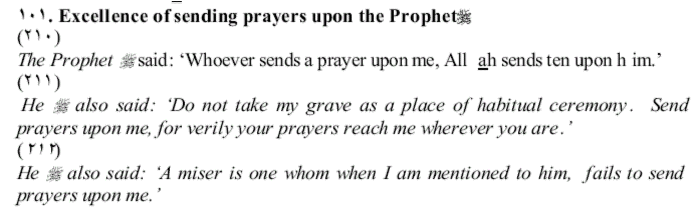
[audio https://salafiaudio.files.wordpress.com/2015/02/hisn-al-muslim-prayersprophet.mp3]Hisn Al Muslim - Images - 101 Prophet

Knowing the Prophet – Some Seerah Lessons – Dr Saleh as Saleh [Audio|En]

Qualities of Prophet Muhammad (Sallallaahu alayhi wa sallam) – Dr Saleh as Saleh [Audio|En]

001- Qualities of the Prophet – Highest Submission to Allaah – 15:08
002- Qualities of the Prophet – Mercy to the Worlds – 16:55
003- Qualities of the Prophet – Lamp Spreading Light – 10:11
004- Qualities of the Prophet – Favor on the Believers – 9:18
005- Qualities of the Prophet – Final and Last Prophet – 14:09
006- Qualities of the Prophet – Final and End of the Messengers – 14:01
007- Qualities of the Prophet – Openness of his Chest – 20:44
008- Qualities of the Prophet – Making Salaah Upon Him – 4:07

FAQ and Clarification of Misconceptions Concerning Prophet Muhammad ﷺ – Dr Saleh as Saleh [Audio|En]

101- Muhammad ﷺ, The Messenger of True Liberation – 52:44
102- Signs and Miracles of Prophet Muhammad – 50:24
103- Seeing the Prophet ﷺ In a Dream – 25:42
104- Ruling on Celebrating the Birthday of the Prophet – 37:04
105- Innovated Celebrations : Birthday & Death Anniversary – 23:03
106- Is the Prophet ﷺ Alive Now ? – 9:20
107- The Prophet’s ﷺ Ranks of Inspiration and Revelation – 6:17
108- The Prophet’s ﷺ Marriages – Refuting Lies – 9:40
109- Abbreviating Salaam and Salah on Prophet – 19:52
110- Points of Benefit – Actions of Prophet ﷺ part 1 – 23:20, part 2 – 40:34
112- Meaning of the Salutation Upon the Prophet – 21:58

Aromatic Fragrance and Permeating Incense – Dr Saleh as Saleh [Audio|En]

Biographies of Prophet Muhammad, sallallaahu ‘alayhi wa sallam
and of his Companion Abu Bakr, radiya Allaahu ‘anhu

Questions and Answers Format

Seeing the Prophet In a Dream – Dr. Saleh As-Saleh [Audio|En]

Listen / Download Mp3 Here (Time 25:40)
[audio https://salafiaudio.files.wordpress.com/2014/09/seeing-the-prophet-in-a-dream-saleh-as-saleh.mp3]

The Rights of Allah’s Messenger sallallahu ‘alayhi wa sallam – Shaykh ibn al-‘Uthaymin

This right is the greatest right of any of the creation. None of the creation have a right greater than the rights of Allah’s Messenger sallallahu ‘alayhi wa sallam. Allah – the Most High – said:

“Indeed We have sent you as a witness rind a bringer of good-tidings and a warner, in order that mankind may believe in Allah and His Messenger, and that you may assist and honour the Messenger.” [Al-Qur’an 48:89]

Therefore it is obligatory to love the Prophet sallallahu ‘alayhi wa sallam over and above any of mankind – even above one’s love for himself, his parents and his children. The Prophet sallallahu ‘alayhi wa sallam said: “None of you will truly believes until he loves me more then his parents, his children and the whole of mankind.” [1]

And from the rights that are due to the Prophet sallallahu ‘alayhi wa sallam are: that he should be honoured, loved and respected – but without any ghulu (exaggeration) or any falling short in the matter. Honouring the Prophet sallallahu ‘alayhi wa sallamduring his lifetime implied honouring his Sunnah (guidance and example) and his noble character and conduct. As for honouring him after his death, then this implies honouring his Sunnah and the Shari’ah (the Prescribed Laws) that he was sent with. Whosoever reflects upon the lives of the Sahabah (Companions of the Prophet) will come to know how these great and virtuous people established the obligation of honouring the Messenger sallallahu ‘alayhi wa sallam.

‘Urwah ibn Mas’ud said to the Quraysh: “O my people! I have seen kings. I have seen Caeser, Chouoes and Negus. But by Allah! I have never seen a king whose companions respect and honor him in the way that the Companions of Muhammad honour Muhammad sallallahu ‘alayhi wa sallam. By Allah! When he spits, the spittle would fall into the hands of one of them, who would then rub his face and skin with it; when he orders them with something, they promptly fulfill it; when he performs wudhu’(ablution), they vie with each other for the remains of the water; and when they speak in his presence, they lower their voices and do not look directly at his face, due to their respect and honour for him.” [2]

So this is how the Companions radhiallahu ‘anhum loved and honoured him, for Allah had endowed and blessed the Prophetsallallahu ‘alayhi wa sallam with a generous and noble character and a mild and easy-going nature. Had he been harsh and hard-hearted, people would not have been able to gather around him and be with him as they did.

Also from the rights that are due to the Prophet sallallahu ‘alayhi wa sallam is to believe in all that he informed as of with regards to the accounts of previous people and nations, to do that which he has commanded and leave that which he has prohibited, and to have ‘iman (faith) that his guidance and example is the best and most perfect guidance and example, and that the Shari’ah(Prescribed Laws) that he was sent with is perfect and complete – no human laws nor systems are to be given precedence or priority over his Shari’ah. Allah – the Most High – said:

“But no by your Lord! They will not truly be Believers, until they make the Prophet a judge in all their disputes, and then find in their souls no resistance against his decision, but rather accept it with the utmost submission.” [Al-Qur’an 4:65]

“Say: If you do love Allah then follow the Prophet. Allah will then love you and forgive you your sins. Indeed Allah is Oft-Forgiving, Most-Merciful.” [Al-Qur’an 3:31]

And from the rights of the Prophet sallallahu ‘alayhi wa sallam is to defend his Shari’ah and his guidance with the strength and capacity at one’s disposal, and also in proportion to the attack that it is under. Thus, if the enemies are attacking it with false proofs and doubts, then his guidance and Shari’ah should be defended with sound knowledge which refutes such false arguments and clarifies the doubts. If, however, the attack is made by any other types of weapons, then the defence should be made in a similar manner. It is not possible for any Believer to hear of some attack upon the Prophet’s Shari’ah or his noble personality, and then to keep silent about it – especially when one has the power to counter such on attack.

From Huquq Da’at Ilayh al-Fitrah wa Qarrarath ash-Shari’ah (pp. 6-7).

This translation is from Al-Istiqaamah Magazine, Issue No. 2, Safar 1417H / July 1996.

The Meaning of “Muhammad is the Messenger of Allaah” – Shaykh ibn Uthaymeen

The Meaning of The Shahaadah: Muhammad is the Messenger of Allaah.

Question 13: You explained the meaning of the Shahaadah: La Ilaaha Illallaah. So, what is the meaning of the Shahaadha: Muhammad Rasoolullaah

The Answer: As for the meaning of the testification that Muhammad (صلى الله عليه و سلم) is the Messenger of Allaah [Muhammad Rasoolullaah] then it is the attestation with the tongue and the belief with the heart that Muhammad bin ‘Abdullaah al- Qurashee al-Haashimee is the Messenger of Allaah to all of the creation, to the Jinn and mankind, as stated by Allaah, The Most High:

Verily! I am Allaah’s Messenger to you all. He is the One to whom the Dominion of the heavens and the earth belongs, none has the right to be worshipped but Him; It is He Who gives life and causes death. So believe in Allaah and His Messenger, the Prophet who can neither read nor write, who believes in Allaah and in His Words [this Qur’aan] and follow him so that you may be guided. [Qur’aan, soorat al-A’raaf (7): 158].

He, The Most High, also Said:

(Exalted is) Blessed be He Who sent down the Criterion [of right and wrong, i.e. the Qur’aan] to His slave [Muhammad صلى الله عليه و سلم] that he may be a warner to the ‘Aalameen (mankind and Jinn). [Qur’aan, soorat al-Furqaan (25): 1].

This Shahaadah necessitates that

  • you believe whatever Allaah’s Messenger informed you of;
  • you comply with whatever he commands;
  • you avoid whatever he forbade and prohibited, and that
  • you do not worship Allaah except with that which he prescribed.

It also necessitates that

  • you do not believe that Allaah’s Messenger has any share nor any right in Ar-Ruboobiyyah or in controlling the affairs of the creation, nor any right to be worshipped at all.Rather, he صلى الله عليه و سلم is a slave worshipper, not one to be worshipped; and that he is a Messenger who is not to be belied. 
  • It is not in his power to bring harm or benefit, neither for himself nor for others, except as Allaah Wills.

This is evident in the Saying of Allaah, The Most High:

Say [O Muhammad صلى الله عليه و سلم]: “I do not tell you that with me are the treasures of Allaah, nor that I know of al-Ghayeb (the hidden and unseen); nor I tell you that I am an angel. I but follow what is revealed to me (by inspiration).” [Qur’aan, soorat al-An’aam (6): 50].

He is a slave of Allaah who acts as he is commanded and follows the orders he is given. And Allaah, The Most High, Says:

[Say O Muhammad صلى الله عليه و سلم]: “It is not in my power to cause (bring) you harm or bring (guide) you to the Right Path.” Say: “None can protect me from Allaah’s Punishment [if I were to disobey Him], nor should I find refuge except in Him.” [Qur’aan, soorat al-Jinn (72): 21-22].

Allaah, The Most High, also Says:

Say (O Muhammad صلى الله عليه و سلم): “I possess no power of benefit or hurt to myself except as Allaah Will. And if I had the knowledge of the Ghayeb, I shoud have secured for myself an abundance of wealth, and no evil should have touched me. I am but a warner, and a bringer of glad tidings unto people who believe.” [Qur’aan, soorat al-A’raaf (7): 188].

So, this is the meaning of the testimony of Laa Ilaaha Illalaah, Muhammad Rasoolullaah. From this meaning the person knows that nothing from the creation deserves the right to be worshipped, not the Messenger of Allaah صلى الله عليه و سلم nor anyone from the creation who is below him in rank; and that worship an only be for Allaah, alone; and that the right of Allaah’s Messenger upon us is to give him the rank and standing which Allaah, The Most High, gave to him: The slave of Allaah and His Messenger.

Translated by Dr Saleh as Saleh rahimahullaah
SourceUnderstanding Worship – Fiqh ul-‘Ibadah – Shaykh ibn Uthaymeen

Prophet’s (صلى الله عليه و سلم) Marriage with Young Aisha (may Allaah be pleased with her) – Dr Saleh as Saleh

Question: Some haters of Islam often say that the Prophet (صلى الله عليه و سلم) married a “six-years old child,” referring to ‘Aisha, may Allah be pleased with her. What is the response?

The Answer: ‘Aisha’s covenant of marriage was conducted when she was six years old, but the actual commencement of the marriage took place when she was nine-years of age. She was the only virgin he married. Marrying at such young age was not the exception in Arabia at that time. In fact many were married in the young age period of 9-12 when they were physically mature. Furthermore, had this been something degrading and immoral, the enemies of the Prophet (صلى الله عليه و سلم) from the Pagans would have loved to use this against the character of the Prophet (صلى الله عليه و سلم) and ‘Aisha’s father (Abu Bakr, may Allah be please with him), the first one to believe the Prophet (صلى الله عليه و سلم) and support his propagation of Islam. Not to mention this would have been a major block against the spread of Islam amongst the Arabs if the Prophet (صلى الله عليه و سلم) would appear as a man of “uncontrolled sexual drive.”

This would have been obvious to resort to, especially when it is known that they accused the Prophet (صلى الله عليه و سلم) of many other things like being a magician, a poet, etc. The fact that they did not attempt even to consider this marriage as a tool against the integrity of the Prophet (صلى الله عليه و سلم) stands as a strong irrefutable evidence that such marriages were of the norm, not the exception. In so many societies, it was even considered that the girl who does not get married before she reaches fifteen years of age as someone being “late” on the scale of marriage timing! In fact such marriages were common in Asia, East Europe, Spain and Portugal.

On the other hand, it was known that one of the Pagans (Jubair bin Mut’im bin ‘Adiye) was interested to marry ‘Aaisha before her engagement to the Prophet (صلى الله عليه و سلم), but her mother (Umm Romaan, may Allah be please with her), rejected him. This proves that she was physically mature for marriage. Her family sought the Prophet (صلى الله عليه و سلم) because of his noble character as her mother asserted when she told her husband (Abu Bakr صلى الله عليه و سلم) of her intent.

There was a great wisdom in her marriage whereby ‘Aaisha witnessed the revelation and the rulings of Islam pertaining to the most particular and private matters of women, transmitting that to the men and women of the world. She reported about 2100 narrations from the Prophet (صلى الله عليه و سلم) covering rulings, worships, and transactions . She was the greatest woman scholar in Islam and she had many students of knowledge from the companions of the Prophet (صلى الله عليه و سلم).

SourceWedding to Four and Lawfully More – Dr Saleh As-Saleh rahimahullah