Pride : A Barrier to Paradise : Shaykh Abdur-Rahmaan as-Sa’dee

[Taken from Bahjatul-Quloobul-Abraar (pp. 156-158)]Source: Al Istiqamah Magazine, Issue No.7 – Rabî’ ul-Awwal 1418H / July 1997

From ‘Abdullaah Ibn Mas’ood radi-Allaahu ‘anhu who related that Allaah’s Messenger sal-Allaahu ‘alayhe wa sallam said:

Whoever has an atoms worth of kibr (pride) in his heart will not enter Paradise.” So a man said: What about a person who loves (i.e. takes pride in) wearing beautiful clothes and beautiful shoes? So he replied: “Indeed Allaah is beautiful and loves beauty. Kibr (pride) is to reject the truth, and to despise the people.” 1

So Allaah – the Most High – informs us that the Hellfire is the abode of those who have kibr (pride and arrogance). And we learn from the (above) hadeeth that: “Whoever has on atoms worth of kibr (pride) in his heart will not enter Paradise.” So this is a proof that kibr (pride) necessitates entry into the Hellfire and prevents entry into Paradise. And this comprehensive explanation that the Prophet sal-Allaahu ‘alayhe wa sallam mentioned has clarified the meaning of kibr (pride) in the dearest possible manner. So he divided kibr into two types:-

[1] Pride against the truth: This is to reject the truth and not to accept it. So anyone who reject the truth is proud and arrogant – in accordance with what he reject of the truth. So it is obligatory upon everyone to humble themselves to the truth which Allaah sent His Messenger with, and which He sent down in His Book. As for those whose pride and arrogance prevents them from totally complying with the Messengers (i.e. having eemaan or faith in them and their message) – then they are kuffaar (unbelievers) who will dwell in the Hellfire for eternity. Since when the truth comes to them via the Messengers, who explain to them the signs and clear proofs, they reject it and are prevented from accepting it, due to the kibr that they harbour in their hearts. Allaah the Most High – said:

“Indeed those who argue about the Signs of Allaah without any authority having come to them, there is nothing in their hearts except kibr (pride). They will never accept the Prophet Muhammad sal-Allaahu ‘alayhe wa sallam as a Prophet.” [Soorah Ghaafir (40):56]

As for those whose arrogance and pride prevent them from complying with parts of the truth – because it opposes their personal opinions or their whims and desires – then such people are not kuffaar (unbelievers), but such an action necessitates them being punished in accordance with what they have of kibr. This is why the Scholars are agreed that whenever the Sunnah (guidance and way) of Allaah’s Messenger sal-Allaahu ‘alayhe wa sallam has been explained to anyone, then it is not lawful for him to turn away from it to the saying of someone else, whoever and whatever status he may have. So it is obligatory upon the seeker of knowledge to give complete and absolute precedence to the saying of Allaah and the saying of His Messenger sal-Allaahu ‘alayhe wa sallam over and above the saying of anyone else, and that he should make that the basis to which he returns, and the foundation upon which he builds; following the guidance of the Prophet sal-Allaahu ‘alayhe wa sallam, striving hard to understand what is intended from it, and following this, both inwardly and outwardly. When a person conforms to this great principle, then he has indeed reached goodness and excellence, and all his errors will be forgiven to him; since his overall objective is to follow that which has been prescribed upon him. So his errors are excused due to his striving his best to recognise and comply with the truth – and this is humbling oneself to the truth.

[2] Pride towards people: This type is to despise the people, and to look down upon them. This attitude arises when a person is amazed with his own self, thinks highly of himself, and thinks he is better than others. So this causes him to have kibr towards the creation, despise them, mock them, and to degrade them through both speech and action. Allaah’s Messenger sal-Allaahu ‘alayhe wa sallam said:

“It is enough evil for a person to despise his brother Muslim.” 2

This is why the man asked: “What about a person who loves (i.e. takes pride in) wearing beautiful clothes and shoes?” Because he feared that this was the kibr which would be under the threat of punishment. So the Prophet sal-Allaahu ‘alayhe wa sallam explained to him that this was not from kibr; since this person was one who complied with the truth, and was humble towards people, and that this was from the beauty that Allaah loves, for indeed Allaah – the Most High is beautiful in His Dhaat (Self), Sifaat (Attributes) and Af’aal (Actions), and He loves both outer and inner beauty.

As regards outer beauty, then it includes cleanliness of the body, clothes and place. As regards to inner beauty, then it is beautifying the character. This is why the Prophet sal-Allaahu ‘alayhe wa sallam used to supplicate:

“O Allaah! Guide me to having beautiful manners and characteristics, no one can guide me to beautifying them except You. And turn away from me all evil actions and characteristics, no one con turn them away from me except You.” 3

And Allaah knows best.

FOOTNOTES

1. Related by Muslim in his Saheeh (1/65).

2. Related by Muslim (no.2564).

3. Related by an-Nasaa’ee (no.861). It was authenticated by al-Albaanee in his Sifatus-Salaah (p.93)

 

Imam as-Sa’dee’s Tafseer of Allaah’s Statement: "Oh you who believe! Siyaam has been prescribed for you…"

Bismillaah Al-Hamdulillaah wa salatu wa salaamu ‘ala rasulullaah
Amma-ba’d
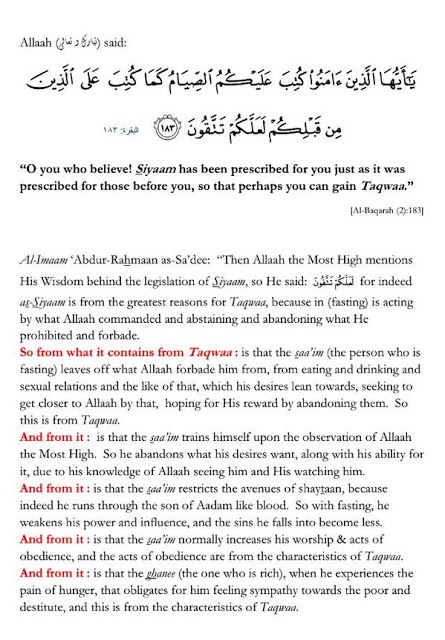
Oh you who believe! Siyaam has been prescribed for you

Source: http://salafiyyah-kuwait.blogspot.com/

Useful Ways of Leading a Happy Life – Imam as Sa’di – Dr Saleh as Saleh [Audio|En]

Based on the Book of Shaykh Abdur Rahman bin Nasr As Sa’di (rahimahullaah)
Dr.Saleh as-Saleh (rahimahullaah)

Useful Ways of Leading a Happy Life – Imam as Sa’di – Dr Saleh as Saleh [Audio|En]

Video Chapters:

  • 00:00 Introduction
  • 07:35 Ch 1.1: [No.1] Iman and Righteous Deeds
  • 20:45 Ch 1.2: [No.2] Goodness to creation, by words, by deeds, and by all types of good acts
  • 22:56 Ch 2.1: [No.3] Occupying Oneself With Useful Knowledge
  • 24:45 Ch 2.2: [No.4] Concern oneself with the affairs of the present, and to stop being anxious about the future, or grieving over the past.
  • 29:25 Ch 3.1: [No.5] Remembering Allah Much
  • 30:22 Ch 3.2: [No.6] Proclaiming and mentioning the favours and blessings of Allah on oneself, both the outwardly manifest, and the hidden
  • 32:03 Ch 3.3: [No.7] Look at those that are below you (in worldly positions),and do no tlook at those that are above you (in worldly positions)
  • 34:20 Ch 4.1: [No.8] Forgetting The Unpleasant Things That Have Passed
  • 37:26 Ch 4.2: [No.9] Prophetic dua to Allah seeking the betterment of his future both in terms of his religion and his worldly affairs
  • 40:10 Ch 5: [No.10] By imagining the worst possible thing that would have happened to him
  • 42:58 Ch 6.1: [No.11] Firmness Of The Heart
  • 44:03 Ch 6.2: [No.12] Reliance On Allah
  • 47:14 Ch 7.1: [No.13] By overlooking bad qualities, and bringing to mind the good qualities
  • 51:16 Ch 8.1: [No.14] Do Not Let Grief And Worry Make Your Short Life Shorter
  • 52:37 Ch 8.2: [No.15] When something unpleasant happens to him,or he is afraid that it will happen to him, he should remember the other blessings of Allah
  • 53:44 Ch 8.6: [No.16] Do not pay attention to slander and other evil talk about you
  • 54:18 Ch 8.6: [No.17] Know also that your life is subservient to your thoughts
  • 54:38 Ch 8.6: [No.18] Train yourself not to desire thanks & gratitude from anyone except Allah
  • 56:44 Ch 8.6: [No.19] Make the attainment of useful things your goal,and strive to realise them, and pay no attention to harmful things
  • 57:10 Ch 8.7: [No.20] On the spot accomplishment of the current activities so that the future may be free for you
  • 57:40 Ch 8.8: [No.21] Rank the Useful things and seek help in good thinking and good counsel

There is no doubt that the bliss of the heart, its tranquility and happiness, and the absence of grief and worry from it, is the goal of every individual. It is the means by which a happy,blissful and excellent life is achieved. There are means to achieve this;some of which are religious, some are natural and some are physical.These means are never gathered together except to the believers. The non-believers on the other hand, despite the fact that the earnest endeavours of their philosophers is to lead them to these means, even if they achieve them in certain aspects, they miss the way to them in several other aspects that are more beneficial, more permanent and better in yielding results.

Shaykh Abdur-Rahman bin Nasir As-Sadi `rahimahullah mention in his treatise the ways and means to achieve this lofty goal that is the quest of every individual. He said that some people are successful in following these ways, and therefore live a good and pure life and enjoy their life. Some woefully fail in following any of them, and they live a wretched and miserable life. Others lie between these two extremes;by the level of their following these means, by that level do they live a good life. And it is Allah `azza wa jall that guides to all that is good, and wards off all that is evil, and it is His Help we seek in this.

The Book in Arabic can be read Here

This book was Published in English by:

Useful Ways Of Leading A Happy Life – by:Shaykh Abdur-Rahman bin Nasir As-Sa’di
Translated by:Bashir Aliyu Umar ; Printed by:The Ministry of Islamic Affairs,Endowments,Da`wah and Guidance ; Supervised by:The Ministry’s Deputyship for Printing and Publishing Affairs.

Read or Download the Book [English Book] [PDF]

What are the Different Classes of Believers? – Shaykh Abdur-Rahman As-Sa’dee (Rahimahullah)

From the Book  “Essential Q & A Concerning the Foundations of Imaan and Obstacles in the Path of Imaan”
By: Shaykh Abdur-Rahman As-Sa’dee (Rahimahullah)

What are the Different Classes of Believers?
Question 9 – Pgs. 31-32

There are 3 main types of believers:
*(footnotes in italics)

This chapter is an explanation of Allah’s Statement {Surah Faatir 35:32}:

ثُمَّ أَوْرَثْنَا الْكِتَابَ الَّذِينَ اصْطَفَيْنَا مِنْ عِبَادِنَا فَمِنْهُمْ ظَالِمٌ لِّنَفْسِهِ وَمِنْهُم مُّقْتَصِدٌ وَمِنْهُمْ سَابِقٌ بِالْخَيْرَاتِ بِإِذْنِ اللَّهِ ذَلِكَ هُوَ الْفَضْلُ الْكَبِيرُ


“Then We caused Our chosen servants to inherit the Book.  Among them are self-oppressors, among them are frugal o­nes, and from them are those who rush forth to perfom good deeds, by the Permission of Allah.”

The author’s reference to the 3 levels of believers found in this Verse is similar to Ibn Katheer’s own explanation of it, and it is in accordance with what has been said by Ibn Abbas, Ibn Mas’ood, and others from the Companions, {May Allah be pleased with them.}  Ibn Abbas {radiallahu anhu} said, “They are the Ummah (Nation) of Muhammad {alayhee salatul wasalaam}, the o­nes whom Allah caused to inherit all the books that He sent down.  The oppressive o­ne will be forgiven, the frugal o­ne will be given an easy reckoning, and the o­ne who rushed forth (to do good deeds) will enter Paradise with no reckoning.” {Tafseer al-Qur’an al-‘Atheem, 6/546}

This chapter serves to further clarify the falsehood of the beliefs of the Murji’ah and Khawaarij, and builds upon the previous 2 chapters. It refutes the Murji’ah since Allah has described the believers as being three distinctly different levels, destroying their false claim that Imaan is o­nly o­ne level.  If Imaan is o­nly o­ne level, then how can it be that some believers are considered self-oppressors, and others are frugal, and others are those who rush forth to do good deeds? It is also a further refutation of the Khawaarij, since Allah has described some of the believers as being oppressors, and this oppression did not take them outside of the fold of Islaam.

1)  Saabiqoon ilal-Khayraat – Those who rush to do good deeds:
Those who rush to do good deeds are those who perform both the obligatory and recommended deeds, while avoiding both the prohibited and disliked affairs.

2) Muqtasidoon – Those who are frugal and selective:
The frugal o­nes are those who restrict themselves to performing o­nly those deeds that are obligatory, while avoiding o­nly the prohibited affairs *(footnotes in italics).

(i.e., Meaning that they fall into disliked affairs and leave off recommended deeds.)

3) Thaalimoon li-Anfusihim – Those who oppress themselves:
Those who oppress themselves are those who mix good deeds with the bad o­nes.   *(footnotes in italics)

*(Meaning that they fall into prohibited affairs and leave off obligations.  In his Tafseer (6/546), Ibn Katheer (rahimahullah) said, explaining these three categories of believers: “The self-oppressor falls short of performing his obligations and falls into some prohibited things.  The frugal o­ne performs his obligations and stays away from prohibited things, however he tends to abandon some of the recommended deeds and falls into some disliked things.  The o­ne who rushes to do good deeds performs both obligatory and recommended deeds, while staying away from both disliked and prohibited things.


No Soul Shall Bear The Sin Of Another – Shaikh Abdur-Rahmaan ibn Naasir as-Sa’dee

Taken from “Tayseerul-Kareemir-Rahmaan fee tafseer Kalaamil-Mannaan” of Shaikh Abdur-Rahmaan ibn Naasir as-Sa‟dee.

[Meaning: And no soul shall bear the burden of sin of another, and if a soul heavily laden with sin calls someone else to bear its sins, nothing of it will be lifted even though he be near of kin.][Sooratul-Faatir (35): Ayah 18]

Shaikh `Abdur-Rahmaan ibn Naasir as-Sa‟dee- rahimahullaah-said in his Tafseer of the Aayah: “And the last meaning is indicated by what He mentioned after it, in His Saying:

[Meaning: And no soul shall bear the burden of sin of another], meaning: on the Day of Resurrection everyone shall be recompensed for his own deeds, and no one shall carry the sins of anyone else.

[Meaning: And if a soul heavily laden with sin calls someone else to bear its sins]: i.e. a soul weighed down with sins and evil deeds: if it calls on someone to take on some of its sins,

[Meaning: Then nothing from it will be carried, even if the one asked were a close relative], for sins cannot be carried (even) for a close relative. So the Hereafter is not the same as this world, where relatives can help each other, and close friends. Rather on the Day of Resurrection a person will wish that he had some right due to him from anyone, even if it be his parents or his close relatives.”

[Translated by Aboo Talhah Daawood ibn Ronald Burbank -rahimahullaah]
http://alitisaambissunnah.wordpress.com

Only Allaah Can Remove Harm – Shaykh AbdurRahman bin Nasr as-Sa’adi

وَإِن يَمۡسَسۡكَ ٱللَّهُ بِضُرّٖ فَلَا كَاشِفَ لَهُۥٓ إِلَّا هُوَۖ وَإِن يُرِدۡكَ بِخَيۡرٖ فَلَا رَآدَّ لِفَضۡلِهِۦۚ يُصِيبُ بِهِۦ مَن يَشَآءُ مِنۡ عِبَادِهِۦۚ وَهُوَ ٱلۡغَفُورُ ٱلرَّحِيمُ ١٠٧

<<And if Allah should touch you with adversity, there is none who can remove it except Allah; and if He intends for you good, then there is no repeller of His bounty. He causes it to reach whom He wills of His servants. And He is the Forgiving, the Merciful>>
[Yunus: 107]

  by Shaykh  AbdurRahman bin Nasr as-Sa’adi
Translated by Umm Yahya

This is one of the greatest proofs that Allaah alone is worthy of worship, for verily He is the One who grants benefit or harm, the One who provides and the One who prevents.

If any harm such as poverty and sickness etc. befalls you << there is none who can remove it except Allaah >>. This is because if all (those from) the creation gathered together in order to bring forth any type of benefit they would be unable to do so unless Allaah wrote it for them (thus allowing it). Likewise if (those from) the creation of Allaah gathered in order to cause harm to anyone, they would be unable to do so unless Allaah allowed it.

 This is why Allaah says: <<and if He intends for you good, then there is no repeller of His bounty. >> meaning, that it is not possible for any of Allaah’s creation to reject His Good and His Kindness, as Allaah says: << Whatever Allah grants people of His mercy – none can withhold it; and whatever He withholds – none can release it thereafter>> [Fatir: 2]

 << He causes it to reach whom He wills of His servants. >> meaning Allaah selects whomsoever He wills with His Mercy from His creation, verily Allah possesses all Excellence and Greatness.

 <<He is the Most Forgiving>> of all the mistakes of the creation, He grants His slave success through the means of His forgiveness, consequently if a slave sins Allah forgives his sins regardless of whether they are major sins or minor sins. He is Ar-Raheem (the Merciful), thus His Mercy encompasses all that exists, hence it is not possible to exist without His goodness even for the (time of) a blink of an eye.

Therefore a slave of Allaah becomes aware of the clear evidence that illustrates that Allaah exclusively is the One who bestows blessings in addition to clearing afflictions and granting good and removing evils and hardships.

There is none from the creation who possesses an iota of this ability to unless it is by Allaah’s permission. Therefore this knowledge obligates upon us an awareness of the reality that Allaah Alone is the Truth and what others call to other than him is merely falsehood.

[From: Tayseer al-Kareem ar-Rahman fee Tafseer Klam al-Manan 3/224]

One Who Has Part of a Prayer to Make up Should Not Get Up Until the Imaam Has Given Both Tasleems – Imam as-Sa’dee

Bismillaah

One Who Has Part of a Prayer to Make up Should Not Get Up Until the Imaam Has Given Both Tasleems* Shaikh `Abdur-Rahmaan ibn Naasir as-Sa`dee –rahimahullaah -was asked:

Question:

“Is it permissible for one who has missed something from the Prayer to stand up to complete what he has missed before the imaam completes the Salutation (tasleem)?”

Answer:

“That is not permissible for him. It is upon him to remain until the imaam has completed the second Salutation. If he gets up before he has completed his Salutation, and he does not go back, then his Prayer becomes a Supererogatory (nafl) [Prayer], and it is upon him to repeat it; because it is obligatory upon one praying behind an imaam to remain along with his imaam until the Prayer of the imaam is completed.”

[al-Majmoo`atul-Kaamilah li Mu·allafaatish-Shaikh `Abdir-Rahmaan ibn Naasir as-Sa`dee‟ (16/125).]
[Translated by Aboo Talhah Daawood ibn Ronald Burbank -rahimahullaah]
www.alitisaambissunnah.wordpress.com

Related Links:

الرَّبّ Ar-Rabb (The Lord and Nurturer) : One of the Names of Allaah

 الرَّبّ  Ar-Rabb (the Lord and Nurturer) the Lord and Master who has none like Him in His Lordship, the One Who nurtures and rectifies the affairs of the creation by the favours which He showers upon them, the Sovereign Owner Who alone creates and commands, the One Who controls the affairs and grants blessings, the One Who nurtures, the Creator, the Provider, the One Who aids and the One Who guides.

[SourceThe Ninety-Nine Names of Allaah – Dawud Burbank [Audio|En] & Transcribed PDF]

The Meaning of Ar-Rabb, the Lord

Ar-Rabb is the owner who has full authority over his property. Ar-Rabb, linguistically means, the master or the one who has the authority to lead. All of these meanings are correct for Allah. When it is alone, the word Rabb is used only for Allah. As for other than Allah, it can be used to say Rabb Ad-Dar, the master of such and such object. Further, it was reported that Ar-Rabb is Allah’s Greatest Name.

Source : Tafseer Ibn Kathir, Surah Fathiha, Dar-us-salam English publication

Shaikh Saalih ibn Saalih al-Fawzaan haafidhahullaah said in Sharh Usool-ith-Thalaathah:

And Ar-Rabb (the Lord) is the One Who is worshipped,

and the proof is His saying, He the Most High:

يَا أَيُّهَا النَّاسُ اعْبُدُوا رَبَّكُمُ الَّذِي خَلَقَكُمْ وَالَّذِينَ مِن قَبْلِكُمْ لَعَلَّكُمْ تَتَّقُونَ

الَّذِي جَعَلَ لَكُمُ الْأَرْضَ فِرَاشًا وَالسَّمَاءَ بِنَاءً وَأَنزَلَ مِنَ السَّمَاءِ مَاءً فَأَخْرَجَ بِهِ مِنَ الثَّمَرَاتِ رِزْقًا لَّكُمْ ۖ فَلَا تَجْعَلُوا لِلَّهِ أَندَادًا وَأَنتُمْ تَعْلَمُونَ

O mankind, single out your Lord with all worship, He Who created you and those who came before you so that you may be dutiful to Him, seeking to avoid His anger and His punishment. He Who made the earth a resting place for you and the sky a canopy, and He sent down from the clouds rain, and He brought out with it crops and fruits from the earth as provision for you, so do not set up rivals for Allaah whilst you know that you have no Lord besides Him. [2:21-22] (#9)

[#9]: His saying, “And Ar-Rabb (the Lord) is the One Who is worshipped”: meaning, He is the One Who deserves to be worshipped, as for other than Him, then it does not deserve worship, because it is not a Lord. This is the intent of the speech of the Shaikh rahimahullaah in his saying, “Ar-Rabb (the Lord) is the One Who is worshipped”, meaning He is the One Who deserves worship. Then also it is not sufficient that a person just affirms Ar-Ruboobiyyah (Lordship), rather he must affirm Al-‘Uboodiyyah (Allaah’s deserving all worship), He the Perfect and Most High, and he must carry it out making it purely and sincerely for Him, the Perfect and Most High. So since he has affirmed that He is Ar-Rabb (the Lord) then it is binding upon him to affirm that he is Al-Ma‘bood (the One Who therefore deserves to be worshipped), and that others besides Him do not deserve anything from worship.

Source : Sharh Usool-ith-Thalaathah – Explanation of the Three Fundamental Principles – of Imaam Muhammad ibn ‘Abdil-Wahhaab [1115-1206 H], Explained by Shaikh Saalih ibn Saalih al-Fawzaan haafidhahullaah, Lesson 20: The Lord is the One Who is Worshipped; The Meaning and Types of Worship (And Ar-Rabb (the Lord) is the One Who is worshipped…)

الْحَمْدُ لِلَّهِ رَبِّ الْعَالَمِينَ
<<All the praises and thanks be to Allâh, the Lord of the ‘Alamîn (mankind, jinns and all that exists)>>. (Surah Faathiha v.2)

(V.1:2) Lord: The actual word used in the Qur’ân is Rabb. There is no proper equivalent for Rabb in the English language. It means the One and the Only Lord for all the universe, its Creator, Owner, Organizer, Provider, Master, Planner, Sustainer, Cherisher, and Giver of security. Rabb is also one of the Names of Allâh.

Source : Surah Fatiha – Translation of the meanings of The Noble Qur’an , in the English Language , By Dr. Muhammad Taqiuddeen al-Hilaalee and Dr. Muhammad Muhsin Khan

Comprehensive and beneficial du’aa – for the Best of Both Worlds : Imaam as-Sa’dee

AsSalam Alaikum wa Rahmatullahi wa Barakaatuhu

Supplication for the Best of Both Worlds

Taken From the articles “Reflections
Al-Istiqaamah Magazine, Issue No.6 – Dhul-Qa’dah 1417H / March 1997

‘Abdullaah ibn Mas’ood radiallaahu ‘anhu relates that the Prophet sallallaahu ‘alayhi wa sallam would supplicate:

O Allaah! I ask You for guidance, piety, safety and well-being, and contentment and sufficiency.”
[Allaahumma innee as’alukal-hudaa wat-tuqaa wal-‘afaafa wal-ghinaa].

Sahih Muslim (no.2721)

Imaam as-Sa’dee (d.1376H) – rahimahullaah – said:

This du’aa (supplication) is from the most comprehensive and beneficial du’aas (supplications), since it includes asking Allaah for well-being with regards to both the Religion and the world. Thus, al-hudaa (the guidance) is beneficial knowledge, and at-tuqaa (i.e. taqwaa or piety) is righteous actions and leaving-off what Allaah and His Messenger have forbidden; and this is (asking) for correctness and well-being of a person’s Religion. For indeed, the Religion comprises of beneficial knowledge and recognising the truth – which is guidance – and standing firm upon obedience to Allaah and His Messenger sallallaahu ‘alayhi wa sallam – and this is piety.

And al-‘afaafa (well-being and safety) and al-ghinaa (contentment and sufficiency) comprises of being safe from (the harms of) the creation and that the heart is not attached to them. And it also comprises of being contented with Allaah and what He provides, and seeking whatever will cause the heart to be satisfied with Him. So with this, happiness in this worldly life is completed, and the heart tastes true sweetness and delight – and this is a goodly life. So whosoever is granted the provisions of guidance, Piety. well-being and contentment has indeed achieved true happiness, and has acquired all that could be possibly sought after, as well as being saved from all that is dreadful and frightening.” [Bahjatul-Quloobul-Abraar (p.198)]