There are some people who speak of equality instead of justice, and this is a mistake. We should not say equality, because equality implies no differentiation between the two. Because of this unjust call for equality, they ask, “What is the difference between male and female?” So they have made men similar to women. The communists said, “What difference is there between the ruler and the subject? No one has any authority over anyone else.” Not even the father over his son?! So they said the father has no authority over his son and so on.Instead, if we say justice, which means giving each one what he or she is entitled, this misunderstanding no longer applies, and the word used is correct. Allah does not say in the Qur’an that He enjoins equality. He said (interpretation of the meaning):
“Verily, Allah enjoins Al‘Adl (i.e. justice)” (Qur’an, 16:90)
“And that when you judge between men, you judge with justice.” (Qur’an, 4:58)
Those who say that Islam is the religion of equality are lying against Islam.Rather Islam is the religion of justice, which means treating equally those who are equal and differentiating between those who are different. No one who knows the religion of Islam would say that it is the religion of equality. Rather what shows you that this principle is false is the fact that most of what is mentioned in the Qur’an denies equality, as in the following verses: “Say: Are those who know equal to those who know not?” (Qur’an, 39:9)
“Say: Is the blind equal to the one who sees? Or darkness equal to light?” (Qur’an, 13:16)
“Not equal among you are those who spent and fought before the conquering (of Makkah, with those among you who did so later.” (Qur’an, 57:10)
“Not equal are those of the believers who sit (at home), except those who are disabled (by injury or are blind or lame), and those who strive hard and fight in the Cause of Allah with their wealth and their lives.” (Qur’an, 4:95)
Not one single letter in the Qur’an enjoins equality, rather it enjoins justice. You will also find that the word justice is acceptable to people, for I feel that if I am better than this man in terms of knowledge, or wealth, or piety, or in doing good, I would not like for him to be equal to me.Everyone knows that it is unacceptable if we say that the male is equal to the female.
– Sheikh Ibn Uthaymeen, Sharh Al-Aqeedah Al-Wasitah, 1/180-181
25.34980855.394526
Share this, Baarakallaah Feekum: [“One who guides to something good has a reward similar to that of its doer” - Saheeh Muslim vol.3, no.4665] [This website protects the copyrights of the authors/publishers. The Content is posted on this website with implicit/explicit permission from content owners]
Question 44: What is Ilhaad–concerning Allaah’s Names and Attributes?
The Answer: The basic meaning of the term Ilhaad i.e. in the Arabic language, it means inclination. And from this is the Saying of Allaah, The Most High:
The tongue of the man they incline to is foreign, while this (the Qur’aan) is a clear Arabic tongue.
[Qur’aan, soorat an-Nahl (16): 103].
And from it is the lahd in the grave, for it is called lahd because of its inclination towards a side of the grave. One cannot know the meaning of Ilhaad except by knowing the meaning of Istiqaamah (uprightness), since, as it is said, “Things become clear and distinct by the [meaning] of their contraries.” So, the Istiqaamah (uprightness) with regard to the subject of Allaah’s Names and Attributes is that we conform to their true and real meanings which befit Allaah, The Most Mighty and Most Majestic, without Tahreef (changing or twisting their wording and meanings), without Ta’teel (denying or divesting Allaah of His Attributes), without Takyeef (asserting how they are), and without Tamtheel (likening them to those of the creation), just as it has passed before in the foundation pertaining to this subject and which ahlus-Sunnah wal-jamaa’ah adhere to. Thus, if we know the meaning of al-Istiqaamah regarding this matter, then its is opposite is al-Ilhaad. And already the people of knowledge have mentioned several kinds of Ilahaad concerning the Names of Allaah, The Most High, which may be comprised by saying that it is deviating from the right course, with respect to that which is obligatory to believe in regarding them.
So, the first kind is for someone to deny some of the Names or any of the Attributes denoted by them. Like to deny the name Ar-Rahmaan as one of the Names of Allaah, just as the people of Jaahilyyah did; or to affirm the Names but deny the Attributes it comprises. Like the saying of some innovators: “Allaah, The Most High, is Ar-Raheem (The One Who Bestows Mercy) but without Rahmah (Mercy), Samee’ (all- Hearer) but without Sam’ (Hearing), al-Baseer (all-Seer) but without Basar (Seeing),” and so forth.
Second Kind: He designates names to Allaah with which He did not Name Himself. The basis that this is considered Ilahaad lies in the fact that Allaah’s Names are contingent upon Revelation (tawqeefiyyah) so that it is not permitted for anyone to designate a name to Allaah with which He did not Name Himself. Since this is considered of saying things about Allaah of which one has no knowledge of, and also because it is a transgression against Allaah (Azza wa Jal) and His Right. And this is similar to what the philosophers have done, for they have designated the name “Active Cause” for “God”. And likewise with the Christians, for they have given the name “the Father” to Allaah, The Most High,–and so forth.
Third Kind: He believes that these names denote attributes similar to those of the creation. Accordingly, he makes them indicative of Tamtheel. The basis that this is considered Ilahaad is that whoever believes that the Names of Allaah (Azza wa Jal) denotes likening of Allaah to His Creation, then he has made the Words of Allaah and His Messenger (صلى الله عليه و سلم) infer unbelief. Because likening of Allaah to His Creation is unbelief, for it’s a denial of Allaah’s Saying:
There is nothing like Him, and He is The All-Hearing, The All Seeing. [Qur’aan, soorat ash-Shura (42): 11], and of His Saying: Do you know of any who is similar to Him? [Qur’aan, soorat Maryam (19): 65].
Na’eem bin Hammad and al-Khuzaa’ee, the Shaykh of Imaam al-Bukhaaree, said: “Whoever likened Allaah to His Creation, then he has disbelieved, and whoever denied the Attributes by which Allaah qualified Himself with, then he has also disbelieved. And the Names by which Allaah Named Himself as well as the Attributes by which He qualified Himself, will not be called Tashbeeh (declaring Allaah to be like His Creation).” [65]
The Fourth Kind: He derives from the Names of Allaah, The Most High, names for idols. Like the derivation “al-Laat” from al-Ilaaah, “al-‘Uzzaa” from “al-‘Azeez,” and “minaat” from “al-Mannaan.” The basis that this is considered Ilahaad, is that Allaah’s Names are particular to Him. So it is not allowed to ascribe the meanings denoting these Names to any created being for the sake of offering him (her, or it) that which only Allaah deserves from worship.
These are the types of Ilhaad concerning the Names of Allaah, The One free of all imperfection, The Most High
Footnotes:
[65] Shaykh al-Albaanee, may Allaah’s Mercy be upon him, said that the Isnaad of the narration from Hammad is saheeh [ath-Thahabee’s al- ’Uluw], p. 184. After reporting the above statement of Hammaad in Siyar ‘Alaam An-Nubalaa’, Imaam ath-Thahabee, may Allaah’s Mercy be upon him, commented, “This statement is true…”
Share this, Baarakallaah Feekum: [“One who guides to something good has a reward similar to that of its doer” - Saheeh Muslim vol.3, no.4665] [This website protects the copyrights of the authors/publishers. The Content is posted on this website with implicit/explicit permission from content owners]
Explanation of a Summary of al-‘Aqeedatul-Hamawiyyah
Author: Shaykh Muhammad Ibn Saalih al-‘Uthaymeen Paperback: 208 Pages Published: January, 2005,
One of the works on this subject is his (Ibn Taymiyyah’s) “al-Fatwaa al-Hamawiyyah” which he wrote as an answer to a question presented to him in the Hijrah year of 698 from Hamaah, a place in ash-Shaam. In it, he was asked what the scholars and Imaams of the religion say concerning the Aayaat and the Ahaadeeth of the Sifaat, or the attributes and characteristics of Allaah. So he answered in about 83 pages and due to which, he suffered trials and afflictions. May Allaah reward him on behalf of Islaam and the Muslims with the best of rewards.
From the Back of the Book:
Allaah has sent Muhammad (Sallallaahu ‘alayhi wa Sallam) with guidance and the true religion. He sent him as a mercy to the world, as an example for the workers, and as a proof against all the servants. He (Muhammad) fulfilled the trust, conveyed the message, advised the Ummah, and he clarified for the people all of what they need regarding the foundations of their religion as well as its detailed matters. He left no good except that he clarified it and encouraged it, and he left no evil but that he warned the Ummah from it so much so that he left his Ummah upon a clear, white path – its night as clear as its day. His companions traversed this path, shining and radiant.
Afterwards, the best generations took it from them in the same state until oppression frowned upon them with the darkness of various innovations by which the innovators conspired against Islaam and its people. The people then wandered in confusion purposelessly, and they began building their ‘Aqeedah beliefs upon a spider’s web.
However, the Lord upholds His religion with His close helpers upon whom He bestows Eemaan, knowledge, and wisdom by which they prevent these enemies. They repel their plot back against their own throats. So no one ever comes out with his innovation except that Allaah – and for this deserves praise and thanks – destines to send someone from Ahlus-Sunnah who refutes and disproves his innovation and extinguishes it.
He has many works on the clarification and explanation of the Sunnah, the reinforcement of its pillars, and the destruction of innovations.
One of the works on this subject is his “al-Fatwaa al-Hamawiyyah” which he wrote as an answer to a question presented to him in the Hijrah year of 698 from Hamaah, a place in ash-Shaam. In it, he was asked what the scholars and Imaams of the religion say concerning the Aayaat and the Ahaadeeth of the Sifaat, or the attributes and characteristics of Allaah. So he answered in about 83 pages and due to which, he suffered trials and afflictions. May Allaah reward him on behalf of Islaam and the Muslims with the best of rewards.
Due to the difficulty in understanding and comprehending this answer from many readers, I wanted to summarize the most important points from it along with some other needed additions. I have named it “Fathu Rabb-il-Bariyyah bi-Talkhees al-Hamawiyyah.”
I first published it in the Hijrah year 1380. I am now publishing it a second time and perhaps changing what I see beneficial of additions or deletions.
I ask Allaah to make our effort sincerely for His Face and as a benefit to His servants, for indeed He is Generous and Kind.
-The Author (Muhammad ibn Saalih al-’Uthaymeen)
25.34980855.394526
Share this, Baarakallaah Feekum: [“One who guides to something good has a reward similar to that of its doer” - Saheeh Muslim vol.3, no.4665] [This website protects the copyrights of the authors/publishers. The Content is posted on this website with implicit/explicit permission from content owners]
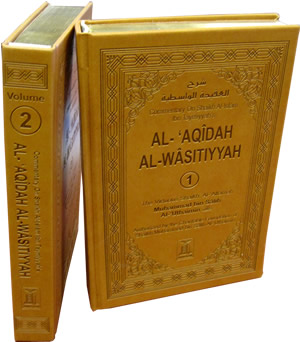
Al-‘Aqidah Al-Wasitiyyah (2 Vol. Set) Author: Muhammad bin Salih Al-‘Uthaimin Publisher: Darussalam Publishers & Distributors (2010) Pages: 1155 Binding: Hardcover . Buy Here
A detailed commentary/explanation of the famous writing of Shaikh Al-Islam Ibn Taymiyyah, al-Aqeedatul-Wasitiyah, done by the noble Shaykh, Muhammad Ibn Saalih al-‘Uthaymeen (Rahimahumullaah).
Two large deluxe volumes contain a detailed study/explanation on the topic of creed/aqeedah (belief in oneness of Allah). Each volume has golden color page edges.
25.34980855.394526
Share this, Baarakallaah Feekum: [“One who guides to something good has a reward similar to that of its doer” - Saheeh Muslim vol.3, no.4665] [This website protects the copyrights of the authors/publishers. The Content is posted on this website with implicit/explicit permission from content owners]
What is the creed of Ahlus-Sunnah wal-Jamaa’ah in regard to Allaah’s Names and Attributes? And what is the difference between a Name and an Attribute? And does affirmation of a Name necessitate affirmation of an Attribute, and (likewise) does affrimation of an Attribute necessitate affirmation of a Name?
Response:
The creed of Ahlus-Sunnah wal-Jamaa’ah in regard to Allaah’s Names and His Attributes is affriming that which Allaah has affirmed for himself from the Names and Attributes, without:
tahreef (changing/distorting a Name and/or Attribute of Allaah to other than its true meaning, i.e. from Allaah to al-Laat, and al-‘Azeez to al-‘Uzzah);
ta’teel (denying some or all of Allaah’s Names and Attributes);
takyeef (questioning as to “how” (Allaah’s Name or Attribute is), i.e. How does Allaah descend, etc.?);
tamtheel (to imply a similarity between Allaah’s Names and Attributes and that of His creation).
And the difference between a Name and an Attribute is that a Name is that which Allaah has named Himself by; and an Attribute is that which Allaah has described Himself by. And between them is a clear difference.
So a Name is that which is considered a Name of Allaah (Subhaanahu wa Ta’aala), (and that) which incorporates an Attribute.And affirmation of a Name necessitates affirmation of an Attribute. For example: al-Ghafoor (the Most Forgiving) is a Name, and (its affirmation) necessitates the (affirmation of the) Attribute of Maghfirah (Forgiveness);
And ar-Raheem (the Most Merciful) is a Name and (its affirmation) necessitates the affirmation of ar-Rahmah (Mercy).
And the affirmation of an Attribute does not necessitate the affirmation of a Name. For example: al-Kalaam (Speech) does not necessitate the affirmation of the Name al-Mutakallim (the Speaker) for Allaah.
So, based upon this, the Names are more wider (in scope), since every Name encompasses an Attribute, however, every Attribute does not encompass a Name.
Share this, Baarakallaah Feekum: [“One who guides to something good has a reward similar to that of its doer” - Saheeh Muslim vol.3, no.4665] [This website protects the copyrights of the authors/publishers. The Content is posted on this website with implicit/explicit permission from content owners]
1 – Belief In Allah’s Existence Allah’s existence is affirmed through Fitrah (the innate purity that Allah creates in every human being), the Mind, the Shari’ah (Islamic Law) and the senses.
a) As for the Fitrah, we say the following: Allah created the belief in Him in every human being. Mankind needs not to be taught this belief or think about how to possess it. However, the ones who have this Fitrah corrupted will not benefit from it. The Prophet (sallallahu alaihi wa-sallam) said, what translated means, “Every newly born will be born having Fitrah. However, his parents will either convert him to Judaism, Christianity or Majocism (fire worshipping).” [Saheeh al-Bukhari]
b) The Human Mind must be used to prove the existence of Allah. All this creation, of old and new, must have a Creator who invented and started it. This creation could not have come to existence on its own or by chance. It could not have created itself, because it did not exist beforehand. Therefore, how can it create? Also, the creation could not have been started by accident or chance. Everything that exists must have a Creator who brought it into existence. Creation is magnificent in organization, coherent and correlated in its existence. There is a reason and originator behind every act. All this nullifies the saying that this entire universe was started by chance. What was started by chance cannot be organized in its form because it did not have any organization before it was formed. What makes what was created by chance to be this organized? If all this creation neither could have created itself nor was it created by chance, then it must have an Originator, Allah, the Lord of the worlds. Allah mentioned this reasoning in the Quran, “Were they created by nothing, or were they themselves the creators?” [52:35].
This Ayah means that men were neither created without a Creator nor did they create themselves. Therefore, Allah is the One who created them. This is why when Jubair ibn Mut’im (radiyallaahu anhu) heard the Messenger (sallallahu alaihi wa-sallam) recite this Surah until he reached, “Were they created by nothing, or were they themselves the creators? Or did they create the heavens and the earth? Nay, but they have no firm belief. Or are with them the Treasures of your Lord? Or are they the tyrants with authority to do as they like?” [52:35-37],
Jubair, a disbeliever then, said, “My heart almost flew (from the power of this reasoning mentioned in the Surah). This was the first time that Iman entered my heart.” [Saheeh al-Bukhari]
c) – As for the Shari’ah, all divine religions testify to the fact that Allah created the world. All Laws that were sent with these divine and revealed religions contain what benefits mankind. This is evidence to the existence of a Wise and All-Knowing Lord Who knows what brings benefit to His creation, All divinely-revealed religions describe a universe that is self evident to the existence and ability of Allah, Who Creates what He Will.
d) – Also, the senses must be used to prove the existence of Allah. We know that Allah accepts the supplication from whoever seek His aid and help, and that He brings them the benefits that they desire. This is clear evidence to the existence of Allah, who said, what translated means, “And (remember) Noah, when he cried (to Us) aforetime We listened to his invocation.” [21:76] and, “(Remember) when you sought help from your Lord and He answered you?” [8:9].
Anas ibn Malik (radhiyallahu anhu) said, “An Arabian (Bedouin) man entered (the Masjid) on Friday while the Prophet was delivering the speech. He said: ‘O Messenger of Allah! (Our) possessions are destroyed, (our) children are hungry. Ask Allah for us.’ He (the Prophet (sallallahu alaihi wa-sallam) raised his hands in supplication (to Allah). All of a sudden, mountain-like clouds were formed. He did not descend from his Minbar (the podium) until I saw rain falling through his beard. On the second Friday, this Arabian man, or someone else, stood up and said: ‘O Messenger of Allah (sallallahu alaihi wa-sallam), Buildings have collapsed and possessions are flooded. Ask Allah for us.’ He (the Prophet (sallallahu alaihi wa-sallam) raised his hands and said: ‘O my Lord! Around us and not on us.’ Wherever he pointed to an area (of the sky), they (the clouds) dispersed.” [Saheeh al-Bukhari]
Allah’s acceptance of supplication has been and still is a known matter until today. It is given to those who are true in their seeking refuge in Allah and perform supplication in the correct manner to ensure its acceptance. Also, there are the signs that Allah gave His Prophets, which are called miracles. People witnessed or heard these miracles. They are clear evidence that the One who sent the Messengers exists, and He is Allah the All Mighty.
These miracles are activities that are beyond the capability of mankind. Allah gave them to His Messengers as a way of aiding them and giving them victory. An example of these miracles is the sign given of Moses. Allah ordered him to strike the sea with his stick, and the sea parted into twelve separate pads between mountains of water on each side of these parts, “Then We inspired Moses (saying): “Strike the sea with your stick. And it parted, and each separated part (of that sea water) became like the huge, firm mass of a mountain.” [26:63]. Another example is the miracle of Jesus. He was given the power by Allah to raise the dead from their graves and back into life. Allah said about him, what translated means, “And I bring the dead to life by Allah’s leave.” [3:49] and, “And when you (O Jesus) brought forth the dead by My Permission.” [5:110]
A third example is the miracle Muhammad (sallallahu alaihi wa-sallam) performed. His tribe, Quraysh, asked him to perform a miracle. He pointed to the moon and it separated into two parts while his people were witnessing the incident. Allah said about this miracle, what translated means, “The Hour has drawn near, and the moon has been cleft asunder. And if they see a sign, they turn away, and say: “This is continuous magic.” [54:1-2].[4] All these miracles, that Allah gave to His Messengers as an aid and victory and that were witnessed by their nations, are proof that Allah exists.
2 – Belief In Allah’s Lordship This means to believe that Allah is the Lord, alone, and that He has no partners or helpers. The Rabb (Lord) is the One who Creates and Commands. There is no creator except Allah and there is no owner of the universe except Him. The Commandment and the Control is His. He said, what translated means, “Surely, His is the Creation and commandment.” [7:54] and, “Such is Allah your Lord; His is the Kingdom. And those whom you invoke or call upon instead of Him, own not even a Qitmir (the membrane over the date-stone).” [35:13]. Only a few people rejected Allah’s Lordship. These are the arrogant ones who deny what they believe deep in their hearts. This happened from Pharaoh, when he said to his people, as was mentioned in the Qur’aan, “I am your lord, most high.” [79:24] and, “O chiefs! I know not that you have a god other than me!” [28:38].
However, what he said was not his true belief. Allah said, what translated means, “And they belied them (Our Signs) wrongfully and arrogantly, though their own selves were convinced thereof” [27:14].
Also, Moses said to Pharaoh, as was mentioned in the Quran, ”Verily, you know that these Signs have been sent down by none but the Lord of the heavens and the earth as clear (evidences of His Oneness and Might). And I think you are, indeed, O Pharaoh, doomed to destruction.” [17:102]. The Arab disbelievers of old used to confirm Allah’s Lordship, although they associated others with Him in worship.
Allah said, what translated means, “Say: “Whose is the earth and whosoever is therein? If you know!” They will say: “It is Allah’s!” Say: “Will you not then remember?” Say: “Who is the Lord of the seven heavens and the Lord of the Great Throne?” They will say: “Allah.” Say: “Will you not then fear Allah?” Say: “In Whose Hands is the sovereignty of everything? And He protects (all), while against Whom there is no protector, if you know?” They will say: “(All this belongs) to Allah.” Say: “How then are you deceived and turn away from the truth?)” [23:84-89],
And indeed if you ask them: “Who has created the heavens and the earth?” They will surely say: “The All-Mighty, the All-Knower created them.” [43:9]
and, “And if you ask them who created them, they will surely say: “Allah.” How then are they turned away (from His worship)” [43:87].
Allah’s order comprises of both, His running of the universe and the Commandment. He is the One who controls the creation and the One who does what He will, according to His Wisdom. He is also the One who gives the Commandment organizing aspects of worship and dealings, according to His Wisdom. Whoever takes anyone, besides Allah, to be the one who commands acts of worship or types of dealings, will have committed Shirk (disbelief, association in worship) with Allah. This act negates Iman.
3 – The Belief That He Is the ILAH: Allah is the Ilah, meaning He is the Worshipped One Who has no partners. This Ilah is worshipped with love and reverence. He said, what translated means, “And your Lord is One Lord, there is none who has the right to be worshipped but He, the Most Beneficent, the Most Merciful.” [2:163]
and, “Allah bears witness that none has the right to be worshipped but He, and the Angels, and those having knowledge (also give this witness); (He is always) maintaining His creation in Justice, none has the right to be worshipped but He, the All-Mighty, the All-Wise.” [3:18].
All things that are taken as gods, besides Allah, are false gods, “That is because Allah is the Truth (the Only True God), and what they (the disbelievers) invoke besides Him, it is falsehood. And verily, Allah is the Most High, the Most Great.” [22:62].
To call these things “gods,” does not make them gods. Allah said about some idols, Al-Lat, Al-’Uzzaa and Manat, “They are but names which you have named, you and your fathers, for which Allah has sent down no authority” [53:23].
Yousef (Joseph) said to his two companions in jail, as was mentioned in the Quran, “Are many different lords (gods) better or Allah the One, the Irresistible? You do not worship beside Him but only names, which you have forged, you and your fathers, for which Allah has sent down no authority.” [12:39-40].
All Messengers used to say to their nations, “Worship Allah! You have no other God but Him.” [23:23]. However, the disbelievers refused to accept this call. They took others as gods besides Allah. They worshipped them besides Allah, calling them when aid and help were needed. Allah refuted the disbelievers in their taking these idols as gods besides Him, using two logical arguments:
The first argument: These idols, that were taken by the disbelievers as gods, do not have any attributes that qualify them to be gods. These false gods were created and do not create. They can neither bring about benefit for whoever worships them, nor can they fend harm off. They cannot give life or take it away. They neither own nor are they partners in the kingdom of the heavens and earth. Allah said, what translated means, “Yet, they have taken besides Him other gods that created nothing but are themselves created, and possess neither hurt nor benefit for themselves, and possess no power (of causing) death, nor (of giving) life, nor of raising the dead)” [25:3],
“Say (O Muhammad): ‘Call upon those whom you asset (to be associate gods) besides Allah, they possess not even the weight of an atom, either in the heavens or on the earth, nor they have any share in either, nor is there for Him any supporter from among them.” [34:22-23] and,
“Do they attribute as partners to Allah those who created nothing but they themselves are created? No help can they give them, nor can they help themselves.” [7:191-192].
If this is the case with false gods, then taking them as gods is a true misguidance and the lowest of all acts. The second argument: The Mushrikeen (polytheists) are among those who confirmed that Allah, alone, is the Lord, the Creator, the One Who Has the ownership of everything and the One Who gives protection and no one can give protection to anyone from His Might. This confirmation requires from these disbelievers to worship Allah alone. He said, what translated means, “O Mankind! Worship your Lord (Allah), Who created you and those who were before you so that you may become among the pious. Who has made the earth a resting place for you, and the sky as a canopy, and sent down rain from the sky and brought forth therewith fruits as a provision for you. Then do not set up rivals unto Allah (in worship) while you know (that He Alone has the right to be worshipped).” [2:21-22],
“And if you ask them who created them, they will surely say: “Allah”.How then are they turned away (from His worship)?” [43:87]
and, “Say (O Muhammad): “Who provides for you from the sky and from the earth? Or who owns hearing and sight? And who brings out the living from the dead and brings out the dead from the living? And who disposes the affairs?” They will say: ‘Allah.” “Say: “Will you not then be afraid of Allah’s punishment?” Such is Allah, your Lord in truth. So after the Truth, what else can there be, save error? How then are you mined away? [10:31-32].
4 – The Belief In Allah’s Names and Attributes. This belief requires accepting whatever Allah described of Himself in His Book or in the Sunnah of His Messenger (sallallahu alaihi wa-sallam). The Names and Attributes must be accepted without alteration [1], rejection [2], and precise description of their true nature or equating them with attributes of the creation. Allah said, what translated means, “And (all) the Most Beautiful Names belong to Allah, so call on Him by them, and leave the company of those who deny His Names. They will be requited for what they used to do.” [7:180],
“His is the highest description in the heavens and in the earth. And He is the All-Mighty, the All-Wise.” [30:27] and, “There is nothing like unto Him, and He is the All-Hearer, the All Seer.” [42:11].
Two groups have fallen into misguidance concerning this matter:
One of them is Al-Mu’attilah (the refuters). This group rejected the Names and Attributes, or some of them, claiming that to accept them is to equate Allah with His creation. This claim is false for many reasons following are two of them:
1. This claim leads to false conclusions that Allah’s Words are in Opposition to each other. Allah is the One who confirmed these Names and Attributes and denied that there is anything that resembles Him. If confirming these Names and Attributes leads to equating Allah with the creation, then this will lead to the conclusion that Allah’s Words are full of discrepancies and refute each other.
2. For two things to have an attribute of some kind, does not mean that they are equal or look-likes. One can witness two persons who are both called “a human who hears, sees and speaks.” However, this description of both does not mean that they are of equal capabilities in their hearing, sight or speech. One can also see that animals have hands, legs and eyes. However, this does not mean that animals are equal in every respect with regards to their hands, legs and eyes. If disparity is this wide between that which creation possess of attributes or names, then the disparity between the Creator and creation is even greater and more evident.
The second misguided group is called “Al- Mushabbihah.” They confirmed the Names and the Attributes. Yet, they equated them with the names and attributes of the creation. They claimed that this is what the Texts mean. They claimed that Allah reveals to His slaves what they can comprehend. This claim is false for many reasons, some of them are: Allah’s resemblance with His creation is false and is refuted with the mind and the Laws of Shari’ah. Texts of the Qur’aan and Sunnah cannot lead to falsehood in their meanings.
Allah revealed what His slaves can understand of the general meaning. However, the true nature of what these meanings are like is a knowledge that only Allah possesses, especially with regards to the true nature of His Names and Attributes. Allah confirmed that He is the All-Hearer. Hearing means to comprehend sounds. However, the true nature of Allah’s Hearing is unknown. Creation vary in their hearing capability. The difference between Allah’s Hearing and the hearing of creation is even greater and more evident. Also, Allah confirmed that He Istawa (Mounted or Settled) on His Throne. To mount and settle on a throne is known in the general meaning of the word “mounted,” or “settled.” The true nature of Allah’s mounting on His Throne is unknown. Mounting on something varies with regards to different creation. To mount on a chair is unlike mounting on a wild camel. If Istiwaa’ is this different between creation, then how can the Istiwaa’ of Allah be compared to the Istiwaa’ of creation? The difference between them is greater and more evident. Benefits of Believing in Allah, in the way described above, leads to many benefits for the believers:
1. To truly realize the Taw’hid of Allah, by depending only on Him and hoping in, fearing and worshipping Him alone. 2. To prefect one’s love and reverence of Allah, and according to His Might as described by His Most-Beautiful Names and Most-High Attributes. 3. To truly give one’s worship to Allah, by adhering to His Commandments and abandoning His Prohibitions.
FOOTNOTES
[1] TAAWEEL – Introducing change in a statement, leaving out the meaning understood by it, expressing and accepting such a meaning which the words may indicate in a doubtful sense. In the present context (i.e. Attributes of Allaah) it means rejecting the true meaning of Attributes of Allaah, as understood by the companions (radiyallaahu anhum), and giving preferences to one own understanding.
[2] TA’TEEL (Rejecting,Leaving or Vacating). It means negating the Attributes of Allaah and denying them with His Self. The difference between Taqweel and Ta’teel is that in the latter case the real meaning is denied which is proved by the Qur’aan and the Hadith. While in Tahreef the explanation of the text is done with such meanings that are false and the word does not prove them. So Ta’teel includes Tahreef. Wherever there is Tahreef, Ta’teel is certainly there, but the reverse is not true. If someone tries to prove the false meaning and denies the real meaning, he is committing both Ta’teel and Tahreef
Share this, Baarakallaah Feekum: [“One who guides to something good has a reward similar to that of its doer” - Saheeh Muslim vol.3, no.4665] [This website protects the copyrights of the authors/publishers. The Content is posted on this website with implicit/explicit permission from content owners]
Al-Wahshiyyi ibn Harb radiallaahu ‘anhu related that some of the Companions of Allaah’s Messenger sallallaahu ‘alayhi wa sallam said:
O Messenger of Allaah! We eat, but do not become satisfied.
So he said to them: “Perhaps you eat separately?”
So they replied: Yes.
So he said: “Eat your food collectively, mention the Name of Allaah upon it, then there will be blessings for you in it.”[1]
Shaykh Ibn al-‘Uthaymeen said:
“This indicates that it is essential to eat collectively from a single plate. So if there are five or ten people, they should eat collectively from a single dish, depending upon the situation. Indeed, doing so is a cause for barakah (blessings) to descend, whilst eating separately is a cause for barakah to depart.”[2]
[1] Hasan: Related by Abu Daawood (no.3764). It was authenticated by al-Haafidh al-‘lraaqee in his Takhreejul-lhyaa (214).
[2] Sharh Riyaadhus-Saaliheen (7/231) of Ibn al-‘Uthaymeen.
Source for the above: Al-Istiqaamah Newsletter, Shawwaal 1418H / February 1998 ,Issue No.8
The following is taken from Imam Al-Nawawi’s Riyad-us-Saliheen – Chapter 107 :
745. `Abdullah bin Busr (May Allah be pleased with him) reported: The Prophet (sallallaahu ’alayhi wa sallam) had a large bowl called Al-Gharra’, which would be carried by four men. One day, when the Companions finished their Duha (forenoon optional) prayer, Al-Gharra’ was brought full of sopped bread, meat and broth, and they sat down around it. When their number increased, Messenger of Allah (sallallaahu ’alayhi wa sallam) sat down on his knees and rested on the soles of his feet. A bedouin said to him: “What sort of sitting is that?” Thereupon Messenger of Allah (sallallaahu ’alayhi wa sallam) said, “Verily, Allah has made me a courteous slave not a fierce tyrant.” Then he said, “Eat from the sides of the bowl and leave the central part of it so that your food will be blessed.” [Abu Dawud].
25.349808 55.394526
Share this, Baarakallaah Feekum: [“One who guides to something good has a reward similar to that of its doer” - Saheeh Muslim vol.3, no.4665] [This website protects the copyrights of the authors/publishers. The Content is posted on this website with implicit/explicit permission from content owners]
The Ruling Concerning Performing a Cesarean Section
This issue occurs in one of four situations:
[1] That the mother is alive and the baby is alive: In which case it is not permissible to do any surgical operation except under necessity such as when delivery becomes difficult, etc. This is because it is not permissible to perform operation when there is no need, as the body is a trust that must be cared for by every person. He must not do anything that threatens it except for a more useful goal, because the operation may harm the child.
[2] That both mother and child are dead: Here, it is not permissible to perform the operation for there is no benefit in it.
[3] That the mother is alive while the child is dead: Here it is permissible to perform operation to remove it. Because, obviously – and Allah knows best – it will not be removed except by an operation.
– If there is a fear for the mother with the operation, it is not permissible to perform the operation as the fear of the harm prevents doing what may benefit.
– If the possibility of harm is very low, and the child may continue to remain in her womb, then there is no problem with the operation, because the continued existence of the baby in her womb prevents her from pregnancy.
[4] That the mother is dead while the baby is alive: Hanbali scholars have stated that it is forbidden to operate in order to remove the child. Their reason for this ruling is that is involves mutilation and a transgression upon an honour that is existent for the sake of a life supposed to be existent, except where part of the child has started coming out, in which case it is allowed to operate to bring out the rest. They said, ‘it is allowed for a midwife to pounce on it so as to force it out’.
Ibnul-Qayyim stated in his book – I’laa, al-Muwaaqqi’een [3/413] – that is was said to Imam Ahmad that Sufyaan was asked concerning a woman who died with a baby moving in her womb, that he said: “I don’t see anything wrong with slitting her stomach to remove it.” On hearing this, Ahmad said: ‘Evil indeed is what he said.’ And he continued to repeat that, saying ‘Subhaanallah – glory be to Allah, ‘Evil indeed is what he said.’
I say [the author], the reasoning of our scholars, which is that this involves mutilation, implies that it should be permissible in these days since the operation does not involve any mutilation.
Based on this, the correct view is that of Sufyaan, which is that it is compulsory (Waajib) to operate if there is a high probability of the baby’s safety,
Or strongly encouraged (Mustahab), if it is likely that he survives,
And permissible (Mubaah), where there is a low chance of its survival.
This is so because of many reasons:
One: Because it is based on that which was forbidden by our scholars, their reason no longer existent as, once the stomach is incised and then stitched back, after removing the baby, there is no mutilation.
Two: The honour of the living is greater than that of the dead. So, if we were to assume that incising her stomach involves dishonouring her, then doing that is less than dishonouring the living (baby which is exposed to death).
Three: The baby is a living and honourable human being exposed to death, and operating to remove it involves saving a human soul from death, which is compulsory, as the benefit can be achieved without any harm.
Four: That our scholars have permitted operating the case of a child who is half into the world, to remove the rest – based on the reason that his life is known (for sure), whereas before it comes out its life is only imaginary – implies that there shouldn’t be a difference between the two situations, before or after it has started coming out, so long as we are sure of its life.
Five: The benefit in it outweighs the harm and it is well known that Islam either compels Muslims or encourages them (to do things) whenever their benefit is higher than their harm; For there is no doubt that incising the stomach of a dead, pregnant woman, to save her baby is a benefit that outweighs the harm in it. Hence, the thing boils down to either being compulsory or encouraged, or (at worst) permissible, according to the level of hope in saving the life of the child, or otherwise.
[Ibn Uthaymeen, Al Muntaqaa min Faraa’id al-Fawaa’id]
Al Ahkaam wal Fataawaa as Shar’iyyah li Katheerin minal Massailit Tibbiyyah (Guidelines and Fataawa Related to Sickness and Medical Practice, pgs. 69-71)
25.349808 55.394526
Share this, Baarakallaah Feekum: [“One who guides to something good has a reward similar to that of its doer” - Saheeh Muslim vol.3, no.4665] [This website protects the copyrights of the authors/publishers. The Content is posted on this website with implicit/explicit permission from content owners]
Question posed to Shaykh ‘Uthaymeen, rahimahullah: Q. My brother dresses his four year old daughter in a veil and says, “He who grows up upon something grows old upon it”, and he tries to force this upon my children. Whereas I disagree with him in this, and say to him, when they reach their menses. What is your opinion about this severity by which he has chained the childhood of this child at the age of four? May Allah reward you with good.
A. There is no doubt that your brother’s statement is the common occurance: He who grows up upon something grows old upon it, this is why the Prophet, salallahu ‘alayhi wa salam, has ordered the one who reaches the age of seven years to perform the prayer, even though he is not yet responsible for his actions, rather this is an order than he be accustomed to it.
As for a young girl, there is no ruling concerning her private zone, it is not obligatory upon her to cover her face, neck and hands or feet, and it is not befitting that she be forced into this. Whereas if she reaches a stage at which men start to become attracted to her, then she should wear the hijab to prevent trials and evil. This varies with different women, for there are some who develope quite rapidly, while others are the opposite of this. Allah is the One Who gives success.
Shaykh Ibn ‘Uthaymeen [Fataawa Manaar al-Islaam: 3/810]
From the book “Islamic Fataawa Regarding the Muslim Child”, page 153
Share this, Baarakallaah Feekum: [“One who guides to something good has a reward similar to that of its doer” - Saheeh Muslim vol.3, no.4665] [This website protects the copyrights of the authors/publishers. The Content is posted on this website with implicit/explicit permission from content owners]
Q: What is the ruling on one who becomes discontented when he is afflicted by calamity?
A: In times of calamity, people divide into four different levels:
The First Level: Discontent and there are different types of discontent:
1. In the heart, as if he is angry with his Lord, and so he rails against what Allāh has ordained for him, and this is forbidden and could even lead to disbelief. Allāh, the Most High, says:
“And among mankind is he who worships Allah as it were upon the edge (i.e. in doubt): if good befalls him, he is content therewith; but if a trial befalls him he turns back on his face (i.e. reverts to disbelief after embracing Islam). He loses both this world and the Hereafter.” (Al-Hajj 22:11)
2. That it is spoken, such as invoking woe, destruction and the like and this is forbidden.
3. That it is physical, such as striking the cheeks, tearing the clothes and pulling out the hair and the like, and all of this is forbidden, because it negates the patience which is required.
The Second Level: Patience and this is as the poet says:
Patience is like its name, its taste is bitter,
But the end result s of it are sweeter than honey.
So, he considers this burden heavy, yet he bears it, even though he hates that it should occur, and his faith protects him from discontent. So, its occurring or not occurring are not the same to him. This is an obligation, because Allāh, the Most High has commanded him to be patient, saying:
وَاصْبِرُواْ إِنَّ اللّهَ مَعَ الصَّابِرِينَ
“and be patient. Surely, Allah is with those who are As-Sabirun (the patient).” (Al-Anfal 8:46)
The Third Level: Acceptance: That a person accepts misfortune, so that its presence or absence are the same to him. Its presence is not hard on him, and he does not bear a heavy burden due to it, and this is highly preferred, although not obligatory, according to the most authoritative opinion. The difference between it and the last level is clear, because the presence of misfortune and its absence are the same in the acceptance of this person, whereas in the level before it, misfortune is difficult for him, yet he bears it.
The Fourth Level: Gratitude, and this is the highest level: It is by him thanking Allah for the misfortune which has befallen him, because he knows that this misfortune is a cause of his sins being remitted and and it might also be a cause of his reward being increased. The Prophet salAllahu alayhi wasallam said:
“There is no misfortune that afflicts a Muslim except that Allah remits a sin from him because of it, even the prick he receives from a thorn.” (Reported by Al-Bukhari and Muslim)
Transcribed from: Fatawa Arkan-ul-Islam | Islamic Verdicts on the Pillars of Islam, Volume 1 – Creed and Prayer | Shaykh ‘Uthaymeen | Darussalam English Publications
Share this, Baarakallaah Feekum: [“One who guides to something good has a reward similar to that of its doer” - Saheeh Muslim vol.3, no.4665] [This website protects the copyrights of the authors/publishers. The Content is posted on this website with implicit/explicit permission from content owners]
May Allah extend your life! This is the questioner, Abu Abdullah, he says in the first question, If a person sees what amazes him, does he say Maashaa Allah Tabaarak Allah (As Allah wills, blessed is Allah!), or Maashaa Allah Tabaarak Allah Laa Quwwata illah billah (As Allah wills, blessed is Allah, there is no strength except with Allah) and are they all correct?
Answer:
All praises are due to Allah, Lord of the worlds and prayer and salutation upon our prophet, Muhammad, his family, his companions and those who follow them in goodness until the Day of Judgement.
If a person sees that which amazes (pleases) him, pertaining to his wealth, then he should say Maashaa Allah Laa Quwwata illa billah, just as in the story of the companion of the two gardens, when his companion said to him: It was better for you to say, when you entered your garden: That which Allah wills there is no power except with Allah. This is if he sees something amazing (pleasing) with his wealth.
If he sees it in other than himself then he should say Barakallahu Alaihi (May Allah bless it for him) or a statement similar to it.
And if he sees something that amazes (pleases) him from the matters of the Dunya (world) he should say: Labbaik, Innal Aish, Aishul Aakhirah, as the Prophet (Sallallaahu alaihi wa sallam ) used to say. So he says Labbaik meaning an answer to you then he said verily the (real) life is the life of the hereafter. He makes it firm within himself at the same instance that the Dunya and whatever is within it does not remain and there is not any life in it but verily the real life is the life of the hereafter.
Share this, Baarakallaah Feekum: [“One who guides to something good has a reward similar to that of its doer” - Saheeh Muslim vol.3, no.4665] [This website protects the copyrights of the authors/publishers. The Content is posted on this website with implicit/explicit permission from content owners]
The evidence for hope and longing (ar-rajaa) is the saying of Allaah, the Most High:
“So whoever hopes to see His Lord and be rewarded by Him, then let him perform righteous deeds and make it purely and sincerely for Him; and let him not make any share of it to anyone other than his Lord.”[Al-Kahf 18:110]
“The evidence for hope and longing (ar-rajaa)” –
Hope and longing is one of the pillars that worship is built upon;
this means that a person is optimistic about obtaining the Mercy and Pardon of Allaah.
It is obligatory upon the servant that they combine both hope and fear because hope causes a person to long for the Mercy of Allaah and fear prevents them from perpetrating an act that earns the anger of Allaah.
Some of the people of knowledge have said that fear and hope are like the ‘two wings of the servant’.
Ar-rajaa is that a person wishes for something that may be attained and is close or it may be something far off but is treated as being close.
This earnest hope which comprises humility and submission may only be directed to Allaah and directing it to other than this is shirk; whether minor or major depends on state of the heart of the person in this case.
“is the saying of Allaah, the Most High: “So whoever hopes to see His Lord and be rewarded by Him, then let him perform righteous deeds and make it purely and sincerely for Him;”– Meaning,
whoever desires and longs to meet their Lord, then sheer desire is not enough but he should also perform righteous deeds.
This verse is a proof that it is obligatory to perform righteous deeds.
A righteous deed is everything that brings the servant closer to Allaah, whether it is an obligation or a recommended act.
A person who hopes but does not act is delusional and has false hopes; this is blameworthy.
“and let him not make any share of it to anyone other than his Lord.””– Meaning,
he should not commit major shirk that expels him from the religion or minor shirk that negates the completeness of tawheed.
Source: A Gift For The Intellect In Explanation Of The Three Fundamental Principles Of Islaam – By Sheikh Ubaid Al-Jaabiree (Hafizahullah) With some notes from the sharh by Sheikh Salih al Uthaymeen (Rahimahullah)
Share this, Baarakallaah Feekum: [“One who guides to something good has a reward similar to that of its doer” - Saheeh Muslim vol.3, no.4665] [This website protects the copyrights of the authors/publishers. The Content is posted on this website with implicit/explicit permission from content owners]
AUTHOR: Imaam Muhammad bin Saalih Al-‘Uthaimeen SOURCE: Talkhees Ahkaam-ul-Udhiyah wadh-Dhakaat PRODUCED BY: Al-Ibaanah.com
There are certain etiquettes one must abide by when slaughtering an animal for a sacrificial offering. However, these etiquettes are not conditional for the validity of a sacrifice. So the sacrifice is still valid even in their absence. Among these etiquettes are:
1. He should face the Qiblah with the animal at the time of slaughtering.
2. He must slaughter the animal in a good manner, which is by quickly and firmly passing a sharpened blade over the neck area.
Some scholars hold the view that this etiquette is obligatory based on the implication found in the Prophet’s saying: “Verily Allaah has prescribed proficiency in everything. So when you kill, kill proficiently. And when you sacrifice, sacrifice proficiently. Each of you should sharpen his blade and lessen the pain inflicted on his sacrificial offering.” [Reported by Muslim]
This opinion is the correct view.
3. The slaughter of a camel must be done by cutting the area just below the neck and above the chest. This is known as nahr. As for all other types of animals, their necks should be sliced.
A camel should be slaughtered while standing and with its (front) left leg tied. If it is difficult to do it this way, the camel can be slaughtered while kneeling.
As for all of the other animals, they are to be slaughtered while lying flat on their left side. However, if the one slaughtering is a lefty, he may use his left hand and lay the animal down on its right side. This is so long as doing it this way is easier upon the animal and more convenient for the one slaughtering.
It is also prescribed for him to place his foot on the collar of the animal to give him better control. As for making the animal kneel and tying its legs together, there is no basis for this in the Sunnah. Some scholars mentioned that one of the reasons why the legs should not be tied is so that the outflow of blood can increase as a result of the animal’s constant motion and instability.
4. The throat and esophagus of the animal should be cut in addition to its jugular veins. For more on this, refer to the discussion on this under the eighth condition of slaughtering.
5. The blade should be concealed from the view of the animal when sharpening it. This means that the animal should not see the blade until the time of the actual slaughter.
6. One should glorify Allaah (by saying Allaahu Akbar) after mentioning His Name (by saying Bismillaah) when slaughtering.
7. One should name the person whom the sacrificial offering (udhiyah) or ‘aqeeqah is being performed for after mentioning Allaah’s Name and glorifying Him. He should also ask Allaah to accept it from him.
So for example, he should say: “In the Name of Allaah, Allaah is the Greatest. O Allaah, this is from You and for You on behalf of me” if he is performing the slaughter for himself or “…on behalf of so and so” if the slaughter is being done on behalf of someone else. And he should say: “O Allaah, accept this from me” if he is performing the slaughter for himself or “…accept this from so and so” if the slaughter is being done on behalf of someone else.
Published on: December 18, 2007
Share this, Baarakallaah Feekum: [“One who guides to something good has a reward similar to that of its doer” - Saheeh Muslim vol.3, no.4665] [This website protects the copyrights of the authors/publishers. The Content is posted on this website with implicit/explicit permission from content owners]
AUTHOR: Imaam Muhammad bin Saalih Al-‘Uthaimeen SOURCE: Talkhees Ahkaam-ul-Udhiyah wadh-Dhakaat (pg. 12-16) PRODUCED BY: Al-Ibaanah.com
There are six conditions that a sacrificial offering (udhiyah) must meet:
The First Condition: The sacrificial offering must be an animal from among cattle, which include camels and cows, or smaller livestock such as sheep and goats. This is based on Allaah’s statement:
“And for every nation We have appointed religious ceremonies that they may mention the Name of Allaah over the beasts of cattle that He has given them for food.” [Surah Al-Hajj: 34]
The term “beasts of cattle” refers to camels, cows, sheep and goats. This definition is well known amongst the Arabs as stated by Al-Hasan, Qataadah, and others.
The Second Condition: It must have reached the required age that is in accordance with the religious standards such as six-months for sheep and one-year and up for everything else. The Prophet said: “Do not slaughter any animal except for one that is mature in age unless that is difficult for you, in which case you may slaughter a premature one from among sheep.” [Reported by Muslim] [1]
“Mature in age” is the age at which an animal is considered fully developed as well as any age beyond that, while “premature” is the age before that. With respect to a camel, a mature-aged one is one that has completed five years. With respect to a cow, a mature-aged one is one that has completed two years. A mature-aged sheep is that which is one-year old while a premature sheep is one that has competed half a year (up to one year).
So based on this, it is invalid to slaughter a camel, cow, and goat if it is under its respective “mature” age as well as a sheep if it is under six months of age.
The Third Condition: The animal must be free of any defect that would prevent its slaughter from being valid and acceptable. These defects are of four types:
1. Clear defectiveness of the eye: This is when the animal’s eye becomes sunken or it sticks out to the point that it looks like a knob or it becomes a pale white indicating clearly that it is one-eyed.
2. Clear illness: This is when the animal exhibits signs of sickness, such as a fever that keeps it from grazing and causes a loss of appetite, or an obvious scabies infection that will spoil its meat and harm a person’s health (if he eats it), or a deep wound that threatens to affect its health and so on.
3. Clear limping: This is when the animal is unable to step safely (without hurting itself) when walking.
4. Emaciation that causes brain loss: This is based on what the Prophet said when he was asked about what types of animals one should avoid when sacrificing. He gestured with his hand and said: “They are four: The lame animal that clearly walks crookedly; the one-eyed animal that clearly has a defect in the eye; the sick animal that clearly has signs of illness; and the emaciated animal that is (usually) not picked.” [2]
This hadeeth was reported by Maalik in al-Muwatta from Al-Baraa’ bin ‘Aazib. In another version of this report narrated by Al-Baraa’ found in the Sunan collections, he said: “The Messenger of Allaah stood up amongst us and said: ‘Four types (of animals) are not permissible to use as sacrificial offerings…’ and he went on to mention them.” [3]
So therefore if these four defects are found in an animal, they prevent its slaughter and sacrifice from being valid. This goes as well for any other defect that is similar to or worse than these, which means that it is also not valid to sacrifice the following types of animals:
1. A blind animal that cannot see with both its eyes.
2. An animal suffering from nausea until it releases its load and its harm is removed.
3. An animal that has been assisted in giving birth if natural delivery is difficult until the threat of danger is removed.
4. An animal afflicted by something fatal such as choking, falling from a high place, and so on until the threat of danger is removed.
5. A crippled animal, which is an animal that cannot walk due to a physical disability.
6. An animal with one of its front legs or back legs broken.
So if these last defects are added to the four mentioned in the narrations, the types of animals that cannot be slaughtered become ten in total. There are these six types plus the animals that suffer from the four previously mentioned defects.
The Fourth Condition: The sacrificial offering must be owned by the one slaughtering it or if not, he must have the right to slaughter it based on religious grounds or based on the approval of the animal’s owner. So if someone sacrifices an animal that does not belong to him, such as one that has been confiscated, stolen, or taken under false pretenses, such a sacrifice is not valid. This is since it is not permissible to draw near to Allaah by way of disobeying Him.
It is also valid if an orphan’s guardian sacrifices an animal for him using his (i.e. the orphan’s) money if this is what the orphan is accustomed to and if his heart will be broken if one is not sacrificed.[4] It is also permissible for a representative to perform the sacrifice using the funds of the person commissioning him with his permission.
The Fifth Condition: No other person’s right should be associated to the animal being slaughtered. So for example, it is not valid to sacrifice an animal that is being held as mortgage on a loan.
The Sixth Condition: The animal should be slaughtered in the specific time-frame legislated in the Religion, which is from the time after the ‘Eid Prayer on the Day of Sacrifice[5] until the sun sets on the last of the days of Tashreeq, which is the thirteenth day of Dhul-Hijjah. So therefore, the days in which the sacrifice is permitted are four: the day of ‘Eid, after prayer, and the three days after that (i.e. the days of Tashreeq).
So whoever performs the sacrifice before the end of the ‘Eid Prayer or after the sun sets on the thirteenth day (of Dhul-Hijjah), his sacrificial offering is not valid. This is based on what Imaam Al-Bukhaaree reported from Al-Baraa’ bin ‘Aazib who narrated that the Prophet said: “Whoever sacrifice an animal before the (‘Eid) Prayer), it is just meat that he presents to his family and not a sacrificial offering at all.” [6]
Al-Bukhaaree also reported that Jundub bin Sufyaan Al-Bajlee narrated: “I witnessed the Prophet say: ‘Whoever slaughters an animal before praying (the ‘Eid Prayer) should slaughter another animal (as sacrifice) in its place.’” [7]
Nubaishah Al-Hadhlee narrated that Allaah’s Messenger said: “The days of Tashreeq are days of eating, drinking and remembrance of Allaah.” [Reported by Muslim] [8]
However, if one has a valid excuse for delaying the slaughter past the days of Tashreeq, such as if the animal runs away from him, due to negligence on his part, and he only finds it after the time-frame for slaughtering has passed. Another example is if a person entrusts someone to slaughter the animal for him but that person forgets to do it until the time has passed. In situations such as these, there is no sin in slaughtering after the prescribed time-frame since there is a valid reason for the delay.
This is also based on the analogy of it being similar to a person who sleeps passed the time of prayer or forgets to do it until its time passes, for he may pray it either when he wakes up or when he remembers.
It is allowed to perform the sacrifice any time during the days of Tashreeq, whether day or night. However, slaughtering during the daytime is better, and doing it on the day of ‘Eid after the two khutbahs is better than that. Each day is better than the day that comes after it, in terms of performing the sacrifice, since that reflects one’s quickness and eagerness to carry out good deeds.
Footnotes:
[1] Saheeh Muslim: Book of Sacrificial Offerings (1963)
[2] Al-Muwatta: Book of Sacrificial Offerings (1)
[3] Sunan Abee Dawood: Book of Sacrificial Offerings (2802); Sunan at-Tirmidhee: Book of Sacrificial Offerings (1497); Sunan an-Nasaa’ee: Book of Sacrificial Offerings (4369); Sunan Ibn Maajah: Book of Sacrificial Offerings (3144); and Musnad Ahmad (4/300)
[4] Translator’s Note: Perhaps the orphan is accustomed to the sacrifice because this was his experience with his parents before he lost them. So if this tradition that he used to partake in with his family is not kept, it will cause his heart to be broken.
[5] Translator’s Note: The Day of Sacrifice, i.e. Yawm-un-Nahr, is the day of ‘Eid, while the days of Tashreeq are the three days that follow it.
[6] Saheeh al-Bukhaaree: Book of Sacrificial Offerings (5545) and Saheeh Muslim: Book of Sacrificial Offerings (1961)
[7] Saheeh al-Bukhaaree: Book of Sacrificial Offerings (5562) and Saheeh Muslim: Book of Sacrificial Offerings (1960)
[8] Saheeh Muslim: Book of Fasting (1141)
Published on: December 8, 2007
Share this, Baarakallaah Feekum: [“One who guides to something good has a reward similar to that of its doer” - Saheeh Muslim vol.3, no.4665] [This website protects the copyrights of the authors/publishers. The Content is posted on this website with implicit/explicit permission from content owners]
Shaykh Muhammad ibn Saaleh Al Uthaymeen may Allah have mercy upon him was asked:
“what is the ruling on the one who eats while in doubt if the sun has risen for fajr or not then after that it becomes clear to him that the sun did actually rise, and and also the one who eats thinking the sun has set then after that it becomes clear to him that the sun did not actually set?”
The noble Shaykh replied by saying:
“if one is in doubt and thinks – has the sun risen or not – then he eats and then after that it becomes clear to him that the sun already rose then it is not upon him to make up his fast; even if he is completly unsure whether it has risen or not. This is because Allah the most high says “ and eat and drink until the white thread (light) of dawn appears to you distinct from the black thread (darkness of the night)”…………
And eating in this time is permitted and there is not no sin on the one who eats in this time nor does he have to make up his fast.As for if one eats thinking the sun has set and then it becomes clear to him after that the the sun did not actually set then it is not upon him to make up his fast upon the most correct opinion, because of the hadeeth of Asmaa bint abu Bakr: the companions opened their fast in the time of the prophet on a cloudy day and they were not orderd to make up their fast.
As for the one who eats in doubtwhether the sun has set and then after that it becomes clear to him that the sun did not set then it is obligatory that he makes up his fast, beause he eate in this state, meaning in a state of doubt and it is haraam for one to eat whilst being in this state of doubt. Rather it is not permissable for him to open his fast except if he is certain that the sun has set or at least he is leaning more towards that. In this particular state, meaning if he opens his fast and he is in doubt then it becomes clear to him that the sun did not set it is waajib for him to repeat his fast because his was not permitted to open his fast in that state.
taken from the majoo alfatawa wa rasaa’il: fatwa number 263
As recieved from west_london_dawah yahoo groups
Share this, Baarakallaah Feekum: [“One who guides to something good has a reward similar to that of its doer” - Saheeh Muslim vol.3, no.4665] [This website protects the copyrights of the authors/publishers. The Content is posted on this website with implicit/explicit permission from content owners]
Q. 429. We have seen in some calendars that during Ramadan there is a section called Al-Imsak. It is situated about ten minutes or a quarter of an hour before the Fajr prayer. Is there any basis for this in the Sunnah, or is it an innovation? Deliver a legal verdict for us and may you be rewarded.
A. This is a form of innovation, and there is no basis for it in the Sunnah. Indeed, the Sunnah contradicts it, because Allah says in His Mighty Book:
“. . .and eat and drink until the white thread (light) of dawn appears to you distinct from the black thread (darkness of night)” [1]
And the Prophet (صلى الله عليه وسلم) said;
“Bilal makes the Athan at night, so eat and drink until you hear the Athan of Ibn Umm Maktum, because he does not call the Athan until Fajr begins.” [2]
This Imssak (time to stop eating and drinking) which some people regulate is an addition to what Allah, the Almighty, the All-Powerful has enjoined, and so it is invalid and it is extreme, and the Prophet (صلى الله عليه وسلم) said:
“Ruined are those who indulge in extremism, ruined are those who indulge in extremism, ruined are those who indulge in extremism.” [3]
Footnotes:
[1] Al-Baqarah 2:187
[2] Reported by Al-Bukhari in the Book of Fasting, in the Chapter: The Statement of the Prophet (صلى الله عليه وسلم) “Do not Let the Athan of Bilal Prevent You” (1918); and by Muslim in the Book of Fasting, in the Chapter: Clarification That Fasting Starts With the Beginning of Fajr (1092).
[3] Reported by Muslim in the Book of Fasting, in the Chapter: Ruined are Those Who Indulge in Tanattu’ (2670).
From the Book “Fatawa Arkanul-Islam “ Islamic Verdicts on the Pillars of Islam (Volume Two) By the Honorable Shaikh Muhammad bin Salih Al- ‘Uthaimeen
Share this, Baarakallaah Feekum: [“One who guides to something good has a reward similar to that of its doer” - Saheeh Muslim vol.3, no.4665] [This website protects the copyrights of the authors/publishers. The Content is posted on this website with implicit/explicit permission from content owners]
Shaykh Ibn ‘Uthaymeen (may Allaah have mercy on him) was asked:
Is zakaah better in Ramadaan, even though it is one of the pillars of Islam?
He replied:
Zakaah, like other good deeds, is better when done at a time of virtue, but when zakaah becomes obligatory and the year has passed, it becomes obligatory for a person to pay it, and he should not delay it until Ramadaan. If the year is completed in Rajab, then he should not delay it until Ramadaan, rather he should pay it in Rajab. If the year is completed in Muharram then he should pay it in Muharram, and not delay it until Ramadaan. But if the year is completed in Ramadaan, then he should pay it in Ramadaan. End quote.
Fataawa Islamiyyah, 2/164
Share this, Baarakallaah Feekum: [“One who guides to something good has a reward similar to that of its doer” - Saheeh Muslim vol.3, no.4665] [This website protects the copyrights of the authors/publishers. The Content is posted on this website with implicit/explicit permission from content owners]
Should we fast and end our fast according to the sighting of the new moon in Saudi Arabia or should we do it according to the sighting of the new moon in the country where we are?
Response:
There are as many as six different opinions amongst the scholars concerning this issue. However, there are two main points of view.
The first is that everyone should sight the moon in their own country and those countries where the moon rises at the same time should follow them. The reason for this is that the time at which the moon rises, varies from place to place.
The second opinion is that the beginning of the new month need only be confirmed in any one of the Muslim countries. If the sighting of the new moon is confirmed in any Muslim country, it is then obligatory for all Muslims to use that sighting to begin the fast of Ramadhaan or end it. According to this last opinion, if the new month is confirmed in Saudi Arabia it is obligatory upon all Muslims, in all parts of the world, to fast if it is the beginning of Ramadhaan and to end their fast if it is the beginning of Shawwaal. This is the most common opinion held by the followers of the madhhab of Imaam Ahmad Ibn Hanbal.
However, the first opinion is more correct because of the evidence in the Qur’aan, Sunnah and because of analogy. With regards to the Qur’aan, Allaah (Subhaanahu wa Ta’aala) says:
{The month of Ramadaan in which was revealed the Qur’aan, a guidance for mankind and clear proofs for guidance and the criterion (between right and wrong). So whoever witnesses the month should fast it…}, [Soorah al-Baqarah, Aayah 185].
This last sentence is a conditional sentence, and the ruling contained in a conditional sentence is established for whomever the condition applies to and it is annulled for anyone for whom the condition does not apply. So the sentence: «Whoever witnesses the month should fast it» implies that whoever does not witness it does not fast it.
It is well known amongst astronomers that the time the moon rises differs from place to place. The moon might be seen in one place and not in another. Therefore, according to the verse, whoever does not see it is not obliged to fast.
With regards to the Sunnah, the Prophet (sal-Allaahu `alayhe wa sallam) said:
«If you sight it (the new moon of Ramadaan), then fast and if you sight it (the new moon of Shawaal),then end the fast. And if it is obscured from you, then complete thirty days (of Sha’baan»).
He therefore linked the ruling to the sighting and if a ruling is linked to an effective cause, then that ruling is annulled in the absence of that cause.
With regards to analogy, we say that in as much as the times for beginning the fast and breaking the fast every day vary from place to place so, in the same way, the times for the beginning and ending of the monthly fast also vary. We here in Riyadh, for example, begin our fast every day before the people in Al-Hijaaz and we also break our fast before they do. It is, therefore, obligatory upon us to start fasting while they are still eating. On the other hand, at the end of the day we are eating while they are still fasting. If, therefore, each place has its own ruling due to the variation in the time that the sun rises and sets, the same also applies due to the variation in the time that the moon rises and sets.
Therefore, the answer to the question is clear. It is obligatory for you to follow the sighting of the new moon in the place where you are.
Share this, Baarakallaah Feekum: [“One who guides to something good has a reward similar to that of its doer” - Saheeh Muslim vol.3, no.4665] [This website protects the copyrights of the authors/publishers. The Content is posted on this website with implicit/explicit permission from content owners]
Is there any supplication reported from the Prophet sallAllaahu ‘alayhi wa sallam and the Companions, may Allaah be pleased with them, at the time of breaking the fast? Should the fasting person repeat what the Mu’aththin says, or continue breaking his fast?
Answer:
The supplication at the time of fasting is most likely to be answered, because it is at the end of an act of worship, and in most cases, a human self is at its weakest point just before he breaks his fast. The weaker a person is physically, and the more tender-hearted, the greater is his feeling of repentance and humility towards Allaah, the Almighty, the All-Powerful.
The supplication which is reported from the Prophet sallAllaahu ‘alayhi wa sallam is:
اللهم لك صمت و على رزقك أفطرت
(Allaahumma Laka Sumtu Wa ‘Ala Rizqika Aftartu.)
“Oh, Allaah! For Your sake I have fasted and with Your sustenance I have broken my fast.”[1]
When he broke his fast, the Prophet sallAllaahu ‘alayhi wa sallam also said:
ذهب الظمأُ، وابتلت الروق و ثبت الأجر إن شاء الله
(Thahabath-Thama’u Wabtallatil-‘Urooqu Wa Thabatal-Ajru In Sha’ Allaah.)
“Thirst has gone, the arteries are moist, and the reward is sure, if Allaah wills.”[2]
Although there may be some weakness in these two Ahadith, some of the Scholars have declared them to be Hasan; and in anycase, if you supplicated using these words or any others words that came to your heart when breaking your fast, then it is most likely to be answered.
As for answering the Mu’aththin when a person is breaking his fast, it is lawful, because of the saying of the Prophet sallAllaahu ‘alayhi wa sallam:
إذا سمعتم المؤذن فقولوا مثل ما يقول
“If you hear the Mu’aththin, then say what he says.” [3]
applys to all situations, except those which there is some evidence to show otherwise.
______________________
[1] Reported by Abu Dawud in the Book of Fasting.
[2] Reported by Abu Dawud in the Book of Fasting, in the Chapter: What to Say When Breaking the Fast (2357).
[3] Reported by al-Bukhari in the Book of Athaan, in the Chapter: What is Said When the Caller is Heard (611); and by Muslim in the Book of Prayer, in the Chapter: the Recommendation of Saying What the Mu’aththinSays (384).
Shaykh Muhammad bin Saalih al-`Uthaymeen
Fatawa Arkaanul-Islaam, DARUSSALAM, Vol.2, p.670
Share this, Baarakallaah Feekum: [“One who guides to something good has a reward similar to that of its doer” - Saheeh Muslim vol.3, no.4665] [This website protects the copyrights of the authors/publishers. The Content is posted on this website with implicit/explicit permission from content owners]
What is the ruling regarding some of the owners of the gold shops stipulates a condition on the person selling them used gold that he must buy new gold from them?
Answer :
This is not permissible, because it is conniving to sell gold for gold with some difference between the qualities, and conniving is prohibited in the Islamic Law, because it is deception and playing with the Laws of Allah.
The ruling on exchanging used Gold for new Gold, like for like, while taking a Fee for Craftsmanship
Question :
What is the ruling concerning many of the people who have gold shops who deal with buying used gold (called Al-Kasr), and they take it to a gold merchant and exchange it for new gold that is specially crafted and that matches the weight of the old gold exactly? Then they take a fee for the craftsmanship of the new gold.
Answer :
It is confirmed from the Prophet Sallallaahu alaihi wa sallam that he said:
“Gold for gold, silver for silver, wheat for wheat, dates for dates, barley for barley, salt for salt like for like, equal for equal, hand to hand (i.e., paid on the spot) .”
Muslim no. 1587.
It is also confirmed from him that he said:
“Whoever increase or seek an increase, then indeed he has committed a Riba transaction.”
Muslim no. 82/1584,1588.
It is also confirmed from him that he was given some good dates, so he asked about them. The people said, “We would take a Sa’ of this for two Sa’s (of bad dates) and two Sa’s for three Sa’s. So, the Prophet Sallallaahu alaihi wa sallam commanded that the sale be canceled and he said:
“This is Riba, exactly.”
Then he directed them to sell the power quality dates for cash, and then to use that cash to buy good dates.
From these Hadiths you can tell that what the questioner mentioned of exchanging gold for gold while adding a fee for the craftsmanship done to one of them is a forbidden matter. It is not permissible and it is included in the Riba transactions that the Prophet Sallallaahu alaihi wa sallam prohibited. The safe method in this is that the used gold be sold for a price without any secret understanding or agreement. Then, after its owner takes money, he buys the new thing. It is better that he search for the new thing in another place and if he does not find it he may return to the person to whom he sold the gold and buy with the cash. If the person increase the price, there is no harm in that. The important thing is that there is no trading of gold for gold while paying some difference, even if the is due to some special craftsmanship work. This is if the merchant is a merchant, then the buyer can say, “Take this gold and make if for me how I want it to be fashioned, and I will give you the cost for the work when the work is finished,” there is no harm in that.
Share this, Baarakallaah Feekum: [“One who guides to something good has a reward similar to that of its doer” - Saheeh Muslim vol.3, no.4665] [This website protects the copyrights of the authors/publishers. The Content is posted on this website with implicit/explicit permission from content owners]




 AbdurRahman.Org
You must be logged in to post a comment.