* Fasting on Mondays and Thursdays after the 15th of Sha‘ban

Q 4: Is it permissible to observe Sawm (Fasting) on Mondays and Thursdays of Rajab and Sha‘ban? Is it permissible to observe Sawm after the fifteenth of Sha‘ban?

A: Observing Sawm on Mondays and Thursdays is not only restricted to Rajab or Sha‘ban, rather it is a Mandub (commendable) act during all the months of the year. It is also permissible for whoever is in the habit of fasting them all year to observe fasting them after the fifteenth of Sha‘ban, even if one of these days coincides with the Day of Doubt (so called because there is doubt concerning it – is it the last day of Sha‘ban or the first day of Ramadan), for the Prophet (peace be upon him) said: Do not observe fast for a day or two days ahead of Ramadan, except a person who is in the habit of observing a particular Sawm; they may fast on that day. (Agreed upon its authenticity by Al-Bukhari and Muslim)

May Allah grant us success! May peace and blessings be upon our Prophet Muhammad, his family, and Companions!

Permanent Committee for Scholarly Research and Ifta’
Chairman: Abdul-`Aziz ibn `Abdullah ibn Baz (rahimahullaah)
http://alifta.com

Does swallowing mucus (sputum or phlegm) invalidate the fast? – Shaykh Al-Albani & Shaykh Uthaymeen

Translated by Rasheed ibn Estes Barbee

http://mtws.posthaven.com/does-swallowing-mucus-invalidate-the-fast-answered-by-shaykh-al-albani

Video Courtesy: Bilal Nahim

Question:

What is the ruling on swallowing sputum or phlegm by a fasting person?

Answer by Shaykh Uthaymeen (rahimaullaah):

If sputum of phlegm does not reach the mouth, then it does not break the fast, and there is only one opinion on this in the Mathhab.
If it does reach the mouth, then he swallows it, the scholars hold two opinions regarding it:

Some of them hold that it breaks the fast, including it in the same category as food and drink. Others hold that it does not break the fast, including it in the same category as saliva, for saliva does not break the fast, even if one collected his saliva and swallowed it, his fast is not invalidated.

When the scholars disagree, it is necessary to refer to the Book (of Allaah) and the Sunnah; and if we are in doubt at to whether this matter invalidates the act of worship or it does not invalidate it, then the basic principle is that it is not invalidated and based upon this, swallowing sputum does not break the fast.

The important thing is that a person leaves his sputum, and does not try to draw it into his mouth, then he should expel it, whether he is fasting or not. As for breaking the fast, it requires an evidence which will be a convincing proof for a person before Allaah, the Almighty, the All-Powerful, for the invalidation of the fast.

Shaykh Muhammad bin Saalih al-`Uthaymeen
Fatawa Arkaanul-Islaam,
Dar-us-Salam English Publication, vol.2, p.666

Rulings for Fasting that are Specific for Women : Shaikh Saalih Al-Fawzaan

Author: Shaikh Saalih Al-Fawzaan
Source: His book Tanbeehaat ‘alaa Ahkaam takhtassu bil-Mu’minaat (pg. 62-67)
Translator: Isma’eel Alarcon 

Fasting the month of Ramadaan is an obligation on every male and female Muslim, and it is one of the pillars and great foundations of Islaam. Allaah says:

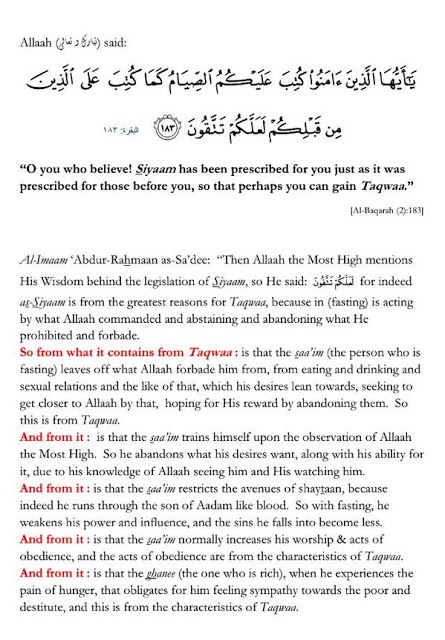
“O you who believe! Fasting is prescribed for you as it was prescribed for those before you in order that you may attain Taqwaa.” [Surah Al-Baqarah: 183]

The word “kutiba” (prescribed) here means “furida” obligated.

So when the young girl reaches the age in which she will be held accountable for her actions, by having one of the signs of puberty become apparent in her, among which is menstruation, then the obligation of fasting begins for her. She could begin menstruating as early as when she is nine years old. However, some young girls are not aware that they are required to begin fasting at that point, so she doesn’t fast thinking that she is too young, nor do her parents order her to fast. This is a great negligence, for one of the pillars of Islaam is being abandoned. If this occurs to any woman, she is obligated to make up for the days of fasting that she abandoned since the point when she began menstruating, even if a long time has passed since that time, for it remains in her obligations.

Who is obligated to fast Ramadaan?

When the month of Ramadaan comes, every male and female Muslim that (1) has reached the age of puberty, is (2) healthy and (3) a resident (i.e. not traveling) is obligated to fast. And whoever is sick or traveling during the month, may break the fast and make up the number of days missed on other days.

Allaah says: “So whoever sights the (moon indicating the beginning of the) month, then he must fast. And whoever is sick or on a journey, then (he may break the fast and instead fast) the number of days missed on other days.” [Surah Al-Baqarah: 185]

Likewise, whoever enters into Ramadaan and he is very old and not able to fast or has a chronic illness, which does not expect to be cured any specific time – whether male or female – may break the fast and instead feed a needy person half a saa’ (four handfuls) of the food from that people’s land for every day missed. Allaah says: “And as for those who can fast (but) with difficulty, they (may break their fast and) feed a needy person.” [Surah Al-Baqarah: 184] Ibn ‘Abbaas (radhi Allaahu anhuma) said: “This ayah is for the old man of whom it is not anticipated that he will be cured.” [Saheeh Al-Bukhaaree] And the sick person of whom it is not hoped that he will be cured from his sickness falls under the ruling of the old person. And he does not have to make up the missed days because of his inability to fast.

A woman is specified with certain excuses that permit her to break the fast in Ramadaan, on the condition that she makes up the days she missed fasting due to these excuses on other days. These excuses are:

1. Menstrual and Postpartum Bleeding: A woman is forbidden from fasting while she is in these two conditions. And she is obligated to make up these missed days of fasting on other days. This is based on what is reported in the two Saheeh collections from ‘Aa’isha (radhi Allaahu anha) who said: We were ordered to make up the (missed) days of fasting but we were not ordered to make up the (missed) prayers.” She gave this answer when a woman asked her: “Why does a menstruating woman have to make up the (missed days of) fasting and not have to make up the (missed) prayers?” So she (radhi Allaahu anha) clarified that this is from the matters dependent on revelation, which must comply with the reported texts.

As for the wisdom behind that, then Shaikh-ul-Islaam Ibn Taimiyyah said in “Majmoo’-ul-Fataawaa” (15/251):

“The blood that comes out of the woman because of menstruation has a discharge of blood in it. A menstruating woman can fast in times other than when the blood that comes out of her due to menstruation contains her blood. So her fasting in this situation is a moderate and balanced fast – no blood, which strengthens the body and which is its main substance – comes out of her during these times. But her fasting when she is menstruating necessitates that her blood come out during this time – the blood, which is the main component of her body and which will lead to a weakness and deficiency in her body. And this will necessitate that her fast not be that of a moderate and balanced nature. So that is why she is commanded to fast in times when she is not menstruating.”

2. Pregnancy and Breast-Feeding: If because of fasting there is harm caused to the woman or the baby or to both of them, then she may break the fast while she is pregnant or breastfeeding. But if the harm for which reason she is breaking her fast only applies to her baby and not her, then she must make up for the days she missed of fasting and feed a needy person for each day missed. And if the harm only applies to herself, then it is sufficient for her to only make up the missed days. This is based on the pregnant woman and breastfeeding woman falling under the generality of Allaah’s saying: “And for those who can fast (but) with difficulty, they (may break their fast) and instead feed a needy person.” [Surah Al-Baqarah: 184]

Al-Haafidh Ibn Katheer (rahimahullaah) said in his Tafseer (1/379):

“Amongst those who fall into the meaning of this ayah are the pregnant and breastfeeding women if they fear for themselves or for their children.”

And Shaikh-ul-Islaam Ibn Taimiyyah said:

“If a pregnant woman fears for her fetus, then she may not fast and instead make up each day of fasting that was missed on other days and feed a needy person around 2 kilograms of bread.” [Majmoo’-ul-Fatawaa: 25/318]

Important Notes:

1. Istihaadah (Irregular Bleeding): This is the condition in which a woman has blood come out of her, which is not her menstrual blood. She must observe the fast and it is not permissible for her to break her fast because of this type of bleeding. When mentioning the allowance of the menstruating woman of breaking her fast, Shaikh-ul-Islaam Ibn Taimiyyah (rahimahullaah) said:

“This is contrary to the woman in the state of Istihaadah, for this state comprises an unfixed period of time, and there is not a time in it in which she can be commanded to begin fasting (again). So because of this, it is not possible to caution against it, the same as for throwing up unexpectedly, emitting blood due to a wound, getting a boil, Ihtilaam (when sexual fluid comes out of the private parts not due to intercourse or foreplay), as well as all the other things that do not have a fixed time in which they could be cautioned against. So this (Istihaadah) was not made as something that nullifies the fast, such as the blood of menstruation.”

[Majmoo’-ul-Fataawaa: 25/251]

2. The Menstruating woman as well as the pregnant and breastfeeding women, if they break their fast in Ramadaan, must make up for the missed days of fasting in the time that occurs between the Ramadaan in which they broke their fast and the forthcoming Ramadaan. But to complete them early is better. And if there only remain a few days before the next Ramadaan begins, then they are obligated to make up the missed days of fasting (from the previous Ramadaan) such that the new Ramadaan will not come upon them while they still have to fast days from the previous Ramadaan. But if they don’t do this and Ramadaan comes upon them while they still owe days of fasting from the previous Ramadaan, and they have no (valid) excuse for delaying it, they are obligated to make up the missed days and to feed a needy person for each day. But if they have a valid excuse, then they must only make up the missed days of fasting. This goes the same for those who must make up the missed days of fasting due to sickness or traveling. Their ruling is like the ruling of the woman who broke the fast due to menses, with the previously mentioned details.

3. It is not permissible for a woman to observe a recommended fast if her husband is present unless she has his permission. This is based on what Al-Bukhaaree, Muslim and others have reported from Abu Hurairah (radhi Allaahu anhu) that the Prophet (Sallallaahu ‘alaihi wa Sallam) said: “It is not permissible for a woman to fast while her husband is present except with his permission.” In some narrations of the hadeeth in Ahmad and Abu Dawood, there occurs the wording “…except Ramadaan.” But if the husband permits her to observe a recommended fast or he is not present around her or if she doesn’t have a husband, then it is encouraged for her to observe this recommended day of fasting. This is especially for the days in which it is recommended to fast such as Mondays and Thursdays, three days in every month, six days in Shawaal, the tenth day of Dhul-Hijjah, the Day of ‘Arafah and the Day of ‘Aashooraa along with the day before or after it. However, she should not observe a recommended fast while she owes days to make up for (the previous) Ramadaan, until she first makes up these missed days and Allaah knows best.

4. If a menstruating woman stops bleeding during the day in Ramadaan, she must begin her fasting for the remainder of the day but still make it up with the days that she didn’t fast because of menses. Her fasting for the remainder of the day in which she stops bleeding is an obligation on her out of respect for the time (i.e. Ramadaan).

What is Prohibited and Disliked for the one Fasting : Shaikh Saalih Al-Fawzaan

Ittihaaf Ahlil-Eemaan bi-Duroos Shahri Ramadaan

Al-Ibaanah.com

All praise be to Allaah for His blessings and kindness. And may the peace and blessings be upon our prophet Muhammad, his family, Companions, and those who follow his guidance and stick to his Sunnah until the Day of Judgement. To proceed:

Know that there are certain manners to fasting that must be abided by and adhered to so that the fast could proceed in the way it was prescribed so that one could achieve its benefits, fulfill its objective and not find it discomforting and without benefit. This is as the Prophet (sallAllaahu ‘alayhi wa sallam) said: “Perhaps all a person fasting derives from his fast is hunger and thirst.”

So fasting is not just the abandonment of food and drink only. Rather, it also entails abandoning improper statements and actions that are forbidden or disliked.

One of the Salaf once said: “The least form of fasting is leaving off food and drink.” This is since drawing near to Allaah by abandoning allowable things cannot be complete unless after drawing nearer to Him by abandoning what Allaah has prohibited under every circumstance. Even though a Muslim is obligated to abandon the unlawful at all times, it is even more binding upon him while he is fasting.

If one commits the unlawful in times other than when he is fasting, he is sinning and worthy of being punished. But if he commits it while fasting, then on top of being sinful and deserving of punishment, this affects his fast by it being either deficient or nullified.

So the person who truly observes the fast is he who withholds his stomach from food and drink, refrains his limbs from sins, restricts his tongue from vile and evil speech, restrains his ears from listening to songs, musical instruments, backbiting and gossip, and holds back his eyes from looking at the forbidden.

The Prophet (sallAllaahu ‘alayhi wa sallam) said: “Whoever does not abandon false speech and acting upon it, then Allaah is not in need of him abandoning his food and drink.” [Reported by Al-Bukhaaree]

The person who is fasting must avoid backbiting, gossip and insulting others, based on what the two Shaikhs (Al-Bulkhaaree and Muslim) reported from Abu Hurairah (radyAllaahu ‘anhu) that he said, and it was raised as being a saying of the Prophet: “Fasting is armor. So if it is a day in which one of you is fasting, then he should not be vile in speech nor should he be sinful nor should he be ignorant. And if someone reviles him, then he should say: ‘I am a person that is fasting.’”

The word junnah (armor) is that which protects the one who wears it from the weapon of his opponent causing harm to him.

So fasting protects a person from falling into sins whose consequences are punishment in this world and the next. The word rafath in the hadeeth refers to lewd and immoral speech. Imaam Ahmad reported in marfoo’ form that the Prophet (sallAllaahu ‘alayhi wa sallam) said: “Verily, fasting is armor so long as it is not pierced.” It was said: “What causes it to be pierced?” He (sallAllaahu ‘alayhi wa sallam) said: “Lying and Backbiting.”

This is proof that backbiting pierces the fast or makes a dent in it. When armor is pierced it is of no more use to the one wearing it. So in the same manner, when one’s fast is pierced, it is no longer any benefit to the one performing it.

Backbiting is as the Messenger of Allaah (sallAllaahu ‘alayhi wa sallam) explained it, and that is mentioning about your brother what he hates. It has been reported in the Musnad of Imaam Ahmad that this breaks the fast:

“Two women were once fasting during the lifetime of Allaah’s Messenger and they almost died of thirst. This was mentioned to the Prophet (sallAllaahu ‘alayhi wa sallam) but he turned away from (allowing) them (to break the fast). Then they were mentioned to him again, so he called for them and ordered them to vomit, i.e. throw up, what was in their stomachs. So they both vomited and filled up a bowl with puss, blood and pieces of flesh. Then the Prophet (sallAllaahu ‘alayhi wa sallam) said: ‘These two fasted by refraining from what Allaah made lawful for them. but they broke their fast by doing what Allaah made unlawful for them. One of them sat with the other and they began to eat from the flesh of people.’”

What transpired with these two women in the presence of the Messenger of Allaah (sallAllaahu ‘alayhi wa sallam) from their vomiting vile and disgusting things – this was from the miracles that Allaah allowed to occur at the hand of His Messenger so that he could show the evil effects of backbiting to the people. Allaah says: “And do not backbite one another. Would one of you love to eat the flesh of his dead brother?” [Surah Al-Hujuraat: 12]

This hadeeth shows that backbiting breaks the fast. This is in the figurative sense, meaning it nullifies the reward of fasting.

May Allaah send His peace and blessings on our prophet, Muhammad, his family and Companions.

The Wisdom Behind Fasting : Shaykh ibn Uthaymeen

Bismillaah

Author:Imaam Muhammad Ibn Saalih Al-‘Uthaimeen
Source:Majaalis Shahr Ramadaan [pgs. 41-43] Abridged
Translator:isma’eel alarcon (al-manhaj.com)

From the wisdom of fasting is that: It is an act of worship done for Allaah, in which the ‘abd (servant) draws closer to His Lord by abandoning the things that he loves and desires, such as food, drink and sexual intercourse. So because of this, the truthfulness of his Faith and the completeness of his servitude to Allaah become apparent, as well as his love for Allaah and his longing for what Allaah has prepared for him (of good). This is since the one who fasts does not abandon something that is beloved to him except for that which is greater to him than it (which is Allaah). When the believer knows that Allaah’s contentment lies in the fasting – which is abandoning those desires that he naturally loves – he will give his Lord’s contentment precedence over his desires. So he abandons his desires no matter how much he longs and yearns for them, because his delight and the tranquility of his soul lies in his abandoning all that for the sake of Allaah.

And from the wisdom behind fasting is that it is a means of attaining Taqwaa, as Allaah says: “O you who believe! Fasting is prescribed for you as it was prescribed for those before you, in order that you gain Taqwaa.” This is since a person who is fasting is commanded to do the obligatory duties and to avoid sinful acts. The Prophet (Sallallaahu ‘alaihi wa Sallam) said: “Whoever does not abandon false speech, acting upon that (false speech) and (acts of) ignorance (i.e. sins), then Allaah has no need of him abandoning his food and drink.” [Reported by Al-Bukhaaree] So when a person is fasting, every time he desires to do a sinful act, he will remember that he is fasting and thus withhold himself from that. This is why the Prophet (Sallallaahu ‘alaihi wa Sallam) ordered the person who is fasting, when cursed at and abused, to say: “I am fasting”, cautioning him (the reviler) that a person fasting is commanded to refrain from cursing and reviling, and reminding himself that he is fasting and cannot react with cursing.

And from the wisdom behind fasting is that the heart opens to contemplation and remembrance (of Allaah). This is since fulfilling one’s desires leads to heedlessness and perhaps the heart becomes hardened and blinded from the truth. This is why the Prophet (Sallallaahu ‘alaihi wa Sallam) advised us to eat and drink little, where he said: “The Son of Aadam does not fill a vessel worse than his stomach.” [Reported by Ahmad, An-Nasaa’ee and Ibn Maajah]

And in Saheeh Muslim, Handhala Al-Usaidee (radhi Allaahu anhu), who was one of the scribes of Allaah’s Messenger, said to the Prophet (Sallallaahu ‘alaihi wa Sallam): “Handhala has become a hypocrite.” So Allaah’s Messenger (Sallallaahu ‘alaihi wa Sallam) said: “Why is that?” He said: “O Messenger of Allaah, when we are with you, you remind us of the Hellfire and Paradise, as if we see them with our own eyes. But when we depart from you, we meet our wives and our children and our homes and we forget much (of what we heard from you).” In the last part of the hadeeth, the Prophet (Sallallaahu ‘alaihi wa Sallam) said to him: “But O Handhala, there is a time for this and a time for that (three times).” Abu Sulaymaan Ad-Daraanee said: “Indeed, when the soul hungers and thirsts, the heart softens and becomes pure. And when it is fed, the heart becomes blinded.”

And from the wisdom behind fasting is that the person who has wealth is caused to realize the blessing of wealth that Allaah has bestowed on him, such that Allaah blessed him with food, drink and sexual intercourse. Many people are deprived of these things, so he should praise Allaah for these blessings and thank Him for granting him them. And he should remember his brother who is poor and who probably goes through the day starved and hungry. So he should be generous to him and give him charity so that he can clothe his barrenness and satisfy his hunger.

And from the wisdom behind fasting is that it trains one to curb the soul, and it gives one strength to withhold his soul by its bridle, such that one can govern it and lead it towards that which is good for it and what will make it prosper. This is because the soul commands one to do evil, except for those souls that my Lord has mercy on. So when a person undoes and lets go of his (soul’s) bridle, the soul lands him into many dangers. But when he controls it and curbs it, he is able to lead it to the highest of levels and the greatest of goals.

And from the wisdom of fasting is that the soul is broken down and restricted from having pride, to the point that it humbles itself to the truth and softens itself before the creation. This is because eating, drinking and having sexual intercourse with women – all of these things bring about insolence, arrogance, vanity and pride over people and over the truth. The soul preoccupies itself with trying to obtain these things because of its need for them. So when it obtains these things, the soul feels like it has conquered what it desired and so it falls into the happiness and proudness that is condemned. And this is a cause for its destruction. Only those whom Allaah protects are saved from this.

And from the wisdom behind fasting is that the passageways of blood (in the body) become narrow due to hunger and thirst, so therefore the passageways of the Devil in the human body also become narrower. This is since the Devil flows through the son of Adam like the flowing of blood, as is authentically recorded in the two Saheeh collections. So by fasting, the whisperings of the Devil are subdued and the strength of one’s desires and anger are subjugated. This is why the Prophet (Sallallaahu ‘alaihi wa Sallam) said: “O young men! Whoever amongst you can afford it, should get married, for it is the best means for lowering one’s gaze and the best way of keeping (one’s) private parts chaste. But whoever is not able to marry, then let him fast, for it has protection.”

And from the wisdom behind fasting are the health benefits that come as a result of it, which are attained by in-taking little food, allowing the digestive system to rest for a specified time, which lets excess wastes and excrements that are harmful to the body be discharged.

So how great and profound is the wisdom of Allaah, and how beneficial are His commandments to His creatures!

O Allaah, give us comprehension of Your Religion and allow us to understand the inner secrets of Your commandments. Rectify for us the affairs of our Religion and our worldly life. And forgive us and our parents and all the Muslims, by Your mercy, O Most Merciful. And may the peace and blessings of Allaah be on Muhammad (Sallallaahu ‘alaihi wa Sallam) and on his family and all his Companions.

The Wisdom and Benefits behind Fasting : Imaam Ibn Qayyim Al-Jawziyyah

Author:Imaam Ibn Qayyim Al-Jawziyyah
Source:Abridged from his book Zaad al-Ma’aad [Al-Muntaqaa Newsletter: 1/9]
Translator:abu maryam
Produced by:al-manhaj.com

The objective behind fasting is to restrain the soul from (its) desires and to prevent it from those things, which are beloved to it. And its purpose is to control the soul’s strength, so that it can be prepared to attain what is found in it (the fast) from success and joy for the soul. Through the fast, one curbs his hunger and thirst and is reminded of the condition of the hungry stomachs of needy people.

Through fasting, one narrows the passages the Devil has inside the servant (of Allaah) by narrowing the passages of food and drink. Also, it prevents the forces of the limbs from getting too accustomed to things that are harmful to it in this world and the hereafter. And each of the soul’s body limbs and energies can cease their rebelliousness (to Allaah) and be harnessed by its bridle.

So therefore, the fast is the bridle of those who fear and obey Allaah and the shield of those wage war (against desires). And it is a garden for the righteous and devoted servants of Allaah. And it is for the Lord of the worlds, over all other actions (done to please Allaah). This is since the person who fasts, in fact does nothing. He only abandons his desire and his food for the sake of the One whom he worships.

So fasting is an abandonment of those things that the soul loves and desires, preferring instead Allaah’s love and contentment. And it is a secret kept between the servant and his Lord – no one else is aware of it.

Fasting has an amazing effect in preserving one’s outer limbs and inner capacities as well as protecting the soul from being overtaken by destructive components, which can ruin and destroy it. And it has a remarkable effect in causing all the harmful things that prevent the soul from being healthy to be emptied out. So fasting guards and protects the health of the person’s heart and body limbs. And it returns the soul all that the hands of the desires has taken from it. So it is from the greatest ways of improving one’s Taqwaa, as Allaah says: “O you who believe! Fasting is prescribed for you as it was prescribed for those before you in order that you attain Taqwaa.” [Surah Al-Baqarah: 185]

The Prophet (Sallallaahu ‘alaihi wa Sallam) said: “Fasting is a shield.” And he commanded those who had intense desires for marriage but were not able to marry, to observe fasting, making it a shield against those desires (of marriage).

When the benefits of fasting are born witness to by sensible minds and upright intuitions, one will come to realize that Allaah prescribed it as a mercy for mankind, goodness to them and a protection and shield for them. The Prophet’s (Sallallaahu ‘alaihi wa Sallam) guidance concerning it was the most perfect of guidance, and the best for reaching the desired objective and the easiest on the soul.

Since restraining the soul from what it loves and desires is from the most difficult and hardest of things, its obligation was delayed until the middle of Islaam, after the Hijrah. This was at the point when the Tawheed and the Prayer had become firmly established in the souls of the Muslims and when they loved the commands of Allaah. So their souls were lead to its obligation in gradual steps. It became obligatory in the second year of Hijrah.

When the Messenger of Allaah (Sallallaahu ‘alaihi wa Sallam) died, he had fasted nine Ramadaans in total. Originally, it was obligated as an option left to the people to choose whether they wanted to fast or to feed needy people for every day. Then that option was transferred into the final obligatory fasting. And the matter of feeding people was left only for the old men and women who did not have the ability to fast.

Fasting had three stages. The first stage was its being obligated with the option of fasting or feeding a needy person. In the second stage, only the fasting was allowed, but if the person fasting slept before breaking his fast, he was forbidden from eating and drinking until the following night. This was abrogated in the third stage. And this is the stage at which the Religion has settled with until the Day of Judgement.

The Ruling on a Sick or Traveling Person Fasting : Imaam ibn Al-‘Uthaimeen

Imaam Muhammad bin Saalih Al-‘Uthaimeen
Fusool fis-Siyaam wat-Taraaweeh waz-Zakaat [Upcoming E-Book]
Al-Ibaanah.com

Lesson Three: The Ruling on a Sick or Traveling Person Fasting

Allaah, the Most High, says: And whoever amongst you is sick or on a journey, then (he may make up) the same amount of missed days on other days. Allaah wants ease for you and He doesn’t want to make things difficult for you.” [Surah Al-Baqarah: 185]

A sick person falls into two types:

First: Whoever has an illness that is permanent and there is no anticipation of it being cured (near term), like cancer for example, this person is not required to fast. This is because he does not have a condition in which it is expected that he will be able to do it (i.e. the fast). However, for every day missed, he must feed a needy person whether if it is by him gathering the same amount of needy people as the days he missed and feeding all of them at once as Anas bin Maalik (radyAllaahu ‘anhu) used to do when he was old, or it could be by dividing up the food for the needy people according to the days missed and then giving every needy person a quarter of a Prophetic saa’, i.e. what weighs about half a kilo and 10 grams of good wheat. It is better if one serves meat or fat along with it in order to compliment the meal. The same applies to an elderly person that is not able to fast, in that he should feed a needy person for every day missed.

Second: Whoever has a temporary illness that they will recover from, such as a fever and what resembles that. This kind of illness has three scenarios:

1. Fasting will not burden or cause harm to him. Such a sick person is obligated to fast since he has no excuse to abandon it.

2. Fasting will be difficult on him but it won’t cause any harm to him. In this situation it is detested for him to fast because one is actually refraining from using Allaah’s allowance, while at the same time he is burdening himself.

3. Fasting will harm him. In this situation, it is forbidden for him to fast because of the harm that he will be inflicting upon himself. Allaah says: “And do not kill yourselves. Verily Allaah is All-Merciful to you.”

[Surah An-Nisaa: 29]

And He says: “And do not throw yourselves into destruction with your own hands.” [Surah Al-Baqarah: 195]

And in a hadeeth, the Prophet (sallAllaahu ‘alayhi wa sallam) said: “There is to be no harming (of others) nor harming (of oneself).” Reported by Ibn Maajah and Al-Haakim, and An-Nawawee said: “Its paths of narrations strengthen one another.”

One can find out if fasting will be harmful to a sick person by (1) that person feeling it to be harmful on himself or by (2) him being informed of it by a trustworthy doctor. When a person who falls under this category of being sick breaks his fast, he must make up the number of days he missed when he recovers. But if he dies before he recovers then making up the missed days is no longer binding upon him, since he is only obligated to fast the number of days missed on other days, which he was not able to reach.

A traveler falls into two types:

First: Whoever intends by traveling to cheat his way out of fasting. It is not permissible for such a person to break his fast, since cheating one’s way out of Allaah’s obligations does not remove those obligations from him.

Second: Whoever does not intend the above by traveling. This person may fall into one of the following three situations:

1. Fasting is extremely difficult upon him. In this case, it is forbidden for him to fast since one time “The Prophet (sallAllaahu ‘alayhi wa sallam) was fasting while on the military expedition to conquer Makkah, when news reached him that the people found it difficult to fast and they were looking at him to see what he would do. So he (sallAllaahu ‘alayhi wa sallam) called for a cup of water after ‘Asr and drank from it while the people were looking at him. Later it was said to him: ‘Some people are still fasting.’ So he (sallAllaahu ‘alayhi wa sallam) replied: ‘Those are the disobedient ones. Those are the disobedient ones.’” [Reported by Muslim]

2. Fasting is difficult upon him, but not so severe. In this situation it is detested (makrooh) for him to fast since he is refraining from one of Allaah’s allowances, while putting a burden upon himself.

3. Fasting is not difficult upon him. In this case he may do whatever is easiest on him – whether it is fasting or choosing not to fast. This is based on Allaah’s statement: “Allaah wants ease for you and He doesn’t want to make things difficult for you.” [Surah Al-Baqarah: 185]

The word “want” here takes on the meaning of love (i.e. He loves ease for you). If there is no difference between fasting or not fasting, then fasting is more preferable, because this is what the Prophet (sallAllaahu ‘alayhi wa sallam) did, as is reported in Saheeh Muslim from Abud-Dardaa (radyAllaahu ‘anhu) who said: “We went out (on a journey) with the Prophet (sallAllaahu ‘alayhi wa sallam) during Ramadaan under intense heat conditions to the point that each of us would put his hand over his head (to cover it) due to the severe heat (of the sun). And no one would be fasting among us except for the Messenger of Allaah (sallAllaahu ‘alayhi wa sallam) and ‘Abdullaah bin Rawaaha.”

A traveler is considered to be traveling from the time he leaves his country to the time he returns to it. And if he takes up residency in the land he travels to for a period of time, he is considered to be traveling as long as he holds the intention that he will never reside there after the objective for which he traveled there for in the first place is fulfilled.

So he is entitled to all of the allowances a traveler has even if the length of his residency extends for a long time. This is since the Prophet (sallAllaahu ‘alayhi wa sallam) did not mention any time limit defining when a travel ends. And the foundation with regard to this issue is that one remains in a traveler’s state and under its rules until there comes a proof that the travel has ended and that its rules fail to apply.

There is no difference in breaking the fast while traveling between a time-constrained travel, such as Hajj, ‘Umrah, visiting a relative, business travel, and so on and between a continuous travel, such as journeys made by car service drivers such as taxis or other larger forms of transportation (i.e. buses). When these drivers exit from their countries, they all enter into the state of travelers and it is permissible for them to do whatever other travelers are permitted to do, such as not fasting during Ramadaan, shortening the four rak’ah prayers into two rak’ahs, and combining the Dhuhr and ‘Asr prayers and Maghrib and ‘Ishaa prayers, when there is a need for it.

Abstaining from the fast is better for them than fasting, if that is easier for them. And they can make up the days missed during the winter. This is because these car service drivers have their own country, which they ascribe to. So when they are in their country, then they are considered residents and whatever applies for or against all other residents also applies for and against them. And when they travel, they are considered travelers and whatever applies in favor or against travelers also applies in favor or against them.

The Inner Secrets of Fasting : Imam Ibn Qudamaah Al-Maqdisee

Bismillaah

Imam Muwaffaq-ud-Deen Ibn Qudamaah Al-Maqdisee
This article is taken from the book Mukhtasar Minhaajul-Qaasideen (p. 38-41)
This article was translated by Isma’eel Ibn al-Arkaan, al-ibaanah.com


Know, that in the fast (Sawm) is a special quality that is not found in anything else. And that is its close connection to Allaah, such that He says:

‘‘The Fast (Sawm) is for Me and I will reward it.’’ [2]

This connection is enough to show the high status of fasting. Similarly, the Ka’bah is highly dignified due to its close connection to Him, as occurs in His statement:

‘‘And sanctify My House.’’ [3]

Indeed, the fast is only virtuous due to two significant concepts:

THE FIRST:
It is a secret and hidden action, thus, no one from the creation is able to see it Therefore riyaa‘ (showing off) cannot enter into it.

THE SECOND:
It is a means of subjugating the enemies of Allaah. This is because the road that the enemies (of Allaah) embark upon (in order to misguide the Son of Aadam) is that of desires. And eating and drinking strengthens the desires. There are many reports that indicate the merits of fasting, and they are well known

THE RECOMMENDED ACTS OF FASTING:

The pre-dawn meal (suhoor) and delaying in taking it are preferable, as well as hastening to break the fast and doing so with dates. Generosity in giving is also recommended during Ramadhaan, as well as doing good deeds and increasing in charity. This is in accordance with the way of the Messenger of Allaah. It is also recommended to study the Qur‘aan and perform I‘tikaaf (seclusion for worship) during Ramadhaan, especially in its last ten days, as well as increasing upon the exertion (towards doing good deeds) in it. In the two Saheehs, ’Aa‘ishah said: ‘‘When the last ten days (of Ramadhaan) would come, the Prophet would tighten his waist wrapper (izaar)’’ [4] The scholars have mentioned two views concerning the meaning of ‘tighten his wrapper (izaar)’ The first is that it means the turning away from women. The second is that it is an expression denoting his eagerness and diligence in doing good deed. They also say that the reason for: the last ten days of Ramadhaan was due to his seeking of the Night of al-Qadr (Laylatul-Qadr).

AN EXPLANATION OF THE INNER SECRETS OF FASTING AND ITS CHARACTERISITCS:

There are three levels of fasting, the general fast, the specific fast and the more specific fast. As for the general fast, then it is the refraining of ones stomach and their private parts from fulfilling their desires. The specific fast is the refraining of ones gaze, tongue, hands, feet, hearing and eyes, as well as the rest of his body parts from committing sinful acts. As for the more specific fast, then it is the heart’s abstention from its yearning after the worldly affairs and the thoughts which distance one away from Allaah, as well as its (the heart’s) abstention. From all the things that Allaah has placed on the same level. [5] From the characteristics of the specific fast is that one lowers his gaze and safeguards his tongue from the repulsive speech that is forbidden, disliked, or which has no benefit, as well as controlling the rest of his body parts. . In a hadeeth by al-Bukhaaree: ‘‘Whosoever does not abandon false speech and the acting upon it, Allaah is not in need off his food and drink.’’ [6]

Another characteristic of the specific fast is that one does not overfill himself with food during the night. Instead, he eats in due measure, for indeed, the son of Aadam does not fill a vessel more evil than his stomach. If he were to eat his fill during the first part of the night, he would not make good use of himself for the remainder of the night. In the same way, if he eats to his fill for suhoor, he does make good use of himself until the afternoon. This is because excessive eating breads laziness and lethargy therefore, the objective of fasting disappears due to one’s excessiveness in eating, for what is indeed intended by the fast, is that one savours the taste of hunger and becomes an abandoner of desires.

RECOMMENDED FASTS:

As for the recommended fasts, then know that preference for fasting is established in certain virtuous days. Some of these virtuous days happen every year, such as fasting the first six days of Shawwaal after Ramadhaan, fasting the day of ’Arafah, the day of ’Ashooraa, and the ten days of Dhul-Hijjah and Muharram. Some of them occur every month, such as the first part of the month, the middle part of it, and the last part of it. So whoever fasts the first part of it, the middle part of it and the last part of it, then he has done well. Some fasts occur every week, and they are every Monday and Thursday. The most virtuous of the recommended fasts is the fast of Daawood. He would fast one day and break his fast the next day. This achieves the following three objectives, the soul is given its share on the day the fast is broken. And on the day of fasting, it completes its share in full. The day of eating is the day of giving thanks and the day of fasting is the day of having patience. And Faith (eemaan) is divided into two halves- that of thankfulness and that of patience. [7] It is the most difficult struggle for the soul. This is because every time the soul gets accustomed to a certain condition, it transfers itself that. As for fasting every day, then it has been reported by Muslim, from the hadeeth of Aboo Qataadah that ’Umar (radiyallaahu ’anhu) asked the Prophet (sallallaahu ’alayhi wa sallam): What is the case if one were to fast everyday? So he (sallallaahu ’alayhi wa sallam) said: ‘‘He did not fast nor did he break his fast or, he did not fast and he did not break his fast.’’ [8] This is concerning the one who fasts continuously, even during the days in which fasting is forbidden.

CHARACTERISITCS OF THE MORE SPECIFIC FASTS:

Know that the one who has been given intellect, knows the objective behind fasting. Therefore, he burdens himself to the extent that he will not be unable to do that which is more beneficial than it. Ibn Mas’ood would fast very little and it is reported that he used to say: ‘‘When I fast, I grow weak in my prayer. And I prefer the prayer over the (optional) fast.’’ Some of the Companions would weaken in their recitation of the Qur‘aan when fasting. Thus, they would exceed in breaking their fast (i.e.. by observing less optional fasts), until they were able to balance their recitation. Every individual is knowledgeable of his condition and of what will rectify it.

Footnotes:

[1] This article is taken from the book Mukhtasar Minhaajul-Qaasideen (p. 38-41) of the illustrious scholar and righteous Imaam, Ibn Qudaamah al-Maqdisee (d.529H). This article was translated by Isma’eel Ibn al-Arkaan and edited by Abu Khaliyl. There were also slight adaptions made to it, such as the exclusion of a couple of statements.

[2] Related by al-Bukhaaree (4/118) and Muslim (no. 1151).

[3] Sooratul-Hajj: 26

[4] Related by al-Bukhaaree (4/322) and Muslim (no. 1147).

[5] (Editors note: Additional comment is required here, The levels mentioned are levels of abstinence. The first of these three levels entails the abstinence which is fulfilled, the fast is considered complete in view of the one having met the legislated requirements [i.e. It does not have to be repeated or made up, the servant has indeed fasted.] The remaining levels deal with the value of the Fast. If the second is level is not met, the fast will be of less value to the servant, than if it were met and likewise for the third. Thus it is said that intentional eating and intercourse render the fast null and void, whereas committing other unlawful acts such, likes speaking falsely, placing the unlawful look to the opposite sex. And so on will constitute a sin of one degree or another, but not nullify the fast.

[6] Related by al-Bukhaaree (4/99)

[7] {Editors note: This statement is based upon an unauthentic Hadeeth, which has been reported by al-Kharaa‘itee and ad-Daylamee. One of its narrators was graded ‘‘abandoned’’ by an-Nisaa‘ee and adh-Dhahabee. Al-Manawee and al-Albaanee approved of its grading. See ad-Da’eefah (no. 625).

[8] Related by Muslim

Ramadhan Index Pagehttps://abdurrahman.org/ramadhan


Fasting: The Great Act of Worship : Shaykh ibn Uthaymeen

By Shaykh Muhammad ibn Saalih Al- ‘ Uthaymeen

This revised edition, produced with the permission of the author and the translator, includes some corrections to the original translation, changes to the English, the addition of the Qur’aanic text, changes to the translations of the meanings of the Qur’aan and hadeeths, changes in the system of transliteration of Arabic terms, and the addition of references and some explanatory notes.

In response to our request to publish this revised edition, Shaykh Ibn ‘Uthaymeen wrote : “ Wa- alaykum us – salaam wa rahmatullaahi wa barakaatuh. As Dr. Saleh As–Saleh  has authenticated the translation of the booklet, I have no objection for you to print it on the condition that it will not have any copyright if we want to print it again. Written by Muhammad ibn Saalih Al – Uthaymeen, dated 1/9/1418 hijri. The booklet mentioned is the booklet on fasting.”

Shaykh Muhammad ibn Saalih Al- ‘Uthaymeen.  

بسم الله الرحمن الرحيم

 All praise is due to Allaah, and may Peace and blessings be on His Messenger Muhammad.

THE VIRTUES OF RAMADHAAN

Abu Hurayrah رضي الله عنه narrated that Allah’s Apostle صلي الله عليه وسلم said, “ When the month of Ramadhaan starts, the gates of Jannah (Paradise) are opened and the gates of Hell are closed, and satans are chained.”(1) The gates of Jannah are opened in this month because a great deat of righteous deeds are performed, and as an encouragement for those who seek Allaah’s reward. The gates of Hell are closed because few sins are committed by believers. The Satans will be chained so that they may noy have the chance they have in other months to whisper into the hearts of the believers and misguide them.

Allaah has prescribed fasting and it obligatory upon all nations. He said :

) يَا أَيُّهَا الَّذِينَ آمَنُوا كُتِبَ عَلَيْكُمُ الصِّيَامُ كَمَا كُتِبَ عَلَى الَّذِينَ مِنْ قَبْلِكُمْ لَعَلَّكُمْ تَتَّقُونَ) (البقرة:183)

O you who believe ! fasting has been prescribed for you as it was prescribed for those before you, that you may become Al – Muttaqoon (the pious). [Al- Baqarah (2) : 183]

If fasting were not a great act of worship, and the reward thereof were not so great, Allah would not have Presceibed it on all nations.

Among the virtues of fasting is that it is a means for atonement of sins. It is narrated on the authority of Abu Hurayrah رضي الله عنه that the Prophet صلي الله عليه وسلم said : “ He who observes the fast of the month of Ramadhaan out of sincerity and hope for the reward from Allaah will have his past sins forgiven.”(2) That is, when fasting is observed out of belief and without resentment to it as an act of worship or doubt in its reward, Allaah will forgive the past sins of the one who observes it.

Abu Hurayrah رضي الله عنه reported the Prophet صلي الله عليه وسلم as saying : “ Allaah said: All the deeds of Adam’s children belong to them, except fasting, which belongs to me and I will reward it. Fasting is a shield (against the Hell and against the commission of sins). If one of you happens to be fasting he should avoid sexual relations with his wife, and should avoid quarrelling. Should someone fight or quarrel with him let him say, ‘ I am fasting.’ By Him in Whose hand my soul is, the smell of the month of a fasting person is better in the sight of Allaah than that of the musk.”(3) It is a shield because it safeguards the believer from vain talk and wrongdoing, and hence protects him from Hell.

Of all the good deeds, Allaah has favored fasting to be greatly rewarded by Him and distinguished it with prestige when it is observed with the pure intention to please Him alone.

Fasting is so meritorious for a believer that he will have two occasions of joy. The first is at the time of breaking his fast, when he enjoys the bounties of Allaah because he has been favored with Allaah’s mercy to observe the fast while many others have been deprived of this great blessing. He will rejoice in the second occasion when he meets his Lord and enjoys the abundant reward for having observed fasting (4). In addition to this, fasting intercedes with Allaah on behalf of the believer on the Day of Judgment.(5)

WHEN DOES FASTING BEGIN AND END ?

Fasting begins upon sighing the new moon. Allaah said:

) فَمَنْ شَهِدَ مِنْكُمُ الشَّهْرَ فَلْيَصُمْهُ)(البقرة: من الآية185)

 So whoever of you sights (the crescent on the first night of) the month (of Ramadhaan), he must fast that month. [Al- Baqarah (2) : 185]

However, it is not incumbent on everyone to sight the new moon. Rather, if a trustworthy Muslim testifies that he has sighted it, then everyone must observe fasting. Abu Hurayrah رضي الله عنه narrated : “ A Bedouin came to the Prophet صلي الله عليه وسلم and reported, ‘ O Prophet, I have seen the new moon of Ramadhaan.’ Thereupon the prophe صلي الله عليه وسلم asked the man, ‘Do you bear witness that “ Laa ilaaha illaaah”. ( i.e. there is no god worthy of being worshipped beside Allah) ?’ ‘ I do,’ said the bedouin. The Prophet صلي الله عليه وسلم further asked him whether he testifies that Muhammad is the Messenger of Allah. The Bedouin affirmed that, too. Thereupon, the Prophet صلي الله عليه وسلم asked Bilaal رضي الله عنه to announce to the people to begin their fast the next day.”(6)

Ibn ‘ Umar رضي الله عنه also confirmed the practice of sighting the new moon in his report : “ The People were seeking the new moon. Having sighted it myself, reported it to the prophet. صلي الله عليه وسلم He began his fast and ordered the people to begin theirs, too.”(7)

He who sights the new moon of Ramadhaan must inform those in authority in the Muslim government or community. Once the Muslim government announces the beginning of Ramadhaan upon the sighting the new moon it becomes binding on the rest of Muslims to begin their fast.(8)

It should be borne in mind, however, that astronomical calculations must be ruled out from the sharee’ah and must not be relied on for sighting the moon, as the Prophet صلي الله عليه وسلم has ruled that Muslims must begin their fast upon seeing the new moon, not upon calculating the month astronomically. It is only when it becomes hard to see the new moon due to weather conditions when Muslims may complete the month of Sha’baan, which precedes Ramadhaan, as Thirty days.(9) The lunar month is either 29 or 30 days. It has neither fewer nor more days.(10)

WHO SHOULD FAST AND WHO SHOULD NOT ?

Fasting is obligatory on the mature sane and healthy Muslim. Those who are immature (i.e. young children) are encouraged to fast. Exempted are those who suffer terminal illness, or are too old to fast. Allah does not overburden His slaves.

Permission to abstain from fasting is granted to the travelers who do not travel for the purpose of breaking their fast. Even though it is permissible to break fast durning travel, it is praiseworthy to fast while traveling if no hardship imposed. In any case, travelers should make up the days they missed fasting in Ramadhaan once Ramadhaan is over and they are back home.

As for those whose sickness does not allow them to fast, they fall into three categories:

  1. If it is neither hard nor harmful for them, they must observe fasting.
  2. If it is hard, but not harmful for them, they are permitted to break their fast.
  3. If it is harmful for them, then they must abstain from fasting.

It is stated in the Qur’aan:

) يَا أَيُّهَا الَّذِينَ آمَنُوا لا تَأْكُلُوا أَمْوَالَكُمْ بَيْنَكُمْ بِالْبَاطِلِ إِلَّا أَنْ تَكُونَ تِجَارَةً عَنْ تَرَاضٍ مِنْكُمْ وَلا تَقْتُلُوا أَنْفُسَكُمْ إِنَّ اللَّهَ كَانَ بِكُمْ رَحِيماً) (النساء:29)

) وَلا تُلْقُوا بِأَيْدِيكُمْ إِلَى التَّهْلُكَةِ)(البقرة: من الآية195)

Do not kill yourselves. [An- Nisaa’ (4) : 29] – Baqarah (2) : 195]

The prophet صلي الله عليه وسلم was reported to have said, “ There is (to be) no harm or reciprocating harm.”(13)

The days that are missed in Ramadhaan must be made up once Ramadhaan is over.

During the monthly period or period of post-natal bleeding, women are to abstain from fasting,(14) but must make up the days they missed after the fasting month is over. The Pregnant or breastfeeding woman whose health or the health of the suckling baby might be affected by fasting should break her fast and make up the missed days after Ramadhaan.

It is also recommended for those who engage in combat in the way of Allah to break their fast. The Prophet صلي الله عليه وسلم told his companions in one of the battles, “ You are going to meet your enemy in the morning, abstaining from fasting is better for your strength, so break your fast.” (15)

THE WISDOM BEHIND FASTING

Fasting is a great act of worship the Muslim performs by turning away from his own desires in order to please his Lord, hoping for His reward. Common sense dictates that one would not give up desired things except for the sake of more desirable ones, in this case the pleasure of Allah, which is the most sought after desire.

It is also a means if achieving piety and righteousness. The Prophet صلي الله عليه وسلم said, “ He who does not give up forged speech and evil actions, Allah needs not his refraining from eating or drinking.”(16) In other words, Allah does not accept his fast.

The heart, through fasting, is inclined to maintain its tenderness since the desires are not sought, but rather shunned, and thus the heart tends to be more receptive to the words of Allah.

The rich person will, through fasting, be more appreciative of Allaah’s graces and bounties. He also will suffer the deprivation the poor and needy experience under normal circumstances. Thus he will be motivated to help them. Fasting helps depress pride or egoism and maintains humbleness. Moreover, fasting has health advantages by means of decreasing the intake of food and relaxing the digestive system. Great is the wisdom of Allah, and great are His Graces !

OBLIGATORY CONDITIONS OF FASTING

Performing the other acts of worship and duties is most important, and salaah is of particular importance, as without it no other act of worship is accepted by Allah.(17) Praying in congregation is a great aspect in our religion. Everyone should attend.(18) Its reward is twenty seven times greater than that which is performed individually.(19) At one time the prophet صلي الله عليه وسلم was about to burn the houses on those who did not attend the congregational prayers.(20)

Refraining from bad behavior such as lying, cheating, music, smoking, backbiting and slandering others to create animosity among them. The Prophet صلي الله عليه وسلم said, “ No slanderer shall enter paradise.”(21) The prophet صلي الله عليه وسلم said, “ There will exist in ummah those who will deem unlawful things lawful (such as) fornication, silk for men, intoxicating beverages and musical instruments.”(22) my

PRAISEWORTHY ETIQUETTE OF FASTING

* Taking the meal of suhoor. The prophet صلي الله عليه وسلم said: “ Take (the meal of) suhoor because there is blessing in it.”(23) He also said: “ The difference between our fasting and that of the people of the book is taking the meal of suhoor.”(24) Even taking a cup of water in lieu of a meal for suhoor has blessing in it, too.

  • Breaking the fast as soon as the sun sets.(25)
  • Making du’aa upon breaking fast.(26)
  • Reciting as much Qur’aan as possible during the monthe of Ramadhaan.

PRACTICES WHICH BREAK THE FAST

  1. Sexual intercourse in the daytime. The willful violation of the fast by this practice requires the fast of sixty consecutive days in order to make up for the day in which the intercourse took place.(27)
  2. Whllful ejaculation by means of kissing or caressing, etc. Wet dreams and unintentional ejaculation do not break the fast.
  3. Eating, drinking, smoking or taking any food substitutes, such as receiving blood, glucose, or I. V. substances while observing the fast.
  4. Willful, not unintentional, vomiting.
  5. Menstrual bleeding.(28)

Days in which the above practices 2 through 5 took place are to be made up a day for a day once Ramadhaan is over.

On the other hand, the application of kuhl ( surmah), eye, ear or nose drops do not break the fast; they are neither food nor a substitute thereof. Wearing perfumes, using the siwaak or toothbrush without toothpaste do not break fast since it has been reported that the Prophet صلي الله عليه وسلم used to do so.(29)

QIYAAM OR TARAAWEEH PRAYER

Allah has made five daily prayers obligatory on the Muslims, which He, due to His Grace, made the reward thereof fifty-fold.(30) He also encourages the believers to perform supererogatory of naft prayers. Among these is the night prayer which falls between midnight and dawn. Allah praised those who engage themselves in prayer at night:

) تَتَجَافَى جُنُوبُهُمْ عَنِ الْمَضَاجِعِ يَدْعُونَ رَبَّهُمْ خَوْفاً وَطَمَعاً)(السجدة: من الآية16)

Their sides forsake their beds to invoke their Lord in fear and hope …. [As- Sajdah (32):16]

The prophet صلي الله عليه وسلم said : “ The best prayer next to obligatory is the night prayer.”(31) In another tradition he said : “O people ! Spread the (Islamic) greeting (i.e. by saying ‘ assalaamu alaykum”), give the food (to those who need it), connect your relatives (by visitation) and pray at night while the others are asleep, and you shall enter Jannah peacefully.”(32) Of the night prayer is Witr, the minimum of which is one rak’ah and maximum of which is eleven rak’ahs.(33)

Performing night prayer in Ramadhaan is far more superior to the performing in any other month by virtue of its recommendation by the prophet, صلي الله عليه وسلم who said, “Whoever prayed at night in it ( i. e. Ramadhaan) out of sincere faith and hoping for a reward from Allah, then all his previous sins will be forgiven.”(34)

Taraaweeh prayer is considered the night prayer in Ramadhaan, and, therefore, one should take good care the observe it, To pray taraaweeh in jamaa’ah (congregation) is a sunnah initiated by our beloved prophet صلي الله عليه وسلم and revived by the second Rightly-Guided Khaleefah, Umar رضي الله عنه (35) Though there has been a difference if opinion among the scholars in the past as to how many rak’ahs taraaweeh should be, all of them unanimously agreed that the best is to apply the sunnah of performing it with eleven rakahs only. The prophet صلي الله عليه وسلم did not pray more than eleven rak’ahs in Ramadhaan or any other month. ‘ Aa’ishah, the wife of the prophet صلي الله عليه وسلم said, “ The prophet never prayed more than eleven rak’ahs at night in Ramadhaan or in any other month.(36)

The full reward of taraaweeh is obtained only when it is performed in jamaa’ah. The person who performs it in jamaa’ah will be considered, according to authentic tradition, as if he spent the rest of that night praying.”(37)

THE VIRTUES OF RECITING THE QUR’AAN.

There are two types of Qur’aan recitation :

1. Practical recitation, which means reading with belief in and application of the orders of Allah and refraining from the unlawful things.

2. Word recitation.

There are many hadeeths in which emphasis is laid on the great reward for those who recite the Qur’aan. The prophet صلي الله عليه وسلم said, “ The best of you is he who learns the Qur’aan and teaches it.”(38) He also said : “ The one who excels in reciting the Qur’aan will be in the company of the honored angels.”(39) And, “ The example of the believer who reads the Qur’aan is like that of the utrujah (a citrus fruit) which has a beautiful fragrance and a beautiful taste. While the example of the believer who does not read the Qur’aan is like that of the date fruit : It has sweet taste, but has no fragrance.”(40) He also said : “ He who recites One letter of the Book of Allaah, will be rewarded for it, and the reward will be multiplied in folds.”(41)

There are certain soorahs of the Qur’aan that have more reward for their recitation. The prophet صلي الله عليه وسلم verified that Satan does not enter the house wherein Soorat Al- Baqarah(42) is recited. When one recites Ayaatul-Kursi(43) at the night, as the prophet صلي الله عليه وسلم informed us, he shall be protected by Allah, and Satan shall not come near him till he wakes up in the morning.(44) The same results may be achieded by the recitation of the last two verses of Soorat Al- Baqarah,(45) as well as the last three soorahs of the Qur’aan.(46)

Our pious predecessors used to busy themselves extensively in reciting the Qur’aan during the month of Ramadhaan. It was customary for them not to go beyond ten verses before they learned the rulings and the knowledge those ten verses contained.

ETIQUETTES OF READING THE QUR’AAN

The Qur’aan which we recete contains the actual words of Allah revealed to Muhammad صلي الله عليه وسلم . Therfore, we should observe the following when recition it :

1. Seek refuge in Allah before reading it (viz. أعوذ بالله من الشيطان الرجيم

“ A’oothu billaahi minash – shaytaanir-rajeem)”

2, Have the intention that the recitation thereof is purely to seek the pleasure of Allah alone.

3. Recite with an alert heart that you may comprehend its contents, imagining while reciting it that Allah is speaking to you though the Qur’aan.

4. Make sure you are clean before touching the Qur’aan. Do not read it when you are in the state of impurity.(47)

5. Do not read the Qur’aan in lavatories or similar places.

6. Read it slowly with pleasant sound and rhythm.

7. Prostrate wherever a verse requires prostration.

THE VIRTUES OF THE LAST TEN DAYS OF RAMADHAAN AND LAYLAY AL-QADR

It has been reported that the Prophet صلي الله عليه وسلم used to put extra effort in his devotion in the last ten days of Ramadhaan.(48) He used to awaken his family in the night that they may not lose the benefit of those bledded nights.(49) It is also reported that he used to make ‘ ittikaaf by spending the last ten days in the masjid.(50)

Laylat al Qadr means the night of honor and decree. It is sometimes erroneously into the night of power. The Prophet صلي الله عليه وسلم recommended to be sought in the last ten days of Ramadhaan. This night is valued to be better than a thousand months spent in devotion to Allah. One of the privileges of this night is that the Qur’aan was revealed in it. In it too, the angels descend to earth with blessings, goodness and mercy (51) . It is a peaceful night in which many are saved from the Hell. Forgiveness of past sins is granted to those who spend it busying themselves in prayer and the remembrance of Allah. (52) The prophet صلي الله عليه وسلم said, “Seek it in the odd nights of the last third of Ramadan.(53)

Reference:

1. Saheeh Al- Bukhaari (Arabic/English), vol. 3, # 123, and Saheeh Muslim (English trans.) # 2361 & 2362. one wording of Muslim is “ the gates of mercy are opened.”

 2. Saheeh Al- Bukhaari (Arabic/English), vol. 3, # 125.

3. Saheeh Al – Bukhaari (Arabic/ English), vol.3, # 118 and #128, and Saheeh Muslim (English trans) # 2567.

4. Saheeh Al Bukhaari (Arabic/English), vol. 3, # 128, and Saheeh Muslim (English trans). # 2567.

5. The Porphet صلي الله عليه وسلم said, “ Fasting and the Qur’aan intercede for the servant on the Day of Resurrection. Fasting will say : O my Lord ! I prevented him from food and desires, so accept my intercession for him ; and the Qur’aan will say : I prevented him from sleep at night, so accept my intercession for him. So their intercession will be accepted.” Reported by Ahmad, Al Haakim, Abu Nu’aym and others from ‘ Abdullaah ibn ‘ Amr. Its chain of narrators is hasan. [Fasting in Ramadaan by Shaykhs saleem Al- Hilaalee and ‘ Alee Hasan ‘ Alee ‘ Abdul – Hameed, p. 5]

6. Sunan Abee Daawud (English trans), # 2333 and # 2334. It is weak according to Al- Albanni.

7. Sunan Abee Daawud (English trans), # 2335. Its chain of narration is saheeh.

8. “Some scholars take into account the divisions amongst the Muslim countries related to the beginning and end of fasting. They advise that in the absence of one Khilaafah governing all Muslims, It is incumbent upon Muslims to follow their repective coutries as to when to fast and when to break the fast. This minimizes the divisions occurring within the same country where people fast according to different rulings.” (See Shaykh Al – ‘ Uthaymeen’s Ash- Sharh Al- Mummti” ‘ alaa zaadil- Mustaqni,” vol.6, p. 322 and Shaykh Al – Albaani’s Itmaa’tul- Minnah fee at- Ta’leeq ‘ alaa fiqhis-sunnah, p. 398). According to Shaykhul- Islaam Ibn Taymiyyah, “ The criteria upon which fasting becomes bound upon Muslims is that the informantion regarding the moon sighting reaches them in a reasonable amount of time to be able to act upon it.”

( Jaami lilikhtiaaraat Al- Fiqhiyah li-Shaykhul – Islaam Ibn Taymeeyah by Dr. Ahmad Mawaafi [ Dammam, Saudi Arabia: Daar Ibn Jawzi, 1413/1993], pp. 438-444.) And Allah knows best.

9. Saheeh Al- Bakhaari (Arabic/English), vol. 3, # 130,133, and Saheeh Muslim (English trans.), # 2363-2381. It should also be noted that it is not permissible to fast a day or two before Ramadhaan thinking that it might be Ramakhaan. Abu Hurayrah رضي الله عنه reported that the prophet صلي الله عليه وسلم said, “ None of you should pre-empt Ramadhaan by fasting a day or two before it, except for a man fasting his usual fast, then let him fast that day.” ( Saheeh Al- Bukhaari (Arabic/English), vol. 3, # 138)

10. Saheeh Al- Bukhaari (Arabic/ English), vol. 3, # 132, 134-135, and 137, and Saheeh Muslim (English trans) # 2384-2390.

11. Saheeh Al- Bukhaari (Arabic/English, vol. 3. # 181.

12. The Prophet # was asked about fasting on a journey and he said , “ Fast if you wish and break it if you wish “ . Saleh Al – Bukhaari (Arabic / English ) Vol . 3 # 164 and Saheeh Muslim ( English Tans. ) # 2487 ] Ibn Abbas رضي الله عنه said , “ Do not condemn one who obsees fast’ or one who does not observe it (in a journey ), for the messenger of Allah # observed it (in a journey), for the messenger of Allah # Observed fast in a journey or he did not observe it (too). [ Saheeh Muslinm (English Trans.) # 2471 ]

13. Ahmad, ibn Maajah; Saheeh [ Saheeh Al- Jaami. As sagheer, # 7517]

14. Saheeh Al- Bukhaari (Arabic/English), vol, 3. # 172. for more information on this subject, refer to The Natural Blood of Women by Shaykh ibn ‘Uthaymeen, translated by Dr. Saleh As- Saleh [ Buraidah , Saudi Arabia ; Dar Al- Bukhari, 1994]

15. Saheeh Muslim (English trans), # 2486

16. Saheeh Muslim (English trans), # 2486. In a fatwah (religious ruling), the Shaykh further explained that the fasting of a person who engages in forbidden speech is not invalidated, but its reward is diminished. The gravity of his sin may be such that it outstrips any reward for his fasting. [ Fataawa As – Siyaam ( Riyadh : Maktabt Al- Furqaan, n.d.)]

17. This is based upon the ruling of one group of scholars that whoever abandons the salaah is a kaafir, and thus, none of his deeds are accepted. The basis for this ruling is several hadeeths in which the prophet صلي الله عليه وسلم indicated that abandoning the prayer is disbelief, such as, “ Between a man and shirk and kufr is only the abandonment of the salaah.” [ Muslim and Ahmad; Saheeh Al Jaami As sagheer, # 2848] Another group of scholars divides those who do not pray into categories, judging them according to their intention. An excellent discussion of the two opinions can be found in the book on the issue of Takfeer by Shaikh Ahmad Fareed [ Suffolk , U. K : Jam’iat Ihyaa’ Minhaaj Al- Sunnah, 1997]

18. Saheeh Al – Bukhaari (Arabic/English), vol.3, # 127. This statement is directed to men. As for the woman, the best place for her to pray is in her home. The prophet صلي الله عليه وسلم said, “ Do not prevent your women (from going to) the masjids, but their houses are better for them.” [Ahmad, Abu Daawud, Al- Haakim saheeh. Saheeh al- Jaami As- Sagheer, # 7458]

19. Saheeh Al- Bukhaari (Arabic/ English), vol, 1. # 618, and Saheeh Muslim (English trans), # 1365

20. This was because of the gravity of their sin. Saheeh Al – Bukhaari (Arabic/ English), vol. 1, # 617. and Saheeh Muslim (English trans), # 1369.

21. Saheeh Al- Bukhaari (Arabic/English, vol, 8, # 82, and Saheeh Muslim (English trans), # 189 Also refer to The Bad Consequences of the Tongue by Shaykh Ahamad Zamzami ( Suffolk , U.K: Jam’iat Ihyaa’ Minhaaj al- Sunnah, 1995) and Gossip and its Adverse Effect on the Muslim Community by Husayn Al- Awayishah [ Bvirut: Ibn Hazm Publishing House, 1997]

22. Saheeh Al- Bukhaari (Arabic/ English), vol. 7, # 494 (B).

23. Saheeh Al- Bukhaari (Arabic/ English), vol, 3, # 146 , and saheeh Muslim (English trans.), #2412. The blessing in it is form obeying the prophet’s orders and following his example, as well as the physical blessing, which is nutrition for the body in order to have the strength to fast. [See Fataawa As- Siyaam, P 40]

24. Saheeh Muslim (English trans.) # 2413.

25. Saheeh al- Bukhaari (Arabic/ English), vol . 3,#178. and Saheeh Muslim (English trans), #1491.

26. Sunan Abee Daawud (English trans). #2350. Also reported by Al- Bayhaqi, Al- Haakim and others, and Daraqutni declared its isnaad (Chain of narrators) to be hasan (acceptable).

27. Saheeh Al- Bukhaari (Arabic/English), vol, 3, #157, and Saheeh Muslim (English trans), # 2457.

28. Saheeh Al- Bukhaari (Arabic/English), vol. 3, #172. This is regardiless of what time of day menses begins. This rule also applies to post-natal bleeding.

29. The prophet صلي الله عليه وسلم said “ The stwaak is a means of cleansing the month and pleasing the Lord.” [ Saheeh al- Jaami, As- Sagheer # 3695]

30. Saheeh Al- Bukhaari (Arabic/English), vol. 1, # 345.

31. Saheeh Muslim (English trans), # 2611-2612; See Saheeh Al- Jaami As- Sagheer #1116.

32. Reported by Ahmed, At- Tirmithi, Ibn Maajah and Al- Haakim, saheeh [ Saheeh Al- jaami, #7865].

33. Saheeh Muslim (English trans), # 1641.

34. Saheeh Al- Bukhaari (Arabic/English), vol. 3, # 226, and Saheeh Muslim (English trans), # 1662.

35. Saheeh Al- Bukhaari (Arabic/English), vol, 3.# 227-229. See also Saheeh Muslim (English trans), # 1667.

36. Saheeh Al- Bukhari (Arabic/English), vol. 2, # 248 & vol. 3, #330, and Saheeh Muslim (English trans), # 1607.

37. This is part of a lengthy hadeeth recorded by At- Tirmithi.

38. Saheeh Al- Bukhaari (Arabic/English), vol. 6, # 545 & 579.

39. Saheeh Muslim (English trans), # 1745.

40. Saheeh Al- Bukhaari (Arabic/English), vol. 6, # 538, and Saheeh Muslim (English trans), # 1743.

41. At- Tirmithi and Al- Haakim, saheeh [ Saheeh Al- Jaami As- Sagheer, 6469]

42. Saheeh Muslim (English trans) # 1707.

43. The 255 th ayah of Soorat Al- Baqaraj (2).

44. Saheeh Al- Bakhaari (Arabic/English), vol. 6, #530.

45. The first edtion of this booklet said “ the last ten ayahs,” but Shaykh Ibn ‘Uthaymeen confirmed that this was an error. The prophet صلي الله عليه وسلم said, “Whoever recited the last two verses of soorat Al- Baqarah at night, that will be sufficient for him.” [ Saheeh Al- Bukhaari (Arabic/English), vol. 6, # 530.]

46. Saheeh Al- Bukhaari (Arabic/English), vol, 6, #536-A.

47. i. e. if you need to make gust.

48. Saheeh Al- Bukhaari ( Arabic / English ), vol. 3 # 241 and Saheeh Muslim ( English Trans).# 2643-2644.

49. Saheeh Al- Bukhaari ( Arabic / English ), col.3, #241 and Saheeh Muslim ( English Trans) # 2643.

50. Saheeh Al- Bukhaari ( Arabic / English ), col.3, #241 and Saheeh Muslim ( English Trans)# 2636

51. Soorat Al- Qadar (97).

52. Saheeh Al- Bukhaari (Arabic/ English ), vol 1 # 34 & vol.3 # 231 and Saheeh Muslim (English trans.) # 1665.

53. Saheeh Al Bukhaari ( Arabic/ English ), Vol.3 # 234; See also vol.3, # 233-240.

Source: binothaimeen.com/soft/lang/Fasting.exe

A Word for the Host – ad-Dawal ila-Allah Magazine

From ad-Dawal ila-Allah Magazine

Ramdaan is a time when all Muslims, all over the world, see much more of one another, whether in the masjids whilst attending the taraweeh prayers or in each other’s homes at the time of Iftaar. Invitations are eagerly accepted, which is a good thing, for among the rights of a Muslim upon the other is that when he is invited he responds [1] and that is in obedience with the Messenger’s instruction:

“When any of you is invited to a dinner, he should accept the invitation…” [2]

Most of us are aware of the distinguished position a guest has in Islam, the right he has upon us of being entertained, as the Prophet mentioned in many Ahadeeth such as the following:

“He who gives food for a fasting person to break his fast, he will receive the same reward as him except that nothing will be reduced form the fasting person’s rewards.” [4]

What we’d like to draw your attention towards is how many times do we spare a thought for our host, the one who goes to the effort of preparing and providing food for his fellow Muslim? We can all relate to the joy and pleasure we feel when we break our fasts together, feeling in our hearts appreciation for the effort our host has gone to, feeling honoured that he/she took so much trouble for us. Yet many of us are unaware and unsure of how we, as guest, can ‘express’ our gratitude. Should we take a box of chocolate, or flowers, or perhaps make an impromptu speech after the meal to say how delicious the meal was?! Alhamdulillah! these are all good things, i.e. complementing and giving gifts to each other, but there is something we as guests can do which is highly recommended in the Sunnah of the Prophet (sallallahu alahi wa-sallam) and that is to supplicate for our hosts, after finishing the food, with any of the following.

1. Akala ta’aamaakul abraaru, wasallatalaykumul mallaa ikaatu, wa aftara ‘indalkumus saa’imoon.

“May righteous eat along with you, the angels seek forgiveness ask Allah to send His Grace and Honor for you, and those who fast, break their fast along with you.” [5]

2. Allahumma at’im man at’amanee wasqi man saqaane.

“O Allah feed the one who fed me, and give the one who gave me drink.” [6]

3. Allahumma-maghfirlahum warhamhum wa baarik feemaa razaqtahum.

“O Allah forgive them, and have mercy upon them and place them in what you have provided them.” [7]

We should learn these supplications so that when we are invited to a meal and can express appreciation by supplication for our host with du’aas taught to us by our Prophet (sallallahu alahi wa-sallam) then never again should we feel stuck for word.


FOOTNOTES

1. See Sahih Muslim (eng. Trans. Vol.3, p.1183, no.5379)

2. Narrated by ibn Umar in Saheeh Muslim (eng trans. Vol.2, p.727, no.3337)

3. Saheeh – related by Bukhari (eng. Trans. Vol.8, p.99-100, no 156 ans 160) frm Aboo Shuraih al-Kabee ans Aboo Hurayrah t.

4. Saheeh related by Ahmad [4/114-6 and 5/192], at-Tirmidhee [no.804]. Ibn Majah [no.1746] and ibn Hibban [no.895] (See Sifat Sawmin Nabee).

5. Reported by Ibn Abe Shaibah [3/100], Ahmad [3/118] an-Nisaa’ee in Ahmalul Yawm [no.268], Ibn as-Sunnee [no.129] and Abdur-Razzal [4/311] through various chains. Its isnaad is Saheeh. NOTE: The addition which some people give to this hadeeth: wa dhakara kumullahu fee man indahu [and may Allah make mention of you to those neat Him] then it has no basis here at all so be aware.

6. Saheeh related by Muslim (eng.trans. vol.8, p.1133, no. 5103) from Miqdaad.

7. Saheeh related by Muslim (eng.trans. vol. 3, p.1127), no.5070 from Abdullah ibn Busr (radhi allahu anhu)


Advice for those Fasting in Ramadaan (Q&A) – Shaykh ibn Al-‘Uthaimeen

Imaam Muhammad bin Saalih Al-‘Uthaimeen
48 Su’aalan fis-Siyaam (binothaimeen.org)
Al-Ibaanah.com

Selected excerpts from the recently released Al-Ibaanah Book publication “Lessons on Fasting, Taraaweeh & Zakaat + 48 Questions & Answers on Fasting”

Question 5

Question: For many people in Ramadaan, their main focus is only that of basking in food and sleep. So Ramadaan becomes a month of laziness and inactivity. Likewise, some people play all night and then sleep during day. What is your advice to these kinds of people?

Answer: I believe that this in reality consists of a waste of time and a waste of money. If people do not have any other objective than to vary their meals, sleep during the day and spend the night doing things that are of no benefit to them, then this is without doubt a waste of a valuable opportunity, which may not repeat itself again for some people in their lifetimes.

Therefore, the determined one is he who goes through Ramadaan the way it should it be done, which is sleeping in the first part of the night, performing the Taraaweeh Prayer, and then standing in prayer during the last part of the night if one is able to. And one should not go to extremes in eating and drinking.

Those who have the ability should strive to feed those who are fasting (when its time to break the fast) either in the masaajid or in other places. This is since whoever feeds a fasting person, he will receive the same reward as the one fasting. So if a person feeds his brothers who are fasting, he will receive the same reward as them. Therefore, those whom Allaah has granted wealth should taken advantage of this opportunity to obtain a great reward.

Question 14

Question: What is the ruling on fasting in Ramadaan when one does not pray?

Answer: The one who fasts but does not pray, his fasting is of no use to him, nor will it be accepted from him, nor will it free him from his indebtedness (of prayer). In fact, fasting is not required on him so long as he does not pray.

This is since one who does not pray is like a Jew and a Christian. So what do you think about a Jew or a Christian that fasts but yet remains upon his religion – is it accepted from him? No. Therefore, we say to this individual: “Repent to Allaah by praying, and (then) fast.” And whoever turns to Allaah in repentance, Allaah will accept his repentance.

Question 23

Question: Should children below the age of fifteen be ordered to fast as in the case with prayer?

Answer: Yes, children who have not yet reached the age of puberty should be ordered to fast if they are able to do it. This is what the Companions would do with their children.

The scholars have stated that a guardian should order whichever youth he possesses guardianship over to fast so that they could practice it and become attached to it, and so that the foundations of Islaam could become instilled in their souls to the point that it becomes like second-nature to them.

However, they are not required to fast if doing so will be difficult on them or bring harm to them. I would like to point out here an issue that some fathers or mothers do, and that is preventing their children from fasting, in direct opposition to what the Companions used to do.

They claim that they are preventing their children from fasting out of mercy and compassion for them. But the reality is that mercy for one’s children is in ordering them to practice the rites of Islaam and to grow accustomed and attached to them. This without a doubt is from the best and most complete forms of raising and cultivating one’s children.

It is authentically reported that the Prophet (sallAllaahu ‘alayhi wa sallam) said:

“Verily a man is a guardian for the members of his household and he will be questioned as to his flock.” [1]

That which is required for guardians with respect to those whom Allaah has given them authority over, such as family members and youth, is that they fear Allaah with regard to them and order them with what they were commanded to order them, such as implementing the rites of Islaam.

Question 27

Question: What is your opinion concerning people who sleep throughout the day in Ramadaan? Some of them pray in congregation while others do not. Is their fast valid?

Answer: The fast of these types of people is valid and they have fulfilled their responsibility. However, it is very deficient and in opposition to what Allaah’s objective is behind fasting. Allaah says:

“O you who believe. Fasting is prescribed for you as it was prescribed for those before you in order that you may gain Taqwaa (fear and dutifulness to Allaah).” [Surah Al-Baqarah: 183]

And the Prophet (sallAllaahu ‘alayhi wa sallam) said:

“Whoever does not abandon false speech, acting upon that (falsehood) and ignorance, then Allaah has no need of him abandoning his food and drink.”

It is well known that missing the prayer and not showing any concern for it is not from Taqwaa (dutifulness to Allaah) nor is it from abandoning acting on falsehood. So it contradicts what Allaah and His Messenger intended by the obligation of fasting.

It is strange that these people sleep the entire day and then spend the whole night awake. Perhaps they may even spend the night engaged in vain pastimes that have no benefit or in doing something unlawful by which they would be acquiring sin.

So my advice to these individuals and their likes is that they fear Allaah and ask Him to help them observe the fast in the manner that He is pleased with, which is spending the fast engrossed in dhikr (remembrance) of Allaah, recitation of the Qur’aan, praying and showing kindness to the creation as well as doing other things mandated in the Religion.

The Prophet (sallAllaahu ‘alayhi wa sallam) was the most generous of people, and the most generous that he would be was in the month of Ramadaan when Jibreel would meet him and teach him the Qur’aan. So during this time, the Messenger of Allaah (sallAllaahu ‘alayhi wa sallam) would be more generous in spreading good than a pleasant breeze. [2]

Footnotes:

[1] Reported by Al-Bukhaaree (no. 2409) and Muslim (no. 1829)
[2] Reported by Al-Bukhaaree (no. 1902) and Muslim (no. 2308)

Published on: September 22, 2006

Khutbah – Fasting has been prescribed for you so you can have Taqwaa – Aboo Sufyaan Uthmaan Beecher [Audio|En]

Fasting has been prescribed for you so you can have Taqwaa (July 12, 2013)
Khutbah delivered @ Camp Buehring, Kuwait by Aboo Sufyaan Uthmaaan Beecher (hafidhahullaah)

Listen / Download Mp3 Here (Time 25:28)

Posted with permission from: http://soundcloud.com/noor-al-furqaan/khutbah-fasting-has-been

Make Du’aa right before Maghrib on Fridays and when Fasting

Bismillaah Al-Hamdulillaah wa salatu wa salaamu ‘ala rasulullaah
Amma-ba’d

Implementing the Sunnah of the Prophet (salallaahu ‘alayhin wa sallam) in your Du’aa to Allaah!

Student Salah al-‘Iraanee (hafidhahullaah) said: “The Du’aa made before Maghrib on Fridays is answered, and the Du’a when fasting is also answered! Both are just before Maghrib!”

Then he brought the hadeeth: “…Supplications will be answered on Friday after ‘Asr prayer until the sun goes down.” [Saheeh al-Targheeb wa’l-Tarheeb, no. 700]

Hadeeth: “There are two which will not be rejected: du’aa at the time of the adhaan and when it is raining.” [Saheeh al-Jaami’ 3078].

Hadeeth: “A du’aa made between the adhaan and iqamah is not rejected.” [Saheeh al-Jaami’, 2408]

Hadeeth: “Oh Messenger of Allaah, which du’aa is heard?” He (salallaahu ‘alayhin wa sallam) said: “In the last third of the night.” [al-Albaani in Saheeh al-Tirmidhi 3499]

The following are Etiquettes, Manners, Guidelines of Making Du’aa from the Sunnah and Min Akhbar as-Salaf (From the Narrations of the Salaf)

Fadalah bin ‘Ubayd (radiallaahu ‘anhu) said: “The Messenger of Allaah (salallaahu ‘alaihi wa sallam) heard a man making supplication in his prayer when he had not praised Allaah or said Salah upon the Prophet. The Messenger of Allaah (salallaahu ‘alaihi wa sallam) said: This man is rushing.

Then he (salallaahu ‘alaihi wa sallam) called him over and said to him or to someone else:

When any one of you supplicates, let him start by praising and glorifying Allaah, The Exalted, then let him send Salah upon the Prophet, and after that let him make supplication as he wishes.

Imam Ahmad, Abu Dawud and At-Tirmidhi reported the above hadeeth and graded it Sahih; An-Nasa`i, Ibn Khuzaymah and Ibn Hibban recorded in their Sahihs.

‘Abdullaah ibn Masood (radiallaahu ‘anhu) said:

When one of you wishes to ask (Allaah), then he should begin with praising and thanking Allaah with that which He deserves. Then he should ask Allaah to send His peace and blessings upon the Prophet (salallaahu ‘alaihi wa sallam) then he should ask (for his need). For verily, that (the above method) is more likely to result in success.

(as-Saheehah no. 3204)

The following is a summary of guidelines for making Du’aa – a summary (and fiqh) from Min Akhbar as-Salaf (From the Narrations of the Salaf):

  • 1- one should be sincere in Du’aa
  • 2- one’s heart should be present in the Du’aa
  • 3- while fearing Allaah
  • 4- one’s food should be halal
  • 5- one should make Du’aa with truthfulness
  • 6- the Du’aa should be made repeatedly, persistently
  • 7- humble yourself to Allaah
  • 8- be consistent in Du’aa
  • 9- increase in Du’aa during times of fear
  • 10- Don’t leave off making Du’aa (even if you commit sins), for Allaah answered the du’aa of shaytan – worst of all creation – “grant me respite until the Day of Judgment.” Allaah said (what means): You are of those allowed respite. (Al-A’raf, ayah 15)
  • 11- Keep in mind that Du’aa is ‘ibaadah (worship)
  • 12- one should be fearful of being prevented from making Du’aa
  • 13- Do not say “my Du’aa is not answered,” while you yourself close the door by sins

Post Courtesy: Maher ibn Ahmad

Imam as-Sa’dee’s Tafseer of Allaah’s Statement: "Oh you who believe! Siyaam has been prescribed for you…"

Bismillaah Al-Hamdulillaah wa salatu wa salaamu ‘ala rasulullaah
Amma-ba’d
Oh you who believe! Siyaam has been prescribed for you

Source: http://salafiyyah-kuwait.blogspot.com/

Three Levels of Fasting – Imam Ibn Qudamaah Al-Maqdisee

There are three levels of fasting, the general fast, the specific fast and the more specific fast.

As for the general fast, then it is the refraining of ones stomach and their private parts from fulfilling their desires.

The specific fast is the refraining of ones gaze, tongue, hands, feet, hearing and eyes, as well as the rest of his body parts from committing sinful acts.

As for the more specific fast, then it is the heart’s abstention from its yearning after the worldly affairs and the thoughts which distance one away from Allaah, as well as its (the heart’s) abstention.

From all the things that Allaah has placed on the same level. [5]

From the characteristics of the specific fast is that one lowers his gaze and safeguards his tongue from the repulsive speech that is forbidden, disliked, or which has no benefit, as well as controlling the rest of his body parts. . In a hadeeth by al-Bukhaaree:

‘‘Whosoever does not abandon false speech and the acting upon it, Allaah is not in need off his food and drink.’’ [6]

Another characteristic of the specific fast is that one does not overfill himself with food during the night. Instead, he eats in due measure, for indeed, the son of Aadam does not fill a vessel more evil than his stomach. If he were to eat his fill during the first part of the night, he would not make good use of himself for the remainder of the night. In the same way, if he eats to his fill for suhoor, he does make good use of himself until the afternoon. This is because excessive eating breads laziness and lethargy therefore, the objective of fasting disappears due to one’s excessiveness in eating, for what is indeed intended by the fast, is that one savours the taste of hunger and becomes an abandoner of desires.

References:

[5] (Editors note: Additional comment is required here, The levels mentioned are levels of abstinence.

The first of these three levels entails the abstinence which is fulfilled, the fast is considered complete in view of the one having met the legislated requirements [i.e. It does not have to be repeated or made up, the servant has indeed fasted.]

The remaining levels deal with the value of the Fast. If the second is level is not met, the fast will be of less value to the servant, than if it were met and likewise for the third.

Thus it is said that intentional eating and intercourse render the fast null and void, whereas committing other unlawful acts such, likes speaking falsely, placing the unlawful look to the opposite sex and so on will constitute a sin of one degree or another, but not nullify the fast.

[6] Related by al-Bukhaaree (4/99)

Posted from : The Inner Secrets of Fasting
Imam Muwaffaq-ud-Deen Ibn Qudamaah Al-Maqdisee
Translated by Isma’eel Ibn al-Arkaan

(Beautiful Talk) Sunnahs Neglected in Ramadaan – Imaam Al-Albaanee

Sunnahs Neglected in Ramadaan

Author:Imaam Muhammad Naasir-ud-Deen Al-Albaanee
Source:The Tape Set Silsilah al-Hudaa wan-Noor, Tape No. 590
Translated by Abu Talha Dawud Burbank rahimahullaah
Video Courtesy: adamibnzuber
You can read the English translation of this at the following link:
Sunnahs Neglected in Ramadaan – Shaykh al-Albaani [PDF]
The following articles are extracted from the above transcription

Rulings on Fasting on Saturday – Various Scholars

Bismillahi-rRahmani-Raheem

As there is difference of opinion among scholars concerning Fasting on Saturday, please find the attached documents with ruling on this subject and their proofs presented…

Attachments: ( Click on the Below Links to read the documents)

  1. Summarized points of – Fasting on Saturday – By Shaykh Uthaymeen
  2. Shaykh Al Albani and Shaykh Abdul Muhsin Al Abbad debate on fasting
  3. Permanent committee ruling on Fasting on SaturDay

Praying that Allah guide us all and give us better understanding of His deen…

Rajeef via KSA_Dawah group

The Day of Aashoora : Lessons, Fasting & Merits – Dr. Saleh as Saleh [Mp3|En]

Listen / Download Mp3 Here (Time 40:47)


The Punishment for One who Intentionally Breaks His Fast!

Ibn Khuzaymah (1986) and Ibn Hibbaan (7491) narrated that Aboo Umaamah al-Baahili (may Allaah be pleased with him) said:

I heard the Messenger of Allaah (peace and blessings of Allaah be upon him) say:
Whilst I was sleeping, two men came to me and took hold of my upper arm, and brought me to a rugged mountain. They said: Climb up.’ I said: I cannot do it.’ They said: We will make it easy for you.’ So I climbed up until I was at the top of the mountain. There I heard loud voices. I said: What are these voices?’ They said: This is the screaming of the people of Hell.’ Then I was taken and I saw people suspended by their ankles, with the corners of their mouths torn and pouring with blood. I said: Who are these?’ They said: These are the people who broke their fast before it was time to do so.’

[Classed as Saheeh by al-Albaanee in Saheeh Mawaarid adh-Dham-aan, 1509].

al-Albaanee (may Allaah have mercy on him) commented: I say: This is the punishment of the one who fasted then deliberately broke his fast before the time for iftaar had come. So how about one who does not fast at all? We ask Allaah to keep us safe and sound in this world and in the Hereafter.

Source: Compiled by Sister Umm Sufyan Fatima

Story of two women fasting during the lifetime of Allaah’s Messenger

It has been reported in the Musnad of Imaam Ahmad that this breaks the fast:

“Two women were once fasting during the lifetime of Allaah’s Messenger and they almost died of thirst. This was mentioned to the Prophet (sallAllaahu ‘alayhi wa sallam) but he turned away from (allowing) them (to break the fast). Then they were mentioned to him again, so he called for them and ordered them to vomit, i.e. throw up, what was in their stomachs. So they both vomited and filled up a bowl with puss, blood and pieces of flesh. Then the Prophet (sallAllaahu ‘alayhi wa sallam) said: ‘These two fasted by refraining from what Allaah made lawful for them. but they broke their fast by doing what Allaah made unlawful for them. One of them sat with the other and they began to eat from the flesh of people.’”

What transpired with these two women in the presence of the Messenger of Allaah (sallAllaahu ‘alayhi wa sallam) from their vomiting vile and disgusting things – this was from the miracles that Allaah allowed to occur at the hand of His Messenger so that he could show the evil effects of backbiting to the people. Allaah says: “And do not backbite one another. Would one of you love to eat the flesh of his dead brother?” [Surah Al-Hujuraat: 12]

This hadeeth shows that backbiting breaks the fast. This is in the figurative sense, meaning it nullifies the reward of fasting.

Source : The least form of fasting is leaving off food and drink
What is Prohibited and Disliked for the one Fasting – by Shaikh Saalih Al-Fawzaan [Ittihaaf Ahlil-Eemaan bi-Duroos Shahri Ramadaan ,Al-Ibaanah.com]

This narration has been declared Dha’eef by Al Imaam Al-Albaani (rahimahullaah) in Silsilah adh-Dha’eefah (Volume 2, Page 10, Hadeeth no 519) & ‘Allaamah Ahmad Shaakir (rahimahullaah) in his Checking of Muhalla of Imaam Ibn Hazm (rahimahullaah) as mentioned by ash-Shaykh Jamaal al Haarithee (hafidhahullaah).

The link to the complete article is here :: http://vb.noor-alyaqeen.com/t21268/