Learn Arabic, Speak Arabic : Sayings of the Salaf

One of the reported instructions ‘Umar wrote to Abû Mûsâ Al-Ash’arî and those under his governance during the former’s Caliphate was, “Seek knowledge and understanding of (fiqh) the Sunnah and seek knowledge and understanding of Arabic.”

Ibn Abî Shaybah, Al-Musannaf Vol.6 p126.

It is reported that he said, “Learn Arabic, for it strengthens the intelligence and increases one’s noble conduct (al-murû`ah).”

Al-Bayhaqî, Shu’ab Al-Îmân Vol.4 p187.

It is also reported that he said, “Do not learn the language of the non-Arabs, and do not enter upon them in their churches on their festivals, for indeed wrath descends upon them.”

‘Abd Al-Razzâq Al-San’ânî, Al-Musannaf Vol.1 p411.

It is also reported that he was once circumambulating the Ka’bah when he heard two men speaking in a language other than Arabic behind him. He turned to them and said, “Find some way to learn Arabic.”

‘Abd Al-Razzâq Al-San’ânî, Al-Musannaf Vol.5 p496.

It is reported that Ubay b. Ka’b – Allâh be pleased with him – said, “Learn Arabic just as you learn to memorize the Qurân.”

Ibn Abî Shaybah, Al-Musannaf Vol.7 p150.

It is reported that Ibn ‘Umar – Allâh be pleased with them – used to hit his children for making language errors.

Tahdhîb Al-Tahdhîb Vol.9 p292.

It is reported that Shu’bah – Allâh have mercy on him – said, “Learn Arabic, for it increases the intelligence.”

Tahdhîb Al-Tahdhîb Vol.4 p303.

It is reported that ‘Attâ b. Abî Rabâh – Allâh have mercy on him – said, “I wish I were fluent in Arabic,” when he was ninety years old.

Al-Dhahabî, Siyar A’lâm Al-Nubalâ`, in his biography of ‘Attâ b. Abî Rabâh.

It is reported that Ibn Shubrumah – Allâh have mercy on him – said, “Men have never worn a garment more beautiful than Arabic.”

Al-Bayhaqî, Shu’ab Al-Îmân Vol.4 p197.

Source: sayingsofthesalaf.net

How can one possibly learn & understand Islaam, without understanding the Arabic language ? : Shaykh Hasan Marzooq Al-Banna

In our sitting this past Thursday with Shaykh Hasan Marzooq Al-Banna (may Allah preserve him). We discussed with him the importance of studying the Arabic language. He informed us that, the brothers and sisters residing in the west and coming to studying Arabic here in Egypt or places similar to her. Should begin with the Qur’aan. He said that this is the best book for learning the Arabic language. All of the rules of grammer are found in the Qur’aan. One can also increase in his/her vocabulary by constantly reading the Qur’aan. He said, yes one should find a good center to study and learn Arabic. But he said, do not neglect the Qur’aan. He said that one should learn proper recitation of the Qur’aan, along with memorizing it. One should never let a day go past and he/she hasnt read the Qur’aan (in Arabic, if you are able). One should study from one copy of the Qur’aan, so that he/she becomes familiar with it. One should carry a copy of the Qur’aan with him/her at all times, and constantly read from it.

He also informed, that if one has a class to learn Arabic at the same time that he is having a class, he said attend the class to learn Arabic. Allah knows best.

He said that how can one possibly learn and understand Islaam, without understanding the Arabic language. He informed us to learn Tawheed, so that we wont be lead astray. But true understanding of it comes from learning it in the Arabic language.

May Allah bless and reward the shaykh for his tireless work in trying to educate us and call us to that which is correct.

May Allah guide us all to understanding the Arabic language.

Email from brother Abdur-Raqib Ibn Robinson on 13th Oct 2008 on the salafipost mailing list.

‎It is a pity that many are only satisfied in the translated meaning of the Qur’an & Prophet’s Sunnah : Shaykh Dr. Muhammad Taqi-ud-Din Al-Hilali

Shaykh Dr. Muhammad Taqi-ud-Din Al-Hilali (Translator of the Noble Qur’an) writes:

‎It is a pity that many nations are only satisfied in the translated meaning of the Qur’an and Prophet’s Sunnah instead of studying the (true) Arabic text of the Qur’an and Prophet’‎s Sunnah. For this reason they are divided into various sects (due to the lack of knowledge about the religion of Islam) e.g. as regards to the ways of religious education, etc. so they are plunged in differences, which was prohibited by Allaah.

If the translation of the meaning of the Qur’an is meant for the above said purpose then it is a real mischief-doing, and an evil action and is against what was brought by Allaah‎s Messenger (Peace be upon him) and also against the opinions of the early and present day religious scholars. All the religious scholars unanimously agree that the Qur’an and the Sunnah should be taught in the language of the Qur’an (i.e. Arabic Language). So did the early religious scholars of the Muslim nation when they conquered different countries.

Translations are mainly meant for informing the people who have not yet embraced Islam to make clear to them the principles of Islam and the teachings of Muhammad (Peace be upon him) and to know its exact facts. When they reach this state and Allaah has blessed them with Islam, they must take the Qur’anic and the Messenger‎s Language (i.e. Arabic) as the only language to understand Islam.

May Allaah’s mercy be on Shaykh ‘Umar Uzbak, a great Turkish man, who strove for Islam in Uzbakistan under the Russian government, after his long fight against the enemies of Islam with fire (iron) and tongue (speech), he took refuge in Afghanistan at Kabul, where the government honoured him. I met him there in 1352 A.H. (approx. 1932 CE) i.e. nearly 40 years ago, and he had vowed to Allaah that he will never speak to a relative or anybody else except in the Qur’anic and Messenger’s (Arabic) language. His wife sent a man for me to intercede for her to him that he should speak with her and her children in the Turkish language even for an hour everyday. So when I spoke to him about it, he said: ‘Russians had compelled us to learn perfectly the Russian language (by force), so we learnt it. And unless they knew that the learning of the Russian language will make the person who learns it, follow their ways of thinking, characters, and their traditions, they would not have forced anybody to learn it.’ He further said to me, ‘I have vowed to Allaah long ago not to speak except in the language of the Qur’an and Sunnah (i.e. Arabic) and I do that only for Allaah’s sake. If my wife and children desire to enjoy speaking with me, they should learn the language of the Qur’an and of the Prophet (Peace be upon him) (i.e. Arabic) and I am ready to teach them the Qur’anic language whenever they desire that‎

[The Interpretation of the Meanings of the Noble Quran in the english language by Dr. Muhammad Taqi-ud-Din Al- Hilali & Dr. Muhammad Muhsin Khan , page xxiv ( 1994 edition )]

Becoming accustomed talking to one another in a language other than Arabic : Ibn Taymiyyah

Sheikh-ul-Islam Ibn Taymiyyah :

BECOMING accustomed talking to one another in a language other than Arabic ‎ so much so that it becomes a habit in the land, with one‎s family, with one‎s friends, in the marketplace, when addressing government representatives or authority figures or when speaking to the people of knowledge ‎ is undoubtedly Makrooh (disliked). Arabic is a symbol of Islam and the language of the Qur‎’an.

When early Muslims went to live in Syria and Egypt, where people spoke Byzantine Greek, and in Iraq and Khurasaan, where people spoke Persian, and North Africa (Al-Maghrib) where people spoke Berber, they taught the people of those countries to speak Arabic. Arabic then became the prevalent language in those lands. All people, Muslims and non-Muslims alike, spoke Arabic.

This was also the case in Khurasaan in the past. Later, they became lax with regard to language and got used to speaking Persian until it became prevalent and Arabic was forgotten by most of them. This is without doubt disliked.

It is best to be accustomed in speaking Arabic. Young people will learn it in their homes and schools, and the symbol of Islam and its people will prevail. This will make it easier to understand the Qur‎an and Sunnah, and the words of the Salaf (pious predecessors – Sahabah, Tabi‎een etc).

Language has a clear and strong effect on one‎s thinking, behavior and religious commitment. It also helps one to resemble with the early generations of this Ummah, the Companions and the Tabi‎een. Being like them improves one‎s thinking, religious commitment and behavior.

Moreover, the Arabic language itself is part of Islam, and knowing Arabic is an obligatory duty. If it is a duty to understand the Qur‎an and Sunnah ‎ and they cannot be understood without knowing Arabic ‎ then the means needed to fulfill the duty also becomes obligatory.

Umar (may Allah be pleased with him) wrote to Abu Moosa Al-Ash‎aree (May Allah be pleased with him), ‎Learn the Sunnah and learn Arabic. Learn the Qur‎an in Arabic for it is Arabic.‎

Umar (May Allah be pleased with him) also said, ‎Learn Arabic for it is part of your religion, and learn how the estate of the deceased should be divided (Faraa‎id) for these are part of your religion.‎

This command of Umar, to learn Arabic and the Shariah combines the things that are needed, as religion involves understanding words and actions. Understanding Arabic is the way to understand the words of Islam, and understanding the Sunnah is the way to understand the actions of Islam‎‎.

Iqtidaa‎us-Siraatil-Mustaqeem (2/207). Ibn Taymiyyah (d. 728H) is one of the great and exceptional scholars known in Islamic history.

source: An article in the Saudi Gazette Newspaper, 17 Shawwal 1429 H edition.


Actions and People most beloved to Allaah

On the authority of Ibn Umar who said: ‘A man came to the Prophet sallAllaahu alayhi wa sallam- said: ‘

O Messenger of Allaah! Which of the people are the most beloved to Allaah and which of the actions are most beloved to Allaah?’

The Messenger of Allaah -sallAllaahu alayhi wa sallam- said:

‘The most beloved of the people to Allaah are the most beneficial for the people. The most beloved of actions to Allaah –Azza wa Jal- are to cause happiness to reach a Muslim, to relieve him from a hardship, to settle a debt for a Muslim or to repel hunger from him. For me to walk with a brother in order to assist him is more beloved to me than to make ‘Itikaf in this Masjid (Masjid al-Madeenah) for a month.

Whoever holds back his anger then Allaah hides his mistakes. Whoever suppresses his anger – even though he is not scared to show it, but withholds due to the truth – Allaah fills his heart with hope on the day of Judgement. Whoever walks with his brother to assist him with a need until he has helped him completely, then Allaah plants his feet firmly on the day people will not stand firmly. Indeed bad behaviour spoils good actions, just as vinegar spoils honey.’

Taken from Silsilah Ahadeeth As-Saheehah of Shaykh Al-Albaani. No. 906

Some Ahadeeth Pertaining to Behaviour and Seeking Permission
Taken from Silsilah Ahadeeth As-Saheehah of Shaykh Al-Albaani
Translated by Abbas Abu Yahya

An Advice To The Muslims – by Shaykh Zayd al-Madkhalee [Audio|Ar-En]

An Advice To The Muslims by Shaykh Zayd al-Madkhalee

Listen / Download Mp3 Here (Time 39:20)

Posted from: mpubs.org

Khutbah – Benefits & Lessons from The Story of the People of the Cave (Sooratul-Kahf) – Aboo Sufyaan ‘Uthmaan Beecher

Jumu’ah Khutbah delivered to Muslims working @ Camp Buehring, Kuwait by Aboo Sufyaan ‘Uthmaan Beecher – 28 Feb 2014

Listen / Download Mp3 Here (Time 28:33)

Posted from: soundcloud.com/noor-al-furqaan

Students of Knowledge Being Quiet About the People of Innovation – Shaykh Rabee in Haadi [Video|Ar-En Subtitles]

Video Source: http://www.westlondondawah.net/the-ru…

Good Resource: Search Hans-Wehr Dictionary & Lane’s Lexicon at the Same Time

AsSalam Alaikum,

Search Online :

Alhamdulillaah, Here  is very important resource for searching for  a word  in Hans-Wehr Dictionary (4th Edition) & Lane’s Lexicon online.

It is a HTML/JavaScript app for both desktop and mobile use that allows looking up Arabic roots in Hans Wehr, Lane’s Lexicon and other books simultaneously. Additionally, you may download the entire website to your hard disk or smart phone’s sd card, for fast offline usage. Read below for more information on downloading and installing it.

You can search in both “Arabic” and “English” words. And it is customized to serach on mobile /smartphone as well.

For Searching: http://ejtaal.net/m/aa/#HW=489,LL=4_283,LS=2,HA=380

Download for offline use :

You can now download the entire website and install it for instance on your phone’s SD card or your desktop PC for super fast access. Download link:

Main download site @ archive.org: Mawrid_Reader_v1.0.zip

The size is about 2.9 GB. The zip file contains two folders, one named “aa” and one “mr” which you should place somewhere on your PC’s drive or on your phone’s SD card. For desktops you should then be able to do “File->Open” and select the index.html file within the “aa” or “mr” folder for root based or alphabetical dictionaries respectively. On smart phones & tablets there are 2 ways you could try to get it installed: 1) Install the free Opera browser (the full one, not the Mini) to go the following url: file://localhost/sdcard, then locate the “aa” or “mr” folder and click on index.html or 2) Install the free Astro file manager and navigate to the aa or mr folder that you’ve extracted from the zip file onto the sdcard. Tap the index.html file and it will either open in your default browser or you can choose any of the installed browser to open the file. Once in your browser you can bookmark it for quick access. I’ve found the Dolpin browser to have the best performance, but the Chrome or Firefox browsers should work as well.

Visit for More Information : http://ejtaal.net/aa/readme.html#download-for-offline-use

Leaving the Correct Path Occurs in Two Ways : Sharhu Sunnah

Points discussed by Shaykh Saalih al-Fowzaan and Shaykh Saalih as-Suhaymee hafizahumAllaah in this excerpt include:

Leaving the correct path occurs in one of two ways:

  • The first is one who leaves the correct path but only intends good
    • He did not seek knowledge from the correct place and is heading for destruction
    • Following him in his error knowingly is a path leading to destruction
    • He should be advised privately (if he is not calling to his error)
  • The second one leaves the correct path deliberately, obstinately and knowing the Truth
    • He wishes to mislead the people and he is a devil
    • The devil misleads people from the Straight Path (aayah and hadeeth mentioned as proof)
    • It is obligatory to warn against this person otherwise he will fool the people
    • This is the role of the knowledge-based refutations, rudood
    • Clarifying the Truth is a trust and responsibility Allaah placed upon the scholars
    • Remaining silent about those who mislead the people is hiding the Truth

[Click Here to Read or Download PDF] – 8 Pages
Translated By Abu Talha Dawood Burbank (rahimahullaah)

Shaykh Ibn Uthaymeen about the Arab rulers [Video|Ar-En Subtitles]

Scholar: Imâm Muhammad bin Sâlih bin ´Uthaymîn
Source: Liqâ’ al-Bâb al-Maftûh (51 B)
Reference: Darulhadith.com

Claim : Peace treaties with Kuffar is Kufr – Shaykh ibn Uthaymin [Video|Ar-En Subtitles]

Scholar: Imâm Muhammad bin Sâlih bin ´Uthaymîn
Source: Liqâ’ al-Bâb al-Maftûh (78 B) 1415-06-14/1994-11-17
Sound-file: http://www.ibnbaz.se/713-6474481
Reference: Darulhadith.com, Sweden
Audio and Translation courtesy of aFatwa.com

Question: Regarding peace with the disbelievers, some say that it is unrestricted disbelief. Others say that it isn’t…

Good Character : Explanation of Four Ahadeeth from Imaam al-Bukhaaree’s al-Adab-ul-Mufrad

Hadeeth no. 270: From Abud-Dardaa· –radiyallaahu `anhu-: from the Prophet    tha the said:
” There is nothing that will be heavier upon the balance than good character” 
[Shaikh al-Albaanee said: “ Hasan: ‘as-Saheehah‘ (no.876)”]

Hadeeth no. 272 : From `Abdullaah ibn `Amr –radiyallaahu `anhumaa-: that he heard the Prophet say: “Shall I inform you of the most beloved of you to me, and those who will be seated closest to me on the Day of Resurrection? “ So the people remained silent, so he repeated it two or three times. The people said: ‘Yes, O Messenger of Allaah!’ He said: “Those who are best in character”
[Shaikh al-Albaanee said: “ Saheeh: ‘as-Saheehah‘ (no.792)”]

Hadeeth no. 277: From Anas –radiyallaahu `anhu– who said: ” I served the Prophet for ten years, and he never said ‘Uff‘ to me, and he never said to me about anything which I had not done: ‘Why didn’t you do it?!’ Nor about anything which I had done: ‘Why did you do it?!’.” 
[Saheeh: Reported by al-Bukhaaree in his ‘Saheeh‘(no.6038) and by Muslim (no.2309).]

Hadeeth no. 323: From Asmaa· bint Yazeed –radiyallaahu `anhaa– that she said ‘The Prophet said: Shall I not inform you of the best ones from amongst you? They said: ‘Yes, indeed.’ He said: Those who when they are seen, then Allaah is remembered. Shall I not inform you of the worst ones from amongst you? They said: ‘Yes, indeed.’ He said: Those who go about carrying tales to cause mischief between friends, those who seek harm and corruption for the innocent “.’ 
[Shaikh al-Albaanee said: ‘Hasan‘.]

Click here to Read or Download the Explanation of these Hadeeth – PDF
Compiled and translated by Abu Talhah Dawud Burbank (rahimahullaah) 

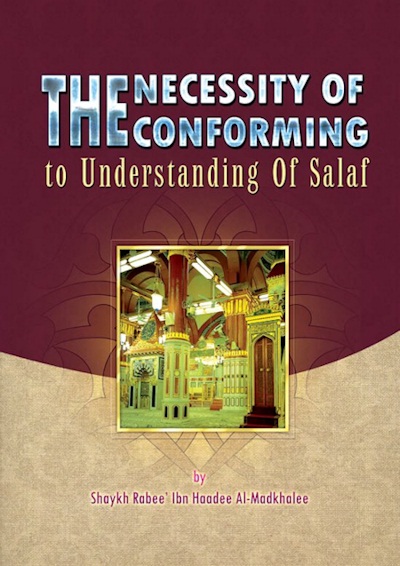
[Book Reco] The Necessity of Conforming to the Understanding of the Salaf : Shaykh Rabee’Al Madkhali

The Necessity of Conforming to the Understanding of the Salaf - Shaykh Rabee'Al Madkhali


About This Publication

In these times of great division and media saturation, this treatise is an essential read to help mankind in general, and Muslims specifically, discern between what is correct and authentic knowledge, from what is misleading.

In this publication, the Shaykh begins by explaining to the readers the reasons why Knowledge of the Qur’aan and the Sunnah is a necessity in our lives.

He further elaborates on the fundamental importance of evidence and proof in the study of Islam and the responsibility we have in staying away from blind following.

Furthermore, in seeking the correct understanding of Islam, he makes clear the status of the Companions when he says, ‘No matter how much an individual excels in intelligence, aptitude and cleverness, he cannot do without the understanding of the Salaf.

Even great Scholars like Shaafi’ee, Malik, Ahmed, Abu Haneefa and others were in great need of referring back to the illustrious companions (may Allah be pleased with them). Ash- Shaafi’ee said: ‘The companions are superior to us in all aspects of knowledge, intelligence and understanding.’’

– See more at: http://www.miraathpublications.net/the-necessity-of-conforming

Author: Shaikh Rabee ibn Haadee al Madkhalee
Paperback: 93 Pages
Published: 2012

Madina Arabic : Book 3: Class Notes

[Read/Download PDF]

Madina Arabic : Book 2: Class Notes

[Read/Download PDF]

Madina Arabic : Book 1: Class Notes

[Read/Download PDF]

Q & A : The Causes For Differing And Splitting : Shaykh Abdullaah al-Ghudayaan

[Read / Download PDF]

Exaggeration with regards to the graves of the righteous : Shaykh Muhammad Ramzan

Benefits From Shaykh Muhammad Ramzan – Kitab at-Tawheed

[Listen / Download PDF]

15 Guidelines Regarding the issues of Takfeer (declaring one to be a kaafir) : Shaykh Muhammad Baazmool

Click the below link to read or download PDF

The Guidelines For Takfeer – Shaykh Muhammad Baazmool [PDF]