The Light of the Sunnah & Tawheed is With the People of Hadeeth and the Darkness of Bida’ and Following Desires Reigns Over Other Than the People of Hadeeth

Compiled by The Eminent Shaykh, the Muhaddith, Rabee’ ibn Haadee al-Madkhalee
Translated by Abbas Abu Yahya

Indeed the place which is enlightened by the Book and the Sunnah in the Islaamic world is the place of the People of Hadeeth, as-Salafiyoon.

Indeed the place which is darkened in the Islaamic world is the place of the People of Bida’ and misguidance, those who oppose the people of Hadeeth and wage war against them.

Indeed the present day political groups – who have among them Ikhwaan Muslimoon and their likes – and the deviant sects – who have among them Jamaat Tabligh – want this darkness to remain in dominance over the Islaamic world and to cover it, they do not even move against it. They have no intention of eliminating it and they have no Manhaj (methodology) to direct them to its removal or to establish Tawheed and the light of the Book and the Sunnah, taking its place.

So they guard this darkness – especially the darkness of the Rafidah and Soofeeyah- with the justification that they are combating the enemies of Islaam, although they definitely do not do this. Their justification is that they say, ‘We cooperate in what we agree upon and overlook what we differ upon,’ which they justify further with their claim that they gather the Muslims together along with the Rawafidah and the extreme Soofees in order to confront the enemies of Islaam.

Then, they wage war against the people of Hadeeth, placing different obstacles and hindrances in front of them which then prevent the people from being enlightened by that which the People of Hadeeth have of the light of Tawheed and the light of the Book, the Sunnah and the Manhaj of the Salaf-as-Saalih.

How long will the defence of this darkness subjected upon the Ummah continue?

When will the Muslims see this light?

Ibn Qayyim -Rahimullaah- said, quoting as-Samaanee -Rahimullaah:

‘Every sect from the people of Bida’ claims that they adhere to the Sharia’ of Islaam and that the truth the Messenger of Allaah -sallAllaahu alayhi wa sallam- established is what they believe in and profess. However, Allah has denied them that as the truth and correct ‘Aqeedah will only be with the People of Hadeeth and Athaar because they successively took their Deen and beliefs with from those who preceded them, generation by generation, until they reached the Tabi’een.

The Tabi’een took it from the Companions of the Prophet -sallAllaahu alayhi wa sallam and the Companions took it from the Messenger of Allaah -sallAllaahu alayhi wa sallam.

There is no way of knowing what the Messenger of Allaah -sallAllaahu alayhi wa sallam- called the people to, of the straight path, except by way of what the People of Hadeeth followed.

What shows that the People of Hadeeth are upon the truth is that if you were to research all the books authored by them, from the first to the last, the oldest to the newest, you would find – despite the fact that they are from different countries and time periods with vast distances between their lands, each of them living in their own regions- that in the matter of belief they are on one path, they flow in one direction following that path and they do not diverge from it, nor do they deviate from it. Their hearts are one heart; you do not see any differing in what they narrated nor any divisions or differing in any issue, no matter how small it may be.

Rather, if everything they uttered with their tongues and what they narrated from the Salaf were gathered you would find it as though it had come from one heart and spoken by one tongue. So is there any evidence clearer than this to show the truth?

Allaah Ta’ala said:

<< Do they not then consider the Qur’aan carefully? Had it been from other than Allaah, they would surely have found therein much contradiction. >> [Nisa:82]

Allaah Ta’ala said:

<< And hold fast, all of you together, to the Rope of Allaah (i.e. this Qur’aan), and be not divided among yourselves, and remember Allaah’s Favour on you, for you were enemies one to another but He joined your hearts together, so that, by His Grace, you became brethren (in Islaamic Faith)>> [Aali-Imraan: 103]

The reason that the people of Hadeeth are united is because they take their Deen and method of narration from the Book and the Sunnah and so, they inherit unity and harmony.

The people of Bida’ took the Deen from their intellects so they inherited separation and differences.

Indeed conveying and narrating from trustworthy, precise narrators ensures that differences are rare and if there were a difference it would be in a single word or the wording of a narration. This differing does not harm the Deen, not does it belittle it. As for following intellects and desires, ideas and opinions, they rarely bring unity.

We have seen that the Companions of Hadeeth, past and present, are those who travelled for these Aathaar. They sought them and took from their sources, they memorized them and became delighted by them, they called to following these narrations and they rebuked those who opposed them. They had numerous narrations between them such that they became famous due to them, just as a craftsman becomes famous because of his skill and what he produces.

Then we saw a people who became disconnected from their memorization and knowledge and deviated from following the well-known, authentic narrations. They absolved themselves from the companionship of its people and attacked the narrations and their people. These people abandoned the rights due to this knowledge, they ascribed evil examples to it and to the people of hadeeth, giving them the vilest of descriptions. So, they called them Nawasib (haters of the family of the Prophet), Mushabiha (those who compare Allaah to the creation), Hashaweeyah (those who busy themselves with things of no benefit) or Mujjassama (those who ascribe a physical body to Allaah). So we came to know, from the correct proofs and supporting evidences, that the people of hadeeth have more right to it (i.e. the knowledge of hadeeth/narrations) than the rest of the sects.’ [Mukhtasir as-Sawaaiq pg 423-429]

The new opponents of the People of Hadeeth continually repeat the attacks that the communist, laymen and Baaith party (a political party with strong socialist tendencies) use against their opponents from amongst the Muslims and other than them, attacking with such statements as, ‘they are spies,’ ‘working for America,’ ‘ scholars of the royal courts’ or ‘scholars who want meals.’

We ask Allaah for guidance that everyone returns to the truth, turning away from falsehood and departing from the darkness of Bida’.

Written by

Rabee bin Haadee Umayr al-Madkhalee

19/5/1421 AH

A Return to Excellence

Al-Istiqaamah Magazine, Issue No.4 – Jumâdal-Awwal 1417H / November 1996

KNOWING THE STRAIGHT PATH

‘Abdullaah ibn Mas’ood radiallaahu ‘anhu said:
The Prophet sallallaahu ‘alayhi wa sallam drew a line for us and said. “This is Allaah’s Straight Path.” Then he drew lines to its right and left and then said. “These ore other paths. Upon every one of them there is a devil calling towards it.” Then he recited: “Indeed this is My Straight Path, so follow it, and do not follow other paths that will separate you from His Path.” [Soorah al-An’aam 6:153].”1

Therefore, that which is necessary for the Muslims – both individuals and groups in order to prepare for the mighty task and to achieve the lofty goal, is to truly know the Straight Path, its People, their ‘aqeedah (belief) and their manhaj (methodology), knowing also the innovations and evils which cause one to separate from this way.

The wisdom in learning about the evil is taken from the hadeeth of Hudhayfah ibn al-Yamaan radiallaahu ‘anhu where he said. “The people used to ask the Messenger of Allaah sallallaahu ‘alayhi wa sallam about the good, but I used to ask him about the evil for fear that it would overtake me …”2 And may Allaah have mercy upon the one who said in poetic wisdom:

“I learnt what was evil, not for itself, but to avoid it. He who does not know evil from good, falls into it.”

CLINGING TO THE ORIGINAL STATE OF AFFAIRS

Abul-‘Aaliyah (d.90H) – rahimahullaah – who said:
“Learn Islaam. Then when you have learnt Islaam, do not turn away from it to the right nor the left. But be upon the Straight Path and upon the Sunnah of your Prophet sallallaahu ‘alayhi wa sallam and that which his Companions were upon … and beware of these innovations because they cause enmity and hatred amongst you. But stick to the original state of affairs which was there before they divided.” So ‘Aasim said: I related this to al-Hasan al-Basree so he said. “He has given you sincere advice and has told you the truth.”3

And it is known that this original state of affairs, had as its pure and sweet spring, the Qur’aan and the Sunnah, built upon the understanding of the Salafus-Saalih (the Pious Predecessors) – the Companions, the Taabi’een and those that followed them – about whom the Prophet sallallaahu ‘alayhi wa sallam said. “The best of mankind is my generation, then those who follow them, then those who follow them.”4

‘Aaishah radiallaahu ‘anhaa said:
A man come to the Prophet sallallaahu ‘alayhi wa sallam and said. Who is the most excellent of mankind? So the Prophet sallallaahu ‘alayhi wa sallam said: “The generation of those that I am in, then the second, then the third.”5

So this principle – the obligation of adhering to the Qur’aan and the authentic Sunnah upon the understanding of the Salafus-Saalih – is the cornerstone principle of Ahlus-Sunnah wal-Jamaa’ah.

Imaam Abu Haneefah (d.150H) – rahimahullaah – said:
“Stick to the narrations and the way of the Salaf and beware of newly invented matters, for all of it is innovation.”6

Imaam al-Awzaa’ee (d.157H) – rahimahullaah – said.
“Patiently restrict yourself to the Sunnah and pause where the people paused, say what they said and avoid what they avoided. Take to the path of your Salafus-Saalih, for indeed, what was sufficient for them, is sufficient for you.”7

Imaam Ahmad bin Hanbal (d.241H) – rahimahullaah – said:
“The fundamentals of the Sunnah with us are: Clinging to that which the Companions of Allaah’s Messenger sallallaahu ‘alayhi wa sallam were upon, taking them as our examples to be followed; avoiding innovations, for every innovation is misguidance.”8

Ibn ‘Abdul-Haadee (d.748H) – rahimahullaah – said:
“It is not permissible to invent on interpretation about a verse or a Sunnah which was not there in the time of the Salaf (the Pious Predecessors), nor did they have any knowledge concerning it, nor explain it to the Ummah. Since this would imply that the Salaf were ignorant of the truth in this matter and failed to reach it. Whereas the late-coming opponent is somehow guided to the truth!”9

Imaam Ibn al-Qayyim (d.751H) – rahimahullaah – said:
“Inventing on explanation with regards to the Book of Allaah – which the Salaf and the Scholars are in opposition to – necessitates one of two things: Either the explanation itself is a mistake. Or that the sayings of the Salaf – which differs with such a saying – are in error! And no one who possess even an ounce of intellect would doubt that the one whose saying is in opposition to that of the Salaf, then he is the one who is in error.”10

SOFTENING THE HEARTS

Along with seeking to understand the correct Islaamic ‘aqeedah (beliefs) and fiqh (jurisprudence), tafseer (Qur’aanic explanation), and hadeeth, on essential part of the way of the Salaf includes understanding matters relating to aadaab and akhlaaq (manners and etiquettes) and tazkiyatun-nufoos (purification of the souls) and reflecting upon the lives of the Salafus-Saaliheen. Since this – it is hoped – will enable hearts to cultivate mildness and humility in the worship of Allaah – the Most High – and also strengthen the determination to strive to making His Religion uppermost in the hearts of the people and upon the face of this earth.

Imaam Ibn al-Jawzee (d.597H) – rahimahullaah – said:
“I feel that occupying oneself with jurisprudence and acquiring the narrations is hardly enough to correct the heart, unless he adds to that the study of raqaa’iq (heart-melting narrations) and the study of the lives of the Salaf us-Saaliheen (the Pious Predecessors). Since they attained what is desirous from the narrations and took from the outer actions what is ordered and what is wanted from them.

And I do not inform you of this except after personal trial and experience. Since I have found that the majority of the narrators and the students of Hadeeth are concerned chiefly with attaining the briefest isnaad (chain of narration) and increase in the number of narrations. And the majority of the Jurisprudents are concerned with dialectics and how to win arguments. So how can the hearts be softened with these things? Previously a group of the Salaf would visit a pious servant to see his conduct and manners, not to take from his knowledge. This was because the fruit of his knowledge was his manners and conduct, so understand this. Thus, along with the study of fiqh and Hadeeth, study the lives of the Salaf and those who were zaahid (abstainers) with regards to the world, so that this may be a cause of softness in your hearts.”11

Yoonus ibn ‘Ubayd (d.139H) – rahimahullaah -said:
“With good manners you understand the knowledge. With the knowledge your actions are corrected. With actions wisdom is obtained. With wisdom you understand zuhd (abstinence) and are granted its benefits. With zuhd comes abandoning the world. With abandoning the world comes desire for the Hereafter. With desire for the Hereafter the pleasure of Allaah – the Mighty and Majestic – is obtained.”12

THE FOUNDATIONS FOR UNITY

The Prophet sallallaahu ‘alayhi wa sallam said:
“This knowledge will be carried by the trustworthy ones of every generation. They will expel from it the alteration made by those going beyond bounds; the false claims of the liars and the false interpretations of the ignorant ones.”13

So it is our hope in Allaah – the Most Perfect- that He adorns us with the correct knowledge bequeathed to us by our Salafus-Saalih, and that He aids us in learning their ‘aqeedah, so that hearts may embrace it; learning their manhaj, so that people may follow it and learning also their manners and behaviour, so that souls may be cultivated upon it, seeking to convey this to others with the wisdom, patience and forebearance that this pure and sublime message demands. So herein lies the excellence and of the one who reaches it.

Al-Haafidh Ibn Rajab (d.795H) – rahimahullaah – said:
“So the beneficial knowledge from amongst all the types of knowledge is to take possession of the texts of the Book and the Sunnah and to understand their meanings, and to limit oneself in that to what is reported from the Companions, the Taabi’een and their Successors – with regards to the meaning of the Qur’aan and the Hadeeth, and what is reported from them as regard to the halaal (lawful) and haraam (prohibited), and zuhd, raqaa’iq, the accounts (of previous nations and Prophets), and other than that. Striving firstly, to distinguish what is authentic and what is weak; and then secondly, striving to understand and comprehend it. And there is enough in that for the intelligent one, and enough to occupy one who busies himself with beneficial knowledge. And he who stops at that and makes his intention purely for the Face of Allaah and seeks His help – then Allaah will help him, guide him and grant him success, satisfaction, understanding and inspiration. Then such a person will take the benefits of this knowledge – which ore found through it alone – and that is fear of Allaah, as Allaah – the Exalted and Majestic – says: “Indeed, it is only those who have knowledge, amongst His slaves, that truly tear Allaah.” [Soorah al-Faatir 35:10].”14

Imaam al-Awaa’ee (d.157H) – rahimahullaah – said:
“Hold fast to the narrations of the Salaf, even if people were to abandon you. And beware of the opinions of the people, no matter how much they beautify it with their speech.”15

Al-Hasan al-Basree (d.110H) – rahimahullaah – said:
“If there was a man who reached the first Salaf, then he (this man) was raised up today, he would not recognise anything of Islaam.” The narrator said: Al-Hasan put his hand on his cheek and said. “Except for this Prayer.” Then he said. “So – by Allaah – how is it for the one who lives in this bad time, not having reached the Salafus-Saalih. So he sees on innovator calling to his innovation, and a worldly person calling to the world, but Allaah protects him from that and makes his heart lean towards those Salafus-Saalih, asking about their way, seeking their narrations and following their path. Allaah will recompense him with a greet reward. So be like that – if Allaah wills.”16


1. Hasan: Related by Ahmad (1/435), an-Nasaa’ee (7/49) and others. This Hadeeth was authenticated by Shaykh al-Albaanee in Dhilaalul-Jannah (no.16).
2. Part of a lengthy Hadeeth related by al-Bukhaaree (6/615) and Muslim (12/235).
3. Related by Ibn Battoh in al-lbaanah (no.136).
4. Related by al-Laalikaa’ee in Sharh Usool I’tiqaad Ahlus-Sunnah wal-Jamaa’ah (no.31).
5. Related by Muslim (no.2536).
6. Related by as-Suyootee in Sawnul-Muntaq wal-Kalaam (p.32)
7. Related by al-Aajurree in ash-Sharee’ah (p.58) and also al-Bayhaqee in Madhkhal ilas-Sunan (no.233).
8. Usoolus-Sunnah (p.5) by Imaam Ahmad.
9. As-Saarimul-Munkee (p.427).
10. Mukhtasar as-Sawaa’iqul-Marsalah (2/128).
11. Sayid ul-Khaatir (p.216).
12. Iqtidaa’ul-‘llmil-‘Aml (no.31).
13. Saheeh: Related by al-Bayhaqee in Sunanul-Kubraa (10/209), Ibn Abee Haatim in al-Jarh wat-Ta’deel (2/17) and Ibn ‘Abdil-Barr in at-Tamheed (1/57-58), from the Hadeeth of Ibraaheem ibn ‘Abdir-Rahmaan al-‘Udharee radiallaahu ‘anhu. It was authenticated by Imaam Ahmad – as occurs in Sharafu Ashaabul-Hadeeth (p.29) of al-Khateeb al-Baghdaadee.
14. Fadl ‘Ilmus-Salaf (p.48) of al-Haafidh Ibn Rajab.
15. Related by al-Khateeb in Sharafu Ashaabul-Hadeeth (p.25), with a Saheeh isnaad.
16. Related by Ibn Waddaah in Al-Bida’ wan-Nahee ‘Anhaa (p.74)


Why Choose Salafiyah ? by Shaik al-Albanee

Shaykh Muhammad Nasir Uddin al-Albani / Source: Al-Asaalah, Issue 9

Question:

Why use the name Salafee? Is it a call towards a party or a group or a madh-hab (school of thought)? Or is it a new sect in Islaam ?

Answer:

Indeed, the word Salaf is well known in the Arabic language as well as in the religious terminology. But what concerns us here, is its discussion from the religious standpoint. Thus, it has authentically been reported on the Prophet, sallAllaahu ‘alayhi wa sallam, that during the sickness from which he died from, he said to Faatimah, radyAllaahu ‘anhaa: “…So fear Allaah and have patience. And I am the best Salaf (predecessor) for you.” 20

Furthermore, the scholars have used this word “Salaf” many times, such that it would be too abundant to number and take into account. Sufficient for us, is one example, and it was that which they have used in their battle against innovations: “And every good lies in following he who has preceded (man salaf) while every evil lies in the innovating of he who came after (man khalaf).”

 However, there are from those who claim to have knowledge, some people who reject this ascription, claiming that there is no basis for it! And so they say: “It is not permissible for a Muslim to say: ‘I am Salafee.’” So it is as if he is saying that it is not permissible for a Muslim to say: “I am following the Salaf As-Saalih (the Pious Predecessors) in what they were upon from beliefs, worship and methodology”! There is no doubt that such a rejection – if that is what he intended – necessitates that one free himself from the correct Islaam, which the righteous predecessors were upon, at the head of whom was the Prophet, sallAllaahu ‘ alayhi wa sallam. This is as is indicated in the mutawaatir hadeeth found in the two Saheehs and other than them, that he, sallAllaahu ‘alayhi wa sallam, said: “The best of mankind is my generation, then those that come after them, then those that come after them.” So it is not permissible for a Muslim to absolve himself from this ascription to the righteous predecessors, whereas, if he were to absolve himself from any other ascription, the scholars would not be able to ascribe him with disbelief or sinfulness.

As for the one who rejects this name from himself, will you not see him ascribing himself to one of the madh-hab s?! Regardless of whether this madh-hab is related to ‘Aqeedah (Creed) or Fiqh (Jurisprudence)? So he is either Ash’aree or Matureedee. Or perhaps he is from the people of Hadeeth or Hanafee, or Shaafi’ee or Maalikee or Hanbalee or whatever else enters into the title of “Ahl-us-Sunnah wal-Jamaa’ah.” But in spite of this, the one who ascribes himself to the Ash’aree madh-hab or to one of the four madh-habs is in fact ascribing himself to individuals that are not infallible, without a doubt, even if there were scholars among them who were correct (in their verdicts). I wish I knew – why doesn’t he reject the likes of these ascriptions to individuals who are not free from error? But as for the one who ascribes himself to the Salaf As-Saalih (righteous predecessors), then he indeed ascribes himself to infallibility (‘isma h), in the general sense. The Prophet, sallAllaahu ‘alayhi wa sallam, has mentioned that one of the signs of the Saved Sect is that they will cling tightly onto what the Messenger of Allaah, sallAllaahu ‘alayhi wa sallam, was upon and what his Companions were upon. So whosoever holds tightly onto them, then he is certainly upon the guidance from his Lord.

And furthermore, it is an ascription that brings honor to the one that ascribes himself to it, and one that facilitates for him the way of the Saved Sect. And these matters do not apply to anyone that ascribes himself to any other ascription, since they are not free from one of two things. Either it is an ascription to a specific individual that is not infallible or it is an ascription to a group of people who follow the methodology of this individual who is not infallible. So there is no infallibility (in their ascriptions) either way. On the opposite of this, there is the infallibility of the Companions of the Prophet, sallAllaahu ‘alayhi wa sallam, (as a whole). And it is that which we have been commanded to hold tightly onto, from his Sunnah and the Sunnah of his Companions after him. And we must persist and strongly emphasize that our understanding of Allaah’s Book and the Sunnah of His Messenger, sallAllaahu ‘alayhi wa sallam, must be in accordance with the methodology of his, sallAllaahu ‘alayhi wa sallam, Companions. This is so that we can be upon infallibility, as opposed to inclining away towards the right or the left, or deviating with an understanding that comes solely from ourselves, of which there is not found in the Book of Allaah or the Sunnah of His Messenger, sallAllaahu ‘alayhi wa sallam, that which provides evidence for it. Furthermore, why is it not sufficient for us to ascribe ourselves to (just) the Qur’aan and the Sunnah? The reason goes back to two matters, the first of which is related to the religious texts , and the second of which is due to the existence of numerous Islaamic groups .

With regard to the first reason, then we find in the religious texts, a command to obey something else in connection with the Qur’aan and the Sunnah, as is found in Allaah’s saying: “O you who believe! Obey Allaah and obey the Messenger and those in authority amongst you.”

 So if there were someone in authority, who was given the oath of allegiance by the Muslims, it would be obligatory to obey him just as it would be obligatory to obey the Qur’aan and the Sunnah. So even if he or those around him commit errors, it would be obligatory to obey him in order to repel the harm of differences of opinions. But this is with the well-known condition: “There is no obedience to a creation (if it involves) disobeying the Creator.” 21

And Allaah, may He be Exalted, says: “And whosoever opposes the Messenger after the guidance has been clearly explained to him, and follows a way other than the Way of the Believers, We will turn him to what he has chosen and burn him in Hell – what an evil destination.” [Surah An-Nisaa: 115]

Indeed, Allaah, Mighty and Sublime, is free and far removed from all imperfections and defects. And there is no doubt or uncertainty that His mentioning of “the Way of the Believers” here, is only due to an immense and comprehensive wisdom and benefit. So it indicates that there is an important obligation – and it is that our following of the Book of Allaah and the Sunnah of His Messenger, sallAllaahu ‘alayhi wa sallam, must be in accordance with what the first Muslims were upon. And they are the Companions of Allaah’s Messenger, sallAllaahu ‘alayhi wa sallam, then those who came after them, then those who came after them. And this is what the da’wat-us-salafiyyah (The Salafee Call) invites and calls to. And it is that which is its main priority in the foundation of its call and the methodology of its educating process.

Indeed, the Salafee Call truly unites the ummah, while any other call only causes division to the ummah. Allaah, Mighty and Sublime, says: “O you who believe, fear Allaah, and be with the truthful.” [Surah At-Tawbah: 119]

So anyone that distinguishes between the Book and the Sunnah on one side and the Salaf As-Saalih (Righteous Predecessors) on the other side, then he can never be truthful. As for with regard to the second reason, then the groups and parties of today do not direct at all towards the following of “the Way of the Believers ”, which has been mentioned in the ayah. And there are some ahaadeeth, which further confirm and support that ayah, such as the hadeeth of the seventy-three sects. All of them will be in the Hellfire except one. The Messenger of Allaah, sallAllaahu ‘alayhi wa sallam, described them as: “The one which is upon the same thing that I and my companions are upon today.” 22

This hadeeth resembles that ayah which mentions the “Way of the Believers ”. Also, there is the hadeeth of Al-‘Irbaad Ibn Saariyah, radyAllaahu ‘anhu, in which he, sallAllaahu ‘alayhi wa sallam, said: “So stick to my Sunnah and the Sunnah of the rightly-guided Khaleefahs after me.” 23

So therefore, there are two Sunnahs: The Sunnah of the Messenger, sallAllaahu ‘alayhi wa sallam, and the Sunnah of the righteous Khaleefahs. So there is no doubt that we – who come in a later time – must return back to the Qur’aan, the Sunnah and “the Way of the Believers.” And it is not permissible for us to say: “We can understand the Qur’aan and the Sunnah by themselves, without turning towards what the righteous predecessors were upon.” And there must be an ascription in this time that distinguishes and is detailed. So it is not sufficient for us to say, “I am a Muslim” only! Or “My madh-hab is Islaam”! For every sect says that! – the Raafidee, the Ibaadee, the Qadyianee, as well as other sectarians!! So what is it that distinguishes you from them?

And if you were to say, “I am a Muslim who is upon the Qur’aan and the Sunnah”, this would also not be sufficient. This is because, the members of these sects – of the Ash’arees and the Matureedees and the Hizbees – they all claim to follow these two sources also. So there is no doubt that the clear, plain, distinctive and decisive classification is to say, “I am a Muslim who is upon the Qur’aan and the Sunnah and upon the methodology of the Salaf As-Saalih (Pious Predecessors). And that can be said in short by saying, “I am a Salafee.” So based on this, indeed the truth which is unavoidable, is that it is not enough to rely on the Qur’aan and the Sunnah without the methodology of the Sala f, for it explains these two with regard to understanding and concept, knowledge and action, and da’wah (calling) and Jihaad.

And we know that they (the Sahaabah), may Allaah be pleased with them, did not used to fanatically cling onto one specific madh-hab or to one specific individual. So there was not found amongst them he who was Bakree (a follower of Abu Bakr), or ‘Umaree (a follower of ‘Umar), or ‘Uthmaanee (a follower of ‘Uthmaan) or ‘Alawee (a follower of ‘Alee). Rather, if it were more easy for one of them to ask Abu Bakr or ‘Umar or Abu Hurairah, he would ask any of them. This is because they believed that it was not permissible to have total and unrestricted devotion in following, except to one individual. Indeed, he was the Messenger of Allaah sallAllaahu ‘alayhi wa sallam, the one who did not speak from his own desire, rather it was only revelation revealed to him.

And if we were to submit to these criticizers, for the sake of argument, that we would name ourselves “Muslims” only, without ascribing ourselves to the Salaf – in spite of it being an honorable and correct ascription. Would they abandon classifying themselves with the names of their parties or their madh-habs or their ways – based on the fact that they are not prescribed in the Religion nor are they correct? “So this contrast between us is enough for you And every container becomes wet due to what is in it.” And Allaah is the Guide to the Right Path. And He, free is He from all defects, is the One in whom we seek assistance.

[Al-Asaala h, Issue 9]

Miracle of the Crying of the Tree Trunk

[Below is a portion from the book “Miracles of the Messenger (Sallalahu Alaihi wa Sallam)” regarding the remembrance of Allah. This miracle occurred when Rasulallah moved from the tree trunk to the newly made pulpit to give the Khutbah. Rasulallah used to lean against the tree trunk but when he left for the pulpit it cried out loud like a child for it would no longer be in the company of the Prophet and hear the remembrance of Allah (azzawajal). You can read the detailed story and hadith in chapter 6 page 105 in the book “Miracles of the Messenger (Sallalahu Alaihi wa Sallam)”]

There was also another reason for the weeping of the tree trunk and this was made clear by the Prophet when he said to his Companions: “It wept because of the remembrance of Allah (Dhikr) which it used to hear.”

So, the tree trunk also used to hear remembrance of Allah from the mouth of the Messenger of Allah (Sallalahu Alaihi wa Sallam) and Allah, the Most Blessed, the Most High says regarding remembrance of Him: “Those who believed (in the Oneness of Allah Islamic Monotheism), and whose hearts find rest in the remembrance of Allah verily, in the remembrance of Allah do hearts find rest. “

Therefore, it is not surprising that the tree trunk cried for that which brought tranquility to it. Haply, we may learn from this lifeless thing to love the remembrance of Allah and to accustom ourselves to it.

The word Dhikr means to remember something through constant verbal repetition of it.

So if a person were to constantly repeat the Names of Allah for example he would be remembering Allah; and due to the great need of man for remembrance of Allah, He has encouraged us to do it, in His Words: “He said: ‘O my Lord! Make a sign for me.’ (Allah) said: ‘Your sign is that you shall not speak to mankind for three days except with signals. And remember your Lord much (by praising Him again and again), and glorify (Him) in the afternoon and in the morning.”

And He says: “O you who believe! Remember Allah with much remembrance.” In remembrance of Allah there is great virtue, including:

Reminding Others to Remember Allah:

Allah, the Most Glorified, the Most High says: “Therefore remember Me (by praying, glorifying). I will remember you, and be grateful to Me (for My countless Favors on you) and never be ungrateful to Me. “

And He inspired the Prophet (Sallalahu Alaihi wa Sallam) to say: “Shall I not inform you about the best of your deeds with Allah and the purest of them with your King and the highest of them in status for you, which are better for you than spending gold and silver in charity and better than meeting your enemy and cutting off their heads, while they also cut off yours?” They said “Certainly, oh, Messenger of Allah!” He said: “It is remembrance of Allah, the All-Mighty, the All Powerful.”

And the Prophet (Sallalahu Alaihi wa Sallam) also said: “The likeness of one who remembers Allah and one who does not remember Allah is as the likeness of the living and the dead.”

It repels Satan and pleases the Most Gracious, according to the Words of the Prophet (Sallalahu Alaihi wa Sallam): “Whenever a people sit in a meeting-place and remember Allah, they are surrounded by angels and enveloped in mercy, and tranquility descends upon them as they remember Allah; and Allah makes mention of them to those with Him.”

It removes Anxiety and Sadness and enlightens the Heart and brings Peace and Tranquility to it, according to the Words of Allah, the Most High: “Those who believed (in the Oneness of Allah Islamic Monotheism), and whose hearts find rest in the remembrance of Allah verily, in the remembrance of Allah do hearts find rest.”

It strengthens the Heart and the Body, according to the Words of the Prophet (Sallalahu Alaihi wa Sallam) to His Daughter, Fatimah and ‘Ali (R). He told them to glorify Allah (i.e., say Subhan Allah) thirty-three times, to praise and thank Allah (i.e., to say Al-Hamdu Lilldh) thirty-three times and to extol Allah (i.e., to say Allahu Akbar) thirty-four times. This was when she (i.e., Fatimah ) asked him for a servant which would help her in her work.

Remembrance of Allah also attracts Sustenance, according to the Words of Allah, the Most High: “Ask forgiveness from your Lord, verily, He is Oft Forgiving; He will send rain to you in abundance, and give you increase in wealth and children, and bestow on you gardens and bestow on you rivers. “

Through remembrance of Allah, the hearts live, according to the Saying of Ibn Taimiyyah: Remembrance of Allah for the heart is like water to the fish; and what would the situation of the fish be if it left the water?

Remembrance of Allah causes the One Who remembers Him to be with Him, according to the Hadith Qudsi: “I am with My slave whenever he remembers me and moves his lips to pronounce My Names.”

And he spoke the truth who said: “The heart becomes diseased due to two things: negligence and sin; and it becomes clear due to two things: seeking forgiveness from Allah and remembrance of Allah.”

By Remembrance of Allah, the Slave earns Allah’s Love, according to the Words of Ibn ‘Abbas (R): “When Moses t went to Mount Sinai, he said: ‘Oh, my Lord! Which of Your slaves is most beloved to You?’ He said: “The one who remembers me and does not forget me.”

Remembrance of Allah also opens up the door to knowledge for the slave and protects the tongue from backbiting and tale-bearing.

It has also been said that it causes the slave to be conscious of Allah’s Observation of him, which admits him to the door of Ihsan, so that he worships Allah as if he could see Him. It also gives rise to Inabah, which is to return to Allah, the All-Mighty, the All-Powerful. So when a person returns frequently to Allah by remembrance of Him, it will cause him to return to Allah in all circumstances.

Remembrance of Allah is the Easiest Act of Worship: It is easy for a person in every place, in every situation and at all times to remember Allah and in spite of this, it is one of the best acts of worship for the movement of the tongue is lighter and easier than the movement of any other part of the body. Therefore, it is incumbent upon the Muslim to take care to accustom his tongue to remembrance of Allah and keep it moist thereby and he should do so in all circumstances, according to the Hadith of ‘Aishah : “The Messenger of Allah (Sallalahu Alaihi wa Sallam), used to remember Allah, the Most High in all circumstances.”

So, we must observe his Sunnah, for there is a supplication and a remembrance of Allah (Dhikr) legislated for every time and every action.

In the Shade of this Miracle

It might appear that the weeping of an inanimate object is something strange, but it was a subjugation from Allah in order that the tree trunk should deliver a Message not only for the Companions (R) rather, it was for all mankind, in every time and place.

It was a message delivered by the tree trunk through Allah’s Ability to do all things and it announced it in a resounding manner, which echoed: “La ilaha illallah (none is worthy of worship except Allah).”

The tree trunk addressed mankind, with a message of complete faith, in that language which purifies the hearts and washes the senses and when humanity understands it, its soul which is wandering in the wilderness will return to it.

Its message will remain to soften hard hearts, to remind forgetful hearts and to awaken sleeping feelings and to give life to sensations which have died and it will remain to shout out to mankind: The dry, lifeless object cried out for the intimacy and delight which it lost, when the Prophet (Sallalahu Alaihi wa Sallam) passed by it in favor of the new pulpit.

The dry, lifeless object was distressed at being far from the Prophet (Sallalahu Alaihi wa Sallam) and alarmed at being parted from him and wished that it should continue. It was as if this dry, lifeless object was declaring to us that we should seek that delight which comes from following the guidance of Al-Mustafa e; and adhering to his Sunnah. And (that it was declaring also) that we should feel distress at being far from it, that we beware of transgress in it, that we should hold fast to it and cling to it by our molar teeth, in order that we might attain closeness to the Prophet and companionship with him, and that the Miracle should remove from us all traces of doubt which might remain present in the hearts of some, regarding the Messenger (Sallalahu Alaihi wa Sallam)

The Meaning of “Al Hamdulillah” (All Praise and Thanks be to Allah) : Tafseer Ibn Katheer Surah Fatiha

Al Hamdulillah
(All Praise and Thanks be to Allah)

The Meaning of Al-Hamd

Abu Ja`far bin Jarir said,

The meaning of (Al-Hamdu Lillah) (all praise and thanks be to Allah) is: all thanks are due purely to Allah, alone, not any of the objects that are being worshipped instead of Him, nor any of His creation. These thanks are due to Allah’s innumerable favors and bounties, that only He knows the amount of.

Allah’s bounties include creating the tools that help the creation worship Him, the physical bodies with which they are able to implement His commands, the sustenance that He provides them in this life, and the comfortable life He has granted them, without anything or anyone compelling Him to do so. Allah also warned His creation and alerted them about the means and methods with which they can earn eternal dwelling in the residence of everlasting happiness. All thanks and praise are due to Allah for these favors from beginning to end.”

Further, Ibn Jarir commented on the Ayah,

(Al-Hamdu Lillah), that it means, “A praise that Allah praised Himself with, indicating to His servants that they too should praise Him, as if Allah had said, `Say: All thanks and praise is due to Allah.’

It was said that the statement, (All praise and thanks be to Allah), entails praising Allah by mentioning His most beautiful Names and most honorable Attributes. When one proclaims, `All thanks are due to Allah,’ he will be thanking Him for His favors and bounties.”

The Difference between Praise and Thanks

Hamd is more general, in that it is a statement of praise for one’s characteristics, or for what he has done. Thanks are given for what was done, not merely for characteristics.

The Statements of the Salaf about Al-Hamd

Hafs mentioned that `Umar said to `Ali, “We know La ilaha illallah, Subhan Allah and Allahu Akbar. What about Al-Hamdu Lillah” `Ali said, “A statement that Allah liked for Himself, was pleased with for Himself and He likes that it be repeated.”

Also, Ibn `Abbas said, “Al-Hamdu Lillah is the statement of appreciation. When the servant says Al-Hamdu Lillah, Allah says, `My servant has praised Me.” Ibn Abi Hatim recorded this Hadith.

The Virtues of Al-Hamd

Imam Ahmad bin Hanbal recorded that Al-Aswad bin Sari` said,

“I said, `O Messenger of Allah! Should I recite to you words of praise for My Lord, the Exalted, that I have collected’ He said,

(Verily, your Lord likes Al-Hamd.)

An-Nasa’i also recorded this Hadith.

Furthermore, Abu `Isa At-Tirmidhi, An-Nasa’i and Ibn Majah recorded that Musa bin Ibrahim bin Kathir related that Talhah bin Khirash said that Jabir bin `Abdullah said that the Messenger of Allah said,

(The best Dhikr (remembering Allah) is La ilaha illallah and the best supplication is Al-Hamdu Lillah.)

At-Tirmidhi said that this Hadith is Hasan Gharib.

Also, Ibn Majah recorded that Anas bin Malik said that the Messenger of Allah said,

(No servant is blessed by Allah and says,`Al-Hamdu Lillah’, except that what he was given is better than that which he has himself acquired.)

Further, in his Sunan, Ibn Majah recorded that Ibn `Umar said that the Messenger of Allah said,

(A servant of Allah once said, `O Allah! Yours is the Hamd that is suitable for the grace of Your Face and the greatness of Your Supreme Authority.’ The two angels were confused as to how to write these words. They ascended to Allah and said, `O our Lord! A servant has just uttered a statement and we are unsure how to record it for him.’ Allah said while having more knowledge in what His servant has said, ‘What did My servant say’ They said, `He said, `O Allah! Yours is the Hamd that is suitable for the grace of Your Face and the greatness of Your Supreme Authority.’ Allah said to them, `Write it as My servant has said it, until he meets Me and then I shall reward him for it.)

Al before Hamd encompasses all Types of Thanks and Appreciation for Allah

The letters Alif and Lam before the word Hamd serve to encompass all types of thanks and appreciation for Allah, the Exalted.

A Hadith stated,

(O Allah! All of Al-Hamd is due to You, You own all the ownership, all types of good are in Your Hand and all affairs belong to You.)

Source: Tafseer Ibn Katheer – Surah Fatiha, Darusslam English Publication

The Dua of Light : Sahih Muslim

[ This hadith was transmitted by Sahih Muslim]

Ibn ‘Abbâs reports that he once stayed the night as a guest of Maymûna, who was his aunt, and the Prophet, may Allâh bless him and grant him peace. They slept on their blanket lengthways, and he slept at the end, crossways. After they had all slept for a while, the Prophet rose in the middle of the night to pray the tahajjud prayer, and Ibn ‘Abbas joined him.

They both did wudû’, and he prayed eleven rak’ats with the Prophet. Then they both went back to sleep again until dawn. Bilâl called the adhân and the Prophet did another two short rak’ats, before going into the mosque to lead the Dawn Prayer.

Ibn ‘Abbâs said that one of the du’âs that the Prophet made during this night was:

“O Allâh, place light in my heart, light in my tongue, light in my hearing, light in my sight, light behind me, light in front of me, light on my right, light on my left, light above me and light below me; place light in my sinew, in my flesh, in my blood, in my hair and in my skin; place light in my soul and make light abundant for me; make me light and grant me light.”

( وَعَنْ ابْنِ عَبَّاسٍ { أَنَّ النَّبِيَّ صلى الله عليه وسلم صَلَّى فَجَعَلَ يَقُولُ فِي صَلَاتِهِ أَوْ فِي سُجُودِهِ :

اللَّهُمَّ اجْعَلْ فِي قَلْبِي نُورًا , وَفِي سَمْعِي نُورًا , وَفِي بَصَرِي نُورًا , وَعَنْ يَمِينِي نُورًا , وَعَنْ شِمَالِي نُورًا , وَأَمَامِي نُورًا , وَخَلْفِي نُورًا , وَفَوْقِي نُورًا , وَتَحْتِي نُورًا , وَاجْعَلْ لِي نُورًا أَوْ قَالَ : وَاجْعَلْنِي نُورًا } . مُخْتَصَرٌ مِنْ مُسْلِمٍ )

This hadith was transmitted by Muslim and others.

Polishing the Hearts : Imaam ibn al-Qayyim al-Jawziyyah

Imaam ibn al-Qayyim al-Jawziyyah (d.751 H), rahimahullaah 1
From al-Istiqaamah magazine Shawwal 1418H/ February 1998

Allaah – the Most High – said:

“O you who believe! Remember Allaah and remember Him a lot.” [Soorah al-Ahzaab 33:4I].

“Those men and women who remember Allaah a lot.” [Soorah al-Ahzaab 33:35].

“So when you have finished the rights of your Pilgrimage, then remember Allaah as you remember your fore-father, or with more intense remembrance.” [Soorah al-Baqarah 2:200].

These verses contain a command to remember Allaah intensely and abundantly, since the worshipper is in dire need of [remembering Allaah] and cannot do without it even for a twinkling of an eye. This is because every moment that a person does not spend in the dhikr (remembrance) of Allaah will not be of any benefit to him. Rather, the harm entailed in being neglectful of the dhikr of Allaah is far greater than any benefits that can be gained. One of the ‘aarifeen (those who are knowledgeable about Allaah) said:”If a person were to spend such and such number of years engaged [in the dhikr of Allaah], then he turns away from it for just a moment, what he will lose is far greater than whatever he has already gained.”

Al-Bayhaqee relates from ‘Aaishah radiallaahu ‘anhaa that the Prophet sallallaahu ‘alayhi wa sallam said: “There is no time in which the son of Aadam does not remember AIIaah in it, except that it will be a source of regret for him on the Day of Judgement” 2

Mu’aadh ibn jabal radiallaahu ‘anhu relates that the Prophet sallallaahu ‘alayhi wa sallam said: “The people of Paradise will not have any regrets except for those moments in which they were not engaged in the dhikr (remembrance) of Allaah.” 3

Mu’aadh ibn Jabal also relates that Allaah’s Messenger sallallaahu ‘alayhi wa sallam was asked: What action is the most beloved to Allaah? So he replied: “That you continue to keep your tongue moist with the dhikr of Allaah, until you die.” 4

POLISHING THE HEART

Abu Dardaa radiallaahu ‘anhu said:”For everything there is a polish and the polish for the heart is the dhikr of Allaah”.

Al-Bayhaqee relates from Ibn ‘Umar radiallaahu ‘anhu that AlIaah’s Messenger sallallaahu ‘alayhi wa sallam said: “For everything there is a polish, and the polish for the hearts is the dhikr (remembrance) of Allaah. There is nothing more potent in saving a person from the punishment of Allaah than the dhikr of Allaah.” It was said: Not even Jihaad in the path of Allaah. So he replied: “Not even if you were to continue striking with your sword until it breaks.”5

There is no doubt that hearts becomes rusty just as copper and silver coins become rusty. The polish for [this rust] is the dhikr of AIlaah. This is because [dhikr] is like a polish [which polishes the heart] like a shiny mirror. When dhikr is left, the rust returns. But when dhikr resumes, then the heart is [again] polished. And hearts become rusty due to two things:-

(i) neglecting remembering Allaah, and

(ii) committing sins.

The polish for these two things is:-

(i) seeking Allaah’s forgiveness and

(ii) dhikr.

CONFUSING TRUTH WITH FALSEHOOD

Whoever neglects [remembering Allaah] most of the time, then his heart will become rusty in accordance with how neglectful the person is. And when this [filthy] rust accumulates on the heart, then it no longer recognises things as they really are. Thus, it views falsehood as if it is the truth, and truth as if it is falsehood. This is because this rust darkens and confuses the heart’s perception, and so it is unable to truly recognise things for what they really are. So as the rust accumulates, the heart gets blackened, and as this happens the heart becomes stained with this filthy rust, and when this occurs it corrupts the heart’s perception and recognition of things. The heart [then] does not accept the truth nor does it reject falsehood, and this is the greatest calamity that can strike the heart. Being neglectful [of dhikr] and following of whims and desires is a direct consequence of such a heart, which [further] extinguish the heart’s light and blinds its vision. Allaah – the Most High – said:
“And do not obey him whose heart We have made to be neglectful of Our remembrance, one who follows his own whims and desires and whose affairs are furat [have gone beyond bounds and whose deeds have been lost].” [Soorah al-Kahf 18:28].

QUALITIES OF A GUIDE

So when a worshipper desires to follow another person, then let him see: Is this person from the people of dhikr, or from the people who are negligent [about remembering Allaah]? Does this person judge in accordance with his whims and desires, or by the Revelation? So, if he judges by whims and desires then he is actually from those people who are negligent; those whose affairs have gone beyond bounds and whose deeds are lost.

The term furat [which occurs in the above verse] has been explained in many ways. It has been explained to mean:- (i) losing the rewards of that type of action which is essential to do, and in which lies success and happiness; (ii) exceeding the limits of something; (iii) being destroyed; and (iv) opposing the truth. Each of these sayings are very close in meaning to each other.

The point is that Allaah – the One free from all imperfections, the Most High – has prohibited following all those who possess such attributes. So it is absolutely essential that a person considers whether such attributes are found in his shaykh, or the person who’s example he follows, or the person that he obeys. If they are, then he should distance himself from such a person. However, if it is found that the person is, in most cases, pre-occupied with the dhikr of Allaah and with following the Sunnah, and his affairs do not exceed the limits, but rather he is judicious and resolute in his affairs, then he should cling to him very firmly.

Indeed, there is no difference between the living and the dead, except with the dhikr of Allaah; since [the Prophet sallallaahu ‘alayhi wa sallam] said: “The example of one who remembers Allaah and someone who does not, is like the example between the living and the dead.”6


FOOTNOTES

1. AI-Waabilus-Sayyib min Kalimit-Tayyib (pp.78-82).

2. Hasan: Related by Abu Nu’aym in al-Hiliyatul-Awliyaa (51361-362). It was authenticated by Shaykh al-Albaanee in Saheehul-Jaami’ (no.5720).

3. Saheeh: Related by lbnus-Sunnee in ‘Aml al-Yawma wal-Laylah (no.3). Refer to Saheehul-Jaami’ (no.5446).

4. Hasan: Related by lbn Hibbaan (no.2318). It was authenticated by Shaykh Saleem al-Hilaalee in Saheeh al-Waabilus-Sayyib (p.80).

5. Saheeh: Related by Ahmad (4/352), from Mu’aadh ibn Jabal radiallaahu ‘anhu. It was authenticated by al-Albaanee in Saheehul-Jaami’ (no.5644).

6. Related by al-Bukhaaree (11/208) and Muslim (1/539).

From al-Istiqaamah magazine Shawwal 1418H/ February 1998

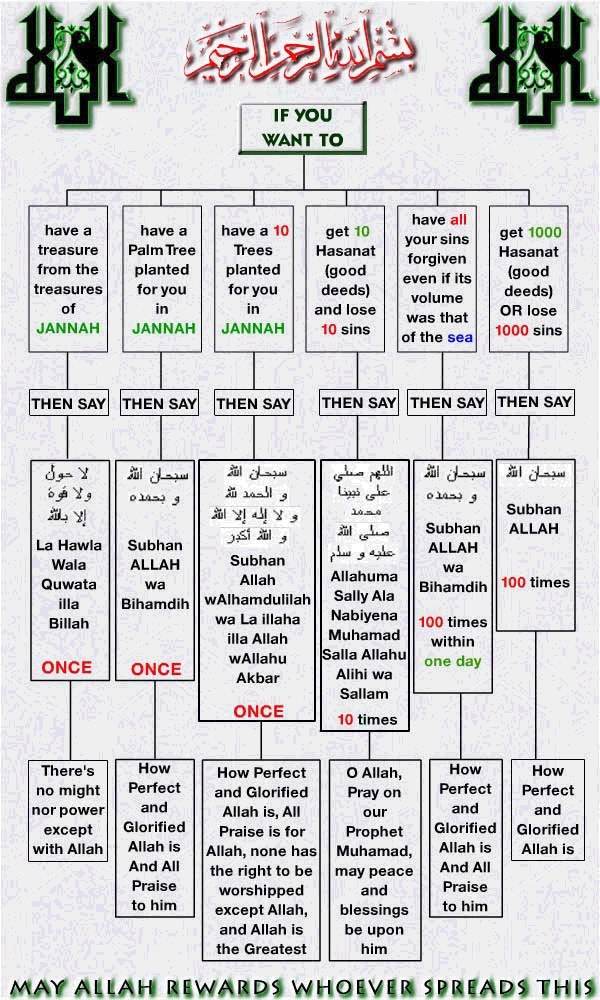
If You Want To..

if you want to

The Supplication and Al-Qadar : Imaam Ibn Qayyim Al-Jawziyyah

Imaam Ibn Qayyim Al-Jawziyyah
Source:His monumental book Ad-Daa wad-Dawaa [The Sickness and the Cure] (pg.22 -23)

al-ibaanah Publications

Here there occurs a very popular question and it is:

If the thing that is being supplicated for is already decreed for the servant, then there is no doubt that it is going to come to pass for him, regardless of whether he supplicates for it or not. And if it has not been decreed for him, then it will not come to pass, regardless of whether he asks Allaah for it or not.

There is one group that perceives this question to be valid and so they have abandoned the supplication and are of the view that there is no benefit in doing it. These people, along with their excessive ignorance and misguidance are in clear contradiction, for if we were to follow their opinion, it would require us to reject all the different means for attaining something (desired).

So it can be said to one of them:

If satisfying your appetite and quenching your thirst were already decreed for you, then there is no doubt that they are going to come to pass, whether you eat and drink or you don’t. And if they were not decreed for you, they will not come to pass, whether you eat and drink or you don’t.

And likewise, if a child were decreed for you, then you will definitely receive it, whether you have sexual intercourse with your wife or you don’t. And if that was not decreed for you, then it will not come to pass. Thus there is no need for marrying, having sexual relations and so on and so forth.

Who says such a statement? Is it one possessing common sense or a beast? Rather, even the animal has a natural inclination (fitrah) towards seeking the means of attaining something (desired), which (for example) will give it sustenance and livelihood. So the animals have more common sense and possess more understanding than these types of people who are like cattle – nay, far worse!

Some of them try to be clever and say:

Preoccupying oneself with supplication falls into the realm of worship solely – Allaah will reward the one supplicating, without that having an effect on what he is asking for in any way. According to this type of person, there is no difference between supplicating and refraining from supplicating by heart and tongue, with regard to that having an effect on attaining what is being asked for. And according to them, the relation of the supplication to it (what is being asked for) is like its relation with silence. There is no difference between them.

Another group, more slick than this one says:

Rather, the supplication is a sign, which Allaah displays as a symbol that a matter has been carried out. So when Allaah grants his servant the ability to supplicate, it is a sign and a symbol that the matter he was requesting has been carried out. This is just as if one were to see a frigid black cloud during the winter season. It is a sign and an implication that it will rain.

They say: Similarly is enacting good deeds with respect to reward, and committing disbelief and sins with respect to punishment – they are pure signs for the occurrence of (either) reward or punishment – not means (by which the result will be attained).

Likewise, according to them, with the matters of breaking, kindling and destroying – none of these things serves as a means for the occurrence (result) of a wreck, fire and death, respectively. Nor is there any connection between those things and what results from them, other than the fact that they are normally paired together – not that one is caused due to the means of the other!

They have contradicted perceptual observation and common sense with this opinion, as well as revelation and fitrah (natural inclination), not to mention all of the other intellectual groups. Rather, those with intellects laugh at them!

The correct view:

There is a third category, apart from those mentioned by the questioner. And it is that the decreed result is preordained along with its proper means, which lead to its occurrence. One of these means is the supplication. It is not preordained just like that, without any means (leading to its occurrence), rather it is preordained along with its proper means (which will ensure its occurrence). So when a person comes across the means, the decreed matter will come to pass. And if he does not come across those means, the decreed matter is denied.

So satisfying one’s appetite and quenching one’s thirst are preordained with (the means of) eating and drinking. Children are preordained with (the means of) sexual intercourse. Harvesting crops is preordained with (the means of) planting and, the withdrawal of the soul from an animal is decreed with slaughter. Likewise, entrance into Paradise is preordained with (good) deeds, while entrance into the Hellfire is preordained with (bad) deeds.

This category is the true one. And it is the one that the questioner has been deprived of and not granted.

Tags: dua can change destiny hadith, dua can change taqdeer hadith, can dua change destiny of marriage, nothing can change the divine decree except dua, can dua change qadr islamqa, nothing can change qadr except dua


Repentance – Ad-Dawah ilAllaah Magazine

Source: Ad-Dawah ilaLlaah Magazine Vol 1 , Issue 1

The word Tawbah (Repentance) in Arabic literally means ‘to return’. In an Islamic context, it refers to the act of leaving what Allaah has prohibited and returning to what He has commanded.

The subject of repentance is one which concerns all people who believe in God, and is vital one for the Muslims to understand because our salvation in the hereafter is dependent on our repentance to Allaah, as is shown by Allaah’s order:

“AND TURN YOU ALL TOGETHER IN REPENTANCE TO ALLAAH O BELIEVERS, THAT YOU MAY BE SUCCESSFUL” [An-Noor (24):31]

In Soorah al-Baqarah, Allaah tells us:

“SURELY ALLAAH LOVES THOSE WHO TURN UNTO HIM IN REPENTANCE AND LOVES THOSE WHO PURIFY THEMSELVES.” [2:222]

This shows how pleasing our repenting is to Allaah. Also, the Prophet, Sallallaahu ‘alaihi wa sallam gave us an example of just how pleasing to Allaah our repenting is an authentic hadeeth in which he, (Sallalaahu Alaihi wa Sallam) said:

“Allaah is more delighted with the repentance of His servant than one of you would be, who suddenly finds his camel laden with supplies after losing it in a barren land” (1)

Try to imagine your joy if you were to suddenly retrieve everything you ever possessed after losing all hope of recovering what you had lost. Then think that Allaah’s delight is even greater than this when His slave repents to Him. So much so, that if man stopped repenting to Allaah, He would replace us with another creation that would turn to Him for forgiveness. The Prophet (Sallalaahu Alaihi wa Sallam) said:

“If you did not commit sins, Allaah would sweep you out of existence and replace you by another people who would commit sins, ask for Allaah’s forgiveness and He would forgive them.” (2)

The problem with many of us today, is that we don’t fear Allaah, which means that we don’t think twice about disobeying Him and therefore falling into sin, which we give no real tought to. So perhaps we should think about the statement which Ibn Mas’ood (3) radi Allaahu ‘anhu, made: “A believer sees his sins as if he were sitting under a mountain which he is affraid may fall on him, whereas the wicked person considers his sins as flies passing over his nose and he just drives them away like this (and he moved his hand over his nose in illustration).” (4)

NEVER DESPAIR

Someone might say, ‘I want to repent but my sins are too many.’ But Allaah says:

“SAY: O MY SLAVES WHO HAVE TRANSGRESSED AGAINST THEMSELVES! DESPAIR NOT FOR THE MERCY OF ALLAAH, VERILY ALLAAH FORGIVES ALL SINS. TRULY HE IS OFT FORGIVING, MOST MERCIFUL.” [Az-Zumar (39):53]

Therefore, we should never lose hope or stop asking for Allaah’s forgiveness. Its importance is shown to us in a hadeeth in which the Prophet (Sallalaahu Alaihi wa Sallam) said:

“O people! Turn to Allaah in repentance and seek His forgiveness, for surely I make repentance a hundred times every day.” (5)

Repentance is such a great act of worship that doing it can totally erase our sins altoghether, as the Prophet, Sallallaahu ‘alaihi wa sallam said: “One who repents from sin is like one without sin.” (6)

ONLY ALLAAH CAN FORGIVE SINS

Forgiveness for our sins is not something that comes automatically, it is something that must be sought sincerely and with consciousness. Also we should remember that it is only through Allaah’s Mercy that anyone will ever enter Paradise. The Prophet (Sallalaahu Alaihi wa Sallam) advised: “Do good deeds properly, sincerely and moderately, and rejoice, for no one’s good deeds will put him in Paradise.” The Companions asked, “Not even you O Messenger of Allaah?” He replied. “Not even me unless Allaah bestows His pardon and mercy on me.” (7)

Therefore in Islaam, salvation rests on faith (which includes), good actions and hope in Allaah’s mercy, all combined in truly unique manner which is not found in any other religion or system.

Furthermore, it is only Allaah who can forgive our sins and He is not in need of any intercessor. The proof for this is in a du’aa (supplication) which the Prophet (Sallalaahu Alaihi wa Sallam) taught his closest Companion Abu Bakr(8):

“O Allaah, truly I have wronged myself and none can forgive sins except you.” (9)

Therefore it is a complete waste of time asking forgiveness from the people such as “saints”, pious people or even the Prophet (Sallalaahu Alaihi wa Sallam). Allaah say in reply to people who do such things:

“VERILY, THOSE YOU CALL UPON BESIDES ALLAAH, ARE ONLY SLAVES LIKE YOURSELVES.” [a;-A’raaf (7):194]

It is important that we never despair of Allaah’s Mercy – no sin is too great to repent for… or too little for that matter. As one of the salaf (Pious predecessors) said: “Do not look at the insignifance of your sins, but consider the greatness of The One you are disobeying.” (10)

NOTES:

1. Narrated by Anas and collected in the hadeeth collection of al-Bukhaaree (eng. trans. vol.8 p.214 no.321) & Muslim (eng. trans. vol.4 p.1434 no.6611)
2. Marrated by Aboo Ayyoob & Aboo Hurayrah & collected by Muslim (eng. trans. vol.4 pp.1436-7 nos.6620-2).
3. ABDULLAAH IBN MAS’OOD (d. 32H) was one of the earliest six to embrace Islaam. Amongst the virtuous things that the Prophet (Sallalaahu Alaihi wa Sallam) said about him, was his saying: “Affirm that which Ibn Mas’ood informs you.” [Saheeh – Ahmad & Others].
4. Collected by al-Bukhaaree (eng. trans. vol.8 p.214 no.320).
5. Reported by al-Aghaar ibn Yasaar & collected in Saheeh Muslim (eng. trans. vol.4 p.1418 no.6523).
6. HASAN – Reported by Abu ‘Ubaidah ibn ‘Abdullaah & collected by Ibn Majah Authenticated by al-Albaanee
7. Reported by Aboo Hurayrah & ‘Aa’ishah & collected by al-Bukhaaree (eng. trans. vol.8 p.315 no.474).
8. ALL of Ahl-us-Sunnah are agreed on the fact that Abu Bakr, radi Allaahu anhu was the most superior amongst all the Companions. The Prophet, said, “There is no one of greater help to me than Abu Bakr & he assisted me with his person, his property & he married his daughter [Aa’ishah] to me.” [HASAN – at-Tabaraanee]. He was appointed Khaleefah after the death of the Prophet & died two years after him at the age of 63.
9. The full text of this du’aa can be found in Saheeh al-Bukhaaree (vol.1 p.442 no.776), Muslim (vol.4 pp.1419-20 no.6533), at-Tirmidhee & Ibn Majah.
10. Collected in al-Baihaqee’s ‘Sh’abul Eemaan’ (5/430).

GLOSSARY

AS DA’WAH ILALLAAH: The Call to Allaah

AHL US-SUNNAH WAL JAMAA’AH: A title used by the people who hold firmly to the SUNNAH of the Prophet in the way of the Companions of the Prophet and their sucessors (al Jamaa’ah). It is a name which distinguishes the people of truth from the people of innovation.

HASAN: Good; an authentic hadeeth – not as good as a ‘saheeh’ hadeeth, but neverless authentic.

RADEEALLAAHU ANHU/ANHA.ANHUM: May Allaah be pleased with him/her/them. Usually said after mentioning the name of a Companion(s).

SAHEEH: Authentic; the highest category of authenticity of hadeeth.

The Meaning of Salaat and Salaam on the Prophet : Shaikh ‘Abdul-Muhsin Hamad Al-‘Abbaad

Shaikh ‘Abdul-Muhsin bin Hamad Al-‘Abbaad
His treatise “Fadlus-Salaat ‘alaan-Nabee” (pg. 11-15)
Al-Ibaanah.com

The Meaning of Salaat on the Prophet:

The Salaat of Allaah upon His Prophet has been interpreted to mean His praising of him before the angels, while the Salaat of the angels upon him has been interpreted to mean their supplication for him. This is the way Abul-‘Aaliyah (radyAllaahu ‘anhu) has defined it as mentioned by Al-Bukhaaree in his Saheeh in the introduction of the chapter on “Verily, Allaah and His angels send their Salaat upon the Prophet. O you who believe, send your Salaat upon him as well as Salaam.” [Surah Al-Ahzaab: 56]

Concerning the explanation of the angels’ sending Salaat upon the Prophet, Al-Bukhaaree reported the following saying of Ibn ‘Abbaas (radyAllaahu ‘anhu), after mentioning the (above) interpretation of Abul-‘Aaliyah:

“To ‘send their Salaat’ means to send their blessings.” Meaning: They supplicate for him to be blessed.

The Salaat of Allaah on the Prophet (sallAllaahu ‘alayhi wa sallam) has also been explained as meaning His Forgiveness and Mercy on him. Al-Haafidh Ibn Hajr quoted many narrations (from the Salaf) in his Fat’h-ul-Baaree concerning this. He afterward commented on the Salaat being defined as such, saying: “The most preferable and likely of these opinions (concerning the definition of Salaat) is that which was mentioned previously from Abul-‘Aaliyah that the meaning of Allaah’s Salaat on His Prophet is His praising and honoring of him, while the Salaat of the angels, as well as everyone else, upon him means their requesting the same thing (i.e. praise and honor) for him from Allaah. However, what is intended here by their request is that of an increase in praise and honor and not the same amount as intended by the original Salaat.”

Al-Haafidh (Ibn Hajr) said: “Al-Haleemee said in ash-Shu’ab: ‘The meaning of Allaah’s Salaat on the Prophet is His extolling of him.’ So what is meant by our statement: ‘Allaahumma Salli ‘alaa Muhammad’ is ‘O Allaah, Exalt Muhammad.’ What is intended by this is: Extolling him in the worldly life with the highest form of remembrance, while manifesting his Religion and preserving his legislation. As regards to the Hereafter, what is intended by it is that he (sallAllaahu ‘alayhi wa sallam) be given tremendous reward, granted the ability to intercede on behalf of his ummah and that his virtue be manifested in the praiseworthy station.’

So based on this, what is meant by Allaah’s statement “Send your Salaat upon him” is: “Invoke your Lord to send His Salaat on him.”

The great scholar, Ibn Al-Qayyim said in his book “Jalaa-ul-Afhaam fis-Salaati was-Salaam ‘alaa Khair-il-Anaam” while discussing the meaning of the Salaat of Allaah and His Angels on His Messenger (sallAllaahu ‘alayhi wa sallam) and His commanding the believing servants to send their Salaat on him, after refuting the claim that the meaning of Salaat is Mercy and Forgiveness:

“Rather, the Salaat that the people were commanded with in it – i.e. the ayah in Surah Al-Ahzaab – is a request to Allaah that he implements what He has informed us about concerning His Salaat and the Salaat of the Angels, and that is: Praising him, manifesting his virtue and nobility, and seeking to honor and elevate him.” So it consists of a notification and a request. This asking and supplicating on our part was called “Salaat on him” for two reasons:

First: It entails that when a person sends Salaat on him, he is praising him and extolling the mention of his virtue and nobility, as well as desiring and loving for Allaah that He do the same. So it consists of a notification (i.e. of a person’s praises) as well as a request (from Allaah that He send His praises).

Second: Such an action was called Salaat from us due to the fact that we are asking Allaah to send His Salaat on him (i.e. the Prophet). So therefore, the meaning of Allaah’s Salaat on the Prophet is His praising of him in order to elevate his remembrance and rank with Allaah, while the meaning of our Salaat on the Prophet is: Asking Allaah to do that (i.e. the above) for him.” [End of Ibn Al-Qayyim’s words]

The Meaning of Salaam on the Prophet:

As for the meaning of Salaam on the Prophet (sallAllaahu ‘alayhi wa sallam), Al-Majd Al-Fayrooz Abaadee said in his book As-Silaatu wal-Bushr fis-Salaati ‘alaa Khair-il-Bashr: “It means: As-Salaam – which is one of Allaah’s Names – be upon you. And the interpretation of that is: ‘May you not be void of goodness and blessing, and may you be safe from detestable and harmful things. This is since a Name of Allaah is only mentioned upon certain things in the hopes of gathering all of the meanings of good and blessing for those things, and to remove the occurrence of defects and corruption from those things.

It is befitting that the Salaam (here) take on the meaning of Salaamah (i.e. peace/safety). Meaning: May Allaah’s divine decree on you be that of peace and security – i.e. May you be safe and secure from blemishes and defects.

So if you say: ‘O Allaah, send your Salaam on Muhammad’, then what you intend from this is: ‘O Allaah, decree for Muhammad – with regard to his Call, ummah and remembrance – safety and absolvement from every defect. Thus throughout the passage of time, let his Call increase in status, his ummah in numbers, and his remembrance elevation.'”

Published: April 4, 2006

You will be raised upon what you die upon – A warning from Shaykh Sulayman Ar Ruhaylee

You will be Raised Upon what you Die Upon – Shaykh Sulaymaan Ar-Ruhaylee حفظه الله
http://mtws.posthaven.com/you-will-be…
Translated by Rasheed ibn Estes Barbee حفظه الله
Video Courtesy : Bilal Nahim @ Manhaj ul-Haqq

Related Link: https://abdurrahman.org/sins

What should one Preoccupy his Time with during the Month of Ramadaan? Shaykh Saalih Al-Fawzaan

Ittihaaf Ahlil-Eemaan bi Duroos Shahri Ramadaan
Al-Ibaanah. com (site is down)

All praise be to Allaah for His blessings and generosity. He has blessed us by allowing us to reach the month of Ramadaan and enabling us to do good deeds by which we can draw nearer to Him. And may the peace and blessings be on our prophet Muhammad – who was the first to hasten to do good deeds – as well as upon his family and Companions – those who believed in him, supported him and followed the light that was revealed to him. They are the successful ones.

As for what follows, then:

I advise you and myself to fear Allaah during this blessed month as well as in any other month. However, this month has a special merit by which Allaah has distinguished it, since it is a unique occasion for performing good deeds. The Prophet (sallAllaahu ‘alayhi wa sallam) would supplicate to Allaah to allow him to be able to reach Ramadaan. So when the month of Rajab would come in, he (sallAllaahu ‘alayhi wa sallam) would say: “O Allaah! Bless us during Rajab and Sha’baan and allow us to reach Ramadaan.”

The Prophet (sallAllaahu ‘alayhi wa sallam) would also give his Companions the glad tidings of its arrival and explain to them its many virtues, saying to them:

“O people! A great and blessed month has come upon you.”

The Prophet (sallAllaahu ‘alayhi wa sallam) would encourage his Companions to strive hard in performing good deeds during this month, both the obligatory and recommended ones, such as prayer, charity, showing goodness and kindness, being patient while obeying Allaah, spending one’s day with fasting, one’s night with praying and one’s hours with recitation of the Qur’aan and remembering Allaah.

So do not waste time by being heedless and refusing, as is the case with the wretched ones who have forgotten Allaah and so He has caused them to forget themselves. Such people do not extract benefit from the passing of occasions for doing good, nor do they realize their sanctity or know their worth.

Many people don’t know this month except as a month for various types of foods and beverages. So they go to great extents in giving their souls what they desire. And they exceed in buying fancy types of foods and drinks.

It is well known that the intake of too much food and drink causes one to be lazy with acts of worship. What is required for the Muslim is that he decrease in his intake of food and drink such that he is energetic when it comes to acts of worship.

Some people don’t know the month of Ramadaan except as a month in which one sleeps during the day and stays up all night doing things that have no benefit or things that cause harm. So these people stay awake most of the night or all of it then sleep in the daytime even over the times of the obligatory prayers. So they don’t pray with the congregation or in the prescribed times of prayer.

Another group of people sit at the dinner table when it’s time to break fast and abandon performing the Maghrib prayer in congregation.

These types of people do not know the value of the month of Ramadaan nor do they refrain from violating its sanctity by committing the forbidden type of sleeplessness (i.e. all night), abandoning the obligations and doing the prohibited.

Next to these people are those individuals who don’t view the month of Ramadaan except as an opportunity for doing business, displaying their products and chasing after the worldly life, which is temporary. So they are active in buying and selling, thus spending all their time in the marketplaces and abandoning the masaajid. And if they do go to the masaajid, then they are in haste and anguish. They do not relax while in the masaajid since their joy and comfort lies in the market areas.

And there is another type of people that do not know the month of Ramadaan except as a time for begging in the masaajid and in the streets. So they spend most of their time going back and forth from here and there and traveling from one country to another in order to collect money through begging and by presenting themselves as being needy when they are in fact wealthy, and as injured when they are in fact healthy! Such people are denying Allaah’s blessing on them and taking the people’s wealth unjustly. And they are wasting their precious time in things that are harmful to them. So there are no special merits that can be found in Ramadaan for these types of people.

O servants of Allaah! The Prophet (sallAllaahu ‘alayhi wa sallam) would strive hard during this month more than he would in any other month. Even though the Prophet (sallAllaahu ‘alayhi wa sallam) was strong in performing worship at all times, he would free himself up during this month from many of the duties, which in reality were acts of worship, leaving off these righteous deeds for deeds that were better than those. The Salaf would follow his example in this regard and so they would particularize this month with higher ambitions, thus keeping themselves unoccupied in it so that they could perform good deeds. They would spend their night in Tahajjud prayer and their day in fasting, remembrance of Allaah and recitation of the Qur’aan, thus frequenting the masaajid for that purpose. So we should compare our conditions to their conditions and see what the extent of our abilities is in this month.

And we should know that just as the good deeds are multiplied during this month, then likewise, evil acts are worse and their punishment is greater. So we should fear Allaah and magnify the sanctity of this month.

“And whoever magnifies the sacred things of Allaah, this is better for him in the sight of his Lord.” [Surah Al-Hajj]

May Allaah grant us all the ability to have righteous statements and actions.

And may the peace and blessings be on our prophet Muhammad, as well as all of his family and Companions.

Published: October 5, 2005 | Modified: October 5, 2005

Rulings for Fasting that are Specific for Women : Shaikh Saalih Al-Fawzaan

Author: Shaikh Saalih Al-Fawzaan
Source: His book Tanbeehaat ‘alaa Ahkaam takhtassu bil-Mu’minaat (pg. 62-67)
Translator: Isma’eel Alarcon 

Fasting the month of Ramadaan is an obligation on every male and female Muslim, and it is one of the pillars and great foundations of Islaam. Allaah says:

“O you who believe! Fasting is prescribed for you as it was prescribed for those before you in order that you may attain Taqwaa.” [Surah Al-Baqarah: 183]

The word “kutiba” (prescribed) here means “furida” obligated.

So when the young girl reaches the age in which she will be held accountable for her actions, by having one of the signs of puberty become apparent in her, among which is menstruation, then the obligation of fasting begins for her. She could begin menstruating as early as when she is nine years old. However, some young girls are not aware that they are required to begin fasting at that point, so she doesn’t fast thinking that she is too young, nor do her parents order her to fast. This is a great negligence, for one of the pillars of Islaam is being abandoned. If this occurs to any woman, she is obligated to make up for the days of fasting that she abandoned since the point when she began menstruating, even if a long time has passed since that time, for it remains in her obligations.

Who is obligated to fast Ramadaan?

When the month of Ramadaan comes, every male and female Muslim that (1) has reached the age of puberty, is (2) healthy and (3) a resident (i.e. not traveling) is obligated to fast. And whoever is sick or traveling during the month, may break the fast and make up the number of days missed on other days.

Allaah says: “So whoever sights the (moon indicating the beginning of the) month, then he must fast. And whoever is sick or on a journey, then (he may break the fast and instead fast) the number of days missed on other days.” [Surah Al-Baqarah: 185]

Likewise, whoever enters into Ramadaan and he is very old and not able to fast or has a chronic illness, which does not expect to be cured any specific time – whether male or female – may break the fast and instead feed a needy person half a saa’ (four handfuls) of the food from that people’s land for every day missed. Allaah says: “And as for those who can fast (but) with difficulty, they (may break their fast and) feed a needy person.” [Surah Al-Baqarah: 184] Ibn ‘Abbaas (radhi Allaahu anhuma) said: “This ayah is for the old man of whom it is not anticipated that he will be cured.” [Saheeh Al-Bukhaaree] And the sick person of whom it is not hoped that he will be cured from his sickness falls under the ruling of the old person. And he does not have to make up the missed days because of his inability to fast.

A woman is specified with certain excuses that permit her to break the fast in Ramadaan, on the condition that she makes up the days she missed fasting due to these excuses on other days. These excuses are:

1. Menstrual and Postpartum Bleeding: A woman is forbidden from fasting while she is in these two conditions. And she is obligated to make up these missed days of fasting on other days. This is based on what is reported in the two Saheeh collections from ‘Aa’isha (radhi Allaahu anha) who said: We were ordered to make up the (missed) days of fasting but we were not ordered to make up the (missed) prayers.” She gave this answer when a woman asked her: “Why does a menstruating woman have to make up the (missed days of) fasting and not have to make up the (missed) prayers?” So she (radhi Allaahu anha) clarified that this is from the matters dependent on revelation, which must comply with the reported texts.

As for the wisdom behind that, then Shaikh-ul-Islaam Ibn Taimiyyah said in “Majmoo’-ul-Fataawaa” (15/251):

“The blood that comes out of the woman because of menstruation has a discharge of blood in it. A menstruating woman can fast in times other than when the blood that comes out of her due to menstruation contains her blood. So her fasting in this situation is a moderate and balanced fast – no blood, which strengthens the body and which is its main substance – comes out of her during these times. But her fasting when she is menstruating necessitates that her blood come out during this time – the blood, which is the main component of her body and which will lead to a weakness and deficiency in her body. And this will necessitate that her fast not be that of a moderate and balanced nature. So that is why she is commanded to fast in times when she is not menstruating.”

2. Pregnancy and Breast-Feeding: If because of fasting there is harm caused to the woman or the baby or to both of them, then she may break the fast while she is pregnant or breastfeeding. But if the harm for which reason she is breaking her fast only applies to her baby and not her, then she must make up for the days she missed of fasting and feed a needy person for each day missed. And if the harm only applies to herself, then it is sufficient for her to only make up the missed days. This is based on the pregnant woman and breastfeeding woman falling under the generality of Allaah’s saying: “And for those who can fast (but) with difficulty, they (may break their fast) and instead feed a needy person.” [Surah Al-Baqarah: 184]

Al-Haafidh Ibn Katheer (rahimahullaah) said in his Tafseer (1/379):

“Amongst those who fall into the meaning of this ayah are the pregnant and breastfeeding women if they fear for themselves or for their children.”

And Shaikh-ul-Islaam Ibn Taimiyyah said:

“If a pregnant woman fears for her fetus, then she may not fast and instead make up each day of fasting that was missed on other days and feed a needy person around 2 kilograms of bread.” [Majmoo’-ul-Fatawaa: 25/318]

Important Notes:

1. Istihaadah (Irregular Bleeding): This is the condition in which a woman has blood come out of her, which is not her menstrual blood. She must observe the fast and it is not permissible for her to break her fast because of this type of bleeding. When mentioning the allowance of the menstruating woman of breaking her fast, Shaikh-ul-Islaam Ibn Taimiyyah (rahimahullaah) said:

“This is contrary to the woman in the state of Istihaadah, for this state comprises an unfixed period of time, and there is not a time in it in which she can be commanded to begin fasting (again). So because of this, it is not possible to caution against it, the same as for throwing up unexpectedly, emitting blood due to a wound, getting a boil, Ihtilaam (when sexual fluid comes out of the private parts not due to intercourse or foreplay), as well as all the other things that do not have a fixed time in which they could be cautioned against. So this (Istihaadah) was not made as something that nullifies the fast, such as the blood of menstruation.”

[Majmoo’-ul-Fataawaa: 25/251]

2. The Menstruating woman as well as the pregnant and breastfeeding women, if they break their fast in Ramadaan, must make up for the missed days of fasting in the time that occurs between the Ramadaan in which they broke their fast and the forthcoming Ramadaan. But to complete them early is better. And if there only remain a few days before the next Ramadaan begins, then they are obligated to make up the missed days of fasting (from the previous Ramadaan) such that the new Ramadaan will not come upon them while they still have to fast days from the previous Ramadaan. But if they don’t do this and Ramadaan comes upon them while they still owe days of fasting from the previous Ramadaan, and they have no (valid) excuse for delaying it, they are obligated to make up the missed days and to feed a needy person for each day. But if they have a valid excuse, then they must only make up the missed days of fasting. This goes the same for those who must make up the missed days of fasting due to sickness or traveling. Their ruling is like the ruling of the woman who broke the fast due to menses, with the previously mentioned details.

3. It is not permissible for a woman to observe a recommended fast if her husband is present unless she has his permission. This is based on what Al-Bukhaaree, Muslim and others have reported from Abu Hurairah (radhi Allaahu anhu) that the Prophet (Sallallaahu ‘alaihi wa Sallam) said: “It is not permissible for a woman to fast while her husband is present except with his permission.” In some narrations of the hadeeth in Ahmad and Abu Dawood, there occurs the wording “…except Ramadaan.” But if the husband permits her to observe a recommended fast or he is not present around her or if she doesn’t have a husband, then it is encouraged for her to observe this recommended day of fasting. This is especially for the days in which it is recommended to fast such as Mondays and Thursdays, three days in every month, six days in Shawaal, the tenth day of Dhul-Hijjah, the Day of ‘Arafah and the Day of ‘Aashooraa along with the day before or after it. However, she should not observe a recommended fast while she owes days to make up for (the previous) Ramadaan, until she first makes up these missed days and Allaah knows best.

4. If a menstruating woman stops bleeding during the day in Ramadaan, she must begin her fasting for the remainder of the day but still make it up with the days that she didn’t fast because of menses. Her fasting for the remainder of the day in which she stops bleeding is an obligation on her out of respect for the time (i.e. Ramadaan).

Remaining Steadfast After Ramadhaan : Abdullaah bin Saalih Al-Fawzaan

‘Abdullaah bin Saalih Al-Fawzaan
Ahaadeeth As-Siyaam: Ahkaam wa Adaab (pg. 155-157)
Al-Ibaanah.com

Sufyaan Ibn ‘Abdillaah (radyAllaahu ‘anhu) said: “O Messenger of Allaah, tell me something about Islaam of which I will not ask anyone else besides you (after that).” He said: “Say: ‘I believe in Allaah’ and then be steadfast (on that).” [1]

This hadeeth is proof that the servant is obligated, after having Eemaan in Allaah, to persevere and be steadfast upon obeying Him by performing the obligatory acts and avoiding the prohibited ones. This is achieved by following the Straight Path, which is the firm Religion, without drifting away from it to the right or to the left.

If a Muslim lived through Ramadaaan and spent its days in fasting and its nights in prayer, and in that month he accustomed himself to doing acts of good, then he must continue to remain upon this obedience to Allaah at all times (after that). This is the true state of the servant (‘abd), for indeed, the Lord of the months is One and He is ever watchful and witnessing His servants at all times.

Indeed, steadfastness after Ramadaan and the rectification of one’s statements and actions are the greatest signs that one has gained benefit from the month of Ramadaan and that he struggled in obedience. They are tokens of acceptance and signs of success.

Furthermore, the deeds of a servant do not come to an end with the end of a month and the beginning of another. Rather they continue and extend until one reaches death, for Allaah says: “And worship your Lord until the certainty (i.e., death) comes to you.” [2]

If the fasting of Ramadaan comes to an end, then indeed the voluntary fasting is still prescribed throughout the entire year, and all praise is due to Allaah. If standing in prayer at night during Ramadaan comes to an end, then indeed, the entire year is a time for performing the night prayer. And if the Zakaat-ul-Fitr comes to an end, then there is still the Zakaah that is obligatory as well as the voluntary charity that lasts the whole year. This goes the same for reciting the Qur’aan and pondering over its meaning as well as every other righteous deed that is desirable, for they can be done at all times. From the many bounties that Allaah has bestowed upon His servants is that He has placed for them many different types of acts of worship and He provided many means for doing good deeds. Therefore, the enthusiasm and the zeal of the Muslim must be constant and he must continue to remain in the service of his Master.

It is unfortunate to find some people performing worship by doing different types of righteous acts during Ramadaan – they guard strictly their five daily prayers in the masjid, they recite the Qur’aan abundantly and they give in charity from their money. But when Ramadaan comes to an end, they grow lazy in their worship. Rather, sometimes they even abandon the obligations, both generally, such as praying in congregation, and specifically, such as praying the Fajr prayer!

And they (even) commit forbidden acts such as sleeping over the time of prayers, indulging in places of foolishness and entertainment, and mingling in parks, especially on the day of ‘Eed! Obtaining help from these evils is only through the Grace of Allaah. Thus, they demolish what they have constructed and they destroy what they have established. This is an indication of deprivation and a sign of perdition. We ask Allaah for His safeguarding and protection!

Indeed, these types of people take the example of turning in repentance and ceasing from committing evil deeds as something specific and restricted to (only) the month of Ramadaan. So they stop doing these (good) acts when the month stops. Thus, it is as if they have abandoned sinning for the sake of Ramadaan, and not out of fear for Allaah! How evil are these people who do not know Allaah except in Ramadaan!

Truly, the success that Allaah grants His servant lies in the fasting of Ramadaan. And Allaah’s assisting him to do that is a great blessing. Thus, this calls for the servant to be grateful to his Lord. And this understanding can be found in Allaah’s saying, after having completed the favor of the month of fasting: “(He wants that you) must compete the same number of days, and that you must magnify Allaah (by saying Allaahu Akbar) for having guided you, so that you may be grateful to Him.” [3]

So the one who is grateful for having fasted, he will remain upon that condition and continue to perform righteous deeds.

Indeed, the true manner of a Muslim is that of one who praises and thanks his Lord for having been bestowed the ability to fast and make qiyaam (night prayer). His condition after Ramadaan is better than it was before Ramadaan. He is more ready to obey, desiring to do good deeds and quick to implement the obligatory acts. This is since he has acquired benefit from this prominent institute of learning. It is that of one who fears for having his fast not accepted, for indeed Allaah only accepts from those who have Taqwaa.

The righteous predecessors would struggle to complete and perfect their deeds, hoping afterwards, that they would be accepted and fearing that they would be rejected. From the reports of ‘Alee (radyAllaahu ‘anhu) is that he said: “Be more concerned with having your deeds accepted than with the deed itself. Did you not hear Allaah say: ‘Verily Allaah only accepts from those who have Taqwaa’?” [4] [5]

‘Aa’ishah said: “I asked the Messenger of Allaah (sallAllaahu ‘alayhi wa sallam) concerning the aayah: ‘And those who give away that which they give (i.e., charity and other good deeds), while their hearts tremble with fear.’ Are they the ones who drink alcohol and steal?” He (sallAllaahu ‘alayhi wa sallam) said: “No, O daughter of As-Siddeeq. But rather, they are the ones who fast and pray and give in charity, yet fear that it won’t be accepted from them. They are the ones who rush to do good deeds and they are the first to do them.” [6]

So be warned and again be warned – of turning backward after having attained guidance, of going astray after persevering! And ask Allaah to provide you with endurance in doing righteous deeds and continuity in performing good acts. And ask Allaah that He grant you a good end, in order that He may accept our Ramadaan from us.

Footnotes:

[1] Saheeh Muslim (no. 38)

[2] Surat-ul-Hijr: 99

[3] Surat-ul-Baqarah: 185

[4] Surat-ul-Maa’idah: 27

[5] Lataa’if-ul-Ma’aarif (pg. 246)

The Complete Guidance on the Rulings of Wiping : Shaykh al-Albanee

Imaam Muhammad Naasir-ud-Deen Al-Albaanee
Tamaam-un-Nas’h fee Ahkaam-il-Mas’h ( which is an appendix to his checking of the book Al-Mas’h ‘alaal-Jawrabayn of Imaam Jamaal-ud-Deen Al-Qaasimee)
Translated by isma’eel alarcon

1. Wiping over the shoes: As for wiping over the shoes (na’alayn) [1] when performing ablution, then it has become popular amongst the contemporaries to say that it is not permissible to wipe over them. And we do not know of any evidence to support that claim, other than what has been stated by Al- Bayhaqee (rahimahullaah) in his Sunan (1/288):

“The asl is the obligation for washing the feet, unless there is an established aspect of the Sunnah that makes it more specific, or there is a consensus (ijmaa’) in which there is no differing. And wiping over the shoes or the socks is not included in any of the two, and Allaah knows best.”

This is what he has stated. And it is well known, unfortunately, that it indicates an unawareness of the previously mentioned ahaadeeth in this treatise [2] regarding the establishment of wiping over the socks and the shoes. And the chains of narration regarding some of them are authentic, as has been clarified previously. This is why At- Turkmanee Al-Hanafee (rahimahullaah) commented on these words, saying:

“This is incorrect, for it has preceded that At- Tirmidhee has authenticated the (hadeeth of) wiping over the socks and the shoes and declared it hasan from the hadeeth of Muzayl on Al- Mugheerah (radhiAllaahu anhu).

He also declared the hadeeth of Ad- Dahhaak on Abu Moosaa (radhiAllaahu anhu) to be hasan. Also, Ibn Hibbaan has verified wiping over the shoes by authenticating the hadeeth of Aws (radhiAllaahu anhu).

Similarly, Ibn Khuzaimah [2] has authenticated the hadeeth of Ibn ‘Umar (radhiAllaahu anhu) on wiping over the shoes. And what Al-Bayhaqee mentioned from the hadeeth of Zayd Ibn Al-Hibaab on Ath-Thawree (meaning with the chain of narration going to Ibn ‘Umar (radhiAllaahu anhu) and it was stated previously) regarding wiping over the shoes, is a good hadeeth. Ibn Al- Qataan has also authenticated it on Ibn ‘Umar (radhiAllaahu anhu).”

[Al-Jawhar-un-Naqee (1/288)]

I say that once you have come to know this, it is not permissible to even hesitate in accepting this allowance – especially after the hadeeth concerning it have been established.

This is since, as the author (Al- Qaasimee) has stated in what has been mentioned previously: “The hadeeth concerning it are authentic, thus there is no recourse other than to hear and obey.”

This is especially the case after knowing that the Sahaabah acted in accordance with it. And foremost amongst them, was the rightly guided Khaleefah, ‘Alee Ibn Abee Taalib (raa). Furthermore, it is the view that was held by some of the Imaams from the pious predecessors (Salaf As-Saalih), may Allaah be pleased with all of them.

Thus, Ibn Hazm (rahimahullaah) said in Al-Muhallaa (2/103):

“Issue: So if the footwear (khuff) are cut so that they fall beneath the ankles, then wiping over them is permissible. This is the opinion of Al- Awzaa’ee and it has been reported on him that he said: ‘The muhrim may wipe over his shoes that come beneath the ankles…’ Others have stated: ‘He may not wipe over them unless they go over the ankles.'”

2. Wiping over khuffs or socks that have holes in them:

As for wiping over khuffs (leather socks) or socks that are torn with holes, then the scholars have differed in this issue with many opinions. The majority of them forbid it based on a long differing amongst them, which you can see in the detailed discussions found in the books of Fiqh and Al-Muhallaa. Other scholars held the opinion that it was permissible, and this is the opinion that we favor. Our argument for this is that: the source principle is the (absolute) allowance for wiping. So whoever forbids it, or places a condition on it – such as that they must be void of any holes – or he places limits to it, then he is refuted by the statement of the Prophet:

“Every condition that is not found in the Book of Allaah, then it is false.” [Al-Bukhaaree and Muslim]

It has also been authentically reported that Sufyaan Ath-Thawree (rahimahullaah) said: “Wipe over them (the socks) so long as they are attached to your feet. Were the socks of the Muhaajireen and the Ansaar anything but torn (with holes), ripped and tattered?” [Reported by ‘Abd-ur-Razzaaq in Al-Musannaf (no.753 ) and from that path of narration, by Al-Bayhaqee (1/283)]

Ibn Hazm (rahimahullaah) said:

“So if there is found in the khuffs, or whatever is worn on the feet, any holes that are small or large, long or wide, such that some part of the foot is visible, whether a little or a lot, or both, then all of that is the same. And wiping over them is permissible, so long as any part of it continues to attach itself to the feet. This is the opinion of Sufyaan Ath-Thawree, Dawood, Abu Thawr, Ishaaq Ibn Raahawaih and Yazeed Ibn Haaroon.” [Al-Muhallaa (2/100)]

Then he (rahimahullaah) goes on to relate the statements of the scholars that forbid it, according to what they contain from differing and contradiction. And then he goes on to refute them and explain that it is an opinion that has no evidence to support it except opinion. Then he closed that with his statement:

“However the truth in this matter is what is reported in the Sunnah, which explains the Qur’aan, in that the ruling for the two feet, which do not have any garment over them to wipe over, is that they must be washed. And the ruling for the two, if there is a garment over them, is that they can be wiped over. This is what is reported in the Sunnah ‘and your Lord is not forgetful.’ [Surah Maryan:64 ]

The Messenger (Sallallaahu ‘alaihi wa Sallam) knew, when he commanded for the wiping over the khuffs or whatever is worn on the feet – and he wiped over the socks – that there was large and small holes, as well as no holes, in the shoes, socks and whatever else is worn on the feet.

And he (Sallallaahu ‘alaihi wa Sallam) also knew that there existed the footwear that was red, black or white as well as the new and the old. But he (Sallallaahu ‘alaihi wa Sallam) did not specify some of it over another. And if the ruling for that in the Religion varied, then Allaah would not have forgotten to send down revelation concerning it, nor would the Messenger of Allaah (Sallallaahu ‘alaihi wa Sallam) have neglected explaining it, far is he removed from that. Thus, it is correct that the ruling for this wiping applies to all conditions.” [Al-Muhallaa (2/100)]

Also, Shaikh- ul-Islaam Ibn Taimiyyah (rahimahullaah) said in his Ikhtiyaaraat (pg.13 ):

“It is permissible to wipe over the (foot) garments on one of its two sides – Ibn Tameem and others related this. It is also permissible to wipe over the khuff that has holes in it, so long as it continues to hold that name (khuff) and one is able to walk in it. This is the older of the two opinions Ash- Shaafi’ee held on it, and it is that which Abul-Barakaat and other scholars have preferred.”

I say: Ar-Raafi’ee attributed this view in Sharh Al-Wajeez (2/370) to the majority of the scholars and uses as a support for it, his argument that the opinion that forbids wiping over them, narrows the door of this allowance, so one must wipe. And he was correct, may Allaah have mercy on him.

3. Does taking off the footwear that is wiped over, nullify the ablution?

The scholars have also differed concerning the one who takes off the khuff and its types after having performed ablution and wiped over them. Their differing can be divided into three opinions.

The First: His ablution is valid and he is not required to do anything.

The Second: He must wash his two feet only.

The Third: He must redo his ablution.

Each of these opinions were held by groups of scholars among the predecessors (Salaf). ‘ Abd-ur-Razzaaq (rahimahullaah) has transmitted their narrations regarding these opinions in his Al-Musannaf (1/210/809-813), as well as Ibn Abee Shaybah (1/187-188) and Al-Bayhaqee (1/289-290).

There is no doubt that the first opinion is what is most correct, for it is in correspondence with the essence of wiping, in that it is an allowance and a facilitation from Allaah. Thus any opinion, other than the first, would deny this facilitation, as has been stated by Ar-Raafi’ee in the previous Issue (#2). Furthermore, the other two opinions are outweighed by two arguments, based on the following two evidences:

First: It complies with the action of the rightly guided Khaleefah ‘Alee Ibn Abee Taalib (raa), for we have presented previously with an authentic chain of narration, that he (raa) once broke his ablution, then performed a new one and wiped over his shoes. Then he took them off and prayed (without them).

Second: It is in compliance with the correct analogy, for indeed if one were to wipe over his head and then shave his hair off, he would not be obligated to wipe over his head again, since he would already have ablution. This is the opinion that Shaikh-ul-Islaam Ibn Taimiyyah (rahimahullaah) favored, as he states in his Ikhtiyaaraat (page15 ):

“The ablution of the one who has wiped over his khuffs and turban is not canceled when he removes either of these two garments. Nor is it canceled by the cessation of its time limit (for wiping). And he is not obligated to wipe over his head nor is he required to wash his feet (because of removing the head or foot garment). This is the view of Al- Hasan Al-Basree. This (view) takes the similitude of the hair that is wiped, according to the correct opinion of the Hanbalee madh-hab and the opinion of the majority of the scholars.”

This was also the view of Ibn Hazm (rahimahullaah), so refer to his words in which he argues against those that oppose it, for indeed it is valuable. [See Al- Muhallaa (2/105-109)]

As for what has been reported by Ibn Abee Shayba (1/187) and Al-Bayhaqee (1/289) on the authority of a man among the Prophet’s companions, who when asked about a person that wiped over his khuffs, then took them off, said: “He should wash his feet.” Then in the chain of narration of this hadeeth is Yazeed Ibn ‘Abd-ir-Rahmaan ad-Daalaanee.

Al-Haafidh Ibn Hajr (rahimahullaah) said of him: “He is truthful, however he made too many mistakes in his narration. And he used to commit tadlees. Al- Bayhaqee (rahimahullaah) reported a similar narration from Abu Bakrah (raa). The narrators of this hadeeth are all reliable except for ‘Alee Ibn Muhammad Al- Qurshee, for I do not know of him.”

Then he (rahimahullaah) reported from Al- Mugheerah Ibn Shu’aba that he (Sallallaahu ‘alaihi wa Sallam) said: “Wiping over the footwear is three days for the traveler and one day for the resident, so long as he doesn’t remove them.”

Then he (rahimahullaah) said. “‘ Umar Ibn Rudaih is alone in reporting this and he is not a strong reporter.”

I say that this addition of “so long as he doesn’t remove them” is rejected due to the loneliness of this weak narrator in reporting it and due to the lack of there being any supporting evidence for it.

Footnotes:

[1] Translator’s Note: The word used in this treatise for shoes is na’alayn, which can mean sandals or shoes that do not pass the ankle. At the time of Allaah’s Messenger (صلّى الله عليه وسلّم ) , the people used to wear these sandals, which were considered shoes. We have decided to translate the word as shoes for fear that if the word sandals were used, people would limit the ruling found in this treatise to just sandals, while the rulings apply to any type of shoe worn on the foot. And Allaah knows best.

[2] Translator’s Note: The treatise he is referring to is Al-Mas-h ‘Alaa Al-Jawrabain (Wiping over the Socks) by the great scholar of Shaam Jamaal-ud-Deen Al-Qaasimee (rahimahullaah). This treatise of Shaikh Al-Albaanee comes directly after his checking of Al-Qaasimee’s book. Al-Albaanee included this last section to the book in order to clarify common misunderstandings present today and to compliment the book. Thus, there will be some references made to this book, such as “as has been stated previously”. This means previously in the book Al-Mas-h ‘Alaa Al-Jawrabain.

Footnotes:

[1] Translator’s Note: The word used in this treatise for shoes is na’alayn, which can mean sandals or shoes that do not pass the ankle. At the time of Allaah’s Messenger (صلّى الله عليه وسلّم  ) , the people used to wear these sandals, which were considered shoes. We have decided to translate the word as shoes for fear that if the word sandals were used, people would limit the ruling found in this treatise to just sandals, while the rulings apply to any type of shoe worn on the foot. And Allaah knows best.

[2] Translator’s Note: The treatise he is referring to is Al-Mas-h ‘Alaa Al-Jawrabain (Wiping over the Socks) by the great scholar of Shaam Jamaal-ud-Deen Al-Qaasimee (rahimahullaah). This treatise of Shaikh Al-Albaanee comes directly after his checking of Al-Qaasimee’s book. Al-Albaanee included this last section to the book in order to clarify common misunderstandings present today and to compliment the book. Thus, there will be some references made to this book, such as “as has been stated previously”. This means previously in the book Al-Mas-h ‘Alaa Al-Jawrabain.

Download the PDF documentThe Complete Guidance on the Rules of Wiping (over Footwear) – Shaykh Albanee

4. When does the time limit for wiping begin?

There are two well-known views of the scholars concerning this issue:

The First: It begins at the point when the ablution is broken (for the first time), after having put on the footwear.

The second: It begins at the point when the first wiping occurs after, having broken the ablution.

Abu Haneefah, Ash- Shaafi’ee, Ahmad and their companions held the first opinion. And we do not know of any evidence on their part, which deserves mentioning, other than that it was simply an opinion. It is for this reason that some of their companions (i.e. from the same madh-hab) have contradicted them, as we shall mention. Nor do we know any of the predecessors from the Sahaabah that opposed the second view, for their guide was the authentic ahaadeeth and the ruling of ‘Umar Ibn Al- Khattaab (raa).

As for the Sunnah, then there are the authentic ahaadeeth, which were reported on many of the companions, in Saheeh Muslim, the Four Sunan collections, the Musnads and others. In these narrations, the Prophet (Sallallaahu ‘alaihi wa Sallam) commanded wiping. In some narrations he allowed the wiping. And in one narration, he (Sallallaahu ‘alaihi wa Sallam) prescribed wiping the length of one day and one night for the resident and three days and three nights for the traveler.

From the matters that are extremely evident, is that this hadeeth serves as a determining factor for the commencement of the time period for wiping, in that it begins immediately after the (first) wiping. It also serves as a refutation for the first opinion, since that (opinion) necessitates, as is determined in the subsidiary issues (furoo’), that the person that prays the Fajr prayer shortly before the rising of the sun, then breaks his ablution (for the first time) during the time of Fajr on the second day. Then performs a new ablution and wipes over his footwear for the first time for the Fajr prayer, that he is not permitted to wipe over them after that! So is it truthful to say that this person has performed the wiping for “a day and a night”?!

If we go according to the second opinion, the one that is most correct, then he is able to wipe over his footwear until shortly before the Fajr prayer of the third day. Rather, they hold even a more strange view than that of what we have mentioned. And it is that: “If one excretes and doesn’t wipe over his footwear, such that a day and a night, or three if he is a traveler, comes to pass, after the excretion. The time limit comes to an end and wiping is not permissible after that, until he takes off his footwear, renews his ablution and then puts his footwear back on.” [An-Nawawee mentioned this opinion in his Majmoo’ (1/476)]

Thus, they prevent an individual from making use of this allowance (rukh-sah), basing it upon this opinion, which is in opposition to the Sunnah! For this reason, Imaam An-Nawawee (rahimahullaah) was left with no choice but to go in contradiction to his madh-hab, due to the strength of the evidence, even though he was keen not to contradict it (the Shaafi’ee madh-hab) if he was able to. So after relating the first opinion and those that held it, he (rahimahullaah) said:

“Al-Awzaa’ee and Abu Thawr said: ‘The commencement of the time limit begins at the point of the (first) wiping (over the footwear) after the first breaking of the ablution.’ And it is a report from Ahmad and Dawood. This is the most favorable (opinion), the one that has the most established evidences in support of it. Ibn Al- Mundhir has favored this view. And something similar to this has been related on ‘ Umar Ibn Al-Khattaab (raa). Al- Maawardee and Ash-Shaashee have reported on Al- Hasan Al- Basree that it begins when the footwear is put on. Those that say that the time limit begins at the point of the (first) wiping use as evidence, the following hadeeth of the Messenger of Allaah (Sallallaahu ‘alaihi wa Sallam): ‘The traveler may wipe (over his footwear) for three days.’ And these ahaadeeth are authentic as has been stated previously. This hadeeth is conclusive evidence that he (Sallallaahu ‘alaihi wa Sallam) wiped (over his footwear) for three days. And this would not be possible, unless the time limit began from the first wiping. And this is also because Ash- Shaafi’ee said: ‘If one excretes while he is a resident, (then travels) and wipes (over his footwear) while traveling, he should completes the wiping (duration) of a traveler, for the ruling for wiping applies.’ Our (Shaafi’ee) companions use the hadeeth of Safwaan (raa), which has been reported by Al-Haafidh Al-Qaasim Ibn Zakariya Al-Matrazee: ‘…from the time of excretion to the time of excretion…’ to support their view. And this is a strange addition (to the hadeeth). It is not established. And they also use Qiyaas (judgment derived by analogy) for their claim…” [Al-Majmoo’ (1/487)]

I say: If the Qiyaas that is mentioned here, is by itself correct in its validity, then for it to be accepted and used as an evidence, it must meet the condition of not contradicting the Sunnah. But if it does contradict it, as I believe it does, then it is not permissible to incline (one’s view) towards it. For this reason it is said:

“When the narrations are mentioned, the deduction is nullified.
And when the influx of Allaah comes, the influx of intellect is nullified.”

How can this analogy be correct, when it also contradicts the opinion of the rightly guided Khaleefah ‘ Umar Ibn Al-Khattaab? I know the blind followers claim to accept the authentic Sunnah when it contradicts ‘Umar’s opinion, as they have done regarding the issue of the pronouncement of the third divorce. So why don’t they accept his opinion when it does conform with the Sunnah?! ‘Abd-ur-Razzaaq has reported in Al-Musannaf on Abu ‘Uthmaan An-Nahdee, who said:

“I came upon Sa’ad and Ibn ‘Umar when they were both arguing in front of ‘Umar (raa) concerning the issue of wiping over the khuffs. So ‘Umar (raa) said: ‘He can wipe over them until the same hour (of the first wiping), for that day and night.'” [Al-Musannaf (1/209/807)]

I say that its chain of narration is authentic according to the conditions of Al-Bukhaaree and Muslim. And it is a conclusive evidence for the fact that the (time limit for) wiping begins when it is first executed over the footwear, and lasts until that same hour the next day. This is what is predominantly apparent in all the narrations that have been reported on the Sahaabah concerning the time limit for the wiping, according to what we have knowledge of, from what has been reported by ‘Abd-ur-Razzaaq and Ibn Abee Shayba in Al-Musannaf. As an example, I will mention what Ibn Abee Shayba (1/180) reported on ‘Amr Ibn Al-Haarith, that he said:

“I traveled with ‘Abdullaah to the (various) cities and he wiped over his khuffs for three days, while not taking them off at all.”

Its chain of narration is saheeh according to the conditions of Al-Bukhaaree and Muslim. Thus, the narrations from the predecessors along with the Sunnah of Muhammad (Sallallaahu ‘alaihi wa Sallam) have agreed with what we have stated. So hold onto it and by the Will of Allaah, you will be guided.

5. Does the end of the time limit cancel the ablution?

Concerning this issue, the scholars are divided into several opinions, the most famous of which are two from the Shaafi’ee madh-hab. And they are:

The First: One is obligated to renew his ablution

The Second: It suffices him to just wash his feet

The Third: There is nothing required of him. Rather, his ablution is valid and he can pray while in its state, so long as he does not excrete or break it. This is what An-Nawawee (rahimahullaah) has stated.

I say: This third opinion is the most strongest of them. And it is that which An-Nawawee favored, also in contradiction to his madh-hab. Thus, he said: “This opinion has been related by Ibn Al- Mundhir on Al- Hasan Al-Basree, Qataadah and Sulaimaan Ibn Harb. Ibn Al- Mundhir favored it. And it is what is the most preferable and most convincing. Our (Shaafi’ee) companions have reported it from Dawood.” [Al-Majmoo’ (1/527)]

I say that Ash-Shi’araanee has related it to Imaam Maalik in Al-Meezaan (1/150) and An-Nawawee related it to others, so refer to it. Also, it is the opinion that Shaikh- ul-Islaam Ibn Taimiyyah took, as you have seen in his afore-mentioned words under the Third Issue, in accordance with Ibn Hazm. And this last one (Ibn Hazm) mentions that the other scholars that held this opinion, included Ibraaheem An-Nakha’ee and Ibn Abee Lailaa.

Then he (rahimahullaah) said:
“This is the view of which it is not permissible to take anyone other than it. This is since there is no mention in the reports that the ablution is annulled due to the body parts that are washed over or some of them, by the termination of the time limit for wiping. Indeed, the Prophet (Sallallaahu ‘alaihi wa Sallam) only forbade that someone wipe over them for more than three days for the traveler and for more than one day for the resident. So whoever holds an opinion contrary to this, then he has crammed some (false) meaning into the reports that which is not present there, and into the statement of the Prophet (Sallallaahu ‘alaihi wa Sallam) that which he (Sallallaahu ‘alaihi wa Sallam) did not say. So whoever does this mistakenly, then there is nothing upon him. And whoever does it intentionally after the argument has been established against him, then he has embarked on committing one of the major sins. And nothing cancels the ablution, except for the excretion (hadath). And this person that has correctly performed his ablution and then does not excrete, then he is in a state of purity. And anyone that is in a state of purity can pray so long as he does not excrete or so long as there does not occur a clear text stating that his purity has been canceled, even if he doesn’t excrete. So this person, whose time limit for wiping has finished, he has not broken his ablution and there is no text that states that his state of purity has been annulled, whether on some of his body parts or all of them. So he is in a state of purity and can pray. This is until he excretes, at which point, he must take off his khuffs and whatever else is worn on his feet, and perform ablution. Then the time limit for wiping is renewed again. And this is the way it will always be and with Allaah lies the success.” [Al-Muhallaa (2/94)]

Beirut1370 H Muhammad Naasir-ud-Deen Al-Albaanee

The Book of Purification : Hadith from Buloogh Al Maaram

Contents

  1.  Water
  2. Utensils
  3. The Nature And Cleansing Of An-Najasah (The Impurities)
  4. Wudu (Ablution)
  5. Mash (Wiping) Over Khuffain (Two Leather Socks)
  6. The Nullification Of Wudu (Ablution)
  7. The Manners Of Answering The Call Of Nature
  8. Taking Ghusl (Bath) And The Precepts Regarding Sexual Impurity
  9. Tayammum (Purification With Soil)
  10. Menstruation

Chapter 1: Water

Narrated Abu Huraira[1] (رضي الله عنه): Allah’s Messenger (صلى الله عليه و سلم) Said regarding the sea, “Its water is purifying and its dead (animals) are lawful (to eat)”.
[Al-Arba’a[2] and Ibn Abu Shaiba reported it, version is of the latter. Ibn Khuzaima and At-Tirmidhi graded it Sahih (sound). Malik, Ash-Shafi’i and Ahmad reported it].

Narrated Abu Sa’id Al-Khudri[3] (رضي الله عنه): Allah’s Messenger (صلى الله عليه و سلم) said, “Water is purer[4] and nothing can make it impure.”
[Reported by Ath-Thalatha[5], and Ahmad graded it Sahih (sound)]

Narrated Abu Umama Al-Bahili[6] (رضي الله عنه): Allah’s Messenger (صلى الله عليه و سلم) said, “Water cannot be rendered impure by anything except something which changes its smell, taste and color[7]”.
[Ibn Majah reported it and Abu Hatim described it as Da’if (weak)]. And Al-Baihaqi reported: “Water is pure unless any impure thing is added which changes its smell, taste and color.

Narrated ‘Abdullah bin ‘Umar[8] (رضي الله عنه): Allah’s Messenger (صلى الله عليه و سلم) said, “If there is enough water to fill two pots (Qulla)[9], it carries no impurity.” Another version has: “it does not become unclean”.
[AI-Arba’a reported it. Ibn Khuzaima, Ibn Hibban and Al-Hakim graded it Sahih (sound)].

Narrated Abu Huraira (رضي الله عنه): Allah’s Messenger (صلى الله عليه و سلم), said, “None of you should take bath in stagnant water when he is sexually impure.”
[Muslim reported it].
Another version of Al-Bukhari has: “None of you should urinate in stagnant water that is not flowing, then take bath in it.[10] “A version of Muslim has the words: “from it (i.e. the water)”.
A version of Abu Da’ud has: “One should not take bath in it from sexual impurity.”

A man[11] who accompanied the Prophet (صلى الله عليه و سلم) narrated: Allah’s Messenger (صلى الله عليه و سلم) forbade a woman to bathe with the water left over by a man, and that a man should not bathe with the water left over by a woman, (and instead) they should both take scoopfuls of the water together.
[Reported by Abu Da’ud and An-Nasa’i and its chain of narrators is Sahih (authentic)]

Narrated Ibn ‘Abbas (رضي الله عنه)[12]: The Prophet (صلى الله عليه و سلم) used to bath with the water left over by Maimuna (رضي الله عنه) [Muslim reported it]. And Ashab As-Sunan (compilers of the Prophet’s sayings) reported that one of the wives of the Prophet (صلى الله عليه و سلم) took bath from a vessel, then came the Prophet (صلى الله عليه و سلم) and when he wanted to take bath from that (vessel), she[13] said, “I was sexually impure.” He said, “Water does not become sexually impure.”
[At- Tirmidhi and Ibn Khuzaima graded it Sahih (sound)].

Narrated Abu Huraira (رضي الله عنه): Allah’s Messenger (صلى الله عليه و سلم) said “The cleansing of the utensil belonging to one of you, after it has been licked by dog, is to wash it seven[14] times, using soil for cleaning at the first time.
[Muslim reported it· Another version has: “he should spill the contents]”
Al-Tirmidhi’s version has: “using soil at the first or last time.

Narrated Abu Qadata[15] (رضي الله عنه): Allah’s Messenger (صلى الله عليه و سلم) Said about the cat that, “It is not unclean, but is one of those who intermingle with you
[Reported by Al-Arba’a[16]. At-Tirmidhi and Ibn Khuzaima graded it Sahih (sound)]

Narrated Anas bin Malik[17] رضي الله عنه): A Bedouin came and urinated in one corner of the mosque, and the people shouted at him, but Allah’s Messenger (صلى الله عليه و سلم) stopped them, and when he finished urinating, the Prophet (صلى الله عليه و سلم) ordered for a bucket of water which was split[18] over it.
[Agreed upon][19]

Narrated Ibn ‘’Umar (رضي الله عنه): Allah’s Messenger (صلى الله عليه و سلم) ‘said, “Two types of dead animals and two types of bloods have been made lawful for us, the two types of dead animals are locusts and fish (seafood), while the two types of bloods are the liver and the spleen.”
[Reported by Ahmad and Ibn Majah, and this Hadith has some weakness.]

Narrated Abu Huraira (رضي الله عنه): Allah’s Messenger (صلى الله عليه و سلم) said, “When a fly falls in the drink of one of you, he should fully dip it and then throw it away because there is disease in one of its wings and cure in the other[20].
[Reported by Al-Bukhari and Abu Da’ud who added: “It (the fly) protects itself with the diseased wing (by dipping it first in a drink)].

Narrated Abu Waqid Al-Laithi[21] (رضي الله عنه): Allah’s Messenger (صلى الله عليه و سلم) said, “Whatever (portion) is cut off from an animal when it is alive is dead (meat).
[Reported by Abu Da’ud and At-Tirmidhi who graded it Hasan (fair), and this version is of Tirmidhi].


[1]           His real name is ‘Abdullah or ‘Abdur-Rahman bin Sakhr Ad-Dausi, and was one of the greatest Sahaba (Companions of the Prophet صلى الله عليه و سلم) and reported the largest number of Ahadith. More than 800 men narrated from him. He became a Muslim in the year of Khaibar (7 H.) and stayed in the company of the Prophet (صلى الله عليه و سلم) until he (the Prophet صلى الله عليه و سلم) died. He was appointed a Mufti (scholar of Islamic verdicts) during the caliphate of’ Umar and later became the governor of Al-Madina during the reign of Mawan bin Al-Hakam. He died in 59 H. and was buried at Al-Baqi’.

[2]           The collectors of Hadith: Abu Da’ud, At-Tirmidhi, An-Nasa’i and Ibn Majah.

[3]           His name is Sa’d bin Malik bin Sinan Al-Khazraji Al-Ansari. He was one of the learned Sahaba, reported many Ahadith and gave religious opinions for some time. He died at the beginning of 74H at the age of 86 years.

[4]           It is reported in Ahmad, At-Tirmidhi and Abu Da’ud that the Prophet (صلى الله عليه و سلم) said these words answering a question about the well of Bud’a, which is located in the vicinity of Al-Madina, and was always filled with filth. This well was situated in a low-lying area and the rainwater would carry all the dirt and garbage into it. These words are certainly about this well.

[5]           The collectors of Hadith: Abu Da’ud, At-Tirmidhi, and An-Nasa’i.

[6]           His name is Suday bin ‘Ajlan, one of the Sahaba who reported many Ahadith. He lived in Egypt then moved to Hims (now in Syria) and died there at the age of 81 or 86 years.

[7]           Some of the people remark that water may be less or more in quantity, if filth alters its one quality out of three (its colors, odor and taste), it would become impure. But the proper view in this connection is that if water is less than 227 kilograms (two Qulla) then mere filth makes it impure, whether there is a change in any one of its quality or not, but when water is more than the said quantity, it does not get impure, until there is a change at least in one quality.

[8]           He was among the most ascetic and most knowledgeable Sahaba. He became a Muslim at Makka while a small boy, and mi grated to Al-Medina. He first participated in the battle of Al-Khandaq, died in 73AH, and was buried at Dhi Tuwa.

[9]           Qulla is a large earthen pot, which may contain water up to two and a half water-skins, viz., and one hundred and thirteen kilograms.

[10]         It means less quantity of water; if water is in abundance, it will be regarded as flowing water, which is not an impure one and is good for bathing. It has been prohibited to urinate in the stagnant water on the ground that one may not make it a habit and pollute the water. Condition of the stagnant water is only because flowing water is always clean and never becomes impure, even dirt and filth do not make it impure.

[11]         This man is one of the Sahaba, and failure to mention his name does not harm because the Sahaba are all trust worthy.

[12]         He is ‘Abdullah bin ‘Abbas bin ‘Abdul-Muttalib, the Prophet’s cousin and the scholar of the Muslim Ummah. He was born 3 years before Al-Hijra and died at Ta’if in 67 AH.

[13]         This Hadith apparently seems to be in contradiction with the first, but actually it is not, because the order is not of absolute prohibition, but is only of suggestive prohibition to avoid any trace of impurity.

[14]         It must be clear that just to clean a thing from impurity, it is not necessary to wash a for seven times. The philosophy of cleaning a thing for seven times is different from that of simple purification. Physicians of today say that mostly in the intestines of dogs there are germs and small worms approximately 4 mm. in length, and these move out from intestines with the excrement and stick to the hair around the anus· When dogs clean this place with tongue, it gets soiled with these organisms If a dog licks a pot or someone kisses the dog, as the European and American ladies do, these ate transferred from dog to the pot or to the mouth of the woman and then to the stomach These organisms keep on moving, and penetrate into blood cells causing many fatal diseases· As the detection of these germs is not possible without microscopic tests, the Shari’a (Islamic law) declared the dog’s saliva an inherently impure thing by a general command, and whatever a thing is polluted with dog’s saliva, must be cleaned seven times (which in one time should be with the soil) to be sure of its purity. For more details please see the footnotes of the book Ahkam-ul-Ahsan, Sharh Umdat-ul-Ahkam].

[15]         He is Al-Harith bin Rib’i Al-Ansari, the prophet’s horseman. He fought the battle of Uhud and those, which followed. It is said he died at Al-Madina or Kufa in 54H

[16]         Abu Da’ud, Tirmidhi, Nasa’i and Ibn Majah·

[17]         He was the Prophet’s servant from the time he came to Al-Madina till his death. He is known as Abu Hamza and was Khazraji· He lived in Basra during Umar’s Caliphate and died in it at the age of 99 or 103 years in 91 or 92 or 93 H.

[18]         This Hadith proves that earth gets pure when dried up, as Ibn Abi Shaiba has narrated, specially when you let the water flow over the spot.

[19]         Al-Bukhari and Muslim

[20]         It is evident from this Hadith that if a fly drops into water or syrup, it will not become impure, and the creatures of this family who’s blood does not flow, like mosquito, wasp and spider, etc, do not make the water impure if fallen or died into it.

[21]         His name is Al-Harith bin ‘Auf and is a descendant of Banu ‘Aamir bin Laith. He became a Muslim very early and is counted among the people of Al-Madina. It is said that he fought at Badr, lived in Makka and died in it in 65H or 68H at the age· of 57 and was buried at Funj.

Chapter 2: Utensils

Narrated Hudhaifa bin Al-Yaman[1] (رضي الله عنه): Allah’s Messenger (صلى الله عليه و سلم) said, “Do not drink in silver or gold utensils, and do not eat in plates of such metals,[2] for such things are for them (the disbelievers) in this worldly life and for you in the Hereafter.”
[Agreed upon][3]

Narrated Umm Salama[4] (رضي الله عنه): Allah’s Messenger (صلى الله عليه و سلم)· Said, “He who drinks in a silver utensil is only swallowing Hell-fire in his stomach.”
[Agreed upon].

Narrated Ibn ‘Abbas (رضي الله عنه): Allah’s Messenger (صلى الله عليه و سلم) said, “When the skin is tanned it becomes purified[5]”
[Reported by Muslim]
AI-Arba ‘a have the words: “Any skiI1 that is tanned…”

Narrated Salama bin Al-Muhabbiq[6] (رضي الله عنه): Allah’s Messenger (صلى الله عليه و سلم) said, “The tanning of a dead animal’s skin purifies it.”
[Ibn Hibban graded it Sahih (sound)].

Narrated Maimuna (رضي الله عنه): Some people dragging a (dead) goat passed by the Prophet (صلى الله عليه و سلم). He told them, “Had you better taken its skin.” They said, “It is dead”. He said, “Water and the leaves of the Acacia tree will purify it.”
[Reported by Abu Da’ud and An-Nasa’i].

Narrated Abu Tha’laba Al-Khushni[7] (رضي الله عنه): I said, “O Allah’s Messenger! We are living in a land inhabited by the people of the Scriptures, can we take our meals in their utensils?” He said, “If you can get utensils other than theirs, do not eat in theirs[8] but if you cannot get other than theirs, wash them and eat in them.”
[Agreed upon].

Narrated ‘Imran bin Husain[9] (رضي الله عنه): The Prophet (صلى الله عليه و سلم) and his Companions performed Wudu (ablution) from a skin water container[10] belonging to a polytheist woman.
[Agreed upon]. (It is an extract of a long Hadith)

Narrated Anas bin Malik (رضي الله عنه): When the cup of the Prophet (صلى الله عليه و سلم) got broken, he fixed it with a silver wire[11] at the crack.
[Reported by Al-Bukhari]


[1]           He is nicknamed Abu Abdullah, both him and his father were Sahaba and he became famous for being the confidant of the Prophet (صلى الله عليه و سلم) He died at Midian (Madain) forty nights after the killing of ‘Uthman in the year 35H or 36 H.

[2]           This Hadith is mentioned here with a purpose to clarify that if it is prohibited to eat and drink in gold and silver utensils, then performing ablution is also prohibited with using gold and silver utensils, otherwise this Hadith would have been placed in the chapter of eating and drinking Eating, drinking and performing ablution in utensils studded with rubies and diamonds is permissible

[3]           Al-Bukhari and Muslim

[4]           She is Hind bint Abu ‘Umaiya. She was married to Abu Salama, she immigrated with him to Abyssinia (Ethiopia) and came with him to Al-Madina When Abu Salama died from an injury, he had sustained during the battle of Uhud the Prophet (صلى الله عليه و سلم) married her in Shawwal 4 H· It is said that she died in 59H or 62 H at the age of 84 years and was buried at Al-Baqi’.

[5]           This Hadith approves that a hide, after tanning becomes pure and clean, may be the hide is of an animal which is (haram) prohibited to eat or (halal) lawful to eat and whether the animal is slaughtered or died. But the skins of human beings and some of the animals are unlawful and not permitted for use. The skin of man is unlawful due to his sacredness and reverence and the skins of animals like dog and pig are unlawful and not permitted for use because they are inherently impure and unclean. It should also be remembered that hair, teeth and horns of permitted animals are also lawful for use and trade.

[6]           He is nicknamed Abu Sinan of Hudhali tribe. He is considered as a resident of Basra and Al-Hasan Al-Basri took the Hadith from him.

[7]           He is a Sahabi (Companion of the Prophet صلى الله عليه و سلم.) descending from Khushain bin An-Nimir of Quda’a tribe. He was one of the Ashab Ash-Shajara who entered a covenant with the Prophet (صلى الله عليه و سلم) on the day of Al-Hudaibiya. He was sent to his people and they accepted Islam. He settled in Sham and died there in 75H.

[8]           This Hadith makes it clear that if the utensils from a Muslim are available then the utensils of a non-Muslim should not be used for eating, drinking or cooking. If it is certain about a non-Muslim that he does not eat something unlawful or prohibited, then his utensils may be used, but even then one should be careful.

[9]           He is nicknamed Abu Nujeid and is from the Khuza’a tribe. He accepted Islam in the year of Khaibar. He settled in Basra and died there in 52H or 53H.

[10]         This Hadith clarifies that such utensils of the polytheists may be used without any hesitations, about which there is no probability of being impure.

[11]         This Hadith proves that if this much amount of gold or silver is present m any utensil, then making ablution with it or eating and drinking in it is not prohibited.

Chapter 3: The Nature and Cleansing of An-Najasah

(The Impurities)

Narrated Anas bin Malik (رضي الله عنه): Allah’s Messenger (صلى الله عليه و سلم) was asked about making vinegar out of wine. He said, “No (it is prohibited)”.[1]
[Reported by Muslim, and At-Tirmidhi and the latter graded it Hasan-Sahih (fair and sound)]

Narrated (Anas bin Malik) (رضي الله عنه): On the day of Khaibar, Allah’s Messenger (صلى الله عليه و سلم) commanded Abu Talha[2] to announce: “Allah and His Messenger have prohibited for you (eating of) the flesh of the donkeys, for it is unclean.”[3]
[Agreed upon.]

Narrated ‘Amr bin Kharija[4] (رضي الله عنه): Allah’s Messenger (صلى الله عليه و سلم) delivered a Khutba (religious talk) to us at Mina while mounted on his camel and its saliva was pouring on my[5] shoulders.
[Reported by Ahmad and At-Tirmidhi and the latter graded it Sahih (sound)]

Narrated ‘Aisha[6] (رضي الله عنه): Allah’s Messenger (صلى الله عليه و سلم) used to wash the semen[7] and then go out for prayer in that (very) garment, and I could still see the trace of the washing on it.
[Agreed upon].
In the version of Muslim: “I used to scrape it (the semen) off the garment of Allah’s Messenger (صلى الله عليه و سلم) and then he offered prayer with it.”
In yet another version of Muslim: “Verily! I (‘Aisha) used to scrape it (the semen) off his garment with my nails while it was dry”.

Narrated Abu As-Samh[8] (رضي الله عنه): Allah’s Messenger صلى الله عليه و سلم) said, “The urine of a baby girl should be washed off and the urine of a baby boy should be sprinkled[9] with water).”
[Reported by Abu Da’ud and An-Nasa’i and Al-Hakim graded it Sahih (sound)

Narrated ‘Asma’ bint Abu Bakr[10] (رضي الله عنه): The Prophet (صلى الله عليه و سلم) said regarding menstruation blood that smears a garment, “She should scrape it, rub it with water, then wash it and then she may pray in it”.
[Agreed upon].

Narrated Abu Huraira (رضي الله عنه): Khaula[11] said, “O Messenger of Allah, suppose the (trace of) the blood does not go?” He said, “(Washing it with) water will suffice you and its trace won’t harm you.”
[Reported by At- Tirmidhi, and its Sanad (chain of narrators) is weak].


[1]           Making of vinegar from wine by adding something in it is prohibited.

[2]           He is Zaid bin Sahl bin Al-Aswad bin Haram Al-Ansari An-Najari who was one of the senior Sahaba. He attended the ‘Aqaba Covenant and all the battles. He fought bravely during the battle of Uhud and defended the Prophet (صلى الله عليه و سلم) till his hand got paralyzed. He also killed 20 men in the battle of Hunain. He died in the year 34 H. or 51 H.

[3]           Leftover water of a donkey is pure and usable

[4]           He is ‘Amr bin Kharija bin Al-Muntafiq Al-Asadi. He was an ally of Abu Sufyan. He is regarded as being from the clan of Al-Ash’ar. He is among the Sahaba who settled in Sham and this Hadith was reported by the people of Basra.

[5]           From this Hadith we come to know that the saliva of a Halal [lawful to eat] animal is also pure. This Hadith was approved by the Prophet صلى الله عليه و سلم.

[6]           She is the daughter of Abu Bakr As-Siddiq and the Prophet (صلى الله عليه و سلم) married her 2 years before the Hijra in the month of Shawwal, but wedded her in 1 H. at the age of9 years. She was very learned and reported many Ahadith. She died on 17 Ramadan 57 H or 58 H. Abu Huraira (رضي الله عنه) offered her Funeral prayer and she was buried at Al-Baqi’.

[7]           There is a difference of opinion concerning the human semen, whether it is impure or not. Some religious elites consider it like saliva or nasal secretion, and according to others it is necessary to wash it. Former group gives its reason from the Hadith of scraping it when dried, and the latter group argues from the Hadith of washing the semen. In fact, semen is impure and it must be cleaned by washing, scraping, rubbing or wiping. (See the book Nail-ul-Autar by Imam Shaukani)

[8]           His name is Iyya’d. He was a manumitted slave and servant of the Prophet (صلى الله عليه و سلم). Ibn Abdul-Bar said that he was reported to be lost and nobody knew where he died.

[9]           It means that there is difference in the urine of a boy and a girl. In the suckling period, girl’s urine is more impure than the boy’s urine.

[10]         She is the mother of’ Abdullah bin Az-Zubair and the elder sister of’ Aisha. She became a Muslim very early in Makka and migrated to Al-Madina. She died less than a month after the killing of her son Ibn Az-Zubair in 73H at the age of about 100 years, yet she neither lost a tooth nor had any mental problem.

[11]         Khaula bint Yasar was a Sahabiya and Abu Salama bin ‘Abdur-Rahman narrated the Hadith from her.

Chapter 4: Wudu (Ablution)

29.  Narrated Abu Huraira (رضي الله عنه): Allah’s Messenger (صلى الله عليه و سلم) said, “Had I not feared burdening my Ummah (followers), I would have commanded them to use Siwak[1] (stick toothbrush) before every Salat (prayer).”
[Reported by Malik, Ahmad and An-Nasa’i. Ibn Khuzaima graded it Sahih (sound) and Al-Bukhari mentioned as a Mu’allaq (suspended — without its chain of narrators)]

30.  Narrated Humran[2], the manumitted slave of ‘Uthman[3] (RA): ‘Uthman (رضي الله عنه) called for water to perform ablution. He washed palms of his hands three times, then rinsed his mouth and sniffed water in his nose and then blew it out. He then washed his face three times. Thereafter he washed his right hand up to his elbow three times[4] then the left one likewise, then he passed wet hands on his head. Then he washed his right foot up to the ankle three times, then the left one likewise. He then said, “I saw Allah’s Messenger (صلى الله عليه و سلم) performing ablution like this ablution of mine.” [Agreed upon]

31.  Narrated ‘Ali[5] (رضي الله عنه), regarding the description of the ablution of the Prophet (صلى الله عليه و سلم): He (the Prophet صلى الله عليه و سلم) wiped his head (with water) only once[6].
[Reported by Abu Da’ud, An-Nasa’i, At-Tirmidhi with a Sahih Sanad (authentic chain of narrators). At-Tirmidhi said, “It’s the most sound Hadith on this subject”]

32.  Narrated ‘Abdullah bin Zaid bin ‘Aasim[7] (رضي الله عنه) describing the nature of ablution performance: Allah’s Messenger (صلى الله عليه و سلم) wiped his head from the forehead to the back of his head and then back to the forehead[8] with his (wet) hands.
[Agreed upon].
And in another version of theirs: “He began from the front of his head and took them (his wet hands) to the back of his head and then returned them to the place he had begun from.”

33.  Narrated Abdullah bin ‘Amr[9] (رضي الله عنه), regarding the description of the ablution: “Then he (Allah’s Messenger صلى الله عليه و سلم) wiped his head, inserted his index finger in his ears and wiped the exterior of his ears with his thumbs.”[10]
[Reported by Abu Da’ud and An-Nasa’i and Ibn Khuzaima graded it Sahih (sound)]

34.  Narrated Abu Huraira (رضي الله عنه): Allah’s Messenger (صلى الله عليه و سلم) said, “When one of you wakes up from his sleep, he must blow off his nose three times, for the Satan spends the night inside one’s nostrils”
[11][Agreed upon]

35.  Narrated (Abu Huraira رضي الله عنه): (Allah’s Messenger صلى الله عليه و سلم said,) “When one of you wakes up from his sleep, he must not put his hand in a utensil till he has washed it three times[12], for he does not know where his hand was (while he slept).”
[Agreed upon. This is Muslim’s version]

36.  Narrated Laqit bin Sabra (رضي الله عنه): Allah’s Messenger (صلى الله عليه و سلم) said, “Perform a perfect Wudu (ablution), run (your fingers) through the fingers of the hands and the toes[13], and if not fasting, sniff water up well inside the nose.”
[Reported by Al-Arba ‘a[14], and Ibn Khuzaima graded it Sahih (sound)]
In another version of Abu Da’ud is: “If you perform ablution rinse your mouth.”

37.  Narrated ‘Uthman (رضي الله عنه): While performing Wudu, the Prophet (صلى الله عليه و سلم) would run (his) fingers through his beard[15].
[Reported by At-Tirmidhi, and Ibn Khuzaima graded it Sahih (sound)]

38.  Narrated ‘Abdullah bin Zaid (رضي الله عنه): Two-thirds of a Mudd[16] (of water) was brought to the Prophet صلى الله عليه و سلم (for ablution) so he began rubbing his arms.
[Reported by Ahmad, and Ibn Khuzaima graded it Sahih (sound)]

39.  Narrated (‘Abdullah bin Zaid رضي الله عنه): He saw the Prophet صلى الله عليه و سلم taking some water to wipe his ears other than the water he had taken to wipe his head.
[Reported by Al-Baihaqi, who said that its Isnad (chain of narrators) is authentic, At-Tirmidhi also graded it Sahih (sound)]
And the words of the Muslim version are: “he wiped his head taking extra water from that he had taken for the washing of the hands,” and this Hadith is Al-Mahfuz.

40.  Narrated Abu Huraira (رضي الله عنه):I heard Allah’s Messenger (صلى الله عليه و سلم) saying, “My people will come on the Day of Resurrection with bright faces, hands and feet from the traces of Wudu (ablution). If any of you can lengthen his brightness[17], let him do so.”
[Agreed upon and this is Muslim’s version]

41.  Narrated ‘Aisha (رضي الله عنه): Allah’s Messenger صلى الله عليه و سلم· loved to begin with the right while putting on his shoes, combing his hair, in his purification and in all his affairs[18].
[Agreed upon]

42.  Narrated Abu Huraira (رضي الله عنه): Allah’s Messenger صلى الله عليه و سلم said, “When you perform ablution, begin with your right limbs.”
[Reported by Al-Arba’a[19] and graded Sahih (sound) by Ibn Khuzaima]

43.  Narrated Al-Mughira bin Shu’ba[20][](رضي الله عنه): The Prophet (صلى الله عليه و سلم) performed ablution and passed wet hands on his forelock, over the turban and over the two leather socks[21].
[Reported by Muslim]

44.  Narrated Jabir bin Abdullah[22] (رضي الله عنه) regarding the Hajj (pilgrimage) of the Prophet (صلى الله عليه و سلم): He (صلى الله عليه و سلم) said, “Begin with what Allah had begun with.”[23]
[Reported by An- Nasa’i in this commanding version while Muslim has reported it in the reporting[24] one]

45.  Narrated (Jabir bin Abdullah رضي الله عنه): The Prophet صلى الله عليه و سلم used to run the water down his elbows while performing ablution.
[Reported by Ad-Daraqutni with a weak chain of narrators]

46.  Narrated Abu Huraira (رضي الله عنه): Allah’s Messenger (صلى الله عليه و سلم) said, “There is no Wudu (ablution) for one who does not mention Allah’s Name upon it[25].”
[Reported by Ahmad, Abu Da’ud and Ibn Majah with a weak chain of narrators].
At-Tirmidhi reported something similar to the above from Sa’id bin Zaid[26], and Abu Sa’id like this, and Ahmad said that nothing is authenticated in it]

47.  Narrated Talha bin Musarrif[27] quoting his father on the authority of his grandfather[28]: “I saw Allah’s Messenger (صلى الله عليه و سلم) rinsing his mouth and sniffing up and blowing his nose with separate scoops[29] of water.”
[Reported by Abi Da’ud with a weak chain of narrators].

48.  Narrated ‘Ali (رضي الله عنه), regarding performance of Wudu (ablution): The Prophet صلى الله عليه و سلم, rinsed his mouth and sniffed and blew (his nose) with water three times. He sniffed up and blew his nose with the same hand from which he took the water.
[Reported by Abu Da’ud and An-Nasa’i]

49.  Narrated ‘Abdullah bin Zaid (رضي الله عنه) regarding Wudu (ablution): The Prophet (صلى الله عليه و سلم) put his hand (in the utensil) rinsed (his mouth) and sniffed up and blew (his nose) from one scoop (of water). He did that three times.
[Agreed upon].

50.  Narrated Anas (رضي الله عنه): The Prophet (صلى الله عليه و سلم) saw a man on whose foot appeared a portion like the size of a nail, which was not touched by water. He then said, “Go back and perform your Wudu (ablution) properly[30].”
[Reported by Abu Da’ud and An-Nasa’i].

51.  Narrated (Anas رضي الله عنه): Allah’s Messenger (صلى الله عليه و سلم) · used only one Mudd[31] of water for ablution and one Sa'[32] to five Mudd of water for his bath.
[Agreed upon].

52.  Narrated Umar[33] (رضي الله عنه): ‘Allah’s Messenger (صلى الله عليه و سلم) said, “If one after performing ablution completely recites the following supplication: (Ash-hadu an la ilaha ill-Allau wahdahu 1a sharika lahu, wa ash-hadu anna Muhammadan ‘abduhu wa Rasuluhu) ‘I testify that there is no one worthy of worship but Allah, He is Alone and has no partner and Muhammad is His slave and Messenger,’ all the eight gates of Paradise will be opened for him and he may enter through any gate he wishes.”
[Reported by Muslim and At-Tirmidhi who added the following words to the supplication: (Allahumma aj ‘alni minAl-tawwabina waj’alni minAl-mutatahhirina) “Oh Allah! Include me among those who repent and those who keep themselves pure”]


[1]           It means that the use of Siwak (tooth cleaning stick from the tree or the toothbrush) with every ablution is Sunna [the way of the noble Prophet صلى الله عليه و سلم] and the Hadith reported by Muslim tells us that Siwak should be used before every prayer. It means that if anybody is going to offer prayers with ablution performed previously, even then he should use Siwak. These Ahadith prove extreme emphasis on the constant use of Siwak for the cleaning of teeth. It is Sunna (supererogatory) and not Wajib (compulsory).

[2]           Humran bin Aban was caught by Khalid bin Al-Walid in a war during Abu Bakr’s caliphate, and he sent him to serve ‘Uthman who freed him. He is trustworthy of the 2nd grade in the reporting of Ahadith. He died in 75 H.

[3]           The third Guided Caliph. He accepted Islam early and married Ruqaiya and then Umm Kulthum, daughters of the Prophet (صلى الله عليه و سلم) and was therefore nicknamed Dhun-Nuirain (the possessor of the two lights, i.e. the daughters of the Prophet h صلى الله عليه و سلم). He was killed as a martyr on Friday, 18th Dhul Hijja, 35H.

[4]           In this Hadith washing of face, hands and feet is stated to be done three times each, whereas in others, two times and one time washing is regarded as enough. Imam Nawawi has written the consensus of opinions that washing once is Fard (obligatory).

[5]           The fourth Guided Caliph. He fought all the battles except Tabuk, for the Prophet (صلى الله عليه و سلم) had left him as in charge in Al-Madina. An evildoer called ‘Abdur-Rahman bin Muljam killed him as a martyr on Friday morning 17th Ramadan 40 H. at Kufa.

[6]           It means that wiping of head (doing Mash) only once is obligatory.

[7]           He was an Ansari belonging to Bani Mazin from An-Najar clan. He fought at Uhud and killed Musailima Al-Kadhdhab together with Wahshi on Al-Yamama Day. He was killed on the day of Al-Harrah in 63 H.

[8]           This Hadith tells us that Mash (wiping) of head should be started from the front.

[9]           He is the son of’ Amr bin Al’-Aas Al-Qurashi. He became a Muslim before his father who was older than him by 13 years. He was an Aalim (learned), memorized Ahadith and was very pious. He died in the 63 H. or 70 H.

[10]         It means that ears are to be wiped internally and externally. The side close to the head is external and near the face is internal. Tirmidhi after narrating the Hadith concerning wiping of ears internally and externally, says that religious scholars follow the same practice.

[11]         Spending the night of Satan inside the nostrils of a man is plausible, but its actual state is better known to Allah and His Messenger. May be this is a figurative expression, because bad excretions gather in the nose and cause laziness, indolence, slackness and negligence. All these states are satanic dispositions

[12]         It means that hands should not be dipped in the ablution water container, as the word ‘ablution’ is present in some of the Ahadith narrated by Bukhari. Allamah Ibn Hajar, in his book Fath Al-Bari, says: Though this Hadith apparently seems to be related with the utensils of ablution but it includes all other utensils and bathing water containers. But if there is a big pool or tank of water then it is permissible to put hands in it

[13]         It means that the fingers of hands and feet should be washed completely and carefully.

[14]         Abu Da’ud, Tirmidhi, Nasa’i and Ibn Majah

[15]         During the performance of ablution, combing of beard with fingers is Sunnah (supererogatory) and not Wajib (compulsory).

[16]         In some Ahadith, a full Mudd has been mentioned. One Mudd is a little more than six hundred grams. This is the least quantity of water mentioned for ablution; otherwise it will be very difficult to perform ablution with small amount of water. Maximum limit of water has not been ordained, any amount of water may be used for ablution and bath, but water should not be wasted

[17]         It may have more than one meaning. It may mean washing of limbs more than the minimum limits, for example, washing of hands up to shoulders and washing of feet up to knees; Abu Huraira رضي الله عنه assumes this meaning. It may also mean that every limb should be washed three times, instead of washing it for one time — the minimum limit for washing. It may also mean to perform ablution again and again or to remain with ablution all the time.

[18]         This mode of action of the noble Prophet صلى الله عليه و سلم was for noble actions, for other actions like coming out of mosque and entering a toilet etc., one should put his left feet first.

[19]         Abu Da’ud, Tirmidhi, Nasa’i and Ibn Majah

[20]         Abu Abdullah or Abu Iesa, Al-Mughira bin Shu’ba bin Mas’ud Ath-Thaqafi was a prominent Sahabi. He became a Muslim in the year of the Khandaq (trench) and migrated. He first participated in Al-Hudaibiya. He died in 50 H. in Kufa

[21]         This Hadith makes it clear that wiping over turban (cap) is also correct. There are two forms of it. First, to wipe partly on the turban and partly on the head. There is no difference of opinion on this form of action. Secondly, to wipe only on turban. There is a difference of opinion on this, but this is also proved by Sahih Hadith narrated by Tirmidhi

[22]         Jabir was an Ansari from Sulami clan and he was nicknamed Abu ‘Abdullah. He was among the eminent Sahaba. He fought at Badr though some said that he did not witness neither Badr nor Uhud, but took part in those battles that followed them. He was also at Siffin. He was among the memorizers of many Ahadith. He became blind towards the end of his life, and died in 74 H at the age of 94 years. It is reported that he was the last Sahabi to die at Al-Madina.

[23]         Noble Quran has mentioned As-Safa in the first place between As-Safa and Al-Marwa. The

Noble Prophet (صلى الله عليه و سلم) Started Sa’i (running between the Safa and Marwa during Hajj and ‘Umrah) from the Safa side, so start ablution in the same manner, starting from washing of the face, then hands up to elbows; then wipe the head and wash the feet.

[24]         In this Hadith the word (bada) has been used in Arabic text, in the sense of giving information instead of order

[25]         In this regard, there exist contradictory Ahadith, which indicate opposing views about saying (Bismillah) before performing ablution. Correct answer of this issue is to say Bismillah is Sunna.

[26]         He is Sa’id bin Zaid bin ‘Amr Al-Qurashi, nicknamed Abu Al-A’war and is one of the ten who were promised Paradise. He accepted Islam very early and was married to Fatima, the sister of ‘Umar, and they were both instrumental to ‘Umar becoming a Muslim. He fought all the battles except Badr, because he was away looking for the caravan. He died in 51 H. and was buried at Al-Baqi’.

[27]         He is Abu Muhammad or Abu ‘Abdullah Talha bin Musarrif. He was a reliable Tabi’i (see glossary) of the 5th grade. He was a righteous reciter of the Quran, and died in 112 H. His father Musarrif is unknown and that has made this Hadith Da’if

[28]         He is called Ka’b bin ‘Amr or Amr bin Ka’b bin Juhdub Al-Yami — descending from a Yamani tribe called Yam of Hamadan. Ibn ‘Abdul-Bar said he (Ka’b) settled in Kufa and is a Sahabi.

[29]         It means that the noble Prophet (صلى الله عليه و سلم), used to take water separately for cleaning the nose and rinsing the mouth. According to the author, this Hadith is Da’if (weak). According to Al-Bukhari and Muslim, the noble Prophet صلى الله عليه و سلم used a single handful of water for cleaning the nose and rinsing the mouth. Imam Nawawi has stated its five forms and regarded sound the one, Al-Bukhari and Muslim has stated.

[30]         This Hadith makes it clear that washing of the whole foot is obligatory. In a Hadith recorded by Muslim, it is stated that it is Fire for that part of the foot, which is dry. In this Hadith, there is repudiation for those who consider the Mash (wiping) of foot as proper and acceptable; or those who consider the Mash (wiping) and Ghusl (washing) both compulsory; or those who consider Mash and Ghusl both permissible.

[31]         One Mudd is equal to six hundred grams approx., and one Sa’ is equal to a little more than two and a half kilograms, and this is the least quantity to be used. It means that one should be very careful in the use of water.

[32]         One Sa ‘ is equivalent to 4 Mudd or 2660 grams

[33]         The second Guided Caliph who was unique throughout history. He filled the world with wisdom, justice and conquests. He was Qurash’s ambassador during the Jahiliya (ignorance) period. He accepted Islam in Dhul Hijja, the 6th year of the Prophet-hood and fought all the battles. He made conquests in Iraq, Persia, Sham, Egypt and other places. He was killed by Abu Lu’lu’a, a slave of Al-Mughira bin Shu’ba and died as a martyr on 1st Muharram 24H.

Chapter 5: Mash (Wiping) Over Khuffain
(Two Leather Socks)

Narrated Mughira bin Shu’ba (رضي الله عنه): Once I was in the company of the Prophet (صلى الله عليه و سلم), he then performed ablution and I dashed to take off his socks (Khuffain). He said, “Leave them for I had put them on after performing ablution[1].” So he wiped over them.
[Agreed upon].

Narrated by Al-Arba’a except An-Nasa’i: The Prophet (صلى الله عليه و سلم) wiped over the upper part of the leather socks and the under part of it.
[In its chain of narrators there is weakness]

Narrated ‘Ali (رضي الله عنه): If the religion were based on opinion,[2] it would be more important to wipe over the under parts of the leather socks than the upper, but I have seen Allah’s Messenger (صلى الله عليه و سلم) wiping over the upper parts of his leather socks.
[Reported by Abu Da’ud with good Isnad (chain of narrators)]

Narrated Safwan bin ‘Assal[3] (رضي الله عنه): When we were on a journey,[4] the Prophet (صلى الله عليه و سلم) used to command us to wear our leather socks for three days and three nights,[5] whether we had to answer the call of nature or slept. However, in case of ejaculation or sexual impurity, he commanded us to remove the leather socks.
[Reported by An-Nasa’i and At-Tirmidhi, version is of the latter. With them Ibn Khuzaima graded it Sahih (sound)]

Narrated ‘Ali (رضي الله عنه): The Prophet (صلى الله عليه و سلم) fixed the period of Mash (wiping) over the leather socks (Khuffain — plural of Khuff) for three days and nights for a traveler and one day and a night for the resident person in a town
[Reported by Muslim].

Narrated Thawban[6] (رضي الله عنه): Allah’s Messenger (صلى الله عليه و سلم) sent out a military expedition and commanded them to wipe over the turbans[7] and leather socks.
[Reported by Ahmad and Abu Da’ud. Al-Hakim graded it Sahih (sound)]

Narrated ‘Umar (رضي الله عنه) in a Mawquf (untraceable) and Anas in a Marfu ‘ (traceable) Hadith: “If one of you performs ablution and puts on his two leather socks, let him perform Mash (wipe) over them (with water) and pray in them, and he may not take them off if he so wishes[8] except after ejaculation or sexual impurity.
[Reported by Ad-Daraqutni and Al-Hakim and graded Sahih (sound) by him]

Narrated Abu Bakra[9] (رضي الله عنه): The Prophet (صلى الله عليه و سلم) gave permission for the traveler to perform Mash (wiping) over his leather socks for three days and nights and for a non-traveler for a day and a night, if he had put them on in a state of purity.
[Reported by Ad-Daraqutni, and graded Sahih (sound) by Ibn Khuzaima]

Narrated Ubai bin ‘Imara[10] (رضي الله عنه): I asked, “O Messenger of Allah, may I wipe over the Khuffain (leather socks)?” The Prophet (صلى الله عليه و سلم) replied, “Yes”. I asked, “For one day?” He replied, “For one day”. I again asked, “And for two days?” He replied, “For two days too”. I again asked, “And for three days?” He replied, “Yes, as long as you wish”.[11]
[Reported by Abu Da’ud, who said, “It is not strong.”[12]]


[1]           Mash (wiping) over the socks is conditioned. One should have put on the socks after performing ablution, if socks have been worn without performing an ablution then wiping over the socks is not permissible.

[2]           It means that the religious commands and prohibitions are based on Revelation and not on prudence. One cannot accept or reject the orders on their comprehension or incomprehension. It does not mean that the commands and prohibitions of religion are against the intellect and wisdom. It also proves that in the presence of a Sahih (authentic and sound) Hadith, giving a verdict against it is not allowed, that is why it has been clarified in Islamic Jurisprudence and its principles.

[3]           Safwan bin ‘Assal Al-Muradi Al-Jumali was a well-known Sahabi who had accompanied the Prophet (صلى الله عليه و سلم) in twelve Ghazwat (expeditions). He settled at Kufa and it is said that among the Sahaba, only ‘Abdullah bin Mas’ud reported a Hadith from him.

[4]           Mash (wiping) over the socks is right, and permitted by Ahadith. There are more than eighty (80) Companions of the noble Prophet (صلى الله عليه و سلم) who have narrated and spoke about this topic. ‘Ashra-e-Mubashshara (ten most pious companions of the noble Prophet صلى الله عليه و سلم, who were given the glad tiding of Paradise in this world) are also included in the list of reporters. Ibn ‘Abdul-Barr has related the consensus of opinion concerning this issue.

[5]           It means that Mash (wiping) is allowed for a traveler up to three days and for a resident up to thirty-four hours. The time period for Mash starts from the nullification of ablution and not from the time of wearing the socks. The way of carrying out Mash (wiping) is to soak the hands with water and starting from the fingers, drawing it up to the calf of the leg. After the completion of permitted time and by passing of the wind, urine, etc., Mash nullifies, and is also cancelled by all those things, which cancel or nullify the ablution.

[6]           He is Thawban bin Bujdud bin Jahdar, who was nicknamed Abu ‘Abdullah. He was an inhabitant of As-Surat, which is a place between Makka and Al-Madina. It was also said that he was from Himyar. He stayed with the Prophet (صلى الله عليه و سلم) throughout his life, then settled in Sham and later on moved to Hims, in which he died in 54 H.

[7]           In Arabic text the word Asa’ib stands for a bandage, which is used for dressing of wounds; or in case of broken leg or arm, over the wooden strips around the broken bone.

[8]           ‘If he so wishes’ means within the permitted time for Mash (wiping). After the completion of Mash time, it is a must to take off the socks and perform ablution afresh and wash the feet too and put on the socks again then the time for Mash will start anew.

[9]           His name is Nufai’ bin Al-Harith or bin Al-Masuh. He descended from Ta’if Fort together with a group of slaves and became a Muslim, whereupon the Prophet (صلى الله عليه و سلم) freed him. He was among the virtuous Sahaba and died at Basra in 51 H or 52 H.

[10]         Ubai bin ‘Imara was a Sahabi from the Ansar of Al-Madina. He settled in Egypt. Ibn Hibban said, “He prayed to the two Qiblah, but I do not take his report as a complete chain of narrators.”

[11]         Sanad (transmitted chain) of this Hadith is not sound. That Hadith in which the period of one day (twenty-four hours) for a resident and three days for a traveler is granted is sound.

[12]         This Hadith was not taken as evidence for its weakness and for contradicting the sound and good Hadith that fixed the durations. An-Nawawi has mentioned in Sharh Al- Muhadhdhab that the Imam have agreed on the weakness of this Hadith and Ahmad said, ” Its narrators are unknown.”

Chapter 6: The Nullification[1] of Wudu (Ablution)

Narrated Anas (رضي الله عنه): The Companions of Allah’s Messenger (صلى الله عليه و سلم) in his lifetime used to wait for the ‘Isha (night) prayer, so much so that their heads were lowered down (by dozing)[2]. They would then pray without performing ablution.[3]
[Reported by Abu Da’ud and Ad- Daraqutni graded it Sahih (sound). Its origin is in Muslim].

Narrated ‘Aisha (رضي الله عنه): Fatima bint Abu Hubaish[4] came to the Prophet r (صلى الله عليه و سلم) and said, “O Messenger of Allah, I am a woman whose blood keeps flowing (even after the menstruation period).[5] I am never purified; should I, therefore, stop praying?” He (the Prophet) said, “No, for that is only a vein, and is not menstruation. So when the menstruation comes, abstain from prayers, and when it ends, wash the blood from your self and then pray.”
[Agreed upon].
Al-Bukhari’s version adds: “Then perform ablution for every prayer,”[6] and Muslim admitted that he dropped this addition deliberately.

Narrated ‘Ali bin Abi Talib (رضي الله عنه): I was one whose Madhi (urethral discharge)[7] flowed readily and asked Miqdad[8] to ask the Prophet (صلى الله عليه و سلم) about it. He (the Prophet) said: “One should perform Wudu (ablution) in this case.”
[Agreed upon and this is Al-Bukhari’s version]

Narrated ‘Aisha (رضي الله عنه): The Prophet (صلى الله عليه و سلم) kissed[9] one of his wives and went to pray without performing (fresh) ablution.
[Reported by Ahmad, and Al-Bukhari graded it Da’if (weak)]

Narrated Abu Huraira (رضي الله عنه): Allah’s Messenger (صلى الله عليه و سلم) said, “If one of you feels disturbance in his stomach and doubts whether he has released some air or not, then he should not leave the mosque unless he hears its sound or smells (its) odor.[10]”
[Reported by Muslim]

Narrated Talq bin ‘Ali[11] (رضي الله عنه): A man said: “I touched my penis” or he said, “Does a man who touch his penis during the prayer should perform Wudu (ablution)?” The Prophet (صلى الله عليه و سلم), replied, “No, it is only a part of your body.”
[Reported by Al-Khamsa[12]. Ibn Hibban graded it Sahih (sound) and Ibn Al-Madini said, “It is better than the Hadith of Busra”]

Narrated Busra bint Safwan[13] (رضي الله عنه): Allah’s Messenger (صلى الله عليه و سلم) said, “He who touches his penis should perform ablution.”[14]
[Reported by Al-Khamsa, and At-Tirmidhi and Ibn Hibban graded it Sahih (sound), and Al-Bukhari said, “It is the most authentic (Hadith) in this chapter”]

Narrated ‘Aisha (رضي الله عنه): Allah’s Messenger (صلى الله عليه و سلم) said, “Whoever vomits, bleeds through the nose[15], or releases Madhi(urethral discharge) should go, perform ablution and then complete his Salat (prayer)[16] (by continuing from where he had stopped at) on condition that he does not speak in the process.”
[Reported by Ibn Majah, and Ahmad and others graded it Da’if].

Narrated Jabir bin Samura[17] (رضي الله عنه): A man asked the Prophet (صلى الله عليه و سلم), “Should I perform ablution after eating mutton?” He replied, “If you wish so”, he then asked, “Should I perform ablution after eating camel meat?[18] He(صلى الله عليه و سلم) said, “Yes.”
[Reported by Muslim]

Narrated Abu Huraira (رضي الله عنه): The Prophet (صلى الله عليه و سلم) said: “Whoever washes a dead person[19] should take a bath (thereafter); and whoever carries it should perform ablution.”
[Reported by Ahmad, An-Nasa’i and At-Tirmidhi who graded it Hasan (fair). And Ahmad said that there is no authentic Hadith in this chapter]

Narrated Abdullah bin Abu ‘Bakr[20] (رضي الله عنه): The book written by Allah’s Messenger (صلى الله عليه و سلم) for ‘Amr bin Hazm[21] also contained: “None except a pure person should touch the Quran[22].
[Reported by Malik as a Mursal and by An-Nasa’i and Ibn Hibban as Mawsul. And it is graded as Ma’lul (defective)].

Narrated ‘Aisha (رضي الله عنه): Allah’s Messenger (صلى الله عليه و سلم) used to mention A11ah’s Name (praise Him) at all times.[23]
[Reported by Muslim and Al-Bukhari recorded it as Mu’allaq (suspended)].

Narrated Anas bin Malik (رضي الله عنه): The Prophet (صلى الله عليه و سلم) had blood extracted from his body[24] and offered the prayer and did not perform (a new) ablution.
[Reported by Ad-Daraqutni who graded it Da’if (weak)]

Narrated Mu’awiya[25] (رضي الله عنه): Allah’s Messenger (صلى الله عليه و سلم) said, “The eye (when awake) is the string of anus (to stop air escaping), and if the two eyes sleep the string is untied.”[26]
[Reported by Ahmad and At-Tabardni who added, “Whoever sleeps should perform ablution.]” Also reported by Abu Da’ud mentioning the above addition without the words “the string is untied”, but both versions are weak]. And Ibn ‘Abbas (رضي الله عنه), narrated in a Marfu’ (traceable) Hadith that: “Ablution is necessary for one who sleeps while he is lying flat[27].”
[Reported by Abu Da’ud and there is weakness in its chain of narrators]

Narrated Ibn ‘Abbas (رضي الله عنه): Allah’s Messenger (صلى الله عليه و سلم) said, “Satan comes to one of you in Salat (prayer) and blows air in his bottom, so he imagines that he has released air yet he did not. So if he gets that feeling he should not leave his prayer unless he hears the sound (of the air) or smells its odor.”
[Reported by Al-Bazzar] . It is originally from the Sahihain of Bukhari and Muslim as the Hadith narrated by ‘Abdullah bin Zaid. And Muslim reported by Abu Huraira likewise. And Abu Sa’id narrated in a Marfu’ Hadith: “If Satan comes to one of you and says: ‘You have nullified your ablution (by releasing air)’, let him say: ‘You have lied.'” [Reported by Al-Hakim]. Ibn Hibban also reported the above Hadith with the version: “Let him say in his heart…”


[1]           All those causes which invalidate the Wudu (ablution) also invalidate the Tayammum (purification with clean soil in case the water is not available).

[2]           It proves that ablution is not cancelled by dozing.

[3]           Sleep invalidates the ablution or not, is a controversial issue. In this matter final decision is that with a sound sleep ablution is nullified, otherwise not.

[4]           Fatima bint Abu Hubaish is a Sahabiya from Quraish and then Asad. Her father is Qais bin ‘Abdul-Muttalib bin Asad bin ‘Abdul-‘Uzza bin Qusai. She was a renowned Muhajira and was married to ‘Abdullah bin Jahsh.

[5]           Vaginal bleeding is of three types: 1) Haid – Blood of regular monthly menstrual course which starts at the age of puberty. This type of blood ceases during the period of pregnancy. 2) Nifas – Puerperal blood coming after the childbirth, it lasts maximum for forty days. 3) Istihada – The blood which may happen to come differently from the above two types. Here it means the last mentioned.

[6]           It means that the Istihada blood invalidates the ablution, that is why the noble Prophet (PUH), ordered to perform a fresh ablution for every prayer.

[7]           Madhi is a white water like lubricant, which oozes out involuntarily at the time of sexual desire. This urethral discharge invalidates the ablution, but is not a cause for obligatory bath

[8]           Miqdad bin ‘Amr bin Tha’laba Al-Bahrani was nicknamed Abul-Aswad or Abu ‘Amr and is known as Al-Miqdad bin Al-Aswad. Al-Aswad bin Yaghuth Az-Zuhri had fostered and entered into a defense agreement with Miqdad in the Jahiliya days. He was among the virtuous, wise and eminent Sahaba. He was the sixth Muslim, made the two migrations and attended all the major battles. He was a horseman during Badr and participated in the conquest of Egypt. He died at the age of 70 in 33 H. at Al-Jauf, three miles from Al- Madina so he was carried to Al-Madina, ‘Uthman offered his Funeral prayer, and was buried at Al-Baqi’.

[9]           This Hadith confirms that ablution is not cancelled by touching a woman with or without lust. This is supported by a reporting of Imam Bukhari narrated by ‘Aisha (رضي الله عنه): The Prophet (صلى الله عليه و سلم) was praying in the darkness and I was laying at rest while my feet were at the place where the Prophet prostrated (on his prayer mat). At the time of prostration he would touch my feet and I would remove them.

[10]         This Hadith points out an important principle that everything remains at its command until there is something certain against it. Suspicion carries no weight, whether one is in prayer or not

[11]         He is Abi Ali Talq bin Ali bin Talq bin ‘Amr Al-Hanafi As-Siheimi Al-Yamami. He visited the Prophet (صلى الله عليه و سلم) as soon as he arrived at Al-Madina and worked with him in building the Prophet’s Mosque.

[12]         Ahmad, Abu Da’ud, Tirmidhi, Nasa’i and Ibn Majah.

[13]         Busra bint Safwan bin Naufal bin Asad bin ‘Abdul-‘Uzza Al-Qurashiya Al-Asadiya was a Sahabiya, among the first Muslims, migrated early and lived till the caliphate of Mu’awiya.

[14]         Foregoing Hadith of Talq bin Ali seems to be contradictory to this, but infect it is not. If the organ is touched uncovered or with lustful intention, then the ablution is nullified, otherwise not.

[15]         This Hadith is Da’if (weak), and there is no Sahih (sound) Hadith concerning this issue.

[16]         It means that if a man prayed two Rak’a with the Imam (leader of prayer) and it happens that his ablution is cancelled. He leaves the prayer and after making a fresh ablution joins again with the Imam in the same part of prayer where he left, then he should finish the prayer with Imam.

[17]         He is a famous Sahabi and the son of Sa’d bin Abi Waqqas’ sister. He settled at Kufa and built a house there. He died in 74 H. or 66 H. His father Samura bin Junada As-Sawai Al. ‘Aamiri is also a Sahabi.

[18]         Some people mean by this the complete ablution and others mean only the rinsing of mouth. Latter view is correct because the noble Prophet (صلى الله عليه و سلم) pointed out fat as its cause and fat always sticks in the mouth only.

[19]     Concerning this issue there is no authentic Hadith. Some say that bath is compulsory on one who bathes the dead body, some others are of the opinion that it is just desirable; while to others ablution is compulsory, and there are still others who consider it also not necessary.

[20]         ‘Abdullah bin Abu Bakr bin Muhammad bin ‘Amr bin Hazm Al-Ansari Al-Madani Al- Qadi was a Tabi’i of the 5th grade. He died in 135 H. at the age of 70 years.

[21]         He is a Khazraji, a Najari and is nicknamed Abu Ad-Dahhak. He first took part in Al-Khandaq and the Prophet (صلى الله عليه و سلم) sent him to Najran to teach the people about the religion and collect their Sadaqat. He wrote for them a book containing the obligatory and voluntary acts, the Sadaqat and the blood wit, and this is the book mentioned in the Hadith. He died in Al-Madina after the fifties

[22]         Hadath Akbar (sexual discharge) and Hadath Asghar (passing wind, urine or defecation) both make the purification due, if Hadath (impurity) is the result of coition then it is unanimously agreed not to touch the noble Quran, but there is a difference of opinion in doing that without ablution.

[23]         The times of answering the call of nature, urination and coition are not included. In the state of being impure by coition, remembrance and pronouncing the Name of Allah is permissible, but touching and reciting the noble Quran is prohibited.

[24]         This Hadith clarifies that bleeding except from two (vagina and anus) does not invalidate the ablution. Ahadith of same class have also been narrated by Ibn ‘Umar, Ibn ‘Abbas and Abi Aufa (رضي الله عنه)

[25]         Both him and his father Abu Sufyan Sakhr bin Harb became Muslims at the conquest of Makka. ‘Umar appointed him as the governor of Sham after the death of his brother Yazid bin Abu Sufyan and he remained so until ‘Ali came out in order to dispose him by force and he was sworn as the caliph when Al-Hasan stepped down in his favor in the year 40 H. He died in Rajab 60 H. at the age of 78 years

[26]         It means sleep is a cause of Hadath (impurity) and not Hadath itself

[27]         It means that sleeping in the flat position results in the invalidation of ablution, whereas in the foregoing Hadith mere sleep is described as the factor of invalidation. Sleeping in the flat position is an indication of sound sleep, when all the organs of body are at rest, it enhances the possibility of uncontrolled passing of wind; while in a light sleep or napping one is not completely unconscious.

Chapter 7: The Manners of Answering
the Call of Nature

Narrated Anas bin Malik (رضي الله عنه): Allah’s Messenger (صلى الله عليه و سلم) used to remove his ring[1] when entering the lavatory.
[Reported by Al-Arba’a[2], and it is defective]

Narrated (Anas) (رضي الله عنه): The Prophet (صلى الله عليه و سلم) on entering the lavatory used to say[3]: [Alla’humma inni a’udhu bika minal khubthi wal khaba’ithi] “O Allah, I seek refuge with you from devils – males and females (or all offensive and wicked things, evil deeds and evil spirits, etc.).”
[Reported by As-Sab’a].

Narrated (Anas) (رضي الله عنه): Whenever Allah’s Messenger (صلى الله عليه و سلم) went to the privy, a servant and I used to carry a skin water container and a spear, and he would cleanse himself with the water[4]
[Agreed upon]

Narrated Al-Mughira bin Shu’ba (رضي الله عنه): Allah’s Messenger (صلى الله عليه و سلم) told me, “Take the skin water container”, he then went forward till he disappeared[5] from me and relieved himself.
[Agreed upon].

Narrated Abu Huraira (رضي الله عنه): Allah’s Messenger (صلى الله عليه و سلم) said, “Safeguard your selves from the two matters which cause ac cursing that befalls the one who relieves himself on people’s path-ways[6] and under the shades.”
[Reported by Muslim]
Narrated Mu’adh[7] (رضي الله عنه): He (the Prophet صلى الله عليه و سلم) said: “Guard against the three things which cause curse (i.e.) defecating at the watering places, on the roadbeds and in the shades.”[8]
[Reported by Abu Da’ud]. Ahmad reported from Ibn Abbas (رضي الله عنه) that defecation is prohibited also at the place where water collects.
[And both the two (i.e. the previous and this Hadith) have weakness.
And Ibn ‘Umar (رضي الله عنه) the prohibition of relieving oneself under fruity trees and on the bank of a flowing river.
[Reported by At-Tabardni with a weak chain of narrators]

Narrated Jabir (رضي الله عنه): Allah’s Messenger (صلى الله عليه و سلم) said, “When two people go together to relieve themselves they should disappear from each other and do not talk, for Allah detests that.”
[Reported by Ahmad; Ibn As-Sakan and Ibn Al-Qattan graded it Sahih (sound) but ‘it is defective[9]].

Narrated Abu Qatada (رضي الله عنه): Allah’s Messenger (صلى الله عليه و سلم) said, “Nobody should touch his penis with his right hand[10] when urinating, and should not clean himself (from defecation or urine) using his right hand and should not breathe in the utensil (he is drinking from).”
[Agreed upon. This version is of Muslim].

Narrated Salman[11] (رضي الله عنه): Allah’s Messenger (صلى الله عليه و سلم) forbade us to face the Qiblah when defecating or urinating, or to clean ourselves using the right hand, or to clean ourselves with less than three stones, or to clean ourselves with dung or a bone.
[Reported by Muslim]

Narrated Abu Ayub[12] (رضي الله عنه): (Allah’s Messenger صلى الله عليه و سلم said,) “Neither face nor turn your back to the Qiblah[13] while defecating or urinating, but turn towards the east or the west.”
[Reported by the As-Sab’a]

Narrated ‘Aisha (رضي الله عنه): The Prophet (صلى الله عليه و سلم) said, “If anyone goes to relieve himself, he should conceal himself.”
[Reported by Abu Da’ud]

Narrated (‘Aisha رضي الله عنه): When the Prophet (صلى الله عليه و سلم) came out of the privy, he used to say, “Ghufra’naka (O Allah! Grant me Your forgiveness).”
[Reported by Al-Khamsa[14]. Abu Hatim and Al-Hakim graded it Sahih (sound)]

Narrated Ibn Mas’ud (رضي الله عنه): The Prophet (صلى الله عليه و سلم) went out to answer the call of nature and asked me to bring three stones. I found two stones and searched for the third but could not find it. So I took a dried piece of dung and brought it to him. He took the two stones and threw away the dung[15] and said, “This is a filthy thing”.
[Reported by Al-Bukhari. And in the version of Ahmad and Ad-Daraqutni it is added: “Bring me more[16] (something other than dung)”]

Narrated Abu Huraira (رضي الله عنه): Allah’s Messenger (صلى الله عليه و سلم) forbade us to use a bone or dung for cleaning and said, “These two things do not purify.”
[Reported by Ad-Daraqutni who graded it Sahih (sound)]

Narrated Abu Huraira (رضي الله عنه): A11ah’s Messenger (صلى الله عليه و سلم) said, “Beware of (smearing yourselves with) urine, because it is the main cause of punishment in the grave.”
[Reported by Ad-Daraqutni]
and Al-Hakim reported that: “Urination is the main cause of punishment in the grave”.
[Its chain of narrators is authentic]

Narrated Sura’qa bin Malik[17] (رضي الله عنه): A11ah’s Messenger (صلى الله عليه و سلم) educated us about lavatory (manners) that we should sit on our left foot[18] and keep erect our right foot.
[Reported by Al-Baihaqi through a chain of weak narrators][19]

Narrated ‘Iesa bin Yazdad[20] from his father (رضي الله عنه,): Allah’s Messenger (صلى الله عليه و سلم) said, “When one of you passes urine, he should empty his penis three times.”
[Reported by Ibn Majah through a weak chain of narrators]

Narrated Ibn ‘Abbas (رضي الله عنه): The Prophet (صلى الله عليه و سلم) asked the residents of Quba’ that what had earned them the Praise of Allah and they replied, “We use water after (cleaning ourselves with) stones.”
[Reported by Al-Bazzar with Da’if chain of narrators and its Asl (original source) is in Abu Da’ud and At-Tirmidhi, and Ibn Khuzaima graded it Sahih (sound) through Abu Huraira (رضي الله عنه) without mentioning the “stones.”]


[1]           On that ring “Allah’s Messenger Muhammad” (صلى الله عليه و سلم) was carved in three lines. It means that Names of Allah and the verses of noble Quran in the written form should not be carried to the lavatory or while going out to answer the call of nature.

[2]           Abu Da’ud, Tirmidhi, Nasa’i and Ibn Majah

[3]           Usually jinns live in such filthy places, for that reason the noble Prophet (صلى الله عليه و سلم) sought the refuge of Allah. Before entering the lavatory one should recite this prayer in an audible voice. According to the narration of Anas (رضي الله عنه), in wilds or in jungle, one should recite this prayer before sitting for the call of nature. During the call of nature one should also be careful about one’s body and clothes.

[4]           Most of the people [religious scholars] prefer to purify with clod of mud and water both.

[5]           This action of the noble Prophet (صلى الله عليه و سلم) guides that while going out for the call of nature, it is necessary to arrange some kind of privacy and be hidden from others. In another Hadith, it is stated that in an open space, a mound of soil or a heap of sand should be made for the purpose of screening. If someone eases himself in an open, Satan will laugh at his buttocks and will make him a laughing stock of people.

[6]           It is prohibited to answer the call of nature near pathways or near the ways in the vicinity of populated areas. Sites of abandoned road or deserted place can be used for the purpose

[7]           Mu’adh is an Ansari of Al-Khazraj tribe and was one of the virtuous, noble and most learned Sahaba. He attended Al-‘Aqaba, Badr and other major battles. The Prophet ·(صلى الله عليه و سلم) appointed him as his representative in Yemen. Then ‘Umar appointed him as the governor of Sham after Abu ‘Ubaida bin Al-Jarrah. He died in the plague of Amwa’s in 17H or 18 H at the age of 38.

[8]           Altogether these are six places. It is forbidden in a Hadith to answer the call of nature or to urinate near the gates of the mosques.

[9]           This is confirmed by other authentic Ahadith, so it is correct.

[10]         Handling the male organ with right hand during urination or washing, and breathing in the utensils during drinking is prohibited according to some, while according to others it is undesirable. Breathing in the utensil is harmful because this is the cause of transmission of germs from one to another, and the Hadith which informs about three pauses while drinking means drink should be taken slowly and not at a gulp.

[11]         He was known as “Salman the benevolent” and was nicknamed Abu ‘Abdullah. His origin is from Persia. He traveled in search of a religion and became a Christian. Then he moved to Al-Madina and believed in the Prophet (صلى الله عليه و سلم) as soon as he arrived at Al-Madina He was a leader in Islam and died in Al-Madina in 50 H or 32 H. It is reported that he lived long for either 250 or 350 years.

[12]         His name is Khalid bin Zaid bin Kulaib. He hosted the Prophet (صلى الله عليه و سلم) when he first arrived in Al-Madina. He was one of the senior and most great Sahaba. He attended Badr and was martyred while taking part in an expedition against the Byzantinians in 50 H. His grave, situated at the walls of Istanbul, is well known and visited.

[13]         In this issue ‘Forbiddance’ is for open places, it is not forbidden in inside the building where there are walls around. As there is a Hadith narrated by ‘Abdullah bin ‘Umar (رضي الله عنه). He narrates: “In the house of my sister Hafsa, I went upstairs on the roof, I saw the noble Prophet (صلى الله عليه و سلم) answering the call of nature, he was facing towards Sham.” This Hadith is of Sahih Muslim.

[14]         The Collectors of Hadith: Ahmad, Abu Da’ud, An-Nasa’i, At-Tirmidhi and Ibn Majah.

[15]         It is known from this Hadith that one should not clean the private parts with dung or excrement of animals, and so it is forbidden to clean with bones.

[16]         The mentioned addition proves that for cleanliness three clods of mud are needed, even though two may suffice, but the condition of three is a must. More than three may be used if needed, but the number should be odd. This Hadith also proves that dung cannot be used for cleaning private parts, likewise cleaning by bones is also prohibited.

[17]         Sura’qa bin Malik bin Ju’shum Al-Mudlaji Al-Kinani, nicknamed Abu Sufyan was a prominent Sahabi. He was the one who traced Allah’s Messenger (رضي الله عنه) on his way to migration whereupon the forelegs of his horse sunk into the ground up to the knees. He died in 24 H.

[18]         There is always advisability in every command of Islam, whether we comprehend it or not The noble Prophet b (صلى الله عليه و سلم) instructed us to sit on the left foot (to put weight of the body on left foot) while sitting for answering the call of nature; as the stomach is on the left side, it makes the action easy; and the constipation, the mother of diseases, is also eradicated.

[19]         This Hadith is weak because there are unknown narrators in its chain.

[20]         ‘Iesa and his father Yazdad are both unknown. Ibn Ma’in said, ” ‘Iesa and his father are unknown.”

Chapter 8: Taking Ghusl (Bath) and the Precepts Regarding Sexual Impurity.

Narrated Abu Sa’id Al-Khudri (رضي الله عنه): Allah’s Messenger (صلى الله عليه و سلم) said: “The water (of the Ghusl is due to the water (of sexual emission)”[1].
[Reported by Muslim and its Asl (origin) is in Al-Bukhari].

Narrated Abu Huraira (رضي الله عنه): AllahÐh’s Messenger (صلى الله عليه و سلم) said that, “If one of you sits between her legs (of a woman) and penetrates her[2], Ghusl (bath) is obligatory.”
[Agreed upon]
And Muslim added: “Even if he does not ejaculate.”

Narrated Umm Salama (رضي الله عنه): Umm Sulaim[3], the wife of Abu Talha said, “O Allah’s Messenger! (صلى الله عليه و سلم) A11ah is not ashamed of the truth. Is a Ghusl (bath) compulsory for a woman when she has a sexual dream.”[4] He (صلى الله عليه و سلم) replied, “Yes! When she sees signs of liquid.”
[Agreed upon.]

Narrated Anas (رضي الله عنه): Allah’s Messenger (صلى الله عليه و سلم) Said about the precept of a woman having ejaculation during sleep like a man, “She should take a Ghusl (bath)”.
[Agreed upon]
Added Muslim: Umm Salama said, “Does this happen (to a woman)?” He (صلى الله عليه و سلم) said, “Yes, otherwise where does the resemblance (of a child to its mother) come from)[5]?”

Narrated ‘Aisha (رضي الله عنه): Allah’s Messenger (صلى الله عليه و سلم) used to take a bath from four things; after sexual intercourse, on Fridays, after extracting blood from his body and after washing a dead body.[6].
[Reported by Abu Da’ud and Ibn Khuzaima graded it Sahih (sound)]

Narrated Abu Huraira (رضي الله عنه), regarding the story of Thumama bin Utha’l[7] when he embraced Islam: The Prophet (صلى الله عليه و سلم) ordered him to take a bath.[8]
[Narrated by Abdur- Razzaq and its origin is in Al-Bukhari and Muslim].

100. Narrated Abu Sa’id Al-Khudri (رضي الله عنه): Allah’s Messenger (صلى الله عليه و سلم) said, “Taking a bath on Friday is a must for every adult”.
[Reported by As-Sab’a[9]].

101. Narrated Samura[10] [2] (رضي الله عنه): Allah’s Messenger (صلى الله عليه و سلم) said, “Whoever performs ablution on Friday has done a good thing and he who takes bath, taking bath is better (for him).”
[Reported by Al-Khamsa[11] and At-Tirmidhi graded it Hasan (fair)]

102. Narrated ‘Ali (رضي الله عنه): The Prophet (صلى الله عليه و سلم) used to teach us the Quran except when he was in a state of sexual impurity[12].
[Reported by Ahmad and Al-Arba’a·. This is the version of At-Tirmidhi who graded it Hasan (fair). And Ibn Hibban graded it Sahih (sound)].

103. Narrated Abu Sa’id Al-Khudri (رضي الله عنه): Allah’s Messenger (صلى الله عليه و سلم) said, “If one of you has sexual intercourse with his wife, and wishes to repeat he should perform ablution [1] [13]between them.”
[Reported by Muslim.]
Al-Hakim added: “Ablution makes one active for repeating (the sexual act).”
Narrated ‘Aisha (رضي الله عنه): Allah’s Messenger (صلى الله عليه و سلم) used to sleep in the state of sexual impurity without touching water[14].
[Reported by Al-Arba ‘a. This Hadith is defective.]

104. Narrated ‘Aisha (رضي الله عنه): Whenever Allah’s Messenger (صلى الله عليه و سلم) took Ghusl (bath) after sexual intercourse, he would begin by washing his hands, then pour water with his right hand on his left hand and wash his sexual organ. He would then perform ablution, then take some water and run his fingers through the roots of his hair. Then he would pour three handfuls on his head, then pour water over the rest of his body and subsequently wash his feet.
[Agreed upon and this version is of Muslim]. Narrated Maimuna (رضي الله عنه): Allah’s Messenger (صلى الله عليه و سلم) poured water over his private parts and washed them with his left hand. He then struck his hand against the earth. In another version: ‘He rubbed it on the earth.’ And in the last of this version: “Then I brought him a towel[15] but he returned it and kept wiping off the water with his hand.”
[Agreed upon].

105. Narrated Umm Salama (رضي الله عنه): I said, “O Messenger of Allah, I am a woman with tightly plaited hair on my head; should I undo it for taking a bath from sexual intercourse?
“In another version is: “from menstruation?” He (صلى الله عليه و سلم) said, “No, it is enough for you to throw three handfuls of water[16] on your head”.
[Reported by Muslim.]

106. Narrated ‘Aisha (رضي الله عنه): Allah’s Messenger (صلى الله عليه و سلم) said, “I do not permit a woman in menstrual condition[17][3] or anyone in a state of sexual impurity to (enter) the mosque”.[18]
[Reported by Abu Da’ud and Ibn Khuzaima graded it Sahih (sound)]

107.     Narrated (‘Aisha رضي الله عنه): I and Allah’s Messenger (صلى الله عليه و سلم) took a Ghusl (bath) due to sexual impurity from the same vessel and our hands alternated into it.
[Agreed upon.] Ibn Hibban added “and (our hands) met.”

108. Narrated Abu Huraira (رضي الله عنه): Allah’s Messenger (صلى الله عليه و سلم) said, “There is sexual impurity under every hair[19], so wash the hair and cleanse the skin.”
[Reported by Abu Da’ud and At-Tirmidhi who both graded it Da’if (weak); and in the version of Ahmad, a similar Hadith is narrated by ‘Aisha (رضي الله عنه), and in the chain is one narrator who is Majhul (unknown)].


[1]           It means after seminal discharge, taking of bath is essential and obligatory. This Hadith is linked only with ‘night discharge’ and not with coition. Most of the religious scholars believe in it. Ubai bin K’ab said that in the early period of Islam, in case of coition, taking of bath was not obligatory until the seminal discharge happened, but afterwards this order was abrogated. Some of the research scholars have reported the consensus of Muslims on this issue that as soon as coition is started, taking of Ghusl (bath) becomes obligatory, whether seminal discharge occurs or not.

[2]           It means that with the start of coitus, taking of Ghusl (bath) becomes obligatory. This Hadith cancels the previous one, if linked with coition.

[3]           Her name is Ar-Rumaisa’ or Al-Ghumaisa’ bint Milha’n, Anas bin Malik’s mother. She was among the virtuous Sahabiyat. She was married to Malik bin An-Nasr, then she became a Muslim and invited him to Islam, but he became angry and went to Sham where he died. She was then proposed to by Abu Talha while still a Mushrik, but she made a condition that he should become a Muslim, so he became one and married her. She died during the caliphate of’ Uthman.

[4]           As Men, women also have “wet dreams”, so taking bath is obligatory for them too.

[5]           It means that women also have seminal discharge otherwise how a child can take after the mother? Resemblance of children to their parents is on account of potency of semen.

[6] Among all these four, taking bath after coition is Fard (obligatory), on Friday is Sunna (the way of noble Prophet صلى الله عليه و سلم) and the rest of the two are Mustahab (desirable). Ahadith regarding obligation of Friday bath are more authentic, therefore, those are to be followed.

[7]           Thumama bin Utha’l was from Banu Hanifa and the chief of Al-Yamama people. He went to perform ‘Umrah while still a Mushrik and was captured by some horsemen of the Prophet صلى الله عليه و سلم). They brought him to Al-Madina and tied him to one of the mosque’s pillars. The Prophet (صلى الله عليه و سلم) released him after three days. He then became a devoted Muslim and stood firm, during the Ridda (apostasy) days, against his people who were cheated by Musailima Al-Kadhdhab.

[8]           When a non-Muslim embraces Islam, it is obligatory for him to take a bath. Abu Da’ud reported that the noble Prophet (صلى الله عليه و سلم) ordered Thumama to take a bath, when he embraced Islam.

[9]           Bukhari, Muslim, Abu Da’ud, Tirmidhi, Nasa’i, Ibn Majah and Musnad Ahmad.

[10] Samura bin Jundub is a well-known Sahabi nicknamed Abu .Abdullah. He was a Fazari and an ally of the Ansar. He was also one of the memorizers who narrated many Ahadith. He settled at Basra and was very harsh against Al-Haruriya. He died rewards the end of the year 59 H.

[11] Abu Da’ud, Tirmidhi, Nasa’i, Ibn Majah and Musnad Ahmad

[12] From this Hadith and from others it is proved that reading of noble Quran for a person, needing post-coition Ghusl (bath) is not right.

[13] This ablution is desirable and not essential, it also brings about a pleasure and freshness in mood. It is reported that if the noble Prophet (صلى الله عليه و سلم) to his different wives in one night, he used to take a Ghusl (bath) after going to each of them. It is also reported that he performed ablution in between and sometimes he did not. So, in this matter one can choose any mode.

[14] It means that before going to sleep, ablution is not essential for a Junubi (a man in the post-discharge state). There is a Hadith from Bukhari regarding this issue that the noble Prophet (صلى الله عليه و سلم) used to perform ablution before eating, drinking or sleeping. Therefore, it is better to follow the way of the noble Prophet (صلى الله عليه و سلم) though it is merely preferable.

[15] The issue of drying the limbs after performing ablution is discretionary, therefore, it depends on the choice whether to dry or not.

[16] This Hadith makes it clear that for a menstruating woman and Junubi (a man in the post-discharge state) it is not essential to unravel the hair. There is another Hadith from ‘Aisha (رضي الله عنه), in which untying of hair is reported. Both the Ahadith are for different occasions.

[17] A menstruating woman is not allowed to enter a mosque and circumambulate the Sacred Ka’ba. She should not pray or fast in this period. Prayers of this period are pardoned but she must fast later on. Reading and touching the noble Quran is also prohibited. She should also not recite a complete verse .f Quran at a time. Remembrance of Allah is allowed to her. She can participate in invocation upon Allah with other Muslims. She is allowed to go to the place of Eid prayers.

[18] It means that a menstruating woman and a man in post-discharge state is not allowed to stay in a mosque but passing through is allowed. If somebody gets discharged as a result of wet dream during a sleep in a mosque, it is essential for him to go out. This is unanimously agreed upon.

[19] We come to know by this Hadith that it is obligatory to wash the whole body after having a sexual intercourse except rinsing of mouth and putting water in the nose because these two are controversial.

Chapter 9: Tayammum (Purification with Soil)

109.    Narrated Jabir bin ‘Abdullah (رضي الله عنه): The Prophet (صلى الله عليه و سلم) said, “I have been given five things which were not given to anyone else before me. Allah made me victorious by awe (of frightening my enemies) for a distance of one month’s journey. The earth has been made for me (and my followers) a place for praying and purification (performing Tayammum). Therefore, anyone (of my followers) should pray wherever the time of Salat (prayer)[1] becomes due.”[2]
In the version of Muslim narrated by Hudhaifa: “The soil[3] of the earth has been made for us as a means of purification when we do not find water.”
In the version of Ahmad narrated by ‘Ali (رضي الله عنه): “The soil has been made for us a means of cleansing.”

Narrated Ammar bin Yasir[4] (رضي الله عنه): The Prophet (صلى الله عليه و سلم) sent me on an errand, then I had ejaculation (in my sleep) and I did not find water. (For performing Tayammum) I rolled on the soil like an animal. Then I returned to the Prophet and mentioned that to him. He (صلى الله عليه و سلم) said, “It was sufficient for you to do with your hands this way”. He then struck his hands once on the soil and then rubbed the left hand on the right and the exterior part of his palms and his face.
[Agreed upon. The version is that of Muslim].
And in the version of Al-Bukhari: ‘He (Allah’s Messenger صلى الله عليه و سلم) struck the earth with his palms of both hands[5] and then blew the dust and rubbed his palms of both hands over his face and hands.

Narrated Ibn ‘Umar (رضي الله عنه): Allah’s Messenger (صلى الله عليه و سلم) said, “Tayammum (purifying with the soil) consists of two strikings[6], of the soil, one for the face and one for the hands up to the elbows.”
[Reported by Ad-Daraqutni, and the Imam graded it Sahih as Mawquf

Narrated Abu Huraira (رضي الله عنه): Allah’s Messenger (صلى الله عليه و سلم) said, “The soil is a means of ablution for a believing Muslim, even if he does not find water for ten years[7]; but when he finds water he should guard against disobeying Allah and let it touch his skin.”
[Reported by AI-Bazzar, and Al-Qattan graded it Sahih  (sound).  But Ad-Daraqutni approved it as Mursal, At-Tirmidhi also reported a similar version on the authority of Abu Dhar,[8] which he authenticated and so did Al-Hakim].

Narrated Abu Sa’id Al-Khudri (رضي الله عنه): Two men set out on a journey and when the time of Salat (prayer) came they had no water. They performed Tayammum with clean earth and prayed. Later on they found water within the time of the prayer.  One of them repeated the prayer and ablution but the other did not repeat. Then they came to Allah’s Messenger (صلى الله عليه و سلم), and related the matter to him. Addressing himself to the one who did not repeat, he said, “You followed the Sunna and your (first) prayer was enough for you.”[9] He said to the one who performed ablution and repeated: “For you there is a double reward”.[10]
[Reported by Abu Da’ud and An-Nasa’i]

Narrated Ibn ‘Abbas (رضي الله عنه) regarding the explanation of the Words of Allah “And if you are ill[11] or on a journey…” If a man sustains a wound in the cause of Allah and an injury, then becomes sexually impure and fears death if he takes Ghusl (bath), he should perform Tayammum.
[Reported by Ad- Daraqutni in a Mawquf (untraceable) Hadith and Al-Bazzar in a Marfu’ (traceable) one. Ibn Khuzaima and Al-Hakim graded it Sahih (sound)].

Narrated ‘Ali (رضي الله عنه): One of my forearms was broken. Then I asked Allah’s Messenger (صلى الله عليه و سلم) and he ordered me to wipe over the bandages.[12]
[Reported by Ibn Majah with a very weak chain of narrators].

Narrated Jabir (رضي الله عنه) concerning the man who had sustained a cut on his head and took a bath and died: (Allah’s Messenger صلى الله عليه و سلم said) “It was enough for him to perform Tayammum then bind a bandage over the wound and wipe water on it and then wash the rest of his body.”
[Reported by Abu Da’ud, its chain is Da’if and there is disagreement concerning its narrator].

Narrated Ibn Abbas (رضي الله عنه): It is the Sunna that a person should not pray more than once [13]with a (one) Tayammum and he should perform Tayammum for the next Salat (prayer).
[Reported by Ad-Daraqutni with a very weak chain of narrators][14]


[1]           It means that if water is not available, one should not miss the first part of prayer time in search of water.

[2]           Other three things are: a) Booty has been made lawful; b) Intercession on the Day of Judgment; c) Messengership for the whole universe

[3]           Soil and all other things from the kind of soil are regarded as same and Tayammum is permissible with them, but things like lime, antimony and arsenic, etc. do not fall in the kind of soil.

[4]           ‘Ammar was nicknamed Abul-Yaqzan, and was among the most senior and early Muslims, and was tortured in Makka for his Faith. He made the two migrations and took part in Badr and all the other important battles. The Prophet (صلى الله عليه و سلم) told him, “O ‘Ammar, the transgressive party will kill you.” This happened in Siffin in 36 H. when he was with ‘Ali and he was killed by some soldiers of Mu’awiya at the age of 73 years.

[5]           This Hadith argues about Tayammum (purification with soil). Religious elites are of the opinion that one stroke on earth is enough for face and both hands. Some others say that two strokes are essential, one for face and the other for hands as is mentioned in the next Hadith. But all Ahadith, which mention ‘two strokes’, are Da’if (weak).

[6]           The scholars of Ahadith have regarded this Hadith as Da’if (weak), and all its chains are also weak.

[7]           It means that at the time of necessity soil is a complete substitute of water and fulfills all purposes of purification whether it concerns ablution, or Ghusl (bath). With one Tayammum many obligatory acts can be performed, if there is no factor, which nullifies it.

[8]           Abu Dhar’s name was Jundub bin Junada, and he was among the most prominent Sahaba and an ascetic. He became a Muslim very early at Makka. Then went back to his people. He came to the Prophet (صلى الله عليه و سلم), at Al-Madina and later settled and died at Rabdha in 32 H.

[9]           It means that if somebody has already prayed a certain prayer by performing Tayammum, then there is no need to repeat the prayer, even afterwards water is found and still there is time for the prayer.

[10]         It was not necessary to pray again, if the prayer had been offered by performing Tayammum. The second person got double reward not for the reason that he prayed again but for the exercise of judgment regarding the problem, which was although wrong but there is one reward for a wrong judgment. Second reason for earning double reward may be that he prayed twice, once with Tayammum and once with ablution

[11]         It means that when you intend for prayer and there is some hindrance in performing ablution or having Ghusl (bath), the Tayammum is essential. Here illness means some serious disease and not the ordinary boils and eruptions.

[12]     Ðp;    The word in Arabic is Jaba’ir used for those wooden strips, which are placed around the broken arm or leg for support and to keep it straight.

[13]         Since Tayammum (purification with soil) is a substitute for ablution, it works the same. Many prayers can be offered with one ablution, in the same way many prayers can be offered with one Tayammum. Some people after performing Tayammum for coition or wet dream hesitate to enter the mosque or to recite the Quran. This is only an evil apprehension and a satanic distraction and should not be cared for. In this Hadith Hasan bin ‘Ammar is weak in the chain of narrators. There are two other Ahadith on the same issue and both of them are Da’if (weak).

[14]         This Hadith is weak because it was narrated by Hasan bin ‘Ammar who was weak, and due to this fact the Hadith scholars did not rely on it, but said that, “Allah has permitted for us the use of soil in the absence of water and since ablution becomes obligatory after passing urine, excreting or releasing air, so is the case of Tayammum.”

Chapter 10: Menstruation

118. Narrated ‘Aisha (رضي الله عنه): Fatima bint Abu Hubaish had a prolonged flow of blood[1] and Allah’s Messenger (صلى الله عليه و سلم)· told her, “The menstruation blood is a dark recognizable blood, so if that comes then avoid prayer. And if it is the other  (light colored blood), then perform Wudu (ablution) and offer Salat  (prayer) (for that is blood of a vein).”
[Reported by Abu Da’ud and An-Nasa’i. Ibn Hibban and Al-Hakim graded it Sahih (sound). Abu Hatim termed it Munkar (unusual)]
And in the Hadith of Asma bint ‘Umais[2] (رضي الله عنه) reported by Abu Da’ud, (the Prophet صلى الله عليه و سلم said:) “She should sit in a tub, and when she sees yellowish color on the top of the water, she should take a bath once for the Zuhr and Asr prayers, and take another bath for the Maghrib and Isha prayers, and take a bath once for the Fajr prayer, and in between these times she should perform ablution.”

119. Narrated Hamna bint Jahsh[3](رضي الله عنه): MY menstruation was too much and severe. So I came to the Prophet (صلى الله عليه و سلم) to ask for his (religious) opinion. He said, “This is a stroke of the devil, so observe your menses for six or seven days, then take a bath and when you see that you are purified and quite clean, pray for twenty-three or twenty-four days, and fast and pray for that will suffice you. And do so every month just as the other women menstruate  (and are purified).  But if you are strong enough[4] to delay the Zuhr prayer and advance the Asr prayer then take a bath and combine the Zuhr and the Asr prayer; then delay the Maghrib prayer and advance the Isha prayer then take a bath and combine the two prayers, do so; and take a bath at Fajr.” Allah’s Messenger صلى الله عليه و سلم said of the two types of actions: “This one appeals more to my liking (i.e. taking a bath for every prayer)”.
[Reported by Al-Khamsa except An- Nasa’i, At-Tirmidhi graded it Sahih (sound) and Al-Bukhari graded it Hasan (fair)]

120. Narrated ‘Aisha (رضي الله عنه): Umm Habiba bint Jahsh[5] complained to Allah’s Messenger (صلى الله عليه و سلم) about the blood (which flows beyond the menstruation period). He said, “Keep away (from prayer) the length of time that your menses prevented you, then take a bath (and offer prayers)”. And she used to take a bath for every prayer[6].
[Reported by Muslim.]
In a version of Al-Bukhari is: “Perform ablution for every Salat (prayer)”. It has been reported by Abu Da’ud and others in another version

121. Narrated Umm Atiya[7] (رضي الله عنه): We considered it nothing (as impure) the muddiness and yellowness (of the fluids) after purification[8] (from menstruation).
[Reported by Al-Bukhari and Abu Da’ud and version is of the latter].

122. Narrated Anas (رضي الله عنه): The Jews used not to eat with a woman during her menstruation period, so the Prophet (صلى الله عليه و سلم) said, “Do every thing else apart from sexual intercourse (with your wives)”.
[Reported by Muslim.]

123. Narrated ‘Aisha (رضي الله عنه): Allah’s Messenger (صلى الله عليه و سلم), used to order me to put on an Izar[9] and then caress[10] me while menstruating.
[Agreed upon]

124. Narrated Ibn ‘Abbas (رضي الله عنه): Allah’s Messenger (صلى الله عليه و سلم) said regarding a husband who has sexual intercourse with his wife during her menstruation period, “He should give out (as atonement) one Dinar or ½ Dinar as alms”
[Reported by Al-Khamsa. Al-Hakim and Ibn Al-Qattan graded it Sahih (sound). And others considered it to be Mawquf (untraceable)][11]

125. Narrated Abu Sa’id AI-Khudri (رضي الله عنه): Allah’s Messenger (صلى الله عليه و سلم) said, “Is it not the case that a woman in her menstruation period neither prays nor fasts?”[12]
[Agreed upon. It is part of a long Hadith]

126. Narrated ‘Aisha (رضي الله عنه): When we came to a place called Sarif, I menstruated and the Prophet (صلى الله عليه و سلم) told me, “Do what a pilgrim does except that you don’t circumambulate round the Ka’ba until you are purified”.
[Agreed upon and it is part of a long Hadith.]

127. Narrated Mu’adh (رضي الله عنه): He asked the Prophet (صلى الله عليه و سلم), “What is lawful for a man regarding his wife when she is menstruating?” and he replied, “What is above the waist wrapper (Izar).”[13]
[Reported by Abu Da’ud and graded it Da’if.]

128. Narrated Umm Salama (رضي الله عنه): During the time of the Prophet (صلى الله عليه و سلم) the women having bleeding after delivery (postnatal or puerperal blood) would refrain (from prayer) for forty days.[14]
[Reported  by Al-Khamsa except An-Nasa’i, and the version is that of Abu Da’ud].
And in another version of Abu Da’ud: “The Prophet (صلى الله عليه و سلم) did not command her to repeat the prayers (abandoned during the period of bleeding).” And Al-Hakim graded it Sahih (sound).


[1]           Istihada may be either prolonged puerperium or prolonged menstruation period (and is regarded as bleeding between the periods). Period of menstruation, according to some scholars is from one to fifteen days; and according to others, its duration is from three to ten days. Experience confirms the later assertion. Every woman knows her period if bleeding exceeds the normal time then it would be Istihada.

[2]           She was the wife of Jafar bin Abu Talib. She had migrated with him to Abyssinia (Ethiopia) and bore him there children, among them was ‘Abdullah. Then Abu Bakr As-Siddiq married her after the martyrdom of Jafar at the battle of Mu’ta, and she bore him Muhammad. Ali bin Abu Talib also married her after the death of Abu Bakr and she bore him Yahya ‘Umar used to ask her the interpretation of dreams. She died after the death of ‘Ali.

[3]           Hamna bint Jahsh is the sister of the ‘Mother of the Believers’ Zainab bint Jahsh. She was married to Mus’ab bin ‘Umair, who was martyred during the battle of Uhud after which she was married by Talha bin ‘Ubaidullah.

[4]           In this Hadith, Hamna was ordered to take a bath three times a day. One bath for Zuhr and Asr prayers; second for Maghrib and Isha; and third for Fajr. In the preceding Hadith Fatima bint Abu Hubaish was ordered merely to perform ablution before every prayer. It means in case of Istihada taking a bath is not compulsory but performing ablution is obligatory for every prayer. Taking a bath is preferable if weather conditions and health allows, otherwise there is no need to take bath.

[5]           Habiba bint Jahsh was another sister of Zainab bint Jahsh,’the Mother of the Believers’ and she was married to ‘Abdur-Rahman bin ‘Auf Muslim narrated that she had a prolonged flow of blood for seven years. She died in 44H.

[6]           It was only a precautionary or voluntary act of Umm Habiba to take a bath for every prayer. Authentic decision regarding this issue is to take a post-menstruation Ghusl (bath) and purify oneself. Concerning prolonged bleeding, there is an order to wash the blood and perform ablution for every prayer

[7]           Her name was Nusaiba bint Ka’b or bint Al-Harith Al-Ansariya. She was among the prominent Sahabiya women, and she used to accompany Allah’s Messenger (صلى الله عليه و سلم) to battles, nursing the sick and treating the injured. She fought during the battle of Uhud like heroes. She witnessed the washing of the body of the daughter of the Prophet (صلى الله عليه و سلم), which she perfected and narrated, and a number of Sahaba and Tabi’i Ulama at Basra recorded that from her. Her Hadith is considered to be the basis of washing the dead. She was counted to be among the Sahabiya who settled at Basra.

[8]           In the narration of’ Aisha (رضي الله عنه), yellow and dusty colored water is considered as menses, but this Hadith states: “We considered it nothing.” Apparently both Ahadith appear to be opposing each other, but actually both are correct in their context. If the yellow or dusty color water oozes out in the menstruation period, it will be considered as ‘menses’; and if it percolates after the period, it is ‘nothing’ as the word B ‘ad At-Tuhr gives the clue.

[9]           A cloth worn from the waistline downwards like a skirt.

[10] Those who do not believe in the Ahadith (i.e. deniers of Sunna), create ambiguity and doubt at this point, and make the people suspicious about the Ahadith. They assert that sexual intercourse in menstruation periods is prohibited by the noble Quran but according to this Hadith the Prophet would do it during that period, therefore, Hadith is not true. Literal meaning of Mubasharat is to touch and rub the body with the body, and speaking metaphorically it means coition.  In other Ahadith it has been clarified that sexual intercourse is strictly forbidden during menstruation, thus, it is quite a dishonesty to translate the word Mubasharat as sexual intercourse instead of ‘fondling’ and create the suspicion.

[11] This is a Da’if (weak) Hadith, therefore, most of the religious scholars do not deem it necessary to expiate, although some of the scholars are in favor of this opinion; but first opinion is correct because order is only for encouraging charity.

[12] This is a small portion of a long Hadith. The noble Prophet (صلى الله عليه و سلم), while delivering a Khutba (religious talk) to the women, told them that their religion was imperfect. They asked, “How?” In the answer to their question, he spoke these words, which mean that a menstruating women should not pray or fast.

[13] “Everything above the Izar (dress worn below the waist)” may have two meanings: First, the Izar may be a figurative speech for ‘sexual intercourse’, in other words, except sexual intercourse everything is permitted. Secondly, it may metaphorically mean the portion of body related to Izar. But this meaning will contradict the other Hadith stating: “Do everything except intercourse·” Therefore, first meaning is preferable.

[14] It means the maximum period of puerperal blood is forty days and minimum time for it is not fixed. If it continues more than forty days, it will be regarded as Istihada (bleeding between periods), which is not a hindrance for prayer, fasting and having sexual intercourse. Every command of the puerperium is identical to that of menstruation.

Source: DarusSalam english Publication

The Things that Nullify Wudoo : Shaikh ‘Abdul-Muhsin Al-‘Abbaad

His explanation of Shuroot as-Salaat of Imaam Ibn ‘Abdil-Wahhaab
Al-Ibaanah.com

The author (Imaam Muhmmad bin ‘Abdil-Wahhaab) stated: “The things that nullify (nawaaqid) the ablution are eight:

(1) Whatever comes out from the two private parts;
(2) Any foul impure substance that comes out from the body;
(3) Loss of consciousness (i.e. sleep/insanity);
(4) Touching a woman with sexual desire;
(5) Touching one’s private part with the hand, whether it is the frontal or rear (private part);
(6) Eating the meat of camels;
(7) Bathing a deceased person; and
(8) Apostating from Islaam, may Allaah protect us from that!”

The Explanation:

First: “Whatever comes out from the two private parts”: This refers to everything that comes out from the two private part areas, such as feces, urine, passing gas, blood, sperm, female ejaculation and so on. The Prophet (sallAllaahu ‘alayhi wa sallam) said: “Allaah does not accept the prayer of any of you if he releases (something) from his private parts, until he performs wudoo.” [Reported by Al-Bukhaaree (6954) and Muslim (537) from Abu Hurairah (radyAllaahu ‘anhu)]

Second: “Any foul impure substance that comes out from the body”: The scholars have differed concerning blood that is emitted from other that the two private parts – does it nullify the wudoo or not? Some of the scholars have taken the view that this does not cancel out the wudoo, since nothing has been authentically reported on the Messenger of Allaah (sallAllaahu ‘alayhi wa sallam) concerning that. Some other scholars have taken the view that it only cancels out the wudoo if a lot of this foul substance is emitted. This is the view that was reported on some of the Sahaabah and Taabi’een, and this is the same opinion that the author has preferred here, may Allaah have mercy on him. This is taking the view that is most cautious and more removed from differing. See al-Mughnee (1/247), the Majmoo’ Fataawaa of Shaikh Ibn Baaz, may Allaah have mercy on him (10/159) and the Fataawaa of the Permanent Committee for Verdicts (5/261).

Third: “Loss of consciousness (i.e. sleep/insanity)”: Wudoo is nullified by the loss of consciousness, whether due to insanity, drunkenness, fainting or deep sleep. As for the sleep in which one is drowsy and lightly dozes without him losing his sense of feeling, such as when one is sitting or standing and he dozes off, so his head bops back and forth, then he becomes conscious, this does not nullify the wudoo. Muslim reported in his Saheeh (376) from Anas (radyAllaahu ‘anhu) that: “The Companions of Allaah’s Messenger would sleep then pray without performing (new) wudoo.” The wording of this hadeeth as reported by Abu Dawood (200) states: “The Companions of Allaah’s Messenger (sallAllaahu ‘alayhi wa sallam) would wait for the ‘Ishaa prayer to the point that their heads would bop around. Then they would pray without performing (new) wudoo.” This proves that the loss of consciousness does not nullify wudoo in itself, but rather that it is just the most likely scenario where one’s wudoo will be broken. What also proves this is the statement of the Prophet (sallAllaahu ‘alayhi wa sallam): “The drawstring of the anus is the eyes. So whoever falls asleep must perform (a new) wudoo.” [Reported by Abu Dawood (203) from ‘Alee (radyAllaahu ‘anhu) and its chain of narration is sound. See Irwaa-ul-Ghaleel (113). An-Nawawee, Al-Mundhiree and Ibn as-Salaah have also been quoted as declaring it hasan (sound).]

Fourth: “Touching a woman with sexual desire”: The opinion preferred here by the author is just one of the three opinions that exist on this issue. The second view holds that touching a woman nullifies one’s wudoo absolutely without exception. The third view states that touching a woman does not break one’s wudoo in the absolute sense, regardless of whether it is done with sexual desire or not, so long as nothing is emitted (i.e. ejaculation) with desire. This (last) opinion is the most correct of all the opinions because of the lack of there being any authentic texts that indicate that this nullifies the wudoo. See the Fataawaa (10/132-138) of Shaikh Ibn Baaz, may Allaah have mercy on him.

Fifth: “Touching one’s private part with the hand, whether it is the frontal or rear (private part)”: This view that has been preferred here by the author is the view of the majority of the scholars, and it is the correct view. This is if the touch occurs without any barrier between the hand and the private part, regardless of whether one touches his own private part or the private part of someone else, or if the one being touched is young or old, dead or alive. This is based on the hadeeth narrated by Busrah bint Safwan (radyAllaahu ‘anhu) who reported that the Prophet (sallAllaahu ‘alayhi wa sallam) said: “Whoever touches his penis must perform wudoo.” [Reported by At-Tirmidhee (82) and others and he said it was a “hasan saheeh hadeeth.” See Irwaa-ul-Ghaleel (116) and the Fataawaa of the Permanent Committee for Verdicts (5/263-266)]

Sixth: “Eating the meat of camels”: There are two opinions from the scholars concerning the wudoo of one who eats the meat of camels. The first is the view of the majority of the scholars, which is that one is not required to perform wudoo from eating their meat. The second view states that one is obligated to perform wudoo because of that regardless of whether the meat is raw or cooked. As for the milk that comes from camels and the juice (gravy) of their meat as well as the food that is cooked along with its meat, then these things do not nullify one’s wudoo. What proves that one is required to perform wudoo because of eating the meat of camels is the hadeeth of Jaabir bin Samurah (radyAllaahu ‘anhu) that a man once asked the Messenger of Allaah (sallAllaahu ‘alayhi wa sallam): ‘Should I perform wudoo after eating the meat of sheep?’ He (sallAllaahu ‘alayhi wa sallam) said: ‘If you wish, perform wudoo and if you wish do not perform wudoo.’The man then asked: ‘Should I perform wudoo after eating the meat of camels?’ He (sallAllaahu ‘alayhi wa sallam) said: ‘Yes, perform wudoo from the meat of camels.’ The man asked: ‘Can I pray in the sheep stables?’ He (sallAllaahu ‘alayhi wa sallam) said: ‘Yes.’ The man asked: ‘Can I pray in the camel resting areas?’ He (sallAllaahu ‘alayhi wa sallam) said: ‘No.’ ” [Reported by Muslim (360)]

Then there is also the hadeeth of Al-Baraa bin ‘Aazib (radyAllaahu ‘anhu) in which he said: “The Messenger of Allaah (sallAllaahu ‘alayhi wa sallam) was asked about performing wudoo after eating the meat of camels, so he replied: ‘Perform wudoo from that.’ And he was asked about the meat of sheep, so he replied: ‘Do not perform wudoo from that.’ Then he was asked about praying in the resting area of the camels, so he replied: ‘Do not pray in the resting areas of the camels for indeed these places are from the devils.’ Then he was asked about praying in the sheep stables, so he replied: ‘Pray in them for indeed these areas are a blessing.’” [Reported by Abu Dawood (184) and others with an authentic chain of narration]

The fundamental principle with regard to a command (from the Prophet) is that that matter becomes an obligation. And the fundamental principle with regard to the mention of wudoo here is that it refers to the Islamic definition of wudoo. So this command is not to be interpreted as a recommendation nor is the wudoo here to be interpreted according to its linguistic meaning, which is washing the hands and rinsing. This is due to the lack of there being something that turns away this fundamental principle. See Irwaa-ul-Ghaleel (118). In his explanation of Saheeh Muslim, An-Nawawee mentioned the difference of opinion of the scholars concerning having to retake wudoo from the meat of camels, saying: “Ahmad bin Hanbal and Ishaaq bin Raahwaih reported two hadeeths concerning this – i.e. performing wudoo from the meat of camels – the hadeeth of Jaabir and the hadeeth of Al-Baraa. This is the view with the strongest proofs even if the majority of the scholars disagree with it.” Also refer to Majmoo’ Fataawaa of Shaikh Ibn Baaz (10/156-158), may Allaah have mercy on him, and the Fataawaa of the Permanent Committee for Verdicts (5/273-277).

Seventh: “Bathing a deceased person”: The scholars have differed into two opinions on the ruling of whether one is required to perform wudoo as a result of washing a dead person’s body. The first opinion is that it is obligatory to perform wudoo after washing the body of a deceased person, while the second states that it is just recommended. Ibn Qudaamah mentioned these two opinions in al-Mughnee (1/256) and inclined towards the view that it is recommended. Abu Dawood (3161) reported from the hadeeth of Abu Hurairah in marfoo’ form: “Whoever washes a dead person, should perform ghusl. And whoever carries his body, should perform wudoo.” Al-Albaanee mentioned it in Irwaa-ul-Ghaleel (144) and in the book Ahkaam-ul-Janaa’iz (53), quoting Ibn Al-Qayyim, Ibn Al-Qattaan, Ibn Hazm, and Ibn Hajr Al-‘Asqalaanee as declaring it authentic. He (i.e. Al-Albaanee) also mentioned that it most likely indicates its recommendation not its obligation, due to an authentic hadeeth in that regard from Ibn ‘Abbaas as well as a narration from Ibn ‘Umar, may Allaah be pleased with them.

If while washing the body, a person touches the private part of the person he is washing without there being a cover between him and the private part, he then becomes obligated to perform the wudoo for having touched the private part, not because he washed the deceased body. Also see the Fataawaa of Shaikh Ibn Baaz (10/165), may Allaah have mercy on him.

Eighth: “Apostating from Islaam, may Allaah protect us from that”: What the author, may Allaah have mercy on him, mentioned here from one losing his wudoo due to apostasy, is what Ibn Qudaamah attributed to the madh-hab of Imaam Ahmad in al-Mughnee (1/238). Furthermore, he attributed the view that apostasy doesn’t nullify the wudoo to the other three Imaams. So if a person performs wudoo and then apostates from Islaam, then returns back to it before committing one of the things that would break his wudoo, except apostasy, then he remains in his state of wudoo, according to the second opinion. So he is not required to repeat the wudoo. However, according to the first view, he is required to repeat the wudoo. But as for the opinion mentioned by the author, then it is the most cautious one and the farthest removed from differing, based on the statement of the Prophet (sallAllaahu ‘alayhi wa sallam): “Leave that which makes you doubt for that which doesn’t make you doubt.”

Published: July 6,2005 | Modified: July 6, 2005

Unity, Groups and Parties : Sh bin Baaz & Sh Saalih al-Fawzaan

source: From Al-Istiqaamah

SHAYKH ‘ABDUL-‘AZEEZ BIN BAAZ

[Q]: What is the obligation upon the Muslim Scholars with regard to the large number of jam’iyyaat (societies) and jamaa’aat (groups) in many of the Islaamic lands and elsewhere, and with regard to the differences that exist between them, to the point that each group declares the others to be misguided. Do you not hold that it is fitting to enter into explaining the like of this matter, and to clarify the truth concerning their differences, for fear that these differences will increase and lead to evil consequences for the Muslims?

[A]: “Our Prophet sallallaahu ‘alayhi wa sallam made clear to us a single way which it is obligatory upon the Muslims to follow and traverse, and that is Allaah’s Straight Path and the methodology of His upright religion. Allaah – the Most High – said: “And this is My Straight Path, so follow it and do not follow other paths that will separate you from His Path. This has He ordained for you, that you may become pious.” [Soorah al-An’aam 6:153]. Just as the Lord of Might and Majesty warned the Ummah (nation) of Muhammad sallallaahu ‘alayhi wa sallam against splitting and disunity, since that is one of the greatest causes of failure and of the enemy taking control, as occurs in the saying of Allaah – the Mighty and Majestic’s: “And fold fast altogether to the rope of Allaah and do not be divided.” [Soorah Aal-‘Imraan 3:101]. And His – the Most High’s – saying: “He has ordained for you the same religion which He ordained for Nooh, and that which We revealed to you, and that which We ordained for Ibraaheem, Moosaa and ‘Eesaa ‘alayhimus-salaam, saying: that you should establish the religion by doing that which you are ordered with, and make no divisions in it. Intolerable for the Pagans is that to which you call them.” [Soorah ash-Shooraa 42:13]. So this is a Divine call to unity and for hearts to be harmonised. And in any Islaamic land, if there are many groups for the purpose of good, aid, co-operating in righteousness and piety between the Muslims – without their being differences between the desires of the companions and followers – then this is good, is a blessing, and produces great benefit.

However, if each of them declare the others to be misguided and attack their actions, then this harm is very great and its evil consequences very serious. Then what is obligatory upon the Muslims is to clarify the true state of affairs and to discuss with each group and to sincerely advise all of them that they should proceed upon the way laid down by Allaah for His servants, and upon that which our Prophet Muhammad sallallaahu ‘alayhi wa sallam called to. Then those who ignore this, or continue in their stubbornness, due to personal benefit or goal – known only to Allaah – then what is obligatory upon those who know the reality is to make this known about them and to warn against them, so that the people may avoid their path, and that those who do not know the reality of their affair may not fall into it and be led astray, and that they are not turned away from the Straight Path which Allaah ordered that we follow, as occurs in His – the Mighty and Majestic’s – saying: “And this is My Straight Path, so follow it and do not follow other paths that will separate you from His Path. This has He ordained for you, that you may become pious.” [Soorah al-An’aam 6:153]. And from that which there is no doubt about is that the multitude of sects and groups in the Islaamic society is, firstly something desired by Shaytaan, and secondly something desired by the enemies of Islaam from amongst mankind. Since agreement and unification of the Muslims, and their being aware of the dangers which threaten them and their ‘aqeedah (beliefs), will make them active in refuting and rebutting it, and acting in a unified manner for the benefit of the Muslims – thus repelling the danger from their religion, their lands and their brothers. And this is something which the enemies – from amongst mankind and jinn – are not pleased with. Therefore they are very eager to split-up the Muslims, destroy their unity and to sow the seeds of enmity and discord between them. We ask Allaah that He unites the Muslims upon the truth and that He removes from their society every type of misguidance and every cause of discord. Indeed He is the One Who is able to do that, and He is the One having full power over it.” 1

[Q]: … and the students of knowledge refer back to you and to the other major Scholars and ask them. So what do you advise them? Do you advise and approve of entering (i.e. joining) the likes of these groups; such as Jamaa’atul-Ikhwaan, Jamaa’atut-Tableegh, Jamaa’atul-Jihaad, and so on, or do you advise them to remain upon seeking knowledge with the students of knowledge from those who call to the way of the Salaf (the Pious Predecessors)?

[A]: “All praise is for Allaah and may Allaah extol and send blessings of peace upon His Prophet. We advise them all to unite upon a single way and that is the way of seeking knowledge and attaining understanding of the Book and the Sunnah, and to proceed along the manhaj (methodology) of Ahlus-Sunnah wal-Jamaa’ah. I advise them all that their goal should be to follow the Book and the Sunnah and to proceed upon the manhaj of Ahlus-Sunnah wal-Jamaa’ah, and that they should all call themselves Ahlus-Sunnah or the followers of the Salafus-Saalih (Pious Predecessors). But as for tahazzub (bigotted partisanship) for the Ikhwaanul-Muslimeen, or Jamaa’atut-Tableegh, or so on, then I do not advise that. That is a mistake. Rather we advise them that they should be together upon a single way, a single jamaa’ah, advising one another with the truth and having allegiance to Ahlus-Sunnah wal-Jamaa’ah. This is the correct way to prevent differences. But if there are various groups upon that same way (i.e. of following the Salafus-Saalih) – a group in such and such a place, and another in such and such a place – but all of them are upon the Salafee2 way, following the Book and the Sunnah, calling to Allaah and having allegiance to Ahlus-Sunnah wal-Jamaa’ah – without tahazzub (partisanship) and without ta’assub (bigotted blind-following) – then that is not harmful – even if there are a number of groups – as long as their way and their goal is one.”3

SHAYKH SAALIH AL-FAWZAAN

[Q]: Noble Shaykh, with regards to the serious state in which the Ummah of Islaam lives – a state of confusion in peoples’ thoughts – particularly in matter relating to the Religion. For the Islamic Jamaa’ahs (groups) and sects have become many, and each of them claim that their manhaj (methodology) is the correct Islamic methodology which must be followed. So the Muslim is left in a state of confusion as to what he should follow and which one is upon the truth.

[A]: “Splitting up is not from the Religion, since the Religion commands us with unity and that we should be a single Jamaa’ah and a single Ummah upon the ‘aqeedah (belief) of Tawheed (i.e. to single out Allaah alone for worship) and upon following the Messenger sallallaahu ‘alayhi wa sallam. Allaah – the Most High – said: “Indeed this Ummah of yours is a single Ummah and I am your Lord, so worship Me alone.” [Soorah al-Anbiyaa 21:92]. And Allaah – the Most High – said: “And hold fast altogether to the rope of Allaah and do not become divided.” [Soorah Aal-‘Imraan 3:103]. And Allaah – the Most Perfect – said: “Indeed those who split-up their Religion and become sects, you have no part with them in the least. Their affair is with Allaah who will tell them what they used to do.” [Soorah al-An’aam 6:159]. So this contains a severe warning against splitting and differing. Allaah – the Most High – said: “And do not be like those who split-up and differed after the clear evidences came to them. For them is a tremendous punishment.” [Soorah Aal-‘Imraan 3:105].

So our Religion is the Religion of al-Jamaa’ah, and the Religion of agreement and unity. Splitting is not from the Religion, since the Religion orders that we are a single Jamaa’ah and the Prophet sallallaahu ‘alayhi wa sallam said: “The Believer to the Believer is like a building, one part supporting the other.”4 And he sallallaahu ‘alayhi wa sallam also said: “The example of the Believers with respect to their mutual love, mercy and affection is like the example of a single body.”5 And it is known that a building and a body are a single cohesive thing, not disunited and fragmented – since if a building splits then it will collapse; and likewise a body, if it splits, then life will be lost. Thus, there must be a unity and we must be a single Jamaa’ah whose foundations is Tawheed and whose methodology is the da’wah (call) of the Messenger sallallaahu ‘alayhi wa sallam; and which proceeds upon the Religion of Islaam. Allaah – the Most High – said: “And this is My Straight Path, so follow it, and do not follow other paths that will separate you from His Path.” [Soorah al-An’aam 6:153]. So these groups, and this splitting which is present today, is not approved of by Islaam. Rather, Islaam forbids it severely and commands uniting upon the ‘aqeedah (belief) of Tawheed and upon the methodology of Islaam, a single Jamaa’ah and a single Ummah, just as our Lord – the Most Perfect, the Most High – ordered. And splitting and their being many (differing) groups and parties is from the plots of the devils – from the jinn and mankind – against this Ummah. So the kuffaar (disbelievers) and the munaafiqs (hypocrites) have never ceased, since olden times, introducing their poison in order to split the Ummah. The jews said previously: “And a party of the People of the Book say: Believe in the morning in that which is revealed to the Muslims, but reject it at the end of the day, so they may turn back.” [Soorah Aal-‘Imraan 3:72]. Meaning: that the Muslims will leave their religion when they see you leaving it. And the Hypocrites said: “Do not spend on those who are with Allaah’s Messenger until they desert him.” [Soorah al-Munaafiqoon 63:7]. “And as for those who erect a mosque by way of disbelief and seeking to harm and disunite the Believers …” [Soorah at-Tawbah 9:107].” 6

[Q]: What is the ruling with regards to those who align themselves with those jamaa’ahs, particularly those that are established upon secrecy and giving bay’ah (pledge of allegiance to the party leader)?

[A]: “The Prophet sallallaahu ‘alayhi wa sallam informed us that splitting would occur and he ordered us, at that particular time, to come together and to be upon that which the Messenger sallallaahu ‘alayhi wa sallam and his Companions were upon. So he sallallaahu ‘alayhi wa sallam said: “The jews split-up into seventy-one sects and my Ummah would split-up into seventy-three sects. All of them are in the Fire except one.” They said: Who is it O Messenger of Allaah? So he replied: “That which I and my Companions are upon this day.”7 And he sallallaahu ‘alayhi wa sallam said, when his Companions asked him to advise him: “I advise you to have taqwaa (fear and obedience) of Allaah and to hear and to obey, even if an Abysinnian slave is a leader over you. And those of you who live long after me will see many differences of opinion. So hold fast to my Sunnah and the guidance of the Rightly-Guided Khaleefahs (Successors) after me; cling to it tightly …”8 So this is the manhaj (methodology) which is obligatory for all the Muslims to follow, until the Day of Resurrection. So when disagreements occur then they must return back to that which the Salaf (the Pious Predecessors) of this Ummah were upon, with regards to manhaj, bay’ah (pledge of allegiance), and other matter connected to the Religion.”


1. Majmoo’ Fataawaa wa Maqaalaat Mutanawwi’ah (5/202-204).
2. Imaam as-Sam’aanee (d.562H) said in al-Insaab (3/273): “As-Salafee: this is an ascription to the Salaf and following their ways, in that which is related from them.” Ibn al-Atheer (d.630H) said in al-Lubaab fee Tahdheebul-Insaab (2/162), commenting upon the previous saying of as-Sam’aanee: “And a group were known by this ascription.” So the meaning is: that the term Salafee, and its ascription to them, was a matter known in the time of as-Sam’aanee – the sixth century – or before him.
3. From a series of taped questions asked by Shaykh Abul-Hasan al-Misree in the house of the noble Shaykh ‘Abdul-‘Azeez bin Baaz – hafidhahullaah – on the 6th day of Dhul-Hijjah 1416H (equivalent to the 24th of April 1996CE).
4. Related by al-Bukhaaree (no.481) and Muslim (no.2585), from Abu Hurayrah radiallaahu ‘anhu.
5. Related by al-Bukhaaree (no.6011) and Muslim (no.2586), from an-Nu’maan ibn Basheer radiallaahu ‘anhu.
6. From a series of questions put to the noble Shaykh – hafidhahullaah – between the 13th and 15th day of Dhul-Hijjah, in the year 1413H. The questions have been reproduced from the book: Maraaji’aat fi Fiqhil-Waaqi’ (pp.44-45).
7. Hasan: Related by at-Tirmidhee (no.2792) and al-Haakim (1/128-129), from ‘Abdullaah ibn ‘Amr radiallaahu ‘anhu. It was authenticated by al-Albaanee in as-Saheehah (no.204).
8. Saheeh: Related by Ahmad (4/126) and Abu Daawood (no.4607), from al-‘Irbaad ibn Saariyah radiallaahu ‘anhu. It was authenticated by al-Haafidh Ibn Hajr in Takhreej Ahaadeeth Mukhtasar Ibnul-Haajib (1/137).
9. Maraaji’aat fi Fiqhil-Waaqi’ (pp.46-47).

Reconciling the Hearts

Al-Istiqaamah, Issue No.3

Allaah – the One free from all imperfections – said:

“So have taqwaa (fear and obedience) of Allaah and reconcile the differences between yourselves.” [Soorah al-Anfaal 8:1].

“Indeed the Believers are but brothers. Therefore reconcile the differences between your brothers, and fear Allaah so that you may receive mercy.” [Soorah al-Hujuraat 49:10].

“So this is a knot which Allaah has bound the Believers together with, such that whenever a person is found possessing eemaan (faith) in Allaah, His Angels, His Books, His Messengers and the Last Bay – whether in the eastern or western part of the world – then such a person becomes the brother of the Believers. This brotherhood obligates that the Believers should love for that person that which they love for themselves, and hate for that person that which they hate for themselves. Therefore, the Prophet sallallaahu ‘alayhi wa sallam said – whilst ordering the brotherhood of eemaan (faith): “Do not envy one another. Do not inflate prices upon one another. Do not hate one another. Do not forsake one another. Do not under-cut one another. But be worshippers of Allaah and brothers. The Muslim is the brother of another Muslim; he neither oppresses him, nor humiliates him, nor lies to him, nor holds him in contempt. And piety is right here – and he pointed to his chest three times. It is enough evil for a person to hold his brother Muslim in contempt. The whole of a Muslim for another Muslim is sacred; his blood, his property and his honour.”1 And he sallallaahu ‘alayhi wa sallam said: “The Believer to the Believer is like a solid structure, one part supporting the other.” And he interlaced his fingers to demonstrate this.2

Thus Allaah and His Messenger sallallaahu ‘alayhi wa sallam ordered that the rights of the Believers be fulfilled by each other, and that those matters which will bring about harmony, love and togetherness be carried out. All of this is to be done in order to further the rights that they have over one another. So from such tights is that when fighting occurs between them – thereby causing their hearts to separate and to have hatred and to cut-off from each other – then the Believers should bring about reconciliation between their brothers and do that which will remove the enmity. Then Allaah ordered taqwaa in general and made the bestowal of His Mercy the consequence of their having taqwaa and their fulfilling the rights of the Believers. So He said: “And have taqwaa of Allaah in order that you may receive mercy.” Thus, if Allaah’s Mercy is attained, then the good of this world and the Hereafter will also be attained.”3

‘Aaishah radiallaahu ‘anhaa used to say, that when people abandoned acting upon this Aayah (verse): “When two parties of the Believers fight each other, then make reconciliation between them.” [Soorah al-Hujuraat 49:9]. So when the Muslims began fighting each other, it was obligatory to reconcile them, as Allaah – the Most High – ordered. However, when they did not do this, then fitnah (trials and tribulations) spread, as did ignorance, and this is what caused the differences to continue.4

Allaah’s Messenger sallallaahu ‘alayhi wa sallam said: “Shall I not inform you of something that is greeter in degree than (optional) fasting, charity and Prayer?” They said: Indeed inform us. So he said: “It is reconciling the people. For indeed causing corruption between them is the shaver!”5

And he sallallaahu ‘alayhi wa sallam explained this shaving in another saying: “The disease of the people before you has overcome you, namely envy and hatred and it is the shaver. I do not say that it shaves-off the heir. Rather, it shaves-off the religion!”6


1. Related by Muslim (no.2564), from Abu Hurayrah radiallaahu ‘anhu.
2. Related by al-Bukhaaree (no.481) and Muslim (no.2585), from Abu Hurayrah radiallaahu ‘anhu.
3. Tayseerul-Kareemur-Rahmaan (7/133-134) of Shaykh as-Sa’dee.
4. Related by Ibn Abil-‘lzz in Sharhul-‘Aqeedatit-Tahaawiyyah (2/777). Al-Bayhaqee related something similar to this in his Sunanul-Kubraa (8/172).
5. Saheeh: Related by at-Tirmidhee (no.2640) and Abu Daawood (no.4919), from Abud-Dardaa radiallaahu ‘anhu. It was authentitated by al-Albaanee in Ghaayatul-Maraam (no.414).
6. Hasan: Related by at-Tirmidhee (no.2641), from az-Zubayr ibn al-‘Awwaam radiallaahu ‘anhu. It was authenticated by al-Albaanee in Saheeh Sunan at-Tirmidhee (no.2038).