The Path that Leads to Jannah – Abu Muhammad al-Maghribee [Mp3|En]

Given in North Palm Beach, FL
http://followthesalaf.com/
[Mp3|English]

Listen / Download Part 01 Here (Time 55:45)

Listen / Download Part 02 Here (Time 31:57)

Listen / Download Part 03 Here (Time 01:04:38)

Listen / Download Part 04 Here (Time 44:46)

Listen / Download Part 05 Here(Time 54:07 )

Listen / Download Part 06 Here (Time 32:20)

Listen / Download Part 07 Here (Time 25:09)

Listen / Download Part 08 Here (Time 49:11 )

“The Virtues Of The Month Of Ramadhaan – Ibn Baaz” – Abu Uwais Abdullah Ali [Mp3|En]

Masjid ar-Rahmah Presents: “The Virtues & Benefits Of The Month Of Ramadhaan” Lecture October 2004.  It was at this lecture that “We Need A Ramadhaan” by Abu Uwais was born may Allah reward him well for that talk. But…..here’s my favorite.  As you will hear he was sick.  This was his last lecture series he gave on Ramadhaan as Allah, The Tremendous, The Compassionate took his life the following month, raheemahullaah.

Listen / Download Mp3 Here  (Time 50:51) [Mp3|English]

[Must Watch] Shaykh Rabee in Kasalaa, Sudan – Funny Short Clip [Video|Ar-En]

Wisdom in Giving Da’wah
Shaykh Rabee bin Hadi Al Madhkhalee

or watch @ http://www.safeshare.tv/w/wkiaDzNrTb
Uploaded by abdalla508 on Youtube

Watch the whole video and see the wisdom Allah has given to our noble Shaykh (May Allah preserve him)

Transcription of the above Audio :

Then we travelled to ‘Kassala’ in Sudan.
It was Maasha Allaah.
We did Da’wah there.
Alhamdolilah.
We talked and Allaah benefited the people there.
It is a small town, so we visited all of the Masaajid there.
They said :
“There is only one masjid that we have not visited yet.
And it is upon the Tijaanee methodology.
And it is a Masjid that we have never been able to enter.”
Because they are very stubborn.
I said :
“We will go there and ask permission.
If they permit us to speak, we will speak.
If they do not permit us to speak, we will leave.
And that is up to Allaah.
We did not come here with force.”
So we went there and the Imaam led the prayer.
After the prayer, I gave him salaam.
[And said to him] :
“Do you mind if I give a small talk to these brothers?”
So he said : “Go ahead.”
So I spoke, may Allaah bless you, and I called to Allaah.
And I called to Tawheed and I called to the Sunnah and so on.
And at the same time I refuted the mistakes.
And the misguided beliefs that were present.

Until I reached the hadeeth of A’isha where she said:
“3 things, if anyone were to tell them to you, Tthen he has lied upon Allaah a great lie.
Whoever tells you that Muhammad has seen his Lord has lied a great lie upon Allaah.
And whoever says that Muhammad, knows the future, has lied a great lie against Allaah.
And whoever claims that Muhammad did not relate the whole religion to the people has lied against Allaah a great lie.
[Bukhaaree and Muslim]

So he got up and said :
“By Allaah, Muhammad saw his Lord with his own two eyes that are on his head.”
So I said to him :
“May Allaah reward you with good.
As for A’isha, [radiAllaahu anhaa], she is the most knowledgeable of his affairs.
And she said that he did not see his Lord.
And By Allaah, if he had seen his Lord he would have told her.”
He kept on talking, so I said to him :
“Wait until I have finished what I have to say.
And then you can ask whatever you like.
That which I know, I will answer.
That which I do not know, I will tell you : Allah knows best.”
I left him and I continued speaking.
And I was not really sure if he stayed or if he left.
Slowly I heard one of the men in the crowd saying :
“By Allaah, what this ‘Zuul’ is saying is the truth”
Zuul means man, in Sudan.
Slowly he said :
“By Allaah, what this man is saying is the Truth”
I used : “Allaah said….” and “The Messenger of Allaah said….”
May Allaah bless you.
Then the athaan of Isha was called and I finished my speech.
Then the Iqaamah was called.
And the people started pushing me to lead the prayer.
So I said :
“Never, never. The Imaam should lead the prayer.”
They said :
“By Allaah, you lead the prayer!”
So I said “OK” and I led the prayer.
After the prayer, the youth from Ansar us-Sunnah and myself left the masjid.
And I asked :
“Where is the Imaam?”
They said “They kicked him out!”
“Who kicked him out!?”
“His own Jamaa’ah kicked him out!”
By Allaah, this is what happened!
But if one was to come to them with this foolishness and insult them, meaning the Tijaaniyyah, the Burhaaniyyah and so forth, If one was to say this, who would accept it!?
But if you came to them with wisdom and kindness.
May Allaah bless you.
Allaah benefited them!
Allaah benefited them with this!
So O brothers, use beneficial knowledge.
And strong irrefutable evidences.
And beneficial wisdom in your Da’wah.
And it is upon you to have all of the beautiful manners that the Book Of Allaah and the Prophet of Guidance encouraged[Sallallaahu Alaihi Wa sallam]
Because they are the tools of Victory.
And they are the tools of Success.
And believe me when I say that the Sahaabah did not spread Islaam and have it enter into the hearts of the people, except with Wisdom and their character, more then with the sword.
Because the one enters Islam by sword will probably not remain steadfast.
The one who entered Islaam by way of knowledge and evidence….He is the one who will have strong faith.
So it is upon you to follow these good ways.
And it is upon you to be serious about knowledge.
As it is upon you to be serious about giving Da’wah to Allaah.

Transcribed by AbdurRahman. Org

Note:
The Tijāniyyah (Arabic: الطريقة التجانية, transliterated: Al-Ṭarīqah al-Tijāniyyah, or “The Tijānī Path”) is a sufi tariqa (order, path) originating in North Africa but now more widespread in West Africa, particularly in Senegal, The Gambia, Mauritania, Mali, Guinea, and Northern Nigeria and Sudan. Its adherents are called Tijānī

"Whenever I waiver and become indecisive" – Ibn Taymiyyah

Shaykhul-Islaam Ibn Taymiyyah (rahimahullah) said: 
“Indeed whenever I waiver and become indecisive in my mind about an issue, or about something or a situation [which is problematic for me] then I ask forgiveness of Allaah the Most High, a thousand times or more, or less until He opens my chest for me and solves the problem which I was confused about. Even if at that time I was in a market place, or in a masjid or in a mountain pass or a school, that does not prevent me from the remembrance [of Allaah] and asking for forgiveness until I achieve my objective.” 
[Al-‘Uqoodad-Durriyyah min Manaaqib Shaykhul-Islaam Ibn Taymiyyah by Ibn ‘Abdul-Haadee (d.748 H), page 5, Daar Kutub al-‘Ilmiyyah Print, with the checking of Muhammad Haamid al-Faqee].
 
Translation: Abu Abdillaah Bilaal Hussain (Mecca)
Post Courtesy : SalafiPublications mailing list

It is not permissible for a woman to pray with her feet uncovered – Shaikh al-Albaani

Q: “Should a woman cover her feet when she prays?”

Shaikh al-Albaani:

It is not permissible for her to pray with her feet uncovered, indeed it is not permissible for her to walk in the streets with her feet uncovered, because the feet are part of a woman’s `awrah based on Allaah’s عز وجل Statement: {And let them not stamp their feet to make known what they conceal of their adornment}.[1] The woman during the Days of Ignorance used to wear what is known in the Arabic language as khalkhaal (anklet), meaning a bracelet with small bells. So when the woman walked, she – in order to turn the men’s attention to her – would strike the ground with her feet so the anklet would make a noise and the men would hear that; and such was due to shaitaan’s whisperings to her.

This means that the feet used to be covered. Because of what? Because of thejilbaab that the women were commanded to cast down from over their heads, according to Allaah’s Statement: {O Prophet! Tell your wives and your daughters and the women of the believers to draw their outer garments  (jilbaabs) close upon themselves}.[2] And it is mentioned in the authentic hadeeth that the Prophet ﷺ said one day during a gathering in which there were also women: ‘Whoever drags his garment out of pride, Allaah عز وجل will not look at him on the Day of Resurrection.’ One of the women said: ‘O Messenger of Allaah, then our feet will be exposed.’ He ﷺ said: ‘let the women lengthen (their garments) by a hand-span.’ She said: ‘Then a wind will come and uncover (their feet).’ He ﷺ said: ‘let them add another hand-span, i.e. (a total of) one cubit, and not go beyond that.’[3] [4]

In this manner, the jilbaab of the Muslim woman – at the time of the revelation of the above-mentioned verse: {to draw their outer garments (jilbaabs) close upon themselves} – used to cover the feet since the socks that are widespread nowadays among both women and men were not widespread at that time. The woman used to cover her shins and feet with the long jilbaab that resembles the `abaa.ah. Therefore it is not permissible for a Muslim woman to uncover her feet while she is on the street, and it is even more impermissible for her to pray with her feet uncovered.”


[1] Surat un-Noor 24:31
[2] Surat ul-Ahzaab 33:59
[3] the Shaikh mentioned the general meaning, not the exact wording, of the woman’s speech
[4] Saheeh at-Tirmidhi 1731, Saheeh Abi Daawood 4119

[silsilat ul-hudaa wa nnoor 697/3-4 / asaheeha translations]

Lessons of Creed Acquired From The Hajj – By ‘AbdurRazzaq bin ‘Abdul-Muhsin al-Badr

Lessons of Creed Acquired From The Hajj – By ‘AbdurRazzaq bin ‘Abdul-Muhsin al-Badr
Translated By Abbas Abu Yahya  [all in PDF format]

Good News For The Strange Sister – Abu Uwais Abdullah Ali [Mp3|En]

Good News For The Strange Sister
Abu Uwais Abdullah Ali (rahimahullaah)
[Mp3|English]

Listen / Download Mp3 Here  (Time 45:53)

The Life Of Khadeejah bint Khuwaylid – Abu Uwais Abdullah Ali [Mp3|En]

A reminder for our men and women on the honorable role, position and status of our women in Islam by looking at the life of Khadeejah bint Khuwaylid (may Allah be pleased with her). This was at a Sister’s Luncheon hosted by Masjidu Rahmah.

Fifteen Examples of Supplications Immediately Answered by Allaah – Ibn Rajab

The Messenger of Allah related that Allah Said:

“…if he calls upon Me, I answer him, and if he asks of Me, I will give him…”

Ibn Rajab commented:

“…This means that this person who is beloved and close to Allah has a special status with Allah such that if he asks Allah for something, He gives it to him, and if he seeks refuge with Allah from anything, He protects him from that thing, and if he calls upon Him, He answers him. So, he ends up becoming from those whose supplications are answered due to his honor with Allah.

And many from the righteous early generations were known to have their supplications answered.

It is related in the ‘Sahih’ that ar-Rubay’ bint an-Nadr broke a tooth of a slave. So, they offered compensation, and they refused. They asked for pardon, and they refused. The Messenger of Allah was then going to implement the rule of retaliation between them. Anas bin an-Nadr said: “The tooth of ar-Rubay’ will be broken? By the One who has sent you with the truth, her tooth will not be broken.” So, the people were pleased and took the compensation. The Messenger of Allah then said: “Indeed, from the slaves of Allah are those who, if they make an oath upon Allah, He fulfills it.”

…And Ibn Abi ad-Dunya reported with his chain that an-Nu’man bin Qawfal said on the day of Uhud: “O Allah, I swear that I will be killed and enter Paradise.” So, he was killed, and the Prophet said: “Indeed, Nu’man made an oath upon Allah, and He fulfilled that oath.”

And Abu Nu’aym reported with his chain from Sa’d that ‘Abdullah bin Jahsh said on the day of Uhud: “O Lord, if I meet the enemy tomorrow, give me an adversary who is strong and harsh for me to fight for Your Sake and for him to fight me. Then, let him cut off my nose and ear so that when I meet You the next day, You Say: ‘O ‘Abdullah! Why were your nose and ear cut off?’ I will say: ‘For You and Your Messenger.’ And You will Say: ‘You have spoken the truth.’

Sa’d said: “I saw him at the end of the day with his nose and ear hanging from a thread.”

And Sa’d bin Abi Waqqas would have his supplications answered. A man lied upon him, and he said: “O Allah, if he is lying, take away his eyesight, elongate his life, and expose him to trials and tribulations.” So, the man was stricken with all of this, as he used to walk through the streets and come into contact with the slave girls, saying: “I am an old man who is experiencing fitnah. I have been stricken with the supplication of Sa’d!”

And he supplicated against a man he heard insulting ‘Ali, and immediately, a camel came and trampled him to death.

And a woman disputed with Sa’id bin Zayd over some land he owned, claiming that he had taken from her land. So, he said: “O Allah, if she is lying, take away her eyesight and kill her in her own land.” So, she became blind, and one night when she was walking in her land, she fell into a well and died.

And al-’Ala’ bin al-Hadrami was on an expedition, and those with him became very thirsty. So, he prayed and supplicated: “O Knower, O Bestower, O Most High, O Mighty! We are Your slaves, and we are fighting Your enemy for Your Sake. Give us water to drink and make ablution from, and do not allow anyone else to benefit from this water!” They walked for a bit to find a river of water flowing from the sky. They drank from it and filled their vessels. Later, some of his companions returned to where the river was to find that there was nothing there, as if there had never been any water there.

And someone complained to Anas bin Malik of a drought in a part of al-Basrah. So, he performed ablution and went out to the patch of land, prayed two units, and it then began raining on the patch of land, and the rain did not fall anywhere beyond that patch of land.

…And Abu Muslim al-Khawlani was known for having his supplications answered. Once, a gazelle passed by him, and the young boys in the area said: “Ask Allah to allow us to capture this gazelle!” So, he supplicated, and he captured it and held it until they were able to take it from his hands.

And he once supplicated against a woman who had ruined his relationship with his wife that her eyesight be taken away. She immediately went blind, and she came to him begging. So, he had pity for her and asked Allah to return her eyesight to her, and his wife returned to her normal state with him.

And a man lied upon Mutarraf bin ‘Abdullah, and Mutarraf said: “If you are lying, I ask Allah to hasten your departure,” and the man died on the spot.

And a Kharijite used to pass by the classes of al-Hasan al-Basri and annoy those present. When it became unbearable, al-Hasan said: “O Allah, You Know how he has harmed us. So, suffice us against him with what You Will,” and the man immediately collapsed and was carried dead to his family.

And Silah bin Ashim was on an expedition, and his camel wandered off with all of his belongings, and there was nobody else around. So, he stood and prayed, saying: “O Allah, I swear that you will return my camel and belongings,” and it walked back until it stood right in front of him.

…And Habib al-’Ajami Abu Muhammad was known for having his supplications answered. He once supplicated for a young boy who was bald, and would weep and wipe his tears over the boy’s head. The boy’s hair began growing black all over his head, and it looked better than it had before.

…And Sa’id bin Jubayr was patient upon the harm inflicted upon him by al-Hajjaj until he killed him, and he was from those whose supplication was answered. He used to have a rooster whose crowing would wake him up to pray at night. One night, it didn’t wake him up on time, and he became very distressed, saying: “What is wrong with it? May Allah cut off its voice!” It never crowed again, and his mother said: “My son, do not supplicate against anything ever again.”

See ‘Jami’ al-’Ulum wal-Hikam’ (2/348-354) for more.

Tremendous Advice from Shaikh Rabee’ On The Importance of Reviewing Correct ‘Aqeedah & Tawheed, Renewing one’s Eeman, and fearing Shirk and Hypocrisy!

Bismillaah Al-Hamdulillaah wa salatu wa salaamu ‘ala rasulullaah
Amma-ba’d

Tremendous Advice from Shaikh Rabee’ On The Importance of Reviewing Correct ‘Aqeedah & Tawheed, Renewing one’s Eeman, and fearing Shirk and Hypocrisy!

Shaikh Rabee’ bin Haadee al-Madkhalee (hafidhahullaah Ta’aala) said:

“Look at the Muslim world today; go to Egypt, or go to Sudan, or go to Pakistan, and you will see incredibly dangerous false practices. In this land of Sa’udia Arabia, we have eradicated these elevated and venerated graves connected with false worship – all praise is due to Allaah. However, today many callers make it easy for the people to go to these locations or places of disobedience of Allaah in other countries, while at the same time it is likely that they denounce the emphasis given by others to calling to the worship of Allaah alone.

Oh brother, the Messenger (salallaahu ‘alaihi wa sallam) would from time to time repeatedly call his companions to reaffirm their oath of allegiance to him that they would not associate anything with Allaah in their worship. He had Abu Bakr and ‘Umar, Ibn Mas’ood, ‘Ubaidah Ibn as-Saamit (radiallaahu ‘anhum) and others again make the oath of allegiance to him that they would not associate or join anything else along with the worship of Allaah, as well as that they would establish the prayer, and so forth.

Why would he reaffirm this oath of allegiance with the likes of Abu Bakr and ‘Umar?

Because our correct belief always requires being refreshed, rekindled, and renewed. As this correct belief, it is necessary that we plant it firmly within us as individuals, and among us collectively, and that we be reminded of its place and importance.” …

Shaikh Rabee’ also said:

“And if there is a caller today who correctly warns the people from this false practice of associating others with Allaah (in worship), the people will say, ‘Do you think we are idol worshippers?’ But why would the Prophet (salallaahu ‘alaihi wa sallam) himself reaffirm this oath of allegiance with the likes of Abu Bakr and ‘Umar, that they not associate anything with Allaah in their worship, yet you ‘callers’ do not warn from this practice of joining others with Allaah in worship?!

Ibraheem (salallaahu ‘alaihi wa sallam) said [in his du’aa to Allaah]:

وَاجْنُبْنِي وَبَنِيَّ أَنْ نَعْبُدَ الأَصْنَامَ
“…and keep me and my sons away from worshipping idols.” (Ibraaheem, ayah 35)

Yes, Ibraaheem – the father of the Prophets – and Khaleel-ur-Rahmaan said:

وَاجْنُبْنِي وَبَنِيَّ أَنْ نَعْبُدَ الأَصْنَامَ رَبِّ إِنَّهُنَّ أَضْلَلْنَ كَثِيرا ً مِنَ النَّاسِ فَمَنْ تَبِعَنِي فَإِنَّه ُُ مِنِّي وَمَنْ عَصَانِي فَإِنَّكَ غَفُور ٌ رَحِيم

“…and keep me and my sons away from worshipping idols. Oh my Lord! They have indeed led astray many among mankind. But whoso follows me, he verily is of me. And whoso disobeys me – still You are indeed Oft-Forgiving, Most Merciful.” (Ibraaheem, ayat 35-36)

He was aware that from among his descendants there would be many Prophets, yet despite this he still feared for them. So how can we consider ourselves safe and secure from this danger?!

Ya Muqqallib al-Qulloob Thabit Qulubuna ‘ala Deenik
(Oh Turner of the hearts, make our hearts steadfast upon Your Religion).

The Messenger of Allaah (salallaahu ‘alaihi wa sallam) often made this supplication and taught his companions to say this supplication. Yet many of us today, we possess undeserved confidence that we will not fall into associating others with Allaah, nor fall into hypocrisy.

But the companions feared for themselves hypocrisy. Ibn Abee Malaikah (rahimahullaah) said:

“I encountered 30 of the companions of the Prophet Muhammad (salallaahu ‘alaihi wa sallam), and all of them feared for themselves being hypocrites.”

Shaikh Rabee’ also said:
“As such, it is necessary that each of us fears falling into hypocrisy, and fears falling into matters of associating others with Allaah in worship, and fears for our hearts swerving away from the truth.

Allaah said:

رَبَّنَا لاَ تُزِغْ قُلُوبَنَا بَعْدَ إِذْ هَدَيْتَنَا وَهَبْ لَنَا مِنْ لَدُنْكَ رَحْمَة ً إِنَّكَ أَنْتَ الْوَهَّابُ
(They say): “Our Lord! Let not our hearts deviate (from the truth) after You have guided us, and grant us mercy from You. Truly, You are the Bestower.” (Aali Imran, ayah 8) and the verse:

فَلاَ يَأْمَنُ مَكْرَ اللَّهِ إِلاَّ الْقَوْمُ الْخَاسِرُونَ
…None feels secure from the Plan of Allaah except the people who are the losers. (Al-A’raf, ayah 99)

So we have fear for that which might affect the steadfastness and the strength of our Eeman within ourselves.

Therefore, we must make every effort in bringing about the causes for steadfastness, from actions which are obedience to Allaah, from submission and compliance to Allaah, Subhanahu wa Ta’aala, from seeking forgiveness of Allaah, Subhanahu wa Ta’aala, during the day and night by always humbly seeking from Him and beseeching Him to make us firm upon Islaam, and that Allaah guide at our hands those who want the guidance of Allaah, Subhanahu wa Ta’aala.”

Shaikh Rabee’ also said:

“As for the danger of lying and hypocrisy, we will offer you some thoughts regarding that. Indeed many of the leading personalities of falsehood and misguidance wore the ‘garments’ of Islaam, and made an outward show of worship and of striving to rectify affairs, as it is not possible for them to attempt to deceive the people except through adorning themselves in these ‘garments’ of Islaam in which they present themselves giving the appearance of righteous Muslims.

So in any case, if he reveals the characteristic of lying – even if he stands the night in prayer and fasts during the day – then that lying is a sign from the signs of hypocrisy. Moreover if he possesses – in addition to this – the characteristics of going against his word and excessiveness in his disputes, then clearly he stands as a pure hypocrite, and from this we seek refuge in Allaah.

Just as the Messenger of Allaah (salallaahu ‘alayhi wa sallam) said:

The Signs of the hypocrites are three, when he speaks, he lies, when he promises, he breaks his word – or it is said when he gives a trust he is disloyal to it – and when he disputes, he goes to extremes.

So these four characteristics, if he possesses these four, then he is a pure hypocrite. And I say that the first three characteristics are those which are mentioned in the narration of Abu Hurrairah. However, the narration of ‘Abdullaah ibn ‘Umar mentions four characteristics. In any case, if he possesses all of these mentioned characteristics, then he is a pure hypocrite upon pure hypocrisy. And it may be that in regard to specific individuals, it would be restricted to the hypocrisy of deeds or actions, or it may be the full reality of hypocrisy in one’s inward belief which then takes him outside of the boundaries of Islaam.

Previously it has been explained to you that some of the people today consider that the matter of hypocrisy as a reality has ‘ended.’ They suppose that hypocrisy was ‘only’ in the time of the Messenger (salallaahu ‘alayhi wa sallam), but as for the latter ages, then they are ‘free’ from hypocrisy occurring within them. This is clearly from their obvious ignorance and foolishness, and we seek refuge in Allaah from that.

As indeed, the most knowledgeable of people regarding the hypocrites was the companion Hudhaifa ibn al-Yamaan (radiallaahu ‘anhu), and this companion who was the most knowledgeable of the hypocrites said: The hypocrisy today is worse and more evil than the hypocrisy in the time of the Messenger. They said, ‘Why is that?’ He said: Because at that time, the hypocrites strove to conceal their hypocrisy, but as for the people today, they manifest it openly.

So these individuals openly showed their hypocrisy, and spoke about their shameful affair, in their opposition to the Muslims. Specifically in the matter of calling to Allaah, the Blessed and the Most High, the one who fights against the call to the truth, engages in deceptions and fabricates things, then it is not something to be considered unlikely that many from among them are true complete hypocrites. And we ask Allaah for health and well being.”

Source: From the Book – “A LightHouse of Knowledge From a Guardian of the Sunnah”, pgs. 222-223, and 240-241.

Let The Sunnah be Your Guide – Shaykh Usaamah Utaybee [Mp3|Ar-En]

Listen / Download Mp3 Here (Time 1:16:58)

Posted from mpubs.org

Related Links:

On following the Proofs and Evidences – Shaykh Usaamah Utaybee [Mp3|Ar-En]

A beneficial lecture given by our sheikh given in Masjid as Sunnah Cranford. The shaikh talks about a few topics but mainly on following the evidences from the Quraan and Sunnah via the understanding of the Salaf.

Ma’an b. ‘Îsâ reports that Imâm Mâlik said,

“I am but a man. I make mistakes sometimes and I am correct sometimes, so examine my opinions and accept anything that agrees with the Book and Sunnah; and leave anything that does not agree with the Book and Sunnah.”

Ibn ‘Abd Al-Barr, Jâmi’ Bayân Al-‘Ilm wa Fadlihi Vol.2 p465.

A Message to the Woman – by Shaykh Salih al-Fawzan [Video|Ar-En]

Scholar: ´Allâmah Sâlih bin Fawzân al-Fawzân
Lecture: Risâlah ilâl-Mar’ah
Source: alfawzan.ws/node/5405
Reference: Maktabah Darulhadith.com
aFatwa.com

Shaykh Fawzaan (hafidahullâh) said:

In the Name of Allâh, the Most Beneficent, the Most Merciful.

All praise is due to Allâh and may the blessings and peace be upon our prophet Muhammad and all of his family and companions.

In these two blessed Friday sermons, we have heard a lot of good by our preacher (Khatîb) –may Allâh grant him success. He spoke on one of the most serious issues, namely the issue of women.

O brothers! Allâh (subhânahu wa ta’âlâ) created the woman, just as the man, for a great duty in this life. Each got their (own) task. The men got their tasks and the women got their tasks. If each stick to their own task and fulfill it, the society would attain a great deal of good. If this order were to be shaken, a great deficiency would occur, just as you heard about the role of the woman in the pre-Islamic time of ignorance, as well as her role in the disbelieving countries of today and her role with the religious Muslims.

The woman is very important and that is why the prophet (sallâ Allâhu ‘alayhi wa sallam) ordered that she is well taken care of. He said in his Kutbah (sermon) on ‘Arafah in connection to his farewell pilgrimage:

“Treat your women well, for they are captives with you.” (Ibn Mâjah 1851)

The prophet (sallâ Allâhu ‘alayhi wa sallam) ordered us to take good care of the women because they play an important role in the society. It’s not only about taking good care of them and giving them their due rights… this is obligatory, what is more important is to protect them from indecencies – the woman is weak as you know – and [to protect them from] trying appearances [i.e. fitnah] and letting them do whatever they want to do. This is the most important thing the prophet (sallâ Allâhu ‘alayhi wa sallam) ordered [in regards to women], namely that we protect them. Allâh (jalla wa ‘alâ) said:

الرِّجَالُ قَوَّامُونَ عَلَى النِّسَاء بِمَا فَضَّلَ اللّهُ بَعْضَهُمْ عَلَى بَعْضٍ وَبِمَا أَنفَقُواْ مِنْ أَمْوَالِهِمْ فَالصَّالِحَاتُ قَانِتَاتٌ حَافِظَاتٌ لِّلْغَيْبِ بِمَا حَفِظَ اللّهُ

“Men are in charge of women, because Allâh has made one of them to excel the other, and because they spend (to support them) from their means. Therefore the righteous women are devoutly obedient (to Allâh and to their husbands), and guard in the husband’s absence what Allâh orders them to guard (e.g. their chastity, their husband’s property, etc.).” (The Qur’ân 4:34)

What does it mean that the man is in charge of the woman? Is it only about providing (for her) and justice? It is not only about that. His responsibility is (also) about something that is more important. He should namely protect this woman so that she doesn’t lose it, frees herself and [begins to] take shyness and chastity lightly. This is the greatest responsibility of the man in regards to the woman.

The “man” in the verse is not only referring to the husband. The man, whether it be her father, brother or some other guardian, is responsible for her and protects her. If it were to go to the length of him having to punish her, he then does it1:

وَاللاَّتِي تَخَافُونَ نُشُوزَهُنَّ فَعِظُوهُنَّ وَاهْجُرُوهُنَّ فِي الْمَضَاجِعِ وَاضْرِبُوهُنَّ

“But those [wives] from whom you fear arrogance – [first] advise them; [then if they persist], forsake them in bed; and [finally], strike them.” (The Qur’ân 4:34, interpretation of the meanings)

The woman is thus in need of being under observation.

The enemies of Islam of these days concentrate on the issue of women. They know that she is the most serious matter in the society. They focus on her. They wage war against the chastity and honour and consider it to be oppression against women. If the woman sticks to chastity and honour, they say that she is deprived of liberty. The fact of the matter is that it is just at that time her freedom (liberty) is preserved (i.e. when she sticks to chastity and honour). She can feely obey Allâh, raise her children and fulfill that which Allâh has given her as a responsibility. She is as a shepherdess in the home of her husband and (is) responsible for her flock. This is her true freedom.

As for her freedom in nudity, indecencies in front of other people, flirtatious gait in the stores/shops and the ability to go wherever she wants to, then this is a type of slavery and not a freedom. It’s slavery to temptation and satan.

O servants of Allâh! Freedom lies in obeying and worshiping Allâh. Therein lies the glory of the soul and the honour of the human and their happiness in this life and the next one. The one who acts disobediently towards Allâh and his commands, whether it is about women or anything else, is one of the degraded slaves of the devils among the humans and the Jinns. It is slavery and not freedom.

We have to know this! We have to preserve our women among the wives, daughters and relatives. We have to cooperate in protecting them and to refrain from listening to this propaganda [by the Kuffâr in west]. The Kuffâr (disbelievers) are trying to eradicate Islam by all possible means. The greatest ways of destruction is to destroy the woman. Because the woman is the basis of the family and the home. If she is destroyed, the home and the family is destroyed as well. The daughters will be destroyed after having copied their destroyed mothers and relatives. Thus, we have to safeguard our women.

Even If the Kuffâr have been successful in degrading some Islamic countries, they will never – by the will and motion of Allâh – succeed in doing the same thing with this county, which is the country of the two holy mosques in which the revelation was sent down to and in which the messenger (sallâ Allâhu ‘alayhi wa sallam) was sent. Herein are men who take care of her honour, even if some deluded men and women take this issue lightly. This country has men who safeguard their honour and the honour of their female relatives. You belong to them – in sha’ Allâh – and (those) who will initiate it.

We have to fear Allâh (subhânahu wa ta’âlâ) and live up to this great responsibility. If we do it, we’ll protect our homes, children, families and societies. She is thusly the basis. Thus, the enemy focuses on her. They are focused on the woman. They got her in a specific focus you are familiar with; in books, papers, magazines, newspapers, media, internet, and all other (possible) fields. They want this country to end up as the other countries so that the manners disappear and the honour gets lost. It will then become easy for the Kuffar (disbelievers) to eradicate Islam from its basis. The poet said:

‘The nations exist as long as their manners exist, when their manners vanish, so do they.’

If the manners disappear, then there is nothing left. The purpose of the manners is the honour, behavior, shyness and dignity. This is what the manners are (ahlâq). Another poet said:

‘I do not say that one should allow the women to show their faces as the men and to walk around in the shops, they have a lot of duties in their homes as the man who is the possessor of the sword and the spear.’2

The woman has her line of work and the man has his. If each of them does their suitable works, the society will then be good and the welfare will be complete. But if this order were to be shaken, the society would then become deficient. That is why the prophet (sallâ Allâhu ‘alayhi wa sallam) cursed the masculine women and the feminine men. All of this just to preserve the woman and allow her to stay in her natural nature, religion, character and honour. The glory and honour should be protected and preserved. Read the chapter “an-Nûr” (of the Qur’ân). You will find therein how greatly and notably the women are protected with covering and permission before one enters into the homes. The same goes for the Sunnah. The prophet (sallâ Allâhu ‘alayhi wa sallam) forbade the woman from travelling alone without a Mahram and said:

“It is not allowed for a woman who believes in Allâh and the Last day to travel without a Mahram.”
(al-Bukhari [3006] and Muslim [1341])

He forbade that she is alone in private with a man who’s not her Mahram and said:

“A man is not alone with a woman but that the Shaytân makes a third.” (at-Tirmidhi 1171)

He forbade the women from mixing with the men. That is why the women prayed with the Muslims behind the messenger of Allâh (sallâ Allâhu ‘alayhi wa sallam) and behind the men in the mosque of the messenger of Allâh (sallâ Allâhu ‘alayhi wa sallam). They were so covered that no one could recognize them. They prayed behind the men. Herein is a proof that mixing is prohibited between both of the sexes. If a woman is not allowed to mix with men in the mosque, which is a place of worship and piousness, one can then ask how she would be allowed to mix with them in offices, amusement parks, parties, and markets. This matter is very serious. We’re surrounded by the enemy now and an ideological warfare. You are well aware of the ideological warfare that is taking place now. The Kuffar (disbelievers) are waging war against the Muslim countries with weapons, ideologies and all other means. We are, as I said before, surrounded by the enemy. We have to be observant.

If we are with Allâh, Allâh is with us. He said:

لَا تَخَافَا إِنَّنِي مَعَكُمَا أَسْمَعُ وَأَرَى

“He (Allâh) said: “Fear not, verily! I am with you both, hearing and seeing.” (The Qur’ân 20:46)

If we are with Allâh, Allâh is then with us. And if Allâh is with us, nobody can hurt us:

لاَ تَحْزَنْ إِنَّ اللّهَ مَعَنَا

“Be not sad (or afraid), surely Allâh is with us.” (The Qur’ân 9:40, interpretation of the meanings)

But who is Allâh with? Allâh is especially with the pious, those who do the right and the believers. We thusly have to be with Allâh (subhânahu wa ta’âlâ). The prophet (sallâ Allâhu ‘alayhi wa sallam) said to Ibn ‘Abbâs [what means]:

“Boy! Take care of Allâh and He will take care of you. Take care of Allâh and you will find Him in front of you.”
(at-Tirmidhî 2516)

We have to, as I said before, be with Allâh, obey Him and follow His commands and avoid His prohibitions for Him (subhânahu wa ta’âlâ) to be with us with His victory, His support and His help.

I ask Allâh for forgiveness and I repent before Him. And I ask Allâh to preserve us and you with His preservation and that He looks after us and you with His victory and help. And may the blessings and peace be upon our prophet Muhammad and all of his family and companions

 Footnotes:

1: What is intended here is not severe beating as is generally done in west by indecorous men, see Tafsir ibn Kathîr verse 4:34 for the explanation.

2: Obviously, the beauty of this poetical verse cannot be seen in the English language.

The Prophet (صلى الله عليه وسلم) cannot by defended by oppression and misguidance

The Prophet (صلى الله عليه وسلم) cannot by defended by oppression and misguidance
Compiled by Aboo Sufyaan ‘Uthmaan Beecher
http://salafiyyah-kuwait.blogspot.in/

Verily all praise is due to Allaah, and may peace and blessings be upon our Prophet Muhammad, and upon his family and his Companions, one and all.

To proceed…

No Muslim would ever agree with the mocking, ridicule, and blasphemous lies directed at our Deen and at our beloved Prophet (صلى الله عليه وسلم).  Rather the Imaams of Ahlus-Sunnah, the likes of Maalik, al-Layth, Ahmad, Ishaaq, and ash-Shaafi’ee, have agreed unanimously that the one who mocks, ridicules, and defames the Prophet (صلى الله عليه وسلم) has disbelieved, and that the prescribed punishment for the one who lives in the lands of the Muslims and does that is death, a punishment that falls under the authority of the Muslim ruler.

There is no doubt that these types of attacks on our Prophet (صلى الله عليه وسلم) will cause anger and make the stomach of every Muslim turn due to his love for Allaah, His Messenger, and His Deen.  But the Muslim who is truthful, sincere, and just, he doesn’t allow himself to be overcome by emotion and respond to these attacks with a knee-jerk reaction that entails actions which Allaah and His Messenger have prohibited.  Rather, like in all matters, he is first and foremost patient, and then he takes those matters back to the Qur’aan and Sunnah and the understanding of the Companions, and those ‘Ulamaa’ who are firmly-grounded in knowledge.  So he is patient and he plants his feet squarely upon knowledge, and he submits to what Allaah and His Messenger (صلى الله عليه وسلم) have decreed.

“O you who believe! Obey Allaah and obey the Messenger, and those of you who have been placed in authority (over you). (And) if you differ in anything amongst yourselves, refer it back to Allaah and His Messenger, if you truly believe in Allaah and in the Last Day. That is better and more suitable for final determination.” [1]

And al-Haafith Ibn Katheer mentions that “those of you who have been placed in authority (over you)”, according to Ibn ‘Abbaas, Mujaahid,  ‘Ataa’ and others from the Salaf refers to the ‘Ulamaa’. And Ibn Katheer mentions that it is general to both the rulers and the ‘Ulamaa’.  And of course this means the ‘Ulamaa’ of Ahlus-Sunnah, not those who ahlul-bid’ah call scholars, the likes of al-Qaradaawee, al-‘Awdah, ‘Abdur-Rahmaan ‘Abdul-Khaaliq, and other than them from the callers to misguidance.

What has transpired over the past few days in the lands of the Muslims and other than them as a reaction to the film attacking Islaam and insulting our beloved Prophet (صلى الله عليه وسلم) – contradicts the guidance and Sunnah of Allaah’s Messenger (صلى الله عليه وسلم).  One should remember that these types of attacks are not something new.  Indeed Allaah mentions throughout the Qur’aan that His messengers (عليهم الصلاة و السلام) were constantly mocked and defamed, that their people called them crazy, mad, and even labeled them as sorcerers, etc.  Allaah تعالى said:

“Likewise, no Messenger came to those before them except that they said: “A sorcerer or a madman!” [2]

And this happened with the Prophets and Messengers from Nooh (عليه السلام) up to His final Messenger, Muhammad (صلى الله عليه وسلم).

In the lifetime of Allaah’s Messenger (صلى الله عليه وسلم) there were those who cursed and insulted him openly.  Ka’b bin al-Ashraf al-Yahoodee, in al-Madeenah, used to recite defamatory poetry about him and made explicit poetry about the women of the Muslims.  And there was ‘Abdullaah bin Khatal in Makkah, who had two female singers who he had sing songs making fun of Prophet Muhammad (صلى الله عليه وسلم).

As for Ka’b bin al-Ashraf, when he returned from Makkah to al-Madeenah and began reciting his poetry insulting him, the Prophet (صلى الله عليه وسلم) asked his Companions, “Who will deal with Ka’b bin al-Ashraf? For indeed he has harmed Allaah and His Messenger.”  And this was when the Prophet (صلى الله عليه وسلم) was in his dawlah in al-Madeenah and he was the ruler, and Ka’b bin al-Ashraf was living under his authority in al-Madeenah.  But the Prophet (صلى الله عليه وسلم) didn’t ask his Companions to punish his neighbors, companions, or even his family members for what Ka’b bin al-Ashraf did.  Nor did he punish the representatives of his tribe, Banu an-Nadeer, or randomly target the Jews of al-Madeenah nor did he boycott their businesses.   Any person of sound intellect would agree that this would be unjust and defies logic, not to mention the texts of the Book and the Sunnah.  Instead he (صلى الله عليه وسلم) -as the ruler – dealt with Ka’b bin al-Ashraf, the one who caused that harm specifically.

 ‘Abdullaah bin Khatal was in Makkah, and he had two female singers who he taught to sing songs making fun of the Prophet (صلى الله عليه وسلم).  And at that time, the Prophet was in al-Madeenah, and was the ruler (صلى الله عليه وسلم), and never did he attack anyone from the kuffaar in al-Madeenah or any other town or village as retribution for the defamation and insults of ‘Abdullaah bin Khatal towards him.  Nor did he command his Companions to attack Makkah or its people because of him. Rather he was patient (صلى الله عليه وسلم) and did not oppress, and did not transgress.  He was patient and he was just (صلى الله عليه وسلم). So when the Prophet (صلى الله عليه وسلم) conquered Makkah, and he entered Makkah with his armies, he ordered them not to harm anyone who did not fight them, except for a small group of people who he named by name (صلى الله عليه وسلم).  From them – and here the Prophet (صلى الله عليه وسلم) had conquered Makkah, and had might and capability (qudrah) – from them was ‘Abdullaah bin Khatal and his two songstresses.  He didn’t tell them to kill Ibn Khatal’s neighbors or his family members. He didn’t  destroy the property of the members of his tribe.  Rather he ordered them to kill ‘Abdullaah bin Khatal and his two songstresses.

These are just two examples of how the Prophet (صلى الله عليه وسلم) dealt with those who abused him in his lifetime.   He was aadil (just), and was saabir (patient) – (صلى الله عليه وسلم).  He did not oppress and was not unjust, and these people cursed him, abused him, mocked him, and insulted him during his lifetime – (صلى الله عليه وسلم)!!   So where are the actions of the jamaa’aat (political groups and parties) and the ignorant folk who’ve been affected by them from the actions and example of Allaah’s Messenger (صلى الله عليه وسلم)?!

Where do you find that the Messenger of Allaah (صلى الله عليه وسلم) and his Companions went to another town and protested, or that they murdered the innocent, or destroyed or burnt their property to the ground because of what the likes of Ibn al-Ashraf and Ibn Khatal did in Makkah and al-Madeenah?!

Rather he was patient and just (صلى الله عليه وسلم)!!  And ‘adl (justice) is to put everything in it’s proper place.  And what we see from these people in Egypt, Yemen, Libya, and other places in the Middle East, is oppression, injustice, and deviation from his Sunnah.  And Allaah said:

“So warn those who oppose his command, lest some fitnah befall him or they afflicted with a painful punishment.” [3]

And what further elucidates the distinction between the guidance of Muhammad (صلى الله عليه وسلم) and those Muslims who have been overtaken by emotion and misguidance, is the narration of ‘Aa’ishah (رضى الله عنها), collected by al-Bukhaaree, Muslim, Ahmad and others, when a group of Jews entered upon the Messenger of Allaah (صلى الله عليه وسلم) and said “as-saamu ‘alaykum” (death be upon you).  So ‘Aa’ishah (رضى الله عنها) understood what they said, so she responded:  “wa ‘alaykum as-saam wal-la’nah” (and death and curses be upon you).  So the Messenger of Allaah (صلى الله عليه وسلم) said:  “Take it easy, O ‘Aa’ishah!  Verily Allaah loves rifq (gentleness and leniency) in all matters.”  So ‘Aa’ishah said: “O Messenger of Allaah! Didn’t you hear what they said?” So he (صلى الله عليه وسلم) said: “I already responded to them (by saying) ‘wa ‘alaykum’ (and upon you, too).”

Our Deen is not based on emotion.  Rather the Muslim who truly and sincerely loves Allaah and His Messenger (صلى الله عليه وسلم) will stick to his guidance and his Sunnah:

“Say:  if you truly love Allaah, then follow me. (If you do) Allaah will love you and forgive you for your sins.  And Allaah is all-forgiving, most merciful.” [4]

Here are some points to consider and reflect upon:

– These protests which have spread throughout the Muslim lands, even to our beloved Kuwait, are a bid’ah, as the ‘Ulamaa’ of Ahlus-Sunnah like Shaykh Ibn Baaz, Shaykh al-Albaanee, and Shaykh Ibn ‘Uthaymeen have clarified. [5] They are an act of opposing and contending with the Muslim ruler and are from the way of the Khawaarij.  Of course the jamaa’aat as-siyaasiyyah allow them and promote them as they are means for them to contend with the Muslim rulers and reach rulership itself.

– We’ve seen how the emotionally charged youth have taken to the streets in these protests and clashed with the police, and caused damage to property – not just the property of the American Embassies – which is in itself an act of oppression – but the property of the Muslims as well!  And this is supposed to be defense of the Prophet (صلى الله عليه وسلم)??!    It cannot be that the Muslims defend the Prophet (صلى الله عليه وسلم) with oppression when Allaah has commanded us with justice (‘adl):

“O you who believe! Stand out firmly for Allaah and be just witnesses and don’t let the enmity and hatred of a people keep you from being just. Be just! That is closer to Taqwaa.” [6]

al-Haafith Ibn Katheer said:  “Don’t let hatred for a people cause you to abandon justice towards them.  Rather exercise justice with everyone, whether it be a close friend or an enemy.”

Shaykhul-Islaam Ibn Taymiyyah:  “for indeed the people did not dispute in the fact that the end result of thulm (oppression and injustice) is evil and harmful, and the end result of ‘adl (justice) is good and noble.  And for this it has been said:  Allaah will aid the nation that is just, even if it is a disbelieving nation, and He will not aid the nation that is unjust and oppressive, even if it is a believing nation.”  [Majmoo’ al-Fataawaa (28/63)]

Then know that punishing others for the crimes and offenses of another is not justice!  Allaah says:
“No person earns any (sin) except against himself (only), and no bearer of burdens shall bear the burden of another.” [7]

– The jamaa’aat as-siyaasiyyah use these protests and these types of events as a forum and a podium to spread their doubts and their conspiracy theories amongst the people and to turn them against their rulers.  They spout out anti-American, anti-western, and anti-Israeli rhetoric and place the blame for the destruction we’ve seen over the past few days on everyone but themselves.  ‘Ali al-Deqbas,  head of the Arab Parliament, actually blamed “international Zionism of being behind the unrest and inciting sedition and hatred of Islam and Muslims in the Middle East in favor of the Zionist entity”.  And the misguided statements like this are many.

– These protests – which as the ‘Ulamaa’ have said is a bid’ah – were used as a cover for those upon the manhaj of the Khawaarij to murder a U.S. ambassador and three other members of his staff, the murder of non-Muslims who were given amn (an assurance of safety and protection) and were from a country that has treaties and agreements with the government of Libya.

The Messenger (صلى الله عليه وسلم) said: “Whoever – from the Muslims – kills a person who is under an agreement or treaty (with the Muslims), he will not smell the Fragrance of Jannah, even though it’s fragrance can be smelled from the distance of 40 years away.” [al-Bukhaaree]

And in another narration he said:  “The assurance of protection of the Muslims is one, so whoever betrays the assurance of protection and safety of another Muslim, then upon him is the curse of Allaah, and (the curse) of the Angels, and (the curse) of all the people.”

al-Haafidh Ibn Hajr (رحمه الله) explained:  “His saying ‘The assurance of protection of the Muslims is one’, means that their giving an assurance of safety and security is correct (and binding).  So if one of them gives amn to a kaafir, then it is haraam upon anyone else to harm him…”

Those non-Muslims who live and work in the Muslim countries have been given amn (an assurance of safety and protection), so by attacking them is contending with and opposing the Muslim ruler, and is an act of treachery and oppression.

Shaykh Taariq as-Subay’ee explained that if even one of the Muslims gives amn to a non-Muslim, even if that Muslim is a man or a woman, a free man or a slave, and even if that is by a gesture, or if a person is given amn by the authorities of a Muslim land through diplomatic agreements or by giving him a visa to enter that land – that person has an assurance of safety and protection from every Muslim.  It is totally haraam for any Muslim to harm him. And the person, – the Muslim -, who does, falls under the curse of Allaah, the Angels, and all of the people.

– Look to those at the head of these protests and you’ll see that all of them are from the heads and supporters of the jamaa’aat as-siyaasiyyah.  And the fact that none of the ‘Ulamaa’ of Ahlus-Sunnah have anything to do with this should be another sign for the person of intellect, just as Ibn ‘Abbaas (رضى الله تعالى عنهما) brought as a proof against the Khawaarij the fact that none of the Companions were with them, when he said (رضى الله عنهما): Indeed I’ve come to you from the Companions of Allaah’s Messenger (صلى الله عليه وسلم) and there is not a single one of them with you!

–  We see the Muslims protesting, fighting with the police, destroying property and other than that, all in the name of defending the Prophet (صلى الله عليه وسلم) from this film produced by a man living in America.  What is amazing is that no one is upset over the masaajid that have graves in them where other than Allaah are worshipped besides Allaah, like the masjid of al-Badawee, Zaynab, or al-Hussayn?!  The greatest sin that one can commit is committed in the lands of the Muslims, and the people are tearing down the American embassy over something they don’t have the authority or ability to do anything about?!

Allaah said:

“Verily, Allaah does not forgive that partners should be set up with him in worship (shirk), but He forgives what is less than that (from sins) for whomever He wills, and whoever sets up partners with Allaah in worship, he has indeed invented a tremendous sin.”  [8]

So these Muslims and these jamaa’aat want to defend Prophet Muhammad(صلى الله عليه وسلم) – by committing oppression and injustice – but where is the defense of Allaah and His Tawheed from the shirk committed by muslims in the lands of the muslims themselves?!

So know that Allaah (تبارك و تعالى) has commanded us with patience and justice, and forbidden us from injustice and oppression.  And there is no justice in the actions we see from our brothers and sisters in Egypt, Yemen, Tunisia, Morocco, Sudan, and the other countries that this is happening in.  Rather what we see is ignorance, oppression, misguidance, and deviation from the Sunnah of Allaah’s Messenger (صلى الله عليه وسلم).

And what benefit have they brought about?

The producer of this shoddy film lives in America, and America is a country that has it’s own laws that it governs it’s citizens by.  And America also has treaties and agreements with almost all of these lands that their embassies are being attacked in, proven by the fact that they have embassies there to begin with.  So then this affair is not in the hands of us common folk, and we don’t have the capability to do anything about it.  What is upon us then is to be patient and cling to the Sunnah of the Prophet (صلى الله عليه وسلم).  And this is a better defense of the Prophet (صلى الله عليه وسلم) than what we see from the jamaa’aat and those infected by them!

And it is important to note that our patience and our clinging to the Sunnah during situations like this, when we don’t have the ability to change them, is not a sign of weakness or deficiency.  Rather it is the people of misguidance from the jamaa’aat as-siyaasiyyah that have duped our youth into thinking that not having the ability to act is the same as not acting, and this is misguidance and deception.

Ibn Mas’ood narrated that the Prophet (صلى الله عليه وسلم) was praying by the Ka’bah, and when he went into sajdah, one of the companions of Aboo Jahl put the entrails of a camel on the Prophet’s back (صلى الله عليه وسلم) while Ibn Mas’ood looked on.  And Ibn Mas’ood said:  “I was watching but couldn’t do anything about it. If only I had the strength and ability (to stop them).” [al-Bukhaaree]

This shows us that in situations when we don’t have the capability to act, due to physical weakness, lack of strength or capability, or there being something else that prevents us from doing that, there is no shame or deficiency in that, just as the Messenger of Allaah (صلى الله عليه وسلم) himself could not aid Yaasir, ‘Ammaar, and Umm ‘Ammaar (رضى الله تعالى عنهم) when he saw them being tortured for their Eemaan in Allaah.  So he said to them (صلى الله عليه وسلم):  “Patience, O Aal-Yaasir (O family of Yaasir)! For indeed you’ve been promised Jannah.”  [9]

What we’ve written here is not a defense of this film.  We find it just as offensive, appalling, and insulting as everyone else.  Nor is it a defense of America, Israel, or any other country.  Rather it is meant to be a defense of the Messenger of Allaah (صلى الله عليه وسلم) and our Deen from those who go beyond the bounds, and those who play on the emotions of the Muslims and the emotional, disenfranchised youth, and call them to deviation and misguidance.  It is a call to patience, justice, and sticking to the Sunnah of the Messenger of Allaah (صلى الله عليه وسلم).  And this what was needed to be said and clarified.  And Allaah knows best.

‘Ubaadah bin as-Saamit narrated:  “The Messenger of Allaah (صلى الله عليه وسلم) took an oath of allegiance from us to listen and obey (the ruler) in adversity and prosperity, in pleasure and displeasure (and even) when somebody is given preference over us, and to not dispute or contend the authority of those it belongs to, and that we speak the truth wherever we may be without fearing in the matter of Allaah the blame of the blamer.” [10]

May peace and blessings be upon our Prophet Muhammad, and upon his family and his Companions, one and all.  And All praise and thanks are due to Allaah, Lord of al-‘Aalameen.

Compiled by Aboo Sufyaan ‘Uthmaan Beecher

[1] an-Nisaa’ (4):59
[2]  adh-Dhaariyaat (51):52
[3]  an-Noor (24):63
[4] Aal-‘Imraan (3):31
[5] Ash-Shaykh, al-‘Allaamah Ibn ‘Uthaymeen said: “so indeed protests are a newly-invented affair.  It was not known during the time of the Prophet (صلى الله عليه وسلم), nor in the era of the Khulafaa’ ar-Raashideen, nor in the era of the Companions (رضى الله عنهم).  Then there is in them from anarchy and disorder what makes them a matter that is prohibited.” الجواب الأبهر ص 75
[6]  al-Ma’idah (5):8
[7] al-An’aam (6):164
[8] an-Nisaa’ (4):48
[9] al-Mastadrak of al-Haakim (3/383), al-Hilyah (1/140), and others. See Saheeh seeratun-Nabawiyyah of Shaykh al-Albaanee (pg.154-155)
[10] Muslim and others

Taken from : http://salafiyyah-kuwait.blogspot.in/2012/09/the-prophet-cannot-by-defended-by.html
Posted with the permission of brother Aboo Sufyaan ‘Uthmaan Beecher
Colour coded and formatted the text for better presentation purposes by AbdurRahman. Org

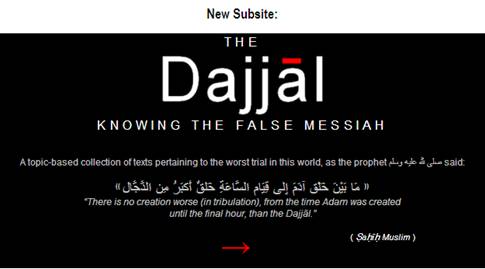
[eBook] Dajjaal – Knowing the False Messaiah – by Abu az-Zubayr Harrison

Compiled and Translated by Abu az-Zubayr Harrison
[AuthenticTranslations.com]

Dajjaal - Knowing the False Messaiah

Click the below link to read or download PDF

Dajjaal – Knowing the False Messaiah – compiled by Abu az-Zubayr Harrison

Contents of the Book

1. Introduction
2. Signs Before the Dajjāl Will Appear
3. Where the Dajjāl will Appear
4. The Dajjāl’s Physical Features
5. The Dajjāl will Have No Children
6. The Dajjāl’s Travels Throughout the Earth
7. The Length of The Dajjāl’s Stay on Earth
8. Has Anyone Seen the Dajjāl?
9. The Dajjāl’s Tribulations
10. The Dajjāl’s False Claim of Lordship
11. The Dajjāl’s Followers
12. Protection from the Dajjāl’s Tribulations
13. The Staunchest Muslims in Opposition to the Dajjāl
14. The Greatest Martyr is Murdered by the Dajjāl
15. Safety from the Dajjāl’s Tribulations Necessitates Paradise
16. The Death of the Dajjāl
17. Other Tribulations Close in Severity to the Dajjāl
18. Why is the Dajjāl Not Explicitly Mentioned in the Quran?


The Terms ‘al-Munawarah’ and ‘al-Mukkarama’ – Shaykh Hamad al-Ansaari (rahimahullaah)

The Term ‘al-Munawarah’

Hamad al-Ansaari (rahimahullaah) said:

‘I searched for the origin of what people say these days of al-Madina ‘al-Munawarah’ and I found that the first people to label it ‘al-Munawarah’ were the ‘Uthmaanyoon’.  As for the Companions and the Successors and those after them, then for many centuries they called it al-Madina an-Nabaweeyah.’

AbdulAwal bin Hamad al-Ansaari commented:

‘I noticed from my father -Rahimullaah- that if he saw a person write ‘al-Munawarah’, he would say to him to wipe out the word ‘al-Munawarah’ and write ‘an-Nabaweeyah.’[28]

‘Indeed the people of knowledge apply the term ‘an-Nabaweeya’ to al-Madina.’[29]

The Shaykh also said:

‘Applying the word ‘al-Munawarah’ after the word al-Madina was introduced by the non-Arabs.  What was well known by the Companions and the Successors was the addition ‘an-Nabaweeyah’. Likewise, adding the term ‘al-Mukkarama’ to Makkah is not known.’[30]

Source : Taken from A Brief Biography of Shaykh, ‘Allaama, al-Muhaddith Hamad al-Ansaari – Translated & Compiled  By  Abbas Abu Yahya

The Dislike of Praising (someone) to Their Face – By‘Alee Bin Zaid Bin Muhammad Bin Haadee Al-Madkhalee

The Dislike of Praising (someone) to Their Face

Taken from the book ‘Qabasun Min Rawaai’-il-Afnaan-in-Nadeeyah- Aadaabun Islaameeyah Wa Wasaayah Shar’eeyah WaAdhkaar Nabaweeyah’ [1] By‘Alee Bin Zaid Bin Muhammad Bin Haadee Al-Madkhalee

Translated by Abu Yusuf, Sagheer Ibn ‘Abdur-Rasheed Al-Kashmeeree

‘Alee Bin Zaid Al-Madkhalee says:

The twenty third advice: The dislike of praising (someone) to their face

And the reason for it being disliked is so that the one who is being spoken about does not become deceived by it and then feel arrogance, and that is an offense against him, and so that the one who is praising will not enter into anything of lying and bring about sin (upon himself).

And the proof for the dislike is what the two Sheikhs (Al-Bukhaaree and Muslim) have reported from the hadeeth of ‘Abdur-Rahmaan Bin Abee Bakrah from his father that a man praised a man in front of the Prophet (sallalahu alaihi wa sallam). So, the Prophet (sallalahu alaihi wa sallam) said:

Woe be to you, you have cut the neck of your companion”.

Then he said:

“If one of you is to definitely praise his brother then let him say: ‘I deem such and such (to be like that) and I do not praise anyone above Allah, Allah is his Reckoner’ – if he believes that he is like that. [2]

So, there is in this hadeeth a prohibition against the open praising (of a person) due to what it leads to in terms of harm which may beset both the one who is praising and the one who is being praised as I have already said, except that the Prophet (sallalahualaihi wa sallam) guided towards a substitute when a person wants to praise another person, as you have seen.

And in Saheeh Muslim from Miqdaad (may Allah be pleased with him) that a man began to praise ‘Uthmaan (may Allah be pleased with him) so Miqdaad proceeded (towards him) and went down on his knees and began to throw the gravel on his face. So, ‘Uthmaan (may Allah be pleased with him) said: ‘What’s the matter with you?’ So, he said: Indeed, the Messenger of Allah (sallalahu alaihi wa sallam) said:

When you see those who praise people (to their faces), then throw dirt in their faces.” [3]

And in the two Saheehs of Al-Bukhaaree and Muslim from Abu Moosa Al-Ash’aree (may Allah be pleased with him) who said: The Prophet (sallalahu alaihi wa sallam) heard a man praise a man and extol him in praise, so he said:

You have destroyed or cut the back of the man.” [4]

And indeed, some of the scholars have made an exception to the dislike of a man praising (another) man for a good action or a praiseworthy affair occurring from him so that it would incite in him a desire to do the likes of it (again), and as an exhortation for the people in taking it as an example to be followed in those things which are similar to it.

I say: So, whosoever has to praise his brother to his face for a correct purpose which has limited or diverse benefit, then it is upon him to beware of exaggerating in the praise and making it long-winded. And it is also upon him to use the method which the Prophet (sallalahu alaihi wa sallam) guided towards in the previous hadeeth.

Imaam Al-Baghawee said after mentioning the aforementioned hadeeth (of Miqdaad):

‘I say: And in totality, praise and commendation of a person (to their face) is disliked, for very rarely is the one who praises safe from a lie which he says whilst praising him, and very rarely is the one who is praised safe from the amazement (of himself) which enters him.’ [5]

References:

[1] Translator’s footnote:, Daar-ul-Meerath-un-Nabawee , Burj-ul-Kayfaan, Algeria, 1st Edition, 1432/2011, Pp 138-1399. The author of this book is the son of the great scholar, Sheikh Zaid Bin Haadee Al-Madkhalee (hafidhahullah) and he has taken selected portions from his father’s book Al-Afnaan-un-Nadeeyah Sharh Mandhoomat-us-Subul-is-Saweeyah and added extra benefits connected to etiquettes, supplications and advice from the Sharee’ah. The Sheikh has also given an introduction to this beneficial work.

[2] Al-Bukhaaree in Al-Adab…(Vol.8, page 16) and Muslim in Az-Zuhd War-Raqaaiq…(Vol.4, No.3000, page 2296)

[3] Muslim in Az-Zuhd War-Raqaaiq…(Vol.4, No.3002, page 2297)

[4] Al-Bukhaaree in Ash-Shahaadaat…(Vol.2, No.2520, page 947- Al-Boga [Ed.]) and Al-Adab… (Vol.5, No.5713, page 2251) and Muslim in Az-Zuhd War-Raqaaiq…(Vol.4, No.3001, page 2297)

[5] See Sharh-us-Sunnah (Vol.13, page 151)

Related Links:

For a detailed knowledge about this Please Read

My Young Daughter Constantly asks me, ‘Why can’t we see Allah in this life?’ – Shaykh Saalih Al-Fawzan

An Exclusive Translation for Sisters Upon Al-Istiqaamah

Shaykh Al-Fawzan was asked on behalf of a young girl the following question: [1]

My young daughter constantly asks me, ‘Why can’t we see Allah in this life?’ What is the best answer to give her as she is young?

The Shaykh (May Allah preserve him) said,

Say to her, ‘This is because you are not able to see him [in this life]. You would burn to pieces.’ It is not possible for a created being to see Allah in this life. Whereas in the Hereafter Allah gives the believer the strength and ability so he is able to see Allah. Yes.

In another place Shaykh Al-Fawzan mentions: [2]

“The Jahmiyyah and the Mu’tazilah, all of them, reject Ar-Ru’yah (the seeing of Allah) in the Hereafter. Another group exists who say, ‘Verily Allah is seen in this life and in the Hereafter.’ This is a position that is held by some of the Sufis.

The third position, and this is the true and correct stance, is that Allah, the Mighty and Majestic will be seen in the Hereafter by the people of paradise as is found in the ahadeeth that have been narrated upon the Prophet (peace and blessings be upon him) and which have reached the level of Mutawaatir (such a great number of ahadeeth it is not possible that they have all been invented). However, in this life, then verily Allah cannot be seen because the people cannot endure and survive seeing Him, the Exalted in this life. When Moosa (peace and blessings be upon him) asked to see Allah, the Exalted, in this life, Allaah said:

“And when Moses arrived at Our appointed time and his Lord spoke to him, he said, “My Lord, show me [Yourself] that I may look at You.” [Allāh] said, “You will not see Me, but look at the mountain; if it should remain in place, then you will see Me.” But when his Lord appeared to the mountain, He rendered it level, and Moses fell unconscious. And when he awoke, he said, “Exalted are You! I have repented to You, and I am the first of the believers.” [Al-A’raaf: 143]

The solid mountain became dust due to the Greatness of Allah, the Mighty and Majestic. So how can a human being withstand seeing Allah [in this life]?”

References:

(1)  sahab.net/forums/index.php?showtopic=119604
(2)  Shaykh Al-Fawzan’s explanation of Al-Haa’iyyah, p. 78-79

Taken from http://uponistiqaamah.blogspot.com

Men Teaching Women without there being a Screen between them – The Permanent Committee

Alifta.net – Fatwa no. 17929

All praise be to Allah Alone, and peace and blessings be upon the final Prophet.

The Permanent Committee for Scholarly Research and Ifta‘ has read the letter which was sent to his Eminence, the Grand Mufty, from the questioners, Chairman and Members of Association of Islamic law at the Faculty of Shari`ah and Islamic Studies at the university of Kuwait. This letter was transferred to the Committee by the Secretariat-General of the Council of Senior Scholars under the number 1202 in 11/03/1416 A. H. The questioners asked the following question:

Is it permissible that a male teacher teaches female students without there being a screen between them so that they see each other? It may be important to mention that mostly the teacher does not see their faces as they wear the face veil.

Is it permissible that a female student attends the office of her male teacher and the latter talks with her without there being a screen between them but mostly without seeing her face? Is it permissible that such a student takes a seat inside the office of a male teacher speaking with him about the field of study and so on, while no Mahram (spouse or permanently unmarriageable relative) accompanies her or she is accompanied by one of her female schoolmates and the teacher explains the lesson to them or answers their questions which are related to lectures and so on? It may be worthy to mention that the foregoing can be done by phone and that some of the teachers are still in their youth or have just started their old age while the female students are mostly in the beginning of their youth.

After the Committee had studied the question it answered as follows:

First, intermixing of men and women in schools or any other places is considered a great Munkar (that which is unacceptable or disapproved of by Shari`ah and Muslims of sound intellect) and a great evil with regard to the affairs of both Din (religion) and the world. Thus, it is not permissible for women to study or work in a place which intermixes men and women. Similarly, their guardians should not allow them to do so.

Second, it is neither permissible for men to teach unveiled women nor to teach women wearing Shar`y (Islamically acceptable) veil in privacy. By the way, all of the body of a woman is `Awrah (parts of the body that must be covered) as far as a non-Mahram (not a spouse or an unmarriageable relative) is concerned. As for covering the head and showing the face, this is not full Hijab (veil).

Third, it is permissible for a man to teach women from behind a screen in female schools where there is no intermixing of male and female students or male and female teachers.

If female students need to ask their male teacher about something, this should be done through closed communication networks, which are renowned and available, or via phones, however, such students should be careful not to soften their speech.

May Allah grant us success. May peace and blessings be upon our Prophet Muhammad, his family, and Companions.

The Permanent Committee for Scholarly Research and Ifta’
Member – Member – Member – Chairman
Bakr Abu Zayd – `Abdul-`Aziz Al Al-Shaykh – Salih Al-Fawzan – `Abdul-`Aziz ibn `Abdullah ibn Baz

Fatwas of the Permanent Committee>Group 1>Volume 12: Jihad and Hisbah>Jihad and Hisbah>Knowledge>Men teaching women without a barrier

Do Not Compromise The Religion – EVER- and beware of the tricks of Ahlul-Bid’ah!

Bismillaah Al-Hamdulillaah wa salatu wa salaamu ‘ala rasulullaah
Amma-ba’d

The following are notes [not verbatim] from a highly beneficial lesson given by student Abu Dihyah Dawood Adeeb (hafidhahullaah Ta’aala) two years ago:

Nuh’s wife calling Nuh (‘alayhi salaam) ‘crazy’ is a direct criticism of Nuh (‘alayhi salaam) and an indirect criticism of Allaah and an indirect criticism of the message of Nuh. …When Allaah inspired Nuh, his wife would spread namima, calling him ‘crazy.’

Allaah said:

وَدُّوا لَوْ تُدْهِنُ فَيُدْهِنُونَ

They wish that you should compromise (in religion out of courtesy) with them, so they (too) would compromise with you. (Al-Qalam, ayah 9)

Imam Ibn Katheer (rahimahullaah Ta’aala) said about this ayah that it means: “They want you to be quiet about their gods and abandon the truth you are upon.”

[The disbelievers and Ahlul-Bid’ah wish that those relaying the truth and forbidding falsehood cease doing so.] And this is exactly what happens to the ‘ulemma of Ahlus-Sunnah, specifically, and on another level the students and the du’aat (callers).

In regards to the callers dealing with other Muslims, it means [Ahlul-Bid’ah desiring] abandoning talking about their [Ahlul-Bid’ah’s] deviation, abandoning talking about their extremism, abandoning talking about their heresies, abandoning talking about their misguidance, or not saying the truth.

Shaikh Saalih al-Fawzaan (hafidhahullaah Ta’aala) said in his tafseer of this ayah:

لَوْ تُدْهِنُ

They wish that you should compromise with them : This is al-Mudahana, and it is to renounce or compromise something from the Religion to please those people [kufaar or Ahlul-Bid’ah], renouncing or giving up something from the Religion to please those people.

– This means [that people of kufr desire that] Ahlul-Islaam making Mudahana with Ahlul-Kufaar

– (Or) coming down a notch, this means [that people of bid’ah desire that] Ahlus-Sunnah making Mudahana with Ahlul-Bid’ah

– (Or) it could also be the people of Islaam with both the kufaar and Ahlul-Bid’ah

Shaikh Fawzaan said: [Allaah said:]

وَدُّوا لَوْ تُدْهِنُ فَيُدْهِنُونَ

They wish that you should compromise (in religion out of courtesy) with them, so they (too) would compromise with you. (Al-Qalam, ayah 9)

The Kufaar would like you to compromise, for if you were to incline just a little bit, you would give them what [they] want. So you would compromise with them, and them with you.

In another ayah:

وَإِنْ كَادُوا لَيَفْتِنُونَكَ عَنِ الَّذِي أَوْحَيْنَا إِلَيْكَ لِتَفْتَرِيَ عَلَيْنَا غَيْرَه ُ وَإِذا ً لاَتَّخَذُوكَ خَلِيلا

Verily, they were about to tempt you away from that which We have revealed (the Qur`an) unto you (O Muhammad), to fabricate something other than it against Us, and then they would certainly have taken you a friend! (Al-Isra`, ayah 73)

وَلَوْلاَ أَنْ ثَبَّتْنَاكَ لَقَدْ كِدْتَّ تَرْكَنُ إِلَيْهِمْ شَيْئا ً قَلِيلا

And had We not made you stand firm, you would nearly have inclined to them a little. (Al-Isra`, ayah 74)

When you compromise, it opens the door for more Mudahana, so you end up making Tamyee’ (watering down the Religion).

Shaikh Fawzaan said:

Allaah said:

إِذا ً لَأَذَقْنَاكَ ضِعْفَ الْحَيَاةِ وَضِعْفَ الْمَمَاتِ ثُمَّ لاَ تَجِدُ لَكَ عَلَيْنَا نَصِيرا

In that case, We would have made you taste a double portion (of punishment) in this life and a double portion (of punishment) after death. And then you would have found none to help you against Us. (Al-Isra`, ayah 75)

Allaah is warning the most pious, righteous, God-fearing man who ever walked on the face of the earth [Prophet Muhammad, salallaahu ‘alayhi wa sallam], so how much more us, the Salafiyoon of America. Meaning you cannot mix (compromise) or water down this Risala (message).

Allaah said:

وَلاَ تَرْكَنُوا إِلَى الَّذِينَ ظَلَمُوا فَتَمَسَّكُمُ النَّارُ وَمَا لَكُمْ مِنْ دُونِ اللَّهِ مِنْ أَوْلِيَاءَ ثُمَّ لاَ تُنصَرُونَ

And incline not toward those who do wrong, lest the Fire should touch you, and you have no protectors other than Allaah, nor you would then be helped. (Hud, ayah 113)

Shaikh Fawzaan said: The Muslim does not haggle or bargain with his Religion ever!

ادْعُ إِلَى سَبِيلِ رَبِّكَ بِالْحِكْمَةِ وَالْمَوْعِظَةِ الْحَسَنَةِ

Invite (mankind, O Muhammad) to the Way of your Lord (i.e. Islaam) with wisdom (i.e. with the Divine Inspiration and the Qur`an) and fair preaching… (An-Nahl, ayah 125)

Of course, you should call to Allaah with wisdom and beautiful exhortation, but he [the true Salafee caller] never relinquishes or renounces anything of his religion to please and satisfy the disbelievers (and deviant Muslims). We don’t compromise anything from Salafiyyah, Islaam.

And we as Muslims don’t compromise, lower, relinquish, foregoe anything of the Sunnah and Salafiyyah and its principles for the people of bid’ah. If we don’t (remain firm) with Ahlul-Bid’ah, then how in the world are we going to (remain firm) when dealing with disbelievers.

Of course, you give da’wah – ادْعُ إِلَى سَبِيلِ رَبِّكَ بِالْحِكْمَةِ وَالْمَوْعِظَةِ الْحَسَنَةِ – but the methodology must be correct; he doesn’t compromise anything from the Deen to please the kufaar.

The one who doesn’t come to Islaam, except by relinquishing or foregoing anything of the Religion, he’s not going to come. We don’t desire him anyway. We are not to transgress the bounds regards our Deen because our Deen will never accept bargaining or haggling or compromise with something from the Deen.

وَدُّوا لَوْ تُدْهِنُ فَيُدْهِنُونَ

They wish that you should compromise (in religion out of courtesy) with them, so they (too) would compromise with you. (Al-Qalam, ayah 9)

Shaikh Fawzaan said: Mudahana means : relinquishing something from the Deen for the pleasure or consent of the kufaar (or Ahlul-Bid’ah).

Abu Dihyah also relayed from Shaikh Saalih al-Fawzaan some of the Mudahana that Ahlul-Bid’ah boldly commit today, such as when they call other Muslims to not call the disbelievers “kufaar” (disbelievers) or “mushrikoon” (polytheists), but instead to call them “non-Muslim.” Or even when some of them they seek to change the address of Allaah in the Qur`an, such as Allaah’s address in Sooratul Kaafiroon. Some of them say, “Do not say (as Allaah says what means): ‘Oh you disbelievers,’ but say ‘Oh you non-Muslims.'” [Aoodhubillaah!] Some of them say, “Do not say (as Allaah says what means): ‘I do not worship what you worship,’ but say ‘I do not pray as you pray,‘ or ‘I do not give charity as you give charity.‘” [Aoodhubillaah!]

They call others to change the religious address.

Shaikh Fawzaan said: “Isn’t this the address of Allaah in the Qur`an? This is the address of Allaah, and you want us to change it? This kind of speech is not permissible ever! Never!! Not permissible.”

Mudahana is haram, because it is relinquishing something of the Religion to please the disbelievers (or Ahlul-Bid’ah).

As for the Mudarat, it is permissible with need to do so.

Mudahana is to relinquish or foregoe something from the Religion.

Mudarat is giving them something to repel their evil without relinquishing anything from the Religion.

Ibn Al-Batal (rahimahullaah Ta’aala) said: “Mudarat is from the good characteristics of the believers, to be responsive to people even with a word, without being coarse with them in speech. This is one of the strongest causes of harmony. Some people think that Mudarat is Mudahana, and this is an error! As Mudara is regrettable, whereas Mudahana is prohibited.

The difference is Mudahana is taken from the word Dahan. A Dahan is a painter, who glosses over something and covers what is actually there. The scholars have explained it [Mudahana] as: lying with a sinner and openly displaying happiness with what he is doing without forbidding him at all.

Mudara is being kind with the ignorant in order to teach him, being kind to the sinner in order to forbid him what he’s doing without being harsh, so that he does not expose what he does, and forbidding him with gentle speech and action, especially if his comradship is needed and the likes of it.” [FatHul-Baari by Ibn Hajar, who quoted Ibn Battal]

Imam al-Qurtubi (rahimahullaah Ta’aala) said: “The difference between Mudara and Mudahana is that Mudara is to surrender the dunya for the benefit of the Deen, and it is permissible and even recommended. And Mudahana is leaving the Deen (or something of the Deen) for the dunya.”

Imam Ibnul-Qayyim (rahimahullaah Ta’aala) said: “Therefore Mudara is praiseworthy, and Mudahana is censured. So there is a difference between the two. The one who is Mudari uses kindness with a person in order for the truth to manifest from the person or make him retract from falsehood.

The Mudahana (the flaterrer and comprimiser) uses kindness in order for the person to remain established upon falsehood and leaves him upon his desires. Mudara is for the people of Eeman, while Mudahana is for the hypocrites.

Post Courtesy of Maher Attiyeh
Colour highlighting and indentation modified by AbdurRahman.Org