[Alternative Mp3 Download Link]
Dr. Saleh as Saleh rahimahullaah audio collection:
https://abdurrahman.org/audio-saleh-as-saleh/
Islamic Knowledge – Islam, Sunnah, Salafiyyah

[Alternative Mp3 Download Link]
Dr. Saleh as Saleh rahimahullaah audio collection:
https://abdurrahman.org/audio-saleh-as-saleh/
Shaykh Sulaymaan Ar-Ruhaylee حفظه الله:
The second point of reflection is a reminder. Last year, O servants of Allah, Ramadhaan came upon us and we exerted ourselves a little and were negligent in many ways. We were lazy in many ways and were surprised when Ramadhaan ended and we bade it farewell. We were regretful of our negligence therein and promised ourselves that if we make it to the next Ramadhaan, we would exert ourselves in worship and that we would not be negligent or lazy.
Here we are, O servants of Allah, we have begun Ramadan and days from it have passed us by. So what have we done regarding our promises? Have we been generous with ourselves by exerting ourselves in these blessed days or have we returned to what we were upon before; exerting ourselves a little and being negligent a lot? It is incumbent, O servants of Allah, to remember our condition last Ramadan so that we can improve our condition in this current Ramadan as it is only a minute number of days, O servants of Allah, before it ends.
Thus, it is obligatory upon us to honor ourselves by exerting ourselves in acts obedience as anyone of us does not know if he will or will not make it to the next Ramadan. How many of our loved ones fasted with us last Ramadan, but today they are lost amongst us and have entered their graves. Allah knows best about our situation. Therefore, we need to make the most of this Ramadan doing righteous deeds as in this lies our happiness in this life and the next.
Translated by Abu Afnaan Muhammad Abdullah حفظه الله
Reference: AbdurRahman.Org
Translated by Abu Afnaan Muhammad Abdullah حفظه الله
Shaykh Sulaymaan Ar- Ruhaylee حفظه الله:
The first point of reflection: Is a point of contemplation and this point – O servants of Allah- is that last year we welcomed Ramadhaan and then bade it farewell. Then, we waited for the next Ramadhaan and saw it as being far away. Yet. here it is upon us and one of us says to himself or his brother. ‘How fast the days have past. I swear by Allah it was as if it was yesterday we bade farewell to the last Ramadhaan and here it is today we begin the current Ramadhaan.’
Verily this is the reality of the days, they quickly pass us by and our appointed times have diminished. One of us says – O servants of Allah- if the year passes by, My age has increased a year’ but the reality of the affair is that certainly his age has decreased by a year as one’s age is limited and one’s appointed time is limited. And verily the reality of the affair is that it is not but steps (closer to death) and Allah knows best when those steps will end. Verily, O servants of Allah, it is but just days which we spend and they spend us as they quickly move us to our appointed time.
Verily, this reality – O servants of Allah – reminds us of the statement of Our Lord the Most High:
And put forward to them the example of the life of this world, it is like the water (rain) which We send down from the sky, and the vegetation of the earth mingles with it, and becomes fresh and green. But (later) it becomes dry and broken pieces, which the winds scatter. And Allah is Able to do everything. [Al-Kahf: 45]
Verily this life – O servants of Allah – quickly passes us by, it quickly passes us by and our condition is not except three: Youth, then old age and then death. (Like the line of poetry says):
‘The last thing an individual is called is ‘old man ‘ and what follows that from the names he is given is ‘the deceased’.
So glad tidings – O servants of Allah- for the one who reflects upon that which has passed and revived the present and what will come with righteous actions.
{So reflect O you who have intellects}
Video Courtesy: Bilal Nahim
Reference: AbdurRahman.Org
Related Link: https://abdurrahman.org/ramadhan
The Messenger of Allaah (salallaahu ‘alaihi wa sallam) said,
“Whoever feeds a fasting person will have a reward like that of the fasting person, without any reduction in his reward.”
[At-Tirmidhi, authenticated by Al-Albani (rahimahullaah).]
Shaykh Muhammad bin Saalih Al-‘Uthaimeen (rahimahullaah) said,
“Those who have the ability should strive to feed those who are fasting (when it’s time to break the fast) either in the masaajid or in other places. This is since whoever feeds a fasting person, he will receive the same reward as the one fasting. So if a person feeds his brothers who are fasting, he will receive the same reward as them. Therefore, those whom Allaah has granted wealth should take advantage of this opportunity to obtain a great reward.”
[48 Su’aalan fis-Siyaam]
–
Posted from 12- Fasting – Ending the Fast – Iftar 10:33 · 1.21 MB
Pillar4 – Fasting – Ramadhan – Dr. Saleh as Saleh
—
The following are taken from Fortress of the Muslim, Dar-us-salam Publication
Offered food when fasting & you decline:
When you are invited (to eat) then reply to the invitation. If you are fasting then invoke Allah’s blessings (on your host), and if you are not fasting then eat.
Muslim 2/1054
Breaking fast in someone’s home:
أَفْطَرَ عِنْدَكُم الصّائِمونَ وَأَكَلَ طَعامَكُمُ الأبْرار، وَصَلَّتْ عَلَيْكُمُ الملائِكَة
Aftara ‘indakumus-saa’imoona, wa ‘akala ta’aamakumul-‘abraaru, wa sallat ‘alaykumul-malaa’ikatu
With you, those who are fasting have broken their fast, you have fed those who are righteous, and the angels recite their prayers upon you.
Abu Dawud 3/367, Ibn Majah 1/556, An-Nasa’i, ‘Amalul-Yawm wal-Laylah 296-8. Al-Albani graded it authentic in Sahih Abu Dawud 2/730
Q. 393. There are some people who call for the uniting of moon sightings everywhere with that of Makkah, in order to unite the Muslim community over the start of the blessed month of Ramadan and other months. What is Your Eminence’s opinion on this?
A. From the point of view of astronomy, this is impossible, because the appearance of the new crescent, as Shaikhul-Islam Ibn Tairniyyah, may Allah have mercy on him, said, differs (from place to place) according to the consensus of those who are knowledge- able in this field. Since it differs, then what is necessitated by the evidence from the Qur’an and the Sunnah, and scientific evidence, is that every country must have its own ruling.
As for the evidence from the Qur’an and the Sunnah, Allah, the Most High says:
“So whoever of you sights (the crescent on the first night of) the month (of Ramadan, i.e. is present at his home), he must observe Saum (fasts) that month” [Al-Baqarah 2:185]
So, if it happened that a people in the farthest part of the earth did not witness the month, i.e. the new crescent, while the people of Makkah had seen the new crescent, how could the address in this Verse be applied to those who had not witnessed the new crescent?! The Prophet صلى الله عليه وسلم said:
“Fast when you see it and break the fast when you see it” [1]
So if the people of Makkah see it, how can we oblige the people of Pakistan and those Asians who live beyond it to fast, when we know that the new crescent has not appeared in their region, and the Prophet صلى الله عليه وسلم: made fasting conditional upon the sighting of the new crescent?
The scientific evidence is the correct analogy, which it is not possible to refute, for we know that the dawn appears in the eastern corner of the earth before the western side. So if the dawn appears on the eastern side, is it incumbent upon us to fast while we are still in the night? The answer is no. If the sun sets in the east, while were still in daylight, is it permissible for us to break our fast? The answer is no. Therefore, the new crescent is exactly like the sun, except that the timing of the new crescent is monthly and the timing of the sun is daily, and He Who said:
“It is made lawful for you to have sexual relations with your wives on the night of As-Saum (the fasts). They are Lihas [i.e. body- cover, or screen, or Sakan (i.e. you enjoy the pleasure of living with them) for you and you are the same for them. Allah knows that you used to deceive yourselves, so He turned to you (accepted your repentance) and forgave you. So now have sexual relations with them and seek that which Allah has ordained for you (offspring), and eat and drink until the white thread (light) of dawn appears to you distinct from the black thread (darkness of night), then complete your Saum (fast) till the nightfall. And do not have sexual relations with them (your wives) while you are in I ’tikaf (i.e. confining oneself in a mosque for prayers and invocations leaving the worldly activities) in the mosques. These are the limits (set) by Allah, so approach them not. Thus does Allah make clear His Ayat (proofs, evidences, lessons, signs, revelations, verses, laws, legal and illegal things, Allah’s set limits, orders, etc.) to mankind that they may become Al-Muttaqun.” [Al-Baqarah 2:187]
is the One Who said:
“whoever of you sights (the crescent on the first night of) the month (of Ramadan, i.e. is present at his home), he must observe Saum (fasts) that month” [Al-Baqarah 2:185]
So, What is necessitated by the evidence from the Qur’an and the Sunnah, as well as scientific evidence, is to make a special judgement for each place regarding fasting and breaking the fast, and to link them on the base of the perceptible sign which Allah has declared in His Book, and His Prophet, Muhammad fig has declared in his Sunnah, and that is the sighting of the moon and the sighting of the sun or the dawn.
[1] Reported by Al-Bukhari in the Book of Fasting, in the Chapter: The Words of the Prophet صلى الله عليه وسلم: When you see the new crescent (1909); and by Muslim in the Book of Fasting, in the Chapter: The Obligation to Fast the Month of Ramadan Upon Sighting the New crescent (1081).
Source: Fatwa Arkanul Islam, Volume 2 – Shaykh Uthaymeen, Dar-us-Salam English Publication
The first question of Fatwa no. 10666
Q 1: What is meant by Al-Fajr-ul-Kadhib (false dawn) and Al-Fajr-ul-Sadiq (true dawn)? According to which one of them do we offer Salah (Prayer)? How can we calculate the time of Al-Fajr-ul-Sadiq?
A: Al-Fajr-ul-Kadhib appears as a rectangle in the sky from the top to the bottom of the horizon, while Al-Fajr-ul-Sadiq appears in the sky spreading along the horizon. The time for offering the Fajr (Dawn) Prayer starts with the appearance of Al-Fajr-ul-Sadiq.
May Allah grant us success. May peace and blessings be upon our Prophet Muhammad, his family, and Companions.
The Permanent Committee for Scholarly Research and Ifta’
Member – Deputy Chairman – Chairman
Abdullah ibn Ghudayyan – Abdul-Razzaq Afify – Abdul-`Aziz ibn `Abdullah ibn Baz
Posted from: http://www.alifta.net/Fatawa/FatawaChapters.aspx?languagename=en&View=Page&PageID=1899&PageNo=1&BookID=7
Clip Extracted from: 11- Fasting – Pre-Dawn Meal – Sahoor 18:59 · 2.17 MB
Pillar4 – Fasting – Ramadhan
–
Allaah, Ta’aala, says:
أُحِلَّ لَكُمْ لَيْلَةَ الصِّيَامِ الرَّفَثُ إِلَى نِسَائِكُمْ هُنَّ لِبَاس ٌ لَكُمْ وَأَنْتُمْ لِبَاس ٌ لَهُنَّ عَلِمَاللَّهُ أَنَّكُمْ كُنتُمْ تَخْتَانُونَ أَنفُسَكُمْ فَتَابَ عَلَيْكُمْ وَعَفَا عَنْكُمْ فَالآنَ بَاشِرُوهُنَّ وَابْتَغُوا مَا كَتَبَ اللَّهُ لَكُمْ وَكُلُوا وَاشْرَبُوا حَتَّى يَتَبَيَّنَ لَكُمُ الْخَيْطُ الأَبْيَضُ مِنَ الْخَيْطِ الأَسْوَدِ مِنَ الْفَجْرِ ثُمَّ أَتِمُّوا الصِّيَامَ إِلَى اللَّيْلِ وَلاَ تُبَاشِرُوهُنَّ وَأَنْتُمْ عَاكِفُونَ فِيالْمَسَاجِدِ تِلْكَ حُدُودُ اللَّهِ فَلاَ تَقْرَبُوهَا كَذَلِكَ يُبَيِّنُ اللَّهُ آيَاتِه ِ لِلنَّاسِ لَعَلَّهُمْ يَتَّقُونَ
It is made lawful for you to have sexual relations with your wives on the night of As-Saum (the fasts). They are body covering for you and you are the same for them. Allaah knows that you used to deceive yourselves, so He turned to you (accepted your repentance) and forgave you. So now have sexual relations with them and seek that which Allaah has ordained for you (offspring), and eat and drink until the white thread (light) of dawn appears to you distinct from the black thread (darkness of night), then complete your Saum (fast) till the nightfall. And do not have sexual relations with them (your wives) while you are in I’tikaaf in the mosques. These are the limits (set) by Allaah, so approach them not. Thus does Allaah make clear His Ayaat to mankind that they may become Al-Muttaqun.
(Al-Baqarah, ayah 187)

Source for above: Book of Fasting – Bulughul Maraam – Dar-us-salam Publication
Fasting – Bulugh – 11- 535 – Blessing of Sahuur – 536 – Breaking the Fast
–
Audio Source: Fasting – Buloughul Maraam
Related Posts for Suhur:
—
FAQ – Fasting – Illness – Diabetes – Saleh-As-Saleh
FAQ – Fasting – Illness – Heart Problems – High Blood Pressure – Saleh-As-Saleh
FAQ – Fasting – Illness – Kidney Stones – Saleh-As-Saleh
FAQ – Fasting – Illness – Mental Disease – Saleh-As-Saleh
FAQ – Fasting – Illness – Recovery Anticipated or Not Anticipated – Saleh-As-Saleh
FAQ – Fasting – Illness – Treatment with Nosedrops – Saleh-As-Saleh
FAQ – Fasting – Incense- Candle- Air Freshener- Perfume- Deodorant- Insecticide – Saleh-As-Saleh
FAQ – Fasting – Inhaler – Oct 13 2005 – Saleh-As-Saleh
FAQ – Fasting – IV Infusion – Local Anesthesia – Suppository – Lotion – Saleh-As-Saleh
FAQ – Fasting – Kohl Application – Saleh-As-Saleh
FAQ – Fasting – Medication – Diet Pills – Saleh-As-Saleh
FAQ – Fasting – Medication for Allergy – Nasal Spray – Saleh-As-Saleh
FAQ – Fasting – Medication Taken With or Without Water – Saleh-As-Saleh
FAQ – Fasting – Menses – Start During the Fasting Day – Saleh-As-Saleh
FAQ – Fasting – Menses – Stop at Fajr – Stop During the Day – Saleh-As-Saleh
FAQ – Fasting – Menses at Time of Seeking Laylatul Qadr – Saleh-As-Saleh
FAQ – Fasting – Menses Inhibitor – Saleh-As-Saleh
FAQ – Fasting – Menses Irregular – 2 Questions – Saleh-As-Saleh
FAQ – Fasting – Menses Start at Time of Adhan of Maghrib – Saleh-As-Saleh
FAQ – Fasting – Miscarriage – Human Features Present or Absent – Saleh-As-Saleh
FAQ – Fasting – Postpartum – Getting Benefits from Ramadan – Saleh-As-Saleh
FAQ – Fasting – Postpartum and Nursing – Breading the Fast – Saleh-As-Saleh
FAQ – Fasting – Pregnancy – Bleeding During Pregnancy – Saleh-As-Saleh
FAQ – Fasting – Pregnancy – Nursing – Making Up – Saleh-As-Saleh
FAQ – Fasting – Saliva and Sputum – Dust – Saleh-As-Saleh
FAQ – Fasting – Shaban – 15th Day – Last Part – Saleh-As-Saleh
FAQ – Fasting – Shower – Rinsing Mouth – Saleh-As-Saleh
FAQ – Fasting – Taking Medication While Abstaining From Food – Saleh-As-Saleh
FAQ – Fasting – Travel – 3 Situations in Regards to Hardship Levels – Saleh-As-Saleh
FAQ – Fasting – Travel in a Plane While Fasting – Saleh-As-Saleh
FAQ – Fasting – Ultra Sound Examination – Saleh-As-Saleh
FAQ – Fasting – Women and Taraweeh – Saleh-As-Saleh
FAQ – Fasting – Women Sad Because They Cannot Fast – Saleh-As-Saleh
FAQ -_Fasting – Brushing With Toothpaste – Gargling – Rinsing Mouth – Saleh-As-Saleh
FAQ – Fasting – Blood Donation – Saleh-As-Saleh
FAQ – Fasting – Dentist Visit – Dental Anesthesia – Tooth Extraction – Saleh-As-Saleh
FAQ – Fasting – i’tikaaf for Women – Seclusion is Not Done at Home – Saleh-As-Saleh
Knowing If Your Deeds Have Been Accepted – Shaykh Ṣāliḥ b. Fawzān Al-Fawzān حفظه الله
https://owaisalhashimi.info/al-fawzan…
Translated by Owais Al-Hashimi حفظه الله
Video Courtesy: Bilal Nahim
http://mtws.posthaven.com/fasting-sha…
Translated by Raha ibn Donald Batts حفظه الله
Video Courtesy: Bilal Nahim
Translated by Abu Afnaan Muhammad ‘Abdullah حفظه الله
Video Courtesy: Bilal Nahim
Question:
May Allah grant you good. The questioner from Yemen, Hasan Saalih asks, ‘Regarding the day of ‘Eid, Eid al Fitr or ‘Eid al Adha, if it coincides with the day of al Jumu’ah, what are the legislative rulings concerning this?
Shaykh Muhammad bin Saalih Al-‘Uthaymeen:
If the ‘Eid coincides with al-Jumu’ah, whether it be ‘Eid al Fitr or Eid al Adha, then it is obligatory that the ‘Eid prayer is prayed and that Jumu’ah is prayed. Then it is said to whoever prayed ‘Eid prayer and was not the imam, if he wishes he may pray Jumu’ah or if he wishes he may pray Dhuhr in his home instead. This is the summary of the issue.

Extremely comprehensive yet potent with much benefit, this Ebook offers a synopsis of essential matters surrounding the ‘Eid prayer which every Muslim who wishes to align himself to the Sunnah of Muhammad(sallAllahu ‘alayhi wa sallam) should be familiar with.
This treatise was written by Shaykh ‘Abdul Qaadir Ibn Muhammad al-Junyad (حفظهالله) and was translated by Abu Afnaan Muhammad ‘Abdullah (حفظهالله) with the explicit permission and approval of the Shaykh.
The Chapter Headings
An excerpt taken from the Chapter: Listening to The ‘Eid Khutbah
Al-Haafidh Ibn Battal mentioned in ‘Sharh Saheeh al-Bukhaaree’, vol.2, pg. 572: “The scholars considered the people talking as the Imaam gives the khutbah as being makrooh (disliked).”
Regarding the hadeeth: “Indeed, we will give the khutbah, thus whoever wishes to stay for the khutbah is to sit and stay and whoever wishes to leave, may leave.”
The majority of the People of Knowledge are of the opinion that this hadeeth is mursal and from those scholars who were of this opinion include: Ibn Ma’een, Abu Zur’ah ar-Raazee, an-Nasaa’ee, Abu Daawood, al-Bayhaqeeand al-Waadi’ee. And mursal is from the categories of weak hadeeth.
Download PDF: The Legislative Rulings For ‘Eid-ul-Fitr by Shaykh ‘AbdulQaadir al-Junayd
Posted from : http://store.mpubs.org
*IMAAM ABOO DAAWOOD AT-TAYAALISEE-rahimahullaah (d. 204 H) reported in his “Musnad” (no. 2545):
“`Imraan narrated to us: from Qataadah: from Aboo Maymooonah: from Aboo Hurairah: that Allaah”s Messenger (صلى الله عليه و سلم) said, concerning Laylatul-Qadr (the Night of Decree):
<< Laylatul-Qadr is the twenty seventh or the twenty ninth night. The Angels that night upon the earth are more than the number of the pebbles >>. “
*Shaikh al-Albaanee -rahimahullaah- said in “as-Saheehah” (no. 2205): “Reported by at-Tayaalisee in his “Musnad” (no. 2545), and from him by Ahmad (2/519), and likewise by Ibn Khuzaymah in his “Saheeh” (2/223): from `Imraan al-Qattaan: from Qataadah: from Aboo Maymoonah: from Aboo Hurairah marfoo`an.
I say: And this is a hasan chain of narration; and al-Haafiz remained silent about it in “al-Fath” (4/209).”
[Translated by Aboo Talhah Daawood ibn Ronald Burbank]
Posted from PDF www.alitisaambissunnah.wordpress.com
* al-`Allaamah Ibn Battaal al-Maalikee -rahimahullaah- said in his explanation of “Saheehul-Bukhaaree” (4/154-157), in explanation of the Chapter: Seeking the Night of Decree in the odd nights of the last ten [Book of the virtue of the Night of Decree: Chapter 3]:
“at-Tabaree said: The Companions and those who followed them upon good differed concerning pinpointing the actual night of Laylatul-Qadr; and they differed in what they narrated from the Prophet -`alaihis-Salaam- to pinpoint it.
Ibn Mas`ood said: “It is the seventeenth night of Ramadaan”; and
`Alee, Ibn Mas`ood, and Zayd ibn Thaabit said: “It is the nineteenth night”; and
some of them said: “It is the twenty (first night)”, based upon the hadeeth of Aboo Sa`eed: that is also related from `Alee and Ibn Mas`ood.
Others said: “It is the twenty third night”, based upon the hadeeth of Ibn `Umar and Ibn `Abbaas; that is related from Ibn `Abbaas, `Aa·ishah, and Bilaal; and it was said by Makhool; and
Ibn `Abbaas and Bilaal said: “It is the twenty fourth night”; and this was the saying of al-Hasan [i.e. al-Basree] and Qataadah; and I think that those who said that were basing it upon his -`alaihis-Salaam- saying: << Seek it when seven remain >>, understanding that the seventh is the first of the seven remaining nights; and that is the twenty fourth night if the month is full [1] And `Alee, Ibn `Abbaas, Ubayy ibn Ka`b, and Mu`aawiyah said: “It is the twenty seventh night”;
[1] i.e. consisting of thirty days; as opposed to “short”,when composed of twenty nine days.
and it is related from Ibn `Umar that he said: “It occurs within the whole of Ramadaan”;
and `Abdullaahibn Buraydah related: from Mu`aawiyah: from the Prophet (صلى الله عليه و سلم) that he said:
<< It is the last night. >>
And Ayyoob said: from Aboo Qilaabah that it moves around throughout all the nights of the last ten.
at-Tabaree said: And the narrations reported about that from the Prophet – `alaihis-Salaam- are authentic, and they are in harmony, they do not contradict each other. this is because they all relate from him -`alaihis-Salaam- that it is within the last ten; and its moving around each year, to one of the last ten nights, is not to be denied. And it is known that he -`alaihis-Salaam- only said, with regard to each of the nights that he commanded his Companions to seek it in, that it was in that night in that (particular) year. So what is correct is that it is in the month of Ramadaan, to the exclusion of the other months of the year, because of the consensus of all those who inherited from the Prophet -`alaihisSalaam- that he said: << (It) is in the last ten; in the odd ones from them. >>
Then there is nothing specific to limit it to a particular night, such that it cannot move to a different night. So if it were restricted to a specific night, then the one having the most right to know that would be the Prophet -`alaihis-Salaam: along with how eager he was to know it, so that he could make his nation aware of it. So he did not make them aware of it, except by its signs: that it is a pleasant night: not hot, and not cold; and that the sun rises on its morning white (dull), with no rays. And the fact that he directed his nation towards it by means of signs, and not by stating a particular night, is a clear proof of the falsity of the saying of those who say that certain things appear that night which do not appear in the rest of the year: such as trees falling to the ground, and then returning to their places. So if that were true, then it would not be hidden from the eyes of one who stood throughout all the nights of the year; so what about the nights of Ramadaan?!
As for what this night has been singled out with, to the exclusion of the rest of the nights, then it is better than a thousand months: meaning that an action done in it : from those things which please Allaah, and which He loves: Prayer, Supplication, and the like, is better than an action done in a thousand months which do not contain the Night of Decree; and that supplication in it is responded to, as long as he does not supplicate for something sinful, nor for the cutting of ties of kinship.
And Maalik said regarding his -`alaihis-Salaam-: << Seek it on the ninth remaining >>: it is the night of the twenty first; and that << Seven remaining >> is the night of the twenty third night; and << Five remaining >> is the twenty fifth.
The author said: The meaning of this, and the Night of Decree occuring on an odd night will only be correct if the month is “short”[i.e. of twenty nine days]. If it is full [i.e. of thirty days], then it will not be except on an even night. So “nine remaining” will be the night of the twenty second; “five remaining” will be the night of the twenty sixth; “seven remaining” will be the night of the twenty fourth: based upon what al-Bukhaaree mentioned from Ibn `Abbaas: so none of them will conform to an odd night. So this proves that the Night of Decree moves around every year within the last ten: from being an odd night to being an even one, and from being an even one to being an odd one. This is because the Prophet -`alaihis-Salaam- did not command his nation to seek it in a full month, but not in a short one. Rather he left seeking it unrestricted, applying to all the months of Ramadaan: those which Allaah causes to be full sometimes, and short on other occasions. So it is established that it moves within all of the last ten nights, as Aboo Qilaabah said…”
[Translated by Aboo Talhah Daawood ibn Ronald Burbank]
Posted from PDF www.alitisaambissunnah.wordpress.com
Imaam Muslim -rahimahullaah- reported in his “Saheeh” (The Book of Fasting: no. 762):
“And Muhammad ibn Haatim and Ibn Abee `Umar narrated to us, both of them: from Ibn `Uyainah. Ibn Haatim said: Sufyaan ibn `Uyainah narrated to us: from `Abdah and `Aasim ibn Abin-Nujood, who both heard Zirr ibn Hubaish say:
“I asked Ubayy ibn Ka`b, saying: Your brother Ibn Mas`ood says: Whoever stands in (Night) Prayer throughout the whole year will attain Laylatul-Qadr (The Night of Decree). So he said: “May Allaah have mercy upon him! He intended that the people should not just rely (upon a single night). Indeed he knew that it was in Ramadaan; and that it is in the last ten; and that it was the twenty seventh night.” Then he swore an oath, without exception that it was the twenty seventh night.” So I said: ” O Abul-Mundhir! Upon what basis do you say that?” He said: “Based upon the sign which Allaah”s Messenger (صلى الله عليه و سلم) informed us of: that it [i.e. the sun] will rise on that day having no rays“.”
Imaam an-Nawawee -rahimahullaah- said in his explanation of “Saheeh Muslim”: “…al-Qaadee `Iyaad said:
It is said that the meaning of its having no rays is that this was just a distinctive sign which Allaah -the Most High- made for it [that year]. He said: Or it is otherwise said: Rather it is on account of the great number of Angels coming and going on its night; and their descending to the earth, and their ascending, with that which they descended with. So their wings and their subtle/ethereal bodies screen the light of the sun and its rays, and Allaah knows best.”
Imaam Aboo Daawood -rahimahullaah- reported the hadeeth (The Book of the Prayer: Chapter 319: What occurs regarding the Night of Decree), (no. 1378), with the wording:
“…On the morning following that night the sun enters the morning like a brass dish, having no rays, until it has risen higher.”
[Declared “hasan saheeh” by Shaikh al-Albaanee -rahimahullaah.]
Imaam Ibn Khuzaymah -rahimahullaah- reported in his “Saheeh” (no. 2192): “ Bundaar narrated to us: Aboo `Aamir narrated to me: Zam`ah narrated to us: from Salamah -he is Ibn Wahraam-: from `Ikrimah: from Ibn `Abbaas: from the Prophet (صلى الله عليه و سلم) that he said regarding the Night of Decree:
“It is a pleasant night, being neither hot nor cold. The sun enters the morning of its day being red and weak.”
-Shaikh al-Albaanee said: “A hadeeth which is “Saheeh” because of its witnesses…”
Imaam an-Nawawee -rahimahullaah- said in his explanation of “Saheeh Muslim” (The Book of Fasting: Chapter 40: The virtue of the Night of Decree):“al-Qaadee [`Iyaad] said:
They disagreed about its place. So a group said: It moves about, so in one year it will be one night, and in another year it will be a different night, and so on; and this harmonizes the ahaadeeth ; and it is said: Each hadeeth refers to one of its times, and there is no contradiction between them. He said: And the like of this was stated by Maalik, ath-Thawree, Ahmad, Ishaaq, Aboo Thawr, and others. They said: It moves about within the last ten nights of Ramadaan…”
al-Haafiz Ibn Hajr -rahimahullaah- said in “Fathul-Baaree” (4/260) in explanation of the chapter heading: “Seeking the Night of Decree in the odd nights of the last ten”:
“This title contains an indication of the preference of the saying that the Night of Decree is restricted to Ramadaan, then to the last ten nights of it, then to the odd nights from them, and that it is not one particular, fixed night. This is what is indicated by the collected narrations concerning it.”
-And he said (4/267):
“So the most correct saying out of all of them is that it is one of the odd nights from the last ten, and that it moves around – as can be understood from the ahaadeeth of this chapter.
So the most likely nights are the odd nights of the last ten; and the most likely night from the odd nights of the last ten in the view of the Shaafi`ees is the twenty-first night or the twenty-third night, in accordance with what occurs in the hadeeth of Aboo Sa`eed and `Abdullaah ibn Unays; whereas in the view of the majority the most likely (night) is the twenty-seventh night, and the evidences for that have preceded.
The scholars said: The wisdom behind Laylatul-Qadr being concealed is so that the people strive to seek it contrary to what would be the case if it were a certain known night – for then they would restrict themselves to that, as has been mentioned concerning the hour on the day of Jumu`ah….”
[Translated by Aboo Talhah Daawood ibn Ronald Burbank rahimahullaah]
Posted from PDF with Permission from: www.alitisaambissunnah.wordpress.com
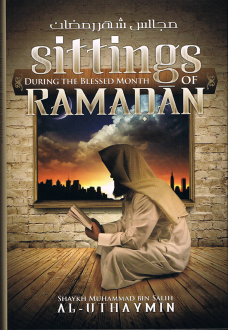
We begin a series of classes Majaalis Ramadan (Sittings in Ramadan) from the works of our noble Shaykh Muhammad ibn Salih al-Uthaymeen rahimahullah.
You can read the Arabic text here.
As with all of our classes at Masjid Tawheed in Stone Mountain, GA, we encourage you to join us.
If you are not able to attend in person, please feel free to listen in via our Spreaker channel or our telelink line at 712-432-2856.
You can buy the above book (english) Here
Contents
Posted from : http://followthesalaf.com/?tag=Majaalis+Ramadan
If a person travels from one country to another where the new crescent of Shawwal has been sighted, should he follow them and break his fast?
Q. 394. If a fasting person travels from one Islamic country to another and it was announced in the first country that the new crescent of Shawwal has been sighted, should he follow them and break his fast, bearing in mind that the new crescent of Shawwal has not yet been sighted in the second country?
A. If a person travels from one Islamic country to another, and the breaking of the fast in the country to which he has travelled was delayed, then he should remain (fasting) with them until they break their fast, because fasting is when the people fast and breaking the fast is when the people break their fast and ( ‘Eid) Al-Adha ( Sacrifice) is on the day when the people sacrifice their animals, even if it means that he increases a day or more. It is the same as if he travelled to a country where the sunset is late for his usual day might be lengthened by two or three hours, or more if he travelled to another country. The new crescent has not been seen there, and the Prophet (صلى الله عليه و سلم) ordered us to not fast unless we see the new crescent, and he also said: “Break your fast when you see it.”
As for the opposite, such as when he travels from a country in which confirmation of the start of the month is delayed to a country in which the start of the month has been confirmed, then he should break his fast with them and make up for what he has missed of Ramadan later. If he missed a day, he must make up for a day and if he missed two days, he must make up for two days.
We say that he makes it up in the second case, because it is not possible for the month to be less than twenty-nine days, nor for it to be more than thirty days. And we say to him: Break your fast, even if you have not completed twenty-nine days, because the new crescent has been seen, and once it has been seen, you must break your fast. And since you have fasted less than twenty-nine, because it is not possible for the month to be less than twenty-nine, so you must complete twenty-nine days, as opposed to the first situation, for you should not break your fast until the new crescent has been seen, and if it has not been seen, then you are still in Ramadan. So, how can you break your fast, for you must fast, even if the month was increased for you, it is only like the increase in the hours of the day .
Posted from : Fatawa Arkanul-Islam : Islamic Verdicts on the Pillars of Islam (Volume2)
By the Honorable Shaikh Muhammad bin Salih Al- ‘Uthaimeen
Collected and Arranged by Fahd bin Nasir bin Ibrahim As-Sulaiman
Published by dar-us-salam
From the Lecture How to Prepare for and Welcome Ramadaan – Dr Murtaza bin Baksh (Urdu)
Translated by: Aboo Bilal Nahim ibn Abd al Majid حفظه الله
Video Courtesy: Bilal Nahim
Source: http://www.binbaz.org.sa/node/19904
Translated by Abu Afnaan Muhammad Abdullah hafidhahullaah
Video Courtesy: Bilal Nahim
Question:
Does ‘Umrah in the month of Ramadan satisfy for the obligation of Hajj due to the Messenger’s (صلى الله عليه وسلم) statement, “Whoever performs ‘Umrah in Ramadan is like the one who makes Hajj with me.”
Shaykh Abdul- Azeez Bin Baaz:
Umrah in Ramadan does not compensate for Hajj. However, it has the merit/virtue of Hajj due to his (صلى الله عليه وسلم) statement, ‘Umrah in Ramadan equals a Hajj’ or he said ‘a Hajj with me‘.
This means in regards to merit and reward and it does not mean it is equivalent to it and replaces it such that he does not have to perform Hajj. No, rather he still must perform the Hajj, the Hajj of Islam (the obligatory Hajj) even if he makes ‘Umrah in Ramadan according to all of the scholars. Thus, with ‘Umrah in Ramadan, the merit of Hajj is attained from the aspect of reward and excellence, but it does not compensate for the Hajj of Islam.
Related Links:
Question:
Is it permissible to offer two Witr prayers in one night?
Answer:
No one should offer two Witr prayers in one night because the Prophet (sallallaahu alaihi wa sallam) said:
There cannot be two Witr prayers in one night.[1]
And he (sallallaahu alaihi wa sallam) also said:
Make the end of your prayer at night Witr. [2]
And he (sallallaahu alaihi wa sallam) said:
Whoever feared that he will not get up at the end of the night should perform Witr at the beginning of it. And whoever desired to stand at the end of it should pray Witr at the end of the night. [3]
If it is easy for the Muslim to perform the night prayer at the end of the night, he should seal his prayer with one Rakah of Witr. Whoever found difficulty in this should perform his Witr at the start of the night.
And if Allaah makes it easy for him (after that) to stand in prayer, he should offer what he can in units of two Rakahs, and he need not repeat the Witr, for the first Witr is sufficient for him, according to the aforementioned Hadith which is:
There cannot be two Witr prayers in one night. [4]
[1] Abu Dawud no. 1439 and At-Tirmithi no. 470
[2] Al-Bukhari no. 990 and Muslim nos. 151, 751
[3] Muslim no. 755
[4] Abu Dawud no. 1439 and At-Tirmithi no. 470
Shaykh `Abdul-`Azeez Bin Baz
Fatawa Islamiyah Vol. 2 Page 298
dar-us-salam publications


 AbdurRahman.Org
You must be logged in to post a comment.