Examine carefully the speech of everyone you hear from in your time particularly – Imam al Barbahaaree

Imaam Abu Muhammad al Barbahaaree (d. 329 H rahimahullaah), said in his Sharh Us-Sunnah :

May Allaah have mercy upon you! Examine carefully the speech of everyone you hear from in your time particularly. So do not act in haste and do not enter in anything from it until you ask and see: Did any of the Companions of the Prophet, may Allaah’s praise and salutations be upon him, speak about it, or did any of the scholars? So if you find a narration from them about it, cling to it, do not go beyond it for anything and do not give precedence to anything over it and thus fall into the Fire.

In Explanation to the above Shaykh Saalih al-Fawzaan (haafidthahullaah) mentioned :

Do not be hasty in accepting as correct what you may hear from the people especially in these later times.  As now there are many who speak about so many various matters, issue rulings and ascribing to themselves both knowledge and the right to speak. This is especially the case after the emergence and spread of new modern day media technologies. Such that everyone now can speak and bring forth that which is in truth worthless; by this meaning words of no true value – speaking about whatever they wish in the name of knowledge and in the name of the religion of Islaam.

It has even reached the point that you find the people of misguidance and the members of the various groups of misguidance and deviance from the religion speaking as well. Such individuals have now become those who speak in the name of the religion of Islaam through means such as the various satellite television channels. Therefore be very cautious!

It is upon you O Muslim, and upon you O student of knowledge individually, to verify matters and not rush to embrace everything and anything you hear.

It is upon you to verify the truth of what you hear, asking, ‘Who else makes this same statement or claim?’, ‘Where did this thought or concept originate or come from?’, ‘Who is its reference or source authority?’

Asking what are the evidences which support it from within the Book and the Sunnah? And inquiring where has the individual who is putting this forth studied and taken his knowledge from? From who has he studied the knowledge of Islaam?

Each of these matters requires verification through inquiry and investigation, especially in the present age and time. As it is not every speaker who should rightly be considered a source of knowledge, even if he is well-spoken and eloquent, and can manipulate words captivating his listeners.

Do not be taken in and accept him until you are aware of the degree and scope of what he possesses of knowledge and understanding. As perhaps someone’s words may be few, but possesses true understanding, and perhaps another will have a great deal of speech yet he is actually ignorant to such a degree that he doesn’t actually possess anything of true understanding. Rather he only has the ability to enchant with his speech so that the people are deceived. Yet he puts forth the perception that he is a scholar, that he is someone of true understanding and comprehension, that he is a capable thinker, and so forth. Through such means and ways, he is able to deceive and beguile the people, taking them away from the way of truth. Therefore what is to be given true consideration is not the amount of the speech put forth or that one can extensively discuss a subject. Rather the criterion that is to be given consideration is what that speech contains within it of sound authentic knowledge, what it contains of the established and transmitted principles of Islaam.

As perhaps a short or brief statement which is connected to or has a foundation in the established principles can be of greater benefit than a great deal of speech which simply rambles on, and through hearing you can’t actually receive very much benefit from.

This is the reality which is present in our time; one sees a tremendous amount of speech which only possesses within it a small amount of actual knowledge. We see the presence of many speakers yet few people of true understanding and comprehension.’

Transcribed from : ‘A Valued Gift for the Reader of Comments Upon the Book Sharh Us-Sunnah‘, page 102-103 | Shaykh Saalih Ibn Fawzaan al-Fawzaan (haafidthahullaah)

[Point 8 of 170] Sharus-Sunnah of Al-Barbaharee Explained by Shaykh Muhammad bin Ramzaan


http://ahlussunnahaudio.com/en/sharhsunna.html

What are the Different Classes of Believers? – Shaykh Abdur-Rahman As-Sa’dee (Rahimahullah)

From the Book  “Essential Q & A Concerning the Foundations of Imaan and Obstacles in the Path of Imaan”
By: Shaykh Abdur-Rahman As-Sa’dee (Rahimahullah)

What are the Different Classes of Believers?
Question 9 – Pgs. 31-32

There are 3 main types of believers:
*(footnotes in italics)

This chapter is an explanation of Allah’s Statement {Surah Faatir 35:32}:

ثُمَّ أَوْرَثْنَا الْكِتَابَ الَّذِينَ اصْطَفَيْنَا مِنْ عِبَادِنَا فَمِنْهُمْ ظَالِمٌ لِّنَفْسِهِ وَمِنْهُم مُّقْتَصِدٌ وَمِنْهُمْ سَابِقٌ بِالْخَيْرَاتِ بِإِذْنِ اللَّهِ ذَلِكَ هُوَ الْفَضْلُ الْكَبِيرُ


“Then We caused Our chosen servants to inherit the Book.  Among them are self-oppressors, among them are frugal o­nes, and from them are those who rush forth to perfom good deeds, by the Permission of Allah.”

The author’s reference to the 3 levels of believers found in this Verse is similar to Ibn Katheer’s own explanation of it, and it is in accordance with what has been said by Ibn Abbas, Ibn Mas’ood, and others from the Companions, {May Allah be pleased with them.}  Ibn Abbas {radiallahu anhu} said, “They are the Ummah (Nation) of Muhammad {alayhee salatul wasalaam}, the o­nes whom Allah caused to inherit all the books that He sent down.  The oppressive o­ne will be forgiven, the frugal o­ne will be given an easy reckoning, and the o­ne who rushed forth (to do good deeds) will enter Paradise with no reckoning.” {Tafseer al-Qur’an al-‘Atheem, 6/546}

This chapter serves to further clarify the falsehood of the beliefs of the Murji’ah and Khawaarij, and builds upon the previous 2 chapters. It refutes the Murji’ah since Allah has described the believers as being three distinctly different levels, destroying their false claim that Imaan is o­nly o­ne level.  If Imaan is o­nly o­ne level, then how can it be that some believers are considered self-oppressors, and others are frugal, and others are those who rush forth to do good deeds? It is also a further refutation of the Khawaarij, since Allah has described some of the believers as being oppressors, and this oppression did not take them outside of the fold of Islaam.

1)  Saabiqoon ilal-Khayraat – Those who rush to do good deeds:
Those who rush to do good deeds are those who perform both the obligatory and recommended deeds, while avoiding both the prohibited and disliked affairs.

2) Muqtasidoon – Those who are frugal and selective:
The frugal o­nes are those who restrict themselves to performing o­nly those deeds that are obligatory, while avoiding o­nly the prohibited affairs *(footnotes in italics).

(i.e., Meaning that they fall into disliked affairs and leave off recommended deeds.)

3) Thaalimoon li-Anfusihim – Those who oppress themselves:
Those who oppress themselves are those who mix good deeds with the bad o­nes.   *(footnotes in italics)

*(Meaning that they fall into prohibited affairs and leave off obligations.  In his Tafseer (6/546), Ibn Katheer (rahimahullah) said, explaining these three categories of believers: “The self-oppressor falls short of performing his obligations and falls into some prohibited things.  The frugal o­ne performs his obligations and stays away from prohibited things, however he tends to abandon some of the recommended deeds and falls into some disliked things.  The o­ne who rushes to do good deeds performs both obligatory and recommended deeds, while staying away from both disliked and prohibited things.


Story of a man who succumbed to Temptation (Inspirational Read !)

Story of a man who succumbed to Temptation
Inspirational Read !!

It is related that a group of people were once seated in the company of Al-Hasan Al-Basri, when some men passed by, dragging along with them a body of a dead man. When Al-Hasan saw the dead man, a glint of instant recognition could be discerned in his eyes, and he fell unconscious from the shock of some memory that had just been rekindled. When he regained consciousness, his companions asked him what was wrong with him.

He said: This man – referring to the dead man being dragged along on the ground – used to be one of the best worshipers and one of the most renowned ascetics (in the world) (renouncing all the temporary pleasures of this world because he was so busy and devoted to worship).

One day he left his home, intending to go to the Masjid to pray, but on the way, he saw a beautiful young Christian women, who became an immediate temptation to him.

When he proposed to her, she refused, saying; “I will not marry you until you become an adherent of my religion.”

He went on his way, but as time went on, he yearned for her continued to increase. He then succumbed to her wish and exited from the fold of (Islaam) the religion of pure, unadulterated Monotheism.

After he became a Christian and some time passed, the woman came out to him from behind the curtain and said, “You are a man who is bereft of goodness. You have forsaken your religion, which was important to you for your entire life, simply for the sake of a lust that is of no value. Indeed, I too am forsaking my religion, but not for the same reason. I am doing so in order to achieve a blissful existence that never comes to an end, an eternal existence under the care of the One, the As-Samad (i.e., Allaah; The Self-Sufficient Master, Whom all creature need, He neither eats nor drinks).” She then recited the entire Chapter of Al-Ikhlaas:

Say (O Muhammad (saw): “He is Allaah, (the) One. Allaah-us-Samad (The Self-Sufficient Master, Whom all creatures need, He neither eats nor drinks). He begets not, nor was He begotten; And there is none co-equal or comparable unto Him.” [Qur’aan:112:1-4]

When the people had heard about what she had said, they approached her and asked, “All along, you had this Chapter memorized?“

“No,” she answered. “By Allaah, I had never known it before. But after this man continued to insist upon having me, I saw a dream; I saw Hellfire, and my place in it was shown to me. I became terrified and panic-stricken. Maalik – the custodian of the Hellfire – said to me: ‘Do not be afraid or sad, for Allaah has ransomed (i.e., saved) you with this man (i.e., he will take the place in Hellfire that you would have taken had not Allaah saved you).’ He then took me by the hand and admitted me into Paradise. Seeing a line written inside of it, I read it; among what was written were these Words:

“Allaah blots out what He wills and confirms (what He wills). And with Him is the Mother of the Book (Al-Lauh Al-Mahfooz).” {Qur’aan 13:39]}

He then recited the Al-Ikhlas Chapter to me, and I began to repeat it. Then I woke up and had it (the Al-Ikhlas Chapter) memorized.”

Al-Hasan then said, “The woman then embraced Islaam, and the man whose corpse you just saw being dragged away was killed for having apostatized. And I ask Allaah to make us firm and steadfast upon guidance and to grant us safety and success.”¹

[Transcribed from: Glimpses From The Lives Of Righteous People | Pages 53-55 | Compiled by: Majdi Muhammad Ash-Shahawi | Darussalam]

Footnote:
¹Bahrud-Dumu

.. But their Tongues rip apart the honor of both the dead and the living – Imaam Ibnul-Qayyim

Imaam Ibnul-Qayyim, rahimahullaah, said:

It is quite amazing how it can be easy upon a person to be cautious and wary with regards to [different impermissible acts such as]: eating from unlawful means, oppression, adultery and fornication, stealing, drinking intoxicants, looking at prohibited things and the likes, and yet quite difficult for him to be careful about the movement of his tongue. So bad that you find a person towards whom the people point to concerning his practice of the Religion, his asceticism, and worship, and despite this he says statements that anger Allaah greatly and he shows no concern about this, yet this statement will take him [to a Fire] that is farther than distance between east and west. (1)

How many people do you see from amongst those who have enough piety to abstain from lewd, indecent acts, oppression and wrong doing, but their tongues rip apart the honor of both the dead and the living and they show not a care in the least.

Footnotes:

(1) Just as al-Bukhaaree (no. 6477) and Muslim (no. 2988) have collected on the authority of Aboo Hurayrah.

Source: “al-Jawaabul-Kaafee/adDaa wad-Dawaa”.

Transcribed from: The Appendix of “An Explanation of the Hadeeth: “Say, ‘I believe in Allah’, and then be upright and steadfast.” | Ibn Rajab
[you can the buy the book @ http://www.authenticstatements.com/sku16368/]


Why is our religion called “Islaam” ? – Permanent Committee

QuestionWhy is our religion called “Islaam”

Answer:

Because one who enters it submits (Aslama) himself to Allaah, and he surrenders to (Istislam), and abides by, all of the judgements that come from Allaah and from His Messenger Salallaahu alayhi wasallam. Allaah Almighty said:

وَمَن يَرْغَبُ عَن مِّلَّةِ إِبْرَاهِيمَ إِلاَّ مَن سَفِهَ نَفْسَهُ

And who turns away from the religion of Ibraheem except him who fools himself? [Baqarah 2:130]

He also said:

إِذْ قَالَ لَهُ رَبُّهُ أَسْلِمْ قَالَ أَسْلَمْتُ لِرَبِّ الْعَالَمِينَ

When His Lord said to him, “Submit (i.e. be a Muslim)!” He said, “I have submitted myself (as a Muslim) to the Lord of all that exists.” [Baqarah 2:131]

And

مَنْ أَسْلَمَ وَجْهَهُ لِلّهِ وَهُوَ مُحْسِنٌ فَلَهُ أَجْرُهُ عِندَ رَبِّهِ

But whoever submits his face (himself) to Allaah and he is a good-doer then his reward is with his Lord [Baqarah 2:112]

Permanent Committee for Research and Verdicts
Fatawa Islamiyah, vol.8, P.355 DARUSSALAM

The Ruling in Divulging Marital Secrets – Shaykh Uthaymeen

Question:

Some women are overcome by the urge to communicate what is said in the house and their marital life to their relatives and friends. Some of what is said is secret, and the husband does not want anyone else to know it. What is the ruling on women who divulge these secrets and communicate them to those outside the house, or to some members of the household?

Answer:

The practice, as some women do, of communicating what is said in the house, and communicating details about their marital life to relatives and friends, is a forbidden thing. It is not permissible for a woman to divulge the secrets of her house or her affairs with her husband to any person. Allaah, The Most High says:

“Therefore the righteous women are devoutly obedient (to Allaah and to their husbands), and guard in the husband’s absence what Allaah orders them to guard (e.g. their chastity and their husband’s property)” An-Nisa’ 4:34

– and the prophet Sallalaahu alaihi wa sallam informed us that the worst of people in rank before Allaah on the Day of Resurrection will be a man who has sexual intercourse with his wife and she with him, then he communicates her secrets.

Shaykh Muhammad bin Saalih al-`Uthaymeen
Fataawa Islamiyyah, Darussalam, volume 5, pages 366/367

Whosoever turns away blindly from the remembrance of the Most Gracious, We appoint for him Shaytan to be a Qarin – Surah Tafsir Ibn Kathir

And whosoever Ya`shu (turns away blindly) from the remembrance of the Most Gracious, We appoint for him Shaytan to be a Qarin (a companion) to him. And verily, they hinder them from the path, but they think that they are guided aright!. Till, when (such a one) comes to Us, he says, “Would that between me and you were the distance of the two easts (or the east and west) a worst companion (indeed)!” (Surah Zukhruf 43:36-38)

(And whosoever Ya`shu (turns away blindly)) means, whoever willfully ignores and turns away

(from the remembrance of the Most Gracious,) Al-`Asha (the root of Ya`sh) refers to weakness of vision; what is meant here is weakness of insight.

(We appoint for him Shaytan to be a Qarin (a companion) to him.) This is like the Ayat:

(And whoever contradicts and opposes the Messenger after the right path has been shown clearly to him) (4:115),

(So when they turned away, Allah turned their hearts away) (61:5), and

(And We have assigned for them intimate companions, who have made fair seeming to them, what was before them and what was behind them) (41:25). Allah says here:

(And verily, they hinder them from the path, but they think that they are guided aright! Until, when he comes to Us,) meaning, for this person who willfully neglects true guidance, We send to him a Shaytan to lead him astray and show him the path to Hell. When he comes before Allah on the Day of Resurrection, he will complain about the Shaytan who was appointed to accompany him.

(he says, “Would that between me and you were the distance of the two easts – a worst companion (indeed)!”) Some of them recited it; (حَتْى إِذَا جَاءَانَا) (Till, when they both come to Us.) referring to the companion Shaytan and the one whom he accompanies.

Surah Tafsir Ibn Kathir – Surah Zukhruf 43:36-38

Darussalam English publication

Related Links:

الرَّبّ Ar-Rabb (The Lord and Nurturer) : One of the Names of Allaah

 الرَّبّ  Ar-Rabb (the Lord and Nurturer) the Lord and Master who has none like Him in His Lordship, the One Who nurtures and rectifies the affairs of the creation by the favours which He showers upon them, the Sovereign Owner Who alone creates and commands, the One Who controls the affairs and grants blessings, the One Who nurtures, the Creator, the Provider, the One Who aids and the One Who guides.

[SourceThe Ninety-Nine Names of Allaah – Dawud Burbank [Audio|En] & Transcribed PDF]

The Meaning of Ar-Rabb, the Lord

Ar-Rabb is the owner who has full authority over his property. Ar-Rabb, linguistically means, the master or the one who has the authority to lead. All of these meanings are correct for Allah. When it is alone, the word Rabb is used only for Allah. As for other than Allah, it can be used to say Rabb Ad-Dar, the master of such and such object. Further, it was reported that Ar-Rabb is Allah’s Greatest Name.

Source : Tafseer Ibn Kathir, Surah Fathiha, Dar-us-salam English publication

Shaikh Saalih ibn Saalih al-Fawzaan haafidhahullaah said in Sharh Usool-ith-Thalaathah:

And Ar-Rabb (the Lord) is the One Who is worshipped,

and the proof is His saying, He the Most High:

يَا أَيُّهَا النَّاسُ اعْبُدُوا رَبَّكُمُ الَّذِي خَلَقَكُمْ وَالَّذِينَ مِن قَبْلِكُمْ لَعَلَّكُمْ تَتَّقُونَ

الَّذِي جَعَلَ لَكُمُ الْأَرْضَ فِرَاشًا وَالسَّمَاءَ بِنَاءً وَأَنزَلَ مِنَ السَّمَاءِ مَاءً فَأَخْرَجَ بِهِ مِنَ الثَّمَرَاتِ رِزْقًا لَّكُمْ ۖ فَلَا تَجْعَلُوا لِلَّهِ أَندَادًا وَأَنتُمْ تَعْلَمُونَ

O mankind, single out your Lord with all worship, He Who created you and those who came before you so that you may be dutiful to Him, seeking to avoid His anger and His punishment. He Who made the earth a resting place for you and the sky a canopy, and He sent down from the clouds rain, and He brought out with it crops and fruits from the earth as provision for you, so do not set up rivals for Allaah whilst you know that you have no Lord besides Him. [2:21-22] (#9)

[#9]: His saying, “And Ar-Rabb (the Lord) is the One Who is worshipped”: meaning, He is the One Who deserves to be worshipped, as for other than Him, then it does not deserve worship, because it is not a Lord. This is the intent of the speech of the Shaikh rahimahullaah in his saying, “Ar-Rabb (the Lord) is the One Who is worshipped”, meaning He is the One Who deserves worship. Then also it is not sufficient that a person just affirms Ar-Ruboobiyyah (Lordship), rather he must affirm Al-‘Uboodiyyah (Allaah’s deserving all worship), He the Perfect and Most High, and he must carry it out making it purely and sincerely for Him, the Perfect and Most High. So since he has affirmed that He is Ar-Rabb (the Lord) then it is binding upon him to affirm that he is Al-Ma‘bood (the One Who therefore deserves to be worshipped), and that others besides Him do not deserve anything from worship.

Source : Sharh Usool-ith-Thalaathah – Explanation of the Three Fundamental Principles – of Imaam Muhammad ibn ‘Abdil-Wahhaab [1115-1206 H], Explained by Shaikh Saalih ibn Saalih al-Fawzaan haafidhahullaah, Lesson 20: The Lord is the One Who is Worshipped; The Meaning and Types of Worship (And Ar-Rabb (the Lord) is the One Who is worshipped…)

الْحَمْدُ لِلَّهِ رَبِّ الْعَالَمِينَ
<<All the praises and thanks be to Allâh, the Lord of the ‘Alamîn (mankind, jinns and all that exists)>>. (Surah Faathiha v.2)

(V.1:2) Lord: The actual word used in the Qur’ân is Rabb. There is no proper equivalent for Rabb in the English language. It means the One and the Only Lord for all the universe, its Creator, Owner, Organizer, Provider, Master, Planner, Sustainer, Cherisher, and Giver of security. Rabb is also one of the Names of Allâh.

Source : Surah Fatiha – Translation of the meanings of The Noble Qur’an , in the English Language , By Dr. Muhammad Taqiuddeen al-Hilaalee and Dr. Muhammad Muhsin Khan

Whistling and Clapping Hands is from Jaahiliyyah – Shaykh Fawzan

[21] They performed worship by whistling and clapping their hands.

– the explanation –

From the aspects of the Days of Ignorance that the Messenger of Allaah (صلى الله عليه وسلم) opposed them in was their performance of worship to Allaah by means of whistling and clapping. Allaah says:

وَمَا كَانَ صَلاَتُهُمْ عِندَ الْبَيْتِ إِلاَّ مُكَاء وَتَصْدِيَةً فَذُوقُواْ الْعَذَابَ بِمَا كُنتُمْ تَكْفُرُونَ

“And their prayer at the House (Ka’bah) was nothing but whistling and clapping of hands. So taste the torment because of what you used to disbelieve.” [Surah Al-Anfaal:35]

This means: The worship that the polytheists performed to Allaah at the sacred Ka’bah was nothing more than whistling and clapping.

The word mukaa means whistling, while tasdeeyah means clapping with the hands and palms. They would do this while at the House of Allaah and call it prayer, seeking nearness to Allaah through it. This is one of the things the devils among mankind and the jinn beautified to them, in order to deceive them.

Worship is not to be done except according to what Allaah has legislated – so it is dependent upon revelation. A person must not introduce something from his own self or take it from someone else when it is not according to what Allaah has legislated, thus worshipping Allaah by it even though it has no source in the religion.

Here, we can derive the prohibition of these two matters, which are: whistling and clapping. They are forbidden even though one may not intend to be performing worship by them, since there can be found imitation of the polytheists in it.

As for clapping, the Prophet (صلى الله عليه وسلم) only allowed it specifically1 for women at the time of a necessity, such as to notify the Imaam if he has omitted or added something to the prayer. This was due to the fitnah that could occur from their voice if there are men present. And it is not permissible for a man to imitate the disbelievers or to imitate a women by clapping.

وَمَا كَانَ صَلاَتُهُمْ عِندَ الْبَيْتِ إِلاَّ مُكَاء وَتَصْدِيَةً فَذُوقُواْ الْعَذَابَ بِمَا كُنتُمْ تَكْفُرُونَ1 Abu Hurairah (رضي الله عنه‏) reported that the Messenger of Allaah (صلى الله عليه وسلم) said: “Saying Subhaanallaaah is for men and clapping is for women.” [Transmitted by Al-Bukhaaree (no. 1203) and Muslim (no. 422/106)] And in the hadeeth of Sahl bin Sa’ad, he reported that the Messenger of Allaah (صلى الله عليه وسلم) said: “Why is it that I see you clapping so much. Whoever is doubtful about something is the prayer, let him SubhanAllaah for if one says it, it will attract attention. Clapping is only for women.” Transmitted by Al-Bukhaaree (no. 684) and Muslim (no. 421)]

From the book Masaa’il-ul-Jaahiliyyah (Aspects of the Days of Ignorance) by Shaykh Muhammad bin ‘Abdil-Wahhaab (d.1206h) explained by Shaykh Saalih bin Fawzaan al-Fawzaan.

Ruling Concerning the Papers that Contain the Name of Allah – Ibn Baaz

Question:

We find some of the verses of the Quran printed in the newspapers or writings, as well as, “In the name of Allah, the Compassionate. the Merciful”,[l] at the beginning of some papers or letters. What do we do with such verses after we are finished reading the newspaper or letter? Should we tear it up or burn it or what should be done?

Response:

It is a must, after one is done with the papers or pages that contain Allah’s name, to safeguard the papers, by burning them or burying them in clean soil.

This is to protect the Quranic verses and Allah’s names from being degraded. It is not allowed to throw them into the garbage heaps or into the street to use them as different kinds of sheets, such as table cloths. Otherwise, one is degrading the names and verses and not safekeeping them.

Shaikh Ibn Baz

Footnote :
1. Of course, the question is talking about these words being written in Arabic.–JZ (Translator)

Source : Fatwas regarding Women – Colleted by Muhammed al-Musnad

If A Woman Ends Her Menses Before Sunset, She Must Perform The Dhuhr And Asr Prayer

Question:

When a menstruating woman becomes pure before before sunrise is it obligatory upon her to perform the maghrib and ‘ishaa prayers? Similarly, if she becomes pure before sunset, is it obligatory upon her to perform the dhuhr and ‘asr prayer?

Answer:

If a mentruating or post-partum bleeding woman becomes pure before sunset, it is obligatory upon her to perform both dhuhr and ‘asr prayers according to the strongest opinion among the scholars.

Similar is the case if she becomes pure before dawn. In that case, she must perform the maghrib and ‘ishaa prayers. This has been narrated from ‘Abdur-Rahmaan ibn Awf and ‘Abdullaah ibn Abbaas. This is the opinion of the majority of the Scholars.

Similarly, if a menstruating or post-partum bleeding woman becomes pure before sunrise, it is obligatory upon her to perform the Fajr prayer.

And from Allaah is guidance.

Shaykh `Abdul-`Azeez Bin Baz
From “Islamic Fatawa Regarding Women”, Darussalam Publishers and Distributors. P84.

Glorifying Allaah the Exalted by mentioning His Names and Attributes (Surah Al-Hashr)

هُوَ اللَّهُ الَّذِي لَا إِلَٰهَ إِلَّا هُوَ ۖ عَالِمُ الْغَيْبِ وَالشَّهَادَةِ ۖ هُوَ الرَّحْمَٰنُ الرَّحِيمُ

He is Allah, beside Whom La ilaha illa Huwa, the All-Knower of the unseen and the seen. He is the Most Gracious, the Most Merciful.

هُوَ اللَّهُ الَّذِي لَا إِلَٰهَ إِلَّا هُوَ الْمَلِكُ الْقُدُّوسُ السَّلَامُ الْمُؤْمِنُ الْمُهَيْمِنُ الْعَزِيزُ الْجَبَّارُ الْمُتَكَبِّرُ ۚ سُبْحَانَ اللَّهِ عَمَّا يُشْرِكُونَ

He is Allah, beside Whom La ilaha illa Huwa, Al-Malik, Al-Quddus, As-Salam, Al-Mu`min, Al-Muhaymin, Al-`Aziz, Al-Jabbar, Al-Mutakabbir. Glory be to Allah! Above all that they associate as partners with Him

هُوَ اللَّهُ الْخَالِقُ الْبَارِئُ الْمُصَوِّرُ ۖ لَهُ الْأَسْمَاءُ الْحُسْنَىٰ ۚ يُسَبِّحُ لَهُ مَا فِي السَّمَاوَاتِ وَالْأَرْضِ ۖ وَهُوَ الْعَزِيزُ الْحَكِيمُ

He is Allah, Al-Khaliq, Al-Bari, Al-Musawwir.To Him belong the Best Names. All that is in the heavens and the earth glorify Him. And He is the Almighty, the All-Wise

[Al-Hashr 59:22-24]

Listen to these Ayah and boost your imaan:

Tafseer Ibn Katheer of the above Verses (Darussalam Eng. publication)

Allah, the Exalted, said,

(He is Allah, beside Whom La ilaha illa Huwa, the All-Knower of the unseen and the seen. He is the Most Gracious, the Most Merciful.)

Allah states that He Alone is worthy of worship, there is no Lord or God for the existence, except Him. All that is being worshipped instead of Allah are false deities. Allah is the All-Knower in the unseen and the seen, He knows all that pertains to the creations that we see, and those we cannot see. Nothing in heaven or on earth ever escapes His knowledge, no matter how great or insignificant, big or small, including ants in darkness. Allah’s statement,

(He is the Most Gracious, the Most Merciful.) was duly explained before at the very beginning of this Tafsir, so it is not necessary to repeat it here, and it asserts that Allah is the Owner of the wide encompassing mercy that entails all of His creation. He is Ar-Rahman and Ar-Rahim of this life and the Hereafter. Allah the Exalted said in other Ayat,

(And My mercy embraces all things.)(7:156),

(Your Lord has written (prescribed) mercy for Himself.)(6:54), and,

(Say: “In the bounty of Allah, and in His mercy; — therein let them rejoice.” That is better than what (the wealth) they amass.)(10:58) Allah the Exalted said,

(He is Allah, beside Whom La ilaha illa Huwa, Al-Malik.) Al-Malik, meaning “The Owner and King of all things,” Who has full power over them without resistance or hindrance. Allah’s statement,

(Al-Quddus,) meaning “The Pure,” according to Wahb bin Munabbih, while Mujahid and Qatadah said that Al-Quddus means “The Blessed.” Ibn Jurayj said that Al-Quddus means “He Whom the honorable angels glorify.”

(As-Salam,) meaning “Free from any defects or shortcomings that lessen or decrease His perfect attributes and actions.” Allah’s statement,

(Al-Mu’min,) means “Who has granted safety to His servants by promising that He will never be unjust to them, ” according to Ad-Dahhak who reported it from Ibn `Abbas. Qatadah said that Al-Mu’min means that “Allah affirms that His statements are true,” while Ibn Zayd said that it means, “He attested to His faithful servants’ having faith in Him.” Allah’s statement,

(Al-Muhaymin,) means, according to Ibn `Abbas and others, “The Witness for His servants actions,” that is, the Ever-Watcher over them. Allah said in similar Ayat,

(And Allah is Witness over all things.)(58:6),

(and moreover Allah is Witness over what they used to do.)(10:46), and,

(Is then He (Allah) Who takes charge (guards) of every person and knows all that he has earned)(13:33) Allah said,

(Al-`Aziz,) meaning that “He is the Almighty, Dominant over all things.” Therefore, His majesty is never violated, due to His might, greatness, irresistible power and pride. Allah said;

(Al-Jabbar, Al-Mutakabbir), meaning “The Only One worthy of being the Compeller and Supreme.” There is a Hadith in the Sahih Collection in which Allah said,

(Might is My Izar and pride is My Rida; if anyone disputes any one of them with Me, then I will punish him.) Allah the Exalted said,

(Glory be to Allah! (High is He) above all that they associate as partners with Him.), then He said,

(He is Allah, Al-Khaliq, Al-Bari, Al-Musawwir.) Al-Khaliq refers to measuring and proportioning, Al-Bari refers to inventing and bringing into existence what He has created and measured. Surely, none except Allah is able to measure, bring forth and create whatever He wills to come to existence. Allah’s statement,

(Al-Khaliq, Al-Bari, Al-Musawwir.) means, if Allah wills something, He merely says to it “be” and it comes to existence in the form that He wills and the shape He chooses,

(In whatever form He willed, He put you together.)(82:8) Allah describing Himself as being Al-Musawwir, Who brings into existence anything He wills in the shape and form He decides.

Allah the Exalted said,

(To Him belong Al-Asma’ Al-Husna (the Best Names).) We explained the meaning of this Ayah in the Tafsir of Surat Al-A`raf. The Two Sahihs recorded that Abu Hurayrah said that the Messenger of Allah said,

(Allah the Exalted has ninety-nine Names, one hundred less one; whoever then preserves them, will enter Paradise. Allah is Witr (One) and He likes the Witr.)

Allah’s statement,

(All that is in the heavens and the earth glorify Him.) is similar to His other statement,

(The seven heavens and the earth and all that is therein, glorify Him and there is not a thing but glorifies His praise. But you understand not their glorification. Truly, He is Ever Forbearing, Oft–Forgiving.)(17:44) Allah’s statement,

(and He is Al-`Aziz) The Almighty, meaning, His greatness is never humbled,

(Al-Hakim) the All-Wise, in His legislation and decrees.

Source : Tafseer Ibn Kathir – Surah Al Hashr, Darussalam English Publication

Khalid bin Al-Walid killing the Devil at the idol Al-Uzza – Tafseer Ibn Kathir

An-Nasa’i recorded that Abu At-Tufayl said,

“When the Messenger of Allah conquered Makkah, he sent Khalid bin Al-Walid to the area of Nakhlah where the idol of Al-`Uzza was erected on three trees of a forest. Khalid cut the three trees and approached the house built around it and destroyed it. When he went back to the Prophet and informed him of the story, the Prophet said to him,

(Go back and finish your mission, for you have not finished it.) Khalid went back and when the custodians who were also its servants of Al-`Uzza saw him, they started invoking by calling Al-`Uzza! When Khalid approached it, he found a naked woman whose hair was untidy and who was throwing sand on her head. Khalid killed her with the sword and went back to the Messenger of Allah , who said to him,

(That was Al-`Uzza!)”

Source: Tafseer Ibn Katheer – 053:an-Najm,  Dar-us-salam english publication

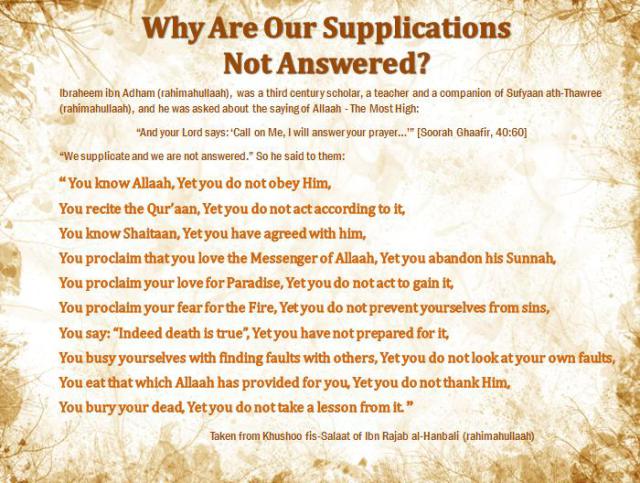
Why Are Our Supplicatiosn Not Answered? – Imam Ibn Rajab

Ibrahim ibn Adham – may Allah have mercy on him – a third century scholar, a teacher and a companion of Sufyan ath-Thawri, was asked about the saying of Allah – the Most High:

and your Lord says: “Call on me I will answer your prayer…” [40:60]

“We supplicate and we are not answered.”

So he said to them:

You know Allah, Yet you do not obey Him,

You recite the Qur’an, Yet do not act according to it,

You know Shaitan, Yet you have agreed with him,

You proclaim that you love Muhammad (Sallallaahu ‘alayhi  wa sallam) Yet you abandon his Sunnah,

You proclaim your love for Paradise, Yet you do not act to gain it,

You proclaim your fear the Fire, Yet you do not prevent yourselves from sins,

You say “Indeed death is true”, Yet you have not prepared for it,

You point out the faults with others, Yet you do not look at your faults,

You eat of that which Allah has provided for you, Yet you do not thank Him,

You bury your dead, Yet you do not take a lesson from it.”

by  Ibn Rajab al Hanbali from Khushu’ fis-salah 

 Why our Du'as are not answered

An Amazing story from al-Hassan al-Basri (rahimahullah)

Shytan has power over the believers due to their sins

A hadith states, “Allah is with the judge as long as he does not commit any injustice. If he commits any injustice, Allah is free from him and keeps Shytan with him.” [1]

Abu al-Faraj ibn al-Jauzi [2] has related a unique story from al-Hassan al-Basri (rahimahullah). The story, depending on how authentic it is, shows the ability of a human in overpowering Shytan if he is sincere to Allah in his religion and it shows how Shytan can take advantage of the human when he strays.

Al-Hasan al-Basri narrated that there was a tree that was worshipped instead of Allah. One man decided to chop down that tree. He was going to chop down the tree out of anger for the sake of Allah. On the way to the tree he met Iblees who was in the form of a man. Iblees asked him, “What do you plan on doing?” The man answered, “I am going to chop down that tree that is worshipped instead of Allah.” Shytan said, “If you do not worship it, why should it harm you if others do so?” The man replied, “I will chop it down.” Shytan then told him, “Would you like something better than that” Do not cut it and you will get two dinars every morning under your pillow.” “From where will I get that?” the man asked. “I will give it to you,” said Iblees. The man returned and the next morning he found two dinars under his pillow. The following morning he again found two dinars under his pillow. On the following morning he did not find anything. He got upset and went to chop down the tree. Shytan again appeared to him in the shape of the same man. Shytan asked him, “What do you want to do?” The man answered, “I plan on cutting down that tree that is worshipped instead of Allah!” Iblees said, “You have lied. There is no way you will be able to do it,” The man left to chop it down. The earth swallowed him and him until it almost killed him. Iblees asked, “Do you know who I . I am Shytan. I met you for the first time when you were angry for the sake of Allah and I had no power over you. I deceived you by two dinars and you stopped what you had intended to do [for the sake of Allah]. Now you have come because you are angry about the two dinars, and I have gotten mastery over you.”

[1] This was recorded by al-Haakim and al-Baihaqi with a hasan chain. See al- Albanee Sahih al-Jaami, vol. 2, p.130

[2] Ibn al-Jawzi, Talbees Iblees, p. 43 [The author, al-Ashqar alluded to the fact that the authenticity of this story needs to be ascertained. Most likely, it is from the Israaeeliyaat or stories of the Jews and Christians.]

Source : The world of Jinn and Devils – Umar S. Ashqar

Islam is not a religion of equality but of Justice – Shaykh Uthaymeen

There are some people who speak of equality instead of justice, and this is a mistake. We should not say equality, because equality implies no differentiation between the two. Because of this unjust call for equality, they ask, “What is the difference between male and female?” So they have made men similar to women. The communists said, “What difference is there between the ruler and the subject? No one has any authority over anyone else.” Not even the father over his son?! So they said the father has no authority over his son and so on.Instead, if we say justice, which means giving each one what he or she is entitled, this misunderstanding no longer applies, and the word used is correct. Allah does not say in the Qur’an that He enjoins equality. He said (interpretation of the meaning):

 “Verily, Allah enjoins Al‘Adl (i.e. justice)” (Qur’an, 16:90)

“And that when you judge between men, you judge with justice.” (Qur’an, 4:58)

 Those who say that Islam is the religion of equality are lying against Islam.Rather Islam is the religion of justice, which means treating equally those who are equal and differentiating between those who are different. No one who knows the religion of Islam would say that it is the religion of equality. Rather what shows you that this principle is false is the fact that most of what is mentioned in the Qur’an denies equality, as in the following verses: “Say: Are those who know equal to those who know not?” (Qur’an, 39:9)

 “Say: Is the blind equal to the one who sees? Or darkness equal to light?” (Qur’an, 13:16)

 “Not equal among you are those who spent and fought before the conquering (of Makkah, with those among you who did so later.” (Qur’an, 57:10)

“Not equal are those of the believers who sit (at home), except those who are disabled (by injury or are blind or lame), and those who strive hard and fight in the Cause of Allah with their wealth and their lives.” (Qur’an, 4:95)

Not one single letter in the Qur’an enjoins equality, rather it enjoins justice. You will also find that the word justice is acceptable to people, for I feel that if I am better than this man in terms of knowledge, or wealth, or piety, or in doing good, I would not like for him to be equal to me.Everyone knows that it is unacceptable if we say that the male is equal to the female.

Sheikh Ibn Uthaymeen,  Sharh Al-Aqeedah Al-Wasitah, 1/180-181

‘… Who is he that will lend a beautiful loan to Allah.’ – Tafsir ibn Kathir

That is a successful trade, O Abu Ad-Dahdah!


Ibn Abi Hatim recorded that `Abdullah bin Mas`ud said, “When this Ayah,

[مَّن ذَا الَّذِى يُقْرِضُ اللَّهَ قَرْضًا حَسَنًا فَيُضَاعِفَهُ لَهُ]

(Who is he that will lend Allah handsome loan: then (Allah) will increase it manifold to his credit (in repaying),) was revealed,

Abu Ad-Dahdah Al-Ansari said, `O Allah’s Messenger! Does Allah ask us for a loan

The Prophet said,

«نَعَمْ، يَاأَبَا الدَّحْدَاح» (Yes, O Abu Ad-Dahdah.)

He said, `Give me your hand, O Allah’s Messenger,’ and the Prophet placed his hand in his hand.

Abu Ad-Dahdah said, `Verily, I have given my garden as a loan to my Lord.’ He had a garden that contained six hundred date trees; his wife and children were living in that garden too. Abu Ad-Dahdah went to his wife and called her, `Umm Ad-Dahdah!’ She said, `Here I am.’ He said, `Leave the garden, because I have given it as a loan to my Lord, the Exalted and Most Honored.’ She said, `That is a successful trade, O Abu Ad-Dahdah! She then transferred her goods and children. The Messenger of Allah said,

«كَمْ مِنْ عَذْقٍ رَدَاحٍ فِي الْجَنَّةِ لِأَبِي الدَّحْدَاح»

(How plentiful are the sweet date clusters that Abu Ad-Dahdah has in Paradise!)” In another narration, the Prophet said,

«رُبَّ نَخْلَةٍ مُدَلَّاةٍ، عُرُوقُهَا دُرٌّ وَيَاقُوتٌ، لِأَبِي الدَّحْدَاحِ فِي الْجَنَّة»

(How many a date tree that has lowered down its clusters, which are full of pearls and gems in Paradise for Abu Ad-Dahdah!)

{Tafsir ibn kathir} – The Encouragement to make a Handsome Loan in the Cause of Allah

Regarding Saying "Mabrook" and the Correct Way to Invoke For Blessings Upon Someone

From Shaykh Ubayd aj-Jaabiree’s Explanation of the Three Fundamental Principles : page 113-114:

“It is allowable to make a supplication for a person that they be blessed.

The correct way to do this is to say: ‘Baaraka Allaahu laka‘ or ‘Baarka Allaahu ‘alayka‘ and ‘hadhal amr mubaarak‘.

The expression that is common upon the tongues of the general people is ‘Mabrook ‘ala fulaan‘ (may so and so be knelt upon); this is a blatant mistake and in opposition to the correct usage of the word in the Arabic language.

Mabrook comes from the verb Baraka and Mubaarak comes from the verb Baaraka, so don’t use the word Mabrook; alternatively, use Mubaarak because it comes from Baaraka as we stated. The common people don’t intend by their saying: ‘Mabrook alayhi’ to supplicate that this person be knelt upon, but this expression is incorrect, as they want to make a supplication for the person that they be blessed. So it is said ‘Baaraka Allaahu alayka’… and ‘Az-Zawaaj Mubaarak’ (Allaah willing, the marriage will be blessed).”

The creed of Ahlus-Sunnah wal-Jamaa’ah in regard to Allaah’s Names and Attributes – Shaykh Uthaymeen

Question:

What is the creed of Ahlus-Sunnah wal-Jamaa’ah in regard to Allaah’s Names and Attributes?
And what is the difference between a Name and an Attribute?
And does affirmation of a Name necessitate affirmation of an Attribute, and (likewise) does affrimation of an Attribute necessitate affirmation of a Name?

Response:

The creed of Ahlus-Sunnah wal-Jamaa’ah in regard to Allaah’s Names and His Attributes is affriming that which Allaah has affirmed for himself from the Names and Attributes, without:

  1. tahreef (changing/distorting a Name and/or Attribute of Allaah to other than its true meaning, i.e. from Allaah to al-Laat, and al-‘Azeez to al-‘Uzzah);
  2. ta’teel (denying some or all of Allaah’s Names and Attributes);
  3. takyeef (questioning as to “how” (Allaah’s Name or Attribute is), i.e. How does Allaah descend, etc.?);
  4. tamtheel (to imply a similarity between Allaah’s Names and Attributes and that of His creation).

And the difference between a Name and an Attribute is that a Name is that which Allaah has named Himself by; and an Attribute is that which Allaah has described Himself by. And between them is a clear difference.

So a Name is that which is considered a Name of Allaah (Subhaanahu wa Ta’aala), (and that) which incorporates an Attribute.And affirmation of a Name necessitates affirmation of an Attribute. For example: al-Ghafoor (the Most Forgiving) is a Name, and (its affirmation) necessitates the (affirmation of the) Attribute of Maghfirah (Forgiveness);
And ar-Raheem (the Most Merciful) is a Name and (its affirmation) necessitates the affirmation of ar-Rahmah (Mercy).

And the affirmation of an Attribute does not necessitate the affirmation of a Name. For example: al-Kalaam (Speech) does not necessitate the affirmation of the Name al-Mutakallim (the Speaker) for Allaah.

So, based upon this, the Names are more wider (in scope), since every Name encompasses an Attribute, however, every Attribute does not encompass a Name.

Shaykh Ibn ‘Uthaymeen
Fataawa Arkaan al-Islaam – Page 73, Fatwa No.30

Saying, ‘Insha’Allah’ (If Allah Wills) when Determining to do something in the Future – Ibn Kathir

Source : Tafseer Ibn Kathir of Surah Al-Kahf

 And never say of anything, “I shall do such and such thing tomorrow.” Except (with the saying), “If Allah wills!” And remember your Lord when you forget and say: “It may be that my Lord guides me to a nearer way of truth than this.” – Surah Kahf: (23, 24 ayah).

When Allah’s Messenger (sallalahu alaihe wa-sallam) declared Allah’s Oneness and proclaimed to be the Messenger of Allah (sallalahu alaihe wa-sallam) and revelation of Divine Message, the disbeliveers of Makkah sent some men to Jewish rabbis in al-Medina and said: “Ask them (the rabbis) about Muhammad (sallalahu alaihe wa-sallam), and describe him to them, and tell them what he is saying.They are the people of the first Book, and they have more knowledge of the Prophets than we do.’ So they set out for al-Medina, they asked the Jewish rabbis about the Messenger of Allah (sallalahu alaihe wa-sallam). They described him to them and told them some of his teachings.

The rabbis said: ‘Ask him about three things which we will tell you to ask, if he answers them then he is a Prophet who has been sent (by Allah); if he does not, then he is saying things that are not true, in which case how you will deal with him will be up to you. Ask him about some young men in ancient times, what was their story? For there is a strange and wondrous tale. Ask him about a man who traveled a great deal and reached the east and the west of the earth. What was his story? And ask him about he Ruh (soul or spirit) what is it?

If he tells you about these things, then he is a Prophet, so follow him, but if he does not tell you, then he is a man who is making things up, so deal with him as you see fit.’ So, the men came back to Makkah and said: ‘O people! We have come to you with a decisive solution which will put an end to the problem between you and Muhammad (sallalahu alaihe wa-sallam). The Jewish rabbis told us to ask him about some matters,’ and they told them what they were. Then they came to the Messenger of Allah (sallalahu alaihe wa-sallam) and said: ‘O Muhammad (sallalahu alaihe wa-sallam) tell us,’ and they asked him about the things they had been told to ask.

The Messenger of Allah (sallalahu alaihe wa-sallam) said: “I will tell you tomorrow about what you have asked me.” But he (sallalahu alaihe wa-sallam) did not say, ‘If Allah Wills.’

Allah Messenger (sallalahu alaihe wa-sallam) never spoke anything except with revelation. So, he waited for the revelation from Allah but fifteen days passed away without any revelation concerning those matter which the disbelievers asked, neither did Jibreel (alaihis-salaam) come to him. The people of Makkah started to doubt him and said: ‘Muhammad (sallalahu alaihe wa-sallam) promised to tell us the next day and now fifteen days have gone by and he has not told us anything in response to the questions we asked.’

The Messenger of Allah (sallalahu alaihe wa-sallam) felt sad because of the delay in revelation and was grieved by what the people of Makkah were saying about him.

Then Jibreel (alaihis-salaam) came with the revelation of Soorah al-Kahf, which contained answers to the questions and also the above mentioned verse explaining the correct etiquette when determining to do something in the future.

Determining to do something in the future should always be attributed to the Will of Allah, Who is the Knower of the Unseen and Who Alone Knows what was and what is yet to happen and what is not to be.

It is reported in Saheeh al-Bukharee from Abu Hurayrah (radhiyallahu anhu), who said: “The Messenger of Allah (sallalahu alaihe wa-sallam) said: “Sulaiman Ibn Dawood (alaihimus-salaam) said: ‘Tonight I will go around to all my seventy wives (according to some reports it is ninety or one hundred wives) so that each one of them will give birth to a son who will fight for the sake of Allah.’ It was said to him, (according to one narration, an Angel said to him), say, ‘If Allah Wills.’ But he did not say it. He went around to the women but none of them gave birth except for one, who gave birth to a half-formed child.” The Messenger of Allah (sallalahu alaihe wa-sallam) said: “By the One, in Whose Hands is my soul, had he said, ‘If Allah wills,’ he would not have broken his oath, and that would have helped him to attain what he wanted.” [Saheeh Muslim (vol. 3, no. 1275)]

So, if one determines to do something in the future or even takes an oath, he should say, ‘If Allah Wills’ or ‘Insha’Allah.’ If one forgets to say “Insha’Allah” then he should say when he remembers it even if it is a year later, as Ibn Abbas (radhiallahu anhu) explained.