an-Nasaaee authored a collection which he titled: “as-Sunan al-Kubraa” in which he gathered authentic Hadeeth as well as those with defects in their chains. He then summarized his collection which is known as “as-Sunan as-Sughraa” although he actually called it “al-Mujtabaa”.
In this summarized collection, he gathered only those Hadeeth which he considered to be authentic; it is this collection that is referred to when a Hadeeth is generally attributed to anNasaaee. “al-Mujtabaa” has the least number of weak Hadeeth out of the other four collections (excluding “Saheeh al-Bukhaaree” and “Saheeh Muslim”). It also contains the least amount of chains including narrators that have been criticized (regarding their Hadeeth narrating). It occupies a status right after “Saheeh al-Bukhaaree” and “Saheeh Muslim”. From the point of only relying upon narrators that are completely void of any criticism, this collection exceeds “Sunan Abu Daawood” and “Sunan at-Tirmithee” due to an-Nasaaee’s severe scrutiny of narrators within his writings. al-Haafith Ibn Hajar said, “How numerous are the narrators that Abu Daawood and atTirmithee relied on, yet an-Nasaaee shunned recording their Hadeeth. He even avoided recording Hadeeth from some of the narrators relied upon in the two authentic collections (“Saheeh al-Bukhaaree” and “Saheeh Muslim”).”
In summary, the conditions of an-Nasaaee in “al-Mujtabaa” are the strongest after the two authentic collections.
an-Nasaaee
He is ‘Abdur-Rahmaan Ahmad Ibn Shu’ayb Ibn ‘Alee an-Nasaaee, and it is said his name is anNaswee, referring to Nasa, a famous place in Khuraasaan. He was born in 215 Hijrah in Nasa. He then traveled in search of Hadeeth, eventually hearing from and studying from the people of the Hijaaz (lands such as Syria, Palestine, etc.), Khuraasaan, ash-Shaam, the Arabian Peninsula and other lands. He resided for a long time in Egypt and his writings spread throughout there. Later he journeyed to Damascus where he met with trials and tribulations. He died in 303 Hijrah in Ramlah, Palestine when he was eighty-three years old.
He left behind him many great works of Hadeeth and the study of their defects. May Allaah have mercy on him and reward him on behalf of his contribution to the Muslims.
Share this, Baarakallaah Feekum: [“One who guides to something good has a reward similar to that of its doer” - Saheeh Muslim vol.3, no.4665] [This website protects the copyrights of the authors/publishers. The Content is posted on this website with implicit/explicit permission from content owners]
The sun will be brought near to mankind, as close as a “mile,” the Arabic word used for mile here being مِيْل (mīl). Whether it is the mile we know to be the common unit of distance or the eye-pencil to apply kohl (as the word could imply in Arabic), whatever the case the sun will be very close to people.[29] If the sun’s heat is as we know it here in this life while there is such a great distance between it and us, then how will it be when it is a “mile” above our heads?
Here is a question: It is well-known that if the sun were to move even a hair from its position, it would burn the earth, incinerating it completely. So how is it possible on that day for the sun to be that close and not burn creation? The answer is that although people will be resurrected on that day with their previous bodies, they may not be recreated in the same exact state and with the same capability as they have now. Rather, they will be stronger and greater in what they can withstand.
For example, if people were to remain for fifty days in direct sunshine with no shade, no food, and no water, they would be unable to do so; they would die. But on the Day of Resurrection, they will remain in such a state for fifty thousand years [30] without food,water, or shade except those to whom Allah ( عزّ وجلّ ) shades. In addition, they will witness other terrifying events but they will be made to withstand them.
As an example of this greater capability to bear situations without dying, look at how the people of the fire will withstand such seemingly unbearable circumstances:
Indeed, those who disbelieve in our verses, we will drive them into a fire. Every time their skins are roasted through, we will replace them with other skins so they may taste the punishment. [Surah An-Nisa 4:56]
Will anyone be saved from the heat of the sun on the Day of Resurrection? Yes, there are types of people whom Allah will shade from the sun. The prophet ( صلّى اللّه عليه وسلّم ) said:
There are seven (types of people) whom Allah will shade in his shade on a day when there will be no shade except his shade: a just ruler; a youth who grew up in the worship of Allah; a man whose heart is attached to the mosques; people who love each other for Allah’s sake, meeting for his sake and parting for his sake; a man who is called by a woman of beauty and position (for adultery), but he says: “(No) I fear Allah;” a man who gives in charity and hides it so much so that his left hand does not know what his right hand gives in charity; and a man who remembered Allah in private so much that his eyes shed tears. [Recorded by al-Bukhārī, Muslim, and al-Tirmidhī]
There are also other types of individuals Allah will shade on that day. And by, “when there will be no shade except his shade,” it means no shade except the shade Allah creates. And it is not as some people think that it is the shade of Allah himself because that would necessitate that the sun would be above Allah ( عزّ وجلّ)
In this life, we can take shelter in shade ourselves, but on the Day of Resurrection, there will be no shade except the shade Allah ( سبحانه وتعالى ) makes so that whoever he wills can take shelter in his shade when the sun is brought near.
Due to the closeness of the sun, people will sweat so much that it will rise.
The Fourth Event
The Sweat Rises
Because of the sun’s heat, people will sweat profusely in proportion to their deeds. For some, the sweat will rise to their ankles, some to their knees, some to their waists, and for some, the sweat will rise up to their mouths. So individuals will be at different levels regarding their sweat. They will sweat from the intense heat and the extremely uncomfortable situation: crowdedness, extreme hardships, and at close distance to the sun. Still, although people will sweat from the circumstances of that day, their sweat will only be according to their deeds in this life. [33]
Here is a question: How will they be of varying degrees in sweat if people are all together in one place? To answer, we must return to a basic principle of belief. It is that when dealing with affairs of the unseen, events that authentic texts confirm will take place in the future, it is incumbent upon us to believe in them, trusting them to be true without persisting in asking, “How? Why?” These are things beyond the extent of our own intellects; it is not yet possible for us to perceive or fully understand it.
Imagine two people buried in a single grave, one a believer and the other a disbeliever. The believer will still experience the enjoyment that he deserves, and the disbeliever will experience the punishment he deserves even though they are in the same grave. Likewise, we believe the sweat will rise on the Day of Judgment as foretold.
Now are we saying that Allah (سبحانه وتعالى) will gather together someone whose sweat will reach his mouth in a particular place, someone with sweat to his ankles in a different place, and others with sweat rising to their knees or waist in other places? No, not necessarily but Allah knows best. What we are saying is that it is possible for the individual with sweat reaching only to his ankles to be next to someone with his sweat up to his mouth because Allah is capable of doing anything. This is comparable to the fact that light will encompass believers all around them, yet at the same time, disbelievers in Allah will be surrounded by darkness.
So regarding the Day of Resurrection, we must believe in it and all that is to occur on that day. As for the “How?” and “Why?” of the exact nature, that is not our right to know. As people suffer on the Day of Resurrection, standing in their own sweat, they will anxiously wait for judgment to begin. And this will only occur by “The Greatest Intercession.”
Footnotes:
[29] The prophet ( صَلَّى اللَّهُ عَلَيْهِ وَسَلَّمَ ) said in the ḥadīth recorded by Muslim confirming this:
On the Day of Resurrection, the sun will be brought close to creation so much that it will be a “mile” from them.
One of the narrators of the ḥadīth, Sulaym Ibn ‘Āmir, said, “By Allah, I do not know if he meant by mīl the distance of land or the mīl that is used to apply kohl to the eye.”
[30] The scholar is perhaps alluding to the verse in Sūrah al-Ma’ārij (70:4) in which Allah says,
There is no owner of treasure who does not pay its zakāh (obligated charity), but it will be heated in the fire of Hell and made into plates with which his sides and forehead will be branded until Allah passes judgment between his slaves on a day the length of which will be like fifty thousand years. Then he will be shown his path, whether it leads to Paradise or to Hell.
[33] This is established by the ḥadīth recorded by Muslim in which the prophet ( صلّى اللّه عليه وسلّم ) said:
The people will be in sweat in accordance with their deeds. For some, it will rise to their ankles, some to their knees, some to their waists, and for some of them, the sweat will reach their mouths.
Share this, Baarakallaah Feekum: [“One who guides to something good has a reward similar to that of its doer” - Saheeh Muslim vol.3, no.4665] [This website protects the copyrights of the authors/publishers. The Content is posted on this website with implicit/explicit permission from content owners]
It should not be understood that “Saheeh al-Bukhaaree” and “Saheeh Muslim” encompass every authentically reported statement of Allaah’s Messenger (صلّى الله عليه وسلّم). Rather, there are many authentic Hadeeth collected by other scholars that neither one of them (al-Bukhaaree & Muslim) recorded in their collections.
an-Nawawee said:
“The intent of both al-Bukhaaree and Muslim was only to collect a large number of authentic Hadeeth just as a book of Fiqh [2] may collect texts pertaining to many different issues, not encompass every possible issue. However, if there is a Hadeeth having an authentic chain of narration that one of them may have left out, or even both of them, then they would have had a reason to do so or they may have recorded a similar Hadeeth in its place. From what is well-known from them, it may be assumed that perhaps they felt it better not to record it, or perhaps they even forgot. They also may have left certain Hadeeth out in order not to make their collections even longer than they are, or they felt what they have recorded was sufficient pertaining to a certain topic. They may have had other reasons as well.”
The Second Point:
Scholars unanimously agree and consider “Saheeh al-Bukhaaree” and “Saheeh Muslim” to be the most authentic written works of Hadeeth. Regarding this, the famous scholar, Ibn Taymiyyah, said, “There is no Hadeeth they both agree to be authentic except that it is undoubtedly authentic.” He also said, “The vast majority of their narrations, the scholars of Hadeeth know with certainty that the Prophet (صلّى الله عليه وسلّم) actually said them.”
Footnotes:
[2] Fiqh: The knowledge of practical legislated Islaamic rulings by their related detailed proofs. – Shaykh Ibn al-‘Uthaymeen, “al-Usool min ‘Ilm al-Usool” pg. 7. – T.N.
Share this, Baarakallaah Feekum: [“One who guides to something good has a reward similar to that of its doer” - Saheeh Muslim vol.3, no.4665] [This website protects the copyrights of the authors/publishers. The Content is posted on this website with implicit/explicit permission from content owners]
[Text from Imam Muhammad Ibn ‘Abdul-Wahhaab’s “Four Rules Regarding Shirk”]
From the Introduction of Author Shaykh Muhammad bin Abdul Wahhaab (rahimahullah) :
“I ask Allaah, the Most Generous, Lord of the Great Throne to befriend you in this world and the Hereafter, and to make you blessed wherever you may be.
And (I ask) that He make you from those who when they are given, are thankful; when they are tested, are patient; and when they sin, seek forgiveness (from Allaah). For indeed these three characteristics are the true signs of happiness.“
Listen to the Explanation of Dr. Saleh As-Saleh (rahimahullaah)
Explanation from Dr. Muhammad Bin ‘Abdir-Rahmaan Al-Khumayyis’ explanation of Four Rules Regarding Shirk
Language:
yatawallaaka (He befriend you) meaning that He take you as a friend (walee) through (His) love, granting of success and guidance.
Explanation:
The author has begun by supplicating and asking Allaah, the Most Generous, Lord of the Great Throne, to befriend the one who reads this book in this world and the Hereafter. As for befriending him in this worldly life, then it is by loving him, guiding him, directing him and assisting him. And as for befriending him in the Hereafter, then it is by showing him mercy and forgiveness, protecting him from the Hellfire and admitting him into Paradise. Then he also supplicates that he be blessed wherever he may be, and that Allaah make him fulfill the meaning of servitude, as well as its stations, which are three:
First: Being thankful for His Blessing. This is at the time when He gives it, as Allaah says:
“Work you, O family of Dawood, with thanks!” [Surah Saba: 13]
And Allaah says:
“And if you are grateful, He will be pleased therewith for you.” [Surah Az-Zumar:7]
And He says:
“And give thanks to Me and do not disbelieve.” [Surah Al-Baqarah: 152]
Being thankful for Allaah’s Blessing is shown through the heart by way of affirming, acknowledging and showing gratitude. And it is shown through the tongue by way of speaking about the blessing and praising it. And it is shown through the limbs by way of acting in accordance with what pleases Allaah.
Second: Being patient during tribulations, hard times and with the things that one hates, which befall the people as a test and examination from Allaah. What is obligatory in these situations is that one have patience. Patience means suppressing the heart from being displeased and from despairing; suppressing the tongue from complaining; and suppressing the limbs from those acts that negate and contradict patience. Allaah says:
“And bear with patience whatever befalls you.” [Surah Luqmaan: 17]
And He says:
“And give glad tidings to those who are patient.” [Surah Al-Baqarah: 155]
Third: Seeking forgiveness after committing a sin. This is since all of the Son of Aadam (i.e. humans) are sinners. But what is obligatory upon mankind when they should fall into sin is to rush to ask for forgiveness and repentance, as Allaah says:
“And those who when they commit some immoral act (i.e. fornication) or wrong themselves with evil, remember Allaah and so seek (His) forgiveness for their sins. And who is it that forgives sins except Allaah? And they do not persist knowingly in what sins they committed (after that).” [Surah Aali ‘Imraan: 135]
So these are the three characteristics: Being thankful for (Allaah’s) Blessing, being patient during times of tribulation, and seeking forgiveness after committing a sin. Whoever fulfills all of these will no doubt be from those who will experience happiness. In fact, happiness is linked to these three characteristics more than any others. All of them contain the meanings of Tawheed, submission, compliance and acceptance from Allaah.
Share this, Baarakallaah Feekum: [“One who guides to something good has a reward similar to that of its doer” - Saheeh Muslim vol.3, no.4665] [This website protects the copyrights of the authors/publishers. The Content is posted on this website with implicit/explicit permission from content owners]
This book was given the title: “al’Jaami’ as-Saheeh” by its author. In it, he recorded six hundred thousand Hadeeth and he exerted great effort in revising them, editing them, and scrutinizing them to determine their authenticity. He was so concerned that he would not place any Hadeeth within his collection without first washing and praying to units of prayer seeking Allaah’s guidance in the decision to include it. He did not include any report or narration unless it was authentically reported from the Messenger of Allaah (صلّى الله عليه وسلّم) with a clear, connected chain of narrators, all known for their trustworthiness and preciseness.
He completed his work over a span of sixteen years. After which, he presented it to Imaam Ahmad, Yahyaa Ibn Ma’een, ‘Alee Ibn al-Madeenee, and others. They admired it and approved of it and attested to its authenticity.
Since then, scholars of every time period have accepted this collection of Hadeeth. al-Haafith athThahabee said, “It is the best and most significant book in Islaam after the Book of Allaah (سُبْحَانَهُ وَ تَعَالَى).”
This collection consists of seven thousand, three-hundred ninety-seven (7,397) Hadeeth including the ones that are repeated, yet placed in different chapters. Excluding the repeated Hadeeth, there are two thousand, six hundred two (2,602) individual Hadeeth as al-Haafith Ibn Hajar pointed out.
al-Bukhaaree
He is Abu ‘Abdullaah Muhammad Ibn Ismaa’eel Ibn Ibraaheem Ibn al-Mugheerah Ibn Bardizbah [1] al-Ja’fee, originally of Persian origin.
He was born in Bukhaaraa (in present-day Uzbekistan) in the month of Shawwaal (the 10th month of the Islaamic calendar) in the year 194 Hijrah. He was raised as an orphan (without his father) in the care of his mother. He began traveling throughout different lands, seeking out Hadeeth in the year 210. He resided for six years in various lands including ash-Shaam (the lands of Palestine, Syria, Jordan, etc.), Egypt, the Arabian Peninsula, Basra, Koofah, and Baghdad (all three in Iraaq). He was very proficient in memorizing and it was even said that he was able to memorize a book after seeing it only once. He was one who abstained from useless worldly things. He was pious and did not mix much with the kings, princes, or leaders. Yet, he was brave and generous. Scholars of his time and thereafter have praised him. Imaam Ahmad said of him, “No one even close to him has ever come from (the land of) Khuraasaan.” Ibn Khuzaymah said, “There is no one under the sky more knowledgeable of Hadeeth of Allaah’s Messenger (صلّى الله عليه وسلّم), nor one having memorized more than Muhammad Ibn Ismaa’eel al-Bukhaaree.” He was also diligent in deducing rulings and had an amazing ability to derive rulings and benefits from Hadeeth as can be witnessed from the manner in which he organized his authentic collection.
He died in a place known as Khartank near Samarqand (in Uzbekistan) on the night of ‘Eed al-Fitr (the Islaamic holiday to conclude fasting in the month of Ramadhaan) in the year 256 Hijrah. He was thirteen days away from the age of sixty-two years old. He left an enormous amount of knowledge behind in his writings. May Allaah have mercy upon him an reward him on behalf of his contribution to the Muslims.
Footnotes:
[1] Bardizbah: A Persian word meaning cultivator or someone who grows crops.
Share this, Baarakallaah Feekum: [“One who guides to something good has a reward similar to that of its doer” - Saheeh Muslim vol.3, no.4665] [This website protects the copyrights of the authors/publishers. The Content is posted on this website with implicit/explicit permission from content owners]
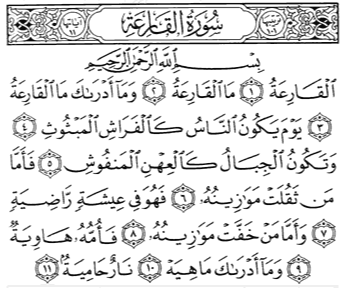
In the Name of Allâh, the Most Gracious, the Most Merciful
[101:1] Al-Qâri’ah (the striking Hour, i.e. the Day of Resurrection).
[101:2] What is the striking (Hour)?
[101:3] And what will make you know what the striking (Hour) is?
[101:4] It is a Day whereon mankind will be like moths scattered about.
[101:5] And the mountains will be like carded wool.
[101:6] Then as for him whose Balance (of good deeds) will be heavy,
[101:7] He will live a pleasant life (in Paradise).
[101:8] But as for him whose Balance (of good deeds) will be light,
[101:9] He will have his home in Hâwiyah (pit, i.e. Hell).
[101:10] And what will make you know what it is?
[101:11] (It is) a fiercely blazing Fire!
Dr. Saleh As-Saleh’s explanation Based on Shaykh Uthaymeen’s Tafseer
The below Explanation was taken from Tafseer Ibn Katheer, Darusssalam English Publication
Al-Qari`ah is one of the names of the Day of Judgement, like Al-Haqqah, At-Tammah, As-Sakhkhah, Al-Ghashiyah and other names.
Then Allah intensifies concern and fright for it by saying,
(And what will make you know what Al-Qari`ah is) Then He explains this by saying,
(It is a Day whereon mankind will be like moths scattered about.) meaning, in their scattering, their dividing, their coming and their going, all due to being bewildered at what is happening to them, they will be like scattered moths. This is like Allah’s statement,
(As if they were locusts spread abroad.) (54:7) Allah said,
(And the mountains will be like wool, carded.) meaning, they will become like carded wool that has began to wear out (fade away) and be torn apart.
Mujahid, `Ikrimah, Sa`id bin Jubayr, Al-Hasan, Qatadah, `Ata’ Al-Khurasani, Ad-Dahhak and As-Suddi have all said, (like wool (`Ihn). ) “Woolen.”
Then Allah informs about the results received by those who performed the deeds, and the honor and disgrace they will experience based upon their deeds. He says,
(Then as for him whose Balance will be heavy.) meaning, his good deeds are more than his bad deeds.
(He will live a pleasant life.) meaning, in Paradise.
(But as for him whose Balance will be light.) meaning, his bad deeds are more than his good deeds. Then Allah says,
(His mother will be Hawiyah.) It has been said that this means he will be falling and tumbling headfirst into the fire of Hell, and the expression `his mother’ has been used to refer to his brain (as it is the mother of his head). A statement similar to this has been reported from Ibn `Abbas, `Ikrimah, Abu Salih and Qatadah. Qatadah said, “He will fall into the Hellfire on his head.” Abu Salih made a similar statement when he said, “They will fall into the Fire on their heads.” It has also been said that it means his mother that he will return to and end up with in the Hereafter will be Hawiyah, which is one of the names of the Hellfire. Ibn Jarir said, “Al-Hawiyah is only called his mother because he will have no other abode except for it.” Ibn Zayd said, “Al-Hawiyah is the Fire, and it will be his mother and his abode to which he will return, and where he will be settled.” Then he recited the Ayah,
(Their abode will be the Fire.) (3:151) Ibn Abi Hatim said that it has been narrated from Qatadah that he said, “It is the Fire, and it is their abode.” Thus, Allah says in explaining the meaning of Al-Hawiyah,
(And what will make you know what it is). Allah’s statement
(A fire Hamiyah!) meaning, extreme heat. It is a heat that is accompanied by a strong flame and fire. It is narrated from Abu Hurayrah that the Prophet said,
(The fire of the Children of Adam that you all kindle is one part of the seventy parts of the fire of Hell.) They (the Companions) said, “O Messenger of Allah! Isn’t it sufficient” He replied,
(It is more than it by sixty-nine times.) This has been recorded by Al-Bukhari and Muslim. In some of the wordings he stated,
(It is more than it by sixty-nine times, each of them is like the heat of it.) It has been narrated in a Hadith that Imam Ahmad recorded from Abu Hurayrah that the Prophet said,
(Verily, the person who will receive the lightest torment of the people of the Hellfire will be a man who will have two sandals that will cause his brain to boil. )”
It has been confirmed in the Two Sahihs that the Messenger of Allah said,
(The Hellfire complained to its Lord and said, “O Lord! Some parts of me devour other parts of me.” So He (Allah) permitted it to take two breaths: one breath in the winter and one breath in the summer. Thus, the most severe cold that you experience in the winter is from its cold, and the most severe heat that you experience in the summer is from its heat. )
In the Two Sahihs it is recorded that he said,
(When the heat becomes intense pray the prayer when it cools down, for indeed the intense heat is from the breath of Hell.)
This is the end of the Tafsir of Surat Al-Qari`ah, and all praise and thanks are due to Allah.
Share this, Baarakallaah Feekum: [“One who guides to something good has a reward similar to that of its doer” - Saheeh Muslim vol.3, no.4665] [This website protects the copyrights of the authors/publishers. The Content is posted on this website with implicit/explicit permission from content owners]
And (remember) when We made the House (the Ka’bah at Makkah) a place of resort for mankind and a place of safety. And take you (people) the Maqam (place) of Ibrahim (Abraham) [or the stone on which Ibrahim (Abraham) stood while he was building the Ka’bah] as a place of prayer (for some of your prayers, e.g. two Rak’at after the Tawaf of the Ka’bah at Makkah), and We commanded Ibrahim (Abraham) and Isma’il (Ishmael) that they should purify My House (the Ka’bah at Makkah) for those who are circumambulating it, or staying (I’tikaf), or bowing or prostrating themselves (there, in prayer).
125. And (remember) when We made the House (the Kabah at Makkah) a place of resort for mankind and a place of safety. And take you (people) the Maqam (place) of Ibrahim (or the stone on which Ibrahim as a place)
Al-Awfi reported that Ibn Abbas commented on Allah’s statement,
وَإِذْ جَعَلْنَا الْبَيْتَ مَثَابَةً لِّلنَّاسِ
(And (remember) when We made the House (the Kabah at Makkah) a place of resort for mankind)
“They do not remain in the House, they only visit it and return to their homes, and then visit it again.”
Also, Abu Jafar Ar-Razi narrated from Ar-Rabi bin Anas from Abu Al-Aliyah who said that,
وَإِذْ جَعَلْنَا الْبَيْتَ مَثَابَةً لِّلنَّاسِ وَأَمْناً
(And (remember) when We made the House (the Kabah at Makkah) a place of resort for mankind and a place of safety) means,
“Safe from enemies and armed conflict. During the time of Jahiliyyah, the people were often victims of raids and kidnapping, while the people in the area surrounding it (Al-Masjid Al-Haram) were safe and not subject to kidnapping.”
Also, Mujahid, Ata’, As-Suddi, Qatadah and Ar-Rabi bin Anas were reported to have said that the Ayah (2:125) means,
“Whoever enters it shall be safe.”
This Ayah indicates that Allah honored the Sacred House, which Allah made as a safe refuge and safe haven. Therefore, the souls are eager, but never bored, to conduct short visits to the House, even every year. This is because Allah accepted the supplication of His Khalil, Ibrahim, when he asked Allah to make the hearts of people eager to visit the House. Ibrahim said (14:40),
رَبَّنَا وَتَقَبَّلْ دُعَآءِ
(Our Lord! And accept my invocation).
Allah described the House as a safe resort and refuge, for those who visit it are safe, even if they had committed acts of evil. This honor comes from the honor of the person who built it first, Khalil Ar-Rahman, just as Allah said,
(And (remember) when We showed Ibrahim the site of the (Sacred) House (the Kabah at Makkah) (saying): “Associate not anything (in worship) with Me…”) (22:26) and,
(Verily, the first House (of worship) appointed for mankind was that at Bakkah (Makkah), full of blessing, and a guidance for Al-Alamin (mankind and Jinn). In it are manifest signs (for example), the Maqam (place) of Ibrahim; whosoever enters it, he attains security) (3:96-97).
The last honorable Ayah emphasized the honor of Ibrahim’s Maqam, and the instruction to pray next to it,
وَاتَّخِذُواْ مِن مَّقَامِ إِبْرَهِيمَ مُصَلًّى
(And take you (people) the Maqam (place) of Ibrahim as a place of prayer). The Maqam of Ibrahim Sufyan Ath-Thawri reported that Said bin Jubayr commented on the Ayah,
وَاتَّخِذُواْ مِن مَّقَامِ إِبْرَهِيمَ مُصَلًّى
(And take you (people) the Maqam (place) of Ibrahim as a place of prayer) “The stone (Maqam) is the standing place of Ibrahim, Allah’s Prophet, and a mercy from Allah. Ibrahim stood on the stone, while Ismail was handing him the stones (constructing the Kabah).”
As-Suddi said, “The Maqam of Ibrahim is a stone which Ismail’s wife put under Ibrahim’s feet when washing his head.”
Al-Qurtubi mentioned this, but he considered it unauthentic, although others gave it prefrence, Ar-Razi reported it in his Tafsir from Al-Hasan Al-Basri, Qatadah, and Ar-Rabi bin Anas.
Ibn Abi Hatim reported that Jabir, describing the Hajj (pilgrimage) of the Prophet said, “When the Prophet performed Tawaf, Umar asked him, Is this the Maqam of our father’ He said, Yes.’ Umar said, Should we take it a place of prayer’ So Allah revealed,
وَاتَّخِذُواْ مِن مَّقَامِ إِبْرَهِيمَ مُصَلًّى
(And take you (people) the Maqam (place) of Ibrahim (Abraham) as a place of prayer.”)
Al-Bukhari said, “Chapter: Allah’s statement,
وَاتَّخِذُواْ مِن مَّقَامِ إِبْرَهِيمَ مُصَلًّى
(And take you (people) the Maqam (place) of Ibrahim (Abraham) as a place of prayer) meaning, they return to it repeatedly.” He then narrated that Anas bin Malik said that Umar bin Al-Khattab said, “I agreed with my Lord, or my Lord agreed with me, regarding three matters. I said, O Messenger of Allah! I wish you take the Maqam of Ibrahim a place for prayer.’ The Ayah,
وَاتَّخِذُواْ مِن مَّقَامِ إِبْرَهِيمَ مُصَلًّى
(And take you (people) the Maqam (place) of Ibrahim (Abraham)) was revealed. I also said, O Messenger of Allah! The righteous and the wicked enter your house. I wish you would command the Mothers of the believers (the Prophet’s wives) to wear Hijab. Allah sent down the Ayah that required the Hijab. And when I knew that the Prophet was angry with some of his wives, I came to them and said, Either you stop what you are doing, or Allah will endow His Messenger with better women than you are.’ I advised one of his wives and she said to me, O Umar! Does the Messenger of Allah not know how to advise his wives, so that you have to do the job instead of him’ Allah then revealed,
(It may be if he divorced you (all) that his Lord will give him instead of you, wives better than you, ـ Muslims (who submit to Allah)).” (66:5)
Also, Ibn Jarir narrated that Jabir said, “After the Messenger of Allah kissed the Black Stone, he went around the house three times in a fast pace and four times in a slow pace. He then went to Maqam of Ibrahim, with it between him and the House, and prayed two Rakahs.” This is part of the long Hadith that Muslim recorded in Sahih. Al-Bukhari recorded that Amr bin Dinar said that he heard Ibn Umar say, “The Messenger of Allah performed Tawaf around the House seven times and then prayed two Rakahs behind the Maqam.”
All these texts indicate that the Maqam is the stone that Ibrahim was standing on while building the House. As the House’s walls became higher, Ismail brought his father a stone, so that he could stand on it, while Ismail handed him the stones. Ibrahim would place the stones on the wall, and whenever he finished one side, he would move to the next side, to complete the building all around. Ibrahim kept repeating this until he finished building the House, as we will describe when we explain the story of Ibrahim and Ismail and how they built the House, as narrated from Ibn Abbas and collected by Al-Bukhari. Ibrahim’s footprints were still visible in the stone, and the Arabs knew this fact during the time of Jahiliyyah. This is why Abu Talib said in his poem known as Al-Lamiyyah’, “And Ibrahim’s footprint with his bare feet on the stone is still visible.”
The Muslims also saw Ibrahim’s footprints on the stone, as Anas bin Malik said, “I saw the Maqam with the print of Ibrahim’s toes and feet still visible in it, but the footprints dissipated because of the people rubbing the stone with their hands.”
Earlier, the Maqam was placed close to the Kabah’s wall. In the present time, the Maqam is placed next to Al-Hijr on the right side of those entering through the door.
When Ibrahim finished building the House, he placed the stone next to the wall of Al-Kabah. Or, when the House was finished being built, Ibrahim just left the stone where it was last standing, and he was commanded to pray next to the stone when he finished the Tawaf (circumambulating). It is understandable that the Maqam of Ibrahim would stand where the building of the House ended. The Leader of the faithful Umar bin Al-Khattab, one of the Four Rightly Guided Caliphs whom we were commanded to emulate, moved the stone away from the Kabah’s wall during his reign. Umar is one of the two men, whom the Messenger of Allah described when he said,
(Imitate the two men who will come after me: Abu Bakr and Umar.)
Umar was also the person whom the Qur’an agreed with regarding praying next to Maqam of Ibrahim. This is why none among the Companions rejected it when he moved it.
Abdur-Razzaq reported from Ibn Jurayj from Ata’, “Umar bin Al-Khattab moved the Maqam back.” Also, Abdur-Razzaq narrated that Mujahid said that Umar was the first person who moved the Maqam back to where it is now standing.” Al-Hafiz Abu Bakr, Ahmad bin Ali bin Al-Husayn Al-Bayhaqi recorded A’ishah saying, “During the time of the Messenger of Allah and Abu Bakr, the Maqam was right next to the House. Umar moved the Maqam during his reign.” This Hadith has an authentic chain of narration.
Share this, Baarakallaah Feekum: [“One who guides to something good has a reward similar to that of its doer” - Saheeh Muslim vol.3, no.4665] [This website protects the copyrights of the authors/publishers. The Content is posted on this website with implicit/explicit permission from content owners]
Share this, Baarakallaah Feekum: [“One who guides to something good has a reward similar to that of its doer” - Saheeh Muslim vol.3, no.4665] [This website protects the copyrights of the authors/publishers. The Content is posted on this website with implicit/explicit permission from content owners]
The following has been posted from Tafseer Ibn Katheer (Darussalam English Publications):
After Allah commanded that He be appreciated, He ordained patience and prayer. It is a fact that the servant is either enjoying a bounty that he should be thankful for, or suffering a calamity that he should meet with patience. A Hadith states:
(Amazing is the believer, for whatever Allah decrees for him, it is better for him! If he is tested with a bounty, he is grateful for it and this is better for him; and if he is afflicted with a hardship, he is patient with it and this is better for him.)
Allah has stated that the best tools to help ease the effects of the afflictions are patience and prayer. Earlier we mentioned Allah’s statement:
And seek help in patience and As-Salah (the prayer) and truly, it is extremely heavy and hard except for Al-Khashiin (i.e., the true believers in Allah) (2:45)
There are several types of Sabr ـ patience: one for avoiding the prohibitions and sins, one for acts of worship and obedience. The second type carries more rewards than the first type. There is a third type of patience required in the face of the afflictions and hardships, which is mandatory, like repentance.
Abdur-Rahman bin Zayd bin Aslam said,
“Sabr has two parts: patience for the sake of Allah concerning what He is pleased with (i.e., acts of worship and obedience), even if it is hard on the heart and the body, and patience when avoiding what He dislikes, even if it is desired. Those who acquire these qualities will be among the patient persons whom Allah shall greet (when they meet Him in the Hereafter; refer to Surat Al-Ahzab 33:44), Allah willing.”
Share this, Baarakallaah Feekum: [“One who guides to something good has a reward similar to that of its doer” - Saheeh Muslim vol.3, no.4665] [This website protects the copyrights of the authors/publishers. The Content is posted on this website with implicit/explicit permission from content owners]
And (remember) when Ibrahim (Abraham) said, “My Lord, make this city (Makkah) a place of security and provide its people with fruits, such of them as believe in Allah and the Last Day.” He (Allah) answered: “As for him who disbelieves, I shall leave him in contentment for a while, then I shall compel him to the torment of the Fire, and worst indeed is that destination!”
Share this, Baarakallaah Feekum: [“One who guides to something good has a reward similar to that of its doer” - Saheeh Muslim vol.3, no.4665] [This website protects the copyrights of the authors/publishers. The Content is posted on this website with implicit/explicit permission from content owners]
Chapter 10: The Fitnah of wealth should be warded off
باب مَا يُتَّقَى مِنْ فِتْنَةِ الْمَالِ
Hadith
حَدَّثَنِي يَحْيَى بْنُ يُوسُفَ، أَخْبَرَنَا أَبُو بَكْرٍ، عَنْ أَبِي حَصِينٍ، عَنْ أَبِي صَالِحٍ، عَنْ أَبِي هُرَيْرَةَ ـ رضى الله عنه ـ قَالَ قَالَ رَسُولُ اللَّهِ صلى الله عليه وسلم
“Perish the slave of Dinar, Dirham, Qatifa (thick soft cloth), and Khamisa (a garment), for if he is given, he is pleased; otherwise he is dissatisfied.“
Sahih al-Bukhari 6435 | In-book : Book 81, Hadith 24 |(English) : Vol. 8, Book 76, Hadith 443
Listen to the Explanation by Dr. Saleh as-Saleh (Based on the explanation of Shaykh Uthaymeen):
Share this, Baarakallaah Feekum: [“One who guides to something good has a reward similar to that of its doer” - Saheeh Muslim vol.3, no.4665] [This website protects the copyrights of the authors/publishers. The Content is posted on this website with implicit/explicit permission from content owners]
And whoever is removed away from the Fire and admitted to Paradise, he indeed is successful. The life of this world is only the enjoyment of deception (a deceiving thing) [3:185]
The Prophet (ﷺ) drew a square and then drew a line in the middle of it and let it extend outside the square and then drew several small lines attached to that central line, and said, “This is the human being, and this, (the square) in his lease of life, encircles him from all sides (or has encircled him), and this (line), which is outside (the square), is his hope, and these small lines are the calamities and troubles (which may befall him), and if one misses him, an-other will snap (i.e. overtake) him, and if the other misses him, a third will snap (i.e. overtake) him.”
Sahih al-Bukhari 6417 | In-book : Book 81, Hadith 6 | English : Vol. 8, Book 76, Hadith 426
–
Hadith
حَدَّثَنَا مُسْلِمٌ، حَدَّثَنَا هَمَّامٌ، عَنْ إِسْحَاقَ بْنِ عَبْدِ اللَّهِ بْنِ أَبِي طَلْحَةَ، عَنْ أَنَسٍ، قَالَ خَطَّ النَّبِيُّ صلى الله عليه وسلم خُطُوطًا فَقَالَ
The Prophet (ﷺ) drew a few lines and said, “This is (man’s) hope, and this is the instant of his death, and while he is in this state (of hope), the nearer line (death) comes to Him.”
Sahih al-Bukhari 6418 | In-book : Book 81, Hadith 7 | English : Vol. 8, Book 76, Hadith 427
Listen to the Explanation by Dr. Saleh as-Saleh (Based on the explanation of Shaykh Uthaymeen):
Share this, Baarakallaah Feekum: [“One who guides to something good has a reward similar to that of its doer” - Saheeh Muslim vol.3, no.4665] [This website protects the copyrights of the authors/publishers. The Content is posted on this website with implicit/explicit permission from content owners]
“Allah’s Messenger (ﷺ) took hold of my shoulder and said,
‘Be in this world as if you were a stranger or a traveler.”
The sub-narrator added: Ibn `Umar used to say,
“If you survive till the evening, do not expect to be alive in the morning, and if you survive till the morning, do not expect to be alive in the evening, and take from your health for your sickness, and (take) from your life for your death.”
Sahih al-Bukhari 6416 | In-book : Book 81, Hadith 5 | Vol. 8, Book 76, Hadith 425
Listen to the Explanation by Dr. Saleh as-Saleh (Based on the explanation of Shaykh Uthaymeen):
Share this, Baarakallaah Feekum: [“One who guides to something good has a reward similar to that of its doer” - Saheeh Muslim vol.3, no.4665] [This website protects the copyrights of the authors/publishers. The Content is posted on this website with implicit/explicit permission from content owners]
The sermon begins by explaining Surah Al-Hadid, verse 20, which describes the life of this world as mere play, amusement, and rivalry, like vegetation that flourishes and then withers. It contrasts this with the Hereafter, which holds either severe torment or forgiveness and pleasure from Allah. The sermon then presents a Hadith narrated by Sahl, emphasizing that even a tiny space in Paradise, the size of a whip, is better than the entire world and everything in it. The speaker also highlights that a single morning or evening journey for Allah’s cause outweighs the value of this entire world, reinforcing the theme of prioritizing the everlasting Hereafter over the fleeting, deceptive enjoyment of worldly life.
The Life of This World vs. The Hereafter (Surah Al-Hadid, Verse 20)
بسم الله الرحمن الرحيم، الحمد لله رب العالمين وصلى الله على نبينا محمد وعلى آله وصحبه وسلم In the name of Allah, the Most Gracious, the Most Merciful. Praise be to Allah, Lord of the worlds, and may prayers and peace be upon our Prophet Muhammad, his family, and his companions.
Continuing into the book of Ar-Riqaq in Sahih al-Bukhari, the softening of the hearts, or the tendering of the hearts. The chapter is the example of the life of this world compared to that of the hereafter.
Allah subhanahu wa ta’ala, the most high, said in Surah 57, verse 20:
Know that the life of this world is only play and amusement, pomp and mutual boasting among you, and rivalry in respect of wealth and children, as the likeness of vegetation after rain, thereof the growth is pleasing to the tiller; afterwards it dries up and you see it turning yellow; then it becomes straw. But in the Hereafter (there is) a severe torment (for the disbelievers, evil-doers), and (there is) Forgiveness from Allah and (His) Good Pleasure (for the believers, good-doers), whereas the life of this world is only a deceiving enjoyment. (57:20)
The explanation of these verses. This is the title which Imam al-Bukhari, rahimahullah, put for this chapter under this book. In these verses, Allah, the most high, makes it clear that the life of this world is only play and amusement, physically and also amusement and play of the heart. And adornment on the apparent. And boastful, pride in in in the tongue, in the saying. Each one boosts and is proud of himself when it comes to others, he thinks himself better and higher in status and in saying, meaning his opinion. Also, regarding wealth and children, rivalry. Like saying, I have more than you in wealth and in children and stronger in respect of men.
The example of this world, as Allah subhanahu wa ta’ala described it here as that of the likeness of it is like of vegetation after rain.
أَعْجَبَ ٱلْكُفَّارَ the growth is pleasing to the tiller. (57:20)
It amused and amazed the Kuffar. Here the term Al-Kuffar, it is said that this refers to the Kuffar, to the disbelievers, those who disbelieved in Allah. Meaning that the only thing which they like of this life is like these appearances and this joy and play and amusement. On the other hand, it is said that this refers to the tiller. The growth is pleasing to the tiller. Then afterwards, it, after it was moist and active and, it dries up. And then it turns yellow. And we see this in front of our eyes. Then it becomes straw, broken by hands and by feet. This is the likeness of this life. It goes up and then it goes away. And it is either that it will entirely leave us or we leave it. There is no other alternative.
Allah the Exalted said,
وَفِى ٱلْءَاخِرَةِ عَذَابٌ شَدِيدٌ وَمَغْفِرَةٌ مِّنَ ٱللَّهِ وَرِضْوَٰنٌ But in the Hereafter (there is) a severe torment (for the disbelievers, evil-doers), and (there is) Forgiveness from Allah and (His) Good Pleasure (for the believers, good-doers). (57:20)
Severe torment for those who preferred this life which is play and amusement and boosting, et cetera, preferred it over seeking the pleasure of Allah and seeking the hereafter over this life. Seeking the hereafter, they make their concern focused upon this life, preferring it over the hereafter and preferring it over seeking the Ridwan, the pleasure of Allah subhanahu wa ta’ala. As Allah has stated in Surah 87, 16-17.
بَلْ تُؤْثِرُونَ ٱلْحَيَوٰةَ ٱلدُّنْيَا وَٱلْءَاخِرَةُ خَيْرٌ وَأَبْقَىٰٓ Nay, you prefer the life of this world; Although the Hereafter is better and more lasting. (87:16-17)
Then Allah subhanahu wa ta’ala said,
وَمَا ٱلْحَيَوٰةُ ٱلدُّنْيَآ إِلَّا مَتَٰعُ ٱلْغُرُورِ whereas the life of this world is only a deceiving enjoyment. (57:20)
You see this kind of restriction, whereas the life of this world, illa mata’ul ghurur, except or only a deceiving enjoyment. All of this entire life. A person may be deceived by it a certain period of time, then it will go away. And then he does not have anything of it. This is the word of this life. And therefore the firm person is the one who takes from it that which is beneficial for the everlasting one.
The Insignificance of This World Compared to Paradise (Hadith of Sahl)
Then Imam al-Bukhari rahimahullah introduced the first hadith under this chapter and that is the hadith of Sahl, radhiyallahu anhu, who said:
سَمِعْتُ النَّبِيَّ صلى الله عليه وسلم يَقُولُ “ مَوْضِعُ سَوْطٍ فِي الْجَنَّةِ خَيْرٌ مِنَ الدُّنْيَا وَمَا فِيهَا، وَلَغَدْوَةٌ فِي سَبِيلِ اللَّهِ أَوْ رَوْحَةٌ خَيْرٌ مِنَ الدُّنْيَا وَمَا فِيهَا ”
“I heard the Prophet Sallallahu Alaihi Wasallam saying, ‘a small place equal to an area occupied by a whip in paradise is better than the whole world and whatever is in it. And an undertaking journey in the forenoon or in the afternoon for Allah’s cause is better than the whole world and whatever is in it.'”
This, if the term “as-sawt” with the “seen” which we know of, meaning the whip, is the one which is affirmed in this hadith, then this is like a stick, one meter approximately. So the small place that it occupies in paradise is better than this entire life and whatever is in it. It is not your life which you live, and not the life lived by others during your lifetime, but rather the entire life from its beginning to its end. And whatever it contains from wealth and properties and children and palaces and ways of communications and mounts and cars and planes and you name it. A place equal to the area occupied by a whip in paradise is better than the entire life from its beginning to its end. And what it and whatever is in it.
And at the end of the hadith the Prophet Sallallahu Alaihi Wasallam said,
وَلَغَدْوَةٌ فِي سَبِيلِ اللَّهِ أَوْ رَوْحَةٌ خَيْرٌ مِنَ الدُّنْيَا وَمَا فِيهَا and a morning’s or an evening’s journey in Allah’s Cause is better than the whole world and whatever is in it.
The ghadwa is the forenoon stay and the rawha is the in the afternoon stay. And here an undertaking journey in the forenoon or in the afternoon for Allah’s cause, meaning in the cause of jihad for the sake of Allah, then it is better than the whole world and whatever is in it as explained earlier. This is the meaning of this hadith.
We ask Allah Subhanahu wa Ta’ala to make us from those who put their concern and look forward for the hereafter and prepare for it that which is pleasing to Allah the most high.
ونسأله سبحانه وتعالى أن يتقبل ذلك منا وأن يدخلنا الجنة برحمته، أن تؤدمت إلى الجنة برحمته. إنه هو الجواد الكريم، وصلى الله على نبينا محمد وعلى آله وصحبه وسلم And we ask Him, may He be glorified and exalted, to accept that from us and to admit us to Paradise by His mercy, that You have admitted us to Paradise by Your mercy. Indeed, He is the Most Generous, the Most Noble. And may Allah’s prayers and peace be upon our Prophet Muhammad, his family, and his companions.
Share this, Baarakallaah Feekum: [“One who guides to something good has a reward similar to that of its doer” - Saheeh Muslim vol.3, no.4665] [This website protects the copyrights of the authors/publishers. The Content is posted on this website with implicit/explicit permission from content owners]
Share this, Baarakallaah Feekum: [“One who guides to something good has a reward similar to that of its doer” - Saheeh Muslim vol.3, no.4665] [This website protects the copyrights of the authors/publishers. The Content is posted on this website with implicit/explicit permission from content owners]
Share this, Baarakallaah Feekum: [“One who guides to something good has a reward similar to that of its doer” - Saheeh Muslim vol.3, no.4665] [This website protects the copyrights of the authors/publishers. The Content is posted on this website with implicit/explicit permission from content owners]
Share this, Baarakallaah Feekum: [“One who guides to something good has a reward similar to that of its doer” - Saheeh Muslim vol.3, no.4665] [This website protects the copyrights of the authors/publishers. The Content is posted on this website with implicit/explicit permission from content owners]
Share this, Baarakallaah Feekum: [“One who guides to something good has a reward similar to that of its doer” - Saheeh Muslim vol.3, no.4665] [This website protects the copyrights of the authors/publishers. The Content is posted on this website with implicit/explicit permission from content owners]
Share this, Baarakallaah Feekum: [“One who guides to something good has a reward similar to that of its doer” - Saheeh Muslim vol.3, no.4665] [This website protects the copyrights of the authors/publishers. The Content is posted on this website with implicit/explicit permission from content owners]
Share this, Baarakallaah Feekum: [“One who guides to something good has a reward similar to that of its doer” - Saheeh Muslim vol.3, no.4665] [This website protects the copyrights of the authors/publishers. The Content is posted on this website with implicit/explicit permission from content owners]





![Bulugh al-Marâm | Dr. Saleh as Saleh [Audio|En]](https://abdurrahman.org/wp-content/uploads/2018/05/having-control-over-sexual-desire-during-fasting-in-ramadhan.jpg)





 AbdurRahman.Org
You must be logged in to post a comment.