Audio Clip extracted from:
- The Sacrificial Animal – Merits and Rulings – Dr. Saleh as Saleh [Audio|En]
Islamic Knowledge – Islam, Sunnah, Salafiyyah

Audio Clip extracted from:
Audio Source: Understand-Islam.net
Q: What is the opinion of your Eminence regarding the opinion of the one who says that Sawm in the first ten days of Dhul-Hijjah is Bid`ah (innovation in religion)?
A: This is an ignorant person who should be taught.
The Messenger (peace be upon him)ordered that good deed should be done in them and fasting is one of the good deeds.
The Prophet (peace be upon him) said: “There are no days during which the righteous action is so pleasing to Allah than these ten days (i.e. The first ten days of Dhul-Hijjah).” They asked him: “O Messenger of Allah, not even Jihad in the Cause of Allah?” He (peace be upon him) replied: “Not even Jihad in the Cause of Allah, except in case one goes forth with his life and his property and does not return with either of it.” Narrated by Al-Bukhari in his Sahih Book of Hadith. [1]
Though it is not certain whether the Prophet (peace be upon him) fasted them or not, yet it should be relied on what the Prophet said because saying is much more significant than practice. When saying is accompanied by practice, this will affirm the Sunnah. The Sunnah of the Prophet are divided into saying, practice, and approving. Though each of them forms the Sunnah, the saying is the most significant and strong of them. Then, the practice comes next and then approval follows.
The Prophet (peace be upon him) said: “There are no days during which the righteous action is so pleasing to Allah than these days.” [2] By these days the Prophet means the first ten days of Dhul-Hijjah. Thus, if one fasts or gives to charity during them, one will be doing a great good.
It is ordained during these days also to recite Takbir (saying: “Allahu Akbar [Allah is the Greatest]”), Tahmid (saying: “Al-hamdu lillah [All praise is due to Allah]”), and Tahlil (saying: “La ilaha illa Allah [There is no god except Allah]”) because he (peace be upon him) said:
“There are no days that are greater before Allah or in which good deeds are more beloved to Him than these ten days, so recite a great deal of Tahlil, Takbir, and Tahmid during them.”[3]
May Allah grant us all success!
Footnotes:
[1] Narrated by Al-Bukhari, Book on Friday, Chapter on the excellence of right action during the days of Tashriq, no. 969; and Al-Tirmidhy, Book on fasting, Chapter on the narrations concerning the right deeds in the first ten days of Dhul Hijjah, no. 757, and the wording is his.’
[2] Al-Bukhari, Sahih, Book on Friday, no. 969; Al-Tirmidhy, Sunan, Book on fasting, no. 757; Abu Dawud, Sunan, Book on fasting, no. 2438; Ibn Majah, Sunan, Book on fasting, no. 1727; Ahmad ibn Hanbal, Musnad, vol. 1, p. 224; and Al-Darimy, Sunan, Book on fasting, no. 1773.’
[3] Ahmad ibn Hanbal, Musnad, vol. 2, p. 75.
Fatwas of Ibn Baz:
Browse by subject > Acts of worship > Hajj > Virtue of the First Ten Days of Dhul-Hijjah and Mustahab acts to be done during them >
Posted from: alifta.net
—
This Short Clip was extracted from this Mp3
Audio Source: http://understand-islam.net/site/index.php?option=com_content&view=article&id=75&Itemid=58#Travel
–
Posted from: Bidah-Innovation in the Deen
—
Principles of Tafseer – Shaykh Ibn Uthaymeen – Dr Saleh as Saleh [Audio|En]
Audio Source: http://understand-islam.net/site/index.php?option=com_content&view=article&id=113&Itemid=59
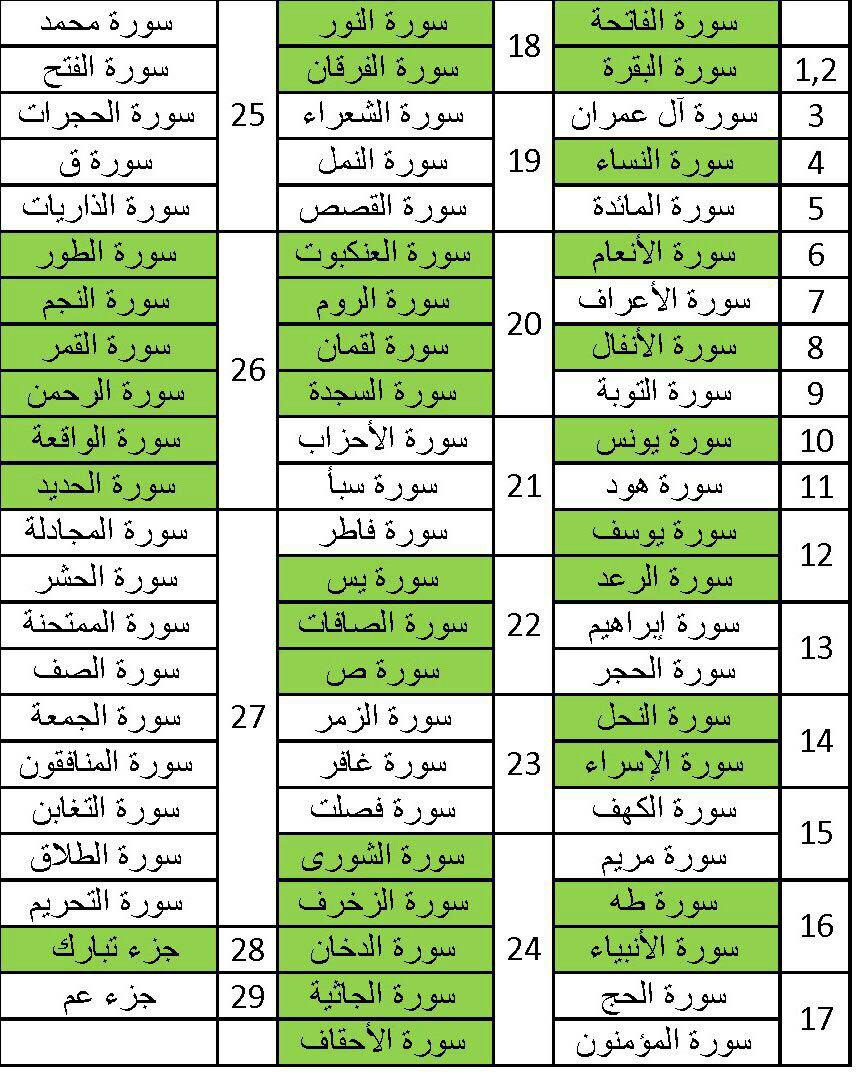
Ibn Taimiyyah, may Allāh have mercy on him, described a 29 day schedule for completing recitation of the Qur’ān closer to the way the Companions did that.
He said: “…Division by complete surahs takes precedence over division by parts [based on letter count].” (412)
And from the great advantages of division by complete surahs, he mentioned (414):
· Reciting speech whose parts are connected, one part with another;
· Beginning [one’s daily recitation] with that which Allāh began a surah with;
· Finishing with that which He finished with;
· Completing what was intended [to be completed] from every surah.
The chart in Arabic below [checked but not produced by me], shows Ibn Taimiyyah’s recommended schedule for a 29 day completion.
Summary of key points by Mikail ibn Mahboob Ariff
Source: Majmū‘ al-Fatāwá, vol. 13, pp. 405-416
Also see:
منتديات الإمام الآجري
http://www.ajurry.com/vb/showthread.php?t=14898
Part 01: [Alternative Download Link]
—
Part 02: [Alternative Download Link]
Posted from: Rulings Related to Death and Funerals (Janaza)
Is it Permissible for the Person to take off the hair on one’s shin or one’s arm?
Dr Saleh As Saleh explains that the hair falls into three categories:
(1) that which is forbidden to remove
(2) that which is commanded to remove
(3) that which there is no mention of prohibition/commandment, i.e no mention of it.
—
Posted from: http://understand-islam.net/site/index.php?option=com_content&view=article&id=134&Itemid=52
—
Posted from: http://understand-islam.net/site/index.php?option=com_content&view=article&id=134&Itemid=52
Abu Hurayrah (radhiyallaahu ‘anhu) narrated that the Messenger of Allaah (sallallaahu ‘alayhi wa sallam) said,
“The rights of the Muslim upon the Muslim are six.” It was said, “And what are they Oh Messenger of Allaah?” He replied,
“When you meet him, give him the greeting of peace,
When he invites you, respond to his invitation,
When he seeks your advice, advise him,
When he sneezes and praises Allaah, supplicate for mercy upon him,
When he becomes ills, visit him, and
When he dies follow him (i.e. his funeral).”
This hadeeth was reported by Muslim.
هل بقي من آثار النبي شيء؟
by Shaykh, the Muhaddith, Rabee’ ibn Haadee al-Madkhalee
Translated by Abbas Abu Yahya
—
Shaykh Rabee al-Madkhali was asked:
Are there any remnants from the Prophet?
The Answer :
There is nothing now from the remnants of the Prophet -alayhi as Sallat wa sallam. Whoever claims that there remains something from his belongings then he is a liar and a crazy foolish person!
We visited India and found people who claimed that they had a hair of the Prophet -alayhi as Sallat wa sallam. They are liars and they are cheaters.
We saw, I think it was either in Pakistan or in Bangladesh a Masjid, where they claimed they had the foot print of the Prophet – sallAllaahu alayhi wa sallam.
Also in Delhi there was a Masjid and the Imam was a Bukhari and he had a lot of influence.
Non-Muslim European men and women who were barely dressed would visit this Masjid. They would go to a place in the Masjid and this Bukhari person would say:
‘At this place is a remnant of the Prophet -alayhi as Sallat wa Sallam.’
It had the like of a dome built over it. You see shameless women and men gathering to view the footprint of the Prophet -alayhi as Sallat wa sallam.
So I saw this evil and I came to this Imam to advise him and I said: ‘You people claim that the Prophet -alayhi as Sallat wa sallam – came to this place and this is his remnant/sign? ‘
He replied: the people say such-and-such.
I said to him: ‘O Brother we read history and came to know that the Messenger -alayhi as Sallat wa sallam- was taken up to the heavens, he went from Makkah to Madinah and he went out for battles to well known areas and he went to Tabuk, but we did not find in history that the Messenger came to Delhi and stood at this place! !
He was going around in circles. . . . then I spoke to his father when he came – and I had a Salafi with me translating – his father said about me: ‘This is bad manners’ [i.e. towards the Prophet’s hair.]
Then this Salafi who was with me informed me:
‘That when King Saud -rahimullaah- visited India and came to Banaras which is the main center idols and deities – this place Banaras is like Makkah – In this place they have many idols, so when they heard that he will visit this place they covered these idols – I swear by Allaah they covered them up – why ? Out of fear of Tawheed.
Then he came to this Masjid to pray and they said to him: Here is the footprint of the Prophet -sallAllaahu alayhi wa sallam- so he quickly left that place and came to know that this is foolishness.
The person who singles out Allaah alone has knowledge and insight, he has understanding, the people of Bida have stupidity, ignorance and foolishness or evilness. May Allaah bless you. So there are many claimants.
In Turkey they claim that the Prophet’s hair is present there, some of the people claim that the Mus’haf which Ali -radiAllaah anhu- wrote with his hand is present etc….. these are lies.
The Sunnah of Allaah regarding these things is that they pass away and cease to exist, this is the Sunnah which Allaah -Subhanahu wa Ta’ala- placed.
O Allaah send praise and security upon Muhammad, upon his family and his Companions.
[Taken from: http://www.rabee.net/show_fatwa.aspx?id=50]
Urdu Audio: 20 kya nabi athaar koi cheez baqi hai 1437
English PDF Download: Day 20 – Are there any Remnants from the Prophet?
Urdu PDF Download: 20 kya nabi athaar koi cheez baqi hai 1437
Posted from: https://followingthesunnah.wordpress.com/2016/06/26/day-20-are-there-any-remnants-from-the-prophet/
Relics of Muhammad, The Prophet’s Hair, hair of prophet mohammed
—
Posted from: Pillar5 – Hajj – QA
—
Posted from: Pillar5 – Hajj – QA
–
Postedfrom: http://understand-islam.net/site/index.php?option=com_content&view=article&id=65&Itemid=87
Read Also:
When Does a Slave Know that a Trial is a Test or a Punishment? – Ibn Baz
–
Posed from: http://understand-islam.net/site/index.php?option=com_content&view=article&id=65&Itemid=87
Further Reading / Listening:
The Excellence of Observing Saum (Fasting) in the months of Muharram and Sha’ban and the Sacred Months (Rajab, Dhul-Qa’dah, and Dhul-Hijjah) – Riyad-us-Saliheen
The Virtue of the first 10 Days of Dhul-Hijjah (Riyaad-us-Saaliheen) – Abu Talha Dawud Burbank [Audio|En]
The Excellence of As-Saum (The Fast) during the first ten Days of Dhul-Hijjah – Riyad-us-Saliheen
Significance & Virtues of the Day of Arafah – Compiled from various sources
The Excellence of Friday Prayer – Riyad-us-Saliheen
–
Posted from : http://understand-islam.net/site/index.php?option=com_content&view=article&id=33&Itemid=54#Review Creed
If a person shows off in his worship, then this falls under four categories.
1. If showing off is the driving force behind doing the act of worship, then the worship is invalid. It is reported in the hadeeth qudsi that Allaah (سُبْحَانَهُ وَ تَعَالَى) said,
“I am the One, One Who does not stand in need of a partner. If anyone does anything in which he associates anyone else with Me, I shall abandon him with one whom he associates with Allaah.” [3]
2. If a person begins his worship sincerely and showing off occurs later at which point he tries to stop showing off, then his worship is valid.
Otherwise, if he continues and does not attempt to ward it off, inclining towards it, then one examines whether the latter part of this worship depends on its earlier part or vice verse. For example, with salaah and wudhu, these worships would become invalid in this case.
On the other hand, if the worship is distinguished such that the parts are independent, then whatever occurred before showing off is valid, and whatever occurred after the person began to show off is invalid. For instance, a person gives $50 in charity sincerely. Later, he gives $500 to show off. His first donation is valid while the $500 are invalid.
3. If a person begins to show off after concluding the worship, then the worship is valid. However, this nullifies the reward for the worship.
Allaah (سُبْحَانَهُ وَ تَعَالَى) said (in the translation of the meaning):
“O you who believe! Do not render in vain your Sadaqah (charity) by reminders of your generosity or by injury, like him who spends his wealth to be seen of men, and he does not believe in Allaah, nor in the Last Day. His likeness is the likeness of a smooth rock on which is a little dust; on it falls heavy rain which leaves it bare. They are not able to do anything with what they have earned. And Allaah does not guide the disbelieving people.”
Surah al-Baqarah (2:264)
4. The showing off is in the descriptive manner of the worship, not its origin. As such, the person initiates the action for the sake of Allaah (سُبْحَانَهُ وَ تَعَالَى) but shows off in its description.
For instance, someone begins his salaah sincerely, but he hears someone come, at which point he begins to perfect his salaah more than normal. In this situation, all of that which he added to the sincere part of the salaah will have no reward.
Footnotes:
[3] Reported in Saheeh Muslim, (English translation no. 7114, book 42)
Source: Al-Qawaa’id wal-Usool al-Jaami’ah wal-Furooq watTaqaaseem al-Badee’ah an-Naafi’ah. The Basic Rulings and Principles of Fiqh – The Beneficial, Eloquent Classifications and Differentiations. Foundation -5
By Sh. ‘Abdur Rahmaan ibn Naasir As-Sa’di (rahimahullaah) (d. 1376 A.H./1956 C.E.)
Discussion based upon: (1) Sh. Ibn Sa’di’s original explanation, (2) Our Sh. Muhammad ibn Saalih Al-‘Uthaimeen’s Commentary, and (3) Full explanation by our Sh. (Dr.) Sami ibn Muhammad As-Sghair (summer 1427 A.H./2006 C.E.)
Posted from: http://understand-islam.net/site/index.php?option=com_wrapper&view=wrapper&Itemid=195
Related Links:
Text from Usool as Sunnah (Foundations of Sunnah)
19.For indeed, (indulging in) theological rhetoric (kalaam) in [22] the matter of Qadar, the Ru’yah, the Qur’aan and other such issues are among the ways that are detested and which are forbidden.
20. The one Who does so, even if he reaches the truth with his words, is not from Ahlus-Sunnah, until he abandons (using) this mode of argumentation, [and until he] submits and believes in the aathaar (the Prophetic Narrations and those of the Companions [23]
Footnotes:
[22] Imaam ash-Shaafi’ee (d. 204H) said,
“My ruling regarding the people of theological rhetoric is that they should be beaten with palm leaves and shoes and be paraded amongst the kinsfolk and the tribes with it being announced, ‘This is the reward of the one who abandons the Book and the Sunnah and turns to theological rhetoric (kalaam).”
Sharh ‘AqeedatitTahaawiyyah of lbn Abil-’Izz, p. 75.
Ibn ‘Abdul-Barr said,
“The people of Fiqh and Aathaar in all the various towns and cities are agreed unanimously that the Ahlul-Kalaam (People of Theological Rhetoric) are (but) Ahlul-Bida’ waz-Zaigh (the People of Innovations and Deviation). And they are not considered, by all of the above, to be amongst the ranks of the Scholars (in truth).”
Reported by Ibn Qudaamah in his Burhaan fee Bayaanil-Qur’aan.
Imaam ash-Shaafi’ee (d. 204H) said,
“That a person is put to trial with everything that Allaah has forbidden, besides Shirk, is better than that he looks at Kalaam (theological rhetoric).” He also said, “If people knew what (misleading and destructive) desires are contained within theological rhetoric they would certainly flee from it as they would from a lion,”
he also said,
“Whoever showed boldness in approaching theological rhetoric will never prosper.”
Reported by Ibn Qudaamah in his Burhaan fee Bayaanil-Qur’aan.
One of the Scholars of ash-Shaash said:
“Every knowledge save that of the Qur’aan is a pre-occupation
Except for the Hadeeth and Fiqh (understanding) of the Deen
Knowledge is only that about which it is said,
‘Haddathanaa …‘ (So and so narrated to us)
And what is besides that
Are but whisperings of the Shayaateen (devils)”
Aboo Yoosuf, the companion of Aboo Haneefah said,
“Whoever sought knowledge by kalaam (theological rhetoric) will turn a heretical apostate,” and Ahmad ibn Hanbal (d. 241H) said, “The person of theological rhetoric will never prosper. And never do you see anyone looking into theological rhetoric except that in his heart is a desire for creating mischief.”
Both narrations are reported by Ibn Qudaamah in his Burhaan fee Bayaanil-Qur’aan.
[23] Muhammad Ibn Seereen (d. 110H) said,
“They (i.e., the Companions and the Taabi’een) used to consider themselves upon the path (of truth) so long as they held onto the narrations.”
Reported by al-Laalikaa’ee in his Sharh Usolil It’iqaad, no. 110.
Shaadh ibn Yahyaa said,
“There is no path which is more straight and direct (in leading) to Paradise than the path of the one who travels upon the aathaar (narrations).”
Reported by al-Laalikaa’ee in his Sharh UsoolilIt’qaad no. 112.
‘Abdullah ibn alMubaarak (d. 181H) said,
“I found that the affair was Ittibaa’ (following and imitation, i.e., following and submission to the narrations).”
Reported by al-Laalikaa’ee in his Sharh Usoolil-l’tiqaad, no. 113
The following audio Clip Extracted from Part 1 of the Series – Knowledge & Etiquette in Seeking it
—
Related Links:
Ilm-ul-Kalam (Knowledge Of Theological Rhetoric) – Ibn Baz
What the Salaf Said Regarding Theological Rhetoric (ilm al Kalaam)
[09/08 1:18 am] Whatsapp Rabee Almaqaalih:
من مجالس شيخنا ربيع العامرة بالنصح والتوجيه
كنت عنده يوم الأربعاء بتاريخ ٢١|٤|١٤٣٣ من هجرة
نبينا محمد صلى الله عليه وسلم.
وكان يتكلم على الغرور ويذمه ثم ذكر :
《 عبد الله القصيمي 》
قال : كان رجلا ذكيا جدا له كتابات قوية لو ثبت يمكن يمثل شيخ الإسلام ابن تيمية في هذا العصر !
لكنه ( الغرور ) الذي أضله ، فيه غرور شديد ، والله كنت أقرأ له والتمس الغرور في بعض كتاباته .
ولما نصحه بعض العلماء تكبر للغرور الذي فيه وارتد عن الدين .انتهى
كتبه : أبو حسان سمير القيسي
From the sittings of Shaykh Rabee full of advice and guidance:
“I was with the shaykh on Wednesday 21/4/1433 AH and he was speaking about self delusion. He was dispraising it and he then made mention of “Abdullah Al-Qaseemi”.
Shaykh Rabee said
“This was an extremely intelligent man who had powerful writings. Had he remained firm, he could well have been like the Shaykh ul Islam ibn Taymiyyah of our times! However, self delusion _(alghuroor)_ is what caused him to stray. He was severely deluded by himself. By Allah, I would read his books and sense self delusion in some of his writings.
When some of the scholars advised him, he became haughty due to that very same delusion that he had (about himself) and thereafter he apostated and left the Religion.”
[End of quote]
Written by Hassaan Sameer Al-Qaysee
I, Nadeem Ahsan-Shah received this from brother Rabee Al-Maqaalih of Madinah (via a whatsapp group) who confirmed to me that he heard this directly from brother Hassaan Sameer Al-Qaysee.
Translated by Abu Ishaaq Nadeem Ahsan-Shah.
May Allah keep us firm upon His Deen and protect us from feeling safe from the Hell-Fire.


 AbdurRahman.Org
You must be logged in to post a comment.