Based on the Answer by Shaykh ibn Uthaymeen rahimahullaah
Question:
Why is it that Allaah burdens the believers (with with trials, illnesses) who worship Him abundantly , while those disobedient enjoy all the goods of life?
Share this, Baarakallaah Feekum: [“One who guides to something good has a reward similar to that of its doer” - Saheeh Muslim vol.3, no.4665] [This website protects the copyrights of the authors/publishers. The Content is posted on this website with implicit/explicit permission from content owners]
Bismillaah hir Rahman nir Raheem. Alhumdulillahi Rabbil Aalameen
Wa sallallahu ala Muhammadin wa ala aalihi wa sahbihi wa sallam
The pillars of Kufr are four, they are,
Haughtiness and disdainfullnes : This prevents the person from submission i.e. yielding.
Envy (Al Hasad) : This prevents him from accepting the naseehah i.e. the advice and from exerting it.
Anger (Al Ghadab) : This prevents him from being just.
Lusts : This prevents him from giving himself to worship.
–
If the pillar of false pride and haughtiness is demolished, then submission will become easy for him. If the pillar of envy is demolished, then it becomes easier for him to accept advice and to offer it. If the pillar of anger is demolished, it becomes easy for him to be just and humble. If the pillar of lust is demolished, it becomes easy for him to be patient and ready for worship.
The demolishing of mountains is much more easier than demolishing these four pillars for the one who is afflicted with it, specially if they are entrenched in him and became as a firmed attribute, because no action can be upright with the presence of these pillars and no soul can be sanctified and purified having these established in it and whenever the person wants to exert himself to do or to act, these four pillars come and corrupt his work. And all other defects originate from these four and if these four are established in the heart it will make him see falsehood in the form of the truth and truth in the form of falsehood and good in the form of wrong and wrong in the form of good and it will make this life grow nearer to him and make the hereafter far removed from him.
If you contemplate the Kufr of the nations before, you will see that the Kufr of the nations originated from these four pillars and upon these four pillars the punishment will befall. The intensity of the punishment and it’s severity will depend upon how these four and entrenched. So whoever opens for himself these four pillars is indeed has opened all the doors of evil, sooner or later and whoever has closed the doors of these then he indeed has closed all the doors of evil because these four prevents submissiveness, sincerity, repentance and longing and turning to Allah, acceptance of the truth, the advice to the Muslims, humbleness to Allah and to his creation. This is what these four pillars can do.
The origin of these four pillars is from man’s ignorance concerning his Lord and ignorance concerning himself. Had he known of his Lord qualified with the most perfect and magnificent attributes and had he known himself qualified with all forms of defects, he wouldn’t be haughty, angry, envious of others because envy in fact is one form of opposition to Allah because he dislikes the favour and blessing of Allah which he bestowed upon his slave while Allah loves that. Not only that, he likes that it to be rifted from his brother and Allah does not like that. So he is opposing Allah in his pre-decree and what Allah loves and his honour and that is why Iblees (Satan) is enemy because his sin was due to haughtiness, arrogance and envy.
How can these be removed?
These two qualities, knowing Allah and Tawheed, and content with him and pleased with him and turning to him, takes away these two qualities of haughtiness and envy and taking anger away by knowing oneself that the self does not deserve all that so that to be angry for it and to avenge for its all sake. In this case this will prompt it to be contempt once this is taken out. Otherwise then this will be preference for the self over its creator and originator. The greatest thing to repel this defect is to train the self to get angry for Allah’s sake and whatever at any time enters the self this type of anger for Allah’s sake, there will exit the anger for its self and the opposite is true. As to the lust, its cure, its healing is in the correct knowledge. Yielding to the self’s lust deprives it from the correct knowledge and putting it on a diet in that respect puts it on the linkage with the correct knowledge. The more you are open the door for lusts, the more you are trying to deprive the self from the correct knowledge and the more you close it, the more you will be linked to the correct knowledge.
Anger is like the wild animal. If its owner releases it, it starts by eating him up first. Lust is like the fire when the person ignites it it begins by burning him there in first. Al-Kibr, haughtiness, false pride, arrogance is like confronting the king regarding the king’s possession and kingdom, if he does not destroy you he will expel you. Envy is like opposing someone who is more powerful and more stronger than you.
This is based on Imam Ibn Al Qayim’s (rahimahAllah) specification of these four pillars of Kufr.
Transcribed by brother AbdulRazak bin AbdulAleem for AbdurRahman.org, May Allah reward him, ameen.
Share this, Baarakallaah Feekum: [“One who guides to something good has a reward similar to that of its doer” - Saheeh Muslim vol.3, no.4665] [This website protects the copyrights of the authors/publishers. The Content is posted on this website with implicit/explicit permission from content owners]
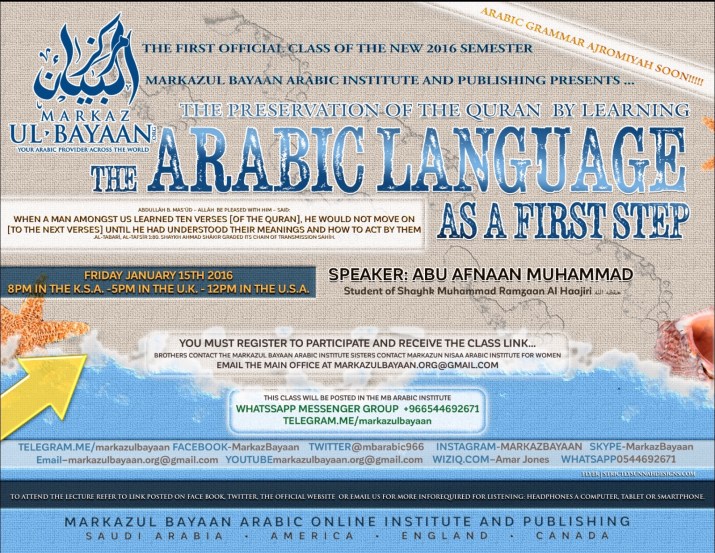
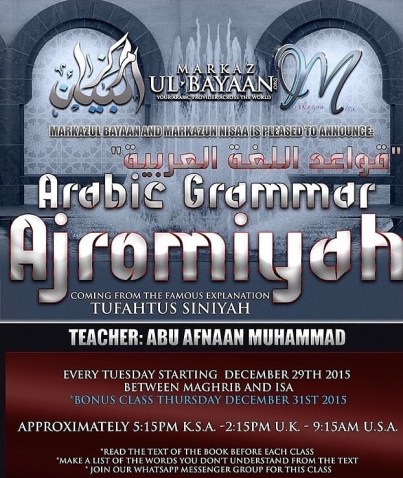
Speaker: Abu Afnaan Muhammad حفظه الله
Student of Shayhk Muhammad Ramzaan Al Haajiri حفظه الله
–
Share this, Baarakallaah Feekum: [“One who guides to something good has a reward similar to that of its doer” - Saheeh Muslim vol.3, no.4665] [This website protects the copyrights of the authors/publishers. The Content is posted on this website with implicit/explicit permission from content owners]
Share this, Baarakallaah Feekum: [“One who guides to something good has a reward similar to that of its doer” - Saheeh Muslim vol.3, no.4665] [This website protects the copyrights of the authors/publishers. The Content is posted on this website with implicit/explicit permission from content owners]
Share this, Baarakallaah Feekum: [“One who guides to something good has a reward similar to that of its doer” - Saheeh Muslim vol.3, no.4665] [This website protects the copyrights of the authors/publishers. The Content is posted on this website with implicit/explicit permission from content owners]
Share this, Baarakallaah Feekum: [“One who guides to something good has a reward similar to that of its doer” - Saheeh Muslim vol.3, no.4665] [This website protects the copyrights of the authors/publishers. The Content is posted on this website with implicit/explicit permission from content owners]
Bismillah wa -Alhamdulillah wa Salaatu wa Salaam ‘alaa Rasulillah ‘amma ba’d
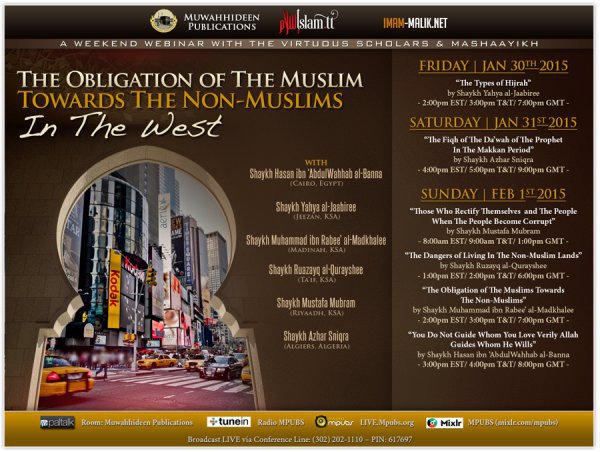
On Friday 30th January, Muwahhideen Publications in conjunction withIslam.tt and Imam-Malik.net hosted a LIVE tele-lecture with Shaykh Yahyaa al-Jaabiree (May Allah Preserve Him) entitled, “The Types of Hijrah” as part of the webinar, “The Obligation of The Muslims Towards The Non-Muslimsin The West”.
This lecture event was translated LIVE into English.
Allah said:
“And as for those who emigrated for the Cause of Allah, after suffering oppression, We will certainly give them goodly residence in this world, but indeed the reward of the Hereafter will be greater, if they but knew!” [Soorah an-Nahl 16:41]
• The Prophet (sallAllahu ‘alayhi wa sallam) said: “Hijrah will not cease until repentance ceases, and repentance will not cease until the sun rises from the West.”
• He (sallAllahu ‘alayhi wa sallam) likewise stated: “There is no Hijrah after the Conquest (of Makkah), but instead Jihaad and (good) intention.” i.e. Hijrah from Makkah to Madeenah, because Makkah had become a land of Islaam and this is a glad tiding that it will remain as such until the Day of Resurrection.
• Hijrah is an obligation upon those who have the ability to do so. If they are unable an exception is made for them. Allah mentions in His Book:
“Except the weak ones among men, women and children who cannot devise a plan, nor are they able to direct their way. For these there is hope that Allah will forgive them, and Allah is Ever Oft Pardoning, Oft-Forgiving.” [Soorah an-Nisaa 4:98-99]
• Whoever finds a Muslim land that will accept him, then it is obligatory for him to emigrate. And whoever does not find a place that would allow him to live there, he should remain in his country and practice his Deen to the best of his ability and treat the people in the best way and not cause the disbelievers to have any animosity towards the Muslims due to his bad actions.
Our Lord (Subhaanahu wa Ta’aalaa) says:
“And say to My slaves that they should (only) say those words that are the best. (Because) Shaytaan verily, sows disagreements among them Surely, Shaytaan is to man a plain enemy.” [Soorah al-Israa` 17:53]
“And (remember) when We took a covenant from the Children of Israel, (saying): Worship none but Allah (Alone) and be dutiful and good to parents, and to kindred, and to orphans and al-Masaakeen (the poor), and speak good to people” [Soorah al-Baqarah 2:83]
This is not because we have some special love for the non-Muslims because of their Deen, but in hope that they will be guided to Islaam and hope that some harm will be repelled form the Muslims.
• From the types of Hijrah are:
1. Leaving a land of bid’ah to a land of Sunnah.
2. Leaving a land of sin and disobedience to a land where the people are righteous and obedient to Allah.
3. Leaving alone that which Allah has prohibited, as is found in the hadeethof ‘Abdullah Ibn ‘Amr ibn al-‘Aas (radhiyAllahu ‘anhu) that the Messenger (sallAllahu ‘alayhi wa sallam) said: “The Muslim is one from whose tongue and hand the Muslims are safe. And a Muhaajir is the one who abandons all that Allah has forbidden.”
• It is befitting for the Muslim to abandon the places where shirk, sin andbid’ah are committed and to stay away from the people who commit those sins because they cause a deficiency in his Deen. And he should not take any knowledge from the people of bid’ah.
• Regarding the third type of leaving alone something – which is the origin of the word – can be applied to shunning people. This can be done to Muslimsif they have committed a sin and it would benefit them and cause them to recognise their sin and repent from it. The Prophet (sallAllahu ‘alayhi wa sallam) did this with Ka’b Ibn Maalik (radhiyAllahu ‘anhu) and others who stayed behind for the Battle of Tabook. The Prophet (sallAllahu ‘alayhi wa sallam) did not speak to them for 50 nights, so they would realise the severity of their sin until Allah revealed that He had accepted their repentance and forgiven them. Allah said:
“Allah has forgiven the Prophet, the Muhaajiroon (Muslim emigrants who left their homes and came to al-Madeenah) and the Ansaar (Muslims of al-Madeenah) who followed him (Muhammad sallAllahu ‘alayhi wa sallam) in the time of distress (Tabook expedition, etc.), after the hearts of a party of them had nearly deviated (from the Right Path), but He accepted their repentance. Certainly, He is unto them full of Kindness, Most Merciful. And (He did forgive also) the three [who did not join the Tabooûk expedition (whom the Prophet sallAllahu ‘alayhi wa sallam)] left (i.e. he did not give his judgement in their case, and their case was suspended for Allah’s Decision) till for them the earth, vast as it is, was straitened and their ownselves were straitened to them, and they perceived that there is no fleeing from Allah, and no refuge but with Him. Then, He accepted their repentance, that they might repent (unto Him). Verily, Allah is the One Who accepts repentance, Most Merciful.” [Soorah at-Tawbah 9:117-118]
• There were other people at that time that likewise stayed behind and they pretended to have a valid excuse when they did not and the Prophet accepted that at face value from them and did not rebuke them from it like the Companions who admitted they did not have an excuse; and Allahexposed those who were hypocrites. This type of hijrah (of shunning) applied to them and remained for 50 nights until Allah accepted their repentance. They benefited from this type of hijrah. They would walk around the market places full of people and no one would pay attention to them. When Allah revealed that He had accepted their repentance the Prophet (sallAllahu ‘alayhi wa sallam) said to Ka’b: “Receive glad tidings of the best day upon you since your mother gave birth to you.”Ka’b asked: “O Messenger of Allah, is this from you or from Allah?” to which the Messenger (sallAllahu ‘alayhi wa sallam) informed him that it was fromAllah.
• However, this type of refusing to talk to people is only applied if they would recognise their sin because of this. If shunning them would only cause them to go further away from the Muslims and go deeper into their sins and break away from the jamaa’ah, it is not to be done.
• The Prophet (sallAllahu ‘alayhi wa sallam) applied this to some people and to others he did not, which was based on their circumstances and if they would benefit from it or not.
Click here to Download / Listen [audio https://salafiaudio.files.wordpress.com/2015/11/the-types-of-hijrah-shaykh-yahya-al-jaabiree.mp3]
Wa Billahi Tawfeeq
Wa SallAllahu wa Sallama wa Barak ‘alaa Nabiyyinaa Muhammad wa ‘alaa ‘Alyhi wa Sahbyhi wa Sallam
Share this, Baarakallaah Feekum: [“One who guides to something good has a reward similar to that of its doer” - Saheeh Muslim vol.3, no.4665] [This website protects the copyrights of the authors/publishers. The Content is posted on this website with implicit/explicit permission from content owners]
Bismillah wa -Alhamdulillah wa Salaatu wa Salaam ‘alaa Rasulillah ‘amma ba’d
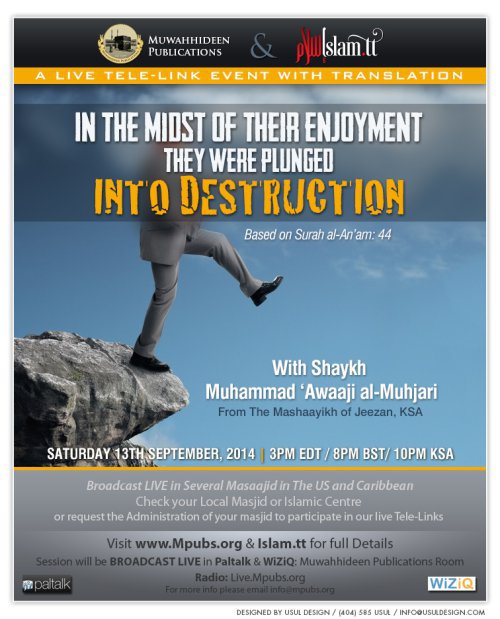
The Noble Shaykh Muhammad ‘Awaaji al-Madkhalee (May Allah Preserve Him) from the mashaayikh of Jeezan, Saudi Arabia delivered a LIVE tele-lecture with Muwahhideen Publications on Saturday 13th September 2014. The Shaykh is a student of Shaykh Ahmad an-Najmi (rahimahullah) andShaykh Zayd al-Madkhalee. He is a teacher at the Salafi Institute in Jeezan, and is recommended by Shaykh Fawaaz al-Madkhalee, Shaykh Zayd al-Madkhalee and others.
This lecture event was translated LIVE into English.
• This lecture is based on the aayaah:
“So, when they forgot (the warning) with which they had been reminded, We opened to them the gates of every (pleasant) thing, until in the midst of their enjoyment in that which they were given, all of a sudden, We took them to punishment, and lo! They were plunged into destruction with deep regrets and sorrows.” [al-An’aam 6:44]
• When the people of Eemaan hear this verse their skin trembles out of fear because they are living and enjoying the blessings of Allah and they do not know if they have truly thanked Allah for those blessings. So we fear that this aayah might apply to us for not giving thanks for those blessings bestowed upon us.
• Istidraaj refers to when Allah continuously bestows blessings upon a person in order to lead them further into sins due to them not being thankful. Allah performs this action to whomever He wants, whenever He wants and the worse type is that which incurs Allah’s anger. This is when the person does something to incur the anger of Allah, despite the fact that He is the One Who brought him to life and He is the One who will cause him to die.
• The greatest type of Istidraaj is a person falling into shirk, which is without doubt the greatest of all sins. Allah continuously pours out blessings upon His servant to the extent that he cannot enumerate them, yet he takes these blessings and uses them for the purpose of other than pleasing Allah.
• “So, when they forgot (the warning) with which they had been reminded” – evidence that Allah has established the burden of proof and clarified the message to the creation but some were caused to forget the message due to their own sins.
• Allah punishes His servant with whatever He wishes and He has a great wisdom in doing that. The greatest punishment is causing the heart of the servant to be negligent and forgetful of the remembrance of its Lord. Allahpours out His blessings upon His servants and despite that many of them are forgetful of these blessings and they do not remember their Lord so they live in a state of heedlessness, just like an animal. O my blessed brother, you should know that if a person falls into a state such as this, he has fallen into the greatest and worst type of Istidraaj.
• How does a Muslim know if the blessings he is enjoying is actually Istidraaj? The answer: If a person uses the blessings of Allah to worship and be obedient to Him and to do what is permissible, then he is giving thanks for the blessings of Allah. However, if he uses these blessings for other than worshipping Allah and they distract him from the remembrance of his Lord, then he should know that these blessings are Istidraaj.
• Just as Istidraaj is a punishment that befalls some individuals, it likewise befalls groups of people and can in fact befall the entire Muslim nation. This is the case if they busy themselves with the blessings that they have been given and in doing so they forget their Lord and do not practice the Sunnahof His Messenger (sallAllahu ‘alayhi wa sallam) and they do not practice the Divine Law that Allah has revealed for them to make the source of ruling.Allah says:
“Such is the Seizure of your Lord when He seizes the (population of) towns while they are doing wrong. Verily, His Seizure is painful, and severe.” [Soorah Hood 11:102]
• Allah does not punish these nations, villages and groups of people when they initially start committing these sins. Rather, if they continually engage in sin and fail to command the good and forbid the evil, this is when Allahpunishes them as a group.
• Allah informed us about the conditions of the nations of the past and what happened with the Prophets and Messengers He sent. Allah clarified the proofs and showed them the right way and sent to them Prophets and Messengers who came with miracles. But these miracles increased them in nothing but arrogance and turning away from their Lord. Thus, Allah seized them with a painful punishment. This was the case with the people of Nooh, Hood, Saalih, Shu’ayb, Moosaa, Ibraaheem and many other nations to whom Allah sent Prophets and Messengers.
• The Prophet (sallAllahu ‘alayhi wa sallam) clarified that the servant would be in a condition where Allah gives him plenty of time and does not punish him hastily. Rather, He gives him health and well-being and continues to give him an opportunity to repent from his sins and seek forgiveness.
• It is found in a Hadeeth Qudsi that the Prophet (sallAllah ‘alayhi wa sallam) said that Allah said: “I am according to the servant’s opinion of Me. If he mentions me to himself, I will mention him to Myself and if he mentions Me in a gathering, I will mention him in a gathering better than it.”
• In another hadeeth, the Prophet (sallAllahu ‘alayhi wa sallam) said: “Allahextends His Hand out at night in order to accept the repentance of the one who sinned by day. And He extends His Hand out during the day in order to accept the repentance of the one who sinned by night, and He continues to do this until the sun rises from the West.”
Allah (Subhaanahu wa Ta’aalaa) says:
“And nothing prevents men from believing, now when the guidance has come to them, and from asking Forgiveness of their Lord, except that the ways of the ancients be repeated with them (i.e. their destruction decreed by Allah) ,or the torment be brought to them face to face? And We send not the Messengers except as giver of glad tidings and warners. But those who disbelieve, dispute with false argument, in order to refute the truth thereby. And they treat My Aayaat and that with which they are warned, as jest and mockery!”[Soorah al-Kahf 18:55-56]
• The following aayah sums up the topic of Istidraaj and how the people are punished for it:
“And who does more wrong than he who is reminded of the Aayaat of his Lord, but turns away from them forgetting what his hands have sent forth. Truly, We have set veils over their hearts lest they should understand this (the Qur’aan) and in their ears, deafness. And if you (O Muhammad) call them to guidance, even then they will never be guided.” [Soorah al-Kahf 18:57]
• This aayah clarifies that whoever turns away from the remembrance ofAllah will be punished by having a seal placed over his heart such that he will not understand the truth and he will not benefit from his sight or hearing.
“And these towns (population, ‘Aad, Thamood, etc.) We destroyed when they did wrong. And We appointed a fixed time for their destruction.” [Soorah al-Kahf 18:59]
• Allah destroyed them only after giving them ample time to repent from their sins, but they did not benefit from this time.
• There is a question I would like you all to pay close attention to, may Allahbless you: Is everyone who commits a sin fallen into Istidraaj of Allah?
• The answer: The human being will fall into sins and no person is safe from falling into sin. However, the sins we commit are not a form of Istidraaj until the person continues doing the sin and fails to repent from it.
• For this reason, Allah commands the human being to repent sincerely because He knows the human beings are going to commit sins. So it is obligatory upon us to fear the punishment of Istidraaj.
Allah says in His Book:
“Did they then feel secure against the Plan of Allah. None feels secure from the Plan of Allah except the people who are the losers.” [Soorah al-A’raaf 7:99]
“Draws near for mankind their reckoning, while they turn away in heedlessness. Comes not unto them an admonition (a chapter of the Qur’aan) from their Lord as a recent revelation but they listen to it while they play, With their hearts occupied (with evil things) those who do wrong, conceal their private counsels, (saying): ‘Is this (Muhammad) more than a human being like you? Will you submit to magic while you see it?’” [Soorah al-Anbiyaa` 21:1-3]
• It is obligatory upon us all to beware of the punishment of Allah and strive against our own selves such that whenever we fall into some sin we hasten to return to Allah and repent to Him. We should frequently make du’aaasking Allah to prevent us from doing anything that will incur His anger.
• If a person is to continually perform righteous deeds and is sincere in doing them only for the Pleasure of Allah and follows the Sunnah of the Messenger (sallAllahu ‘alayhi wa sallam) in doing those deeds and asks his Lord for firmness upon His Deen, Allah will make easy his affair and expand this chest and guide him to all that is good.
• Let us take for example one of the many blessings Allah has given all of us, one of those physical blessings Allah has given us in our bodies. Do we use this blessing in order to obey our Lord such that we give thanks for this blessing as we should or do we use this blessing in order to disobey our Lord?
• This is the blessing of sight. If we use our sight to look at what is around us, we see the roads that we are walking on and we look at what we need to around us to keep ourselves safe, then we have used that blessing properly. And likewise if we guard our sight and lower our gaze from looking at anything Allah has prohibited. If we use our eyes to cry out of fear for Allahand we look at those beautiful things Allah has created and think about their beauty and tie that back to the Power and Omnipotence of our Creator, then and only then have we given thanks for this blessing of sight.
• On the other hand, if we use the blessing of sight to look at things that are prohibited such as looking at women who are not our relatives, looking at the private parts of the Muslims and entering into places that we are not permitted to enter into or looking at prohibited books such as the books of magic and other than that, in this case we have used the blessing of sight for other than what Allah has allowed us to use it for and thus we would be committing a sin. And we should fear in such a situation. We should fear that by using this blessing of sight and looking at things that are prohibited that we are incurring Allah’s anger upon ourselves.
• We ask Allah Al-‘Adheem, Rabbul ‘Arsh al-‘Adheem to make us amongst those who worship Him upon clarity and who implement theSunnah of His Messenger (sallAllahu ‘alayhi wa sallam) and we ask Him not to make us of those who use His blessings to incur His anger by way ofIstidraaj. And we ask Him to grant us life and keep us all upon the Deen ofIslaam and upon the Sunnah of His Messenger as long as we live and to die upon them as well.
• We should not forget our brothers around the world who are being oppressed when we are making du’aa. We should ask Allah to rectify their affairs, to strengthen their weaknesses and to raise from amongst them people who will govern by the rule of Allah in their lands.
• We should spread the Deen of Islaam by our good character, by the good treatment of others and by being patient; this is something that we have been commanded by Allah to do. The Prophet (sallAllahu ‘alayhi wa sallam) said: “By Allah, if Allah guides one man because of you, it would be better for you than the red camel.”
• We should also take a firm position in warning against the errors that take place at the hands of some of those who attribute themselves to Islaam from the deviant sects who are far away from the true teachings of Islaam such as ISIS, Ikhwaan al-Muslimeen, Jamaa’ah at-Tableegh and other than them from the deviant groups. These groups are ruining the reputation of Islaamin the non-Muslims countries. When the non-Muslims see their faulty actions they think that all of the Muslims believe and act as they do.
• Spread the Sunnah of the Prophet (sallAllahu ‘alayhi wa sallam) and teach it to the people and be patient with them and treat the people kindly in order to guide them.
Click here to Download / Listen [audio https://salafiaudio.files.wordpress.com/2015/11/in-the-midst-of-their-enjoyment-they-were-plunged-into-destruction-shaykh-muhammad-awaaji-al-muhjari.mp3]
Wa Billahi Tawfeeq
Wa SallAllahu wa Sallaama wa Barak ‘alaa Nabiyanna Muhammad wa ‘alaa ‘Alyhi wa Sahbyhi wa Sallam
Share this, Baarakallaah Feekum: [“One who guides to something good has a reward similar to that of its doer” - Saheeh Muslim vol.3, no.4665] [This website protects the copyrights of the authors/publishers. The Content is posted on this website with implicit/explicit permission from content owners]
Bismillāh wa -Alḥamdulillāh wa Ṣalātu wa Salām ‘alā Rasūlillāh ‘amma ba’d
On Wednesday 30th September 2015, Muwahhideen Publications hosted a LIVE tele-link lecture with Shaykh Ḥāmid Ibn Khamīs al-Junaybī (May Allāh Preserve Him) who is from the well-known Mashāyikh of the U.A.E.
All praise belongs to Allāh; to Him alone belong all greatness. He is the Glorified, the One Who no one besides Him owns all the Greatness and Power. The dominion belongs to Him and all praise belongs to Him. All of the affairs are in His Hands; everything comes from Him and everything shall return to Him. He is to be praised and He is the All-Great. He is near His servants with His Knowledge and is aware of everything they say do and think; absolutely nothing is a secret from Him. He knows everything that is in their souls and is aware of what they do in private and in public. He is the Only One Who gives and withholds; He is the One Who debases and the One Who raises others. The One Who makes some people noble and lowers others; the One Who gives life and causes death. There is nothing and no one who deserves worship except Him. He – The Exalted – said about Himself: “To Him belongs all that is in the heavens and all that is in the earth, and He is the Most High, the Most Great.” [1]
“All praises and thanks be to Allāh, Who (Alone) created the heavens and the earth, and originated the darkness and the light, yet those who disbelieve hold others as equal with their Lord. He it is Who has created you from clay, and then has decreed a stated term (for you to die). And there is with Him another determined term (for you to be resurrected), yet you doubt (in the Resurrection). And He is Allāh (to be worshipped Alone) in the heavens and on the earth, He knows what you conceal and what you reveal, and He knows what you earn (good or bad).” [2]
Allāh (سبحانه و تعالى) sent His Messenger as one who would give glad tidings and warn the people; he was a shining light who called others to Allāh. He was at the forefront of those who were humble; he was humble to Allāh, the Lord of all that exists. He (صلى الله عليه وسلم) said: “Do not excessively praise me as the Christians excessively praised ‘Īsā Ibn Maryam; I am only a slave, so say the slave of Allāh and His Messenger.”
He (صلى الله عليه وسلم) used to visit the sick, attend funerals and would accept invitations when people invited him. He used to ride a donkey and eat bread made out of barley and he would dip it in old oil when people would invite him. He performed Ḥajj on a very weak animal and was wearing clothing that was not even worth four dirhams and in spite of this he said: “O Allāh make this a Ḥajj in which there will be no showing off.”
When his Companions (عنھم الله رضي) saw him, they loved him more than anyone else and in spite of this they would never stand up for him when he entered because they knew he disliked that. He used to milk his own animal with his hands, fix his shoes with his own hands and he served himself in his house, and he was the one whom the entire Arabian Peninsula was under his control yet he (صلى الله عليه وسلم) said: “Whoever is humble for Allāh, Allāh would raise him.”
The Prophet (صلى الله عليه وسلم) knew that establishing Tawḥīd and directing all forms of worship to Allāh is might and whoever does this is the mighty person and has reached the highest rank for the human being; a rank that no one else can reach except by fulfilling Tawḥīd. The Prophet (صلى الله عليه وسلم) nurtured his Companions upon this principle and he knew that having arrogance prevents the perfection of Tawḥīd.
Arrogance and Tawḥīd cannot perfectly join in one soul; it contradicts the perfection of Tawḥīd. Tawḥīd necessitates that a servant humbles himself before his Lord and likewise he is humble to the created beings. The humble person who has fulfilled Tawḥīd does not see himself as being better than anyone else. He knows that the bounty is in the Hand of Allāh (سبحانه و تعالى) and he does not see himself as having prestige over anyone else because this prestige comes from none other than Allāh.
When a servant completes Tawḥīd and builds this foundation of Tawḥīd, he will do so revering and worshipping Allāh (سبحانه و تعالى) , having a complete and perfect love for Allāh which will cause him not to compete with Allāh in His Greatness and Majesty, which is befitting to nothing and no one other than Allāh.
The Prophet (صلى الله عليه وسلم) said teaching his Companions: “No one will enter Jannah if he has within his heart even a mustard seed of arrogance.” It was said: “O Messenger of Allāh, men like to have nice clothing and shoes.” So the Prophet (صلى الله عليه وسلم) responded: “Indeed Allāh is Beautiful and He loves beauty. Arrogance is rejecting the truth and disdaining the people.”
Likewise, he (صلى الله عليه وسلم) said: “Whoever drags his garment out of arrogance, Allāh will not even look at him on the Day of Resurrection.”
He also informed us saying: “The arrogant people will be resurrected on the Day of Resurrection as small as ants and they will be covered with humiliation.”
In another ḥadīth the Prophet (صلى الله عليه وسلم) said: “Once a man was walking in a garment he was very impressed with and was combing the front of his hair (he was arrogant about his clothing and hair). Allāh caused the earth to swallow him and he will continue to be swallowed until the Day of Resurrection.”
If you know O servant of Allāh that you were created from nothing but dirt and will return to dirt, you should not put yourself above your level and give yourself any status you do not deserve. If you know this you would know that this only returns to the affair of Tawḥīd. That a person is only as good as he is in actions in worshipping his Lord and the only reason each person was created was to single out his Lord in worship. If you know this, it would cause you to fear giving your weak self any status it does not deserve or any position it has not earned. Allāh has made signs for the people of Īmān and signs for the people of arrogance. Allāh has made punishments for those who are arrogant on the earth without right just as He has made rewards for those who are humble. From the greatest of punishments for those who are arrogant is as Allāh said:
“I shall turn away from My Āyāt (verses of the Qur’ān) those who behave arrogantly on the earth, without a right, and (even) if they see all the Āyāt (proofs, evidences, verses, lessons, signs, revelations, etc.), they will not believe in them. And if they see the way of righteousness (monotheism, piety, and good deeds), they will not adopt it as the Way, but if they see the way of error (polytheism, crimes and evil deeds), they will adopt that way, that is because they have rejected Our Āyāt (proofs, evidences, verses, lessons, signs, revelations, etc.) and were heedless (to learn a lesson) from them.” [3]
The signs that Allāh will turn away from the arrogant people are both the signs in nature, which are evidence to His Oneness and likewise the signs and verses of His Book. He will turn them away such that they will look at the evidence all around them in nature, which point to the fact that the Creator is One and that He alone should be worshipped, they could have the evidence right in front of them in the Qur’ān and read it but not understand it. Because of their arrogance Allāh would turn their hearts away from pondering the truth, and this is the greatest of punishments – having a blind heart; having a covering over the heart such that the truth is presented to a person and they cannot even recognize it.
What is befitting for the servant to keep in mind is that he is a slave who has been commanded to make his entire life for the Sake of Allāh. He was created to worship his Lord and he was not created to have arrogance and make himself better than others or try to become the ruler over others and compel others. Whenever someone’s soul whispers to him that he is better than others and he has these thoughts of arrogance, he is to remember how great Allāh is. That He (Allāh) is the Only One Who is worthy of this Greatness, and by doing so the person humbles himself.
Imām Ibn al-Qayyim (الله رحمھ) mentions about the people of Īmān that when they feel within themselves that they are better than others, they remember how great and exalted their Lord is and that He is the Only One deserving this Greatness. And they should remember how angry He becomes with whoever tries to compete with Him in this Greatness. By doing so the servants humble themselves in their hearts and souls and they get rid of these feelings of arrogance. This is the peak of having humility.
Whenever Allāh blesses someone and allows them to gain some understanding of the Dīn, allows them to learn some of the legislative rulings or He blesses them to be a devout worshiper or one who remembers Allāh often or blesses him to be one who fasts often or stands the night in prayer or any of the other acts of worship and because of that blessing the servant feels that he is better than those who do not perform these acts of worship, he feels that he has a higher status than other people because of this blessing he has been given, he should realize that this is part of having insufficient knowledge of Allāh and His Names and Attributes and having a lack of reverence for Allāh (سبحانه و تعالى).
Take a minute and ponder with me, O my brother about the story of Qārūn and how he was arrogant and thought he was better than everyone else. Allāh mentions his story in Sūrah Qaṣaṣ:
“Verily, Qārūn (Korah) was of Mūsā’s (Moses) people, but he behaved arrogantly towards them. And We gave him of the treasures, that of which the keys would have been a burden to a body of strong men.When his people said to him: ‘Do not be glad (with ungratefulness to Allāh’s Favours). Verily! Allāh likes not those who are glad (with ungratefulness to Allāh’s Favours). But seek, with that (wealth) which Allāh has bestowed on you, the home of the Hereafter, and forget not your portion of legal enjoyment in this world, and do good as Allāh has been good to you, and seek not mischief in the land. Verily, Allāh likes not the Mufsidūn (those who commit great crimes and sins, oppressors, tyrants, mischief-makers, corrupts). He said: ‘This has been given to me only because of knowledge I possess.’ Did he not know that Allāh had destroyed before him generations, men who were stronger than him in might and greater in the amount (of riches) they had collected. But the Mujrimūn (criminals, disbelievers, polytheists, sinners, etc.) will not be questioned of their sins (because Allāh knows them well, so they will be punished without account).” [4] “So We caused the earth to swallow him and his dwelling place. Then he had no group or party to help him against Allāh, nor was he one of those who could save themselves.” [5]
After mentioning this story Allāh reminds His servants and gives them a get principle when He said:
“That home of the Hereafter (i.e. Paradise), We shall assign to those who rebel not against the truth with pride and oppression in the land nor do mischief by committing crimes. And the good end is for the Muttaqūn.” [6]
Ponder upon this with me, O my bother – may Allāh bless you – two great statements in which the Messenger (صلى الله عليه وسلم) clarified to you the virtue of being humble for the Sake of Allāh.
The first of them is: “Whoever leaves alone some clothing out of humbleness for the Sake of Allāh and he is able to wear that clothing, Allāh will call him on the Day of Resurrection in front of all of the creation and give him the choice to wear whichever of the garments of īmān he wishes.” [7]
What is meant by this ḥadīth is whoever is living amongst people who are middle class and they dress in a way that is normal (they do not wear very poor clothing or very fancy clothing) and this person himself is able to wear the clothing of the rich people but so that he fits in with the others and so that their hearts are not hurt when they see him wearing clothing they are not able to wear, he dresses as they do. Whoever does this out of humility for the Sake of Allāh will get this great reward. He will be called in front of the creation on the Day of Judgement and will be given the choice to wear whichever of the garments of īmān he wishes. However, if a person is living amongst people who wear nice clothing, he should wear the same as they wear because, “Indeed Allāh is Beautiful and He loves beauty.”
The second ḥadīth that I would like you to ponder with me about is the statement of the Messenger (صلى الله عليه وسلم): “Shall I not inform you of the people of Jannah?” His Companions said: “Please do.” He said: “Every weak person (i.e. he is not arrogant); if this person swears in the Name of Allāh then Allāh will make whatever he swears to come true.” He then said: “Shall I not inform you of the people of the Hellfire?” They said: “Please do.” He (صلى الله عليه وسلم) said: “Every person who is rough, harsh and arrogant (in the way that he walks; the one who struts arrogantly when he walks).” [8]
I would like to conclude – may Allāh bless you – by informing you of some of the means to gain this humility, to make ourselves humble for the Sake of Allāh. In doing so I will site some of the statements of Imām Ibn al-Qayyim in his book Ar-Rūh in which he said that humility comes from having knowledge of Allāh and knowing His Names and Attributes and the characteristics of Majesty that belong to Him. Likewise, it comes from revering Him, loving Him and giving Him His due respect. This humility also comes from a person knowing himself and knowing the details of his own shortcomings and knowing how very imperfect he is and knowing all of his mistakes and the outcomes of all of his mistakes.
As a result of knowing these things a person becomes humble. His heart breaks in front of Allāh and he lowers the wing of humility to the servants of Allāh. He does not consider himself to be better than anyone else and he does not consider himself to have any rights over anyone else. Rather, he believes that everyone is better than him and that he owes something to everyone else. This state of being humble is something that Allāh only gives to those whom He loves and those who are close to Him.
We ask Allāh to make us all from those who are humble for the Sake of Allāh and who are humble towards the servants of Allāh. And we ask Allāh to make us from those who love Him and those whom He loves. We ask Him to make us from those who are merciful towards the other servants of Allāh and we ask Him to forgive all of our shortcomings and sins and to grant us success in achieving what He loves and is pleased with. And we ask Him to cause us to live upon Islām, Tawḥīd and the Sunnah and to die following nothing but Islām, Tawḥīd and the Sunnah. And Allāh is the Highest and Most Great, and He knows best.
Wa Billāhi Tawfīq
Wa SallAllāhu wa Sallama wa Bārak ‘alā Nabiyyinā Muḥammad wa ‘alā Ālihi wa Ṣaḥbihi wa Sallam
Footnotes:
[1] Sūrah ash-Shūrā 42:4
[2] Sūrah al-An’ām 6:1-3
[3] Sūrah al-A’rāf 7: 146
[4] Sūrah al-Qaṣaṣ 28:76-78
[5] Sūrah al-Qaṣaṣ 28:81
[6] Sūrah al-Qaṣaṣ 28:83
[7] Reported by at-Tirmidhī and authenticated by Shaykh al-Albānī
[8] Reported by al-Bukhārī
Share this, Baarakallaah Feekum: [“One who guides to something good has a reward similar to that of its doer” - Saheeh Muslim vol.3, no.4665] [This website protects the copyrights of the authors/publishers. The Content is posted on this website with implicit/explicit permission from content owners]
The Islamic stance on terrorist attacks remains the same whether these take place in a Muslim land or a non-Muslim land. Islam condemns all acts of terrorism, such as kidnapping, beheading, suicide bombing, etc.
Share this, Baarakallaah Feekum: [“One who guides to something good has a reward similar to that of its doer” - Saheeh Muslim vol.3, no.4665] [This website protects the copyrights of the authors/publishers. The Content is posted on this website with implicit/explicit permission from content owners]
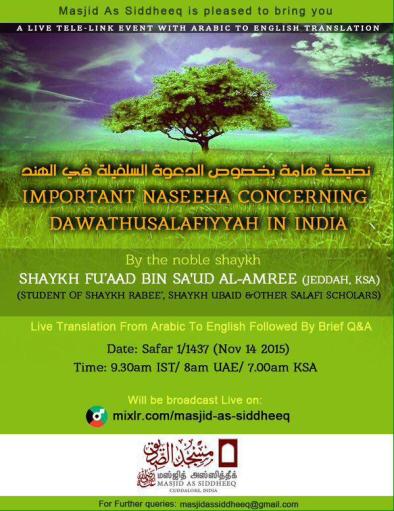
Masjid As Siddheeq, Cuddalore Tamil Nadu, South India presents you
Important Naseehah Concerning Dawatus Salafiyyah in India
With The Noble Shaykh Fu’ād bin Sa’ud al-Amree {حفظه الله} – from the Well Known Scholars of Jeddah and Student of Shk. Rabee’, Shk. Ubayd and other Salafī Scholars
Listen / Download Mp3 Here (Time 1:49:48)
[audio https://salafiaudio.files.wordpress.com/2015/11/important-naseehah-concerning-dawatus-salafiyyah-in-india-02-01-1437-shaykh-fuad-ibn-saud-al-amree.mp3]
Delivered on 02-01-1437
Translated into English by Nadeem Ahsan Shah hafidhahullaah
Share this, Baarakallaah Feekum: [“One who guides to something good has a reward similar to that of its doer” - Saheeh Muslim vol.3, no.4665] [This website protects the copyrights of the authors/publishers. The Content is posted on this website with implicit/explicit permission from content owners]
Further Parts will be added as they are available .. in shaa’ Allaah
Share this, Baarakallaah Feekum: [“One who guides to something good has a reward similar to that of its doer” - Saheeh Muslim vol.3, no.4665] [This website protects the copyrights of the authors/publishers. The Content is posted on this website with implicit/explicit permission from content owners]
Share this, Baarakallaah Feekum: [“One who guides to something good has a reward similar to that of its doer” - Saheeh Muslim vol.3, no.4665] [This website protects the copyrights of the authors/publishers. The Content is posted on this website with implicit/explicit permission from content owners]
Share this, Baarakallaah Feekum: [“One who guides to something good has a reward similar to that of its doer” - Saheeh Muslim vol.3, no.4665] [This website protects the copyrights of the authors/publishers. The Content is posted on this website with implicit/explicit permission from content owners]
Source: From class #1 of Hajj – Al-Mulakhas al-Fiqhi – Shaykh Saalih al-Fawzaan | Abu Muhammad al-Maghribee [Audio|En] (12 Mp3)
Share this, Baarakallaah Feekum: [“One who guides to something good has a reward similar to that of its doer” - Saheeh Muslim vol.3, no.4665] [This website protects the copyrights of the authors/publishers. The Content is posted on this website with implicit/explicit permission from content owners]
Share this, Baarakallaah Feekum: [“One who guides to something good has a reward similar to that of its doer” - Saheeh Muslim vol.3, no.4665] [This website protects the copyrights of the authors/publishers. The Content is posted on this website with implicit/explicit permission from content owners]
Share this, Baarakallaah Feekum: [“One who guides to something good has a reward similar to that of its doer” - Saheeh Muslim vol.3, no.4665] [This website protects the copyrights of the authors/publishers. The Content is posted on this website with implicit/explicit permission from content owners]
Share this, Baarakallaah Feekum: [“One who guides to something good has a reward similar to that of its doer” - Saheeh Muslim vol.3, no.4665] [This website protects the copyrights of the authors/publishers. The Content is posted on this website with implicit/explicit permission from content owners]
Share this, Baarakallaah Feekum: [“One who guides to something good has a reward similar to that of its doer” - Saheeh Muslim vol.3, no.4665] [This website protects the copyrights of the authors/publishers. The Content is posted on this website with implicit/explicit permission from content owners]
Share this, Baarakallaah Feekum: [“One who guides to something good has a reward similar to that of its doer” - Saheeh Muslim vol.3, no.4665] [This website protects the copyrights of the authors/publishers. The Content is posted on this website with implicit/explicit permission from content owners]








 AbdurRahman.Org
You must be logged in to post a comment.