The Meaning and Origin of Sufism : Shaikh Saalih Al-Fawzaan

Source: Haqeeqat-ut-Tasawwuf (pg. 11-15) [1422 1st Edition]

Al-Ibaanah.com

The words Tasawwuf and Soofiyyah were not known during the first generation of Islaam. Rather, they were only introduced into it after that or they were adopted into Islaam from other nations.

Shaikh-ul-Islaam Ibn Taimiyyah, may Allaah have mercy on him, said in Majmoo’-ul-Fataawaa: “As for the term Soofiyyah (Sufism), then it was not heard of during the first three generations of Islaam. Rather, speech concerning it only became known after the first three generations. Several Imaams and scholars spoke about it afterward, such as Imaam Ahmad bin Hanbal, Abu Sulaymaan Ad-Daaraanee and others. It was also reported from Sufyaan Ath-Thawree that he spoke about it. Some of them also mentioned that on the authority of Al-Hasan Al-Basree. They differed in their views on the meaning of what a Soofee ascribes himself to, since the word ‘Soofee’ is a noun indicating an ascription, such as Al-Qurshee, Al-Madanee and so on.

It is said to be an ascription to Ahlus-Suffah,[1] but this is an error, since if this were the case, they would call themselves Suffee. It is also said to be an ascription to the saff (row) that is the foremost before Allaah, but this is also wrong, since if this were the case, they would call themselves Saffee. It is also said to be an ascription to the safwah (best) from Allaah’s creation. This too is an error, since if it were so, they would have to call themselves Safwee. It is also held to be an ascription to Soofah bin Bishr bin Udd bin Taabikhah, an Arab tribe that used to be located next to Makkah in the past, which the ascetics would ascribe themselves to. Even though the ascription of Soofee is in conformity to this person’s name (Soofah) from a grammatical standpoint, it is also a weak opinion, since these people were not well known to most of the ascetics and because if the ascetics were to ascribe to them, it would have been more likely that they would have ascribed to them during the era of the Sahaabah, Taabi’een and the Atbaa’ at-Taabi’een.

It is also due to the fact that the majority of those who speak on behalf of the Soofees are not aware of this tribe and they are not pleased with being attributed to a tribe from the Days of Ignorance (Jaahiliyyah), which did not exist during the era of Islaam. It is also held, and this is the most well known opinion, that Soofee is an ascription to soof (wool). This was since the first time that the Soofees appeared was in Basrah (‘Iraq).

The first people that established the role of Soofiyyah were some of the companions of ‘Abdul-Waahid bin Zayd. ‘Abdul-Waahid was one of the companions of Al-Hasan Al-Basree who lived in Basrah and was into such great lengths in abstinence (zuhd), worship (‘ibaadah), fear of Allaah (khawf) and so on, the likes of which were not found in the rest of the inhabitants of other lands.

Abush-Shaikh Al-Asbahaanee reported with a chain of narration connected to Muhammad bin Sireen that it reached him that a group of people preferred wearing wool, so he said: ‘There are some people that prefer to wear wool claiming that they resemble the Messiah, son of Maryam. However, the guidance of our Prophet (sallAllaahu ‘alayhi wa sallam) is more beloved to us, and he (sallAllaahu ‘alayhi wa sallam) would wear cotton and other types of clothes.’ Or he stated words similar to this.”

Then he (Ibn Taimiyyah) said after this: “These people ascribe themselves to outer garments, which in this case is wool (soof) garments. So it can be said about one of them that he is a Soofee. However, their methodology is not restricted to the wearing of woolen garments, nor do they mandate that on anyone or adhere to ordering it. They only attach themselves to it due to it being the outer condition.”

Then he said: “So this is the origin of Soofiyyah (Sufism). After this, it branched off and diversified.” [2]

Ibn Taimiyyahs words, may Allaah have mercy on him, indicate that Sufism originated in the lands of Islaam at the hands of some very pious worshippers from Basrah as a result of their going to great lengths in abstinence (zuhd) and worship (‘ibaadah). Then after that, Sufism evolved and changed.

The conclusion that some modern-day authors have come to – that Sufism crept into the lands of the Muslims from other religions, such as Hinduism and Christian monasticism – has become accepted based on what Shaikh Ibn Taimiyyah reported from Muhammad bin Sireen, that he said: “There are some people that prefer to wear wool claiming that they resemble the Messiah, son of Maryam. However, the guidance of our Prophet (sallAllaahu ‘alayhi wa sallam) is more beloved to us!” This indicates that Sufism has a connection to the religion of the Christians!!

Dr. Saabir At-Tu’aimah said in his book: “Sufism – Its Beliefs and Methods”: “It appears that it came about due to the influence of Christian monasticism in which the monks would wear woolen garments and reside in their monasteries. There were many of them that would be upon this practice throughout the lands, which Islaam freed by way of Tawheed…” [3]

Shaikh Ihsaan Ilaahee Dhaheer, may Allaah have mercy on him, said in his book “Sufism: Its Source and Origin”: “When we look deep into the teachings of the first and latter-day Sufis and the statements that have been quoted and narrated from them in the Sufi books of old and present, we see a huge difference between it and the teachings of the Qur’aan and the Sunnah. Likewise, we don’t see its roots or its seeds in the history of the chief of all creations (Prophet Muhammad) (sallAllaahu ‘alayhi wa sallam) nor in that of his righteous and noble Companions, from the best of Allaah’s creation. Rather, contrary to that, we see that it has been derived and acquired from Christian Monasticism, Brahmanism, Hinduism, the religious devotion of Judaism and the asceticism of Buddhism.” [4]

Shaikh ‘Abdur-Rahmaan Al-Wakeel, may Allaah have mercy on him, said in the introduction of the book “The Downfall of Sufism”: “Indeed, Sufism is the lowest and vilest of schemes, which the Devil innovated so that the servants of Allaah can mock and ridicule along with him in his war against Allaah and His Messengers. It is the veil of the Magians (Majoos), which gives the impression that it is divine. Rather, it is the veil of every enemy to the true religion. Examine it and you will find in it Brahmanism, Buddhism, Zoroastrianism, and the Manichaean beliefs. You will find Platonism in it. You can even find Judaism, Christianity and the idolatry of the Days of Ignorance in it.” [5]

Through presenting the views of these modern-day writers regarding the origin of Sufism, as well as many other writers not mentioned here that hold these same views, it becomes clear that Sufism is a foreign concept that was introduced into Islaam. This shows in the practices of those who ascribe themselves to it – those practices that are foreign to Islaam and far removed from its guidance. By this, we intend the latter-day adherents to Sufism whose mystical illusions and fantasies have become many and great.

But as for the former predecessors, such as Al-Fudayl bin ‘Iyyaad, Al-Junaid, Ibraaheem bin Adham and others, then they were upon a state of moderateness.

Footnotes:

[1] Translator’s Note: The Ahlus-Suffah (People of the Bench) referred to the poorer Companions who would sit outside the Prophet’s (sallAllaahu ‘alayhi wa sallam) masjid, waiting for charity and waiting for the Prophet (sallAllaahu ‘alayhi wa sallam) to come out so that they could accompany him and learn hadeeth from him.

[2] Majmoo’-ul-Fataawaa (11/5-7, 16, 18)

[3] As-Sufiyyah: Mu’taqidan wa Maslakan (pg. 17)

[4] At-Tasawwuf: Al-Mansha’ wal-Masdar (pg. 28)

[5] Masra’ at-Tasawwuf (pg. 19)

Published: September 18, 2004 | Modified: September 18, 2004

Mirza Ghulam Ahmad and the Qadiyani Sect : Imaam al-Albaanee

Imaam Muhammad Naasir-ud-Deen Al-Albaanee
Al-‘Aqeedah At-Tahaawiyyah – Sharh wa Ta’leeq (pg. 39-40)
Al-Ibaanah.com

The Prophet (sallAllaahu ‘alayhi wa sallam) informed his ummah in many ahaadeeth, advising and cautioning them, that there would be many imposters (Dajjaaleen) after him. In some narrations, he (sallAllaahu ‘alayhi wa sallam) said: “Everyone will claim to be a prophet, whereas I am the seal of the prophets – there being no prophet after me.” [Reported by Muslim and others; See al-Ahaadeeth as-Saheehah: no. 1683]

Amongst these imposters was Mirza Ghulam Ahmad Al-Qadiyani who claimed prophethood for himself. He has followers spread throughout India, Germany, England and America. And they have masaajid which they use to misguide the Muslims. There were some individuals amongst them in Syria as well, but Allaah uprooted them and eradicated them.

They have many vile beliefs apart from their belief that prophethood continued after Muhammad (sallAllaahu ‘alayhi wa sallam). The one who preceded them in this belief is Ibn ‘Arabee, the Sufi. They have authored a treatise on this subject in which they have collected statements from him that serve as support for this afore-mentioned belief of theirs. And the mashaayikh were not able to refute it because it was from that which Ibn ‘Arabee said (!!) even though they asserted with certainty that they were disbelievers. There is no room to mention their beliefs here.

No doubt they are the ones whom the Messenger of Allaah intended when he (sallAllaahu ‘alayhi wa sallam) said in the hadeeth that has been authentically reported from him: “There will be lying impostors during the Last Days that will bring you narrations, which neither you nor your forefathers heard of. So beware and let them beware, lest they misguide you and bring calamity upon you.” [Reported by the author (i.e. At-Tahaawee) in Mushkil-ul-Athaar (4/104). It is also found in Saheeh Muslim (1/9)]

From their most distinguishing signs is that when they begin speaking about their Call (i.e. beliefs), before everything, they start out with affirming the death of ‘Eesaa (Jesus). When they are able to accomplish this – according to their perception – they proceed onto the next level, which involves mentioning the ahaadeeth that talk about the descent of ‘Eesaa, and make it clear that that they believe in these narrations. However, they then quickly move on to distorting their meanings by claiming that what is meant by them is the descent of someone similar to ‘Eesaa (Jesus), since they have already established and confirmed – according to their views – that ‘Eesaa (Jesus) died. So they claim that this person was Ghulam Ahmad Al-Qadiyani!

They have many, many other examples of distorting texts similar to this, which leads us to believe that they are a group from amongst the heretical Baatinees. We will point out some of their deviant beliefs soon by the Will of Allaah.

From the misguided beliefs of the Qadiyanis is that they reject the Jinn as being a creation apart from mankind. So they distort the apparent meaning of all the ayaat and ahaadeeth that clearly prove their existence and their distinction from mankind amongst creation, instead claiming that these texts refer to humans themselves or a specific group from amongst mankind. This is even the case with Iblees (i.e. the Devil) himself as they allege that he was a human being that was evil! So how misguided they are!!

Published: January 31, 2006

– Other Fatwas –

Al-Qadianiyyah order

The third question of Fatwa no. 1615

Q 3: What is the ruling on this new faith and its followers, I mean Al-Ahmadiyyah faith? Callers to this faith warn against memorizing any Ayahs from the Qur’an or the Names of Allah and prohibit invoking blessings upon the Prophet (peace be upon him). Where and when did this faith originate? What is the ruling on those who avoid it?

A: The Pakistani government, the Muslim World League in Makkah Al-Mukarramah and the Organization of Islamic Conference held in the League in 1394 A.H. issued a declaration that this (Qadiani) sect is outside the fold of Islam. The Conference published a report on the origin of this sect, when and how it was founded, and many other details disclosing its reality.

In conclusion, it is a sect claiming that the Indian leader Mirza Ghulam Ahmad (born in the thirteenth century) was a prophet who received revelation and that anyone who disbelieves in him is not considered a true Muslim. Allah (Exalted be He) states in His Book that our Prophet Muhammad (peace be upon him) is the Seal (Last) of the Prophets. Muslim scholars are unanimously agreed upon this. Whosoever claims that after him there is a prophet receiving revelationfrom Allah (Glorified and Exalted be He) commits an act of Kufr (disbelief). This is because such a person goes against the Ijma‘ (consensus) of the Islamic Ummah (nation) and denies what is stated in the Qur’an and the authentic Hadith reported from the Prophet (peace be upon him) which affirm that Muhammad (peace be upon him) is the Last of all prophets.

May Allah grant us success. May peace and blessings of Allah be upon our Prophet Muhammad, his family and Companions!

The Permanent Committee for Scholarly Research and Ifta’

Member Member Deputy Chairman Chairman
`Abdullah ibn Qa`ud `Abdullah ibn Ghudayyan `Abdul-Razzaq `Afify `Abdul-`Aziz ibn `Abdullah ibn Baz

Browse by Volume Number > Group 1 > Volume 2: `Aqidah (2) > The Sects > Al-Qadyaniyyah order > Ruling on Al-Ahmadiyyah sect and their beliefs

Q: I hope you can explain the ruling on the Sufi order called Al-Qadyaniyyah and their alleged prophet Ghulam Ahmad Al-Qadyany I ask you kindly to send me any books related to this order as I am very interested in studying it.

A: The Prophethood ended with Muhammad (peace be upon him), and there is no prophet after him. This is authentically proved by the Qur’an and the Sunnah, and whoever claims otherwise, or claims Prophethood, then he is a liar. Foremost among those people is Ghulam Ahmad Al-Qadyany whose claim of Prophethood is nothing but falsehood, and so what his followers claim in this regard is also falsehood.

In the light of the above, the Council of Senior Scholars issued a decree regarding Al-Qadyaniyyah as a Kafir (disbelieving) sect for their claims.

May Allah grant us success. May peace and blessings be upon our Prophet Muhammad, his family, and Companions.

The Permanent Committee for Scholarly Research and Ifta’

Member Member Deputy Chairman Chairman
`Abdullah ibn Qa`ud `Abdullah ibn Ghudayyan `Abdul-Razzaq `Afify `Abdul-`Aziz ibn `Abdullah ibn Baz

Browse by Volume Number > Group 1 > Volume 2: `Aqidah (2) > The Sects > Al-Qadyaniyyah order > Ruling on the Sufi order called Al-Qadyaniyyah and their alleged prophet

The difference between the Muslims and Al-Ahmadiyyin

Q 3: What is the difference between the Muslims and Al-Ahmadiyyin ?

A: The difference between them is that Muslims are people who worship Allah Alone, follow His Messenger Muhammad (peace and blessings be upon him), and believe that Muhammad is the last of all prophets. But Al-Ahmadiyyun, followers of Mirza Ghulam Ahmad, are disbelievers and are not Muslims. They claim that Mirza Ghulam Ahmad is a prophet after Muhammad (peace be upon him). Whoever adopts this faith is a disbeliever according to all Muslim scholars. Allah (may He be praised) says: Muhammad (صلى الله عليه وسلم) is not the father of any of your men, but he is the Messenger of Allâh and the last (end) of the Prophets. In addition, it is authentically reported that Allah’s Messenger (peace be upon him) said: I am the seal of prophets and there is no prophet after me.

May Allah grant us success. May peace and blessings be upon our Prophet Muhammad, his family, and Companions.

The Permanent Committee for Scholarly Research and Ifta’

Member Member Deputy Chairman Chairman
`Abdullah ibn Qa`ud `Abdullah ibn Ghudayyan `Abdul-Razzaq `Afify `Abdul-`Aziz ibn `Abdullah ibn Baz

Browse by Volume Number > Group 1 > Volume 2: `Aqidah (2) > The Sects > Al-Qadyaniyyah order > The difference between Muslims and Al-Ahmadiyyah

The ruling concerning the Braylwiyyah : The Permanent Committee

Question:

There is a particular group in Pakistan called the ((Braylwiyyah)) or ((Jamaa’ah Nuwaaree)) which is a reference to their current leader known as ((Nuwaaree)). I ask your excellencies the Sharee’ah ruling regarding them and their ‘aqeedah, and the prayer behind them as this is a contentious issue which many people are unaware of the reality. I will mention some of their defective ways and beliefs:

1) The belief that the Messenger of Allaah (sal-Allaahu `alayhe wa sallam) is alive;

2) The belief that the Messenger of Allaah (sal-Allaahu `alayhe wa sallam) is present and all-seeing, especially immediately after Salaat al-Jumu’ah;

3) The belief that the Messenger (sal-Allaahu `alayhe wa sallam) is the foremost intercessor;

4) They believe in “saints” and the dead in their graves, and they offer salaah at the graves requesting them for their needs to be met;

5) Their commendation of domes and lighting up of graves;

6) Their saying ((Yaa Rasool, Yaa Muhammad (sal-Allaahu `alayhe wa sallam)));

7) Their hatred towards whoever loudly says ((Aameen)) and raises his hands in the salaah, considering such a person to be a Wahhaabee;

8) Their great astonishment at the use of the miswaak before the salaah;

9) Kissing the thumbs whilst doing wudhoo., the adhaan and after the salaah;

10) After the salaah, their imaam repeating the aayah:

{Allaah sends His prayers on the Prophet and also His angels too}, [Soorah al-Ahzaab, Aayah 56].

11) They gather after the Salaat al-Jumu’ah standing and reciting anaasheed and sending praises (to the Prophet (sal-Allaahu `alayhe wa sallam));

12) After they complete the Noble Qur.aan in the Salaat at-Taraaweeh in the month of Ramadhaan, they prepare alot of food and distribute it in the dining area of the masjid, in addition to sweets;

13) They build masaajid and seek much importance in decorating them, writing ((Yaa Muhammad)) above the mihraab (standing place of the imaam);

14) They consider themselves the people of the Sunnah and correct ‘aqeedah and that (all) others are in error;

15) What is the Sharee’ah ruling regarding performing the salaah behind them (their imaam), considering I am a medical student in Karachi and live next door to the masjid where they are in (overall) control (i.e. their beliefs and practices prevail)?

Response:

Whoever has these characteristics and attributes, then it is not permissible to offer your salaah behind them (their imaam), and whoever knows of their condition, then their salaah is not correct. This is because most of their characteristics and attributes are of kufr and bid`ah which negate the tawheed (oneness) with which Allaah had sent His messenger and revealed in His Book, and that which conflicts with the Qur.aan, such as His (Subhaanahu wa Ta’aala) saying:

{Verily, you (Muhammad) will die and verily, they (too) will die}, [Soorah az-Zumar, Aayah 30]

And His saying:

{And the mosques are for Allaah (alone), so invoke not anyone along with Allaah}, [Soorah al-Jinn, Aayah 18]

And their bid`ah which they practice should be detested with good manners, and if they accept (and leave these pratices) then all praise is for Allaah (alone); And if they do not accept (and continue in these practices) then you should leave them and offer your salaah in the masjid of the Ahlus-Sunnah. And in this, with respect to Ibraaheem (alayhis-salaam) there is a good example:

{And I shall turn away from you and from those whom you invoke besides Allaah. And I shall call on my Lord; and I hope that I shall not be unblest in my invocation to my Lord}, [Soorah Maryam, Aayah 48].

And with Allaah lies all success and may Allaah send prayers and salutations upon our Prophet (sal-Allaahu `alayhe wa sallam) and his family and his companions.

The Permanent Committee for Islaamic Research and Fataawa, comprising –
Head: Shaykh ‘Abdul ‘Azeez Ibn Abdullaah Ibn Baaz;
Deputy Head: Shaykh ‘Abdur-Razzaaq ‘Afeefee;
Member: Shaykh ‘Abdullaah Ibn Qu’ood
Fataawa al-Lajnah ad-Daa.imah lil-Buhooth al-‘Ilmiyyah wal-Iftaa., – Volume 2, Page 396, Fatwa No.3090

Why talk about the Deviant Sects of Old? Shaykh Jamaal Al-Haarithee

Jamaal bin Fareehaan Al-Haarithee

Al-Ajwibat-ul-Mufeedah ‘an As’ilat-il-Manaahij-il-Jadeedah (pg. 33-37) [2nd Edition]
Al-Ibaanah.com

Someone might say:

“Why do you talk about the Mu’atazliah, the Jahmiyyah, the Zanaadiqah, the Asharees, the Khawaarij and the Murji’ah and always mention them when speaking about the issues of Creed, when these groups have ceased to exist and its adherents have died out?” As the saying goes: “They have been consumed by time.” So there is no reason to mention them.

Our response is, and with Allaah lies the success: Yes, these sects existed in the past, and their followers and founders have died out ages ago. However, their ideologies still prevail, and their beliefs have not come to an end. Rather, the followers of these ideas and beliefs, who have been influenced by these groups, are still present among us today.

So their ideologies and beliefs are passed on from generation to generation, and they have people who continue to pass them on.

As for the beliefs of the Mu’tazliah, then it is still in existence today and in fact it is widely spread amongst those who ascribe to Islaam. This is since the Shee’ah, in all of their various sects and denominations, even the Zaydees among them, adhere to the beliefs of the Mu’tazliah.

As for the Ash’arees, then it is a sect that exists in groups amongst a majority of the Muslims today.

As for the belief of Irjaa, it can be found also in the Hanafees who believe that Eemaan (Faith) is just tasdeeq (affirmation) and qawl (speech). So actions, according to them, do not fall into the fold of Eemaan. Even though this Irjaa is of a lesser nature, it is still from the Irjaa of the well-known people of rhetoric.

And as for the apostates, such as those who believe in wahdat-ul-wujood and other than them, then they exist today as well, since the followers of Ibn ‘Arabee can be found today and they are from the extreme Sufis.

So based on this, when we mention these groups, we are not talking about the actual groups of old, but rather we are talking about the groups that exist among the Muslims today. And this is something that is not hidden from the students of knowledge. So it is only those who are unaware of the realities or those who wish to confuse the people and spread false beliefs that condemn us when we mention these groups. So it is upon such people to ask before they condemn. This is just a short discussion on the matter, but in reality this topic is vast, and Allaah knows best.

I will present some examples below that make it clear that the ideologies of these destructive groups are still present today:

1. Sayyid Qutb said in his book “In the Shade of the Qur’aan” (4/2328): “The Qur’aan is present and in existence just like the earth and the heavens.” This is the belief that the Qur’aan is created, and this is the view of the Jahmiyyah and other deviant groups.

2. He also said in the afore-mentioned book (6/4002) while interpreting Allaah’s statement: “Say: He is Allaah, the One” [Surah Al-Ikhlaas: 1]: “This indeed refers to the oneness of existence. So there is no reality except for His reality, nor is there a true existence except for His existence. So everything else that exists, its existence stems from that actual existence.” This is the belief of wahdat-ul-wujood.

3. Muhammad Qutb said: “The matter requires us to call the people to Islaam all over again, not because, this time, they reject saying ‘Laa Ilaaha Illaa Allaah, Muhammad Rasoolullaah’ with their mouths, as the people during the first stage of strangeness would do, but because the people during this time reject the main requisite of Laa Ilaaha Ilaa Allaah, which is: Judging by the Legislation of Allaah.” [Quoted from the book “Our Current Situation” (pg. 29)]

I say: This is declaring the masses to be disbelievers, in the absolute sense. If this is not so, then how can he judge that the people reject Allaah’s Rule. And how can he liken them to the Days of Ignorance prior to Islaam, without going into detail or making exceptions for those who do in fact implement Allaah’s Legislation, and who have no constitution except the Book of Allaah? These kinds of general statements are oft repeated by these writers, as if they don’t acknowledge the existence of the huge Salafee Islamic state located in the heart of Arabia. And it is as if they don’t acknowledge the existence of Muslims in various other regions that are from the followers of Hadeeth, supporters of the Sunnah and adherents to the beliefs of the Salaf.

The strange thing is that these people, or some of them, were living in this Islamic state (The Kingdom of Saudi Arabia) at the time they made such statements, which contain grave deception for the readers, such that an average person is led to believe that there cannot be found an Islamic state today that professes Laa Ilaaha Illaa Allaah, implementing its requisites and ruling by Allaah’s Laws. And it leads the reader to believe that there cannot be found any individuals or groups that adhere to Tawheed on the face of this earth. And this is deceiving, misleading and deluding the readers. So let the student of knowledge take note of this phenomenon that is widespread amongst these types of writers, may Allaah guide them to what is correct!

4. One of those who ascribes himself to the Da’wah said:

“From the outward display of sins is when a person boasts about his sins in front of his colleagues. So he begins to speak aloud, saying he did such and such, and he goes into detail about many of his sins. This kind of person will not be forgiven (!!), unless he repents, because the Prophet ruled concerning him that he will not be pardoned: ‘Everyone from my ummah will be pardoned except for those who outwardly profess their evil.’ And what is worse and viler than this is when some of them say: ‘I have unlawful relations’ or ‘I have girlfriends’ or ‘I go on dates.’ This person is filled with sins. Some of these people even record sins on tapes! There is no honor for these people since they are apostates by doing this!! They record how to beguile a girl and get her to commit lewd acts. This is apostasy from Islaam! This person (who records this) will be in the Fire of Hell forever unless he repents!!” [From the tape “A Gathering on the Platform]

And with regard to some of the singers, whose tapes are spread around by the youth – tapes which call to filthiness and which delude the young boys and girls, he said:

“I am certain that the person who does this act, the least that can be said about him, is that he takes sins lightly. And there is no doubt that belittling a sin, especially if it is a major sin and the scholars have unanimously agreed on its prohibition, constitutes disbelief in Allaah. So the likes of these people, there is no doubt that their actions are apostasy from Islaam. I say this with a tranquil and calm heart.” [The tape: “The Youth – Questions and Problems]

I say: Declaring sinners to be disbelievers and interpreting the spread and distribution of sins amongst the people as being a belittlement of sins that leads to disbelief, this shows hastiness in labeling people disbelievers due to major sins and a lack of showing restraint. And this is from the methodology of the Khawaarij, as they declare people to be disbelievers due to major sins. As for the example he gave of a person manifesting his sins and evil relationships with sinners, then this kind of talk shows that these things are probable but do not consist of clear proof. Perhaps the thing that causes the person to do this is ignorance. This is why we must remind them and not declare them disbelievers. And this is the way of Ahlus-Sunnah wal-Jamaa’ah. Furthermore, belittling something and taking it lightly does not constitute a mockery of it. In fact, everyone that commits a sin, whether major or minor, doesn’t do so unless he first considers it trivial and belittles it. So someone who takes something lightly doesn’t necessarily ridicule it. And who is the one that is free from sins?! And Allaah knows best.

5. Another person said, whilst asking a question and then responding to it at the same time: “Do you think that the evils that are present in our communities today are just sinful matters? Many people assume today that interest is just a sin or a major sin, and that drugs and alcohol are sins, and that bribery is just a sin or one of the major sins… No doubt O brothers!! I have looked into this matter and it has become clear to me now that: Many people in our societies have made interest lawful, and refuge is sought in Allaah. Did you know that now the interest-based banks in our country has reached two million customers? I swear this to you by Allaah! Does each individual from these millions know that interest is Haraam, but yet still deals with it even though it is a sin?! By Allaah!! So then, from the danger that is present today, due to the vast amount of widespread sins is that many people have made these major sins permissible and lawful, and we seek Allaah’s refuge! [From the tape Tawheed First (!!)]

I reply with the same answer I gave in the previous example. However, this example is more dangerous for the one who made this statement, in my understanding, since in his grave exaggeration, he claims that what occurs in this society from interest, alcohol and bribery, all of these are not just disobedience or major sins. And he swears by Allaah to this! Being determined that the one who commits sins is deeming it to be permissible, without hearing from anyone of them that they clearly assert interest to be lawful, or dealing with bribes to be lawful or using drugs and alcohol to be lawful – to positively deem these people to be disbelievers without hearing these statements come from them or having a reliable proof that bears witness that they in fact deem these acts to be permissible, and to instead only have assumptions, is a clear proof of the weak restraint and lack of consideration this individual has. This is the methodology of the Khawaarij and the Mu’tazliah. So my advice to him and those like him is to recant from making such general assertions that are more dangerous for them than for others. Turning back to the truth is better than persisting in falsehood.

6. A third person, who has a doctorate in ‘Aqeedah, said whilst holding in his hand a flyer from a hotel in one of the Gulf states:

“In this hotel, it clearly states, that they serve alcoholic drinks, in addition to the other things it has…So this is a clear call to alcohol and to naked and intermingled dancing whilst drinking alcohol. We seek Allaah’s refuge from this disbelief.” [From Cassette No. 272/2 of The Explanation of al-‘Aqeedat-ut-Tahaawiyyah]

And he said in a book of his:

“Disbelief and apostasy has appeared in our newspapers, evil has spread in our circles and we are called to fornication on our radios and television sets. And we have made interest lawful.”

This book was prepared and printed with various different titles. In Pakistan, it went by the title: “Removing the Grief from the Scholars of the Ummah.” In America, it goes by the title: “Kissinger’s Promise.” And in Egypt, the book was titled: “Facts surrounding the Gulf Crisis.”

Regardless, you have seen how this individual has taken it upon himself to make the statement that we have made interest permissible. But we, all praise be to Allaah, do not deem interest as being permissible, nor does our society. Nor do we consider simply distributing alcoholic drinks to some of the neighboring regions as being open disbelief that expels one from the fold of Islaam. Rather, that which we worship Allaah with, is that those things mentioned by these individuals that ascribe themselves to the Da’wah – all of these things are sins, apart from disbelief. In fact all of these acts are a lesser form of disbelief (i.e. minor disbelief), meaning that they are acts of disobedience and major sins that negate the completeness of Eemaan of the person who commits them, but not the foundation of Eemaan, as the Prophet said: “A fornicator does not fornicate whilst being a believer at the time he fornicates. And a thief does not steal whilst being a believer at the time he is stealing…”

No doubt the Eemaan (Faith) that is being negated here is the completeness of Eemaan (i.e. so the sinner does not have complete Eemaan, meaning his Eemaan is deficient). And there are many more examples of this in our Religion. We ask Allaah to grant us understanding of our Religion and to guide these people and their likes to the truth. My dear brother, O you who strives for this Salafee methodology! After seeing these examples of the ideologies present in some of the callers today, not to mention the youth that are deceived by them, and who sit in front of them, taking their ideas and beliefs, which destroy the Creed of the Salaf.

After seeing all this, will you still say: “Why do you talk about these groups that have come to an end”, when their deviant and corrupt beliefs and methods still exist and their misguidance is still present?? So reflect, may Allaah guide you, on the importance of Tawheed and of implementing it, and on warning about all of the deviant groups in every time and place, and on returning back to the methodology of the Salaf as-Saalih (righteous predecessors), in light of the Book and the Sunnah, and Allaah knows best.

Purchase the complete translation of this book from Al-Ibaanah.Com

Related Link:

If I Supplicated to Allaah with the name Ali – By: Shaykh Saalih al-Fawzan

Question:

May Allaah treat you well. The questioner asks; If I supplicated to Allaah with the name ” O Ali” (without the adding the AL in front of it) intending the name of Allaah; al-Ali العلي (the Most High) is this imitating the actions of the Raafidah (Shia) those who seek aid from other than Allaah?

Answer:

(Do not say) Ali only (say) علي عظيم (the Most High, the All Mighty) as Allaah says; “He is al-Ali al-Atheem” (2:225)

Why don’t you say ع لي عظ يم Ali Atheem (as mentioned in the ayah) (so) that you will be safe from what you have said; fearing that you maybe supplicating to Ali Ibn Abee Taalib. So if you would have said; O Ali O Atheem (together) as mentioned in the ayah, you would be protected from this accusation.

Translated by: Abu Anas Atif Hasan
http://alfawzan.af.org.sa/node/14826

Posted with Permission from : Al-Binaa Publishing | Durham NC

Related Links:

The so-called Salat Al-Fatih – The Permanent Committee for Scholarly Research and Ifta

Q 5: The Al-Tijaniyyah sect has their own supplication called Salat Al-Fatih, which they consider to be better than reciting the Qur’an. Is this true? Moreover, on Friday before Maghrib (Sunset) Salah and after Subh (Dawn) Salah, they circle around a piece of cloth on which, they claim, the Prophet (peace be upon him) and Ahmad Al-Tijany sit. During such times they recite the supplication called Salat Al-Fatih. Please, provide evidence and clarify if this practice is proper.

A: All their claims are false. Moreover, their deeds are null and void and are considered to be Bid’ahs (rejected innovation in religion).

For more clarification, I will cite the so-called Salat-ul-Fatih (Remembrance from the Tijaniyyah order).The following is cited in the Simplified Encyclopedia of Contemporary Religions, Doctrines, and Parties – The World Assembly Of Muslim Youths: “Their leader, Ahmad Al-Tijany, claims that he physically met the Prophet, peace be upon him, talked with him, and learned Salat-ul-Fatih from him- The wording of this Salat reads: “O Lord, have peace and blessings upon our master Muhammad, the opener of the closed, the last of the prophets, the supporter of right with right, and the guide to Your straight path, his family as high as his standing and rank.” They have beliefs concerning this Salah, including:The Messenger of Allah, peace be upon him, told him that the reward for reciting it once is equivalent to that of reciting the Qur’an six times.

The Messenger of Allah, peace be upon him, told him once again that the reward for reciting this Salah once is six thousand times as much as that for every Dhikr (Remembrance of Allah), Du`a’ (supplication), long or short, and the recitation of the Qur’an (Jawahir Al-Ma`any Wa Bulugh Al-Amany, vol. 1, p. 136)

The reward for such Salah is gained only if the reciter is authorized to recite it. This means there should be a chain of authorization tracing back to Ahmad Al-Tijany who, according to him, received this Salah from the Messenger of Allah.

Allegedly being the words of Allah (Exalted be He), this Salah is deemed to be a Hadith Qudsy (Revelation from Allah in the Prophet’s words) (Al-Durrah Al-Faridah, vol. 4, p. 128).

– He who recites Salat-ul-Fatih ten times will gain a reward that even an `Arif (Sufi who has reached a high station of worship) who had lived for one million years would not get if he had not recited it.

– He who recites this Salah even once will have his sins forgiven and will have a reward as much as that for six thousand Tasbihs (saying: “Subhan Allah [Glory be to Allah]”), Du`a’s (supplication), and Dhikrs. (See Mushtaha Al-Kharif Al-Jani, pp. 127, 299 and 300.

I say that the following verse applies to the above: “Then woe to those who write the Book with their own hands and then say, ‘This is from Allah,’ to purchase with it a little price!” The Committee elaborated on this sect in the previous Fatwas.

May Allah grant us success. May peace and blessings be upon our Prophet Muhammad, his family, and Companions.

The Permanent Committee for Scholarly Research and Ifta
Member – Member – Deputy Chairman – Chairman
Abdullah ibn Qa’ud – Abdullah ibn Ghudayyan  -Abdul-Razzaq Afify – Abdul-`Aziz ibn `Abdullah ibn Baz

http://alifta.com/Fatawa/Fatwaprint.aspx?id=664&BookID=&sectionid=7

Ruling on Making Takfeer on the One Who Slanders as-Siddiqah Aishah – Shaykh Saalih al-Fawzaan [Video|Ar-En Subtitles]

Video Courtesy: LearnToReadTheKuran

Refutation of Sufi myth on the issue of Dhaati and ‘Atai (Personal and Bestowed) ! – Dr Murtaza bin Baksh [Video|Urdu-English Subtitles]

Dr Murtaza bin Baksh (hafidhahullaah)

In the name of Allaah, The Beneficent, The Most Merciful

This lecture is about a small pamphlet claiming that Allaah’s Prophets and Friends have the Power Bestowed upon them to Help, Save and Provide sustenance, children etc etc. This small yet informative clip will shed light on the above claim. For more knowledgeable lectures in Urdu language, kindly visit the following websites:
www.ashabulhadith.com

May Allaah allow us to follow the proper teachings of Islaam until our death AMEEN
Wassalam o alaikum warah matullahe wabara katahu

Courtesy of : aimproduction

Refuting those who say: “The Shia are our brothers” – Sheikh Salih al-Fawzaan [Video|Ar-En Subtitles]

Refuting those who say that the Shia are our brothers || Sheikh Salih al-Fawzaan
الرد على مقولة الشيعة إخواننا || الشيخ صالح الفوزان

Uploaded by daarulhaq

Shaykh Muhammed Sa’eed bin Raslaan about the killing of Allamah Ihsaan Ilaahi Dhaheer and the Shi’a [Video|Ar-En Subtitles]

Uploaded by DawahSalafiyaah

Shaykh Muhammad Saeed bin Raslaan on the great pakistani Alim and Mujadid Allamah Ihsaan Ilaahi Dhaheer. Born and raised in Pakistan and after having graduated from the Islamic University of Madeenah he went back to his country to spread ad-Dawatus-Salafiyaah, telling the people to worship the one true God and abandoning grave-worship and refuting the people of innovation such as the Barelwiyyah and Deobandiyyah, Rafidaah and Qadiyaniyyah. He was killed in 1987 and it was said that Shaykh Bin Baaz broke out in tears and led his funeral prayer in Riyaad which millions of people attended. He, rahimahullahu ta’ala, was then carried to the graveyard of Baqee. May Allah have mercy upon him and may Allah give the Rafidaah what they deserve for they have been slaughtering Ahlus-Sunnah to this very day. We advise you with the advice of Shaykh Raslaan: Return to the books of Allamah Ihsaan Ilaahi Dhaheer!

For more info on the History and Doctrines of the Rafidah, please visit www.shia.bs

A Glimpse Into The Creed of The Twelver Shi’a – Shaykh Muhammad ibn Rabee’ al-Madkhalee [Audio|Ar-En]

A Glimpse Into The Creed of The Twelver Shi' a

Bismillaah wa -Alhamdulillaah wa Salaatu wa Salaam ‘alaa Rasulillaah ‘amma ba’d

Muwahhideen Publications organized a LIVE Tele-Lecture with the Noble Shaykh Muhammad ibn Rabee’ ibn Hadi’ al-Madkhalee (May Allaah Preserve Him), son of Ash-Shaykh al-Allaamah Rabee’ ibn Hadi al-Madkhalee (May Allaah Preserve Him) and a professor of ‘Aqeedah in TheIslaamic University of Madeenah.

This session was translated LIVE into English.

Part 01 : Listen / Download Mp3 Here (Time 1:11:11)

Part 02 : Listen / Download Mp3 Here (Time 1:28:15)

Our Noble Shaykh Muhammad Ibn Rabee’ (hafidhahullaah) began by saying that truly the shi’a have been a tribulation and test from Allaah upon the Ummah; it has been a calamity that befell this Ummah and surely this is the way of Allaah, that He tests His slaves. For  this dunya is a life of fitan, assessing the mettle of the servants of Allaah; it is an abode where good and evil mingle, contrary to the aakhirah which is the life of exclusive truth where evil does not mix with the good.

Shaykh Muhammad then went on to describe the history of this deviant group and how they came about. He explained the atmosphere after the murder of ‘Uthmaan (radhiyAllaahu ‘anhu) and the two positions held by the Sahabah concerning how the issue should be dealt with. He explained the role of the hypocrites in this fitnah and then went on to shed some light on the character of ‘Abdullaah Ibn Saba’ and the falsehood and shirkhe injected into the pure Islaamic Creed from within.  From them is his belief that ‘Ali (radhiyAllaahu ‘anhu)  had more right to the khilaafah thanAbu Bakr‘Umar and ‘Uthmaan (radiyAllaahu ‘anhum). He then went a step further and declared ‘Ali (radhiyAllaahu ‘anhu) to be the embodiment of Allaah and exalted be Allaah above the falsehood that he claime d.

Our Shaykh proceeded to explain that there is a group of shi’a who believed that ‘Ali (radhiyAllaahu ‘anhu) was the best of the companions. However, they did not see the first three khulafaa as evil men but believed in their virtue, loved them for the sake of Allaah and even prayed for them. This group is the smallest and for the most part no longer existent.

Now, the matter has changed and they base allegiance and enmity on a person’s stance on Abu Bakr‘Umar and ‘Uthmaan (radhiyAlllahu ‘anhum); they make it obligatory to hate them and render them enemies of Allaah and if one refuses to do such they claim that this individual is misguided or might even make takfir on him.

The Shaykh then went on to say that the shi’a fall into two groups – the twelvers and the zaydiyyah and between these two are vast differences in understanding and creed. The twelvers epitomize misguidance of the greatest magnitude; their beliefs are deeply rooted in shirk and even the affair of racism has entered upon them as they believe in the virtue of the Persian lineage.

Shaykh Muhammad (hafidhahullaah) continued by enlightening us about the linguistic meanings for the terms ‘shi’a’ and ‘raafidhah’ and explained the story behind them being referred to as the raafidhah.

He then proceeded to touch on their beliefs regarding the twelve Imaams whom they deify and deem to be infallible. Here the Shaykh listed the twelve Imaams and then explained that as for the twelfth Imaam, whom they claim has been alive for over 1200 years has never existed historically as his father, Hasan, never bore any children!

Our Shaykh further delved into some of their atrocious beliefs such as the deifying of Ahlul Bayt and their calling upon them in times of ease and hardship as well as their disgusting notion that the Qur’aan has been tampered with, is missing two thirds and the complete Qur’aan which they refer to as the version of Faatimah will only come in the time of the Mahdi. The consensus of the people of Islaam is that this is clear kufr.

Shaykh Muhammad (hafidhahullaah) concluded this sitting by saying that the danger and enmity of the shi’a is more severe than that of the jews and christians as acquisition of our wealth and land will please them (the jews and christians) but these shi’a have great resolve to spread their creed and would settle for nothing less than to drink our blood and ensure that no one from Ahlus Sunnah remains on the face of the earth. They sleep and awake upon their devilish schemes and plots.

This lecture is a must listen for the seeker of truth who wishes to acquaint himself/herself with the falsehood of the shi’a so that he/she may be wary of them as they seek to spread their repugnant beliefs.

Wa Billaahi Tawfeeq

Wa SallAllaahu wa Sallaama wa Barak ‘alaa Nabiyanna Muhammad wa ‘alaa ‘Alyhi wa Sahbyhi wa Sallam

Source : Posted from mpubs.org with permission

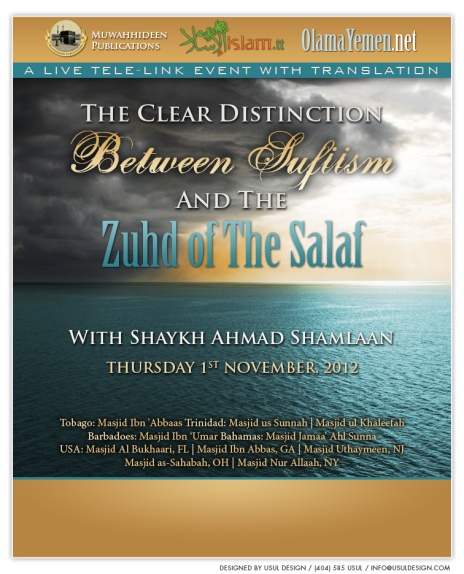
The Clear Distinction Between Sufism and The Zuhd of The Salaf – Shaykh Ahmad ibn Ahmad Shamlaan [Audio|Ar-En]

The Clear Distinction Between Sufism and The Zuhd of The Salaf
Shaykh Ahmad ibn Ahmad Shamlaan (hafidhahullaah)
[Audio|Arabic-English]

The Clear Distinction Between Sufism and The Zuhd of The Salaf by Shaykh Ahmad ibn Ahmad Shamlaan

Bismillaah wa -Alhamdulillaah wa Salaatu wa Salaam ‘alaa Rasulillaah ‘amma ba’d

Muwahhideen Publications facilitated a LIVE telelink lecture with Shaykh Ahmad ibn Ahmad Shamlaan (hafidhahullaah), from the mashaayikh and head of Dar ul Hadeeth, Radaa’, Yemen.

A superb refutation of the falsehood of the sufis!

Listen / Download Mp3 Here (Time 1:23:17)

The noble Shaykh Ahmad ibn Ahmad Shamlaan (hafidhahullaah) explained that Zuhud is to renounce worldly pleasures in order to gain nearness to Allaah. It is to leave off what Allaah has made haram and to do that which Allaah has made obligatory. This concept is of tremendous importance in Islaam and the Shaykhpresented this in the form of a comparison between the proper and upright Zuhud of the Salaf to the extreme and deviant practices of the sufis. The Salaf best understood and practiced this noble principle. They had reached the pinnacle of sincerity and devotion to Allaah and strict adherence to the sunnah of the Messenger (sallAllaahu ‘alayhi wa sallam), performing all acts of worship in precise accordance to the legislated texts. The Shaykh showed the clear distinction of this to the absurd innovations of the sufis who went to such extremes in their ‘ibaadah, out of their acclaimed piety, that many of their beliefs and practices fell into kufr.

Our Shaykh Ahmad Shamlaan (hafidhahullaah) continues in this lecture making distinct the falsehood of thesufis and the proper practice of our salaf us saalih in their implementation of zuhud.

Wa Billaahi Tawfeeq

Wa SallAllaahu wa Sallaama wa Barak ‘alaa Nabiyanna Muhammad wa ‘alaa ‘Alyhi wa Sahbyhi wa Sallam

Source : Taken from http://www.mpubs.org with permission

al-Fawzan about Jarh upon Ahl-ul-Bid’ah and the Principles of Adnan Ar’ur [Video|Ar-En]

[Video|Arabic-English Captions]

Scholar: ´Allâmah Sâlih bin Fawzân al-Fawzân
Source: youtube.com/watch?v=B9jK_y4aWpE
Reference: Darulhadith.com
Translation & video: aFatwa.com

Question: We’re wondering about a few principles. We would like to hear with you whether they agree with the confirmed principles of Ahl-us-Sunnah. The first principle is “We correct without criticising (Jarh)”. What do you say about that?

Shaykh al-Fawzân: It is baseless. That principle is baseless. People who stick to that which is false have to be criticised.

Questioner: The second principle is “If you judge, you will be judged, and if you call, you will be rewarded.” What do you say about this principle?

al-Fawzân: It is innovated. It is unfounded. People who stick to that which is false have to be judged.

Questioner: The third principle is: “It is from justice to mention the good and bad sides.” The person argued for it with the known Hadîth:

“He spoke the truth to you whilst he is a liar.”

What do you say about this?

al-Fawzân: This is also false. This speech is also false. Allâh mentioned the bad sides of the Mushrikûn (polytheists, pagans or idolaters) without mentioning the good sides.

Questioner: Does this also apply to Ahl-ul-Bid’ah?

al-Fawzân: What about Ahl-ul-Bid’ah?

Questioner: He says that it is from justice to also mention their good and bad sides…

al-Fawzân: It’s the same thing. Their bad sides are mentioned unlike their good ones. Allâh mentioned the bad sides of the enemies without mentioning their good sides. Are these ‘Ar’ûr’s principles?

Questioner: Yes, these are his principles.

al-Fawzân: They are all rejected and false. He has been refuted in several books.

Questioner: The fifth principle is “It is allowed to say that a person is wrong but it is forbidden to slander him.”

al-Fawzân: This is just as “We correct without criticizing”. They are the same.

Questioner: He gave an example and asked why Imâm Ahmad is not condemned when making Takfîr upon the one who does not perform the prayer whilst Sayyid Qutb is condemned when he expresses himself in certain ways so that we say that he makes Takfîr upon the societies while Imâm Ahmad is not condemned when he makes Takfîr upon all these multitudes? What do you say about this?

al-Fawzân: Imâm Ahmad was incredibly learned. He knew the evidence and how they were to be used. Sayyid Qutb was ignorant and had no knowledge. He had no evidence for what he said. It is unjust to compare Imâm Ahmad with Sayyid Qutb.

Questioner: He also says that he does not know of anybody today in the world who has spoken about methodological matters such as Sayyid Qutb and that most of what he has written is correct. When he was put on the spot, he said that he with “methodological matters” meant affairs of elections and assassinations and that he with “today” meant the fifties…

al-Fawzân: He does not know. He does not know because he is ignorant. We know – and all praise is due to Allâh – that the scholars before and after Sayyid Qutb do not agree with him.

Questioner: He also says that there exists a call that consists of criticizing the people due to some mistake or unclear utterance and [unclear sound]. What do you say about that?

al-Fawzân: It is empty speech. He wants to whitewash the falsehood and defend those who stick to that which is false.

Questioner: He says that he who follows up the discord of the groups will find that the reason mostly is the character and not the creed or the methodology. Is that true?

al-Fawzân: The reasons are due to the creed and not the character. He wants to cover them up.

Question: What do you say about him?

al-Fawzân: He is no scholar at all. He came to Saudi Arabia as a craftsman. He thereafter revealed what he stands by.

Questioner: Should we refrain from going to his lessons? He is coming to Europe. Do you advise the Salafi-youth to attend his lessons?

al-Fawzân: I advise the Salafî-youth to boycott his lessons and that they do not attend them.

[Must Watch] Shaykh Rabee in Kasalaa, Sudan – Funny Short Clip [Video|Ar-En]

Wisdom in Giving Da’wah
Shaykh Rabee bin Hadi Al Madhkhalee

or watch @ http://www.safeshare.tv/w/wkiaDzNrTb
Uploaded by abdalla508 on Youtube

Watch the whole video and see the wisdom Allah has given to our noble Shaykh (May Allah preserve him)

Transcription of the above Audio :

Then we travelled to ‘Kassala’ in Sudan.
It was Maasha Allaah.
We did Da’wah there.
Alhamdolilah.
We talked and Allaah benefited the people there.
It is a small town, so we visited all of the Masaajid there.
They said :
“There is only one masjid that we have not visited yet.
And it is upon the Tijaanee methodology.
And it is a Masjid that we have never been able to enter.”
Because they are very stubborn.
I said :
“We will go there and ask permission.
If they permit us to speak, we will speak.
If they do not permit us to speak, we will leave.
And that is up to Allaah.
We did not come here with force.”
So we went there and the Imaam led the prayer.
After the prayer, I gave him salaam.
[And said to him] :
“Do you mind if I give a small talk to these brothers?”
So he said : “Go ahead.”
So I spoke, may Allaah bless you, and I called to Allaah.
And I called to Tawheed and I called to the Sunnah and so on.
And at the same time I refuted the mistakes.
And the misguided beliefs that were present.

Until I reached the hadeeth of A’isha where she said:
“3 things, if anyone were to tell them to you, Tthen he has lied upon Allaah a great lie.
Whoever tells you that Muhammad has seen his Lord has lied a great lie upon Allaah.
And whoever says that Muhammad, knows the future, has lied a great lie against Allaah.
And whoever claims that Muhammad did not relate the whole religion to the people has lied against Allaah a great lie.
[Bukhaaree and Muslim]

So he got up and said :
“By Allaah, Muhammad saw his Lord with his own two eyes that are on his head.”
So I said to him :
“May Allaah reward you with good.
As for A’isha, [radiAllaahu anhaa], she is the most knowledgeable of his affairs.
And she said that he did not see his Lord.
And By Allaah, if he had seen his Lord he would have told her.”
He kept on talking, so I said to him :
“Wait until I have finished what I have to say.
And then you can ask whatever you like.
That which I know, I will answer.
That which I do not know, I will tell you : Allah knows best.”
I left him and I continued speaking.
And I was not really sure if he stayed or if he left.
Slowly I heard one of the men in the crowd saying :
“By Allaah, what this ‘Zuul’ is saying is the truth”
Zuul means man, in Sudan.
Slowly he said :
“By Allaah, what this man is saying is the Truth”
I used : “Allaah said….” and “The Messenger of Allaah said….”
May Allaah bless you.
Then the athaan of Isha was called and I finished my speech.
Then the Iqaamah was called.
And the people started pushing me to lead the prayer.
So I said :
“Never, never. The Imaam should lead the prayer.”
They said :
“By Allaah, you lead the prayer!”
So I said “OK” and I led the prayer.
After the prayer, the youth from Ansar us-Sunnah and myself left the masjid.
And I asked :
“Where is the Imaam?”
They said “They kicked him out!”
“Who kicked him out!?”
“His own Jamaa’ah kicked him out!”
By Allaah, this is what happened!
But if one was to come to them with this foolishness and insult them, meaning the Tijaaniyyah, the Burhaaniyyah and so forth, If one was to say this, who would accept it!?
But if you came to them with wisdom and kindness.
May Allaah bless you.
Allaah benefited them!
Allaah benefited them with this!
So O brothers, use beneficial knowledge.
And strong irrefutable evidences.
And beneficial wisdom in your Da’wah.
And it is upon you to have all of the beautiful manners that the Book Of Allaah and the Prophet of Guidance encouraged[Sallallaahu Alaihi Wa sallam]
Because they are the tools of Victory.
And they are the tools of Success.
And believe me when I say that the Sahaabah did not spread Islaam and have it enter into the hearts of the people, except with Wisdom and their character, more then with the sword.
Because the one enters Islam by sword will probably not remain steadfast.
The one who entered Islaam by way of knowledge and evidence….He is the one who will have strong faith.
So it is upon you to follow these good ways.
And it is upon you to be serious about knowledge.
As it is upon you to be serious about giving Da’wah to Allaah.

Transcribed by AbdurRahman. Org

Note:
The Tijāniyyah (Arabic: الطريقة التجانية, transliterated: Al-Ṭarīqah al-Tijāniyyah, or “The Tijānī Path”) is a sufi tariqa (order, path) originating in North Africa but now more widespread in West Africa, particularly in Senegal, The Gambia, Mauritania, Mali, Guinea, and Northern Nigeria and Sudan. Its adherents are called Tijānī

The Arab Spring? – The Reality of Revolution in Light of The Qur’aan and Sunnah – Shaykh Adil Sayyid [Audio|Ar-En]

The Reality of Revolution in Light of The Quraan and Sunnah by Shaykh 'Adil as-Sayyid

Bismillaah wa -Alhumdulillaah wa Salaatu wa Salaam ‘alaa Rasulullaah ‘amma ba’d

The Noble Shaykh ‘Adil as-Sayyid (May Allaah Preserve Him), from the mashayikh of Egypt, delivered a beautiful LIVE Telelink Lecture with Muwahhideen Publications. The Shaykh brought some of the reasons for oppressive rulers over the muslimeen as a punishment or test from Allaah, then he expounds on the method of change that begins with the society first in order to deserve better rulers and/or Governments.

Beginning with Tunisia then Libya, Egypt, Yemen and now Syria, the Muslim lands have become riddled with the fitnah of revolution – an adopted method of change that has never been part of Islaam.

This disease has entered the hearts and minds of Muslims who have resorted to demonstrations, protests and revolting against the Muslim ruler – all of which are haram (impermissible), according to the pristine sharee’ah (the final and preserved Islaamic legislation revealed from above the heavens by One Who is All-Wise and All-Knowing). Many have been deceived into change through these hectic and democratic methods.[1]

This sickness of revolution, which was innovated by the early deviant groups such as the Khawaarij, has now sadly become the accepted way amongst ignorant Muslims – and undoubtedly this benefits none but the enemies of Islaam. May Allaah rectify the Muslim lands from this disease, and return us all back to the Qur`aan and Sunnah upon the understanding of the righteous predecessors (the Prophet, salallaahu ‘alayhi wa sallam, and his companions, radiallaahu ‘anhum).

Shaykh ‘Adil Sayyid (hafidhahullaah), who is in the middle of this calamity in Egypt and who has defended the position of Ahlus-Sunnah, clarified this very important issue on the 20th of Jamada ath-Thaani, 1433, corresponding to 5-9-12.

Source: Listen/Download (Arabic & English)
[audio https://salafiaudio.files.wordpress.com/2013/01/the-reality-of-revolutione2809dthe-arab-springe2809d-in-light-of-the-quraan-and-sunnah-e28093-shaykh-e28098adil-as-sayyid.mp3]

Read /Download the Full transcription of this Beneficial audio [PDF]


The Deception of the Shaytaan of the Soofeeyah – Compiled & Translated By Abbas Abu Yahya

Ibn Qayyim aj-Jawzeeyah (d.751) -Rahimullaah- said:

‘And how good is what Abu Ahmad ash-Shayrazi said:

‘The Soofeeyah used to ridicule Shaytaan and now the Shaytaan ridicules them! !’

[Taken from: ‘Ighaatul al-Lafaan Fee Massaeed ash-Shaytaan’ with the checking by Shaykh Albani Vol. 1 p.241]

The Deception of the Shaytaan of the Soofeeyah

Shaykh Muhammad Hamid al-Faqee -Rahimullaah- comments on the statement of Imaam Ibn al-Qayyim -Rahimullaah- when he spoke about the deception of the Shaytaan of the Soofeeyah, when he Imaam Ibn al-Qayyim -Rahimullaah- said:

‘The Shaytaan caused them to buzz around (dance) and to beat/strike the ground whizzing around on their feet, then sometimes he makes them like donkeys going around a pivot, and sometimes like insects dancing  in the middle of the house…’

Shaykh Muhammad Hamid al-Faqee said:

‘The Shaykh (Ibn al-Qayyim -Rahimullaah) intends the Mutasawwafa (Soofeeyah) who form into circles, then stand up in those circles and dance and swing from side to side to the tune of singing and musical instruments.  They shout, scream and dance together with what they call Dhikr (remembrance of Allaah), rather it is sinfulness, disobedience and the remembrance of Shaytaan, may Allaah guide them and free them and free Islaam from those evils and crimes.’

[Taken from: ‘Ighaatul al-Lafaan Fee Massaeed ash-Shaytaan’ with the checking by Shaykh Albani Vol. 1 p.409]

How the Shaytaan Deceived the People that Whistling and Clapping is Prayer

Shamsuddeen Muhammad bin Abee Bakr Ibn Qayyim aj-Jawzeeyah (d.751) -Rahimullaah- speaks about the Ayaah
<<Their prayer at the House (of Allaah) was nothing but whistling and clapping of hands. >> [Anfal: 35] and how the Shaytaan deceived the people that whistling and clapping is prayer.

Ibn al-Qayyim quotes: ‘Ibn Arafah and Ibn al-Ambaari who said: ‘that whistling and clapping is not prayer. . .’

Shaykh Muhammad Hamid al-Faqee commented on this by saying:

‘In reality this is not prayer, Allaah called it prayer because they used to whistle and clap in their thundering movements to the tunes of whistling and clapping, since they intended by it a means of coming closer to Allaah, so Allaah reprimanded them and criticized them, and Allaah clarified that He does not love that, He does not reward them for it except with a painful punishment.

And that whistling and clapping (of the polytheists) is like what takes place in the gatherings of the Soofeeyah of our time, like for like; dancing movements to the tune of whistling and clapping. Their deep-rooted desires beautified this, likewise their ignorance and the Shayateen from the men and Jinn, beautified this to make them think that it is Dhikr (remembrance of Allaah) and worship!!

Allaah is far from this.’

Source : Statements of the People of Knowledge Regarding the Soofeeyah  [PDF]
Compiled & Translated By Abbas Abu Yahya

http://followingthesunnah.wordpress.com

What are the types of Murji’ah? – Shaykh Saalih al-Fawzaan

Question:

What are the types of the Murji’ah? Please also mention their statements with regards to the issues of eemaan.

Answer:

The Murji’ah are of four types:

ONE: Those who say that eemaan is merely knowledge (ma’rifah), even if this is not accompanied by testification (tasdeeq).

This is the statement of the Jahmiyyah.

This is the most evil and the ugliest of statements. It is in fact disbelief (kufr) in Allah Azza wa Jall, because the mushrikoon from the early times, and Pharaoh (Firawn), and Haamaan and Qaaroon and (even) Iblees all acknowledged (the existence) of Allaah, Azza wa Jall, in their hearts. However because they did not state this on their tongues, nor testify to this in their hearts, nor act upon it with their limbs, then this knowledge did not benefit them.

TWO: Those who say that eemaan is testification in the heart only.

This is the statement of the Ashaa’irah (the Ash’arees).

This is also a false statement since the disbelievers (kuffaar) testify in their hearts, they know that the Quraan is True and that the Messenger (sal Allaahu alaiyhi wa sallam) is True, and the Jews and Christians know that.

Those to whom We gave the Scripture (Jews and Christians) recognise him (Muhammad sal Allaahu alaihi wa sallam) as they recognise their sons; but verily, a party of them conceal the truth while they know it – [i.e. the qualities of Muhammad sal Allaahu alaihi wa sallam which are written in the Tawraat and the Injeel]. (Surah Al Baqarah: 146)

And they testify to it in their hearts.

Allaah Ta’aala says regarding the Mushrikoon: We know indeed the grief which their words cause you (O Muhammad sal Allaahu alaihi wa sallam); it is not you that they deny but it is the Ayaat of Allaah that the Dhaalimoon (polytheists and wrongdoers) deny. (Surah Al An’aam: 33)

So these people did not state upon their tongues nor did they act with their limbs, yet they did testify in their hearts – so they did not become people of eemaan (mu’minoon).

THREE: The statement of those who are the direct opposite of the Ashaa’irah – and they are the Karaamiyah. Those who say that eemaan is statement on the tongue even if the person does not truly believe in his heart.

Without doubt, this is a false statement since the hypocrites (munaafiqoon) – those who are in the lowest depths of the Fire – say “We bear witness that laa ilaaha ill Allaah and that Muhammad rasool ullaah’ with their tongues and they act (accordingly) with their limbs, but they do not truly believe in that nor do they testify to it in their hearts.

This is just as Allaah Ta’aala says: When the hypocrites come to you (O Muhammad sal Allaahu alaihi wa sallam) they say: ‘We bear witness that you are indeed the Messenger of Allaah’. And Allaah knows that you are indeed His Messenger and Allaah bears witness that the hypocrites are liars indeed. They have made their oaths a screen (for their hypocrisy). In this way they hinder (men) from the Path of Allaah. Verily, evil is what they used to do. (Surah Al Munaafiqoon: 1-2)

And He says, Subhaanahu wa ta’aala: They say with their tongues what is not in their hearts. (Surah Al Fath: 11)

FOUR: The statement of the murji’ah al fuqahaa, and they are the lightest of the groups in terms of irjaa’ – those who say that eemaan is belief (i’tiqaad) in the heart and statement upon the tongue, but action does not enter into it.

This is the statement of the Murji’ah al-Fuqahaa and this is a statement which is also incorrect since there is no eemaan without action.

Shaykh Saalih al-Fawzaan
Masaa’il fil Eemaan p18, 19
Translated by Abu Abdir Rahmaan ibn Najam

Ruling on the Sufi way of repeating the Names of Allah – Permanent Committee

The Naqshabandiyyah

Q: What is the ruling, in your understanding, on the Sufi Tariqahs (orders) in general, and the Naqshabandi Tariqah in particular?

A: There is a lot of Bid`ah (rejected innovation in religion) practiced among the Sufi Tariqahs, such as holding Dhikr (Remembrance of Allah) circles and gatherings in rows, in which they all repeat the Name of Allah together, saying, “Allah, Allah,” one of His Attributes saying, “Hayy (Ever-Living), Hayy,” or “Qayyum (Self-Subsisting), Qayyum,” referring to Him through the pronoun “Huwa (He), Huwa,” or repeating meaningless sounds, such as “Ah, Ah.”

They also repeat other formulas of Dhikr, in which they beseech help from other than Allah, seek support of the dead, such as Al-Badawy, Al-Shadhily, Al-Jilany, and others.

Their books contain a lot of Bid`ah and scattered evil, especially Al-Naqshabandiyyah.

In their daily Wird (sayings recited with consistency), they repeat the Name of Allah in their hearts, without moving their lips. The Murids (students) evoke their shaykh and his Wird, believing that this will be a means of saving them on the Day of Resurrection. These practices are all abominable acts of Bi`dah; none of these forms of Dhikr were reported from the Prophet (peace be upon him) in what was sent to him in the Qur’an and the Sunnah.

It is, however, authentically narrated that the Prophet (peace be upon him) said, “Anyone who does something that we have not ordered (in worship) it will be rejected.” The Prophet also said, “Anyone who introduces something in this matter of our (the religion) that is not from it, it will be rejected.”

May Allah grant us success! May peace and blessings be upon our Prophet Muhammad, his family and Companions!

Permanent Committee for Scholarly Research and Ifta’
`Abdul-`Aziz ibn `Abdullah ibn Baz,`Abdul-Razzaq `Afify, `Abdullah ibn Ghudayyan, `Abdullah ibn Qa`ud

The Mu’tazilites المعتزله – The so-called Rationalistic Sect – Dr Saleh as Saleh

The Mu’tazilah (from i’tazala, “to remove oneself” or “to withdraw”) is one of the philosophical schools whose doctrines were affected by Greek philosophy. Originally the sect was established by Waasil Ibn ‘Ataa’ (80-131Hj/699-748 C.E.), who withdrew (i’tazala) from the circle of al-Hasan al-Basri (d.110Hj/728) because of his opposing view that the Muslim who commits a grave sin was neither a believer nor a kaafir , but somewhere between the two (manzilah baynal- manzilatayn ). This marked the beginning of this so-called rationalistic sect. In its early stages its concepts were close to those of the Khaarijites. In the third century of Hijrah, the Mu’tazilah became  influenced by the Shee’ah. The Mu’tazilites teachings were further developed under the influence of the Greek and Persian ideologies leading to the birth of ‘ilmul kalaam (scholastic theology).

Some of the main corrupt beliefs of the Mu’tazilites include:

(1)  Denying the Attributes of Allaah.

(2)  Claiming that the Qur’aan is created. They were able to influence the Caliph al-Ma’moon (in 212Hj/827) and enforce this belief along with other distortions. Their scrutiny was a virtual inquisition. Many scholars were jailed and/or killed. Imaam Ahmad bin Hanbal was tortured and jailed for his great stand defending the truth held by the salaf that the Qur’aan is the uncreated literal Word of Allaah. His great stand together with afew other scholars, led to the decline of the fitnah, and the Mu’tazilite doctrine was suppressed under the Caliph al-Mutawakkil (ruled 232-247Hj/ 847-861).

(3)  Claiming that man’s action is totally independent from Allaah’s Will. This is in direct opposition to what the Qur’aan and sunnah have affirmed, namely that man has the ability and the will to act, but like all other things, nothing escapes the Will of Allaah, the Most High. [107]

 (4)  Denying the general intercession for the sins committed by the disobedient Muslims and which Allaah approved for the Prophet (Peace be upon him) and others on the Day of Resurrection [See earlier in the text].

Blended under the title of “rational” this sect exists nowadays without openly carrying the same title it once held. The approach and methodology of those who make the intellectual proofs supersede the text (from the Qur’aan and sunnah ) is widespread. The opposite extreme is those who believe that rational evidences has no role whatsoever in implying many things which the textual evidences have proven. The medium path is that of the salaf , which affirms an implicative relationship between the textual evidences and intellectual proofs. The shar’ (the Qur’aan and authentic sunnah) lead and guide to the intellectual proofs and the latter share in guiding to many things which the shar’ implies. Basically, therefore, there is no contradiction between the two, but to the contrary, there is association. The basis for this relationship, however, is the shar’, and not the intellect, as the rationalists from the Mu’tazilites and the latter Ash’arites claim. This is because the shar’ is indispensable in itself and is not in need of our knowledge and reasoning. We are the ones who are in need of the shar’ and of its knowledge. So if the intellect knows the shar’ it attains a perfection which it lacked before. But if it fails, then it will remain ignorant and deficient.

In addition, the human intellect is one of the comparative or relative matters. Ahmad may know something by his intellect which Hasan’s intellect is totally unaware of. The same person may know of something under certain conditions which he may not know of at a different time and (or) state. The fact is that people have different levels of intellect in accordance with what Allaah (Subhanahu wa ta’alaa) bestows upon them from reasoning, awareness, contemplation and deduction, and differentiation.

It is natural that the intellect may err and fall in contradictions and /or differences in matters to which it may be subjected. So, those who say that the intellect should be given precedence to the shar’ are referring people to something to which there is no way to affirm and perceive its correctness. That is why many of the sects differed and split amongst themselves when they gave precedence to their rationalistic dogmas vis-à vis  the textual proofs. The irony is that each of these groups say that the intellect stands to support their positions! Another irony is that the top theologians who laid down many of these dogmas went into perplexity and confusion. Many of them like Imaam al-Juwaynee, Ar-Raazi, al-Ghazaali, and others, regretted their positions and asked Allaah to let them die on fitrah . In their cases, there is a lesson for those who still reiterate  the same dogmas from the latter Ash’arites , Mu’tazilites and many of those who exaggerate the role of the intellect! A great reminder for all is the saying of Allaah I about the shar’:

{ وَلَوْ كَانَ مِنْ عِنْدِ غَيرِ اللهِ لَوَجَدُوا فِيهِ اختِلافاً كَثِيراً } [النساء:82]

Had [the Qur’aan] been from other than Allaah, they would surely have found therein much contradictions. [Qur’aan, Soorat An-Nisaa’ (4:82)].

The authentic sunnah is a Revelation from Allaah and the Prophet (Peace be upon him) said: “I have been given the Qur’aan and something like it along with [i.e. the sunnah ]. [108]  The shar’ with its textual proofs guiding the intellect are from Allaah, and that is why the salaf who correctly understood this relationship were, by Allaah’s help, saved from falling into perplexity and confusion! All Praise is due to Allaah.

Footnotes:

[107] For more details see our book Al-Qadaa’ wal-Qadar [Buraidah, Saudi Arabia: Daarul-Bukhaari Publication, 1417/1996], pp. 62-69. Check also http://www.understandislam.net.

[108] Collected by Abu Daawood, Ibn Maajah, Ahmad, at-Tahawi, and ad-Daarimee; Shaykh al-Albaani authenticated it in his verification of the Kitaabul Eemaan by Ibn Taymeeyah (p. 37).

Source : From the  Appendix of the Book,

Tafseer Ayatul-KursiBy Shaykh Muhammad bin Saalih Al-’Uthaymeen
With Related Points of Benefit From the Shaykh’s Commentary on Imaam ibn Taymeeyah’s Sharhul ’Aqeedatil-Waasitiyyah,  Prepared by  Dr. Saleh As-Saleh (rahimahullah)

The claim that there are only twenty Attributes of Allah – alifta.net

Al-Sifat (the Attributes of Allah)

Q 12: I read in the book of Tawdih Al-`Aqidah Al-Mufidah Fi `Ilm Al-Tawhid, that is a commentary by Shaykh Husayn Abdul-Rahim on Al-Mazidah that was written by Ahmad Al-Dardir. It is the second part of the course of the fourth year in the prepatory stage in Al-Azhar institutes. This fourth edition was verified also by Musa Ahmad, V. 4, on 1363 A.H, 1963 A.D. In this book, I read that the Attributes of Allah (Exalted be He) are twenty Attributes in the saying of a certain group as Al-Raziyah. In another saying Imam Al-Ash`ary and those who adopted his views said that the Attributes of Allah are thirteen Attributes. What is agreed upon according to this book is seven Attributes that are the Attributes of Al-Ma’any (the meanings). We would like to know what is incumbent upon us with regard to the Attributes of Allah and their number if they are seven, thirteen or twenty. If they are twenty Attributes, what is the meaning of His being Potent and Living. Are these books proper for studying the sound creed? I doubt such books, because the author of Al-Mazidah is Ash’ary.

I would like to follow the example of Ahl-ul-Sunnah wal-Jama`ah (those adhering to the Sunnah and the Muslim community). I do not like to imitate Al-Asha`irah or others.Guide me to a book that talks about the Attributes of Allah according to the creed of Ahl-ul-Sunnah (those adhering to the Sunnah)!

A: `Aqidah of Ahl-ul-Sunnah wal-Jama`ah is that Allah is described with the Attributes of Perfection.Moreover, Allah should be described with what He described Himself with in the Qur’an and what His Messenger (peace be upon him) described Him without Tahrif (distortion of the meaning), Ta`til (denial of Allah’s Attributes), Takyif (questioning Allah’s Attributes or Tamthil (likening Allah’s Attributes to those of His Creation) according to His saying: There is nothing like Him; and He is the All-Hearer, the All-Seer.

Saying that they are twenty, seven or thirteen has no basis and contradicts the Qur’an, Sunnah and consensus of Muslim Ummah (nation).

The book you have mentioned is not reliable.

You can read the book called Al-‘Aqidah Al-Wasitiyyah by Ibn Taymiyyah with the commentary of Muhammad Khalil Al-Harras.

You can also read Al-Tadmuriyah and Al-Hamawiyah both written by Shaykh Al-Isalm Ibn Taymiyyah.

These three books have pointed out the creed of Ahl-ul-Sunnah (those adhering to the Sunnah) concerning the Names and Attributes of Allah and refuted the allegations of their opponents.

May Allah grant us success! May peace and blessings be upon our Prophet Muhammad, his family, and Companions!

Permanent Committee for Scholarly Research and Ifta’

Member     Deputy Chairman     Chairman
`Abdullah ibn Ghudayyan     `Abdul-Razzaq `Afify     `Abdul-`Aziz ibn `Abdullah ibn Baz

Browse by Volume Number > Group 1 > Volume 3: `Aqidah 3 > Tawhid-ul-Asma’ wal-Sifat > Attributes > The claim that there are only twenty Attributes of Allah