Shaytan says : “If you miss him now , you will never catch him again”

When death befalls someone, he should know that it is an hour of serious suffering because it is a moment of severe pain, when he is leaving all objects of love, his loved ones, and to all that the horror of the throes of death and fear of where his wealth go. Then Shaytan comes and attempts to have the slave [of Allah] become discontent with his Lord, he tells him ‘Look at you! What made you die? Is it painful? You are leaving your wife, your children and you will be laid under the ground? So he might cause him to become discontent with his Lord, hating Allaah’s decree, making him say things that include any kind of objection , or he might make him unjust in his will, giving some of the inheritors preference over others, to on and so forth. In this case, we need to cure the whispers of Shaytaan and cure the self .

Abu Dawood reported from Abu al-Yusr (radiy Allaahu anhu) that the Prophet (Sallallaahu ‘alaihi wa sallam) used to say,

 أعوذ بك أن يتخبطني الشيطان عند الموت

Aoodhubika an ya takhabaTani ash-Shaytaan ‘indal Mawt

“I seek refuge in You that Shaytaan flounders me at death: [1]

In that minute Shaytaan tells his assistants,

“If you miss him now [i.e. you do not succeed to lead him astray before he dies], you will never catch him again [i.e. you will never be able to deviate him at any other time].”

As for the cure for these trials we should first mention that whoever is mindful of Allah while in good health, Allah will protect him when he is ill, and whoever observes Allah in his thoughts, Allah will protect him when he moves his bodily parts.

Al-Khattaab said,

“His seeking refuge in the ‘floundering of Shaytaan at death‘, that is if Shaytaan seizes him when he leaves this world, preventing him from repenting or hinders him from mending his affairs, leaving an injustice or he makes him despair from the mercy of Allaah or makes him hate death or be sorry for this life, so he becomes discontented with Allah’s decree in dissolution, going to the hereafter, so one has a bad end and he meets his Lord while he is discontented with Him.

It was narrated that the Shaytaan is never tougher on a man as in death and he tells his assistants: ‘Take this person! if you miss him today you will never catch him again.’ We seek refuge in Allah from his evil, we ask him to bless our death and to have a good end.”

[1] Reported by Abu Dawood 1552-1553, al-Nasa’i[8:283] through the chain of Afla’ Mawla (emancipated slave) of Abu Ayyub from Abu al-Yusr that the Prophet (Sallallaahu ‘alaihi wa sallam) used to pray, “O Allah! I seek refuge in you from dying under abolishment, not being deliberate, I seek refuge in you from drowning, from burning and from senility, I seek refuge in you that Shaytaan flounders me at death, I seek refuge in you that I die while escaping from fighting for Your sake and I seek refuge in you from dying because of a sting.”

Source: from the Book “Disciplining the Soul” by Ibn al Jawzi (rahimahullaah) , published by Dar as-Sunnah

Related Links:

Jinn & Devils Index Page:
https://abdurrahman.org/jinn-shayateen-devils/

Seeking Refuge in Allah from Shaitan :
https://authentic-dua.com/category/dua-dhikr/shaitan-devil/

Is The Smile On The Face Of A Dead Person an Indication Of Good Ending ? – Shaykh Muhammad Al-Wassabi

Question:

Is The Smile On The Face Of A Dead Person An Indication Of Husn Al Khātimah (I.E. Good Ending Of One’s Worldly Life)?

Shaykh Muhammad Al-Wassãbi :

Husn al-khātimah has been mentioned in various hadīths. So we should rely solely on what was reported from the Messenger (peace be upon him) regarding it and should not add to it based on opinion. From the opinion-based signs of husn al-khātimah is the dead person being light. Some people consider this to be from husn al-khātimah— that his body was extremely swift and easy (when carried) over people’s shoulders. This is not a proof. It might be because his body is lean, yet knowing whether or not a person’s actions are righteous is something else.

Ok then what if his body were fat? Would it be said that this is from sū’ al-khātimah (i.e. evil ending)?

Pay no attention to this. Husn al-Khātimah is when (a Muslim) dies while fasting, performing haj, praying, doing jihaad, when he dies upon a good ending, upon a righteous deed. In this case, you say: Maashaallaah! Wishing him good but not affirming Paradise for him. Conversely, sū’ al-khātimah is when one dies while not praying (i.e. abandoning prayer), (visiting) a sorcerer, while drunk, or committing robbery or any forbidden act. However, affirm for him neither Paradise nor Hell.

Source: ajurry.com/vb/attachment.php?attachmentid=30411&d=13750230

Translated Into English By Abu Ilyas Abdulali Jourari Al – M Aghrebi

Al Binaa Publishing | Durham NC

Having Good Thoughts About Allah : by Shaykh ‘Abdur Razzaaq Ibn ‘Abdul Muhsin

Compilation of Tweets from the lecture, “Having Good Thoughts About Allah” by Dawud Adib (hafidhahullah) 

Having good thoughts of Allah is an enormous act of worship and has a lofty position for those seeking to get close to Allah. It is one of the obligations of Tawheed; in fact, the Tawheed of the slave will not be correct except by having good assumptions of Allah

Having good assumptions of Allah brings about praiseworthy effects and beneficial fruits in this life and the next

Jaabir (radhiyAllahu ‘anhu) said, “Three days before the Messenger (sallAllahu ‘alayhi wa sallam) died he said, ‘Do not allow anyone of you to die except that he is perfecting his assumptions about Allah.’”

Side Benefit: The ‘Ulamaa` pay close attention to those statements and actions of the Prophet (sallAllahu ‘alayhi wa sallam) that happen close to his death by days, weeks or months because the revelation is about to cease

Having good thoughts about Allah will produce good actions; and this comes from having knowledge of Allah – one is the result of the other.

Hasan al-Basree (rahimahullah) said, “Verily, when the believer perfects his thoughts about his Rabb, he would have perfected his actions and the faajir is the one who has corrupted his thoughts of his Lord, so his actions will also be corrupted.”

Deeply reflect upon this consistent, strong connection between having good thoughts of Allah and good actions. It is based upon having good knowledge of Allah, specifically about his Lofty Names and Perfect Attributes.

If you know the Name of Allah, Al-Ghaffaar, then you have to perfect your thoughts about Him when you make istighfaar.

If you deeply ponder upon His Beautiful Name, At-Tawwaab and that Allah will accept the repentance of His servants and pardon them for their offences, then it is upon you to perfect your assumptions of Him, that He will accept your repentance regardless of what your offense is

If some of the calamities of this world or pain afflicts you, even some of those diseases that are called incurable or fatal, it is upon you to perfect your assumptions about Allah, that He is Ash-Shaafee and there is no remedy or healing except His healing.

“Who has created me, and it is He Who guides me; And it is He Who feeds me and gives me to drink. And when I am ill, it is He who cures me; And Who will cause me to die, and then will bring me to life (again)” [Soorah ash-Shu’araa` :78-81]

These aayaat indicate that Ibraaheem (‘alayhis salaam) had good thoughts about Allah. He did not attribute becoming sick to Allah as he attributed creation, guidance and sustenance to Him. He did not say “when Allah makes me ill” – he attributed this to himself

In your du’aa to Allah for the good things of this dunyaa and aakhirah, you must perfect your thoughts about Allah that He will answer you

“And your Lord said: ‘Invoke Me, I will respond to your (invocation). Verily! Those who scorn My worship will surely enter Hell in humiliation!” [Soorah Ghaafir: 60]

“And when My slaves ask you (O Muhammad) concerning Me, then (answer them), I am indeed near (to them by My Knowledge) I respond to the invocations of the supplicant when he calls on Me.” [Soorah al-Baqarah: 186]

Having good thoughts about Allah is from the most tremendous blessings and greatest bounties that Allah gives to whomever He wishes

Ibn Abi Dunyaa (rahimahullah) said in “Having Good Thoughts AboutAllah”: ‘Abdullah Ibn Mas’ood (radhiyAllahu ‘anhu) said, “I swear by The One Who there is none worthy of worship but Him. A believing slave has not been given anything better than having good assumptions about Allah.”

Then he (Ibn Mas’ood) said, “And I swear by the One Who there is nothing worthy of worship but Him, that there is no slave who perfects his assumption of Allah except that Allah will give him what he assumed and all of that good is in the Hand of Allah.”

It is said that whoever is more knowledgeable of Allah will be the most fearing of Him and whoever is most fearing of Him will be foremost in acts of worship and will be furthest from acts of disobedience

As Allah says, “It is only those who have knowledge among His slaves that fear Allah.” [Soorah Faatir :28]

Indeed, having good thoughts is constructed upon perfecting your knowledge and understanding of Allah. This produces good actions and obedience, and will be your share and portion of the People of Eemaan; this is a description of the People of Eemaan

The munaafiqoon and mushrikoon have no share regarding having good thoughts of Allah. In fact, they have bad thoughts of Allah

It is a sign of nifaaq and kufr to have bad thoughts of Allah because those who have bad thoughts of Him are those who do not believe in Him

“And that He may punish the Munaafiqoon, men and women, and also the Mushrikoon men and women, who think evil thoughts about Allah for them is a disgraceful torment, and the Anger of Allah is upon them, and He has cursed them and prepared Hell for them and worst indeed is that destination.” [Soorah al-Fath :6]

Thus, the scholars have said that there is no punishment mentioned in the Qur’aan more severe than that for having bad thoughts about Allah

They have bad thoughts of Allah due to their disbelief in Allah, their corrupted ‘Aqeedah and the deviation in their hearts

These tremendous benefits were taken from the lecture, “Having Good Thoughts of Allah” by Shaykh ‘Abdur Razzaaq Ibn ‘Abdul Muhsin al-‘Abbaad(hafidhahumullah)

Posted from : mpubs.org/forum

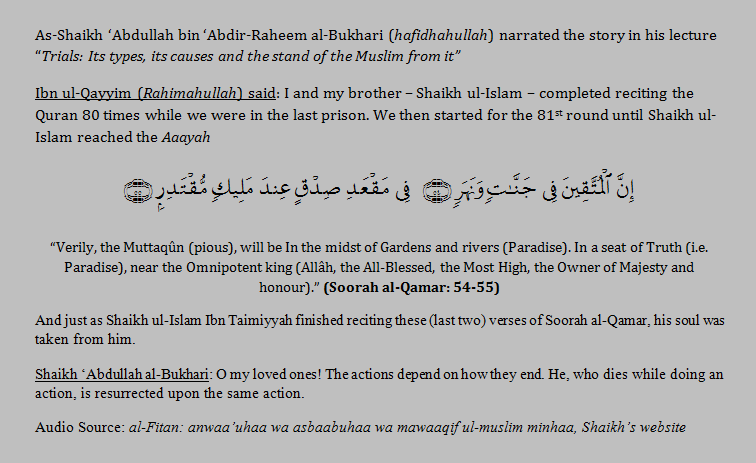
Actions are how they get sealed. The last Action of Ibn Taymiyyah!

Actions are how they get sealed. The last Action of Ibn Taymiyyah!

Benefit Shared by أبوحفص عديّ بن محمّد via Twitter
http://elbukhari.com/download/esound/muhadarat/al_fitan.mp3 …

The Death of the Prophet (Peace be upon him) : Shaykh Safi ur-Rahmaan Mubarakfoori

From Ar-Raheeq al-Makhtoom

The Start of the Disease

On Monday the twenty-ninth of Safar in the eleventh year of al-Hijra, he participated in funeral rites in al-Baqee’. On the way back he had a headache, his temperature rose so high that the heat effect could be felt over his headband. He led the Muslims in prayer for eleven days though he was sick. The total number of his sick days were either thirteen of fourteen.

The Last Week

When his sickness grew severe he asked his wives: “Where shall I stay tomorrow?” “Where shall I stay?” They understood what he wanted. So they allowed him to stay wherever he wished. He moved to ‘Aishah’s room leaning – while he was walking – on al-Fadl bin al-‘Abbas and ‘Alî bin Abî Tâlib. Head banded as he was, he dragged his feet till he came into her abode. It was there that he spent the last week of his life.

During that period, ‘Aishah used to recite al-Mu’awwidhat (Chapters 113 and 114 of the Qur’ân) and other supplications which he has already taught her.

Five days before death

On Wednesday, five days before he died the Prophet’s temperature rose so high signalling the severness of his disease. He fainted and suffered from pain. “Pour out on me seven Qirab (water skin pots) of various water wells so that I may go out to meet people and talk to them.” So they seated him in a container (usually used for washing) and poured out water on him till he said: “That is enough. That is enough.”

Then he felt well enough to enter the Mosque. He entered it band-headed, sat on the pulpit and made a speech to the people who were gathering together around him. He said: “The curse of Allâh falls upon the Jews and Christians for they have made their Prophets’ tombs places of worship.” [Sahîh al-Bukhârî, 1/62; Muatta’ Imâm Malik, p.360] Then he said: “Do not make my tomb a worshipped idol.” [Muatta’ Imâm Malik, p.65]

Then he offered himself and invited the people to repay any injuries he might have inflicted on them, saying:

“He whom I have ever lashed his back, I offer him my back so that he may avenge himself on me. He whom I have ever blasphemed his honour, here I am offering my honour so that he may avenge himself.”

Then he descended, and performed the noon prayer. Again he returned to the pulpit and sat on it. He resumed his first speech about enmity and some other things. A man then said: “You owe me three Dirhams.” The Prophet sallallaahu ‘alayhi wa sallam said: “Fadl, pay him the money.” He went on saying:

“I admonish you to be good to Al-Ansar (the Helpers). They are my family and with them I found shelter. They have acquitted themselves credibly of the responsibility that fell upon them and now there remains what you have to do. You should fully acknowledge and appreciate the favour that they have shown, and should overlook their faults.”

In another version: “The number of believers would increase, but the number of Helpers would decrease to the extent that they would be among men as salt in the food. So he who from among you occupies a position of responsibility and is powerful enough to do harm or good to the people, he should frilly acknowledge and appreciate the favour that these benefactors have shown and overlook their faults.”

And said: “Allâh, the Great, has given a slave of His the opportunity to make a choice between whatever he desires of Allâh’s provisions in this world, and what He keeps for him in the world, but he has opted for the latter.”

Abû Sa’id Al-Khudri said: “Upon hearing that, Abû Bakr cried and said: ‘We sacrifice our fathers and mothers for your sake.’ We wondered why Abû Bakr said such a thing. People said: ‘Look at that old man! The Messenger of Allâh says about a slave of Allâh who was granted the right between the best fortunes of this world and the bounty of Allâh in the Hereafter, but he says: We sacrifice our fathers and mothers for your sake!’ It was later on that we realized what he had aimed at. The Messenger of Allâh was the slave informed to choose. We also acknowledged that Abû Bakr was the most learned among us.” [Mishkat Al-Masabih, 2/546]

Then the Messenger of Allâh said:

“The fellow I feel most secure in his company is Abû Bakr. If I were to make friendship with any other one than Allah, I would have Abû Bakr a bosom friend of mine. For him I feel affection and brotherhood of Islam. No gate shall be kept open in the Mosque except that of Abû Bakr’s.” [Sahîh al-Bukhârî, 1/22,429,449, 2/638; Misbkat Al-Masabih, 2/548]

Four days before his death

On Thursday, four days before the death of the Messenger of Allâh he said to people — though he was suffering from a severe pain:

“Come here. I will cause you to write something so that you will never fall into error.” Upon this ‘Umar bin Al-Khattab said: “The Prophet of Allâh is suffering from acute pain and you have the Qur’an with you; the Book of Allâh is sufficient unto you.” Others however wanted the writing to be made. When Muhammad heard them debating over it, he ordered them to go away and leave him alone. [Sahîh al-Bukhârî, 2/637]

That day he recommended three things:

1. Jews, Christians and polytheists should be expelled out of Arabia .
2. He recommended that delegations should be honoured and entertained, in a way similar to the one he used to do.
3. As for the third — the narrator said that he had forgotten it. It could have been adherence to the Holy Book and the Sunnah. It was likely to be the accomplishment and the mobilization of Osamah’s army, or it could have been performance of prayers and being attentive to slaves.

In spite of the strain of disease and suffering from pain, the Prophet used to lead all the prayers till that Thursday — four days before he died. On that day he led the sunset prayer and recited:

“By the winds (or angels or the Messengers of Allah) sent forth one after another.” [77:1] [Misbkat Al-Masabih, 1/102]

In the evening he grew so sick that he could not overcome the strain of disease or go out to enter the Mosque. ‘Aishah said: The Prophet asked: “Have the people performed the prayer?” “No. They haven’t. They are waiting for you.” “Put some water in the washing pot.” Said he. We did what he ordered. So he washed and wanted to stand up, but he fainted. When he came round he asked again “Have the people prayed?” Then the sequence of events took place again and again for the second and the third times from the time he washed to the time he fainted after his attempts to stand up. Therefore he sent to Abû Bakr to lead the prayer himself. Abû Bakr then led the prayer during those days [Sahîh al-Bukhârî, 1/99]. They were seventeen prayers in the lifetime of Muhammad sallallaahu ‘alayhi wa sallam.

Three or four times ‘Aishah talked to the Prophet sallallaahu ‘alayhi wa sallam to exempt Abû Bakr from leadership in prayer lest people should despair of him, but he refused and said: “You (women) are like the women who tried to entice Joseph (Yusuf) into immorality. Convey my request to Abû Bakr to lead the prayer.”

A Day or Two prior to Death

On Saturday or on Sunday, the Prophet sallallaahu ‘alayhi wa sallam felt that he was well enough to perform the prayer; so he went out leaning on two men in order to perform the noon prayer. Abû Bakr, who was then about to lead the prayer withdrew when he saw him coming; but the Prophet made him a gesture to stay where he was and said: “Seat me next to him.” They seated him on the left hand side of Abû Bakr. The Prophet led the prayer, and Abû Bakr followed him and raised his voice at every ‘Allâhu Akbar’ (i.e. Allâh is the Greatest) the Prophet said, so that the people may hear clearly. [Sahîh al-Bukhârî 1/98,99]

A Day before his Death

On Sunday, a day before he died, the Prophet sallallaahu ‘alayhi wa sallam set his slaves free, paid as a charity the seven Dinars he owned and gave his weapons as a present to the Muslims. So when night fell ‘Aishah had to borrow some oil from her neighbour to light her oil-lantern. Even his armour was mortgaged as a security with a Jew for thirty Sa’ (a cubic measure) of barley.

The Last Day Alive

In a narration by Anas bin Malik, he said: “While the Muslims were performing the dawn prayer on Monday — led by Abû Bakr, they were surprised to see the Messenger of Allâh raising the curtain of ‘Aishah’s room. He looked at them while they were praying aligned properly and smiled cheerfully. Seeing him, Abû Bakr withdrew to join the lines and give way to him to lead the prayer. For he thought that the Prophet wanted to go out and pray.” Anas said: “The Muslims, who were praying, were so delighted that they were almost too enraptured at their prayers. The Messenger of Allâh made them a gesture to continue their prayer, went into the room and drew down the curtain.” [ibid. 21640]

The Messenger of Allâh sallallaahu ‘alayhi wa sallam did not live for the next prayer time.

When it was daytime, the Prophet sallallaahu ‘alayhi wa sallam called Fatimah and told her something in a secret voice that made her cry. Then he whispered to her something else which made her laugh. ‘Aishah enquired from her after the Prophet’s death, as to this weeping and laughing to which Fatimah replied:

“The first time he disclosed to me that he would not recover from his illness and I wept. Then he told me that I would be the first of his family to join him, so I laughed.” [Sahîh al-Bukhârî, 2/638]

He gave Fatimah glad tidings that she would become the lady of all women of the world [Rahmat-ul-lil’alameen, 1/282]. Fatimah witnessed the great pain that afflicted her father. So she said: “What great pain my father is in!”. To these words, the Prophet remarked:

“He will not suffer any more when today is over.” [Sahîh al-Bukhârî, 2/641]

He asked that Al-Hasan and Al-Husain be brought to him. He kissed them and recommended that they be looked after. He asked to see his wives. They were brought to him. He preached them and told them to remember Allah. Pain grew so much severe that the trace of poison he had at Khaibar came to light. It was so sore that he said to ‘Aishah: “I still feel the painful effect of that food I tasted at Khaibar. I feel as if death is approaching.” [ibid, 2/637] He ordered the people to perform the prayers and be attentive to slaves. He repeated it several times. [ibid. 2/637]

The Prophet sallallaahu ‘alayhi wa sallam breathes his last

When the pangs of death started, ‘Aishah leant him against her. She used to say: One of Allah’s bounties upon me is that the Messenger of Allâh died in my house, while I am still alive. He died between my chest and neck while he was leaning against me. Allâh has mixed his saliva with mine at his death. For ‘Abdur Rahman – the son of Abû Bakr – came in with a Siwak (i.e. the root of a desert plant used for brushing teeth) in his hand, while I was leaning the Messenger of Allâh against me. I noticed that he was looking at the Siwak, so I asked him – for I knew that he wanted it — “Would you like me to take it for you?” He nodded in agreement. I took it and gave it to him. As it was too hard for him, I asked him “Shall I soften it for you?” He nodded in agreement. So I softened it with my saliva and he passed it (on his teeth).

In another version it is said: “So he brushed (Istanna) his teeth as nice as he could.” There was a water container (Rakwa) available at his hand with some water in. He put his hand in it and wiped his face with it and said:

“There is no god but Allah. Death is full of agonies.” [Sahîh al-Bukhârî, 2/640]

As soon as he had finished his Siwak, brushing, he raised his hand or finger up, looked upwards to the ceiling and moved his lips. So ‘Aishah listened to him. She heard him say: “With those on whom You have bestowed Your Grace with the Prophets and the Truthful ones (As-Siddeeqeen), the martyrs and the good doers. O Allâh, forgive me and have mercy upon me and join me to the Companionship on high.” [ibid, 2/638-641] Then at intervals he uttered these words: “The most exalted Companionship on high. To Allâh we turn and to Him we turn back for help and last abode.” This event took place at high morning time on Monday, the twelfth of Rabi’ al-Awwal, in the eleventh year of Al-Hijrah. He was sixty-three years and four days old when he died.

The Companions’ concern over the Prophet’s Death

The great (loss) news was soon known by everybody in Madinah. Dark grief spread on all areas and hoirizons of Madinah. Anas said: “I have never witnessed a day better or brighter than that day on which the Messenger of Allâh sallallaahu ‘alayhi wa sallam came to us; and I have never witnessed a more awful or darker day than that one on which the Messenger of Allâh died on.” [Mishkat-ul-Masabih, 2/547]

When he died, Fatimah said: “O Father, whom his Lord responded to his supplication! O Father, whose abode is Paradise . O Father, whom I announce his death to Gabriel.” [Sahîh al-Bukhârî, 2/641]

‘Umar’s Attitude

‘Umar, who was so stunned that he almost lost consciousness and stood before people addressing them: “Some of the hypocrites claim that the Messenger of Allâh sallallaahu ‘alayhi wa sallam died. The Messenger of Allâh did not die, but went to his Lord in the same way as Moses bin ‘Imran did. He stayed away for forty nights, but finally came back though they said he had been dead. By Allah, the Messenger of Allâh will come back and he will cut of the hands and legs of those who claim his death.” [Ibn Hisham, 2/655]

Abû Bakr’s Attitude

Abû Bakr left his house at As-Sunh and came forth to the Mosque on a mare-back. At the Mosque, he dismounted and entered. He talked to nobody but went on till he entered ‘Aishah’s abode, and went directly to where the Messenger of Allâh sallallaahu ‘alayhi wa sallam was. The Prophet was covered with a Yemeni mantle. He uncovered his face and tended down, kissed him and cried. Then he said: “I sacrifice my father and mother for your sake. Allah, verily, will not cause you to die twice. You have just experienced the death that Allâh had ordained.”

Then he went out and found ‘Umar talking to people. He said: “‘Umar, be seated.” ‘Umar refused to do so. People parted ‘Umar and came towards Abû Bakr, who started a speech saying:

“And now, he who worships Muhammad sallallaahu ‘alayhi wa sallam, Muhammad is dead now. But he who worships Allah, He is Ever Living and He never dies. Allâh says: ‘Muhammad sallallaahu ‘alayhi wa sallam is no more than a Messenger, and indeed (many) Messengers have passed away before him. If he dies or is killed, will you then turn back on your heels (as disbelievers)? And he who turns back on his heels, not the least harm will he do to Allâh, and Allâh will give reward to those who are grateful.’ ” [3:144]

Ibn ‘Abbas said: “By Allâh it sounded as if people had never heard such a Qur’aanic verse till Abû Bakr recited it as a reminder. So people started reciting it till there was no man who did not recite it.”

Ibn Al-Musaiyab said that ‘Umar had said: “By Allâh as soon as I heard Abû Bakr say it, I fell down to the ground. I felt as if my legs had been unable to carry me so I collapsed when I heard him say it. Only then did I realize that Muhammad sallallaahu ‘alayhi wa sallam had really died.” [Sahîh al-Bukhârî, 2/640,641]

Burial and Farewell Preparations to his Honourable Body

Dispute about who would succeed him broke out even before having the Messenger of Allah’s body prepared for burial. Lots of arguments, discussions, dialogues took place between the Helpers and Emigrants in the roofed passage (portico) of Barn Sa’ida. Finally they acknowledged Abû Bakr (RA) as a caliph. They spent the whole Monday there till it was night. People were so busy with their arguments that it was late night — just about dawn of Tuesday — yet his blessed body was still lying on his bed covered with an inked-garment. He was locked in the room.

On Tuesday, his body was washed with his clothes on. He was washed by Al-’Abbas, ‘Alî, Al-Fadl and Qathm — the two sons of Al-’Abbas, as well as Shaqran — the Messenger’s freed slave, Osamah bin Zaid and Aws bin Khauli. Al-’Abbas, Al-Fadi and Qathm turned his body round, whereas Osamah and Shaqran poured out water. ‘Alî washed him and Aws leant him against his chest.

They shrouded him in three white Sahooli cotton cloth which had neither a headcloth [Sahîh al-Bukhârî, 1/169, Sahîh Muslim, 1/306] nor a casing and inserted him in.

A sort of disagreement arose with regard to a burial place. Abû Bakr said: “I heard the Messenger of Allâh say: ‘A dead Prophet is buried where he dies.’” So Abû Talhah lifted the bed on which he died, dug underneath and cut the ground to make the tomb.

People entered the room ten by ten. They prayed for the Prophet sallallaahu ‘alayhi wa sallam. The first to pray for him were people of his clan. Then the Emigrants, then the Helpers. Women prayed for him after men. The young were the last to pray.

This process took Tuesday long and Wednesday night (i.e. the night which precedes Wednesday morning). ‘Aishah said: “We did not know that the Prophet sallallaahu ‘alayhi wa sallam was being buried till we heard the sound of tools digging the ground at the depth of Wednesday night.” [Mukhtasar Seerat Ar-Rasool, p.471; Ibn Hisham, 2/649-665; Talqeeh Fuhoom Ahl M-Athar, p. 38, 39; Rahmat-ul-lil’alameen 1/277-286]

You will be raised upon what you die upon – A warning from Shaykh Sulayman Ar Ruhaylee

You will be Raised Upon what you Die Upon – Shaykh Sulaymaan Ar-Ruhaylee حفظه الله
http://mtws.posthaven.com/you-will-be…
Translated by Rasheed ibn Estes Barbee حفظه الله
Video Courtesy : Bilal Nahim @ Manhaj ul-Haqq

Related Link: https://abdurrahman.org/sins

Mourning for Kings and Rulers entail imitation of the Enemies of Islam – Shaykh Ibn Baaz (rahimahullaah)

All praise be to Allah, and peace and blessings be upon the Messenger of Allah, his family, his Companions, and those who follow his guidance.

There is, in the present time, a tradition in many Islamic countries that when a king or a leader dies, people must mourn for three days or more or less. Flags are lowered at half-mast and the State departments stop working.

Undoubtedly, these acts go against Shari`ah (Islamic law) and entail imitation of the enemies of Islam.

Authentic Hadiths related from the Prophet (peace be upon him) prohibit and warn people, except a wife, against mourning. The maximum period of mourning for a woman is four months and ten days, if the deceased is her husband, and three days or less for relatives. The other practices done during mourning a deceased person, whether a king or a leader, are prohibited in Shari`ah.

During the lifetime of the Prophet (peace be upon him), his son Ibrahim, his three daughters and others died, but he (peace be upon him) did not mourn them.

The leaders who joined the Battle of Mu’tah, including Zayd ibn Harithah, Ja`far ibn Abu Talib and `Abdullah ibn Rawahah (may Allah be pleased with them) were killed during the Prophet’s era but he (peace be upon him) did not mourn them.

Furthermore, the Sahabah (Companions of the Prophet) did not mourn the death of the Prophet (peace be upon him), the best of creation and prophets, nor did they mourn Abu Bakr Al-Siddiq (may Allah be pleased with him), the best of Sahabah and creation after the prophets. When `Umar, `Uthman and `Aly (may Allah be pleased with them), the best creation after the prophets and Abu Bakr Al-Siddiq, were killed, no one mourned them. The same was true with all the Sahabah and the Imams of Islam and guidance of Tabi`un (Followers, the generation after the Companions of the Prophet) and the next generation including Sa`id ibn Al-Musayyib, `Aly ibn Al-Husayn Zayn Al-`Abidin, his son Muhammad ibn `Aly, `Umar ibn `Abdul-`Aziz,Al-Zuhry, Imam Abu Hanifah, his two companions, Imam Malik ibn Anas, Al-Awza`y, Al-Thawry, Imam Al-Shafi`y, Imam Ahmad ibn Hanbal, and Is-haq ibn Rahawayh and many others. No Muslim mourned those people.

If this (mourning) were good, the Salaf (righteous predecessors) would have done it. All goodness lies in following them and evil lies in opposing them. Therefore, the Sunnah (whatever is reported from the Prophet) affirmed that what the Salaf did concerning avoiding mourning any person except for a dead husband, is the right action.

The mourning practiced nowadays for the death of kings and leaders is unacceptable in Islam. These practices entail imitating the enemies of Islam and result in much harm, such as suspension of public services. Consequently, the Muslim authorities and rulers must abandon these acts of mourning and follow the conduct of the Salaf.

Furthermore, the people of knowledge have to warn and inform Muslims about the ruling on these acts as they are obliged to advise people and cooperate in righteousness and piety.

I, therefore, for the sake of Allah, the Prophet (peace be upon him) and all Muslims, Imams and ordinary people, find it necessary to write this brief statement. I ask Allah (Glorified and Exalted be He) to grant Muslim rulers and subjects success to do what pleases Him and to follow Shari`ah and warn against opposing it. May Allah purify our hearts and deeds for He is the All-Hearer of supplication, the Ever-Near. May Allah’s Peace and blessings be upon our Prophet Muhammad, his family and Companions.

Source: Fatwas of Ibn Baz (rahimahullaah) – http://www.alifta.net

Sahih Bukhari : “Book of Menses”: No. 311  – Narrated Um-‘Atiya:

We were forbidden to mourn for a dead person for more than three days except in the case of a husband for whom mourning was allowed for four months and ten days. (During that time) we were not allowed to put kohl (antimony eye powder) in our eyes or to use perfumes or to put on colored clothes except a dress made of ‘Asb (a kind of Yemen cloth, very coarse and rough). We were allowed very light perfumes at the time of taking a bath after menses and also we were forbidden to go with the funeral procession

No One Lives for Eternity – By Shaykh AbdulMuhsin bin Hamd al-Abaad al-Badr

Listen to Audio Excerpt @ : Miraath Publications – BiteSize Ramadhaan 1434 Articles – Day 30

Allaah Ta’ala said:

وَمَا جَعَلۡنَا لِبَشَرٖ مِّن قَبۡلِكَ ٱلۡخُلۡدَۖ أَفَإِيْن مِّتَّ فَهُمُ ٱلۡخَٰلِدُونَ ٣٤

– And We granted not to any human being immortality before you (O Muhammad), then if you die, would they live forever? – [Anbiyya: 34]

Shaykh AbdulMuhsin said:

‘The Noble Ayaah indicates that the passage of a human is to pass away, and that Allaah did not make it such that anyone could live for eternity before the Prophet -sallAllaahu alayhi wa sallam, so eternity is not for the Prophet or for anyone else to remain. But rather everyone is moving towards passing away as Allaah Ta’ala said:

كُلُّ مَنۡ عَلَيۡهَا فَانٖ ٢٦ وَيَبۡقَىٰ وَجۡهُ رَبِّكَ ذُو ٱلۡجَلَٰلِ وَٱلۡإِكۡرَامِ ٢٧

Whatsoever is on it (the earth) will perish. And the Face of your Lord full of Majesty and Honour will abide forever.  [Rahman: 26-27]

Some of the people of knowledge said: ‘The Mushrikoon used to reject his -sallAllaahu alayhi wa sallam – Prophet hood, and they would say: ‘Muhammad is a poet we await for him some calamity after some time, and perhaps he will die just like such and such poet died from such and such tribe. So Allaah Ta’ala mentioned that indeed Prophets before you died, and Allaah has power over His religion with victory and protection, this is how the Deen and Sharia of the Prophet is protected.’

With this Ayaah, it indicates that al-Khidr has indeed died, whether he was a Wali (friend of Allaah Azza wa Jal), or a Prophet, or Messenger, because he was a human being, and he was present at the time of Moosa –alayhim as-Salaam. And Allaah Azza wa Jal had indeed said:

وَمَا جَعَلۡنَا لِبَشَرٖ مِّن قَبۡلِكَ ٱلۡخُلۡدَۖ

– And We granted not to any human being immortality before you (O Muhammad) –

[From ‘Min Kanooz Qur’aan’ by Shaykh AbdulMuhsin p.118]

Compiled & Translated By Abbas Abu Yahya

All Praise belongs to Allaah, may His peace and blessings be upon our final Prophet Muhammad, his family, his companions and all those who follow his guidance.

– See more at: http://www.miraathpublications.net/day-30-seeking-forgiveness/#sthash.sMH4UER4.dpuf

The Two Resurrections After Death – Shaykh Ubayd al-Jaabiree [Audio|Ar-En]

Listen / Download Mp3 Here (Time 46:18)

The minor resurrection which is the stupor of death and that it came with the truth which is meeting with Allah, the Exalted and the soul will be brought to judgment and will have its reward or punishment which will be advanced to it before the major Day of Resurrection. Then He mentioned the major Resurrection as He, the Almighty says, وَنُفِخَ فِي الصُّورِ ۚ ذَٰلِكَ يَوْمُ الْوَعِيدِ which means, “And the Trumpet will be blown, that will be the Day whereof warning (had been given) (i.e. the Day of Resurrection).” [ القرآن الكريم The Noble Qur’aan, سورة ق  Soorah Qaaf 050, Verse 020]

From: AL-FAWA’ ID – A Collection Of Wise Sayings by Imam Ibn Al-Qayyim [ رحمه الله , rahimahullaah, may Allaah have mercy on him, died 751AH]

What a Muslim does with death of his close relative who is a Mushrik? – Shaykh Al-Albaani

The Ahadeeth of Tawheed from the Silsilah Ahadeeth As-Saheehah of Shaykh Al-Albaani
Chapters of Tawheed and the Shahadtayn Part 14
Translated by Abbas Abu Yahya

37- What a Muslim does with his close relative who is a Mushrik And Abu Talib died upon Shirk

161- The Messenger of Allaah said to Ali bin Abu Ta lib: ‘Go and bury your father.’ He said; ‘No, I won’t bury him, because he died as a Mushrik.’

The Messenger said to him: ‘Go and bury him, and do n’t speak to anyone until you come to me. ‘I came to him and I had signs of dirt and dust upon me. He ordered me to wash, so I washed and he supplicated for me with supplications which would not please me to exchange anything for them on the face of this earth.

From the benefits of the hadeeth:

1. That it is permissible for a Muslim to take the responsibilities of burying his close Mushrik relative. This does not negate his hate for his relative’s shirk. Do you not see that ‘Alee refused to bury his father for the first time. Whereby, he said: ‘he died as a mushrik ‘ thinking that if he buried him then this would enter into being in alliance with his father which is pro hibited. Like the saying of Allaah Ta’ala: <<Take not as friends the people who incurred the Wrath of Allaah >>

When the Messenger ordered him again to bury his father he hastened to fulfill the Messenger’s order. And he left that which seemed to be correct to him the first time. It is also from obedience, that a person leaves his own opinion for the command of his Prophet – sallAllaahu alayhi wa sallam.

It appears to me that the son burying his mushrik father or his mother is the last of what the son possesses of good companionship wit h his mushrik father in this world. As for after the burial then it is not allowed for him to pray for him, nor seek forgiveness for him, this is due to the clear statement of Allaah Ta’ala: << It is not proper for the Prophet and those who believe to ask Allaah’s Forgiveness for the Mushrikeen even though they be of kin >>

So, if this is the case, what is the situation of t he one who supplicates for mercy and forgiveness on the pages of newspapers and magazines for some of the kuffar , announcing their deaths, for a small amount of dirhams !

The one who is concerned for his hereafter should fear Allaah.

2- It is not legislated for him to wash the unbeliever, nor should he shroud him. And nor should he pray upon him even if he is a close relative, since, the Prophet – sallAllaahu alayhi wa sallam did not order Alee to do so. If this had been permissible, the Prophet – sallAllaahu alayhi wa sallam would have mentioned it, since delaying the explanation of an order when there is a need for it, is not permissible. This is the Madhab of the Hambalees and other than them.

3- It is not legislated for the relatives of that Mushrik to follow the funeral procession. Because the Prophet – sallAllaahu alayhi wa sallam did not do this for his uncle. His uncle was the kindest and the most compassionate of the people to him. Even to the extent that the Prophet supplicated to Allaah for him, whereby his uncle’s punishment will be the least in the Hellfire, as has been previously explained.

And in all of this there is a lesson for those peop le who have been deceived by their ancestry, but they do not do any thing for their hereafter with their Lord, and Allaah the Great spoke the truth when He said: << There will be no kinship among them that Day, nor will they ask of one another. >>

Related Links:

  • The Ahadeeth of Tawheed  – From the ‘Silsilah Ahadeeth As-Saheehah’ Of Shaykh Al-Albaani , Translated by Abbas Abu Yahya

The Bequest of Nooh (alayhi as-Salaam) to his Son at the time of his Death – Shaykh Naasiruddeen al-Albaanee

The bequest of Nooh – alayhi as-Sallam

134 – “When death was approaching the Prophet of Allaah Nooh -sallAllaahu alayhi wa sallam – he said to his son: I will narrate to you my bequest; I command you with two things and prohibit you from two things. I command you with ‘La ilaha ‘illa Allaah’ (‘There is none worthy of worship in truth except Allaah) if the seven heavens and the seven earths were placed upon a scale and ‘La ilaha ‘illa Allaah’ was placed on the other, then ‘La ilaha ‘illa Allaah’ would be heavier.

If the seven heavens and the seven earths were a closed off circle then ‘La ilaha ‘illa Allaah’ would be able to break it.

The second thing I command you with is Subhana Allaahi wa bihamdihi (Far is Allaah from imperfection and praise is for Him), since it is a supplication for everything, and by it the creation is given its provision. I prohibit you from shirk and pride.

( the narrator said: I asked or someone asked) : O Messenger of Allaah as for shirk then we know about it, but what is pride? Is it that one of us has sandals with two good straps?

The Messenger answered: No.

He asked again: is it that one of us has companions and they sit with him?

The Messenger again answered: No.

Someone asked: O Messenger of Allaah, what is pride?

He said: ridiculing the truth and belittling the people and reviling them.”

Silsilah Saheehah: 134

From the benefits of the hadeeth:

I say: there are many benefits from this hadeeth; I will suffice by indicating to some of them:

1- The permissibility of writing a bequest at the time of death.

2- The excellence of saying ‘La ilaha ‘illa Allaah’ and saying Subhana Allaah and that they are a cause for the creation to receive provision from Allaah.

3- The scales on the Day of Judgment are true and real, and they have two pans. This is from the belief of the ahl-ul Sunnah, opposing that of the Mu’tazilah and their followers in the modern times. Who do not believe that which has been affirmed regarding ‘Aqeedah in the authentic Ahadeeth, with the claim that these are Ahkbaar al-Ahad (singular narrations) which do not convey certainty. I have exposed this claim in my book ‘with ustaadh at-Tantawee’.

4 – The seven earths are like the seven heavens. There are many Ahadeeth regarding this in Bukharee and Muslim and in other books. Perhaps one day we will have time to follow up these Ahadeeth and research them. What supports these Ahadeeth is the saying of Allaah Tabaraka wa Ta’ aala : << It is Allaah Who has created seven heavens and of the earth the like thereof (i.e. seven). >> I.e. they are similar in creation and in number.

So, you should not pay any attention to the one who explains it away, there by it ends up as a negation of similarity as well as in numbers, being deceived by the Europeans and where their knowledge has reached to, from having gone up in to space however they do not know of seven earths, along with that they do not know about seven heavens. Will we reject the speech of Allaah and the speech of His Messenger due to the ignorance of the Europeans and others along with them, declaring that the more they increase their knowledge of the universe, the more they increase in their ignorance of it. Allaah the Most Great has spoken the truth when He said : << And of knowledge, you (mankind) have been given only a little>>

5 – That beautification with good clothing has nothing to do with pride what so ever. Rather, it is a matter which is permissible, because Allaah is Beautiful and He loves beauty, like the Messenger of Allaah -sallAllaahu alayhi wa sallam – said regarding this issue, as is narrated by Muslim in his ‘Saheeh’.

6- Pride which has been equated with Shirk will not allow entrance in to Paradise for the one who has an equivalent of an atoms worth. That is the pride, which is rejecting the truth after it has been made clear, and defaming innocent people without truth. So, the Muslim should be extremely cautious from being characterized with this type of pride, just like he should be extremely cautious from being characterized with the Shirk which places its companion in the Hell-fire for eternity.

All Praise belongs to Allaah, may His peace and blessings be upon our final Prophet Muhammad, his family, his companions and all those who follow his guidance

The Ahadeeth of Tawheed, Explained By the Muhaaddith, the Allaamah, Shaykh Naasirud-Deen al-Albaanee (rahimullaah), Source: Silsilah Ahadeeth As-Saheehah of Shaykh Al-Albaani (rahimahullaah), Translated by: Abbas Abu Yahya (hafidhahullaah)

Oh Mankind! Indeed You are Returning to your Lord! – Abu Muhammad al-Maghribee [Audio|En]

Oh Mankind! Indeed You are Returning to your Lord!
Abu Muhammad al-Maghribee (hafidhahullaah)
Audio Courtesy: http://followthesalaf.com
[Audio|English]

Khutbah from Friday, February 24, 2012
Based on Sheikh Muhammad ibn al-Uthaymeen‘s tafseer of selected ayaat in Surat al-Inshiqaaq

Listen / Download Mp3 Here  (Time 31:28)

O man! Verily, you are returning towards your Lord with your deeds and actions (good or bad), a sure returning, so you will meet (i.e. the results of your deeds which you did).

Then, as for him who will be given his Record in his right hand,
He surely will receive an easy reckoning,
And will return to his family in joy.

But whosoever is given his Record behind his back,
He will invoke (his) destruction,

And shall enter a blazing Fire, and made to taste its burning.
Verily, he was among his people in joy!
Verily, he thought that he would never come back (to Us)!

(al-Inshiqaaq: 6-14)

Preparing Yourself for the Day of Judgement – Abu Muhammad al-Maghribee [Audio|En]

Preparing Yourself for the Day of Judgement
Abu Muhammad al-Maghribee
http://followthesalaf.com
(mp3/english)

This lecture was given on Saturday, May 12, 2012 at Masjid at-Tawheed and is based on a lecture of our Noble Sheikh, Dr Saaleh al-Fawzaan regarding the preparations for the Day in which we will each stand in front of our Lord.

We prepare for many things in life; a new job, moving, a visitor coming… even just to leave the house, we prepare. So what preparations are we making for the Hereafter?

Every soul shall taste death…” Surat al-Anbiyaa (21:35)

Listen / Downlaod Mp3 Here 

At the deathbed of Umm Habibah (radhi Allaahu anha)

At the deathbed of Umm Habibah (radhi Allaahu anha)

It is reported that ‘Â`ishah – said, “Umm Habîbah called for me on her deathbed and said, ‘There used to occur between us the kinds of things that happen between co-wives (al-darâ`ir), so may Allâh forgive me and you those things.’ I said, ‘May Allâh forgive you all those things and release you from [all liability] for that.’ She replied, ‘You have made me happy, may Allâh make you happy.’ And she sent for Umm Salamah and said the same things to her.”

Al-Dhahabî, Siyar A’lâm Al-Nubalâ` Vol. 2 p223

SayingsofTheSalaf.net

Interpretation of seeing the dead in a dream in a disliked situation – Shaykh ibn Uthaymeen

Question:

What is the interpretation of seeing a deceased every time in dreams?

Response:

If one sees a deceased in a good state in a dream, this lends hope that he is in a good state. If one sees him in another type of state, this could simply be devils taking on the form of people. Devils take on the shapes of people in a disliked situation in order to grieve the living. This is because devils are very avaricious to do anything that brings grief, worry and sadness to the believers. Allah has said,

“Secret counsels are only from Satan, in order that he may cause grief to the believers. But he cannot harm them in the least, except as Allah permits” (al-Mujadalah 10).

So if a person sees something evil for a deceased in a dream, he must seek refuge in Allah from the evil of Satan and the evil of what he saw. He should not communicate that dream to anyone concerning that deceased. In that way, the deceased will not harm whatsoever. In fact, any time a person sees something disturbing in a dream, he should then seek refuge in Allah from the evil of Satan and the evil of what he saw. Then he should spit three times on his left side. He should then change his side upon which he was sleeping to the other side. If he makes ablution and prays, that is better and superior. He should not communicate that dream to anyone and, in that case, he will not be harmed by it at all.

Shaikh ibn Uthaymeen (rahimahullaah)

Source : From the Book – “Fatwas regarding Women” – Collected by Muhammed al-Musnad , Dar-us-Salam Publications.

Istirja (Inna Lillahi wa Inna Ilahi Raaji’oon) – Tafseer Ibn Katheer

Tafseer Ibn Katheer – Suratul Baqarah [Surah No.2]

(155. And certainly, We shall test you with something of fear, hunger, loss of wealth, lives and fruits, but give glad tidings to As-Sabirin (the patient).)
(156. Who, when afflicted with calamity, say: “Truly, to Allah we belong and truly, to Him we shall return.”)
(157. They are those on whom are the Salawat (i.e., who are blessed and will be forgiven) from their Lord, and (they are those who) receive His mercy, and it is they who are the guided ones.)

Allah informs us that He tests and tries His servants, just as He said in another Ayah:

(And surely, We shall try you till We test those who strive hard (for the cause of Allah) and As-Sabirin (the patient), and We shall test your facts (i.e., the one who is a liar, and the one who is truthful).) (47:31)

Hence, He tests them with the bounty sometimes and sometimes with the afflictions of fear and hunger. Allah said in another Ayah:

(So Allah made it taste extreme of hunger (famine) and fear.) (16:112)

The frightened and the hungry persons show the effects of the affliction outwardly and this is why Allah has used here the word `Libas’ (cover or clothes) of fear and hunger. In the Ayat above, Allah used the words:

(with something of fear, hunger,) meaning, a little of each. Then (Allah said),

(loss of wealth,) meaning, some of the wealth will be destroyed,

(lives) meaning, losing friends, relatives and loved ones to death,

(and fruits,) meaning, the gardens and the farms will not produce the usual or expected amounts. This is why Allah said next:

(but give glad tidings to As-Sabirin (the patient).)

He then explained whom He meant by `the patient’ whom He praised:

(Who, when afflicted with calamity, say: “Truly, to Allah we belong and truly, to Him we shall return.”) meaning, those who recite this statement to comfort themselves in the face of their loss, know that they belong to Allah and that He does what He wills with His servants. They also know that nothing and no deed, even if it was the weight of an atom, will be lost with Allah on the Day of Resurrection. These facts thus compel them to admit that they are Allah’s servants and that their return will be to Him in the Hereafter.

This is why Allah said:

(They are those on whom are the Salawat (i. e., who are blessed and will be forgiven) from their Lord, and (they are those who) receive His mercy,) meaning, Allah’s praise and mercy will be with them. Sa`id bin Jubayr added, “Meaning, safety from the torment.”

(and it is they who are the guided ones.) `Umar bin Al-Khattab commented: “What righteous things, and what a great heights.

(They are those on whom are the Salawat from their Lord, and (they are those who) receive His mercy) are the two righteous things.

(and it is they who are the guided ones) are the heights.”

The heights means more rewards, and these people will be awarded their rewards and more.

There are several Ahadith that mention the rewards of admitting that the return is to Allah by saying:(“Truly, to Allah we belong and truly, to Him we shall return.”) when afflictions strike.

For instance, Imam Ahmad reported that Umm Salamah narrated:

Once, Abu Salamah came back after he was with Allah’s Messenger and said: I heard Allah’s Messenger recite a statement that made me delighted. He said:(No Muslim is struck with an affliction and then says Istirja` when the affliction strikes, and then says: `O Allah! Reward me for my loss and give me what is better than it,’ but Allah will do just that.) Umm Salamah said: So I memorized these words. When Abu Salamah died I said Istirja` and said: “O Allah! Compensate me for my loss and give me what is better than it.” I then thought about it and said, “Who is better than Abu Salamah” When my `Iddah (the period of time before the widow or divorced woman can remarry) finished, Allah’s Messenger asked for permission to see me while I was dyeing a skin that I had. I washed my hands, gave him permission to enter and handed him a pillow, and he sat on it.

He then asked me for marriage and when he finished his speech, I said, “O Messenger of Allah! It is not because I do not want you, but I am very jealous and I fear that you might experience some wrong mannerism from me for which Allah would punish me. I am old and have children.” He said: (As for the jealousy that you mentioned, Allah the Exalted will remove it from you. As for your being old as you mentioned, I have suffered what you have suffered. And for your having children, they are my children too.) She said, “I have surrendered to Allah’s Messenger.” Allah’s Messenger married her and Umm Salamah said later, “Allah compensated me with who is better than Abu Salamah: Allah’s Messenger .’ [ Muslim reported a shorter version of this Hadith]

Source : Quran : Tafsir Ibn Kathir : Surah No.2