Scholars Biographies: Imaam Abu Ja’far Ahmad Ibn Muhammad At-Tahaawee

Imaam Abu Ja’far Ahmad Ibn Muhammad At-Tahaawee

Source : Shaikh al-Albaanee’s checking and notes to the Sharh and Matn  of Aqeedah Tahaawiyyah

His Name and Lineage: 

He was the Imaam, the Muhaddith, the Faqeeh, the Haafidh, the noble Scholar, Abu Ja’far Ahmad bin Muhammad bin Salaamah bin Salama ‘Abdul-Malik bin Salama Al-Azdee At-Tahaawee. Al-Azadee is an ascription to a well-known tribe from Qahtaan. At-Tahaawee is an ascription to the land Tahaa in Upper Egypt.

His Search for Knowledge: 

His lineage in knowledge is connected to his family and uncles, for his father was from the scholars and his uncle was the Imaam Isma’eel bin Yahyaa Al-Muznee. (Died 264H). He was born in 239H. When he reached the age of adolescence, he moved to Egypt in search of knowledge. Al-Muznee was the one with the most knowledge of Fiqh amongst the companions of Imaam Muhammad bin Idrees Ash-Shaafi’ee in his land. And likewise his mother was from the people of knowledge and narrations.

Then he linked with the scholars of Egypt as well as those who came to Egypt. And his teachers were many, as were his students.

Every time the scope of his horizons would widen, he would find himself confused amidst a score of Fiqh issues. And he would not find the sufficient answers from his uncle that would soothe his confusion over these issues. So he began to examine what his uncle would do when he was faced with these kinds of contradictory opinions. His uncle would refer a lot to the books of the associates of Abu Haneefah (i.e. Hanafis), and he would favor many of the opinions of Abu Haneefah with regard to these issues. These favored opinions of his were recorded in his book “Mukhtasar Al-Muznee.”

So after that he was left with no choice but to look into the books of the associates of Abu Haneefah and adopt their methodology in establishing fundamental principles and deriving subsidiary rulings. This is such that when he completed his knowledge of the madh-hab of Imaam Abu Haneefah, he changed to that madh-hab and became one of its followers. But this did not prevent him from opposing and contradicting some of the (erroneous) opinions held by the Imaam (Abu Haneefah) and preferring the opinions of the other Imaams (on certain issues). This is because he, may Allaah have mercy on him, was not a muqallid (blind follower) of Abu Haneefah. But rather he only saw the methodology of Abu Haneefah in Fiqh as being the most exemplary of methodologies, according to his opinion – so he treaded that path. This is why you will find him in his book “Ma’aanee Al-Athaar” affirming some views that his Imaam (Abu Haneefah) did not hold. What supports what we stated just now, is what Ibn Zoolaaq stated:

“I heard Abul-Hasan ‘Alee Ibn Abee Ja’far At-Tahaawee say: I heard my father say: ‘ (and he mentioned the virtues of Abu ‘Ubayd Harbaway and his Fiqh and said) He would ask me about (Fiqh) issues. So one day I gave my answer to one issue, so he said to me: ‘This is not the opinion of Abu Haneefah.’ So I said: ‘O judge (Qaadee), do I have to hold the same opinion for every opinion that Abu Haneefah held?” So he said: ‘I didn’t think you were more than a blind follower.’ I said to him: ‘And does anyone blindly follow someone except he who is a fanatic?’ He said: ‘Or a simple-minded person.’ So this story spread throughout Egypt, such that it became a proverb and the people memorized it.'”

He was educated under many shuyookh, whom he took knowledge and benefited from. He had more than three hundred teachers. He would spend lots of time with those scholars that came to visit Egypt from different parts of the world, such that he would add to his knowledge what knowledge they had. This shows you the extent of the concern he had for benefiting and learning from the scholars, as well as the intense eagerness he had for acquiring knowledge. Many scholars praised him and described him as being reliable, trustworthy, a Faqeeh, intelligent, a good memorizer and a pious worshipper. He had a high proficiency in Fiqh and Hadeeth.

The Scholars’ Praise for Him: 

Ibn Yoonus said: “At-Tahaawee was reliable, trustworthy, a Faqeeh, intelligent, the likes of whom one did not come afterward.”

Imaam Adh-Dhahabee said in his At-Taareekh al-Kabeer: “He was the Faqeeh, the Muhaddith, the Haafidh, one of the elite personalities, and he was reliable, trustworthy, knowledgeable of Fiqh and intelligent.”

Ibn Katheer said in Al-Bidaayah wan-Nihaayah: “He was one of the reliable, trustworthy and brilliant scholars of Hadeeth (Haafidh).”

He served as an intermediary for the knowledge between those who came before (Salaf) and those who came after (Khalaf). The scholars praised him and mentioned him as being a Muhaddith (scholar of Hadeeth), one whose report was reliable and an established narrator. He was distinguished and highly proficient in writing. And he became the most knowledgeable of Fiqh amongst the Hanafis in Egypt. This was even though he had a share in the Fiqh of all of the madh-habs of Fiqh and Hadeeth, and he knew of the various sciences of Islaam.

His Books: 

As for his writings, then for the most part, they are verifications and compilations, containing many benefits. Among his writings is “Al-‘Aqeedah At-Tahaawiyyah”, which we are writing the introduction for now, as well as for its explanation (by Ibn Abee Al-‘Izz). Even though the size of the book is small, its benefits are many and its methodology is that of the Salaf. And you will find that it contains everything the Muslim needs concerning his Creed. There is also his book “Ma’aanee Al-Athaar”, which is a book in which he presents different areas of research in Fiqh along with their evidences. And during the course of his research, he mentions the issues in which there are differences of opinion amongst the scholars. And he lists the proofs and evidences for each opinion and debates them, outweighing which one appears to be the truth according to him. This book will accustom the student of knowledge with understanding Fiqh and it will acquaint him with the areas of difference of opinion.

He left behind many other great works, close to forty different books, amongst which are: Sunan Ash-Shaafi’ee, Mushkil Al-Athaar, Ahkaam-ul-Qur’aan, Al-Mukhtaar, Sharh Al-Jaam’i-ul-Kabeer, Sharh Al-Jaam’i-us-Sagheer, Ash-Shuroot, Nawaadir al-Fiqhiyyah and others.

Imaam At-Tahaawee was well known and famous for commanding good and forbidding evil, for voicing out the truth and returning to that which he held to be the truth without being affected by the (other) scholars, rulers and associates.

Sufficient for us is the agreement of the majority of the scholars upon accepting this Creed, which has been truthfully called: “An Explanation of the Creed of Ahlus-Sunnah wal-Jamaa’ah.” And no one speaks against it except for those who rebel against the Creed held within it such as some remnants from the Mu’tazilah and the people of Hulool and Ittihaad (Sufi belief that Allaah is incarnate within His creation), and those who follow any opinion.

His Death: 

Imaam At-Tahaawee died on a Thursday at the beginning of Dhul-Qa’adah in 321H and was buried in the Qaraafah graveyard in Egypt. May Allaah have mercy on him.

Source: Originally published in al-manhaj .com website ( this site no more exists)


Brief Biography: Imam Al-Laalikaa’ee (d.418H)

Imaam Abul-Qaasim Hibatullaah Al-Laalikaa’ee

Source: Intro to the Book “The Creed of Imam Bukhaaree”
Translated by: Dawud Burbank rahimahullaah

He was Abul-Qaasim Hibatullaah, Ibn al-Hasan bin Mansoor ar-Raazee, at-Tabaree, al-Laalikaa’ee. The author of the encyclopedia of the ‘aqeedah of the Salaf called Sharh Usool I’tiqaad Ahlis-Sunnah wal Jamaa’ah.

He lived in a time of great confusion and political strife and division. A time when innovations were widespread and were propagated by their profounder and followers, including the Mu‘tazilah, the Qadariyyah, the Khawaarij, the Murjiah, the Rawaafid and others besides them. Around his time many of the scholars of Ahlus-Sunnah wal-Jamaa’ah stood to author books in defense of the ‘aqeedah of the Companions, the Taabe’een and the Salaf after them and to warn against the widespread innovations.

However, the book of al-Laalikaa’ee is the most comprehensive of all those books and its reader can delight in the abundance of knowledge and guidance contained therein. He reports from more than 180 people and this indicates the large number of Shaykhs he learnt from.

Amongst his students was the famous al-Khateeb al-Baghdaadee who said about him in his Taareekh Baghdaad (14/70): “We wrote from him and he used to understand and memorize (well).”

Ibn Katheer said about him in al-Bidaayah (12/24): “He used to understand and memorize and he (was always) concerned and anxious about hadeeth.” He was known for his precision and his perspicacity in hadeeth. One of his students saw Abul-Qaasim al-Laalikaa’ee after his death in a good dream.

Al-Khateeb al-Baghdaadee mentions this and those after him narrate it from him, ‘Alee bin al-Hasan bin Jadaa al-’Akbaree said: ‘I saw Abul-Qaasim at-Tabaree in a dream and I said to him. What has Allaah done with you?’ He said: ‘He has forgiven me.’ I said: ‘For what reason?’ And it was as if he said in a word in a lowered, subdued voice: ‘The Sunnah.’

He died in the year 418H whilst he was middle-aged, before he became famous for his knowledge and his works, may Allaah have mercy upon him. Refer to the introduction to Sharh Usoolil-Itiqaad (1/65-101) by Ahmad Sa’d Hamdaan for more details.

Source: Originally published in al-manhaj .com website ( this site no more exists)

Scholars Biographies: Shaykh Abdullah al-Qar’aawee

1315H–1389H: Shaikh ‘Abdullaah bin Muhammad Al-Qar’aawee

Author: Fawaaz bin ‘Alee Al-Madkhalee
Source: His compilation “Tareeq-ul-Wusool ilaa Eedaah ath-Thalaathat-il-Usool. Produced By:  Al-Ibaanah.com

He was Shaikh ‘Abdullaah bin Muhammad bin Hamad bin Muhammad Al-Qar’aawee [2] An-Najdee from the district of Qaseem in Najd. He played a great role in Calling to Allaah and spreading the authentic creed, particularly in the southern regions of Saudi Arabia, where this (Salafee) Da’wah thrived and prospered.

He, may Allaah have mercy on him, was born in Dhul-Hijjah of 1315H in the city of ‘Unayzah. His father passed away two months prior to his birth, so he was raised an orphan under the care and auspices of his mother and paternal uncle. He was brought up learning the basic elementary studies, uprightness, purification and memorization of the Qur’aan. During the first part of his life, he occupied himself with conducting business, but he changed to seeking knowledge. He traveled to India twice and then moved throughout the cities of the Kingdom of Saudi Arabia seeking knowledge. So he traveled from Buraydah to Makkah and then to Madeenah, Riyadh, Ihsaa and Qatar. In fact, he even transcended beyond the Arabian Peninsula, visiting Iraq, Egypt and Syria.

Afterward, he commenced his Call to reformation, turning his attention to the southern region of the Kingdom of Saudi Arabia. He settled in Saamitah and made it the center for his Da’wah. So he began calling the people to have Taqwaa of Allaah and to adhere to the beliefs of the pious predecessors (Salaf as-Saalih), with wisdom and fair admonition. Many students would gather around him, and so he would have a large following of people who came to him seeking knowledge. So he held gatherings, teaching them the Qur’aan, Tafseer, Tajweed, Tawheed, Hadeeth, Fiqh, Laws of Inheritance, and some of the sciences of the Arabic language. [3]

Then he focused on some of the neighboring towns of Saamitah and opened various educational institutes, appointing some of his main students as teachers in them – students the likes of Shaikh Haafidh Al-Hakamee (rahimahullaah), about whom he said: “He is one of my students, however he has surpassed me in knowledge by far.”

He would supply these schools with everything that students stood in need of, such as books, notepads and so on, purchasing that with his personal donations. He would also go out in person to visit the neighboring villages on certain days to the point that the people turned towards seeking knowledge under him. The Shaikh’s schools spread out from the district of Tuhaamah to the district of ‘Aseer. He opened many schools and institutes within these regions and appointed his major students to teach in them.

Some of the main objectives of his Da’wah were to rectify the Creed in the people’s souls, to cultivate the true Islaam into the hearts of the Muslim youth and to guide them to the correct path. Prior to his arrival, the community was living upon ignorance and false notions. So the Shaikh, may Allaah have mercy on him, produced students that were strong in their Creed to guide the people and call them to Allaah. So his efforts were crowned with success and many of the people began to perform the obligations at their proper times.

During the last part of his life, he was afflicted with a painful sickness, as a result of which he was forced to move to Riyadh where he was admitted into its central hospital. On Tuesday, the 8th of Jumaadaal-Oolaa, 1389H, the Shaikh passed away, having reached around 73 years of age – a lifetime which he spent serving knowledge, seeking it and spreading it to the people. He, may Allaah have mercy on him, is regarded today as one of the Imaams of the Islamic Da’wah of the 14th Hijree Century, particularly in the districts of Tuhaamah and ‘Aseer, which serve as the birthplace of his Da’wah.

For more about Imaam Al-Qar’aawee, refer to the book “Shaikh Haafidh bin Ahmad Al-Hakamee – His Life and Effects” (pg. 31-35) written by our sheikh, Zayd bin Muhammad Al-Madkhalee, rahimahullaah, and the book “Shaikh ‘Abdullaah Al-Qar’aawee and his Da’wah in the South of the Kingdom” (pg. 12) by As-Sahlee.


Footnotes:

[1] Translator’s Note: This book was compiled by Fawaaz al-Madkhalee from classes Shaikh Zayd Al-Madkhalee (rahimahullaah) gave on the explanation of the famous book “The Three Fundamental Principles” in the First Shaikh ‘Abdullaah bin Muhammad Al-Qar’aawee Educational Seminar, which was held in 1415H in the district of Jaazaan.

[2] Translator’s Note: Al-Qar’aawee was the nickname of his grandfather, which was an ascription to a town he lived in called al-Qar’aa, within the confines of the city of Buraydah. See Fatawaa al-Jaliyyah, footnote 3 on (pg. 5).

[3] Shaikh ‘Abdullaah Al-Qar’aawee served as one of the carriers of the Sunnah and one of the callers to it during that time period. He studied under the noble scholars of his region of Najd and elsewhere. He longed to be one of the callers to Allaah and to be one of those who would revive His Religion, aiding the truth, and guiding the people from deviation to the truth and from Shirk to Tawheed. He yearned to be from those who would warn the people against the evils that are the cause for Allaah’s Anger. So Allaah willed for him to be from those who called to his Path in the southern region of Saudi Arabia. This was due the suggestion of his teacher at that time, the former Muftee of Saudi Arabia, Shaikh Muhammad bin Ibraaheem (rahimahullaah), to go there.

This happened after Shaikh Al-Qar’aawee confided in him a dream he had in which he saw himself go down to the southern regions of Saudi Arabia. So he set out for the south and ended up in Jaazaan in the year 1358H. Thereafter, he advanced to the city of Saamitah, and Allaah benefited the people of these lands through him. So the people of the south learned the Book and the Sunnah from him and they began to understand the Religion of Allaah at his hands.

When he first came to Saamitah, he opened the first Madrasah Salafiyyah (Salafee School) there in Sha’baan 1358H, and began teaching in it shortly thereafter. The school was opened in the house of Shaikh Naasir bin Khaloofah, may Allaah have mercy on him.

At the head of his students, were:

  • Shaikh Haafidh bin Ahmad al-Hakamee,
  • Shaikh Ahmad bin Yahyaa An-Najmee,
  • Shaikh ‘Umar Jardee Al-Madkhalee,
  • Shaikh Muhammad bin Ahmad Al-Hakamee, and
  • other scholars, at whose hands Allaah raised the Sunnah and subdued innovation.

[This excerpt is from footnote 3 on (pg. 5) of Al-Fatawaa al-Jaliyyah, written by the compiler of the book, Hasan bin Muhammad Ad-Dagreeree.]

Whoever Allah wishes from them will go to Paradise, through His Favour (Fadl) – Dawud Burbank [Audio|En]

Aqeedah Tahaawiyyah: Lesson 48 : Point [175-177]
Dawud Burbank [Audio|English]

175. So whoever He wishes from them will go to Paradise, through His Favour (Fadl); and whoever He wishes from them will go to the Fire, from His Justice (‘Adl).

176. And everyone will act in accordance with what has been decreed for him and is going towards the destination he was created for.

177. And good and evil are pre-decreed for the servants

[Souncloud Audio Link]

At-Ta`leeqaat Al-Mukhtasarah `alaa Matn Al-`Aqeedah AtTahaawiyyah. By Shaykh Saalih ibn Fawzaan al-Fawzaan hafizahullaah. Translated by Aboo Talhah Daawood Burbank, rahimahullaah, in 1426AH

Posted with kind permission from Dawud Burbank rahimahullaah

Listen to the Full Audio Series of Aqeedah Tahaawiyyah:
Explanation of Aqeedah at-Tahaawiyyah – Dawud Burbank [Audio|En]

Book Study Resource : Aqeedah at-Tahaawiyyah – Imam at-Tahaawi

Related Linksabdurrahman.org/finaljourney

[Book Study] Sharh as-Sunnah of Imam Barbahaaree (شرح السنة للبربهاري)

Explanation of the Creed (Kitaab Sharh us-Sunnah) – شرح السنة للبربهاري
by Abu Muhammad Al-Hasan ibn ‘Alee ibn Khalaf Al-Barbahaaree (d. 329H) rahimahullaah, The Imaaam of Ahlus-Sunnah wal-Jamaa’ah of his time

READ – Biography of Imaam Abu Muhammad Al-Hasan Ibn ‘Alee Al-Barbahaaree

Study Resources :

[Book Reco] The Explanation Of Imam Barbahaaree’ Sharh as-Sunnah – Shaykh Saalih Al-Fawzaan

Sharh as-Sunnah of Imaam Baarbaharee– Arabic Text & Audio

Sharh as-Sunnah of Imaam Baarbaharee– English Translation – Dawud Burbank

Sharh-us-Sunnah – Shaykh Saalih Fawzaan – Dawood Burbank [Audio|En]

Arabic Audio Lectures of Shaykh Fawzan
شرح السنة للبربهاري | موقع الشيخ صالح بن فوزان الفوزان
http://www.alfawzan.af.org.sa/ar/node/2081  or 
http://subulsalam.com/catplay.php?catsmktba=1393

Imām Al-Barbahārī’s Sharh as-Sunnah شرح السنة للإمام البربهاري – Explained by Shaykh Muhammad Ramzān [Audio|Ar-En]

[Book Reco] The Explanation Of Imam Barbahaaree’ Sharh as-Sunnah – Shaykh Saalih Al-Fawzaan

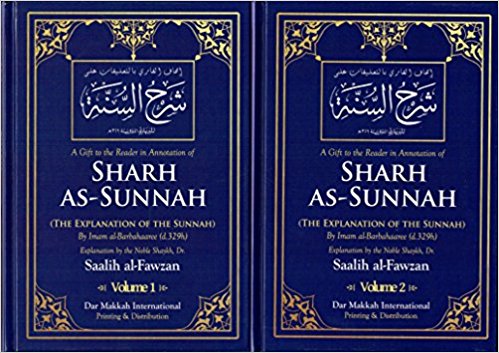
Sharh As-sunnah, Explanation of the Sunnah By Imam Al-barbahari

This is an English translation of Imaam al-Barbahaaree’s classic work, Sharh As-Sunnah. The book consists of 170 points on different aspects of the Muslim creed

Title of the Book: A Gift To The Reader In Annotation Of Sharh As-Sunnah (The Explanation Of The Sunnah)
The Number Of Books: Pgs. 816 /2 Volumes(HB)
Publisher: Dar Makkah International
Translator: Abdus Sami’ Abdus Salaam

This is the highly beneficial two volume work in explanation of the famous works by Imam al-Barbahaaree (d.329h) by the esteemed & noble Shaykh, Dr Saalih al- Fawzan. Its importance can be seen by virtue of its being compiled in the early times; as it is one of the books of the earliest Salaf – those who lived in the same period with the great Imams, acquired knowledge from them and reported their pure Aqidah (creed).

Buy the Book Herehttp://www.authenticstatements.com/bks-0400/

Visit : Book Study Resources of Sharhu Sunnah – Imam Barbaharee

Scholars Biographies: Shaykh Abdul Muhsin al-Abbaad

1353H-Present: Shaikh ‘Abdul-Muhsin bin Hamad Al-‘Abbaad
Produced By : Al-Ibaanah.com

His Name and Lineage:

He is the great scholar and Muhaddith, Shaikh ‘Abdul-Muhsin bin Hamad bin ‘Abdil-Muhsin bin ‘Abdillaah Al-‘Abbaad Aali Badr. The family of Aali Badr comes from the family of Jalaas, which originates from the ancient tribe of ‘Anazah, one of the descendent tribes of ‘Adnan (descendent of Prophet Isma’eel). His great-grandfather’s nickname was ‘Abbaad and so as a result some of his offspring inherited it from him, such as Shaikh ‘Abdul-Muhsin and his mother, the daughter of Sulaymaan bin ‘Abdillaah Aali Badr.

The Shaikh was born on a Tuesday night after ‘Ishaa prayer in the month of Ramadaan, 1353H in the city of Zulfi, Saudi Arabia. This is the city where he grew up and learned the basics of reading and writing.

His Early Studies:

While in Zulfi, he studied under Shaikh ‘Abdullaah bin Ahmad Al-Manee’, Shaikh Zaid bin Muhammad Al-Munaifee, Shaikh ‘Abdullaah bin ‘Abdir-Rahmaan Al-Ghaith with whom he completed the noble Qur’aan, and Shaikh Faalih bin Muhammad Ar-Roomee.

When the first elementary school opened in Zulfi in 1368H, he joined it in its third year and obtained his primary degree there in 1371H.

After completing his primary studies, he moved to Riyadh and signed up with the Educational Institute there. This was the same year (1372H) that Imaam ‘Abdul-‘Azeez bin Baaz moved to Riyadh from Kharj, where he had served as judge since 1357H, and the first year he taught in this Institute. Amongst the colleagues that he studied with at that time was Shaikh Muhammad Amaan Al-Jaamee, may Allaah have mercy on him.

After graduating from this institute, the Shaikh enrolled with the College of Sharee’ah in the Imaam Muhammad bin Su’ood Islamic University of Riyadh. During his last year at the college, he was appointed a teacher in the Educational Institute of Buraidah in 5/13/1379H. Then towards the end of that final school year, he returned back to Riyadh to take his final examination for the college. Allaah blessed him by granting him the ability to finish first amongst his whole class which consisted of over 80 graduates. They represented the fourth class of graduates from the College of Sharee’ah of the Imaam Muhammad bin Su’ood University. He also finished in the first rank amongst his class during his first three years at the college and when receiving his secondary degree from the Educational Institute of Riyadh.

While in Riyadh, he was able to study under scholars the likes of Shaikh Muhammad bin Ibraaheem Aali Shaikh, Shaikh ‘Abdul-‘Azeez bin Baaz, Shaikh Muhammad Al-Ameen Ash-Shanqeetee, Shaikh ‘Abdur-Rahmaan Al-Afreeqee and Shaikh ‘Abdur-Razzaaq ‘Afeefee both in the University and in local masaajid.

He studied specifically under Shaikh ‘Abdur-Rahmaan Al-Afreeqee in Riyadh in the year 1372H and then studied Hadeeth and its Terminology the following year under him. He would say about him: “He was a sincere teacher and a great scholar, as well as a counselor, guide and good example, may Allaah have mercy on him.”

He also had a special relationship with Shaikh ‘Abdul-‘Azeez bin Baaz ever since the first time they met in 1372H. He studied formally under him in the fourth year of the College of Sharee’ah. Shaikh ‘Abdul-Muhsin mentioned: “Most of the contact I had with him would occur in between classes and in the masjid. I would also visit him in his home.”

In 1380H, he transferred to teach in the Educational Institute of Riyadh. But when the Islamic University of Madeenah opened and the first college to be established there was the College of Sharee’ah, Shaikh Muhammad bin Ibraaheem Aali Shaikh selected him to work there as a teacher. Prior to this, towards the end of 1379H, Shaikh ‘Abdul-Muhsin had requested Shaikh Muhammad bin Ibraaheem, may Allaah have mercy on him, to put him in the teaching profession program, to which he agreed on the condition that when he completed the program he would teach at the Islamic University when it opened. Shaikh ‘Abdul-Muhsin replied that he was fully prepared for the task.

His Role in the Islamic University:

So he began teaching at the Islamic University of Madeenah in 1381H and he was the first to deliver a class there. He accompanied his teacher, Shaikh ‘Abdul-‘Azeez bin Baaz, who taught at the University for the next fifteen years.

He served as a member of the University’s committee from the time of its inception to 1393H. Then in 7/30/1393H, he was appointed vice-president of the Islamic University behind Shaikh ‘Abdul-‘Azeez bin Baaz, the president at that time, who nominated him amongst three candidates for the position, upon which King Faisal, may Allaah have mercy on him, selected him for the job.

Shaikh ‘Abdul-Muhsin stayed in this position up to 10/26/1399H when he was relieved of it at his own request. In the first two of these six years, he was the second-in-charge. Then when Shaikh ‘Abdul-‘Azeez bin Baaz, may Allaah have mercy on him, transferred to become president of the Educational Research and Religious Verdict Administration, he became first-in-charge. During these six years, the Shaikh did not stop giving two weekly classes for fourth-year students at the College of Sharee’ah.

Shaikh ‘Abdul-Muhsin says about this: “I would go to him, i.e. Shaikh Ibn Baaz, before going to the University and sit with him for a little while. Shaikh Ibraaheem Al-Husayyin would also be with him and would read the (chapters on) Mu’aamalaat (business and social dealing between Muslims) to him from after Fajr till the sun rose. On one of these days, he said to me: ‘I had a dream last night where I saw a beautiful camel, which I was pulling and you were riding. And I led it to the Islamic University.’ And all praise be to Allaah, this dream came true for I served as vice-president under him for two years, then assumed his role as interim president after him for four years.”

During the time that he served as president of the University, about five-thousand manuscripts were added to its library. This was the same time that Shaikh Hammaad Al-Ansaaree was hired to bring books from libraries around the world. Shaikh Hammaad said: “A majority of the classical works of the Salaf that were photocopied for the Islamic University were done at the time when Shaikh ‘Abdul-Muhsin served as president there.”

He also said: “I brought five-thousand manuscripts for the Islamic University during my travels. Most of the journeys I took for the purpose of obtaining manuscripts and photocopying them were done during the time that Shaikh ‘Abdul-Muhsin Al-‘Abbaad was president of the University.”

Most of these manuscripts were books of Hadeeth and books on the Creed of the Salaf. To get a clearer picture of the great service that Shaikh ‘Abdul-Muhsin did while president of the Islamic University, look at the following statement of Shaikh Hammaad Al-Ansaaree:

“A historical account should be written about Shaikh ‘Abdul-Muhsin Al-‘Abbaad. He did certain jobs in the University that I wish I could have recorded or taped. There were two times in the day that he would insist on working at his job even though it wasn’t required of him – in the morning and in the afternoon after ‘Asr. I went to visit him one time in his office after ‘Asr when he was president of the University and sat with him. I then asked: ‘Where is the coffee, Shaikh?’ He answered: ‘Its ‘Asr now and there is no one here to make it.’ One time I was determined to get to the University before him so I got in the car and went. When I arrived at the University, there was Shaikh ‘Abdul-Muhsin opening the door to the University before everyone else!”

He would also say: “Relate Shaikh ‘Abdul-Muhsin’s diligence at work to the people for there is no harm in this.”

Shaikh ‘Abdul-Muhsin Al-‘Abbaad was also the reason why Shaikh Hammaad Al-Ansaaree wrote his famous book on Tawassul, which served as a refutation of a book written by ‘Abdullaah Al-Ghumaaree, which Shaikh ‘Abdul-Muhsin had brought back with him from his trip to Morocco.

Amongst the other milestones reached by the University under Shaikh ‘Abdul-Muhsin’s presidency was that it transferred from being a government facility to a private institution, the advanced studies department for the Master’s and Doctorate’s programs were formed, the faculties of Qur’aan and Islamic studies, Hadeeth, and Arabic language were created, the size of the University’s land increased to accommodate a proposed 20,000 students, and the University’s printing department was also established.

Shaikh ‘Abdul-Muhsin continues to teach at the University until this very day even though he is past the compulsory age of retirement. No one has taught longer at the Islamic University than him since he taught from its very first day until now. In addition to this, he also continues to hold lessons in the Prophet’s Masjid.

Sufficient as testimony of the great role Shaikh ‘Adul-Muhsin Al-‘Abbaad has had on the Islamic University of Madeenah is what Shaikh Hammaad Al-Ansaaree said as recorded by his son, ‘Abdul-Awwal, in his biography of his father (2/597): “The Islamic University (of Madeenah) is the university of Al-‘Abbaad, Az-Zayid and Shaikh Ibn Baaz.” And then he began praising the days they spent together.

His Travels:

The first trip that the Shaikh took outside of his hometown of Zulfi was when he went to Makkah for Hajj in 1370H. Then in 1371, he traveled to Riyadh to seek knowledge. He also traveled to Morocco. It is said that Shaikh ‘Abdul-Muhsin Al-‘Abbaad obtained his Master’s Degree from Egypt.

Some of the Shaikh’s profound Sayings:

“I have in my possession notes from the various grades of school beginning from the third year of primary school, which are from the dearest and most precious of what I saved.”

“From the most beloved of deeds to me and the most hoped for by me in the sight of my Lord is my immense love for the Companions of Allaah’s Messenger and my extreme hatred for those who hate them. And Allaah has indeed blessed me with boys and girls as children. I named four of my sons after the four rightly-guided Khaleefahs after first naming one with the name of the chief of Messengers, i.e. Muhammad. And I named some of my daughters after some of the Mothers of the Believers after naming one with the name of the leader of the believing women, i.e. Faatimah. I ask Allaah and seek a way to Him through my love for them and my hatred for those who hate them. And I ask Him to gather me in their company and to increase them in virtue and reward.”

His Students:

Many of today’s scholars and well-known students of knowledge have studied under the Shaikh either through his classes in the University or the lessons he delivers in the Prophet’s Masjid. Amongst the most famous of them are:

1. Shaikh Ihsaan Ilaahee Dhaheer, may Allaah have mercy on him;
2. Dr. ‘Alee Naasir Al-Faqeehee
3. Dr. Saalih As-Suhaymee
4. Dr. Wasee’ullaah ‘Abbaas
5. Dr. Baasim Al-Jawaabirah
6. Dr. ‘Aasim bin ‘Abdillaah Al-Qaryootee
7. Dr. ‘Abdur-Razzaaq Al-‘Abbaad, his son
8. Dr. Rabee’ bin Haadee Al-Madkhalee

His Connection with the Scholars:

He had a special relationship with many people of knowledge, especially those who would teach in the Islamic University, and not to mention those about whom he heard were people of virtue and good standing, As an example, he had a special relationship with Shaikh ‘Umar Fullaata, may Allaah have mercy on him, which can be seen in a lecture he delivered about him after his death, which was later transcribed and published.

His Writings:

Shaikh ‘Abdul-Muhsin Al-‘Abbaad has authored numerous books, some of which were either originally lectures or lessons he gave throughout the course of his life. Below are some of his well-known published books and treatises:

1. ‘Ishroona Hadeethan min Saheeh-il-Bukhaaree [20 Hadeeth from the Narrations of Al-Bukhaaree]

2. ‘Ishroona Hadeethan min Saheeh-il-Imaam Muslim [20 Hadeeth from the Narrations of Imaam Muslim]

3. Min Akhlaaq-ir-Rasool-il-Kareem [From the Manners of the Noble Messenger]

4. ‘Aqeedatu Ahlis-Sunnah wal-Jamaa’ah fis-Sahaabat-il-Kiraam [The Creed of Ahlus-Sunnah wal-Jamaa’ah concerning the Noble Companions] This book is available on Al-Ibaanah.Com as a free downloadable e-book.

5. Fadlu Ahlil-Bait wa ‘Uloo Makaanatihim ‘inda Ahlis-Sunnati wal-Jamaa’ah [The Virtue of the Members of the Prophet’s Household and their High Status amongst Ahlus-Sunnah]

6. ‘Aqeedatu Ahlis-Sunnah wal-Athar fil-Mahdee-il-Muntadhar [The Creed of Ahlus-Sunnah wal-Athar concerning the Awaited Mahdee] This book was originally a lecture the Shaikh gave, which Shaikh ‘Abdul-‘Azeez bin Baaz, was present for and praised, and announced he would publish before it was completed.

7. Ar-Radd ‘alaar-Rifaa’ee wal-Bootee [A Refutation of Ar-Rifaa’ee and Al-Bootee]

8. Al-Intisaar Lis-Sahaabat-il-Akhyaar [Supporting the Excellent Companions – A Refutation of the False Allegations of Hasan Al-Maalikee]

9. Fadlul-Madeenah wa Adaab Suknaahaa wa Ziyaaratihaa [The Virtue of Madeenah and the Etiquettes of Living in it and Visiting it]

10. Sharh ‘Aqeedah Ibn Abee Zaid Al-Qayrawaanee [An Explanation of the Creed of Ibn Abee Zaid Al-Qayrawaanee] This explanation is based on various lesson he would give in the masjid. Shaikh ‘Abdul-Muhsin was one of the first Salafee scholars, if not the first, to explain this book. Shaikh Hammaad Al-Ansaaree, who died in the middle of 1418H said: “No Salafee scholar explained the Creed of Ibn Abee Zaid Al-Qayrawaanee. Only the Asha’rees have explained it.”

11. Min Aqwaal-il-Munsifeen fis-Sahaabee al-Khaleefah Mu’aawiyah [From the Statements of the Impartial on the Companion, the Caliph Mu’aawiyah] This book has been translated and is available in the English language.

12. Rifqan Ahlus-Sunnah bi-Ahlis-Sunnah [Ahlus-Sunnah, be gentle with one another] This book has been published on-line and in book format.

13. Fat’h-ul-Qawee-il-Mateen bi-Sharh-il-Arba’een [Allaah’s Aid in Explaining An-Nawawee’s 40 Hadeeth] An excellent book in which the Shaikh explains An-Nawawee’s 42 hadeeth and Ibn Rajab’s additional 8 hadeeth – 50 in total.

14. Sharh Shuroot as-Salaat [An Explanation of the Conditions, Pillars and Requirements of Prayer] This is a brief explanation of the classical work of Imaam Muhammad bin ‘Abdil-Wahhaab, which is pending publication by Al-Ibaanah Book Publishing.

Shaikh ‘Abdul-Muhsin has many more books and treatises attributed to him, whether from his writings or a transcription of his lectures and lessons, which have not been mentioned here.

The Scholars’ Praise for him:

The great scholar, Hammaad Al-Ansaaree, may Allaah have mercy on him, said about him:

“Verily, my eyes did not see the likes of Shaikh ‘Abdul-Muhsin Al-‘Abbaad in terms of piety.” [Tarjamah Hammad Al-Ansaaree (2/621)]

It is important to note that Shaikh Hammaad said this even though he had met and accompanied great scholars the likes of Muhammad bin Ibraaheem Aali Shaikh, Al-Mu’allimee, Ibn Baaz and Al-Albaanee. So this is a significant testimony.

Since Shaikh ‘Abdul-Muhsin Al-‘Abbaad was well-versed in the field of Hadeeth, the great scholar, Imaam Al-Albaanee, would rely on some of his verifications, as can be seen in his as-Saheehah (5/276). While authenticating a hadeeth about the Mahdee and quoting Ibn Al-Qayyim as saying it was good, he said: “Shaikh Al-‘Abbaad concurred with it in his treatise on the Mahdee.”

He had a very strong relationship with his teacher, Shaikh ‘Abdul-‘Azeez bin Baaz. Whever someone would come from Madeenah (to Riyadh), he would ask them about Shaikh ‘Abdul-Muhsin Al-‘Abbaad, Shaikh Hammaad Al-Ansaaree and Shaikh ‘Umar Fullaata. [Jawaanib min Seerah Ibn Baaz (pg. 261)]

Shaikh Al-Albaanee, may Allaah have mercy on him, said:

“I do not know of anyone equal to him in this era with devotion to the Hadeeth and vast research of it. I cannot do without nor do I see that anyone else can do without his books and benefiting from them.”

Examples of his Piety:

When the Shaikh served as president of the Islamic University of Madeenah, he didn’t abuse his position and take it as an opportunity to oppress the workers and employees. Shaikh Hammaad Al-Ansaaree relates: “I went to the University at the time of ‘Asr when Shaikh ‘Abdul-Muhsin served as its president. And there would be no one in the University except for him and me. So I said to him: ‘Why don’t you bring someone who will open the University for you before you come?’ He replied: ‘I will not make anybody work at this time because it is a time of rest.’ This was at the time of ‘Asr.”

One graduate from the University related that when the Shaikh was president there he would not like to stop the university car on the road to buy things for the house. Meaning: Since the car was just to take him to and from work, he would not like to abuse this by using it for personal reasons.

On another occasion, when his term of presidency ended, his driver saw him standing on the street waiting, so he passed by him as usual and offered to take him home, but he replied: “I wouldn’t think of it. My term as president has ended and I called my son to come and get me.”

Examples of his Humor and Joking:

In his lecture on Shaikh ‘Umar Fullaata’s biography, Shaikh ‘Abdul-Muhsin said:

“From the funny incidents between us is that I would always joke with Shaikh ‘Umar about his age and how old he was even though he did not look it. One year while we were on Hajj, we went inside one of the tents in ‘Arafaat where we saw a man whose hair had become completely white – even his eyebrows. So I told Shaikh ‘Umar: ‘This man is from your peers’ – meaning he is old. After we sat down, the man looked at me and said: ‘I am your student. You taught me during the night courses of the primary school in Riyadh.’ This was around 1374H. While I was studying in Riyadh, I would teach voluntary courses in the evening at that school where most of the students worked during the day. So Shaikh ‘Umar, may Allaah have mercy on him, saw that as an opportunity to turn the tables around on me. Thereafter, he kept asking that man over and over again: ‘You are Shaikh ‘Abdul-Muhsin’s student?’”

His Lessons:

As mentioned before, Shaikh ‘Abdul-Muhsin holds regular lessons at the Prophet’s Masjid in addition to teaching in the University. He also holds some classes in his masjid. From the classical works that he would explain in the Haram during his lessons there and which can be found in the tape library at the Haram:

1. An explanation of the abridgement of al-Alfiyyah of As-Suyootee (57 tapes)
2. An explanation of the Creed of Ibn Abee Zayd Al-Qayrawaanee (14 tapes)
3. An explanation of Saheeh Al-Bukhaaree, which he did not complete (623 tapes)
4. An explanation of Sunan An-Nasaa’ee (414 tapes)
5. An explanation of Sunan Abee Dawood (272 tapes) and still ongoing
6. An explanation of the Book of Fasting from al-Lul’lu wal-Marjaan (7 tapes)
7. An explanation of Adaab-ul-Mashee ilaas-Salaat (14 tapes)

May Allaah reward the Shaikh for his great efforts in educating the Muslims and spreading the truth and may He preserve him. The telephone number of the Shaikh in Madeenah is 04/8475207.

Sources for his Biography:

This biography was taken from various postings on sahab.net.

Published on: September 6, 2007

PS: Slight updates to the above post by AbdurRahman.org

Related Linkhttps://abdurrahman.org/scholars-biographies


Types of Impurities (An-Najaasaat) and How to Purify them : Abdul-Azeem ibn Badawee al-Khalafee | Dawood Burbank

THE CHAPTER OF IMPURITIES (AN-NAJAASAAT):

Najaasaat (impurities) is the plural of najaasah (impurity), and it is everything which the people of sound nature hold to be dirty, and which they guard themselves from, and which they wash their clothes from if it fall upon them, such as urine and excrement.[1]

And the basic principle for all things is permissibility (ibaahah) and that they are pure (at-Tahaarah). So whoever claims that a particular thing is impure must bring evidence. So if he produces it then that is the case; but if he is unable to do so, or he comes with something that does not establish proof, then what is obligatory upon us is to remain upon what is necessitated by the basic principle and the basic natural state.[2]

This is because passing a judgement that something is impure is a ruling which will bring about general duty and responsibility, so it is not permissible except after proof has been established. [3]

So from that which has been proven to be impure are:

1 & 2: Human urine and excrement:

As for excrement (al-ghaa.it), then because of the hadeeth of Aboo Hurayrah that Allaah’s Messenger (صلّى الله عليه وسلّم ) said:

<<If one of you steps with his shoe upon something harmful (al-Adhaa), then the earth will be purification for it.>> [4]

And ‘al-Adhaa’ is everything which harms/offends, from impurities, filth, rocks, thorns, and other then that. [5]

And what is meant by it in the hadeeth is impurity (najaasah), as is clear. As for urine, then because of the hadeeth of Anas: that a bedouin man urinated in the mosque, so some people stood up to restrain him. So Allaah’s Messenger (صلّى الله عليه وسلّم ) said: <<Leave him, and do not interrupt him.>>

He said: “When he finished he (صلّى الله عليه وسلّم ) called for a bucket of water, and poured it upon it.” [6]

3 & 4 Pre-seminal fluid (al-madhee) and ‘al-wadee’:

As for pre-seminal fluid, then it is clear, thin, slippery fluid which discharges when there is (sexual) desire. Its discharge does not itself give a feeling of delight, nor does it shoot out all at once, nor is it followed by slackness. The person may not notice its discharge, and this happens to men and women. [7]

And it is impure (najas), and therefore the Prophet (صلّى الله عليه وسلّم ) ordered that the penis be washed from it.

From `Alee who said: “ I was a man who had profuse pre-seminal discharge, and I felt shy to ask the Prophet (صلّى الله عليه وسلّم ) because of my position with respect to his daughter. So I told al-Miqdaad ibn al-Aswad, and he asked him. So he said:

<<He should wash his penis and perform wudoo..>> ” [8]

As for ‘al-wadee’, then it is a thick white fluid which may come out after urination, [9] and it is impure.

From Ibn `Abbaas who said: “Semen, and ‘al-wadee’, and pre-seminal fluid (al madhee). As for semen, then it is what necessitates a bath (ghusl); and as for ‘alwadee’and ‘al-madhee’, then he said: “Wash your penis, or: the parts of your penis, and perform wudoo. in the manner in which you perform wudoo· for the Prayer.” [10]

5. The dung of animals whose meat may not be eaten:

From `Abdullaah who said: the Prophet (صلّى الله عليه وسلّم ) wanted to go out to the toilet, so he said: <<Bring me three stones.>> So I found two stones for him and a piece of dung from a donkey. So he took hold of the two stones, and he threw the piece of dung away, and he said: <<It is something impure.>> [11]

6. Menstrual blood:

From Asmaa· bint Abee Bakr who said: “A woman came to the Prophet (صلّى الله عليه وسلّم ) and said: ‘If menstrual blood falls on the garment of one of us, what should she do?’ So he said: <<She should scrape it off, then she should rub it with water, then she should wash it (all). Then she can pray whilst wearing it.>> [12]

7. The saliva of a dog:

From Aboo Hurayrah who said, Allaah’s Messenger (صلّى الله عليه وسلّم ) said:

<<The purification for the vessel of one of you if a dog licks from it is that he washes it seven times, the first of them being with earth.>> [13]

8. Animal carcasses:

Referring to animals which die without having been slaughtered in the legislated manner, because of his (صلّى الله عليه وسلّم ) saying:

<<When an animal skin is tanned then it has become pure.>> [14]

And an ‘animal skin’ (ihaab) is the hide of an animal which has died.

And exceptions to that [15] are:

(i) Dead fish and locusts, because of the hadeeth of Ibn `Umar- radiyallaahu `anhu)maa- who said: Allaah’s Messenger (صلّى الله عليه وسلّم ) said:

<<Two dead animals and forms of blood have been made lawful for us. As for the two dead animals, then they are fish and locusts; and as for the two forms of blood it is the liver and the spleen.>> [16]

(ii) Dead animals which do not have blood which flows, such as flies, ants, bees, and their like.

From Aboo Hurayrah -radiyallaahu `anhu- that Allaah’s Messenger (صلّى الله عليه وسلّم ) said:

<<If a fly falls into the vessel of one of you then let him immerse it in it, totally. Then let him throw it out, for indeed in one of its wings there is a poison and in the other there is a remedy.>> [17]

(iii) The bones of a dead animal, and its horn, claws, hair, and feathers.

All of that is pure, in keeping with the basic principle, which is that things are pure; and because of what al-Bukhaaree reported in disconnected form,[18] saying, ‘az-Zuhree said about the bones of a dead animal, such as the elephant and its like, “I met people from the Salaf of the scholars using it as combs, and as pots for oil. They did not see any harm in that.” And Hammaad said: “There is no harm in (using) the feathers of dead birds.”

HOW IMPURITY IS TO BE PURIFIED.

You should know that the bringer of the legislation, who made us aware that a thing is impure, or causes other things to become impure, has also made us aware of how we are able to purify it. So what is obligatory upon us is to follow his saying and to comply with his command. So whatever it is reported about that it must be washed until no colour, smell, or taste remains from it, then that is its purification; and whatever it is reported about that water must be poured upon it, or sprinkled upon it, or that it should be scraped, or wiped upon the earth, or merely walking upon pure earth, then that is its purification. Furthermore you should know that water is the basic substance for purifying impurities, since the bringer of the Legislation described it with his saying: <<Allaah created water as being pure and purifying>> [19], so nothing else besides it is turned to, unless that is established from the bringer of the legislation; otherwise not, since it would be a case of turning aside from something known to be a purifier towards something which is not known to be a purifier, and this would be a departure from what the legislated manner of proceeding demands.

So when you know this, then here is what occurs in the legislation regarding the manner of purifying substances which are impure or which cause impurity:

1. Purifying the animal through tanning:

From Ibn `Abbaas -radiyallaahu `anhumaa- who said: I heard Allaah’s Messenger (صلّى الله عليه وسلّم ) say:

<<Whichever animal skin is tanned, then it becomes pure.>> [20]

2. Purifying the vessel which a dog has licked:

From Aboo Hurayrah- radiyallaahu `anhu- that Allaah’s Messenger (صلّى الله عليه وسلّم ) said: <<The purification of the vessel of one of you when a dog has licked it is that he washes it seven times, the first of them being with the earth.>> [21]

3. Purifying a garment which menstrual blood has fallen onto:

From Asmaa· bint Abee Bakr -radiyallaahu `anhaa- who said: A woman came to the Prophet (صلّى الله عليه وسلّم ) and said: “If menstrual blood falls onto the garment of one of us, what should she do?” So he said:

<<She should scrape it off, then she should rub it with water, then she should wash it (all). Then she can pray whilst wearing it.>> [22]

If a trace still remains after that, then there is no harm: From Aboo Hurayrah -radiyallaahu `anhu- that Khawlah bint Yasaar said, “O Messenger of Allaah! I have only a single garment, and I menstruate whilst wearing it.” He said:

<<When you become clean wash the place of the blood, then pray whilst wearing it.>>

She said: “O Messenger of Allaah! If its trace is not removed?” He said:
<<The water will suffice you, and its trace will not harm you.>> [23]

4. Purifying the trailing hem of the woman’s garment:

From a slave-girl who gave birth to a child of Ibraaheem ibn `Abdir-Rahmaan ibn `Awf, that she asked Umm Salamah -the wife of the Prophet (صلّى الله عليه وسلّم ) I am a woman who makes the hem of my garment long, then what if I walk upon a filthy place?” So Umm Salamah said: “The Prophet (صلّى الله عليه وسلّم ) said: <<What comes after it will purify it.>> [24]

5. Purifying the garment from the urine of a suckling baby: [25]

From Abus-Samh, the servant of the Prophet (صلّى الله عليه وسلّم ) who said: “The Prophet (صلّى الله عليه وسلّم ) said:

<<It should be washed from the urine of a girl, and sprinkled with water from the urine of a boy.>>[26]

6. Purifying the garment from pre-seminal fluid (madhee):

From Sahl ibn Hunayf who said: I used to experience difficulty and trouble on account of pre-seminal fluid, and I used to frequently take a bath from it. So I mentioned that to Allaah’s Messenger (صلّى الله عليه وسلّم ) and he said:

<<The wudoo· would suffice you for that.”>>

I said: “What about that which fall upon my garment from it?” He said:
<<It will suffice you to take a handful of water, and to rub your garment with it wherever you see it has fallen upon it.>> [27]

7. Purifying the underneath of the shoe:

From Aboo Sa`eed -radiyallaahu `anhu- that the Prophet (صلّى الله عليه وسلّم ) said: <<When one of you comes to the mosque, then let him turn his shoes over and examine them. So if he sees some filth, then let him wipe it upon the earth, then let him pray whilst wearing them.>> [28]

8. Purifying the earth:

From Aboo Hurayrah -radiyallaahu `anhu- who said: “A Bedouin stood and urinated in the mosque. So the people began raising their voices against him. So the Prophet (صلّى الله عليه وسلّم ) said to them:

<<Leave him, and pour a bucket of water upon his urine; for you were sent as people who make things easy, and you were not sent as people who make things difficult.>> [29]

And the Prophet (صلّى الله عليه وسلّم ) commanded that in order to quickly purify the earth. So if it had been left until it became dry, and then the trace of the impurity departed, then it would have become pure, because of the hadeeth of Ibn `Umar -radiyallaahu `anhumaa- who said:

“Dogs used to urinate in the mosque, and come and go, in the time of Allaah’s Messenger (صلّى الله عليه وسلّم ) and they had not used to sprinkle anything upon it.” [30]

Footnotes:

[1] ar-Rawdatun-Nadiyyah (1/12) .
[2] as-Saylul-Jarraar (1/31) of ash-Shawkaanee.
[3] ar-Rawdatun-Nadiyyah (1/15) of Siddeeq Hasan Khaan.
[4] Saheeh: Saheeh Abee Daawood (no. 834); Aboo Daawood (2/47/381).
[5] `Awnul-Ma`bood (Sharh Abee Daawood) (2/44).
[6] Agreed upon. Muslim (1/236/284), and the wording is his; and al-Bukhaaree (10/449/6025).
[7] Sharh Saheeh Muslim: (3/213).
[8]Agreed upon: Muslim (1/247/303), and the wording is his; al-Bukhaaree (1/230/132) in abridged form.
[9]‘Fiqhus-Sunnah’ (1/24).
[10] Saheeh…al-Bayhaqee (1/115).
[11] Saheeh: Saheehul-Jaami`: (253); Ibn Khuzaymah (1/39/70), and it is reported by others without the words ‘from a donkey’. It was reported by al-Bukhaaree (1/256/156), an-Nasaa·ee (1/39), at-Tirmidhee (1/13/17), and Ibn Maajah (1/114/314).
[12] Agreed upon: Muslim (1/240/291), and the wording is his; al-Bukhaaree (1/410/307).
[13] Saheeh: Saheehul-Jaami` (3933); Muslim (1/234/91/279).
[14] Saheeh: Saheehul-Jaami` (511); Muslim (1/277/366), Aboo Daawood (11/181/4105).
[15] i.e. to the condition of being impure (transl.)
[16] Saheeh: Saheehul-Jaami` (210); Ahmad (1/255/96), al-Bayhaqee (1/254)
[17] Saheeh: Saheehul-Jaami` (837); al-Bukhaaree (10/250/5782), Ibn Maajah (2/1159/3505)
[18] (1/342)
[19] as-Saylul-Jarraar (1/42, 48) -with some paraphrasing. And you should know that regarding his saying “Allaah created water as being pure and purifying” al-Haafiz (Ibn Hajr) said in ‘at-Talkhees’ (1/14): “I have not found it in this form, and it has preceded as a hadeeth of Aboo Sa`eed with the wording: “Water is pure and purifying, nothing causes it to become impure.””
[20] Saheeh: Saheehul-Jaami` (2907); Ahmad (1/230/49), at-Tirmidhee (3/135/1728), Ibn Maajah (2/1193/3609), an-Nasaa·ee (7/173).
[21] Saheeh: Saheehul-Jaami` (3933), Muslim (1/234/91/279)
[22] Agreed upon: Muslim (1/240/291), and the wording is his; al-Bukhaaree (1/410/307).
[23] Saheeh: Saheeh Abee Daawood (351); Aboo Daawood (2/26/361), al-Bayhaqee (2/408)
[24] Saheeh:Saheeh Ibn Maajah (430), Muwatta· Imaam Maalik (27/44), Aboo Daawood (2/44/379), atTirmidhee (1/95/143), Ibn Maajah (1/177/531).
[25] i.e. the baby who is still breast-fed and has not been weaned onto solid food (transl.).
[26] Saheeh: Saheeh an-Nasaa·ee (293), Aboo Daawood (2/36/372), an Nasaa·ee (1/158).
[27] Hasan: Saheeh Ibn Maajah (409), Aboo Daawood (1/357/207), at-Tirmidhee (1/76/115), Ibn Maajah (1/169/506).
[28] Saheeh: Saheeh Abee Daawood (605); Aboo Daawood (2/353/636).
[29] Agreed upon: al-Irwaa. (171); al-Bukhaaree (1/323/220), an-Nasaa·ee (1/48 & 49); and it is reported in longer form by Aboo Daawood (2/39/376) & at-Tirmidhee (1/99/147).
[30] Saheeh: Saheeh Abee Daawood (368); al-Bukhaaree in disconnected form (1/278/174), Aboo Daawood (2/42/378).

Source : Al-Wajeez, The Book Of Purification  –  Abdul-`Azeem ibn Badawee al-Khalafee, Translated by Abu Talhah Dawood Burbank . An excellent book on the rules and regulations of various acts of worship, with evidences from the Book and Sunnah. This chapter deals with water and aspects of purification, wudhoo, ghusl, the toilet etc

Related Linkhttps://abdurrahman.org/tahara-purification/

Scholars Biographies: Shaykh ‘Abdur-Rahmaan ibn Naasir as-Sa’dee

BIOGRAPHY OF THE SHAIKH `ABDUR-RAHMAAN IBN NAASIR AS-SA`DEE -rahimahullaahu ta`aalaa

[Abridged from the book ‘ash-Shaikh `Abdur-Rahmaan ibn Naasir as-Sa`dee wa juhooduhu fee tawdeehil-`Aqeedah’ of Shaikh `Abdur-Razzaaq `Abdil-Muhsin al-`Abbaad]

Firstly: His lineage.

He is the great scholar, the pious person, the Zaahid (one who abstained from the unnecessary things of this world), the jurist, the scholar of the principles of Fiqh. The great scholar of al-Qaseem, and our Shaikh, Aboo `Abdillaah `Abdur-Rahmaan ibn Naasir ibn `Abdillaah ibn Naasir ibn Hamd Aal Sa`dee, from the tribe of Banoo Tameem.

Secondly: His birth.

He was born in `Unayzah, in al-Qaseem, on the twelfth of Muharram 1307H, and he lived as an orphan, without either of his parents.

Thirdly: His upbringing.

His father gave importance to his cultivation, and before his death he instructed his eldest son to look after him, and he took on the task of caring for him in the best manner. So he was equipped with a righteous environment, and with a great desire to seek knowledge, and he exerted in it day and night, day after day.

Fourthly: His characteristics.

(a) His physical characteristics: He was of medium height, his hair was dense; and he had a full, round face, and a dense beard. He was whitish in colour, with a reddish tinge. He had a handsome face, with light upon it, and a pure complexion.

(b) His manners: He was good-humoured, and beloved to the people on account of his good nature.

Anger would not be seen upon his face.

He had a great degree of humility and modesty, and he was amiable, to an extent that is rarely found. He was humble with the young and the old, the rich and the poor.

He had a high level of manners, decency, uprightness, and firm resolve in all his affairs. He abstained from the unnecessary things of this world, and was one who witheld (from asking). He had selfrespect, despite his possessing very little. He felt compassion towards the poor, the needy, and the strangers. He would give money to the poor and needy students, so that they could free themselves from preoccupation with seeking a livelihood.

He loved to bring about peace and rectification between the people. His clothing was moderate in fineness, and avoided conspicuousness.

Fifthly: His life in the field of knowledge.

His overriding concern in his life was to derive the benefit of knowledge, and to utilize his time for that. So he began with memorization of the Qur·aan at an early age, and he had memorized it proficiently by the age of eleven. Then he began acquiring the rest of the branches of Islamic knowledge.

He did not restrict himself whilst seeking knowledge to a single field of knowledge; rather he studied many fields: so he studied Tafseer, Hadeeth, Creed and Belief, Fiqh, Usool, Science of Hadeeth, the sciences of the language, and other than this.

The Shaikh gave a great deal of attention to the books of the two Shaikhs of Islaam: Ibn Taimiyyah and Ibnul-Qayyim; he devoted himself to reading and revising them, and to memorising and understanding them, and to writing and abridging them..

He first sat to teach at the age of twenty three, and he used to divide his time between learning and teaching. He would spend some time in reading to the scholars, and some time in sitting to teach the students. He would also spend some time in referring to the books, and in researching within them. He would not allow any of his time to be lost without his utilising it, to such an extent that teaching in his city fell to him, and all of the students relied upon him with regard to their education.

Sixthly: His Shaikhs.

(1) Shaikh Ibraaheem ibn Hamd ibn Jaasir (1241-1338 H). He was the first Shaikh whom he read to. He learned from him Tafseer and Hadeeth, and the Principles (Usool) of both of them.
(2) Shaikh Muhammad ibn `Abdil-Kareem ash-Shibl (1257-1343 H). He learned from him Fiqh, and its Principles, and the sciences of the Arabic Language.
(3) Shaikh Muhammad ibn ash-Shaikh `Abdil-`Azeez al-Muhammad al-Maani` (1300-1385 H). He learned from him the sciences of the Arabic Language.
(4) Shaikh Muhammad al-Ameen ash-Shanqeetee (1289-1351 H). He learned from him Tafseer, Hadeeth, Science of Hadeeth, and the sciences of the Language.

Seventhly: His students:

(1) Shaikh Muhammad ibn Saaalih al-`Uthaymeen. He took over from his Shaikh in the duty of Imaam of the Congregational Mosque of `Unayzah, and in teaching, admonishing, and delivering the khutbah.
(2) Shaikh `Abdullaah ibn `Abdir-Rahmaan al-Bassaam. Member of the Discretionary Committee in the Western Region.
(3) Shaikh `Abdul-`Azeez ibn Muhammad as-Salmaan. He studied in the Imaamud-Da`wah Institute in ar-Riyaad, and he followed the path of his shaikh in authorship.

Eighthly: His writings:

Shaikh Ibn Sa`dee -rahimahullaah- gave great attention to writing works. He produced many works in the different fields of Islamic knowledge. Some have been printed, while others are, as yet, unprinted. So from the printed works are:

1- ‘al-Adillatul-Qawaati` wal-Baraaheen fee Ibtaal Usoolil-Mulhideen’;
2- ‘al-Irshaad ilaa Ma`rifatil-Ahkaam’;
3- ‘Bahjatu Quloobil-Abraar wa Qurratu `Uyoonil-Akhyaar fee Sharh Jawaami`il-Akhbaar’, and it is presently being prepared and attended to;
4- ‘Tawdeehul-Kaafiyatish-Shaafiyah’;
5- ‘at-Tawdeeh wal-Bayaan lishajaratil-Eemaan’;
6- ‘at-Tanbeehaatul-Lateefah feemahtawat `alaihil-Waasitiyyah minal-Mabaahithil-Muneefah’;
7- ‘Tayseerul-Kareemir-Rahmaan fee Tafseer Kalaamil-Mannaan’;
8- ‘ad-Durratul-Mukhtasarah fee Mahaasin Deenil-Islaam’;
9- ‘Risaalah fil-Qawaa`idil-Fiqhiyyah’;
10- ‘Risaalah Lateefah Jaami`ah fee Usoolil-Fiqhil-Muhimmah’; and it is before your eyes, along with annotations upon it;
11- ‘Tareequl-Wusool ilal-`Ilmil-Ma·mool bima`rifatil-Qawaa`id wad-Dawaabit wal-Usool’;
12- ‘al-Fataawas-Sa`diyyah’.They were gathered after his death -rahimahullaahu ta`aalaa.
13- ‘al-Qawaa`idul-Hisaan li-Tafseeril-Qur·aan’;
14- ‘al-Qawlus-Sadeed fee Maqaasidit-Tawheed’;
15- ‘Manhajus-Saalikeen wa Tawdeehul-Fiqh fid-Deen’;
16- ‘al-Wasaa·ilul-Mufeedah lil-Hayaatis-Sa`eedah’.

Ninthly: His illness and death:

He fell ill in the year 1371 H, i.e. five years before his death, with the illness of high blood pressure and arteriosclerosis, and it would strike him time after time, and he bore it patiently, until he moved on to his Lord, at the time of Fajr, on Thursday the 22nd of Jumaadal-Aakhirah 1376 H – may Allaah forgive him, and his parents, and our parents, and all of the Muslims.

[Compiled by Aboo Talhah Daawood ibn Ronald Burbank]

Source: www.alitisaambissunnah.wordpress.com

A Brief discussion of some points from the Creed of Ahlus-Sunnah – Imam al-Sa’di | Dawud Burbank [Audio|En]

[Souncloud Audio Link]

This short audio clip has been extracted from the Class#01 of audio series:
Kitaab-ut-Tawheed – Expl of Imam al-Sa’di – Dawud Burbank [Audio Series|En]

The Paradise and the Fire are both already created and they will never finish or pass away – Dawud Burbank [Audio|En]

Aqeedah Tahaawiyyah: Lesson 48 : Point [173-174]
Dawud Burbank [Audio|English]

173. And the Paradise and the Fire are both already created; they will never finish or pass away.
174. And that Allaah- the Most High- created Paradise and the Fire before the rest of creation, and He created inhabitants for both of them.

[Souncloud Audio Link]

At-Ta`leeqaat Al-Mukhtasarah `alaa Matn Al-`Aqeedah AtTahaawiyyah. By Shaykh Saalih ibn Fawzaan al-Fawzaan hafizahullaah. Translated by Aboo Talhah Daawood Burbank, rahimahullaah, in 1426AH

Posted with kind permission from Dawud Burbank rahimahullaah

Listen to the Full Audio Series of Aqeedah Tahaawiyyah:
Explanation of Aqeedah at-Tahaawiyyah – Dawud Burbank [Audio|En]

Book Study Resource : Aqeedah at-Tahaawiyyah – Imam at-Tahaawi

Related Linksabdurrahman.org/finaljourney

We have Eemaan in the Resurrection, the Reckoning, the Bridge and the Balance – Dawud Burbank [Audio|En]

Aqeedah Tahaawiyyah: Lesson 47 : Point [172]
Dawud Burbank [Audio|English]

172. And we have Eemaan in the Resurrection (al-Ba’th), and in the recompensing for deeds on the Day of Resurrection; and in the presentation of deeds and in the Reckoning, and in the reading of the records; and in the reward and punishment; and in theBridge (as-Siraat) and in the Balance (al-Meezaan)

[Souncloud Audio Link]

At-Ta`leeqaat Al-Mukhtasarah `alaa Matn Al-`Aqeedah AtTahaawiyyah. By Shaykh Saalih ibn Fawzaan al-Fawzaan hafizahullaah. Translated by Aboo Talhah Daawood Burbank, rahimahullaah, in 1426AH

Posted with kind permission from Dawud Burbank rahimahullaah

Listen to the Full Audio Series of Aqeedah Tahaawiyyah:
Explanation of Aqeedah at-Tahaawiyyah – Dawud Burbank [Audio|En]

Book Study Resource : Aqeedah at-Tahaawiyyah – Imam at-Tahaawi

Related Linksabdurrahman.org/finaljourney

Scholars Biographies: Imam Ibn Baz

1330H-1420H: Imaam ‘Abdul-‘Azeez bin ‘Abdillaah bin Baaz

Author : BinBaz.Org.sa
Source: BinBaz.Org.Sa [Abridged and with Additions]
Produced By: Al-Ibaanah.com

His Name and Lineage:

He was the noble and exemplary scholar, ‘Abdul-‘Azeez bin ‘Abdillaah bin ‘Abdir-Rahmaan bin Muhammad bin ‘Abdillaah Aali Baaz, may Allaah have mercy on him. Baaz was a family that had deep roots in knowledge. business, and agriculture. They were known for their virtues and character. Shaikh Sulaymaan bin Hamdaan, may Allaah have mercy on him, said in his book on the biographies of the Hanbalee scholars: “Their origin was in Madeenah, then one of their ancestors moved to Dur’eeyah.”

His Birth and Early Youth:

He was born in Riyadh, the capital city of Najd on the 12th of Dhul-Hijjah, 1330H. This is where he spent his childhood, adolescence and early adult years.

Imaam Ibn Baaz was raised in an environment engrossed in knowledge, since Riyadh at that time was filled with scholars and people of guidance. It was also a place of security and peace since King ‘Abdul-‘Azeez had re-conquered it and established justice there based on the laws of Islaam. This was after Riyadh had been a place of endless turmoil and instability.

Imaam Ibn Baaz first started by learning the Qur’aan as was the custom of the Salaf, who would memorize and master the Qur’aan before moving on to other subjects. So he memorized the entire Qur’aan by heart before reaching the age of puberty. He then went on to study at the hands of the scholars in his area.

It is also important to note that his mother, may Allaah have mercy on her, played a large role in his path towards knowledge, since she would be the one who would constantly encourage and incite him towards acquiring knowledge, as he stated towards the end of one of his lectures, “My journey with the writers”, in which he discussed some examples of his life.

Imaam Ibn Baaz had sight for the first part of his life. Then due to Allaah’s infinite wisdom, He willed that the Imaam’s sight weaken due to an eye disease in 1346H, which eventually lead to him completely losing his eyesight in 1350H when he was close to twenty years of age. However, this did not prevent him from his perseverance and diligence in seeking knowledge, which he continued to do and excel in.

Remarkably, losing his eyesight was a means of benefit for Imaam Ibn Baaz, since he was able to achieve several advantages of which we will mention four, as an example and not to limit:

1. Reward from Allaah: Imaam Al-Bukhaaree reported in his Saheeh a hadeeth qudsee, in which Allaah said: “If my servant is tested with losing his two beloved (eyes), I will substitute them with Paradise.”[Saheeh Al-Bukhaaree: no. 5653]

2. Strong Memorization: Imaam Ibn Baaz was the Haafidh (Memorizer) of this era when it came to Knowledge of Hadeeth. If you were to ask him on a hadeeth found in the Six Collections of Hadeeth or other collections such as the Musnad of Imaam Ahmad, you would find him well versed in the hadeeth’s chain of narration, textual wording, the scholars who spoke on it, its narrators and its explanation.

3. Lack of Interest in Worldly Splendors: Imaam Ibn Baaz refrained from chasing after the pleasures of the worldly life, living an abstentious and humble lifestyle.

4. High Determination: Losing sight, only made Imaam Ibn Baaz more determined and perseverant in his quest for seeking and acquiring knowledge, to the point that he became one of the senior scholars, known throughout the world. Allaah indeed replaced the light in his eyes with light in his heart, love for knowledge, and following of the Prophet’s Sunnah.

His Teachers:

After memorizing the Qur’aan, Imaam Ibn Baaz, may Allaah have mercy on him, went on to study the other Islaamic sciences under many of the scholars of Riyadh, the most prominent of whom were:

1. Shaikh Muhammad bin ‘Abdil-Lateef Aali Shaikh, the great-great grandson of Imaam Muhammad bin ‘Abdil-Wahhaab,
2. Shaikh Saalih bin ‘Abdil-‘Azeez Aali Shaikh, the great-great grandson of Imaam Muhammad bin ‘Abdil-Wahhaab and the Chief Judge of Riyadh,
3. Shaikh Sa’ad bin Hamad Al-‘Ateeq, Judge of Riyadh,
4. Shaikh Hamad bin Faaris, Vice-Chancellor of the Treasury of Riyadh,
5. Shaikh Sa’ad Waqqaas Al-Bukhaaree, from the scholars of Makkah whom he learned the science of Tajweed from in 1355H,
6. Shaikh Muhammad bin Ibraaheem Aali Shaikh, former Chief Muftee of the Kingdom of Saudi Arabia. He attended his study circles for about ten years, learning all of the Islamic sciences from him, from 1347H to 1357H, when his teacher nominated him to be a judge. May Allah have mercy on all of them.

His Educational Life:

When Imaam Ibn Baaz was selected for being the Judge of the Kharj district, he accepted it unwillingly since he had no desire or love for position. But it was due to the encouragement of his teacher, Shaikh Muhammad bin Ibraaheem Aali Shaikh, and the order of King ‘Abdul-‘Azeez that he took up the position. So he went to ad-Dalam, the capital city of the Kharj district at that time, and the people greeted him warmly. As soon as he got out of the car that transported him there, he ascended the Central Mosque and prayed two rak’at, in accordance with the Sunnah. Then he rested for a while in the presence of the Ameer of ad-Dalam at that time, Naasir bin Sulaymaan al-Huqbaanee, may Allaah have mercy on him. Thereafter the people gathered around him and so he gave them a profound admonition. From the things he told them was that he had no desire to be the Judge of their district but that he was ordered and so he must obey the leader.

As soon as he commenced working at his position, Allaah brought much good through his hands and he judged the people with justice and kindness. He served in this position for a little over fourteen years. During this time, the Kharj district became a place of good and uprightness. Imaam Ibn Baaz would attribute this success to the good hearts of the people and their high esteem for virtue and justice. Because the courts were in ad-Dalam, he lived there in the Judge’s Residence given to him by Imaam ‘Abdullaah bin Faysal bin Turkee.

Imaam Ibn Baaz was well known throughout the Muslim world for his religious verdicts (fataawaa) and his beneficial books. He would preside over committees for educational seminars in Saudi Arabia, and give various lectures over the telephone to Muslims outside of the Kingdom. He would also answer the questions of the people over the radio and during the blessed times of Hajj and Ramadaan. And his words would appear in Muslim newspapers, magazines, and articles throughout the world.

His Books and Treatises:

Even though the Imaam was pressed for time as a result of his duties and role in giving da’wah and educating, he still made time to write books and treatises that addressed important issues, which the Muslims were in need of knowledge of. Amongst his most famous works were:

1. The Obligation of Following the Sunnah
2. The Ideological Attack
3. The Life and Call of Imaam Muhammad bin ‘Abdil-Wahhaab
4. Three Treatises on the Prayer
5. The Correct Belief and what Opposes It
6. Important Lessons for the Muslim Ummah
7. A Criticism of Arab Nationalism
8. The Dangers of Tabarruj
9. Two Essays on Fasting and Zakaat
10. The Ruling on Pictures
11. The Ruling on Celebrating the Prophet’s Birthday
12. A Warning against Innovations

And there are many more books, which can be read and printed at the Imaam’s official web site binbaz.org.sa. This was in addition to his many fataawaa (religious verdicts) that were collected, compiled and published, which range in numerous volumes.

His Educational and Religious Positions:
1. He served as a Judge in the Kharj District of Saudi Arabia for fourteen years from 1357H to 1371H.

2. He taught at the Educational Institute of Riyadh in 1372H and in the College of Sharee’ah after its inception in 1373H, covering the subjects of Fiqh, Tawheed and Hadeeth. He remained in this teaching position for nine years until 1380H.

3. In 1381H, he was appointed Vice-Chancellor of the Islamic University of Madeenah, where he served until 1390H.

4. He was then appointed as the Chancellor of the Islamic University of Madeenah in 1390H, after its former Chancellor, Shaikh Muhammad bin Ibraaheem Aali Shaikh died in Ramadaan of 1389H. He remained in this position until 1395H.

5. In 10/14/1395H, the King ordered that Imaam Ibn Baaz be appointed as Head of the Council for Islamic Research, Verdicts, Da’wah and Guidance. He held this position until 1414H.

6. In 1/20/1414H, the King appointed Imaam Ibn Baaz as the Chief Muftee of the Kingdom of Saudi Arabia. He held this position along with being the Head of the Council of Senior Scholars and the Head of the Committee for Islamic Research and Verdicts.

He also held the following positions:

1. Head of the Permanent Committee for Islamic Research and Verdicts,

2. President and Member of the Founding Committee for the Muslim World League,

3. President of the higher World League Council,

4. President of the World Supreme Council for Mosques,

5. President of the Islamic Fiqh Assembly in Makkah, which is under the Muslim World League,

6. Member of the Higher Council of the Islamic University of Madeenah,

7. Member of the Supreme Committee for Islamic Propagation.

His Students:

Imaam Ibn Baaz, may Allaah have mercy on him, had numerous students that would attend his classes and study circles. The most famous and distinguished among them were:

1. Muhammad bin Saalih Al-‘Uthaimeen, former member of the Council of Senior Scholars, may Allaah have mercy on him,
2. ‘Abdullaah bin Hasan Al-Qu’ood, current member of the Permanent Committee for Islamic Research and Fataawaa and of the Council of Senior Scholars,
3. ‘Abdullaah bin ‘Abdir-Rahmaan Al-Ghudayyaan, current member of the Permanent Committee for Islamic Research and Fataawaa and of the Council of Senior Scholars,
4. ‘Abdul-Muhsin Al-‘Abbaad, former Chancellor and Vice-Chancellor of the Islamic University of Madeenah,
5. Saalih bin Fawzaan Al-Fawzaan, current member of the Permanent Committee for Islamic Research and Fataawaa and of the Council of Senior Scholars,
6. Rabee’ bin Haadee Al-Madkhalee,
7. ‘Abdul-‘Azeez bin ‘Abdillaah Ar-Raajihee

His Physical Attributes and Appearance:

The Shaikh, may Allaah have mercy on him, was of medium build, and neither tall nor short. He had a round face and was of a golden-brown color. He had a curved nose and a beard that was short on the cheeks but thick below the chin. His beard used to be black, but when too many white hairs started showing, he dyed it with henna. Indeed, his description resembled that of many of the scholars before him.

He had a beautiful appearance. He would always try to wear white garments, and would love wide clothes, and thawbs that would reach the middle of his shin.

His Humility and Piety:

The Imaam knew his own worth and so he would be very humble before Allaah. So he would treat the people in a kind manner, with gentleness and mercy. He would not transgress over anyone or show arrogance to anyone. He would not give a false impression of grandness nor would he get up to the leave when in the company of the poor and needy, or refrain from walking and intermingling with them. He would also never turn away from listening to the advice of those who were below him.

What also showed his humbleness was that he would answer the invitation of his students and close friends to come to their wedding gatherings. He would always arrive early and ask one of the brothers to recite some ayaat from the Qur’aan, which he would then go on to explain to everyone present.

His Death:

Imaam Ibn Baaz passed away on Thursday, the 27th of Muharram, 1420H (5/13/1999), due to heart failure. He was 89 years old at the time. Millions of people throughout the Kingdom of Saudi Arabia gathered to witness his funeral prayer and he was buried in the ‘Adl Cemetery in Makkah. Muslims throughout the world mourned his loss and it was only a few months later that the Muslim world would lose another great scholar, Imaam Al-Albaanee, may Allaah have mercy on them both.

The Bath (al-Ghusl) : Abdul-Azeem ibn Badawee al-Khalafee | Dawood Burbank

THE BATH (al-Ghusl):

Those things which make it obligatory:

1) Semen coming out whilst awake or during sleep:

Because of his (صلّى الله عليه وسلّم ) saying:

“Taking a bath is binding if semen comes out.”[1]

And from Umm Salamah that Umm Sulaym said: “O Messenger of Allaah, Allaah is not shy of the truth, so is the bath binding upon the woman if she has a sexual dream.” He said: “Yes if she sees semen.” [2]

And having desire is a condition if a person is awake but not during sleep. Because of his (صلّى الله عليه وسلّم ) saying:

“If you ejaculate semen then take a bath from janaabah, but if you do not ejaculate it with force then do not take a bath.” [3]

ash-Shawkaanee [4] said: ‘al-hadhf means firing out, and it does not occur in this manner except as a result of desire and it contains a point of note that that which comes out without desire, either because of illness or severe cold, does not necessitate taking a bath.’

And whoever has a sexual dream and does not find semen, then there is no bath due upon him. And whoever finds semen but does not remember any sexual dream then taking a bath is upon him.

From `Aa·ishah-radiyallaahu `anhaa- that she said:

“Allaah’s Messenger (صلّى الله عليه وسلّم ) was asked about the man who finds liquid but does not remember any sexual dream, so he said: “He should take a bath.” And he was asked about a man who sees that he had intercourse in a dream but he does not find any liquid. So he (صلّى الله عليه وسلّم ) said:”There is no bath due upon him.” [5]

2) Sexual intercourse, even if he does not ejaculate:

From the hadeeth of Aboo Hurayrah -radiyallaahu `anhu- from the Prophet (صلّى الله عليه وسلّم ) that he said: “If he sits between her four limbs, and he has intercourse with her, then the bath has become obligatory, even if he did not ejaculate.” [6]

3) An Unbeliever accepting Islaam:

From Qays ibn `Aasim that he accepted Islaam, so the Prophet (صلّى الله عليه وسلّم ) ordered him to take a bath with water and lote-tree leaves. [7]

4) The cessation of the menstrual period and after-birth bleeding:

Because of the hadeeth of `Aa·ishah -radiyallaahu `anhaa- that the Prophet (صلّى الله عليه وسلّم ) said to Faatimah bint Abee Hubaysh:

“When the menstrual period comes then leave off the Prayer; and when it departs, then take a bath and pray.” [8]

And after-birth bleeding is just like the menstruation period by consensus.

5) The day of Jumu`ah:

From the hadeeth of Aboo Sa`eed al-Khudree that the Prophet (صلّى الله عليه وسلّم ) said: “Taking the bath for the Jumu`ah is obligatory upon every adult.” [9]

Its Pillars:

1) Intention: Because of the hadeeth:”Actions are but by intentions…” [10]
2) Covering the whole body with water.

Its recommended form:

From `Aa·ishah -radiyallaahu `anhaa- that she said:

‘When Allaah’s Messenger (صلّى الله عليه وسلّم ) took a bath from janaabah he would begin and wash his hands, then he would pour water with his right hand over his left hand and wash his genitals. Then he would perform the wudoo· in the manner in which he performed the wudoo· for the Prayer. Then he would take the water and enter his fingers into the roots of his hair until he saw that he had caused the water to reach all parts of it. Then he would take three handfuls of water and put it upon his head. Then he washed his feet.’[11]

Point of note:

It is not obligatory upon the woman to undo her hair when taking a bath from janaabah, but it is obligatory upon her to do that in the bath for the menstrual period.

From Umm Salamah -radiyallaahu `anhaa- that she said: ‘I said: “O Messenger of Allaah! I am a woman who ties my hair into plaits. Shall I undo it for the bath of janaabah?” He said: “No, it would suffice you to pour three handfuls of water upon your head, then make the water flow upon yourself, and you will be clean.” [12]

From `Aa·ishah -radiyallaahu `anhaa- that Asmaa· asked the Prophet (صلّى الله عليه وسلّم ) about the bath from menstruation. So he said:

“One of you should take her water and her lote-tree leaves, so she should purify herself and purify herself in a good manner then she should pour it upon her head and strongly rub it in until she reaches the roots upon her hair. Then she should pour the water upon herself, then she should take a piece of cloth with musk upon it and clean herself with it.” So Asmaa· said: ‘How should she clean herself with it? so he said “Subhaanallaah! (How perfect is Allaah!) She should clean herself with it.”

So `Aa·ishah said to her, and it is as if she said it secretly to her: ‘You should wipe away the trace of blood with it.’

And she asked him about the bath of janaabah. So he said:

“She should take some water and purify herself, and clean herself in a good manner, or perform the purification fully. Then she should pour it upon her head, and rub it in until she reaches the roots of (the hair) upon her head. Then she should pour the water upon herself.” [13]

So this hadeeth clearly shows a difference between the bath which a woman takes from her menses, and her bath from the state of janaabah, since he emphasised upon the menstruating woman that she should exert in rubbing strongly, and in purifying, in a way in which he did not emphasis regarding her bath from janaabah. Just as the hadeeth of Umm Salamah is a proof that it is not obligatory to undo the hair in her bath from janaabah. [14]

And the basic rule is to undo the hair to make certain that the water reaches whatever is underneath it. Except that it has been pardoned in the bath of janaabah because of the fact that it happens repeatedly, and that it would create severe difficulty to have to undo it for that. Contrary to the bath after the menses because it happens only once a month. [15]

A point of note:

It is permissible for the two spouses to take a bath together in a single place, each of them looking at the private part of the other; because of the saying of `Aa·ishah – radiyallaahu `anhaa: ‘I used to take a bath, I and Allaah’s Messenger (صلّى الله عليه وسلّم ) from a single vessel, when we were in a state of janaabah.’ [16]

The recommended baths:

1-Taking a bath at each act of sexual intercourse:

Because of the hadeeth of Aboo Raafi` that one night the Prophet (صلّى الله عليه وسلّم ) had relations with all of his wives in succession, taking a bath with this one, and with this one. He said: “O Messenger of Allaah! Why don’t you make it a single bath?” So he (صلّى الله عليه وسلّم ) said:

“This is purer, and better, and cleaner.” [17]

2- The woman who has continual bleeding taking a bath for every Prayer, or one bath for the Zuhr Prayer and `Asr Prayer together, and one bath for the Maghrib and the `Ishaa· Prayer together, and one bath for the Fajr Prayer.

Because of the hadeeth of `Aa·ishah -radiyallaahu `anhaa- that she said: “Umm Habeebah had continual bleeding in the time of Allaah’s Messenger (صلّى الله عليه وسلّم ) so he commanded her to take a bath for every Prayer….the hadeeth.” [18]

And in a narration from her a woman had continual bleeding in the time of Allaah’s Messenger (صلّى الله عليه وسلّم ) so she was commanded that she should bring the `Asr Prayer forward and delay the Dhur Prayer, and that she should take a single bath for both of them; and that she should delay the Maghrib Prayer and bring forward the `Ishaa· Prayer, and take a bath for the two of them, and that she should take a bath for the Dawn Prayer. [19]

3- Taking a bath after becoming unconscious:

Because of the hadeeth of `Aa·ishah -radiyallaahu `anhaa- that she said Allaah’s Messenger (صلّى الله عليه وسلّم ) became very ill. So he said: “Have the people prayed?” So we said: ‘No, they are waiting for you O Messenger of Allaah’. So he said: “Put some water in the tub for me.” She said so we did so. So he took a bath and then he tried to stand but he fell unconscious. Then he came around and he said: “Have the people prayed?” So we said: ‘No, they are waiting for you O Messenger of Allaah’. He said put some water for me in the tub. She said so we did so. So he took a bath then he tried to stand up and he fainted. Then he came around and he said:” Have the people prayed?” So we said: ‘No, they are waiting for you O Messenger of Allaah’. And she mentioned his sending a message to Aboo Bakr, and the completion of the hadeeth. [20]

4- Taking a bath after burying a Mushrik:

Because of the hadeeth of `Alee ibn Abee Taalib -radiyallaahu `anhu- that he came to the Prophet (صلّى الله عليه وسلّم ) and he said: “Aboo Taalib has died.” So he (صلّى الله عليه وسلّم ) said: “Go and bury him.” So when I had buried him I came back to him, and he said to me: “Take a bath.” [21]

5- Taking a bath for the two `Eeds and for the Day of `Arafah:

Because of what al-Bayhaqee reported, by way of ash-Shaafi`ee: from Zaadhaan, who said: “A man asked `Alee -radiyallaahu `anhu- about the bath.” So he said: “Take a bath every day if you want to.” So he said: “No, the bath which is the bath.” He said: “The Day of Jumu`ah, and the Day of `Arafah, and the Day of Sacrifice, and the Day of Fitr.” [22]

6- Taking a bath after washing the dead:

Because of his (صلّى الله عليه وسلّم ) saying: “Whoever washes a dead person then let him take a bath.” [23]

7- Taking a bath for the state of Ihraam for `Umrah or Hajj:

Because of the hadeeth of Zayd ibn Thaabit that he saw the Prophet (صلّى الله عليه وسلّم ) remove his (usual) clothes for entering the state of Ihraam, and he took a bath. [24]

8- Taking a bath to enter Makkah:

Because of the hadeeth of Ibn `Umar -radiyallaahu `anhu(maa)- that he had not used to come to Makkah except that he would spend the night at Dhee Tuwaa, and then enter the morning. So he would take a bath and then enter Makkah in the day time; and he mentioned from the Prophet (صلّى الله عليه وسلّم ) that he did it. [25]

Footnotes:

[1] Saheeh: [Mukhtasar Muslim (151), Muslim (1/269/343), Aboo Daawood (1/366/214)

[2] Agreed upon: al-Bukhaaree (1/228/130), Muslim (1/251/313), at-Tirmidhee (1/80/122)

[3] Its chain of narration is hasan saheeh: [Irwaa.ul-Ghaleel (1/162), Ahmad (1/247/82).

[4]  Naylul Awtaar (1/275)

[5] Saheeh: Saheeh Sunan Abee Daawood (216), at-Tirmidhee (1/74/113), Aboo Daawood (1/399/233)

[6] Saheeh: [Mukhtasar Muslim (152)], Muslim (1/271/348)

[7] Saheeh: [Irwaa.ul-Ghaleel (128), an-Nasaa.ee(1/109), at-Tirmidhee (2/58/602), Aboo Daawood (2/19/351)

[8] Agreed upon: al-Bukhaaree (1/42/320), Muslim (1/262/333), Aboo Daawood (1/466/279), at-Tirmidhee (1/82/125), an-Nasaa.ee (1/186), and their wordings except for al-Bukhaaree is: ‘wash the blood away from yourself.’

[9]Agreed upon: al-Bukhaaree (357/2/879), Muslim (2/580/846), Aboo Daawood (2/4 & 5 /337), an-Nasaa.ee (3/93), Ibn Maajah (1/346/1089)

[10]Agreed upon: al-Bukhaaree, Muslim (1/204/226)

[11]Agreed upon.

[12]Saheeh: [Irwaa·ul-Ghaleel (136), Muslim (1/259/330), Aboo Daawood (1/426/248), an-Nasaa·ee (1/131), atTirmidhee (1/71/105), Ibn Maajah (1/198/603).

[13]Saheeh: [Mukhtasar Muslim (172)], Muslim (1/261/-61-332)

[14]Tahdheeb Sunan Abee Daawood of Ibnul Qayyim.

[15]Tahdheeb Sunan Abee Daawood of Ibnul Qayyim.

[16]Hasan: Saheeh Sunan Ibn Maajah (480), Aboo Daawood (1/370/216), Ibn Maajah (1/194/590).

[17]Hasan: [Saheeh Sunan Ibn Maajah (480)], Aboo Daawood (1/370/216), Ibn Maajah (1/194/590)

[18]Saheeh: [Saheeh Sunan Abee Daawood (269)] Aboo Daawood (1/483/289)

[19]Saheeh:[Saheeh Sunan Abee Daawood (273)] Aboo Daawood (1/487/291)

[20]Agreed upon: Muslim (1/311/418), al-Bukhaaree (1/172/687).

[21]Its chain of narration is Saheeh.

[22][[Saheeh:al-Irwaa·:146]].

[23]Saheeh:[Saheeh Sunan Ibn Maajah (1195), Ibn Maajah (1/470/1463).

[24]Hasan: [Irwaa·ul-Ghaleel (149), at-Tirmidhee (2/163/831).

[25]Agreed upon: Muslim (2/919-227-1259)-and this is his wording, al-Bukhaaree (3/435/1573), Aboo Daawood (5/318/1848), at-Tirmidhee (2/172/854).

Source : Al-Wajeez, The Book Of Purification  –  Abdul-`Azeem ibn Badawee al-Khalafee, Translated by Abu Talhah Dawood Burbank . An excellent book on the rules and regulations of various acts of worship, with evidences from the Book and Sunnah. This chapter deals with water and aspects of purification, wudhoo, ghusl, the toilet etc

Related Linkhttps://abdurrahman.org/tahara-purification/

Punishment of the Grave : The Hadeeth of al-Baraa bin Aazib – Dawud Burbank [Audio|En]

Aqeedah Tahaawiyyah: Lesson 46 : Point [171 – Additional Benefit]
Dawud Burbank [Audio|English]

[Souncloud Audio Link]

From “Aḥkām al-Janāiz” by Muḥammad Nāṣir al-Dīn al-Albānī

This article is comprised of a single ḥadīth that, when presented with the various wordings and additions, illustrate with clear descriptions the distinction between a believer and a disbeliever at the time of death. This ḥadīth, though recorded in earlier ḥadīth collections, was translated from “Aḥkām al-Janāiz wa Bidau’hā” (no. 105, pp. 198-202) by Muḥammad Nāṣir al-Dīn al-Albānī with the scholar’s accompanying notes included.

Click the below link to read or download the full PDF document

The Believer and Disbeliever at the Time of Death – Shaykh al Albanee –  Translated by: Abu az-Zubayr Harrison

The grave will either be a garden from the gardens of Paradise, or a pit from the pits of the Fire – Dawud Burbank [Audio|En]

Aqeedah Tahaawiyyah: Lesson 46 : Point [171]
Dawud Burbank [Audio|English]

171. And the grave will either be a garden from the gardens of Paradise, or a pit from the pits of the Fire.

[Souncloud Audio Link]

At-Ta`leeqaat Al-Mukhtasarah `alaa Matn Al-`Aqeedah AtTahaawiyyah. By Shaykh Saalih ibn Fawzaan al-Fawzaan hafizahullaah. Translated by Aboo Talhah Daawood Burbank, rahimahullaah, in 1426AH

Posted with kind permission from Dawud Burbank rahimahullaah

Listen to the Full Audio Series of Aqeedah Tahaawiyyah:
Explanation of Aqeedah at-Tahaawiyyah – Dawud Burbank [Audio|En]

Book Study Resource : Aqeedah at-Tahaawiyyah – Imam at-Tahaawi

Related Linksabdurrahman.org/finaljourney


We have Eemaan in the punishment of the grave for those who are deserving of it & Questioning of each person in the Grave – Dawud Burbank [Audio|En]

Aqeedah Tahaawiyyah: Lesson 45 : Point [170]
Dawud Burbank [Audio|English]

170. And (We have Eemaan) in the punishment of the grave for those who are deserving of it; and in Munkar and Nakeer questioning each person in his grave about his Lord, his Religion, and his Prophet – as occurs in the narrations from Allaah’s Messenger صَلَّى اللّٰهُ عَلَيْهِ وَسَلَّم and from the Companions – may Allaah be pleased with them.

[Souncloud Audio Link]

At-Ta`leeqaat Al-Mukhtasarah `alaa Matn Al-`Aqeedah AtTahaawiyyah. By Shaykh Saalih ibn Fawzaan al-Fawzaan hafizahullaah. Translated by Aboo Talhah Daawood Burbank, rahimahullaah, in 1426AH

Posted with kind permission from Dawud Burbank rahimahullaah

Listen to the Full Audio Series of Aqeedah Tahaawiyyah:
Explanation of Aqeedah at-Tahaawiyyah – Dawud Burbank [Audio|En]

Book Study Resource : Aqeedah at-Tahaawiyyah – Imam at-Tahaawi

Related Links:

The wisdom behind saying, “Laa Hawla Wa-Laa Quwwata illa Billah” when the Mu’adhin says, “Hayya `Ala Al-Salah” and “Hayya `Ala Al-Falah” – Imam Ibn Baz

From `Abdul-`Aziz ibn `Abdullah ibn Baz to the honorable brother H. M. Th., may Allah grant him safety! May Allah’s Peace, Mercy, and Blessings be upon you. In respect of your request for Fatwa registered in the Department of the Scholarly Research and Ifta’ (no. 1513), dated (21/4/1407 A.H.), it contains three questions. Here are the answers:

 Q3: What is the wisdom behind saying,  لا حَوْلَ وَلا قُوَّةَ إِلا بِاللهLa Hawla Wala Quwwata Illla Billah”  (There is no might nor power except with Allah) when the Mu`adh-dhin says,  حي على الصلاةHayya `Ala Al-Salah (Come to Salah)” and  حي على الفلاح “Hayya `Ala Al-Falah (Come to Success)” taking into consideration that they imply a call to Salah? Is there a Hadith that refers to that?

A: The wisdom behind that saying is that man is weak by nature. He has no ability to move from a condition to another except with the help of Allah. Even his going to Salah in congregation needs the help and power of Allah. A servant of Allah has no might or power except with Allah. He realizes that he is weak, powerless, and unable to answer this call unless Allah helps him Alone. Therefore, upon hearing that call, he says: “La Hawla Wala Quwwata Illa Billah”.

This is authentically reported from `Umar (may Allah be pleased with him) as related by Muslim in his Sahih. May Allah grant us all success! May Allah’s Peace, Mercy, and Blessings be upon you!

Issued by the office of His Eminence and was read to His Eminence again on 4/4/1415 A.H.

Source: Fatwas of Ibn Baz > Volume 10 > Book of Salah > Chapter on Adhan and Iqamah > 

http://alifta.net/Fatawa/FatawaChapters.aspx?languagename=en&View=Page&PageID=1628&PageNo=1&BookID=14

We have Eemaan in the Angel of death (Malakul Mawt), who is entrusted with taking the souls of the people – Dawud Burbank [Audio|En]

Aqeedah Tahaawiyyah: Lesson 45 : Point [169]
Dawud Burbank [Audio|English]

169. And we have Eemaan in the Angel of death (Malakul Mawt), who is entrusted with taking the souls of the people.

[Souncloud Audio Link]

At-Ta`leeqaat Al-Mukhtasarah `alaa Matn Al-`Aqeedah AtTahaawiyyah. By Shaykh Saalih ibn Fawzaan al-Fawzaan hafizahullaah. Translated by Aboo Talhah Daawood Burbank, rahimahullaah, in 1426AH

Posted with kind permission from Dawud Burbank rahimahullaah

Listen to the Full Audio Series of Aqeedah Tahaawiyyah:
Explanation of Aqeedah at-Tahaawiyyah – Dawud Burbank [Audio|En]

Book Study Resource : Aqeedah at-Tahaawiyyah – Imam at-Tahaawi

Related Linkabdurrahman.org/angels

We have Eemaan in the (Angels who are) noble scribes (al-Kiraamul-Kaatibeen) – Dawud Burbank [Audio|En]

Aqeedah Tahaawiyyah: Lesson 45 : Point [168]
Dawud Burbank [Audio|English]

168.And we have Eemaan in the (Angels who are) noble scribes (al-Kiraamul-Kaatibeen), since Allaah has appointed them as guardians over us.

[Souncloud Audio Link]

At-Ta`leeqaat Al-Mukhtasarah `alaa Matn Al-`Aqeedah AtTahaawiyyah. By Shaykh Saalih ibn Fawzaan al-Fawzaan hafizahullaah. Translated by Aboo Talhah Daawood Burbank, rahimahullaah, in 1426AH

Posted with kind permission from Dawud Burbank rahimahullaah

Listen to the Full Audio Series of Aqeedah Tahaawiyyah:
Explanation of Aqeedah at-Tahaawiyyah – Dawud Burbank [Audio|En]

Book Study Resource : Aqeedah at-Tahaawiyyah – Imam at-Tahaawi

Related Linkabdurrahman.org/angels