Hasten to break your fast & pray Maghrib Prayer in the Masjid – Shaykh al-Albaani

So here two matters were mentioned, and they are neglected by most of the people, and they are: hastening to break the fast, and delaying the pre-dawn meal (Suhoor).

As for neglect of the first matter, which is hastening to break the Fast, then in the view of some people it contradicts another hadeeth, which is his (صلى الله عليه و سلم) ‬saying, “My Ummah will continue to be upon good for as long as they hasten to pray the Maghrib Prayer.”

So here we have two commands, to hasten with two matters. So it appears to some people that we cannot hasten to perform both of them together.

But reconciling between the command to hasten with breaking the Fast and the command to hasten to pray the Maghrib Prayer is a very easy matter. So it is something that our Prophet (صلى الله عليه و سلم) ‬made clear to us by his action and practice.

He (صلى الله عليه و سلم) ‬used to break the Fast with three dates. He would eat three dates. Then he would pray the Maghrib Prayer, then he would eat again if he found that he needed to eat the evening meal.

But today we fall into two offences:

(i) Firstly we delay the Adhaan from its legislated time.
(ii) Then after this delay comes another delay, which is that we sit down for a meal – except for a few people who are eager and pray the Maghrib Prayer in the mosque. But the majority of the people wait until they hear the Adhaan, and then they sit down to eat as if they are having a dinner, or their evening meal, and not just breaking their fast.

So the Adhaan these days – in most of the lands of Islaam, is, unfortunately, I have to say, and not just in Jordan, and I have known this from investigation, in most of the lands of Islaam – the Adhaan for Maghrib is given after the time it becomes due. And the reason for this is that we have abandoned adhering to and applying the Islamic rulings, and instead we have come to depend upon astronomical calculations. We depend upon the timetable. But these time-tables are based upon astronomical calculations which count the land as being a single flat plane. So they give a time for this flat plane, whereas the reality is that the land, particularly in this land of ours varies, varying between the depression of valleys and the elevation of mountains. So it is not correct that a single time be given which covers the shore, the planes and the mountains. No, each part of the land has its own time. So therefore whoever is able in his place of residence, in his city or his village, to see the sun set with his own eye, then whatever time it sets at, that is the hastening that we have been commanded with in his (صلى الله عليه و سلم) ‬ saying, which we just mentioned: ‘My Ummah will continue to be upon good as long as they hasten to break the fast.’ So the Prophet (صلى الله عليه و سلم) ‬was careful to implement this Sunnah by teaching it, and by putting it into practice.

As for his teaching, then he (صلى الله عليه و سلم) ‬said, in the hadeeth reported by al-Bukharee in his ‘Saheeh’ (no. 1954), “If the night appears from this side,” and he pointed towards the east, “and the day has departed from here,” and he pointed towards the west, “and the sun has set, then the fasting person’s fast is broken” What does ‘the fasting person’s fast is broken’ mean? It means he has entered under the ruling that he should break his fast.

So then comes the previous ruling where the Messenger (صلى الله عليه و سلم) ‬encouraged hastening to break the Fast, and the Messenger (صلى الله عليه و سلم) ‬used to implement this, even when he was riding on a journey. So it is reported in the ‘Saheeh’ of al-Bukharee (no.1955) that:

the Prophet (صلى الله عليه و سلم) ‬ordered one of his Companions to prepare the Iftaar for him. So he replied, ‘O Messenger of Allaah it is still daytime before us.’ Meaning: the light of the sun, so even though it had set, yet its light was still clear in the west. So the Messenger (صلى الله عليه و سلم) ‬did not respond to what he had said, rather he re-emphasized the command to him to prepare the Iftaar. So the narrator of the hadeeth who said, We could see daylight in front of us, meaning: the light of day, the light of the sun, When we broke our fast, said, “If one of us had climbed onto his camel he would have seen the sun.”

The sun had set from here, and the Messenger (صلى الله عليه و سلم) ‬ordered one of the Companions to prepare the Iftaar – Why? To hasten upon good “My Ummah will continue upon good for as long as they hasten to break the Fast.”

So what is important is that we notice that the Iftaar, which is legislated to be hastened must be done with a few dates. Then we must hasten to perform the Prayer. Then after this the people can sit and eat as they need. This is the first matter, which I wanted to remind you of, and it is how to reconcile the two things that the Prophet (صلى الله عليه و سلم) ‬commanded we should hasten to perform.

The first being the command to hasten the breaking of the Fast, and the second being the command to hasten the Maghrib Prayer. So the Iftaar should be done with some dates, as occurs in the Sunnah, and if dates are not available, then with some gulps of water. Then the Prayer should be prayed in congregation in the mosque.

The above is posted from(Beautiful Talk) Sunnahs Neglected in Ramadaan – Imaam Muhammad Naasir-ud-Deen Al-Albaanee , Translated by Dawud Burbank rahimahullaah

Mistake Regarding Opening Supplication in Salah when the Person joins the Congregation late – Abdul-Qaadir al-Junayd – Abu Muhammad al Maghribee [Audio Benefit|En]

Listen / Download Mp3 Here (Time 4:59)
[audio https://salafiaudio.files.wordpress.com/2015/06/mistake-regarding-opening-supplication-in-salah-when-the-person-joins-the-congregation-late-abdul-qaadir-al-junayd-abu-muhammad-al-maghribee.mp3]

This Short clip is extracted from the Lecture
Telelink: Sheikh Abdul-Qaadir Al-Junayd – Common Mistakes In The Prayer Pt2
http://followthesalaf.com/home/2013/5/12/telelink-sheikh-abd

Further Reading:
Common Mistakes in Prayer – Shaykh Muhammad Bazmool [Free E-Book]

Not Looking at the place of Sujood (Prostration) in the Salah (Prayer) – Shaykh Abdul-Qaadir al-Junayd – Abu Muhammad al Maghribee [Audio Benefit|En]

Listen / Download Mp3 Here (Time 4:14)

This Short clip is extracted from the Lecture
Telelink: Sheikh Abdul-Qaadir Al-Junayd – Common Mistakes In The Prayer Pt2
http://followthesalaf.com/home/2013/5/12/telelink-sheikh-abd

Further Reading:
Common Mistakes in Prayer – Shaykh Muhammad Bazmool [Free E-Book]

Do not Race with Imam in your Salah (Prayer)- Abdul-Qaadir-al-Junayd – Abu Muhammad al Maghribee [Audio Benefit|En]

Listen / Download Mp3 Here (Time 4:05)
[audio https://salafiaudio.files.wordpress.com/2015/06/do-not-race-with-imam-in-your-salah-prayer-abdul-qaadir-al-junayd-abu-muhammad-al-maghribee.mp3]

The Imam is there to be followed
Listen / Download Mp3 Here (Time 5:10)
[audio https://salafiaudio.files.wordpress.com/2015/06/the-imam-is-there-to-be-followed-abdul-qaadir-al-junayd-abu-muhammad-al-maghribee.mp3]

These Short clips are extracted from the Lecture
Telelink: Sheikh Abdul-Qaadir Al-Junayd – Common Mistakes In The Prayer Pt2
http://followthesalaf.com/home/2013/5/12/telelink-sheikh-abd

The Messenger of Allah (sallallaahu ‘alaihi wasallam) said:

Move not before the imam does. When the imam says. Allahu akbar, you say, Allahu akbar. When he says, waladh-dhalleen’ you say, aameen. In another narration, he said: Surely the imam is there to be followed[Sahih Muslim]

He also said:

Does not the one who raises his head before the imam does fear that Allah would transform his head into a donkey’s head [Sahih Muslim]

Further Reading:
Common Mistakes in Prayer – Shaykh Muhammad Bazmool [Free E-Book]

Remembering Their Cell Phones Before Remembering Allah – Shaykh Abdur Razzaq al-Badr [Video|Ar-En Subtitles]

Remembering Their Cell Phones Before Remembering Allah
Shaykh Abdur Razzaq al-Badr حفظه الله
http://mtws.posthaven.com/remembering…
Translated by Rasheed ibn Estes Barbee حفظه الله

Video Courtesy: Bilal Nahim

The Conditions, Pillars and Requirements of Prayer – Dawud Burbank [Audio|En]

by Imaam Muhammad ibn ‘Abdil-Wahhaab rahimuhullaah
with the explanation of Sh ‘AbdulMuhsin al-‘Abbaad hafidhahullaah
Translated by Abu Talhah Dawud Burbank

Uploaded with Permission from Dawud Burbank rahimahullaah

Part 01 : Listen / Download Mp3 Here (Time 52:31)

Part 02 : Listen / Download Mp3 Here (Time 50:16)

Note: Series Incomplete – only above two audio available

Conditions, Pillars & Waajibaat of Salah – Ibn Baz – Dr. Saleh as Saleh [Audio|En]

25- Important Lessons – Ch 06 – Salaah – Its Conditions
[audio http://salafiaudio.files.wordpress.com/2014/08/saleh-as-saleh-important-lessons-for-the-ummah-25-chapter6-conditions-of-salaat.mp3]

26- Important Lessons – Ch 07 – Salaah – Its Pillars
[audio http://salafiaudio.files.wordpress.com/2014/08/saleh-as-saleh-important-lessons-for-the-ummah-26-chapter7-pillars-of-salaat.mp3]

27- Important Lessons – Ch 08 – Salaah – Its Waajibaat
[audio http://salafiaudio.files.wordpress.com/2014/08/saleh-as-saleh-important-lessons-for-the-ummah-27-waajibaat-of-salaat.mp3]

Source: Important Lessons for the Ummah – Ibn Baaz | Dr Saleh as Saleh [Audio|En]

Authentic Adhkaar (Remembrance) after the Obligatory Salaah (Prayer) – Dawud Burbank

Dhikr #1

Dhikr After Obligatory Prayer - Dawud Burbank - 01

(1) MUSLIM reported (no. 591): “Daawood ibn Rushayd narrated to us: alWaleed narrated to us : from al-Awzaa`ee: from Aboo Ammaar-his name is Shaddaad ibn `Abdillaah: from Aboo Asmaa. : from Thawbaan who said: “When Allaah’s Messenger (صلى الله عليه و سلم) finished his Prayer he would seek forgiveness three times, and say:

اللّهُـمَّ أَنْـتَ السَّلامُ ، وَمِـنْكَ السَّلام ، تَبارَكْتَ يا ذا الجَـلالِ وَالإِكْـرام

[O Allaah You are the Flawless One, and from You comes peace and security.
Blessed are You, Possessor of Majesty and Honour].

al-Waleed said: So I said to al-Awzaa`ee: ‘How is seeking forgiveness done?’

He said: “You say : “… أَسْـتَغْفِرُ الله  أَسْـتَغْفِرُ الله ”

(I seek Allaah’s forgiveness, I seek Allaah’s forgiveness….)”.

-The wording of the four ‘Sunan’ in a hadeeth of `Aa.ishah- radiyallaahu `anhaa-(declared authentic by Shaikh al-Albaanee) is:

اللّهُـمَّ أَنْـتَ السَّلامُ ، وَمِـنْكَ السَّلام ، تَبارَكْتَ يا ذا الجَـلالِ وَالإِكْـرام

[O Allaah You are the Flawless One, and from You comes peace and security.
Exalted are You, O Possessor of Majesty and Honour].

Dhikr #2

Dhikr After Obligatory Prayer - Dawud Burbank - 02

(2) AL-BUKHAAREE reported (no.844): “Muhammad ibn Yoosuf narrated to us, saying: Sufyaan narrated to us: from `Abdul-Malik ibn `Umayr: from Warraad-the scribe of al-Mugheerah ibn Shu`bah who said: al-Mugheerah dictated to me in a letter to Mu`aawiyah that the Prophet (صلى الله عليه و سلم) used to say after every Obligatory Prayer:

La ilaha illal-lahu wahdahu la shareeka lah, lahul-mulku walahul-hamd, wahuwa ‘ala kulli shayin qadeer, allahumma la mani’a lima a’tayt, wa la mu’tiya lima mana’t, wala yanfa’u thal-jaddi minkal-jad

None has the right to be worshipped except Allaah, alone, having no partner. Sovereignty is His and all praise is for Him, and He has full power over everything. O Allaah no one can hold back what You give, and no one can give what You hold back, and no one’s riches can benefit them against You.”

Dhikr #3

Dhikr After Obligatory Prayer - Dawud Burbank - 03

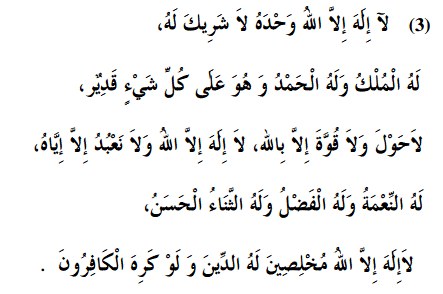
(3) MUSLIM reported (no.594): “And Muhammad ibn `Abdillaah ibn Numayr narrated to us: My father narrated to us: Hishaam narrated to us: from AbuzZubayr who said: “Ibn az-Zubayr used to say at the end of every Prayer when he had given the Salutation:

La ilaha illal-lah, wahdahu la shareeka lah, lahul-mulku walahul-hamd, wahuwa ‘ala kulli shayin qadeer. la hawla wala quwwata illa billah, la ilaha illal-lah, wala na’budu illa iyyah, lahun-niAAmatu walahul-fadl walahuth-thana-ol- hasan, la ilaha illal-lah mukhliseena lahud-deen walaw karihal-kafiroon.

[None has the right to be worshipped except Allaah, alone, having no partner. Sovereignty is His and all praise is for Him, and He has full power over everything. There is no change and no ability except with (the Aid of) Allaah. None has the right to be worshipped except Allaah, and we do not worship except Him. All blessings are from Him and all favour is from Him, and fine praise is for Him. None has the right to be worshipped except Allaah, we make the Religion purely and sincerely for Him-even though the Disbelievers detest that],

and he said: “Allaah’s Messenger (صلى الله عليه و سلم) used to repeat these words after every Prayer.”

Dhikr #4

Dhikr After Obligatory Prayer - Dawud Burbank - 04

(4) (a) Saying: ‘Subhaanallaah’, ‘al-hamdu lillaah’, and ‘Allaahu Akbar’- thirty three times each after every Prayer.
[al-Bukhaaree (no. 843) and Muslim (no. 595) from a hadeeth of Aboo Hurairah-radiyallaahu `anhu]

or (b) Saying: ‘Subhaanallaah’ -thirty-three times, ‘al-hamdu lillaah’ -thirty-three times, and ‘Allaahu akbar’ -thirty-four times-after every Prayer. [Reported by Muslim (no. 596) from a hadeeth of Ka`b ibn `Ujrah-radiyallaahu `anhu]

or (c) Saying: ‘Subhaanallaah’ -thirty-three times, ‘al-hamdu lillaah’ -thirty-three times, and ‘Allaahu akbar’ -thirty-three times- and then: لا إلهَ إلاّ اللّهُ وَحْـدَهُ لا شريكَ لهُ، لهُ الملكُ ولهُ الحَمْد، وهُوَ على كُلّ شَيءٍ قَـدير
whoever does so after every Prayer then his sins will be forgiven even if they are like the foam of the sea.
[Reported by Muslim (no.597) from a hadeeth of Aboo Hurairah-radiyallaahu `anhu]

or (d) Saying: ‘Subhaanallaah’ -twenty-five times, ‘al-hamdu lillaah’ -twenty-five times, ‘Allaahu akbar’ -twenty-five times ‘Laa ilaaha illallaah’ -twenty-five times
[Reported by an-Nasaa.ee (no. 1350) from a hadeeth of Zayd ibn Thaabit-radiyallaahu `anhu and declared ‘Saheeh’ by Shaikh al-Albaanee-rahimahullaahu.]

or (e) ) Saying: ‘Subhaanallaah’ -ten times, ‘al-hamdu lillaah’ -ten times, ‘Allaahu akbar’ -ten times.
[Reported by al-Bukhaaree (no.6329)-from a hadeeth of Aboo Hurairah-radiyallaahu `anhu]

Dhikr #5

Dhikr After Obligatory Prayer - Dawud Burbank - 05

(5) ABOO DAAWOOD reported (no. 1522): “ `Ubaydullaah ibn `Umar ibn Maysarah narrated to us: `Abullaah ibn Yazeed al-Muqri. narrated to us: Haywah ibn Shurayh narrated to us, saying: I heard `Uqbah ibn Muslim say: Aboo `Abdir-Rahmaan al-Hubulee narrated to me: from as-Sunaabihee: from Mu`aadh ibn Jabal: that Allaah’s Messenger (صلى الله عليه و سلم ) took hold of his hand and said:

<>
So he said: << I counsel you, O Mu`aadh: Do not leave off saying at the end of every Prayer:

اللّهُـمَّ أَعِـنِّي عَلـى ذِكْـرِكَ وَشُكْـرِك ، وَحُسْـنِ عِبـادَتِـك

[O Allaah help me upon remembrance of You, giving thanks to You, and worshipping You in a fine manner].>>

And Mu`aadh counselled as-Sunaabihee with that, and as-Sunaabihee counselled Aboo `Abdir-Rahmaan with it.”

[Shaikh al-Albaanee-rahimahullaah-said in ‘Saheeh Sunan Abee Daawood’ (no. 1362): “ I say: Its chain of narration is ‘Saheeh’ and it was declared ‘Saheeh’ by Ibn Khuzaymah and Ibn Hibbaan (2017)…

And the hadeeth is reported by Ahmad (5/244-245), Ibn Khuzaymah in his ‘Saheeh’ (751), and likewise Ibn Hibbaan (no. 2345), and Aboo Nu`aym in ‘al-Hilyah’ (1/241 & 5/130) through other chains from `Abdullaah ibn Yazeed al-Muqri… with it, and they add: “And Aboo `Abdir-Rahmaan counselled `Uqbah ibn Muslim.” And Aboo Nu`aym added: “And `Uqbah counselled Haywah, and Haywah counselled Aboo `Abdir-Rahmaan al-Muqri., and Aboo `Abdir-Rahmaan al-Muqri., counselled Bishr ibn Moosaa, and Bishr ibn Moosaa counselled Muhammad ibn Ahmad ibn al-Hasan, and Muhammad ibn Ahmad al-Hasan counselled me.

Aboo Nu`aym-rahimahullaah said: “And I counsel you (all) with it.” I say: This hadeeth is from the famous hadeeth reported with a serial chain, mentioning love, and I was given ijaazah to narrate it by the virtuous Shaikh Raaghib at-Tabbaakhrahimahullaah, and he narrated it to me… and he reported its isnaad in this manner mentioning love at each stage of the chain.]

Dhikr #6

Dhikr After Obligatory Prayer - Dawud Burbank - 06

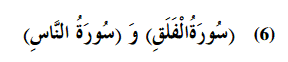
(6) AT-TIRMIDHEE reported (no.2903): “Qutaybah narrated to us, saying: Ibn Lahee`ah narrated to us: from Yazeed ibn Abee Habeeb: from `Alee ibn Rabaah: from `Uqbah ibn `Aamir who said: “Allaah’s Messenger (صلى الله عليه و سلم) commanded me to recite the two Soorahs of seeking refuge (alMu`awwidhatayn) at the end of every Prayer..” [Declared ‘saheeh’ by Shaikh al-Albaanee-rahimahullaah.]

Dhikr #7

Dhikr After Obligatory Prayer - Dawud Burbank - 07

(7) AN-NASAA.EE reported in ‘`Amalul-Yawm wal-Laylah’ (no. 100): “alHusayn ibn Bishr related to us in Tarsoos-we wrote from him, saying: Muhammad ibn Himyar narrated to us, saying: Muhammad ibn Ziyaad narrated to us: from Aboo Umaamah who said: Allaah’s Messenger (صلى الله عليه و سلم) said:<> [Shaikh al-Albaanee declared the hadeeth ‘Saheeh’ in ‘as-Saheehah’ (no. 972)].

Dhikr #8

Dhikr After Obligatory Prayer - Dawud Burbank - 08

(8) AL-BUKHAAREE reported (no. 2822): “Moosaa ibn Ismaa`eel narrated to us: Aboo `Awaanah narrated to us: `Abdul-Malik ibn `Umayr narrated to us, saying: I heard `Amr ibn Maymoon al-Awdee say: Sa`d used to teach his sons these words, just as a teacher teaches boys to write, and he used to say that Allaah’s Messenger (صلى الله عليه و سلم) would seek refuge (with Allaah) from them at the end of the Prayer:

Allahumma innee a’oothu bika minal-jubn, wa-a’oothu bika min an oradda ila arthalil- ‘umur, wa-a’oothu bika min fitnatid-dunya wa wa-a’oothu bika min ‘athabil-qabr.

[O Allaah! I seek Your refuge from cowardice, and I seek Your refuge from being brought back to senile old age, and I seek Your refuge from the trials of the world, and I seek your refuge from the punishment of the grave]

So I narrated it to Mus`ab and he affirmed it.”

Dhikr #9

Dhikr After Obligatory Prayer - Dawud Burbank - 09

(9) AN-NASAA.EE reported (no. 1347): `Amr ibn `Alee related to us, saying: Yahyaa narrated to us: from `Uthmaan ash-Shahhaam: from Muslim ibn Abee Bakrah who said: My father used to say at the end of the Prayer:

[O Allaah! I seek Your refuge from Unbelief, and poverty, and the punishment of the grave].

So I used to say it, so my father said: “Who did you take this from?” So I said: “From you!” He said: “Allaah’s Messenger (صلى الله عليه و سلم ) used to say it at the end of the Prayer.”

[Shaikh al-Albaanee said: “Its isnaad is ‘Saheeh’”]

Dhikr #10

Dhikr After Obligatory Prayer - Dawud Burbank - 10

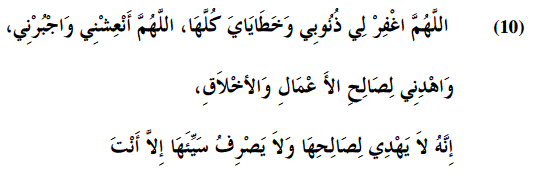
(10) IBNUS-SUNNEE reported in `Amalul-Yawm wal-Laylah’ (no. 116), and AT-TABARAANEE in ‘al-Kabeer’ (nos.7811 & 7893) (& 7982)… from Aboo Umaamah-radiyallaahu `anhu-who said:

“I never drew near to Allaah’s Messenger (صلى الله عليه و سلم ) at the end of an obligatory or optional Prayer except that I heard him saying:

[O Allaah forgive me all of my sins and shortcomings. O Allaah raise me and restore me, and guide me to righteous deeds and manners; no one can guide to that which is righteous from them, nor repel that which is bad from them besides You].”

[Declared ‘hasan’ (i.e. due to supporting narrations) by Shaikh al-Albaanee in ‘SaheehulJaami`’ (no. 1266) and Shaikh Saleem al-Hilaalee in ‘Saheeh Kitaabil-Adhkaar’ (189/154).]

Dhikr #11

Dhikr After Obligatory Prayer - Dawud Burbank - 11

(11) AN-NASAA.EE reported [Book of ‘Sahw’ (Forgetfulness)]:Chapter (87): Another type of dhikr after the Salutation (no.1344):

“Muhammad ibn Ishaaq as-Saaghaanee related to us, saying: Aboo Salamah alKhuzaa`ee-Mansoor ibn Salamah narrated to us, saying: Khallaad ibn Sulaymaan narrated to us, saying Aboo Salamah said: and he was on e of those who were fearful: From Khaalid ibn Abee `Imraan: from `Urwah: from `Aa.ishah: that when Allaah’s Messenger (صلى الله عليه و سلم) had sat in a gathering or prayer he would say some words. So `Aa.ishah asked him about the words, so he said:

<

[I declare You free of all imperfections, O Allaah, and all praise is for You. I seek Your forgiveness and turn in repentance to You.].”

[Shaikh al-Albaanee-rahimahullaah-declared it ‘Saheeh’.]

[Compiled and translated by Abu Talhah Dawud Burbank rahimahullaah]

Click the below link to read or download PDF

Authentic Adhkaar (Remembrance) after the Salaah (Prayer) – Dawud Burbank [PDF]

Timings of Salah (Prayers) – Dr Saleh as Saleh [Audio|En]

Umdatul ahkaam – Salaah – 44 – Timings of Prayers – part 1
[audio https://salafiaudio.files.wordpress.com/2014/09/umdatul-ahkaam-salaah-44-timings-of-prayers-part-1-saleh-as-saleh.mp3]

Umdatul ahkaam – Salaah – 45 – 47 – Times of Salaah – part 2
[audio https://salafiaudio.files.wordpress.com/2014/09/umdatul-ahkaam-salaah-45-47-times-of-salaah-part-2-saleh-as-saleh.mp3]

Umdatul ahkaam – Salaah – 49 – 50 – Times of Salaah – part 3
[audio https://salafiaudio.files.wordpress.com/2014/09/umdatul-ahkaam-salaah-49-50-times-of-salaah-part-3-saleh-as-saleh.mp3]

SourceUmdatul Ahkaam – Book of Salaah – Dr. Saleh as Saleh [Audio|En]

Salah – Facing the Qiblah – Umdatul ahkaam – Dr Saleh as Saleh [Audio|En]

Umdatul ahkaam – Salaah – 64 – Facing the Qiblah – part 1
[audio https://salafiaudio.files.wordpress.com/2014/09/umdatul-ahkaam-salaah-64-facing-the-qiblah-part-1-saleh-as-saleh.mp3]

Umdatul ahkaam – Salaah – 65 – Rulings on Qiblah – part 2
[audio https://salafiaudio.files.wordpress.com/2014/09/umdatul-ahkaam-salaah-65-rulings-on-qiblah-part-2-saleh-as-saleh.mp3]

Umdatul ahkaam – Salaah – 66 – Rulings on Qiblah – part 3
[audio https://salafiaudio.files.wordpress.com/2014/09/umdatul-ahkaam-salaah-66-rulings-on-qiblah-part-3-saleh-as-saleh.mp3]

Umdatul ahkaam – Salaah – 67 – Rulings on Qiblah – part 4
[audio https://salafiaudio.files.wordpress.com/2014/09/umdatul-ahkaam-salaah-67-rulings-on-qiblah-part-4-saleh-as-saleh.mp3]

SourceUmdatul Ahkaam – Book of Salaah – Dr. Saleh as Saleh [Audio|En]

Prostration of Forgetfulness in Prayer – Shaykh Uthaymeen

Prostration of Forgetfulness in Prayer – by Shaykh Muhammad Saleh Al Uthaymeen [PDF] Translated by Aboo Talhah Dawood ibn Ronald Burbank

Click the below link to read or download PDF

The Prostration of Forgetfulness – Shaykh Uthaymeen – Dawood Burbank [PDF]

Times Of Salah – Bulugh Al Maraam – Umm Abdillaah al-Waadi’eeyyah

Click the below link to read or download article

Notes from Bulughul Maraam – Umm ‘Abdillaah Al-Waadi’iyyah – BM-129 143 Times Of Salah [PDF]

When is it Forbidden to Pray ? – Dr. Saleh as Saleh

Based upon benefits from the duroos of our Sh. Muhammad bin Salih Al-‘Uthaimeen (rahimahullaah) And those our Sh. Saami As-Sghair (hafidhahullah)- Summer 1427 AH.

Click the below link to read or download the article

Points of Benefit – Times When it is Forbidden to Pray – Dr Saleh as Saleh [PDF]

Read the Article Below:

All Praise is due to Allah, and may the salaah and salaam be on Prophet Muhammad, his household, the noble companions and those who follow them until the Day of Resurrection.

Times When it is Forbidden to Pray

There are five times when it is forbidden to pray; three of them are severe, and two are less severe. The five times are as follows:

1) From after the fajr prayer until the sun has risen
2) From sunrise until the sun has risen to the height of a spear (approximately one meter) above the horizon
3) From when the sun is at midday, until it passes the meridian
4) From after salaat al-asr until the sun reaches the height of a spear above the horizon
5) From the time the sun has reached the height of a spear from its setting till sunset.

The severe times when it is forbidden to pray are those which are short (namely the second, third, and fifth cases mentioned above). Also, it is forbidden to bury the dead during these times as in the hadith of Uqbah ibn ‘Aamir (radhi Allaahu anhu) in Saheeh Muslim where the Prophet (صلى الله عليه وسلم) mentioned it was not permissible to bury the dead during these three times. If we take our deceased to the cemetery and the sun has just risen, then it is not allowed to bury that person until the sun has risen the height of a spear. After that, we can bury the dead, and similarly with respect to the other times.

Exception to the Prohibition for a Fard Salaah

In general, the salaah is forbidden during these times; however, there are exceptions. The first exception is the missed prayers. For instance, if a man has missed a fard prayer, he can pray it during a forbidden time, even if that time is severe in terms of forbiddance. This is in accordance with the hadith of the Prophet (صلى الله عليه وسلم)

“Whoever forgets a prayer or sleeps and misses it, let him pray it when he remembers it, for there is no other expiation for it than that.”

[Reported by al-Bukhari (hadith no. 572) and Muslim (hadith no. 1564)]

The statement of the Prophet (صلى الله عليه وسلم) “let him pray it when he remembers it” is general and has no exception. Since this is an asserted fareedah(obligation), the prayer in this case should not be delayed after the person remembers it or awakes.

Exception to the Prohibition for a Salaah with a Cause

The second type of salaah that is excluded from this prohibition, according to the preponderating opinion, is those that have a cause for it; these can be prayed in the forbidden times. This is a narration from Imam Ahmad (rahimahullaah) and the choice of Shaykh al-Islam ibn Taymiyyah (rahimahullaah). An example of this is repeating the jama’ah; for instance, if a person prays fajr in congregation and goes to another mosque finding the people in prayer there, then in this case, it is permissible for him to pray with them, without sin. The evidence for this is that the Prophet (صلى الله عليه وسلم) when he was in Mina prayed fajr; after salaah, he saw two men who did not pray with him so he inquired as to why they did that. The men responded that they had already prayed in their residence. The Prophet (صلى الله عليه وسلم) said,

“If you do so and you come to a mosque where there is congregation prayer, then pray with them, and it will be naafil for you.”

Another example is when a person makes tawaaf, it is Sunnah to pray two rakat behind the station of Ibrahim (‘alayhis sallam). As such, if a person makes tawaaf after fajr, it is permissible for him to make these two rakat. The evidence is in the saying of the Prophet to Bani ‘Abd Manaf,

“O Bani ‘Abd Manaf, do not prevent anyone who makes tawaaf around this house or prays therein (i.e. in the masjid) any hour he wishes from the day or the night.”

Some of the ‘ulama considered this hadith as evidence to perform the two rakat following the tawaaf, even if it was during one of the forbidden times.

Also, from this exception is on the day of juma’ah, if the imam is giving the khutbah (sermon), then the person may offer the tahiyyat al-masjid even at the time when the sun is at its meridian. This is because once when the Prophet was delivering the khutbah, a man came into the masjid and sat down. The Prophet asked him if he had prayed, and the man replied in the negative. To this, the Prophet (صلى الله عليه وسلم) said, “Stand up and offer two rakat and make them light.”

The fourth instance from the second type of exception is the entrance to the masjid. For example, if a person enters the masjid after the fajr prayer or salaat al-asr, then he should not sit until he offers two rakat. This is because this salaat has a cause, namely the entrance to the masjid.

Fifth, upon the eclipse of the sun, it is permissible to pray the associated prayer.

The sixth type of salaah that is permitted during a forbidden time is the two rakat after the wudhu. This is because this salaat has a legal cause, namely the wudhu.

Seventh, it is permissible to make salaat al-istikharaah during the forbidden times. Salaat al-istikharaah is when a person makes two rakat and then asks Allah to guide him when he is uncertain about a certain matter. Suppose there arises a situation where someone needs to make this salaat, but this occurred during a time when it is forbidden to pray. In this case, it is permissible for him to pray these two rakat because of the associated cause.

Conclusion

Therefore, the hadith that there is no salaat after fajr or asr is general, particularized in cases where the person offers a salaat that has a cause; in such a situation, it is not forbidden. This is one narration from Imam Ahmad and the choice of Shaykh al-Islam ibn Taymiyyah. It is also the madhab of Imam ash-Shafa’i (rahimahullaah), and it is the correct opinion.

And Allaah, the Most High, Knows Best.

All Praise is due to Allah, and may the salaah and salaam be on Prophet Muhammad, his household, and the noble companions and those who follow them until the Day of Resurrection.

Saleh As-Saleh
22nd Rajab, 1427 AH
August 16, 2006

Description Of Salah – Bulugh Al Maraam – Umm Abdillaah al-Waadi’eeyyah

Click the below link to read or download PDF

Notes from Bulughul Maraam – Umm ‘Abdillaah Al-Waadi’iyyah – BM-210 252 Description of Salah [PDF]

Rulings on Movements in Prayers – Shaykh Uthaymeen |Dr. Saleh As-Saleh

Click the below link to read or download PDF

Points of Benefit Regarding Movements in Salaah – Dr Saleh as Saleh [PDF]

Read the Article Below:

Points of Benefit Regarding Movements in Salaah
Rulings on Movements in Prayers
Prepared by Saleh As-Saleh

Based upon several talks & Fatawaas by our Sh. Muhammad bin Salih Al-‘Uthaimeen (rahimahullaah)
Transcribed by sis Umm ‘Ali, Haleima el Amazighia, from live duroos in Paltalk’s “Understanding Islam 1” room Text Edition by sis Umm Ahmad, al-Kanadiyyah

In the Name of Allaah, the Most Beneficent, the Most Merciful. I testify that there is no true god worthy of worship except Allaah and that Muhammad is Allaah’s true slave and Messenger.

In the Hadeeth of the Prophet (صلى الله عليه وسلم) concerning the redirecting the direction in the prayers towards Makkah, we know that the companions moved while in Salaah when the command came to redirect towards the Qiblah, a move for the benefit of the Salaah. And thus their move was an obligatory one, since it is inevitable that they must face the Qiblah.

“The Prophet prayed facing Bait-ul-Maqdis (i.e. Jerusalem) for sixteen or seventeen months but he wished that his Qibla would be the Ka’ba (at Mecca). (So Allah Revealed (2.144) and he offered ‘Asr prayers (in his Mosque facing Ka’ba at Makkah) and some people prayed with him. A man from among those who had prayed with him went out and passed by some people offering prayer in another mosque, and they were in the state of bowing. He said, “I, (swearing by Allah,) testify that I have prayed with the Prophet facing Makkah.” Hearing that, they turned their faces to the Ka’ba while they were still bowing. Some men had died before the Qibla was changed towards the Ka’ba. They had been killed and we did not know what to say about them (i.e. whether their prayers towards Jerusalem were accepted or not). So Allah revealed: — “And Allah would never make your faith (i.e. prayer) to be lost (i.e. your prayers offered (towards Jerusalem). Truly Allah is Full of Pity, Most Merciful towards mankind.” (2.143) [see Bukhari, vol. 6, no. 13].

The movements in Salaah can be classified into five categories:

1. Waajibah (obligatory)
2. Mustahabah (recommended or praiseworthy)
3. Muharamah (forbidden)
4. Makroohah (disliked)
5. Mubaahah (allowable)

1. The movement which is obligatory is the one upon which an obligation or an abstention from something unlawful depends.

For example, if a person is told that the Qiblah is to his right, while in the prayer, it is obligatory upon him, to move so as to face the Qiblah.

Similar to this is if a person is praying alone behind the row, then it becomes clear to him that there is a gap in the row in front of him, then the movement to close this gap and for him to enter the row, becomes in this case obligatory.

Also, if the avoidance of something haraam depends upon this movement, then the movement becomes obligatory. For example, a man is praying and sees on his headcover, or turban or hat, some impurity, some filth. In this case he must move to take off this head-cover. And from this is the incident which took place with the Prophet (صلى الله عليه وسلم) when Jibreel (‘alayhi salaam) came to the Prophet (صلى الله عليه وسلم) while he was leading the people in Salaah and he told him that there was some Najaasah (impurity) on his shoes. So he took them off since this is an obligation:

Abu Sa’eed reported that the Prophet removed his shoes and the people behind him did likewise. When he finished the prayer, he asked, “Why did you remove your shoes?” They said, “We saw you remove yours.” He said, “Gabriel came to me and informed me that there was some filth on them. Therefore, when one of you comes to the mosque, he should turn his shoes over and examine them. If one finds any dirt on them, he should rub them against the ground and pray with them on.” [The hadeeth is related by Ahmad, Abu Dawood (650, English), al-Hakim, Ibn Hibban and Ibn Khuzaimah. The latter graded it as saheeh. This narration from Abu Sa’eed is declared saheeh also by An-Nawawi, Ibn Katheer, Ibn Hajar and al-Albaani]

2. When the movement is praiseworthy or recommendable. This is when a recommended action depends upon it.

Take for example a group of three persons who established the congregational prayer. One stood to the right of the Imaam and the other stood to his left. In this case the Imaam would gently push them to his back, behind him. This pushing is recommended.

Also this is recommended if done to prevent something disliked. For example, if in front of you there is something distracting your calmness in Salaat, like decoration-type, then it is recommended for you to take it away, because they take away from your khushoo’.

And from that, if a person feels the need to scratch on some part of his body, like some itching on his head or on his hand, and it is distracting him, he needs to scratch it. In this case it is recommended for him to scratch it, and this happens a lot.

3. The movement in Salaah is forbidden if it is frequent and successive without necessity.

Some of the scholars (rahimahumullaah) mentioned that the frequency is determined by three movements. So, if the person makes three consecutive moves without need then this nullifies the prayer.

Other scholars (rahimahumullaah) state that, there is no justification to limit this to a number, because this requires a daleel (evidence). The criteria of what constitutes many moves is what is commonly conventional to be many, such that if the person is seen doing that, it would appear that as if he is not praying. And these moves are to be consecutive – one after the other and without a need to do so.

So, for example we see some people making many consecutive and unnecessary moves, checking his garment, hat, checking the time, moving a pen from one pocket to another, and so forth. But if, on the other hand, while in prayer, he hears some sounds behind him and all of the sudden there is a beast or a lion or something dangerous coming towards him, so he runs away. Although in this case he is making many moves, this is for a necessity and therefore this does not nullify his prayers.

4. The fourth movement in Salaah is that which is disliked. These are few while there is no need for them.

People do this a lot nowadays. Sometimes you see them looking at their watch during Salaah. And it is the Shaytaan who incites these people to make such moves.

5. The final category is the movement that is allowable.

These are slight moves because they may be needed, or many moves because of necessity.

6-There remains one kind of category, which is the core of the Salaah and that is the heart-movement.

If the heart is directed to Allaah ‘Azza waj Jaal (Most Might and Magnificent) and the believer feels that he is standing before Allaah (سُبْحَانَهُ وَ تَعَالَى), between His Hands, and he has a sincere longing to draw near to Him in his Salaah and he fears Him, then in this case his heart is present and in submissiveness and humility. And this is the most perfect situation. If otherwise, then his heart will go in all directions. As in the Hadeeth of ‘Ammaar bin Yaasir (radiya allaahu ‘anhu):

I heard Allaah’s Messenger (صلى الله عليه وسلم) say: “A man returns after saying his prayer while a tenth part of his prayer, or a ninth part, or an eighth part, or a seventh part, or a sixth part, or a fifth part, or a third part, or half of it, is recorded for him.” [Abu Dawood, no. 789; declared hasan by al-Hafidh al-‘Iraqi, and al-Albani].

So, the self-talk which may occur in the Salaah, it takes out of its perfection, but it does not nullify it.

All Praise is due to Allaah, and may Allaah’s Salaah and Salaam be upon our Prophet Muhammad (صلى الله عليه وسلم), his pure household, the noble companions, and those who follow on their Path. Aameen.

Saleh As-Saleh
26-5-1427 AH
June 22, 2006

Rulings on facing the Qiblah in the Prayers – by Saleh As-Saleh

Click the below link to read or download PDF

Points of Benefit Regarding Al-Qiblah – Dr Saleh as Saleh [PDF]

Listen / Download Mp3 Here (Time 49:30)
[audio https://salafiaudio.files.wordpress.com/2014/11/points-of-benefit-in-salaat-24-concerning-direction-of-qiblah-dr-saleh-as-saleh.mp3]

Description of Witr Salaah (Prayer) – Dr. Saleh-As-Saleh [Audio|En]

Listen / Download Mp3 Here (Time 8:50)
[audio https://salafiaudio.files.wordpress.com/2014/09/salaah-in-islam-witr-salaah-description-saleh-as-saleh.mp3]

An Explanation of The Du’aa of Qunoot – by Shaykh Muhammad Saleh Al Uthaymeen

This is a concise explanation of the Du’aa, or supplication that is said during the Witr prayer. This explanation was given by Shaykh Muhammad Ibn Saalih al-‘Uthaymeen, may Allaah have mercy on him, during his lectures which he used to present in the central mosque in Mecca (al-Masjid al-Haraam) during the blessed month of Ramadhaan. This Article includes Memorization Chart & Glossary

Click the below link to read or download PDF

The Du’aa of Qunoot during Witr Prayer – Shaykh Uthaymeen [PDF]

Sutrah in Salaat – by Dr. Saleh As-Saleh [Audio|En]

Listen / Download Mp3 Here (Time 36:34)

Sutra – Bulugh Al Maraam – Umm ‘Abdillaah al-Waadi’eeyyah

Click the below link to read or download PDF

Notes from Bulughul Maraam – Umm ‘Abdillaah Al-Waadi’iyyah – BM-180 186 Sutra [PDF]