Click the Below link to read :
From the Book Explaining the Fundamentals of faith – by Shaykh Muhammad Saleh Al Uthaymeen, Translated by Dr. Saleh as Saleh.
Islamic Knowledge – Islam, Sunnah, Salafiyyah

Click the Below link to read :
From the Book Explaining the Fundamentals of faith – by Shaykh Muhammad Saleh Al Uthaymeen, Translated by Dr. Saleh as Saleh.
AUTHOR: Shaikh Saalih bin Fawzaan Al-Fawzaan
TRANSLATED: Al-Ibaanah Book Publishing
PRODUCED BY: Al-Ibaanah.com
About the Book:
This is a complete translation of a short treatise called “Al-Eemaan bil-Malaa’ikah wa Atharuhu fee Hayaat-il-Ummah” [Belief in the Angels and its Effect in the Life of the Ummah] written by Shaikh Saalih bin Fawzaan Al-Fawzaan, a member of the Council of Senior Scholars in Saudi Arabia. The source used for this translation was the Arabic version found on the Shaikh’s web site: alfuzan.net.
Although this treatise is short in size, it provides many proofs and evidences for the descriptions, duties and general characteristics of the angels, and gives many splendid points of benefit concerning the angels and our place with respect to them.
As the author mentions in this treatise, our purpose for learning about the angels is not just for the sake of knowing about them for our general understanding, but rather, it is so that we can become conscious of their constant presence around us and their effect in our daily lives. Also, if we become conscious of the fact that there are two angels with us at all times recording our statements and actions, we would become cautious of what we say and do lest our guardian angels record something about us for which we will be held accountable before Allaah. In addition to this, we must also bear in mind that Belief in the Angels is one of the six pillars of Eemaan, which every Muslim is obligated to have knowledge of.
Quotes from the Book:
“These are the three angels that are responsible for life. Jibreel is responsible for bringing the revelation, which brings life into the hearts. Mikaa’eel is responsible for the raindrops, which bring life to the earth after its death. Israafeel is responsible for blowing on the trumpet, which will bring life to the bodies (on the Day of Resurrection). This is why when the Prophet would get up for prayer at night, after saying the opening Takbeer, he sallallaahu alaihi wa sallam would say in his opening supplication: ‘O Allaah! Lord of Jibreel, Mikaa’eel and Israafeel, Originator of the heavens and the earth…’”
“Death is ascribed to Allaah here because He is the One who orders it to occur. It is also ascribed to the angels because they are the ones who physically carry that out by gathering the soul and leading it out of the human’s body until it reaches his throat. And it is also ascribed to the Angel of Death –‘Say: ‘The Angel of Death, who is set over you, will take your souls’’ – because he is the one in charge of seizing the souls after they have been rounded up in the last stage (of death).”
“There are also angels that are responsible for protecting humans from perils. A human being is prone to walk into dangers everyday. However, Allaah entrusts angels that guard and protect him from these dangers during his lifetime, which Allaah has ordained for him. This earth, which a human being walks upon everyday, contains many dangers. There are wild beasts, snakes, scorpions, not to mention transgressors from among humans – enemies and oppressors. However, Allaah has placed these angels around the human being. Allaah says: ‘He (a person) has those (angels) who constantly surround him – from before him and behind him, protecting him by the Command of Allaah.’ [Surah Ar-Ra’ad: 11] Therefore, so long as Allaah has decreed that this individual will be safe from harms, these angels will protect and guard him, and no human will be able to harm him. But if Allaah desires to bring an end to his appointed time, He removes them from him – one from before him and one from behind him.”
“Belief in the Angels has a tremendous effect on the life of humans, since if a person is aware of them, he will indeed be cautious and mindful. If a person realizes that there are angels entrusted to him who constantly surround him day and night, he will surely be cautious of what he says and does, lest something is recorded about him that is not befitting. So if he knew that there were investigators following him, wouldn’t he be cautious out of fear that they might take hold of some speech or action of his which will cause him a harmful end? So how can he not then be cautious and mindful of the angels when he doesn’t see them? But as for humans, you can see them. So the one who is watching you and you can see him, you are wary about him. However, the angels see you but you cannot see them. It is possible that you might be able to protect yourself from humans – you can go inside your home or lock yourself up in some secluded area and they would not be able to gain any information about you. But as for the angels, they enter with you everywhere. Allaah has given them the ability to reach and access any place that He commands them to reach.”
Click the Below Link to the PDF Document
Belief in the Angels and its effect on the life of the Ummah- Shaykh al Fawzan- Al-Ibaanah.com [PDF]
Click the Below Link to read the PDF Document
al-Qawl-ul- Mufeed Fee Adillatit-Tawhid – 15 – Muhammad al-Wasabi [PDF]
Source: Lessons on Tawhid – Approximately 50 Classes – from Dar-ul-Hadith, Dammaj, Yemen
Conditions of ‘La ilaha ‘illa Allaah’ ‘There is none worthy of worship in truth except Allaah’
By Hafidh al-Hakami -Rahimahullaah-
Taken from his book ‘Ma’arij al-Qabool’
Translated by Abbas Abu Yahya
The first Condition: al-Ilm – Knowledge
The meaning of ‘La ilaha ‘illa Allaah’ and its intent are affirmation and negation, so knowledge negates ignorance.
Allaah –Azza wa Jal- said:
<< So know that La ilaha ‘illa Allaah (none has the right to be worshipped in truth except Allaah) >> [Muhammad: 19]
Allaah –Ta’ala- said:
<< except those who bear witness to the truth >> [Zukhruf: 86]
Which means that they testify to ‘La ilaha ‘illa Allaah’ << while they know>> [Zukhruf: 86] with their hearts and they pronounce its meaning with their tongues.
Allaah –Ta’ala- said:
<<Allaah bears witness that La ilaha ‘illa Huwa (none has the right to be worshipped but He), and the angels and those having knowledge (also give this witness); (He is always) maintaining His creation in Justice. La ilaha ‘illa Huwa (none has the right to be worshipped but He), the All-Mighty, the All-Wise.>> [Aali-‘Imran: 18]
Allaah –Ta’ala- said:
<<Say: ‘Are those who know equal to those who do not know?’ It is only men of understanding who will remember (i.e. get a lesson from Allaah’s Signs and Verses)>> [Zumar: 9]
Allaah –Ta’ala- said:
<< It is only those who have knowledge among His slaves that fear Allaah>> [Faatir: 28]
Allaah –Ta’ala- said:
<< And these similitudes We put forward for mankind, but none will understand them except those who have knowledge (of Allaah and His Signs, etc.)>> [Ankaboot: 43]
In the Saheeh of Imaam Muslim on the authority of ‘Uthmaan –RadhiAllaahu anhu- who said that: the Messenger of Allaah – sallAllaahu alayhi wa sallam – said: ‘Whoever dies knowing ‘La ilaha ‘illa Allaah’ entersParadise.’
The Second Condition: Al-Yaqeen – Certainty
The second condition is certainty which negates doubt, such that the one who pronounces ‘La ilaha ‘illa Allaah’ does it with certainty of what these words indicate, with a decisive certainty. This is sinceEemaan cannot do without certain knowledge (Ilm al-Yaqeen), as opposed to suspicious knowledge (Ilm al-Thann), and what would be the case if doubt entered Eemaan?
Allaah -Azza wa Jal- said:
<<Only those are the believers who have believed in Allaah and His Messenger and afterward doubt not but strive with their wealth and their lives for the Cause of Allaah. Those! They are the truthful. >>[Hujuraat: 15]
So certainty was a condition for them having truthfulness in theirEemaan in Allaah and His Messenger and also that they did not have uncertainty or doubt ‘La ilaha ‘illa Allaah’.
As for uncertainty then that comes from the Munafiqeen (hypocrites) – and we seek refuge with Allaah. They were the ones about whom Allaah -Ta’ala- said:
<< It is only those who believe not in Allaah and the Last Day and whose hearts are in doubt that ask your leave (to be exempted fromJihaad). So in their doubts they waver >> [Tawbah: 45]
In the Saheeh of Imaam Muslim from the hadeeth of Abu Huraira –RadhiAllaahu anhu- who said that the Messenger of Allaah – sallAllaahu alayhi wa sallam – said: ‘I testify that none is worthy of worship in truth except Allaah and that I am the Messenger of Allaah. There is no servant of Allaah who meets Allaah with these two testifications, not doubting in them, except that he enters Paradise.’
In another narration: ‘there is no servant of Allaah who meets Allaah with these two testifications, not doubting in them, who is prevented from entering Paradise.’
Also in the Saheeh of Muslim on the authority of Abu Huraira –RadhiAllaahu anhu- from the long hadeeth that the Prophet – sallAllaahu alayhi wa sallam – sent him with his shoes and said: ‘Whoever you meet behind this garden that testifies ‘La ilaha ‘illa Allaah’ with certainty in his heart then give him the glad tidings of Paradise.’
So the Messenger made the entrance into Paradise of the one who says ‘La ilaha ‘illa Allaah’ conditional upon his having certainty of it in his heart, with no doubt in it. So, if the condition is removed then the reward is also then removed.
Third Condition: al-Qabool – Acceptance
Acceptance of what this statement necessitates is with the heart and the tongue.
Allaah -Azza wa Jal – narrates to us the news of what precededregarding those who were previously saved and regarding the punishment of those who rejected and refused to accept this statement. As Allaah –Ta’ala – said:
<<And similarly, We sent not a warner before you to any town (people) but the luxurious ones among them said: ‘We found our fathers following a certain way and religion and we will indeed follow their footsteps.’
(The warner) said: ‘Even if I bring you better guidance than that which you found your fathers following?’ They said: ‘Verily, We disbelieve in that with which you have been sent.’
So We took revenge of them, then see what was the end of those who denied (Islaamic Monotheism)>> [Zukhruf 23-25]
Allaah -Ta’ala- said:
<< Then (in the end) We save Our Messengers and those who believe! Thus it is incumbent upon Us to save the believers. >> [Yunus: 103]
Allaah -Ta’ala- said:
<< And indeed We did send Messengers before you to their own peoples. They came to them with clear proofs, then We took vengeance on those who committed crimes (disbelief, setting partners in worship with Allaah, sins, etc.), and (as for) the believers it was incumbent upon Us to help (them). >> [Room 47]
He -Subhanahu wa Ta’ala – informed us of what He promised to those who accept ‘La ilaha ‘illa Allaah’ of reward and what He has prepared of punishment for the one who rejects ‘La ilaha ‘illa Allaah’
As Allaah -Ta’ala- said:
<< (It will be said to the Angels): ‘Assemble those who did wrong, together with their companions (from the devils) and what they used to worship instead of Allaah. And lead them on to the way of flaming Fire (Hell);
‘But stop them, verily they are to be questioned.’
‘What is the matter with you? Why do you not help one another (as you used to do in the world)?’
Nay, but that Day they shall surrender,
And they will turn to one another and question one another.
They will say: ‘It was you who used to come to us from the right side [i.e. from the right side of one of us and beautify for us every evil, order polytheism for us, and prevent us from the truth i.e. Islaamic Monotheism and from every good deed].’
They will reply: ‘Nay, you yourselves were not believers.
‘And we had no authority over you. Nay! But you were transgressing people (disobedient, polytheists, and disbelievers).
‘So now the Word of our Lord has been justified against us, that we shall certainly (have to) taste (the torment).
‘So we led you astray because we were ourselves astray.’
Then verily, that Day, they will (all) share in the torment.
Certainly, that is how We deal with Al-Mujrimoon (polytheists, sinners, criminals, the disobedient to Allaah, etc.).
Truly, when it was said to them: ‘La ilaha ‘illa Allaah’ (none has the right to be worshipped but Allaah), they puffed themselves up with pride (i.e. denied it).
And (they) said: ‘Are we going to abandon our (gods) for the sake of a mad poet? >> [Saaffat: 22-36]
Allaah -Ta’ala- made the cause of and the reason for their punishment their arrogance towards ‘La ilaha ‘illa Allaah’ and their belying of those who came with it. So, they did not negate what Allaah negated and they did not affirm what Allaah affirmed, rather they said rejecting and proudly:
<< ‘Has he made the âliha (gods) (all) into One Ilâh (God – Allaah). Verily, this is a curious thing!’
And the leaders among them went about (saying): ‘Go on, and remain constant to your âliha (gods)! Verily, this is a thing designed (against you)!
‘We have not heard (the like) of this among the people of these later days. This is nothing but an invention! >> [Saad: 5-7]
And here they said : <<‘Are we going to abandon our (gods) for the sake of a mad poet? >>
Then Allaah -Azza wa Jal – refuted them and turned that back on them via His Messenger – sallAllaahu alayhi wa sallam – and He said:
<<Nay! He has come with the truth (i.e. Allaah’s Religion – Islaamic Monotheism and this Qur’aan) and he confirms the Messengers (before him who brought Allaah’s religion – Islaamic Monotheism).>> [Saaffat: 37] to the end of the Aayaat.
Then He said about those before them:
<< Except the chosen slaves of Allaah (faithful, obedient, true believers of Islaamic Monotheism). For them there will be a known provision (in Paradise). Fruits; and they shall be honoured, in the Gardens of delight (Paradise) >> [Saaffat: 40-43] to the end of theAayaat.
And Allaah -Ta’ala- said:
<< Whoever brings a good deed (i.e. Belief in the Oneness of Allaah along with every deed of righteousness), will have better than its worth, and they will be safe from the terror on that Day. >>[Naml: 89]
And in the Saheeh on the authority of Abu Musa –RadhiAllaahu anhu- thatthe Prophet – sallAllaahu alayhi wa sallam – said: ‘The like of what Allaah sent me with of guidance and knowledge is like heavy rainfall which poured onto the ground. There was some land which was fertile which absorbed the water and many plants and grass began to grow. There was some land which was arid but it held the water and Allaah made the people benefit by it, so they drank from it, used the water and used it for agriculture.
There was some other land which was affected by the water but was flat land where nothing would grow. It did not hold the water nor did it allow plants to grow. That is the example of the one who has understanding of the Deen and benefits from what Allaah sent me with, so he learns it and teaches it and the example of he whocannot raise his head due to it and does not accept the guidance of Allaah with which I have been sent.’
Fourth Condition
Al-Inqiyaad – Submission & Obedience
Submission and obedience to what ‘La ilaha ‘illa Allaah’ requires and that it negates disobedience.
Allaah -Azza wa Jal – said:
<< And turn in repentance and in obedience with true Faith (Islaamic Monotheism) to your Lord and submit to Him (in Islaam) >> [Zumar: 54]
Allaah -Ta’ala- said:
<<And who can be better in religion than one who submits his face (himself) to Allaah and he is a Muhsin (a good-doer). >> [Nisaa’: 125]
Allaah -Ta’ala- said:
<<And whosoever submits his face (himself) to Allaah, while he is aMuhsin (good-doer), then he has grasped the most trustworthy handhold [La ilaha ‘illa Allaah (none has the right to be worshipped but Allaah)]. >> [Luqman: 22]
Which means holding onto ‘La ilaha ‘illa Allaah’
<< And to Allaah return all matters for decision. >> [Luqman: 22]
The meaning of which is, that he submits his face to Allaah i.e. he obeys Him, and he is a righteous person worshipping Allaah Alone.Whoever does not submit his face to Allaah and is not a righteous person then he has not held onto the most trustworthy handhold that will never break.
That is the meaning of the saying of Allaah -Azza wa Jal which follows:
<<And whoever disbelieved, let not his disbelief grieve you, to Us is their return and We shall inform them what they have done. Verily, Allaah is the All-Knower of what is in the hearts (of men).
We let them enjoy for a little while, then in the end We shall oblige them to (enter) a great torment. >> [Luqman: 23-24]
Fifth Condition
Sidq – Truthfulness
Truthfulness to ‘La ilaha ‘illa Allaah’ negates lying, falsehood and it is to say ‘La ilaha ‘illa Allaah’ truthfully from one’s heart and to make one’s speech in accordance to what is in one’s heart.
Allaah -Azza wa Jal – said:
<<Alif Lâm Mîm. Do people think that they will be left alone because they say: ‘We believe’ and will not be tested.
And We indeed tested those who were before them. And Allaah will certainly make (it) known (the truth of) those who are true, and will certainly make (it) known (the falsehood of) those who are liars, (although Allaah knows all of that before testing them). >> [Ankaboot: 1-3]
Allaah -Ta’ala- said regarding the Munafiqeen (hypocrites) who said‘La ilaha ‘illa Allaah’, speaking falsely:
<<And of mankind, there are some (hypocrites) who say: ‘We believe in Allaah and the Last Day’ while in fact they believe not.
They (think to) deceive Allaah and those who believe while they only deceive themselves and perceive (it) not!
In their hearts is a disease (of doubt and hypocrisy) and Allaah has increased their disease. A painful torment is theirs because they used to tell lies. >> [al-Baqarah: 8-11]
How many times has Allaah -Ta’ala- mentioned them and exposed them, repeatedly exposing their cover and revealing it. He makes their humiliation manifest in more than one place in His Book such as in Soorahs Baqarah, Aali-‘Imran, Nisaa’, Anfaal, Tawbah as well as a whole Soorah dedicated to them (i.e. Al-Munaafiqoon) along withother Soorahs.
In Bukhari and Muslim on the authority of Mu’aadh bin Jabal –RadhiAllaahu anhu- from the Prophet – sallAllaahu alayhi wa sallam -:
‘There is none who testifies that ‘La ilaha ‘illa Allaah and that Muhammad is His slave and Messenger’ truthfully from his heart except that Allaah prohibits him from entering the Fire.’
So Allaah made being saved from the Fire, for the one who says this statement, conditional by saying it truthfully from his heart. Merely pronouncing ‘La ilaha ‘illa Allaah’ does not benefit the one who says it unless there is agreement with the heart.
Also in Bukhari and Muslim from the hadeeth of Anas bin Malik and Talha bin Ubaydullaah –RadhiAllaahu anhumaa– in the story of the Bedouin – who was Damaam bin Tha’alabah, a delegate of Bani Sa’ad bin Bakr – when he asked the Messenger of Allaah – sallAllaahu alayhi wa sallam – about the rulings of Islaam and was then informed by him.He then asked the Messenger – sallAllaahu alayhi wa sallam – ‘Do I have to do anything else?’
The Messenger – sallAllaahu alayhi wa sallam – answered: ‘No, except if you perform it optionally.’
Then the Bedouin said: ‘I swear by Allaah I will not increase uponthat nor decrease from it.’
So the Messenger of Allaah – sallAllaahu alayhi wa sallam – said: ‘He will be successful if he is truthful.’
And in some narrations: ‘Indeed if he is truthful then he will enter into Paradise.’
So the Messenger made it a condition for his success and entrance into Paradise that he was truthful.
Sixth Condition:
Al-Ikhlaas – Sincerity
Sincerity is purifying actions from all the stains of Shirk with righteous intention.
Allaah -Tabaraka wa Ta’ala – said:
<< Surely, the religion (i.e. worship and obedience) is for Allaah only>> [Zumar: 3]
Allaah -Ta’ala- said:
<<And they were commanded not but that they should worship Allaah and worship none but Him Alone >> [al-Bayyinah: 5]
Allaah -Ta’ala- said:
<< So worship Allaah (Alone) by doing religious deeds sincerely for Allaah’s sake only, (not to show-off and not to set up rivals with Him in worship)>> [Zumar: 2]
Allaah -Ta’ala- said:
<< Say: ‘Verily, I am commanded to worship Allaah (Alone) by obeying Him and doing religious deeds sincerely for Allaah’s sake only >> [Zumar :11]
Allaah -Ta’ala- said:
<<Say ‘Allaah Alone I worship by doing religious deeds sincerely for His sake only, not to show off and not setting up rivals with Him in worship.’>> [Zumar: 14]
Allaah -Ta’ala- said:
<<Verily, the hypocrites will be in the lowest depths (grade) of the Fire; no helper will you find for them. Except those who repent (from hypocrisy), do righteous good deeds, hold fast to Allaah, purify their religion for Allaah (by worshipping none but Allaah and do good for Allaah’s sake only, not to show-off), then they will be with the believers. >> [Nisaa: 145-146]
And there are other similar Aayaat.
In the Saheeh of Bukhari on the authority of the Prophet – sallAllaahu alayhi wa sallam : ‘Of those people happiest with my intercession is the one who said ‘La ilaha ‘illa Allaah’ sincerely from his heart or from his self.’
Also, in the Saheeh of Bukhari on the authority of ‘Utbaan bin Malik–RadhiAllaahu anhu- from the Prophet – sallAllaahu alayhi wa sallam – who said: ‘Indeed Allaah prohibited the Fire for the one who said: ‘La ilaha ‘illa Allaah’ desiring by it the Face of Allaah – Azza wa Jal.’
In the Jaami’ of Tirmidhee on the authority of Abu Huraira –RadhiAllaahu anhu- that the Messenger of Allaah –sallAllaahu alayhi wa sallam– said: ‘A slave of Allaah does not ever say ‘La ilaha ‘illa Allaah’ sincerely except that the doors to the heavens are opened for him until it reaches the ‘Arsh, as long as he keeps away from the major sins.’
Tirmidhee said the hadeeth via this chain is Hasan Ghareeb.
Seventh Condition:
Al-Muhabbah – Love
Which is having love for this statement, what it necessitates and indicates, loving its people – those who act upon it, adhering to its conditions – and to hate what violates it.
Allaah -Azza wa Jal – said:
<<And of mankind are some who take (for worship) others besides Allaah as rivals (to Allaah). They love them as they love Allaah. But those who believe love Allaah more (than anything else). >> [al-Baqarah: 165]
Allaah – Ta’ala – said:
<<O you who believe! Whoever from among you turns back from his religion (Islaam), Allaah will bring a people whom He will love and they will love Him; humble towards the believers, stern towards the disbelievers, fighting in the Way of Allaah and never afraid of the blame of th0e blamers. >> [Maa’idah: 54]
Allaah -Azza wa Jal – informed us that His worshippers, the believers, are more severe in their love for Him. That is because they do not associate anyone else with Him in their love for Him, unlike those from the Mushrikeen who claimed they loved Him but then also took partners with Allaah whom they loved just as they loved Him.
The sign that the slave of Allaah loves his Lord is that he submits to what Allaah loves, even if it opposes his desires and that he also hates what his Lord hates, even if his desires are inclined to it. The slave of Allaah is loyal to whomever Allaah and His Messenger are loyal to and he has enmity towards whomever has enmity towardsAllaah.
He follows His Messenger, – sallAllaahu alayhi wa sallam – imitates his example and accepts his guidance. All of these are signs of the presence ofthe conditions of love. It is not conceivable to have love without its conditions being present.
Allaah -Tabaraka wa Ta’ala – said:
<<Have you seen him who has taken as his ilâh (god) his own desire? Would you then be a Wakeel (a disposer of his affairs or a watcher) over him? >> [Furqaan: 43]
Allaah -Ta’ala- said:
<<Have you seen him who takes his own lust (vain desires) as hisilâh (god), and Allaah knowing (him as such) left him astray and sealed his hearing and his heart and put a cover on his sight. Who then will guide him after Allaah?>> [Jaathiyah: 23]
So everyone who worships other than Allaah along with Him, then in reality he worships his own desire. Every sin by which Allaah is disobeyed, it is due to the slave of Allaah submitting to his desires rather than to the commands of Allaah – Azza wa Jal – and the avoidance of His prohibitions.
Allaah -Ta’ala- said regarding loyalty and enmity for the sake of Allaah:
<< Indeed there has been an excellent example for you in Ibraheem and those with him, when they said to their people: ‘Verily, we are free from you and whatever you worship besides Allaah. We have rejected you and there has begun between us and you hostility and hatred forever, until you believe in Allaah Alone’>> [Mumtahana: 4]
Allaah -Ta’ala- said:
<< You will not find any people who believe in Allaah and the Last Day befriending those who oppose Allaah and His Messenger even though they were their fathers, their sons, their brothers or their kindred (people). For such He has written Faith in their hearts >>[Mujadilah:22]
Allaah -Ta’ala- said:
<<O you who believe! Take not the Jews and the Christians asAuliyâ’ (friends, protectors, helpers, etc.), they are but Auliyâ’ to one another. And if any amongst you takes them as Auliyâ’, then surely he is one of them >> [Maa’idah: 51]
Allaah -Ta’ala- said:
<<O you who believe! Take not for Auliyâ’ (supporters and helpers) your fathers and your brothers if they prefer disbelief to Belief. And whoever of you does so, then he is one of the Zâlimûn (wrong-doers, etc.).
Say: If your fathers, your sons, your brothers, your wives, your kindred, the wealth that you have gained, the commerce in which you fear a decline and the dwellings in which you delight … are dearer to you than Allaah and His Messenger and striving hard and fighting in His Cause, then wait until Allaah brings about His Decision (torment). And Allaah guides not the people who are the rebellious, disobedient to Allaah. >> [Tawbah: 23-24]
Allaah -Ta’ala- said:
<< O you who believe! Take not My enemies and your enemies as friends >> [Mumtahana: 1]
to the end of the Soorah. And there are other Aayaat.
[Following the Messenger – sallAllaahu alayhi wa sallam]
Allaah -Ta’ala- said regarding the conditions for following His Messenger – sallAllaahu alayhi wa sallam :
<<Say: ‘If you (really) love Allaah then follow me, Allaah will love you and forgive you of your sins. And Allaah is Oft-Forgiving, Most Merciful.’ Say: ‘Obey Allaah and the Messenger.’ But if they turn away, then Allaah does not like the disbelievers. >> [Aali-‘Imran: 31]
The Messenger of Allaah – sallAllaahu alayhi wa sallam – said: ‘There are three characteristics, whoever has them finds the sweetness of Eemaan: that Allaah and His Messenger are more beloved to him than other than them; that when he loves a person he loves him only for Allaah’s sake and that he hates to return to disbelief after Allaah has saved him from it just as he hates to be thrown into the Hell-Fire’
Narrated by Bukhari and Muslim from the hadeeth of Anas –Radhi’allaahu anhu.
Also, Bukhari and Muslim narrate on the authority of Anas and of Abu Huraira –Radhi’Allaahu anhu– who said that: the Messenger of Allaah – sallAllaahu alayhi wa sallam – said: ‘None of you truly believes until I am more beloved to him than his son, his father and all mankind.’
That is what the Messenger – sallAllaahu alayhi wa sallam – brought, information about Allaah, the commands relating to what Allaah loves and is pleased with and prohibitions of what Allaah dislikes and rejects.
So if the slave of Allaah follows what Allaah commands and keeps away from what Allaah prohibits, even if that opposes his desire, then he is a true believer. So what is the case if he desires nothingother than this?
In a hadeeth: ‘The strongest part of al-Eemaan is loving and hating for the sake of Allaah.’
Ibn ‘Abbas –RadhiAllaahu anhu- said: ‘Whoever loves for the sake of Allaah, hates for the sake of Allaah, is loyal for the sake of Allaah and has enmity for the sake of Allaah then he obtains the alliance of Allaah due to that.
What has become common amongst the people today is a brotherhood based upon the affairs of the Dunya, which does not benefit its people in anything.
Hasan al-Basri and other than him from the Salaf mention that: ‘There were a people who claimed the love of Allaah -Azza wa Jal – so Allaah tried them with this Aayah:
<<Say (O Muhammad to mankind): ‘If you (really) love Allaah then follow me (i.e. accept Islamic Monotheism, follow the Qur’aan and the Sunnah), Allaah will love you and forgive you of your sins. And Allaah is Oft-Forgiving, Most Merciful.’ Say (O Muhammad): ‘Obey Allaah and the Messenger.’ But if they turn away, then Allaah does not like the disbelievers. >> [Aali-Imraan: 31-32]
Bukhari -Rahimahullaah- said: Muhammad bin Sinaan narrated to us that Faleeh said that Hilaal bin ‘Alee narrated to us on the authority of ‘Atta bin Yassar on the authority of Abu Huraira –RadhiAllaahu anhu- that the Messenger of Allaah – sallAllaahu alayhi wa sallam – said: ‘Everyone from my Ummah will enter Paradise, except the one who refuses to enter.’
They asked: ‘O Messenger of Allaah, who would refuse?’
He said: ‘Whoever obeys me enters Paradise and whoever disobeys me has refused to enter.’
Bukhari said Muhammad bin Ubadah informed us that Yazeed narrated to us that Saleem – and he praised him – narrated to us that Sa’eed bin Meena narrated to us – or I heard – Jaabir bin Abdullaah say: ‘Some angels came to the Prophet while he was sleeping. Some of them said: ‘He is sleeping.’ Others said: ‘His eyes are sleeping but his heart is awake.’
Then they said: ‘There is an example for this companion of yours.’
One of them said: ‘Then set forth an example for him.’
Some of them said: ‘He is sleeping.’
The others said: ‘His eyes are sleeping but his heart is awake.’
Then they said: ‘His example is of a man who built a house then offered a banquet therein and sent an inviter (messenger) to invite the people. So whoever accepted the invitation of the inviter, entered the house and ate of the banquet and whoever did not accept the invitation of the inviter, did not enter the house nor did he eat of the banquet.’
Then the Angels said: ‘Interpret this example to him so that he may understand it.’
Some of them said: ‘He is sleeping.’
The others said; ‘His eyes are sleeping but his heart is awake.’
Then they said: ‘The house stands for Paradise and the caller is Muhammad; whoever obeys Muhammad, obeys Allah; and whoever disobeys Muhammad, disobeys Allah. Muhammad distinguished between the people (i.e. through his message the good is distinguished from the bad and the believers from the disbelievers).’
Here it should be known that the testification ‘La ilaha ‘illa Allaah’ is not complete except with the testification that Muhammad is the Messenger of Allaah – sallAllaahu alayhi wa sallam.
It should also be known that loving Allaah –Azza wa Jal – cannot be complete except by loving what He loves and disliking what He dislikes. There is no way to knowing what Allaah – Ta’ala- loves and is pleased with or what He dislikes and rejects except by following what the Messenger of Allaah – sallAllaahu alayhi wa sallam– ordered and keeping away from what he prohibited.
So loving Allaah necessitates loving the Messenger of Allaah, believing in him and following him. This is why loving Allaah is connected to loving the Messenger of Allaah – sallAllaahu alayhi wa sallam – in many places in the Qur’aan, such as the saying of Allaah -Azza wa Jal:
<< Say: If your fathers, your sons, your brothers, your wives, your kindred, the wealth that you have gained, the commerce in which you fear a decline and the dwellings in which you delight … are dearer to you than Allaah and His Messenger and striving hard and fighting in His Cause, then wait until Allaah brings about His Decision (torment). And Allaah guides not the people who are Al-Fâsiqûn (the rebellious, disobedient to Allaah). >> [Tawbah: 24]
There are many other Aayaat like this one.
All Praise belongs to Allaah, may His peace and blessings be upon our final Prophet Muhammad, his Family, his Companions and all those who follow his guidance.
Click the Below Link to Read the PDF Document
7 Conditions of ‘La ilaha ‘illa Allaah’ – Haafith Al Hakami – Abbas Abu Yahya [PDF]
By Hafidh al-Hakami -Rahimullaah-
Taken from his book ‘Ma’arij al-Qabool’
Translated by Abbas Abu Yahya
The words in the testification ‘La ilaha ‘illa Allaah’ are words which are the path to the success of entry into Paradise and salvation from the fire.
Allaah -Azza wa Jal- said: << And whoever is removed away from the Fire and admitted to Paradise, he indeed is successful. >> [Al-Imraan: 185]
It is the way and path to happiness in the two worlds which cannot be reached except by these words. It is with this statement that Allaah sent His Messengers and with it, He revealed His Books. The Dunya and the Hereafter, Paradise and Hell-Fire were created for this statement.
Happiness and wretchedness are directly related to this testification. Due to it, the records of deeds will be taken either to the right or the left and the scale will be either heavy or light. By it is being saved from the Fire after its advent whilst not adhering to ‘La ilaha ‘illa Allaah’ is remaining in the Fire.
Due to it, Allaah took the covenant, because of it is recompense and accountability and regarding it, will be the questioning on the Day of Meeting.
As Allaah –Ta’ala- says: << So, by your Lord, We shall certainly call all of them to account. For all that they used to do. >> [Al-Hijr: 92-93]
Allaah –Ta’ala- said : << Then surely, We shall question those (people) to whom it (the Book) was sent and verily, We shall question the Messengers. >> [A’raaf: 6]
As for Allaah –Ta’ala- questioning those to whom ‘La ilaha ‘illa Allaah’ was sent, on the Day of Judgement, then from that is Hissaying- << And (remember) the Day (Allaah) will call to them and say: ‘What answer gave you to the Messengers?’>> [Qasas: 65] along with the preceding, following and other Aayaat.
As for Allaah questioning the Messengers then from that is the saying of Allaah –Ta’ala- << On the Day when Allaah will gather the Messengers together and say to them: ‘What was the response you received (from men to your teaching)? They will say: ‘We have no knowledge, verily, only You are the All-Knower of all that is hidden (or unseen, etc.).’>> [al-Mai’dah:109] and there are other similarAayaat.
It is the greatest of blessings from Allaah -Azza wa Jal– that Heblessed His slaves and guided them to ‘La ilaha ‘illa Allaah’. This is why Allaah Ta’ala mentioned it in Soorah an-Nahl, the Soorah of blessings, so He proceeded with it before every other blessing.
He said: <<He sends down the angels with inspiration of His Command to whom of His slaves He pleases (saying): Warn mankind that Lâ ilâha illa Ana (none has the right to be worshipped but I), so fear Me (by abstaining from sins and evil deeds). >> [Nahl: 2]
It is the statement of testification and the key to the land of happiness. It is the foundation of the Deen and its foundingprinciple, the head of the affair, the trunk of its tree and the pillar of its canopy.
The rest of the pillars and obligations of the Deen extend and branchout from this testification. Its completion is restricted to adhering to its meaning and performing what it requires. It is the strong handhold that will never break regarding which Allaah -Azza wa Jal-said: << Whoever disbelieves in Tâghût (false gods) and believes in Allaah, then he has grasped the most trustworthy handhold that will never break. >> [al-Baqarah: 256]
Sa’eed bin Jubayr and Dhihaak said that:
‘It is the contract which Allaah -Azza wa Jal- mentioned when he said: <<None shall have the power of intercession, but such a one as has received permission (or promise) from the Most Beneficent (Allaah). >> [Maryam: 87]
Abdullaah ibn Abbas –radiAllaah anhuma- said: ‘It is the testification of ‘La ilaha ‘illa Allaah’, renouncing any capability or strength for other than Allaah and not hoping except in Allaah -Azza wa Jal.’
La ilaha ‘illa Allaah is al-Husna (the best – i.e. its meaning as stated byAllaah -Azza wa Jal- when He said: <<As for him who gives (in charity), keeps his duty to Allaah and fears Him, And believes in Al-Husna. We will make smooth for him the path of ease (goodness). >> [Layl: 5-7]
This was also mentioned by Abu AbdurRahman as-Sulamee, Dhihaak and was narrated by ‘Ateeyah on the authority of Ibn ‘Abbas.
It is the statement of truth which Allaah -Azza wa Jal- mentionedwhen He –Ta’ala said: << except those who bear witness to the truth (i.e. believed in the Oneness of Allaah, and obeyed His Orders), and they know (the facts about the Oneness of Allaah). >>[Zukhruf :86] as stated by al-Baghawi.
It is the statement of Taqwaa (piety) as Allaah -Azza wa Jal-mentioned when He said: << and made them stick to the word of piety (i.e. none has the right to be worshipped but Allaah) and they were well entitled to it and worthy of it. >> [Fath: 26]
This was mentioned by Ibn Jareer and Abdullaah bin Ahmad, byTirmidhi with ‘asaaneed (chains) up to Ubayy bin Ka’ab -radiAllaah anhu-on the authority of the Prophet – sallAllaahu alayhi wa sallam.
It is the statement which is firmly-fixed as Allaah -Azza wa Jal-mentions when He says: <<Allaah will keep firm those who believe with the word that stands firm in this world (i.e. they will keep on worshipping Allaah Alone and none else) and in the Hereafter. >>[Ibraheem: 27]
Narrated by Bukhari and Muslim on the authority of al-Bara bin ‘Aazib -radiAllaah anhu- from the Prophet – sallAllaahu alayhi wa sallam.
It is the good statement (kalimah Tayyibah) which was previously made a solid example as Allaah –Ta’ala- says: <<Do you not see how Allaah sets forth a parable? – A goodly word as a goodly tree, whose root is firmly fixed and its branches (reach) to the sky (i.e. very high). >> [Ibraheem: 24]
This is what was mentioned by ‘Alee bin Talha on the authority of Ibn ‘Abbas.
The foundation of this statement ‘La ilaha ‘illa Allaah’ is firmly fixed in a believer’s heart, its branches are righteous actions which ascend to the sky – to Allaah -Azza wa Jal.
This is what was mentioned by Dhihaak, Sa’eed bin Jubair, Ikrima’, Mujahid and others.
It is the goodness which Allaah –Azza wa Jal– mentions when He says: <<Whoever brings a good deed shall have ten times the like thereof >> [An’aam: 160]
Allaah –Ta’ala– said: <<Whoever brings a good deed (i.e. Belief in the Oneness of Allaah along with every deed of righteousness), will have better than its worth and they will be safe from the terror on that Day. >> [Naml: 89]
This was mentioned by Zain al-Abideen and Ibraheem an-Nakha’aee and it is ascribed to the Messenger on the authority of Abee Dharr – sallAllaahu alayhi wa sallam – that he said: ‘It is the best of righteous deeds.’[1]
This statement ‘La ilaha ‘illa Allaah’ wipes out sins and mistakes.
It is the highest description which Allaah -Azza wa Jal- mentions when He says: << His is the highest description (i.e. none has the right to be worshipped but He and there is nothing comparable unto Him) in the heavens and in the earth.>> [Room: 27]
As was mentioned by Qatadah and Muhammad bin Jareer, also by Malik on the authority of Muhammad bin al-Munkadir.
It is the means for success as is mentioned in Saheeh Muslim thatwhen the Prophet – sallAllaahu alayhi wa sallam – heard the Mu’adhin (the caller to the prayer) saying: ‘Ashhadu alla ilaha ‘illa Allaah’ (I testify that there is none worthy of worship in truth except Allaah’) he – sallAllaahu alayhi wa sallam – said: ‘You have exited the fire.’[2]
On the authority of Ubadah bin Saamitt -radiAllaah anhu- who said: I heard the Messenger of Allaah – sallAllaahu alayhi wa sallam – saying: ‘Whoever testifies that there is none worthy of worship in truth except Allaah and that Muhammad is the Messenger of Allaah then Allaah prohibits the Fire for him.’ [3]
In the hadeeth of intercession: ‘Take out from the Fire whoever said‘La ilaha ‘illa Allaah’ and had in his heart the like of an atom’s worth of Eemaan.’[4]
‘La ilaha ‘illa Allaah’ is the means of entering into Paradise as is mentioned in Bukhari and Muslim on the authority of Ubadah bin Saamitt -radiAllaah anhu- who said: The Messenger of Allaah – sallAllaahu alayhi wa sallam – said: ‘Whoever says ‘Ashhadu alla ilaha ‘illa Allaah wahdahu la shareeka lahu wa anna Muhammadan Abduhu wa Rasooluhu (I testify thatthere is none worthy of worship in truth except Allaah Alone and He has no partners and that Muhammad is His slave and Messenger’) and that Isa is the slave of Allaah and the son of Allaah’s female slave, he was created by a word which was sent to Maryam and he is a command from Him, that Paradise is true and the Fire is true’, then Allaah will enter him into Paradise from whichever of the eight doors of Paradise he chooses.’[5]
In another narration: ‘Allaah enters him into Paradise with what he has of actions.’[6]
It is the best thing with which Allaah -Azza wa Jal- is rememberedand the heaviest thing on the slave of Allaah’s scale on the Day of Judgement as mentioned in ‘Musnad’ on the authority of Abdullaah bin Amr -radiAllaah anhu- from the Prophet – sallAllaahu alayhi wa sallam:
‘When death was approaching the Prophet of Allaah, Nooh –sallAllaahu alayhi wa sallam – he said to his son: I will narrate to you my bequest; I command you with two things and prohibit you from two things. I command you with ‘La ilaha ‘illa Allaah’ (‘There is none worthy of worship in truth except Allaah), if the seven heavens and the seven earths were placed upon one scale and ‘La ilaha ‘illa Allaah’was placed on the other, then ‘La ilaha ‘illa Allaah’ would be heavier.
If the seven heavens and the seven earths were a closed circle then‘La ilaha ‘illa Allaah’ would be able to break it.
The second thing I command you with is Subhana Allaahi wa bihamdihi (Far is Allaah from imperfection and praise is for Him), since it is a supplication for everything and by it, the creation is given its provision.
I prohibit you from Shirk and pride. (The narrator said: I asked or someone asked) : O Messenger of Allaah as for Shirk then we know about it, but what is pride? Is it that one of us has sandals with two good straps?
The Messenger answered: No.
He asked again: Is it that one of us has companions and they sit with him?
The Messenger again answered: No.
Someone asked: O Messenger of Allaah, what is pride?
He said: Ridiculing the truth and belittling and reviling the people.’[7]
Also in ‘Musnad’ on the authority of Abdullaah bin Amr -radiAllaah anhu-from the Prophet – sallAllaahu alayhi wa sallam: ‘Musa –alayhi Sallam- said: ‘O Lord teach me something by which I can remember You and supplicate to You.’
He said: O Musa say ‘La ilaha ‘illa Allaah’
Musa said: O Lord everyone of Your slaves says this.’
He said: O Musa say ‘La ilaha ‘illa Allaah’
He said: ‘La ilaha ‘illa Allaah’ but I want something specific for me.
He said: O Musa if the seven heavens and the seven earths and what is in them other than Me were placed on a scale and ‘La ilaha ‘illa Allaah’ was placed on the scale then ‘La ilaha ‘illa Allaah’ wouldoutweigh them.’[8]
In Tirmidhi, Nisa’ee and in Musnad on the authority of Abdullaah bin Amr bin al-Aas -radiAllaah anhu- who said I heard the Messenger of Allaah – sallAllaahu alayhi wa sallam –saying:
‘Indeed Allaah will single out a man from my Ummah in front of all the people on the Day of Judgement. Ninety-nine scrolls will be unrolled for him; every scroll will stretch as far as the eye can see.
Then Allaah will say: Do you deny anything of this? Did the Angelsrecording your deeds oppress you?
So the man will say: No, my Lord.
Allaah will say: Do you have an excuse?
The man will say: No, my Lord.
Allaah will say: Yes, indeed, We have a good deed for you and indeed, there will be no oppression upon you today.’
Then a card will be brought forth and in it will be: ‘I testify that there is none worthy of worship except Allaah and that Muhammad is His slave and His Messenger.’
Then Allaah will say: Bring your bad deeds.
The man will say: What is this card compared with these scrolls?
Allaah will say: Indeed, you will not be oppressed.
The Prophet continued: The scrolls will be put on one side of the scales and the card will be put on the other side, the scrolls will be light and the card will be heavy, there can be nothing more heavythan the name of Allaah.’[9]
All Praise belongs to Allaah, may His peace and blessings be upon our final Prophet Muhammad, his family, his companions and all those who follow his guidance.
Taken from ‘Ma’arij al-Qabool’ 410 vol.2
Footnotes
[1] On the authority of Abu Dharr who said: ‘I said: O Messenger of Allaah advise me.’ The Messenger – sallAllaahu alayhi wa sallam – said: ‘If you do a bad deed then follow it up with a good one and it wipes it out.’ Abu Dharr continued: I said: ‘O Messenger of Allaah is ‘La ilaha ‘illa Allaah’ from the good deeds?’ He answered: ‘It is the best of righteous deeds.’ Narrated by Ahmad and al-Albani graded it Hasan in ‘Saheehah’ (1373).
[2] Saheeh Muslim
[3] Saheeh Muslim
[4] Narrated by Ahmad and Ibn Khuzaimah and al-Albani graded it as saheeh in ‘Kitab as-Sunnah’ (852)
[5] Bukhari & Muslim
[6] Bukhari & Muslim
[7] Silsilah Saheehah: 134
[8] This narration has been declared Da’eef by Shaykh Muqbil bin Hadi al-Waadi’ee in his checking of ‘al-Mustadrak’ by al-Hakim 1/1988.
[9] Silsilah Saheehah: 135
—
Click the Below Link to read the PDF
The Excellence of ‘La ilaha ‘illa Allaah’ – Hafidh al-Hakami – Abbas Abu Yahya (PDF)
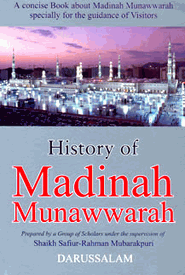
History of Madinah Munawwarah (Shaikh Safiur-Rahman Mubarakpuri)
Publisher: Darussalam Publishers and Distributors (2002)
Pages: 152 Binding: Paperback
You can buy Here or read most of the book @ Google Books Here
Description from the publisher:
In this book, mention has been made about the different aspects of Al-Madinah, and the most important historical events are recorded that have direct effect on the establishment and sacredness of Al-Madinah as well as its religious weight.
This book has highlighted the sites that are highly important whenever Al-Madinah is mentioned like the Prophet’s Mosque, Quba Mosque and others. A great part of the book is designated to speak about the Prophet’s Mosque updating the expansions and the improvements that has taken place from the time of Muhammad (Sallallaahu alaihi wa sallam) till the Saudi era. It contains more than fifty, pictures taken from original documented resources. The pictures vary from old to new dealing with many aspects. The book is a genuine addition to the Islamic library in, its subject both for the researcher and the regular reader. This book sought scientific trustworthiness, by presenting only the correct Ahadith and authentic reports.
Hajj is an act of worship that must be devoted only to Allaah. It is a declaration and a manifestation of the belief in the Oneness (tawheed) of Allaah. It is a time to call upon Allaah to purify the self from any worship to other than Him.
The Muslim who declares the talbiyah: (Labbaika allaahumma labbaik. labbaika laa shareeka laka labbaik; innal-hamda wan-ni’mata laka wal mulk, laa shareeka lak) understands that it is a du’aa that means: “Here I am O Allaah, here I am. Here I am, You have no partner, here I am. Surely all praise is due to You, and every bounty is from You, and all dominion is Yours, and You have no partner.”
The Muslim, therefore, should submit himself completely (mentally, spiritually, and physically) to Allaah Alone. No worship should be devoted to statues, tombs, religious leaders, righteous men (dead or alive) or any part of the creation!
The tawheed of Allaah requires the Muslim to follow the perfect way of worship. This is the way (sunnah) of Muhammad sallallaahu alaihi wa sallam as understood by the sahaabah (the companions of the Prophet sallallaahu alaihi wa sallam), who were the best of mankind.
Listen / Download Mp3 Here (Time 01:45:19)
[Read or Download the Book– PDF]
Courtesy: UnderStand-Islam.net
Listen / Download Mp3 Here (Time 10:52)
Audio Courtesy : Understand-Islam.net
Natural Blood of Women
By Shaykh Muhammad bin Salih Al-Utheimeen
الدماء الطبيعية للنساء
الشيخ محمد بن صالح العثيمين
Translated & Researched by Dr. Saleh-As Saleh
Published & Distributed by Daar Al-Bukhari
Click the below Link to read the Book in PDF Format
Natural Blood of Women – Shaykh Uthaymeen – Dr Saleh As-Saleh [PDF]
Table of Contents:
Visit the Link below to Listen to the audio
IBN MAAJAH reported in his “Sunan” [Book of the Adhaan & the Sunnah regarding it: Chapter 5: The virtue of the Adhaan, and the reward for the Mu·adhdhins]:
(no. 728): “Muhammad ibn Yahyaa narrated to us, and al-Hasan ibn `Alee al-Khallaal, both saying: `Abdullaah ibn Saalih narrated to us saying: Yahyaa ibn Ayyoob narrated to us: from Ibn Juraij: from Naafi`: from Ibn `Umar: that Allaah”s Messenger (صَلَّى اللّٰهُ عَلَيْهِ وَسَلَّم):
<<Whoever gives the adhaan for twelve years then Paradise is binding for him, and sixty good deeds will be written for him each day, and for each iqaamah thirty good deeds.>>
-Shaykh al-Albaanee said: “Saheeh”
-Shaykh al-Albaanee brought it in “as-Saheehah” (no. 42) with the difference in wording: <<...and sixty good deeds will be written for him each time…>>, and he said:
“Reported by Ibn Maajah (no. 728), al-Haakim (1/205) – and from him by al-Bayhaqee (1/433), and Ibn `Adiyy (1/220), al-Baghawee in “Sharhus-Sunnah” (1/58/1-2), and ad-Diyaa· in “al-Muntaqaa min masmoo”aatihi bi Marw” (32/1) ….
al-Baghawee said: “”Abdullaah ibn Saalih, the scribe of al-Layth, was “sadooq”, except that some things deserving criticism occurred in his narrations of hadeeth”, therefore al-Boosayree said in “az-Zawaa·id” (q. 48/2): “Its isnaad is weak because of the weakness of `Abdullaah ibn Saalih.”
And the hadeeth has another weakness, and it is the “`an`anah” of Ibn Juraij, and al-Bayhaqee said after it: “And Yahyaa ibn al-Mutawakkil reported it from Ibn Juraij: from someone who narrated to him from Naafi`. al-Bukhaaree said: And this is more correct.”
I say: So it becomes clear that this chain of narration does not establish proof. However al-Haakim mentioned a witness for it, by way of Ibn Wahb: Ibn Lahee`ah related to me: from `Ubaydullaah ibn Abee Ja`far: from Naafi` – with it.
And this is a “Saheeh” isnaad: all its narrators are reliable; and even though there is speech concerning the memory of Ibn Lahee`ah, then this is only the case when the narrator from him is other than one of the `Abdullaahs – and Ibn Wahb is one of them …
So therefore the hadeeth becomes “Saheeh“, and all praise is for Allaah for His granting the successful attainment of correctness.
So this hadeeth becomes a clear virtue for the mu·adhdhin who is constant upon his adhaan for the aforementioned period, and it will not be hidden that this has the condition that the person gives the adhaan purely and sincerely seeking the Face of Allaah – the Most High, not seeking by means of it provision, nor doing it for show or repute, because of the many established proofs in the Book and the Sunnah which show that Allaah – the Most High – will not accept actions unless they are done purely and sincerely for Him.
Refer to the book of “ar-Riyaa.” (performing deeds for show) at the beginning of “at-Targheeb watTarheeb” of al-Mundhiree.
And it is established that a man came to Ibn “Umar and said: “I love you for Allaah”s sake.” He said: “”Then bear witness that I hate you for Allaah”s sake!”” He said: “Why?” He said: “”Because you sing in your adhaan and you take payment for it!!“”
– at-Tabaraanee reported it in “al-Mu”jamul-Kabeer” (12/264/13059) and others.
So what is truly a cause of sorrow is that this tremendous act of worship, and this visible sign of Islaam, has been turned away from by most scholars of the Muslims in our lands. So you will hardly see a single one of them giving adhaan in a mosque, except as Allaah wishes. Indeed they perhaps shy-away from performing it, whereas you may see them rushing for the position of imaam, indeed disputing over it!
So it is to Allaah that we raise our complaint about the strangeness of this time.””
Click the Below Link to read the PDF document:
The Virtue of the Adhaan & Reward For the Mu’adhdhins
Translated by Aboo Talhah Daawood ibn Ronald Burbank -rahimahullaah
Posted from : http://alitisaambissunnah.wordpress.com/
Click the Below Link to read the PDF Document
Points of Benefit Regarding Adhaan – Dr Saleh as Saleh [PDF]
Listen / Download the Mp3 (Time 2:46)
Read the article Below:
All Praise is due to Allah, and may the salaah and salaam be on Prophet Muhammad, his household, and the noble companions and those who follow them until the Day of Resurrection.
Question:
Is the adhan an obligation, and should we face the qiblah when performing it?
Answer:
The legal meaning of adhan is I’laam (announcement). The Islamic meaning of it is to worship Allah (سُبْحَانَهُ وَ تَعَالَى) through a specific announcement, which involves specific remembrances at the time when salaah is due.
The adhan is a collective duty (fard kifaayah); this means that if it is done by someone, then this lifts the duty off the rest due to the hadeeth of Malik ibn al- Huwayrith who narrated that the Prophet (sallallaahu ‘alayhi wa sallam) said:
“…And when it is time for the prayer then one of you should pronounce the Adhaan (call) for the prayer…” [see Bukhari vol. 9. no. 352]
The evidence for its obligation upon men is the command of the Prophet (صلى الله عليه وسلم) to perform it in several ahaadeeth and that he (صلى الله عليه وسلم) continued to do it while traveling as well as in residence. Therefore, the adhaan is a collective duty for those in residence, as well as the traveler.
The adhaan is not an obligation upon women. There is a difference of opinion whether it is permissible for women to perform it. One opinion is that is a Sunnah for them to do the iqamah when they gather for the congregation, without the adhaan, and that there may be a merit in it. This is the saying of our shaykh, Muhammad ibn Saalih al-Uthaimeen (rahimahullaah).
Some of the scholars of the past went with the opinion that women performing the adhaan is allowed and recommended, as in one narration from Imam Ahmad (rahimahullaah). In another report, he said: The iqamah is recommended without the adhan. It is also reported that Imam Ahmad disliked women doing them.
From the etiquettes of the adhaan is to face the qiblah because of the action of Bilal himself (radiya Allaahu ‘anhu) when he performed the adhaan. The report was declared hasan by Shaykh al-Albani due to supporting evidences in Irwaa’ul Ghaleel.
And Allaah, the Most High, knows best.
Saleh As-Saleh

Umdat al-Ahkaam – Hadeeth No.63
All Praise is due to Allaah, and may the salaah and salaam be on Prophet Muhammad, his household, the noble companions, and those who follow them until the Day of Resurrection.
Abi Sa’eed al-Khudri (radiyallaahu ‘anhu) reported that the Messenger of Allaah (sallallaahu ‘alayhi wa sallam) said:
“Whenever you hear the adhaan, say what the Mu’adhdhin is saying.” [01]
Benefit: Ruling Concerning Following the Statements of the Mu’adhdhin
The mu’adhdhin (caller) makes the adhaan for the five prescribed prayers and also on the day of jumu’ah; when he calls, he does so aloud making it inevitable that one must hear his voice in order to respond.
In this hadeeth, the instruction of the Prophet (صَلَّى اللّٰهُ عَلَيْهِ وَسَلَّم) “say what the Mu’adhdhin is saying” implies that every statement made by the mu’adhdhin should be repeated verbatim by those that hear it. This covers the entire adhaan excluding two statements, specifically the hayyalatan (i.e. “hayya ‘ala’-salaah” – come for salaah and “hayya ‘ala’-falaah” – come for success), for which the responder says “Laa hawla wa laa quwwata illa billaah” (There is no power or strength except with Allaah); this is the instruction of the Prophet (صَلَّى اللّٰهُ عَلَيْهِ وَسَلَّم) as recorded by Muslim in his Saheeh.[02] Therefore, for all other statements made by the mu’adhdhin, the responder repeats them exactly word for word.
Likewise, the responder must make all statements following the mu’adhdhin with his tongue; doing so with one’s heart is insufficient since the Prophet (صَلَّى اللّٰهُ عَلَيْهِ وَسَلَّم) directed the responder to “say”, which in general entails utterance by the tongue.
Benefit: Types of Saying
“Saying” is of four types.
1) In the heart – There are no rulings from sharee’ah that depends on this. That is why there is no effect legally if someone recites the Qur’aan with his heart since it is not a saying. Similarly, if someone says in his heart that his wife is divorced, then this statement is not implemented as it has no effect.
Furthermore, if someone makes an oath not to speak to a specific person and says in his heart “In shaa Allaah”, then this exception is of no benefit to him, and if he talks to that person in the future, then he breaks his oath, which makes the expiation binding upon him.
2) To utter by one’s tongue and moving the lips
3) To make one’s self hear – There is a difference between the second and the third types of saying since a person may move his tongue without making himself hear.
4) To make others hear him – This is known as al-jahr (loudness)
If a person makes salaah without moving his lips, then this salaah is invalid since he did not actually “say” takbeeratul-ihraam, al-Fatiha, and the rest of the Qur’aan that he recites. However, it is not a condition that he makes himself hear.
Benefit: Following the Mu’adhdhin if you can See but not Hear Him
If you see the mu’adhdhin but you are unable to hear him, then you do not repeat after him as the condition is hearing him.
Benefit: General Principles When Following the Mu’adhdin
This hadeeth indicates that you follow the mu’adhdhin even if there is more than one caller. The Prophet (صَلَّى اللّٰهُ عَلَيْهِ وَسَلَّم) said, “Whenever you hear the adhaan.” Thus, if you hear multiple callers, then you follow them as this is remembrance. The scholars said that this is applicable as long as the person is not in salaah since the praying individual is not called. Similarly, if the person has already prayed, then the generality of the hadeeth implies that it is still applicable to him, making it appropriate that he responds.
Benefit: Wisdom of Allaah (سبحانه و تعالى)
When a person is responding to the adhaan, he is getting a share of the reward; therefore, Allaah (سبحانه و تعالى) gives him a reward even if he is not establishing the worship. Therefore, Allaah (سبحانه و تعالى) has enabled the believer to share in rewards through related matters.
Examples:
1) Although a person may not be making hajj, he is still able to attain specific rewards during that prescribed period. When the hujjaj (pilgrims) make the sacrifice, a person who is not performing hajj may also make a sacrifice.
2) It is known that during hajj, the pilgrims stay away from certain prohibited things while in ihraam. Likewise, it is prescribed that those who are not doing hajj but still intend to make a sacrifice not cut their hair, nails, etc.
3) In addition, it is legislated that those not performing hajj pray salaat al-‘Eid.
Benefit: Accompanying the Adhaan
The response must be said in a manner accompanying the adhaan
Benefit: Prerecorded Adhaan
A recording is simply relating and copying a voice. There is no legal effect to it so no response is required. However, if someone hears the adhaan being broadcast live, then he may follow it.
Example: A recording of qur’aan is played from a tape or over the radio, and the reciter comes to a point where sujood at-tilaawah is legislated. The listener does not make sujood as he is not sharing with the reciter in time.
Benefit: Mu’adhdhin Following Another Mu’adhdhin
If a caller completes the adhaan and hears other mu’adhdhineen (pl. of mu’adhdhin) making adhaan, then he may follow them because he falls under the general wording of the hadeeth.
Benefit: Following Multiple Callers
Benefit: Person in Salaah Following the Mu’adhdhin
The famous saying regarding this is that repeating after the caller can distract the musallee (i.e. person in salaah). The Prophet (صَلَّى اللّٰهُ عَلَيْهِ وَسَلَّم) said:
“Verily, the mind is occupied and busy with more important matters during the salaah.” [03]
Shaykh al-Islaam ibn Taymiyyah (rahimahullaah) held another opinion; he maintained that the person in salaah may respond because this response is remembrance whose cause existed in salaah. Similarly, he said it is permissible to say “al-hamdullillaah” if you sneeze or return the salaam because the Prophet (صَلَّى اللّٰهُ عَلَيْهِ وَسَلَّم) responded to that while in salaah. However, when it comes to following the mu’adhdhin, consideration is required because the response to the adhaan is prolonged and is far longer than returning the salaam, which is simply responded to with the hand, finger, or head. Thus, it is precautionary not to respond.
Benefit: Responding While Answering the Call of Nature
Excluded from responding is the one that it is answering the call of nature. This is based on the hadeeth of the Prophet (صَلَّى اللّٰهُ عَلَيْهِ وَسَلَّم),
“I do not like to remember Allaah except in a state of purity”
Benefit: Mu’adhdhin Responding to Himself
Concerning the mu’adhdhin repeating after himself, there are two opinions.
1) He responds to himself in order to combine the reward of adhaan with the reward of responding.
2) What is apparent in the hadeeth is that there must be a hearer and someone else that is heard. As such, the mu’adhdhin would not respond to himself.
Benefit: Following the Iqaamah
What is apparent in this hadeeth is the following of the adhaan only. However, another opinion holds that the iqaamah is also referred to as an adhaan as in the hadeeth that the Prophet (صَلَّى اللّٰهُ عَلَيْهِ وَسَلَّم) said,
“Between the adhaanayn (i.e. two adhaan), there is salaah” [04]
Some scholars have contended that since the Prophet (صَلَّى اللّٰهُ عَلَيْهِ وَسَلَّم) referred to the iqaamah as adhaan, it is permissible to repeat after the muqeem (the one that performs the iqaamah). In addition, they took as evidence the hadeeth in Sunan Abu Dawood that the Prophet (صَلَّى اللّٰهُ عَلَيْهِ وَسَلَّم) commanded the people to also follow the iqaamah, but this hadeeth has weakness. However, following the muqeem could cause the person to delay making takbeeratul-ihraam and entering the salaah.
Benefit: Volume of the Response
The response in this hadeeth is in principle. There are no indications of a link between the essence of the remembrance and the description of the sound (loud or silent). Moreover, there is no benefit in being loud in the response.
Benefit: Missing Following Mu’adhdhin Due to a Legal Excuse
When someone has a legal excuse for being unable to follow the mu’adhdhin (e.g. answering the call of nature), then he may make up what he missed. Similarly, if someone first hears the mu’adhdhin during the middle of the adhaan, then he starts following from the beginning and completes the following with the mu’adhdhin.
Example: Someone first hears the mu’adhdhin at “hayya ‘ala’-salaah.” The person should start from the beginning at “Allaahu Akbar” until he catches up with the mu’adhdhin and then continue to follow him.
Benefit: Adhaan of a Child
With respect to the child that has reached the age of distinction, Shaykh al-Islaam ibn Taymiyyah (rahimahullaah) held the opinion that the adhaan which is collective duty is permissible from him but not the adhaan which is in individual duty.
I ask Allaah to make this a benefit for myself and for all those that read it and/or convey it. All Praise is due to Allaah, and may the salaah and salaam be on Prophet Muhammad, his household, the noble companions and those who follow them until the Day of Resurrection.
Saleh As-Saleh
15th of Dhul Qi’dah 1428 AH.
Corresponding to Dec 25th , 2007
Footnotes:
[01] Reported in Saheeh al-Bukhaari (English translation vol. 1, hadeeth no. 585) and Malik’s Muwatta (English Translation book 3, hadeeth no 2)
[02] Hadeeth from ‘Umar bin al-Khattab (English Translation book 4, hadeeth 748).
[03] Reported in Saheeh al-Bukhaari (English translation vol. 5, hadeeth no. 215).
[04] Agreed upon. Reported from Abdullaah bin Mughaffal al-Muzani (radiyallaahu ‘anhu) in Saheeh al-Bukhaari (English translation vol. 1, hadeeth no. 597 & 600) and in Saheeh Muslim (English translation no. 1822, book 4).
—
Based upon the sharh (explanation) of Hadeeth No.63 from Umdat al-Ahkaam by our Shayekh Muhammad bin Saalih al-‘Uthaimeen (rahimahullaah) and More recently by our Shayekh Sh. (Dr.) Sami ibn Muhammad As-Sghair (hafidhahullaah) in his sharh of the Umdah in 1428 AH
Prepared by Saleh As-Saleh. Transcribed and first edited by Br. Abu Abdullaah al-Amreeki, Jazaahullaahu Khairan,from live duroos in Paltalk’s “Understanding Islam 1” room.Text further edited by sis Umm Ahmad al-Kanadiyyah, Jazaahaallaahu Khairan,and finally reviewed and checked by Saleh as-Saleh.
Click the Below Link to read the PDF document.
Rulings on The Response to the Adhaan – Dr Saleh as Saleh [PDF]
Related Link: https://abdurrahman.org/salah/adhan-call-to-prayer/
1786. Abu Hurairah (May Allah be pleased with him) said: The Messenger of Allah (sallallaahu alayhi wa sallam) said, “He who is presented with a flower of sweet basil should not reject it, because it is light in weight and pleasant in odour.”
[Muslim].
1787. Anas bin Malik (May Allah be pleased with him) reported: The Prophet (sallallaahu alayhi wa sallam) never refused a gift of perfume.
[Al-Bukhari].
Allah, the Exalted, says:
“Truly, the Muttaqun (the pious and righteous persons) will be amidst Gardens and water-springs (Jannah). (It will be said to them): `Enter therein (Jannah), in peace and security.’ And We shall remove from their breasts any deep feeling of bitterness (that they may have). (So they will be like) brothers facing each other on thrones. No sense of fatigue shall touch them, nor shall they (ever) be asked to leave it.” (15:45-48)
“(It will be said to the believers of Islamic Monotheism): `My slaves! No fear shall be on you this Day, nor shall you grieve. (You) who believed in Our Ayat (proofs, verses, lessons, signs, revelations, etc.) and were Muslims (i.e., who submit totally to Allah’s Will, and believe in the Oneness of Allah). Enter Jannah, you and your wives, in happiness.’ Trays of gold and cups will be passed round them; (there will be) therein all that inner-selves could desire, and all that eyes could delight in and you will abide therein forever. This is the Jannah which you have been made to inherit because of your deeds which you used to do (in the life of the world). Therein for you will be fruits in plenty, of which you will eat (as you desire).” (43:68-73)
“Verily, the Muttaqun (the pious), will be in place of security (Jannah). Among Gardens and springs. Dressed in fine silk and (also) in thick silk, facing each other. So (it will be). And We shall marry them to Hur (fair females) with wide, lovely eyes. They will call therein for every kind of fruit in peace and security. They will never taste death therein except the first death (of this world), and He will save them from the torment of the blazing Fire. As a bounty from your Rubb! That will be the supreme success!” (44:51-57)
“Verily, Al-Abrar (the pious and righteous) will be in Delight (Jannah). On thrones, looking (at all things). You will recognise in their faces the brightness of delight. They will be given to drink of pure sealed wine. The last thereof (that wine) will be the smell of musk, and for this let (all) those strive who want to strive (i.e., hasten earnestly to the obedience of Allah). It (that wine) will be mixed with Tasnim. A spring whereof drink those nearest to Allah.” (83:22-28)
The Qur’anic Ayat on the subject are many and well-known.
1880. Jabir (May Allah be pleased with him) reported: The Messenger of Allah (sallallaahu alayhi wa sallam) said, “The inhabitants of Jannah will eat and drink therein, but they will not have to pass excrement, to blow their noses or to urinate. Their food will be digested producing belch which will give out a smell like that of musk. They will be inspired to declare the freedom of Allah from imperfection and proclaim His Greatness as easily as you breathe.”
[Muslim].
1881. Abu Hurairah (May Allah be pleased with him) said: The Messenger of Allah (sallallaahu alayhi wa sallam) said, “Allah, the Exalted, has said: `I have prepared for my righteous slaves what no eye has seen, no ear has heard, and the mind of no man has conceived.’ If you wish, recite:
`No person knows what is kept hidden for them of joy as a reward for what they used to do.”’ (32:17)
[Al-Bukhari and Muslim].
1882. Abu Hurairah (May Allah be pleased with him) said: The Messenger of Allah (sallallaahu alayhi wa sallam) said, “The first group (of people) to enter Jannah will be shining like the moon on a full-moon night. Then will come those who follow them who will be like the most shining planet in the sky. They will not stand in need of urinating or relieving of nature or of spitting or blowing their noses. Their combs will be of gold and their sweat will smell like musk; in their censers the aloes-wood will be used. Their wives will be large eyed maidens. All men will be alike in the form of their father `Adam, sixty cubits tall.”
Another narration is: The Messenger of Allah (sallallaahu alayhi wa sallam) said, “Their utensils will be of gold, their perspiration will smell like musk; everyone of them will have two wives; the marrow of the bones of the wives’ legs will be seen through the flesh out of excessive beauty. They (i.e., the people of Jannah) will neither have difference, nor enmity (hatred) amongst themselves; their hearts will be as if one heart, and they will be glorifying Allah in the morning and in the afternoon.”
[Al-Bukhari and Muslim].
1883. Al-Mughirah bin Shu`bah (May Allah be pleased with him) said: The Messenger of Allah (sallallaahu alayhi wa sallam) said, “Musa (Moses) (sallallaahu alayhi wa sallam) asked his Rubb: `Who amongst the inhabitants of Jannah will be the lowest in rank?’ He said: `It will be a person who will be admitted into Jannah last of all when all the dwellers of Jannah have entered Jannah. It will be said to him: Enter Jannah. But he will say: O my Rubb! How should I enter while the people have settled in their apartments and taken their shares? It will be said to him: Will you be satisfied and pleased if you have a kingdom like that of a monarch of the world? He will say: I will be content, my Rubb. Allah will say: For you is that, and like that and like that and like that and like that. He will say at the fifth time: I am well-pleased, my Rubb. Allah will say: It is for you and ten times more like it. You will have whatever your soul desires and whatever your eyes could delight in. He will say: I am well-pleased, my Rubb.’ Musa (sallallaahu alayhi wa sallam) said: `Who will be of the highest rank in Jannah.’ Allah said: `They are those whom I chose and I established their honour with My Own Hand. I attest with My Seal that they will be blessed with such bounties as no eye has seen, no ear has heard and no human mind has perceived.”’
[Muslim].
1884. `Abdullah bin Mas`ud (May Allah be pleased with him) reported: The Messenger of Allah (sallallaahu alayhi wa sallam) said, “I know of the last of the inhabitants of the Hell to be taken out from there and the last one to enter Jannah. He is a man who will come out of the Fire, crawling on all fours. Allah, the Rubb of glory and honour will say to him: `Go and enter Jannah.’ He will go to it and think that it is full up. He will then come back and say: `O my Rubb, it is full up.’ Allah will say to him: `Go and enter Jannah.’ He will again go to it and think that it is full up. So he will turn back. Allah will again say: `Go and enter Jannah. For you have what is equal to ten times the world.’ He will say: `Are You making fun of me while You are the King?” At this I (i.e., the narrator) saw the Messenger of Allah (sallallaahu alayhi wa sallam) laugh till his premolars were visible and he said, “Such man will be the last dweller of Jannah in its lowest rank.”
[Al-Bukhari and Muslim].
1885. Abu Musa (May Allah be pleased with him) said: The Prophet (sallallaahu alayhi wa sallam) said, “In Jannah the believer will have a tent made of a single hollowed pearl of which the length will be sixty miles in the sky. The believer will have his wives with him and he will visit them and they will not be able to see one another.”
[Al-Bukhari and Muslim].
1886. Abu Sa`id Al-Khudri (May Allah be pleased with him) said: The Prophet (sallallaahu alayhi wa sallam) said, “There is a tree in Jannah that is so huge that if a rider of a swift horse has to cover its distance from one end to another in one hundred years, he will not be able to do so.”
Another narration from Abu Hurairah (May Allah be pleased with him) is: The Messenger of Allah (sallallaahu alayhi wa sallam) said, “A rider will not be able to cross its (the tree’s) shade even after travelling for one hundred years.”
[Al-Bukhari and Muslim]
1887. Abu Sa`id Al-Khudri (May Allah be pleased with him) said: The Prophet (sallallaahu alayhi wa sallam) said, “The dwellers of Jannah will look at those in the upper abodes above them as you look at a shining star which remains in the eastern or western horizon; such will be the difference in superiority which some of them have over others.” The Messenger of Allah (sallallaahu alayhi wa sallam) was asked: “Will those be the dwellings of the Prophets which no one else will be able to reach?” He (sallallaahu alayhi wa sallam) replied, “Yes, but by Him in Whose Hand my soul is! men who believed in Allah and acknowledged the truthfulness of the Messengers will reach them.”
[Al-Bukhari and Muslim].
1888. Abu Hurairah (May Allah be pleased with him) said: The Messenger of Allah (sallallaahu alayhi wa sallam) said, “A space in Jannah equal to the distance between the middle and the end of a bow will be better than all that upon which the sun rises and sets.”
[Al-Bukhari and Muslim].
1889. Anas (May Allah be pleased with him) said: The Messenger of Allah (sallallaahu alayhi wa sallam) said, “In Jannah there is a market to which the people will come every Friday. The northern wind will blow and shower fragrance on their faces and clothes and, consequently, it will enhance their beauty and loveliness. They will then return to their wives who will also have increased in their beauty and loveliness, and their families will say to them: `We swear by Allah that you have been increased in beauty and loveliness since leaving us.’ Thereupon they will reply: `We swear by Allah that you have also been increased in beauty and loveliness since we left you.”’
[Muslim].
1890. Sahl bin Sa`d (May Allah be pleased with him) said: The Messenger of Allah (sallallaahu alayhi wa sallam) said, “The dwellers of Jannah will see the upper abodes of Jannah as you see the stars in the sky.”
[Al-Bukhari and Muslim].
1891. Sahl bin Sa`d (May Allah be pleased with him) said: I was in the company of the Prophet (sallallaahu alayhi wa sallam). He gave a description of Jannah and concluded with these words, “There will be bounties which no eye has seen, no ear has heard and no human heart has ever perceived.” He (sallallaahu alayhi wa sallam) then recited this Verse:
“Their sides forsake their beds, to invoke their Rubb in fear and hope, and they spend (in charity in Allah’s Cause) out of what We have bestowed on them. No person knows what is kept hidden for them of joy…” (32:16,17)
[Al-Bukhari].
1892. Abu Sa`id and Abu Hurairah (May Allah be pleased with them) reported: The Messenger of Allah (sallallaahu alayhi wa sallam) said, “When the dwellers of Jannah enter Jannah, an announcer will call: (You have a promise from Allah that) you will live therein and you will never die; you will stay healthy therein and you will never fall ill; you will stay young and you will never become old; you will be under a constant bliss and you will never feel miserable.”
[Muslim].
1893. Abu Hurairah (May Allah be pleased with him) said: The Messenger of Allah (sallallaahu alayhi wa sallam) said, “The lowest place of any of you in Jannah will be that Allah will tell him to express his wish. He will wish and wish again. Allah will then ask him: `Have you expressed your wish?’ He will answer: `Yes, I have.’ Allah will say: `You will have what you have wished for and the like thereof along with it.”’
[Muslim].
1894. Abu Sa`id Al-Khudri (May Allah be pleased with him) said: The Messenger of Allah (sallallaahu alayhi wa sallam) said, “Allah, the Rubb of honour and glory, will say to the inhabitants of Jannah: `O inhabitants of Jannah!’ They will respond: `Here we are! At Your service, O our Rubb. All good is in Your Hand!’ He will ask them: `Are you pleased?’ They will reply: `Why should we not be pleased, O Rubb, when You have given us what You have not given to any of Your creatures?’ Allah will say: `Shall I not give you something better than that?’ They will ask: `O Rubb! What can be better than that?’ Allah will say: `I shall bestow My Pleasure upon you and I shall never be displeased with you.”’
[Al-Bukhari and Muslim].
1895. Jarir bin `Abdullah (May Allah be pleased with him) reported: We were sitting with the Messenger of Allah (sallallaahu alayhi wa sallam) when he looked at the full moon and observed, “You shall see your Rubb in the Hereafter as you are seeing this moon; and you will not feel the slightest inconvenience in seeing Him.”
[Al-Bukhari and Muslim].
1896. Suhaib (May Allah be pleased with him) reported: The Messenger of Allah (sallallaahu alayhi wa sallam) said, “When the inhabitants of Jannah enter Jannah, Allah, the Glorious and Exalted, will say to them: `Do you wish me to give you anything more?’ They will reply: `Have You not made our faces bright? Have You not brought us into Jannah and delivered us from the Hell?’ And Allah will remove the Veil. The (dwellers of Jannah) will feel that they have not been awarded anything dearer to them than looking at their Rubb.”
[Muslim].
Allah, the Exalted, says:
“Verily, those who believe and do deeds of righteousness, their Rubb will guide them through their Faith; under them will flow rivers in the Gardens of Delight (Jannah). Their way of request therein will be Subhanaka Allahumma (Glory to You, O Allah!) and Salam (peace, safety from evil) will be their greetings therein (Jannah)! and the close of their request will be: Al-hamdu lillahi Rabbil-`Alamin [All the praises and thanks are to Allah, the Rubb of `Alamin (mankind, jinn and all that exists)].” (10:9,10)
Allah, the Exalted, says:
“And ask forgiveness for your sin…” (47:19)
“And seek the forgiveness of Allah. Certainly, Allah is Ever Oft-Forgiving, Most Merciful.” (4:106)
“And declare the freedom of your Rubb from imperfection beginning with His praise, and ask His forgiveness. Verily, He is the One Who accepts the repentance and Who forgives.” (110:3)
“For Al-Muttaqun (the pious) there are Gardens (Jannah) with their Rubb, underneath which rivers flow. Therein (is their) eternal (home) and Azwajun Mutahharatun (purified mates or wives). And Allah will be pleased with them. And Allah is All-Seer of the (His) slaves. Those who say: `Our Rubb! We have indeed believed, so forgive us our sins and save us from the punishment of the Fire. (They are) those who are patient, those who are true (in Faith, words, and deeds), and obedient with sincere devotion in worship to Allah. Those who spend (give the Zakat and alms in the way of Allah) and those who pray and beg Allah’s Pardon in the last hours of the night.” (3:15-17)
“And whoever does evil or wrongs himself but afterwards seeks Allah’s forgiveness, he will find Allah Oft-Forgiving, Most Merciful.” (4:110)
“And Allah would not punish them while you (Muhammad (sallallaahu alayhi wa sallam)) are amongst them, nor will He punish them while they seek (Allah’s) forgiveness.” (8:33)
“And those who, when they have committed Fahishah (illegal sexual intercourse) or wronged themselves with evil, remember Allah and ask forgiveness for their sins; – and none can forgive sins but Allah – and do not persist in what (wrong) they have done, while they know.” (3:135)
The Qur’anic Ayat on the subject are many and well-known.
1869. Al-Agharr Al-Muzani (May Allah be pleased with him) said: The Messenger of Allah (sallallaahu alayhi wa sallam) said, “Sometimes I perceive a veil over my heart, and I supplicate Allah for forgiveness a hundred times in a day.”
[Muslim].
1870. Abu Hurairah (May Allah be pleased with him) said: I heard the Messenger of Allah (sallallaahu alayhi wa sallam) saying, “I swear by Allah that I seek Allah’s Pardon and turn to Him in repentance more than seventy times a day.”
[Al-Bukhari].
1871. Abu Hurairah (May Allah be pleased with him) said: The Messenger of Allah (sallallaahu alayhi wa sallam) said, “By the One in Whose Hand my soul is! If you do not commit sins, Allah would replace you with a people who would commit sins and seek forgiveness from Allah; and Allah will certainly forgive them.”
[Muslim].
1872. Ibn `Umar (May Allah be pleased with them) said: We counted Messenger’s saying a hundred times during one single sitting: Rabb-ighfir li, wa tubb `alayya, innaka Antat-Tawwabur-Rahim. (My Rubb! Forgive me and pardon me. Indeed, You are the Oft-Returning with compassion and Ever Merciful.”
[Abu Dawud and At-Tirmidhi].
1873. Ibn `Abbas (May Allah be pleased with them) said: The Messenger of Allah (sallallaahu alayhi wa sallam) said, “If anyone constantly seeks pardon (from Allah), Allah will appoint for him a way out of every distress and a relief from every anxiety, and will provide sustenance for him from where he expects not.”
[Abu Dawud].
1874. Ibn Mas`ud (May Allah be pleased with him) said: The Messenger of Allah (sallallaahu alayhi wa sallam) said, “He who says: `Astaghfir ullah-alladhi la ilaha illa Huwal-Haiyul-Qayyumu, wa atubu ilaihi (I seek the forgiveness of Allah, there is no true god except Allah, the Ever-Living, the Self-Subsisting, and I turn to Him in repentance),’ his sins will be forgiven even if he should have run away from the battlefield (while he was engaged in fighting for the Cause of Allah).”
[Abu Dawud, At-Tirmidhi and Al-Hakim (on conditions of Al-Bukhari and Muslim for accepting Hadith)].
1875. Shaddad bin Aus (May Allah be pleased with him) said: The Prophet (sallallaahu alayhi wa sallam) said, “The best supplication for seeking forgiveness (Syed-ul-Istighfar) is to say: `Allahumma Anta Rabbi, la ilaha illa Anta, khalaqtani wa ana `abduka, wa ana `ala `ahdika wa wa`dika mastata`tu, a`udhu bika min sharri ma sana`tu, abu‘u laka bini`matika `alayya, wa abu‘u bidhanbi faghfir li, fa innahu la yaghfirudh-dhunuba illa Anta. (O Allah! You are my Rubb. There is no true god except You. You have created me, and I am Your slave, and I hold to Your Covenant as far as I can. I seek refuge in You from the evil of what I have done. I acknowledge the favours that You have bestowed upon me, and I confess my sins. Pardon me, for none but You has the power to pardon).’ He who supplicates in these terms during the day with firm belief in it and dies on the same day (before the evening), he will be one of the dwellers of Jannah; and if anyone supplicates in these terms during the night with firm belief in it and dies before the morning, he will be one of the dwellers of Jannah.”
[Al-Bukhari].
1876. Thauban (May Allah be pleased with him) reported: Whenever the Messenger of Allah (sallallaahu alayhi wa sallam) finished his Salat (prayer), he would beg forgiveness three times [by saying, `Astaghfirullah’ (3 times)] and then he would say: “Allahumma Antas-Salamu, wa minkas-Salamu, tabarakta ya Dhal-Jalali wal-Ikram. (O Allah! You are the Bestower of security and security comes from You; Blessed are You. O Possessor of glory and honour).” Imam Al-Auza`i (one of the subnarrators) of this Hadith was asked: “How forgiveness should be sought?” He replied: “I say: Astaghfirullah, Astaghfirullah (I seek forgiveness from Allah. I seek forgiveness from Allah).”
[Muslim].
1877. `Aishah (May Allah be pleased with her) reported: Prior to his demise, the Messenger of Allah (sallallaahu alayhi wa sallam) used to supplicate frequently: Subhan Allahi wa bihamdihi; Astaghfirullaha wa atubu ilaihi (Allah is free from imperfection, and I begin with praising Him. I beg forgiveness from Allah and I turn to Him in repentance.”
[Al-Bukhari and Muslim].
1878. Anas (May Allah be pleased with him) said: I heard the Messenger of Allah (sallallaahu alayhi wa sallam) saying, “Allah, the Exalted, has said: `O son of Adam! I shall go on forgiving you so long as you pray to Me and aspire for My forgiveness whatever may be your sins. O son of Adam! I do not care even if your sins should pile up to the sky and should you beg pardon of Me, I would forgive you. O son of Adam! If you come to Me with an earthful of sins and meet Me, not associating anything with Me in worship, I will certainly grant you as much pardon as will fill the earth.”’
[At-Tirmidhi].
1879. Ibn `Umar (May Allah be pleased with them) said: The Prophet (sallallaahu alayhi wa sallam) said, “O women folk! You should give charity and be diligent in seeking Allah’s forgiveness because I have seen (i.e., on the Night of the Ascension to the highest heavens) that dwellers of the Hell are women.” A woman amongst them said: “Why is it that the majority of the dwellers of Hell are women?” The Prophet (sallallaahu alayhi wa sallam) replied, “You curse frequently and are ungrateful to your husbands. In spite of your lacking in wisdom and failing in religion, you are depriving the wisest of men of their intelligence.” Upon this the woman asked: “What is the deficiency in our wisdom and in our religion?” He (sallallaahu alayhi wa sallam) replied, “Your lack of wisdom can be well judged from the fact that the evidence of two women is equal to that one man. You do not offer Salat (prayer) for some days and you do not fast (the whole of) Ramadan sometimes, it is a deficiency in religion.”
[Muslim].
1808. An-Nawwas bin Sam`an (May Allah be pleased with him) reported: One morning the Messenger of Allah (sallallaahu alayhi wa sallam) made a mention of Dajjal, and he described him to be insignificant and at the same time described him so significant that we thought he was on the date-palm trees (i.e., nearby). When we went to him (the Prophet (sallallaahu alayhi wa sallam)) in the evening, he perceived the sign of fear on our faces. He said, “What is the matter with you?” We said: “O Messenger of Allah, you talked about Dajjal this morning raising your voice and lowering it until we thought he was hiding in the palm-trees grove: He said: “Something other than Dajjal make worry about you. If he appears while I am with you, I will defend you against him. But if he appears after I die, then everyone of you is his own defender. Allah is the One Who remains after me to guide every Muslim. Dajjal will be a young man with very curly hair with one eye protruding (with which he cannot see). I compare (his appearance) to that of Al-`Uzza bin Qatan. He who amongst you survives to see him, should recite over him the opening Ayat of Surat Al-Kahf (i.e., Surat 18: Verses 1-8). He will appear on the way between Syria and Iraq and will spread mischief right and left. O slaves of Allah! Remain adhered to the truth.” We asked: “O Messenger of Allah! How long will he stay on the earth?” He said, “For forty days. One day will be like a year, one day like a month, one day like a week and the rest of the days will be like your days.” We said: “O Messenger of Allah! Will one day’s Salat (prayer) suffice for the Salat of that day which will be equal to one year?” Thereupon he said, “No, but you must make an estimate of time and then offer Salat.” We said: “O Messenger of Allah! How quickly will he walk upon the earth?” Thereupon he said, “Like cloud driven by the wind (i.e., very quickly). He will come to the people and call them to his obedience and they will affirm their faith in him and respond to him. He will then give command to the sky and it will send its rain upon the earth and he will then send his command to the earth and it will grow vegetation. Then in the evening their pasturing animals will come to them with their humps very high and their udders full of milk and their flanks stretched. He will then come to another people and invite them, but they will reject him and he will leave them, in barren lands and without any goods and chattels! He would then walk through the waste land and say to it: `Bring forth your treasures’, and the treasures will come out and follow him like swarms of bees. He will then call a person brimming with youth and strike him with the sword and cut him into two pieces and make these pieces lie at a distance, which is generally between the archer and his target. He will then call that young man and he will come forward, laughing, with his face gleaming out of joy; and it will be at this very time that Allah will send `Isa (Jesus), son of Maryam (Mary) who will descend at the white minaret in the eastern side of Damascus, wearing two garments lightly dyed and placing his hands on the wings of two angels. When he will lower his head, there would fall drops of water from his head, and when he will raise it up, drops like pearls would scatter from it. Every disbeliever who will find his (i.e., `Isa’s) smell will die and his smell will reach as far as he will be able to see. He will then search for Dajjal until he will catch hold of him at the gate of Ludd (village near Jerusalem), and will kill him. Then the people, whom Allah will have protected, will come to `Isa son of Maryam, and he will wipe their faces and will inform them of their ranks in Jannah, and it will be under such conditions that Allah will reveal to `Isa these words: `I have brought forth from amongst my slaves such people against whom none will be able to fight, so take these people safely to the mountain.’ And then Allah will send Ya’juj and Ma’juj (Gog and Magog people) and they will sworn down from every slope. The first of them will pass the Lake Tabariyah (near the Dead Sea in Palestine) and drink all its water. And when the last of them will pass, he will say: `There was once water there.’ Prophet `Isa (sallallaahu alayhi wa sallam) and his companions will then be so much hard-pressed that the head of an ox will be dearer to them than one hundred dinar, and `Isa along with his companions, will make supplication to Allah, Who will send insects which will attack their (Ya’juj and Ma’juj people) neck until they all will perish like a single person. Prophet, `¦sa and his companions will then come down and they will not find in the earth as much space as a single span which would not be filled with their corpses and their stench. Prophet `Isa and his companions will then again beseech Allah, Who will send birds whose necks will be like those of Bactrian camels, and they will carry them and throw them where Allah will desire. Then Allah will send down rain which will spare no house in the city or in the countryside. It would wash away the earth until it appears like a mirror. Then the earth will be told to bring forth its fruit and restore its blessings; and as a result of this, there will grow such a big pomegranate that a group of people will eat from it and seek shelter under its skin. Milk will be so blessed that the milk of one she-camel will suffice for a large company and the cow will give so much milk, that it will suffice for a whole tribe. The sheep will give so much milk that the whole family will be able to drink out of that, and at that time Allah will send a pleasant wind which will soothe people even under their armpits, and will take the life of every Muslim and true believer, and only the wicked will survive. They will commit adultery in public like asses and the Resurrection Day will be held.”
[Muslim].
1809. Rib`i bin Hirash (May Allah be pleased with him) said: I accompanied Abu Mas`ud Al-Ansari to Hudaifah bin Al-Yaman (May Allah be pleased with them). Abu Mas`ud said to him: “Tell us what you heard from the Messenger of Allah (sallallaahu alayhi wa sallam) about Dajjal (the Antichrist).” Hudaifah said: He (sallallaahu alayhi wa sallam) said, “Dajjal will appear, and with him will be water and fire. That which people consider to be water will in fact be a burning fire, and that which people will consider to be fire will in fact be cool and sweet water. He who from amongst you happens to face him, should jump into that which he sees as fire for that will be nice and sweet water.” Abu Mas`ud said: “I have also heard this from the Messenger of Allah (sallallaahu alayhi wa sallam).”
[Al-Bukhari and Muslim]
1810. `Abdullah bin `Amr bin Al-`As (May Allah be pleased with them) said: The Messenger of Allah (sallallaahu alayhi wa sallam) said, “Dajjal (the Antichrist) will appear in my Ummah and he will stay in the world for forty. I do not know whether this will be forty days or forty months or forty years. Allah will then send (Prophet) `Isa (Jesus), son of Maryam (Mary). `Isa will pursue him and slaughter him. Then people will survive for seven years (i.e., after the demise of `Isa) in the state that there will be no rancour between two persons. Then Allah will send a cool breeze from the side of Ash-Sham. None will remain upon the face of the earth having the smallest particle of good or Faith in him but he will die, so much so that even if someone amongst you will enter the innermost part of a mountain, this breeze will reach that place also and will cause him to die. Only the wicked people will survive and they will be as fast as birds (i.e., to commit evil) and as ferocious towards one another as wild beasts. They will never appreciate the good, nor condemn evil. Then Shaitan (Satan) will come to them in the garb of a man and will say: `Will you not obey me?’ They will say: `What do you order us to do?’ He will command them to worship idols. They will have abundance of sustenance and will lead comfortable lives. Then the Trumpet will be blown. Every one hearing it, will turn his neck towards it and will raise it. The first one to hear that Trumpet will be a man who will be busy repairing the basin for his camels. He will become unconscious. Allah will send, or will cause to send, rain which will be like dew and there will grow out of it (like wild growth) the bodies of the people. Then the second Trumpet will be blown and they will stand up and begin to look around. Then it will be said: `O people! Go to your Rubb.’ Then there will be a command: `Make them stand there.’ After it they will be called to account. Then it will be said: `Separate from them the share of the Fire.’ It will be asked: `How much?’ It will be said: `Nine hundred and ninety-nine out of every thousand.’ That will be the Day which will make children hoary-headed men because of its terror and that will be the Day when the Shin will be uncovered.”
[Muslim].
1811. Anas bin Malik (May Allah be pleased with him) said: The Messenger of Allah (sallallaahu alayhi wa sallam) said, “There will be no land which will not be trampled by Dajjal (the Antichrist) but Makkah and Al-Madinah; and there will be no passage leading to them which will not be guarded by the angels, arranged in rows. Dajjal will appear in a barren place adjacent to Al-Madinah and the city will be shaken three times. Allah will expel from it every disbeliever and hypocrite.”
[Muslim].
1812. Anas (May Allah be pleased with him) said: The Messenger of Allah (sallallaahu alayhi wa sallam) said, “Dajjal (the Antichrist) will be followed by seventy thousand Jews of Isfahan and will be dressed in robes of green coloured satin.”
[Muslim].
1813. Umm Sharik (May Allah be pleased with her) reported: I heard the Prophet (sallallaahu alayhi wa sallam) saying, “People will run away from Dajjal (the Antichrist) seeking shelter in the mountains.”
[Muslim].
1814. `Imran bin Hussain (May Allah be pleased with them) reported: I heard the Messenger of Allah (sallallaahu alayhi wa sallam) saying, “Between time of the creation of Adam and the Resurrection Day, there is nothing greater than the mischief of Dajjal (the Antichrist).”
[Muslim].
1815. Abu Sa`id Al-Khudri (May Allah be pleased with him) reported: I heard the Prophet (sallallaahu alayhi wa sallam) saying, “Dajjal (the Antichrist) will come forth and a person from amongst the believers will go towards him and the armed watchmen of Dajjal will meet him and they will say to him: `Where do you intend to go?’ He will say: `I intend to go to this one who has appeared.’ They will say to him: `Don’t you believe in our lord (meaning Dajjal)?’ He will say: `There (i.e., we know Him to be Allah, Alone, without any partners) is nothing hidden about our Rubb.’ Some of them will say: `Let us kill him’, but some others will say: `Has your lord (Dajjal) not forbidden you to kill anyone without his consent?’ So they will take him to Dajjal. When the believer will see him, he will say: `O people! This is Dajjal about whom the Messenger of Allah (sallallaahu alayhi wa sallam) has informed us.’ Dajjal will have him laid on his stomach and have his head. He will be struck on his back and on his stomach. Dajjal will ask him: `Don’t you believe in me?’ He will say: `You are the false Messiah.’ He will then give his order to have him sawn with a saw into two from the parting of his hair up to his legs. After that Dajjal will walk between the two halves and will say to him: `Stand up’, and he will stand on his feet. He will then say to him: `Don’t you believe in me?’ The person will say: `It has added to my insight that you are Dajjal’. He will add: `O people! He will not be able to behave with anyone amongst people in such a manner after me.’ Dajjal will try to kill him. The space between his neck and collarbone will turn into copper and he will find no way to kill him. So he will catch hold of him by his hand and feet and throw him into (what appears to be the fire). The people will think that he has been thrown into the fire whereas he will be thrown into Jannah.” The Messenger of Allah (sallallaahu alayhi wa sallam) added, “He will be the most eminent amongst the people with regard to martyrdom near the Rubb of the worlds.”
[Muslim]
1816. Al-Mughirah bin Shu`bah (May Allah be pleased with him) said: No one asked the Messenger of Allah (sallallaahu alayhi wa sallam) more about Dajjal than I asked him. He said to me, “He will not harm you.” I said: “O Messenger of Allah, it is reported that he will have with him a mountain of bread and a river full of water.” Thereupon he said, “He (Dajjal) is far too worthless and insignificant near Allah (to let him deceive the believers).”
[Al-Bukhari and Muslim].
1817. Anas (May Allah be pleased with him) said: The Messenger of Allah (sallallaahu alayhi wa sallam) said, “There has not been a Prophet who has not warned his Ummah of that one-eyed liar (Dajjal). Behold, he is blind in one eye and your Rubb (Allah) is not blind. On his forehead are the letters: (K.F.R.) (meaning Kafir- disbeliever).”
[Al-Bukhari and Muslim].
1818. Abu Hurairah (May Allah be pleased with him) said: The Messenger of Allah (sallallaahu alayhi wa sallam) said, “Let me tell you something about Dajjal (the Antichrist) which no Prophet had told his people. He is blind (in one eye) and will bring with him something like Jannah and Hell; but what he calls Jannah will be in fact Hell.”
[Al-Bukhari and Muslim].
1819. `Abdullah bin `Umar (May Allah be pleased with them) said: One day the Messenger of Allah (sallallaahu alayhi wa sallam) mentioned Al-Masih Dajjal (the Antichrist) in the presence of the people and said, “Verily, Allah is not one-eyed but Al-Masih Ad-Dajjal is blind in the right eye which looks like a swollen grape.”
[Al-Bukhari and Muslim]
1820. Abu Hurairah (May Allah be pleased with him) said: The Messenger of Allah(sallallaahu alayhi wa sallam) said, “The Last Hour will not come until the Muslims fight against the Jews, until a Jew will hide himself behind a stone or a tree, and the stone or the tree will say: `O Muslim, there is a Jew behind me. Come and kill him,’ but Al-Gharqad tree will not say so, for it is the tree of the Jews.”
[Al-Bukhari and Muslim].
1821. Abu Hurairah (May Allah be pleased with him) reported: The Messenger of Allah (sallallaahu alayhi wa sallam) said, “By Him in Whose Hand my soul is, the world will not come to an end until a man passes by a grave and will lie over it saying, `Would that I were in this grave (i.e., dead)!’ Not he will say so because of religious reasons but because of widespread mischief and severe trials of this world.”
[Al-Bukhari and Muslim].
1822. Abu Hurairah (May Allah be pleased with him) said: The Messenger of Allah (sallallaahu alayhi wa sallam) said, “The Hour will not come to pass before the River Euphrates dries up to unveil the mountain of gold, for which people will fight. Ninety-nine out of one hundred will die (in the fighting) and every man amongst them will say: `Perhaps I may be the only one to remain alive.”’
Another narration is: “The time is near when the River Euphrates will dry up to unveil a treasure of gold. Whosoever may be alive at that time, should not take anything of it.”
[Al-Bukhari and Muslim]
1823. Abu Hurairah (May Allah be pleased with him) said: The Messenger of Allah (sallallaahu alayhi wa sallam) said, “People will desert Al-Madinah in spite of it being in better condition except for wild beasts and birds. The Last Hour will happen upon two shepherds of the tribe of Muzainah. They will enter Al-Madinah driving their sheep but will find it full of wild beasts and would turn away. When they will arrive at the hill named Thaniyyat-ul-Wada` they will fall on their faces.”
[Al-Bukhari and Muslim].
1824. Abu Sa`id Al-Khudri (May Allah be pleased with him) said: The Prophet (sallallaahu alayhi wa sallam) said, “From your caliphs there will be one in the Last Days who will distribute wealth without counting it.”
[Muslim].
1825. Abu Musa Al-Ash`ari (May Allah be pleased with him) said: The Prophet (sallallaahu alayhi wa sallam) said, “A time will come when a man will go about with alms from his gold and will not find anyone to receive it. One man will be seen being followed by forty women dependant upon him on account of the scarcity of men and excess of women.”
[Muslim].
1826. Abu Hurairah (May Allah be pleased with him) reported: The Prophet (sallallaahu alayhi wa sallam) said, “A man bought a piece of land from another man, and the buyer found a jar filled with gold in the land. The buyer said to the seller: `Take your gold, as I bought only the land from you and not the gold.’ The owner of the land said: `I sold you the land with everything in it.’ So both of them took their case before a third man who asked: `Have you any children?’ One of them said: `I have a boy.’ The other said, `I have a girl.’ The man said: `Marry the girl to the boy and spend the money on them; and whatever remains give it in charity.”’
[Al-Bukhari and Muslim].
1827. Abu Hurairah (May Allah be pleased with him) said: The Messenger of Allah (sallallaahu alayhi wa sallam) said, “There were two women, each had her child with her. A wolf came and took away the child of one of them. One woman said to her companion: `The wolf has taken your son.’ The other said: `It has taken your son.’ So both of them took the dispute to Prophet Dawud (David) (sallallaahu alayhi wa sallam) who judged that the boy should be given to the older lady. Then they went to Prophet Sulaiman (Solomon) (sallallaahu alayhi wa sallam) son of Dawud and put the case before him. Prophet Sulaiman said: `Give me a knife so that I may cut the child into two and give one half to each of you.’ The younger woman said: `Do not do so; may Allah bless you! He is her child.’ On that Prophet Sulaiman decided the case in favour of the younger woman.”
[Al-Bukhari and Muslim].
1828. Mirdas Al-Aslami (May Allah be pleased with him) said: The Prophet (sallallaahu alayhi wa sallam) said, “The pious men will depart one after another, the dregs of people, like the sediment of barley or dates will remain; Allah will not raise them in value and esteem.”
[Al-Bukhari].
1829. Rifa`ah bin Rafi` Az-Zuraqi (May Allah be pleased with him) said: Jibril (Gabriel) came to the Prophet (sallallaahu alayhi wa sallam) and asked him: “How do you estimate among you those who participated in the battle of Badr?” He replied, “They were the best of Muslims” (or he may have said something similar to that). Jibril said: “The same is the case with the angels who were at Badr.”
[Al-Bukhari].
1830. Ibn `Umar (May Allah be pleased with them) said: The Messenger of Allah (sallallaahu alayhi wa sallam) said, “If Allah afflicts punishment upon a nation, it befalls the whole population indiscriminately and then they will be resurrected and judged according to their deeds.”
[Al-Bukhari and Muslim].
1831. Jabir (May Allah be pleased with him) said: There was a trunk of a date-palm tree upon which the Prophet (sallallaahu alayhi wa sallam) used to recline while delivering Khutbah (sermon). When a pulpit was placed in the mosque, we heard the trunk crying out like a pregnant she-camel. the Prophet (sallallaahu alayhi wa sallam) came down from the pulpit and put his hand on the trunk and it became quiet.
Another narration is: The Prophet (sallallaahu alayhi wa sallam) used to stand by a tree or a date-palm on Friday (to give the Khutbah). Then an Ansari woman or man said, “O Messenger of Allah! Shall we make a pulpit for you?” He replied, “If you wish.” So they made a pulpit for him and when it was Friday, the Prophet (sallallaahu alayhi wa sallam) sat on the pulpit [to deliver the Khutbah (sermon)] and the trunk of the date-palm on which he used to recline cried out as if it would split asunder.
Another narration is: It cried like a child and the Prophet (sallallaahu alayhi wa sallam) descended (from the pulpit) and embraced it while it continued moaning like a child being quietened. The Prophet (sallallaahu alayhi wa sallam) said, “It was crying for (missing) what it used to hear of Dhikr near it.”
[Al-Bukhari].
1832. Abu Tha`labah Al-Khushani (May Allah be pleased with him) said: The Messenger of Allah (sallallaahu alayhi wa sallam) said, “Allah, the Exalted, has laid down certain duties which you should not neglect, and has put certain limits which you should not transgress, and has kept silent about other matters out of mercy for you and not out of forgetfulness, so do not seek to investigate them.”
[Ad-Daraqutni and others]
1833. `Abdullah bin Abu `Aufa (May Allah be pleased with them) said: We accompanied the Messenger of Allah (sallallaahu alayhi wa sallam) in seven expeditions, and we ate locusts.
[Al-Bukhari and Muslim].
1834. Abu Hurairah (May Allah be pleased with him) said: The Prophet (sallallaahu alayhi wa sallam) said, “A believer should not be stung twice from the same hole.”
[Al-Bukhari and Muslim].
1835. Abu Hurairah (May Allah be pleased with him) said: The Messenger of Allah (sallallaahu alayhi wa sallam) said, “There are three (types of) people with whom Allah will neither speak on the Day of Resurrection nor purify them (from sins) and there will be a painful chastisement for them: A person who has spare water in a desert and he refuses to give it to the traveller; a person who sells a commodity to another person after the afternoon prayer and swears by Allah that he has bought it at such and such price, and the buyer pays him accordingly though in reality it was not true; and a person who pledges allegiance to an Imam (leader) just for some worldly benefit, and then if the Imam bestows on him (something out of that) he fulfills his allegiance, and if does not give him, he does not fulfill it.”
[Al-Bukhari and Muslim].
1836. Abu Hurairah (May Allah be pleased with him) said: The Prophet (sallallaahu alayhi wa sallam) said, “Between the two Blowing of the Trumpet there will be an interval of forty.” The people said, “O Abu Hurairah! Do you mean forty days?” He said, “I cannot say anything.” They said, “Do you mean forty years?” He said, “I cannot say anything.” They said, “Do you mean forty months?” He said, “I cannot say anything. The Prophet added: `Everything of the human body will perish except the last coccyx bone (end part of the spinal cord), and from that bone Allah will reconstruct the whole body. Then Allah will send down water from the sky and people will grow like green vegetables‘.”
[Al-Bukhari and Muslim].
1837. Abu Hurairah (May Allah be pleased with him) reported: Once the Prophet (sallallaahu alayhi wa sallam) was speaking to us when, a bedouin came and asked him: “When will the Last Day be?” The Messenger of Allah (sallallaahu alayhi wa sallam) continued his talk. Some of those present thought that he had heard him but disliked the interruption and the other said that he had not hear him. When the Messenger of Allah (sallallaahu alayhi wa sallam) concluded his speech he asked, “Where is the one who inquired about the Last Day?” The man replied: “Here I am.” The Messenger of Allah (sallallaahu alayhi wa sallam) replied, “When the practice of honouring a trust is lost, expect the Last Day.” He asked: “How could it be lost?” He replied, “When the government is entrusted to the undeserving people, then wait for the Last Day.”
[Al-Bukhari].
1838. Abu Hurairah (May Allah be pleased with him) reported: The Messenger of Allah (sallallaahu alayhi wa sallam) said, “Your leaders will lead you in Salat (prayer). If they conduct it properly, you and they will be rewarded; but if they make mistakes you will earn the reward and they will be held responsible (for the mistakes).”
[Al-Bukhari].
1839. Abu Hurairah (May Allah be pleased with him) said in the interpretation of the Ayah reported: “You are the best of peoples ever raised up for (the benefit of) mankind…” (3:110): The best for mankind are those who bring them with chains round their necks till they embrace Islam (and thereby save them from the eternal punishment in the Hell-fire, and make them enter Jannah in the Hereafter).”
[Al-Bukhari].
1840. Abu Hurairah (May Allah be pleased with him) said: the Prophet (sallallaahu alayhi wa sallam) said, “Allah marvels at those people who enter Jannah in chains.”
[Al-Bukhari].
1841. Abu Hurairah (May Allah be pleased with him) said: the Prophet (sallallaahu alayhi wa sallam) said, “The dearest parts on the face of the earth near Allah are its mosques, and the most hated parts near Allah are its markets.”
[Muslim].
1842. Salman Al-Farisi (May Allah be pleased with him) said: The Prophet (sallallaahu alayhi wa sallam) said, “Do not, if you can help, be the first to enter the market and the last to leave it because it is an arena of Satan and the standard of Satan is set there.”
[Muslim].
There are other narrations with some variation in the wordings.
1843. `Asim Al-Ahwal said: `Abdullah bin Sarjis (May Allah be pleased with him) said to the Messenger of Allah (sallallaahu alayhi wa sallam): “O Messenger of Allah! May Allah forgive all your sins!” The Messenger of Allah (sallallaahu alayhi wa sallam) said, “And yours also.” `Asim reported: I asked `Abdullah: “Did the Messenger of Allah (sallallaahu alayhi wa sallam) seek forgiveness for you?” He replied: “Yes, and for you also.” Then he recited the Verse: “Seek forgiveness for your sins and for the believing men and the believing women.” (47:19)
[Muslim].
1844. Abu Mas`ud Al-Ansari (May Allah be pleased with him) said: The Prophet (sallallaahu alayhi wa sallam) said, “One of the admonitions of the previous Prophets which has been conveyed to people is that if you have no modesty, you can do whatever you like.”
[Al-Bukhari].
1845. Ibn Mas`ud (May Allah be pleased with him) reported: The Prophet (sallallaahu alayhi wa sallam) said, “The first matter concerning which people will be judged on the Day of Resurrection will be the matter of blood.”
[Al-Bukhari and Muslim]
1846. `Aishah (May Allah be pleased with her) reported: The Messenger of Allah (sallallaahu alayhi wa sallam) said, “Angels were created from light, jinns were created from a smokeless flame of fire, and `Adam was created from that which you have been told (i.e., sounding clay like the clay of pottery).”
[Muslim].
1847. `Aishah (May Allah be pleased with her) said: The conduct of the Prophet (sallallaahu alayhi wa sallam) was entirely according to the Qur’an.
[Muslim in a long Hadith].
1848. `Aishah (May Allah be pleased with her) reported: The Messenger of Allah (sallallaahu alayhi wa sallam) said, “He who loves to meet Allah, Allah loves to meet him; and he who dislikes to meet Allah, Allah abhors to meet him.” I (`Aishah) said: “O Messenger of Allah! So far as the feelings of aversion against death is concerned, we all have this feeling.” Thereupon he said, “I do not mean that. What I meant is that when a (true) believer is given the glad tidings of the Mercy of Allah, His Pleasures and His Jannah (at the time of death), he loves to meet Allah, and Allah also loves to meet him. When a disbeliever is given the news of the Torment of Allah and His Wrath (at the time of death), he dislikes to meet Allah and Allah also abhors to meet him.”
[Muslim].
1849. Safiyyah bint Huyai (May Allah be pleased with him), the Mother of the Believers, said: I came to visit the Prophet (sallallaahu alayhi wa sallam) while he was in the state of I`tikaf [(seclusion) in the mosque during the last ten days of Ramadan]. After having talked to him, I got up to return. The Prophet (sallallaahu alayhi wa sallam) also got up with me and accompanied me a part of the way. At that moment two Ansari man passed by. When they saw him they quickened their pace. The Prophet (sallallaahu alayhi wa sallam) said to them, “Do not hurry. She is Safiyyah, daughter of Huyai, my wife.” They said: “Subhan Allah (Allah is free from imperfection)! O Messenger of Allah! (You are far away from any suspicion).” The Messenger of Allah (sallallaahu alayhi wa sallam) said, “Satan circulates in a person like blood (in the blood streams). I apprehended lest Satan should drop some evil thoughts in your minds.”
[Al-Bukhari and Muslim].
1850. Al-`Abbas bin `Abdul-Muttalib (May Allah be pleased with him) said: I was in the company of the Messenger of Allah (sallallaahu alayhi wa sallam) on the day of (the battle of) Hunain. Abu Sufyan bin Al-Harith and I did not leave the Messenger of Allah (sallallaahu alayhi wa sallam) throughout the battle. The Messenger of Allah (sallallaahu alayhi wa sallam) was riding on his white mule. When the Muslims had an encounter with the pagans, Muslims took to their heels. The Messenger of Allah (sallallaahu alayhi wa sallam) began to urge his mule towards the disbelievers, holding the bridle of his mule. I was trying to restrain it from going very fast, and Abu Sufyan was holding the stirrup of the mule of the Messenger of Allah (sallallaahu alayhi wa sallam). The Messenger of Allah (sallallaahu alayhi wa sallam) said, “O Abbas! Call out the People of As-Samurah [i.e., those people who had made the covenant under the tree (i.e., Bai`ah Ridwan)].” `Abbas called out at the top of his voice: “Where are the People of As-Samurah.” `Abbas said: As soon as they heard my voice, they rushed towards the Prophet (sallallaahu alayhi wa sallam) like a cow turning towards her calf. They were shouting: “Here we are.” Soon they began to fight the infidels. Then there was a call for Ansar. Those who called out to them shouted: “O you the people of Ansar! O you the people of Ansar!” They ended their call at Banu Al-Harith bin Al-Khazraj. The Messenger of Allah (sallallaahu alayhi wa sallam) who was riding on his mule looked at their fight with his neck stretched forward and he said, “This is the time when the fight is raging hot.” Then the Messenger of Allah (sallallaahu alayhi wa sallam) took pebbles and threw them in the face of the disbelievers. He said, “By the Rubb of Muhammad, the disbelievers will be defeated.” I continued to watch until I found that their force was subdued and they began to retreat.
[Muslim].
1851. Abu Hurairah (May Allah be pleased with him) said: The Messenger of Allah (sallallaahu alayhi wa sallam) said, “O people! Allah is Pure and, therefore, accepts only that which is pure. Allah has commanded the believers as He has commanded His Messengers by saying: `O Messengers! Eat of the good things, and do good deeds.‘ (23:51) And He said: `O you who believe (in the Oneness of Allah – Islamic Monotheism)! Eat of the lawful things that We have provided you…”’ (2:172). Then he (sallallaahu alayhi wa sallam) made a mention of the person who travels for a long period of time, his hair are dishevelled and covered with dust. He lifts his hand towards the sky and thus makes the supplication: `My Rubb! My Rubb!’ But his food is unlawful, his drink is unlawful, his clothes are unlawful and his nourishment is unlawful, how can, then his supplication be accepted?”
[Muslim].
1852. Abu Hurairah (May Allah be pleased with him) said: The Messenger of Allah (sallallaahu alayhi wa sallam) said, “There are three (types of) people whom Allah will neither speak to on the Day of Resurrection nor will He purify them (i.e., from their sins), nor will look upon them; and they will have a painful chastisement. These are: An old man who commits fornication; a king who is a great liar and a poor man who is proud.”
[Muslim]
1853. Abu Hurairah (May Allah be pleased with him) said: The Messenger of Allah (sallallaahu alayhi wa sallam) said, “Saihan (Oxus), Jaihan (Jaxartes), Al-Furat (Euphrates) and An-Nil (Nile) are all from the rivers of Jannah.”
[Muslim].
1854. Abu Hurairah (May Allah be pleased with him) said: The Messenger of Allah (sallallaahu alayhi wa sallam) took hold of my hand and said, “Allah, the Exalted and Glorious, created the earth on Saturday, the mountains on Sunday, the trees on Monday, the things entailing labour on Tuesday, light on Wednesday, He spread out animals of all kinds on Thursday, and created Adam in the afternoon on Friday, and it was the last hour of Friday between the afternoon and the night.”
[Muslim].
1855. Abu Sulaiman Khalid bin Al-Walid (May Allah be pleased with him) said: In the battle of Mu’tah, seven swords were broken in my hand, and all that remained with me was a Yemeni sword.
[Al-Bukhari].
1856. `Amr bin `Al-`As (May Allah be pleased with him) said: I heard the Messenger of Allah (sallallaahu alayhi wa sallam) saying, “When a judge utilizes his skill of judgement and comes to a right decision, he will have a double reward, but when he uses his judgement and commits a mistake, he will have a single reward.”
[Al-Bukhari and Muslim]
1857. `Aishah (May Allah be pleased with her) said: The Prophet (sallallaahu alayhi wa sallam) said, “Fever comes from the vehement raging of Hell, so cool it with water.”
[Al-Bukhari and Muslim].
1858. `Aishah (May Allah be pleased with her) said: The Prophet (sallallaahu alayhi wa sallam) said, “If a person dies without observing Saum (fasts), his Wali should make it up on his behalf.”
[Al-Bukhari and Muslim].
1859. `Auf bin Malik (May Allah be pleased with him) said: `Aishah (May Allah be pleased with her) as told that `Abdullah bin Az-Zubair (May Allah be pleased with them) had said in respect of selling of a gift which was presented to her: “By Allah! If `Aishah does not stop this kind of thing, I will declare her incompetent to administer her property.” `Aishah (May Allah be pleased with her) asked: “Did He (`Abdullah bin Az-Zubair) say so?” The people said: “Yes.” `Aishah (May Allah be pleased with her) said: “I vow it before Allah that I will never speak to Ibn Az-Zubair.” When this desertion lasted long, `Abdullah bin Az-Zubair sought intercession with her, but she said: “By Allah I will not accept the intercession of anyone for him, and I will not commit a sin of breaking my vow.” When this state of affairs was prolonged, Ibn Az-Zubair felt it hard on him. He said to Al-Miswar bin Makhramah and `Abdur-Rahman bin Al-Aswad bin Yaghut: “I beseech you in the Name of Allah that you should take me to `Aishah because it is unlawful for her to vow to sever relations with me.” So Al-Miswar and `Abdur-Rahman took him with them. They sought her permission, saying: “As-salamu `alaika wa rahmatullahi wa barakatuhu! Shall we come in?” `Aishah (May Allah be pleased with her) said: “Come in,” They asked: “All of us?” She said: “All of you,” not knowing that Ibn Az-Zubair was also with them. So, when they entered, Ibn Az-Zubair entered the screened place and got hold of `Aishah (May Allah be pleased with her), his aunt. He was requesting her to forgive him and wept. Al-Miswar and `Abdur-Rahman also pleaded on his behalf and requested her to speak to him and to accept his repentance. They said to her: “The Prophet (sallallaahu alayhi wa sallam) forbade to cut off relationship because it is unlawful for any Muslim not to talk to his (Muslim) brother (or sister, for that matter) for more than three (days).” So when they persisted in urging and reminding her of the superiority of having good relation with kith and kin, she began to weep, saying: “I have made a vow which is a matter of very serious nature.” They persisted in their appeal till she spoke with `Abdullah bin Az-Zubair, and she freed forty slaves as an expiation for breaking her vow. Later on, whenever she remembered her vow, she would weep so much that her veil would become wet with tears.
[Al-Bukhari].
1860. `Uqbah bin `Amir (May Allah be pleased with him) said: One day the Messenger of Allah (sallallaahu alayhi wa sallam) went out and asked Allah’s forgiveness for the martyrs of the battle of Uhud after eight years. It seemed that by so doing, he bid farewell to the living and the dead. He then came back, rose to the pulpit and said, “I shall be your precursor; I am a witness for you (before Allah), and I will be present before you at the River (Haud Al-Kauthar). By Allah I can see with my own eyes the Haud from this place. I am not afraid that you will associate anything with Allah in worship after (my demise), but I apprehend that you will vie with one another for the life of the world.” The narrator said: It was the last time that I saw the Messenger of Allah (sallallaahu alayhi wa sallam).
[Al-Bukhari and Muslim].
There are some more narrations with very minor changes in its wording.
1861. Abu Zaid `Amr bin Akhtab Al-Ansari (May Allah be pleased with him) said: The Messenger of Allah (sallallaahu alayhi wa sallam) led us in the morning (Fajr) prayer and he ascended the pulpit and addressed us until it was the time for the Zuhr prayer. He then came down the pulpit and led us in Salat (prayer). Again he ascended the pulpit and addressed until it was the time for the `Asr prayer. He then again came down, led us in Salat and again ascended the pulpit and addressed us until sunset. He informed us of everything that lay hidden in the past and what will happen in the future; and the most learned amongst us is the one who has preserved it in his memory.
[Muslim].
1862. `Aishah (May Allah be pleased with her) said: The Prophet (sallallaahu alayhi wa sallam) said, “He who vows to obey Allah, should obey Him. But he who vows to disobey Allah, should not disobey Him.”
[Al-Bukhari].
1863. Umm Sharik (May Allah be pleased with her) said: The Messenger of Allah (sallallaahu alayhi wa sallam) ordered me to kill chameleon. He also said, “It blew (fire) on Prophet Ibrahim.
[Al-Bukhari and Muslim].
1864. Abu Hurairah (May Allah be pleased with him) said: The Messenger of Allah (sallallaahu alayhi wa sallam) said, “He who kills a chameleon at the first blow, such and such number of good deeds will be awarded to him; whoever kills it at the second blow, such and such number of merits will be recorded for him. And if he kills it at the third blow, he will get such and such merits.”
Another narration is: The Messenger of Allah (sallallaahu alayhi wa sallam) said, “If anyone kills a chameleon with the first blow, a hundred good deeds will be recorded for him; less than that will be recorded for him if he kills it at the second blow, and still less rewards will be recorded for him if he kills it at the third blow.”
[Muslim].
1865. Abu Hurairah (May Allah be pleased with him) said: The Messenger of Allah (sallallaahu alayhi wa sallam) said: “A man (from amongst the people before you) said: `Indeed! I will give in charity.’ So he took his Sadaqah out and placed it in a thief’s hand. In the morning the people were talking (about this incident) and saying: `Sadaqah was given to a thief last night.’ The man said: `O Allah! Praise be to You. I have given Sadaqah to a thief. Indeed, I will give in charity!’ So he took his Sadaqah out and he placed it in a prostitute’s hand. In the morning the people were talking (about this incident) and saying: `Sadaqah was given to a prostitute last night.’ On hearing this, the man said: `Praise be to You, O Allah! I gave Sadaqah to a prostitute. Indeed, I will give in charity!’ So he took his Sadaqah out and placed it in a rich man’s hand. In the morning the people were talking (about this incident) and saying: `Sadaqah was given to a rich man last night.’ The man said: `O Allah! Praise be to You (for helping me) give charity to a thief, a prostitute and a rich man.’ Then he had a dream in which he was told that his Sadaqah to the thief might result in his refraining from his theft, his Sadaqah to the prostitute might help her abstain from her immorality, and his Sadaqah to the rich man might help him pay heed and spend from what Allah had bestowed upon him.”
[Al-Bukhari].
1866. Abu Hurairah (May Allah be pleased with him) reported: We accompanied the Messenger of Allah (sallallaahu alayhi wa sallam) to a banquet. The meat of the forearm was presented to him as he was very fond of it. The Messenger of Allah (sallallaahu alayhi wa sallam) ate a morsel of it and said, “I will be the master of all the people on the Day of Resurrection. Do you know why? Allah will gather all human beings, past and present generations on the same ground so that the announcer may be able to make them all hear his voice and the onlookers may be able to see all of them. The sun will come very close to the people, they will suffer such distress and trouble as they will not be able to bear. Then the people will say: `Do you see our (miserable) condition? You should look for someone who can intercede for you with your Rubb.’ Some people will say to the others: `Go to your father, Adam.’ So they will go to Adam and say to him: `You are the father of mankind; Allah created you with His Own Hand, and breathed into you of His spirit, ordered the angels to prostrate before you and He made you dwell in Jannah. So (please) intercede for us with your Rubb. Do you not see our (miserable) condition?’ Adam will say: `Today my Rubb has become so angry as He has never been before, nor will He ever become angry after this. He forbade me to approach the tree, but I disobeyed Him. I am worried about myself. Go to someone else. Go to (Prophet) Nuh (Noah).’ They will come to Nuh and will say to him: `O Nuh! You are the first of Messenger of Allah to the people on the earth, and Allah has named you a grateful slave. Please intercede for us with your Rubb. Do you not see our (miserable) condition?’ He will say: `Today my Rubb his become so angry as He has never been before, nor will He become angry hereafter. I was granted the right to make one definitely accepted invocation. I availed of this opportunity and made it against my nation. I am worried about myself. Go to someone else. Go to (Prophet) Ibrahim (Abraham).’ They will go to Ibrahim and say to him: `O Ibrahim, you are Messenger of Allah and His Khalil (the intimate friend of Allah) from among the people of the earth; so please intercede for us with your Rubb. Don’t you see our (miserable) condition?’ He will say to them: `Today my Rubb has become so angry as He has never been before; nor will he ever be so hereafter. I had told three lies. I am worried about myself. Go to someone else. Go to (Prophet) Musa (Moses).’ The people will then go to Musa and say to him: `O Musa! You are Messenger of Allah and Allah gave you superiority above the others with His Message and with His direct Talk to you, so intercede for us with your Rubb. Do you not see our (miserable) condition?’ Musa will say: `Today my Rubb has become so angry as he has never been before, nor will He ever be hereafter. I killed a man whom I had not been ordered to kill. I am worried about myself. Go to someone else. Go to (Prophet) `Isa (Jesus).’ So they will go to `¦sa and say to him: `O `Isa! You are Messenger of Allah and His Word (i.e., “Be”-and he was) which he bestowed on Maryam (Mary) and a spirit created by Him; and you talked to the people while you were in the cradle. Please intercede for us with your Rubb. Do you not see our (miserable) condition?’ `¦sa will say: `Today my Rubb has become so angry as He has never been before, nor will He ever be like this hereafter.’ `Isa will not mention any sin, but will say: `I am worried about myself. Go to someone else. Go to Muhammad (sallallaahu alayhi wa sallam).”’
Another narration is: The Messenger of Allah said, “They will come to me and say: `O Muhammad! You are the Messenger of Allah and the Last of Prophets, and Allah has forgiven your past and future sins. Please intercede for us with your Rubb. Do you not see our (miserable) condition?”’ The Messenger of Allah (sallallaahu alayhi wa sallam) added, “Then I will proceed under Allah’s Throne and fall down in prostration before my Rubb. Then, He will bestow upon me knowledge of such praises and glorification to Him as He has never bestowed upon anybody else before me. Then I will be addressed: `O Muhammad! Raise your head. Ask, and your request will be granted. Intercede, and your intercession will be accepted.’ So I will raise my head and say: `My followers, O my Rubb! My followers, O my Rubb! My followers, O my Rubb!’ It will be said: `O Muhammad! Admit into Jannah such people as are not subjected to reckoning through the right gate of Jannah.’ The rest of them will be admitted along with the rest of mankind through the various gates of Jannah.” The Messenger of Allah (sallallaahu alayhi wa sallam) further said, “By Him in Whose Hand my soul is! The distance between every two sides of the gates of Jannah is like the distance between Makkah and Hajar, or that between Makkah and Busra (Syria).”
[Al-Bukhari and Muslim]
1867. Ibn `Abbas (May Allah be pleased with them) reported: Ibrahim (sallallaahu alayhi wa sallam) brought his wife and her son Isma`il (sallallaahu alayhi wa sallam), while she was suckling him, to a place near the Ka`bah under a tree on the spot of Zamzam, at the highest place in the mosque. In those days, there was no human being in Makkah, nor was there any water. So he made them sit over there and placed near them a leather bag containing some dates, and a small water-skin containing some water, and set out homeward. Isma`il’s mother followed him saying: “O Ibrahim! Where are you going, leaving us in this valley where there is no person whose company we may enjoy, nor is there anything (to enjoy)?” She repeated that to him many times, but he did not look back at her. Then she asked him: “Has Allah commanded you to do so?” He said: “Yes.” She said: “Then He will not neglect us.” She returned while Ibrahim proceeded onwards. Having reached the Thaniya, where they could not see him, he faced Ka`bah, raised his both hands and supplicated: “O our Rubb! I have made some of my offspring to dwell in an uncultivable valley by Your Sacred House (the Ka`bah at Makkah) in order, O our Rubb, that they may perform As-Salat (Iqamat-as-Salat). So fill some hearts among men with love towards them, and (O Allah) provide them with fruits so that they may give thanks.” (14:37).
Isma`il’s mother went on suckling Isma`il and drinking from the water which she had. When the water in the water-skin had all been used up, she became thirsty and her child also became thirsty. She started looking at Isma`il, tossing in agony. She left him, for she could not endure looking at him, and found that the mountain of As-Safa was the nearest mountain to her on that land. She stood on it and started looking at the valley keenly so that she might see somebody, but she could not see anybody. Then she descended from As-Safa, and when she reached the valley, she tucked up her robe and ran in the valley like a person in distress and trouble till she crossed the valley and reached Al-Marwah mountain where she stood and started looking, expecting to see somebody, but she could not see anybody. She repeated that (running between As-Safa and Al-Marwah) seven times.” Ibn `Abbas further related: The Prophet (sallallaahu alayhi wa sallam) said, “This is the source of the tradition of the Sa`y – i.e., the going of people between the two mountains. When she reached Al-Marwah (for the last time), she heard a voice and she exclaimed: `Shshs!’ (Silencing herself) and listened attentively. She heard the voice again and said: `O (whoever you may be) You have made me hear your voice; have you any succour for me?’ And behold! She saw an angel at the place of Zamzam, digging the earth with his heel (or with his wing), till water flowed out from that place. She started to make something like of a basin around it, using her hands in this way and began to fill her water-skin with water with her hands, and the water was flowing out until she had scooped some of it.” The Prophet (sallallaahu alayhi wa sallam) further said, “May Allah bestow mercy on Isma’il’s mother! Had she let the Zamzam flow without trying to control it (or had she not scooped in that water) while filling her water-skin, Zamzam would have been a stream flowing on the surface of the earth.” The Prophet (sallallaahu alayhi wa sallam) further added, “Then she drank (water) and suckled her child. The angel said to her: `Do not be afraid of being neglected, for this is the site on which the House of Allah will be built by this boy and his father, and Allah will never let neglected His people.’ The House of Allah (the Ka`bah) at that time was on a high place resembling a hillock, and when torrents came, they flowed to its right and left. She continued living in that way till some people from the tribe of Jurhum passed by her and her child. As they were coming from through the way of Kada`, in the lower part of Makkah where they saw a bird that had a habit of flying around water and not leaving it. They said: `This bird must be flying over water, though we know that there is no water in this valley.’ They sent one or two messengers who discovered the source of water, and returned to inform them of the water. So, they all came towards the water.” The Prophet (sallallaahu alayhi wa sallam) added, “Isma`il’s mother was sitting near the water. They asked her: `Do you allow us to stay with you?’ She replied: `Yes, but you will have no right to possess the water.’ They agreed to that.” The Prophet (sallallaahu alayhi wa sallam) further said, “Isma`il’s mother was pleased with the whole situation as she used to love the company of the people. So, they settled there, and later on they sent for their families who came and settled with them. The child (i.e., Isma`il) grew up and learnt Arabic from them (his virtues) caused them to love and admire him as he grew up, and when he reached the age of puberty, they gave him one of their daughters in marriage. After Isma`il’s mother had died, Ibrahim came after Isma`il’s marriage in order to see his family that he had left before, but he did not find Isma`il there. When he asked Isma`il’s wife about him, she replied: `He has gone in search of our livelihood.’ Then he asked her about their way of living and their condition, and she replied complaining to him: `We are living in hardship, misery and destitution.’ He said: `When your husband returns, convey my salutations to him and tell him to change the threshold of the door of his house.’ When Isma`il came, he seemed to have perceived something unusual. He asked his wife: `Did anyone visit you?’ She replied: `Yes, an old man of such and such description came and asked me about you and I informed him, and he asked about our state of living, and, I told him that we were living in hardship and poverty.’ Thereupon Isma`il said: `Did he advise you anything?’ She replied: `Yes, he told me to convey his salutations to you and to change the threshold of your door.’ Isma`il said: `That was my father, and he has ordered me to divorce you. Go back to your family.’ So Isma`il divorced her and married another woman from amongst them (Jurhum). Then Ibrahim stayed away from them for a period as long as Allah wished, and called on them again but did not find Isma`il. So he came to Isma`il’s wife and asked her about him. She said: `He has gone in search of our livelihood.’ Ibrahim asked her about their sustenance and living: `How are you getting on?’ She replied: `We are prosperous and well off.’ Then she praised Allah, the Exalted. Ibrahim asked: `What kind of food do you eat?’ She said: `Meat.’ He said: `What do you drink?’ She said: `Water.’ He said, `O Allah! Bless their meat and water!”’ The Prophet (sallallaahu alayhi wa sallam) added, “At that time they did not have grain, and if they had grain, he would have also invoked Allah to bless it.” The Prophet (sallallaahu alayhi wa sallam) further said, “If somebody has only these two things as his sustenance, his health and disposition will be badly affected because these things do not suit him unless he lives in Makkah.” The Prophet (sallallaahu alayhi wa sallam) added, “Then Ibrahim said to Isma`il’s wife, `When your husband comes, give my regards to him and tell him that he should keep firm the threshold of his door.’ When Isma`il came back, he asked his wife: `Did anyone call on you?’ She replied: `Yes, a good looking old man came to me.’ She praised him and added: `He asked about you, and I informed him, and he asked about our livelihood and I told him that we were in good condition.’ Isma`il asked her: `Did he give you a piece of advice?’ She said: `Yes, he told me to convey his regards to you and ordered that you should keep firm the threshold of your door.’ On that Isma`il said: `He was my father and you are the threshold of the door. He has ordered me to keep you with me.’ Then Ibrahim stayed away from them for a period as long as Allah wished and called on them afterwards. He saw Isma`il under a tree near Zamzam, sharpening his arrows. When he saw Ibrahim, he rose up to welcome him, and they greeted each other as a father does with his son or a son does with his father. Ibrahim said: `O Isma`il! Allah has given me an order.’ Isma`il said: `Do what your Rubb has commanded you to do.’ Ibrahim asked: `Will you help me?’ Isma`il said: `I will help you.’ Ibrahim said: `Allah has ordered me to build a house here, pointing to a hillock higher than the land surrounding it.”’ The Messenger of Allah (sallallaahu alayhi wa sallam) added, “Then they raised the foundations of the House (i.e., Ka`bah). Isma`il brought the stones and Ibrahim was building (the house). When the walls became high, Isma`il brought stone and placed it for Ibrahim who stood over it and carried on building the House, while Isma`il was handing over the stones to him, both of them prayed: `O our Rubb! Accept this service from us! Verily, You are the All-Hearer and the All-Knower.”’
[Al-Bukhari].
There are some more narrations about this incident, some adding details and some with minor variations in the wordings.
1868. Sa`id bin Zaid (May Allah be pleased with him) reported: I heard the Messenger of Allah (sallallaahu alayhi wa sallam) saying, “Truffle (edible fungus) is a species of Al-Manna and their water cures eye diseases.”
[Al-Bukhari and Muslim]
Allah, the Exalted, says:
“And if an evil whisper from Shaitan (Satan) tries to turn you away (O Muhammad (sallallaahu alayhi wa sallam)) (from doing good), then seek refuge in Allah.” (41:36)
“Verily, those who are Al-Muttaqun (the pious), when an evil thought comes to them from Shaitan (Satan), they remember (Allah), and (indeed) they then see (aright).” (7:201)
“And those who, when they have committed Fahishah or wronged themselves with evil, remember Allah and ask forgiveness for their sins; – and none can forgive sins but Allah – and do not persist in what (wrong) they have done, while they know. For such, the reward is forgiveness from their Rubb, and Gardens with rivers flowing underneath (Jannah), wherein they shall abide forever. How excellent is this reward for the doers (who do righteous deeds according to Allah’s Orders)!” (3:135,136)
“And all of you beg Allah to forgive you all, O believers, that you may be successful.” (24:31)
1807. Abu Hurairah (May Allah be pleased with him) said: The Prophet (sallallaahu alayhi wa sallam) said, “He who takes an oath and involuntarily says: `By Al-Lat and Al-`Uzza’ should at once affirm: `La ilaha illallah (there is no true god except Allah)’, and he who says to his companion: `Come let’s gamble’ should make expiation by giving something in charity.”
[Al-Bukhari and Muslim].
Allah, the Exalted, says:
“And let those who oppose the Messenger’s commandment (i.e., his Sunnah legal ways, orders, acts of worship, statements) (among the sects) beware, lest some Fitnah (disbelief, trials, afflictions, earthquakes, killing, overpowered by a tyrant) should befall them or a painful torment be inflicted on them.” (24:63)
“And Allah warns you against Himself (His punishment).” (3:30)
“Verily, (O Muhammad (sallallaahu alayhi wa sallam)) the Grip (punishment) of your Rubb is severe.” (85:12)
“Such is the Seizure of your Rubb when He seizes the (population of) towns while they are doing wrong. Verily, His Seizure is painful and severe.” (11:102)
1806. Abu Hurairah (May Allah be pleased with him) said: The Prophet (sallallaahu alayhi wa sallam) said, “Allah, the Exalted, becomes angry, and His Anger is provoked when a person does what Allah has declared unlawful.”
[Al-Bukhari and Muslim].
1802. Sa`d bin Abu Waqqas (May Allah be pleased with him) said: The Prophet (sallallaahu alayhi wa sallam) said, “He who (falsely) attributes his fatherhood to anyone besides his real father, knowing that he is not his father, will be forbidden to enter Jannah.”
[Al-Bukhari and Muslim].
1803. Abu Hurairah (May Allah be pleased with him) said: The Prophet (sallallaahu alayhi wa sallam) said, “Do not turn away from your fathers, for he who turns away from his father, will be guilty of committing an act of disbelief.”
[Al-Bukhari and Muslim]
1804. Yazid bin Sharik bin Tariq (May Allah be pleased with him) said: I saw `Ali (May Allah be pleased with him) giving a Khutbah (sermon) from the pulpit and I heard him saying: “By Allah, we have no book to read except Allah’s Book and what is written in this scroll. He unrolled the scroll which showed a list of what sort of camels to be given as blood-money, and other legal matters relating to killing game in the sanctuary of Makkah and the expiation thereof. In it was also written: The Messenger of Allah (sallallaahu alayhi wa sallam) said: `Al-Madinah is a sanctuary from `Air to Thaur (mountains). He who innovates in this territory new ideas in Islam, commits a sin therein, or shelters the innovators, will incur the Curse of Allah, the angels, and all the people, and Allah will accept from him neither repentance nor a ransom on the Day of Resurrection. The asylum (pledge of protection) granted by any Muslim (even of the) lowest status is to be honoured and respected by all other Muslims, and whoever betrays a Muslim in this respect (by violating the pledge) will incur the Curse of Allah, the angels, and all the people; and Allah will accept from him neither repentance nor a ransom on the Day of Resurrection. Whoever attributes his fatherhood to someone other than his (real) father, and takes someone else as his master other than his (real) master without his permission, will incur the Curse of Allah, the angels and all the people, and Allah will accept from him neither repentance nor a ransom on the Day of Resurrection.”
[Al-Bukhari and Muslim].
1805. Abu Dharr (May Allah be pleased with him) reported: I heard the Messenger of Allah (sallallaahu alayhi wa sallam) saying: “A person who attributes his fatherhood to anyone other than his real father, knowing that he is not his father, commits an act of disbelief. And he who makes a claim of anything which in fact does not belong to him, is none of us. He should make his abode in Hell, and he who labels anyone as disbeliever or calls him the enemy of Allah and he is in fact not so, his charge will revert to him.”
[Al-Bukhari and Muslim].
1800. `Ali (May Allah be pleased with him) said: I have retained in my memory the saying of the Messenger of Allah (sallallaahu alayhi wa sallam) that: “No one is considered an orphan after he has attained the age of maturity; and it is unlawful to remain silent from dawn till night.”
[Abu Dawud with Hasan (good) Isnad].
1801. Qais bin Abu Hazim ¨(May Allah be pleased with him)(c) said: Abu Bakr (May Allah be pleased with him) came upon a woman named Zainab from the Ahmas tribe and noticed that she was observing total silence. He said: “What has happened to her? Why does she not speak?” People informed him that she had sworn to remain silent. He then said to her: “You should speak, it is not permissible (to observe silence), for it is an act of the Days of Ignorance (Jahiliyyah).” (After hearing this) she started speaking.
[Al-Bukhari].


 AbdurRahman.Org
You must be logged in to post a comment.